Chapter 4: Food Processing And Technology
Milk is one of the most difficult foods to keep. In a warm country it turns within hours, and a farmer who milks more than his family can drink has a problem rather than a profit. In the years after Independence, the dairy farmers of Kaira district in Gujarat faced exactly this. Their milk had to be sold the same morning, at whatever price was offered, or thrown away.
The answer was not a better market. It was a technology. At Anand, where Verghese Kurien had arrived as a young dairy engineer in 1949, the farmers’ own co-operative — the union whose products you know as Amul — set out to turn surplus milk into milk powder. There was a difficulty. The spray-drying methods then in use had been worked out for cow’s milk, and Indian dairying rested largely on the buffalo. A colleague, H. M. Dalaya, worked out how buffalo milk could be dried into a stable powder.
That single processing step changed everything downstream. Milk collected in the flush season no longer spoiled; it waited on a shelf as powder, travelled to cities, and returned a steady price to the farmer. A perishable food had been made shelf-stable, portable and saleable — which is, in one sentence, what food processing does.
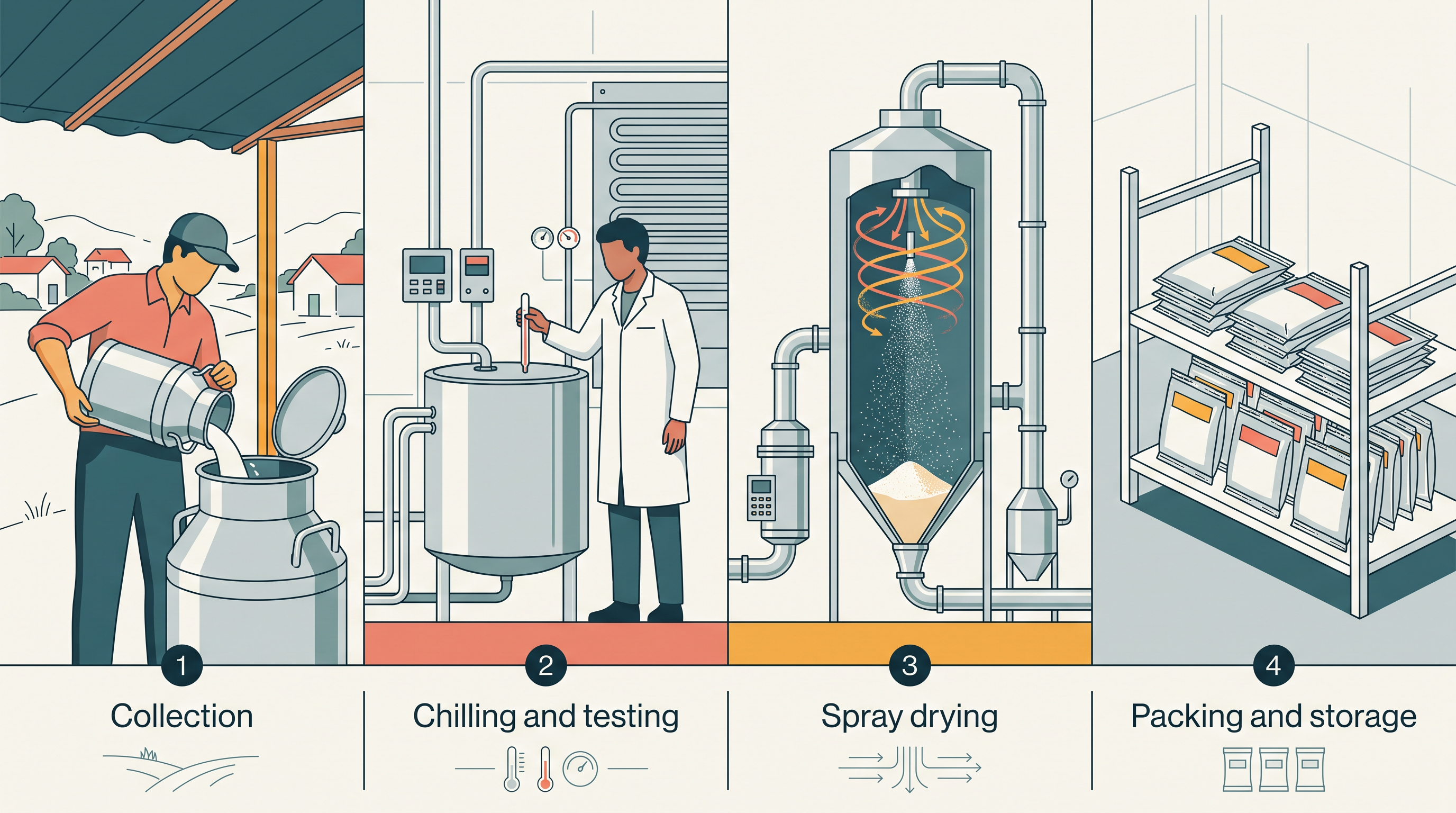
Fig. 4.0 – Processing fresh milk into milk powder.
4.1 Why Foods Are Processed
Almost nothing you ate today reached you exactly as it left the field. The wheat was cleaned and milled, the milk was chilled, the oil was pressed and filtered, the tea was withered and dried. Food processing — the deliberate treatment of a raw food to make it safer, more useful or longer-lasting — is not a modern invention. It is one of the oldest things households have done with food.
The reasons for it have changed over time, and it is worth separating the old reasons from the new ones. The old reasons came from need. The new ones come largely from what consumers now expect.
The Oldest Reasons
Grain has been dried after harvest for as long as grain has been grown. A freshly harvested grain carries enough moisture for moulds and insects to live on; drying it in the sun removes that moisture and so extends its shelf life — the length of time a food stays safe and acceptable to eat under its normal storage conditions. The farmer who dries her grain is not following a rule. She is removing the one thing spoilage organisms cannot do without.
Three purposes ran through this early processing, and all three are still valid.
- To improve digestibility — cooking, soaking and fermenting break down parts of a food that the body handles poorly in the raw state.
- To improve palatability — how pleasant a food is to eat, in taste, smell, appearance and texture. A bitter or tough raw material becomes acceptable after treatment.
- To ensure a continuous supply — a food harvested in one season is made to last into the seasons when it is not available.
India has a long tradition of doing all three at home. Fruit is cooked in heavy sugar syrup to make murabba, which keeps for months because the concentrated sugar leaves no free water for micro-organisms to use. Along the coasts, fish is salted and sun-dried for the monsoon months when boats cannot go out. Each of these is preservation reasoned out long before anyone could name the organism being defeated.
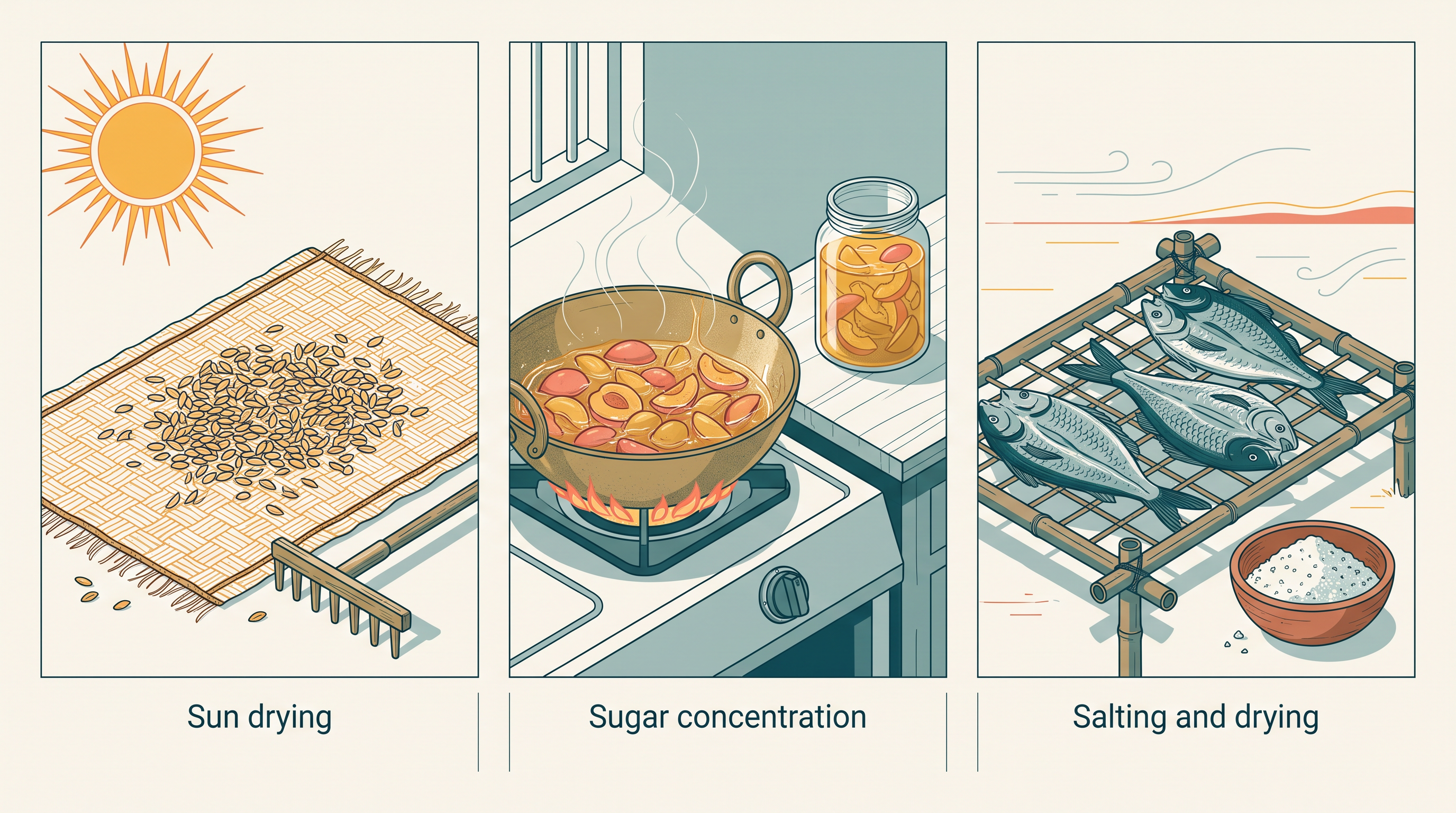
Fig. 4.1 – Traditional household food preservation.
What Consumers Ask For Today
Better transport, faster communication and a growing industry changed what households buy and therefore what they expect. Food no longer has to come from within a day’s travel, and a shopper today chooses between products rather than accepting what the season offers.
The result is a longer and more demanding list of expectations. Consumers now look for foods described as fresh and organic, for foods they believe to be safer and healthier, and for foods that still have a usable shelf life when they reach the kitchen. They also expect a product to hold its nutrients, to have a dependable taste, texture and consistency, and to be easy to package, store and carry home.
These expectations pull in different directions, which is exactly why the subject exists. A food that must last three months and taste as it did on the first day will not manage it by accident. Meeting several of these demands at once has driven scientists to develop the methods and techniques that this chapter goes on to describe.
Traditional And Industrial Processing Side By Side
All of us eat ready-made foods of some kind — instant mixes, packaged snacks, ready-to-eat curries in sealed pouches. These are manufactured using a wide variety of processes, and it would be wrong to imagine that the newer ones have replaced the older ones. For many products, simple traditional methods are still used; alongside them, newer processes and technologies turn out processed foods in bulk.
The difference between the two is not that one is correct and the other is not. Both rest on the same principles. What separates them is scale, and scale changes almost everything about how the work is done, as Table 4.1 sets out.
That last row carries the important consequence. When food is eaten by the household that made it, the maker answers for it directly. When food travels to strangers, safety and quality have to be built into the process itself and demonstrated afterwards — which is why industrial processing needs trained professionals, written standards and testing, while a household kitchen does not.
4.2 The Significance Of Food Processing Today
A subject earns its place in a school course when the country needs the work it teaches. Food processing earns its place three times over — once because India now grows more than it can consume fresh, once because staple diets leave gaps that food itself can be made to close, and once because illness and lifestyle have changed what people want on their plates.
4.2.1 India’s Growing Food Industry
For much of the twentieth century India was an agro-deficit country — it produced less food than its population needed and had to import the difference. It is now agro-surplus, producing more agricultural and horticultural produce than is consumed as it comes off the field.
A surplus is not automatically a benefit. Produce that cannot be stored, moved or converted into a stable product simply rots between the farm and the buyer. The surplus therefore created a need for storage and processing capacity, and the Indian food industry grew to meet it. It is today among the country’s major producers of processed foods, and a significant employer at every level from the collection centre to the laboratory.
Exact figures for the industry’s size, its rank among the country’s industries and its share of national income are revised every year, so no single number stays true for long. When you need one, take it from the current annual report of the Ministry of Food Processing Industries and quote the year along with it.
Three further changes have pushed the same demand upwards. Working patterns and household routines have altered the time available for cooking. People move for work and study far more than they once did, and carry their food preferences with them. Globalisation has put products from other countries on Indian shelves and Indian products on shelves abroad. Each of these widens the range of products a market expects, and a wider range demands continuous research into newer technologies.
4.2.2 Food Fortification
A diet can be adequate in quantity and still be short of something. Diets built largely on a single staple — rice in much of the east and south, wheat in much of the north — supply energy well, but are often low in particular vitamins and minerals, and a long-continued shortage produces a deficiency disorder.
There are two ways to close such a gap. One is to persuade every household to change what it eats, which is slow and depends on what people can afford and obtain. The other is to add the missing nutrient to a food that everybody already buys. The second approach is called food fortification.
Notice what makes the method work. The nutrient is added to something eaten daily, in ordinary quantities, by nearly everyone — salt, flour, rice, milk, cooking oil. Nobody has to remember to take anything, change a habit or spend more. A condiment such as salt is an especially good carrier, because the amount a person uses in a day varies far less than the amount of any other food they eat.
The Food Safety and Standards Authority of India (FSSAI) has laid down standards for the fortification of staple foods, so that a fortified product carries a known amount of the added nutrient rather than whatever the manufacturer chooses. Table 4.2 sets out the staples covered and what each carries.
A fortified product is identified by the +F logo shown in Fig. 4.2, printed alongside the FSSAI licence number. Reading that logo on a packet is a small skill worth having, because it is the only visible difference between a fortified staple and an unfortified one.
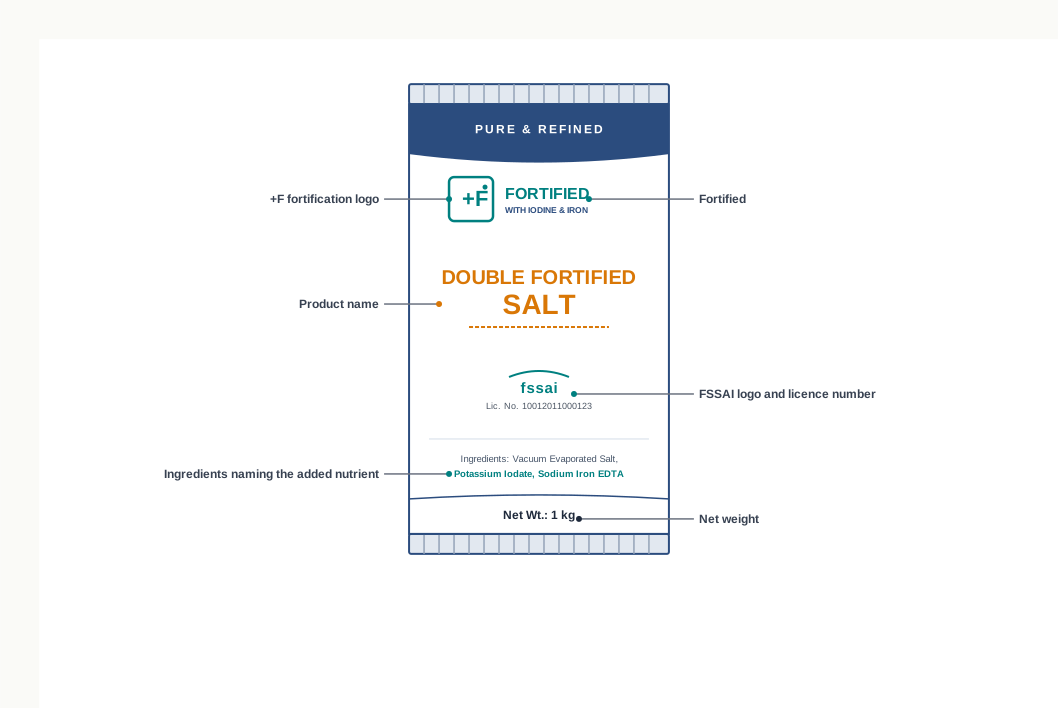
Fig. 4.2 – The fortified food logo on a pack of salt.
4.2.3 Foods Designed For Health And Wellness
Conditions such as heart disease and diabetes have become more common, and public interest in wellness has grown alongside them. Food scientists have responded by altering the composition of processed foods rather than only preserving them — the aim being to keep the eating quality of a product while changing what it contributes nutritionally.
Two examples show how this is done, and both are instructive because the difficulty in each case is texture rather than taste.
Reducing The Energy Value Of A Product
Sugar does more in a food than sweeten it, but sweetness is the part a consumer notices first. Replacing some or all of it with an artificial sweetener — a substance that gives an intense sweet taste while supplying little or no energy — lowers the Calorie content of the product. A small quantity is enough, because these substances are many times sweeter than sugar.
Fat is harder to remove. In ice cream, fat is what makes the product smooth on the tongue; take it out and the result is coarse and icy. Here the fat is replaced by specially treated proteins, which behave in the mouth much as fat globules do and give the same smooth texture, while the energy value of the product is reduced.
Meeting Changed Consumer Perceptions
What consumers believe about food has changed as much as what they know. There is a rapidly growing demand for foods free of chemicals, pesticides and preservatives, and at the same time for those very foods to have a long shelf life and to keep their natural flavour and appearance.
Put plainly, the consumer is asking for the results that preservatives were invented to deliver, without the preservatives. That is a genuine technical problem, not an unreasonable demand, and much current research — better packaging, gentler heat treatments, controlled atmospheres — is an attempt to answer it.
All of this together has raised the importance of food processing and technology as a discipline. It has also created a steady demand for people trained in it, which is the subject the later part of this chapter turns to.
4.3 Basic Concepts
Four terms are used constantly in this field, and in ordinary conversation they are treated as though they meant the same thing. They do not. Each names a different kind of work, done by different people, answering a different question about the same food.
Read them in the order given below. Each one builds on the one before it: science explains, processing converts, technology applies, manufacturing produces at scale.
4.3.1 Food Science
Food science is a distinct field that applies the basic sciences to food. It draws on chemistry and physics, on microbiology, on agronomics — the science of crop production and soil management — and on the culinary arts, because how a food behaves in a pan is as much a part of its behaviour as how it behaves in a test tube.
Its span is wide. Food science is concerned with all the technical aspects of a food, beginning with harvesting or slaughtering and ending with cooking and consumption. Fig. 4.3 sets out that span as a chain, and it is worth noticing that no stage in it is outside the food scientist’s interest.

Fig. 4.3 – The span of food science.
To work across that chain, a food scientist uses knowledge of biology, of the physical sciences and of engineering. Four things are studied in particular:
- the composition of foods — what a food is made of;
- the changes that occur at various stages, from harvest through the different processes and through storage;
- the causes of spoilage;
- the principles underlying food processing.
In short, food scientists deal with the physico-chemical aspects of food. Their work is what allows the rest of us to understand the nature and properties of a food, and so to predict how it will behave.
4.3.2 Food Processing
Food processing was introduced in Section 4.1 as the treatment of a raw food to make it safer, more useful or longer-lasting. Stated formally, it is the set of methods and techniques used to transform raw ingredients into finished and semi-finished products.
The phrase ‘semi-finished’ matters. Not every processed product is ready to eat. Wheat flour, refined oil and tomato paste are all processed products that a household or another factory will process further before the food reaches a plate.
Processing begins with the raw material, and this is where it can most easily fail. Good quality raw material from a plant or animal source is a requirement, not a preference, because no process improves what it is given — it can only convert it. What the conversion aims at is a product that is attractive, marketable and, very often, long in shelf life.
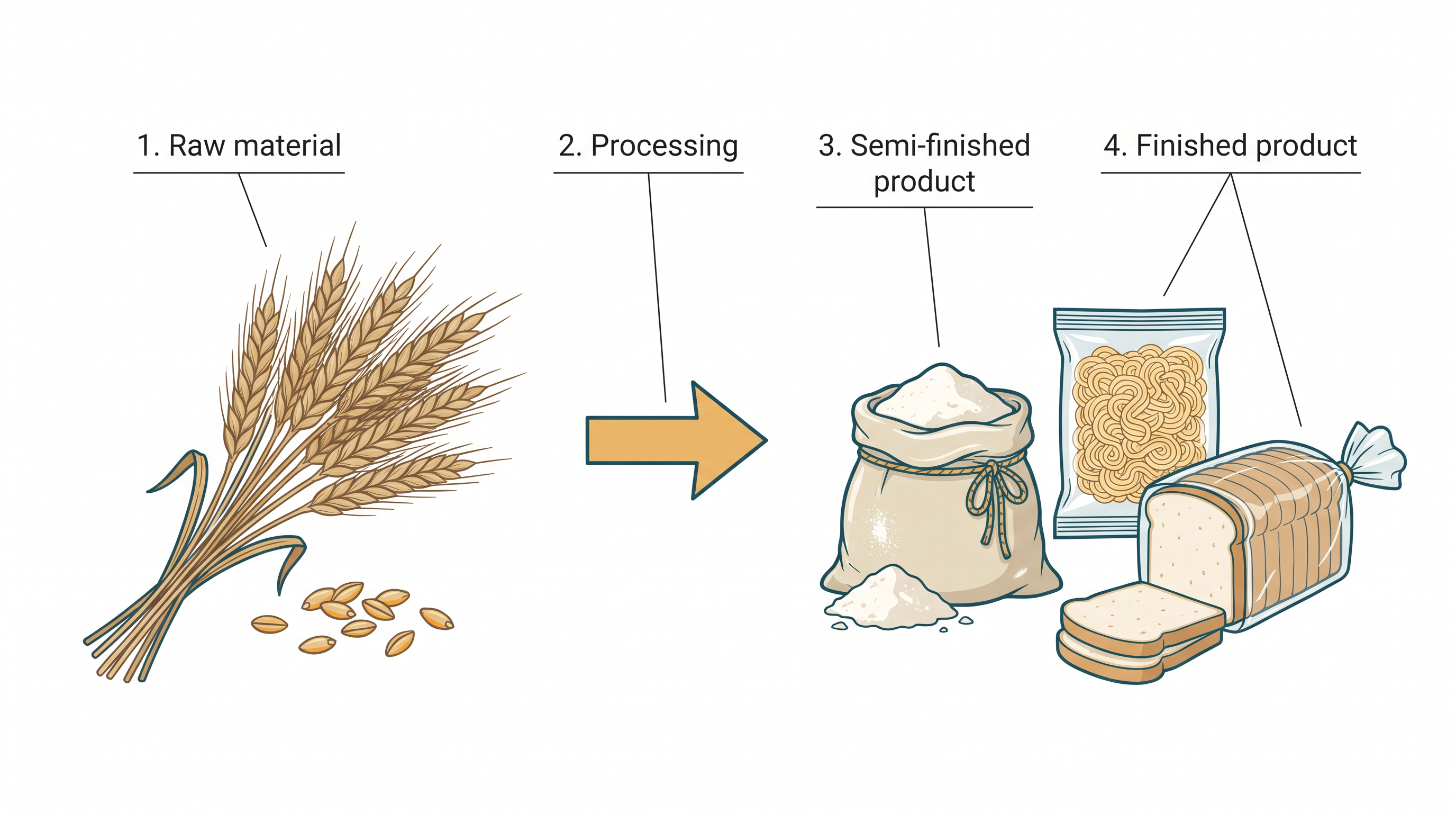
Fig. 4.4 – A raw material and its processed products.
4.3.3 Food Technology
Technology, in general, is the science and application of scientific as well as socio-economic knowledge and legal rules for production. That definition has three parts, and a student who reads past them will miss what separates technology from science. A technologist must know the science; must also know what a market will pay for, buy and accept; and must work within the law that governs the product.
Food technology applies this to food. It uses and exploits the knowledge of food science and of food engineering — the branch that designs the machinery and the plant in which processes are actually carried out — to produce varied foods.
Studying food technology gives an in-depth knowledge of science and technology, and develops practical skills across a long list of operations: selection, storage, preservation, processing, packaging and distribution. The foods that result are expected to be safe, nutritious and wholesome, desirable to eat, and at the same time affordable and convenient.
Sustainability As Part Of The Work
There is a further aspect of food technology that has become significant, and it is not about the product at all. It is about waste. A great deal of what is grown is lost between the field and the plate — to spoilage, to poor storage, to processes that discard usable material.
Food technology therefore also works to promote sustainability: to avoid waste, to save and utilise all the food that is produced, and to ensure that processing practices are themselves safe and sustainable. A technologist who turns fruit peel into pectin, or spent grain into animal feed, is doing food technology as much as one who develops a new beverage.
4.3.4 Food Manufacturing
Food manufacturing is the mass production of food products, using the principles of food technology, to meet the diverse needs of a growing population. It is the point at which the work leaves the laboratory and the pilot kitchen and goes onto a production line.
Two words in that description carry the weight. ‘Mass’ means quantities that no household method can reach, which is why manufacturing depends on machinery, measurement and written specifications. ‘Diverse’ means that a growing population does not want more of one product but a wider range of them — which is why a manufacturer runs many products rather than one.
Food manufacturing is among the largest manufacturing industries of the present time, and it is the sector that employs the greatest number of the professionals this chapter goes on to describe.
Table 4.3 places the four terms side by side. If you can tell them apart on the first two rows, you can tell them apart anywhere.
4.4 The Development Of Food Processing And Technology
Research in food technology is not new; it has been going on for well over two centuries. Two nineteenth-century developments in particular turned preservation from a set of inherited household habits into a subject that could be studied, explained and improved. Fig. 4.5 places them, and what followed, in order.
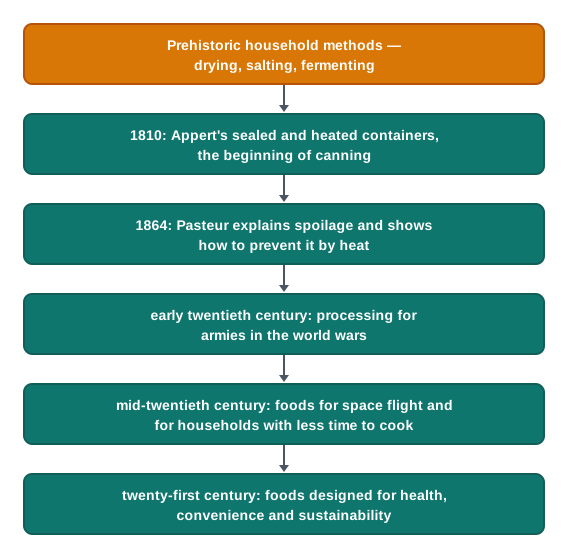
Fig. 4.5 – Milestones in the development of food technology.
4.4.1 From Canning To Pasteurisation
In 1810, Nicolas Appert worked out a method of preserving food in sealed containers that were then heated. This was a decisive event, and the development of canning — sealing food in an airtight container and heating it so that the contents keep without refrigeration — had a major impact on every food preservation technique that came after it.
What is remarkable about Appert’s work is that it succeeded without an explanation. Nobody at the time knew that micro-organisms existed in food, or that they were what heating destroyed and sealing kept out. Appert had a procedure that worked and no principle to account for it.
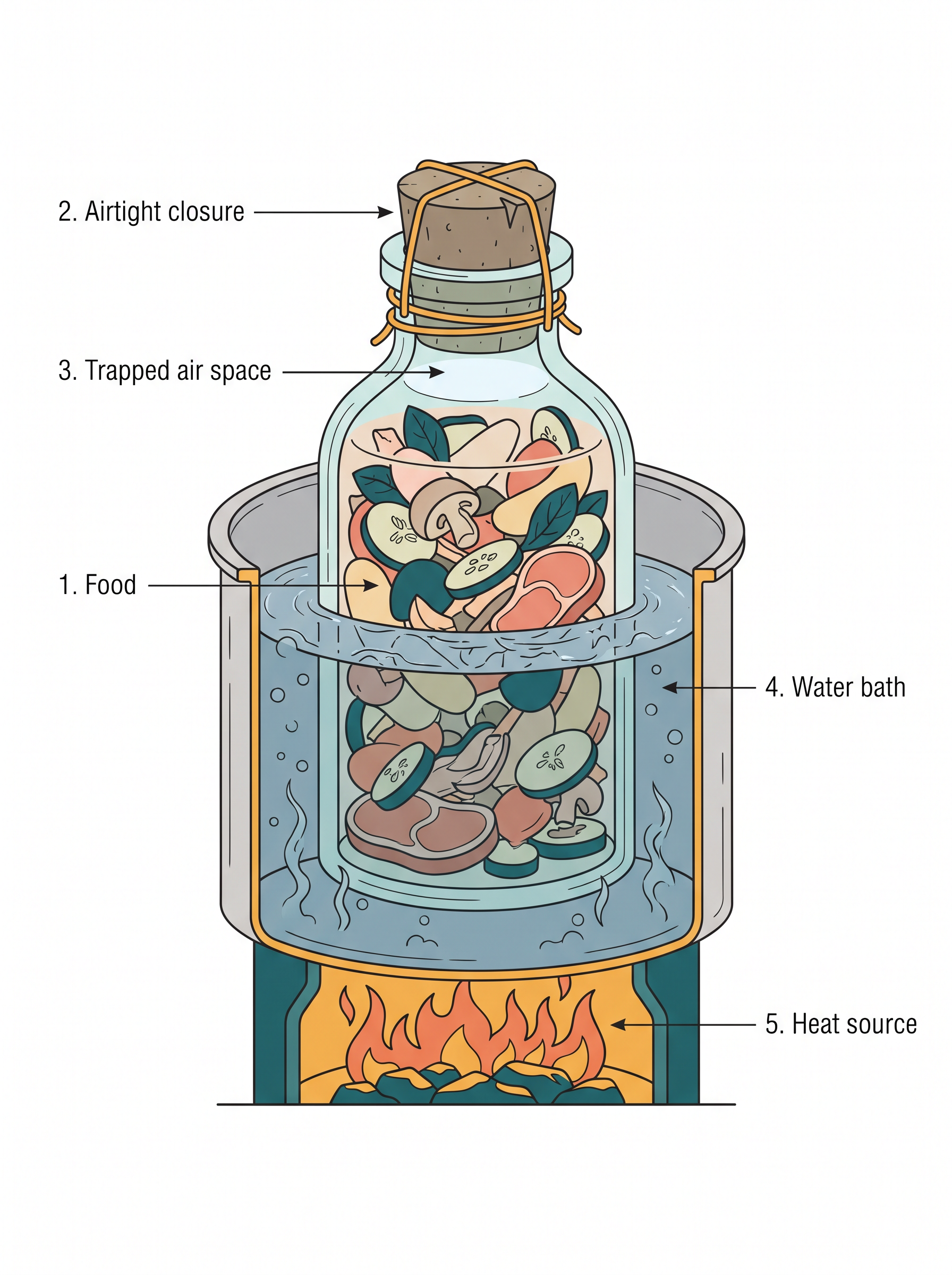
Fig. 4.6 – Appert’s method of preserving food in sealed containers.
The explanation arrived half a century later. In 1864, Louis Pasteur studied the spoilage of wine and described how it could be avoided. This was an early attempt to put food technology on a scientific basis, because for the first time a preservation practice was tied to the living organisms it acted against.
Pasteur’s investigations went well beyond wine. He worked on the production of alcohol, vinegar, wines and beer, and on the souring of milk — all of them changes brought about by micro-organisms, some wanted and some not. Out of this work came pasteurisation, a controlled heat treatment that destroys disease-producing organisms in a liquid food without cooking it or spoiling its flavour.
The method Pasteur developed for wine and beer was later applied to milk, and it is with milk that his name is now most closely associated. The treatment is deliberately gentle: milk is held at about 63 °C for 30 minutes, or at about 72 °C for 15 seconds, and then cooled quickly. Boiling would also make the milk safe, but it would change its taste and damage some of its nutrients, which is exactly what the process is designed to avoid.
Pasteurisation was a significant advance in ensuring the microbiological safety of food. It is also the clearest early illustration of this chapter’s central idea — that once you know what causes a change, you can treat the cause exactly, and no more than exactly.
4.4.2 From Military Rations To The Modern Consumer
Food technology was first put to serious use to serve military needs. An army has to be fed far from where food is grown, at a time it cannot choose, from supplies that may have travelled for months — which is a preservation problem before it is anything else.
Through the twentieth century three pressures pushed the field forward together: the world wars, the exploration of space, and a rising consumer demand for varied products. Space flight in particular demanded foods that were light, compact, stable without refrigeration and safe beyond any doubt, and the solutions found there passed into ordinary use.
Convenience Enters The Household
Products such as instant soup mixes and ready-to-cook items, including complete meals, were developed in this period. They answered a change in how households ran: in more and more families, the people who cooked were also going out to work, and the time available for preparing a meal had shrunk.
The food industry was then compelled to attend to nutritional concerns as well. A convenient food that displaced a nutritionally sound one was a poor bargain, and manufacturers had to answer for what their products contributed to the diet, not only for how quickly they could be served.
Wider Tastes And A Longer Season
Food preferences and choices changed alongside. People began taking into their everyday diet food items and preparations from other regions of India and from other countries — a shift you can see in any city market. At the same time, the desire to have seasonal foods available all the year round increased sharply.
Both demands are technological before they are anything else. A dish from another region has to be made from what is available here; a fruit eaten out of season has to have been preserved, stored or transported from somewhere it is in season. Food technologists worked on new techniques to supply both, while keeping the food safer and fresher than the older methods could manage.
In the twenty-first century, the challenge has shifted again — to producing foods suited to health and to the other changing needs of consumers, which is where Section 4.2 found the subject standing today. The cumulative result is a vast variety of safe and convenient foods available to ordinary households.
The gain is largest where the need is greatest. In developing countries, this rapidly expanding field has helped improve food security — the assurance that people have physical and economic access to enough safe and nutritious food at all times — by reducing what is lost after harvest and making supply steadier through the year. It has also opened avenues for employment at every level, from the collection centre to the laboratory, which is the subject of the rest of this chapter.
4.5 The Need For Food Processing And Preservation
Food processing has already been described as a branch of manufacturing, in which raw materials are transformed into intermediate foodstuffs or edible products by applying scientific knowledge and technology. This section asks the question behind all of it: why must food be processed and preserved at all? The answer has two halves — what processing gives a food, and what would happen to the food if it were left alone.
4.5.1 What Processing Adds To A Food
Raw food materials, as they come from the field or the animal, are often bulky, perishable and sometimes inedible in that state. Various processes convert them into materials that are more useful, more concentrated, shelf-stable and palatable — solid foods, or potable beverages that can be drunk as they are.
The changes made also reduce the work waiting at the other end. A food that arrives cleaned, cut, milled or part-cooked cuts the preparation time for whoever is cooking, and that saving is one of the reasons processed foods have spread so widely through ordinary kitchens.
Most of the time, then, processing adds value to the product. Four kinds of value are worth naming separately, because a given process usually delivers more than one:
- storability — the product keeps longer than the raw material it was made from;
- portability — it is lighter, more compact or better contained, so it can travel;
- palatability — it is more pleasant to eat than the raw material;
- convenience — it needs less time, skill or equipment before it can be served.
This is why professionals in food processing have to be broadly informed. Their work requires knowledge of the general characteristics of raw food materials, the principles of food preservation, and the processing factors that influence quality. It also requires an understanding of packaging, of water and waste management, of good manufacturing processes and of sanitation procedures — because a product is only as safe as the plant it was made in.
4.5.2 How Foods Deteriorate
Every food is subject to deterioration, and deterioration takes three forms: physical, chemical and biological. Whichever form it takes, it shows itself in familiar ways — spoilage, the development of off-flavours, the deterioration of texture, discoloration and the loss of nutritional value. To varying degrees these reduce a food’s appeal, and at some point they render it unfit or unsafe to eat.
It is useful to separate the two consequences. A food that has lost its appeal may still be safe; a food that is unsafe may still look and smell acceptable. Neither judgement can be made reliably by appearance alone.
A number of factors set these changes going, and Fig. 4.7 gathers them around a single food.
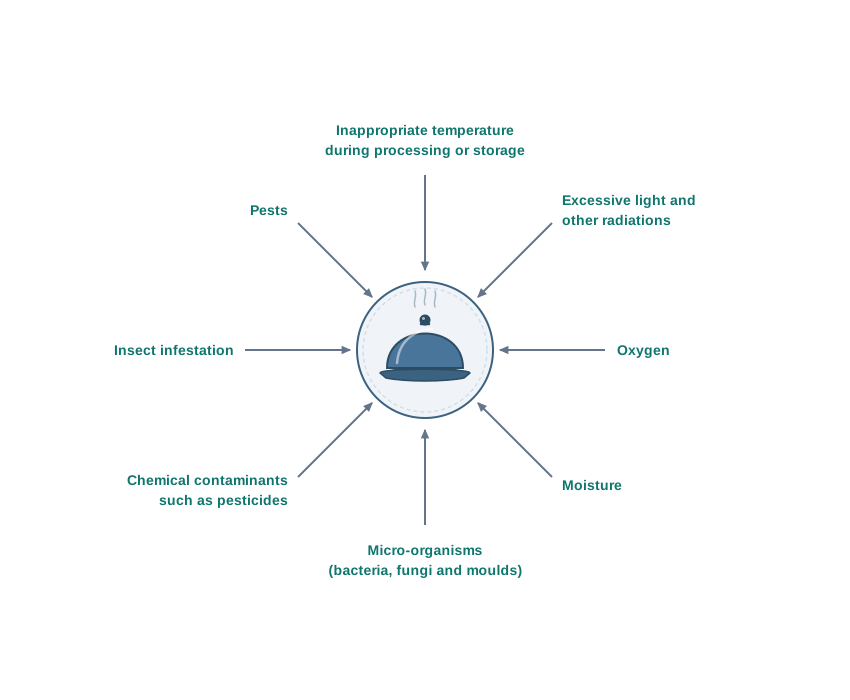
Fig. 4.7 – Factors causing food deterioration.
Two further causes act from within the food rather than upon it. The first is enzyme action. An enzyme is a specific class of protein molecule that acts as a biological catalyst — that is, it speeds up a chemical reaction without being used up in it. Enzymes naturally present in a food continue working after the food has been harvested, and their action degrades it.
The second is the set of physical and chemical changes that begin in the constituents of a food from plant and animal sources very soon after harvesting or slaughtering. These begin at once, without any organism being involved, and they alter the quality of the food from the first hour. Table 4.4 separates the three kinds of deterioration.
4.5.3 Classes Of Foods Based On Perishability
Not every food deteriorates at the same rate, and foods are grouped by how quickly they do. The grouping is practical rather than theoretical: it tells a household or a manager how soon a food must be used, and therefore how it must be stored and how often it must be bought. Table 4.5 gives the three classes.
Read the third row across and the whole classification becomes reasoning rather than a list to be learnt. What decides the class is not the kind of food but the conditions inside it — chiefly how much water is freely available to micro-organisms.
4.5.4 Older Methods Of Preservation
Because food deteriorates, it has to be preserved in an edible and safe form, and the methods for doing so are very old — they date back to prehistoric times, long before anything was known about the organisms they defeat.
The oldest methods are these:
- sun drying — the moisture is removed, so nothing can grow;
- controlled fermentation — a wanted organism is encouraged, which acidifies the food and crowds out the unwanted ones;
- salting and pickling — salt draws water out of the food and out of any microbial cell in it;
- candying — heavy sugar syrup ties up the free water in the same way salt does;
- roasting — dry heat destroys organisms and drives off moisture;
- smoking — heat and the chemicals in the smoke together preserve the surface;
- baking — heat destroys organisms and lowers the moisture of the finished product;
- using spices as preservatives — several spices contain substances that slow microbial growth.
Read down that list and you will see only three ideas at work: take the water away, make the surroundings hostile by adding salt, sugar, acid or spice, or apply heat. Every later method is a more controlled version of one of these.
These tried and tested techniques are still in use in households across the country. With the coming of the industrial revolution, new methods were developed alongside them — not to replace the old principles but to apply them at scale and with measurement.
Food processing, as a discipline, incorporates and unifies two things: the general characteristics of the different classes of foods, and the principles of several sciences at once — food science, chemistry, food microbiology, nutrition, sensory analysis and statistics — including good manufacturing practices as required by regulation.
4.5.5 What Micro-Organisms And Enzymes Need To Act
Many food processing operations exist for one purpose: to extend the shelf life of the product. The concepts behind them are equally simple to state — reduce or eliminate microbial activity, and control the other factors that influence spoilage.
The principal micro-organisms that cause food spoilage are bacteria, fungi, yeasts and moulds. You met their growth in biology: under congenial conditions they multiply very rapidly, which is why a food can be sound in the morning and spoilt by evening.
Congenial conditions can be named exactly. The factors influencing microbial growth are:
- nutrient availability — the organisms feed on the food itself;
- moisture — water that is freely available to them;
- pH — most spoilage organisms do poorly in acid surroundings;
- oxygen levels — some organisms need oxygen, others are held back by it;
- the presence or absence of inhibiting substances, such as antibiotics.
Enzymes have their own requirements. The activity of the enzymes inherently present in a food depends on pH and on temperature, which is why the same two controls work against enzymes and organisms alike. Oxidative enzymes in fresh fruits and vegetables go on using oxygen to metabolise after the fruit has been picked, and this continued activity is a direct cause of their short shelf life.
Temperature deserves a separate look, because it is the control a household actually has. Bacteria grow at any temperature between 5 °C and 60 °C, a range known as the danger zone, shown in Fig. 4.8. Foods rich in protein — meat, fish, poultry, eggs and dairy products — are the ones bacteria prefer, and are therefore called high risk foods.
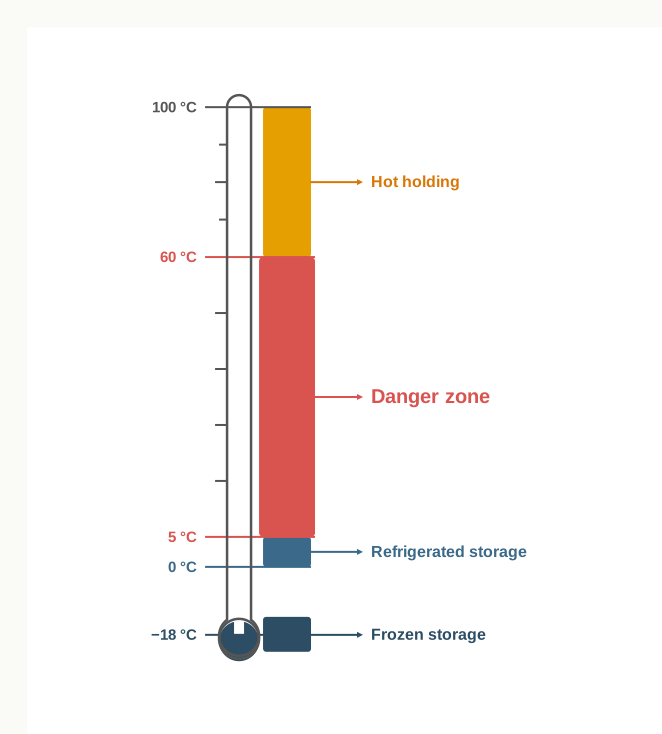
Fig. 4.8 – The temperature danger zone.
4.5.6 The Basic Concepts Behind Processing Methods
Once the requirements of micro-organisms and enzymes are known, the methods of processing follow from them directly. Take away any one requirement and growth stops. The basic concepts used in food processing methods to prevent food spoilage are five:
- application of heat;
- removal of water moisture;
- lowering of temperature during storage;
- reduction of pH;
- controlling the availability of oxygen.
Table 4.6 pairs each concept with the requirement it removes. Read it alongside the list of growth factors above, and you will find that the five concepts are simply that list turned around.
Notice that none of these five is a trick or a recipe. Each is a principle, and a student who holds the principle can work out for herself why a method she has never met before does what it does — which is the whole purpose of learning them in this order.
4.6 Classification Of Processed Foods
Processed foods are classified on the basis of the extent and the type of processing they have undergone. There are seven classes, and they are best read as a sequence: the raw material is interfered with a little in the first class, a great deal by the fifth, and the last two are grouped by what the food is for rather than by how much was done to it.
Fig. 4.9 sets the classes out as a scale, which is a useful picture to carry through the rest of this section.
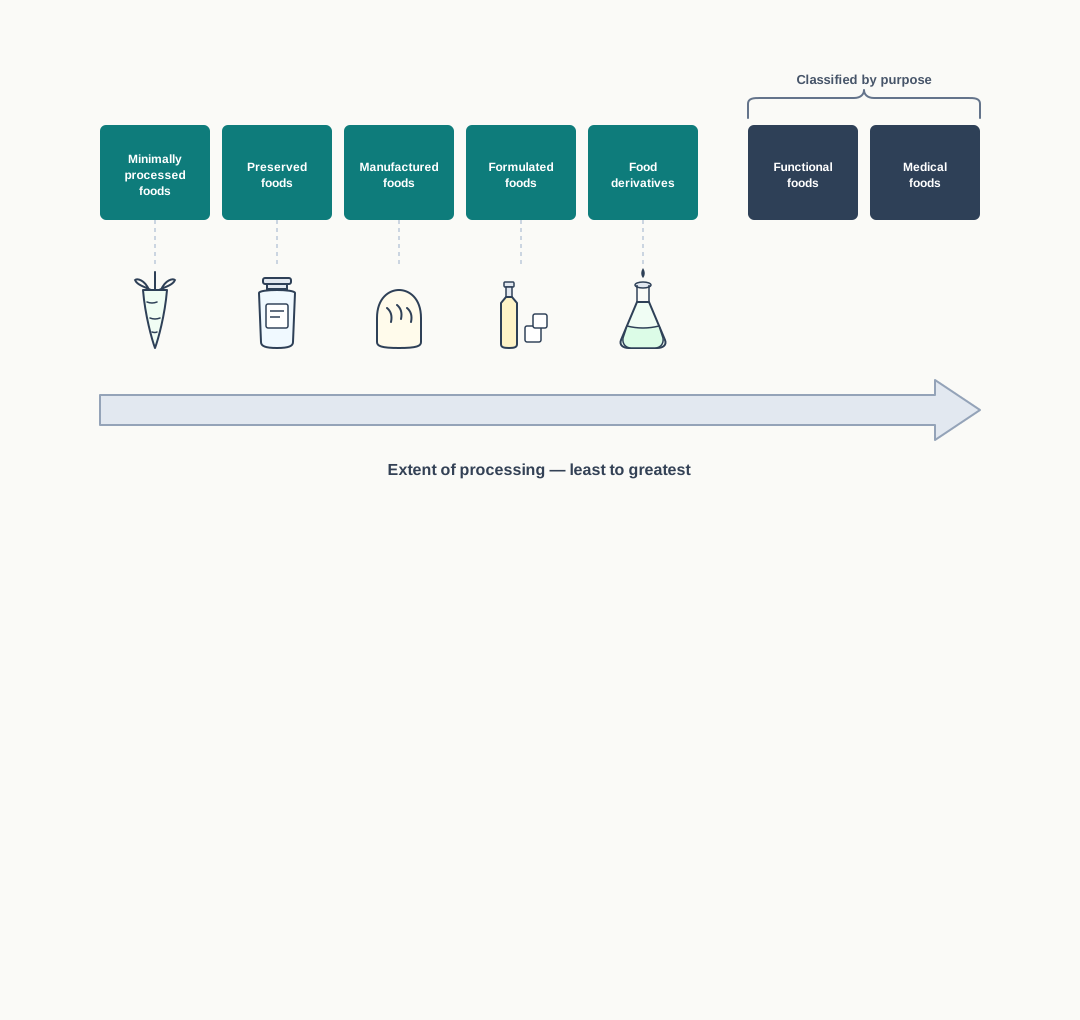
Fig. 4.9 – Processed foods arranged by extent of processing.
Classes That Keep The Food’s Character
Minimally processed foods are processed as little as possible, so that the quality of the fresh food is retained. The operations used are mechanical rather than chemical or thermal — cleaning, trimming, shelling, cutting and slicing — followed by storage at low, that is, refrigeration temperatures.
Nothing here is intended to change the food. Every step is intended to make it more usable while leaving it as close to fresh as it can be kept, which is also why such products have a short life and must stay cold throughout.
Preserved foods go one step further. Methods of preservation are applied, but they are chosen so that they do not change the character of the product substantially: a frozen pea is still recognisably a pea. Frozen peas and frozen vegetables, dehydrated peas and dehydrated vegetables, and canned fruits and vegetables all belong here.
Classes That Change It
Manufactured foods are the first class in which the original characteristics of the raw product are lost. Some basic method of preservation is applied, and various ingredients are added along with it — salt, sugar, oil, or even chemical preservatives. Pickles, jams, marmalades, squashes, papads and wadis are examples.
Look at what is being done and the loss of character stops being a defect. A mango that has become a pickle cannot be turned back into a mango, but it can now be kept for a year, carried anywhere and eaten in any season — which was the point of making it.
Formulated foods are not made from a single raw material at all. They are prepared by mixing and processing individual ingredients so as to give a relatively shelf-stable product. Bread, biscuits, ice cream, cakes and kulfi are formulated foods.
The distinguishing feature is the recipe. A formulated food exists only as the combination its formula specifies, and changing the proportions changes the product, which is why this class depends so heavily on accurate measurement and on recipe development.
Food derivatives are components taken out of a food rather than products made from the whole of it. In industry, a component is obtained from the raw product by purification — sugar from sugarcane, or oil from oilseeds are the standard examples.
A derivative may then be processed further into something with different properties. Oil, for instance, is converted into vanaspati by a process called hydrogenation, in which hydrogen is added to the liquid oil so that it becomes a semi-solid fat.
Classes Defined By Purpose
The last two classes break the pattern. They are not named for how much processing was done, but for what the food is expected to do for the person eating it.
Functional foods are foods that can have a beneficial effect on human health beyond the nutrients they supply. Probiotics are the usual example: foods carrying live micro-organisms that are helpful to the digestive system.
Medical foods are used in the dietary management of a disease or condition, and are eaten on medical advice rather than by preference. Low sodium salt, and lactose-free milk for persons with lactose intolerance, are examples: in each case an ordinary food has been altered so that a person who cannot handle one of its constituents can still eat it.
Table 4.7 brings the seven classes together.
4.7 The Knowledge And Skills A Food Technologist Needs
Professionals involved in food processing and technology need a wide range of knowledge and skills, and the range makes more sense when it is sorted by the stage of work it belongs to. Food production is categorised into three stages, and each stage asks for its own kind of competence:
- food as a material;
- food product development;
- recipe development.
Nobody is expected to be equally strong in all three. A person usually works chiefly in one and needs a working acquaintance with the other two, which is a useful thing to know when you are choosing what to specialise in.
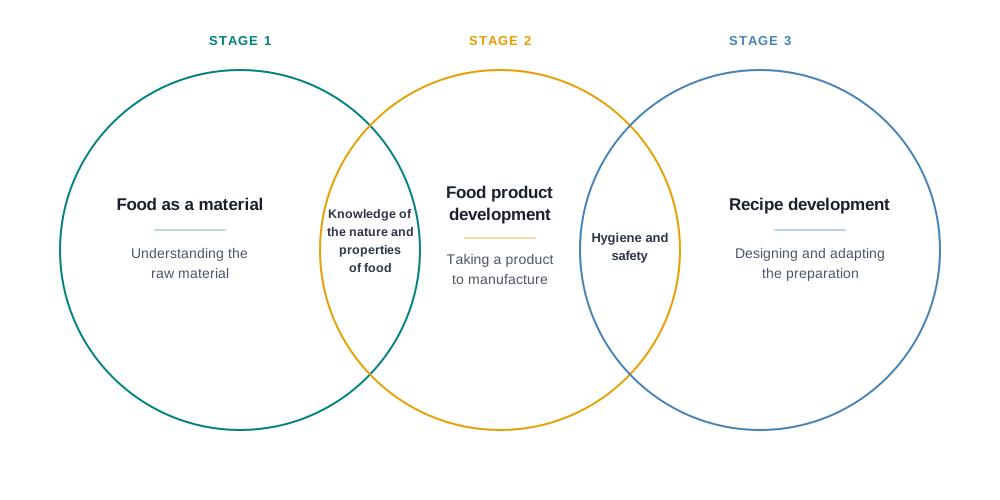
Fig. 4.10 – The three stages of food production.
4.7.1 Food As A Material
This stage is about the raw material itself, before any decision is taken about what to make from it. The work is largely one of assessment: what is available, what it is like, what it will cost, and what may already have gone wrong with it.
The knowledge and skills needed here are:
- seasonal availability of foodstuffs;
- the nature and properties of food;
- nutritional content and its analysis;
- the cost of the foodstuff;
- the influence of chemical pesticides, time, moisture, temperature and additives;
- assessment of the quality of raw foods and ingredients, for quality production of food;
- food hygiene and food safety;
- knowledge of information technology for contemporary food production.
Two of these deserve a note. Seasonal availability governs both cost and quality — a fruit bought in its season is cheaper and better, and a processing unit plans its year around this. And the influence of time, moisture and temperature is exactly the deterioration you studied in Section 4.5, met here as a purchasing problem rather than a storage one.
4.7.2 Food Product Development
This stage takes an idea and turns it into something a factory can make repeatedly and a shop can sell lawfully. The work moves from the kitchen bench towards the production line, and the questions change accordingly.
The knowledge and skills needed here are:
- knowledge of food preparation and cooking skills for large scale food production;
- knowledge of product specifications, and testing against them;
- observing and measuring quality control as per specifications;
- assessment by sensory methods, that is, by testing and tasting the foods produced;
- industrial practices and manufacturing systems, and their control;
- labelling and packaging of the marketable product;
- Hazard Analysis and Critical Control Point (HACCP).
Three of these terms are worth defining as they are met. A product specification is the written description of what the product must be — its composition, weight, colour, texture, moisture, shelf life and packaging — against which every batch is checked. Sensory evaluation is the assessment of a food by trained tasters using sight, smell, taste, touch and hearing, under controlled conditions, so that a judgement about quality is more than one person’s opinion.
HACCP is a system for keeping food safe during production. Every step of a process is examined for the hazards it could introduce; the steps at which a hazard must be controlled are identified as critical control points; and at each of those points a limit is set, monitored and recorded. The value of the system is that it prevents problems in the process rather than detecting them in the finished product, by which time the batch is already made.
4.7.3 Recipe Development
Recipe development is the craft end of the subject. Someone has to decide what actually goes into the product, in what proportions and by what method, and then adapt that preparation until it works at the scale intended and pleases the people who will buy it.
The knowledge and skills needed here are:
- expertise in cooking;
- knowledge of the nature and properties of food;
- the uses of ingredients, and measuring and weighing them accurately;
- designing, analysing and adapting a basic recipe;
- food handling skills;
- food production following hygiene and safety norms;
- handling tools and equipment accurately;
- innovations in product design and preparation, according to consumer perceptions;
- use of information technology for contemporary production.
Accuracy of measurement is what separates this work from home cooking. At home, a little more or less of an ingredient produces a slightly different dish; in production, it produces a batch that fails its specification, and the entire quantity may have to be discarded.
Table 4.8 compares the three stages, which is the quickest way to see why they call for different people.
One requirement runs through all three columns and should not be passed over. Food hygiene and safety appear in the first stage, in the seventh item of the second, and in the sixth of the third. In this industry, safety is not a specialisation. It is a condition of the work, whatever part of it a person does.
4.8 Preparing For A Career
A student who has followed the chapter so far knows what the work is. This section turns to how a person enters it — what the industry actually does, what it expects a professional to know, and what has to be studied after Class XII.
4.8.1 The Work Of The Food Industry
The food industry is not a single occupation. It carries out several distinct kinds of work at once:
- processing and manufacture;
- research and development — modifying existing food products, developing new ones, researching consumer markets and developing new technologies;
- ensuring food safety and monitoring food quality;
- improving quality control procedures;
- costing, so that production is profitable;
- regulatory affairs — meeting the legal requirements that govern food.
Within this, professionals commonly specialise in one branch of food technology. The usual branches are beverages, dairy products, meat and poultry, sea food, fats and oils, stabilisers, preservatives and colours, food grains, and additives. Specialising matters because the raw materials behave differently: a person who understands the microbiology of a dairy plant is not automatically equipped for a grain mill.
A professional working in this area requires knowledge and skills about:
- food science, food chemistry, microbiology, food processing, safety and quality assurance, good manufacturing practices, and nutrition;
- analysis of raw and cooked or manufactured foods for composition, quality and safety;
- food ingredients, and their uses in food preparations and in large scale food production;
- product specifications and food product development;
- sensory evaluation and acceptability;
- industrial practices, systems control, distribution channels and consumer purchase patterns;
- food packaging and labelling;
- the ability to use information technology to support product design;
- skills in food preparation and cooking;
- the ability to design, analyse, follow a design brief and adapt recipes.
Two items on that list are easy to overlook and are worth pausing on. Distribution channels and consumer purchase patterns are business knowledge, not laboratory knowledge — a technically excellent product that reaches the wrong shelf at the wrong price still fails. A design brief is the written statement of what a client or a company wants a new product to be, and working to one means solving somebody else’s problem rather than one’s own.
4.8.2 Educational Routes And Qualifications
After successfully completing 10+2 or an equivalent examination, more than one route is open, and they differ in length and in what they lead to. Fig. 4.11 sets them out.
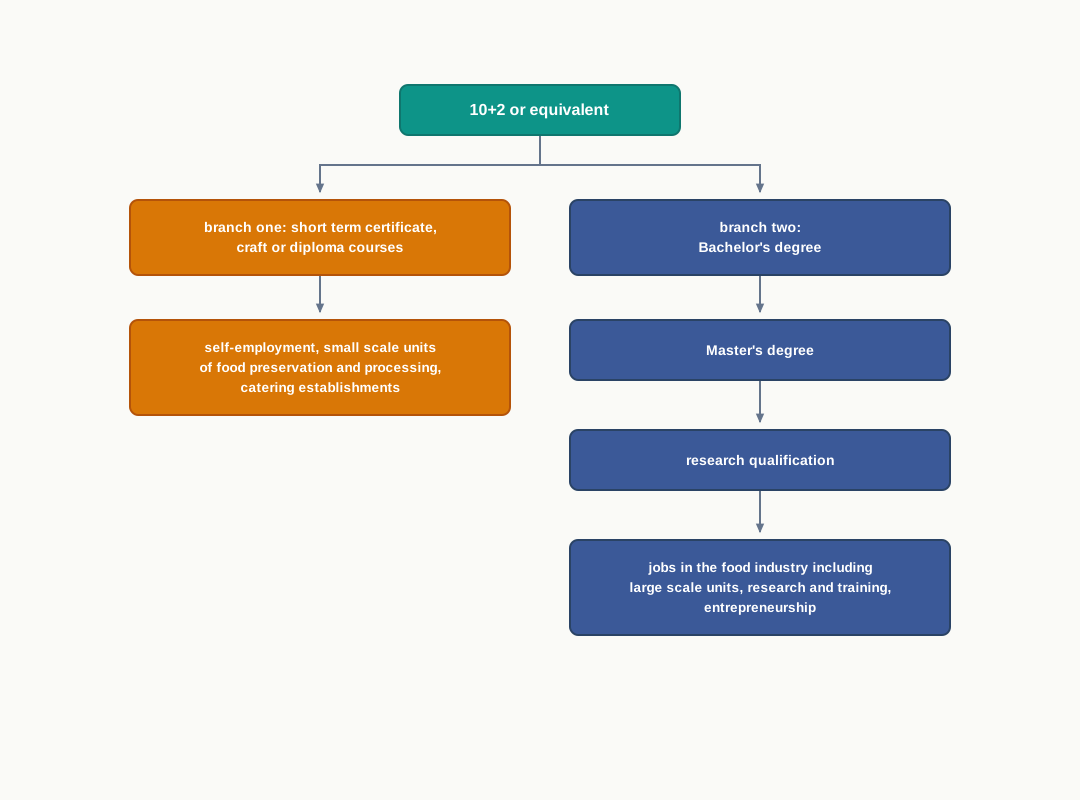
Fig. 4.11 – Routes into food processing and technology after Class XII.
Short term certificate, craft and diploma courses are offered by institutes and colleges in different states, and also at the Central Food Technological Research Institute (CFTRI) at Mysuru. These courses suit a student who wants to begin working or earning early. They are a good preparation for self-employment, for placement in small scale units of food preservation and processing, and for catering establishments.
Bachelor’s and Master’s degrees, and research qualifications beyond them, give the most comprehensive grounding. They are what large scale units in the food industry look for, and they are also the route into research and training and into entrepreneurship on a larger scale. Many universities in India and abroad offer graduate and post graduate degrees in food technology.
There are also institutes offering post graduate courses in specialised aspects of food processing and technology. The National Institute of Food Technology, Entrepreneurship and Management (NIFTEM) is one such; it functions at Kundli in Sonipat district, Haryana, and at Thanjavur in Tamil Nadu.
Neither column is the better one in the abstract. The right choice depends on what a student wants to be doing five years from now, and a person who begins with a diploma and works for a while is not shut out of a degree later.
4.9 Scope And Career Avenues
The demand for processed, packed and convenient food with a prolonged shelf life has to be met by people, not only by machinery. It therefore requires well-trained human resource across the food industry, and this is what makes the future of professions and careers in food technology and food processing an encouraging, challenging and rewarding one.
The field applies science and technology to the processing, utilisation, preservation, packaging and distribution of food and food products. Because that is a long chain, it encompasses a diverse range of specialisations — which is the most useful thing about it for a student who does not yet know exactly what she wants to do.
4.9.1 Where Food Technologists Work
The work of food technologists is carried on in a wide range of establishments:
- food industries and quality control departments;
- hotels and hospitals;
- labelling and packaging industries;
- breweries and distilleries, and soft drink industries;
- dairy and confectionery units;
- fish and meat processing, and fruit and vegetable processing units;
- processing of grains, cereals and millets, and rice and flour mills.
Hospitals may look out of place on that list. They are not: a hospital kitchen prepares therapeutic diets for people who are ill, under conditions where a lapse in food safety carries far more risk than it would elsewhere.
Within any of these establishments, the expertise is useful in several departments — purchase and storage, processing and manufacture, quality monitoring and management, safety assessment, and research and development. Besides employment in an establishment, entrepreneurship is a highly rewarding avenue, and it is dealt with separately below.
4.9.2 Avenues For Employment
The posts open to a trained person are more varied than the phrase ‘work in a food factory’ suggests. The recognised career avenues are these, with a word on what each involves:
- production managers — running the production line and its people, output and schedules;
- project implementation — setting up a new unit or line and bringing it into working order;
- marketing and sales personnel — placing the product with distributors and retailers;
- sensory evaluation — conducting and interpreting the panel testing of products;
- quality assurance — building and running the systems that keep quality and safety within specification;
- research and development, and product development — creating and improving products and processes;
- project financing — arranging and structuring the money a food project needs;
- project appraisal — examining a proposed project and judging whether it is technically and commercially sound;
- teaching and research — in colleges, universities and research institutes;
- entrepreneurship development — training and supporting others who are starting food enterprises;
- consultancy — advising units that do not employ a specialist of their own;
- technical marketing of products — selling ingredients, machinery or processes to buyers who need the technical case explained.
Notice how many of these are not laboratory posts. Financing, appraisal, marketing and consultancy all need a person who understands food technology and can talk about money, risk or customers as well — which is a rarer combination than either skill alone.
Globalisation has widened this further. Indian shores have opened to foreign investment and technologies, and many foreign and multinational companies are setting up production, research and development, educational and outsourcing facilities in the country. There is therefore ample scope for food technologists and food scientists in Indian as well as foreign organisations. The food processing industry also offers a good opportunity for the export of products.
4.9.3 Self-Employment And Entrepreneurship
Food processing in India has always been practised as a household or cottage scale activity. Long before formal training in food processing operations existed, sweets, papads, murabbas, pickles, fried snacks, and roasted and puffed cereals were being prepared and marketed for local consumption. The tradition of the small food enterprise is older than the industry.
Several things have made that route easier than it was. Growth in agriculture, horticulture and pisciculture — the rearing of fish — has improved the supply of raw material. The Government offers incentives and support to entrepreneurs setting up their own enterprise, by way of finance, training, infrastructure and marketing facilities. Financial support is available from many banks, with particular encouragement for women entrepreneurs, and State Governments contribute by providing space to those who apply for it.
A self-employment venture in food technology can be pitched at very different levels. It may be highly technology-oriented and investment-intensive, needing plant, capital and trained staff. Or it may be a low technology, low investment unit — salted peanuts, drinking water pouches, dehydrated products or pickles are the familiar examples.
Read that case again and you will see the chapter’s principles doing the work. The choice of equipment came from knowing which spoilage factor threatened the product; the choice of scale came from costing and from the market; and the label came from the law. None of it came from a rule about how to start a business.
4.9.4 The Indian Food Industry Today
The Indian food industry is among the country’s largest, whether it is measured by output, by its share of exports or by the number of people it employs. Exports have been rising, and rising exports directly enlarge employment avenues, because a product made for a distant market needs more processing, more packaging and more testing than one sold down the road.
Figures for the industry’s size, its rank, its share of national income and its rate of growth are estimates, and they are revised every year. Any figure you quote must therefore carry its source and its year with it; the annual report of the Ministry of Food Processing Industries is the place to look for the current one.
What changes far more slowly is the shape of the industry — which segments it consists of. Fig. 4.12 sets these out.
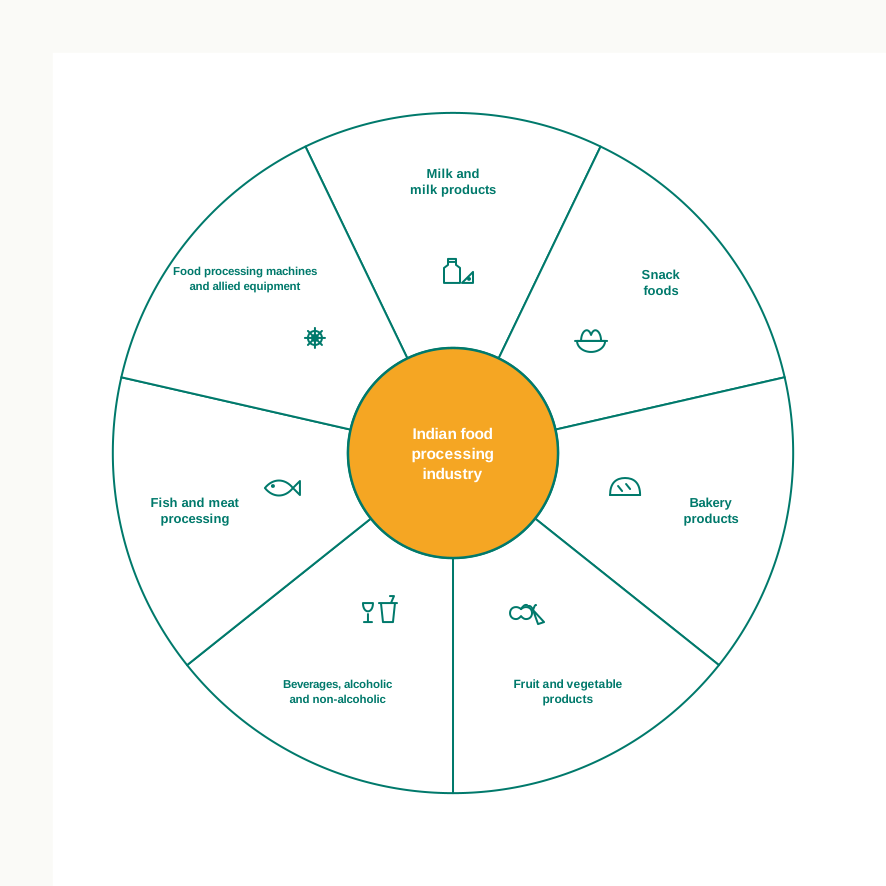
Fig. 4.12 – Key segments of the Indian food processing industry.
The last segment on that wheel is worth a second look, because it is not a food at all. Food processing machines and allied equipment are made by an industry that exists only because the others do — a reminder that the openings created by this field extend well past the people who handle food themselves.
4.10 Summary
- Food processing is the deliberate treatment of a raw food to make it safer, more useful or longer-lasting, and it is one of the oldest practices of the household.
- The oldest reasons for processing food were three:
- to improve digestibility;
- to improve palatability;
- to ensure a continuous supply.
- Shelf life is the length of time a food stays safe and acceptable to eat under its normal storage conditions.
- Consumers today additionally expect foods that are fresh, organic, safe and healthy, that retain their nutrients, that hold a dependable taste, texture and consistency, and that are easy to package, store and transport.
- Traditional household methods and modern industrial processes rest on the same principles; they differ in scale, in measurement, in consistency between batches and in how far the food travels from the person who made it.
- India has moved from being agro-deficit to agro-surplus, and the surplus created the need for storage and processing capacity that the food industry now supplies.
- Food fortification is the deliberate addition of one or more nutrients, in a controlled amount, to a foodstuff or condiment that people already eat daily, so that the population’s minimum dietary requirement for that nutrient is met.
- FSSAI has laid down fortification standards for staple foods, including salt, wheat flour and maida, rice, milk and edible oil, and a fortified product carries the +F logo.
- Because heart disease and diabetes have become more common, food scientists also alter the composition of processed foods — for example by replacing sugar with artificial sweeteners to reduce Calorie content, and by replacing the fat in ice cream with specially treated proteins that give the same smooth texture at a lower energy value.
- Four terms must be distinguished:
- food science studies the composition, properties, changes and spoilage of food;
- food processing transforms raw ingredients into finished and semi-finished products;
- food technology applies food science, food engineering, socio-economic knowledge and legal rules to production;
- food manufacturing is the mass production of food products using the principles of food technology.
- Food technology also works to promote sustainability, avoiding waste and utilising all the food that is produced.
- In 1810 Nicolas Appert developed the method of preserving food in sealed, heated containers, which began canning, although the reason it worked was not then known.
- In 1864 Louis Pasteur explained the spoilage of wine and how to prevent it, putting food technology on a scientific basis; his heat treatment, later applied to milk, is pasteurisation, which destroys disease-producing organisms without cooking the food.
- Food technology was first developed for military needs, and grew through the world wars, space exploration and the demand for convenience, wider tastes and out-of-season foods.
- Processing adds value to a food by increasing its storability, portability, palatability and convenience, and by reducing preparation time.
- Foods undergo physical, chemical and biological deterioration, shown as spoilage, off-flavours, poor texture, discoloration and loss of nutritive value.
- Deterioration is caused by pests and insects, unsuitable temperatures, light and other radiations, oxygen, moisture, micro-organisms and chemical contaminants, and also by the food’s own enzymes, which are protein molecules acting as biological catalysts.
- Foods are classed by perishability:
- perishable foods keep one or two days, such as milk, curds, fish and meat;
- semi-perishable foods keep one to two weeks, such as fruits and vegetables, with root crops such as onions and potatoes keeping two to four weeks;
- non-perishable foods keep about a year, such as grains, pulses and dals, and oilseeds.
- The oldest methods of preservation are sun drying, controlled fermentation, salting and pickling, candying, roasting, smoking, baking, and the use of spices as preservatives.
- The principal micro-organisms causing food spoilage are bacteria, fungi, yeasts and moulds, and their growth depends on nutrient availability, moisture, pH, oxygen levels and the presence or absence of inhibiting substances.
- Enzyme activity in food depends on pH and temperature, and oxidative enzymes in fresh fruits and vegetables shorten their shelf life by continuing to use oxygen after harvest.
- Bacteria grow between 5 °C and 60 °C, called the danger zone, and prefer protein-rich foods such as meat, fish, poultry, eggs and dairy products, which are called high risk foods.
- The five basic concepts used in processing to prevent spoilage are:
- application of heat;
- removal of water moisture;
- lowering of temperature during storage;
- reduction of pH;
- controlling the availability of oxygen.
- Processed foods are classified by the extent and type of processing into minimally processed, preserved, manufactured, formulated foods, food derivatives, functional foods and medical foods.
- Food production is categorised into three stages — food as a material, food product development and recipe development — each requiring its own knowledge and skills.
- A product specification is the written description a batch is checked against; sensory evaluation is assessment by trained tasters under controlled conditions; HACCP identifies hazards in a process and sets critical control points at which they are monitored.
- The food industry carries out processing and manufacture, research and development, food safety and quality monitoring, quality control, costing and regulatory affairs, and professionals may specialise in branches such as beverages, dairy products, meat and poultry, sea food, fats and oils, stabilisers, preservatives and colours, food grains and additives.
- After 10+2 there are two routes:
- short term certificate, craft and diploma courses, offered in many states and at CFTRI, Mysuru, which suit self-employment, small scale units and catering establishments;
- Bachelor’s and Master’s degrees and research qualifications, which suit large scale industry, research, teaching and larger entrepreneurship, with specialised post graduate work at institutes such as NIFTEM.
- Food technologists work in food industries, quality control departments, hotels, hospitals, packaging industries, breweries and distilleries, soft drink units, dairy and confectionery, fish and meat processing, fruit and vegetable processing, and grain, rice and flour mills.
- Career avenues include production management, project implementation, marketing and sales, sensory evaluation, quality assurance, research and product development, project financing, project appraisal, teaching and research, entrepreneurship development, consultancy and technical marketing.
- Self-employment has long been practised at household and cottage scale, and is now supported by government incentives, training, infrastructure and marketing facilities, by bank finance with particular encouragement for women entrepreneurs, and by space provided by State Governments.
- A food enterprise may be highly technology-oriented and investment-intensive, or a low technology and low investment unit such as one making salted peanuts, drinking water pouches, dehydrated products or pickles.
- The key segments of the Indian food processing industry are milk and milk products, snack foods, bakery products, fruit and vegetable products, beverages, fish and meat processing, and food processing machines and allied equipment.
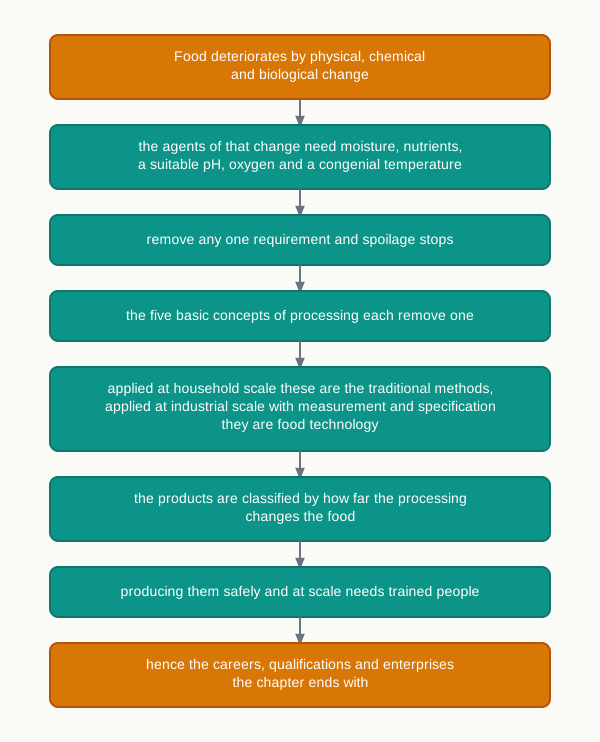
Fig. 4.13 – Summary of the chapter’s argument.
4.11 Key Terms
- Artificial sweetener — a substance that gives an intense sweet taste while supplying little or no energy, used to lower the Calorie content of a product.
- Canning — sealing food in an airtight container and heating it, so that the contents keep without refrigeration.
- CFTRI — the Central Food Technological Research Institute at Mysuru, which conducts research in food science and technology and offers courses in the field.
- Danger zone — the temperature range from 5 °C to 60 °C, within which bacteria grow.
- Enzyme — a protein molecule that acts as a biological catalyst, speeding up a chemical reaction without being used up in it.
- Food derivatives — components obtained from a raw product by purification, such as sugar from sugarcane or oil from oilseeds.
- Food fortification — the deliberate addition of one or more nutrients, in a controlled amount, to a foodstuff or condiment, so that people meet their minimum dietary requirement for that nutrient.
- Food manufacturing — the mass production of food products using the principles of food technology, to meet the varied needs of a growing population.
- Food processing — the set of methods and techniques by which raw materials are transformed into finished or semi-finished products.
- Food science — the study of the composition and properties of food, the changes it undergoes from harvest or slaughter to consumption, and the causes of its spoilage.
- Food security — the assurance that people have physical and economic access to enough safe and nutritious food at all times.
- Food technology — the application of food science, food engineering, socio-economic knowledge and legal rules to the selection, storage, preservation, processing, packaging and distribution of food.
- Formulated foods — relatively shelf-stable products made by mixing and processing individual ingredients to a formula, such as bread, biscuits, ice cream, cakes and kulfi.
- FSSAI — the Food Safety and Standards Authority of India, the body that lays down food standards, including standards for the fortification of staple foods.
- Functional foods — foods that can have a beneficial effect on human health beyond the nutrients they supply, such as probiotics.
- HACCP — Hazard Analysis and Critical Control Point, a system that identifies the hazards in a food process and sets control points at which each is monitored and recorded.
- High risk foods — protein-rich foods preferred by bacteria, such as meat, fish, poultry, eggs and dairy products.
- Manufactured foods — foods in which the original character of the raw product is lost, made by preservation together with added salt, sugar, oil or chemical preservatives, such as pickles, jams and papads.
- Medical foods — foods used in the dietary management of a disease or condition, such as low sodium salt and lactose-free milk.
- Minimally processed foods — foods processed as little as possible, by cleaning, trimming, shelling, cutting or slicing, and kept at refrigeration temperatures.
- Murabba — fruit preserved by cooking in a heavy sugar syrup, which leaves no free water for micro-organisms to use.
- NIFTEM — the National Institute of Food Technology, Entrepreneurship and Management, which offers specialised post graduate courses in food processing and technology.
- Palatability — how pleasant a food is to eat, in taste, smell, appearance and texture.
- Pasteurisation — a controlled heat treatment that destroys disease-producing organisms in a liquid food without cooking it or spoiling its flavour.
- Preserved foods — foods to which a preservation method has been applied without substantially changing their character, such as frozen and dehydrated vegetables and canned fruits.
- Product specification — the written description of what a product must be, against which every batch is checked.
- Sensory evaluation — the assessment of a food by trained tasters, using the senses under controlled conditions.
- Shelf life — the length of time a food stays safe and acceptable to eat under its normal storage conditions.
4.12 Points To Ponder
- The five basic concepts of food processing were all in use for centuries before anyone knew that micro-organisms existed. What does that tell you about how practical knowledge grows, and what is gained when the principle behind a long-used practice is finally understood?
- Fortification corrects a nutritional shortfall by adding a nutrient to a food everyone already buys, rather than by persuading people to change what they eat. What are the strengths of solving the problem this way, and what can it not achieve?
- Consumers increasingly ask for foods that are free of preservatives and yet keep for months without losing flavour or appearance. Is that demand unreasonable, or is it a technical problem waiting to be solved — and how would a food technologist go about answering it?
- A large part of what India grows is lost between the field and the plate. Where should a food technologist’s effort do the most good — in developing new products, or in reducing that loss?
- When food travels from a household kitchen to a stranger’s plate, the maker no longer answers for it face to face. What must be built into a process to take the place of that direct accountability?
- A small home-scale unit and a large manufacturing plant are held to the same food safety requirements, although their resources are very different. On what grounds can that be defended, and what support does it imply small units should receive?
4.13 Objective Questions
- (MCQ) The transformation of raw ingredients into finished and semi-finished products by a set of methods and techniques is: [1]
- food science
- food processing
- food manufacturing
- food security
- (MCQ) Frozen peas, dehydrated vegetables and canned fruits belong to the class of: [1]
- minimally processed foods
- preserved foods
- manufactured foods
- formulated foods
- (MCQ) The conversion of oil into vanaspati is an example of: [1]
- a functional food
- a medical food
- a food derivative processed further
- a minimally processed food
- (MCQ) Which one of the following is not among the five basic concepts used in food processing to prevent spoilage? [1]
- removal of water moisture
- reduction of pH
- controlling the availability of oxygen
- addition of artificial sweeteners
- (MCQ) Lactose-free milk supplied for persons with lactose intolerance is classified as: [1]
- a functional food
- a medical food
- a formulated food
- a preserved food
- (Assertion–Reason) Read the assertion and the reason, and choose the correct option. [1] Assertion (A): Grain that has been dried after harvest keeps for about a year. Reason (R): Drying removes the moisture that micro-organisms and enzymes need in order to act.
- Both A and R are true, and R is the correct explanation of A.
- Both A and R are true, but R is not the correct explanation of A.
- A is true but R is false.
- A is false but R is true.
- (Assertion–Reason) Read the assertion and the reason, and choose the correct option. [1] Assertion (A): Milk is pasteurised rather than boiled before it is packed. Reason (R): Boiling cannot destroy disease-producing organisms in milk.
- Both A and R are true, and R is the correct explanation of A.
- Both A and R are true, but R is not the correct explanation of A.
- A is true but R is false.
- A is false but R is true.
- (Match the following) Match the food in Column A with the class it belongs to in Column B. [1]
| Column A | Column B |
|---|---|
| a. Sugar obtained from sugarcane | i. Formulated food |
| b. Kulfi | ii. Manufactured food |
| c. Papad | iii. Food derivative |
(Fill in the blank) The temperature range from 5 °C to 60 °C, within which bacteria grow, is called the ______. [1]
(Fill in the blank) The written description of what a product must be, against which every batch is checked, is called its ______. [1]
(True or false) Food that has begun to deteriorate can always be identified by its appearance and smell. [1]
(Name the following) Name the class of protein molecules present in a food that act as biological catalysts and continue to degrade the food after harvest. [1]
(Odd one out) Pick the odd one out and give a reason for your choice: milk, curds, onions, fish. [1]
4.14 Check Your Concepts
Define food fortification, and name any two staple foods for which FSSAI has laid down fortification standards. [2]
State the three purposes for which foods were originally processed. [2]
Give a reason for each of the following: [3]
- A dry food such as grain is stored in an airtight container, while cut vegetables are stored in a refrigerator.
- Fat is replaced by specially treated proteins in some ice creams rather than simply being left out.
- Salt is chosen as a carrier for iodine in preference to other everyday foods.
Differentiate between food science and food technology, stating the basis of difference. [3]
Explain, with an example of each, the difference between a preserved food and a manufactured food, stating the basis of difference. [3]
Why does a food technologist need to know about distribution channels and consumer purchase patterns, when the product itself is a technical matter? [3]
List the factors that influence the growth of micro-organisms in a food, and explain how any two of them are controlled in food processing. [4]
Explain what is meant by HACCP, and state why it is considered better to control hazards during a process than to test the finished product. [4]
What would happen to a country’s agricultural surplus if its food processing and storage capacity did not grow along with its production? Explain your answer with reference to the three classes of foods based on perishability. [4]
Describe the three stages into which food production is categorised, and state the knowledge and skills each stage requires. [5]
Give a brief account of the development of food processing and technology from the beginning of the nineteenth century to the present day. [5]
4.15 Identify & Label
Study Fig. 4.2. Identify the logo that shows the product has been fortified, and state what other statutory mark and number must appear alongside it on the pack. [2]
Study Fig. 4.8. Identify the two temperature limits marked on the scale, name the band that lies between them, and state which class of foods must not be left standing within it. [3]
Study Fig. 4.7. Identify any four factors shown as causing deterioration of the food, and state for each whether it acts upon the food from outside or from within it. [2]
Study Fig. 4.9. Name the classes of processed foods placed at the two ends of the scale, and state the basis on which the classes have been arranged in that order. [2]
Study Fig. 4.12. Identify any three segments of the Indian food processing industry shown in the wheel, and name one product that belongs to each. [3]
4.16 Case & Application Based
- A school hostel receives its weekly supplies on a Monday morning: cartons of milk, fresh fish for the same day, crates of tomatoes and brinjals, sacks of onions and potatoes, and sacks of rice and dal. The cold storage that morning is working, but the kitchen staff are told it will be shut down for repairs from Wednesday. [4]
- Classify the delivered items by perishability, and state which of them the shutdown will affect first.
- Suggest, with reasons, the order in which these foods should be used through the week.
- Name one preservation method the kitchen could apply to a part of the delivery before Wednesday, and state the basic concept it works on.
- A self-help group in a fruit-growing district decides to make amla candy for sale, buying fruit at the height of the season when it is cheapest. One member proposes to sell the candy in open baskets at the weekly market; another insists on sealed printed packets, which cost more. [5]
- Explain the principle by which candying preserves the fruit.
- To which class of processed foods does the candy belong, and why?
- Give two reasons in support of the member who wants sealed printed packets.
- State four items of information that must appear on the label of the packet.
- Aditya has finished Class XII and wants to work in food processing. His family runs a small oil mill, and he would like eventually to set up a unit of his own; but he is also drawn to product development work in a large company. He can afford either a one-year diploma now or a longer degree programme. [4]
- Compare the two routes open to him, stating what each usually leads to.
- Which route would suit each of his two ambitions, and why?
- Name two career avenues, other than production, that a person with his interests could later move into, and state what each involves.