Chapter 5: Food Quality And Food Safety
Food That Had To Be Safe The First Time
In the early 1960s, engineers in the United States faced an unusual problem. Astronauts were about to spend days in a spacecraft, and someone had to feed them. On the ground, if a batch of food turns out to be contaminated, people fall ill and are treated. In orbit, there is no doctor, no hospital and no way home in a hurry. The food had to be safe the first time, every time.
The Pillsbury Company was asked to develop this food, working with the National Aeronautics and Space Administration and the laboratories of the United States Army at Natick. The team began the way most food companies did then: test the finished product. They quickly found the method useless for their purpose. To be reasonably sure a batch was safe, they would have had to test so many packets that almost nothing was left to send up.
So they turned the problem around. Instead of judging food at the end, they studied every stage — the raw material, each step of processing, the packing, the storage — and asked where something could go wrong and how it could be stopped there. In 1971 they described this approach publicly, and it has since become the backbone of food safety systems around the world, in space kitchens and in ordinary factories alike.
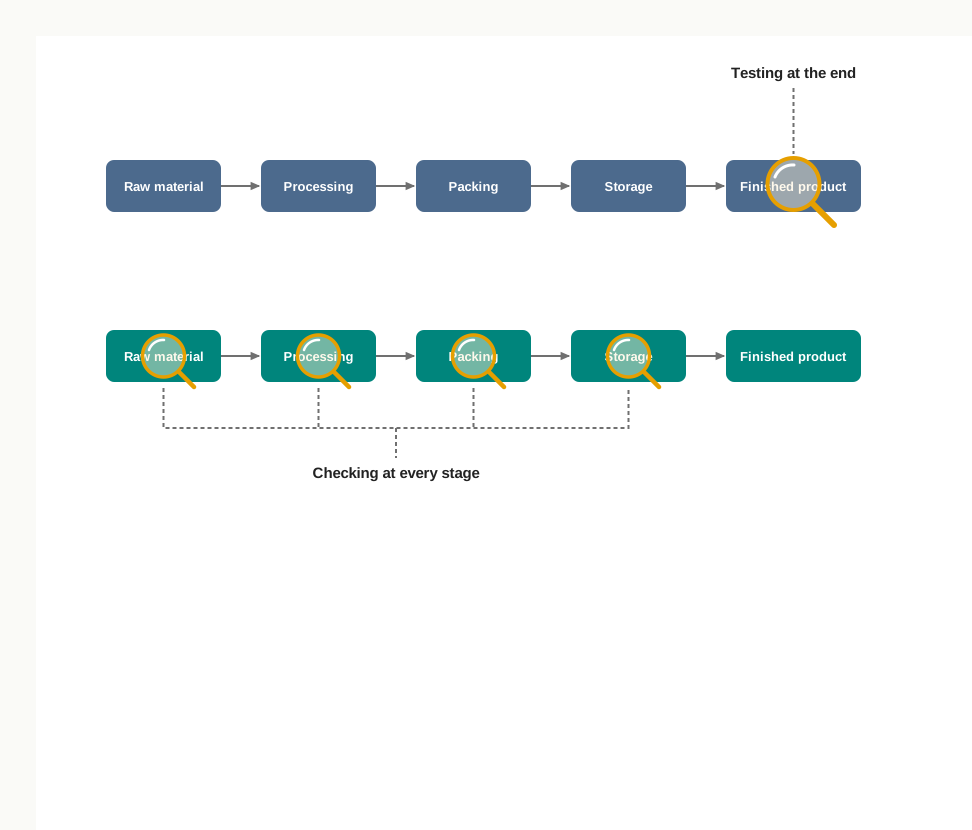
Fig. 5.0 – Checking at the end versus checking at every stage.
5.1 Why Food Safety And Quality Matter
Every one of us eats several times a day, mostly without pausing to ask whether what is on the plate is fit to eat. We trust the grain in the sack, the milk in the packet and the food sold at the corner stall. That trust is usually rewarded, but not always, and when it is not, the consequences reach much further than one unhappy stomach.
This chapter is about how that trust is kept — by the person cooking at home, by the factory, by the inspector and by the law. It begins with the reason the subject matters at all.
5.1.1 Food, Health And Food-Borne Illness
Food decides a great deal about a population: how healthy people are, how well nourished they are, and how much work they are able to do. A country whose people eat well and safely is a country that can work. This is why food is treated not merely as a private matter but as a public one.
Food that is unsafe produces food-borne illness — any illness caused by eating food that carries harmful organisms or harmful substances. The illness may be mild and pass in a day, or it may be severe enough to need hospital care. Young children, older people and those already weakened by illness are affected most sharply.
The scale of the problem is large. The World Health Organization’s estimates of the global burden of food-borne disease, published in 2015 and based on data for 2010, put the number of people falling ill from unsafe food at about 600 million a year and the number of deaths at about 420 000, of which around 125 000 are children under five years of age.
India carries a share of this burden. The National Family Health Survey of 2015–16 found that close to one child in ten below the age of five had suffered an episode of diarrhoea in the two weeks before the survey. Not every episode comes from food, but contaminated food and water are among the leading causes.
What An Outbreak Costs
The harm does not stop at illness. When food from a particular kitchen, factory or town is found to be unsafe, people stop buying it, visitors stop coming, workers lose earnings and sometimes lose jobs, and disputes end up in court. A single incident can damage a business, a trade or a tourist season.
Follow the chain in Fig. 5.1 and you can see why governments treat food safety as an economic question as much as a health one.
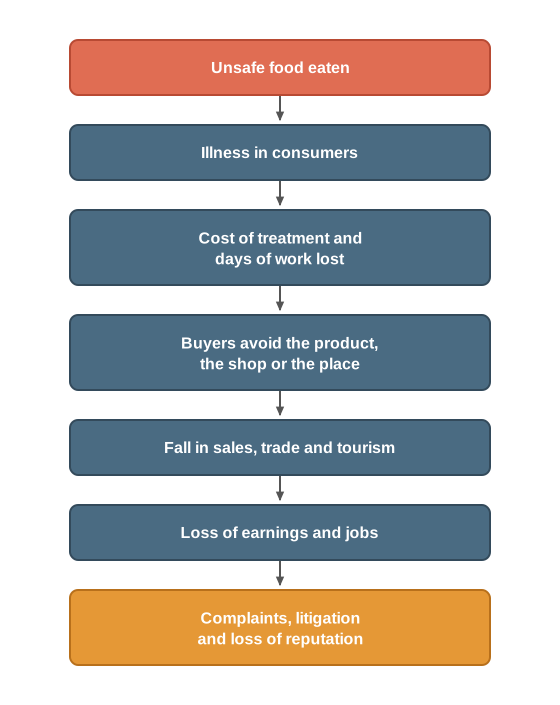
Fig. 5.1 – From unsafe food to wider loss.
5.1.2 Factors Behind The Growing Concern
Food safety has always mattered. What has changed is how much of it is now out of the eater’s own hands. A generation or two ago, a household bought whole grain, whole spices and oilseeds, and cleaned, ground and cooked them itself. Anyone who wanted to know what was in the food could look at it.
Today most of what a family eats has passed through hands it will never see. Higher incomes, better purchasing power, new processing technology and a demand for convenience have together produced an enormous range of packaged, processed and health-oriented foods. Each of these is welcome, and each adds a step at which something can go wrong. Table 5.1 sets the two situations side by side.
Several separate pressures have pushed food safety and quality to the front in the last few decades.
Where And How Food Is Made
More people eat outside the home than ever before, in canteens, hostels, roadside outlets and restaurants. In such settings food is cooked in bulk, handled by many people and often prepared well before it is served, so it must be held at the right temperature in the meantime or it will spoil.
Packaged and processed foods have multiplied, and the safety of each has to be assured. Even raw foodstuffs are now bought ready-prepared: ground spice powders and blends, and pressed oils, once made at home, now come in packets, and their purity has become a matter of public concern rather than a domestic one.
Moving bulk food is complicated. A consignment may travel a long distance and wait a long time between the factory and the plate, and every hour of that journey has to be planned so that the food arrives safe.
New And Changing Pathogens
Micro-organisms do not stay the same. They adapt, some become resistant to antibiotics, and genetic exchange or mutation can produce new strains able to cause disease. At the same time, people themselves have become more susceptible in places — poor nourishment, age and other illness all lower resistance.
A striking feature of the last few decades is how many food-borne pathogens now recognised were unknown to science earlier, and a number of food-borne illnesses still have no identified cause. When the cause of an illness is not known, it is described as being of unknown etiology — that is, its origin has not been traced.
Because pathogens travel with food, with animals and with people, no country can watch only its own borders. Detecting a new organism early, identifying it and warning others requires surveillance networks that work nationally and share information internationally.
Trade Across Borders
India is a signatory to the non-tariff agreement of the World Trade Organisation, which has opened world markets to member countries. Once food crosses borders in both directions, a country must be able to guarantee that what it sends out is safe and to satisfy itself that what comes in is safe too.
This is only possible if there are clear standards and a working system to enforce them. Manufacturers are required to meet the standards laid down for quality and safety, and to have their products tested regularly.
Contaminants From The Environment
Air, soil and water carry the residues of what is put into them. Pesticides used in the field, industrial pollutants and residues of medicines given to animals can all reach food before it is ever cooked.
Added to these are the substances put into food deliberately — preservatives, colouring matter, flavouring agents and stabilisers. All of these are lawful within limits, and all of them make it necessary to analyse food for what it contains: both the nutrients that should be there and the contaminants that should not.
Taken together, these pressures explain why safe, wholesome and nutritious food is now such a live concern, and why the food business has grown into a field with real career openings. Before those openings can be discussed, the basic ideas have to be clear: what food safety is, what a hazard is, what food quality means, and how standards and management systems work.
5.2 Basic Concepts Of Food Safety
Before anything can be regulated, it has to be defined. The terms in this section are the ones on which the whole of food law and food-safety practice rests, so it is worth being exact about them.
5.2.1 Food Safety
Food safety is the assurance that a food is acceptable for human consumption in the way it is meant to be used. Notice the last part of that sentence. Safety is not a fixed property of a substance; it is judged against the intended use.
Wheat flour meant for a chapati and wheat flour meant for a fermented preparation are held to the same standard of cleanliness, but a food sold for an infant is held to a stricter one than the same food sold for an adult, because the intended eater is different. Raw kidney beans are unsafe eaten as they are and safe once boiled thoroughly, because the intended use includes the cooking.
Understanding food safety becomes easier once two further terms are clear: toxicity and hazard. They sound alike and are constantly mixed up, and the difference between them is exactly what a food-safety system works on.
5.2.2 Toxicity And Hazard
Toxicity is the capacity of a substance to produce harm or injury of any kind under any conditions. It belongs to the substance itself. A substance that can injure the body is toxic whether or not anyone ever comes near it.
Hazard is the relative probability that harm or injury will actually result, when the substance is not used in the prescribed manner and quantity. Hazard therefore depends on the situation — on how much, how used, and how stored.
Take a bottle of dishwashing liquid. It is toxic: swallowing it would injure anyone. Kept on a shelf away from food and used only for washing, it presents almost no hazard. Pour it into an unlabelled bottle and stand it beside the cooking oil, and the toxicity has not changed at all while the hazard has become serious. Table 5.2 separates the two ideas.
This is a useful thought to hold on to. Food safety work rarely removes toxic substances from the world; it removes the conditions under which they reach food.
Hazards in food are grouped into three kinds — physical, chemical and biological — and each of them can produce harmful effects on the health of the consumer. The next section takes them one at a time.
5.3 Hazards In Food
Anything in food that can injure the person eating it is a hazard, and hazards fall into three groups according to what they are made of. Some can be seen and picked out, some can be seen only under a microscope, and some cannot be seen at all. Fig. 5.2 shows how the groups divide.
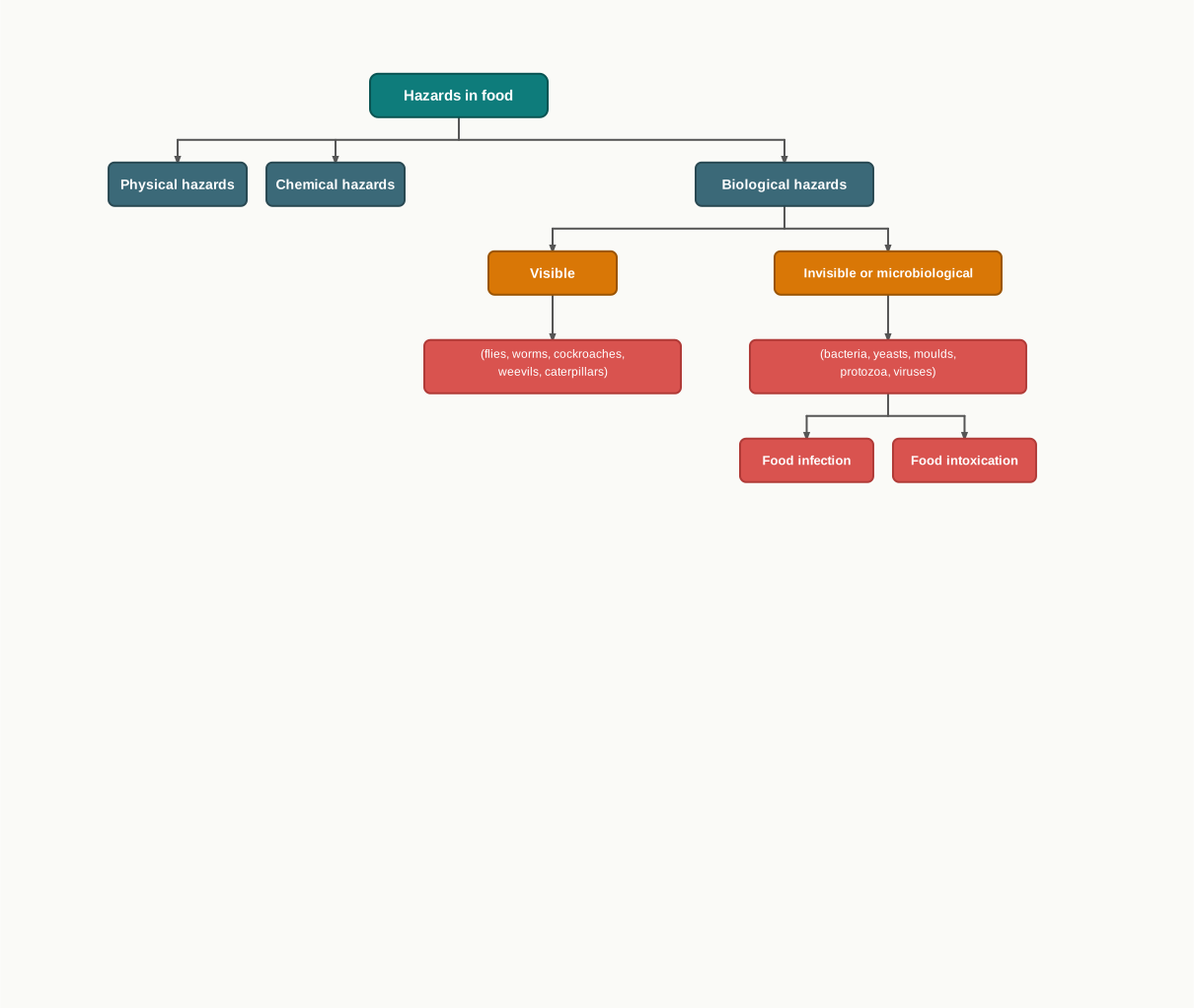
Fig. 5.2 – Classification of hazards in food.
5.3.1 Physical Hazards
A physical hazard is any physical material not normally found in food, which causes illness or injury to the person who eats it. It has no business being there and it arrives by accident, carelessness or poor storage.
Physical hazards include stones and grit from threshing floors, stems and seeds left after cleaning, hair, bone fragments and feathers, splinters of wood, pieces of string and jute fibre from sacking, and buttons, jewellery, nails, nuts and bolts from the people and machines around the food. Bidis, cigarettes and matchsticks find their way in where smoking is allowed near a food area. Parts of pests — an insect wing, a rodent hair — belong here too. Fig. 5.3 shows the common ones.
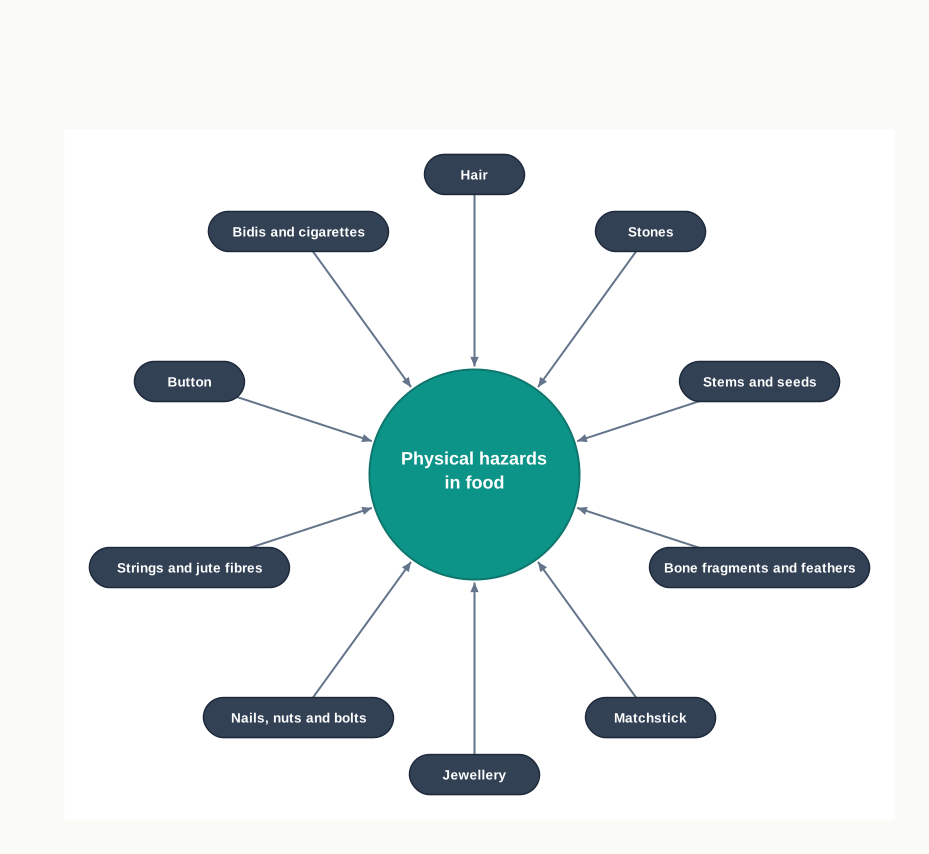
Fig. 5.3 – Physical hazards in food.
Most physical hazards are, at least in principle, catchable. Cleaning the grain, sieving the flour, covering the hair, keeping jewellery off the hands and keeping smoking away from the kitchen remove a large share of them before they reach the pot.
5.3.2 Chemical Hazards
Chemical hazards are chemicals or other harmful substances that may be added to food either intentionally or unintentionally. Unlike a stone in the rice, they cannot be seen, and the food may look perfectly ordinary.
Some arrive before the food is harvested. Residues of pesticides sprayed on the crop, residues of medicines given to animals, toxic metals from polluted soil and water, and industrial chemicals such as polychlorinated biphenyls, which persist in the environment and collect in fatty foods, are all of this kind.
Others arrive later, in the kitchen or the factory. Cleaning chemicals splash or seep into food where they are stored or used carelessly. Preservatives, colours, flavouring agents and other additives are lawful and useful in themselves, but they become hazards in two ways: when a substance that is not permitted in food is used at all, and when a permitted one is used in excess of the quantity allowed. Adulterants deliberately mixed in for profit are chemical hazards of the worst kind, and they are dealt with separately in section 5.4. Fig. 5.4 groups these sources.
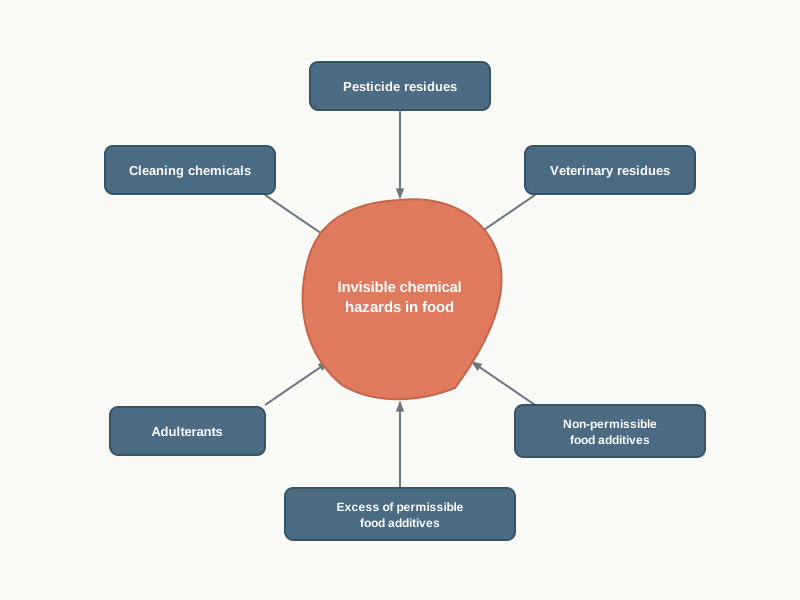
Fig. 5.4 – Chemical hazards in food.
5.3.3 Biological Hazards
Biological hazards are living organisms in food. Some of them are large enough to see: flies settling on an uncovered dish, worms in a stored pulse, cockroaches in a store cupboard, weevils in grain and caterpillars in a vegetable. These are shown in Fig. 5.5.
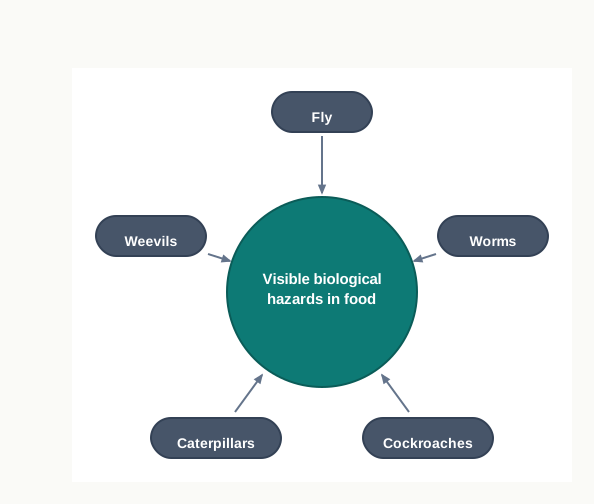
Fig. 5.5 – Visible biological hazards in food.
The rest are invisible. Bacteria, yeasts, moulds, protozoa and viruses are microscopic, and a food carrying millions of them looks exactly like a food carrying none. Fig. 5.6 shows this second group.
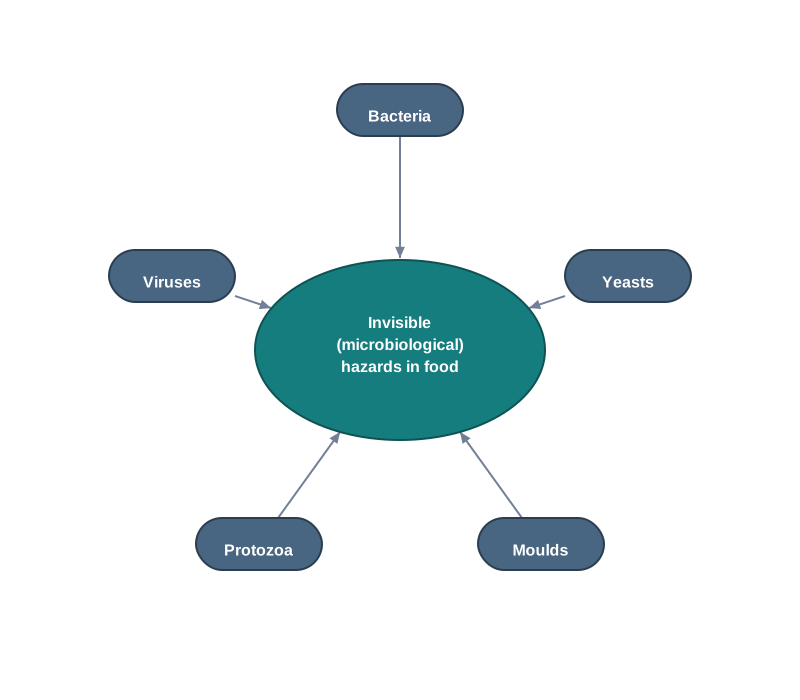
Fig. 5.6 – Invisible or microbiological hazards in food.
Those micro-organisms that are associated with food and cause disease are called food-borne pathogens. Not every micro-organism in food is a pathogen — the ones that set curd and raise bread are useful — so the word marks out the harmful ones.
Food-borne pathogens cause disease in two quite different ways, and the difference decides how the illness is prevented. In one, the living organism itself is swallowed; in the other, only the poison it left behind is swallowed. These two are food infection and food intoxication.
In everyday speech both are called food poisoning, and the base term is used loosely. Strictly, poisoning describes illness caused by a toxin, so it is clearer to keep the two names separate.
5.3.3.1 Food Infection
Food infection results from eating food containing live pathogenic organisms, which then multiply inside the body and cause disease. The organism has to be alive when it is eaten, which is why heat treatment works against it.
Salmonella is the classic example. It lives in the intestinal tract of animals, and raw milk and eggs are also sources. Heat destroys it, but inadequate cooking leaves some organisms alive, and those that survive multiply quickly — under warm, favourable conditions a population can double about every 20 minutes. The symptoms of a Salmonella infection are diarrhoea, fever and abdominal cramps.
Much of the time the organism does not arrive in the dish that finally causes the illness. It is carried there. The transfer of harmful organisms from one food, surface or hand to another food is called cross-contamination, and it is the commonest route by which a safely cooked dish becomes unsafe. Follow one such path in the walkthrough below.
The same journey can begin with a person rather than a board. If someone handling food does not wash their hands with soap after using the toilet and before touching food, organisms travel straight from hand to dish.
5.3.3.2 Food Intoxication
Food intoxication is illness caused by toxins that bacteria have produced in the food itself. Some bacteria release harmful toxins while growing, and many of these toxins remain in the food even after the organism that made it has been killed. Cooking the food afterwards therefore does not necessarily make it safe.
Bacteria produce these toxins when the food has been left standing at the wrong temperature — not hot enough and not cold enough. Food held warm on a counter for hours is exactly the condition they need.
The awkward part is that a toxin in food cannot be detected by smell, appearance or taste. A dish that looks fresh and smells good is therefore not necessarily a safe dish, and the nose is not a food-safety instrument.
Staphylococcus aureus is a common example of a toxin-producing organism. It is present in air, dust and water, and it is also carried harmlessly in the nasal passage, throat, skin and hair of a large proportion of perfectly healthy people. Someone carrying it contaminates food simply by touching their nose, face or hair while handling it. Diarrhoea is one of the symptoms that follows.
Table 5.3 sets the two kinds of illness side by side.
5.3.3.3 Parasites, Pests And Infestation
Parasites are a further biological hazard. Worm infestation from tapeworm in pork is one example: the parasite is present in the meat and passes to the person who eats it undercooked.
Food is also attacked by pests and insects during storage and service. Infestation is the presence of pests, insects or their remains in stored food, and it damages the food, contaminates it with droppings and body parts, and opens the way for micro-organisms. Fig. 5.7 shows two familiar situations.
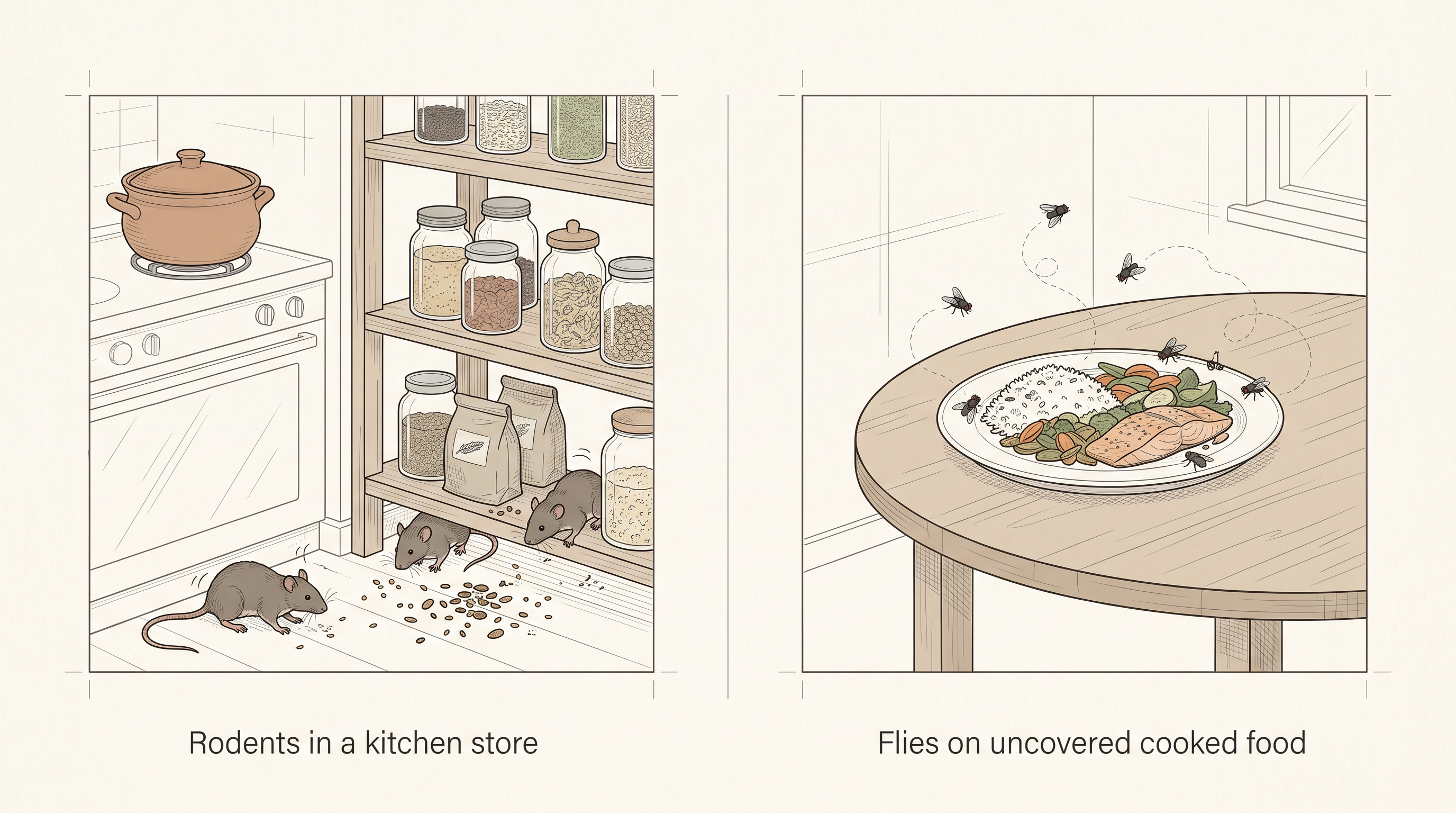
Fig. 5.7 – Infestation of food.
Of the three groups of hazards, biological hazards are the most important cause of food-borne illness. Despite everything that is done in food safety, microbial pathogens remain a serious concern, and new ones keep appearing.
5.3.4 The Emergence Of New Pathogens
A pathogen does not become a food-safety problem on its own. Four things decide whether a new one appears and spreads: the human host, animal hosts and their contact with humans, the pathogen itself, and the environment in which food is produced, processed, handled and stored.
The host matters because resistance varies. Malnutrition, age and existing illness all lower a person’s defences, and infections can take hold in such groups that would not take hold elsewhere. The pathogen matters because organisms change: genetic exchange between organisms, or mutation within one, can produce a new strain able to cause disease when the parent strain could not.
The environment matters most of all, because it decides who meets what. Changes in eating habits, changes in climate, mass production, new processing methods and a food supply that now moves around the globe can all carry an organism into a population or a region that has never encountered it.
Norovirus, rotavirus and hepatitis E are examples of viruses spread through contaminated food and water. New pathogens will keep evolving, and that means a continuing need for methods to isolate them, to detect their presence in foods, and to bring them under control.
5.4 Contamination And Adulteration
Two words are used constantly in food law, and they are not the same word. One describes something getting into food; the other describes something being done to food. Keeping them apart matters, because one is often an accident and the other almost never is.
5.4.1 Contamination
Contamination is the presence in food of harmful or objectionable foreign substances — chemicals, micro-organisms or diluting materials — whether they get in before processing, during it, or afterwards in storage. Every hazard described in section 5.3 reaches food by contamination.
The word carries no assumption about intention. Grit that blows into a drying yard, bacteria carried from a chopping board, a cleaning agent that seeps into a sack of flour: all of these contaminate the food, and none of them was put there on purpose.
5.4.2 Adulteration And Adulterants
Adulteration is the process by which the quality of a food is lowered. It happens in either of two ways, and both are worth naming separately.
The Two Ways Quality Is Lowered
The first is addition. A cheaper or inferior material is mixed into the food so that the seller has more to sell. Water stirred into milk, papaya seeds mixed into black pepper and a non-permitted dye used to brighten a dull turmeric powder are all additions of this kind. The buyer pays the price of the good article and receives something less.
The second is extraction. A valuable ingredient is removed from the food, and what remains is sold as though it were complete. Milk from which the fat has been taken out, and then sold as whole milk, has been adulterated just as surely as milk with water added, though nothing has been put in.
Adulteration is not confined to what is done deliberately. Biological and chemical contamination occurring during the growth, storage, processing, transport and distribution of a food also lowers its quality, and is counted as adulteration as well. This is where the two terms of this section meet: contamination that degrades the quality of a food product amounts to adulteration of it.
The substances used to make food products unsafe for human consumption are called adulterants. Some merely cheat the buyer; others, such as an unpermitted dye or an oil that does not belong in the tin, are toxic in themselves and turn a question of value into a question of health.
Table 5.4 sets out how the two terms differ and where they overlap.
Adulteration is an offence, and the standards a food must meet and the authority that enforces them are the subject of section 5.6. What matters here is the idea: a food can fail its buyer either because something wrong has entered it, or because something right has been taken out of it.
5.5 Food Quality
Safety answers one question: will this food harm the person who eats it? Quality answers a larger one: is this food worth what is being paid for it? A dish can be perfectly safe and still be stale, discoloured, badly cooked and poorly nourishing.
5.5.1 Attributes Of Food Quality
Food quality refers to the attributes that influence a product’s value to the consumer. Some of those attributes are ones the buyer wants — good colour, flavour and texture — and some are ones the buyer wants to be sure are absent, such as spoilage, contamination, adulteration and food-safety hazards.
Quality is therefore a whole-picture idea rather than a single measurement. Four sets of attributes go into it, shown in Fig. 5.8.
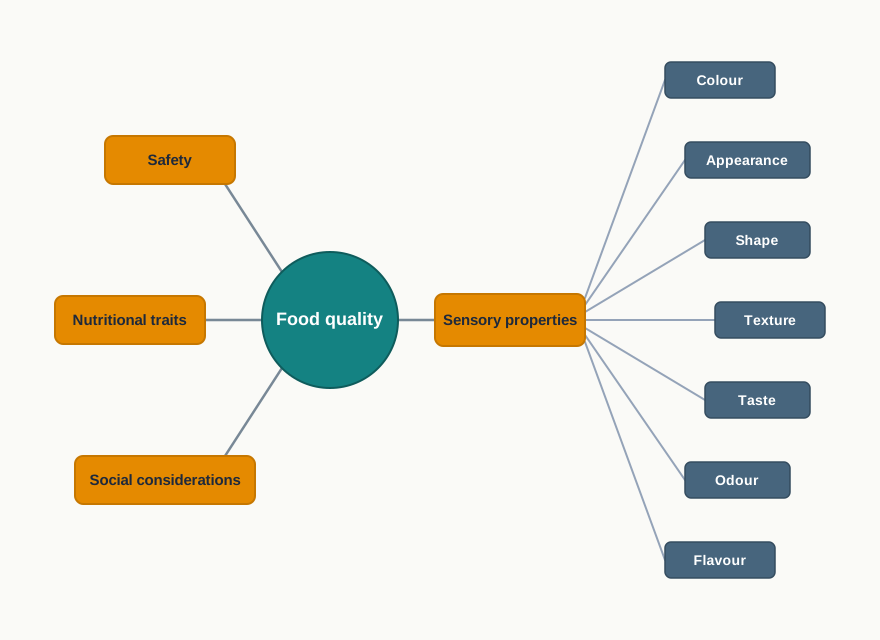
Fig. 5.8 – Attributes of food quality.
The sensory properties are the ones a buyer can judge without any instrument: colour, texture, shape, appearance, taste, flavour and odour. These are what make a person pick up one bunch of greens and put back another, and they are also the first sign that a food has begun to spoil.
Nutritional traits are what the food contributes to the body, and they may not match the sensory ones at all — a highly polished grain looks better and nourishes less. Social considerations cover the expectations a food has to meet in the community that eats it: what is acceptable, how it is prepared, how it is presented.
The fourth attribute is safety, and it stands in a particular relation to the rest. Safety is a preliminary attribute and a precursor of quality: it comes first, and the other attributes are only worth discussing once it is settled. A beautifully coloured sweet carrying an unpermitted dye has no quality at all, whatever it looks like. Table 5.5 draws the distinction out.
Because quality has to be assured and cannot simply be hoped for, governments and international bodies across the world have laid down food standards that manufacturers and suppliers are expected to meet. Those standards are the subject of section 5.6.
5.5.2 Good Practices In Food Service
Everyone who handles food along the way — at pre-preparation, at preparation and processing, at packaging and at service — is a food service provider, and each of them can either protect the food or spoil it. The recognised good practices described in section 5.8 apply to all of them.
Five points carry most of the weight in day-to-day food service.
- Quality of raw materials and water. Nothing downstream can improve a bad ingredient, and water used for washing, cooking and ice becomes part of the food, so it must be fit to drink.
- Cleanliness of the premises, the personnel, the equipment, and the areas used for preparing, storing and serving food. Every one of these touches the food, and a clean cook working on a dirty surface is not enough.
- Storage of food at the appropriate temperature. Prepared food waiting to be served is the point at which micro-organisms multiply fastest, so it must be held hot or held cold, not left standing in between.
- Food hygiene — the practices that keep food free from contamination at every stage of handling. This includes covering food, keeping raw and cooked items apart, and washing hands at the right moments.
- Good service practices. Serving with clean utensils rather than hands, not returning served food to the main container, and keeping the serving area covered protect food after it has already been safely cooked.
5.6 Food Standards
A standard is an agreed statement of what a food must be: what it may contain, what it may not contain, how much of a substance is permitted, and how it must be handled. Without such statements, safety and quality are matters of opinion, and no buyer, seller or inspector can settle a dispute.
Food standards, together with the control systems that enforce them, do three things. They build quality into every stage of food production and service rather than checking for it at the end; they help ensure a supply of hygienic and wholesome food; and they make trade possible, both within a country and between countries, because both sides know what is being bought.
5.6.1 The Four Levels Of Standards
Standards are not written at one place only. They exist at four levels, which are coordinated with one another so that a food moving from a factory to another country does not meet contradictory demands.
- Company standards. These are prepared by a company for its own use. They are normally copies of the national standards, sometimes set a little tighter so that a batch that drifts slightly still passes the law.
- National standards. In India, standards for food are laid down by the Food Safety and Standards Authority of India. They apply to everyone selling food in the country.
- Regional standards. Groups of countries that share geography, climate and trading patterns set up their own standardisation bodies, so that a rule fits the conditions of that region.
- International standards. These are published by the International Organisation for Standardisation and by the Codex Alimentarius Commission, both discussed in section 5.7.
The levels fit inside one another. A company writes its own specification from the national standard; a national body draws on regional and international standards when framing its own. That is what keeps them coordinated instead of competing.
5.6.2 Food Standards And Regulations In India
5.6.2.1 Voluntary Product Certification
Alongside the law, India has grading and marking schemes that a producer may join by choice. These are voluntary: a food is not illegal without the mark, but the mark tells a buyer that an outside body has checked the product.
The Bureau of Indian Standards is the national standards body for goods generally, and it deals with the standardisation of consumer goods including food products. It runs a voluntary certification scheme for processed foods under the ISI mark.
AGMARK is a voluntary scheme for the certification of agricultural products, both raw and processed, and it exists to safeguard the health of consumers. It is administered under the grading and marking rules of the Government of India, and it is the mark most often seen on articles such as edible oils, honey, ghee, spices and pulses.
These two are voluntary. The FSSAI licence or registration number that appears on packaged food is not: every food business selling in India has to be licensed or registered, and the number is its proof. Fig. 5.9 shows the three marks together.
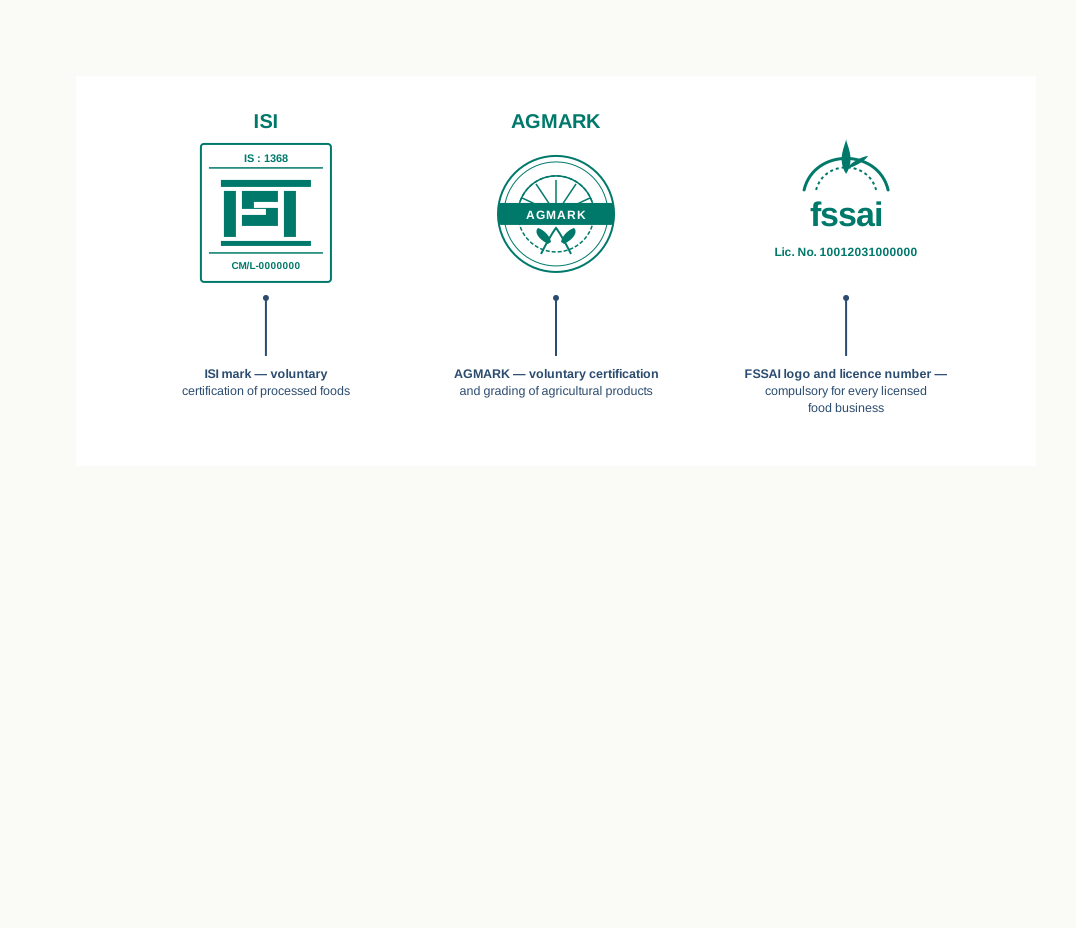
Fig. 5.9 – Certification marks on food packages in India.
5.6.2.2 The Food Safety And Standards Act, 2006
For many years, food in India was governed by a scatter of separate laws. The Prevention of Food Adulteration Act, 1954 was enacted by the Government of India to prevent the adulteration of food, and was amended over two hundred times as needs changed. Around it sat a set of Orders dealing with particular commodities.
- The Fruit Products Order, 1955, which laid down specifications for fruit and vegetable products.
- The Meat Food Products Order, 1973, under which the processing of meat products was licensed.
- The Vegetable Oil Products Order, which laid down specifications for vanaspati, margarine and shortenings.
Each of these was administered by a different ministry or department, and a manufacturer could find one product answering to several authorities at once. The industry found this cumbersome, and the need was felt to bring the regulation of food quality under a single law.
That is what the Food Safety and Standards Act, 2006 did. Its object is to consolidate the laws relating to food, bringing the different pieces of legislation under one umbrella, and all the Acts and Orders listed above now stand consolidated under it. Every food product manufactured in India, and every food imported and sold in India, has to meet the requirements prescribed under this Act.
The Act established the Food Safety and Standards Authority of India (FSSAI), and gave it the task of laying down science-based standards for food and regulating its manufacture, storage, distribution, sale and import, so that safe and wholesome food is available for human consumption. The Act also carries provisions the earlier law did not: for hygienic conditions in and around manufacturing premises, and for assessing and managing risks to human health in a scientific manner.
The Act reflects a shift that has taken place in food law internationally — a move away from compositional or vertical standards towards safety or horizontal standards. Table 5.6 explains the difference, which is easier to see than to state.
5.6.2.3 Functions Of The FSSAI
The Act gives the FSSAI a set of functions. Read together, they describe an authority that writes the rules, builds the machinery to apply them, gathers the evidence and tells the public.
- Framing regulations that lay down the standards and guidelines for articles of food, and the system for enforcing those standards.
- Laying down mechanisms and guidelines for the accreditation of certification bodies that certify food safety management systems for food businesses, and for the accreditation of laboratories and the notification of accredited laboratories.
- Providing scientific advice and technical support to the Central Government and State Governments for framing policy and rules on food safety and nutrition.
- Collecting and collating data on food consumption, on the incidence and prevalence of biological risk, on contaminants and residues in food products, and on emerging risks, and introducing a rapid alert system.
- Creating an information network across the country so that the public, consumers, panchayats and others receive rapid, reliable and objective information about food safety and issues of concern.
- Providing training programmes for persons who are involved, or intend to get involved, in food businesses.
- Contributing to the development of international technical standards for food, and of sanitary and phyto-sanitary standards.
- Promoting general awareness about food safety and food standards.
Notice how few of these are about catching offenders. Most of them are about making it possible for a food business to get things right in the first place: standards to work to, laboratories that can test, training for the people handling food, and information reaching consumers.
5.7 International Organisations In Food Standards And Trade
Attempts to lay down what a food must be are very old. Governing authorities across the world have long set rules on the sale of food, both to protect the health of the people who eat it and to prevent dishonest practices in selling it. What is new is that these rules now have to work across borders.
Three bodies matter most in this international work: the Codex Alimentarius Commission, the International Organisation for Standardisation and the World Trade Organisation. Between them they enhance food safety, quality and security, and support research and trade.
5.7.1 Codex Alimentarius Commission
The Codex Alimentarius Commission (CAC) is an intergovernmental body — that is, a body whose members are governments rather than companies or individuals. It was set up jointly by the Food and Agriculture Organization and the World Health Organization of the United Nations in 1963, with the objective of establishing international standards that protect the health of consumers and facilitate trade in food and agricultural products.
Its membership is close to universal. In 2017 it stood at 187 member countries together with one member organisation, the European Union. India is a member through the Ministry of Health and Family Welfare. The Commission has become the single most important international reference point for developments in food standards.
The document the Commission publishes is the Codex Alimentarius, a name that means food code. It is a collection of internationally adopted food standards, and it contains not only standards but also codes of practice, guidelines and other recommendations, all directed at protecting consumers and ensuring fair practices in the food trade.
Codex does not itself bind anyone. Its influence works the other way round: different countries use Codex standards as the basis on which they develop their own national standards, so a rule agreed at Codex reappears, in national dress, in the laws of many countries.
5.7.2 International Organisation For Standardisation
The International Organisation for Standardisation (ISO) is a worldwide, non-governmental federation of national standards bodies, each country’s standards body being one member. India is represented in it by the Bureau of Indian Standards.
Its mission is to promote the development of standardisation and related activities across the world, so as to facilitate the international exchange of goods and services, and to develop cooperation in intellectual, scientific, technological and economic activity. The work done results in international agreements, which are published as International Standards.
The best known of these for our purpose is ISO 9000, an international reference for quality requirements. It is concerned with the quality management of an organisation — that is, with how a firm is run and how it keeps its own work consistent, rather than with any single product. Adopting these standards is voluntary.
Codex and ISO are both international, both influential and easily confused. Table 5.7 separates them.
5.7.3 World Trade Organisation
The World Trade Organisation (WTO) was established in 1995. Its main objective is to help trade flow smoothly, freely, fairly and predictably, and it does this by administering trade agreements, settling trade disputes between countries and assisting countries with trade policy issues. The WTO Agreement covers goods, services and intellectual property.
Food enters this picture at the point where a safety rule and a trade rule meet. A country may keep out a consignment that fails its safety standards, but it may not use a safety standard as a disguised way of keeping out a competitor. Agreed international standards are what make that line possible to draw.
5.7.4 The Food Control System
Standards on paper change nothing by themselves. Enforcing them requires a strong food control system, and an effective one has two limbs: food inspection and analytical capability. Neither works without the other, as Fig. 5.10 shows.
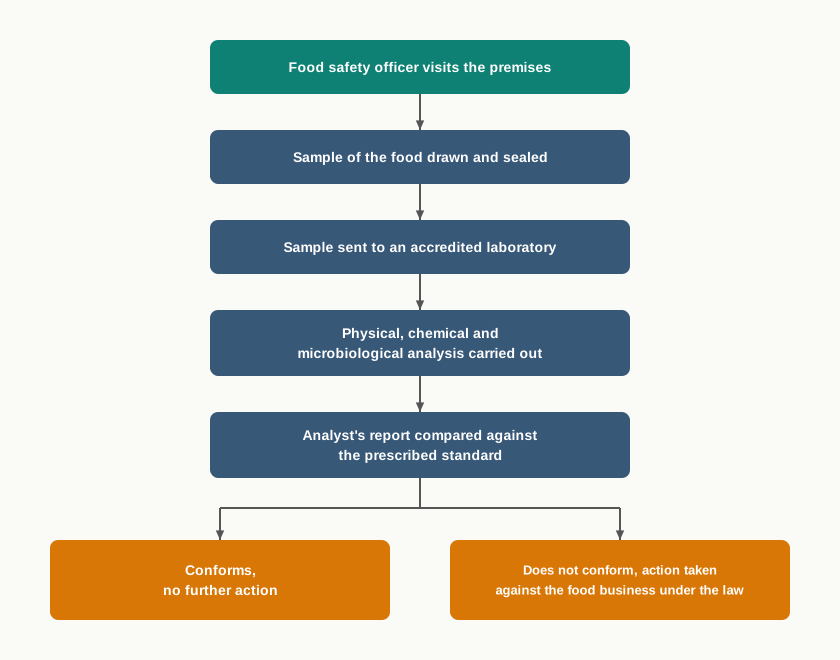
Fig. 5.10 – Testing a food sample.
Food inspection is the verification, through inspection, that products conform to standards. It ensures that all foods are produced, handled, processed, stored and distributed in compliance with the regulations and the legislation. Government and municipal authorities appoint officers for this work — under the Food Safety and Standards Act, 2006 the officer is designated a food safety officer — and they investigate how far the food in their area conforms to standards.
Analytical capability is the ability to find out what is actually in the food. This calls for well-equipped, accredited laboratories, and for well-trained personnel who understand laboratory management and the physical, chemical and microbiological analysis of foods.
The range of things such a laboratory must be able to detect is wide: food contaminants, environmental chemicals, biotoxins, pathogenic bacteria, food-borne viruses and parasites. An inspector who can collect a sample but cannot have it tested has established nothing, which is why the two limbs are always spoken of together.
5.8 Food Safety Management Systems
Over the years, food safety and quality have come to mean much more than avoiding pathogens, chemical toxicants and other hazards once they appear. A hazard can enter food at any stage of the food chain — the whole sequence a food passes through from the field to the plate — and a system that watches only one stage will miss whatever enters at another. Control has to run through the chain, as Fig. 5.11 shows.

Fig. 5.11 – Where hazards enter the food chain.
A food safety management system is the organised set of practices by which a food business keeps hazards under control across that whole chain. Safety and quality are assured through three such systems, each covering a different part of the ground: Good Manufacturing Practices, Good Handling Practices, and Hazard Analysis Critical Control Point.
5.8.1 Good Manufacturing Practices
Good Manufacturing Practices (GMP) are a part of quality assurance, requiring manufacturers and processors to take proactive steps to ensure that their products are safe. The word proactive is the important one: the steps are taken before anything has gone wrong, not after a complaint.
GMP works on two fronts. It minimises or eliminates contamination in the manufacturing process, and it prevents false labelling, so that the consumer is neither harmed by the product nor misled about it. A buyer who reads a label and gets what it promises is being protected by GMP.
For the manufacturer, GMP is also a good business tool. Working to a defined practice refines compliance and performance, so fewer batches are rejected and less is lost.
5.8.2 Good Handling Practices
Good Handling Practices (GHP) take a comprehensive view of the journey from the farm to the store or the consumer. Their purpose is to identify the potential sources of risk along that journey, and to indicate what steps and procedures are to be taken to minimise the risk of contamination.
Where GMP concentrates on how a product is made, GHP concentrates on how it is handled and by whom. It ensures that every person who handles food follows good hygiene practices, at every point where the food changes hands.
5.8.3 Hazard Analysis Critical Control Point
Hazard Analysis Critical Control Point (HACCP) is a means of providing assurance about the safety of food. It is an approach to food manufacture and storage in which the raw materials and each individual step of a particular process are considered in detail, and each is evaluated for its potential to contribute to the growth of pathogenic micro-organisms or to any other food hazard.
Its work therefore has three parts: identifying the hazards; assessing the chance of each hazard occurring at each step or stage of the food chain, from raw material procurement through manufacturing and distribution to the use of the food product; and defining the measures by which those hazards will be controlled.
The middle term in the name needs explaining. A critical control point is a step in the process at which control can be applied and is essential to prevent a hazard, or to reduce it to an acceptable level. Cooking a meat preparation to a specified temperature is such a point; the choice of serving dish is not. Identifying the few points that really decide the outcome is what makes the system workable.
Why HACCP Is Preferred
Testing the finished product is not useless, but it has a built-in limitation. It is time consuming and expensive, and it detects a problem only after the problem has already happened — after a batch has been made, and sometimes after it has been sold. Table 5.8 sets the two approaches against each other.
There are further reasons for the preference. HACCP lets producers, processors, distributors and exporters use their resources efficiently and cost-effectively in assuring food safety. It also fits the way the law is now written: the Food Safety and Standards Act, 2006 places the primary responsibility for safe food on producers and suppliers, working through HACCP, GMP and GHP. That placement of responsibility matters both for consumer protection and for international food trade, because an importing country wants to see a system, not a certificate for one batch.
5.9 Scope And Career Avenues
Everything in this chapter — the hazards, the standards, the laboratories, the management systems — has to be done by somebody. That somebody is trained, and the training is open to anyone who takes this subject further.
5.9.1 The Growing Food Sector
India is experiencing steady growth in food processing, and it is expected to remain one of the country’s major growth areas in the years ahead. More food is being processed, packed and branded than ever before, and more of it is crossing borders in both directions.
Growth of this kind brings a matching responsibility. Trading internationally means meeting the sanitary and phyto-sanitary protections that other countries require, and satisfying our own. The Food Safety and Standards Act, 2006 reflects the shift in food law towards greater consumer protection, ensuring the safety and wholesomeness of food at every stage of the food chain.
Two things follow from this for a student. The work to be done has expanded, and it now runs from the field to the counter rather than sitting at one point. That is what has widened the scope of this field and increased the career options within it.
5.9.2 Career Options
Professionals in this area need a solid grounding in food chemistry, food processing and preservation, and food analysis and quality control. Beyond these, it is valuable to be well versed in food microbiology, in food laws, and in sensory evaluation — the systematic assessment of a food’s appearance, texture, odour, taste and flavour by trained judges under controlled conditions.
Regulatory and public health agencies employ such professionals as food legislators, as food safety officers, and as food analysts or public analysts working in government laboratories. Voluntary certification and standards bodies, such as those running the AGMARK scheme and the Bureau of Indian Standards, employ them in quality control laboratories.
Industry employs them in larger numbers still. Large food industries, and institutional operations such as flight kitchens, run in-house quality control units that need trained people. One may also qualify as a food auditor — a person trained to examine whether a food business’s safety system is working as it claims — after the required training. Fig. 5.12 sets out the positions available inside a food industry.
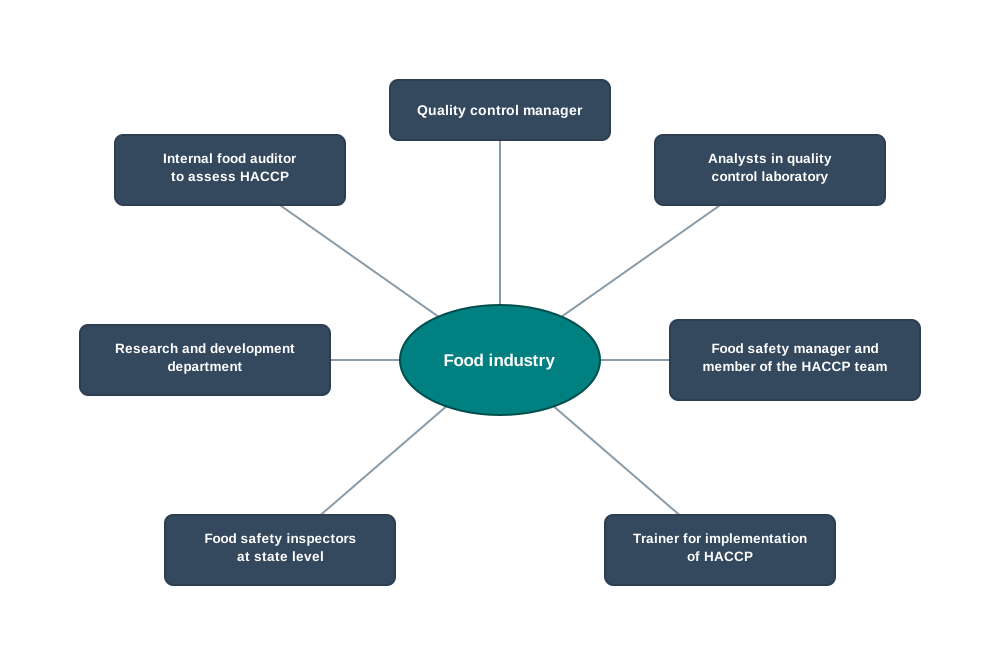
Fig. 5.12 – Job opportunities in the food industry.
Beyond the factory and the regulator, the field opens into other kinds of work. Food testing laboratories in both the public and the private sector need analysts and technicians. Certification work under standards such as ISO needs specialists, as does HACCP implementation. Teaching, academic work, research and scientific writing all draw on the same training, and voluntary organisations take on people in a range of capacities.
5.9.3 Self-Employment And Entrepreneurship
Not all of this work is salaried. A qualified person can set up an analytical food laboratory, offering testing services to businesses that are too small to run laboratories of their own.
Consultancy is a second route. Food businesses that must put a safety system in place, and must satisfy an auditor that it works, often engage someone from outside to design and set it up.
A third is education in food safety and sanitation — training the people who actually handle food. A food business is only as safe as the practices of the person at the stove and the person at the counter, so training them is real and needed work.
Placement options are emerging at different levels across regulatory and health agencies alike. The integrated approach of the Home Science curriculum, and particularly the discipline of Food Science and Nutrition within it, gives exactly the combination this field asks for: the science of the food, the law that governs it, and the practical skill to manage a hazard where it arises.
5.10 Summary
- Food determines the health, nutritional status and working capacity of a population, so the safety of food is a public concern and not only a private one.
- Food-borne illness is illness caused by eating food carrying harmful organisms or substances, and its effects go beyond health to earnings, employment, trade, tourism and litigation.
- Concern over food safety and quality has grown because:
- more food is eaten away from home, prepared in bulk, by many handlers, well before it is served;
- processed and packaged foods, including spices and oils once prepared at home, now dominate the market;
- bulk transport leaves a long gap between processing and consumption;
- micro-organisms adapt, resistance develops and new pathogens appear;
- international trade requires countries to guarantee the safety of what they send and receive;
- pollution, pesticides and food additives make the analysis of food necessary.
- Food safety is the assurance that a food is acceptable for human consumption according to its intended use.
- Toxicity is the capacity of a substance to cause harm; hazard is the probability that harm will actually result when the substance is not used in the prescribed manner and quantity.
- Hazards in food are of three kinds:
- physical hazards — materials not normally found in food, such as stones, hair, stems and seeds, bone fragments and pieces of packing;
- chemical hazards — pesticide and veterinary residues, toxic metals, cleaning chemicals, adulterants, non-permitted additives and excess of permitted additives;
- biological hazards — living organisms, whether visible, such as flies, worms, cockroaches, weevils and caterpillars, or invisible, such as bacteria, yeasts, moulds, protozoa and viruses.
- Micro-organisms that are associated with food and cause disease are called food-borne pathogens, and they cause illness in two ways.
- Food infection results from eating live pathogenic organisms which multiply in the body, as with Salmonella, and is prevented by thorough cooking and by avoiding cross-contamination.
- Food intoxication results from toxins already formed in the food, as with Staphylococcus aureus; the toxins survive after the organism is killed and cannot be detected by smell, appearance or taste.
- Parasites such as tapeworm, and infestation by pests and insects, are further biological hazards.
- New pathogens emerge through the interaction of the human host, animal hosts, the pathogen itself and the environment in which food is produced, processed, handled and stored.
- Contamination is the presence of harmful or objectionable foreign substances in food, before, during or after processing or storage.
- Adulteration is the lowering of a food’s quality, by adding inferior material or extracting a valuable ingredient, and includes contamination arising during growth, storage, processing, transport and distribution; the substances used are called adulterants.
- Food quality is the set of attributes that determine a food’s value to the consumer, covering its sensory properties, nutritional traits, social considerations and safety.
- Safety is a preliminary attribute and a precursor of quality: a food that is unsafe has no quality, whatever its other attributes.
- Food service providers at every stage should observe good practice, chiefly:
- quality of raw materials and water;
- cleanliness of premises, personnel, equipment and preparation, storage and serving areas;
- storage of food at the appropriate temperature;
- food hygiene;
- good service practices.
- Standards exist at four coordinated levels: company, national, regional and international.
- In India the ISI mark of the Bureau of Indian Standards and the AGMARK scheme are voluntary certifications, the first for processed foods and the second for agricultural products.
- The Food Safety and Standards Act, 2006 consolidated the earlier food laws, including the Prevention of Food Adulteration Act, 1954 and the commodity Orders, under one umbrella, and applies to all food manufactured in India or imported and sold in India.
- The Act established the Food Safety and Standards Authority of India to lay down science-based standards and to regulate the manufacture, storage, distribution, sale and import of food; the FSSAI frames regulations, accredits certification bodies and laboratories, advises government, collects data and runs a rapid alert system, informs the public, trains food handlers, contributes to international standards and promotes awareness.
- The Act reflects the international shift from compositional or vertical standards to safety or horizontal standards.
- Three international bodies shape this field:
- the Codex Alimentarius Commission, an intergovernmental body whose Codex Alimentarius is the reference from which countries develop national standards;
- the International Organisation for Standardisation, a federation of national standards bodies, whose ISO 9000 is a voluntary reference for quality management;
- the World Trade Organisation, established in 1995 to help trade flow smoothly, freely, fairly and predictably.
- An effective food control system has two limbs: food inspection, which verifies conformity to standards, and analytical capability, which requires accredited laboratories and trained personnel.
- A hazard can enter at any stage of the food chain, so control must run through the whole chain; this is the work of food safety management systems.
- Good Manufacturing Practices require manufacturers to take proactive steps that minimise contamination and prevent false labelling.
- Good Handling Practices cover the journey from farm to store or consumer and ensure that everyone handling food follows good hygiene.
- Hazard Analysis Critical Control Point identifies the hazards at each step, assesses the chance of their occurring, fixes the critical control points at which control is essential, and defines the measures by which they are controlled.
- HACCP is preferred because it prevents rather than detects, catches a fault at the step where it arises, uses resources efficiently, assures consistent quality, and matches the Act’s placing of primary responsibility on producers and suppliers.
- The growth of food processing and of international trade has widened the scope of this field, opening careers in regulation, public health, industry, laboratories, auditing, certification, teaching, research and entrepreneurship.
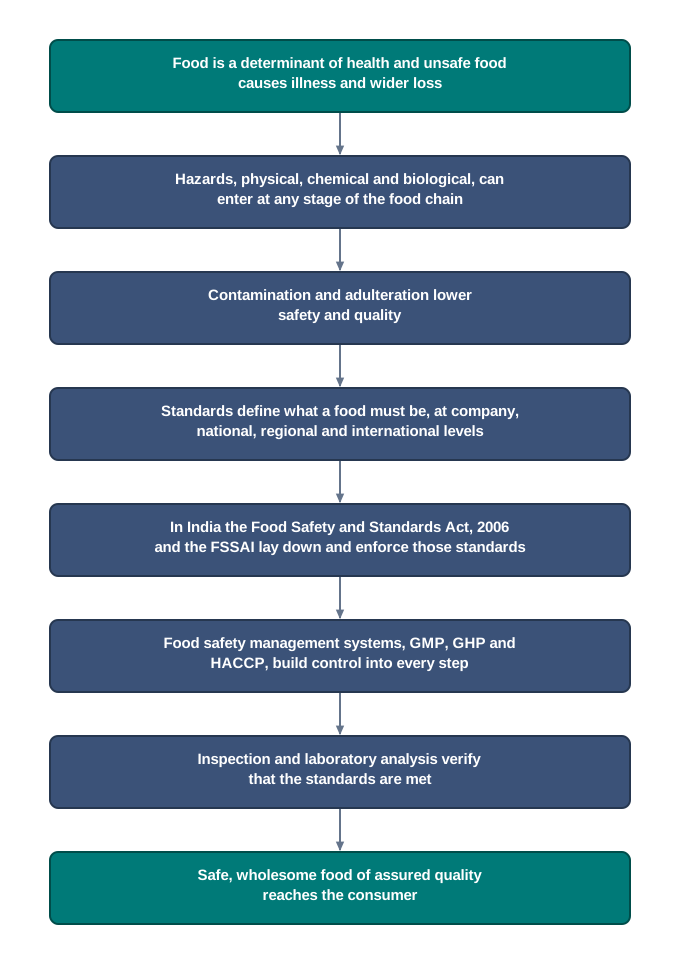
Fig. 5.13 – The argument of this chapter.
5.11 Key Terms
- Adulterants — substances used in a food that make the product unsafe or unfit for human consumption.
- Adulteration — the lowering of a food’s quality, by adding inferior material or removing a valuable ingredient.
- AGMARK — the voluntary Indian scheme for certifying and grading agricultural products, raw and processed.
- Analytical capability — the accredited laboratories and trained personnel needed to find out what a food actually contains.
- Biological hazards — living organisms in food, from visible insects and worms to invisible bacteria, yeasts, moulds, protozoa and viruses.
- Chemical hazards — chemicals or harmful substances added to food, intentionally or unintentionally.
- Codex Alimentarius — the collection of internationally adopted food standards, codes of practice and guidelines published by the CAC.
- Codex Alimentarius Commission (CAC) — the intergovernmental body that sets international food standards to protect consumers and facilitate trade.
- Contamination — the presence of harmful or objectionable foreign substances in food, before, during or after processing or storage.
- Critical control point — a step in a process at which control is essential and possible, to prevent a hazard or reduce it to an acceptable level.
- Cross-contamination — the transfer of harmful organisms from one food, surface or hand to another food.
- Food auditor — a trained person who examines whether a food business’s safety system is working as it claims.
- Food chain — the whole sequence a food passes through, from production to the consumer.
- Food control system — the machinery that enforces standards, consisting of food inspection and analytical capability.
- Food hygiene — the practices that keep food free from contamination at every stage of handling.
- Food infection — illness caused by eating live pathogenic organisms that multiply inside the body.
- Food inspection — verification, through inspection, that foods conform to the prescribed standards.
- Food intoxication — illness caused by toxins already formed in the food by bacteria growing in it.
- Food quality — the attributes that determine a food’s value to the consumer: sensory, nutritional, social and safety.
- Food safety — the assurance that a food is acceptable for human consumption according to its intended use.
- Food Safety and Standards Act, 2006 — the Indian law that consolidated the earlier food laws and established the FSSAI.
- Food Safety and Standards Authority of India (FSSAI) — the authority that lays down science-based food standards for India and regulates the food business.
- Food safety management system — the organised set of practices by which a food business controls hazards across the whole food chain.
- Food standards — agreed statements of what a food must be, used to assure quality and to make trade possible.
- Food-borne illness — illness caused by eating food that carries harmful organisms or harmful substances.
- Food-borne pathogens — micro-organisms associated with food that cause disease.
- Good Handling Practices (GHP) — practices covering the food’s journey from farm to store or consumer, ensuring hygienic handling throughout.
- Good Manufacturing Practices (GMP) — proactive practices by which manufacturers minimise contamination and prevent false labelling.
- Hazard — the probability that harm or injury will result when a substance is not used in the prescribed manner and quantity.
- Hazard Analysis Critical Control Point (HACCP) — a preventive system that identifies hazards at every step of a process and controls them where they arise.
- Horizontal standards — safety standards that apply across foods, covering hygiene, contaminants, additives and labelling.
- Infestation — the presence of pests, insects or their remains in stored food.
- International Organisation for Standardisation (ISO) — the worldwide federation of national standards bodies that publishes International Standards.
- ISI mark — the voluntary certification mark of the Bureau of Indian Standards, applied to processed foods and other goods.
- Physical hazard — any physical material not normally found in food, which causes illness or injury.
- Sensory evaluation — the systematic assessment of a food’s appearance, texture, odour, taste and flavour by trained judges under controlled conditions.
- Sensory properties — the attributes of a food that can be judged by the senses: colour, texture, shape, appearance, taste, flavour and odour.
- Toxicity — the capacity of a substance to produce harm or injury of any kind under any conditions.
- Vertical standards — compositional standards that specify what a particular named food must be made of.
- World Trade Organisation (WTO) — the body established in 1995 to help trade flow smoothly, freely, fairly and predictably.
5.12 Points To Ponder
- Safety is described as a precursor of quality. Could a food business ever sensibly work on the quality of its product before its safety, or must the order always run one way?
- The ISI mark and AGMARK are voluntary, while the FSSAI licence is compulsory. What does a producer gain by taking on a certification the law does not demand?
- A toxin in food cannot be detected by smell, appearance or taste. What does this say about the long-standing household habit of sniffing food to decide whether it is fit to eat, and what should take the place of that judgement?
- Codex standards bind no country by themselves, yet they shape food law across the world. How can a rule with no force of its own become so influential?
- HACCP was designed for operations that repeat the same process daily. How far can its reasoning be carried into an ordinary kitchen, where no two days are alike and nothing is recorded?
- One food-safety failure can damage an entire trade, not only the business responsible. Why might the law place primary responsibility for safe food on producers and suppliers rather than chiefly on inspection?
5.13 Objective Questions
- (MCQ) Which of the following is a physical hazard in food? [1]
- Residue of a pesticide sprayed on the crop
- A jute fibre from a storage sack
- A toxin produced by bacteria in a cooked dish
- A colour used in excess of the permitted quantity
- (MCQ) The Food Safety and Standards Authority of India was established under the [1]
- Prevention of Food Adulteration Act, 1954
- Fruit Products Order, 1955
- Food Safety and Standards Act, 2006
- Meat Food Products Order, 1973
- (MCQ) Illness caused by toxins already formed in the food before it is eaten is called [1]
- food infection
- infestation
- cross-contamination
- food intoxication
- (MCQ) Which statement about the ISI mark is correct? [1]
- It is compulsory for every food sold in India
- It is a voluntary certification scheme run by the Bureau of Indian Standards
- It certifies only raw agricultural produce
- It is issued by the Codex Alimentarius Commission
- (Assertion–Reason) Read the assertion and reason and choose the correct option. [1] Assertion (A): A dish that smells and looks perfectly fresh may still cause illness. Reason (R): Bacterial toxins in food cannot be detected by smell, appearance or taste.
- Both A and R are true, and R is the correct explanation of A
- Both A and R are true, but R is not the correct explanation of A
- A is true but R is false
- A is false but R is true
- (Assertion–Reason) Read the assertion and reason and choose the correct option. [1] Assertion (A): HACCP is preferred to testing the finished product. Reason (R): Testing the finished product detects a problem only after the batch has been made.
- Both A and R are true, and R is the correct explanation of A
- Both A and R are true, but R is not the correct explanation of A
- A is true but R is false
- A is false but R is true
- (Match The Following) Match the body in Column A with its description in Column B. [1]
| Column A | Column B |
|---|---|
| a. Codex Alimentarius Commission | i. Administers trade agreements and settles trade disputes between countries |
| b. International Organisation for Standardisation | ii. An intergovernmental body whose standards countries use to develop national regulations |
| c. World Trade Organisation | iii. A federation of national standards bodies whose standards are adopted voluntarily |
(Fill In The Blank) The capacity of a substance to produce harm or injury of any kind under any conditions is called ____________. [1]
(True Or False) Adulteration includes the removal of a valuable ingredient from a food, and not only the addition of inferior material. [1]
(Name The Following) Name the step in a process at which control is essential and possible in order to prevent a hazard or reduce it to an acceptable level. [1]
(Odd One Out) Pick the odd one out and give a reason: bacteria, yeasts, moulds, weevils. [1]
5.14 Check Your Concepts
Define food safety, and state why the phrase ‘according to its intended use’ is part of the definition. [2]
List any four functions of the Food Safety and Standards Authority of India. [2]
Give a reason why a person working in a food preparation area is required to keep the head covered. [2]
Differentiate between toxicity and hazard, stating the basis of difference. [3]
Explain, with one example each, the two ways in which a food may be adulterated. [3]
Why has concern about food safety and quality grown so sharply in recent decades? Explain any four reasons. [4]
Differentiate between food infection and food intoxication on the basis of what is swallowed, where the harm is produced, and the effect of thorough cooking. [4]
What would happen if a food business relied only on testing its finished product? Explain, and describe how HACCP works instead. [5]
Explain the four levels at which food standards are set, and show how they fit together. [5]
5.15 Identify And Label
Study Fig. 5.9. Identify each of the three marks shown, and state for each what it certifies and whether it is voluntary or compulsory. [3]
Study Fig. 5.3. Identify any five of the items shown, and state the group of hazards to which all of them belong. [3]
Study Fig. 5.6. Name the five groups of micro-organisms labelled, and state why this figure is titled ‘invisible’ hazards while Fig. 5.5 is not. [3]
Study Fig. 5.8. Name the four sets of attributes that make up food quality, and list the seven sensory properties shown. [3]
5.16 Case And Application Based
- A school canteen prepares 300 servings of a rice preparation. The cooking is finished by ten in the morning and the food is ladled into large uncovered vessels that stand on the counter until it is served at one. One helper is recovering from a cold and repeatedly touches his nose while serving. The serving spoons are rinsed in water drawn from an open drum kept in the yard. [4]
- Identify three separate points at which this food may become unsafe.
- Which type of food-borne illness is most likely here, and why?
- Suggest one control measure for each of the three points you have identified.
- A small unit in a hill district makes fruit jam and sells it locally. The owner now wants to supply shops in other states, and has been told the unit must be able to show that its product is safe and that the process is under control. [4]
- Name the authority whose requirements the unit must meet, and state what must appear on the label.
- Name two stages of the jam-making process that are likely to be critical control points, and state the hazard each controls.
- Explain how a system such as HACCP would help the owner more than testing a jar from each batch.
- Two packets of a ground spice are on a shop shelf. One is sealed, carries an AGMARK mark and an FSSAI logo with a licence number, and states a date of packing. The other is loose, weighed out from an open sack, and is a noticeably brighter colour. [4]
- State two things the marks on the first packet tell the buyer, and one thing they do not.
- Why is the brighter colour of the loose spice a matter for caution rather than a sign of quality?
- Using the idea of safety as a precursor of quality, explain how you would advise the buyer to choose.