Chapter 11: Hospitality Management
The Sarai On The Great Road
In the 1540s CE, the ruler Sher Shah Suri rebuilt the long road that ran from Bengal across northern India to the north-west — the Sadak-e-Azam, known today as the Grand Trunk Road. Along its length he ordered rest houses, called sarais, placed roughly a day’s journey apart.
A sarai was a walled enclosure with a single gateway, small rooms opening on to a courtyard, a well, stables for animals, and a kitchen. A traveller who reached the gate before it was shut for the night was given a room and a meal. Cooks prepared the food, and the keeper of the sarai was answerable to the state for everyone inside the walls.
Look closely at how that work was divided. One person received the traveller at the gate and noted the arrival. Another cleaned the rooms and drew the water. Another cooked. Another watched the gate and the stables through the night.
Those four jobs are almost exactly the four kinds of work a hotel does today — receiving and recording guests, cleaning and supplying rooms, feeding people, and running the services that stand behind all three. A sarai gave its services free, as dharmashalas still do. Travel now happens on a scale that free hospitality cannot carry, so the same services are bought, sold, staffed and managed as an industry. This chapter takes you through that industry, department by department.
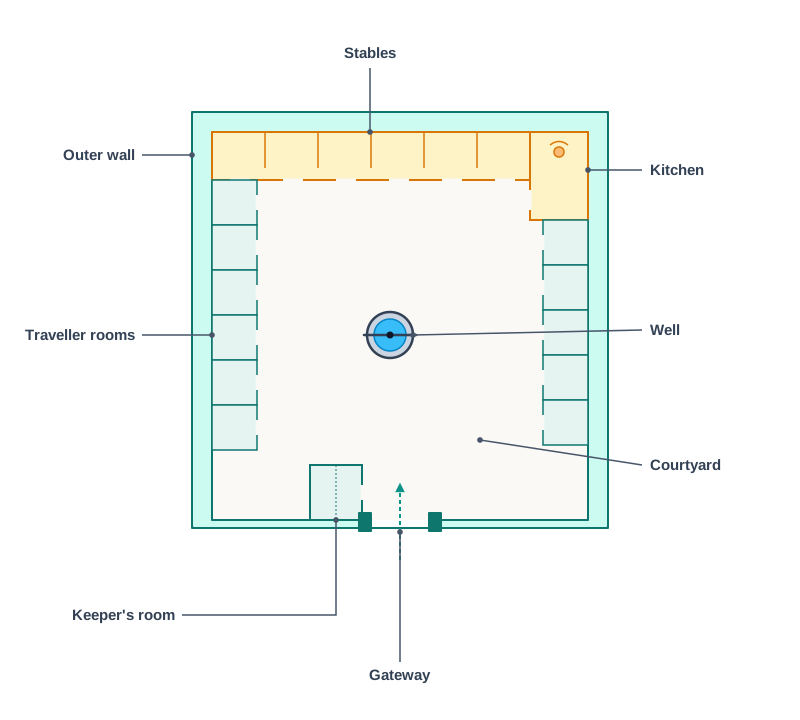
Fig. 11.0 – Plan of a roadside sarai.
11.1 Why Hospitality Matters Today
Travel used to be rare and difficult. Today a student leaves home for a coaching centre in another state, a technician flies out to install a machine, a family goes to a wedding four hundred kilometres away, and a patient travels to a city hospital for surgery. All of them sleep somewhere that is not their own house.
That single fact is what creates the hospitality industry. Somebody has to provide a room, a meal, clean water and a safe night to a person who is far from everything familiar.
Why People Travel
People move for many different reasons, and the reason shapes what they need. Some travel for business, for marketing a product, or for official work. Others travel to study, to go on a pilgrimage, to spend a holiday, to visit relatives, or to shop.
A growing number travel to another city or country for treatment. This is called medical tourism — travelling away from one’s own place mainly to obtain medical care. Such a traveller needs a quiet room, food that suits a prescribed diet, and a stay that may run for weeks rather than nights.
Many others travel to see something they cannot see at home: a different culture, a heritage monument, wildlife, or simply a landscape. Large gatherings pull people in from every direction — the Pushkar and Kumbh melas, the Dasara festival in Mysuru, the Ganapati festival in Mumbai and Pune. A town of ordinary size may have to house and feed several times its own population for a week.
What A Traveller Needs
Whatever brings a person to a place, the requirement at the end of the day is the same. It must be comfortable, safe and hygienic. A tourist — a person who travels and stays temporarily in a place away from home — is measuring the stay against her own home, because that is the only standard she has.
This is why the industry sets itself an unusual goal: to give a stranger something close to the comfort of home in a building she has never entered before. Everything in the chapters that follow — the way a room is cleaned, the way a bill is settled, the way a guest is greeted — exists to close that gap.
The consequences run all the way up the scale. A comfortable stay is one traveller’s experience. A safe, affordable place to stay decides whether a family can attend a wedding or a treatment at all. For a town near a pilgrimage site or a wildlife park, the money visitors spend on rooms, food and transport supports shops, drivers, guides and cooks through the year. And at the national level, travel earns foreign exchange and employs people at every level of skill, which is why tourism has a ministry of its own.
Before going department by department, you need the vocabulary of the industry — what counts as a hotel, what a motel or a resort is, and which sectors make up the business. That is where the chapter turns next.
11.2 Basic Concepts Of Hospitality
Before you can study how a hotel is run, you need the words the industry itself uses. Two of them do most of the work: what hospitality actually means, and what kinds of establishment provide it.
11.2.1 The Meaning Of Hospitality
Think of what happens in a household when a guest arrives. Someone opens the door and greets her, someone takes her bag, she is offered water, then tea, then a place to sit. A bed is made up, a meal is cooked with her likes in mind. None of this is a single act. It is a relationship, for as long as she stays, between the one who receives and the one who is received.
Hospitality is exactly that relationship, between a guest and a host. It is the practice of receiving a guest generously — welcoming her, seeing to her entertainment, and providing services with warmth and courtesy.
In its practical sense, hospitality means providing a place to stay, food, entertainment and the other facilities that make a stay comfortable. Notice that warmth is part of the definition and not an extra. A clean room delivered rudely has not met the definition.
11.2.2 Types Of Hospitality Establishments
Hospitality is sold by several different kinds of establishment. They differ in what they provide, which is why a traveller chooses between them. The differences are set side by side in Table 11.1.
A hotel is a commercial establishment that offers lodging, meals and other services to its guests. It is the fullest form of the business, and most of this chapter is built around it.
A motel provides services similar to a hotel, with one difference that shapes everything about it: parking lies close to the room, or the room door itself opens on to the parking lot. It suits a traveller who is driving through and wants to reach the room and the vehicle without crossing a lobby.
A lodge offers rented accommodation, chiefly for sleeping. It may not provide food or other services, and a guest who stays in one plans her meals elsewhere.
A resort is known for its leisure attraction. It offers a broad range of amenities, sports facilities and leisure activities, so that the whole holiday can be spent within its grounds. Here the stay is not a means to something else; the stay is the reason for the journey.
Furnished apartments provide all the essential amenities a guest needs, including the means to cook, and suit a stay measured in weeks. Furnished camps provide hospitality to people who go hiking or undertake adventure sports, in places where no permanent building exists.
Hospitality Beyond Hotels
Hospitality services are not confined to places that rent rooms. They are part of what happens at conventions, conferences, weddings, parties, theme parks, amusement parks and cruise lines. Guest houses, hostels and hospitals provide them too, and organisations that provide hospitality generally run management departments for the purpose.
This matters for a reason worth holding on to through the whole chapter. The fundamental principles of hospitality management are the same everywhere. A hospital ward and a hotel floor both need beds made, linen exchanged, meals served on time and visitors directed to the right place. What changes is the scale and the priority, not the principle.
11.2.3 Sectors Of The Hospitality Industry
For work to be carried out smoothly and efficiently, the industry divides itself into sectors, and within an establishment into departments. The five sectors that make up the industry are shown in Fig. 11.1.
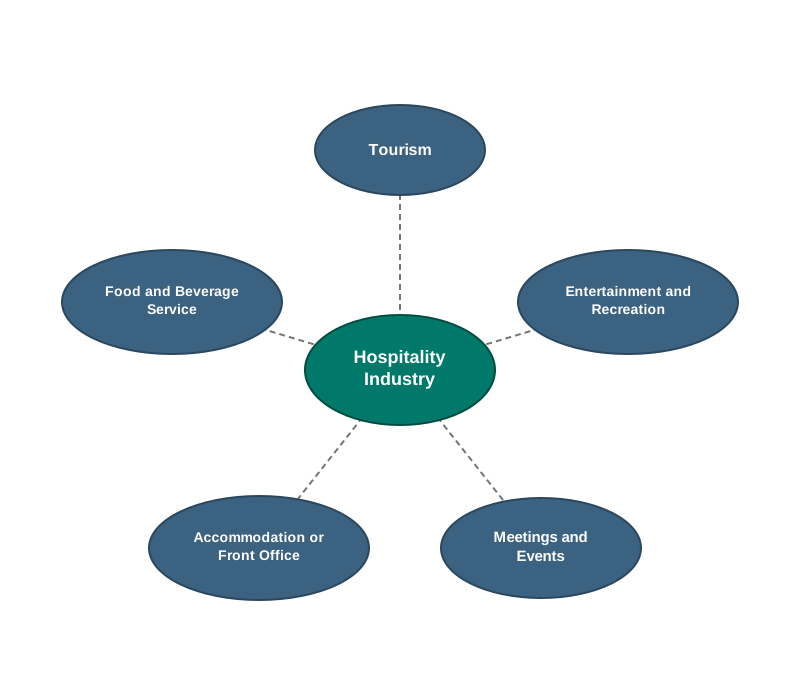
Fig. 11.1 – Sectors of the hospitality industry.
Read the diagram as a division of work rather than a list. Tourism brings the traveller to the place. Accommodation, through the front office, receives her and gives her a room. Food and beverage service feeds her. Entertainment and recreation occupies the hours she is not sleeping or eating. Meetings and events handle the conferences, banquets and weddings a property hosts for people who may not be staying there at all.
A single hotel usually works in more than one of these sectors at once, which is why its departments have to coordinate so closely. The rest of this chapter examines the three departments a guest deals with most directly — the front office, housekeeping, and food and beverages — and the support departments behind them.
11.3 The Guest Cycle
A hotel looks, from outside, like a building people walk into. Seen from the inside it is something quite different: a sequence of stages that every guest passes through in the same order, whether she stays one night or one month.
That sequence is called the guest cycle — the four stages through which a guest passes in dealing with a hospitality establishment, from the first enquiry to the settling of the final bill. Understanding it is the key to understanding the departments, because each department’s work is attached to a particular stage.
Two things about the cycle are easy to miss. It begins before the guest reaches the building, and it does not end when she leaves. The four stages are set out in Fig. 11.2.
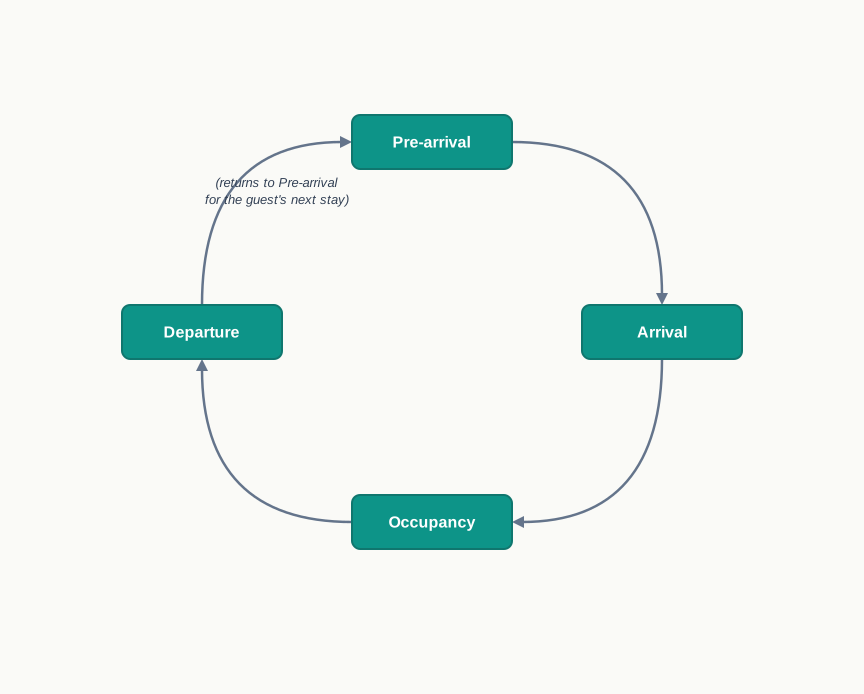
Fig. 11.2 – Stages of the guest cycle.
The arrow that closes the loop is the whole point of the diagram. A satisfied guest re-enters the cycle at the pre-arrival stage the next time she travels, and this time she enquires at the same establishment.
11.3.1 Pre-Arrival Stage
The cycle starts before the guest physically steps into the hotel. At this stage she is only an enquiry — a phone call, a message, a booking made through an agent or a website.
Two activities belong to this stage. The first is quoting rates to the guest: telling her what a room of each type will cost on the dates she wants. The second is reserving the room, done by the reservation department or through a central reservation system, a shared booking system that holds the room availability of a chain of properties in one place, so that a booking made anywhere is visible everywhere.
The purpose of the stage is to make sure a room genuinely exists for her on the night she arrives. A guest who reaches a full hotel at midnight with a booking in hand has been failed at this stage, not at the desk.
11.3.2 Arrival Stage
In this stage the guest actually arrives and registers, or checks in. Registration means entering her details in the establishment’s records and formally allotting her a room.
11.3.3 Occupancy
This is the stage that lasts longest and involves the largest number of people. It consists of providing services as the guest requires them, ensuring her security, and coordinating the various guest services so that they do not clash with one another.
The focus throughout is guest satisfaction. That is not politeness for its own sake; it has a commercial purpose. A guest who is satisfied uses the establishment again and recommends it, and this is what the industry calls customer loyalty — the tendency of a guest to return to the same establishment rather than choose a competitor.
Winning loyalty is far cheaper than finding a new guest for every room every night, which is why so much of a hotel’s effort goes into a stage that earns no extra payment by itself.
11.3.4 Departure
Departure is the final stage, in which the guest is ready to leave the accommodation. She checks out, the bill is settled, and the room is released for cleaning.
One task remains after she has gone. The establishment keeps an up-to-date record of the room she occupied along with other information about her, known as guest history — the record of a guest’s past stays, preferences and feedback. Her opinion of the services is recorded as part of it.
Guest history is what allows the next stay to begin better than the last one. If the record shows that she asked for a quiet room away from the lift and preferred a light breakfast, that room and that breakfast can be arranged before she asks again. This is where the loop in Fig. 11.2 is actually closed.
11.4 The Front Office
Most of the guest cycle falls under one department. The front office is the department that receives guests, allots rooms, keeps the records of their stay and settles their bills.
The guest arrives here and meets the staff of the hospitality industry for the first time. Whatever she has been told over the phone, this is where she finds out what the establishment is actually like. The interaction between guest and staff at this counter builds the relationship between her and the organisation, and builds the image of the organisation itself.
That is why the front office is called the focal point of any hotel. It is not the largest department, and it does not do the heaviest work, but every other department’s effort reaches the guest through it.
11.4.1 Services Offered By The Front Office
The staff at the front office carry out a long list of tasks, and it helps to see them grouped by what they achieve rather than as a list to be learnt.
Receiving the guest comes first — welcoming her, meeting and greeting her. Alongside this runs the work of organising the reservation status of room availability, so that the desk knows at any moment which rooms are free.
Then comes the paperwork of the stay: registering guests and allocating rooms, maintaining records of check-in and check-out details, and issuing room keys.
Through the occupancy stage the desk provides porter services, passes messages to guests, coordinates with other guest services, and supplies information both in-house and about the world outside — where the banquet hall is, and equally where the nearest chemist is. At the end, it prepares and settles the bills.
The manner in which all this is done matters as much as the doing. Consider two receptionists handing over the same key to the same room at the same rate. One looks up, uses the guest’s name and says the room is ready; the other does not look up at all. The room is identical and the bill is identical, but only one of those guests will book again. Because the front office sets that impression, the manner of its service plays a central role in image building and ultimately affects the revenue the establishment earns.
The desk cannot do any of this alone. Front office staff coordinate constantly with transport for the guest’s travel, with accounts and billing, with room service and the restaurants, with engineering when something in the room fails, with stores, with sales, and above all with housekeeping, which tells the desk which rooms are ready to be sold.
11.4.2 Organisation Of The Front Office
Because these tasks run through the day and night, they are divided among posts arranged in a hierarchy. The organisation of a front office department is shown in Fig. 11.3.
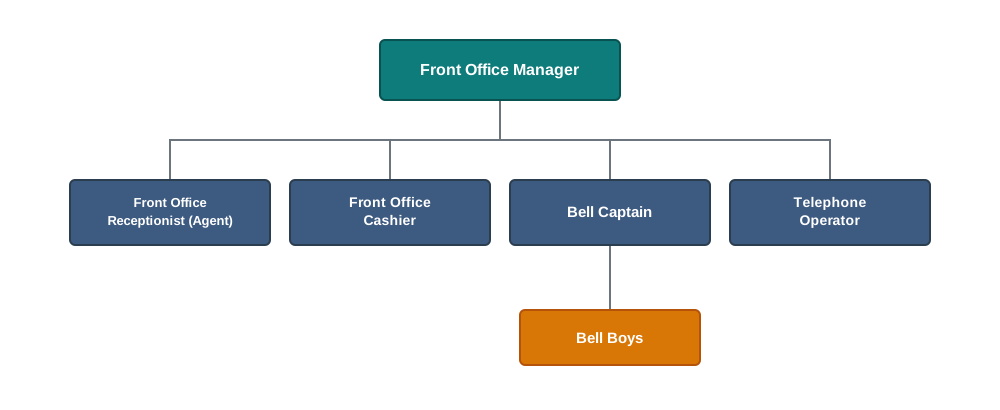
Fig. 11.3 – Organisation of the front office department.
Read a chart of this kind as a line of reporting rather than a line of importance. It shows who answers to whom when a decision is needed, and where a task goes when the person holding it is absent. In a small establishment several of these posts are held by one person; in a large hotel each may head a team of its own.
11.4.3 Designations And Duties Of Front Office Personnel
The duties attached to each post in the front office are set out in Table 11.2. Notice how they are distributed: managing and scheduling at the top, guest-facing work in the middle, and baggage and door duties at the entrance.
Two of these designations are worth a second look. Uniformed services — the doorman, the bell captain and the bell boys — are the staff a guest sees in uniform in the lobby and at the entrance, and they are supervised by the lobby manager, with the bell captain directly in charge of baggage and of the bell boys themselves.
Several of these titles are old, and some are grammatically male — bell boy, doorman. The posts themselves are held by men and women alike, and nothing in the duties attached to them depends on the sex of the person holding the post.
11.5 The Housekeeping Department
Ask a guest what she remembers about a hotel and she will rarely describe the lobby. She will tell you whether the sheets were fresh, whether the bathroom smelt clean, whether the corridor was quiet and the garden pleasant. All of that is the work of one department.
Housekeeping is the department responsible for cleanliness, hygiene and the appearance of the whole establishment. It provides a healthy environment by maintaining high standards of hygiene, and it keeps the aesthetics of the property — its decor, its linen, its flowers, its garden — at the level the establishment promises.
The guest’s decision to stay, and to come back, depends largely on the quality of what this department does. In a hotel, room decor, the facilities inside the room, safety, cleanliness and hygiene matter more than almost anything else, because they are what the guest lives with hour by hour.
Housekeeping As A Business Of Its Own
Housekeeping is no longer confined to hotels. Many organisations, including corporate offices, now hire housekeeping services on a contractual basis rather than employing their own staff. This has opened an avenue for people to start enterprises of their own.
Done commercially, the work carries a far greater volume of activity, and a far greater set of challenges, than housekeeping in a single household. Maintaining a large number of rooms and public areas every single day is a complex task. It cannot be done by willing hands alone; it has to be planned, divided into sections, and staffed with trained people. The rest of this section shows how that division is made.
11.5.1 Functions Of The Housekeeping Department
The prime function of the department is to maintain cleanliness and hygiene of space. Attached to that prime function are four others.
- Cleaning of public areas and guestrooms.
- Supply and upkeep of laundry, and exchange of the various kinds of linen and of uniforms.
- Internal flower arrangement, and maintenance of the external landscape or garden.
- Coordination and communication with other departments — front office, restaurants, engineering, accounts and others — through the control desk.
- Pest control.
The last two are the ones students most often forget, and both are essential. Pest control protects food, linen and the health of everyone in the building. Coordination decides whether a cleaned room actually reaches the front office as a saleable room, or sits ready and unsold because nobody passed on the information.
11.5.2 Sections Of The Housekeeping Department
To perform these functions efficiently, the department is divided into sections, each holding one clear responsibility.
- Housekeeping control desk — passes information on to the housekeeping staff working in different parts of the hotel.
- Housekeeping management — plans, organises and controls all the activities of the department.
- Guestroom brigade — upkeeps and cleans the guestrooms.
- Public area brigade — maintains the cleanliness of the foyer, lobby, front office and other common areas.
- Linen and uniform room — coordinates with the laundry, and is responsible for supplying clean linen to the entire establishment and uniforms to all the staff.
- Horticulture and flower arrangement team — maintains the landscape of the hotel and arranges flowers in the rooms and at various places.
- Lost and found section — takes charge of luggage and belongings guests have misplaced.
The logic of the division is worth naming. Three sections are defined by the space they look after, two by the material they handle, one by the information it moves, and one by the exception it deals with. Nothing is left without an owner, and no two sections can each assume the other has done a job.
11.5.3 Staffing Pattern And Responsibilities
Sections need people, and people need to know whom they report to. To run the department efficiently, the right person has to be matched to each post. The staffing pattern of a housekeeping department is shown in Fig. 11.4.
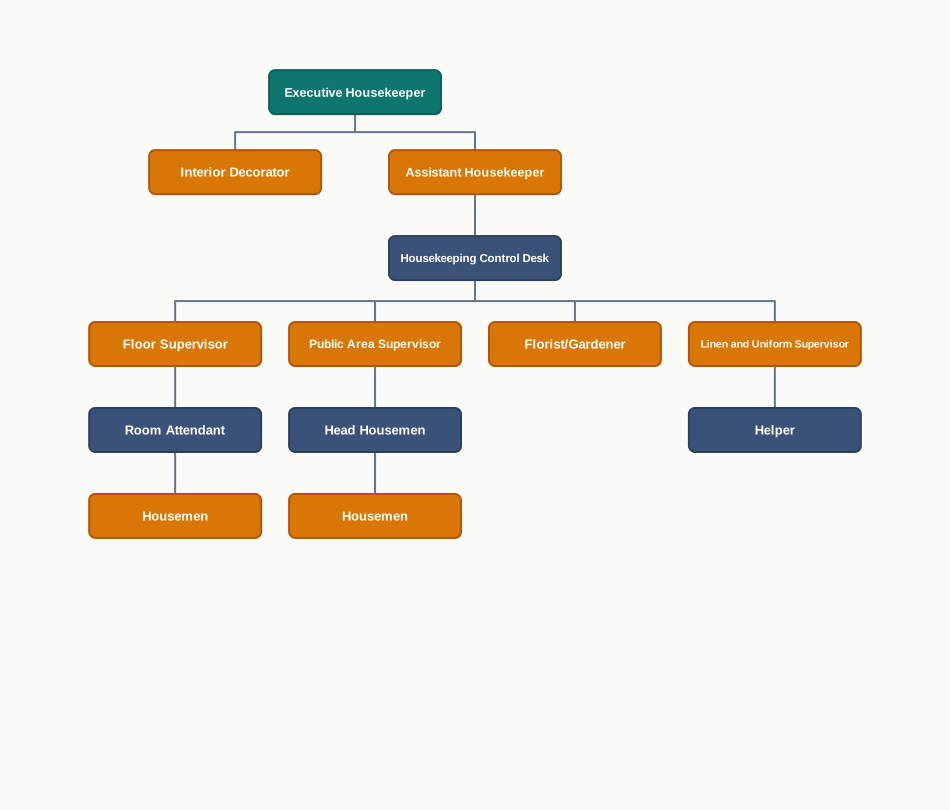
Fig. 11.4 – Organisational chart of a housekeeping department.
This chart is a general pattern, not a fixed rule. The structure and hierarchy vary from one organisation to another. A large hotel may fill every post separately, while a small one has staff who multi-task, one person holding two or three of these responsibilities at once.
The responsibilities attached to the main posts are these.
- Executive Housekeeper — manages the functioning of the whole department through judicious use of manpower, materials, money, time and the other resources available. Checks schedules, checks cleanliness, and answers for the department’s functioning.
- Assistant Housekeeper — in a large hotel there may be one for each shift of duty. Prepares the duty schedule and checks the cleanliness and functioning of the workers.
- Desk control supervisor — coordinates with the front office for information on guest departures, gets vacated rooms cleaned, and hands the cleaned rooms back. This desk is manned round the clock, because guests and staff contact it at any hour.
- Floor supervisor — one for each floor, responsible for the cleanliness and maintenance of the guest rooms, corridors, staircase and floor pantries on that floor.
- Room attendant — does the actual cleaning of guest rooms and bathrooms.
- Housemen — housekeeping attendants who perform the heavy cleaning activities: vacuuming, mopping, sweeping and shifting furniture.
- Public area supervisor — responsible for the cleanliness of the public areas, including the main entrance, corridors, offices, banquet halls and restaurants, and gets the work done through the housemen.
- Florist/Gardener — maintains the garden and does the flower arrangements in various parts of the hotel. In a small hotel this may be one person.
- Linen room / uniform room supervisor — responsible for the supply, acquisition, storage, issue and cleanliness of the linen and uniforms needed across the hotel.
Follow the chain in one ordinary event and the structure explains itself. A guest checks out; the front office tells the desk control supervisor; the desk tells the floor supervisor; the room attendant cleans the room; the floor supervisor checks it; the desk tells the front office the room can be sold again. A break at any one of those links leaves a clean room unsold or, worse, an unclean room occupied.
11.5.4 Cleaning Surfaces, Equipment And Cleaning Agents
Cleaning is an integral part of any organisation, office or hotel, and it is a planned activity rather than a reaction to visible dirt. It calls for staff selected for practical housekeeping skills, correct cleaning procedures, and a qualified supervisor to check the result. Choosing the right specialised equipment, tools and cleaning solutions, and keeping up with new technology, is an essential part of training.
Cleaning is not all done at the same interval. Activities are performed on a daily, weekly, monthly or seasonal basis, as set out in Table 11.3.
Surfaces, And Why They Decide The Method
A hotel is finished in many different materials. Walls, floors, counter tops and furniture may be of wood, granite, marble, ceramic tiles, stone, linoleum, plastic, vinyl, fibre glass, metal, leather, cane, rubber, cloth, paint or wallpaper.
Each of these behaves differently. Marble is attacked by acids. Wood is spoilt by standing water. Leather cracks if it is degreased. Wallpaper cannot be scrubbed. This is why the method is chosen from the surface and not from the stain.
Equipment And Agents
The equipment commonly used includes vacuum cleaners, brushes and brooms of various types, mops, containers, cleaning cloths, and trolleys that carry several pieces of equipment together. The trolley matters more than it looks: it lets an attendant work along a corridor without walking back to the store for every item, and it is shown in Fig. 11.5.
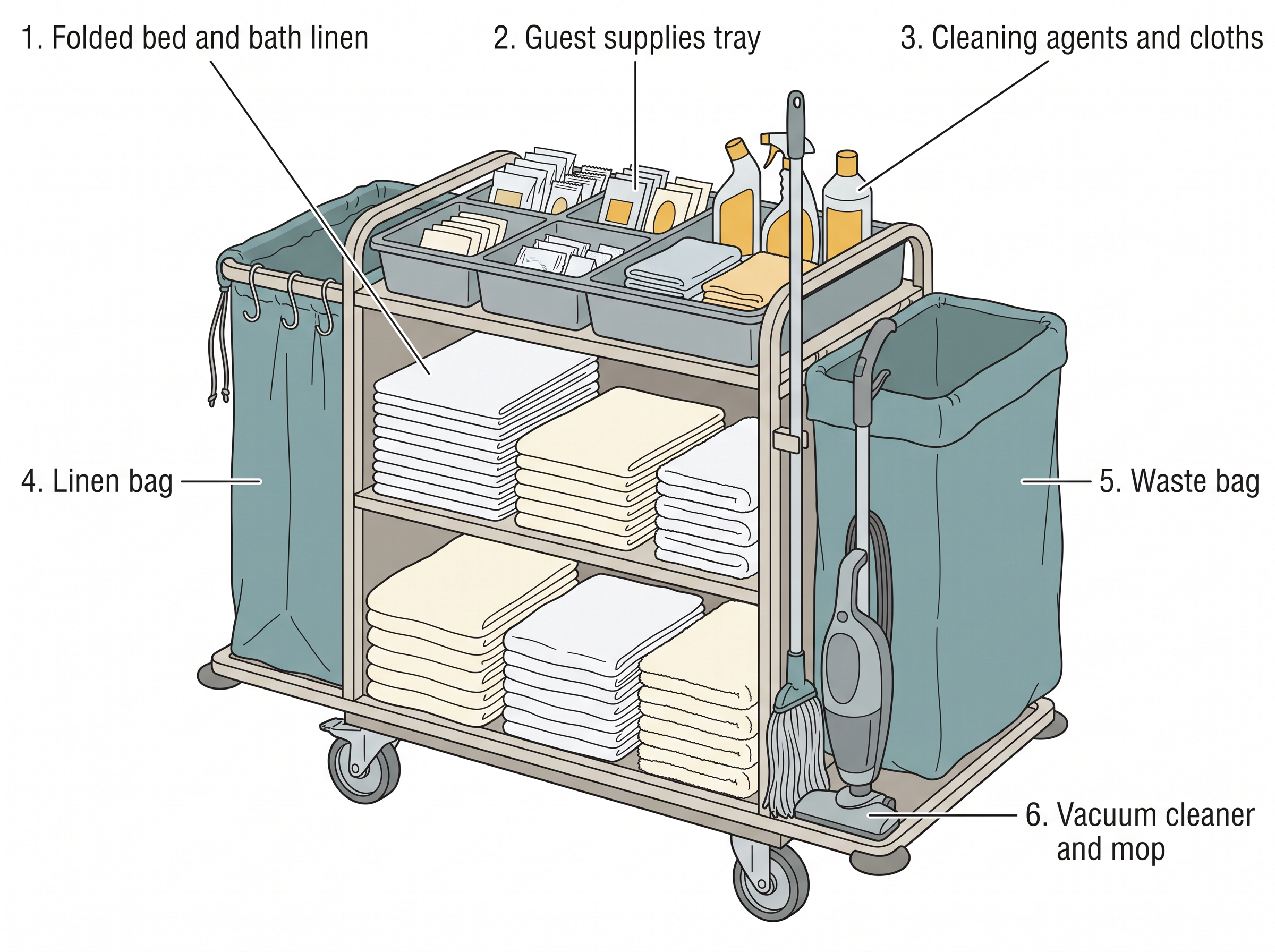
Fig. 11.5 – A housekeeping trolley.
The cleaning agents used include water, ammonia, vinegar, soaps and detergents, washing soda, abrasives, polishes, acids and similar liquids. Water is the agent of first resort and the mildest. Abrasives and acids sit at the other end: they clean by wearing the surface away or by chemical attack, and they are used only where the surface can take it.
One must be cautious with all of them. A strong agent may clean the soil and damage the surface in the same stroke, and a marble floor scoured with an acidic cleaner cannot be restored. This is why the choice of an appropriate cleaning agent is treated as a skill in its own right.
11.5.5 The Linen And Uniform Room
The linen and uniform room is an integral part of the housekeeping department. It stores and maintains enough stock of bed linen, bath linen, linen for the restaurants and uniforms for every staff member of the hotel.
‘Enough stock’ is the working idea here. At any moment a set of linen is on the bed, a set is in the wash, and a set is on the shelf ready to replace it. If the stock is cut too fine, one delayed laundry load stops rooms being let.
The laundry itself may be done within the department where the facilities exist, or given to an outside agency. Doing it in-house costs more in equipment and space but gives control over the timing; sending it out costs less to set up and makes the establishment depend on somebody else’s schedule.
11.5.6 Flower Arrangement And Landscape
Flowers are used to enhance the aesthetic appeal of interior spaces, and are placed in guest rooms, at the reception, in restaurants and in banquet halls. An establishment may give a contract to florists to supply arrangements regularly, or the housekeeping department may make the arrangements itself.
The choice is the same one as with the laundry — buy the service, or build the skill in-house — and it is decided by how much is needed, how often, and at what cost.
11.5.7 Eco-Friendly Practices In Housekeeping
Housekeeping is also the department that consumes the most water, electricity and chemicals, so it is the department where conservation shows the largest result. Staff in many hotels are now trained in environmental conservation and eco-friendly practice.
Some of these practices concern materials. Bed sheets of organic cotton are used, laundry cycles are run without harsh chemicals, and cleaning agents are chosen to be non-toxic, water-based, hypoallergenic and biodegradable — that is, capable of being broken down by natural processes rather than persisting in water and soil.
Others concern use. Cards placed in rooms invite guests to reuse towels rather than have every towel washed daily, which saves water, electricity and detergent at once. Energy-efficient bulbs cut the electricity a room consumes for the same light.
Notice that the guest has been made part of the system. A hotel cannot reduce its laundry load by decision alone, because the linen is used by someone else. The towel card works because it turns a guest’s own household habit into the establishment’s saving.
11.6 The Food And Beverages Department
The food and beverages department is responsible for the sale of food and drink in a hospitality establishment. It is the part of the business that earns money meal by meal rather than night by night, and in many properties it earns as much as the rooms do.
Several service departments come under it: the kitchen or kitchens, banquets, the restaurants, room service, stewarding, and the bars and coffee shops. Between them they cover every way food can reach a guest — at a table, in a hall laid for three hundred, or on a tray carried to a room.
Three of these are examined here, and they divide the work in a way worth noticing at the start: one prepares the food, one keeps the utensils and the kitchen fit to prepare it in, and one serves it. Their differences are set out in Table 11.4.
11.6.1 The Kitchen
The kitchen is the place where food is prepared. In a large hotel it is not one room but several working areas, each an independent section handling one kind of preparation.
The sections may include butchery, which deals with raw meat; bakery and confectionery; vegetable preparations; a soups section; the pantry; and the hot range, where the actual cooking over heat is done. In a smaller hotel these sections are combined, and the same team moves between them through the day.
There is a hygiene reason behind the division as well as an efficiency one. Keeping raw meat, vegetables and baked goods in separate areas with separate equipment prevents raw material from contaminating food that will be eaten as it is.
The Kitchen Crew
A large establishment has a whole crew in the kitchen, arranged in the order shown in Fig. 11.6.
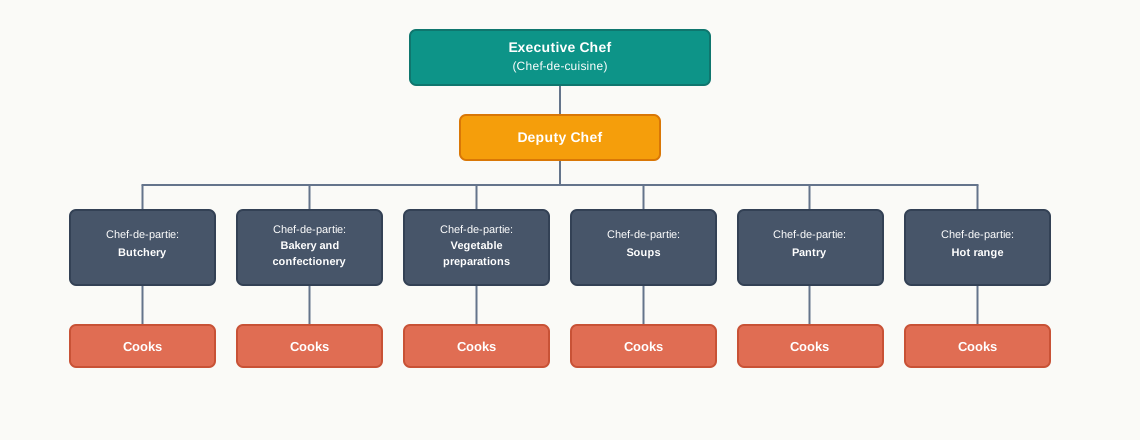
Fig. 11.6 – Hierarchy of the kitchen crew.
The executive chef, or chef-de-cuisine, is the head of the kitchen. The post is a management post, not only a cooking one: the executive chef is responsible for planning, organising and controlling kitchen operations, which means deciding the menu, the purchasing, the staffing and the standards. Next comes the deputy chef.
The supervisors in charge of individual sections of the kitchen are called chef-de-parties — one for the bakery, one for the hot range, and so on. Below them are the cooks who make the common food items.
None of this works in isolation. The restaurant personnel coordinate closely with the kitchen for the supply of food orders to guests, and an order that is not communicated accurately produces a dish nobody wanted at a table that is no longer waiting for it.
11.6.2 Kitchen Stewarding
Kitchen stewarding is concerned with the storage, maintenance, cleanliness and issue of cutlery, crockery and glassware to the restaurant and the kitchen. The department is also responsible for maintaining cleanliness in the kitchen itself and for washing the pots and pans that have been used.
The word ‘stewarding’ misleads students every year, so hold on to the distinction: this department does not prepare food. It takes charge of everything the food is cooked in, served on and eaten with, and of the state of the kitchen those utensils come back to.
The department may have an executive kitchen steward, kitchen stewards, a dishwasher, a pot washer and utility workers to clean the kitchen. Everyone working here must maintain high standards of grooming, hygiene and sanitation, along with good manners and basic etiquette, since a lapse in this department reaches the guest through the plate she eats from.
11.6.3 The Restaurant
A restaurant is a commercial facility that provides food and beverages to customers. It is equipped with dining tables, chairs and other furniture, with crockery, cutlery, linen and decor.
The quality of all of this varies to suit the objectives, concept and standards of the establishment. A roadside eating place and a fine-dining room in a large hotel are both restaurants; what differs is the standard each has set itself and the price at which it can then sell a meal. Neither is judged against the other, and each fails only if it does not meet its own promise.
Restaurant Staff
A restaurant manager is responsible for the overall functioning of the restaurant. The senior restaurant supervisor and the head waiter lead a team of waiters, also called stewards, who actually serve the food. The assistant waiter clears the table.
Between them, this team sees that the standards of cleanliness, hygiene and service are maintained. They are expected to be courteous to guests, to possess good manners and etiquette, and to greet guests with a pleasant manner. Above all they need thorough knowledge of the ways of serving food, because service is a skill with rules of its own — which side a dish is presented from, in what order guests are served, when a plate may be cleared — and a well-cooked meal can still be spoilt by serving it badly.
11.7 Support Service Departments And Management Functions
A guest deals with three departments and imagines that is the hotel. Behind them stands a second set of departments she never sees, without which the first three could not open in the morning.
11.7.1 Support Service Departments
The support service departments are the departments that keep an establishment running without dealing with guests directly. They are also called ‘back office’ departments, in contrast with the front office.
- Finance and accounts — handles the money: the bills, the payments, the purchase of everything the establishment consumes, and the accounts by which the owners judge whether the business is working.
- Engineering — keeps the building and its equipment in working order: the power supply, the water supply, the lifts, the air conditioning, the kitchen equipment and the laundry machinery.
- Human resources — recruits the staff, arranges their training, keeps their records and handles wages, leave and welfare.
- Sales and marketing — brings in the business, by selling rooms and banquet space to companies, travel agents and event organisers, and by advertising the property.
A hotel therefore has a large number of departments with complex relationships among them. Almost nothing a guest experiences is produced by a single department acting alone.
The smooth functioning of an organisation of this kind depends on the efficient management of its resources — the people it employs, the materials it consumes, the money it spends and the time it has. That is what makes management a subject in its own right rather than a matter of good intentions.
11.7.2 Management Functions In A Hospitality Organisation
Whoever heads a department, and whoever heads the establishment, performs the same set of tasks. These are the management functions — planning, organising, co-ordinating, staffing, directing, controlling and evaluating the use of resources in the light of the goals of the institution.
You will meet these functions again, treated fully, in the chapter on catering management. For the moment, hold on to what each one does.
- Planning — deciding in advance what is to be achieved and how, before any resource is committed.
- Organising — arranging the work, the materials and the equipment so that the plan can actually be carried out.
- Co-ordinating — making the parts fit, so that departments working separately arrive at the same result at the same time.
- Staffing — putting the right people in the right posts, in the right numbers, and training them.
- Directing — guiding and instructing the staff while the work is in progress.
- Controlling — checking the work against the plan and the budget, and correcting what has drifted.
- Evaluating — judging, at the end, whether the goal was met and at what cost.
These functions run as a cycle, not as a list finished once, as Fig. 11.7 shows.
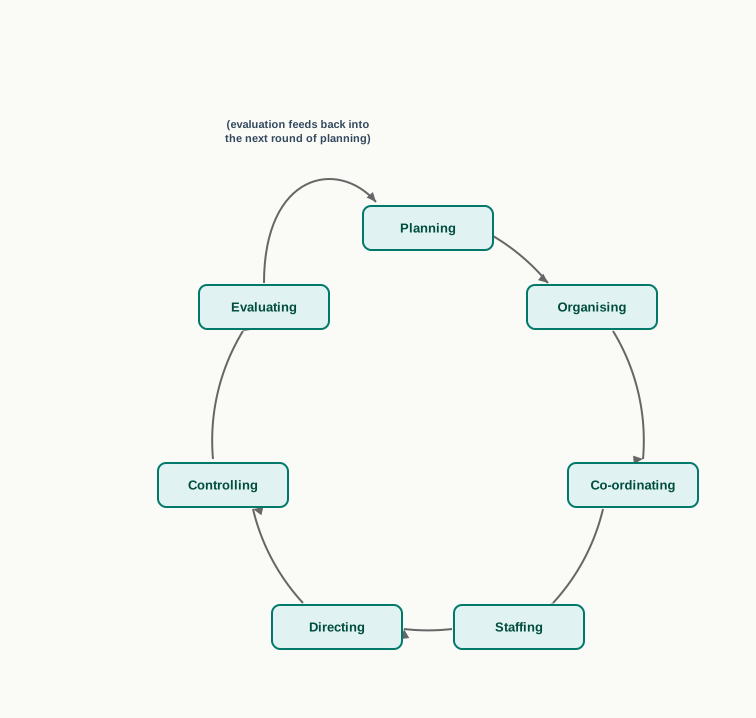
Fig. 11.7 – The management functions.
The return arrow carries the whole idea. What evaluation finds — that the banquet ran an hour late, or that linen stock ran short in the tourist season — becomes the raw material for the next plan. A manager who evaluates and does not plan again has merely kept a record of a problem.
11.8 Scope And Careers In Hospitality
An industry that runs twenty-four hours a day, every day of the year, needs a great many people. It also needs them at every level of skill and training, which is what makes hospitality unusual as a field of work: there is an entry point for a person with a school certificate and a career path from that point upwards.
The organisational structure of a hotel has a hierarchy of top management, middle management, junior management, supervisors and operations staff. There are job opportunities at each of these levels, as Table 11.5 shows.
The industry employs a large number of young entrants, because the operations level is by far the largest and most people join it early. Progression is largely from within, and a person who joins as a room attendant may in time supervise a floor and then a department. Experience earned on the floor is valued here in a way it is not in every industry.
The scope is wider than hotels. The fundamentals of hospitality management apply to hostels and to large hospitals as well, both of which have to house, feed and clean for large numbers of people every day.
11.8.1 Competencies Required In The Industry
A hospitality job is a job done in front of people, and the competencies the industry looks for follow from that.
The staff need to be well groomed, to maintain good personal hygiene, to be orderly in their work, and to have good manners and etiquette. A pleasant, welcoming manner matters, because the guest reads it before she hears a word.
Beyond manner come the qualities that carry a person through a long shift: a cheerful attitude, self-discipline, courtesy, physical fitness, and good communication skills. Self-confidence and the ability to speak more than one language add a great deal, particularly at the front office, where guests may arrive speaking any language at all.
Appearance is treated as part of the job. A clean and neatly pressed uniform, minimum accessories, neatly kept hair, and clean, trimmed nails are all expected. The reasoning is not vanity: front office staff must be at their best at all times, because their appearance projects an image not only of themselves but of the whole establishment.
Notice that almost every one of these competencies can be learnt. Grooming, courtesy, orderliness and language are all trainable, which is why the industry recruits for attitude and trains for skill.
11.8.2 Courses And Career Opportunities
Catering and hospitality management courses are offered by institutes across the country, at levels ranging from certificate courses to degrees. Candidates may pursue catering courses at undergraduate as well as postgraduate level, and diploma and certificate courses are available for those who want to enter the industry sooner.
Hotel management is among the more popular career choices for students leaving school, partly because the training is practical from the first year and partly because the qualification is portable — the same skills are wanted in every city and in many countries.
The openings this chapter has made visible include the following.
- Positions in housekeeping departments, at every level of the hierarchy.
- Entrepreneurial opportunities in housekeeping, since many organisations now contract the work out rather than employ their own staff.
- Positions in the front office, and at the reception or control desk, in hotels and similar establishments.
- Entrepreneurial opportunities in supplying flower arrangements and similar services to establishments on contract.
- Specialisation in theme-based events organised within an establishment.
Two of those five are enterprises rather than jobs. That is worth pausing on. A person who has learnt how a housekeeping department works, or how a banquet hall is dressed for an event, owns a skill that can be sold to many establishments at once, without owning a hotel.
11.9 Summary
- People travel for business, official work, study, pilgrimage, medical treatment, leisure, visiting relatives and shopping, and every traveller needs a place to stay that is comfortable, safe and hygienic.
- A tourist is a person who travels and stays temporarily in a place away from home, and she judges a stay against the comfort of her own home.
- Hospitality is the relationship between a guest and a host, in which the guest is welcomed and provided accommodation, food, entertainment and other services with warmth and courtesy.
- Hospitality is sold by establishments of several kinds:
- a hotel, offering lodging, meals and other services;
- a motel, offering lodging with parking beside the room;
- a lodge, offering rented accommodation chiefly for sleeping;
- a resort, offering amenities, sports and leisure activities as the attraction itself;
- furnished apartments, offering the amenities of a home for a long stay;
- furnished camps, offering hospitality at hiking and adventure sites.
- Hospitality services are also part of conventions, conferences, weddings, theme parks, cruise lines, guest houses, hostels and hospitals, and the same fundamental principles of management apply to all of them.
- The industry is made up of five sectors: tourism, entertainment and recreation, meetings and events, accommodation or front office, and food and beverage service.
- The guest cycle has four stages:
- pre-arrival, when rates are quoted and a room is reserved through the reservation department or a central reservation system;
- arrival, when the guest registers and checks in;
- occupancy, when services are provided, the guest’s security is ensured and guest services are coordinated;
- departure, when the guest checks out and the bill is settled.
- Guest satisfaction during occupancy earns customer loyalty, which brings the guest back into the cycle for her next stay.
- Guest history is the record of a guest’s stay, preferences and feedback, kept after departure so that the next stay can be arranged better.
- The front office receives guests, allots rooms, keeps records and settles bills, and is the focal point of a hotel because every other department’s work reaches the guest through it.
- Front office posts run from the front office manager and assistant manager through the front office supervisor, lobby manager, receptionist, cashier and telephone operator to the bell captain, bell boys and doorman.
- The housekeeping department is responsible for cleanliness, hygiene and the appearance of the whole establishment, and its functions are:
- cleaning of guestrooms and public areas;
- supply and upkeep of laundry, linen and uniforms;
- flower arrangement and maintenance of the landscape;
- coordination with other departments through the control desk;
- pest control.
- Housekeeping is divided into sections — the control desk, housekeeping management, the guestroom brigade, the public area brigade, the linen and uniform room, the horticulture and flower arrangement team, and the lost and found section.
- The department is headed by the executive housekeeper, under whom work the assistant housekeeper, the desk control supervisor, floor and public area supervisors, room attendants, housemen, the florist or gardener, and the linen and uniform room supervisor.
- Cleaning is planned by frequency — daily, weekly, monthly and seasonal — and the cleaning agent and method are chosen to suit the surface, since an agent strong enough to remove the soil may also damage the material.
- Cleaning equipment includes vacuum cleaners, brushes, brooms, mops, containers, cleaning cloths and trolleys, and cleaning agents include water, ammonia, vinegar, soaps and detergents, washing soda, abrasives, polishes and acids.
- The linen and uniform room stocks bed linen, bath linen, restaurant linen and staff uniforms, and the laundry may be done in-house or given to an outside agency.
- Eco-friendly housekeeping uses organic cotton linen, chemical-free laundry cycles, biodegradable and non-toxic agents, energy-efficient bulbs, and cards inviting guests to reuse towels.
- The food and beverages department is responsible for the sale of food and drink through the kitchens, banquets, restaurants, room service, stewarding and the bars and coffee shops.
- A large kitchen has independent sections such as butchery, bakery and confectionery, vegetable preparations, soups, the pantry and the hot range, which smaller kitchens combine.
- The kitchen is headed by the executive chef or chef-de-cuisine, who plans, organises and controls kitchen operations, followed by the deputy chef, the chef-de-parties in charge of sections, and the cooks.
- Kitchen stewarding stores, cleans and issues cutlery, crockery and glassware, washes pots and pans, and maintains cleanliness in the kitchen; it does not prepare food.
- A restaurant provides food and beverages to customers, and is run by a restaurant manager with a supervisor and head waiter leading the waiters or stewards, and an assistant waiter who clears the tables.
- Support service or back office departments — finance and accounts, engineering, human resources, and sales and marketing — keep the establishment running without dealing with guests directly.
- The management functions are planning, organising, co-ordinating, staffing, directing, controlling and evaluating the use of resources in the light of the goals of the institution, and they run as a cycle in which evaluation feeds the next plan.
- A hospitality organisation offers jobs at five levels — top management, middle management, junior management, supervisors and operations staff — and progression is largely from within.
- The competencies the industry looks for are grooming, hygiene, orderliness, good manners and etiquette, a cheerful and courteous attitude, self-discipline, physical fitness, communication skills, self-confidence and language ability.
- Catering and hospitality courses are offered from certificate level to postgraduate degrees, and the field carries both employment and entrepreneurial opportunities, including contract housekeeping, flower supply and theme-based events.
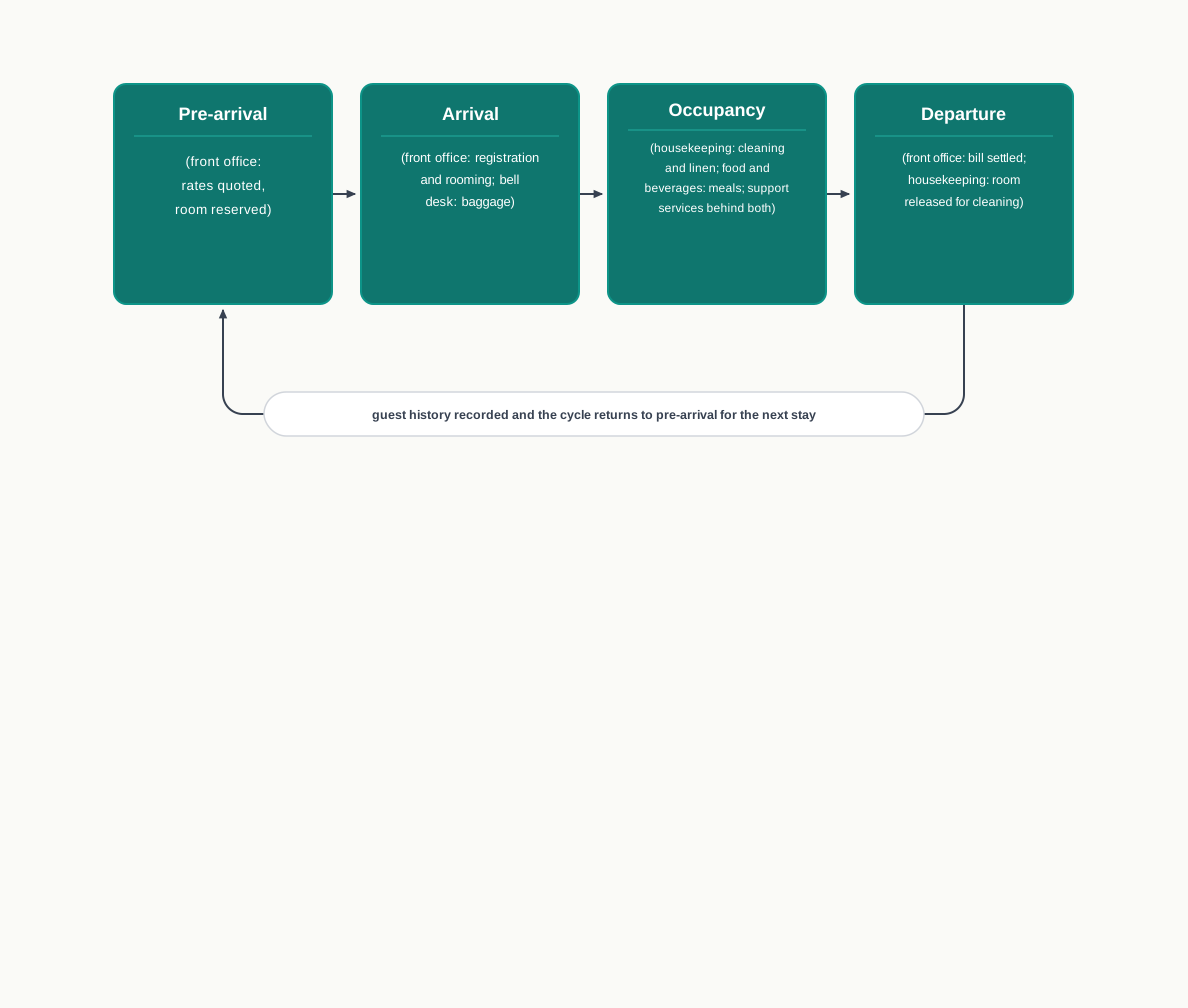
Fig. 11.8 – The guest cycle and the departments that serve it.
11.10 Key Terms
- Assistant housekeeper — the officer who prepares the duty schedule and checks the cleanliness and functioning of the staff, often one for each shift.
- Central reservation system — a shared booking system holding the room availability of several properties, so that a booking made anywhere is visible everywhere.
- Customer loyalty — the tendency of a satisfied guest to return to the same establishment instead of choosing a competitor.
- Desk control supervisor — the person who coordinates with the front office on departures, gets vacated rooms cleaned and hands them back as ready.
- Executive housekeeper — the head of the housekeeping department, responsible for its manpower, materials, money, time and standards.
- Floor supervisor — the supervisor responsible for the cleanliness and maintenance of the rooms, corridors, staircase and pantries on one floor.
- Florist/Gardener — the person who maintains the garden and makes the flower arrangements for the establishment.
- Food and beverages department — the department responsible for the sale of food and drink, through kitchens, restaurants, banquets, room service, stewarding and bars.
- Front office — the department that receives guests, allots rooms, maintains records of the stay and settles bills.
- Furnished apartment — accommodation providing all essential amenities of a home, suited to a stay of weeks or months.
- Furnished camp — temporary accommodation provided at hiking and adventure sport sites where no permanent building exists.
- Guest cycle — the four stages through which a guest passes with an establishment: pre-arrival, arrival, occupancy and departure.
- Guest history — the record kept of a guest’s past stays, preferences and feedback, used to serve her better on her next visit.
- Guestroom brigade — the housekeeping section that cleans and maintains the guestrooms.
- Horticulture and flower arrangement team — the housekeeping section that maintains the landscape and arranges flowers through the establishment.
- Hospitality — the relationship between a guest and a host, in which the guest is welcomed and provided accommodation, food, entertainment and other services with warmth and courtesy.
- Hotel — a commercial establishment offering lodging, meals and other services to its guests.
- Housekeeping — the department responsible for the cleanliness, hygiene and appearance of the entire establishment.
- Housekeeping control desk — the housekeeping section that passes information to staff working in different parts of the establishment.
- Housekeeping management — the section that plans, organises and controls all the activities of the housekeeping department.
- Housemen — housekeeping attendants who carry out heavy cleaning work such as vacuuming, mopping, sweeping and shifting furniture.
- Kitchen — the place where food is prepared, divided in large establishments into independent sections.
- Kitchen stewarding — the department that stores, cleans and issues cutlery, crockery and glassware, washes pots and pans, and maintains cleanliness in the kitchen.
- Linen and uniform room — the housekeeping section that stocks and supplies bed linen, bath linen, restaurant linen and staff uniforms.
- Linen room / uniform room supervisor — the person responsible for the supply, acquisition, storage, issue and cleanliness of linen and uniforms.
- Lodge — an establishment offering rented accommodation chiefly for sleeping, often without food or other services.
- Lost and found section — the housekeeping section that takes charge of belongings and luggage guests have misplaced.
- Management functions — planning, organising, co-ordinating, staffing, directing, controlling and evaluating the use of resources in the light of an institution’s goals.
- Medical tourism — travel away from one’s own place mainly in order to obtain medical care.
- Motel — an establishment providing services like a hotel, with parking beside the room or a room door opening on to the parking lot.
- Public area brigade — the housekeeping section that maintains the cleanliness of the foyer, lobby, front office and other common areas.
- Public area supervisor — the supervisor responsible for cleanliness of the entrance, corridors, offices, banquet halls and restaurants.
- Resort — an establishment known for rural attraction, offering amenities, sports facilities and leisure activities for a complete holiday.
- Restaurant — a commercial facility that provides food and beverages to customers at tables.
- Room attendant — the staff member who does the actual cleaning of guest rooms and bathrooms.
- Support service departments — the back office departments that keep an establishment running without dealing with guests directly: finance and accounts, engineering, human resources, and sales and marketing.
- Tourist — a person who travels and stays temporarily in a place away from home.
11.11 Points To Ponder
The guest cycle begins before a guest reaches the building and continues after she has left it. If an establishment had to give up one stage of the cycle entirely, which stage could it least afford to lose, and what would go wrong first?
Housekeeping does the heaviest work in a hotel and meets the guest least. Does a department’s importance depend at all on how visible it is, and how might an establishment recognise work that guests never see?
A cleaning agent must be strong enough to remove the soil and mild enough to leave the surface unharmed. Think of a surface in your school or classroom where these two requirements pull hardest against each other, and work out how you would settle the conflict.
Eco-friendly practices in a hotel depend partly on guests agreeing to them, as the towel card shows. Where else could an establishment invite guests to save a resource, and what would make a guest agree rather than feel inconvenienced?
The same fundamental principles of hospitality management apply to a hotel, a hostel and a hospital. Take any one department in this chapter and consider what it would have to do differently in a hospital, and what would stay exactly the same.
Two of the career opportunities in this field are enterprises rather than jobs. What does a person need, besides the skill itself, before a housekeeping or flower-supply service can be sold to an establishment on contract?
11.12 Objective Questions
- (MCQ) The stage of the guest cycle in which rates are quoted and a room is reserved is: [1]
- arrival
- pre-arrival
- occupancy
- departure
- (MCQ) Washing the pots and pans used in the kitchen is the work of: [1]
- the guestroom brigade
- kitchen stewarding
- the chef-de-partie
- the public area brigade
- (MCQ) An establishment that offers rented accommodation chiefly for sleeping, and may not provide food, is a: [1]
- resort
- motel
- lodge
- furnished apartment
- (MCQ) The record of a guest’s past stays, preferences and feedback is called: [1]
- guest cycle
- guest history
- customer loyalty
- occupancy record
- (Assertion–Reason) Read the assertion and the reason and choose the correct option. [1] Assertion (A): The front office is called the focal point of a hotel. Reason (R): The front office does the heaviest physical work in a hotel.
- Both A and R are true, and R is the correct explanation of A.
- Both A and R are true, but R is not the correct explanation of A.
- A is true but R is false.
- A is false but R is true.
- (Assertion–Reason) Read the assertion and the reason and choose the correct option. [1] Assertion (A): An acidic cleaning agent is not used on a marble floor. Reason (R): The cleaning agent must be mild enough to leave the surface unharmed.
- Both A and R are true, and R is the correct explanation of A.
- Both A and R are true, but R is not the correct explanation of A.
- A is true but R is false.
- A is false but R is true.
- (Match the following) Match the post in Column A with the responsibility in Column B. [1]
| Column A | Column B |
|---|---|
| a. Doorman | i. Prepares the duty schedule of housekeeping staff and checks the workers’ functioning |
| b. Chef-de-partie | ii. Welcomes guests on arrival and escorts them to the registration desk |
| c. Assistant housekeeper | iii. Supervises one section of the kitchen |
(Fill in the blank) The section of the housekeeping department that passes information to staff working in different parts of the hotel is the ______________ . [1]
(Fill in the blank) Travel undertaken away from one’s own place mainly in order to obtain medical care is called ______________ . [1]
(True or False) State whether each statement is true or false. [1 each]
- A central reservation system holds the room availability of a chain of properties in one place.
- The linen and uniform room is a section of the front office department.
- Evaluating is one of the management functions.
- Pest control is the responsibility of the housekeeping department.
(Name the following) Name the following. [1 each]
- The head of the kitchen in a large hotel.
- The housekeeping post responsible for the cleanliness of banquet halls and the main entrance.
- The sector of the hospitality industry that handles conferences and weddings.
(Odd one out) Pick the odd one out and give a reason for your choice. [1] Finance and accounts, engineering, housekeeping, human resources.
11.13 Check Your Concepts
Define hospitality. [2]
List any four functions of the housekeeping department. [2]
Give a reason why cleaning activities in a hotel are planned as daily, weekly, monthly and seasonal work rather than all being done every day. [2]
State the two activities carried out at the pre-arrival stage of the guest cycle. [2]
Differentiate between a hotel and a motel, stating the basis of difference. [3]
Differentiate between the kitchen and kitchen stewarding, stating the basis of difference. [3]
Explain, with an example, why the choice of a cleaning agent is decided by the surface and not by the soil. [3]
Why is guest satisfaction during the occupancy stage treated as a commercial matter and not only a courtesy? [3]
Explain the responsibilities of any four members of the housekeeping department. [4]
Describe the services offered by the front office to a guest, from her arrival to her departure. [4]
What would happen if the desk control supervisor did not pass on the information that a room had been vacated and cleaned? Explain the consequences for at least two departments. [4]
Explain the seven management functions and show, with one example from a hotel, how evaluation feeds back into planning. [5]
Describe the eco-friendly practices followed by a housekeeping department, and explain why the cooperation of the guest is necessary for some of them to work. [5]
11.14 Identify & Label
Study Fig. 11.3. Name the post at the head of the department and the post to which the bell boys report, and state one duty of each. [2]
Study Fig. 11.4. Identify the post placed immediately above the room attendant, and name the two posts that report directly to the executive housekeeper. [2]
Study Fig. 11.5. Identify any four items carried on the trolley and state the purpose of each. [3]
Study Fig. 11.1. Name the five sectors shown, and state which sector a hotel banquet booked for a conference belongs to. [3]
Study Fig. 11.6. Identify the post that supervises a single section such as the bakery, and state the post directly above it. [2]
11.15 Case & Application Based
- A newly opened hotel in a hill town has forty rooms. During the first tourist season, guests complain that rooms are not ready at check-in time, that towels are sometimes not replaced, and that the lobby floor, which is of marble, has developed dull patches since opening. The manager finds that housekeeping has no separate sections, that one supervisor handles both floors and public areas, and that the same cleaning agent is used on every surface. [5]
- Identify the two housekeeping sections whose absence explains the first two complaints, and state what each would have done.
- Explain the likely cause of the dull patches on the marble floor.
- Suggest how the cleaning work should be planned by frequency for a hotel of this size.
- Name the housekeeping post that should be coordinating with the front office about room readiness, and state its duty.
- A guest arrives at a hotel at 11 p.m. with a confirmed booking made through a travel agent. At the desk she is told that no reservation has been recorded in her name and that only one room, of a costlier type, is free. She is travelling for treatment at a nearby hospital and will stay for two weeks. [5]
- At which stage of the guest cycle did the failure occur, and what should have been done at that stage?
- Which front office staff members will deal with her over the next few minutes, and what will each do?
- Her stay is long and she must keep to a prescribed diet. Name two departments that will have to coordinate for this, and state what each must arrange.
- Explain how guest history, recorded after this stay, could be used if she returns for a follow-up visit.
- A corporate office with three hundred employees decides to stop employing its own cleaning staff and to award a housekeeping contract instead. A former hotel floor supervisor bids for the contract and wins it. [4]
- State two competencies from her hotel work that she will need in this enterprise.
- She must decide whether to wash the office’s uniforms in her own set-up or send them to an outside agency. State one advantage of each option.
- Which two management functions will she be performing when she prepares the duty roster and then checks the work against it? Name each and say what it involves.