Chapter 12: Consumer Education And Protection
On 15 March 1962, the President of the United States, John F. Kennedy, sent a special message to his country’s Congress. Its subject was not war or taxes but shopping. He argued that the largest single group in any economy is also the one least organised and least listened to — the people who buy. He then named four rights that every buyer should have: the right to safety, the right to be informed, the right to choose, and the right to be heard.
The idea travelled. In 1983, consumer groups around the world began marking 15 March as World Consumer Rights Day. In India, Parliament passed the Consumer Protection Act in 1986; it received assent on 24 December, and that date is now observed every year as National Consumer Day. The Act gave an Indian buyer something she had never had before — a simple, low-cost place to complain, and a legal right to compensation when a purchase went wrong.
Markets, however, do not stand still. Shopping moved to screens, advertisements followed people into their phones, and goods began arriving from sellers a buyer would never meet. So the law changed again: the Consumer Protection Act, 2019 replaced the 1986 Act and brought e-commerce, misleading advertisements and product liability within its reach.
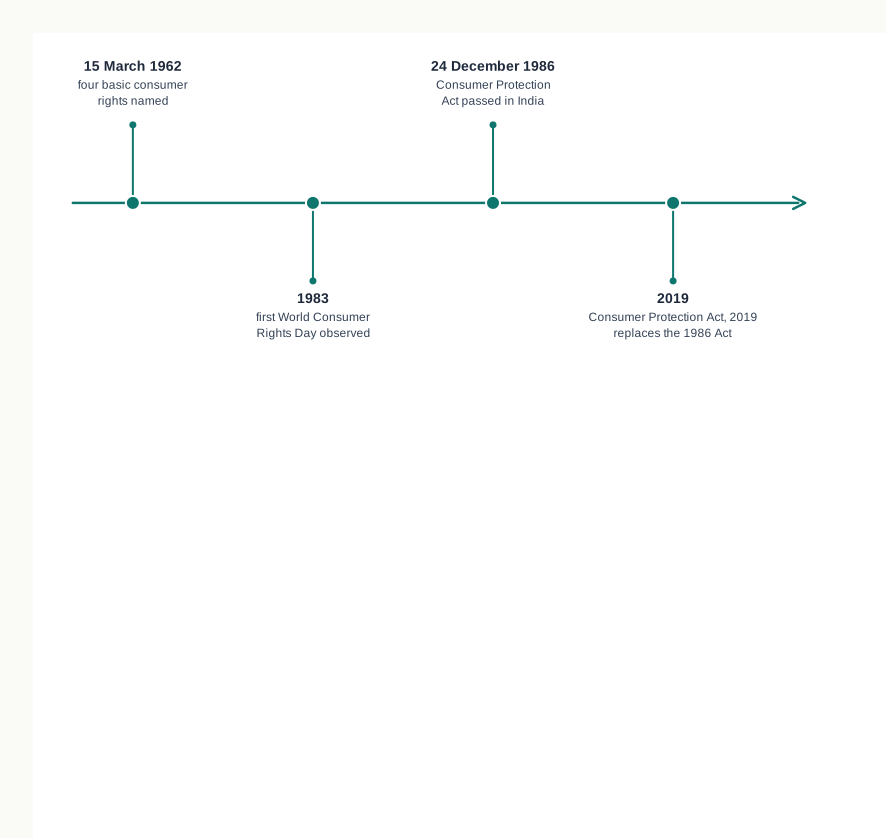
Fig. 12.0 – Milestones in the consumer rights movement.
12.1 Significance Of Consumer Education And Protection
Every one of us buys. You buy a notebook, your family buys atta and cooking gas, a neighbour hires an electrician, a hospital buys bedsheets. The moment money is paid for goods or services meant to be used and not resold, the buyer is a consumer. That makes consumer studies one of the few areas of Home Science in which every single person is already a participant.
Look at any market street or any online store and you will notice the same thing — the number of goods on sale keeps growing, in towns and in villages alike. Fifty years ago a household choosing a cooking oil had a handful of options; today the same shelf carries a dozen, in four kinds of packaging, at five different prices. Choice of this size is an advantage only to a buyer who knows how to use it.
Why The Market Has Changed
Two connected changes explain the shelves you see. The first is industrialisation, which allows the same article to be made in large quantities by many manufacturers at once. The second is globalisation — the growing flow of goods, money, technology and information across national borders, so that what is made in one country is sold in many.
India began opening its economy to foreign companies through a set of economic reforms in 1991. Since then, multinational firms have set up manufacturing and assembly units here, and imported goods have become ordinary sights in Indian stores. Rising incomes and rising buying power have pushed consumption further.
The Advantage And Its Price
The gain is real. A buyer today has much to choose from, and competing sellers must keep prices and quality in check to hold their share of the market. Manufacturers can no longer take a customer for granted, because a company’s reputation, and therefore its profits, rest on what consumers say about it.
The cost is equally real. Choosing well has become harder. A single purchase may now require you to understand an unfamiliar technology, a new material or a list of features you have never heard of, and to weigh price against quality before deciding. Alongside this, consumers meet malpractices, exploitation by unscrupulous sellers and advertisements that promise more than the product delivers.
From The Individual To The Nation
This is where consumer education earns its place. Consumer education is the process of learning what you can expect from the market, what the law entitles you to, and how to act when a purchase goes wrong. Consumer protection is the machinery that backs it — the laws, standards, agencies and organisations that stand behind the buyer.
Notice how the benefit widens as it travels. An informed buyer protects her own money. A household of informed buyers wastes less and eats safer food. A community of informed buyers is hard to cheat, so unfair sellers lose business to fair ones. And a nation of informed buyers pushes its whole market towards better goods, which is why the level of consumer awareness in a country is treated as a measure of its development.
None of this happens by itself. Consumers cannot sit back and watch a market shape itself around them; they have to understand how the economic system works and how they, businesses and the government are linked to one another. Being careful, alert and well informed is not a personal virtue in a modern market. It is a working skill, and the rest of this chapter builds it.
12.2 Basic Concepts
Before a market can be studied, its central figure has to be described precisely. This section fixes the meaning of five terms you will meet repeatedly in this chapter, and then sets out what a buyer is entitled to expect in return for the money paid.
12.2.1 Who Is A Consumer
A consumer is the final buyer of goods and services, purchased to satisfy personal or household needs and wants. The word ‘final’ does the real work in that sentence. A person who buys wheat to grind and eat is a consumer; a trader who buys the same wheat to sell again is not, because the wheat has not reached the end of its journey.
What a consumer buys ranges from the products of nature, such as water and fuelwood, to manufactured goods and services bought in the market. Services count as fully as goods do — a bus ride, a haircut, a bank account and an insurance policy are all purchases, and the person who pays for them is a consumer.
Consumers are the primary component of a socio-economic system, because every person in an economy is one. As purchasing power — the quantity of goods and services a person’s income can actually buy — rises, people spend not only on necessities but on articles that bring comfort, convenience and sometimes prestige. That spending puts money back into the market, and the movement of money is what allows an economy to grow. A consumer’s decision at a counter is therefore a small piece of a national process.
12.2.2 Terms Used In The Market
Four terms recur in the language of consumer studies, and each names something slightly different.
A consumer product is any article produced or distributed for sale to a consumer, for use in a home or in an institution such as a school, hospital, college or office. A pressure cooker in a kitchen and a mosquito net in a hostel are both consumer products.
Consumer behaviour is the process by which a buyer arrives at a purchasing decision — how a need is felt, how information is gathered, how alternatives are compared, and how the final choice is made and later judged. Manufacturers study it closely, which is one reason advertisements are designed the way they are.
A consumer forum is a place or organisation where consumers can discuss products and services and share their advantages and disadvantages. Some forums go further and work as advocacy groups, taking up problems on behalf of buyers who cannot pursue them alone. Note that the everyday word ‘forum’ here means a discussion body; the formal complaint-hearing authorities set up under consumer law are a separate matter, taken up in Section 12.5.
Consumer footfalls means the number of customers who enter a given space, such as a shop, a market or a mall, in a stated period. It is counted because it measures interest rather than income — a store may have high footfalls and modest sales, which tells its owner something useful. As consumption in a country rises, footfalls rise with it.
12.2.3 What A Consumer Expects
A purchase is an exchange, and the buyer’s side of it carries expectations. These expectations are set out in Fig. 12.1, and each of them will reappear later in the chapter as a right, a standard mark or a complaint.
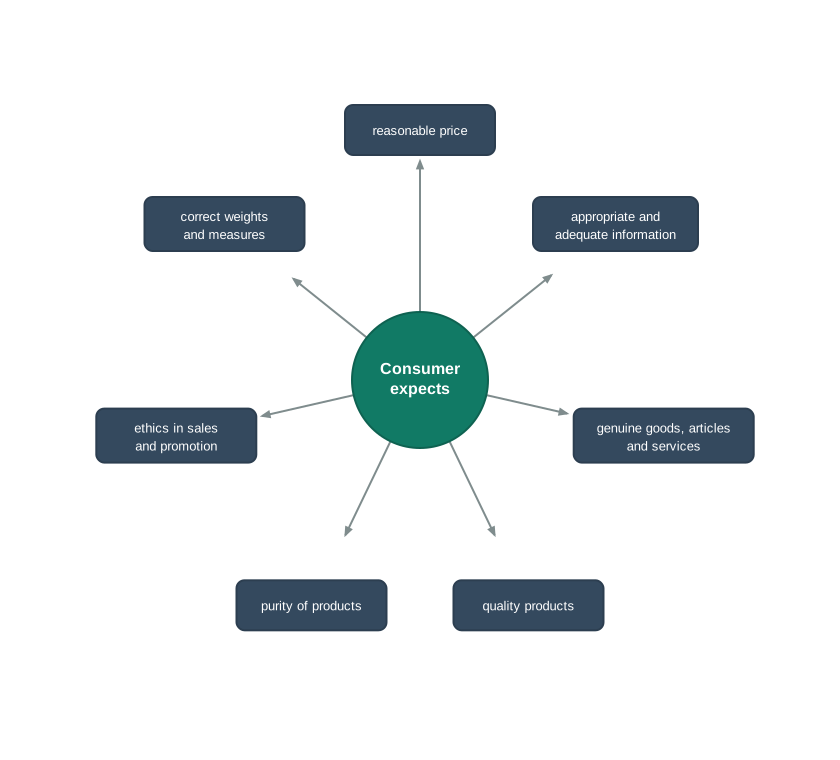
Fig. 12.1 – Consumer expectations from a product or service.
Read the seven together and a pattern appears. Three of them concern the article itself — that it be genuine, of good quality and pure. Two concern the count and the cost — correct weights and measures, and a reasonable price. The last two concern conduct — that the information given be adequate and accurate, and that selling and promotion be carried on honestly.
These expectations are reasonable, but they are not automatically met. The next section examines what happens when they are not.
12.3 Problems Faced By Consumers
Sellers do not always meet the expectations set out in Fig. 12.1. Some cannot — a small manufacturer may lack the equipment to hold a standard. Some will not, and choose to profit from a buyer who is not paying attention. Many consumers, meanwhile, never take a shop or a manufacturer to task at all, either because they do not know they can or because the amount seems too small to bother about.
Knowing the common problems is the first defence against them. Nine recur often enough to be studied one by one.
12.3.1 Substandard Or Poor Quality Goods
The same article is made by many producers at once — large corporations, small local units and manufacturers abroad. The materials they use differ, and so does the quality of what reaches the shelf.
The difficulty for a buyer is that quality is often invisible at the counter. Two ceiling fans may look identical and differ entirely in the grade of copper in the winding. Most consumers do not know which quality standards apply to an article, so they cannot tell which of the two has met one.
12.3.2 Adulteration
Adulteration means adding a substance to a product, or removing a valuable part of it, so that its composition, nature or quality is altered. It may be intentional, as when a cheap powder is mixed into an expensive one, or unintentional, as when dust or insect matter enters grain during careless storage.
Adulteration is a serious problem for two separate reasons. The first is economic: the buyer pays for one thing and receives another. The second is more serious — an adulterant can harm health, and the person eating it has no warning that anything is wrong.
Adulteration of food was long dealt with under the Prevention of Food Adulteration Act, 1954, and that Act supplied the definition used above. The regulatory work now rests with the Food Safety and Standards Authority of India, set up under the Food Safety and Standards Act, 2006.
12.3.3 High Prices
Every consumer expects to be charged a fair price. Price, however, is not fixed by fairness alone. It is shaped by government policy, by how much of the article is available, by its quality, by the cost of transporting it, by where the shop stands, by how the article is distributed, by what was spent on promoting it, and by how much convenience the buyer is willing to pay for.
Two goods of the same quality can therefore carry different prices, because their production costs, overheads and advertising budgets differ. A shampoo advertised heavily on television must recover that spending from the price on the bottle.
This leads to a common mistake. Many buyers treat price as a signal of quality and assume the costlier article must be the better one. Sometimes it is; often the extra money has gone into packaging, promotion or the shop’s own margin. And where a seller judges that a customer is not well informed, the price quoted may simply be raised.
12.3.4 Lack Of Consumer Information
Most consumers do not know their rights or their responsibilities, and are unaware of the legislative provisions made to protect them. A right that is not known cannot be used, which is why this single gap sits behind several of the other problems in this list.
12.3.5 Inadequate Or Erroneous Information Given By The Manufacturer
Even an alert buyer can decide badly if the information available is thin or misleading. Four sources of information fail her in different ways.
- Labels. Many labels are incomplete, and some are deceptive. Essential particulars may be missing, printed too small to read, or written in technical terms that an ordinary buyer cannot interpret.
- Advertisements. An advertisement is designed to persuade, not to inform. It rarely answers the questions that decide a purchase — how the article performs, how it is cared for and maintained, and what after-sales service exists.
- Buying guides. Independent guides comparing consumer durables and non-durables are few, so a buyer comparing two washing machines has little neutral material to consult.
- Packaging. Packaging has become a marketing tool in its own right. Attractive packs invite impulsive buying; containers are sometimes far larger than their contents; several layers of costly material may be used; and an unchanged product is repackaged in a novel shape and advertised as new.
The remedy for all four is the same habit — read the pack rather than the poster, and compare declared particulars rather than claims.
12.3.6 Incorrect Weights And Measures
A buyer can receive less than she paid for without any dispute about quality at all. This happens when weights or scales have been tampered with, or when a correct measure is used incorrectly — a tilted balance, a thumb resting on the pan, a measuring jar read from the wrong angle.
Weights and measures used in trade must carry a seal or verification stamp showing that they have been checked by the authorities. An unstamped weight in a shop is not a genuine one, and a buyer is entitled to ask.
12.3.7 Spurious, Duplicate And Imitation Products
Spurious goods are articles falsely presented as something they are not — imitations of well-known brands, sold in similar packaging, in the same colour scheme, and under a brand name that differs from the original by a letter or two.
The confusion is deliberate, and the cost is not only financial. Such imitations are usually of poor quality, and in the case of medicines, cosmetics, helmets or electrical fittings they can be genuinely unsafe to use.
12.3.8 Sales Promotion Schemes That Entice The Consumer
The Indian market carry a very large number of competing products, and national and multinational companies fight for a share of it. One of their main weapons is the sales promotion scheme — exchange offers, bonus packs, lucky draws, free gifts and limited-period discounts.
Such schemes are not always what they appear. A price may be raised shortly before a discount is announced, a free gift may be of little value, and a bonus pack may cost more per unit than the plain one. The offer works by creating urgency, and urgency is the enemy of comparison. A buyer who calculates the price per hundred grams before deciding is not swayed by the word ‘free’.
12.3.9 Problems With Services
Grievances are not limited to goods. Consumers use a wide range of services — municipal services, water supply, electricity, transport, banking, insurance and other financial services — and each can fall short.
The characteristic failure of a service is the gap between what the sales contract promises and what is delivered: a connection not restored, a claim not settled, a charge not explained, an after-sales visit that never happens. Because a service leaves nothing physical behind, the buyer’s protection is the paperwork — the contract, the receipt, the complaint number and the dates.
In order to deal with all of this, consumers need to be aware and educated about their rights, their responsibilities and the protection mechanisms available to them. That is the work of the rest of this chapter.
12.4 Eco-Friendly Production And Green Consumption
Buying well is not only about protecting your own money. What is made, and how it is made, draws on materials, water, fuel and land, and what is thrown away has to go somewhere. Sustainability — meeting present needs in a way that does not exhaust the resources later generations will need — has become a widely used idea in discussions of both production and consumption.
Two connected terms follow from it. Eco-friendly production means making goods in ways that use fewer raw materials, consume less energy and water, and leave less waste behind. Green consumption is the buyer’s side of the same idea: choosing goods that are made and packed this way, buying what will actually be used, and preferring articles that can be repaired, refilled or recycled rather than discarded.
Between the two stands green marketing — the selling of products presented as being more in tune with nature. Green marketing offers consumers goods that generate less waste, draw on fewer raw materials and save other resources.
A caution belongs here. Because ‘green’ sells, the claim is sometimes made loosely. Words such as natural, pure or environment-friendly carry no fixed meaning on their own, and a pack may be labelled green while its contents or its packaging are nothing of the kind. A certification mark is more reliable than an adjective, because a mark is awarded against a written standard by an outside body. The Ecomark scheme, studied in Section 12.6, does exactly this for household consumer products.
So the green claim, like the price claim and the quality claim, is checked in the same way as everything else in this chapter — by looking for evidence on the pack rather than for a word on it.
12.5 The Consumer Protection Act And Consumer Rights
Knowing what can go wrong is useful only if something can be done about it. In India, that something is a law written specifically for buyers.
12.5.1 The Consumer Protection Act
India’s first comprehensive consumer law was the Consumer Protection Act, 1986. It was a landmark, because until then a person cheated over a purchase had to go to an ordinary civil court — slow, formal and expensive, and hardly worth it for a defective mixer grinder. The Act created a separate machinery whose whole purpose was simple, speedy and inexpensive redressal, and it made the consumer movement in India broad-based and effective.
That Act has been replaced by the Consumer Protection Act, 2019, which came into force in 2020. The reason for replacing it was the market described in Section 12.1. Between 1986 and 2019 shopping moved partly online, advertising acquired far greater reach, and a buyer began routinely purchasing from a seller she would never meet. The older law had not been written for any of this.
What The Act Does
The Act works in two ways at once. First, it gives a consumer the right to complain to an authority about a grievance and to have it heard. Second, it allows her to claim compensation for loss or injury suffered because of a seller’s or manufacturer’s negligence. It applies to all goods and services unless the central government expressly exempts them.
Four features of the 2019 Act deserve particular notice.
- A central regulator, the Central Consumer Protection Authority, was set up. It can investigate unfair practices on its own, order recall of unsafe goods and act against misleading advertisements, without waiting for an individual complaint.
- Misleading advertisements attract strict penalties, and these can reach the person who endorses the product as well as the one who sells it.
- E-commerce and electronic service providers are covered explicitly, so an online purchase carries the same protection as a purchase across a counter.
- Product liability was introduced. A manufacturer, seller or service provider can be held answerable for harm caused by a defective product or a deficient service.
Where A Complaint Goes
Complaints are heard by consumer disputes redressal commissions arranged in three tiers, as shown in Fig. 12.2. Which tier a complaint begins at depends on the value of the goods or services and the compensation claimed; those limits are prescribed by the government and revised from time to time. A consumer dissatisfied with a decision can appeal to the tier above.
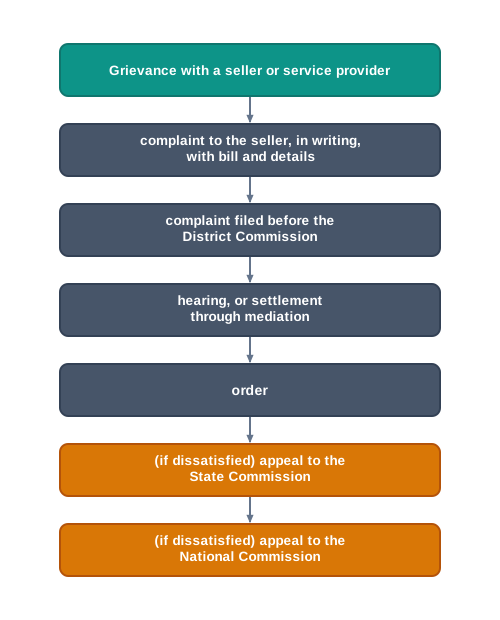
Fig. 12.2 – The path of a consumer complaint.
12.5.2 The Six Consumer Rights
Consumer rights are the rights provided by law to protect consumer interests — designed to ensure that every buyer obtains goods and services of reasonable quality at fair prices. The Government of India has accepted and enshrined six of them. Four are the basic rights: the right to safety, the right to be informed, the right to choose and the right to be heard. Two were added later: the right to seek redressal and the right to consumer education.
- Right to safety. This is the right to be protected against goods, production processes and services that are hazardous to health or life. It is the reason a helmet must meet a standard and a pressure cooker must carry a certification mark.
- Right to be informed. This is the right to know the quality, quantity, potency, purity, standard and price of goods and services before buying, so that a consumer is not misled by an unfair trade practice — any deceptive method used to promote a sale, such as a false claim, a fake discount or a hidden condition.
- Right to choose. Every buyer has the right of access to a variety of goods and services, of differing quality, quantity, size and design, at competitive prices, and to choose among them according to her own needs. A right to choose is meaningful only where no seller can force a single option on the market.
- Right to be heard. Consumers’ interests must receive due consideration at the appropriate forums, and consumers have the right to be represented in bodies working for their welfare. Both the state and voluntary agencies are expected to provide such forums.
- Right to seek redressal. This is the right to a remedy against unfair trade practices and unscrupulous exploitation — a fair settlement of a genuine grievance, and compensation for faulty goods and deficient services.
- Right to consumer education. This is every person’s right to acquire the knowledge and skill needed to be an informed buyer, so that she can decide wisely while purchasing goods and hiring services, and can pursue a problem herself.
Read as a set, the six rights follow the life of a purchase. Safety and information protect you before you buy; choice protects you while you are deciding; being heard and redressal protect you afterwards. Education runs underneath all five, because a right that its holder does not know about is worth nothing.
12.6 Standardisation Marks
The law gives a consumer a remedy after a purchase goes wrong. Standardisation marks work earlier, at the moment of choosing, and prevent many purchases from going wrong at all.
Standardisation means fixing an agreed specification for an article — what it must contain, how it must perform, how pure or how strong it must be — and writing that specification down so that anyone can test a sample against it. A standardisation mark is the small printed symbol a manufacturer is licensed to put on a product to declare that it has met such a specification.
The mark matters because of who awards it. It is not the seller’s own claim about the seller’s own goods; it is granted by an outside body that has written the standard, inspected the manufacturer and tested samples, and that can withdraw the licence if the standard is not held. That is why a mark is stronger evidence than any adjective on the wrapper.
India uses several marks, each covering a defined class of goods. Table 12.1 sets them side by side; the sections that follow explain each in turn.
12.6.1 ISI Mark
The ISI mark is the certification mark of the Bureau of Indian Standards (BIS), the national standards body, which was earlier called the Indian Standards Institution — hence the initials that survive on the mark. Under the certification scheme, BIS issues a licence to a manufacturer whose goods are found to meet the relevant Indian Standard, and inspects and tests to see that the standard continues to be met.
Its coverage is the widest of all the marks. Indian Standards exist for food items such as vegetables, fruit and meat products, spices and condiments, processed foods, cereal and soya products, confectionery and beverages, and equally for electrical goods, soaps, detergents, paints and paper.
For most articles the mark is voluntary, but for some it is not. Where careless manufacture could injure the user, certification is mandatory, and it is an offence to sell the article without the mark. A genuine ISI mark is always accompanied by the number of the Indian Standard it certifies and the licence number of the manufacturer.
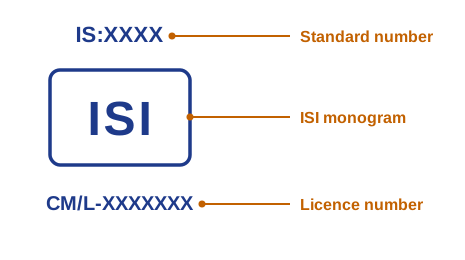
Fig. 12.3 – ISI mark.
12.6.2 AGMARK
AGMARK is the grading and certification mark for agricultural produce, promulgated by the Government of India and administered by the Directorate of Marketing and Inspection. It applies to commodities such as spices, honey, ghee, edible oils, pulses and flour.
Its distinctive work is grading. Agricultural produce is not uniform in the way a manufactured article is — two consignments of the same spice differ in moisture, in extraneous matter and in the proportion of the good part to the poor. AGMARK sorts produce into grades against a written specification, so a buyer who looks for the seal before purchasing an agricultural product knows both that it has been examined and what grade it has been placed in.
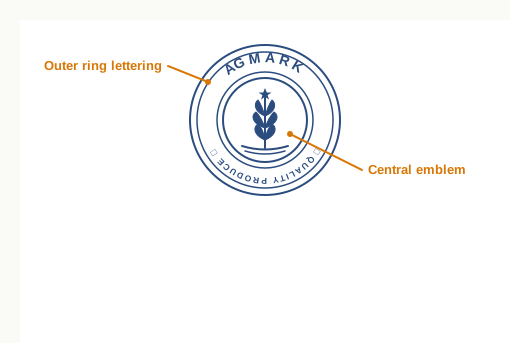
Fig. 12.4 – AGMARK seal.
12.6.3 FPO Mark
FPO stands for the Fruit Products Order. The Order laid down statutory minimum standards for the quality of processed fruit and vegetable products — jams, jellies, squashes, sauces, pickles and canned fruit — and for the premises in which they are processed. It also fixed limits for metallic contaminants and for preservatives in different fruit products.
The FPO mark is still seen on such packs, and you should be able to recognise it. Its legal position, however, has changed: the Fruit Products Order was among the orders subsumed under the Food Safety and Standards Act, 2006, and the regulation of processed fruit and vegetable products now rests with FSSAI. On a pack of jam bought today, the FSSAI licence number is the current assurance.
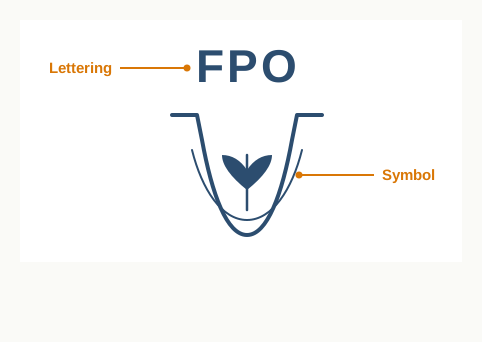
Fig. 12.5 – FPO mark.
12.6.4 Woolmark
Woolmark certifies that a garment or fabric is made of pure new wool and not blended with other fibres. It is administered by The Woolmark Company, and it is recognised internationally rather than only in India.
The mark answers a real difficulty at the counter. A wool blend can look and feel very like pure wool, yet it behaves differently in wear and, more importantly for a household, in washing. A garment certified as pure new wool will respond to the care instructions for wool; a blend may need entirely different treatment.
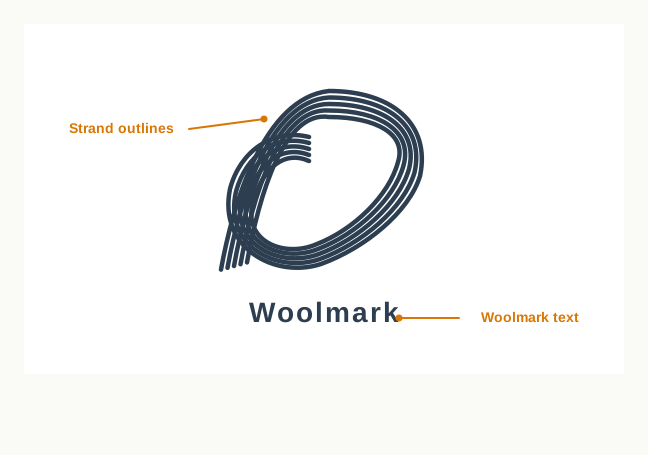
Fig. 12.6 – Woolmark.
12.6.5 Silk Mark
Silk Mark is a quality assurance label certifying that a fabric or garment is pure natural silk. It is issued by the Silk Mark Organisation of India, and besides assuring the buyer it also serves to promote genuine silk generally.
Silk is among the most imitated of textiles, because polyester filament can be woven and finished to resemble it closely, and because the price difference is large. A buyer paying for silk therefore has a strong interest in a mark: the tag, with its unique number, is easier to check at the counter than any test she could perform on the cloth.
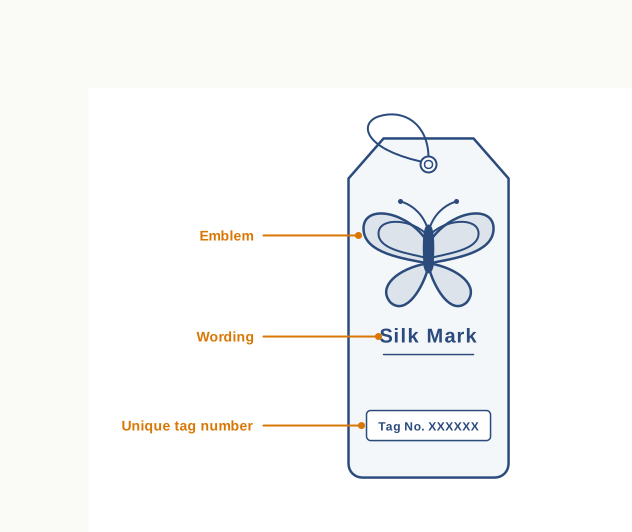
Fig. 12.7 – Silk Mark label.
12.6.6 Hallmark
Hallmarking is the accurate determination and official recording of the proportion of precious metal in an article. The BIS hallmark on a gold or silver article indicates that it has been assayed and tested at a recognised Assaying and Hallmarking Centre, and that the metal conforms to the standard of fineness and purity claimed for it.
The consumer’s problem with precious metal is that purity cannot be judged by the eye at all. Two chains of identical appearance may differ in gold content, and the difference is the price. Hallmarking replaces the buyer’s judgement with a laboratory’s. For gold jewellery, hallmarking has been made mandatory in stages, and a hallmarked piece now carries a unique six-digit alphanumeric identification number along with the BIS mark and the purity grade.
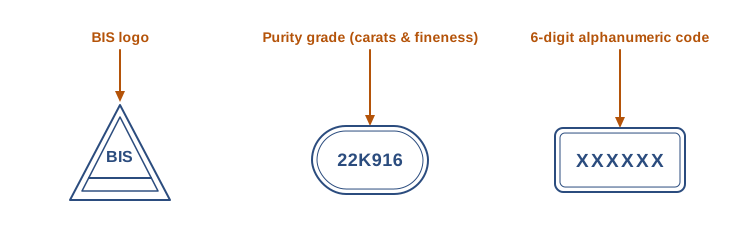
Fig. 12.8 – BIS hallmark on a gold article.
12.6.7 Ecomark
The Ecomark scheme is operated by BIS for household and consumer products that meet stated environmental criteria — soaps and detergents, paper, packaging material and plastic products among them. A product carrying the mark is certified as being less harmful to the environment than others in its category: made without producing hazardous waste, and biodegradable or recyclable.
The logo is an earthen pot. The choice is deliberate — a vessel made from a natural material, produced with little energy, and returning to the earth when it breaks. Ecomark is awarded alongside quality certification, so a product must first be fit for its purpose and then be shown to meet the environmental criteria; a mark for an article that does not work would help nobody.
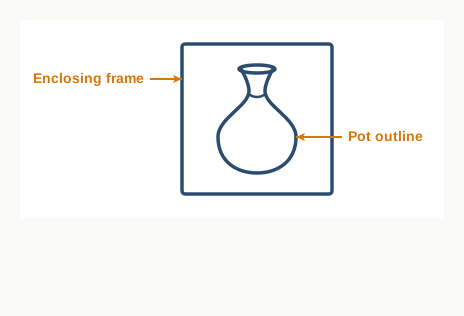
Fig. 12.9 – Ecomark logo.
12.6.8 FSSAI Mark
The Food Safety and Standards Authority of India (FSSAI) was established under the Food Safety and Standards Act, 2006. It lays down science-based standards for articles of food, and regulates their manufacture, storage, distribution, sale and import, so that the food available for human consumption is safe.
Unlike the marks above, the FSSAI mark is not a grade or a quality award. It is a licence declaration: every packaged food carries the FSSAI logo with the licence number of the manufacturer or packer printed below it, and that number can be checked. It is the single most useful thing to look for on any packaged food, because a food business selling without a valid licence is operating outside the law.
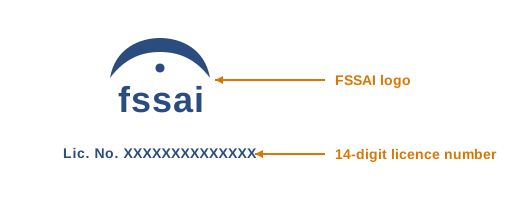
Fig. 12.10 – FSSAI mark on a food pack.
Reading The Marks Together
Notice that the eight marks divide by commodity, not by quality. Three concern food — AGMARK for agricultural produce, the FPO mark historically for processed fruit and vegetable products, and FSSAI for all packaged food. Two concern textiles — Woolmark for wool and Silk Mark for silk. One concerns precious metals, one concerns manufactured goods generally, and one concerns environmental performance.
This is why a single question — ‘is this article certified?’ — is the wrong question. The right one is: which mark should this particular article carry, and is it there?
12.7 Agencies And Organisations That Work For Consumers
A law needs institutions to carry it, and a market needs watchers who are not part of it. Two very different kinds of body work for the Indian consumer — those set up by the government, and those set up by consumers themselves.
12.7.1 Statutory And Government Bodies
Several statutory and semi-government bodies look after consumer interests as part of their regular work. You have met two of them already. The Bureau of Indian Standards writes Indian Standards and runs the certification schemes behind the ISI mark, the Hallmark and Ecomark. The Directorate of Marketing and Inspection, under the Government of India, administers AGMARK grading for agricultural produce. Standard-setting is consumer protection in its quietest form: it removes a defect before the article is made rather than compensating for it afterwards.
Alongside these are the Consumer Protection Councils, set up by the government at the central, state and district levels. A council is an advisory body rather than a court. It does not hear individual complaints or award compensation; its function is to promote and protect the six consumer rights, to advise the government on consumer questions, and to take up matters that affect consumers as a group.
The Department of Consumer Affairs also runs the National Consumer Helpline, which a consumer can approach for guidance on a grievance and on how to take it further. Guidance of this kind matters because, as Section 12.3 noted, most consumers do not act on a complaint simply because they do not know where to begin.
12.7.2 Voluntary Consumer Organisations
A voluntary consumer organisation is a non-governmental body formed to work in the consumer interest. Its strength is that it has nothing to sell and no party to serve. Because its interests are non-partisan, its findings about a product carry weight with buyers, with the press and with the government.
What These Organisations Do
Their work falls into three broad kinds.
- Information. They publish magazines, booklets, newsletters, buying guides, audio-visual material and research reports, and they hold public meetings. Many run libraries and documentation centres that anyone may use.
- Testing and vigilance. Many carry out comparative testing — buying several competing brands of an article from the open market, testing them side by side against the same criteria, and publishing the results without accepting advertising from the manufacturers. They also warn the public about harmful or unsafe products, report product recalls, and act as vigilance groups in the market.
- Advocacy and grievance handling. They circulate information about new legislative provisions, offer legal advice, take up individual grievances and complaints, and argue the consumer case when policy is being framed.
Some Consumer Organisations And Their Publications
India has several consumer organisations that bring out publications in the consumer interest, and similar bodies exist in other countries. Table 12.2 lists the best known.
Read the table for a pattern rather than for the names alone. Each of these bodies built its reputation on the same thing — independent testing published without advertising — and each turned a magazine into a form of consumer power. When a buyer in Ahmedabad reads a comparative test before choosing a water purifier, she is exercising the right to be informed through an organisation that exists only because consumers funded it.
12.8 Consumer Responsibilities
Rights and responsibilities are spoken of together for a reason. A right places a duty on somebody else; it also places one on the person who holds it, because a right unused, unclaimed and unsupported by any effort of her own is of no help to her. Consumer responsibilities are the duties a buyer owes to herself, to the seller and to other consumers if the market is to work honestly.
Nine of these are set out below.
- Keep your knowledge of the law current. Consumers should regularly update what they know about the laws and legislative provisions made by the government. Section 12.5 showed why: the law that governed a purchase in 2015 is not the law that governs one today, and the newer provisions are the ones that cover an online order.
- Be honest in your dealings, and pay for all your purchases. A consumer who takes a service without paying, or returns a used article claiming it was never opened, weakens the case of every honest buyer who complains later.
- Survey the market before you buy. Find out which brands are available, compare their features across different shops and different markets, and compare their prices. This is the only reliable answer to the price-and-quality confusion described in Section 12.3.
- Choose freely from what is available, according to your own needs and requirements. The right to choose is exercised, not received. A buyer who accepts whatever the shopkeeper places on the counter has given her choice away.
- Read the information given on the label or brochure before purchasing. Net quantity, ingredients, date of manufacture, date of expiry, maximum retail price and the manufacturer’s address are all printed there, and reading them takes less time than a complaint would.
- Buy products carrying a standardisation mark. As Section 12.6 explained, the mark is the only assurance of quality that comes from outside the seller.
- Keep receipts and other documents of purchase. The cash memo, the invoice, the warranty card and the delivery note are the proof of purchase you will need if the article turns out to be defective or stops working. Without them, a genuine grievance becomes very difficult to establish.
- Read the terms before buying a service. For insurance, credit cards, bank deposits and similar services, read and understand the terms and conditions, the liabilities and the service charges, and ask the representative to explain in writing any point that is not clearly written. A service leaves no article behind, so the contract is the whole of it.
- Know the consumer organisations. Be aware of what national and international consumer organisations do, and understand what membership of such a body offers — access to comparative test reports, buying guides and help with grievances.
Read the nine together and you will see they fall into three groups. Responsibilities (a), (e), (f) and (i) are about being informed. Responsibilities (c) and (d) are about deciding. Responsibilities (g) and (h) are about keeping evidence. Responsibility (b) stands alone, and is about fairness in the other direction.
Responsibilities, then, are not a moral list attached to the end of a chapter on rights. Each one exists because of a specific way in which a purchase can go wrong, and together they decide whether the protections studied in this chapter can actually be used.
12.9 Careers In Consumer Education And Protection
Everything in this chapter so far has been addressed to you as a buyer. The same material can be looked at the other way round — as the working knowledge of a profession. Someone writes the standards, someone tests the samples, someone answers the helpline, and someone explains all of it in language an ordinary shopper can use.
12.9.1 Knowledge And Skills Required
The subject knowledge required in this field is the content of this chapter, carried much further. A person entering it professionally needs a thorough grasp of the quality standards applying to different classes of products, of adulteration and the methods by which adulterants are detected, and of consumer protection law together with consumer rights and responsibilities. She also needs to know the protection mechanisms and the redressal agencies well enough to guide someone else through them.
Alongside this sits a second set of requirements, and in this field they are not secondary. Most of the work involves dealing with people who are worried, angry or confused, so it calls for good communication and interpersonal skills, an empathetic and understanding attitude, and the patience to be a good listener.
The work is also creative. Consumer awareness has to be carried to people who did not ask for it, through programmes, advertisements and talks, and someone has to design these. Writing ability matters throughout — for preparing educational material on consumer education, and for reporting the results of consumer tests clearly enough that a reader can act on them. Underneath all of it lies a plain willingness to help fellow consumers and the public at large.
12.9.2 Courses And Qualifications
Courses at the undergraduate and postgraduate levels aim at building an overall awareness of, and training in, consumer affairs, with particular emphasis on consumer protection.
At the degree level, the usual routes are B.Sc. Home Science or B.A. Home Science, B.Sc. Family Resource Management, B.Sc. Home Management, B.Sc. Resource Management, and the Bachelor of Business Administration (B.B.A.) or Bachelor of Business Studies (B.B.S.). The relevant subject within these degrees goes by different names in different institutions — consumer studies, consumer education, consumer behaviour, or consumer in the market — so a prospectus has to be read for content rather than for the title of the paper.
At the postgraduate level, several universities offer a PG Diploma in Consumer Education, a PG Diploma in Management of Voluntary Organisations, and a PG Diploma in Consumer Services. Postgraduate degrees that deal with consumer questions in terms of empowerment, protection and consumer behaviour include M.Sc. Home Science, M.Sc. Resource Management and Design Application, Family Resource Management, and an M.B.A. with a specialisation in marketing.
12.9.3 Scope And Career Options
Training in consumer education and protection opens work in several directions.
- Government organisations. The Bureau of Indian Standards, the Directorate of Marketing and Inspection and the Department of Consumer Affairs employ people in managerial and technical positions where decisions about standards, grading and policy are taken.
- Voluntary consumer organisations. Work here covers product testing, creating consumer awareness, consumer education and empowerment, and bringing out the organisation’s magazine.
- The consumer division of a company. Large firms maintain divisions that handle consumer complaints and suggestions, and customer relationship and facilitation divisions that build customer databases and deal with buyers individually.
- Market research organisations. These study consumer behaviour, the reach of a product, how far consumers accept a new product, and what feedback and suggestions buyers offer.
- Your own consumer organisation, started to work on the issues discussed in this chapter.
- The National Consumer Helpline, doing consumer counselling and helping people obtain redressal of their complaints.
- Consultancy and teaching. Schools and colleges run consumer clubs whose educative and outreach activities need planning and management; teaching posts exist in the area of consumer studies; and a freelance consultant can guide people through the consumer commissions and other redressal mechanisms.
- Communication and publicity. The Central Bureau of Communication, the Government of India’s agency for public communication, needs content developers for material on consumer awareness and education in the print and electronic media.
- Consumer testing laboratories, working as an analyst on the comparative evaluation of competing products.
- Consumer activism. Some people work as consumer activists, and those with legal training can plead cases before the consumer commissions.
- Journalism. Those who write well can take up journalism relating to consumer affairs.
Beyond these, some additional training allows a person to begin at a junior level assisting individuals with financial management. With further training and experience, that path leads to work connected with insurance, shares and the management of financial portfolios.
Look back over the list and notice what unites it. Every one of these roles exists because information in a market is unevenly distributed — the seller knows more than the buyer. The work, whatever its designation, consists of closing that gap.
12.10 Summary
- Every person who buys goods or hires services for personal, family or household use is a consumer, so consumer studies concerns everyone.
- Industrialisation and globalisation have greatly increased the number of goods on sale in Indian markets, in towns and in villages alike.
- This brings a gain and a cost:
- the gain is wider choice, competing sellers and pressure on prices and quality;
- the cost is that choosing well has become harder, and buyers meet malpractices, unscrupulous sellers and misleading advertisements.
- Consumer education builds the knowledge and skill to buy wisely and to claim redressal; consumer protection is the machinery of laws, standards and agencies that stands behind the buyer.
- The benefit of consumer awareness widens from the individual to the family, the community and the nation, which is why the level of consumer awareness is treated as a measure of a country’s development.
- A consumer is the final buyer; a person who buys for resale or for a commercial purpose is not a consumer, except where the goods are used to earn a livelihood through self-employment.
- Four terms recur in this field:
- consumer product — an article produced or distributed for sale for use in a home or an institution;
- consumer behaviour — the process by which a buyer reaches a purchasing decision;
- consumer forum — a place or organisation where consumers discuss products and services, some of which work as advocacy groups;
- consumer footfalls — the number of customers entering a given space in a stated period.
- A consumer expects reasonable price, adequate and accurate information, genuine goods and services, quality, purity, correct weights and measures, and ethics in sales and promotion.
- Nine problems recur in the market:
- substandard or poor quality goods;
- adulteration, whether intentional or unintentional;
- high prices, and the mistaken belief that a higher price must mean better quality;
- lack of consumer information about rights, responsibilities and legal provisions;
- inadequate or erroneous information from labels, advertisements, buying guides and packaging;
- incorrect weights and measures;
- spurious, duplicate and imitation products;
- sales promotion schemes that entice the buyer into hasty purchases;
- problems with services, where what is delivered falls short of what the contract promised.
- Adulteration alters the composition, nature or quality of a product; it cheats the buyer and can also harm health.
- Sustainability, eco-friendly production and green consumption concern the resources used in making and using goods; green marketing offers products said to be more in tune with nature.
- The Consumer Protection Act, 2019 has replaced the Consumer Protection Act, 1986, and provides simple, speedy and inexpensive redressal.
- The 2019 Act set up a central regulator in the Central Consumer Protection Authority, penalises misleading advertisements, covers e-commerce and electronic service providers, and introduced product liability.
- The Act rests on the principle of self-help: the machinery exists, but it works only when a consumer uses it.
- Complaints are heard by consumer disputes redressal commissions at the district, state and national levels, with appeal from each tier to the one above.
- Six consumer rights are enshrined in India:
- right to safety;
- right to be informed;
- right to choose;
- right to be heard;
- right to seek redressal;
- right to consumer education.
- A standardisation mark is granted by an outside certifying body against a written specification, which is why it is stronger evidence than any claim made by the seller.
- The main marks and their coverage are:
- ISI mark — manufactured goods certified by the Bureau of Indian Standards, compulsory for some articles;
- AGMARK — grading of agricultural produce, administered by the Directorate of Marketing and Inspection;
- FPO mark — processed fruit and vegetable products, now regulated by FSSAI;
- Woolmark — pure new wool;
- Silk Mark — pure natural silk;
- Hallmark — fineness and purity of gold and silver articles;
- Ecomark — household consumer products meeting environmental criteria;
- FSSAI mark with licence number — all packaged food.
- Statutory and government bodies working in the consumer interest include the Bureau of Indian Standards, the Directorate of Marketing and Inspection, the Consumer Protection Councils at the central, state and district levels, and the National Consumer Helpline.
- Voluntary consumer organisations are non-partisan bodies that inform through publications, carry out comparative testing of competing brands, act as vigilance groups, and take up grievances and advocacy.
- Well-known consumer organisations and their publications include VOICE with Consumer Voice, CERC with Insight, Consumer Reports in the United States, Which? in the United Kingdom and CHOICE in Australia.
- Consumer responsibilities require a buyer to keep her knowledge of the law current, deal honestly, survey the market, choose according to her needs, read the label, prefer marked products, keep receipts, read the terms of a service, and know the consumer organisations.
- Careers in this field call for knowledge of standards, adulteration and consumer law, together with communication, listening, creative and writing skills.
- Work is available in government standard-setting bodies, voluntary consumer organisations, the consumer divisions of companies, market research, the National Consumer Helpline, consultancy and teaching, public communication, testing laboratories, consumer activism and journalism.
- The chapter’s whole argument runs as a single chain, condensed in Fig. 12.11.
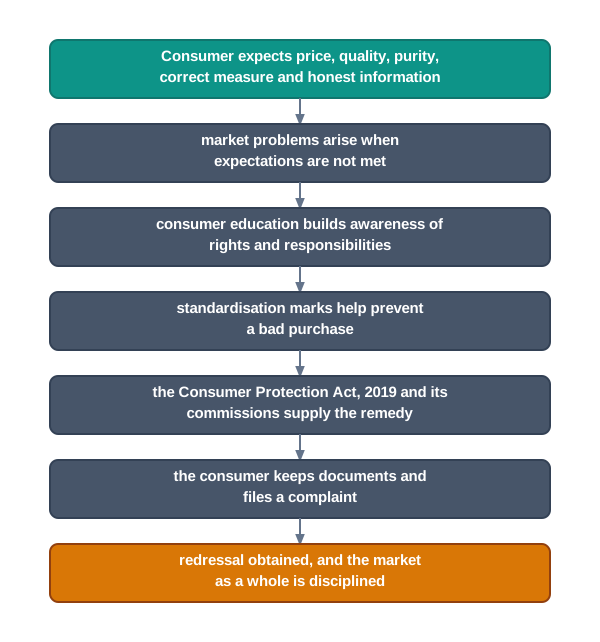
Fig. 12.11 – From expectation to redressal.
12.11 Key Terms
- Adulteration — adding a substance to a product, or removing a valuable part of it, so that its composition, nature or quality is altered.
- Comparative testing — buying competing brands of an article from the open market and testing them side by side against identical criteria, then publishing the results.
- Consumer — the final buyer of goods or services, purchased for personal, family or household use and not for resale or a commercial purpose.
- Consumer behaviour — the process by which a buyer arrives at a purchasing decision.
- Consumer education — the development of the knowledge, skills and awareness that enable a person to buy wisely, use goods and services well, and claim redressal when a purchase goes wrong.
- Consumer footfalls — the number of customers who enter a given space, such as a shop or a mall, in a stated period.
- Consumer forum — a place or organisation where consumers discuss products and services; some such bodies also work as advocacy groups.
- Consumer product — any article produced or distributed for sale to a consumer, for use in a home or in an institution such as a school, hospital, college or office.
- Consumer Protection Act, 2019 — the present Indian law for the protection of consumer interests, which replaced the Consumer Protection Act, 1986.
- Consumer Protection Councils — advisory bodies set up by the government at the central, state and district levels to promote and protect consumer rights.
- Consumer protection — the machinery of laws, standards, agencies and organisations that stands behind the buyer.
- Consumer responsibilities — the duties a buyer owes to herself, to the seller and to other consumers if the market is to work honestly.
- Consumer rights — the rights provided by law to protect consumer interests; six are enshrined in India.
- Consumer studies — the field of study concerned with consumers, their behaviour, their protection and their education.
- Globalisation — the growing flow of goods, money, technology and information across national borders.
- Green consumption — choosing, using and disposing of goods in ways that draw less on natural resources and leave less waste.
- Green marketing — the selling of products presented as being more in tune with nature, using fewer raw materials and creating less waste.
- Product liability — the answerability of a manufacturer, seller or service provider for harm caused by a defective product or a deficient service.
- Purchasing power — the quantity of goods and services that a person’s income can actually buy.
- Redressal — the setting right of a wrong, by repair, replacement, refund or compensation.
- Spurious goods — articles falsely presented as something they are not, such as imitations of well-known brands.
- Standardisation — fixing and writing down an agreed specification for an article, so that any sample can be tested against it.
- Standardisation mark — a printed symbol that a manufacturer is licensed to put on a product to declare that it meets a written specification.
- Sustainability — meeting present needs in a way that does not exhaust the resources later generations will need.
- Unfair trade practice — any deceptive method used to promote a sale, such as a false claim, a fake discount or a hidden condition.
- Voluntary consumer organisation — a non-governmental body formed to work in the consumer interest, independent of sellers and of political parties.
12.12 Points To Ponder
- The Consumer Protection Act rests on the principle of self-help. What does a market lose when most people with a genuine grievance decide that the amount is too small to pursue?
- A standardisation mark is awarded by a body outside the company. Why does that outside position matter more to the value of the mark than the strictness of the standard itself?
- Consumer organisations refuse advertising from the companies whose products they test. What would happen to a comparative test report if that rule were relaxed just once?
- The right to choose assumes that several sellers are competing. What happens to that right when only one supplier exists for a service, as is often the case with water or electricity?
- Green marketing sells a product partly on what it does not do — waste less, pollute less. How can a buyer tell such a claim apart from a word printed on a wrapper?
- The 1986 Act was written for a market of shops and counters, and the 2019 Act for one that includes screens and unseen sellers. What change in the way people buy might make a further revision necessary?
12.13 Objective Questions
- Multiple choice question. A person who buys rice from a wholesaler in order to sell it in her own shop is [1]
- a consumer, because she has paid for the rice
- a consumer, because rice is a consumer product
- not a consumer, because the purchase is for a commercial purpose
- not a consumer, because rice is an agricultural produce
- Multiple choice question. Grading of agricultural produce such as spices, honey and edible oils is certified by [1]
- the ISI mark
- AGMARK
- Ecomark
- the Hallmark
- Multiple choice question. Which of the following was introduced by the Consumer Protection Act, 2019 and was not part of the 1986 Act? [1]
- The right to be heard
- Simple, speedy and inexpensive redressal
- Product liability
- The right to seek redressal
- Multiple choice question. A shopkeeper uses a weight that carries no seal or verification stamp. The consumer problem involved is [1]
- adulteration
- incorrect weights and measures
- spurious products
- substandard goods
- Assertion–reason. Choose the correct option. [1] Assertion (A): A standardisation mark is stronger evidence of quality than a claim printed on the wrapper. Reason (R): A standardisation mark is awarded by a certifying body outside the manufacturing company, against a written specification.
- Both A and R are true, and R is the correct explanation of A.
- Both A and R are true, but R is not the correct explanation of A.
- A is true but R is false.
- A is false but R is true.
- Assertion–reason. Choose the correct option. [1] Assertion (A): A costlier packet of an article is necessarily of better quality than a cheaper one. Reason (R): The price of an article is influenced by production cost, overheads, transport, packaging, advertising and the seller’s margin.
- Both A and R are true, and R is the correct explanation of A.
- Both A and R are true, but R is not the correct explanation of A.
- A is true but R is false.
- A is false but R is true.
- Match the following. [4]
| Column A | Column B |
|---|---|
| a. Woolmark | i. Packaged food |
| b. Silk Mark | ii. Household products meeting environmental criteria |
| c. Ecomark | iii. Pure new wool |
| d. FSSAI mark | iv. Pure natural silk |
Fill in the blank. The Consumer Protection Act, 2019 set up a central regulator known as the ______________. [1]
Fill in the blank. Adding a substance to a product, or removing a valuable part of it, so that its composition or quality is altered, is called ______________. [1]
State whether true or false. The Consumer Protection Councils hear individual complaints and award compensation. [1]
State whether true or false. The number of customers entering a shop or a mall in a stated period is called consumer footfalls. [1]
Name the following. [3]
- The consumer organisation based in Ahmedabad, and the publication it brings out.
- The mark that certifies the fineness and purity of gold articles.
- The three tiers of consumer disputes redressal commissions.
Odd one out, and give a reason. [2] AGMARK, FPO mark, Woolmark, FSSAI mark
12.14 Check Your Concepts
Define consumer education, and state one thing it enables a buyer to do. [2]
Give a reason why keeping a cash memo matters even for a small purchase. [2]
State any three expectations a consumer has while purchasing a product. [2]
Explain, with one example, why a buyer cannot always judge quality at the counter. [3]
Why is the Consumer Protection Act said to rest on the principle of self-help? [3]
Differentiate between a standardisation mark and an advertisement claim, stating the basis of difference. [3]
Explain how packaging and sales promotion schemes can work against a consumer’s own interest. [4]
Describe any four responsibilities of a consumer, giving the reason behind each. [4]
What would happen to the market if voluntary consumer organisations accepted advertising from the companies whose products they test? Explain your reasoning. [4]
Explain the six consumer rights, and show how they follow the life of a purchase from before buying to after it. [5]
Describe any five problems commonly faced by consumers, and suggest one practical step a buyer can take against each. [5]
12.15 Identify And Label
Look at Fig. 12.3. Identify the mark, name the body that awards it, and state the two numbers that appear with a genuine mark of this kind. [3]
Look at Fig. 12.8. Identify the mark, state the class of goods it applies to, and label the three particulars stamped on the article. [3]
Look at Fig. 12.9. Identify the logo, state what its shape signifies, and name the class of products it covers. [3]
Look at Fig. 12.1. Label any four of the expectations shown, and state which of them a standardisation mark helps to secure. [3]
12.16 Case And Application Based
- Read the situation and answer the questions that follow. [5] For a wedding in the family, a household in Coimbatore buys a saree described by the shop as pure silk, and a gold chain. The saree carries a printed tag with a number on it. The gold chain is sold from a tray of similar chains, none of them stamped, and the shopkeeper says a bill is not necessary as the payment was in cash.
- Which mark should each of the two purchases carry, and what does each mark assure?
- State two consumer responsibilities the buyer has not exercised in this situation.
- Six months later the chain is found to be of lower purity than claimed. Explain what difficulty the absence of a bill creates, and what the buyer could have done differently at the counter.
- Read the situation and answer the questions that follow. [5] A student orders a table lamp from an online seller. The listing shows a photograph of a metal lamp and describes it as unbreakable. The lamp that arrives is of plastic, and its switch stops working within a week. The seller’s messages go unanswered. The order confirmation, the listing details and the invoice are all saved on the student’s phone.
- Name two consumer rights that have been affected here, and explain how each has been affected.
- Under which law does an online purchase of this kind fall, and name one feature of that law that applies directly to this situation.
- Set out, in order, the steps the student should take to obtain redressal, and state which saved document supports each step.