Chapter 14: Corporate Communication And Public Relations
A Seat At The Table
In 1927, a large American telephone company did something no big company had done before. It hired a magazine editor named Arthur W. Page and made him a vice-president — not of engineering, not of sales, but of public relations. He was the first person anywhere to hold such a post in a major corporation, and he was later elected to the company’s board of directors, where the real decisions were taken.
Page had refused the job on any other terms. He did not want to be, as he put it, a publicity man. A telephone company, he argued, digs up public streets, is answerable to the government and runs a wire into people’s homes. It survives only as long as the public is willing to let it. If that is true, then how the company behaves is not a matter for the press office to explain afterwards; it is a matter of policy, decided in the boardroom, with the public’s likely reaction already in the room.
That idea — that an organisation’s reputation is built by what it does, and that someone senior must be responsible for it — is the seed of everything in this chapter. Page held the post for nearly twenty years, and the practice he shaped is now called corporate communication.
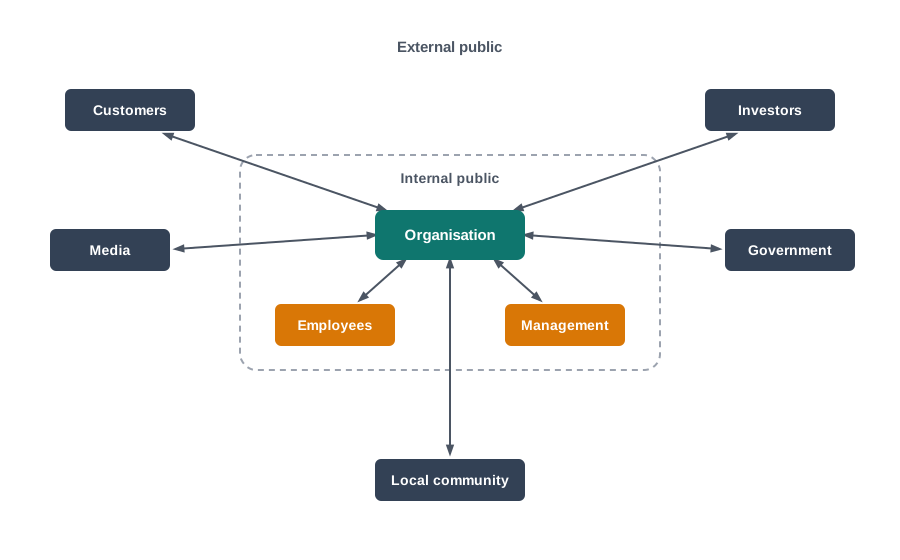
Fig. 14.0 – An organisation and its publics.
14.1 Corporate Communication: The Basic Idea
An idea, a fact or an opinion does nothing at all until it is communicated and understood. That is as true of an organisation as it is of a person. A company may run an excellent factory, pay its workers well and make a reliable product, but if none of this is known outside its gates, it might as well not be happening.
In earlier chapters you have studied communication between people. Here you will study communication as it works inside and around organisations — companies, hospitals, schools, cooperative societies, government departments and voluntary bodies. Over the last century this has grown into an organised activity with its own specialists, and it is now treated as one of the tools of management.
14.1.1 What Corporate Communication Means
Corporate communication is the whole set of activities by which an organisation manages and coordinates its communication — both the communication that goes on inside it and the communication that passes between it and the world outside. The word ‘corporate’ comes from the idea of a body: many parts acting as one. That is exactly the problem corporate communication solves. An organisation has hundreds of voices, and it has to speak with one.
Notice the word ‘manages’. Communication happens in an organisation whether anyone plans it or not — in notices, bills, advertisements, telephone calls, the behaviour of a delivery van driver. Corporate communication is the deliberate work of deciding what is said, to whom, when, through which medium, and by whom, so that these many messages do not contradict one another.
Who Does It, And With Whom
The information that flows out of an organisation comes from two kinds of people. Specialists — an engineer, a dietitian, an accountant, a lawyer — hold detailed knowledge of one area. Generalists — managers and communication officers — understand the organisation as a whole and can put that knowledge into language an outsider will follow. Corporate communication draws on both, which is why it is concerned with people, with organisational processes, with activities and with media, all at once.
The people it deals with are equally varied. An organisation communicates with its employees, its customers, its investors, its suppliers, government departments, the press and the neighbourhood it works in. Anyone who is affected by what an organisation does, or who can affect it in turn, is called a stakeholder. A large organisation may have stakeholders in one town and also in another country, so the same message may have to travel both locally and globally.
A great deal of management thinking about productivity has gone into building teams, rewards and structures. Yet when employees are asked what actually gets in the way of their work, the answer that comes back most often is far simpler — they were not told what they needed to know, or not told in time. The simplest need of all is communication.
14.1.2 Why Public Perception Matters
Whether an organisation succeeds or fails depends a great deal on something it does not directly control: what people think of it. Public perception is the picture that the general public, customers, competitors and employees carry in their minds about an organisation. That picture decides whether people buy from it, work for it, invest in it, or trust it in a difficult moment.
Perception is not the same thing as reality, and this is the uncomfortable part. A hospital may follow every safety rule and still be believed careless; a small workshop may be trusted far beyond the scale of its actual work. Because reputation is built out of what people believe, an organisation cannot afford to leave that belief to chance. Establishing an accurate and favourable picture of itself in the minds of its stakeholders is the primary objective of corporate communication. In plain words, it is about how the world sees you.
Consider what happens when something goes wrong — a delayed delivery, a faulty batch, a dispute with workers. Two quite different things now exist side by side: what actually happened, and what people understand to have happened. The organisation’s future is decided by the second one. If it responds calmly, explains itself early and shows what it is doing to set matters right, stakeholders judge it very differently from an organisation that goes silent or turns aggressive. Fig. 14.1 traces how one event travels through to the organisation’s fortunes.
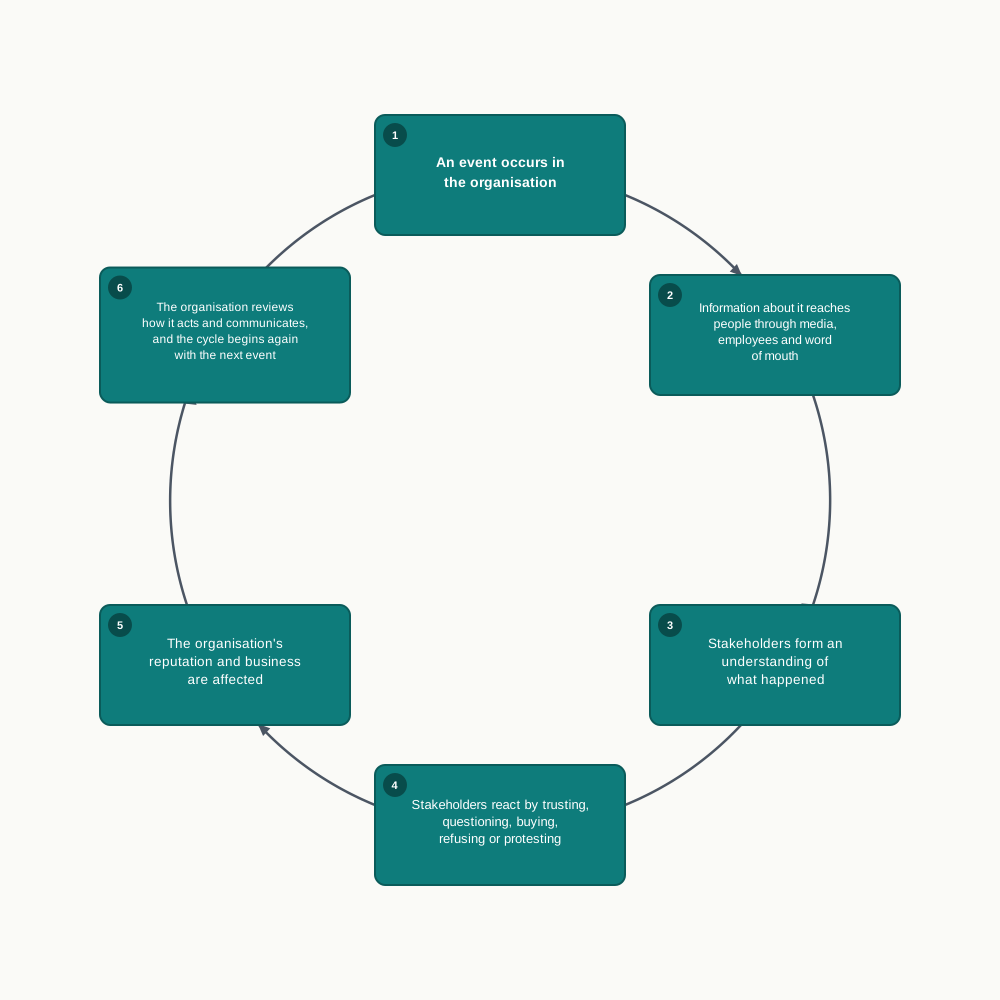
Fig. 14.1 – How an event becomes a reputation.
The corporate communication team’s task is to anticipate the third and fourth steps of that chain before they arrive. It asks how a particular decision is likely to be read by employees, by customers and by the press, and it advises the management accordingly. The tools it uses are ordinary ones — press releases, newsletters, advertisements, meetings, and now the organisation’s own online channels.
There is an important limit here. Deciding what to say and when to say it is legitimate management; putting out a picture the organisation knows to be false is not. The principles you will study later in this chapter rest on the opposite idea — that reputation is earned by conduct, and that communication only makes that conduct visible.
14.1.3 What Corporate Communication Achieves
When it is done well, corporate communication produces four things that no single department can produce on its own.
A positive and favourable public perception, so that the organisation is given a fair hearing when it needs one.
Effective and efficient avenues of communication, so that information reaches employees, consumers and investors quickly and by a known route, instead of arriving late or as rumour.
A strong corporate culture, corporate identity and corporate philosophy — respectively, the shared habits and values by which people inside the organisation work; the visible face by which outsiders recognise it, such as its name, logo and manner of dealing; and the set of beliefs about why the organisation exists at all.
A genuine sense of corporate citizenship — the organisation behaving as a responsible member of the community it works in, rather than as a stranger passing through.
The last of these is worth pausing on. Corporate citizenship shows itself in ordinary, checkable ways: keeping to environmental rules, employing people from the locality, paying suppliers on time, joining in local development work. It cannot be manufactured by an announcement, which is precisely why it counts.
14.2 Functions Of Corporate Communication
You have seen what corporate communication is and why an organisation cannot manage without it. The next question is a practical one: what does the work actually consist of? The functions below are the ones a communication department carries out, whether it is a department of twenty people in a large company or a single officer in a cooperative society.
The Main Functions
Building a healthy organisational environment. Information held by specialists has to reach the people who need it — employees at every level, shareholders, customers and the media. Where that flow is steady and reliable, people work with confidence; where it is blocked, rumour fills the gap and morale falls with it.
Creating and maintaining the brand. A brand is not a logo. It is the whole set of expectations attached to an organisation’s name — what people assume about its quality, its prices and its behaviour before they have any direct experience of it. Corporate communication builds those expectations and then works to see that the organisation meets them.
Looking after reputation. Reputation is what stakeholders say about an organisation when it is not in the room. Deliberately watching it, measuring it and repairing it is called reputation management, and it has become a priority for most organisations. Image is the picture an organisation projects; reputation is the verdict people return after watching it over time.
Acting as a liaison with outside bodies. Government departments, regulators, trade associations, other companies and civic bodies all need to deal with the organisation, and the organisation needs a known route to them. Corporate communication is that route.
Informing the public about products and achievements. New products, new services, expansions, awards and research findings are announced through the media so that the public learns of them accurately and from the organisation itself.
Crisis control. When something goes badly wrong, decisions have to be taken quickly and by people who understand how each choice will be read. This is examined further in the case below.
Handling global communication and communication technology. Many organisations now work across languages, time zones and legal systems, using tools that did not exist a generation ago. Choosing the right tool, and using it competently, is itself part of the job.
Not Only For Companies
It is easy to assume that this work belongs to large businesses alone. It does not. A hospital, a university, a district cooperative, a non-governmental organisation, a municipal corporation and a government department each depend on being understood and trusted by the people they serve. All of them need a respectable image and a sound reputation, and all of them suffer when they lose one.
Three changes have made this work harder and more urgent than it once was. Competition has increased, so a dissatisfied customer has somewhere else to go. Information is far more accessible, so a fact an organisation would rather not discuss is rarely a secret for long. And the media has multiplied — news, comment and complaint now travel through many channels at once, at a speed no press office can outrun. This is why the work is handled professionally rather than left to whoever is free.
14.3 Public Relations: Meaning And Significance
Corporate communication is the wider activity. Inside it sits a body of work with its own history, its own professionals and its own name — public relations. In many organisations the two words are used almost interchangeably; in others, public relations is one department within the communication function. Either way, you need to know what it means and what it is for.
14.3.1 What Public Relations Means
Public relations (PR) is the planned and continuing effort to build and keep mutual understanding and goodwill between an organisation and the groups of people it depends on. Notice the two words that carry the weight. The effort is planned — it is not a series of reactions to whatever happens. And it is continuing — goodwill is not built in the week you need it.
People sometimes call PR both an art and a science, and the description is a fair one. It has the judgement, feeling and timing of an art: knowing how a message will land, and when a silence is better than a statement. It also has the system of a science: audiences are studied, plans are written, results are measured against what was intended.
Because organisations differ so much, PR looks different in each one. The techniques, strategies and practices of a government department, a private manufacturer, a public sector undertaking, a hospital and a voluntary organisation are not the same, and a method that suits one may be useless in another. As an organised profession, PR is of fairly recent origin, in India and elsewhere, though the underlying activity — persuading people, keeping them informed, building goodwill — is very old.
How PR Differs From Corporate Communication
The two overlap, and in a small organisation the same person does both. Where they part company is in emphasis, and Table 14.1 sets this out.
14.3.2 The Significance Of Public Relations
Every organisation has publics, so every organisation has public relations whether it plans them or not. The choice is only between relations that are managed and relations that drift. Because the consequences of drift are expensive, the work is normally entrusted to experienced people who can be trusted to speak for the organisation.
PR is not one activity with one aim. Each PR programme is built around a particular objective, and the objective decides the strategy and the plan. A programme may be intended to build a positive image over years, to see an organisation through a crisis, to keep employees motivated and informed, to create curiosity about something new, to support the advertising of a product, or simply to tell people about a coming event in good time.
The approaches follow from the objective. A press conference — a meeting called so that journalists can question the organisation directly — suits an announcement that will raise questions. A press release, a written statement issued to the media for publication, suits information that must reach many outlets in identical form. A gathering before a major event suits the building of personal contact. None of these is the right method in general; each is right for a particular purpose.
Public relations, advertising and the media are closely inter-related and share several activities, which is why they are so often confused with one another. You will see exactly where they meet and where they differ in section 14.5.
14.3.3 A Code Of Ethics For PR Professionals
Every profession that holds power over other people’s interests works under a code of ethics — a written set of standards that members agree to keep, covering honesty, confidentiality and conflict of interest. Doctors have one; so do lawyers, accountants and auditors. PR professionals are no exception, and for a particular reason.
PR people know things before the public does. They know that a factory is to be expanded, that a product is about to be withdrawn, that two companies are about to merge, that results are worse than expected. That knowledge has a market value, and the temptation to trade on it — or to pass it quietly to a friend — is real. Turning advance information into private gain is a breach of trust and, in the case of listed companies, a breach of law as well.
There is a second pressure. A PR professional serves the interests of an employer or a client, and is sometimes asked to present a picture that is not true, or to make an inconvenient story disappear. Refusing is not disloyalty; it is what keeps the profession usable. A communicator known to shade the truth is of no value to the next client either, because nothing that person says will be believed. Keeping to a code of ethics and a code of conduct is what separates a professional communicator from a fixer or a manipulator.
14.4 Functions Of Public Relations
An organisation may run its own PR department, or it may hire a PR agency — an outside firm that handles this work for several clients. The two arrangements have a great deal in common, and the functions listed below are performed under both. Where they differ, it is usually in emphasis: an agency is more often asked to draft policy afresh, while an in-house department is already living inside the policy it helped write.
Read these as the jobs the PR function performs. In section 14.5 you will meet the areas in which it performs them, and you will notice some overlap between the two lists — that is expected, because a function such as publications is both a task to be done and a field to be worked in.
The Common Functions
Public relations policy. Before anything is issued, an organisation needs a settled position on how it will deal with the press, what it will disclose, who is authorised to speak for it and how quickly it will respond. Developing this policy, recommending it to the top management and then explaining it to every department is the first function. A policy known only to the PR department is of no use, because the enquiry may arrive at the factory gate.
Statements and press releases. PR personnel prepare the organisation’s formal statements, its press releases, and sometimes the speeches its executives deliver. This work is not clerical. Whoever drafts the statement decides which fact leads, what is explained and what is left for questions, and in doing so shapes the picture the reader forms of the company, the product or the policy.
Publicity. Publicity is coverage an organisation obtains in the media without paying for the space or time — a news report, an interview, a mention of an achievement. It involves issuing announcements of the organisation’s activities and products to the media and the community, planning promotional campaigns through the media, and handling the enquiries that come in from journalists and from the public at large.
Maintaining relations. PR personnel keep up a working liaison with government units at the local, State, national and, for some organisations, international level. They also maintain the organisation’s standing with the community around it as a good neighbour — complying with environment protection standards, offering employment to local people and taking part in local development work. This is the corporate citizenship of section 14.1.3, met in practice. A further part of this function is communication with shareholders and other investors, which may extend to preparing annual and quarterly reports and organising shareholders’ meetings.
Publications. Producing the organisation’s own publications, particularly the in-house magazine — a periodical written for employees and their families, carrying news of the organisation, transfers, retirements, safety notes and staff achievements — is also part of the work, and is sometimes handed to an agency.
Notice how much of this list is written rather than spoken, and how much of it is routine rather than dramatic. A policy that everyone knows, an enquiry answered the same day, an annual report that arrives on time: these are what make the organisation predictable, and predictability is most of what trust is made of.
14.5 Major Areas Of PR Activity
The functions of the previous section are carried out in five broad fields. A PR officer’s week is usually spread across all of them, and the skill lies in judging which field a particular problem belongs to. A complaint spreading on social media is not solved by a brochure; a confused customer is not helped by a press conference.
14.5.1 Press Relations
Press relations means the working relationship an organisation maintains with newspapers, news channels and news websites — with editors, sub-editors, correspondents and reporters alike. It is deliberately kept at all levels, because the reporter who covers a story today is often the editor who decides on it tomorrow.
The relationship rests on a plain exchange. Journalists need news in order to stay in business; PR needs coverage in order to reach the public. Neither side is doing the other a favour, and understanding this interdependence keeps the relationship steady and professional rather than personal.
What Good Press Relations Look Like
Press releases that are well written and, just as importantly, well timed — reaching the desk before the deadline rather than after it.
Practical help to the correspondent writing an article: background material, figures, photographs, access to the person who actually knows.
Easy accessibility. A telephone that is answered during a difficult week is worth more than a year of pleasant lunches.
Forbearance of criticism. Journalists will sometimes report the organisation unfavourably. Answering with facts, and without anger, is the only response that works twice.
Even-handedness. Undue favours to one paper and cold shoulders to another are noticed at once, and they cost far more goodwill than the favour buys.
While all this goes on, the PR officer is also conveying something less tangible — the culture of the organisation. How enquiries are handled, how mistakes are admitted, how quickly calls are returned: this tells a journalist what kind of organisation it is, quite apart from the information being supplied.
14.5.2 Advertising
Very few products sell on their own merit alone. People must first know that the product exists, understand what it does and be given a reason to prefer it. Advertising is paid communication placed in a medium by an identified sponsor for exactly that purpose — to spread information, to persuade, or to influence people to buy or use something.
The media available are many: newspapers and magazines, radio, television, hoardings, cinema and, increasingly, online platforms. Each reaches a different set of people at a different cost, and none reaches everybody. In many organisations it is the PR person who decides the advertising budget and selects the media it will be spent on, because that person knows which publics need to be reached.
Advertising and publicity are close cousins and are constantly confused. Table 14.2 separates them.
14.5.3 Publications
The PR department produces the organisation’s own printed and digital material: brochures, folders, pamphlets, circular letters, in-house magazines and similar publications. Unlike a news report, this material carries the organisation’s own words directly to the reader, which makes the drafting of it a responsibility rather than a routine.
Five considerations govern the preparation of any such publication, and they pull against one another, so a judgement has to be made each time.
Simplicity — language the intended reader will follow at first reading, without technical vocabulary that only the organisation uses.
Clarity — one main message per piece, laid out so that a reader in a hurry still takes it away.
Cost — an expensive brochure that reaches five hundred people may serve the organisation worse than a plain leaflet that reaches fifty thousand.
A true image of the organisation — nothing claimed that the organisation cannot demonstrate, since a publication is a document a dissatisfied customer can hold up later.
Attractiveness — a piece that is not picked up communicates nothing, however accurate it may be.
Fig. 14.2 shows the common forms and how they differ in size and use.

Fig. 14.2 – Common corporate communication publications.
14.5.4 Other Media Coordination
Print and broadcast are not the only channels available, and for many audiences they are not the best ones. The PR department also works with audio-visual media — short films and documentaries, exhibitions and stalls, hoardings, and traditional forms such as puppetry and folk-song. These last are not decorative additions. In a village audience, a message carried by a familiar folk form is attended to, remembered and discussed in a way that a printed pamphlet is not.
Two further channels are so ordinary that they are easily overlooked: speaking and the telephone. Good public speaking at a meeting, and courteous handling of an ordinary telephone call, add steadily to the organisation’s image, because spoken words remain one of the strongest modes of communication we have. A single rude call answered badly can undo an expensive campaign.
Alongside this, the department maintains working relations with the publicity media themselves — radio and television stations, production units and online platforms — so that when airtime or cooperation is needed, the organisation is already known to them.
14.5.5 PR With Constituents
The word ‘constituents’ here means the particular groups on whose support an organisation depends. Beyond the local press, PR officers keep up a liaison with the local community, with financial analysts, bankers and leading institutions, and with shareholders and potential investors. Each of these groups asks different questions, and each needs an answer in its own language: a banker wants the figures, a neighbour wants to know about the noise and the effluent.
Internal PR is the other half of this field, and it is often the neglected half. Maintaining relations with employees at every level, including executives and senior personnel, does two things at once. It keeps the staff informed, so that they are not the last to hear news about their own organisation. It also keeps the PR officer informed — a communicator who is cut off from what is happening inside the organisation will be the last to know of a problem and the first to be asked about it.
14.6 The Seven Principles Of Public Relations
The seven principles below were practised by Arthur W. Page, whom you met at the opening of this chapter, and they are still taught as the working standard of the profession. They are not rules of procedure. Each one is a statement about where reputation actually comes from, and the procedures follow from them.
Read them together first. Every one of the seven is a variation on a single idea: an organisation’s standing is produced by what it does, and communication is the work of making that conduct visible and understood. Once that idea is accepted, most of the day-to-day decisions in public relations answer themselves.
The Seven Principles
Tell the truth. Let the public know what is happening, and give an accurate picture of the organisation’s character, ideals and practices. This is placed first because everything after it depends on it. A communicator who has been caught out once is no longer useful to the organisation, however skilled, because the next statement will be read as a possible falsehood.
Prove it with action. Page’s own way of putting this was that public perception is shaped overwhelmingly by what an organisation does and only marginally by what it says — he expressed it as a ratio of ninety to ten. The exact proportion is a dictum rather than a measurement, but the instruction it carries is exact: if the organisation wants to be thought safe, it must be safe, and the announcement comes afterwards.
Listen to the customer. Understand what the public wants and needs, and keep the top decision makers and the other employees informed about how the public is reacting to the organisation’s products, policies and practices. Communication that flows only outward is not communication. A PR department that cannot tell the management something it does not want to hear has stopped doing half its job.
Manage for tomorrow. Anticipate public reaction and remove the practices that will create difficulty later, instead of waiting to defend them. An organisation that generates goodwill in ordinary times has something to draw on in a difficult week; one that has generated none has to buy attention at the worst possible moment.
Conduct public relations as if the whole organisation depended on it. Corporate relations is a management function, not a service department. No major strategy should be put into effect without first considering its impact on the public, which means the communication professional has to be a policymaker with a seat where decisions are taken — not a person called in afterwards to phrase them well.
Realise that an organisation’s true character is expressed by its people. The strongest opinions about an organisation, favourable or otherwise, are formed from the words and deeds of its employees — the person at the counter, the driver, the technician who came to the house. Every employee, serving or retired, is therefore part of its public relations. It follows that the communication function must support each employee’s ability and willingness to be an honest, well-informed ambassador to customers, friends, shareholders and public officials.
Remain calm, patient and good-humoured. The groundwork for public relations is laid by consistent, reasoned attention to information and contacts over long periods. This is difficult in an age of continuous news and of many watchdog organisations — bodies that exist to scrutinise how companies and governments behave and to publicise what they find. But when a crisis does arrive, the calm head communicates best, and the person who has kept steady in ordinary times is the one who will be believed.
Why The Order Matters Less Than The Set
These seven are often printed as a list, which makes them look like items to be memorised. They work better read as a chain. Truthfulness (a) is only sustainable if conduct supports it (b). Conduct can only be corrected if the organisation is listening (c) and thinking ahead (d). Listening and forethought are useless unless the communicator sits where policy is made (e). Policy is carried out by employees, who are the organisation as far as the public is concerned (f). And all of it holds together only if the person responsible can keep a level head when tested (g).
14.7 Internal And External Communication
Two kinds of communication are used more than any other in corporate communication, and they are distinguished simply by where the message is going. Internal communication stays within the organisation; external communication crosses its boundary. Both were shown in Fig. 14.0 at the start of this chapter.
The distinction matters because the two behave differently. Inside the organisation the audience is known, is obliged to pay attention and will notice inconsistency at once. Outside it, the audience is scattered, is under no obligation to listen and will judge the organisation on a single encounter.
14.7.1 Internal Communication
Internal communication is communication between and among the employer and the employees of an organisation. It binds an organisation together: it lifts morale by keeping people informed about matters that affect them, it promotes transparency by putting decisions and their reasons on record, and it prevents the slow erosion of trust that follows when staff learn important news from outside. It is worth stating plainly that most internal problems in an organisation — duplicated work, missed deadlines, resentment between departments — trace back to communication that did not happen or was not understood.
The Directions It Flows In
Internal communication does not run only from the top downward. It moves in several directions across the organisational structure, as Fig. 14.3 shows.
Vertical downward — from senior management to the levels below. Broad policies, objectives, instructions and decisions travel this way.
Vertical upward — from employees to their seniors. Reports, suggestions, complaints and the results of listening travel this way, and this is the direction most often blocked.
Horizontal — between people at the same level in different sections, such as production and stores agreeing a schedule.
Diagonal — between people at different levels in different departments, such as a machine operator dealing directly with an accounts clerk about a bill.
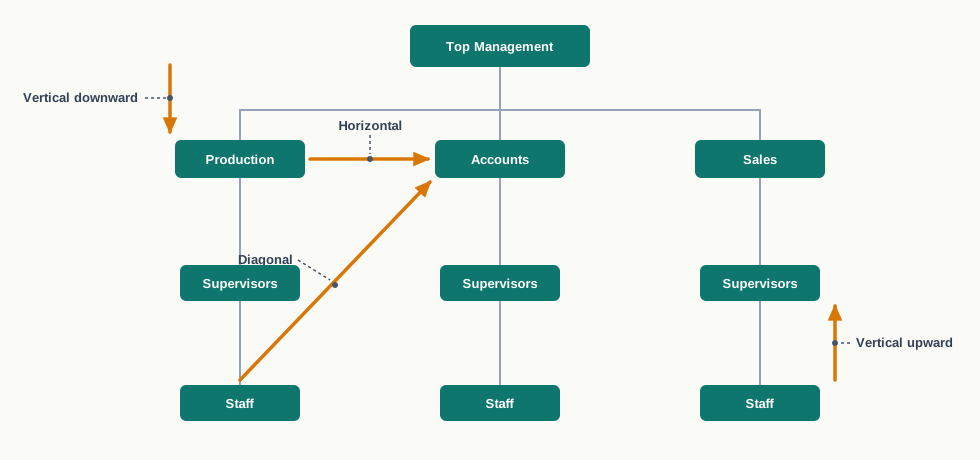
Fig. 14.3 – Directions of internal communication.
Internal communication may also be formal or informal. Formal communication follows the recognised channels and is usually recorded — an order, a circular, minutes of a meeting. Informal communication is the unofficial network of conversation that exists in every workplace. It is fast and it cannot be abolished; the only sound response to it is to make the formal channel faster and more reliable, so that people have less need to guess.
All of this is what allows managers to do their work at all. Planning, direction, coordination and motivation are carried out through communication and by no other means — a plan that has not been communicated is only an intention.
The Media Used
Messages inside an organisation travel through both written and spoken media, and the choice between them is a real decision. Speech is quicker and allows the listener to ask; writing leaves a record and reaches everyone in the same words.
The written media in common use include instructions and orders, letters, memos, house journals, posters, bulletin boards, information racks, handbooks, manuals and activity reports. A handbook or manual carries information that must stay available for years; a bulletin board or an information rack carries what people need this week; a memo settles one matter between named people.
14.7.2 External Communication
External communication takes place between members of an organisation and the outside world. It carries messages and necessary information to the Government and its departments, to customers, dealers, other corporate bodies and the general public at large.
Its purposes follow from what you have already studied. It creates and protects a positive image, it preserves the brand, and it maintains the organisation’s public relations. In an economy where an organisation may buy from one country and sell in another, it also does the work of marketing, since the buyer is reached only through it.
Certain facts and information simply must be shared with outsiders, whether or not the organisation would prefer to. A dealer needs to know of a price revision, a regulator needs to be told of an accident, a shareholder is entitled to the annual accounts. Doing this fully and on time is what promotes goodwill with the public; doing it grudgingly, late or partially destroys goodwill faster than silence would.
Here too both written and verbal media are used. The written media include letters, memos, in-house magazines, posters, bulletins and annual reports. Notice that some of these appear in both lists — an in-house magazine written for employees is read by their families and often by outsiders as well. Nothing an organisation writes stays inside it reliably, which is a useful discipline for the person drafting it.
Table 14.3 sets the two side by side.
14.8 Composing And Transmitting The Message
Whatever the organisation and whatever the public, the communicator’s work divides into two activities:
composing the message; and
transmitting it.
They are separate skills, and each can be done well while the other is done badly. A carefully written notice pinned where nobody walks has failed. A well-chosen channel carrying a confusing message has also failed.
14.8.1 Composing The Message: The Seven Cs
A message is composed for a reader who is busy, who did not ask for it, and who will give it a few seconds before deciding whether to continue. The seven Cs of communication are the checks a composer runs before sending anything out.
Conciseness. Say it in as few words as the meaning allows. A short message is likelier to be read at all, and brevity is what catches the reader’s attention in a crowded page or inbox.
Concreteness. Give specific facts — dates, quantities, names, places — rather than general assurances. ‘The counter will be closed on 12 August’ is concrete; ‘services may be affected shortly’ is not, and it leaves the reader to invent the missing detail.
Clarity. The message must carry one appropriate and explicit meaning. If a sentence can be read two ways, it will be read both ways by different people, and the confusion will come back as complaints.
Completeness. The reader must be given everything needed to act. A meeting notice without the venue, a recall notice without the batch number, an instruction without a deadline — each forces a second round of communication that costs more than the first.
Courtesy. Keep a courteous tone, and acknowledge the reader’s position. Courtesy is not decoration; a curt message provokes resistance to its own content, and the resistance outlasts the message.
Correctness. Check the message for accuracy of fact and for correctness of language. Errors of grammar and spelling damage the sender more than the meaning, because the reader silently concludes that the same carelessness runs through the organisation.
Consideration. Write from the reader’s point of view rather than the sender’s. This is often called the you-attitude: instead of listing what the organisation has decided, say what it means for the person reading. ‘You may collect your card from Counter 3 after 10 a.m.’ does the same work as ‘We have opened Counter 3’ and does it better.
The Seven Cs At Work
Consider a notice put up by a cooperative store: Due to unavoidable circumstances the store will remain closed. Inconvenience regretted. It is concise and courteous, and it fails on almost everything else. It is not concrete — closed when, and for how long? It is not complete — may members collect pre-booked items elsewhere? It is not considerate — it describes the store’s situation, not the member’s problem.
Rewritten: The store will be closed on Monday, 12 August, for stock-taking, and will reopen at 9 a.m. on Tuesday. Members with pre-booked orders may collect them from the godown gate on Monday between 10 a.m. and 1 p.m. For help, telephone the manager at the number below. It is longer, and it is far more concise in the only sense that matters — the number of exchanges needed before the member knows what to do.
14.8.2 Transmitting The Message
Composing well is not enough; the message must be carried by a medium that suits both the content and the people it is meant for. In PR work the choice is made by looking first at the characteristics of the target audience — where they are, what they read, watch or listen to, what they already know, and how much time they will give.
Language follows the same test. The vocabulary, the level of detail and even the language itself depend on the target group. A technical note for engineers, a leaflet for farmers buying seed, and a circular for shareholders may all carry the same information, and none of the three can be used in place of another.
The person transmitting the message is part of the medium too. A PR professional’s disposition — patience, steadiness, courtesy under pressure — and interpersonal skills affect how the message is received, particularly when it is delivered face to face or over the telephone. This is why the next section takes up the skills the work demands, and why so many of them are skills of manner rather than of technique.
14.9 Knowledge And Skills Required
Everything in this chapter so far has described work. This section describes the equipment needed to do it. Skills are what make a person a better and more effective communicator; they are what turn the two activities of section 14.8 — composing and transmitting — from intentions into results.
The encouraging point is that almost none of these skills is a gift of temperament. They are acquired, and by different routes. Listening can largely be taught to oneself. Interpersonal skills, negotiation and rapport are picked up by watching people who are good at them and noticing what they actually do. Presentation skills involve software and equipment, and usually need some formal training. Structured training programmes exist for accent neutralisation, public speaking, telephone etiquette, basic writing, decision making and stress management. Time management is sometimes trained and more often learnt through experience. Table 14.4 sets out the routes.
14.9.1 Listening Skills
Listening is not the absence of speaking. It is an active process with three parts, shown in Fig. 14.4, and a breakdown at any one of them means the message has not arrived.

Fig. 14.4 – The three parts of listening.
Hearing is the physical part: the body receives sounds and interprets them. You may hear words as part of a conversation without doing anything further with them. Hearing is critical to listening, but it is only the first stage. Understanding is where the brain processes the words heard and derives meaning from them in the context of the whole conversation — this is the stage at which information is actually communicated to you. A word understood on its own and not in context is frequently understood wrongly.
Responding is the last part, and it is the one that makes listening visible. A response shows the speaker that you heard what was said and grasped what was intended. It may take the form of a decision to act on what you have understood, or of a reply carrying your opinion or comments. In an organisation this matters twice over: the speaker who is never responded to stops speaking, and that is how upward communication dies.
14.9.2 Interpersonal Skills
Interpersonal skills are the measure of a person’s ability to work within an organisation through ordinary social communication and interaction — in short, the skills used to deal with other people. They are exercised in every meeting, every handover and every disagreement.
Their effect on an organisation is practical rather than pleasant. Where interpersonal skills are strong, conflicts are fewer and are settled sooner, and productivity rises for that reason alone. In informal situations they make communication easy and comfortable, which is when most useful information passes. People with good interpersonal skills are generally able to manage the feelings that arise in difficult situations and respond appropriately, instead of being carried away by emotion — not by suppressing what they feel, but by not letting it choose their words for them.
14.9.3 Negotiation Skills
Negotiation is the process by which two parties who each find something in the other’s position unacceptable try to reach an agreement both can live with. Each side tries to convince the other, and both must be fully prepared, because there are almost always more issues and variables in play than either side has thought of.
Good negotiation is not defeating the other party. Done properly, it is the trading of concessions, and it is entirely possible for both sides to come away satisfied — which matters, because in business the person across the table is usually someone you will deal with again next year.
Preparation is where the skill mostly lies. Before the meeting, a good negotiator lists every variable that could be traded, estimates what each one would cost to give away, and then decides two things: which concessions to offer first, and which ones to hold back for the point where the talks come to a crunch.
14.9.4 Presentation Skills
Presentation skills are used to communicate ideas and information to a group. A presentation carries the speaker’s personality in a way a document cannot, and it allows immediate interaction — the audience can question, and the presenter can see the point at which people stopped following. A good presentation has four elements.
Content — the information the audience needs, limited to as much as they can absorb in one sitting. More than that is not generosity; it is waste.
Structure — a logical beginning, middle and end, sequenced and paced so that the audience can follow. The presenter must judge the pace by the audience, not by the clock.
Packaging — the treatment given to the content: how it is arranged, illustrated and displayed, including the use of presentation software where it genuinely helps.
Human element — treated separately below, because it is the element most often left out.
14.9.5 The Human Element
A presentation is remembered because a person was attached to it. Whatever the content and the packaging, the presenter still has to analyse what this particular audience needs and select an approach for them.
The same principle governs a great deal of ordinary organisational communication. Many offices send cards to employees on birthdays and other special occasions. The card is a system; it is the senior colleague who adds a personal word that makes the person feel recognised. A message that could have been sent to anyone tends to be received as though it had been.
14.9.6 Rapport Establishment
Rapport is the establishment of trust and harmony in a relationship. It is the key element in obtaining the support and cooperation of other people, which is why it belongs in a chapter on public relations at all.
Rapport is built through much more than the words used. Tone of voice, pace, posture, facial expression and the degree to which one person matches the manner of the other all contribute, and most of this happens without either person consciously attending to it. The practical skill is to become conscious of what is normally unconscious: to notice that you are speaking quickly to someone who is anxious, or looking at a screen while a colleague is explaining a problem. Most people establish rapport easily with those similar to themselves; a skilled communicator can do it across a much wider range of people.
14.9.7 Effective Decision Making
Decision making can be a complex process, and every effective person in an organisation needs the skill. Both human and material elements are involved — money, materials, time and equipment on one side; people’s abilities, expectations and reactions on the other. The task is to assess and prioritise these factors, anticipate the likely outcome, and decide in the best interest of all the parties concerned.
The skill is not confined to boardrooms. A student with a fixed monthly allowance faces the same structure of problem: there are always more claims on it than it will cover — food, travel, a gift for a friend, photocopying study material — and how far that allowance goes depends on the quality of the choosing. The same is true of a few free hours in a week, where deciding the order of importance among activities is itself the decision.
In a large organisation the difficulty is that the interests do not point the same way. A manager weighs efficiency against cost, and the satisfaction of customers against that of employees and owners, knowing that no option satisfies all of them completely. Deciding well here means choosing knowingly, and being able to explain the reasoning afterwards.
14.9.8 Telephone Etiquette, Basic Writing And Public Speaking Skills
These three you have already met in school, and you have more of them than you probably credit yourself with.
Telephone etiquette — announcing who you are, listening without interrupting, noting down what was asked, saying when you will call back — creates a good impression and puts the other person at ease within the first few seconds. Basic writing skills, including the writing of emails and notes, are built through your language curriculum. Public speaking is developed by anyone who has taken part in an elocution or debate, or has listened closely to a speaker who held an audience. What changes at work is only the purpose: as a communicator you now apply these three deliberately, because each of them is a place where the organisation’s image is either built or lost.
14.9.9 Accent Neutralisation
Every language is spoken with an accent, shaped by where a speaker grew up and what other languages they carry. There is no accentless English: Indian, British, American and Australian speakers each have one, and so does every region within those countries.
Accent neutralisation is training in pronouncing words so that a listener unfamiliar with the speaker’s accent can follow easily. Its purpose is mutual intelligibility, not the replacement of one’s own way of speaking with somebody else’s, and no accent is more correct than another. Speakers seek it for practical reasons: to widen personal and professional opportunities, to work comfortably in long conversations, presentations and telephone calls where the listener cannot see them, and to be understood the first time by audiences who do not share their background.
14.9.10 Time Management
Time is the one resource that cannot be increased, borrowed or recovered, and every other resource is spent through it. Time management is a set of principles, practices, tools and systems used together to get more value from the time available.
It is a skill and can therefore be developed by someone who does not currently have it. In practice it means knowing what has to be done, deciding the order of importance, allotting realistic durations, and reviewing afterwards what took longer than expected. Its effects run in two directions: an individual gets more done and feels more in control, and across a whole organisation the difference between good and poor time management is enormous, because delays in one department become idle time in the next. It also reduces stress, since a great deal of stress is produced by work that is late rather than by work that is hard.
14.9.11 Stress Management
Almost everyone experiences some stress on an ordinary day — reaching school on time, preparing for a test, getting a piece of work finished. Stress is the physical, mental and emotional response we make to the demands, changes and events of our lives; a situation that produces pressure or strain is a stressor.
Stress is not simply an enemy. In moderate amounts it sharpens attention and pushes us to finish something difficult, and the satisfaction afterwards is part of why we take on difficult things at all. Symptoms begin to appear when we feel that the demands being made on us exceed our ability to meet them, and it is at that point that stress starts to cost more than it contributes.
Managing stress means taking charge of the things that can be taken charge of: your schedule, your surroundings, how you approach problems, and how much you are attempting at once. The aim is a balanced life — time for work, for relationships, for rest and for enjoyment — together with enough flexibility to hold up under pressure when it comes. If stress is persistent, or is affecting sleep, appetite or the ability to work, that is not a failure of management; it is a signal to speak to a doctor, a school counsellor or a trusted adult, who can help far more quickly than any technique applied alone.
14.10 Use Of Technology To Communicate
Of everything that has changed the scope of communication, technology has changed it most. It has opened doors to information, knowledge and news from all over the world, and it has done so for ordinary people and small organisations, not only for large ones. A cooperative of weavers can now show its work to a buyer in another country without either party travelling.
The term in general use for all of this is Information and Communication Technologies (ICT). ICT is an umbrella term covering all the technical means used for processing and communicating information. Strictly speaking it includes pre-digital technologies as well — paper-based writing is a technology for storing and transmitting information — but in ordinary use it refers to digital technologies: methods of communication, techniques of transmission, communications equipment, media, and the techniques used to store and process information.
The term became popular partly because two fields merged. Information technology (IT) is concerned with storing and processing data, while telecom technology is concerned with carrying signals from one place to another. Once a computer could send what it had processed down a telephone line, the two were no longer separable, and a single term was needed for both.
What This Changed For Organisations
For a communication department, the practical effect is that the same message can now be composed once and transmitted through several channels within minutes. An organisation’s own website and social media pages let it speak to the public directly, without waiting for a journalist to carry the message. An intranet or a group messaging system reaches every employee at every branch on the same day. Video conferencing allows a meeting between people in four cities at the cost of the connection.
Two consequences follow that are worth thinking about. The first is speed: information now moves faster than most organisations can decide what to say about it, which is why the calmness of principle (g) in section 14.6 has become harder and more valuable. The second is reach in both directions: the customer who is unhappy has the same channels as the organisation, and can use them just as quickly. Technology has not made communication easier to control. It has made it faster, cheaper and far less one-sided.
14.11 Scope Of Corporate Communication And Public Relations
Having seen what this work is, what it does and what it demands, the last question is how far it extends. The scope falls into three parts.
Within The Organisation
Corporate offices and organisations of every other kind need this function to cover the whole of the communication that passes between employer and employees. That is a larger territory than it sounds: appointment and transfer, policy and its reasons, safety instructions, grievances, results, retirements. Wherever an organisation employs people, there is internal communication to be managed, whether or not anyone has been given the job.
Beyond The Organisation
The second part of the scope is everything outside. A PR officer extends the organisation’s communication to shareholders, the media and the press, non-governmental organisations, government departments, customers and the general public. Dealing with outside agencies is where the role is most exposed, because each of these groups can act on what it hears — a regulator by inspecting, a customer by leaving, a journalist by publishing.
Notice how the ladder runs. A single employee’s grievance is handled at the level of the individual; internal communication holds the organisation together at the level of the institution; press relations and community work place that organisation within its locality; and liaison with government departments and national media places it in the life of the country. The same principles operate at each rung, and the same seven principles of section 14.6 apply at all of them.
Innovation In Media And Technology
The third part of the scope is that it keeps changing. New media and technologies appear, audiences move to them, and the communicator has to judge which are worth using for which public. This is why nobody in this field finishes learning it. The tools of ten years ago are not the tools of today, but the questions asked of every tool are the old ones: who is the audience, what do they need to know, and will they believe it.
For this reason the field is a wide one to work in. Companies, public sector undertakings, government departments, hospitals, universities, cooperatives, non-governmental organisations and specialist PR agencies all employ people to do it, and the skills of section 14.9 travel between them.
14.12 Summary
- An idea, a fact or an opinion does nothing for an organisation until it is communicated and understood.
- Corporate communication is the set of activities by which an organisation manages and coordinates all its communication, inside the organisation and outside it, so that it presents itself consistently.
- The information it carries comes from both specialists, who hold detailed knowledge, and generalists, who understand the organisation as a whole.
- A stakeholder is anyone affected by what an organisation does, or able to affect it in turn — employees, customers, investors, suppliers, government, the media and the local community.
- Public perception is the picture stakeholders carry of an organisation, and it decides whether they buy from it, work for it, invest in it or trust it.
- Perception is not the same as reality, so establishing an accurate and favourable picture of itself is the primary objective of corporate communication.
- After any event, what people understand to have happened decides the organisation’s fortunes more than what actually happened; deciding what to say is legitimate, stating what is false is not.
- Corporate communication produces four things:
- a positive and favourable public perception;
- effective and efficient avenues of communication;
- a strong corporate culture, corporate identity and corporate philosophy;
- a genuine sense of corporate citizenship.
- Its functions are building a healthy organisational environment, creating and maintaining the brand, reputation management, liaison with outside bodies, informing the public of products and achievements, crisis control, and handling global communication and its technologies.
- Every kind of organisation needs this work — hospitals, cooperatives, universities, non-governmental organisations and government departments as much as companies.
- Public relations is a deliberate, planned and sustained effort to establish and maintain mutual understanding between an organisation and its publics.
- PR is called both an art and a science: it needs the judgement and timing of an art and the study, planning and measurement of a science.
- Each PR programme is built around a particular objective — building an image, handling a crisis, motivating employees, creating curiosity, supporting advertising or announcing an event — and the objective decides the strategy and the approach used.
- PR professionals work under a code of ethics because they hold advance information that must not be commercialised, and because a communicator who shades the truth becomes useless to every client.
- The functions of PR are public relations policy, statements and press releases, publicity, maintaining relations with government and community, and publications.
- The major areas of PR activity are press relations, advertising, publications, other media coordination, and PR with constituents.
- Press relations rest on interdependence: journalists need news and PR needs coverage, so well-timed releases, accessibility, even-handedness and forbearance of criticism keep the relationship working.
- Advertising is paid and fully controlled by the organisation; publicity is unpaid media coverage that the organisation cannot control but which the audience finds more credible.
- Publications are prepared with attention to simplicity, clarity, cost, a true image of the organisation, and attractiveness.
- Other media coordination covers films, exhibitions, hoardings and folk forms such as puppetry and folk-song, along with good public speaking and courteous use of the telephone.
- PR with constituents covers liaison with the local community, bankers, financial analysts, shareholders and investors, and internal relations with employees at every level.
- Arthur W. Page’s seven principles of public relations are:
- tell the truth;
- prove it with action;
- listen to the customer;
- manage for tomorrow;
- conduct public relations as if the whole organisation depended on it;
- realise that an organisation’s true character is expressed by its people;
- remain calm, patient and good-humoured.
- All seven rest on one idea: reputation is earned by conduct, and communication makes conduct visible rather than replacing it.
- Internal communication takes place between and among the employer and employees; it binds the organisation, raises morale, promotes transparency and prevents rumour.
- It flows vertically downward, vertically upward, horizontally and diagonally, and may be formal or informal.
- External communication takes place between members of the organisation and the outside world, and works to create a positive image, preserve the brand, maintain public relations and support marketing.
- Communication activity divides into composing the message and transmitting it, and each can be done well while the other is done badly.
- The seven Cs to be observed while composing a message are conciseness, concreteness, clarity, completeness, courtesy, correctness and consideration.
- Transmission depends on the characteristics of the target audience, on language chosen for that group, and on the communicator’s own disposition and interpersonal skills.
- The skills required are learnable, by self-teaching, by observing effective people, by formal training or through experience.
- Listening is an active process of three parts — hearing, understanding and responding — and it fails if any one of them is missing.
- Interpersonal skills reduce conflict and raise productivity, and allow a person to respond appropriately in difficult situations instead of being ruled by emotion.
- Negotiation is the trading of concessions by prepared parties, and is done well when both sides can accept the outcome.
- A good presentation has content, structure, packaging and a human element.
- Rapport is the establishment of trust and harmony, built largely through tone, pace and manner rather than words alone.
- Effective decision making means assessing and prioritising human and material factors, anticipating outcomes, and deciding in the best interest of all parties concerned.
- Telephone etiquette, basic writing and public speaking are everyday skills that decide how an organisation is judged in ordinary contact.
- Accent neutralisation is training for mutual intelligibility, not the replacement of one accent by another, since no accent is more correct than another.
- Time management is a set of principles, practices, tools and systems for getting more value from time; it raises productivity and reduces stress.
- Stress is our physical, mental and emotional response to demands and changes; managing it means taking charge of schedule, surroundings and approach, and seeking help from a doctor or counsellor when it persists.
- Information and Communication Technologies cover all technical means of processing and communicating information, and gained currency as information technology and telecom technology merged.
- Technology has made communication faster, cheaper and less one-sided, since the dissatisfied customer now has the same channels as the organisation.
- The scope of this work covers all communication with employees, all communication with outside publics, and continuing innovation in the media and technologies used.
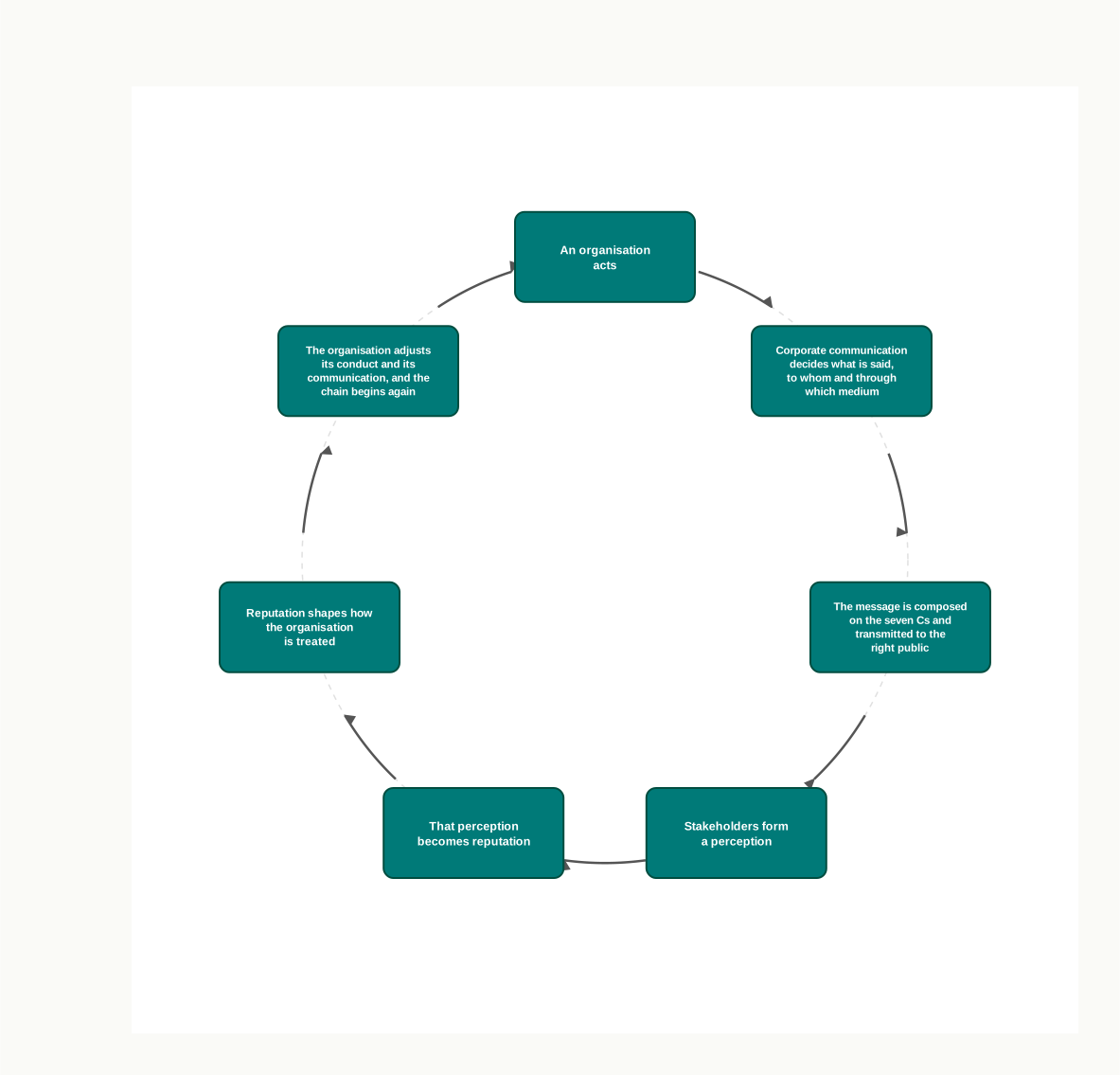
Fig. 14.5 – The corporate communication cycle.
14.13 Key Terms
Accent neutralisation — training in pronouncing words so that a listener unfamiliar with the speaker’s accent can follow easily; its aim is mutual intelligibility, not the replacement of one accent by another.
Advertising — paid communication placed in a medium by an identified sponsor, to inform, persuade or influence people to buy or use something.
Brand — the whole set of expectations attached to an organisation’s name, about its quality, its prices and its behaviour.
Code of ethics — a written set of standards, covering honesty, confidentiality and conflict of interest, that the members of a profession agree to keep.
Corporate citizenship — an organisation behaving as a responsible member of the community it works in, shown in checkable conduct rather than announcements.
Corporate communication — the set of activities by which an organisation manages and coordinates all its internal and external communication, so that it presents itself consistently.
Corporate culture — the shared habits, values and ways of working of the people inside an organisation.
Corporate identity — the visible face by which outsiders recognise an organisation, such as its name, logo and manner of dealing.
Corporate philosophy — the set of beliefs an organisation holds about why it exists and what it is for.
External communication — communication between members of an organisation and the outside world, including government, customers, dealers, other corporate bodies and the general public.
In-house magazine — a periodical produced by an organisation for its employees and their families, carrying organisational news, staff achievements and notices.
Information and Communication Technologies (ICT) — an umbrella term for all technical means used for processing and communicating information, used today mainly of digital technologies.
Information technology (IT) — the technology concerned with storing and processing data, which merged with telecom technology to give the term ICT.
Internal communication — communication between and among the employer and the employees of an organisation, flowing vertically, horizontally and diagonally.
Interpersonal skills — the skills used to deal with other people within an organisation through ordinary social communication and interaction.
Listening — the active process of hearing a message, understanding it in context and responding to it.
Negotiation — the process by which two parties who each find something unacceptable in the other’s position trade concessions to reach an agreement both can accept.
Presentation skills — the skills used to communicate ideas and information to a group, through content, structure, packaging and a human element.
Press relations — the working relationship an organisation maintains with newspapers, news channels and news websites at all levels, from reporter to editor.
Press release — a written statement issued by an organisation to the media for publication, carrying identical information to many outlets at once.
Public perception — the picture that the public, customers, competitors and employees carry in their minds about an organisation.
Public relations (PR) — a deliberate, planned and sustained effort to establish and maintain mutual understanding and goodwill between an organisation and its publics.
Publicity — media coverage obtained without paying for the space or time, such as a news report, an interview or a mention of an achievement.
Rapport — the establishment of trust and harmony in a relationship, built largely through tone, pace and manner rather than words alone.
Reputation management — the deliberate work of watching, measuring and repairing what stakeholders say about an organisation over time.
Seven Cs of communication — the checks applied while composing a message: conciseness, concreteness, clarity, completeness, courtesy, correctness and consideration.
Stakeholder — anyone affected by what an organisation does, or able to affect it in turn.
Stress — the physical, mental and emotional response a person makes to the demands, changes and events of life.
Time management — a set of principles, practices, tools and systems used together to get more value from the time available.
14.14 Points To Ponder
If reputation is earned by what an organisation does rather than by what it says, what real work is left for the communicator to do?
Publicity is more credible to an audience than advertising, yet organisations spend far more on advertising. What does that tell you about how much they value control over a message?
Informal communication exists in every workplace and cannot be abolished. Should an organisation try to use it, or only try to make its formal channels faster than it?
If every employee, serving or retired, is part of an organisation’s public relations, how far can an organisation reasonably expect an employee to speak for it outside working hours?
Technology has given the dissatisfied customer the same channels of communication as the organisation. Has this made organisations more honest, or only quicker to respond?
Accent neutralisation is taught so that a speaker is understood the first time. Where does being easier to understand end and being asked to sound like somebody else begin?
14.15 Objective Questions
- (MCQ) — The primary objective of corporate communication is to: [1]
- increase the volume of an organisation’s sales in a given year
- establish an accurate and favourable perception of the organisation among its stakeholders
- reduce the number of employees needed in the marketing department
- prevent journalists from reporting on the organisation
- (MCQ) — Which of the following is publicity and not advertising? [1]
- A full-page notice bought in a newspaper
- A hoarding placed at a bus terminal
- A news report on an award won by the organisation
- A radio spot broadcast during a sponsored programme
- (MCQ) — Communication between a machine operator in the production section and a clerk in the accounts section is: [1]
- vertical downward
- vertical upward
- horizontal
- diagonal
- (MCQ) — A notice states that a counter will be closed on 12 August and will reopen at 9 a.m. on 13 August. Which of the seven Cs does this most obviously satisfy? [1]
- Courtesy
- Concreteness
- Consideration
- Correctness
- (Assertion–Reason) — Read the two statements and choose the correct option. [1] Assertion (A): An organisation should inform its own employees of major news before it reaches the press. Reason (R): Employees who learn organisational news from outside sources stop trusting the organisation’s own channels, and rumour takes their place.
- Both A and R are true, and R is the correct explanation of A
- Both A and R are true, but R is not the correct explanation of A
- A is true but R is false
- A is false but R is true
- (Assertion–Reason) — Read the two statements and choose the correct option. [1] Assertion (A): Audiences generally find publicity more credible than advertising. Reason (R): The organisation controls the exact wording and timing of publicity.
- Both A and R are true, and R is the correct explanation of A
- Both A and R are true, but R is not the correct explanation of A
- A is true but R is false
- A is false but R is true
- (Match the following) — Match each item in Column A with its description in Column B. [4]
| Column A | Column B |
|---|---|
| a. Corporate identity | i. The shared habits and values by which people inside an organisation work |
| b. Corporate culture | ii. The beliefs an organisation holds about why it exists |
| c. Corporate philosophy | iii. The visible face by which outsiders recognise an organisation |
| d. Corporate citizenship | iv. An organisation behaving as a responsible member of its community |
(Fill in the blank) — Coverage obtained in the media without paying for the space or time is called ______. [1]
(Fill in the blank) — ______ is an umbrella term covering all the technical means used for processing and communicating information. [1]
(True or false) — Internal communication flows only downward, from the top management to the levels below. [1]
(True or false) — A code of ethics forbids a PR professional from turning advance knowledge of an organisation’s affairs into private gain. [1]
(Name the following) — Name the three parts of the active process of listening. [1]
(Name the following) — Name any two written media used for internal communication in an organisation. [1]
(Odd one out) — Pick the odd one out and give a reason: brochure, folder, pamphlet, press conference. [1]
(Odd one out) — Pick the odd one out and give a reason: conciseness, correctness, courtesy, coordination. [1]
14.16 Check Your Concepts
Define corporate communication. [2]
State any two purposes served by external communication. [2]
List the five major areas of PR activity. [2]
Give a reason why a PR officer should avoid showing undue favour to one newspaper over another. [2]
Explain, with one example, what is meant by the you-attitude in composing a message. [3]
Differentiate between advertising and publicity, stating the basis of difference in each case. [3]
Why is a code of ethics particularly necessary for PR professionals? Give two reasons. [3]
What would happen to an organisation whose downward communication works well but whose upward communication is blocked? [3]
Explain the four elements of a good presentation. [4]
Differentiate between internal and external communication on any four bases. [4]
Explain any four functions of corporate communication, with an example of each. [4]
‘Reputation is earned by conduct; communication only makes conduct visible.’ Explain this statement with reference to any three of the seven principles of public relations. [5]
Explain the seven Cs to be kept in mind while composing a message. [5]
Describe the skills a corporate communicator needs, and state how each of them may be acquired. [5]
14.17 Identify & Label
Study Fig. 14.0. Identify the two groups shown on either side of the dotted boundary, and name any three members of each group. [3]
Study Fig. 14.2. Identify the publication shown as a stapled multi-page booklet, and state one situation in which an organisation would choose it in place of a single printed sheet. [2]
Study Fig. 14.3. Identify the four directions of internal communication marked on the chart, and give one example of a message that would travel in each direction. [4]
14.18 Case & Application Based
- A district cooperative bank is shifting its main branch to a new building three streets away, and the move will take place over one weekend. Depositors, the staff, the local traders’ association and the district administration all need to be told. The branch manager wants a single printed notice put up on the old door on Friday evening. [4]
- Identify two publics that this plan will fail to reach, and state why.
- Suggest a suitable medium for each of those two publics, giving a reason for your choice.
- State the essential information the notice for depositors must carry, and name the two Cs your list is chiefly satisfying.
- A garment manufacturing unit on the edge of a town is asked by residents of the neighbouring colony to explain a persistent smell coming from its dyeing section. The owner believes the smell is harmless and wants to wait until the complaint dies down. The unit’s communication officer disagrees. [5]
- Which two of the seven principles of public relations does the owner’s plan disregard? Justify your choice.
- State what the unit should establish before it makes any statement to the residents, and explain why that order matters.
- Explain how this situation could affect the unit’s relations with the local press and with the State pollution control authorities.
- Suggest one action, apart from communication, that would make any statement the unit issues believable.
- A public hospital is opening a new mother and child care wing. The superintendent wants the opening announced to the general public, to the district health department, to the doctors and nurses who will be transferred to the new wing, and to the local press. The hospital has no advertising budget at all. [5]
- Classify each of these four as internal or external communication.
- Choose a suitable medium for each, and give one reason for each choice.
- Explain how publicity could carry the announcement to the general public without any advertising spend, and state one limitation of relying on it.