Chapter 5: Challenges To And Restoration Of The Congress System
In May 1964, India lost the only Prime Minister it had ever known. Jawaharlal Nehru had been unwell for more than a year, and in that year one question had been asked in the newspapers, in Parliament and in the Congress party offices: after Nehru, who?
There was a second question underneath it, and it was the frightening one: after Nehru, what?
India in 1964 was seventeen years old as an independent country. Many observers outside it did not expect its democratic experiment to outlive the man who had led it. Newly independent countries, they pointed out, had rarely managed a peaceful, democratic handover of power. A country that could not do so, it was feared, would sooner or later find the army stepping into the space that politics had left empty.
The doubts were not only about the succession. The 1960s were already being called India’s ‘dangerous decade’. Poverty, inequality, and communal and regional divisions were unresolved, and any of them, it was said, could bring down the democratic project or break the country apart.
What actually happened in the twelve years that followed was stranger than either the prophets of collapse or the confident nationalists expected. India managed a peaceful succession — twice in two years. Then the party that had run the country since Independence tore itself in half. And then, having split, it won the biggest victory of its life.
The cartoon printed on this chapter’s opening page tells that story in four drawings, and it is worth decoding before you begin. The pair of bullocks in it is not decoration: a pair of bullocks was originally the election symbol of the Congress party.
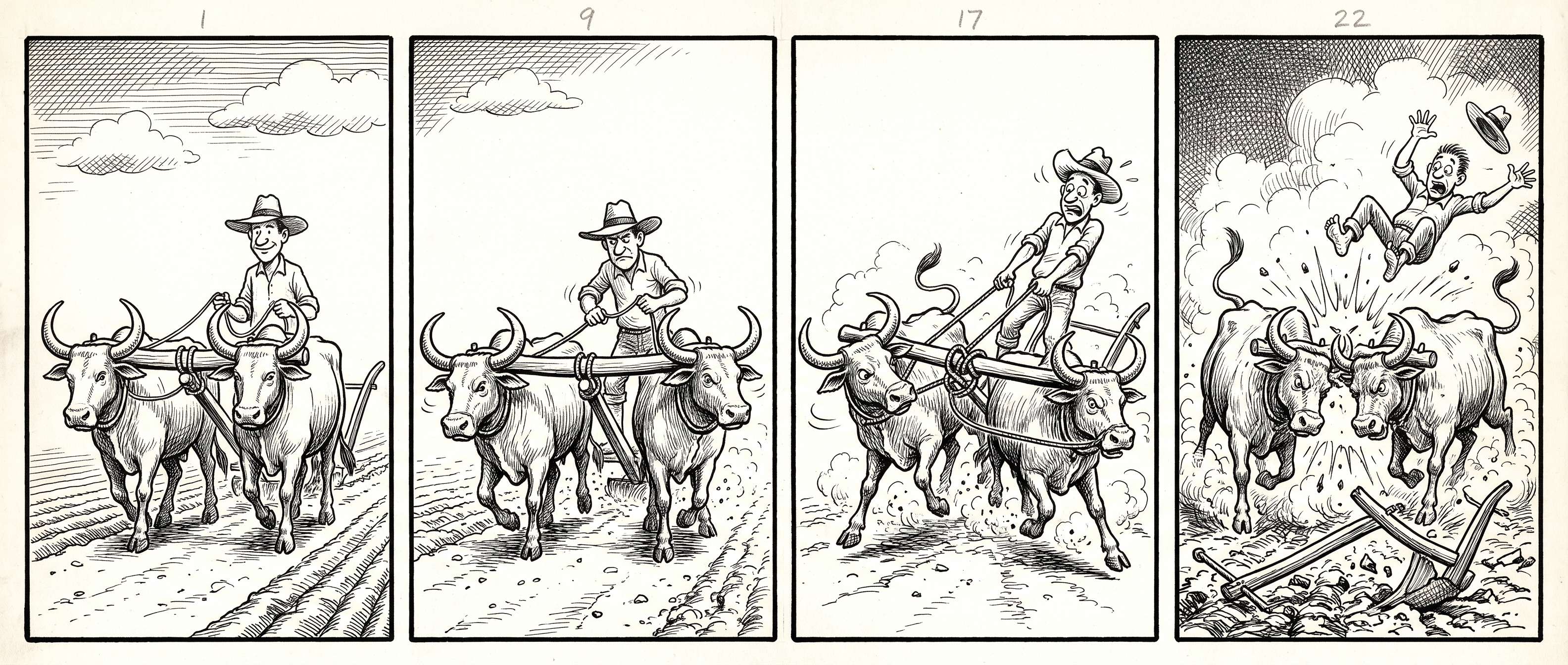
Fig. 5.0 – The changing nature of the Congress party. Inspiration: R. K. Laxman, The Times of India.
Read it as a sequence, not as four separate jokes. In the first panel the two bullocks pull the same plough in the same direction. By the twenty-second year after Independence — that is, 1969 — they have turned and are charging straight at each other. The cartoonist is making a claim: that the party’s real trouble came from inside it, and that it built up slowly, year by year, until it broke into the open. That is a strong claim, and this chapter will let you test it. Notice, too, what a cartoon of this kind cannot show. It cannot tell you what the quarrel was about, who was right, or whether the collision was a disaster for the Congress or the making of it.
5.1 Challenge Of Political Succession
Prime Minister Jawaharlal Nehru passed away in May 1964. He had been unwell for more than a year, and that long illness had already set off a great deal of speculation about the usual question that follows the death of any leader: after Nehru, who?
But in a newly independent country like India, the situation raised a second and far more serious question: after Nehru, what?
Why The Second Question Frightened People
The second question came out of the serious doubts that many outsiders had about whether India’s democratic experiment would survive Nehru. It was feared that India, like so many other newly independent countries, would not be able to manage a democratic succession — that is, a peaceful, lawful handover of power to a new leader chosen by the ordinary political process.
A failure of that kind, it was feared, could open the door to a political role for the army. Where politicians cannot settle who governs, soldiers often settle it for them. That had already happened in several countries that had won freedom around the same time as India.
Besides, there were doubts about whether a new leadership could handle the multiple crises that were awaiting a solution. The 1960s were labelled the ‘dangerous decade’, a decade in which unresolved problems like poverty, inequality, and communal and regional divisions could lead to a failure of the democratic project or even to the disintegration of the country.
It is worth pausing on that word ‘suspicion’. When France or Canada face similar problems — economic distress, regional resentment, quarrels over language — nobody predicts that those countries will fall apart. Why was India held under this constant suspicion? Part of the answer is the record of newly decolonised states in those years. Part of it, you may decide, is something less flattering to the observers themselves.
The newspaper front page reproduced here is worth reading as evidence of that mood, and not merely as a record of a death.
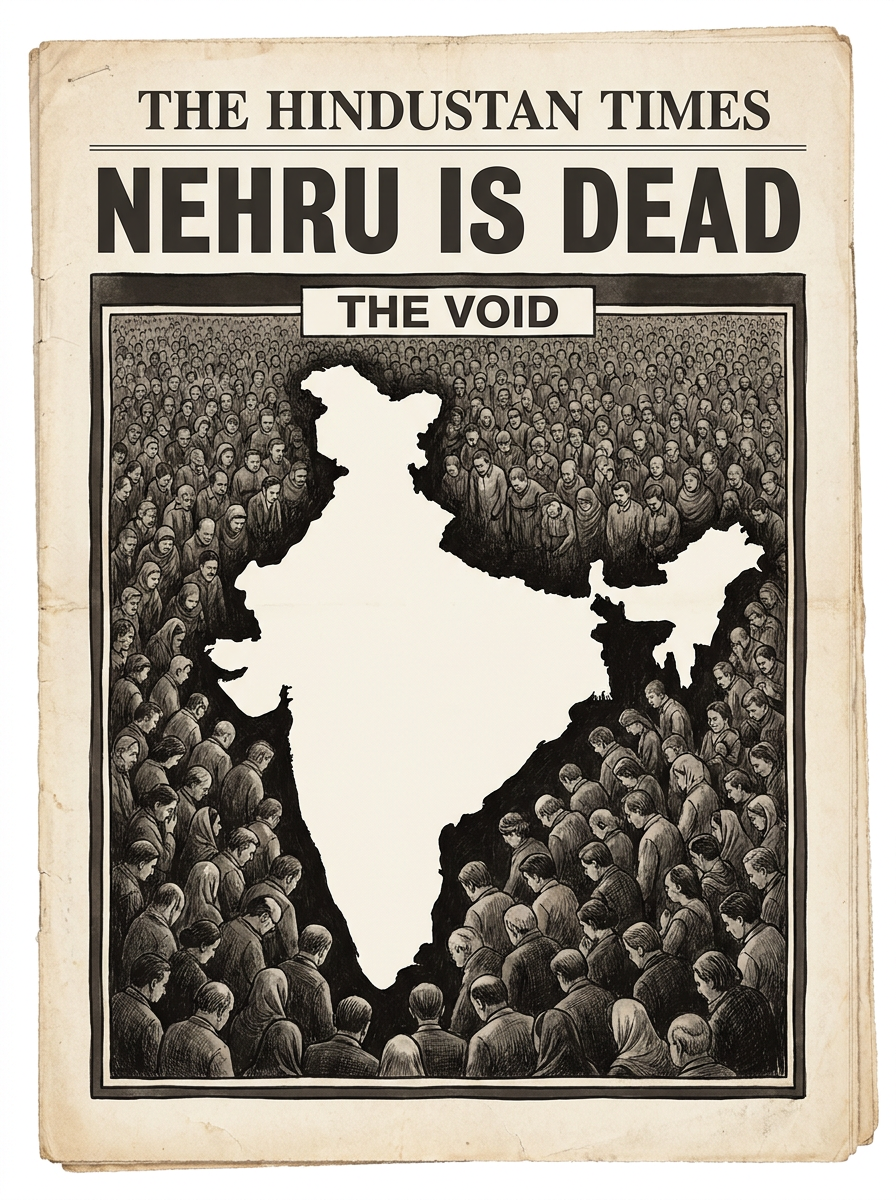
Fig. 5.1 – The Hindustan Times reports the death of Nehru.
The cartoonist has drawn the country as a hole — a void where a figure used to be. That is exactly the fear this section is about: not grief alone, but the suspicion that the man and the system had become the same thing, so that losing one meant losing the other.
5.1.1 From Nehru To Shastri
The ease with which the succession after Nehru took place proved all the critics wrong.
When Nehru passed away, K. Kamraj, the president of the Congress party, consulted party leaders and Congress members of Parliament. He found that there was a consensus in favour of Lal Bahadur Shastri. Shastri was unanimously chosen as the leader of the Congress parliamentary party — the body of a party’s own MPs, sitting together as a group — and thus became the country’s next Prime Minister.
Shastri was a non-controversial leader from Uttar Pradesh who had been a Minister in Nehru’s cabinet for many years, and Nehru had come to depend a lot on him in his last year. He was known for his simplicity and his commitment to principles. Earlier he had resigned from the position of Railway Minister, accepting moral responsibility for a major railway accident.
What Shastri’s Government Faced
Shastri was the country’s Prime Minister from 1964 to 1966. In that short time the country faced two major challenges at once.
The first was economic. India was still recovering from the economic consequences of the war with China, and now failed monsoons, drought and a serious food crisis presented a grave challenge. A country that cannot feed itself must buy food from abroad, and a country at war must buy weapons; doing both at once strains everything else.
The second was military. As you have already read, the country also faced a war with Pakistan in 1965. Shastri’s famous slogan Jai Jawan Jai Kisan — hail the soldier, hail the farmer — symbolised the country’s resolve to face both these challenges together, by honouring the man at the front and the man in the field in the same breath.
Shastri’s Prime Ministership came to an abrupt end on 11 January 1966, when he suddenly expired in Tashkent, then in the USSR and currently the capital of Uzbekistan. He was there to discuss and sign an agreement with Muhammad Ayub Khan, the then President of Pakistan, to end the war.
How A Succession Was Managed
The chapter has now shown you two vacancies at the top, and both were filled by the same route. It is set out in Fig. 5.2.
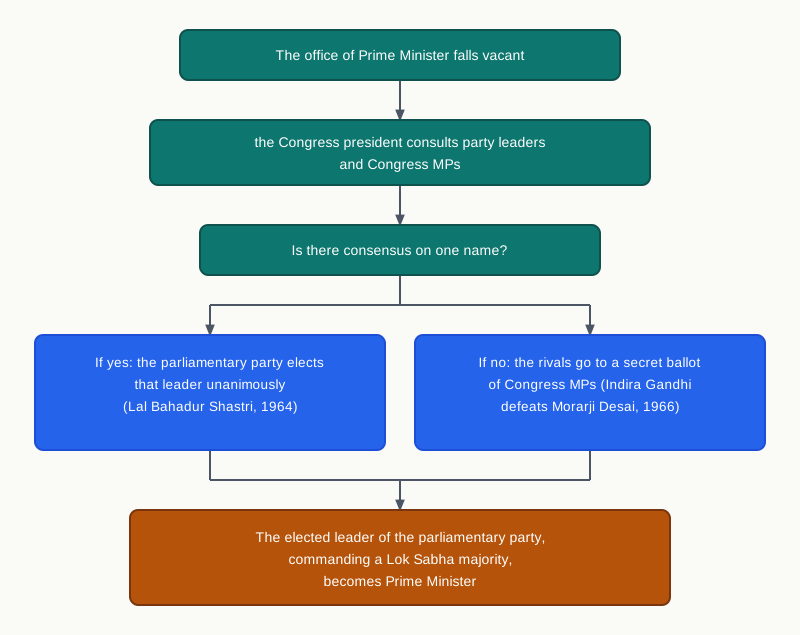
Fig. 5.2 – How the Congress replaced a Prime Minister.
Notice what the chart shows and what it hides. The steps are the same in both years; what changed was whether the party’s leaders could agree in advance. The rule stayed constant. The politics did not.
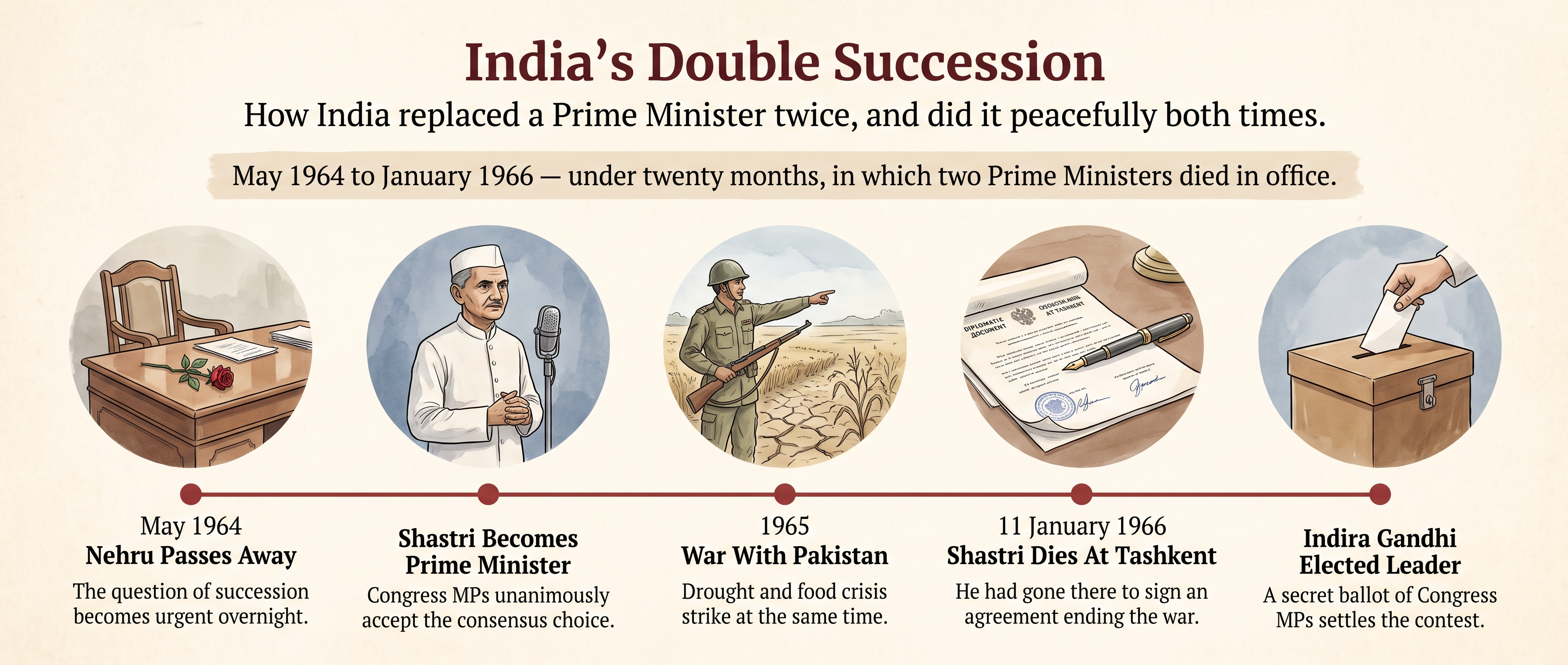
Fig. 5.3 – Two successions in two years.
5.1.2 From Shastri To Indira Gandhi
Thus the Congress faced the challenge of political succession for the second time in two years. This time there was an intense competition between Morarji Desai and Indira Gandhi.
Morarji Desai had earlier served as Chief Minister of Bombay state — the state that was later divided into today’s Maharashtra and Gujarat — and had also been a Minister at the centre. Indira Gandhi, the daughter of Jawaharlal Nehru, had been Congress President in the past, and had also been Union Minister for Information in the Shastri cabinet.
This time the senior leaders in the party decided to back Indira Gandhi, but the decision was not unanimous. The contest was therefore resolved through a secret ballot among Congress MPs — a vote in which no one can see how any individual MP has voted, so that an MP may defy a powerful leader without fear. Indira Gandhi defeated Morarji Desai by securing the support of more than two-thirds of the party’s MPs.
A peaceful transition of power, despite intense competition for leadership, was seen as a sign of maturity of India’s democracy. That judgement was not only an Indian one, as the following source shows.
Read the sentence carefully. The word ‘forebodings’ concedes that the newspaper’s own readers had expected trouble, and ‘dispatch’ means speed. The editorial is saying that India replaced its leader faster and with less unseemly quarrelling than Britain had just managed to do — and Britain, remember, was the country whose parliamentary practice India had inherited.
Now the limit. This is one editorial in one London newspaper, written within days of a single event. It records how the succession looked from outside, not how it was engineered inside the Congress party. It says nothing about the bargaining among party leaders, and it could not, in June 1964, know whether the next succession would go as smoothly. A source can testify to an impression; it cannot certify a system.
The New Prime Minister Settles In
It took some time before the new Prime Minister could settle down. While Indira Gandhi had been politically active for very long, she had served as a minister under Lal Bahadur Shastri only for a short period.
The senior Congress leaders may have supported Indira Gandhi in the belief that her administrative and political inexperience would compel her to be dependent on them for support and guidance. That belief matters, because it tells you what those leaders thought they were buying: not a rival, but a dependent.
Within a year of becoming Prime Minister, Indira Gandhi had to lead the party in a Lok Sabha election. Around this time, the economic situation in the country had further deteriorated, adding to her problems. Faced with these difficulties, she set out to gain control over the party and to demonstrate her leadership skills.
The cartoon below was published within a week of her election as leader.
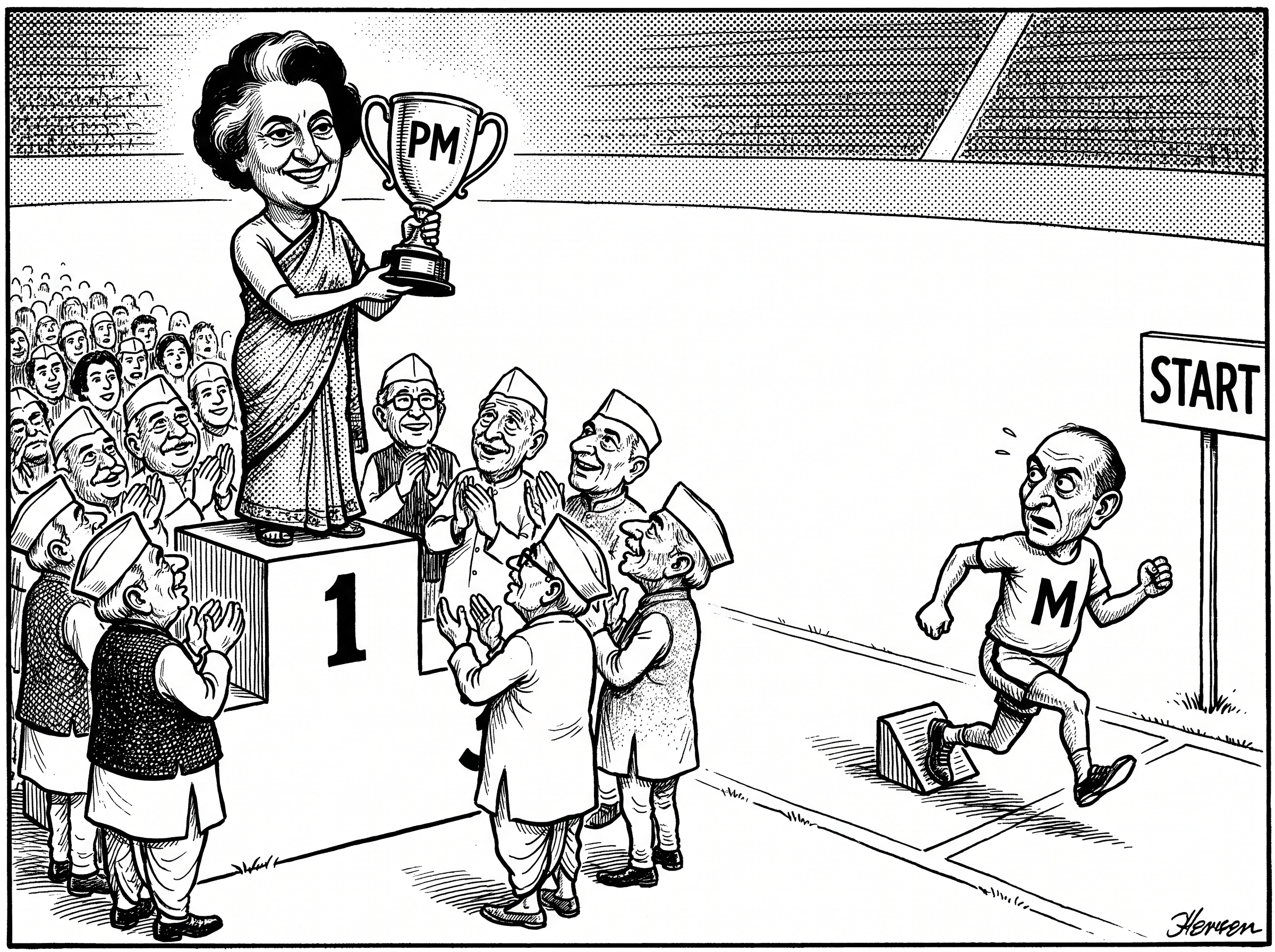
Fig. 5.4 – The leadership contest of January 1966. Inspiration: R. K. Laxman, The Times of India, 18 January 1966.
The joke is about timing. The prize has already been handed over at the finishing line while the challenger is still leaving the starting block — a comment on how quickly and how decisively the contest was closed. The cartoonist is also making a quieter point: the applauding men are not spectators, they are the party’s senior leaders, and it was they who decided whose hand the trophy would reach.
And here is the limit. A cartoon drawn on 18 January 1966 can capture what a contest looked like on the day it ended. It cannot tell you why the senior leaders chose as they did, and it certainly cannot tell you what would follow. On the evidence of this drawing alone, you would never guess that the woman on the podium would, within four years, break the party of the men clapping below her.
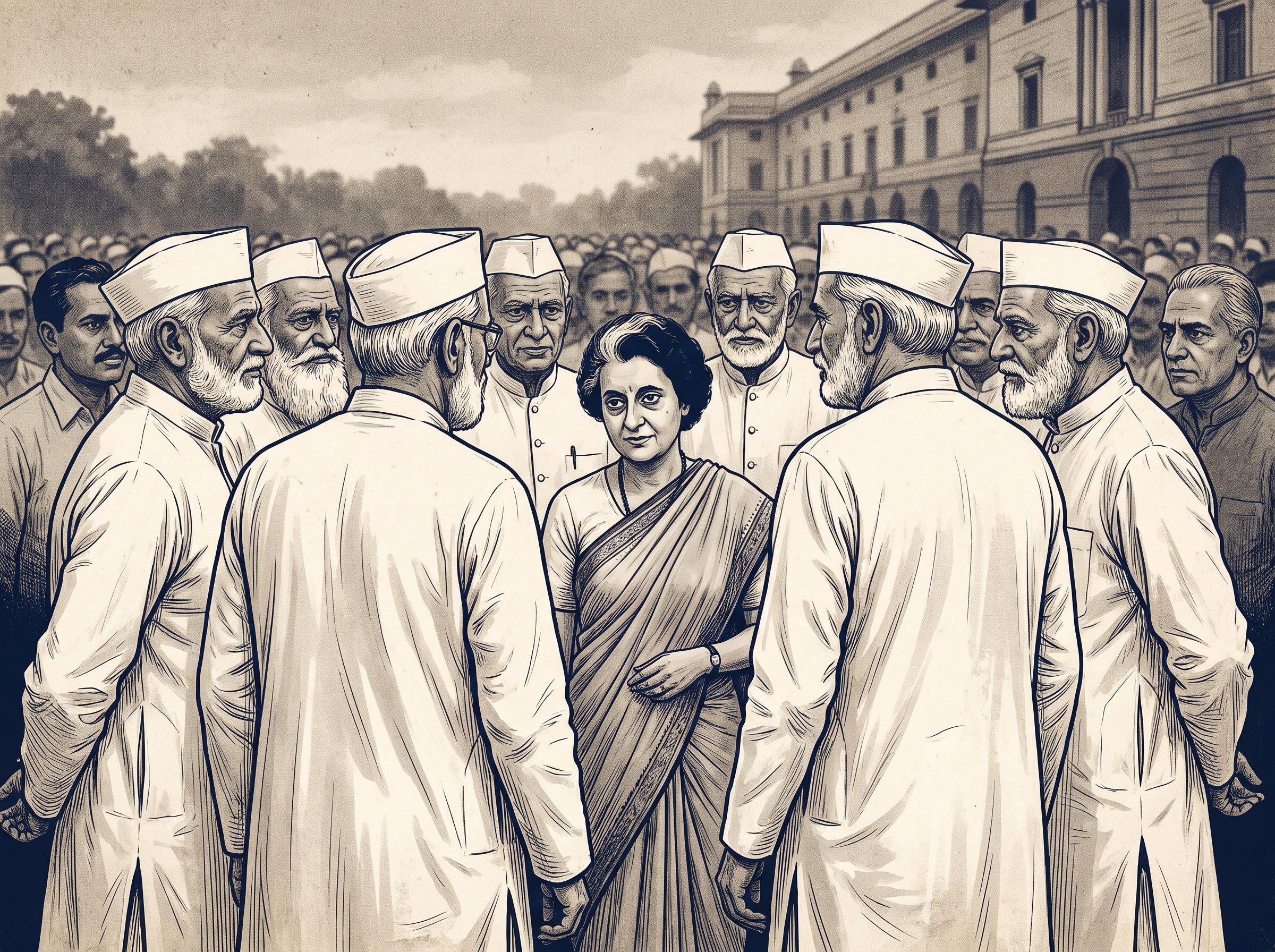
Fig. 5.5 – Indira Gandhi with Congress leaders.
Look at the photograph and count. One woman, in a world of political leadership dominated by men — and it is fair to ask, as you look at it, why positions like that have so rarely been held by women. That question is not answered by this chapter, but it is raised by every photograph in it.
5.2 Fourth General Elections, 1967
The year 1967 is considered a landmark year in India’s political and electoral history. You have already read how the Congress party was the dominant political force throughout the country from 1952 onwards. That trend was to undergo significant changes with the 1967 elections.
To see why the change was so sharp, you have to look first at the four years that led up to it.
5.2.1 Context Of The Elections
In the years leading up to the fourth general elections, the country witnessed major changes. Two Prime Ministers had died in quick succession. The new Prime Minister, who was being seen as a political novice — a beginner, untested in high office — had been in office for less than a year.
The period was also fraught with a grave economic crisis. Successive failure of the monsoons brought widespread drought, and with it a decline in agricultural production and a serious food shortage. Foreign exchange reserves — the stock of foreign currency a country holds to pay for its imports — were depleted. Industrial production and exports dropped. All of this came combined with a sharp rise in military expenditure and a diversion of resources away from planning and economic development.
The Rupee Is Devalued
One of the first decisions of the Indira Gandhi government was to devaluate the Indian rupee, under what was seen to be pressure from the US. Devaluation means officially reducing the value of a country’s currency against other currencies, so that its exports become cheaper abroad and its imports become dearer at home.
The figures tell you how large the change was. Earlier, one US dollar could be purchased for less than Rs. 5; after devaluation it cost more than Rs. 7. An Indian importer buying goods worth 100 dollars had earlier paid less than \(100 \times 5 = 500\) rupees for that foreign currency; after devaluation the same purchase cost him more than \(100 \times 7 = 700\) rupees. Everything the country bought from abroad — including food and fuel — now cost far more in rupees.
Prices, Protests And The Government’s Answer
The economic situation triggered off a price rise. People started protesting against the increase in the prices of essential commodities, against food scarcity, against growing unemployment, and against the overall economic condition in the country. Bandhs and hartals were called frequently across the country.
The government saw the protests as a law and order problem and not as expressions of people’s problems. That choice had consequences. Treating a hungry crowd as a policing matter does not make it less hungry, and this further increased public bitterness and reinforced popular unrest.
The communist and socialist parties launched struggles for greater equality. You will read in the next chapter about how a group of communists who separated from the Communist Party of India (Marxist) to form the Communist Party of India (Marxist-Leninist) led armed agrarian struggles and organised peasant agitations. This period also witnessed some of the worst Hindu-Muslim riots since Independence.
An Election In A Rajasthan Village
National crises are one thing; what an election actually felt like on the ground is another. The chapter takes you into a single village, Devisar, in the Chomu constituency of Rajasthan, during the 1967 assembly elections. In that constituency the main parties in the fray were the Congress and the Swatantra party.
But Devisar had its own local political dynamics, and these got mixed up with the competition between the two parties. Sher Singh had traditionally dominated village politics, but gradually his nephew, Bhim Singh, was emerging as the more popular leader and rival.
Though both were Rajputs, Bhim Singh cultivated the support of many non-Rajputs in the village by attending to their requirements after becoming the panchayat Pradhan — the elected head of the village council. So he struck a new equation: an alliance of Rajputs and non-Rajputs.
He proved to be more adept at building alliances across the village by supporting candidates in other villages for the posts of village Pradhan. In fact, he took an initiative and took a delegation to the State Chief Minister and Congress leader Mohan Lal Sukhadia, pressing the name of one of his friends from a nearby village as the Congress candidate in the Assembly election. When Sukhadia convinced him of some other name, Bhim Singh in turn convinced many others that they should work for the party candidate.
Bhim Singh knew what he was buying. If the party candidate won from this constituency, that candidate would become a minister, and thus he himself would have direct contact with a minister for the first time.
Sher Singh had no option but to work for the Swatantra candidate, who was a jagirdar. He kept telling people that the jagirdar would help build the village school and use his resources for the development of the locality. At least in Devisar village, the Assembly election had turned into a factional fight between uncle and nephew. This account is based on Anand Chakravarti, A Village in Chomu Assembly Constituency in Rajasthan.
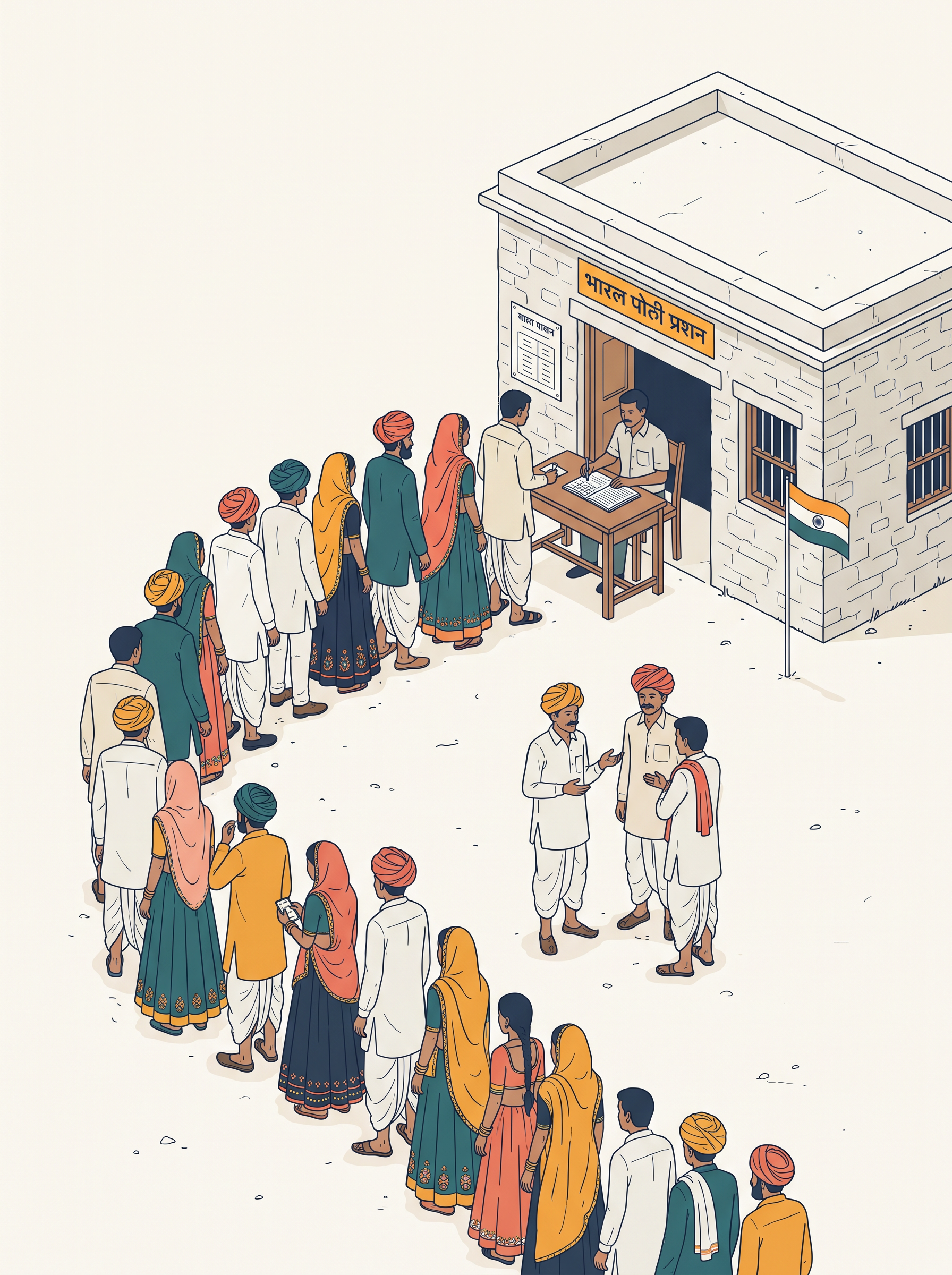
Fig. 5.6 – Field studies of Indian elections.
Hold on to what this village teaches. A national election is also thousands of local contests, in which party symbols get attached to quarrels that existed long before the parties arrived — and in which a voter’s real question may be which of two relatives will control the village next.
5.2.2 Non-Congressism
This situation could not have remained isolated from party politics in the country. Opposition parties were in the forefront of organising public protests and pressurising the government.
Parties opposed to the Congress realised something arithmetical about their own defeats: the division of their votes kept the Congress in power. Where several rivals split the anti-Congress vote between them, the Congress could win a seat without ever winning most of the votes cast.
Thus parties that were entirely different and disparate in their programmes and ideology got together to form anti-Congress fronts in some states, and entered into electoral adjustments of sharing seats in others. Under such an adjustment, the parties agree not to fight each other in the same constituency, so that the opposition vote falls behind one candidate.
They felt that the inexperience of Indira Gandhi, and the internal factionalism within the Congress, provided them an opportunity to topple the Congress.
The socialist leader Ram Manohar Lohia gave this strategy the name of ‘non-Congressism’. He also produced a theoretical argument in its defence: Congress rule was undemocratic and opposed to the interests of ordinary poor people; therefore, the coming together of the non-Congress parties was necessary for reclaiming democracy for the people.
The chapter also prints, in its margin, a question worth sitting with: is non-Congressism relevant today? Could the same strategy be applied against a dominant party in a state where one party has ruled for a long time? The test is the one Lohia identified. It works wherever a single party keeps winning because its opponents divide the vote against it — and it collapses wherever those opponents cannot agree on anything except that they want the ruling party out.
Not everyone read the situation as Lohia did. To some foreign observers, the unrest of the mid-1960s looked less like democracy renewing itself and more like democracy failing.
Read what the writer is actually predicting. He is not saying the government of the day will lose an election; he is saying that civil government itself will fail, and that the army will become the only source of authority. This is the ‘dangerous decade’ fear, stated by a journalist in the most confident possible terms, in the very year of the fourth general election.
Now the limit. An article is an argument, not a finding. Maxwell is writing at the height of the crisis, with no way of knowing what the voters were about to do, and his own certainty is part of the evidence — it tells you how the unrest looked to an observer who had already decided how the story would end. Notice, too, that he was wrong: the elections of 1967 were held on time, governments changed hands, and the army did not enter politics. A source can be a faithful record of an opinion and still be a bad prediction.
5.2.3 Electoral Verdict
It was in this context of heightened popular discontent and the polarisation of political forces that the fourth general elections to the Lok Sabha and the State Assemblies were held in February 1967. The Congress was facing the electorate for the first time without Nehru.
The results jolted the Congress at both the national and state levels. Many contemporary political observers described the election results as a ‘political earthquake’.
The Congress did manage to get a majority in the Lok Sabha, but with its lowest tally of seats and share of votes since 1952. Half the ministers in Indira Gandhi’s cabinet were defeated. The political stalwarts who lost in their constituencies included Kamaraj in Tamil Nadu, S.K. Patil in Maharashtra, Atulya Ghosh in West Bengal and K. B. Sahay in Bihar.
Read that last sentence again. These were not ordinary MPs; they were the men who ran the party. A party can survive losing seats. It is a different matter when the voters remove the leadership itself.
The Earthquake In The States
The dramatic nature of the political change would be more apparent to you at the State level. The Congress lost its majority in as many as seven States. In two other States defections prevented it from forming a government.
These nine States where the Congress lost power were spread across the country — Punjab, Haryana, Uttar Pradesh, Madhya Pradesh, Bihar, West Bengal, Orissa, Madras and Kerala.
In Madras State (now called Tamil Nadu), a regional party — the Dravida Munnetra Kazhagam (DMK) — came to power by securing a clear majority. The DMK won power after having led a massive anti-Hindi agitation by students against the centre on the issue of the imposition of Hindi as the official language. This was the first time any non-Congress party had secured a majority of its own in any State.
In the other eight States, coalition governments consisting of different non-Congress parties were formed. A popular saying at the time was that one could take a train from Delhi to Howrah and not pass through a single Congress ruled State. It was a strange feeling for those who were used to seeing the Congress in power. So, was the domination of the Congress over?
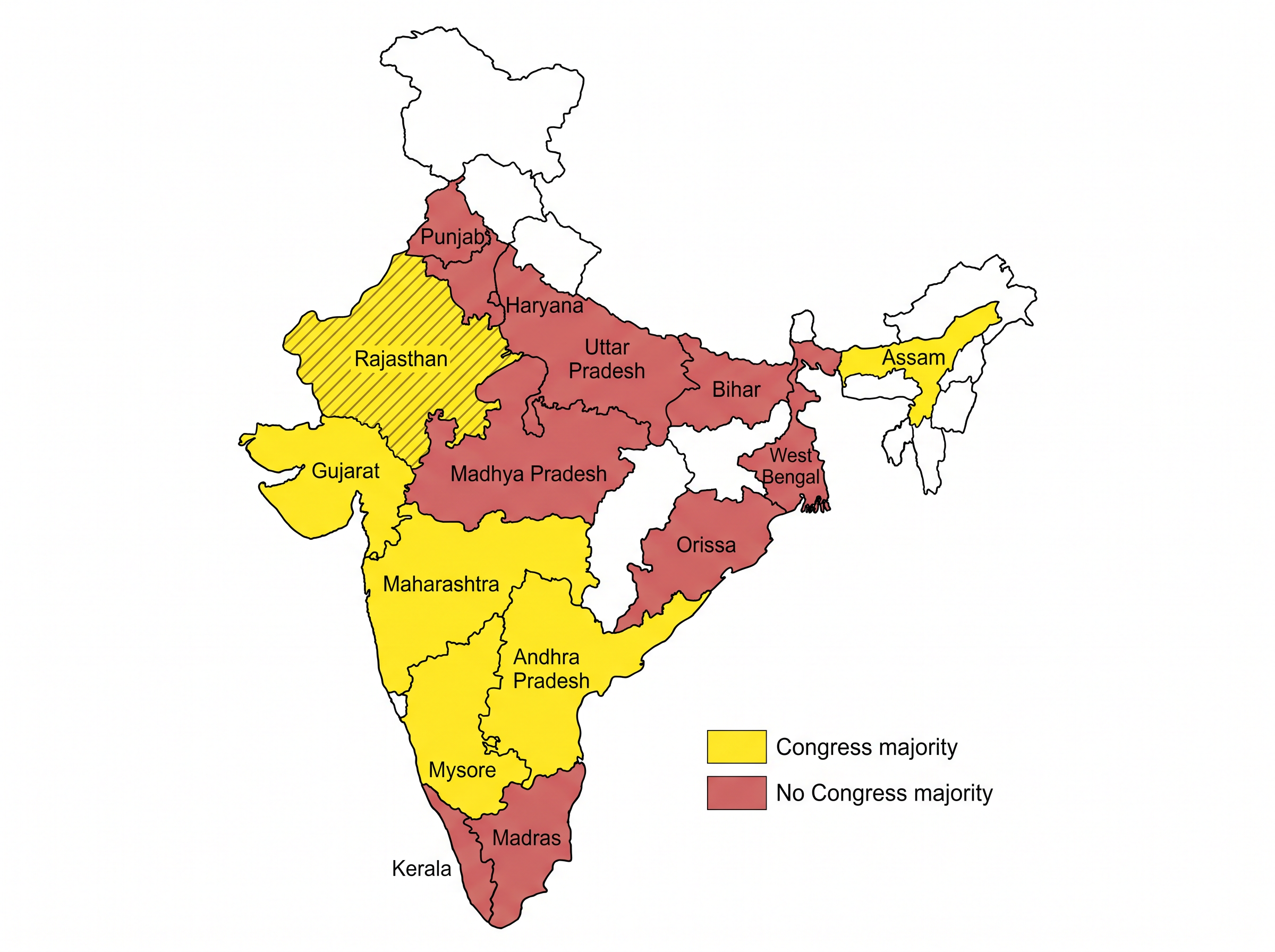
Fig. 5.7 – Assembly election results, 1967.
The map is worth reading slowly. It shows, at a glance, what a list of nine states cannot: that the reverses were not confined to one region, one language zone or one kind of state, but ran across the north, the east and the south.
And here is what it cannot show. A map colours a whole state by a single outcome, so it hides how close the contest was — a state lost by two seats looks exactly like a state lost by a hundred. It says nothing about vote shares, so it cannot tell you whether the Congress vote collapsed or merely split. It shows one moment, and cannot show that several of these governments would fall within months. Notice also that the chapter’s own note warns you not to treat this illustration as an authentic depiction of India’s boundaries; it is a diagram, not a survey map.
5.2.4 Coalitions
The elections of 1967 brought into the picture the phenomenon of coalitions. A coalition is a government formed by two or more parties, none of which can command a majority on its own, and which therefore agree to govern together.
Since no single party had got a majority, various non-Congress parties came together to form joint legislative parties — called Samyukt Vidhayak Dal in Hindi — that supported non-Congress governments. That is why these governments came to be described as SVD governments.
In most of these cases the coalition partners were ideologically incongruent, which is to say that their beliefs did not fit together at all. The SVD government in Bihar, for instance, included the two socialist parties — the SSP and the PSP — along with the CPI on the left and the Jana Sangh on the right.
In Punjab it was called the ‘Popular United Front’. It comprised the two rival Akali parties of that time — the Sant group and the Master group — with both the communist parties, the CPI and the CPI(M), along with the SSP, the Republican Party and the Bharatiya Jana Sangh.
A student today may well ask what is so unusual about hung assemblies and coalition governments, since we see them all the time. That reaction is exactly the point. What is now ordinary was, in 1967, entirely new — and it was new because for fifteen years one party had governed almost everywhere. The habit of coalition had to be learnt, and the first attempts at it were made by partners who agreed on nothing except whom they were against.
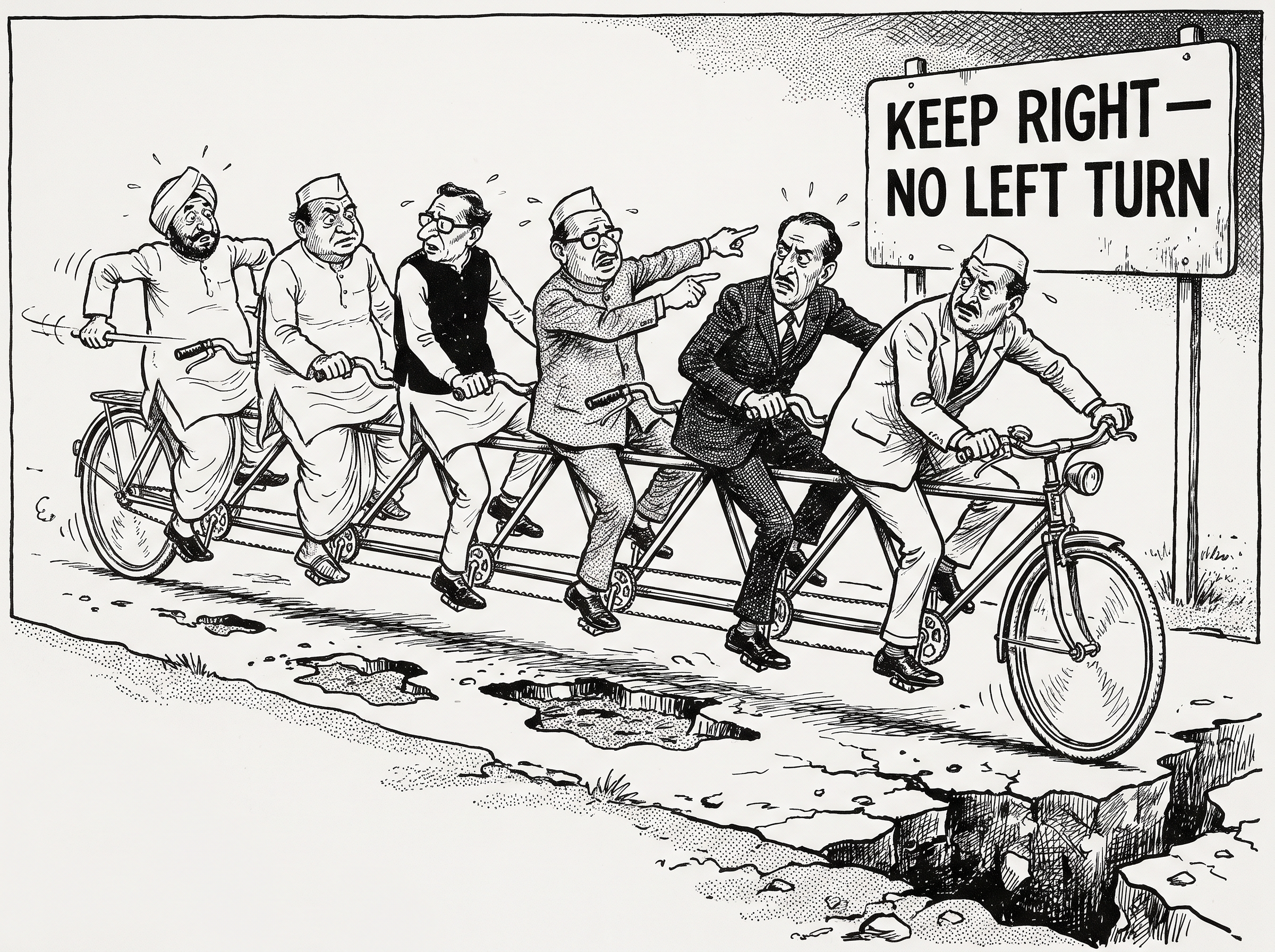
Fig. 5.8 – Charan Singh’s United Front of non-communist parties. Inspiration: Kutty.
Decode the drawing. Several parties are being made to ride one machine, which only moves if everybody pedals the same way, and the signboard tells them which way they may not turn — the front is defined by whom it excludes. The cartoonist’s claim is that a coalition of opposites is a vehicle that cannot be steered.
The limit is the usual one, and it matters here. A cartoon is one opinion, drawn to be funny, and it settles nothing. It cannot show that some coalitions do hold together, that some ideologically mixed governments do pass laws, or that voters may prefer an awkward coalition to a comfortable single-party rule. It gives you the case against; you must find the case for elsewhere.
5.2.5 Defection
Another important feature of the politics after the 1967 election was the role played by defections in the making and unmaking of governments in the States.
Defection means that an elected representative leaves the party on whose symbol he or she was elected, and joins another party. The voter chose a symbol; the legislator now sits under a different one.
After the 1967 general election, breakaway Congress legislators played an important role in installing non-Congress governments in three States — Haryana, Madhya Pradesh and Uttar Pradesh. The constant realignments and shifting political loyalties in this period gave rise to the expression ‘Aya Ram, Gaya Ram’.
The Story Of ‘Aya Ram, Gaya Ram’
The expression ‘aya ram, gaya ram’ became popular in the political vocabulary in India to describe the practice of frequent floor-crossing by legislators. Literally translated, the terms meant, Ram came and Ram went.
The expression originated in an amazing feat of floor crossing achieved by Gaya Lal, an MLA in Haryana, in 1967. He changed his party thrice in a fortnight — from the Congress to the United Front, back to the Congress, and then within nine hours to the United Front again.
It is said that when Gaya Lal declared his intention to quit the United Front and join the Congress, the Congress leader Rao Birendra Singh brought him to the Chandigarh press and declared that ‘Gaya Ram was now Aya Ram’.
Gaya Lal’s feat was immortalised in the phrase ‘Aya Ram, Gaya Ram’, which became the subject of numerous jokes and cartoons. Later, the Constitution was amended to prevent defections.
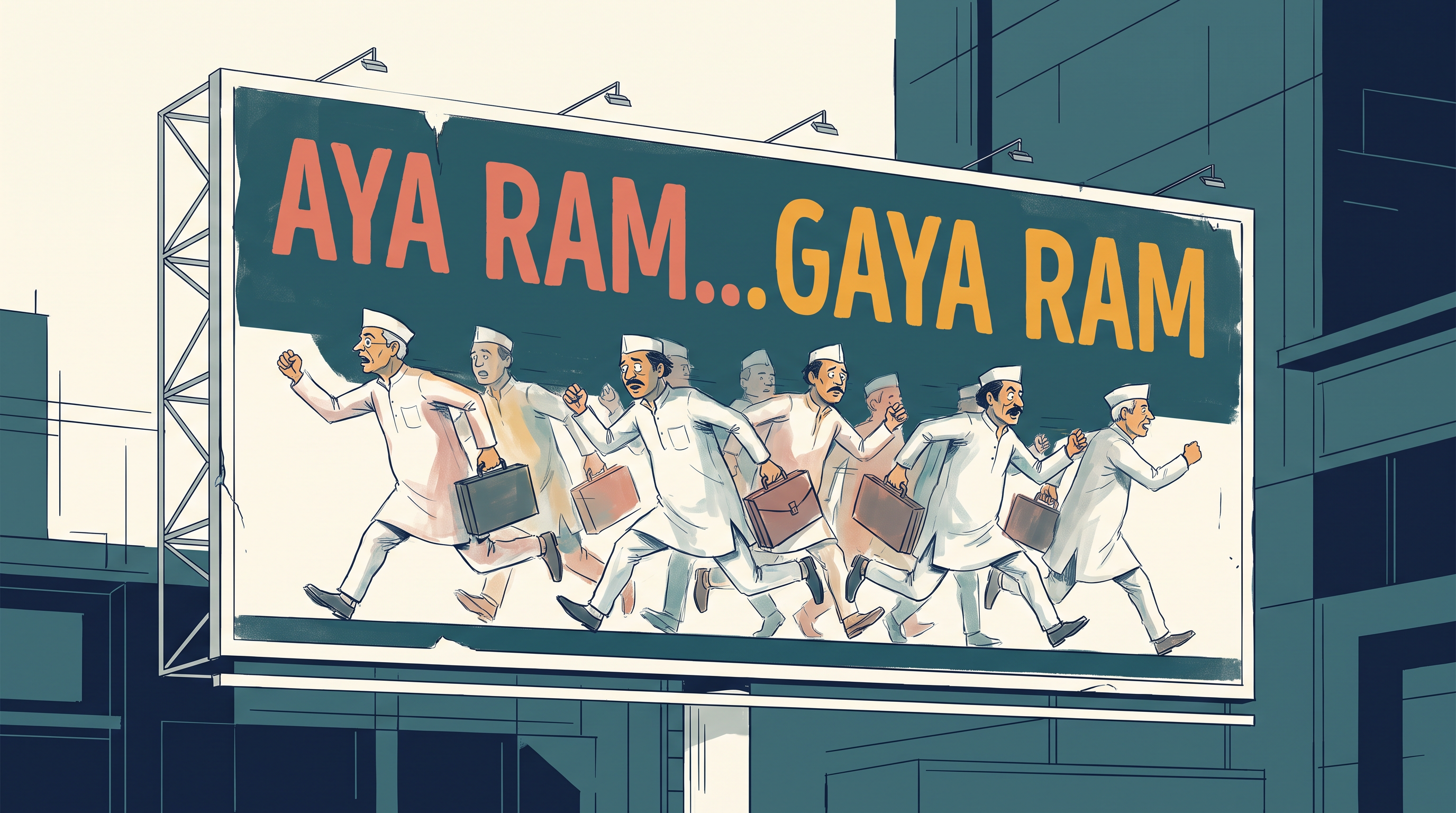
Fig. 5.9 – The Aya Ram Gaya Ram phrase in advertising.
Take the joke seriously for a moment. Behind it lies a real democratic problem: if a legislator can sell the seat that voters gave to a party, then governments are made and unmade by a handful of individuals rather than by the electorate. That is why the phrase outlived the man — and why, in the end, the Constitution itself had to be amended.
5.3 Split In The Congress
We saw that after the 1967 elections, the Congress retained power at the Centre but with a reduced majority, and lost power in many States. More importantly, the results proved that the Congress could be defeated at the elections.
But there was no substitute as yet. Most non-Congress coalition governments in the States did not survive for long. They lost their majority, and either new combinations were formed or President’s rule had to be imposed — the arrangement under which, when no government can be formed in a State, the Union takes over the administration of that State.
So the opposition had shown that the Congress could be beaten, without yet showing that anyone else could govern. The real danger to Indira Gandhi, as it turned out, was not sitting on the opposition benches at all.
5.3.1 Indira Vs. The ‘Syndicate’
The real challenge to Indira Gandhi came not from the opposition but from within her own party. She had to deal with the ‘syndicate’, a group of powerful and influential leaders from within the Congress.
The Syndicate had played a role in the installation of Indira Gandhi as the Prime Minister, by ensuring her election as the leader of the parliamentary party. These leaders expected Indira Gandhi to follow their advice.
Gradually, however, Indira Gandhi attempted to assert her position within the government and the party. She chose her trusted group of advisers from outside the party. Slowly and carefully, she sidelined the Syndicate.
Who The Syndicate Were
Syndicate was the informal name given to a management group of Congress leaders who were in control of the party’s organisation — that is, the machinery of the party outside government: its offices, its committees and its selection of candidates.
It was led by K. Kamraj, former Chief Minister of Tamil Nadu and then the president of the Congress party. It included powerful State leaders like S. K. Patil of Bombay city (later named as Mumbai), S. Nijalingappa of Mysore (later Karnataka), N. Sanjeeva Reddy of Andhra Pradesh and Atulya Ghosh of West Bengal.
Both Lal Bahadur Shastri and later Indira Gandhi owed their position to the support received from the Syndicate. This group had a decisive say in Indira Gandhi’s first Council of Ministers — the body of ministers, headed by the Prime Minister, that runs the Union government — and also in policy formulation and implementation.
After the Congress split, the leaders of the syndicate and those owing allegiance to them stayed with the Congress (O). Since it was Indira Gandhi’s Congress (R) that won the test of popularity, all these big and powerful men of Indian politics lost their power and prestige after 1971.
There is a lesson here that reaches beyond the 1960s. State-level leaders acting as king-makers at the centre is often thought of as something that began in the 1990s. The Syndicate shows that it is older than that: a Prime Minister could be made, and expected to be guided, by a handful of powerful men who had never been elected to lead the country at all.
Turning A Power Struggle Into An Ideological Struggle
Indira Gandhi thus faced two challenges. She needed to build her independence from the Syndicate. She also needed to work towards regaining the ground that the Congress had lost in the 1967 elections.
Indira Gandhi adopted a very bold strategy. She converted a simple power struggle into an ideological struggle — that is, instead of arguing about who should command the party, she argued about what the party was for.
She launched a series of initiatives to give government policy a Left orientation. She got the Congress Working Committee to adopt a Ten Point Programme in May 1967. This programme included social control of banks, nationalisation of General Insurance, a ceiling on urban property and income, public distribution of food grains, land reforms, and the provision of house sites to the rural poor.
Notice the shape of the move. Every one of those items is a promise to the poor, and every one of them is uncomfortable for the propertied. While the ‘syndicate’ leaders formally approved this Left-wing programme, they had serious reservations about the same — and a leader who says out loud what her rivals will only mutter has already put them on the defensive.
5.3.2 Presidential Election, 1969
The factional rivalry between the Syndicate and Indira Gandhi came into the open in 1969.
Following President Zakir Hussain’s death, the post of President of India fell vacant that year. Despite Mrs Gandhi’s reservations, the ‘syndicate’ managed to nominate her long time opponent and then Speaker of the Lok Sabha, N. Sanjeeva Reddy, as the official Congress candidate for the ensuing Presidential elections.
Indira Gandhi retaliated by encouraging the then Vice-President, V.V. Giri, to file his nomination as an independent candidate. She also announced several big and popular policy measures, like the nationalisation of fourteen leading private banks and the abolition of the ‘privy purse’, the special privileges given to former princes. Nationalisation means transferring a private business into public ownership, so that the government, and not private owners, runs it.
Morarji Desai was the Deputy Prime Minister and Finance Minister. On both the above issues serious differences emerged between him and the Prime Minister, resulting in Desai leaving the government.
The Whip And The Conscience Vote
Congress had seen differences of this kind in the past. But this time both the parties wanted a showdown, and it took place during the Presidential elections.
The then Congress President S. Nijalingappa issued a ‘whip’ asking all the Congress MPs and MLAs to vote in favour of Sanjeeva Reddy, the official candidate of the party. A whip is an instruction from a party to its own legislators to vote in a particular way; defying it is an act of open indiscipline.
Supporters of Indira Gandhi requisitioned a special meeting of the AICC — the All India Congress Committee, the party’s national body — which is why this faction came to be known as ‘requisitionists’. But the meeting was refused.
After silently supporting V.V. Giri, the Prime Minister openly called for a ‘conscience vote’, which meant that the MPs and MLAs from the Congress should be free to vote the way they want.
The election ultimately resulted in the victory of V.V. Giri, the independent candidate, and the defeat of Sanjeeva Reddy, the official Congress candidate. A party’s own president had commanded its legislators to vote one way, and enough of them had voted the other way to defeat him.
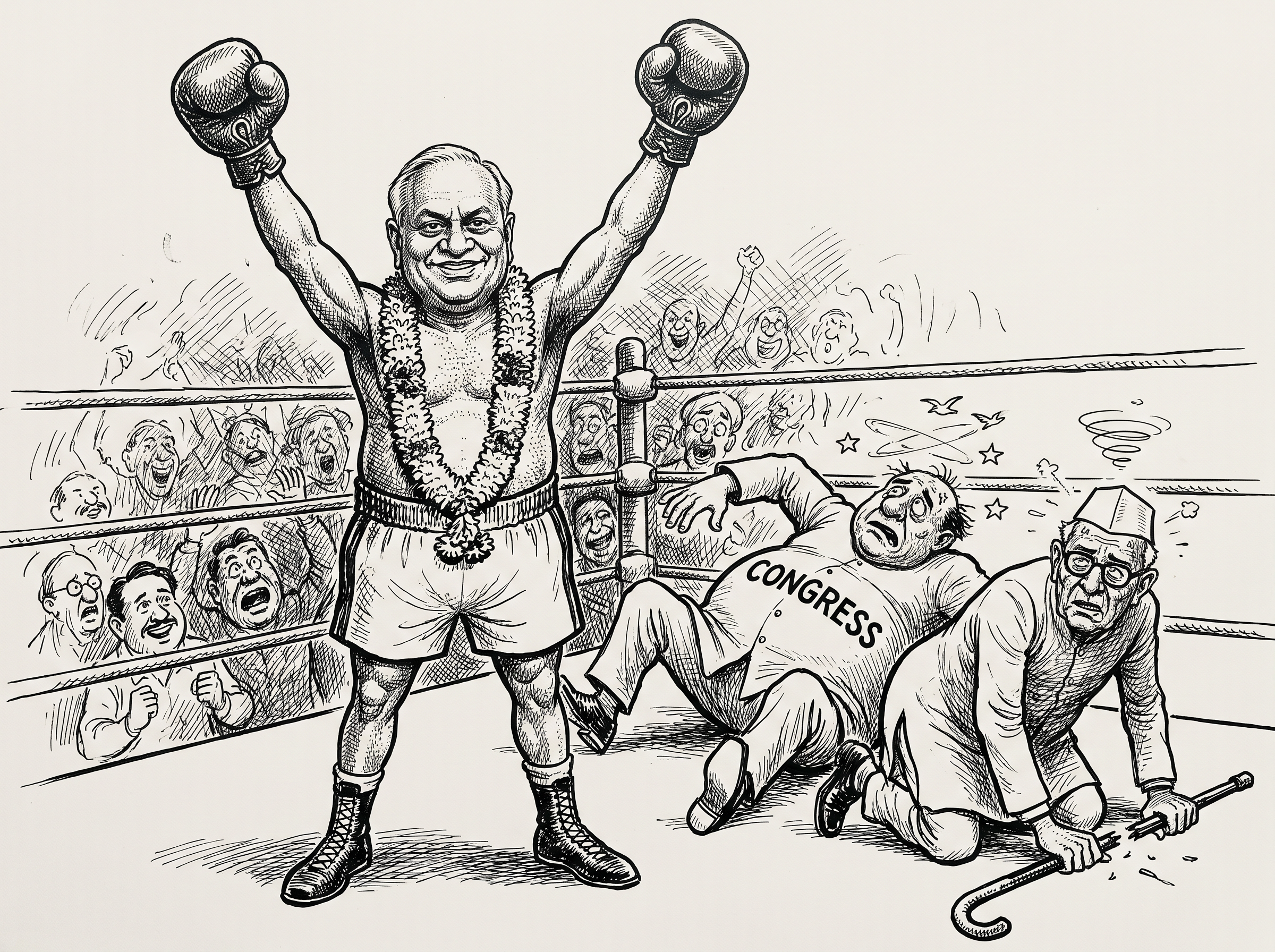
Fig. 5.10 – The Left Hook and V.V. Giri’s victory. Inspiration: R. K. Laxman, The Times of India, 21 August 1969.
The title carries the whole argument. A ‘left hook’ is a boxer’s punch thrown with the left hand, and the cartoonist is punning on it: Giri’s victory was also a blow struck by the Left — the wing of the party that Indira Gandhi had adopted with her Ten Point Programme. The men on the floor are not the opposition; they are the party’s own bosses, defeated by their own legislators.
The limit is worth stating plainly. A cartoon drawn in the week of a result reads the result as a knockout, and its exaggeration is the point of the form. It cannot tell you how many legislators actually defied the whip, or why each of them did. Nor can it tell you whether the Presidential contest was a fight about ideology, as Indira Gandhi said it was, or simply a fight about who would command the Congress. Both readings survive the drawing.
The Split Becomes Formal
The defeat of the official Congress candidate formalised the split in the party.
The Congress President expelled the Prime Minister from the party. She, in turn, claimed that her group was the real Congress. Notice how strange this is: a party had thrown out the country’s Prime Minister, and the Prime Minister had refused to accept that she was the one who had left.
By November 1969, the Congress group led by the ‘syndicate’ came to be referred to as the Congress (Organisation), and the group led by Indira Gandhi came to be called the Congress (Requisitionists). These two parties were also described as the Old Congress and the New Congress.
Indira Gandhi projected the split as an ideological divide between socialists and conservatives, between the pro-poor and the pro-rich. That description was itself a political act. It cast every one of her opponents, whatever his reasons, as a defender of the rich.
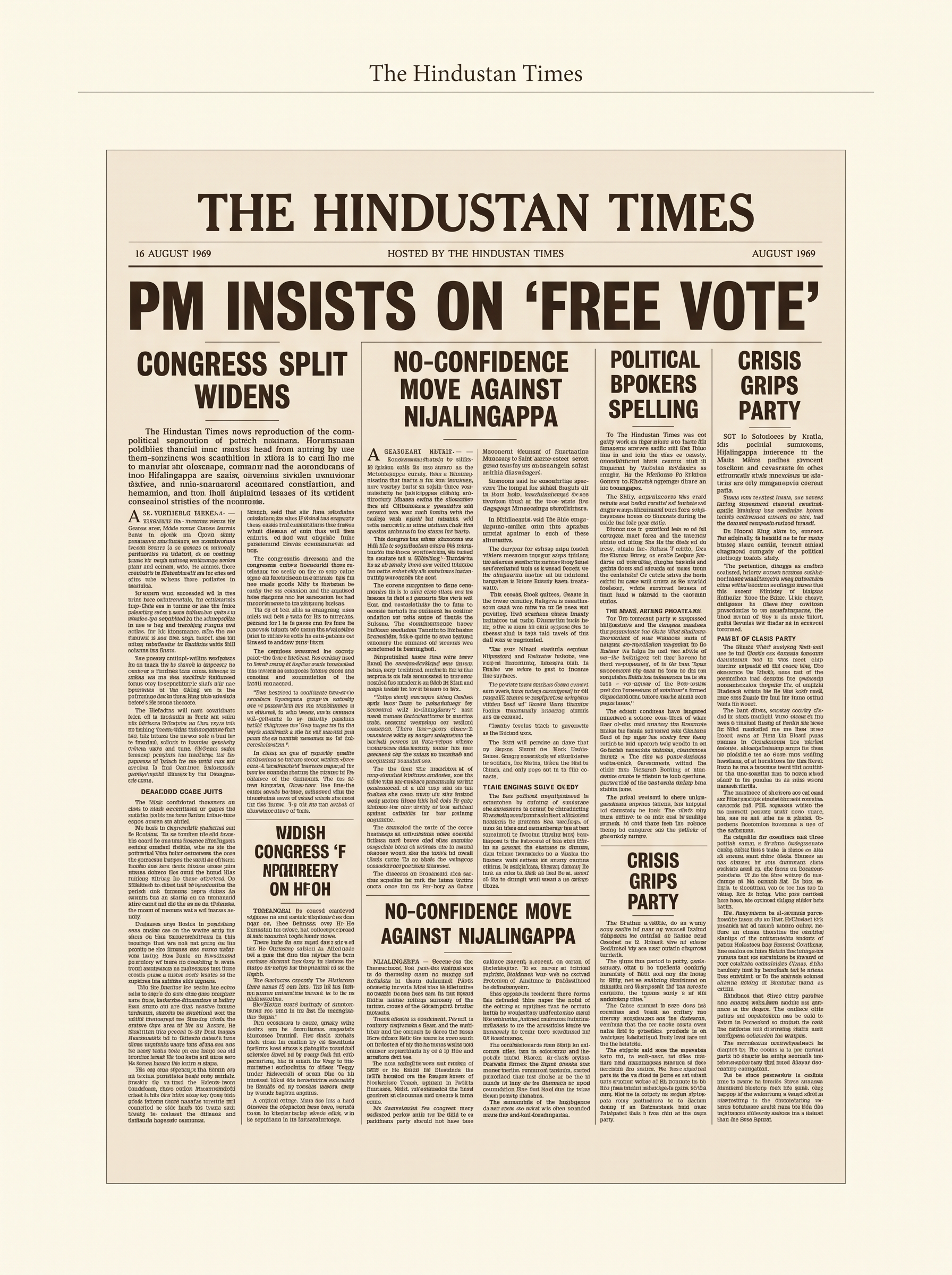
Fig. 5.11 – Newspaper front page on the day the Congress split.
The letter of expulsion was written by the Congress President himself, and it is printed here in his own words.
Unpack the charge. ‘Political narcissism’ means a leader’s absorption in her own image; a ‘coterie of unscrupulous sycophants’ means a small circle of flatterers with no principles — a pointed reference to the advisers Indira Gandhi had chosen from outside the party. Nijalingappa’s claim is that a popular leader who breaks free of her party’s organisation becomes a danger to democracy itself.
Now the limit, and it is a large one. This is a letter written by the losing side of a factional war, on the day it expelled its own Prime Minister. It is evidence of what the Syndicate believed and of how it wished to be seen; it is not a neutral account of what happened. It tells you nothing about the case on the other side — that the organisation was an unelected group of bosses, and that the leader had gone over their heads to the voters. Preserving this source is not agreeing with it.
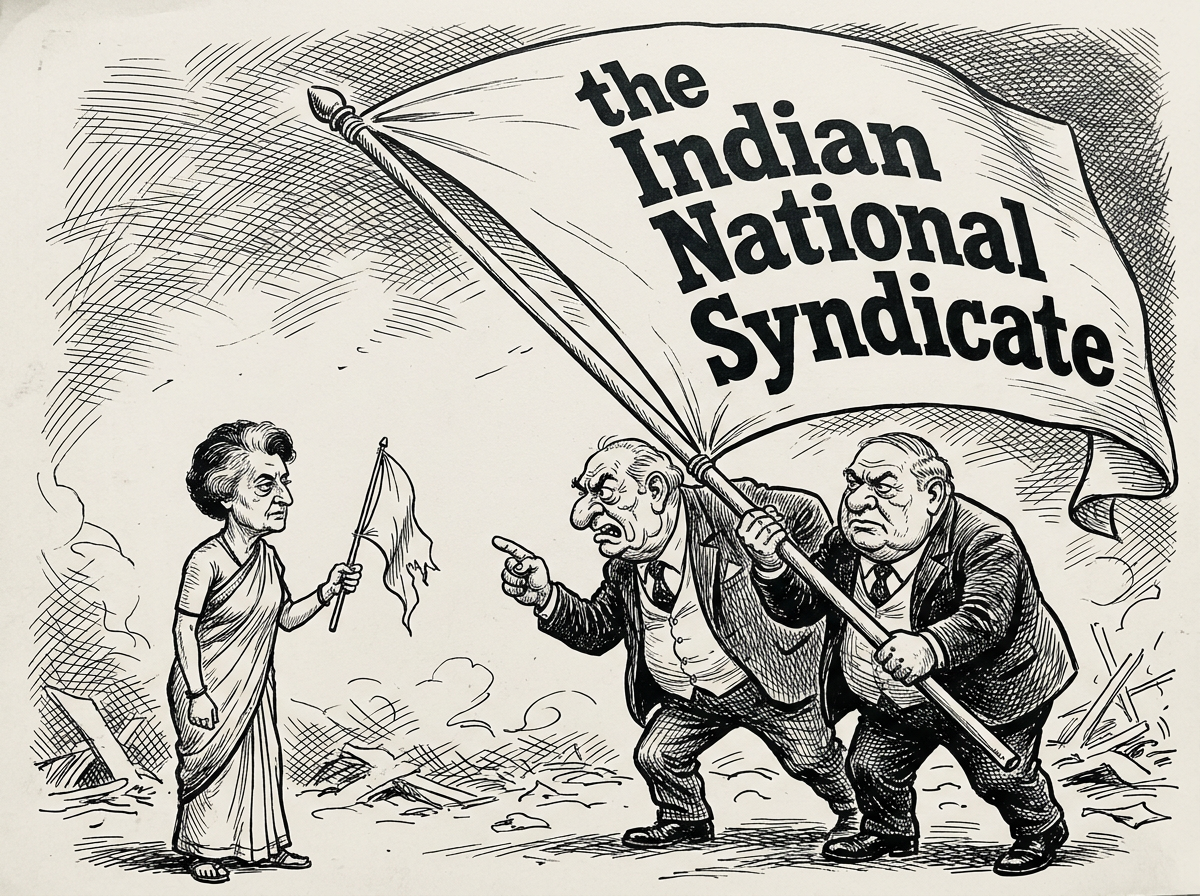
Fig. 5.12 – Leadership rivalry in the Congress Party. Inspiration: Vijayan, Shankar’s Weekly, 20 July 1969.
The joke works on two levels. Each side is claiming to be the Congress — one holds a flag, the other holds a bigger flag with the party’s name altered to ‘Syndicate’. And the taunt is aimed at inheritance: by invoking the wish attributed to Gandhiji that the Congress be dissolved after Independence, the cartoonist suggests that both factions are quarrelling over a legacy neither may deserve.
The limit again. This is one cartoonist’s impression, published in July 1969, before the split was formalised. It records how the rivalry looked to a sceptical observer at the time. It cannot tell you which side had the greater claim to the party, and it does not try to.
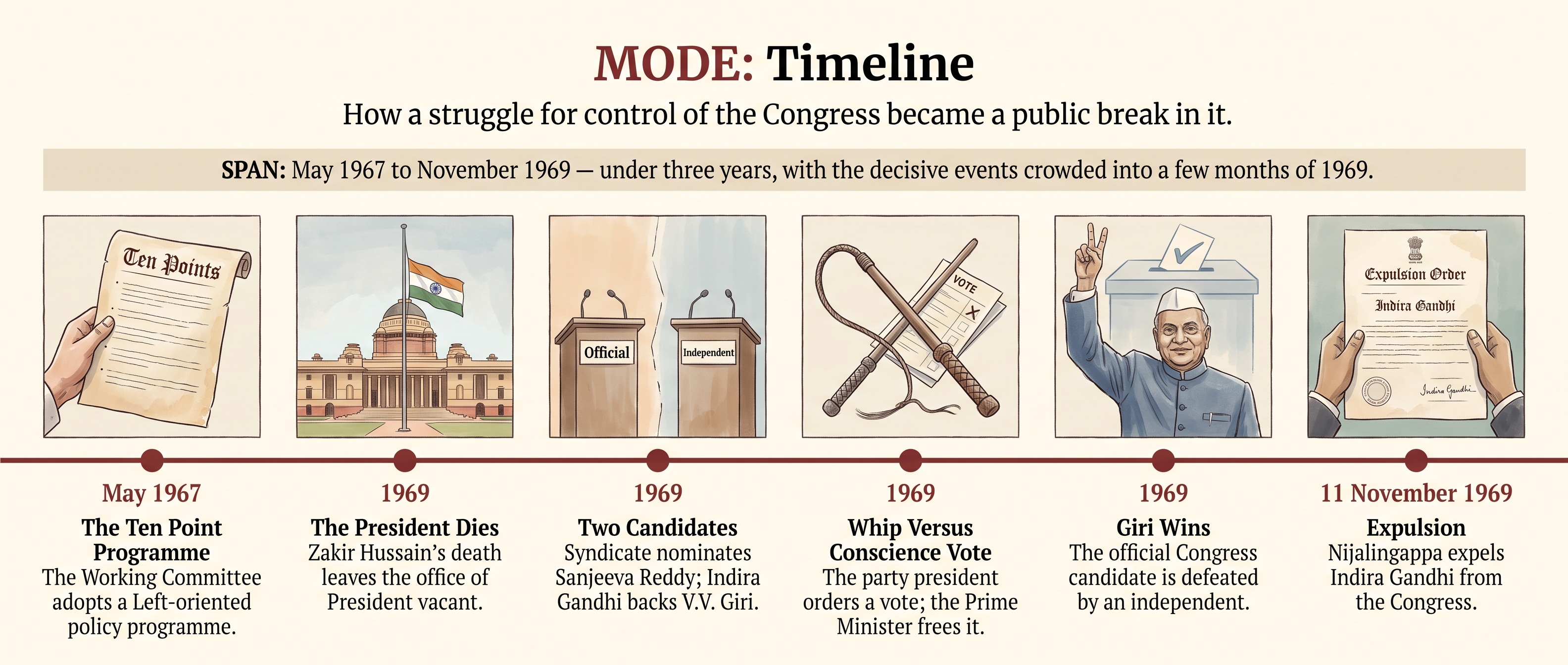
Fig. 5.13 – From the Ten Point Programme to the split.
Abolition Of Privy Purse
One of the two issues on which Indira Gandhi went over her party’s head deserves a section of its own, because it ran on for years and ended in an amendment to the Constitution.
You have read earlier about the integration of the Princely States. That integration was preceded by an assurance: after the dissolution of princely rule, the then rulers’ families would be allowed to retain certain private property, and would be given a grant in heredity or a government allowance, measured on the basis of the extent, revenue and potential of the merging state. This grant was called the privy purse.
At the time of accession, there was little criticism of these privileges, since integration and consolidation was the primary aim. A state that is being stitched together does not begin by picking a quarrel with the men whose signatures it needs.
Yet hereditary privileges were not consonant with the principles of equality and social and economic justice laid down in the Constitution of India. Money paid to a family for ever, simply because of who its ancestor was, is hard to square with a Constitution that promises equality. Nehru had expressed his dissatisfaction over the matter time and again.
Following the 1967 elections, Indira Gandhi supported the demand that the government should abolish privy purses. Morarji Desai, however, called the move morally wrong and amounting to a ‘breach of faith with the princes’. Both positions are serious ones: a promise was given, and a promise of hereditary privilege sits badly in a republic.
The route the government then had to take is worth following step by step, because it shows you how an elected government, a second chamber and a court all constrain one another.
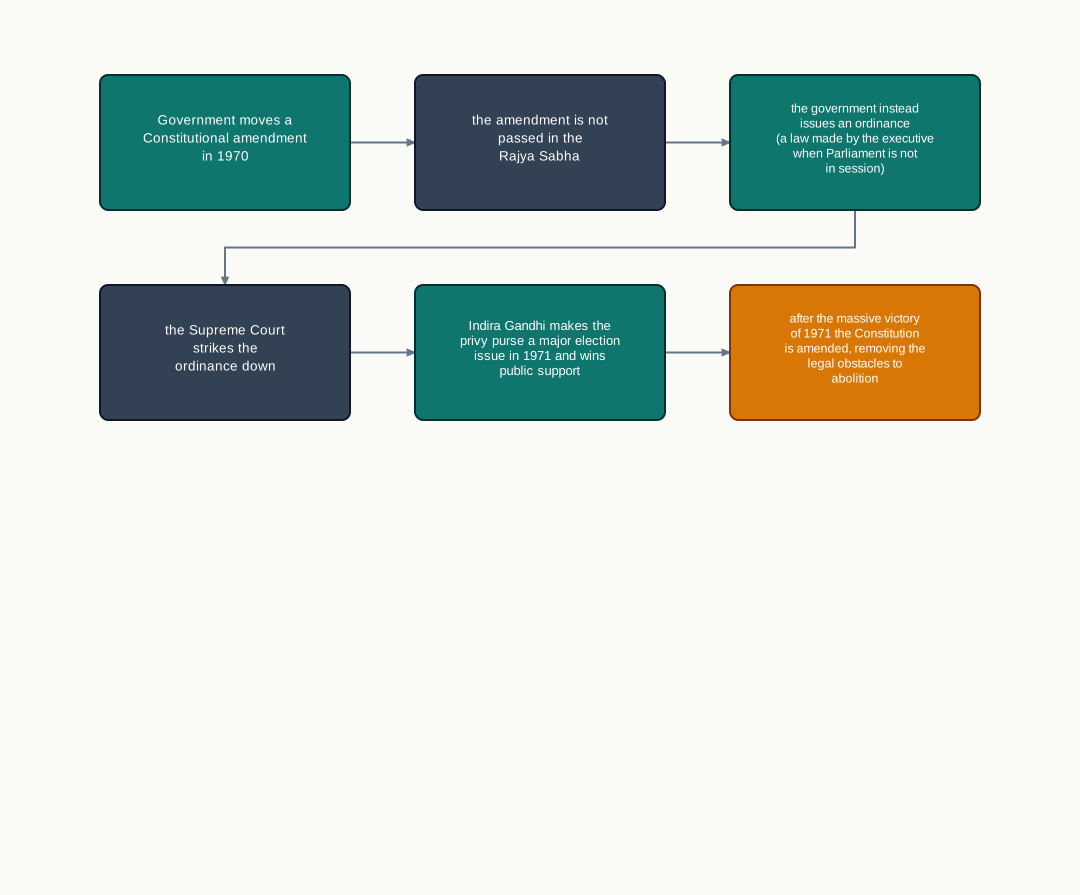
Fig. 5.14 – How the privy purse was abolished.
Read the chart as a lesson in how power actually works. A government with a Lok Sabha majority could not get its way in the Rajya Sabha. When it tried to bypass Parliament by ordinance, the Supreme Court struck the ordinance down. What finally settled the question was not cleverness but an election — the government went to the voters, won, and only then amended the Constitution. This is also the first sign of the strategy that fills the next section: when blocked inside the institutions, go outside them, to the people.
5.4 The 1971 Election And Restoration Of Congress
The split in the Congress reduced the Indira Gandhi Government to a minority. A government in a minority is one whose own MPs are fewer than half the House, so it can be voted out the moment its supporters withdraw.
Yet her government continued in office with the issue-based support of a few other parties, including the Communist Party of India and the DMK. Issue-based support means exactly what it says: those parties backed the government on particular questions, without joining it — and could stop backing it at any time.
During this period the government made conscious attempts to project its socialist credentials. This was also a phase when Indira Gandhi vigorously campaigned for implementing the existing land reform laws, and undertook further land ceiling legislation, which sets a legal limit on how much land one holder may own.
In order to end her dependence on other political parties, to strengthen her party’s position in the Parliament, and to seek a popular mandate for her programmes, Indira Gandhi’s government recommended the dissolution of the Lok Sabha in December 1970. This was another surprising and bold move. The fifth general election to the Lok Sabha was held in February 1971.
5.4.1 The Contest
The electoral contest appeared to be loaded against the Congress(R). After all, the new Congress was just one faction of an already weak party.
Everyone believed that the real organisational strength of the Congress party was under the command of the Congress(O). The men who had built the machine — the district committees, the workers, the ties to local leaders — had stayed on the other side.
To make matters worse for Indira Gandhi, all the major non-communist, non-Congress opposition parties formed an electoral alliance known as the Grand Alliance. The Samyukta Socialist Party (SSP), the Praja Socialist Party (PSP), the Bharatiya Jana Sangh (BJS), the Swatantra Party (SWA) and the Bharatiya Kranti Dal (BKD) came together under this umbrella. The ruling party had an alliance with the Communist Party of India (CPI).
An Agenda Against An Adjective
Yet the new Congress had something that its big opponents lacked — it had an issue, an agenda and a positive slogan.
The Grand Alliance did not have a coherent political programme. It was, in the language of the previous section, non-Congressism carried to the national level: a front defined by whom it was against. Indira Gandhi said that the opposition alliance had only one common programme, Indira Hatao — remove Indira.
In contrast to this, she put forward a positive programme captured in the famous slogan Garibi Hatao, remove poverty. She focused on the growth of the public sector, the imposition of a ceiling on rural land holdings and urban property, the removal of disparities in income and opportunity, and the abolition of princely privileges.
Through garibi hatao, Indira Gandhi tried to generate a support base among the disadvantaged, especially among the landless labourers, Dalits and Adivasis, minorities, women and the unemployed youth. The slogan of garibi hatao, and the programmes that followed it, were part of Indira Gandhi’s political strategy of building an independent nationwide political support base — independent, that is, of the party bosses whose blessing had made her Prime Minister in 1966.
Decades after the slogan was first given, there is still much poverty around, and it is fair to ask whether garibi hatao was only an election gimmick. Hold the question open for now. A slogan can be a genuine programme, a sincere promise that was not kept, or a device to win votes — and the same words can be all three at different moments.
5.4.2 The Outcome And After
The results of the Lok Sabha elections of 1971 were as dramatic as was the decision to hold these elections.
The Congress(R)–CPI alliance won more seats and votes than the Congress had ever won in the first four general elections. The combine won 375 seats in the Lok Sabha and secured 48.4 per cent of the votes. Indira Gandhi’s Congress(R) won 352 seats with about 44 per cent of the popular votes on its own.
Now contrast this with the performance of the Congress(O). The party with so many stalwarts could get less than one-fourth of the votes secured by Indira Gandhi’s party, and win merely 16 seats. Work the comparison out: less than a quarter of about 44 per cent is under 11 per cent of the vote, and it converted into sixteen seats in the whole country.
With this, the Congress party led by Indira Gandhi established its claim to being the ‘real’ Congress, and restored to it the dominant position in Indian politics. The test had been put to the voters, and the voters had answered.
The Grand Alliance of the opposition proved a grand failure. Their combined tally of seats was less than 60.
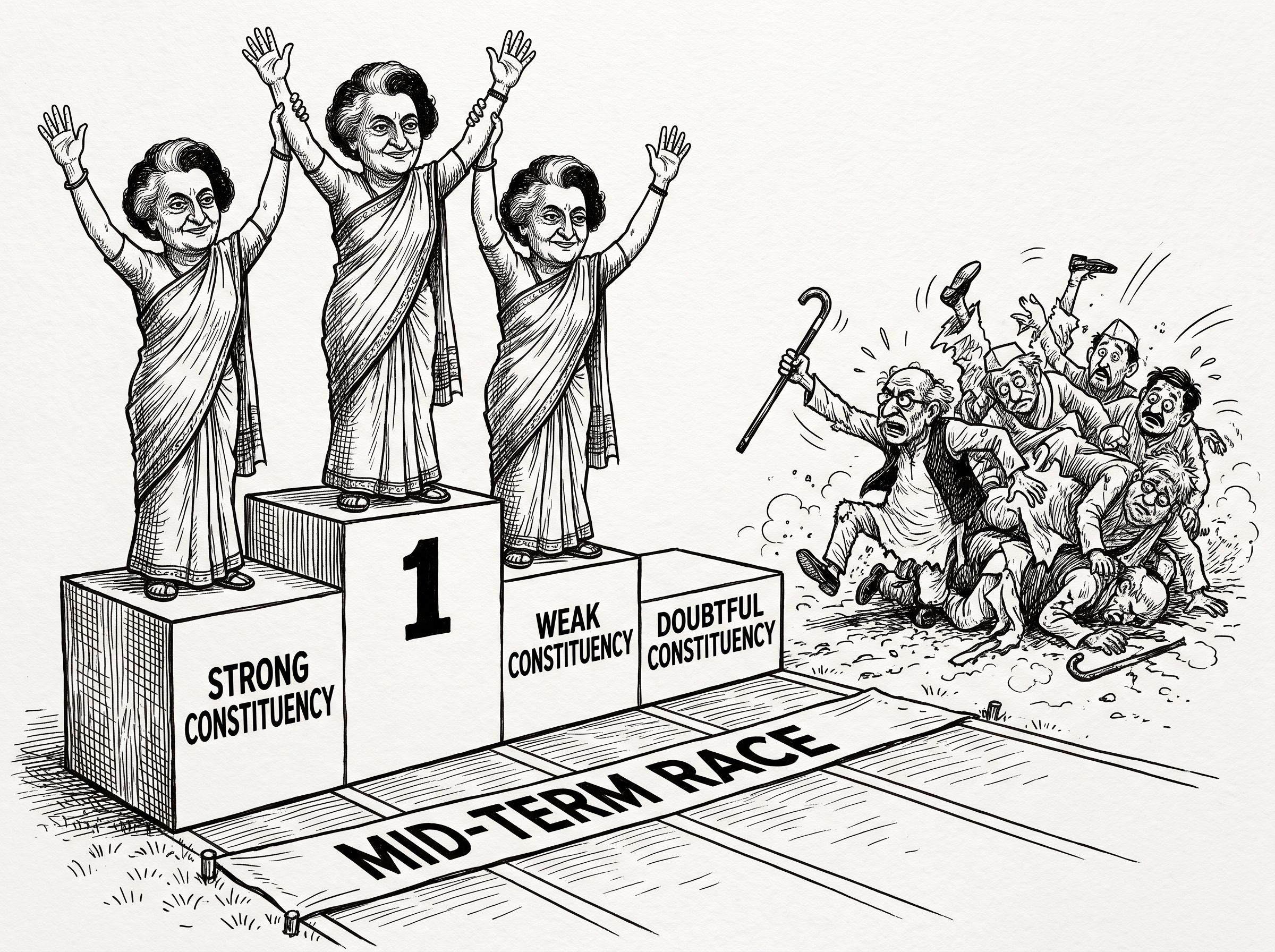
Fig. 5.15 – The Grand Finish of the 1971 elections. Inspiration: R. K. Laxman, The Times of India.
The pun in the title is the whole reading: the Grand Alliance meets a ‘Grand Finish’. But look at the podium more carefully than the joke requires. All three places have been taken by the same person — the strong seats, the weak seats and even the doubtful seats came to her. The cartoonist is claiming that this was not a narrow win but a sweep across every kind of constituency.
The limit. A cartoon can register the scale of a defeat; it cannot explain it. It cannot tell you whether people voted for garibi hatao, against a rudderless alliance, or simply for the leader they knew — and it certainly cannot tell you whether the promises would be kept. For that you need the numbers, and the numbers only tell you how people voted, never why.
The War, And The Sweep Of 1972
Soon after the 1971 Lok Sabha elections, a major political and military crisis broke out in East Pakistan, now Bangladesh — the eastern wing of Pakistan, separated from its western wing by the whole width of northern India.
As you have read earlier, the 1971 elections were followed by the crisis in East Pakistan and the Indo-Pak war leading to the establishment of Bangladesh. These events added to the popularity of Indira Gandhi. Even the opposition leaders admired her statesmanship.
Her party swept through all the State Assembly elections held in 1972. She was seen not only as the protector of the poor and the underprivileged, but also as a strong nationalist leader. The opposition to her, either within the party or outside of it, simply did not matter.
With two successive election victories, one at the centre and the other at the State level, the dominance of the Congress was restored. The Congress was now in power in almost all the States. It was also popular across different social sections. Within a span of four years, Indira Gandhi had warded off the challenge to her leadership and to the dominant position of the Congress party.
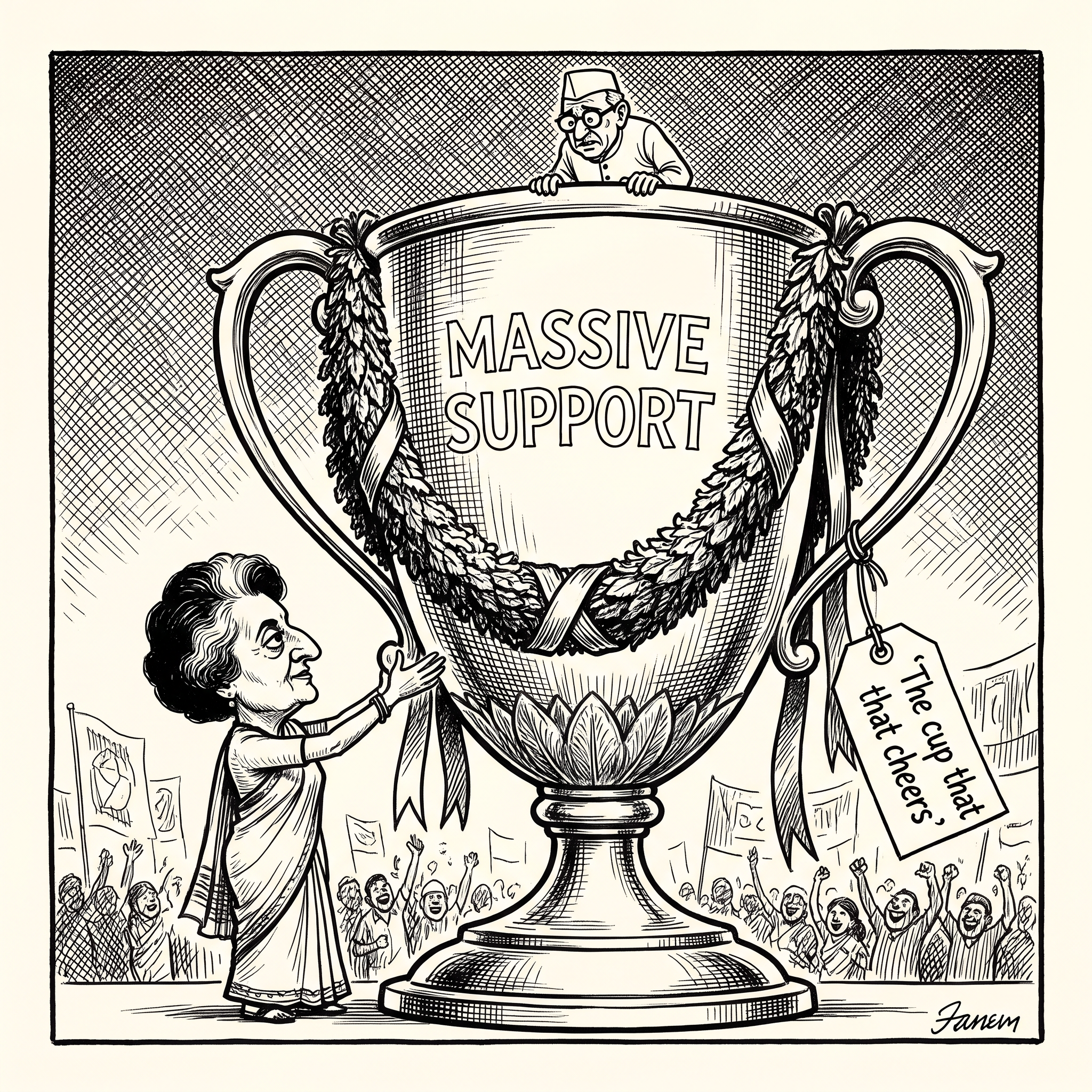
Fig. 5.16 – The scale of Indira Gandhi’s support after 1971. Inspiration: R. K. Laxman, The Times of India.
The cup is a trophy of victory, but the cartoonist has drawn it big enough to hold a man — and it is a party colleague who is sitting inside it, being handed over along with the prize. The suggestion is that the massive support now belonged to the leader personally, and that the party came as part of her winnings.
That reading is one cartoonist’s, and the drawing proves nothing. It cannot show you how a leader’s authority is exercised day to day, and it cannot distinguish between a party that adores its leader and a party that fears her. But hold the thought, because the next cartoon makes the same charge more sharply.
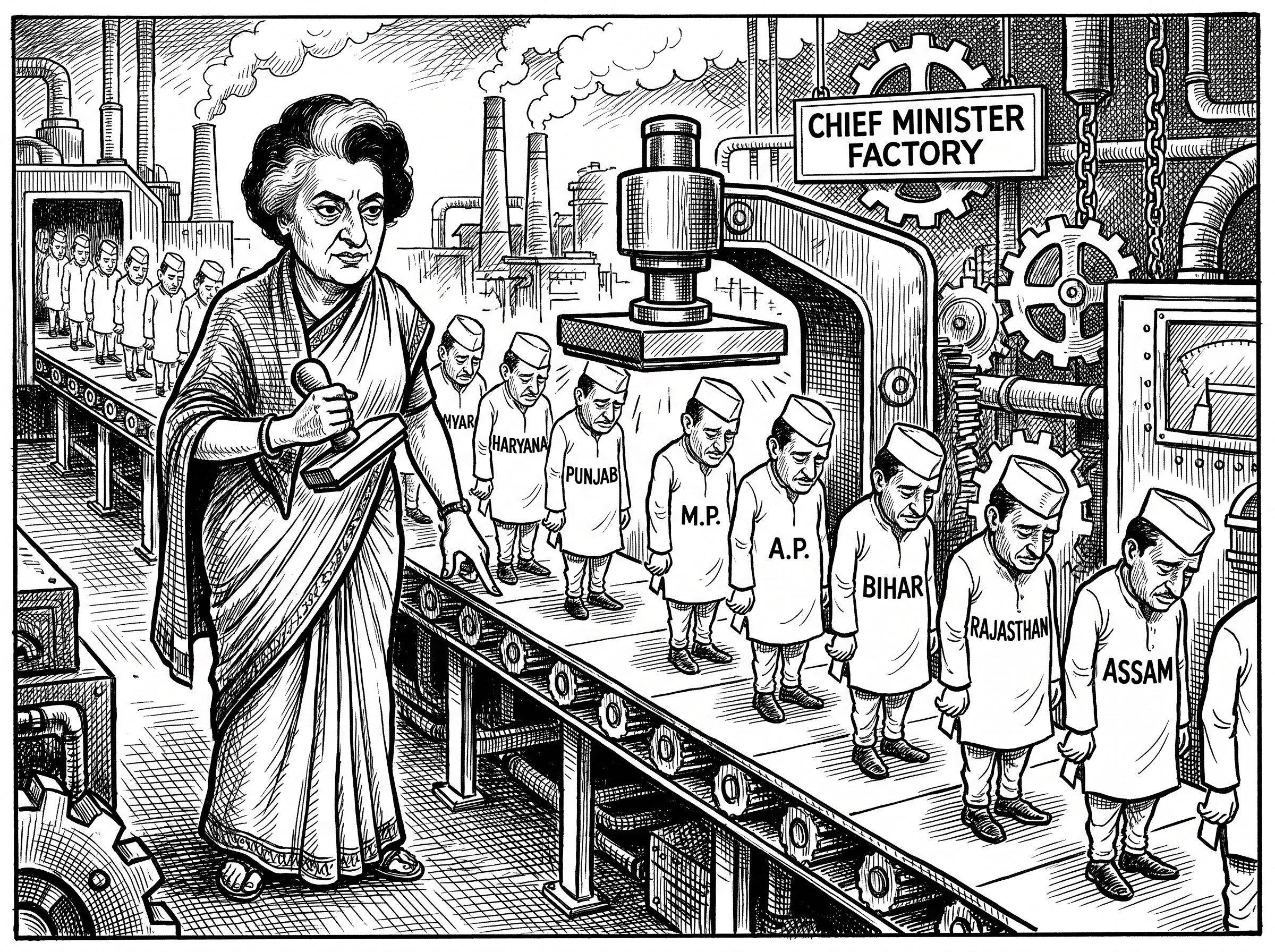
Fig. 5.17 – The new manner of choosing Chief Ministers. Inspiration: Kutty.
Read the machinery. Chief Ministers are the elected heads of State governments, chosen by the legislators of their own State. In the cartoon they arrive on a conveyor belt, interchangeable, to be picked by one person at the centre. The cartoonist’s claim is that after 1971 the States had stopped producing their own leaders and had begun receiving them.
The limit, stated honestly. This is an opinion, and a hostile one; the chapter does not print figures on how Chief Ministers were selected. What the drawing does record is a perception, in the years of maximum popularity, that power had become highly centralised. Whether that perception was fair is exactly the question the next section takes up.
5.4.3 Restoration?
But does it mean that the Congress system was restored?
What Indira Gandhi had done was not a revival of the old Congress party. In many ways she had re-invented the party. It occupied a similar position in terms of its popularity as in the past. But it was a different kind of a party.
It relied entirely on the popularity of the supreme leader. It had a somewhat weak organisational structure. This Congress party now did not have many factions, and thus it could not accommodate all kinds of opinions and interests. While it won elections, it depended more on some social groups: the poor, the women, Dalits, Adivasis and the minorities.
This was a new Congress that had emerged. Thus Indira Gandhi restored the Congress system by changing the nature of the Congress system itself.
Someone reading that sentence for the first time is entitled to object: that is like changing the top and the legs of a table and still calling it the old table. So it is worth asking directly what the Old and the New Congress actually had in common. They shared a name, a symbol of national leadership inherited from the freedom movement, and a position of dominance in Indian politics. What they no longer shared was the thing that had made the Congress system work — the ability to hold many factions and many interests inside one party.
What The Restoration Cost
Despite being more popular, the new Congress did not have the kind of capacity to absorb all the tensions and conflicts that the Congress system was known for.
While the Congress consolidated its position, and Indira Gandhi assumed a position of unprecedented political authority, the spaces for democratic expression of people’s aspirations actually shrank. This is the sentence to sit with. A party that can hold a quarrel inside itself gives that quarrel somewhere to go; a party that cannot, pushes it out into the streets.
The popular unrest and mobilisation around issues of development and economic deprivation continued to grow. In the next chapter you will read about how this led to a political crisis that threatened the very existence of constitutional democracy in the country.
Let’s Watch A Film: Zanjeer
The mood of these years reached the cinema. Zanjeer was released in 1973, directed by Prakash Mehra, with a screenplay by Salim Khan and Javed Akhtar, and starring Amitabh Bachchan, Ajit, Jaya Bhaduri and Pran.
Vijay, a young police officer, is framed on false charges and sent to jail while fighting gangsters. Released from jail, Vijay is determined to take revenge. He fights all odds and vanquishes the villains. Even while he is engaged in taking revenge, Vijay is fighting the anti-social element, and he gets the tacit support of many others from within the system.
The film portrayed the erosion of moral values, and the deep frustrations arising from that, quite forcefully. It represents the indifference of the system and the harsh and volcanic eruption of protest through the anger of Vijay. The film set the trend of what was later to be known as the ‘angry young man’ of the seventies.
Ask yourself why such a hero appeared exactly then. A film is not evidence of what a government did; it is evidence of what audiences were willing to cheer. The man on the screen took the law into his own hands because, in the story, the institutions would not act — and that is the same complaint, in a different language, that the previous paragraphs have just described growing in the streets.
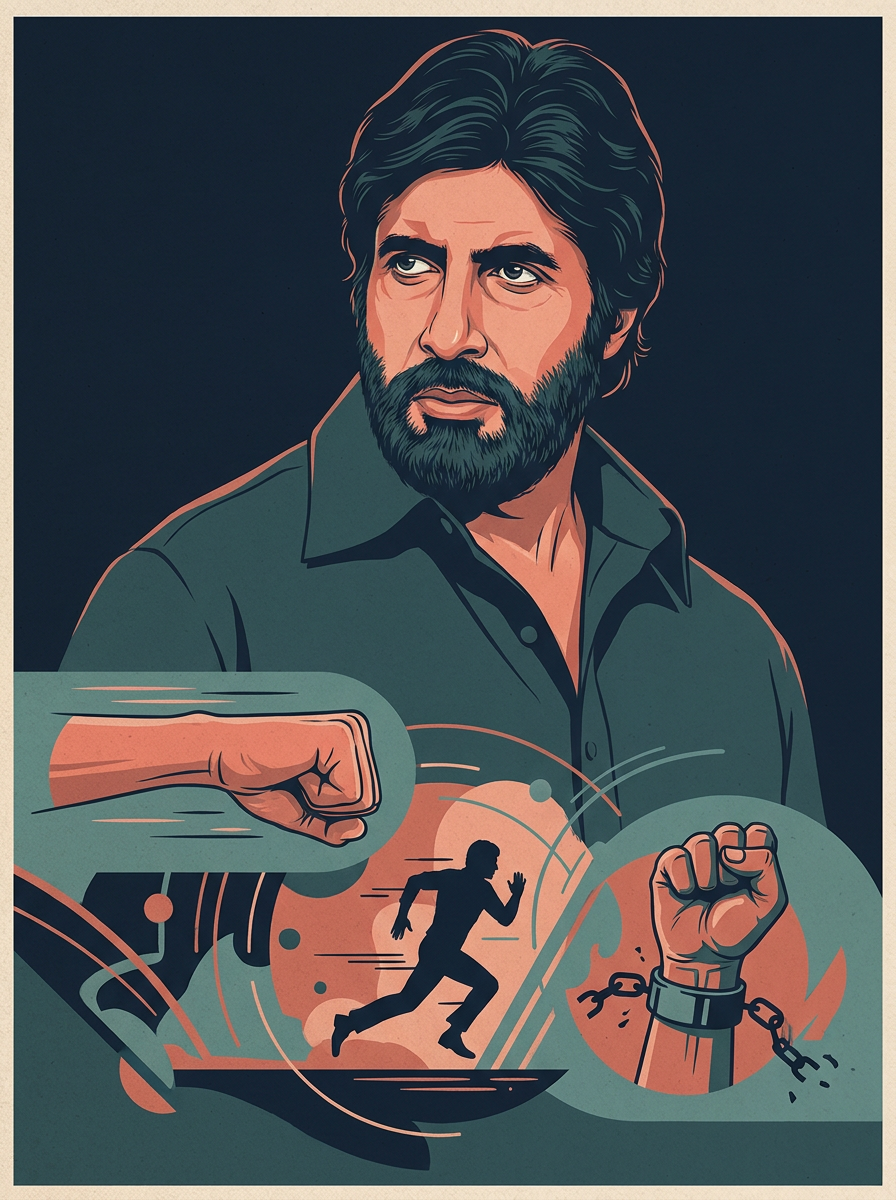
Fig. 5.18 – The poster of the 1973 film Zanjeer.
5.5 Summary
Two Successions
- Nehru died in May 1964, and the question was not only ‘after Nehru, who?’ but ‘after Nehru, what?’ Many outsiders doubted that a newly independent India could manage a democratic succession at all.
- Both successions were peaceful. Kamraj found a consensus for Lal Bahadur Shastri in 1964; a secret ballot of Congress MPs chose Indira Gandhi over Morarji Desai in 1966.
- Shastri’s short term faced two crises at once: drought, food shortage and the after-effects of the war with China, and the war with Pakistan in 1965. His slogan Jai Jawan Jai Kisan joined the two.
- Indira Gandhi was thought inexperienced, and the senior leaders who backed her expected her to depend on them.
The Earthquake Of 1967
- The mid-1960s brought a grave economic crisis: failed monsoons, food shortage, falling exports, depleted foreign exchange, and rising military spending. The rupee was devalued, taking the dollar from under Rs. 5 to over Rs. 7.
- Prices rose, bandhs and hartals spread, and the government treated the protests as a law and order problem rather than as expressions of people’s problems.
- Lohia gave the opposition’s strategy its name — ‘non-Congressism’ — arguing that Congress rule was undemocratic and that uniting against it was necessary to reclaim democracy.
- In February 1967 the Congress kept a Lok Sabha majority, but with its lowest seats and vote share since 1952. Half of Indira Gandhi’s ministers were defeated, and stalwarts like Kamaraj, S.K. Patil, Atulya Ghosh and K. B. Sahay lost their seats.
- The Congress lost power in nine States. The DMK won Madras outright — the first majority won by any non-Congress party in any State — and elsewhere SVD coalitions of ideologically incongruent parties took office.
- Defection became a route to power, and Gaya Lal’s three party-changes in a fortnight gave the language the phrase ‘Aya Ram, Gaya Ram’.
The Split
- The real challenge to Indira Gandhi came from within: the Syndicate, the group of leaders who controlled the party organisation and expected to guide her.
- She turned a power struggle into an ideological one, pushing the Congress Working Committee to adopt the Ten Point Programme in May 1967.
- The rivalry broke into the open in the Presidential election of 1969. The party president issued a whip for Sanjeeva Reddy; the Prime Minister called for a conscience vote; V.V. Giri, backed by her, won.
- She was expelled on 11 November 1969, and the party divided into the Congress (O) and the Congress (R) — the Old and the New Congress. She described the split as a divide between the pro-poor and the pro-rich.
- The privy purse showed how the fight was fought: an amendment blocked in the Rajya Sabha, an ordinance struck down by the Supreme Court, and abolition only after an election was won.
The Restoration
- Reduced to a minority, her government sought a fresh mandate and the Lok Sabha was dissolved in December 1970.
- In February 1971 the Grand Alliance offered Indira Hatao; she offered Garibi Hatao. The Congress(R)–CPI combine won 375 seats and 48.4 per cent of the votes; Congress(R) alone won 352 seats. The Congress(O) won 16, and the Grand Alliance under 60.
- The Bangladesh crisis and the war that followed added to her popularity, and her party swept the State Assembly elections of 1972.
- The restored Congress was a new party: it rested on the leader’s popularity, had a weak organisation, few factions and a narrower social base, and could no longer absorb conflict inside itself.
- The Congress system was restored by changing its nature. Popular unrest kept growing, and the spaces for democratic expression shrank — the beginning of the crisis you will read about next.
The Chapter In One Sequence
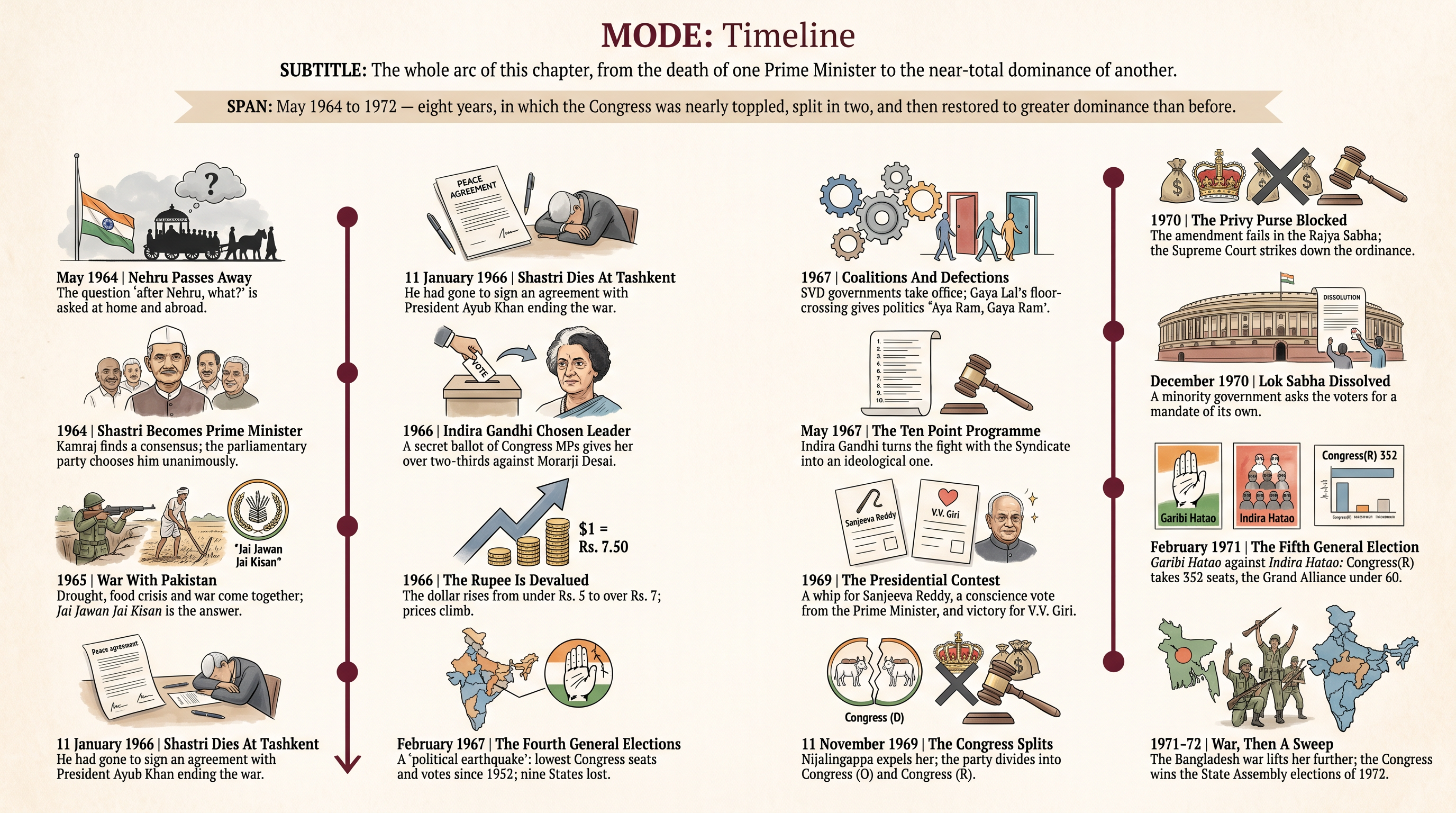
Fig. 5.19 – From the void to the sweep.
5.6 NCERT Questions
Which of these statements about the 1967 elections is/are correct?
- Congress won the Lok Sabha elections but lost the Assembly elections in many states.
- Congress lost both Lok Sabha and Assembly elections.
- Congress lost majority in the Lok Sabha but formed a coalition government with the support of some other parties.
- Congress retained power at the Centre with an increased majority.
Match the following:
Column A Column B a. Syndicate i. An elected representative leaving the party on whose ticket s/he has been elected b. Defection ii. A catchy phrase that attracts public attention c. Slogan iii. Parties with different ideological position coming together to oppose Congress and its policies d. Anti-Congressism iv. A group of powerful and influential leaders within the Congress Whom would you identify with the following slogans/phrases?
- Jai Jawan, Jai Kisan
- Indira Hatao!
- Garibi Hatao!
Which of the following statement about the Grand Alliance of 1971 is correct? The Grand Alliance …..
- was formed by non-Communist, non-Congress parties.
- had a clear political and ideological programme.
- was formed by all non-Congress parties.
How should a political party resolve its internal differences? Here are some suggestions. Think of each and list out their advantages and shortcomings.
- Follow the footsteps of the party president
- Listen to the majority group
- Secret ballot voting on every issue
- Consult the senior and experienced leaders of the party
State which of these were reasons for the defeat of the Congress in 1967. Give reasons for your answer.
- The absence of a charismatic leader in the Congress party
- Split within the Congress party
- Increased mobilisation of regional, ethnic and communal groups
- Increasing unity among non-Congress parties
- Internal differences within the Congress party
What were the factors which led to the popularity of Indira Gandhi’s Government in the early 1970s?
What does the term ‘syndicate’ mean in the context of the Congress party of the sixties? What role did the Syndicate play in the Congress party?
Discuss the major issue which led to the formal split of the Congress Party in 1969.
Read the passage and answer the questions below: …Indira Gandhi changed the Congress into highly cerntalised and undemocratic party organisation, from the earlier federal, democratic and ideological formation that Nehru had led…..But this… could not have happened had not Indira Gandhi changed the entire nature of politics. This new, populist politics turned political ideology ……. into a mere electoral discourse, use of various slogans not meant to be translated into government policies…… During its great electoral victories in early 1970s, amidst the celebration, the Congress party as a political organisation died….. — Sudipta Kaviraj
- What according to the author is the difference between the strategies of Nehru and Indira Gandhi?
- Why does the author say that the Congress party ‘died’ in the seventies?
- In what way, did the change in the Congress party affect other political parties also?
Let Us Do It Together
- Make a list of slogans coined by political parties.
- Do you see any similarities between advertisements and manifestoes, slogans and advertisements of political parties?
5.7 Check Your Concepts
- Look again at Fig. 5.7. State two things the map tells you about the 1967 assembly results, and two things it cannot tell you about them.
- Reconstruct the chain that runs from the devaluation of the rupee to the formation of anti-Congress fronts. Set out each step in order, and name at least two points at which the government’s own response made the situation worse.
- Trace the steps by which the privy purse was finally abolished. At each stage, name what blocked the government and how it responded.
- Read Source 5.1 again. What exactly is the editorial praising, and why should a foreign newspaper’s approval not be treated as proof that the succession inside the Congress was well managed?
- Read Source 5.2 again. What did Neville Maxwell predict, and what happened instead? What kind of claim can an article of this sort establish, and what kind can it not?
- Set out Ram Manohar Lohia’s argument for non-Congressism as a claim with its reasons. Then state the strongest objection to it that this chapter’s own account of the SVD governments supplies.
- Indira Gandhi and Morarji Desai took opposite positions on the abolition of the privy purse. State each position in a sentence, and explain what value each of them is giving priority to.
- Fig. 5.17 shows Chief Ministers arriving on a conveyor belt. What claim is the cartoonist making about power after 1971, and what evidence would you need before you could accept or reject that claim?