Chapter 8: Recent Developments In Indian Politics
In May 1996 the votes were counted, and India learned that it had elected a Parliament in which nobody had won.
The Bharatiya Janata Party had more seats than any other party. By convention, the largest party is invited first to try to form a government, and so the BJP was invited. Its government was sworn in. But a government in India survives only if it can show a majority on the floor of the Lok Sabha, and most other parties were opposed to its policies and would not support it. The BJP government could not secure that majority. Within weeks, in June 1996, it was out of office.
What followed was stranger still. A United Front — the Janata Dal together with several regional parties — took office instead. It did not have a majority either. It governed because the Congress, which had lost the election and had no wish to join the government, agreed to support it from outside: to vote with it in the House without taking a single ministry.
So the party with the most seats sat in opposition, and a coalition of smaller parties ran the country on borrowed votes. Nobody had planned this. No one had voted for it directly. And yet, for the next two decades, this was how India would be governed.
This chapter is about how that happened, and what it did to Indian democracy.
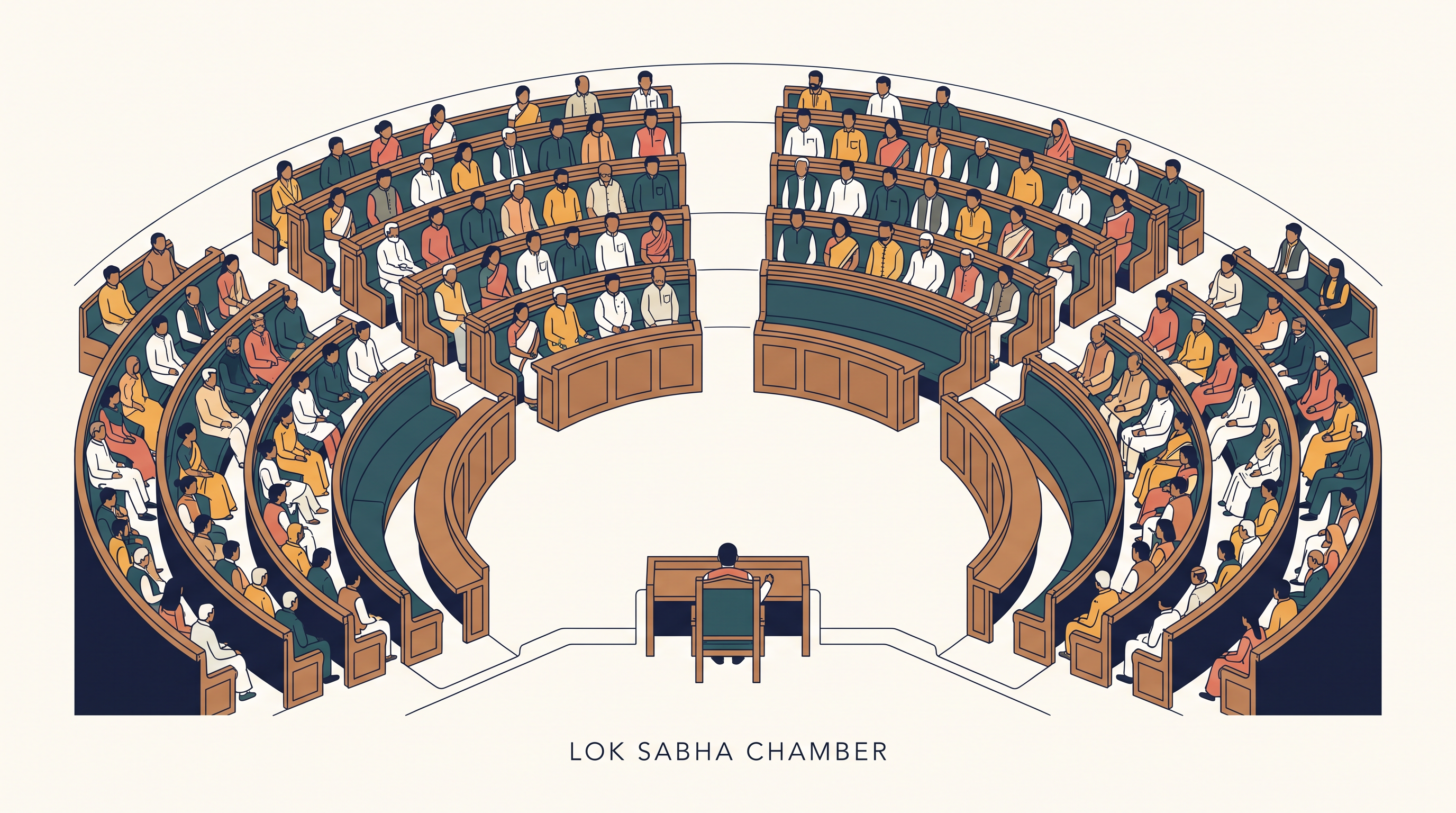
Fig. 8.0 – The hung Parliament of 1996.
8.1 Context Of The 1990s
This is the last chapter of the book, and it takes a wide view of the last two decades of politics in India. These developments are complicated, because many different factors came together to produce outcomes nobody had expected. The new era in politics was impossible to foresee, and it is still difficult to understand.
The developments are also controversial. They involve deep conflicts, and we are still standing very close to the events. That is not a reason to avoid the questions. The whole point of studying the history of politics in India since Independence is to make sense of our present, so the chapter asks four questions and then hands them to you.
The Chapter’s Own Questions
The chapter does not answer these questions for you. It gives you the information and the tools, so that you can ask and answer them yourself by the time you finish the book.
A cartoonist drawing in 1990 saw the whole decade coming as a fairground ride.
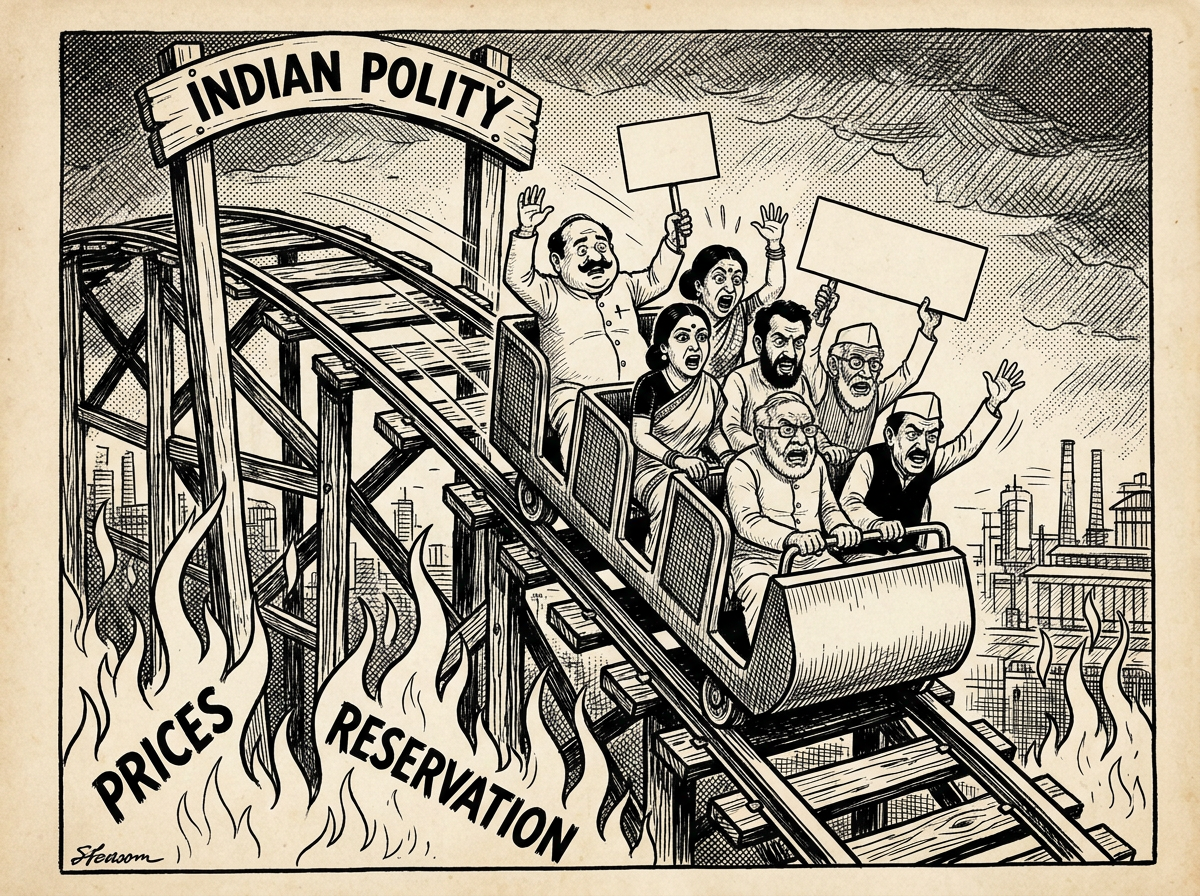
Fig. 8.1 – The roller coaster ride of the 1990s. Inspiration: Cartoon drawn in 1990.
The joke works only if you know that all nine riders are in the same car. They belong to rival parties and to rival regions, and yet the cartoonist has put them on one track, going up and down together. The claim being made is that no one is driving: the polity itself is the ride, and the leaders are passengers.
Notice what the drawing cannot do. It shows the ups and downs, but it cannot tell you why the ride began, or which of these leaders would still matter in ten years. It was drawn in 1990, before most of what this chapter describes had happened. A cartoon captures a mood, not an explanation.
Five Developments
You have read in the last chapter that Rajiv Gandhi became Prime Minister after the assassination of Indira Gandhi. He led the Congress to a massive victory in the Lok Sabha elections held immediately afterwards, in 1984. As the eighties came to a close, the country saw five developments that would leave a long-lasting mark on our politics. The sequence is set out in Fig. 8.2.
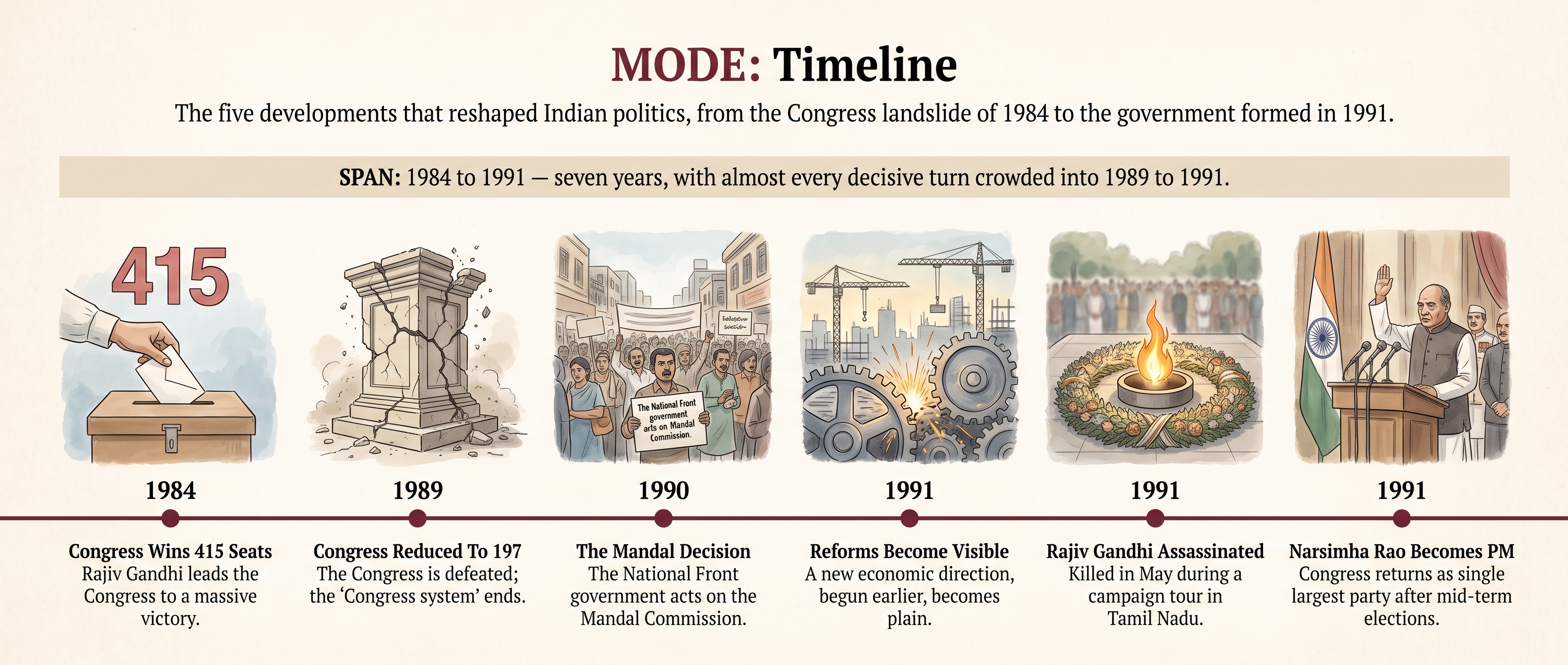
Fig. 8.2 – The Turn Of The Late Eighties.
One — The Defeat Of 1989
The most crucial development of this period was the defeat of the Congress party in the elections held in 1989. The party that had won as many as 415 seats in the Lok Sabha in 1984 was reduced to only 197 in this election.
The Congress improved its performance and came back to power soon after the mid-term elections held in 1991 — elections held earlier than expected, because the House elected in 1989 did not last its full term. So the party was far from finished. But the elections of 1989 marked the end of what political scientists have called the ‘Congress system’: the arrangement, which you met earlier in this book, in which the Congress sat at the centre of the party system and every other party defined itself in relation to it.
To be sure, the Congress remained an important party, and ruled the country more than any other party even in this period since 1989. What it lost was not office. It lost the kind of centrality it had earlier enjoyed in the party system.
That question — can the Congress bounce back to its old glory? — was asked constantly through the nineties, and a butter advertisement made a joke of it.
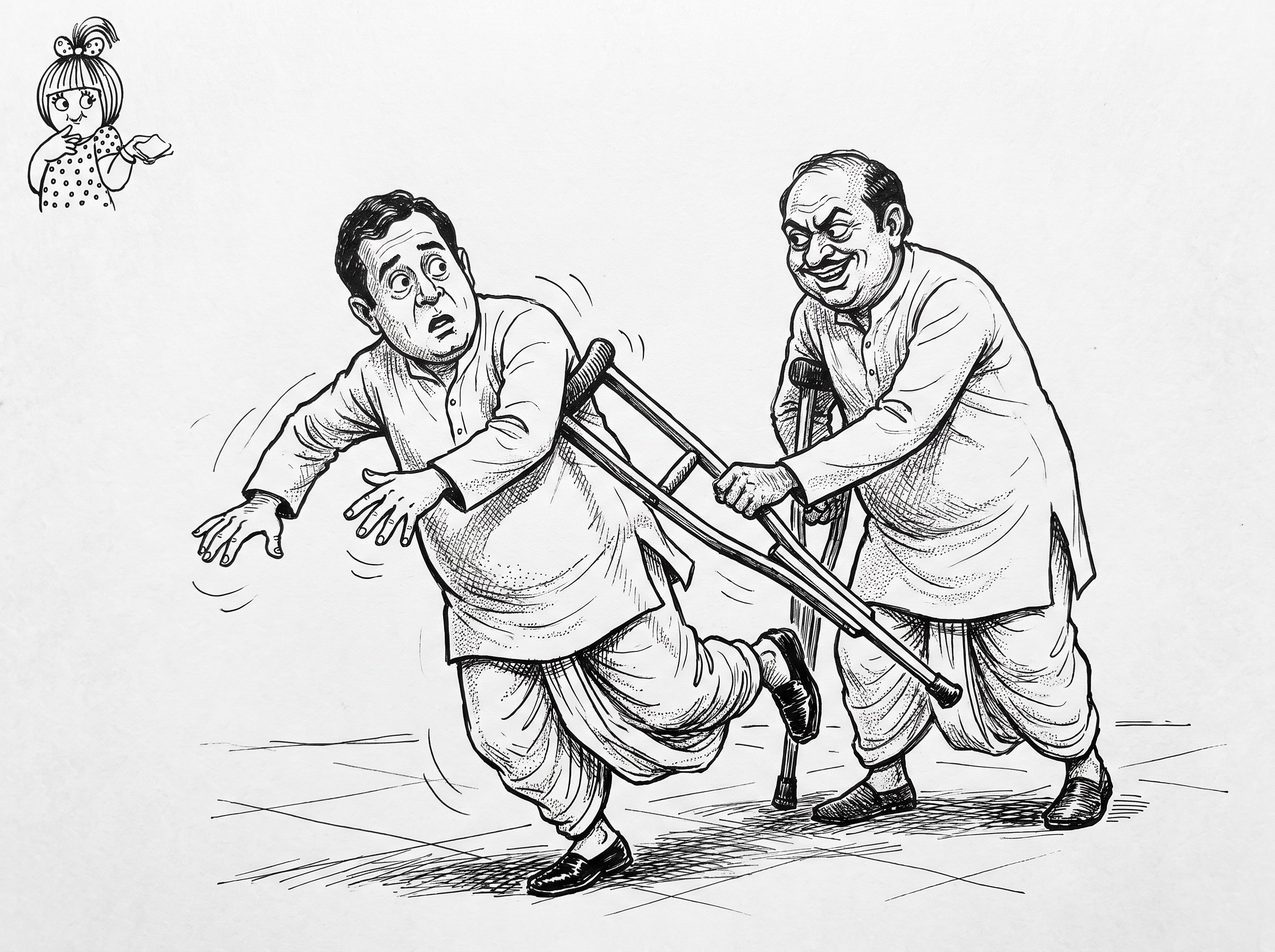
Fig. 8.3 – Sitaram Kesri withdraws support from Deve Gowda. Inspiration: Amul hoarding.
Two things are being said at once. ‘Cong-less’ is a pun: a government without the Congress, and also a government that is cong-less — missing something it needs to stand. The crutches are the visual argument. A government supported from outside, without the supporting party joining it, does not stand on its own legs, and the party holding the crutches can take them away.
But read the limit as well. This is a commercial hoarding selling butter, drawn to be funny in a week when the news was full of a government falling. It records that the collapse of governments had become ordinary enough to advertise with. It does not tell you why the Congress withdrew its support, or whether the United Front deserved to fall. For that, you need the argument, not the joke.
Two — The Mandal Issue
The second development was the rise of the ‘Mandal issue’ in national politics. This followed the decision by the new National Front government in 1990 to implement the recommendation of the Mandal Commission that jobs in central government should be reserved for the Other Backward Classes.
The decision led to violent ‘anti-Mandal’ protests in different parts of the country. This dispute between the supporters and the opponents of OBC reservations came to be known as the Mandal issue, and it was to play an important role in shaping politics from 1989 onwards. You will meet the Commission itself, and what it actually recommended, in section 8.3.
Whether this was a passing storm or a permanent change in Indian politics was, at the time, an open question — and it is worth holding that question as you read on.
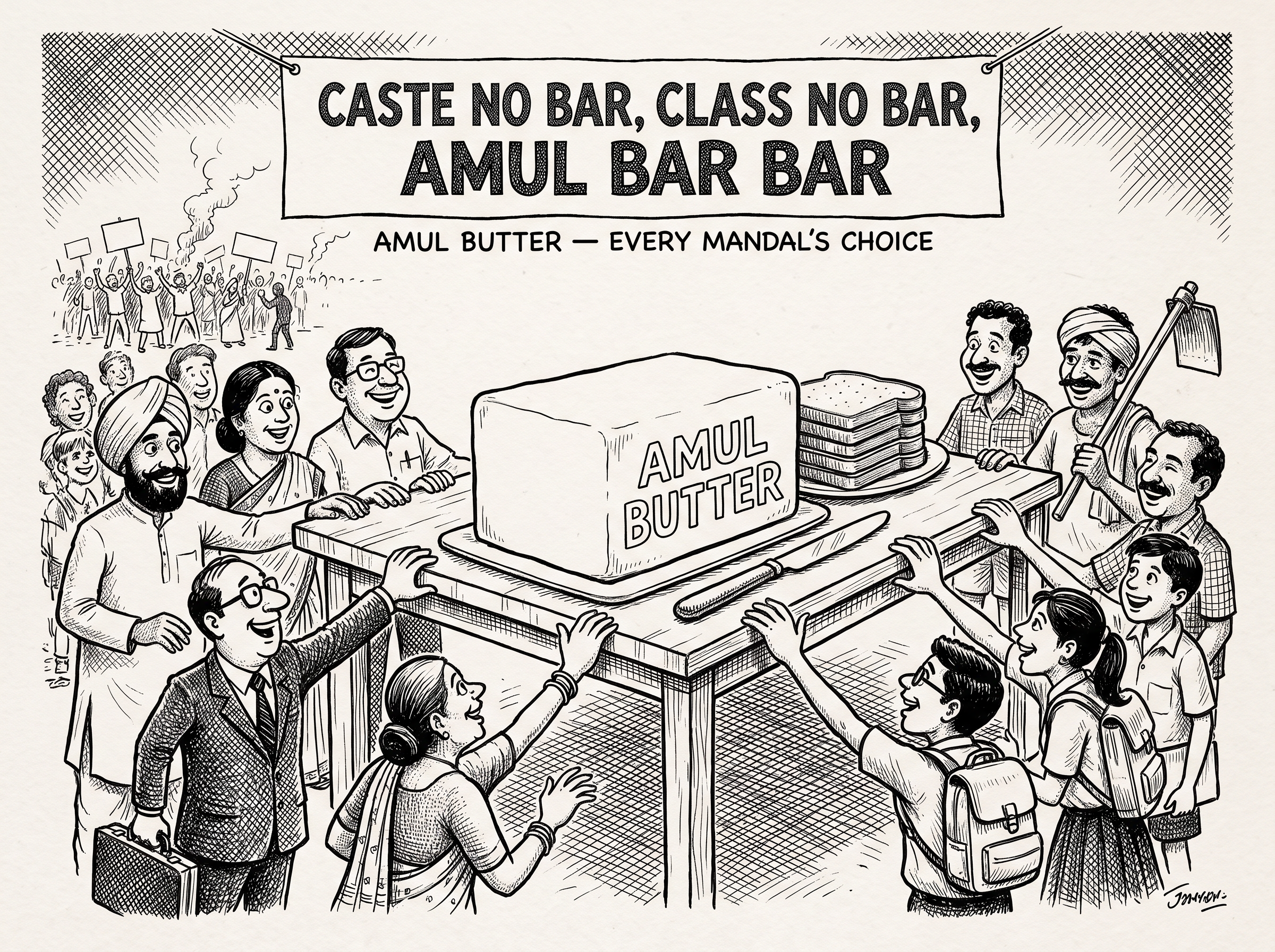
Fig. 8.4 – A reaction to Mandalisation. Inspiration: Amul hoarding.
The pun turns on two meanings of ‘bar’. ‘Caste no bar’ is the language of matrimonial and job advertisements, meaning no caste is excluded; ‘Amul bar bar’ is the butter bar itself. And ‘every Mandal’s choice’ plays on the Commission’s name. The claim is cheerfully made: at the breakfast table, caste and class do not count.
The limit is worth stating plainly. The hoarding jokes about a dispute that was, at that very moment, producing violent protest in many cities. It tells you that the word ‘Mandal’ had entered everyday language within weeks. It tells you nothing about what people on either side of the reservation argument actually believed, or why they felt so strongly.
Three — A New Economic Direction
Third, the economic policy followed by the various governments took a radically different turn. This is known as the initiation of the structural adjustment programme, or the new economic reforms — a change of direction in how the state managed the economy.
Started by Rajiv Gandhi, these changes first became very visible in 1991, and they radically changed the direction that the Indian economy had pursued since Independence. These policies have been widely criticised by various movements and organisations. But the various governments that came to power in this period have continued to follow them.
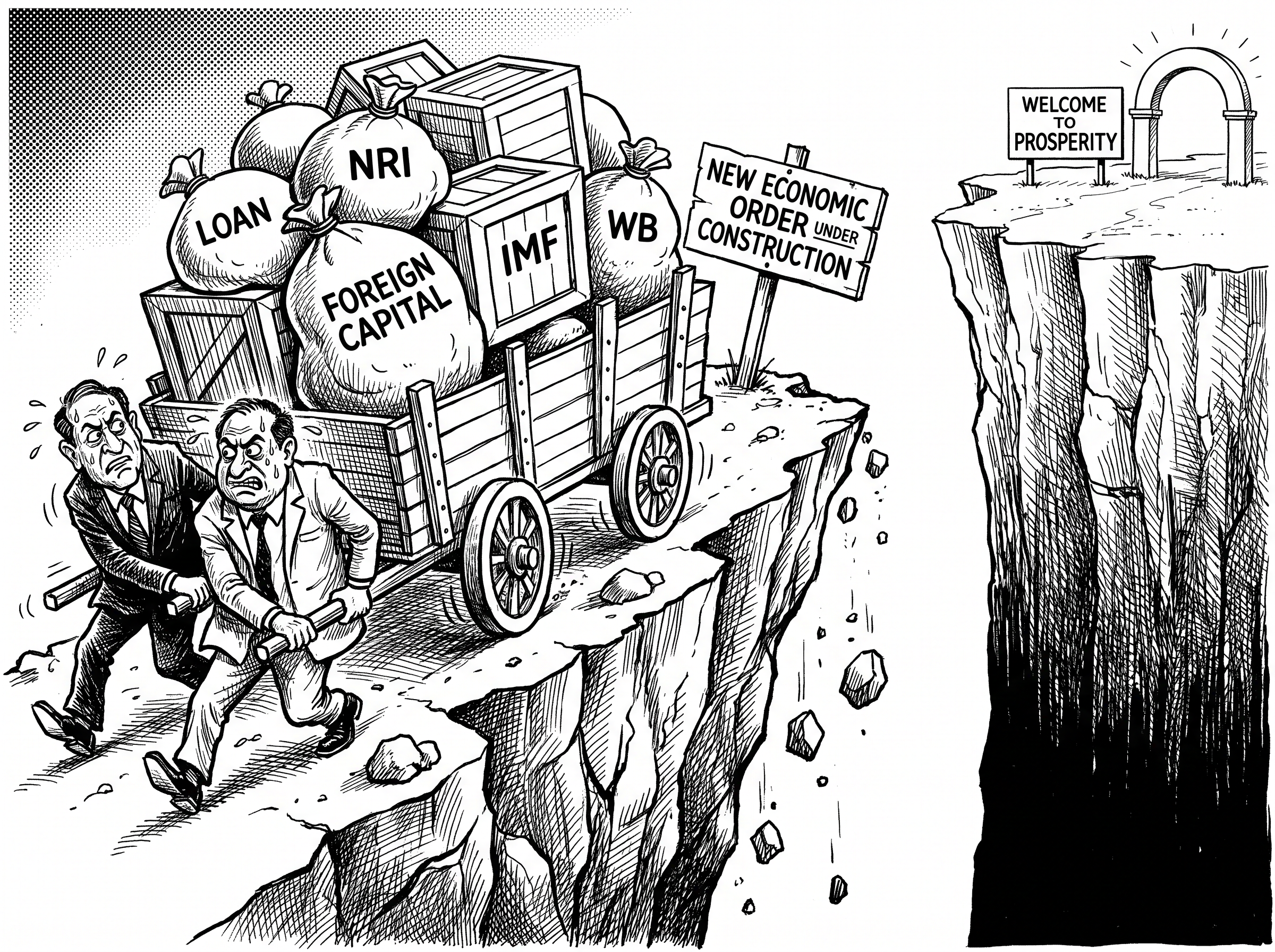
Fig. 8.5 – The initial phase of the New Economic Policy. Inspiration: R. K. Laxman, The Times of India.
Every element of the drawing is an argument. The cliff is crumbling under the cart, so the path is unsafe. The cart is loaded with borrowings and outside money, so the journey is being made on other people’s resources. Prosperity is real but on the far side of a gap, and the speech balloon is the cheerful voice of the men doing the hauling. The cartoonist is not saying the reforms will fail. He is saying that the confidence is arriving before the bridge does.
And here the limit is sharp. The cartoon was drawn in the initial phase, before anyone could know where the road led. It captures scepticism, not evidence. Whether the reforms delivered what was promised is a question you cannot settle from a drawing — and the chapter itself only records that they were widely criticised and were nonetheless continued by every government that followed.
Four — Ayodhya Enters Politics
Fourth, the centuries-old legal and political dispute over the Ram Janmabhoomi Temple in Ayodhya began to influence the politics of India, and gave birth to various political changes. The Ram Janmabhoomi Temple Movement became a central issue, and it transformed the direction of the discourse on secularism and democracy.
These changes culminated in the construction of the Ram Temple at Ayodhya, following the decision of the constitutional bench of the Supreme Court, which was announced on November 9, 2019. Section 8.4 follows this dispute from its beginnings to that judgment.
Alongside the dispute ran another voice — the older devotional call for harmony between faiths.
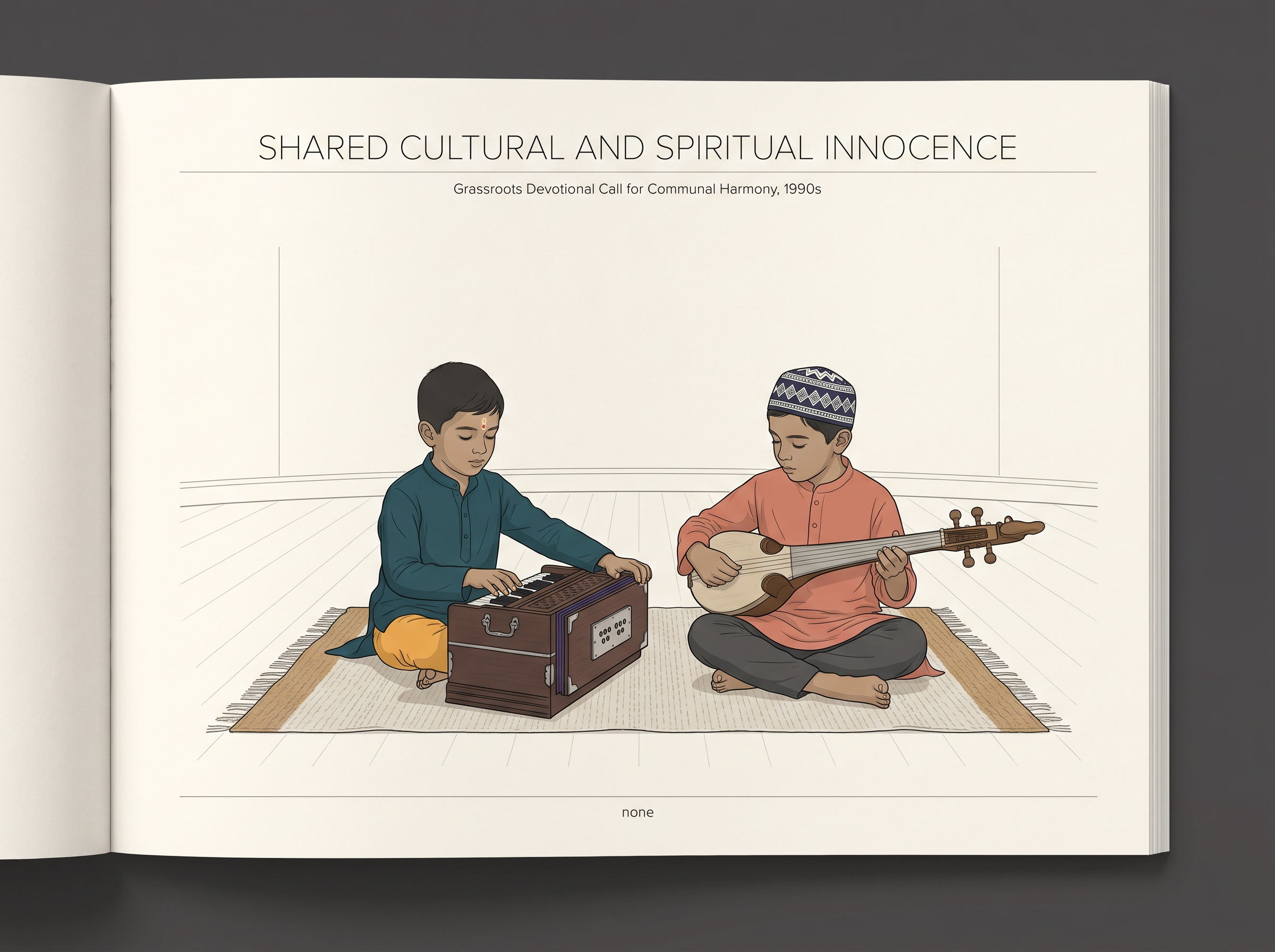
Fig. 8.6 – Message of harmony.
Five — A Leadership Changes Hands
Finally, the assassination of Rajiv Gandhi in May 1991 led to a change in the leadership of the Congress party. He was assassinated by a Sri Lankan Tamil linked to the LTTE, while he was on an election campaign tour in Tamil Nadu.
In the elections of 1991, the Congress emerged as the single largest party. Following Rajiv Gandhi’s death, the party chose Narsimha Rao as the Prime Minister. Who would lead the Congress, and whether anyone could restore it, stayed in the headlines for years afterwards.
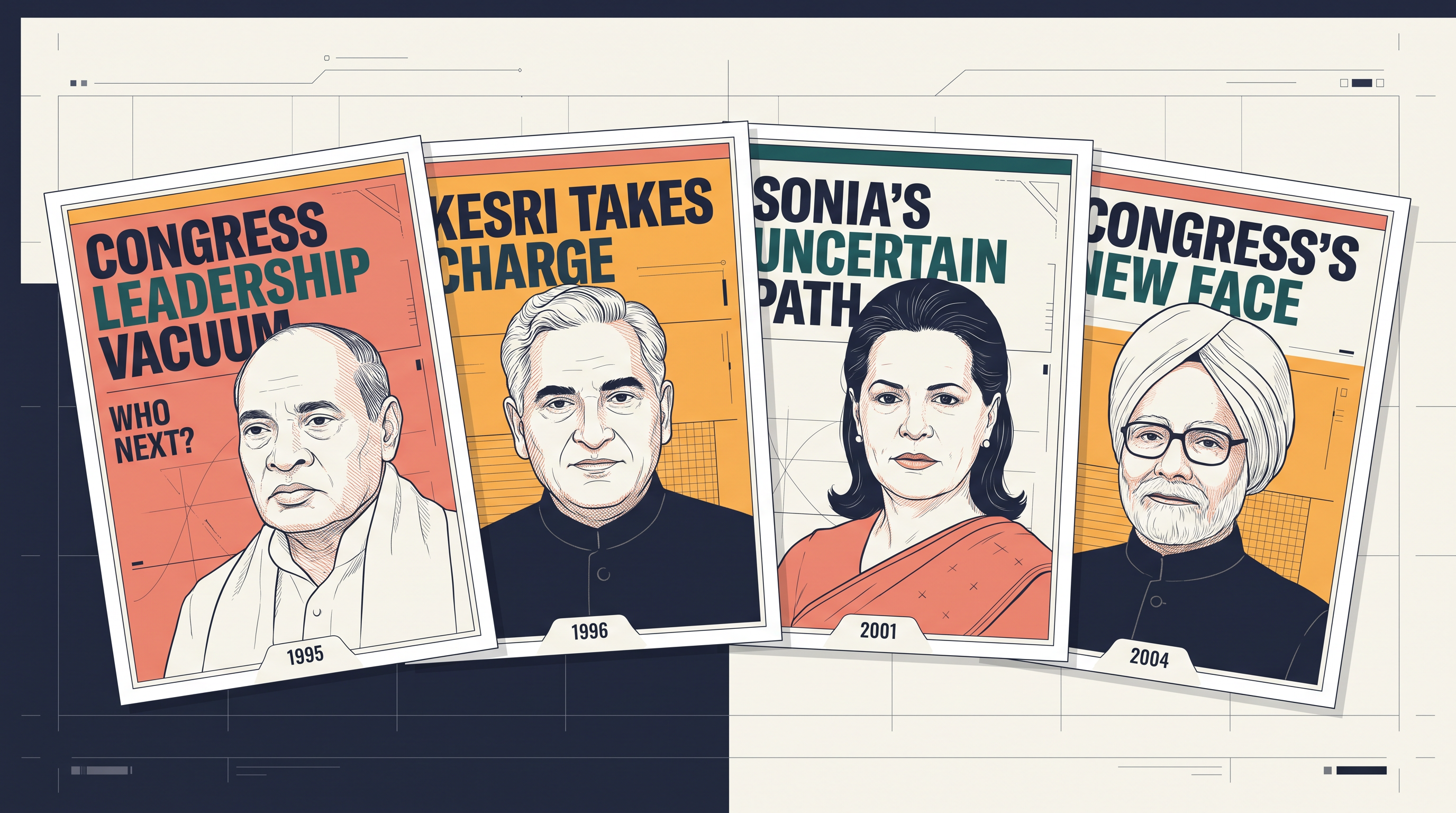
Fig. 8.7 – Leadership in Congress made many headlines.
These five developments did not arrive one at a time and wait their turn. They overlapped, and they pulled against each other. A new economic policy was being launched in the same years in which caste and religious identity were becoming the sharpest lines in politics, and in which no party could any longer govern on its own. The rest of the chapter takes them in turn.
8.2 Era Of Coalitions
The elections of 1989 led to the defeat of the Congress party, but they did not result in a majority for any other party either. A majority here means more than half the seats in the Lok Sabha — the number a government must be able to show if it is to survive a vote in the House.
Though the Congress was the largest party in the Lok Sabha, it did not have a clear majority, and therefore it decided to sit in the opposition. That decision mattered. The largest party in the House chose not to try to govern.
The National Front stepped into the space. The Front was itself an alliance of the Janata Dal and some other regional parties, and on its own it did not have the numbers either. It received support from two diametrically opposite political groups: the BJP and the Left Front. On this basis the National Front formed a coalition government — but the BJP and the Left Front did not join that government.
Support From Outside
That last sentence is the whole puzzle of the period, so read it slowly. The BJP and the Left Front promised to vote with the government in the Lok Sabha, and thereby kept it alive, without taking a single ministry in it. This is called supporting a government from outside.
The arrangement suits the supporter. It can keep a rival out of power without owning any of the government’s decisions, and it can walk away whenever it chooses. It is far less comfortable for the government, which holds office on votes it does not control. A cartoonist saw exactly this.
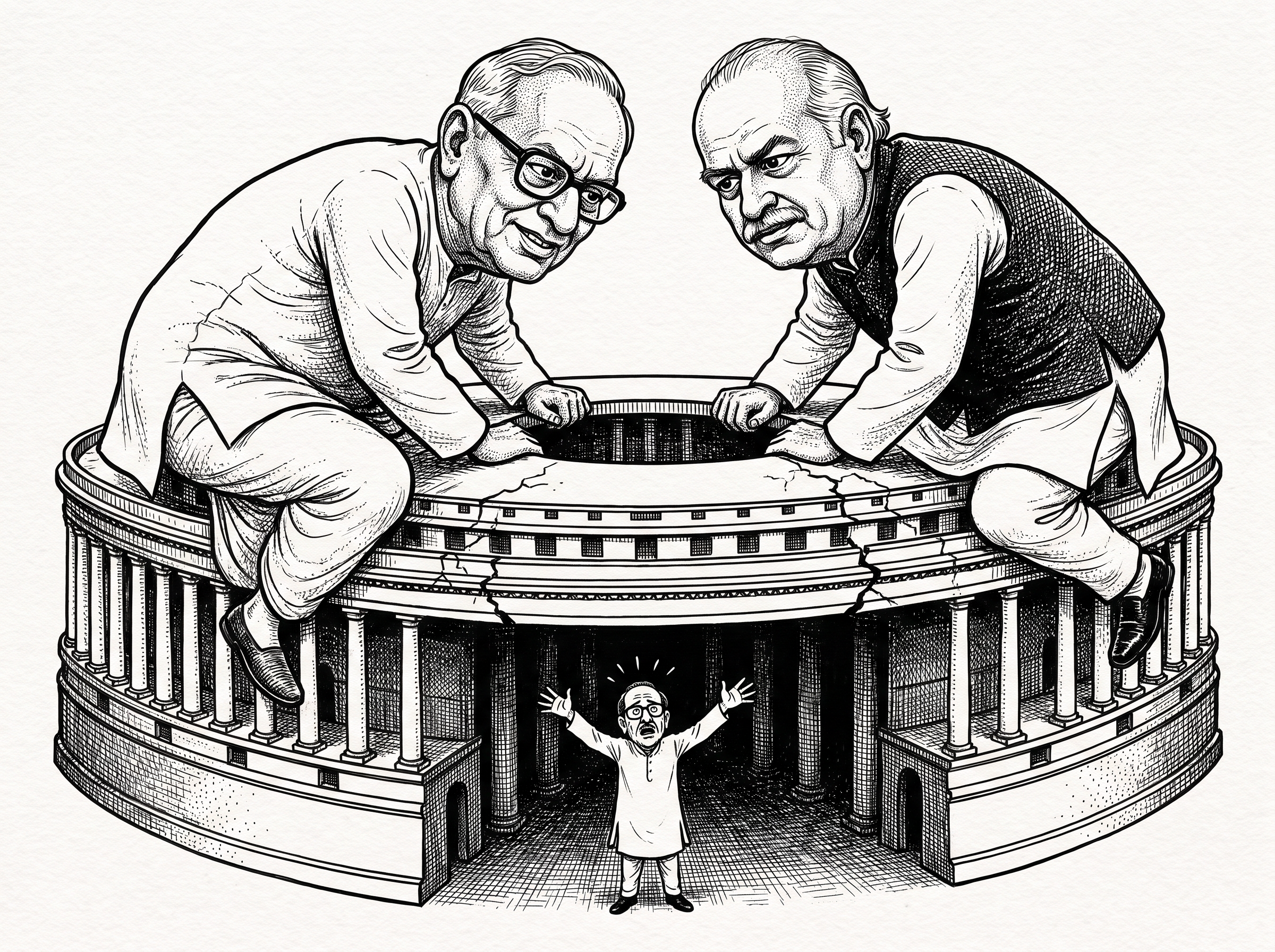
Fig. 8.8 – The National Front Government supported by the Left and the BJP. Inspiration: Sudhir Tailang, HT Book of Cartoons.
The joke is a matter of scale and position. The two supporters are drawn far larger than the Prime Minister they are supporting, and they are literally outside the building — on its roof — while still sitting on top of it. The cartoonist’s claim is that ‘outside support’ is a fiction: the men who are not in the government are the men holding it down.
Note what the drawing cannot settle. It shows the BJP and the Left Front as equally heavy, and it shows the Prime Minister as helpless. It cannot tell you what V. P. Singh’s government actually decided, or whether either supporter got what it wanted from the arrangement. A cartoon states one opinion in one image; it cannot draw the reply.
The general procedure that this period made routine is set out in Fig. 8.9.
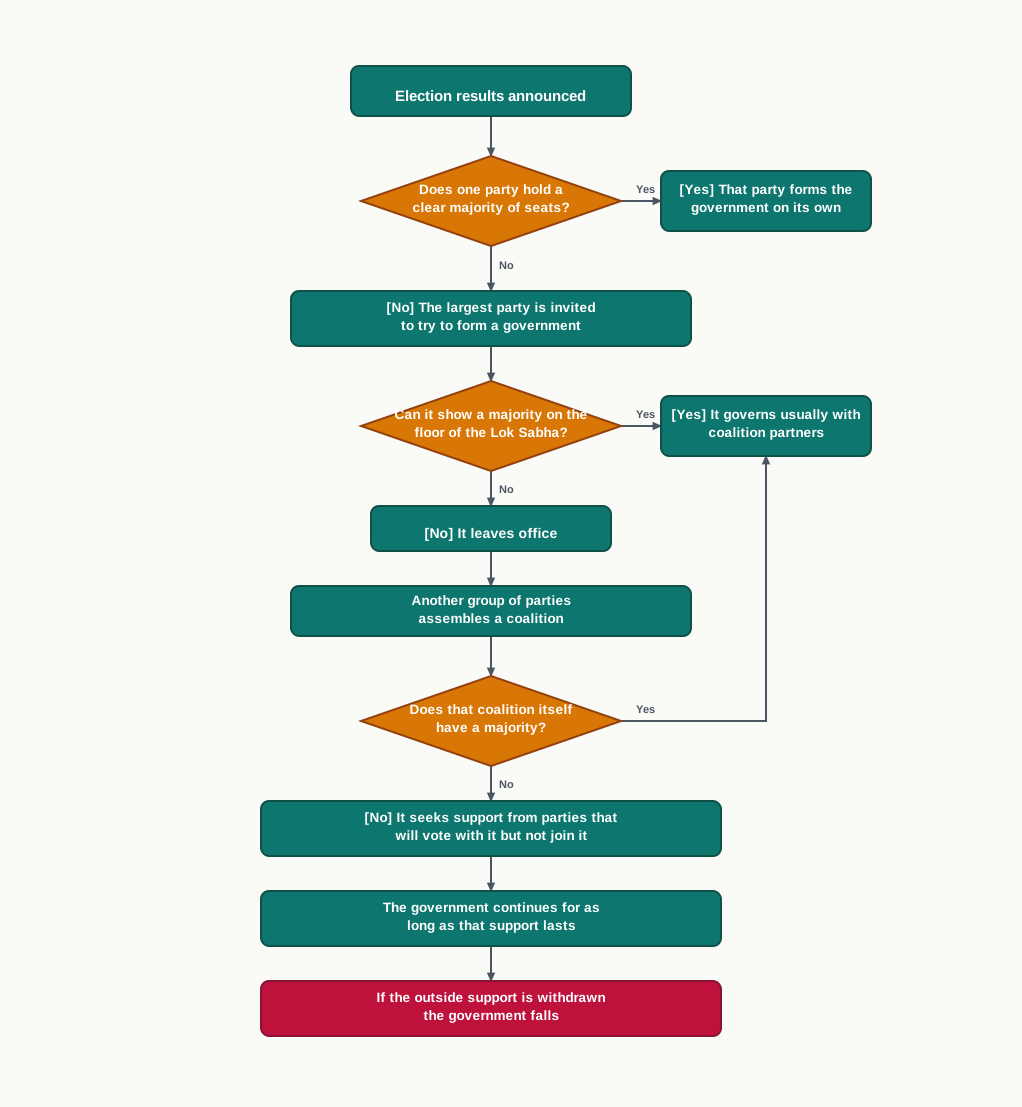
Fig. 8.9 – Forming a government when no party has a majority.
8.2.1 Decline Of Congress
The defeat of the Congress party marked the end of Congress dominance over the Indian party system. Do you remember the discussion in earlier chapters about the restoration of the Congress system? Way back in the late sixties, the dominance of the Congress party was challenged; but the Congress, under the leadership of Indira Gandhi, managed to re-establish its predominant position in politics.
The nineties saw yet another challenge to the predominant position of the Congress. This time, however, the challenge did not produce a successor. It did not mean the emergence of any other single party to fill the Congress party’s place.
An Era Of Many Parties
Thus began an era of a multi-party system — a system in which several parties are strong enough that none can be sure of governing alone. To be sure, a large number of political parties had always contested elections in our country, and our Parliament always had representatives from several political parties. That is not what changed.
What happened after 1989 was the emergence of several parties in such a way that one or two parties did not get most of the votes or seats. This also meant that no single party secured a clear majority of seats in any Lok Sabha election held from 1989 till 2014.
This development initiated an era of coalition governments at the Centre, in which regional parties played a crucial role in forming ruling alliances. But in the 2014 and 2019 Lok Sabha elections, the BJP got a clear majority on its own.
Ask The People Who Lived It
Here is something worth doing before you read on. Talk to your parents about their memories of the events happening since the 1990s, and ask them what they felt were the most significant events of the period. Sit together in groups and draw up a comprehensive list of the events your parents report, see which events get cited most often, and compare that list with what this chapter suggests were the most significant. Then discuss why some events matter more to some people than to others.
8.2.2 Alliance Politics
The nineties also saw the emergence of powerful parties and movements that represented the Dalit and backward castes — the Other Backward Classes, or OBCs. Many of these parties represented powerful regional assertion as well. Section 8.3 takes up their rise in detail.
These parties played an important role in the United Front government that came to power in 1996. The United Front was similar to the National Front of 1989, for it too included the Janata Dal and several regional parties. But this time the BJP did not support the government. The United Front government was supported by the Congress.
The Equations Keep Changing
Look carefully at what has just been described, because it shows how unstable the political equations were. In 1989, both the Left and the BJP supported the National Front government, because they wanted to keep the Congress out of power. In 1996, the Left continued to support a non-Congress government — but this time the Congress supported it too, because both the Congress and the Left wanted to keep the BJP out of power.
In other words, the same party was propped up from outside by opposite ends of the political spectrum, and the reason was never agreement on a programme. It was agreement about who should not govern. The two Fronts are set side by side in Table 8.A1.
The BJP Consolidates
The Congress and the Left did not succeed for long, because the BJP continued to consolidate its position in the elections of 1991 and 1996. It emerged as the largest party in the 1996 election and was invited to form the government. But most other parties were opposed to its policies, and therefore the BJP government could not secure a majority in the Lok Sabha.
It finally came to power by leading a coalition government from May 1998 to June 1999, and was re-elected in October 1999. Atal Behari Vajpayee was the Prime Minister during both these NDA governments, and his government formed in 1999 completed its full term.
Eleven Governments
Thus, with the elections of 1989, a long phase of coalition politics began in India. Since then there have been eleven governments at the Centre, all of which have either been coalition governments, or minority governments supported by other parties which did not join the government.
In this new phase, any government could be formed only with the participation or the support of many regional parties. This applied to the National Front in 1989, the United Front in 1996 and 1997, the BJP-led coalition in 1998, the NDA in 1999, and the UPA in 2004 and 2009. However, this trend changed in 2014. The whole run of governments is set out in Table 8.1.
Read the middle of the table slowly. Between May 1996 and March 1998 the country had three governments in under two years, while the two entries on either side of that stretch each ran for years. The instability was not spread evenly across the period; it was concentrated in the years when nobody could assemble a stable set of supporters.
The table counts governments, not what they did. It records who held office and who kept them there, and nothing at all about their major policies, their performance, or the controversies around them. NCERT leaves blank space beside this chart precisely so that you can fill that in yourself, and points you to the official list of current and former Prime Ministers at http://pmindia.gov.in/en.
One Party Or Many?
By the end of the nineties a cartoonist could set two Indias side by side and expect every reader to understand the joke.
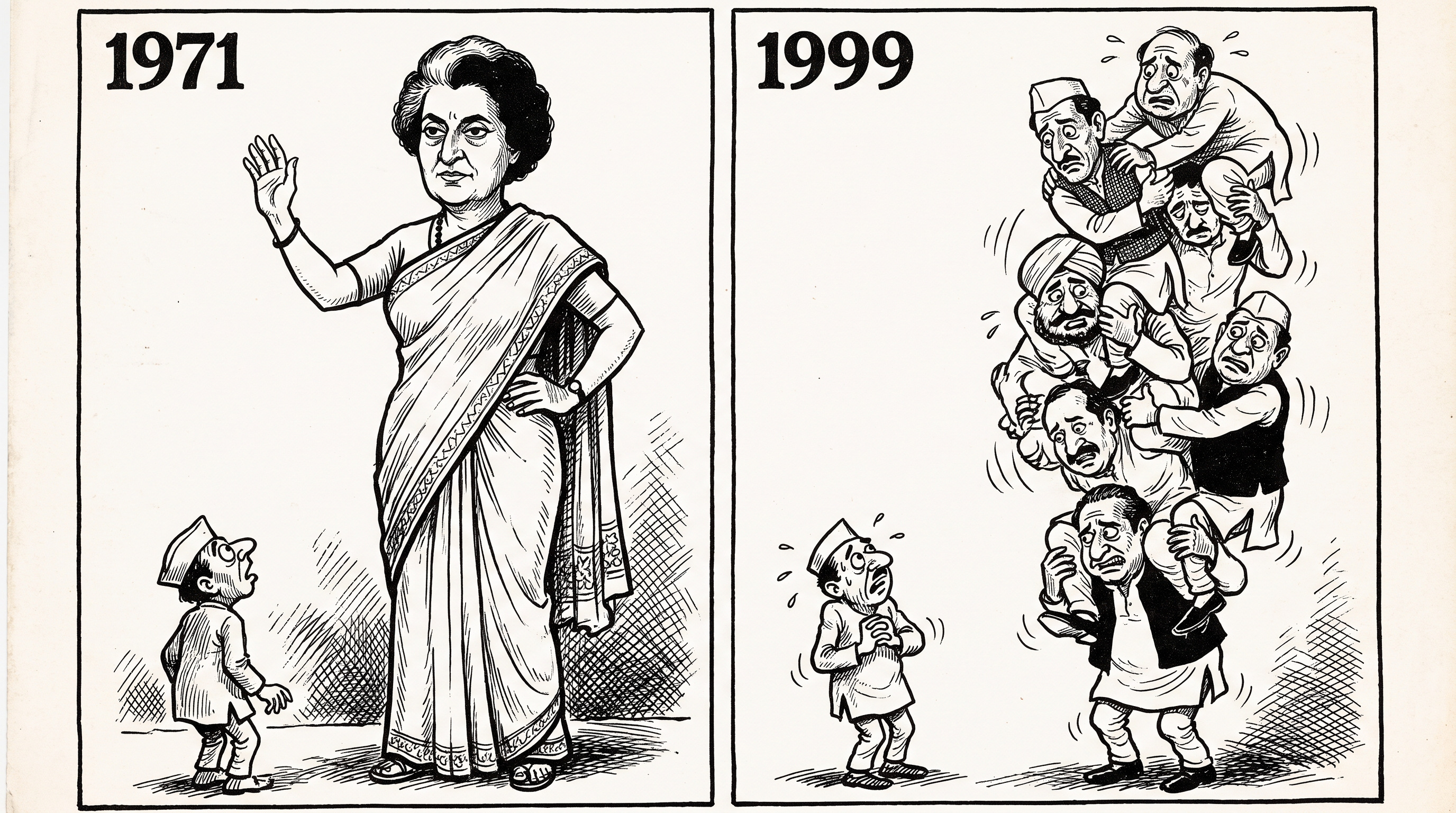
Fig. 8.10 – From one-party dominance to a multi-party alliance system. Inspiration: Ajit Ninan, India Today.
The composition carries the argument. In 1971 one figure fills the frame; in 1999 the same space is filled by a stack of figures who are only standing because they are balanced on each other. The cartoonist is not saying the new arrangement is worse. He is saying it is precarious, and that some people looked back at the old certainty with longing.
But a cartoon flatters a single idea. The stack is drawn as unsteady — and yet the government formed in 1999 completed its full term. The drawing captures a fear about coalitions; it does not test it. That is your job, not the cartoonist’s.
Where Coalitions Came From
Let us connect this development with what we have learnt so far. The era of coalition governments may be seen as a long-term trend, resulting from relatively silent changes that had been taking place over several decades.
We saw in Chapter Two that in earlier times it was the Congress party itself that was a ‘coalition’ — of different interests, different social strata and different groups. That is what gave rise to the term ‘Congress system’. The coalition, in other words, used to sit inside one party.
We also saw that, especially since the late 1960s, various sections had been leaving the Congress fold and forming separate political parties of their own. And we noted the rise of many regional parties in the period after 1977. While these developments weakened the Congress party, they did not enable any single party to replace it. The coalition had simply moved out of the party and onto the floor of the House.
Two further questions are worth carrying forward, and the chapter does not close either of them. Does the logic of a plural society mean India will always have coalitions — or can the national parties consolidate their positions again, as the 2014 and 2019 results might suggest? And is the coalition-or-single-party question the right one to ask at all, when what a government does may matter more than how it was assembled?
8.3 Political Rise Of Other Backward Classes
One long-term development of this period was the rise of the Other Backward Classes as a political force. You have already come across the term OBC. It refers to the administrative category ‘Other Backward Classes’ — communities other than the SC and the ST who suffer from educational and social backwardness. They are also referred to as the ‘backward castes’.
The word ‘administrative’ is doing real work in that sentence. OBC is not the name of a single community. It is a category the state uses when it decides who is entitled to particular benefits, and much of the politics of this period is a fight over who belongs in it and what belonging in it should bring.
A Space Opens Up
We have already noted in Chapter Six that the support for the Congress among many sections of the ‘backward castes’ had declined. That created a space for non-Congress parties that drew more support from these communities.
You would recall that the rise of these parties first found political expression at the national level in the form of the Janata Party government in 1977. Many of the constituents of the Janata Party — like the Bharatiya Kranti Dal and the Samyukta Socialist Party — had a powerful rural base among some sections of the OBC.
So the political rise of the OBCs did not begin with the Mandal Commission. What the Mandal decision did was to take a slow social change and turn it into the sharpest argument in national politics.
8.3.1 ‘Mandal’ Implemented
In the 1980s, the Janata Dal brought together a similar combination of political groups with strong support among the OBCs. The decision of the National Front government to implement the recommendations of the Mandal Commission further helped in shaping the politics of the ‘Other Backward Classes’.
Here is the mechanism, and it is worth stating carefully, because it is not obvious. The intense national debate for and against reservation in jobs made people from the OBC communities more aware of this identity. An argument about a policy became, for millions of people, an argument about who they were. And that helped those who wanted to mobilise these groups in politics.
This period therefore saw the emergence of many parties that sought better opportunities for OBCs in education and employment, and that also raised the question of the share of power enjoyed by the OBCs. These parties made a democratic claim, and it should be stated in their own terms: since the OBCs constituted a large segment of Indian society, it was only democratic that they should get adequate representation in administration and have their due share of political power.
The debate did not stay on the newspaper page.
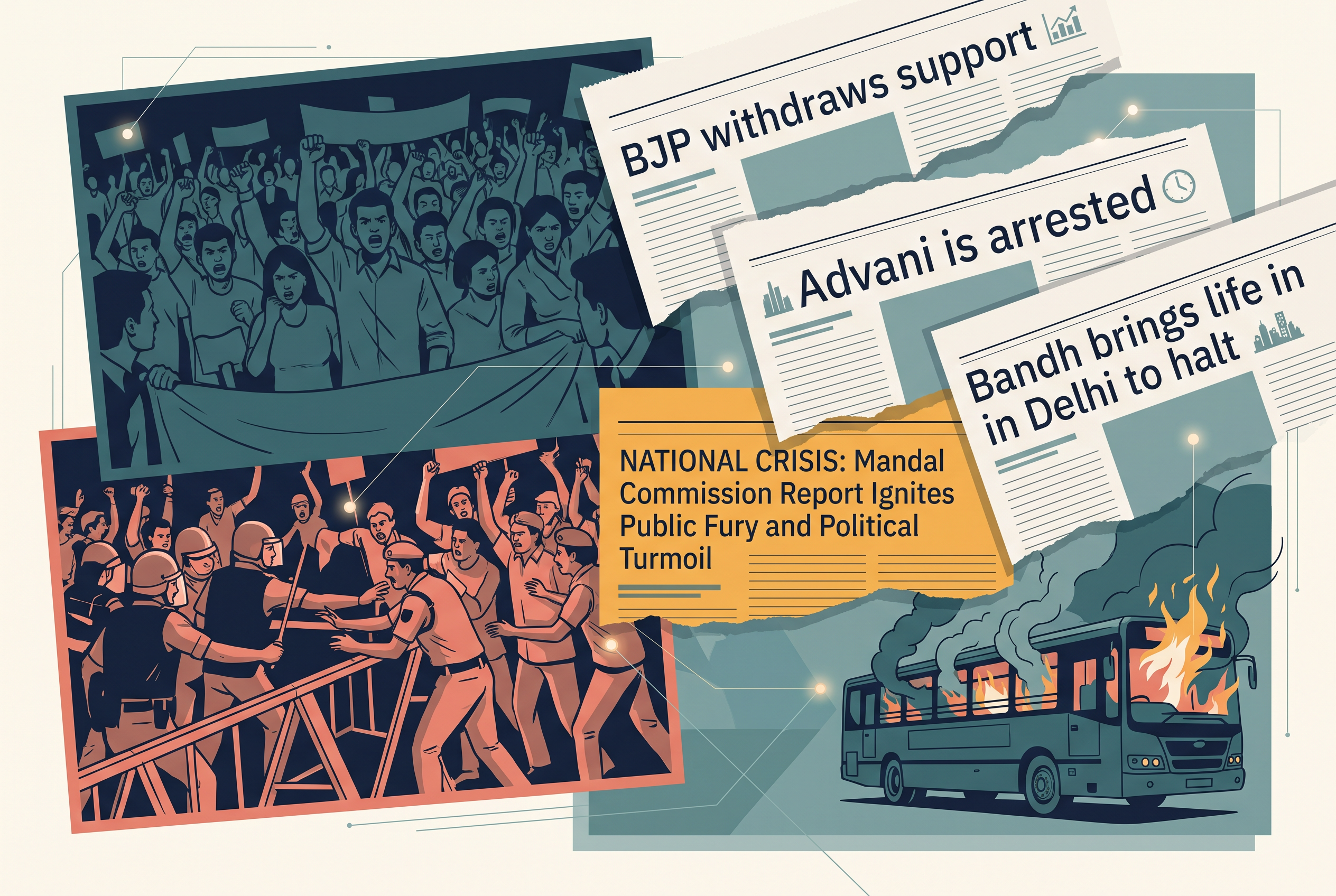
Fig. 8.11 – Agitations against the implementation of the Mandal Commission report.
Look at what has been placed side by side here. The photographs show the agitation in the streets. The headlines show the government coming apart at the same moment: a party withdrawing its support, a leader arrested, a Prime Minister refusing to resign, a bandh — a general shutdown of shops, transport and offices — halting Delhi.
The montage makes a strong claim by arrangement alone: that the street and the government were shaken by the same decision. But notice its limits. A collage of front pages records what editors thought worth printing, in the cities where the protests were fiercest. It cannot tell you what those who supported the decision felt, and there were many; nor can it tell you how the argument sounded in the southern States, where reservations for the OBC had existed for decades.
The Mandal Commission
Reservations for the OBC were in existence in southern States since the 1960s, if not earlier. But this policy was not operative in north Indian States. It was during the tenure of the Janata Party government in 1977-79 that the demand for reservations for backward castes in north India, and at the national level, was strongly raised.
Karpoori Thakur, the then Chief Minister of Bihar, was a pioneer in this direction. His government had introduced a new policy of reservations for OBCs in Bihar. Following this, the central government appointed a Commission in 1978 to look into and recommend ways to improve the conditions of the backward classes.
This was the second time since Independence that the government had appointed such a commission. It was therefore officially known as the Second Backward Classes Commission. Popularly, it is known as the Mandal Commission, after the name of its Chairperson, Bindeshwari Prasad Mandal.
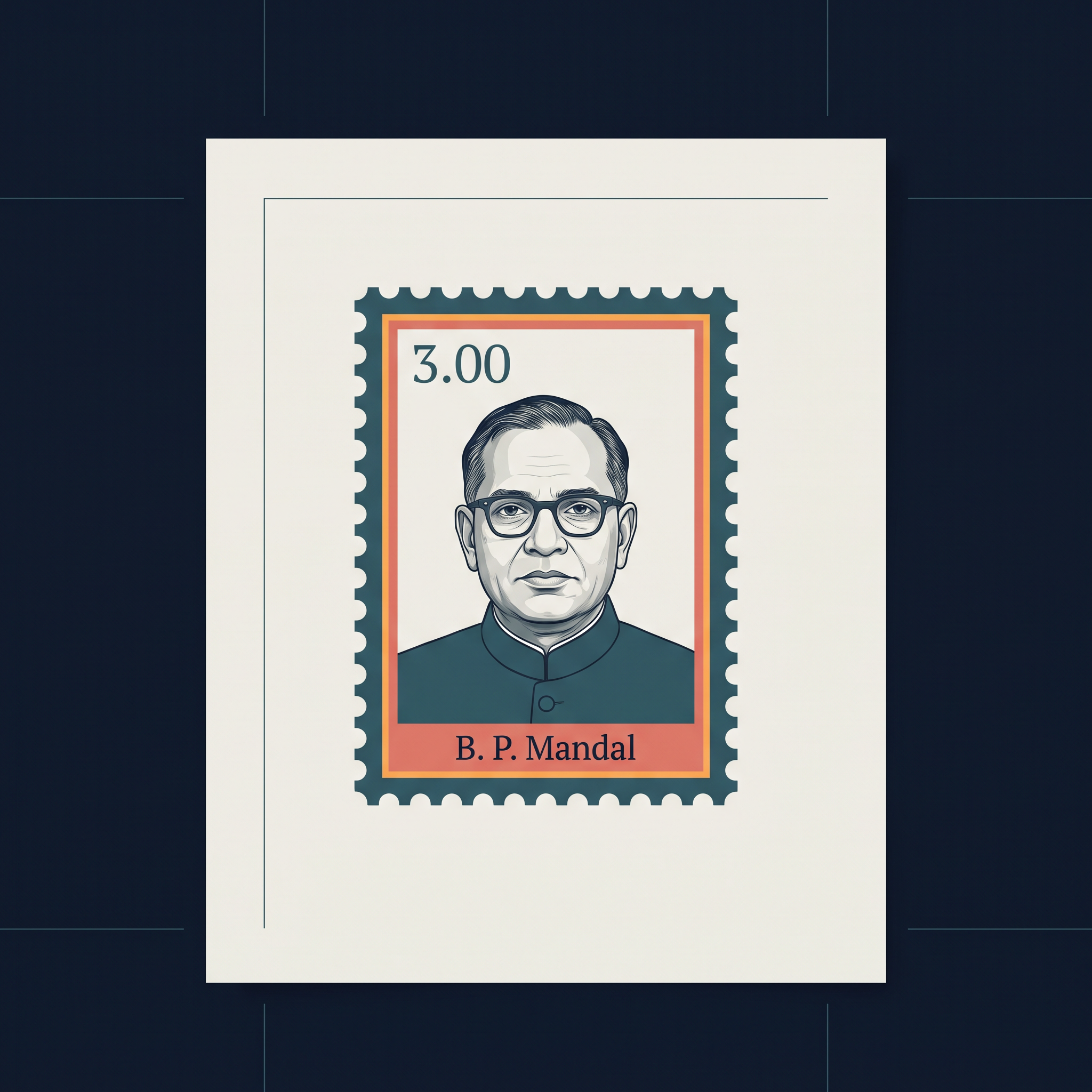
Fig. 8.12 – A postage stamp bearing the portrait of B. P. Mandal.
What The Commission Was Asked, And What It Found
The Mandal Commission was set up to investigate the extent of educational and social backwardness among various sections of Indian society, and to recommend ways of identifying these ‘backward classes’. It was also expected to give its recommendations on the ways in which this backwardness could be ended.
The Commission gave its recommendations in 1980. By then the Janata government had fallen — so the report arrived on the desk of a government that had not asked for it. That is one reason it lay unused for a decade.
The Commission advised that ‘backward classes’ should be understood to mean ‘backward castes’, since many castes, other than the Scheduled Castes, were also treated as low in the caste hierarchy. This was a consequential move: it made caste, and not income alone, the unit for identifying backwardness.
The Commission then did a survey, and found that these backward castes had a very low presence both in educational institutions and in employment in public services. It therefore recommended reserving 27 per cent of seats in educational institutions and government jobs for these groups. The Mandal Commission also made many other recommendations, like land reform, to improve the conditions of the OBCs.
That last sentence deserves a pause. The Commission’s report was not only about quotas. It is worth asking why the reservation recommendation became the whole of the public argument, while recommendations such as land reform were barely discussed at all.
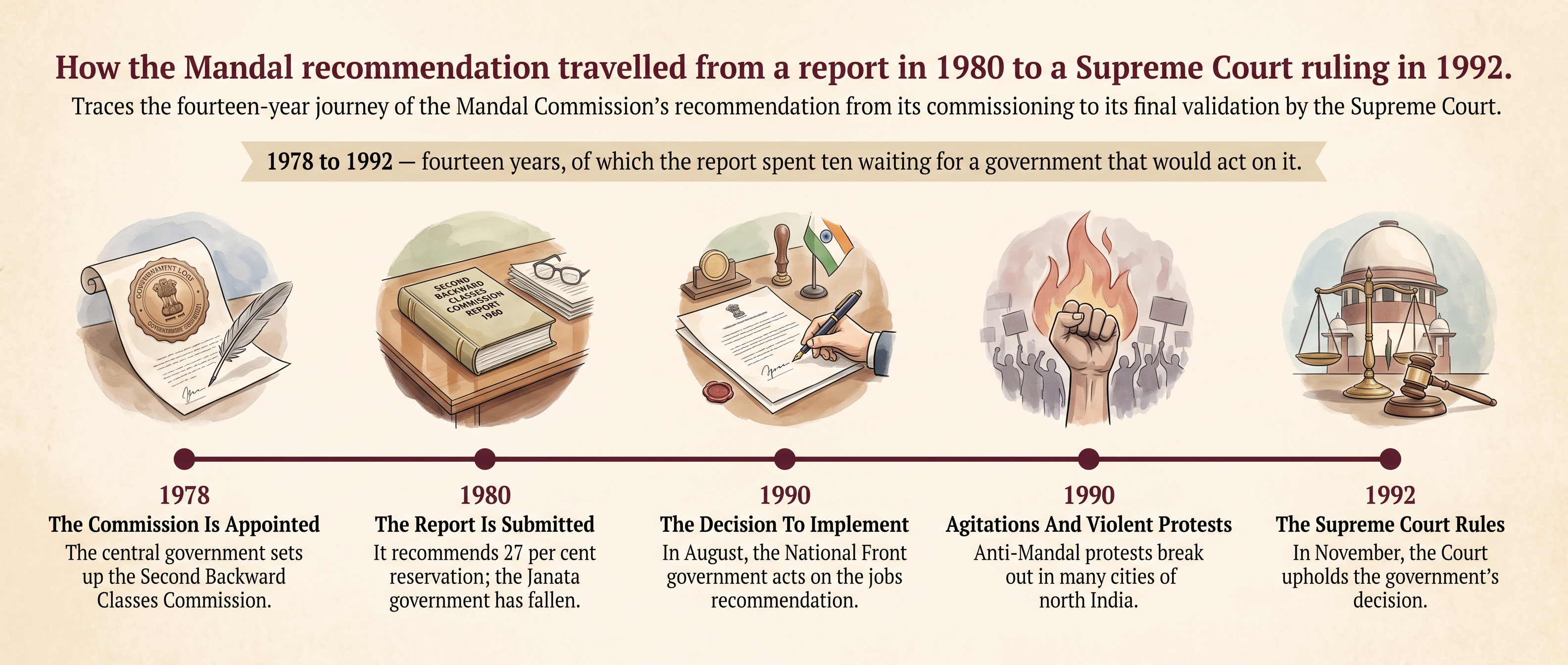
Fig. 8.13 – From Commission To Court.
The Decision And The Court
In August 1990, the National Front government decided to implement one of the recommendations of the Mandal Commission — the one pertaining to reservations for OBCs in jobs in the central government and its undertakings. This decision sparked agitations and violent protests in many cities of north India.
The decision was also challenged in the Supreme Court. In a democracy, a policy contested in the streets can also be contested in a courtroom, and this one was.
8.3.2 Political Fallouts
The 1980s also saw the rise of the political organisation of the Dalits. In 1978 the Backward and Minority Communities Employees Federation, or BAMCEF, was formed. This organisation was not an ordinary trade union of government employees. It took a strong position in favour of political power for the bahujan — the SC, the ST, the OBC and the minorities.
It was out of this that the subsequent Dalit Shoshit Samaj Sangharsh Samiti, and later the Bahujan Samaj Party (BSP), emerged under the leadership of Kanshi Ram.
A Breakthrough In Uttar Pradesh
The BSP began as a small party supported largely by Dalit voters in Punjab, Haryana and Uttar Pradesh. But in the 1989 and the 1991 elections, it achieved a breakthrough in Uttar Pradesh.
Stop at that sentence, because it records a first. This was the first time in independent India that a political party supported mainly by Dalit voters had achieved this kind of political success.
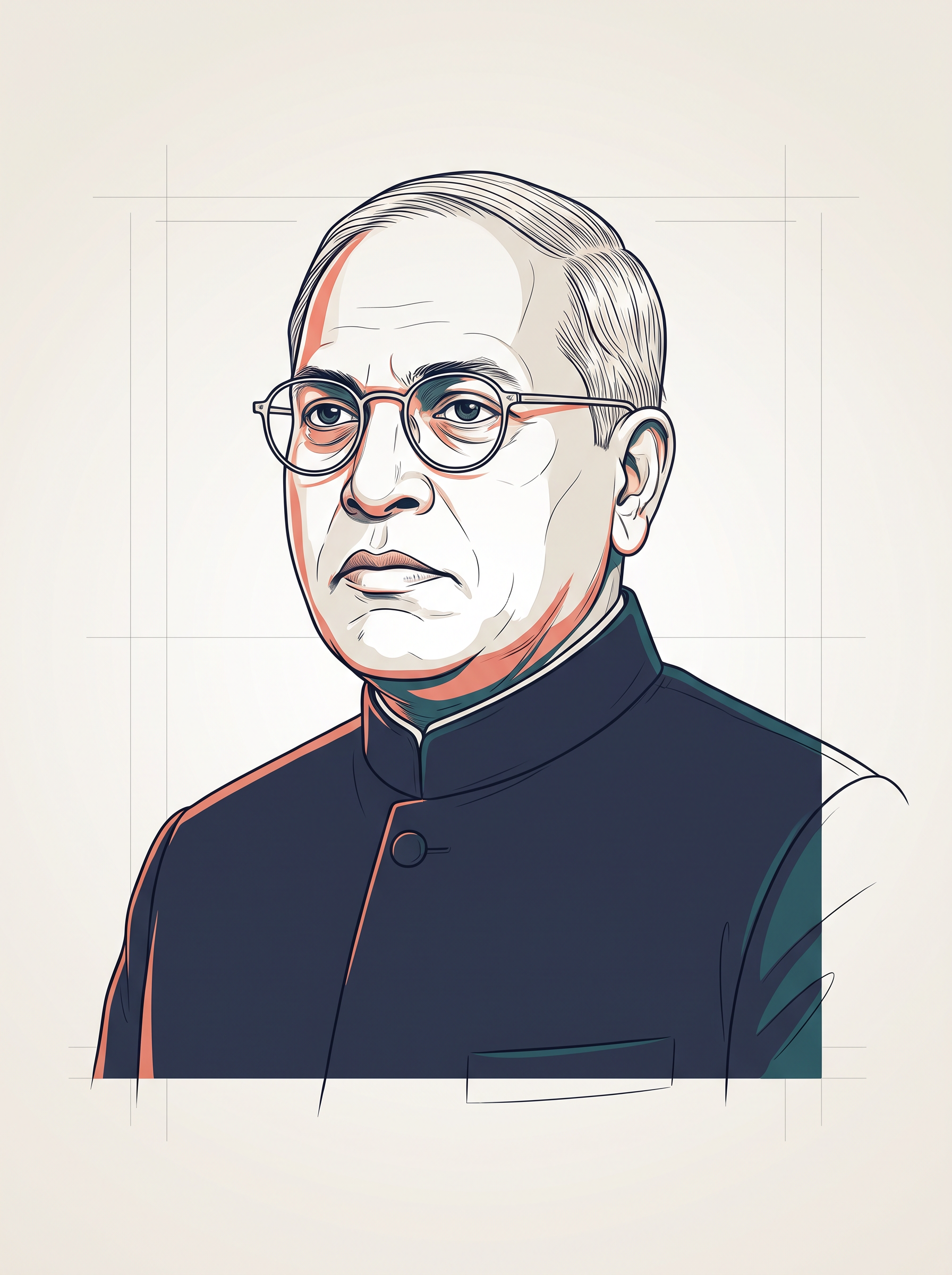
Fig. 8.14 – Kanshi Ram, the founder of the Bahujan Samaj Party.
Politics Built On Numbers
In fact, the BSP, under Kanshi Ram’s leadership, was envisaged as an organisation based on pragmatic politics — politics guided by what will actually win power, rather than by a fixed ideological programme.
It derived confidence from a simple piece of arithmetic. The bahujans — the SC, the ST, the OBC and the religious minorities taken together — constituted the majority of the population, and were therefore a formidable political force on the strength of their numbers alone. In a democracy where governments are made by counting heads, that is not a small thought.
Since then the BSP has emerged as a major political player in the State, and has been in government on more than one occasion. Its strongest support still comes from Dalit voters, but it has expanded its support now to various other social groups.
Two Politics, Not One
It would be a mistake to read all of this as a single rising tide. In many parts of India, Dalit politics and OBC politics have developed independently, and often in competition with each other. The bahujan arithmetic assumes that these groups will act together. In practice they frequently have not.
Two questions were asked at the time, and they have not gone away. Will the rise of these parties benefit the leaders of all the backward and Dalit communities, or will the gains be monopolised by some powerful castes and families within these groups? And are the leaders the real point at all? Will this politics lead to better policies, and to their effective implementation for the really deprived people — or will it remain just a political game played over their heads?
8.4 Communalism, Secularism, Democracy
The other long-term development during this period was the visible rise of politics based on religious identity, leading to a debate about secularism and democracy.
Two words in that sentence need pinning down before we go further. Secularism, as the Indian Constitution understands it, means that the state does not belong to any religion, and that citizens of every faith are equal before the law. Communalism means politics that treats a religious community as a single political bloc, with interests set against those of other communities. The debate of this period was about where the line between the two lay.
The Making Of The BJP
We noted in Chapter Six that in the aftermath of the Emergency, the Bharatiya Jana Sangh had merged with the Janata Party. After the fall of the Janata Party and its break-up, the supporters of the erstwhile Jana Sangh formed the Bharatiya Janata Party (BJP) in 1980.
Initially, the BJP adopted a broader political platform than that of the Jana Sangh. The party embraced ‘Gandhian Socialism’ along with cultural nationalism as its ideology. But it did not get much success in the elections held in 1984.
After 1986, the party began to emphasise nationalism as the core of its ideology. The BJP also pursued the politics of ‘Hindutva’ for political mobilisation.
What Hindutva Claims
Hindutva was popularised by Vinayak Damodar Savarkar as the basis of Indian nationhood. It basically meant that to be an Indian, one must accept India as their ‘fatherland’ (pitrubhu) as well as their holy land (punyabhu).
Believers of Hindutva argue that a strong nation can be built on the basis of a united national culture. They also believe that, in the case of India, Hindutva can provide this base.
Notice that this is a claim about what holds a nation together, and it is the kind of claim that has to be argued for rather than assumed. That is why the rise of this politics produced a debate — not merely a contest of votes, but an argument about what kind of country India is.
Two Developments Around 1986
Two developments around 1986 became central to the politics of the BJP. The first was the Shah Bano case in 1985.
The Shah Bano case shows something important about how a democracy handles disagreement. A court gave a ruling; Parliament had the power to change the law and used it; and the decision was then contested in public by groups who disagreed with it for entirely different reasons. Each step was legal. Which of them was right is exactly what the country could not agree on.
The second significant development was the Ayodhya issue.
8.4.1 Ayodhya Issue
The Ayodhya issue was deeply rooted in the socio-cultural and political history of the country, and it carried different perspectives from various stakeholders. It involved contentions regarding the birth place of Shri Ram, one of the most holy religious sites, and its legal ownership.
The significance of the Ayodhya Ram Janmabhoomi site can be judged by the fact that its 500-year-long history, starting from 1528, is marked by numerous conflicts which are also documented in the Lucknow, Barabanki and Faizabad district Gazetteers — the official district records maintained by the administration.
A three-dome structure was built at the site of Shri Ram’s birth place in 1528, but the structure had a visible display of Hindu symbols and relics in its interior as well as its exterior portions. The Ayodhya Ram Janmabhoomi issue therefore got linked to national pride in India’s ancient civilisation.
Over the years, this issue evolved into a prolonged legal battle, leading to the structure being sealed in 1949 due to the onset of court proceedings. The conflicts of these centuries were not only legal. One incident is dated November 28, 1858, when Nihang Sikhs captured the Janmabhoomi site and performed Puja and Havan, before being forcibly ousted by the colonial administration.
The Turn Of 1986
In 1986, the situation regarding the three-dome structure took a significant turn when the Faizabad — now Ayodhya — district court ruled to unlock the structure, allowing people to worship there.
The dispute had been going on for many decades, as it was believed that the three-dome structure was built at Shri Ram’s birthplace after the demolition of a temple. However, although Shilaanyas — the ceremonial laying of a foundation stone — for the temple was done, further construction remained prohibited.
The two communities were left holding two different grievances, and the chapter is careful to record both. The Hindu community felt that their concerns related to the birth place of Shri Ram were overlooked, while the Muslim community sought assurance of their possession over the structure.
Subsequently, tensions heightened between both communities over ownership rights, resulting in numerous disputes and legal conflicts. In 1992, following the demolition of the structure, some critics contended that it presented a substantial challenge to the principles of Indian democracy.
That criticism should be understood precisely. The claim being made was not about who owned the site. It was that a dispute which the courts were hearing had been settled outside them — and that a democracy which lets that happen has weakened something in itself.
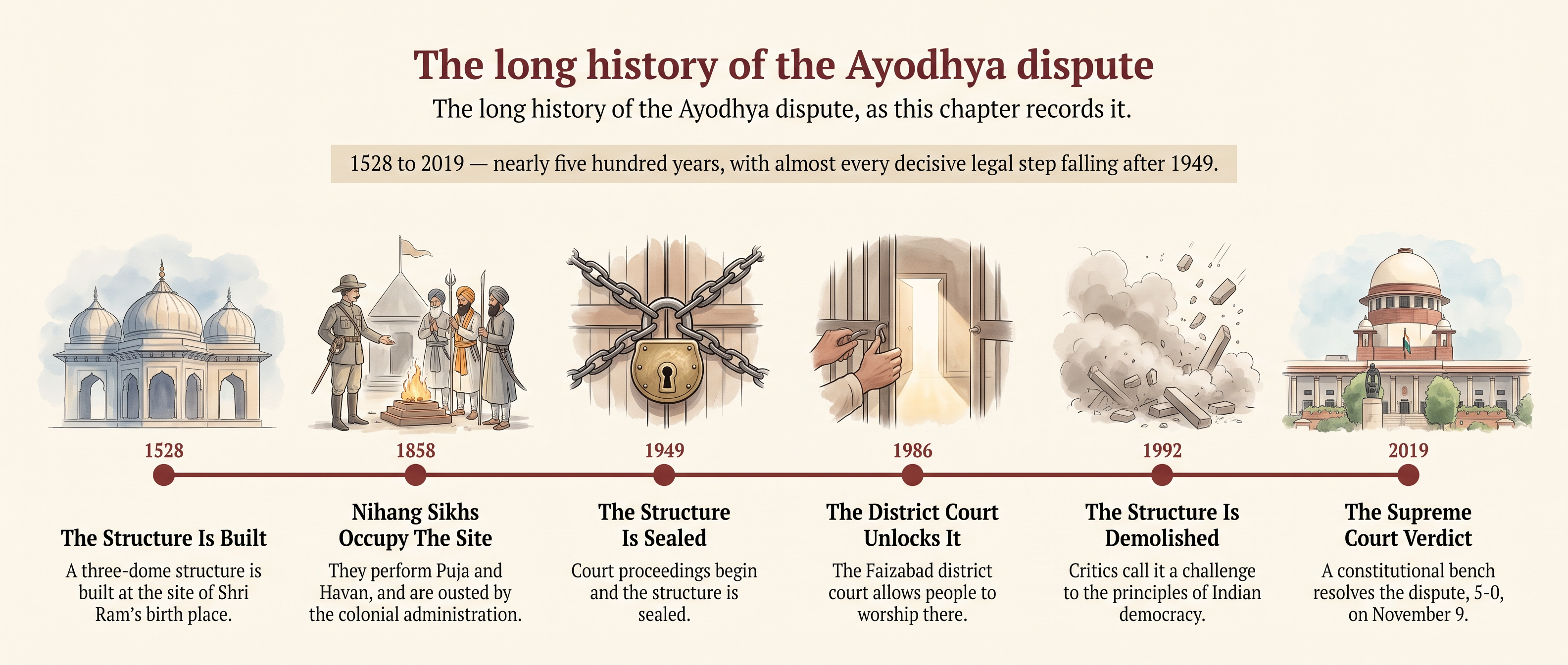
Fig. 8.15 – Five Centuries At One Site.
8.4.2 From Legal Proceedings To Amicable Acceptance
It is important to note that in any society conflicts are bound to take place. However, in a multi-religious and multi-cultural democratic society, these conflicts are usually resolved following the due process of law — that is, through the procedures the law itself lays down, in which every side is heard before a decision is made.
Through a number of democratic and legal procedures — court hearings, mediation attempts, popular movements, and finally a 5-0 verdict of a constitutional bench of the Supreme Court on November 9, 2019 — the Ayodhya issue was resolved. A constitutional bench is a bench of senior judges assembled to decide a question of constitutional importance; a 5-0 verdict means all five judges agreed. The verdict sought to reconcile the conflicting interests of the various stakeholders involved in the dispute.
The verdict allotted the disputed site to the Shri Ram Janmabhoomi Teertha Kshetra Trust for the construction of a Ram temple, and directed the concerned government to allot an appropriate site for the construction of a Mosque to the Sunni Central Waqf Board.
In this way, democracy gives room for conflict resolution in a plural society like ours, upholding the inclusive spirit of the Constitution. The issue was resolved following the due process of law, based on evidence such as archaeological excavations and historical records. The Supreme Court’s decision was celebrated by the society at large. The chapter reads it as a classic example of consensus building on a sensitive issue, showing the maturity of a democratic ethos that is civilisationally ingrained in India.
Reading The Judgment
The Court did not only decide who would hold the site. It also set down what the Constitution requires of every judge deciding such a case, and that passage is worth reading in the Court’s own words.
Read what the passage is doing. It is not making a claim about Ayodhya at all. It is stating the standard by which the Court says a case like this must be judged: that citizens of every faith stand in the same relation to the law, and that no religion’s belief ranks above another’s in a court. The judges are, in effect, telling the country what they are not permitted to do.
The limit is worth naming. A judgment records the reasoning a court is willing to state in public, and it settles a legal question. It cannot tell you how the parties felt about losing or winning, or whether the reasoning persuaded anyone outside the courtroom. And a passage of general principle, taken alone, does not tell you how the Court applied that principle to the facts. For that, you need the next extract.
This extract is a finding, not a principle. The Court is recording what it holds to have been established — that the faith and belief of Hindus, before and after the construction of the mosque, was that this site is the Janmaasthan of Lord Ram — and it is careful to say on what basis: documentary and oral evidence discussed earlier in the judgment.
Set the two extracts side by side and you can see how the Court worked. The first says that the law does not rank one faith above another. The second says that the existence of a belief, held over centuries, is a fact that can be proved by evidence like any other fact. A court can find that people believed something without ruling that the belief is true — and it is precisely that distinction that allows a secular court to decide a religious dispute.
What neither extract can settle is the question the chapter leaves open. A judgment can end a legal dispute. Whether it ends a political one, and what the Ram Janmabhoomi movement has left behind in the way Indians argue about secularism, is not a matter a court can rule on.
8.5 Emergence Of A New Consensus
The period after 1989 is sometimes seen simply as the period of the decline of the Congress and the rise of the BJP. That description is too neat. If you want to understand the complex nature of political competition in this period, you have to compare the electoral performances of the Congress and the BJP — and to compare them carefully, because seats and votes do not tell the same story.
Reading The Two Charts
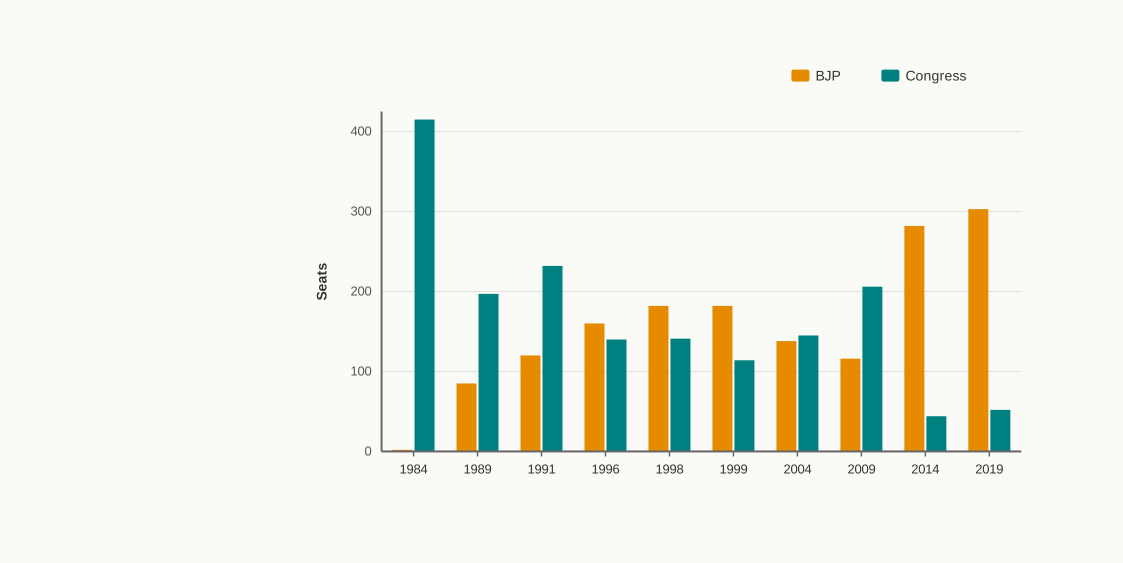
Fig. 8.16 – Party position in Lok Sabha, 1984 to 2019.
Read the two ends of the chart first. In 1984 the Congress held 415 seats and the BJP held 2. In 2019 the BJP held 303 and the Congress held 52. Between those two elections the two parties have, in effect, exchanged places.
Now read the middle, which is where the interesting part lies. The two lines of bars cross in 1996, when the BJP won 160 seats to the Congress’s 140. But the crossing is not final: in 2004 the Congress is again ahead, with 145 seats to the BJP’s 138, and in 2009 it is well ahead, with 206 to 116. Only from 2014 does the gap open decisively.
So the period is not one long slide for one party and one long climb for the other. It is a genuine competition, with the lead changing hands more than once.
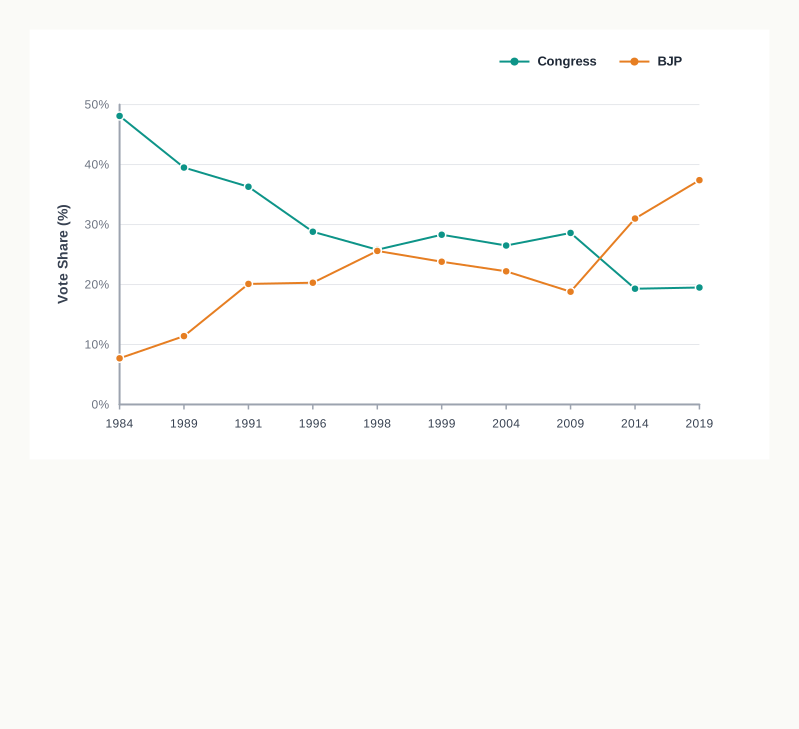
Fig. 8.17 – Vote share in Lok Sabha, 1984 to 2019.
The second chart counts something different, and it is the one students most often skip. Seats are won constituency by constituency; vote share is the percentage of all votes a party polls across the country. The two need not move together.
Look at what happens when you set them side by side. In 1984 the Congress won 415 seats with 48.1 per cent of the vote. In 2019 the BJP won 303 seats with 37.4 per cent, while the Congress polled 19.5 per cent. A party can therefore hold fewer votes than an earlier winner and still command a large majority of seats.
The chapter asks you to notice one more thing. Since the 1989 election, the votes polled by the two parties together add up, most of the time, to more than fifty per cent — except in 1996, 2004 and 2009. Turn that around and you see the point: in every one of these elections, something close to half the country voted for neither of them. A chart of two parties is, by design, a chart with most of India left out of it.
And here is the limit that governs both figures. They count seats and votes. They do not record a single reason. Nothing in these charts tells you why the Congress vote fell, or whether people who voted for the BJP were voting for Hindutva, for the new economic policies, for a leader, or against someone else. For reasons, you have to leave the chart and go back to the argument.
8.5.1 Lok Sabha Elections (2004-2019)
In the elections of 2004, the Congress party too entered into coalitions in a big way. The National Democratic Alliance (NDA) was defeated, and a new coalition government led by the Congress, known as the United Progressive Alliance (UPA), came to power. This government received support from the Left Front parties — support from outside, of the kind you met in section 8.2.
The elections of 2004 also witnessed the partial revival of the Congress party. It could increase its seats once again after 1991. But the contest was extremely close: in the 2004 elections there was a negligible difference between the votes polled by the Congress and its allies, and the BJP and its allies. The country changed governments on a very small margin.
Map
Map 8.1 Caption: Lok Sabha election results, 2004. Brief: Reproduce the printed map of India showing the 2004 Lok Sabha results by constituency, shaded in four categories — NDA, UPA, Left Parties, Others — with the legend as printed. Source: Election Commission of India. The map must show the full extent of India as officially defined by the Government of India, including Jammu and Kashmir and Ladakh, and no part of India may be shown as disputed or as belonging to another state. Carry NCERT’s printed note that the illustration is not drawn to scale and should not be taken as an authentic depiction of India’s external boundaries. Label nothing beyond the results shown.
The map is worth a slow look, because it shows something the seat totals hide. Neither alliance is confined to one part of the country, and yet neither sweeps the whole of it. Large blocks of constituencies fall to the Left Parties and to ‘Others’ — parties in neither national alliance. A national election, seen on a map, turns out to be a set of very different regional contests held on the same day.
What the map cannot tell you is the size of the margins. A constituency won by a hundred votes is shaded exactly like one won by a lakh. Nor can it show vote share: a party can colour a great deal of the map without polling the most votes overall.
From 2004 To 2019
The Congress-led UPA government completed its term, despite the Left parties withdrawing their support in July 2008 on the issue of the Indo-US nuclear deal. Elections for the 15th Lok Sabha were held in 2009. The results witnessed a rise in the number of seats of the Indian National Congress — from 145 in 2004 to 206 in 2009 — and the Congress-led UPA returned to office. Dr. Manmohan Singh was sworn in as Prime Minister for a second term, heading the coalition government of the UPA again.
The Bharatiya Janata Party declared Narendra Modi, then the Chief Minister of Gujrat, as its Prime Ministerial candidate in September 2013. The BJP under the leadership of Narendra Modi got a clear majority in the 16th Lok Sabha elections held in 2014. The BJP won 282 seats on its own, becoming the first party to gain a single-party majority after 30 years.
Read the next sentence carefully, because it is the one that surprises people. Despite having a single-party majority of its own, the BJP did choose to form the NDA government with its coalition partners. It did not need them to survive a vote — and it kept them anyway.
The year 2014 was a proverbial watershed moment in Indian politics. The Narendra Modi-led NDA government rapidly took decisions in the social sector, in foreign policy and in economic policy.
The BJP again emerged victorious, with 303 seats of its own, in the 2019 Lok Sabha election. Even when the BJP is getting a full majority, the recognition of coalition politics is still relevant. Thus the party system has now changed almost dramatically from what it was till the seventies.
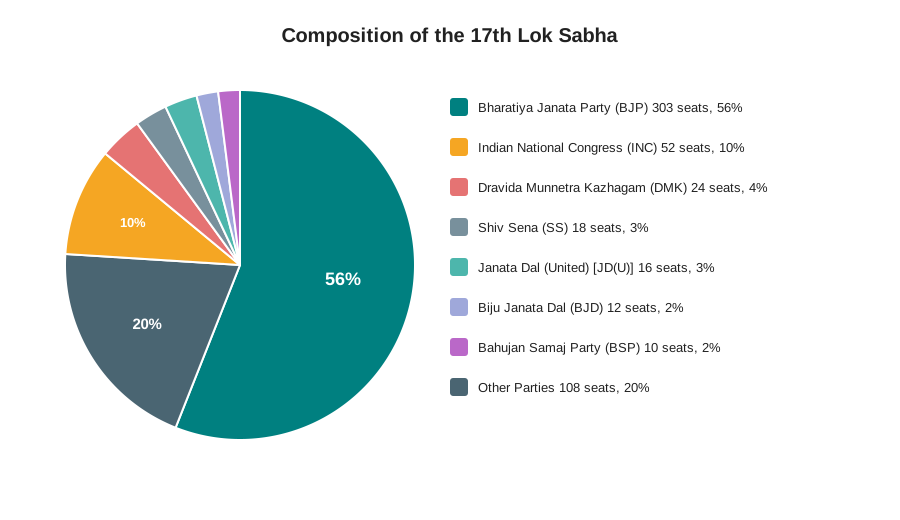
Fig. 8.18 – Party position in the 17th Lok Sabha.
The pie chart records the same fact from a different angle. One party holds 56 per cent of the seats — and the remaining 44 per cent is split among a long list of parties, of which 20 per cent of the House sits under the single label ‘Other Parties’. A clear majority for one party, and a Lok Sabha still crowded with many, are both true at once.
That is the limit of the chart, and it is a useful one to state. A pie shows the shares of a House; it cannot show how those parties behave, whether they cooperate, or how much of the vote each of them polled. ‘Other Parties’, taken as a wedge, is not a group at all — it is more than a hundred members who agree on nothing in particular.
Work On The Numbers Yourself
The chapter hands you the data and asks you to use it. This chapter covers the major developments in Indian politics until the 2004 elections, the 14th Lok Sabha. Subsequently, elections were held in 2009, in which the UPA led by the Congress won; and in the 2014 and 2019 elections the NDA led by the BJP emerged victorious. The position of the various parties in the 17th Lok Sabha is given in Fig. 8.18, and a detailed study of the Members of the 17th Lok Sabha is available on the website of the Lok Sabha, at http://loksabha.nic.in.
You are asked to compare and contrast the electoral performances of the various political parties since 2004. Table 8.2 is the data for that. You can also collect results from the website of the Election Commission of India, at http://eci.nic.in. Finally, prepare a timeline of the major political events in India since 2004, and share and discuss it in your classroom.
Total seats in the Indian Parliament: 543 — 530 from the States and 13 from the Union Territories.
Read the table row by row and one pattern jumps out. The parties that rise and fall most sharply are not the two national parties but the State-level ones: the AIADMK moves from 9 seats to 37 and back to 1; the DMK from 18 to none to 24; the RJD from 24 down to nothing. Regional fortunes swing violently, and the composition of every alliance at the Centre depends on those swings.
The table counts seats in four elections and nothing else. It cannot tell you which of these parties were allies in which year, how many votes any of them polled, or whether a party that vanished from the table had lost its voters or merely lost its seats under a system where the runner-up in a constituency wins nothing.
8.5.2 Growing Consensus
However, on many crucial issues, a broad agreement has emerged among most parties. This is the argument that closes the chapter, and it is a surprising one: in the midst of severe competition and many conflicts, a consensus — a broad agreement that most parties accept, even while they fight each other for power — appears to have emerged. It consists of four elements.
First, agreement on new economic policies. While many groups are opposed to the new economic policies, most political parties are in support of them. Most parties believe that these policies would lead the country to prosperity and to a status of economic power in the world.
Second, acceptance of the political and social claims of the backward castes. Political parties have recognised that the social and political claims of the backward castes need to be accepted. As a result, all political parties now support reservation of seats for the ‘backward classes’ in education and employment. Political parties are also willing to ensure that the OBCs get an adequate share of power. You saw this happen in section 8.3: a decision that brought cities to a halt in 1990 is now opposed by nobody.
Third, acceptance of the role of State level parties in governance of the country. The distinction between State level and national level parties is fast becoming less important. As we saw in this chapter, State level parties are sharing power at the national level, and have played a central role in the country’s politics of the last twenty years or so.
Fourth, emphasis on pragmatic considerations rather than ideological positions, and political alliances without ideological agreement. Coalition politics has shifted the focus of political parties from ideological differences to power sharing arrangements. Thus, most parties of the NDA did not agree with the ‘Hindutva’ ideology of the BJP. Yet they came together to form a government, and remained in power for a full term.
Where This Leaves Us
All these are momentous changes, and they are going to shape politics in the near future. We started this study of politics in India with the discussion of how the Congress emerged as a dominant party. From that situation, we have now arrived at a more competitive politics — but a politics that rests on a certain implicit agreement among the main political actors.
The parties, though, are not the only actors. Even as political parties act within the sphere of this consensus, popular movements and organisations are simultaneously identifying new forms, new visions and new pathways of development. Issues like poverty, displacement, minimum wages, livelihood and social security are being put on the political agenda by peoples’ movements, reminding the state of its responsibility.
Similarly, issues of justice and democracy are being voiced by people in terms of class, caste, gender and regions. So the consensus among parties does not end the argument. It moves it outside the party system, into the movements — which is exactly where the next set of political demands is being written.
We cannot predict the future of democracy. All we know is that democratic politics is here to stay in India, and that it will unfold through a continuous churning of some of the factors mentioned in this chapter.
Before you leave this chapter, the book sets you one last discussion. Around the time of India’s Independence, many other countries also became independent and adopted democracy. India emerged as a mature democracy, playing a great role in promoting social equality and national development, while in some of those countries this has not been the case. Discuss amongst yourselves the factors that have enabled democracy to thrive in India.
Two reminders of what that democracy asks of a citizen are printed at the close of the chapter.
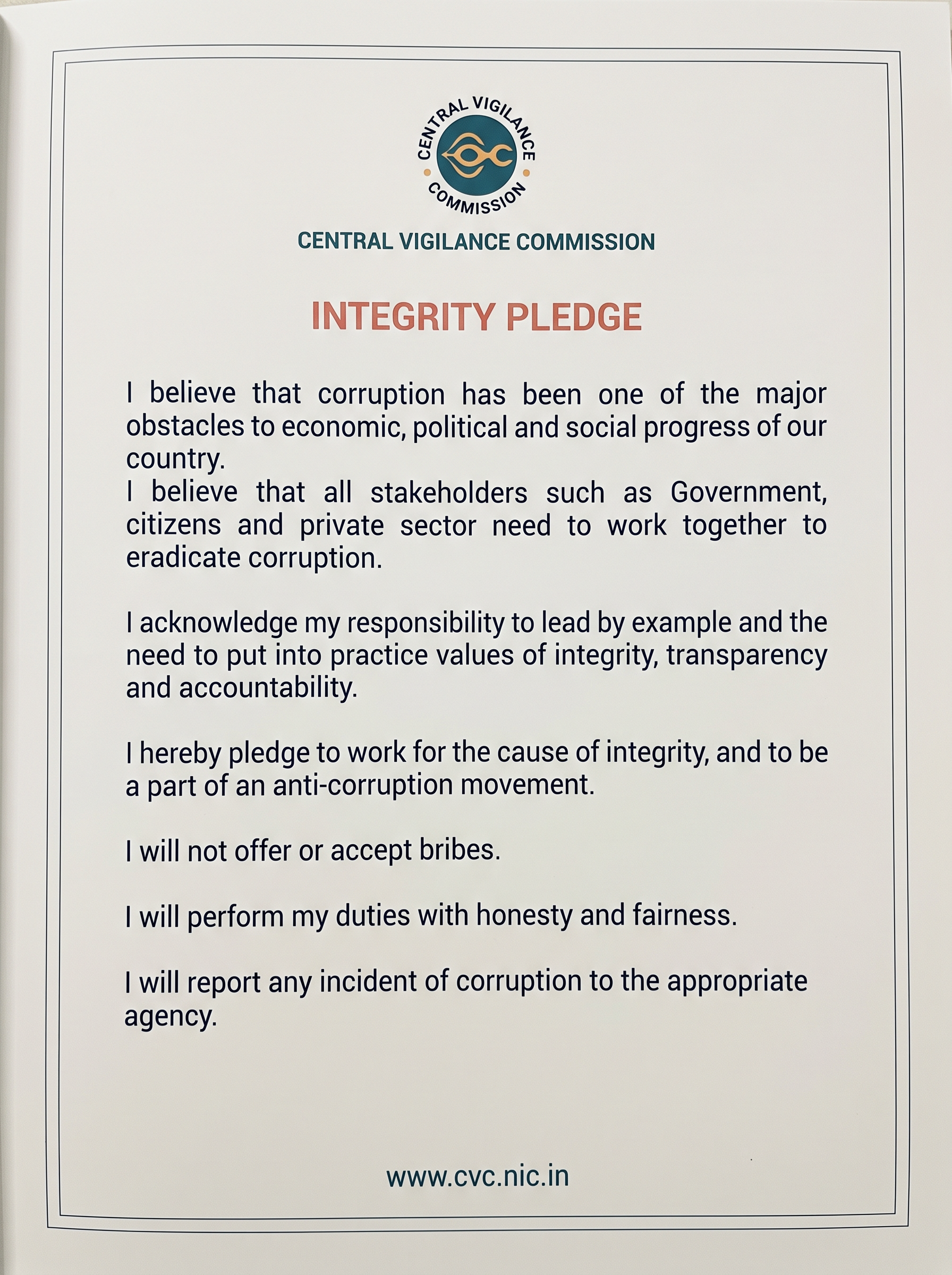
Fig. 8.19 – The Integrity Pledge.

Fig. 8.20 – How to cast your vote.
Everything in this chapter — the coalitions, the Mandal argument, the Ayodhya verdict, the new consensus — was decided by governments that exist because of what happens in that small compartment. The last picture in the book is a set of instructions for the one act on which all the rest depends.
8.6 Summary
What This Chapter Established
- As the eighties closed, five developments reshaped Indian politics: the defeat of the Congress in 1989, the rise of the Mandal issue, a new economic direction, the Ayodhya dispute entering national politics, and the assassination of Rajiv Gandhi in May 1991.
- The Congress fell from 415 seats in 1984 to 197 in 1989. It returned to office in 1991, but it never regained its old centrality. That is what is meant by the end of the ‘Congress system’.
- No single party replaced it. From 1989 till 2014, no party won a clear majority in a Lok Sabha election, and every government at the Centre was a coalition or a minority government kept alive by parties that would not join it.
- The alliances were built on arithmetic, not agreement. In 1989 the BJP and the Left supported the National Front to keep the Congress out; in 1996 the Congress and the Left supported the United Front to keep the BJP out.
- The Vajpayee government formed in 1999 was the first of this era to complete a full term. In 2014 and 2019 the BJP won a clear majority on its own — and still governed with its NDA partners.
- The Other Backward Classes rose as a political force. The Mandal Commission, appointed in 1978, recommended in 1980 that 27 per cent of educational seats and government jobs be reserved for them.
- The National Front’s decision of August 1990 to act on that recommendation set off violent protests, a national debate, and a challenge in the Supreme Court, which upheld the decision in the Indira Sawhney case in November 1992.
- The debate itself sharpened OBC identity and made these communities easier to mobilise, giving rise to parties that demanded jobs, education and a due share of political power.
- Dalit politics organised separately. BAMCEF, formed in 1978, led on to the Bahujan Samaj Party under Kanshi Ram, which broke through in Uttar Pradesh in 1989 and 1991. In many States, Dalit and OBC politics compete rather than combine.
- Politics based on religious identity became visible, and opened a debate about secularism and democracy. The BJP, formed in 1980, emphasised nationalism after 1986 and pursued the politics of Hindutva.
- The Shah Bano case of 1985, and the law of 1986 that nullified the Supreme Court’s judgement, drew courts, Parliament and religious tradition into a single dispute that no side won.
- The Ayodhya dispute, running from 1528, was resolved through the due process of law: a 5-0 verdict of a constitutional bench of the Supreme Court on November 9, 2019, allotting the site to the Shri Ram Janmabhoomi Teertha Kshetra Trust and directing the government to allot a site for a Mosque to the Sunni Central Waqf Board.
- Beneath the competition, a consensus grew on four things: the new economic policies, the claims of the backward castes, the role of State-level parties at the Centre, and alliances built on power sharing rather than ideology.
- Seats and votes tell different stories. The Congress won 415 seats with 48.1 per cent of the vote in 1984; the BJP won 303 seats with 37.4 per cent in 2019 — and in most elections since 1989, close to half the country voted for neither party.
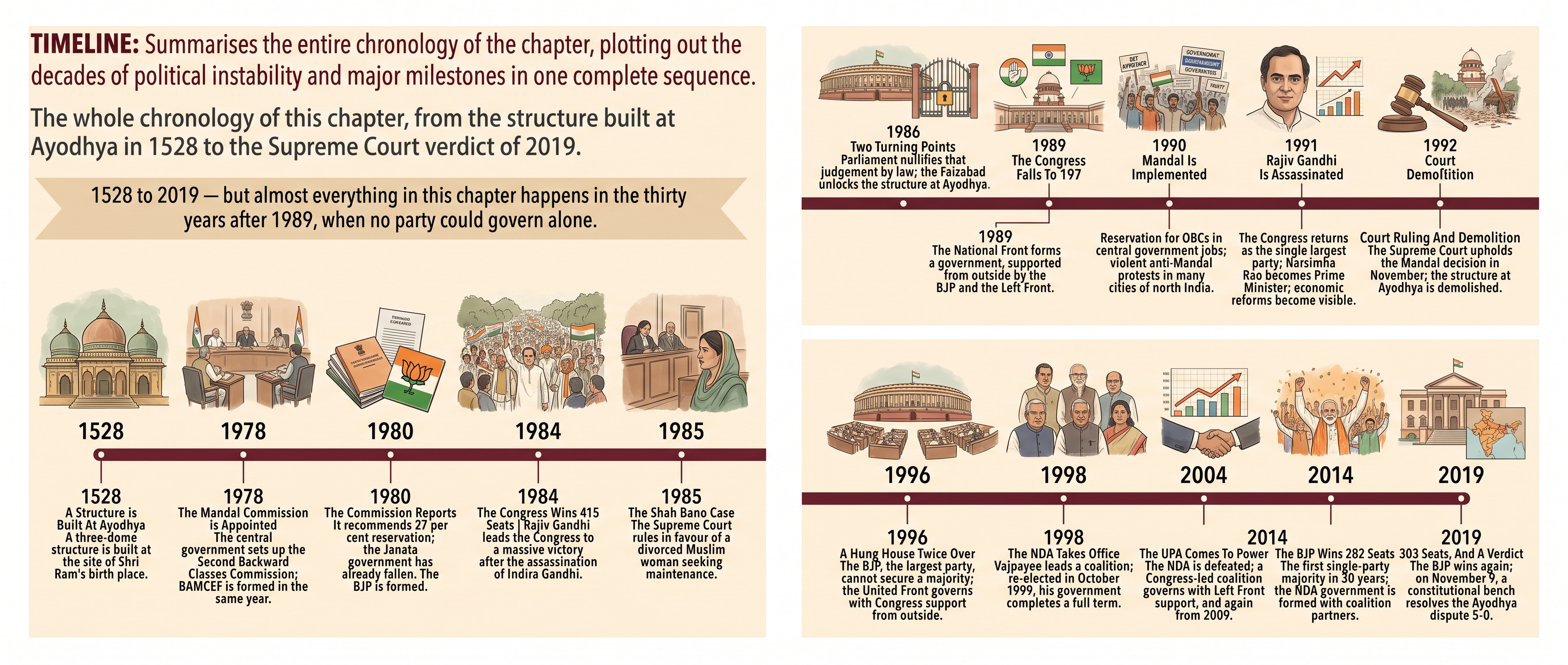
Fig. 8.21 – The Chapter In One Sequence.
8.7 NCERT Questions
Unscramble a bunch of disarranged press clippings from Unni-Munni’s file, and arrange them in chronological order.
- Implementation of the recommendation of the Mandal Commission
- Formation of the Janata Dal
- Supreme Court Judgment on the Ram Janmabhoomi
- Assassination of Indira Gandhi
- The formation of NDA government
- Formation of the UPA government
Match the following.
Column A Column B a. Politics of Consensus i. Shah Bano case b. Caste based parties ii. Rise of OBCs c. Personal Law and Gender Justice iii. Coalition government d. Growing strength of Regional parties iv. Agreement on Economic policies State the main issues in Indian politics in the period after 1989. What different configurations of political parties did these differences lead to?
‘In the new era of coalition politics, political parties are not aligning or re-aligning on the basis of ideology.’ What arguments would you put forward to support or oppose this statement?
Trace the emergence of the BJP as a significant force in post-Emergency politics.
In spite of the decline of Congress dominance, the Congress party continues to influence politics in the country. Do you agree? Give reasons.
Many people think that a two-party system is required for successful democracy. Drawing from India’s experience of the last 30 years, write an essay on what advantages the present party system in India has.
Read the passage and answer the questions below: Party politics in India has confronted numerous challenges. Not only has the Congress system destroyed itself, but the fragmentation of the Congress coalition has triggered a new emphasis on self-representation which raises questions about the party system and its capacity to accommodate diverse interests, …. . An important test facing the polity is to evolve a party system or political parties that can effectively articulate and aggregate a variety of interests. — Zoya Hasan
- Write a short note on what the author calls the challenges of the party system, in the light of what you have read in this chapter.
- Give an example from this chapter of the lack of accommodation and aggregation mentioned in this passage.
- Why is it necessary for parties to accommodate and aggregate a variety of interests?
8.8 Check Your Concepts
- Explain what it means for a party to support a government ‘from outside’. Why did the National Front need such support in 1989, and who gave it?
- In 1989 the BJP and the Left Front both supported the National Front; in 1996 the Congress and the Left both supported the United Front. What does this pair of facts tell you about the basis on which alliances were formed in this period?
- Look again at Fig. 8.8. What claim is the cartoonist making about outside support, and how does the drawing make that claim? State one thing the cartoon cannot tell you.
- Using Fig. 8.16 and Fig. 8.17 together, explain how a party can win far more seats than an earlier winner while polling a smaller share of the votes. Refer to 1984 and 2019 in your answer.
- Reconstruct the chain of events and effects that runs from the National Front’s decision of August 1990 to the emergence of parties demanding a due share of political power for the OBCs.
- Source 8.1 and Source 8.2 come from the same judgment but do different kinds of work. Explain the difference between them, and say why a court can find that a belief has long existed without ruling on whether the belief is true.
- Using Table 8.2, describe how the seat counts of two State-level parties changed between 2004 and 2019. Explain why such swings mattered for the formation of governments at the Centre in this period.
- The chapter argues that a consensus has emerged among most parties on four issues, and it also records that many groups and movements oppose the new economic policies. Does agreement among parties amount to agreement in the country? Give reasons for your answer.