Chapter 3: Plant Kingdom
In the 1700s, a Swedish botanist named Carl Linnaeus set out to bring order to the plant world. Plants had names that differed from village to village and country to country, and no two botanists seemed to agree on how they were related. Linnaeus needed a rule that anyone, anywhere, could apply.
His solution was surprisingly bold for its time: he sorted plants by counting the parts inside their flowers — chiefly the stamens, the pollen-bearing organs. Two stamens, one group. Five stamens, another. It was simple, repeatable, and it worked well enough that botanists across Europe adopted it almost overnight. Linnaeus also gave us the two-word naming system we still use today, such as Homo sapiens for humans.
Yet his flower-counting system had a hidden flaw. By resting on just one or two features, it forced apart plants that were actually close relatives and lumped together plants that were not. A cactus and a poppy might land in the same group simply because they shared a stamen count. Botanists slowly realised that a few surface features could not capture true kinship — and that realisation launched centuries of rethinking about how living things should be grouped.
This chapter continues that story. It walks through the great divisions of the plant kingdom — algae, bryophytes, pteridophytes, gymnosperms and angiosperms — and shows how each group represents a step in the long journey of plants from water onto land.
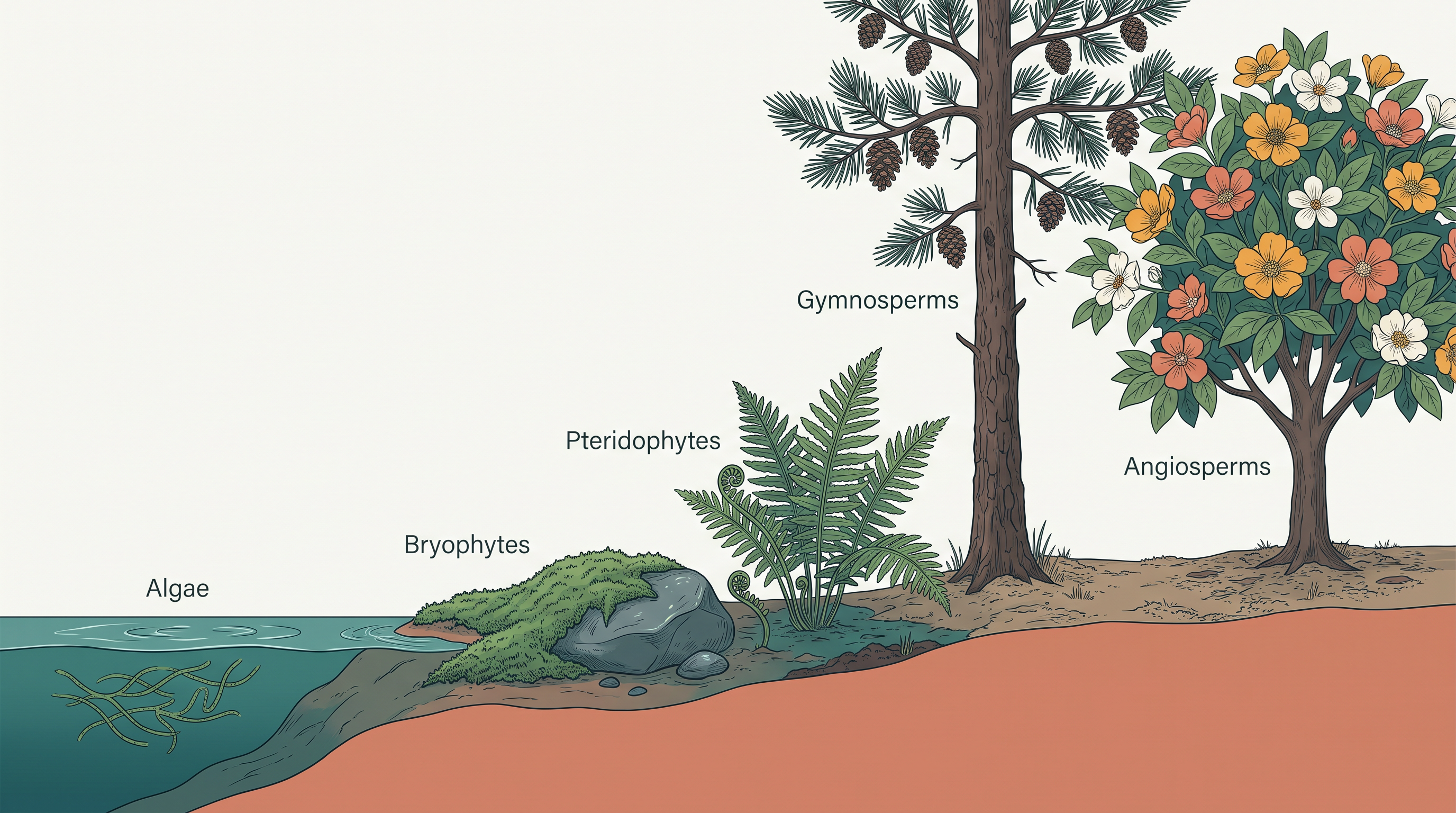
Fig. 3.0 – Evolutionary sequence of the five major plant groups.
You will be able to answer each of these questions by the time you finish this chapter.
3.1 Algae
Algae are among the simplest members of the plant kingdom. They are chlorophyll-bearing, which means they carry the green pigment used to trap sunlight and make their own food, so they are autotrophic — self-feeding organisms that do not depend on others for nutrition. Their body is thalloid, meaning it is a simple thallus: an undivided plant body with no true roots, stems or leaves.
Most algae are aquatic and live in both fresh water and the sea, but they also turn up in many other places — on moist stones, in soil, and on wood. Some even live in partnership with other organisms: in association with fungi they form lichens, and a few grow on animals, such as on the fur of the sloth bear.
The size and shape of algae vary enormously. Some are tiny colonial forms like Volvox, some are thread-like (filamentous) forms such as Ulothrix and Spirogyra, and a few marine forms, the kelps, grow into massive plant bodies. This range of forms is shown in Fig. 3.1.
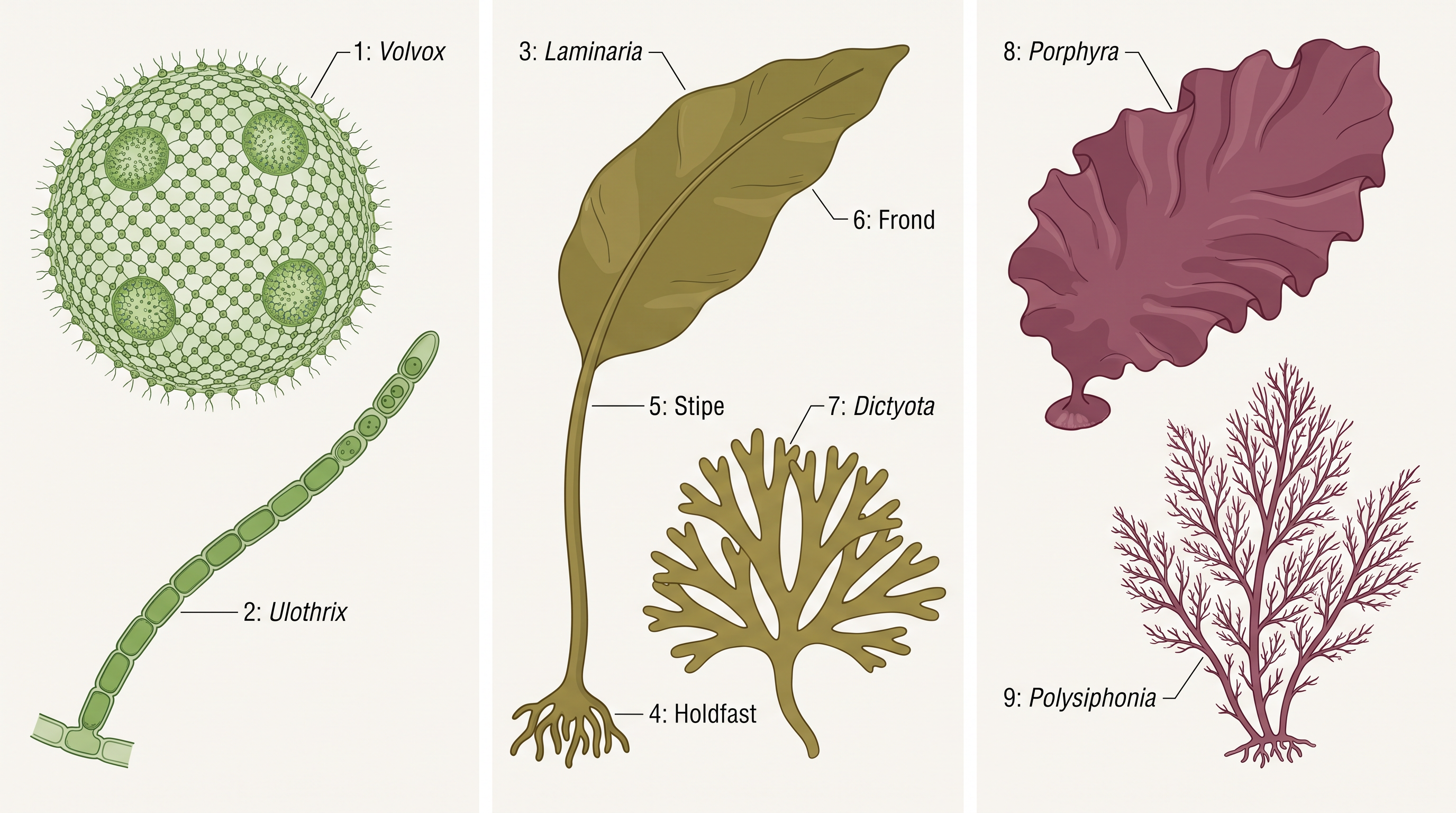
Fig. 3.1 – Representative algae: (a) green, (b) brown and (c) red.
How Algae Reproduce
Algae reproduce in three ways — by vegetative, asexual and sexual methods. The overall picture is summarised in FC 3.1.
Flowchart
FC 3.1 – Reproduction in algae: Reproduction → branches into three: (vegetative → fragmentation → each fragment grows into a new thallus); (asexual → formation of spores, most commonly flagellated zoospores → germinate → new plant); (sexual → fusion of two gametes → isogamous / anisogamous / oogamous).
In vegetative reproduction, the body simply breaks into pieces by fragmentation, and each fragment grows into a complete new thallus. In asexual reproduction, the alga produces different kinds of spores; the most common are zoospores, which are flagellated and therefore motile, and on germination each gives rise to a new plant.
In sexual reproduction, two gametes (the sex cells) fuse. The nature of these gametes differs from one alga to another, and this gives us three named patterns. When the two fusing gametes look alike in size — whether both are flagellated and motile (as in Ulothrix) or both non-flagellated and non-motile (as in Spirogyra) — the process is isogamous. When the two gametes differ in size, as in species of Eudorina, it is anisogamous. When a large, non-motile (static) female gamete fuses with a small, motile male gamete, as in Volvox and Fucus, it is oogamous.
Why Algae Matter
Algae are useful to humans in many ways, but their greatest importance is ecological. At least half of all the carbon dioxide fixed on Earth is taken up by algae during photosynthesis. Because they photosynthesise, they also raise the level of dissolved oxygen in the water around them.
Above all, algae are primary producers — they build the energy-rich compounds that form the base of the food chains of all aquatic animals. In other words, most life in water ultimately depends on the food that algae make.
Algae also serve us directly. Many species of Porphyra, Laminaria and Sargassum are among the roughly 70 species of marine algae used as food. Certain marine brown and red algae make large amounts of hydrocolloids — water-holding substances — such as algin (from brown algae) and carrageen (from red algae), both used commercially. Agar, obtained from Gelidium and Gracilaria, is used to grow microbes in the laboratory and to prepare ice-creams and jellies. Chlorella, a unicellular alga rich in protein, is used as a food supplement, even by space travellers.
On the basis of their pigments, stored food and cell wall, the algae are divided into three main classes: Chlorophyceae, Phaeophyceae and Rhodophyceae.
3.1.1 Chlorophyceae
The members of Chlorophyceae are commonly called green algae. Their plant body may be unicellular, colonial or filamentous. They are usually grass-green because the pigments chlorophyll a and chlorophyll b dominate.
These pigments are held inside definite chloroplasts — the cell organelles where photosynthesis happens. The chloroplast can take many shapes in different species: discoid, plate-like, reticulate (net-like), cup-shaped, spiral or ribbon-shaped.
Most green algae have one or more storage bodies called pyrenoids inside their chloroplasts. Pyrenoids store protein along with starch. Some green algae store food instead as oil droplets. Their cell wall is rigid, with an inner layer of cellulose and an outer layer of pectose.
Reproduction in green algae
Vegetative reproduction usually takes place by fragmentation. Asexual reproduction is by flagellated zoospores produced inside zoosporangia (the sacs in which zoospores form). Sexual reproduction varies greatly in the type and formation of the sex cells and may be isogamous, anisogamous or oogamous. Some commonly found green algae are Chlamydomonas, Volvox, Ulothrix, Spirogyra and Chara (Fig. 3.1a).
3.1.2 Phaeophyceae
The members of Phaeophyceae, or brown algae, are found mainly in marine (sea) habitats. They show great variation in size and form, ranging from simple branched, filamentous forms such as Ectocarpus to the profusely branched kelps, which may reach a height of 100 metres.
Brown algae possess chlorophyll a, chlorophyll c, carotenoids and xanthophylls. Their colour ranges from olive-green to various shades of brown, depending on how much of the xanthophyll pigment fucoxanthin is present. Food is stored as complex carbohydrates, either as laminarin or as mannitol.
The vegetative cells have a cellulose wall usually covered on the outside by a gelatinous coating of algin. Inside, the protoplast contains plastids, a centrally placed vacuole and a nucleus.
The brown-algal body has a clear division of parts, best seen in the larger forms. It is attached to the surface it grows on by a holdfast, bears a stalk called the stipe, and carries a leaf-like photosynthetic organ called the frond.
Vegetative reproduction is by fragmentation. In most brown algae, asexual reproduction is by biflagellate zoospores that are pear-shaped and carry two unequal flagella attached laterally (on the side). Sexual reproduction may be isogamous, anisogamous or oogamous. The gametes may fuse in the water or, in oogamous species, within the oogonium (the female sex organ). The gametes are pyriform (pear-shaped) and bear two laterally attached flagella. Common brown algae include Ectocarpus, Dictyota, Laminaria, Sargassum and Fucus (Fig. 3.1b).
3.1.3 Rhodophyceae
The members of Rhodophyceae are commonly called red algae, named for the dominance of the red pigment r-phycoerythrin in their bodies. Most red algae are marine, and they are especially common in warmer waters. They are found both in well-lit regions near the water’s surface and at great depths in the ocean, where very little light reaches.
The red thalli of most red algae are multicellular, and some have a complex body organisation. Food is stored as floridean starch, which is very similar in structure to amylopectin and glycogen.
Red algae usually reproduce vegetatively by fragmentation. They reproduce asexually by non-motile spores and sexually by non-motile gametes. Their sexual reproduction is oogamous and is followed by complex post-fertilisation developments. Common red algae include Polysiphonia, Porphyra (Fig. 3.1c), Gracilaria and Gelidium.
Comparing the three classes
The pigments, stored food, cell wall, flagella and habitat of the three classes are compared in Table 3.1.
Table 3.1 Divisions of Algae and their Main Characteristics
| Classes | Common Name | Major Pigments | Stored Food | Cell Wall | Flagellar Number and Position of Insertions | Habitat |
|---|---|---|---|---|---|---|
| Chlorophyceae | Green algae | Chlorophyll a, b | Starch | Cellulose | 2–8, equal, apical | Fresh water, brackish water, salt water |
| Phaeophyceae | Brown algae | Chlorophyll a, c, fucoxanthin | Mannitol, laminarin | Cellulose and algin | 2, unequal, lateral | Fresh water (rare), brackish water, salt water |
| Rhodophyceae | Red algae | Chlorophyll a, d, phycoerythrin | Floridean starch | Cellulose, pectin and poly sulphate esters | Absent | Fresh water (some), brackish water, salt water (most) |
In NEET and board papers, this section is most often tested through match-the-following (alga → class, or product → source alga), “differentiate between red and brown algae,” and assertion–reason items on pigments, stored food and the iso/aniso/oogamy series, so it is worth learning Table 3.1 column by column.
3.2 Bryophytes
Bryophytes are the mosses and liverworts — small green plants you often see growing in moist, shaded spots, especially in the hills (Fig. 3.2). They are a step more advanced than algae, yet they still live tied to damp places.
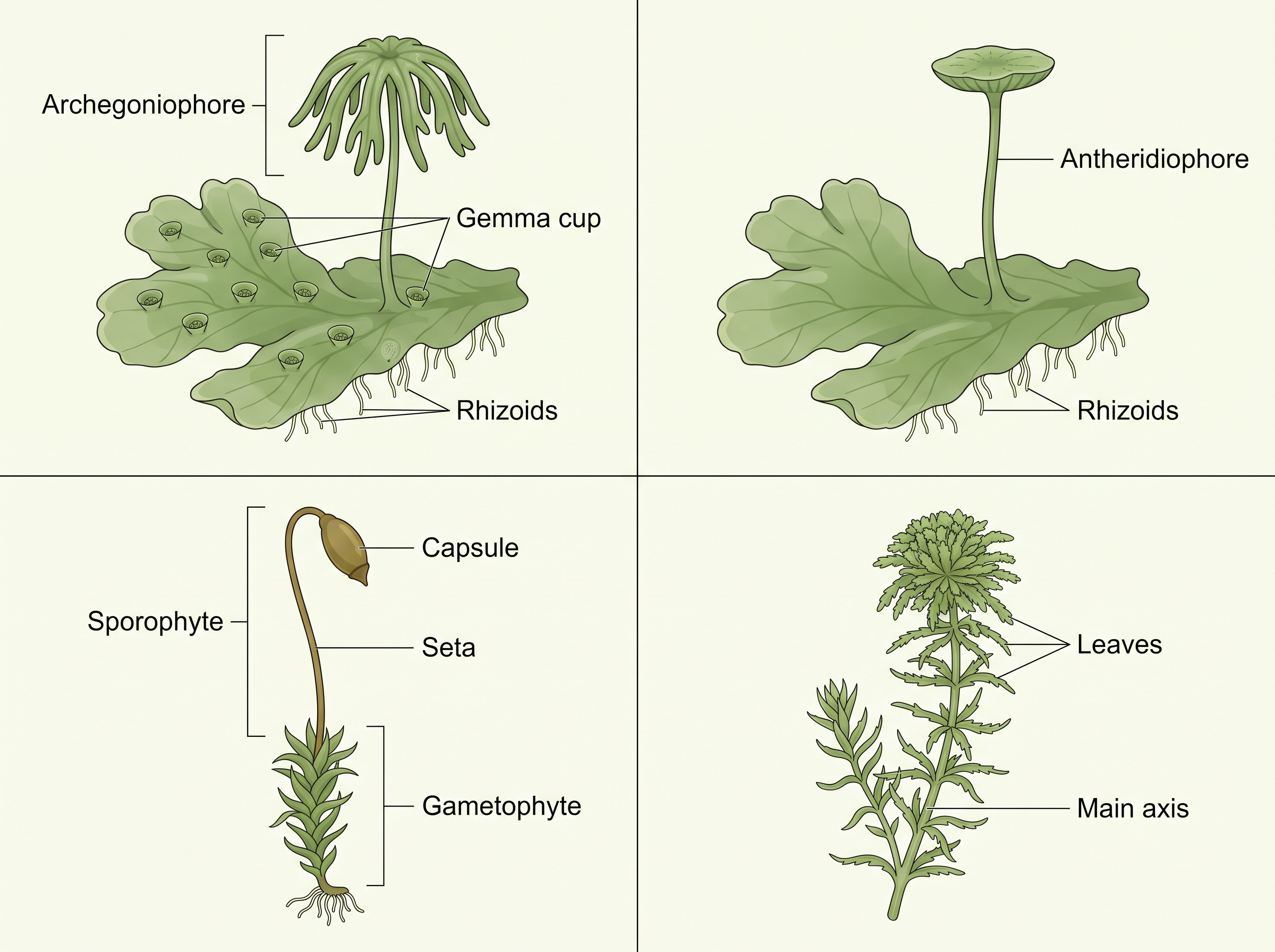
Fig. 3.2 – Bryophytes: (a, b) Marchantia, (c) Funaria and (d) Sphagnum.
Amphibians of the Plant Kingdom
Bryophytes are often called the amphibians of the plant kingdom. Just as amphibians such as frogs live on land but must return to water to breed, bryophytes can live in soil but still depend on water for sexual reproduction. This is why they are usually found in damp, humid and shaded localities.
They also play an important role in plant succession — the gradual, step-by-step process by which plants colonise and take over bare land. On bare rock and raw soil, bryophytes are among the earliest settlers, preparing the ground for other plants to follow.
The Bryophyte Body
The plant body of a bryophyte is more differentiated than that of algae, but it is still simple. It is thallus-like, lying flat (prostrate) or standing upright (erect), and is fixed to the surface it grows on (the substratum) by rhizoids — thread-like structures that may be unicellular or multicellular.
Bryophytes lack true roots, stems and leaves. They may have root-like, leaf-like or stem-like structures, but these are not true organs because they do not have the internal tissues that real roots, stems and leaves possess.
The main plant body of a bryophyte is haploid — it carries only a single set of chromosomes (n). Because this body produces gametes (sex cells), it is called a gametophyte.
Sexual Reproduction and the Sporophyte
The sex organs of bryophytes are multicellular, unlike the single-celled sex organs of many algae. The male sex organ is the antheridium, which produces biflagellate (two-flagellum) male gametes called antherozoids. The female sex organ is the archegonium, which is flask-shaped and produces a single egg.
At the time of fertilisation, the antherozoids are released into water, where they swim until they reach an archegonium. One antherozoid fuses with the egg to form the zygote — the first cell of the new generation.
The zygote does not divide by reduction division straight away. Instead, it grows into a multicellular body called the sporophyte. This sporophyte is not free-living: it stays attached to the photosynthetic gametophyte and draws its nourishment from it.
Some cells of the sporophyte then undergo reduction division (meiosis) — the type of cell division that halves the chromosome number — to produce haploid spores. These spores germinate to grow into new gametophytes, and the cycle begins again. The whole alternating cycle is shown in FC 3.2.
Flowchart
FC 3.2 – Bryophyte life cycle (alternation of generations): gametophyte (n) → produces antherozoids and egg → antherozoid swims through water and fertilises egg → zygote (2n) → grows into sporophyte (2n, attached to gametophyte) → some cells undergo meiosis → haploid spores (n) → germinate → back to gametophyte (n).
Economic and Ecological Importance
Bryophytes are, on the whole, of little direct economic importance, but they are not useless. Some mosses provide food for plant-eating mammals, birds and other animals. Species of Sphagnum, a moss, provide peat, which has long been used as fuel and as packing material for shipping living material over long distances, because peat can hold a great deal of water.
Their ecological role is far more important. Mosses, together with lichens, are among the first organisms to colonise bare rock, so they carry great ecological value. They slowly break down the rock and make the surface fit for higher plants to grow. Because mosses form dense mats over the soil, they soften the impact of falling rain and help prevent soil erosion.
On the basis of their body form, the bryophytes are divided into liverworts and mosses.
3.2.1 Liverworts
Liverworts usually grow in moist, shady places — the banks of streams, marshy ground, damp soil, tree bark and deep inside woods. The plant body of a liverwort is thalloid, as in Marchantia. The thallus is dorsiventral (it has distinct upper and lower surfaces) and lies closely pressed (appressed) against the surface it grows on. The leafy kinds of liverworts bear tiny leaf-like appendages arranged in two rows on their stem-like structures.
Reproduction in liverworts
Asexual reproduction takes place either by fragmentation of the thalli or by special structures called gemmae (singular: gemma). Gemmae are green, multicellular, asexual buds that form in small cup-like receptacles called gemma cups, which sit on the thallus. Once a gemma detaches from the parent, it germinates and grows into a new plant.
During sexual reproduction, the male and female sex organs are produced either on the same thallus or on separate thalli. The sporophyte formed after fertilisation is differentiated into three parts — a foot, a seta and a capsule. After meiosis, spores form inside the capsule, and these spores germinate to give free-living gametophytes.
3.2.2 Mosses
In mosses, the gametophyte is again the main stage of the life cycle, and it passes through two stages. The first is the protonema stage, which grows directly from a spore. It is a creeping, green, branched and often filamentous (thread-like) stage.
The second is the leafy stage, which arises from the secondary protonema as a side bud (lateral bud). It consists of upright, slender axes bearing spirally arranged leaves, and it is fixed to the soil by multicellular, branched rhizoids. This leafy stage carries the sex organs.
Vegetative reproduction in mosses is by fragmentation and by budding in the secondary protonema. In sexual reproduction, the sex organs — antheridia and archegonia — are produced at the tips of the leafy shoots. After fertilisation, the zygote develops into a sporophyte made of a foot, seta and capsule. This sporophyte is more elaborate than that of liverworts. The capsule holds spores, which are formed after meiosis, and mosses have an elaborate mechanism for dispersing these spores. Common examples of mosses are Funaria, Polytrichum and Sphagnum (Fig. 3.2).
Comparing liverworts and mosses
In exams, this section is commonly tested through “why are bryophytes called amphibians,” ploidy questions (gametophyte n vs sporophyte, spores n), diagram-labelling of Funaria and Marchantia, sequence-ordering of the life cycle, and match-the-following linking a plant to its group.
3.3 Pteridophytes
The pteridophytes are the horsetails and ferns. People use them for medicinal purposes and as soil-binders, and many are grown as ornamental (decorative) plants. Their real importance, though, is evolutionary: pteridophytes are the first terrestrial (land) plants to possess vascular tissues — the special conducting tissues xylem and phloem. Xylem carries water and minerals upward, while phloem carries food; you will study both in detail in Chapter 6.
Pteridophytes are found in cool, damp, shady places, although some grow well in sandy soil. You can see representative pteridophytes in Fig. 3.3.
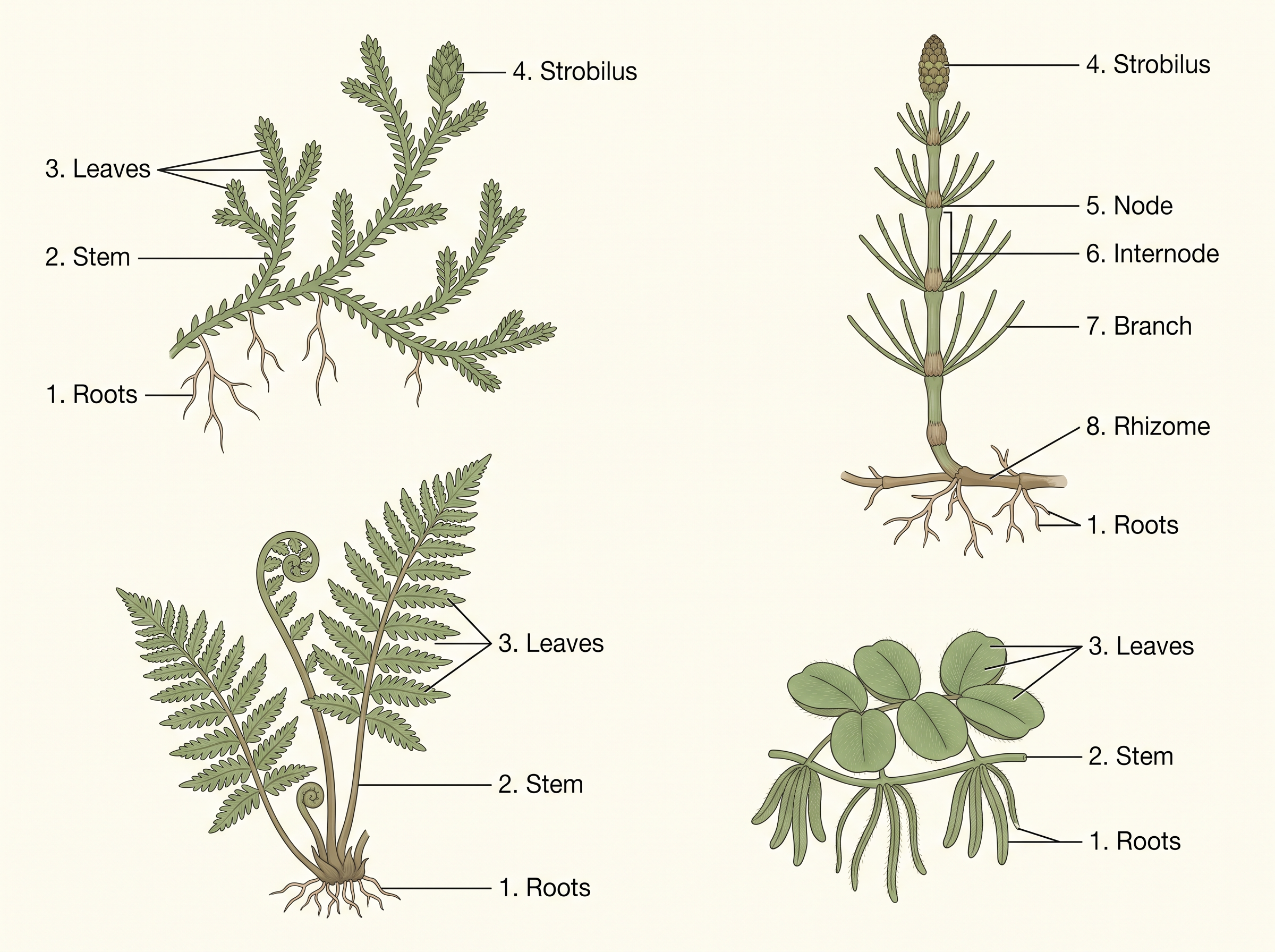
Fig. 3.3 – Pteridophytes: (a) Selaginella, (b) Equisetum, (c) fern and (d) Salvinia.
The Sporophyte Takes Over
Recall that in bryophytes the dominant phase of the life cycle was the gametophyte. In pteridophytes, the situation flips: the main plant body is the sporophyte, and it is now differentiated into true root, stem and leaves (Fig. 3.3). These organs contain well-developed vascular tissues.
The leaves of pteridophytes may be small — called microphylls, as in Selaginella — or large, called macrophylls, as in ferns. The sporophytes bear sporangia (spore sacs), which are borne on leaf-like appendages called sporophylls. In some plants the sporophylls group together into distinct compact structures called strobili or cones, as in Selaginella and Equisetum.
Inside the sporangia, special spore mother cells divide by meiosis to produce spores. Each spore then germinates into a small, inconspicuous, multicellular, free-living and mostly photosynthetic thalloid gametophyte called a prothallus.
From Prothallus to New Sporophyte
The prothallus needs cool, damp, shady places to survive. Because of this narrow requirement — and because they still need water for fertilisation — living pteridophytes are limited in where they can spread, and are confined to narrow geographical regions.
The prothallus bears the male and female sex organs, called antheridia and archegonia respectively. Water is required to carry the antherozoids — the male gametes released from the antheridia — to the mouth of the archegonium. When a male gamete fuses with the egg inside the archegonium, a zygote is formed. The zygote then grows into a multicellular, well-differentiated sporophyte, which is the dominant phase of the pteridophyte life cycle. The full cycle is shown in FC 3.3.
Flowchart
FC 3.3 – Pteridophyte life cycle: dominant sporophyte (2n) → sporangia on sporophylls → spore mother cells undergo meiosis → spores (n) → germinate → prothallus/gametophyte (n) → antheridia (antherozoids) and archegonia (egg) → antherozoid swims through water to egg → fertilisation → zygote (2n) → grows into dominant sporophyte (2n).
Homospory, Heterospory and the Seed Habit
In most pteridophytes, all the spores are of one similar kind; such plants are called homosporous. But a few genera, such as Selaginella and Salvinia, produce two different kinds of spores — large macrospores (megaspores) and small microspores — and these are called heterosporous.
In heterosporous plants, the megaspores and microspores germinate to give female and male gametophytes respectively. Importantly, the female gametophytes are not shed — they are retained on the parent sporophyte for a period of time. The zygote then develops into a young embryo while still inside the female gametophyte, on the parent plant.
This retention of the female gametophyte and the development of the embryo on the parent plant is a precursor to the seed habit, which is considered an important step in evolution.
Classification of Pteridophytes
The pteridophytes are further divided into four classes, summarised in FC 3.4.
Flowchart
FC 3.4 – Classification of pteridophytes: Pteridophytes → four classes: Psilopsida (Psilotum); Lycopsida (Selaginella, Lycopodium); Sphenopsida (Equisetum); Pteropsida (Dryopteris, Pteris, Adiantum).
This section is a favourite for exam questions on heterospory and its significance, “when and where does meiosis occur” in the fern life cycle, ploidy of the prothallus and spores, differentiating homosporous from heterosporous plants, and matching a genus to its class.
3.4 Gymnosperms
The name gymnosperm comes from two Greek words — gymnos, meaning naked, and sperma, meaning seed. These are plants in which the ovules are not enclosed by any ovary wall and stay exposed, both before and after fertilisation. As a result, the seeds that form after fertilisation are also uncovered — that is, naked.
Gymnosperms include medium-sized to tall trees and shrubs (Fig. 3.4). One gymnosperm, the giant redwood Sequoia, is among the tallest tree species on Earth.
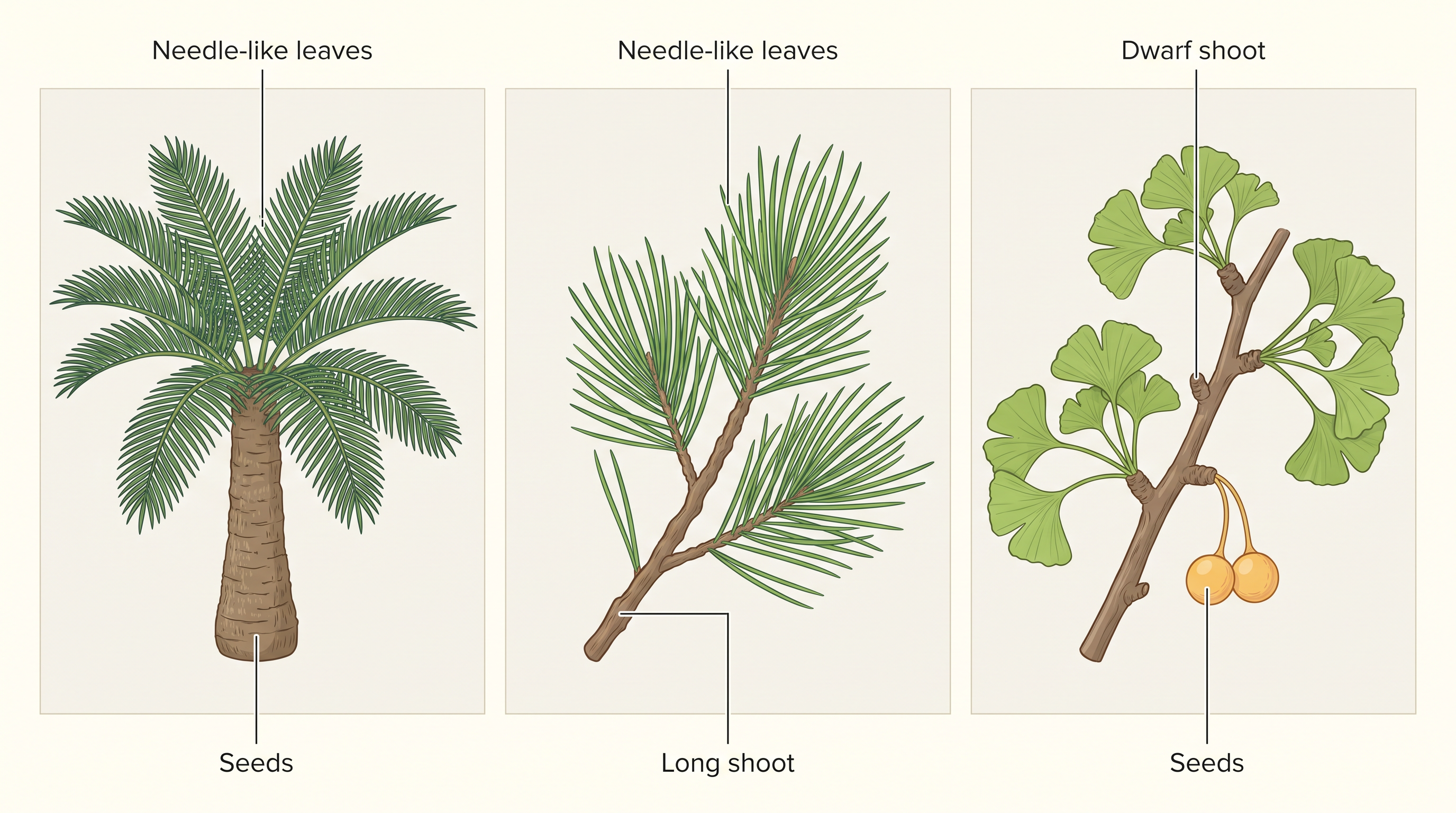
Fig. 3.4 – Gymnosperms: (a) Cycas, (b) Pinus and (c) Ginkgo.
Roots, Stems and Leaves
The roots of gymnosperms are generally tap roots. In some genera the roots form partnerships with other organisms. In Pinus, the roots associate with a fungus to form mycorrhiza — a root–fungus partnership that helps the plant absorb nutrients. In Cycas, small specialised roots called coralloid roots grow near the surface and house \(N\_2\)-fixing cyanobacteria, which supply the plant with usable nitrogen.
The stems may be unbranched, as in Cycas, or branched, as in Pinus and Cedrus. The leaves may be simple or compound; in Cycas the pinnate (feather-like) leaves persist on the plant for a few years.
The leaves of gymnosperms are well built to survive extremes of temperature, humidity and wind. In conifers, the leaves are needle-like, which reduces their surface area. A thick cuticle (waxy outer covering) and sunken stomata (breathing pores set into pits) further cut down water loss.
Cones: Male and Female
Gymnosperms are heterosporous — they produce two kinds of haploid spores, microspores and megaspores. Both kinds form inside sporangia borne on sporophylls, which are arranged spirally along an axis to form loose (lax) or compact strobili or cones.
The cones that bear microsporophylls and microsporangia are called microsporangiate or male strobili. The microspores inside them develop into a much-reduced male gametophyte, confined to just a few cells — this reduced gametophyte is the pollen grain. Pollen grains develop within the microsporangia.
The cones that bear megasporophylls with ovules (megasporangia) are called megasporangiate or female strobili. The male and female cones may sit on the same tree, as in Pinus, but in Cycas the male cones and the megasporophylls are borne on separate trees.
Inside the ovule, the megaspore mother cell develops from one of the cells of the nucellus. The nucellus is wrapped in protective envelopes, and this whole composite structure is the ovule.
The ovules are borne on megasporophylls, which may cluster together to form the female cones. The megaspore mother cell divides meiotically to give four megaspores. One of these megaspores, still enclosed within the megasporangium, develops into a multicellular female gametophyte bearing two or more archegonia (female sex organs). This female gametophyte is also retained within the megasporangium.
Pollination, Fertilisation and the Naked Seed
Here gymnosperms take a decisive step beyond bryophytes and pteridophytes. In those groups the gametophytes lived independently; in gymnosperms, the male and female gametophytes have no free-living existence. They stay inside the sporangia, which remain attached to the sporophyte (the parent tree).
The pollen grain is released from the microsporangium and carried away by air currents until it reaches the opening of an ovule on a megasporophyll. There, a pollen tube grows out, carrying the male gametes towards the archegonia inside the ovule, and discharges its contents near the mouth of the archegonium.
Following fertilisation, the zygote develops into an embryo, and the ovule develops into a seed. And because the ovule was never enclosed, these seeds remain uncovered — naked. The whole cycle is summarised in FC 3.5.
Flowchart
FC 3.5 – Gymnosperm life cycle: dominant sporophyte (tree) → bears male cones and female cones. Male: microsporophylls → microsporangia → microspores → pollen grain (reduced male gametophyte). Female: megasporophylls → ovule (nucellus + envelopes) → megaspore mother cell → meiosis → four megaspores → one develops → female gametophyte with archegonia (retained in megasporangium). Then: pollen released → carried by air currents → reaches ovule opening → pollen tube grows to archegonia → male gametes discharged → fertilisation → zygote → embryo; ovule → naked seed → grows into new sporophyte.
In exams, gymnosperms are tested through “important characteristics of gymnosperms,” “why gymnosperms and angiosperms are classified separately,” diagram-labelling of Pinus/Cycas cones, ploidy of the gametophytes, and match-the-following (e.g., Cycas → gymnosperm).
3.5 Angiosperms
In the gymnosperms of the previous section, the ovules lay naked. In the angiosperms, or flowering plants, the story is different: the pollen grains and ovules are developed inside a specialised structure called the flower, and after fertilisation the seeds are enclosed within fruits. The name itself captures this — angio means covered or enclosed, and sperma means seed, so an angiosperm is a “covered-seed” plant.
Angiosperms are an exceptionally large and varied group, growing in a very wide range of habitats. They range in size from the tiny Wolffia, the smallest flowering plant, to the towering trees of Eucalyptus, which grow to over 100 metres. They give us food, fodder, fuel, medicines and many other commercially important products.
The angiosperms are divided into two classes — the dicotyledons and the monocotyledons (Fig. 3.5). The division is based on the number of cotyledons, or seed leaves, present in the seed: dicotyledons (dicots) have two cotyledons, while monocotyledons (monocots) have one. You will study these two groups in detail in later chapters on plant morphology.
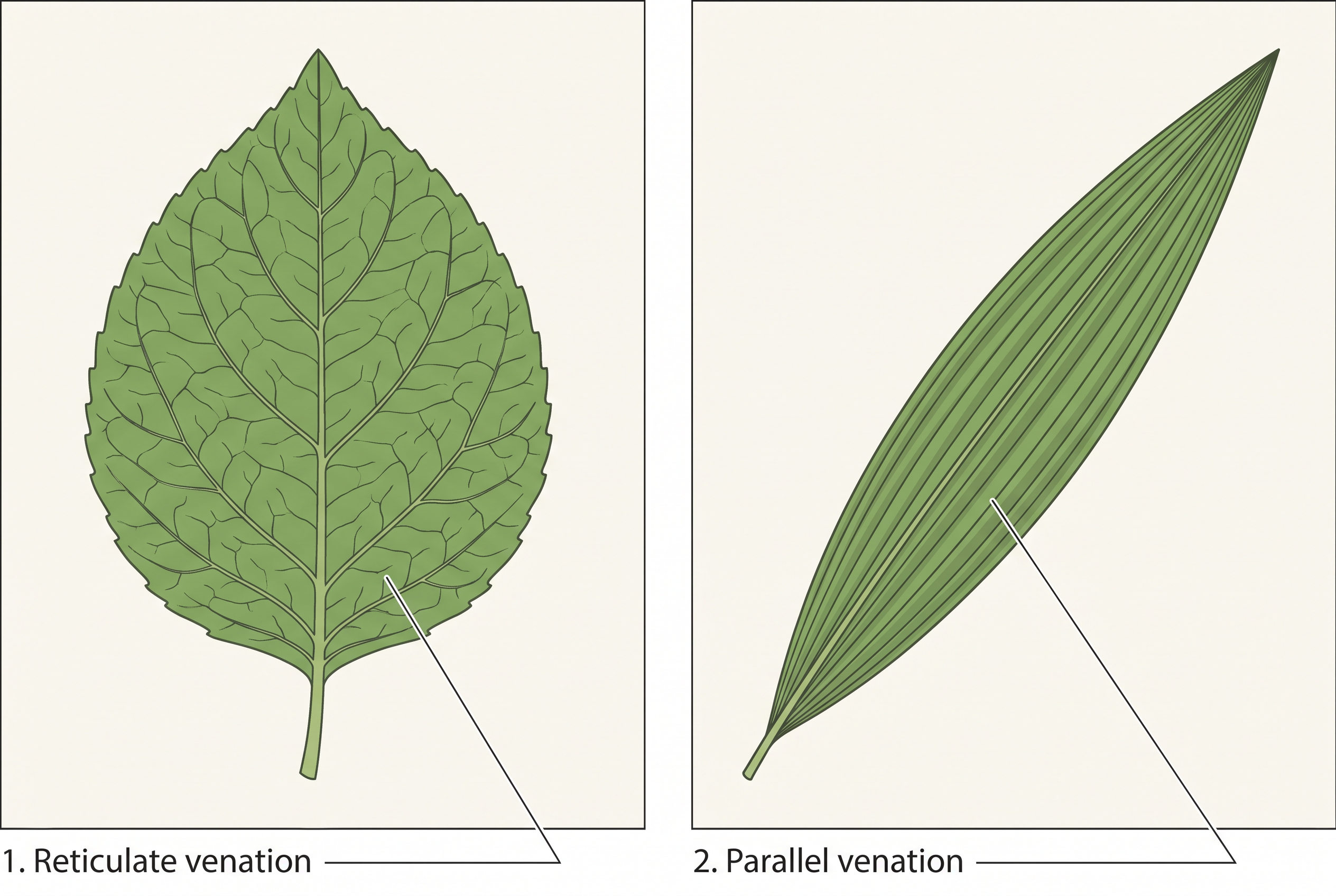
Fig. 3.5 – Angiosperms: (a) dicotyledon and (b) monocotyledon.
In exams, this section is tested through “why are seeds of angiosperms enclosed while those of gymnosperms are naked,” the smallest and largest angiosperm examples, and the basic distinction between dicots and monocots.
3.6 Summary
- The plant kingdom includes five major groups: algae, bryophytes, pteridophytes, gymnosperms and angiosperms.
- Algae are chlorophyll-bearing, simple, thalloid, autotrophic and largely aquatic organisms. Based on their pigments and the type of food they store, algae are classified into three classes — Chlorophyceae, Phaeophyceae and Rhodophyceae.
- Algae reproduce vegetatively by fragmentation, asexually by forming different kinds of spores, and sexually by forming gametes. Their sexual reproduction may be isogamous, anisogamous or oogamous.
- Bryophytes can live in soil but depend on water for sexual reproduction. Their plant body is more differentiated than that of algae — thallus-like, prostrate or erect, and attached to the ground by rhizoids, with root-like, leaf-like and stem-like structures.
- Bryophytes are divided into liverworts and mosses. Liverworts have a thalloid, dorsiventral body, while mosses have upright, slender axes bearing spirally arranged leaves.
- The main bryophyte body is the gamete-producing gametophyte. It bears male sex organs (antheridia) and female sex organs (archegonia). The male and female gametes fuse to form a zygote, which grows into a sporophyte that produces haploid spores; these spores germinate into new gametophytes.
- In pteridophytes, the main plant body is the sporophyte, differentiated into true root, stem and leaves with well-developed vascular tissues. The sporophyte bears sporangia that produce spores.
- These spores germinate into gametophytes that need cool, damp places to grow. The gametophytes bear antheridia and archegonia. Water is required to carry the male gametes to the archegonium, where the zygote forms after fertilisation and then grows into a new sporophyte.
- Gymnosperms are plants whose ovules are not enclosed by any ovary wall, so after fertilisation the seeds remain exposed — which is why they are called naked-seeded plants.
- Gymnosperms produce microspores and megaspores in microsporangia and megasporangia borne on sporophylls. The microsporophylls and megasporophylls are arranged spirally on an axis to form male and female cones respectively. The pollen grain germinates, and the pollen tube releases the male gamete into the ovule, where it fuses with the egg cell in the archegonia. After fertilisation, the zygote becomes an embryo and the ovules become seeds.
- Angiosperms are divided into two classes — the dicotyledons and the monocotyledons.
The overall progression across the five groups is condensed in FC 3.6.
Flowchart
FC 3.6 – The plant kingdom, group by group with the key trend: Algae (simple, thalloid, aquatic) → Bryophytes (land plants, but need water for reproduction; dominant gametophyte) → Pteridophytes (true roots, stems, leaves with vascular tissue; dominant sporophyte; still need water) → Gymnosperms (seed plants; naked seeds; gametophytes not free-living; no water needed for fertilisation) → Angiosperms (seeds enclosed in fruits; flowers; divided into dicots and monocots).
3.7 Points to Ponder
- As we move from bryophytes to pteridophytes to seed plants, the gametophyte becomes smaller and more dependent while the sporophyte becomes dominant. Why might it have been advantageous for evolution to “invest” more in the sporophyte than in the gametophyte?
- Bryophytes and pteridophytes still need a film of water for their male gametes to swim to the egg. How does this single requirement shape where these plants can and cannot live, even today?
- Heterospory — producing two different kinds of spores — is called a precursor to the seed habit. What problems of life on land might the seed habit have solved that free-swimming spores and gametes could not?
- Gymnosperms have naked seeds, while angiosperms enclose their seeds in fruits. What advantages might enclosing a seed inside a fruit offer a plant, both for protecting the seed and for spreading it?
- The earliest classification systems grouped plants by just a few visible features such as leaf shape or the number of stamens. Why can two plants that look alike on the surface still be only distantly related — and what kinds of evidence would help you judge true kinship?
- Algae are among the “simplest” plants, yet they carry out roughly half of all carbon dioxide fixation on Earth and form the base of aquatic food chains. Does “simple” always mean “unimportant”? What does this suggest about judging organisms by their complexity?
- Mosses and lichens are often the first life to colonise bare rock, slowly turning it into soil for other plants. What would happen to the pace of plant succession on new land — such as a cooled lava flow — if these pioneer organisms did not exist?
3.8 NCERT Questions
- What is the basis of classification of algae?
- When and where does reduction division take place in the life cycle of a liverwort, a moss, a fern, a gymnosperm and an angiosperm?
- Name three groups of plants that bear archegonia. Briefly describe the life cycle of any one of them.
- Mention the ploidy of the following: protonemal cell of a moss; primary endosperm nucleus in dicot; leaf cell of a moss; prothallus cell of a fern; gemma cell in Marchantia; meristem cell of monocot; ovum of a liverwort; and zygote of a fern.
- Write a note on economic importance of algae and gymnosperms.
- Both gymnosperms and angiosperms bear seeds, then why are they classified separately?
- What is heterospory? Briefly comment on its significance. Give two examples.
- Explain briefly the following terms with suitable examples: (i) protonema (ii) antheridium (iii) archegonium (iv) diplontic (v) sporophyll (vi) isogamy
- Differentiate between the following: (i) red algae and brown algae (ii) liverworts and moss (iii) homosporous and heterosporous pteridophyte
- Match the following (column I with column II):
| Column I | Column II |
|---|---|
| a. Chlamydomonas | i. Moss |
| b. Cycas | ii. Pteridophyte |
| c. Selaginella | iii. Algae |
| d. Sphagnum | iv. Gymnosperm |
- Describe the important characteristics of gymnosperms.
3.9 Check Your Concepts
- Assertion–Reason. Assertion: Bryophytes are called the amphibians of the plant kingdom. Reason: They can live on land but still depend on water for sexual reproduction. State whether the assertion and the reason are true, and whether the reason correctly explains the assertion.
- Both green algae and brown algae contain chlorophyll, yet one looks grass-green and the other looks brown. Explain why.
- What would happen to a fern’s life cycle if it were kept permanently in a dry place with no film of water available? At which exact step would the cycle fail, and why?
- Arrange the following stages of a moss life cycle in the correct sequence: leafy gametophyte, spore, sporophyte, protonema, zygote.
- Why is oogamy considered more advanced than isogamy? Support your answer with the division of labour between the two gametes.
- Match each alga with its type of sexual reproduction:
| Column I | Column II |
|---|---|
| a. Ulothrix | i. Oogamous |
| b. Spirogyra | ii. Isogamous, with motile gametes |
| c. Volvox | iii. Isogamous, with non-motile gametes |
- Match each algal product with its source:
| Column I | Column II |
|---|---|
| a. Algin | i. Red algae (Gelidium, Gracilaria) |
| b. Carrageen | ii. Brown algae |
| c. Agar | iii. Red algae |
- In a diagram of a Marchantia thallus, a small cup-like structure bears green multicellular buds. Name this structure and the buds it contains, and state their function.
- In pteridophytes, the female gametophyte of heterosporous plants is retained on the parent sporophyte, and the embryo begins its development there. Why is this retention regarded as a step towards the seed habit?
- Assertion–Reason. Assertion: Gymnosperms do not need water for fertilisation. Reason: The male gametes are carried to the egg through a pollen tube instead of swimming. State whether both statements are true and whether the reason explains the assertion.
- Why are the seeds of gymnosperms described as “naked,” while the seeds of angiosperms are not?
- Explain how the needle-like leaves, thick cuticle and sunken stomata of conifers together help them survive extremes of temperature and reduce water loss.
- Arrange the following events of the gymnosperm life cycle in the correct order: pollen tube grows towards archegonia, microspore develops into a pollen grain, ovule develops into a seed, pollen grain is carried by air currents, fertilisation occurs.
- Both Pinus and Cycas have special root associations. Differentiate between the mycorrhiza of Pinus and the coralloid roots of Cycas, mentioning what each partner provides.
- The dominant phase of the life cycle shifts as we move from bryophytes to pteridophytes. State which phase dominates in each group, and explain how the presence of vascular tissue in pteridophytes is linked to this shift.
- Angiosperms occupy a far wider range of habitats than pteridophytes. Give two reasons, based on their reproduction and seed structure, for this wider spread.