Chapter 1: Some Basic Concepts of Chemistry
```markdown
In the 1770s, a French chemist named Antoine Lavoisier did something that sounds almost too simple to matter: he weighed things very, very carefully. Other scientists of his time burned metals, watched them turn into crumbly powders, and argued about a mysterious “fire-substance” that supposedly escaped during burning. Lavoisier decided to settle the argument with a balance instead of a debate.
He sealed a metal and some air inside a closed glass vessel and weighed the whole thing. Then he heated it until the metal turned to powder. When he weighed the sealed vessel again, the reading had not changed at all — not by the smallest amount his balance could detect. The metal had clearly been transformed, yet the total mass stayed exactly the same. Nothing had truly been lost or gained; matter had only been rearranged.
That single, patient result became the Law of Conservation of Mass, and it turned chemistry from a collection of recipes into an exact, measurable science. From this idea flow almost all the concepts in this chapter: how we classify matter, how we measure it honestly, why elements combine in fixed ratios, how we count atoms we can never see, and how we balance the equations that describe every reaction.
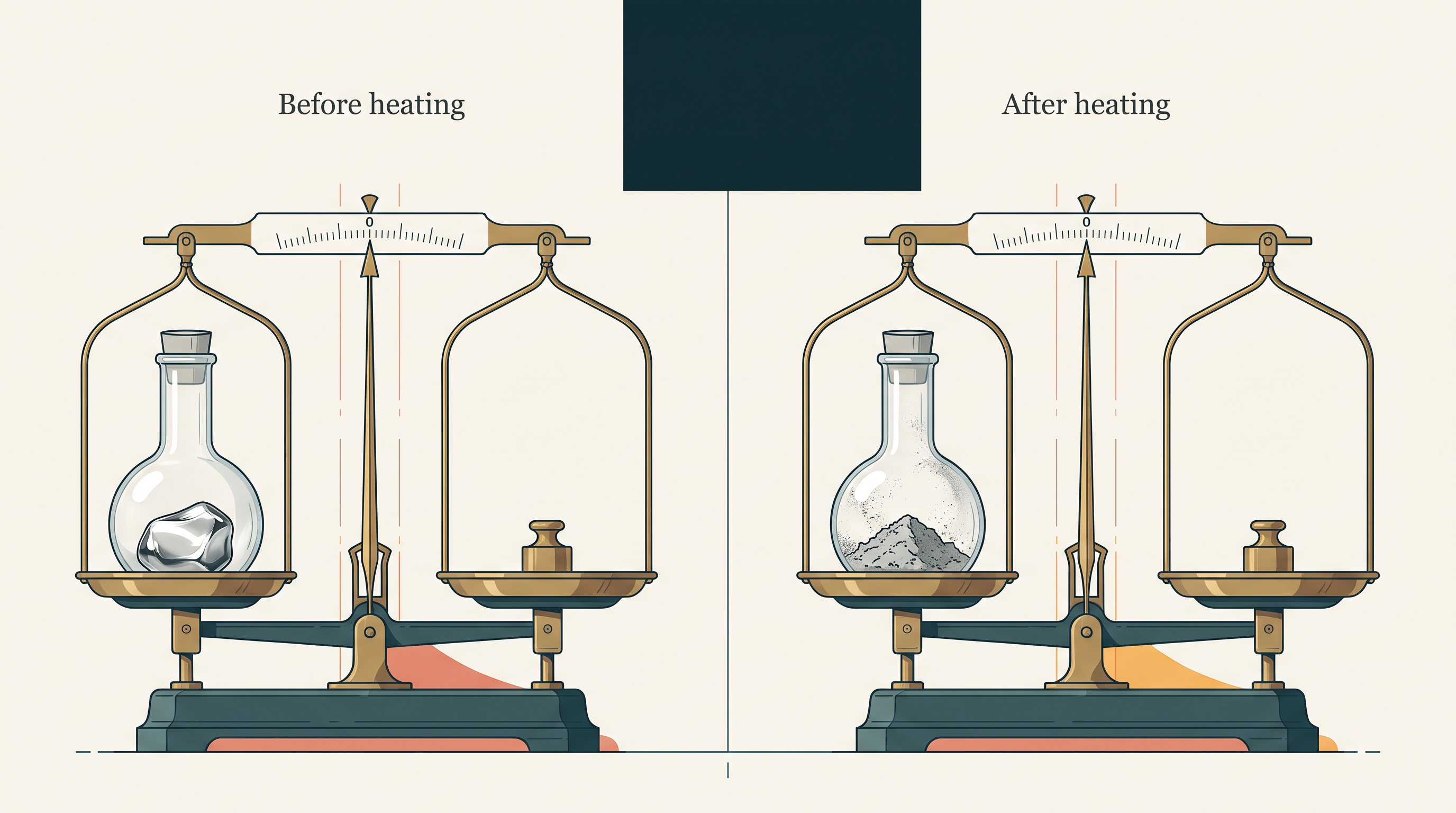
Fig. 1.0 – Lavoisier’s experiment demonstrating the conservation of mass.
By the end of this chapter, you will be able to reason out the answers to each of these questions for yourself.
1.1 Importance of Chemistry
Chemistry sits at the very centre of science. It rarely works in isolation — instead, it weaves into almost every other branch of knowledge, lending its ideas to physics, biology, geology, medicine and engineering alike.
Chemistry Touches Every Field
The principles of chemistry turn up in surprisingly diverse places. They help explain weather patterns in the atmosphere, the way signals pass between cells in the brain, and even the working of the tiny components inside a computer. On a larger scale, chemistry drives the industries that manufacture fertilisers, alkalis, acids, salts, dyes, polymers, drugs, soaps, detergents, metals and alloys, along with an endless stream of new materials. Wherever matter is being made, changed or understood, chemistry is at work.
Meeting Human Needs: Food and Health
Chemistry contributes in a big way to a nation’s economy, but its deeper value lies in meeting basic human needs — food, healthcare and a better quality of life. The large-scale production of fertilisers and improved pesticides and insecticides, for example, helps grow more food on the same land.
Its role in medicine is just as striking. Chemistry provides methods to isolate life-saving drugs from natural sources and, just as importantly, to synthesise them in the laboratory once their structures are understood. Some of these drugs, such as cisplatin and taxol, are effective in cancer therapy, while the drug AZT (Azidothymidine) is used to help patients living with AIDS.
Designing New Materials
A better grasp of chemical principles has made it possible to design and build entirely new materials with properties tailored to a purpose — specific magnetic, electric or optical behaviour that nature does not readily offer. This understanding has led to superconducting ceramics, conducting polymers and optical fibres, the last of which carry the light signals behind much of modern communication.
Chemistry has also helped establish the industries that produce everyday utility goods such as acids, alkalis, dyes, polymers and metals. These industries contribute strongly to the economy and generate large-scale employment, linking laboratory science directly to the prosperity of a nation.
Chemistry and the Environment
In recent years, chemistry has begun to repair some of the damage that earlier technology caused. When it was discovered that CFCs (chlorofluorocarbons) — once widely used as refrigerants — were destroying the protective ozone layer in the stratosphere, chemists successfully designed safer alternatives to replace them.
Yet major environmental challenges remain. Managing greenhouse gases such as methane and carbon dioxide, understanding biochemical processes, using enzymes for large-scale chemical production, and creating new exotic materials are all intellectual challenges awaiting the next generation of chemists.
A developing country like India, in particular, needs talented and creative chemists ready to take on such challenges. To become one, you must first master the basic concepts of chemistry — and those concepts begin with the idea of matter itself. It is with the nature of matter that our study now starts.
1.2 Nature of Matter
You have met the word matter in earlier classes. Anything that has mass and takes up space is matter. The book in your hand, the pen you write with, the water you drink, the air around you and every living thing is made of matter, because each of them has mass and occupies space.
Before studying how matter behaves, let us recall two familiar ideas: the physical states in which matter exists, and the way matter is classified.
1.2.1 States of Matter
Matter can exist in three physical states — solid, liquid and gas. What sets these states apart is not the kind of particles present but how those particles are arranged and how freely they move, as shown in Fig. 1.1.
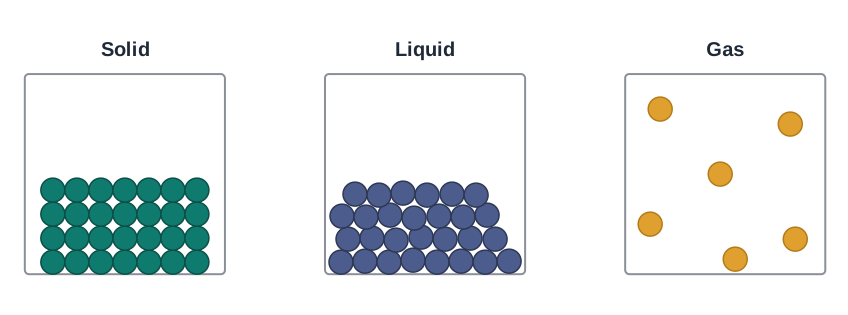
Fig. 1.1 – Particle arrangements in the three states of matter.
In a solid, the particles are held very close together in an orderly, fixed arrangement, with little freedom to move. In a liquid, the particles are still close together, but they are free to move around and slip past one another. In a gas, the particles are far apart compared with a solid or liquid, and they move about easily and rapidly.
This difference in particle arrangement is the cause behind the everyday behaviour of the three states:
Solids have a definite volume and a definite shape.
Liquids have a definite volume but do not have a definite shape — they take the shape of the container they are placed in.
Gases have neither a definite volume nor a definite shape — they spread out and completely fill the container.
The three states are not permanent labels — they are interconvertible. By changing temperature and pressure, one state can be turned into another:
\[\text{Solid} \underset{\text{cool}}{\overset{\text{heat}}{\rightleftharpoons}} \text{liquid} \underset{\text{cool}}{\overset{\text{heat}}{\rightleftharpoons}} \text{gas}\]
On heating, a solid usually melts to a liquid, and the liquid on further heating changes to a gas (or vapour). Running the process backwards, a gas on cooling condenses (liquefies) to a liquid, and the liquid on further cooling freezes to a solid. Throughout these changes the substance itself stays the same — only its state changes — which is why melting and boiling are physical changes.
1.2.2 Classification of Matter
You learnt in Class IX that at the bulk (macroscopic) level, matter can be classified as either a mixture or a pure substance. Each of these divides further, as summarised in Fig. 1.2.
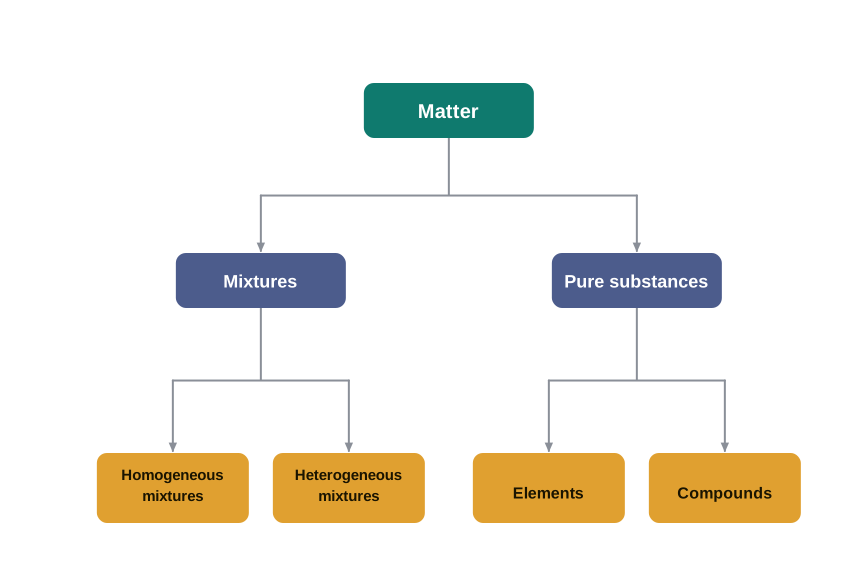
Fig. 1.2 – Macroscopic classification of matter.
Mixtures
A mixture contains particles of two or more pure substances combined in any ratio, so its composition is not fixed — it can vary. The pure substances that make up a mixture are called its components. Most of the everyday things around you — sugar dissolved in water, air, tea — are mixtures.
Mixtures come in two types. In a homogeneous mixture, the components mix completely, so the particles are spread out uniformly and the composition is the same throughout the sample. A sugar solution and clean air are homogeneous. In a heterogeneous mixture, the composition is not uniform, and the different components can often be seen separately — a mixture of salt and sugar, or grains and pulses with bits of grit, is heterogeneous.
A useful feature of any mixture is that its components can be separated by physical methods — simple hand-picking, filtration, crystallisation, distillation and the like — without any chemical reaction taking place.
Pure Substances
A pure substance is different from a mixture: all its constituent particles are the same in chemical nature, so it has a fixed composition. Copper, silver, gold, water and glucose are examples. Glucose, for instance, always contains carbon, hydrogen and oxygen in one fixed ratio, and these constituents cannot be separated by simple physical methods.
Pure substances themselves fall into two classes — elements and compounds.
Elements
Particles of an element consist of only one type of atom. An atom is the smallest particle of an element that takes part in a chemical change. Sodium, copper, silver, hydrogen and oxygen are all elements, and every atom within a given element is of the same kind, while atoms of different elements differ from one another.
The particles of an element may exist either as single atoms or as molecules. In some elements, such as sodium and copper, the atoms themselves are the constituent particles. In others, the particles are molecules built from two or more atoms — for example, hydrogen, nitrogen and oxygen gases exist as molecules in which two atoms join together (\(\mathrm{H_2}\), \(\mathrm{N_2}\), \(\mathrm{O_2}\)). This is illustrated in Fig. 1.3.
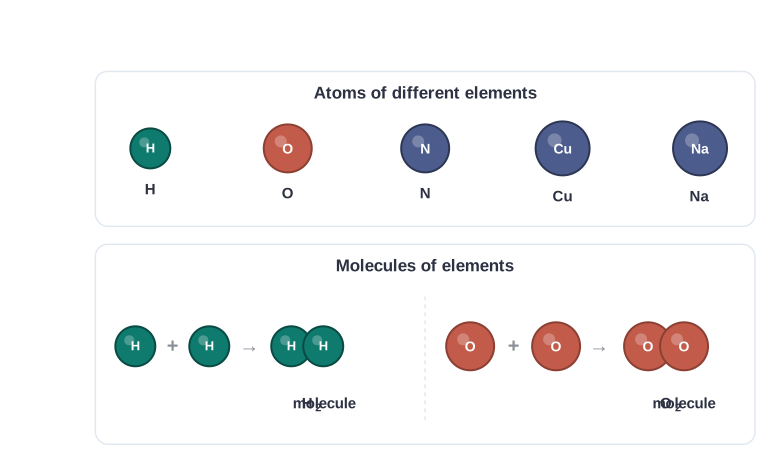
Fig. 1.3 – Atoms and molecules of elements.
A molecule, then, is a group of two or more atoms bonded together and behaving as a single unit.
Compounds
When two or more atoms of different elements combine together in a definite ratio, a molecule of a compound is formed. Unlike a mixture, the constituents of a compound cannot be separated by physical methods — only chemical methods can break them apart. Water, ammonia, carbon dioxide and sugar are all compounds. The molecules of water and carbon dioxide are shown in Fig. 1.4.
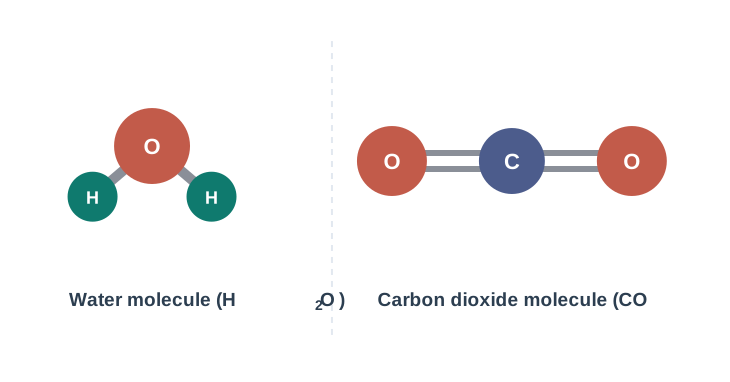
Fig. 1.4 – Molecules of water and carbon dioxide.
Notice that a water molecule is made of two hydrogen atoms and one oxygen atom (\(\mathrm{H_2O}\)), while a carbon dioxide molecule has one carbon atom joined to two oxygen atoms (\(\mathrm{CO_2}\)). The atoms of different elements are present in a compound in a fixed, definite ratio, and this ratio is a fingerprint of that particular compound.
There is one more striking feature of compounds: the properties of a compound are usually completely different from the properties of the elements that make it. Hydrogen and oxygen are both gases — hydrogen burns readily and oxygen supports combustion — yet the compound they form, water, is a liquid that is actually used to put out fires.
1.3 Properties of Matter and Their Measurement
1.3.1 Physical and Chemical Properties
Every substance carries its own set of characteristic properties — the features that make it recognisably itself and different from everything else. These properties fall into two families: physical properties and chemical properties.
Physical properties are the ones you can observe or measure without turning the substance into anything new. Colour, odour, melting point, boiling point, hardness, density and physical state (solid, liquid or gas) all belong here. When you note that copper is reddish-brown or that ice melts at \(0\ \text{°C}\), the copper is still copper and the melted ice is still water — only something about its appearance or condition has been described.
Chemical properties, in contrast, describe how a substance behaves when it undergoes a chemical change and is converted into one or more new substances. Combustibility, acidity or basicity, and reactivity with acids, bases, water or air are all chemical properties.
Why the Distinction Matters
The dividing line is simple once you see the cause behind it. Observing a physical property leaves the substance chemically untouched, so it can be measured again and again on the same sample. Measuring a chemical property, however, requires a chemical reaction to happen, which uses up the original substance and creates something different. You can measure the melting point of a piece of paper without destroying it, but to test whether paper is combustible you must actually burn it — and once it has become ash and gases, there is no paper left to test a second time.
Chemists rely on both kinds of property to describe, interpret and predict how substances behave. Physical properties often let us separate and purify materials (for example, using differences in boiling point in distillation), while chemical properties warn us how a substance will react and therefore how it should be handled and stored.
In examinations, this idea is commonly tested through “classify the property as physical or chemical” items and through assertion–reason questions, where the reasoning usually turns on whether a new substance is formed.
Having distinguished the two kinds of property, we now turn to how physical properties are actually measured, which is taken up in the next section.
1.3.2 Measurement of Physical Properties
Science advances by measuring, not just describing. To investigate matter properly, its physical properties must be measured quantitatively — that is, expressed as definite amounts. Many properties, such as length, area and volume, are quantitative in nature and can be pinned down with a number.
Every measurement is written as a number followed by a unit. The number tells you how much, and the unit tells you of what. For example, the length of a room may be written as \(6\ \text{m}\); here 6 is the number and m (metre) is the unit in which the length is measured. Leave out the unit and the “6” is meaningless — it could be 6 centimetres or 6 kilometres.
Two Older Systems of Measurement
For a long time, two different systems of measurement were used in different parts of the world: the English System and the Metric System. The metric system, which originated in France in the late eighteenth century, was the more convenient of the two because it was built on the decimal system, so converting between larger and smaller units meant simply multiplying or dividing by powers of ten.
As science grew more international, the scientific community felt the need for a single common standard that everyone could use. Such a system was established in 1960, and it is the subject of the next section.
1.3.3 The International System of Units (SI)
As science became a truly international effort, the world needed one shared language of measurement. That language is the International System of Units — in French Le Système International d’Unités, abbreviated everywhere as SI.
The SI was established by the 11th General Conference on Weights and Measures (CGPM, from Conférence Générale des Poids et Mesures). The CGPM is an intergovernmental treaty organisation set up by a diplomatic agreement called the Metre Convention, signed in Paris in 1875.
Seven Base Units, Many Derived Units
The SI is built on just seven base units, listed in Table 1.1. These correspond to seven fundamental scientific quantities. Every other physical quantity you will meet — speed, volume, density, pressure, energy and so on — is a derived unit, obtained by combining these seven. For example, speed is length divided by time (m s⁻¹) and volume is length cubed (m³).
Table 1.1 Base Physical Quantities and their Units
| Base Physical Quantity | Symbol for Quantity | Name of SI Unit | Symbol for SI Unit |
|---|---|---|---|
| Length | \(l\) | metre | m |
| Mass | \(m\) | kilogram | kg |
| Time | \(t\) | second | s |
| Electric current | \(I\) | ampere | A |
| Thermodynamic temperature | \(T\) | kelvin | K |
| Amount of substance | \(n\) | mole | mol |
| Luminous intensity | \(I_v\) | candela | cd |
How the Base Units Are Defined
Modern SI base units are no longer defined by physical objects that could be lost or could change over time. Instead, each one is now defined by fixing the numerical value of a constant of nature — the speed of light, the Planck constant, the caesium frequency, and so on. These definitions are collected in Table 1.2.
Table 1.2 Definitions of SI Base Units
| Quantity (Unit) | Definition |
|---|---|
| Length (metre, m) | Defined by fixing the speed of light in vacuum \(c\) as exactly \(299792458\) when expressed in m s⁻¹, where the second is defined in terms of the caesium frequency \(\Delta\nu_{Cs}\). |
| Mass (kilogram, kg) | Defined by fixing the Planck constant \(h\) as exactly \(6.62607015\times10^{-34}\) when expressed in J s (equal to kg m² s⁻¹), where the metre and second are defined in terms of \(c\) and \(\Delta\nu_{Cs}\). |
| Time (second, s) | Defined by fixing the caesium frequency \(\Delta\nu_{Cs}\) — the unperturbed ground-state hyperfine transition frequency of the caesium-133 atom — as \(9192631770\) when expressed in Hz (equal to s⁻¹). |
| Electric current (ampere, A) | Defined by fixing the elementary charge \(e\) as exactly \(1.602176634\times10^{-19}\) when expressed in C (equal to A s), where the second is defined via \(\Delta\nu_{Cs}\). |
| Thermodynamic temperature (kelvin, K) | Defined by fixing the Boltzmann constant \(k\) as exactly \(1.380649\times10^{-23}\) when expressed in J K⁻¹ (equal to kg m² s⁻² K⁻¹), where kg, m and s are defined in terms of \(h\), \(c\) and \(\Delta\nu_{Cs}\). |
| Amount of substance (mole, mol) | One mole contains exactly \(6.02214076\times10^{23}\) elementary entities — the fixed value of the Avogadro constant \(N_A\) in mol⁻¹, called the Avogadro number. An elementary entity may be an atom, molecule, ion, electron or any specified group of particles. |
| Luminous intensity (candela, cd) | Defined by fixing the luminous efficacy of monochromatic radiation of frequency \(540\times10^{12}\) Hz, \(K_{cd}\), as \(683\) when expressed in lm W⁻¹ (equal to cd sr W⁻¹, or cd sr kg⁻¹ m⁻² s³), where kg, m and s are defined in terms of \(h\), \(c\) and \(\Delta\nu_{Cs}\). |
Prefixes for Large and Small Quantities
Chemistry constantly deals with quantities that are enormously large or vanishingly small. To avoid writing long strings of zeros, the SI allows prefixes to be attached to a unit, each standing for a multiple or submultiple (a power of ten) of that unit. The full set is given in Table 1.3.
Table 1.3 Prefixes used in the SI System
| Multiple | Prefix | Symbol |
|---|---|---|
| \(10^{-24}\) | yocto | y |
| \(10^{-21}\) | zepto | z |
| \(10^{-18}\) | atto | a |
| \(10^{-15}\) | femto | f |
| \(10^{-12}\) | pico | p |
| \(10^{-9}\) | nano | n |
| \(10^{-6}\) | micro | µ |
| \(10^{-3}\) | milli | m |
| \(10^{-2}\) | centi | c |
| \(10^{-1}\) | deci | d |
| \(10\) | deca | da |
| \(10^{2}\) | hecto | h |
| \(10^{3}\) | kilo | k |
| \(10^{6}\) | mega | M |
| \(10^{9}\) | giga | G |
| \(10^{12}\) | tera | T |
| \(10^{15}\) | peta | P |
| \(10^{18}\) | exa | E |
| \(10^{21}\) | zeta | Z |
| \(10^{24}\) | yotta | Y |
With the SI framework and its prefixes in place, we can now look more closely at some of the specific quantities — mass, volume, density and temperature — that you will use again and again throughout this book.
1.3.4 Mass and Weight
Two words that everyday speech treats as the same — mass and weight — mean quite different things in science, and confusing them is a common mistake worth avoiding from the start.
The mass of a substance is the amount of matter present in it. The weight of an object is the force with which gravity pulls on it. The key consequence of this difference is that the mass of a substance is constant everywhere, whereas its weight can change from place to place, because the strength of gravity itself varies.
Measuring Mass in the Laboratory
In the laboratory, the mass of a substance is found accurately using an analytical balance, shown in Fig. 1.5.
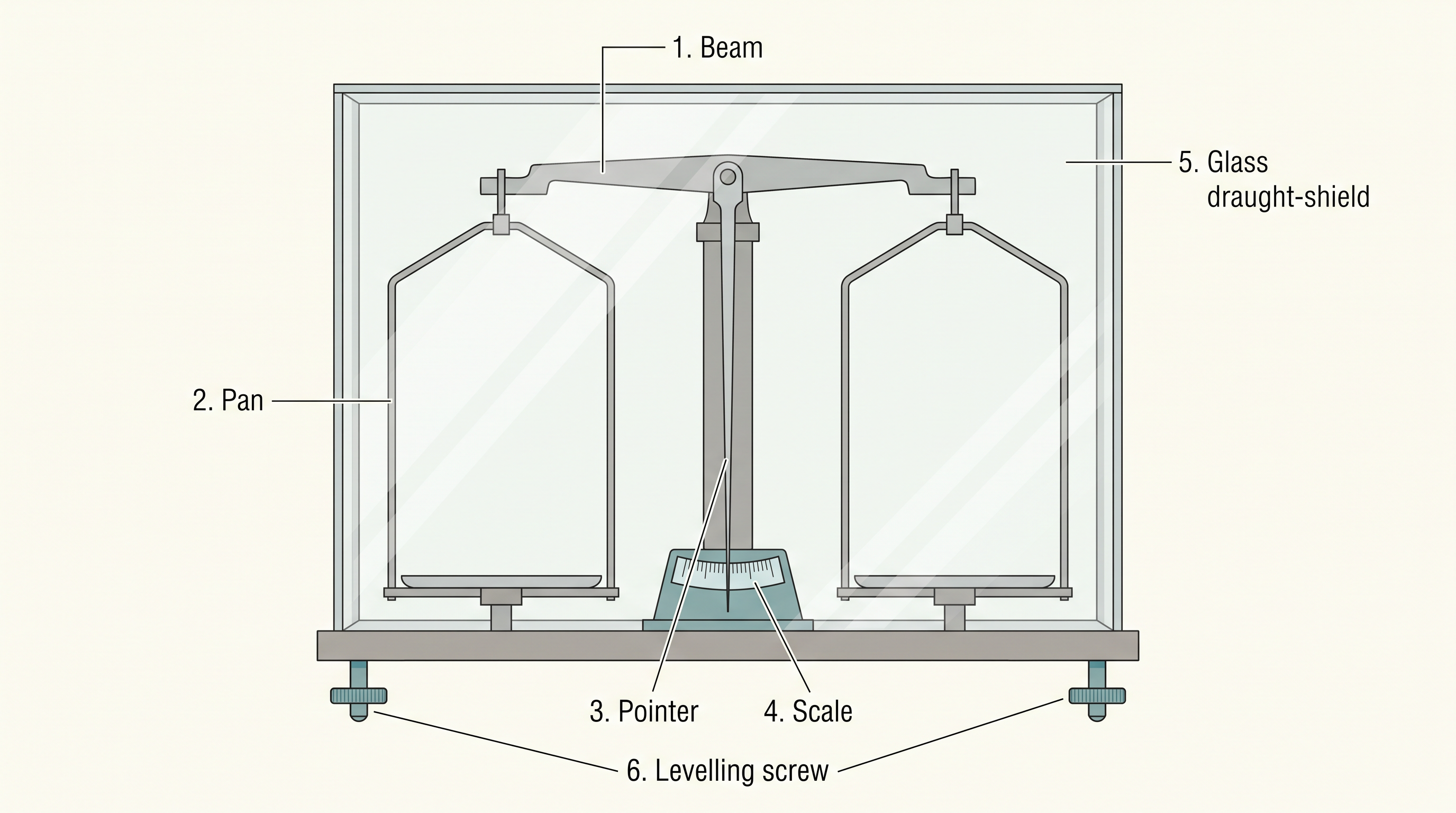
Fig. 1.5 – An analytical balance.
The SI unit of mass, as listed in Table 1.1, is the kilogram (kg). In chemistry laboratories, however, the amounts of substance handled are usually small, so its smaller fraction the gram is more convenient, where \(1\ \text{kg} = 1000\ \text{g}\).
1.3.5 Volume
Volume is the amount of space that a substance occupies. Because space is measured in three directions — length, breadth and height — volume has the units of (length)³. In the SI system, therefore, the unit of volume is the cubic metre, \(\text{m}^3\).
A cubic metre is a large volume for a laboratory, where much smaller amounts are handled. For this reason chemists usually express volume in cubic centimetres (\(\text{cm}^3\)) or cubic decimetres (\(\text{dm}^3\)). A very common unit for the volume of liquids is the litre (L), which — although convenient and widely used — is not an SI unit.
The units are linked by simple relations, which are worth memorising:
\[1\ \text{L} = 1000\ \text{mL}, \qquad 1000\ \text{cm}^3 = 1\ \text{dm}^3, \qquad 1\ \text{cm}^3 = 1\ \text{mL}\]
Fig. 1.6 helps you picture these relationships, showing how a cube of side \(10\ \text{cm}\) (that is, \(1\ \text{dm}\)) holds exactly one litre.
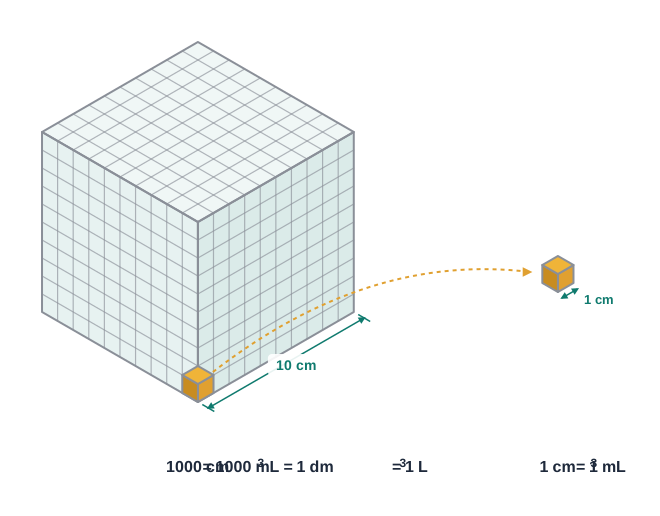
Fig. 1.6 – Relationship between common volume units.
Measuring Volume in the Laboratory
In the laboratory, the volume of a liquid or solution is measured with a graduated cylinder, a burette or a pipette, while a volumetric flask is used to prepare a solution of a known, exact volume. These devices are shown in Fig. 1.7.
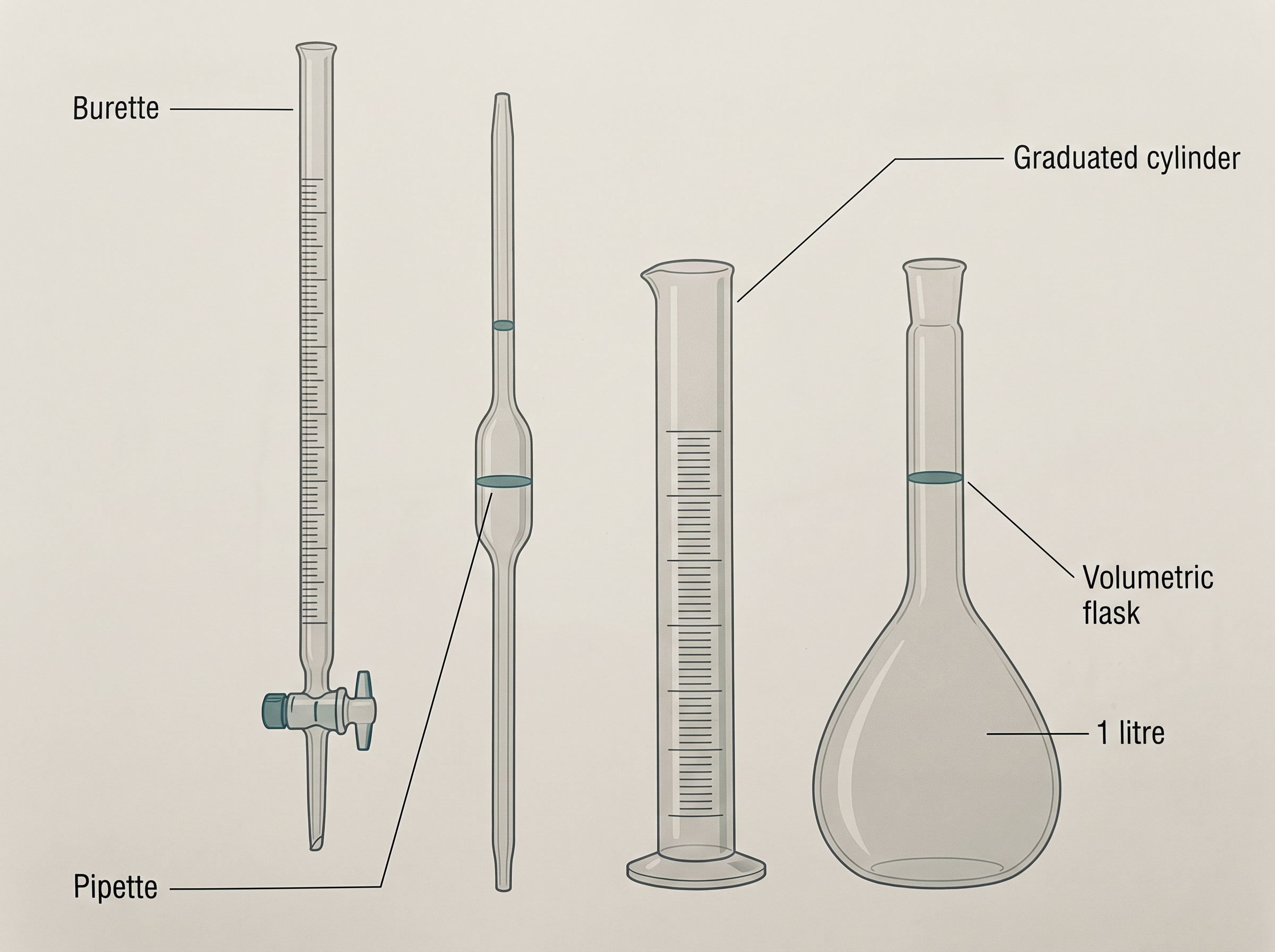
Fig. 1.7 – Laboratory glassware for measuring volume.
1.3.6 Density
The two properties just discussed — mass and volume — combine to give a third, very useful property called density. Density links the two by asking a simple question: how much matter is packed into a given amount of space?
\[d = \frac{m}{V}\]
Here \(d\) is the density, \(m\) is the mass and \(V\) is the volume. (The symbol \(\rho\) is also commonly used for density.) In words, the density of a substance is its mass per unit volume.
Because density is mass divided by volume, its SI unit follows directly from the SI units of those two quantities:
\[\text{SI unit of density} = \frac{\text{SI unit of mass}}{\text{SI unit of volume}} = \frac{\text{kg}}{\text{m}^3} = \text{kg m}^{-3}\]
This SI unit is rather large for laboratory work, so chemists often express density in \(\text{g cm}^{-3}\), with the mass in grams and the volume in cubic centimetres.
What Density Tells Us
Density is more than a number — it reveals how closely the particles of a substance are packed together. A high density means a large mass squeezed into a small volume, so the particles must be tightly packed. A low density means the same amount of space holds less matter, so the particles are more loosely arranged.
1.3.7 Temperature
Temperature — a measure of how hot or cold something is — can be reported on three common scales: degree Celsius (°C), degree Fahrenheit (°F) and kelvin (K). Of these, the kelvin is the SI unit. Thermometers built on all three scales are compared in Fig. 1.8.
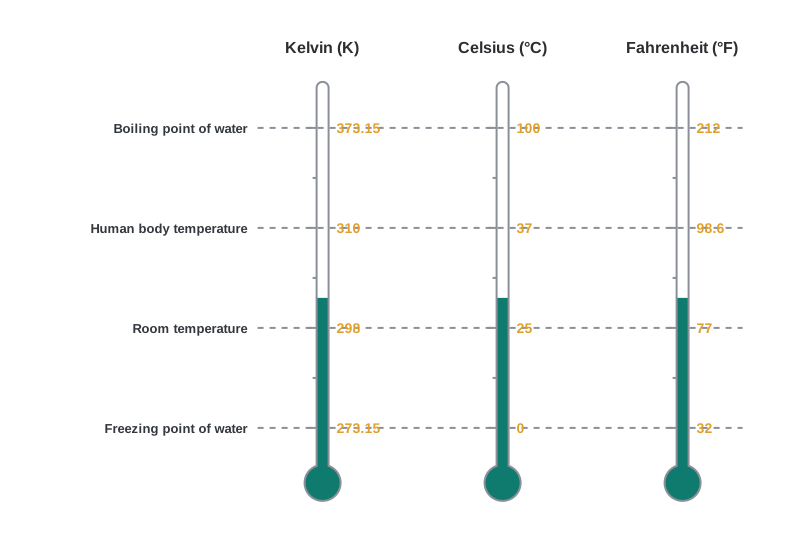
Fig. 1.8 – Comparison of the Kelvin, Celsius and Fahrenheit temperature scales.
A Celsius thermometer is usually calibrated from 0° to 100°, these two marks being the freezing point and the boiling point of water. The Fahrenheit scale places the same two points differently, running from 32° to 212°.
Converting Between the Scales
The Celsius and Fahrenheit readings for the same temperature are connected by:
\[^\circ\text{F} = \frac{9}{5}\,(^\circ\text{C}) + 32\]
The kelvin scale is related to the Celsius scale by simply shifting the zero:
\[\text{K} = {}^\circ\text{C} + 273.15\]
An interesting difference stands out here. Temperatures below \(0\ ^\circ\text{C}\) (negative values) are perfectly normal on the Celsius scale, but on the kelvin scale a negative temperature is impossible. This is because the kelvin scale starts from absolute zero (\(0\ \text{K}\)), the lowest temperature that can ever exist — there is simply nothing colder to measure.
With temperature, we have now surveyed the everyday quantities of measurement. The next step is to handle the numbers these measurements produce carefully and honestly — the subject of uncertainty in measurement.
1.4 Uncertainty in Measurement
In chemistry you constantly meet numbers — some from experiments, some from calculations. Many of these numbers are extremely large or extremely small, and every measured number carries a little uncertainty. This section looks at how to handle such numbers conveniently and how to report data honestly, showing only as much certainty as the measurement truly allows.
1.4.1 Scientific Notation
Because chemistry deals with atoms and molecules, it deals with numbers of staggering size. The number of molecules in just \(2\ \text{g}\) of hydrogen gas is about
\[602200000000000000000000\]
while the mass of a single hydrogen atom is about
\[0.00000000000000000000000166\ \text{g}\]
Other constants — Planck’s constant, the speed of light, the charge on a particle — involve numbers of similar magnitude. Writing out so many zeros is not only tedious; it makes even simple addition, subtraction, multiplication or division painfully error-prone.
The solution is scientific notation (exponential notation), in which any number is written in the form \(N \times 10^{n}\), where \(n\) is an exponent (positive or negative) and \(N\) is a “digit term” whose value lies between \(1.000\ldots\) and \(9.999\ldots\)
For example, \(232.508\) is written as \(2.32508\times10^{2}\). The decimal point has been moved two places to the left, which is why the exponent is \(+2\). Similarly, \(0.00016\) becomes \(1.6\times10^{-4}\): here the decimal has to be moved four places to the right, so the exponent is \(-4\).
Multiplication and Division
These operations follow the ordinary rules for powers of ten — the digit terms are multiplied or divided, and the exponents are added or subtracted:
\[(5.6\times10^{5})\times(6.9\times10^{8}) = (5.6\times6.9)(10^{5+8}) = 38.64\times10^{13} = 3.864\times10^{14}\]
\[(9.8\times10^{-2})\times(2.5\times10^{-6}) = (9.8\times2.5)(10^{-2+(-6)}) = 24.50\times10^{-8} = 2.450\times10^{-7}\]
\[\frac{2.7\times10^{-3}}{5.5\times10^{4}} = (2.7\div5.5)(10^{-3-4}) = 0.4909\times10^{-7} = 4.909\times10^{-8}\]
Addition and Subtraction
For these, the numbers must first be rewritten so that they have the same exponent; only then are the digit terms added or subtracted.
To add \(6.65\times10^{4}\) and \(8.95\times10^{3}\), the second is rewritten with the same exponent as the first:
\[6.65\times10^{4} + 8.95\times10^{3} = (6.65\times10^{4}) + (0.895\times10^{4}) = 7.545\times10^{4}\]
A subtraction works the same way:
\[(2.5\times10^{-2}) - (4.8\times10^{-3}) = (2.5\times10^{-2}) - (0.48\times10^{-2}) = 2.02\times10^{-2}\]
1.4.2 Significant Figures
Every experimental measurement carries some uncertainty, because no instrument is perfect and no observer is flawless. Suppose an object’s mass read on a rough platform balance is \(9.4\ \text{g}\), while the same object on a sensitive analytical balance reads \(9.4213\ \text{g}\). The analytical value is more detailed, and its last digit (the 4 after the decimal, in the platform reading) is the uncertain one.
We indicate this uncertainty by stating the number of significant figures — the digits that are meaningful. These are all the digits known with certainty, plus one final digit that is estimated. If a result is written as \(11.2\ \text{mL}\), the “11” is certain and the “2” is uncertain; the uncertainty is understood to be \(\pm 1\) in the last digit unless stated otherwise.
The rules for counting significant figures are:
- All non-zero digits are significant. For example, \(285\ \text{cm}\) has three significant figures, and \(0.25\ \text{mL}\) has two.
- Zeros before the first non-zero digit are not significant; they only fix the position of the decimal point. Thus \(0.03\) has one significant figure and \(0.0052\) has two.
- Zeros between two non-zero digits are significant. Thus \(2.005\) has four significant figures.
- Zeros at the end of a number, to the right of the decimal point, are significant. Thus \(0.200\ \text{g}\) has three significant figures. However, terminal zeros in a number with no decimal point are not counted as significant — for example, “\(100\)” (no decimal point) has only one significant figure. Such numbers are best written in scientific notation to remove all doubt: \(1\times10^{2}\) shows one significant figure, \(1.0\times10^{2}\) shows two, and \(1.00\times10^{2}\) shows three.
- Exact counting numbers — such as 2 balls or 20 eggs — have an infinite number of significant figures, since they can be written as \(2 = 2.000000\) or \(20 = 20.000000\).
In a number written in scientific notation, every digit of the digit term is significant. Thus \(4.01\times10^{2}\) has three significant figures and \(8.256\times10^{-3}\) has four.
Precision and Accuracy
Two words describe how “good” a set of measurements is, and they are not the same.
Suppose the true mass of a sample is \(2.00\ \text{g}\). Student A measures \(1.95\ \text{g}\) and \(1.93\ \text{g}\) — close to each other but not to the true value, so precise but not accurate. Student B gets \(1.94\ \text{g}\) and \(2.05\ \text{g}\) — neither close to each other nor to the truth, so neither precise nor accurate. Student C reports \(2.01\ \text{g}\) and \(1.99\ \text{g}\) — close to each other and to the true value, so both precise and accurate. These results are collected in Table 1.4.
Table 1.4 Data to Illustrate Precision and Accuracy
| Measurements/g | 1 | 2 | Average (g) |
|---|---|---|---|
| Student A | 1.95 | 1.93 | 1.940 |
| Student B | 1.94 | 2.05 | 1.995 |
| Student C | 2.01 | 1.99 | 2.000 |
Calculations with Significant Figures
When measured numbers are combined, the answer must not pretend to be more precise than the data allow.
Addition and subtraction: the result cannot have more digits to the right of the decimal point than the number that has the fewest such digits. For example:
\[12.11 + 18.0 + 1.012 = 31.122\]
Since \(18.0\) has only one digit after the decimal point, the answer must be reported to one decimal place: \(31.1\).
Multiplication and division: the result must have no more significant figures than the measurement with the fewest significant figures. For example:
\[2.5 \times 1.25 = 3.125\]
Since \(2.5\) has only two significant figures, the answer is reported as \(3.1\).
Rounding Off
To trim a number to the required significant figures, use these rounding rules:
- If the digit to be removed is greater than 5, increase the preceding digit by one. For example, rounding \(1.386\) by removing the 6 gives \(1.39\).
- If the digit to be removed is less than 5, the preceding digit is left unchanged. For example, rounding \(4.334\) by removing the last 4 gives \(4.33\).
- If the digit to be removed is exactly 5, the preceding digit is left unchanged if it is even, but increased by one if it is odd. For example, \(6.35\) rounds to \(6.4\), while \(6.25\) rounds to \(6.2\).
1.4.3 Dimensional Analysis
While calculating, we often need to convert a quantity from one unit to another. The method used for this is called the factor label method (also the unit factor method or dimensional analysis). Its central idea is that any equality between two units can be turned into a fraction equal to 1, called a unit factor, which can be multiplied in without changing the true value of a quantity.
Consider converting a length of 3 inch (in) into centimetres. We know that
\[1\ \text{in} = 2.54\ \text{cm}\]
From this single equivalence, two unit factors can be written, and each equals 1:
\[\frac{1\ \text{in}}{2.54\ \text{cm}} = 1 \qquad \text{and} \qquad \frac{2.54\ \text{cm}}{1\ \text{in}} = 1\]
To convert 3 in into cm, we multiply by whichever unit factor cancels “in” and leaves “cm”:
\[3\ \text{in} = 3\ \text{in} \times \frac{2.54\ \text{cm}}{1\ \text{in}} = 3 \times 2.54\ \text{cm} = 7.62\ \text{cm}\]
Notice that the correct unit factor is the one whose numerator carries the unit you want in the answer. Units are handled exactly like numbers — they can be cancelled, multiplied, divided or raised to powers.
As a second example, convert 2 L of milk into cubic metres. We know \(1\ \text{L} = 1000\ \text{cm}^3\) and \(1\ \text{m} = 100\ \text{cm}\), which gives
\[\frac{1\ \text{m}}{100\ \text{cm}} = 1\]
To get \(\text{m}^3\), this unit factor is cubed:
\[\left(\frac{1\ \text{m}}{100\ \text{cm}}\right)^{3} = \frac{1\ \text{m}^3}{10^{6}\ \text{cm}^3} = 1\]
Now, since \(2\ \text{L} = 2\times1000\ \text{cm}^3 = 2000\ \text{cm}^3\),
\[2000\ \text{cm}^3 \times \frac{1\ \text{m}^3}{10^{6}\ \text{cm}^3} = \frac{2000}{10^{6}}\ \text{m}^3 = 2\times10^{-3}\ \text{m}^3\]
As a third example, find how many seconds there are in 2 days. Here \(1\ \text{day} = 24\ \text{h}\), \(1\ \text{h} = 60\ \text{min}\) and \(1\ \text{min} = 60\ \text{s}\), so the unit factors can be multiplied in series in a single step:
\[2\ \text{day} \times \frac{24\ \text{h}}{1\ \text{day}} \times \frac{60\ \text{min}}{1\ \text{h}} \times \frac{60\ \text{s}}{1\ \text{min}} = 2 \times 24 \times 60 \times 60\ \text{s} = 172800\ \text{s}\]
1.5 Laws of Chemical Combinations
Elements do not combine to form compounds in a random, careless way. The way they combine is governed by five basic laws of chemical combination, worked out patiently over the eighteenth and nineteenth centuries. We take them one at a time.
1.5.1 Law of Conservation of Mass
The first of these laws was put forward by the French chemist Antoine Lavoisier in 1789. From careful, quantitative studies of combustion reactions he concluded that in any physical or chemical change, there is no net change in the total mass — matter is only rearranged, never created and never destroyed.
This law became the foundation of quantitative chemistry, since it is exactly what allows us to balance chemical equations and to expect that the masses of products equal the masses of reactants.
1.5.2 Law of Definite Proportions
This law was given by the French chemist Joseph Proust. He stated that a given compound always contains exactly the same proportion of elements by weight, no matter where it comes from or how it is made.
Proust tested this with two samples of cupric carbonate — one obtained from a natural mineral source, the other prepared synthetically in the laboratory. He found the composition of both to be identical:
| Sample | % of copper | % of carbon | % of oxygen |
|---|---|---|---|
| Natural sample | 51.35 | 9.74 | 38.91 |
| Synthetic sample | 51.35 | 9.74 | 38.91 |
From this he concluded that, whatever its source, a given compound always contains the same elements combined in the same proportion by mass.
This law is sometimes also called the Law of Definite Composition.
1.5.3 Law of Multiple Proportions
This law was proposed by John Dalton in 1803. It applies when the same two elements combine to form more than one compound. In that case, the masses of one element that combine with a fixed mass of the other are in the ratio of small whole numbers.
For example, hydrogen and oxygen combine to form two different compounds — water and hydrogen peroxide:
\[\text{Hydrogen} + \text{Oxygen} \rightarrow \text{Water} \qquad (2\ \text{g} + 16\ \text{g} \rightarrow 18\ \text{g})\]
\[\text{Hydrogen} + \text{Oxygen} \rightarrow \text{Hydrogen peroxide} \qquad (2\ \text{g} + 32\ \text{g} \rightarrow 34\ \text{g})\]
Here the masses of oxygen (16 g and 32 g) that combine with a fixed mass of hydrogen (2 g) bear the simple ratio \(16 : 32\), that is \(1 : 2\) — a ratio of small whole numbers.
1.5.4 Gay Lussac’s Law of Gaseous Volumes
This law was given by Joseph Louis Gay Lussac in 1808. He observed that when gases react with one another, or are produced in a reaction, their volumes bear a simple whole-number ratio — provided all the gases are measured at the same temperature and pressure.
For example, 100 mL of hydrogen combines with 50 mL of oxygen to give 100 mL of water vapour:
\[\text{Hydrogen} + \text{Oxygen} \rightarrow \text{Water} \qquad (100\ \text{mL} + 50\ \text{mL} \rightarrow 100\ \text{mL})\]
The volumes of hydrogen and oxygen that combine (100 mL and 50 mL) are in the simple ratio \(2 : 1\).
Gay Lussac’s discovery of these whole-number volume ratios is really the law of definite proportions expressed by volume, rather than by mass as Proust had stated it. His law was finally given a proper explanation by the work of Avogadro in 1811.
1.5.5 Avogadro’s Law
In 1811, Amedeo Avogadro proposed that equal volumes of all gases, measured at the same temperature and pressure, contain equal numbers of molecules. In doing so he drew a clear distinction between an atom and a molecule — a distinction that is second nature to us today but was new at the time.
Consider once more the reaction of hydrogen and oxygen to form water: two volumes of hydrogen combine with one volume of oxygen to give two volumes of water vapour, with no oxygen left over. This is shown in Fig. 1.9, where each box holds an equal number of molecules.
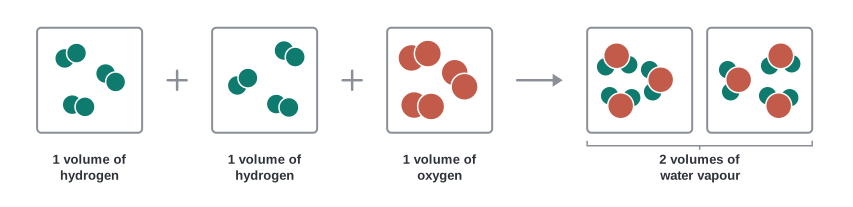
Fig. 1.9 – Volumes of combining gases and Avogadro’s law.
In modern symbols this is written as:
\[2\,\mathrm{H_2}\text{(g)} + \mathrm{O_2}\text{(g)} \rightarrow 2\,\mathrm{H_2O}\text{(g)}\]
Avogadro could make sense of these results by treating the gas particles as molecules that can be made of two or more atoms. If hydrogen and oxygen are taken to be diatomic — \(\mathrm{H_2}\) and \(\mathrm{O_2}\), as we recognise them now — the volume relationships follow naturally. Dalton and others of the time, however, believed that atoms of the same kind could not combine, so that molecules such as \(\mathrm{H_2}\) or \(\mathrm{O_2}\) containing two identical atoms simply did not exist. For this reason Avogadro’s proposal, though published in a French journal and entirely correct, gained little support at first.
Nearly 50 years later, in 1860, the first international conference on chemistry was held at Karlsruhe in Germany to settle such disputes. There, Stanislao Cannizzaro presented an outline of chemical philosophy that highlighted the importance of Avogadro’s work, and the idea was at last widely accepted.
1.6 Dalton’s Atomic Theory
The idea that matter is built from tiny, indivisible particles is very old. The word “atom” itself comes from the Greek a-tomos, meaning indivisible, and the notion dates back to the philosopher Democritus (about 460–370 BCE). For centuries it remained pure speculation — but the experimental laws of chemical combination described in the previous section gave it, at last, a firm scientific footing.
In 1808, the English chemist John Dalton gathered these ideas into a testable theory in his book A New System of Chemical Philosophy. His atomic theory rested on four key postulates.
What the Theory Explained — and What It Could Not
Dalton’s theory was powerful because it naturally accounted for the laws of chemical combination. If atoms cannot be created or destroyed but only rearranged, the total mass must stay constant (conservation of mass). If a compound is a fixed combination of atoms, its composition by mass is fixed (definite proportions), and different whole-number combinations of the same atoms give the small whole-number ratios of the law of multiple proportions.
The theory had a clear limit, however. It could not explain Gay Lussac’s law of gaseous volumes, because it offered no reason why gases should combine in such simple ratios by volume. That gap was filled later by Avogadro’s idea of molecules containing more than one atom.
How the Theory Was Later Refined
Later discoveries showed that some of Dalton’s postulates were not perfectly correct. The atom is not truly indivisible — it is itself made of smaller subatomic particles (studied in the next unit). And atoms of the same element are not always identical in mass, because an element can have isotopes, which differ in mass. These refinements do not overturn Dalton’s theory so much as sharpen it, and they are a favourite source of assertion–reason questions in examinations.
1.7 Atomic and Molecular Masses
Now that we are comfortable with atoms and molecules, we can ask a sharper question: what exactly do we mean by the mass of an atom or a molecule, and how is it measured?
1.7.1 Atomic Mass
The mass of a single atom is unimaginably small, because atoms themselves are so tiny. Today, sophisticated instruments such as the mass spectrometer measure atomic masses very accurately. But in the nineteenth century, scientists could only measure the mass of one atom relative to another. Hydrogen, the lightest atom, was arbitrarily assigned a mass of 1 (with no units), and every other element was given a mass relative to it.
The modern system, agreed upon in 1961, instead uses carbon-12 as the standard. Carbon-12 is one of the isotopes of carbon, written \(^{12}\mathrm{C}\). In this system, \(^{12}\mathrm{C}\) is assigned a mass of exactly 12 atomic mass units, and the masses of all other atoms are stated relative to it.
In everyday units this works out to
\[1\ \text{amu} = 1.66056\times10^{-24}\ \text{g}\]
The actual mass of a hydrogen atom, for instance, is
\[\text{Mass of a hydrogen atom} = 1.6736\times10^{-24}\ \text{g}\]
Expressed in atomic mass units, this becomes
\[\frac{1.6736\times10^{-24}\ \text{g}}{1.66056\times10^{-24}\ \text{g}} = 1.0078\ \text{amu} = 1.0080\ \text{amu}\]
Similarly, the mass of an oxygen-16 (\(^{16}\mathrm{O}\)) atom works out to \(15.995\ \text{amu}\).
At present, the symbol “amu” has been replaced by “u”, which stands for unified mass. Whenever we use the atomic masses of elements in calculations, we in fact use their average atomic masses, explained next.
1.7.2 Average Atomic Mass
Many naturally occurring elements exist as a mixture of more than one isotope. To find a single working mass for such an element, we take each isotope’s mass and weight it by how abundant that isotope is (its per cent occurrence). The result is the average atomic mass.
Carbon, for example, has three isotopes with the abundances and masses shown below.
| Isotope | Relative Abundance (%) | Atomic Mass (amu) |
|---|---|---|
| \(^{12}\mathrm{C}\) | 98.892 | 12 |
| \(^{13}\mathrm{C}\) | 1.108 | 13.00335 |
| \(^{14}\mathrm{C}\) | \(2\times10^{-10}\) | 14.00317 |
Using these data, the average atomic mass of carbon is
\[(0.98892)(12\ \text{u}) + (0.01108)(13.00335\ \text{u}) + (2\times10^{-12})(14.00317\ \text{u}) = 12.011\ \text{u}\]
In the same way, average atomic masses can be found for other elements. The atomic masses printed in the periodic table are, in fact, these average atomic masses.
1.7.3 Molecular Mass
The molecular mass of a substance is simply the total mass of all the atoms in one of its molecules. It is found by multiplying the atomic mass of each element by the number of its atoms in the molecule and adding the results together.
For methane, \(\mathrm{CH_4}\), which has one carbon atom and four hydrogen atoms:
\[\text{Molecular mass of } \mathrm{CH_4} = (12.011\ \text{u}) + 4\,(1.008\ \text{u}) = 16.043\ \text{u}\]
For water, \(\mathrm{H_2O}\):
\[\text{Molecular mass of } \mathrm{H_2O} = 2\,(1.008\ \text{u}) + 16.00\ \text{u} = 18.02\ \text{u}\]
1.7.4 Formula Mass
Not every substance is made of discrete molecules. Sodium chloride, for example, does not contain separate \(\mathrm{NaCl}\) molecules; instead, positive sodium ions (\(\mathrm{Na^+}\)) and negative chloride ions (\(\mathrm{Cl^-}\)) are arranged in a repeating three-dimensional structure, as shown in Fig. 1.10.

Fig. 1.10 – The crystal lattice of sodium chloride.
In this lattice, each \(\mathrm{Na^+}\) ion is surrounded by six \(\mathrm{Cl^-}\) ions and each \(\mathrm{Cl^-}\) ion by six \(\mathrm{Na^+}\) ions. Because there is no single “molecule” of sodium chloride, we use its simplest formula, \(\mathrm{NaCl}\), to calculate a formula mass in place of a molecular mass.
Thus the formula mass of sodium chloride is
\[\text{Formula mass of } \mathrm{NaCl} = 23.0\ \text{u} + 35.5\ \text{u} = 58.5\ \text{u}\]
1.8 Mole Concept and Molar Masses
Atoms and molecules are so small that even a pinch of any substance contains an astonishing number of them. Counting such particles one by one is impossible, so chemists need a counting unit of convenient size — just as everyday life uses handy counting words.
We speak of a dozen for 12 items, a score for 20, and a gross for 144. In exactly the same spirit, chemistry uses the mole to count entities at the microscopic level — atoms, molecules, ions, electrons, or any specified particles.
In the SI system, the mole (symbol mol) was introduced as the seventh base quantity, standing for the amount of substance.
How Many Particles Are in a Mole?
The amount of substance is given the symbol \(n\), and an “elementary entity” may be an atom, molecule, ion, electron or any specified group of particles. A crucial point is that a mole of any substance always contains the same number of entities, whatever the substance may be.
This number was pinned down precisely by measuring the mass of a single carbon-12 atom with a mass spectrometer, which came out to be \(1.992648\times10^{-23}\ \text{g}\). Since one mole of carbon weighs \(12\ \text{g}\), the number of atoms in it is
\[\frac{12\ \text{g mol}^{-1}\ \text{of}\ ^{12}\mathrm{C}}{1.992648\times10^{-23}\ \text{g}/^{12}\mathrm{C}\ \text{atom}} = 6.0221367\times10^{23}\ \text{atoms mol}^{-1}\]
This number is so important that it is given its own name and symbol: the Avogadro constant (or Avogadro number), denoted \(N_A\), named in honour of Amedeo Avogadro. Written out fully, without powers of ten, it is
\[602213670000000000000000\]
So this many entities make up one mole of any substance. For example:
- 1 mol of hydrogen atoms \(= 6.022\times10^{23}\) atoms
- 1 mol of water molecules \(= 6.022\times10^{23}\) water molecules
- 1 mol of sodium chloride \(= 6.022\times10^{23}\) formula units of sodium chloride
Molar Mass
Having defined the mole, we can easily state the mass of one mole of any substance.
For example:
\[\text{Molar mass of water} = 18.02\ \text{g mol}^{-1}\]
\[\text{Molar mass of sodium chloride} = 58.5\ \text{g mol}^{-1}\]
The photograph in Fig. 1.11 shows what one mole of several different substances actually looks like — very different volumes and appearances, yet each containing the same \(6.022\times10^{23}\) entities.
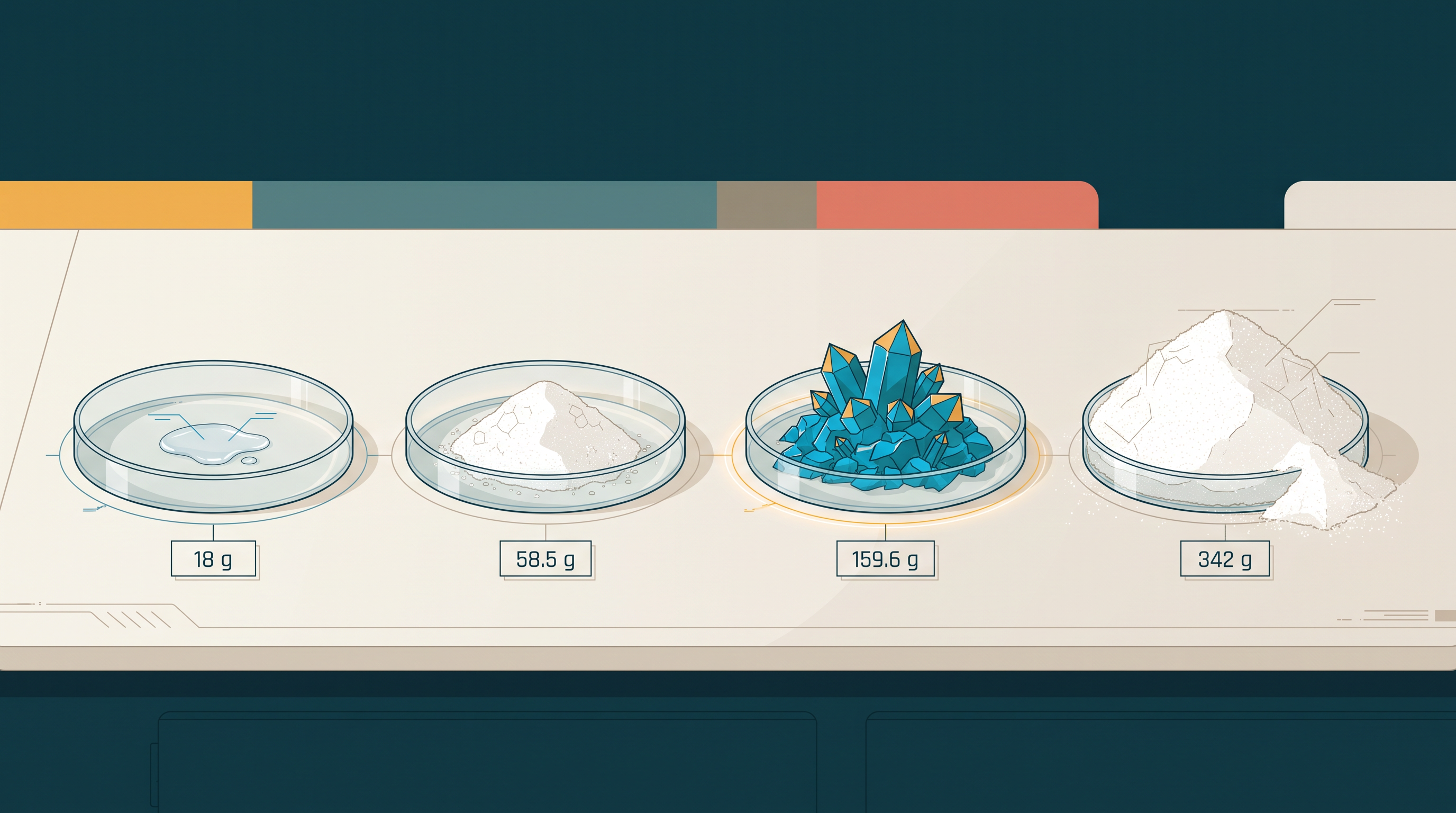
Fig. 1.11 – One mole of water, sodium chloride, copper sulphate and sugar.
1.9 Percentage Composition
Until now we have counted entities in a sample. Often, though, we need to know something different: what fraction of a compound’s mass is made up by each element. This is its percentage composition.
Knowing the percentage composition answers two useful questions. For an unknown compound, it tells us which elements are present and in what ratio — a first step towards finding its formula. For a known compound, it lets us check purity: if a sample’s measured composition matches that of the pure substance, the sample is likely pure.
Calculating Mass Percentage
The mass percentage of an element in a compound is found from:
\[\text{Mass \% of an element} = \frac{\text{mass of that element in the compound}}{\text{molar mass of the compound}} \times 100\]
Take water, \(\mathrm{H_2O}\), whose molar mass is \(18.02\ \text{g}\). It contains hydrogen and oxygen, so:
\[\text{Mass \% of hydrogen} = \frac{2\times1.008}{18.02}\times100 = 11.18\]
\[\text{Mass \% of oxygen} = \frac{16.00}{18.02}\times100 = 88.79\]
As a second example, consider ethanol, whose molecular formula is \(\mathrm{C_2H_5OH}\). Its molar mass is
\[(2\times12.01 + 6\times1.008 + 16.00)\ \text{g} = 46.068\ \text{g}\]
so:
\[\text{Mass \% of carbon} = \frac{24.02\ \text{g}}{46.068\ \text{g}}\times100 = 52.14\%\]
\[\text{Mass \% of hydrogen} = \frac{6.048\ \text{g}}{46.068\ \text{g}}\times100 = 13.13\%\]
\[\text{Mass \% of oxygen} = \frac{16.00\ \text{g}}{46.068\ \text{g}}\times100 = 34.73\%\]
1.9.1 Empirical Formula for Molecular Formula
Percentage composition leads naturally to a compound’s formula. Two kinds of formula must be distinguished.
If the mass percentages of the elements are known, the empirical formula can be worked out; if the molar mass is also known, the molecular formula follows. The full route is summarised in FC 1.1.
Flowchart
FC 1.1 – Finding a molecular formula from mass % data: mass % of each element → assume a 100 g sample (mass of each element in grams) → divide each mass by its atomic mass (moles of each element) → divide all mole values by the smallest (simplest ratio) → round to whole numbers → empirical formula; then branch: compute empirical formula mass → n = molar mass ÷ empirical formula mass → multiply empirical formula by n → molecular formula.
1.10 Stoichiometry and Stoichiometric Calculations
The word stoichiometry comes from two Greek words — stoicheion (meaning element) and metron (meaning measure). Fittingly, stoichiometry is the “measuring of elements”: it deals with calculating the masses (and sometimes volumes) of reactants and products in a chemical reaction.
Before we calculate how much reactant is needed or how much product forms, we must see how much information a balanced chemical equation carries. Consider the combustion of methane:
\[\mathrm{CH_4}\text{(g)} + 2\,\mathrm{O_2}\text{(g)} \rightarrow \mathrm{CO_2}\text{(g)} + 2\,\mathrm{H_2O}\text{(g)}\]
Here methane and dioxygen are the reactants, while carbon dioxide and water are the products. The letter (g) beside each formula shows the substance is a gas; for solids and liquids we would write (s) and (l).
What a Balanced Equation Tells Us
The numbers in front of the formulas — the 2 before \(\mathrm{O_2}\) and \(\mathrm{H_2O}\), and the (unwritten) 1 before \(\mathrm{CH_4}\) and \(\mathrm{CO_2}\) — are called stoichiometric coefficients. They give the number of molecules, and equally the number of moles, taking part in or formed by the reaction. Reading the equation above, therefore:
- One mole of \(\mathrm{CH_4}\) reacts with two moles of \(\mathrm{O_2}\) to give one mole of \(\{CO_2}\) and two moles of \(\mathrm{H_2O}\).
- One molecule of \(\mathrm{CH_4}\) reacts with two molecules of \(\mathrm{O_2}\) to give one molecule of \(\mathrm{CO_2}\) and two molecules of \(\mathrm{H_2O}\).
- \(22.7\ \text{L}\) of \(\mathrm{CH_4}\) reacts with \(45.4\ \text{L}\) of \(\mathrm{O_2}\) to give \(22.7\ \text{L}\) of \(\mathrm{CO_2}\) and \(45.4\ \text{L}\) of \(\mathrm{H_2O}\).
- \(16\ \text{g}\) of \(\mathrm{CH_4}\) reacts with \(2\times32\ \text{g}\) of \(\mathrm{O_2}\) to give \(44\ \text{g}\) of \(\mathrm{CO_2}\) and \(2\times18\ \text{g}\) of \(\mathrm{H_2O}\).
From these relationships the data can be freely interconverted between mass, moles and number of molecules, and — using density — between mass and volume, as summarised in FC 1.3.
Flowchart
FC 1.3 – Interconversion of quantities: number of molecules ↔︎ (÷ or × Avogadro number Nₐ) ↔︎ moles ↔︎ (× or ÷ molar mass) ↔︎ mass ↔︎ (÷ or × density) ↔︎ volume.
Balancing a Chemical Equation
By the law of conservation of mass, a balanced equation must show the same number of atoms of each element on both sides. Many equations can be balanced by trial and error. Take a few metals and non-metals burning in oxygen to give oxides:
\[4\,\mathrm{Fe}\text{(s)} + 3\,\mathrm{O_2}\text{(g)} \rightarrow 2\,\mathrm{Fe_2O_3}\text{(s)} \quad \text{(balanced)}\]
\[2\,\mathrm{Mg}\text{(s)} + \mathrm{O_2}\text{(g)} \rightarrow 2\,\mathrm{MgO}\text{(s)} \quad \text{(balanced)}\]
\[\mathrm{P_4}\text{(s)} + \mathrm{O_2}\text{(g)} \rightarrow \mathrm{P_4O_{10}}\text{(s)} \quad \text{(unbalanced)}\]
In the first two, the metal and oxygen atoms already match on both sides. In the third, the phosphorus atoms balance but the oxygen atoms do not: there are 10 oxygen atoms on the right, so a coefficient of 5 is placed before \(\mathrm{O_2}\):
\[\mathrm{P_4}\text{(s)} + 5\,\mathrm{O_2}\text{(g)} \rightarrow \mathrm{P_4O_{10}}\text{(s)} \quad \text{(balanced)}\]
Now consider the combustion of propane, \(\mathrm{C_3H_8}\), balanced step by step.
Step 1 — Write correct formulas of reactants and products:
\[\mathrm{C_3H_8}\text{(g)} + \mathrm{O_2}\text{(g)} \rightarrow \mathrm{CO_2}\text{(g)} + \mathrm{H_2O}\text{(l)} \quad \text{(unbalanced)}\]
Step 2 — Balance carbon: three C atoms need three \(\mathrm{CO_2}\) molecules:
\[\mathrm{C_3H_8}\text{(g)} + \mathrm{O_2}\text{(g)} \rightarrow 3\,\mathrm{CO_2}\text{(g)} + \mathrm{H_2O}\text{(l)}\]
Step 3 — Balance hydrogen: eight H atoms need four \(\mathrm{H_2O}\) molecules:
\[\mathrm{C_3H_8}\text{(g)} + \mathrm{O_2}\text{(g)} \rightarrow 3\,\mathrm{CO_2}\text{(g)} + 4\,\mathrm{H_2O}\text{(l)}\]
Step 4 — Balance oxygen: the right side now has \(3\times2 = 6\) (in \(\mathrm{CO_2}\)) plus \(4\times1 = 4\) (in \(\{H_2O}\)), that is 10 oxygen atoms, so five \(\mathrm{O_2}\) molecules are needed:
\[\mathrm{C_3H_8}\text{(g)} + 5\,\mathrm{O_2}\text{(g)} \rightarrow 3\,\mathrm{CO_2}\text{(g)} + 4\,\mathrm{H_2O}\text{(l)}\]
Step 5 — Verify: three carbon, eight hydrogen and ten oxygen atoms appear on each side. The equation is balanced. The general routine is summarised in FC 1.2.
Flowchart
FC 1.2 – Balancing an equation: write correct formulas (unbalanced skeleton) → balance metal/carbon atoms first → balance hydrogen atoms → balance oxygen atoms → adjust coefficients only, never subscripts → verify equal atoms of each element on both sides → balanced equation.
Remember one golden rule: to balance an equation you may only change the coefficients, never the subscripts in a formula — changing a subscript would change the substance itself.
1.10.1 Limiting Reagent
In real laboratory work, reactants are rarely mixed in the exact ratio the balanced equation demands. Usually one reactant is present in excess and another in short supply. The reactant present in the smaller (insufficient) amount is used up first, and once it is gone the reaction stops, however much of the other reactant remains. That reactant therefore fixes — or limits — the amount of product formed.
1.10.2 Reactions in Solutions
Most laboratory reactions are carried out in solution, so we need ways to state how much substance is dissolved in a given amount of solution or solvent. The concentration of a solution can be expressed in four common ways:
- Mass per cent (weight per cent, w/w %)
- Mole fraction
- Molarity
- Molality
Mass Per Cent
Mass per cent gives the mass of solute as a percentage of the mass of the whole solution:
\[\text{Mass per cent} = \frac{\text{Mass of solute}}{\text{Mass of solution}}\times100\]
Mole Fraction
Mole fraction is the ratio of the moles of one component to the total moles in the solution.
If a substance A is dissolved in a substance B, with \(n_A\) and \(n_B\) moles respectively, then:
\[x_A = \frac{n_A}{n_A + n_B}, \qquad x_B = \frac{n_B}{n_A + n_B}\]
Molarity
Molarity is the most widely used concentration unit, denoted by M.
\[\text{Molarity (M)} = \frac{\text{No. of moles of solute}}{\text{Volume of solution in litres}}\]
Suppose we have a \(1\ \text{M}\) solution of NaOH and want to prepare a \(0.2\ \text{M}\) solution from it. A \(1\ \text{M}\) NaOH solution contains 1 mol of NaOH in 1 litre. For a \(0.2\ \text{M}\) solution we need \(0.2\) mol of NaOH in 1 litre. So we must take the volume of the \(1\ \text{M}\) solution that contains \(0.2\) mol of NaOH and dilute it to 1 litre with water. Since 1 mol is present in \(1000\ \text{mL}\),
\[\frac{1000\ \text{mL}}{1\ \text{mol}} \times 0.2\ \text{mol} = 200\ \text{mL of solution}\]
So \(200\ \text{mL}\) of \(1\ \text{M}\) NaOH is taken and diluted with water to \(1\) litre. Such dilutions are handled with the general formula \(M_1 V_1 = M_2 V_2\), where here \(M_1 = 0.2\ \text{M}\), \(V_1 = 1000\ \text{mL}\), \(M_2 = 1.0\ \text{M}\):
\[0.2\ \text{M} \times 1000\ \text{mL} = 1.0\ \text{M} \times V_2 \;\Rightarrow\; V_2 = \frac{0.2\ \text{M}\times1000\ \text{mL}}{1.0\ \text{M}} = 200\ \text{mL}\]
Note that the number of moles of solute (NaOH) stays \(0.2\) throughout — dilution changes only the amount of solvent, not the amount of solute.
Molarity depends on temperature, because the volume of a solution changes with temperature.
Molality
\[\text{Molality (m)} = \frac{\text{No. of moles of solute}}{\text{Mass of solvent in kg}}\]
Unlike molarity, molality does not change with temperature, because mass is unaffected by temperature. A solution of known higher concentration, from which more dilute solutions are prepared, is called a stock solution.
1.11 Summary
Chemistry is not a very old discipline, yet people in ancient India already understood many scientific phenomena long before modern science and applied that knowledge in daily life.
The study of chemistry reaches into every sphere of life: chemists study the properties, structure and changes of substances.
All substances are made of matter, which can exist in three states — solid, liquid and gas. The particles are arranged differently in each state, giving each state its characteristic properties.
Matter is classified as elements, compounds or mixtures. An element contains only one type of particle (existing as atoms or molecules); a compound forms when atoms of two or more elements combine in a fixed ratio; mixtures are very common, and many substances around us are mixtures.
Studying a property always involves measurement, which needs a system of units. Several systems (English and Metric) have been used, but the scientific community has agreed on the common SI system, built on seven base units.
Every measurement carries some uncertainty, so data must be handled carefully. Because quantities in chemistry range from about \(10^{-31}\) to \(10^{+23}\), they are written in scientific notation (\(N\times10^{n}\)). Uncertainty is shown through the number of significant figures, and dimensional analysis (the factor-label method) is used to convert between units.
Density links mass and volume: \[d = \frac{m}{V}\]
The combination of atoms is governed by five laws of chemical combination: the Law of Conservation of Mass, the Law of Definite Proportions, the Law of Multiple Proportions, Gay Lussac’s Law of Gaseous Volumes, and Avogadro’s Law.
These laws led to Dalton’s atomic theory, which states that atoms are the building blocks of matter.
Atomic mass is expressed relative to the \(^{12}\mathrm{C}\) isotope of carbon, which is assigned an exact value of \(12\ \text{u}\). The value normally used for an element is its average atomic mass, which accounts for the natural abundance of its isotopes.
The molecular mass of a substance is the sum of the atomic masses of all atoms in one molecule. For substances without discrete molecules (such as ionic solids), the formula mass is used instead. The molecular formula of a compound can be found from its mass percentage composition together with its molar mass.
The number of atoms, molecules or other particles in a sample is expressed using the Avogadro constant (\(6.022\times10^{23}\)), which defines one mole of particles. The mass of one mole is the molar mass (in g mol⁻¹).
Chemical reactions are represented by balanced chemical equations, whose coefficients give the molar ratios and the numbers of particles taking part. The quantitative study of the reactants needed and the products formed is called stoichiometry; stoichiometric calculations can find the amount of reactant required for a given amount of product, and vice versa. One reactant may act as the limiting reagent, fixing the maximum amount of product.
The amount of substance dissolved in a given volume of solution is expressed in several ways — mass per cent, mole fraction, molarity and molality: \[\text{Molarity (M)} = \frac{\text{moles of solute}}{\text{volume of solution in litres}}, \qquad \text{Molality (m)} = \frac{\text{moles of solute}}{\text{mass of solvent in kg}}\]
1.12 NCERT Questions
Calculate the molar mass of the following: (i) \(\mathrm{H_2O}\) (ii) \(\mathrm{CO_2}\) (iii) \(\mathrm{CH_4}\)
Calculate the mass per cent of different elements present in sodium sulphate (\(\mathrm{Na_2SO_4}\)).
Determine the empirical formula of an oxide of iron, which has 69.9% iron and 30.1% dioxygen by mass.
Calculate the amount of carbon dioxide that could be produced when
- 1 mole of carbon is burnt in air.
- 1 mole of carbon is burnt in 16 g of dioxygen.
- 2 moles of carbon are burnt in 16 g of dioxygen.
Calculate the mass of sodium acetate (\(\mathrm{CH_3COONa}\)) required to make 500 mL of 0.375 molar aqueous solution. Molar mass of sodium acetate is \(82.0245\ \text{g mol}^{-1}\).
Calculate the concentration of nitric acid in moles per litre in a sample which has a density, \(1.41\ \text{g mL}^{-1}\) and the mass per cent of nitric acid in it being 69%.
How much copper can be obtained from 100 g of copper sulphate (\(\mathrm{CuSO_4}\))?
Determine the molecular formula of an oxide of iron, in which the mass per cent of iron and oxygen are 69.9 and 30.1, respectively.
Calculate the atomic mass (average) of chlorine using the following data:
| % Natural Abundance | Molar Mass | |
|---|---|---|
| \(^{35}\mathrm{Cl}\) | 75.77 | 34.9689 |
| \(^{37}\mathrm{Cl}\) | 24.23 | 36.9659 |
In three moles of ethane (\(\mathrm{C_2H_6}\)), calculate the following:
- Number of moles of carbon atoms.
- Number of moles of hydrogen atoms.
- Number of molecules of ethane.
What is the concentration of sugar (\(\mathrm{C_{12}H_{22}O_{11}}\)) in \(\text{mol L}^{-1}\) if its 20 g are dissolved in enough water to make a final volume up to 2 L?
If the density of methanol is \(0.793\ \text{kg L}^{-1}\), what is its volume needed for making 2.5 L of its 0.25 M solution?
Pressure is determined as force per unit area of the surface. The SI unit of pressure, pascal is as shown below: \(1\ \text{Pa} = 1\ \text{N m}^{-2}\) If mass of air at sea level is \(1034\ \text{g cm}^{-2}\), calculate the pressure in pascal.
What is the SI unit of mass? How is it defined?
Match the following prefixes with their multiples:
| Prefixes | Multiples |
|---|---|
| a. micro | i. \(10^{6}\) |
| b. deca | ii. \(10^{9}\) |
| c. mega | iii. \(10^{-6}\) |
| d. giga | iv. \(10^{-15}\) |
| e. femto | v. 10 |
What do you mean by significant figures?
A sample of drinking water was found to be severely contaminated with chloroform, \(\mathrm{CHCl_3}\), supposed to be carcinogenic in nature. The level of contamination was 15 ppm (by mass).
- Express this in per cent by mass.
- Determine the molality of chloroform in the water sample.
Express the following in the scientific notation:
- 0.0048 (ii) 234,000 (iii) 8008 (iv) 500.0 (v) 6.0012
- How many significant figures are present in the following?
- 0.0025 (ii) 208 (iii) 5005 (iv) 126,000 (v) 500.0 (vi) 2.0034
- Round up the following upto three significant figures:
- 34.216 (ii) 10.4107 (iii) 0.04597 (iv) 2808
- The following data are obtained when dinitrogen and dioxygen react together to form different compounds:
| Mass of dinitrogen | Mass of dioxygen | |
|---|---|---|
| (i) | 14 g | 16 g |
| (ii) | 14 g | 32 g |
| (iii) | 28 g | 32 g |
| (iv) | 28 g | 80 g |
a. Which law of chemical combination is obeyed by the above experimental data? Give its statement.
b. Fill in the blanks in the following conversions:
    (i) 1 km = ...................... mm = ...................... pm
    (ii) 1 mg = ...................... kg = ...................... ng
    (iii) 1 mL = ...................... L = ...................... $\text{dm}^3$
If the speed of light is \(3.0\times10^{8}\ \text{m s}^{-1}\), calculate the distance covered by light in 2.00 ns.
In a reaction \(\mathrm{A} + \mathrm{B_2} \rightarrow \mathrm{AB_2}\) Identify the limiting reagent, if any, in the following reaction mixtures.
- 300 atoms of A + 200 molecules of B
- 2 mol A + 3 mol B
- 100 atoms of A + 100 molecules of B
- 5 mol A + 2.5 mol B
- 2.5 mol A + 5 mol B
Dinitrogen and dihydrogen react with each other to produce ammonia according to the following chemical equation: \(\mathrm{N_2}\text{(g)} + \mathrm{H_2}\text{(g)} \rightarrow 2\,\mathrm{NH_3}\text{(g)}\)
- Calculate the mass of ammonia produced if \(2.00\times10^{3}\ \text{g}\) dinitrogen reacts with \(1.00\times10^{3}\ \text{g}\) of dihydrogen.
- Will any of the two reactants remain unreacted?
- If yes, which one and what would be its mass?
How are \(0.50\ \text{mol}\ \mathrm{Na_2CO_3}\) and \(0.50\ \text{M}\ \mathrm{Na_2CO_3}\) different?
If 10 volumes of dihydrogen gas reacts with five volumes of dioxygen gas, how many volumes of water vapour would be produced?
Convert the following into basic units:
- 28.7 pm (ii) 15.15 pm (iii) 25365 mg
- Which one of the following will have the largest number of atoms?
- 1 g Au (s) (ii) 1 g Na (s) (iii) 1 g Li (s) (iv) 1 g of \(\mathrm{Cl_2}\)(g)
Calculate the molarity of a solution of ethanol in water, in which the mole fraction of ethanol is 0.040 (assume the density of water to be one).
What will be the mass of one \(^{12}\mathrm{C}\) atom in g?
How many significant figures should be present in the answer of the following calculations?
- \(\dfrac{0.02856 \times 298.15 \times 0.112}{0.5785}\)
- \(5 \times 5.364\)
- \(0.0125 + 0.7864 + 0.0215\)
Use the data given in the following table to calculate the molar mass of naturally occuring argon isotopes:
| Isotope | Isotopic molar mass | Abundance |
|---|---|---|
| \(^{36}\mathrm{Ar}\) | \(35.96755\ \text{g mol}^{-1}\) | 0.337% |
| \(^{38}\mathrm{Ar}\) | \(37.96272\ \text{g mol}^{-1}\) | 0.063% |
| \(^{40}\mathrm{Ar}\) | \(39.9624\ \text{g mol}^{-1}\) | 99.600% |
Calculate the number of atoms in each of the following (i) 52 moles of Ar (ii) 52 u of He (iii) 52 g of He.
A welding fuel gas contains carbon and hydrogen only. Burning a small sample of it in oxygen gives 3.38 g carbon dioxide, 0.690 g of water and no other products. A volume of 10.0 L (measured at STP) of this welding gas is found to weigh 11.6 g. Calculate (i) empirical formula, (ii) molar mass of the gas, and (iii) molecular formula.
Calcium carbonate reacts with aqueous HCl to give \(\mathrm{CaCl_2}\) and \(\mathrm{CO_2}\) according to the reaction, \(\mathrm{CaCO_3}\text{(s)} + 2\,\mathrm{HCl}\text{(aq)} \rightarrow \mathrm{CaCl_2}\text{(aq)} + \mathrm{CO_2}\text{(g)} + \mathrm{H_2O}\text{(l)}\) What mass of \(\mathrm{CaCO_3}\) is required to react completely with 25 mL of 0.75 M HCl?
Chlorine is prepared in the laboratory by treating manganese dioxide (\(\mathrm{MnO_2}\)) with aqueous hydrochloric acid according to the reaction \(4\,\mathrm{HCl}\text{(aq)} + \mathrm{MnO_2}\text{(s)} \rightarrow 2\,\mathrm{H_2O}\text{(l)} + \mathrm{MnCl_2}\text{(aq)} + \mathrm{Cl_2}\text{(g)}\) How many grams of HCl react with 5.0 g of manganese dioxide?
1.13 Check Your Concepts
Classify each of the following as an element, a compound or a mixture, giving one reason in each case: (i) graphite, (ii) sodium chloride, (iii) sea water, (iv) ozone gas, (v) stainless steel.
Why can the components of a mixture be separated by physical methods, while those of a compound cannot? Explain in terms of how the constituent particles are held together.
State whether each of the following is a physical property or a chemical property, and justify: (i) the boiling point of ethanol, (ii) the fact that magnesium burns in air, (iii) the density of copper, (iv) the reaction of zinc with dilute hydrochloric acid.
Assertion (A): The mass of an object remains the same on the Moon as on the Earth. Reason (R): Mass is the amount of matter in an object and does not depend on gravity. Choose the correct option: (a) both A and R are true and R is the correct explanation of A; (b) both A and R are true but R is not the correct explanation of A; (c) A is true but R is false; (d) A is false but R is true.
A gas has neither a definite shape nor a definite volume, while a solid has both. Explain this difference on the basis of the arrangement and movement of the constituent particles.
“Ice floats on water.” Explain this observation in terms of density, and state one consequence of this behaviour for aquatic life.
Distinguish clearly between precision and accuracy. Is it possible for a set of measurements to be precise but not accurate? Illustrate with an example of your own.
Why is a negative temperature possible on the Celsius scale but not on the kelvin scale?
State the law of multiple proportions and explain how it differs from the law of definite proportions. Which of the two would you use to compare \(\mathrm{SO_2}\) and \(\mathrm{SO_3}\)?
Dalton’s atomic theory successfully explained the law of conservation of mass and the law of definite proportions, but failed to explain Gay Lussac’s law of gaseous volumes. Explain why, and state whose idea removed this difficulty.
Assertion (A): The atomic mass of carbon shown in the periodic table is 12.011 u, not exactly 12 u. Reason (R): Naturally occurring carbon is a mixture of isotopes with different masses. Choose the correct option: (a) both A and R are true and R is the correct explanation of A; (b) both A and R are true but R is not the correct explanation of A; (c) A is true but R is false; (d) A is false but R is true.
Why is the term “formula mass” used for sodium chloride instead of “molecular mass”? Name one other substance for which formula mass would be the appropriate term.
One mole of any substance contains the same number of particles, yet one mole of different substances has different masses. Explain why there is no contradiction here.
Match the following:
| Column I | Column II |
|---|---|
| a. Avogadro’s law | i. Mass is neither created nor destroyed |
| b. Law of conservation of mass | ii. Equal volumes of gases at same T and P contain equal numbers of molecules |
| c. Law of definite proportions | iii. Masses of one element combining with a fixed mass of another are in small whole-number ratios |
| d. Law of multiple proportions | iv. A compound always has the same composition by mass |
In balancing a chemical equation, why are you allowed to change the coefficients but never the subscripts within a formula?
Two reactants are mixed in amounts that are not in the stoichiometric ratio. Explain, in terms of the limiting reagent, which reactant decides how much product is formed and why the excess reactant is left over.
Molarity of a solution changes with temperature but molality does not. Explain the reason behind this difference.
A solution is diluted by adding more water to it. State, with reasons, what happens to (i) the number of moles of solute, and (ii) the molarity of the solution.
Explain why the empirical formula of a compound can be determined from its mass percentage composition alone, but its molecular formula cannot.
A student reports the mass of a sample as 100 g. Explain why this value is ambiguous in terms of significant figures, and rewrite it in scientific notation to show (i) one significant figure, (ii) three significant figures.
1.14 Practice With Numericals
Calculate the molar mass of (i) \(\mathrm{Ca(OH)_2}\), (ii) \(\mathrm{Al_2(SO_4)_3}\), (iii) \(\mathrm{C_6H_{12}O_6}\). (Take H = 1.008, C = 12.011, O = 16.00, Al = 26.98, S = 32.06, Ca = 40.08.)
Calculate the number of molecules present in 4.4 g of carbon dioxide, and the number of oxygen atoms in it. (Take C = 12, O = 16, \(N_A = 6.022\times10^{23}\ \text{mol}^{-1}\).)
Calculate the mass per cent of nitrogen in urea, \(\mathrm{NH_2CONH_2}\). (Take N = 14, H = 1, C = 12, O = 16.)
An organic compound contains 52.14% carbon, 13.13% hydrogen and 34.73% oxygen by mass. Its molar mass is \(46.0\ \text{g mol}^{-1}\). Determine its empirical and molecular formulas.
A block of aluminium has a mass of 27.0 g and a volume of \(10.0\ \text{cm}^3\). Calculate its density in \(\text{g cm}^{-3}\) and in \(\text{kg m}^{-3}\).
Convert (i) \(25\ ^\circ\text{C}\) into kelvin and into degrees Fahrenheit, (ii) \(212\ ^\circ\text{F}\) into degrees Celsius.
Using the factor label method, express (i) a speed of \(72\ \text{km h}^{-1}\) in \(\text{m s}^{-1}\), (ii) a volume of \(2.5\ \text{L}\) in \(\text{m}^3\).
Calculate the mass of magnesium oxide formed when 4.8 g of magnesium is burnt completely in oxygen, according to \(2\,\mathrm{Mg}\text{(s)} + \mathrm{O_2}\text{(g)} \rightarrow 2\,\mathrm{MgO}\text{(s)}\). (Take Mg = 24, O = 16.)
For the reaction \(\mathrm{N_2}\text{(g)} + 3\,\mathrm{H_2}\text{(g)} \rightleftharpoons 2\,\mathrm{NH_3}\text{(g)}\), 28 g of dinitrogen is mixed with 3.0 g of dihydrogen. Identify the limiting reagent and calculate the mass of ammonia formed. (Take N = 14, H = 1.)
Calculate the mass of sodium hydroxide required to prepare 250 mL of a 0.20 M aqueous solution. (Molar mass of NaOH = \(40\ \text{g mol}^{-1}\).)
What volume of a 2.0 M HCl stock solution is needed to prepare 500 mL of a 0.50 M HCl solution?
A solution is prepared by dissolving 9.0 g of glucose (\(\mathrm{C_6H_{12}O_6}\)) in 250 g of water. Calculate (i) the mass per cent of glucose, and (ii) the molality of the solution. (Molar mass of glucose = \(180\ \text{g mol}^{-1}\).)
An element X has two isotopes with masses \(10.0\ \text{u}\) and \(11.0\ \text{u}\), present in relative abundances of 20.0% and 80.0% respectively. Calculate the average atomic mass of X.
Calculate the number of significant figures in each result and report the answer correctly: (i) \(6.02 \times 3.4\), (ii) \(15.75 + 2.1 + 0.006\).
Calculate the mass of oxygen (in g) required for the complete combustion of 4.4 g of propane according to \(\mathrm{C_3H_8}\text{(g)} + 5\,\mathrm{O_2}\text{(g)} \rightarrow 3\,\mathrm{CO_2}\text{(g)} + 4\,\mathrm{H_2O}\text{(l)}\). (Take C = 12, H = 1, O = 16.)