Chapter 5: Thermodynamics
In the 1820s, a young French military engineer named Sadi Carnot became fascinated by steam engines — the roaring machines that were then reshaping factories, ships, and mines across Europe. Engineers of his day could build engines, but nobody truly understood them. Why did every engine, no matter how cleverly built, waste so much of its fuel’s energy as useless heat? Was there a limit to how much work a given amount of heat could ever produce?
Carnot decided to reason about the problem from first principles rather than tinker with machinery. In a slim book on the “motive power of fire,” he argued that heat flowing from a hot body to a cold one could be made to do work — but only in a way that had a natural direction and a strict ceiling. Heat, he realised, never flows uphill on its own.
Carnot died young, and his little book was almost forgotten. Yet the questions he raised — about energy, its transformations, and the one-way street that most natural changes seem to travel — grew into one of the most powerful branches of science: thermodynamics. The same ideas that once described steam engines now tell a chemist whether a reaction will release heat, whether it will happen at all, and how far it will go.
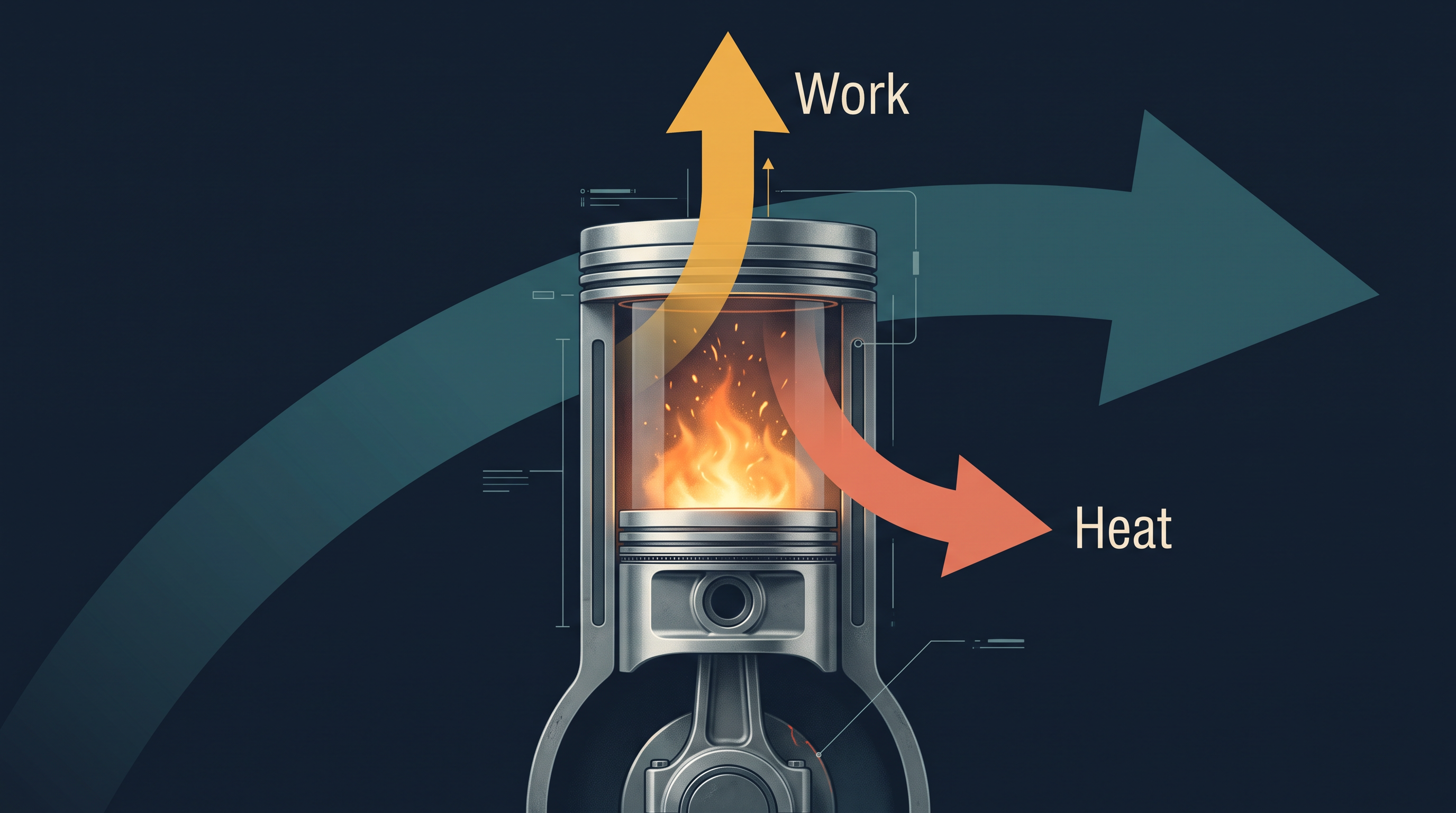
Fig. 5.0 – Heat, work, and the direction of change.
By the end of this chapter, you will be able to reason your way to the answers to each of these questions.
5.1 Thermodynamic Terms
In chemistry, we are constantly interested in reactions and in the energy that flows in or out as they happen. When methane burns, when a battery drives a torch, when ice melts in a glass of water — energy is being shifted from one form to another. To study these energy changes carefully and quantitatively, we first need a shared vocabulary. This section builds that vocabulary. The terms defined here — system, surroundings, state, internal energy, heat, work — are used in every later section of the chapter, so it is worth learning them precisely.
5.1.1 The System and the Surroundings
When we want to study something in the laboratory, we mentally draw a line around the part of the world we care about. That chosen part is called the system. Everything else — the rest of the universe that lies outside it — is called the surroundings.
Together, the system and the surroundings make up the whole universe:
\[\text{Universe} = \text{System} + \text{Surroundings}\]
Of course, the entire rest of the universe is not really affected by a small reaction in a beaker. So, in practice, the surroundings mean only that nearby portion of the universe that can actually exchange energy or matter with the system — usually the region of space in the immediate neighbourhood of the system.
For example, suppose we are studying a reaction between two substances A and B kept in a beaker. Then the beaker with its reaction mixture is the system, and the room in which the beaker sits is the surroundings, as shown in Fig. 5.1.
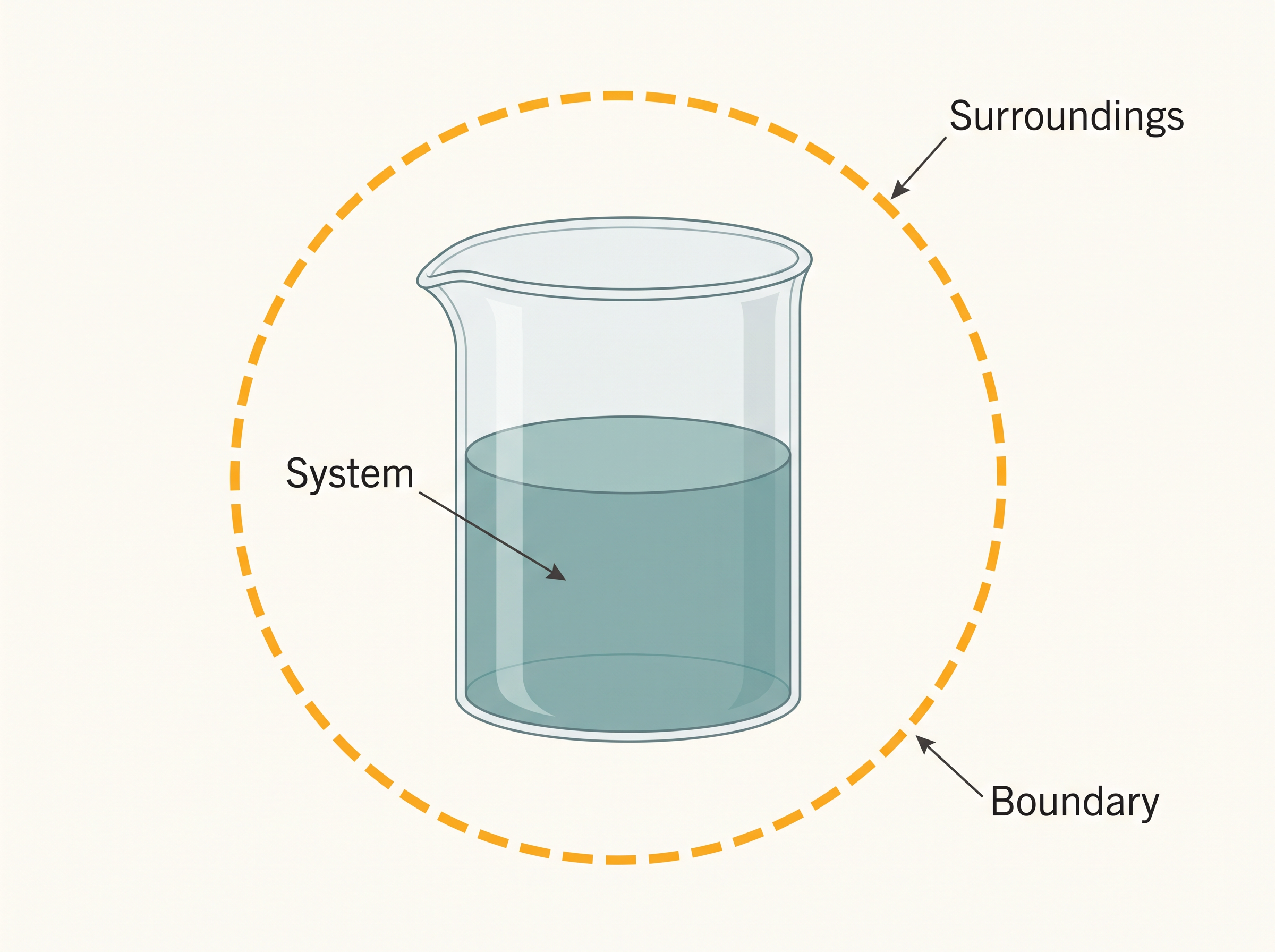
Fig. 5.1 – System and surroundings.
The imaginary or real wall that separates the system from the surroundings is called the boundary. The boundary is what lets us keep track of every bit of matter and energy going into or coming out of the system.
A system need not be enclosed by a physical wall like a beaker or test tube. It can also be defined simply by choosing a region of space — a set of coordinates marking off a certain volume. What matters is that we always think of the system as clearly separated from the surroundings by some boundary, whether that boundary is solid glass or just an imaginary surface in space.
5.1.2 Types of the System
We can sort systems into three types, depending on whether matter and energy are allowed to cross the boundary. The three set-ups are drawn side by side in Fig. 5.2.
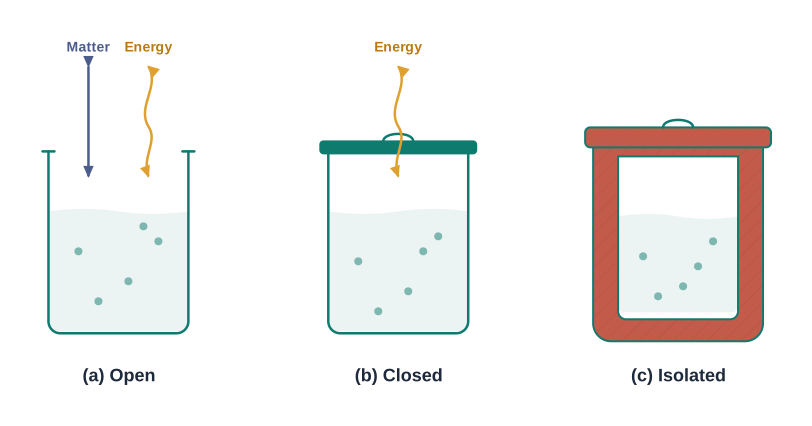
Fig. 5.2 – (a) Open, (b) closed and (c) isolated systems.
Open System
In an open system, both energy and matter can be exchanged with the surroundings. A beaker of reactants left open to the air is an open system — heat can flow through the walls, and vapour (matter) can escape or enter across the open top. Here the boundary is an imaginary surface enclosing the beaker and its contents.
Closed System
In a closed system, energy can still be exchanged with the surroundings, but matter cannot. If the same reactants are sealed inside a closed vessel made of a conducting material such as copper or steel, heat can pass through the metal walls, but no substance can get in or out. That is a closed system.
Isolated System
In an isolated system, neither energy nor matter can be exchanged with the surroundings. Reactants sealed inside a thermos flask (or any closed, well-insulated vessel) come close to being an isolated system, because the insulation blocks heat flow and the seal blocks matter flow.
5.1.3 The State of the System
To do any useful calculation, we must be able to describe the system fully. We do this by stating the values of a few measurable, bulk (large-scale) properties: its pressure (\(p\)), volume (\(V\)), temperature (\(T\)), and composition. Once these are fixed, the system is said to be in a definite state.
Variables such as \(p\), \(V\) and \(T\) are called state variables or state functions, because their values depend only on the present state of the system — not on the path taken to reach that state.
We do not have to list every possible property to fix the state. Only a certain minimum number of properties can be varied independently; once these are set, all the others take definite values automatically. How many are needed depends on the nature of the system. Conveniently, we never have to fully specify the state of the surroundings — and it is a good thing we don’t have to, because that would be impossible.
5.1.4 The Internal Energy as a State Function
When a chemical system gains or loses energy, we need a single quantity to represent its total energy. This total — the sum of all the chemical, electrical, mechanical, and every other kind of energy stored inside the system — is called the internal energy, symbol \(U\).
The internal energy of a system can change in three ways: when heat passes into or out of the system, when work is done on or by the system, or when matter enters or leaves the system. (The last of these applies only to open systems, which is why we usually study closed or isolated systems when we want to track \(U\) cleanly.)
Let us look at the first two ways — work and heat — one at a time. To keep matter out of the picture, imagine a fixed quantity of water sealed in a thermos flask or an insulated beaker, so nothing can enter or leave.
Work
To study a change in internal energy caused by work alone, we first block all heat exchange. A system whose walls do not allow heat to pass is called adiabatic, and a process carried out in such a system is an adiabatic process. The insulating wall is called the adiabatic wall, shown in Fig. 5.3.
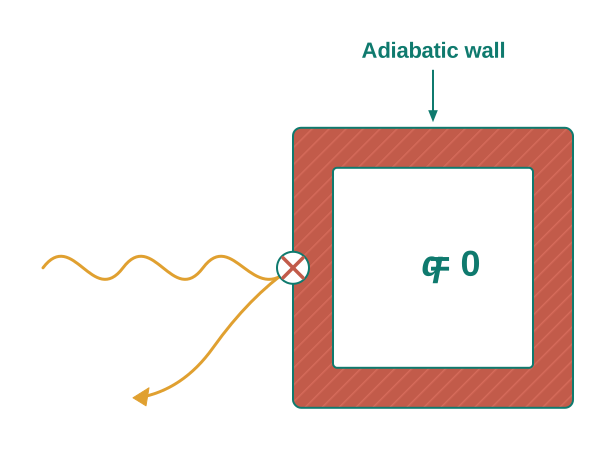
Fig. 5.3 – An adiabatic system.
Now let us change the internal energy of our insulated water by doing work on it. Call the starting state A, with temperature \(T_A\) and internal energy \(U_A\). We can raise the temperature of the water in two quite different ways.
One way: We do some mechanical work — say \(1\ \text{kJ}\) — by rotating small paddles that churn the water. The new state is B, at temperature \(T_B\). We find that \(T_B > T_A\), so the temperature has changed by \(\Delta T = T_B - T_A\). If the internal energy in state B is \(U_B\), the change is \(\Delta U = U_B - U_A\).
Second way: We now supply the same amount of work — \(1\ \text{kJ}\) — but as electrical work, using an immersion heater. When we measure the temperature change, we find it is exactly the same as before, namely \(T_B - T_A\).
This result is not a coincidence. Between about 1840 and 1850, J. P. Joule performed careful experiments of exactly this kind and showed that a given amount of work done on a system produces the same change of state — the same final temperature — no matter how the work is done. In other words, the change depends only on the initial and final states, not on the path.
Because the outcome is independent of path, it makes sense to define internal energy \(U\) as a quantity fixed by the state of the system, such that the adiabatic work \(w_{\text{ad}}\) needed to move between two states equals the difference in \(U\):
\[\Delta U = U_2 - U_1 = w_{\text{ad}}\]
This is precisely what we mean by saying internal energy \(U\) is a state function.
Following the IUPAC sign convention, \(w_{\text{ad}}\) is taken as positive when work is done on the system, because the internal energy then increases. Conversely, when work is done by the system, \(w_{\text{ad}}\) is negative, because the internal energy decreases.
Are there other state functions we already know? Yes — \(V\), \(p\) and \(T\) are all state functions too. For instance, if we warm a system from \(25\,^\circ\text{C}\) to \(35\,^\circ\text{C}\), the change in temperature is \(+10\,^\circ\text{C}\) whether we heat it straight up or overshoot and cool it back down to \(35\,^\circ\text{C}\). The change depends only on the start and end temperatures. Likewise, the volume of water in a pond is a state function: the change in volume does not care whether the water arrived by rain, by tubewell, or by both.
Heat
We can also change the internal energy of a system by transferring heat — without doing any work. Heat, symbol \(q\), is energy that flows because of a temperature difference between the system and its surroundings.
To see this, we repeat the earlier change (same starting and finishing states) but this time using thermally conducting walls instead of adiabatic ones, as in Fig. 5.4. We take water at temperature \(T_A\) in a copper-walled container and place it in a large heat reservoir at a higher temperature \(T_B\).
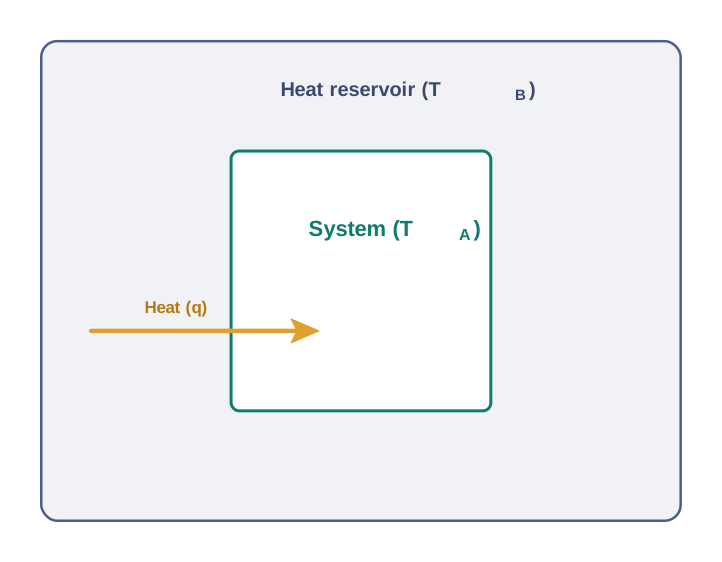
Fig. 5.4 – A system with thermally conducting walls.
The heat absorbed by the water, \(q\), can be measured from the temperature difference \(T_B - T_A\). If no work is done and the volume is kept constant, the whole change in internal energy comes from heat:
\[\Delta U = q \qquad (\text{at constant volume, no work})\]
Following the IUPAC convention, \(q\) is positive when heat flows from the surroundings into the system (raising its internal energy), and negative when heat flows out of the system into the surroundings (lowering its internal energy).
The General Case
In most real situations, both effects happen together: a system exchanges some heat and does or receives some work. Combining the two, the total change in internal energy is:
\[\Delta U = q + w \qquad (5.1)\]
For any particular change, \(q\) and \(w\) can each vary depending on how the process is carried out. But their sum, \(q + w = \Delta U\), depends only on the initial and final states — it is independent of the path. This is what makes \(U\) so useful.
If there is no exchange of energy as heat or work at all — that is, an isolated system with \(w = 0\) and \(q = 0\) — then \(\Delta U = 0\). The internal energy of an isolated system simply cannot change.
Equation (5.1), \(\Delta U = q + w\), is the mathematical statement of the first law of thermodynamics.
It is worth noting a subtle difference between internal energy and an ordinary mechanical property such as volume. We can quote an exact, absolute value for the volume of a system in a given state. But we cannot state an absolute value for internal energy — only its change, \(\Delta U\), can be measured. This is why every equation in thermodynamics deals with \(\Delta U\), never with \(U\) by itself.
5.2 Applications
Many chemical reactions produce gases that can push against their surroundings and do mechanical work, or they release heat that we can put to use. To connect these everyday effects to the internal-energy ideas of the previous section, we now need to quantify work and heat carefully. This section shows how, and along the way introduces a second very important state function — enthalpy.
5.2.1 Work
Of all the kinds of work a system can do, we will focus on just one: mechanical work, in the form of pressure–volume work. This is the work a gas does when it pushes a piston out, or the work done on a gas when a piston is pushed in.
Pressure–Volume Work
Imagine a cylinder holding one mole of an ideal gas, fitted with a frictionless piston. The gas has volume \(V_i\) and its own pressure is \(p\). Now suppose we press on the piston with an external pressure \(p_{\text{ex}}\) that is larger than \(p\). The piston moves inward, compressing the gas until the inside pressure rises to match \(p_{\text{ex}}\). Let the final volume be \(V_f\). The set-up is drawn in Fig. 5.5(a).
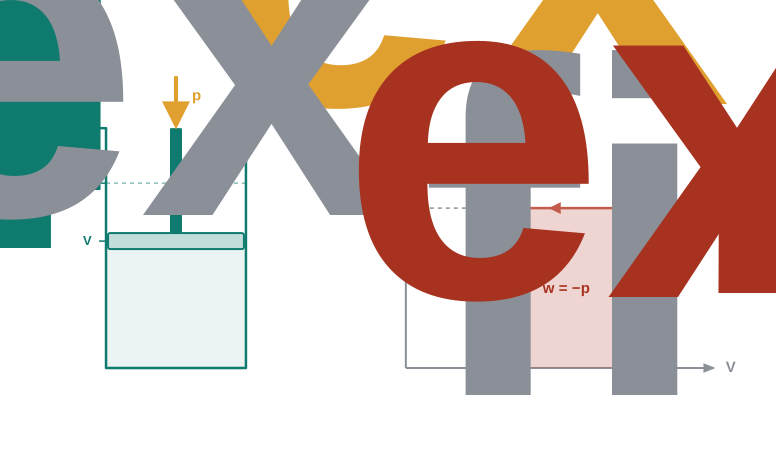
Fig. 5.5(a) – Pressure–volume work for a single-step compression.
Suppose the piston (cross-sectional area \(A\)) moves inward through a distance \(l\). Then the change in volume is
\[\Delta V = l \times A = (V_f - V_i)\]
We also know that pressure is force per unit area, so the force pushing on the piston is \(p_{\text{ex}} \times A\). If \(w\) is the work done on the system by this movement of the piston, then
\[w = \text{force} \times \text{distance} = p_{\text{ex}} \cdot A \cdot l = p_{\text{ex}}(-\Delta V) = -p_{\text{ex}}\,\Delta V = -p_{\text{ex}}(V_f - V_i) \qquad (5.2)\]
The negative sign is exactly what we need to match the IUPAC convention (work done on the system is positive). During a compression, \((V_f - V_i)\) is negative, and a negative multiplied by the leading minus sign gives a positive value for \(w\) — showing correctly that work is being done on the system.
Work Done in Finite Steps
The single-step case above assumes \(p_{\text{ex}}\) stays constant throughout. Suppose instead the external pressure is changed in a series of finite steps during the compression. Then we add up the work done on the gas over all the steps, which comes to \(-\Sigma\, p\,\Delta V\). On a \(p\)–\(V\) plot this appears as the total shaded area under the steps, as shown in Fig. 5.6(b).
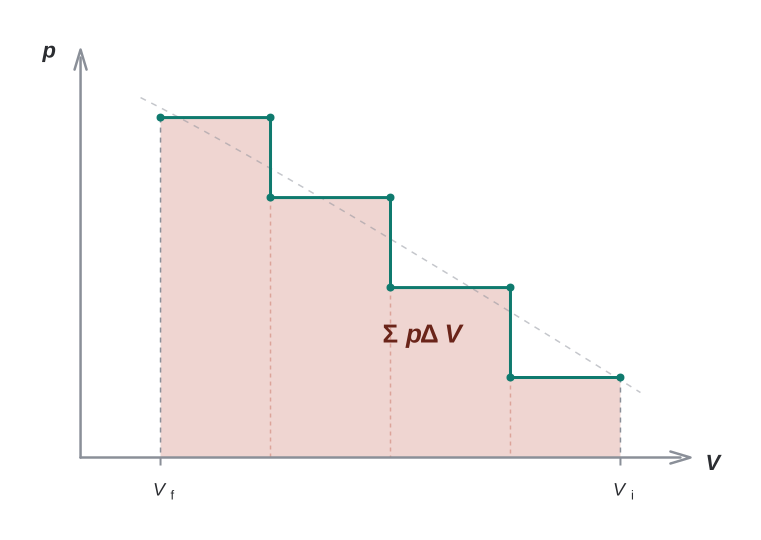
Fig. 5.6(b) – Work done in finite steps.
Reversible and Irreversible Processes
Now imagine carrying out the compression so gently that the external pressure is at every instant only infinitesimally greater than the gas pressure. The volume then shrinks by tiny amounts \(dV\) at each stage, and we can sum (integrate) the work as
\[w = -\int_{V_i}^{V_f} p_{\text{ex}}\, dV \qquad (5.3)\]
For such a slow compression, \(p_{\text{ex}} = (p_{\text{in}} + dp)\) at each stage, where \(p_{\text{in}}\) is the gas’s own (internal) pressure. In a similarly gentle expansion, the external pressure is always just less than the gas pressure, so \(p_{\text{ex}} = (p_{\text{in}} - dp)\). Combining both, in general \(p_{\text{ex}} = (p_{\text{in}} \pm dp)\). A process carried out this way is called a reversible process. This idea is shown in Fig. 5.7(c).
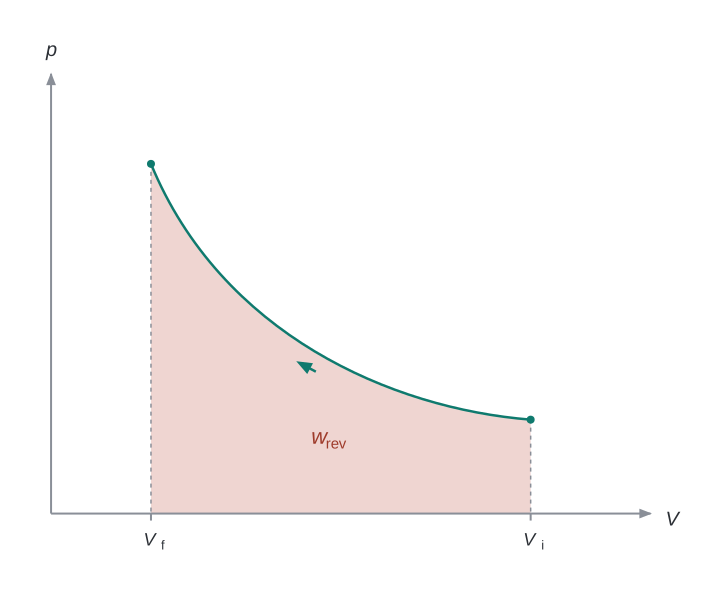
Fig. 5.7(c) – Work done under reversible conditions.
Any process that is not carried out in this ideal, infinitely slow way is called an irreversible process. Almost every real, fast-moving change — a gas expanding suddenly, a match burning — is irreversible.
Work Done Under Reversible Conditions
To make equation (5.3) usable in chemistry, we relate the work to the gas’s own internal pressure. Under reversible conditions we write
\[w_{\text{rev}} = -\int_{V_i}^{V_f} p_{\text{ex}}\, dV = -\int_{V_i}^{V_f} (p_{\text{in}} \pm dp)\, dV\]
Because the product \(dp \times dV\) is vanishingly small, it can be dropped, leaving
\[w_{\text{rev}} = -\int_{V_i}^{V_f} p_{\text{in}}\, dV \qquad (5.4)\]
Now we express the internal pressure (which we can just call \(p\)) in terms of volume using the ideal gas equation. For \(n\) moles of an ideal gas, \(pV = nRT\), so
\[p = \frac{nRT}{V}\]
At constant temperature (an isothermal process), substituting this in:
\[w_{\text{rev}} = -\int_{V_i}^{V_f} nRT\,\frac{dV}{V} = -nRT \ln\frac{V_f}{V_i} = -2.303\, nRT \log\frac{V_f}{V_i} \qquad (5.5)\]
The natural logarithm appears because integrating \(\dfrac{dV}{V}\) gives \(\ln V\). The factor \(2.303\) is simply the number that converts a natural logarithm (\(\ln\)) into a base-10 logarithm (\(\log\)), since \(\ln x = 2.303 \log x\) — a handy switch when using log tables.
Free Expansion
Expansion of a gas into a vacuum, where \(p_{\text{ex}} = 0\), is called free expansion. Since there is no opposing pressure to push against, no work is done — and this is true for an ideal gas whether the expansion is carried out reversibly or irreversibly (equations 5.2 and 5.3 both give \(w = 0\) when \(p_{\text{ex}} = 0\)).
Writing the First Law for Different Processes
We can now write the first law, \(\Delta U = q + w\), in several forms depending on the process. Substituting the expression \(w = -p_{\text{ex}}\,\Delta V\) (equation 5.2) into the first law:
\[\Delta U = q - p_{\text{ex}}\,\Delta V\]
If the process is carried out at constant volume (\(\Delta V = 0\)), the work term vanishes and
\[\Delta U = q_V\]
The subscript \(V\) in \(q_V\) reminds us that the heat is exchanged at constant volume.
For an isothermal expansion of an ideal gas into vacuum (free expansion), \(w = 0\) because \(p_{\text{ex}} = 0\). Joule also showed experimentally that \(q = 0\) in this case; therefore \(\Delta U = 0\).
The first law can then be written for the following isothermal changes:
For an isothermal irreversible change: \[q = -w = p_{\text{ex}}(V_f - V_i)\]
For an isothermal reversible change: \[q = -w = nRT \ln\frac{V_f}{V_i} = 2.303\, nRT \log\frac{V_f}{V_i}\]
For an adiabatic change, \(q = 0\), so \[\Delta U = w_{\text{ad}}\]
5.2.2 Enthalpy, \(H\)
A Useful New State Function
We saw that the heat absorbed at constant volume equals the change in internal energy, \(\Delta U = q_V\). But most chemical reactions are not carried out at constant volume — they happen in open flasks and test tubes under constant atmospheric pressure. So we need a state function suited to constant-pressure conditions.
At constant pressure, we can write the first law (equation 5.1) as
\[\Delta U = q_p - p\,\Delta V\]
where \(q_p\) is the heat absorbed at constant pressure and \(-p\,\Delta V\) is the expansion work done by the system. Writing the initial state as 1 and the final state as 2:
\[U_2 - U_1 = q_p - p(V_2 - V_1)\]
Rearranging to collect the state-1 and state-2 terms:
\[q_p = (U_2 + pV_2) - (U_1 + pV_1) \qquad (5.6)\]
This suggests defining a new thermodynamic function, the enthalpy \(H\), as
\[H = U + pV \qquad (5.7)\]
so that equation (5.6) becomes simply
\[q_p = H_2 - H_1 = \Delta H\]
Although \(q\) generally depends on the path, \(H\) is a state function because it is built entirely from \(U\), \(p\) and \(V\), which are all state functions. Therefore \(\Delta H\) is independent of path, and so is \(q_p\). Whenever heat is absorbed at constant pressure, we are in fact measuring the change in enthalpy.
For finite changes at constant pressure, equation (5.7) gives
\[\Delta H = \Delta U + \Delta(pV)\]
and since \(p\) is constant,
\[\Delta H = \Delta U + p\,\Delta V \qquad (5.8)\]
Remember that \(\Delta H = q_p\): it is the heat absorbed by the system at constant pressure. This gives us the crucial sign rule for reactions: \(\Delta H\) is negative for exothermic reactions, which give out heat, and positive for endothermic reactions, which take in heat from the surroundings.
At constant volume (\(\Delta V = 0\)), the \(p\,\Delta V\) term disappears, so equation (5.8) becomes
\[\Delta H = \Delta U = q_V\]
Relating ΔH and ΔU for gaseous reactions. The difference between \(\Delta H\) and \(\Delta U\) is usually tiny for reactions involving only solids and/or liquids, because these do not change volume much on heating. The difference becomes important when gases are involved. Consider a reaction at constant pressure and temperature. Let \(V_A\) be the total volume of gaseous reactants, \(V_B\) the total volume of gaseous products, \(n_A\) the moles of gaseous reactants, and \(n_B\) the moles of gaseous products. Applying the ideal gas law:
\[pV_A = n_A RT\] \[pV_B = n_B RT\]
Subtracting:
\[pV_B - pV_A = n_B RT - n_A RT = (n_B - n_A)RT\] \[p(V_B - V_A) = (n_B - n_A)RT\] \[p\,\Delta V = \Delta n_g RT \qquad (5.9)\]
Here \(\Delta n_g\) is the number of moles of gaseous products minus the number of moles of gaseous reactants. Substituting equation (5.9) into equation (5.8) gives the very useful relation
\[\Delta H = \Delta U + \Delta n_g RT \qquad (5.10)\]
Equation (5.10) lets us calculate \(\Delta H\) from \(\Delta U\), and the other way round.
Extensive and Intensive Properties
Thermodynamics divides properties into two types. An extensive property is one whose value depends on the amount or size of matter present. Mass, volume, internal energy, enthalpy, and heat capacity are all extensive — double the sample and you double these.
An intensive property, by contrast, does not depend on the amount of matter. Temperature, density, and pressure are intensive — they are the same whether you have a drop or a bucketful.
A molar property, written \(\chi_m\), is the value of an extensive property \(\chi\) for exactly one mole of substance. If \(n\) is the amount of matter,
\[\chi_m = \frac{\chi}{n}\]
which is independent of the amount of matter — so a molar property behaves like an intensive property. Molar volume \(V_m\) and molar heat capacity \(C_m\) are examples.
To see the distinction clearly, consider a gas in a container of volume \(V\) at temperature \(T\), as in Fig. 5.8(a). Now insert a partition dividing it in half, as in Fig. 5.8(b). Each half now has half the original volume, \(\dfrac{V}{2}\) — so volume changed, meaning it is extensive. But the temperature of each half is still \(T\) — unchanged — meaning temperature is intensive.
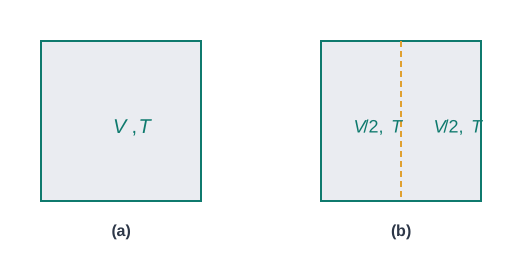
Fig. 5.8 – (a) Single container and (b) partitioned container.
Heat Capacity
We now ask a practical question: how do we measure the heat transferred to a system? When a system absorbs heat, its temperature rises, and the temperature rise is proportional to the heat supplied:
\[q = \text{coeff} \times \Delta T\]
The size of this coefficient depends on the size, composition, and nature of the system. Writing the coefficient as \(C\):
\[q = C\,\Delta T\]
The coefficient \(C\) is called the heat capacity. By measuring the temperature rise and knowing \(C\), we can find the heat supplied.
When \(C\) is large, a given amount of heat produces only a small temperature rise. Water has a large heat capacity, which is why a lot of energy is needed to warm it.
Heat capacity is directly proportional to the amount of substance. The molar heat capacity \(C_m\) is the heat capacity of one mole of substance — the heat needed to raise the temperature of one mole by one degree (celsius or kelvin):
\[C_m = \frac{C}{n}\]
The specific heat (or specific heat capacity) is the heat needed to raise the temperature of one unit mass by one degree. To find the heat \(q\) required to warm a sample, we multiply the specific heat \(c\) by the mass \(m\) and the temperature change \(\Delta T\):
\[q = c \times m \times \Delta T = C\,\Delta T \qquad (5.11)\]
The Relationship between \(C_p\) and \(C_V\) for an Ideal Gas
Heat capacity depends on the conditions of heating. At constant volume it is written \(C_V\), and at constant pressure it is written \(C_p\). Let us find how the two are related for an ideal gas.
Writing the heat equation for each condition:
at constant volume, \(q_V = C_V \Delta T = \Delta U\) at constant pressure, \(q_p = C_p \Delta T = \Delta H\)
For one mole of an ideal gas, starting from \(\Delta H = \Delta U + \Delta(pV)\):
\[\Delta H = \Delta U + \Delta(pV) = \Delta U + \Delta(RT) = \Delta U + R\,\Delta T\] \[\therefore\ \Delta H = \Delta U + R\,\Delta T \qquad (5.12)\]
(We used \(pV = RT\) for one mole, so \(\Delta(pV) = R\,\Delta T\) at constant \(R\).) Now substituting \(\Delta H = C_p \Delta T\) and \(\Delta U = C_V \Delta T\):
\[C_p \Delta T = C_V \Delta T + R\,\Delta T\] \[C_p = C_V + R\] \[C_p - C_V = R \qquad (5.13)\]
So for an ideal gas, the molar heat capacity at constant pressure exceeds that at constant volume by exactly the gas constant \(R\).
5.3 Measurement of ∆U and ∆H: Calorimetry
We have defined internal energy change and enthalpy change — but how do we actually measure them in the laboratory? The answer is calorimetry: an experimental technique that measures the heat released or absorbed in a chemical or physical process by tracking a temperature change.
In calorimetry, the process is carried out inside a vessel called a calorimeter, which is immersed in a known volume of liquid. If we know the heat capacity of that liquid and of the calorimeter itself, we can work out the heat evolved by measuring how much the temperature changes.
Measurements are made under two different conditions, matching the two heat quantities we met earlier: at constant volume, where the heat exchanged is \(q_V\), and at constant pressure, where it is \(q_p\).
∆U Measurements
To measure heat absorbed or released at constant volume, chemists use a bomb calorimeter (Fig. 5.9). At its heart is a strong steel vessel — the “bomb” — immersed in a water bath. The whole assembly is the calorimeter, and the water bath ensures that essentially no heat escapes to the outside surroundings.
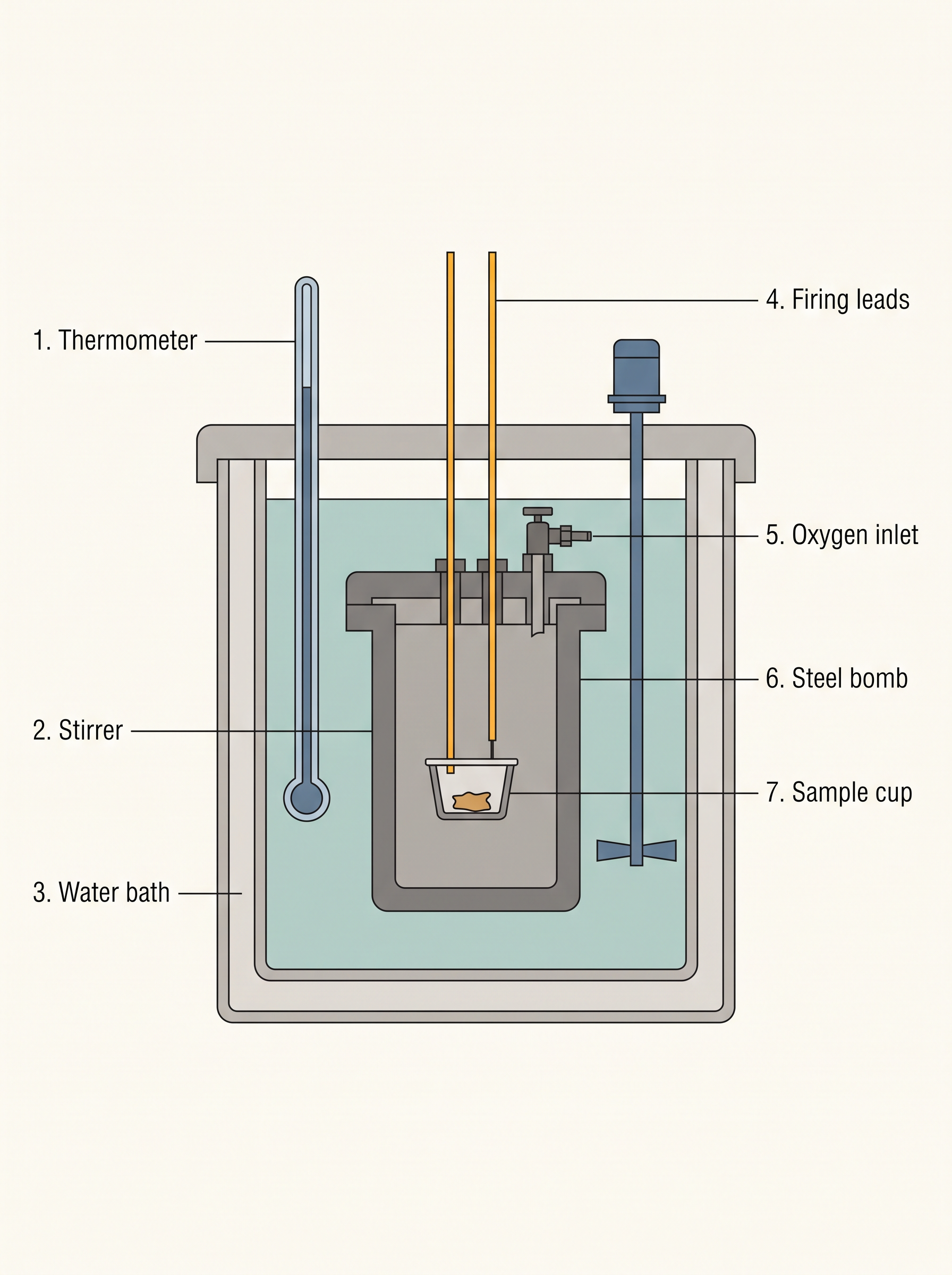
Fig. 5.9 – A bomb calorimeter.
A combustible substance is placed in the steel bomb and burned in pure dioxygen supplied under pressure. The heat evolved passes into the water surrounding the bomb, and the temperature rise is measured. Because the sealed bomb cannot change its volume, the process happens at constant volume.
Under these conditions, no work is done — even when the reaction involves gases — because \(\Delta V = 0\), so \(p\,\Delta V = 0\). The measured temperature change of the calorimeter is then converted to \(q_V\) using the known heat capacity of the calorimeter, through the heat-capacity relation \(q = C\,\Delta T\) (equation 5.11). Since no work is done, this \(q_V\) equals \(\Delta U\) for the reaction.
Flowchart
FC 5.1 – Bomb-calorimeter measurement logic: combustible sample + excess O₂ in sealed steel bomb → complete combustion → heat passes to surrounding water + bomb → temperature rise ΔT measured → heat gained by calorimeter q = C×ΔT → heat released by reaction q_V = −C×ΔT → convert to per mole → since ΔV = 0, ΔU = q_V → obtain ΔH from ΔH = ΔU + Δn_g RT
∆H Measurements
Most reactions in the laboratory are run in open vessels under ordinary atmospheric pressure, so we more often want the heat change at constant pressure. This is measured in a simpler calorimeter such as the one in Fig. 5.10.
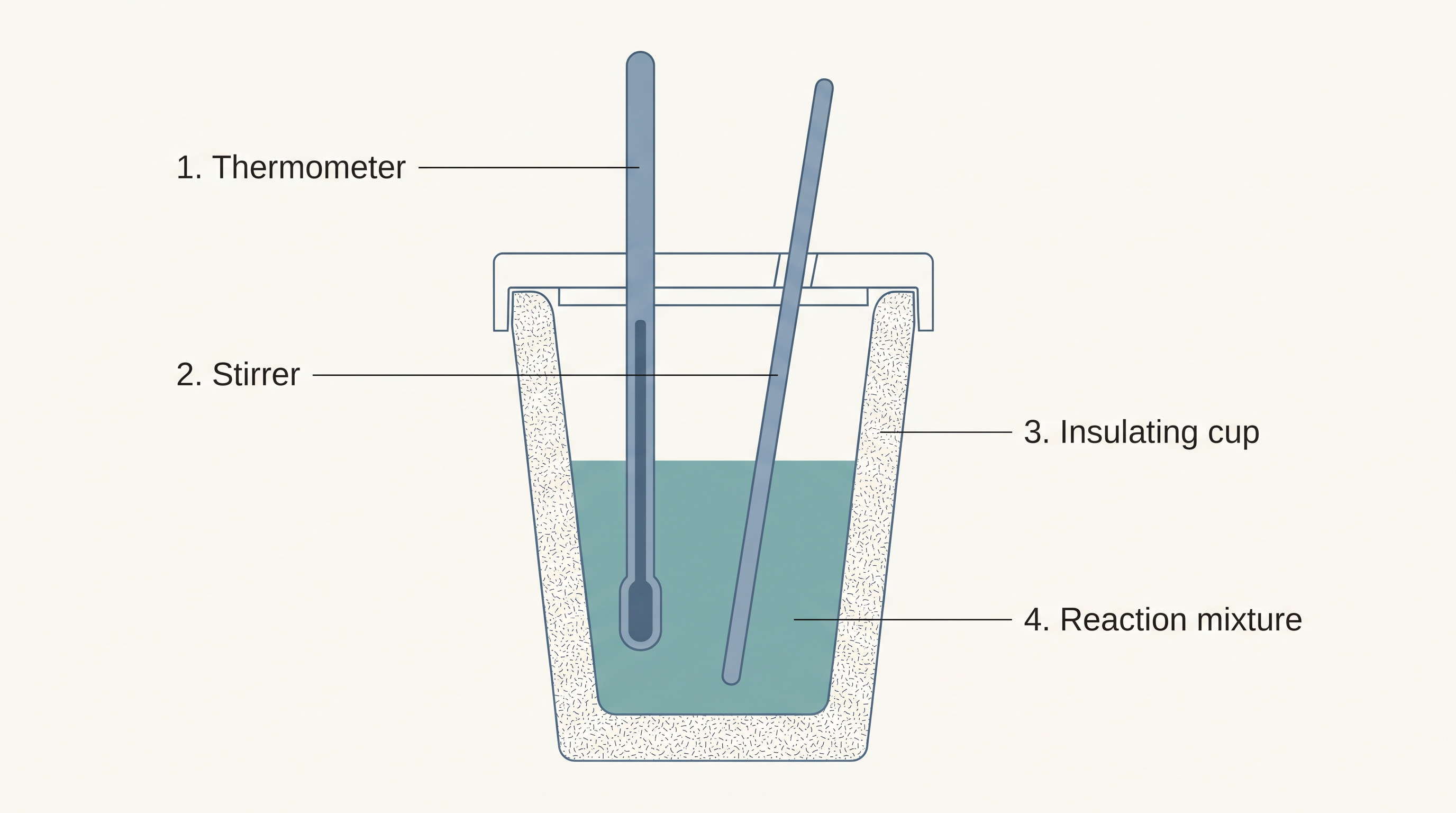
Fig. 5.10 – A constant-pressure calorimeter.
We know that \(\Delta H = q_p\) (at constant \(p\)). So the heat absorbed or evolved at constant pressure, \(q_p\), is also called the heat of reaction or enthalpy of reaction, symbol \(\Delta_r H\).
The sign follows directly from what we learned about \(\Delta H\). In an exothermic reaction the system loses heat to the surroundings, so \(q_p\) is negative and \(\Delta_r H\) is negative. In an endothermic reaction heat is absorbed, so \(q_p\) is positive and \(\Delta_r H\) is positive.
5.4 Enthalpy Change, ∆rH of a Reaction – Reaction Enthalpy
In every chemical reaction, reactants are turned into products:
\[\text{Reactants} \rightarrow \text{Products}\]
The enthalpy change that goes with this conversion is the reaction enthalpy, which we met in the previous section as \(\Delta_r H\). Here we make it quantitative. Since enthalpy is a state function, the enthalpy change of a reaction is simply the total enthalpy of the products minus the total enthalpy of the reactants:
\[\Delta_r H = (\text{sum of enthalpies of products}) - (\text{sum of enthalpies of reactants})\]
Written with stoichiometric coefficients, this is
\[\Delta_r H = \sum_i a_i H_{\text{products}} - \sum_i b_i H_{\text{reactants}} \qquad (5.14)\]
Here the symbol \(\sum\) (sigma) means “sum of,” and \(a_i\) and \(b_i\) are the stoichiometric coefficients of the products and reactants in the balanced equation.
For example, for the combustion of methane:
\[\mathrm{CH_4}\text{(g)} + 2\,\mathrm{O_2}\text{(g)} \rightarrow \mathrm{CO_2}\text{(g)} + 2\,\mathrm{H_2O}\text{(l)}\]
\[\Delta_r H = \sum_i a_i H_{\text{products}} - \sum_i b_i H_{\text{reactants}} = \left[H_m(\mathrm{CO_2},\ \text{g}) + 2H_m(\mathrm{H_2O},\ \text{l})\right] - \left[H_m(\mathrm{CH_4},\ \text{g}) + 2H_m(\mathrm{O_2},\ \text{g})\right]\]
where \(H_m\) is the molar enthalpy of each species.
Knowing the reaction enthalpy is genuinely useful. It tells an engineer how much heating or cooling is needed to keep an industrial reaction running at a steady temperature, and it is also needed to work out how an equilibrium constant changes with temperature.
Standard Enthalpy of Reactions
The enthalpy of a reaction depends on the conditions — pressure, temperature, and the physical states of everything involved. To compare reactions fairly, we agree on a set of standard conditions.
For instance, the standard state of liquid ethanol at \(298\ \text{K}\) is pure liquid ethanol at \(1\ \text{bar}\); the standard state of solid iron at \(500\ \text{K}\) is pure iron at \(1\ \text{bar}\). Data are usually reported at \(298\ \text{K}\). Standard conditions are shown by adding the superscript \(^\circ\) (plimsoll sign) to the symbol, for example \(\Delta H^\circ\). So whenever you see that little superscript, read it as “measured with everything in its standard state.”
Enthalpy Changes during Phase Transformations
Changes of physical state — melting, boiling, subliming — also involve energy, even though no new substance is formed. These usually happen at constant pressure, and during the change the temperature stays constant.
Fusion (melting). Ice needs heat to melt, and it melts at a fixed temperature (\(273\ \text{K}\) at atmospheric pressure):
\[\mathrm{H_2O}\text{(s)} \rightarrow \mathrm{H_2O}\text{(l)} \qquad \Delta_{\text{fus}} H^\circ = 6.00\ \text{kJ mol}^{-1}\]
If the water freezes again, the process reverses and the same amount of heat is given off to the surroundings. Melting is always endothermic (heat must be put in), so all enthalpies of fusion are positive.
Vaporisation (boiling/evaporation). Water needs heat to turn into vapour. At the boiling point \(T_b\) and constant pressure:
\[\mathrm{H_2O}\text{(l)} \rightarrow \mathrm{H_2O}\text{(g)} \qquad \Delta_{\text{vap}} H^\circ = +40.79\ \text{kJ mol}^{-1}\]
Sublimation. Sublimation is the direct conversion of a solid into vapour, without passing through the liquid. Solid \(\mathrm{CO_2}\) (“dry ice”) sublimes at \(195\ \text{K}\) with \(\Delta_{\text{sub}} H^\circ = 25.2\ \text{kJ mol}^{-1}\); naphthalene sublimes slowly, with \(\Delta_{\text{sub}} H^\circ = 73.0\ \text{kJ mol}^{-1}\).
Why the values differ. The size of a phase-change enthalpy depends on how strongly the molecules attract one another. Water molecules are held tightly by strong hydrogen bonds, so a lot of heat is needed to pull them apart into vapour. In an organic liquid such as acetone, the intermolecular attractions are the much weaker dipole–dipole forces, so it takes less heat to vaporise one mole of acetone than one mole of water. Table 5.1 lists standard fusion and vaporisation enthalpies for several substances.
Table 5.1 Standard Enthalpy Changes of Fusion and Vaporisation (\(T_f\) and \(T_b\) are melting and boiling points, respectively)
| Substance | \(T_f\)/K | \(\Delta_{\text{fus}} H^\circ\)/(kJ mol\(^{-1}\)) | \(T_b\)/K | \(\Delta_{\text{vap}} H^\circ\)/(kJ mol\(^{-1}\)) |
|---|---|---|---|---|
| \(\mathrm{N_2}\) | 63.15 | 0.72 | 77.35 | 5.59 |
| \(\mathrm{NH_3}\) | 195.40 | 5.65 | 239.73 | 23.35 |
| \(\mathrm{HCl}\) | 159.0 | 1.992 | 188.0 | 16.15 |
| \(\mathrm{CO}\) | 68.0 | 6.836 | 82.0 | 6.04 |
| \(\mathrm{CH_3COCH_3}\) | 177.8 | 5.72 | 329.4 | 29.1 |
| \(\mathrm{CCl_4}\) | 250.16 | 2.5 | 349.69 | 30.0 |
| \(\mathrm{H_2O}\) | 273.15 | 6.01 | 373.15 | 40.79 |
| \(\mathrm{NaCl}\) | 1081.0 | 28.8 | 1665.0 | 170.0 |
| \(\mathrm{C_6H_6}\) | 278.65 | 9.83 | 353.25 | 30.8 |
Standard Enthalpy of Formation
A particularly important kind of reaction enthalpy is the one for building a compound out of its elements. When exactly one mole of a compound is formed in its standard state from its elements in their most stable states of aggregation (called their reference states), the enthalpy change is the standard molar enthalpy of formation, symbol \(\Delta_f H^\circ\). The subscript \(f\) stands for “formation.”
The reference state of an element is its most stable form at \(25\,^\circ\text{C}\) and \(1\ \text{bar}\). For example, the reference state of dihydrogen is \(\mathrm{H_2}\) gas, and those of dioxygen, carbon, and sulphur are \(\mathrm{O_2}\) gas, \(\mathrm{C}_{\text{graphite}}\), and \(\mathrm{S}_{\text{rhombic}}\) respectively. Some reactions with their standard molar enthalpies of formation are:
\[\mathrm{H_2}\text{(g)} + \tfrac{1}{2}\mathrm{O_2}\text{(g)} \rightarrow \mathrm{H_2O}\text{(l)} \qquad \Delta_f H^\circ = -285.8\ \text{kJ mol}^{-1}\] \[\mathrm{C}\text{(graphite, s)} + 2\,\mathrm{H_2}\text{(g)} \rightarrow \mathrm{CH_4}\text{(g)} \qquad \Delta_f H^\circ = -74.81\ \text{kJ mol}^{-1}\] \[2\,\mathrm{C}\text{(graphite, s)} + 3\,\mathrm{H_2}\text{(g)} + \tfrac{1}{2}\mathrm{O_2}\text{(g)} \rightarrow \mathrm{C_2H_5OH}\text{(l)} \qquad \Delta_f H^\circ = -277.7\ \text{kJ mol}^{-1}\]
Standard enthalpies of formation of some common substances are given in Table 5.2.
Table 5.2 Standard Molar Enthalpies of Formation (\(\Delta_f H^\circ\)) at 298 K of a Few Selected Substances
| Substance | \(\Delta_f H^\circ\)/(kJ mol\(^{-1}\)) | Substance | \(\Delta_f H^\circ\)/(kJ mol\(^{-1}\)) |
|---|---|---|---|
| \(\mathrm{Al_2O_3}\)(s) | −1675.7 | \(\mathrm{HI}\)(g) | +26.48 |
| \(\mathrm{BaCO_3}\)(s) | −1216.3 | \(\mathrm{KCl}\)(s) | −436.75 |
| \(\mathrm{Br_2}\)(l) | 0 | \(\mathrm{KBr}\)(s) | −393.8 |
| \(\mathrm{Br_2}\)(g) | +30.91 | \(\mathrm{MgO}\)(s) | −601.70 |
| \(\mathrm{CaCO_3}\)(s) | −1206.92 | \(\mathrm{Mg(OH)_2}\)(s) | −924.54 |
| \(\mathrm{C}\)(diamond) | +1.89 | \(\mathrm{NaF}\)(s) | −573.65 |
| \(\mathrm{C}\)(graphite) | 0 | \(\mathrm{NaCl}\)(s) | −411.15 |
| \(\mathrm{CaO}\)(s) | −635.09 | \(\mathrm{NaBr}\)(s) | −361.06 |
| \(\mathrm{CH_4}\)(g) | −74.81 | \(\mathrm{NaI}\)(s) | −287.78 |
| \(\mathrm{C_2H_4}\)(g) | 52.26 | \(\mathrm{NH_3}\)(g) | −46.11 |
| \(\mathrm{CH_3OH}\)(l) | −238.86 | \(\mathrm{NO}\)(g) | +90.25 |
| \(\mathrm{C_2H_5OH}\)(l) | −277.69 | \(\mathrm{NO_2}\)(g) | +33.18 |
| \(\mathrm{C_6H_6}\)(l) | +49.0 | \(\mathrm{PCl_3}\)(l) | −319.70 |
| \(\mathrm{CO}\)(g) | −110.53 | \(\mathrm{PCl_5}\)(s) | −443.5 |
| \(\mathrm{CO_2}\)(g) | −393.51 | \(\mathrm{SiO_2}\)(s) (quartz) | −910.94 |
| \(\mathrm{C_2H_6}\)(g) | −84.68 | \(\mathrm{SnCl_2}\)(s) | −325.1 |
| \(\mathrm{Cl_2}\)(g) | 0 | \(\mathrm{SnCl_4}\)(l) | −511.3 |
| \(\mathrm{C_3H_8}\)(g) | −103.85 | \(\mathrm{SO_2}\)(g) | −296.83 |
| \(n\text{-}\mathrm{C_4H_{10}}\)(g) | −126.15 | \(\mathrm{SO_3}\)(g) | −395.72 |
| \(\mathrm{HgS}\)(s) red | −58.2 | \(\mathrm{SiH_4}\)(g) | +34 |
| \(\mathrm{H_2}\)(g) | 0 | \(\mathrm{SiCl_4}\)(g) | −657.0 |
| \(\mathrm{H_2O}\)(g) | −241.82 | \(\mathrm{C}\)(g) | +716.68 |
| \(\mathrm{H_2O}\)(l) | −285.83 | \(\mathrm{H}\)(g) | +217.97 |
| \(\mathrm{HF}\)(g) | −271.1 | \(\mathrm{Cl}\)(g) | +121.68 |
| \(\mathrm{HCl}\)(g) | −92.31 | \(\mathrm{Fe_2O_3}\)(s) | −824.2 |
| \(\mathrm{HBr}\)(g) | −36.40 |
A standard molar enthalpy of formation is just a special case of \(\Delta_r H^\circ\) — the case where one mole of a compound is formed from its constituent elements, as in the three equations above (one mole each of water, methane, and ethanol).
By contrast, the exothermic reaction \[\mathrm{CaO}\text{(s)} + \mathrm{CO_2}\text{(g)} \rightarrow \mathrm{CaCO_3}\text{(s)} \qquad \Delta_r H^\circ = -178.3\ \text{kJ mol}^{-1}\] is not the enthalpy of formation of calcium carbonate, because \(\mathrm{CaCO_3}\) is being made from other compounds, not from its constituent elements.
Similarly, for the reaction \[\mathrm{H_2}\text{(g)} + \mathrm{Br_2}\text{(l)} \rightarrow 2\,\mathrm{HBr}\text{(g)} \qquad \Delta_r H^\circ = -178.3\ \text{kJ mol}^{-1}\] the enthalpy change is not a standard enthalpy of formation of \(\mathrm{HBr}\)(g), because two moles of product are formed instead of one, i.e. \(\Delta_r H^\circ = 2\Delta_f H^\circ\). Dividing all coefficients by 2 gives the formation reaction proper: \[\tfrac{1}{2}\mathrm{H_2}\text{(g)} + \tfrac{1}{2}\mathrm{Br_2}\text{(l)} \rightarrow \mathrm{HBr}\text{(g)} \qquad \Delta_f H^\circ = -36.4\ \text{kJ mol}^{-1}\]
By convention, the standard enthalpy of formation \(\Delta_f H^\circ\) of an element in its reference state (its most stable state of aggregation) is taken as zero.
Using formation enthalpies to find a reaction enthalpy. Suppose a chemical engineer wants to know how much heat is needed to decompose calcium carbonate to lime and carbon dioxide, with all substances in their standard states: \[\mathrm{CaCO_3}\text{(s)} \rightarrow \mathrm{CaO}\text{(s)} + \mathrm{CO_2}\text{(g)} \qquad \Delta_r H^\circ = ?\] We use the general equation \[\Delta_r H^\circ = \sum_i a_i \Delta_f H^\circ(\text{products}) - \sum_i b_i \Delta_f H^\circ(\text{reactants}) \qquad (5.15)\] where \(a\) and \(b\) are the coefficients of products and reactants. Here \(a\) and \(b\) are 1 each, so \[\Delta_r H^\circ = \left[\Delta_f H^\circ(\mathrm{CaO},\ \text{s}) + \Delta_f H^\circ(\mathrm{CO_2},\ \text{g})\right] - \Delta_f H^\circ(\mathrm{CaCO_3},\ \text{s})\] \[= 1(-635.1\ \text{kJ mol}^{-1}) + 1(-393.5\ \text{kJ mol}^{-1}) - 1(-1206.9\ \text{kJ mol}^{-1})\] \[= 178.3\ \text{kJ mol}^{-1}\] The positive sign shows that the decomposition of \(\mathrm{CaCO_3}\)(s) is endothermic — you have to heat it to get the products.
Thermochemical Equations
A balanced chemical equation written together with the value of its \(\Delta_r H\) is called a thermochemical equation. In such equations we always specify the physical state (and, where relevant, the allotropic form) of each substance. For example: \[\mathrm{C_2H_5OH}\text{(l)} + 3\,\mathrm{O_2}\text{(g)} \rightarrow 2\,\mathrm{CO_2}\text{(g)} + 3\,\mathrm{H_2O}\text{(l)} \qquad \Delta_r H^\circ = -1367\ \text{kJ mol}^{-1}\] This describes the combustion of liquid ethanol at constant temperature and pressure; the negative sign tells us the reaction is exothermic.
Two conventions to remember:
- The coefficients in a balanced thermochemical equation refer to the number of moles (never molecules) of reactants and products.
- The numerical value of \(\Delta_r H^\circ\) refers to the number of moles specified by that equation, and carries units of kJ mol\(^{-1}\).
Illustration. Consider the reduction of ferric oxide: \[\mathrm{Fe_2O_3}\text{(s)} + 3\,\mathrm{H_2}\text{(g)} \rightarrow 2\,\mathrm{Fe}\text{(s)} + 3\,\mathrm{H_2O}\text{(l)}\] From Table 5.2, \(\Delta_f H^\circ(\mathrm{H_2O},\text{l}) = -285.83\), \(\Delta_f H^\circ(\mathrm{Fe_2O_3},\text{s}) = -824.2\), while \(\Delta_f H^\circ(\mathrm{Fe},\text{s}) = 0\) and \(\Delta_f H^\circ(\mathrm{H_2},\text{g}) = 0\) by convention. Then \[\Delta_r H_1 = 3(-285.83\ \text{kJ mol}^{-1}) - 1(-824.2\ \text{kJ mol}^{-1}) = (-857.5 + 824.2)\ \text{kJ mol}^{-1} = -33.3\ \text{kJ mol}^{-1}\] The coefficients used here are pure numbers equal to the stoichiometric coefficients, and the unit kJ mol\(^{-1}\) means per mole of reaction. Once we balance the equation a particular way, that fixes what “one mole of reaction” means. If we balance it differently — say \[\tfrac{1}{2}\mathrm{Fe_2O_3}\text{(s)} + \tfrac{3}{2}\mathrm{H_2}\text{(g)} \rightarrow \mathrm{Fe}\text{(s)} + \tfrac{3}{2}\mathrm{H_2O}\text{(l)}\] — then this amount counts as one mole of reaction and \[\Delta_r H_2 = \tfrac{3}{2}(-285.83\ \text{kJ mol}^{-1}) - \tfrac{1}{2}(-824.2\ \text{kJ mol}^{-1}) = (-428.7 + 412.1)\ \text{kJ mol}^{-1} = -16.6\ \text{kJ mol}^{-1} = \tfrac{1}{2}\Delta_r H_1\] Halving the coefficients halves the enthalpy change — which shows again that enthalpy is an extensive quantity.
- When a chemical equation is reversed, the value of \(\Delta_r H^\circ\) is reversed in sign. For example: \[\mathrm{N_2}\text{(g)} + 3\,\mathrm{H_2}\text{(g)} \rightarrow 2\,\mathrm{NH_3}\text{(g)} \qquad \Delta_r H^\circ = -91.8\ \text{kJ mol}^{-1}\] \[2\,\mathrm{NH_3}\text{(g)} \rightarrow \mathrm{N_2}\text{(g)} + 3\,\mathrm{H_2}\text{(g)} \qquad \Delta_r H^\circ = +91.8\ \text{kJ mol}^{-1}\]
Hess’s Law of Constant Heat Summation
Because enthalpy is a state function, the enthalpy change of a reaction depends only on the initial and final states, not on the path taken. So the enthalpy change is the same whether the reaction happens in one step or in a series of steps. This idea is captured by Hess’s law.
Why the law is useful. Consider forming carbon monoxide by burning graphite in a limited supply of oxygen: \[\mathrm{C}\text{(graphite, s)} + \tfrac{1}{2}\mathrm{O_2}\text{(g)} \rightarrow \mathrm{CO}\text{(g)} \qquad \Delta_r H^\circ = ?\] We cannot measure this directly, because some \(\mathrm{CO_2}\) is always produced alongside the \(\mathrm{CO}\). But we can measure two related reactions and combine them: \[\text{(i)}\quad \mathrm{C}\text{(graphite, s)} + \mathrm{O_2}\text{(g)} \rightarrow \mathrm{CO_2}\text{(g)} \qquad \Delta_r H^\circ = -393.5\ \text{kJ mol}^{-1}\] \[\text{(ii)}\quad \mathrm{CO}\text{(g)} + \tfrac{1}{2}\mathrm{O_2}\text{(g)} \rightarrow \mathrm{CO_2}\text{(g)} \qquad \Delta_r H^\circ = -283.0\ \text{kJ mol}^{-1}\] To get one mole of \(\mathrm{CO}\) on the right, we reverse equation (ii), which flips the sign (heat is now absorbed): \[\text{(iii)}\quad \mathrm{CO_2}\text{(g)} \rightarrow \mathrm{CO}\text{(g)} + \tfrac{1}{2}\mathrm{O_2}\text{(g)} \qquad \Delta_r H^\circ = +283.0\ \text{kJ mol}^{-1}\] Adding equations (i) and (iii), the \(\mathrm{CO_2}\) cancels and we obtain the desired equation: \[\mathrm{C}\text{(graphite, s)} + \tfrac{1}{2}\mathrm{O_2}\text{(g)} \rightarrow \mathrm{CO}\text{(g)} \qquad \Delta_r H^\circ = (-393.5 + 283.0) = -110.5\ \text{kJ mol}^{-1}\]
The whole route is summarised in FC 5.2.
Flowchart
FC 5.2 – Hess’s-law route to ΔrH for C → CO: target C(graphite)+½O₂ → CO (ΔrH unknown); combine measured steps — (i) C+O₂ → CO₂ (−393.5) and reversed (ii) giving (iii) CO₂ → CO+½O₂ (+283.0); add (i)+(iii) → C+½O₂ → CO, ΔrH = −393.5 + 283.0 = −110.5 kJ mol⁻¹
In general, if the enthalpy of an overall reaction A → B along one route is \(\Delta_r H\), and \(\Delta_r H_1, \Delta_r H_2, \Delta_r H_3 \dots\) are the enthalpies of the reactions leading to the same product B by another route, then \[\Delta_r H = \Delta_r H_1 + \Delta_r H_2 + \Delta_r H_3 \dots \qquad (5.16)\] This can be pictured as an enthalpy cycle, shown in Fig. 5.11a.
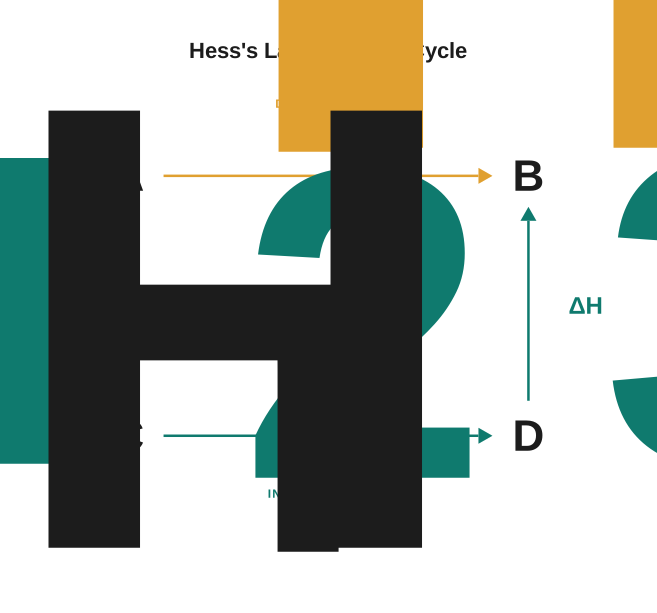
Fig. 5.11a – A general enthalpy cycle.
5.5 Enthalpies for Different Types of Reactions
Different kinds of reactions have enthalpy changes with their own names and symbols. Learning these names makes it easy to look up and combine data. In this section we meet the enthalpies of combustion, atomization, bond breaking, lattice formation, solution, and dilution.
Standard Enthalpy of Combustion
Combustion reactions — burning in oxygen — are always exothermic. They power industry, transport, and rockets, so their enthalpies are especially useful.
Cooking gas in cylinders is mostly butane, \(\mathrm{C_4H_{10}}\). Complete combustion of one mole of butane releases \(2658\ \text{kJ}\):
\[\mathrm{C_4H_{10}}\text{(g)} + \tfrac{13}{2}\mathrm{O_2}\text{(g)} \rightarrow 4\,\mathrm{CO_2}\text{(g)} + 5\,\mathrm{H_2O}\text{(l)} \qquad \Delta_c H^\circ = -2658.0\ \text{kJ mol}^{-1}\]
Similarly, the combustion of glucose gives out \(2802.0\ \text{kJ}\) per mole:
\[\mathrm{C_6H_{12}O_6}\text{(g)} + 6\,\mathrm{O_2}\text{(g)} \rightarrow 6\,\mathrm{CO_2}\text{(g)} + 6\,\mathrm{H_2O}\text{(l)} \qquad \Delta_c H^\circ = -2802.0\ \text{kJ mol}^{-1}\]
Our own bodies release energy from food by essentially this same overall process, although in the body the final products form through a long series of enzyme-controlled biochemical steps rather than a single flame.
Enthalpy of Atomization
Consider breaking one mole of dihydrogen completely into free atoms:
\[\mathrm{H_2}\text{(g)} \rightarrow 2\,\mathrm{H}\text{(g)} \qquad \Delta_a H^\circ = 435.0\ \text{kJ mol}^{-1}\]
Here the H–H bonds are broken to give hydrogen atoms. The enthalpy change is called the enthalpy of atomization, \(\Delta_a H^\circ\).
For a diatomic molecule like dihydrogen, the enthalpy of atomization is also the bond dissociation enthalpy (there is only one bond to break). Other examples of atomization are:
\[\mathrm{CH_4}\text{(g)} \rightarrow \mathrm{C}\text{(g)} + 4\,\mathrm{H}\text{(g)} \qquad \Delta_a H^\circ = 1665\ \text{kJ mol}^{-1}\]
Note that the products are only atoms of C and H in the gaseous phase. For a metal:
\[\mathrm{Na}\text{(s)} \rightarrow \mathrm{Na}\text{(g)} \qquad \Delta_a H^\circ = 108.4\ \text{kJ mol}^{-1}\]
In the case of sodium (and metals in general), the enthalpy of atomization is the same as the enthalpy of sublimation, because turning the solid metal into a gas of separate atoms is subliming it.
Bond Enthalpy
Chemical reactions are, at heart, the breaking of old bonds and the making of new ones. Breaking a bond requires energy; forming a bond releases energy. Two related terms describe this:
- Bond dissociation enthalpy, and
- Mean bond enthalpy.
Diatomic Molecules
For a diatomic molecule, breaking the single bond gives the bond dissociation enthalpy:
\[\mathrm{H_2}\text{(g)} \rightarrow 2\,\mathrm{H}\text{(g)} \qquad \Delta_{\text{H–H}} H^\circ = 435.0\ \text{kJ mol}^{-1}\]
For a diatomic molecule this equals the enthalpy of atomization. Two more examples:
\[\mathrm{Cl_2}\text{(g)} \rightarrow 2\,\mathrm{Cl}\text{(g)} \qquad \Delta_{\text{Cl–Cl}} H^\circ = 242\ \text{kJ mol}^{-1}\] \[\mathrm{O_2}\text{(g)} \rightarrow 2\,\mathrm{O}\text{(g)} \qquad \Delta_{\text{O=O}} H^\circ = 428\ \text{kJ mol}^{-1}\]
Polyatomic Molecules
In a polyatomic molecule, the bond dissociation enthalpy is different for different bonds, even for bonds that look identical. Take methane, \(\mathrm{CH_4}\). Its overall atomization is:
\[\mathrm{CH_4}\text{(g)} \rightarrow \mathrm{C}\text{(g)} + 4\,\mathrm{H}\text{(g)} \qquad \Delta_a H^\circ = 1665\ \text{kJ mol}^{-1}\]
Although all four C–H bonds are identical in length and energy in the intact molecule, the energies needed to break them one after another differ:
\[\mathrm{CH_4}\text{(g)} \rightarrow \mathrm{CH_3}\text{(g)} + \mathrm{H}\text{(g)} \qquad \Delta_{\text{bond}} H^\circ = +427\ \text{kJ mol}^{-1}\] \[\mathrm{CH_3}\text{(g)} \rightarrow \mathrm{CH_2}\text{(g)} + \mathrm{H}\text{(g)} \qquad \Delta_{\text{bond}} H^\circ = +439\ \text{kJ mol}^{-1}\] \[\mathrm{CH_2}\text{(g)} \rightarrow \mathrm{CH}\text{(g)} + \mathrm{H}\text{(g)} \qquad \Delta_{\text{bond}} H^\circ = +452\ \text{kJ mol}^{-1}\] \[\mathrm{CH}\text{(g)} \rightarrow \mathrm{C}\text{(g)} + \mathrm{H}\text{(g)} \qquad \Delta_{\text{bond}} H^\circ = +347\ \text{kJ mol}^{-1}\]
Because the four steps differ, we use a single averaged value — the mean bond enthalpy of the C–H bond, obtained by dividing the total atomization enthalpy by the number of bonds:
\[\Delta_{\text{C–H}} H^\circ = \tfrac{1}{4}(\Delta_a H^\circ) = \tfrac{1}{4}(1665\ \text{kJ mol}^{-1}) = 416\ \text{kJ mol}^{-1}\]
The mean C–H bond enthalpy is about \(416\ \text{kJ mol}^{-1}\). It differs only slightly from compound to compound (as in \(\mathrm{CH_3CH_2Cl}\), \(\mathrm{CH_3NO_2}\), etc.), so a single averaged value works well for estimates.
Using Hess’s law, bond enthalpies can be used to estimate reaction enthalpies. The standard enthalpy of a gas-phase reaction is related to bond enthalpies by:
\[\Delta_r H^\circ = \sum \text{bond enthalpies}_{\text{reactants}} - \sum \text{bond enthalpies}_{\text{products}} \qquad (5.17)\]
In words: the net enthalpy change equals the energy needed to break all the bonds in the reactant molecules minus the energy needed to break all the bonds in the product molecules. This relationship is especially handy when formation enthalpies are unavailable — but remember it is approximate, and valid only when all substances are in the gaseous state. Bond enthalpy values for some single and multiple bonds are given in Table 5.3.
Table 5.3(a) Some Mean Single Bond Enthalpies in kJ mol\(^{-1}\) at 298 K
| Bond partner | H | C | N | O | F | Si | P | S | Cl | Br | I |
|---|---|---|---|---|---|---|---|---|---|---|---|
| H | 435.8 | ||||||||||
| C | 414 | 347 | |||||||||
| N | 389 | 293 | 159 | ||||||||
| O | 464 | 351 | 201 | 138 | |||||||
| F | 569 | 439 | 272 | 184 | 155 | ||||||
| Si | 293 | 289 | — | 368 | 540 | 176 | |||||
| P | 318 | 264 | 209 | 351 | 490 | 213 | 213 | ||||
| S | 339 | 259 | — | — | 327 | 226 | 230 | 213 | |||
| Cl | 431 | 330 | 201 | 205 | 255 | 360 | 331 | 251 | 243 | ||
| Br | 368 | 276 | 243 | — | 197 | 289 | 272 | 213 | 218 | 192 | |
| I | 297 | 238 | — | 201 | — | 213 | 213 | — | 209 | 180 | 151 |
Table 5.3(b) Some Mean Multiple Bond Enthalpies in kJ mol\(^{-1}\) at 298 K
| Bond | Enthalpy | Bond | Enthalpy | Bond | Enthalpy |
|---|---|---|---|---|---|
| N = N | 418 | C = C | 611 | O = O | 498 |
| N ≡ N | 946 | C ≡ C | 837 | ||
| C = N | 615 | C = O | 741 | ||
| C ≡ N | 891 | C ≡ O | 1070 |
Lattice Enthalpy
For an ionic compound, we define the lattice enthalpy as the energy needed to break the crystal apart into free gaseous ions:
\[\mathrm{Na^+Cl^-}\text{(s)} \rightarrow \mathrm{Na^+}\text{(g)} + \mathrm{Cl^-}\text{(g)} \qquad \Delta_{\text{lattice}} H^\circ = +788\ \text{kJ mol}^{-1}\]
We cannot measure lattice enthalpy directly by experiment. Instead we build an indirect enthalpy cycle called the Born–Haber cycle (Fig. 5.12).
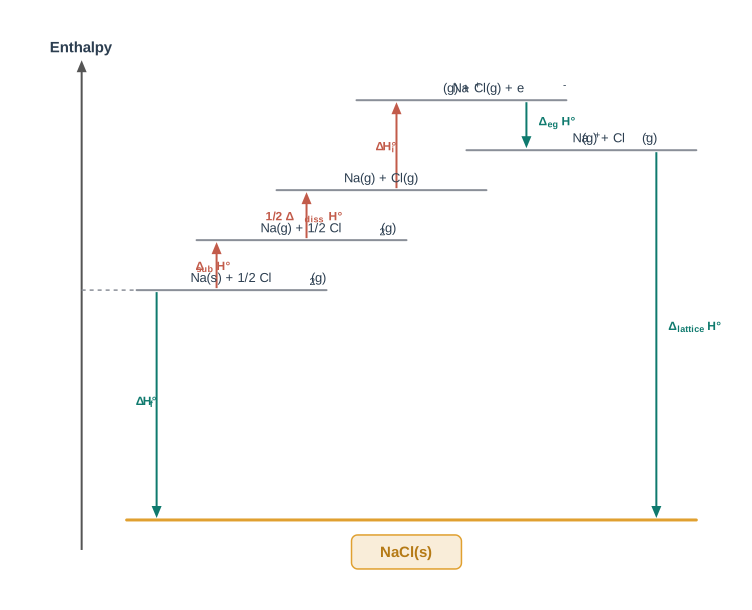
Fig. 5.12 – Born–Haber cycle for sodium chloride.
We calculate the lattice enthalpy of \(\mathrm{Na^+Cl^-}\text{(s)}\) through these steps:
- \(\mathrm{Na}\text{(s)} \rightarrow \mathrm{Na}\text{(g)}\), sublimation of sodium metal, \(\Delta_{\text{sub}} H^\circ = 108.4\ \text{kJ mol}^{-1}\)
- \(\mathrm{Na}\text{(g)} \rightarrow \mathrm{Na^+}\text{(g)} + e^-\text{(g)}\), ionization of sodium atoms, \(\Delta_i H^\circ = 496\ \text{kJ mol}^{-1}\)
- \(\tfrac{1}{2}\mathrm{Cl_2}\text{(g)} \rightarrow \mathrm{Cl}\text{(g)}\), dissociation of chlorine (half the bond dissociation enthalpy), \(\tfrac{1}{2}\Delta_{\text{bond}} H^\circ = 121\ \text{kJ mol}^{-1}\)
- \(\mathrm{Cl}\text{(g)} + e^-\text{(g)} \rightarrow \mathrm{Cl^-}\text{(g)}\), electron gained by chlorine atoms, electron gain enthalpy \(\Delta_{eg} H^\circ = -348.6\ \text{kJ mol}^{-1}\)
- \(\mathrm{Na^+}\text{(g)} + \mathrm{Cl^-}\text{(g)} \rightarrow \mathrm{Na^+Cl^-}\text{(s)}\)
These five steps, arranged as a closed loop, form the Born–Haber cycle. The route is also summarised in FC 5.3.
Flowchart
FC 5.3 – Born–Haber cycle for NaCl: Na(s) + ½Cl₂(g) → [sublime Na, +108.4] → Na(g) → [ionize Na, +496] → Na⁺(g) → [½ dissociate Cl₂, +121] → add Cl(g) → [electron gain by Cl, −348.6] → Cl⁻(g) → combine Na⁺(g)+Cl⁻(g) into NaCl(s); loop closed by reverse of formation (+411.2); sum around cycle gives ΔlatticeH = +788 kJ mol⁻¹
A note on ionization enthalpy and electron gain enthalpy. You met ionization enthalpy and electron gain enthalpy in Chapter 3; in fact, those very terms come from thermodynamics. Strictly, ionization energy and electron affinity are defined at absolute zero. At any other temperature, the heat capacities of reactants and products must be accounted for. For the reactions \(\mathrm{M}\text{(g)} \rightarrow \mathrm{M^+}\text{(g)} + e^-\) (ionization) and \(\mathrm{M}\text{(g)} + e^- \rightarrow \mathrm{M^-}\text{(g)}\) (electron gain) at temperature \(T\):
\[\Delta_r H^\circ(T) = \Delta_r H^\circ(0) + \int_0^T \Delta_r C_p^\circ\, dT\]
Taking \(C_p = \tfrac{5}{2}R\) for each species (\(C_V = \tfrac{3}{2}R\)), we get \(\Delta_r C_p^\circ = +\tfrac{5}{2}R\) for ionization and \(-\tfrac{5}{2}R\) for electron gain. Therefore:
\[\Delta_r H^\circ\ (\text{ionization enthalpy}) = E_0\ (\text{ionization energy}) + \tfrac{5}{2}RT\] \[\Delta_r H^\circ\ (\text{electron gain enthalpy}) = -A\ (\text{electron affinity}) - \tfrac{5}{2}RT\]
The importance of the cycle is that the sum of all the enthalpy changes around a complete loop is zero. Applying Hess’s law:
\[\Delta_{\text{lattice}} H^\circ = 411.2 + 108.4 + 121 + 496 - 348.6 = +788\ \text{kJ}\]
(Here the \(411.2\) term is the reverse of the formation enthalpy of NaCl, whose \(\Delta_f H^\circ = -411.2\ \text{kJ mol}^{-1}\).) This is the lattice enthalpy for \(\mathrm{NaCl}\text{(s)} \rightarrow \mathrm{Na^+}\text{(g)} + \mathrm{Cl^-}\text{(g)}\). The corresponding internal energy change is smaller by \(2RT\) (because \(\Delta n_g = 2\)) and equals \(+783\ \text{kJ mol}^{-1}\).
Enthalpy of Solution
The lattice enthalpy now lets us understand what happens when an ionic solid dissolves. When an ionic compound dissolves, its ions leave their fixed positions in the crystal lattice and become free to move in solution — but at the same time, the ions are surrounded and stabilised by solvent molecules (hydration, when the solvent is water). Both processes happen together, as shown for a general salt \(\mathrm{AB}\) in Fig. 5.13a.
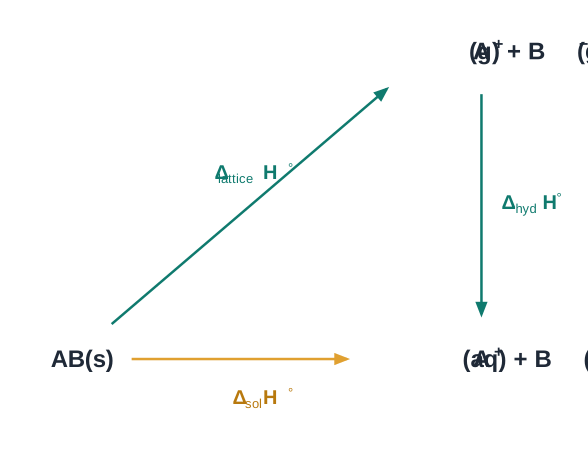
Fig. 5.13a – Enthalpy cycle for dissolution.
The enthalpy of solution is determined by two opposing quantities — the lattice enthalpy \(\Delta_{\text{lattice}} H^\circ\) (energy to pull the ions apart) and the enthalpy of hydration of the ions \(\Delta_{\text{hyd}} H^\circ\) (energy released as the ions are solvated):
\[\Delta_{\text{sol}} H^\circ = \Delta_{\text{lattice}} H^\circ + \Delta_{\text{hyd}} H^\circ\]
For one mole of \(\mathrm{NaCl}\text{(s)}\), with lattice enthalpy \(= +788\ \text{kJ mol}^{-1}\) and \(\Delta_{\text{hyd}} H^\circ = -784\ \text{kJ mol}^{-1}\) (from the literature):
\[\Delta_{\text{sol}} H^\circ = +788\ \text{kJ mol}^{-1} - 784\ \text{kJ mol}^{-1} = +4\ \text{kJ mol}^{-1}\]
So dissolving common salt involves very little heat change — the large lattice and hydration energies nearly cancel.
For most ionic compounds, \(\Delta_{\text{sol}} H^\circ\) is positive and the dissolution is endothermic. This is why the solubility of most salts in water increases as temperature rises. If the lattice enthalpy is very high, the compound may not dissolve at all — which helps explain why many fluorides tend to be less soluble than the corresponding chlorides.
Enthalpy of Dilution
The enthalpy of solution is the enthalpy change when a solute is added to a given amount of solvent. But the value depends on how much solvent is used. Consider dissolving one mole of gaseous hydrogen chloride in different amounts of water (we write “aq.” for water):
\[\mathrm{HCl}\text{(g)} + 10\ \text{aq.} \rightarrow \mathrm{HCl}.10\ \text{aq.} \qquad \Delta H = -69.01\ \text{kJ/mol}\]
Now look at how the value changes as we use more and more water:
\[\text{(S-1)}\quad \mathrm{HCl}\text{(g)} + 25\ \text{aq.} \rightarrow \mathrm{HCl}.25\ \text{aq.} \qquad \Delta H = -72.03\ \text{kJ/mol}\] \[\text{(S-2)}\quad \mathrm{HCl}\text{(g)} + 40\ \text{aq.} \rightarrow \mathrm{HCl}.40\ \text{aq.} \qquad \Delta H = -72.79\ \text{kJ/mol}\] \[\text{(S-3)}\quad \mathrm{HCl}\text{(g)} + \infty\ \text{aq.} \rightarrow \mathrm{HCl}.\infty\ \text{aq.} \qquad \Delta H = -74.85\ \text{kJ/mol}\]
As more solvent is used, the enthalpy of solution approaches a limiting value — the value at infinite dilution (equation S-3 for hydrochloric acid).
To find the enthalpy of dilution, we subtract equation (S-1) from equation (S-2):
\[\mathrm{HCl}.25\ \text{aq.} + 15\ \text{aq.} \rightarrow \mathrm{HCl}.40\ \text{aq.}\] \[\Delta H = [-72.79 - (-72.03)]\ \text{kJ/mol} = -0.76\ \text{kJ/mol}\]
This value (\(-0.76\ \text{kJ/mol}\)) is the enthalpy of dilution — the heat exchanged with the surroundings when extra solvent is added to a solution.
5.6 Spontaneity
The first law of thermodynamics links heat and work, but it says nothing about direction. It happily allows a reaction to run forwards or backwards, as long as energy is conserved. Yet in the real world, heat always flows from a hotter body to a colder one, never the reverse on its own. In fact, every naturally occurring change — chemical or physical — tends to go spontaneously in just one direction.
A gas expands to fill the space available to it; carbon burns in oxygen to give carbon dioxide. But heat will not flow from a cold body to a warm one by itself, a gas will not gather back into one corner of its container, and carbon dioxide will not split back into carbon and oxygen on its own. These one-way changes prompt a deep question: what is the driving force behind spontaneous change, and what decides its direction? Answering this is the goal of this section.
What “spontaneous” really means. You might think a spontaneous reaction is one that happens the instant reactants are mixed. Not so. A mixture of hydrogen and oxygen can sit for years at room temperature with no visible change — yet the reaction is still called spontaneous, because it is proceeding, only extremely slowly. So spontaneity means “having the potential to proceed without the help of an external agency.” It says nothing about how fast. And spontaneous changes share another feature: they cannot reverse their direction by themselves.
Is Decrease in Enthalpy a Criterion for Spontaneity?
When water flows downhill or a stone falls to the ground, there is a net decrease in potential energy in the direction of change. By analogy, we might guess that a chemical reaction is spontaneous when energy decreases — that is, when the reaction is exothermic. Many exothermic reactions are indeed spontaneous:
\[\tfrac{1}{2}\mathrm{N_2}\text{(g)} + \tfrac{3}{2}\mathrm{H_2}\text{(g)} \rightarrow \mathrm{NH_3}\text{(g)} \qquad \Delta_r H^\circ = -46.1\ \text{kJ mol}^{-1}\] \[\tfrac{1}{2}\mathrm{H_2}\text{(g)} + \tfrac{1}{2}\mathrm{Cl_2}\text{(g)} \rightarrow \mathrm{HCl}\text{(g)} \qquad \Delta_r H^\circ = -92.32\ \text{kJ mol}^{-1}\] \[\mathrm{H_2}\text{(g)} + \tfrac{1}{2}\mathrm{O_2}\text{(g)} \rightarrow \mathrm{H_2O}\text{(l)} \qquad \Delta_r H^\circ = -285.8\ \text{kJ mol}^{-1}\]
The drop in enthalpy on going from reactants to products can be shown on an enthalpy diagram, as in Fig. 5.14(a). So the idea that “a fall in energy drives the reaction” seems reasonable — so far.
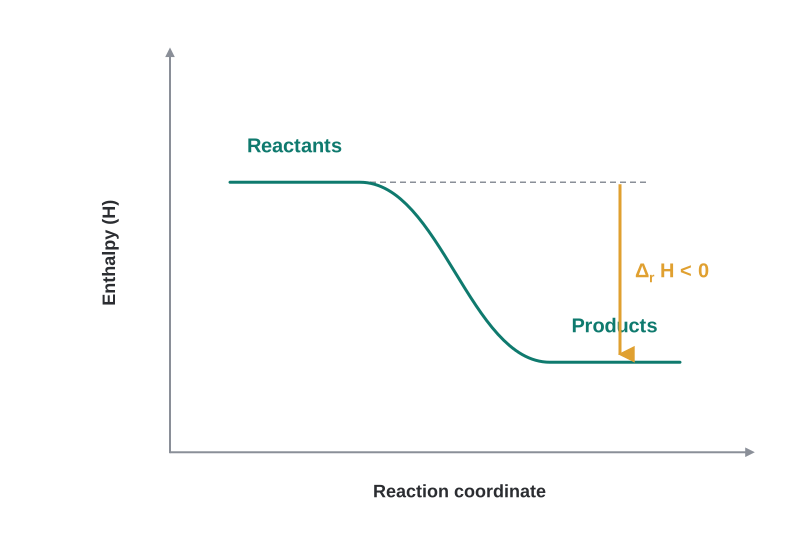
Fig. 5.14(a) – Enthalpy diagram for an exothermic reaction.
But now examine these reactions:
\[\tfrac{1}{2}\mathrm{N_2}\text{(g)} + \mathrm{O_2}\text{(g)} \rightarrow \mathrm{NO_2}\text{(g)} \qquad \Delta_r H^\circ = +33.2\ \text{kJ mol}^{-1}\] \[\mathrm{C}\text{(graphite, s)} + 2\,\mathrm{S}\text{(l)} \rightarrow \mathrm{CS_2}\text{(l)} \qquad \Delta_r H^\circ = +128.5\ \text{kJ mol}^{-1}\]
These are endothermic — enthalpy goes up — yet they are spontaneous. The increase in enthalpy is shown in Fig. 5.15(b).
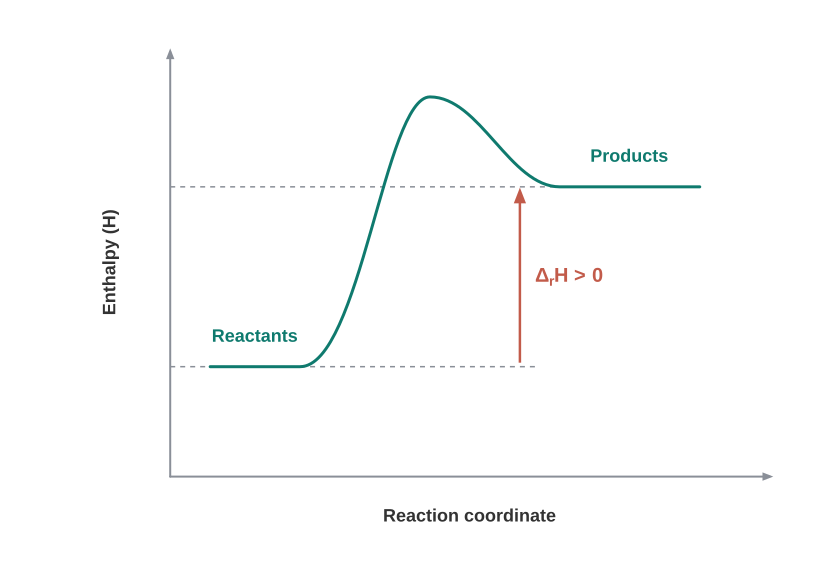
Fig. 5.15(b) – Enthalpy diagram for an endothermic reaction.
So decrease in enthalpy may be a contributory factor to spontaneity, but it clearly is not the whole story — it is not true for all cases. Something else must also be at work.
Entropy and Spontaneity
To find the missing factor, consider a case where the enthalpy change is zero yet the process is still spontaneous. Take two gases, A and B, in a closed, isolated container, separated by a partition (Fig. 5.16). Remove the partition, and the gases diffuse into each other until, after a while, mixing is complete.
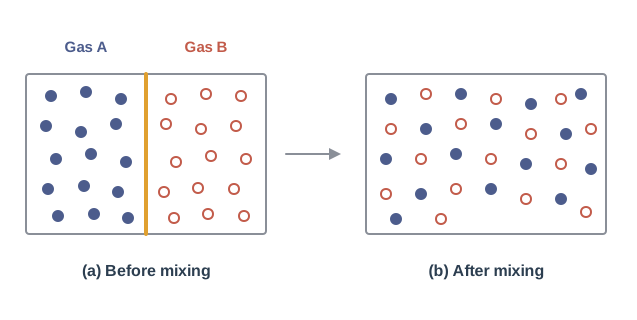
Fig. 5.16 – Entropy increase during the diffusion of two gases.
Before mixing, if you picked a molecule from the left you were sure it was A, and from the right sure it was B. After mixing, a molecule picked at random could be either — the system has become less predictable, more chaotic. This suggests a new postulate: in an isolated system, there is always a tendency for the system to become more disordered, and this could be the criterion for spontaneous change.
To capture this disorder, we introduce a new thermodynamic function, entropy, symbol \(S\). Entropy measures the degree of randomness or disorder in a system.
For a given substance, the crystalline solid state is the most ordered — the state of lowest entropy — while the gaseous state is the most disordered, the state of highest entropy. In a reaction, a loss of regularity in structure means an increase in entropy. Like internal energy and enthalpy, entropy is a state function, so \(\Delta S\) is independent of path.
Relating entropy to heat. Whenever heat is added to a system, molecular motions become more vigorous and the system more random — heat has a randomising influence. Can we then simply set \(\Delta S\) equal to \(q\)? Not quite. Experience shows that the disordering effect of a given amount of heat also depends on the temperature at which it is added. A system already at high temperature is highly disordered, so a bit more heat barely changes its randomness; the same heat added to a cold, orderly system disorders it much more. In other words, entropy change is inversely proportional to temperature. For a reversible process:
\[\Delta S = \frac{q_{\text{rev}}}{T} \qquad (5.18)\]
The total entropy change for the system and surroundings together decides spontaneity:
\[\Delta S_{\text{total}} = \Delta S_{\text{system}} + \Delta S_{\text{surr}} > 0 \qquad (5.19)\]
When a system reaches equilibrium, its entropy is maximum and the entropy change is zero, \(\Delta S = 0\). So entropy increases during a spontaneous process until it reaches a maximum at equilibrium. Since entropy is a state property, we can calculate the entropy change of a reversible process from
\[\Delta S_{\text{sys}} = \frac{q_{\text{sys, rev}}}{T}\]
Here is a telling point. For both reversible and irreversible isothermal expansion of an ideal gas, \(\Delta U = 0\). But \(\Delta S_{\text{total}}\) (that is, \(\Delta S_{\text{sys}} + \Delta S_{\text{surr}}\)) is not zero for the irreversible process. So \(\Delta U\) cannot tell reversible and irreversible processes apart, whereas \(\Delta S\) can.
Gibbs Energy and Spontaneity
Using \(\Delta S_{\text{total}}\) works cleanly for an isolated system, but most real reactions happen in closed or open systems, where both enthalpy and entropy change. As we have seen, neither a decrease in enthalpy nor an increase in entropy alone can settle the direction. We need a single function that combines the two.
We define the Gibbs energy (or Gibbs function), \(G\), as
\[G = H - TS \qquad (5.20)\]
Gibbs energy is an extensive property and a state function. The change in Gibbs energy for the system is
\[\Delta G_{\text{sys}} = \Delta H_{\text{sys}} - T\Delta S_{\text{sys}} - S_{\text{sys}}\Delta T\]
At constant temperature, \(\Delta T = 0\), so
\[\Delta G_{\text{sys}} = \Delta H_{\text{sys}} - T\Delta S_{\text{sys}}\]
Dropping the “system” subscript, we write the famous Gibbs equation:
\[\Delta G = \Delta H - T\Delta S \qquad (5.21)\]
In words: Gibbs energy change = enthalpy change − (temperature × entropy change). Both terms are energy quantities: \(T\Delta S\) has units \((\text{K})(\text{J K}^{-1}) = \text{J}\), matching \(\Delta H\), so \(\Delta G\) comes out in energy units.
Linking ΔG to spontaneity. Starting from \(\Delta S_{\text{total}} = \Delta S_{\text{sys}} + \Delta S_{\text{surr}}\), suppose the system is in thermal equilibrium with the surroundings (same temperature \(T\)). Any increase in enthalpy of the surroundings equals the decrease in enthalpy of the system, so the entropy change of the surroundings is
\[\Delta S_{\text{surr}} = \frac{\Delta H_{\text{surr}}}{T} = -\frac{\Delta H_{\text{sys}}}{T}\]
Therefore
\[\Delta S_{\text{total}} = \Delta S_{\text{sys}} + \left(-\frac{\Delta H_{\text{sys}}}{T}\right)\]
Multiplying through by \(T\):
\[T\Delta S_{\text{total}} = T\Delta S_{\text{sys}} - \Delta H_{\text{sys}}\]
For a spontaneous process, \(\Delta S_{\text{total}} > 0\), so
\[T\Delta S_{\text{sys}} - \Delta H_{\text{sys}} > 0 \quad\Rightarrow\quad -(\Delta H_{\text{sys}} - T\Delta S_{\text{sys}}) > 0\]
Using the Gibbs equation (5.21), this becomes
\[-\Delta G > 0 \quad\Rightarrow\quad \Delta G = \Delta H - T\Delta S < 0 \qquad (5.22)\]
Here \(\Delta H_{\text{sys}}\) is the reaction’s enthalpy change, and \(T\Delta S_{\text{sys}}\) is the part of the energy that is not available to do useful work. So \(\Delta G\) is the net energy that is available to do useful work — which is why \(G\) is also called the free energy of the reaction.
So \(\Delta G\) gives a clear criterion for spontaneity at constant pressure and temperature: (i) If \(\Delta G\) is negative (\(< 0\)), the process is spontaneous. (ii) If \(\Delta G\) is positive (\(> 0\)), the process is non-spontaneous.
The role of temperature. A reaction with a positive enthalpy change and a positive entropy change can still be spontaneous, provided \(T\Delta S\) is large enough to outweigh \(\Delta H\). This can happen in two ways: if the positive \(\Delta S\) is small, \(T\) must be large; if the positive \(\Delta S\) is large, even a modest \(T\) will do. The first case is one reason many reactions are carried out at high temperature. Table 5.4 summarises how temperature affects spontaneity.
Table 5.4 Effect of Temperature on Spontaneity of Reactions
| \(\Delta_r H^\circ\) | \(\Delta_r S^\circ\) | \(\Delta_r G^\circ\) | Description |
|---|---|---|---|
| − | + | − | Reaction spontaneous at all temperatures |
| − | − | − (at low \(T\)) | Reaction spontaneous at low temperature |
| − | − | + (at high \(T\)) | Reaction nonspontaneous at high temperature |
| + | + | + (at low \(T\)) | Reaction nonspontaneous at low temperature |
| + | + | − (at high \(T\)) | Reaction spontaneous at high temperature |
| + | − | + (at all \(T\)) | Reaction nonspontaneous at all temperatures |
(The terms “low temperature” and “high temperature” are relative; for a particular reaction, “high temperature” could even mean room temperature.)
Entropy and Second Law of Thermodynamics
For an isolated system, the change in energy is zero (\(\Delta U = 0\)). Therefore, an increase in entropy is the natural direction of spontaneous change in such systems. This is, in fact, the second law of thermodynamics.
Like the first law, the second law can be stated in several ways. It also explains why spontaneous exothermic reactions are so common: in an exothermic reaction, the heat released increases the disorder of the surroundings, so the overall entropy change is positive — which makes the reaction spontaneous.
Absolute Entropy and Third Law of Thermodynamics
Molecules can move in several ways: they may travel in straight lines (translational motion), spin like a top (rotational motion), and their bonds may stretch and compress (vibrational motion). As temperature rises, all these motions become more vigorous and entropy increases; as temperature falls, entropy decreases.
If we keep cooling a pure crystalline substance, its particles settle into a perfectly ordered arrangement. This leads to the third law of thermodynamics.
This is so because there is perfect order in a crystal at absolute zero. The statement is confined to pure crystalline solids, because theory and experiment show that the entropy of solutions and supercooled liquids is not zero at \(0\ \text{K}\).
The importance of the third law is that it lets us calculate absolute values of entropy for a pure substance from thermal data alone. This is done by summing the \(\dfrac{q_{\text{rev}}}{T}\) increments from \(0\ \text{K}\) up to \(298\ \text{K}\). These standard entropies can then be used to calculate standard entropy changes for reactions, by a Hess’s-law type of calculation.
5.7 Gibbs Energy Change and Equilibrium
Knowing the sign and magnitude of the free energy change of a reaction lets us do two powerful things: (i) predict whether the reaction is spontaneous, and (ii) predict how much useful work could be extracted from it. So far we have looked at free energy changes in irreversible reactions. Now let us turn to reversible reactions and equilibrium.
Free Energy at Equilibrium
In the strict thermodynamic sense, “reversible” means a process carried out so that the system is at all times in perfect equilibrium with its surroundings. Applied to a chemical reaction, “reversible” means the reaction can proceed in both directions at once, setting up a dynamic equilibrium.
At first this seems paradoxical: the reactions in both directions should each proceed with a decrease in free energy — but both cannot decrease at once. The resolution is that at equilibrium the free energy of the system is at a minimum. If it were not, the system would spontaneously slide to a configuration of lower free energy. So the criterion for equilibrium in a reaction \(\mathrm{A} + \mathrm{B} \rightleftharpoons \mathrm{C} + \mathrm{D}\) is:
\[\Delta_r G = 0\]
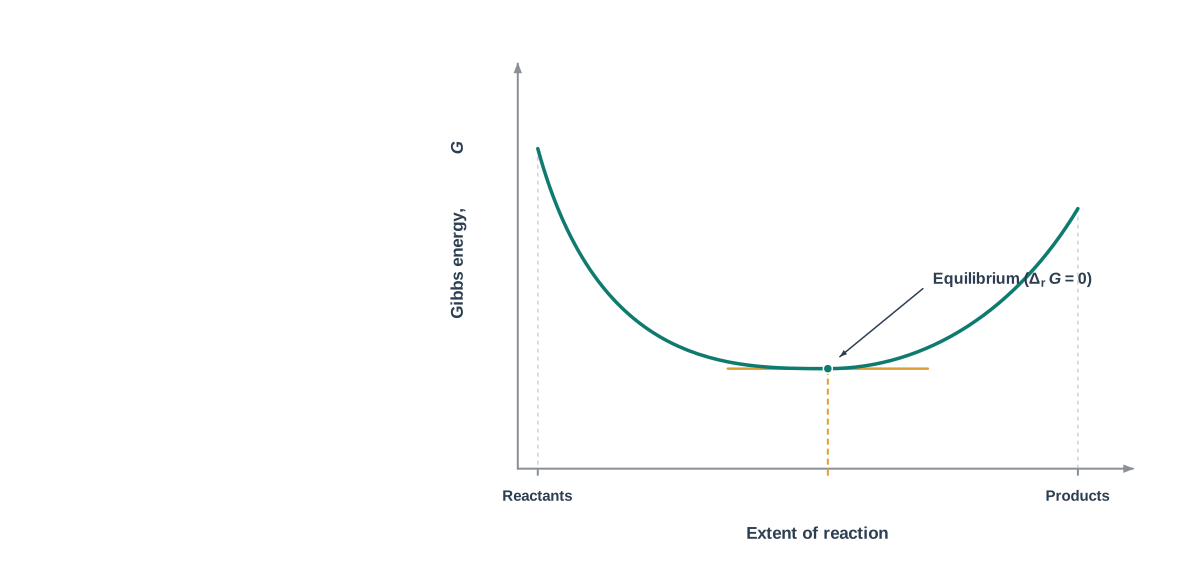
Fig. 5.17 – Gibbs energy at equilibrium.
Relating ΔrG° to the Equilibrium Constant
For a reaction in which all reactants and products are in their standard states, the standard Gibbs energy change \(\Delta_r G^\circ\) is related to the equilibrium constant \(K\) of the reaction. Starting from the equilibrium condition:
\[0 = \Delta_r G^\circ + RT \ln K\]
which rearranges to
\[\Delta_r G^\circ = -RT \ln K\] \[\Delta_r G^\circ = -2.303\, RT \log K \qquad (5.23)\]
We also know, from the Gibbs equation, that
\[\Delta_r G^\circ = \Delta_r H^\circ - T\Delta_r S^\circ = -RT \ln K \qquad (5.24)\]
What this tells us about the extent of reaction. For a strongly endothermic reaction, \(\Delta_r H^\circ\) is large and positive, so \(K\) is much smaller than 1 and the reaction forms little product. For a strongly exothermic reaction, \(\Delta_r H^\circ\) is large and negative, \(\Delta_r G^\circ\) is large and negative too, and \(K\) is much larger than 1 — such reactions can go nearly to completion. The value of \(\Delta_r G^\circ\) also depends on \(\Delta_r S^\circ\), so whether the entropy change is positive or negative will further shift \(K\) and the extent of reaction.
Equation (5.24) is useful in two directions: (i) We can estimate \(\Delta_r G^\circ\) from measured values of \(\Delta_r H^\circ\) and \(\Delta_r S^\circ\), and then calculate \(K\) at any temperature — helpful for judging economic yields of products. (ii) If \(K\) is measured directly in the laboratory, we can work backward to find \(\Delta_r G^\circ\) (and hence estimate it at other temperatures).
5.8 Summary
Thermodynamics deals with energy changes in chemical and physical processes. It lets us study these changes quantitatively and make useful predictions about whether a change will happen and how far it will go.
To study any change, we divide the universe into the system (the part we observe) and the surroundings (everything else). Systems are classified as open (matter and energy exchanged), closed (only energy exchanged), or isolated (neither exchanged).
Chemical and physical processes evolve or absorb heat (\(q\)), part of which may be converted into work (\(w\)). These are linked by the first law of thermodynamics: \[\Delta U = q + w\]
\(\Delta U\), the change in internal energy, depends only on the initial and final states — it is a state function. In contrast, \(q\) and \(w\) depend on the path taken and are not state functions.
We follow the sign convention of giving \(q\) and \(w\) a positive sign when they are added to the system.
Heat transfer causes a temperature change whose magnitude depends on the heat capacity (\(C\)) of the substance: \[q = C\,\Delta T\]
For the expansion or compression of gases, work is measured by \(w = -p_{\text{ex}}\,\Delta V\). Under a reversible process, \(p_{\text{ex}} = p\) for infinitesimal volume changes, giving \(w_{\text{rev}} = -p\,dV\); here the gas equation \(pV = nRT\) can be used.
At constant volume, \(w = 0\), so \(\Delta U = q_V\) — the heat transferred at constant volume.
Most chemical reactions are run at constant pressure, so we define another state function, enthalpy: \[\Delta H = \Delta U + \Delta n_g RT\] Enthalpy change can be found directly from the heat change at constant pressure, \(\Delta H = q_p\).
There are many kinds of enthalpy change. Phase changes — melting (fusion), vaporisation, and sublimation — usually occur at constant temperature, and their enthalpy changes are always positive (endothermic).
Enthalpies of formation, combustion, and other enthalpy changes can be calculated using Hess’s law, which follows from enthalpy being a state function.
Enthalpy change for a chemical reaction can be determined from formation enthalpies: \[\Delta_r H = \sum_i \left(a_i \Delta_f H_{\text{products}}\right) - \sum_i \left(b_i \Delta_f H_{\text{reactants}}\right)\]
For gaseous reactions, it can also be estimated from bond enthalpies: \[\Delta_r H^\circ = \sum \text{bond enthalpies of the reactants} - \sum \text{bond enthalpies of the products}\]
The first law does not tell us the direction of a chemical reaction — it says nothing about what drives a change. For isolated systems, \(\Delta U = 0\), so energy change cannot be the guide.
For direction, we define another state function, entropy (\(S\)) — a measure of disorder or randomness. For a spontaneous change, the total entropy change is positive. For an isolated system, \(\Delta U = 0\) but \(\Delta S > 0\), so entropy change distinguishes a spontaneous change while energy change does not.
Entropy change is measured for a reversible process by \[\Delta S = \frac{q_{\text{rev}}}{T}\] and \(\dfrac{q_{\text{rev}}}{T}\) is independent of path.
Since chemical reactions are generally carried out at constant pressure, we define one more state function, the Gibbs energy (\(G\)), which combines the enthalpy and entropy changes of the system: \[\Delta_r G = \Delta_r H - T\Delta_r S\]
For a spontaneous change, \(\Delta G_{\text{sys}} < 0\); at equilibrium, \(\Delta G_{\text{sys}} = 0\).
The standard Gibbs energy change is related to the equilibrium constant by \[\Delta_r G^\circ = -RT \ln K\]
\(K\) can be calculated from this equation if we know \(\Delta_r G^\circ\), which in turn can be found from \(\Delta_r G^\circ = \Delta_r H^\circ - T\Delta_r S^\circ\).
Temperature is an important factor in this equation. Many reactions that are non-spontaneous at low temperature are made spontaneous at high temperature, for systems having a positive entropy of reaction.
Flowchart
FC 5.4 – The logical sequence of the chapter: define system + surroundings → measure heat q and work w → first law, ΔU = q + w → at constant V, ΔU = q_V (bomb calorimeter); at constant p, define enthalpy, ΔH = q_p (constant-pressure calorimeter) → obtain reaction enthalpies via formation enthalpies, bond enthalpies, or Hess’s law → but ΔH alone cannot predict direction → introduce entropy S (disorder); spontaneous if ΔS_total > 0 → combine both into Gibbs energy, ΔG = ΔH − TΔS → ΔG < 0 spontaneous; ΔG = 0 equilibrium; ΔG > 0 non-spontaneous → at equilibrium, ΔrG° = −RT ln K → predict extent of reaction
5.9 NCERT Questions
Choose the correct answer. A thermodynamic state function is a quantity
- used to determine heat changes
- whose value is independent of path
- used to determine pressure volume work
- whose value depends on temperature only.
For the process to occur under adiabatic conditions, the correct condition is:
- \(\Delta T = 0\)
- \(\Delta p = 0\)
- \(q = 0\)
- \(w = 0\)
The enthalpies of all elements in their standard states are:
- unity
- zero
- \(< 0\)
- different for each element
\(\Delta U^\circ\) of combustion of methane is \(-X\ \text{kJ mol}^{-1}\). The value of \(\Delta H^\circ\) is
- \(= \Delta U^\circ\)
- \(> \Delta U^\circ\)
- \(< \Delta U^\circ\)
- \(= 0\)
The enthalpy of combustion of methane, graphite and dihydrogen at \(298\ \text{K}\) are \(-890.3\ \text{kJ mol}^{-1}\), \(-393.5\ \text{kJ mol}^{-1}\), and \(-285.8\ \text{kJ mol}^{-1}\) respectively. Enthalpy of formation of \(\mathrm{CH_4}\text{(g)}\) will be
- \(-74.8\ \text{kJ mol}^{-1}\)
- \(-52.27\ \text{kJ mol}^{-1}\)
- \(+74.8\ \text{kJ mol}^{-1}\)
- \(+52.26\ \text{kJ mol}^{-1}\)
A reaction, \(\mathrm{A} + \mathrm{B} \rightarrow \mathrm{C} + \mathrm{D} + q\) is found to have a positive entropy change. The reaction will be
- possible at high temperature
- possible only at low temperature
- not possible at any temperature
- possible at any temperature
In a process, \(701\ \text{J}\) of heat is absorbed by a system and \(394\ \text{J}\) of work is done by the system. What is the change in internal energy for the process?
The reaction of cyanamide, \(\mathrm{NH_2CN}\text{(s)}\), with dioxygen was carried out in a bomb calorimeter, and \(\Delta U\) was found to be \(-742.7\ \text{kJ mol}^{-1}\) at \(298\ \text{K}\). Calculate enthalpy change for the reaction at \(298\ \text{K}\). \[\mathrm{NH_2CN}\text{(g)} + \tfrac{3}{2}\mathrm{O_2}\text{(g)} \rightarrow \mathrm{N_2}\text{(g)} + \mathrm{CO_2}\text{(g)} + \mathrm{H_2O}\text{(l)}\]
Calculate the number of kJ of heat necessary to raise the temperature of \(60.0\ \text{g}\) of aluminium from \(35\,^\circ\text{C}\) to \(55\,^\circ\text{C}\). Molar heat capacity of Al is \(24\ \text{J mol}^{-1}\text{K}^{-1}\).
Calculate the enthalpy change on freezing of \(1.0\ \text{mol}\) of water at \(10.0\,^\circ\text{C}\) to ice at \(-10.0\,^\circ\text{C}\). \(\Delta_{\text{fus}} H = 6.03\ \text{kJ mol}^{-1}\) at \(0\,^\circ\text{C}\). \[C_p[\mathrm{H_2O}\text{(l)}] = 75.3\ \text{J mol}^{-1}\text{K}^{-1}\] \[C_p[\mathrm{H_2O}\text{(s)}] = 36.8\ \text{J mol}^{-1}\text{K}^{-1}\]
Enthalpy of combustion of carbon to \(\mathrm{CO_2}\) is \(-393.5\ \text{kJ mol}^{-1}\). Calculate the heat released upon formation of \(35.2\ \text{g}\) of \(\mathrm{CO_2}\) from carbon and dioxygen gas.
Enthalpies of formation of \(\mathrm{CO}\text{(g)}\), \(\mathrm{CO_2}\text{(g)}\), \(\mathrm{N_2O}\text{(g)}\) and \(\mathrm{N_2O_4}\text{(g)}\) are \(-110\), \(-393\), \(81\) and \(9.7\ \text{kJ mol}^{-1}\) respectively. Find the value of \(\Delta_r H\) for the reaction: \[\mathrm{N_2O_4}\text{(g)} + 3\,\mathrm{CO}\text{(g)} \rightarrow \mathrm{N_2O}\text{(g)} + 3\,\mathrm{CO_2}\text{(g)}\]
Given \[\mathrm{N_2}\text{(g)} + 3\,\mathrm{H_2}\text{(g)} \rightarrow 2\,\mathrm{NH_3}\text{(g)}; \qquad \Delta_r H^\circ = -92.4\ \text{kJ mol}^{-1}\] What is the standard enthalpy of formation of \(\mathrm{NH_3}\) gas?
Calculate the standard enthalpy of formation of \(\mathrm{CH_3OH}\text{(l)}\) from the following data: \[\mathrm{CH_3OH}\text{(l)} + \tfrac{3}{2}\mathrm{O_2}\text{(g)} \rightarrow \mathrm{CO_2}\text{(g)} + 2\,\mathrm{H_2O}\text{(l)}; \qquad \Delta_r H^\circ = -726\ \text{kJ mol}^{-1}\] \[\mathrm{C}\text{(graphite)} + \mathrm{O_2}\text{(g)} \rightarrow \mathrm{CO_2}\text{(g)}; \qquad \Delta_c H^\circ = -393\ \text{kJ mol}^{-1}\] \[\mathrm{H_2}\text{(g)} + \tfrac{1}{2}\mathrm{O_2}\text{(g)} \rightarrow \mathrm{H_2O}\text{(l)}; \qquad \Delta_f H^\circ = -286\ \text{kJ mol}^{-1}\]
Calculate the enthalpy change for the process \[\mathrm{CCl_4}\text{(g)} \rightarrow \mathrm{C}\text{(g)} + 4\,\mathrm{Cl}\text{(g)}\] and calculate bond enthalpy of C–Cl in \(\mathrm{CCl_4}\text{(g)}\). \[\Delta_{\text{vap}} H^\circ(\mathrm{CCl_4}) = 30.5\ \text{kJ mol}^{-1}\] \[\Delta_f H^\circ(\mathrm{CCl_4}) = -135.5\ \text{kJ mol}^{-1}\] \[\Delta_a H^\circ(\mathrm{C}) = 715.0\ \text{kJ mol}^{-1}, \text{ where } \Delta_a H^\circ \text{ is enthalpy of atomisation}\] \[\Delta_a H^\circ(\mathrm{Cl_2}) = 242\ \text{kJ mol}^{-1}\]
For an isolated system, \(\Delta U = 0\), what will be \(\Delta S\)?
For the reaction at \(298\ \text{K}\), \[2\mathrm{A} + \mathrm{B} \rightarrow \mathrm{C}\] \(\Delta H = 400\ \text{kJ mol}^{-1}\) and \(\Delta S = 0.2\ \text{kJ K}^{-1}\text{mol}^{-1}\). At what temperature will the reaction become spontaneous considering \(\Delta H\) and \(\Delta S\) to be constant over the temperature range.
For the reaction, \[2\,\mathrm{Cl}\text{(g)} \rightarrow \mathrm{Cl_2}\text{(g)}\] what are the signs of \(\Delta H\) and \(\Delta S\)?
For the reaction \[2\,\mathrm{A}\text{(g)} + \mathrm{B}\text{(g)} \rightarrow 2\,\mathrm{D}\text{(g)}\] \(\Delta U^\circ = -10.5\ \text{kJ}\) and \(\Delta S^\circ = -44.1\ \text{J K}^{-1}\). Calculate \(\Delta G^\circ\) for the reaction, and predict whether the reaction may occur spontaneously.
The equilibrium constant for a reaction is \(10\). What will be the value of \(\Delta G^\circ\)? \(R = 8.314\ \text{J K}^{-1}\text{mol}^{-1}\), \(T = 300\ \text{K}\).
Comment on the thermodynamic stability of \(\mathrm{NO}\text{(g)}\), given \[\tfrac{1}{2}\mathrm{N_2}\text{(g)} + \tfrac{1}{2}\mathrm{O_2}\text{(g)} \rightarrow \mathrm{NO}\text{(g)}; \qquad \Delta_r H^\circ = 90\ \text{kJ mol}^{-1}\] \[\mathrm{NO}\text{(g)} + \tfrac{1}{2}\mathrm{O_2}\text{(g)} \rightarrow \mathrm{NO_2}\text{(g)}; \qquad \Delta_r H^\circ = -74\ \text{kJ mol}^{-1}\]
Calculate the entropy change in surroundings when \(1.00\ \text{mol}\) of \(\mathrm{H_2O}\text{(l)}\) is formed under standard conditions. \(\Delta_f H^\circ = -286\ \text{kJ mol}^{-1}\).
5.10 Check Your Concepts
A thermos flask containing hot soup is often described as an “isolated system,” yet the soup eventually goes cold. Explain why no real system is perfectly isolated, and identify what kind of exchange is actually taking place.
Assertion (A): Internal energy \(U\) is a state function, but heat \(q\) and work \(w\) are not. Reason (R): For a given change of state, \(q\) and \(w\) can individually take different values depending on the path, but their sum is fixed. Choose whether both A and R are true and R correctly explains A; both true but R does not explain A; A true and R false; A false and R true. Justify your choice.
A gas expands into a vacuum. State the values of \(w\), \(q\) and \(\Delta U\) for this free expansion of an ideal gas, and explain in one or two sentences why work is zero even though the gas has clearly expanded.
Why is \(C_p\) always greater than \(C_V\) for an ideal gas? Answer in terms of where the supplied heat goes in each case.
Explain why the difference between \(\Delta H\) and \(\Delta U\) is negligible for a reaction involving only solids and liquids, but can be significant for a reaction involving gases.
For each of the following reactions, predict the sign of \(\Delta n_g\) and hence state whether \(\Delta H\) is greater than, less than, or equal to \(\Delta U\):
- \(\mathrm{C}\text{(graphite)} + \mathrm{O_2}\text{(g)} \rightarrow \mathrm{CO_2}\text{(g)}\)
- \(\mathrm{N_2}\text{(g)} + 3\,\mathrm{H_2}\text{(g)} \rightarrow 2\,\mathrm{NH_3}\text{(g)}\)
- \(\mathrm{CaCO_3}\text{(s)} \rightarrow \mathrm{CaO}\text{(s)} + \mathrm{CO_2}\text{(g)}\)
Why is a bomb calorimeter used to measure \(\Delta U\) rather than \(\Delta H\)? Explain, referring to the condition that is held constant and to the work term.
The enthalpy change for the reaction \(\mathrm{CaO}\text{(s)} + \mathrm{CO_2}\text{(g)} \rightarrow \mathrm{CaCO_3}\text{(s)}\) is \(-178.3\ \text{kJ mol}^{-1}\). Explain why this is NOT the standard enthalpy of formation of calcium carbonate, and write the equation that would represent its formation enthalpy.
Why is the standard enthalpy of formation of \(\mathrm{O_2}\text{(g)}\), \(\mathrm{C}\text{(graphite)}\) and \(\mathrm{H_2}\text{(g)}\) taken as zero, while that of \(\mathrm{C}\text{(diamond)}\) is \(+1.89\ \text{kJ mol}^{-1}\)?
Hess’s law is said to be a direct consequence of enthalpy being a state function. Explain this link in your own words, and state one practical situation in which Hess’s law is the only way to obtain a reaction enthalpy.
For methane, the four successive C–H bond dissociation enthalpies are \(427\), \(439\), \(452\) and \(347\ \text{kJ mol}^{-1}\), yet the mean C–H bond enthalpy is quoted as \(416\ \text{kJ mol}^{-1}\). Explain why the four values differ and how the mean value is obtained.
Arrange the following in order of increasing entropy, giving a reason for the order: \(1\) mol \(\mathrm{H_2O}\text{(s)}\), \(1\) mol \(\mathrm{H_2O}\text{(l)}\), \(1\) mol \(\mathrm{H_2O}\text{(g)}\).
Predict whether entropy increases or decreases in each of the following, giving a one-line reason:
- \(\mathrm{N_2}\text{(g)} + 3\,\mathrm{H_2}\text{(g)} \rightarrow 2\,\mathrm{NH_3}\text{(g)}\)
- A sample of table salt dissolves in water
- Water vapour condenses on a cold window pane
- \(\mathrm{CaCO_3}\text{(s)} \rightarrow \mathrm{CaO}\text{(s)} + \mathrm{CO_2}\text{(g)}\)
Assertion (A): The rusting of iron is a spontaneous process even though its entropy change is negative. Reason (R): The heat released to the surroundings increases the entropy of the surroundings enough to make the total entropy change positive. State whether both A and R are true, and whether R correctly explains A. Justify your answer.
A reaction has \(\Delta H > 0\) and \(\Delta S > 0\). Explain, using the Gibbs equation, why such a reaction becomes spontaneous only above a certain temperature, and describe how that temperature can be estimated.
Complete the following table by predicting whether each reaction is spontaneous, non-spontaneous, or temperature-dependent:
| \(\Delta H\) | \(\Delta S\) | Spontaneity? |
|---|---|---|
| Negative | Positive | ? |
| Positive | Negative | ? |
| Negative | Negative | ? |
| Positive | Positive | ? |
“A spontaneous reaction is always a fast reaction.” Comment critically on this statement, using the example of a mixture of hydrogen and oxygen at room temperature.
At equilibrium, \(\Delta_r G = 0\). Explain what this means physically in terms of the Gibbs energy of the system, and why the reaction does not simply stop at that point.
Using the relation \(\Delta_r G^\circ = -2.303\,RT\log K\), explain why a strongly exothermic reaction is usually accompanied by a large equilibrium constant, and what this implies about the extent of the reaction.
Why can lattice enthalpy not be measured directly by experiment? Name the indirect method used, and list, in order, the steps involved for \(\mathrm{NaCl}\).
Explain why the dissolution of most ionic salts in water is endothermic, and predict how the solubility of such a salt would change if the temperature were raised. Relate your answer to lattice enthalpy and hydration enthalpy.
State the third law of thermodynamics. Why is the statement restricted to pure crystalline solids and not extended to solutions or supercooled liquids?
5.11 Practice With Numericals
A system absorbs \(250\ \text{J}\) of heat from its surroundings, and \(180\ \text{J}\) of work is done on the system. Calculate the change in internal energy of the system.
Two moles of an ideal gas expand isothermally and reversibly at \(300\ \text{K}\) from a volume of \(5.0\ \text{L}\) to \(50.0\ \text{L}\). Calculate the work done by the gas and the heat absorbed. (\(R = 8.314\ \text{J K}^{-1}\text{mol}^{-1}\))
One mole of an ideal gas expands against a constant external pressure of \(2.0\ \text{atm}\) from a volume of \(3.0\ \text{L}\) to \(8.0\ \text{L}\) at constant temperature. Calculate the work done, in L atm and in joules. (\(1\ \text{L atm} = 101.3\ \text{J}\))
For an ideal gas, \(C_V = 20.8\ \text{J K}^{-1}\text{mol}^{-1}\). Calculate \(C_p\), and hence the heat required to raise the temperature of \(2.5\ \text{mol}\) of the gas by \(30\ \text{K}\) at constant pressure. (\(R = 8.314\ \text{J K}^{-1}\text{mol}^{-1}\))
For the reaction \(\mathrm{CaCO_3}\text{(s)} \rightarrow \mathrm{CaO}\text{(s)} + \mathrm{CO_2}\text{(g)}\) at \(298\ \text{K}\), \(\Delta H = +178.3\ \text{kJ mol}^{-1}\). Calculate \(\Delta U\) for the reaction. (\(R = 8.314\ \text{J K}^{-1}\text{mol}^{-1}\))
A sample of a solid fuel weighing \(1.20\ \text{g}\) is burned completely in a bomb calorimeter of heat capacity \(6.5\ \text{kJ K}^{-1}\). The temperature rises from \(298.0\ \text{K}\) to \(301.2\ \text{K}\). Calculate the heat released per gram of fuel at constant volume.
Calculate the heat required to melt \(90\ \text{g}\) of ice at \(0\,^\circ\text{C}\) and then to raise the temperature of the resulting water to \(25\,^\circ\text{C}\). (\(\Delta_{\text{fus}} H^\circ\) of ice \(= 6.01\ \text{kJ mol}^{-1}\); specific heat of water \(= 4.2\ \text{J g}^{-1}\,^\circ\text{C}^{-1}\))
Using the standard enthalpies of formation \(\Delta_f H^\circ(\mathrm{C_2H_5OH},\text{l}) = -277.69\), \(\Delta_f H^\circ(\mathrm{CO_2},\text{g}) = -393.51\) and \(\Delta_f H^\circ(\mathrm{H_2O},\text{l}) = -285.83\ \text{kJ mol}^{-1}\), calculate the standard enthalpy of combustion of ethanol: \[\mathrm{C_2H_5OH}\text{(l)} + 3\,\mathrm{O_2}\text{(g)} \rightarrow 2\,\mathrm{CO_2}\text{(g)} + 3\,\mathrm{H_2O}\text{(l)}\]
Given the following data, use Hess’s law to calculate \(\Delta_r H^\circ\) for the reaction \(\mathrm{C}\text{(graphite)} + 2\,\mathrm{H_2}\text{(g)} \rightarrow \mathrm{CH_4}\text{(g)}\): \[\mathrm{C}\text{(graphite)} + \mathrm{O_2}\text{(g)} \rightarrow \mathrm{CO_2}\text{(g)}; \qquad \Delta H^\circ = -393.5\ \text{kJ mol}^{-1}\] \[\mathrm{H_2}\text{(g)} + \tfrac{1}{2}\mathrm{O_2}\text{(g)} \rightarrow \mathrm{H_2O}\text{(l)}; \qquad \Delta H^\circ = -285.8\ \text{kJ mol}^{-1}\] \[\mathrm{CH_4}\text{(g)} + 2\,\mathrm{O_2}\text{(g)} \rightarrow \mathrm{CO_2}\text{(g)} + 2\,\mathrm{H_2O}\text{(l)}; \qquad \Delta H^\circ = -890.3\ \text{kJ mol}^{-1}\]
Using the mean bond enthalpies H–H \(= 435.8\), Cl–Cl \(= 243\) and H–Cl \(= 431\ \text{kJ mol}^{-1}\), estimate \(\Delta_r H^\circ\) for the gas-phase reaction \(\mathrm{H_2}\text{(g)} + \mathrm{Cl_2}\text{(g)} \rightarrow 2\,\mathrm{HCl}\text{(g)}\), and compare it with the value obtained from \(\Delta_f H^\circ(\mathrm{HCl},\text{g}) = -92.31\ \text{kJ mol}^{-1}\).
For \(\mathrm{KBr}\), the lattice enthalpy is \(+689\ \text{kJ mol}^{-1}\) and the total hydration enthalpy of its ions is \(-670\ \text{kJ mol}^{-1}\). Calculate the enthalpy of solution of \(\mathrm{KBr}\), and predict whether its solubility in water increases or decreases with rise in temperature.
The enthalpy of combustion of butane, \(\mathrm{C_4H_{10}}\), is \(-2658.0\ \text{kJ mol}^{-1}\). Calculate the heat released when \(29\ \text{g}\) of butane is burned completely in oxygen.
A reaction has \(\Delta H = +45.0\ \text{kJ mol}^{-1}\) and \(\Delta S = +150\ \text{J K}^{-1}\text{mol}^{-1}\). Calculate \(\Delta G\) at \(298\ \text{K}\), and find the minimum temperature above which the reaction becomes spontaneous.
Calculate the entropy change in the surroundings at \(298\ \text{K}\) when a reaction releases \(120\ \text{kJ mol}^{-1}\) of heat at constant pressure.
For a reaction at \(298\ \text{K}\), \(\Delta_r H^\circ = -92.4\ \text{kJ mol}^{-1}\) and \(\Delta_r S^\circ = -198\ \text{J K}^{-1}\text{mol}^{-1}\). Calculate \(\Delta_r G^\circ\), and hence the equilibrium constant \(K\) at this temperature. (\(R = 8.314\ \text{J K}^{-1}\text{mol}^{-1}\))
The standard Gibbs energy change for a reaction at \(298\ \text{K}\) is \(\Delta_r G^\circ = +11.4\ \text{kJ mol}^{-1}\). Calculate the equilibrium constant \(K\) and state whether reactants or products are favoured at equilibrium. (\(R = 8.314\ \text{J K}^{-1}\text{mol}^{-1}\))