Chapter 9: Hydrocarbons
In the 1820s, London was learning to light its streets and homes with gas. This “illuminating gas” was made from oils and stored, under pressure, in large metal cylinders. Over time, a thin oily liquid kept collecting at the bottom of these cylinders — an unwanted residue that most people simply threw away.
Michael Faraday, better known today for his work on electricity, was curious about that leftover liquid. In 1825 he carefully separated a pure, sweet-smelling compound from it. He found it was made of nothing but carbon and hydrogen, and he called it “bicarburet of hydrogen.” We now know this compound as benzene.
That small act of curiosity opened an enormous door. Benzene turned out to be the parent of a whole family of ring-shaped compounds — the aromatic hydrocarbons — that behave nothing like the fuels they were drawn from. From this one oily residue would come the chemistry behind dyes, medicines, plastics and perfumes.
Every hydrocarbon you meet in this chapter — the methane in a marsh, the petrol in a car, the acetylene in a welder’s torch, the benzene Faraday found — is built from just two elements. Yet the way their carbon atoms are joined makes all the difference. That single idea shapes everything that follows.
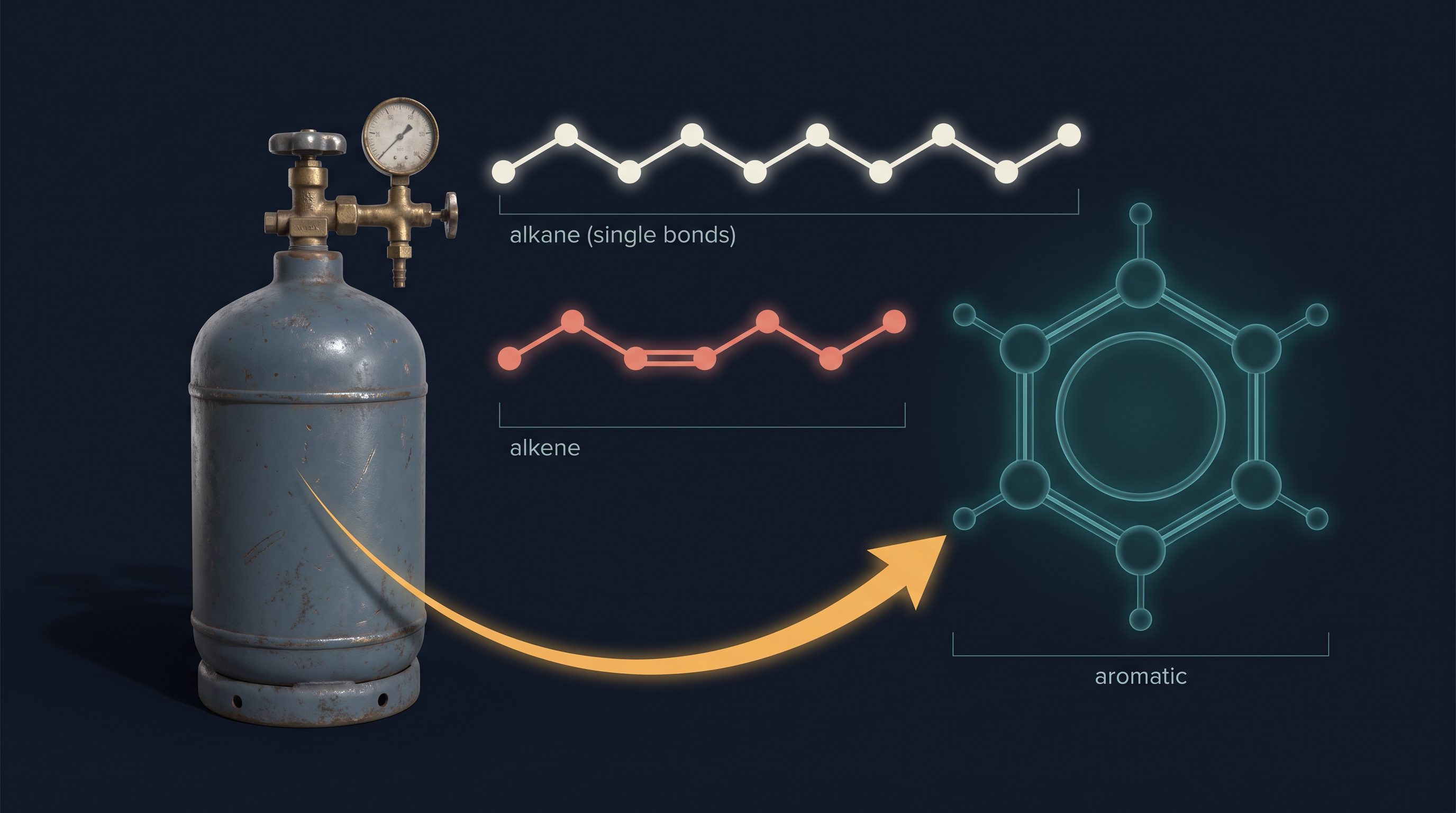
Fig. 9.0 – Hydrocarbon families and Faraday’s discovery.
As you work through this chapter, keep these questions in mind — by the end, you will be able to reason out the answer to each one yourself.
9.1 Classification
The word hydrocarbon is self-explanatory: it names a compound made of carbon and hydrogen only, and nothing else. Because carbon can bond to itself again and again while still holding on to hydrogen, these two elements alone build an enormous family of compounds. That family runs through your everyday life far more than you might expect.
Why Hydrocarbons Matter
You have almost certainly met the fuels LPG and CNG. LPG is the short form of liquefied petroleum gas, while CNG stands for compressed natural gas. A third term, LNG (liquefied natural gas), also appears often in the news; it is a fuel obtained by liquefying natural gas.
Many of these fuels come from petroleum, a mixture found deep under the earth’s crust. Petrol, diesel and kerosene oil are all separated from petroleum by fractional distillation — the process of separating a liquid mixture into fractions with different boiling ranges. Coal gas, by contrast, is obtained by the destructive distillation of coal, that is, by strongly heating coal in the absence of air.
Natural gas is found in the upper strata during the drilling of oil wells. When this gas is compressed, it becomes the CNG used as a vehicle fuel.
Not all fuels burn equally cleanly. LPG is used as a domestic fuel because it pollutes the least. Kerosene oil is also a domestic fuel, but it causes some pollution. For vehicles we use petrol, diesel and CNG — and petrol- and CNG-run vehicles pollute less than many others. What every one of these fuels has in common is that each is a mixture of hydrocarbons, and each is an important source of energy.
The usefulness of hydrocarbons does not stop at energy. They are the raw materials for polymers such as polythene, polypropene and polystyrene. Higher hydrocarbons serve as solvents for paints, and they are the starting materials for the manufacture of many dyes and drugs. In short, hydrocarbons quietly power and supply a great deal of modern life.
The Three Main Categories
Hydrocarbons are of different types. Depending upon the kinds of carbon–carbon bonds present, they can be classified into three main categories: (i) saturated, (ii) unsaturated, and (iii) aromatic hydrocarbons.
Saturated hydrocarbons contain only carbon–carbon and carbon–hydrogen single bonds. “Saturated” means each carbon holds the maximum number of hydrogen atoms it possibly can — it is fully “filled up” with hydrogen. When carbon atoms are joined into an open chain using single bonds, the compound is called an alkane (a class you first met in Unit 8). When the carbon atoms instead close up into a ring, the compound is called a cycloalkane. A cycloalkane is still saturated, because all its bonds are single bonds — being cyclic does not make a compound unsaturated.
Unsaturated hydrocarbons contain one or more carbon–carbon multiple bonds — double bonds, triple bonds, or both. Because a multiple bond takes the place of extra hydrogen atoms, an unsaturated compound carries fewer hydrogens than the saturated one with the same number of carbons. Hydrocarbons with double bonds are alkenes; those with triple bonds are alkynes.
Aromatic hydrocarbons are a special type of cyclic compound. They too are unsaturated, but they behave very differently from ordinary alkenes and alkynes — the reason for this special behaviour is one of the most interesting stories in the chapter, and you will study it in detail later.
The overall scheme is easiest to see as a branching chart, shown in FC 9.1.
Flowchart
FC 9.1 – Classification of hydrocarbons: Hydrocarbons → branches into three: (1) Saturated → further branches into “open chain = alkanes” and “ring = cycloalkanes”; (2) Unsaturated → further branches into “C=C double bond = alkenes” and “C≡C triple bond = alkynes”; (3) Aromatic → “special cyclic compounds, e.g. benzene”.
Building Molecular Models
You can construct a large number of models of such molecules — both open-chain and closed-chain — as long as you keep two simple rules in mind: carbon is tetravalent (it forms four bonds) and hydrogen is monovalent (it forms one bond). Keeping the valencies satisfied is what makes a structure correct.
For making models of alkanes, you can use toothpicks for the bonds and plasticine balls for the atoms. For alkenes, alkynes and aromatic hydrocarbons, which contain multiple bonds, spring models can be constructed, since a spring bends to show how the extra bonds curve between the two carbon atoms.
9.2 Alkanes
As we have just seen, alkanes are saturated open-chain hydrocarbons that contain only carbon–carbon single bonds. The simplest and first member of this family is methane (\(\mathrm{CH_4}\)). Methane is a gas found in coal mines and in marshy places, where it is released as decaying plant matter breaks down.
There is a neat way to picture how the family grows. Take methane and replace one of its hydrogen atoms with a carbon atom; then add just enough hydrogens to satisfy the tetravalence of that new carbon. What you get is \(\mathrm{C_2H_6}\), known as ethane. In other words, ethane can be thought of as methane with one hydrogen replaced by a \(\mathrm{-CH_3}\) (methyl) group.
Continue this exercise — keep replacing a hydrogen with a \(\mathrm{-CH_3}\) group — and the next members appear one after another: \(\mathrm{C_3H_8}\) (propane), \(\mathrm{C_4H_{10}}\) (butane), and so on.
\[\mathrm{CH_4} \xrightarrow{\ \text{replace one H by } \mathrm{-CH_3}\ } \mathrm{CH_3-CH_3}\ (\mathrm{C_2H_6})\]
These hydrocarbons are remarkably unreactive under normal conditions — they do not react with acids, bases, or most common reagents. Because of this sluggishness, they were once called paraffins.
The Homologous Series and General Formula
If you examine the formulas of successive alkanes (\(\mathrm{CH_4}\), \(\mathrm{C_2H_6}\), \(\mathrm{C_3H_8}\), \(\mathrm{C_4H_{10}}\) …), a clear pattern emerges. Each member differs from the previous one by a fixed \(\mathrm{-CH_2-}\) unit. Such a family, in which every member follows one general formula and neighbours differ by \(\mathrm{CH_2}\), is called a homologous series.
The general formula for the alkane family is:
\[\mathrm{C_n H_{2n+2}}\]
Here \(n\) is the number of carbon atoms. Putting an appropriate value of \(n\) gives any particular member (called a homologue) — for example, \(n = 1\) gives \(\mathrm{CH_4}\) and \(n = 5\) gives \(\mathrm{C_5H_{12}}\).
Shape and Bonding in Alkanes
Recall the shape of methane. According to VSEPR theory (Chapter 4), methane has a tetrahedral structure, with the carbon atom at the centre and the four hydrogen atoms at the four corners of a regular tetrahedron. All the H–C–H bond angles are \(109.5^\circ\), as drawn in Fig. 9.1.
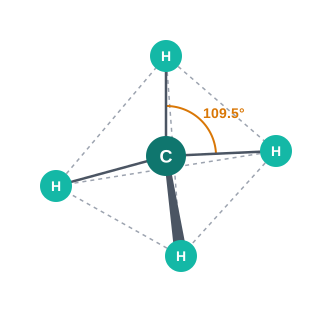
Fig. 9.1 – Tetrahedral structure of methane.
In larger alkanes, such tetrahedra are simply joined together. The C–C and C–H bond lengths are 154 pm and 112 pm respectively (Chapter 8). Both the C–C and C–H bonds are sigma (\(\sigma\)) bonds, formed by the head-on overlapping of \(sp^3\) hybrid orbitals of carbon with each other (for C–C) and with the \(1s\) orbitals of hydrogen (for C–H). A \(\sigma\) bond is a strong bond with its electron cloud lying directly between the two nuclei, which is exactly why alkanes are so stable and unreactive.
9.2.1 Nomenclature and Isomerism
You have already studied the nomenclature of organic compounds in Chapter 8. We now extend that understanding to alkanes, with the common names given in parentheses where useful.
The first three alkanes — methane, ethane and propane — each have only one possible structure. From the fourth member onwards, however, the same molecular formula can be arranged in more than one way.
Isomers of Butane and Pentane
Consider \(\mathrm{C_4H_{10}}\). Its four carbon atoms can be joined either in a continuous chain or in a branched chain, giving two different structures:
Structure I — a continuous chain: \[\mathrm{CH_3-CH_2-CH_2-CH_3} \qquad \text{Butane (}n\text{-butane), b.p. } 273\ \text{K}\]
Structure II — a branched chain: \[\mathrm{(CH_3)_2CH-CH_3} \qquad \text{2-Methylpropane (isobutane), b.p. } 261\ \text{K}\]
Now try \(\mathrm{C_5H_{12}}\) — five carbons and twelve hydrogens can be arranged in three ways:
Structure III: \(\mathrm{CH_3-CH_2-CH_2-CH_2-CH_3}\) — Pentane (\(n\)-pentane), b.p. 309 K.
Structure IV: \(\mathrm{(CH_3)_2CH-CH_2-CH_3}\) — 2-Methylbutane (isopentane), b.p. 301 K.
Structure V: \(\mathrm{C(CH_3)_4}\) — 2,2-Dimethylpropane (neopentane), b.p. 282.5 K.
Structures I and II share the same molecular formula but differ in their boiling points and other properties. The same is true of III, IV and V. Compounds that have the same molecular formula but different structures — and therefore different properties — are called structural isomers. Structures I and II are isomers of butane; III, IV and V are isomers of pentane.
Looking more closely, structures I and III have a continuous chain, while II, IV and V have a branched chain. Structural isomers that differ in the way the carbon chain is arranged are called chain isomers. Thus \(\mathrm{C_4H_{10}}\) has two chain isomers and \(\mathrm{C_5H_{12}}\) has three.
Types of Carbon Atoms
The carbon atoms in an alkane are not all alike. Based on how many other carbon atoms a given carbon is attached to, it is called primary (1°), secondary (2°), tertiary (3°), or quaternary (4°).
A carbon attached to no other carbon (as in methane) or to only one other carbon (as in ethane) is a primary carbon; terminal carbons are always primary. A carbon attached to two other carbons is secondary, one attached to three is tertiary, and one attached to four (the “neo” or quaternary carbon) is quaternary.
The number of possible isomers rises quickly as the chain grows: \(\mathrm{C_6H_{14}}\) has five isomers, \(\mathrm{C_7H_{16}}\) has nine, and \(\mathrm{C_{10}H_{22}}\) has as many as 75.
Alkyl Groups
In the branched structures above, a \(\mathrm{-CH_3}\) group was attached to a carbon of the main chain. Groups such as \(\mathrm{-CH_3}\), \(\mathrm{-C_2H_5}\), \(\mathrm{-C_3H_7}\) are called alkyl groups, because they are derived from alkanes by removing one hydrogen atom. Their general formula is \(\mathrm{C_n H_{2n+1}}\) (Unit 8).
Naming More Complex Alkanes
Let us recall the general rules for nomenclature discussed in Chapter 8 by looking at the worked examples in Table 9.1. The key ideas are always: pick the longest chain, number it so the substituents get the lowest set of locants, and cite substituents in alphabetical order.
Table 9.1 – Nomenclature of a Few Organic Compounds
| Structure (condensed) | IUPAC name | Remark |
|---|---|---|
| \(\mathrm{CH_3-CH(CH_3)-CH_2-CH(C_2H_5)-CH_2-CH_3}\) | 4-Ethyl-2-methylhexane | Lowest sum of locants and alphabetical order |
| Octane chain with two ethyl (at C-3), one isopropyl (at C-5), one methyl (at C-4) | 3,3-Diethyl-5-isopropyl-4-methyloctane | Lowest sum of locants and alphabetical order |
| Decane chain with sec-butyl (at C-5) and isopropyl (at C-4) | 5-sec-Butyl-4-isopropyldecane | “sec” is not counted while alphabetising; “isopropyl” is taken as one word |
| Nonane chain with a 2,2-dimethylpropyl side chain (at C-5) | 5-(2,2-Dimethylpropyl)nonane | Further numbering is given to the substituents of the side chain |
| \(\mathrm{CH_3-CH_2-CH(CH_3)-CH_2-CH(C_2H_5)-CH_2-CH_3}\) | 3-Ethyl-5-methylheptane | Alphabetical priority order |
Writing a Structure From Its Name
Getting from a name back to a structure is just as important as naming. The steps are: first write the longest chain (the parent alkane), then number it, attach the substituents to the correct carbons, and finally add enough hydrogens to satisfy the valence of every carbon. Take 3-ethyl-2,2-dimethylpentane as an example.
- Draw the chain of five carbons: \(\mathrm{C-C-C-C-C}\)
- Number the carbons: \(\mathrm{C^1-C^2-C^3-C^4-C^5}\)
- Attach an ethyl group at carbon 3 and two methyl groups at carbon 2.
- Satisfy the valence of each carbon by adding the right number of hydrogens, giving: \[\mathrm{CH_3-C(CH_3)_2-CH(C_2H_5)-CH_2-CH_3}\]
9.2.2 Preparation
Petroleum and natural gas are the main natural sources of alkanes. In the laboratory, however, alkanes can be prepared by several methods.
1. From Unsaturated Hydrocarbons
Dihydrogen gas adds to alkenes and alkynes in the presence of finely divided catalysts such as platinum, palladium or nickel to give alkanes. This process is called hydrogenation. The metal surface adsorbs the dihydrogen and activates the H–H bond, making it easier to add across the multiple bond. Platinum and palladium bring about the reaction at room temperature, whereas nickel usually needs relatively higher temperature and pressure.
\[\mathrm{CH_2{=}CH_2} + \mathrm{H_2} \xrightarrow{\ \mathrm{Pt/Pd/Ni}\ } \mathrm{CH_3-CH_3} \qquad (9.1)\] Ethene gives ethane.
\[\mathrm{CH_3-CH{=}CH_2} + \mathrm{H_2} \xrightarrow{\ \mathrm{Pt/Pd/Ni}\ } \mathrm{CH_3-CH_2CH_3} \qquad (9.2)\] Propene gives propane.
\[\mathrm{CH_3-C{\equiv}C-H} + \mathrm{H_2} \xrightarrow{\ \mathrm{Pt/Pd/Ni}\ } \mathrm{CH_3-CH_2CH_3} \qquad (9.3)\] Propyne gives propane.
2. From Alkyl Halides
(i) By reduction. Alkyl halides (except fluorides) on reduction with zinc and dilute hydrochloric acid give alkanes.
\[\mathrm{CH_3-Cl} + \mathrm{H_2} \xrightarrow{\ \mathrm{Zn,\ H^+}\ } \mathrm{CH_4} + \mathrm{HCl} \qquad (9.4)\] Chloromethane gives methane.
\[\mathrm{C_2H_5-Cl} + \mathrm{H_2} \xrightarrow{\ \mathrm{Zn,\ H^+}\ } \mathrm{C_2H_6} + \mathrm{HCl} \qquad (9.5)\] Chloroethane gives ethane.
\[\mathrm{CH_3CH_2CH_2Cl} + \mathrm{H_2} \xrightarrow{\ \mathrm{Zn,\ H^+}\ } \mathrm{CH_3CH_2CH_3} + \mathrm{HCl} \qquad (9.6)\] 1-Chloropropane gives propane.
(ii) Wurtz reaction. Alkyl halides on treatment with sodium metal in dry ethereal (moisture-free) solution give higher alkanes. This is known as the Wurtz reaction, and it is used to prepare higher alkanes containing an even number of carbon atoms — because two identical alkyl groups join end to end.
\[\mathrm{CH_3Br} + 2\,\mathrm{Na} + \mathrm{BrCH_3} \xrightarrow{\ \text{dry ether}\ } \mathrm{CH_3-CH_3} + 2\,\mathrm{NaBr} \qquad (9.7)\] Bromomethane gives ethane.
\[\mathrm{C_2H_5Br} + 2\,\mathrm{Na} + \mathrm{BrC_2H_5} \xrightarrow{\ \text{dry ether}\ } \mathrm{CH_3-CH_2-CH_2-CH_3} + 2\,\mathrm{NaBr} \qquad (9.8)\] Bromoethane gives \(n\)-butane.
3. From Carboxylic Acids
(i) Decarboxylation. Sodium salts of carboxylic acids, on heating with soda lime, give alkanes containing one carbon atom less than the carboxylic acid. This loss of carbon dioxide from a carboxylic acid is called decarboxylation.
\[\mathrm{CH_3COO^{-}Na^{+}} + \mathrm{NaOH} \xrightarrow{\ \mathrm{CaO},\ \Delta\ } \mathrm{CH_4} + \mathrm{Na_2CO_3}\] Sodium ethanoate gives methane.
(ii) Kolbe’s electrolytic method. An aqueous solution of the sodium or potassium salt of a carboxylic acid, on electrolysis, gives an alkane containing an even number of carbon atoms at the anode.
\[2\,\mathrm{CH_3COO^{-}Na^{+}} + 2\,\mathrm{H_2O} \xrightarrow{\ \text{Electrolysis}\ } \mathrm{CH_3-CH_3} + 2\,\mathrm{CO_2} + \mathrm{H_2} + 2\,\mathrm{NaOH} \qquad (9.9)\]
The reaction is believed to follow a free-radical path, summarised in FC 9.2.
Flowchart
FC 9.2 – Kolbe’s electrolytic method (acetate example): (i) 2 CH₃COO⁻Na⁺ ⇌ 2 CH₃COO⁻ + 2 Na⁺; (ii) At anode: 2 CH₃COO⁻ → (lose 2e⁻) 2 CH₃COO• (acetate free radical) → 2 •CH₃ (methyl free radical) + 2 CO₂↑; (iii) •CH₃ + •CH₃ → H₃C–CH₃↑ (ethane); (iv) At cathode: 2 H₂O + 2e⁻ → 2 OH⁻ + 2 •H, then 2 •H → H₂↑.
The individual steps are: \[\text{(i)}\quad 2\,\mathrm{CH_3COO^{-}Na^{+}} \rightleftharpoons 2\,\mathrm{CH_3COO^{-}} + 2\,\mathrm{Na^{+}}\] \[\text{(ii) At anode:}\quad 2\,\mathrm{CH_3COO^{-}} \xrightarrow{-2e^{-}} 2\,\mathrm{CH_3COO}^{\bullet} \rightarrow 2\,{}^{\bullet}\mathrm{CH_3} + 2\,\mathrm{CO_2}\uparrow\] \[\text{(iii)}\quad {}^{\bullet}\mathrm{CH_3} + {}^{\bullet}\mathrm{CH_3} \rightarrow \mathrm{H_3C-CH_3}\uparrow\] \[\text{(iv) At cathode:}\quad 2\,\mathrm{H_2O} + 2e^{-} \rightarrow 2\,\mathrm{OH^{-}} + 2\,{}^{\bullet}\mathrm{H}; \qquad 2\,{}^{\bullet}\mathrm{H} \rightarrow \mathrm{H_2}\uparrow\]
9.2.3 Properties
Physical Properties
Alkanes are almost non-polar molecules. This is because the C–C and C–H bonds are covalent, and the electronegativity difference between carbon and hydrogen is very small, so almost no charge separation develops. As a result, alkane molecules are held together only by weak van der Waals forces.
Because these forces are weak, the physical state changes gradually along the series: the first four members, \(\mathrm{C_1}\) to \(\mathrm{C_4}\), are gases; \(\mathrm{C_5}\) to \(\mathrm{C_{17}}\) are liquids; and those with 18 carbon atoms or more are solids at 298 K. Alkanes are colourless and odourless.
Since alkanes are non-polar, they do not dissolve in water (a polar solvent) but dissolve well in non-polar solvents. This is the familiar rule: like dissolves like — polar substances dissolve in polar solvents, and non-polar ones in non-polar solvents. Petrol, itself a mixture of hydrocarbons, is used for dry-cleaning clothes to remove grease stains. Since petrol dissolves the grease, grease must also be non-polar; indeed, grease is a mixture of higher alkanes and is non-polar and hydrophobic (water-repelling).
The boiling points of alkanes (Table 9.2) rise steadily with increasing molecular mass. This is because the van der Waals forces grow stronger as the molecular size — and hence the surface area of contact between molecules — increases.
A striking comparison appears among the three isomeric pentanes. Pentane, with a continuous chain of five carbons, has the highest boiling point (309.1 K), whereas its most branched isomer, 2,2-dimethylpropane, boils lowest (282.5 K). With more branching, the molecule becomes more compact and ball-shaped, reducing the surface area over which neighbouring molecules can touch. Smaller contact area means weaker van der Waals forces, which are overcome at lower temperatures.
Table 9.2 – Variation of Melting Point and Boiling Point in Alkanes
| Molecular formula | Name | Molecular mass/u | b.p./K | m.p./K |
|---|---|---|---|---|
| \(\mathrm{CH_4}\) | Methane | 16 | 111.0 | 90.5 |
| \(\mathrm{C_2H_6}\) | Ethane | 30 | 184.4 | 101.0 |
| \(\mathrm{C_3H_8}\) | Propane | 44 | 230.9 | 85.3 |
| \(\mathrm{C_4H_{10}}\) | Butane | 58 | 272.4 | 134.6 |
| \(\mathrm{C_4H_{10}}\) | 2-Methylpropane | 58 | 261.0 | 114.7 |
| \(\mathrm{C_5H_{12}}\) | Pentane | 72 | 309.1 | 143.3 |
| \(\mathrm{C_5H_{12}}\) | 2-Methylbutane | 72 | 300.9 | 113.1 |
| \(\mathrm{C_5H_{12}}\) | 2,2-Dimethylpropane | 72 | 282.5 | 256.4 |
| \(\mathrm{C_6H_{14}}\) | Hexane | 86 | 341.9 | 178.5 |
| \(\mathrm{C_7H_{16}}\) | Heptane | 100 | 371.4 | 182.4 |
| \(\mathrm{C_8H_{18}}\) | Octane | 114 | 398.7 | 216.2 |
| \(\mathrm{C_9H_{20}}\) | Nonane | 128 | 423.8 | 222.0 |
| \(\mathrm{C_{10}H_{22}}\) | Decane | 142 | 447.1 | 243.3 |
| \(\mathrm{C_{20}H_{42}}\) | Eicosane | 282 | 615.0 | 309.7 |
Chemical Properties
As mentioned earlier, alkanes are generally inert towards acids, bases, oxidising and reducing agents. Under certain conditions, however, they undergo the following reactions.
1. Substitution Reactions
In a substitution reaction, one or more hydrogen atoms of an alkane are replaced by another atom or group — a halogen, a nitro group, or a sulphonic acid group. Halogenation takes place either at higher temperature (573–773 K) or in the presence of diffused sunlight or ultraviolet light. Lower alkanes do not undergo nitration or sulphonation.
The chlorination of methane is a good example, proceeding one step at a time:
\[\mathrm{CH_4} + \mathrm{Cl_2} \xrightarrow{\ h\nu\ } \mathrm{CH_3Cl} + \mathrm{HCl} \qquad (9.10)\] Chloromethane. \[\mathrm{CH_3Cl} + \mathrm{Cl_2} \xrightarrow{\ h\nu\ } \mathrm{CH_2Cl_2} + \mathrm{HCl} \qquad (9.11)\] Dichloromethane. \[\mathrm{CH_2Cl_2} + \mathrm{Cl_2} \xrightarrow{\ h\nu\ } \mathrm{CHCl_3} + \mathrm{HCl} \qquad (9.12)\] Trichloromethane. \[\mathrm{CHCl_3} + \mathrm{Cl_2} \xrightarrow{\ h\nu\ } \mathrm{CCl_4} + \mathrm{HCl} \qquad (9.13)\] Tetrachloromethane.
Ethane behaves similarly: \[\mathrm{CH_3-CH_3} + \mathrm{Cl_2} \xrightarrow{\ h\nu\ } \mathrm{CH_3-CH_2Cl} + \mathrm{HCl} \qquad (9.14)\] Chloroethane.
The rate of reaction of alkanes with different halogens follows the order \(\mathrm{F_2 > Cl_2 > Br_2 > I_2}\), and the ease of replacement of hydrogen atoms is \(3^\circ > 2^\circ > 1^\circ\). Fluorination is too violent to control, while iodination is very slow and reversible; it can be carried out only in the presence of oxidising agents such as \(\mathrm{HIO_3}\) or \(\mathrm{HNO_3}\), which remove the \(\mathrm{HI}\) formed.
\[\mathrm{CH_4} + \mathrm{I_2} \rightleftharpoons \mathrm{CH_3I} + \mathrm{HI} \qquad (9.15)\] \[\mathrm{HIO_3} + 5\,\mathrm{HI} \rightarrow 3\,\mathrm{I_2} + 3\,\mathrm{H_2O} \qquad (9.16)\]
Mechanism. Halogenation is believed to proceed by a free-radical chain mechanism with three stages — initiation, propagation and termination. The overall logic is captured in FC 9.3.
Flowchart
FC 9.3 – Free-radical chain mechanism of chlorination of methane: Initiation (Cl₂ →hv 2 Cl•) → Propagation (Cl• + CH₄ → •CH₃ + HCl; then •CH₃ + Cl₂ → CH₃Cl + Cl•; chain repeats) → Termination (radicals combine: Cl•+Cl•→Cl₂; •CH₃+•CH₃→C₂H₆; •CH₃+Cl•→CH₃Cl). Note the branch: the repeating propagation loop is what makes the chain; termination breaks it.
(i) Initiation. The reaction is started by the homolysis of the chlorine molecule under light or heat. The Cl–Cl bond is weaker than the C–C and C–H bonds, so it breaks most easily, giving two chlorine free radicals. \[\mathrm{Cl-Cl} \xrightarrow[\text{homolysis}]{\ h\nu\ } 2\,\mathrm{Cl}^{\bullet}\]
(ii) Propagation. A chlorine free radical attacks a methane molecule, pulling off a hydrogen to form a methyl free radical and H–Cl. \[\text{(a)}\quad \mathrm{CH_4} + \mathrm{Cl}^{\bullet} \xrightarrow{\ h\nu\ } {}^{\bullet}\mathrm{CH_3} + \mathrm{H-Cl}\] The methyl radical then attacks a fresh chlorine molecule to give \(\mathrm{CH_3-Cl}\) and a new chlorine free radical. \[\text{(b)}\quad {}^{\bullet}\mathrm{CH_3} + \mathrm{Cl-Cl} \xrightarrow{\ h\nu\ } \mathrm{CH_3-Cl} + \mathrm{Cl}^{\bullet}\] Steps (a) and (b) keep regenerating radicals, so they set up a self-sustaining chain. Other propagation steps also occur, which explain how the more highly chlorinated products form: \[\mathrm{CH_3Cl} + \mathrm{Cl}^{\bullet} \rightarrow {}^{\bullet}\mathrm{CH_2Cl} + \mathrm{HCl}\] \[ {}^{\bullet}\mathrm{CH_2Cl} + \mathrm{Cl-Cl} \rightarrow \mathrm{CH_2Cl_2} + \mathrm{Cl}^{\bullet}\]
(iii) Termination. The chain stops when radicals are used up, chiefly by combining with one another: \[\text{(a)}\quad \mathrm{Cl}^{\bullet} + \mathrm{Cl}^{\bullet} \rightarrow \mathrm{Cl-Cl}\] \[\text{(b)}\quad \mathrm{H_3C}^{\bullet} + {}^{\bullet}\mathrm{CH_3} \rightarrow \mathrm{H_3C-CH_3}\] \[\text{(c)}\quad {}^{\bullet}\mathrm{CH_3} + \mathrm{Cl}^{\bullet} \rightarrow \mathrm{H_3C-Cl}\] Step (b) is important: it explains why a little ethane appears as a by-product during the chlorination of methane — two methyl radicals simply join together.
2. Combustion
Alkanes on heating in air or dioxygen are completely oxidised to carbon dioxide and water, releasing a large amount of heat.
\[\mathrm{CH_4}\text{(g)} + 2\,\mathrm{O_2}\text{(g)} \rightarrow \mathrm{CO_2}\text{(g)} + 2\,\mathrm{H_2O}\text{(l)}; \qquad \Delta_c H^{\ominus} = -890\ \text{kJ mol}^{-1} \qquad (9.17)\]
\[\mathrm{C_4H_{10}}\text{(g)} + \tfrac{13}{2}\,\mathrm{O_2}\text{(g)} \rightarrow 4\,\mathrm{CO_2}\text{(g)} + 5\,\mathrm{H_2O}\text{(l)}; \qquad \Delta_c H^{\ominus} = -2875.84\ \text{kJ mol}^{-1} \qquad (9.18)\]
The general combustion equation for any alkane is: \[\mathrm{C_n H_{2n+2}} + \left(\frac{3n+1}{2}\right)\mathrm{O_2} \rightarrow n\,\mathrm{CO_2} + (n+1)\,\mathrm{H_2O} \qquad (9.19)\]
Because of the large amount of heat released, alkanes are widely used as fuels.
During incomplete combustion — when the supply of air or dioxygen is insufficient — carbon black (a fine soot) is formed instead. It is used in the manufacture of ink, printer ink, black pigments and filters. \[\mathrm{CH_4}\text{(g)} + \mathrm{O_2}\text{(g)} \xrightarrow[\text{combustion}]{\text{incomplete}} \mathrm{C}\text{(s)} + 2\,\mathrm{H_2O}\text{(l)} \qquad (9.20)\]
3. Controlled Oxidation
On heating with a regulated supply of dioxygen or air at high pressure in the presence of suitable catalysts, alkanes give a variety of oxidation products.
\[2\,\mathrm{CH_4} + \mathrm{O_2} \xrightarrow{\ \mathrm{Cu}/523\,\mathrm{K}/100\,\text{atm}\ } 2\,\mathrm{CH_3OH} \qquad (9.21)\] Methanol. \[\mathrm{CH_4} + \mathrm{O_2} \xrightarrow[\Delta]{\ \mathrm{Mo_2O_3}\ } \mathrm{HCHO} + \mathrm{H_2O} \qquad (9.22)\] Methanal. \[2\,\mathrm{CH_3CH_3} + 3\,\mathrm{O_2} \xrightarrow[\Delta]{\ (\mathrm{CH_3COO})_2\mathrm{Mn}\ } 2\,\mathrm{CH_3COOH} + 2\,\mathrm{H_2O} \qquad (9.23)\] Ethanoic acid.
Ordinarily alkanes resists oxidation, but an alkane having a tertiary hydrogen atom can be oxidised to the corresponding alcohol by potassium permanganate. \[\mathrm{(CH_3)_3CH} \xrightarrow[\text{Oxidation}]{\ \mathrm{KMnO_4}\ } \mathrm{(CH_3)_3COH} \qquad (9.24)\] 2-Methylpropane gives 2-methylpropan-2-ol.
4. Isomerisation
\(n\)-Alkanes, on heating in the presence of anhydrous aluminium chloride and hydrogen chloride gas, isomerise to branched-chain alkanes. (Some minor products also form but, as is usual in organic chemistry, only the major products are shown.)
\[\mathrm{CH_3(CH_2)_4CH_3} \xrightarrow{\ \text{Anhy. } \mathrm{AlCl_3}/\mathrm{HCl}\ } \mathrm{CH_3-CH(CH_3)-CH_2-CH_2-CH_3} + \mathrm{CH_3CH_2-CH(CH_3)-CH_2-CH_3} \qquad (9.25)\] \(n\)-Hexane gives 2-methylpentane and 3-methylpentane.
5. Aromatization
\(n\)-Alkanes having six or more carbon atoms, on heating to 773 K at 10–20 atmospheric pressure in the presence of oxides of vanadium, molybdenum or chromium supported over alumina, get dehydrogenated (lose hydrogen) and cyclised to benzene and its homologues. This reaction is called aromatization or reforming. The set-up is drawn in Fig. 9.2.
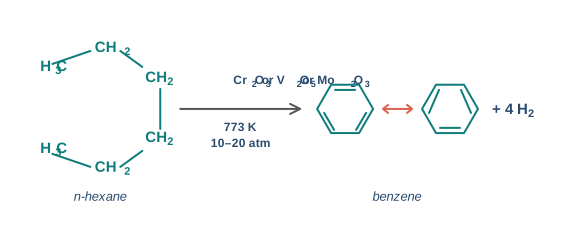
Fig. 9.2 – Aromatization of n-hexane to benzene.
\[\mathrm{C_6H_{14}} \xrightarrow[\text{773 K, 10--20 atm}]{\ \mathrm{Cr_2O_3\ /\ V_2O_5\ /\ Mo_2O_3}\ } \mathrm{C_6H_6} + 4\,\mathrm{H_2} \qquad (9.26)\] \(n\)-Hexane gives benzene.
6. Reaction With Steam
Methane reacts with steam at 1273 K in the presence of a nickel catalyst to form carbon monoxide and dihydrogen. This method is used for the industrial preparation of dihydrogen gas.
\[\mathrm{CH_4} + \mathrm{H_2O} \xrightarrow[\Delta]{\ \mathrm{Ni}\ } \mathrm{CO} + 3\,\mathrm{H_2} \qquad (9.27)\]
7. Pyrolysis
Higher alkanes, on heating to a high temperature, decompose into lower alkanes, alkenes and other fragments. Such decomposition into smaller pieces by the application of heat is called pyrolysis or cracking.
\[\mathrm{C_6H_{14}} \xrightarrow{\ 773\ \mathrm{K}\ } \mathrm{C_6H_{12}} + \mathrm{H_2}; \quad \mathrm{C_4H_8} + \mathrm{C_2H_6}; \quad \mathrm{C_3H_6} + \mathrm{C_2H_4} + \mathrm{CH_4} \qquad (9.28)\]
Pyrolysis is believed to be a free-radical reaction. The production of oil gas or petrol gas from kerosene oil or petrol makes use of this principle. For example, dodecane — a constituent of kerosene oil — on heating to 973 K over platinum, palladium or nickel gives a mixture of heptane and pentene.
\[\mathrm{C_{12}H_{26}} \xrightarrow[973\ \mathrm{K}]{\ \mathrm{Pt/Pd/Ni}\ } \mathrm{C_7H_{16}} + \mathrm{C_5H_{10}} + \text{other products} \qquad (9.29)\] Dodecane gives heptane and pentene.
9.2.4 Conformations
Alkanes contain carbon–carbon sigma (\(\sigma\)) bonds. The electron distribution of a \(\sigma\) molecular orbital is symmetrical around the internuclear axis of the C–C bond, and it is not disturbed when one part of the molecule turns about that axis. This means there is essentially free rotation about a C–C single bond.
Such rotation produces different spatial arrangements of the atoms, which can change into one another by simply turning about the bond. These different arrangements, interconvertible by rotation around a C–C single bond, are called conformations (also conformers or rotamers). An alkane can therefore have an infinite number of conformations.
Rotation, however, is not completely free. It is hindered by a small energy barrier of about 1–20 kJ mol\(^{-1}\), arising from a weak repulsive interaction between the electron clouds of the adjacent bonds. This kind of repulsive interaction is called torsional strain.
Conformations of Ethane
The ethane molecule (\(\mathrm{C_2H_6}\)) contains a carbon–carbon single bond, with each carbon carrying three hydrogen atoms. Imagine holding one carbon fixed and rotating the other about the C–C axis. This produces an infinite number of arrangements of the front hydrogens relative to the rear hydrogens — the conformational isomers (conformers) of ethane.
Two of these are the extreme, limiting cases: - In the eclipsed conformation, the hydrogen atoms on the two carbons are as close together (directly behind one another) as possible. - In the staggered conformation, the hydrogen atoms are as far apart as possible. - Any in-between arrangement is called a skew conformation.
In all conformations, the bond angles and bond lengths stay exactly the same — only the relative twist changes. These conformations are usually drawn using Sawhorse and Newman projections.
1. Sawhorse Projections
In a Sawhorse projection, the molecule is viewed along the molecular axis. The central C–C bond is drawn as a somewhat longer straight line, with its upper end tilted slightly to the right or left. The front carbon is shown at the lower end of the line and the rear carbon at the upper end. Each carbon carries three lines (the three C–H bonds), inclined at 120° to one another. The eclipsed and staggered forms are shown in Fig. 9.3.
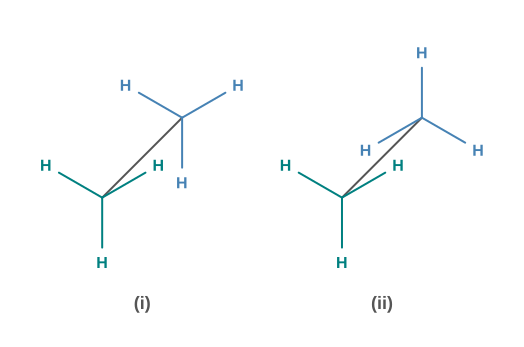
Fig. 9.3 – Sawhorse projections of ethane.
2. Newman Projections
In a Newman projection, the molecule is viewed straight down the C–C bond, head on. The nearer carbon is shown as a point from which three lines (front C–H bonds) radiate at 120°. The rear carbon is drawn as a circle, with its three C–H bonds shown as shorter lines, again at 120°. These are shown in Fig. 9.4.
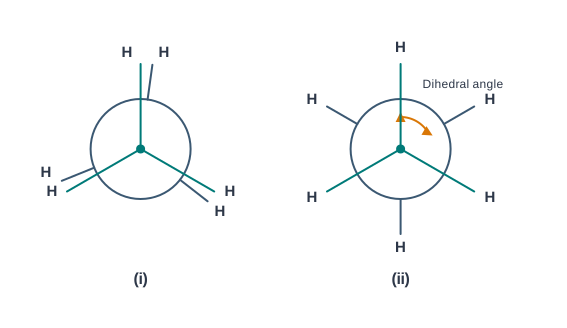
Fig. 9.4 – Newman projections of ethane.
Relative Stability of the Conformations
In the staggered form, the electron clouds of the carbon–hydrogen bonds are as far apart as possible. This gives minimum repulsive forces, minimum energy, and therefore maximum stability.
When the staggered form twists into the eclipsed form, the C–H electron clouds come closer together, increasing the repulsions between them. To bear these increased repulsions the molecule must have more energy, so the eclipsed form is less stable. This repulsive interaction that affects the stability of a conformation is the torsional strain, and its size depends on the angle of rotation about the C–C bond. That angle is also called the dihedral angle or torsional angle.
Of all the conformations of ethane, the staggered form has the least torsional strain and the eclipsed form the maximum. The staggered conformation is therefore more stable and is the preferred one; the molecule spends most of its time in it.
The energy difference between the two extreme forms is of the order of 12.5 kJ mol\(^{-1}\), which is very small. Even at ordinary temperatures, an ethane molecule gains enough thermal (kinetic) energy through intermolecular collisions to jump over this 12.5 kJ mol\(^{-1}\) barrier. For all practical purposes, then, rotation about the carbon–carbon single bond in ethane can be regarded as almost free, and it has not been possible to separate and isolate the different conformational isomers of ethane.
9.3 Alkenes
Alkenes are unsaturated hydrocarbons that contain at least one carbon–carbon double bond. What should their general formula be? A double bond between two carbon atoms uses up bonding capacity that would otherwise hold hydrogen, so an alkene has two hydrogen atoms fewer than the alkane with the same number of carbons. Hence the general formula for alkenes is:
\[\mathrm{C_n H_{2n}}\]
Alkenes are also known as olefins.
9.3.1 Structure of Double Bond
The carbon–carbon double bond in an alkene is not two identical bonds. It is made of one strong sigma (\(\sigma\)) bond and one weaker pi (\(\pi\)) bond.
The \(\sigma\) bond (bond enthalpy about 397 kJ mol\(^{-1}\)) forms by the head-on overlapping of \(sp^2\) hybridised orbitals of the two carbon atoms. The \(\pi\) bond (bond enthalpy about 284 kJ mol\(^{-1}\)) forms by the lateral or sideways overlapping of the two unhybridised \(2p\) orbitals of the two carbons. Because sideways overlap is much less effective than head-on overlap, the \(\pi\) bond is the weaker of the two.
The double bond is shorter (bond length 134 pm) than a C–C single bond (154 pm), since the two carbons are pulled closer by the extra bond.
This weaker \(\pi\) bond is the key to almost all of alkene chemistry. The \(\pi\) electrons are loosely held and mobile, so they stick out above and below the line of the carbons where reagents can easily reach them. Reagents that are “hungry” for electrons — that is, electron-seeking species — are called electrophilic reagents (electrophiles). Alkenes are readily attacked by such electrophiles, which is why the weaker \(\pi\) bond makes alkenes far more reactive than alkanes: the alkene converts to a stable single-bonded product by adding the electrophile across the double bond.
Even so, the whole double bond taken together is strong. Its bond enthalpy (681 kJ mol\(^{-1}\)) is greater than that of a single carbon–carbon bond in ethane (348 kJ mol\(^{-1}\)) — but note that it is less than twice the single-bond value, which again tells us the second (\(\pi\)) bond is weaker. The orbital pictures of ethene are shown in Figs. 9.5 and 9.6.
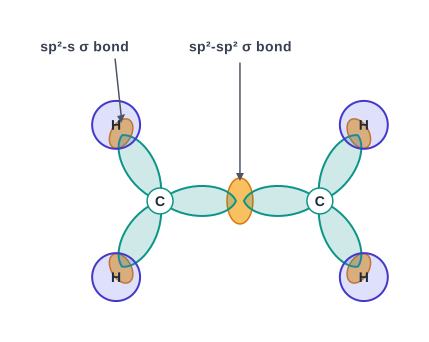
Fig. 9.5 – The sigma bond framework of ethene.
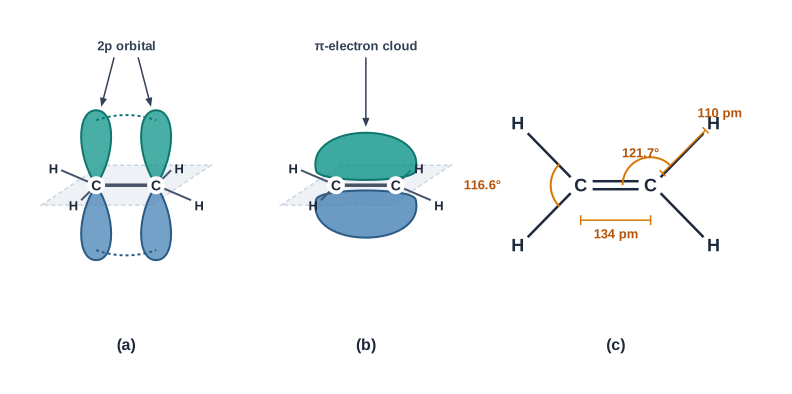
Fig. 9.6 – Orbital picture and geometry of ethene.
9.3.2 Nomenclature
For naming alkenes in the IUPAC system, the longest chain of carbon atoms containing the double bond is chosen as the parent chain. The chain is numbered from the end nearer to the double bond, so the double bond gets the lowest possible locant. The suffix -ene replaces the -ane of the corresponding alkane.
The very first member would be \(\mathrm{CH_2}\) (putting \(n = 1\) in \(\mathrm{C_nH_{2n}}\)), called methene, but it has a very short life. The first stable member is \(\mathrm{C_2H_4}\), called ethylene (common name) or ethene (IUPAC). A few members are named below.
| Structure | IUPAC name |
|---|---|
| \(\mathrm{CH_3-CH{=}CH_2}\) | Propene |
| \(\mathrm{CH_3-CH_2-CH{=}CH_2}\) | But-1-ene |
| \(\mathrm{CH_3-CH{=}CH-CH_3}\) | But-2-ene |
| \(\mathrm{CH_2{=}CH-CH{=}CH_2}\) | Buta-1,3-diene |
| \(\mathrm{CH_2{=}C(CH_3)-H}\) (i.e. \(\mathrm{CH_2{=}C(CH_3)_2}\) skeleton with methyl branch) | 2-Methylprop-1-ene |
| \(\mathrm{CH_2{=}CH-CH(CH_3)-CH_3}\) | 3-Methylbut-1-ene |
9.3.3 Isomerism
Alkenes show both structural isomerism and geometrical (cis–trans) isomerism.
Structural Isomerism
As with alkanes, ethene (\(\mathrm{C_2H_4}\)) and propene (\(\mathrm{C_3H_6}\)) each have only one structure, but higher alkenes can be arranged in several ways. The formula \(\mathrm{C_4H_8}\), for instance, can be written three ways:
I. \(\mathrm{CH_2{=}CH-CH_2-CH_3}\) — But-1-ene II. \(\mathrm{CH_3-CH{=}CH-CH_3}\) — But-2-ene III. \(\mathrm{CH_2{=}C(CH_3)-CH_3}\) — 2-Methylprop-1-ene
Here structures I and III (and II and III) differ in the carbon skeleton, so they are chain isomers. Structures I and II have the same skeleton but the double bond in a different place, so they are position isomers.
Geometrical (cis–trans) Isomerism
The two doubly bonded carbons still have to satisfy their remaining two valences by bonding to two atoms or groups each. If the two atoms or groups on each carbon are different, the molecule can be written as a \(\mathrm{YXC{=}CXY}\) type, and it can be drawn in two ways, shown in Fig. 9.7.
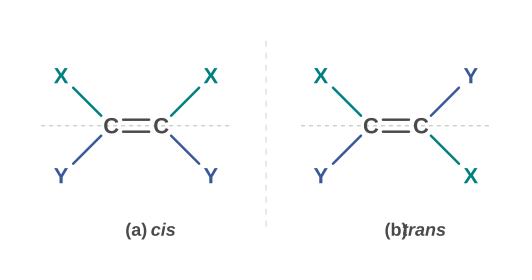
Fig. 9.7 – General representations of cis and trans isomers.
In arrangement (a) the two identical atoms (both X, or both Y) lie on the same side of the double bond; in arrangement (b) they lie on opposite sides. Because the geometry of the two arrangements is different, they are stereoisomers — molecules with the same connectivity but a different arrangement of atoms in space.
Why can’t the molecule simply rotate from one form into the other? Because rotation about a C=C double bond is not free — the \(\pi\) bond locks it. You can feel this with a simple model: join two stiff cardboards with two nails and try to twist one relative to the other; the twisting is restricted. This restricted rotation about the doubly bonded carbons gives rise to the two fixed geometries. Such stereoisomers are called geometrical isomers.
Because their spatial arrangements differ, geometrical isomers differ in properties such as melting point, boiling point, dipole moment and solubility. The cis and trans forms of but-2-ene are shown in Fig. 9.8.
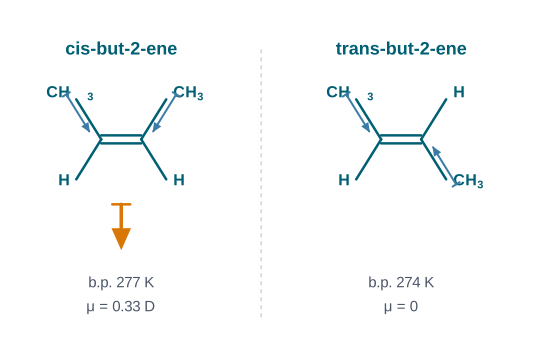
Fig. 9.8 – Dipole moments in cis- and trans-but-2-ene.
The cis form of an alkene is more polar than the trans form. For example, the dipole moment of cis-but-2-ene is 0.33 D (Debye), whereas that of the trans form is almost zero. This is easy to see from the geometry: in trans-but-2-ene the two methyl groups point in opposite directions, so the two C–CH\(_3\) bond dipoles cancel, making the molecule non-polar. In the cis form they point the same way and add up, giving a net dipole.
For solids, it is observed that the trans isomer has a higher melting point than the cis form, because its more symmetrical shape packs more neatly into the crystal.
Geometrical isomerism is also shown by alkenes of the types \(\mathrm{XYC{=}CXZ}\) and \(\mathrm{XYC{=}CZW}\).
Draw the cis and trans isomers of the following, and write their IUPAC names: (i) \(\mathrm{CHCl{=}CHCl}\); (ii) \(\mathrm{C_2H_5(CH_3)C{=}C(CH_3)C_2H_5}\).
cis-1,2-Dichloroethene and trans-1,2-Dichloroethene.
cis-3,4-Dimethylhex-3-ene and trans-3,4-Dimethylhex-3-ene.
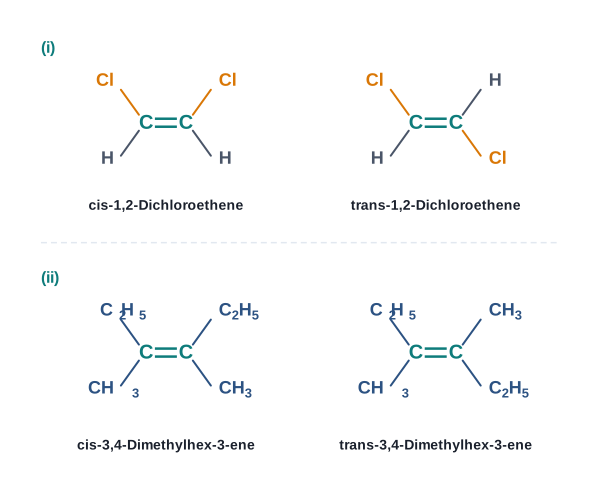
[Caption:] Fig. 9.9 – Geometrical isomers of 1,2-dichloroethene and 3,4-dimethylhex-3-ene. [/Caption:]
9.3.4 Preparation
1. From Alkynes
Alkynes on partial reduction with a calculated amount of dihydrogen give alkenes. The catalyst decides the geometry of the product.
Over palladised charcoal partially deactivated with poisons such as sulphur compounds or quinoline — a catalyst known as Lindlar’s catalyst — the alkene formed has the cis geometry. In contrast, reduction with sodium in liquid ammonia gives the trans alkene.
\[\mathrm{RC{\equiv}CR'} + \mathrm{H_2} \xrightarrow{\ \mathrm{Pd/C}\ } cis\text{-alkene} \qquad (9.30)\] \[\mathrm{RC{\equiv}CR'} + \mathrm{H_2} \xrightarrow{\ \mathrm{Na/liquid\ NH_3}\ } trans\text{-alkene} \qquad (9.31)\] \[\mathrm{CH{\equiv}CH} + \mathrm{H_2} \xrightarrow{\ \mathrm{Pd/C}\ } \mathrm{CH_2{=}CH_2} \qquad (9.32)\] Ethyne gives ethene. \[\mathrm{CH_3-C{\equiv}CH} + \mathrm{H_2} \xrightarrow{\ \mathrm{Pd/C}\ } \mathrm{CH_3-CH{=}CH_2} \qquad (9.33)\] Propyne gives propene.
2. From Alkyl Halides
Alkyl halides (R–X), on heating with alcoholic potash (potassium hydroxide dissolved in alcohol, such as ethanol), lose one molecule of the hydrogen halide to form an alkene. This is called dehydrohalogenation (removal of a halogen acid). It is an example of a \(\beta\)-elimination reaction, because the hydrogen atom removed comes from the \(\beta\)-carbon — the carbon next to the one bearing the halogen.
\[\underset{\beta}{\mathrm{CH_3}}-\underset{\alpha}{\mathrm{CH_2X}} \xrightarrow[\Delta]{\ \text{alc. KOH}\ } \mathrm{CH_2{=}CH_2} + \mathrm{HX} \qquad (9.34)\] (X = Cl, Br, I)
The rate of the reaction depends on the halogen and the alkyl group. For the halogens the rate order is iodine > bromine > chlorine, while for the alkyl groups it is tertiary > secondary > primary.
3. From Vicinal Dihalides
Dihalides in which the two halogen atoms are on adjacent carbon atoms are called vicinal dihalides. On treatment with zinc metal, they lose a molecule of \(\mathrm{ZnX_2}\) to form an alkene. This is dehalogenation.
\[\mathrm{CH_2Br-CH_2Br} + \mathrm{Zn} \rightarrow \mathrm{CH_2{=}CH_2} + \mathrm{ZnBr_2} \qquad (9.35)\] \[\mathrm{CH_3CHBr-CH_2Br} + \mathrm{Zn} \rightarrow \mathrm{CH_3CH{=}CH_2} + \mathrm{ZnBr_2} \qquad (9.36)\]
4. From Alcohols by Acidic Dehydration
Alcohols are the hydroxy derivatives of alkanes, written as R–OH (with R = \(\mathrm{C_nH_{2n+1}}\)). On heating with concentrated sulphuric acid, an alcohol loses one molecule of water to form an alkene. Since water is eliminated in the presence of an acid, this is called the acidic dehydration of alcohols. It too is a \(\beta\)-elimination, because the \(\mathrm{-OH}\) group takes a hydrogen atom from the \(\beta\)-carbon.
\[\underset{\text{Ethanol}}{\mathrm{CH_3-CH_2-OH}} \xrightarrow[\Delta]{\ \text{Conc. } \mathrm{H_2SO_4}\ } \mathrm{CH_2{=}CH_2} + \mathrm{H_2O} \qquad (9.37)\] Ethanol gives ethene.
9.3.5 Properties
Physical Properties
As a class, alkenes resemble alkanes in physical properties, differing mainly in their types of isomerism and in being slightly more polar. The first three members are gases, the next fourteen are liquids, and the higher ones are solids. Ethene is a colourless gas with a faint sweet smell; the other alkenes are colourless and odourless.
Alkenes are insoluble in water but fairly soluble in non-polar solvents such as benzene and petroleum ether. Their boiling points rise steadily with molecular size — each added \(\mathrm{-CH_2-}\) group raises the boiling point by about 20–30 K. As with alkanes, a straight-chain alkene boils higher than its branched isomer.
Chemical Properties
Alkenes are a rich source of loosely held \(\pi\) electrons, so their typical reactions are addition reactions, in which electrophiles add across the carbon–carbon double bond to give addition products. Some reagents add by a free-radical mechanism, and under special conditions alkenes can even undergo free-radical substitution. Oxidation and ozonolysis are also important. The main reactions follow.
1. Addition of Dihydrogen
Alkenes add one molecule of dihydrogen in the presence of finely divided nickel, palladium or platinum to form alkanes (as already discussed in Section 9.2.2).
2. Addition of Halogens
Halogens such as bromine or chlorine add to an alkene to form a vicinal dihalide. Iodine, however, does not add under normal conditions. The reddish-orange colour of a solution of bromine in carbon tetrachloride is discharged when the bromine adds across the double bond — this decolourisation is a common test for unsaturation. The addition is an electrophilic addition that goes through a cyclic halonium ion (which you will study in higher classes).
\[\mathrm{CH_2{=}CH_2} + \mathrm{Br-Br} \xrightarrow{\ \mathrm{CCl_4}\ } \mathrm{CH_2Br-CH_2Br} \qquad (9.38)\] Ethene gives 1,2-dibromoethane. \[\mathrm{CH_3-CH{=}CH_2} + \mathrm{Cl-Cl} \rightarrow \mathrm{CH_3-CHCl-CH_2Cl} \qquad (9.39)\] Propene gives 1,2-dichloropropane.
3. Addition of Hydrogen Halides
Hydrogen halides (HCl, HBr, HI) add to alkenes to form alkyl halides. The order of reactivity is HI > HBr > HCl. Like halogen addition, this is an electrophilic addition.
Addition of HBr to symmetrical alkenes. When the alkene is symmetrical (the same groups on both doubly bonded carbons), there is only one possible product.
\[\mathrm{CH_2{=}CH_2} + \mathrm{H-Br} \rightarrow \mathrm{CH_3-CH_2-Br} \qquad (9.40)\] \[\mathrm{CH_3-CH{=}CH-CH_3} + \mathrm{HBr} \rightarrow \mathrm{CH_3-CH_2-CHBrCH_3} \qquad (9.41)\]
Addition of HBr to unsymmetrical alkenes (Markovnikov’s rule). When the alkene is unsymmetrical, like propene, two products are possible:
\[\mathrm{CH_3-CH{=}CH_2} + \mathrm{H-Br} \rightarrow \underset{\text{(I) 2-Bromopropane}}{\mathrm{CH_3-CHBr-CH_3}} \ \text{or}\ \underset{\text{(II) 1-Bromopropane}}{\mathrm{CH_3-CH_2-CH_2Br}} \qquad (9.42)\]
In 1869, the Russian chemist Markovnikov studied many such reactions and framed a general rule.
According to this rule, the bromine (the negative part) goes to the middle carbon, which has fewer hydrogens, so product I (2-bromopropane) is expected — and in practice it is indeed the principal product. The reason becomes clear from the mechanism.
Mechanism. Hydrogen bromide first supplies an electrophile, \(\mathrm{H^+}\), which attacks the double bond to form a carbocation (a positively charged carbon species). Two carbocations are possible.
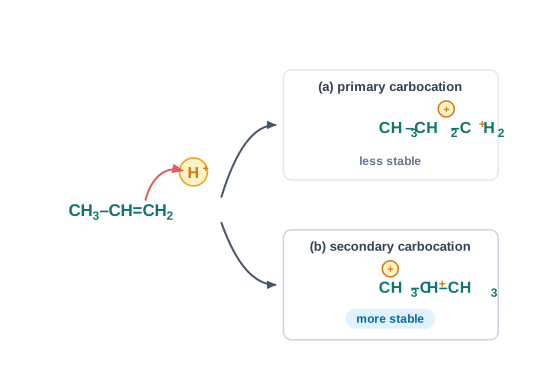
Fig. 9.10 – Mechanism of Markovnikov addition to propene.
The secondary carbocation (b), \(\mathrm{CH_3-\overset{+}{C}H-CH_3}\), is more stable than the primary carbocation (a), \(\mathrm{CH_3-CH_2-\overset{+}{C}H_2}\). The more stable one forms faster and therefore predominates.
The carbocation (b) is then attacked by the \(\mathrm{Br^-}\) ion to give the product: \[\mathrm{CH_3-\overset{+}{C}H-CH_3} + \mathrm{Br^-} \rightarrow \underset{\text{2-Bromopropane (major product)}}{\mathrm{CH_3-CHBr-CH_3}}\]
Anti-Markovnikov addition (peroxide effect / Kharash effect). In the presence of a peroxide, the addition of HBr to an unsymmetrical alkene such as propene takes place contrary to Markovnikov’s rule. This happens only with HBr, not with HCl or HI.
\[\mathrm{CH_3-CH{=}CH_2} + \mathrm{HBr} \xrightarrow{\ (\mathrm{C_6H_5CO})_2\mathrm{O_2}\ } \mathrm{CH_3-CH_2-CH_2Br} \qquad (9.43)\] Propene gives 1-bromopropane (the “wrong-way” product).
Mechanism. The peroxide effect proceeds by a free-radical chain mechanism, summarised in FC 9.4.
Flowchart
FC 9.4 – Peroxide (anti-Markovnikov) addition of HBr to propene: Initiation — benzoyl peroxide (C₆H₅COO)₂ → homolysis → 2 C₆H₅COO• → 2 C₆H₅• + 2 CO₂; then C₆H₅• + H–Br → C₆H₆ + Br•. Propagation — CH₃–CH=CH₂ + Br• → CH₃–•CH–CH₂Br (more stable secondary radical, branch b) rather than CH₃–CHBr–•CH₂ (less stable primary radical, branch a); then CH₃–•CH–CH₂Br + H–Br → CH₃–CH₂–CH₂Br (1-bromopropane, major) + Br•, chain continues.
The individual steps are:
Homolysis of the peroxide, then generation of a bromine radical: \[(\mathrm{C_6H_5COO})_2 \xrightarrow{\text{Homolysis}} 2\,\mathrm{C_6H_5COO}^{\bullet} \rightarrow 2\,\mathrm{C_6H_5}^{\bullet} + 2\,\mathrm{CO_2}\] \[\mathrm{C_6H_5}^{\bullet} + \mathrm{H-Br} \xrightarrow{\text{Homolysis}} \mathrm{C_6H_6} + \mathrm{Br}^{\bullet}\]
The bromine radical adds to the double bond. It can give two radicals: (a) a less stable primary radical, or (b) a more stable secondary radical. The bromine adds to the terminal carbon so that the more stable secondary radical (b) forms.
The secondary radical then abstracts a hydrogen from HBr, giving 1-bromopropane (major) and regenerating a bromine radical to continue the chain: \[\mathrm{CH_3-\overset{\bullet}{C}H-CH_2Br} + \mathrm{H-Br} \rightarrow \mathrm{CH_3-CH_2-CH_2Br} + \mathrm{Br}^{\bullet}\]
The greater stability of the secondary free radical (compared with the primary) is what makes 1-bromopropane the major product.
The peroxide effect is not seen with HCl or HI. The H–Cl bond is stronger (430.5 kJ mol\(^{-1}\)) than the H–Br bond (363.7 kJ mol\(^{-1}\)) and is not cleaved by the free radical. The H–I bond is weaker (296.8 kJ mol\(^{-1}\)), but iodine free radicals prefer to combine with one another to form iodine molecules rather than add to the double bond.
4. Addition of Sulphuric Acid
Cold concentrated sulphuric acid adds to alkenes, following Markovnikov’s rule, to form alkyl hydrogen sulphates by electrophilic addition.
\[\mathrm{CH_2{=}CH_2} + \mathrm{HO-SO_2-OH} \rightarrow \mathrm{CH_3-CH_2-OSO_2-OH} \qquad (9.44)\] Ethyl hydrogen sulphate (\(\mathrm{C_2H_5HSO_4}\)). \[\mathrm{CH_3-CH{=}CH_2} + \mathrm{HOSO_2OH} \rightarrow \mathrm{CH_3-CH(OSO_2OH)-CH_3} \qquad (9.45)\] Propyl hydrogen sulphate.
5. Addition of Water
In the presence of a few drops of concentrated sulphuric acid, alkenes add water to form alcohols, again following Markovnikov’s rule.
\[\mathrm{CH_3-C(CH_3){=}CH_2} + \mathrm{H_2O} \xrightarrow{\ \mathrm{H^+}\ } \mathrm{(CH_3)_3C-OH} \qquad (9.46)\] 2-Methylpropene gives 2-methylpropan-2-ol.
6. Oxidation
(a) Alkenes react with a cold, dilute, aqueous solution of potassium permanganate (Baeyer’s reagent) to give vicinal glycols (diols). The decolourisation of the \(\mathrm{KMnO_4}\) solution is used as a test for unsaturation.
\[\mathrm{CH_2{=}CH_2} + \mathrm{H_2O} + [\mathrm{O}] \xrightarrow[273\ \mathrm{K}]{\ \text{dil. } \mathrm{KMnO_4}\ } \mathrm{CH_2(OH)-CH_2(OH)} \qquad (9.47)\] Ethane-1,2-diol (glycol). \[\mathrm{CH_3-CH{=}CH_2} + \mathrm{H_2O} + [\mathrm{O}] \xrightarrow[273\ \mathrm{K}]{\ \text{dil. } \mathrm{KMnO_4}\ } \mathrm{CH_3CH(OH)CH_2OH} \qquad (9.48)\] Propane-1,2-diol.
(b) Acidic potassium permanganate or acidic potassium dichromate oxidises alkenes more vigorously, cleaving the double bond to give ketones and/or acids, depending on the alkene and the conditions.
\[\mathrm{(CH_3)_2C{=}CH_2} \xrightarrow{\ \mathrm{KMnO_4}/\mathrm{H^+}\ } \mathrm{(CH_3)_2C{=}O} + \mathrm{CO_2} + \mathrm{H_2O} \qquad (9.49)\] 2-Methylpropene gives propan-2-one. \[\mathrm{CH_3-CH{=}CH-CH_3} \xrightarrow{\ \mathrm{KMnO_4}/\mathrm{H^+}\ } 2\,\mathrm{CH_3COOH} \qquad (9.50)\] But-2-ene gives ethanoic acid.
7. Ozonolysis
Ozonolysis of an alkene involves adding a molecule of ozone across the double bond to form an ozonide, followed by cleavage of the ozonide with zinc and water (\(\mathrm{Zn}\)–\(\mathrm{H_2O}\)) into smaller molecules. This reaction is very useful for locating the position of a double bond in an unknown alkene, because the products tell you where the double bond was.
\[\mathrm{CH_3CH{=}CH_2} + \mathrm{O_3} \rightarrow \text{(propene ozonide)} \xrightarrow{\ \mathrm{Zn} + \mathrm{H_2O}\ } \mathrm{CH_3CHO} + \mathrm{HCHO} \qquad (9.51)\] Propene gives ethanal and methanal. \[\mathrm{(CH_3)_2C{=}CH_2} + \mathrm{O_3} \rightarrow \text{(ozonide)} \xrightarrow{\ \mathrm{Zn} + \mathrm{H_2O}\ } \mathrm{(CH_3)_2C{=}O} + \mathrm{HCHO} \qquad (9.52)\] 2-Methylpropene gives propan-2-one and methanal.
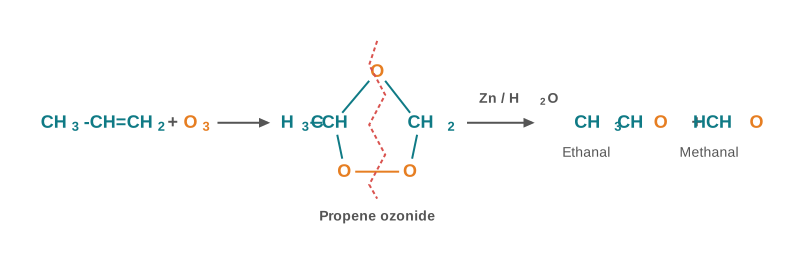
Fig. 9.11 – Ozonolysis of propene.
8. Polymerisation
You are familiar with polythene bags and sheets. Polythene is formed when a large number of ethene molecules join together at high temperature and pressure in the presence of a catalyst. The large molecules so formed are called polymers, and this joining reaction is called polymerisation. The simple molecules from which polymers are built are called monomers.
\[n\,(\mathrm{CH_2{=}CH_2}) \xrightarrow[\text{Catalyst}]{\ \text{high temp./pressure}\ } {-}(\mathrm{CH_2-CH_2})_n{-} \qquad (9.53)\] Polythene. \[n\,(\mathrm{CH_3-CH{=}CH_2}) \xrightarrow[\text{Catalyst}]{\ \text{high temp./pressure}\ } {-}(\mathrm{CH(CH_3)-CH_2})_n{-} \qquad (9.54)\] Polypropene.
Polymers are used to make plastic bags, squeeze bottles, refrigerator dishes, toys, pipes, and radio and T.V. cabinets. Polypropene is used to make milk crates, plastic buckets and other moulded articles.
9.4 Alkynes
Like alkenes, alkynes are unsaturated hydrocarbons, but they contain at least one carbon–carbon triple bond. Because a triple bond ties up even more bonding capacity, an alkyne has still fewer hydrogen atoms than the alkene or alkane with the same number of carbons. Their general formula is:
\[\mathrm{C_n H_{2n-2}}\]
The first stable member of the series is ethyne, popularly known as acetylene. Alkynes are important starting materials for a large number of organic compounds, which makes this an interesting class to study.
9.4.1 Nomenclature and Isomerism
In the common system, alkynes are named as derivatives of acetylene. In the IUPAC system, they are named as derivatives of the corresponding alkanes, replacing the ending -ane by the suffix -yne. The position of the triple bond is indicated by the number of the first triply bonded carbon. A few members are listed in Table 9.2.
Table 9.2 – Common and IUPAC Names of Alkynes (\(\mathrm{C_nH_{2n-2}}\))
| Value of n | Formula | Structure | Common name | IUPAC name |
|---|---|---|---|---|
| 2 | \(\mathrm{C_2H_2}\) | \(\mathrm{H-C{\equiv}CH}\) | Acetylene | Ethyne |
| 3 | \(\mathrm{C_3H_4}\) | \(\mathrm{CH_3-C{\equiv}CH}\) | Methylacetylene | Propyne |
| 4 | \(\mathrm{C_4H_6}\) | \(\mathrm{CH_3CH_2-C{\equiv}CH}\) | Ethylacetylene | But-1-yne |
| 4 | \(\mathrm{C_4H_6}\) | \(\mathrm{CH_3-C{\equiv}C-CH_3}\) | Dimethylacetylene | But-2-yne |
Ethyne and propyne each have only one structure, but butyne has two: but-1-yne and but-2-yne. Since these differ only in the position of the triple bond, they are position isomers.
For the next homologue, \(\mathrm{C_5H_8}\), we can arrange five carbons in a continuous chain or with a side chain:
I. \(\mathrm{HC{\equiv}C-CH_2-CH_2-CH_3}\) — Pent-1-yne II. \(\mathrm{H_3C-C{\equiv}C-CH_2-CH_3}\) — Pent-2-yne III. \(\mathrm{H_3C-CH(CH_3)-C{\equiv}CH}\) — 3-Methylbut-1-yne
Here I and II are position isomers, while I and III (and II and III) are chain isomers.
9.4.2 Structure of Triple Bond
Ethyne is the simplest alkyne, and its structure is shown in Fig. 9.12.
Each carbon atom of ethyne has two \(sp\) hybridised orbitals. The carbon–carbon \(\sigma\) bond forms by the head-on overlapping of one \(sp\) orbital from each carbon. The other \(sp\) orbital of each carbon overlaps along the internuclear axis with the \(1s\) orbital of a hydrogen atom, forming two C–H \(\sigma\) bonds. Because the two \(sp\) orbitals on a carbon point in exactly opposite directions, the H–C–C bond angle is \(180^\circ\) — the molecule is linear.
Each carbon is also left with two unhybridised \(p\) orbitals, which are perpendicular to each other and to the plane of the C–C \(\sigma\) bond. The \(2p\) orbitals of one carbon lie parallel to the \(2p\) orbitals of the other, and they overlap sideways to form two \(\pi\) bonds between the carbons.
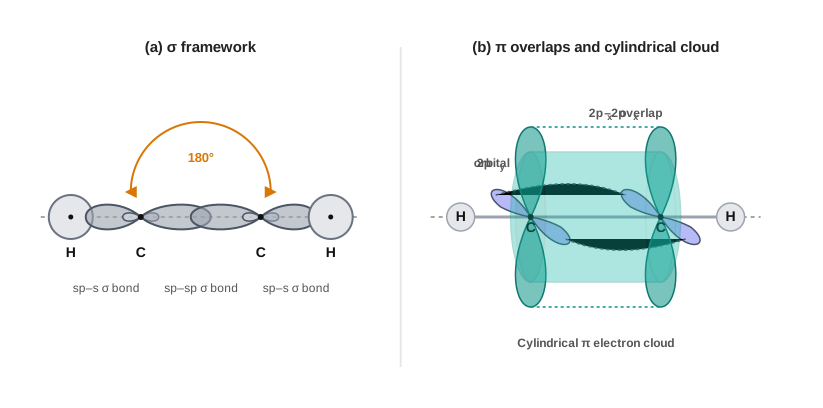
Fig. 9.12 – Orbital picture of ethyne.
Thus an ethyne molecule contains one C–C \(\sigma\) bond, two C–H \(\sigma\) bonds, and two C–C \(\pi\) bonds. The C≡C bond (bond enthalpy 823 kJ mol\(^{-1}\)) is stronger than a C=C bond (681 kJ mol\(^{-1}\)) and a C–C bond (348 kJ mol\(^{-1}\)). The C≡C bond length is shorter (120 pm) than that of C=C (133 pm) and C–C (154 pm). Because the two \(\pi\) clouds together wrap symmetrically around the carbons, the electron cloud between the two carbons is cylindrically symmetrical about the internuclear axis.
9.4.3 Preparation
1. From Calcium Carbide
On an industrial scale, ethyne is prepared by treating calcium carbide with water. The calcium carbide itself is made by heating quicklime with coke, and the quicklime is obtained by heating limestone. The three steps are:
\[\mathrm{CaCO_3} \xrightarrow{\ \Delta\ } \mathrm{CaO} + \mathrm{CO_2} \qquad (9.55)\] \[\mathrm{CaO} + 3\,\mathrm{C} \rightarrow \mathrm{CaC_2} + \mathrm{CO} \qquad (9.56)\] Calcium carbide. \[\mathrm{CaC_2} + 2\,\mathrm{H_2O} \rightarrow \mathrm{Ca(OH)_2} + \mathrm{C_2H_2} \qquad (9.57)\]
The extraction/preparation sequence is summarised in FC 9.5.
Flowchart
FC 9.5 – Industrial preparation of ethyne from limestone: limestone (CaCO₃) → heat (calcination) → quicklime (CaO) + CO₂ → heat with coke (C) → calcium carbide (CaC₂) + CO → add water → ethyne (C₂H₂) + slaked lime Ca(OH)₂.
2. From Vicinal Dihalides
Vicinal dihalides, on treatment with alcoholic potassium hydroxide, undergo dehydrohalogenation: one molecule of hydrogen halide is eliminated to give an alkenyl halide, which on further treatment with sodamide (\(\mathrm{NaNH_2}\)) loses a second molecule of hydrogen halide to give the alkyne.
\[\underset{\text{1,2-Dibromoethane}}{\mathrm{CH_2Br-CH_2Br}} \xrightarrow[-\mathrm{KBr},\ -\mathrm{H_2O}]{\ \text{alc. KOH}\ } \underset{\text{Bromoethene}}{\mathrm{CH_2{=}CHBr}} \xrightarrow[-\mathrm{NaBr},\ -\mathrm{NH_3}]{\ \mathrm{NaNH_2}\ } \underset{\text{Ethyne}}{\mathrm{CH{\equiv}CH}} \qquad (9.58)\]
9.4.4 Properties
Physical Properties
The physical properties of alkynes follow the same trend as those of alkenes and alkanes. The first three members are gases, the next eight are liquids, and the higher ones are solids. All alkynes are colourless. Ethyne has a characteristic odour, while the other members are odourless. Alkynes are weakly polar, lighter than water and immiscible with it, but they dissolve in organic solvents such as ethers, carbon tetrachloride and benzene. Their melting point, boiling point and density all increase with molar mass.
Chemical Properties
Alkynes show acidic nature, addition reactions and polymerisation reactions.
A. Acidic Character of Alkyne
Sodium metal and sodamide (\(\mathrm{NaNH_2}\)) are strong bases. They react with ethyne to form sodium acetylide with the release of dihydrogen gas. These reactions do not occur with ethene or ethane, which shows that ethyne is acidic in comparison to them.
Why should this be so? The answer lies in hybridisation. In ethyne the acidic hydrogen atoms are attached to \(sp\) hybridised carbons; in ethene they are on \(sp^2\) carbons, and in ethane on \(sp^3\) carbons. An \(sp\) orbital has the maximum percentage of \(s\) character (50%). More \(s\) character means the electrons are held closer to the nucleus, so an \(sp\) hybridised carbon has the highest electronegativity. This carbon therefore pulls the shared electron pair of the C–H bond more strongly towards itself, loosening the hydrogen so that it can be released as a proton (\(\mathrm{H^+}\)) more easily. Hence the hydrogen atoms attached to a triply bonded carbon are acidic — but note that only these hydrogens are acidic, not every hydrogen in an alkyne.
\[\mathrm{HC{\equiv}CH} + \mathrm{Na} \rightarrow \underset{\text{Monosodium ethynide}}{\mathrm{HC{\equiv}C^-Na^+}} + \tfrac{1}{2}\,\mathrm{H_2} \qquad (9.59)\] \[\mathrm{HC{\equiv}C^-Na^+} + \mathrm{Na} \rightarrow \underset{\text{Disodium ethynide}}{\mathrm{Na^+\,{}^-C{\equiv}C^-\,Na^+}} + \tfrac{1}{2}\,\mathrm{H_2} \qquad (9.60)\] \[\mathrm{CH_3-C{\equiv}C-H} + \mathrm{Na^+NH_2^-} \rightarrow \underset{\text{Sodium propynide}}{\mathrm{CH_3-C{\equiv}C^-Na^+}} + \mathrm{NH_3} \qquad (9.61)\]
These reactions are not shown by alkenes and alkanes, so they are used to distinguish alkynes from them. Overall, alkanes, alkenes and alkynes follow these trends in acidic behaviour: \[\text{(i)}\quad \mathrm{CH{\equiv}CH} > \mathrm{H_2C{=}CH_2} > \mathrm{CH_3{-}CH_3}\] \[\text{(ii)}\quad \mathrm{HC{\equiv}CH} > \mathrm{CH_3{-}C{\equiv}CH} \gg \mathrm{CH_3{-}C{\equiv}C{-}CH_3}\]
B. Addition Reactions
An alkyne contains a triple bond, so it can add on two molecules of dihydrogen, halogen, hydrogen halide, and so on. In each case the addition happens in two steps. The product of the first step depends on the stability of the intermediate vinylic cation, and addition to unsymmetrical alkynes follows Markovnikov’s rule. Most of these are electrophilic addition reactions.
\[-\mathrm{C{\equiv}C}- + \mathrm{H{-}Z} \xrightarrow{\ \mathrm{H^+}\ } \text{vinylic cation} \rightarrow -\mathrm{CH{=}CZ}-\]
(i) Addition of dihydrogen. \[\mathrm{HC{\equiv}CH} + \mathrm{H_2} \xrightarrow{\ \mathrm{Pt/Pd/Ni}\ } [\mathrm{H_2C{=}CH_2}] \xrightarrow{\ \mathrm{H_2}\ } \mathrm{CH_3-CH_3} \qquad (9.62)\] \[\mathrm{CH_3-C{\equiv}CH} + \mathrm{H_2} \xrightarrow{\ \mathrm{Pt/Pd/Ni}\ } [\mathrm{CH_3-CH{=}CH_2}] \xrightarrow{\ \mathrm{H_2}\ } \mathrm{CH_3-CH_2-CH_3} \qquad (9.63)\] Propyne first gives propene, then propane.
(ii) Addition of halogens. \[\mathrm{CH_3-C{\equiv}CH} + \mathrm{Br-Br} \rightarrow \underset{\text{1,2-Dibromopropene}}{[\mathrm{CH_3CBr{=}CHBr}]} \xrightarrow{\ \mathrm{Br_2}\ } \underset{\text{1,1,2,2-Tetrabromopropane}}{\mathrm{CH_3-CBr_2-CHBr_2}} \qquad (9.64)\] The reddish-orange colour of bromine in carbon tetrachloride is discharged, so this too is a test for unsaturation.
(iii) Addition of hydrogen halides. Two molecules of hydrogen halide (HCl, HBr, HI) add to an alkyne to form gem dihalides (in which both halogens end up on the same carbon). \[\mathrm{H-C{\equiv}C-H} + \mathrm{H-Br} \rightarrow \underset{\text{Bromoethene}}{[\mathrm{CH_2{=}CH-Br}]} \xrightarrow{\ \mathrm{HBr}\ } \underset{\text{1,1-Dibromoethane}}{\mathrm{CH_3-CHBr_2}} \qquad (9.65)\] \[\mathrm{CH_3-C{\equiv}CH} + \mathrm{H-Br} \rightarrow \underset{\text{2-Bromopropene}}{[\mathrm{CH_3-CBr{=}CH_2}]} \xrightarrow{\ \mathrm{HBr}\ } \underset{\text{2,2-Dibromopropane}}{\mathrm{CH_3-CBr_2-CH_3}} \qquad (9.66)\]
(iv) Addition of water. Like alkanes and alkenes, alkynes do not normally react with water. However, one molecule of water adds to an alkyne on warming with mercuric sulphate and dilute sulphuric acid at 333 K, forming carbonyl compounds (aldehydes or ketones). The first-formed unstable enol rearranges (isomerises) to the carbonyl compound. \[\mathrm{HC{\equiv}CH} + \mathrm{H-OH} \xrightarrow[333\ \mathrm{K}]{\ \mathrm{Hg^{2+}}/\mathrm{H^+}\ } [\mathrm{CH_2{=}CH-OH}] \xrightarrow{\text{Isomerisation}} \underset{\text{Ethanal}}{\mathrm{CH_3-CHO}} \qquad (9.67)\] \[\mathrm{CH_3-C{\equiv}CH} + \mathrm{H-OH} \xrightarrow[333\ \mathrm{K}]{\ \mathrm{Hg^{2+}}/\mathrm{H^+}\ } [\mathrm{CH_3-C(OH){=}CH_2}] \xrightarrow{\text{Isomerisation}} \underset{\text{Propan-2-one}}{\mathrm{CH_3-CO-CH_3}} \qquad (9.68)\]
(v) Polymerisation.
(a) Linear polymerisation. Under suitable conditions, ethyne polymerises linearly to give polyacetylene (polyethyne), a high-molecular-mass polyene made of repeating \((\mathrm{-CH{=}CH-CH{=}CH-})\) units. Under special conditions this polymer conducts electricity.
(b) Cyclic polymerisation. When ethyne is passed through a red-hot iron tube at 873 K, it undergoes cyclic polymerisation: three molecules of ethyne join to form benzene. This is the best route for going from aliphatic (open-chain) compounds to aromatic (ring) compounds.
\[3\,\mathrm{CH{\equiv}CH} \xrightarrow[873\ \mathrm{K}]{\ \text{Red-hot iron tube}\ } \mathrm{C_6H_6} \qquad (9.69)\]
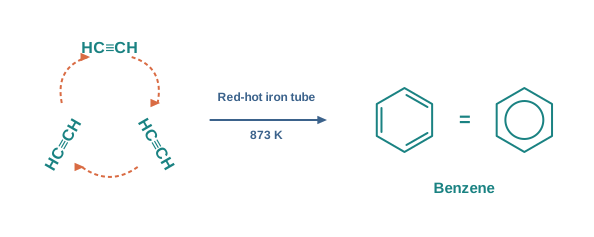
Fig. 9.13 – Cyclic polymerisation of ethyne to benzene.
9.5 Aromatic Hydrocarbons
These hydrocarbons are also known as arenes.
Most such compounds were found to contain a benzene ring. The benzene ring is highly unsaturated, yet in the great majority of its reactions the unsaturation is retained — a striking difference from alkenes and alkynes, which readily lose their multiple bonds in addition reactions.
There are also aromatic hydrocarbons that contain no benzene ring at all, but instead some other highly unsaturated ring. Aromatic compounds containing a benzene ring are called benzenoids; those without one are called non-benzenoids.
Some examples of arenes are benzene, toluene, naphthalene and biphenyl, drawn in Fig. 9.14.
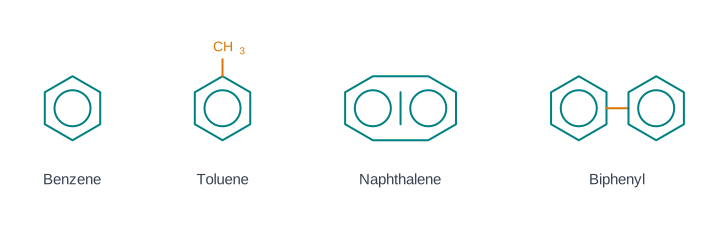
Fig. 9.14 – Examples of aromatic hydrocarbons.
9.5.1 Nomenclature and Isomerism
The nomenclature and isomerism of aromatic hydrocarbons was introduced in Chapter 8. The key structural fact is that all six hydrogen atoms in benzene are equivalent. Because of this, benzene forms only one monosubstituted product — replacing any one hydrogen gives exactly the same compound.
When two hydrogen atoms of benzene are replaced by two similar or different monovalent atoms or groups, three different position isomers become possible: - 1,2 (or 1,6) — called ortho (\(o\)-) - 1,3 (or 1,5) — called meta (\(m\)-) - 1,4 — called para (\(p\)-)
A few examples of benzene derivatives are shown in Fig. 9.15.
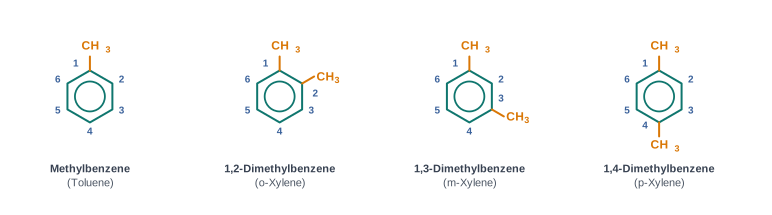
Fig. 9.15 – Ortho, meta, and para position isomers of dimethylbenzene.
9.5.2 Structure of Benzene
Benzene was isolated by Michael Faraday in 1825. Its molecular formula, \(\mathrm{C_6H_6}\), points to a very high degree of unsaturation — far more hydrogen-poor than any alkane, alkene or alkyne of six carbons. This formula alone did not explain how benzene was related to the compounds you have just studied, and because benzene has such unusual properties and stability, it took chemists several years to settle on its structure.
Two experimental clues guided them: 1. Benzene was found to form a triozonide, which indicates the presence of three double bonds. 2. Benzene gives one and only one monosubstituted derivative, which indicates that all six carbon atoms and all six hydrogen atoms are identical.
On the basis of these observations, August Kekulé proposed in 1865 a structure with a cyclic arrangement of six carbon atoms joined by alternate single and double bonds, with one hydrogen atom on each carbon.
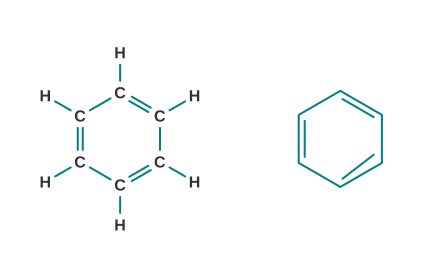
Fig. 9.16 – The Kekulé structure of benzene.
The Problem With the Kekulé Structure
The Kekulé structure implies that two isomeric 1,2-dibromobenzenes should exist: in one, the two bromine atoms would sit on carbons joined by a double bond; in the other, on carbons joined by a single bond. But experimentally, benzene gives only one ortho disubstituted product.
Kekulé overcame this by suggesting that the double bonds in benzene are oscillating — flipping rapidly back and forth between the two arrangements, so that the two “isomers” are really one and the same compound.
Even with this modification, the Kekulé structure still could not explain two things: benzene’s unusual stability, and its clear preference for substitution reactions over addition reactions. Both were explained later by resonance.
Resonance and Stability of Benzene
According to Valence Bond Theory, the idea of oscillating double bonds is now replaced by resonance. Benzene is not one structure flipping into another; it is a single resonance hybrid of several contributing structures. The two Kekulé structures, A and B, are the main contributors.
The hybrid is represented by drawing a circle (or a dotted circle) inside the hexagon, as in structure (C). That circle stands for the six electrons that are delocalised — spread evenly over all six carbon atoms of the ring rather than being tied to any two.
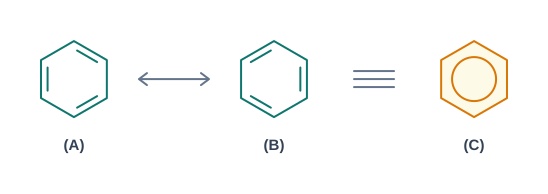
Fig. 9.17 – Resonance structures and the hybrid of benzene.
The Orbital Picture
Orbital overlapping gives an even better picture. All six carbon atoms in benzene are \(sp^2\) hybridised. Two of the \(sp^2\) hybrid orbitals of each carbon overlap with the \(sp^2\) orbitals of its two neighbours, forming six C–C \(\sigma\) bonds that lie in the hexagonal plane. The remaining \(sp^2\) orbital of each carbon overlaps with the \(s\) orbital of a hydrogen atom, forming six C–H \(\sigma\) bonds.
Each carbon is then left with one unhybridised \(p\) orbital, standing perpendicular to the plane of the ring.
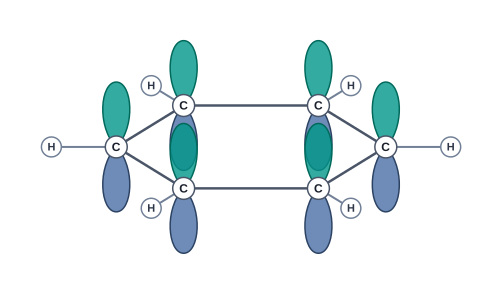
Fig. 9.18 – The sigma bond framework and unhybridised p orbitals of benzene.
These perpendicular \(p\) orbitals are close enough to overlap sideways and form \(\pi\) bonds. But here is the crucial point: there are two equal possibilities. Three \(\pi\) bonds can form by overlap between \(\mathrm{C_1-C_2}\), \(\mathrm{C_3-C_4}\), \(\mathrm{C_5-C_6}\) (Fig. 9.19a) — or equally well between \(\mathrm{C_2-C_3}\), \(\mathrm{C_4-C_5}\), \(\mathrm{C_6-C_1}\) (Fig. 9.19b).
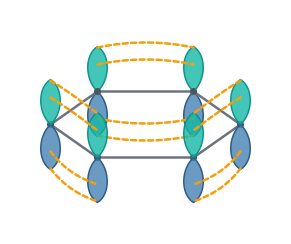
Fig. 9.19 (a) – Localised π bonds forming one Kekulé structure.
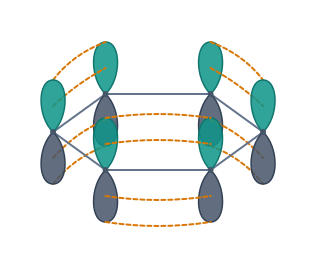
Fig. 9.19 (b) – Localised π bonds forming the second Kekulé structure.
Structures 9.19(a) and (b) correspond to the two Kekulé structures with localised \(\pi\) bonds. But X-ray diffraction shows that the internuclear distance between all the carbon atoms in the ring is the same. Since there is no reason to prefer one overlap over the other, there is an equal probability for the \(p\) orbital of each carbon to overlap with the \(p\) orbitals of both its neighbours (Fig. 9.19c). The result can be pictured as two doughnut-shaped rings of electron cloud — one above and one below the plane of the hexagon (Fig. 9.19d).
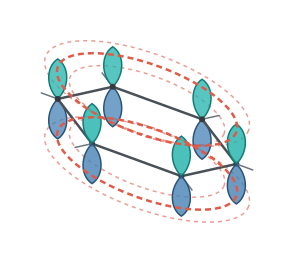
Fig. 9.19 (c) – Equal overlap of all p orbitals.
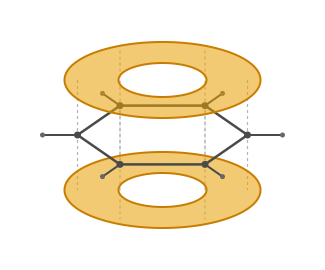
Fig. 9.19 (d) – The delocalised π electron cloud of benzene.
The six \(\pi\) electrons are thus delocalised and can move freely about all six carbon nuclei, instead of being confined between any two. A delocalised electron cloud is attracted more strongly by the nuclei of the carbon atoms than an electron cloud localised between just two carbons. This extra attraction is exactly why the presence of delocalised \(\pi\) electrons makes benzene more stable than a hypothetical “cyclohexatriene” (a ring with three genuine, localised double bonds).
What the Bond Lengths Tell Us
X-ray diffraction data reveals that benzene is a planar molecule. Had either structure A or B been correct, we would expect two different C–C bond lengths — some short (double) and some long (single). Instead, X-ray data shows that all six C–C bond lengths are the same (139 pm), a value intermediate between a C–C single bond (154 pm) and a C=C double bond (133 pm).
The absence of any pure double bond in benzene explains its reluctance to undergo addition reactions under normal conditions — and hence its unusual behaviour.
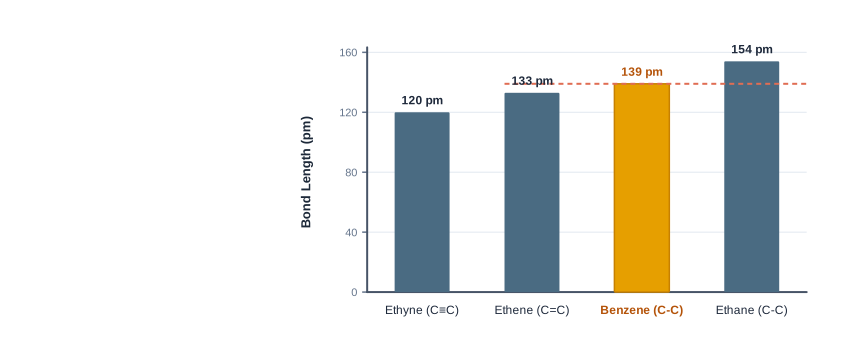
Fig. 9.20 – Carbon–carbon bond lengths.
9.5.3 Aromaticity
Benzene was considered the parent “aromatic” compound. Today the name is applied to all ring systems — whether or not they contain a benzene ring — that possess the following characteristics:
- Planarity — the ring must be flat.
- Complete delocalisation of the \(\pi\) electrons in the ring.
- Presence of \((4n + 2)\ \pi\) electrons in the ring, where \(n\) is an integer (\(n = 0, 1, 2, \dots\)).
The third condition is often called the Hückel Rule.
Some examples of aromatic compounds, with their \(n\) values, are shown in Fig. 9.21: - Benzene, the cyclopentadienyl anion, and the cycloheptatrienyl cation: \(n = 1\), 6 \(\pi\) electrons. - Naphthalene: \(n = 2\), 10 \(\pi\) electrons. - Anthracene and phenanthrene: \(n = 3\), 14 \(\pi\) electrons.
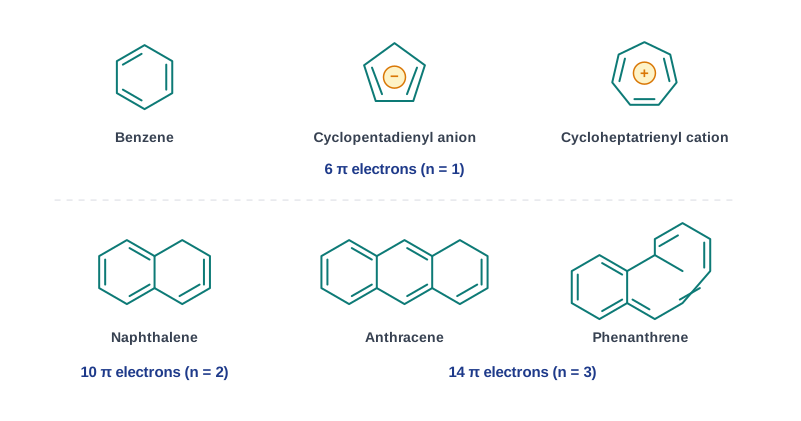
Fig. 9.21 – Examples of non-benzenoid and benzenoid aromatic systems.
9.5.4 Preparation of Benzene
Benzene is commercially isolated from coal tar. In the laboratory, it may be prepared by the following methods.
(i) Cyclic polymerisation of ethyne — three molecules of ethyne joining in a red-hot iron tube at 873 K (Section 9.4.4).
(ii) Decarboxylation of aromatic acids — the sodium salt of benzoic acid, on heating with soda lime, gives benzene. \[\mathrm_C_6H_5COONa} + \mathrm{NaOH} \xrightarrow[\Delta]{\ \mathrm{CaO}\ } \mathrm{C_6H_6} + \mathrm{Na_2CO_3} \qquad (9.70)\]
(iii) Reduction of phenol — phenol is reduced to benzene by passing its vapours over heated zinc dust. \[\mathrm{C_6H_5OH} + \mathrm{Zn} \xrightarrow{\ \Delta\ } \mathrm{C_6H_6} + \mathrm{ZnO} \qquad (9.71)\]
9.5.5 Properties
Physical Properties
Aromatic hydrocarbons are non-polar molecules, usually colourless liquids or solids with a characteristic aroma. They are immiscible with water but readily miscible with organic solvents, and they burn with a sooty flame (a consequence of their high carbon content).
You are probably familiar with naphthalene balls, used in toilets and for the preservation of clothes because of their distinctive smell and moth-repellent property.
Chemical Properties
Arenes are characterised by electrophilic substitution reactions. Under special conditions they can also undergo addition and oxidation reactions.
Electrophilic Substitution Reactions
The common electrophilic substitution reactions of arenes are nitration, halogenation, sulphonation, and Friedel–Crafts alkylation and acylation. In each, the attacking reagent is an electrophile (\(\mathrm{E^+}\)).
(i) Nitration. A nitro group is introduced into the benzene ring when benzene is heated with a mixture of concentrated nitric acid and concentrated sulphuric acid (the nitrating mixture). \[\mathrm{C_6H_6} + \text{conc. }\mathrm{HNO_3} \xrightarrow[323\text{--}333\ \mathrm{K}]{\ \text{conc. }\mathrm{H_2SO_4}\ } \underset{\text{Nitrobenzene}}{\mathrm{C_6H_5NO_2}} + \mathrm{H_2O} \qquad (9.72)\]
(ii) Halogenation. Arenes react with halogens in the presence of a Lewis acid such as anhydrous \(\mathrm{FeCl_3}\), \(\mathrm{FeBr_3}\) or \(\mathrm{AlCl_3}\) to give haloarenes. \[\mathrm{C_6H_6} + \mathrm{Cl_2} \xrightarrow{\ \text{Anhyd. } \mathrm{AlCl_3}\ } \underset{\text{Chlorobenzene}}{\mathrm{C_6H_5Cl}} + \mathrm{HCl} \qquad (9.73)\]
(iii) Sulphonation. The replacement of a ring hydrogen atom by a sulphonic acid group is called sulphonation. It is carried out by heating benzene with fuming sulphuric acid (oleum). \[\mathrm{C_6H_6} + \mathrm{H_2SO_4}(\mathrm{SO_3}) \xrightarrow{\ \Delta\ } \underset{\text{Benzene sulphonic acid}}{\mathrm{C_6H_5SO_3H}} + \mathrm{H_2O} \qquad (9.74)\]
(iv) Friedel–Crafts alkylation. When benzene is treated with an alkyl halide in the presence of anhydrous aluminium chloride, an alkylbenzene is formed. \[\mathrm{C_6H_6} + \mathrm{CH_3Cl} \xrightarrow{\ \text{Anhyd. } \mathrm{AlCl_3}\ } \underset{\text{Toluene}}{\mathrm{C_6H_5CH_3}} + \mathrm{HCl} \qquad (9.75)\] \[\mathrm{C_6H_6} + \mathrm{C_2H_5Cl} \xrightarrow{\ \text{Anhyd. } \mathrm{AlCl_3}\ } \underset{\text{Ethylbenzene}}{\mathrm{C_6H_5C_2H_5}} + \mathrm{HCl} \qquad (9.76)\]
(v) Friedel–Crafts acylation. The reaction of benzene with an acyl halide or an acid anhydride in the presence of a Lewis acid (\(\mathrm{AlCl_3}\)) gives an acyl benzene. \[\mathrm{C_6H_6} + \mathrm{CH_3COCl} \xrightarrow[\Delta]{\ \text{Anhyd. } \mathrm{AlCl_3}\ } \underset{\text{Acetophenone}}{\mathrm{C_6H_5COCH_3}} + \mathrm{HCl} \qquad (9.77)\] \[\mathrm{C_6H_6} + (\mathrm{CH_3CO})_2\mathrm{O} \xrightarrow[\Delta]{\ \text{Anhyd. } \mathrm{AlCl_3}\ } \mathrm{C_6H_5COCH_3} + \mathrm{CH_3COOH} \qquad (9.78)\] (Acetyl chloride and acetic anhydride respectively.)
If an excess of the electrophilic reagent is used, further substitution can take place, with more ring hydrogens being successively replaced. For example, benzene treated with excess chlorine in the presence of anhydrous \(\mathrm{AlCl_3}\) is chlorinated all the way to hexachlorobenzene. \[\mathrm{C_6H_6} + 6\,\mathrm{Cl_2} \xrightarrow[\text{dark, cold}]{\ \text{Anhyd. } \mathrm{AlCl_3}\ } \underset{\text{Hexachlorobenzene}}{\mathrm{C_6Cl_6}} + 6\,\mathrm{HCl} \qquad (9.79)\]
Mechanism of Electrophilic Substitution Reactions
Experimental evidence shows that \(\mathrm{S_E}\) reactions (S = substitution; E = electrophilic) proceed through three steps: (a) generation of the electrophile, (b) formation of a carbocation intermediate, (c) removal of a proton from the carbocation intermediate.
The sequence is summarised in FC 9.7.
Flowchart
FC 9.7 – Mechanism of electrophilic substitution in benzene: Step (a) Generate the electrophile (e.g. Cl–Cl + AlCl₃ → Cl⁺ + [AlCl₄]⁻) → Step (b) The benzene π cloud attacks E⁺ → σ-complex / arenium ion forms (one ring carbon becomes sp³; ring loses aromatic character; the positive charge is stabilised by resonance over the remaining carbons) → Step (c) A base ([AlCl₄]⁻ or [HSO₄]⁻) removes the proton from that sp³ carbon → aromatic character is restored → substituted benzene (C₆H₅E) + HCl/H₂SO₄.
(a) Generation of the electrophile \(\mathrm{E^+}\). During chlorination, alkylation and acylation of benzene, anhydrous \(\mathrm{AlCl_3}\) — being a Lewis acid — helps generate the electrophile \(\mathrm{Cl^+}\), \(\mathrm{R^+}\), or \(\mathrm{RC^+{=}O}\) (the acylium ion) respectively, by combining with the attacking reagent: \[\mathrm{Cl-Cl} + \mathrm{AlCl_3} \rightarrow \mathrm{Cl^+} + [\mathrm{AlCl_4}]^- \qquad \text{(chloronium ion)}\] \[\mathrm{CH_3-Cl} + \mathrm{AlCl_3} \rightarrow \mathrm{{}^+CH_3} + [\mathrm{AlCl_4}]^-\] \[\mathrm{CH_3-CO-Cl} + \mathrm{AlCl_3} \rightarrow \mathrm{CH_3-\overset{+}{C}{=}O} + [\mathrm{AlCl_4}]^-\]
In the case of nitration, the electrophile is the nitronium ion, \(\mathrm{{}^+NO_2}\). It is produced by the transfer of a proton from sulphuric acid to nitric acid:
Step I: \[\mathrm{HO-SO_2-OH} + \mathrm{H-O-NO_2} \rightleftharpoons \mathrm{H_2\overset{+}{O}-NO_2} + \mathrm{HSO_4^-}\] (protonated nitric acid)
Step II: \[\mathrm{H_2\overset{+}{O}-NO_2} \rightleftharpoons \mathrm{H_2O} + \mathrm{{}^+NO_2}\] (nitronium ion)
Notice what has happened here: sulphuric acid has donated a proton and nitric acid has accepted it. So in generating the nitronium ion, sulphuric acid serves as the acid and nitric acid as the base — it is a simple acid–base equilibrium. (Nitric acid, usually thought of as an acid, is behaving as a base here because there is an even stronger acid present.)
(b) Formation of the carbocation (arenium ion). The attack of the electrophile on the ring gives a \(\sigma\)-complex or arenium ion, in which one of the ring carbons has become \(sp^3\) hybridised.
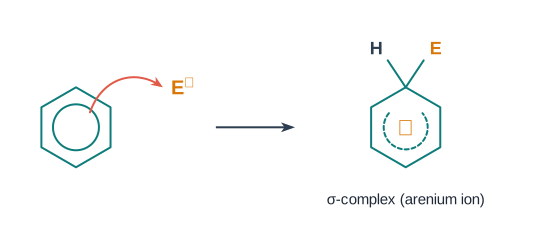
Fig. 9.22 – Formation of the arenium ion.
The arenium ion is stabilised by resonance — the positive charge is spread over the remaining ring carbons rather than sitting on any one of them.
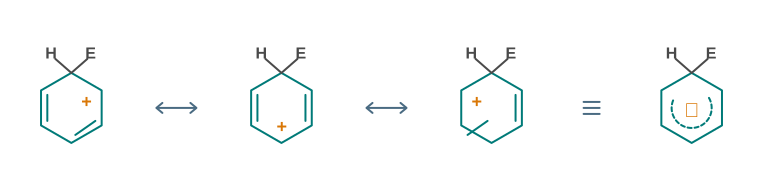
Fig. 9.23 – Resonance structures of the arenium ion.
Importantly, the \(\sigma\)-complex (arenium ion) loses its aromatic character, because the delocalisation of electrons stops at the \(sp^3\) hybridised carbon — the ring’s continuous \(\pi\) system is broken there. This loss of aromaticity is exactly why the next step must happen.
(c) Removal of the proton. To restore the aromatic character, the \(\sigma\)-complex releases the proton from the \(sp^3\) hybridised carbon, which is attacked by \([\mathrm{AlCl_4}]^-\) (in halogenation, alkylation and acylation) or \([\mathrm{HSO_4}]^-\) (in nitration).
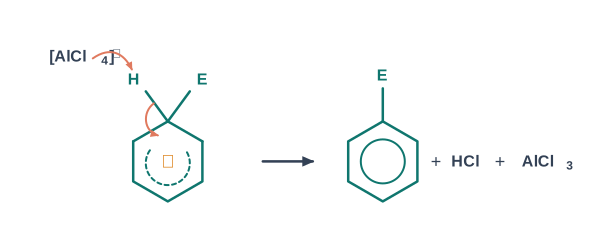
Fig. 9.24 – Restoration of aromaticity.
Now you can see the whole logic of aromatic substitution. Benzene does let an electrophile attack it — but the arenium ion that forms has lost the very delocalisation that made benzene stable. Losing a proton restores that delocalisation, and the ring gets its aromatic stability back. Adding a nucleophile instead would have kept the ring non-aromatic. Substitution, therefore, is the path that preserves aromaticity, and that is why benzene substitutes rather than adds.
Addition Reactions
Under vigorous conditions — high temperature and/or pressure in the presence of a nickel catalyst — hydrogenation of benzene gives cyclohexane. Note that it takes three molecules of dihydrogen, one for each of the three “double bonds” of the delocalised system. \[\mathrm{C_6H_6} + 3\,\mathrm{H_2} \xrightarrow[\Delta]{\ \mathrm{Ni}\ } \underset{\text{Cyclohexane}}{\mathrm{C_6H_{12}}} \qquad (9.80)\]
Under ultraviolet light, three chlorine molecules add to benzene to produce benzene hexachloride, \(\mathrm{C_6H_6Cl_6}\), also called gammaxane. \[\mathrm{C_6H_6} + 3\,\mathrm{Cl_2} \xrightarrow[500\ \mathrm{K}]{\ \text{uv}\ } \underset{\text{Benzene hexachloride (BHC)}}{\mathrm{C_6H_6Cl_6}} \qquad (9.81)\]
Combustion
When heated in air, benzene burns with a sooty flame producing carbon dioxide and water. \[\mathrm{C_6H_6} + \frac{15}{2}\,\mathrm{O_2} \rightarrow 6\,\mathrm{CO_2} + 3\,\mathrm{H_2O} \qquad (9.82)\]
The general combustion reaction for any hydrocarbon may be written as: \[\mathrm{C_x H_y} + \left(x + \frac{y}{4}\right)\mathrm{O_2} \rightarrow x\,\mathrm{CO_2} + \frac{y}{2}\,\mathrm{H_2O} \qquad (9.83)\]
9.5.6 Directive Influence of a Functional Group in Monosubstituted Benzene
When a monosubstituted benzene is subjected to further substitution, the three possible disubstituted products (ortho, meta, para) are not formed in equal amounts. Two patterns of behaviour are seen: either the ortho and para products dominate, or the meta product dominates.
Crucially, which pattern occurs depends on the substituent already present on the ring — not on the nature of the incoming group. This is called the directive influence of substituents.
Ortho and Para Directing Groups
Groups that direct the incoming group to the ortho and para positions are called ortho and para directing groups.
Take the phenolic \(\mathrm{-OH}\) group as an example. Phenol is a resonance hybrid of several structures, shown in Fig. 9.25.
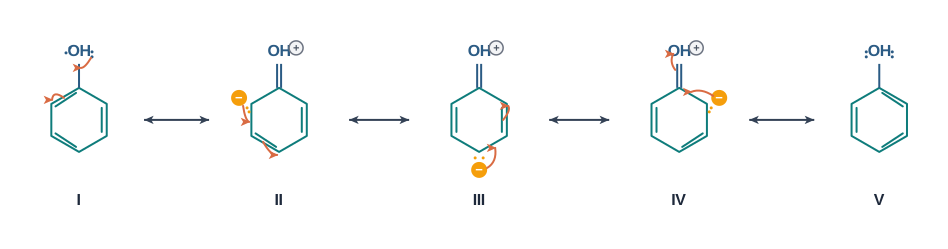
Fig. 9.25 – Resonance structures of phenol.
It is clear from the resonating structures that the electron density is greater at the ortho and para positions. Since an electrophile is attracted to regions of high electron density, substitution takes place mainly at these positions.
There is, however, a competing effect. The \(\mathrm{-OH}\) group also exerts a \(-\mathrm{I}\) (electron-withdrawing inductive) effect, which slightly reduces the electron density at the ortho and para positions. But the resonance effect wins: the overall electron density at these positions still increases. Therefore the \(\mathrm{-OH}\) group activates the benzene ring for attack by an electrophile.
Other examples of activating groups are \(\mathrm{-NH_2}\), \(\mathrm{-NHR}\), \(\mathrm{-NHCOCH_3}\), \(\mathrm{-OCH_3}\), \(\mathrm{-CH_3}\), \(\mathrm{-C_2H_5}\).
The Special Case of Halogens
Aryl halides are an interesting middle case: halogens are moderately deactivating. Because of their strong \(-\mathrm{I}\) effect, the overall electron density on the benzene ring decreases, which makes further substitution more difficult.
However, through resonance, the electron density at the ortho and para positions is still greater than at the meta position. Hence halogens are deactivating and yet ortho–para directing. The resonance structures of chlorobenzene are shown in Fig. 9.26.
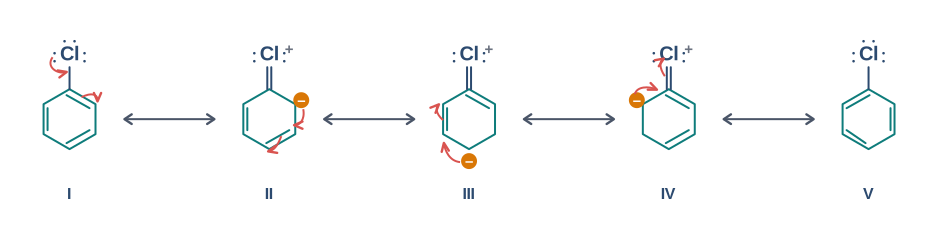
Fig. 9.26 – Resonance structures of chlorobenzene.
Meta Directing Groups
Groups that direct the incoming group to the meta position are called meta directing groups. Examples are \(\mathrm{-NO_2}\), \(\mathrm{-CN}\), \(\mathrm{-CHO}\), \(\mathrm{-COR}\), \(\mathrm{-COOH}\), \(\mathrm{-COOR}\), \(\mathrm{-SO_3H}\).
Take the nitro group. It reduces the electron density in the benzene ring because of its strong \(-\mathrm{I}\) effect. Nitrobenzene is a resonance hybrid of the structures shown in Fig. 9.27.
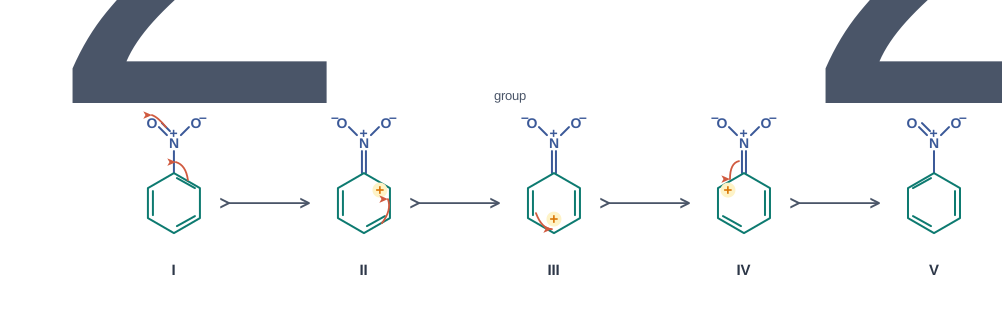
Fig. 9.27 – Resonance structures of nitrobenzene.
In this case the overall electron density on the benzene ring decreases, which makes further substitution difficult. Such groups are therefore also called deactivating groups.
Look closely at where the electron density is lost. The resonance structures place positive charge at the ortho and para positions, so those positions are comparatively poorer in electrons than the meta position. The electrophile therefore attacks the comparatively electron-rich meta position, giving meta substitution.
9.6 Carcinogenicity and Toxicity
The chapter so far has shown hydrocarbons as fuels, as building blocks, and as remarkably stable ring systems. But there is a serious warning attached to some of them, and it must be understood as carefully as any reaction.
Benzene, and polynuclear hydrocarbons containing more than two benzene rings fused together, are toxic and are said to possess cancer-producing (carcinogenic) property.
Where They Come From
Such polynuclear hydrocarbons are formed during the incomplete combustion of organic materials such as tobacco, coal and petroleum. This is an important link back to Section 9.2: recall that when an alkane burns with an insufficient supply of air or dioxygen, it is not fully oxidised to \(\mathrm{CO_2}\) and \(\mathrm{H_2O}\); instead, carbon-rich fragments survive. Some of those fragments join up into fused-ring aromatic systems — exactly the compounds that are carcinogenic.
How They Cause Harm
Once formed, these hydrocarbons can enter the human body. Inside, they undergo various biochemical reactions, and the products of those reactions eventually damage DNA, which leads to cancer.
The sequence is summarised in FC 9.8.
Flowchart
FC 9.8 – How carcinogenic polynuclear hydrocarbons act: organic material (tobacco, coal, petroleum) → incomplete combustion → polynuclear aromatic hydrocarbons formed → enter the human body → undergo biochemical reactions → damage DNA → cancer.
Some Carcinogenic Hydrocarbons
The compounds shown in Fig. 9.28 are among the known carcinogenic hydrocarbons. Notice the common structural theme: in every case, several benzene rings are fused together into a large, flat, polynuclear system.
- 1,2-Benzanthracene
- 3-Methylcholanthrene
- 1,2-Benzpyrene
- 1,2,5,6-Dibenzanthracene
- 9,10-Dimethyl-1,2-benzanthracene
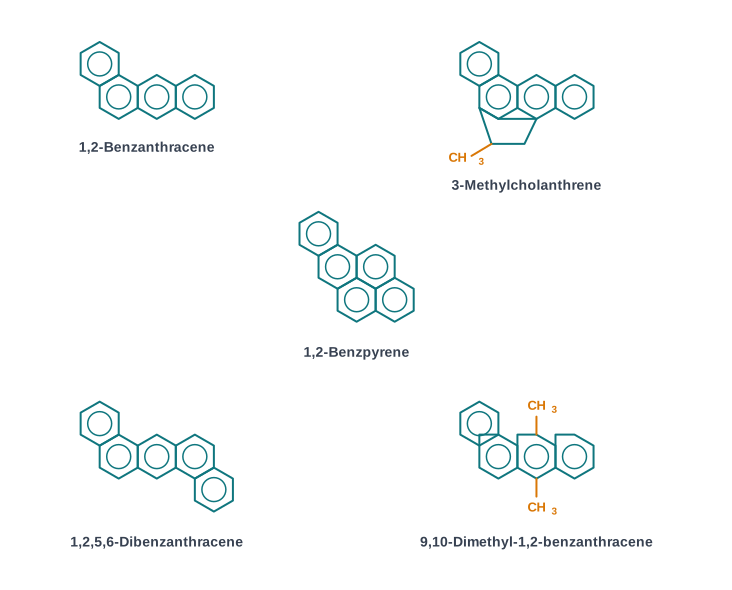
Fig. 9.28 – Carcinogenic polynuclear hydrocarbons.
9.7 Summary
What hydrocarbons are, and where they come from
- Hydrocarbons are compounds made of carbon and hydrogen only.
- They are obtained mainly from coal and petroleum, which are our major sources of energy.
- Petrochemicals — products derived from petroleum — are the starting materials for a very large number of commercially important substances.
- LPG (liquefied petroleum gas) and CNG (compressed natural gas), the main fuels for homes and the automobile industry, both come from petroleum.
Classification
- According to their structure, hydrocarbons are classified as open chain saturated (alkanes), unsaturated (alkenes and alkynes), cyclic (alicyclic), and aromatic.
Flowchart
FC 9.9 – Chapter overview of hydrocarbons and their characteristic reactions: Hydrocarbons → (1) Alkanes (saturated, CₙH₂ₙ₊₂) → free radical substitution, combustion, oxidation, aromatization; (2) Alkenes (CₙH₂ₙ) and Alkynes (CₙH₂ₙ₋₂) → addition reactions, mainly electrophilic addition; (3) Aromatic hydrocarbons (arenes, e.g. benzene) → mainly electrophilic substitution; addition only under special conditions.
Reactions of each family
- The important reactions of alkanes are free radical substitution, combustion, oxidation and aromatization.
- Alkenes and alkynes undergo addition reactions, which are mainly electrophilic additions — the loosely held \(\pi\) electrons attract electron-seeking reagents.
- Aromatic hydrocarbons, despite being unsaturated, undergo mainly electrophilic substitution reactions. They undergo addition reactions only under special conditions.
Isomerism and conformation
- Alkanes show conformational isomerism, because rotation along the C–C sigma bond is (almost) free.
- Of the two extreme conformations of ethane — staggered and eclipsed — the staggered one is more stable, since its hydrogen atoms are farthest apart and torsional strain is least.
- Alkenes exhibit geometrical (cis–trans) isomerism, because rotation around the carbon–carbon double bond is restricted.
Benzene and aromaticity
- Benzene and benzenoid compounds show aromatic character.
- Aromaticity — the property of being aromatic — belongs to compounds with a specific electronic structure, described by Hückel’s \((4n+2)\,\pi\) electron rule (together with planarity and complete delocalisation of the \(\pi\) electrons).
- The nature of the group or substituent attached to the benzene ring decides two things: whether the ring is activated or deactivated towards further electrophilic substitution, and the orientation (ortho/para or meta) of the incoming group.
A caution
- Some polynuclear hydrocarbons having a fused benzene ring system possess carcinogenic property.
9.8 NCERT Questions
How do you account for the formation of ethane during the chlorination of methane?
Write the IUPAC names of the following compounds:
- \(\mathrm{CH_3CH{=}C(CH_3)_2}\)
- \(\mathrm{CH_2{=}CH-C{\equiv}C-CH_3}\)
- (the skeletal structure given in the original figure)
- \(\mathrm{C_6H_5-CH_2-CH_2-CH{=}CH_2}\)
- (the 2-methylphenol-type structure given in the original figure)
- \(\mathrm{CH_3(CH_2)_4\,CH\,(CH_2)_3\,CH_3}\) with a \(\mathrm{CH_2-CH(CH_3)_2}\) branch
- \(\mathrm{CH_3-CH{=}CH-CH_2-CH{=}CH-CH(C_2H_5)-CH_2-CH{=}CH_2}\)
For the following compounds, write the structural formulas and IUPAC names of all possible isomers having the number of double or triple bonds indicated:
- \(\mathrm{C_4H_8}\) (one double bond)
- \(\mathrm{C_5H_8}\) (one triple bond)
Write the IUPAC names of the products obtained by the ozonolysis of the following compounds:
- Pent-2-ene
- 3,4-Dimethylhept-3-ene
- 2-Ethylbut-1-ene
- 1-Phenylbut-1-ene
An alkene ‘A’ on ozonolysis gives a mixture of ethanal and pentan-3-one. Write the structure and IUPAC name of ‘A’.
An alkene ‘A’ contains three C–C bonds, eight C–H \(\sigma\) bonds and one C–C \(\pi\) bond. ‘A’ on ozonolysis gives two moles of an aldehyde of molar mass 44 u. Write the IUPAC name of ‘A’.
Propanal and pentan-3-one are the ozonolysis products of an alkene. What is the structural formula of the alkene?
Write the chemical equations for the combustion reaction of the following hydrocarbons:
- Butane
- Pentene
- Hexyne
- Toluene
Draw the cis and trans structures of hex-2-ene. Which isomer will have the higher boiling point, and why?
Why is benzene extraordinarily stable, though it contains three double bonds?
What are the necessary conditions for any system to be aromatic?
Explain why the following systems are not aromatic:
- (the exocyclic methylene compound shown in the original figure)
- (the five-membered ring shown in the original figure)
- (the eight-membered ring shown in the original figure)
How will you convert benzene into:
- \(p\)-nitrobromobenzene
- \(m\)-nitrochlorobenzene
- \(p\)-nitrotoluene
- acetophenone?
In the alkane \(\mathrm{H_3C-CH_2-C(CH_3)_2-CH_2-CH(CH_3)_2}\), identify the 1°, 2° and 3° carbon atoms, and give the number of H atoms bonded to each one of these.
What effect does the branching of an alkane chain have on its boiling point?
The addition of HBr to propene yields 2-bromopropane, while in the presence of benzoyl peroxide the same reaction yields 1-bromopropane. Explain, and give the mechanism.
Write down the products of ozonolysis of 1,2-dimethylbenzene (\(o\)-xylene). How does the result support the Kekulé structure for benzene?
Arrange benzene, \(n\)-hexane and ethyne in decreasing order of acidic behaviour. Also give the reason for this behaviour.
Why does benzene undergo electrophilic substitution reactions easily and nucleophilic substitutions with difficulty?
How would you convert the following compounds into benzene?
- Ethyne
- Ethene
- Hexane
Write the structures of all the alkenes which on hydrogenation give 2-methylbutane.
Arrange the following sets of compounds in order of their decreasing relative reactivity with an electrophile, \(\mathrm{E^+}\):
- Chlorobenzene, 2,4-dinitrochlorobenzene, \(p\)-nitrochlorobenzene
- Toluene, \(p\)-\(\mathrm{H_3C-C_6H_4-NO_2}\), \(p\)-\(\mathrm{O_2N-C_6H_4-NO_2}\)
Out of benzene, \(m\)-dinitrobenzene and toluene, which will undergo nitration most easily, and why?
Suggest the name of a Lewis acid other than anhydrous aluminium chloride which can be used during the ethylation of benzene.
Why is the Wurtz reaction not preferred for the preparation of alkanes containing an odd number of carbon atoms? Illustrate your answer by taking one example.
9.9 Check Your Concepts
Explain why alkanes were once called “paraffins”. What does the name tell you about their chemical behaviour, and how is this behaviour related to the nature of the C–C and C–H bonds?
Pentane, 2-methylbutane and 2,2-dimethylpropane all have the molecular formula \(\mathrm{C_5H_{12}}\), yet their boiling points are 309.1 K, 300.9 K and 282.5 K respectively. Account for this trend in terms of molecular shape and intermolecular forces.
Assertion–Reason. Assertion: The staggered conformation of ethane is more stable than the eclipsed conformation. Reason: In the staggered conformation, the C–H bond lengths are shorter than in the eclipsed conformation. State whether the assertion and the reason are true or false, and whether the reason correctly explains the assertion.
Although the staggered conformation of ethane is the more stable one, individual conformers of ethane have never been separated and isolated. Explain why.
Why does chlorination of methane, carried out in the presence of light, produce a mixture of \(\mathrm{CH_3Cl}\), \(\mathrm{CH_2Cl_2}\), \(\mathrm{CHCl_3}\) and \(\mathrm{CCl_4}\) rather than a single pure product?
Iodination of an alkane is very slow and reversible, yet it can be carried out in the presence of \(\mathrm{HIO_3}\) or \(\mathrm{HNO_3}\). Explain the role played by these reagents.
Complete the following reactions and name the major organic product in each:
- \(\mathrm{CH_3CH_2Br} + 2\,\mathrm{Na} + \mathrm{BrCH_2CH_3} \xrightarrow{\text{dry ether}} ?\)
- \(\mathrm{CH_3CH_2CH_2COO^-Na^+} + \mathrm{NaOH} \xrightarrow{\mathrm{CaO},\ \Delta} ?\)
- \(\mathrm{(CH_3)_3CH} \xrightarrow{\mathrm{KMnO_4}} ?\)
- \(\mathrm{CH_4} + \mathrm{H_2O} \xrightarrow[\Delta]{\mathrm{Ni}} ?\)
A student writes that “cycloalkanes are unsaturated because they contain a ring.” Identify the error and correct the statement, explaining what really decides saturation.
Explain, using the mechanism, why the addition of HBr to propene gives 2-bromopropane as the major product, whereas the addition of HBr to but-2-ene gives only one product regardless of Markovnikov’s rule.
Why is the peroxide (Kharash) effect observed with HBr but not with HCl or HI? Support your answer with the relevant bond enthalpy values.
Predict the product. Give the structure and IUPAC name of the major product in each case:
- But-1-ene + HBr (no peroxide)
- But-1-ene + HBr (in the presence of benzoyl peroxide)
- 2-Methylpropene + \(\mathrm{H_2O}\) / \(\mathrm{H^+}\)
- Propyne + 2 mol HBr
Both bromine water (in \(\mathrm{CCl_4}\)) and Baeyer’s reagent are decolourised by an alkene. Explain the chemistry behind each test, and state what a negative result with both reagents would tell you about a hydrocarbon sample.
Which of the following will show cis–trans isomerism? Give a reason in each case.
- \(\mathrm{CH_3-CH{=}CH-CH_3}\)
- \(\mathrm{CH_2{=}CCl_2}\)
- \(\mathrm{(CH_3)_2C{=}CH-CH_3}\)
- \(\mathrm{CH_3CH{=}CBr-CH_2CH_3}\)
cis-But-2-ene has a dipole moment of 0.33 D while trans-but-2-ene has a dipole moment of almost zero. Explain this difference in terms of the geometry of the two isomers.
Explain, with reference to hybridisation and \(s\) character, why ethyne reacts with sodium metal to liberate dihydrogen while ethene and ethane do not.
But-1-yne reacts with sodamide to give a sodium salt, but but-2-yne does not. Explain.
Arrange in order and give a reason for each ordering:
- \(\mathrm{HC{\equiv}CH}\), \(\mathrm{H_2C{=}CH_2}\), \(\mathrm{CH_3-CH_3}\) — in decreasing order of acidity
- C–C, C=C, C≡C — in increasing order of bond length
- HI, HBr, HCl — in decreasing order of reactivity towards addition to an alkene
The reduction of an alkyne can give either the cis or the trans alkene. Name the reagent used in each case, and explain why the choice of catalyst matters.
Describe how you would distinguish between ethane, ethene and ethyne using simple chemical tests. Give the reagent, the observation, and the reason in each case.
Explain the term “resonance hybrid” as applied to benzene. Why is the hybrid more stable than either of the two Kekulé structures?
All six C–C bond lengths in benzene are 139 pm, whereas a C–C single bond is 154 pm and a C=C double bond is 133 pm. What does this observation prove about the structure of benzene, and how does it explain benzene’s reluctance to undergo addition reactions?
Assertion–Reason. Assertion: Chlorobenzene is deactivated towards electrophilic substitution, yet the incoming group still enters mainly at the ortho and para positions. Reason: The chlorine atom exerts a \(-\mathrm{I}\) effect on the whole ring, but also donates its lone pair into the ring by resonance. State whether the assertion and the reason are true, and whether the reason correctly explains the assertion.
In the nitration of benzene, sulphuric acid acts as an acid and nitric acid as a base. Explain this statement, and write the equations by which the electrophile is generated.
Why must the arenium ion (the \(\sigma\)-complex) lose a proton rather than add a nucleophile? Relate your answer to the aromatic character of benzene.
Match the following substituents with their directive influence and their effect on the reactivity of the benzene ring:
| Substituent | Directive influence / effect |
|---|---|
| a. \(\mathrm{-NH_2}\) | i. Deactivating, meta directing |
| b. \(\mathrm{-NO_2}\) | ii. Activating, ortho/para directing |
| c. \(\mathrm{-Cl}\) | iii. Deactivating, ortho/para directing |
| d. \(\mathrm{-CH_3}\) | iv. Activating, ortho/para directing |
Aromatic hydrocarbons burn with a sooty flame, whereas alkanes generally do not. Explain, and connect your answer to the formation of carcinogenic polynuclear hydrocarbons.
Suggest a sequence of reactions to carry out each conversion. Give the reagents and conditions for every step:
- Ethyne → benzene
- Benzene → acetophenone
- Sodium ethanoate → ethane
- 1,2-dibromoethane → ethyne
Explain why polythene and polypropene, though extremely useful, are regarded as a serious environmental concern. Name the monomer of each.
9.10 Practice With Numericals
Write the balanced chemical equation for the complete combustion of hexane (\(\mathrm{C_6H_{14}}\)), and calculate the number of moles of \(\mathrm{O_2}\) required to burn 1 mole of hexane completely.
Using the general combustion equation for an alkane, \(\mathrm{C_nH_{2n+2}} + \left(\dfrac{3n+1}{2}\right)\mathrm{O_2} \rightarrow n\,\mathrm{CO_2} + (n+1)\,\mathrm{H_2O}\), write the balanced equation for the complete combustion of decane (\(\mathrm{C_{10}H_{22}}\)), and state how many moles of \(\mathrm{CO_2}\) and \(\mathrm{H_2O}\) are produced per mole of decane.
The enthalpy of combustion of methane is \(\Delta_c H^{\ominus} = -890\ \text{kJ mol}^{-1}\). Calculate the heat released when 8.0 g of methane is burned completely. (Molar mass of \(\mathrm{CH_4} = 16\ \text{g mol}^{-1}\).)
The enthalpy of combustion of butane is \(\Delta_c H^{\ominus} = -2875.84\ \text{kJ mol}^{-1}\). Calculate the heat evolved when 29 g of butane is burned completely. (Molar mass of \(\mathrm{C_4H_{10}} = 58\ \text{g mol}^{-1}\).)
A hydrocarbon has the molecular formula \(\mathrm{C_5H_{10}}\). Determine its degree of unsaturation and state, with reasoning, whether the compound could be an alkene, an alkyne, or a cycloalkane.
Calculate the number of \(\sigma\) and \(\pi\) bonds present in one molecule of each of the following:
- Propene, \(\mathrm{CH_3-CH{=}CH_2}\)
- But-2-yne, \(\mathrm{CH_3-C{\equiv}C-CH_3}\)
- Benzene, \(\mathrm{C_6H_6}\)
A hydrocarbon contains 85.7% carbon and 14.3% hydrogen by mass. Its molar mass is 56 g mol\(^{-1}\). Determine its empirical formula and its molecular formula, and state which homologous series it belongs to. (Atomic masses: C = 12 u, H = 1 u.)
On complete combustion, 0.88 g of a gaseous hydrocarbon gave 2.64 g of \(\mathrm{CO_2}\) and 1.44 g of \(\mathrm{H_2O}\). If the molar mass of the hydrocarbon is 44 g mol\(^{-1}\), determine its molecular formula and name the compound. (Molar masses: \(\mathrm{CO_2} = 44\), \(\mathrm{H_2O} = 18\ \text{g mol}^{-1}\).)
Calcium carbide reacts with water according to \[\mathrm{CaC_2} + 2\,\mathrm{H_2O} \rightarrow \mathrm{Ca(OH)_2} + \mathrm{C_2H_2}\] Calculate the mass of ethyne obtained from 64 g of pure calcium carbide. (Molar masses: \(\mathrm{CaC_2} = 64\), \(\mathrm{C_2H_2} = 26\ \text{g mol}^{-1}\).)
Apply Hückel’s rule to determine the value of \(n\) for each of the following planar, fully conjugated ring systems, and state whether each is aromatic:
- 6 \(\pi\) electrons
- 10 \(\pi\) electrons
- 12 \(\pi\) electrons
- 14 \(\pi\) electrons
Ethene is hydrogenated to ethane in the presence of a nickel catalyst. Calculate the volume of dihydrogen (at STP, molar volume \(= 22.4\ \text{L mol}^{-1}\)) needed to hydrogenate 5.6 g of ethene completely. (Molar mass of \(\mathrm{C_2H_4} = 28\ \text{g mol}^{-1}\).)
Benzene requires three molecules of dihydrogen for complete hydrogenation to cyclohexane. Calculate the mass of cyclohexane obtained from 39 g of benzene, assuming the reaction goes to completion. (Molar masses: \(\mathrm{C_6H_6} = 78\), \(\mathrm{C_6H_{12}} = 84\ \text{g mol}^{-1}\).)