Chapter 8: Organic Chemistry: Some Basic Principles and Techniques
In 1828, a young German chemist named Friedrich Wöhler was heating a very ordinary laboratory salt — ammonium cyanate, the kind of compound anyone would file under “mineral” or “inorganic.” He expected an unremarkable result. Instead, on evaporating the solution, he found white crystals of urea, the very substance excreted in the urine of humans and animals. This was startling, because at the time chemists firmly believed that compounds made by living things carried a mysterious “vital force” and could never be built from lifeless mineral matter. Wöhler had just made an “organic” compound from an “inorganic” one, without any living cell, plant, or animal involved. He is said to have written to a friend that he had witnessed “the great tragedy of science” — a beautiful theory destroyed by an ugly fact. That single crystallisation quietly dismantled the vital-force idea and threw open the door to modern organic chemistry. Today the compounds carbon forms — in fuels, medicines, plastics, dyes, DNA, and the proteins of your own muscles — number in the millions. This chapter equips you with the basic language, structures, naming rules, reaction ideas, and laboratory techniques that chemists use to make sense of that vast, carbon-built world.
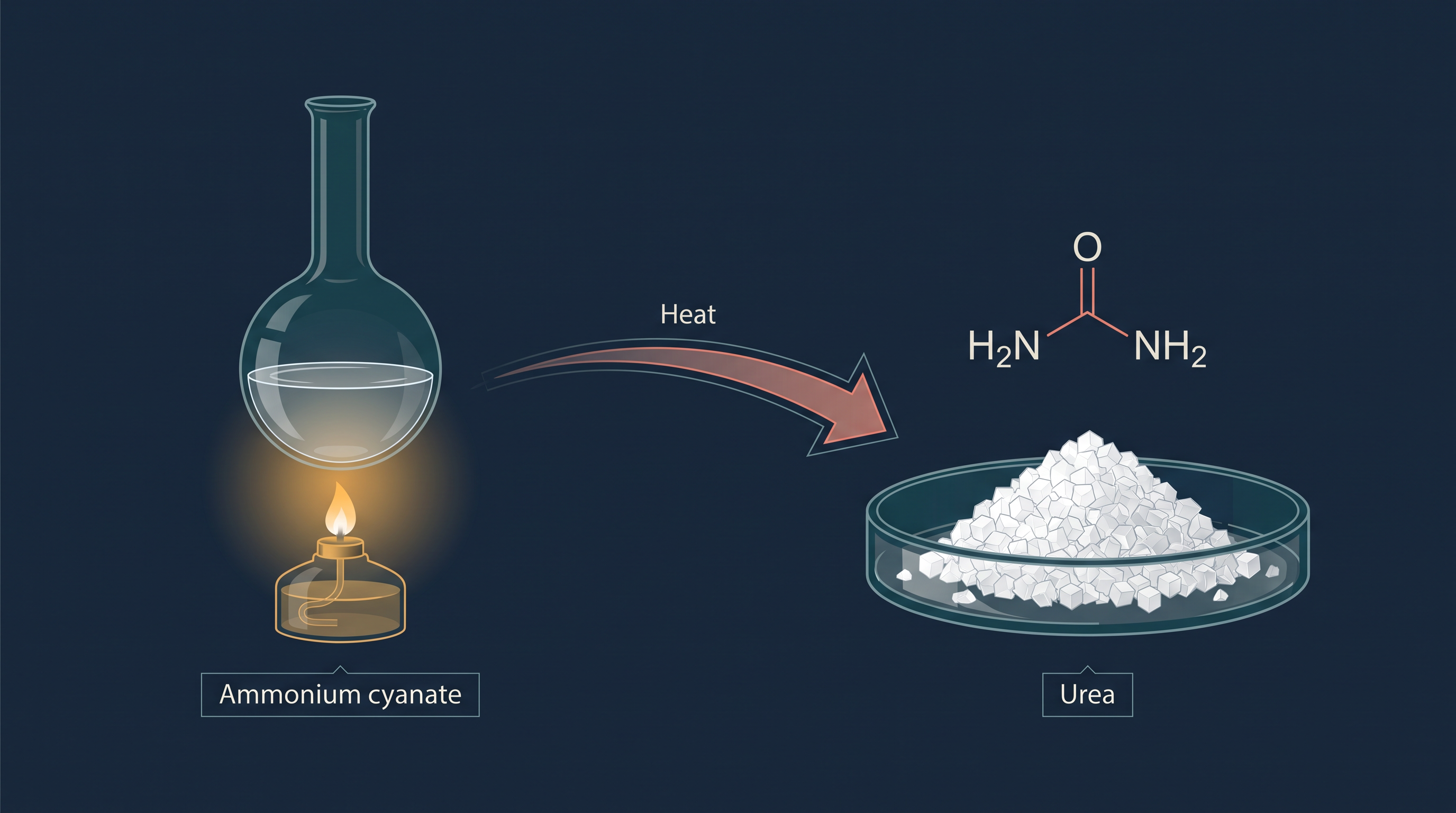
Fig. 8.0 – Wöhler’s synthesis of urea.
By the end of this chapter, you will be able to reason your way to answers for each of these questions.
8.1 General Introduction
You already know from the previous chapter that carbon is a rather special element. It has a unique ability called catenation — the capacity of carbon atoms to link with one another through covalent bonds, forming long chains, branched chains, and rings. On top of that, carbon readily forms covalent bonds with atoms of several other elements such as hydrogen, oxygen, nitrogen, sulphur, phosphorus, and the halogens.
A covalent bond, recall, is a bond formed when two atoms share a pair of electrons. Because carbon can share electrons both with itself and with these other elements, it can assemble an almost endless variety of molecules. The compounds that result from this bonding are studied together under a distinct branch of chemistry called organic chemistry. This unit lays out the basic principles and the analytical techniques you need in order to understand how organic compounds form and how they behave.
Why Carbon Compounds Matter
Organic compounds are central to life itself. They include very complex molecules such as deoxyribonucleic acid (DNA), which carries genetic information, and the proteins that make up essential parts of our blood, muscles, and skin.
Beyond living systems, organic compounds appear all around us — in clothing fibres, fuels, polymers (plastics), dyes, and medicines. These everyday materials are only a small sample of the enormous range of applications that carbon compounds have.
How Organic Chemistry Began
The science of organic chemistry is roughly two hundred years old. Around the year 1780, chemists started to draw a line between two groups of substances: organic compounds, obtained from plants and animals, and inorganic compounds, prepared from mineral sources.
At that time, the Swedish chemist Berzelius put forward the idea that a mysterious “vital force” — something present only in living organisms — was responsible for producing organic compounds. In other words, people believed such compounds could never be made in a laboratory from non-living matter.
This belief was overturned in 1828, when F. Wöhler synthesised an organic compound, urea, starting from an inorganic compound, ammonium cyanate.
\[\mathrm{NH_4CNO} \xrightarrow{\ \text{Heat}\ } \mathrm{NH_2CONH_2}\]
Here ammonium cyanate (\(\mathrm{NH_4CNO}\)) is heated and rearranges into urea (\(\mathrm{NH_2CONH_2}\)). The importance of this experiment was not the product itself but what it proved: a substance normally made by living bodies could be built from ordinary mineral matter.
The case became even stronger with two later achievements — the synthesis of acetic acid by Kolbe (1845) and the synthesis of methane by Berthelot (1856). Together these showed conclusively that organic compounds could be prepared from inorganic sources in the laboratory, with no living organism involved.
Finally, the development of the electronic theory of covalent bonding — the idea that bonds form through the sharing and shifting of electrons — gave organic chemistry its modern shape, allowing chemists to explain not just what compounds exist but why they react the way they do.
8.2 Tetravalence of Carbon: Shapes of Organic Compounds
8.2.1 The Shapes of Carbon Compounds
A good grasp of molecular structure is the foundation for understanding and predicting how organic compounds behave. You have already met the theories of valency and molecular structure in Unit 4, so some of this will feel familiar.
You also already know that carbon shows tetravalence — it forms four covalent bonds — and that this, together with the way its bonds form, is explained in terms of carbon’s electronic configuration and the hybridisation of its \(s\) and \(p\) orbitals. Hybridisation, recall, is the mixing of atomic orbitals of similar energy to produce new, equivalent orbitals that are better suited for bonding.
It is worth recalling how hybridisation accounts for the shapes of three simple molecules. Methane (\(\mathrm{CH_4}\)), ethene (\(\mathrm{C_2H_4}\)), and ethyne (\(\mathrm{C_2H_2}\)) are explained by the use of \(sp^3\), \(sp^2\), and \(sp\) hybrid orbitals respectively by their carbon atoms.
How Hybridisation Controls Bond Strength
Hybridisation does more than fix the shape of a molecule; it also influences the bond length and the bond enthalpy (a measure of bond strength) in a compound. The reason lies in how much \(s\) character each hybrid orbital carries.
An \(s\) orbital sits closer to the nucleus than a \(p\) orbital of the same shell. So the more \(s\) character a hybrid orbital has, the closer its electron cloud lies to the nucleus.
An \(sp\) hybrid orbital contains more \(s\) character (50%) than an \(sp^3\) hybrid orbital (25%). Because of this, an \(sp\) orbital is held closer to the nucleus and forms shorter and stronger bonds than an \(sp^3\) orbital.
The \(sp^2\) hybrid orbital is intermediate in \(s\) character (33%) between \(sp\) and \(sp^3\). Consequently the length and enthalpy of the bonds it forms are also intermediate between those two.
Hybridisation and Electronegativity
The change in hybridisation also affects the electronegativity of carbon — its tendency to attract the shared electrons of a bond. The rule is simple: the greater the \(s\) character of the hybrid orbitals, the greater the electronegativity.
Thus a carbon atom using an \(sp\) hybrid orbital, with 50% \(s\) character, is more electronegative than one using \(sp^2\) or \(sp^3\) hybridised orbitals. This relative electronegativity shows up in several physical and chemical properties of the molecules concerned, which you will study in later units.
8.2.2 Some Characteristic Features of \(\pi\) Bonds
To understand why carbon–carbon multiple bonds behave the way they do, we look closely at the \(\pi\) (pi) bond. A \(\pi\) bond forms only when two \(p\) orbitals on adjacent atoms are oriented parallel to each other, because this parallel arrangement is necessary for a proper sideways (side-by-side) overlap.
Consider the ethene molecule, \(\mathrm{H_2C{=}CH_2}\), drawn in Fig. 8.1. For its \(\pi\) bond to form, all the atoms of the molecule must lie in the same plane. In this flat arrangement the two \(p\) orbitals (one on each carbon) are mutually parallel, and both of these \(p\) orbitals stand perpendicular to the plane of the molecule.
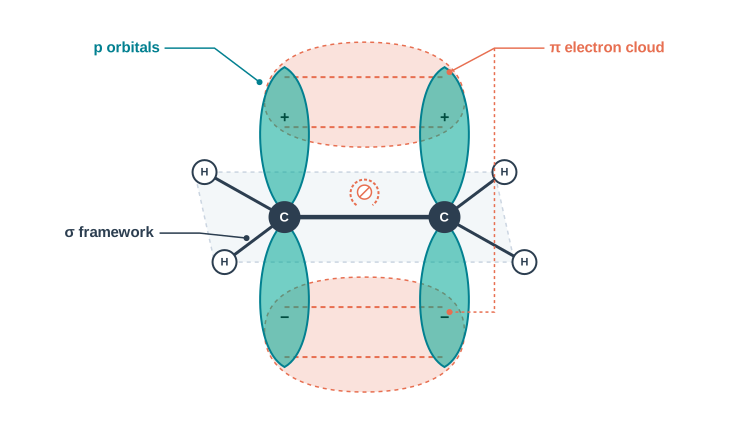
Fig. 8.1 – Orbital structure of ethene.
Why Double Bonds Cannot Rotate Freely
This parallel-overlap requirement has a striking consequence. If you were to rotate one \(\mathrm{CH_2}\) fragment relative to the other, the two \(p\) orbitals would no longer be parallel, and their overlap would be spoiled. Because maximum overlap is needed to hold the \(\pi\) bond together, such rotation about a carbon–carbon double bond (C=C) is restricted. This is quite unlike a single bond, about which groups can rotate freely.
Why π Bonds Are Reactive
There is a second important feature. The electron charge cloud of the \(\pi\) bond is located above and below the plane of the bonding atoms, rather than directly between the two nuclei. This position leaves those electrons relatively exposed and easily available to attacking reagents.
As a result, in molecules that contain multiple bonds, the \(\pi\) bonds generally provide the most reactive centres. Keep this idea in mind — it will explain much of the chemistry of alkenes and alkynes in later units, where reagents are seen to “attack” the electron-rich double or triple bond.
8.3 Structural Representations of Organic Compounds
8.3.1 Complete, Condensed and Bond-line Structural Formulas
Chemists draw the structures of organic compounds in several different ways, each a shorthand that reveals a little more or a little less detail. The main types are the Lewis structure (dot structure), the dash structure, the condensed structure, and the bond-line structural formula.
From Lewis Dots to Dashes
A Lewis structure shows every bonding electron as a dot, but this quickly becomes cluttered. It can be simplified by representing each shared pair of electrons (a two-electron covalent bond) with a dash (–).
Such a dash formula focuses attention on the electrons that are actually involved in bond formation. A single dash represents a single bond, a double dash a double bond, and a triple dash a triple bond. Lone pairs of electrons on heteroatoms — atoms other than carbon and hydrogen, such as oxygen, nitrogen, sulphur, or halogens — may or may not be shown.
Using this convention, ethane (\(\mathrm{C_2H_6}\)), ethene (\(\mathrm{C_2H_4}\)), ethyne (\(\mathrm{C_2H_2}\)), and methanol (\(\mathrm{CH_3OH}\)) are drawn out with every atom and every bond in place. Structures shown in this fully detailed way are called complete structural formulas.
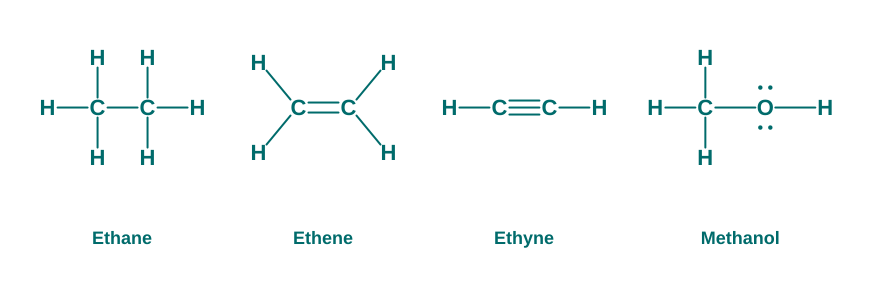
Fig. 8.2 – Complete structural formulas of four molecules.
Condensing the Formula
These complete formulas can be shortened by leaving out some or all of the dashes that represent covalent bonds, and by writing the number of identical groups attached to an atom as a subscript. The result is called a condensed structural formula. In this form, ethane, ethene, ethyne, and methanol become:
\[\mathrm{CH_3CH_3} \qquad \mathrm{H_2C{=}CH_2} \qquad \mathrm{HC{\equiv}CH} \qquad \mathrm{CH_3OH}\]
Longer chains condense even further. For example, \(\mathrm{CH_3CH_2CH_2CH_2CH_2CH_2CH_2CH_3}\) can be written more compactly as \(\mathrm{CH_3(CH_2)_6CH_3}\), where the repeating \(\mathrm{CH_2}\) unit is collected inside a bracket with a subscript.
The Bond-line Formula
For further simplification, organic chemists use another representation in which only lines are used. In this bond-line structural formula, the carbon and hydrogen atoms are not written at all, and the lines representing carbon–carbon bonds are drawn in a zig-zag fashion.
The only atoms specifically written are heteroatoms such as oxygen, chlorine, and nitrogen. The terminals (the free ends of the zig-zag) denote methyl (\(-\mathrm{CH_3}\)) groups, unless a functional group is indicated there instead. Each line junction (each corner or end where lines meet) denotes a carbon atom, bonded to as many hydrogens as are needed to satisfy carbon’s valency of four.
This economy is why the bond-line style is a chemist’s favourite for drawing large molecules quickly. As an illustration, 3-methyloctane can be represented in the condensed form \(\mathrm{CH_3CH_2CH(CH_3)CH_2CH_2CH_2CH_2CH_3}\) and, equivalently, as a zig-zag bond-line drawing.
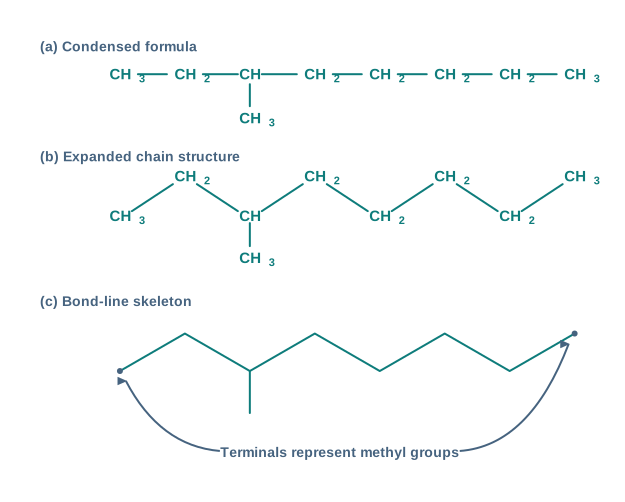
Fig. 8.3 – Three representations of 3-methyloctane.
Similarly, 2-bromobutane can be drawn as the condensed formula \(\mathrm{CH_3CHBrCH_2CH_3}\) or as a bond-line skeleton in which only the Br is written and the zig-zag ends stand for methyl groups.
Bond-line Formulas for Rings
For cyclic (ring) compounds, the bond-line formula is a closed polygon. Each corner of the polygon is a carbon atom carrying the hydrogens needed to complete its valency. Thus cyclopropane is a triangle, cyclopentane is a pentagon, and chlorocyclohexane is a hexagon with “Cl” written at one corner.
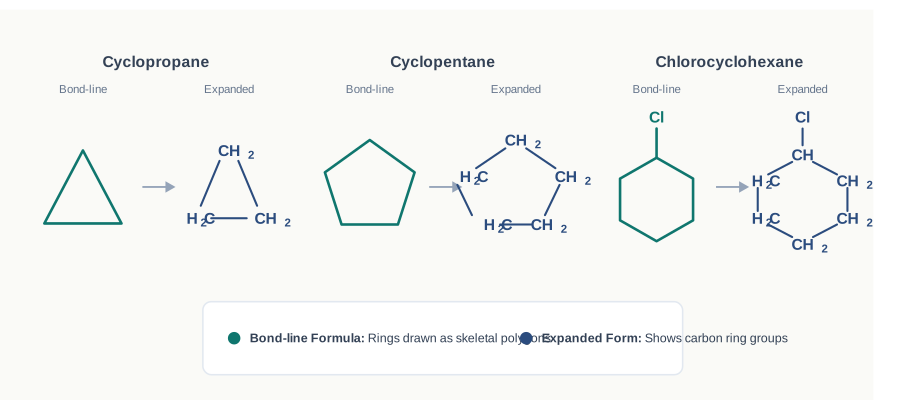
Fig. 8.4 – Bond-line and expanded formulas for cyclic compounds.
(NCERT-origin, values preserved exactly)
Expand each of the following condensed formulas into their complete structural formulas.
(a) \(\mathrm{CH_3CH_2COCH_2CH_3}\)
(b) \(\mathrm{CH_3CH{=}CH(CH_2)_3CH_3}\)
Draw out every carbon, every hydrogen, and every bond. Remember that the “CO” in (a) is a carbonyl group, a C double-bonded to O.
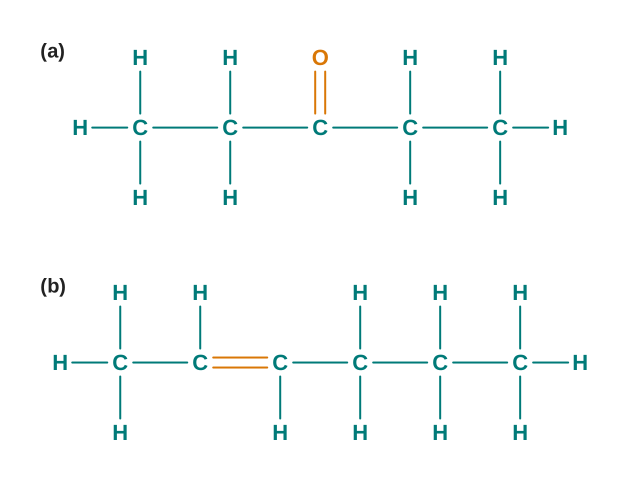
[Caption:] Fig. 8.5 – Complete structural formulas. [/Caption:]
(NCERT-origin, values preserved exactly)
For each of the following compounds, write a condensed formula and also their bond-line formula.
(a) \(\mathrm{HOCH_2CH_2CH_2CH(CH_3)CH(CH_3)CH_3}\)
(b) \(\mathrm{N{\equiv}C{-}CH(OH){-}C{\equiv}N}\)
Condensed formula:
\(\mathrm{HO(CH_2)_3CH(CH_3)CH(CH_3)_2}\)
\(\mathrm{HOCH(CN)_2}\)
Bond-line formula:
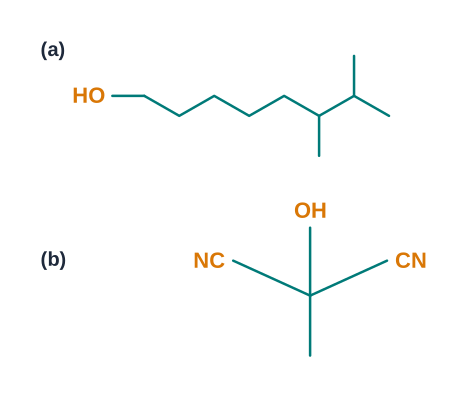
[Caption:] Fig. 8.6 – Bond-line formulas. [/Caption:]
(NCERT-origin, values preserved exactly)
Expand each of the following bond-line formulas to show all the atoms including carbon and hydrogen.
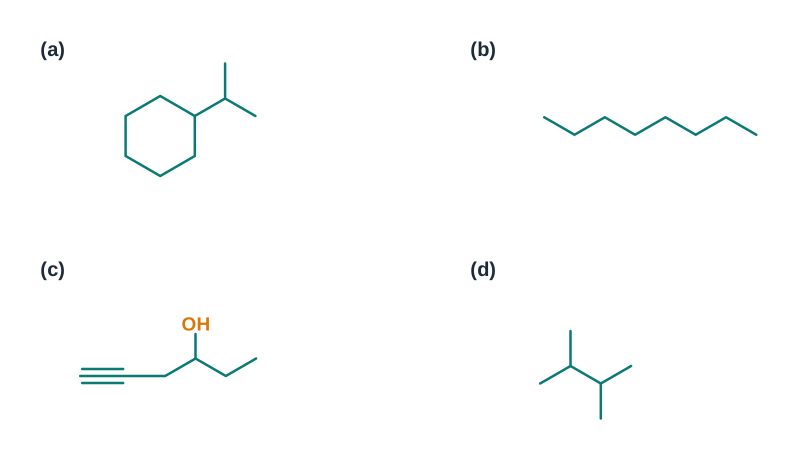
[Caption:] Fig. 8.7 – Bond-line formulas for expansion. [/Caption:]
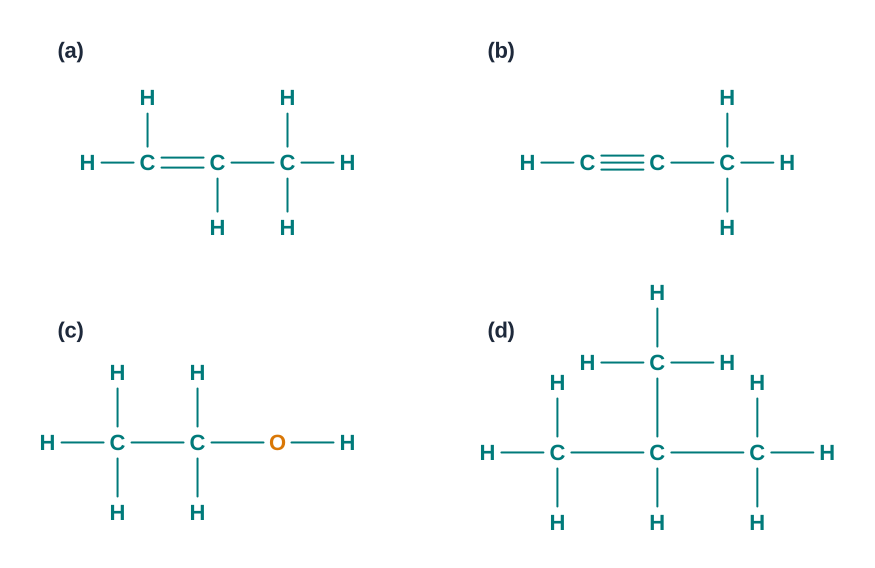
[Caption:] Fig. 8.8 – Fully expanded structural formulas. [/Caption:]
8.3.2 Three-Dimensional Representation of Organic Molecules
A structural formula drawn flat on paper cannot, by itself, show that a molecule is three-dimensional. To capture the 3-D shape on a 2-D page, chemists use certain drawing conventions — most commonly the solid-wedge and dashed-wedge formula.
Reading Wedges and Dashes
The idea is to make some bonds appear to come toward you and others to go away from you. The solid-wedge (\(\blacktriangleleft\), a filled triangle) indicates a bond projecting out of the plane of the paper, towards the observer. The dashed-wedge (a hatched or dotted triangle) indicates a bond projecting out of the plane of the paper but away from the observer.
Wedges are always drawn so that the broad end of the wedge is towards the observer — the bond appears to widen as it comes closer to you. Bonds that lie flat, in the plane of the paper, are drawn with an ordinary straight line (—).
Putting these together, the 3-D shape of the methane molecule can be represented on paper as shown in Fig. 8.9.
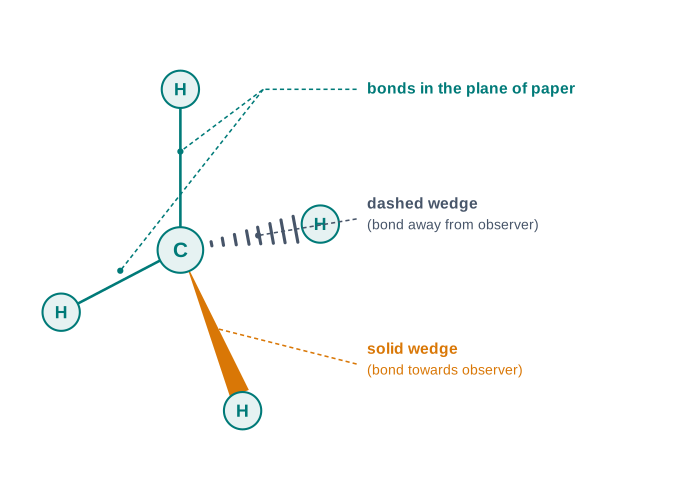
Fig. 8.9 – Wedge-and-dash representation of methane.
Molecular Models
Besides drawings, chemists use physical molecular models for a better visualisation and perception of the three-dimensional shapes of organic molecules. These are made of wood, plastic, or metal and are commercially available. Three types are commonly used, each emphasising something different.
In the framework model, only the bonds connecting the atoms are shown, and not the atoms themselves. This model emphasises the pattern of bonds in a molecule while ignoring the size of atoms.
In the ball-and-stick model, both the atoms and the bonds are shown: balls represent atoms and sticks denote bonds. For compounds containing a C=C (for example, ethene), springs can be used in place of sticks to represent the double bond; such models are then called ball-and-spring models.
The space-filling model emphasises the relative size of each atom, based on its van der Waals radius (a measure of how much space an atom occupies). Bonds are not shown in this model; instead it conveys the actual volume that each atom takes up in the molecule.
In addition to these physical models, computer graphics can also be used for molecular modelling, allowing molecules to be rotated and examined on a screen.
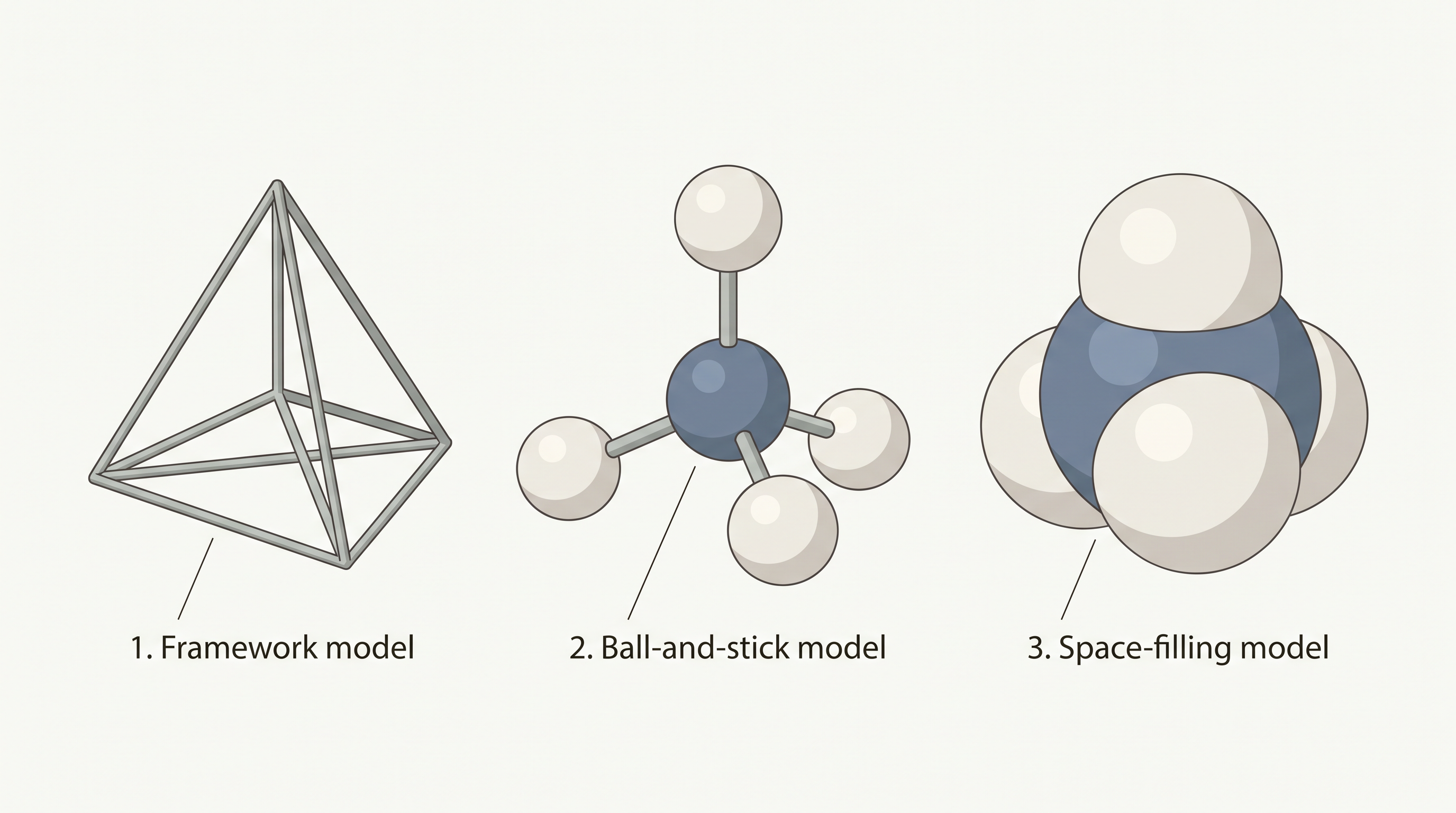
Fig. 8.10 – Three types of molecular models.
8.4 Classification of Organic Compounds
The number of organic compounds already known is enormous, and it keeps growing. To handle this vast collection sensibly, chemists classify these compounds — chiefly on the basis of their structures. The broad classification is summarised in Fig. 8.11.
Flowchart
Fig. 8.11 – Classification of organic compounds by structure: Organic compounds → branches into (I) Acyclic / open-chain compounds and (II) Cyclic / closed-chain (ring) compounds. Under (II): → Alicyclic compounds; → Aromatic compounds. Aromatic compounds branch into → Benzenoid and → Non-benzenoid; Benzenoid further branches into → Homocyclic/Carbocyclic and → Heterocyclic aromatic. Alicyclic branch also notes → Homocyclic and → Heterocyclic (non-aromatic).
I. Acyclic or Open-chain Compounds
These compounds are also called aliphatic compounds. They consist of straight-chain or branched-chain compounds, in which the carbon atoms are joined in an open chain that does not close into a ring.
Familiar examples include ethane (\(\mathrm{CH_3CH_3}\)), isobutane (a branched chain), acetaldehyde (\(\mathrm{CH_3CHO}\)), and acetic acid (\(\mathrm{CH_3COOH}\)).
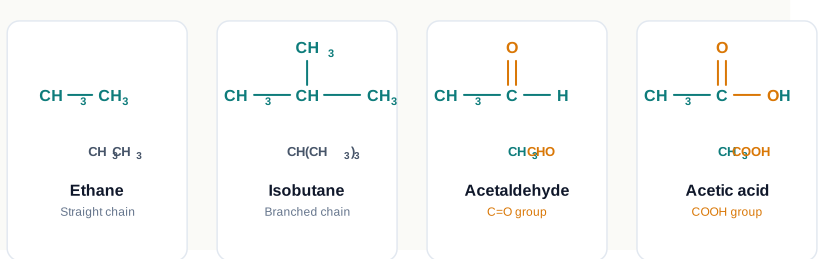
Fig. 8.12 – Open-chain (aliphatic) compounds.
II. Cyclic or Closed-chain (Ring) Compounds
When the carbon atoms link up so that the chain closes into a ring, the compound is cyclic. Cyclic compounds are further divided into alicyclic and aromatic types.
(a) Alicyclic Compounds
Alicyclic (aliphatic cyclic) compounds contain carbon atoms joined in the form of a ring. In many of them all the ring atoms are carbon; such rings are called homocyclic (or carbocyclic). Examples include cyclopropane, cyclohexane, and cyclohexene.
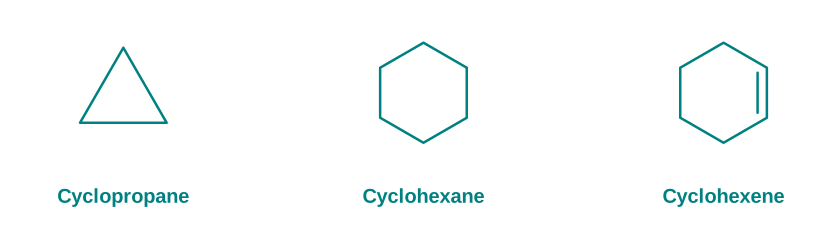
Fig. 8.13 – Alicyclic compounds.
Sometimes atoms other than carbon are also present in the ring; such compounds are called heterocyclic. Tetrahydrofuran, a five-membered ring containing one oxygen atom, is an example of this type.
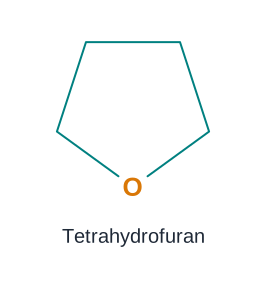
Fig. 8.14 – Tetrahydrofuran.
These heterocyclic (non-aromatic) compounds exhibit some properties similar to those of aliphatic compounds.
(b) Aromatic Compounds
Aromatic compounds are a special class of compounds. You will study them in detail in Chapter 9. They include benzene and other related ring compounds, which are described as benzenoid.
Like alicyclic compounds, aromatic compounds may also contain a heteroatom in the ring. When they do, they are called heterocyclic aromatic compounds.
Some benzenoid aromatic examples are benzene, aniline, and naphthalene. A non-benzenoid aromatic example is tropone. And some heterocyclic aromatic examples are furan, thiophene, and pyridine.
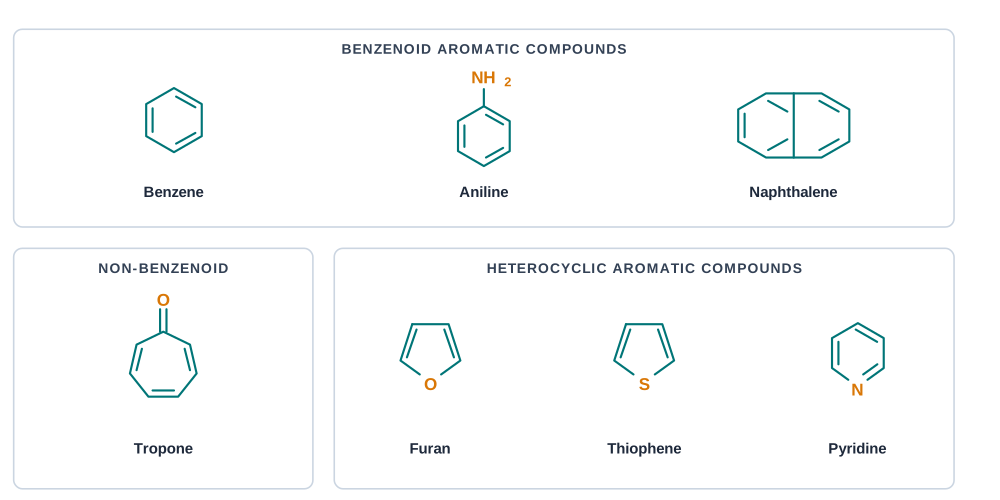
Fig. 8.15 – Aromatic compounds.
Classification by Functional Groups
Structure is not the only basis for classification. Organic compounds can also be classified by the functional groups they contain, sorting them into families or homologous series. These two ideas are taken up next.
8.4.1 Functional Group
A functional group is an atom or a group of atoms joined to the carbon chain that is responsible for the characteristic chemical properties of the organic compound. In other words, the functional group is the “reactive handle” of the molecule — the part where most of its typical reactions happen.
Some common examples are the hydroxyl group (\(-\mathrm{OH}\)), the aldehyde group (\(-\mathrm{CHO}\)), and the carboxylic acid group (\(-\mathrm{COOH}\)), among others.
8.4.2 Homologous Series
A group or a series of organic compounds, each containing the same characteristic functional group, forms a homologous series, and the individual members of the series are called homologues.
Features of a Homologous Series
The members of a homologous series share a general molecular formula, and any two successive members differ from each other by a \(-\mathrm{CH_2}\) unit (one carbon and two hydrogens). This regular, step-by-step difference is what makes a homologous series so orderly: as you move along it, properties change gradually and predictably.
There are many homologous series in organic chemistry. Some of these are the alkanes, alkenes, alkynes, haloalkanes, alkanols, alkanals, alkanones, alkanoic acids, and amines.
Polyfunctional Compounds
It is also possible for a single compound to contain two or more functional groups — either identical or different. Such compounds are called polyfunctional compounds, and naming them requires deciding which functional group takes priority, a point developed in the next section on nomenclature.
8.5 Nomenclature of Organic Compounds
Organic chemistry deals with millions of compounds. To identify each one clearly and without confusion, a systematic method of naming has been developed. It is known as the IUPAC (International Union of Pure and Applied Chemistry) system of nomenclature.
The power of this system lies in a simple design principle: in systematic nomenclature the names are correlated with the structure, in such a way that a reader or listener can deduce the structure directly from the name. The name is not a label to be memorised — it is a set of instructions for drawing the molecule.
Names Before IUPAC
Before the IUPAC system existed, organic compounds were assigned names based on their origin or on some property they showed. For instance, citric acid is named so because it is found in citrus fruits, and the acid found in the red ant is named formic acid, since the Latin word for ant is formica.
Such names are traditional and are considered trivial or common names. Some common names are still followed even today. For example, Buckminsterfullerene is a common name given to the newly discovered \(\mathrm{C_{60}}\) cluster (a form of carbon), noting its structural similarity to the geodesic domes popularised by the famous architect R. Buckminster Fuller.
Common names are useful and in many cases indispensable, particularly when the alternative systematic names are lengthy and complicated. Common names of some organic compounds are given in Table 8.1.
Table 8.1 Common or Trivial Names of Some Organic Compounds
| Compound | Common name |
|---|---|
| \(\mathrm{CH_4}\) | Methane |
| \(\mathrm{H_3CCH_2CH_2CH_3}\) | n-Butane |
| \(\mathrm{(H_3C)_2CHCH_3}\) | Isobutane |
| \(\mathrm{(H_3C)_4C}\) | Neopentane |
| \(\mathrm{H_3CCH_2CH_2OH}\) | n-Propyl alcohol |
| \(\mathrm{HCHO}\) | Formaldehyde |
| \(\mathrm{(H_3C)_2CO}\) | Acetone |
| \(\mathrm{CHCl_3}\) | Chloroform |
| \(\mathrm{CH_3COOH}\) | Acetic acid |
| \(\mathrm{C_6H_6}\) | Benzene |
| \(\mathrm{C_6H_5OCH_3}\) | Anisole |
| \(\mathrm{C_6H_5NH_2}\) | Aniline |
| \(\mathrm{C_6H_5COCH_3}\) | Acetophenone |
| \(\mathrm{CH_3OCH_2CH_3}\) | Ethyl methyl ether |
8.5.1 The IUPAC System of Nomenclature
A systematic name of an organic compound is generally derived by identifying two things: the parent hydrocarbon and the functional group(s) attached to it.
Consider a molecule such as \(\mathrm{CH_3{-}CH(CH_3){-}CH_2{-}CH(Br){-}CH(OH){-}CH_3}\). Reading it as a chemist would, you look for the longest carbon chain (the parent chain), then note the branch (here a methyl group) and the functional groups (here Br and OH). Every part of the eventual name comes from one of these three features.
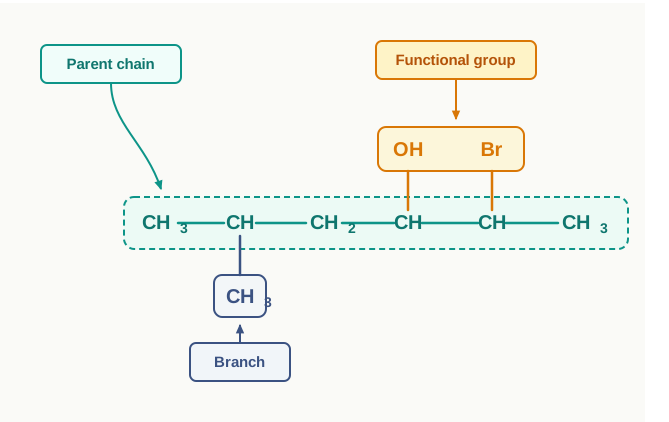
Fig. 8.16 – Components of a systematic IUPAC name.
By further using prefixes and suffixes, the parent name can be modified to obtain the actual name.
Compounds containing carbon and hydrogen only are called hydrocarbons. A hydrocarbon is termed saturated if it contains only carbon–carbon single bonds. The IUPAC name for a homologous series of such compounds is alkane. Paraffin (Latin: little affinity) was the earlier name given to these compounds — a reference to their reluctance to react. Unsaturated hydrocarbons are those that contain at least one carbon–carbon double or triple bond.
8.5.2 IUPAC Nomenclature of Alkanes
Straight Chain Hydrocarbons
The names of such compounds are based on their chain structure. They end with the suffix ‘-ane’ and carry a prefix indicating the number of carbon atoms present in the chain — except from \(\mathrm{CH_4}\) to \(\mathrm{C_4H_{10}}\), where the prefixes are derived from trivial names.
The IUPAC names of some straight-chain saturated hydrocarbons are given in Table 8.2. Notice that the alkanes in Table 8.2 differ from each other by merely the number of \(-\mathrm{CH_2}\) groups in the chain. They are homologues of the alkane series.
Table 8.2 IUPAC Names of Some Unbranched Saturated Hydrocarbons
| Name | Molecular formula | Name | Molecular formula |
|---|---|---|---|
| Methane | \(\mathrm{CH_4}\) | Heptane | \(\mathrm{C_7H_{16}}\) |
| Ethane | \(\mathrm{C_2H_6}\) | Octane | \(\mathrm{C_8H_{18}}\) |
| Propane | \(\mathrm{C_3H_8}\) | Nonane | \(\mathrm{C_9H_{20}}\) |
| Butane | \(\mathrm{C_4H_{10}}\) | Decane | \(\mathrm{C_{10}H_{22}}\) |
| Pentane | \(\mathrm{C_5H_{12}}\) | Icosane | \(\mathrm{C_{20}H_{42}}\) |
| Hexane | \(\mathrm{C_6H_{14}}\) | Triacontane | \(\mathrm{C_{30}H_{62}}\) |
Branched Chain Hydrocarbons
In a branched chain compound, small chains of carbon atoms are attached at one or more carbon atoms of the parent chain. These small carbon chains (branches) are called alkyl groups. For example, \(\mathrm{CH_3{-}CH(CH_3){-}CH_2{-}CH_3}\) and \(\mathrm{CH_3{-}CH(CH_2CH_3){-}CH_2{-}CH(CH_3){-}CH_3}\) both carry such branches.
In order to name such compounds, the names of the alkyl groups are prefixed to the name of the parent alkane. An alkyl group is derived from a saturated hydrocarbon by removing a hydrogen atom from carbon. Thus \(\mathrm{CH_4}\) becomes \(-\mathrm{CH_3}\) and is called the methyl group. An alkyl group is named by substituting ‘yl’ for ‘ane’ in the corresponding alkane. Some alkyl groups are listed in Table 8.3.
Table 8.3 Some Alkyl Groups
| Molecular formula (alkane) | Name of alkane | Structural formula (alkyl group) | Name of alkyl group |
|---|---|---|---|
| \(\mathrm{CH_4}\) | Methane | \(-\mathrm{CH_3}\) | Methyl |
| \(\mathrm{C_2H_6}\) | Ethane | \(-\mathrm{CH_2CH_3}\) | Ethyl |
| \(\mathrm{C_3H_8}\) | Propane | \(-\mathrm{CH_2CH_2CH_3}\) | Propyl |
| \(\mathrm{C_4H_{10}}\) | Butane | \(-\mathrm{CH_2CH_2CH_2CH_3}\) | Butyl |
| \(\mathrm{C_{10}H_{22}}\) | Decane | \(-\mathrm{CH_2(CH_2)_8CH_3}\) | Decyl |
Abbreviations are used for some alkyl groups. For example, methyl is abbreviated as Me, ethyl as Et, propyl as Pr, and butyl as Bu.
Branched Alkyl Groups
The alkyl groups can be branched also. Thus propyl and butyl groups can have branched structures. These branched groups have specific trivial names:
- Isopropyl-: \(\mathrm{CH_3{-}CH(CH_3){-}}\)
- sec-Butyl-: \(\mathrm{CH_3{-}CH_2{-}CH(CH_3){-}}\)
- Isobutyl-: \(\mathrm{(CH_3)_2CH{-}CH_2{-}}\)
- tert-Butyl-: \(\mathrm{(CH_3)_3C{-}}\)
- Neopentyl-: \(\mathrm{(CH_3)_3C{-}CH_2{-}}\)
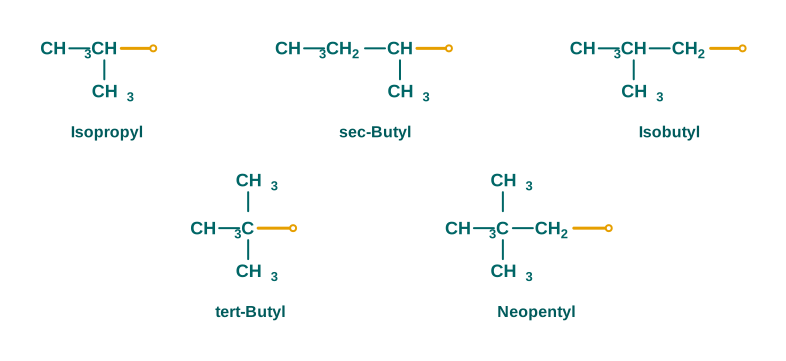
Fig. 8.17 – Common branched alkyl groups.
So the propyl groups can either be the n-propyl group or the isopropyl group. The branched butyl groups are called sec-butyl, isobutyl, and tert-butyl group. We also encounter the structural unit \(-\mathrm{CH_2C(CH_3)_3}\), which is called the neopentyl group.
Nomenclature of Branched Chain Alkanes
We encounter a number of branched chain alkanes, and there is a fixed sequence of rules for naming them. The full sequence is summarised in Fig. 8.18.
Flowchart
Fig. 8.18 – Naming a branched chain alkane: identify the longest carbon chain (parent/root chain) → number the chain so that branched carbons get the lowest possible numbers → prefix the names of the alkyl branches with their position numbers → if identical substituents repeat, use di/tri/tetra… and separate numbers by commas → if two substituents are in equivalent positions, give the lower number to the one first in alphabetical order → for a branched alkyl group, number its own carbon of attachment as 1 and place the whole name in parentheses.
Rule 1. First of all, the longest carbon chain in the molecule is identified. In the example (I), the longest chain has nine carbons and it is considered as the parent or root chain. Selection of a parent chain as shown in (II) is not correct because it has only eight carbons.
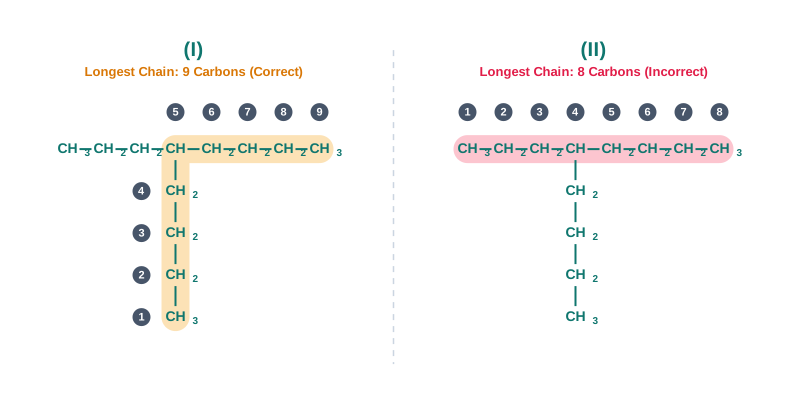
Fig. 8.19 – Selecting the longest carbon chain.
Rule 2. The carbon atoms of the parent chain are numbered to identify the parent alkane and to locate the positions of the carbon atoms at which branching takes place due to the substitution of an alkyl group in place of hydrogen atoms. The numbering is done in such a way that the branched carbon atoms get the lowest possible numbers.
Thus, the numbering in the above example should be from left to right (branching at carbon atoms 2 and 6) and not from right to left (which would give numbers 4 and 8 to the carbon atoms at which branches are attached).
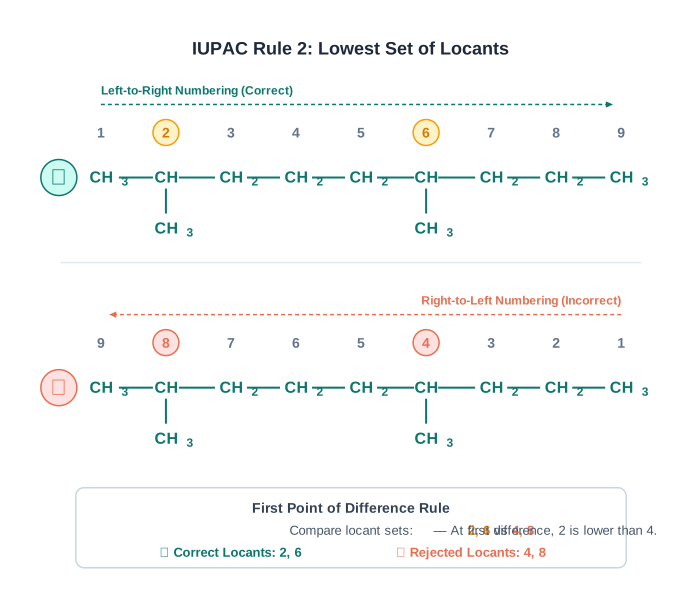
Fig. 8.20 – Numbering the parent chain.
Rule 3. The names of alkyl groups attached as a branch are then prefixed to the name of the parent alkane, and the position of the substituents is indicated by the appropriate numbers. If different alkyl groups are present, they are listed in alphabetical order. Thus the name for the compound shown above is 6-ethyl-2-methylnonane. [Note: the numbers are separated from the groups by hyphens, and there is no break between methyl and nonane.]
Rule 4. If two or more identical substituent groups are present, then the numbers are separated by commas. The names of identical substituents are not repeated; instead prefixes such as di (for 2), tri (for 3), tetra (for 4), penta (for 5), hexa (for 6) etc. are used.
While writing the name of the substituents in alphabetical order, these prefixes, however, are not considered. That is, “dimethyl” is alphabetised under “m” for methyl, not under “d”. Thus the following compounds are named as:
- \(\mathrm{CH_3{-}CH(CH_3){-}CH_2{-}CH(CH_3){-}CH_3}\) → 2,4-Dimethylpentane
- \(\mathrm{CH_3{-}C(CH_3)_2{-}CH_2{-}CH(CH_3){-}CH_3}\) → 2,2,4-Trimethylpentane
- The seven-carbon chain bearing an ethyl group at C-3 and two methyl groups at C-4 → 3-Ethyl-4,4-dimethylheptane
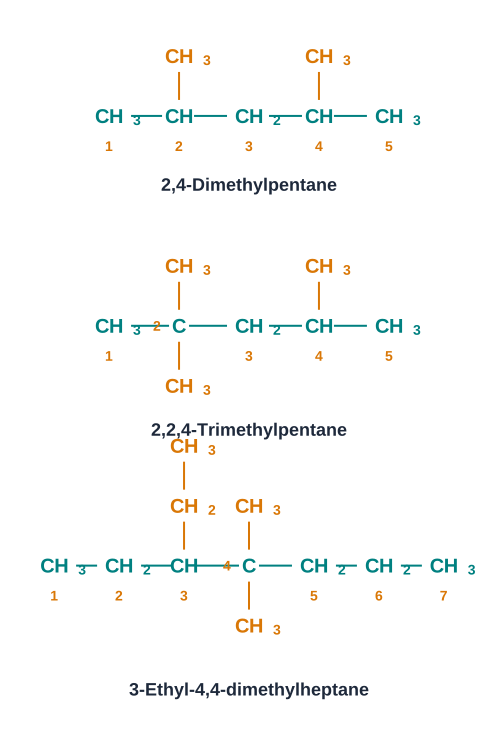
Fig. 8.21 – Naming alkanes with identical repeating branches.
Rule 5. If the two substituents are found in equivalent positions, the lower number is given to the one coming first in the alphabetical listing. Thus, the following compound is named 3-ethyl-6-methyloctane and not 6-ethyl-3-methyloctane — because “ethyl” comes before “methyl” alphabetically, ethyl earns the lower locant.
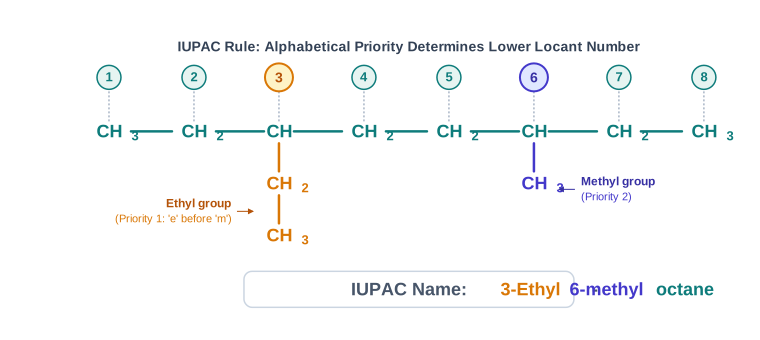
Fig. 8.22 – Alphabetical priority in numbering.
Rule 6. The branched alkyl groups can be named by following the above-mentioned procedures. However, the carbon atom of the branch that attaches to the root alkane is numbered 1, as exemplified below.
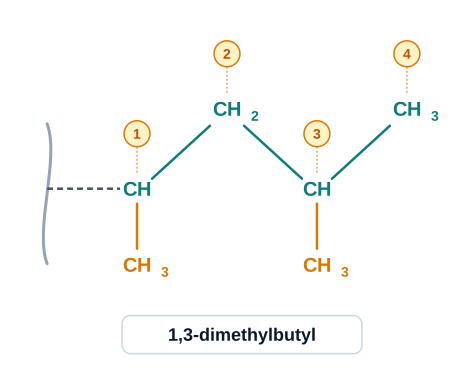
Fig. 8.23 – Numbering a branched alkyl group.
The name of such a branched chain alkyl group is placed in parenthesis while naming the compound.
Alphabetising Trivial Prefixes
While writing the trivial names of substituents in alphabetical order, the prefixes iso- and neo- are considered to be part of the fundamental name of the alkyl group. The prefixes sec- and tert- are not considered to be part of the fundamental name. So “isopropyl” is alphabetised under “i”, but “sec-butyl” is alphabetised under “b”.
The use of iso and related common prefixes for naming alkyl groups is also allowed by the IUPAC nomenclature, as long as these are not further substituted.
In multi-substituted compounds, the following rules may also be remembered:
- If there happen to be two chains of equal size, then that chain is to be selected which contains the more number of side chains.
- After selection of the chain, numbering is to be done from the end closer to the substituent.
Applying these, we get names such as:
- 5-(2-Ethylbutyl)-3,3-dimethyldecane [and not 5-(2,2-dimethylbutyl)-3-ethyldecane]
- 5-sec-Butyl-4-isopropyldecane
- 5-(2,2-Dimethylpropyl)nonane
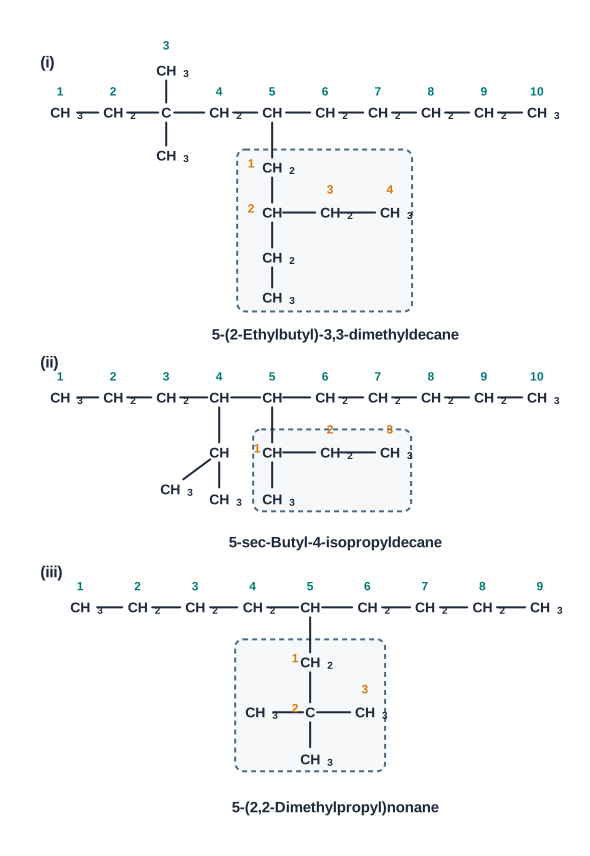
Fig. 8.24 – Naming alkanes with complex branched groups.
Cyclic Compounds
A saturated monocyclic compound is named by prefixing ‘cyclo’ to the corresponding straight chain alkane. If side chains are present, then the rules given above are applied.
Two useful pointers for rings:
- Numbering around the ring follows alphabetical order of the substituents, so 1-methyl-3-propylcyclohexane has the methyl at C-1.
- Where there is a choice, the more branched carbon gets the lower number. Thus the compound below is 3-ethyl-1,1-dimethylcyclohexane and not 1-ethyl-3,3-dimethylcyclohexane.
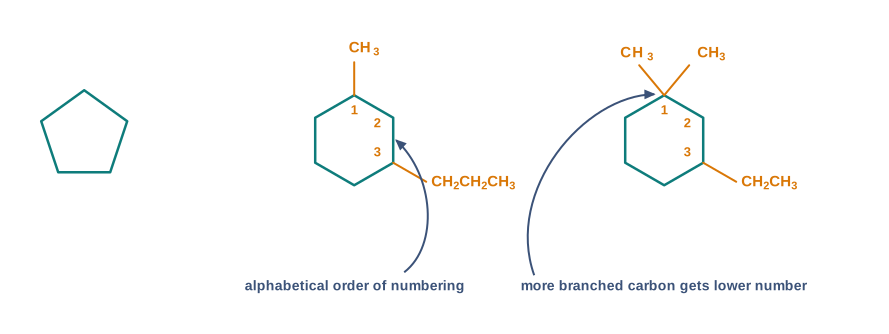
Fig. 8.25 – Numbering substituted cyclic alkanes.
8.5.3 Nomenclature of Organic Compounds having Functional Group(s)
A functional group, as defined earlier, is an atom or a group of atoms bonded together in a unique manner which is usually the site of chemical reactivity in an organic molecule.
Compounds having the same functional group undergo similar reactions. For example, \(\mathrm{CH_3OH}\), \(\mathrm{CH_3CH_2OH}\), and \(\mathrm{(CH_3)_2CHOH}\) — all having the \(-\mathrm{OH}\) functional group — liberate hydrogen on reaction with sodium metal. This shared behaviour is exactly why the presence of functional groups enables the systematisation of organic compounds into different classes.
Examples of some functional groups with their prefixes and suffixes, along with some examples of organic compounds possessing these, are given in Table 8.4.
Table 8.4 Some Functional Groups and Classes of Organic Compounds
| Class of compounds | Functional group structure | IUPAC group prefix | IUPAC group suffix | Example |
|---|---|---|---|---|
| Alkanes | – | – | -ane | Butane, \(\mathrm{CH_3(CH_2)_2CH_3}\) |
| Alkenes | \(\mathrm{>C{=}C<}\) | – | -ene | But-1-ene, \(\mathrm{CH_2{=}CHCH_2CH_3}\) |
| Alkynes | \(-\mathrm{C{\equiv}C}-\) | – | -yne | But-1-yne, \(\mathrm{CH{\equiv}CCH_2CH_3}\) |
| Arenes | – | – | – | Benzene, \(\mathrm{C_6H_6}\) |
| Halides | \(-\mathrm{X}\) (X = F, Cl, Br, I) | halo- | – | 1-Bromobutane, \(\mathrm{CH_3(CH_2)_2CH_2Br}\) |
| Alcohols | \(-\mathrm{OH}\) | hydroxy- | -ol | Butan-2-ol, \(\mathrm{CH_3CH_2CHOHCH_3}\) |
| Aldehydes | \(-\mathrm{CHO}\) | formyl, or oxo | -al | Butanal, \(\mathrm{CH_3(CH_2)_2CHO}\) |
| Ketones | \(\mathrm{>C{=}O}\) | oxo- | -one | Butan-2-one, \(\mathrm{CH_3CH_2COCH_3}\) |
| Nitriles | \(-\mathrm{C{\equiv}N}\) | cyano | nitrile | Pentanenitrile, \(\mathrm{CH_3CH_2CH_2CH_2CN}\) |
| Ethers | \(-\mathrm{R{-}O{-}R}-\) | alkoxy- | – | Ethoxyethane, \(\mathrm{CH_3CH_2OCH_2CH_3}\) |
| Carboxylic acids | \(-\mathrm{COOH}\) | carboxy | -oic acid | Butanoic acid, \(\mathrm{CH_3(CH_2)_2CO_2H}\) |
| Carboxylate ions | \(-\mathrm{COO^-}\) | – | -oate | Sodium butanoate, \(\mathrm{CH_3(CH_2)_2CO_2^-\ Na^+}\) |
| Esters | \(-\mathrm{COOR}\) | alkoxycarbonyl | -oate | Methyl propanoate, \(\mathrm{CH_3CH_2COOCH_3}\) |
| Acyl halides | \(-\mathrm{COX}\) (X = F, Cl, Br, I) | halocarbonyl | -oyl halide | Butanoyl chloride, \(\mathrm{CH_3(CH_2)_2COCl}\) |
| Amines | \(-\mathrm{NH_2}\), \(\mathrm{>NH}\), \(\mathrm{>N}-\) | amino- | -amine | Butan-2-amine, \(\mathrm{CH_3CHNH_2CH_2CH_3}\) |
| Amides | \(-\mathrm{CONH_2}\), \(-\mathrm{CONHR}\), \(-\mathrm{CONR_2}\) | -carbamoyl | -amide | Butanamide, \(\mathrm{CH_3(CH_2)_2CONH_2}\) |
| Nitro compounds | \(-\mathrm{NO_2}\) | nitro | – | 1-Nitrobutane, \(\mathrm{CH_3(CH_2)_3NO_2}\) |
| Sulphonic acids | \(-\mathrm{SO_3H}\) | sulpho | sulphonic acid | Methylsulphonic acid, \(\mathrm{CH_3SO_3H}\) |
Choosing the Suffix and Numbering the Chain
First of all, the functional group present in the molecule is identified, which determines the choice of appropriate suffix.
The longest chain of carbon atoms containing the functional group is numbered in such a way that the functional group is attached at the carbon atom possessing the lowest possible number in the chain. By using the suffix as given in Table 8.4, the name of the compound is arrived at.
Handling Polyfunctional Compounds
In the case of polyfunctional compounds, one of the functional groups is chosen as the principal functional group and the compound is then named on that basis. The remaining functional groups, which are subordinate functional groups, are named as substituents using the appropriate prefixes.
The choice of principal functional group is made on the basis of an order of preference. The order of decreasing priority for some functional groups is:
\(-\mathrm{COOH}\), \(-\mathrm{SO_3H}\), \(-\mathrm{COOR}\) (R = alkyl group), \(\mathrm{COCl}\), \(-\mathrm{CONH_2}\), \(-\mathrm{CN}\), \(-\mathrm{HC{=}O}\), \(\mathrm{>C{=}O}\), \(-\mathrm{OH}\), \(-\mathrm{NH_2}\), \(\mathrm{>C{=}C<}\), \(-\mathrm{C{\equiv}C}-\) .
The \(-\mathrm{R}\), \(\mathrm{C_6H_5}-\), halogens (F, Cl, Br, I), \(-\mathrm{NO_2}\), alkoxy (\(-\mathrm{OR}\)) etc. are always prefix substituents — they never become the suffix.
Thus, a compound containing both an alcohol and a keto group is named as a hydroxyalkanone, since the keto group is preferred to the hydroxyl group.
For example, \(\mathrm{HOCH_2(CH_2)_3CH_2COCH_3}\) will be named as 7-hydroxyheptan-2-one and not as 2-oxoheptan-7-ol. Similarly, \(\mathrm{BrCH_2CH{=}CH_2}\) is named as 3-bromoprop-1-ene and not 1-bromoprop-2-ene — because the double bond, being a suffix group, must get the lower number.
Repeated Functional Groups
If more than one functional group of the same type is present, their number is indicated by adding di, tri, etc. before the class suffix. In such cases the full name of the parent alkane is written before the class suffix. For example, \(\mathrm{CH_2(OH)CH_2(OH)}\) is named as ethane-1,2-diol — note that the “-e” of ethane is retained.
However, the ending “–ne” of the parent alkane is dropped in the case of compounds having more than one double or triple bond. For example, \(\mathrm{CH_2{=}CH{-}CH{=}CH_2}\) is named as buta-1,3-diene.
(NCERT-origin, values preserved exactly)
Derive the structure of (i) 2-Chlorohexane, (ii) Pent-4-en-2-ol, (iii) 3-Nitrocyclohexene, (iv) Cyclohex-2-en-1-ol, (v) 6-Hydroxyheptanal.
(i) ‘hexane’ indicates the presence of 6 carbon atoms in the chain. The functional group chloro is present at carbon 2. Hence, the structure of the compound is \(\mathrm{CH_3CH_2CH_2CH_2CH(Cl)CH_3}\).
(ii) ‘pent’ indicates that parent hydrocarbon contains 5 carbon atoms in the chain. ‘en’ and ‘ol’ correspond to the functional groups C=C and \(-\mathrm{OH}\) at carbon atoms 4 and 2 respectively. Thus, the structure is \(\mathrm{CH_2{=}CHCH_2CH(OH)CH_3}\).
(iii) Six membered ring containing a carbon–carbon double bond is implied by cyclohexene, which is numbered as shown in (I). The prefix 3-nitro means that a nitro group is present on C-3. Thus, complete structural formula of the compound is (II). Double bond is suffixed functional group whereas \(\mathrm{NO_2}\) is prefixed functional group; therefore double bond gets preference over the \(-\mathrm{NO_2}\) group.
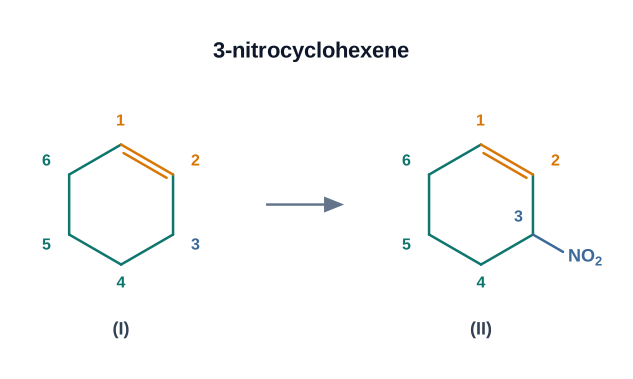
[Caption:] Fig. 8.26 – Deriving the structure of 3-nitrocyclohexene. [/Caption:]
(iv) ‘1-ol’ means that a \(-\mathrm{OH}\) group is present at C-1. OH is suffixed functional group and gets preference over C=C bond. Thus the structure is as shown in (II).
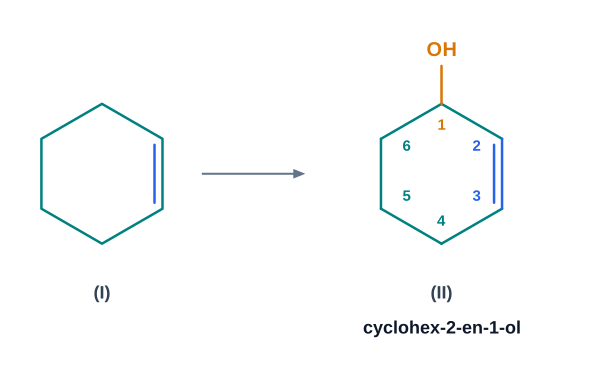
[Caption:] Fig. 8.27 – Deriving the structure of cyclohex-2-en-1-ol. [/Caption:]
(v) ‘heptanal’ indicates the compound to be an aldehyde containing 7 carbon atoms in the parent chain. The ‘6-hydroxy’ indicates that \(-\mathrm{OH}\) group is present at carbon 6. Thus, the structural formula of the compound is: \(\mathrm{CH_3CH(OH)CH_2CH_2CH_2CH_2CHO}\). Carbon atom of \(-\mathrm{CHO}\) group is included while numbering the carbon chain.
8.5.4 Nomenclature of Substituted Benzene Compounds
For IUPAC nomenclature of substituted benzene compounds, the substituent is placed as a prefix to the word benzene. However, common names (written in brackets below) of many substituted benzene compounds are also universally used.
Thus we have methylbenzene (toluene), methoxybenzene (anisole), aminobenzene (aniline), nitrobenzene, and bromobenzene.
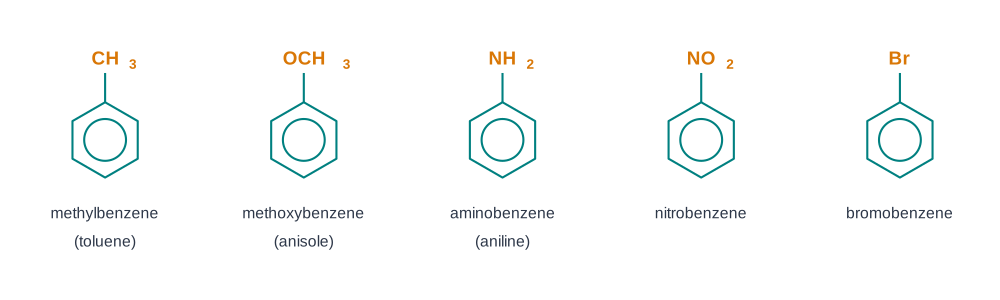
Fig. 8.28 – Monosubstituted benzene compounds.
Disubstituted Benzenes
If the benzene ring is disubstituted, the position of substituents is defined by numbering the carbon atoms of the ring such that the substituents are located at the lowest numbers possible. For example, the compound (b) below is named as 1,3-dibromobenzene and not as 1,5-dibromobenzene.
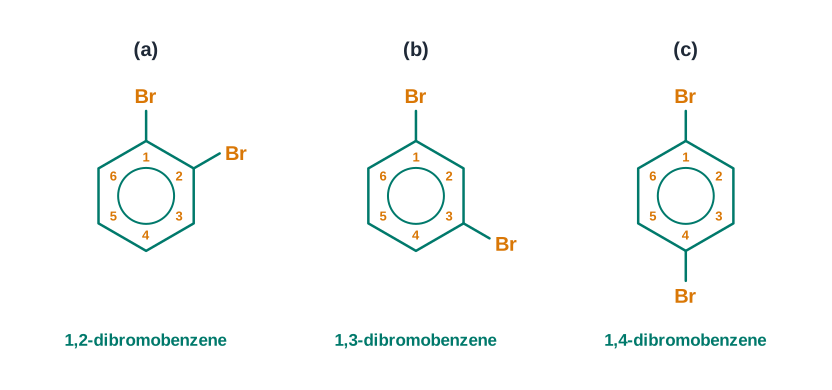
Fig. 8.29 – Isomers of dibromobenzene.
In the trivial system of nomenclature, the terms ortho (o), meta (m) and para (p) are used as prefixes to indicate the relative positions 1,2; 1,3 and 1,4 respectively.
Thus, 1,3-dibromobenzene (b) is named as m-dibromobenzene (meta is abbreviated as m-) and the other isomers of dibromobenzene, 1,2-(a) and 1,4-(c), are named as ortho (or just o-) and para (or just p-)-dibromobenzene, respectively.
Tri- and Higher Substituted Benzenes
For tri- or higher substituted benzene derivatives, these o/m/p prefixes cannot be used, and the compounds are named by identifying substituent positions on the ring by following the lowest locant rule.
In some cases, the common name of a benzene derivative is taken as the base compound. Then the substituent of the base compound is assigned number 1, and the direction of numbering is chosen such that the next substituent gets the lowest number. The substituents appear in the name in alphabetical order. Some examples:
- 1-Chloro-2,4-dinitrobenzene (not 4-chloro-1,3-dinitrobenzene)
- 2-Chloro-1-methyl-4-nitrobenzene (not 4-methyl-5-chloro-nitrobenzene)
- 2-Chloro-4-methylanisole — here anisole is the base compound, so the OMe carbon is C-1
- 4-Ethyl-2-methylaniline — here aniline is the base compound, so the \(\mathrm{NH_2}\) carbon is C-1
- 3,4-Dimethylphenol — here phenol is the base compound, so the OH carbon is C-1
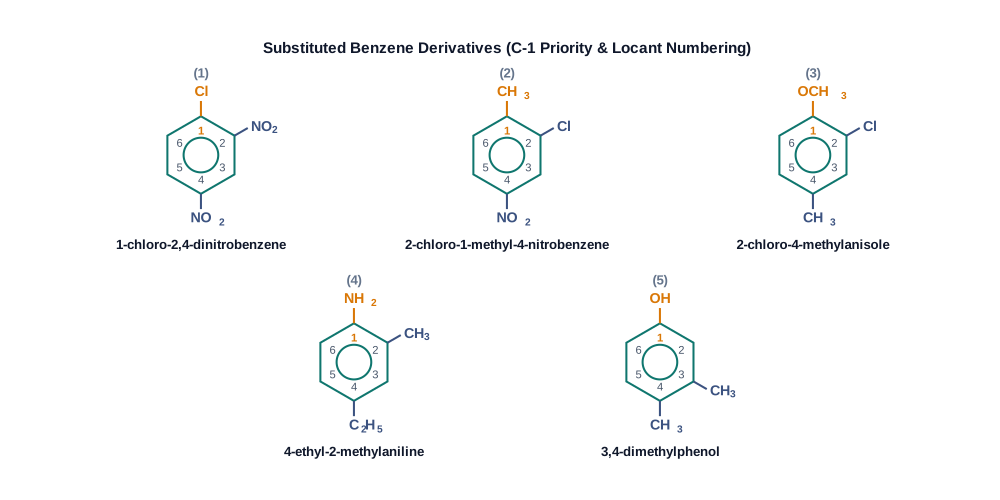
Fig. 8.30 – Higher substituted benzene compounds.
Benzene as a Substituent
When a benzene ring is attached to an alkane with a functional group, it is considered as a substituent, instead of as a parent. The name for benzene as substituent is phenyl (\(\mathrm{C_6H_5}-\), also abbreviated as Ph).
(NCERT-origin, values preserved exactly)
Write the structural formula of:
(a) o-Ethylanisole, (b) p-Nitroaniline, (c) 2,3-Dibromo-1-phenylpentane, (d) 4-Ethyl-1-fluoro-2-nitrobenzene.
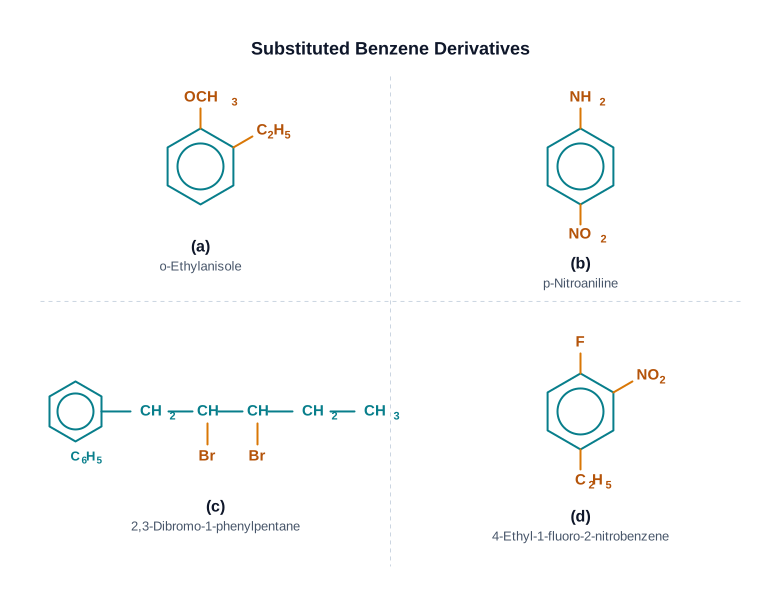
[Caption:] Fig. 8.31 – Derived structures of substituted benzenes. [/Caption:]
8.6 Isomerism
It is a striking fact of organic chemistry that a molecular formula does not, by itself, identify a compound. The phenomenon of existence of two or more compounds possessing the same molecular formula but different properties is known as isomerism. Such compounds are called isomers.
The reason this can happen is straightforward once you recall the last two sections: the same set of atoms can be linked together in more than one way, or can be arranged differently in space. The different types of isomerism are set out in Fig. 8.32.
Flowchart
Fig. 8.32 – Types of isomerism: Isomerism → branches into (A) Structural isomerism and (B) Stereoisomerism. Structural isomerism branches into → Chain isomerism, → Position isomerism, → Functional group isomerism, → Metamerism. Stereoisomerism branches into → Geometrical isomerism, → Optical isomerism.
8.6.1 Structural Isomerism
Compounds having the same molecular formula but different structures (that is, different manners in which the atoms are linked) are classified as structural isomers. Here the very connectivity of the atoms differs — which atom is bonded to which.
Some typical examples of different types of structural isomerism are given below.
(i) Chain Isomerism
When two or more compounds have similar molecular formula but different carbon skeletons, these are referred to as chain isomers and the phenomenon is termed chain isomerism.
For example, the molecular formula \(\mathrm{C_5H_{12}}\) represents three compounds:
- \(\mathrm{CH_3CH_2CH_2CH_2CH_3}\) — Pentane (a straight chain)
- \(\mathrm{CH_3{-}CH(CH_3){-}CH_2CH_3}\) — Isopentane (2-Methylbutane)
- \(\mathrm{CH_3{-}C(CH_3)_2{-}CH_3}\) — Neopentane (2,2-Dimethylpropane)
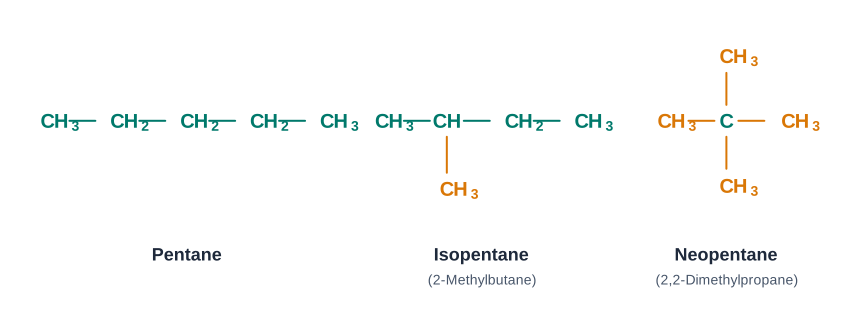
Fig. 8.33 – Chain isomers of C₅H₁₂.
(ii) Position Isomerism
When two or more compounds differ in the position of a substituent atom or functional group on the same carbon skeleton, they are called position isomers and this phenomenon is termed position isomerism.
For example, the molecular formula \(\mathrm{C_3H_8O}\) represents two alcohols:
- \(\mathrm{CH_3CH_2CH_2OH}\) — Propan-1-ol
- \(\mathrm{CH_3{-}CH(OH){-}CH_3}\) — Propan-2-ol
Both have a three-carbon chain and one \(-\mathrm{OH}\) group; only the position of the \(-\mathrm{OH}\) differs.
(iii) Functional Group Isomerism
Two or more compounds having the same molecular formula but different functional groups are called functional isomers, and this phenomenon is termed functional group isomerism.
For example, the molecular formula \(\mathrm{C_3H_6O}\) represents an aldehyde and a ketone:
- \(\mathrm{CH_3{-}CO{-}CH_3}\) — Propanone (a ketone)
- \(\mathrm{CH_3{-}CH_2{-}CHO}\) — Propanal (an aldehyde)
Because the functional group itself is different, these two isomers belong to entirely different chemical families and undergo quite different reactions — even though a chemist weighing them would find the same molar mass.
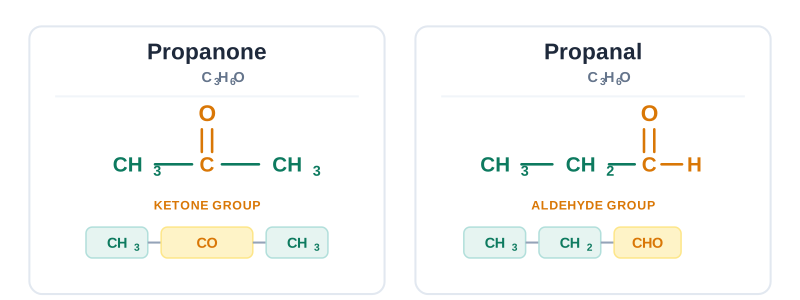
Fig. 8.34 – Functional group isomers of C₃H₆O.
(iv) Metamerism
Metamerism arises due to different alkyl chains on either side of the functional group in the molecule.
For example, \(\mathrm{C_4H_{10}O}\) represents methoxypropane (\(\mathrm{CH_3OC_3H_7}\)) and ethoxyethane (\(\mathrm{C_2H_5OC_2H_5}\)). In both, the functional group is the same — an ether oxygen — but the way the four carbons are distributed on the two sides of that oxygen is different: 1 and 3 in the first case, 2 and 2 in the second.
8.6.2 Stereoisomerism
There is a second, subtler way in which two molecules can differ. The compounds that have the same constitution and sequence of covalent bonds but differ in the relative positions of their atoms or groups in space are called stereoisomers.
Notice the crucial distinction from structural isomerism: in stereoisomers, the connectivity is identical. Every atom is bonded to exactly the same neighbours. What differs is only how those atoms are oriented in three-dimensional space — which is why the wedge-and-dash conventions you met earlier matter so much here.
This special type of isomerism is called stereoisomerism, and it can be classified as geometrical and optical isomerism. Recall from Section 8.2.2 that rotation about a C=C double bond is restricted; this restriction is exactly what makes geometrical isomerism possible, since the groups on either side of the double bond are locked into fixed relative positions.
8.7 Fundamental Concepts in Organic Reaction Mechanism
In an organic reaction, the organic molecule (also referred to as a substrate) reacts with an appropriate attacking reagent and leads to the formation of one or more intermediates and finally products.
The general reaction can be depicted as follows.
Flowchart
Fig. 8.35 – General course of an organic reaction: Organic molecule (Substrate) → [attacking Reagent] → [Intermediate] → Product(s); a second branch from [Intermediate] → Byproducts.
Substrate and Reagent: Which is Which?
The substrate is that reactant which supplies carbon to the new bond, and the other reactant is called the reagent. If both the reactants supply carbon to the new bond, then the choice is arbitrary, and in that case the molecule on which attention is focused is called the substrate.
In such a reaction, a covalent bond between two carbon atoms, or between a carbon and some other atom, is broken and a new bond is formed. Chemists want to know exactly how this happens — not merely what goes in and what comes out.
A sequential account of each step, describing details of electron movement, energetics during bond cleavage and bond formation, and the rates of transformation of reactants into products (kinetics) is referred to as reaction mechanism.
The knowledge of reaction mechanism helps in understanding the reactivity of organic compounds and in planning strategy for their synthesis. In the following subsections we shall learn some of the principles that explain how these reactions take place.
8.7.1 Fission of a Covalent Bond
Every organic reaction begins with a bond breaking. A covalent bond can get cleaved in either of two ways: (i) heterolytic cleavage, or (ii) homolytic cleavage. The difference lies entirely in what happens to the shared pair of electrons.
Heterolytic Cleavage
In heterolytic cleavage, the bond breaks in such a fashion that the shared pair of electrons remains with one of the fragments. The two electrons travel together, to one side only.
After heterolysis, one atom has a sextet electronic structure (only six valence electrons) and a positive charge, and the other has a valence octet with at least one lone pair and a negative charge.
Thus, heterolytic cleavage of bromomethane will give \(\overset{+}{\mathrm{C}}\mathrm{H_3}\) and \(\mathrm{Br^-}\), as shown below:
\[\mathrm{H_3C{-}Br} \longrightarrow \mathrm{H_3\overset{+}{C}} + \mathrm{Br^-}\]
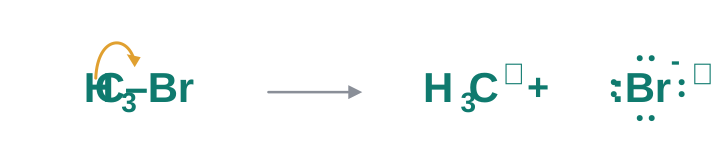
Fig. 8.36 – Heterolysis of bromomethane.
Carbocations
A species having a carbon atom possessing a sextet of electrons and a positive charge is called a carbocation (earlier called carbonium ion). The \(\overset{+}{\mathrm{C}}\mathrm{H_3}\) ion is known as a methyl cation or methyl carbonium ion.
Carbocations are classified as primary, secondary or tertiary depending on whether one, two, or three carbons are directly attached to the positively charged carbon. Some other examples of carbocations are:
- \(\mathrm{CH_3\overset{+}{C}H_2}\) — ethyl cation, a primary carbocation
- \(\mathrm{(CH_3)_2\overset{+}{C}H}\) — isopropyl cation, a secondary carbocation
- \(\mathrm{(CH_3)_3\overset{+}{C}}\) — tert-butyl cation, a tertiary carbocation
Carbocations are highly unstable and reactive species — unsurprising, since a carbon with only six electrons is desperate to complete its octet.
Alkyl groups directly attached to the positively charged carbon stabilise the carbocations, due to inductive and hyperconjugation effects, which you will be studying in Sections 8.7.5 and 8.7.9. More alkyl groups therefore mean more stability. The observed order of carbocation stability is:
\[\overset{+}{\mathrm{C}}\mathrm{H_3} < \mathrm{CH_3\overset{+}{C}H_2} < \mathrm{(CH_3)_2\overset{+}{C}H} < \mathrm{(CH_3)_3\overset{+}{C}}\]
The Shape of a Carbocation
These carbocations have a trigonal planar shape, with the positively charged carbon being \(sp^2\) hybridised. Thus, the shape of \(\overset{+}{\mathrm{C}}\mathrm{H_3}\) may be considered as being derived from the overlap of three equivalent \(\mathrm{C}(sp^2)\) hybridised orbitals with the \(1s\) orbital of each of the three hydrogen atoms. Each bond may be represented as a \(\mathrm{C}(sp^2)\)–\(\mathrm{H}(1s)\) sigma bond.
The remaining carbon orbital — the unhybridised \(p\) orbital — is perpendicular to the molecular plane and contains no electrons. This empty \(p\) orbital is exactly where a nucleophile will later attack, and it is drawn in Fig. 8.37.
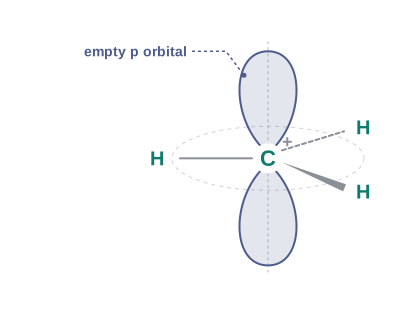
Fig. 8.37 – Shape of the methyl carbocation.
Carbanions
The heterolytic cleavage can also give a species in which carbon gets the shared pair of electrons. For example, when a group Z attached to the carbon leaves without the electron pair, the methyl anion \(\left(\mathrm{H_3C{:}}^-\right)\) is formed:
\[\mathrm{CH_3{-}Z} \longrightarrow \mathrm{H_3C{:}^-} + \mathrm{Z^+}\]
Such a carbon species carrying a negative charge on the carbon atom is called a carbanion.
Carbon in a carbanion is generally \(sp^3\) hybridised, and its structure is a distorted tetrahedron, as shown in Fig. 8.38 — the lone pair occupies one of the four tetrahedral positions, and because a lone pair spreads out more than a bonding pair, it pushes the three bonds slightly closer together.
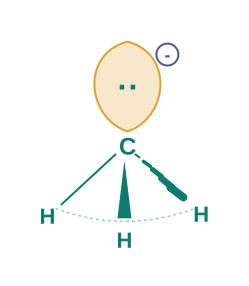
Fig. 8.38 – Shape of the methyl carbanion.
Carbanions are also unstable and reactive species. The organic reactions which proceed through heterolytic bond cleavage are called ionic or heteropolar, or just polar reactions.
Homolytic Cleavage
In homolytic cleavage, one of the electrons of the shared pair in a covalent bond goes with each of the bonded atoms. The electrons split up, one to each side.
Thus, in homolytic cleavage, the movement of a single electron takes place instead of an electron pair. The single electron movement is shown by a ‘half-headed’ (fish hook) curved arrow, as distinct from the full-headed arrow used for an electron pair.
Such cleavage results in the formation of neutral species (atom or group) which contain an unpaired electron. These species are called free radicals. Like carbocations and carbanions, free radicals are also very reactive. A homolytic cleavage can be shown as:
\[\mathrm{R{-}X} \xrightarrow{\ \text{Heat or Light}\ } \mathrm{\dot{R}} + \mathrm{\dot{X}}\]
Here \(\mathrm{\dot{R}}\) is an alkyl free radical, carrying one unpaired electron and no charge.
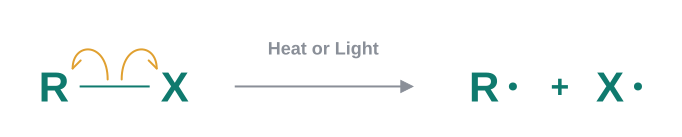
Fig. 8.39 – Homolysis of a covalent bond.
Alkyl radicals are classified as primary, secondary, or tertiary. Alkyl radical stability increases as we proceed from primary to tertiary:
\[\mathrm{\dot{C}H_3} < \mathrm{\dot{C}H_2CH_3} < \mathrm{\dot{C}H(CH_3)_2} < \mathrm{\dot{C}(CH_3)_3}\]
(methyl free radical < ethyl free radical < isopropyl free radical < tert-butyl free radical)
Organic reactions which proceed by homolytic fission are called free radical or homopolar or nonpolar reactions.
8.7.2 Substrate and Reagent
Ions are generally not formed in the reactions of organic compounds. Molecules as such participate in the reaction. It is therefore convenient to name one reagent as substrate and the other as reagent.
In general, a molecule whose carbon is involved in new bond formation is called the substrate, and the other one is called the reagent. When a carbon–carbon bond is formed, the choice of naming the reactants as substrate and reagent is arbitrary and depends on the molecule under observation. For example:
(i) \[\mathrm{CH_2{=}CH_2} + \mathrm{Br_2} \longrightarrow \mathrm{BrCH_2{-}CH_2Br}\] Here ethene is the substrate, bromine is the reagent, and 1,2-dibromoethane is the product.
(ii) Benzene reacts with \(\mathrm{CH_3Cl}\) to give toluene and \(\mathrm{HCl}\); here benzene is the substrate and \(\mathrm{CH_3Cl}\) the reagent.
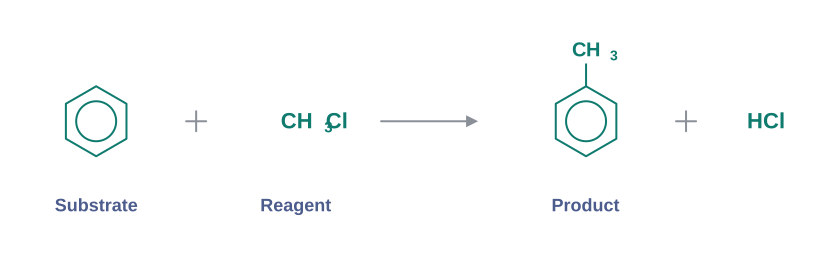
Fig. 8.40 – Substrate and reagent in a substitution reaction.
Nucleophiles and Electrophiles
Reagents attack the reactive site of the substrate. The reactive site may be an electron-deficient portion of the molecule (a positive reactive site) — for example, an atom with an incomplete electron shell, or the positive end of a dipole in the molecule. If the attacking species is electron rich, it attacks these sites.
If the attacking species is electron deficient, the reactive site for it is that part of the substrate molecule which can supply electrons — for example, the \(\pi\) electrons in a double bond (recall from Section 8.2.2 that these are loosely held above and below the molecular plane).
This gives us two complementary kinds of reagent:
A reagent that brings an electron pair to the reactive site is called a nucleophile (Nu:), i.e., nucleus seeking, and the reaction is then called nucleophilic.
A reagent that takes away an electron pair from the reactive site is called an electrophile (\(\mathrm{E^+}\)), i.e., electron seeking, and the reaction is called electrophilic.
How Nucleophiles and Electrophiles Pair Up
During a polar organic reaction, a nucleophile attacks an electrophilic centre of the substrate — that specific atom or part of the substrate which is electron deficient.
Similarly, the electrophiles attack at a nucleophilic centre, which is the electron-rich centre of the substrate. Thus, the electrophiles receive an electron pair from the substrate when the two undergo bonding interaction. A curved-arrow notation is used to show the movement of an electron pair from the nucleophile to the electrophile.
Some examples of nucleophiles are the negatively charged ions with a lone pair of electrons, such as hydroxide (\(\mathrm{HO^-}\)) and cyanide (\(\mathrm{NC^-}\)) ions, and carbanions (\(\mathrm{R_3C^-}\)). Neutral molecules such as \(\mathrm{H_2\ddot{O}{:}}\), \(\mathrm{R_3N{:}}\), \(\mathrm{R_2\ddot{N}H}\) etc. can also act as nucleophiles due to the presence of a lone pair of electrons.
Examples of electrophiles include carbocations (\(\overset{+}{\mathrm{C}}\mathrm{H_3}\)) and neutral molecules having functional groups like the carbonyl group (\(\mathrm{>C{=}O}\)) or alkyl halides (\(\mathrm{R_3C{-}X}\), where X is a halogen atom).
The carbon atom in carbocations has a sextet configuration; hence it is electron deficient and can receive a pair of electrons from the nucleophiles.
In neutral molecules such as alkyl halides, due to the polarity of the C–X bond, a partial positive charge is generated on the carbon atom, and hence the carbon atom becomes an electrophilic centre at which a nucleophile can attack.
(NCERT-origin, values preserved exactly)
Using curved-arrow notation, show the formation of reactive intermediates when the following covalent bonds undergo heterolytic cleavage.
(a) \(\mathrm{CH_3{-}SCH_3}\), (b) \(\mathrm{CH_3{-}CN}\), (c) \(\mathrm{CH_3{-}Cu}\)
In each case the electron pair goes to the more electronegative partner. In (a) and (b), sulphur and the cyano group are more electronegative than carbon, so carbon is left positive. In (c), copper is a metal and less electronegative than carbon, so carbon keeps the pair and becomes negative.
\(\mathrm{CH_3{-}SCH_3} \longrightarrow \mathrm{\overset{+}{C}H_3} + \mathrm{{}^-SCH_3}\)
\(\mathrm{CH_3{-}CN} \longrightarrow \mathrm{\overset{+}{C}H_3} + \mathrm{{}^-CN}\)
\(\mathrm{CH_3{-}Cu} \longrightarrow \mathrm{{}^-CH_3} + \mathrm{\overset{+}{C}u}\)
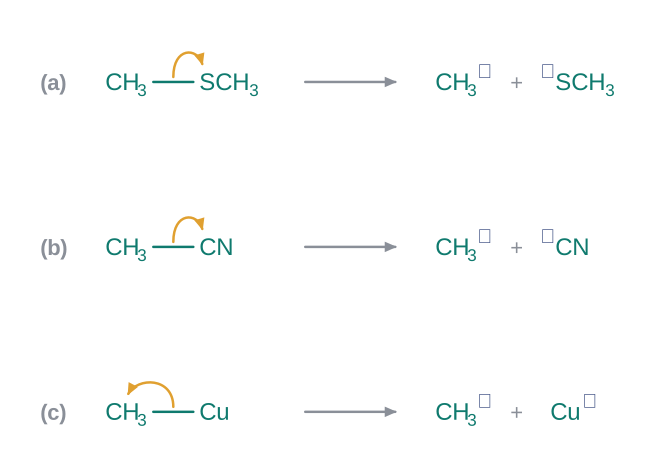
[Caption:] Fig. 8.41 – Examples of heterolytic bond cleavage. [/Caption:]
8.7.3 Electron Movement in Organic Reactions
The movement of electrons in organic reactions can be shown by curved-arrow notation. It shows how changes in bonding occur due to electronic redistribution during the reaction.
The rule for drawing the arrow is simple and worth fixing firmly in mind: to show the change in position of a pair of electrons, the curved arrow starts from the point from where an electron pair is shifted, and it ends at the location to which the pair of electrons may move. The arrow tracks electrons, never atoms.
The three common patterns of electron-pair shift are:
- From a \(\pi\) bond to an adjacent bond position
- From a \(\pi\) bond to an adjacent atom
- From an atom to an adjacent bond position
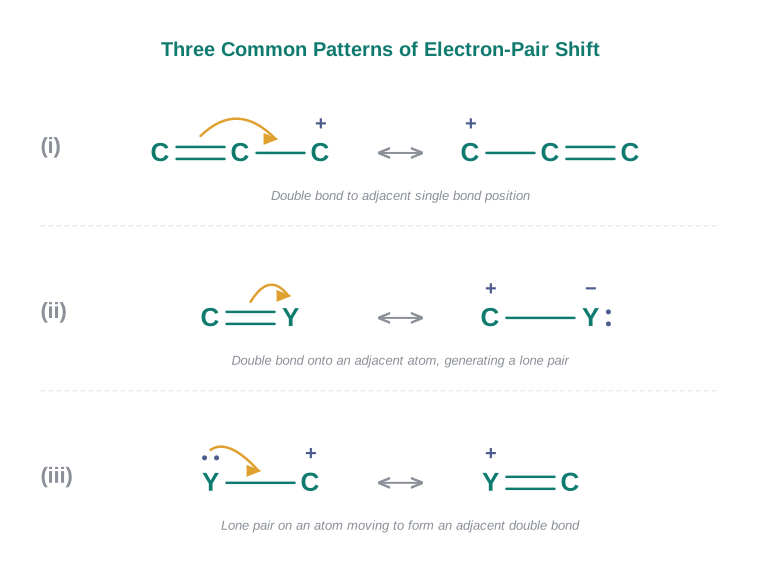
Fig. 8.42 – Common patterns of electron-pair shift.
Movement of a single electron is indicated by a single-barbed ‘fish hook’ (i.e., half-headed curved arrow).
For example, in the transfer of the hydroxide ion giving ethanol, and in the dissociation of chloromethane, the movement of electrons using curved arrows can be depicted as follows:
\[\mathrm{HO^-} + \mathrm{CH_3{-}Br} \longrightarrow \mathrm{CH_3OH} + \mathrm{{:}\ddot{B}r{:}^-}\]
\[\mathrm{CH_3{-}Cl} \longrightarrow \mathrm{\dot{C}H_3} + \mathrm{\dot{C}l}\]
The first is a heterolytic, nucleophilic process (full-headed arrows); the second is a homolytic one (fish-hook arrows).
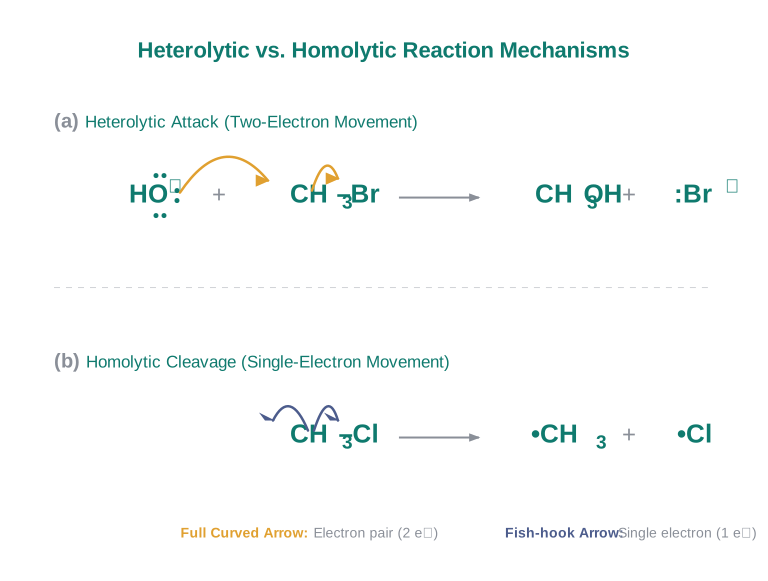
Fig. 8.43 – Electron movement in polar and nonpolar reactions.
8.7.4 Electron Displacement Effects in Covalent Bonds
The electron displacement in an organic molecule may take place in either of two circumstances: in the ground state under the influence of an atom or a substituent group, or in the presence of an appropriate attacking reagent.
The electron displacements due to the influence of an atom or a substituent group present in the molecule cause permanent polarisation of the bond. The inductive effect and resonance effects are examples of this type of electron displacement — they are built into the molecule and are always there.
Temporary electron displacement effects are seen in a molecule only when a reagent approaches to attack it. This type of electron displacement is called the electromeric effect or polarisability effect; it lasts only as long as the attacking reagent is present.
In the following subsections we will learn about these types of electronic displacements.
8.7.5 Inductive Effect
When a covalent bond is formed between atoms of different electronegativity, the electron density is more towards the more electronegative atom of the bond. Such a shift of electron density results in a polar covalent bond. Bond polarity leads to various electronic effects in organic compounds.
Let us consider chloroethane (\(\mathrm{CH_3CH_2Cl}\)), in which the C–Cl bond is a polar covalent bond. It is polarised in such a way that carbon-1 gains some positive charge (\(\delta^+\)) and the chlorine some negative charge (\(\delta^-\)).
The fractional electronic charges on the two atoms in a polar covalent bond are denoted by the symbol \(\delta\) (delta), and the shift of electron density is shown by an arrow that points from the \(\delta^+\) to the \(\delta^-\) end of the polar bond.
\[\overset{\delta\delta^+}{\mathrm{CH_3}} \longrightarrow \overset{\delta^+}{\mathrm{CH_2}} \longrightarrow \overset{\delta^-}{\mathrm{Cl}}\] (with carbon-2 and carbon-1 numbered as shown)
How the Effect Travels Down a Chain
In turn, carbon-1, which has developed a partial positive charge (\(\delta^+\)), draws some electron density towards it from the adjacent C–C bond. Consequently, some positive charge (\(\delta\delta^+\)) develops on carbon-2 also, where \(\delta\delta^+\) symbolises a relatively smaller positive charge as compared to that on carbon-1.
In other words, the polar C–Cl bond induces polarity in the adjacent bonds. Such polarisation of a \(\sigma\)-bond caused by the polarisation of an adjacent \(\sigma\)-bond is referred to as the inductive effect.
This effect is passed on to the subsequent bonds also, but the effect decreases rapidly as the number of intervening bonds increases, and becomes vanishingly small after three bonds. This is a point worth remembering for exams — the inductive effect is a short-range influence.
Electron-withdrawing and Electron-donating Groups
The inductive effect is related to the ability of substituent(s) to either withdraw or donate electron density to the attached carbon atom. Based on this ability, the substituents can be classified as electron-withdrawing or electron-donating groups, relative to hydrogen.
Halogens and many other groups such as nitro (\(-\mathrm{NO_2}\)), cyano (\(-\mathrm{CN}\)), carboxy (\(-\mathrm{COOH}\)), ester (\(\mathrm{COOR}\)), aryloxy (\(-\mathrm{OAr}\), e.g. \(-\mathrm{OC_6H_5}\)), etc., are electron-withdrawing groups.
On the other hand, the alkyl groups like methyl (\(-\mathrm{CH_3}\)) and ethyl (\(-\mathrm{CH_2{-}CH_3}\)) are usually considered as electron-donating groups.
8.7.6 Resonance Structure
There are many organic molecules whose behaviour cannot be explained by a single Lewis structure. The classic example is that of benzene.
Its cyclic structure containing alternating C–C single and C=C double bonds is inadequate for explaining its characteristic properties. Here is the difficulty: as per the above representation, benzene should exhibit two different bond lengths, due to C–C single and C=C double bonds.
However, as determined experimentally, benzene has a uniform C–C bond distance of 139 pm, a value intermediate between the C–C single (154 pm) and C=C double (134 pm) bonds. All six bonds are identical, which no single alternating-bond drawing can express.
Thus, the structure of benzene cannot be represented adequately by the above structure. Further, benzene can be represented equally well by the energetically identical structures I and II — the two ways of placing the alternating double bonds around the ring.
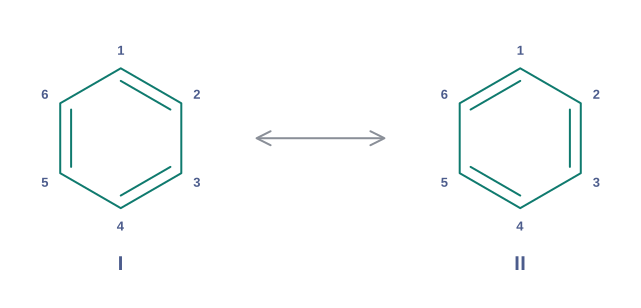
Fig. 8.44 – Resonance structures of benzene.
The Resonance Hybrid
Therefore, according to the resonance theory (Chapter 4), the actual structure of benzene cannot be adequately represented by any of these structures; rather it is a hybrid of the two structures (I and II), called resonance structures.
The resonance structures (canonical structures or contributing structures) are hypothetical and individually do not represent any real molecule. They contribute to the actual structure in proportion to their stability. It is important not to picture the molecule as flickering between the two forms — it is, at all times, a single blended structure.
A Second Example: Nitromethane
Another example of resonance is provided by nitromethane (\(\mathrm{CH_3NO_2}\)), which can be represented by two Lewis structures, (I) and (II). There are two types of N–O bonds in these structures — one single, one double.
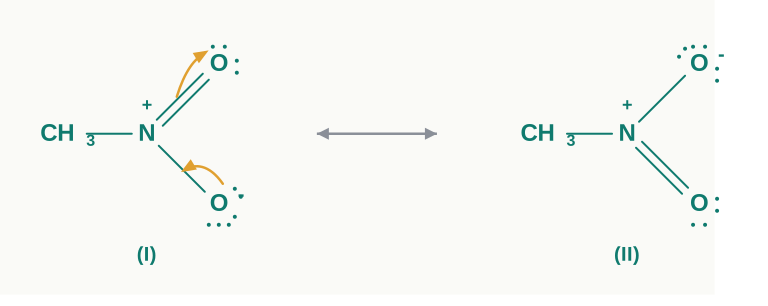
Fig. 8.45 – Resonance structures of nitromethane.
However, it is known that the two N–O bonds of nitromethane are of the same length (intermediate between an N–O single bond and an N=O double bond). The actual structure of nitromethane is therefore a resonance hybrid of the two canonical forms I and II.
Resonance Energy
The energy of the actual structure of the molecule (the resonance hybrid) is lower than that of any of the canonical structures. In other words, resonance stabilises a molecule.
The difference in energy between the actual structure and the lowest energy resonance structure is called the resonance stabilisation energy or simply the resonance energy.
The more the number of important contributing structures, the more is the resonance energy. Resonance is particularly important when the contributing structures are equivalent in energy — as in benzene, where structures I and II are identical in energy and therefore contribute equally.
Rules for Writing Resonance Structures
The following rules are applied while writing resonance structures.
The resonance structures have (i) the same positions of nuclei and (ii) the same number of unpaired electrons. That is, only electrons move between canonical structures — never atoms.
Among the resonance structures, the one which is more stable than others is the one which has:
- more number of covalent bonds,
- all the atoms with an octet of electrons (except hydrogen, which has a duplet),
- less separation of opposite charges,
- a negative charge (if any) on the more electronegative atom, and a positive charge (if any) on the more electropositive atom, and
- more dispersal of charge.
(NCERT-origin, values preserved exactly)
Write resonance structures of \(\mathrm{CH_3COO^-}\) and show the movement of electrons by curved arrows.
First, write the structure and put unshared pairs of valence electrons on appropriate atoms. Then draw the arrows one at a time, moving the electrons to get the other structures.
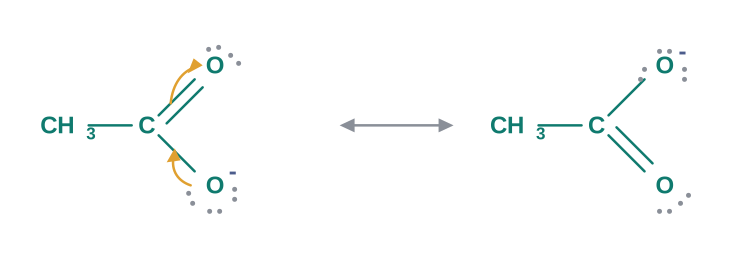
[Caption:] Fig. 8.46 – Resonance structures of the acetate ion. [/Caption:]
(NCERT-origin, values preserved exactly)
Write resonance structures of \(\mathrm{CH_2{=}CH{-}CHO}\). Indicate relative stability of the contributing structures.
Structure I: \(\mathrm{CH_2{=}CH{-}CH{=}O}\) (all neutral)
Structure II: \(\mathrm{\overset{+}{C}H_2{-}CH{=}CH{-}\ddot{O}^-}\)
Structure III: \(\mathrm{{}^-\overset{..}{C}H_2{-}CH{=}CH{-}\overset{+}{O}}\)
Stability: I > II > III
[I: Most stable, more number of covalent bonds, each carbon and oxygen atom has an octet and no separation of opposite charge; II: negative charge on more electronegative atom and positive charge on more electropositive atom; III: does not contribute as oxygen has positive charge and carbon has negative charge, hence least stable.]
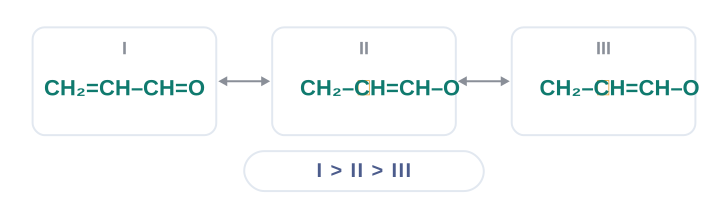
[Caption:] Fig. 8.47 – Resonance structures of CH₂=CH–CHO. [/Caption:]
(NCERT-origin, values preserved exactly)
Explain why the following two structures, I and II, cannot be the major contributors to the real structure of \(\mathrm{CH_3COOCH_3}\).
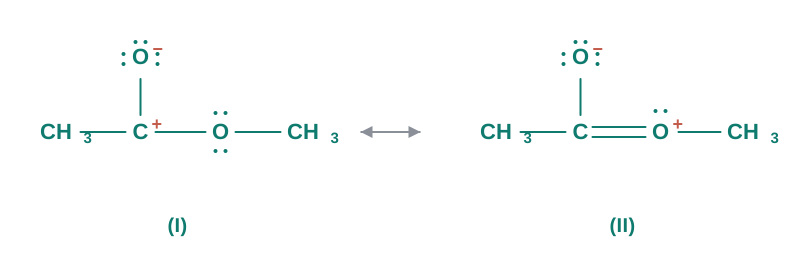
[Caption:] Fig. 8.48 – Rejected resonance structures of methyl acetate. [/Caption:]
The two structures are less important contributors as they involve charge separation. Additionally, structure I contains a carbon atom with an incomplete octet.
8.7.7 Resonance Effect
The resonance effect is defined as ‘the polarity produced in the molecule by the interaction of two \(\pi\)-bonds, or between a \(\pi\)-bond and a lone pair of electrons present on an adjacent atom’. The effect is transmitted through the chain.
There are two types of resonance or mesomeric effect, designated as R or M effect.
(i) Positive Resonance Effect (+R effect)
In this effect, the transfer of electrons is away from an atom or substituent group attached to the conjugated system. This electron displacement makes certain positions in the molecule of high electron density.
This effect in aniline is shown by the delocalisation of the nitrogen lone pair into the ring, which builds up negative charge at the ortho and para positions.
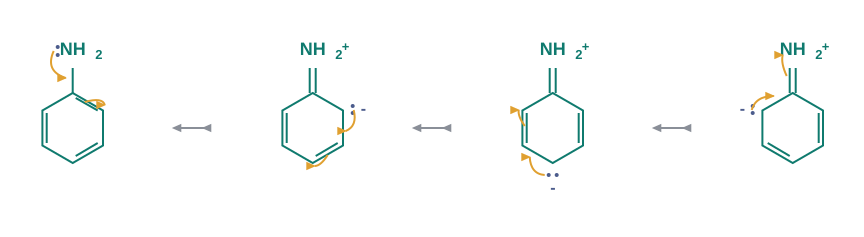
Fig. 8.49 – Resonance structures of aniline.
(ii) Negative Resonance Effect (–R effect)
This effect is observed when the transfer of electrons is towards the atom or substituent group attached to the conjugated system. The attached group pulls electron density out of the ring.
For example, in nitrobenzene this electron displacement can be depicted by drawing the ring electrons flowing towards the nitro group, leaving positive charge at the ortho and para positions.
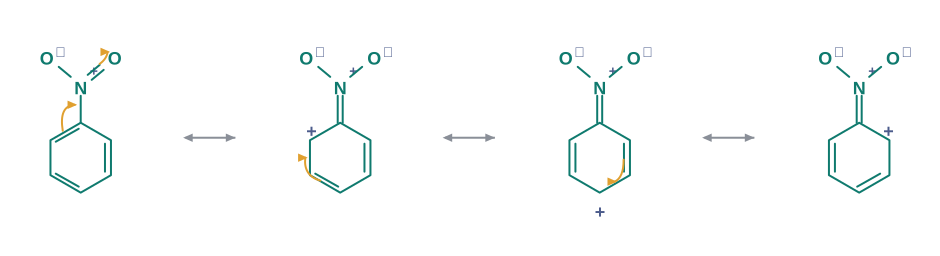
Fig. 8.50 – Resonance structures of nitrobenzene.
Which Groups Show Which Effect
The atoms or substituent groups which represent +R or –R electron displacement effects are as follows:
+R effect: – halogen, \(-\mathrm{OH}\), \(-\mathrm{OR}\), \(-\mathrm{OCOR}\), \(-\mathrm{NH_2}\), \(-\mathrm{NHR}\), \(-\mathrm{NR_2}\), \(-\mathrm{NHCOR}\)
–R effect: \(-\mathrm{COOH}\), \(-\mathrm{CHO}\), \(\mathrm{>C{=}O}\), \(-\mathrm{CN}\), \(-\mathrm{NO_2}\)
Conjugated Systems
The presence of alternate single and double bonds in an open chain or cyclic system is termed as a conjugated system. These systems often show abnormal behaviour. The examples are 1,3-butadiene, aniline, and nitrobenzene etc. In such systems, the \(\pi\)-electrons are delocalised and the system develops polarity.
8.7.8 Electromeric Effect (E effect)
Unlike the inductive and resonance effects, the electromeric effect is a temporary effect. The organic compounds having a multiple bond (a double or triple bond) show this effect in the presence of an attacking reagent only.
It is defined as the complete transfer of a shared pair of \(\pi\)-electrons to one of the atoms joined by a multiple bond, on the demand of an attacking reagent. Note the word “complete” — unlike the inductive effect, which is a partial shift, here the whole pair moves across.
The effect is annulled as soon as the attacking reagent is removed from the domain of the reaction. It is represented by E, and the shifting of the electrons is shown by a curved arrow. There are two distinct types of electromeric effect.
(i) Positive Electromeric Effect (+E effect)
In this effect, the \(\pi\)-electrons of the multiple bond are transferred to that atom to which the reagent gets attached. For example:
\[\mathrm{>C{=}C<} + \mathrm{H^+} \longrightarrow \mathrm{>\overset{+}{C}{-}C<}\ \text{(with H now bonded to the second carbon)}\]
Here the attacking reagent is \(\mathrm{H^+}\), and the \(\pi\) pair shifts to the carbon that takes up the H.
(ii) Negative Electromeric Effect (–E effect)
In this effect, the \(\pi\)-electrons of the multiple bond are transferred to that atom to which the attacking reagent does not get attached. For example:
\[\mathrm{>C{=}C<} + \mathrm{{}^-CN} \longrightarrow \mathrm{>C{-}\overset{-}{C}<}\ \text{(with CN now bonded to the first carbon)}\]
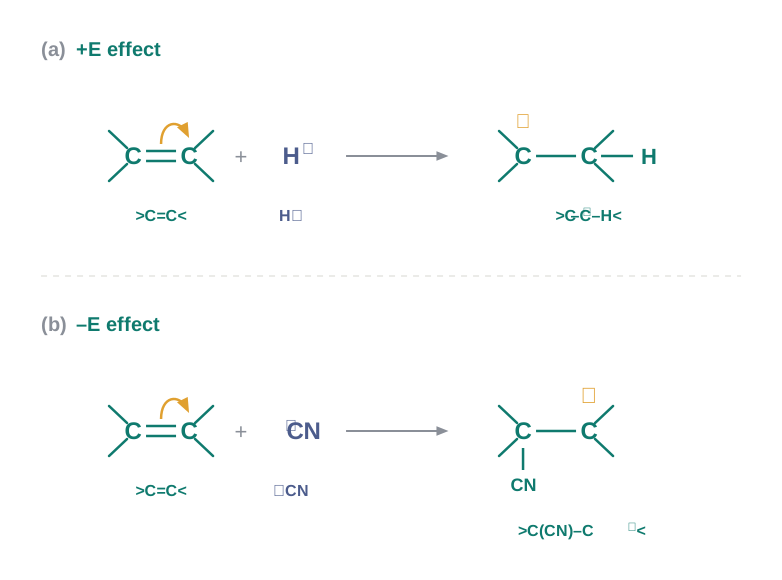
Fig. 8.51 – Positive and negative electromeric effects.
When inductive and electromeric effects operate in opposite directions, the electromeric effect predominates — because it is a complete transfer of an electron pair, whereas the inductive effect is only a partial shift.
8.7.9 Hyperconjugation
Hyperconjugation is a general stabilising interaction. It involves delocalisation of \(\sigma\) electrons of a C—H bond of an alkyl group directly attached to an atom of an unsaturated system, or to an atom with an unshared \(p\) orbital.
The \(\sigma\) electrons of the C—H bond of the alkyl group enter into partial conjugation with the attached unsaturated system or with the unshared \(p\) orbital. Unlike the electromeric effect, hyperconjugation is a permanent effect.
Hyperconjugation in the Ethyl Cation
To understand the hyperconjugation effect, let us take an example of \(\mathrm{CH_3\overset{+}{C}H_2}\) (ethyl cation), in which the positively charged carbon atom has an empty \(p\) orbital — the very orbital we met in Section 8.7.1.
One of the C-H bonds of the methyl group can align in the plane of this empty \(p\) orbital, and the electrons constituting the C-H bond in plane with this \(p\) orbital can then be delocalised into the empty \(p\) orbital, as depicted in Fig. 8.52(a).
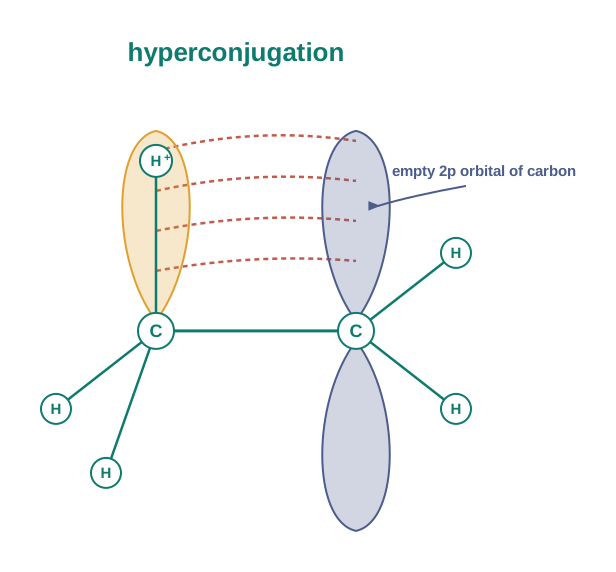
Fig. 8.52(a) – Hyperconjugation in the ethyl cation.
This type of overlap stabilises the carbocation, because electron density from the adjacent \(\sigma\) bond helps in dispersing the positive charge. A charge that is spread out is always more stable than one concentrated on a single atom.
In general, the greater the number of alkyl groups attached to a positively charged carbon atom, the greater is the hyperconjugation interaction and stabilisation of the cation.
Thus, we have the following relative stability of carbocations:
\[\mathrm{(CH_3)_3\overset{+}{C}} > \mathrm{(CH_3)_2\overset{+}{C}H} > \mathrm{CH_3\overset{+}{C}H_2} > \overset{+}{\mathrm{C}}\mathrm{H_3}\]
This is the same order you met in Section 8.7.1; hyperconjugation is one of the two reasons behind it.
Hyperconjugation in Alkenes and Alkylarenes
Hyperconjugation is also possible in alkenes and alkylarenes. Delocalisation of electrons by hyperconjugation in the case of an alkene can be depicted as in Fig. 8.53(b), where the C–H \(\sigma\) bond of the methyl group overlaps with the \(\pi\) system of the double bond.
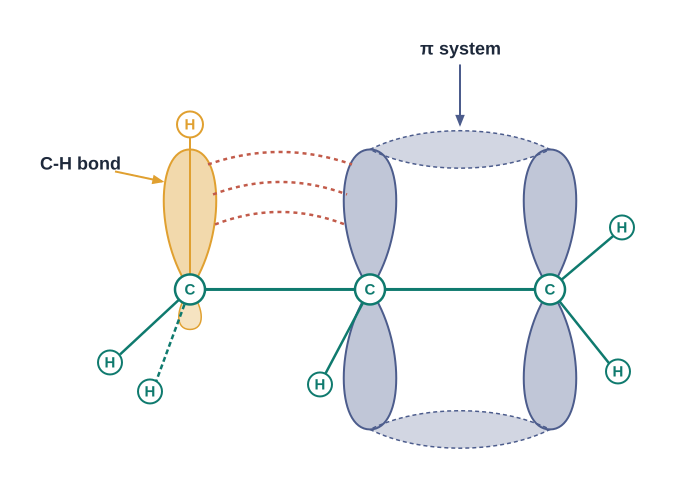
Fig. 8.53(b) – Hyperconjugation in propene.
No-bond Resonance
There are various ways of looking at the hyperconjugative effect. One of the ways is to regard the C—H bond as possessing partial ionic character due to resonance.
In this picture, one writes a series of contributing structures in which the C–H bond is shown as broken, the hydrogen carrying the positive charge and the electron pair having moved into the adjacent system. Because one structure has “no bond” where the C–H bond used to be, the hyperconjugation may also be regarded as no bond resonance.
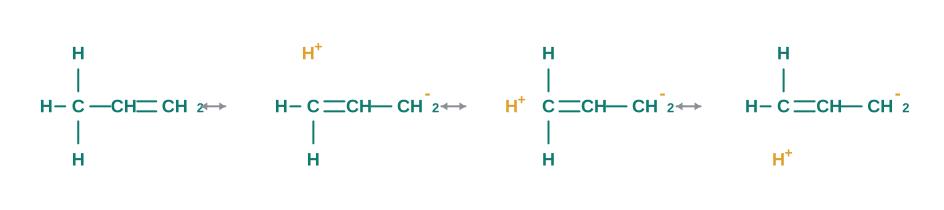
Fig. 8.54 – No-bond resonance structures of propene.
8.7.10 Types of Organic Reactions and Mechanisms
Having seen how bonds break and how electrons shift, we can now name the broad families of organic reactions. Organic reactions can be classified into the following categories:
- Substitution reactions — one atom or group in the substrate is replaced by another.
- Addition reactions — two species add across a multiple bond, which becomes saturated.
- Elimination reactions — atoms or groups are removed from adjacent carbons, creating a multiple bond.
- Rearrangement reactions — the atoms within a molecule are reorganised to give a structural isomer.
You will be studying these reactions in Chapter 9 and later in Class XII.
8.8 Methods of Purification of Organic Compounds
Once an organic compound is extracted from a natural source or synthesised in the laboratory, it is essential to purify it. A compound straight out of a reaction flask is almost never pure — it is mixed with unreacted starting material, by-products, and solvent.
The various methods used for the purification of organic compounds are based on two things: the nature of the compound and the nature of the impurity present in it. There is no single universal method; you choose the technique that exploits a physical difference between the compound and its impurities.
The common techniques used for purification are as follows:
- Sublimation
- Crystallisation
- Distillation
- Differential extraction, and
- Chromatography
Checking Whether the Compound Is Pure
Finally, the purity of a compound is ascertained by determining its melting point or boiling point. Most of the pure compounds have sharp melting points and boiling points — that is, they melt or boil over a very narrow range of temperature. An impure sample, by contrast, melts over a wide range and usually at a lower temperature than the pure substance.
New methods of checking the purity of an organic compound are based on different types of chromatographic and spectroscopic techniques.
8.8.1 Sublimation
You have learnt earlier that on heating, some solid substances change directly from the solid to the vapour state, without passing through the liquid state. This process is called sublimation.
The purification technique based on the above principle is known as sublimation, and it is used to separate sublimable compounds from non-sublimable impurities.
Naphthalene and camphor are familiar sublimable solids; an impurity such as common salt or sand, which will not sublime, is simply left behind.
8.8.2 Crystallisation
This is one of the most commonly used techniques for the purification of solid organic compounds. It is based on the difference in the solubilities of the compound and the impurities in a suitable solvent.
How Crystallisation Works
The impure compound is dissolved in a solvent in which it is sparingly soluble at room temperature but appreciably soluble at higher temperature. This choice of solvent is the heart of the method: it lets you dissolve the compound when hot and force it back out when cold.
The solution is concentrated to get a nearly saturated solution — a solution holding as much solute as it can at that temperature.
On cooling the solution, the pure compound crystallises out and is removed by filtration. The impurities, being present in smaller amounts, stay dissolved. The filtrate — called the mother liquor — contains the impurities and a small quantity of the compound.
Practical Variations
If the compound is highly soluble in one solvent and very little soluble in another solvent, crystallisation can be satisfactorily carried out in a mixture of these solvents.
Impurities which impart colour to the solution are removed by adsorbing them over activated charcoal, whose enormous surface area traps the coloured impurity molecules.
Repeated crystallisation becomes necessary for the purification of compounds containing impurities of comparable solubilities — a single pass would not separate them cleanly.
8.8.3 Distillation
This important method is used to separate (i) volatile liquids from non-volatile impurities, and (ii) liquids having sufficient difference in their boiling points.
Liquids having different boiling points vaporise at different temperatures. The vapours are cooled and the liquids so formed are collected separately.
For example, chloroform (b.p. 334 K) and aniline (b.p. 457 K) are easily separated by the technique of distillation, since their boiling points differ widely. The set-up is drawn in Fig. 8.55.
The liquid mixture is taken in a round bottom flask and heated carefully. On boiling, the vapours of the lower boiling component are formed first. The vapours are condensed by using a condenser and the liquid is collected in a receiver. The vapours of the higher boiling component form later, and that liquid can be collected separately.
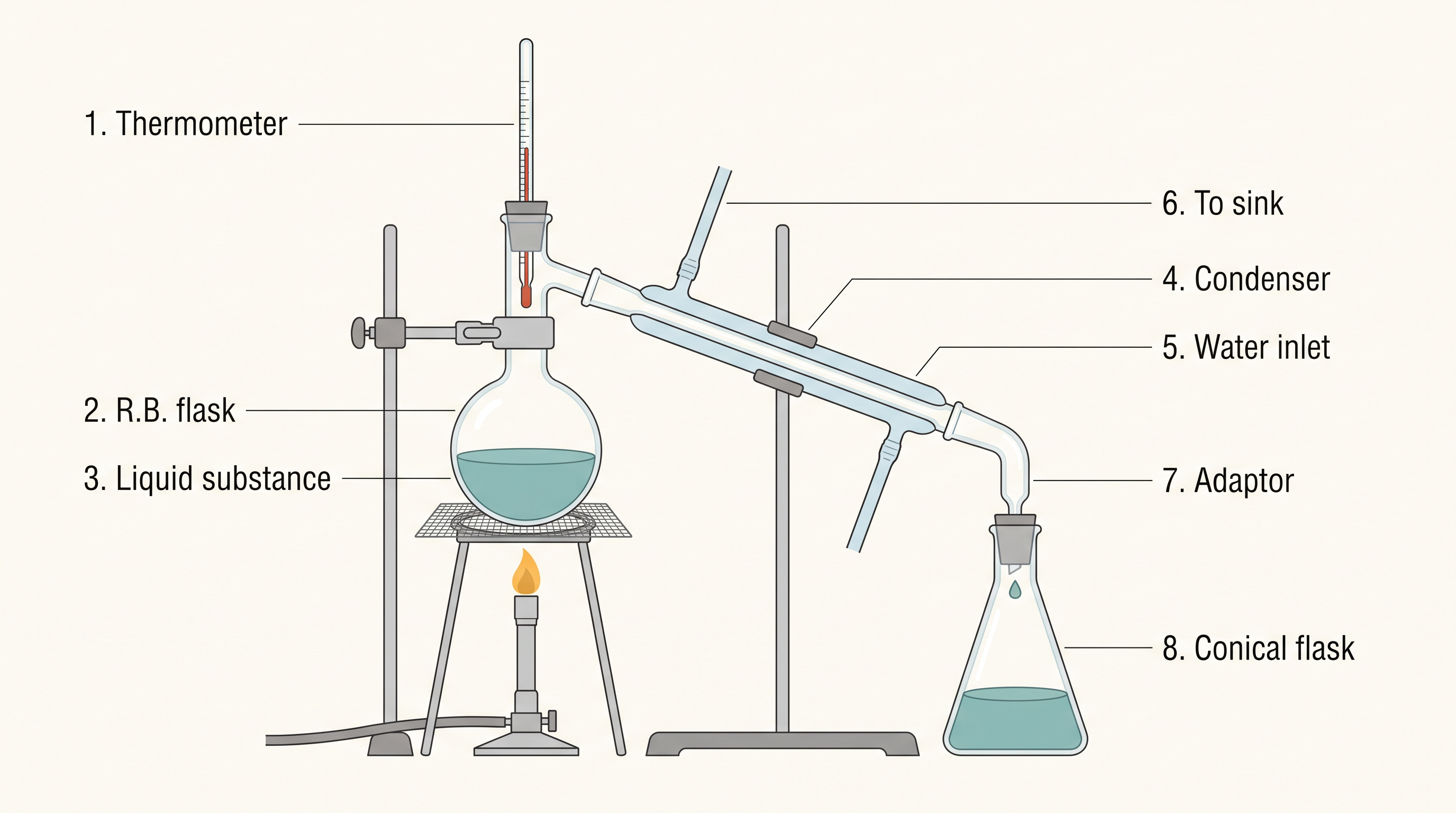
Fig. 8.55 – Simple distillation apparatus.
Fractional Distillation
If the difference in boiling points of two liquids is not much, simple distillation cannot be used to separate them. The vapours of such liquids are formed within the same temperature range and are condensed simultaneously — so a single distillation gives a mixture, not a pure liquid.
The technique of fractional distillation is used in such cases. In this technique, vapours of a liquid mixture are passed through a fractionating column before condensation. The fractionating column is fitted over the mouth of the round bottom flask, as shown in Fig. 8.56.
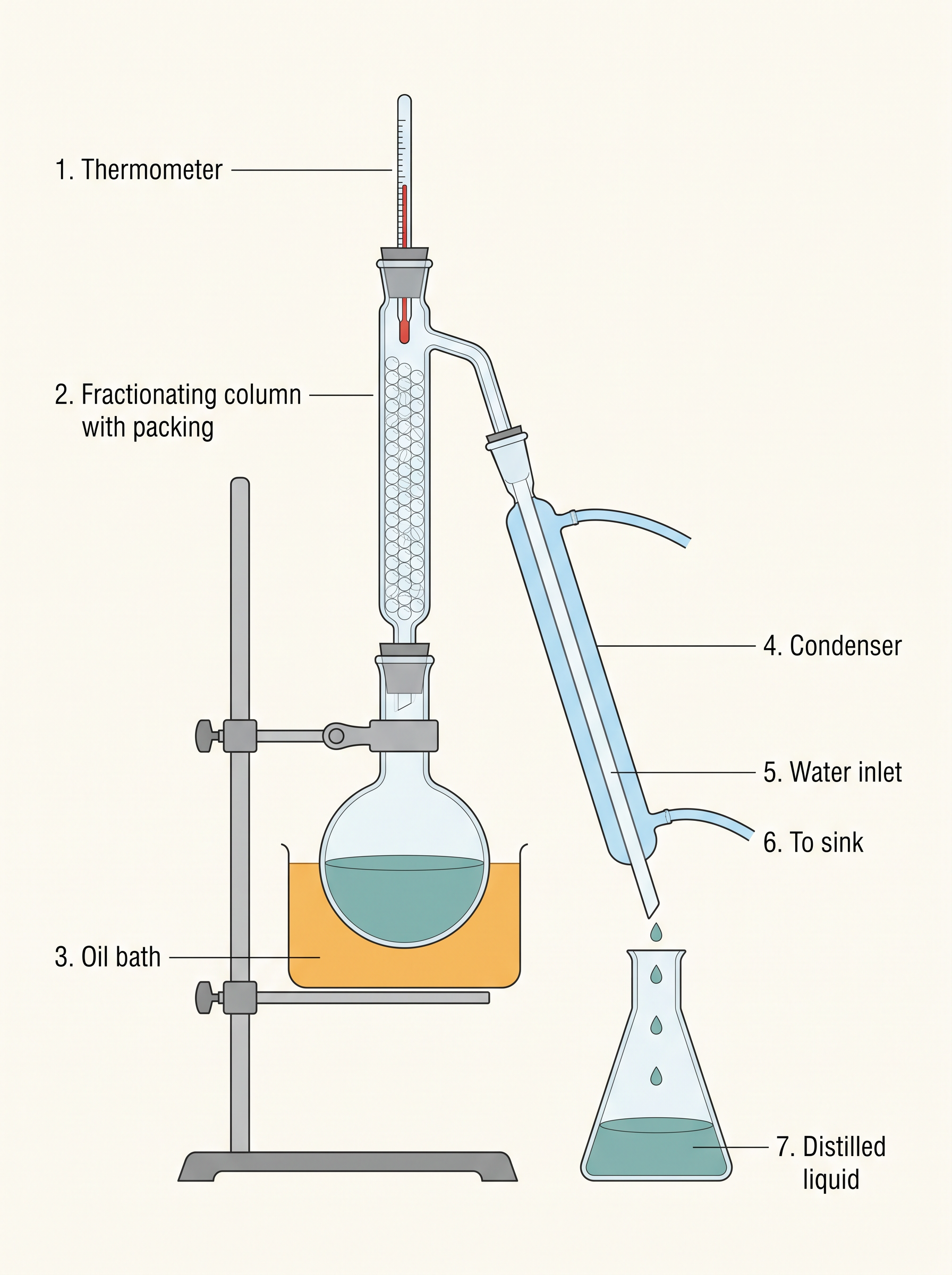
Fig. 8.56 – Fractional distillation apparatus.
What Happens Inside the Column
Vapours of the liquid with higher boiling point condense before the vapours of the liquid with lower boiling point. The vapours rising up in the fractionating column therefore become richer in the more volatile component. By the time the vapours reach the top of the fractionating column, these are rich in the more volatile component.
Fractionating columns are available in various sizes and designs, as shown in Fig. 8.57.
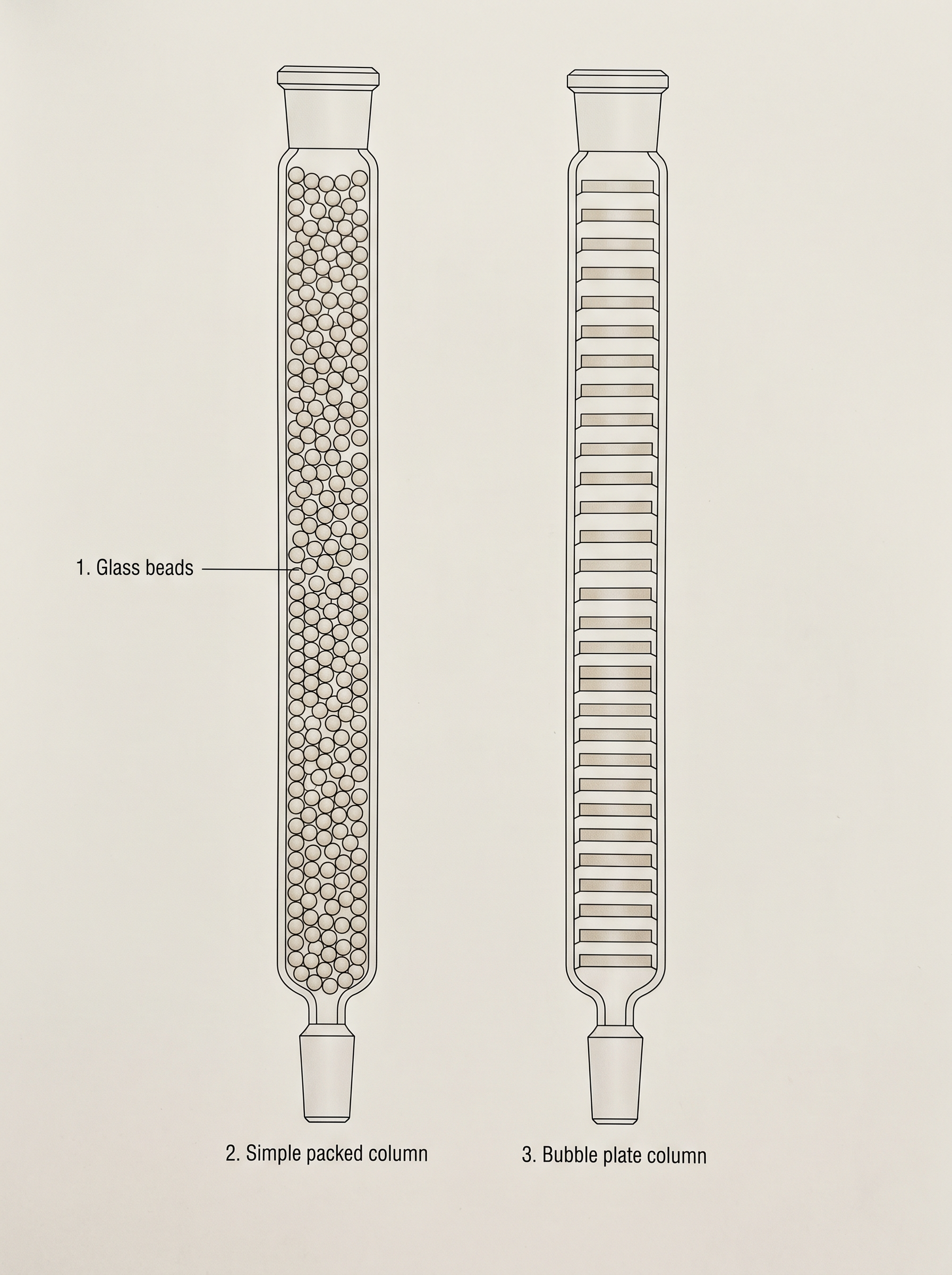
Fig. 8.57 – Types of fractionating columns.
A fractionating column provides many surfaces for heat exchange between the ascending vapours and the descending condensed liquid. Some of the condensing liquid in the fractionating column obtains heat from the ascending vapours and re-vaporises. The vapours thus become richer in the low boiling component.
The vapours of the low boiling component ascend to the top of the column. On reaching the top, the vapours become pure in the low boiling component, and pass through the condenser; the pure liquid is collected in a receiver.
After a series of successive distillations, the remaining liquid in the distillation flask gets enriched in the high boiling component.
Each successive condensation and vaporisation unit in the fractionating column is called a theoretical plate. Commercially, columns with hundreds of plates are available — the more plates, the sharper the separation.
Distillation under Reduced Pressure
This method is used to purify liquids having very high boiling points, and those which decompose at or below their boiling points. Simply heating such a liquid to its normal boiling point would destroy it.
Such liquids are made to boil at a temperature lower than their normal boiling points by reducing the pressure on their surface.
The reasoning rests on the definition of boiling: a liquid boils at a temperature at which its vapour pressure is equal to the external pressure. So if you lower the external pressure, a lower vapour pressure — and therefore a lower temperature — will suffice.
The pressure is reduced with the help of a water pump or vacuum pump, as shown in Fig. 8.58.
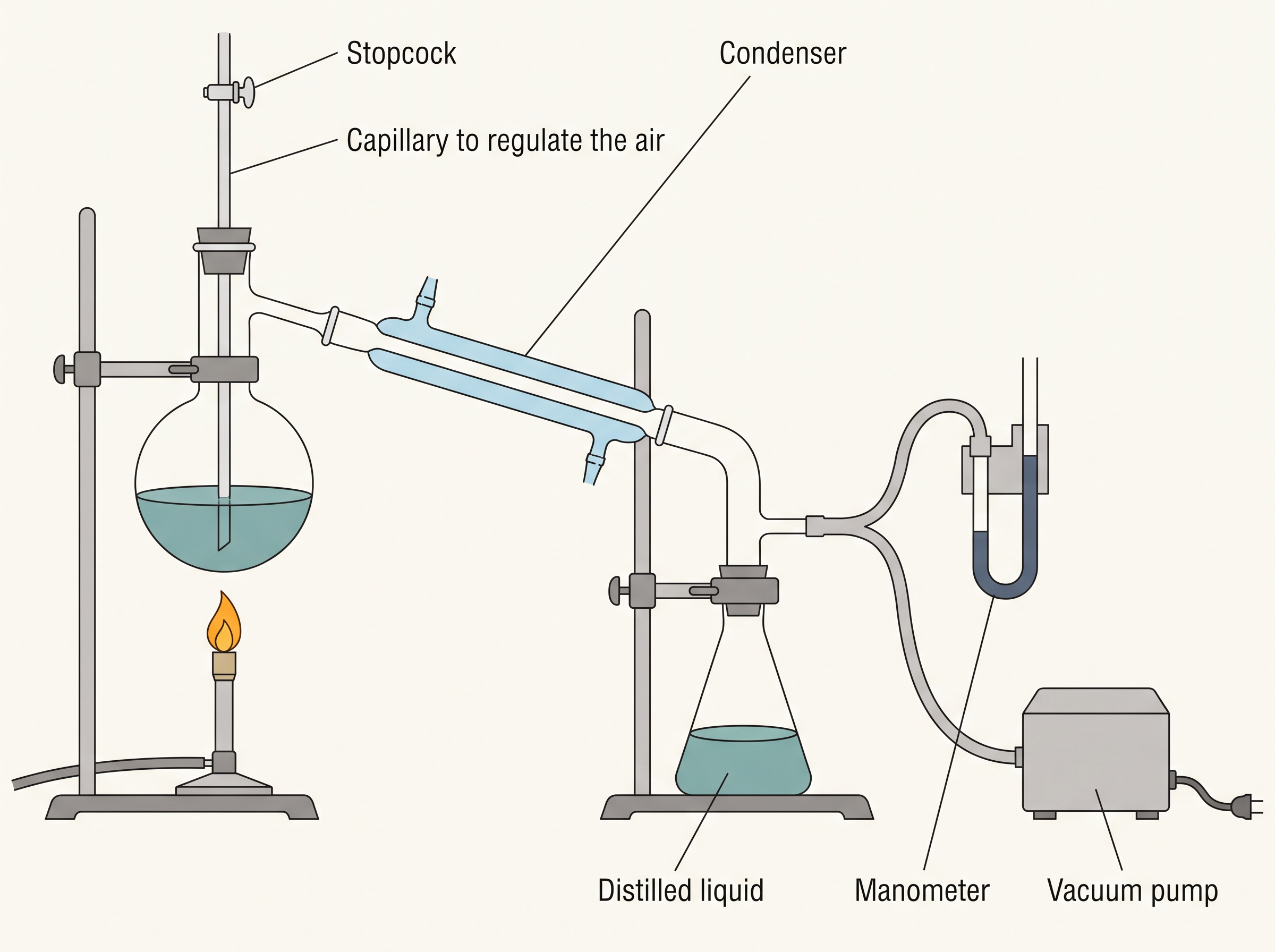
Fig. 8.58 – Distillation under reduced pressure.
Steam Distillation
This technique is applied to separate substances which are steam volatile and are immiscible with water.
In steam distillation, steam from a steam generator is passed through a heated flask containing the liquid to be distilled. The mixture of steam and the volatile organic compound is condensed and collected. The compound is later separated from water using a separating funnel — easily done, because the two are immiscible and form two layers.
The set-up is shown in Fig. 8.59.
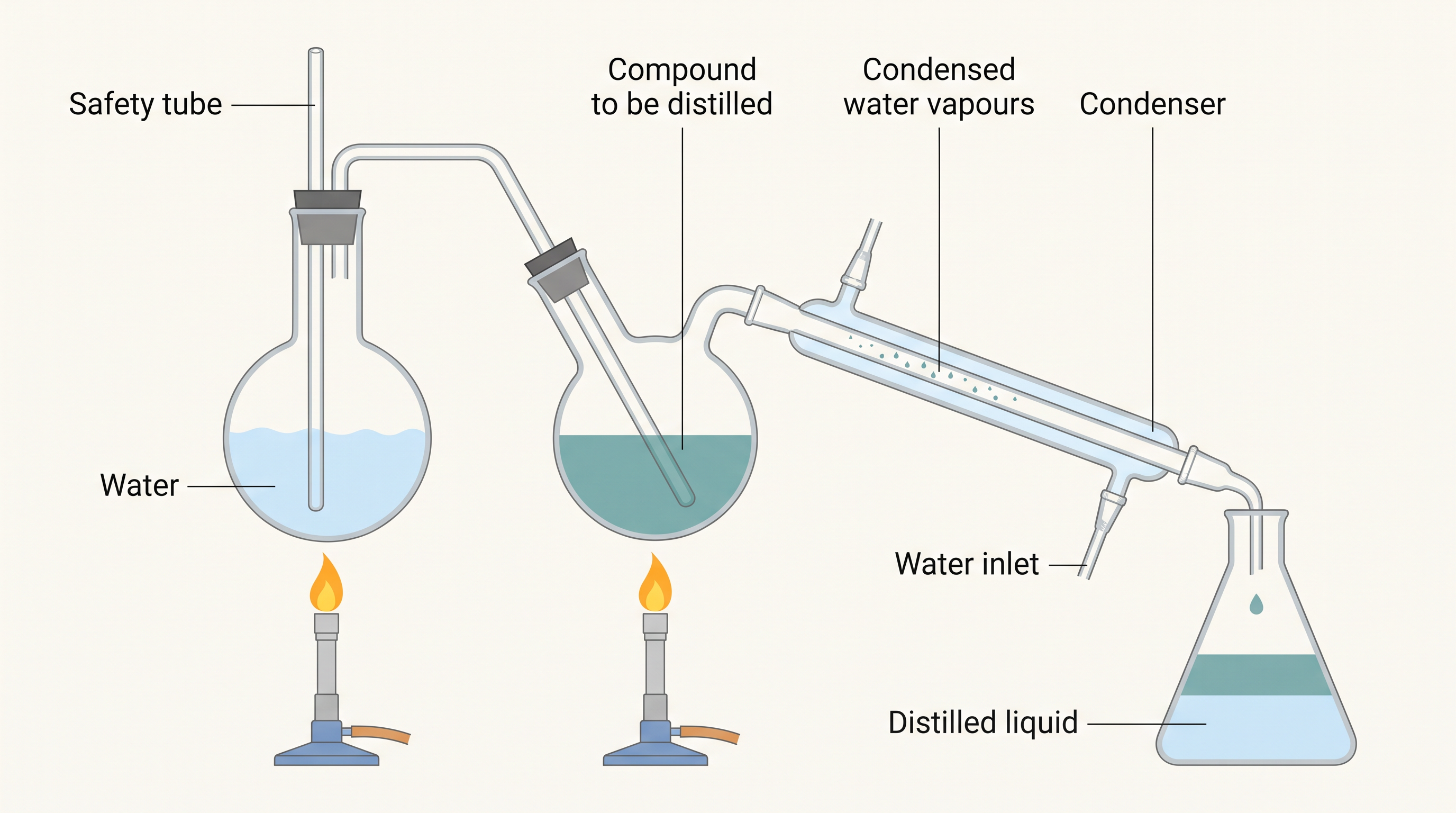
Fig. 8.59 – Steam distillation apparatus.
Why Steam Distillation Works Below 373 K
In steam distillation, the liquid boils when the sum of vapour pressures due to the organic liquid (\(p_1\)) and that due to water (\(p_2\)) becomes equal to the atmospheric pressure (\(p\)), i.e.
\[p = p_1 + p_2\]
Since \(p_1\) is lower than \(p\), the organic liquid vaporises at a lower temperature than its boiling point. This is the key insight: the organic compound never has to supply the whole atmospheric pressure on its own — water helps it.
Thus, if one of the substances in the mixture is water and the other a water-insoluble substance, then the mixture will boil close to but below 373 K. A mixture of water and the substance is obtained, which can be separated by using a separating funnel.
Aniline is separated by this technique from an aniline–water mixture.
8.8.4 Differential Extraction
When an organic compound is present in an aqueous medium, it is separated by shaking it with an organic solvent in which it is more soluble than in water.
For this to work, the organic solvent and the aqueous solution should be immiscible with each other, so that they form two distinct layers which can be separated by a separatory funnel. The compound distributes itself between the two layers, preferring the one in which it is more soluble.
The organic solvent is later removed by distillation or by evaporation to get back the compound.
Differential extraction is carried out in a separatory funnel as shown in Fig. 8.60.
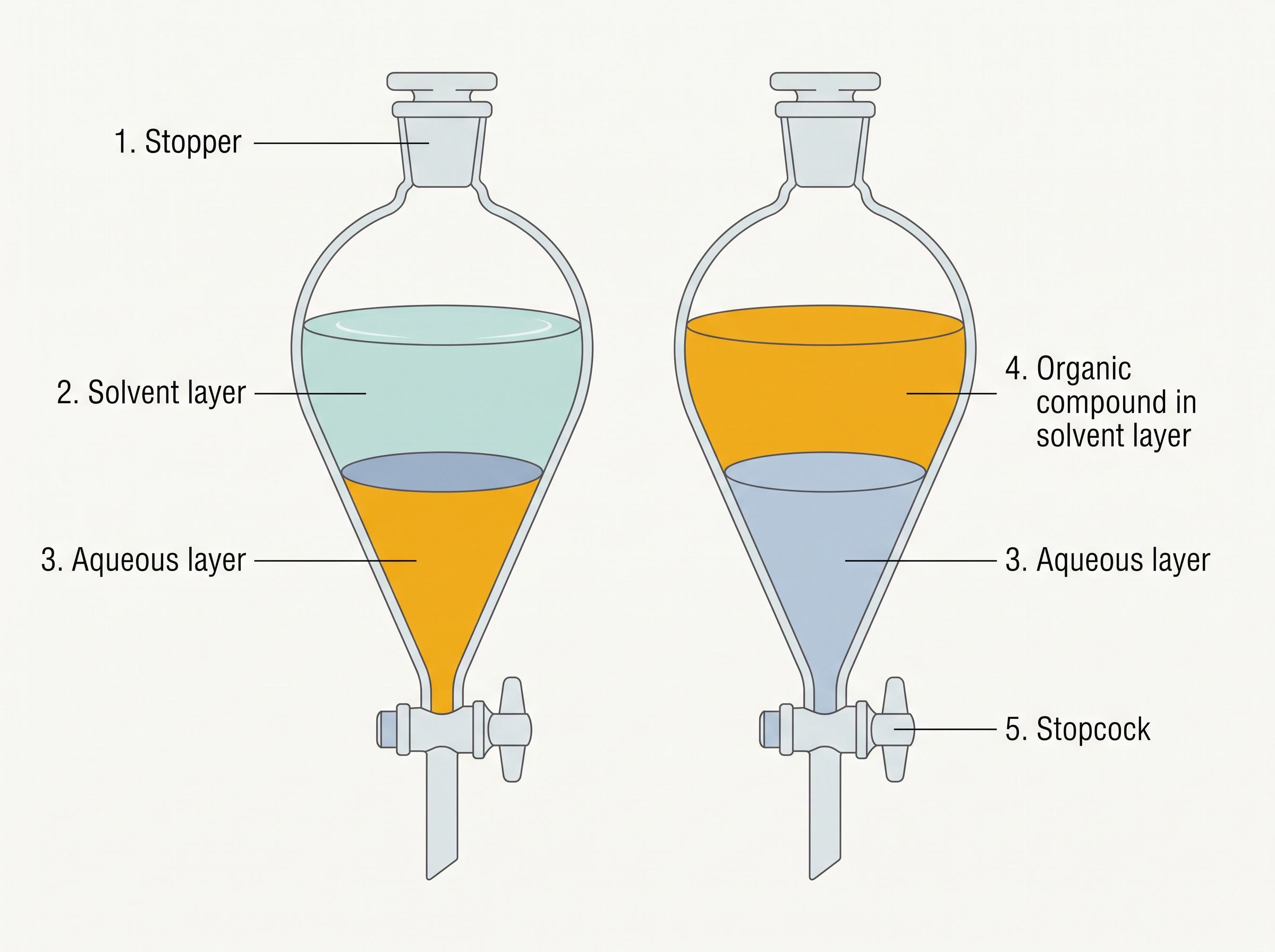
Fig. 8.60 – Differential extraction in a separatory funnel.
Continuous Extraction
If the organic compound is less soluble in the organic solvent, a very large quantity of solvent would be required to extract even a very small quantity of the compound. That is wasteful and impractical.
The technique of continuous extraction is employed in such cases. In this technique, the same solvent is repeatedly used for extraction of the compound — it is distilled, condensed, passed through the aqueous layer again, and recycled.
8.8.5 Chromatography
Chromatography is an important technique extensively used to separate mixtures into their components, purify compounds, and also test the purity of compounds.
The name chromatography is based on the Greek word chroma, for colour, since the method was first used for the separation of coloured substances found in plants.
The Basic Set-up
In this technique, the mixture of substances is applied onto a stationary phase, which may be a solid or a liquid. A pure solvent, a mixture of solvents, or a gas is allowed to move slowly over the stationary phase. The components of the mixture get gradually separated from one another. The moving phase is called the mobile phase.
Based on the principle involved, chromatography is classified into different categories. Two of these are:
- Adsorption chromatography, and
- Partition chromatography.
(a) Adsorption Chromatography
Adsorption chromatography is based on the fact that different compounds are adsorbed on an adsorbent to different degrees. Adsorption means the sticking of molecules onto the surface of a solid.
Commonly used adsorbents are silica gel and alumina.
When a mobile phase is allowed to move over a stationary phase (the adsorbent), the components of the mixture move by varying distances over the stationary phase — a component that clings strongly to the adsorbent moves slowly, while one that clings weakly is carried further along.
Following are two main types of chromatographic techniques based on the principle of differential adsorption:
- Column chromatography, and
- Thin layer chromatography.
Column Chromatography
Column chromatography involves separation of a mixture over a column of adsorbent (stationary phase) packed in a glass tube. The column is fitted with a stopcock at its lower end, as shown in Fig. 8.61.
The mixture adsorbed on adsorbent is placed on the top of the adsorbent column packed in a glass tube. An appropriate eluant, which is a liquid or a mixture of liquids, is allowed to flow down the column slowly.
Depending upon the degree to which the compounds are adsorbed, complete separation takes place. The most readily adsorbed substances are retained near the top, and others come down to various distances in the column, forming separate bands.
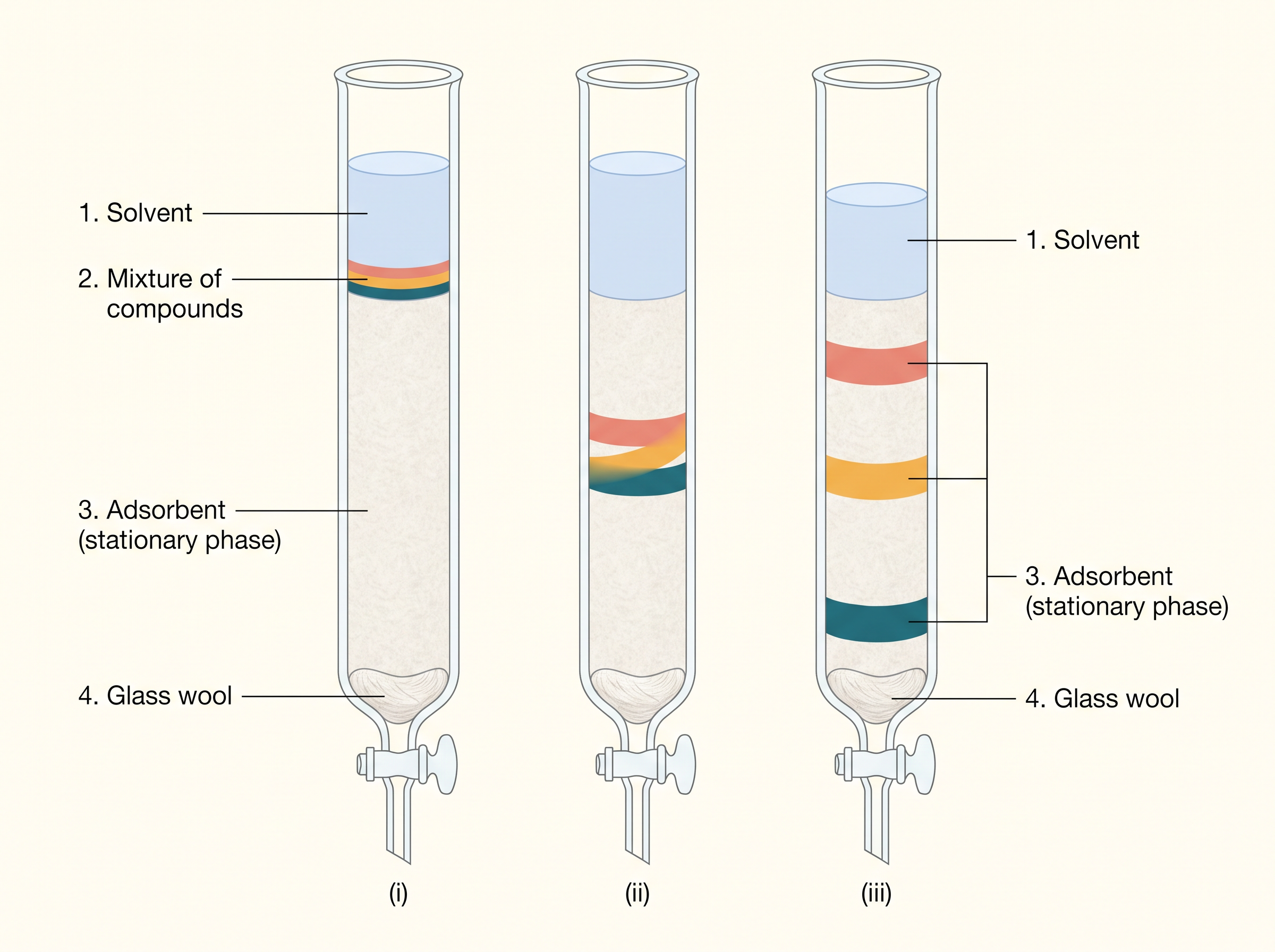
Fig. 8.61 – Column chromatography.
Flowchart
Fig. 8.62 – Column chromatography, step by step: pack the glass column with adsorbent (stationary phase) → load the adsorbed mixture at the top of the column → pour the eluant (mobile phase) and let it flow down slowly → components move down at different rates according to how strongly each is adsorbed → the most strongly adsorbed component stays near the top, the least strongly adsorbed travels farthest → collect the separated components from the stopcock in order.
Thin Layer Chromatography
Thin layer chromatography (TLC) is another type of adsorption chromatography, which involves separation of substances of a mixture over a thin layer of an adsorbent coated on a glass plate.
A thin layer (about 0.2 mm thick) of an adsorbent (silica gel or alumina) is spread over a glass plate of suitable size. The plate is known as a thin layer chromatography plate or chromaplate.
The solution of the mixture to be separated is applied as a small spot about 2 cm above one end of the TLC plate. The glass plate is then placed in a closed jar containing the eluant, as shown in Fig. 8.63(a).
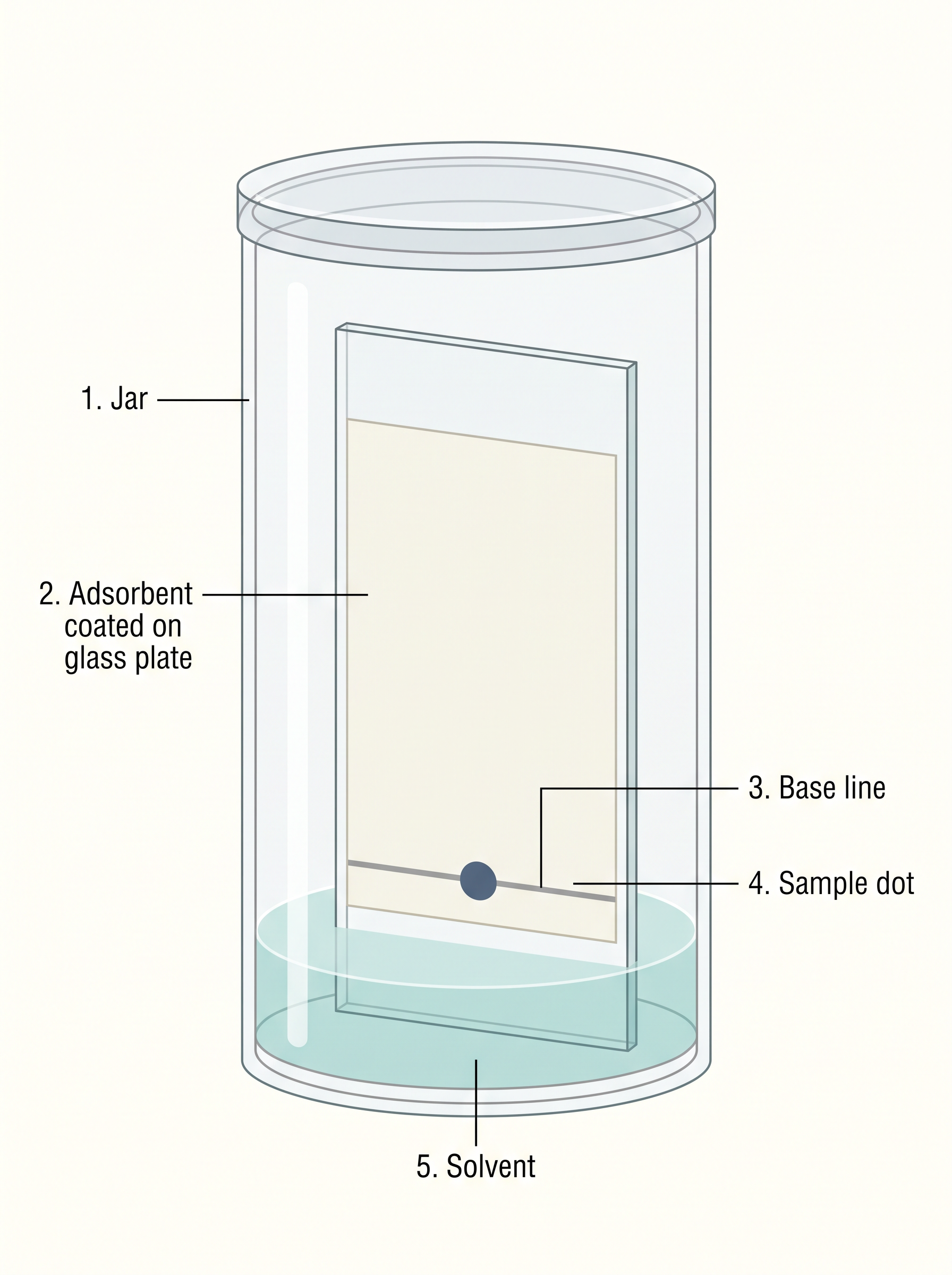
Fig. 8.63(a) – Developing a thin layer chromatogram.
As the eluant rises up the plate, the components of the mixture move up along with the eluant to different distances depending on their degree of adsorption, and separation takes place.
The Retardation Factor
The relative adsorption of each component of the mixture is expressed in terms of its retardation factor, i.e., \(R_f\) value, measured from the developed chromatogram (Fig. 8.64(b)).
\[R_f = \frac{\text{Distance moved by the substance from base line }(x)}{\text{Distance moved by the solvent from base line }(y)}\]
Because \(x\) can never exceed \(y\), the \(R_f\) value always lies between 0 and 1. A strongly adsorbed compound barely moves and has a small \(R_f\); a weakly adsorbed one travels almost with the solvent front and has an \(R_f\) close to 1.
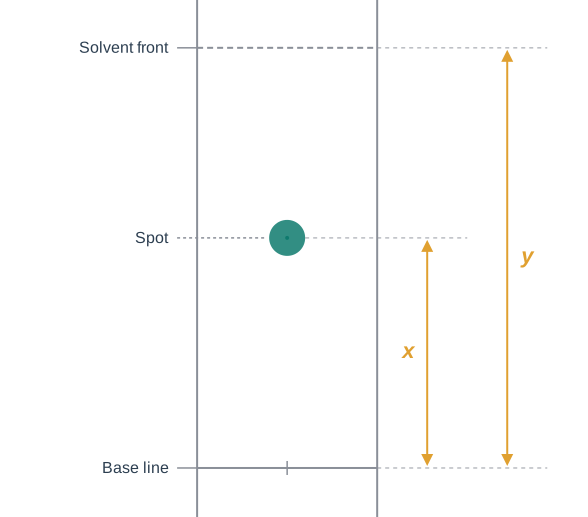
Fig. 8.64(b) – Developed TLC plate and Rf calculation.
Detecting the Spots
The spots of coloured compounds are visible on the TLC plate due to their original colour. But most organic compounds are colourless, so they must be made visible.
The spots of colourless compounds, which are invisible to the eye but fluoresce in ultraviolet light, can be detected by putting the plate under ultraviolet light.
Another detection technique is to place the plate in a covered jar containing a few crystals of iodine. Spots of compounds which adsorb iodine will show up as brown spots.
Sometimes an appropriate reagent may also be sprayed on the plate. For example, amino acids may be detected by spraying the plate with ninhydrin solution, which gives a coloured product with them.
(b) Partition Chromatography
Partition chromatography is based on continuous differential partitioning of components of a mixture between stationary and mobile phases. Here the stationary phase is a liquid, and each component keeps distributing itself between the two liquids as it travels.
Paper chromatography is a type of partition chromatography. In paper chromatography, a special quality paper known as chromatography paper is used. Chromatography paper contains water trapped in it, and it is this trapped water — not the paper itself — which acts as the stationary phase.
A strip of chromatography paper spotted at the base with the solution of the mixture is suspended in a suitable solvent or a mixture of solvents (Fig. 8.65). This solvent acts as the mobile phase.
The solvent rises up the paper by capillary action and flows over the spot. The paper selectively retains different components according to their differing partition in the two phases.
The paper strip so developed is known as a chromatogram. The spots of the separated coloured compounds are visible at different heights from the position of the initial spot on the chromatogram. The spots of the separated colourless compounds may be observed either under ultraviolet light or by the use of an appropriate spray reagent, as discussed under thin layer chromatography.
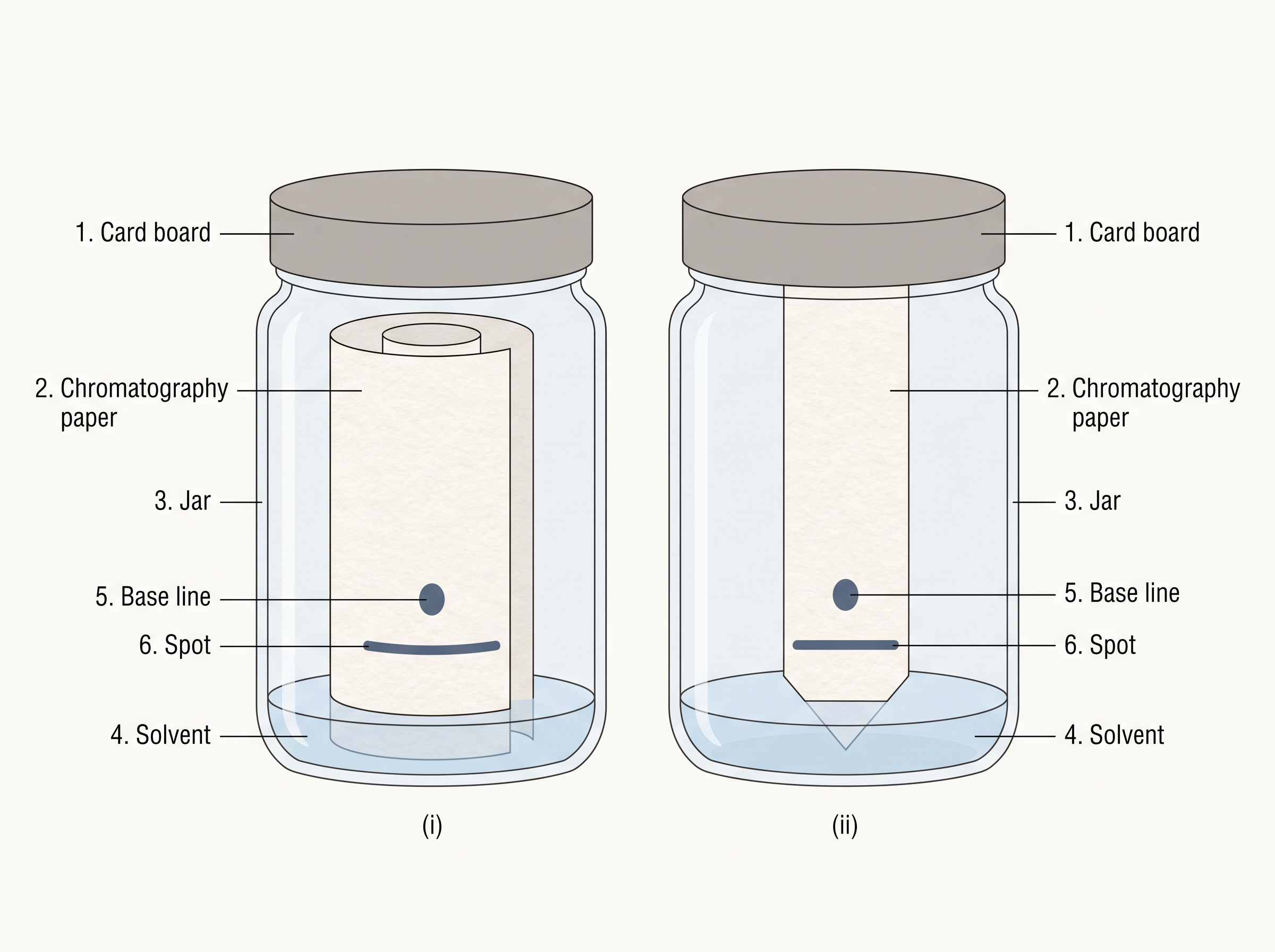
Fig. 8.65 – Paper chromatography.
8.9 Qualitative Analysis of Organic Compounds
Before a chemist can work out the formula or structure of an unknown organic compound, a more basic question must be answered: which elements does it contain? Qualitative analysis answers exactly this.
The elements present in organic compounds are carbon and hydrogen. In addition to these, they may also contain oxygen, nitrogen, sulphur, halogens, and phosphorus.
8.9.1 Detection of Carbon and Hydrogen
Carbon and hydrogen are detected by heating the compound with copper(II) oxide. Copper(II) oxide here acts as an oxidising agent — it supplies the oxygen needed to burn the compound.
Carbon present in the compound is oxidised to carbon dioxide (tested with lime-water, which develops turbidity), and hydrogen is oxidised to water (tested with anhydrous copper sulphate, which turns blue).
The reactions involved are:
\[\mathrm{C} + 2,\mathrm{CuO} \xrightarrow{\ \Delta\ } 2,\mathrm{Cu} + \mathrm{CO_2}\]
\[\mathrm{H_2} + \mathrm{CuO} \xrightarrow{\ \Delta\ } \mathrm{Cu} + \mathrm{H_2O}\]
The two products are then confirmed by their own characteristic tests:
\[\mathrm{CO_2} + \mathrm{Ca(OH)_2} \longrightarrow \mathrm{CaCO_3}\downarrow + \mathrm{H_2O}\]
\[5,\mathrm{H_2O} + \mathrm{CuSO_4} \longrightarrow \mathrm{CuSO_4{\cdot}5H_2O}\] \[\text{White} \qquad\qquad \text{Blue}\]
The white anhydrous copper sulphate turns blue as it takes up water of crystallisation — a simple and reliable signal that hydrogen was present in the original compound.
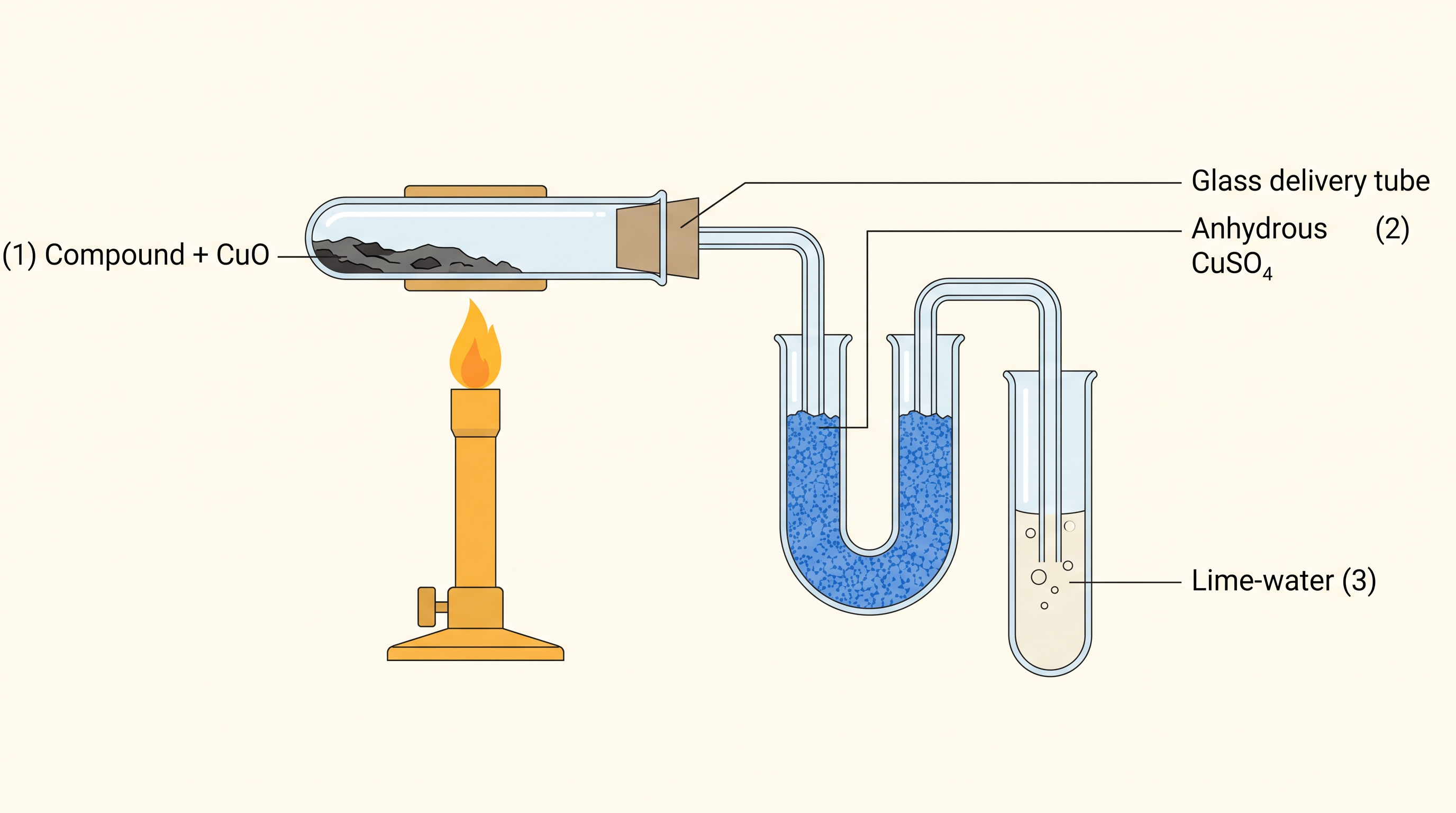
Fig. 8.66 – Detection of carbon and hydrogen.
8.9.2 Detection of Other Elements
Nitrogen, sulphur, halogens and phosphorus present in an organic compound are detected by “Lassaigne’s test”.
The Idea Behind Lassaigne’s Test
Here is the difficulty the test overcomes. In an organic compound, nitrogen, sulphur, and the halogens are bound by covalent bonds. Covalently bound atoms do not give ionic tests — you cannot precipitate a chlorine atom that is firmly held inside a molecule.
So the elements present in the compound are first converted from the covalent form into the ionic form, by fusing the compound with sodium metal. Sodium is a powerful reducing agent that tears the elements out of the molecule and hands them the electrons they need to become simple ions.
The following reactions take place:
\[\mathrm{Na} + \mathrm{C} + \mathrm{N} \xrightarrow{\ \Delta\ } \mathrm{NaCN}\]
\[2,\mathrm{Na} + \mathrm{S} \xrightarrow{\ \Delta\ } \mathrm{Na_2S}\]
\[\mathrm{Na} + \mathrm{X} \xrightarrow{\ \Delta\ } \mathrm{Na,X} \qquad (\mathrm{X} = \mathrm{Cl},\ \mathrm{Br}\ \text{or}\ \mathrm{I})\]
Here C, N, S and X all come from the organic compound.
The Sodium Fusion Extract
The cyanide, sulphide and halide of sodium so formed on sodium fusion are extracted from the fused mass by boiling it with distilled water. This extract is known as the sodium fusion extract, and every test that follows is performed on it.
Flowchart
Fig. 8.67 – Lassaigne’s test: organic compound + sodium metal → fuse (strong heating) → covalent N, S, X converted to ionic NaCN, Na₂S, NaX → plunge hot fused mass into distilled water and boil → filter → sodium fusion extract → branch into four tests: (a) with FeSO₄ then conc. H₂SO₄ → Prussian blue → nitrogen present; (b) with acetic acid + lead acetate → black ppt → sulphur present; or with sodium nitroprusside → violet colour → sulphur present; (c) acidify with HNO₃ then add AgNO₃ → white/yellowish/yellow ppt → Cl/Br/I present; (d) heat with sodium peroxide, boil with HNO₃, add ammonium molybdate → yellow colour/ppt → phosphorus present.
(A) Test for Nitrogen
The sodium fusion extract is boiled with iron(II) sulphate and then acidified with concentrated sulphuric acid. The formation of Prussian blue colour confirms the presence of nitrogen.
What happens chemically is this. Sodium cyanide first reacts with iron(II) sulphate and forms sodium hexacyanidoferrate(II). On heating with concentrated sulphuric acid, some iron(II) ions are oxidised to iron(III) ions, which react with sodium hexacyanidoferrate(II) to produce iron(III) hexacyanidoferrate(II) (ferriferrocyanide), which is Prussian blue in colour.
\[6,\mathrm{CN^-} + \mathrm{Fe^{2+}} \rightarrow [\mathrm{Fe(CN)_6}]^{4-}\]
\[3,[\mathrm{Fe(CN)_6}]^{4-} + 4,\mathrm{Fe^{3+}} \xrightarrow{\ x\mathrm{H_2O}\ } \mathrm{Fe_4[Fe(CN)_6]_3{\cdot}}x\mathrm{H_2O}\] \[\text{Prussian blue}\]
(B) Test for Sulphur
There are two confirmatory tests, and either may be used.
(a) The sodium fusion extract is acidified with acetic acid and lead acetate is added to it. A black precipitate of lead sulphide indicates the presence of sulphur.
\[\mathrm{S^{2-}} + \mathrm{Pb^{2+}} \longrightarrow \mathrm{PbS}\downarrow\] \[\text{Black}\]
(b) On treating sodium fusion extract with sodium nitroprusside, appearance of a violet colour further indicates the presence of sulphur.
\[\mathrm{S^{2-}} + [\mathrm{Fe(CN)_5NO}]^{2-} \longrightarrow [\mathrm{Fe(CN)_5NOS}]^{4-}\] \[\text{Violet}\]
When Nitrogen and Sulphur Are Both Present
In case nitrogen and sulphur both are present in an organic compound, sodium thiocyanate is formed instead of separate cyanide and sulphide. It gives a blood red colour and no Prussian blue, since there are no free cyanide ions available.
\[\mathrm{Na} + \mathrm{C} + \mathrm{N} + \mathrm{S} \longrightarrow \mathrm{NaSCN}\]
\[\mathrm{Fe^{3+}} + \mathrm{SCN^-} \longrightarrow [\mathrm{Fe(SCN)}]^{2+}\] \[\text{Blood red}\]
This is a common exam trap: a blood-red colour instead of Prussian blue does not mean nitrogen is absent — it means both nitrogen and sulphur are present together.
However, if sodium fusion is carried out with an excess of sodium, the thiocyanate decomposes to yield cyanide and sulphide. These ions then give their usual tests.
\[\mathrm{NaSCN} + 2,\mathrm{Na} \longrightarrow \mathrm{NaCN} + \mathrm{Na_2S}\]
(C) Test for Halogens
The sodium fusion extract is acidified with nitric acid and then treated with silver nitrate.
- A white precipitate, soluble in ammonium hydroxide, shows the presence of chlorine.
- A yellowish precipitate, sparingly soluble in ammonium hydroxide, shows the presence of bromine.
- A yellow precipitate, insoluble in ammonium hydroxide, shows the presence of iodine.
\[\mathrm{X^-} + \mathrm{Ag^+} \longrightarrow \mathrm{AgX}\]
X represents a halogen — Cl, Br or I.
Why Nitric Acid Is Added First
If nitrogen or sulphur is also present in the compound, the sodium fusion extract is first boiled with concentrated nitric acid to decompose the cyanide or sulphide of sodium formed during Lassaigne’s test.
These ions would otherwise interfere with the silver nitrate test for halogens — cyanide would give a white precipitate of silver cyanide and sulphide a black precipitate of silver sulphide, either of which could be mistaken for (or would mask) the halide result.
(D) Test for Phosphorus
The compound is heated with an oxidising agent (sodium peroxide). The phosphorus present in the compound is oxidised to phosphate.
The solution is boiled with nitric acid and then treated with ammonium molybdate. A yellow colouration or precipitate indicates the presence of phosphorus.
\[\mathrm{Na_3PO_4} + 3,\mathrm{HNO_3} \longrightarrow \mathrm{H_3PO_4} + 3,\mathrm{NaNO_3}\]
\[\mathrm{H_3PO_4} + 12,\mathrm{(NH_4)_2MoO_4} + 21,\mathrm{HNO_3} \longrightarrow\] \[\text{(ammonium molybdate)}\] \[\mathrm{(NH_4)_3PO_4{\cdot}12MoO_3} + 21,\mathrm{NH_4NO_3} + 12,\mathrm{H_2O}\] \[\text{(ammonium phosphomolybdate)}\]
The yellow ammonium phosphomolybdate is the species actually seen, and it is this compound that will be weighed in the quantitative estimation of phosphorus in the next section.
8.10 Quantitative Analysis
Qualitative analysis tells you which elements are present. Quantitative analysis goes one step further and tells you how much of each is present — and this is very important in organic chemistry.
It helps chemists in the determination of mass per cent of elements present in a compound. You have learnt in Chapter 1 that mass per cent of elements is required for the determination of the empirical and molecular formula of a compound. Without it, a chemist would know the ingredients of a molecule but not its recipe.
The percentage composition of elements present in an organic compound is determined by the following methods.
8.10.1 Carbon and Hydrogen
Both carbon and hydrogen are estimated in one experiment. A known mass of an organic compound is burnt in the presence of excess of oxygen and copper(II) oxide. Carbon and hydrogen in the compound are oxidised to carbon dioxide and water respectively.
\[\mathrm{C_xH_y} + \left(x + \tfrac{y}{4}\right)\mathrm{O_2} \longrightarrow x,\mathrm{CO_2} + \left(\tfrac{y}{2}\right)\mathrm{H_2O}\]
Trapping and Weighing the Products
The whole method rests on catching each product separately and weighing it.
The mass of water produced is determined by passing the mixture through a weighed U-tube containing anhydrous calcium chloride, which absorbs water.
Carbon dioxide is absorbed in another U-tube containing a concentrated solution of potassium hydroxide, an alkali which readily takes up the acidic gas \(\mathrm{CO_2}\).
These tubes are connected in series, as shown in Fig. 8.68 — the water absorber first, then the carbon dioxide absorber. The increase in masses of calcium chloride and potassium hydroxide gives the amounts of water and carbon dioxide, from which the percentages of carbon and hydrogen are calculated.
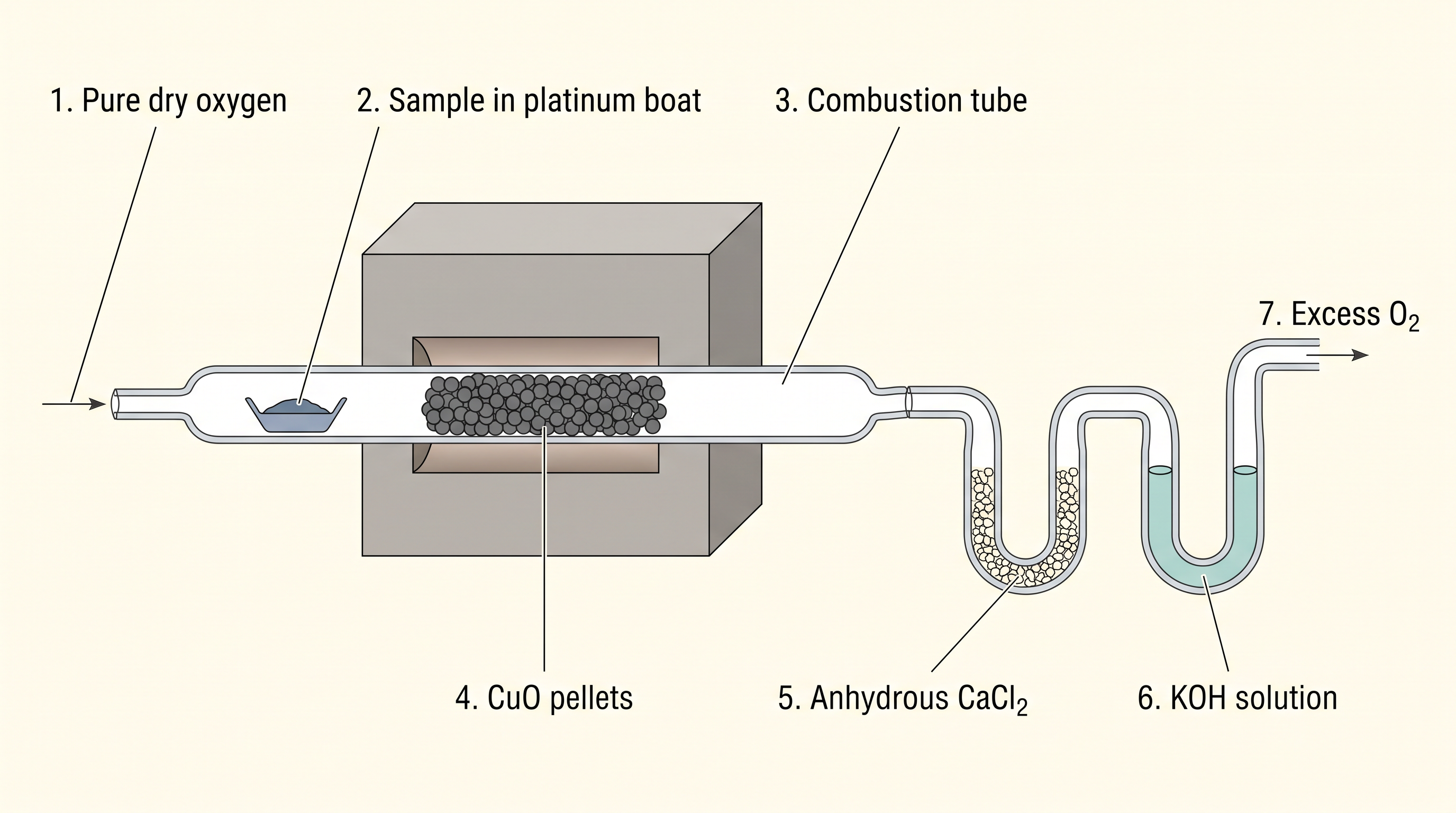
Fig. 8.68 – Estimation of carbon and hydrogen.
Deriving the Formulas
Let the mass of organic compound be \(m\) g, and the mass of water and carbon dioxide produced be \(m_1\) and \(m_2\) g respectively.
The reasoning is a simple mole argument. Every 44 g of \(\mathrm{CO_2}\) contains 12 g of carbon (the molar mass of \(\mathrm{CO_2}\) is 44, of which C contributes 12). Likewise, every 18 g of \(\mathrm{H_2O}\) contains 2 g of hydrogen (the molar mass of \(\mathrm{H_2O}\) is 18, of which the two H atoms contribute 2). Hence:
\[\text{Percentage of carbon} = \frac{12 \times m_2 \times 100}{44 \times m}\]
\[\text{Percentage of hydrogen} = \frac{2 \times m_1 \times 100}{18 \times m}\]
8.10.2 Nitrogen
There are two methods for estimation of nitrogen: (i) Dumas method and (ii) Kjeldahl’s method.
(i) Dumas Method
The nitrogen-containing organic compound, when heated with copper oxide in an atmosphere of carbon dioxide, yields free nitrogen in addition to carbon dioxide and water.
\[\mathrm{C_xH_yN_z} + \left(2x + \tfrac{y}{2}\right)\mathrm{CuO} \longrightarrow x,\mathrm{CO_2} + \tfrac{y}{2},\mathrm{H_2O} + \tfrac{z}{2},\mathrm{N_2} + \left(2x + \tfrac{y}{2}\right)\mathrm{Cu}\]
Traces of nitrogen oxides formed, if any, are reduced to nitrogen by passing the gaseous mixture over a heated copper gauze — this matters, because any nitrogen trapped as an oxide would not be counted.
The mixture of gases so produced is collected over an aqueous solution of potassium hydroxide, which absorbs carbon dioxide. Nitrogen, being unabsorbed, is collected in the upper part of the graduated tube (Fig. 8.69), and its volume is read off.
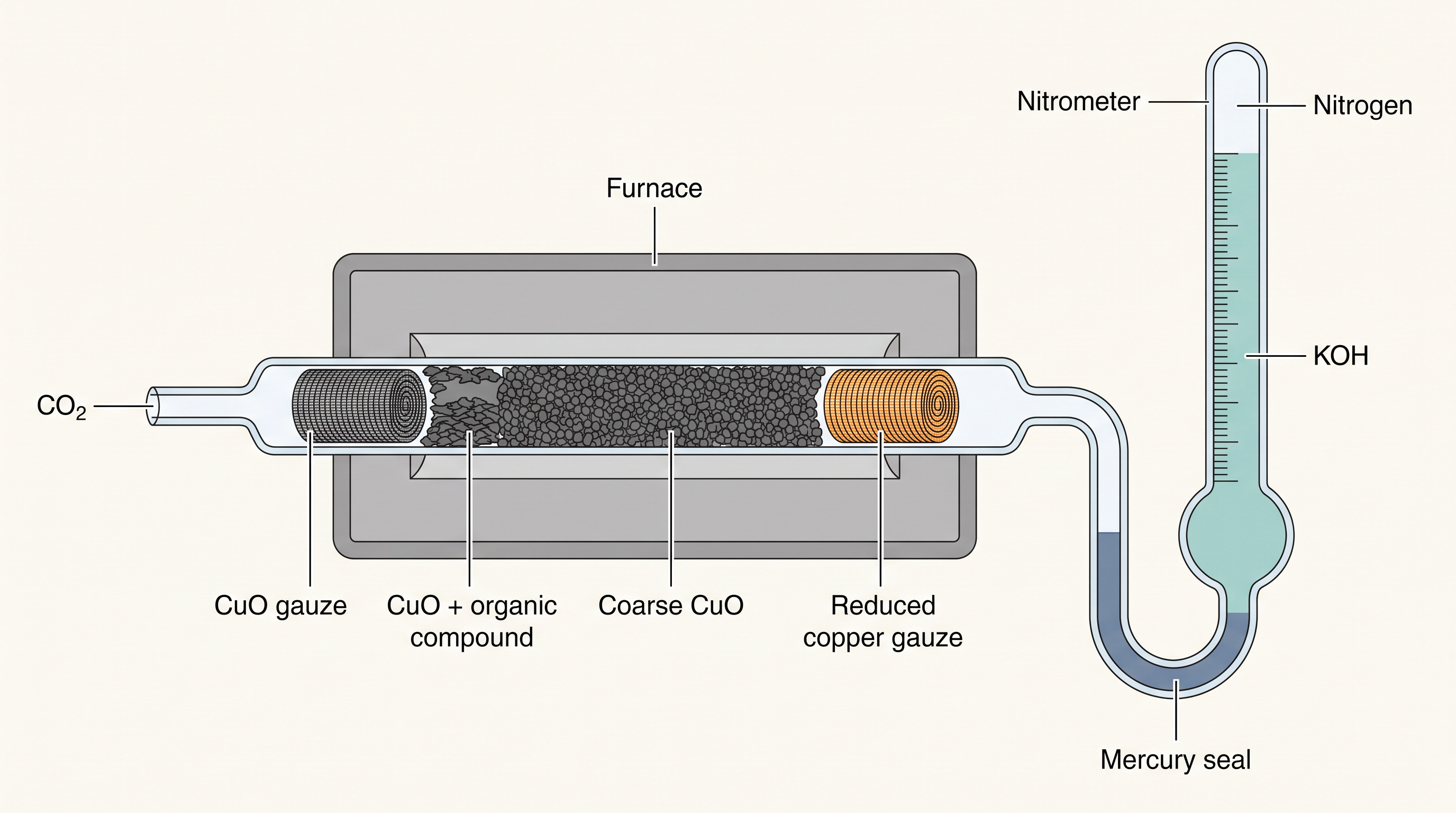
Fig. 8.69 – Dumas method for nitrogen estimation.
Working Out the Percentage
Let the mass of organic compound = \(m\) g Volume of nitrogen collected = \(V_1\) mL Room temperature = \(T_1\) K
The gas is collected at room temperature and at a pressure \(p_1\), so it must first be converted to STP conditions using the combined gas law:
\[\text{Volume of nitrogen at STP} = \frac{p_1 V_1 \times 273}{760 \times T_1}\] \[(\text{Let it be } V\ \text{mL})\]
Where \(p_1\) and \(V_1\) are the pressure and volume of nitrogen. Note that \(p_1\) is different from the atmospheric pressure at which nitrogen gas is collected. This is because the nitrogen is collected over an aqueous solution, and the water vapour above that solution contributes its own pressure (the aqueous tension). The value of \(p_1\) is obtained by the relation:
\[p_1 = \text{Atmospheric pressure} - \text{Aqueous tension}\]
Now use the molar volume. 22400 mL of \(\mathrm{N_2}\) at STP weighs 28 g. Hence:
\[V\ \text{mL}\ \mathrm{N_2}\ \text{at STP weighs} = \frac{28 \times V}{22400}\ \text{g}\]
\[\text{Percentage of nitrogen} = \frac{28 \times V \times 100}{22400 \times m}\]
(ii) Kjeldahl’s Method
The compound containing nitrogen is heated with concentrated sulphuric acid. Nitrogen in the compound gets converted to ammonium sulphate (Fig. 8.70). This first stage is called digestion.
The resulting acid mixture is then heated with excess of sodium hydroxide. The liberated ammonia gas is absorbed in an excess of a standard solution of sulphuric acid.
The amount of ammonia produced is determined indirectly — by estimating the amount of sulphuric acid consumed in the reaction. This is done by estimating the unreacted sulphuric acid left after the absorption of ammonia, by titrating it with a standard alkali solution. The difference between the initial amount of acid taken and that left after the reaction gives the amount of acid reacted with ammonia.
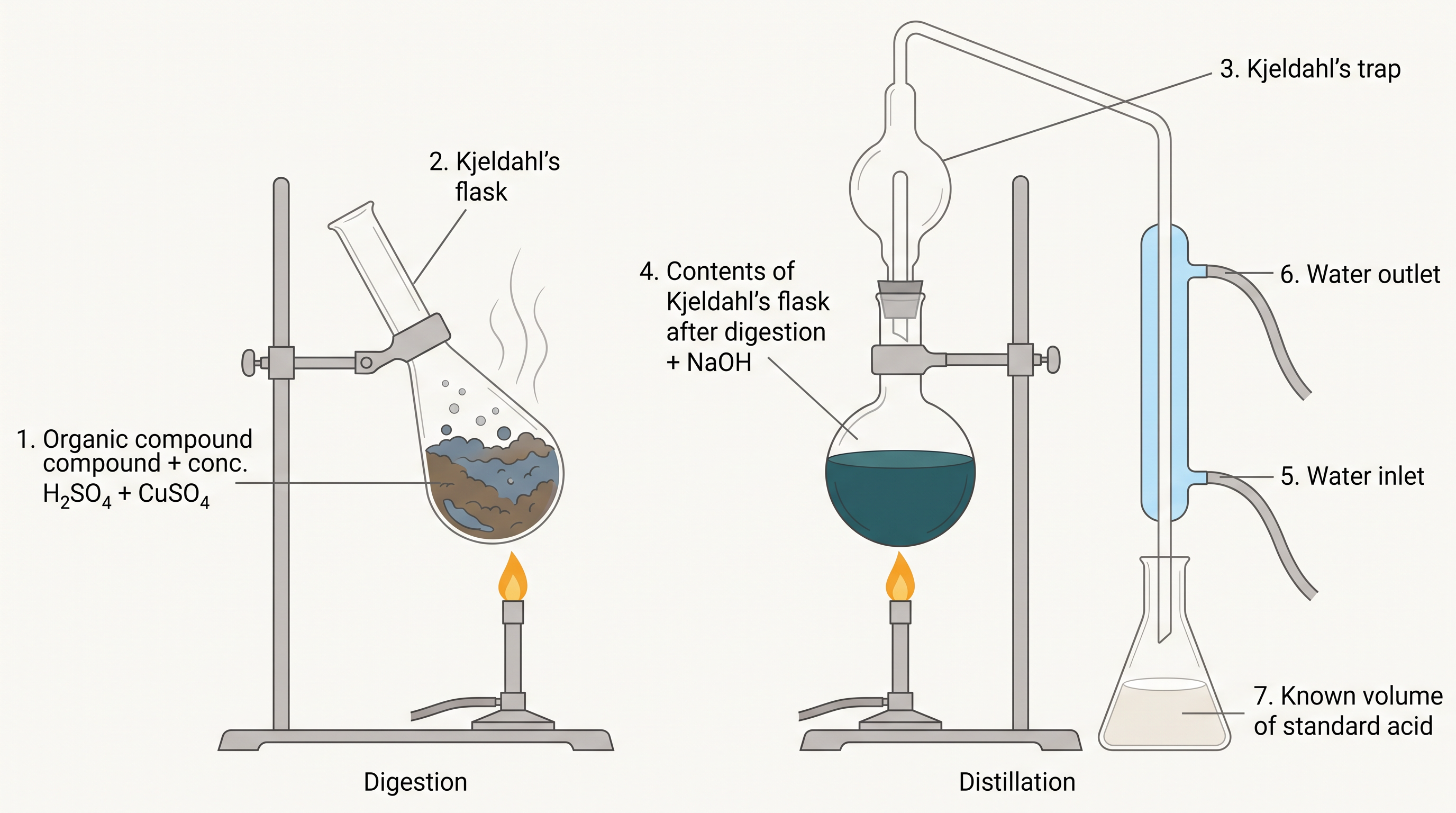
Fig. 8.70 – Kjeldahl method for nitrogen estimation.
The reactions involved are:
\[\text{Organic compound} + \mathrm{H_2SO_4} \longrightarrow \mathrm{(NH_4)_2SO_4}\]
\[\mathrm{(NH_4)_2SO_4} \xrightarrow{\ 2\mathrm{NaOH}\ } \mathrm{Na_2SO_4} + 2,\mathrm{NH_3} + 2,\mathrm{H_2O}\]
\[2,\mathrm{NH_3} + \mathrm{H_2SO_4} \longrightarrow \mathrm{(NH_4)_2SO_4}\]
Deriving the Kjeldahl Formula
Let the mass of organic compound taken = \(m\) g
Volume of \(\mathrm{H_2SO_4}\) of molarity M, taken = \(V\) mL
Volume of \(\mathrm{NaOH}\) of molarity M, used for titration of excess of \(\mathrm{H_2SO_4}\) = \(V_1\) mL
Now follow the stoichiometry carefully. Sulphuric acid is dibasic — one mole of it neutralises two moles of \(\mathrm{NaOH}\), and equally two moles of \(\mathrm{NH_3}\). This is where every factor of 2 in the derivation comes from.
\(V_1\) mL of \(\mathrm{NaOH}\) of molarity M
\(\qquad = V_1/2\) mL of \(\mathrm{H_2SO_4}\) of molarity M
Volume of \(\mathrm{H_2SO_4}\) of molarity M unused = \((V - V_1/2)\) mL
\((V - V_1/2)\) mL of \(\mathrm{H_2SO_4}\) of molarity M
\(\qquad = 2(V - V_1/2)\) mL of \(\mathrm{NH_3}\) solution of molarity M.
1000 mL of 1 M \(\mathrm{NH_3}\) solution contains 17 g \(\mathrm{NH_3}\) or 14 g of N
\(2(V - V_1/2)\) mL of \(\mathrm{NH_3}\) solution of molarity M contains:
\[\frac{14 \times \mathrm{M} \times 2(\mathrm{V} - \mathrm{V_1}/2)}{1000}\ \text{g N}\]
\[\text{Percentage of N} = \frac{14 \times \mathrm{M} \times 2(\mathrm{V} - \mathrm{V_1}/2)}{1000} \times \frac{100}{m}\]
\[= \frac{1.4 \times \mathrm{M} \times 2,(\mathrm{V} - \mathrm{V}/2)}{m}\]
The Limitation of Kjeldahl’s Method
Kjeldahl method is not applicable to compounds containing nitrogen in nitro and azo groups, and nitrogen present in the ring (e.g. pyridine), as nitrogen of these compounds does not change to ammonium sulphate under these conditions. In such cases the Dumas method must be used instead.
8.10.3 Halogens
Carius Method
A known mass of an organic compound is heated with fuming nitric acid in the presence of silver nitrate, contained in a hard glass tube known as a Carius tube (Fig. 8.71), in a furnace.
Carbon and hydrogen present in the compound are oxidised to carbon dioxide and water. The halogen present forms the corresponding silver halide (AgX). It is filtered, washed, dried and weighed.
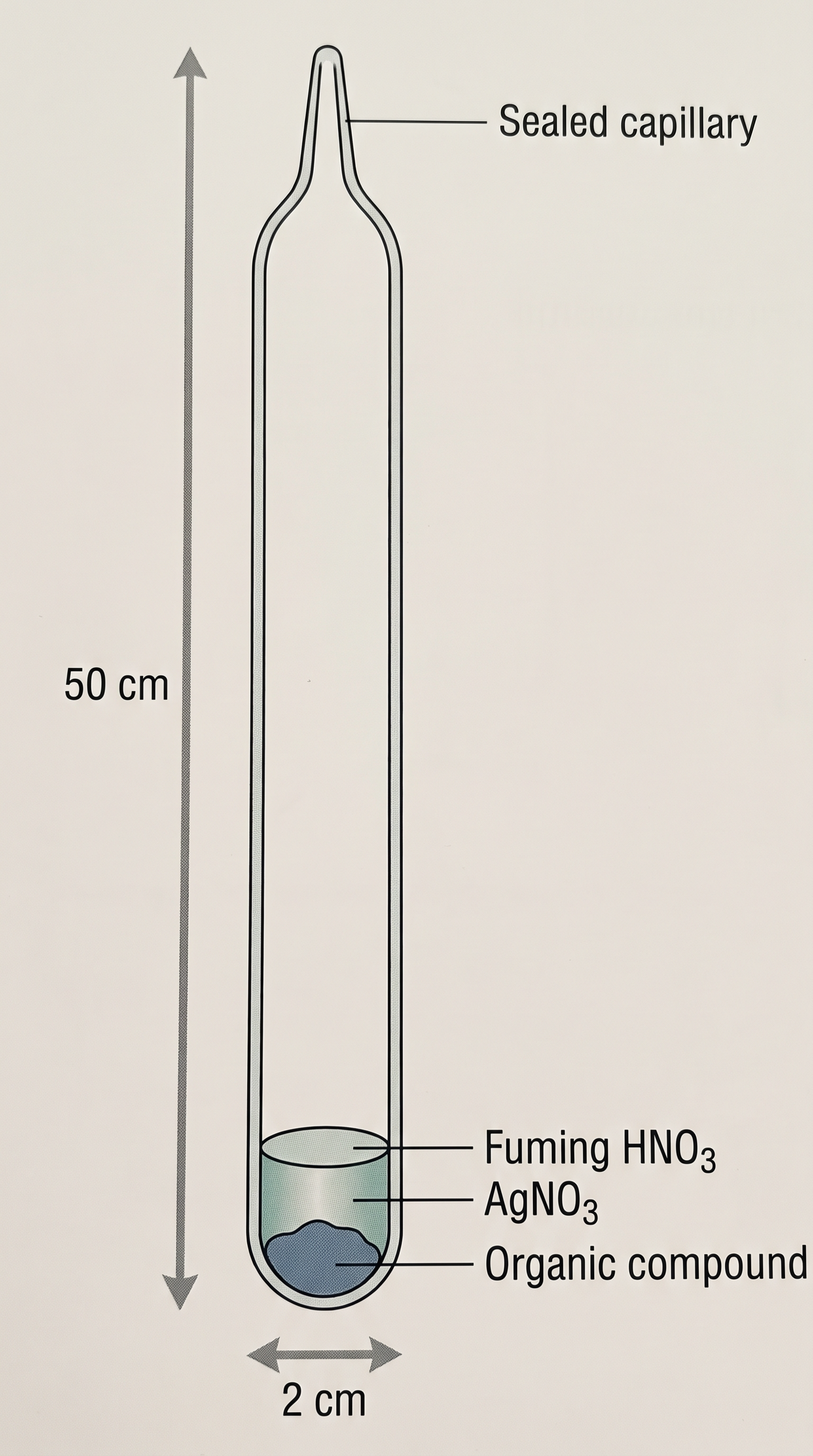
Fig. 8.71 – Carius tube.
Let the mass of organic compound taken = \(m\) g
Mass of AgX formed = \(m_1\) g
1 mol of AgX contains 1 mol of X. This one-to-one relation is what makes the calculation simple: every halogen atom in the compound ends up in exactly one formula unit of silver halide.
\[\text{Mass of halogen in } m_1\ \text{g of AgX} = \frac{\text{atomic mass of X} \times m_1\ \text{g}}{\text{molecular mass of AgX}}\]
\[\text{Percentage of halogen} = \frac{\text{atomic mass of X} \times m_1\ \text{g}}{\text{molecular mass of AgX} \times m} \times 100\]
8.10.4 Sulphur
A known mass of an organic compound is heated in a Carius tube with sodium peroxide or fuming nitric acid. Sulphur present in the compound is oxidised to sulphuric acid.
It is precipitated as barium sulphate by adding excess of barium chloride solution in water. The precipitate is filtered, washed, dried and weighed. The percentage of sulphur can be calculated from the mass of barium sulphate.
Once again the key is a one-to-one relation: each sulphur atom of the compound ends up in one formula unit of \(\mathrm{BaSO_4}\).
Let the mass of organic compound taken = \(m\) g and the mass of barium sulphate formed = \(m_1\) g
1 mol of \(\mathrm{BaSO_4}\) = 233 g \(\mathrm{BaSO_4}\) = 32 g sulphur
\(m_1\) g \(\mathrm{BaSO_4}\) contains \(\dfrac{32 \times m_1}{233}\) g sulphur
\[\text{Percentage of sulphur} = \frac{32 \times m_1 \times 100}{233 \times m}\]
8.10.5 Phosphorus
A known mass of an organic compound is heated with fuming nitric acid, whereupon phosphorus present in the compound is oxidised to phosphoric acid.
It is precipitated as ammonium phosphomolybdate, \(\mathrm{(NH_4)_3PO_4{\cdot}12MoO_3}\), by adding ammonia and ammonium molybdate.
Alternatively, phosphoric acid may be precipitated as \(\mathrm{MgNH_4PO_4}\) by adding magnesia mixture, which on ignition yields \(\mathrm{Mg_2P_2O_7}\).
Let the mass of organic compound taken = \(m\) g and mass of ammonium phosphomolybdate = \(m_1\) g
Molar mass of \(\mathrm{(NH_4)_3PO_4{\cdot}12MoO_3}\) = 1877 g
\[\text{Percentage of phosphorus} = \frac{31 \times m_1 \times 100}{1877 \times m}%\]
If phosphorus is estimated as \(\mathrm{Mg_2P_2O_7}\),
\[\text{Percentage of phosphorus} = \frac{62 \times m_1 \times 100}{222 \times m}\]
where 222 u is the molar mass of \(\mathrm{Mg_2P_2O_7}\), \(m\) the mass of organic compound taken, \(m_1\) the mass of \(\mathrm{Mg_2P_2O_7}\) formed, and 62 the mass of two phosphorus atoms present in the compound \(\mathrm{Mg_2P_2O_7}\).
8.10.6 Oxygen
The percentage of oxygen in an organic compound is usually found by difference between the total percentage composition (100) and the sum of the percentages of all other elements. This is the practical route in most laboratories.
However, oxygen can also be estimated directly, as follows.
Direct Estimation of Oxygen
A definite mass of an organic compound is decomposed by heating in a stream of nitrogen gas. The mixture of gaseous products containing oxygen is passed over red-hot coke, when all the oxygen is converted to carbon monoxide.
This mixture is passed through warm iodine pentoxide (\(\mathrm{I_2O_5}\)), when carbon monoxide is oxidised to carbon dioxide, producing iodine.
\[\text{Compound} \xrightarrow{\ \text{heat}\ } \mathrm{O_2} + \text{other gaseous products}\]
\[[2,\mathrm{C} + \mathrm{O_2} \xrightarrow{\ 1373\ \mathrm{K}\ } 2,\mathrm{CO}] \times 5 \qquad\qquad \text{(A)}\]
\[[\mathrm{I_2O_5} + 5,\mathrm{CO} \longrightarrow \mathrm{I_2} + 5,\mathrm{CO_2}] \times 2 \qquad \text{(B)}\]
On making the amount of CO produced in equation (A) equal to the amount of CO used in equation (B) — by multiplying the equations (A) and (B) by 5 and 2 respectively — we find that each mole of oxygen liberated from the compound will produce two moles of carbon dioxide.
Thus 88 g carbon dioxide is obtained if 32 g oxygen is liberated. (Here 88 g is 2 moles of \(\mathrm{CO_2}\), and 32 g is 1 mole of \(\mathrm{O_2}\).)
Let the mass of organic compound taken be \(m\) g Mass of carbon dioxide produced be \(m_1\) g
\(\therefore\ m_1\) g carbon dioxide is obtained from \(\dfrac{32 \times m_1}{88}\) g \(\mathrm{O_2}\)
\[\therefore\ \text{Percentage of oxygen} = \frac{32 \times m_1 \times 100}{88 \times m}%\]
The percentage of oxygen can be derived from the amount of iodine produced also, since equation (B) also fixes the amount of iodine liberated per mole of CO.
Modern Elemental Analysis
Presently, the estimation of elements in an organic compound is carried out by using microquantities of substances and automatic experimental techniques.
The elements carbon, hydrogen and nitrogen present in a compound are determined by an apparatus known as a C,H,N elemental analyser. The analyser requires only a very small amount of the substance (1–3 mg) and displays the values on a screen within a short time. A detailed discussion of such methods is beyond the scope of this book.
8.11 Summary
Structure and Bonding in Organic Compounds
- Organic compounds are formed through covalent bonding, and the nature of this bonding is described by the concept of orbital hybridisation, according to which carbon can have \(sp^3\), \(sp^2\), and \(sp\) hybridised orbitals.
- The \(sp^3\), \(sp^2\), and \(sp\) hybridised carbons are found in compounds like methane, ethene, and ethyne respectively. The tetrahedral shape of methane, the planar shape of ethene, and the linear shape of ethyne all follow from this concept.
- An \(sp^3\) hybrid orbital can overlap with the \(1s\) orbital of hydrogen to give a carbon–hydrogen (C–H) single bond, called a sigma (\(\sigma\)) bond.
- Overlap of an \(sp^2\) orbital of one carbon with an \(sp^2\) orbital of another results in the formation of a carbon–carbon \(\sigma\) bond.
- The unhybridised \(p\) orbitals on two adjacent carbons can undergo lateral (side-by-side) overlap to give a pi (\(\pi\)) bond.
Representing Organic Molecules
- Organic compounds can be represented by various structural formulas — complete, condensed, and bond-line.
- The three-dimensional representation of organic compounds on paper can be drawn by the wedge and dash formula.
Classification and Naming
- Organic compounds can be classified on the basis of their structure or of the functional groups they contain.
- A functional group is an atom or group of atoms bonded together in a unique fashion, and it determines the physical and chemical properties of the compounds.
- The naming of organic compounds is carried out by following a set of rules laid down by the International Union of Pure and Applied Chemistry (IUPAC). In IUPAC nomenclature, the names are correlated with the structure in such a way that the reader can deduce the structure from the name.
Organic Reaction Mechanism
- Organic reaction mechanism concepts are based on the structure of the substrate molecule, the fission of a covalent bond, the attacking reagents, the electron displacement effects, and the conditions of the reaction. These organic reactions involve breaking and making of covalent bonds.
- A covalent bond may be cleaved in a heterolytic or a homolytic fashion. A heterolytic cleavage yields carbocations or carbanions, while a homolytic cleavage gives free radicals as the reactive intermediate.
- Reactions proceeding through heterolytic cleavage involve complementary pairs of reactive species. These are the electron-pair donor, known as a nucleophile, and the electron-pair acceptor, known as an electrophile.
- The inductive, resonance, electromeric, and hyperconjugation effects may help in the polarisation of a bond, making certain carbon atoms or other atom positions into places of low or high electron density.
- Organic reactions can be broadly classified into the following types: substitution, addition, elimination, and rearrangement reactions.
Purification, Qualitative and Quantitative Analysis
- Purification, qualitative analysis, and quantitative analysis of organic compounds are carried out for determining their structures. The overall sequence is set out in Fig. 8.72.
Flowchart
Fig. 8.72 – Complete analysis of an unknown organic compound: impure compound → purification (sublimation / crystallisation / distillation / differential extraction / chromatography) → check purity by sharp melting or boiling point → qualitative analysis (detect C and H by heating with CuO; detect N, S, halogens, P by Lassaigne’s test on the sodium fusion extract) → quantitative analysis (estimate C and H by combustion; N by Dumas or Kjeldahl’s method; halogens by Carius method; S and P by oxidation and precipitation; O usually by difference) → mass per cent of each element → empirical formula → molecular formula → structure.
- The methods of purification — namely sublimation, distillation, and differential extraction — are based on the difference in one or more physical properties of the compound and the impurity.
- Chromatography is a useful technique of separation, identification, and purification of compounds. It is classified into two categories: adsorption and partition chromatography. Adsorption chromatography is based on differential adsorption of various components of a mixture on an adsorbent. Partition chromatography involves continuous partitioning of the components of a mixture between stationary and mobile phases.
- After getting the compound in a pure form, its qualitative analysis is carried out for detection of the elements present in it. Nitrogen, sulphur, halogens, and phosphorus are detected by Lassaigne’s test.
- Carbon and hydrogen are estimated by determining the amounts of carbon dioxide and water produced on combustion.
- Nitrogen is estimated by the Dumas or Kjeldahl’s method, and halogens by the Carius method.
- Sulphur and phosphorus are estimated by oxidising them to sulphuric and phosphoric acids respectively, and weighing the precipitates so obtained.
- The percentage of oxygen is usually determined by difference between the total percentage (100) and the sum of the percentages of all other elements present.
Key Relations to Remember
\[\text{Percentage of carbon} = \frac{12 \times m_2 \times 100}{44 \times m} \qquad \text{Percentage of hydrogen} = \frac{2 \times m_1 \times 100}{18 \times m}\]
\[\text{Percentage of nitrogen (Dumas)} = \frac{28 \times V \times 100}{22400 \times m}\]
\[\text{Percentage of halogen (Carius)} = \frac{\text{atomic mass of X} \times m_1 \times 100}{\text{molecular mass of AgX} \times m}\]
\[\text{Percentage of sulphur} = \frac{32 \times m_1 \times 100}{233 \times m} \qquad \text{Percentage of oxygen} = \frac{32 \times m_1 \times 100}{88 \times m}\]
\[R_f = \frac{\text{Distance moved by the substance from base line}}{\text{Distance moved by the solvent from base line}}\]
8.12 NCERT Questions
- What are hybridisation states of each carbon atom in the following compounds? \(\mathrm{CH_2{=}C{=}O}\), \(\mathrm{CH_3CH{=}CH_2}\), \(\mathrm{(CH_3)_2CO}\), \(\mathrm{CH_2{=}CHCN}\), \(\mathrm{C_6H_6}\)
- Indicate the \(\sigma\) and \(\pi\) bonds in the following molecules: \(\mathrm{C_6H_6}\), \(\mathrm{C_6H_{12}}\), \(\mathrm{CH_2Cl_2}\), \(\mathrm{CH_2{=}C{=}CH_2}\), \(\mathrm{CH_3NO_2}\), \(\mathrm{HCONHCH_3}\)
- Write bond line formulas for: Isopropyl alcohol, 2,3-Dimethylbutanal, Heptan-4-one.
- Give the IUPAC names of the following compounds:
- a two-carbon chain attached to a benzene ring (bond-line structure)
- a branched chain ending in a \(-\mathrm{CN}\) group (bond-line structure)
- a branched six-carbon chain with two methyl substituents (bond-line structure)
- a chain bearing Cl and Br substituents (bond-line structure)
- a chain bearing Cl and ending in a \(-\mathrm{CHO}\) group (bond-line structure)
- \(\mathrm{Cl_2CHCH_2OH}\)
- Which of the following represents the correct IUPAC name for the compounds concerned?
- 2,2-Dimethylpentane or 2-Dimethylpentane
- 2,4,7-Trimethyloctane or 2,5,7-Trimethyloctane
- 2-Chloro-4-methylpentane or 4-Chloro-2-methylpentane
- But-3-yn-1-ol or But-4-ol-1-yne
- Draw formulas for the first five members of each homologous series beginning with the following compounds.
- \(\mathrm{H{-}COOH}\)
- \(\mathrm{CH_3COCH_3}\)
- \(\mathrm{H{-}CH{=}CH_2}\)
- Give condensed and bond line structural formulas and identify the functional group(s) present, if any, for:
- 2,2,4-Trimethylpentane
- 2-Hydroxy-1,2,3-propanetricarboxylic acid
- Hexanedial
- Identify the functional groups in the following compounds:
- a benzene ring bearing \(-\mathrm{CHO}\), \(-\mathrm{OMe}\) and \(-\mathrm{OH}\) groups
- a benzene ring bearing \(-\mathrm{NH_2}\) and an ester group, \(-\mathrm{COOCH_2CH_2N(C_2H_5)_2}\)
- a benzene ring bearing a \(-\mathrm{CH{=}CHNO_2}\) group
- Which of the two: \(\mathrm{O_2NCH_2CH_2O^-}\) or \(\mathrm{CH_3CH_2O^-}\) is expected to be more stable and why?
- Explain why alkyl groups act as electron donors when attached to a \(\pi\) system.
- Draw the resonance structures for the following compounds. Show the electron shift using curved-arrow notation.
- \(\mathrm{C_6H_5OH}\)
- \(\mathrm{C_6H_5NO_2}\)
- \(\mathrm{CH_3CH{=}CHCHO}\)
- \(\mathrm{C_6H_5{-}CHO}\)
- \(\mathrm{C_6H_5{-}\overset{+}{C}H_2}\)
- \(\mathrm{CH_3CH{=}CH\overset{+}{C}H_2}\)
- What are electrophiles and nucleophiles? Explain with examples.
- Identify the reagents shown in bold in the following equations as nucleophiles or electrophiles:
- \(\mathrm{CH_3COOH} + \mathbf{HO^-} \rightarrow \mathrm{CH_3COO^-} + \mathrm{H_2O}\)
- \(\mathrm{CH_3COCH_3} + \mathbf{{}^-CN} \rightarrow \mathrm{(CH_3)_2C(CN)(OH)}\)
- \(\mathrm{C_6H_6} + \mathbf{CH_3\overset{+}{C}O} \rightarrow \mathrm{C_6H_5COCH_3}\)
- Classify the following reactions in one of the reaction type studied in this chapter.
- \(\mathrm{CH_3CH_2Br} + \mathrm{HS^-} \rightarrow \mathrm{CH_3CH_2SH} + \mathrm{Br^-}\)
- \(\mathrm{(CH_3)_2C{=}CH_2} + \mathrm{HCl} \rightarrow \mathrm{(CH_3)_2ClC{-}CH_3}\)
- \(\mathrm{CH_3CH_2Br} + \mathrm{HO^-} \rightarrow \mathrm{CH_2{=}CH_2} + \mathrm{H_2O} + \mathrm{Br^-}\)
- \(\mathrm{(CH_3)_3C{-}CH_2OH} + \mathrm{HBr} \rightarrow \mathrm{(CH_3)_2CBrCH_2CH_2CH_3} + \mathrm{H_2O}\)
- What is the relationship between the members of following pairs of structures? Are they structural or geometrical isomers or resonance contributors?
- two bond-line ketone structures
- two C=C structures bearing D and H substituents
- \(\mathrm{H{-}C(\overset{+}{O}H){=}OH}\) and \(\mathrm{H{-}\overset{+}{C}(OH){-}OH}\)
- For the following bond cleavages, use curved-arrows to show the electron flow and classify each as homolysis or heterolysis. Identify reactive intermediate produced as free radical, carbocation and carbanion.
- \(\mathrm{CH_3O{-}OCH_3} \rightarrow \mathrm{CH_3\dot{O}} + \mathrm{\dot{O}CH_3}\)
- a ketone \(\mathrm{>C{=}O}\) reacting with \(\mathrm{{}^-OH}\) to give an enolate and \(\mathrm{H_2O}\)
- a tert-butyl bromide ionising to give the tert-butyl cation and \(\mathrm{Br^-}\)
- benzene reacting with \(\mathrm{E^+}\) to give a cyclohexadienyl cation
- Explain the terms Inductive and Electromeric effects. Which electron displacement effect explains the following correct orders of acidity of the carboxylic acids?
- \(\mathrm{Cl_3CCOOH} > \mathrm{Cl_2CHCOOH} > \mathrm{ClCH_2COOH}\)
- \(\mathrm{CH_3CH_2COOH} > \mathrm{(CH_3)_2CHCOOH} > \mathrm{(CH_3)_3C{\cdot}COOH}\)
- Give a brief description of the principles of the following techniques taking an example in each case.
- Crystallisation
- Distillation
- Chromatography
- Describe the method, which can be used to separate two compounds with different solubilities in a solvent S.
- What is the difference between distillation, distillation under reduced pressure and steam distillation?
- Discuss the chemistry of Lassaigne’s test.
- Differentiate between the principle of estimation of nitrogen in an organic compound by
- Dumas method and
- Kjeldahl’s method.
- Discuss the principle of estimation of halogens, sulphur and phosphorus present in an organic compound.
- Explain the principle of paper chromatography.
- Why is nitric acid added to sodium extract before adding silver nitrate for testing halogens?
- Explain the reason for the fusion of an organic compound with metallic sodium for testing nitrogen, sulphur and halogens.
- Name a suitable technique of separation of the components from a mixture of calcium sulphate and camphor.
- Explain, why an organic liquid vaporises at a temperature below its boiling point in its steam distillation?
- Will \(\mathrm{CCl_4}\) give white precipitate of \(\mathrm{AgCl}\) on heating it with silver nitrate? Give reason for your answer.
- Why is a solution of potassium hydroxide used to absorb carbon dioxide evolved during the estimation of carbon present in an organic compound?
- Why is it necessary to use acetic acid and not sulphuric acid for acidification of sodium extract for testing sulphur by lead acetate test?
- An organic compound contains 69% carbon and 4.8% hydrogen, the remainder being oxygen. Calculate the masses of carbon dioxide and water produced when 0.20 g of this substance is subjected to complete combustion.
- A sample of 0.50 g of an organic compound was treated according to Kjeldahl’s method. The ammonia evolved was absorbed in 50 ml of 0.5 M \(\mathrm{H_2SO_4}\). The residual acid required 60 mL of 0.5 M solution of NaOH for neutralisation. Find the percentage composition of nitrogen in the compound.
- 0.3780 g of an organic chloro compound gave 0.5740 g of silver chloride in Carius estimation. Calculate the percentage of chlorine present in the compound.
- In the estimation of sulphur by Carius method, 0.468 g of an organic sulphur compound afforded 0.668 g of barium sulphate. Find out the percentage of sulphur in the given compound.
- In the organic compound \(\mathrm{CH_2{=}CH{-}CH_2{-}CH_2{-}C{\equiv}CH}\), the pair of hybridised orbitals involved in the formation of \(\mathrm{C_2{-}C_3}\) bond is:
- \(sp - sp^2\)
- \(sp - sp^3\)
- \(sp^2 - sp^3\)
- \(sp^3 - sp^3\)
- In the Lassaigne’s test for nitrogen in an organic compound, the Prussian blue colour is obtained due to the formation of:
- \(\mathrm{Na_4[Fe(CN)_6]}\)
- \(\mathrm{Fe_4[Fe(CN)_6]_3}\)
- \(\mathrm{Fe_2[Fe(CN)_6]}\)
- \(\mathrm{Fe_3[Fe(CN)_6]_4}\)
- Which of the following carbocation is most stable?
- \(\mathrm{(CH_3)_3C{\cdot}\overset{+}{C}H_2}\)
- \(\mathrm{(CH_3)_3\overset{+}{C}}\)
- \(\mathrm{CH_3CH_2\overset{+}{C}H_2}\)
- \(\mathrm{CH_3\overset{+}{C}H,CH_2CH_3}\)
- The best and latest technique for isolation, purification and separation of organic compounds is:
- Crystallisation
- Distillation
- Sublimation
- Chromatography
- The reaction: \[\mathrm{CH_3CH_2I} + \mathrm{KOH(aq)} \rightarrow \mathrm{CH_3CH_2OH} + \mathrm{KI}\] is classified as:
- electrophilic substitution
- nucleophilic substitution
- elimination
- addition
8.13 Check Your Concepts
- Explain why the C–H bond in ethyne is shorter and stronger than the C–H bond in ethane, even though the same two elements are bonded in each case.
- Rotation about a C–C single bond is free, but rotation about a C=C double bond is restricted. Account for this difference in terms of orbital overlap.
- Assertion (A): The methyl carbocation, \(\overset{+}{\mathrm{C}}\mathrm{H_3}\), is the least stable of all carbocations. Reason (R): The methyl carbocation has no C–H bond on an adjacent carbon that can align parallel to its empty \(p\) orbital. Choose the correct option:
- Both A and R are true and R is the correct explanation of A.
- Both A and R are true but R is not the correct explanation of A.
- A is true but R is false.
- A is false but R is true.
- Arrange the following carbocations in increasing order of stability and justify your order: \(\mathrm{CH_3\overset{+}{C}H_2}\), \(\mathrm{(CH_3)_3\overset{+}{C}}\), \(\overset{+}{\mathrm{C}}\mathrm{H_3}\), \(\mathrm{(CH_3)_2\overset{+}{C}H}\)
- Both benzene and nitromethane are described as resonance hybrids. State the experimental evidence in each case that a single Lewis structure cannot explain.
- Distinguish between the inductive effect and the electromeric effect on the basis of
- the electrons involved,
- whether the effect is permanent or temporary, and
- whether an attacking reagent is required.
- Explain why \(-\mathrm{NH_2}\) shows a +R effect while \(-\mathrm{NO_2}\) shows a –R effect, referring to the structure of each group.
- A compound has the molecular formula \(\mathrm{C_4H_{10}O}\). Draw two structures that are metamers of each other and two that are position isomers of each other, and name each type.
- “Two compounds may have the same molecular formula, the same functional group, and the same connectivity, and still be different substances.” Explain how this is possible, naming the type of isomerism involved.
- Give the IUPAC names of the following:
- \(\mathrm{CH_3{-}CH(CH_3){-}CH_2{-}CH(C_2H_5){-}CH_2{-}CH_3}\)
- \(\mathrm{CH_3{-}CO{-}CH_2{-}CH_2{-}COOH}\)
- \(\mathrm{HO{-}CH_2{-}CH_2{-}CHO}\)
- Write the structure of 3-bromoprop-1-ene. Explain why it is not named 1-bromoprop-2-ene.
- A student names a compound “3-ethyl-1,1-dimethylcyclohexane”. Another student insists it should be “1-ethyl-3,3-dimethylcyclohexane”. Which is correct, and what rule settles the dispute?
- While alphabetising substituent prefixes, “isopropyl” is placed under ‘i’ but “sec-butyl” is placed under ‘b’. Explain the rule behind this apparent inconsistency.
- In Lassaigne’s test on a compound containing both nitrogen and sulphur, no Prussian blue colour appears, yet the compound definitely contains nitrogen. Explain this observation with the relevant reactions.
- Kjeldahl’s method cannot be used to estimate nitrogen in nitrobenzene or in pyridine. Give the reason, and name the method that should be used instead.
- In the estimation of carbon and hydrogen, the combustion gases are passed through anhydrous calcium chloride before the potassium hydroxide solution. Explain why the order cannot be reversed.
- Explain why steam distillation fails if the organic compound is miscible with water.
- A compound has an \(R_f\) value close to 0.9 on a TLC plate, while a second compound on the same plate has an \(R_f\) value of 0.1. Which compound is more strongly adsorbed on the stationary phase, and why?
- Match the following purification technique with the situation in which it is used:
| Technique | Situation |
|---|---|
| a. Sublimation | i. A liquid that decomposes at its boiling point |
| b. Steam distillation | ii. A solid that vaporises without melting, mixed with a non-volatile impurity |
| c. Distillation under reduced pressure | iii. Two liquids whose boiling points are very close |
| d. Fractional distillation | iv. A water-immiscible, steam-volatile compound |
- Identify the electrophilic centre and the nucleophile in the reaction of \(\mathrm{CH_3Br}\) with \(\mathrm{OH^-}\), and use curved-arrow notation to show the electron movement.
- Draw the resonance structures of the carboxylate ion \(\mathrm{HCOO^-}\) and use them to explain why both C–O bonds in the ion are found experimentally to have the same length.
- The inductive effect of a chlorine atom is said to become “vanishingly small after three bonds.” Use this fact to predict which of the following is the stronger acid, and explain: \(\mathrm{ClCH_2CH_2COOH}\) or \(\mathrm{CH_3CHClCOOH}\).
- Assertion (A): A homolytic cleavage is favoured in the presence of heat or light. Reason (R): Homolysis produces two neutral free radicals and involves no separation of charge. Choose the correct option:
- Both A and R are true and R is the correct explanation of A.
- Both A and R are true but R is not the correct explanation of A.
- A is true but R is false.
- A is false but R is true.
- Complete and classify each of the following as substitution, addition, or elimination:
- \(\mathrm{CH_2{=}CH_2} + \mathrm{Br_2} \rightarrow\) ?
- \(\mathrm{CH_3CH_2Br} + \mathrm{CN^-} \rightarrow\) ?
- Why is anhydrous \(\mathrm{CuSO_4}\) (white) used, rather than hydrated \(\mathrm{CuSO_4{\cdot}5H_2O}\) (blue), in the detection of hydrogen in an organic compound?
8.14 Practice With Numericals
- On complete combustion, 0.30 g of an organic compound gave 0.44 g of carbon dioxide and 0.18 g of water. Calculate the percentage composition of carbon and hydrogen in the compound.
- An organic compound contains carbon, hydrogen and oxygen only. It was found to contain 52.2% carbon and 13.0% hydrogen by mass. Determine the empirical formula of the compound. (C = 12 u, H = 1 u, O = 16 u)
- In Dumas’ method, 0.25 g of an organic compound gave 31.7 mL of nitrogen collected at 300 K and 745 mm pressure. Calculate the percentage of nitrogen in the compound. (Aqueous tension at 300 K = 15 mm)
- In Kjeldahl’s estimation, the ammonia evolved from 0.75 g of an organic compound was absorbed in 50 mL of 0.5 M \(\mathrm{H_2SO_4}\). The residual acid required 30 mL of 0.5 M NaOH for complete neutralisation. Calculate the percentage of nitrogen in the compound.
- In a Carius estimation, 0.25 g of an organic compound gave 0.47 g of silver bromide. Calculate the percentage of bromine in the compound. (Molar mass of \(\mathrm{AgBr} = 188\ \text{g mol}^{-1}\); atomic mass of Br = 80 u)
- 0.2 g of an organic sulphur compound gave 0.35 g of barium sulphate on Carius estimation. Calculate the percentage of sulphur in the compound. (Molar mass of \(\mathrm{BaSO_4} = 233\ \text{g mol}^{-1}\))
- An organic compound on analysis gave 0.466 g of ammonium phosphomolybdate from 0.30 g of the compound. Calculate the percentage of phosphorus in the compound. (Molar mass of \(\mathrm{(NH_4)_3PO_4{\cdot}12MoO_3} = 1877\ \text{g}\); atomic mass of P = 31 u)
- In a direct estimation of oxygen, 0.20 g of an organic compound produced 0.11 g of carbon dioxide by the iodine pentoxide route. Calculate the percentage of oxygen in the compound.
- In a thin layer chromatography experiment, the solvent front rose 10.0 cm from the base line while two spots, A and B, were found at 2.5 cm and 7.5 cm from the base line respectively. Calculate the \(R_f\) value of each spot, and state which compound is more strongly adsorbed.
- Count the number of \(\sigma\) and \(\pi\) bonds present in each of the following molecules:
- \(\mathrm{CH_3{-}CH{=}CH{-}C{\equiv}CH}\)
- \(\mathrm{CH_3{-}CO{-}CH_3}\)
- An organic compound contains 40.0% carbon, 6.7% hydrogen and 53.3% oxygen. Its molar mass is found to be \(180\ \text{g mol}^{-1}\). Determine its empirical formula and its molecular formula.