Chapter 1: Towards Independence And Partition: The Last Phase (1939-1947)
On the morning of 29 September 1942, a procession moved along the road towards the police station at Tamluk, a small town in the Midnapore district of southern Bengal. Its purpose was to take over the station and the courts, and so to make the district ungovernable. Near the front walked a widow in her seventies, Matangini Hazra, whom people in the town called ‘Gandhi Buri’ — the old Gandhian woman. The police opened fire. Hazra was hit and died on the road, the tricolour still in her hands.
Nothing about that morning had been planned in Delhi or Bombay. Seven weeks earlier, before dawn on 9 August, the government had arrested the entire working leadership of the Congress. The men and women who would ordinarily have called such a march were already in jail, and most of them heard about Tamluk long afterwards.
That leaves a hard problem for anyone trying to write this history. Congress offices were sealed, its funds seized and several newspapers censored. Much of the fullest surviving account of what happened in Midnapore in 1942 comes from the side doing the shooting: firing reports, arrest returns, prisoner counts, lists of houses burnt.
This chapter follows the last eight years of British rule in India. It also keeps asking a second question — how do we know? — because so much of what survives was written by officials trying to explain how they had lost control.
Map
Map 1.1 Caption: Tamluk lies in the Midnapore district of southern Bengal, west of the mouths of the Ganga. Brief: Locate Tamluk and Midnapore within the province of Bengal as it stood in 1942, with Calcutta and the Bay of Bengal labelled; provincial boundaries of British India, not present-day state boundaries, and the caption period stated on the map face; include an inset showing the full extent of India as officially defined; do not mark any 1947 boundary line.
1.1 The National Movement During The Second World War
In September 1939 India was taken into a war fought across three continents by a decision made in London and announced in Delhi. No Indian legislature was asked. Within two months the largest party in the country had pulled its ministers out of office, and the constitutional experiment of the previous two years had collapsed.
What followed was three years of bargaining under wartime pressure. The British made two offers, in 1940 and in 1942. Both were refused, and the second refusal led straight to the largest anti-colonial upheaval India had seen since 1857. This section follows that sequence from the declaration of war to the crushing of the Quit India Movement.
1.1.1 War Without Consent: The Congress Ministries Resign
The Declaration Of 3 September 1939
Germany invaded Poland on 1 September 1939. Britain and France declared war on Germany two days later, on 3 September. Italy did not enter the war until June 1940, and the Soviet Union was not fighting Germany until it was invaded in June 1941.
On the same day that Britain declared war, Lord Linlithgow announced that India was at war. As Viceroy he was the Crown’s chief representative in India, governing through an Executive Council of officials and answering to the Secretary of State for India in London. He consulted neither the Central Legislative Assembly nor a single elected Indian minister.
Legally he was entitled to do this. India was not a self-governing dominion; it was a possession, and its foreign relations were decided in Britain. Politically, the announcement was a gift to every Indian politician who had argued that the reforms of the 1930s were a shell.
Why The Ministries Were In A Position To Object
The objection had force because, since 1937, Indians had actually been governing the provinces. Under the Government of India Act, 1935, the provinces had been given provincial autonomy — an arrangement in which elected Indian ministers, answerable to elected provincial legislatures, ran most departments of provincial government, with the British Governor retaining emergency powers in reserve.
After the general election of 1937 the Indian National Congress had formed ministries in seven of the eleven provinces of British India. Its ministers were running education, public health, police, prisons and local government across most of the country. They were now being asked to help administer a war they had not been consulted about.
Four Grievances
The Congress Working Committee — the small executive body that took the party’s decisions between its annual sessions — set out the case against cooperation, and it rested on four points.
The first was the declaration itself. India had been made a belligerent without the consent of the Congress or of the elected members of the central legislature.
The second was the refusal of a declaration on war aims. Britain said it was fighting for freedom and democracy in Europe. The Congress asked what those words meant for India, and demanded a clear statement that India would be free after the war, with a share of real power immediately. No such statement came.
The third was repression. Under the Defence of India Act and the rules made under it, the government could arrest, detain without trial, censor and ban. Congress members watched wartime powers being used against political opponents while being asked to support the war.
The fourth was an ordinance by which the central government took back certain administrative powers that Indians had come to exercise. An ordinance is a law issued by the executive without a vote in the legislature, and its use here confirmed that provincial autonomy could be trimmed at will.
Resignation And Its Consequences
In the autumn of 1939 the Working Committee directed all Congress ministers to resign, and the ministries went out of office. It was a deliberate act of withdrawal, not a defeat at the polls.
The consequence was that most of British India returned to rule by its Governors. Where an elected ministry could not function, the Governor took over the government of the province himself under the emergency provisions of the 1935 Act. The Congress had removed itself from office, and the administration carried on without it.
The Muslim League drew the opposite conclusion. It called for 22 December 1939 to be observed as a Day of Deliverance — deliverance from Congress rule in the provinces. The gap between the two organisations, which the ministries had already widened, was now public.
The sequence from the outbreak of war to the Quit India Resolution is set out in Fig. 1.0, and it is worth keeping in view, because each step below follows from the one before it.
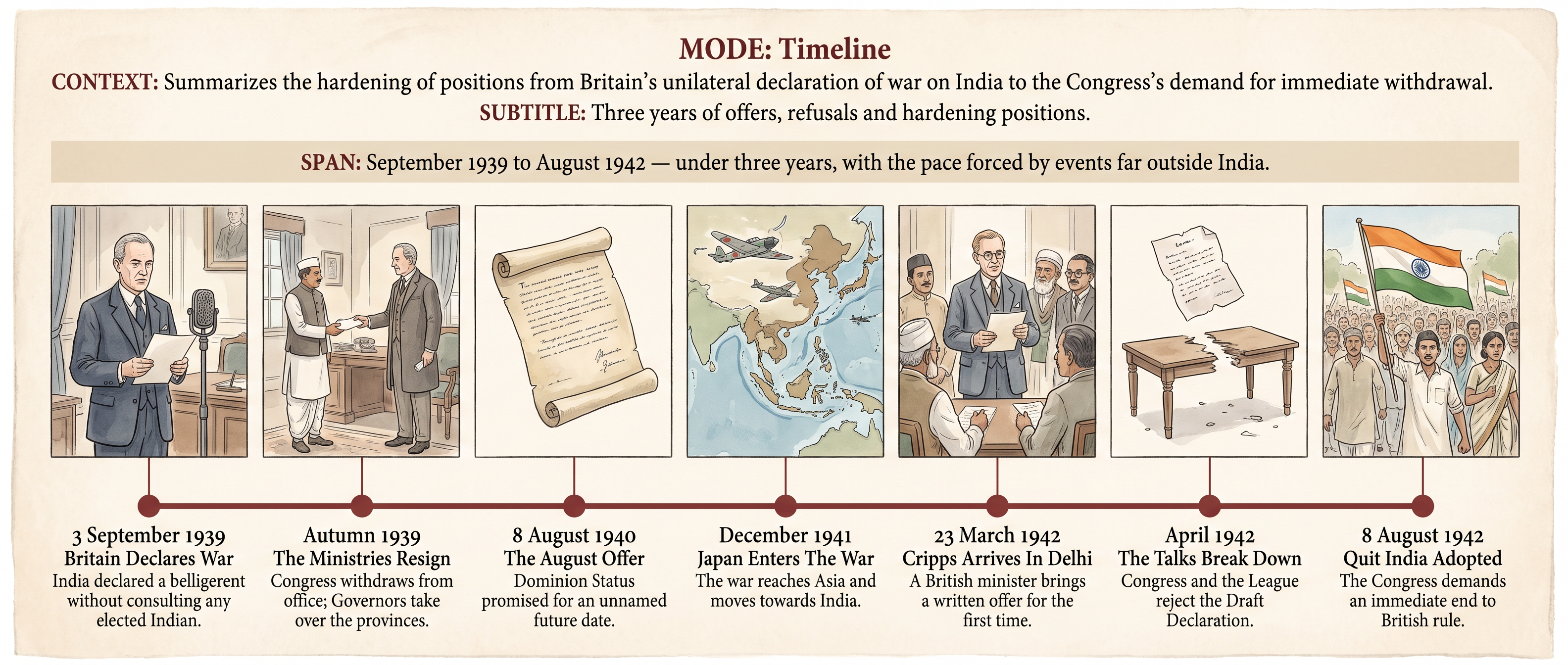
Fig. 1.0 – From The Declaration Of War To Quit India.
1.1.2 The August Offer, 1940
The War Turns Against Britain
For eight months after September 1939 little happened on the western front. Then, in the spring of 1940, Germany overran Denmark, Norway, the Netherlands, Belgium and France in a matter of weeks. The British army in France was driven back to the coast and evacuated from Dunkirk, on the French side of the Channel, in a fleet of naval and civilian vessels.
By the summer of 1940 France had surrendered, Britain was fighting alone in Europe, and German aircraft were bombing British cities. A government in that position needed Indian soldiers, Indian factories, Indian money and Indian calm.
The Congress Offer From Poona
The Congress position also shifted. Meeting at Poona in July 1940, its leadership signalled that it would support the war effort if two conditions were met: a clear declaration of India’s independence, and the formation at once of a provisional national government at the centre with the elected representatives of Indians in it.
This was a real concession. The Congress was offering wartime cooperation to a government it had walked out on a few months earlier. It expected an answer of the same size.
What Linlithgow Offered
The answer came on 8 August 1940 and is known as the August Offer. It contained six elements.
The Governor-General’s Executive Council — the small body of officials through which the Viceroy actually governed — would be enlarged to bring in more Indians. A War Advisory Council would be set up, including representatives of the princely states and of national leaders, to be consulted on the conduct of the war.
Third, and most consequential, minority opinion was reassured. The government said that Muslim views would be given due weight in deciding India’s political future and that Muslim interests would be safeguarded. In practice this meant that no future settlement would be imposed over the objection of a large section of Indian opinion.
Fourth, after the war a body representative of Indian opinion would frame the new constitution. A Constituent Assembly is an elected body whose task is to write a constitution and then dissolve. Fifth, the government hoped all Indian parties would cooperate towards free and equal partnership within the Commonwealth of Nations. Sixth, Dominion Status — self-government in domestic and foreign affairs while remaining under the Crown, as Canada and Australia already were — was named as India’s future.
Why It Satisfied Nobody
Two things in the August Offer were genuinely new. For the first time the British accepted in principle that Indians, not Parliament at Westminster, would frame India’s constitution. For the first time Dominion Status was stated as the goal rather than hinted at.
Everything else was postponed. There was no date, no transfer of any real power during the war, and no national government. Jawaharlal Nehru’s response was that the idea of Dominion Status was now ‘dead as a doornail’ — the Congress had committed itself to complete independence eleven years earlier, and the offer was a decade behind the demand.
Gandhi’s objection was different in kind. He argued that the declaration had widened the gulf between the British rulers and Indian nationalists rather than narrowing it, because it made the terms of British thinking plain.
The Muslim League welcomed precisely the part the Congress condemned. The assurance about minority opinion meant that no constitutional settlement could be forced through against the League’s objection, and that assurance was worth more to it than any council seat.
1.1.3 The Cripps Mission, 1942
Japan At The Door
In December 1941 Japan attacked the American fleet at Pearl Harbour and struck at British and Dutch possessions in South-East Asia. The war was no longer a European affair.
Within weeks the Japanese advance was extraordinary. Singapore, the great British naval base at the tip of the Malay peninsula, surrendered in February 1942. Rangoon fell in March, and by the middle of the year Japanese forces held Burma and stood on India’s eastern frontier, as Map 1.2 shows.
Map
Map 1.2 Caption: By mid-1942 Japanese forces had reached the eastern frontier of British India. Brief: Show South-East Asia and eastern India as of mid-1942, with Malaya, Singapore, Burma and Rangoon labelled and the extent of Japanese control shaded; mark the Burma-India frontier and label Calcutta and the Bay of Bengal; use the provincial boundaries of British India in 1942 and state the year on the map face; include an inset showing the full extent of India as officially defined; do not shade any part of India as occupied.
The military position changed British calculations. An India that was sullen, unpoliced and possibly sympathetic to a Japanese advance was a danger to the whole eastern war. Pressure also came from Britain’s allies: the United States and China both wanted India settled and fighting.
Why Churchill Sent Cripps
In March 1942 the War Cabinet of the British Prime Minister, Winston Churchill, sent one of its own members to Delhi. Sir Stafford Cripps was a Labour politician who had long argued the Indian case in Britain and was personally known to Congress leaders. He reached India on 23 March 1942 carrying a written offer, called the Draft Declaration.
That a British minister came with a document at all was new. Previous offers had been announcements made by the Viceroy; this one was negotiable, and Cripps spent three weeks discussing it with the leaders of every major party.
The Draft Declaration
The proposals covered both the immediate war period and the settlement afterwards.
For the long term, India would become a Dominion after the war, with the right to leave the Commonwealth if it chose. A constitution-making body would be set up as soon as fighting ended, elected by the newly chosen lower houses of the provincial legislatures by proportional representation, with the princely states sending nominated representatives.
The most far-reaching clause concerned provinces that did not like the result. Any province unwilling to accept the new constitution could keep its existing position or frame a constitution of its own, and could seek Dominion Status separately. A treaty would protect racial and religious minorities, and earlier British assurances to Muslims would be honoured.
For the war period itself, almost nothing changed. The British government would keep the direction of defence, security and the conduct of the war in its own hands. Indian leaders were invited to take part in the counsels of their country and to help in a task described as vital to India’s future freedom — but not to control it.
1.1.4 Why The Cripps Proposals Were Rejected
The Congress Objections
The Congress case against the Draft Declaration had four strands, and only the first was about the future.
Everything of substance was postponed to the end of a war that Britain might yet lose. An offer of freedom later, from a government whose survival was uncertain, was widely described at the time as a post-dated cheque.
Next, Indians were to have no share in the defence administration of their own country while the war ran. The Congress had asked that Indians take responsibility for defence; the proposals kept it in British hands entirely.
Third, the Congress wanted the Governor-General to act as a constitutional head — that is, to act on the advice of a national government of Indian leaders, as the King acted on the advice of his ministers in Britain. No formal assurance of this was given, and there was no proposal for an interim national government at all.
Fourth, and most serious in the long run, was the right of a province to stay out. The Working Committee saw at once what that clause meant: any province could refuse to join the Indian Union, and the offer therefore contained a division of the country inside it. The Committee described it as a severe blow to the conception of Indian unity.
The League’s Objections
The Muslim League rejected the offer for the opposite reason. The Draft Declaration allowed provinces to opt out one at a time, but it did not accept the principle of a separate Muslim state, and it gave no assurance that one would be created.
The League also objected to a single constitution-making body. Such an assembly, elected from the provinces as a whole, would have a permanent non-Muslim majority, and the League’s leaders held that partition, not a shared constitution, was the answer to India’s constitutional problem.
Everyone Else
Smaller organisations were no happier. The Hindu Mahasabha opposed the offer because more than one union would damage the country’s integrity. Sikh and Depressed Classes spokesmen felt that their interests had not been adequately guaranteed. Of the organised parties, only M. N. Roy’s Radical Democratic Party welcomed the scheme, and it later criticised the Mission as insufficient.
Breakdown
Negotiations collapsed in April 1942 and Cripps went home. Britain now had a war on India’s eastern frontier and no political settlement behind it, and the Congress had learnt that patient negotiation had produced nothing it could use. The road from the failure of the Cripps Mission to the Quit India Resolution was short and direct.
1.1.5 The Quit India Resolution, 8 August 1942
Gandhi’s Argument
Through the summer of 1942 Gandhi developed an argument that turned the usual objection on its head. It was said that the British could not leave while Japan threatened India. Gandhi replied that the British presence was itself the threat, and he made the case in his weekly paper Harijan.
The reasoning is worth following. Japan’s quarrel, on this view, was with the British Empire, not with India; remove the empire and the reason for invasion goes with it. A free India, moreover, would defend itself with a will that a subject India could not be expected to find.
The argument was contested at the time, including inside the Congress. It assumed that Japanese war aims stopped where British possessions ended, and neither Gandhi nor his critics could know whether that was true. What the argument did was remove the last respectable reason for waiting.
From Wardha To Bombay
The Congress Working Committee met at Wardha in July 1942 and approved the demand for British withdrawal. The full All India Congress Committee then assembled in Bombay and adopted the Quit India Resolution on 8 August 1942.
The resolution demanded that British rule in India end immediately. It argued that this rule was leading the country towards ruin and weakening its capacity to defend itself. And it sanctioned a non-violent mass struggle on the widest possible scale, drawing on the discipline the country had built up over twenty-two years of organised campaigning.
‘Do Or Die’
Gandhi spoke to the delegates that night. The speech is the reason most people remember the date, and it made explicit what the resolution left formal.
Two things are happening in that passage at once. Gandhi is refusing any bargain short of complete freedom, which closes off the kind of negotiation the previous two years had consisted of. And he is handing responsibility to every listener individually, in a form short enough to be carried in the head — which is exactly what a movement needs when its organisation is about to be destroyed.
1.1.6 The Movement And Its Suppression
The Arrests Of 9 August
The government did not wait. Before dawn on 9 August 1942, hours after the resolution was passed, police across the country arrested Gandhi, Jawaharlal Nehru, Vallabhbhai Patel, Abul Kalam Azad and the whole Working Committee, along with provincial and district leaders.
Gandhi was interned at the Aga Khan Palace in Poona. The Working Committee members were held in Ahmednagar Fort. For a long time the public did not know where any of them were.
The organisation was dismantled with them. The All India Congress Committee and the provincial committees were declared unlawful, offices were sealed, funds were confiscated and papers were seized. The calculation was that a movement decapitated on its first morning would not start.
A Movement Without Leaders
The calculation failed, and what followed took a shape nobody had planned. The upheaval is usually described in three overlapping phases.
The first was urban and immediate: hartals — the closing of shops and businesses as a protest — along with strikes, student walkouts, processions and clashes with police in Bombay, Calcutta, Delhi, Lucknow, Kanpur, Patna and other cities. This phase was largely over within a fortnight.
The second was rural and far more damaging to the government. Crowds attacked the physical apparatus of the state: railway lines and stations, telegraph wires, post offices, police stations and government buildings. In parts of Bihar, eastern United Provinces, Bengal, Orissa and the Bombay Presidency, communications broke down and the administration briefly stopped working.
The third phase was underground. Activists who had escaped arrest organised in secret, kept up sabotage, ran clandestine communication and sustained the movement into 1943 and beyond, long after the open risings had been put down.
Parallel Governments
In a few districts, people did not merely defy the administration; they replaced it. Local national governments took over the ordinary business of rule — collecting revenue, settling disputes, organising relief, running a volunteer force.
The longest-lasting was the Prati Sarkar in Satara, in the Bombay Presidency, which functioned in the countryside for years. There were others at Ballia in the eastern United Provinces, at Talcher in Orissa, and in the Midnapore district of Bengal, where the procession described at the start of this chapter was one episode in a wider takeover.
These experiments matter out of proportion to their size. They show that the demand was not only for the British to go, but for something specific to take their place, and that villagers were willing to build it themselves.
The Weight Of Repression
The government answered with force on a scale it had not used for generations. Police and troops fired on crowds. Aircraft were used against gatherings in parts of Bihar, Bengal and Orissa. Villages near sabotaged railway lines were burnt, and collective fines were imposed on whole communities.
In the first five months more than 60,000 people were arrested on various charges, and some 18,000 were held without trial under wartime detention rules. Official figures admitted around a thousand people killed in firings; nationalist estimates ran several times higher, and no figure covers deaths in custody or in punitive operations.
Censorship was imposed on newspapers, including Gandhi’s own Harijan, so the country learnt what was happening late and in fragments. Several historians have judged that India had not seen repression this intense since the Revolt of 1857.
1.1.7 The Significance Of The Quit India Movement
What It Did Not Achieve
Judged by its own demand, the movement failed. The British did not quit. The open risings were broken within months, the leaders stayed in jail until 1944 and 1945, and the war was fought to its end with Indian resources.
That outcome was predictable. An unarmed population, with its entire leadership imprisoned on the first morning, was not going to defeat the wartime military power of a government that had decided to hold on. Significance has to be looked for elsewhere.
What It Changed
The first change was in what the government now knew about itself. British rule in India had always rested on the assumption that most people accepted it most of the time, and that the police and the ordinary machinery of administration were enough. In 1942 that assumption failed publicly, and rule had to be restored by the army.
The second change was in the balance of confidence. The strength of the upheaval convinced Indians across the country that independence was near, and it told the British that after the war they would be governing a population that had already tried to throw them out once.
New Leaders, New Participants
With the recognised leadership in jail, a younger and more radical group came forward and ran the underground: Ram Manohar Lohia, Jai Prakash Narayan, Achyut Patwardhan, Aruna Asaf Ali, Satish Samanta and others. Several of them would still be shaping Indian politics thirty years later.
Women were central to the movement rather than incidental to it, in numbers and in leadership. Aruna Asaf Ali took charge of the Bombay session on 9 August after the arrests and became a central figure in the underground. Kanaklata Barua, a girl of seventeen, was shot dead at Gohpur in Assam in September 1942 while leading a procession carrying the national flag towards a police station.
The League’s Opportunity
One consequence was not intended by anyone in the Congress. For three years, while the Congress was banned and its leaders imprisoned, the Muslim League was free to organise, negotiate and govern in the provinces where it held office.
The League had stayed out of the movement. It emerged from the war stronger, better organised and established as the party the British had to deal with alongside the Congress. Some of the ground the Congress lost in 1942 it never recovered, and that fact runs through the negotiations of 1946 and 1947 in Section 1.3.
1.2 Subhash Chandra Bose And The Indian National Army
While the Congress leadership sat in jail and the underground worked in the districts, a second challenge to British rule was being built outside India altogether. It was an army, raised largely from Indian soldiers who had already been captured by the Japanese, and it was commanded by a man who had twice been elected president of the Congress.
Its military record was short and unsuccessful. Its political effect, three years later, was out of all proportion to what it achieved in the field, and understanding why is the point of this section.
1.2.1 Bose And The Congress: The Widening Rift
Two Presidencies
Subhash Chandra Bose was elected president of the Congress at its Haripura session in Gujarat in 1938. He argued for complete independence rather than Dominion Status, and for using the coming European war as an opportunity to press Britain when it was weak.
He also disagreed with Gandhi about method. Bose had criticised the calling-off of earlier mass campaigns, held that non-violence alone would not shift the British, and wanted the Congress to plan for industrialisation, land reform and a socialist economic programme in a free India.
At the Tripuri session in 1939, held near Jabalpur in the Central Provinces, Bose stood for a second term against Pattabhi Sitaramayya, who was backed by Gandhi, and won. Gandhi took the result personally, saying that the defeat was his own more than the losing candidate’s, and the Working Committee refused to serve under Bose.
Forward Bloc And Departure
Unable to govern the party he had been elected to lead, Bose resigned the presidency in April 1939. In May he founded the Forward Bloc, at first a group within the Congress, committed to complete independence through anti-imperialist struggle, a modern socialist state, freedom of worship and cultural autonomy, and social justice regardless of class, creed or gender.
When war came, Bose campaigned against Indian participation and was arrested. Held under detention at his family home in Calcutta in 1940, he escaped in January 1941 in disguise, travelled overland through Peshawar and Kabul, and reached Germany by way of the Soviet Union in the spring of 1941.
1.2.2 The Founding Of The Indian National Army
Bose In Germany
In Berlin, Bose set up a broadcasting station, known as Azad Hind Radio, from which he spoke to India, and organised an Indian Legion of about three thousand men. Its soldiers were Indian prisoners of war taken by the Germans in North Africa — a prisoner of war being a captured enemy soldier, held until the fighting ends.
Germany was the wrong base. Its armies were nowhere near India, and Hitler showed no serious interest in an Indian campaign. The war that could actually reach India was being fought by Japan, and in early 1943 Bose left Europe by German submarine, transferred at sea to a Japanese one, and landed in Japanese-held Sumatra in May 1943.
The First INA
Something for him to lead already existed. The Indian Independence League was a political organisation of Indians living in South-East Asia — in Singapore, Malaya, Burma and Japan — many of them merchants, plantation workers and clerks whose families had been settled there for a generation.
When Singapore fell in February 1942, tens of thousands of Indian soldiers of the British Indian Army became prisoners. Japan handed many of them over to the League, and an Indian National Army was formed under Captain Mohan Singh.
This first INA did not last. Mohan Singh insisted that his force be treated as the army of a free country and not as an auxiliary of the Japanese; the Japanese would not agree; and in December 1942 the arrangement broke down and Mohan Singh was removed and detained. The lesson of that quarrel — who exactly the army belonged to — did not go away.
Bose Takes Command
Subhash Chandra Bose reached Singapore in July 1943, and Rash Behari Bose formally handed over the leadership of the League and its army. In August he became Supreme Commander of the revived Indian National Army, also called the Azad Hind Fauj.
Recruitment now widened beyond prisoners of war. Indian civilians across Malaya and Burma volunteered and gave money, and the army enrolled people irrespective of caste, creed or gender — a deliberate policy, and one that mattered to a force drawn from communities that ate, worshipped and married separately.
1.2.3 Azad Hind: Government, Regiments And Resources
A Provisional Government
On 21 October 1943, at Singapore, Bose proclaimed the Provisional Government of Azad Hind — of free India — with himself as head of state, prime minister and minister for war. It declared war on Britain and the United States.
Nine governments recognised it. That list is worth reading carefully, because every one of them was either an Axis power or a state set up under Japanese sponsorship: Japan, Germany and Italy, along with the Japanese-backed regimes in Burma, the Philippines, Manchukuo, Nanjing, Croatia and Thailand. No neutral or Allied government recognised Azad Hind at all.
In November 1943 Japan transferred the Andaman and Nicobar Islands to the provisional government, and Bose visited Port Blair at the end of December and renamed the two island groups Shaheed, meaning martyr, and Swaraj, meaning self-rule. In practice the Japanese military kept control of the islands and their population; the transfer was a gesture, and it is a fair test of how much sovereignty Azad Hind really held.
The Regiments
The INA was organised in brigades named for Indian political figures — the Gandhi Brigade, the Nehru Brigade and the Azad Brigade among them. At his first public meeting Bose called for women volunteers, and the resulting Rani of Jhansi Regiment, commanded by Lakshmi Sahgal, was a combat unit rather than a nursing corps.
A women’s fighting regiment in 1943 was without precedent in any Indian or British force. Most of its recruits were young women from Tamil families settled on the rubber plantations of Malaya, and its existence tells you how far Bose was willing to break with the social arrangements of the army he had grown up beside.
1.2.4 Operations On The Eastern Frontier And The Defeat
Chalo Delhi
In January 1944 Bose moved his headquarters forward to Rangoon in Burma, and gave the army the slogan ‘Chalo Delhi’ — on to Delhi. His best-known appeal to his soldiers asked them to give him their blood, promising them freedom in return.
The plan was for the INA to advance with the Japanese into north-eastern India, take Imphal, the capital of Manipur, and Kohima in the Naga Hills, and then move down into Assam and Bengal. The expectation was political as much as military: that once a free Indian army stood on Indian soil, the population would rise and the Indian units of the British army would change sides.
Map
Map 1.3 Caption: The Imphal and Kohima campaign of 1944 was fought on the mountainous frontier between Burma and north-eastern India. Brief: Show Burma and north-eastern India in 1944, with Rangoon, Mandalay, the Chindwin river, the Burma-India frontier, Imphal, Moirang, Kohima and Dimapur marked; arrows for the Japanese and INA advance of March 1944 and the retreat of mid-1944; label the hill terrain; state the year on the map face; include an inset showing the full extent of India as officially defined.
The whole span of the INA, from Bose’s escape to the trials that followed its defeat, is set out in Fig. 1.1.
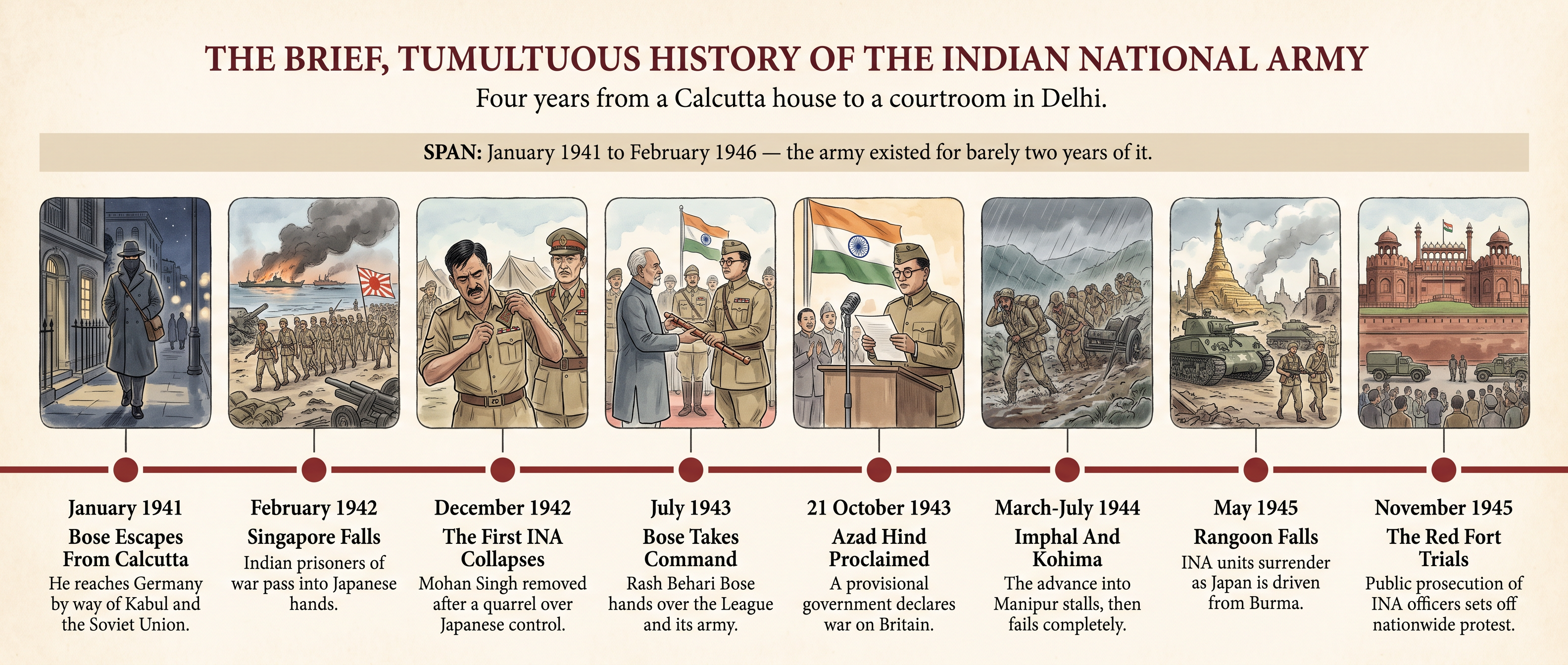
Fig. 1.1 – The Course Of The Indian National Army.
Imphal And Kohima
The advance began in March 1944 and units crossed crossed the frontier into Manipur. At Moirang, south of Imphal, INA officers raised the Indian tricolour in April 1944 — the flag of a free India flying over Indian territory for the first time.
That was the high point. Imphal and Kohima were besieged but never taken. The defenders were supplied by air, the Allies held command of the sky, and the monsoon turned the mountain tracks into mud. The Japanese plan had assumed that captured British supplies would feed the advance, and when the towns did not fall, the food did not come.
By July 1944 the campaign had failed, with very heavy Japanese and INA losses to fighting, hunger and disease. The retreat back through Burma was worse than the advance, and there was no general rising in India and no defection of British Indian units.
Collapse
After that the INA’s fate followed Japan’s. Allied forces pushed south through Burma, Rangoon fell in May 1945, and INA units were captured or surrendered in large numbers. Japan surrendered in August 1945.
Bose left South-East Asia by air in August 1945 and, on the accepted account, died on 18 August of injuries received when his aircraft crashed at Taipei in Taiwan. Doubts about his death circulated in India for decades and were examined by more than one official inquiry; his death remains a subject on which some people in India do not accept the official finding.
1.2.5 The Significance Of The INA
Not A Military Achievement
Measured as a campaign, the INA achieved almost nothing. It captured no city of consequence, held no Indian territory for long, and was defeated as thoroughly as the Japanese army it depended on.
Its equipment came from the Japanese and was never enough; its supply lines were another army’s; and the political calculation that India would rise behind it turned out to be wrong. Any honest account has to begin there.
The Trials At The Red Fort
The effect came after the fighting, and it came because the British made a decision. In November 1945 the government put captured INA officers on public trial for waging war against the King-Emperor, and it did so at the Red Fort in Delhi, the old seat of the Mughal court.
The first trial was of three officers together — Prem Sahgal, Gurbaksh Singh Dhillon and Shah Nawaz Khan, a Hindu, a Sikh and a Muslim. The Congress took up their defence and put senior lawyers, including Jawaharlal Nehru, on the defence team, and the trials became the largest public political event in India since 1942.
Demonstrations, strikes and student protests spread across the country in support of the accused. The men were convicted, and the government then remitted their sentences rather than face what enforcing them would cost. That retreat was itself a signal.
The Loyalty Of The Armed Forces
Here is the point on which the INA mattered most. British rule in India rested finally on an army recruited from Indians, and the trials made every Indian soldier and sailor watch other Indian soldiers being tried for choosing the other side.
In February 1946 ratings of the Royal Indian Navy mutinied in Bombay, and the mutiny spread to other ports and drew sympathy strikes in the city. Unrest also appeared in other services. For a government whose control depended on Indian troops obeying orders against Indian civilians, this was a different order of problem from a mass movement.
What The INA Left Behind
The INA also left an argument and an example. It had been raised from every community and from both sexes, and it had shown that Indians would fight under Indian command, which the sacrifice of its soldiers made hard to dismiss.
Its association with Japan and Germany remained a serious charge against it, and not everyone in the national movement admired what Bose had done. But by 1946 the British had reason to doubt the instrument they governed with, and that doubt runs straight into the negotiations of Section 1.3.
1.3 The Transfer Of Power (1945-1947)
Between the end of the war in 1945 and August 1947, British rule in India was wound up in twenty-four months. The speed is the thing to explain. In 1939 the government had refused even to state that India would be free after the war; by 1947 it was legislating its own departure and moving the date forward.
This section takes that period in the order the events themselves ran: why British thinking changed, what was offered in 1946, why the offer failed, and how the failure produced a deadline, a plan of partition and an Act of Parliament.
1.3.1 Why The British Attitude Changed After The War
A Bankrupt Victor
Britain won the war and was ruined by it. Its cities were damaged, its industry was worn out, rationing continued for years, and it survived on American credit. Lend-Lease aid from the United States stopped almost as soon as Japan surrendered, and Britain had to negotiate a large American loan simply to keep going.
India’s position in that account had reversed. Britain had bought supplies, services and soldiers in India throughout the war on credit, and by 1945 it owed India very large sterling balances. The colony that was supposed to pay for itself had become a creditor, and the old financial argument for holding India had gone.
A New Government In London
In July 1945 the British electorate voted Churchill out and put the Labour Party in office under Clement Attlee. Labour had argued for Indian self-government for years, and several of its leading figures had personal contacts among Congress leaders.
This was not a sudden discovery of principle. It was a government that had accepted, before it took office, that India would have to be given up, and that the only questions left were when, to whom and on what terms.
The Wider World
The war had also left two powers larger than Britain. Neither the United States nor the Soviet Union had any interest in preserving European colonial empires, and both had said so during the war. A Britain dependent on American money was in a poor position to argue.
Colonial rule was besides losing its footing everywhere. The Japanese conquest of 1942 had shown Asians that European empires could be beaten, and independence movements were pressing across Asia and Africa. India was the largest of them and the most watched.
The Instrument Problem
The most immediate reason was closer to hand. British rule in India had always been carried out by Indians — Indian soldiers, Indian policemen, Indian clerks and Indian officials — supervised by a small British service, and in 1942 that machinery had needed the army to hold the country down.
By 1946, as Section 1.2 described, the reliability of the armed forces themselves was in question. The British Indian services were also shrinking: almost no new British officers had been recruited during the war, and those in post were tired and looking to leave. A government that cannot be sure of its soldiers, its police and its administrators cannot govern against a united population, whatever its intentions.
1.3.2 The Cabinet Mission, 1946: Aims And Major Provisions
The Decision To Send It
In February 1946 Attlee announced in the House of Commons that a special mission of British Cabinet ministers would go to India to settle the transfer of power by negotiation. The announcement came at a moment when the unrest described in Section 1.2 was at its height.
Three ministers came, arriving in March 1946: Lord Pethick-Lawrence, the Secretary of State for India, who led the Mission; Sir Stafford Cripps, back in Delhi four years after his own failed attempt; and A. V. Alexander, the First Lord of the Admiralty.
The Aims
The Mission had three purposes, and they pulled against one another.
The first was to agree a machinery for framing a constitution — who would write India’s constitution, and how that body would be chosen. The second was to set up an interim government at the centre: a temporary government of Indian political leaders, running the country under the existing constitutional arrangements until the new constitution came into force.
The third was to do all this while keeping India a single country. The Mission examined the demand for a separate sovereign Pakistan and rejected it, both in the large form the League wanted and in a smaller form confined to Muslim-majority districts, on the grounds that either would leave large minorities stranded and would divide the army, the railways and the economy.
The Major Provisions
The plan announced in May 1946 tried to answer the League’s fears without conceding a separate state, and it had four main parts.
There would be a Union of India covering both the British Indian provinces and the princely states. The Union would deal with only three subjects — foreign affairs, defence and communications — with the power to raise the money needed for them. Every other power would rest with the provinces.
Second, the provinces could form groups, and the plan sorted them into three: Group A, the Hindu-majority provinces of the north, west, east and south; Group B, the Muslim-majority provinces of the north-west; and Group C, Bengal together with Assam. Each group could decide its own subjects and set up its own executive and legislature.
Third, a Constituent Assembly would be elected indirectly by the members of the provincial legislative assemblies, with the princely states sending representatives. It would meet, divide into the three groups to settle provincial and group constitutions, and then come together to frame the Union constitution.
Fourth, an interim government drawn from the major parties would run the country meanwhile, with seats reserved for the Sikh, Indian Christian and Parsi minorities alongside the Congress and the League.
What The Plan Was Trying To Do
The design has a logic worth spelling out. A Muslim-majority group of provinces, controlling everything except three subjects, would give the League something close to autonomy inside a single Indian union — self-rule without secession.
It also contained an escape hatch. After the constitution had been running for ten years, a province could reconsider both its group and the Union arrangements. Nobody was being locked in forever.
1.3.3 Deadlock: The Grouping Dispute And Its Consequences
Two Readings Of One Clause
Both the Congress and the League accepted the Cabinet Mission plan in the summer of 1946, and each accepted a different plan.
The League read grouping as compulsory. Provinces would go into their groups automatically, and the group would decide collectively whether to stay in the Union — which is what made the scheme worth accepting, because Group B and Group C together were the substance of Pakistan.
The Congress read grouping as optional. A province was free to join a group or stay out, and the Constituent Assembly, once elected, would be sovereign and could interpret the plan as it chose. On that reading the groups could be emptied of meaning by any province that walked away, and the North-West Frontier Province and Assam, both with Congress ministries, were expected to do exactly that.
The Congress said so publicly in July 1946. The League then withdrew its acceptance, and called on Muslims to observe 16 August 1946 as Direct Action Day to press the demand for Pakistan.
The Violence Of 1946
What followed was the worst communal violence India had seen. In Calcutta, from 16 August 1946, four days of rioting killed several thousand people, with attacks and reprisals between Hindu and Muslim crowds and a provincial administration that did not stop them.
Violence spread through the following months — to Noakhali in eastern Bengal, then to Bihar, then to Garhmukteshwar in the United Provinces, and in the spring of 1947 to Punjab, where Hindu, Muslim and Sikh communities were all involved. Hundreds of thousands of people left their homes.
Two things should be said plainly about this. It was not a spontaneous quarrel between neighbours; in most places it followed political mobilisation and spread where the authorities failed or refused to intervene early. And it was not one-sided in any province: attack produced reprisal, and each set of victims became the argument for the next attack. What it did to the politics was decisive — after Calcutta, every negotiator was working under the threat of civil war.
A Government That Could Not Govern
Meanwhile the interim government was being formed. Wavell, the Viceroy, invited Jawaharlal Nehru to form it, and it was sworn in on 2 September 1946 without the League. The League joined at the end of October, having refused the Constituent Assembly.
It never worked as a government. Liaquat Ali Khan, who led the League group and held the finance portfolio, used that department to block proposals from Congress ministers, and the cabinet operated as two hostile blocs rather than one administration. In June 1947 Sardar Patel remarked that Pakistan was already functioning inside the Indian government.
The Constituent Assembly, elected in July 1946, met for the first time in December 1946 with the League absent. Table 1.1 shows why its absence mattered so much, and why the League refused to enter it.
Read the two main figures together. The Congress took almost every general seat, and the League took 73 of the 78 seats reserved for Muslims — so each party could claim to speak for its constituency almost completely, and neither could claim to speak for the other’s.
That is also the arithmetic of the League’s boycott. In an assembly of 296 the Congress could count on well over two-thirds, and the League concluded that a body in which it was permanently outvoted would produce a constitution it could not live under. By the end of 1946 the constitution-making machinery existed, and one of the two parties it was built for would not enter it.
1.3.4 Attlee’s Declaration Of 20 February 1947
A Date Certain
On 20 February 1947 Attlee made a statement in the House of Commons that changed the terms of every negotiation in India. The British government, he announced, intended to transfer power to responsible Indian hands by a date not later than June 1948.
He added a warning. If a constitution had not been worked out by a fully representative assembly before that date, the government would have to decide to whom power should be handed over — to some form of central government, or to the existing provincial governments, or in whatever way seemed most reasonable in the interests of the Indian people.
At the same time Attlee announced that Lord Mountbatten would replace Wavell as Viceroy. Mountbatten took office on 24 March 1947.
Why The Declaration Mattered
Until then, both Indian parties had reason to wait. Each could calculate that the British would eventually need it more, and that holding out cost nothing. The deadline destroyed that calculation for both of them at once.
For the League, delay no longer strengthened its hand, because Britain would be gone by June 1948 whether or not the League had got Pakistan. For the Congress, the second half of the statement was alarming: if there was no agreed settlement, power might be handed to the provinces separately, and India could dissolve into a scatter of successor states rather than one.
The declaration also removed the last doubt about British intentions. Whatever else was uncertain, the British were leaving, and Indian politicians now had about fifteen months to agree on what they were leaving to.
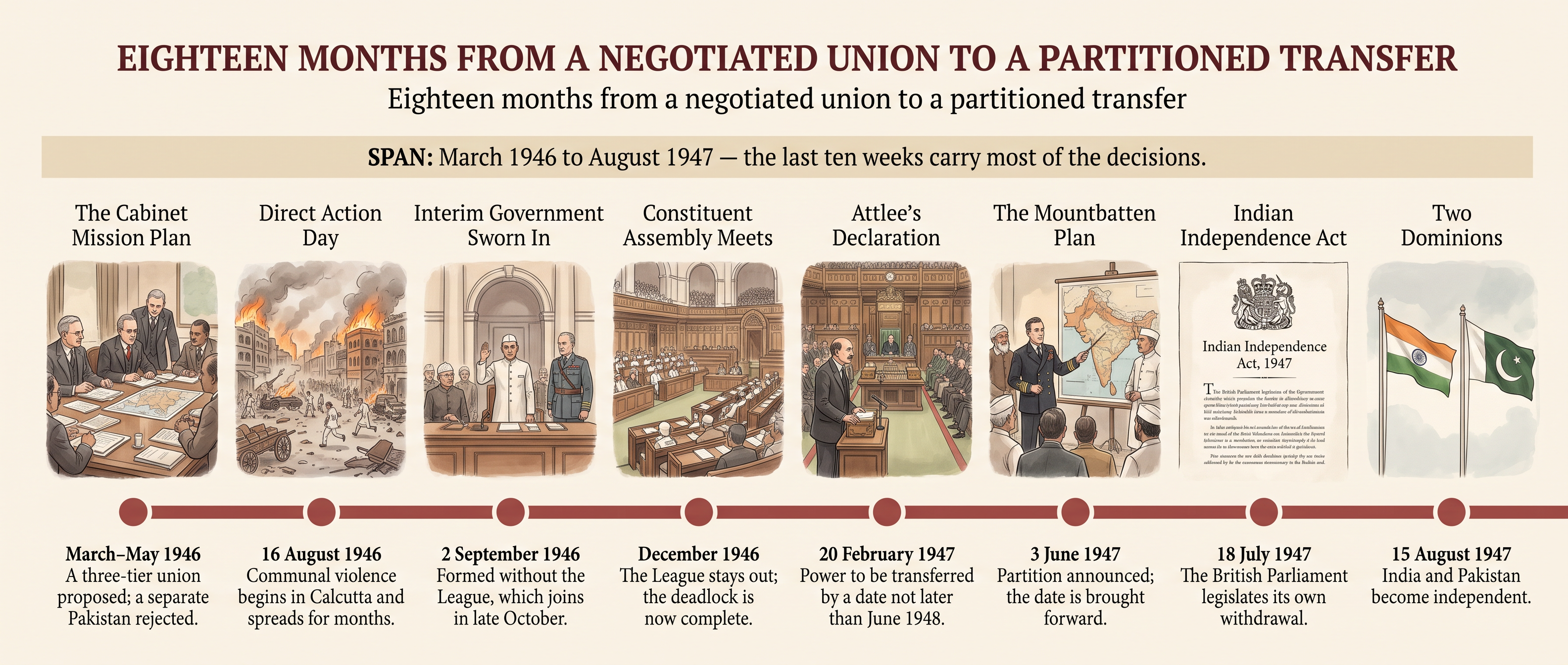
Fig. 1.2 – From The Cabinet Mission To Independence.
1.3.5 The Mountbatten Plan: Main Features
The Plan Of 3 June 1947
Mountbatten arrived believing a united India might still be arranged, spent ten weeks in negotiation, and concluded that it could not. The plan he announced on 3 June 1947 accepted partition and, crucially, brought the transfer forward from June 1948 to August 1947.
Its main features were these.
British India would be divided into two independent dominions, India and Pakistan, on 15 August 1947. The provinces would decide their own destination by procedures set out in the plan, rather than by any decision made in London or Delhi.
Bengal and Punjab, each with a large minority, would not be handed over whole. The legislative assembly of each province would meet in two parts, one representing the Muslim-majority districts and the other the rest, and if either part voted for partition, the province would be divided.
Sind’s assembly would decide for itself. A referendum — a direct vote of the electorate on a single question — would be held in the North-West Frontier Province, and another in the Sylhet district of Assam on whether to join East Bengal. British Baluchistan would decide separately.
A Boundary Commission would then draw the actual lines through Punjab and Bengal. Each dominion would have its own Constituent Assembly with full power to frame its own constitution, and each would have a Governor-General until it did.
Map
Map 1.4 Caption: The two dominions as they stood on 15 August 1947, with Punjab and Bengal divided between them. Brief: Show the Indian subcontinent on 15 August 1947, with the territory of the Dominion of Pakistan (West Punjab, Sind, British Baluchistan, the North-West Frontier Province, East Bengal and Sylhet) distinguished from the Dominion of India; mark the Radcliffe boundary lines through Punjab and Bengal and label Lahore, Amritsar, Calcutta, Dacca and Karachi; state the date on the map face and note that these are the boundaries of 1947, not of today; show the full extent of India as officially defined; leave the princely states unshaded and labelled as such.
What The Plan Settled And What It Did Not
The plan was accepted quickly because it asked each party only the question it was willing to answer. The League got a sovereign state; the Congress got a strong centre for the rest of India instead of a weak union with a permanent veto in it; the provinces decided by vote rather than by decree.
What it did not settle was where the boundary actually ran. The Boundary Commission’s awards for Punjab and Bengal were not published until after independence, which meant that millions of people in the border districts did not know, on 15 August, which country they were living in.
1.3.6 Why The Major Political Parties Accepted The Plan
The Congress
The Congress had opposed the division of India for its entire existence, and its acceptance in June 1947 needs explaining rather than assuming.
The first reason was the violence. Since August 1946 the country had been in the middle of killings that neither party could stop and that the government would not, and Congress leaders concluded that partition was a lesser evil than a civil war fought over the whole subcontinent.
The second was the experience of the interim government. Nine months of a cabinet split into two blocs had shown what a united India with a League veto at the centre would look like in practice, and Nehru and Patel were unwilling to inherit a state that could be paralysed by its own constitution.
The third was Attlee’s warning. With the British leaving by June 1948 in any case, an unsettled India risked breaking into far more than two pieces, and a partition agreed now was better than a collapse later.
The fourth reason was arithmetic. The elections of 1946 had shown that the League held nearly all the Muslim seats, and the claim that the Congress could speak for Muslims as well was no longer sustainable at the negotiating table.
Not everyone agreed. Gandhi opposed partition to the end and said that he could see only evil in the plan, though he did not break with the Working Committee that accepted it. Socialists within the Congress condemned it too. The decision was taken by a leadership that thought it had run out of alternatives, not by one that had been persuaded.
The Muslim League
For the League, acceptance was the achievement of its demand, and Jinnah accepted the plan although what he received was much less than he had asked for.
Pakistan came without the whole of Punjab and the whole of Bengal, and without Calcutta, the industrial and commercial capital of the east. It was two territories separated by a thousand miles of India. Jinnah described it as truncated and eaten away, and took it because the alternative on offer was no state at all.
Others
Sikh leaders in Punjab faced a choice between two bad outcomes. Their community was concentrated in the centre of the province, with its shrines and its best agricultural land on both sides of any possible line, and it had no majority anywhere. They accepted the partition of Punjab because the alternative was to be included entirely within Pakistan.
1.3.7 Modifications In The Indian Independence Act
Turning A Plan Into Law
A plan announced by a Viceroy has no legal force. The Mountbatten Plan had to be enacted by the British Parliament, and the Indian Independence Act was passed in July 1947, receiving royal assent on 18 July, less than a month before it took effect.
Its provisions followed the plan, with the details filled in. From 15 August 1947 two independent dominions, India and Pakistan, would come into being, each free to conduct its own domestic and foreign affairs. West Punjab, Sind, British Baluchistan, the North-West Frontier Province and East Bengal, together with Sylhet, would form Pakistan; the rest of British India, including East Punjab and West Bengal, would form India.
A Boundary Commission would demarcate the frontier through Punjab and Bengal. The Constituent Assembly of each dominion would frame its constitution and would also act as its central legislature in the meantime. A Governor-General would be appointed for each: Mountbatten stayed on for India, and Jinnah took the office in Pakistan.
What The Act Modified
The Act’s real work was undoing the constitutional structure that had governed India for a century. After 15 August 1947 the British Parliament would have no power to legislate for either dominion, the Secretary of State for India ceased to exist as an office, and the British Crown gave up the title of Emperor of India.
The Act did not, however, give India a constitution. Until each Constituent Assembly produced one, government would be carried on under the Government of India Act, 1935 — the same statute that had created provincial autonomy in 1937 — adapted and modified for a dominion with nobody above it. India was independent under an amended colonial law, and would remain so until it adopted its own Constitution.
That is the sense in which the Act was a machinery statute rather than a founding document. It transferred power and provided for a difficult transition; what to do with the power was left entirely to Indians.
Midnight
The Constituent Assembly of India met in New Delhi on the night of 14 August 1947. Nehru spoke shortly before midnight, and the opening of that speech is the most quoted sentence in modern Indian history.
It is worth noticing what the sentence does not mention. Punjab and Bengal were being divided as he spoke, the boundary awards were still unpublished, and columns of refugees were already on the roads. A speech made at a moment of achievement is not a description of the country at that moment, and this chapter’s last section returns to that distance.
Jawaharlal Nehru was sworn in as the first Prime Minister of India, and Mountbatten became the first Governor-General of the new dominion. Eight years after a Viceroy declared India at war without asking anybody, the transfer of power was complete.
1.4 Summary
The War And The National Movement
- India was declared a belligerent in September 1939 by the Viceroy alone, without any elected Indian being consulted, which exposed provincial autonomy as an arrangement that could be overridden whenever London chose.
- The Congress withdrew from office rather than administer a war it had not agreed to, and the seven provinces it governed passed to their Governors; the Muslim League treated the resignations as a deliverance.
- The August Offer of 1940 conceded two things in principle — an Indian-made constitution and Dominion Status as the goal — but transferred no power during the war, and it gave the League an assurance that no settlement could be imposed over its objection.
- The Cripps Mission of 1942 came because Japan was on India’s frontier, not because British thinking had changed; it offered Dominion Status afterwards while keeping defence and real authority in British hands until then.
- The Congress rejected the Draft Declaration for what it withheld now, and for the clause allowing provinces to stay out, which it read as partition written into the offer; the League rejected it for not conceding a Muslim state.
- Quit India followed directly from that failure. Gandhi’s argument was that the British presence was itself the invitation to invasion, and the resolution of 8 August 1942 demanded immediate withdrawal and sanctioned mass struggle.
- Arresting the entire leadership before dawn on 9 August did not stop the movement; it produced a leaderless one — urban strikes, then attacks on railways, telegraphs and police stations, then an underground that lasted years.
- In a few districts people replaced the administration rather than merely defying it, running courts, relief and volunteer forces of their own.
- Repression was on a scale unseen since 1857: over 60,000 arrests in five months, detention without trial, firing on crowds, aircraft used against gatherings, and censorship that kept the country ignorant of its own upheaval.
- The movement failed in its own terms and mattered anyway: rule had to be restored by the army, a new generation of leaders emerged from the underground, and the Congress’s three-year absence left the field to a League that grew stronger in it.
Bose And The Indian National Army
- Subhash Chandra Bose left the Congress after being elected its president twice and being unable to lead it, founded the Forward Bloc, and concluded that Britain could be beaten only with the help of its enemies.
- The first Indian National Army, raised from prisoners of war after the fall of Singapore, collapsed in December 1942 over the question of whether it belonged to India or to Japan.
- Bose revived it from July 1943, proclaimed the Provisional Government of Azad Hind, and recruited across caste, creed and gender, including a women’s combat regiment without precedent in any army in India.
- Azad Hind was recognised only by Axis powers and Japanese-sponsored states, and the territory transferred to it stayed under Japanese military control — a government with a flag and an army but very little sovereignty.
- The advance on Imphal and Kohima in 1944 reached Indian soil at Moirang and then failed against air supply, the monsoon and a plan that assumed captured stores; no rising followed and no British Indian units changed sides.
- The INA’s effect came from the Red Fort trials of 1945, which produced nationwide protest, forced the government to remit the sentences, and raised the one question British rule could not survive — whether Indian soldiers would keep obeying.
The Transfer Of Power
- Britain emerged from the war a bankrupt victor, owing India large sterling balances, dependent on American credit, governed by a Labour ministry that had already accepted withdrawal, and unsure of the Indian forces and services it ruled through.
- The Cabinet Mission of 1946 examined the demand for a separate Pakistan and rejected it, offering instead a union of three subjects, provinces grouped into A, B and C, and an interim government.
- The plan died on the ambiguity of grouping: compulsory to the League, optional to the Congress, and neither would accept the other’s reading.
- From August 1946 communal violence spread from Calcutta through Bengal, Bihar, the United Provinces and Punjab, and every negotiation after it was conducted under the threat of civil war.
- The 1946 election results showed each party holding its own constituency almost completely, which destroyed the Congress’s claim to speak for all Indians and left the League refusing to enter an assembly where it would always be outvoted.
- Attlee’s Declaration of 20 February 1947 set a deadline and named the alternative — power handed to the provinces if no agreement came — which ended the advantage either party gained by waiting.
- The Mountbatten Plan of 3 June 1947 accepted partition, brought the date forward to 15 August, and left the provinces to decide by assembly vote or referendum, with a Boundary Commission to draw the lines afterwards.
- The Congress accepted it as a lesser evil than civil war and than a centre paralysed by a permanent veto; the League accepted a state far smaller than it had demanded; Sikh leaders accepted the division of Punjab to avoid being wholly inside Pakistan.
- The Indian Independence Act of July 1947 created two dominions, ended Parliament’s power to legislate for them and abolished the office of Secretary of State, but gave India no constitution — government continued under the adapted Government of India Act, 1935, until India framed its own.
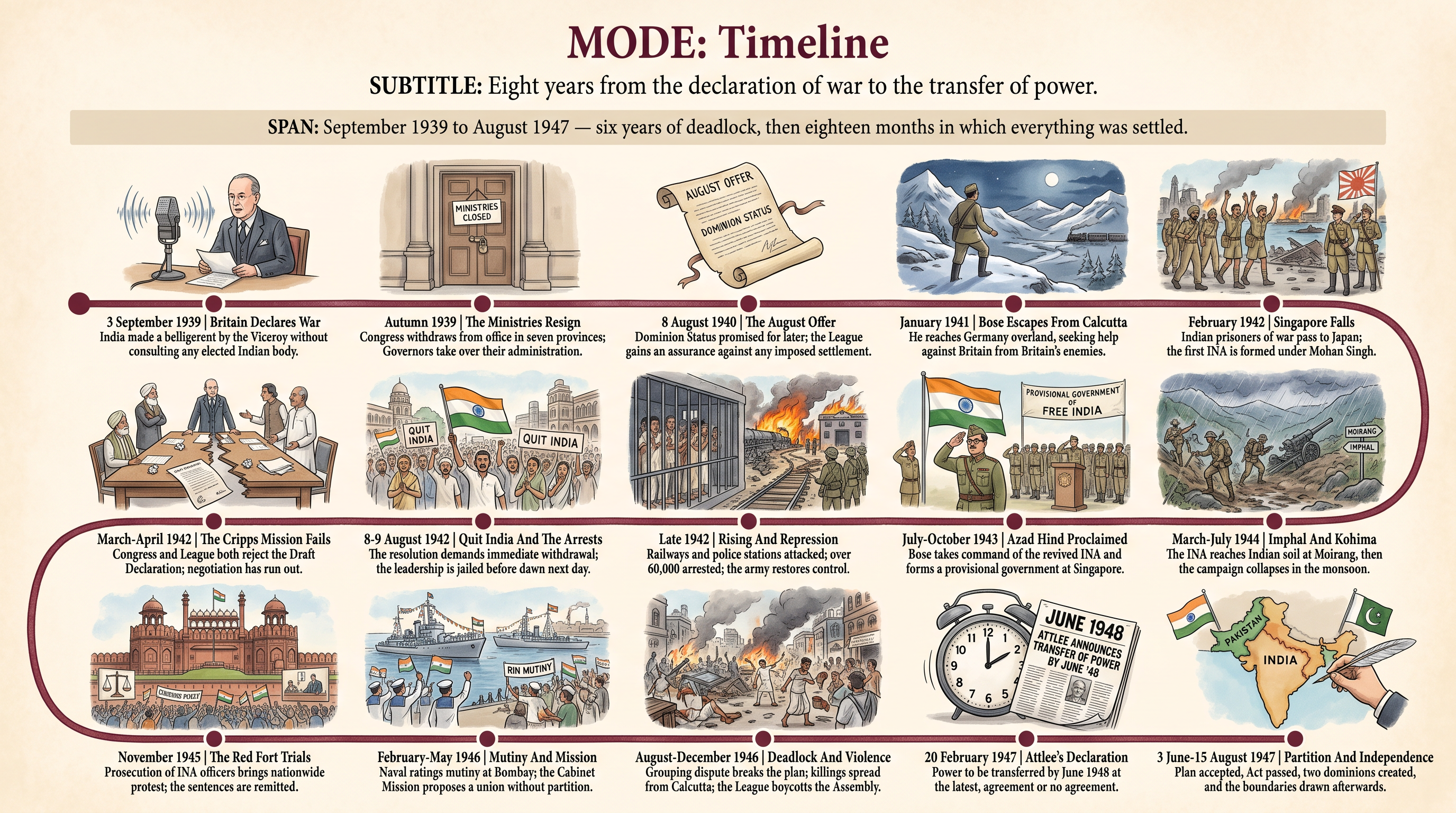
Fig. 1.3 – The Last Phase, 1939 To 1947.
What The Evidence Cannot Tell Us
Most of what survives from these eight years was written by the state or by the leaders who negotiated with it: official files, police returns, party resolutions, speeches and memoirs. The people who filled the crowds of 1942, joined the INA, or left their homes in 1946 and 1947 mostly left no written record of why they did it.
That silence bends the picture in a particular direction. It makes the movement look more organised than it was, because organisations keep minutes and villages do not, and it makes 1947 look like a sequence of negotiations rather than what it also was — a collapse of ordinary safety for millions of people who were never asked.
Some of the gaps have been partly filled since, by testimony gathered from survivors decades afterwards. But memory recorded fifty years later is evidence of a different kind, and no interview can restore what nobody wrote down at the time.
1.5 Recall And Explanation
Set out the four grievances on which the Congress ministries resigned in the autumn of 1939, and explain why their withdrawal from office left the Viceroy in a stronger position rather than a weaker one.
The August Offer of 1940 was rejected by the Congress and welcomed in part by the Muslim League. Explain what each of them saw in the same document.
Stafford Cripps came to India twice, in 1942 and again in 1946. Hold the two missions side by side: what did each of them offer, what was each trying to achieve, and what had changed between them?
1.6 Working With Evidence
Read Source 1.2 again. What was Gandhi asking his listeners to do, and why did the form of the appeal — short, personal and addressed to each individual — matter so much, given what happened before dawn the next morning?
Using Fig. 1.0, reconstruct the chain of events that runs from the breakdown of the Cripps negotiations in April 1942 to the arrests of 9 August 1942. At each step, say what made the next step likely.
Study Table 1.1. What do the two main figures show about the position of the Congress and the Muslim League by 1946, and how do they help explain the League’s refusal to enter the Constituent Assembly? State also what the table cannot tell you about Indian opinion.
The Indian National Army captured no Indian city and was defeated in the field. Explain why the advance of 1944 failed, and why this chapter still treats the INA as important for the end of British rule.
Using Map 1.4, locate West Punjab, East Bengal, Sylhet and the North-West Frontier Province. For each one, explain by what procedure it came to be part of Pakistan under the Mountbatten Plan.
1.7 Argument And Judgement
This chapter says that most of what can be counted about 1942 was counted by the government that was suppressing the movement. What can that kind of evidence establish reliably, and what can it never tell us? Answer with examples from the chapter.
The Congress had opposed the division of India throughout its existence and accepted it in June 1947. Argue the case both ways: that the acceptance was forced on the leadership by circumstances it could not control, and that it was a choice the leadership made among alternatives it could see. Say which case you find stronger and why.