Chapter 3: Development Of Indian Democracy (1964-77)
Before dawn on 26 June 1975, the electricity supply to the newspaper offices on Bahadur Shah Zafar Marg in Delhi was cut off. Presses that should have been running off the morning edition stood silent. Later that day the Prime Minister, Indira Gandhi, broadcast to the nation. The President had proclaimed an Emergency, she said, and there was no cause for alarm.
When the papers came back, the pages had to be shown to an official censor before they could be printed. Editors argued, and lost. Within days the Indian Express appeared with the space reserved for its editorial left completely blank.
That blank column is a historical source, and a strange one. It carries no words at all, yet it tells us a good deal — that something had been written, that it was stopped, and that the editor wanted readers to see the stopping. What it cannot tell us is what the editorial actually said. Nor can it tell us how many other pieces were quietly abandoned by writers who never risked sending them in at all.
That difficulty runs right through the chapter ahead. Between 1964 and 1977 India argued fiercely with itself — over food, over land, over language, over who should hold power and on what terms. Much of that argument survives on paper. Some of it was stopped before it reached paper, and a historian has to work out where those silences lie.

Fig. 3.0 – The blank editorial column during the Emergency.
3.1 Lal Bahadur Shastri As Prime Minister
Jawaharlal Nehru died on 27 May 1964, after seventeen years as Prime Minister. Nobody in India had governed the country in his absence, and nobody was sure how the succession would work. Within days the Congress Parliamentary Party — the body of Congress members sitting in Parliament, which chooses the party’s leader — settled on Lal Bahadur Shastri, and he was sworn in as Prime Minister on 9 June 1964.
Shastri was a small, quiet man from a modest family in Uttar Pradesh, with a long record inside the Congress organisation. He had been Railway Minister and later Home Minister, and had once resigned from the railways portfolio after a serious train accident. He held office for only nineteen months, and for most of that time the country was short of food and at war. What he did in those months is the subject of this section.
The sequence is set out in Fig. 3.1.
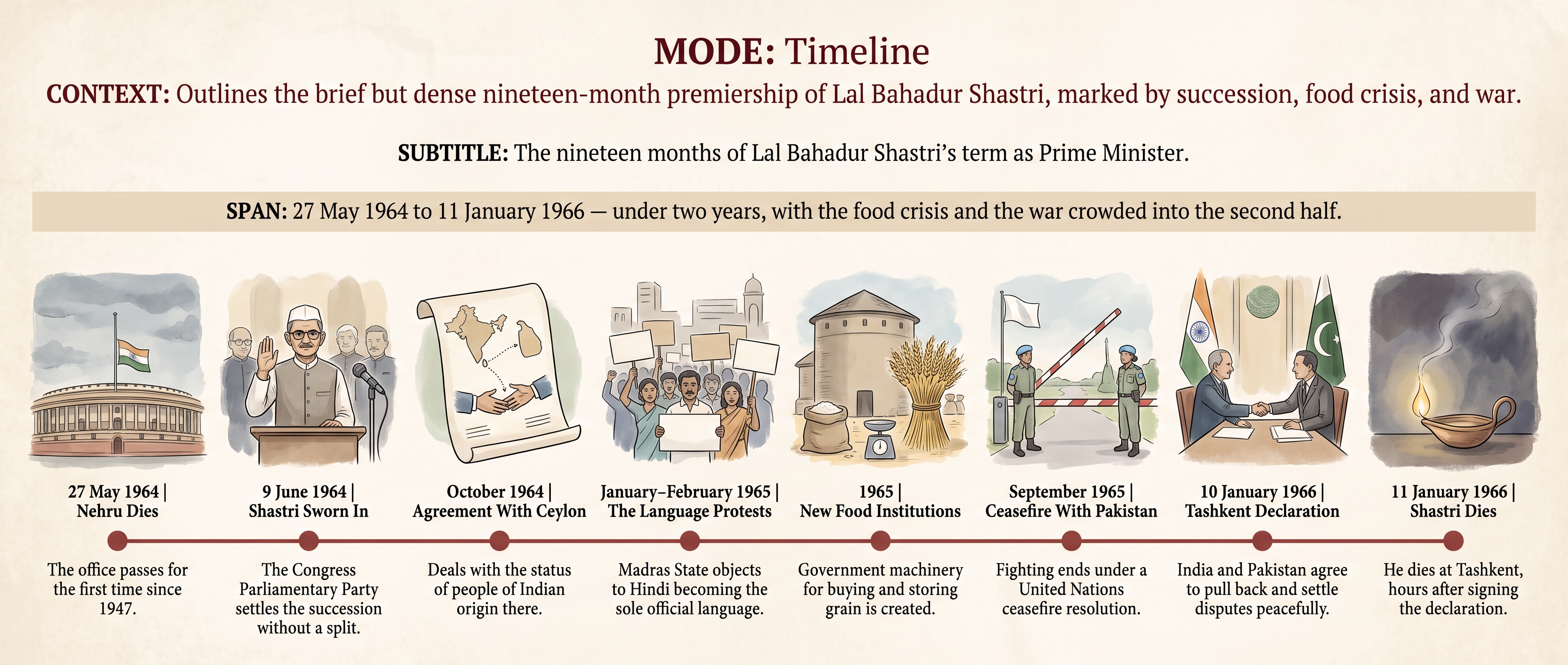
Fig. 3.1 – Shastri In Office.
3.1.1 Food Shortage And The Turn To Self-Sufficiency
India in the mid-1960s did not grow enough food to feed itself. Two bad monsoons left large parts of the country short of grain, and the government bought wheat abroad, chiefly from the United States, to keep the ration shops supplied.
Buying food abroad solved the immediate hunger and created a longer problem. A country that imports its staple grain is negotiating about far more than grain, because the supplier can slow the ships down whenever it dislikes what the buyer is doing. Shastri put the argument to the public in plain terms, appealing to citizens to give up one meal a week, and beginning with his own household.
Building The Machinery
The lasting work was institutional. In 1965 the government set up the Food Corporation of India, which buys grain from farmers, stores it and moves it to where it is needed, and the Agricultural Prices Commission, which advises on the price the government should offer. Together these gave a farmer something he had never had: a price announced in advance and a guaranteed buyer.
That mattered because the new farming methods then being discussed were expensive. Procurement at an assured price is what makes it rational for a cultivator to spend money on new seed, fertiliser and irrigation, since he knows the crop can be sold even if the market floods. This is why the Shastri years are usually described as the foundation of the Green Revolution — the sharp rise in wheat and rice yields achieved in the following decade using high-yielding seed varieties, fertiliser and assured irrigation.
Milk followed the same logic. The National Dairy Development Board was set up in 1965 at Anand in Gujarat, taking as its model the district cooperative there, in which village societies collected milk from their members and sold it collectively. The large national milk programme came later, but the body that ran it dates from Shastri’s term.
3.1.2 The War Of 1965 And The Tashkent Agreement
In 1965 India and Pakistan fought a war. Its causes and its course belong to the study of India’s foreign policy and are taken up there; what concerns us here is what the war revealed about the new Prime Minister and how it ended.
Shastri had been chosen partly because he seemed mild and manageable. In the war he was neither. He backed his commanders, spoke to the country in short, unadorned broadcasts, and gave it the slogan Jai Jawan, Jai Kisan — hail the soldier, hail the farmer — which tied the man at the front to the man in the field and made self-sufficiency in food a matter of national defence rather than of economics alone.
The fighting stopped in September 1965 under a ceasefire called for by the United Nations Security Council. In January 1966 Shastri met President Ayub Khan of Pakistan at Tashkent, then a city in the Soviet Union and now the capital of Uzbekistan, with the Soviet government acting as host and go-between. The two signed the Tashkent Declaration on 10 January 1966, agreeing to withdraw their forces to the positions held before the fighting and to settle their differences by peaceful means.
Hours later, in the early morning of 11 January 1966, Shastri died at Tashkent of a heart attack. He had been Prime Minister for nineteen months.
3.1.4 Two Years Weighed Up
Judged by legislation passed, Shastri’s premiership is thin. Judged by what it settled, it is not. It showed that the Congress could transfer power after Nehru without breaking; that a Prime Minister with no personal following could lead a country at war; and that the Union would negotiate with a protesting state rather than override it.
The food institutions of 1965 outlived him by decades and made possible a rise in output he did not live to see. The manner of his death — abroad, at the end of a peace negotiation — fixed his public reputation as a plain man who did a hard job and asked for nothing. When he died on 11 January 1966, the question the Congress had answered in 1964 came back at once: who would govern next.
3.2 The Importance Of The Election Of 1967
India voted in February 1967 in its fourth general election. The Lok Sabha and most state assemblies were elected together, so a voter marked two ballots on the same day, one for Delhi and one for the state capital. It was the first general election held without Nehru, and the first fought under the shadow of drought, rising prices and a war just ended.
Every election since 1952 had returned the Congress to power at the centre and in almost every state. Political scientists had begun to treat that as the settled shape of Indian politics rather than as a result that had to be won each time. The election of 1967 is important because it ended that assumption without ending Indian democracy — which is a distinction worth holding on to as you read the rest of this chapter.
3.2.1 The Results And What They Showed
The Congress won the election and lost its aura. Table 3.1 sets the two results side by side.
Read the second row carefully. A house of 520 needs 261 for a majority, so 283 is a majority — but a margin of twenty-two, held by a party that had been governing with a margin of over a hundred. A government with that cushion must keep every one of its own members satisfied, because two dozen unhappy members can now end it.
The state results were sharper. The Congress lost its majority in the assemblies of eight states — Bihar, Uttar Pradesh, Rajasthan, Punjab, West Bengal, Orissa, Madras and Kerala. In Madras the Dravida Munnetra Kazhagam won outright and C. N. Annadurai became Chief Minister, the first time a state had been taken by a party built on a regional and linguistic identity. In Kerala and West Bengal, United Front ministries took office in which communist parties were largest partners.
Several of the men who had run the Congress machine were personally defeated. K. Kamaraj lost in Madras, S. K. Patil lost in Bombay, and Atulya Ghosh lost in Bengal. These were the leaders known as the ‘Syndicate’ — senior organisation men, mostly former Chief Ministers, who controlled state party machines and had settled the succession in 1964 among themselves. Men who cannot win their own seats find it hard to go on telling a Prime Minister what to do.
Map
Map 3.1 Caption: States where the Congress lost its assembly majority in the elections of February 1967. Brief: Political map of India showing the full extent of India as officially defined, with state boundaries as they stood in 1967 (Madras, Mysore, Bombay and the newly separated Punjab and Haryana); shade and label only Bihar, Uttar Pradesh, Rajasthan, Punjab, West Bengal, Orissa, Madras and Kerala; do not use present-day state names or boundaries.
3.2.2 Coalition Ministries And Defection In The States
Where no single party held a majority, several had to govern together. A coalition is a government formed by two or more parties that agree on a common programme, usually because none of them can command a majority alone. In much of north India these were called Samyukta Vidhayak Dal — united legislators’ party — ministries, and they brought together socialists, the Jan Sangh, communists and Congress rebels who agreed on very little except that the Congress should not govern.
Such ministries were fragile, and a second practice made them more so. Defection is the act of a legislator leaving the party on whose ticket he was elected and joining another, usually in exchange for office. Between 1967 and 1968 hundreds of legislators changed sides across the country, ministries fell within weeks of being formed, and several states passed into President’s rule — the arrangement under Article 356 by which the Union takes over the administration of a state whose government has broken down.
3.2.3 The End Of One-Party Dominance
Put the two levels together and the significance of 1967 becomes clear. At the centre the Congress governed, but on sufferance. In the states it now faced governments run by its opponents, who controlled police, land administration and patronage in territories containing a large part of India’s population.
This mattered for how the Union worked in practice. A Chief Minister from another party negotiates with Delhi rather than reporting to it, and disputes over money, appointments and the use of Article 356 became live political questions instead of internal Congress business.
It also changed what an opposition party was for. Before 1967, opposition parties were mainly places to make arguments from; after 1967 they were places from which to govern, which forced them to think about alliances, administration and the compromises both require. Section 3.3 examines who these parties were and what they believed.
3.2.4 The Congress Divides
The election also settled a quarrel inside the Congress, though it took two more years to work itself out. Indira Gandhi had been chosen as Prime Minister in 1966 by the same organisation leaders who had chosen Shastri, on the calculation that she would need them. After 1967 that calculation collapsed: the leaders had lost their seats and their state machines, while she had led the party through a national election and remained in office.
The open break came in 1969 over the party’s official candidate for President of India. Indira Gandhi encouraged Congress members of Parliament and of the state assemblies to vote according to conscience rather than the party whip, and the candidate she favoured, V. V. Giri, won. The organisation’s leaders treated this as defiance of the party, and in November 1969 they expelled her.
The Congress thus split in two. Her supporters, who had requisitioned a meeting of the party’s national body, took the name Congress (R), for Requisitionists. Those who stayed with the old party organisation became Congress (O), for Organisation. She remained Prime Minister, since her government could still command a majority in the Lok Sabha with support from outside.
The sequence is set out in Fig. 3.2. Notice how much of it follows from the arithmetic in Table 3.1: a party that wins comfortably does not put its leadership to this kind of test.
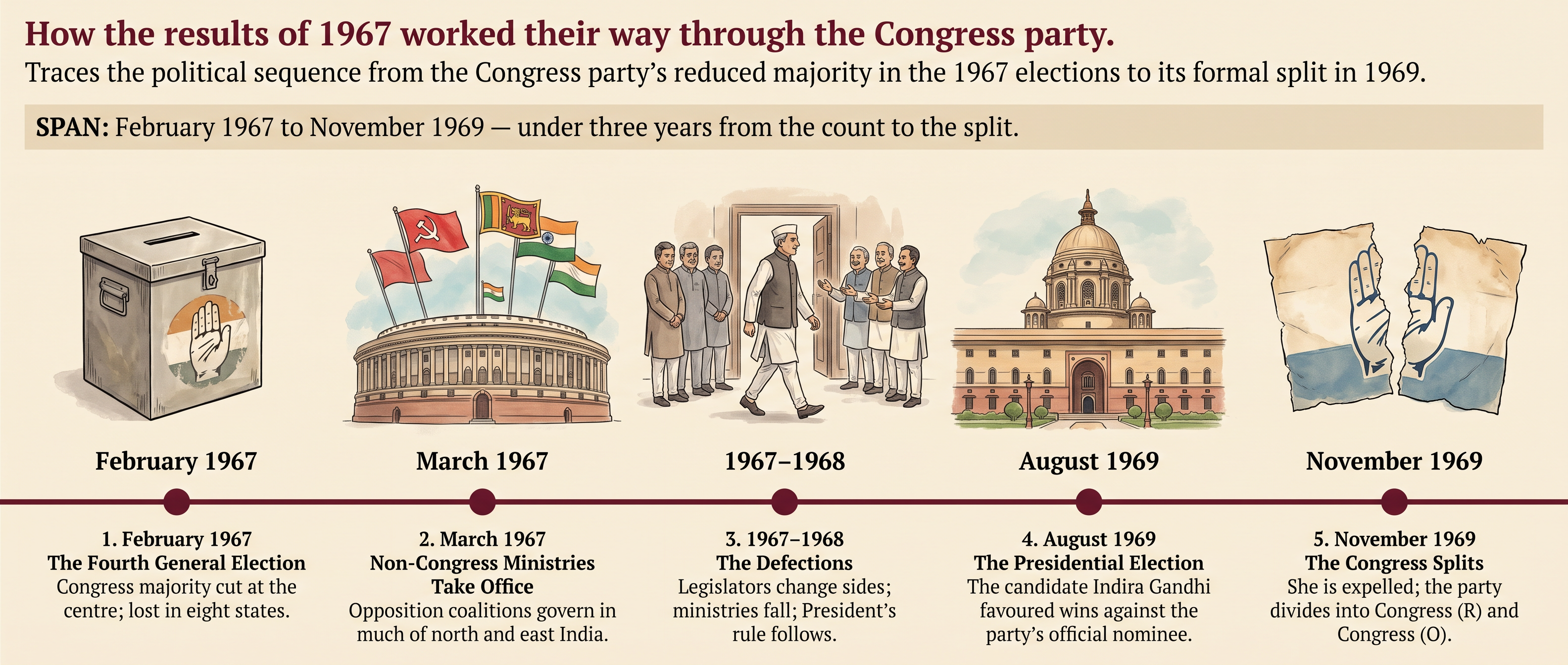
Fig. 3.2 – From Election To Split.
3.3 Main Opposition Political Parties And Their Ideologies
The parties that took office in the states in 1967 had not been created that year. Most had been in existence since the 1950s or earlier, arguing their case from a few dozen seats while the Congress governed. What changed was their opportunity, and with it the seriousness with which their ideas had to be examined.
An ideology is a connected set of beliefs about how society should be ordered and what politics is for. It is not the same as a programme of promises: the programme changes with the season, the ideology explains why a party makes those promises and not others. The five parties below held ideologies that were genuinely different from one another, which is why the coalitions they formed together were so unstable.
3.3.2 Communist Party Of India
The Communist Party of India, founded in the 1920s, was the oldest of India’s opposition parties. Its ideology was Marxism-Leninism — the doctrine that history is driven by conflict between classes, that the state in a capitalist society serves the propertied classes, and that a disciplined party of cadres must lead the working class and the peasantry to power.
In practice the CPI in the 1960s combined that doctrine with a particular reading of Indian conditions. It held that the main enemies were imperialism and the old landed classes, that the Congress contained a progressive section that was fighting both, and that communists should therefore work with that section where possible rather than treat the Congress as a single reactionary bloc. Internationally it looked to the Soviet Union.
Its organising strength lay in trade unions and peasant associations, and its electoral strength in Kerala, West Bengal, Andhra Pradesh and parts of Bihar — regions where landlessness, tenancy and industrial employment gave its arguments a large audience.
3.3.3 Communist Party Of India (Marxist)
In 1964 the communist movement in India divided, and the Communist Party of India (Marxist) was formed. The dispute was about all three of the questions above at once: whether the Congress government could be treated as progressive, how to read the border conflict with China, and which side to take in the quarrel then dividing the Soviet Union from China.
The CPI(M) held that the Congress government represented the propertied classes — the industrial bourgeoisie and the big landowners — and could not therefore be a vehicle of fundamental change. It stayed within electoral politics and contested elections seriously, but it refused alliance with the Congress and put more weight on building peasant and worker organisations that could act outside the legislature as well as within it.
The distinction between the two communist parties confuses students, so hold it clearly. Both were Marxist-Leninist and both contested elections. They differed on whether the Congress was a partial ally or the principal adversary, on which foreign communist party they took their bearings from, and in temper — the CPI(M) was the more militant, and it grew fastest in West Bengal, Kerala and Tripura, where it led or dominated the fronts formed after 1967.
3.3.4 Bharatiya Jan Sangh
The Bharatiya Jan Sangh was founded in 1951 by Syama Prasad Mookerjee, who had resigned from Nehru’s cabinet. Its ideology was cultural nationalism — the argument that Indian nationhood rests on a single, ancient civilisational culture, and that the state’s policies should express and protect that culture rather than treat it as one tradition among many.
From this followed its main demands. It wanted Hindi established firmly as the national language, and opposed the assurances given to the non-Hindi states. It pressed for a ban on cow slaughter. It argued for swadeshi, meaning self-reliance and the protection of Indian producers, and it criticised the Congress’s socialism as a burden on enterprise and its secularism as favouritism towards religious minorities.
The party drew organisational strength from the Rashtriya Swayamsevak Sangh, a cadre-based cultural organisation whose full-time workers supplied much of its discipline. Its support lay mainly in the towns of northern and central India, among traders, small businessmen and salaried professionals. Deendayal Upadhyaya, Atal Bihari Vajpayee and Lal Krishna Advani were among the leaders who built it in these years.
3.3.5 Shiromani Akali Dal
The Shiromani Akali Dal was different in kind from the other four: a regional party, confined to Punjab, and one that had begun not as an electoral organisation but as the political wing of a movement to reform the management of Sikh shrines in the 1920s. Its ideology was tied throughout to Sikh religious and political identity, and its claim was to represent and safeguard the interests of the Sikh community.
Through the 1950s and early 1960s its central demand had been a Punjabi-speaking state. That demand was met in 1966, when Punjab was reorganised along linguistic lines and Haryana was separated from it. In 1967 the Akali Dal entered a coalition ministry in the new Punjab, and its politics turned towards a second demand: greater powers for the states within the Indian federal system, in money, in the control of river waters and in the administration of their own affairs.
This brought it into recurring conflict with a Congress government at the centre that was moving in the opposite direction, towards concentration rather than devolution. That conflict runs on well past 1977 and is taken up in the next chapter.
3.4 The Naxal Movement
In the spring of 1967, while coalition ministries were being sworn in across north India, a few hundred sharecroppers in a cluster of villages in the far north of West Bengal decided that the way to get land was to take it. The place was Naxalbari, a police station area in the Siliguri subdivision of Darjeeling district, in the narrow corridor of land that joins the north-east of India to the rest of the country. The movement that began there took its name from the village and outlived it by decades.
This section asks seven questions in turn: why the movement arose, who led it, where it operated, how peasants and students fought, what the state did, why it declined, and what it left behind.
3.4.1 Factors Behind Its Rise
Land That Never Changed Hands
The first factor was the failure of land reform. State governments had passed laws after independence setting ceilings on how much land one family could hold, so that the surplus could be given to the landless. The laws were passed; the land largely stayed where it was.
Landholders kept their estates by dividing them on paper among relatives, servants and even fictitious persons, so that no single holding exceeded the ceiling. Where land was declared surplus, litigation could delay its transfer for years. Since land records were maintained locally, and the men who maintained them depended on the same landholders, the paper record and the field rarely matched.
The sharecropper’s position was worse still. A bargadar who farmed another man’s land for a share of the crop usually had no entry anywhere recording that he was the cultivator. Without that entry he could be evicted at the end of a season, and he had no way of proving to a court that he had ever been there.
Tribal Land, Forest And Tea
Naxalbari lay in a tract where these problems met another. Its cultivators were largely Santhal, Oraon, Munda and Rajbanshi — communities with long-standing claims to land in the terai, working also as labour on the tea gardens that had taken over much of the surrounding hill slope. Land lost to moneylenders and jotedars here was land lost by whole communities.
The Constitution contains special provisions for the administration of Scheduled Areas and for the protection of Scheduled Tribes, including a Governor’s power to regulate the transfer of land to outsiders and a Tribes Advisory Council to be consulted on their welfare. Where these were used weakly or not at all, the protection existed on paper and the dispossession continued in fact.
An Ideology Waiting For An Occasion
The third factor was political. Maoism — the version of communism associated with Mao Zedong — held that in a mainly agrarian country the revolution would be made by peasants rather than by industrial workers, that it would take the form of a long armed struggle based in the countryside, and that political power ultimately rests on armed force.
Communists who believed this had become impatient with both established communist parties, which they accused of revisionism — of settling into elections and ministries and abandoning revolution. That impatience sharpened in 1967 for an ironic reason: a United Front ministry including the CPI(M) had just taken office in Calcutta, and its own district workers in Darjeeling were about to test whether an elected communist government would let peasants seize land.
The Uprising
The immediate trigger was an assault. A sharecropper who had obtained an order recognising his right to a plot was beaten by the landholder’s men when he tried to occupy it. Peasant committees answered by taking possession of fields across the area, and in May 1967 the confrontation turned violent: a police inspector was killed, and police firing on a gathering of villagers killed several people, among them women and children.
The West Bengal government suppressed the rising within about two months. But it had already been noticed elsewhere, and one notice mattered more than the rest. In July 1967 the newspaper of the Communist Party of China devoted an editorial to it, presenting a local land seizure as the beginning of an Indian revolution on the Chinese pattern.
The editorial gave the participants something they badly needed: the sense that a few villages in Darjeeling district were part of something world-historical. It also fixed the movement’s direction, since a group that has been publicly praised for following the Chinese path is under pressure to keep following it.
3.4.2 Main Leaders: Charu Majumdar And Kanu Sanyal
Charu Majumdar, born in 1918 and based at Siliguri, supplied the movement’s theory. He had worked for years as a communist organiser in the Darjeeling district, and between 1965 and 1967 he wrote a series of essays attacking revisionism and calling for armed peasant struggle on the Chinese model. Collected afterwards, these are known as the Historic Eight Documents, and they became the founding text of the movement.
In 1969 Majumdar became General Secretary of a new party, the Communist Party of India (Marxist-Leninist), formed by those who had broken with the CPI(M). By 1970 he had carried his argument to its furthest point in what was called the annihilation line: that small secret squads should kill individual class enemies — landlords, moneylenders, policemen, and later others — and that this, rather than mass organisation, was the way to break the old order. Section 3.4.7 examines what that decision did to the movement.
Kanu Sanyal, born at Kurseong in 1932, supplied the organisation. He had spent years among the peasants and tea garden workers of the district as a member of the CPI(M)’s Darjeeling committee, and he was the movement’s link to the villages that actually rose. It was Sanyal who announced the formation of the CPI(ML) at a public rally in Calcutta in 1969.
The two men are usually named together, and they were not the same. Sanyal’s strength lay in building peasant committees that hundreds of people belonged to; Majumdar’s line ended in squads of five or six. Sanyal came to reject the annihilation line publicly, and after his release from prison he spent the rest of his long life arguing that the movement’s error had been to abandon the mass organisation it began with.
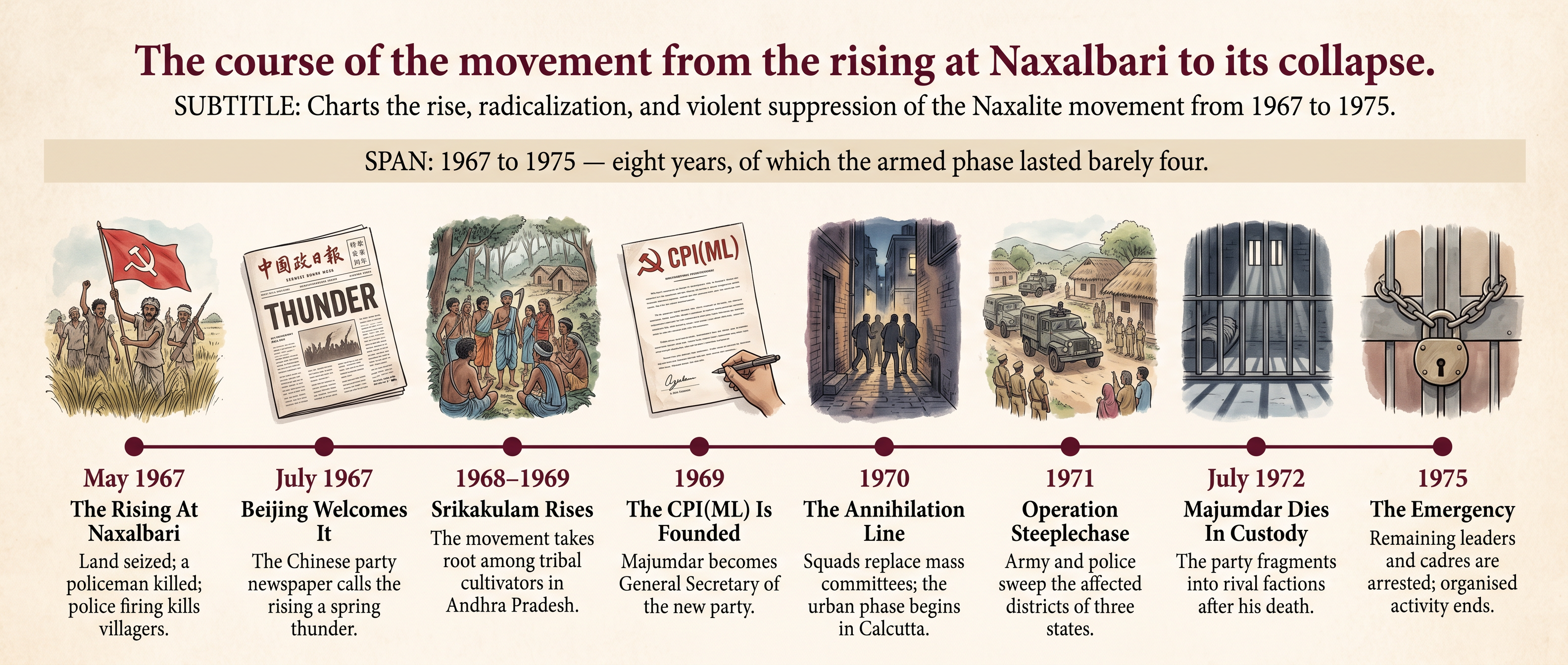
Fig. 3.3 – The Naxal Movement.
3.4.3 Where The Movement Operated: West Bengal And Andhra Pradesh
Two states carried the movement, and the difference between them is instructive.
In West Bengal the movement began in the Naxalbari, Kharibari and Phansidewa police station areas of the Siliguri subdivision. From 1969 it took hold in the Debra and Gopiballavpur areas of Midnapore district, in parts of Birbhum, and in the tracts bordering Bihar and Orissa. From 1970 it moved into Calcutta itself, which had no landlords to fight but a very large number of angry students.
In Andhra Pradesh the centre was Srikakulam district in the north-east, in the hill tracts where tribal cultivators had for years been organised against forced labour, debt and the loss of land to traders and moneylenders from the plains. That organisation existed before the Naxalbari rising; what 1967 gave it was a national affiliation and an armed programme. Majumdar visited in 1969 to guide the work, and squads were formed on the Bengal pattern.
The movement also appeared in Bihar and Orissa, in districts adjoining the Bengal border. Everywhere, its ground was the same: land held by a few, worked by many, in country where the police could not easily go.
Map
Map 3.2 Caption: The main areas of Naxalite activity in the late 1960s and early 1970s. Brief: Map of India showing the full extent of India as officially defined, with state boundaries of about 1970; mark and label Naxalbari and the Siliguri subdivision in northern West Bengal, Midnapore and Birbhum districts, Calcutta, and Srikakulam district in northern Andhra Pradesh; shade lightly the adjoining districts of Bihar and Orissa; do not mark later areas of Maoist activity.
3.4.4 The Struggle Carried Out By Peasants
What the peasants actually did followed a pattern. Village committees were formed, often at night. Standing crops on disputed land were harvested by the committee and taken. Land was occupied and redistributed among the landless. Land records and debt bonds were seized from the landholder’s house and burnt, on the reasoning that a debt with no paper is hard to collect.
In places the committees went further and set up what amounted to a parallel administration: they settled disputes, fixed wages and issued their own orders, in territory where the official administration had stopped functioning. Some committees passed sentence on hated landholders, and men were killed.
It is worth being exact about what this was and was not. It was a genuine mass movement in its first phase: thousands of cultivators across a cluster of villages took part, in the open, and its central demand — recorded rights and land for those who worked it — was one that Indian law itself claimed to support. It was also a movement that killed people, and the annihilation line after 1970 made killing its principal method rather than one of its weapons.
3.4.5 The Struggle Carried Out By Students
From 1969 the movement moved into the colleges, and this is what made it a national phenomenon rather than a district one. Majumdar argued that revolutionary work was not confined to the countryside and called on students to leave their studies and go to the villages. Large numbers did.
Students from Presidency College and Calcutta University, from Jadavpur and from the medical and engineering colleges of Bengal abandoned degrees to organise in rural areas or to form squads in the city. Its Bengali weekly, Deshabrati, circulated widely among them. Some, like Santosh Rana, became organisers of the rural struggle in Midnapore; many others were arrested, and a considerable number were killed.
In Calcutta between 1970 and 1971 the urban phase took a form that lost the movement much of its sympathy: attacks on institutions and on public statues, including those of nineteenth-century social reformers, on the argument that these represented a compromised past. Examinations were disrupted, classrooms were entered by armed groups, and the city’s colleges became places where students feared each other.
3.4.6 Government Measures Against The Movement
The response came from both the state and the Union governments, and it moved through three stages.
The first was ordinary policing, used from May 1967 onwards: firing on gatherings, arrests of local leaders, and the recovery of occupied land for its registered holders.
The second was special legislation. In 1970 the West Bengal government enacted the West Bengal (Prevention of Violent Activities) Act, which gave wide powers of preventive detention. No separate national law was passed against the movement, but from 1971 the Union’s preventive detention law was used against it extensively, as Section 3.6 will describe.
The third was military. In 1971, with West Bengal under President’s rule, the Union deployed the army alongside the police in a joint counter-insurgency operation known as Operation Steeplechase, covering the affected districts of West Bengal, Bihar and Orissa. The method was to cordon a large area, seal the routes out of it, and search through it village by village, with the army forming the outer ring and the Central Reserve Police Force the inner one. Thousands were arrested.
The operation broke the organisation. It should also be recorded plainly that the suppression involved widespread torture in custody and the death of prisoners and suspects, including that of Charu Majumdar himself, who died in police custody in Calcutta in July 1972 within a fortnight of his arrest. Both the movement and the state that put it down killed people who were in their power.
3.4.7 Reasons For Its Decline In The 1970s
The movement collapsed almost as quickly as it had grown, and its own decisions account for as much of that as the state’s actions did.
The annihilation line was the central mistake. Replacing open peasant committees with secret squads of five or six meant the movement no longer needed the villagers and could not protect them. Killings carried out in the name of the poor frightened the poor, and the mass base that had made Naxalbari possible drained away.
Repression did the rest. The top leadership was arrested and tried, links between the leaders and local organisers were cut, and inexperienced men were left to hold together forces they had not built. Operation Steeplechase drove the survivors underground within months.
The movement had also never solved the problem it had set itself. It called for armed struggle without ever building a trained and equipped guerrilla force, so its squads faced the army and the police with improvised weapons and no military organisation.
After Majumdar’s death in 1972 the CPI(ML) fragmented into rival factions, each claiming his authority and disputing the annihilation line. Many young people who had joined out of idealism left, disillusioned by killings they could not justify to themselves. The arrests that followed the declaration of Emergency in 1975 removed what remained of the organised leadership.
3.4.8 The Impact Of The Movement
Measured against its own aim of revolution, the movement failed completely. Measured differently, it left three marks.
It put the land question back at the centre of Indian politics. Governments that had let ceiling and tenancy laws sleep for two decades were reminded, in the most direct way available, of what unrecorded tenancy and evaded ceilings could produce, and land reform re-entered political programmes in the 1970s.
It marked the politics of a generation. Thousands of educated young people spent years of their lives, and in many cases their lives, in the movement; those who survived carried its arguments into journalism, teaching, trade unions and later political parties.
And it did not entirely end. Fragments of the CPI(ML) survived the 1970s, some entering electoral politics and others continuing armed struggle in the forested districts of central and eastern India. The movement also entered the culture: Utpal Dutt wrote a play about it while it was still going on, and Khwaja Ahmad Abbas made a film about it, The Naxalites, in 1980.
3.5 The JP Movement (1974-75)
By the early 1970s the country was in economic difficulty. The monsoon had failed, food prices and the price of imported oil had risen steeply, industrial production was slack and there were few jobs for the young men leaving colleges. Governments in the states were widely believed to be corrupt, and students were the first to say so publicly.
The movement that resulted took its popular name from the man who agreed, reluctantly and late, to lead it. Jai Prakash Narayan was seventy-one, had been out of party politics for twenty years, and held no office of any kind.
3.5.1 Origin: Jai Prakash Narayan’s Disputes With Mrs Gandhi
Jai Prakash Narayan’s quarrel with Indira Gandhi was not personal and did not begin in 1974. It rested on a view of what had gone wrong with Indian democracy, and it had been building for years.
His first objection was to corruption and to the way political money worked. He argued that elections had become expensive contests financed by business, that ministries in the states were being made and unmade by purchased defections, and that a party which governed by these means could not deliver the land reform and rural reconstruction it kept promising.
His second objection was to the concentration of power. He held that the Congress under Mrs Gandhi had hollowed out its own internal democracy, that decisions had moved from the party’s committees to a small group around the Prime Minister, and that Parliament was becoming a place where such decisions were ratified rather than made.
His third objection concerned the courts. When the government in 1973 appointed a Chief Justice of India over the heads of three judges senior to him, Jai Prakash Narayan protested publicly, treating it as an attempt to secure a judiciary that would not obstruct the executive.
Behind all three lay his own idea of politics. Sarvodaya thinking distinguished between raj niti, the politics of state power, and lok niti, the politics of the people acting directly through village and district bodies. He wanted power decentralised to those bodies and doubted whether competing parties, as they then worked, could produce good government at all. This is why he could tell students that changing a ministry would not be enough.
3.5.2 Main Features Of Its Course
Ahmedabad And Patna
The agitation began not in Bihar but in Gujarat, where in December 1973 students at an engineering college in Ahmedabad protested against a sharp rise in their hostel food charges. Within weeks the protest had spread across the state and turned into a general demand for the Chief Minister’s resignation. He resigned in February 1974, and the assembly was dissolved the following month. The lesson taken by students elsewhere was simple: a state government could be brought down from the street.
In Bihar, students formed the Bihar Chhatra Sangharsh Samiti in February 1974, with Lalu Prasad Yadav as its president. On 18 March 1974 it called a gherao of the Bihar Legislative Assembly on the day of the budget session. Roads were blocked, government property was damaged, and in the days that followed students were killed in police firing in Patna. The Chief Minister, Abdul Ghafoor, offered talks; the colleges stayed shut.
The Movement Finds A Leader
In April 1974 the students asked Jai Prakash Narayan to lead them, and he accepted on one condition: that the movement remain non-violent. On 8 April he led a silent procession of thousands through Patna, walking at its head without speaking — a deliberate contrast to the stone-throwing of the previous month.
On 5 June 1974 he addressed an enormous meeting at the Gandhi Maidan in Patna and gave the movement its programme. He called for Sampoorna Kranti, Total Revolution, which he described as seven revolutions at once — social, economic, political, cultural, intellectual, educational and spiritual. The demand was not merely a change of ministry but a change in how society and government worked.
Non-Cooperation In Practice
The methods followed from the demand and were largely Gandhian. The movement asked for the dissolution of the Bihar assembly and called on members to resign their seats; several did. It organised the picketing of government offices and the boycott of examinations. It set up janata sarkars in villages to settle disputes and manage local affairs outside the official administration. A youth organisation, the Chhatra Yuva Sangharsha Vahini, was formed to hold the movement together between agitations.
The state government did not fall and the assembly was not dissolved. Through the winter of 1974 the movement therefore widened rather than won: on 4 November 1974 a procession Jai Prakash Narayan was leading in Patna was broken up by a lathi charge in which he himself was struck, and the picture of a frail old man being beaten did the government considerable damage.
From Bihar To The Country
During 1975 the movement stopped being about Bihar. Opposition parties that agreed on very little — the Jan Sangh and its student organisation, the socialists, the Congress (O) and the Lok Dal — accepted Jai Prakash Narayan as a common leader, which no party leader could have made them do. Sarvodaya workers who disliked party politics worked alongside cadres of the Rashtriya Swayamsevak Sangh, whose discipline supplied much of the movement’s organisation and whose presence its critics never stopped pointing to.
A judgment of the Allahabad High Court on 12 June 1975, examined in Section 3.6, turned the movement’s argument into an immediate national demand. On 25 June 1975 Jai Prakash Narayan addressed a mass rally in Delhi, called for the Prime Minister’s resignation, announced a nationwide civil disobedience movement, and asked the police and the armed forces not to obey orders they considered illegal and immoral.
That night the Emergency was proclaimed. Jai Prakash Narayan was arrested along with opposition leaders across the country and held in detention at Chandigarh, and the movement he led stopped where it stood.
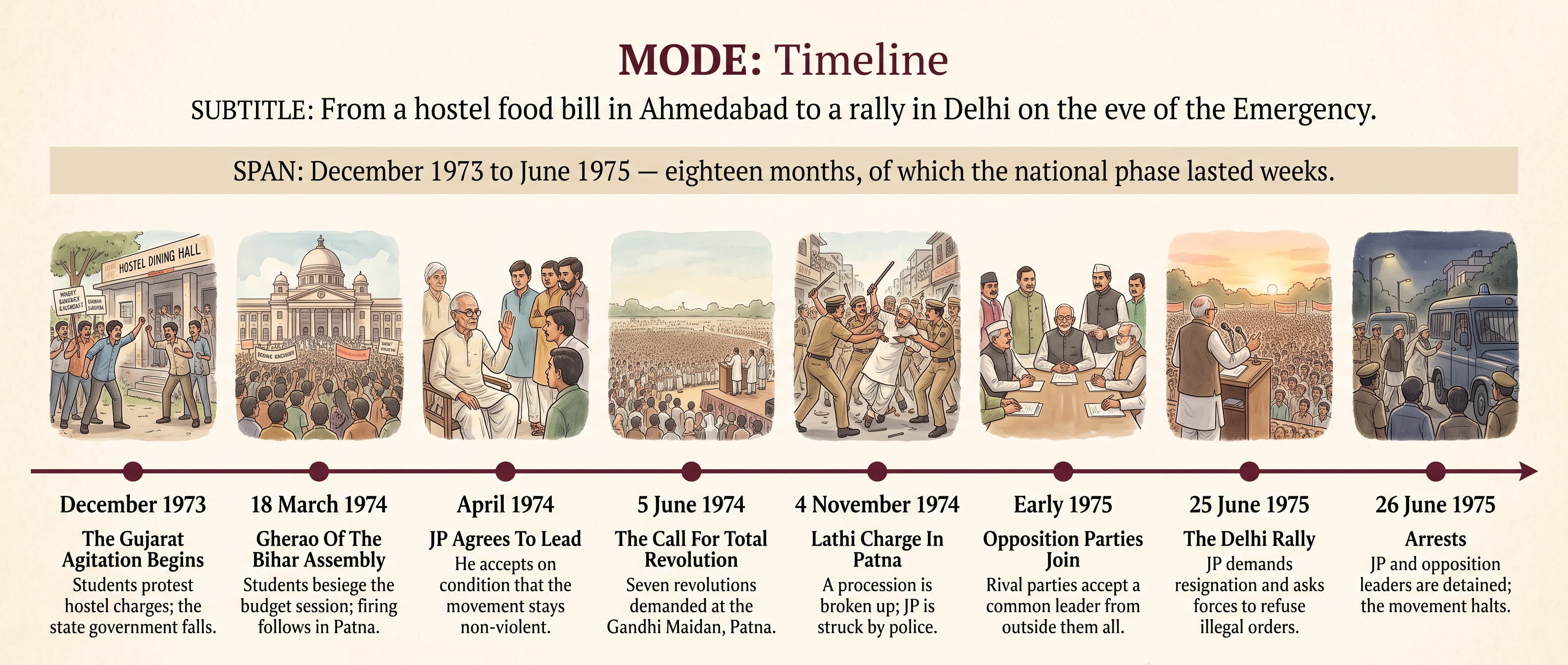
Fig. 3.4 – The Course Of The JP Movement.
3.5.3 Assessment Of Its Significance
Judged by its stated aims, the movement achieved almost nothing. The Bihar assembly was not dissolved, the ministry did not fall, and Total Revolution was never defined precisely enough to be carried out. Its most concrete achievement, the janata sarkars, did not survive the arrests.
Judged by its effects, it changed Indian politics in three ways.
First, it assembled an opposition. Parties that had spent twenty-five years unable to combine accepted a single leader and a shared demand. What that combination could do at an election belongs to the next chapter, but the combination itself was made in 1974 and 1975.
Second, it precipitated the Emergency. The government treated a mass civil disobedience movement, backed by an appeal to the police and the armed forces, as a threat to the state’s ability to function; that is the reasoning offered when the Emergency was proclaimed the following night, and Section 3.6 examines it. The movement thus produced the opposite of what it intended, at least in the short run.
Third, it trained a political generation. Many of the students who ran the Bihar agitation — Lalu Prasad Yadav, Nitish Kumar, Sushil Kumar Modi, Ram Vilas Paswan among them — spent the next four decades in national and state politics, and the movement’s argument about corruption and accountability stayed with them.
Its weaknesses should be recorded with equal care. Total Revolution was a mood rather than a programme. A movement led by a man who distrusted parties depended in practice on the organisation of parties, and one of them, the Jan Sangh’s parent body, gained more from the alliance than the Sarvodaya workers did. And the call to the police and the army to judge orders for themselves raised a question that a democracy cannot treat lightly, whichever side of it one comes down on.
3.6 The Emergency (1975-76)
The Constitution allows for emergencies. Article 352, as it stood in 1975, permitted the President to proclaim an Emergency if he was satisfied that the security of India was threatened by war, external aggression or internal disturbance. Two emergencies had already been proclaimed, in 1962 and 1971, and both concerned wars.
The proclamation signed on the night of 25 June 1975 was the first to rest on internal disturbance, and it turned a constitutional provision meant for national danger into an instrument of domestic politics. For twenty-one months India had elections postponed, opposition leaders in jail, newspapers censored and fundamental rights unenforceable in court, and all of it was done through legal forms.
The words are worth pausing on. Nothing in the document names the disturbance, identifies who was causing it or explains why the ordinary law was insufficient. That silence is itself the point: the proclamation had to satisfy a form of words, and the reasons for it are found elsewhere.
3.6.1 Reasons For Its Imposition
The Political Crisis
The immediate cause was a court judgment. On 12 June 1975 the Allahabad High Court set aside Indira Gandhi’s election to the Lok Sabha from Rae Bareli, finding that she had used government servants and government resources in her campaign, and disqualified her from contesting elections for six years. The findings concerned the misuse of officials and machinery rather than any manipulation of the count, but the legal consequence was the same: the Prime Minister was no longer validly elected.
On the same day the Congress lost the Gujarat assembly election to a front of opposition parties assembled in the manner Section 3.5 described. Within a fortnight the Supreme Court gave her a partial stay, allowing her to remain Prime Minister while her appeal was heard but not to vote in the Lok Sabha, and the opposition demanded that she resign in the meantime.
The second cause was the movement in the streets. The rally in Delhi on 25 June announced a nationwide civil disobedience campaign and called on the police and the armed forces to refuse orders they held to be illegal and immoral. The government’s case was that a movement of this kind, added to the railway strike of 1974 which had stopped goods traffic across the country, amounted to a deliberate attempt to make administration impossible.
The Deeper Conditions
Behind the crisis lay two years of economic misery: failed monsoons, food scarcity, a doubling of oil prices after 1973, inflation that ate wages, and unemployment among the educated young. Governments that cannot control prices lose their moral authority quickly, and this one had.
There was also a way of thinking about the opposition that had grown inside the government. Ministers and party spokesmen argued that the agitation was not simply Indian discontent but part of a design assisted from outside, aimed at removing a government that had nationalised banks and taken an independent line in world affairs. Evidence for the claim was never produced, but the belief was real and it shaped the decision.
Judging Between Them
Historians divide over how to weigh these. One reading treats the Emergency as a personal act: a Prime Minister facing disqualification chose to suspend the rights of a nation rather than step aside for the months her appeal would take. Another treats it as the outcome of a genuine breakdown, in which a defeated opposition tried to unseat by agitation a government it could not defeat at the polls.
The two readings are not entirely exclusive. What is not in dispute is the sequence: the judgment came on 12 June, the demand for resignation followed, and the proclamation was signed thirteen days later.
3.6.2 Main Features Of The Suspension Of Democratic Rights
Arrests Without Trial
The first act of the Emergency was the arrest of the opposition. Jai Prakash Narayan, Morarji Desai, Charan Singh, Raj Narain, Atal Bihari Vajpayee, Vijayaraje Scindia and hundreds of other leaders were taken into custody in the first days, followed over the months by trade unionists, students, journalists and party workers across the country.
They were held under preventive detention — imprisonment ordered by the executive to prevent an anticipated offence, without charge or trial. The law used was the Maintenance of Internal Security Act, passed in 1971, which was amended in 1975 so that a detained person need not be told the grounds of his detention, and then placed in the Ninth Schedule so that the Act itself could not be challenged in court. Detentions ran into six figures.
The Courts Are Closed Off
On 27 June 1975 the government suspended the right to move any court to enforce the fundamental rights guaranteed by Articles 14, 21 and 22 — equality before the law, life and personal liberty, and protection against arbitrary arrest. In January 1976 the freedoms of Article 19, including speech, assembly and association, went the same way.
Detained persons nevertheless petitioned the High Courts, and nine of them held that a person could still ask a court whether his detention was lawful, since a government must at least act under some law. In April 1976, in the habeas corpus case, the Supreme Court overruled them all. Habeas corpus — literally ‘you shall have the body’ — is the order by which a court requires that a prisoner be produced before it so that the legality of the detention can be examined; it is the oldest protection any legal system offers against arbitrary imprisonment. The majority held that while the suspension lasted, no person had any right to move any court on the ground that a detention was illegal. One judge, H. R. Khanna, dissented, holding that the state could not deprive a person of life or liberty without lawful authority even during an Emergency. He was passed over for the office of Chief Justice the following year.
The Press
Censorship began at once. Newspapers had to submit their pages to a censor before printing, a system known as pre-censorship, and instructions specified what could not be reported: the arrests, speeches by detained leaders, criticism of ministers, even the fact that material had been censored.
The machinery was then rebuilt so that censorship would not depend on daily orders. The Press Council, the independent body that heard complaints against the press and defended its freedom, was abolished. The four independent news agencies were merged into a single government-influenced agency, Samachar, so that the news reaching most papers came through one channel. A law of 1976 penalised the publication of what the government judged objectionable matter. Journals that resisted lost their advertising and their newsprint quotas, and foreign correspondents who would not accept the conditions were expelled.
Broadcasting needed no new law, since All India Radio and Doordarshan were already state-owned, and both were used for the government’s own message. Films, songs and books judged unsuitable were kept off the air or out of circulation.
Parliament And The Constitution
Parliament was in session for much of this period, but with the opposition in jail and the press silenced it functioned as a ratifying body. Three amendments changed the framework itself.
The Thirty-eighth Amendment (1975) barred the courts from examining the proclamation of Emergency. The Thirty-ninth Amendment (1975) placed the election of the President, Vice-President, Prime Minister and Speaker beyond the reach of the courts altogether, and applied this to the Prime Minister’s pending case. The Forty-second Amendment (1976) went furthest: it gave Parliament unrestrained power to amend any part of the Constitution and put that power beyond judicial review, gave the directive principles precedence over fundamental rights in specified cases, restricted the courts’ power to issue stay orders, and extended the normal life of the Lok Sabha from five years to six. Parliament also extended its own life beyond the five years for which it had been elected, so that no general election fell due.
State governments run by opponents were removed. The DMK ministry in Tamil Nadu was dismissed in January 1976 and the state placed under President’s rule, and the opposition ministry in Gujarat went the same way in March 1976. Twenty-six organisations were banned in July 1975, among them the Rashtriya Swayamsevak Sangh, the Jamaat-e-Islami and the Anand Marg.
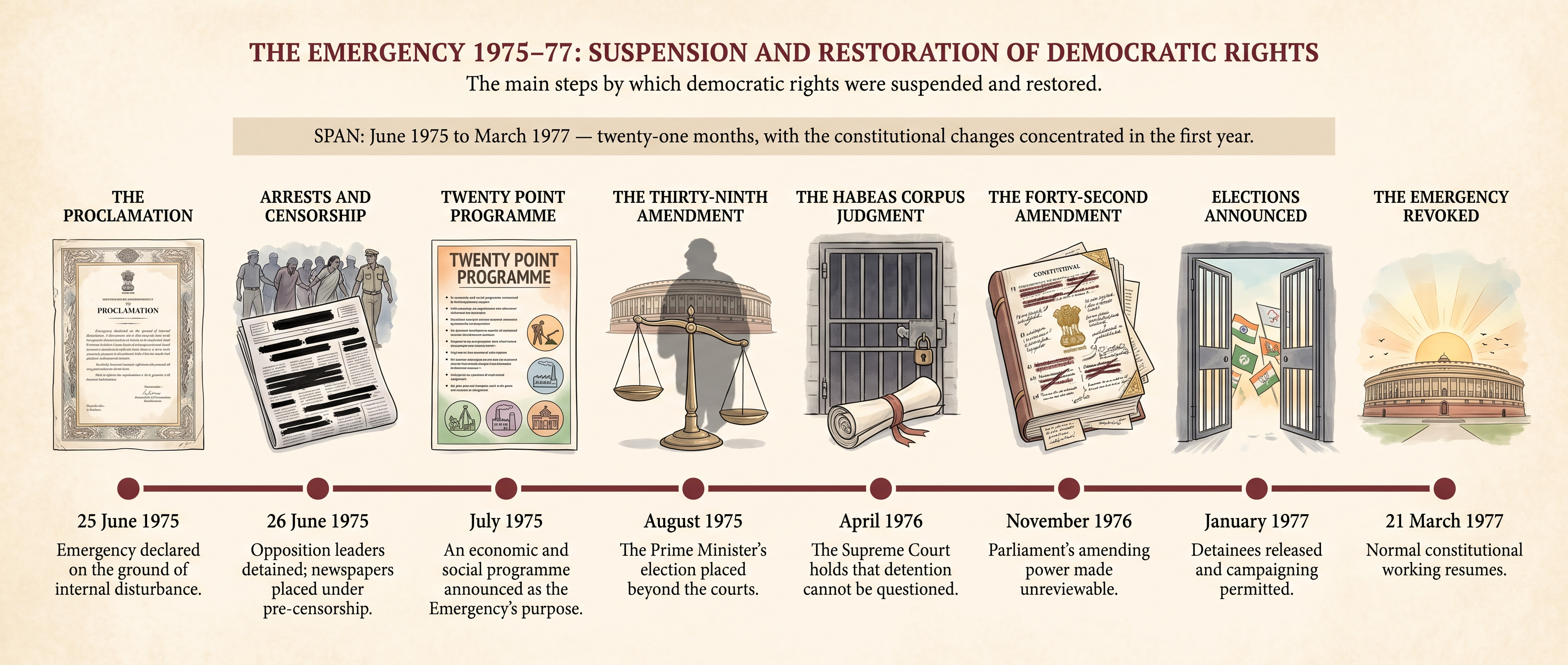
Fig. 3.5 – The Emergency.
3.6.3 Assessment Of Its Impact: The Positive Case
A fair assessment has to begin with what its supporters said at the time, because a great many respectable people did support it. The Sarvodaya leader Vinoba Bhave described it as a period of discipline. Sections of business welcomed it. The Communist Party of India, following the reasoning described in Section 3.3.2, supported it as a blow against the right.
Their case rested on four claims.
The first was order. Strikes, agitations and closures stopped almost overnight. Trains ran to time, offices worked their hours, and government servants attended. For citizens exhausted by two years of disruption this was a visible improvement, and it is the argument most often heard from those who lived through it.
The second was prices. Inflation, which had been running at intolerable levels, fell sharply during 1975-76. A good monsoon after two bad ones was the main reason, and the economy grew strongly that year, but the coincidence was politically powerful.
The third was the Twenty Point Programme announced in July 1975: enforcement of land ceilings and distribution of surplus land, house sites for the landless, abolition of bonded labour, relief from rural indebtedness, minimum wages for agricultural labour, and price control. Some of it was implemented. The Bonded Labour System (Abolition) Act of 1976 outlawed a form of servitude that earlier governments had left alone, and land was distributed in several states.
The fourth concerned the social composition of politics. The programme’s benefits, where they arrived, went to groups who had received little from the state before, and the intermediate and lower castes of north India who gained from land distribution and wage laws became a political force in the years that followed.
Each of these claims can be contested. Order obtained by removing the possibility of protest is not the same as consent. Prices fell where the rains fell. And a programme carried out without any press free to report it cannot be verified as its authors described it — which is exactly the difficulty the next section, and the box below, turn on.
3.6.4 Assessment Of Its Impact: The Negative Case
What Was Done To Individuals
More than a lakh people were detained without trial, and the later inquiry established that many were held on the say-so of local officials and police, settling local scores. Prisoners were ill-treated and some died in custody. None of them could go to a court.
Two programmes carried out in the name of the Twenty Point Programme did the greatest damage. The first was compulsory sterilisation, driven by Sanjay Gandhi, the Prime Minister’s son, who held no office of any kind. Officials were given targets; teachers, clerks and health workers were told their salaries or promotions depended on producing cases; slum dwellers, labourers and men on their way to collect ration were rounded up. More than eight million sterilisations were performed in 1976-77, several times any earlier figure. Police firing on villagers resisting a sterilisation camp at Muzaffarnagar in Uttar Pradesh killed a number of people.
The second was slum clearance in Delhi, carried out with the same disregard for the people it displaced.
What Was Done To The System
The damage to institutions was of a different kind and lasted longer. Parliament amended the Constitution to protect one election and to place its own amending power beyond challenge. The Supreme Court, asked to defend personal liberty at the moment it mattered most, declined. The press was reduced to a channel for official statements, and the civil services learned that instructions from people holding no office could be treated as orders.
The 1976 amendment altered the balance the Constitution had struck between the three branches of government, tilting it decisively towards the executive. That the amendments were made lawfully is what makes them serious: the Emergency showed that the constitutional machinery could be used, without being broken, to remove the protections it existed to provide.
The Reckoning
Two consequences followed. Within the country, the government’s own support drained away in exactly the constituencies the Twenty Point Programme was meant to serve, because sterilisation and demolition were felt hardest by the poor. Elections were announced in January 1977, detainees released, and the Emergency revoked on 21 March 1977. What the voters did with that opportunity belongs to the next chapter.
The longer consequence was constitutional. The abuse of Article 352 led to the requirement that a proclamation be based on the written advice of the Cabinet and that ‘internal disturbance’ be replaced by the far narrower ground of armed rebellion, and much of what the Forty-second Amendment had done was undone. No government since has proclaimed an Emergency of this kind.
3.7 Summary
The Shastri Years
- Nehru died in May 1964 and the Congress transferred power without splitting, which was itself the first test the system passed; Lal Bahadur Shastri took office in June 1964 and held it for nineteen months.
- India could not feed itself, and imported grain came with the political leverage of the country that supplied it; the answer chosen was self-sufficiency rather than continued dependence.
- The institutions built in 1965 — a corporation to buy and store grain, a commission to advise on the price, and a board for dairying — mattered because they gave cultivators an assured buyer, without which no farmer would risk the cost of new seed.
- Shastri led the country through the war of 1965 and signed the Tashkent Declaration on 10 January 1966, dying there the next day.
- His most important democratic act was the assurance that English would continue as an associate official language, given after the language protests in Madras State: a state was negotiated with, not overruled.
The Election Of 1967
- The Congress kept the Lok Sabha with a much reduced majority and lost its majority in eight state assemblies, so opposition parties governed a large part of India for the first time.
- Where no party had a majority, coalitions governed; where coalitions were fragile, legislators defected for office, ministries fell and President’s rule followed.
- Several Syndicate leaders lost their own seats, which destroyed the authority of the men who had chosen two Prime Ministers, and left Indira Gandhi free of them.
- The quarrel that followed ended in November 1969 with the Congress splitting into Congress (R) and Congress (O) — the end of the party as a single organisation containing all its disagreements.
The Opposition Parties
- The Socialist Party stood for democratic socialism, land redistribution and — in Lohia’s version — for treating caste inequality as seriously as economic inequality; Lohia’s argument for uniting against the Congress produced the results of 1967.
- The Communist Party of India treated the Congress as containing a progressive strand worth supporting; the Communist Party of India (Marxist), formed when the movement split in 1964, treated the Indian state as the instrument of landlords and big business. The difference was about what kind of state India is, not merely about tactics.
- The Bharatiya Jan Sangh argued from cultural nationalism — that a nation is held together by a shared culture — and took positions on language, cow protection, Jammu and Kashmir and swadeshi economics from that premise.
- The Shiromani Akali Dal grew out of a movement to reform Sikh shrines, won its Punjabi-speaking state in 1966, and then developed the wider demand that states should hold far more power and the Union far less.
The Naxal Movement
- Its causes were concrete: ceiling laws evaded on paper, sharecroppers left out of the record and therefore evictable, and tribal land lost to moneylenders where constitutional protections went unused.
- Its occasion was political: a communist party had entered office in West Bengal in 1967, and a section of its own workers concluded that elections would never deliver land.
- Charu Majumdar supplied the theory and, after 1970, the annihilation line — killing individual class enemies through secret squads; Kanu Sanyal supplied the village organisation and later rejected that line.
- It operated in the Naxalbari belt, Midnapore, Birbhum and Calcutta in West Bengal, and in Srikakulam in Andhra Pradesh, drawing peasants first and students from 1969.
- The state answered with detention laws, President’s rule and Operation Steeplechase in 1971, and with widespread custodial violence; Majumdar died in police custody in July 1972.
- It failed as a revolution and succeeded as a warning: it put unrecorded tenancy and unenforced ceilings back at the centre of politics, and left a word the Indian state still uses.
The JP Movement
- It began with students in Gujarat and Bihar in 1973-74 over fees and food, and widened into a movement against corruption and misgovernment after deaths in police firing.
- Jai Prakash Narayan’s dispute with Indira Gandhi was about the concentration of power, the purchase of defections and the independence of the courts, and it rested on his own preference for people’s politics over party politics.
- Total Revolution, declared in June 1974, demanded change in seven spheres at once; the movement’s methods — resignations, boycotts, janata sarkars — were Gandhian, and its strength lay in a leader whom rival parties would all accept.
- Its significance is that it assembled an opposition, trained a political generation, and raised the unresolved question of what citizens may legitimately do between elections; its immediate result was the Emergency.
The Emergency
- The proclamation of 25 June 1975 was the first to use the ground of internal disturbance, and it followed the Allahabad judgment of 12 June setting aside the Prime Minister’s own election.
- Rights were suspended through legal forms: preventive detention under an unchallengeable law, the suspension of the right to move courts, pre-censorship of the press, and constitutional amendments placing the Emergency, the Prime Minister’s election and Parliament’s amending power beyond judicial review.
- The Supreme Court’s habeas corpus judgment of 1976 left a detainee with no court to go to; the single dissent recorded that the state may not take liberty without lawful authority even then.
- Its defenders pointed to order restored, prices falling, and a Twenty Point Programme that abolished bonded labour and distributed some land.
- Its costs were a lakh and more detained without trial, a coercive sterilisation drive and demolitions such as Turkman Gate, and lasting damage to Parliament, the courts and the press.
- The Emergency was revoked on 21 March 1977; afterwards the ground of internal disturbance was removed from Article 352 and much of the Forty-second Amendment undone.
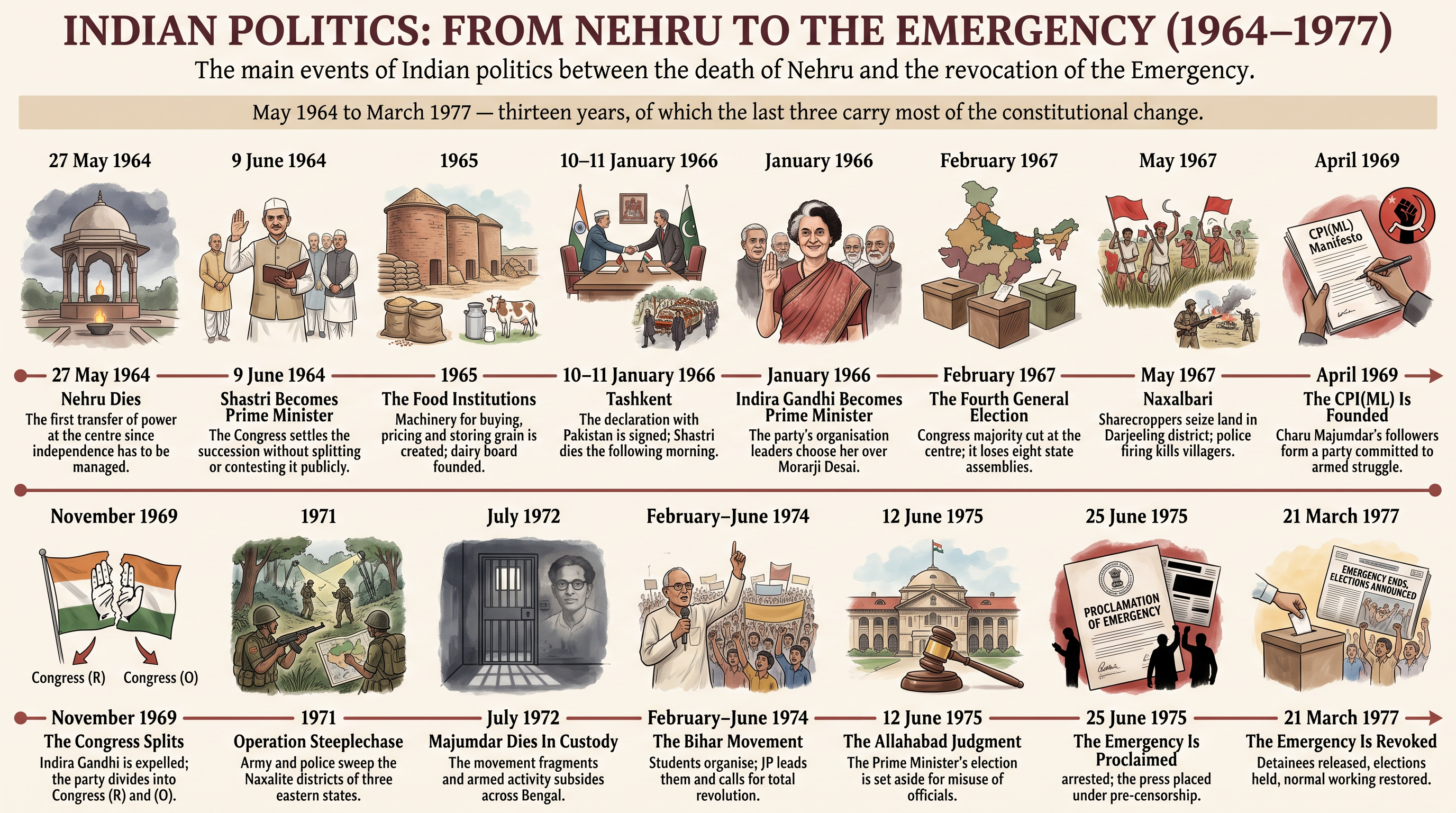
Fig. 3.6 – The Chapter In Sequence.
What The Evidence Cannot Tell Us
The sharecroppers of the Naxalbari belt left almost no records of their own. What we know of their claims comes from party documents written by organisers, from police case files and from an official inquiry — all of them made by people with an interest in the outcome. The men who kept the land records were the ones the dispute was about.
For the Emergency the silence is of a different kind, and it was manufactured. Newspapers could not report the firings, the demolitions or the deaths in custody, so for twenty-one months the ordinary evidence a historian would use was not allowed to be created. Much of what we know came out afterwards, from an inquiry appointed by a successor government, from files that recorded written orders but not the spoken ones, and from the memories of those who survived to speak.
That is worth carrying out of this chapter. A record can be silent because nobody thought an event worth writing down, or because somebody made sure it was not written down, and telling those two silences apart is a large part of the historian’s work.
3.8 Check Your Memory
Lal Bahadur Shastri held office for only nineteen months. Explain two things he did that outlasted his term: the food institutions created in 1965, and the assurance he gave to the non-Hindi states on the language question.
Look again at Table 3.1. Work out how far the Congress was above the majority mark in each of the two elections shown, and explain what that change meant for the way a government at the centre now had to behave.
The chapter states that ceiling laws existed across eastern India but that land did not change hands. Set out the steps by which this happened, and explain why a sharecropper whose name appeared in no record could not use the law that was meant to protect him.
The Communist Party of India and the Communist Party of India (Marxist) were both Marxist–Leninist parties. Explain what they shared and where they differed, and show why that difference mattered once the CPI(M) entered office in West Bengal in 1967.
The Naxal movement had a mass following in the villages of the Naxalbari belt in 1967 and had collapsed within five years. Give the reasons for its decline that lay inside the movement itself, and those that lay in the actions of the state.
Reconstruct the sequence by which a protest about hostel charges became a national movement demanding the resignation of the Prime Minister. Identify the points at which the movement changed in scale or in character.
Read Source 3.2 again. State the ground on which the Emergency was proclaimed, and then explain what this document cannot tell a historian about why it was proclaimed.
Using Map 3.2, locate the areas in which the Naxal movement was strongest, and explain what conditions these widely separated places had in common.
The chapter says that the silence in the record of the Emergency was manufactured rather than accidental. Explain what this means, using two examples given in the chapter, and say what a historian must therefore do to find out what happened.
Historians disagree about whether the Emergency was an aberration in India’s democratic history or the culmination of a decade of centralising power. Argue the case on either side, using evidence drawn from this chapter, and state what would make you change your mind.
3.3.1 Socialist Party
The socialists came out of the Congress itself. They had organised as a group inside it from the 1930s, arguing that political independence without economic equality would leave most Indians where they were, and they left to form a separate party after independence. By the mid-1960s they were split into two organisations, the Samyukta Socialist Party and the Praja Socialist Party, which agreed on most of their doctrine and quarrelled over strategy and leadership.
Their ideology was democratic socialism — the belief that economic equality should be achieved through elections, legislation and popular movements rather than through revolution or the rule of a single party. They wanted ceilings on landholding and the redistribution of land to those who worked it, decentralisation of power to the village and the district, and small-scale, labour-using industry in preference to giant plants.
The socialists also did something the other national parties then avoided: they put caste inequality at the centre of politics. Ram Manohar Lohia, their most forceful thinker, argued that political and administrative offices should be reserved in large proportion for backward castes, women and other groups long shut out of them, and that English as the language of government kept power in the hands of a small educated class.
Lohia’s second contribution was tactical. He argued for gair-Congressvad, or non-Congressism: that every party opposed to the Congress should combine against it wherever it could, whatever their other disagreements. That argument produced the coalition ministries of 1967 described in Section 3.2. Lohia died in October 1967, a few months after seeing it work.
Jai Prakash Narayan, once the best-known socialist of his generation, had by this time left party politics altogether for social work in the villages. He returns to this chapter in Section 3.5, from outside the party system rather than within it.