Chapter 9: Cold War (1945-91)
On the evening of 24 July 1945, in a palace at Potsdam just outside Berlin, the three victors of the Second World War were finishing another long day of argument about the future of Europe. As the session broke up, the American President, Harry Truman, walked round the table to the Soviet leader, Joseph Stalin, and mentioned — casually, almost as an afterthought — that the United States had built a new weapon of unusual destructive power.
Stalin barely reacted. He said he was glad to hear it and hoped it would be used against Japan. Truman took the reply to mean that Stalin had not understood what he had just been told.
Truman was wrong. Soviet intelligence had been reporting on the American bomb project for years. Stalin knew a great deal more than Truman imagined, and within days he was pressing his own scientists to work faster.
How can historians describe a conversation that lasted less than a minute, between two men, with no minutes taken? Because three of the people in that room wrote about it afterwards: Truman in his memoirs, Churchill, who was watching from a distance, and Marshal Zhukov, who recorded what Stalin said on returning to his quarters. Their accounts agree that the exchange happened. They do not agree about what Stalin understood.
That minute is a good place to begin. The allies were still allies. They were also already keeping their most important secret from one another.
Map
Map 9.1 Caption: Europe after 1945, showing the two blocs that formed within four years of a shared victory. Brief: Political map of Europe as it stood by 1949; shade the Soviet-aligned states of eastern and central Europe in one tone, the states aligned with the United States and Britain in a second, and neutral or unaligned states in a third; mark the four occupation zones of Germany with a broken line and label Berlin separately inside the Soviet zone; label Potsdam; state in the key that boundaries shown are those of 1949 and are not present-day boundaries; do not mark any event, alliance or crisis discussed later in the chapter.
9.1 The End Of Wartime Unity
In May 1945 Germany surrendered to armies that had marched in from both east and west. The Soviet Union, the United States and Britain had won together. Photographs from that spring show their soldiers shaking hands on the river Elbe in central Germany.
Within two years those same governments were treating each other as the main threat to their own security. Nothing had been declared, and no shot had been fired between them. The alliance had simply run out of the one thing holding it up.
That one thing was Germany. The wartime partnership was an agreement to defeat a common enemy, not an agreement about what the world should look like afterwards. Once the enemy was gone, the partners were left facing each other across a ruined continent, each holding armies in place and each certain that the other was up to something.
9.1.1 What The Term ‘Cold War’ Described
A War Without Fighting
The Cold War was a long confrontation between the United States and the Soviet Union in which the two never fought each other directly, but organised almost everything else as though a war were coming. It ran, in the period this chapter covers, from 1945 to 1991.
The confrontation had all the machinery of war except the fighting. Each side built weapons against the other, kept troops facing the other, ran spies inside the other’s territory, gathered allies, and used propaganda — information selected and shaped to persuade rather than to inform — to argue its case to the rest of the world.
The phrase itself was older than the confrontation it named, but it entered ordinary political language in 1947, when Bernard Baruch, an adviser to the American President, used it in a public speech. Journalists picked it up, and within a year it had become the standard name for what everyone could see was happening.
Two Systems, Two Camps
The two states at the centre of it were the first to be called superpowers — states whose military reach, economic size and political influence extended far beyond their own regions. Each stood for a way of organising economy and society, and each believed the other’s way could not last.
The United States stood for capitalism, a system in which farms, factories and businesses are largely privately owned and prices are set by buying and selling in a market. Politically it stood for elections contested by more than one party, and for freedoms of speech, worship and association written into law.
The Soviet Union stood for communism as it had developed there since 1917: the state owning land, industry and trade, planning production centrally, and a single party — the Communist Party — holding political power without a rival. Its leaders argued that this abolished the exploitation of workers, and that multi-party elections in capitalist states disguised the rule of the wealthy.
Each of these is an ideology: a connected set of beliefs about how society should be organised, strong enough that people act on it. Ideology mattered here in a very practical way. Each side believed the other’s system was not merely different but temporary — destined to collapse, or to be pushed over.
Around each superpower gathered a bloc, a group of states tied to a leading power by treaties, trade, aid and, in some cases, the presence of its army. By the end of the 1940s most of Europe belonged to one bloc or the other, and a state’s position was not always its own choice.
9.1.2 The Roots Of Mutual Suspicion
An Older Quarrel
The hostility of 1946 was not new. It was the alliance of 1941 that was new. Sequence matters here, and Fig. 9.0 sets it out.
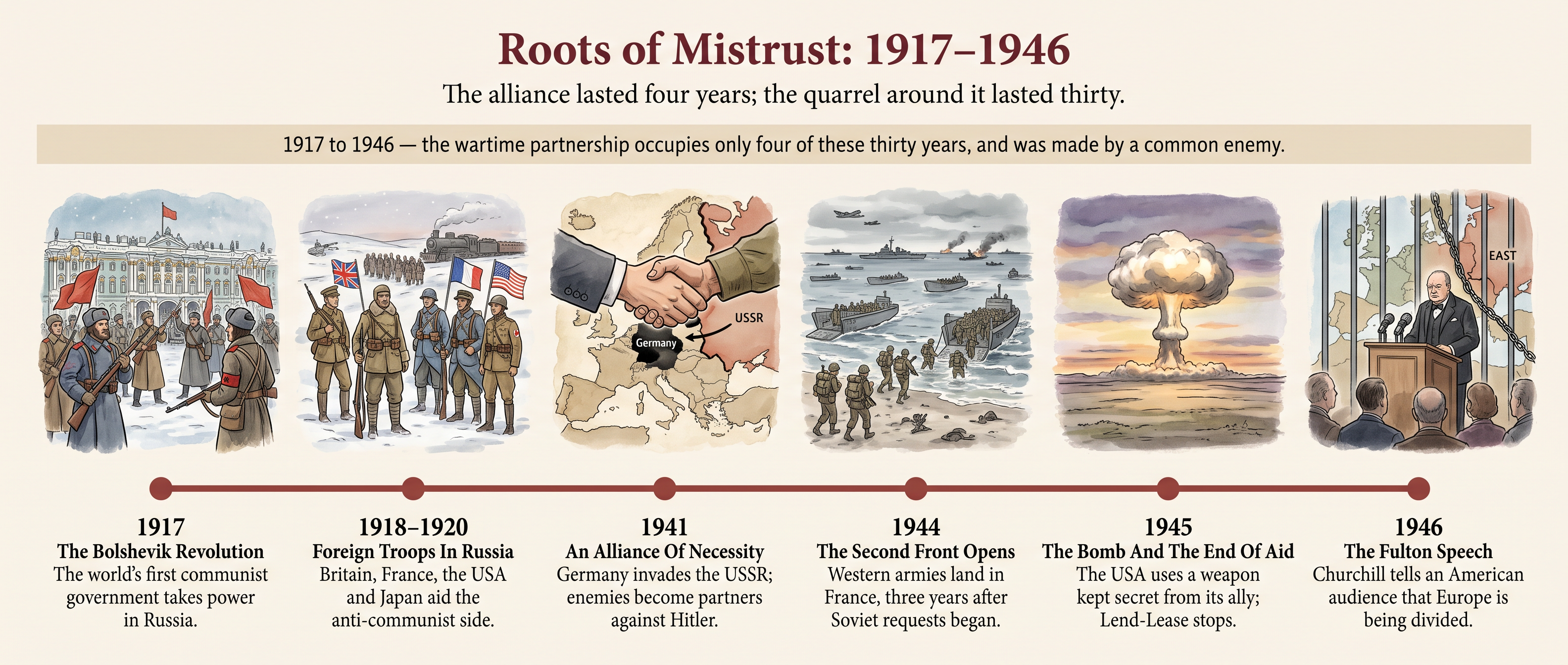
Fig. 9.0 – How The Allies Came To Distrust Each Other.
In 1917 a revolution in Russia produced the world’s first communist government, which announced openly that capitalism would be overthrown everywhere. In the civil war that followed, troops from Britain, France, the United States and Japan were sent into Russia to help the anti-communist side.
They failed, and the communists won. But the memory hardened on both sides. Soviet leaders drew the lesson that the capitalist powers had tried to strangle their state at birth. Western governments drew the lesson that this was a state committed to undoing theirs.
For twenty years the Soviet Union stood outside the ordinary business of European diplomacy. The alliance of 1941 was made not by a change of heart on either side but by Germany, which attacked the Soviet Union and gave the two camps the same enemy.
The Strains Inside The Alliance
The Soviet Union carried the heaviest share of the fighting in Europe and lost more people, soldiers and civilians together, than any other combatant. From 1941 Stalin pressed his allies to open a second front in western Europe, so that German divisions would be pulled away from Soviet soil.
The landings in France came in June 1944. From the Soviet side the three-year gap looked deliberate — as though the western allies were content to let Germany and the USSR exhaust each other. From the western side it looked like the time an invasion of that size actually needed. Neither reading could be proved to the other, and both were believed at home.
Money added to it. Under Lend-Lease, the arrangement by which the United States supplied its allies with weapons, vehicles, food and raw materials during the war, large quantities of American supplies had reached the Soviet Union. Soon after the fighting in Europe ended, the flow was cut off abruptly, and Soviet requests for a reconstruction loan went nowhere.
The Bomb And The Silence
The most damaging secret was the atomic bomb. The United States and Britain developed it together and told their Soviet ally nothing, and the weapon was used against Japan in August 1945 while the war-time alliance was still formally alive.
To Soviet leaders this said two things at once: that they were not trusted, and that the balance of power had just moved sharply against them. The Soviet atomic programme was accelerated at once, and in 1949 it produced a working bomb. From that point every quarrel between the two states carried nuclear weight.
A Curtain Across Europe
The sharpest early quarrel was over Poland, the country across which German armies had twice reached Russia. Soviet policy was to have governments in eastern Europe that Moscow could rely on. American policy rested on self-determination — the principle that a people should choose its own government — which had been stated as a war aim.
Both positions were defensible and they could not both be satisfied. As pressure from Washington and London grew, Moscow’s grip on the region tightened rather than loosened, and the states between Germany and the Soviet border began to acquire governments in which communists held the decisive posts.
In March 1946 Winston Churchill, no longer Prime Minister but leader of the opposition in Britain, travelled to Westminster College in the small town of Fulton, in the American state of Missouri, and told his audience what he thought had happened to Europe.
The phrase iron curtain stuck, and became the ordinary term for the closed frontier between the two halves of Europe. Stettin and Trieste are the two ends of that line: Stettin a Baltic port at the mouth of the Oder, now the Polish city of Szczecin, and Trieste a port at the head of the Adriatic, in the north-east of Italy.
The speech did not create the division; it announced it. But it did make the division public, and it pushed American opinion towards treating the Soviet Union as an adversary rather than an awkward partner. Moscow answered that Churchill was calling for a war against socialism.
By 1947 each side could point to a list of the other’s actions and read them as proof of bad faith. That is the condition in which the Cold War began: not one decision, but two governments each convinced that the other had already decided.
9.2 The Wartime Conferences
Twice in six months the leaders of the three great allied powers sat down together to settle what would happen to Europe once Germany was beaten. The first meeting, at Yalta, took place while the war was still being fought. The second, at Potsdam, took place among the ruins it had left.
The two conferences are usually studied together, and for a good reason. Reading them side by side shows how quickly the mood changed: at Yalta the allies were still bargaining as partners, and at Potsdam they were bargaining as rivals who happened to be in the same room.
Fig. 9.1 sets out what happened between the two meetings, because most of the change is explained by the five months in between.
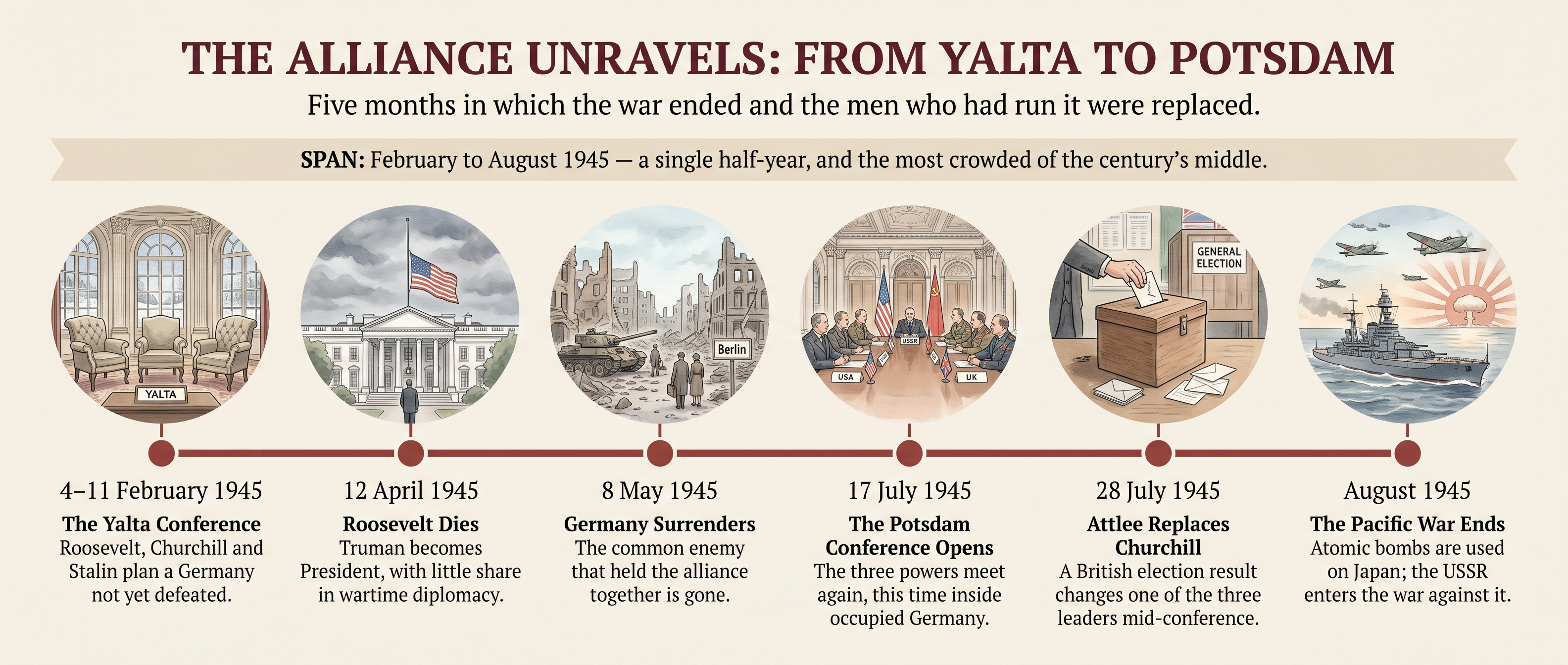
Fig. 9.1 – Between The Two Conferences.
9.2.1 Yalta, February 1945
Who Met, And When
The conference met at Yalta, a resort town in the Crimea on the northern coast of the Black Sea, then part of the Soviet Union. It ran from 4 to 11 February 1945. Soviet armies were already inside Poland and closing on Berlin; western armies had not yet crossed the Rhine.
The three men present were the American President, Franklin Roosevelt; the British Prime Minister, Winston Churchill; and Joseph Stalin, who led the Soviet Union as General Secretary of the Communist Party and head of its government. Their military position shaped the bargaining. The Red Army was standing on most of the territory being discussed.
What Was Decided
The most durable decision was the creation of a new world organisation, the United Nations, to replace the League of Nations, which had failed to prevent the war. The conference settled how its Security Council would vote and called a founding meeting for April in San Francisco.
Germany was to be occupied and divided into zones, one each for the United States, Britain and the Soviet Union, with a French zone added out of the British and American shares. Berlin, lying well inside the Soviet zone, was to be split in the same way. Austria and Vienna were to be treated on the same pattern. You can see the shape of this in Map 9.1.
Germany was also to be disarmed, stripped of Nazi rule and made to pay reparations — compensation paid by a defeated state for the damage its war has caused. A Soviet proposal of twenty billion dollars, half of it to the Soviet Union, was accepted only as a basis for later discussion, not as an agreed figure.
Stalin promised to enter the war against Japan within three months of Germany’s defeat. In return the Soviet Union was to recover the southern part of Sakhalin Island, lost to Japan in 1905, gain the Kuril Islands, and receive port and railway rights in Manchuria in north-eastern China.
Finally, the three governments issued a joint statement on the countries being liberated from German rule.
The Problem Of Poland
Poland took more of the conference’s time than anything else. Two rival Polish authorities existed: a government-in-exile in London, recognised by Britain since 1939, and a communist-led administration set up under Soviet protection as the Red Army advanced.
The compromise agreed was that the communist-led body would be broadened to include members from the London side, and that free elections would follow. Poland’s eastern border was fixed roughly along the line the Soviet Union had taken in 1939, and Poland was to be compensated with German territory in the west.
The weakness of this was visible at the time. The government being ‘broadened’ was already in place, already backed by the army occupying the country, and free to decide how much broadening actually happened. Roosevelt and Churchill left Yalta with a promise; Stalin left with the ground.
9.2.2 Potsdam, July 1945
A Changed Cast
The second conference met from 17 July to 2 August 1945 at Potsdam, a town just outside Berlin, in the part of Germany occupied by Soviet forces. It was the last of the wartime meetings, and by then two of the three faces had changed.
Roosevelt had died in April. His successor, Harry Truman, had been kept at a distance from wartime diplomacy and came to Potsdam with far less patience for Soviet demands. Churchill arrived, then lost a general election at home, and on 28 July was replaced in the middle of the conference by Clement Attlee, the new Labour Prime Minister. Only Stalin sat through both conferences.
One more thing had changed. Shortly before the conference the United States successfully tested an atomic bomb. Truman now had a weapon no other state possessed, and Soviet entry into the Pacific war — the great prize sought at Yalta — mattered rather less to him than it had six months earlier.
What Was Agreed
A Council of Foreign Ministers was set up, representing the United States, the Soviet Union, Britain, France and China, to prepare the peace treaties.
Germany was to be disarmed and demilitarised, the Nazi Party dissolved, and its leaders tried as war criminals. German industry was to be reduced far enough that the country could not rearm. The four zones were to be administered separately but treated as one economic unit.
Reparations were settled by a formula that mattered more than it looked. Each occupying power would take its reparations from its own zone, with an additional share for the Soviet Union drawn from the western zones, part of it in exchange for food sent west from the east.
Territory in eastern Germany, up to the rivers Oder and Neisse, was placed under Polish administration until a final peace settlement, and German populations east of that line were to be moved westward. In practice the transfers were neither orderly nor humane, and millions of people lost their homes.
While the conference sat, the United States, Britain and China issued a demand that Japan surrender unconditionally. The Soviet Union, still formally at peace with Japan, was not a party to it.
What Was Left Open
The conference agreed a great deal and settled very little. It did not fix a date, or a method, for reuniting the four zones into one German state. It did not produce a peace treaty with Germany at all. Both questions were left to a future that never arrived on the terms Potsdam assumed.
Nor did Potsdam do anything for the promise of free elections made at Yalta. Soviet forces held the territory east of the line, and no mechanism existed to make them behave differently. Truman and Attlee left protesting; the protest changed nothing on the ground.
What Potsdam did produce was a working boundary. The line between what Soviet armies held and what western armies held was accepted for now by all sides. That temporary line hardened, over the next four years, into the frontier of the Cold War.
9.3 The American Response
In the first half of 1947 the United States took two decisions that ended any remaining doubt about where it stood. In March it promised political and military support to governments resisting communist pressure. In June it offered money on a scale nobody had seen before to rebuild the economies of Europe.
The two were designed to work together. The first said that America would not stand aside; the second attacked what Washington believed communism actually fed on, which was hunger. Both were announced as offers to the whole of Europe, and both were understood in Moscow as moves against it.
9.3.1 The Truman Doctrine, March 1947
The Crisis In Greece And Turkey
Greece had been fighting a civil war since German forces withdrew in 1944. On one side stood the restored monarchy and its government; on the other, communist-led forces who had done much of the resistance fighting against the German occupation. British troops and British money had been holding up the government’s side.
In February 1947 the British government told Washington it could no longer afford to do so. Britain had won the war and was close to bankrupt: rationing was still in force at home, and the winter of 1946–47 had been savage. The Foreign Secretary, Ernest Bevin, made it plain that support for Greece would have to stop within weeks.
Turkey was under pressure of a different kind. The Soviet Union had been pressing it for a share in controlling the straits that link the Black Sea to the Mediterranean — the sea route through which Soviet shipping had to pass — and had raised territorial claims in the east.
What Truman Said
On 12 March 1947 President Truman went before Congress to ask for money for Greece and Turkey. He could have argued it narrowly, as a bill for two countries. Instead he set it out as a choice facing the whole world.
Congress voted 400 million dollars, 300 million for Greece and 100 million for Turkey, together with military advisers and equipment. The Greek government’s forces gained steadily, and by the end of 1949 the communist side had been defeated.
The premise of the speech is worth examining, because it was thinner than the language suggested. The Greek communists were supplied mainly by neighbouring communist states, above all Yugoslavia, and Stalin gave them little. Truman’s speech described one worldwide struggle; the case in front of him was a good deal more local.
Containment
Out of this grew the policy that shaped American conduct for forty years. Containment meant accepting the communist governments already in place, making no attempt to remove them, but blocking communism from spreading any further, by aid, alliances or force if necessary.
Two things followed from it. First, the United States abandoned the habit of staying out of European quarrels in peacetime — the habit it had returned to after 1918. Second, any local conflict anywhere could now be read in Washington as a test of containment, which meant that small crises grew large very quickly.
9.3.2 The Marshall Plan, June 1947
An Economy In Ruins
Two years after the fighting stopped, western Europe had not recovered. Bombing had destroyed factories, bridges and housing; trade between European countries had broken down; farms could not get fertiliser or machinery; and governments had no dollars left to buy from abroad.
The winter of 1946–47 made all of it worse. Fuel ran short in Britain and France, food rations in the western zones of Germany fell to levels that could not sustain heavy work, and communist parties in France and Italy — already large — were gaining support.
Washington read this as a double danger. A collapsing Europe could not buy American exports, and a hungry Europe might vote communists into power without a single Soviet soldier crossing a border.
The Offer, And Who Took It
On 5 June 1947 the American Secretary of State, George C. Marshall, used a speech at Harvard University to propose that the United States finance European recovery — provided that the European states worked out together what they needed.
The programme that followed was called the European Recovery Programme, and everyone called it the Marshall Plan. Sixteen western European states met in Paris that summer to draw up a joint list of needs; the western occupation zones of Germany were brought in afterwards. Between 1948 and 1952 roughly thirteen billion dollars flowed across the Atlantic.
Most of it did not arrive as cash. It arrived as goods — wheat, cotton, oil, machinery, vehicles — and the way that worked is set out below.
The recovery that followed was rapid. Industrial output in the receiving countries passed pre-war levels within a few years, and the political parties that had been gaining from hardship stopped gaining.
Why Moscow Refused
The offer was formally open to every European state, including the Soviet Union. Soviet representatives came to the Paris talks and then walked out. Their objection was to the conditions: the receiving states had to disclose their economic plans, coordinate them jointly, and accept a degree of American supervision of how the money was used.
For Moscow, that meant opening the Soviet economy to inspection by a rival power, and letting Washington influence the reconstruction of eastern Europe. Soviet officials described the plan as dollar imperialism — the use of economic aid to gain the influence that conquest would otherwise require.
Poland and Czechoslovakia showed interest. Czechoslovakia, still a democracy in 1947, actually accepted the invitation, and was then instructed by Moscow to withdraw. It did. That single reversal told the Czechoslovak government, and everyone watching, exactly how much independence it now had.
The Marshall Plan therefore did something its authors had not advertised. By offering aid on terms one side could not accept, it drew the economic line that match the political one. After the summer of 1947 there were two Europes, and each was being rebuilt by a different power on different principles.
9.4 The Soviet Response
Moscow could not match the Marshall Plan. The Soviet Union had lost more in the war than any other combatant and had no spare wealth to send abroad. What it could do was make sure that the states it controlled did not look westward for what it could not supply.
It did this in three steps over two years: a political body to bind the communist parties together, a set of trade agreements to replace the aid that had been refused, and finally an economic organisation to plan the eastern bloc as a whole. Fig. 9.2 shows how closely each move followed a western one.
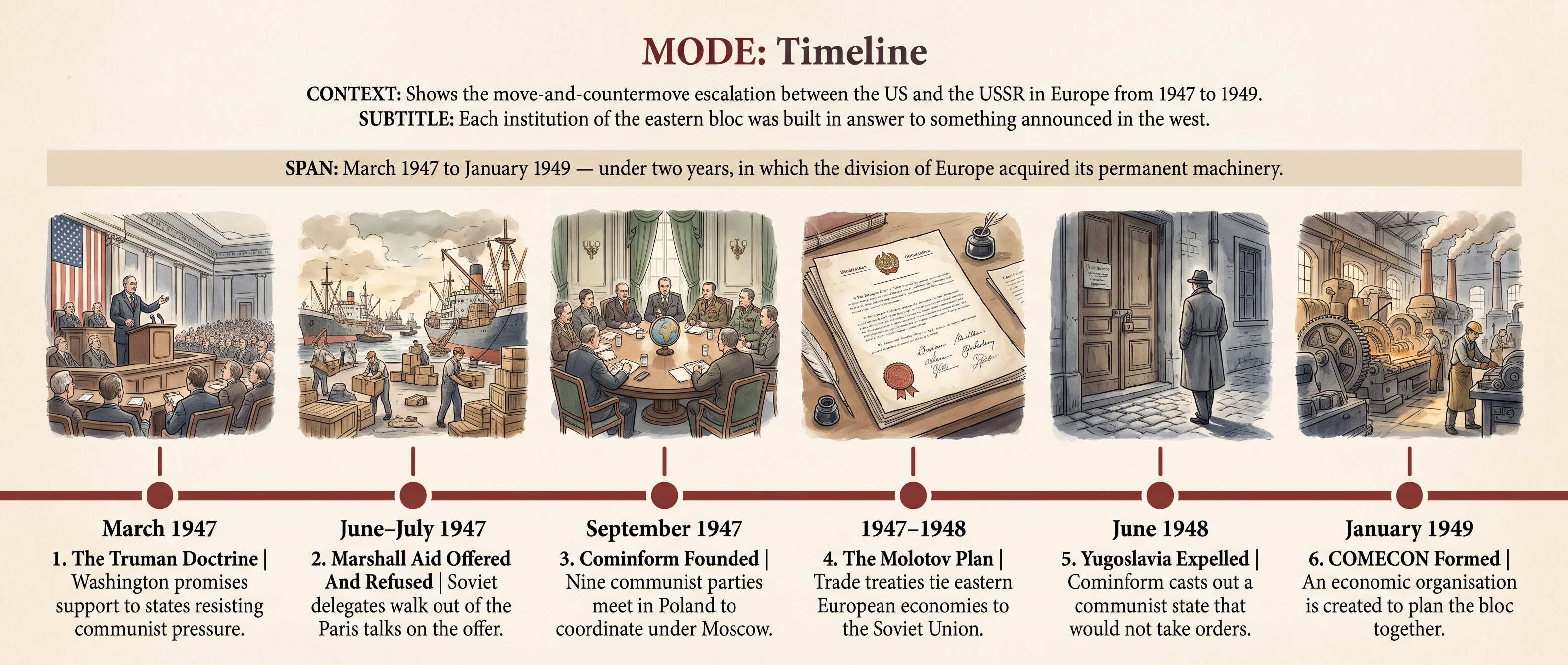
Fig. 9.2 – Move And Countermove, 1947–1949.
9.4.1 Cominform, September 1947
Why It Was Set Up
In September 1947 the communist parties of nine countries met at a resort in Poland and founded the Communist Information Bureau, always shortened to Cominform. The nine were the Soviet Union, Yugoslavia, Poland, Czechoslovakia, Hungary, Romania, Bulgaria, and — the two that were not in power — the communist parties of France and Italy.
Its purpose was announced as the exchange of information between parties. Its real work was to make sure that every communist party in Europe followed the Soviet line, on the Marshall Plan first of all, and on everything else afterwards.
At the founding meeting the Soviet delegate, Andrei Zhdanov, set out a picture of the world that mirrored Truman’s almost exactly: two camps, one imperialist and led by the United States, the other democratic and anti-imperialist and led by the Soviet Union. Each side had now told its followers that no middle ground existed.
What It Did
Cominform gave Moscow a permanent instrument for supervising other people’s parties. The French and Italian communists, who had been serving in coalition governments, were criticised for cooperating with non-communist parties and pushed into opposition and strikes.
Within the eastern bloc, member states were expected to trade chiefly with one another, and contact with non-communist countries was discouraged. Being communist was not by itself enough; a party had to be communist in the form Moscow approved.
That last requirement produced Cominform’s most dramatic act. In June 1948 Yugoslavia — a founding member, and the country in which Cominform’s offices sat — was expelled for refusing to take instructions. Section 9.5 examines why Yugoslavia could do this when no other state could. The offices moved to Bucharest, and the lesson was noted everywhere.
Cominform lasted until 1956, when it was wound up as Soviet policy towards the satellite states softened.
9.4.2 The Molotov Plan
Refusing Marshall aid left eastern Europe with the same wrecked factories and the same shortages as the west, and no dollars either. The Soviet Foreign Minister, Vyacheslav Molotov, put together an alternative in the months after the Paris walkout, and it carried his name.
The Molotov Plan was not a fund. It was a series of trade agreements, made one at a time between the Soviet Union and each eastern European state, under which goods were exchanged on terms set in Moscow. Soviet oil, cotton and grain went one way; machinery, food and manufactured goods came back.
The difference from the Marshall Plan matters. Marshall aid was multilateral: the sixteen recipients met, argued and drew up a joint programme, and the money was a grant. The Molotov agreements were bilateral, each state dealing with Moscow separately, and they were trade rather than gift. Dealing separately, no eastern European state ever faced the Soviet Union as part of a group.
9.4.3 COMECON, 1949
What It Was Meant To Do
In January 1949 the Soviet Union and five eastern European states — Bulgaria, Czechoslovakia, Hungary, Poland and Romania — founded the Council for Mutual Economic Assistance, known as COMECON. Albania joined within the year, and East Germany in 1950.
COMECON was meant to do for the eastern bloc what the Marshall Plan machinery was doing for the west: coordinate reconstruction across national borders. It fitted economies that were being rebuilt on Soviet lines. Industry was under nationalisation, meaning that the state owned the factories, mines and banks outright; agriculture was moving towards collectivisation, in which peasants’ individual holdings were merged into large farms run collectively or by the state.
Each member also worked to a planned economy — one in which a government office, not the market, decides what will be produced, in what quantity, and at what price. Where every member plans, it is at least possible in principle for the members to plan together.
How Well It Worked
For its first years COMECON did very little. It became active in the 1950s, and in the early 1960s Nikita Khrushchev tried to turn it into a genuinely integrated economy, with each member specialising: heavy industry concentrated in East Germany and Czechoslovakia, agriculture in Hungary and Romania.
The plan collapsed on national resistance, Romania objecting most strongly. A state told to remain agricultural while its neighbours industrialised was being asked to accept permanent second rank, and it refused. Khrushchev dropped the scheme.
The results were mixed rather than empty. Eastern Europe did rebuild, industrial output grew, and health services and schooling reached people who had never had them. But growth ran behind western Europe’s, consumer goods stayed scarce, and the poorest members — Albania above all — gained least.
The comparison mattered politically as well as economically. Two halves of one continent, starting from similar ruins in 1945, were being rebuilt by rival methods. By the 1970s the gap between them was visible to anyone who could cross the line and look, which is one reason so few people were allowed to.
9.5 The Rift Widens: Soviet Expansion In Eastern Europe (1945-1948)
Between the German surrender and the spring of 1948, every state between the Soviet border and the occupation line in Germany acquired a communist government. None of these countries had elected a communist majority in a free vote. All of them ended the period with communists holding power alone.
This is the process usually called Sovietisation, and it is the single development that convinced western governments that Soviet policy was expansion rather than security. It is worth studying slowly, because the same method was used again and again with small local variations.
9.5.1 How The Satellite States Were Made
Why Moscow Wanted The Region
Four reasons are usually given, and they do not exclude one another.
The first was security. German armies had crossed this ground twice in thirty years, and Soviet losses in the second invasion ran into tens of millions. A belt of friendly states between Germany and the Soviet border was, in Moscow’s view, the minimum protection.
The second was ideology. Stalin’s government held that communism would eventually replace capitalism everywhere, and that helping it forward where the Red Army already stood was both natural and safe.
The third was isolation. Before 1941 the Soviet Union had stood outside the European system, excluded and mistrusted. Having allies who could not defect was a way of never being alone again.
The fourth was material. The Soviet economy was wrecked, and the resources of neighbouring states — Romanian oil, Polish coal, German and Czech machinery — could be turned to Soviet reconstruction. Trade terms inside the bloc were set to favour Moscow, and in Romania this was done through joint Soviet-Romanian companies that carried much of the country’s output eastward.
The result, in each country, was a satellite state: formally an independent country with its own flag, government and seat at the United Nations, but unable to take a major decision that Moscow opposed.
The Method: Slice By Slice
The takeovers did not happen by a single stroke. The usual sequence began with a coalition government in which communists took part alongside other parties, and in which they asked for a modest share of posts — but always including the ministry that controlled the police.
From that position, opponents were removed one at a time and for separate reasons: this leader accused of collaborating with the Germans, that party split by an engineered breakaway, another figure arrested for treason, a third pushed into exile. Each removal was small enough that the remaining parties preferred to accept it rather than fight.
The Hungarian communist leader Mátyás Rákosi gave the method its name. He called it salami tactics: slicing the opposition away piece by piece, so that no single slice was worth a confrontation, until nothing was left of it. Fig. 9.3 makes the point.
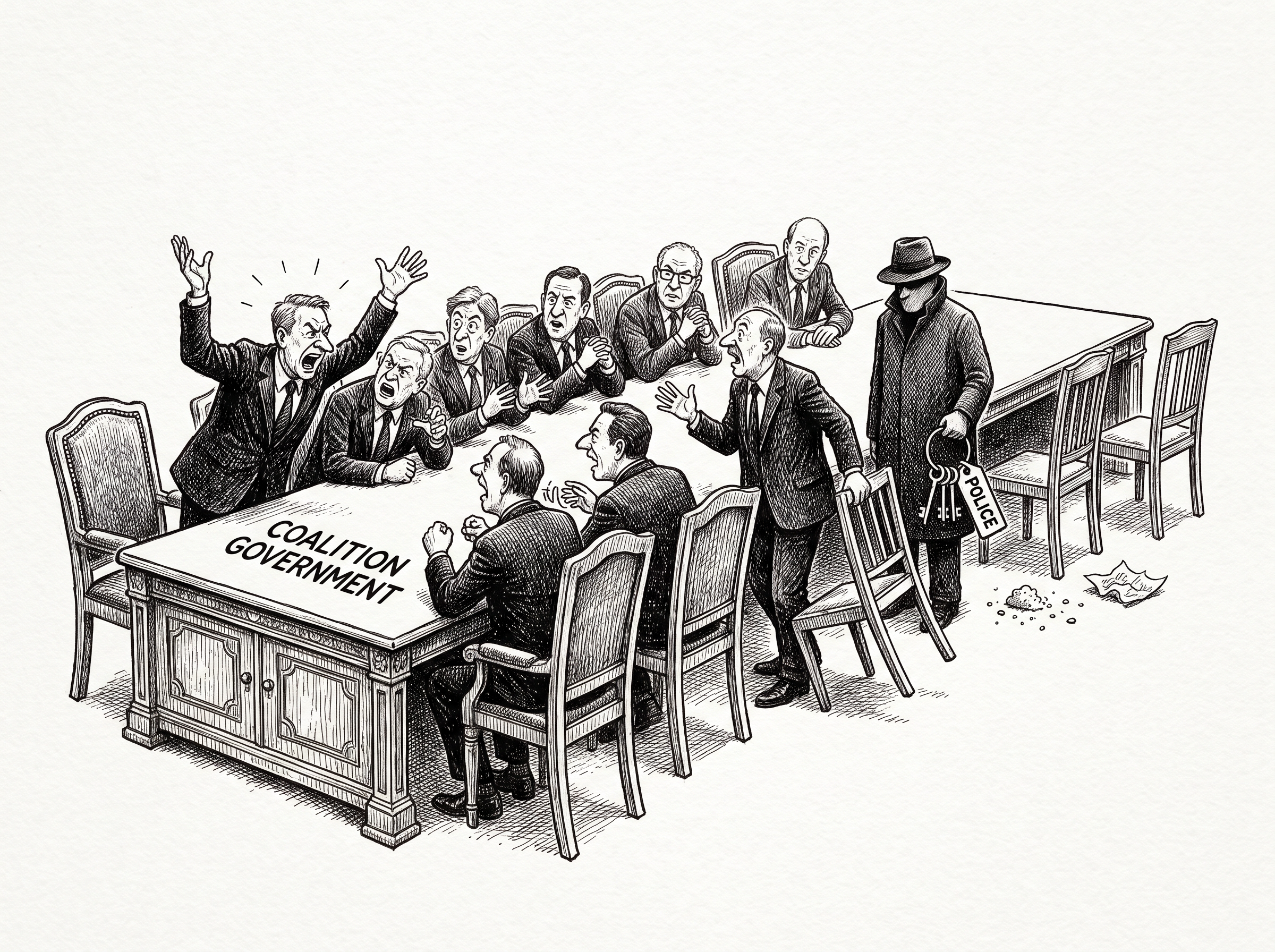
Fig. 9.3 – The opposition removed one place at a time.
Poland
Poland showed the method first. As the Red Army advanced in 1944 a communist-led committee was set up at Lublin to administer liberated territory, although a Polish government-in-exile already existed in London and had been recognised by Britain since 1939.
The Yalta compromise brought a few London politicians into the Lublin body and promised free elections. The elections were held in January 1947, and they were neither free nor fair: opposition candidates were arrested, their meetings broken up, and the results announced gave the communist-led bloc an overwhelming victory. Within months the main opposition leader had fled the country, and Poland was a one-party state.
Romania And Bulgaria
In Romania the monarchy survived the war, with King Michael on the throne. In 1945, with Soviet troops in the country, a Soviet envoy demanded the appointment of a government headed by a politician acceptable to Moscow, and the King gave way. Elections in 1946 were rigged; in December 1947 the King was forced to abdicate and leave, and Romania was declared a republic.
In Bulgaria the communists worked through the Fatherland Front, the wartime coalition of communists and others that had taken power in September 1944. They held the interior ministry and the mass media from the start and removed rivals steadily. In 1947 Nikola Petkov, the most prominent opposition leader, was arrested, tried and executed. A show trial — a trial whose verdict is settled before it opens, staged for public effect — was becoming a normal instrument of politics. Georgi Dimitrov then led a fully communist government.
Hungary
Hungary is the clearest case of all, because it began with a genuinely free election. In November 1945 the Smallholders’ Party won a large majority and the communists took about seventeen per cent of the vote.
That result was simply worked around. The communists held the interior ministry, and therefore the police. Over 1946 and 1947 the Smallholders were broken apart: their secretary-general was seized by Soviet forces on a charge of conspiracy, their prime minister was forced out while travelling abroad, and the party split into fragments. A fresh election in 1947, held under pressure, produced a communist-led coalition, and by 1948 the takeover was complete.
The Exception: Yugoslavia
One communist state in the region was not made this way, and its difference tells you what mattered.
9.5.2 The Communist Coup In Czechoslovakia, 1948
The Last Democracy East Of The Line
Czechoslovakia was the exception that western opinion cared about most. It had been a working democracy before the war, it was the most industrialised country in the region, and after 1945 it was governed by a genuine coalition under President Edvard Beneš.
Its elections of 1946 were free, and the communists won them: they took about thirty-eight per cent of the vote, the largest share of any party, and their leader Klement Gottwald became prime minister of a coalition government. Czechoslovak leaders hoped their country could be a bridge — friendly to Moscow, democratic at home, trading with both halves of Europe.
Two things ended the hope. The first was the Marshall Plan: the government accepted the invitation to Paris in 1947 and was ordered by Moscow to withdraw. The second was arithmetic. Communist support was falling, and everyone expected losses in the elections due in May 1948.
February 1948
The crisis began over the police. Non-communist ministers complained that the communist interior minister was replacing senior police officers with party members. When the complaint was ignored, twelve of them resigned in February 1948.
The resignation was a tactic, not a surrender. The ministers expected President Beneš to refuse the resignations, dismiss the government and call an early election, which they believed they would win. It failed on every count.
The communists had prepared for exactly this. Armed workers’ militias appeared on the streets of Prague, the police and the trade unions were already under communist control, and a senior Soviet official arrived in the city while Soviet forces manoeuvred beyond the frontier — though, unlike Poland or Romania, no Soviet troops were stationed in the country. Beneš, aged and ill, faced with the threat of civil conflict, accepted the resignations.
On 25 February 1948 Gottwald announced a new government which the communists controlled. The May elections were held with a single approved list of candidates. Beneš resigned in June, and the last democracy east of the line was gone.
The Death Of Jan Masaryk
On 10 March 1948 Jan Masaryk, the foreign minister and the son of the state’s founding president, was found dead in the courtyard below his bathroom window. He was one of the few non-communists still in office.
The verdict recorded at the time was suicide. Later investigations, including one conducted after communist rule ended, concluded that he was thrown from the window. The case is still argued, and it is a useful reminder that the most dramatic details of this period are often the least settled.
Why It Mattered
The coup changed western opinion faster than anything before it. Poland and Romania could be explained away as countries the Red Army had occupied. Czechoslovakia was a democracy that had chosen to live with the Soviet Union, and it had been taken anyway, without an invasion.
In Washington, London and Paris the conclusion drawn was that no state on the Soviet side of the line was safe, and that economic aid alone would not be enough. Within weeks western European governments were discussing a military alliance, and within a year they had one. The next confrontation, however, came before the alliance existed, and it came in Berlin.
9.6 Crisis In Europe: Berlin, NATO And The Division Of Germany
Germany had been the reason the wartime alliance existed, and Germany was where the alliance finally broke. Between the summer of 1948 and the autumn of 1949 the two sides came closer to fighting than at any point so far, built the military alliance that fixed the shape of Europe, and turned one occupied country into two states.
All three developments belong together, and the geography explains why. Map 9.2 shows the arrangement agreed at the wartime conferences, and the problem built into it.
Map
Map 9.2 Caption: Occupied Germany and divided Berlin, 1945 to 1949, with the air corridors used during the blockade. Brief: Map of Germany within its 1945 occupation boundaries; shade the American, British, French and Soviet zones distinctly and label each; show Berlin as an inset or enlarged circle deep inside the Soviet zone, itself divided into four sectors; mark the three agreed air corridors running from the western zones into West Berlin, and the road, rail and canal routes that were closed in June 1948; mark the Oder–Neisse line as the eastern boundary; state in the key that these are occupation boundaries of 1945–49 and are not present-day borders.
9.6.1 The Berlin Blockade And The Airlift (1948-49)
A City Inside The Soviet Zone
Berlin had been split into four sectors, one for each occupying power, while lying deep within the Soviet zone. Access by air had been settled in writing: three corridors, twenty miles wide, running from the western zones into the city. Access by road, rail and water rested on wartime understandings rather than a treaty.
For three years the arrangement held awkwardly. Then the western powers began to treat their zones as one economy. The American and British zones had been merged for economic purposes in 1947, the French zone joined them, and Marshall aid was flowing in.
The Currency That Started It
The trigger was money. Germany’s old currency was worthless; people traded in cigarettes and barter, and no economy could be rebuilt on that. In June 1948 the western powers introduced a new currency in their zones, and extended it to the western sectors of Berlin.
To Moscow this was intolerable for two reasons. It meant the western zones were becoming a single functioning economy — the first step towards a separate German state. And it meant a hard, valuable currency circulating in the middle of the Soviet zone, where prices, wages and rationing were being managed quite differently.
There was also the matter of appearances. West Berlin, supplied and reviving, sat in plain view of a Soviet zone still stripped for reparations. The contrast was daily, visible and impossible to argue with.
The Blockade
On 24 June 1948 the Soviet authorities closed every road, railway and canal linking West Berlin to the western zones, and cut off electricity supplied from the Soviet sector. Two million people in the western sectors were left with food and coal stocks measured in weeks.
The aim was not to start a war. It was to make the western powers choose between two humiliations: abandon West Berlin, or abandon the plan for a west German state in exchange for restored access. Either choice would have been a defeat, and neither would have required a Soviet soldier to fire a shot.
Fighting a way through by land was considered in Washington and rejected. An armed convoy on a closed road would have to shoot first, and nobody wanted the first shot of a third world war fired over a roadblock.
The Airlift
What remained was the air corridors, which had been agreed in writing and which the Soviet Union did not close. The western powers decided to supply an entire city by aircraft.
The scale was extraordinary. Aircraft landed at intervals of a few minutes around the clock, in all weather, and more than two million tonnes of food, coal, medicine and machinery were flown in. Aircrew were killed in crashes during the operation.
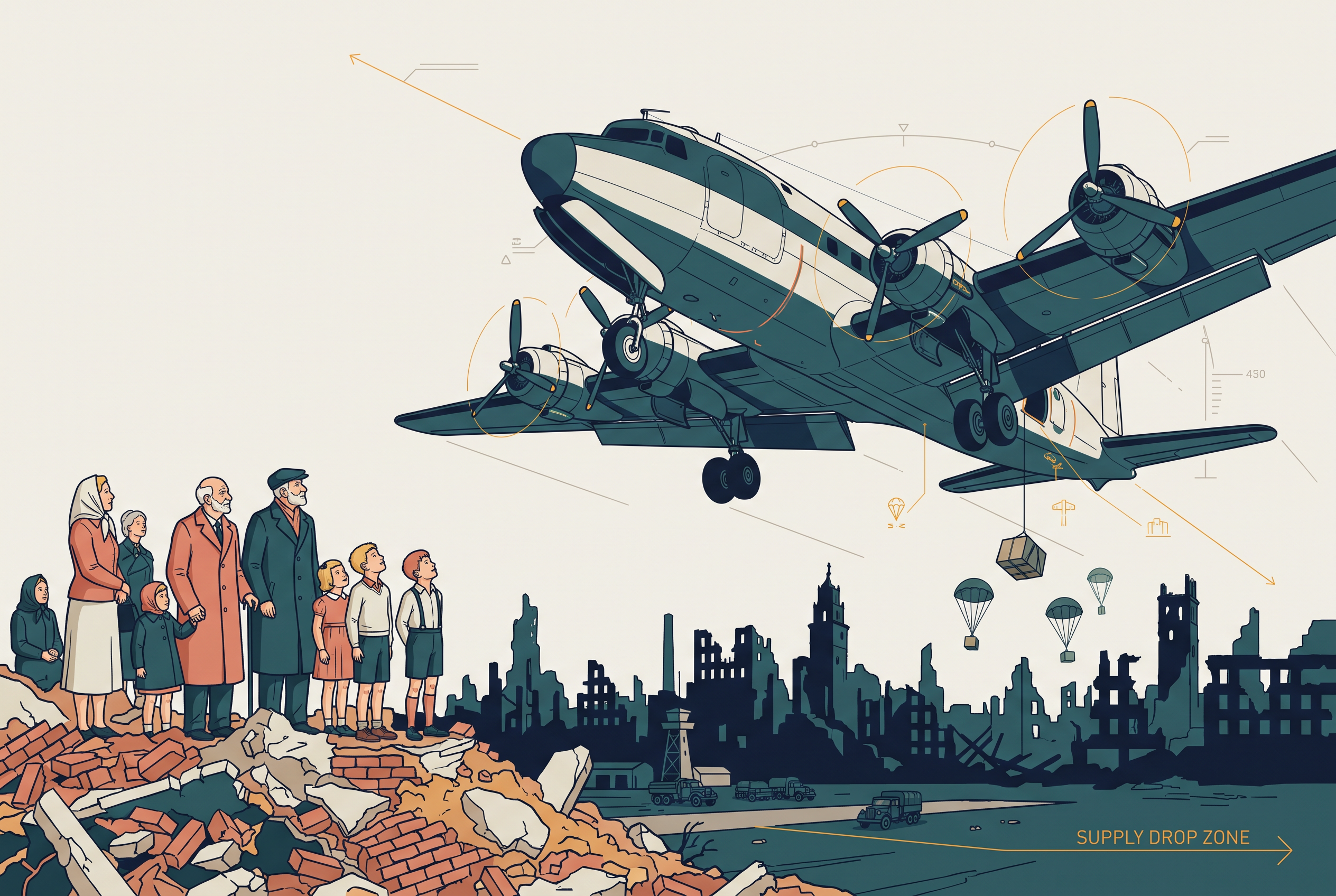
Fig. 9.4 – The Berlin Airlift, 1948–49.
Soviet aircraft harassed the flights and searchlights were used against them, but the corridors were never physically closed. Doing so would have meant shooting down transport aircraft carrying food, and that was a step Moscow was not prepared to take.
How It Ended
The blockade was lifted on 12 May 1949, after eleven months. It had failed completely, and worse than failed.
West Berlin had not been starved out. The western powers had not abandoned their plan for a German state; the crisis had convinced them to hurry it. And the political effect was the opposite of what had been intended: Germans in the western sectors, occupied four years earlier by armies that had bombed their cities, now saw those same aircraft keeping them alive.
9.6.2 The Formation Of NATO, 1949
From Brussels To Washington
Western European rearmament had begun before Berlin. In March 1948, weeks after the Czechoslovak coup, Britain, France, the Netherlands, Belgium and Luxembourg signed the Treaty of Brussels, promising each other military help in case of attack.
The five knew this was not enough. None of them could resist a Soviet attack, together or apart, and the only power that could was on the other side of the Atlantic. The blockade removed the remaining hesitation in Washington.
On 4 April 1949 twelve states signed the North Atlantic Treaty in Washington: the five Brussels signatories together with the United States, Canada, Italy, Portugal, Norway, Denmark and Iceland. Greece and Turkey joined in 1952, and West Germany in 1955.
What The Treaty Meant
The core of it was a single promise: an armed attack on one member, in Europe or North America, would be treated as an attack on all of them. Forces were placed under a joint command with a permanent structure, so that the promise would not depend on decisions taken after an attack had already begun.
The significance for the United States was constitutional as much as military. Since its founding the country had avoided permanent alliances in peacetime; now it had committed itself in advance, indefinitely, to defending Europe. That reversal, more than any speech, is what made containment real.
For Moscow, NATO confirmed the reading it had held since 1946: that a capitalist alliance was being assembled against it, now with a rearming Germany inside. Each side had built its position out of what the other’s last move seemed to prove.
9.6.3 Two German States
The blockade settled Germany’s fate, though not in the way anyone had planned in 1945.
In May 1949 the western zones adopted a Basic Law, and in the elections that August the Federal Republic of Germany was formed, with Bonn as its capital and Konrad Adenauer as its first Chancellor. It was a parliamentary democracy, tied economically to the West through Marshall aid and militarily to NATO from 1955.
In October 1949 the Soviet zone answered by proclaiming the German Democratic Republic, with its capital in East Berlin. It was a one-party communist state, its economy planned and nationalised on the Soviet model.
Berlin remained the anomaly: one city, divided, with its western half a democratic enclave more than a hundred miles inside the eastern state. It stayed the most dangerous point on the map for the next four decades.
Neither German government accepted the arrangement as permanent, and both claimed to speak for the whole nation. But every year the two states diverged further — different currencies, laws, armies, schools and alliances — and what began as a temporary occupation line became a frontier that lasted forty-one years.
9.7 The Cuban Missile Crisis, 1962
For thirteen days in October 1962 the two superpowers came closer to a nuclear war than at any other moment in the Cold War. The confrontation took place not in Europe, where the quarrel had begun, but over an island ninety miles from the coast of Florida.
That distance is the first thing to understand about the crisis, and Map 9.3 makes it plain. The second is that neither side wanted the war they were both preparing for, and both spent the last days of the crisis looking for a way to stop without appearing to give way.
Map
Map 9.3 Caption: Cuba, the United States and the naval quarantine line of October 1962. Brief: Map of the Caribbean and the south-eastern United States; label Cuba, Havana, Florida, and the American cities named in the text; show the arc of the naval quarantine line drawn around Cuba in October 1962; mark the sea approach from the Atlantic used by Soviet ships; include a scale bar so the distance from Cuba to the American coast can be read directly; state the date of the situation shown in the key; do not mark missile sites individually or any later event.
9.7.1 Causes Of The Crisis
Cuba Before The Revolution
Cuba had been closely tied to the United States since it won independence from Spain at the end of the nineteenth century. American companies owned much of the sugar industry, the mines, the power supply and the telephone system, and the United States kept a naval base on the island.
In 1952 Fulgencio Batista, a soldier who had dominated Cuban politics for years, seized power in a coup and ruled as a dictator. His government was corrupt and violent, and it was supported by Washington because it was reliably friendly to American business and firmly anti-communist.
Castro And The Break With Washington
Opposition took the form of a guerrilla campaign led by Fidel Castro, fought from the mountains of eastern Cuba. In January 1959 Batista fled and Castro took power.
Castro was not, at that point, a communist. What he was, unmistakably, was a nationalist who intended Cuba’s resources to belong to Cubans. Land was redistributed, and American-owned estates, refineries and factories were nationalised, with compensation offered on terms their owners rejected.
Washington responded with economic pressure: first a cut in the sugar quota on which Cuba’s export earnings depended, then a trade embargo, then the breaking of diplomatic relations in January 1961. Each step pushed Cuba towards the only other buyer for its sugar and supplier of its oil. Soviet trade and aid expanded to fill the gap.
The Bay Of Pigs, 1961
In April 1961 a force of about fifteen hundred Cuban exiles, trained, armed and transported by the American Central Intelligence Agency, landed at the Bay of Pigs on Cuba’s southern coast. The plan had been prepared under President Eisenhower and was allowed to proceed by his successor, John F. Kennedy.
It failed within three days. The expected popular rising did not happen, air support was withheld to preserve the fiction that the United States was not involved, and the invaders were captured or killed.
The consequences all ran against Washington. Castro’s position at home was strengthened, and later that year he declared himself a Marxist and Cuba a socialist state. And he had been given solid evidence that the United States would use force to remove him, which made a Soviet security guarantee look less like an alliance and more like a necessity.
Why Khrushchev Sent The Missiles
In 1962 the Soviet Union began secretly installing nuclear missiles in Cuba, together with the launch sites, aircraft and troops to protect them. Three motives are usually given, and the evidence supports all three.
The first was the balance of forces. The United States had far more long-range missiles than the Soviet Union, and had stationed medium-range Jupiter missiles in Turkey, on the Soviet Union’s own border. Missiles in Cuba would place American cities under the same kind of threat, cheaply and quickly.
The second was Cuba itself. After the Bay of Pigs, Moscow had reason to expect a second and larger American attempt, and losing the one communist state in the western hemisphere would have been a serious blow.
The third was bargaining. Khrushchev had been pressing for years to force the western powers out of West Berlin, and a strong position in the Caribbean might be traded for concessions in Europe.
9.7.2 Effects Of The Crisis
Thirteen Days In October
On 14 October 1962 an American reconnaissance aircraft photographed missile sites under construction in western Cuba. Kennedy was shown the photographs two days later.
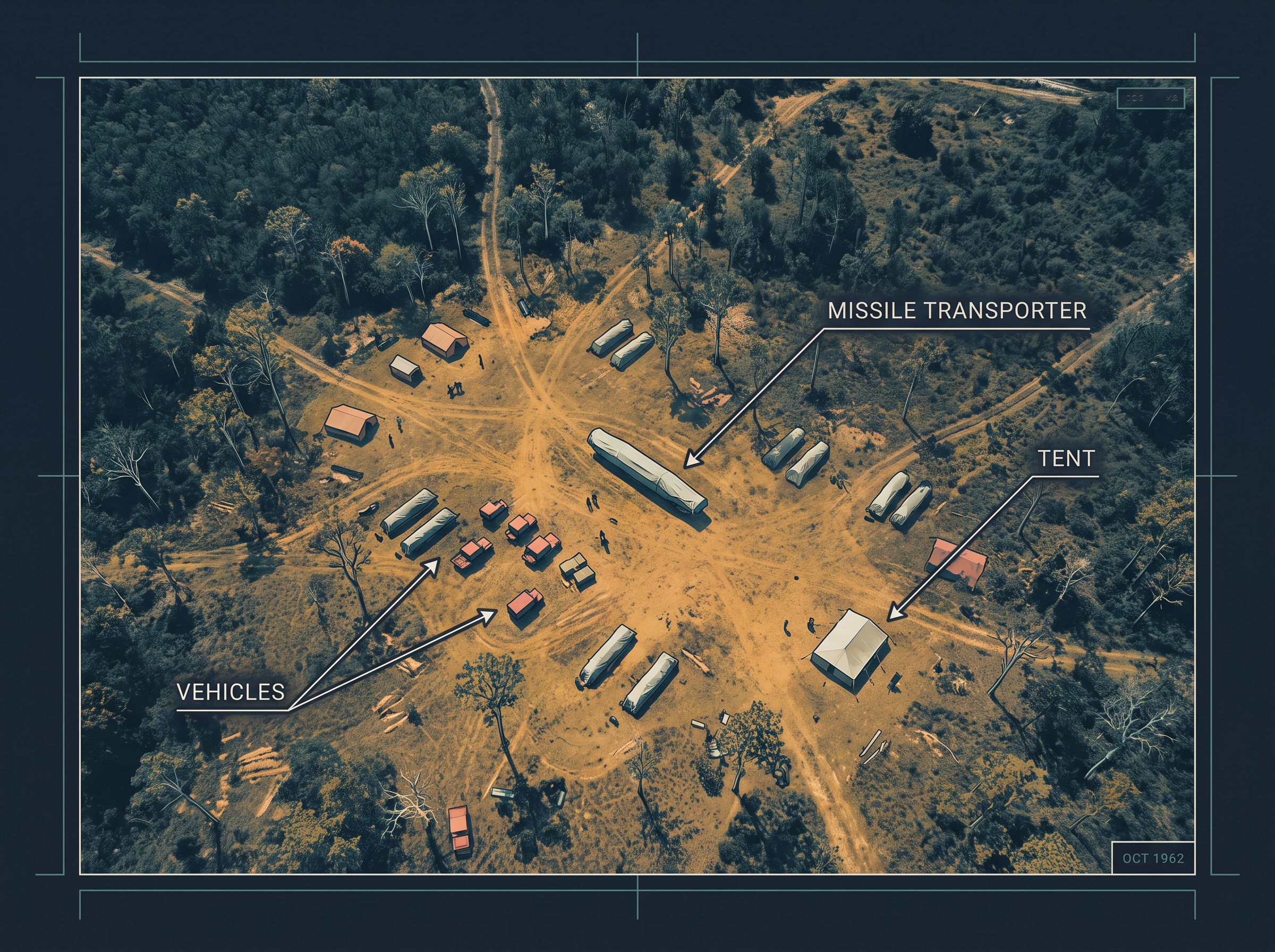
Fig. 9.5 – Aerial reconnaissance of a Cuban missile site.
Fig. 9.6 sets out what followed. Note how compressed it is; the whole confrontation is shorter than a school term’s opening fortnight.
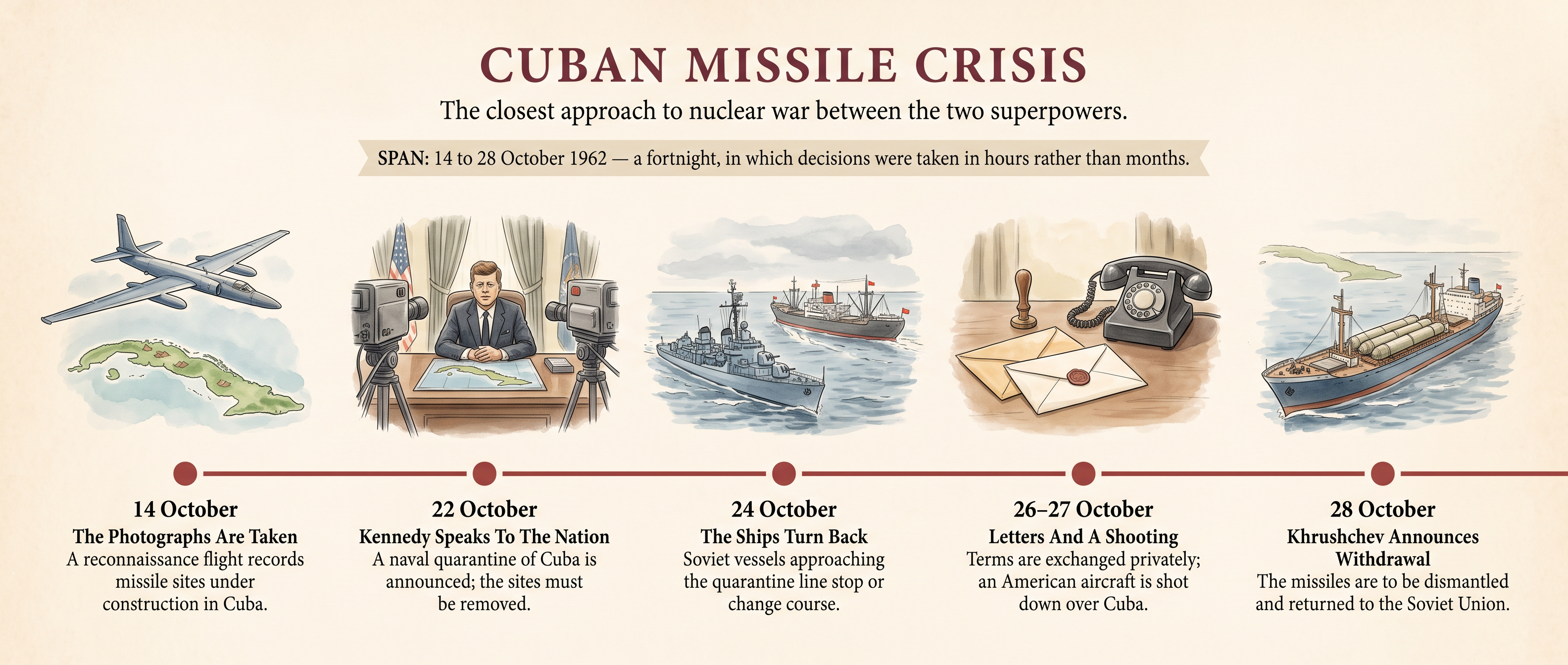
Fig. 9.6 – Thirteen Days, October 1962.
Kennedy’s advisers considered bombing the sites and invading the island. He chose instead a naval blockade, called a quarantine because a blockade is technically an act of war, and announced it publicly on 22 October. Soviet ships carrying further equipment were to be stopped and searched.
For two days the world waited to see whether those ships would sail on. They stopped. But the sites already in Cuba continued to be built, and on 27 October an American reconnaissance aircraft was shot down over the island and its pilot killed.
How It Was Settled
The settlement was reached through an exchange of letters between Khrushchev and Kennedy, and through private conversations in Washington between the President’s brother and the Soviet ambassador. The Acting Secretary-General of the United Nations, U Thant, appealed publicly to both sides for restraint and offered to mediate.
The terms had two halves. Publicly, the Soviet Union would dismantle and remove the missiles, and the United States would end the quarantine and undertake not to invade Cuba. Privately, the United States would withdraw its Jupiter missiles from Turkey a few months later, and this part of the bargain would not be announced.
The secrecy mattered politically. It allowed the outcome to be presented in America as a Soviet retreat, and it meant that Khrushchev received little credit at home for what he had actually obtained.
What Followed
The crisis frightened both governments into a number of practical changes.
A direct communications link, the hot line, was established between Moscow and Washington in 1963, so that leaders could reach each other within minutes rather than through embassies and telegrams. In August 1963 the United States, the Soviet Union and Britain signed a treaty banning nuclear tests in the atmosphere, in space and under water, leaving only underground testing permitted. It was the first arms control agreement of the Cold War.
The political effects were mixed. Kennedy’s standing rose; Khrushchev’s fell, and the humiliation contributed to his removal from power two years later. Cuba, which had not been consulted about the withdrawal, remained communist, remained under American embargo, and remained a Soviet ally.
The deepest effect was harder to see. Both sides had discovered how quickly a confrontation could run beyond anyone’s control, and how little either really knew about what the other intended. That discovery did not end the arms race — both powers built more weapons after 1962, not fewer — but it made the two governments willing, for the first time, to talk about limiting them.
9.8 Détente
After 1962 the two superpowers went on arming, but they also began talking. By the end of the 1960s the talking had become systematic, and the 1970s brought a decade in which the Cold War, without ending, was managed rather than fought.
The period is known by a French word. Détente means a relaxation of tension — the loosening of something that has been wound tight. It did not mean friendship, and neither side gave up its view of the other. It meant that both had concluded that permanent confrontation was more dangerous and more expensive than they could afford.
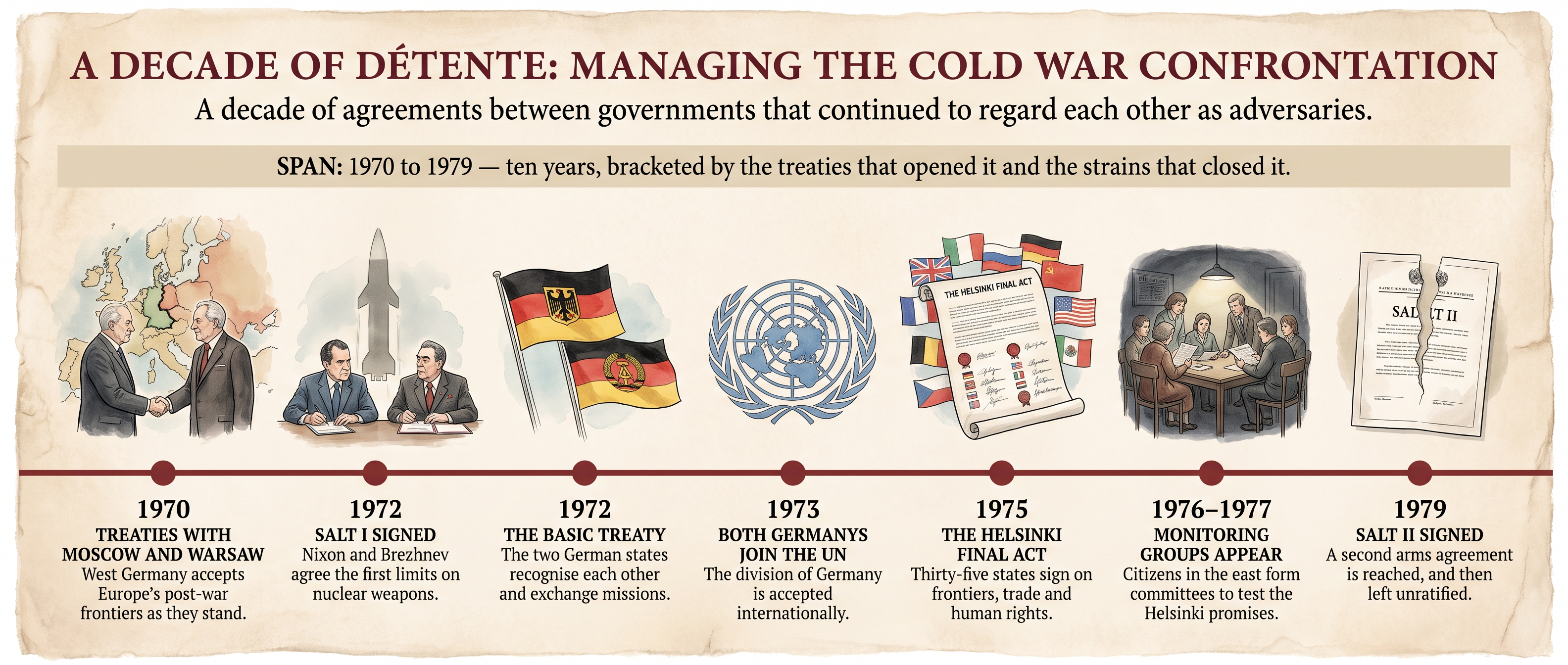
Fig. 9.7 – The Years Of Détente.
9.8.1 Reasons For Détente
The Cost And The Fear
The largest reason was money. Both superpowers were spending enormous sums on weapons that could not be used, and both had domestic problems that the same money would have solved. The Soviet economy was growing more slowly each decade while promising its citizens a rising standard of living. The American economy was strained by war, and by the oil price rise of 1973 that hit every industrial country.
Behind the accounting lay the memory of October 1962. Both governments had looked over the edge and disliked what they saw. The hot line and the test ban treaty had already shown that agreement was possible on narrow, technical matters.
Public opinion pushed in the same direction, particularly in western Europe, where anti-nuclear campaigning had become a serious political force. Western Europeans understood clearly that a war fought between the superpowers would be fought across their own countries.
Moscow’s Reasons
Soviet reasons were specific. Military spending was consuming resources that consumer industry and agriculture badly needed, and the satellite states were showing signs of strain — Poland had seen strikes and riots over food prices in 1970 serious enough to bring down its party leader.
There was also China. The Soviet Union and China had quarrelled bitterly through the 1960s over ideology and over their long common border, and by the end of the decade there had been fighting on it. When the United States began improving its own relations with China in the early 1970s, Moscow had every reason not to be the odd one out in a triangle of three great powers.
Washington’s Reasons
American reasons were partly the mirror image. The United States was extracting itself from a long and unpopular war in south-east Asia, and had concluded that its resources were not unlimited. Playing Moscow and Beijing against each other was easier if Washington was on speaking terms with both.
There was a technical reason too. Both sides now had enough weapons to destroy the other after absorbing a first strike, so further building bought no advantage. If neither could win, limiting the numbers cost neither side anything real.
Europe’s Own Reasons
The most consequential European contribution came from West Germany. Willy Brandt, Chancellor from 1969, pursued a policy known as Ostpolitik — eastern policy — which meant dealing with the eastern states as they actually were rather than as West Germany wished them to be.
For twenty years West German policy had refused to recognise East Germany or the loss of German territory in the east. Brandt reversed this. In 1970 West Germany signed treaties with the Soviet Union and with Poland accepting existing frontiers, including the Oder–Neisse line, and in 1972 a Basic Treaty with East Germany under which each state recognised the other’s existence.
9.8.2 Effects On Eastern Europe
The Frontiers Accepted
The first effect was recognition, and for the eastern governments it was the prize they had wanted since 1945.
Their borders had never been settled by a peace treaty. Now West Germany, and then the wider international community, accepted the post-war map. Both German states joined the United Nations in 1973. East Germany, which for two decades most western countries had refused to recognise as a country at all, acquired embassies, treaties and a seat at the table.
This looked like a clear gain for Moscow, and in the short term it was. The states of eastern Europe were now internationally established, and the arrangement of 1945 had been formally blessed by the powers that had spent thirty years objecting to it.
Helsinki, 1975
The recognition came with a price attached, and the price was written into the same document.
In August 1975, at Helsinki, thirty-five states — every European country except Albania, together with the United States and Canada — signed a Final Act covering three areas: the security of existing frontiers, cooperation in trade and science, and the treatment of people.
The eastern governments treated this section as the cost of the bargain. What they had not foreseen was that their own citizens would read it.
Within two years, committees had formed in the Soviet Union, Czechoslovakia and Poland whose method was simply to compare their governments’ conduct with the document their governments had signed. In Czechoslovakia the best known of these was Charter 77, a declaration circulated by writers, academics and former officials. Its members were harassed, dismissed from work and imprisoned — but they were not, on their own account, breaking the law. They were quoting it.
That is the most important effect of détente on eastern Europe. It gave opposition a language that was not revolutionary, and a text the government could not disown.
Contact, Credit And Debt
Two quieter effects mattered as much.
The first was contact. Ostpolitik meant West Germans visiting relatives in the east, telephone lines reconnected, letters and parcels moving. Eastern Europeans could compare, in detail and from their own families, how the two halves of the continent lived.
The second was money. Détente opened western credit to eastern governments, and several borrowed heavily to import western machinery and raise living standards without reforming their economies. Poland borrowed most of all. When interest rates rose and export earnings fell at the end of the 1970s, the debts had to be serviced by cutting what people ate.
The Limits Of Détente
None of this ended the Cold War. Both sides went on building weapons throughout the decade, and SALT limited the growth rather than the arsenals. Soviet control over the bloc was not relaxed, and the police apparatus that dealt with the Helsinki monitors was the same one as before.
By the end of the 1970s the mood had cooled again. The second arms agreement, signed in 1979, was never ratified by the American Senate, and relations between the two governments turned sharply colder at the turn of the decade.
But something had changed inside the eastern bloc that could not be reversed by a change of mood in Moscow or Washington. Its citizens had a signed international text, western contacts and, before long, a debt crisis. The three came together first in Poland.
9.9 The Downfall Of Communism In Poland And East Germany
In 1989 communist rule ended across eastern Europe within a few months, and almost everywhere without a battle. Governments that had held power for forty years, with large armies and larger police forces, gave way to crowds, strikes and negotiations.
The reason it was possible lies in Moscow. Since 1968 Soviet policy had rested on what became known as the Brezhnev Doctrine: the claim that the Soviet Union had the right, and the duty, to intervene in any socialist state where socialism was threatened. Every opposition movement in the bloc had to reckon with the possibility of Soviet tanks.
Mikhail Gorbachev, who led the Soviet Union from 1985, withdrew that guarantee. He told the eastern European governments, privately and then publicly, that Soviet forces would not be used to keep them in power. Once that was believed, each government was left facing its own people with nothing behind it.
Poland went first, and it had been going first for nine years.
9.9.1 Poland: Solidarity And The Election Of 1989
Why Poland Was Different
Three things made Poland the hardest country in the bloc to govern.
It had a working class concentrated in enormous state shipyards, steelworks and mines — the very people the system claimed to represent, and the people best placed to stop the economy by refusing to work. It had a Catholic Church that had never been broken, attended by most of the population and possessing an authority the party could not match. And it had a history of protest: strikes over food prices had shaken the government in 1970 and again in 1976, and out of the second of these came committees of intellectuals working with the workers who had been beaten and sacked.
In 1978 a Polish cardinal was elected Pope, and in 1979 he visited Poland. Millions attended his open-air masses. For the first time in a generation Poles saw, in physical form, how many of them there were and how few of them believed what the state said.
August 1980
Martial Law
The concession did not last. In December 1981 General Wojciech Jaruzelski, who now led both the party and the army, declared martial law: tanks on the streets, telephones cut, a curfew, and thousands of Solidarity activists interned overnight. The union was banned the following year.
Jaruzelski’s own explanation, then and afterwards, was that he acted to prevent a Soviet invasion — that a Polish crackdown was better than a foreign one. Whether Moscow was in fact preparing to intervene is still argued.
Repression worked in the narrow sense. Solidarity was driven underground for seven years, publishing illegally and organising in secret. It did not work in the wider sense at all. The economy continued to decay, the foreign debt built up in the 1970s still had to be serviced, and the government had now destroyed its last chance of being believed.
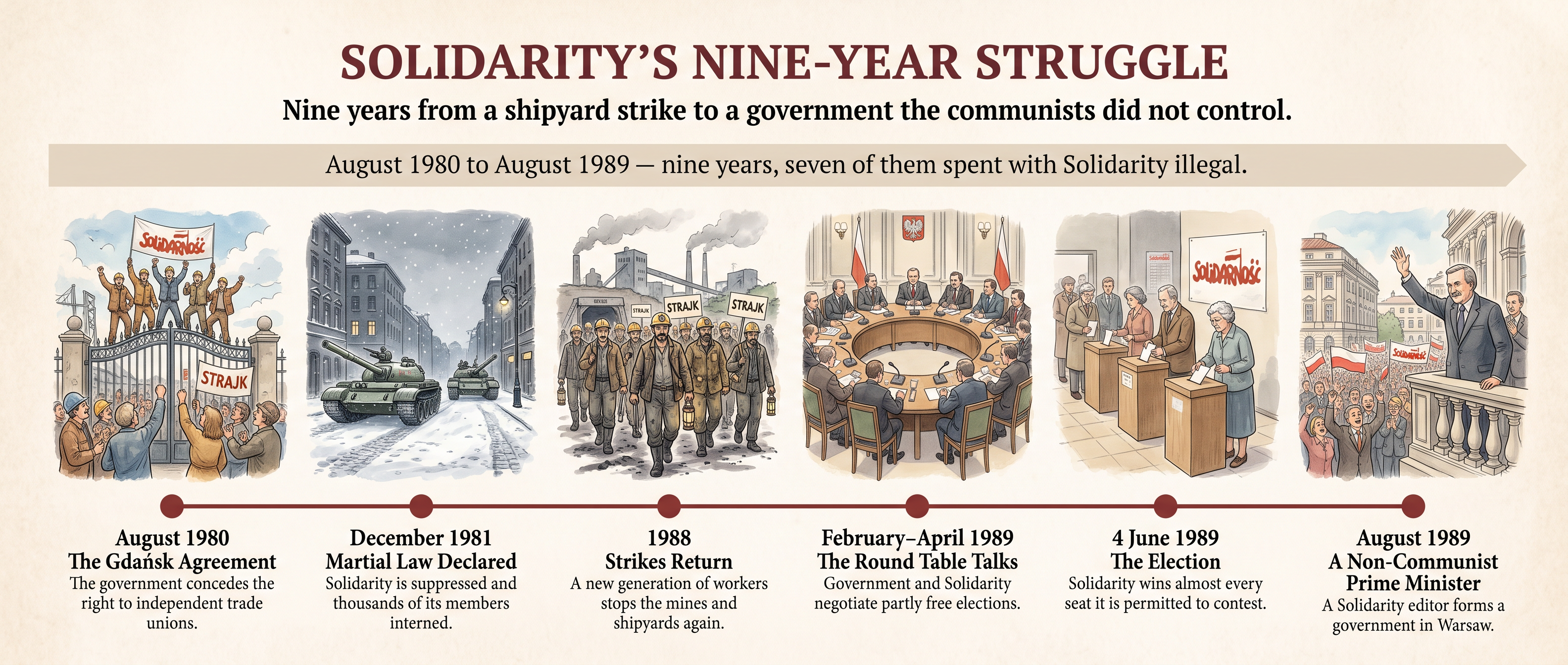
Fig. 9.8 – Poland, 1980 To 1989.
The Round Table And The Election Of 1989
By 1988 prices were rising again and a younger set of workers, with no memory of the 1981 defeat, was striking in the mines and shipyards. The government could not feed the country or pay its debts, and this time Moscow had made it clear that no help was coming.
In February 1989 the government did what it had refused to do for seven years: it sat down with the people it had imprisoned. The Round Table talks, held over two months with the Church present, produced an agreement to legalise Solidarity and to hold elections in June.
The elections were partly free, and the arithmetic matters. Sixty-five per cent of the seats in the lower house were reserved in advance for the communists and their allied parties. Solidarity was permitted to contest the remaining thirty-five per cent, and all the seats in a newly created upper house.
It won every contested seat in the lower house but one, and ninety-nine of the hundred seats in the upper house. Several unopposed communist candidates failed even to obtain the votes needed to be elected.
The result destroyed the government’s claim to speak for the workers, in public, by counting. Within weeks its allied parties had changed sides, and in August 1989 Tadeusz Mazowiecki, a Solidarity editor, became the first non-communist prime minister in the bloc. In December 1990 Wałęsa was elected President.
Not a shot had been fired, and no Soviet tank had moved.
9.9.2 East Germany: The Wall Comes Down
A State People Left
East Germany’s central problem had always been the door in the middle of it. West Berlin, prosperous and free, sat inside the country, and until 1961 East Germans could simply walk into it. Millions did, and in August 1961 the government sealed the city with a wall to stop them.
For twenty-eight years the Wall worked. It also defined the state: a country that had to be fenced in, whose own citizens were shot at when they tried to leave.
By 1989 the government was led by Erich Honecker, in office since 1971, who regarded Gorbachev’s reforms as dangerous nonsense and refused to imitate them. East German newspapers censored reports of Soviet reform, which is an unusual position for a satellite state to reach.
Hungary Opens A Door
The break came sideways. In the summer of 1989 Hungary, reforming rapidly, dismantled the fortifications along its border with Austria and then opened the frontier.
East Germans were permitted to holiday in Hungary. Now they could drive to a Hungarian campsite and walk into Austria, and from there into West Germany, which recognised them automatically as citizens. Tens of thousands went. Others crowded into the West German embassy in Prague and were eventually allowed to leave by train.
The Wall had been made irrelevant without being touched. A state losing its young, skilled workers at that rate could not go on.
Leipzig, Autumn 1989
Inside the country, demonstrations grew from small prayer meetings at a church in Leipzig into weekly marches through the city. They were disciplined and deliberately unprovocative; the marchers’ chant claimed the state’s own language, insisting that they, and not the party, were the people.
The decisive night was in October, when the crowd was far too large for the police to disperse and the order to open fire was not given. Once that had happened without bloodshed, the marches spread to every large town, and the government’s authority drained away within weeks. Honecker was removed by his own colleagues within days.
9 November 1989
On the evening of 9 November 1989 an East German spokesman, announcing new travel regulations at a press conference, was asked when they would take effect and answered, apparently without authority, that they applied immediately.
The announcement was broadcast. Berliners walked to the crossing points and demanded to be let through. The guards had no orders, could not reach anyone who would give them any, and eventually opened the barriers. Crowds crossed in both directions through the night, and people climbed onto the Wall itself.
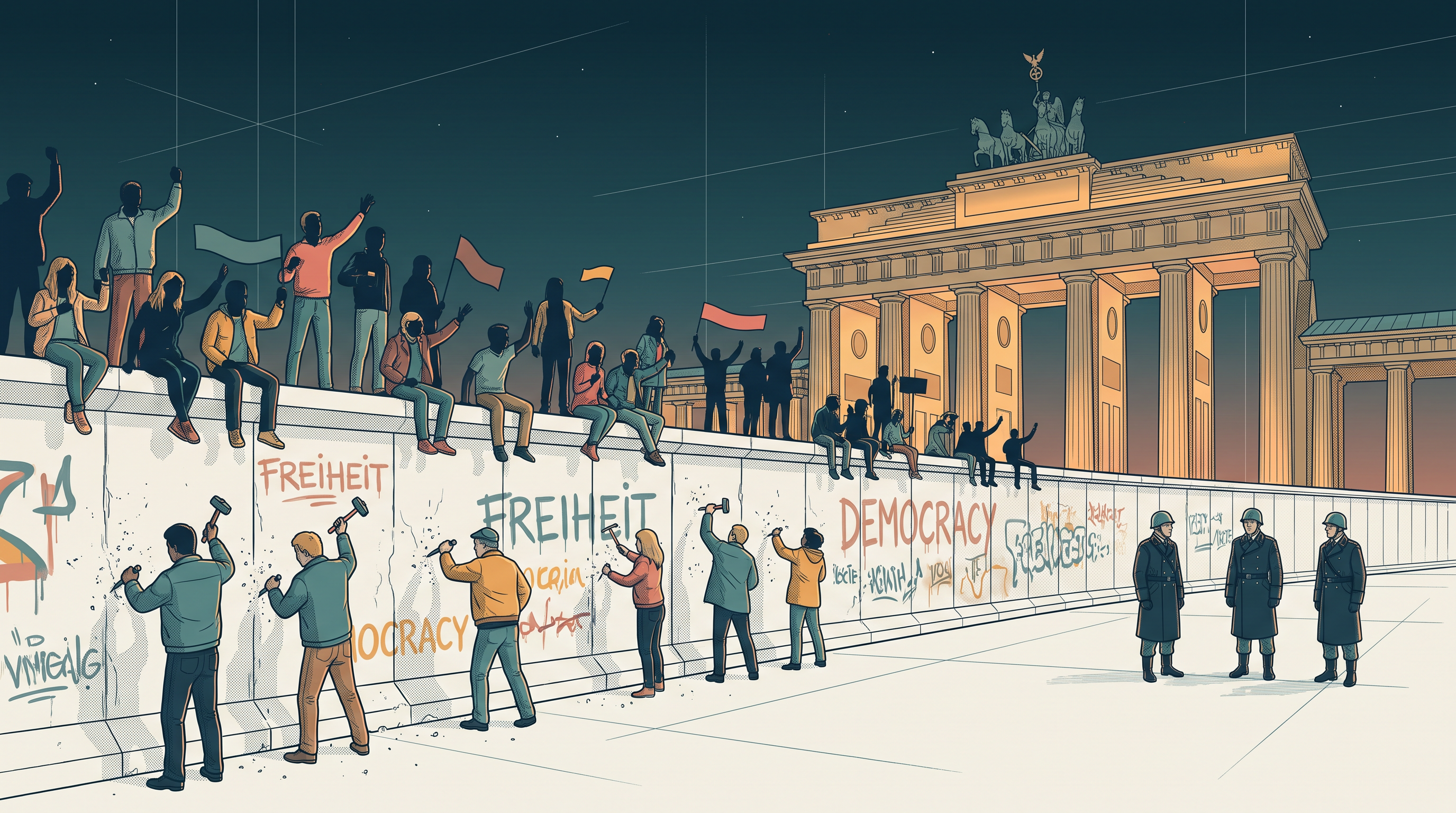
Fig. 9.9 – Berliners on the Wall, November 1989.
Physical demolition came later, and in stages. But the frontier that had defined Europe since 1945 had been opened by a confused press conference and a crowd that decided to test it.
Reunification, 1990
Events then moved faster than any government had planned. East Germany’s first free elections, in March 1990, were won by parties committed to rapid union with the West. The two currencies were merged in July.
The remaining obstacle was international. Germany’s division had been the settlement of the Second World War, and the four occupying powers still held rights over it. Negotiations through 1990 produced Soviet consent to a united Germany inside NATO, in return for financial help with the withdrawal of Soviet forces, which was completed in 1994.
On 3 October 1990 the two German states became one, with Helmut Kohl as the first Chancellor of a united Germany since the war. Fig. 9.10 sets out the German sequence, which is best read alongside the Polish one: what Poland took nine years to achieve, East Germany did in eleven months, because Poland had already shown that it could be done and had proved that Soviet tanks would not come.
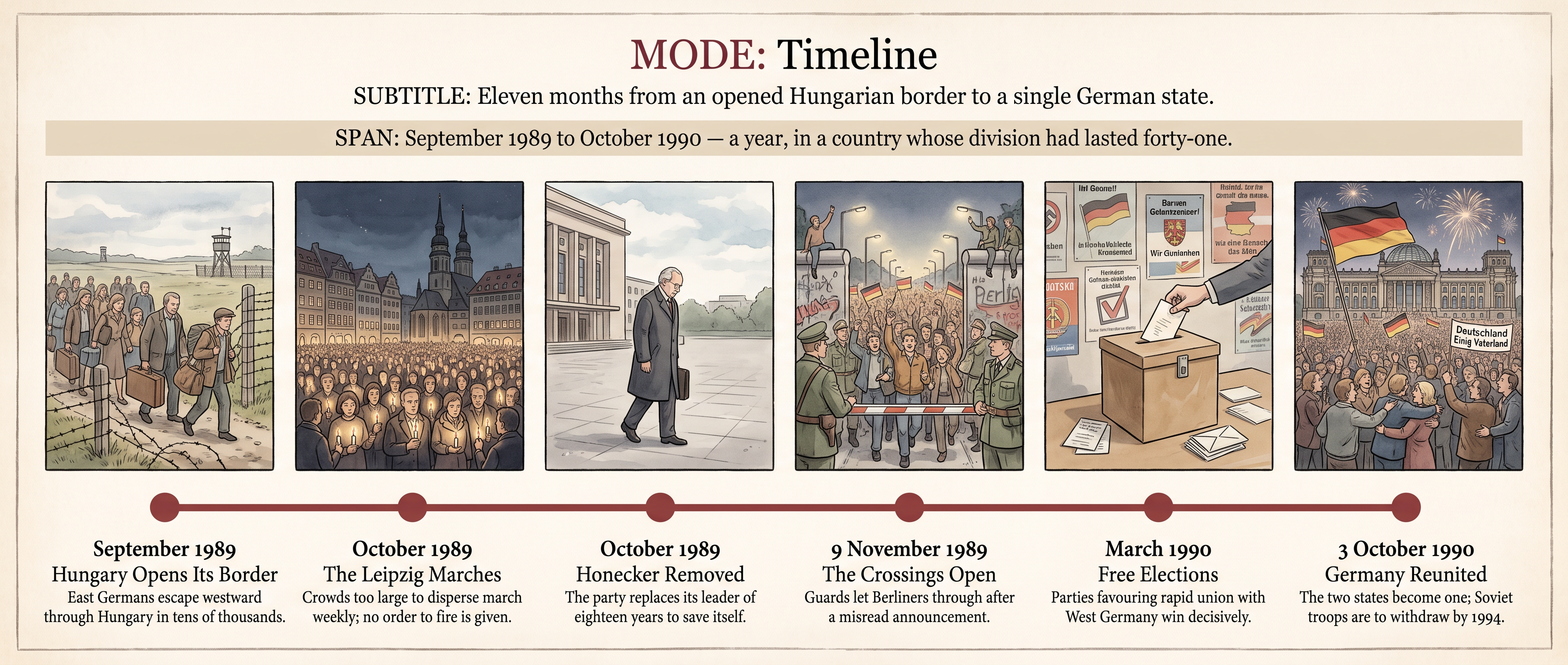
Fig. 9.10 – East Germany, 1989 To 1990.
9.10 The Breakup Of The USSR
On 26 December 1991 the Soviet Union ceased to exist. It had not been invaded, and it had not been defeated in a war. It was dissolved by the leaders of its own republics, and its last President signed the papers that ended his own office.
The Soviet Union was a union of fifteen republics, formally voluntary, in practice run from Moscow by one party. Six years earlier it had possessed the world’s largest army, a nuclear arsenal matching America’s, and an empire of allied states in eastern Europe. Fig. 9.11 shows how quickly all of it went.
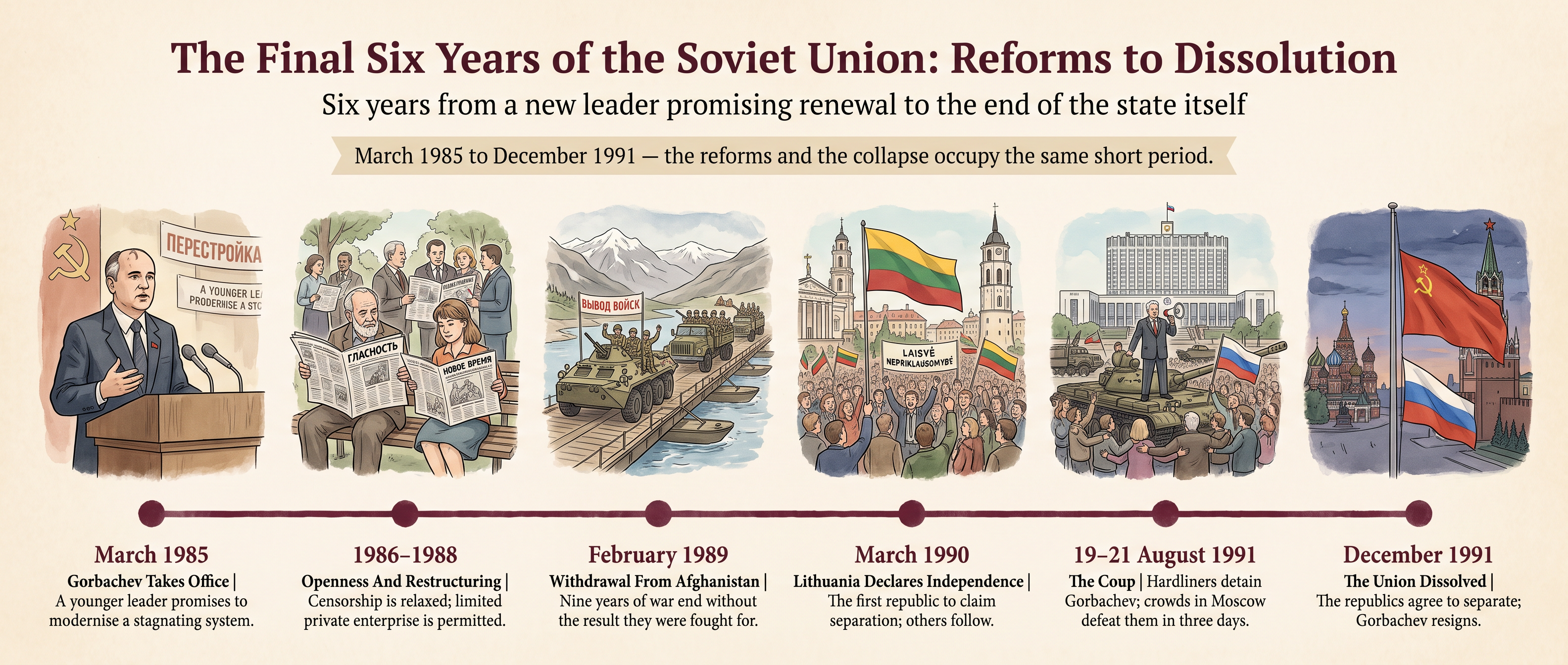
Fig. 9.11 – From Reform To Dissolution.
9.10.1 Reasons For The Collapse
An Economy That Had Stopped Growing
The Soviet economy had industrialised a peasant country within a generation, and by the 1970s it had run out of ways to grow. Central planning could build steelworks and dams; it was very bad at producing shoes people wanted to wear, or getting a harvest from the field to the shop before it rotted.
Growth rates fell through the 1970s and into the 1980s. Factories met their targets in tonnes while shortages of ordinary goods became normal, and queuing became part of daily life. Housing, hospitals and consumer services lagged well behind those of western Europe, a comparison that Soviet citizens could increasingly make for themselves.
The system had no internal correction for this. A factory that produced badly did not fail, and a manager who innovated took a risk with no reward.
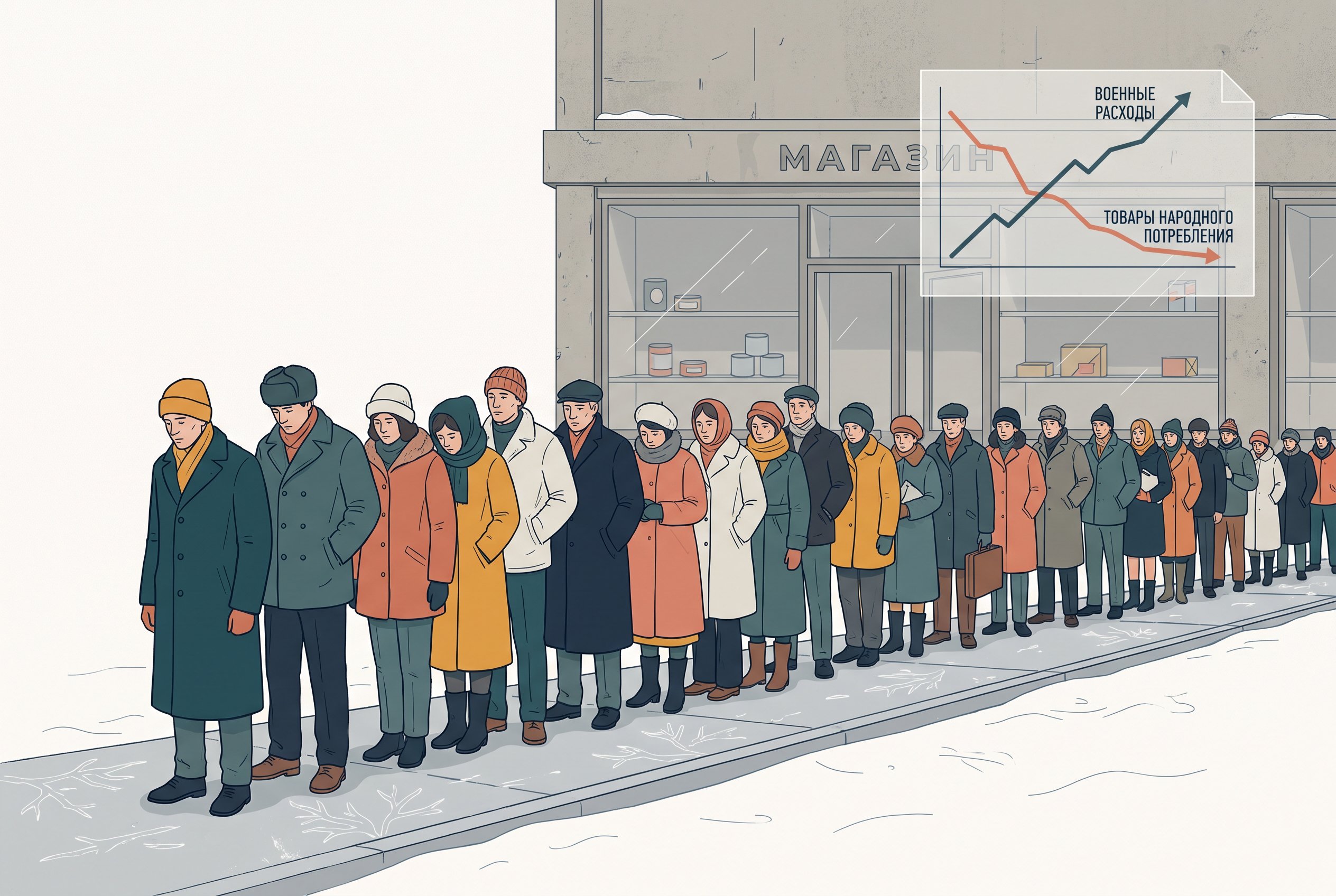
Fig. 9.12 – A queue outside a state shop.
The Cost Of Being A Superpower
The Soviet Union matched American military spending out of an economy less than half the size. Missiles, ships, aircraft and a vast standing army absorbed resources and the best engineers.
To that was added the cost of the bloc. Eastern European economies were subsidised with cheap Soviet oil and gas, and propped up when they got into difficulty. And from 1979 the Soviet Union fought a war in Afghanistan that lasted nine years, killed around fifteen thousand of its own soldiers, achieved nothing it had been begun for, and was widely condemned abroad. The withdrawal was completed in 1989.
Politics Without Consent
The political system had aged with its leaders. One party held power, contested elections did not exist, the press printed what it was told, and the security services watched everyone. Citizens could not travel abroad freely, publish freely, or organise anything the party had not approved.
For decades this had been sustained by a bargain: obedience in exchange for security, steady work and slow improvement. By the 1980s the state was no longer delivering the improvement, and the bargain looked increasingly like a demand.
There was also the question of nationality. The Union contained more than a hundred nationalities, and several republics — the Baltic states above all — had been absorbed by force within living memory. Their peoples had not forgotten it.
9.10.2 Political Changes: Glasnost And Perestroika
Gorbachev’s Problem
Mikhail Gorbachev became General Secretary of the Communist Party in March 1985, and in 1990 took the newly created post of President of the Soviet Union. He was younger than his predecessors, and he believed the system could be repaired.
That is the essential point about him, and it is often missed. Gorbachev did not set out to end communist rule, dissolve the Union or lose eastern Europe. He set out to make a socialist state work efficiently and command genuine support. Every one of his major reforms was designed to strengthen it.
Openness: Glasnost
Glasnost means openness. In practice it meant relaxing censorship and permitting public criticism, and it was intended as a tool: if managers and officials were exposed in the press, they could be made to perform.
Newspapers began printing what they had never printed — industrial failures, official corruption, environmental disasters, and eventually the crimes of the Stalin period, including the purges and the camps. Banned books and films appeared. Hundreds of political prisoners were released, among them the physicist Andrei Sakharov, brought back to Moscow from internal exile in 1986.
The effect ran far beyond what was intended. A population permitted to discuss what was wrong did not stop at inefficient factories. Once the history of the state’s own violence was in the newspapers, the party’s claim to moral authority could not be repaired.
Restructuring: Perestroika
Perestroika means restructuring, and it was the economic half of the programme. Small private and cooperative businesses were legalised, chiefly in services and food. The Law on State Enterprises of 1987 reduced central control over what factories produced and sold, so that they would respond to customers rather than to the plan.
The results were bad, and for an understandable reason. The old system of control was dismantled faster than any new system could replace it. Enterprises freed from targets raised wages and cut unprofitable lines; the state kept spending while its revenues fell; inflation appeared; and shortages in the shops became worse rather than better.
In 1989 around half a million coal miners went on strike. The government conceded most of their demands, which taught every other group of workers what strikes could achieve.
Why The Reforms Pulled Apart
Gorbachev was caught between two groups that agreed on nothing except that he was wrong.
Reformers, led after 1990 by Boris Yeltsin, argued that half-measures were the problem and that a full market economy and genuine democracy were needed at once. Conservatives in the party, the army and the security services argued that the reforms had already gone dangerously far, and that the state was being talked to pieces.
Yeltsin’s own position grew steadily stronger. He was elected to the new national parliament in 1989 with an overwhelming Moscow vote, and in June 1991 he was elected President of the Russian republic in a direct popular ballot — a democratic mandate of a kind Gorbachev, appointed to his offices, never possessed.
9.10.3 The Coup Of August 1991
By the summer of 1991 Gorbachev was negotiating a new Union Treaty that would hand most powers to the republics and leave a much looser federation. It was to be signed on 20 August.
On 19 August a group of senior figures — including the Vice-President, the Defence and Interior Ministers, and the head of the security service — announced a state of emergency. Gorbachev, on holiday in the Crimea, was cut off and held at his residence; his Vice-President, Gennady Yanayev, appeared on television claiming to have taken over. Tanks entered Moscow.
The coup failed within three days, and how it failed matters. Crowds gathered around the Russian parliament building and built barricades. Yeltsin came out and climbed onto a tank in front of the building to denounce the takeover, and the pictures went round the world. Some army units refused to move against the crowds; three young men were killed in a night-time clash. The plotters, who had prepared no plan for people refusing to obey, gave up and were arrested.
Gorbachev returned to Moscow on 22 August. He had been rescued, and everyone including him understood by whom.
The consequences ran fast. The Communist Party’s activities were suspended and then banned in Russia; the institution that had governed since 1917 was gone in a fortnight. Gorbachev remained President of a Union that was emptying out beneath him.
9.10.4 The Republics Demand Independence
The republics had been moving towards separation before the coup. Lithuania declared independence in March 1990, and Estonia and Latvia moved the same way; in January 1991 Soviet forces attacked the television tower in Vilnius, and people were killed defending it.
The August coup turned a movement into a stampede. If Moscow could produce men willing to seize power by force, membership of the Union was plainly dangerous. Ukraine declared independence within days of the coup’s collapse, and confirmed it by referendum in December with an overwhelming majority. Republic after republic followed.
Ukraine’s decision was decisive, because a union of Slav republics without Ukraine made little sense to anyone. In December 1991 the leaders of Russia, Ukraine and Belarus met and declared that the Soviet Union had ceased to exist, replacing it with a loose commonwealth that most of the remaining republics soon joined.
Gorbachev was left as president of a state that its own members had dissolved. On 25 December 1991 he resigned, and the Soviet flag came down over the Kremlin. The Union formally ended the next day, seventy-four years after the revolution that had created the world’s first communist government.
The Cold War ended with it. There was no peace treaty and no surrender, because there had been no war. One of the two sides simply stopped existing.
9.11 Summary
The End Of Wartime Unity
- The alliance of 1941–45 was an agreement to defeat Germany, not an agreement about the world afterwards; once Germany fell, nothing held it together.
- The hostility was older than the alliance: a communist state founded in 1917, foreign troops sent against it in the civil war, and twenty years of mutual exclusion.
- Wartime strains — the delayed second front, the abrupt end of Lend-Lease, the atomic bomb kept secret from an ally — gave each side evidence of the other’s bad faith.
- The ‘Cold War’ meant confrontation with everything except direct fighting: arms, spies, allies, aid and propaganda, between two superpowers each convinced the other’s system could not last.
The Wartime Conferences
- At Yalta in February 1945 the three leaders agreed to a United Nations, to occupation zones in Germany and Austria, to reparations in principle, and to free elections in liberated Europe.
- The Declaration on Liberated Europe promised free elections but defined no mechanism, no supervision and no penalty — gaps that were later filled differently on each side of the line.
- At Potsdam in July 1945 two of the three leaders had changed, Germany was already occupied, and the United States held a weapon nobody else had.
- Potsdam agreed disarmament, denazification, war crimes trials and reparations taken zone by zone; it agreed no peace treaty and no date for reuniting Germany.
- Taking reparations zone by zone meant the four zones stopped working as one economy, so Germany’s economic division arrived before its political division.
Two Programmes, Two Blocs
- In March 1947 the Truman Doctrine committed the United States to supporting states resisting communist pressure — an open-ended promise, made because Britain could no longer fund Greece and Turkey.
- Containment meant blocking any further spread of communism while accepting the governments already in place.
- In June 1947 the Marshall Plan offered American money for European recovery, on terms requiring joint planning and disclosure that the Soviet Union would not accept.
- Moscow answered with the Molotov Plan’s bilateral trade treaties, with Cominform in September 1947 to discipline the communist parties, and with COMECON in January 1949.
- Cominform’s two-camp doctrine mirrored Truman’s: both sides now told their followers publicly that no middle ground existed.
The Rift Widens
- Between 1945 and 1948 every state between Germany and the Soviet frontier acquired a communist government, none of them by a free majority vote.
- Soviet motives ran together: security after two invasions, ideology, an end to isolation, and resources for reconstruction.
- The method was salami tactics — a coalition entered, the interior ministry taken, opponents removed one at a time, then an election nobody could lose.
- Yugoslavia was the exception, because Tito’s communists had liberated the country themselves; expelled from Cominform in 1948, it stayed communist and independent.
- Czechoslovakia, the last democracy east of the line, fell in February 1948 without a Soviet invasion, which convinced western governments that economic aid alone was not enough.
Crisis In Europe
- West Berlin lay a hundred miles inside the Soviet zone, with air access guaranteed in writing and land access resting on wartime understanding.
- The western currency reform of June 1948 provoked the blockade; the western powers answered with an eleven-month airlift rather than force a road.
- The blockade failed completely and hastened what it was meant to prevent: NATO in April 1949, and two German states before the year ended.
- NATO’s promise that an attack on one member was an attack on all reversed the American tradition of avoiding peacetime alliances.
- Germany’s temporary occupation line became a frontier that lasted forty-one years.
The Cuban Missile Crisis
- Cuba’s revolution of 1959 met American economic pressure and an American-backed invasion attempt, and turned to Moscow for trade, aid and protection.
- Soviet missiles were sent in 1962 for three reasons that all fit the evidence: the nuclear balance, the defence of Cuba, and leverage over Berlin.
- Thirteen days of confrontation ended in a bargain — the missiles withdrawn publicly, an undertaking not to invade Cuba, and the American missiles in Turkey removed secretly.
- The crisis produced the first practical steps towards control: the hot line, and in 1963 a treaty banning nuclear tests in the atmosphere, in space and under water.
- Both sides had discovered how little either knew of the other’s intentions, and how fast a crisis could outrun the people managing it.
Détente
- Détente was the management of the confrontation, not its end: fixed frontiers, agreed weapon numbers and open channels, with both sides still arming.
- Its causes were cost, the memory of 1962, the Sino-Soviet split, public pressure in western Europe, and West Germany’s Ostpolitik.
- SALT I in 1972 limited launchers and missile defences; the Helsinki Final Act of 1975 accepted Europe’s frontiers in exchange for commitments on human rights.
- Eastern governments gained recognition and western credit; both gains carried costs, in debts that had to be serviced and in a signed text their citizens began quoting back at them.
- Monitoring groups formed in Moscow, Czechoslovakia and Poland whose method was simply to compare government conduct with government signatures.
1989
- Every earlier challenge in the bloc had been ended by force; Gorbachev’s refusal to use it removed the guarantee on which the eastern governments rested.
- In Poland, debt and food prices produced the Gdańsk strike of 1980 and Solidarity, ten million members strong, suppressed under martial law in December 1981 and not destroyed.
- The Round Table talks of 1989 produced an election designed so that the communists could lose, which they lost completely; a Solidarity government took office in August.
- East Germany existed only because Germany was divided; when Hungary opened its border in September 1989 its citizens simply left.
- The Berlin crossings opened on 9 November 1989 through a misread announcement and guards who chose not to shoot; the two German states were united on 3 October 1990.
The End Of The Soviet Union
- The Soviet economy had stopped growing, could not supply ordinary goods, and carried military spending and bloc subsidies out of an economy half America’s size.
- Gorbachev’s reforms were meant to save the system: glasnost to expose bad administration, perestroika to make enterprises answer to customers.
- Both released more than they controlled — criticism reached the system itself, and the old machinery of command was dismantled before anything worked in its place.
- The coup of August 1991 collapsed in three days because crowds gathered, officers hesitated, and the plotters had no plan for people refusing to obey.
- Ukraine’s vote in December 1991 ended any possible union; the Soviet state was dissolved by its own republics, and the Cold War ended without a treaty because there had been no war.
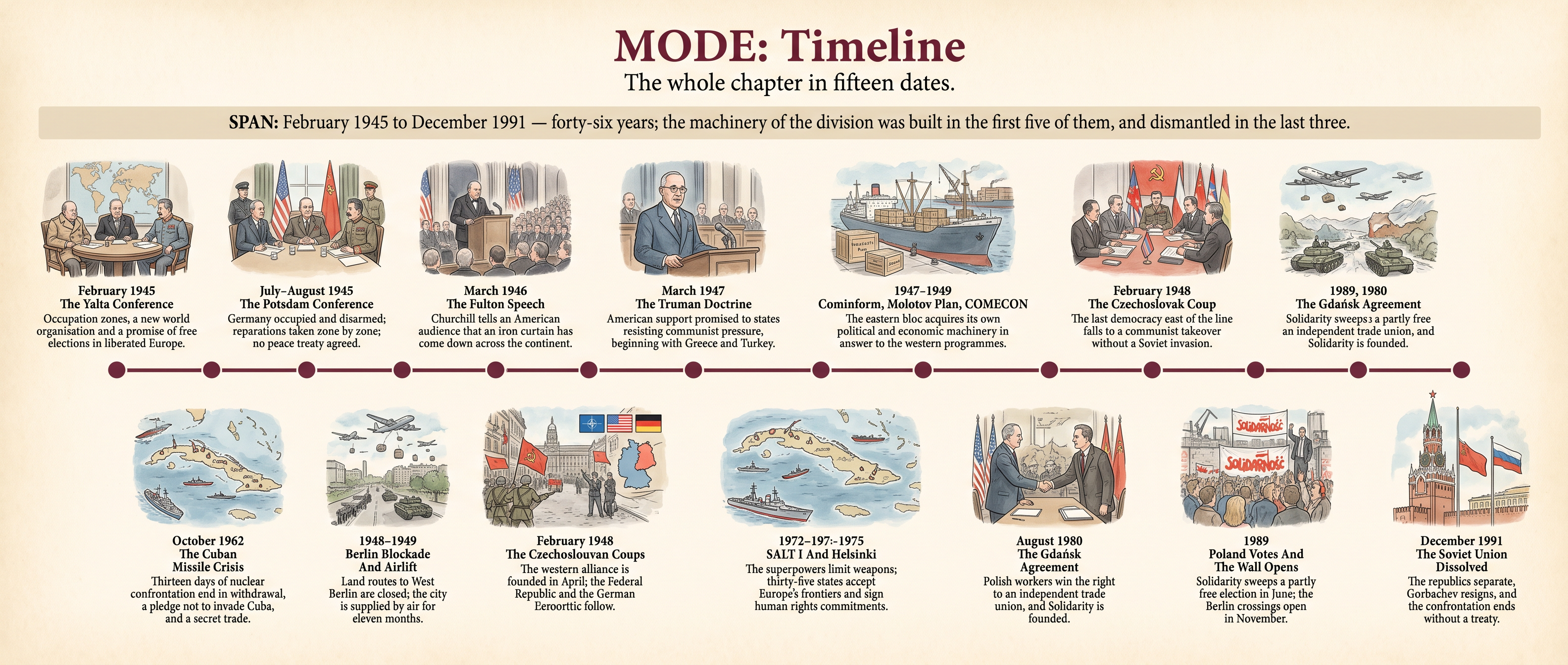
Fig. 9.13 – The Cold War, 1945 To 1991.
What The Evidence Cannot Tell Us
The records of this period are unequal, and that unevenness shapes the history. American decisions can be studied in released papers and even in recordings of the meetings themselves; Soviet decisions are known chiefly from documents opened after 1991, unevenly and incompletely, and much on the Cuban and eastern European side remains closed.
Nor do we know what most people east of the line actually thought before censorship was relaxed. A state that permits no polling, no independent press and no free association produces silence, and silence is neither agreement nor opposition. Crowd sizes are estimates; private motives are inferences; and some of the sharpest questions in this chapter — why Khrushchev chose Cuba, whether Stalin planned the takeovers from the start, how Jan Masaryk came to fall — rest on evidence that supports more than one answer.
What the sources do establish is what was done, when, and by whom. Why it was done has to be argued, and that argument is what historians of the Cold War have been conducting ever since.
9.12 Check Your Memory
State what the Truman Doctrine promised, and describe the situation in Greece and Turkey in early 1947 that led the United States to make that promise.
The Molotov Plan and the Marshall Plan were both answers to the same European crisis. Explain how they differed in the way each was organised, and what that difference meant for the countries receiving help under each.
Explain how the introduction of a new currency in the western zones of Germany in June 1948 led to the Berlin Blockade. Set out the steps in order.
Using Fig. 9.8, reconstruct the stages by which Poland moved from the shipyard strike of August 1980 to a non-communist government in August 1989. Identify the two points at which the outcome could most easily have gone the other way, and say why.
Read Source 9.2 again. State what the three governments promised the peoples of liberated Europe, then identify two things the wording leaves undefined. Explain how each of those gaps mattered in eastern Europe between 1945 and 1948.
Read Source 9.5 again. Why did the Soviet Union agree to sign commitments of this kind at Helsinki in 1975, and how did those commitments come to be used by its own citizens? Use the chapter’s account of the monitoring groups in your answer.
Study Map 9.2. Using the map, explain why West Berlin was so exposed in June 1948, and why the western powers chose to supply the city by air rather than force a way through by road.
Look again at Fig. 9.5 and the discussion beside it. What could the analysts establish from a photograph of this kind, and what could they not establish? Explain why that distinction mattered for the decisions taken in Washington in October 1962.
Compare the way communists came to power in Yugoslavia (Case 9.1) with the way they came to power in Poland or Hungary. Explain what this difference tells us about why Moscow could control some communist states and not others.
Historians disagree about whether détente strengthened communist rule in eastern Europe or helped to undermine it. Set out the strongest case for each position, using evidence from this chapter, and say which you find more convincing and why.