Chapter 11: Middle East: Israeli-Palestine Conflict (1916-1993)
In the winter of 1939, a committee sat down in a London room with a bundle of letters that were already a quarter of a century old. On one side of the table were British officials. On the other were Arab delegates who had come to London for talks on the future of Palestine. The letters had passed between Husain, the Sharif of Mecca, and Sir Henry MacMahon, Britain’s High Commissioner in Egypt, in 1915 and 1916, while the First World War was still being fought.
The Arab delegates argued that in these letters Britain had promised Arab independence, and that Palestine lay inside the area promised. The British officials argued that one phrase in one letter — about the districts lying to the west of Damascus, Homs, Hama and Aleppo — had quietly left Palestine out of the pledge.
Both sides had the same evidence in front of them. The letters were dated, signed and carefully preserved. Yet the two readings could not be brought together, and the committee’s report ended by recording the disagreement instead of settling it.
That is the difficulty this chapter begins with. The documents survive; the intentions of the men who wrote them do not survive alongside them. Out of promises this ambiguous grew a dispute over one narrow strip of land that shaped the Middle East for the rest of the century.
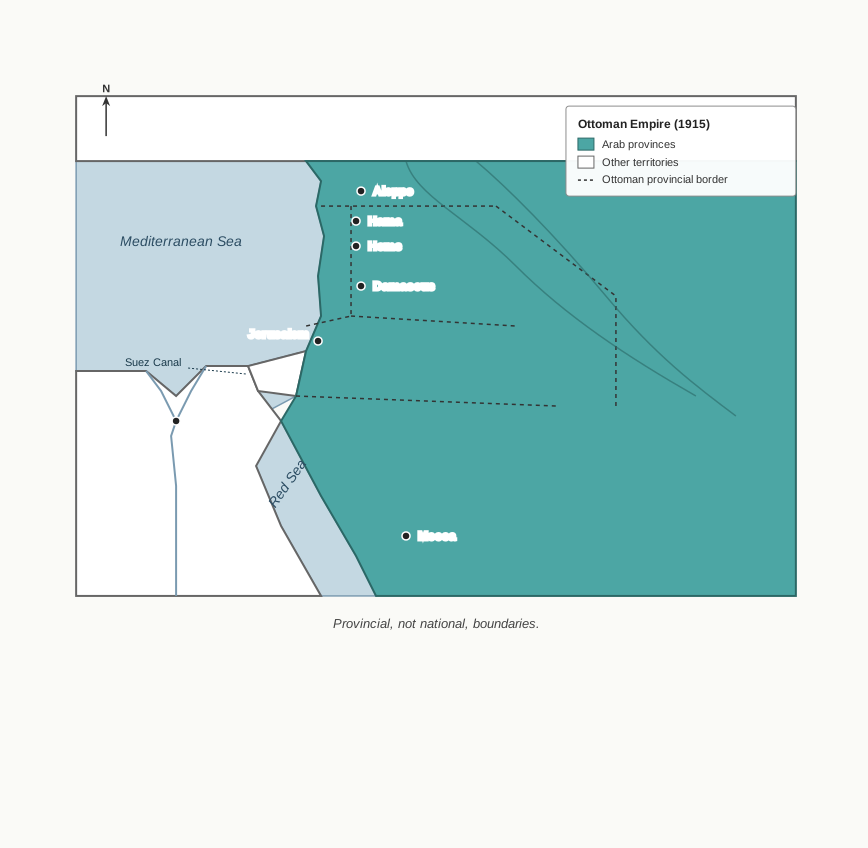
Fig. 11.0 – Ottoman Arab provinces in 1915.
11.1 Two Nationalisms, One Land
Palestine is a narrow strip of land at the eastern end of the Mediterranean Sea, lying between the coast and the river Jordan. The whole territory is smaller than Haryana. Within it stand places of the deepest religious importance to Jews, Muslims and Christians, and Jerusalem is holy to all three.
In 1914 this land was not a country and had no borders of its own. It was a set of administrative districts inside the Ottoman Empire, the Turkish-ruled state governed from Istanbul, which had held the Arabic-speaking lands of West Asia since the early sixteenth century. The northern districts of Palestine were attached to the province of Beirut, while the district of Jerusalem was administered directly from Istanbul because so many European governments took an interest in its holy places.
Perhaps 700,000 people lived there on the eve of the First World War. The great majority were Arabs — mostly Muslim, with a long-established Christian minority — and most of them were villagers who farmed land they or their landlords had held for generations. Jews were a small minority, well under a tenth of the population, though their numbers were rising.
Two Movements, One Territory
Nationalism is the belief that a people who share a language, a history or a culture form a nation, and that a nation has the right to govern itself in a land of its own. In the half-century before 1914 this belief was remaking Europe, and it was carried into West Asia by students, soldiers, journalists and migrants.
Two national movements grew in these years, and each is named in this chapter’s title in a different way. Arab nationalism developed among Arabic-speakers living inside the Ottoman Empire. Zionism developed among Jews living scattered across Europe and beyond it, far from Palestine.
Neither movement began as a quarrel with the other. Each answered a problem of its own — Ottoman rule in one case, the position of Jews in Europe in the other. What made them collide was that the land each wanted was the same land, and that a third party, Britain, would soon hold power over it.
11.1.1 The Aims Of Arab Nationalism
Under Ottoman Rule
The Ottoman sultan ruled his Arab provinces through appointed governors. A large province was called a vilayet, and its governor collected taxes, kept order and answered to Istanbul. In the Hijaz, the western region of Arabia that contains Mecca and Medina, the sultan also recognised a Sharif — a hereditary local guardian of the holy cities, drawn from a family claiming descent from the Prophet.
For most of the nineteenth century Arab Muslims did not regard this arrangement as foreign rule. The sultan was a Muslim ruler and claimed the leadership of the wider Muslim community, and Arab notables served in his administration and his army. Discontent, where it existed, was usually about taxes and misgovernment rather than about being ruled by Turks.
From Language To Politics
Change began with writing rather than with politics. From the 1860s a revival of Arabic literature, printing and journalism gathered pace in Beirut, Damascus and Cairo, led at first largely by Christian Arab writers and later by Muslim reformers. Reading their own classical literature in cheap print, educated Arabs began to think of themselves as a people with a shared inheritance.
The decisive push came in 1908, when a group of officers and officials known as the Young Turks seized control of the Ottoman government. They promised constitutional equality, but in practice they centralised power and pressed Turkish as the language of administration and education. Arab officials and army officers who had expected a larger share of power found themselves with less.
Secret societies followed. Arab students in Paris and Arab officers in the Ottoman army organised from about 1911 to press for self-government, and in 1913 an Arab congress met in Paris to state the case openly. The sequence is set out in Fig. 11.1.
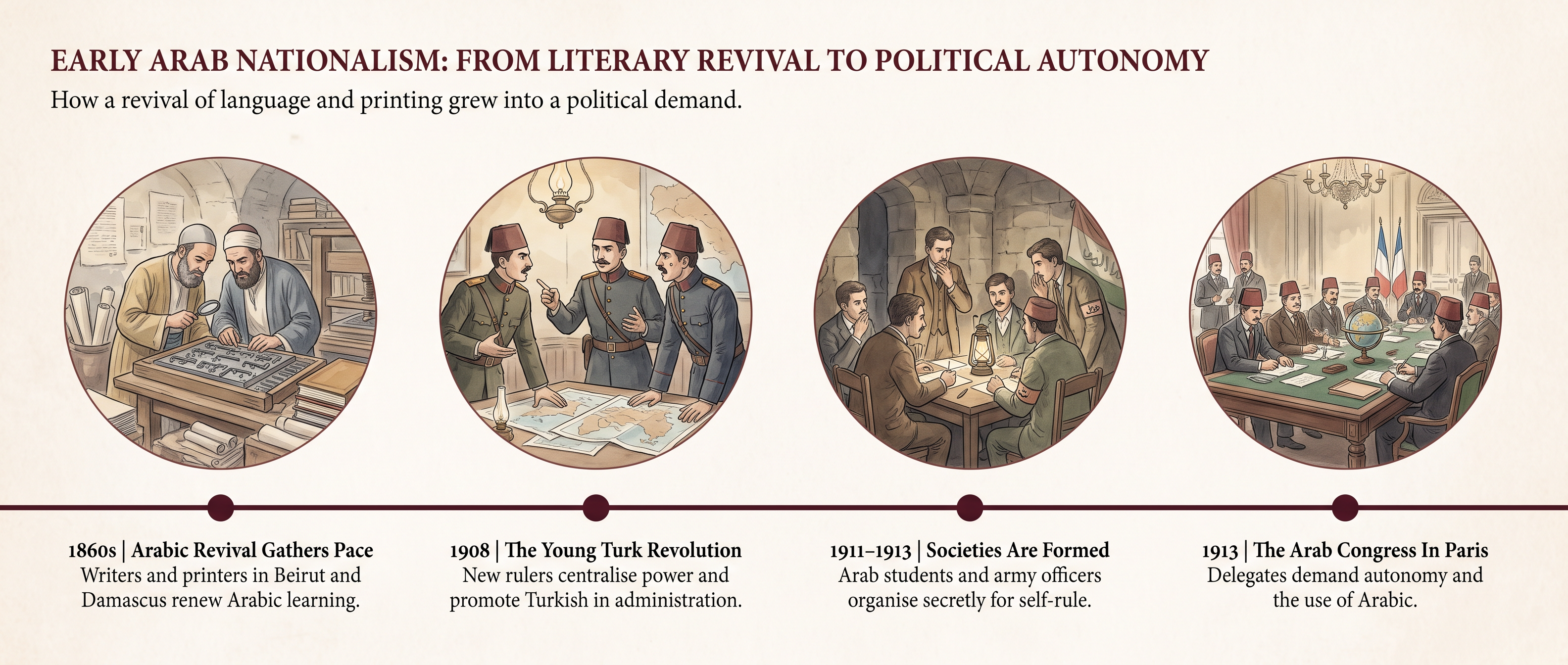
Fig. 11.1 – The Arab national awakening.
What The Movement Wanted
The aims stated before 1914 were narrower than the word ‘independence’ suggests. What the congress and the societies asked for was decentralisation: Arab provinces governed largely by Arabs, Arabic used in schools, courts and offices, and Arab representation in Istanbul. Separation from the empire was still a minority demand.
Two further points matter for everything that follows. First, the movement was small, urban and educated; the villages that held most of the population were barely touched by it. Second, it thought in terms of a single Arab world stretching from Arabia to Syria, in which Palestine was simply one district among many — not a separate country with a separate future.
11.1.2 The Aims Of Zionism
A Scattered People
Since Roman times most Jews had lived outside Palestine, in communities spread across Europe, West Asia and North Africa. This scattering is called the diaspora, and it lasted so long that by the nineteenth century Jewish life almost everywhere was minority life, lived under rulers of another faith. Prayer, festival and ritual nevertheless kept the memory of Jerusalem alive, and Jews spoke of the land as Zion, after a hill in the city.
Judaism, the religion of the Jewish people, is thousands of years old. Zionism, the political movement that grew out of this attachment, is not. It was organised in the 1890s, and its aim was concrete and modern: a recognised national home for Jews in Palestine, guaranteed by law rather than held on sufferance.
Why The Movement Began When It Did
In western Europe Jews had won legal equality during the nineteenth century, yet hostility towards them persisted in politics, in the press and in daily life. In the Russian Empire, where the largest Jewish population lived, the situation was far worse. From 1881 waves of pogroms — organised mob attacks on Jewish neighbourhoods, often tolerated by officials — killed and ruined thousands and drove very large numbers to emigrate.
Most of those emigrants went to America. A small minority went to Palestine, in the migration waves known as aliyah, a word meaning ‘going up’. From these beginnings a movement took shape which argued that equality granted by others could always be withdrawn, and that Jews would be safe only when they governed themselves somewhere.
That argument was put into print in 1896 by Theodor Herzl, an Austrian journalist, who called for a Jewish state established openly and with international agreement. In 1897 a congress at Basel in Switzerland turned the argument into an organisation and a programme, and further bodies were founded to raise money and buy land in Palestine. Fig. 11.2 sets out this sequence, which runs alongside the years covered in Fig. 11.1.
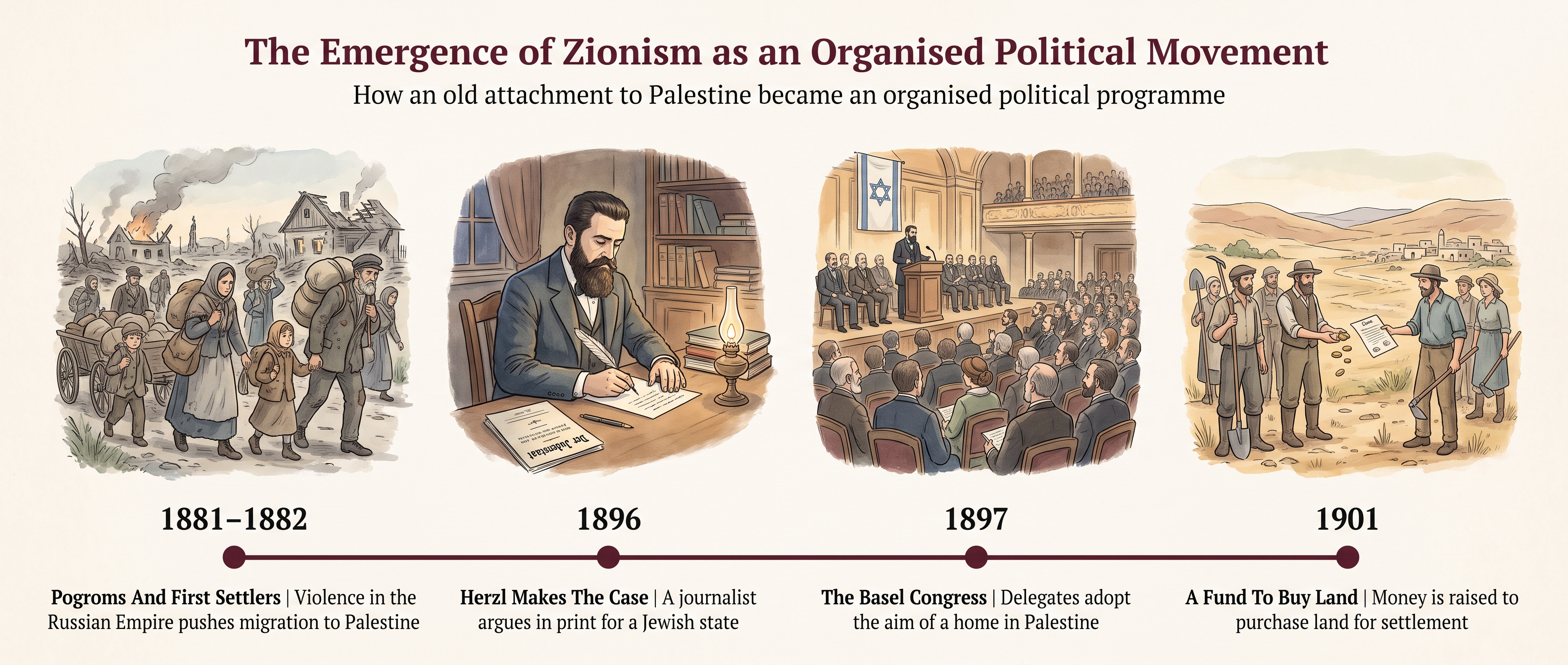
Fig. 11.2 – The rise of political Zionism.
The Aims, Stated Plainly
Three aims can be separated out. The first was migration: to bring Jews to Palestine in numbers large enough to matter. The second was settlement on the land, through purchase and farming colonies, so that the community had an economic base of its own. The third, and the one that shaped the politics of this chapter, was legal recognition — a home secured by public law rather than by the goodwill of a governor.
That third aim explains why the movement’s leaders spent so much effort courting great powers. A legal guarantee could only come from a state strong enough to give one. When the First World War put the future of the Ottoman provinces in play, that search for a sponsor would find its opportunity.
Jewish opinion was not united behind any of this. Some religious authorities objected that a political movement should not anticipate a return promised by God; many Jews in western Europe wanted acceptance as citizens of the countries they already lived in, and feared that Zionism would cast doubt on their loyalty. Zionism was one Jewish answer to the position of Jews in Europe, not the only one.
The Collision
By 1914 the Jewish population of Palestine had grown to roughly 60,000, much of it recently arrived. Land bought from absentee landlords sometimes carried tenant farmers on it, and those tenants could be displaced when the land changed hands. Local Arab protests against land sales and immigration were already being made to Ottoman officials before the war began.
The two movements were therefore in contact, and increasingly in friction, well before any European power made a promise to either of them. What the war added was not the dispute itself but the power to decide it.
11.2 The Conflicting Promises Of The First World War
The Ottoman Empire entered the First World War in November 1914 on the side of Germany. That single decision turned West Asia from a distant province of European diplomacy into a theatre of the war, and it put the future of the Arab lands into question for the first time in four centuries.
For Britain the danger was immediate. The Suez Canal, the sea route to India, ran along Egypt’s eastern edge, and Egypt was under British control. An Ottoman advance across Sinai threatened that route, and Ottoman propaganda threatened something else as well.
The sultan in Istanbul also claimed to be the caliph — the recognised leader of the worldwide Muslim community — and in late 1914 he proclaimed a jihad, a call to religious struggle, against the Allies. Britain ruled tens of millions of Muslim subjects, most of them in India, and its officials feared what such a call might do among them. They wanted a Muslim authority of standing to take the other side.
Out of these pressures came three commitments, made within about two years of each other. The sequence is set out in Fig. 11.3. Notice as you read that each took a different form — a private exchange of letters, a secret treaty between allies, and a public declaration — and that the form of each shaped what it could later be made to mean.
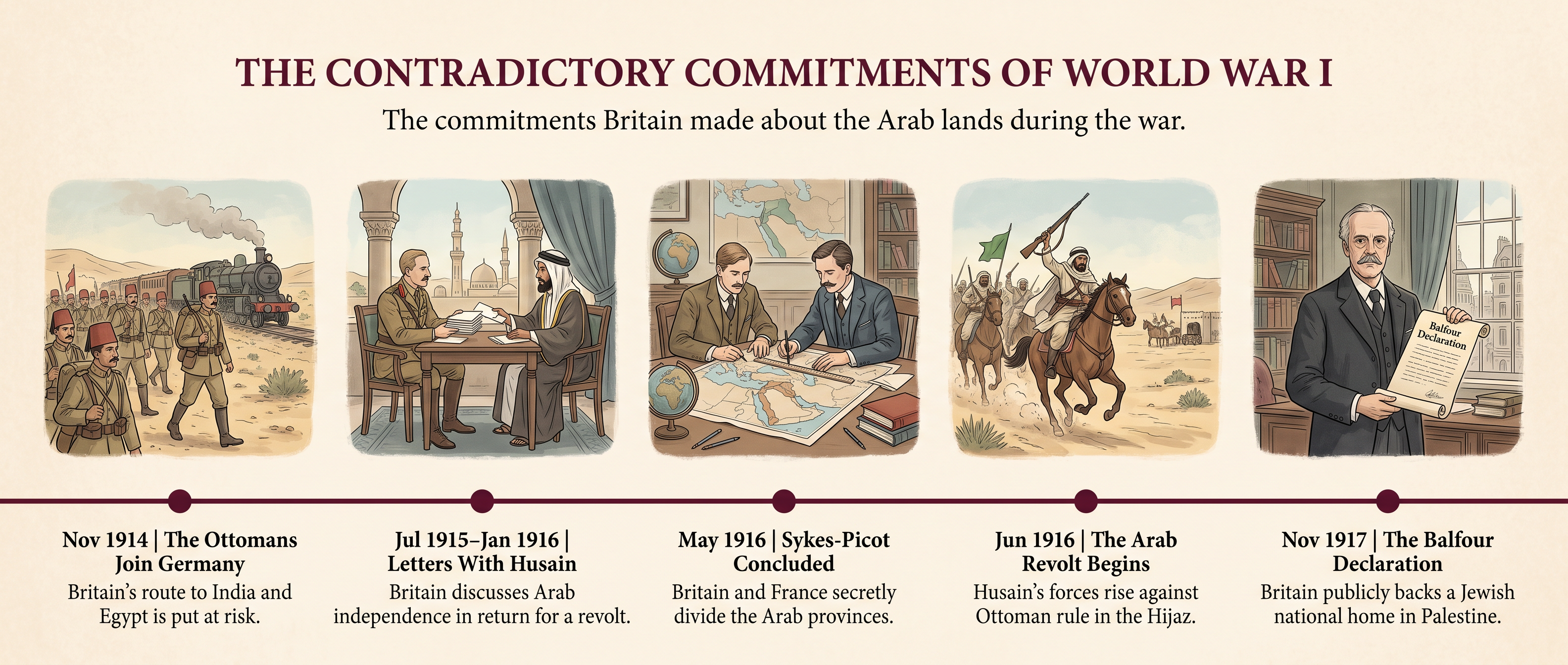
Fig. 11.3 – Three promises in three years.
11.2.1 The Husain-MacMahon Correspondence
Why Britain Wanted A Revolt
Husain, the Sharif of Mecca, was exactly the figure Britain was looking for. He held religious standing in the Muslim world, he commanded armed followers in the Hijaz, and he had his own reasons for resenting the Young Turk government, which was tightening its control over his position.
Husain in turn saw an opening. A war that occupied the Ottoman army might be the moment to convert his local authority into rule over a large Arab kingdom. Each side, in other words, approached the other for reasons of its own.
The contact was made through Cairo. Between 14 July 1915 and 30 January 1916, Husain and Sir Henry MacMahon, Britain’s High Commissioner in Egypt, exchanged ten letters. These are the letters known collectively as the Husain-MacMahon Correspondence.
What The Letters Said
Husain opened by asking Britain to recognise the independence of the Arab lands within boundaries he set out, running across Arabia and up through Syria and Mesopotamia. MacMahon replied on behalf of his government that Britain was prepared to recognise and support Arab independence in the regions demanded — but with reservations.
Those reservations are the whole difficulty. MacMahon excluded areas where Britain was not free to act without French agreement, and he described the excluded ground as portions of Syria lying to the west of the districts of Damascus, Homs, Hama and Aleppo. He also set aside British interests around Baghdad and Basra.
The four towns he named all lie well to the north of Palestine, in what is now Syria. Palestine itself was never mentioned by name in the letters, and this silence in a document of such importance is the fact from which everything else in the dispute grows.
The Revolt
Husain acted on the exchange. In June 1916 he proclaimed a revolt against Ottoman rule in the Hijaz, and his sons led Arab forces who took Mecca and then fought northwards along the Red Sea coast and into Syria, tying down Ottoman troops and cutting the railway that supplied them.
British officers were attached to these forces as liaison and advisers, the best known of them T. E. Lawrence. Their presence mattered less than the money and weapons that came with them, and the revolt remained a modest force beside the main British armies advancing from Egypt.
What the revolt did secure was a claim. When the war ended, Arab leaders could argue that they had fought as allies on the winning side, and that a promise had been given in return.
11.2.2 The Sykes-Picot Agreement, 1916
A Bargain Between Allies
While the Cairo letters were still being exchanged, London and Paris were holding a quite separate conversation. France had long-standing commercial and religious interests in Syria and Lebanon and expected to be rewarded there. Britain wanted Mesopotamia and secure access to the Mediterranean.
The negotiations were conducted by Sir Mark Sykes for Britain and François Georges-Picot for France, and the understanding they reached in May 1916 carries their names. Russia, then still an ally, was informed and gave its assent in return for claims of its own. Because it settled how the Ottoman Arab provinces would be divided, it is also called the Asia Minor Agreement.
What It Divided
The agreement drew a line across the map. France was to control the coastal region of Syria and Lebanon directly, with a further zone of influence inland. Britain was to control southern Mesopotamia, including Basra and Baghdad, with its own zone of influence between. Palestine, because so many governments claimed an interest in its holy places, was not given to either power outright but was to be placed under some form of international administration. The division is shown in Fig. 11.4.
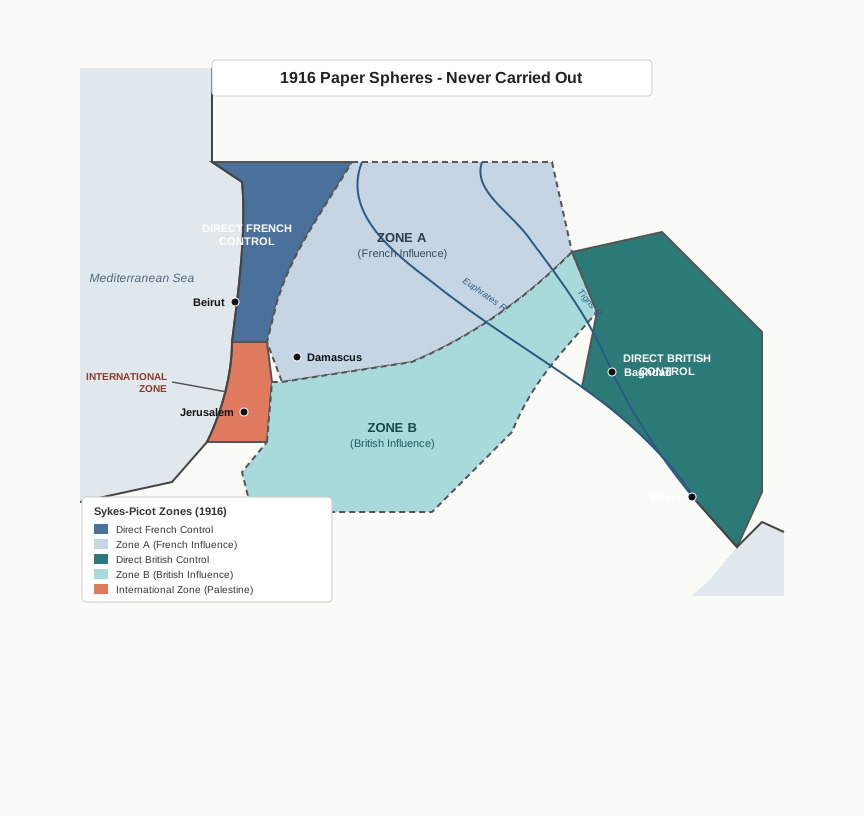
Fig. 11.4 – Sykes-Picot zones of 1916.
Two features of this bargain matter more than the exact lines. First, it treated the Arab provinces as territory for the victors to allot, at the same moment as Britain was discussing Arab independence in Cairo. Second, it placed Palestine outside any Arab settlement altogether, before any promise had been made to the Zionists at all.
How The Secret Came Out
Secret treaties are usually secret for a long time. This one was not. After the Bolsheviks took power in Russia in November 1917 they opened the imperial archives and published the wartime agreements they found there, including this one, as evidence of what they said the war had really been about.
The text therefore reached Arab leaders while the war was still being fought, and British officials had to explain a document they had never intended anyone to read. The damage was not only political; it taught the Arab side to treat British assurances as one part of a larger and less generous design.
11.2.3 The Balfour Declaration, 1917
Why Britain Made It
The third commitment was made in the open, and to a movement rather than to a ruler. Zionist leaders in Britain, among them Chaim Weizmann, a chemist born in the Russian Empire and working in Manchester, had spent years arguing the case for a British-sponsored Jewish home in Palestine.
Several arguments told in their favour by 1917. Some ministers held religious or moral sympathies of their own. More practically, the government hoped that a declaration would win Jewish opinion in the United States, which had just entered the war, and in Russia, which was in danger of leaving it. There was also a strategic calculation: a friendly community in Palestine would sit beside the Suez Canal, and would give Britain a reason to keep the territory out of French hands.
The result was a short letter from Arthur James Balfour, the Foreign Secretary, to Lord Rothschild, a leading figure in British Jewish life, for communication to the Zionist Federation of Great Britain and Ireland. Its operative sentence is printed below.
What The Words Do And Do Not Say
Read it slowly and the care taken over its wording becomes obvious. The government views the object with favour and will use its best endeavours; it does not undertake to deliver anything. The object is a ‘national home’, a phrase with no meaning in law, and not a state.
The safeguard is drawn just as carefully. The Arab majority — then about nine people in ten in Palestine — is not named as a people at all, but described as the ‘existing non-Jewish communities’, and what is protected for them is civil and religious rights, not political rights. Nothing in the sentence promises them a share in governing the country.
For Zionists the declaration was nevertheless a decisive gain, because it brought a great power’s public backing for the legal recognition their movement had been seeking since 1897. For Arab leaders it was the moment at which a territory they believed had been promised to them was publicly promised, in part, to somebody else.
11.2.4 Reading The Three Promises Together
Set side by side, the three documents are not three versions of one policy. They were made by different men, for different audiences, at different stages of a war Britain was not certain of winning, and no one in London ever sat down to reconcile their wording.
They also differ in kind, which is why they could not simply cancel one another. The correspondence with Husain was a negotiation, hedged with reservations and never turned into a treaty. Sykes-Picot was an agreement between governments, precise about lines on a map. The Balfour Declaration was a public statement of policy, vague about what it offered but impossible to disown once printed.
What they had in common was the assumption that the Arab provinces of a defeated empire would be disposed of by the victors. On that assumption all three could be believed at once — and each party to them did believe the one addressed to itself.
By the end of 1918 the Ottoman army had been driven out of Syria and Palestine and the empire’s rule in the Arab lands was over. The promises now had to be turned into an actual administration, and it was Britain, not Husain and not the Zionist movement, that held the territory.
11.3 Palestine Under The British Mandate
When the fighting ended, Britain held Palestine by occupation. In April 1920 the Allied powers meeting at San Remo assigned it to Britain as a mandate — a territory that a victorious power was authorised to administer on behalf of the League of Nations, on the understanding that it was being prepared for eventual self-government. The League confirmed the arrangement in 1922, and it came into force in 1923.
The mandate for Palestine was unlike any other, because the text of the Balfour Declaration was written into it. Britain was formally charged with facilitating a Jewish national home while safeguarding the rights of the other inhabitants. A government that had made two promises in wartime now held a legal document that contained both of them.
Administration was placed in the hands of a British High Commissioner in Jerusalem, backed by British officials, police and troops. The eastern part of the mandated area, across the river Jordan, was soon administered separately as Transjordan and closed to Jewish settlement; the name will reappear in this chapter as one of the Arab states of 1948.
11.3.1 Immigration, Land And Arab Protest
A Promise That Worked Only One Way
On paper the two obligations were balanced. In practice they were not, because they were of different kinds. The Jewish national home required action — permits, immigration, land registration, recognised institutions — while the safeguard for the Arab majority only required that certain rights not be damaged.
The Zionist movement organised quickly to use what the mandate offered. A Zionist Commission had already been sent to Palestine in 1918, and over the following years the Jewish community built its own elected assembly, schools, trade union federation, health services and armed self-defence groups. Arab political life had no comparable framework, partly because its leaders refused to join bodies whose legal basis included the Balfour Declaration, which they regarded as void from the start.
The Numbers On The Ground
The mandate government took only two censuses, in 1922 and 1931, and estimated the population in the years after that. Table 11.1 sets out what those counts show.
Read the columns against each other and the pattern is clear. The whole population grew fast, and the Arab population grew substantially through natural increase, so Jewish immigration was not simply replacing Arabs. But the Jewish share of the population trebled in twenty-five years, and most of that shift came in the 1930s, when Nazi persecution in Germany and Poland drove Jewish emigration on a scale nobody had planned for.
That is what made the arithmetic political. A minority of one in ten posed no threat to Arab majority rule in a future self-governing Palestine. A minority approaching a third, still growing, and organised as a community with its own institutions, plainly did.
Land, Labour And Displacement
Immigration was only half the question; land was the other half. Zionist funds bought land, often from absentee landlords living in Beirut or Damascus, and much of the land bought was already worked by Arab tenant farmers who had no ownership documents to defend.
Land purchased by the national funds was held permanently for the Jewish community and could not be resold, and the movement increasingly insisted that it be worked by Jewish labour. Each rule made sense from inside the project of building a self-supporting national home. Together they meant that a tenant displaced by a sale did not simply become a wage labourer on the same field; he lost his connection to that land entirely.
Protest, And Then Revolt
Arab protest ran through the whole mandate period and grew steadily harder. There were violent disturbances in 1920 and 1921, and much worse in 1929, when a dispute over rights of worship at the wall below the Temple Mount, sacred to Jews as the Western Wall and to Muslims as al-Buraq, set off attacks and killings across the country. More than a hundred people died on each side, many of the Arab dead shot by British forces restoring order.
The breaking point came in 1936. A general strike, called to demand an end to immigration and land sales and the establishment of a national government, lasted six months and was followed by three years of armed rebellion in the countryside. Britain suppressed it with troops, house demolitions, mass detentions and the exile of Arab political leaders.
The revolt shaped what followed in two ways that are easy to miss. It forced Britain to reconsider the whole policy, which produced the Peel Commission. And it left Palestinian Arab society, by 1939, with its leadership scattered, its fighters disarmed and its economy damaged — weaknesses it still carried when war came in 1948.
11.3.2 The Peel Commission And The Search For Partition
A Royal Commission Is Sent
In 1936, with the strike under way, the British government appointed a royal commission headed by Lord Peel to find out why Palestine had become ungovernable. It took evidence for months from officials, Zionist leaders and Arab representatives, and reported in July 1937.
Its central finding was blunt and, in the end, correct. The two national movements wanted incompatible things in the same territory, no single administration could satisfy both, and the mandate as written could not be made to work.
What Peel Proposed
From that finding came the first official proposal to divide the country. A Jewish state was to be formed in Galilee and along part of the coastal plain; an Arab state was to take the remainder and be joined to Transjordan; and Britain was to retain Jerusalem, Bethlehem and a corridor to the sea, so that the holy places stayed under international protection. The commission also proposed transferring populations between the two areas to make the division workable.
How Each Side Answered
Arab leaders rejected partition outright. Accepting it meant conceding that a foreign power could hand over part of their country to recent immigrants, and the proposed Jewish state contained a large Arab population who would find themselves under a government not their own.
The Zionist response was divided and more careful. The Zionist Congress that met weeks later rejected the specific boundaries as too small, but authorised its leaders to negotiate further — which amounted to accepting the principle of partition while bargaining over its terms. That distinction between principle and terms would matter again in 1947.
Britain then thought better of the whole scheme. A further commission reported in 1938 that partition on Peel’s lines was impracticable, and the plan was dropped.
The White Paper Of 1939
With war in Europe approaching, British policy turned towards keeping the Arab world quiet. The White Paper issued in May 1939 offered an independent Palestinian state within ten years, limited Jewish immigration to 75,000 over the next five years and made anything beyond that conditional on Arab consent, and restricted land sales to Jews in most of the country.
The timing could hardly have been worse. The door to Palestine was being closed at the moment when Jews in Europe most needed somewhere to go, and Zionists regarded the policy as a repudiation of the national home and of the mandate itself. Arab leaders were not satisfied either, since the promised state was distant and conditional, and their leadership formally rejected it too.
11.3.3 The Second World War And The End Of The Mandate
Fighting On Two Fronts
When war came, the Jewish community in Palestine faced a contradiction it managed by living with it. Tens of thousands volunteered for the British forces, because Nazi Germany was the greater enemy; at the same time the community continued to oppose the White Paper, and organised the movement of Jewish refugees to Palestine outside the British quotas, which the authorities treated as illegal immigration and intercepted at sea.
What The War Changed
By 1945 the situation had been altered by an event outside Palestine altogether. About six million European Jews had been murdered in the Nazi genocide, and the survivors were in camps across Europe with no homes and often no families to return to.
This transformed the political weight of the Zionist case. What had been an argument about the safety of a minority now rested on a demonstrated fact, and it won sympathy in the United States that pre-war Zionism had never commanded. President Truman pressed Britain to admit 100,000 Jewish survivors immediately, and an Anglo-American committee of inquiry recommended the same in 1946.
Britain refused, because admitting them would break the White Paper and enrage the Arab states whose goodwill it still needed. The refusal turned parts of the Jewish community from allies of Britain into its opponents.
An Administration Under Attack
Armed Jewish organisations began attacking British installations, railways and personnel. In July 1946 one of them bombed the King David Hotel in Jerusalem, the wing of which housed the British administrative secretariat and military headquarters; ninety-one people were killed, British, Arab and Jewish. Britain replied with mass arrests, searches and the deportation of intercepted immigrants, which produced further outrage abroad.
By early 1947 Britain was holding Palestine with roughly a hundred thousand troops and police, at a cost it could not carry. The country was exhausted by the war, was withdrawing from India, and could see no policy in Palestine that both communities would accept. In February 1947 the government announced that it was handing the problem to the United Nations. The sequence from mandate to referral is set out in Fig. 11.5.
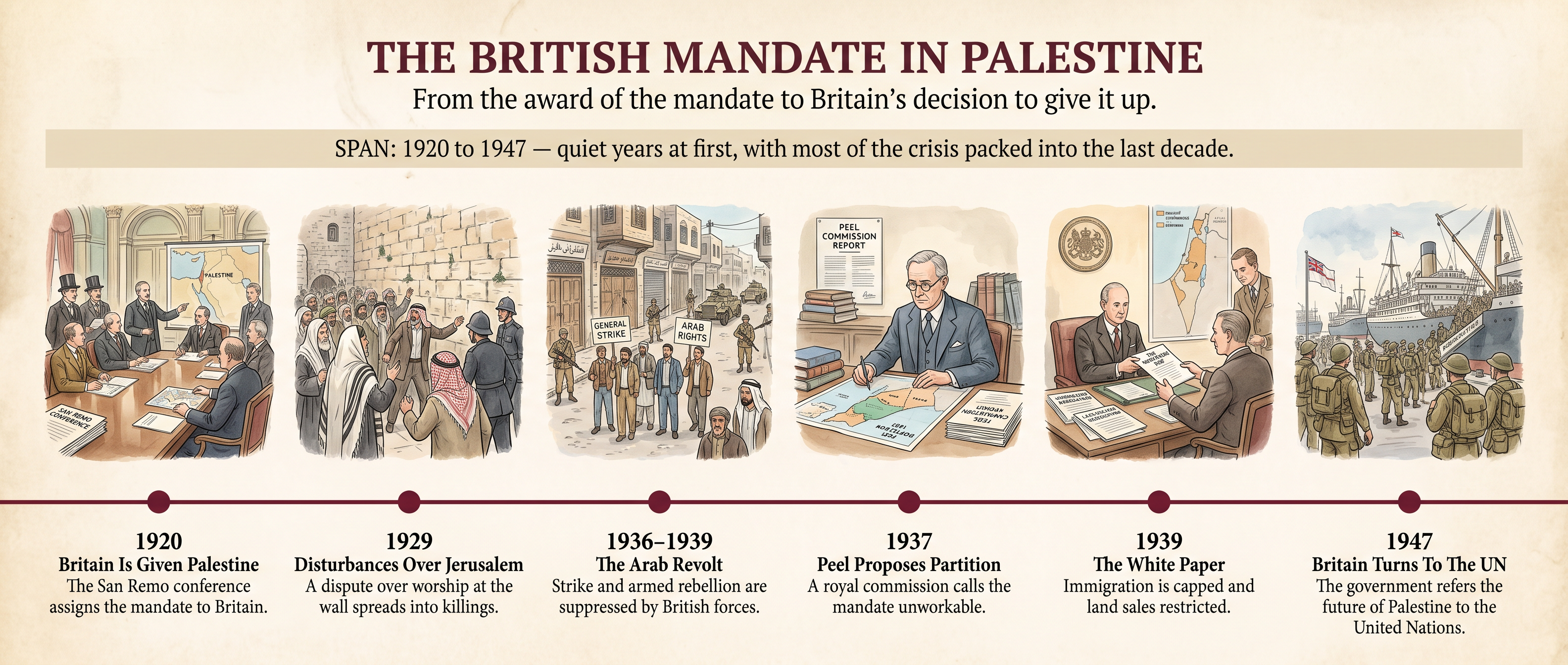
Fig. 11.5 – The mandate years.
11.4 The Formation Of The State Of Israel
In 1947 the future of Palestine passed from a single imperial government to an international organisation two years old. The United Nations had been created to settle disputes between states, and it was now handed a dispute inside a territory that was not a state at all, between two communities that would not sit in the same room.
11.4.1 The United Nations Partition Plan
The Committee And Its Two Reports
In May 1947 the General Assembly set up a special committee on Palestine, made up of representatives of eleven countries, none of them great powers. The committee came to Palestine, took evidence and travelled through the country during the summer.
It heard only one of the two communities properly. Jewish institutions gave detailed evidence and organised visits; the Arab Higher Committee boycotted the proceedings, on the argument that Arab rights in Palestine were self-evident and that participating would suggest they were open to negotiation. That boycott cost the Arab case a hearing at the moment when it most needed one.
The committee reported at the end of August 1947 and could not agree. Its majority recommended partition into an Arab state and a Jewish state, joined in an economic union, with Jerusalem placed under international administration. Its minority recommended a single federal state with Arab and Jewish areas inside it. Zionist leaders welcomed the majority plan; Arab leaders rejected both.
The Vote Of 29 November 1947
The General Assembly adopted a modified version of the majority plan on 29 November 1947 as Resolution 181. The vote was 33 in favour, 13 against and 10 abstentions.
The pattern of that vote is worth pausing over. The United States and the Soviet Union, already opposed to each other almost everywhere else, both voted for partition. Britain, which had governed Palestine for a quarter of a century, abstained. India voted against, preferring the federal solution — a position shaped by its own recent experience of a partition carried out on religious lines.
What The Plan Divided
The territory was cut into interlocking pieces, shown in Fig. 11.6. The Jewish state was to take the coastal plain, eastern Galilee and the Negev desert in the south, amounting to roughly 55 per cent of the country. The Arab state was to take the central highlands, western Galilee and the Gaza coast, roughly 42 per cent. Jerusalem and Bethlehem, sacred to all three faiths, were to belong to neither and be governed internationally.
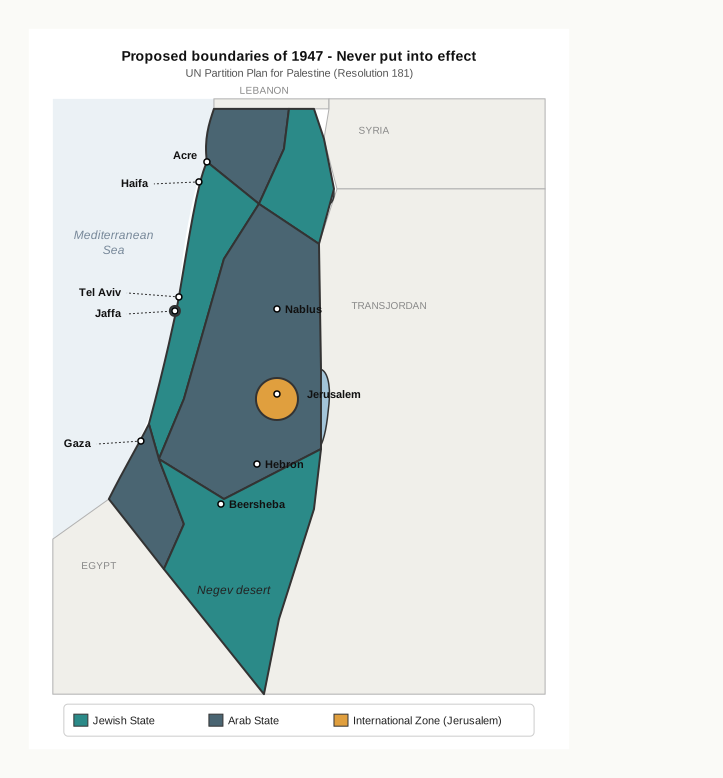
Fig. 11.6 – The UN partition plan of November 1947.
Two figures explain why the plan was received so differently by the two sides. Jews were about a third of the population and held under a tenth of the land, and were allotted more than half the territory. Inside the proposed Jewish state the population would have been about 500,000 Jews and about 400,000 Arabs — very nearly half its inhabitants would have been Arabs living in a state defined as Jewish.
Why Each Side Answered As It Did
Zionist leaders accepted, though many disliked the boundaries. Acceptance brought what the movement had wanted since 1897 — a state recognised in international law — and the alternative was to keep displaced survivors of the genocide waiting in European camps.
Arab leaders rejected, and their reasoning did not depend on the details. In their view a majority population was being required to surrender more than half its country to recent immigrants by a vote of governments far away, and no principle of self-determination allowed that. Some of them also expected that if it came to fighting, the Arab states would win.
11.4.2 The Declaration Of 14 May 1948
The Last Months Of The Mandate
Fighting began within days of the vote and grew through the winter into a civil war between the two communities, which is taken up in the next section. Britain announced that its administration would end and its troops leave, and set the date at 15 May 1948.
It then did nothing to bring the partition plan into being. British officials would not help a plan neither side had accepted, and the UN commission appointed to carry it out was never able to take up its work in Palestine. As the mandate ran down, courts, police and services stopped functioning, and each community fell back on its own institutions.
The Declaration
Only one side had institutions ready for that moment. The Jewish Agency, the body recognised under the mandate as representing the Jewish community, already functioned as a government in miniature, with departments, finances and a defence force.
On the afternoon of 14 May 1948, hours before the mandate expired at midnight, David Ben-Gurion, the head of the Jewish Agency, read out a declaration of independence at a museum hall in Tel Aviv. The new state was named Israel. The declaration cited the UN resolution as its authority, promised equal rights to all inhabitants, and invited the Arab population to remain and take part in building it.
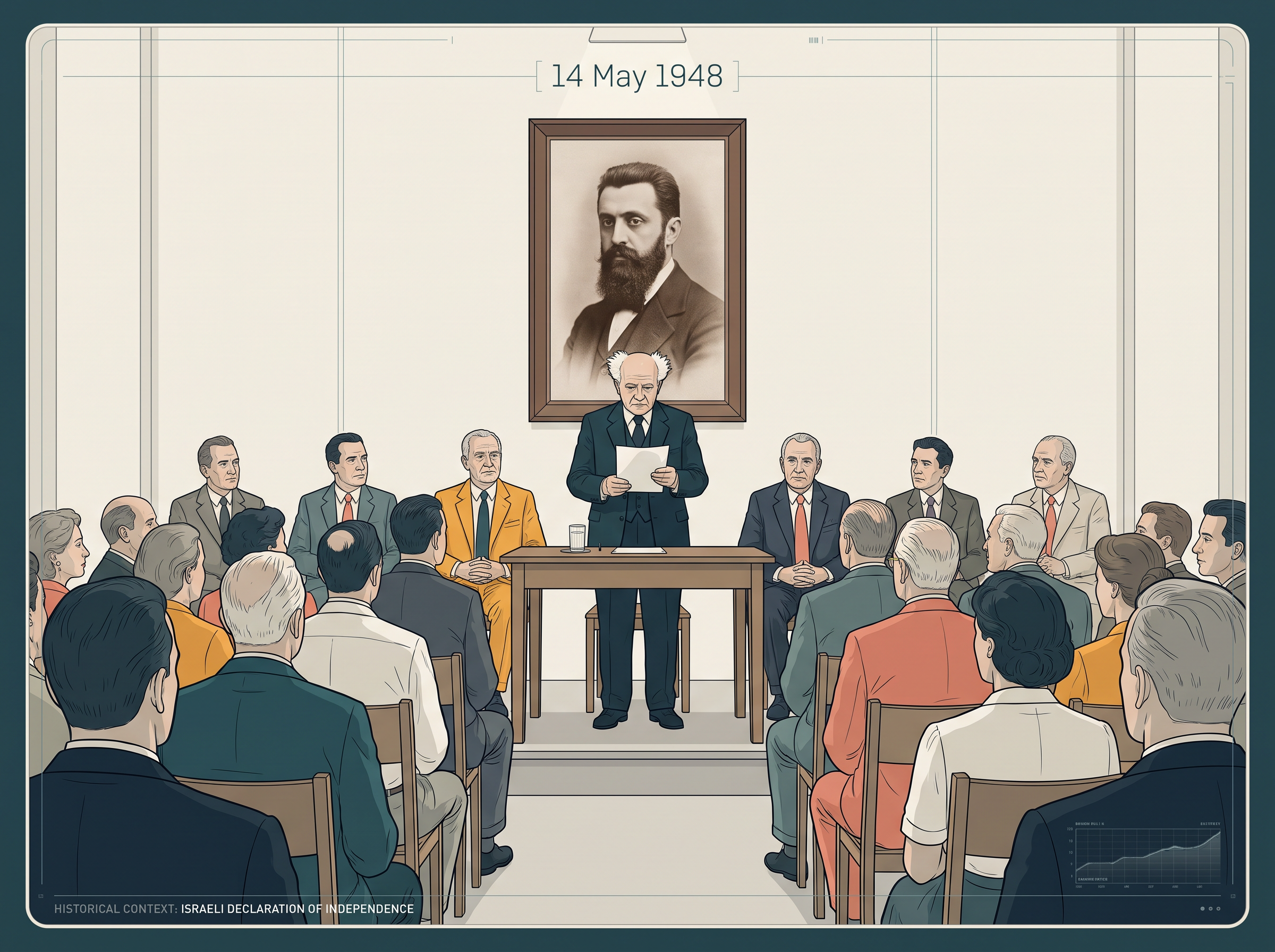
Fig. 11.7 – Ben-Gurion reading the declaration of independence.
One thing the declaration did not do was state where the new state’s borders lay. That omission was deliberate. Fixing borders would have meant either accepting the UN lines or publicly claiming more than them, and with armies expected within hours neither was useful.
Recognition, And A State That Did Not Appear
Recognition came almost at once. The United States recognised the new state within hours, and the Soviet Union followed within days, with other governments after them. For a movement whose central aim had been legal standing, this was the aim achieved.
The Arab state envisaged by the resolution never came into existence. Palestinian Arab leadership had been broken by the revolt of the late 1930s and exiled or scattered, no equivalent administrative machinery had been built, and the neighbouring Arab governments had plans of their own for the territory. On 15 May the armies of those governments crossed into Palestine, and the civil war became a war between states.
11.5 The First Arab-Israeli Conflict (1948-1949)
The war that followed the declaration of independence is the first of the four wars this chapter has to explain. It is also the one that fixed the shape of everything after it, because it created the borders, the refugee population and the mutual expectations that the later wars were fought over.
11.5.1 Why The War Broke Out
A Plan Nobody Would Enforce
The immediate cause was simple and structural. The United Nations had recommended a partition that one side accepted and the other rejected, and no authority existed to impose it. Britain was leaving, the UN had no troops, and the two communities in Palestine were already armed.
In such a situation each side had reason to act rather than wait. The Jewish leadership needed to hold the territory the plan had allotted it, secure the road to Jerusalem and defend isolated settlements. Palestinian Arab leaders needed to prevent a Jewish state from coming into being at all, and believed that the promised support of neighbouring states would make that possible.
What The Arab States Wanted
The Arab governments that intervened in May 1948 are often described as acting together. They did not. Their armies entered under a nominal joint command, but each had aims of its own and mistrusted the others.
King Abdullah of Transjordan commanded the best-trained force in the region, the Arab Legion, and his practical objective was to secure the hill country of central Palestine for his own kingdom rather than to create an independent Palestinian state. Egypt’s government did not want Abdullah enlarged, and moved partly to prevent it. Syria, Lebanon and Iraq each had smaller ambitions and smaller commitments.
Public opinion pushed them all. Arab populations had followed the Palestine question for a decade, and no government could stand aside from a cause its own people regarded as a test of Arab independence. The intervention was in this sense both a war of choice and a war the governments could not avoid.
11.5.2 The Two Phases Of The Fighting
The Civil War, December 1947 To May 1948
Fighting began within days of the partition vote and ran for nearly six months before any regular Arab army crossed a border. This first phase was a civil war between the two communities of Palestine, fought while British troops were still present but increasingly unwilling to intervene.
Its central struggle was over roads. Arab irregular forces, joined by volunteers from neighbouring countries, cut the routes between Jewish areas and besieged the Jewish quarters of Jerusalem, while Jewish forces attacked to reopen them. By April 1948 the Jewish command had moved from defending settlements to taking and holding territory, and the balance shifted quickly.
Both sides committed atrocities in these months. In April, fighters of two Jewish irregular organisations killed more than a hundred villagers at Deir Yassin, near Jerusalem; days later, Arab fighters attacked a medical convoy on its way to the Hadassah hospital and killed most of those aboard. News of Deir Yassin, spread by both sides for opposite reasons, deepened the panic that was already emptying Arab towns.
The mixed cities fell one after another before the mandate ended — Tiberias, Haifa, Safed, Jaffa. That sequence matters for what follows: by the time the Arab armies arrived, a great deal had already been decided.
The War Between States, May 1948 To 1949
On 15 May the armies of Egypt, Transjordan, Iraq, Syria and Lebanon entered Palestine. The Arab Legion took the hill country and the Old City of Jerusalem, where the Jewish quarter surrendered; Egyptian forces advanced along the coast towards Tel Aviv and into the northern Negev.
The United Nations then arranged two truces during the summer. Israel used them far better than its opponents did. The separate militias were merged into a single army under one command, conscription was extended, and arms bought abroad — most importantly rifles, machine guns and aircraft from Czechoslovakia — were brought in and distributed.
When fighting resumed, the initiative had changed hands. Israeli offensives in the autumn and winter cleared the Galilee, drove Egyptian forces back into the Gaza coastal strip, and reached the Gulf of Aqaba in the south. Armistice agreements were signed separately with Egypt, Lebanon, Transjordan and Syria between February and July 1949. Fig. 11.8 sets out the sequence.
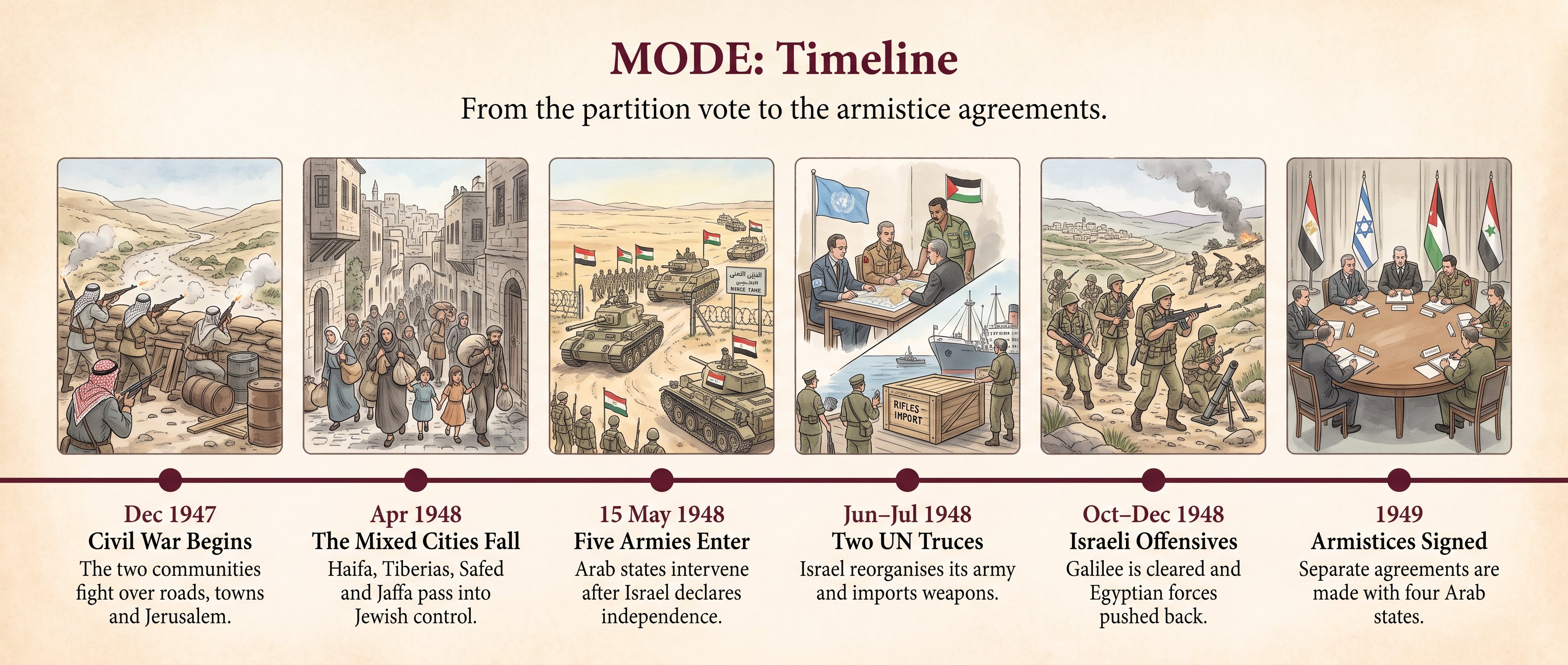
Fig. 11.8 – The first Arab-Israeli conflict.
Why Israel Won
Four reasons carry most of the explanation, and they are connected. Israel fought a single war under a single command, while its opponents fought five loosely coordinated ones. Israel mobilised its whole population, so that by the later stages it had more soldiers in the field than the Arab armies combined. It used the truces to arm, while Arab supply lines lengthened and stayed thin. And its forces were fighting for the survival of a state whose defeat would leave them nowhere to go.
None of this made the outcome inevitable. In the first weeks Israeli forces were short of heavy weapons and came close to breaking in the Negev and on the Jerusalem road. Israeli losses were about 6,000 dead — roughly one person in a hundred of the entire Jewish population.
11.5.3 Results: Territory And Refugees
More Land Than The Plan Allowed
The armistice lines of 1949, drawn where the armies stopped, gave Israel about three-quarters of mandate Palestine, appreciably more than the partition plan had allotted, including western Galilee and the corridor to Jerusalem. These lines came to be called the Green Line, after the colour used to draw them on the negotiators’ maps. Fig. 11.9 sets them beside the 1947 proposal.
No Palestinian state emerged from any of this. Egypt administered the Gaza Strip without annexing it. Transjordan took the hill country and the eastern half of Jerusalem, annexed both in 1950 and renamed itself Jordan. Jerusalem, which the UN had meant to internationalise, was divided by a fortified line through its middle.
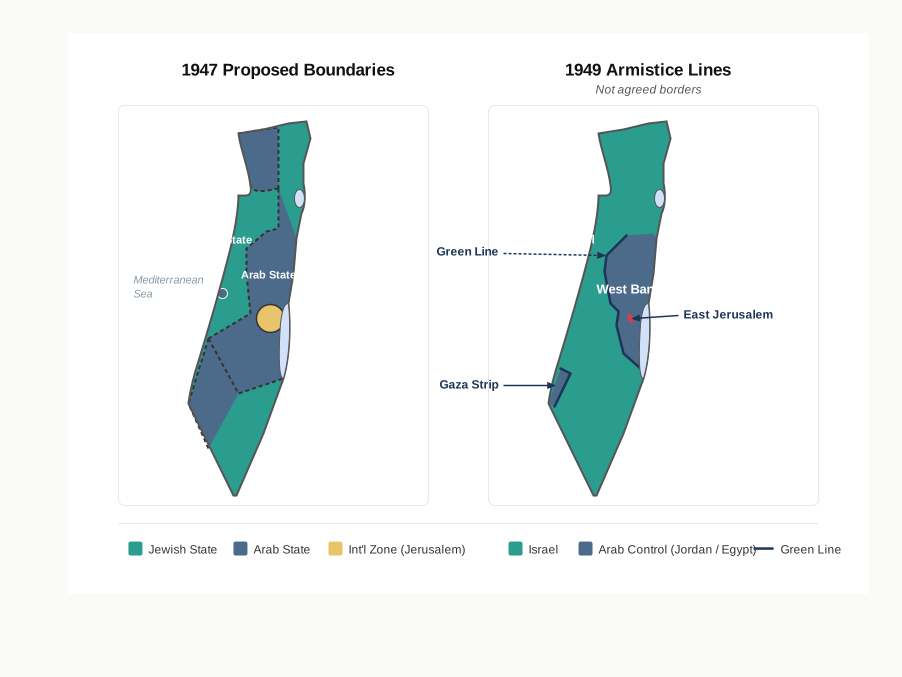
Fig. 11.9 – The 1949 armistice lines and the 1947 proposed boundaries.
The Refugees
The largest result was a population. About 700,000 Palestinian Arabs — the majority of the Arab population of the territory Israel now held — were outside it when the fighting stopped. Some had fled the fighting expecting to come back; some were expelled by Israeli forces; some left because their leaders had gone or because news of Deir Yassin had reached their village.
They were not allowed to return. Israel’s government held that readmitting them would create a hostile minority inside a state fighting for its existence, and that their property could be used to settle the Jewish immigrants now arriving. In December 1948 the UN General Assembly passed a resolution stating that refugees wishing to return and live at peace should be permitted to do so, and that those choosing not to return should be compensated. It was not implemented, and it has been quoted in every negotiation since.
The refugees settled in camps in the Gaza Strip, the West Bank, Jordan, Lebanon and Syria, where a UN relief agency was set up to feed and school them. Those camps, and the generation born in them, are where the Palestinian national movement of the 1960s came from.
In the years that followed, a movement ran the other way as well. Most of the ancient Jewish communities of Arab and Muslim countries left or were driven out under the pressure of the conflict, and a large number of them settled in Israel.
Two Names For One Event
The war ended without a peace treaty. An armistice is a formal agreement to stop fighting; it settles nothing about borders, refugees or recognition, and every one of those questions was left open.
That is why the same events carry two names. Israelis call the war of 1948 the War of Independence, and mark it as the moment a state was won against odds. Palestinians call it the Nakba, the catastrophe, and mark it as the moment a society was destroyed and scattered.
11.6 The Suez Crisis (1956)
The second war in this sequence looks at first like a different kind of conflict altogether. Its trigger was a canal, its main protagonists for part of the time were two European powers, and Palestine is barely mentioned in the documents. Yet it belongs squarely in this chapter, because it settled who spoke for the Arab world, and because it convinced Israel that the balance of the region could be changed by striking first.
11.6.1 Nasser, The Canal And The Road To War
A New Kind Of Ruler In Egypt
Egypt’s defeat in 1948 discredited its monarchy. In 1952 a group of army officers overthrew King Farouk, and from that group Gamal Abdel Nasser emerged as the country’s leader, becoming Prime Minister in 1954 and President in 1956.
Nasser’s programme rested on three ideas that ran together. Egypt was to be genuinely independent of Britain, which had held a garrison on its soil for seventy years. It was to be modernised by state-led development, the symbol of which was a great new dam on the Nile at Aswan. And Egypt was to lead a wider Arab world that took orders from no European capital.
He had early successes. An agreement in 1954 secured the withdrawal of British troops from the canal zone, completed in June 1956, and his refusal to join Western military alliances made him a hero to a generation of Arabs who had grown up under foreign supervision.
The Border With Israel
Along the armistice lines the peace was never quiet. Refugees crossed back into Israel from the Gaza Strip, and armed groups known as fedayeen — a word meaning those who sacrifice themselves — carried out raids inside Israel. Israel replied with reprisal raids on Egyptian and Jordanian positions, each heavier than the last.
A large Israeli raid on Gaza early in 1955 killed a number of Egyptian soldiers and exposed how weak Nasser’s army was. He responded by seeking modern weapons, and in September 1955 announced an arms deal with Czechoslovakia — in practice with the Soviet bloc, since Western governments would not sell him what he wanted.
Egypt also kept the Suez Canal closed to Israeli shipping, as it had since 1949, and blockaded the Straits of Tiran at the mouth of the Gulf of Aqaba, cutting Israel’s southern port of Eilat off from the Red Sea. For Israel these were acts of war conducted without fighting.
The Dam And The Canal
The arms deal alarmed Washington and London, who read it as Egypt drifting towards the Soviet Union. In July 1956 they withdrew their offer to help finance the Aswan dam, and the World Bank loan that depended on it lapsed with it.
Nasser’s reply came within days. On 26 July 1956 he announced the nationalisation of the Suez Canal Company — the transfer of a privately owned company into state ownership — declaring that the canal’s tolls would build the dam that the West had refused to fund. The canal ran through Egyptian territory, the company was registered in Egypt, and compensation was offered to shareholders.
For Britain the canal was the route through which most of its oil arrived, and its Prime Minister, Anthony Eden, regarded Nasser as a dictator who had to be stopped before he grew stronger. France had a second grievance: Egypt was supplying and encouraging the Algerian nationalists then fighting French rule. Israel had a third: the blockade and the raids.
11.6.2 The Tripartite Attack
A Plan Made In Secret
Through the autumn of 1956, Britain, France and Israel worked out a scheme that each of them then denied. Israel would attack Egypt across Sinai. Britain and France would issue an ultimatum to both sides to withdraw from the canal, which Egypt was certain to refuse. They would then intervene, in the character of peacemakers separating combatants, and occupy the canal zone.
The plan was agreed at a meeting near Paris in late October and set down in a short protocol which the three governments kept hidden. This is why the crisis is remembered as much for the deception as for the fighting.
The Fighting
Israel invaded Sinai on 29 October 1956 and moved fast, taking the peninsula and the Gaza Strip within about a week and opening the Straits of Tiran. The Anglo-French ultimatum followed on cue, Egypt rejected it, and British and French aircraft bombed Egyptian airfields from 31 October. Paratroops and seaborne forces landed at Port Said on 5 November. Fig. 11.10 shows the ground involved.
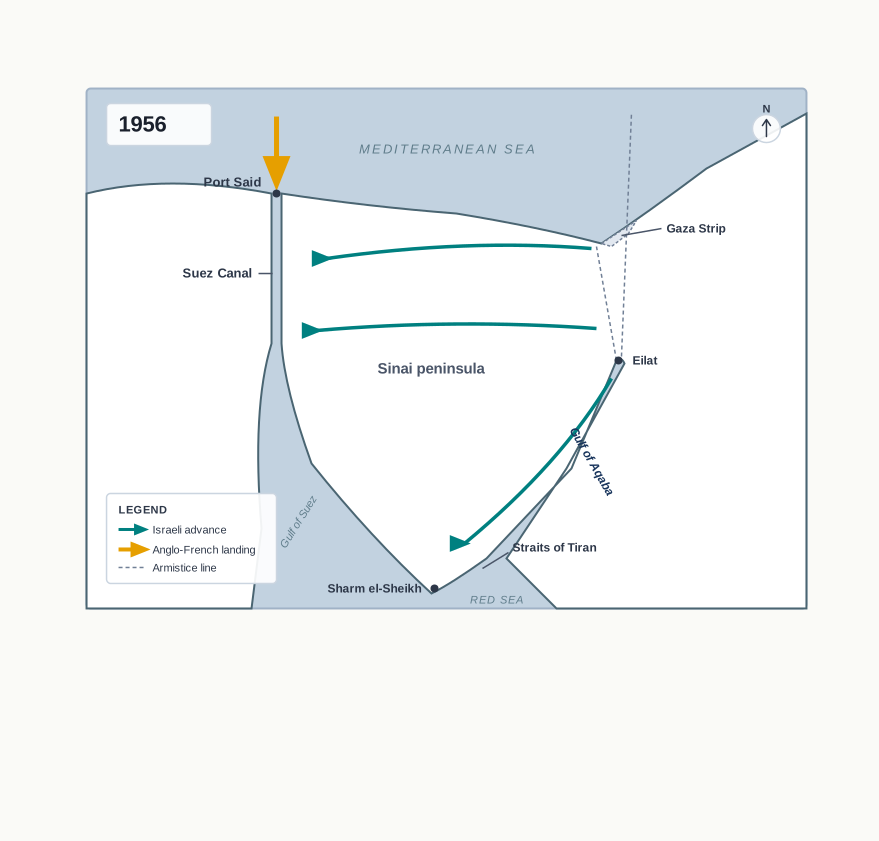
Fig. 11.10 – The Suez Crisis of 1956.
Militarily the operation worked. Politically it collapsed within forty-eight hours. The United States, which had not been told, opposed the attack outright and applied financial pressure on Britain, whose currency was already under strain. The Soviet Union threatened the attackers in language deliberately alarming. At the United Nations the two superpowers found themselves on the same side against two of the oldest powers in Europe.
Britain accepted a ceasefire on 6 November with its forces still short of the canal, and France had no choice but to follow. A United Nations Emergency Force — the first peacekeeping force of its kind — was assembled to take over the ground. British and French troops were gone by the end of December; Israel withdrew from Sinai and Gaza by March 1957, in return for the peacekeepers being stationed at Sharm el-Sheikh to keep the Straits of Tiran open.
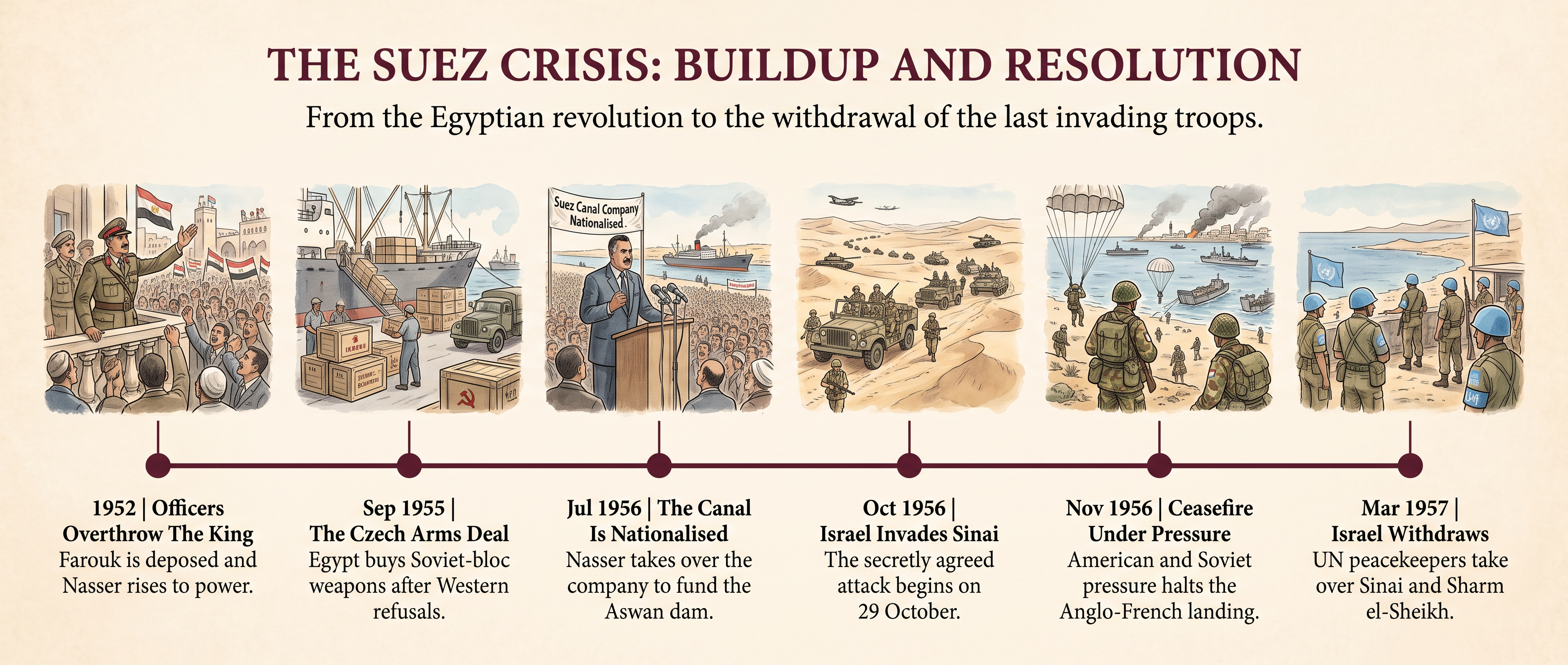
Fig. 11.11 – The Suez Crisis.
11.6.3 Results: A Military Success And A Political Defeat
For Britain And France
The crisis is the clearest single marker of the end of British and French power in West Asia. Two states that had drawn the map of the region in 1916 could no longer act in it without American consent, and had been forced to stop in mid-operation. Eden resigned within weeks, his health and his reputation both broken.
The canal itself stayed Egyptian. Ships sunk during the fighting blocked it for months, and when it reopened in 1957 it was operated by Egypt, which is what the war had been fought to prevent.
For Nasser And The Arab World
Nasser lost the battles and won the crisis. Having survived an attack by two European powers and Israel, and having kept the canal, he became the most admired leader in the Arab world, and Arab nationalism acquired a living figurehead. Egypt’s alignment with the Soviet Union deepened, and the Cold War now had a permanent foothold in the region’s quarrels.
For the Palestinians there was no gain at all. The war was fought over a waterway and a reputation, and it left the refugees where they were, under Egyptian administration in Gaza or in camps beyond the armistice lines.
For Israel
Israel withdrew from every inch of territory it had taken, which looked like defeat. In its own terms, however, it had achieved most of what it wanted: the Straits of Tiran were open, the fedayeen raids from Gaza fell away for a decade, and its army had shown that it could cross Sinai in a week.
That last lesson was the dangerous one. Israel’s commanders concluded that a sudden first strike could settle a war before its enemies were ready, and Egypt’s commanders drew the opposite conclusion in the same event. Eleven years later, both would act on what they had learnt here.
11.7 The Six Day War (1967)
Six days of fighting in June 1967 changed the map of the region more than the previous twenty years had done. It is the pivot of this chapter: almost every dispute in the second half of it — occupied territory, settlements, the status of Jerusalem, what the Palestinians were to do for themselves — dates from this week.
11.7.1 The Build-Up To June 1967
An Armistice That Was Never A Peace
Nothing signed in 1949 or 1957 had settled anything. The Arab states did not recognise Israel, Israel had no agreed borders, and the armistice lines ran through farmland and across water sources that both sides used.
The Jordan river was one flashpoint. Israel drew water from it for irrigation, Arab governments planned to divert its headwaters in Syria and Lebanon to prevent that, and each project brought shelling and air attacks along the northern lines. By 1966 clashes between Israel and Syria were frequent, and in April 1967 an air battle over Syrian territory ended with several Syrian aircraft shot down.
A second flashpoint was new. Palestinian guerrilla groups, formed in the late 1950s among refugees and exiles who had lost faith in the Arab states, began raiding into Israel from Syrian and Jordanian territory from 1965. Israel struck back at the states from which the raids came, which pushed those states towards a confrontation none of them had chosen.
The Crisis Of May 1967
In May 1967 the Soviet Union passed word to Egypt that Israel was massing troops for an attack on Syria. The report was untrue, but Nasser acted on it, and once he had begun to act his own standing left him little room to stop.
Three steps followed in quick succession. Egyptian forces moved into Sinai in strength. Nasser then demanded the withdrawal of the United Nations Emergency Force that had stood between the two armies since 1957, and the UN complied. On 22 May he closed the Straits of Tiran to Israeli shipping — reversing the one clear gain Israel had taken from 1956, and doing it in the most public way possible.
Arab governments then closed ranks. Jordan, which had quarrelled bitterly with Nasser, signed a defence agreement placing its army under Egyptian command at the end of May, and Iraqi units moved westward. Arab radio and newspapers spoke of the coming destruction of Israel, and Israeli society, much of it made up of survivors of the genocide in Europe, took those words literally.
Israel’s cabinet debated for two weeks and then decided to strike first. The reasoning was the reasoning of 1956, hardened by experience: a small state with no strategic depth and a reserve army it could not keep mobilised for long could not afford to let the other side choose the moment.
11.7.2 Six Days Of Fighting
The First Morning
The war was effectively decided in its first three hours. On the morning of 5 June 1967 Israeli aircraft attacked Egyptian airfields, destroying most of the Egyptian air force on the ground before it could take off, and then did the same to Syrian and Jordanian aircraft. With the skies clear, Israeli armoured columns advanced into Sinai against forces that could not be supplied or protected from the air.
Three Fronts In Six Days
Egypt’s army in Sinai broke within days, and Israeli units reached the Suez Canal. Jordan, bound by the agreement it had signed a week earlier and misled by Egyptian claims of victory, opened fire around Jerusalem; by 7 June Israeli forces held the eastern half of the city, including the walled Old City, and the whole of the West Bank. In the final two days Israel took the Golan Heights from Syria, the high ground from which Syrian guns had shelled the valley farms below.
A ceasefire took effect on 10 June. Israel had taken the Gaza Strip and the Sinai peninsula from Egypt, the West Bank and East Jerusalem from Jordan, and the Golan Heights from Syria, and had roughly trebled the territory under its control. Fig. 11.12 shows the result.
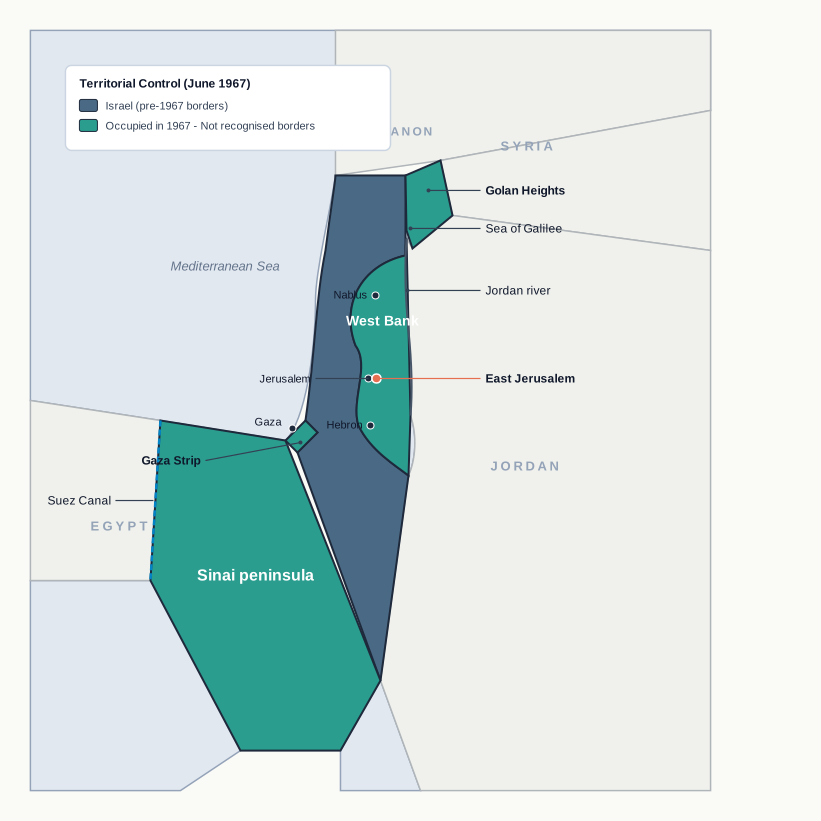
Fig. 11.12 – Territories occupied by Israel in June 1967.
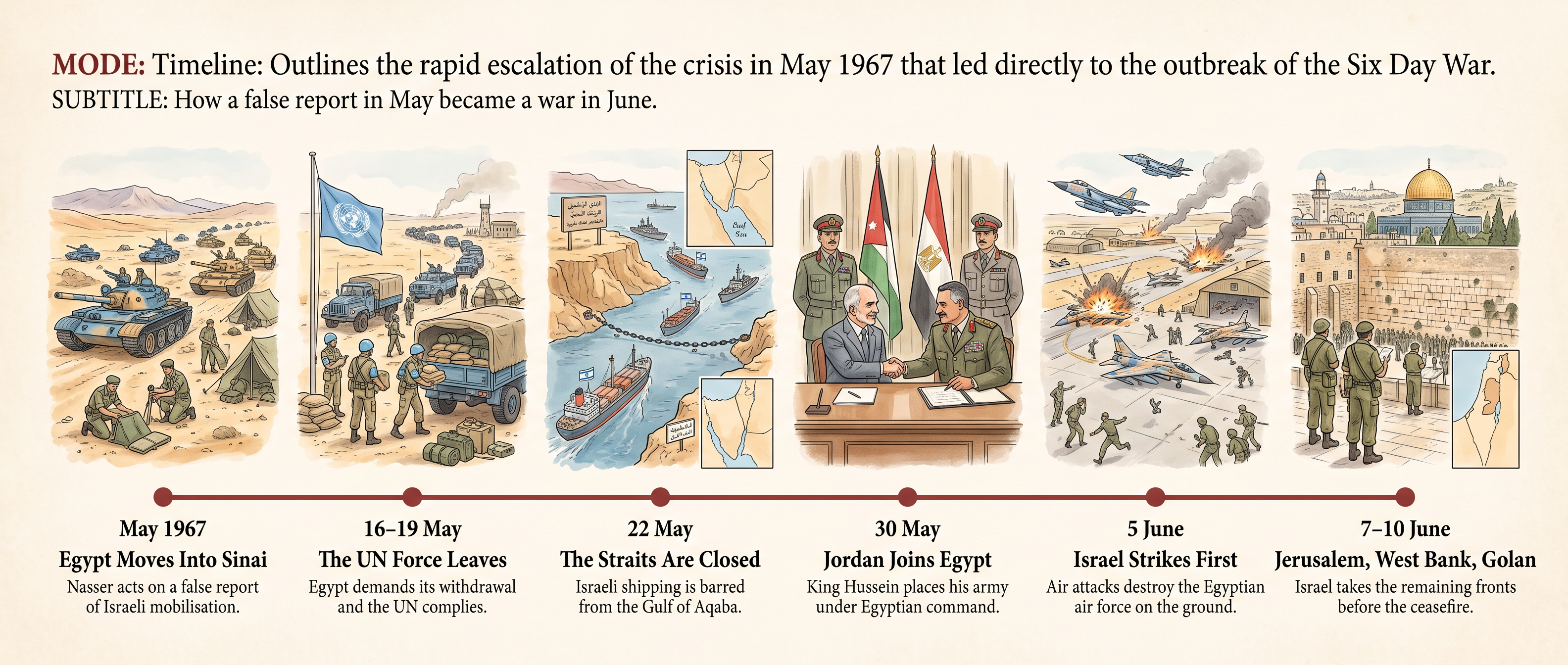
Fig. 11.13 – Crisis and war in 1967.
11.7.3 Results: Occupied Territories And New Refugees
A Population Under Military Rule
The most consequential result was not territorial but human. Around a million Palestinians living in the West Bank and Gaza came under Israeli military government, which is a form of rule by army order rather than by an elected legislature. They were not citizens of Israel, and the states that had administered them — Jordan and Egypt — no longer did.
A further displacement accompanied the fighting. Roughly 300,000 people left the West Bank for Jordan during and after the war, and for many of them it was the second flight in one lifetime, having already left their homes in 1948.
Within months, Israeli settlement in the occupied territories began, at first in the name of security and later for religious and political reasons. Each settlement made a future withdrawal harder, which is precisely why some of those who built them did so.
A New Formula, And A Refusal
In November 1967 the UN Security Council passed a resolution that has framed every negotiation since. It coupled two principles: that territory could not be acquired by war, and that every state in the region had a right to live in peace within secure and recognised boundaries. Land in exchange for peace and recognition — that was the bargain it proposed, and its wording was left studiedly vague about how much land.
The Arab states meeting at Khartoum in September had already answered in the opposite direction, agreeing on no peace with Israel, no recognition of it and no negotiation with it. Both positions were on the table when the next war came.
What The Palestinians Concluded
For Palestinians the defeat carried a conclusion of its own. Three Arab armies had been destroyed in six days, and the promise that Arab states would recover Palestine on their behalf had been tested and had failed.
The lesson drawn was that Palestinians would have to act as a national movement in their own right rather than as a cause adopted by others. The organisation through which they did so had been created three years earlier for quite different purposes, and it is taken up later in this chapter.
Nasser himself offered to resign in the days after the defeat and was persuaded by public demonstrations to stay. He remained in office, but the era in which one Arab leader could speak for the whole Arab world was over, and the initiative in the conflict began to pass to the Palestinians themselves.
11.8 The Yom Kippur War (1973)
The fourth war is the strangest of the four, because the side that lost it on the battlefield gained most from it. It was launched not to destroy Israel but to break a deadlock, and it ended by making the first peace treaty between Israel and an Arab state possible.
11.8.1 Why Egypt And Syria Attacked
A Frozen Situation
After 1967 the front lines did not move, but they were not quiet either. Egyptian and Israeli forces exchanged artillery fire and air raids across the Suez Canal for nearly two years in what became known as the war of attrition, which cost both sides steadily and changed nothing.
Nasser died in September 1970 and was succeeded by Anwar Sadat, who inherited a country whose army had been beaten twice, whose canal had been closed since 1967, and whose eastern province, Sinai, was occupied by a foreign army. Egypt was spending an enormous share of its budget on defence and could not develop while it did so.
Sadat’s Calculation
Sadat’s aim was to recover Sinai, and he was willing to consider recovering it by negotiation. He said as much publicly in the early 1970s, and in 1972 he expelled thousands of Soviet military advisers, partly to signal to Washington that Egypt was available for a different relationship.
Nothing came of it. Israel, holding the territory and confident after 1967, saw no reason to give it up on terms Egypt would accept, and the United States saw no reason to press an ally while the situation was stable and its own attention lay elsewhere. Sadat concluded that only a war could make the region’s frozen position negotiable again.
The war he planned was therefore limited in its objective. Egyptian forces did not have to defeat Israel; they had to cross the canal, hold a strip of Sinai and prove that the line of 1967 was not permanent. Syria, whose government wanted the Golan Heights back, joined with more ambitious aims of its own.
Surprise
The attack was set for 6 October 1973, the Jewish festival of Yom Kippur, the Day of Atonement, when Israel largely stops and many soldiers are away from their posts. The same day fell within the Muslim month of Ramadan, which is why Arab accounts call this the Ramadan War, and others simply the October War.
Israeli intelligence saw the Egyptian and Syrian build-up and read it as an exercise. The assumption underneath the error was that Egypt would not attack without first acquiring long-range aircraft, and that no Arab government would begin a war it could not win outright. Both halves of that assumption were reasonable, and both were wrong.
11.8.2 The Course Of The October Fighting
The First Week
The opening was a success beyond Egyptian expectations. Egyptian infantry crossed the canal in boats behind an artillery barrage, breached the sand rampart of the Israeli defensive line with high-pressure water hoses, and established themselves on the eastern bank. Soviet-supplied anti-aircraft and anti-tank missiles inflicted heavy losses on the Israeli aircraft and tanks sent to throw them back.
On the Golan front Syrian armour advanced across the plateau and came close to breaking through into the Israeli valleys below, and was held only by outnumbered units fighting until reserves arrived. For the first days of the war Israel was in real danger, and its government knew it.
The Turn
The recovery came from mobilisation and resupply. Israel called up its reserves in full, and the United States mounted a large airlift of weapons and equipment while the Soviet Union resupplied Egypt and Syria. The superpowers were now arming both sides of a war neither wanted to be drawn into.
Israeli forces pushed the Syrians back beyond the pre-war line on the Golan. In Sinai they found a gap between the two Egyptian armies, crossed the canal westward, and cut off the Egyptian Third Army on the eastern bank from its supplies. Fig. 11.14 shows both movements.
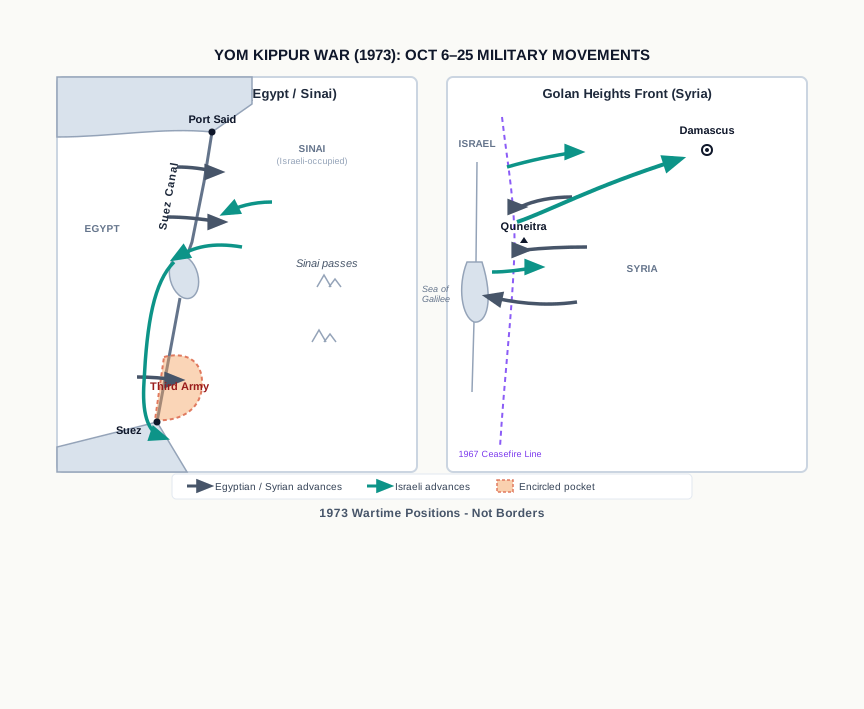
Fig. 11.14 – The Egyptian and Syrian fronts in October 1973.
Stopping The War
By the third week the war had become dangerous for reasons beyond the region, since a Soviet client army was about to be destroyed and both superpowers were on alert. The Security Council called for a ceasefire on 22 October, fighting continued past it, and a further resolution brought the guns to a halt on 25 October.
Israel had again ended a war holding more ground than when it started, and had again lost more heavily than it expected — about 2,600 dead, in a country of three million. The confidence of 1967 did not survive it.
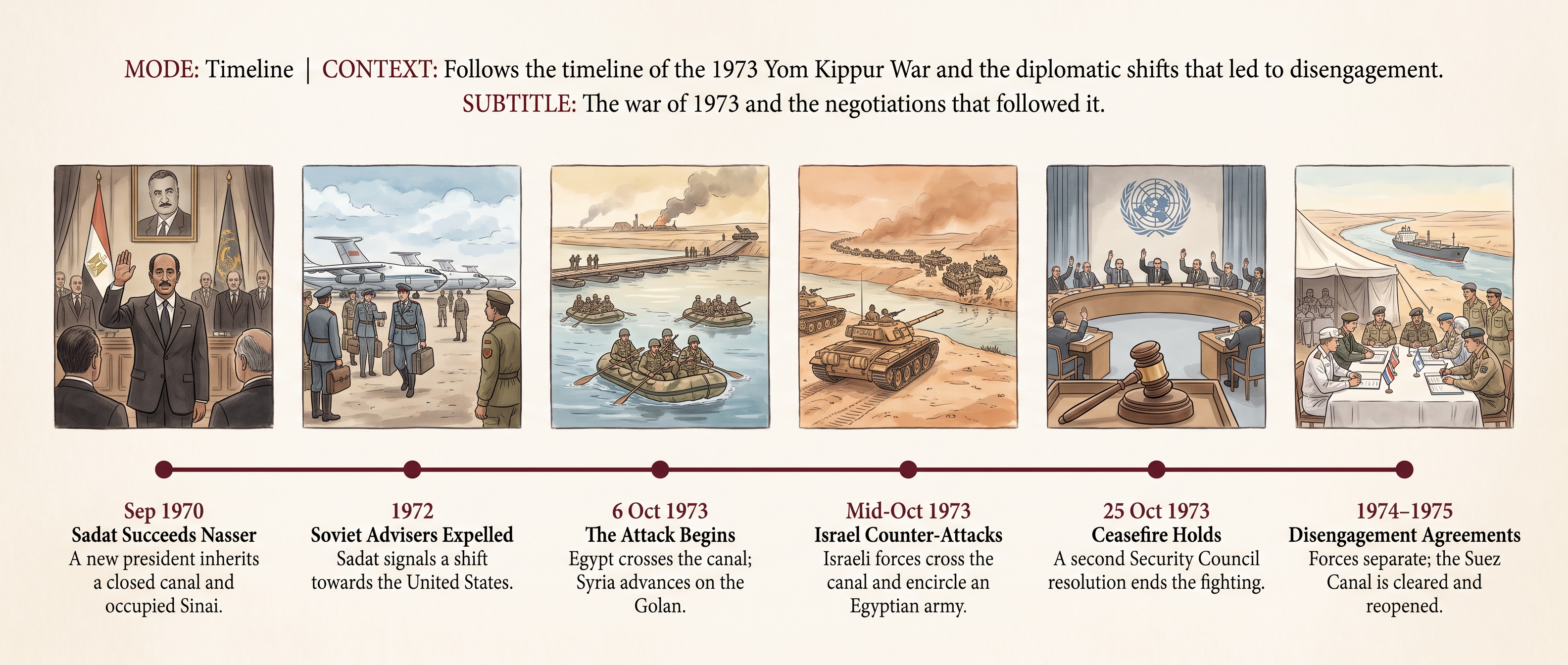
Fig. 11.15 – From attrition to disengagement.
11.8.3 Results: The Oil Weapon And A Door To Talks
Oil As A Weapon
The most far-reaching consequence was economic and reached far outside the region. Arab oil-producing states cut production and embargoed supplies to countries they regarded as supporting Israel, and the exporting countries’ organisation raised prices sharply — roughly a fourfold increase within a few months.
Industrial economies that had been built on cheap oil met fuel shortages, rising prices and a long recession. Oil-importing developing countries, India among them, were hit harder still, since their import bills rose without any corresponding rise in what they earned. For the first time the Arab-Israeli conflict had a direct effect on household budgets in countries with no stake in it.
Politics In Israel And Egypt
In Israel the war was a shock rather than a triumph. A public inquiry into the failure to anticipate the attack shook confidence in the government, and Prime Minister Golda Meir resigned in 1974.
In Egypt the effect was the reverse. The crossing of the canal in the first days became a national achievement, and Sadat could speak to his own people as a leader who had restored their army’s honour. That standing was exactly what he needed, because a leader who has been beaten cannot negotiate, while a leader who has partly succeeded can.
The Door Opens
The immediate diplomatic result was a series of agreements separating the armies, negotiated through American mediation in 1974 and 1975. Forces pulled back on both fronts, a buffer zone with observers was created in Sinai, and Egypt cleared and reopened the Suez Canal in 1975 after eight years of closure.
None of this was peace. But it was the first time since 1949 that Israel and an Arab state had negotiated over territory and reached agreement, and it established that the United States, not the United Nations and not the Soviet Union, was the mediator both sides would use. The road from here runs directly to Camp David.
11.9 Sadat And The Camp David Accord (1979)
Between 1948 and 1973 no Arab state had recognised Israel or negotiated a peace with it. Within six years of the last of those wars, the largest Arab state had done both. This section explains how that happened, what was agreed, and why the agreement cost Egypt its place in the Arab world.
11.9.1 Sadat’s Turn Towards Negotiation
Why Egypt Moved First
Sadat’s reasons were as much economic as diplomatic. Egypt had fought four wars in twenty-five years, carried a vast army, lost the revenue of the Suez Canal for eight years and could not feed a fast-growing population while doing so. Sinai, with its oilfields, remained under occupation.
He had also learnt from 1973 what force could and could not achieve. The war had proved that the lines of 1967 were not permanent, but it had also proved that Israel could not be defeated outright. If Sinai was to be recovered, it would be recovered at a table.
The disengagement agreements of 1974 and 1975 had already broken the taboo on negotiating, and had shown Sadat that the United States would deliver Israeli concessions that no amount of Arab pressure could. What was missing was a way past the deadlock over procedure — who would attend which conference, and whether the PLO would be present.
The Visit To Jerusalem
Sadat’s answer was to skip the procedure altogether. In November 1977 he announced that he was willing to go to Israel itself, and days later he flew to Jerusalem and addressed the Israeli parliament — the first Arab head of state ever to set foot in the country whose existence his own government had refused to acknowledge.
The speech itself offered no new terms. He asked for full withdrawal from the territories taken in 1967 and for Palestinian rights, and offered peace and recognition in return. What was extraordinary was not the content but the act: by arriving in Jerusalem he conceded, in front of the world, that Israel was a permanent state to be dealt with.
Israel’s Prime Minister, Menachem Begin, had come to office in 1977 at the head of a party committed to keeping the West Bank permanently, but he was willing to trade Sinai, which carried no such claim. He visited Egypt the following month, and the two governments began to talk directly.
Thirteen Days In Maryland
Direct talks then stalled for most of 1978 over the Palestinian question. In September the American President, Jimmy Carter, invited both leaders to Camp David, the presidential retreat in Maryland, and kept them there for thirteen days, carrying proposals between two men who for much of the time refused to meet.
The result was two framework agreements signed in September 1978. Those frameworks were turned into the formal peace treaty signed in Washington in March 1979, and it is that settlement, taken as a whole, that is known as the Camp David Accord of 1979.
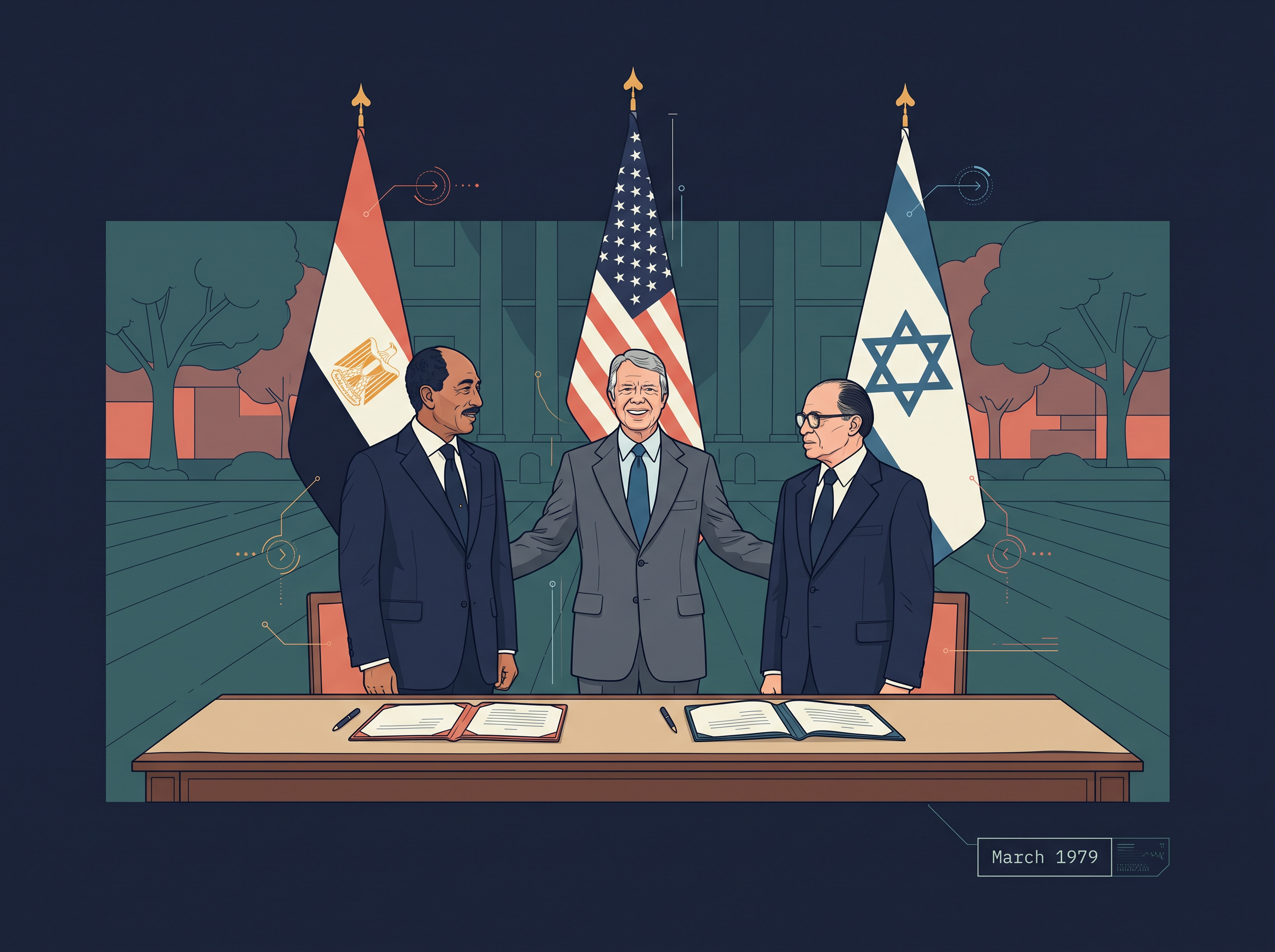
Fig. 11.16 – Sadat, Carter and Begin at Camp David.
11.9.2 The Terms Of The Accord
What Egypt And Israel Agreed
The core of the settlement was an exchange, and both halves of it were carried out. The state of war between the two countries ended, and Israel withdrew in stages from the whole of Sinai, completing the withdrawal in 1982 and dismantling the settlements and airfields it had built there.
In return Egypt gave Israel what no Arab state had given it before: recognition, an exchange of ambassadors, open borders and normal diplomatic relations. Israeli ships were to pass freely through the Suez Canal and the Straits of Tiran — the two waterways over which the wars of 1956 and 1967 had been fought.
Security was handled by demilitarisation rather than by trust. Sinai was to be kept largely free of Egyptian forces, with limits written into the treaty and international observers stationed to verify them, so that neither army could again mass on the other’s frontier without warning. Egypt also undertook to sell Israel oil from the Sinai wells, and both countries received large-scale American aid.
What Was Said About The Palestinians
The second framework dealt with the West Bank and Gaza, and this is where the accord’s reputation was made and lost. It provided for a five-year transitional period during which the inhabitants would have self-governing authority, with negotiations on the final status of the territories to begin within three years.
Three things were missing from it. The Palestinians themselves were not represented at Camp David, and the PLO, which most Palestinians regarded as their representative, was not recognised by either party to the talks. The word ‘state’ appeared nowhere. And the two sides left Camp David with different understandings of what had been said about halting settlement in the West Bank, which meant that settlement building continued.
The Palestinian framework was therefore never implemented, while the Egyptian-Israeli treaty was implemented in full. That asymmetry is the accord in a sentence.
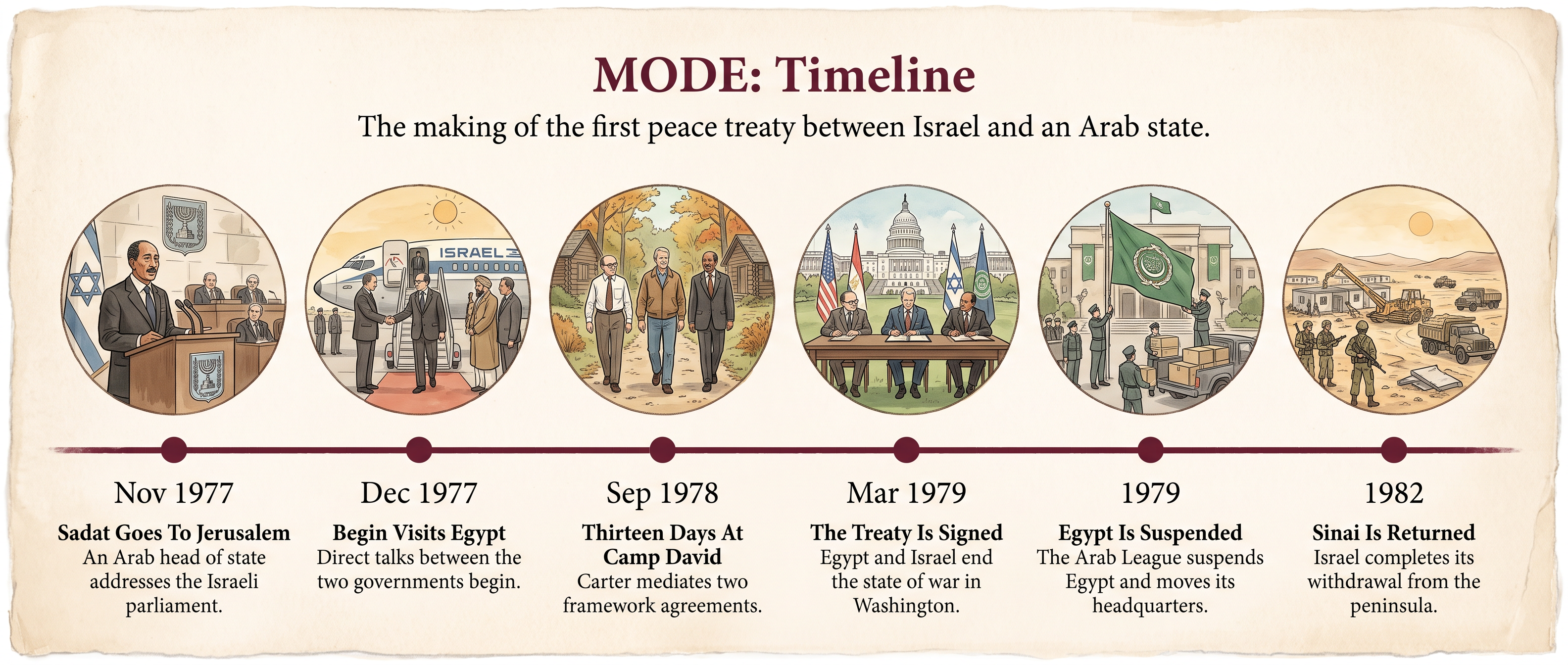
Fig. 11.17 – From Jerusalem to Washington.
11.9.3 Results: Peace For Egypt, Isolation In The Arab World
What Egypt Gained And Paid
Egypt recovered its territory without further fighting, ended a quarter-century of war, reopened its economy and secured a long-term American subsidy. Measured against Sadat’s own aims, the policy succeeded completely.
The price was paid in the Arab world. The Arab League suspended Egypt’s membership and moved its headquarters out of Cairo, most Arab states broke off relations, and the PLO condemned the accord as a separate deal that abandoned the Palestinians in exchange for land. Sadat, who had been the hero of October 1973, was now denounced across the region he had once expected to lead.
Opposition at home was fiercer still, among Islamist groups who regarded recognition of Israel as a betrayal. In October 1981, at a parade held to commemorate the crossing of the canal, Sadat was assassinated by soldiers from one such group. The treaty nevertheless held, and has held under every Egyptian government since.
What It Changed In The Conflict
Strategically, the accord ended the era of Arab-Israeli wars between states. Without Egypt, no coalition could fight Israel on more than one serious front, and no such war has been fought since.
It also changed what the conflict was about. With the interstate war closed off, the unresolved question that remained was the one Camp David had failed to answer: the future of the Palestinians in the occupied territories, now entering their second decade under military government. The next stage of this chapter belongs to them.
11.10 The Origin And Formation Of The PLO
Everything in this chapter so far has been done to the Palestinians rather than by them. Promises were exchanged over their heads in 1915 and 1917, their country was partitioned by a vote in New York, and four wars were fought in their name by governments that were not theirs. This section is about the organisation through which they began to act for themselves.
11.10.1 Why An Umbrella Organisation Was Needed
A People Without A Political Address
After 1948 the Palestinians were scattered across several jurisdictions, and each of them discouraged separate Palestinian politics. Those in the West Bank became Jordanian citizens, and the Jordanian government suppressed talk of a distinct Palestinian nation, since the kingdom now contained the territory such a nation would claim. Those in Gaza lived under Egyptian military administration without citizenship. Those in Lebanon and Syria lived as refugees with restricted rights, and those inside Israel were a minority under military government until 1966.
The result was a national movement with no institutions. Small groups formed in the camps and among Palestinian students and professionals working in the Gulf, but there was no body that could speak for the whole people, hold funds, or be dealt with by other governments.
Two Different Answers
By the late 1950s two answers to that problem were emerging, and they pointed in opposite directions.
The first came from Palestinians themselves. A group of them working in Kuwait, among them Yasser Arafat, founded the movement later known as Fatah at the end of that decade. Its central argument was that waiting for Arab governments to liberate Palestine was a mistake, and that Palestinians must fight for it themselves — an argument that Arab governments found distinctly unwelcome.
The second came from the Arab states. Independent Palestinian action risked dragging them into wars at times of somebody else’s choosing, and Egypt in particular wanted the cause organised where it could be supervised. An official Palestinian body, created by the Arab League and funded by it, would give the Palestinians a voice and keep that voice under control.
11.10.2 Formation, Charter And Recognition
1964
The decision was taken at the first Arab League summit in Cairo in January 1964. A Palestine National Council — a kind of parliament in exile, made up of delegates from the communities of the diaspora — met in Jerusalem on 28 May 1964, then under Jordanian control, and the Palestine Liberation Organisation was founded on 2 June 1964, with Ahmad Shukeiri as its first chairman.
Two things were set up alongside it. A national charter stated the organisation’s aims, and a Palestine Liberation Army was formed from Palestinian units stationed in Arab countries and commanded, in practice, by those countries.
What The Charter Said
The charter defined Palestine as an indivisible homeland of the Palestinian Arab people, held that the partition of 1947 and the establishment of Israel were illegitimate, and named armed struggle as the route to liberation. It also asserted the right of the refugees to return to the homes they had left in 1948.
The organisation was described as an umbrella: not a single party but a coalition of factions, each with its own leadership and fighters, holding seats in the National Council and represented on an Executive Committee. Fatah was the largest, and the Popular Front and the Democratic Front, both further to the left, were the most prominent of the others.
1967 Changes Everything
In its first three years the PLO achieved very little, because it was what the Arab states had designed it to be. The defeat of June 1967 destroyed that arrangement in a week. Three Arab armies had been beaten, and the promise that they would recover Palestine had been shown to be worthless.
The guerrilla organisations gained by exactly as much as the governments lost. A clash in Jordan in 1968, in which Fatah fighters stood their ground against an Israeli raid, was presented across the Arab world as proof that Palestinians could fight when armies could not, and recruits arrived in thousands. In 1969 Arafat became chairman of the PLO’s executive committee, and the umbrella passed from the Arab League’s control into the hands of the movements underneath it.
Armed Struggle And Its Costs
Armed struggle meant raids across the ceasefire lines, and for some factions it also meant attacks far outside the region. Aircraft were hijacked on international routes, and in 1972 a group connected to the movement seized and killed eleven Israeli athletes and coaches at the Munich Olympic Games, in front of the largest television audience the cause had ever had.
These operations had contradictory effects, and both were lasting. They forced the Palestinian question onto the world’s attention after two decades in which it had been treated as a refugee problem. They also fixed an association between that question and the killing of civilians, which cost the movement sympathy it needed and gave its opponents an argument that did not have to be invented.
The armed presence had political costs closer to home as well. Conflict with the Jordanian army in 1970 ended with the PLO’s expulsion from Jordan, and the leadership moved its base to Lebanon and later, in 1982, to Tunis — far from the territories whose population it claimed to represent.
Recognition
Recognition nevertheless came, and quickly. At a summit in Rabat in 1974 the Arab states named the PLO the sole legitimate representative of the Palestinian people, which removed Jordan’s claim to speak for the West Bank. In November 1974 the United Nations General Assembly invited Arafat to address it and granted the PLO observer status.
By the mid-1970s, therefore, the Palestinians had what they had lacked since 1948: an address. A body existed that other governments recognised, that could negotiate if it chose to, and that could also be blamed for what its factions did. Both halves of that position mattered when negotiations finally began.
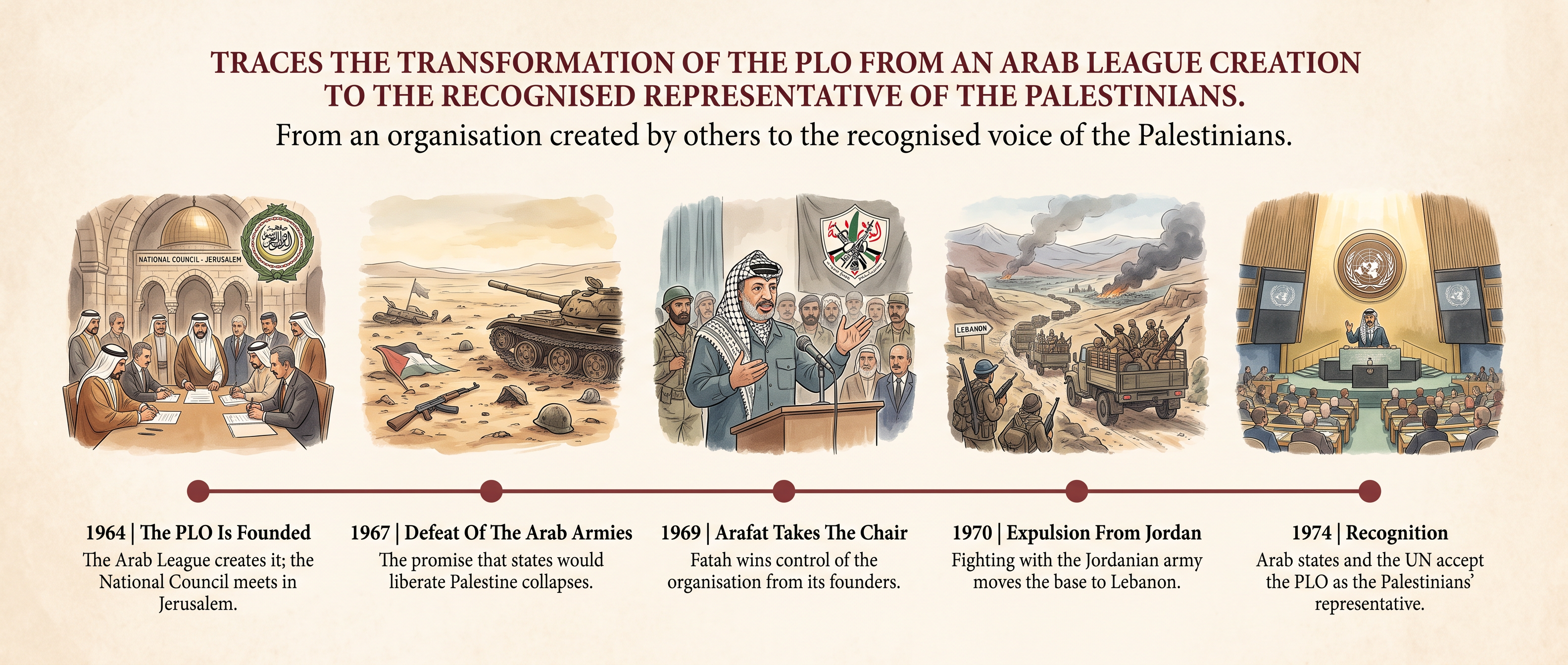
Fig. 11.18 – The rise of the PLO.
11.11 The Intifada (1987-1993)
For twenty years after 1967 the occupied territories were quiet in the way that a place under military government is quiet. There were protests, strikes and arrests, but no sustained revolt, and Israeli governments increasingly assumed that the arrangement could continue indefinitely. In December 1987 that assumption ended.
Intifada is an Arabic word meaning a shaking off or a tremor. It was used for what began that month and continued, in falling intensity, until the Oslo agreement of 1993.
11.11.1 Causes Of The Uprising
Twenty Years Of Military Government
By 1987 about a million and a half Palestinians lived in the West Bank and the Gaza Strip under Israeli military rule. They were not citizens of Israel and could not vote for the authority that governed them; that authority ran by military order, and its orders reached into ordinary life at every point.
Movement required permits. Land could be declared state land and taken. Political parties, flags and many books were banned, universities were closed for long periods, and people could be held without trial or deported. Two decades of this had produced a generation that had never known anything else, and had never voted for anything.
Land, Settlements And Work
Alongside the rule came the settlements. Israeli communities in the West Bank and Gaza had grown from a handful in the early 1970s to a substantial population by the mid-1980s, connected by roads Palestinians could not always use and supplied with water on terms Palestinian villages did not get. Every new settlement made a future withdrawal less likely, which Palestinians understood perfectly well.
The economy compounded the anger. The territories became a market for Israeli goods and a source of cheap labour, and tens of thousands of Palestinians travelled daily to work in Israeli construction, agriculture and service jobs at the bottom of the wage scale, then returned at night to camps and towns where there was no comparable work.
Gaza carried this most heavily. It was one of the most densely populated places on earth, more than half its people were registered refugees living in camps, and its unemployment and poverty had no outlet at all.
Nobody Coming To Help
The last cause was political. Egypt had made its peace and left the conflict. The PLO leadership was in Tunis, a thousand miles away, weakened and unable to affect daily life in the territories. Arab summits passed resolutions and did nothing.
The conclusion drawn in the camps and towns was that no state and no exiled leadership was going to end the occupation, and that if anything was to be done, the people living under it would have to do it themselves.
The Trigger
On 8 December 1987 an Israeli army vehicle collided with cars carrying Palestinian workers at the crossing out of Gaza, and four men were killed. The deaths were almost certainly an accident. In the atmosphere of that December they were widely believed to be deliberate revenge for a killing days earlier, and the funerals in Jabalia refugee camp turned into demonstrations that the army could not disperse.
Within days the protests had spread through Gaza and into the West Bank. What made this different from every earlier disturbance was that it did not stop.
11.11.2 Forms Of Protest And Their Impact
An Uprising Without An Army
The Intifada was organised from below. Underground local committees in neighbourhoods, camps and villages issued leaflets setting out what should happen each week, and a unified underground leadership coordinated them. Trade unions, student groups, women’s committees and charitable societies supplied the structure, and the PLO in Tunis followed events for the first months rather than directing them.
Its methods were mostly unarmed, and deliberately so. Young men and boys threw stones at patrols and barricaded roads with burning tyres. Shopkeepers closed at set hours in general strikes. Palestinians resigned from the civil police, boycotted Israeli products, refused to pay taxes, and flew the banned Palestinian flag. When schools were closed for months, classes were held in houses.
The Israeli Response
Israel treated the uprising first as a policing problem and then as a war of attrition against a civilian population. Curfews were imposed on whole towns, schools and universities closed, thousands were arrested and held without trial, houses of suspects were demolished and organisers were deported.
The defence minister’s instruction to use force to break the stone-throwing produced images that travelled everywhere: soldiers with rifles against teenagers with stones. By 1993 well over a thousand Palestinians had been killed by Israeli forces, a large proportion of them under the age of eighteen, and about 160 Israelis had been killed. Several hundred Palestinians were also killed by other Palestinians as suspected collaborators, an ugly aspect of the uprising that its own leadership was unable to control.
What The Uprising Achieved
Three changes came out of it, and together they made negotiation possible.
The first was in world opinion. Television carried the confrontation nightly, and the picture of Israel as a small state surrounded by enemies was replaced, in much of the world’s coverage, by the picture of an army governing a civilian population that did not want it. Israel’s diplomatic position weakened accordingly.
The second was inside Israel. The occupation now cost money, reserve service and reputation, and a growing part of the Israeli public began to ask what it was for. When elections were held in 1992, a government came to power that was willing to trade territory for a settlement — a shift that would have been unthinkable in 1987.
The third was inside the Palestinian movement. The initiative had passed to the people in the territories, and the PLO abroad had to catch up or become irrelevant. In November 1988 the Palestine National Council, meeting in Algiers, declared Palestinian independence and accepted, in effect, a settlement based on two states; in December Arafat stated publicly that he recognised Israel’s right to exist and renounced terrorism, and the United States opened a dialogue with the organisation for the first time.
The Other Consequence
The uprising also produced a rival. Hamas was founded in Gaza in the first weeks of the Intifada, out of the Muslim Brotherhood’s existing network of mosques, clinics and schools. It framed the conflict in religious rather than national terms, rejected any settlement that recognised Israel, and competed with the PLO for the leadership of the movement.
By the early 1990s the Palestinian side was therefore in an unusual position: exhausted by six years of uprising, internationally stronger, financially weaker after the PLO backed the losing side in the Gulf conflict of 1991, and increasingly challenged from within. Talks that began at a conference in Madrid in 1991 went nowhere in public. The agreement that came out of secret negotiations two years later is the subject of the next section.
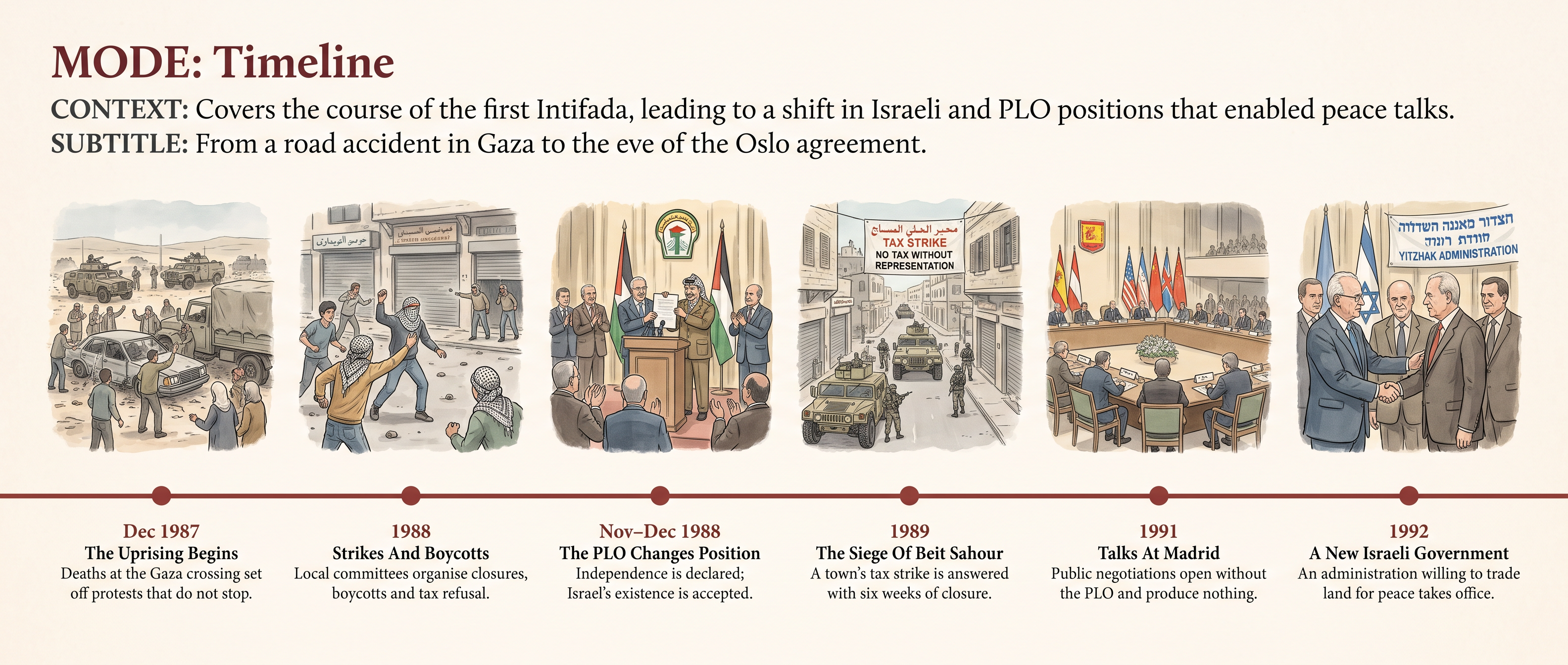
Fig. 11.19 – The first Intifada.
11.12 The Oslo Peace Accords
For nearly thirty years Israel and the PLO had refused to talk to each other, each holding that recognition was the prize the other must earn rather than the ground negotiation stood on. In 1993 both dropped that position within a fortnight, and did it in public.
11.12.1 Oslo I (1993): Main Features
The Channel Through Norway
The negotiations that produced the agreement did not happen at the conference tables the world was watching. From January 1993 a small group of Israeli academics and PLO officials met secretly in Norway, hosted quietly by the Norwegian foreign ministry, and were later joined by senior Israeli officials as the talks turned serious.
The setting mattered. There were no cameras, no preconditions, and no need for either side to defend each concession in public as it was made. Terms were settled in Oslo in August 1993, and only then did the governments involved bring the result into the open.
The Exchange Of Recognition
The first documents were not the agreement at all but two letters, exchanged in September 1993. In them Israel recognised the PLO as the representative of the Palestinian people, and the PLO recognised Israel’s right to exist in peace and security, renounced terrorism and undertook to remove from its charter the clauses denying that right.
That exchange was the real breakthrough, and it cost each side something no earlier negotiation had been able to extract. Israel accepted that the Palestinians had a national leadership it must deal with; the PLO accepted the permanence of the state whose creation it had been founded to reverse.
The Declaration Of Principles
The agreement itself, signed at the White House on 13 September 1993, was a declaration of principles about the process rather than a settlement of the conflict. Its main features can be stated simply.
A Palestinian Authority would be established to govern Palestinians in the occupied territories, with an elected council. Israeli forces would withdraw first from the Gaza Strip and the town of Jericho, and then in stages from other populated areas. Powers over education, health, welfare, taxation and tourism would be transferred to the new authority. The whole arrangement was to last five years as a transitional period.
The hardest questions were not answered but postponed. Jerusalem, the refugees, the settlements, borders and security arrangements were listed as permanent status issues, to be negotiated separately, with those talks to begin no later than the third year of the interim period.
One thing the document did not contain is as important as anything in it. Nowhere did it promise a Palestinian state, and nowhere did it require Israel to stop building settlements while the interim period ran.
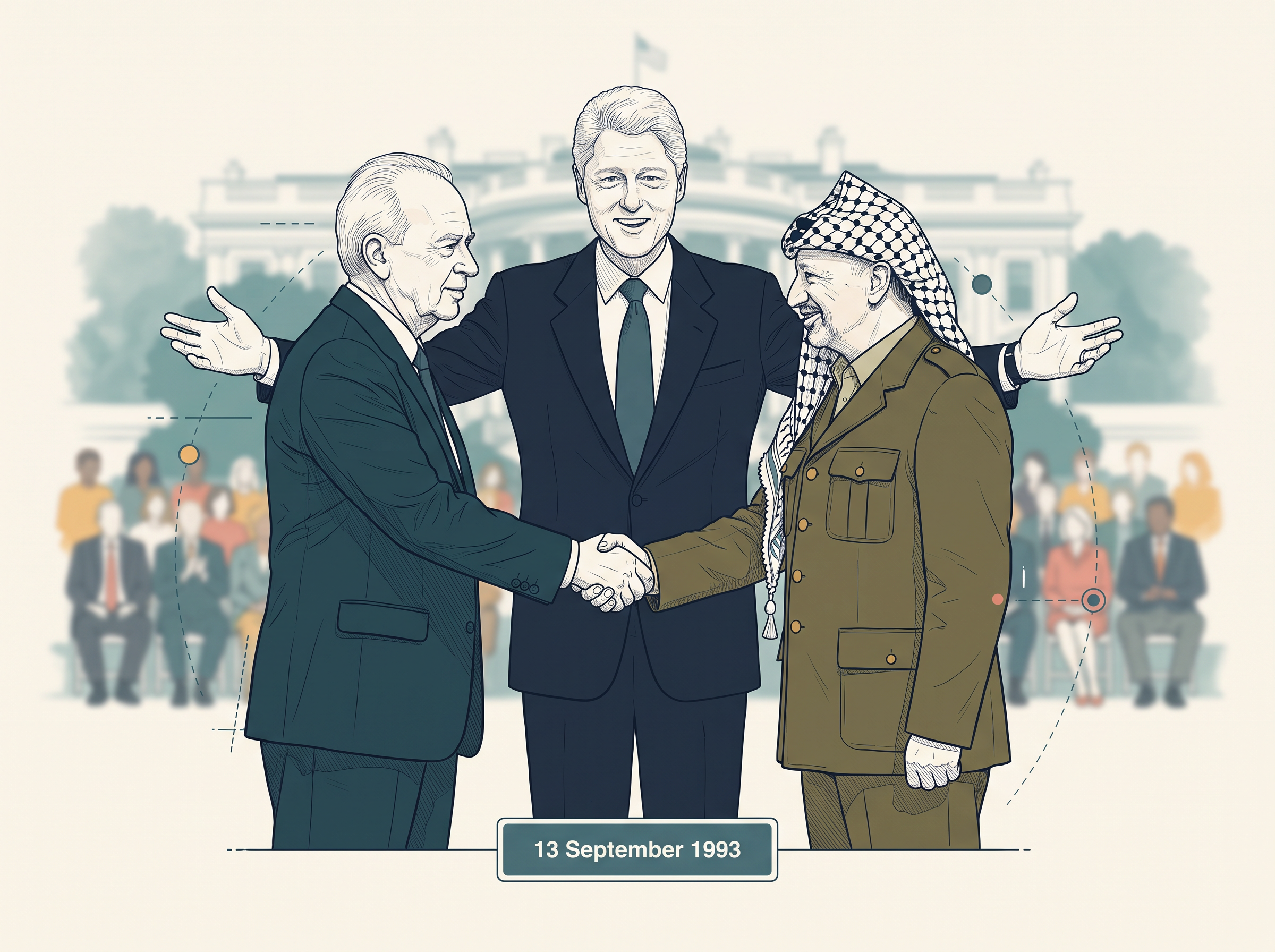
Fig. 11.20 – Rabin and Arafat at the White House.
11.12.2 Oslo II (1995): Main Features
An Agreement About Administration
The interim agreement signed in Washington on 28 September 1995, after being settled at Taba in Egypt, is the one usually called Oslo II. Where Oslo I stated principles, this one filled in the machinery, and it ran to hundreds of pages of annexes.
Its main provisions were four. Elections would be held for a Palestinian Legislative Council, and they were duly held in January 1996. Israeli forces would redeploy out of the main Palestinian towns in stages. Palestinian prisoners would be released in phases. And the two sides would cooperate on security, water, electricity and economic matters.
Areas A, B And C
Its most consequential feature was a division of the West Bank into three kinds of territory, set out in Table 11.2. The division was meant to be temporary, with land moving from Area C to Area B and from B to A as redeployments proceeded.
Read the third column carefully. The Palestinian Authority took charge of the towns where most Palestinians lived, which is why the agreement felt substantial to the people inside them, but it governed a very small share of the land. Area C, under complete Israeli control, contained all the settlements, the main roads and almost all the open land on which a future state would have to be built. Later redeployments raised Area A to roughly 18 per cent, and there the division stopped.
11.12.3 Why Oslo Failed To Bring Peace
The Design Problem
The accords were built on postponement. Every question capable of ending the conflict — Jerusalem, refugees, borders, settlements — was set aside for later, on the theory that five years of working together would build enough trust to settle them.
The theory required that nothing happen in the meantime to make the final settlement harder. Almost everything that happened made it harder. Settlement building continued throughout, and the settler population in the occupied territories, about 110,000 when the first agreement was signed, roughly doubled over the interim years. To Palestinians this looked like a process in which they conceded recognition at the start and watched the land under negotiation being built on while they waited.
Violence And Its Purpose
The second cause of failure was that the opponents of the agreement on each side understood exactly how to destroy it, and set out to do so.
In February 1994 an Israeli settler opened fire on Muslims at prayer in Hebron and killed twenty-nine of them. From 1994 Hamas and other groups carried out suicide bombings on Israeli buses and in city streets, killing civilians in numbers that turned Israeli opinion against the process. In November 1995, weeks after signing Oslo II, Yitzhak Rabin was shot dead at a peace rally in Tel Aviv by an Israeli opposed to giving up territory.
Each attack had the same logic. Violence by one side’s extremists proved to the other side’s public that the agreement was not delivering security, and every such proof strengthened the politicians who had said so from the beginning. Rabin’s assassination removed the one Israeli leader with the military reputation to sell territorial concessions to a sceptical public.
Distrust, And What Each Side Saw
By the mid-1990s each side was measuring the other by what it had failed to do. Israelis pointed to bombings and asked why the Palestinian Authority did not stop them. Palestinians pointed to settlements, closures and checkpoints, noted that daily life had become harder rather than easier, and asked what they had recognised Israel for.
An Israeli government elected in 1996 was openly sceptical of the agreements and slowed their implementation. The permanent status talks that were supposed to begin in the third year never produced a settlement, the five-year period expired, and the interim arrangements — Areas A, B and C, the checkpoints, the Authority without a state — hardened into the situation they had been designed to replace.
What It Did Achieve
Failure is not the whole account. Mutual recognition, once given, was not withdrawn: Israel has continued to deal with a Palestinian leadership, and the Palestinian national movement has continued to negotiate on the basis of two states rather than one. A Palestinian governing authority exists, with elections, ministries and a police force, which had never existed before. And the framework of two states for two peoples, first proposed by the Peel Commission in 1937 and voted on at the United Nations in 1947, became the framework within which almost all later diplomacy was conducted.
What Oslo did not do was end the conflict, and the reasons it did not are the reasons this chapter began where it did. The questions left open in 1993 — who the land belongs to, who may return to it, and who governs Jerusalem — are the same questions that were left open by three contradictory promises made during the First World War.
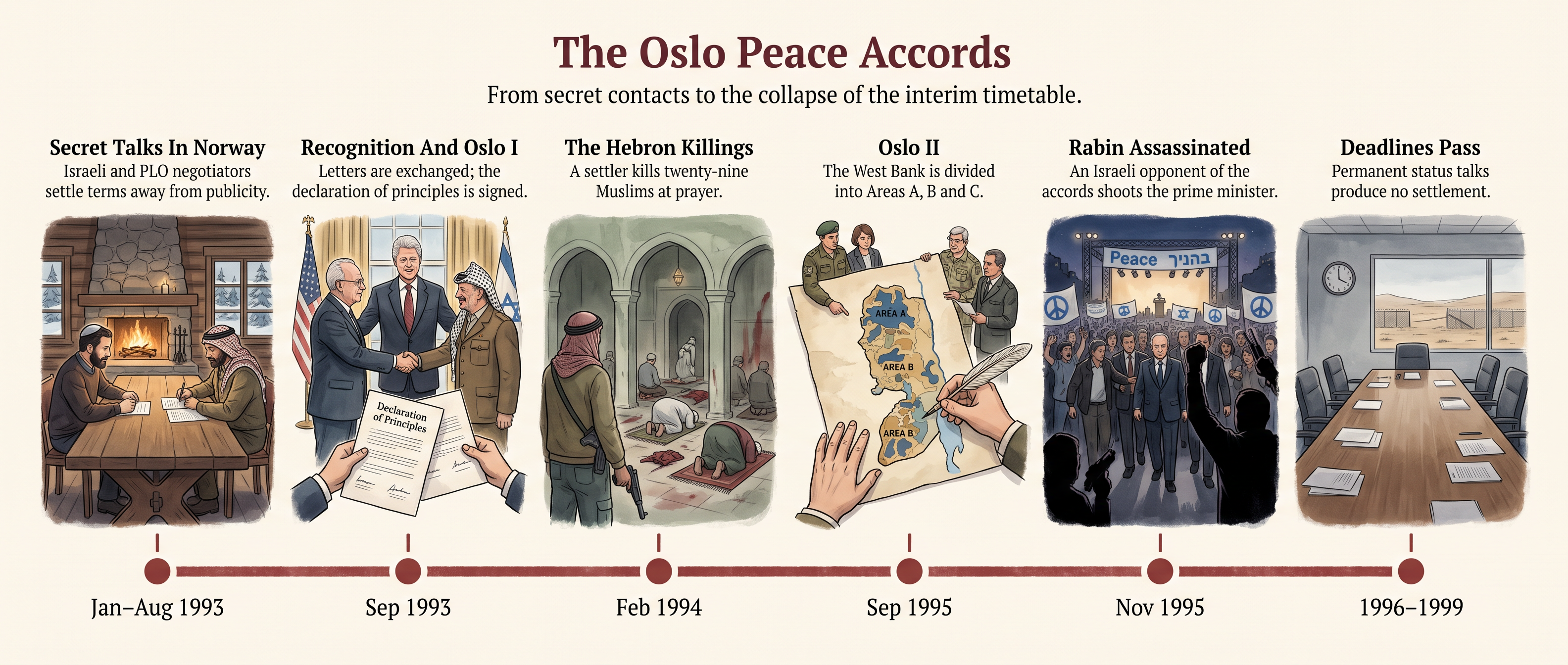
Fig. 11.21 – The Oslo process.
11.13 Summary
Two Movements And Three Promises
- Palestine in 1914 was not a country but a set of Ottoman districts, with an Arab majority of about nine in ten and a small Jewish minority.
- Arab nationalism grew from a revival of Arabic learning into a political demand after 1908, and asked at first for autonomy inside the Ottoman Empire rather than independence.
- Zionism was organised in the 1890s in response to the position of Jews in Europe, and its central aim was a national home in Palestine recognised in law, not merely settlement on the ground.
- The two movements were already in friction over land purchase and immigration before any European power made a promise to either of them.
- During the First World War Britain made three commitments about the same region — the Husain-MacMahon correspondence, the Sykes-Picot Agreement and the Balfour Declaration — in three different forms, for three different audiences, and never reconciled them.
- The Balfour Declaration promised a ‘national home’ without defining it, protected the civil and religious rights of the Arab majority without naming them as a people, and said nothing about their political rights.
The Mandate And The End Of It
- The mandate awarded to Britain in 1920 carried the Balfour policy inside its own text, so Britain was legally bound to both of its wartime positions at once.
- The obligations were not equal in practice: building a national home required action, while safeguarding the majority required only that certain rights not be damaged.
- Jewish immigration, driven after 1933 by persecution in Europe, raised the Jewish share of the population from about a ninth in 1922 to about a third by 1947, and turned the demographic question into a political one.
- Arab protest ran from riots in the 1920s to the revolt of 1936-1939, whose suppression left Palestinian society leaderless and disarmed a decade before the decisive war.
- The Peel Commission of 1937 was the first official body to conclude that the mandate was unworkable and to propose partition; the Second World War and the genocide of European Jews then transformed the political weight of the Zionist case.
- Unable to satisfy either side, Britain referred the question to the United Nations in 1947 and left without implementing the partition the UN recommended.
Four Wars
- The UN plan of 1947 allotted about 55 per cent of the territory to a Jewish state whose population would have been nearly half Arab; Zionist leaders accepted it, Arab leaders rejected it, and no authority existed to enforce it.
- The war of 1948-1949 fell into two phases, a civil war before the mandate ended and a war between states after it, and Israel won because it fought under one command, mobilised fully and armed itself during the truces.
- Its results were the borders of the Green Line, the annexation of the West Bank by Jordan, Egyptian administration of Gaza, no Palestinian state, and about 700,000 refugees who were not permitted to return.
- The Suez Crisis of 1956 was a war Egypt lost militarily and won politically: the canal stayed nationalised, Nasser became the leading figure of Arab nationalism, and Britain and France ceased to be powers that could act alone in the region.
- The Six Day War of 1967 was set off by a false report, an ultimatum over the Straits of Tiran and an Israeli decision to strike first; it left Israel occupying Sinai, Gaza, the West Bank, East Jerusalem and the Golan Heights, with about a million Palestinians under military government.
- Resolution 242 established the formula of land for peace, and its deliberate ambiguity about how much land has shaped every negotiation since.
- The war of 1973 was launched by Sadat to break a deadlock rather than to win outright; it ended with Egypt’s army encircled, but it restored Egyptian standing, produced the oil shock, and made the United States the mediator both sides would use.
From War To Negotiation
- Camp David worked because its Egyptian provisions were specific and timetabled; Sinai was returned in full by 1982, and the treaty has held ever since.
- Its Palestinian provisions were vague and undated, no Palestinian took part in making them, and nothing came of them — which is why the Arab League suspended Egypt and why Sadat was assassinated in 1981.
- The PLO was created in 1964 by the Arab League to keep the Palestinian cause under supervision, and passed out of that control after 1967, when the defeat of the Arab armies destroyed their claim to be liberating Palestine.
- Recognition followed in 1974 from the Arab states and the United Nations, giving the Palestinians a body that other governments could negotiate with — and one that could also be held responsible for what its factions did.
- The Intifada that began in December 1987 was organised locally and fought mainly without weapons, and it changed three things: world opinion, Israeli willingness to trade territory, and the PLO’s public position on recognising Israel.
- The Oslo Accords rested on an exchange of recognition, then postponed Jerusalem, refugees, borders and settlements to permanent status talks that never concluded.
- Oslo II divided the West Bank into Areas A, B and C, giving the Palestinian Authority the towns and Israel almost three-quarters of the land, and the arrangement meant as an interim step became the situation itself.
- The process failed because its hardest questions were deferred while settlement building continued, and because extremists on both sides — including the Israeli who assassinated Rabin in 1995 — attacked it precisely in order to destroy the trust it depended on.
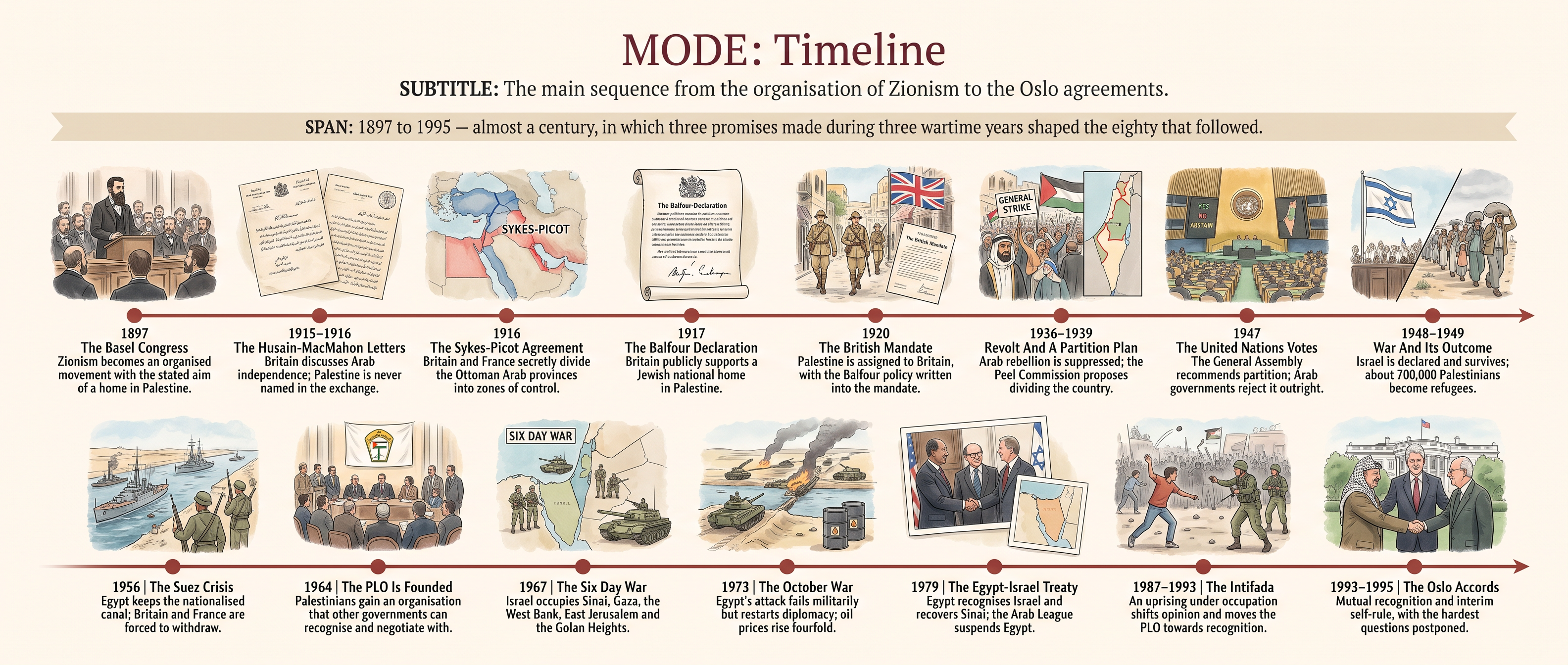
Fig. 11.22 – The whole chapter.
What The Evidence Cannot Tell Us
The written record of this chapter was made overwhelmingly by states. Britain’s files, the minutes of the League and the United Nations, army orders and treaty texts survive in quantity, and they record what governments decided and what they wished to be seen deciding.
The people the decisions were made about are far less well recorded. Most Palestinian villages kept no archive, and what documents existed in 1948 were scattered or destroyed along with the villages; much of what we know of that year from the Palestinian side comes from testimony collected decades afterwards, by people remembering their childhood. The Jewish communities of Europe who did not survive the 1930s and 1940s left no account of what they would have chosen.
And no document, however carefully preserved, can settle what its authors intended. That is why the argument that opened this chapter — over ten letters, four named towns and one unmentioned territory — could not be resolved by reading the letters again, and has never been resolved since.
11.14 Recall And Explanation
Explain what a mandate was and what an armistice was, as those terms are used in this chapter. Why did it matter, for everything that followed, that 1949 produced armistices and not a peace treaty?
State the aims of Arab nationalism as they stood before 1914, and the aims of Zionism at the same date. Identify one aim on each side that had nothing to do with the other movement.
Britain made three commitments about the Arab lands between 1915 and 1917. Describe each one, and explain how the form each took — a private exchange of letters, a secret treaty, a public declaration — affected what could later be claimed from it.
11.15 Working With The Evidence
Read Source 11.1 again. Set out what the British government undertook to do in it, what it undertook not to allow, and three things the wording deliberately leaves undefined.
Study Table 11.1. Describe the change it records between 1922 and 1947, and explain why the same figures were read as reassuring by one community and as alarming by the other. State one thing about the population of Palestine that these figures cannot tell you.
Using Fig. 11.6 and Fig. 11.9 together, locate the Gaza Strip, the West Bank, Jerusalem and the Negev. Explain how the territory Israel held in 1949 differed from the territory proposed for it in 1947, and what became of the Arab state that the 1947 plan had provided for.
Reconstruct the chain of events from the Soviet warning to Egypt in May 1967 to the Israeli air strike of 5 June. At which points in that chain could a different decision have prevented the war, and by whom?
11.16 Judgement
Distinguish the agreement of 1993 from the agreement of 1995. What did each actually settle, and what did the division of the West Bank into Areas A, B and C mean for a Palestinian living in a town in Area A?
Historians disagree about why so many Palestinians left their homes in 1948. Set out both readings of the evidence, and explain what would turn on the question being settled one way rather than the other. Do not decide it; make the strongest case for each.
This chapter argues that its written record was made overwhelmingly by governments. Choose one episode from the chapter and explain what that imbalance leaves out of our picture of it, and what kind of evidence would be needed to fill the gap.