Chapter 4: Changing Face Of The Indian Democracy (1977 – 1986)
Early in 1979, clerks in Mangaldoi, a constituency in central Assam, opened the electoral roll. The sitting member of the Lok Sabha had died, a by-election was due, and before any by-election the roll has to be revised: new voters added, the dead struck off, objections heard.
What the revision turned up did not stay inside the office. The number of names had risen far faster than births in the district could explain. Thousands of objections were filed, claiming that people listed as voters were not citizens at all, but migrants who had crossed the border from Bangladesh. Officials began hearings. Word travelled through the district, then through the state.
Within months the All Assam Students’ Union had built a movement out of that argument, and the movement would run for six years — closed colleges, emptied polling booths, killings in the countryside — before it ended in an agreement signed in New Delhi on 15 August 1985.
A voters’ list is a peculiar kind of evidence. It records precisely how many names an office had entered, in which village, in which year. It cannot tell you where a single one of those people was born. Almost everyone whose name was disputed in 1979 left no written record of their own.
This chapter is about that pattern repeating across India between 1977 and 1986: rolls, votes and signed accords becoming the instruments of the country’s hardest arguments with itself.
Map
Map 4.1 Caption: The four regions this chapter follows, shown as they stood between 1977 and 1986. Brief: Political map showing the full extent of India as officially defined by the Government of India. Shade and label Punjab, Assam, Nagaland, and Mizoram (a Union Territory throughout this period, not yet a state). Mark Chandigarh, Amritsar, Guwahati, Kohima and Aizawl. State boundaries are those of the period, not of today; do not draw states created after 1986.
4.1 The Janata Government (1977 – 1979)
For the first thirty years after independence, one party held power at the Centre. Congress had won every general election since 1952, and for most Indians alive in 1977 no other government had ever existed in New Delhi.
That ended in March 1977. A party barely two months old took office, and for twenty-eight months India was governed by men who had spent much of the previous year in prison. This section follows that government: how it was elected, how it was assembled, what it promised, what it managed to do, and why it fell apart.
4.1.1 The Elections Of 1977
The Announcement
On 18 January 1977, Indira Gandhi went on All India Radio and told the country that the Lok Sabha, the directly elected lower house of Parliament, would be dissolved and fresh elections held in March.
The announcement was startling because it had not been necessary. Since the proclamation of Emergency on 25 June 1975 — the suspension of ordinary democratic rights studied in the previous chapter — the life of that Lok Sabha had already been extended twice by Parliament. There was no legal compulsion to face the voters at all.
Within days, most detainees held under the Maintenance of Internal Security Act (MISA) — a law that allowed the government to jail a person without trial, and without telling a court why — were released. Press censorship was lifted, and the ban on public meetings was relaxed. Opposition leaders walked out of jail with roughly eight weeks to fight a general election.
Why she took the risk is still argued over. There was no shortage of advice reaching the Prime Minister that she would win comfortably.
A Straight Fight
Indian elections until then had usually been many-cornered contests in which the opposition split its vote and Congress won seats with far less than half the votes cast. In 1977 that arithmetic broke. Four opposition parties dissolved themselves into a single party on 23 January, so that in most northern constituencies the voter faced one Congress candidate and one challenger.
The campaign itself was fought over the Emergency rather than over any programme. Congress speakers presented the period as one of order restored and prices held; their opponents presented the election as a choice between a democracy and a dictatorship.
Two of the Emergency’s programmes did particular damage. The compulsory sterilisation drive of 1976 and the demolition of settlements in and around Delhi had fallen hardest on the poor of the northern states, and the resentment was fresh.
What The Result Looked Like
Polling was held in the third week of March 1977. About sixty per cent of an electorate of more than 320 million voted, a higher turnout than in the previous general election.
The Janata Party won 295 of the 542 seats in the Lok Sabha, and with its allies commanded about 330. Congress fell to 154. In Uttar Pradesh and Bihar, the two largest states in the country, Congress won no seat at all; most of the seats it did keep were in the south.
The defeats reached the top of the government. Indira Gandhi lost Rae Bareli, the constituency she had represented since 1967, to Raj Narain, the opponent whose election petition had begun the crisis of 1975. Her son Sanjay Gandhi lost Amethi.
4.1.2 Establishing The Janata Government
Four Parties Become One
The party that won had been built inside jail. During the Emergency, opposition leaders across the political spectrum — among them Jayaprakash Narayan, Morarji Desai, Charan Singh, Atal Bihari Vajpayee, L K Advani and Acharya J B Kripalani — had been detained, many of them under MISA, and several had been held together.
Detention taught them a simple lesson. Separately, each of their parties could be picked off; together they were the only alternative on offer. Talks that had begun during the JP Movement of 1974–75 now became a merger.
On 23 January 1977, four parties dissolved their separate identities into the Janata Party: Congress (O), the older faction left behind by the Congress split; the Bharatiya Jana Sangh; the Bharatiya Lok Dal; and the Socialist Party. Jayaprakash Narayan and Kripalani, who held no office in it, gave the new party the moral authority that made the merger credible.
A second blow to Congress followed on 2 February, when Jagjivan Ram, one of its most senior ministers, resigned and formed the Congress for Democracy along with H N Bahuguna and Nandini Satpathy. His group fought the election in alliance with the Janata Party and merged into it soon afterwards.
Choosing A Prime Minister
Winning was easier than agreeing on who should govern. Three men claimed the office: Morarji Desai, Charan Singh and Jagjivan Ram. With the party unable to decide, the choice was handed to Jayaprakash Narayan and Kripalani, who named Desai.
Morarji Desai was sworn in as Prime Minister on 24 March 1977, at eighty-one the oldest person to hold the office. Charan Singh took the Home Ministry, Jagjivan Ram took Defence, and Atal Bihari Vajpayee became Minister of External Affairs.
One appointment carried a particular symbolism. L K Advani, who had spoken for the party during the campaign, was given the Ministry of Information and Broadcasting — the ministry that had administered censorship for the previous nineteen months.
Consolidating In The States
Within weeks the new government turned to the states. It argued that nine Congress state governments, elected in 1972 and now facing an electorate that had voted the other way in March, had lost the right to continue. The assemblies were dissolved and fresh elections held in June 1977.
Doing this required President’s Rule — the provision under Article 356 of the Constitution by which the Union government can dismiss a state government and take over its administration. Congress had been criticised for years for using that provision against opposition-ruled states, and the Janata Party had said so loudly during the campaign.
The June elections gave the Janata Party power in most of those states, and Congress lost the governments it had held for a generation. But the method left a mark. A government elected on a promise to restore constitutional propriety had reached for the same instrument its predecessors had used, and its opponents did not forget.
4.1.3 The Policies Of The Janata Government
The Manifesto Of February 1977
On 10 February 1977, weeks before polling, the Janata Party published its manifesto — the printed statement of what a party promises to do if elected. It is worth reading closely, because it shows a coalition trying to write down what its very different members could agree on.
The political promises were the sharpest, and the easiest to agree on. The government would dismantle the machinery of the Emergency, restore fundamental rights and full civil liberties to the press, to parties and to individuals, release political prisoners, guarantee the rule of law, amend the Forty-second Amendment passed during the Emergency, repeal MISA, reform the conduct of elections, and appoint an inquiry into the abuses of the previous two years.
In foreign affairs the manifesto promised what it called genuine non-alignment — keeping equal distance from both the United States and the Soviet Union rather than leaning towards either.
An Economics Of Villages And Small Workshops
The economic promises pointed in a direction quite different from anything the country had followed since 1950. Priority was to go to agriculture and to small-scale, labour-intensive industry. Resources were to be shifted from industry to the rural sector, and planning was to be decentralised rather than directed from the Centre.
There was to be no further expansion of the public sector. A national wage policy would set a minimum wage and narrow income differences, food production for mass consumption would be pushed, the prices of essential commodities held down, and the right to work made real. Landlordism was to be abolished and holdings below two hectares made tax-free.
Set that against the Nehruvian model that had governed Indian planning for a quarter century. That model put its money into heavy industry and large public-sector plants, planned centrally through the Five Year Plans, and expected industrial growth to pull the rest of the economy behind it. The Janata programme reversed the priorities: the village, the small workshop and the field came first, and the state was to step back from building factories itself. Both were programmes for a poor country trying to grow, but they disagreed about where growth begins.
The social promises were the most general: welfare of women and children, safeguards for the rights and interests of the Scheduled Castes and Scheduled Tribes, freedom of religion, better public health, drinking water, the eradication of illiteracy with a three-language formula in schools, and energy for domestic and industrial use.
4.1.4 Implementing The Programme
Undoing The Emergency In Law
The government’s real achievement lay in constitutional law, and it took a year to finish. The Forty-fourth Amendment, passed in 1978, undid several of the changes the Forty-second Amendment had made during the Emergency. It restored the power of the Supreme Court and the High Courts to rule on the validity of central and state legislation, and it wrote new safeguards into the Emergency provisions themselves.
The most important change was a single phrase in Article 352.
Before 1978, the third ground in that list read ‘internal disturbance’. It was on that ground that the Emergency of 1975 had been proclaimed, and ‘internal disturbance’ can mean almost anything a government finds inconvenient. Armed rebellion cannot. Alongside it, the amendment required the Cabinet’s recommendation in writing before any such proclamation, and made Parliament’s approval necessary at shorter intervals.
MISA was repealed in 1978. In the same period the government appointed a commission of inquiry under Justice J C Shah to examine the excesses of the Emergency — the detentions, the demolitions, the sterilisations — which took evidence through 1977 and reported in 1978. Charges arising from the Baroda dynamite case were withdrawn, and the affairs of the state-backed Maruti company were investigated.
The Economy: Grain, Wages And Foreign Firms
The Food for Work Programme, begun in 1977, used the government’s foodgrain stocks to pay wages in kind for rural works — village roads, school buildings, tanks. It put grain into the hands of people who needed employment, and it was run with real energy in some states. It also drew heavily on stocks and on the exchequer.
The self-reliance strand of the programme was enforced through the Foreign Exchange Regulation Act, under which foreign companies operating in India were required to reduce their holding in their Indian branches to a minority share and take Indian partners.
Harvests in 1977 and 1978 were good, and foodgrain output reached record levels. But the gains did not last. Inflation, which the Emergency had briefly checked, returned, and by the end of 1979 prices were rising by more than twenty per cent a year.
The Society That Did Not Change
Here the government achieved least. It had promised eradication of poverty, welfare for women and children, and protection for Scheduled Castes and Scheduled Tribes, and almost none of it moved.
Part of the reason lay in who had voted the Janata Party in and who ran it in the districts. Its base in the northern countryside was made up largely of prosperous peasants and landowners, along with small-town traders. A programme of land reform or higher agricultural wages would have hurt precisely those supporters.
Meanwhile the assertion of rights by the rural poor met violent reprisal. In July 1977, in the village of Belchi in Bihar, a group of Dalit labourers was killed by men from a dominant landholding community; the incident became nationally known when Indira Gandhi travelled to the village. It was one of several such attacks in north India in these years, and it exposed the distance between what the manifesto promised the Scheduled Castes and what the party’s own social base was prepared to concede.
4.1.5 The Reasons For Its Downfall
A Party Held Together By One Thing
The Janata Party was a merger of parties that agreed about the Emergency and about very little else. The Bharatiya Jana Sangh drew on Hindu nationalist politics; the socialists were hostile to exactly that; the Bharatiya Lok Dal spoke for prosperous peasants in the north and had little organisation elsewhere; Congress (O) was conservative and represented the old Congress that the split of 1969 had left behind.
Once Indira Gandhi was out of office, the single thing they shared was gone. What remained were three men who each believed he should be Prime Minister, and four sets of workers who had spent decades fighting one another.
The Dual Membership Dispute
The quarrel that finally broke the party was about membership. Former Jana Sangh members of the Janata Party continued to belong to the Rashtriya Swayamsevak Sangh, a Hindu nationalist organisation. The socialists inside the party demanded that they choose one or the other, arguing that a single party could not have members organised separately outside it.
Communal rioting in several towns, including Jamshedpur in 1979, hardened both sides. The dispute was never resolved, and it became the ground on which the party split.
Prices, Rivalry And Collapse
The economy turned against the government in its final year. The monsoon of 1979 failed over much of the country, farm output fell, and a second worldwide rise in oil prices pushed up the cost of fuel and of everything carried by road or rail. The budget presented by Charan Singh, who had returned to the government as Deputy Prime Minister and Finance Minister, added to the pressure on prices.
The prosecution of Indira Gandhi also misfired. She was arrested in October 1977 on charges arising from the Emergency, and released within a day when the magistrate found the evidence inadequate. Cases against her stalled, the special courts moved slowly, and the pursuit began to look like persecution. Sympathy for her grew in exactly the states that had defeated her.
In July 1979, Charan Singh and Raj Narain left the Janata Party with their followers. Morarji Desai resigned on 15 July rather than face a confidence vote he could not win. Charan Singh was sworn in as Prime Minister on 28 July with the outside support of Congress — which withdrew that support before he had faced the Lok Sabha even once. He resigned in August, the House was dissolved, and a fresh general election was ordered for January 1980, at which Congress returned to power under Indira Gandhi.
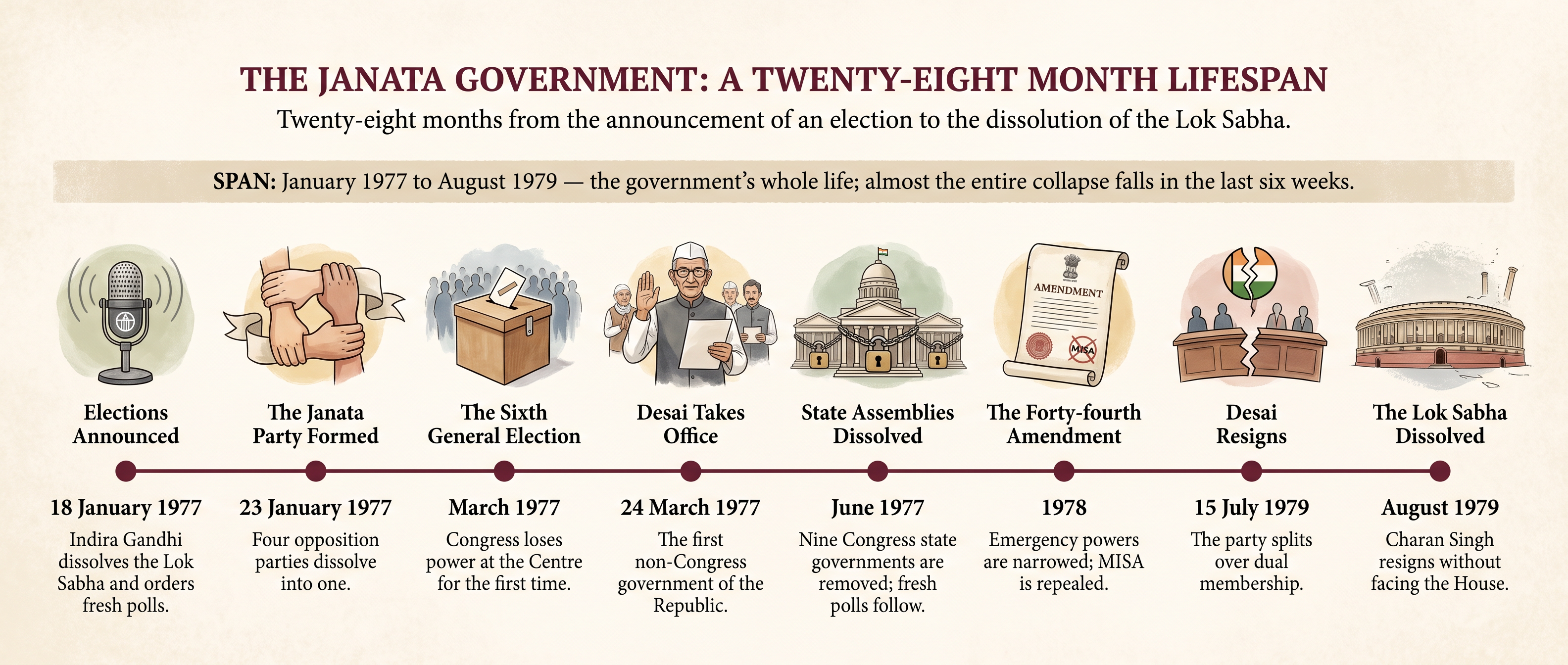
Fig. 4.0 – The Janata Years.
What Survived It
Judged by its own programme, the Janata government failed. It did not reform land, wages or the position of the Scheduled Castes; the economy was worse in 1979 than in 1977; and it could not hold itself together for three years.
Judged by the constitutional question that had put it in office, it did something no election result could do by itself. It wrote the restraint into law, and that law outlived the government by decades.
4.2 Centre-State Relations
The first half of this chapter asked who governs in New Delhi. The rest of it asks a harder question: what the Union owes the states, and what happens when a region decides that the answer is not enough.
Between 1977 and 1986, four regions pressed that question hard — Punjab, Assam, Nagaland and Mizoram. Their histories are different and their demands were not the same. Before taking them one at a time, it is worth being clear about the arrangement they were pressing against.
4.2.1 What The Constitution Divided
A Federation With A Strong Centre
India is a federation. Federalism is a system in which powers are divided between a national government and state governments, each with a sphere of its own, and the division is written into the constitution so that neither side can simply take the other’s powers away.
The Seventh Schedule of the Constitution makes that division. The Union List holds subjects on which only Parliament may legislate — defence, foreign affairs, currency, railways, atomic energy. The State List holds subjects that belong to the states — police, public order, public health, agriculture and land. The Concurrent List holds subjects on which both may legislate, with Union law prevailing in a conflict.
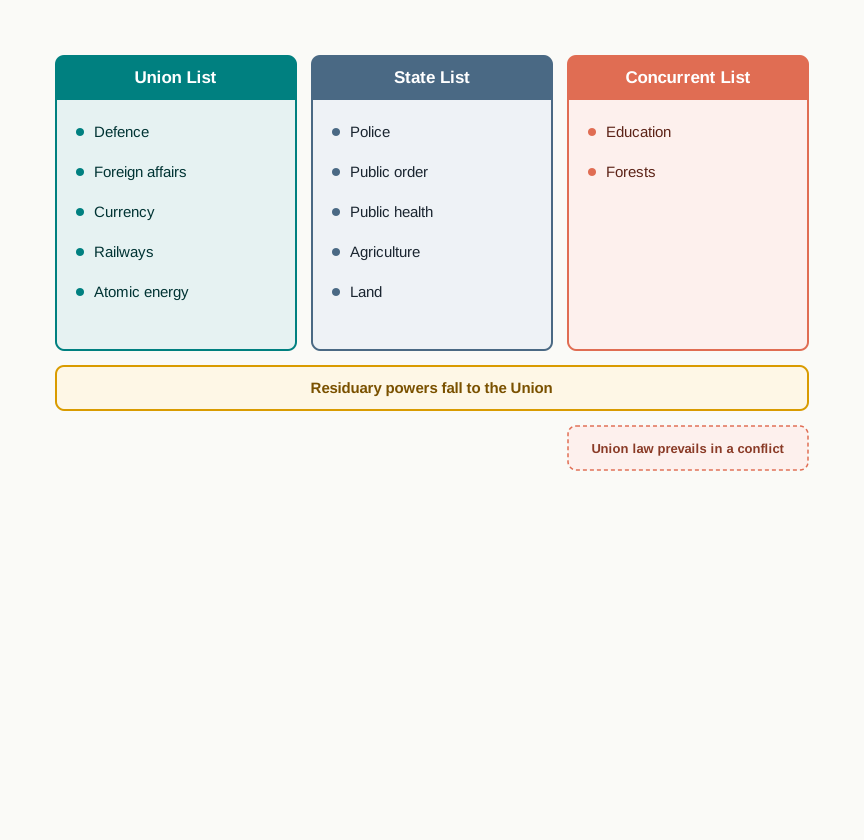
Fig. 4.1 – The Seventh Schedule.
The Indian version of federalism leans towards the Centre in several ways at once. Subjects not mentioned in any list — the residuary powers — belong to the Union, where in some other federations they belong to the states. The Governor of each state is appointed by the President, that is, on the advice of the Union government. Most states raise far less money than they spend, and depend on transfers from the Union to close the gap.
And there is Article 356, whose use to dismiss nine state governments in 1977 was described earlier in this chapter. A state government can be removed by the Centre; the Centre cannot be removed by the states.
Why It Was Built That Way
None of this was accidental. The Constitution was written by people who had just watched the subcontinent partitioned, who had spent the previous years persuading and pressing more than five hundred princely states into the Union, and who genuinely feared that India would come apart.
A strong Centre was their insurance against that. The cost of the insurance was that a region with a grievance had few constitutional ways to press it, and no way at all to press it against the Union’s will.
4.2.2 Why Regions Began To Press
What Changed In The Late 1970s
Several things came together at once. The most obvious was the result of March 1977. For thirty years the Centre had looked immovable; now everyone could see that it was not. Parties that spoke for a single state, and movements that had been shouting into silence, drew the obvious conclusion.
The second was the memory of centralisation. The Emergency had concentrated power in New Delhi as never before, and the Forty-second Amendment had even moved education and forests from the State List to the Concurrent List. Then the government elected to reverse all that dismissed nine state governments within three months. State politicians of every party learned the same lesson about how secure they were.
The third was uneven development. Prosperity and poverty were both producing grievances, and not the same grievances. A region that had grown rich from new farming methods wanted a fair share of water, of industry and of prices, and resented decisions about all three being taken elsewhere. A region that felt passed over wanted jobs, land and control over who came to live in it.
The fourth applied to the north-eastern hills alone. There, some communities had never accepted in 1947 that they were part of India at all, and their argument with the Union was older than any of the others in this chapter.
A Scale Of Demands
It helps to sort what these movements were asking for, because the words are often used loosely and they do not mean the same thing.
At the mildest end is a demand for autonomy — more powers, more money or more control over a region’s own affairs, while remaining inside the Indian Union. Next comes a demand for a separate state: redrawing the map so that a community has a government of its own, still under the Constitution. At the far end is secession — leaving India altogether to form a separate country.
The distinction matters because the Centre’s response depended on where it thought a movement stood on that scale, and because movements moved along it. A demand for autonomy that went unanswered for long enough could harden; a secessionist movement that had been fought to a standstill could settle for statehood.
The Centre’s Instruments
Against these demands the Union had a fixed set of responses, and it used all of them in these years. It could negotiate and sign an agreement. It could dismiss a state government or hold an election. It could create a new state. And it could send in the army and the police under laws that gave them extraordinary powers.
The sections that follow show the same four instruments being used in four different orders, with four different outcomes. What is worth watching in each case is not only what the region demanded, but how long it took before anyone in New Delhi treated the demand as something to be negotiated rather than suppressed.
4.3 Punjab: Demands And The Centre’s Response
Punjab in the 1970s was one of the richest states in India and one of the most unsettled. Understanding why needs a short look backwards, because the demands of the 1970s came out of a settlement made in 1966.
In that year Punjab was reorganised on the basis of language, as much of India had been reorganised a decade earlier. The Punjabi-speaking areas remained Punjab; the Hindi-speaking areas became Haryana; the hill districts went to Himachal Pradesh. Three things were left unsettled by that division, and all three were still open fifteen years later.
4.3.1 The Demands Of The Akali Dal
What Was Left Open In 1966
The first unsettled question was Chandigarh. The new city built as Punjab’s capital was made a Union Territory and served as the joint capital of both Punjab and Haryana, belonging fully to neither.
The second was territory. Some Punjabi-speaking villages had been left in Haryana, and each state claimed areas the other held.
The third, and the most bitter, was water. The Ravi, the Beas and the Sutlej rise in the hills and flow through Punjab, but their waters were divided between Punjab, Haryana and Rajasthan by decisions taken at the Centre. When work began in 1982 on a canal to carry water from the Sutlej towards the Yamuna, farmers in Punjab saw it as their water being taken away.
Map
Map 4.2 Caption: Punjab, Haryana and Himachal Pradesh after the reorganisation of 1966, with the rivers at the centre of the water dispute. Brief: Regional map showing the full extent of India as officially defined, with an inset enlarging the north-west. Label Punjab, Haryana, Himachal Pradesh and Chandigarh as a Union Territory; draw and label the Ravi, Beas and Sutlej, and the line of the Sutlej-Yamuna Link canal begun in 1982. Mark Amritsar and Anandpur Sahib. Boundaries are those of 1966 to 1986.
The Party And Its Demands
The Akali Dal was the political party that carried these claims. Founded in the 1920s, it had grown out of the movement to bring the management of Sikh shrines under an elected body, and it spoke for Sikh religious and political concerns. Its strength lay in the villages of rural Punjab, among landowning peasant families.
Its demands fell into four groups. There were the territorial claims — Chandigarh and the Punjabi-speaking areas. There was the claim to a larger share of river waters. There were religious demands, including recognition of the distinct identity of the Sikhs as a community and permission for the broadcast of hymns from Harmandir Sahib, the Golden Temple at Amritsar. And there was a constitutional demand: that the states be given far more power, and the Centre far less.
Prosperity That Produced Grievance
It seems odd that the state which had gained most from the new farming methods of the 1960s should have been the angriest. The connection is real, though, once the details are looked at.
The new seeds, fertilisers and tube wells raised yields sharply, but they also raised costs. Farmers borrowed to buy inputs and machines, and machines did work that labourers and small tenants had done. Landholdings in Punjab were being divided among sons in each generation, so many farming families were now working plots too small to support the borrowing the new methods required.
At the same time, Punjab had little industry. Successive governments had been reluctant to build large plants in a border state, and there were few jobs outside farming for the educated young men leaving colleges in the towns. Prosperity had raised expectations faster than it could satisfy them, and the shortfall was blamed on decisions taken in New Delhi.
4.3.2 The Anandpur Sahib Resolution
In 1973, the working committee of the Akali Dal met at Anandpur Sahib and adopted a resolution setting out the party’s programme. It was reaffirmed at Ludhiana five years later, and for the next decade every argument about Punjab came back to it.
Its constitutional demand was the boldest thing in it. The Union government, it said, should be left with defence, foreign affairs, currency and communications; everything else should belong to the states. It also asked for Chandigarh and the Punjabi-speaking areas, for a fair share of the river waters, and for recognition of the Sikhs as a distinct community.
The passage that was quoted most often, and read most differently, was about identity.
Read one way, this is a demand for autonomy of the kind the rest of the resolution spells out: a state with more powers, inside India. Read another way, the words ‘independent identity’ and ‘national aspiration’ point towards a separate nation.
The Akali Dal insisted on the first reading. Indira Gandhi’s government took the second, treating the resolution as a secessionist document and the party that had passed it as a separatist party. Neither side changed its reading in twelve years.
4.3.3 The 1977 Elections And The Akali Government
When the Congress state governments were dissolved after the general election of 1977, Punjab went to the polls in June along with the rest. The Akali Dal, fighting in alliance with the Janata Party, won and formed a government under Parkash Singh Badal.
For the first time the party that had made these demands was in office. It made very little difference, and the reason is worth understanding.
Almost nothing on the Akali list was within a state government’s power. Chandigarh, the transfer of territory and the sharing of river waters were all matters for the Union government or for bodies it appointed. A Chief Minister in Chandigarh could pass resolutions about them; he could not deliver them.
Office also cost the party something. A party in government cannot lead an agitation against the government, and the Akali Dal’s authority had always rested on its ability to mobilise. Meanwhile its leaders — Parkash Singh Badal, Jagdev Singh Talwandi and Harchand Singh Longowal among them — competed with one another for control of the party and of the religious bodies attached to it.
In 1980, after Congress returned to power at the Centre, the Punjab assembly was dissolved along with several others, and Congress won the election that followed. The Akali Dal was out of office with none of its demands met, and out of the agitation habit that had once given it a hold on rural Punjab.
4.3.4 The Rise Of Bhindranwale
A Preacher Becomes A Political Force
Into that space came Jarnail Singh Bhindranwale. In 1977 he became head of the Damdami Taksal, an old Sikh seminary that trained preachers, and he travelled the villages preaching a return to religious orthodoxy — against the cutting of hair, against tobacco and alcohol, against what he described as a drift away from Sikh practice.
His audiences were large and young, drawn from the same rural families whose sons were finding no work. His authority was religious before it was political, which made it very hard for political parties to argue with him.
His Demands And His Methods
Bhindranwale’s stated demand was that the Anandpur Sahib Resolution be implemented in full. He spoke of the Sikhs as a nation and refused to condemn those who called for Khalistan — the land of the pure, a separate Sikh country — though he did not himself declare it.
The demand for Khalistan was being pressed elsewhere too. In April 1980 Jagjit Singh Chauhan announced the formation of a National Council of Khalistan, and went on to declare its formation from London the following month.
Bhindranwale’s methods separated him from the Akali leadership. He addressed enormous gatherings and gave his sermons a political edge; his followers armed themselves; and from 1980 onwards, killings began of people who opposed him. The murder of a newspaper editor in Amritsar in September 1981 led to his arrest, and to his release weeks later when the case against him did not hold.
In 1982 the Akali Dal launched a mass agitation, the Dharam Yudh Morcha, under Longowal, to press the Anandpur Sahib demands. Bhindranwale joined it, and by doing so placed himself alongside the party rather than under it. In the same year he moved into the Golden Temple complex, and in December 1983 into the Akal Takht itself, the seat of temporal authority in Sikhism. Weapons were carried in and defensive positions built.
Through 1983 and early 1984 the killings widened. Hindus were killed in Punjab, and so were Sikhs who criticised the militants; bus passengers were pulled out and shot; officials and policemen were targeted. In October 1983 the Congress state government was dismissed and Punjab was placed under President’s Rule. The Union government now administered the state directly, and the crisis was entirely its own.
4.3.5 Operation Bluestar: Results And Impact
The Operation
In the first week of June 1984, the Indian Army was ordered into the Golden Temple complex at Amritsar to remove Bhindranwale and the armed men with him. The operation was codenamed Operation Bluestar. Similar operations were carried out at about forty other gurdwaras across Punjab at the same time.
The timing mattered enormously. The complex was sealed on 3 June, the martyrdom anniversary of Guru Arjan, when it was full of pilgrims who had come for the day and could not leave once the curfew closed around the city. The assault itself began on the night of 5 June. Journalists were kept out and communications with Punjab were cut.
The men inside were well armed and well positioned, and the fighting was far heavier than had been expected. Tanks and artillery were used inside the complex. By 6 June the army held the site. Bhindranwale was dead, along with those who had fought beside him. The Akal Takht was reduced to rubble.
The Impact
Militarily the operation succeeded. In every other sense its consequences ran the other way.
For Sikhs everywhere, including the very many who had opposed Bhindranwale and everything he stood for, an army had attacked their holiest shrine and destroyed a building at the centre of their faith. The hurt was not confined to Punjab or to any political position. Soldiers deserted from several units, officials resigned their posts and returned honours, and the argument that the Indian state was hostile to Sikhs as a community — which had been a minority claim in 1983 — found a wide hearing.
On 31 October 1984, Indira Gandhi was assassinated at her residence in New Delhi by two of her own Sikh bodyguards.
In the days that followed, Sikhs were attacked and killed in Delhi and other cities in violence that was not spontaneous: mobs were led to particular houses and shops, and the police in many places did not intervene. Several thousand people died, most of them in Delhi. Inquiries were appointed over the following years, and convictions came, when they came at all, decades later.
Militancy in Punjab did not end with Operation Bluestar. It grew. The insurgency that followed lasted into the early 1990s, and most of those killed in Punjab during those years were Sikhs.
4.3.6 The Punjab Accord, 1985
Rajiv Gandhi became Prime Minister on his mother’s death, and in the following year the government tried to settle by agreement what force had not settled. Talks were opened with Longowal, who had been released from detention and who represented the moderate leadership of the Akali Dal.
On 24 July 1985 the two men signed the Punjab Accord, also known as the Rajiv-Longowal Accord.
Its terms addressed the old list. Chandigarh was to be transferred to Punjab, with territory in compensation for Haryana to be determined by a commission. The competing claims of Punjab, Haryana and Rajasthan to river waters were to go to a tribunal. A judicial inquiry was promised into the killings of Sikhs in Delhi in November 1984. The government agreed to consider legislation on the management of gurdwaras across the country, and to review the special powers given to the security forces in Punjab.
The Accord recognised, in other words, that most of these demands had been negotiable all along.
Longowal was assassinated on 20 August 1985, less than a month after signing it. Elections were held in September; the Akali Dal won and Surjit Singh Barnala became Chief Minister.
The settlement did not hold. Chandigarh was not transferred on the appointed date or for many years afterwards. The water dispute went to a tribunal and stayed there. In January 1986 militants again occupied the Golden Temple complex. Violence in Punjab continued, and it was the early 1990s before it subsided.
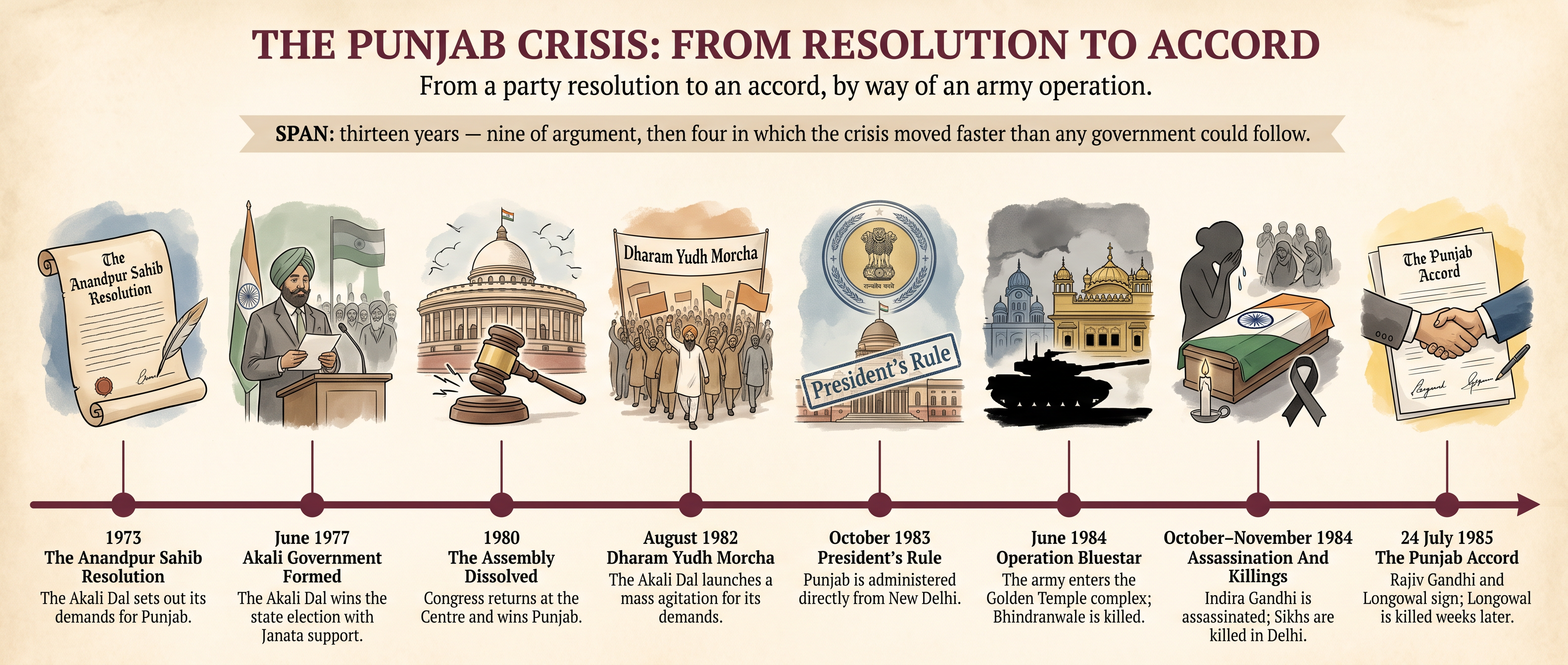
Fig. 4.2 – Punjab, 1973 To 1986.
4.4 Assam: Discontent, Agitation And Accord
4.4.1 Reasons For Assamese Discontent
A State Shaped By Movement Of People
Assam lies in India’s north-east, joined to the rest of the country by a narrow corridor of land and sharing international borders with Bhutan and Bangladesh. Most of its people live along the valley of the Brahmaputra; in the south, the Barak valley around Silchar has long been largely Bengali-speaking. Assam is also home to many indigenous communities with languages and land of their own.
Migration into this state is not a recent thing, and that is the first fact to hold on to. Under colonial rule, tea plantations were opened in the nineteenth century and labour was recruited for them from central India. Bengali Hindus from East Bengal, who had had access to English education earlier, took up much of the clerical and professional work in the province’s offices, courts and schools. From the early twentieth century, Bengali Muslim peasants from densely settled districts of East Bengal were encouraged to move onto the riverine lands of the Brahmaputra valley, because cultivation raised revenue.
By the middle of the twentieth century, many Assamese felt that they were being pushed to the margins of their own province: outnumbered in the towns, outbid for jobs, and steadily losing land in the countryside.
Map
Map 4.3 Caption: Assam and its neighbours as they stood between 1972 and 1986. Brief: Regional map of the north-east within the full extent of India as officially defined. Label Assam with the Brahmaputra and Barak valleys, and show Meghalaya, Nagaland, Manipur, Tripura and the Union Territories of Mizoram and Arunachal Pradesh. Mark Guwahati, Silchar, Nagaon, Kohima and Aizawl, and the international border with Bangladesh. Boundaries are those of the period, not of today.
Language, Jobs And Resources
The demand that followed from this fear was, first of all, about language. From the 1950s the Assamese movement asked that Assamese be preferred in state government service, and that it become the sole official language of the state and the medium of instruction in its colleges.
In 1960 the Assam legislature passed a law making Assamese the sole official language. Bengali-speakers in the Barak valley resisted, and their protest ended in police firing at Silchar in May 1961 in which eleven people were killed. Bengali was then retained as an official language in the Barak valley districts. In 1972 Assamese was made the sole medium of instruction in colleges affiliated to Gauhati University, and the argument reopened.
Around the same time, the state itself was shrinking. Nagaland had been carved out in 1963, and in 1972 Meghalaya, Manipur and Tripura became states while Mizoram and Arunachal Pradesh became Union Territories. Assam was left smaller, and the sense of a community losing ground was not only about language.
There was also an economic case, and it was a strong one. Assam produced oil and tea, but much of the refining, processing, taxing and profit happened elsewhere. There was little industry in the state, few jobs for its graduates, and a widespread belief that a distant Centre took Assam’s resources and returned very little.
Finally there was the war of 1971 and the creation of Bangladesh, which sent a fresh wave of people across a long and porous border. Who had come when, and who was therefore a citizen, became the question on which everything else in Assam came to turn.
4.4.2 The Course Of Assam’s Agitation
From A Voters’ List To A Movement
The trigger, as this chapter’s opening pages described, was the revision of the electoral roll in Mangaldoi before a by-election in 1979. The revision suggested that the number of voters had grown far beyond what births could explain.
In mid-1979 the All Assam Students’ Union and the All Assam Gana Sangram Parishad launched a movement built on three demands, usually summed up as detection, deletion and deportation: identify those who had entered illegally, remove their names from the electoral rolls, and send them back. Prafulla Kumar Mahanta and Bhrigu Kumar Phukan led it, and it drew in students, teachers, government employees, cultivators and traders across the Brahmaputra valley.
Its methods at first were those of mass civil protest. There were bandhs and processions; government offices, courts and railway stations were picketed; colleges and schools stayed shut for long stretches; and in 1980 the movement blocked the movement of crude oil out of the state, which turned a regional agitation into a national problem.
Talks, Boycott And Violence
Negotiations between the movement and the Union government ran from 1980 onwards and broke down repeatedly on one point: the cut-off date. The government wanted to accept everyone who had arrived before the Bangladesh war of 1971. The movement wanted a much earlier date, and would not agree that people who had come in the 1960s should stay on the rolls.
While talks stalled, the state became ungovernable. President’s Rule alternated with short-lived governments, strikes and firings were frequent, and the Union government decided in 1983 to hold elections to the assembly and the Lok Sabha whether or not the movement agreed.
The movement called for a total boycott, and it was largely obeyed. Turnout in the Brahmaputra valley constituencies was extremely low, and the government formed afterwards had almost no claim to represent the people it governed. The election also brought weeks of violence across the state.
The worst of it came on 18 February 1983 at Nellie, in Nagaon district, where about two thousand people were killed in a single morning. Most of the dead were Muslims of Bengali origin, and many were women and children. The violence did not stop to establish when anyone’s family had arrived; people were killed for who they were taken to be.
In October 1983 Parliament passed the Illegal Migrants (Determination by Tribunals) Act, which applied to Assam alone and set out a procedure for identifying illegal migrants through tribunals. The movement rejected it, arguing that the procedure it laid down made detection nearly impossible in practice.
4.4.3 The Assam Accord, 1985
Talks resumed seriously in late 1984 and continued into 1985, now with Rajiv Gandhi’s government. They produced a settlement signed at New Delhi on 15 August 1985 between the Union government, the state government and the leaders of the movement.
Its central provision was a set of dates. Those who had entered Assam before 1 January 1966 would be regularised as citizens. Those who had come between that date and 24 March 1971 would be identified, removed from the electoral rolls and kept off them for ten years, after which their names would be restored; in the meantime they kept their other rights. Those who had entered on or after 25 March 1971 — the day the Bangladesh war began — were to be identified and expelled. The Accord also promised to seal the border, to clear encroachments on government land, and to invest in Assam’s industry and education.
The clause the movement had fought hardest for was not about dates at all.
The state assembly was dissolved after the signing. In October 1985 the leaders of the movement converted it into a political party, the Asom Gana Parishad, and in December the party won the assembly election. Prafulla Kumar Mahanta, who had led the students’ union, became Chief Minister at thirty-three.
That is a remarkable outcome, and worth pausing on. A movement that had boycotted an election in 1983 formed the government through an election in 1985. The instruments of the Constitution had absorbed a movement that once refused to use them.
What the Accord did not do was settle the question underneath it. Detection through the tribunals proceeded slowly and produced very few expulsions. Fresh movements followed within a few years — the Bodo demand for a separate state, and an armed movement led by the United Liberation Front of Asom. The agitation had ended; the argument about who belongs in Assam had not.
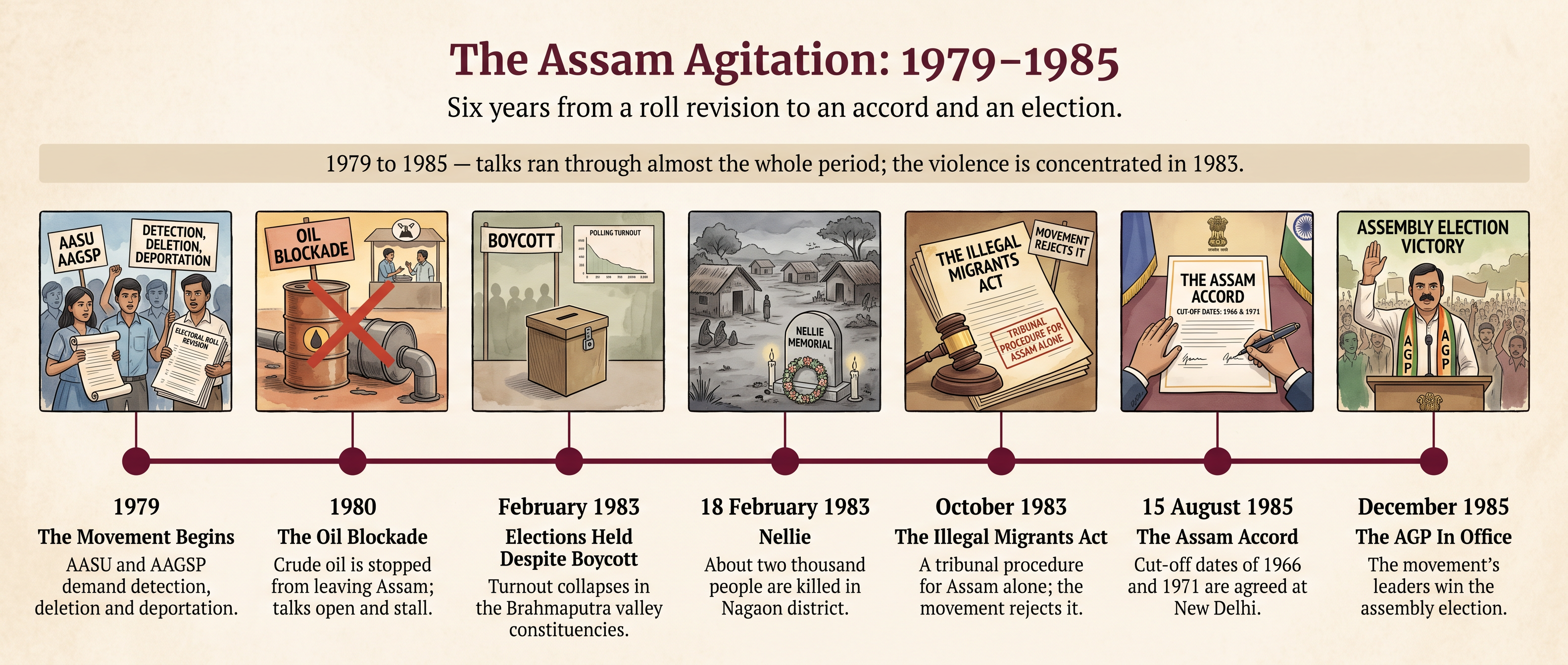
Fig. 4.3 – The Assam Agitation.
4.5 Nagaland: Separatist Demands And Statehood
The Naga hills run along the frontier between Assam and Burma, and they are home to many communities — the Angami, Ao, Sema, Konyak and others — each with its own language and its own villages. They are called Naga tribes collectively, but that collective name was itself something new in the twentieth century.
Their argument with India is the oldest in this chapter. It did not begin with a grievance about jobs, water or language. It began with a claim that they had never been part of India at all.
4.5.1 The Nagas’ Separatist Demands
Where The Claim Came From
British administration reached these hills late and lightly. Under the Government of India Act of 1935, the Naga Hills were classified from 1937 as an Excluded Area, administered by the Governor of Assam at his own discretion rather than by the elected provincial ministry. Whatever else that meant, it meant that the Nagas had almost no experience of being governed from Delhi or even from Shillong.
Two other things shaped the claim. American Baptist missionaries had been working in the hills since the nineteenth century, bringing schools and a written script along with Christianity, so that a small educated class grew up. And during the First World War, Naga men served in a labour corps in France, returning with a sense of themselves as one people rather than as separate villages.
Out of that came the Naga Club, formed at Kohima in 1918 by government servants and returned soldiers. In 1929, when the Simon Commission came to India to consider constitutional reform, the Club submitted a memorandum asking that the Nagas be left alone to decide their own future when the British left.
From Memorandum To Declaration
In 1946 the Naga National Council was formed, taking over the Club’s role. In June that year it submitted a four-point memorandum to the Cabinet Mission. It claimed to stand for the solidarity of all Naga tribes, including those in unadministered areas; it objected to Assam being grouped with Bengal; it asked that the Naga Hills be included in an autonomous Assam within a free India, with local autonomy and safeguards; and it asked for a separate electorate.
That is a demand for autonomy, not for a separate country. Within a year the position had hardened. In June 1947 the NNC signed a nine-point agreement with Sir Akbar Hydari, the Governor of Assam, which gave the Nagas a large measure of self-government for ten years, after which the arrangement was to be reviewed. The two sides read the final clause differently: the Nagas took it to mean they could choose their future at the end of ten years, and the government did not.
On 14 August 1947, a day before India became independent, the NNC declared the Naga homeland independent. The government of India did not recognise the declaration.
Referendum, Boycott, Rebellion
In May 1951 the NNC held a referendum of its own among the Naga people and announced that an overwhelming majority had voted for independence. Neither the government of India nor the government of Assam accepted the result.
The NNC then boycotted the first general elections of 1952, and told Nagas to stop paying taxes and to keep their children out of government schools. Talks with Nehru went nowhere.
From the middle of the 1950s the movement went underground and took up arms. A parallel administration was proclaimed, with its own government and a military wing, and it began attacking Indian forces in the hills. The Indian government answered with laws of exceptional severity: the Assam Maintenance of Public Order (Autonomous District) Act of 1953, and then the Armed Forces (Special Powers) Act of 1958, which gave soldiers wide powers of search, arrest and use of force in areas declared disturbed. Naga tribal councils and courts were dissolved, and the army moved into the hills in strength.
4.5.2 The Birth Of Nagaland State
Force alone was not settling anything, and there were Nagas who wanted a settlement. From 1957, a body called the Naga People’s Convention met to find one, arguing that the Nagas should get a political future inside India rather than fight indefinitely for one outside it.
Its first result came in 1957, when the Naga Hills district of Assam and the Tuensang area to its east were joined into a single administrative unit taken out of Assam’s control and placed under the Union government. It gave the area a separate identity but not self-government, and it satisfied few people.
The Convention kept meeting, and in July 1960 it reached a sixteen-point agreement with the government of India. Under it, the Union government accepted the creation of Nagaland as a full state.
The steps followed quickly. Nagaland was placed under a transitional regulation in 1961, with an interim body of forty-five members elected by the various tribes. Parliament passed the State of Nagaland Act in 1962, and on 1 December 1963 the President of India, Sarvepalli Radhakrishnan, inaugurated the state at Kohima, which became its capital. P. Shilu Ao took office as the first Chief Minister. Elections were held in January 1964 and the first elected legislative assembly met the following month.
Nagaland thus became the first state created in the north-east after independence, and it was created for a community that had declared itself outside India sixteen years earlier. But the men in the hills had not agreed to any of it.
4.5.3 The Course Of The Agitation
Statehood changed the political ground without ending the war. Through the 1960s two processes ran side by side: an elected state government at Kohima, and an armed movement in the hills that did not recognise it.
The first serious attempt to bridge them came from within Naga society. Early in 1964 the Nagaland Baptist Church Convention brought together people from across the ethnic communities of the state to press for peace. Out of that meeting came the Peace Mission, made up of Jayaprakash Narayan, the Anglican churchman Michael Scott, and Bimala Prasad Chaliha, the Chief Minister of Assam.
The Mission succeeded in bringing about a ceasefire in 1964, and rounds of talks followed over the next several years, some of them at the highest level. They failed on the same point every time. The government would discuss almost anything within the Constitution; the underground leadership wanted a settlement outside it.
The ceasefire frayed through the later 1960s, breaking down at the end of the decade. The NNC was banned in 1972 and the fighting resumed. Meanwhile many Naga leaders had gone abroad or across the border for support and training, and the movement itself was beginning to divide over what it should now be prepared to accept.
4.5.4 The Shillong Accord, 1975
On 11 November 1975, at Shillong in Meghalaya, representatives of the underground Naga organisations signed an agreement with the government of India.
Its terms were brief and, from the government’s point of view, complete. The signatories accepted the Constitution of India of their own volition. They agreed to deposit their arms and to give up violence. Other issues were to be settled later, once these two things had been done.
For twenty-eight years, that had been the one thing the movement refused to do. Accepting the Constitution meant accepting that the Naga future would be argued inside India, and it made the declaration of 1947 a dead letter.
The Accord was therefore rejected almost at once by those who had not signed it. Thuingaleng Muivah and Isak Chishi Swu, senior figures in the NNC, condemn it as a complete surrender of Naga rights, and S. S. Khaplang took the same view. In 1980 they broke away and founded the National Socialist Council of Nagaland, which took the armed movement into a new generation. That organisation would itself split later.
The lesson of Shillong is worth carrying into the next section. An accord settles a conflict only if the people who can continue the fighting have signed it. This one was signed by some of them, and the fighting continued.
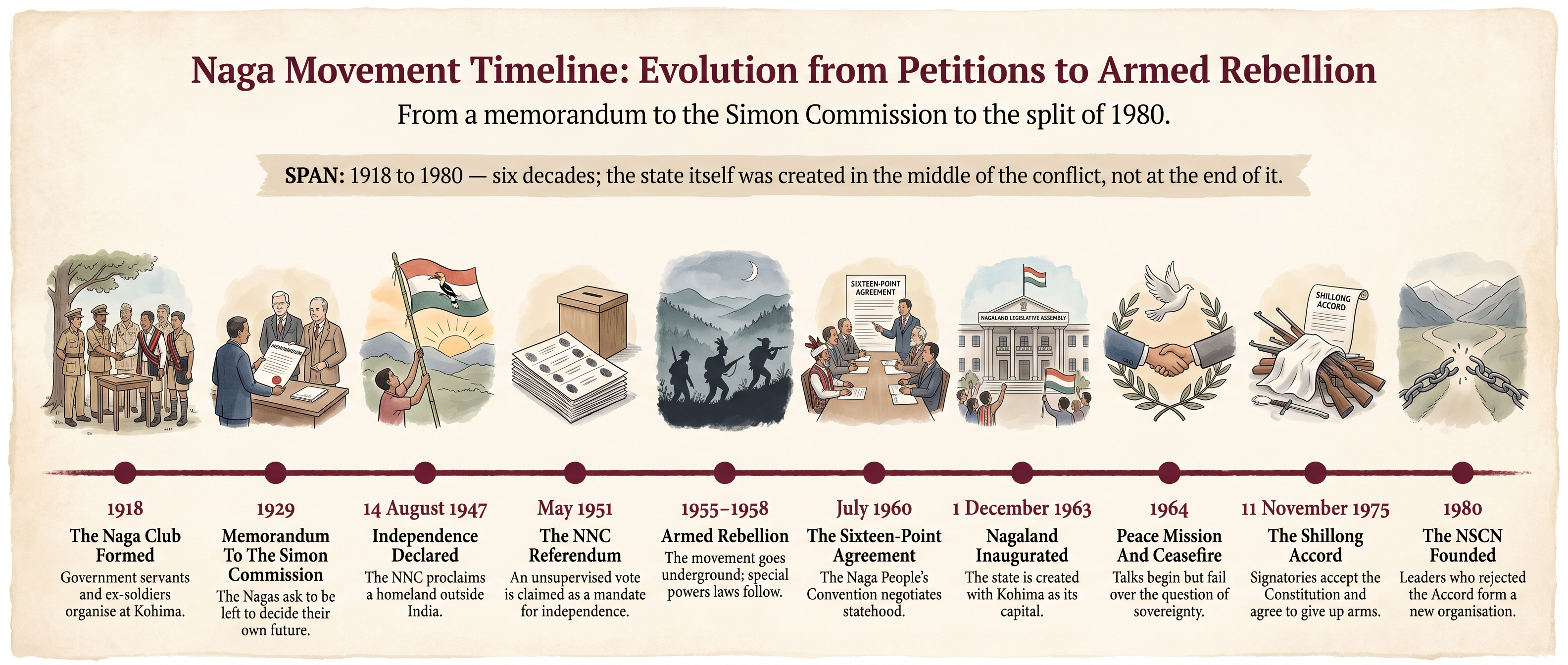
Fig. 4.4 – The Naga Movement.
4.6 Mizoram: The Mizoram Movement (1959 – 1986)
The Mizo hills lie south of the Naga hills, along the borders with Burma and East Pakistan, which became Bangladesh in 1971. Until 1972 they formed a district of Assam, and their people — Mizo-speaking, largely Christian, living in hill villages under their own chiefs and customs — had little in common with the plains that governed them.
This movement began with something no government planned and none could have prevented. It ended with the most complete settlement in this chapter.
4.6.1 The Course Of The Movement
A Famine That Arrives On Schedule
In 1959 the Mizo hills were struck by a famine the Mizos call mautam. It comes from the bamboo that covers the hills, which flowers all at once in a cycle of roughly forty-eight years, and it had been recorded before.
That last step is the one that matters historically. The relief work was taken up by a body that became the Mizo National Famine Front, and in 1961 the Famine Front was turned into a political organisation, the Mizo National Front, under the leadership of Pu Laldenga.
A movement born out of hunger carried a specific charge: that a distant government had watched the hills starve and had not moved. Whether the Assam government could have done much more is arguable. What is not arguable is that most Mizos believed it had not tried.
The Grievances Behind The Front
Other resentments were already in place. The decision to make Assamese the sole official language of Assam, described in the previous section, applied to a district where almost nobody spoke it, and knowledge of it was required for government employment.
Beyond that lay the ordinary complaints of a hill district administered from a plains capital: almost no roads, few schools beyond those the missions had built, no industry, and decisions about all of it taken by people who had never been there.
By 1965 Laldenga was writing to the Prime Minister claiming the right of the Mizos to decide their own future. The MNF had by then concluded that independence would not be given and would have to be taken.
Operation Jericho And After
The MNF prepared a secret plan called Operation Jericho. Its aim was to seize the Mizo hills in a single stroke: surprise attacks on treasuries, fuel stations, the communications network and the camps of the security forces; senior non-Mizo officials to be taken captive; and the flag of an independent Mizoram raised at Aizawl. If the flag could be kept flying for forty-eight hours, the planners believed, other countries would recognise them and the United Nations would follow.
The rising began on the night of 28 February 1966. The next day the MNF attacked the 1st Assam Rifles, struck at Aizawl, Lunglei, Champhai and Border Security Force posts in the south of the district, wrecked the telephone exchange, took the treasury, and brought down the Indian flag at the Assam Rifles headquarters. On 1 March 1966 it declared Mizoram independent.
The response was immediate and overwhelming. On 2 March the government invoked the Assam Disturbed Areas Act of 1955 and the Armed Forces (Special Powers) Act, declaring the whole district disturbed. Troops were flown in, and in the first week of March the Indian Air Force was used against Aizawl itself — the only occasion, it is generally held, on which India has used air power inside its own territory. Within weeks the rising had been crushed. Most of the MNF leadership escaped across the border, and in 1967 the Front was outlawed.
The Villages That Were Moved
The insurgency did not end there; it went into the jungle, and the army set about cutting it off from the villages that fed and hid it. Between 1967 and 1970, under a scheme of grouping, 464 villages were emptied and their people moved into 109 new centres along the roads, where they could be watched. About three-quarters of the rural population of the district was uprooted.
Families lost their fields, their houses and the graves of their dead, and were resettled among strangers under curfew. It was effective as counter-insurgency: the MNF’s supply and recruitment from the villages was broken. It also made a generation of Mizos remember the Indian state as the force that had moved them off their land.
4.6.2 The Resolution Of The Movement
Statehood Offered In Instalments
While the fighting went on, a political track opened. In May 1971 a delegation from the Mizo District Council met Indira Gandhi and asked for full statehood. The government offered a Union Territory instead, and the Mizo leaders accepted on the understanding that the Union Territory could later be upgraded.
On 21 January 1972 the Union Territory of Mizoram was created out of Assam, with one seat in the Lok Sabha and one in the Rajya Sabha.
This was more than the Nagas had been offered before 1963 and less than the Mizos had asked for, and it did not stop the insurgency. Through the 1970s the MNF fought on from across the borders while the government pursued two things at once: hard operations against the insurgents, and repeated offers of talks and of amnesty — a pardon for those who came out of the underground and gave up their arms.
An agreement was reached in July 1976, in which Laldenga accepted that Mizoram was an integral part of India and it was proposed that the MNF contest elections as a political party. It did not hold. Elections to the Mizoram assembly in 1978 were won by the People’s Conference under Brigadier T. Sailo, the MNF gained nothing from the political route it had half-taken, and it went back to the underground.
The Accord Of 1986
Talks were reopened after Rajiv Gandhi became Prime Minister, and Laldenga met him in February 1985. Both sides had reason to settle. The MNF had been fighting for twenty years without winning; the government had learned in Punjab and Assam what an unsettled conflict cost; and the one thing the MNF now wanted that the Union could give — full statehood — was no longer unthinkable.
The Mizoram Peace Accord was signed on 30 June 1986. Its terms were plain on both sides. The MNF would end all underground activity, bring in its personnel and arms, abstain from violence and help restore order. The Union government would grant Mizoram full statehood with Aizawl as its capital, hold elections soon after, provide constitutional safeguards to protect Mizo religion, social customs and customary law, and grant amnesty to insurgents who came over ground.
Parliament passed the Fifty-third Amendment to the Constitution to give those safeguards effect, and the State of Mizoram Act followed. On 20 February 1987 Mizoram became the twenty-third state of the Indian Union. The ban on the MNF was lifted, and Laldenga, who had signed the declaration of independence in 1966, was sworn in as Chief Minister of a state of India.
Mizoram has been among the most peaceful parts of the north-east ever since. Of the four conflicts in this chapter, it is the only one that can be said to have been settled.
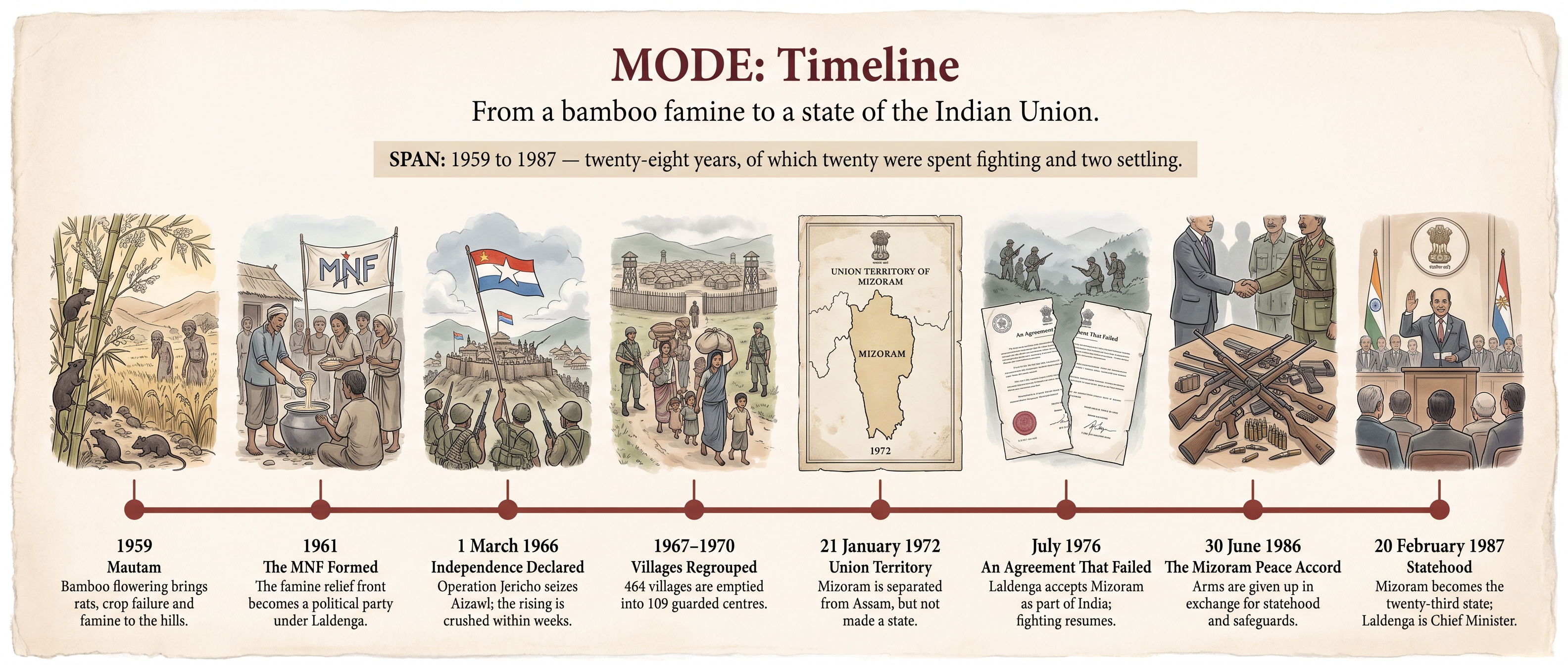
Fig. 4.5 – The Mizoram Movement.
4.7 Summary
The Janata Government
- Congress had governed at the Centre from 1952 to 1977. The election of March 1977 ended that, and showed Indians that the Centre could be defeated at the polls.
- Indira Gandhi was not obliged to call the election of 1977; the Lok Sabha’s life had already been extended twice under the Emergency. Why she called it is still argued over.
- The opposition won because it stopped competing with itself. Four parties merged into the Janata Party on 23 January 1977, so most northern seats saw a straight fight.
- The Janata Party won 295 of 542 seats and its alliance about 330; Congress fell to 154 and won nothing in Uttar Pradesh or Bihar. Indira Gandhi lost Rae Bareli.
- The party was assembled in jail, out of groups with nothing in common but opposition to the Emergency. Morarji Desai was chosen Prime Minister only because Jayaprakash Narayan and Kripalani were asked to decide.
- Within three months the new government dismissed nine Congress state governments using Article 356 — the very instrument it had condemned in opposition.
- Its manifesto of February 1977 promised to dismantle the Emergency in law, and to reverse the Nehruvian economic order by putting agriculture, small industry and decentralisation first.
- Its lasting achievement was the Forty-fourth Amendment of 1978, which narrowed the ground for an Emergency from ‘internal disturbance’ to armed rebellion, restored judicial review, and added procedural safeguards. MISA was repealed.
- Its economic record was mixed and its social record poor. Land reform, wages and protection of the Scheduled Castes went nowhere, because the party’s own base in the northern countryside was made of landholders.
- It fell because a merger is not a party. The dispute over Jana Sangh members’ continued RSS membership split it, Desai resigned in July 1979, and the Lok Sabha was dissolved in August.
- Failed prosecutions of Indira Gandhi turned pursuit into sympathy, and drought and rising prices did the rest.
Centre And States
- India’s federalism leans towards the Centre: residuary powers with the Union, Governors appointed by it, states dependent on it for money, and Article 356 available against them.
- That design was deliberate insurance, written by people who had just seen Partition and the integration of the princely states.
- After 1977, regional demands grew sharper because the Centre had been shown to be beatable, because the Emergency had concentrated power, and because development had been uneven.
- Demands sat on a scale — autonomy inside the Union, a separate state, or secession — and movements moved along that scale depending on how they were answered.
- The Union used four instruments in these years: negotiation and accords, President’s Rule and elections, the creation of new states, and armed force under special powers laws.
Punjab
- The reorganisation of 1966 left three things unsettled: Chandigarh, Punjabi-speaking territory, and the sharing of the Ravi, Beas and Sutlej waters.
- Prosperity from the new farming methods produced grievance rather than contentment: rising costs, shrinking holdings, little industry and educated young men without work.
- The Anandpur Sahib Resolution of 1973 asked that the Union keep only defence, foreign affairs, currency and communications. Its language of ‘independent identity’ could be read as autonomy or as separation, and each side chose the reading its politics required.
- The Akali government of 1977 could not deliver, because everything it demanded lay in the Centre’s hands. Losing office in 1980 left it with neither power nor agitation.
- Jarnail Singh Bhindranwale rose as a preacher and became a political force, demanding the Anandpur Sahib Resolution in full; from 1980 killings began, and by 1983 Punjab was under President’s Rule.
- Operation Bluestar in June 1984 removed him at enormous cost: the Akal Takht destroyed, pilgrims killed on a day of remembrance, no independent count of the dead.
- Its impact ran far beyond Punjab — desertions, resignations, the assassination of Indira Gandhi in October 1984, and organised killings of Sikhs in Delhi and other cities in November in which thousands died.
- The Punjab Accord of July 1985 conceded most of what had been negotiable all along. Longowal was assassinated within a month, and the terms were not implemented.
Assam
- Assamese discontent grew from a long history of migration — plantation labour, Bengali Hindu clerks and professionals, Bengali Muslim cultivators — and the fear of becoming a minority at home.
- Language was the first battleground: Assamese made the sole official language in 1960, firing at Silchar in 1961, and Assamese made the sole medium of college instruction in 1972.
- Economic grievance ran alongside: oil and tea produced in Assam were refined, processed and taxed elsewhere, and there was little industry and little employment.
- The agitation of 1979 began from a routine revision of an electoral roll, and demanded detection, deletion and deportation of foreigners. Talks failed for six years on the cut-off date.
- The election of 1983 was held against a boycott, turnout in the Brahmaputra valley collapsed, and about two thousand people were killed at Nellie in a single morning.
- The Assam Accord of 15 August 1985 fixed base dates of 1966 and 1971, and promised safeguards for the cultural and linguistic identity of ‘the Assamese people’ without saying who they are.
- The movement then became the Assam Gana Parishad and won the December 1985 election — a movement absorbed into the constitutional system it had boycotted.
Nagaland
- The Naga claim was the oldest and the most fundamental: not a grievance within India but a denial that they had ever been part of it.
- It grew from light colonial administration, mission schools, war service abroad, the Naga Club of 1918 and the memorandum to the Simon Commission in 1929.
- The NNC’s memorandum of 1946 asked for autonomy inside a free India; by 14 August 1947 the demand had become a declaration of independence.
- The unsupervised referendum of 1951, the boycott of the 1952 elections, and armed rebellion from the mid-1950s were met with the Assam Maintenance of Public Order Act and the Armed Forces (Special Powers) Act of 1958.
- Statehood came through negotiation with Nagas who wanted a settlement: the sixteen-point agreement of 1960, and the inauguration of Nagaland on 1 December 1963.
- Statehood did not end the war, because it answered a demand the underground had never made. The Peace Mission of 1964 produced a ceasefire but no settlement.
- The Shillong Accord of 1975 secured acceptance of the Constitution from those who signed it — and was rejected by those who had not, who founded the NSCN in 1980.
Mizoram
- The mautam famine of 1959 turned a bamboo flowering into a political movement: relief organised by Mizos themselves became the Mizo National Front in 1961.
- Language policy and the neglect of a hill district administered from the plains supplied the rest of the grievance.
- Operation Jericho and the declaration of independence on 1 March 1966 were crushed within weeks, with special powers laws invoked and air power used against Aizawl.
- Between 1967 and 1970, 464 villages were emptied into 109 guarded centres, uprooting about three-quarters of the rural population — effective against the insurgents, and unforgotten.
- Union Territory status in 1972 was less than the Mizos had asked for, and the agreement of 1976 collapsed.
- The Mizoram Peace Accord of 30 June 1986 traded arms for statehood, safeguards for Mizo custom and law, and amnesty. Mizoram became a state in 1987 with Laldenga as Chief Minister.
- Of the four conflicts in this chapter, Mizoram is the one that was settled.
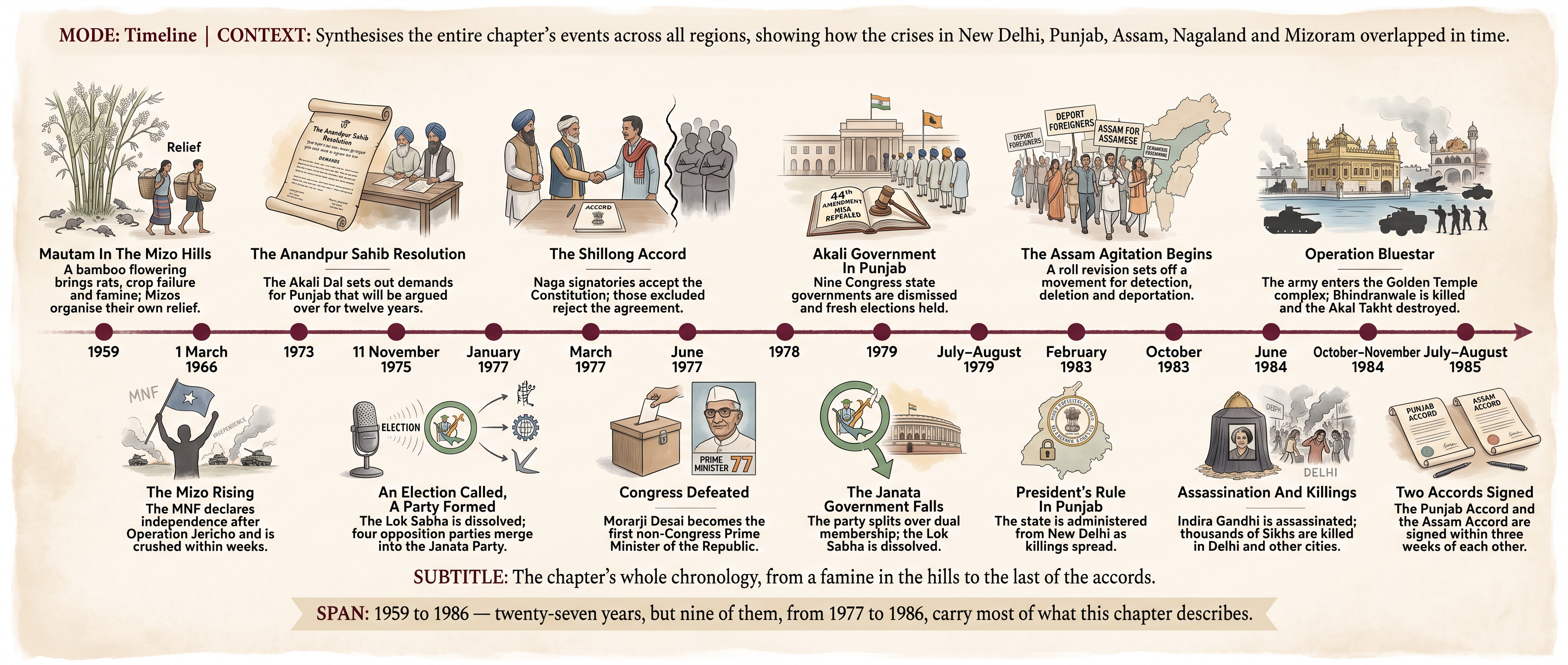
Fig. 4.6 – The Chapter In Order.
What The Evidence Cannot Tell Us
This chapter rests on documents made by organisations with something at stake: election returns, party resolutions, government white papers, commission reports, administrative registers and newspapers. Each records what its maker needed recorded, and stops there.
So the returns count votes but not reasons; the electoral roll counts names but cannot say where anyone was born; the grouping records count households moved but not what the move cost them; and for June 1984 and February 1983 there is no independent count of the dead at all.
The people at the centre of these events — the pilgrim in the temple complex, the family in the burnt village, the household resettled beside a road in the Mizo hills — mostly left no written record of their own. Where their side of it survives, it survives as memory, gathered long afterwards by people who went looking for it.
4.8 Check Your Memory
Name the four parties that dissolved themselves into the Janata Party in January 1977, and state the single change the Forty-fourth Amendment made to the ground on which a national emergency may be proclaimed.
The Assam Accord fixed two dates. State them, and explain what was to happen to people who had entered Assam before the first, between the two, and on or after the second.
The Akali Dal formed the government of Punjab in 1977 and left office in 1980 with none of its main demands met. Explain why holding power in the state made so little difference to those demands.
Trace the steps by which the bamboo flowering of 1959 in the Mizo hills led to the founding of a political organisation. At which step does the chain stop being about ecology and start being about politics?
Using Fig. 4.0, reconstruct in order the stages by which a government elected with a large majority in March 1977 reached dissolution in August 1979. For each stage, say whether the cause lay in the economy or inside the party itself.
Distinguish between a demand for autonomy and a demand for secession as this chapter defines them. Then place the Anandpur Sahib Resolution of 1973 and the Naga declaration of 14 August 1947 on that scale, giving your reasons for each.
Read Source 4.2 again. Explain how the Akali Dal and the Union government each supported opposed readings from the same words, and then state one thing the extract itself cannot settle.
Using Map 4.2, locate Chandigarh, the Ravi, the Beas and the Sutlej, and the line of the canal begun in 1982. Explain how the map helps you understand two of the Akali Dal’s demands in a way that a written list of those demands would not.
The chapter states that there is no independent count of those who died in the Golden Temple complex in June 1984, and treats the figure for Nellie in February 1983 with the same caution. Explain why such counts do not exist, and what a historian can and cannot claim as a result.
Historians disagree about the rise of Bhindranwale: one reading holds that he was encouraged by Congress leaders in order to divide the Akali vote, the other that he grew out of a village revival that no party in Delhi created or controlled. Set out the case for each, and state what evidence would help you decide between them.