Chapter 6: Movements For Women’s Rights
Every ten years, India counts its people. The census asks plain questions — how many live in this house, how old are they, can they read — and its answers fill volumes that almost nobody reads for pleasure.
In 1972 a committee appointed by the Government of India began reading them closely. Its members had been asked to find out how women in independent India were actually living. They spent the next two years travelling, holding public hearings, and gathering evidence from women in villages, towns and factories. Beside that testimony they set out one long column of census figures: the number of women in India for every thousand men, decade after decade.
The line did not rise. In 1901 there were 972 women for every thousand men. In 1971 there were 930. Across seventy years of new hospitals, new schools and a new Constitution promising equality, the share of women in the population had fallen, steadily, in ten-year steps.
Nothing in biology explains that. Slightly more boys than girls are born, but girls, once born, survive at least as well as boys. A falling ratio therefore points not to nature but to how families and the state treated daughters — how they were fed, when they were taken to a doctor, whether they were wanted at all.
The committee’s report appeared in 1974 under the title Towards Equality. That title was a statement about distance.
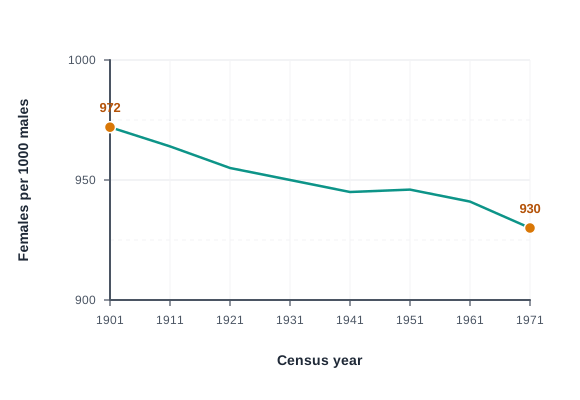
Fig. 6.0 – Females per thousand males in India, 1901–1971.
6.1 Why A Committee On The Status Of Women Was Appointed
Independent India began with an unusual promise. In much of the world, women had won the vote in stages, and only after long campaigns. In India, the vote came to women and men together, at the moment the Republic was founded, and equality between the sexes was written directly into the Constitution.
That promise was made in 1950. By the end of the 1960s, nobody could say with confidence what it had actually changed. Laws had been passed, schools had been opened, and five-year plans had been written. Whether any of this had reached the majority of Indian women was a question no government had yet answered with evidence.
The Committee on the Status of Women in India was appointed to answer it. Its report, Towards Equality, is the starting point of this chapter, and it is also the starting point of a great deal of what followed in the 1970s and 1980s.
6.1.1 The Constitutional Promise And The Reality
What The Constitution Guaranteed
The Constitution that came into force on 26 January 1950 does not treat women as a separate category of citizen. It guarantees equality before the law to every person, and it forbids the State from discriminating against any citizen on the ground of sex.
Article 15 is the clearest statement of this. It names sex alongside religion, race, caste and place of birth as a ground on which the State may not discriminate. A later clause of the same Article allows the State to make special provisions for women and children, so that measures taken in their favour are not themselves struck down as discrimination.
Alongside these enforceable rights sit the Directive Principles of State Policy — goals written into the Constitution to guide governments, but which a citizen cannot take to court. Two of them speak directly to women: that men and women equally should have the right to an adequate means of livelihood, and that there should be equal pay for equal work.
Why The Promise Was Hard To Check
Legislation followed in the 1950s and 1960s. Marriage and inheritance law was reformed, a civil marriage law was made available across communities, and in 1961 Parliament passed a law against dowry, which the later part of this chapter examines closely.
The difficulty was that nobody knew what any of it had done. Statistics on women were scattered across the census, labour records, health returns and school registers, collected for different purposes and never brought together. Reform was measured by the number of Acts passed, not by any change in how women lived.
6.1.2 The Terms Of The Enquiry
How The Committee Came To Be Appointed
In September 1971 the Ministry of Education and Social Welfare appointed the Committee on the Status of Women in India. It was chaired by Dr Phulrenu Guha, and its member-secretary, who directed much of the research, was Vina Mazumdar. The committee began its work in 1972.
There was an international push behind the appointment as well as a domestic one. The United Nations had asked member states to report on the position of women in their own countries, and 1975 had been designated International Women’s Year. India’s committee was set up in that climate, but the questions it chose to ask were its own.
What The Committee Was Asked To Do
A committee of this kind is given terms of reference — the written list of questions it is appointed to answer, which fixes what it may investigate and what it may recommend. The terms given to this committee were wide.
It was asked to examine the constitutional, legal and administrative provisions that affected the social status of women. It was asked to assess what those provisions had actually achieved, particularly in education and in employment. It was asked to study how the process of development itself had affected women. Finally, it was asked to suggest measures that would allow women to play their full part in the building of the nation.
Read carefully, those terms contain an assumption worth noticing. The committee was not asked whether women’s condition had improved. It was asked how far the promises had been kept — which is a harder question, and one that invites an unflattering answer.
How It Gathered Its Evidence
The committee did not work only from files. Over roughly two years its members travelled through the states, held public hearings, and took evidence directly from women — in villages, in towns, in factories and in offices. Written memoranda came in from organisations and individuals. Specialists were commissioned to study particular questions.
That testimony was then set against the official record: census tables going back to 1901, sample survey data on employment, literacy figures, and health statistics. The strength of the report comes from this pairing. Testimony gave the committee the questions; the statistics told it whether what one woman described was happening to millions.
The report was completed in 1974 under the title Towards Equality: Report of the Committee on the Status of Women in India. What it found is the subject of the next section.
6.2 Towards Equality: What The Committee Found
The committee had expected to write a progress report. What it produced was closer to a warning. Across education, work, health, law and politics, it found that the gains of the previous twenty-five years had gone to some women and passed most of them by.
Three findings gave the report its force. The proportion of women in the population was falling. Most of the work women did was not counted as work at all. And the machinery meant to deliver equality — laws, schemes, plans — was reaching the women who needed it least.
6.2.1 Numbers That Did Not Add Up
Why The Figure Mattered
A falling sex ratio is not a statement about births. Slightly more boys are born than girls in almost every human population. Where girls are fed, treated and taken to a doctor on the same terms as boys, they survive at least as well, and the ratio moves towards balance rather than away from it.
India’s ratio was moving the other way. The committee read this as evidence of differential treatment — of girls and women dying earlier than they needed to, in numbers large enough to bend a national statistic. It pointed to the same period in which women’s life expectancy in India remained below men’s, at a time when women outlived men in most of the world.
6.2.2 Work, Education And Health
The Work That Was Not Counted
The census records a person as a worker on the basis of a definition, and definitions decide what becomes visible. A woman who spent her day transplanting paddy on the family’s field, tending its animals, husking its grain and carrying its water was very often recorded as a housewife, because none of that work carried a wage.
The committee argued that this was a measurement failure with real consequences. Work that is not counted is not planned for. If official figures show few women in the economy, then training schemes, credit and technology are designed for men, and the women who are in fact producing food and goods are handed nothing.
At the same time, the work participation rate — the share of a group recorded as economically active — was falling for women in exactly the sectors that were being modernised. Machines came into the processing of rice and grain, into textiles, into mining; the jobs that vanished first were the ones women had held.
Schooling And Literacy
Independent India had opened schools rapidly, and the number of girls in classrooms had risen. The committee’s point was that a rise from a very low base still leaves a very low figure. At the 1971 census barely one woman in five was recorded as literate, against roughly twice that proportion of men.
The gap also widened as the ladder went up. Girls were withdrawn at the point where schooling began to cost the family something — a fee, a journey, a daughter’s labour at home, or a delay in her marriage. Enrolment figures counted admissions; they did not follow the girl who stopped coming after Class 5.
Health, Nutrition And Marriage
On health the committee found a pattern consistent with the sex ratio. Women ate last and least in many households, went to a doctor later than men, and bore children early and often, with maternal deaths remaining common.
Child marriage was a part of this, and it persisted despite being restrained by law since 1929. Here the committee made a general point that runs through the whole report: a practice that a community regards as normal is not ended by an Act that nobody is prosecuted under.
6.2.3 Political And Economic Participation
The Vote And The Legislature
Women in India had voted since the first general election, and they voted in large numbers. What they did not do, in anything like proportionate numbers, was sit in the bodies they elected. Women’s share of seats in Parliament and in the state legislatures stayed small and showed no upward trend.
The committee was blunt about what this meant. Political equality had been achieved as a right and not as a fact. The few women who did reach high office came overwhelmingly from politically established families, which made them a poor guide to what was possible for women in general.
A Disagreement Inside The Committee
On the remedy, the committee divided. The majority did not recommend reserving seats for women in Parliament and the state legislatures, holding that reservation would separate women into a distinct political category and would not, in itself, produce leaders with a base of their own. A minority disagreed strongly and said so in the report.
The committee did favour bringing women into the structures of local government, where decisions about water, schooling and village works are actually taken. That the disagreement was printed rather than smoothed over is one reason the report has kept its authority.
What The Findings Added Up To
Taken together, the findings pointed at something larger than any single problem. The process of development itself — new machinery, new employment, new institutions — had not been neutral between men and women. It had opened opportunities mainly to men and closed older ones to women.
That is why Towards Equality is treated as a break rather than as one more official publication. It shifted the question from what should be done for women to why what had already been done had not worked.
6.3 The Recommendations And The Significance Of The Report
A committee that only describes a problem can be thanked and shelved. Towards Equality ended with recommendations, and it is worth reading them as a set, because they follow from the diagnosis rather than sitting loosely beside it.
The committee had found that formal rights existed but were not reaching women. Its proposals therefore concentrated less on granting new rights than on closing the distance between a right and its use.
Law And Marriage
The first cluster concerned law. The committee wanted existing legislation enforced rather than merely enacted, and it wanted the practical obstacles to enforcement removed.
It recommended compulsory registration of marriages, so that the age of a bride and the fact of an earlier wife could be established from a record instead of a memory. It pressed for a uniform minimum age of marriage, and for monogamy to apply to all communities. It also wanted the law against dowry, which had been on the statute book since 1961, actually used.
The link between registration and enforcement is worth pausing on. A law that forbids marriage below a certain age is unusable if nobody can prove how old the bride was. The committee’s recommendations were often of this unglamorous, procedural kind.
Work, Statistics And Training
The second cluster followed from the finding on uncounted work. The committee wanted the definitions used in official statistics changed, so that women working unpaid on family land or in family enterprise appeared in the count.
Alongside this it recommended enforcement of equal pay, protection of maternity benefits, and training and organisation for women in the unorganised sector — the vast field of work outside registered factories and offices, where there is no employer to inspect and no register to check.
Education And Local Government
On education the committee wanted the target of universal elementary education taken seriously for girls specifically, with adult literacy programmes aimed at women who had already been left out of school.
On politics, as the previous section described, the committee’s proposal ran through local government rather than the legislature. It recommended statutory women’s panchayats at village level — elected village councils, here composed of women, with funds of their own for work in the village. The reasoning was that women would gain political experience where the decisions touched their daily lives.
Finally, it asked for permanent machinery inside government to monitor the status of women, so that the country would not have to wait another twenty-five years to discover what had happened.
Why The Report Mattered
It Changed The Question
Before 1974, government thinking about women in India ran largely through the language of welfare: women as a weaker section to be assisted. Towards Equality replaced that with the language of rights denied and promises unkept. The women in its pages are citizens who are owed something, not beneficiaries who are being helped.
That shift is the report’s largest single effect, and it can be traced in what came afterwards. Equal remuneration for men and women became the subject of a Central law in 1976. The Sixth Five Year Plan, covering 1980 to 1985, carried a separate chapter on women and development, the first time national planning treated women as a subject in their own right rather than as a heading under social welfare.
It Gave The Movement Its Evidence
The report also created a body of hard information that had not existed before. Activists, journalists and lawyers arguing about dowry, wages or schooling in the later 1970s could now point to an official document, prepared by a government committee, that agreed with them about the facts.
This mattered for the campaigns described in the rest of this chapter. A protest that says women are treated badly can be dismissed as an opinion. A protest that says the government’s own committee found the sex ratio falling and its own laws unenforced is much harder to answer.
The research itself continued after the committee dissolved. Scholars who had worked on it went on to build the study of women’s condition into a recognised field in Indian universities, with dedicated research centres from 1980 onwards.
6.3.1 What The Report Did Not Reach
The Limits Of Its Frame
No enquiry sees everything, and it is worth being precise about what this one missed, because the gaps shaped what women’s organisations had to take up themselves.
The report’s centre of gravity lay in the public realm: schooling, employment, wages, law, political representation. Violence inside the home was not the category around which it was built. Dowry appears in its pages as a social evil and a legal failure, but the specific pattern that dominated the next decade — young married women dying in their husbands’ houses — had not yet become a public issue, and the report did not anticipate it.
Its picture of women who had been educated was also thin. The committee documented the exclusion of women from schooling and work with great care. It had much less to say about the graduate whose family decided she would not take the job she had qualified for, because that woman appears in no statistic as deprived.
The Limits Of Its Power
There was a second kind of limit, and it had nothing to do with the committee’s insight. A committee reports; it cannot legislate, budget or prosecute. Its recommendations were advisory, and several of the most important were not acted on for years.
The committee also worked from official statistics whose weakness it had itself exposed. Having shown that the count of women workers was wrong, it still had to reason from that count, because no better one existed.
6.4 The Dowry System In Post-Independence India
The second half of this chapter turns from a report to a movement. To follow what women’s organisations were fighting about in the 1970s and 1980s, it is necessary first to be exact about the practice they were fighting.
Dowry is property or money transferred from a bride’s family to the groom or his family in connection with her marriage. The transfer may be cash, jewellery, furniture, household goods or a vehicle. It may be handed over at the wedding, promised before it, or demanded long afterwards.
Parliament had already put a definition on the statute book. The Act of 1961, which the last section of this chapter examines in full, opens by saying what it means by the word.
The clauses that follow this opening line cover a transfer by either party to the marriage, by the parents of either party, or by any other person, made in connection with the marriage. The Act expressly excludes mahr, the sum a Muslim husband settles on his wife under her own personal law, which moves in the opposite direction and belongs to her.
A Gift, Or A Claim?
Older practice in many communities involved stridhan — literally a woman’s wealth, the jewellery and goods given to a bride which remained her own property and over which she, not her husband’s family, had rights. What spread in the twentieth century was different in the two ways that matter most.
First, the property moved to the groom’s household rather than staying with the bride. Second, the handing over of goods at the wedding stopped being the end of the matter. Demands could continue for years after the marriage, with the wife living in the household that was making them.
Why It Spread When It Did
Nothing about the decades after independence made dowry inevitable, and it is worth resisting the idea that it is simply an ancient custom that survived. The practice was expanding in this period, into regions and communities where it had not been usual, and the demands themselves were growing.
Two changes fed it. Salaried employment and higher education created a visible ranking of grooms, and a family that had spent on a son’s degree or secured him a government post could ask more for him. At the same time, the range of goods a household might want — furniture, a scooter, later a refrigerator or a television — grew rapidly.
A third factor lay in the law of inheritance. Daughters had been given rights in family property by legislation in the 1950s, but in practice dowry was often treated as a daughter’s share, handed over at marriage in place of any claim on the family’s land or house afterwards. What was described as her portion functioned as her disinheritance.
What The Practice Cost
The immediate cost fell on the bride’s family, which might borrow, sell land or spend a decade’s savings to marry a daughter. Families with several daughters faced the prospect repeated.
The heavier cost fell on the bride. A woman who arrived in a household that considered itself short-changed was in a weak position from the first day. Where demands continued after the wedding, pressure on her was the instrument for extracting them: taunting, confinement, denial of food, and beating. In the worst cases the harassment ended in her death — sometimes by suicide, sometimes by killing that was presented afterwards as a kitchen accident.
This is where the earlier part of the chapter and this part meet. A committee reading census tables had found that daughters were surviving less well than sons. A practice that made a daughter an expense to be met, and a young wife a lever to be used, is one of the reasons a girl was less wanted in the first place.
A Practice, Not A Crime Wave
One caution before the next section. Almost every account of these decades, including the language of the law itself, speaks of dowry deaths, and it is right to name that harm plainly. But dowry in this period was ordinary rather than exceptional. It was negotiated openly between respectable families, discussed in marriage advertisements, and defended as custom by people who would have been shocked to be called criminals.
That is precisely what made it hard to fight. The women’s organisations of the 1970s were not chasing a few violent households. They were arguing against something their own neighbours regarded as normal, and in many cases had themselves paid or received.
6.5 The Anti-Dowry Movement Of The 1970s And 1980s
Movements rarely begin with a national organisation and a plan. This one began with small groups of women in particular cities, working on what was in front of them, and only later discovering that they were part of something larger.
Its rise was closely tied to the report examined earlier in this chapter. Towards Equality appeared in 1974, and the first campaigns date from the year after. The report supplied the facts; what the groups supplied was the insistence that these facts were somebody’s fault.
6.5.1 From Hyderabad To Pune To Delhi
The First Campaigns
The Progressive Organisation of Women, formed in Hyderabad, launched a campaign against dowry in 1975. It treated dowry and violence inside the home as one problem rather than two, which was itself a departure from the older welfare approach.
In the same year a conference in Pune brought together women from a range of backgrounds under the banner of the Women’s Liberation Movement Coordination Committee. Young educated women, industrial workers, women in the unorganised sector, teachers and writers set out their demands there, and the meeting led to the founding of Purogami Stree Sangathan. In Bombay, Stree Mukti Sangathan had been formed in 1974 and had begun organising open protests against dowry.
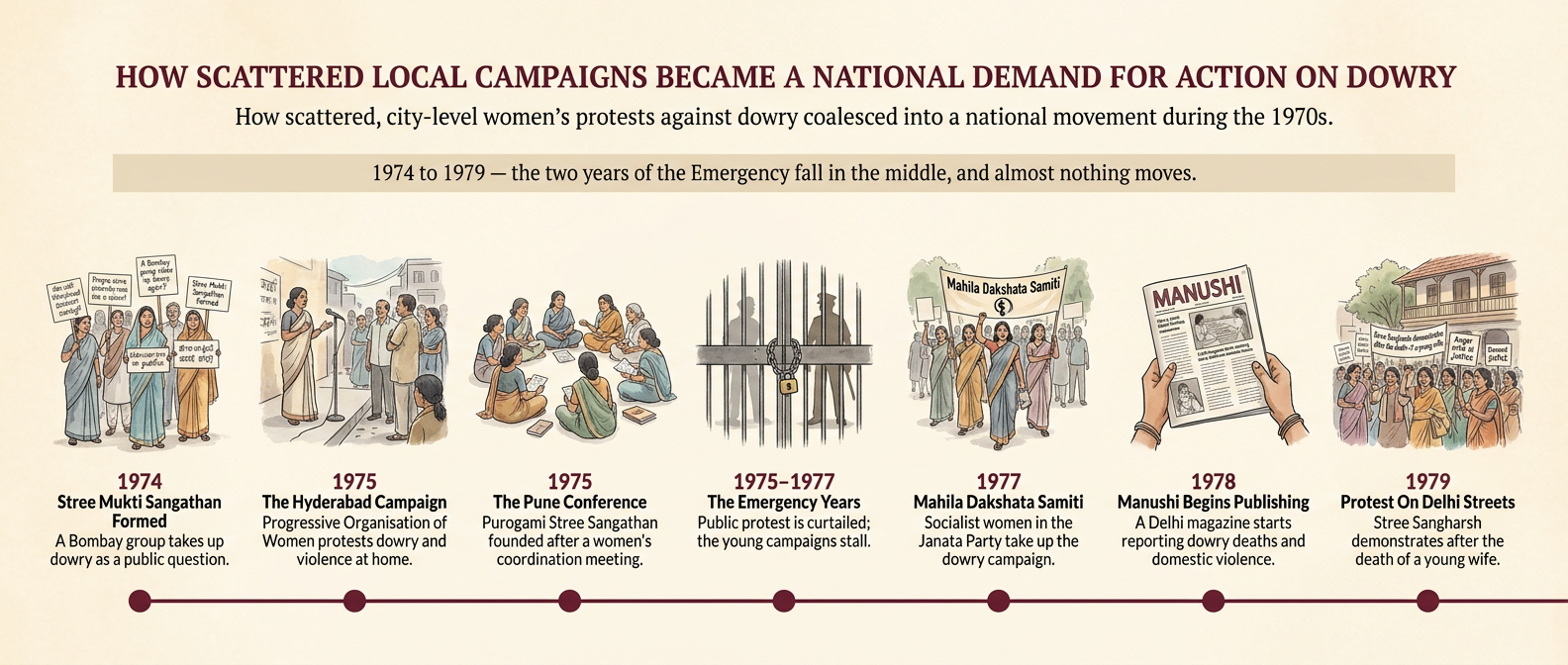
Fig. 6.1 – The Movement Takes Shape.
The Emergency Interrupts
These protests did not grow into a sustained campaign in the mid-1970s, and the reason lay outside the movement. The Emergency was imposed in June 1975 and public agitation of every kind was curtailed until it was withdrawn in 1977. The groups survived; the campaigns did not.
When the restrictions were lifted, the movement resumed in a different city and with a sharper focus. From 1977 a campaign against dowry gathered in Delhi, and it took as its subject the violence done to young married women — beatings, harassment sustained over years, deaths by burning, and women driven to suicide.
Two organisations were central in these years. Mahila Dakshata Samiti was formed in 1977 by women in the Janata Party, most of them from a socialist background, and it played a leading part in launching the campaign. Stree Sangharsh worked to bring dowry-related crimes to public notice, organising demonstrations against domestic violence and dowry deaths.
6.5.2 The Organisations And Their Methods
Who Was Organising
By the end of the 1970s a number of groups were working on dowry, and they came from strikingly different political homes. Nari Raksha Samiti, whose name means women’s rescue committee, mounted large demonstrations that set off public debate about dowry and dowry-related crime. Dahej Virodhi Chetna Mandal was formed specifically to build awareness against the practice.
Party-linked organisations worked alongside these. Janwadi Mahila Samiti, associated with the women’s organisation of the Communist Party of India (Marxist), ran a door-to-door campaign, taking the argument into individual households rather than waiting for people to come to a meeting.
This variety is part of the history. Socialists, communists, autonomous feminist collectives and professional women’s associations disagreed about a great deal, and on dowry they found they could act together.
How They Worked
The methods were chosen for a problem the police would not touch and the courts rarely saw. Groups held debates and conferences to argue the issue out. They organised public demonstrations, including outside the houses of families whose daughters-in-law had died. They put up posters and held public meetings.
Street theatre became one of the most effective instruments. Performed in a market or a colony without a stage or a ticket, a play could reach an audience that would never read a pamphlet, and it dramatised dowry harassment and dowry deaths in order to shame the practice rather than to entertain.
Publishing mattered as much. Manushi, a Delhi-based magazine on women and society founded in 1978, printed case after case of dowry harassment and violence in the home and organised public meetings around them. Reporting a death by name, with the household named, made it a fact on record instead of a rumour in a lane.
The groups also worked case by case: standing with a woman’s parents at the police station so that a complaint was written down, sitting through hearings, and following what happened to a case after the press had moved on.
Finally, they made the demand personal. Meetings ended with men and women pledging that they would neither give nor take dowry — a small act, but one aimed at the fact established in the previous section, that this was a normal practice among ordinary respectable families.
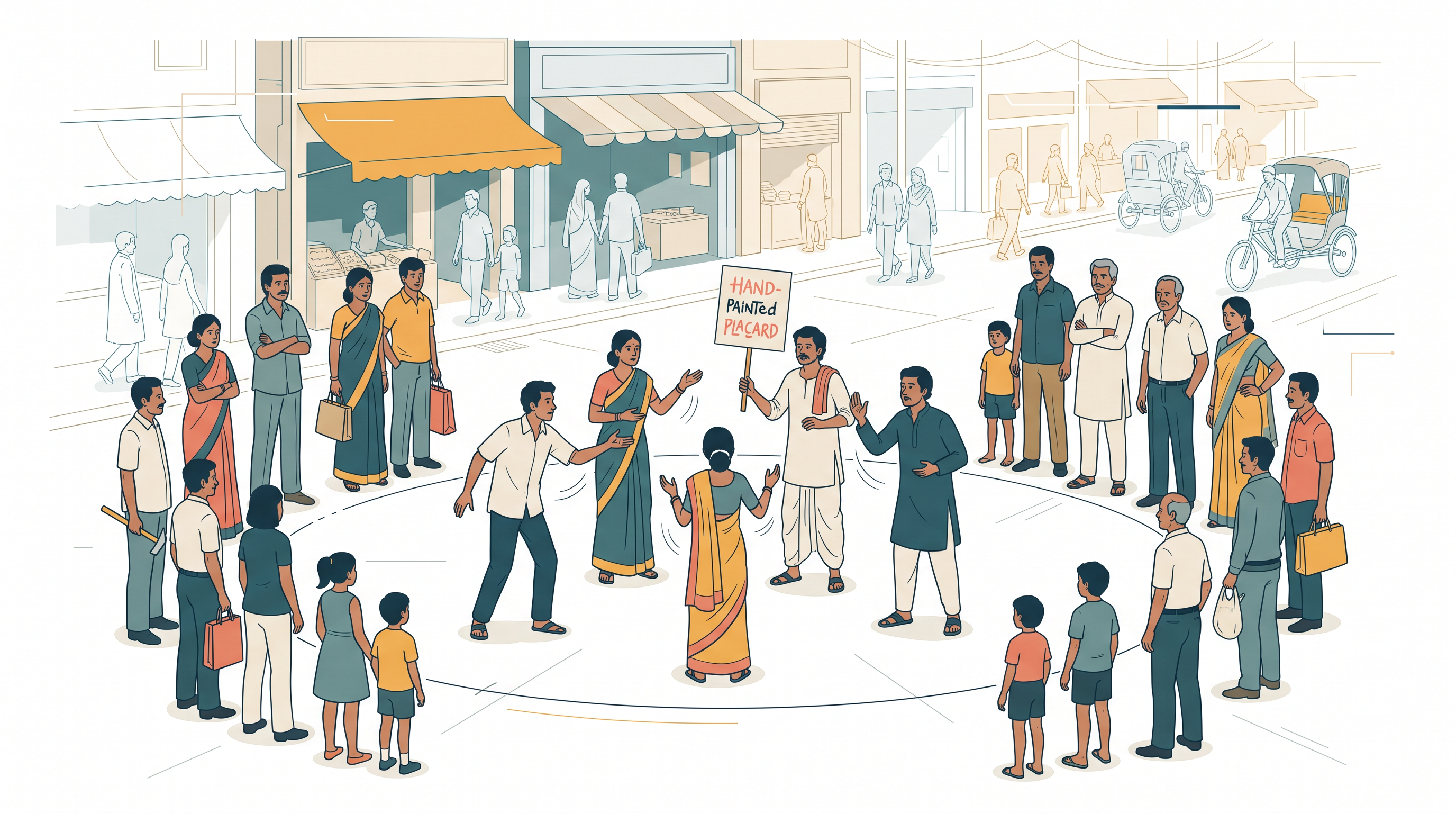
Fig. 6.2 – A street-play performance.
Where The Cities Were
The campaigns of these years were urban and were concentrated in a handful of cities — Delhi, Bombay, Hyderabad, Bangalore, Ahmedabad, Madras and Pune. Map 6.1 shows where they were. That distribution reflects where colleges, printing presses, newspapers and salaried employment were, and it is also a limit on the movement, which reached the towns long before it reached the villages.
Map
Map 6.1 Caption: Cities where women’s organisations campaigned against dowry and domestic violence in the 1970s and 1980s. Brief: Political map showing the full extent of India as officially defined, with state boundaries as they stood in the 1980s; mark and label only Delhi, Bombay, Pune, Ahmedabad, Hyderabad, Bangalore and Madras, using these city names with a key note that several have since been renamed; shade nothing and add no arrows or movement lines.
From Protest To Law
By the early 1980s the campaign had a second target. Public shaming could reach one household at a time; changing the law reaches all of them. The groups began pressing for offences that the police could act on without waiting for a complaint, and for rules of evidence that did not require a dead woman to give testimony.
That demand, and what Parliament did with it, is the subject of the last section of this chapter.
6.6 The Struggle Against Domestic Violence
The campaign described in the last section began with dowry. It did not stay there. By the early 1980s the women’s organisations were arguing about something wider, and harder to name in law: violence done to a woman by the people she lived with.
Domestic violence is violent or abusive behaviour that occurs within the home, usually by a spouse, a partner or a relative. It covers physical assault, sexual abuse, and psychological and emotional abuse — threats, humiliation, isolation and control sustained over years.
Not all of it was connected to dowry. A demand for goods was one occasion for violence, and it was the occasion that first made violence visible, because a death at least produced a body and sometimes a newspaper report. But women’s organisations found, as they took up case after case, that beating and abuse continued in households where nothing was being demanded at all.
Why It Was Not A Public Question
The Threshold Of The House
The chief obstacle was an idea rather than a statute: that what happened inside a family was that family’s own business. A quarrel between husband and wife was thought to belong to a different order of things from an assault in the street, even where the injuries were identical.
The police acted on the same understanding. A woman who came to a station was commonly advised to go home and adjust, and the matter was recorded as a domestic quarrel, if it was recorded at all. Relatives on both sides usually agreed with the advice, since a complaint threatened the marriage and, with it, the standing of two families.
Nowhere To Go, Nothing To Live On
The second obstacle was material. A woman who left had to have somewhere to go and something to live on, and most had neither. Property was in her husband’s or her father-in-law’s name. Her own labour, as the earlier part of this chapter showed, was frequently unpaid and unrecorded, so she had no earnings of her own and no claim to any.
Her parents’ house was often not an option either. A returned daughter was widely regarded as a disgrace, and in a family that had already paid a dowry she was also an expense that had been settled once and was now back.
Making The Violence Visible
Counting What Nobody Counted
Women’s organisations took on the work of documentation. They kept records of the women who came to them, published accounts of individual cases, and set the cases side by side so that a pattern could be seen where each family saw only its own misfortune.
This is how a private misery becomes a public fact. Twenty separate tragedies are twenty accidents; twenty cases with the same shape — a young wife, a household making demands, injuries over months, a death recorded as accidental — are evidence of something systematic.
Shelter, Counselling And Advice
Alongside publicity the organisations built practical support, because a woman persuaded to complain still had to survive the consequences. Short stay homes offered a place to live for a limited period. Family counselling centres, legal aid cells and helplines gave advice on maintenance, custody and the filing of a complaint.
These services were small in scale against the size of the problem, and they depended on grants and volunteers. Their importance was that they existed at all: for the first time there was somewhere outside the family to take the question.

Fig. 6.3 – Campaign poster against domestic violence.
What The Movement Demanded
Out of this work came a set of demands aimed squarely at the law, and they are worth stating precisely, because the next section is about how far Parliament met them.
The organisations wanted cruelty by a husband or his relatives made an offence in its own right, so that a woman did not have to wait until she was gravely injured before anything could be done. They wanted such offences made ones the police could act on without a magistrate’s permission and without the accused walking out on bail the same day.
They wanted the law to take account of the circumstances of a young wife’s death — the fact that the only witnesses were the household accused, and that the woman herself could no longer testify. And they wanted remedies that did not require a criminal trial at all: a right to stay in the shared home, a maintenance order, an order restraining a violent husband.
The first three of these were addressed in the 1980s. The fourth waited much longer.
6.7 The Government’s Response In Law
Governments answered the movement mainly in one currency: legislation. Between 1961 and 1986 Parliament built up a body of dowry law, and in the 1980s it added new offences to the criminal law aimed specifically at what happened to married women in their husbands’ households.
Reading these Acts in sequence is the clearest way to see what the campaigns achieved, because each amendment is a response to a defect that the previous law had exposed. Fig. 6.4 sets out the sequence before we take the statutes one by one.
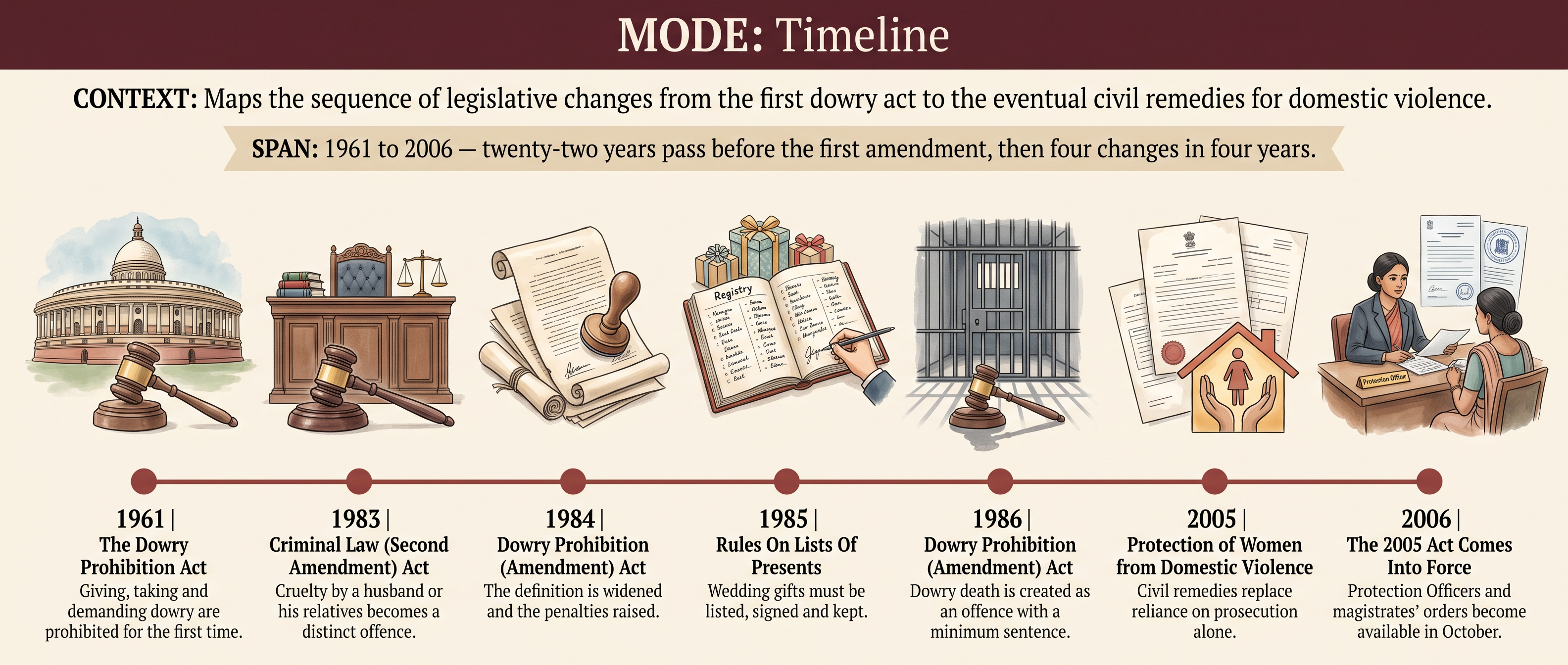
Fig. 6.4 – Legislating Against Dowry And Violence At Home.
6.7.1 The Dowry Prohibition Act And Its Amendments
The Act Of 1961
The Dowry Prohibition Act, 1961 was the first All-India legislative enactment against dowry, and it came into force on 1 July 1961. It prohibited giving dowry, taking dowry and demanding it, and it defined the practice in the broad terms already met in Source 6.2.
For its time this was a serious statement of intent. Parliament had declared that a transaction most families regarded as ordinary was unlawful.
Why It Failed
The Act failed almost completely for twenty years, and the reasons are worth setting out, because the movement’s demands were shaped by them.
The definition itself contained the first flaw. As originally passed, the Act covered property given ‘in consideration of’ the marriage. A family could therefore insist that nothing had been given as a condition of the wedding, and that everything handed over was a voluntary gift to a beloved daughter — a defence that was almost impossible to disprove.
The penalties were small. The prosecution had to be launched within a short period, and the offence could not be investigated by the police on their own initiative. Above all, the burden of proving that dowry had been given lay on the person complaining.
That last point was decisive. The only people who could give evidence of a demand were the bride, her parents and the household that had made it. The bride was living in that household; her parents wanted the marriage to survive; and if she had died, the sole surviving witnesses were the accused.
The Amendment Of 1984
The Dowry Prohibition (Amendment) Act, 1984 was passed to close these gaps. It replaced the words ‘in consideration of’ the marriage with ‘in connection with’ the marriage, so that the voluntary-gift defence no longer worked.
It raised the punishments for giving, taking and demanding dowry, and prescribed a minimum term of imprisonment for the first time. It also strengthened the requirement that any dowry which had in fact been received be transferred to the woman herself, and eased the procedural conditions that had made a prosecution so difficult to begin.
The following year the government framed the Dowry Prohibition (Maintenance of Lists of Presents to the Bride and Bridegroom) Rules, 1985. Presents given at a marriage were to be entered in a list, with the value and the giver recorded, and the list signed by both parties. The purpose was evidential: to create, at the time of the wedding, a document that could later distinguish a gift from a demand.
The Amendment Of 1986
The 1984 changes were still not enough, and Parliament returned to the subject two years later. The Dowry Prohibition (Amendment) Act, 1986 fixed the punishment for giving or taking dowry at not less than five years, with a fine of not less than fifteen thousand rupees or the value of the dowry, whichever was greater. Demanding dowry was made punishable with not less than six months and up to two years.
Two further changes mattered as much as the sentences. The Act shifted the burden of proof onto the person accused of taking or demanding dowry — a reversal of the ordinary rule, made because of the practical difficulty described above. And it provided for the appointment of Dowry Prohibition Officers to enforce the Act, so that enforcement no longer depended entirely on a family willing to complain.
The same amendment inserted the offence of dowry death into the Indian Penal Code, which 6.7.2 examines.
6.7.2 Changes In The Criminal Law
Cruelty As An Offence
The Criminal Law (Second Amendment) Act, 1983 met the movement’s first demand directly. It inserted Section 498A into the Indian Penal Code, making cruelty by a husband or his relatives towards a wife a distinct offence, punishable with imprisonment up to three years and a fine.
Two features of the new offence mattered as much as its existence. It was made cognizable, meaning the police could register a case and investigate without a magistrate’s order, and non-bailable, meaning release was not a matter of right. A corresponding provision was added to the Code of Criminal Procedure so that a court could take up such a case on a police report or on a complaint by the woman or her close relatives.
The 1983 Act also added a presumption to the law of evidence: where a married woman died by suicide within seven years of her marriage and had been subjected to cruelty by her husband or his relatives, a court might presume that they had abetted it.
The Offence Of Dowry Death
The 1986 amendment then created the offence the campaigns had been demanding since 1979. Under Section 304B of the Indian Penal Code, where a woman dies of burns or bodily injury, or otherwise than in normal circumstances, within seven years of her marriage, and it is shown that she had been subjected to cruelty or harassment by her husband or his relatives in connection with a demand for dowry soon before her death, the death is called a dowry death. The punishment is imprisonment for not less than seven years, extending to imprisonment for life.
A matching presumption was added to the law of evidence. Where those circumstances are established, the court is to presume that the husband or the relative concerned caused the death.
The reasoning behind this design should be clear from the last section. The ordinary criminal law asks the prosecution to prove what happened in a room to which it has no access. Section 304B changes the question: once the surrounding facts are proved, it is for the household to explain the death rather than for the dead woman’s family to reconstruct it.
What The Criminal Law Could Not Do
These provisions were real gains, and the movement had won them. Their limits appeared quickly.
A prosecution begins after the harm. It requires a police station that will register the case, an investigation that collects evidence at the time, and a trial that ends within a useful period. It offers nothing at all to the woman who is being beaten now and wants it to stop without her husband going to prison and her children losing a home.
6.7.3 Protection From Domestic Violence
A Different Kind of Remedy
The fourth demand of the 1980s — remedies that did not depend on a criminal trial — was met only in the following century. The Protection of Women from Domestic Violence Act was passed in 2005 and came into force in October 2006.
Its approach is civil rather than criminal. It defines domestic violence widely, covering physical, sexual, verbal, emotional and economic abuse, and it allows a woman to apply to a magistrate for orders: a protection order restraining further violence, a residence order securing her right to remain in the shared household, monetary relief, custody of children and compensation. Protection Officers were created to help her make the application and to place her case before the court.
The change of instrument is the point. The Act does not ask a court to decide whether someone should go to prison. It asks what a woman needs in order to be safe, and it can order it.
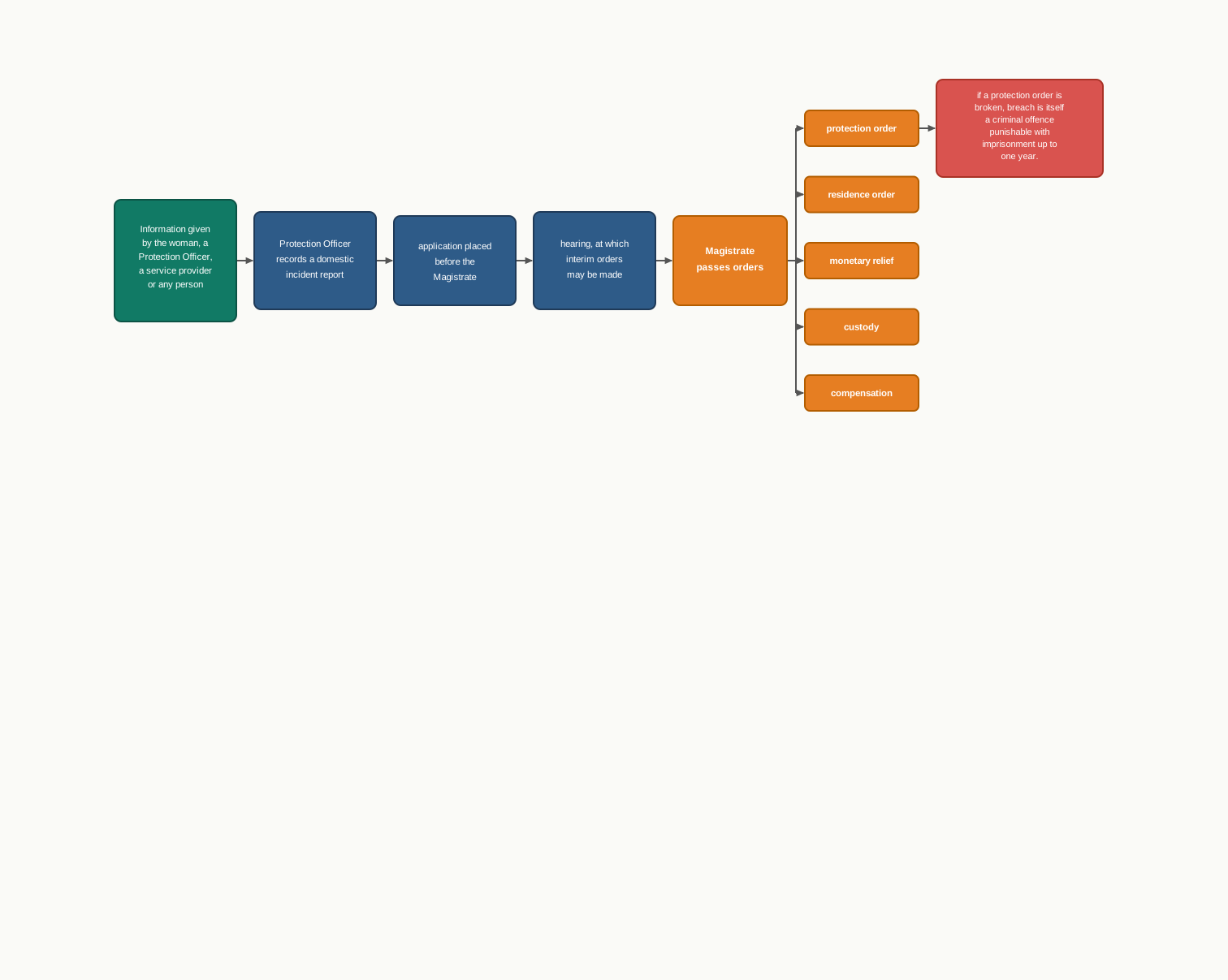
Fig. 6.5 – How a complaint moves under the 2005 Act.
The Distance Still To Go
It would be wrong to close this chapter with a law and call the matter settled. Dowry is still given and taken across much of India, negotiated in the same open way, and prosecutions remain a small fraction of the practice. Domestic violence still goes unreported, for the reasons set out in 6.6, most of which no statute can remove.
What the movement of the 1970s and 1980s changed is nevertheless substantial, and it is of a kind that historians can trace. A practice that had been private became a public argument. A death that would have been closed as an accident became something the police were obliged to investigate. And a committee’s finding that the law existed but did not work turned into a decade of pressure to make it work.
Whether that pressure has yet reached the households where dowry is settled is a question this chapter cannot answer. It can only show how the question came to be asked.
6.8 Summary
The Report
- India’s Constitution guaranteed equality and forbade discrimination on the ground of sex from 1950, but by the late 1960s no one had checked, in one place, whether that guarantee had reached women’s lives.
- The Committee on the Status of Women in India was appointed in September 1971 by the Ministry of Education and Social Welfare, chaired by Dr Phulrenu Guha, and began work in 1972.
- Its terms of reference asked not whether women’s condition had improved but how far the constitutional promises had been kept — a harder question, inviting an unflattering answer.
- It gathered evidence in two forms: testimony taken at public hearings across the states, and official statistics running back to the census of 1901. Testimony supplied the questions; the statistics showed whether they described millions.
- The central finding was demographic. The number of women per thousand men fell from 972 in 1901 to 930 in 1971, which pointed to girls and women being fed, treated and cared for worse than boys and men.
- The second finding was about measurement. Most of women’s labour was unpaid work on family land or in family enterprise, so it fell outside the census definition of a worker — and work that is not counted is not planned for.
- Schooling had expanded, but from a very low base, and girls were withdrawn at the point where education began to cost the family something.
- Politically, women voted in large numbers and sat in legislatures in very small ones. The committee divided over reserved seats and printed its disagreement rather than concealing it.
- Its recommendations aimed at closing the gap between a right and its use: registration of marriages, enforcement of existing law, changed statistical definitions, equal pay, education targets for girls, women’s panchayats at village level, and permanent machinery to monitor women’s status.
- Towards Equality, completed in 1974, replaced the language of welfare with the language of rights denied, and gave the campaigns that followed an official document that agreed with them about the facts.
- It could not do everything. Violence inside the home was not the category it was built around, and a committee can recommend but cannot legislate, budget or prosecute.
The Practice And The Movement
- Dowry is property transferred from a bride’s family to the groom’s household in connection with her marriage. It differs from stridhan, which remained the woman’s own, in where the property goes and in the fact that demands often continued for years after the wedding.
- The practice was spreading in these decades rather than merely surviving, driven by a visible ranking of salaried and educated grooms and by a widening range of consumer goods.
- Where dowry was treated as a daughter’s share of family property, it functioned as her disinheritance, since the property passed to her husband’s household and not to her.
- Anti-dowry campaigns began in 1975 in Hyderabad and Pune, following the Bombay organising of 1974; the Emergency of 1975 to 1977 halted them; the movement revived in Delhi from 1977 and sharpened after the demonstrations of 1979.
- The organisations came from unlike political homes — socialist, communist, autonomous and professional — and found they could act together on this one question.
- Their methods answered a problem the police would not touch: demonstrations outside named households, street theatre, posters and public meetings, case-by-case accompaniment to police stations, and reporting in the press and in the magazine Manushi, founded in 1978.
- The campaigns then widened from dowry to violence at home in general, which women’s organisations found continued in households where nothing was being demanded.
- Domestic violence stayed invisible because it was treated as a family’s private business, because complaints were not written down, and because a woman who left had nowhere to go and nothing of her own to live on.
- By documenting cases side by side, organisations turned separate misfortunes into evidence of a pattern — the step that made a public argument possible.
The Response In Law
- The Dowry Prohibition Act, 1961 prohibited giving, taking and demanding dowry, and was almost unusable: gifts could be called voluntary, penalties were slight, the police could not act on their own, and the family reporting a demand was confessing to an offence.
- The Criminal Law (Second Amendment) Act, 1983 made cruelty by a husband or his relatives a distinct offence under Section 498A, cognizable and non-bailable, and added a presumption about a married woman’s suicide within seven years of marriage.
- The Dowry Prohibition (Amendment) Act, 1984 replaced ‘in consideration of’ the marriage with ‘in connection with’ it, raised the penalties, and eased the procedural conditions that had blocked prosecutions.
- The Rules of 1985 required presents at a marriage to be listed and signed, creating at the wedding the evidence a later prosecution would need.
- The Dowry Prohibition (Amendment) Act, 1986 fixed minimum sentences, shifted the burden of proof onto the person accused of taking or demanding dowry, provided for Dowry Prohibition Officers, and created the offence of dowry death in Section 304B, with a matching presumption in the law of evidence.
- Criminal law, however, acts only after the harm and offers nothing to a woman who wants the violence to stop today. The Protection of Women from Domestic Violence Act, 2005, in force from October 2006, answered that with civil remedies: protection orders, the right to remain in the shared household, monetary relief and custody.
- Dowry continues to be given and taken, and most violence at home is still not reported. What the movement changed was that a private practice became a public argument, and a death that would once have been closed as an accident became something the State was obliged to investigate.
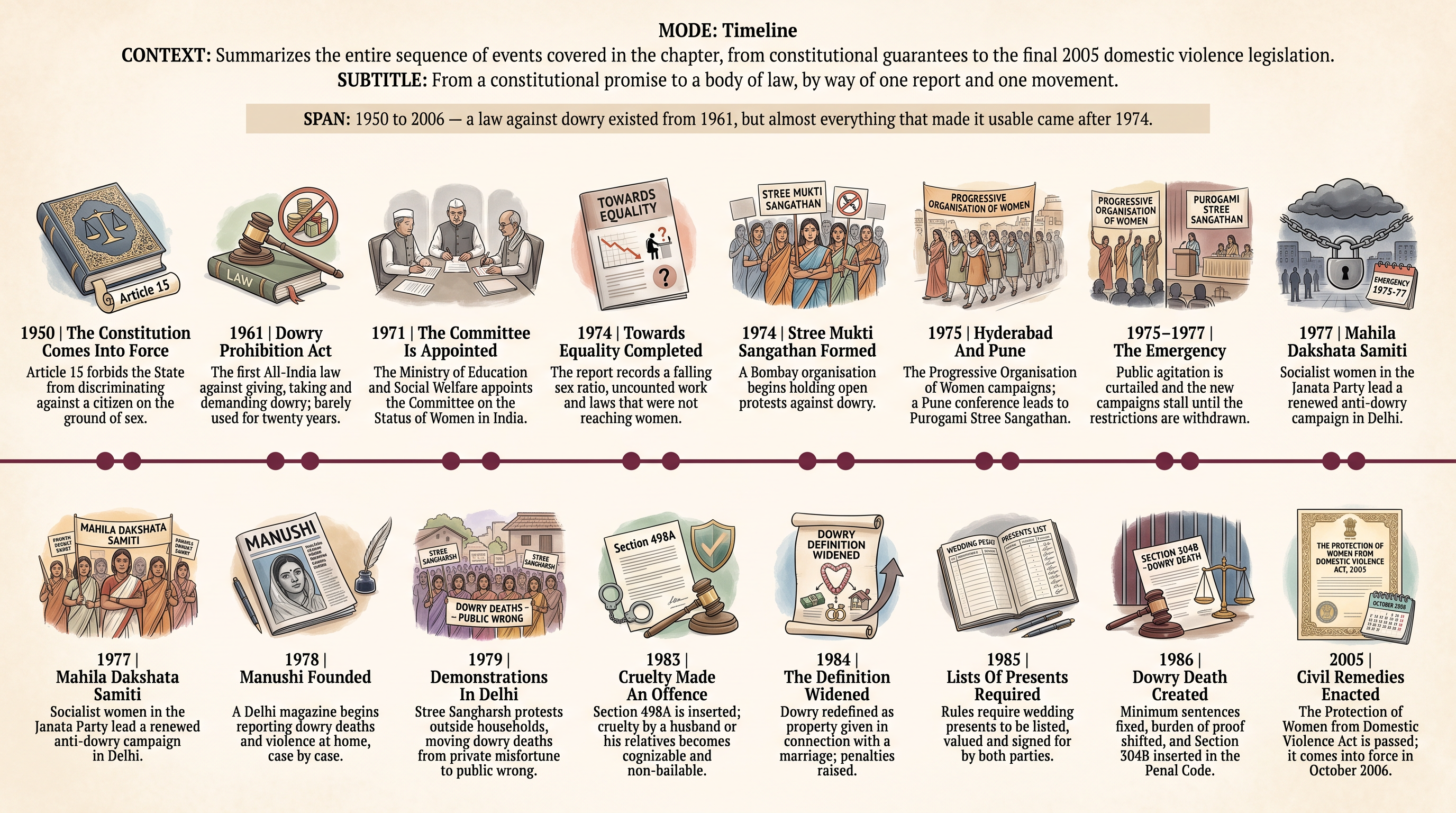
Fig. 6.6 – The Chapter In Sequence.
What The Evidence Cannot Tell Us
The women who gave evidence at the committee’s hearings speak to us through a report written by other people. Their testimony survives as summary and conclusion, not in their own words, so we can recover what was found far more easily than what was said.
The practice itself left almost no records. Dowry was settled in conversations between families, and neither side kept accounts of an agreement that both would have denied making. Where a death was closed as an accident, no case file exists — which means the scale of the harm in these decades can be described, but never counted.
The movement’s own archive has a shape too. It comes from cities, from literate organisers, from magazines and printed pamphlets. What a woman in a village thought about any of this in 1979 is very largely lost.
6.9 Check Your Memory
Why was the Committee on the Status of Women in India appointed, and what were its terms of reference asking it to find out?
Explain why the Dowry Prohibition Act, 1961 was so little used in the first twenty years after it came into force. Refer to at least three features of the Act itself.
Study Table 6.1. Describe what happens to the figures between 1901 and 1971, and explain why the committee read this as evidence about how girls and women were treated rather than about how many were born.
Read Source 6.2 again. The Act defines dowry very broadly, and yet families accused of taking it had a ready defence before 1984. Explain what that defence was, and what the amendment of 1984 did about it.
Distinguish between stridhan and dowry as this chapter defines them, and explain why the difference mattered for the security of a young married woman.
Using Fig. 6.1, reconstruct the sequence by which the campaigns that began in 1975 stalled and then revived. Explain what interrupted them, and how the focus of the movement had changed by 1979.
The chapter states that the number of dowry deaths in these decades can be described but never counted. Explain, using what the chapter says about how such deaths were recorded, why the surviving evidence cannot yield a figure.
Women’s organisations documented case after case and published them side by side. Explain how this practice turned a series of private misfortunes into a public argument, and why the police records of the time could not have done the same work.
Compare what the criminal law provisions of 1983 and 1986 were able to do with what the Act of 2005 was able to do. Refer to Fig. 6.5, and explain why the movement needed both kinds of remedy.
The committee divided over whether seats should be reserved for women in Parliament and the state legislatures. Set out the case each side made, and explain what evidence would help you decide between them.