Chapter 1: The Living World
Imagine walking into a crowded market where every trader speaks a different language and calls the same fruit by a different name. Buying a single mango would turn into an argument. For much of human history, the study of living things was exactly this confusing. The same plant might be called by a dozen local names across different villages, and no scientist could be sure they were even talking about the same organism.
In the eighteenth century, a Swedish naturalist named Carolus Linnaeus set out to end this confusion. Working through vast collections of plants and animals, he gave each kind of organism a fixed, two-word Latin name — one word for the larger group it belonged to, and one for its particular kind. He gathered his system into a monumental publication titled Systema Naturae. For the first time, a botanist in Sweden and a botanist in India could use the very same name for the very same plant.
Linnaeus did more than hand out names. He arranged living things into neat, nested groups — a ladder of categories running from the smallest unit of life all the way up to the broadest. That ladder still shapes how biologists organise the roughly 1.7–1.8 million species known today. His quiet work of counting, comparing and naming became the foundation of an entire science: taxonomy.

Fig. 1.0 – The birth of binomial nomenclature.
By the end of this chapter, you will be able to answer each of these questions for yourself.
1.1 Diversity in the Living World
Look around you at any moment and life is everywhere — potted plants on a windowsill, insects crossing a wall, birds overhead, pets, and countless organisms too small for the naked eye. Living things occupy the most extreme habitats imaginable: cold mountains, deciduous forests, oceans, freshwater lakes, deserts and even hot springs. This astonishing spread of life is what makes the living world so wonderful to study.
Watching all this variety, one question naturally arises — what indeed is life? This single question actually contains two different questions inside it. The first is a technical one: what makes something living as opposed to non-living? The second is a philosophical one: what is the purpose of life? As scientists, we set the philosophical question aside and focus only on the technical one. Our aim here is to reflect on what “living” means and how the endless variety of life can be studied in an organised way.
The Sheer Variety of Life
If you widen the area you observe, the range and number of organisms you find keeps increasing. Step into a dense forest and you will meet far more kinds of living things than you would in a single garden. Each different kind of plant, animal or organism that you notice represents a species — a distinct kind of living thing.
So far, the number of species that have been known and described ranges between 1.7 and 1.8 million. This figure is what we mean by biodiversity: the number and types of organisms present on earth. Importantly, this number is not fixed. As we explore new regions — and re-examine familiar ones — new organisms are continuously being discovered and identified.
Why We Need Standard Names
We usually know the plants and animals around us by their local names. The trouble is that these local names change from place to place, and even within a single country. If everyone used only local names, scientists in different regions could never be sure they were discussing the same organism.
To avoid such chaos, there must be a way to standardise the naming of living organisms so that a particular organism is known by the same name all over the world. This process is called nomenclature. But a name is only meaningful if we can be sure which organism it belongs to — that is, the organism must first be described correctly and matched to its name. This matching process is called identification.
To make worldwide naming reliable, biologists have agreed on fixed procedures for assigning a scientific name to each known organism. For plants, these are laid down in the International Code for Botanical Nomenclature (ICBN). For animals, taxonomists follow the International Code of Zoological Nomenclature (ICZN). These codes ensure that each organism has only one valid name, that a correct description lets anyone anywhere arrive at the same name, and that no two different organisms end up sharing a name.
Binomial Nomenclature
Biologists follow universally accepted principles to name organisms, and every scientific name has two parts — the generic name (the genus) and the specific epithet (the species). Because each name is made of two words, this system is called binomial nomenclature (bi- = two, nomen = name). It was given by Carolus Linnaeus and is now practised by biologists everywhere because a two-word format proved simple and convenient.
Take the mango as an example. Its scientific name is written as Mangifera indica. Here Mangifera is the genus, and indica is the particular species, or specific epithet. The structure of such a name is worth reading carefully, as shown in Fig. 1.1.
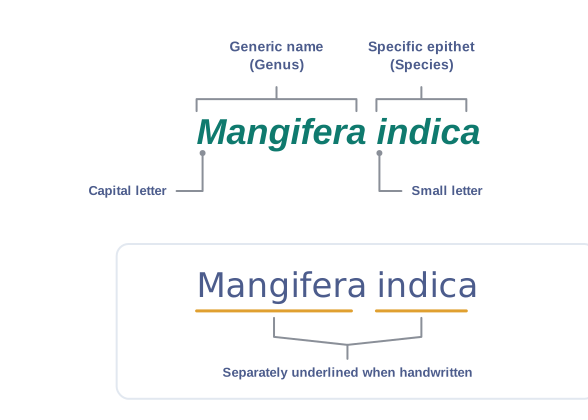
Fig. 1.1 – Breakdown of a binomial name.
The universal rules of nomenclature are as follows:
- Biological names are generally in Latin and written in italics. They are Latinised or derived from Latin, whatever the organism’s origin.
- The first word represents the genus, while the second word denotes the specific epithet.
- When handwritten, both words are separately underlined; when printed, they are shown in italics to indicate their Latin origin.
- The first word (the genus) starts with a capital letter, while the specific epithet starts with a small letter — as in Mangifera indica.
There is one more detail. The name of the author — the scientist who first described the species — may appear after the specific epithet in an abbreviated form. For example, Mangifera indica Linn. tells us that this species was first described by Linnaeus.
From Naming to Grouping: Classification
Since it is nearly impossible to study every single living organism one by one, we need a way to make the task manageable. That way is classification — the process by which things are grouped into convenient categories based on some easily observable characters.
We already do this instinctively. The moment we say “plants,” “animals,” “dogs,” “cats” or “insects,” we mentally attach a set of characters to each group. Think of a dog, and you picture dogs, not cats. Say “Alsatians,” and the picture becomes even more specific. Say “mammals,” and you think of animals with external ears and body hair. Say “wheat,” and you see wheat plants, not rice.
Each such convenient category — Dogs, Cats, Mammals, Wheat, Rice, Plants, Animals — is scientifically called a taxon (plural: taxa). A key idea here is that taxa exist at very different levels. “Plants” is a taxon; “Wheat” is also a taxon; “Animals,” “Mammals” and “Dogs” are all taxa too. Yet you know that a dog is a mammal and mammals are animals — so these three represent taxa at different levels of grouping.
Based on their characteristics, then, all living organisms can be sorted into different taxa. This whole process of classification is called taxonomy. Modern taxonomy does not rely on outward appearance alone; it uses external and internal structure, the structure of the cell, the development process, and ecological information about organisms.
Putting it together, four processes are basic to taxonomy: characterisation, identification, classification and nomenclature. Their logical flow is shown in FC 1.1.
Flowchart
FC 1.1 – Processes basic to taxonomy: characterisation (note the organism’s features) → identification (match it to a known kind) → nomenclature (give it its correct scientific name) → classification (place it in its proper taxa).
Systematics and Relationships
Taxonomy is not a new pursuit. Human beings have always wanted to know more about the organisms around them, especially those useful to them. In early times, people needed reliable sources of food, clothing and shelter, so the very earliest classifications were based simply on the uses of various organisms.
Over time, humans became interested not only in the diversity of organisms but also in the relationships among them. This branch of study is called systematics. The word comes from the Latin systema, meaning the systematic arrangement of organisms. Linnaeus himself used Systema Naturae as the title of his publication.
The scope of systematics was later enlarged to include identification, nomenclature and classification as well. What sets systematics apart is that it takes into account the evolutionary relationships between organisms — how they are related through descent — not merely how they look.
1.2 Taxonomic Categories
Classification is never a single-step process. It works through a hierarchy of steps, and each step represents a particular rank or category. Because each such category is one part of the overall taxonomic arrangement, it is called a taxonomic category, and all the categories taken together make up the taxonomic hierarchy. Every category is a unit of classification that stands for a rank, and each rank is commonly called a taxon (plural: taxa).
An example makes this clear. Insects form a group of organisms that share common features — for instance, three pairs of jointed legs. Because insects are recognisable, concrete objects, they can be given a rank or category. So a group represents a category, a category denotes a rank, and each rank or taxon is a unit of classification. A crucial point: these taxonomic groups are distinct biological entities, not merely collections of look-alikes thrown together by appearance.
Taxonomic studies of all known organisms have produced a set of common categories: kingdom, phylum or division (the term used for plants), class, order, family, genus and species. In every group — plant or animal — species is the lowest category. To decide where an organism belongs, we need to know its characters, because those characters reveal the similarities and dissimilarities between it and other organisms.
1.2.1 Species
Taxonomy treats a group of individual organisms with fundamental similarities as a species. You should be able to tell one species apart from another closely related species on the basis of distinct morphological (form-and-structure) differences.
Consider three examples: Mangifera indica (mango), Solanum tuberosum (potato) and Panthera leo (lion). In each name, the second word — indica, tuberosum, leo — is the specific epithet, the part that names the species. The first words — Mangifera, Solanum and Panthera — are the genera, a higher level of taxon.
A single genus may contain one or more specific epithets, each representing a different but morphologically similar organism. For example, the genus Panthera also has the specific epithet tigris, and Solanum includes species such as nigrum and melongena. Human beings belong to the species sapiens, placed in the genus Homo — so our scientific name is written Homo sapiens.
1.2.2 Genus
A genus comprises a group of related species that have more characters in common with one another than with the species of other genera. In simple terms, genera are aggregates of closely related species.
For example, potato and brinjal are two different species, yet both belong to the genus Solanum. Similarly, the lion (Panthera leo), the leopard (P. pardus) and the tiger (P. tigris) share several common features and are all species of the genus Panthera. This genus is different from the genus Felis, which includes the cats.
1.2.3 Family
The next higher category, family, is a group of related genera. A family shows still fewer similarities among its members than a genus or a species does. In plants, families are characterised on the basis of both vegetative features (leaves, stems, roots) and reproductive features (flowers, fruits).
Among plants, for example, the three genera Solanum, Petunia and Datura are placed together in the family Solanaceae. Among animals, the genus Panthera (lion, tiger, leopard) is grouped with the genus Felis (cats) in the family Felidae. If you compare a cat and a dog, you will notice some similarities but also clear differences — enough that they are placed in two separate families, Felidae and Canidae respectively.
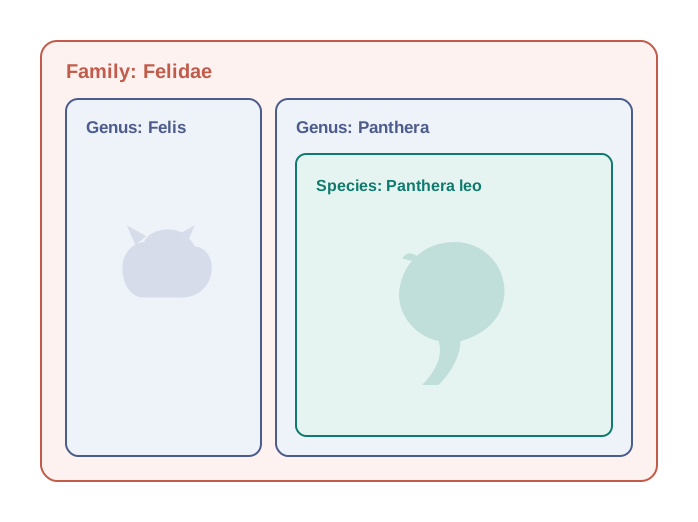
Fig. 1.2 – Nested grouping of taxonomic categories.
1.2.4 Order
You have already seen that species, genus and family are based on a number of shared characters. Higher categories such as order are identified from broader aggregates of characters. An order is an assemblage of families that exhibit a few similar characters — but these shared characters are fewer in number than those uniting the different genera within a single family.
Among plants, the families Convolvulaceae and Solanaceae are placed together in the order Polymoniales, mainly on the basis of their floral characters. Among animals, the order Carnivora includes families such as Felidae and Canidae.
1.2.5 Class
A class is a category that includes related orders. For example, the order Primata — comprising monkey, gorilla and gibbon — is placed in the class Mammalia, along with the order Carnivora, which includes animals like the tiger, cat and dog. Class Mammalia contains several other orders as well.
1.2.6 Phylum
Classes of animals such as fishes, amphibians, reptiles and birds, together with mammals, are grouped into the next higher category, the phylum. All of these are placed in the phylum Chordata because they share features such as the presence of a notochord and a dorsal hollow neural system.
In the case of plants, classes with a few shared characters are assigned to a higher category called a division rather than a phylum.
1.2.7 Kingdom
All animals belonging to the various phyla are finally assigned to the highest category, Kingdom Animalia. The Kingdom Plantae is separate and comprises all plants drawn from the various divisions. From here on, these two great groups are simply referred to as the animal and plant kingdoms.
The taxonomic categories from species up to kingdom are shown in ascending order — beginning with species — in Fig. 1.3. These are broad categories; to place organisms even more precisely, taxonomists have also developed many sub-categories within this hierarchy.
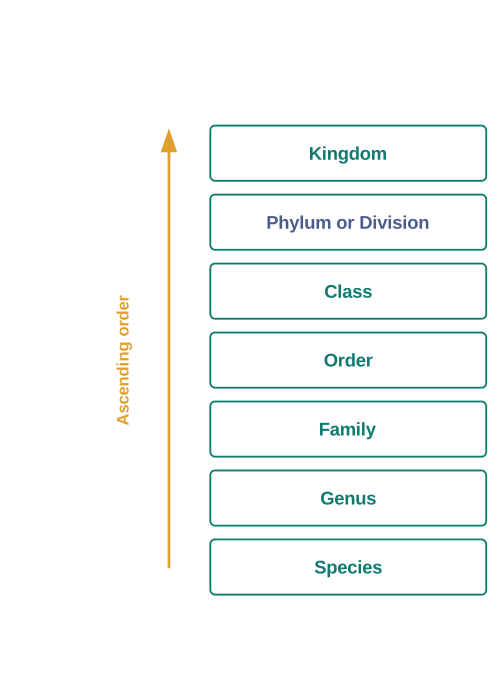
Fig. 1.3 – Taxonomic categories in ascending order.
The complete sequence of ranks is summarised in FC 1.2.
Flowchart
FC 1.2 – Taxonomic hierarchy (descending): Kingdom → Phylum / Division → Class → Order → Family → Genus → Species.
Now look carefully at the basis of this arrangement. As we move higher — from species towards kingdom — the number of common characteristics shared by the members goes on decreasing. The lower the taxon, the more characters its members share; the higher the category, the harder it becomes to work out its relationship to other taxa at the same level. This is why classification grows more complex at the higher ranks.
To see the hierarchy in action, Table 1.1 lists the taxonomic categories to which some familiar organisms — housefly, man, mango and wheat — belong.
| Common Name | Biological Name | Genus | Family | Order | Class | Phylum/Division |
|---|---|---|---|---|---|---|
| Man | Homo sapiens | Homo | Hominidae | Primata | Mammalia | Chordata |
| Housefly | Musca domestica | Musca | Muscidae | Diptera | Insecta | Arthropoda |
| Mango | Mangifera indica | Mangifera | Anacardiaceae | Sapindales | Dicotyledonae | Angiospermae |
| Wheat | Triticum aestivum | Triticum | Poaceae | Poales | Monocotyledonae | Angiospermae |
1.3 Summary
The living world is remarkably rich in variety. Millions of plants and animals have already been identified and described, yet a very large number still remain unknown.
The sheer range of organisms — in size, colour, habitat, and physiological and morphological features — drives us to search for the defining characteristics of living things.
To make the study of this diversity manageable, biologists have evolved definite rules and principles for the identification, nomenclature and classification of organisms.
The branch of knowledge that deals with identification, nomenclature and classification is called taxonomy.
Taxonomic studies of different species of plants and animals are useful in agriculture, forestry and industry, and more generally for knowing our bio-resources and their diversity.
The basics of taxonomy — identification, naming and classification — have been developed universally under agreed international codes.
On the basis of resemblances and distinct differences, each organism is identified and given a correct scientific (biological) name made of two words, following the system of binomial nomenclature.
Every organism occupies a definite place or position within the system of classification.
There are many categories or ranks, generally referred to as taxonomic categories or taxa, and all these categories together constitute a taxonomic hierarchy.
Flowchart
FC 1.3 – Overall flow of the chapter: characterisation → identification → nomenclature (binomial name assigned) → classification → placement in the taxonomic hierarchy (Species → Genus → Family → Order → Class → Phylum/Division → Kingdom).
1.4 Points to Ponder
The number of species that have been described keeps rising every year. Does this mean we will one day hold a complete catalogue of life on earth — or will the count never truly be finished? What does your answer suggest about the real size of biodiversity?
Local names often carry useful everyday knowledge about a plant or animal, even though they vary from place to place. When we replace a local name with a single Latin scientific name, what do we gain — and is anything lost?
As we climb from species up towards kingdom, the characters shared by members steadily decrease, while the number of organisms grouped together increases. Why should such broad groupings, based on so few shared features, still be scientifically meaningful?
The earliest classifications sorted organisms by their uses to human beings. How would such a “usefulness-based” scheme differ from one based on evolutionary relationships, and which do you think deserves to be called more scientific?
Systematics treats classification as a record of evolutionary relationships, so that every living organism is connected to organisms that lived long before it. How does thinking of classification as a branching “family tree” — rather than a set of fixed boxes — change the way you understand what a species is?
1.5 NCERT Questions
Why are living organisms classified?
Why are the classification systems changing every now and then?
What different criteria would you choose to classify people that you meet often?
What do we learn from identification of individuals and populations?
Given below is the scientific name of Mango. Identify the correctly written name.
- Mangifera Indica
- Mangifera indica
Define a taxon. Give some examples of taxa at different hierarchical levels.
Can you identify the correct sequence of taxonomical categories?
- Species \(\rightarrow\) Order \(\rightarrow\) Phylum \(\rightarrow\) Kingdom
- Genus \(\rightarrow\) Species \(\rightarrow\) Order \(\rightarrow\) Kingdom
- Species \(\rightarrow\) Genus \(\rightarrow\) Order \(\rightarrow\) Phylum
Try to collect all the currently accepted meanings for the word ‘species’. Discuss with your teacher the meaning of species in case of higher plants and animals on one hand, and bacteria on the other hand.
Define and understand the following terms:
- Phylum
- Class
- Family
- Order
- Genus
Illustrate the taxonomical hierarchy with suitable examples of a plant and an animal.
1.6 Check Your Concepts
Assertion–Reason. Assertion: In a scientific name, the first word begins with a capital letter and the second word begins with a small letter. Reason: In binomial nomenclature the first word denotes the genus and the second word denotes the specific epithet. State whether both statements are correct and whether the reason correctly explains the assertion.
Why is Latin preferred for writing scientific names rather than a modern spoken language?
What kind of confusion could arise if biologists relied only on local (common) names instead of scientific names? Support your answer with one example.
Distinguish between taxonomy and systematics.
Differentiate between the terms nomenclature and identification.
Match the organism in Column I with its correct family in Column II.
| Column I (Organism) | Column II (Family) |
|---|---|
| a. Man | i. Poaceae |
| b. Housefly | ii. Hominidae |
| c. Mango | iii. Muscidae |
| d. Wheat | iv. Anacardiaceae |
Sequence-ordering. Arrange the following taxa of the lion in the correct ascending order (lowest to highest): Chordata, Panthera, Animalia, Felidae, leo, Mammalia, Carnivora.
As we move from species towards kingdom, the number of characters shared by the members decreases. Explain why this trend makes the higher categories more difficult to define.
Potato, brinjal and Datura are all placed in the same family. What does belonging to a common family suggest about the features and even the chemistry these plants may share?
Draw the taxonomic hierarchy as an ascending ladder from species to kingdom and label each rank. For a plant, indicate which term replaces “phylum.”
Why is species regarded as the lowest taxonomic category, and what fundamentally defines a species?
Name the international codes that govern the naming of (a) plants and (b) animals, and state the main purpose these codes serve.
Assertion–Reason. Assertion: The term “division” is used for plants while “phylum” is used for animals. Reason: Division and phylum lie at completely different levels of the taxonomic hierarchy. State whether the assertion and reason are correct, and whether the reason correctly explains the assertion.
The number of described species is currently given as 1.7–1.8 million. Give one reason why this figure should not be treated as final.
How does a genus differ from a family in terms of the number of common characters shared by its members?