Chapter 4: Animal Kingdom
More than two thousand years ago, the Greek thinker Aristotle set himself a curious task. He wanted to sort every animal he had ever seen into orderly groups. He watched them, dissected them, and compared them carefully. Instead of grouping animals simply by where they lived or how they looked, he searched for deeper, shared features. He separated animals that had red blood — such as fish, birds, and mammals — from those that did not, such as insects, crabs, and molluscs. He also noticed which animals gave birth to live young and which laid eggs. His system was far from perfect, yet the idea behind it was powerful, and it still guides us today: animals that look nothing alike on the outside can share hidden features on the inside.
Think about a jellyfish, an earthworm, a butterfly, and a human being. On the surface they seem to have almost nothing in common. Yet biologists place each of them in a precise position within one grand system — the animal kingdom. They do this not by counting legs or comparing colours, but by asking deeper questions. How are the animal’s cells arranged? Is its body symmetrical? Does it have a true body cavity within? These few fundamental questions can unlock the hidden relationships between more than a million known species of animals.
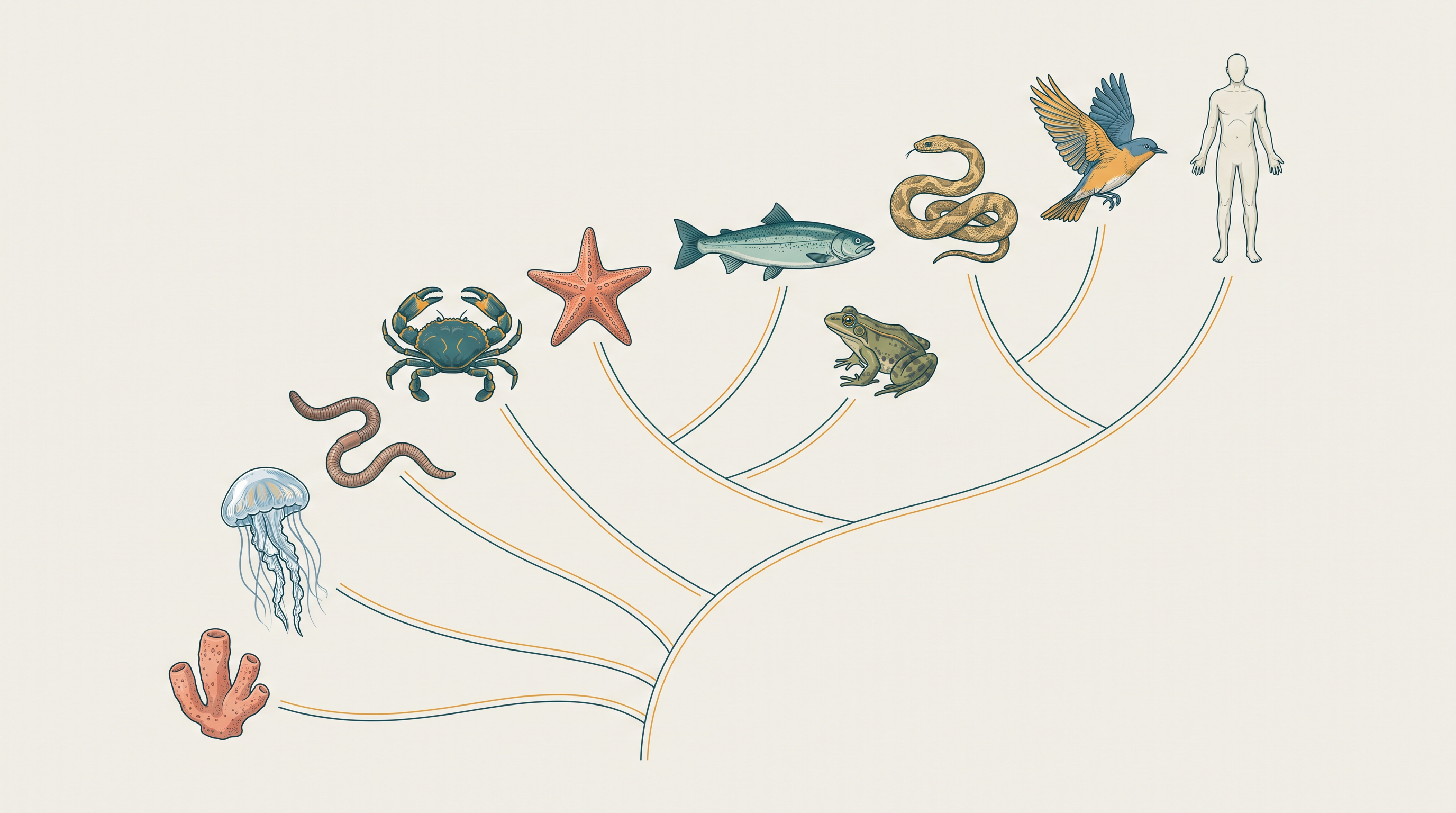
Fig. 4.0 – Diversity of the animal kingdom.
By the end of this chapter, you will be able to answer each of these questions with confidence.
4.1 Basis of Classification
Every animal you can think of — from a tiny sponge fixed to a rock to a running tiger — differs from the others in structure and outward form. If we tried to sort them by appearance alone, the task would be almost hopeless. Fortunately, beneath these differences lie a few fundamental features that many animals share.
These shared features include the way an animal’s cells are arranged, its body symmetry, the presence and nature of a body cavity called the coelom, and the patterns of its digestive, circulatory and reproductive systems. Biologists use these deep-seated features — not surface looks — as the basis for classifying animals. The most important of them are discussed below.
4.1.1 Levels of Organisation
Every member of the kingdom Animalia is multicellular, meaning its body is built of many cells rather than a single cell. Yet not all animals organise those cells in the same way. As we move from simpler to more complex animals, the cells are arranged into higher and higher levels of organisation.
In sponges, the cells are arranged as loose aggregates — simply grouped together without forming true tissues. This is the cellular level of organisation. Even here, a little division of labour occurs, meaning different cells carry out different activities.
In coelenterates (such as Hydra and jellyfish), the arrangement is more advanced. Cells that perform the same function are grouped together into tissues. A tissue is a group of similar cells working together for a common function. This arrangement is called the tissue level of organisation.
A still higher level is seen in Platyhelminthes (flatworms) and other higher phyla. Here, different tissues combine to form organs, each specialised for a particular job. This is the organ level of organisation. An organ is a structure built of several tissues that together perform a specific function.
The highest level appears in animals such as annelids, arthropods, molluscs, echinoderms and chordates. In these animals, organs work together as functional systems, each system carrying out a specific physiological role — for example, digestion or circulation. This is the organ-system level of organisation.
Flowchart
FC 4.1 – Levels of organisation (simple → complex): cellular level (sponges) → tissue level (coelenterates) → organ level (flatworms) → organ-system level (annelids to chordates)
How Organ Systems Vary in Complexity
Even among animals that possess organ systems, the systems themselves differ in complexity. Take the digestive system. In Platyhelminthes it has only a single opening to the outside, which serves as both mouth and anus; such a gut is called incomplete. A complete digestive system, by contrast, has two separate openings — a mouth to take food in and an anus to pass waste out.
The circulatory system also comes in two types. In the open type, blood is pumped out of the heart into open spaces, so that the cells and tissues are directly bathed in it. In the closed type, blood always flows through a series of vessels of varying diameters — arteries, veins and capillaries — and is never released into open spaces.
4.1.2 Symmetry
Animals can also be grouped by their body symmetry — the way the body can be divided into matching halves.
Sponges are mostly asymmetrical, meaning no plane passing through the centre divides the body into two equal halves.
When any plane passing through the central axis of the body divides it into two identical halves, the animal shows radial symmetry. Coelenterates, ctenophores and echinoderms have this body plan, as seen in Fig. 4.1a.
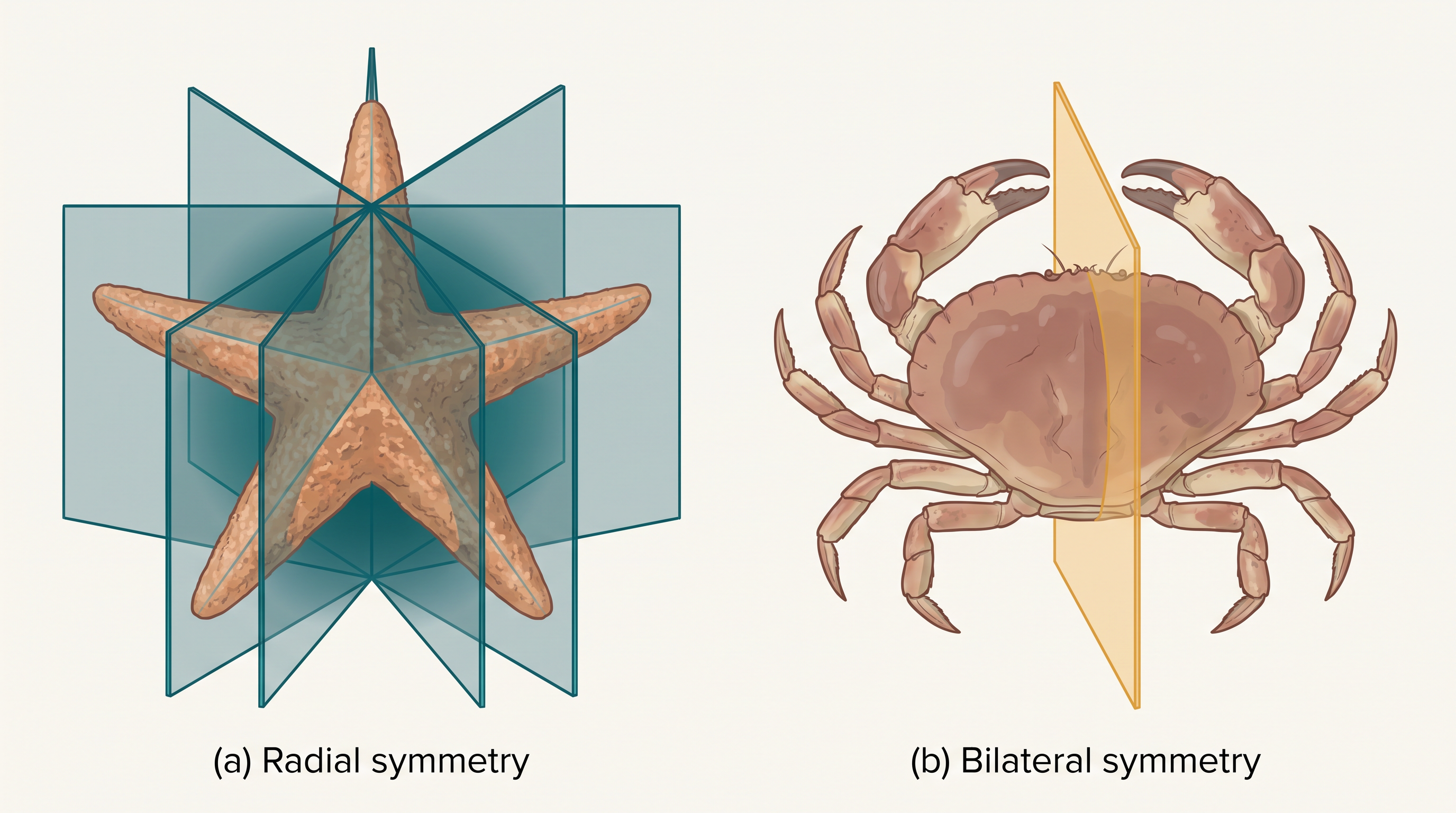
Fig. 4.1 – Symmetry: (a) radial and (b) bilateral.
Animals such as annelids and arthropods can be divided into identical left and right halves by only one particular plane. This is bilateral symmetry (Fig. 4.1b).
4.1.3 Diploblastic and Triploblastic Organisation
As an animal embryo develops, its cells first arrange themselves into layers called germinal layers (or germ layers). These layers later give rise to all the tissues and organs of the body.
In some animals, the cells are arranged in only two germinal layers: an outer ectoderm and an inner endoderm. Such animals are diploblastic — for example, the coelenterates. Between the two layers lies an undifferentiated, jelly-like layer called mesoglea (Fig. 4.2a).
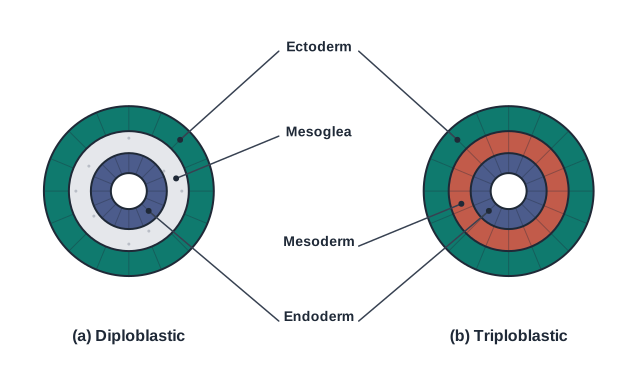
Fig. 4.2 – Germinal layers: (a) diploblastic and (b) triploblastic.
In other animals, the developing embryo has a third germinal layer, the mesoderm, lying between the ectoderm and the endoderm. Such animals are triploblastic. This condition runs from Platyhelminthes all the way up to the chordates (Fig. 4.2b).
4.1.4 Coelom
Whether or not an animal has a cavity between its body wall and its gut wall is very important in classification. A body cavity that is lined by mesoderm is called a coelom, or true body cavity.
Animals that possess a true coelom are called coelomates — for example, annelids, molluscs, arthropods, echinoderms, hemichordates and chordates (Fig. 4.3a).
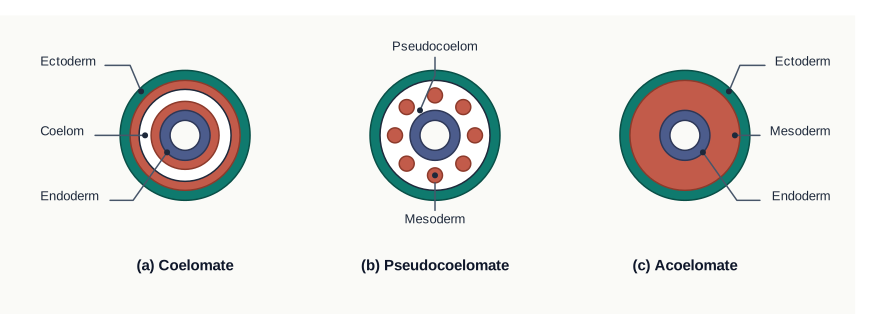
Fig. 4.3 – Sectional views of the body cavity: (a) coelomate, (b) pseudocoelomate, and (c) acoelomate.
In some animals, the body cavity is not lined by mesoderm. Instead, the mesoderm is present only as scattered pouches lying between the ectoderm and the endoderm. Such a cavity is a false coelom, or pseudocoelom, and the animals possessing it are pseudocoelomates — for example, the aschelminthes (Fig. 4.3b).
In yet other animals, there is no body cavity at all between the body wall and the gut. These are acoelomates — for example, the platyhelminthes (Fig. 4.3c).
4.1.5 Segmentation
In some animals, the body is divided — both externally and internally — into a series of segments, with at least some organs repeated in each segment. The earthworm is a familiar example: its body clearly shows this pattern, called metameric segmentation, and the phenomenon itself is known as metamerism.
4.1.6 Notochord
The notochord is a long, rod-like supporting structure that develops from the mesoderm on the dorsal (back or upper) side of the embryo during development.
Animals that form a notochord at some stage of their life are called chordates. Animals that never form this structure are called non-chordates — a group that includes everything from Porifera up to the echinoderms.
4.2 Classification of Animals
Using the common fundamental features described in the preceding section — levels of organisation, symmetry, germ layers, coelom, segmentation and notochord — the whole of Animalia can be sorted into broad groups called phyla. The overall scheme is summarised in FC 4.2.
Flowchart
FC 4.2 – Broad classification of Kingdom Animalia: Animalia (multicellular) → by level of organisation and symmetry and coelom. Cellular level → mostly asymmetrical → acoelomate → Porifera. Tissue/organ/organ-system level → Radial → acoelomate → Coelenterata (Cnidaria), Ctenophora; Bilateral → without body cavity (acoelomate) → Platyhelminthes; with false coelom (pseudocoelomate) → Aschelminthes; with true coelom (coelomate) → Annelida, Arthropoda, Mollusca, Echinodermata, Hemichordata, Chordata. Note: Echinodermata shows radial or bilateral symmetry depending on the stage
The important characteristic features of each phylum are now described one by one.
4.2.1 Phylum – Porifera
Members of this phylum are commonly known as sponges. They are generally marine and mostly asymmetrical (Fig. 4.4). These are primitive multicellular animals with only the cellular level of organisation.
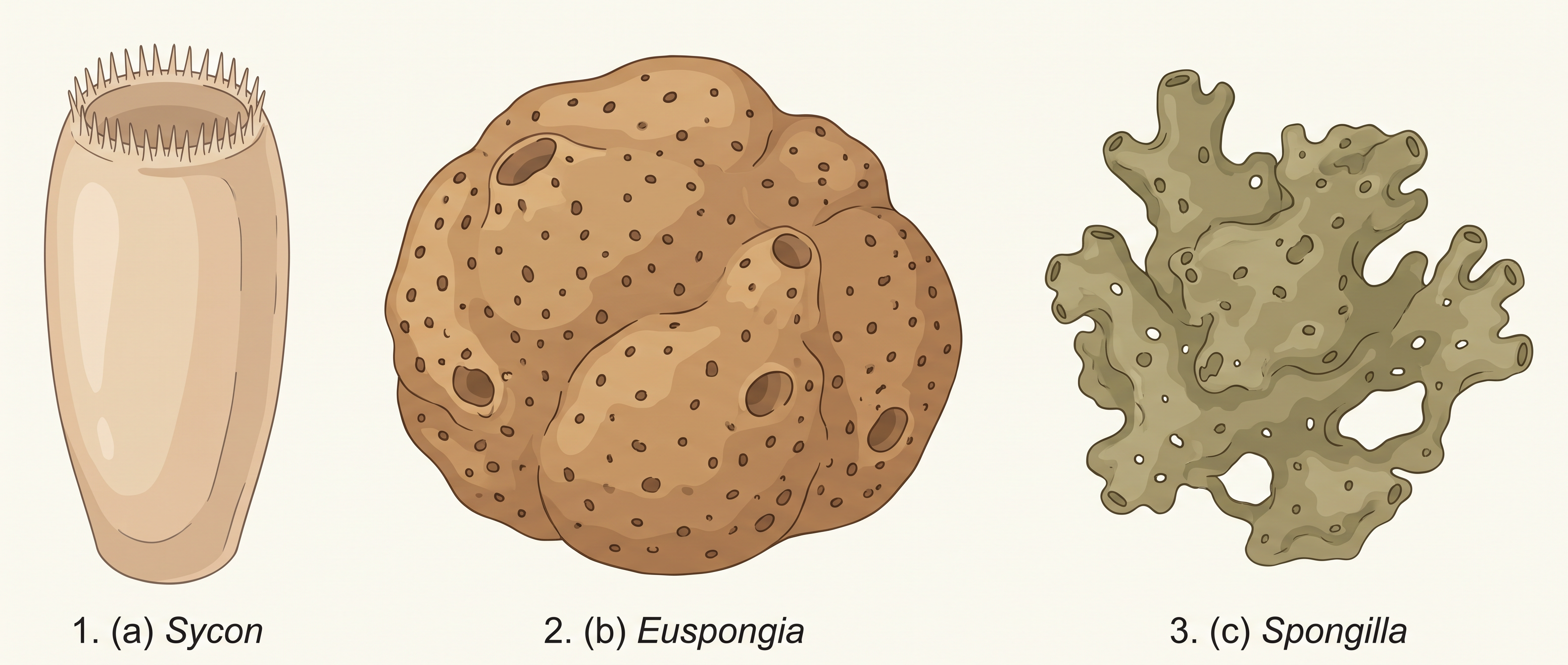
Fig. 4.4 – Examples of Porifera: (a) Sycon, (b) Euspongia, and (c) Spongilla.
Sponges have a special water transport, or canal, system. Water enters through minute pores called ostia in the body wall, passes into a central cavity called the spongocoel, and finally leaves through a large opening called the osculum. This flow of water is helpful in gathering food, exchanging respiratory gases and removing waste.
The spongocoel and canals are lined by special flagellated collar cells called choanocytes, which drive the water current and capture food. Digestion is intracellular, meaning it takes place inside individual cells rather than in a gut cavity.
The body is supported by a skeleton made of spicules (needle-like structures) or of spongin fibres. Sponges are hermaphrodite (also called monoecious): eggs and sperms are produced by the same individual, so the sexes are not separate.
Sponges reproduce asexually by fragmentation (a piece breaks off and grows into a new sponge) and sexually by forming gametes. Fertilisation is internal. Development is indirect — it passes through a larval stage that looks quite different from the adult.
Examples: Sycon (Scypha), Spongilla (a freshwater sponge) and Euspongia (the bath sponge).
4.2.2 Phylum – Coelenterata (Cnidaria)
These are aquatic, mostly marine animals that may be sessile (fixed) or free-swimming, and are radially symmetrical (Fig. 4.5). The name Cnidaria comes from special cells called cnidoblasts (or cnidocytes) present on the tentacles and body.
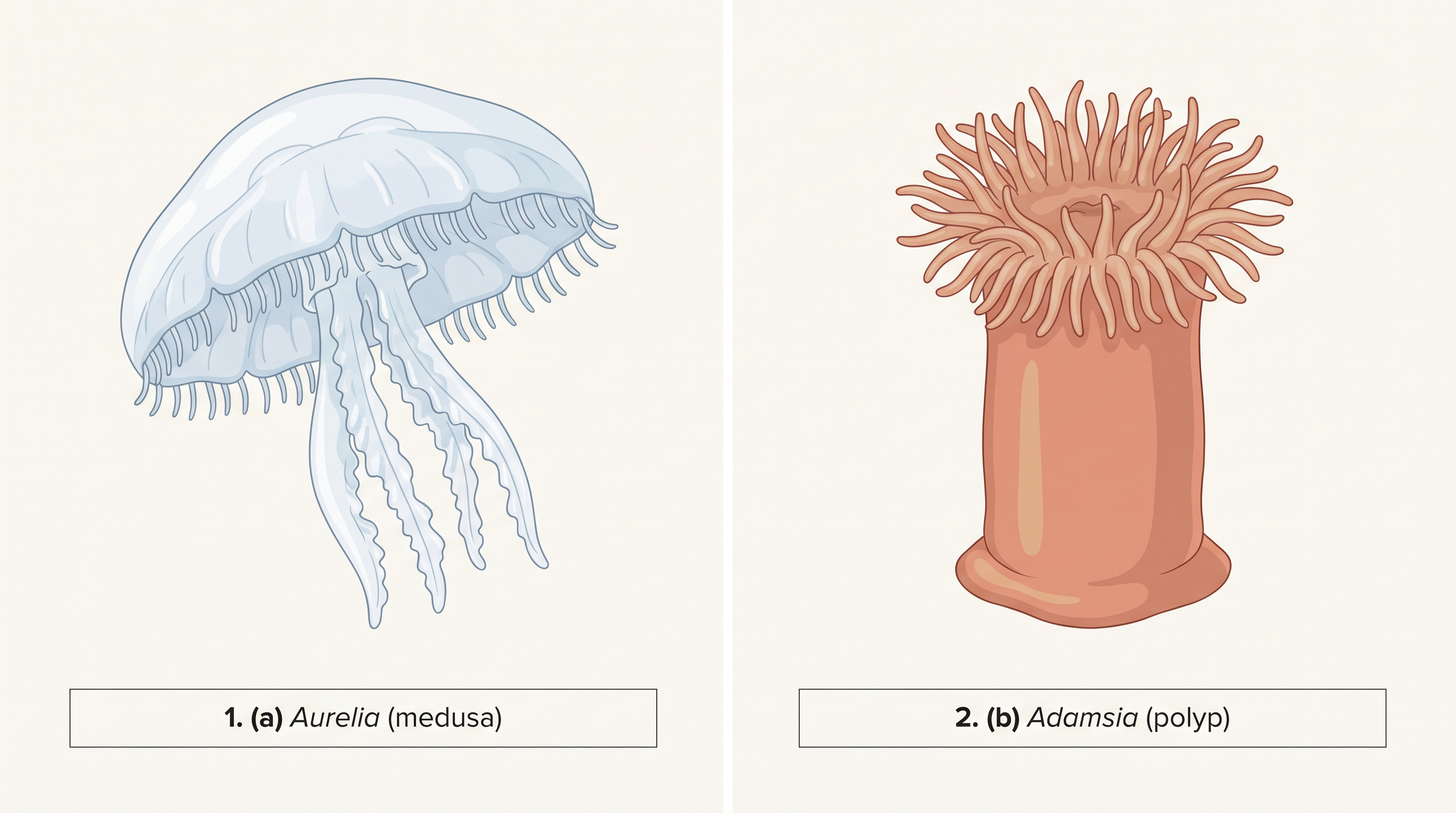
Fig. 4.5 – Coelenterate body forms: (a) Aurelia and (b) Adamsia.
Each cnidoblast contains a stinging capsule, or nematocyst. Cnidoblasts are used for anchorage, for defence and for capturing prey (Fig. 4.6).
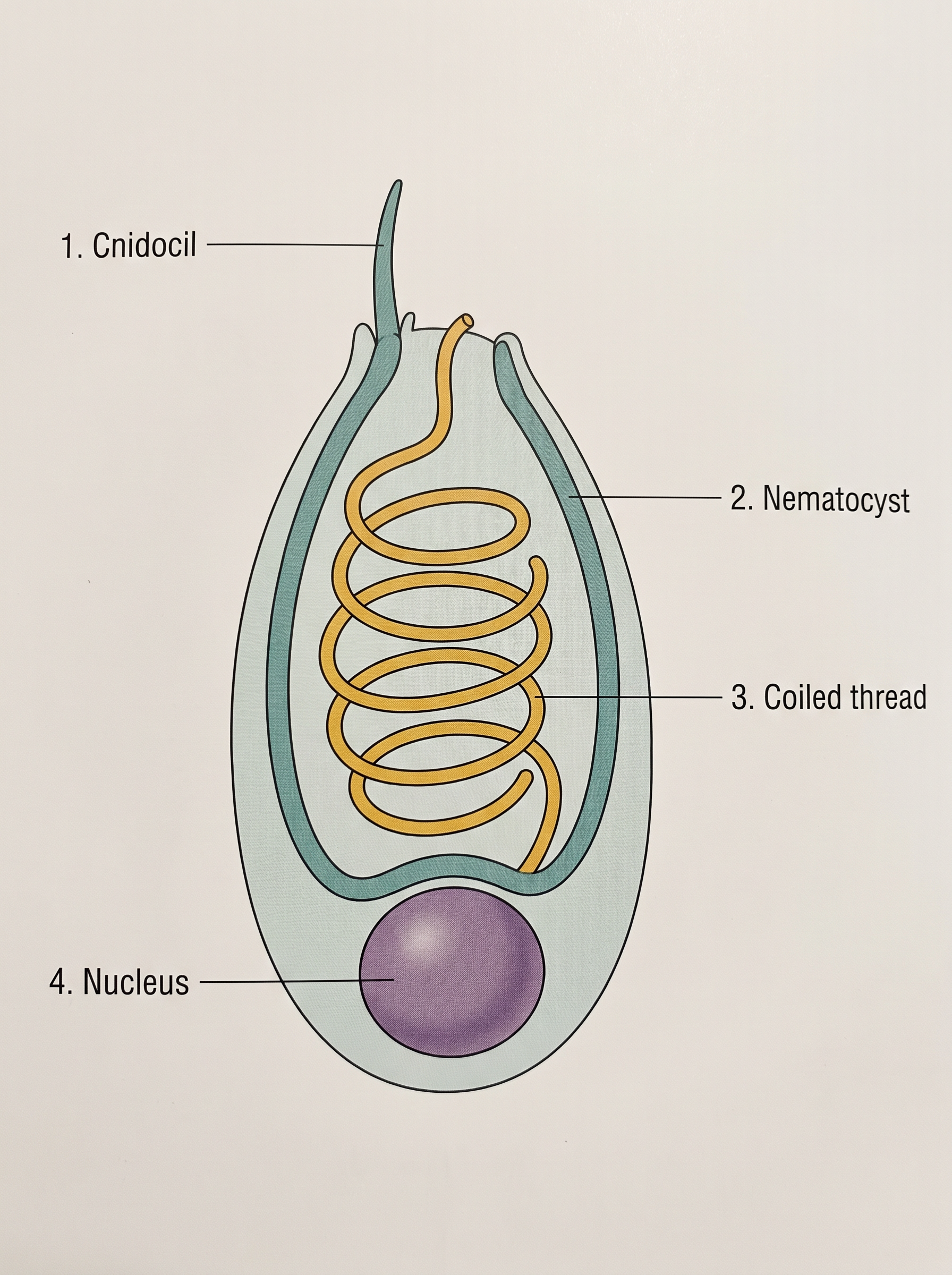
Fig. 4.6 – Diagrammatic view of a cnidoblast.
Cnidarians have the tissue level of organisation and are diploblastic. They possess a central gastro-vascular cavity (a cavity that both digests food and distributes it) with a single opening, the mouth, which lies on a raised area called the hypostome. Digestion is both extracellular (in the cavity) and intracellular (within cells). Some cnidarians, such as corals, build a hard skeleton of calcium carbonate.
Cnidarians show two basic body forms, called polyp and medusa (Fig. 4.5). The polyp is a sessile, cylindrical form such as Hydra or Adamsia, while the medusa is an umbrella-shaped, free-swimming form such as Aurelia (the jellyfish).
Some cnidarians exist in both forms during their life and show alternation of generations, called metagenesis. Here, polyps produce medusae asexually, and medusae produce polyps sexually (for example, Obelia).
Examples: Physalia (Portuguese man-of-war), Adamsia (sea anemone), Pennatula (sea-pen), Gorgonia (sea-fan) and Meandrina (brain coral).
4.2.3 Phylum – Ctenophora
Ctenophores, commonly called sea walnuts or comb jellies, are exclusively marine, radially symmetrical and diploblastic, with the tissue level of organisation. The body bears eight external rows of ciliated comb plates that help in locomotion (Fig. 4.7).
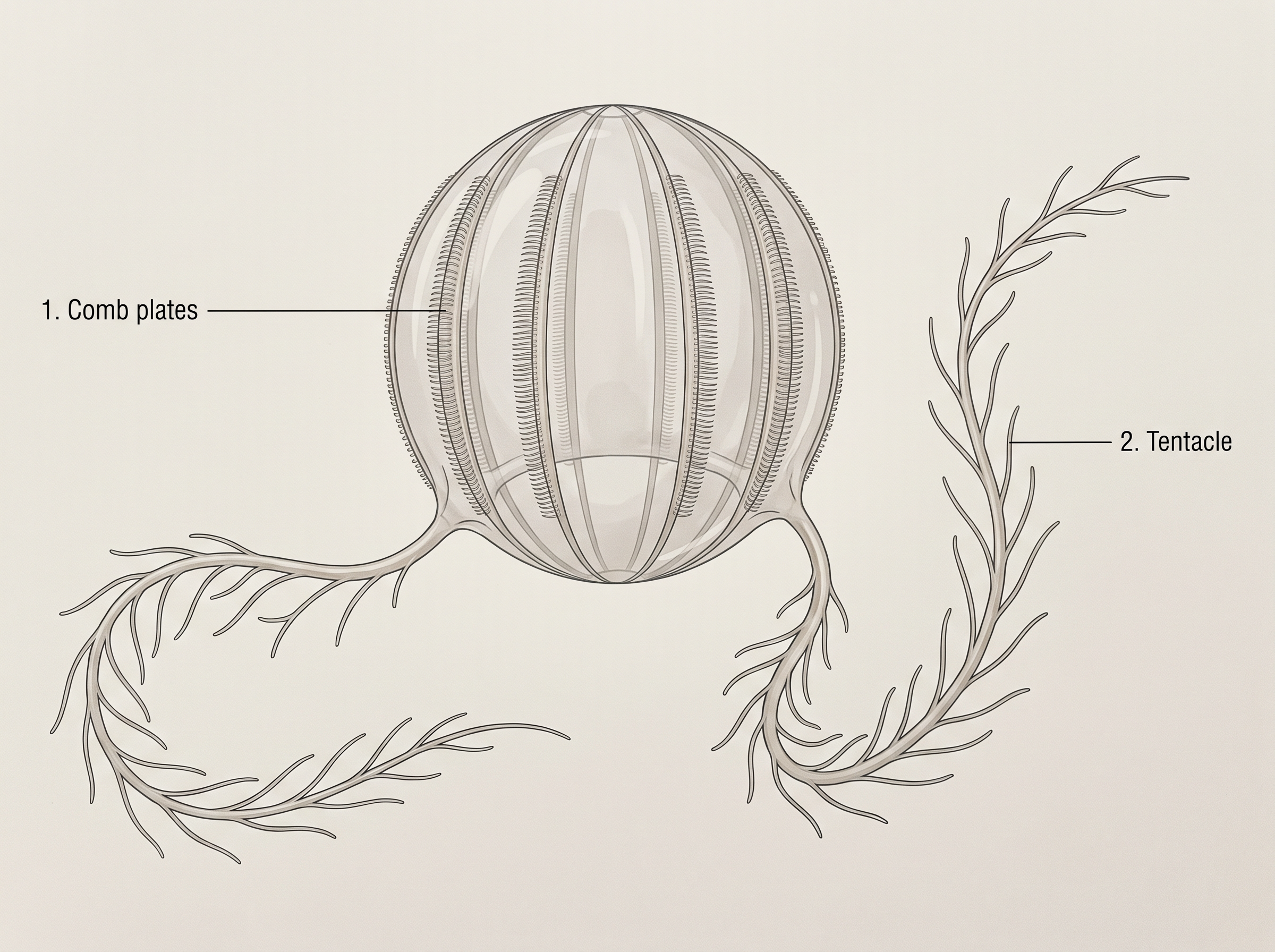
Fig. 4.7 – Pleurobrachia.
Digestion is both extracellular and intracellular. Bioluminescence — the ability of a living organism to give off light — is well developed in ctenophores. The sexes are not separate. Reproduction takes place only by sexual means. Fertilisation is external, and development is indirect.
Examples: Pleurobrachia and Ctenoplana.
4.2.4 Phylum – Platyhelminthes
These animals have a flattened, dorso-ventrally compressed body, which is why they are called flatworms (Fig. 4.8). Most of them are endoparasites — parasites that live inside the body of other animals, including human beings.
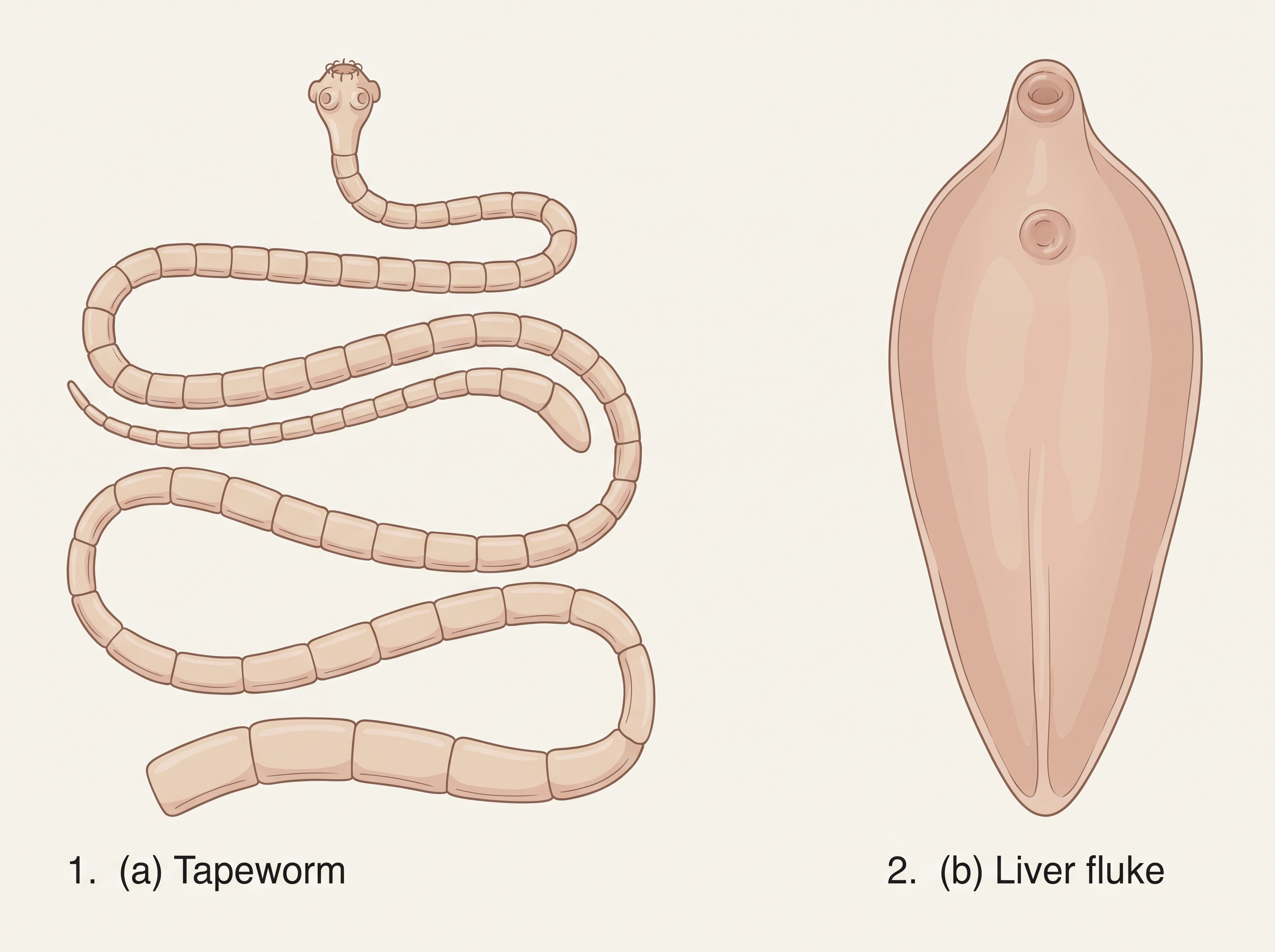
Fig. 4.8 – Examples of Platyhelminthes: (a) tapeworm and (b) liver fluke.
Flatworms are bilaterally symmetrical, triploblastic and acoelomate, with the organ level of organisation. The parasitic forms bear hooks and suckers that grip the host. Some of them absorb nutrients directly from the host through their body surface. Special cells called flame cells help in osmoregulation (control of water and salt balance) and in excretion.
The sexes are not separate. Fertilisation is internal, and development passes through many larval stages. Some members, such as Planaria, have a remarkable capacity for regeneration — regrowing lost body parts.
Examples: Taenia (tapeworm), Fasciola (liver fluke).
4.2.5 Phylum – Aschelminthes
The body of aschelminthes is circular in cross-section, which gives them the common name roundworms (Fig. 4.9). They may be free-living (in water or on land) or parasitic in plants and animals.
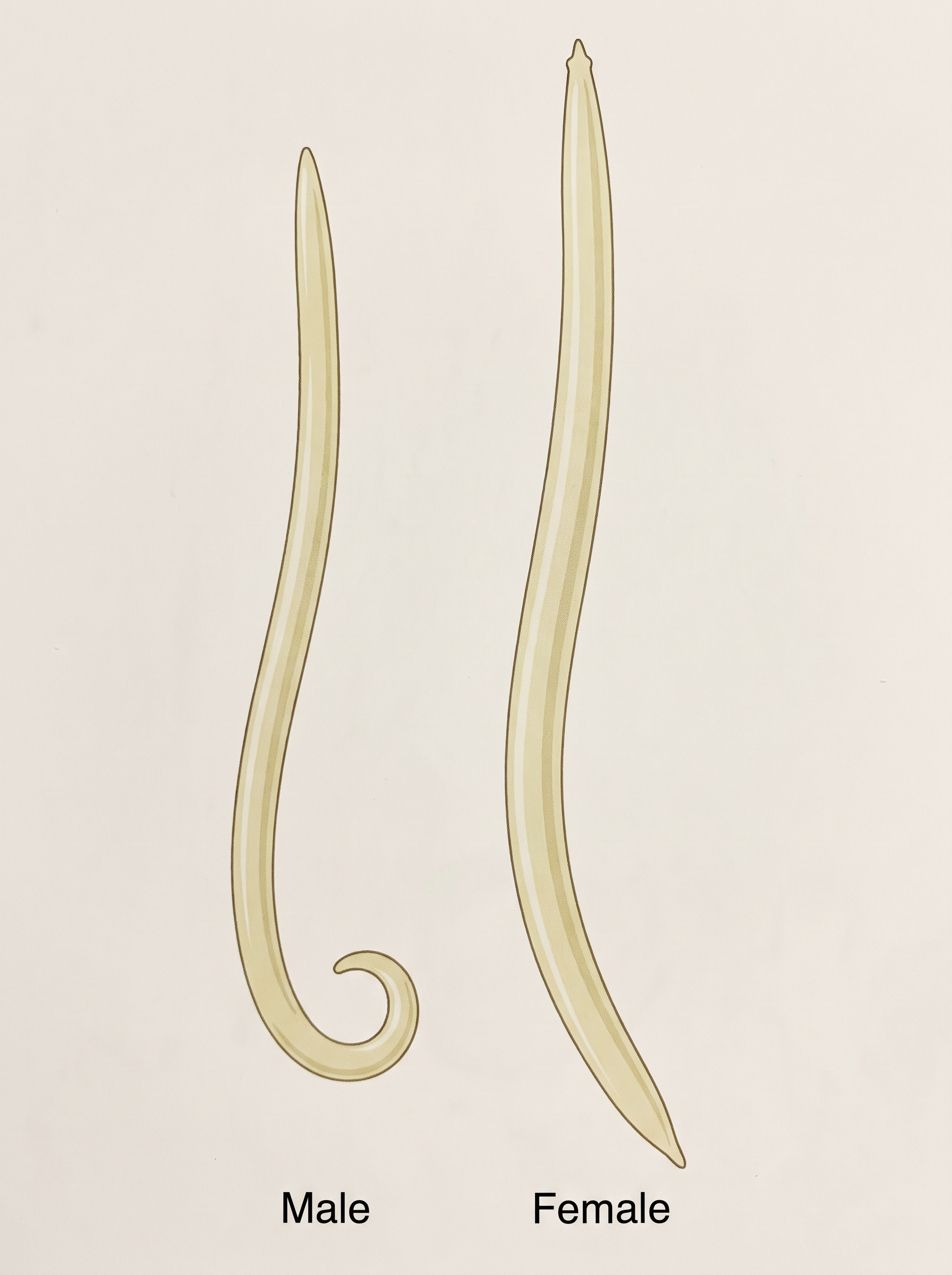
Fig. 4.9 – Roundworms: male and female.
Roundworms have the organ-system level of organisation. They are bilaterally symmetrical, triploblastic and pseudocoelomate. The alimentary canal is complete, with a well-developed muscular pharynx. An excretory tube removes body wastes from the body cavity through an excretory pore.
The sexes are separate, a condition called dioecious, meaning males and females are distinct individuals. Often the females are longer than the males. Fertilisation is internal, and development may be direct (the young resemble the adult) or indirect.
Examples: Ascaris (roundworm), Wuchereria (filaria worm), Ancylostoma (hookworm).
4.2.6 Phylum – Annelida
Annelids may be aquatic (marine or freshwater) or terrestrial, and may be free-living or sometimes parasitic. They show the organ-system level of organisation and bilateral symmetry, and are triploblastic, metamerically segmented and coelomate.
Their body surface is distinctly marked into segments, or metameres, which is the source of the phylum name (Latin annulus: little ring) (Fig. 4.10).
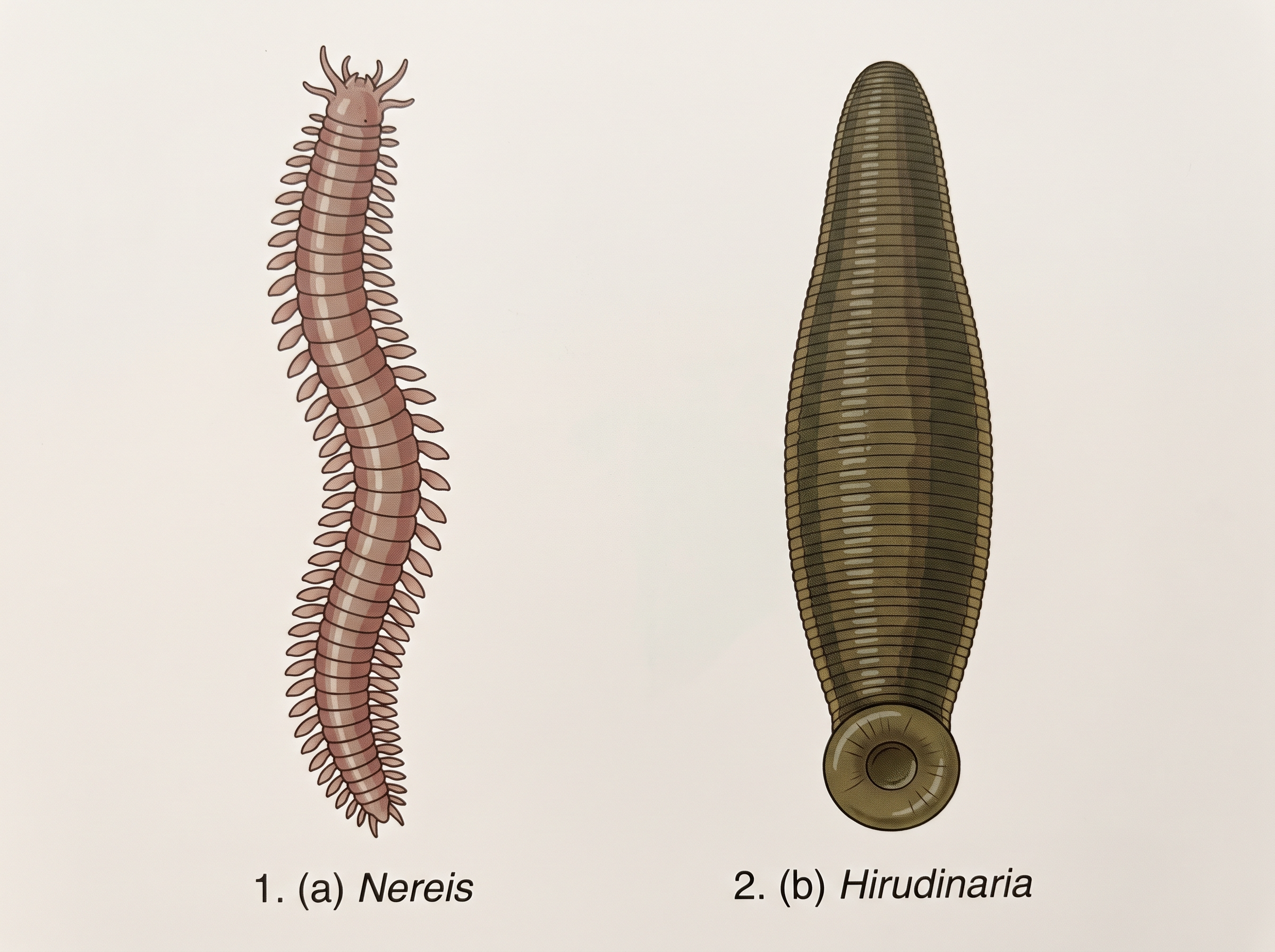
Fig. 4.10 – Examples of Annelida: (a) Nereis and (b) Hirudinaria.
They possess longitudinal and circular muscles that help in locomotion. Aquatic annelids like Nereis have lateral, paddle-like appendages called parapodia, which help in swimming. A closed circulatory system is present. Structures called nephridia (singular, nephridium) help in osmoregulation and excretion.
The neural system consists of paired ganglia (singular, ganglion — a cluster of nerve cell bodies) joined by lateral nerves to a double, ventral nerve cord. Nereis, an aquatic form, is dioecious, but earthworms and leeches are monoecious (hermaphrodite — both sexes in one individual). Reproduction is sexual.
Examples: Nereis, Pheretima (earthworm) and Hirudinaria (the blood-sucking leech).
4.2.7 Phylum – Arthropoda
This is the largest phylum of Animalia and includes the insects. In fact, over two-thirds of all named animal species on Earth are arthropods (Fig. 4.11). They show the organ-system level of organisation and are bilaterally symmetrical, triploblastic, segmented and coelomate.
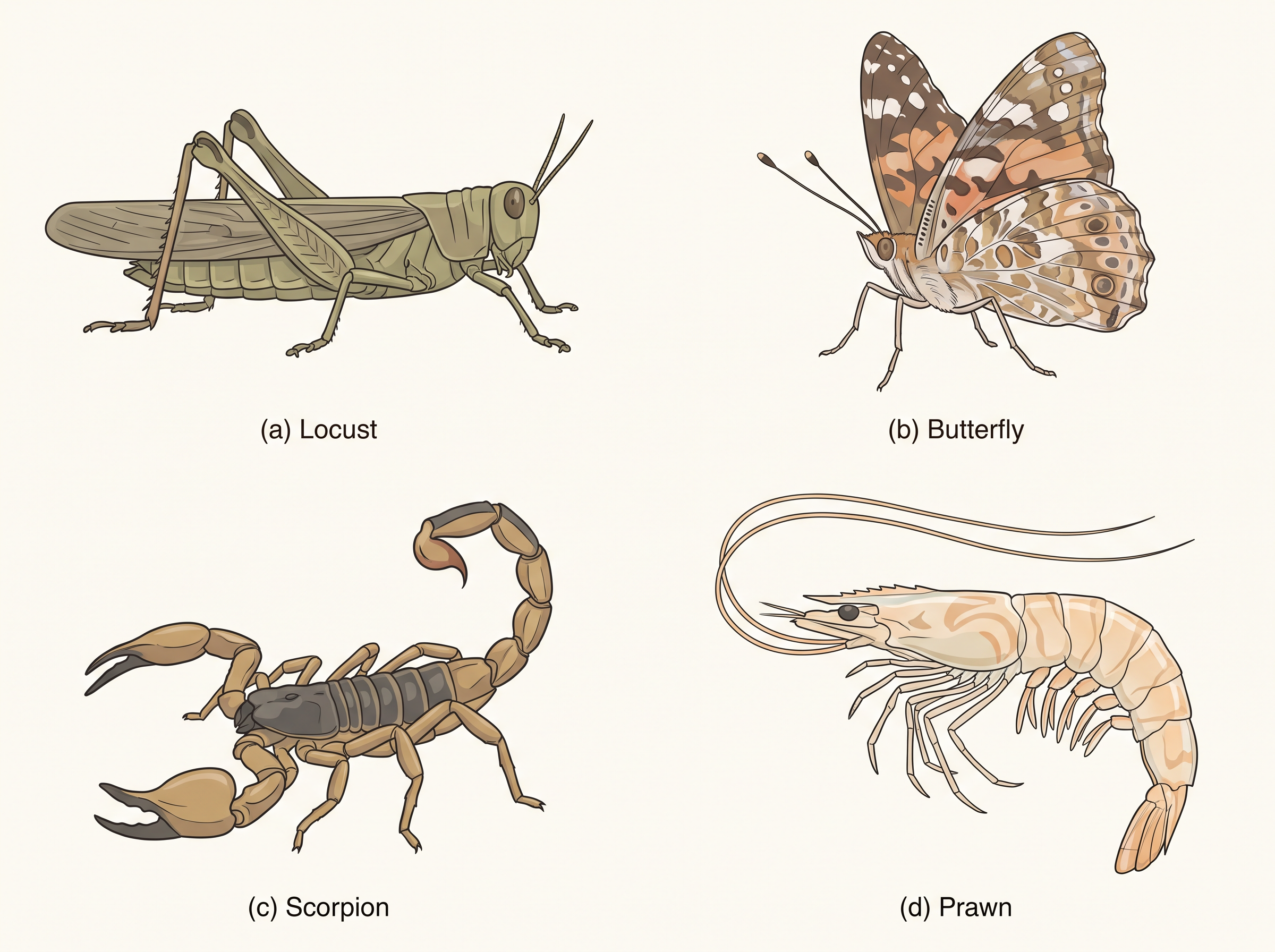
Fig. 4.11 – Examples of Arthropoda.
The body of an arthropod is covered by a chitinous exoskeleton (an outer skeleton made of chitin) and is divided into head, thorax and abdomen. They have jointed appendages, which is exactly what the name means (Greek arthros: joint, poda: appendages).
Their respiratory organs are gills, book gills, book lungs or a tracheal system. The circulatory system is of the open type. Sensory organs such as antennae, eyes (both compound and simple) and statocysts (balancing organs) are present. Excretion takes place through malpighian tubules. They are mostly dioecious, fertilisation is usually internal, and most are oviparous (egg-laying). Development may be direct or indirect.
Why Arthropods Are So Successful
Several features together explain why arthropods outnumber every other animal group. Their tough exoskeleton protects them, prevents water loss on land and supports their small bodies. Their jointed appendages allow varied, precise movements — walking, swimming, digging and flying. Their small size lets them occupy countless tiny habitats, and their range of respiratory and sensory organs suits them to water, land and air alike.
Examples: Economically important insects — Apis (honey bee), Bombyx (silkworm), Laccifer (lac insect); Vectors — Anopheles, Culex and Aedes (mosquitoes); Gregarious pest — Locusta (locust); Living fossil — Limulus (king crab).
4.2.8 Phylum – Mollusca
This is the second largest animal phylum (Fig. 4.12). Molluscs may be terrestrial or aquatic (marine or freshwater) and show the organ-system level of organisation. They are bilaterally symmetrical, triploblastic and coelomate.
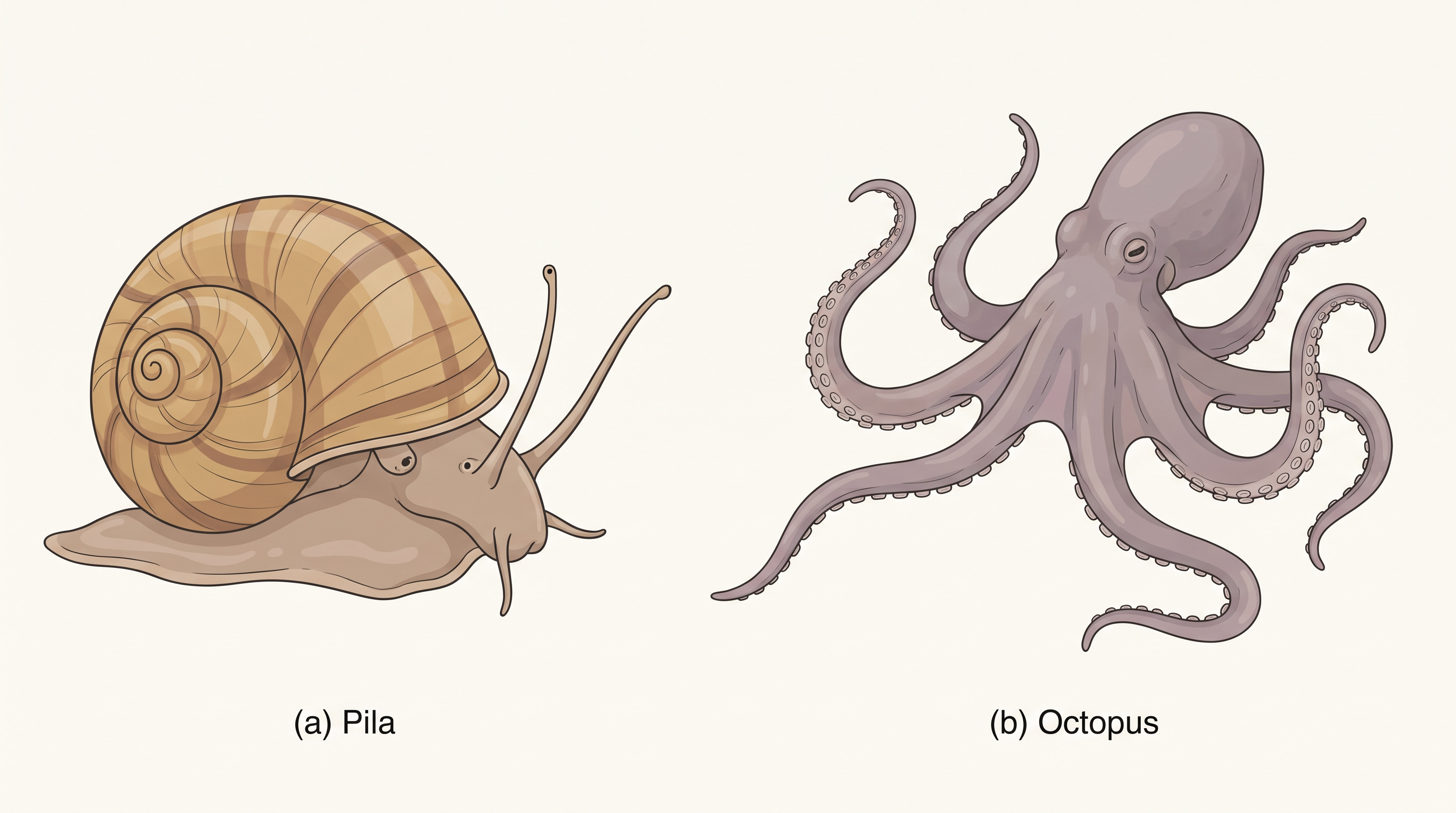
Fig. 4.12 – Examples of Mollusca: (a) Pila and (b) Octopus.
The body is usually covered by a calcareous (calcium-containing) shell and is unsegmented, with a distinct head, a muscular foot and a visceral hump (the raised mass containing the internal organs). A soft, spongy layer of skin called the mantle covers the visceral hump. The space between the hump and the mantle is the mantle cavity, in which feather-like gills are present; these carry out respiration and excretion.
The anterior head region bears sensory tentacles. The mouth contains a file-like rasping organ used for feeding, called the radula.
They are usually dioecious and oviparous, with indirect development.
Examples: Pila (apple snail), Pinctada (pearl oyster), Sepia (cuttlefish), Loligo (squid), Octopus (devil fish), Aplysia (sea-hare), Dentalium (tusk shell) and Chaetopleura (chiton).
4.2.9 Phylum – Echinodermata
These animals have an endoskeleton (internal skeleton) made of calcareous ossicles (small bony plates), which gives the phylum its name, meaning “spiny bodied” (Fig. 4.13). All are marine and show the organ-system level of organisation.
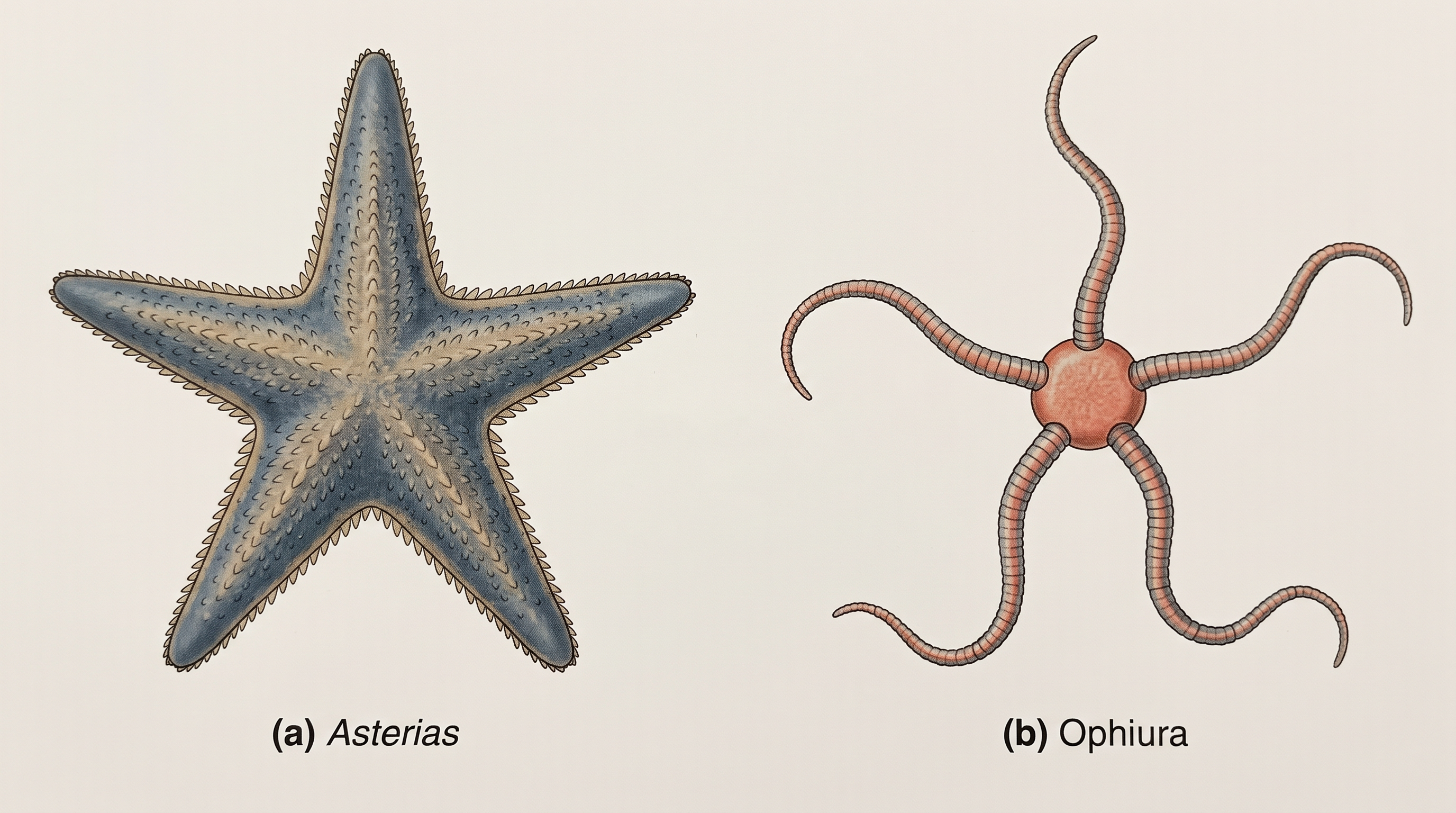
Fig. 4.13 – Examples of Echinodermata: (a) Asterias and (b) Ophiura.
An interesting point is that the adult echinoderms are radially symmetrical, but their larvae are bilaterally symmetrical — so the symmetry depends on the life stage. They are triploblastic and coelomate. The digestive system is complete, with the mouth on the lower (ventral) side and the anus on the upper (dorsal) side.
The most distinctive feature of echinoderms is the water vascular system, a network of fluid-filled canals unique to this group.
An excretory system is absent. The sexes are separate and reproduction is sexual. Fertilisation is usually external, and development is indirect, with a free-swimming larva.
Examples: Asterias (starfish), Echinus (sea urchin), Antedon (sea lily), Cucumaria (sea cucumber) and Ophiura (brittle star).
4.2.10 Phylum – Hemichordata
Hemichordata was earlier treated as a sub-phylum within phylum Chordata, but it is now placed as a separate phylum under the non-chordates. Hemichordates have a small, rudimentary structure in the collar region called the stomochord, which is somewhat similar to a notochord.
This phylum is a small group of worm-like marine animals with the organ-system level of organisation. They are bilaterally symmetrical, triploblastic and coelomate. The body is cylindrical and is made up of an anterior proboscis, a collar and a long trunk (Fig. 4.14).
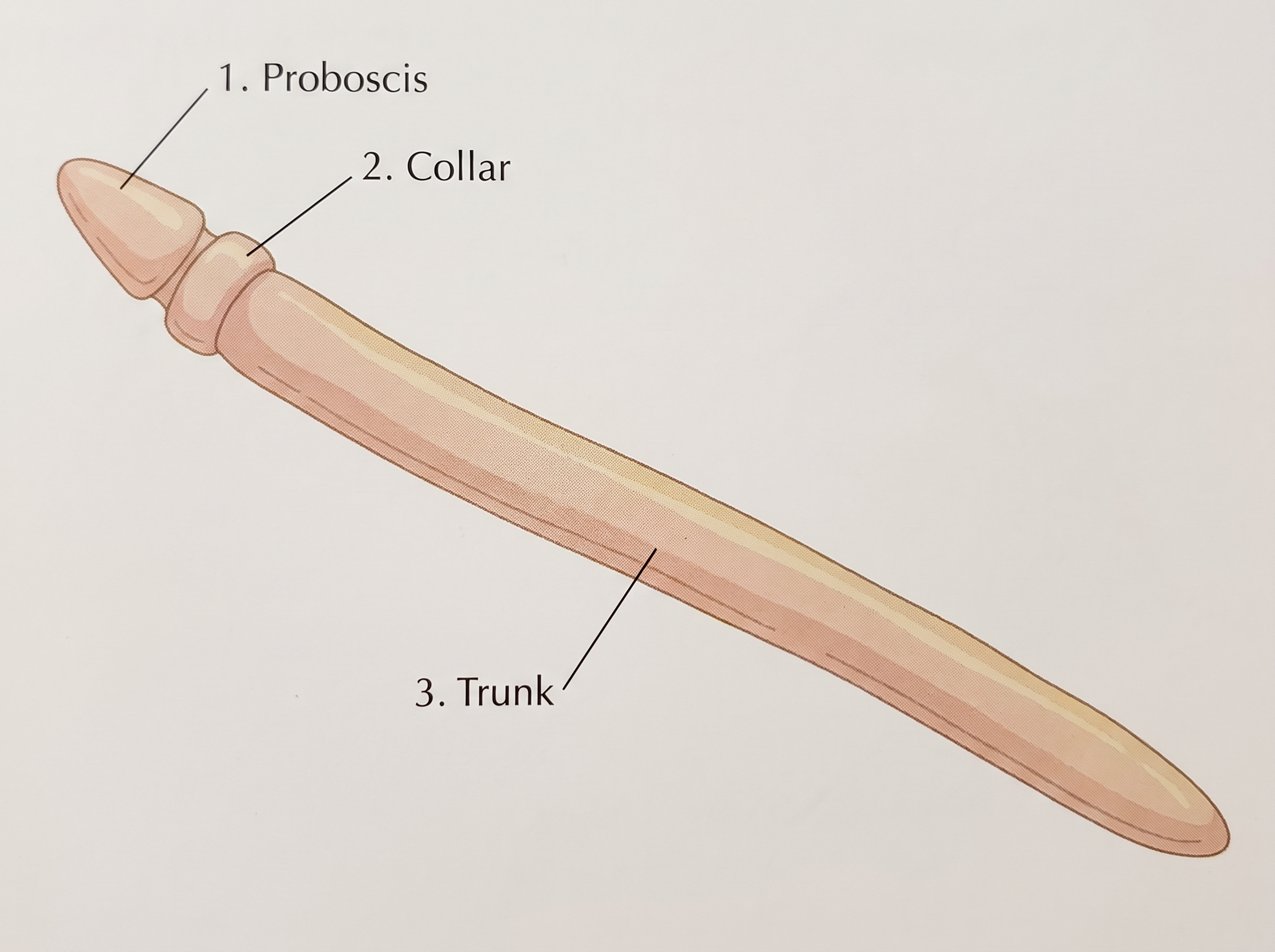
Fig. 4.14 – Balanoglossus.
The circulatory system is of the open type. Respiration takes place through gills. The excretory organ is the proboscis gland. The sexes are separate, fertilisation is external, and development is indirect.
Examples: Balanoglossus and Saccoglossus.
4.2.11 Phylum – Chordata
Animals of phylum Chordata are fundamentally characterised by four features: the presence of a notochord, a dorsal hollow nerve cord, and paired pharyngeal gill slits, along with a post-anal tail (Fig. 4.15). They are bilaterally symmetrical, triploblastic and coelomate, with the organ-system level of organisation, and they have a closed circulatory system.
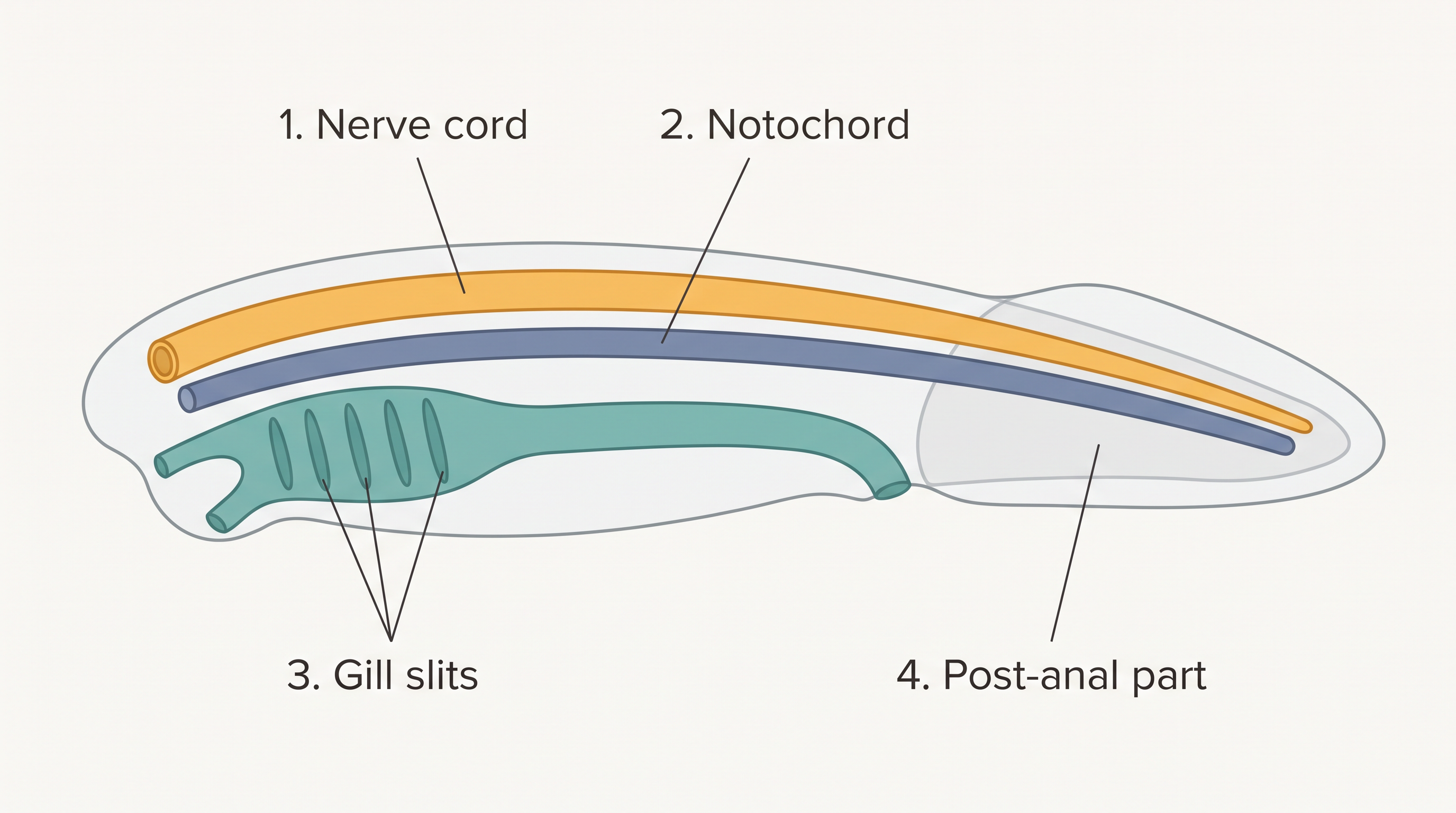
Fig. 4.15 – Fundamental chordate characteristics.
The clearest way to grasp what makes a chordate is to compare it directly with a non-chordate.
Phylum Chordata is divided into three subphyla: Urochordata (also called Tunicata), Cephalochordata and Vertebrata.
The subphyla Urochordata and Cephalochordata are together called protochordates (Fig. 4.16) and are exclusively marine. In Urochordata, the notochord is present only in the larval tail, whereas in Cephalochordata it extends from head to tail and is retained throughout life.
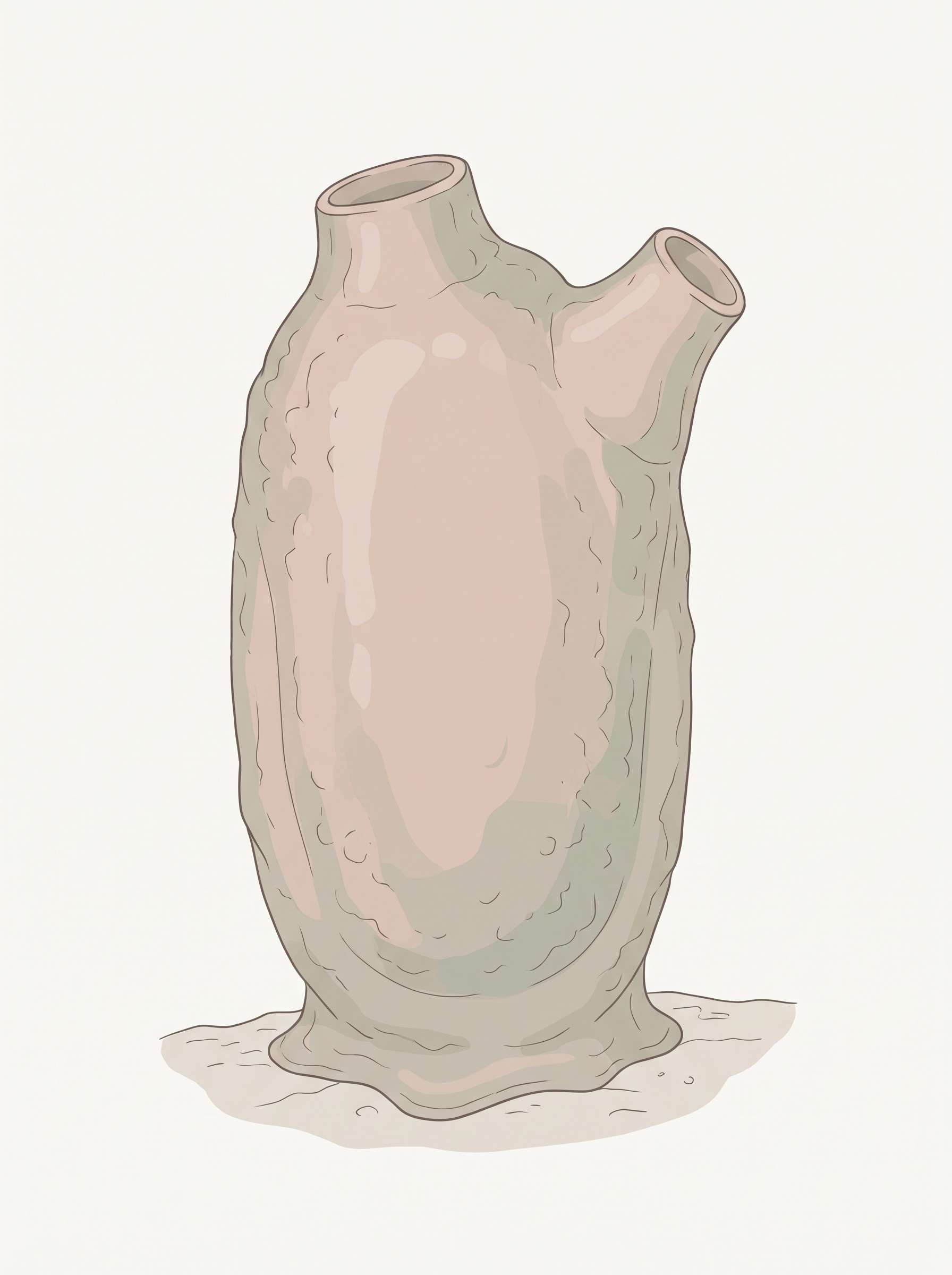
Fig. 4.16 – Ascidia.
Examples: Urochordata — Ascidia, Salpa, Doliolum; Cephalochordata — Branchiostoma (Amphioxus or lancelet).
Subphylum Vertebrata
Members of subphylum Vertebrata possess a notochord during the embryonic period. Later, the notochord is replaced by a cartilaginous or bony vertebral column (backbone) in the adult. Thus, all vertebrates are chordates, but not all chordates are vertebrates.
Besides the basic chordate characters, vertebrates possess a ventral muscular heart with two, three or four chambers, kidneys for excretion and osmoregulation, and paired appendages that may be fins or limbs.
Subphylum Vertebrata is further divided as summarised in FC 4.3.
Flowchart
FC 4.3 – Division of Vertebrata: Vertebrata → Agnatha (lacks jaw) → Class Cyclostomata; Vertebrata → Gnathostomata (bears jaw) → Super Class Pisces (bear fins) → Class Chondrichthyes, Class Osteichthyes; Super Class Tetrapoda (bear limbs) → Class Amphibia, Reptilia, Aves, Mammalia
4.2.11.1 Class – Cyclostomata
All living members of Cyclostomata are ectoparasites (external parasites) on some fishes. They have an elongated body bearing 6–15 pairs of gill slits for respiration. Cyclostomes have a sucking, circular mouth without jaws (Fig. 4.17).
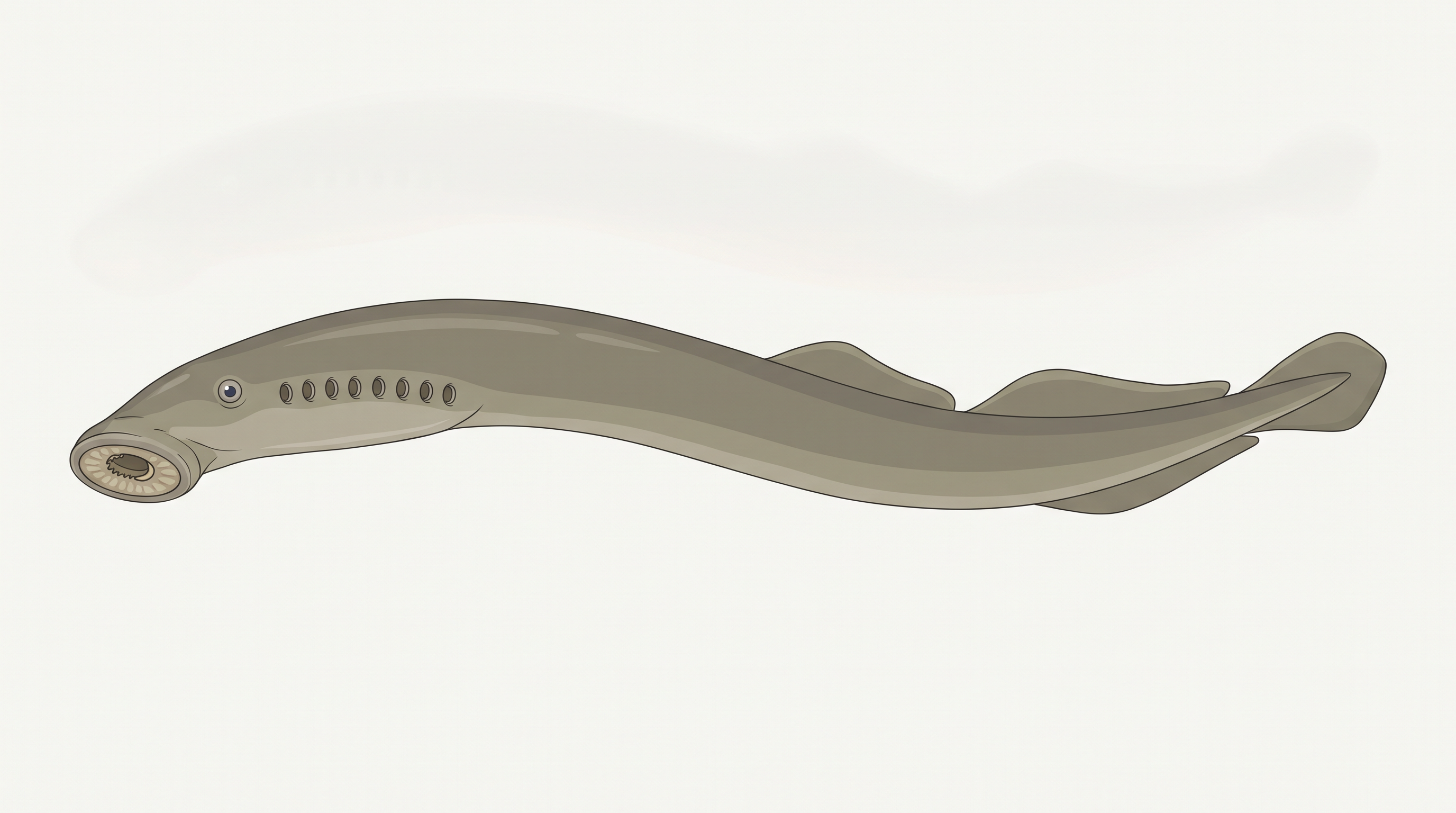
Fig. 4.17 – Petromyzon.
Their body has no scales and no paired fins. The cranium (skull) and vertebral column are cartilaginous. Circulation is of the closed type. Cyclostomes are marine but migrate to fresh water for spawning (releasing eggs and sperm); after spawning they die within a few days. Their larvae, after metamorphosis, return to the ocean.
Examples: Petromyzon (lamprey) and Myxine (hagfish).
4.2.11.2 Class – Chondrichthyes
These are marine animals with a streamlined body and a cartilaginous endoskeleton (Fig. 4.18). The mouth is located ventrally (on the underside). The notochord is persistent throughout life. Gill slits are separate and lack an operculum (a gill cover).
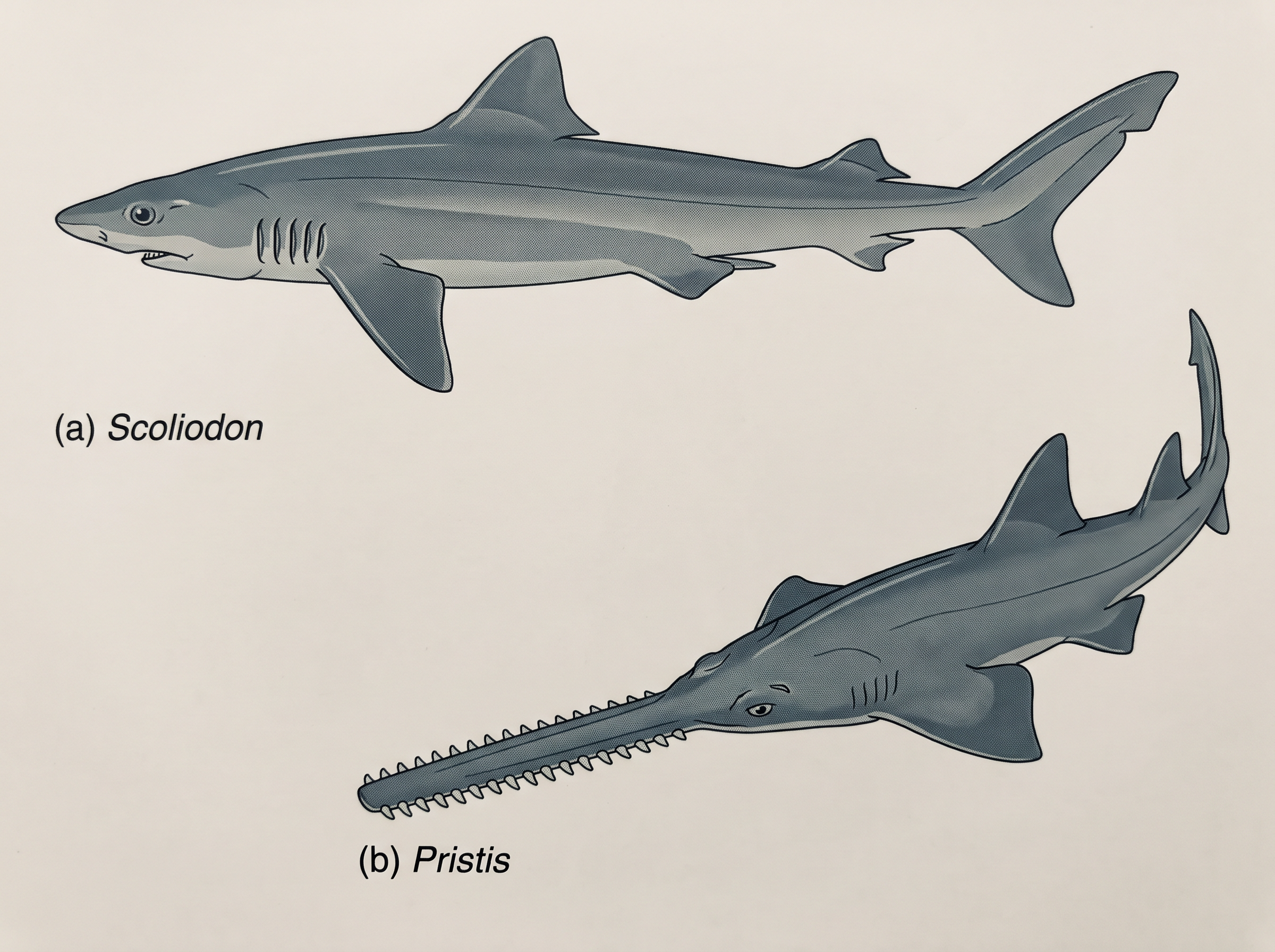
Fig. 4.18 – Cartilaginous fishes: (a) Scoliodon and (b) Pristis.
The skin is tough and bears minute placoid scales; the teeth are modified, backwardly directed placoid scales. Their jaws are very powerful, and these animals are predaceous (predatory). Because they lack an air bladder, they must swim constantly to avoid sinking.
The heart is two-chambered, with one auricle and one ventricle. Some have electric organs (for example, Torpedo) and some have a poison sting (for example, Trygon). They are cold-blooded, or poikilothermous, meaning they cannot regulate their own body temperature. The sexes are separate; in males, the pelvic fins bear claspers. Fertilisation is internal, and many of them are viviparous (giving birth to live young).
Examples: Scoliodon (dogfish), Pristis (sawfish), Carcharodon (great white shark), Trygon (sting ray).
4.2.11.3 Class – Osteichthyes
This class includes both marine and freshwater fishes with a bony endoskeleton. Their body is streamlined, and the mouth is mostly terminal (at the front tip) (Fig. 4.19). They have four pairs of gills covered by an operculum on each side. The skin bears cycloid or ctenoid scales.
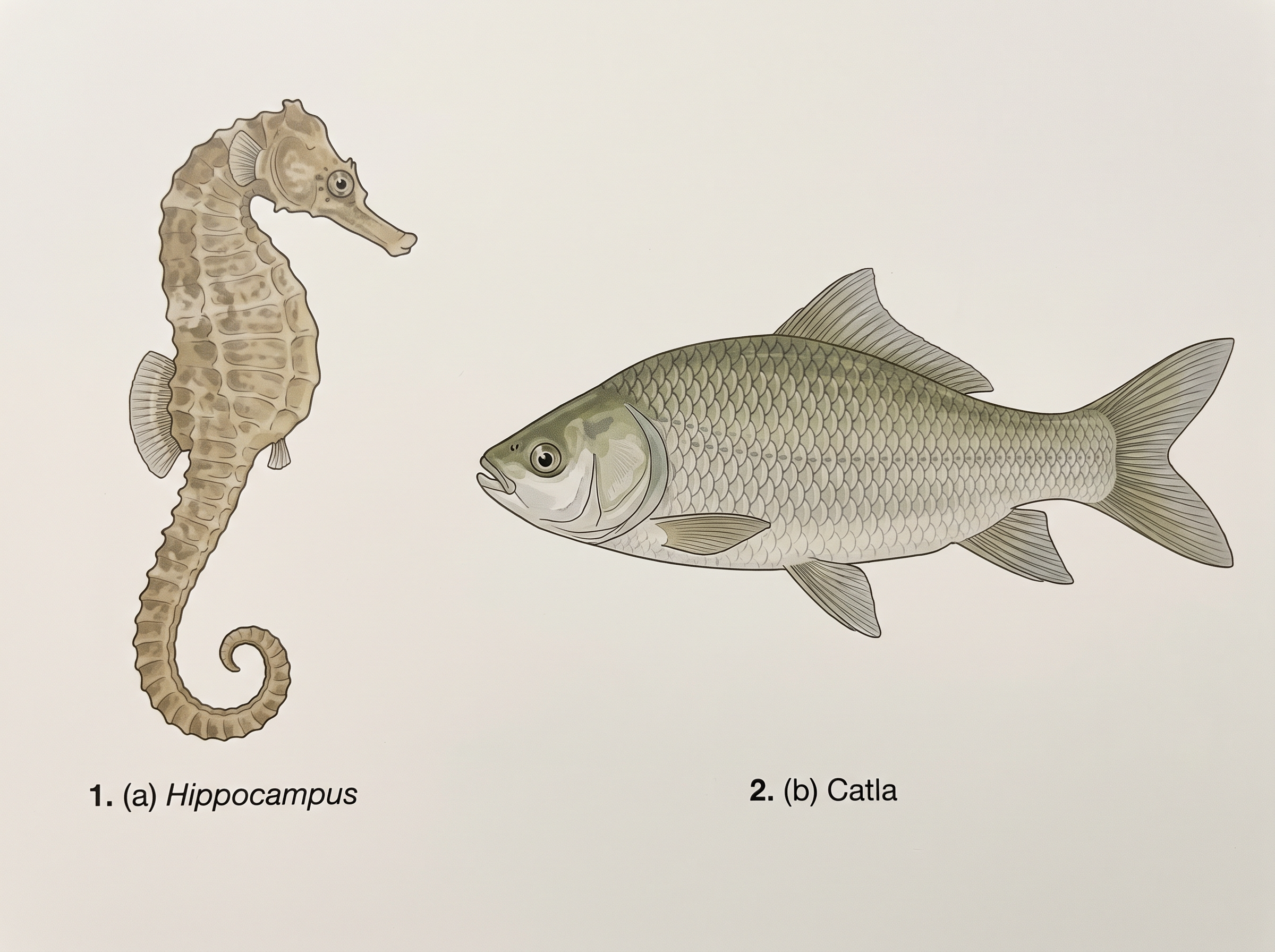
Fig. 4.19 – Bony fishes: (a) Hippocampus and (b) Catla.
An air bladder is present, which regulates buoyancy — the fish’s ability to float at a chosen depth. The heart is two-chambered (one auricle and one ventricle). They are cold-blooded. The sexes are separate. Fertilisation is usually external. They are mostly oviparous, and development is direct.
Examples: Marine — Exocoetus (flying fish), Hippocampus (sea horse); Freshwater — Labeo (rohu), Catla (katla), Clarias (magur); Aquarium — Betta (fighting fish), Pterophyllum (angel fish).
4.2.11.4 Class – Amphibia
As the name indicates (Greek amphi: dual, bios: life), amphibians can live both in water and on land (Fig. 4.20). Most of them have two pairs of limbs. The body is divided into head and trunk, and a tail may be present in some.
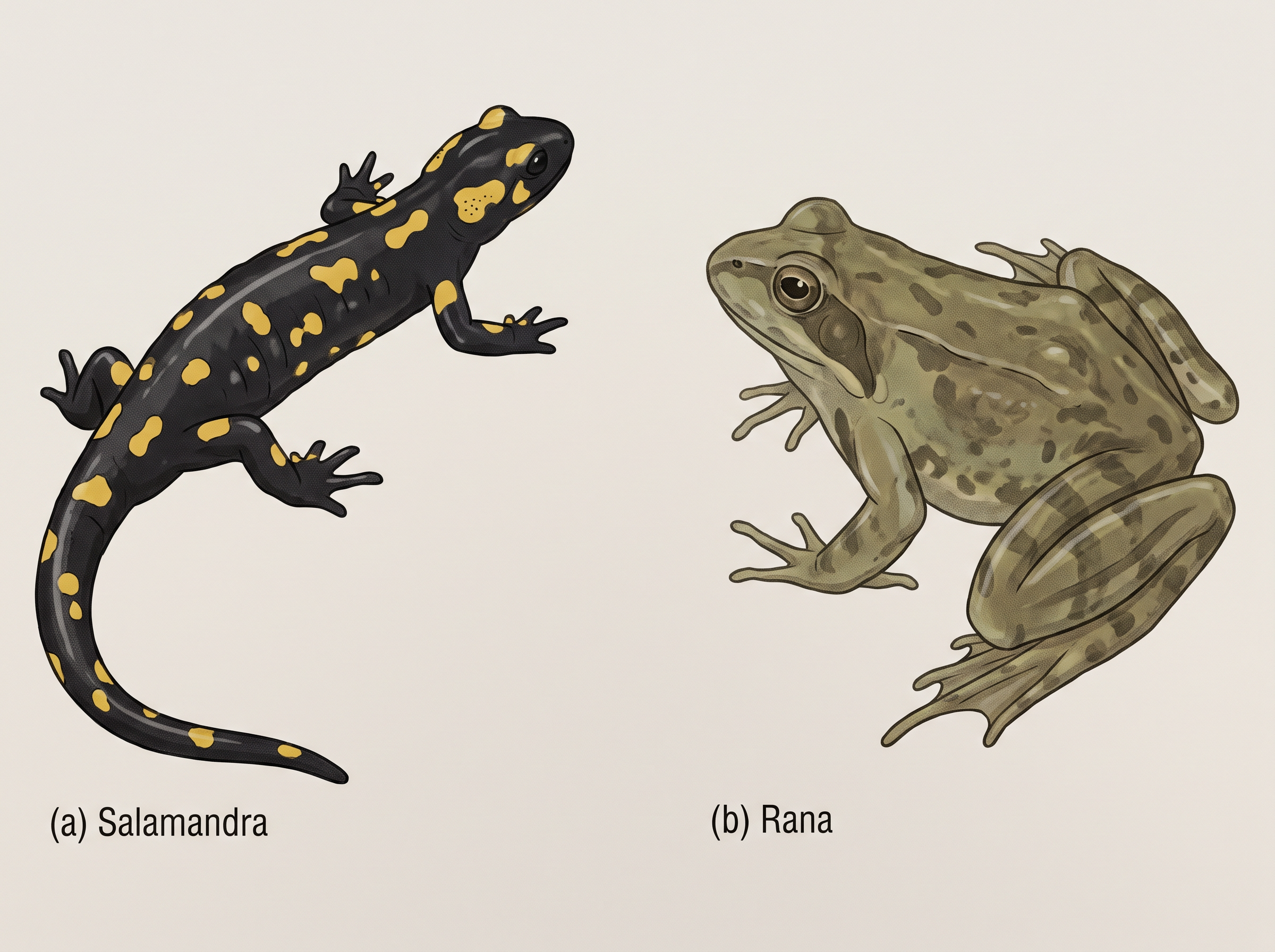
Fig. 4.20 – Examples of Amphibia: (a) Salamandra and (b) Rana.
The amphibian skin is moist and lacks scales. The eyes have eyelids. A tympanum (an eardrum-like membrane) represents the ear. The alimentary canal, urinary tract and reproductive tract open into a common chamber called the cloaca, which opens to the outside.
Respiration takes place through gills, lungs and the skin. The heart is three-chambered (two auricles and one ventricle). These are cold-blooded animals. The sexes are separate, fertilisation is external, they are oviparous, and development is indirect.
Examples: Bufo (toad), Rana (frog), Hyla (tree frog), Salamandra (salamander), Ichthyophis (a limbless amphibian).
4.2.11.5 Class – Reptilia
The class name refers to their creeping or crawling movement (Latin repere or reptum: to creep or crawl). They are mostly terrestrial, and the body is covered by dry, cornified skin bearing epidermal scales or scutes (Fig. 4.21). They have no external ear openings; a tympanum represents the ear.
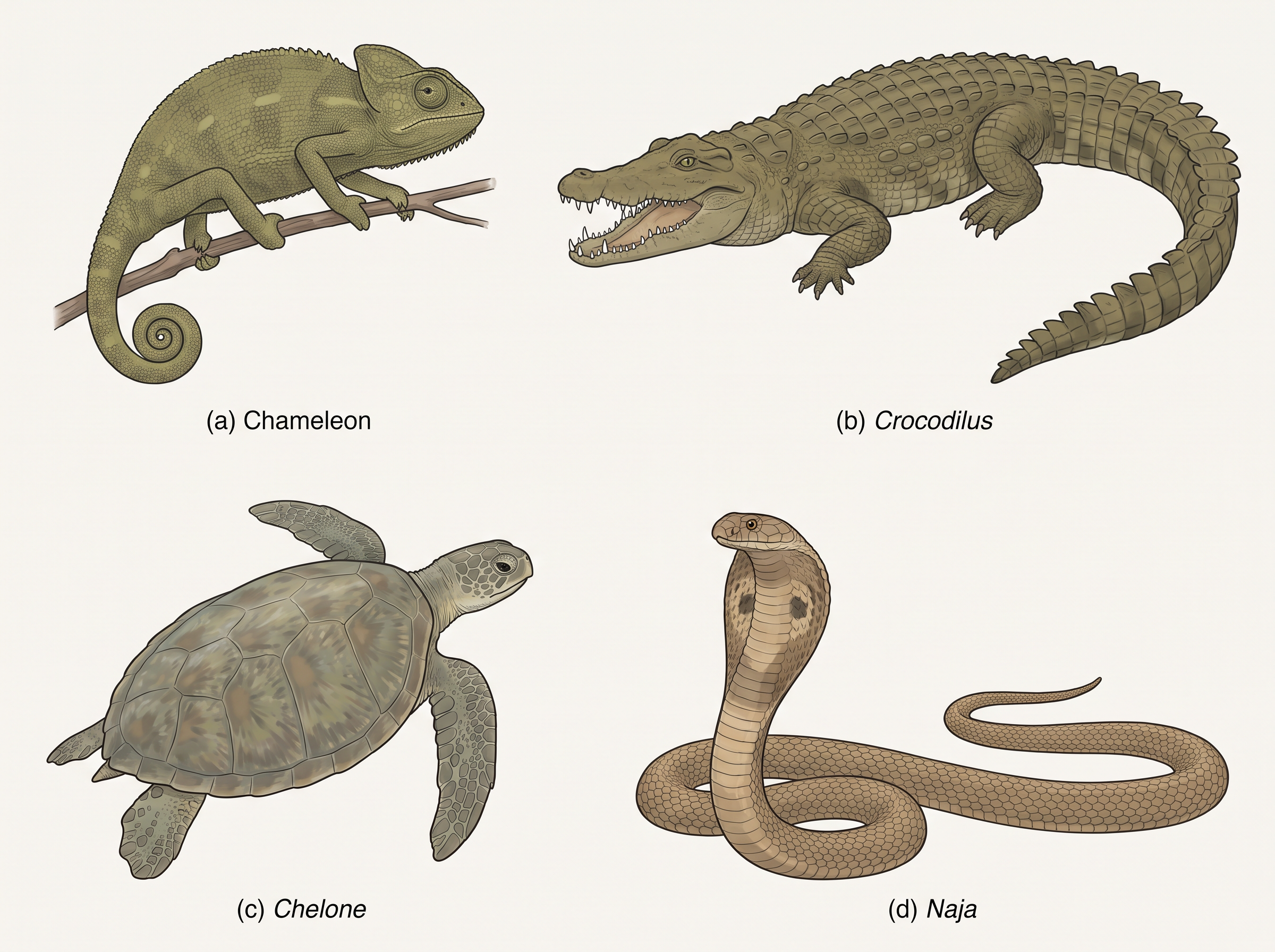
Fig. 4.21 – Reptiles.
Limbs, when present, are two pairs. The heart is usually three-chambered, but four-chambered in crocodiles. Reptiles are poikilotherms (cold-blooded). Snakes and lizards periodically shed their scales as a skin cast. The sexes are separate, fertilisation is internal, they are oviparous, and development is direct.
Examples: Chelone (turtle), Testudo (tortoise), Chameleon (tree lizard), Calotes (garden lizard), Crocodilus (crocodile), Alligator (alligator), Hemidactylus (wall lizard); poisonous snakes — Naja (cobra), Bangarus (krait), Vipera (viper).
4.2.11.6 Class – Aves
The characteristic features of Aves (birds) are the presence of feathers, and the ability to fly in most of them, except flightless birds such as the ostrich. They possess a beak (Fig. 4.22). The forelimbs are modified into wings, while the hind limbs, generally bearing scales, are modified for walking, swimming or clasping tree branches.
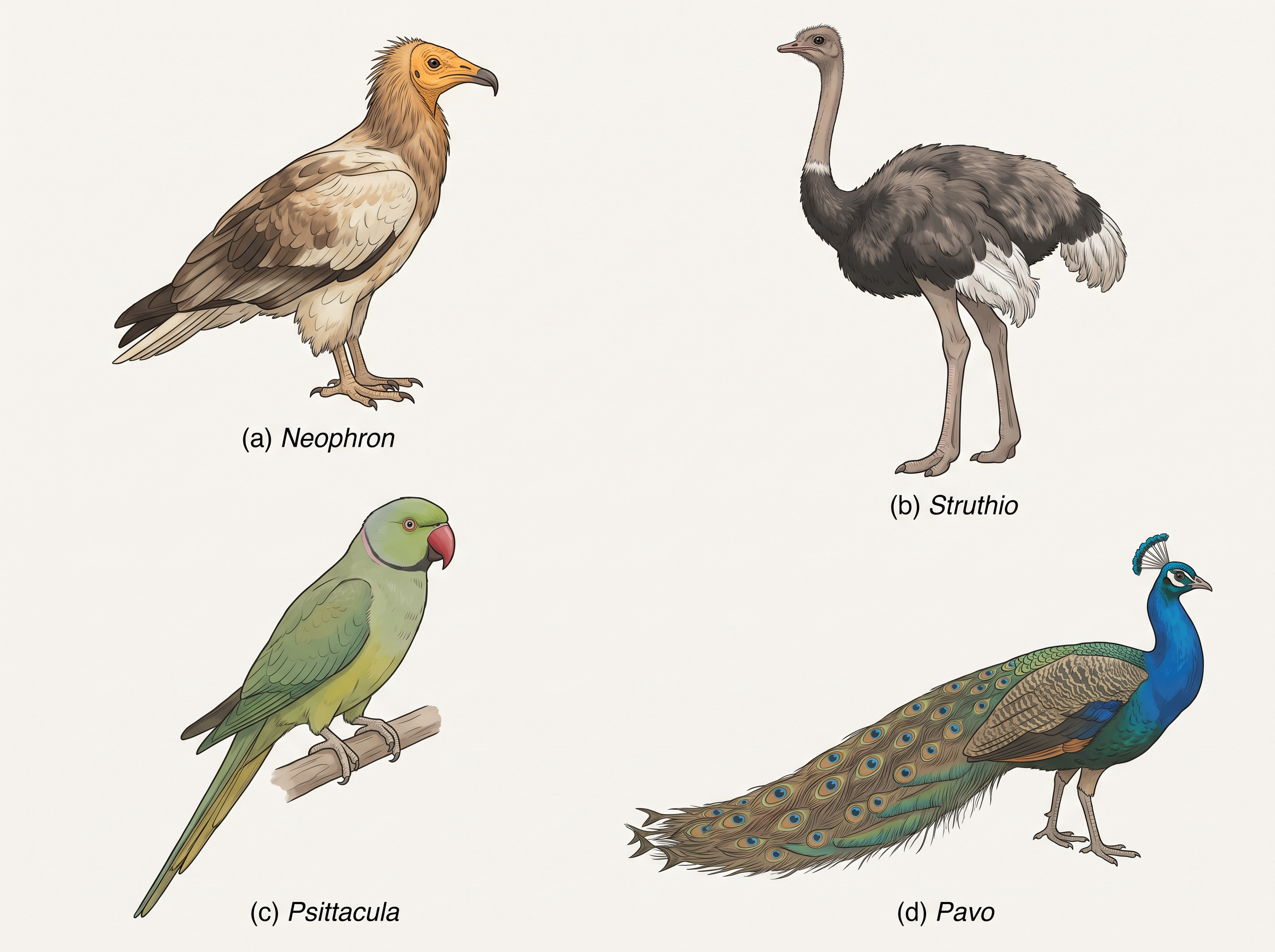
Fig. 4.22 – Examples of birds.
The skin is dry and without glands, except for the oil gland at the base of the tail. The endoskeleton is fully ossified (bony), and the long bones are hollow with air cavities, a condition described as pneumatic. The digestive tract has additional chambers, the crop and the gizzard. The heart is completely four-chambered. Birds are warm-blooded, or homoiothermous, meaning they can maintain a constant body temperature.
Respiration is by lungs, and air sacs connected to the lungs supplement it. The sexes are separate, fertilisation is internal, they are oviparous, and development is direct.
Examples: Corvus (crow), Columba (pigeon), Psittacula (parrot), Struthio (ostrich), Pavo (peacock), Aptenodytes (penguin), Neophron (vulture).
4.2.11.7 Class – Mammalia
Mammals are found in an enormous range of habitats — polar ice caps, deserts, mountains, forests, grasslands and dark caves — and some are adapted to fly or to live in water. The most unique mammalian feature is the presence of milk-producing glands, the mammary glands, by which the young are nourished. They have two pairs of limbs, adapted for walking, running, climbing, burrowing, swimming or flying (Fig. 4.23).
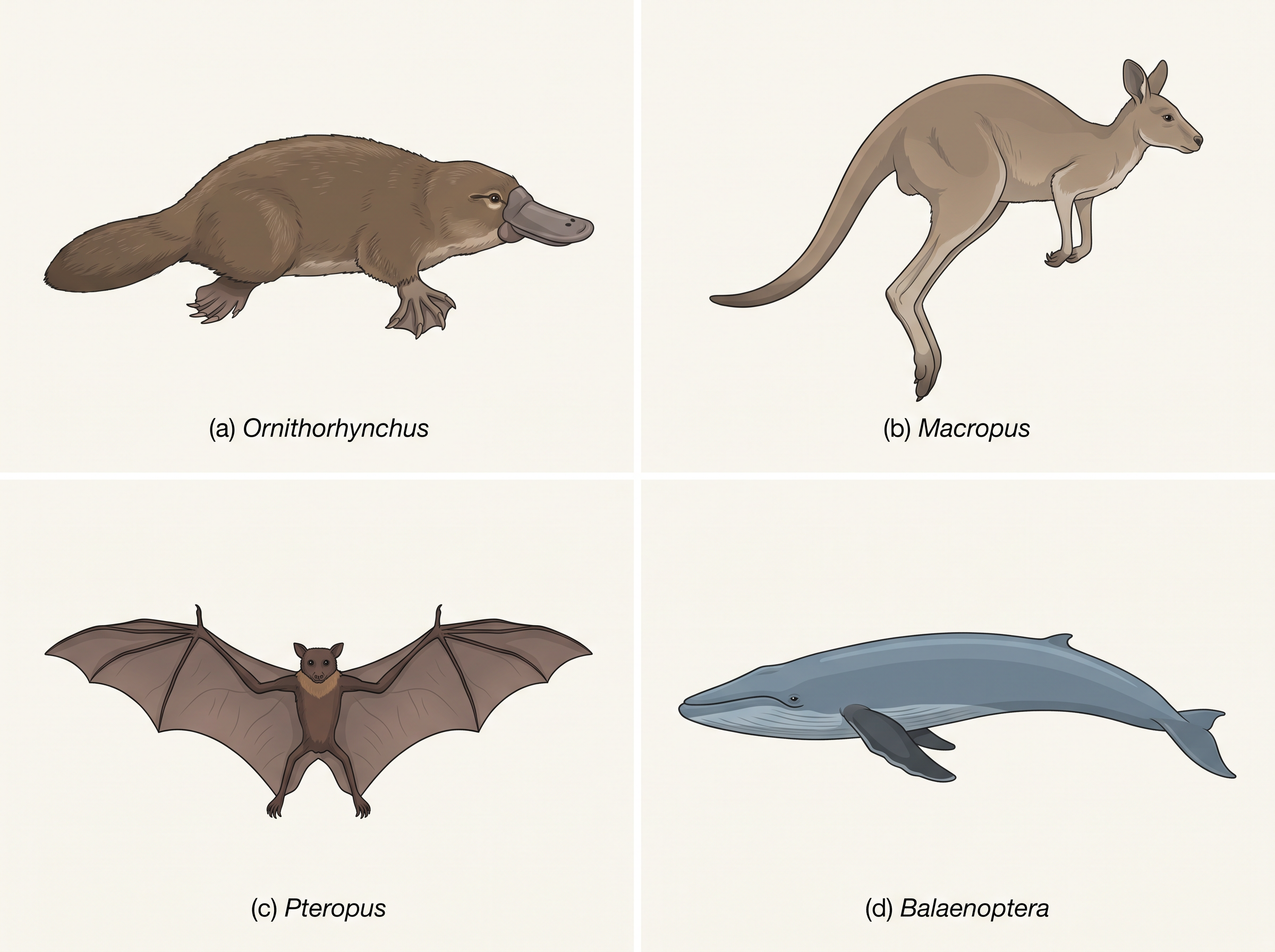
Fig. 4.23 – Examples of mammals.
The skin of mammals is unique in possessing hair. External ears, or pinnae, are present. Different types of teeth are present in the jaw. The heart is four-chambered, and mammals are homoiothermous. Respiration is by lungs. The sexes are separate and fertilisation is internal. They are viviparous, with a few exceptions, and development is direct.
Examples: Oviparous — Ornithorhynchus (platypus); Viviparous — Macropus (kangaroo), Pteropus (flying fox), Camelus (camel), Macaca (monkey), Rattus (rat), Canis (dog), Felis (cat), Elephas (elephant), Equus (horse), Delphinus (common dolphin), Balaenoptera (blue whale), Panthera tigris (tiger), Panthera leo (lion).
Salient Features of the Animal Phyla
The distinguishing features of all the phyla studied above are brought together in the comparison below, which is a useful revision tool for quickly telling one phylum from another.
4.3 Summary
A few basic fundamental features — level of organisation, symmetry, cell organisation, coelom, segmentation and notochord — allow us to broadly classify the animal kingdom. Besides these, each phylum or class has its own distinctive characters.
The sequence of features used to place an animal is summarised in FC 4.4.
Flowchart
FC 4.4 – The logic of animal classification: cell arrangement (cellular → tissue → organ → organ-system) → symmetry (asymmetrical / radial / bilateral) → germ layers (diploblastic / triploblastic) → body cavity (acoelomate / pseudocoelomate / coelomate) → segmentation (absent / present) → notochord (absent = non-chordate; present = chordate) → within chordates: jaws (Agnatha / Gnathostomata) → appendages (fins = Pisces; limbs = Tetrapoda)
Porifera are multicellular animals with the cellular level of organisation and characteristic flagellated choanocytes.
Coelenterates bear tentacles and cnidoblasts. They are mostly aquatic, sessile or free-floating.
Ctenophores are marine animals that move using comb plates.
Platyhelminths have a flat body and bilateral symmetry; their parasitic forms bear distinct suckers and hooks.
Aschelminthes are pseudocoelomate roundworms, including both parasitic and non-parasitic forms.
Annelids are metamerically segmented animals with a true coelom.
Arthropods are the most abundant group of animals, marked by jointed appendages and a chitinous external skeleton.
Molluscs have a soft body usually surrounded by an external calcareous shell.
Echinoderms have a spiny skin; their most distinctive feature is the water vascular system.
Hemichordates are a small group of worm-like marine animals with a cylindrical body divided into proboscis, collar and trunk.
Phylum Chordata includes animals that possess a notochord either throughout life or during early embryonic life. Other common chordate features are a dorsal, hollow nerve cord and paired pharyngeal gill slits.
Among vertebrates, some lack jaws (Agnatha) while most possess jaws (Gnathostomata). Agnatha is represented by the class Cyclostomata — the most primitive chordates and ectoparasites on fishes.
Gnathostomata has two super classes, Pisces and Tetrapoda. Chondrichthyes and Osteichthyes bear fins and are grouped under Pisces; the Chondrichthyes are marine fishes with a cartilaginous endoskeleton.
The classes Amphibia, Reptilia, Aves and Mammalia have two pairs of limbs and are grouped under Tetrapoda.
Amphibians have adapted to live both on land and in water.
Reptiles are marked by dry, cornified skin; limbs are absent in snakes.
Fishes, amphibians and reptiles are poikilothermous (cold-blooded).
Aves are warm-blooded animals with feathers and forelimbs modified into wings for flight; their hind limbs are adapted for walking, swimming, perching or clasping.
The unique features of mammals are mammary glands and hair on the skin; they commonly show viviparity.
4.4 Points to Ponder
Two animals may look almost identical from the outside yet belong to different phyla, while two that look nothing alike may be close relatives. Why do biologists trust hidden features — such as the coelom or the germ layers — more than outward appearance when classifying animals?
As we move from sponges to chordates, animals climb from the cellular level to the organ-system level of organisation. What advantages might each higher level of organisation offer, and does greater complexity always mean a “better” animal?
Radial symmetry is common in sessile or floating animals, while bilateral symmetry is common in animals that move actively in one direction. How might an animal’s symmetry be connected to the way it lives and moves?
Many flatworms and roundworms are parasites that have gained hooks and suckers but lost or reduced other structures. Can losing certain features also be a kind of successful adaptation?
In vertebrates, the embryonic notochord is later replaced by a vertebral column. Why might a flexible rod be useful early in development, and a jointed backbone be more useful in the adult?
Arthropods and molluscs are the two largest animal phyla, yet they are built on very different body plans. What does their shared success suggest about the many possible ways of “solving” the problem of survival?
Hemichordates were once placed within the chordates and are now treated as a separate phylum. What does this shift tell us about scientific classification — is it a fixed truth, or something that grows and changes with new evidence?
Fishes, amphibians and reptiles are cold-blooded, while birds and mammals are warm-blooded. How might the ability to keep a constant body temperature have widened the range of habitats an animal can occupy?
4.5 NCERT Questions
What are the difficulties that you would face in classification of animals, if common fundamental features are not taken into account?
If you are given a specimen, what are the steps that you would follow to classify it?
How useful is the study of the nature of body cavity and coelom in the classification of animals?
Distinguish between intracellular and extracellular digestion.
What is the difference between direct and indirect development?
What are the peculiar features that you find in parasitic platyhelminthes?
What are the reasons that you can think of for the arthropods to constitute the largest group of the animal kingdom?
Water vascular system is the characteristic of which group of the following: (a) Porifera (b) Ctenophora (c) Echinodermata (d) Chordata
“All vertebrates are chordates but all chordates are not vertebrates.” Justify the statement.
How important is the presence of air bladder in Pisces?
What are the modifications that are observed in birds that help them fly?
Could the number of eggs or young ones produced by an oviparous and viviparous mother be equal? Why?
Segmentation in the body is first observed in which of the following: (a) Platyhelminthes (b) Aschelminthes (c) Annelida (d) Arthropoda
Match the following:
| Column I | Column II |
|---|---|
| a. Operculum | i. Ctenophora |
| b. Parapodia | ii. Mollusca |
| c. Scales | iii. Porifera |
| d. Comb plates | iv. Reptilia |
| e. Radula | v. Annelida |
| f. Hairs | vi. Cyclostomata and Chondrichthyes |
| g. Choanocytes | vii. Mammalia |
| h. Gill slits | viii. Osteichthyes |
- Prepare a list of some animals that are found parasitic on human beings.
4.6 Check Your Concepts
Assertion–Reason. Assertion: A sponge is placed in the animal kingdom even though it has no organs or nervous system. Reason: An organism qualifies as an animal only if it possesses a complete organ-system level of organisation. State whether the assertion and the reason are true, and whether the reason correctly explains the assertion.
Why does a shark have to keep swimming throughout its life, while a bony fish such as Catla can rest motionless in water? Explain the structural reason.
What difficulties would the internal organs of a coelomate animal face if it did not possess a true coelom? Answer with reference to the functions of the coelom.
Arrange the following levels of organisation in increasing order of complexity, and name one animal group that shows each: organ level, cellular level, organ-system level, tissue level.
In a diagram illustrating the fundamental characteristics of a chordate, identify and label the four features that place an animal in phylum Chordata.
Distinguish between diploblastic and triploblastic animals, and give one example of each.
Assertion–Reason. Assertion: Hemichordata is now placed under the non-chordates. Reason: The stomochord in the collar region of hemichordates is a fully developed notochord. State whether the assertion and the reason are true, and whether the reason correctly explains the assertion.
Match each phylum with its most distinctive feature:
| Column I | Column II |
|---|---|
| a. Arthropoda | i. water vascular system |
| b. Echinodermata | ii. jointed appendages |
| c. Mollusca | iii. comb plates for locomotion |
| d. Ctenophora | iv. radula |
Why is metagenesis (alternation of generations) regarded as a special feature of certain cnidarians such as Obelia? Explain what happens in each generation.
A marine animal is radially symmetrical as an adult but was bilaterally symmetrical as a larva, and possesses an endoskeleton of calcareous ossicles. To which phylum does it belong? Justify your answer.
What is the operculum, and which class of fishes lacks it? How does its absence affect the appearance of the gill region?
Give reasons why amphibians are said to lead a “dual life,” referring to their respiration and habitat.
Arrange the following in the correct sequence to show the path of water flow through a sponge: osculum, ostia, spongocoel.
Earthworms and leeches are monoecious, whereas Nereis is dioecious, although all three are annelids. Explain the difference between the terms monoecious and dioecious.
Why are the long bones of birds described as pneumatic, and how does this condition assist them in flight?
Identify the odd one out and give the reason for your choice: Torpedo, Trygon, Scoliodon, Catla.
The crocodile’s heart differs from that of most other reptiles. State this difference, and explain why it makes the crocodile an exception within class Reptilia.
Distinguish between a polyp and a medusa, and name one cnidarian that exhibits both body forms during its life cycle.
Both roundworms (Aschelminthes) and flatworms (Platyhelminthes) include many parasites, yet they differ in their body cavity. Compare the two groups on the basis of coelom and level of organisation.
“The presence or absence of a notochord divides the entire animal kingdom into two broad groups.” Name these two groups and state the position of echinoderms and hemichordates in this division.