Chapter 5: Morphology of Flowering Plants
In the middle of the 1700s, a Swedish botanist named Carl Linnaeus was doing something that looked almost too simple to be science: he was counting flower parts. Where others saw a meadow of scattered blooms, Linnaeus looked closely and began sorting plants by how many stamens (the male parts) and how many pistils (the female parts) each flower carried. A flower with a certain number of stamens went into one group; a flower with a different number went into another.
From this careful, patient counting he built an entire system for naming and organising the plant kingdom — the same two-word naming style, like Solanum tuberosum for the potato, that we still use today. His great insight was that the outward form of a plant, especially its flower, is not random decoration. It is a reliable code. Read the code correctly and you can tell one plant from another, and even recognise which plants are close relatives.
That study of external form — of roots, stems, leaves, flowers, fruits and seeds — is called morphology. Before we can understand how plants live, reproduce or get classified, we first need a shared, precise vocabulary to describe what they look like. This chapter gives you exactly that: the standard terms botanists use to describe a flowering plant from its root tip to its ripened fruit.
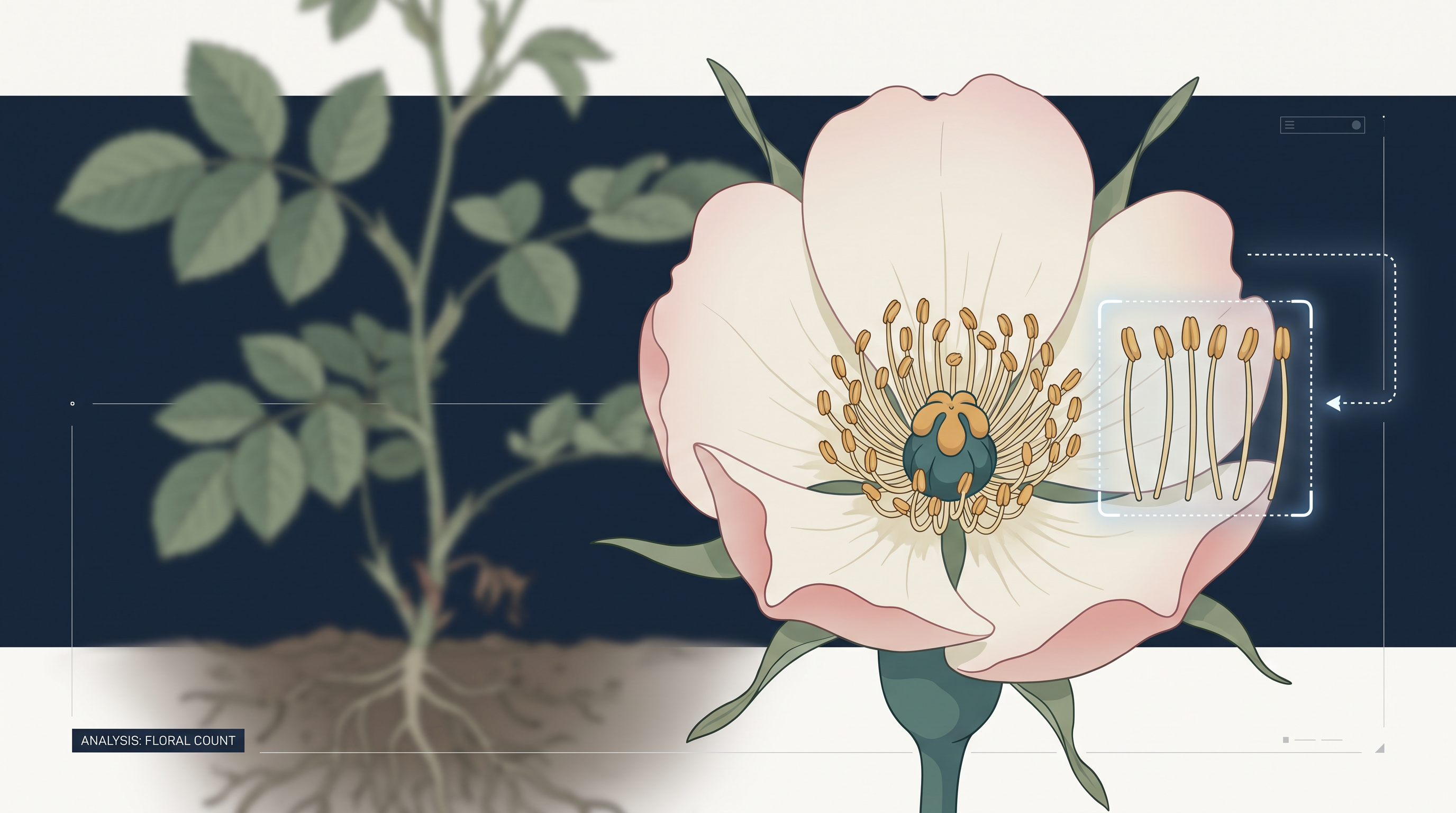
Fig. 5.0 – Counting floral parts for classification.
By the end of this chapter, you will be able to answer each of these questions using the language of plant morphology.
5.1 The Root
Angiosperms — the flowering plants — show an enormous variety in their outward form, yet every one of them is built from the same set of basic organs: roots, stems, leaves and, in season, flowers and fruits. Pull out any weed from the ground and you will find this shared body plan repeated.
The body of a flowering plant is divided into two systems. The part that stays hidden below the soil is the root system, while the portion that rises into the air — stem, leaves, flowers and fruits — makes up the shoot system, as shown in Fig. 5.1. In this section we look closely at the root system.
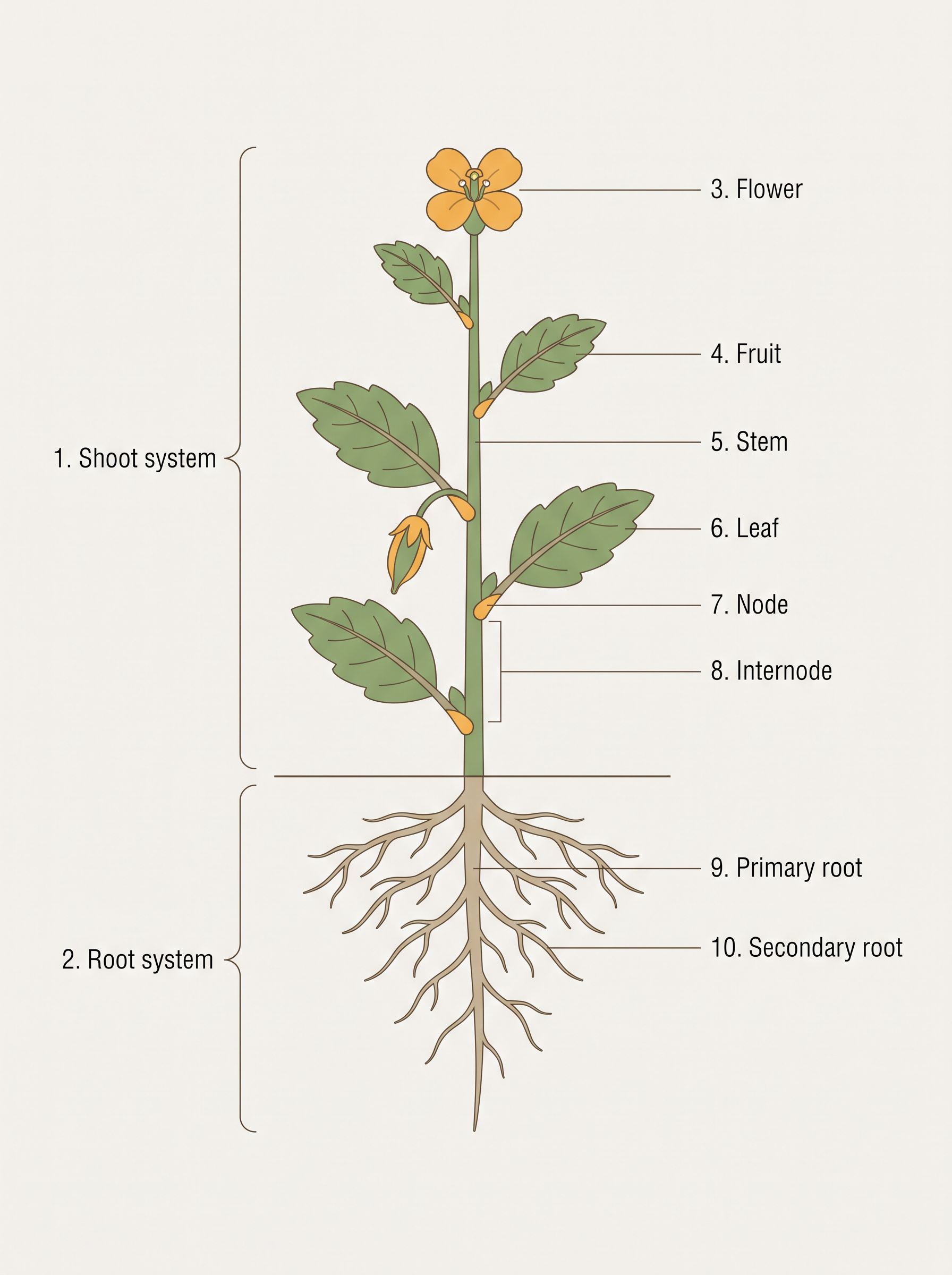
Fig. 5.1 – Parts of a flowering plant.
How the Root System Develops
When a seed germinates, the first structure to emerge is the radicle — the tiny embryonic root already packed inside the seed. In most dicotyledonous plants (dicots, whose seeds carry two seed leaves or cotyledons), the radicle simply keeps elongating straight down into the soil to form the primary root.
The primary root then sends out side branches, and these are ranked by order. The branches coming off the primary root are the secondary roots, their branches are the tertiary roots, and so on. Together, the primary root and all its branches make up the tap root system, the kind you see in the mustard plant (Fig. 5.2a).
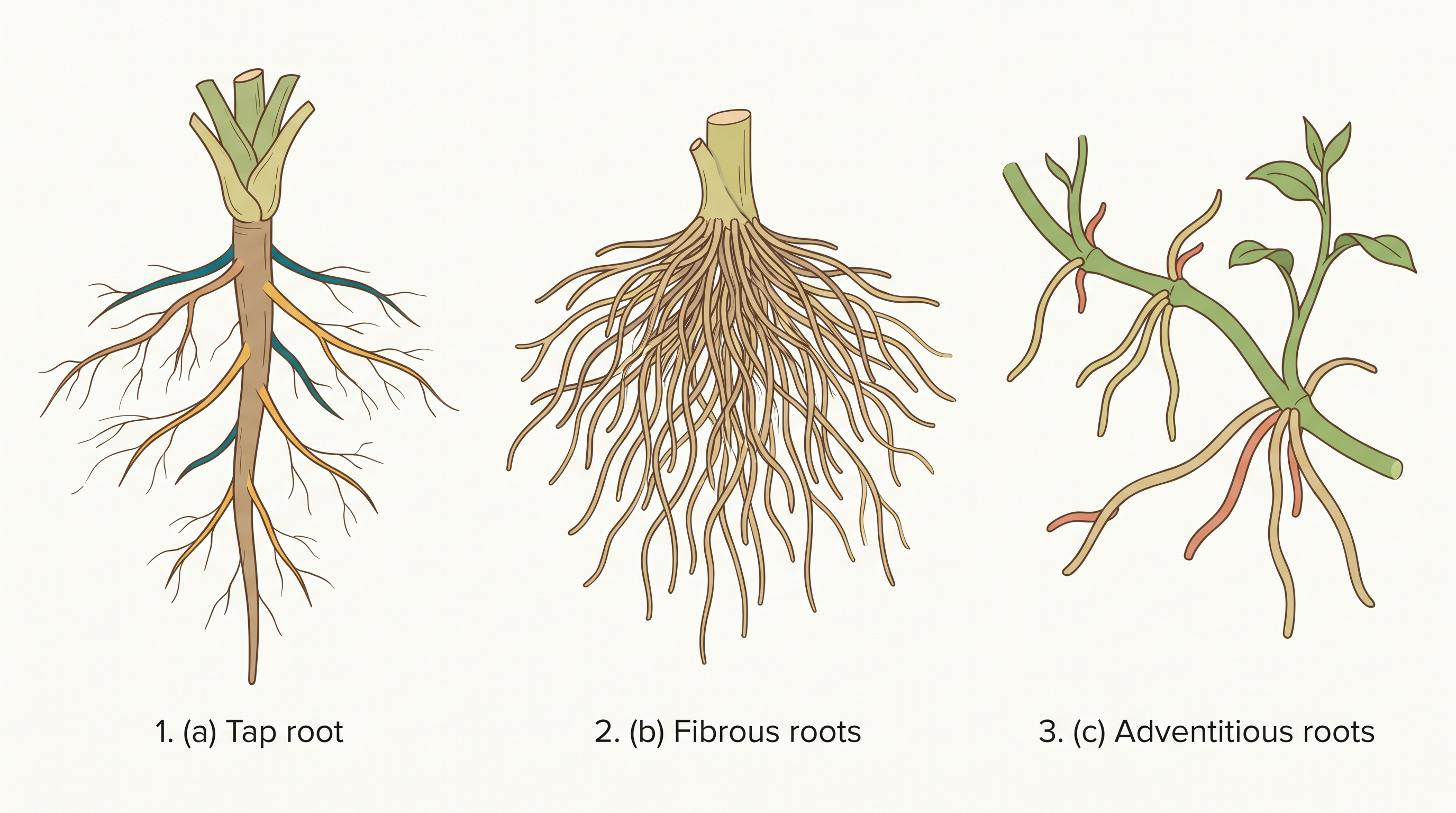
Fig. 5.2 – Types of root systems.
Monocots follow a different route. In monocotyledonous plants (monocots, whose seeds carry a single cotyledon), the primary root is short-lived. It soon dies and is replaced by a large number of roots that grow out from the base of the stem. This bushy cluster of roughly equal-sized roots is the fibrous root system, seen in the wheat plant (Fig. 5.2b).
Not every root grows from the radicle. In some plants — grasses, Monstera, and the banyan tree — roots arise from parts of the plant other than the radicle, such as the stem or a branch. These are called adventitious roots (Fig. 5.2c).
Functions of the Root
A root does far more than hold the plant in place. Its four main jobs are: absorbing water and dissolved minerals from the soil; providing firm anchorage so the plant is not toppled by wind or its own weight; storing reserve food material; and taking part in the synthesis of plant growth regulators (chemical messengers, similar to hormones, that control how the plant grows).
5.1.1 Regions of the Root
A root does not grow evenly along its whole length; growth is packed into distinct zones near the tip. Right at the very apex sits a thimble-like cap of cells called the root cap (Fig. 5.3). Since a growing root must push through hard, gritty soil, the root cap protects the tender tip behind it — rather like a helmet — and is steadily worn away and renewed as the root advances.
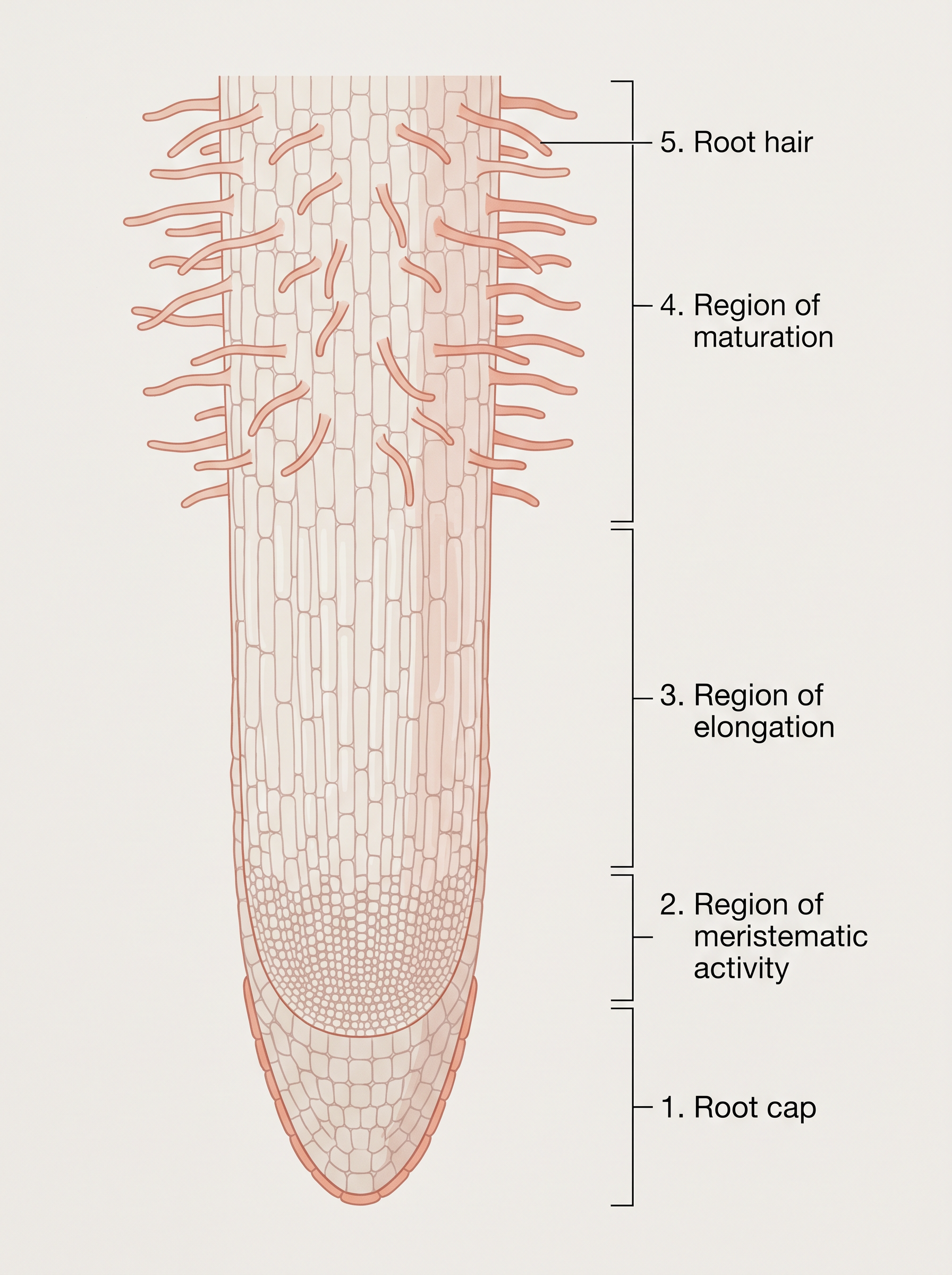
Fig. 5.3 – Regions of the root tip.
A few millimetres above the cap lies the region of meristematic activity. Its cells are very small, thin-walled and filled with dense protoplasm, and they divide again and again. A meristem is simply such a region of actively dividing cells; think of this zone as the root’s growth engine, constantly turning out new cells.
Just above (proximal to) the dividing zone is the region of elongation. Here the newly made cells stop dividing and instead stretch and enlarge greatly. It is this lengthening of cells that actually drives the root deeper into the soil.
Higher up still, the enlarged cells stop growing and slowly differentiate — that is, they mature into particular cell types with particular jobs. This zone is the region of maturation. From some of its epidermal (outer surface) cells grow very fine, delicate, thread-like outgrowths called root hairs, and these are the actual structures that absorb water and minerals from the soil.
Flowchart
FC 5.1 – Regions of the root tip, from apex upward: Root cap (protects tip) → Region of meristematic activity (cells divide) → Region of elongation (cells stretch and enlarge) → Region of maturation (cells differentiate; root hairs appear).
The fixed, tip-to-base order of these four regions is a favourite in exams: sequence-ordering questions often ask you to arrange them correctly, while the tap–fibrous–adventitious distinction commonly appears as match-the-following or assertion–reason items. Remembering why each region exists — protection, division, elongation, maturation — makes these questions straightforward.
5.2 The Stem
What features tell a stem apart from a root? The stem is the ascending part of the plant axis — it grows upward and bears the branches, leaves, flowers and fruits. This upward direction is the first clue: while the root grew downward from the radicle, the stem develops from the plumule, the embryonic shoot present in the seed. So a single germinating seed sends its radicle down to build the root and its plumule up to build the stem.
Look along a stem and you will notice it is marked off into segments. The points where leaves are attached are called nodes, and the stretches of stem between two nodes are called internodes (both are labelled in Fig. 5.1). A stem also carries buds — compact, undeveloped shoots that can grow into a branch or a flower. A bud at the very tip of the stem is a terminal bud, while a bud sitting in the axil (the angle between a leaf and the stem) is an axillary bud.
A young stem is usually green, but as it ages it often turns woody and dark brown.
Functions of the Stem
The main job of the stem is to spread out the branches so that the leaves, flowers and fruits are held in good positions — leaves lifted into sunlight, flowers raised for pollinators to find. In doing so, the stem also acts as the plant’s transport highway: it conducts water and minerals upward from the roots and carries photosynthates (the food, mainly sugars, made during photosynthesis) to wherever they are needed.
Beyond transport, some stems take on extra roles: storage of food, support, protection, and vegetative propagation — a form of asexual reproduction in which a new plant grows from a vegetative part rather than from a seed.
5.3 The Leaf
A leaf is a lateral, usually flattened structure borne on the stem. It arises at a node and carries a bud in its axil; this axillary bud can later grow into a branch. Leaves are produced by the shoot apical meristem — the zone of dividing cells at the very tip of the shoot (recall that a meristem is simply a region of actively dividing cells). They are added in acropetal order, which means the oldest leaves sit lowest on the stem and each newer leaf appears closer to the growing tip.
Leaves are the plant’s most important vegetative organs for photosynthesis — the process by which green parts of a plant use sunlight to make food.
Parts of a Leaf
A typical leaf has three main parts: the leaf base, the petiole and the lamina (Fig. 5.4a). The leaf base is where the leaf joins the stem, and it may carry two small leaf-like structures called stipules. In monocots, the leaf base often widens into a sheath that wraps partly or wholly around the stem. In some leguminous plants (members of the pea and bean group) the leaf base swells into a cushion-like structure called the pulvinus.
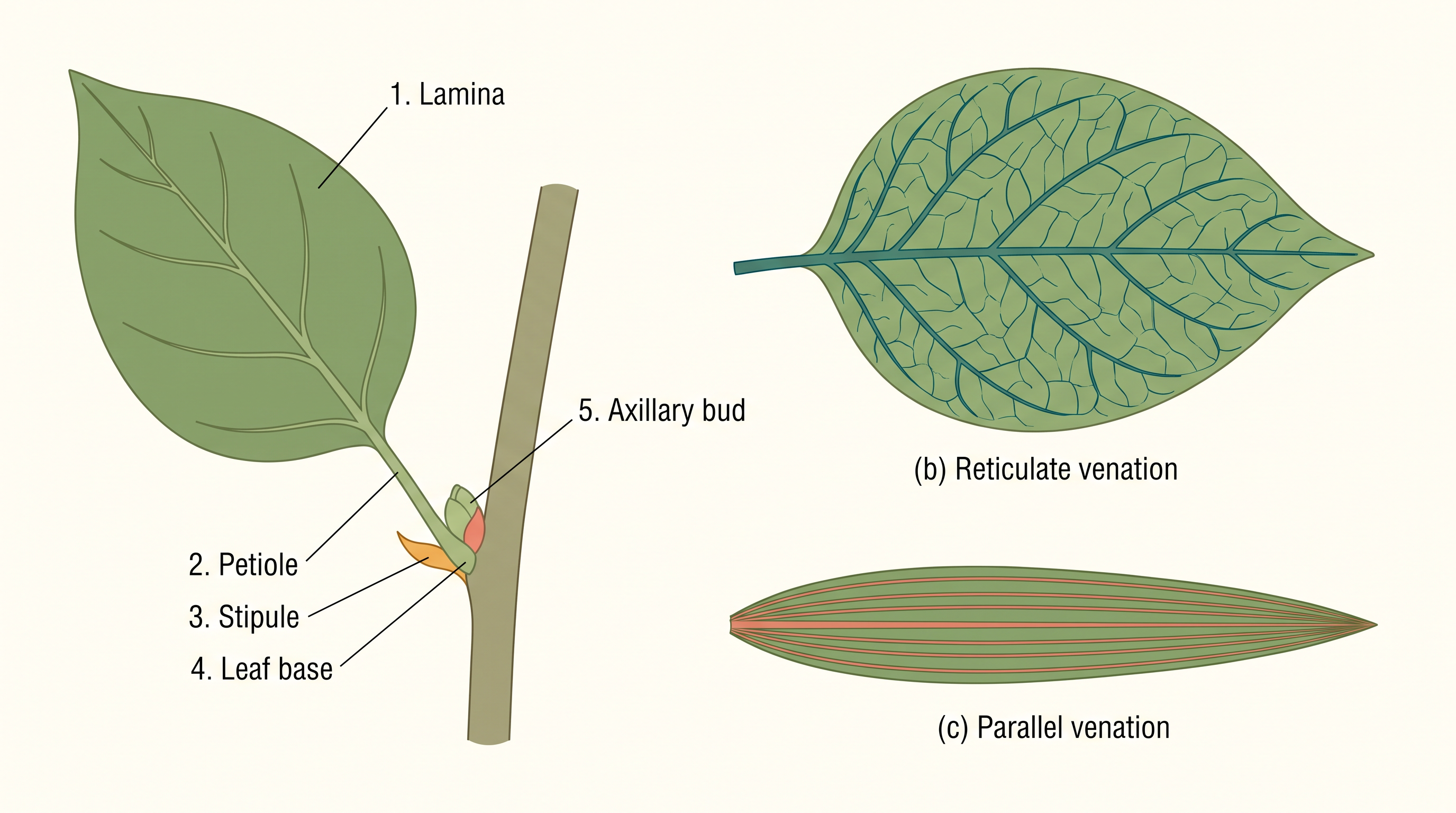
Fig. 5.4 – Structure of a leaf and venation types.
The petiole is the stalk that holds the blade out to the light. A long, thin, flexible petiole lets the leaf blade flutter in the breeze, which cools the leaf and keeps bringing fresh air to its surface.
The lamina, or leaf blade, is the green, expanded part of the leaf, crossed by veins and finer veinlets. Running down the middle is usually one prominent vein, the midrib. Veins do two jobs at once: they stiffen the blade, giving it rigidity, and they act as channels that transport water, minerals and food to and from the leaf. From one kind of leaf to another, the lamina varies widely in shape, margin, apex, surface, and how deeply it is cut (incised).
5.3.1 Venation
The way the veins and veinlets are arranged across the lamina is called venation. When the veinlets branch and rejoin to form a net-like mesh, the venation is said to be reticulate (Fig. 5.4b). When the veins instead run more or less parallel to one another along the lamina, it is parallel venation (Fig. 5.4c).
As a rule, leaves of dicotyledonous plants show reticulate venation, while parallel venation is characteristic of most monocotyledons — which makes venation a quick way to guess whether a plant is a dicot or a monocot.
5.3.2 Types of Leaves
A leaf is called simple when its lamina is undivided, or when its incisions do not reach down to the midrib. When the incisions cut all the way to the midrib, splitting the blade into separate leaflets, the leaf is called compound.
There is a neat way to tell a compound leaf’s leaflet apart from a whole simple leaf: a bud is present in the axil of the petiole in both simple and compound leaves, but there is no bud in the axil of a leaflet. So if you find a bud at its base, you are looking at a leaf; if there is none, it is only a leaflet.
Compound leaves are of two types (Fig. 5.5). In a pinnately compound leaf, several leaflets are arranged along a common central axis called the rachis, which represents the midrib of the leaf — as in neem. In a palmately compound leaf, the leaflets are all attached at one common point, the tip of the petiole, spreading out like fingers from a palm — as in silk cotton.
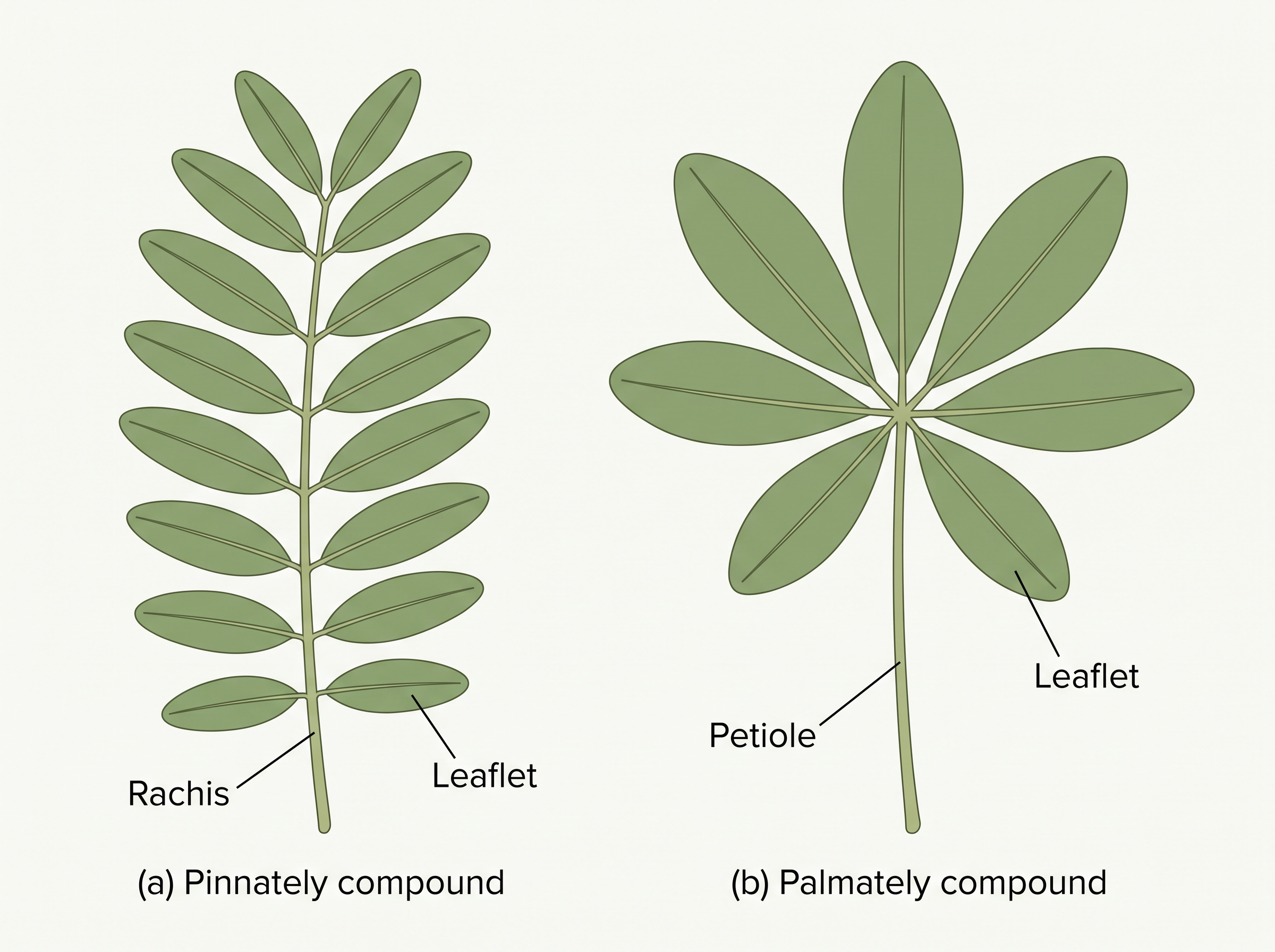
Fig. 5.5 – Compound leaves: (a) pinnately and (b) palmately compound.
5.3.3 Phyllotaxy
Phyllotaxy is the pattern in which leaves are arranged on the stem or branch. It is usually of three kinds — alternate, opposite and whorled (Fig. 5.6).
In alternate phyllotaxy, a single leaf arises at each node, with successive leaves on alternate sides, as in china rose, mustard and sunflower. In opposite phyllotaxy, a pair of leaves arises at each node, the two lying opposite each other, as in Calotropis and guava. When more than two leaves arise at a single node and form a ring, the arrangement is whorled, as in Alstonia.
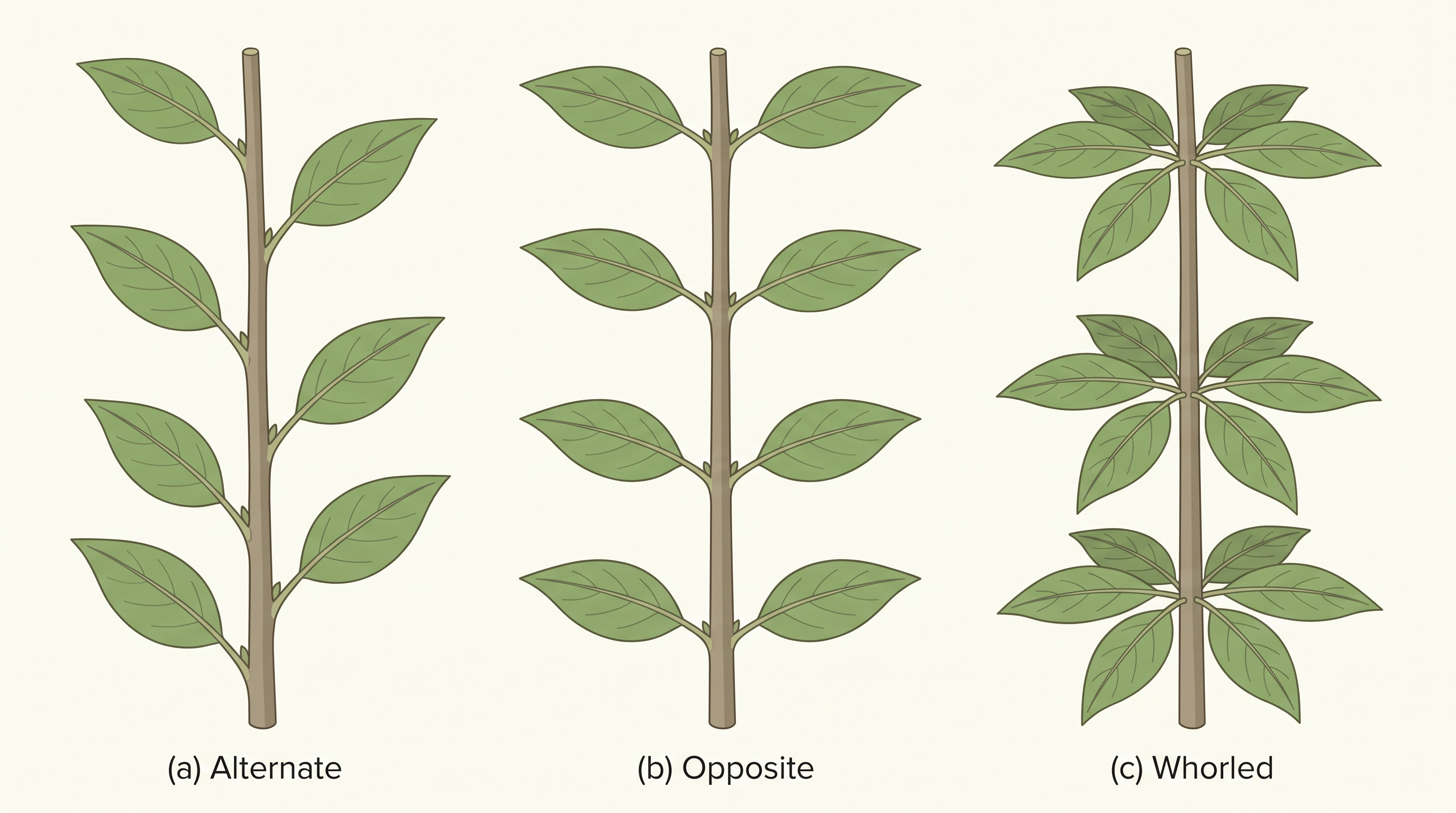
Fig. 5.6 – Types of phyllotaxy.
5.4 The Inflorescence
A flower is really a modified shoot — a shoot rebuilt for reproduction. When the time comes to flower, the shoot apical meristem stops making leaves and turns into a floral meristem. The internodes now fail to elongate, so the axis becomes short and condensed, and at successive nodes the apex produces different kinds of floral appendages (the parts of a flower) instead of leaves.
If the tip of a shoot itself transforms into a flower, that flower stands alone; it is said to be solitary. More often, though, several flowers are grouped together, and the pattern in which they are arranged on the floral axis is called the inflorescence.
The whole of an inflorescence’s design depends on one question: does the growing tip keep growing, or does it use itself up to make a flower? This gives two major types — racemose and cymose.
In a racemose inflorescence, the main axis keeps growing and does not end in a flower. The flowers are borne on its sides in acropetal succession, meaning the oldest flowers are at the base and the youngest near the growing tip (Fig. 5.7).
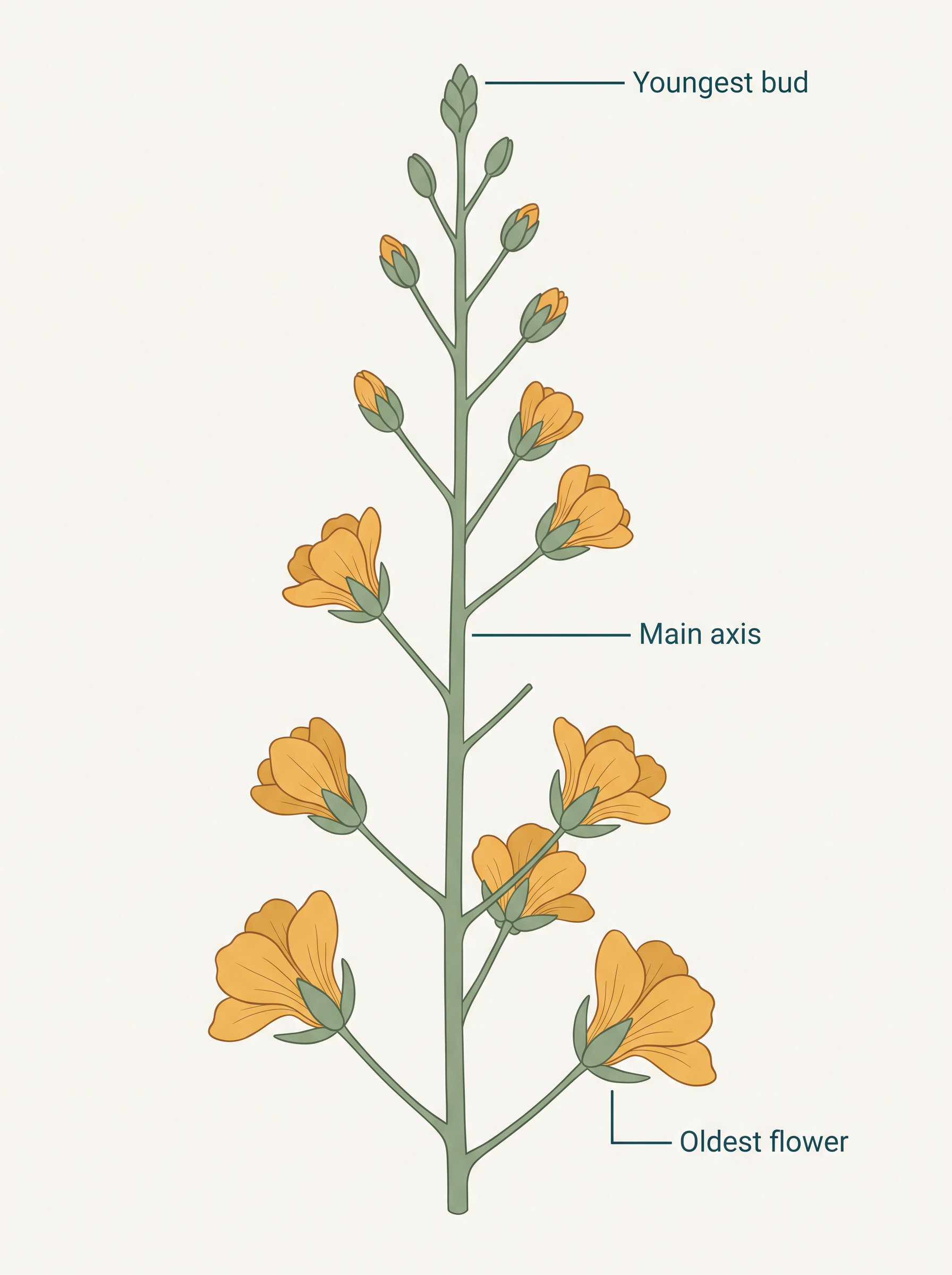
Fig. 5.7 – Racemose inflorescence.
In a cymose inflorescence, the main axis ends in a flower and so its growth is limited. The remaining flowers are then borne in basipetal order — the oldest flower sits at the tip and younger flowers appear below it, towards the base (Fig. 5.8).
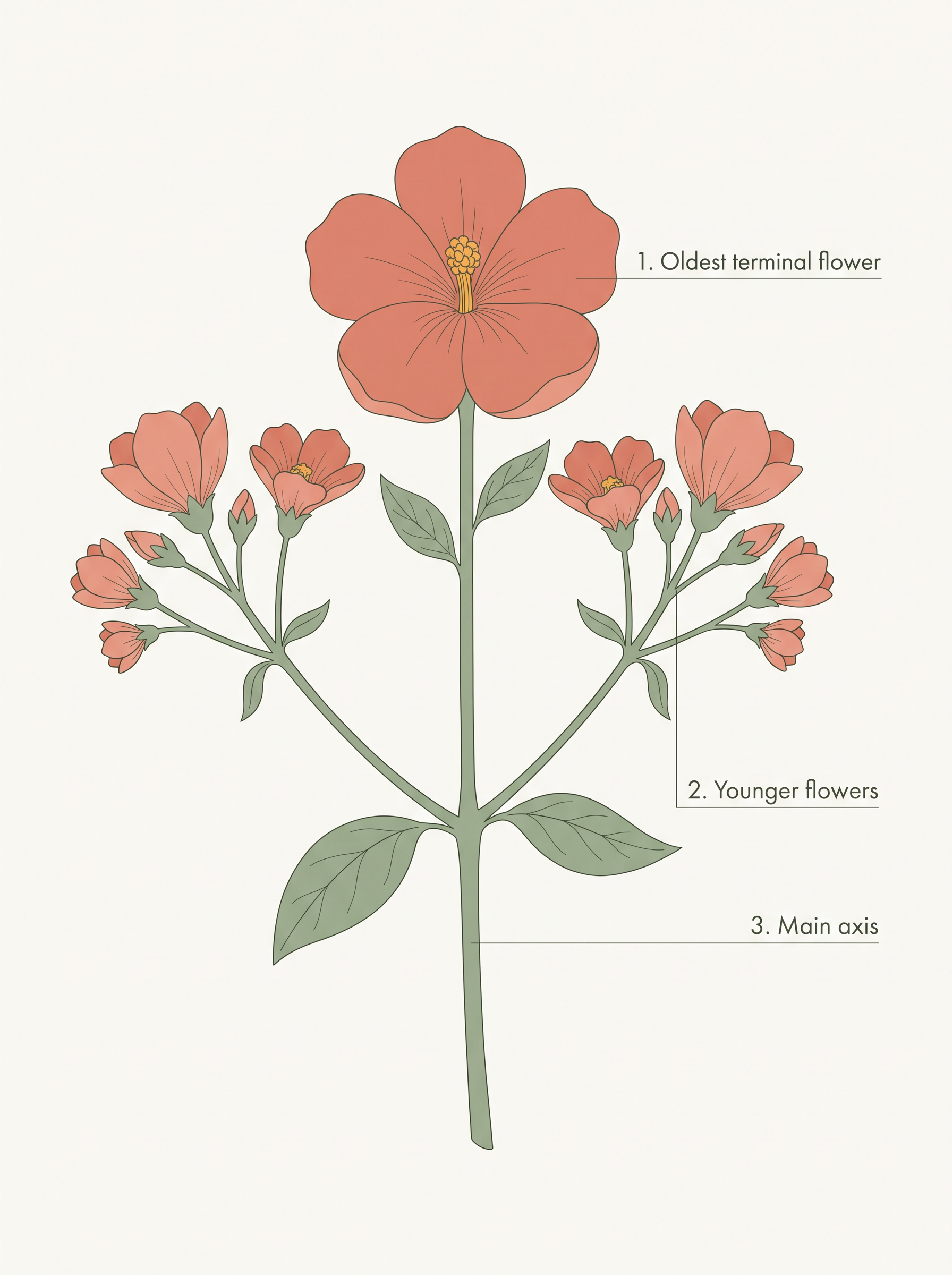
Fig. 5.8 – Cymose inflorescence.
5.5 The Flower
The flower is the reproductive unit of the angiosperms; its whole purpose is sexual reproduction. A typical flower is built on the swollen tip of its stalk. The stalk itself is the pedicel, and its swollen end, which carries the flower parts, is called the thalamus (or receptacle).
On this thalamus sit four different kinds of whorls, one after another: the calyx, the corolla, the androecium and the gynoecium. The calyx and corolla are accessory organs — helpers that support reproduction without taking part in it directly — while the androecium and gynoecium are the actual reproductive organs. In some flowers, such as lily, the calyx and corolla look alike and cannot be told apart; together they are then called the perianth.
A flower that carries both androecium and gynoecium is bisexual. A flower with only stamens (male parts) or only carpels (female parts) is unisexual.
Symmetry of the Flower
Flowers also differ in their symmetry — how they can be divided into matching halves. A flower is actinomorphic (radially symmetrical) when it can be cut into two equal halves along any radial plane passing through its centre, as in mustard, datura and chilli. It is zygomorphic (bilaterally symmetrical) when it can be halved into two similar parts along only one particular vertical plane, as in pea, gulmohur, bean and Cassia. A flower that cannot be divided into two similar halves by any vertical plane through the centre is asymmetric (irregular), as in canna.
Number of Floral Parts and Bracts
When the floral parts occur in multiples of a fixed number, the flower is described by that number: trimerous (multiples of 3), tetramerous (multiples of 4) or pentamerous (multiples of 5). As a helpful rule of thumb, trimerous flowers are typical of monocots, while tetramerous and pentamerous flowers are common in dicots.
Some flowers carry a bract at the base of the pedicel — a small reduced leaf. Flowers that have such a bract are bracteate, and those without it are ebracteate.
Position of the Ovary
Depending on where the calyx, corolla and androecium are attached relative to the ovary on the thalamus, flowers are described as hypogynous, perigynous or epigynous (Fig. 5.9).
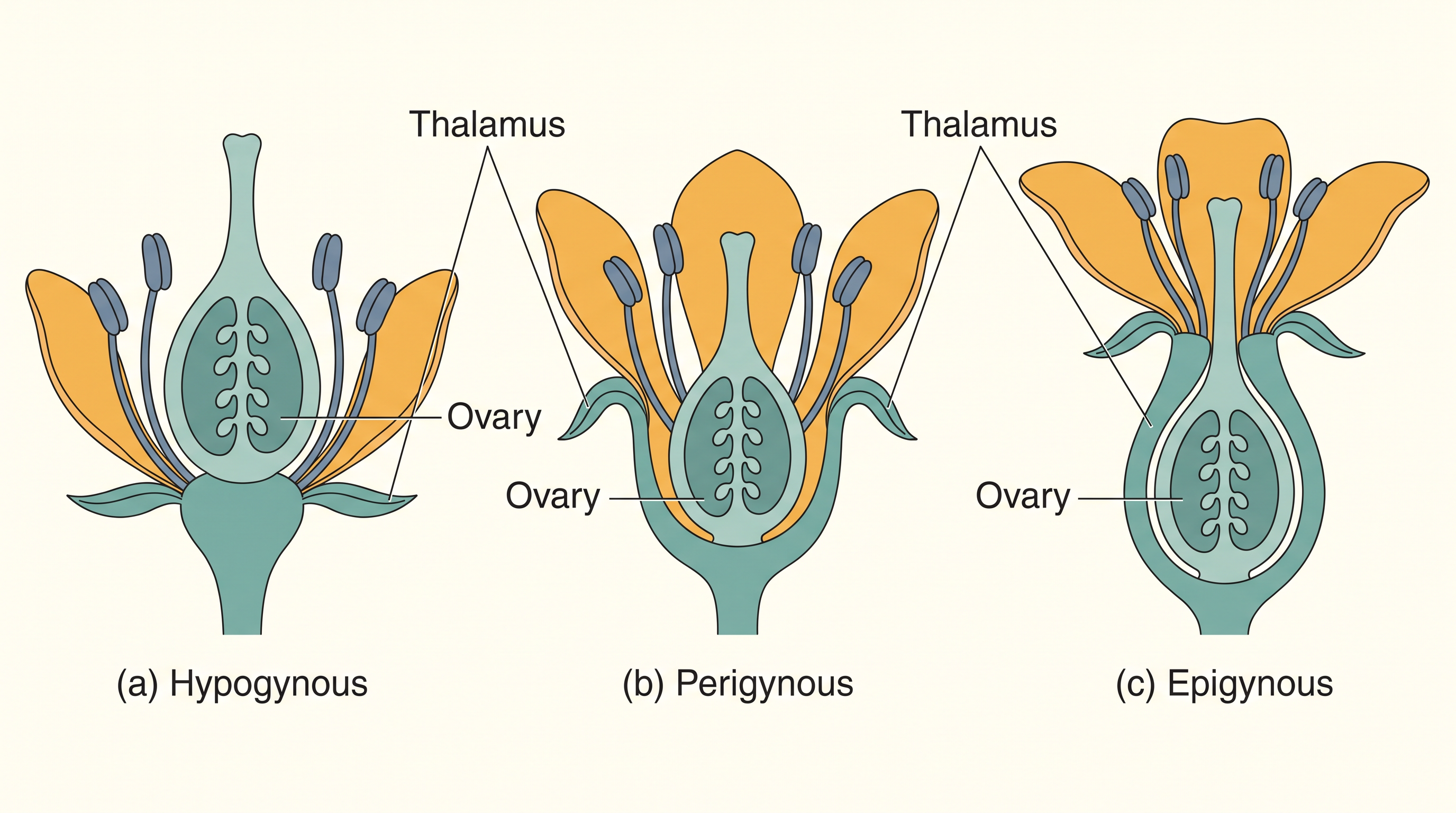
Fig. 5.9 – Position of floral parts on the thalamus.
In a hypogynous flower, the gynoecium sits at the highest point and all the other parts are placed below it; the ovary is then said to be superior, as in mustard, china rose and brinjal. In a perigynous flower, the gynoecium sits in the centre while the other parts are borne on the rim of the thalamus at almost the same level; here the ovary is half inferior, as in plum, rose and peach. In an epigynous flower, the margin of the thalamus grows up and around the ovary, completely enclosing and fusing with it, so that the other parts arise from above the ovary; the ovary is then inferior, as in guava, cucumber and the ray florets of sunflower.
5.5.1 Parts of a Flower
Each flower normally has four floral whorls — calyx, corolla, androecium and gynoecium — arranged from the outside inward (Fig. 5.10). We now look at each in turn.
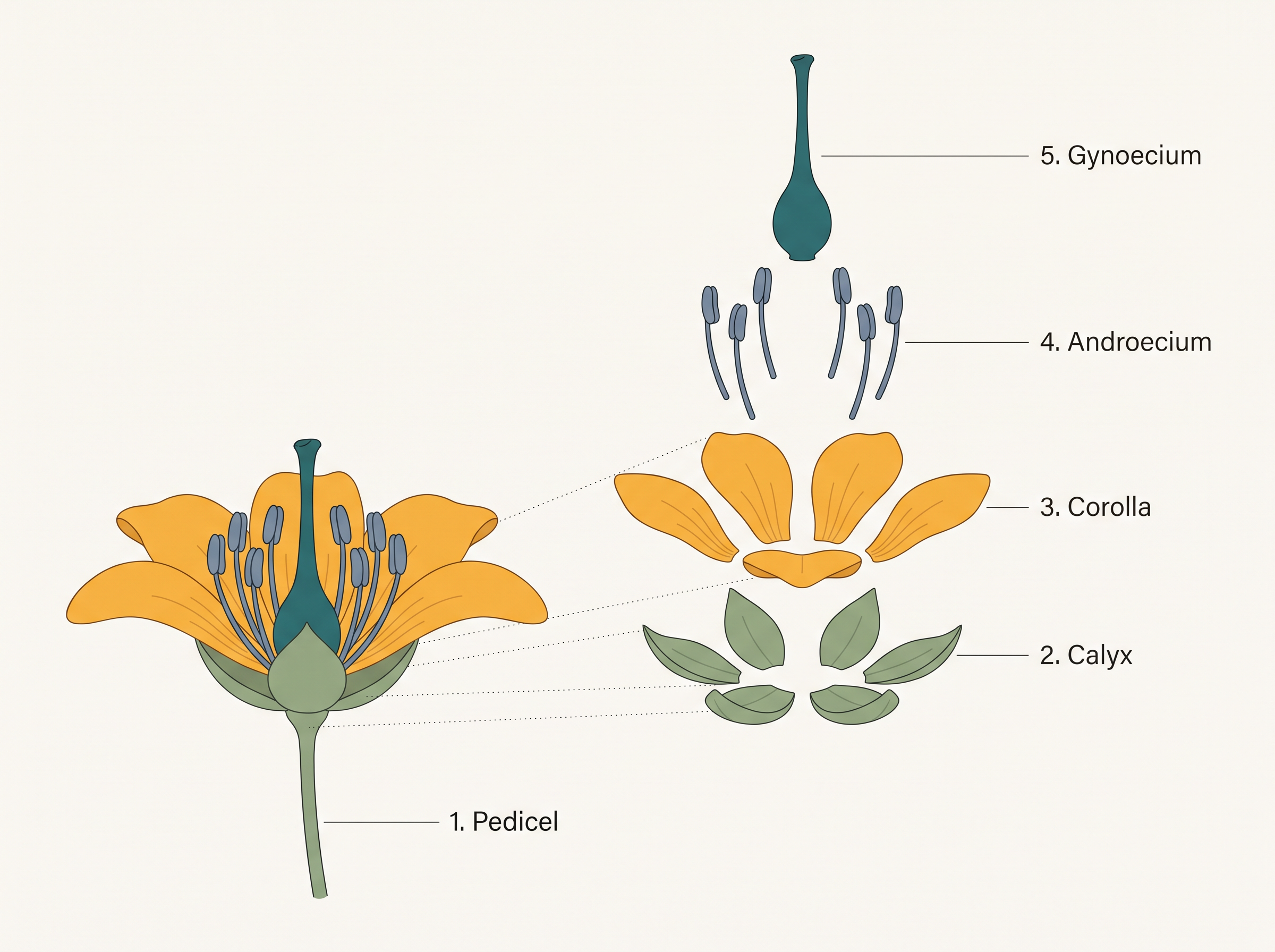
Fig. 5.10 – Parts of a flower.
5.5.1.1 Calyx
The calyx is the outermost whorl of the flower, and its individual members are called sepals. Sepals are generally green and leaf-like, and their main job is to protect the flower while it is still a bud.
The calyx may be gamosepalous, when the sepals are united, or polysepalous, when the sepals are free.
5.5.1.2 Corolla
The corolla is made up of petals. Petals are usually brightly coloured, and this colour is not for show alone — it attracts insects and other animals for pollination. Like the calyx, the corolla too may be gamopetalous (petals united) or polypetalous (petals free). The shape and colour of the corolla vary greatly from plant to plant; it may be tubular, bell-shaped, funnel-shaped or wheel-shaped.
Aestivation
Aestivation describes how the sepals or petals are arranged relative to one another inside the floral bud. Its main types are valvate, twisted, imbricate and vexillary (Fig. 5.11).
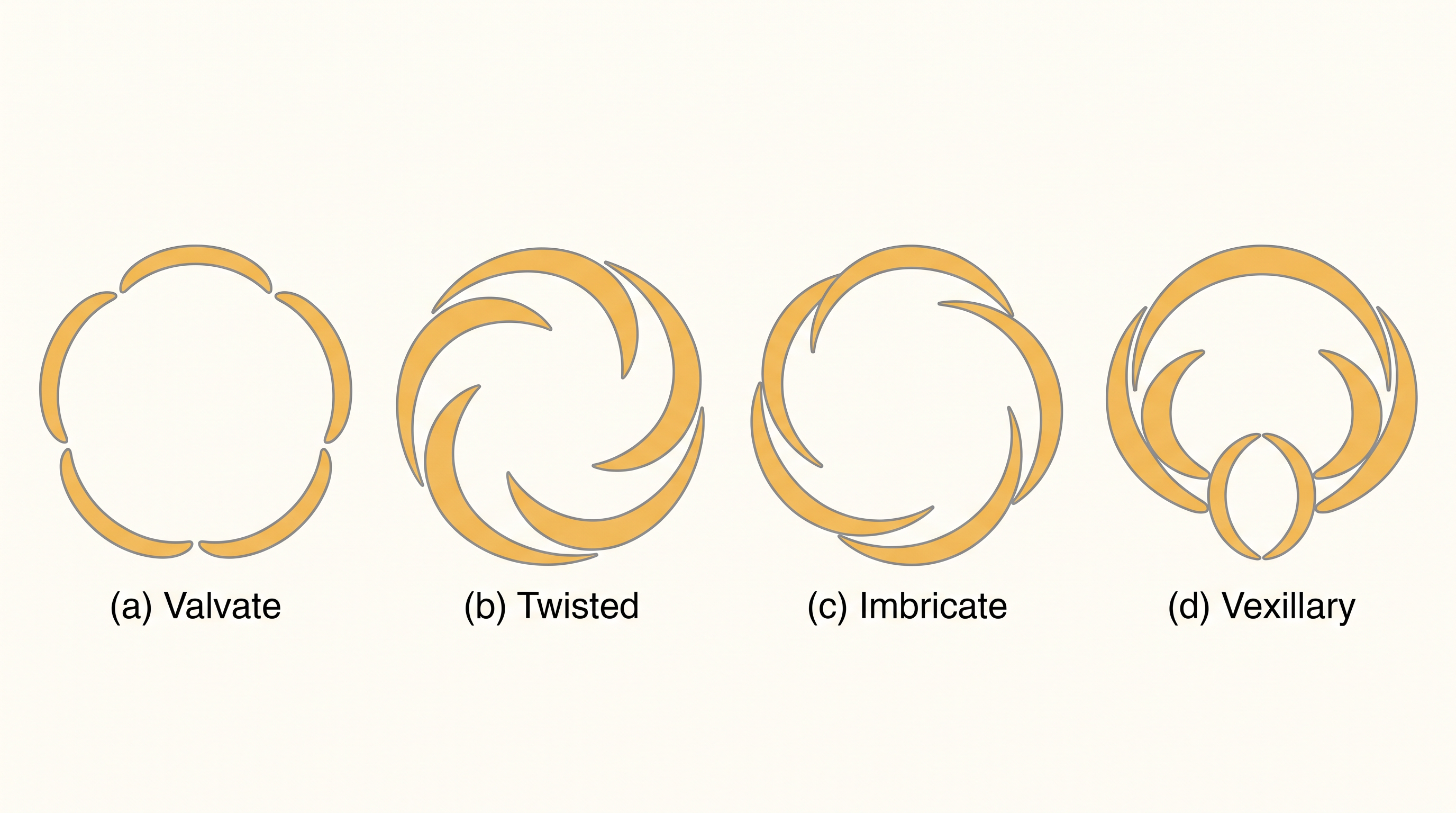
Fig. 5.11 – Types of aestivation in corolla.
In valvate aestivation, the sepals or petals just touch one another at their margins without overlapping, as in Calotropis. In twisted aestivation, one margin of each part overlaps the margin of the next, and so on around the whorl, as in china rose, lady’s finger and cotton. In imbricate aestivation, the margins overlap one another but not in any set direction, as in Cassia and gulmohur.
A special case is vexillary (or papilionaceous) aestivation, seen in pea and bean flowers. Here there are five petals: the largest, called the standard, overlaps the two lateral petals (the wings), which in turn overlap the two smallest anterior petals (the keel).
5.5.1.3 Androecium
The androecium is composed of stamens, and each stamen is the male reproductive organ. A stamen has a stalk called the filament and, at its tip, an anther. Each anther is usually bilobed, and every lobe contains two chambers called pollen-sacs, where the pollen grains are produced. A stamen that is sterile — one that produces no pollen — is called a staminode.
Stamens may be joined to other floral parts or to one another. When stamens are attached to the petals they are epipetalous, as in brinjal; when attached to the perianth they are epiphyllous, as in lily.
The stamens of a flower may stay completely free (polyandrous) or become united to varying degrees. When they unite into a single bundle they are monoadelphous, as in china rose; into two bundles, diadelphous, as in pea; and into more than two bundles, polyadelphous, as in citrus. The filaments may also differ in length within one flower, as in Salvia and mustard.
5.5.1.4 Gynoecium
The gynoecium is the female reproductive part of the flower, made up of one or more carpels. A carpel has three parts: the stigma, the style and the ovary. The ovary is the enlarged basal part; rising from it is the elongated tube-like style, and at the tip of the style sits the stigma, the receptive surface on which pollen grains land.
Each ovary bears one or more ovules, attached to a flattened, cushion-like placenta. When a flower has more than one carpel, the carpels may stay free — a condition called apocarpous, as in lotus and rose — or be fused together, called syncarpous, as in mustard and tomato. After fertilisation, the ovules develop into seeds and the ovary matures into a fruit.
Placentation
The way the ovules are arranged inside the ovary is called placentation. There are several types — marginal, axile, parietal, basal and free central (Fig. 5.12).
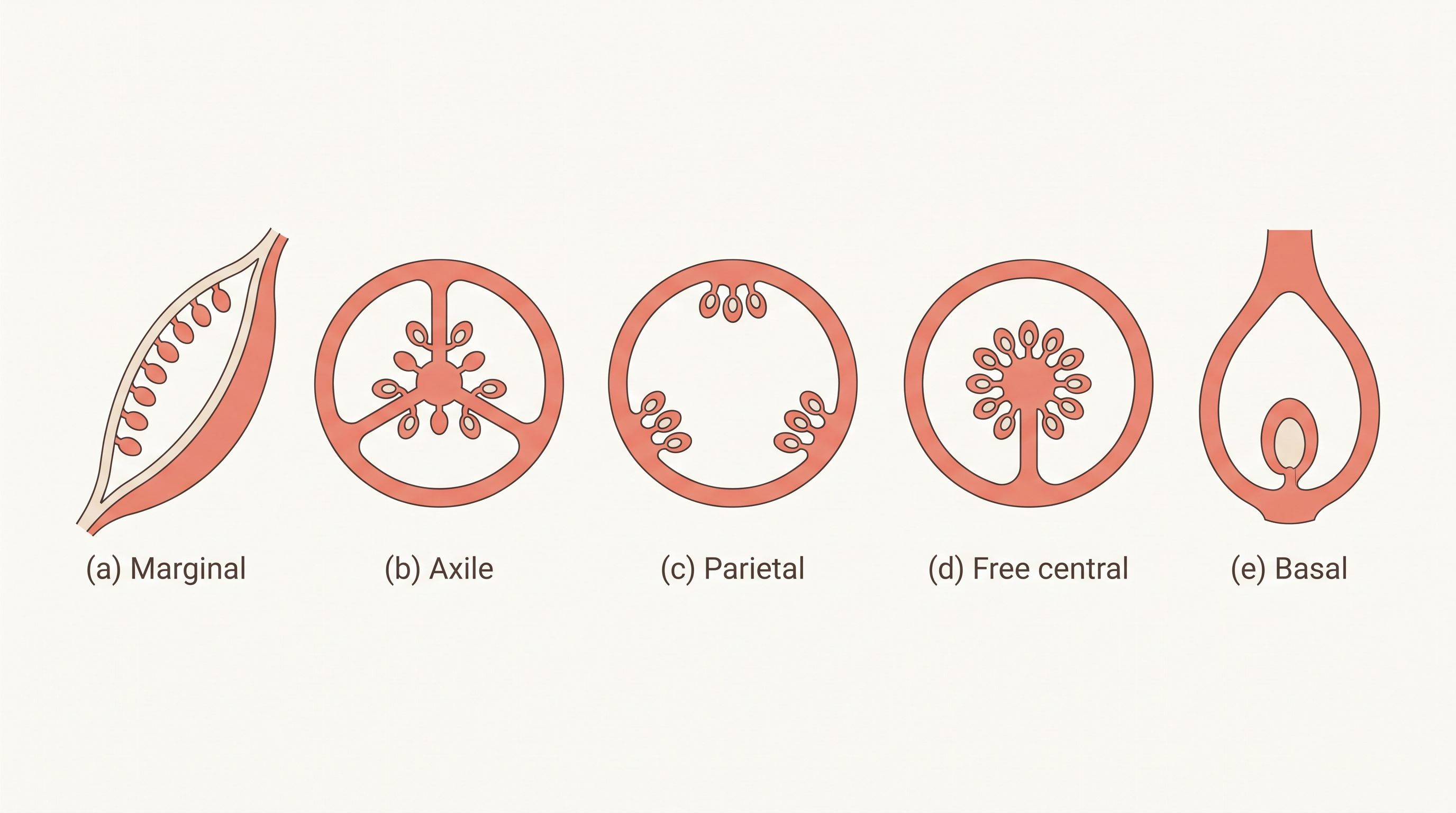
Fig. 5.12 – Types of placentation.
In marginal placentation, the placenta forms a ridge along the ventral suture (the seam) of the ovary, and the ovules are borne on this ridge in two rows, as in pea. In axile placentation, the placenta is axial and the ovules are attached to it in a multilocular ovary — one divided into several chambers or locules — as in china rose, tomato and lemon.
In parietal placentation, the ovules develop on the inner wall or peripheral part of the ovary. The ovary starts one-chambered but becomes two-chambered by the growth of a false septum (a false partition wall), as in mustard and Argemone. In free central placentation, the ovules are borne on a central axis while the septa are absent, as in Dianthus and Primrose. In basal placentation, the placenta lies at the base of the ovary and a single ovule is attached to it, as in sunflower and marigold.
5.6 The Fruit
The fruit is a hallmark of the flowering plants. As we saw at the end of the last section, once fertilisation is over the ovary matures — and this matured or ripened ovary is the fruit. So a fruit is essentially a grown-up ovary that has done its reproductive job and now houses the seeds.
Sometimes a fruit forms even without fertilisation of the ovary. Such a fruit is called a parthenocarpic fruit.
Structure of a Fruit
A fruit generally has two parts: a wall called the pericarp, and the seeds inside it. The pericarp may be dry or fleshy. When it is thick and fleshy, the pericarp is further divided into three layers — the outer epicarp, the middle mesocarp and the inner endocarp.
In mango and coconut, the fruit is a special fleshy type called a drupe (Fig. 5.13). Both develop from a monocarpellary (single-carpelled), superior ovary and are one-seeded.
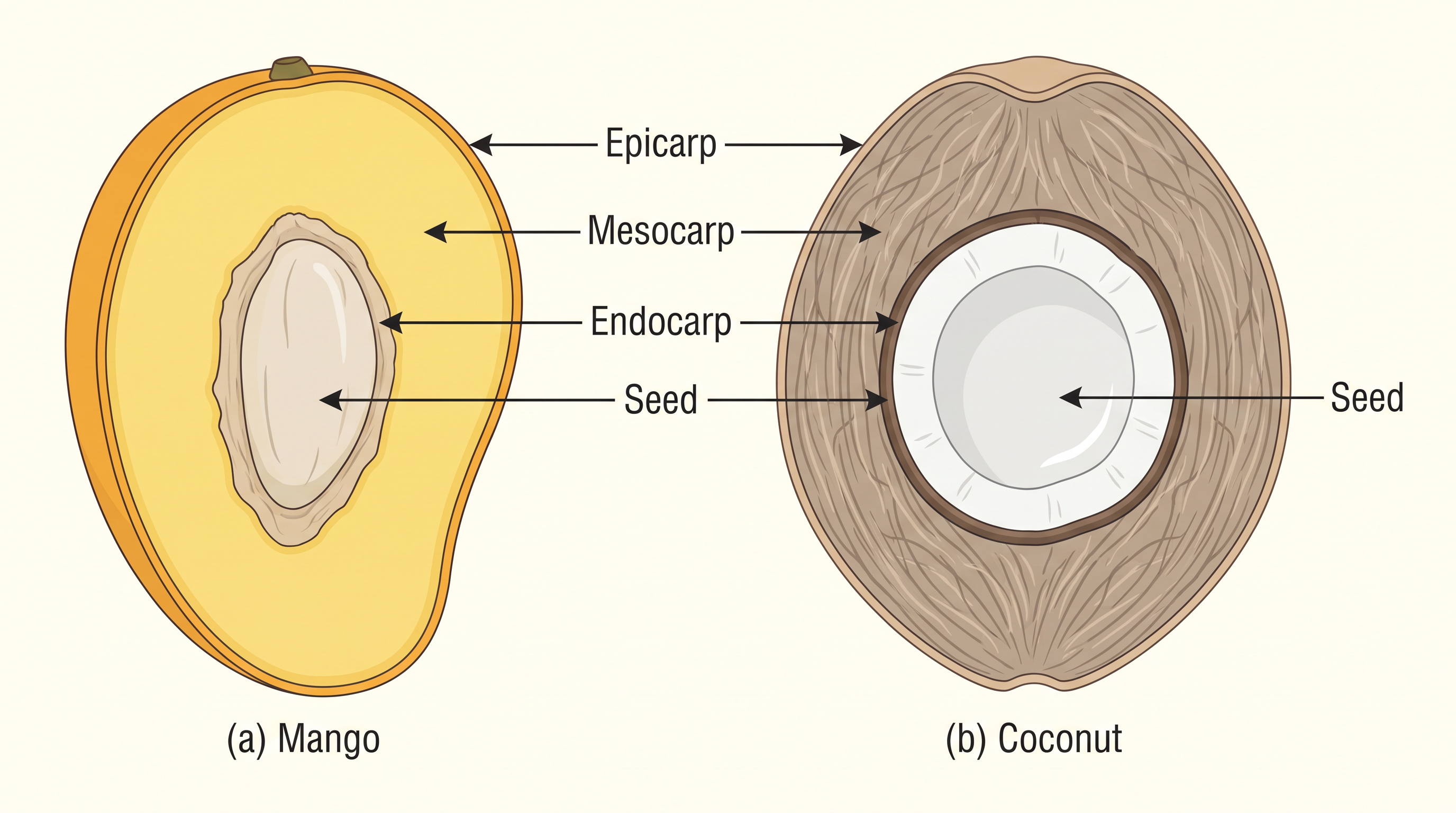
Fig. 5.13 – Parts of a fruit: (a) mango and (b) coconut.
In the mango, the pericarp is clearly divided into three: a thin outer epicarp (the skin), a fleshy, juicy, edible middle mesocarp (the part we eat), and a stony, hard inner endocarp (the shell around the seed). The coconut is also a drupe, but here the mesocarp is fibrous — it forms the coir husk rather than a juicy pulp.
5.7 The Seed
After fertilisation, the ovules inside the ovary develop into seeds. A seed is made up of a protective seed coat and an embryo — the young plant-in-waiting. The embryo itself has three parts: a radicle (the future root), a plumule (the future shoot) joined by a central embryonal axis, and cotyledons — one cotyledon in seeds like wheat and maize, or two in seeds like gram and pea.
This single difference — one cotyledon or two — is what gives us the names monocotyledon and dicotyledon, so the structure of the seed sits at the very root of how flowering plants are grouped.
5.7.1 Structure of a Dicotyledonous Seed
The outermost covering of the seed is the seed coat, and in a dicot seed it has two layers: the tough outer testa and the thinner inner tegmen. On the seed coat is a scar called the hilum, marking the spot where the developing seed was attached to the fruit. Just above the hilum lies a tiny pore called the micropyle, through which water first enters at germination.
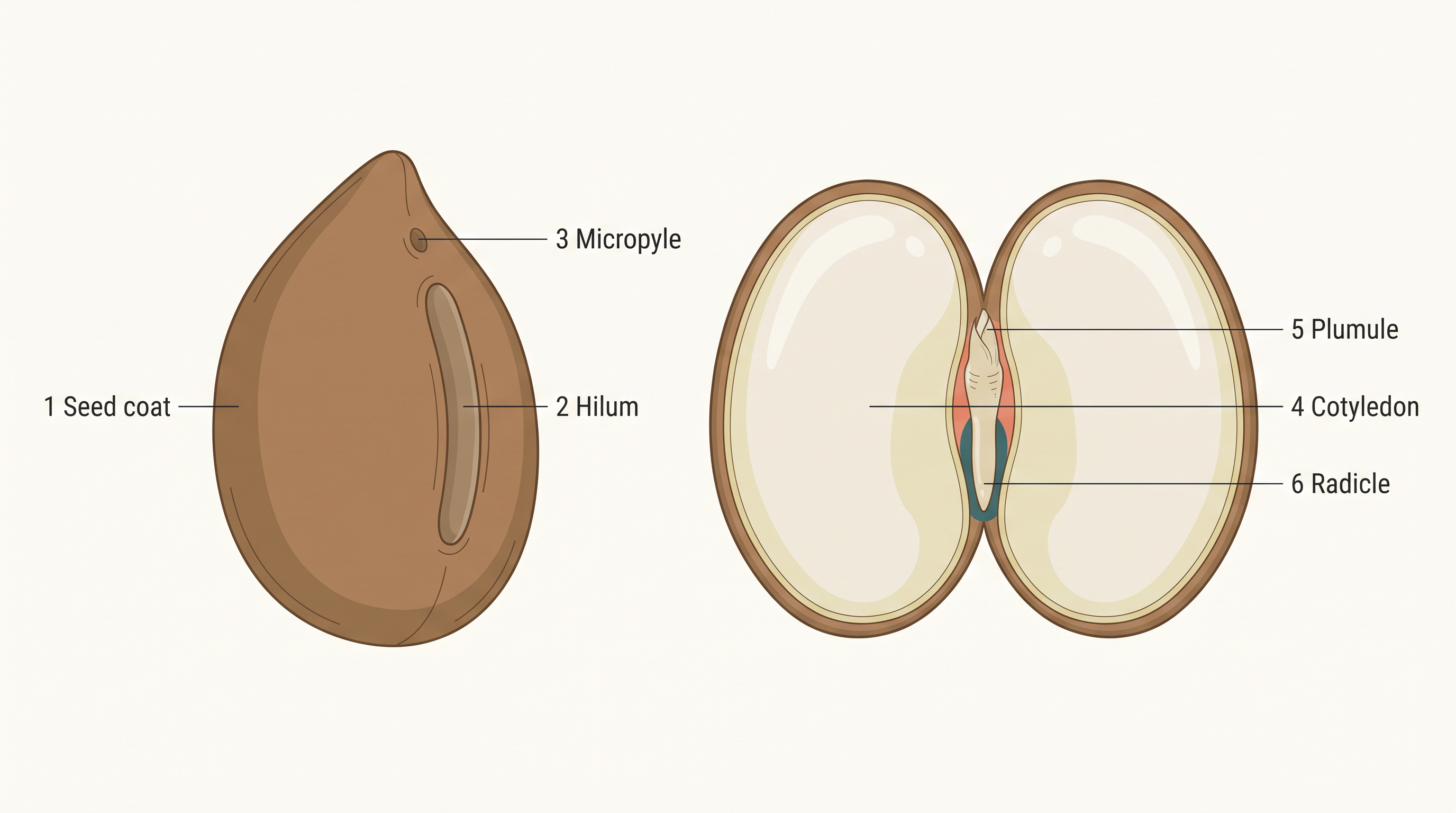
Fig. 5.14 – Structure of a dicotyledonous seed.
Inside the seed coat is the embryo, consisting of the embryonal axis and two cotyledons. The cotyledons are often fleshy and packed with reserve food. At the two ends of the embryonal axis lie the radicle and the plumule (Fig. 5.14).
In some dicot seeds, such as castor, a food-storing tissue called the endosperm — formed as a result of double fertilisation (a special process in flowering plants, studied in detail later, in which one fusion forms the embryo and another forms the endosperm) — is still present in the mature seed. These are endospermic seeds. In plants such as bean, gram and pea, the endosperm is used up during seed development and is absent from the mature seed; such seeds are non-endospermous.
5.7.2 Structure of Monocotyledonous Seed
Monocot seeds are generally endospermic, though a few — as in orchids — are non-endospermic. We take maize, a cereal, as the typical example.
In cereals such as maize, the seed coat is membranous (thin and papery) and usually fused with the fruit wall, so the two cannot be separated. The endosperm is bulky and stores the seed’s food. An outer proteinous layer of the endosperm, the aleurone layer, separates it from the embryo.
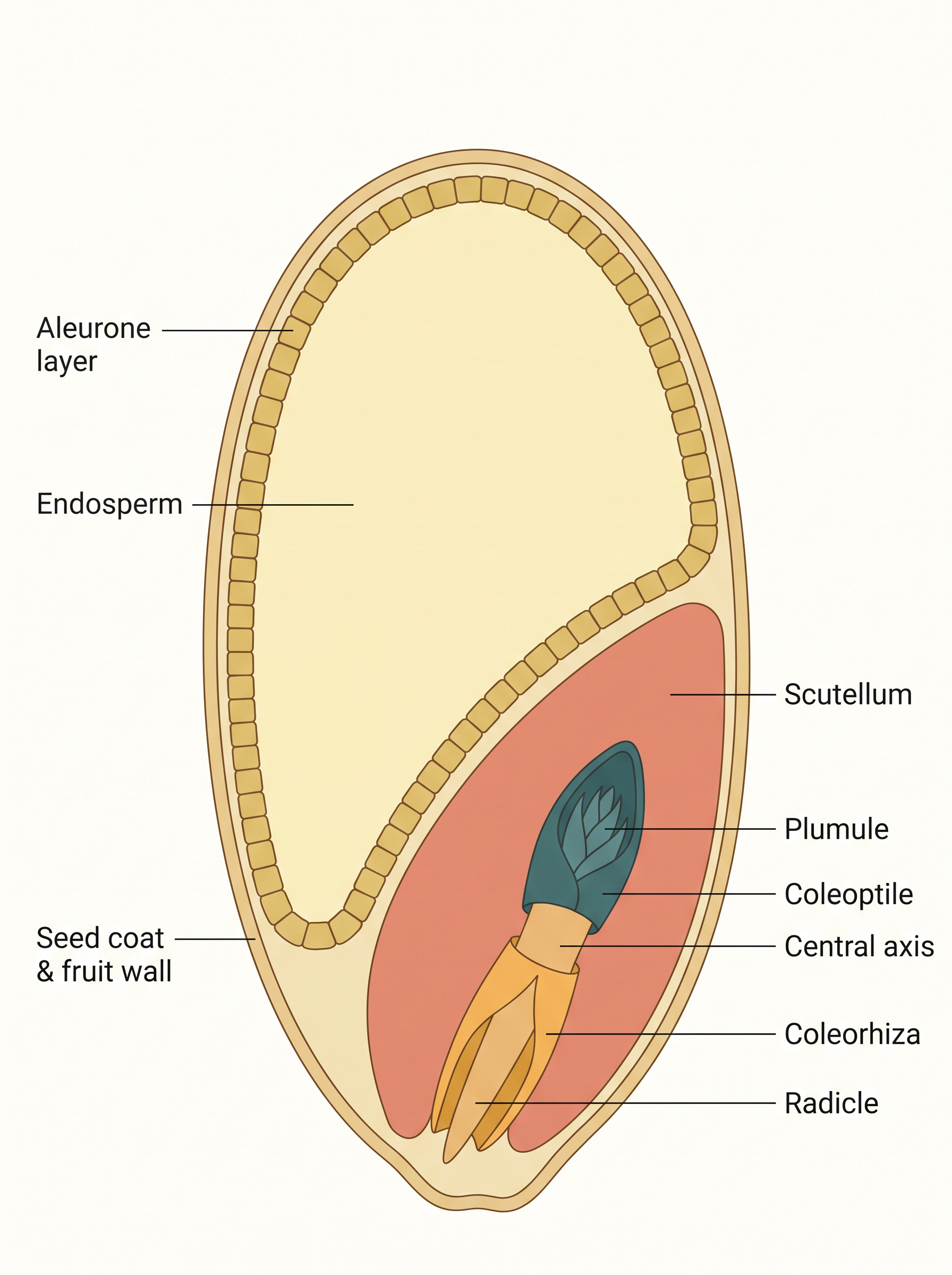
Fig. 5.15 – Structure of a monocotyledonous seed.
The embryo is small and lies in a groove at one end of the endosperm. It has one large, shield-shaped cotyledon called the scutellum, and a short axis carrying a plumule and a radicle. Here the plumule and radicle are protected by sheaths: the plumule by the coleoptile and the radicle by the coleorhiza (Fig. 5.15).
These two seed diagrams — the gram seed and the vertical section of a maize seed — are classic labelling questions in board exams, so it helps to learn each labelled part along with what it does.
5.8 Semi-technical Description of a Typical Flowering Plant
To describe a flowering plant properly, botanists use its morphological features in a fixed, orderly way. The description must be brief, written in simple scientific language, and set out in a proper sequence — so that any two people describing the same plant produce comparable accounts.
The plant is described in this order: first its habit (its general form and life-style — herb, shrub or tree), then its vegetative characters (roots, stem and leaves), and finally its floral characters (the inflorescence and the flower parts). Once the parts have been described in words, the flower is summarised in two compact ways: a floral diagram and a floral formula.
The Floral Formula
A floral formula condenses a whole flower into a single line of symbols and numbers. Each symbol stands for one feature, so that the entire make-up of a flower can be read at a glance.
| Symbol | Meaning |
|---|---|
| Br | Bracteate (a bract is present) |
| K | Calyx (sepals) |
| C | Corolla (petals) |
| P | Perianth (calyx and corolla alike) |
| A | Androecium (stamens) |
| G | Gynoecium (carpels) |
| \(\underline{G}\) | Superior ovary |
| \(\overline{G}\) | Inferior ovary |
| \(\male\) | Male flower |
| \(\female\) | Female flower |
| ⚥ | Bisexual flower |
| \(\oplus\) | Actinomorphic (radial symmetry) |
| % | Zygomorphic (bilateral symmetry) |
Two more conventions capture how parts are joined. Fusion of members within a whorl is shown by enclosing their number in a bracket — so \(G_{(2)}\) means the two carpels are fused. Adhesion — the union of members of different whorls — is shown by a line drawn above the symbols of the parts involved.
Putting all this together, the floral formula of the mustard plant (family Brassicaceae) is:
\[\oplus\ \ \text{⚥}\ \ K_{2+2}\ \ C_{4}\ \ A_{2+4}\ \ \underline{G}_{(2)}\]
The Floral Diagram
While the formula records numbers and unions, the floral diagram shows positions — the number of parts in each whorl, how they are arranged, and how they relate to one another (Fig. 5.16). The whorls are drawn as a set of concentric rings: the calyx outermost, then the corolla, then the androecium, with the gynoecium at the centre. The position of the mother axis (the main axis that bears the flower) is marked by a dot at the top of the diagram. Like the formula, the diagram also shows cohesion within a whorl and adhesion between whorls.
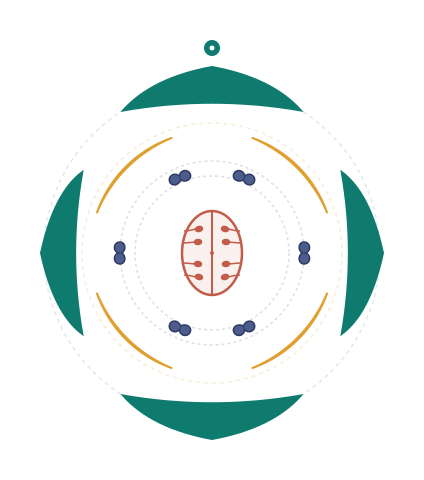
Fig. 5.16 – Floral diagram of mustard.
5.9 Solanaceae
Solanaceae is a large family, commonly called the potato family. It is widely distributed across the tropics, subtropics and even temperate zones (Fig. 5.17). Using the standard sequence from the previous section, we can now describe a typical member of this family.
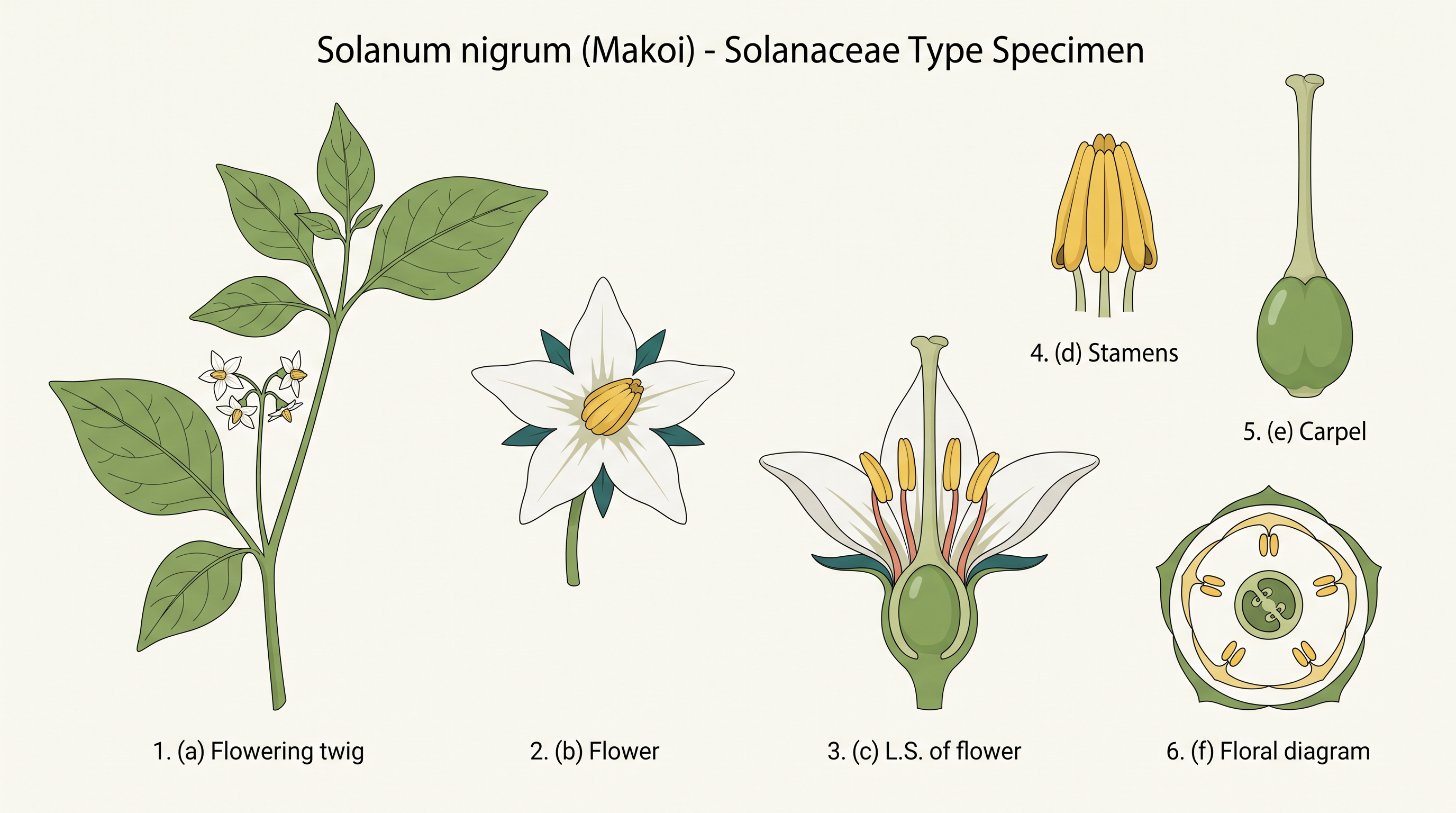
Fig. 5.17 – Solanum nigrum: plant parts and floral diagram.
Vegetative Characters
Habit: Plants are mostly herbs and shrubs, and rarely small trees.
Stem: Herbaceous, rarely woody; aerial; erect, cylindrical and branched; solid or hollow; hairy or glabrous (smooth, without hairs). In potato (Solanum tuberosum) the stem is modified into an underground food-storing structure.
Leaves: Alternate, simple, and rarely pinnately compound; exstipulate (without stipules); with reticulate venation.
Floral Characters
Inflorescence: Solitary, axillary, or cymose, as in Solanum.
Flower: Bisexual and actinomorphic.
Calyx: Sepals five, united (gamosepalous); persistent (staying attached even after the fruit forms); valvate aestivation.
Corolla: Petals five, united (gamopetalous); valvate aestivation.
Androecium: Stamens five; epipetalous (attached to the petals).
Gynoecium: Bicarpellary (two carpels), obliquely placed (the carpels set at an angle to the plant’s median plane), syncarpous (carpels fused); ovary superior, bilocular (two chambers); placenta swollen with many ovules; axile placentation.
Fruits: A berry (a fleshy fruit, as in tomato) or a capsule (a dry fruit that splits open to shed its seeds).
Seeds: Many, and endospermous.
Summing up the flower in symbols, the floral formula of Solanaceae is:
\[\oplus\ \ \text{⚥}\ \ K_{(5)}\ \ \overline{C_{(5)}\, A_{5}}\ \ \underline{G}_{(2)}\]
Here \(K_{(5)}\) and \(C_{(5)}\) show five united sepals and five united petals; the line above \(C_{(5)}\) and \(A_{5}\) marks the epipetalous condition (stamens adhering to the corolla); \(A_{5}\) gives five stamens; and \(\underline{G}_{(2)}\) shows a superior ovary of two fused carpels.
Economic Importance
Many members of this family are important to people in very different ways: as food (tomato, brinjal, potato), as a spice (chilli), as medicine (belladonna, ashwagandha), as a fumigatory (tobacco), and as ornamentals (petunia).
5.10 Summary
Flowering plants show enormous variation in shape, size, structure, mode of nutrition, life span, habit and habitat, yet all are built on a well-developed root system and shoot system.
The root system is either a tap root or a fibrous system. As a rule, dicots have tap roots and monocots have fibrous roots. In some plants, roots become modified for storage of food, mechanical support and respiration.
The shoot system is made up of stem, leaves, flowers and fruits. Features of the stem — the presence of nodes and internodes, multicellular hairs, and a positively phototropic (growing towards light) nature — help tell a stem apart from a root.
A leaf is a lateral outgrowth of the stem, developed exogenously (from the outer tissue) at a node. Leaves are green so they can carry out photosynthesis, and they vary markedly in shape, size, margin, apex, and the extent to which the lamina is incised.
A flower is a modified shoot meant for sexual reproduction. Flowers are grouped into different types of inflorescences and vary greatly in structure, symmetry, position of the ovary relative to the other parts, and the arrangement of petals, sepals and ovules.
After fertilisation, the ovary is modified into the fruit and the ovules into seeds. Seeds may be monocotyledonous or dicotyledonous and differ in shape, size and period of viability.
Flowchart
FC 5.2 – What a flower becomes after fertilisation: Flower → fertilisation → ovary matures into fruit; and ovules develop into seeds (mono- or dicotyledonous).
- Floral characters form the basis for classifying and identifying flowering plants, as illustrated by semi-technical descriptions of families. A plant is therefore described in a definite sequence using scientific terms, and its floral features are summarised compactly as a floral diagram and a floral formula.
5.11 Points to Ponder
Roots and stems both branch, yet only the stem bears leaves and buds while only the root usually bears root hairs. Why might it help a plant to keep its anchoring–absorbing system and its leaf-bearing system structurally so different?
Dicots tend to pair tap roots with reticulate venation, and monocots pair fibrous roots with parallel venation. What might these paired differences suggest about two distinct “design solutions” plants have arrived at for the same problems of support, anchorage and transport?
A flower is described as a modified shoot, with its parts thought of as modified leaves on a condensed axis. If that is so, what does it imply about where petals, sepals, stamens and carpels originally “came from”?
Bright petals attract pollinators, but they also cost the plant energy and make the flower more conspicuous to plant-eaters. Under what conditions might a plant be better off with small, dull, or even absent petals?
Why should the arrangement and number of floral whorls (calyx, corolla, androecium, gynoecium) be a more dependable guide to a plant’s family than features such as leaf shape, plant height or habit?
Food is stored in a stem in the potato, in the seed’s cotyledons or endosperm in cereals and pulses, and in modified roots in some other plants. What factors might decide which organ a particular plant uses to store its reserves?
Fruits can form without fertilisation (parthenocarpy) and give seedless produce that many people prefer. What might such seedless fruits mean for the plant itself, whose fruit normally exists to protect and disperse seeds?
5.12 NCERT Questions
How is a pinnately compound leaf different from a palmately compound leaf?
Explain with suitable examples the different types of phyllotaxy.
Define the following terms:
- aestivation
- placentation
- actinomorphic
- zygomorphic
- superior ovary
- perigynous flower
- epipetalous stamen
Differentiate between:
- Racemose and cymose inflorescence
- Apocarpous and syncarpous ovary
Draw the labelled diagram of the following:
- gram seed
- V.S. of maize seed
Take one flower of the family Solanaceae and write its semi-technical description. Also draw its floral diagram.
Describe the various types of placentations found in flowering plants.
What is a flower? Describe the parts of a typical angiosperm flower.
Define the term inflorescence. Explain the basis for the different types of inflorescence in flowering plants.
Describe the arrangement of floral members in relation to their insertion on the thalamus.
5.13 Check Your Concepts
Arrange the four regions of the root in correct order, starting from the tip of the root and moving upward: region of elongation, root cap, region of maturation, region of meristematic activity.
The root cap is continuously worn away and re-formed as a root grows. Explain why this constant renewal is necessary for the root.
Assertion (A): Root hairs are found in the region of maturation and not near the very tip of the root. Reason (R): The region of maturation is where epidermal cells differentiate, and some of them grow out as root hairs. State whether both A and R are correct and whether R correctly explains A.
A gardener digs up an underground plant part that has no leaves. What features would you look for to decide whether it is a modified stem or a root, and why?
You are shown a single detached green structure and asked whether it is a simple leaf or a leaflet of a compound leaf. Which single feature would settle the question, and how?
Why is parallel venation in a leaf usually a good clue that the plant is a monocotyledon? What venation would you expect in a dicotyledon?
Match each type of phyllotaxy in Column I with the correct example in Column II.
| Column I | Column II |
|---|---|
| a. Alternate | i. Alstonia |
| b. Opposite | ii. china rose |
| c. Whorled | iii. Calotropis |
Assertion (A): In a racemose inflorescence the flowers open in acropetal order. Reason (R): In a racemose inflorescence the main axis ends in a flower and stops growing. State whether A and R are correct and whether R correctly explains A.
Explain why grouping many small flowers into a single inflorescence can make pollination more efficient than having the same flowers scattered singly over the plant.
Match each type of aestivation in Column I with the correct example in Column II.
| Column I | Column II |
|---|---|
| a. Valvate | i. pea |
| b. Twisted | ii. Calotropis |
| c. Imbricate | iii. Cassia |
| d. Vexillary | iv. china rose |
A flower can be divided into two equal halves by only one particular vertical plane. Is it actinomorphic or zygomorphic? Give one example of such a flower.
In an epigynous flower, is the ovary superior or inferior? Explain your answer in terms of how the thalamus and the other floral parts are arranged.
Match each type of placentation in Column I with the correct feature in Column II.
| Column I | Column II |
|---|---|
| a. Marginal | i. single ovule at the base of the ovary |
| b. Axile | ii. ovules on a central axis of a multilocular ovary |
| c. Parietal | iii. ovules in two rows on a ridge along the ventral suture |
| d. Basal | iv. ovules on the inner wall, ovary made two-chambered by a false septum |
A papaya plant flowers abundantly year after year but never bears fruit. Using the idea of unisexual flowers, suggest a likely reason.
When you eat the fleshy part of a mango, which layer of the pericarp are you eating? Name the three layers of the pericarp in order from outside to inside.
What is a parthenocarpic fruit? Give one everyday example and state how such a fruit differs from an ordinary fruit in its seeds.
Distinguish between the coleoptile and the coleorhiza in a maize seed. Which structure does each protect?
Assertion (A): In a non-endospermous seed such as pea, the food for the germinating embryo is stored in the cotyledons. Reason (R): In such seeds the endosperm is used up during seed development and is absent from the mature seed. State whether A and R are correct and whether R correctly explains A.
In a floral formula, what is indicated by (a) enclosing the number of a whorl within a bracket, and (b) a line drawn above the symbols of two whorls?
The floral formula of the mustard plant is \(\oplus\ ⚥\ K_{2+2}\ C_{4}\ A_{2+4}\ \underline{G}_{(2)}\). In words, describe the symmetry, sex, and the make-up of each whorl of this flower.
The potato is often mistaken for a root because it grows underground. Give two reasons, based on its structure, for classifying it as a stem.
Write the floral formula of a typical flower of the family Solanaceae, and state whether its ovary is superior or inferior.