Chapter 1: Concept of State
Somewhere on the ice of Antarctica stand two Indian research stations, Maitri and Bharati. Scientists live there for months at a time. They have shelter, food, electricity, a daily routine and rules they must follow. Ships and aircraft come and go. On the surface, it looks like a small, well-run settlement.
And yet Antarctica is not a country. No flag flies over it as an owner. Nobody is born a citizen of Antarctica. Under the Antarctic Treaty of 1959, the nations active there agreed to keep the continent for peaceful and scientific use, and to hold their territorial claims in suspension. So a place with land, people, buildings, rules and even an administration is still, in the eyes of law, not a State at all.
That should make you pause. If land and people and rules are not enough, what exactly is missing? Why can a research base with a strict rulebook never be a State, while a tiny country of a few thousand people, smaller than many Indian towns, is one — and is treated as the equal of India or the United States at the United Nations?
The answer lies in what lawyers mean by the word State.
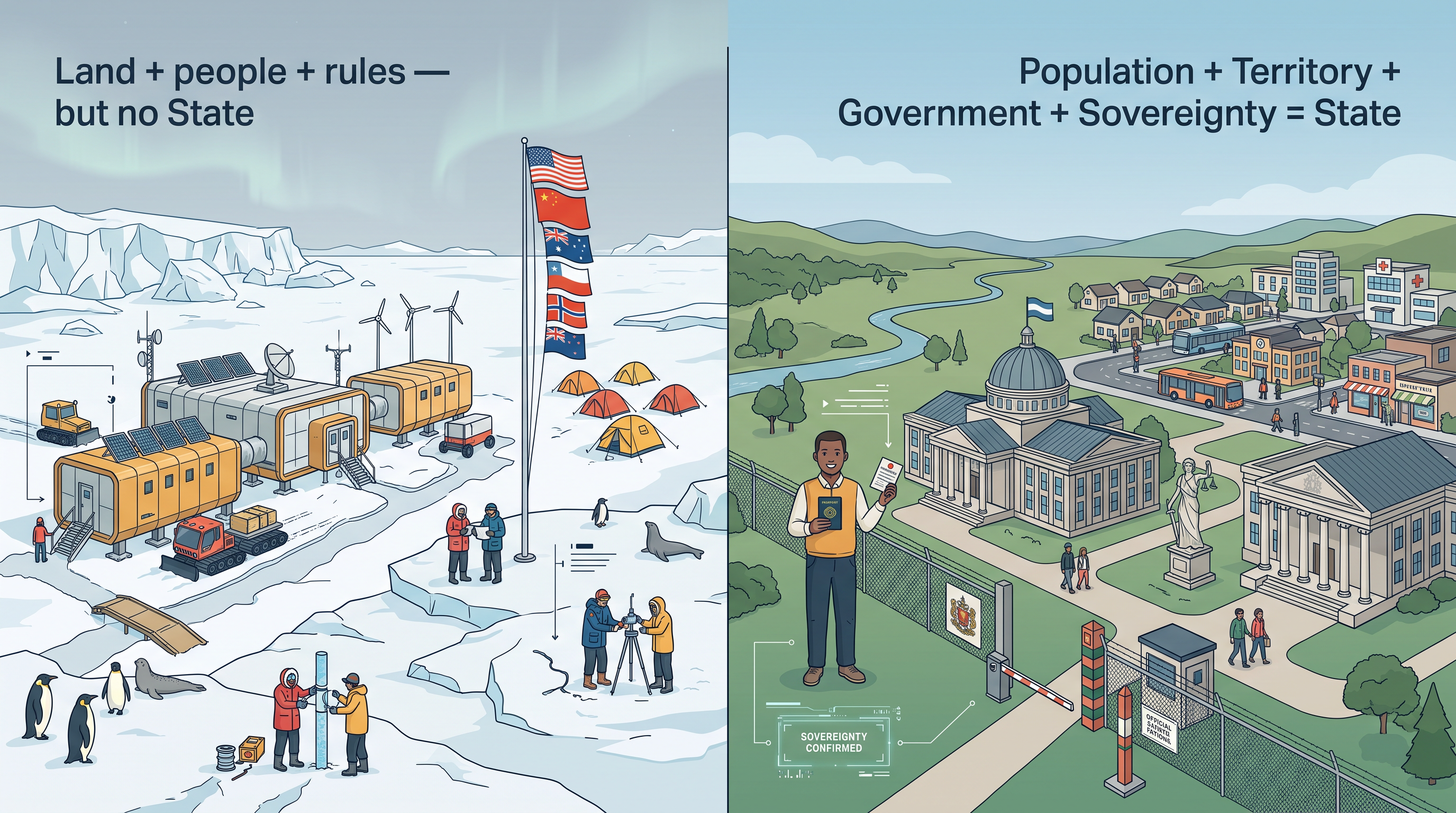
Fig. 1.0 – An Antarctic research station compared to a sovereign State.
You cannot answer these on page one. By the end of this chapter, you will be able to answer every one of them.
1.1 Law, Society and the Need for the State
Human beings do not live alone. We live in society because we need one another — for food, work, shelter, learning, companionship and a sense of right and wrong. Our social, economic and moral needs are met through other people, not in isolation.
But living together is not automatically peaceful. The moment people share space, resources and opportunities, their interests begin to collide. Two neighbours want the same strip of land. A buyer and a seller disagree over what was promised. A crowd wants to use one road at the same time.
Living together therefore demands three things: order, cooperation and mutual respect. To secure them, every society develops rules and norms about how its members should behave — what may be done, what must not be done, and what must be done.
When a Rule Becomes Law
Not every rule of a society is law. Touching the feet of elders is a rule of custom. Not lying is a rule of morality. Wearing the school uniform is a rule of an institution. These guide behaviour, but they are not law.
A rule becomes law when three conditions are satisfied together: it is formally recognised by an authority, it is uniformly applied to everyone it covers, and it is backed by authority that can enforce it. A rule that only some people follow, or that nobody can enforce, has not yet become law.
Law, then, may be understood as a system of rules created and enforced to regulate human behaviour in society. It lays down what is permitted, what is prohibited and what is required, and it aims at justice, order and stability.
The last part of that definition is what sets law apart. Customs, traditions and moral principles depend on social approval; if you break them, people may disapprove of you. Law does not depend on approval. It is binding in nature, and its violation invites punishment.
Why Law Alone Is Not Enough
Suppose a society writes down excellent rules and stops there. Who declares that these rules, and not some others, are the law of the land? Who investigates when a rule is broken? Who imposes the punishment, and who makes sure that the punishment is actually carried out?
Laws cannot function effectively unless they are supported by authority and enforcement. Authority is necessary to make laws in the first place. Enforcement mechanisms are necessary to ensure that people comply with them once made.
This is also why law carries sanctions — the penalties attached to disobedience, such as a fine, imprisonment, or an order to pay compensation. Sanctions act as deterrents. They give a person who is tempted to break the rule a strong reason not to, and so they prevent individuals from acting against social order.
Without an enforcing authority, laws would remain ineffective. The strong would simply ignore them, the weak would have nowhere to go, and society would descend into disorder and chaos. The need for authority and enforcement therefore leads naturally to the emergence of the State — the organised political institution created to make laws and to ensure their implementation.
The Triangle: Society, Law and the State
Law, society and the State are therefore closely interrelated, and it helps to see the relationship as a circle rather than a straight line, as shown in Fig. 1.1.
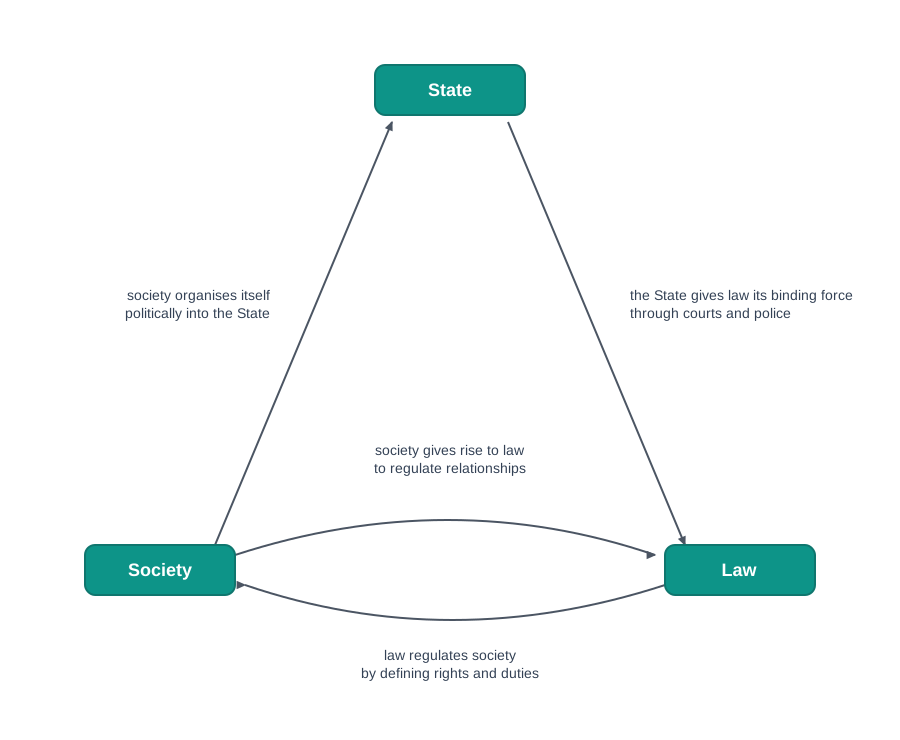
Fig. 1.1 – The interrelated cycle of society, law and the State.
Society gives rise to law, because relationships among individuals and groups have to be regulated. Law in turn regulates society, by defining the rights each person may claim and the duties each person owes. And for law to operate effectively, an organised political authority is required — an authority provided by the State.
The State represents society in its politically organised form. It possesses the power to make laws, to enforce them through institutions such as courts and the police, and to ensure obedience by using legitimate authority. “Legitimate” matters here: a gang can also force people to obey, but only the State’s power to compel is recognised as lawful.
So the two halves of the relationship fit together. Society creates the need for law, and law derives its binding force from the authority of the State.
This is why a book on law must begin with the State. To understand how laws are made, enforced and obeyed, it is essential to study the concept of the State — its origin, its elements and its functions. That is the work of the rest of this chapter.
1.2 Definition of State
In everyday speech the word “state” is used loosely. We speak of the state of the weather, of the states of India, and of the State as a country. In law the word is far more precise, and two well-known definitions show how precise it is.
The Dictionary Definition
Black’s Law Dictionary defines a State as the political system of a body of people who are politically organised, together with the system of rules by which jurisdiction and authority are exercised over that body of people.
Notice the two ideas packed into it. First, a body of people — not any crowd, but people who are politically organised. Second, a system of rules through which authority is actually exercised over those people. People plus organised authority: neither alone will do.
The word jurisdiction appears here for the first time in this book. It means the legal power of an authority to make decisions that bind a defined set of people within a defined area. A State has jurisdiction over its people and its territory; it does not have jurisdiction over the people of another State.
Garner’s Definition
The definition most often quoted in Legal Studies is that of J. W. Garner. According to Garner, a State is a community of persons more or less numerous, permanently occupying a definite portion of territory, independent or nearly so of external control, and possessing an organised Government to which the great body of inhabitants render habitual obedience.
Garner’s definition is valued because it is complete. Every phrase in it points to one of the four things a State must have:
- “a community of persons more or less numerous” — population;
- “permanently occupying a definite portion of territory” — territory;
- “possessing an organised Government to which the great body of inhabitants render habitual obedience” — government;
- “independent or nearly so of external control” — sovereignty.
Two words in that definition are easy to read past and are worth pausing on. “Permanently occupying” rules out a wandering group that has no settled land of its own. “Habitual obedience” means that people obey the government as a matter of routine, not that every single person obeys every single time — a State does not stop being a State because some of its laws are broken.
So the State must possess four elements: population, territory, government and sovereignty. Section 1.4 examines each of them in detail, and you will find that most disputes about whether a particular place is a State come down to one of these four being weak or missing.
1.3 Emergence of the State from Society
The State is usually described in one short phrase: society politically organised. The phrase is worth unpacking slowly, because it tells you both what the State is made of and what it adds.
What Society Is
Society is an association of human beings who live a collective life and form social relations to fulfil their needs of life. Those needs are not only material. They may be physical, emotional, intellectual or spiritual — food and shelter, but also affection, learning and belief.
That people organise themselves into groups is not a theory; it is a plain fact that cannot be denied. Look around any Indian town and you will find societal institutions everywhere — the family, clans, tribes, villages, religious institutions, educational institutions and workplace associations.
Society is therefore best understood not as a place but as a web — the whole web of social relationships. The threads of that web are formed by kinship, affinity of various kinds, language affinity, religious affinity, territorial affinity, and the common conscience of individuals, that is, the shared sense of right and wrong that binds a group together.
These relationships are governed in many different ways. Some are governed by necessity, some by custom, some by courtesy, some by morality, some by mutual understanding, some by agreement, and some even by contract. A brother helps his sister out of affection; a shopkeeper delivers goods because of a contract. Both are social relationships, but the force holding each together is different.
What Turns a Society into a State
Notice that not one of those forces is, by itself, political. A society held together only by custom and courtesy is still a society, not a State.
The change comes when two further things appear. A society qualifies for being a State when it is governed by a common set of laws, rules and regulations, and when it obeys a supreme authority. Common rules that apply to all, and one authority above all — that is the political organisation of society.
The State thus fulfils society’s need for political organisation, so that the purpose of collective living can actually be realised. People come together to live better; the State is the arrangement that keeps that collective life orderly enough to work.
This is the sense in which Aristotle (384–322 BCE) is understood in his treatise Politics, where he observed that man is a social animal and man is a political animal. The two halves of the observation are a sequence rather than a repetition. Because human beings are social, they form society; because they are political, that society organises itself into a State.
Which Depends on Which
The order matters, and examiners like to test it. The State is formed out of society. Society is the primary association — it exists first and it exists independently. A State is formed to regulate the political activity of individuals so that social order is maintained.
It follows that the State depends on society for its existence, and not the other way round. A society without a State has existed at many points in history. A State without a society is impossible, because there would be nobody to organise.
R.M. MacIver (1882–1970), in his famous work The Modern State, made this point sharply. He observed that there are social forms such as the family, the church or the club which owe neither their origin nor their inspiration to the State; social forces such as custom or competition, which the State may protect or modify but certainly does not create; and social motives such as friendship or jealousy, which establish relationships far too intimate and personal to be controlled by the great engine of the State. The State, in a word, regulates the outstanding external relationships of men in society.
That last phrase is the key to MacIver’s argument. The State does not reach into everything. It governs the outward, public side of our relationships — property, contracts, safety, crime, taxes — and leaves the inward side, our affections and beliefs and private loyalties, to society itself.
1.4 Elements of a State
Section 1.2 showed that Garner’s definition contains four things a State must possess. Those four are called the elements of a State, and they are examined one by one below. Fig. 1.2 shows how they fit together.
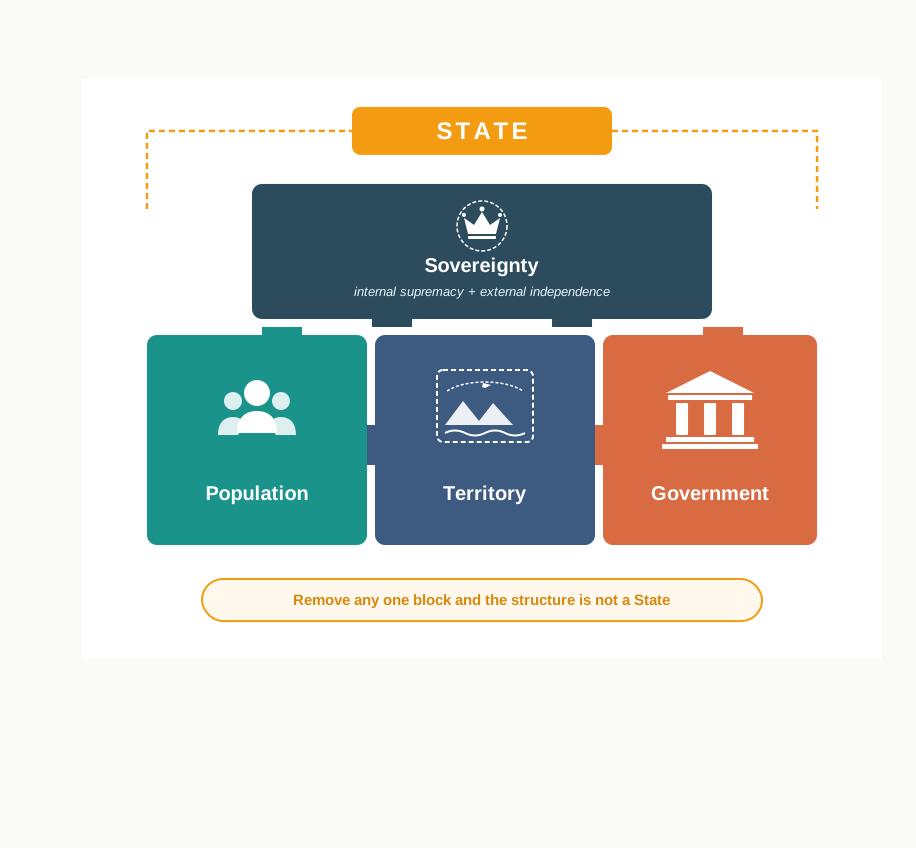
Fig. 1.2 – The four essential elements of a State.
Keep one test in mind as you read: all four must be present at the same time. Three out of four does not make a State.
1.4.1 Population
A State is a human association, constituted by the people living in it. Population is therefore an essential element, and the most obvious one. It is people who make a State; without them there can be no State at all.
People are not merely counted, either. They maintain the resources of the country, they live on the land, and they form the Government. Take the people away and there is nobody left to be governed and nobody left to govern.
How many people are needed? There is no fixed number in law. The requirement is stated in functional terms: the population must be large enough to make a State and to sustain it.
Political thinkers have long argued about the ideal size. Plato (429–347 BCE), in his book The Laws, suggested a figure of 5040 citizens for constituting an ideal State. Aristotle (384–322 BCE) refused to name a number and gave a test instead — the population of a State should be neither so large that administration becomes inconvenient, nor so small that the people cannot lead a life of peace and security.
Stephen Leacock (1869–1944), the English-born Canadian political economist and writer, put the same idea in terms of capacity. The population, he said, must be sufficient in number to maintain a State organisation, and it ought not to be greater than the territorial area and the resources that the State is capable of supporting.
The Nature of the Population
Size is one question; composition is another. A population may be homogeneous — broadly similar in race, religion, language or culture — or heterogeneous, that is, marked by diversity in these respects.
Countries such as India, the United States of America and Canada have populations marked by exactly such diversity. India alone has dozens of major languages and every major religion, and it remains one State.
The contrast in sheer numbers is just as striking. The People’s Republic of China has a population of more than 1400 million people, whereas the smallest State in the world, the Vatican, has a population of only 821 people. Both are States, and in international law both are equal as States. Population size decides a country’s weight in world affairs; it does not decide whether the country is a State.
1.4.2 Territory
A State is a territorial institution. Its fixed territory, along with its population, gives it a physical identity in the eyes of both municipal law and international law. Municipal law here does not mean the law of a municipality — in this context it means the internal law of a country, as opposed to the law that operates between countries.
The reason territory matters is practical. The functions of a State, as a political and legal community of human beings, must first of all be exercised somewhere. Territory is the geographical area that is owned and controlled by a government or country in order to exercise State sovereignty.
Here too thinkers have debated size. Aristotle favoured a State of moderate size. Montesquieu (1689–1775) argued that there is a necessary connection between the size of a State and the form of government best suited to it — a small country and a vast one cannot sensibly be run in the same way. The fact is that the States of the world vary enormously. San Marino has an area of about 24 square miles, whereas the United States of America has a territory of 37,38,395 square miles.
What “Territory” Includes
Territory is not only the surface of the land. It is generally described as including:
- the land, both that which belongs to the State and that which belongs to individuals;
- the internal waters and the territorial sea, including straits, which the State claims for sovereignty;
- the airspace above this territory.
Taken together, this covers the land, the bodies of water, the atmosphere and the natural resources of the country. It is on the land that resources such as agriculture, livestock, minerals, oil, natural gas and forestry are found — which is why control over territory is also control over wealth.
How Fixed Must the Territory Be?
Territories constitute the physical basis of the State, and this has a consequence worth stating plainly: nomadic communities can have no State of their own, because they lead a wandering life and occupy no definite portion of territory permanently.
Ideally, a State should possess an undisputed territory of its own, over which it has exclusive jurisdiction. Ideally, too, it should have territorial contiguity — geographically, it should be one composite whole.
But this is a preference, not an absolute condition. A fixed territory is not essential to the existence of a State, provided there is an acceptable degree of what is characterised as consistency in the nature of the territory in question and of its population. In fact, all modern States are contained within territorial limits.
In brief, then, a territory does not need to possess geographical unity. It may even consist of territorial areas which lack connection with one another, or which are distant from one another. Islands and other territories separated from the mainland still constitute the territory of that State.
1.4.3 Government
Government is the political and administrative organ of a State. The State operates through its government; the government is the machinery through which the State acts.
The two must not be confused. The State consists of all its citizens and is the broader concept. The Government is narrower — it is the sum total of the legislative, executive and judicial activities of a State.
Government also runs deeper than the national level. It includes internal bodies and sub-State governing authorities at the local and regional levels, such as the Municipal Corporations, Municipal Councils, Panchayats and Gram Sabhas in India. When a Gram Sabha resolves to build a village road, that too is the government of the State at work.
The range of what a government provides is very wide. It makes provision for defence, foreign relations, the levy of taxes, the issue of currency, the building of roads and bridges, transportation, communication, water supply, electricity, health, education and other kinds of social and physical infrastructure.
Above all, the government of a State must be so organised that it enforces law to maintain order, peace and security. That is the function it cannot delegate and cannot abandon.
Finally, note that government is not a fixed thing. As the role of a State changes, so does the form of its government — a point that Section 1.8 develops when it examines the different roles a State may play.
1.4.4 Sovereignty
Sovereignty is the crucial factor that distinguishes the State from every other association. A school, a company, a club and a temple trust all have members, property, rules and office-bearers. None of them has sovereignty, and that is why none of them is a State.
Without a sovereign there can be no State in the technical sense of the term. Sovereignty is the most essential ingredient and characteristic in the formation of a State, and no State can exist without both of its two faces — internal and external sovereignty.
Internal Sovereignty
Internal sovereignty means that the people residing within the territory of the State give their unqualified obedience and support to the authority of the State, and further that the State is supreme in all its internal matters.
It is by virtue of its sovereignty that the State makes its laws and its decisions, and issues commands which are binding on all citizens. And it is here that one of the most important propositions in this whole chapter appears: the right to use legitimate coercion in its own right is exclusive to a State. A private person who forces another to pay money commits an offence; the State, acting through its courts and its officers, may lawfully compel exactly that.
Sovereignty is also tougher than it looks. Internal revolts or external aggressions may disturb a State, but the State continues to exist so long as it retains legitimate sovereignty. Disturbance is not extinction.
External Sovereignty
External sovereignty is understood as the freedom of the State from external control and influence. The State should be treated at par with other States and should not be assigned any inferior position.
In practical terms, this means the State must be free to enact its own laws and to decide its own foreign policy without external pressure. A country whose laws are written elsewhere is not, in the full sense, sovereign.
International Recognition
To the four classical elements, modern practice has added a fifth consideration. Presently, international recognition is also considered an essential element of the State. It means the recognition, by other States, of this State’s sovereignty over a given territory and population.
The reason is easy to see once external sovereignty is understood. Equality with other States is not something a territory can simply announce about itself; it becomes real only when other States accept it and deal with the new entity as a State. This is why a region may have people, land and even a functioning government and still not be treated as a State — the last piece, acceptance by the community of States, is missing.
1.5 What is Government?
Government has already appeared in this chapter as one of the four elements of a State. It now deserves a closer look on its own, because in everyday conversation “the State” and “the government” are used as if they meant the same thing — and in law they do not.
Government is the political and administrative machinery through which the State makes and enforces laws. The word machinery is well chosen. A State has authority; the government is the apparatus through which that authority is actually exercised.
Black’s Law Dictionary defines Government as the structure of principles and rules determining how a State or organisation is regulated.
State and Government Distinguished
So what exactly is the difference between the State and the Government? The main differences are these.
Read the table as a single idea rather than three separate ones. Everything in the right-hand column is derived. The government has power because the State has sovereignty; the government defends the territory because the territory belongs to the State. The State is the source, the government is the agent.
You can see this working every time an election is held. When one government replaces another, India does not become a different State. The territory, the population and the sovereignty stay exactly where they were; only the machinery through which authority is exercised has changed hands.
1.6 The Concept of State and Article 12 of the Constitution of India
Everything said so far has described the State as political science and international law understand it — population, territory, government, sovereignty. The Constitution of India uses the same word, but for a narrower and much more practical purpose.
The reason is simple. Part III of the Constitution guarantees Fundamental Rights, and those rights are held mainly against the State. Before you can enforce a right against the State, somebody has to say precisely which bodies count as “the State”. Article 12 does that job.
What Article 12 Includes
Read carefully, the definition covers four categories:
- the Government and Parliament of India — that is, the Executive and the Legislature of the Union;
- the Government and Legislature of each State — that is, the Executive and the Legislature of the State;
- all local and other authorities within the territory of India;
- all local and other authorities under the control of the Government of India.
Two phrases in the Article carry a great deal of weight. “Local authorities” refers to bodies such as Municipal Corporations, Municipal Councils and Panchayats, which you met in Section 1.4.3. “Other authorities” is deliberately wider, and it is what brings statutory bodies and bodies functioning under governmental control within the reach of Fundamental Rights.
That width is the whole point of the provision. If only Parliament and the Union Government were covered, a citizen’s rights could be defeated simply by routing a decision through some other public body. Article 12 closes that escape route.
Notice also the opening words, “unless the context otherwise requires”. The definition is not rigid; where a particular Article of Part III clearly points to something narrower, the context prevails.
Three Questions Often Asked About Article 12
- What is Article 12 of the Constitution? It defines the term “State” as that term is used in Part III of the Constitution, while mentioning the application of the provisions of Fundamental Rights of the Indian citizen.
- Is Article 12 itself a Fundamental Right? Technically it is not. It is a definition clause. Its function is to define “State” for the Fundamental Rights that are entailed in Articles 14 to 35.
- Is the judiciary a State under Article 12? There is no explicit mention of the judiciary — the Supreme Court, the High Courts or the lower courts — as “State” in Article 12. However, the judiciary cannot make rules that are themselves violative of Fundamental Rights.
One clarification is needed on (a). Fundamental Rights are often described loosely as rights of “the Indian citizen”, but that is not accurate for all of them. Some rights in Part III, such as the right to equality before the law, are guaranteed to every person in India, citizen or not; only certain rights are reserved for citizens alone. Article 12 defines “the State” for the whole of Part III, whoever the right happens to belong to.
The point in (c) is worth sitting with. Whether or not the courts are “the State” for every purpose, no organ of the country may frame rules that take away the rights Part III guarantees. Fundamental Rights bind the constitutional structure as a whole.
Two Different Meanings of One Word
Because the same word carries two meanings in this chapter, keep them apart.
This also clears up a confusion that troubles many students. India is a State in the international-law sense. Rajasthan, Kerala and Assam are States of the Indian Union — units within one sovereign country. They have territory, population and government, but they do not possess sovereignty of their own, and so they are not States in the sense in which India is one. Under Article 12, however, the Government and Legislature of Rajasthan are very much “the State”, because a citizen may enforce Fundamental Rights against them.
1.7 Theories on the Origin of State
Nobody watched the first State being born. What we have instead are explanations offered by political philosophers, each trying to account for how organised political authority came into being among human beings.
None of these theories is a statute and none of them can be proved in a court. They matter for a different reason: each one carries a different answer to the question why should anyone obey the State? — and that question is very much alive today.
Read the five theories that follow with one eye on the source of authority each of them identifies: blood, the father, the mother, God, or the consent of the people.
1.7.1 Theory of Kinship
The kinship theory of the origin of the State is based on sociological facts — on how human groups are actually seen to grow. Its earliest advocate is Aristotle (384–322 BCE).
In his treatise Politics, Aristotle observed that a society of many families is called a village, and a village is most naturally composed of the descendants of one family — the children and the children’s children — since every family is governed by its elder, as are the branches that spring from it, on account of their relation to him; and when many villages join themselves together so entirely as to form in every respect but one society, that society is a State, and contains in itself the perfection of government.
In other words, the family was the unit of society at the beginning. Blood relationship and kinship brought the members of a family together, and they all accepted the authority of the head of the family. The name of the common ancestor served as the symbol of kinship, the badge that told people they belonged to one another.
The sequence is therefore simple: kinship created society, and society in turn created the State. As shown in Fig. 1.3, the growth runs in stages — with the expansion of a family, new families arose; the multiplication of families led to the formation of clans; with the expansion of clans, tribes came into existence; and ultimately the State came into existence.
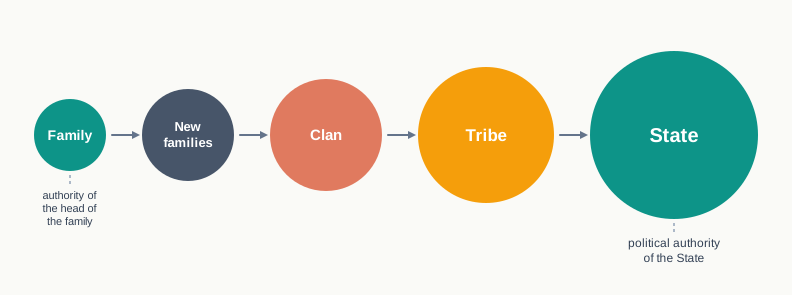
Fig. 1.3 – Stages of State formation under the Theory of Kinship.
On this view, the origin of government is to be found in the family itself. Family, discipline, command and obedience are supposed to represent the beginnings of government — a child learns obedience long before a citizen does. The view finds support from the writings of R.M. MacIver (1882–1970), according to whom the curbs and controls that constitute the essence of government are first seen in the family.
The theory is not free from doubt. There is a difference of opinion among scholars regarding the nature of kinship — in particular, whether the earliest kinship groups traced descent through the father or through the mother. That disagreement produces the next two theories.
1.7.2 Patriarchal Theory
According to the Patriarchal Theory, the eldest male descendant of the family had the important role to play in the origin and development of the State. Authority, on this view, descended through the father’s line.
The theory finds its support from Sir Henry Maine (1822–1888). In his book Ancient Law (1861), Maine explained that the State developed out of the family, as a legitimate legal system developed out of the unrestrained autocracy of the family head — patria potestas.
Under patria potestas, the eldest male parent of the family had the final and unqualified authority over the family and the household. His word settled everything, and no member could appeal against it.
Maine explained the growth as follows. The head expanded the family ties by polygamy, and thus created a bondage among individuals on the basis of kinship, out of which a State could form. The congregation of families formed villages, the extension of villages formed tribes or a clan, and these ultimately came together to form the State.
1.7.3 Matriarchal Theory
The Matriarchal Theory reverses the line of descent. It finds support from political thinkers such as McLennan (1827–1881) and Edward Jenks (1861–1939).
According to them, patriarchal families were non-existent in the primitive ages. In those societies polyandry — the practice where a woman had many husbands — was the pattern of the household, and authority rested with the mother. McLennan described the mater familias, the mother as head of the family, as the final authority in matters of possession and disposal of the property of the family.
Edward Jenks illustrated this process from his studies of primitive tribes in Australia. Those tribes were organised into groups known as totem groups. A totem group was not organised on the basis of blood relationship; its members were united by a common symbol such as a tree or an animal.
Marriage worked across these groups. Men of one totem group would marry all the women of their generation belonging to another totem group, so the system of marriage included polygamy as well as polyandry.
That practice had a consequence which is the heart of the argument. Kinship and paternity in such cases could not be determined, but maternity was a fact. When nobody can say with certainty who a child’s father is, descent and authority can only be traced through the mother.
Jenks further points out that with the passage of time, and with the beginning of the pastoral stage in human civilisation, the matriarchal society evolved into the patriarchal one.
Criticism of the Patriarchal and Matriarchal Theories
Both theories have been criticised on the same ground, and the criticism is worth learning because it applies to the kinship theory as well.
- The authority of a State as a political institution over its individuals is not derived from nature, as a parent’s authority is, but from the choice of the individuals themselves.
- The purpose of forming a State differs to a great extent from the purpose of a family — a family exists for care, upbringing and continuity, while a State exists to maintain order among strangers.
- The authority to run a State is conferred on the ruler not because of his seniority, but on account of his status and competence.
1.7.4 Divine Theory
According to the Divine Theory, the State is established and governed by God, or by some super-human power, or by the King acting as God’s agent, with the religious scriptures as the guide.
The reasoning runs by analogy with creation itself. As God created the animals, plants, trees, rivers, hills and other inanimate objects, so God also created the State for a particular end in view — the peace, protection and preservation of creatures on this earth.
The theory found support from political thinkers such as James I (1566–1625) and Sir Robert Filmer (1588–1653). It implies that individuals must obey and support some definite ruler who holds a high moral status equivalent to God.
Two consequences followed. First, the theory adds a moral character to the functions of the State: a ruler who governs on God’s behalf is expected to govern justly. Second, laws backed by religious sanctions appealed more strongly to the primitive man, who was more willing to live under the authority of a king whose commands carried divine weight.
The belief was not confined to one faith. Hindus, Christians, Muslims, Jews and many other faiths of this world hold a similar view, that the origin of political authority had divine sanction. Hinduism considered King Rama and King Krishna as divine incarnations in this world. The Islamic States also seek to uphold the reign of God (Allah) on earth. Christianity too traced the origin of political theory to the will of God.
1.8 Role of a State
Every State has population, territory, government and sovereignty. But what should a State actually do with that authority? Should it merely keep the peace and leave people alone, or should it run schools, hospitals, railways and pension schemes as well?
Political thinkers have never agreed. In the words of Professor MacIver, the State has no finality and can have no perfected form; the State is an instrument of social man. An instrument, note — a tool that different societies pick up for different purposes.
Because the purposes differ, the descriptions of the State differ too. Some scholars consider the State a moral and ethical institution; others consider it an evil institution to be kept as small as possible. MacIver himself referred to the many different notions that have been held of it — the State as a class organisation, as a legal institution, as a mutual insurance agency, as an unnecessary evil, as a necessary evil, as the march of God on earth, as a welfare system, as a power system, and as an organism.
You do not have to choose between these labels. You do have to notice what they are arguing about: how much of life should belong to the State, and how much should be left to private individuals.
Heywood’s Classification
Andrew Heywood, an English political writer, offers a way of sorting this out in his book Politics. He classifies the role of the State according to which functions and responsibilities the State fulfils and which are left to private individuals — from the State that does least to the State that does most, as set out in Fig. 1.5.
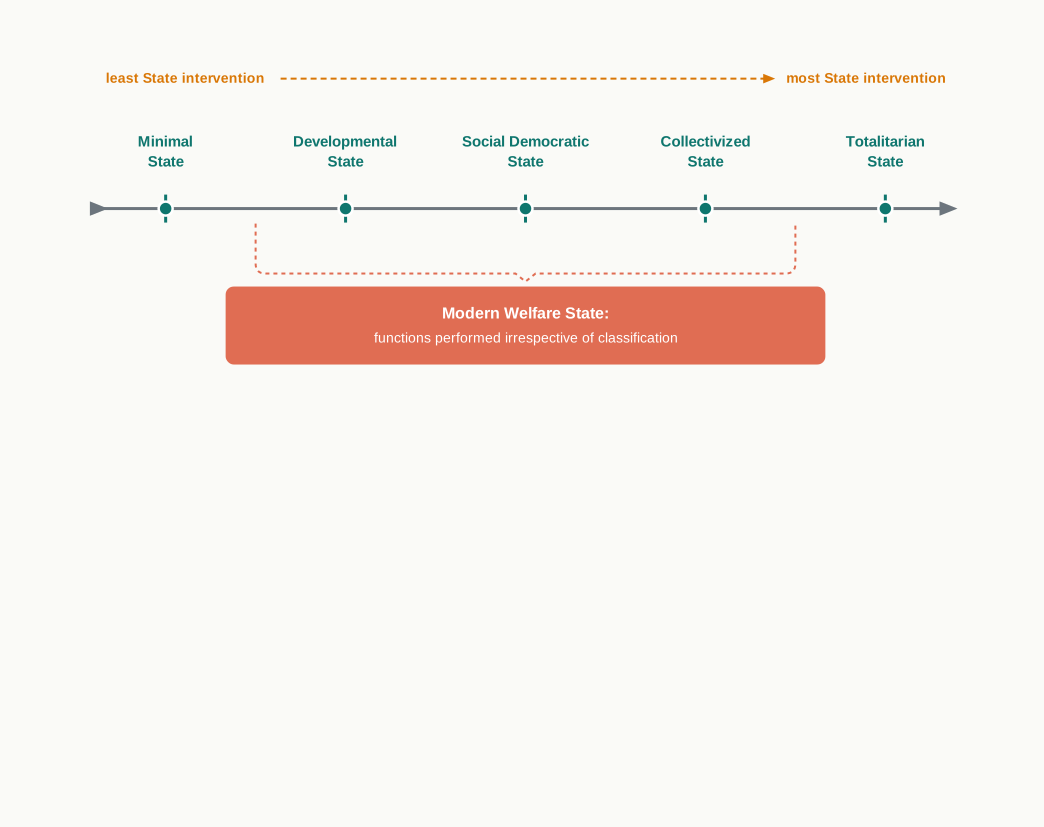
Fig. 1.5 – Heywood’s classification of the role of the State.
A. Minimal States
The ideal of the minimal State is a contribution of the classical liberals. The names of political thinkers such as John Locke, Jeremy Bentham, J. S. Mill, Herbert Spencer, Robert Nozick, Friedrich Von Hayek and Milton Friedman are generally associated with this approach.
The governing idea is to ensure the widest possible individual liberty. People who ascribe a minimal role to the State believe that a laissez-faire approach to the economy — the phrase means “let it be” or “leave it alone” — is most likely to lead to economic prosperity.
On this view the State’s role is to protect individuals from interference in their liberty, and to see that transactions between private individuals remain voluntary and free. According to John Locke’s theory, the State acts as a night watchman, whose services are called upon only when orderly existence is threatened.
That leaves the State a basic but real job: providing protection from external attacks, enforcing agreements, and maintaining domestic order. Beyond this, minimal States play a minimum role in interfering with the social and economic life of their subjects.
B. Developmental States
A developmental State is characterised by strong State intervention, together with extensive regulation and planning.
The term describes the State’s essential role in harnessing national resources and directing incentives through a distinctive policy-making process. The State here is not a night watchman but a driver of the economy — deciding which industries to encourage, and steering investment towards them.
The first person to seriously conceptualise the developmental State was Chalmers Johnson (1931–2010). Johnson defined the developmental State as a State that is focused on economic development and takes the necessary policy measures to accomplish that objective.
D. Collectivized States
Collectivized States go considerably further. They undertake the control of economic life itself, by bringing the common ownership of all economic resources under their own control for the welfare of all.
Such a State makes laws to control the private property of its citizens. The People’s Republic of China follows such a policy. The State takes care of the economic needs of its citizens — it provides food, shelter and employment — and in return the citizens must not act against government policies.
E. Totalitarian States
Philosophers such as Hegel, and dictators such as Hitler and Mussolini, held that the State must have absolute powers and that individuals have no rights against the State.
According to this view, the State can do no wrong, and the whole life of an individual falls within the jurisdiction of the State. There is no private sphere left at all — not in work, not in belief, not in family life.
Compare this with what you studied in section 1.6. Under the Constitution of India, Fundamental Rights are held against the State, and a citizen may go to court when the State violates them. A totalitarian State is precisely the arrangement in which that sentence could not be written.
F. Modern Welfare State
Irrespective of the classification a country falls under, certain functions are performed by a modern welfare State. They fall into two groups.
The first group is the older, basic set of functions:
- maintenance of law and order;
- establishment of justice;
- defence, public security and foreign relations;
- maintenance of public health and sanitation, and water supply;
- transport and communication systems;
- supply of power, electricity and essential commodities;
- control of banking, currency and inflation;
- preservation of forests;
- checking of trading, and control of prices and measurements.
The second group is what makes the State a welfare State, because these functions look after people rather than merely regulate them:
- removal of social exploitation and the establishment of social unity;
- provision of economic and other benefits to weaker sections;
- social security for old age people, widows, orphans and the disabled;
- protection of workers by regulating minimum wages and pension;
- education of the masses;
- encouragement of art and literature;
- scientific and technological research;
- cultural exchanges, to increase the spirit of cultural unity and harmony among the masses.
Read that second list against your own week. The mid-day meal at a government school, the ration shop, the old-age pension a grandmother collects, the minimum wage printed on a construction site board, the government scholarship portal — each of these is a welfare-State function in operation, not an abstraction.
1.9 Summary
- Human beings live in society to fulfil their social, economic and moral needs, and living together requires order, cooperation and mutual respect.
- Society develops rules and norms to regulate conduct, and such a rule becomes law when it is formally recognised, uniformly applied and backed by authority.
- Law is a system of rules created and enforced to regulate human behaviour, laying down what is permitted, prohibited or required, and aiming at justice, order and stability.
- Unlike customs, traditions and moral principles, law is binding in nature and its violation invites punishment.
- Law cannot work without authority to make it and enforcement machinery to secure compliance; the sanctions attached to law act as deterrents.
- Without an enforcing authority, laws would remain ineffective and society would descend into disorder and chaos, and this need leads to the emergence of the State.
- Law, society and the State are interrelated:
- society gives rise to law to regulate relationships among individuals and groups;
- law regulates society by defining rights and duties;
- the State supplies the organised political authority that law needs to operate.
- The State represents society in its politically organised form and makes law binding through its legitimate authority.
- Black’s Law Dictionary defines a State as the political system of a body of people who are politically organised, and the system of rules by which jurisdiction and authority are exercised over them.
- According to J. W. Garner, a State is a community of persons more or less numerous, permanently occupying a definite portion of territory, independent or nearly so of external control, and possessing an organised Government to which the great body of inhabitants render habitual obedience.
- Garner’s definition is valued because it contains all four elements of a State — population, territory, government and sovereignty.
- The State is society politically organised; a society qualifies to be a State when it is governed by a common set of laws, rules and regulations and obeys a supreme authority.
- Aristotle observed in his treatise Politics that man is a social animal and man is a political animal.
- Society is the primary association and came first; the State is formed out of society, and the State depends on society for its existence and not the other way round.
- R.M. MacIver, in The Modern State, observed that social forms, social forces and social motives are not created by the State, and that the State regulates only the outstanding external relationships of men in society.
- Population is an essential element because it is the people who make a State; the population must be large enough to make a State and to sustain it.
- Views on the size of population differ:
- Plato suggested a figure of 5040 citizens for an ideal State in The Laws;
- Aristotle held that it should be neither so large that administration becomes inconvenient nor so small that people cannot live in peace and security;
- Stephen Leacock held that it must be sufficient to maintain a State organisation and not greater than the territory and resources can support.
- A population may be homogeneous or heterogeneous in respect of race, religion, language or culture, and diversity does not affect statehood.
- Territory is the definite geographical area — land, internal waters and territorial sea, and the airspace above them — over which a State exercises exclusive control.
- A State should ideally possess an undisputed territory of its own with territorial contiguity, but geographical unity is not essential, and separated areas such as islands still form part of a State’s territory.
- Communities that lead a wandering life and occupy no definite territory permanently cannot form a State.
- Government is the political and administrative machinery through which the State makes and enforces laws, and is the sum total of the legislative, executive and judicial activities of a State.
- Government includes sub-State authorities at local and regional levels, such as Municipal Corporations, Municipal Councils, Panchayats and Gram Sabhas in India.
- Sovereignty is the crucial factor distinguishing the State from all other associations, and it has two aspects:
- internal sovereignty — the State is supreme in all internal matters and its commands bind all citizens, and the right to use legitimate coercion is exclusive to it;
- external sovereignty — the State is free from external control and influence and is treated at par with other States.
- Internal revolts or external aggressions may disturb a State, but the State continues to exist so long as it retains legitimate sovereignty.
- International recognition, that is, recognition of a State’s sovereignty over a given territory and population by other States, is presently also considered an essential element.
- The State and the government are not the same:
- the State has four elements, of which government is only one;
- sovereignty belongs to the State, and the government merely exercises power on its behalf;
- territory belongs to the State, and the government has the responsibility to preserve, protect and defend it.
- Article 12 of the Constitution of India defines “the State” for Part III, and it includes the Government and Parliament of India, the Government and Legislature of each State, and all local or other authorities within the territory of India or under the control of the Government of India.
- Article 12 is not itself a Fundamental Right; it is a definition clause that identifies the bodies against which the Fundamental Rights entailed in Articles 14 to 35 may be enforced.
- The judiciary is not expressly mentioned as “State” in Article 12, but the judiciary cannot make rules that are themselves violative of Fundamental Rights.
- Political philosophers have offered different theories on the origin of the State.
- The Theory of Kinship, whose earliest advocate is Aristotle, holds that the family was the first unit, that kinship created society and society created the State, and that families grew into clans, clans into tribes and tribes into the State.
- The Patriarchal Theory, supported by Sir Henry Maine in Ancient Law (1861), traces the State to the authority of the eldest male head of the family under patria potestas.
- The Matriarchal Theory, supported by McLennan and Edward Jenks, holds that authority in primitive societies rested with the mother, since in the totem groups paternity could not be determined but maternity was a fact.
- Jenks held that with the beginning of the pastoral stage of civilisation, matriarchal society evolved into the patriarchal one.
- Both these theories are criticised on the grounds that the authority of the State rests on the choice of individuals and not on nature, that the purpose of a State differs from that of a family, and that authority is conferred on a ruler for status and competence rather than seniority.
- The Divine Theory holds that the State was established and is governed by God, or by the King as God’s agent, and it was supported by James I and Sir Robert Filmer.
- The Social Contract Theory traces the State to the mutual agreement and consent of the people, who entered into a contract to escape the state of nature; it was propounded by Thomas Hobbes, John Locke and Jean Jacques Rousseau, and became the basis for modern democracy.
- Hobbes, in Leviathan, described the state of nature as a condition of perpetual war in which life was solitary, poor, nasty, brutish and short, and created an all-powerful sovereign who was not a party to the contract and against whom there was no right of revolt.
- Locke, in Two Treatises of Government, described the state of nature as peaceful but inconvenient, provided for two contracts — social and governmental — held the ruler bound by the contract as a trustee of the people, and allowed revolt where popular trust was breached.
- Rousseau, in The Social Contract, held that the general will of the people created the State, regarded the general will as sovereign, treated government as merely a tool to execute the popular will, and left no scope for revolt.
- The Social Contract Theory is criticised because individuals unaware of political authority could not have entered such an agreement at any particular point of time, and because a State founded on agreement may be destabilised whenever the agreement is revoked.
- MacIver held that the State has no finality and can have no perfected form, and that the State is an instrument of social man.
- Andrew Heywood, in Politics, classifies States by the functions the State performs and those left to private individuals:
- minimal States, favoured by classical liberals, follow laissez-faire and treat the State as a night watchman;
- developmental States use strong intervention, regulation and planning to drive economic development;
- social democratic States work on fairness, equality and equal distribution of wealth;
- collectivized States bring all economic resources under common ownership and control;
- totalitarian States claim absolute power, leaving individuals no rights against the State.
- Irrespective of the classification, a modern welfare State maintains law and order, justice, defence, public security and foreign relations, and provides infrastructure and essential services.
- A modern welfare State also removes social exploitation, provides benefits to weaker sections and social security to the old, widows, orphans and the disabled, protects workers through minimum wages and pension, educates the masses, and encourages art, literature, research and cultural exchange.
1.10 Key Terms
Law — a system of rules created and enforced by an authority to regulate human behaviour in society, binding in nature, whose violation invites punishment.
Sanction — the penalty attached to the breach of a law, such as a fine or imprisonment, which acts as a deterrent against disobedience.
Society — an association of human beings who live a collective life and form social relations to fulfil their physical, emotional, intellectual and spiritual needs.
State — society in its politically organised form; a community of persons permanently occupying a definite territory, independent of external control, and possessing an organised government that the people habitually obey.
Jurisdiction — the legal power of an authority to make decisions that bind a defined set of persons within a defined area.
Population — the people who constitute a State, which must be large enough to make a State and to sustain it.
Homogeneous population — a population broadly similar in race, religion, language or culture.
Heterogeneous population — a population marked by diversity of race, religion, language or culture.
Territory — the definite geographical area of a State, comprising its land, internal waters and territorial sea, and the airspace above them.
Municipal law — the internal or domestic law of a country, as distinguished from international law, which governs relations between countries.
Territorial contiguity — the quality of a territory forming one composite geographical whole, desirable in a State but not essential to its existence.
Government — the political and administrative machinery through which the State makes and enforces its laws; the sum total of the legislative, executive and judicial activities of a State.
Sovereignty — the supreme authority of a State, internally over all persons within its territory and externally in freedom from the control of other States.
Internal sovereignty — the supremacy of the State in all its internal matters, by virtue of which its laws and commands bind all citizens.
External sovereignty — the freedom of a State from external control and influence, and its right to be treated at par with other States.
Coercion — compelling a person by force or the threat of force, which only the State may lawfully do in its own right.
International recognition — the acceptance by other States of a State’s sovereignty over a given territory and population.
“State” under Article 12 — for the purposes of Part III of the Constitution of India, the Government and Parliament of India, the Government and Legislature of each State, and all local or other authorities within the territory of India or under the control of the Government of India.
Other authorities — the wider category in Article 12 that brings bodies beyond the ordinary organs of government within the reach of Fundamental Rights.
Patria potestas — the final and unqualified authority of the eldest male parent over the family and household, on which the Patriarchal Theory rests.
Mater familias — the mother as head of the family, treated by the Matriarchal Theory as the final authority over family property.
Totem group — a primitive group united not by blood relationship but by a common symbol such as a tree or an animal, studied by Edward Jenks.
State of nature — the imagined pre-political condition of mankind described by the social contract theorists, before any political authority existed.
Social contract — the mutual agreement by which individuals left the state of nature and consented to establish political authority.
Governmental contract — in Locke’s theory, the second contract, made between the individuals and the ruler, by which government was established and the ruler bound by its terms.
Limited government — Locke’s concept of a government limited in its rulers, powers, functions and tenure, holding authority as a trustee of the people.
General will — in Rousseau’s theory, the collective will of the people directed at the common good, which he regarded as sovereign.
Laissez-faire — literally “let it be” or “leave it alone”; the policy of minimum State interference in economic life.
Night watchman State — Locke’s description of the minimal State, whose services are called upon only when orderly existence is threatened.
Minimal State — a State that confines itself to defence, enforcement of agreements and maintenance of domestic order, leaving social and economic life to private individuals.
Developmental State — a State characterised by strong intervention, regulation and planning, focused on economic development.
Social democratic State — a State functioning on the principles of fairness, equality and equal distribution of wealth to achieve social, political and economic justice.
Collectivized State — a State that brings the ownership of all economic resources under its own control and regulates the private property of its citizens.
Totalitarian State — a State claiming absolute power, in which individuals have no rights against the State and the whole of life falls within its jurisdiction.
Modern welfare State — a State that, besides maintaining law, order, justice and defence, provides education, public health, social security and support to weaker sections.
1.11 Points to Ponder
- If a rule is obeyed by everyone out of habit and nobody has ever had to enforce it, is anything really added by calling it law?
- The State claims the exclusive right to use legitimate coercion. What makes that use of force “legitimate” when the same act by a private person would be an offence?
- Society existed before the State and does not depend on it. Does that make the State less important, or does it explain why the State must be limited?
- MacIver said the State regulates only the outward relationships of people. In an age of social media, workplace conduct rules and online surveillance, is the line between the outward and the private still where he drew it?
- Should international recognition really be treated as an element of statehood? A place either satisfies the four classical elements or it does not — why should the opinions of other countries decide the question?
- Article 12 deliberately uses the wide phrase “other authorities”. As more public services are delivered by private companies and contractors, should the reach of Fundamental Rights widen with them?
- The theories on the origin of the State cannot be proved historically. What, then, is the value of studying them in a law course?
- Hobbes traded liberty for security and Locke refused to. Which trade does a society make when it accepts stronger policing powers in return for greater safety?
- Rousseau left no room for revolt because he believed the people are always sovereign. Is a system with no lawful way to resist authority safe, however democratic its theory?
- A welfare State promises education, health care and social security. What is owed in return by the citizen who receives them, and can the law demand it?
- Real countries rarely fit into one of Heywood’s categories. Is a classification that no country matches exactly still useful?
1.12 Textbook Questions
How are law, society and the State interrelated? Explain with examples.
If a society has rules but no enforcement mechanism, will those rules still be called law? Explain with reasons and examples.
Can a State exist without law? Discuss with arguments and give examples to support your answer.
- List the various theories on the origin of the State.
- Briefly explain the elements of a State.
- What are the various kinds of States on the basis of the role they play?
Answer the following questions in about 200 words:
- Explain the comparative views on the Social Contract Theory.
- Define State.
- Explain the emergence of the State.
Rousseau stated, “Man is born free, and everywhere he is in chains.” In the light of this statement, in which type of State would a man be chained the most, and why? Give an example of such a State. If given a choice of residence, in which type of State would you like to reside? Give reasons.
Patria, a locatable place on the world map, having a considerable territory under its control, consisted of a population of 1 million people. It was ruled by Col. George; however, the place did not gain any international political recognition, as one of the major elements was missing. Identify and explain all the elements of a State.
How has the concept of State been defined in the Constitution of India? Why do you think it has been included in Part III of the Constitution?
How would you differentiate between India as a State and the various States of India?
Imagine yourself living in a state of nature. Which aspects of your life would you want to give up, and what would you expect in return? What kind of social contract would you enter into, and with whom?
1.13 Objective Questions
A rule of society becomes law when it is —
- followed by a majority of people out of habit
- formally recognised, uniformly applied and backed by authority
- approved by religious scriptures
- written down and printed in a book
Which of the following is NOT one of the four elements of a State?
- Population
- Territory
- Written constitution
- Sovereignty
According to J. W. Garner, the inhabitants of a State render to its organised Government —
- occasional obedience
- habitual obedience
- conditional obedience
- obedience only in times of war
Plato, in his book The Laws, suggested that an ideal State should consist of —
- 504 citizens
- 5040 citizens
- 50,400 citizens
- no fixed number of citizens
In the expression “municipal law and international law”, the term municipal law refers to —
- the bye-laws made by a Municipal Corporation
- the internal or domestic law of a country
- the law applicable only to urban areas
- the law governing relations between countries
The exclusive right to use legitimate coercion belongs to —
- the State
- any association recognised by law
- the head of every family
- the majority community in a territory
Which of the following statements about the relationship between the State and the government is correct?
- Sovereignty belongs to the government, which shares it with the State
- The government owns the territory of the State
- The government is one element of the State and exercises power on its behalf
- A change of government brings a new State into existence
Article 12 of the Constitution of India defines the term “State” for the purposes of —
- the whole Constitution
- Part III of the Constitution
- international law
- the Preamble alone
The earliest advocate of the Theory of Kinship on the origin of the State is —
- Sir Henry Maine
- Edward Jenks
- Aristotle
- Sir Robert Filmer
The expression patria potestas, associated with the Patriarchal Theory, refers to —
- the authority of the eldest male parent over the family and household
- the authority of the mother over family property
- the authority of a village council over its members
- the authority of the King over his subjects
Edward Jenks based his support for the Matriarchal Theory on his study of —
- the city-states of ancient Greece
- primitive tribes in Australia organised into totem groups
- the Roman family under Roman law
- the Minangkabau people of Indonesia
The description of life in the state of nature as “solitary, poor, nasty, brutish and short” was given by —
- John Locke
- Jean Jacques Rousseau
- Thomas Hobbes
- R.M. MacIver
In Locke’s theory, the governmental contract was made between —
- the individuals among themselves
- the individuals and the ruler
- the ruler and the general will
- the family heads and the clan elders
According to Rousseau, the government is —
- the sovereign itself
- a party to the social contract
- merely a tool to execute the popular will
- an authority that individuals must obey unquestioningly
The description of the State as a “night watchman” is associated with —
- the minimal State
- the developmental State
- the collectivized State
- the totalitarian State
The first person to seriously conceptualise the developmental State was —
- Andrew Heywood
- Chalmers Johnson
- Milton Friedman
- Herbert Spencer
Assertion (A): Society can exist without a State, but a State cannot exist without society. Reason (R): Society is the primary association, and the State is formed out of society to regulate the political activity of individuals.
Assertion (A): A group of people living on a piece of land under agreed rules is not necessarily a State. Reason (R): A State must possess population, territory, government and sovereignty together, and the absence of any one of them prevents it from being a State.
Assertion (A): The territory of a State need not form one unbroken geographical whole. Reason (R): Islands and other areas separated from the mainland still constitute the territory of a State, provided the State exercises exclusive jurisdiction over them.
Assertion (A): A change of government through an election does not create a new State. Reason (R): Sovereignty belongs to the State, and the government only exercises power on the State’s behalf.
Assertion (A): Article 12 is not itself a Fundamental Right. Reason (R): Article 12 is a definition clause that identifies the bodies against which the Fundamental Rights contained in Articles 14 to 35 may be enforced.
Assertion (A): Hobbes allowed the people no general right to revolt against the sovereign. Reason (R): In Hobbes’s theory the ruler was not a party to the social contract and was therefore not bound by its terms.
Assertion (A): Internal revolts or external aggression do not by themselves bring a State to an end. Reason (R): A State continues to exist so long as it retains its legitimate sovereignty.
1.14 Check Your Concepts
Why does a rule need to be “backed by authority” before it can be called law? Explain what would happen to a rule that satisfies every other requirement but this one.
Distinguish between law and other social rules such as custom, tradition and morality, on the bases of source, application, binding force and consequence of breach.
What purpose do sanctions serve in a legal system? Would law still function if no penalty were attached to its breach?
“Society creates the need for law, and law derives its binding force from the State.” Explain this statement using the relationship between society, law and the State.
State the four elements contained in J. W. Garner’s definition of a State, and identify the words in the definition that point to each one.
Why does Garner’s definition use the words “permanently occupying” and “habitual obedience”? What would be lost if these two words were removed?
Distinguish between society and the State on at least four bases.
Aristotle observed that man is a social animal and also a political animal. Why are these two statements treated as a sequence rather than a repetition?
Correct the error in the following statement and give reasons: “Since the State makes and enforces all law, society depends on the State for its existence.”
A wandering community of about two lakh people follows a common set of customs and obeys its own council of elders, but moves across three countries with the seasons. Which element of a State is missing, and why does its absence matter?
Explain, with reasons, whether a State’s territory must be one composite geographical whole. What does the law require instead?
What does the territory of a State include besides its land? Why is control over territory also treated as control over resources?
Why is sovereignty said to be the element that distinguishes a State from every other association? Use the example of a large private company or a university in your answer.
Distinguish between internal sovereignty and external sovereignty, and state one consequence that follows from each.
Why is the right to use legitimate coercion described as exclusive to the State? Give one example of an act that is lawful when done by the State and an offence when done by a private person.
What happens to the existence of a State when an armed revolt takes control of part of its territory for several months? Explain the legal position.
Why has international recognition come to be regarded as an essential element of a State, even though it is not one of the four classical elements?
Distinguish between the State and the government on the bases of elements, sovereignty and territory.
Identify the provision: which Article of the Constitution of India defines “the State”, for which Part does it do so, and which four categories of bodies does it cover?
Why did the makers of the Constitution use the wide expression “other authorities” in Article 12 instead of naming only Parliament and the Governments? What would happen to Fundamental Rights if the expression were narrowed?
Explain the difference between the meaning of “State” in international law and its meaning under Article 12, and use that difference to explain why Kerala is a State of India but not a State in the international-law sense.
Arrange the following stages of the Theory of Kinship in the correct order and explain the progression: tribe, family, State, clan, new families.
On what common grounds are the Patriarchal and Matriarchal Theories criticised? State three grounds.
Why did Edward Jenks conclude that authority in the totem groups he studied must have been traced through the mother? Which single fact carried the argument?
Distinguish between the state of nature as described by Hobbes, Locke and Rousseau.
Why does Locke allow the people a right of revolt while Hobbes denies it? Base your answer on who is a party to the contract in each theory.
Explain Locke’s two contracts and state what each of them produced.
Rousseau said individuals surrendered their rights to the general will and yet lost nothing. Explain how he reached that conclusion, and why his theory leaves no scope for revolt.
State the two main criticisms of the Social Contract Theory, and explain why the second criticism suggests that such a State would be unstable.
Correct the error in the following statement and give reasons: “Hobbes held that when a government falls, the State survives unchanged, because the State and the government are different institutions.”
What is meant by the State as a “night watchman”? Which classification of States does this description belong to, and what functions does such a State still perform?
Distinguish between a minimal State and a collectivized State on the bases of aim, role in the economy and treatment of private property.
Why can a totalitarian State not have Fundamental Rights of the kind guaranteed by Part III of the Constitution of India?
List any five functions of a modern welfare State that go beyond the maintenance of law and order, and explain what makes them “welfare” functions.
Why is it difficult to place a real country entirely within one of Heywood’s categories? Illustrate your answer with functions performed by the Indian State.
1.15 Case-Based Questions
- The region of Vaneria lies on the coast of a large country. It has a settled population of about eight lakh people who have lived there for generations, a definite area with marked boundaries, and an elected Council that collects taxes, runs schools and maintains a police force which the residents obey as a matter of routine. Last year the Council declared Vaneria independent. The parent country rejects the declaration and continues to station its own officials there, and no other country has accepted Vaneria’s claim.
- Which of the four classical elements of a State does Vaneria clearly possess? Support each with a fact from the passage.
- Which element is doubtful, and which specific facts create the doubt?
- What difference does the absence of acceptance by other countries make, and under which heading studied in this chapter does it fall?
- Would your answer change if the parent country withdrew all its officials and formally accepted the declaration? Explain which element would then be satisfied.
- Meera applies for a trade licence to run a small tailoring unit. The Municipal Council of her town rejects her application, and the written order states that licences in that ward are given only to men. Meera wants to challenge the order as a violation of her Fundamental Rights. The Council argues that it is not the Government of India and not the Government of the State, and that Fundamental Rights therefore cannot be enforced against it.
- Which Article of the Constitution answers the Council’s argument, and what does it provide?
- Under which of the four categories covered by that Article does the Municipal Council fall?
- Explain why the definition in that Article was drafted widely instead of naming only Parliament and the Governments.
- Would the position be different if the licence had been refused by a private tailoring association of which Meera is not a member? Give reasons.
- In the country of Rendel, a general election is held and the ruling party is defeated. The new government reverses several policies of the old one, transfers senior officials and renames a number of public schemes. A newspaper column claims that “a new Rendel has come into being” and that the country’s borders, treaties and citizenship laws must now be settled afresh.
- Is the newspaper’s claim correct? Answer with reference to the distinction between the State and the government.
- To whom does sovereignty belong in Rendel, and what exactly changed on the day of the election result?
- Whose duty is it to preserve, protect and defend the territory of Rendel, and does that duty amount to ownership of the territory?
- Which of the three social contract thinkers studied in this chapter would have agreed with the newspaper, and why?
- Two neighbouring countries take very different paths. In Aldora, the government confines itself to defence, policing, the courts and the enforcement of contracts; industry, schooling and health care are left almost entirely to private hands. In Berun, the government owns all major industries, allots housing and employment, fixes the prices of essential goods and restricts what citizens may say about official policy.
- Classify Aldora and Berun on Heywood’s classification of the role of the State, and justify each classification with a fact from the passage.
- Which thinkers are associated with the approach followed by Aldora?
- A citizen of Berun wishes to challenge a government order that dismissed her from employment. Explain the difficulty she faces, using what you have learnt about the rights of individuals in such a State.
- Berun later begins to permit criticism of official policy and allows citizens to approach an independent court against the government, while keeping its industries in public ownership. Would your classification of Berun change? Give reasons.
- The country of Kesland consists of a mainland and a chain of twelve islands lying about 900 kilometres out at sea. Kesland’s laws apply on the islands, its courts sit there and its officials administer them. A visiting scholar argues that the islands cannot be part of Kesland’s territory because they are not joined to the mainland, and that Kesland therefore fails the requirement of territorial contiguity.
- Is the scholar’s argument sound? Explain what the requirement of territorial contiguity actually demands.
- What does the territory of Kesland include besides the land of the mainland and the islands?
- Suppose a neighbouring country begins to administer four of the islands, collects taxes there and its courts are the only ones functioning on them. How would that fact change the position, and which element of statehood is affected?
- A residents’ association in a large housing colony frames its own rules: no construction without approval, a fine of one thousand rupees for littering, and expulsion from the association for repeated breaches. The association has a written constitution, an elected committee, defined boundaries and about four thousand residents who generally follow the rules. Its president says the colony is “a small State in itself”.
- Which element of a State does the association clearly lack? Explain what that element means.
- The association imposes a fine and the resident refuses to pay. Can the association compel payment by force? Compare its position with that of the State, using the idea of legitimate coercion.
- Is the association’s rulebook “law” in the sense studied in this chapter? Give reasons based on the three requirements a rule must satisfy.
1.7.5 Social Contract Theory
The Social Contract Theory traces the existence of the State to the mutual agreement and mutual consent of the people to form a State. It is the most influential of the five, because it is the one modern democracies actually rest on.
Three political philosophers propounded it: Thomas Hobbes and John Locke, both from England, and Jean Jacques Rousseau from France. They assumed that, in order to escape from the pre-political condition of society, individuals entered into a social contract.
That pre-political condition of mankind was described as the state of nature — the imagined condition of human life before any political authority existed. All three begin there, and the differences between them start with how each one pictures it.
The theory established two propositions that became the basis for modern democracy: that there is an obligation to obey political authority, and that ultimate political authority rests with the consent of the people.
Thomas Hobbes
Thomas Hobbes (1588–1679), an English political philosopher, explained the origin of the State in his literary work Leviathan. He argued that prior to the emergence of a civil State, human beings were in the state of nature, which he characterised as the pre-social phase of human nature.
Hobbes’s picture of that phase is bleak. People’s lives were under constant struggle with nature. The state of nature was a condition of unmitigated selfishness, and a condition of perpetual war where every man was an enemy to every other man. In his famous description, the life of a human being was solitary, poor, nasty, brutish and short.
To evade the state of nature, and to secure their natural rights of life, liberty and property as civil rights, individuals entered into a social contract to establish a State. The people authorised their right of governing themselves to the sovereign, which came into being as a result of that contract.
The person, or the assembly of persons, to whom the rights were surrendered became the sovereign, and the individuals who agreed to submit to that authority became subjects. For Hobbes, the sovereign meant the King.
Now comes the feature that separates Hobbes from the other two. The ruler was not a party to the contract. He was therefore not bound by any of its terms and was free to rule as per his whims. The commands of the sovereign were laws for the governed, the sovereign was not accountable to the people, and the people gave their ruler unquestioned obedience.
In the words of R.G. Gettle, Hobbes created the all-powerful sovereign on account of his belief that without such sovereign power, law, order, peace and security could not be maintained in society.
Consistently with this, Hobbes deprived the people of their right to revolt against the sovereign. He allowed individuals to disobey the commands only in two situations — when the sovereign deprived them of their right to self-preservation, or when the ruler was conquered and submitted his authority to a new emperor.
According to Hobbes, a change in the government meant the dissolution of the State. Thus he did not maintain the distinction between State and government as political institutions — a distinction which, as Section 1.5 showed, modern law treats as fundamental.
The comic-strip characters Calvin and Hobbes carry the names of two thinkers. Hobbes was named for the seventeenth-century philosopher Thomas Hobbes, while Calvin’s name came from the sixteenth-century theologian John Calvin.
John Locke
John Locke (1632–1704), in his book Two Treatises of Government, explained that the state of nature was not a state of war at all, but a state of peace, natural rights, preservation, goodwill and mutual assistance.
Locke’s state of nature was pre-political rather than pre-social. The people were social; they had rights and liberties. The state of nature ensured three rights to individuals — those relating to life, liberty and property.
If it was so peaceful, why leave it? Because, said Locke, the state of nature was one of inconvenience. Life was inconvenient because each individual had to interpret the law of nature for himself, and had also to enforce it without the help of any other authority. The state of nature did not have the machinery to enforce the natural rights of individuals.
Notice how closely this matches Section 1.1. Rules existed; what was missing was an authority to declare and enforce them. Locke is making the same point in the language of the seventeenth century.
To preserve this state of affairs, two contracts were made — the social contract and the governmental contract.
The second contract changes everything. Because the ruler was a party to it, the ruler was bound by its terms. Unlike Hobbes, Locke traces the source of the government’s authority to the consent of the community.
From this follows Locke’s most influential contribution: the concept of limited government, limited in terms of the rulers, their powers, their functions and their tenure. He believed in limited monarchy, in which the King was the trustee of the people. If the ruler abused his powers and breached the popular trust, he might be changed by a revolt by the people.
Why does Locke allow a right of revolt when Hobbes does not? Because of who is bound by the contract. In Hobbes’s account the ruler is not a party to the contract at all, so he can breach no term and owes the people nothing; in Locke’s account the ruler is a party and holds power on trust, so a breach of that trust releases the people and justifies removing him.
Jean Jacques Rousseau
According to Jean Jacques Rousseau (1712–1778), it was the general will of the people that led to the creation of the institution called the State.
In his literary work The Social Contract, Rousseau described the state of nature as a state of bliss and happiness. It did not last. With the passage of time, the increase in population and the disparity of wealth and power, life became intolerable, and simplicity and happiness disappeared.
Human beings then started to build their relations on cooperation and dependency. They entered into a social contract to preserve their natural rights — but, and this is Rousseau’s distinctive move, without submitting or subordinating themselves to any ruler or authority.
How is that possible? Individuals surrendered their rights to the general will, of which the individuals themselves were a part. Because they were part of the very body they surrendered to, they shared in those rights even after transferring them. Nothing was lost to a master; it was pooled.
Individuals were thereafter governed by a new authority in the name of the general will — the common good of the people — in the form of direct democracy. Rousseau regarded the general will of the people as sovereign, and the content of the common good depends on the prevailing circumstances of a society.
According to Rousseau, the government is merely the tool to execute the popular will. Popular sovereignty is therefore in continuous exercise, and for that reason there is no scope for revolt in his theory — the people do not need to rise against an authority that is, at every moment, themselves. Fig. 1.4 sets out the relationship.
Fig. 1.4 – Rousseau’s social contract cycle.
Criticism of the Social Contract Theory
The theory is criticised on certain common counts.
Comparing the Three Views
The three thinkers agree that the State rests on consent, and disagree about almost everything else. The differences are a favourite for distinguish-between questions, so learn them side by side.
Hobbes vs Locke vs Rousseau