Chapter 6: Jurisprudence, Nature and Meaning of Law
A notice goes up on the school board one Monday morning. Three names, and one line beside them: barred from the annual sports meet for indiscipline during last month’s trip. One of the three, Aarav, was not on that trip. He never left the city that weekend.
He goes to the office and asks to be heard. The reply is polite and final — the decision is already recorded, and the school rule book says the Principal may act on a teacher’s report. Aarav reads the rule. It says exactly that. On the words of the rule, he has no case at all.
And yet something is clearly wrong. A person has been punished for something he did not do, without once being asked. Aarav has lost the argument about what the rule says. He has not lost the argument about what is right.
That gap — between what a rule states and what fairness demands — is where this chapter begins. For centuries, thinkers have disagreed about what makes something law in the first place. Is a rule law simply because someone in authority wrote it down and can enforce it? Or must it also be just, reasoned, and in step with the people who live under it? Different answers to that one question produced the different schools of legal thought you are about to study.

Fig. 6.0 – The gap between rules and fairness.
By the end of this chapter, you will be able to answer each of these questions for yourself.
6.1 Introduction: The Meaning and Nature of Law
Walk into almost any courtroom in India and you will find, somewhere in the building, an image of a robed woman holding a pair of scales in one hand and a sword in the other, her eyes covered by a blindfold. She is not decoration. She is a statement about what law is supposed to be, made in a picture rather than in words, as shown in Fig. 6.1.
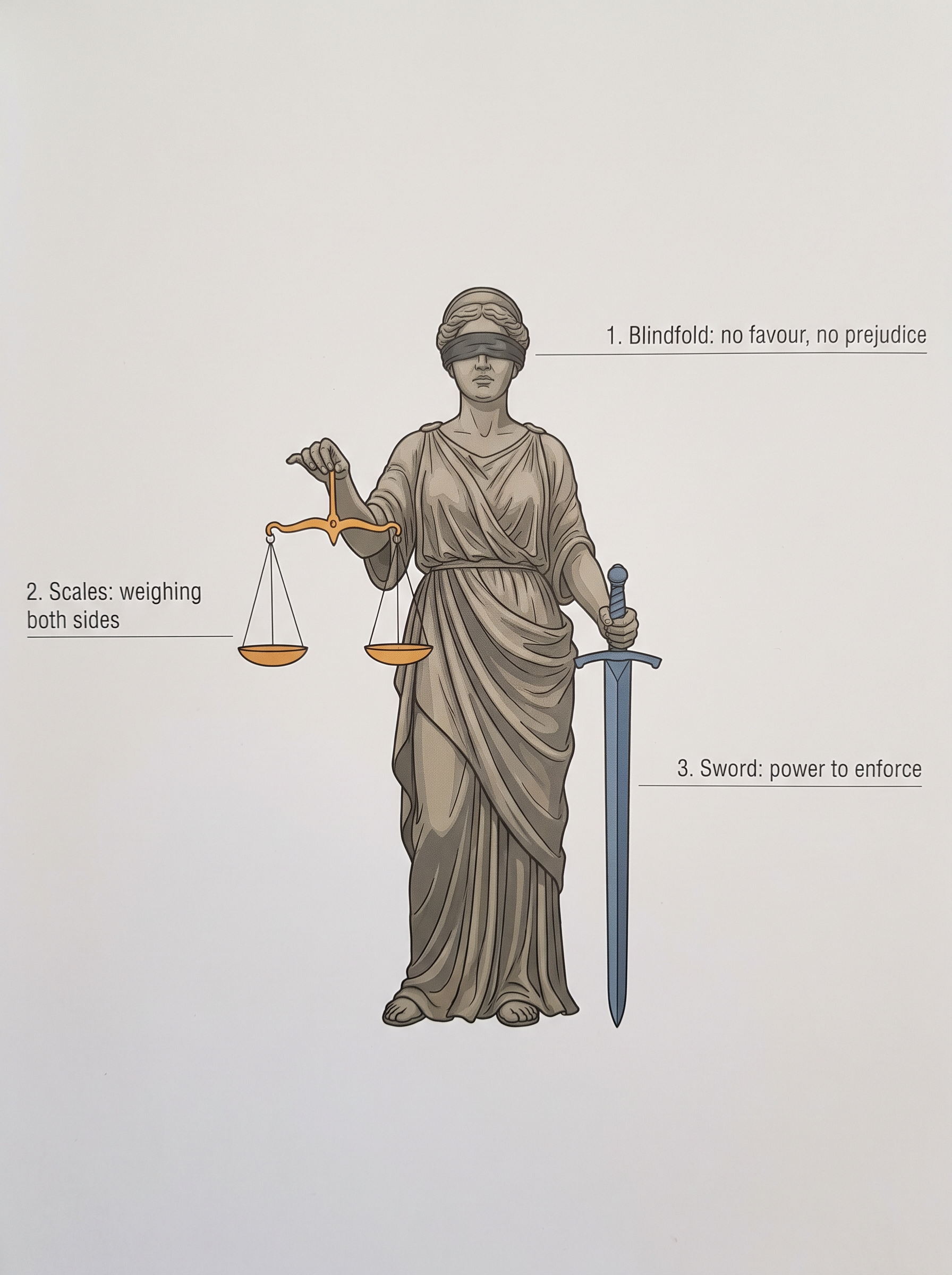
Fig. 6.1 – The Lady of Justice.
Each part carries a meaning. The scales say that both sides must be weighed before anything is decided. The sword says that a decision which cannot be enforced is not worth much. The blindfold says that the person deciding must not see who stands before her — rich or poor, powerful or ordinary, known or unknown.
Why Law Matters
Law and the legal system are central to any civilisation. In modern times it is almost impossible to picture a society running without them. Law is not merely useful for orderly social life; it is essential to the very survival of a community of human beings living together.
That is why understanding what law means is not a lawyer’s private concern. Every citizen lives inside the law from birth, and everyone therefore has reason to understand it.
What Jurisprudence Studies
The study of law from a distance — asking what law is, where it comes from, and why people should obey it — is called jurisprudence. It is sometimes described as the philosophy or theory of law. A statute tells you what the rule is; jurisprudence asks what makes that rule count as law at all.
Begin with the everyday sense of the word. In a layman’s language, law is a system of rules and regulations which a country or society recognises as binding on its citizens, which the authorities may enforce, and the violation of which attracts punitive action.
Notice the three parts working together — a rule, an authority that can enforce it, and a consequence for breaking it. These rules are generally found in constitutions, in legislations passed by the legislature, and in judicial decisions.
Why Jurists Disagree
That working description is enough for daily life, but jurists and legal scholars have never arrived at a unanimous definition of law. This is not a recent difficulty. The problem of defining law goes back centuries.
Part of the reason is that people have approached law from very different starting points. Some jurists have considered law a divinely ordered rule, or a reflection of divine reasons. Others have defined it from philosophical, theological, historical, social and realistic angles.
Each starting point produces a different picture. A thinker who begins with divine reason will say an immoral rule cannot truly be law. A thinker who begins with the State will say a rule is law once the sovereign has enacted it, whatever its moral quality. A thinker who begins with society will say law is whatever a community actually lives by. None of them is simply being careless with words; each is answering a slightly different question about the same subject.
It is precisely because of these different approaches that different concepts of law, and consequently various schools of law, have emerged. Jurists hold different perceptions and understandings of what constitutes law and legal systems. Those schools are the subject of this chapter.
6.2 Historical Perspective
The disagreement about what law is did not begin in modern times. It is at least as old as ancient Greece, and two of its earliest figures still shape the argument today — Plato and his pupil Aristotle.
Two Ancient Starting Points
A famous depiction of the two thinkers, shown in Fig. 6.2, captures the difference in a single gesture. Plato stands on the left holding a copy of his Timaeus and pointing upwards. The raised hand symbolises his concern with the eternal and unchanging forms — a perfect order that exists above the ordinary world and against which everything here can be measured.

Fig. 6.2 – Plato and Aristotle.
Aristotle (384 BC – 322 BC) stands on the right, carrying his Nicomachean Ethics and keeping his hand low, turned towards the ground. That downward hand symbolises his concern with the temporal and mutable world — the world as it actually is, changing, imperfect and particular.
Two gestures, two directions, two ways of thinking about law. The upward hand suggests that law should be judged against a higher, permanent standard. The downward hand suggests that law must be worked out from the conditions of the society in which people actually live.
Neither position was abandoned. The upward-pointing view grew into the natural law tradition; the downward-looking view runs through the historical, sociological and realist approaches you will meet later in this chapter. What the image records, in other words, is that different approaches towards law existed from ancient times — and that the debate you are about to study is the same debate, still unfinished.
6.3 The Case of the Speluncean Explorers
Before studying the schools of law one by one, it helps to have a single hard problem in front of you — one set of facts that every school can be asked to solve. This chapter uses a famous problem known as the Case of the Speluncean Explorers.
How the Situation Arose
Five explorers went on a cave expedition. While they were inside, a landslide blocked the only exit. They were completely trapped, with no food and no water.
After several days they managed to contact a rescue team through a wireless device. The doctors on the surface told them that rescue would take many more days, and that they were unlikely to survive that long without food.
The explorers then asked the doctors a question: could they survive by killing and eating one of their group? The doctors refused to answer.
Left without guidance, the explorers decided among themselves to draw lots. Whoever lost would be killed so that the others could live. One of them later tried to withdraw from this agreement, but the others went ahead with the plan. He was killed and eaten. Eventually the remaining four were rescued.
The Charge and the Rule
After the rescue, the four survivors were charged with murder. The law of that jurisdiction was not ambiguous. It stated that whoever intentionally kills another shall be punished with death.
Read that rule against the facts and the difficulty appears at once. The four men did intend the killing. There was no accident and no mistake about identity. On the plain words of the statute, the case against them is complete, and the punishment fixed by law is death.
The Question for the Judges
The judges therefore had to decide between two positions:
- Should the law be applied strictly, exactly as it is written?
- Or should the extraordinary situation inside the cave be taken into account?
This is where the case stops being a story and becomes jurisprudence. Different judges gave different opinions, and each opinion reflected a different school of legal thought — a different answer to the question of what law fundamentally is.
Which Facts Are Doing the Work
A student of law reads such a problem differently from a general reader. The task is not to feel about the facts but to identify which facts a court could actually rely on, and which fact, if changed, would change the outcome.
Several facts here are legally loaded. The killing was intentional, which satisfies the plain words of the statute. The medical advice suggested that all five would otherwise die, which raises the question of necessity. The lots were drawn by agreement, which raises the question of consent. And one explorer withdrew before the lot fell, which raises the sharpest question of all — whether an agreement he had repudiated could still bind him.
Why This Case Is Placed Here
The facts show that applying the law is not always easy. The law on murder was clear, yet the unusual situation inside the cave made the judges think differently. Each judge looked at the same facts and reached a different conclusion, and those differences came from different ways of understanding law itself.
You will now study the various schools of law. As each school is introduced, the opinion of the judge who reasoned in that way is set out beside it — so that you can watch legal thinking change from one school to the next while the facts stay exactly the same.
6.4 Schools of Law
Because jurists begin from different starting points, they end with different accounts of what law is. Those accounts, grouped together, are called the schools of law. Five of them matter for this chapter — the Natural, Analytical, Historical, Sociological and Realist schools.
Read them as five answers to one question: what makes a rule count as law? And keep the cave in mind, because after each school you will meet the judge who reasoned that way.
6.4.1 Natural Law School
Natural law is generally explained as the law of nature, or divine law — a law that is eternal and universal. It has, however, carried different meanings at different points in time. It was long associated with theology, yet it was also used for entirely secular purposes. Its central claim is that law of this kind exists independent of human will.
It is called natural in a particular sense: it is not created by man but found through nature. Human beings do not invent it by voting on it; they discover it by reasoning about what is right.
The Central Idea
Natural law theory varies in its aims and content, but one idea runs through all of it. There is a higher law, based on morality, against which the moral or legal validity of human law can be measured. At the heart of the theory is the belief that certain universal moral laws exist which human laws may not go against without losing their legal or moral force.
The theory therefore asserts an essential connection between law and morality. Law is not simply what is enacted in statutes. If legislation is not moral, then on this view it is not law at all. St. Thomas Aquinas called law without moral content a perversion of law.
An Unjust Law Is Not a Law
Exponents of natural law believe that law and morality are linked, and the point is captured in a maxim.
On this view, the notion of law cannot be fully articulated without some reference to morality.
A caution is needed here, because students often overstate the position. Classical naturalists appear to have believed that law necessarily includes all moral principles, but this does not mean that law is entirely about moral principles. The argument is narrower: legal norms promulgated by human beings are valid only if they are consistent with morality.
Criticism and Revival
The principles of natural law were rejected by jurists such as Bentham and Austin in the nineteenth century because of their vague and ambiguous character. A higher law that everyone agrees exists but no two people can state in the same words is difficult to apply in a courtroom.
The opposite extreme brought its own damage. Where morality was pushed out of law altogether, law was reduced to the command of a gunman — obey or suffer — and such a system failed to satisfy the aspirations of the people. It was realised that over-emphasis on the historical approaches to law had contributed to the rise of fascism in Italy and Nazism in Germany.
The change in the socio-political conditions of the world, such as the rise of materialism after the First World War, shook the conscience of Western society. It compelled twentieth-century Western legal thinkers to reconsider the existing legal regimes, so as to provide alternatives based on a value-oriented ideology and to check the moral degradation of society. These factors led to the revival of natural law theory in a modified form, different from its traditional form.
6.4.2 Analytical School
This school aims to create a scientifically valid system of law by analysing legal concepts and ideas on the basis of empirical or scientific methods. It is also referred to as the positive or imperative school of jurisprudence, and it came as a reaction against the school of natural law.
Most of its founders — Jeremy Bentham (1748–1832), an English philosopher and jurist, and John Austin (1790–1859), an English jurist and a student of Bentham who is popularly credited with founding the analytical school of jurisprudence — discarded and rejected natural law as vague and abstract ideas.
Positivism emphasises the separation of law and morality. According to the exponents of this school, law is man-made, or enacted by the legislature. Natural law thinkers proposed that if a law is not moral, no one is under any duty to obey it; positivists believe that a duly enacted law, until it is changed, remains law and should be obeyed as such.
Austin’s Command Theory
John Austin propounded that law is the command of the sovereign, backed by the threat of punishment. In his work The Province of Jurisprudence Determined, published in 1832, Austin tried to explain the distinction between law and morality. According to him, natural law doctrines were responsible for blurring that distinction; to get rid of the confusion, he defined law as a species of command of the sovereign.
Austin held that a command is an expression of desire by a political superior — a king or a parliament, for example — to a political inferior, such as subjects or citizens. The political inferior is to commit or omit an act, is under an obligation to obey, and if the command is disobeyed becomes liable for punishment. Commands, in short, are prescribed modes of conduct laid down by the sovereign.
He further viewed the sovereign as a person or group of persons to whom a society gives habitual obedience, and who gives no such obedience to anyone else. Notice the two halves of that test — obedience received from below, and none owed above. Both must be satisfied.
This idea of command, and of punishment for disobeying the command, is the most prominent aspect of positive law. It is what separates positive law from the principles of the law of God, and also from positive morality, which consists of man-made rules of conduct such as customary rules and international law. Principles of morality and positive morality do not originate from a sovereign, and so, for Austin, they are not law in the strict sense. The classification is set out in Fig. 6.3.
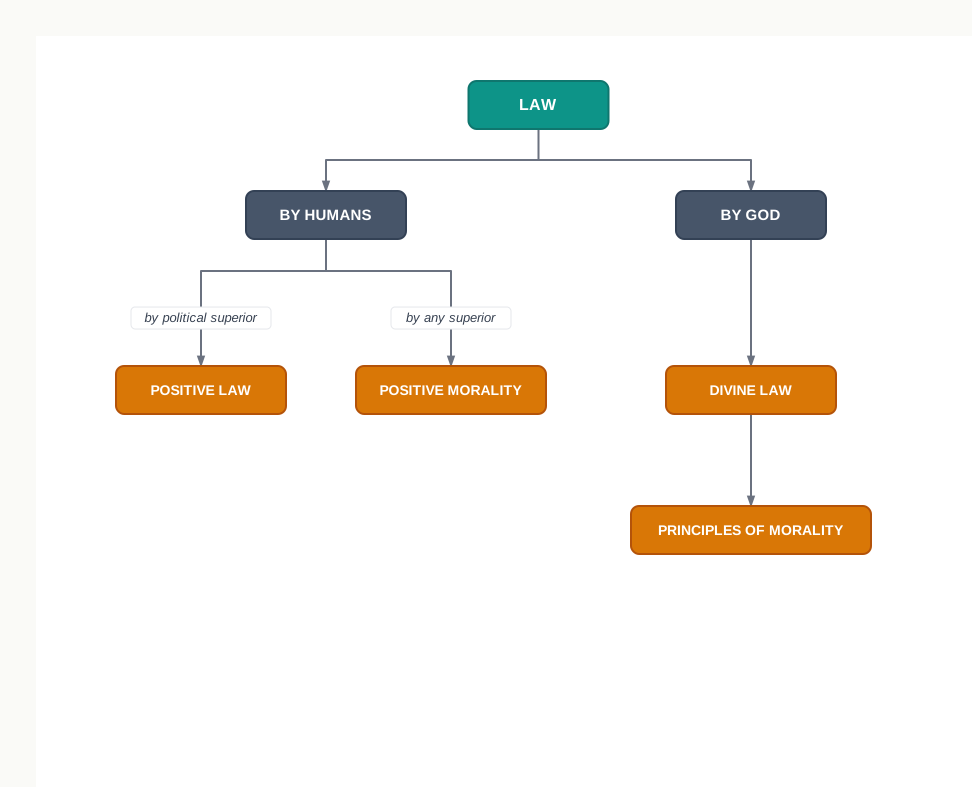
Fig. 6.3 – Austin’s classification of law.
With the passage of time, the analytical school was rejected by jurists such as Dworkin, Fuller and Finnis, because it gave too much emphasis to law as a command and rejected morality and custom as sources of law. It failed to give morality its due importance.
6.4.3 Historical School
History is considered the foundation of knowledge in the contemporary era. According to the followers of the historical school, laws are the creation of interactions between the local situation and the conditions of the people. The school suggests that law should conform to the local needs and feelings of the society.
It started as a reaction against both natural law and positivism, and grew as a form of legal thought that emphasised the irrational, racial and evolutionary character of law. Where natural law looked upward to a universal standard and positivism looked to the sovereign, this school looked backward — to how a particular people had actually lived and what customs they had built over generations.
According to Friedman, a noted jurist, the main features of Savigny’s historical school of jurisprudence can be summarised as follows:
- Law should be a reflection of the common spirit of the people and their custom.
- Law is not universal; it is particular, like the language of a particular society.
- Law is not static; it has a relationship with the development of the society.
- Law is not given by a political superior, but is found or given by the people.
The comparison with language in point 2 is worth pausing on. No one sits down and enacts a language; it grows with the people who speak it, and it cannot simply be transplanted to another society. This school says the same of law.
Sir Henry James Sumner Maine (August 15, 1822 – February 3, 1888), a British jurist and legal historian who pioneered the study of comparative law, primitive law and anthropological jurisprudence, is the main exponent of the British Historical School of Jurisprudence.
Even the historical approach is not free from criticism. There are many problems with it, and it was rejected on the ground that its explanation of law is vague, parochial and unscientific.
6.4.4 Sociological School
Exponents of this school consider law a social phenomenon. It visualises law from the perceptions of people in society, and it emphasises the balancing of conflicting interests within that society.
The sociological school considers law a tool for social change. Followers of this school insist that law exists for the needs of society, and the philosophy of the sociological approach provides an opportunity to social and legal reformers — because if law exists to serve social need, then a law that no longer serves it may be reformed. Roscoe Pound (1870–1964), an American jurist, is considered the chief exponent of sociological jurisprudence in the United States.
According to Roscoe Pound, the main features of the sociological school can be summarised as follows:
- It highlights the purpose and function of law rather than its content.
- Law is a social institution designed for social need.
- Law is a tool to balance the conflicting interests of society.
6.4.5 Realist School
Realists consider laws made by judges to be the real law. They give less importance to traditional rules and concepts as real sources of law. Realism is contrary to idealism, and it is a combination of analytical positivism and sociological jurisprudence — it takes the positivist interest in law as it actually is, and the sociological interest in law as it actually works.
Realists do not give much importance to laws enacted by legislative bodies, and consider judge-made law to be the actual law. They place great emphasis on the role of judges in the implementation, interpretation and development of law, and believe that the social, economic and psychological background of a judge plays an important part in his decision-making.
A prominent American jurisprudential scholar, Karl Llewellyn (1893–1962), who was associated with the school of legal realism, identified some of the main features of the realist school:
- Law is not static, as it keeps on changing.
- Law is a means to a social end.
- Society changes faster than the law.
- Law cannot be certain; decisions of the courts depend on many factors, including the psychological, social and economic background of the judges.
- Case studies are important, and the court room is a laboratory of law.
The last point explains the school’s method. If you want to know what the law of a country really is, a realist would say, do not only read its statute book — sit in its courts and watch what judges actually do with those statutes.
6.4.6 Conclusion: Comparing the Schools
From the above description of the major approaches or schools of law, it may be concluded that these approaches can neither be accepted in totality nor rejected completely. Every school has its own way of understanding and explaining law. These theories are products of certain times and places, and are fully relevant only in a given setting.
Some parts of the theories listed above may have become outdated or unacceptable in the present-day scenario, but none of them can be totally rejected. A modern legal system carries something of each: statutes enacted by a sovereign legislature, constitutional morality that no statute may violate, personal laws grown out of custom, welfare legislation designed for social need, and a body of judge-made precedent.
6.5 Rule of Law and the Principles of Natural Justice
The natural law tradition asks whether a rule is just. That question would be of academic interest only if it never entered a working legal system. It does enter — through two ideas that a modern constitutional democracy treats as binding: the rule of law, and the principles of natural justice.
The Rule of Law
The rule of law essentially means that law carries supremacy over all individuals, even those in positions of power. Two further notions are so closely tied to it that they cannot be detached from it — equality, and non-arbitrariness.
The rule of law is one of the basic and general principles of the Constitution. It has been characterised in the words of Max Weber as legal domination — as an idea of government of law rather than an idea of men.
That contrast is the whole point. Where men rule, what happens to you depends on who is in office and what mood he is in. Where law rules, it depends on a known rule that applies to him as much as to you.
So in essence the rule of law means that everyone — the government, its officials and the citizens together — should act according to the law. The doctrine has been described as the supremacy of the law: where the rule of law prevails, no person can be said to be above the law, and even the functions and actions of the executive organ of the State must remain within the ambit of the law.
The obligation runs in both directions. The rule of law imposes a duty on all citizens in a parliamentary democracy to obey the law; and for such obedience to be rightly demanded, the law itself must be a just law, and not arbitrary or oppressive law.
Notice how close that last sentence stands to the natural law position you studied in 6.4.1. The rule of law is where the demand for just law stops being philosophy and becomes a working constitutional standard.
Principles of Natural Justice
Natural justice, in simple terms, means the minimum standards or principles which administrative authorities should follow in deciding matters that have civil consequences.
Understand who this binds. It is not aimed only at courts, which already follow elaborate procedure. It is aimed at the ordinary decision-making authorities a citizen actually meets — a licensing officer, a departmental committee, a school administration — whenever their decision will cost a person something: a job, a licence, a seat, a benefit.
In India these principles are firmly grounded in Articles 14 and 21 of the Constitution. With the introduction of the concept of substantive and procedural due process in Article 21, fairness — which is part of the principles of natural justice — can be read into Article 21.
The link with Article 14 completes the circle. Violation of the principles of natural justice results in arbitrariness; and since arbitrariness is the opposite of equality, a violation of natural justice is a violation of the equality clause of Article 14.
The Two Rules
The principles of natural justice encompass the following two rules.
That second example is the situation this chapter opened with. Aarav lost the argument about what the school rule permitted, but audi alteram partem gives him the argument he was actually making — that a decision affecting him could not be taken without hearing him first.
Generally, the rule of law and due process of law are considered new incarnations of natural justice in the twentieth century — the same ancient demand for fairness, restated in the vocabulary of constitutional law.
6.6 Functions and Purposes of Law
After discussing and understanding the meaning of the term law, a natural set of questions follows. Why is there law in society? What is the need for law? Can a society be governed smoothly without any kind of law? What is the function and purpose of law?
The functions and purposes of law have been changing with time and place. They depend on the nature of the State. A State that exists mainly to collect revenue and defend a frontier asks less of its law than a State that promises its citizens education, health and dignity. At present, in a welfare and democratic State, law carries several important functions.
Law Across a Lifetime
It can be stated that law starts regulating the welfare and other aspects of human life from the moment a child is conceived in her mother’s womb. In fact, the State interacts with and protects its citizens throughout their lives, with the help of law, as Fig. 6.4 shows.
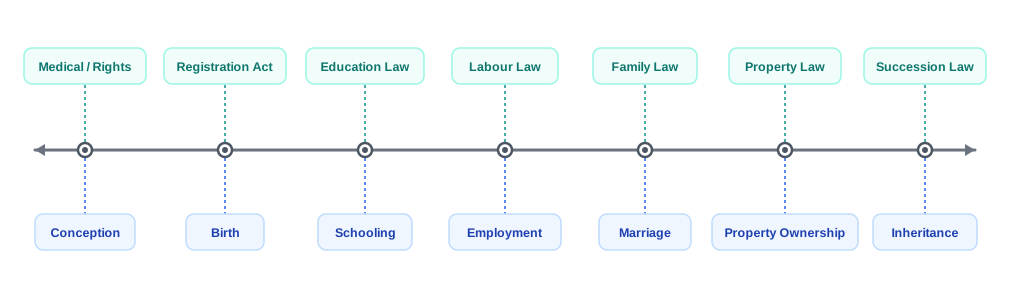
Fig. 6.4 – Law across a human lifetime.
Look along that timeline and the answer to “why do we need law” stops being abstract. A birth is registered, a school admission is regulated, a job carries conditions of service, a purchase creates enforceable rights, a marriage and a succession are governed by rules — none of these arrangements would hold together on goodwill alone.
The Major Functions
Some of the major functions and purposes of law are listed below.
- To deliver justice — to give each person what the law recognises as due to him, through a process he can invoke.
- To provide equality and uniformity — so that the same rule applies to persons in the same situation, whatever their status.
- To maintain impartiality — so that decisions are taken on the merits of the matter and not on the identity of the parties.
- To maintain law and order — to secure the basic peace without which no other activity in society is possible.
- To maintain social control — to set the outer limits of acceptable conduct and attach consequences to crossing them.
- To resolve conflicts — to give disputing parties a settled forum and a settled procedure instead of a private trial of strength.
- To bring orderly change through law and social reform — to alter entrenched practices deliberately and peacefully, rather than leaving change to accident or agitation.
Read as a group, these functions are not seven unrelated jobs. The first three describe the quality a legal system must have, the next three describe the work it does day to day, and the last describes its capacity to move society forward.
In board examinations this section is usually tested through direct questions on the functions of law, and through case-based questions that give a short factual situation and ask which function of law the situation illustrates. The safest habit is to name the function and then say what would happen in that situation if law did not perform it.
6.7 Summary
- In a layman’s language, law is a system of rules and regulations which a country or society recognises as binding on its citizens, which the authorities may enforce, and the violation of which attracts punitive action.
- These rules are generally contained in constitutions, legislations and judicial decisions.
- Jurisprudence is the study of law itself — what makes a rule count as law, where law comes from, and why it should be obeyed.
- Jurists and legal scholars have never arrived at a unanimous definition of law, because law has been approached from divine, philosophical, theological, historical, social and realistic angles.
- It is out of these different approaches that the different schools of law emerged.
- The disagreement is ancient. Plato, pointing upward with his Timaeus, stands for concern with the eternal and immutable; Aristotle (384 BC – 322 BC), with his Nicomachean Ethics and his hand held low, stands for concern with the temporal and mutable world.
- The Case of the Speluncean Explorers is a problem case in which five trapped explorers drew lots, one was killed and eaten, and the four survivors were charged with murder under a statute punishing intentional killing with death.
- The judges had to decide whether the law should be applied strictly or whether the extraordinary situation should be considered; each judge’s answer reflected a different school of legal thought.
- The Natural Law School treats law as eternal and universal, found through nature rather than created by man, and holds that there is a higher law based on morality against which human law is measured. Its central claims are:
- there is an essential connection between law and morality;
- legislation that is not moral is not law, and St. Thomas Aquinas called law without moral content a perversion of law;
- Lex iniusta non est lex — an unjust law is not a true law, and there is no need to follow it;
- human legal norms are valid only if consistent with morality.
- Natural law was rejected by jurists such as Bentham and Austin in the nineteenth century as vague and ambiguous, but revived in a modified form by twentieth-century thinkers seeking a value-oriented alternative.
- Judge Foster, reasoning as a naturalist, held that the killing preserved life and that blind application of the law would be unjust, and decided that the explorers should be acquitted.
- The Analytical School, also called the positive or imperative school, seeks a scientifically valid system of law and emphasises the separation of law and morality; a duly enacted law remains law until changed and should be obeyed.
- John Austin propounded that law is the command of the sovereign backed by the threat of punishment, and defined law as a species of command of the sovereign in The Province of Jurisprudence Determined, published in 1832.
- A command is an expression of desire by a political superior to a political inferior, who is under an obligation to obey and liable to punishment for disobedience.
- The sovereign is a person or group of persons to whom a society gives habitual obedience and who gives no such obedience to others.
- Positive law is distinguished from the principles of the law of God and from positive morality — customary rules and international law — because the latter do not originate from a sovereign.
- The analytical school was rejected by Dworkin, Fuller and Finnis for over-emphasising law as command and for ignoring morality and custom as sources of law.
- Judge Keen, reasoning as a positivist, held that judges must apply the law as written and that moral reasoning belongs to the legislature, and decided that the explorers must be convicted.
- The Historical School holds that laws are created by the interaction of local situations and the conditions of the people, and that law should conform to local needs and feelings. According to Friedman, the main features of Savigny’s historical school are:
- law should reflect the common spirit of the people and their custom;
- law is not universal, but particular, like the language of a society;
- law is not static and is related to the development of society;
- law is not given by a political superior but is found or given by the people.
- Sir Henry James Sumner Maine (August 15, 1822 – February 3, 1888) is the main exponent of the British Historical School; the approach has been criticised as vague, parochial and unscientific.
- The Sociological School treats law as a social phenomenon and a tool for social change, and its chief exponent in the United States was Roscoe Pound (1870–1964). Its main features are:
- it highlights the purpose and function of law rather than its content;
- law is a social institution designed for social need;
- law is a tool to balance the conflicting interests of society.
- Judge Handy, reasoning sociologically, held that law should reflect common sense, social realities and public opinion, and decided that the explorers should be released.
- The Realist School treats judge-made law as the real law and combines analytical positivism with sociological jurisprudence, stressing that a judge’s social, economic and psychological background affects his decisions. Karl Llewellyn (1893–1962) identified these features:
- law is not static, as it keeps on changing;
- law is a means to a social end;
- society changes faster than the law;
- law cannot be certain, since decisions depend on many factors including the background of the judges;
- case studies are important and the court room is a laboratory of law.
- Judge Tatting, unable to reconcile morality with strict legality, withdrew from deciding the case.
- The schools of law can neither be accepted in totality nor rejected completely, because each is a product of a particular time and place and each explains something the others miss.
- The rule of law means the supremacy of law over all individuals, even those in positions of power, and carries equality and non-arbitrariness as inseparable components.
- Max Weber characterised it as legal domination — government of law rather than government of men; even the executive must act within the ambit of the law.
- The rule of law imposes a duty on citizens to obey the law, and for such obedience the law itself must be just and not arbitrary or oppressive.
- The principles of natural justice are the minimum standards that administrative authorities must follow in deciding matters having civil consequences, and in India they are grounded in Articles 14 and 21 of the Constitution.
- Fairness is read into Article 21 through substantive and procedural due process, and violation of natural justice amounts to arbitrariness and therefore violates the equality clause of Article 14.
- Natural justice rests on two rules:
- Nemo judex in causa sua — no one should be a judge in his own cause, the rule against bias;
- Audi alteram partem — hear the other party, the rule of fair hearing, that no one should be condemned unheard.
- The rule of law and due process of law are generally considered new incarnations of natural justice in the twentieth century.
- Law regulates human welfare from the moment a child is conceived, and the State interacts with and protects its citizens throughout their lives through law.
- The major functions and purposes of law in a welfare and democratic State are:
- to deliver justice;
- to provide equality and uniformity;
- to maintain impartiality;
- to maintain law and order;
- to maintain social control;
- to resolve conflicts;
- to bring orderly change through law and social reform.
6.8 Key Terms
Law — a system of rules which a country or society recognises as binding on its citizens, which the authorities may enforce, and the violation of which attracts punitive action.
Jurisprudence — the study of law itself: what makes a rule count as law, where law comes from, and why it should be obeyed.
Schools of law — the broad groupings of jurists who share a common answer to the question of what law fundamentally is.
Natural law — a higher, universal and unchanging law grounded in morality and found through reason, against which the validity of human-made law is measured.
Lex iniusta non est lex — the maxim that an unjust law is not a true law, and therefore need not be followed.
Analytical school — also called the positive or imperative school; it studies law by scientific analysis of legal concepts and separates law from morality.
Command — in Austin’s theory, an expression of desire by a political superior to a political inferior, carrying an obligation to obey and liability to punishment for disobedience.
Sovereign — a person or group of persons to whom a society gives habitual obedience and who gives no such obedience to anyone else.
Positive law — law laid down by a sovereign for those under its authority, as distinguished from divine law and from positive morality.
Positive morality — man-made rules of conduct, such as customary rules and international law, which do not originate from a sovereign.
Historical school — the school which holds that law grows out of the custom and common spirit of a particular people and is found rather than made.
Sociological school — the school which treats law as a social phenomenon and a tool for social change, existing to balance the conflicting interests of society.
Realist school — the school which treats judge-made law as the real law and studies how judges actually decide cases.
Rule of law — the supremacy of law over every person and authority alike, carrying with it equality and the absence of arbitrariness.
Natural justice — the minimum standards of procedural fairness that an authority must follow while deciding a matter having civil consequences.
Nemo judex in causa sua — no one should be a judge in his own cause; the rule against bias.
Audi alteram partem — hear the other party; the rule of fair hearing, that no one should be condemned unheard.
Due process of law — the requirement that the procedure affecting a person’s rights be fair, just and reasonable, and not arbitrary or oppressive.
6.9 Points to Ponder
If a law that has been properly enacted strikes you as deeply unjust, what should a citizen do — obey it, disobey it openly, or challenge it in court? What does each choice cost, and who pays that cost?
Judge Tatting withdrew from deciding the case rather than choose between logic and emotion. Was that an honest admission of difficulty, or a failure of a judge’s duty to decide?
Would your view of the Speluncean Explorers change if no lots had been drawn, or if the explorer who was killed had never objected to the agreement? Which single fact does most of the work in your answer?
The historical school argues that law cannot simply be transplanted from one society to another. India still runs on several statutes drafted in the colonial period. Can a borrowed law become genuinely the people’s own over time, and what would show that it has?
Realists say that a judge’s social, economic and psychological background shapes his decisions. If that is true, what follows for the promise of equality before the law, and for the way judges are selected?
The principles of natural justice bind administrative authorities. Should they equally bind a school disciplinary committee, a sports federation, or a social media platform deciding to remove a user’s post?
If law is a tool for social change, should the legislature move ahead of public opinion on a contested social question, or wait until opinion has shifted? Consider what each approach risks.
The Lady of Justice is blindfolded. Yet Indian law sometimes requires an authority to notice who is standing before it — for example, when providing for the disadvantaged. Is that a departure from the blindfold, or a fuller understanding of what equality demands?
Which school of law best explains the Indian Constitution — or does a single document need more than one school to be explained at all?
The rule of law requires that citizens obey the law and that the law itself be just. What happens to a legal system when only one half of that bargain is kept?
6.10 Textbook Questions
- Provide one point of difference between the following:
- Natural law school and Analytical school
- Sociological school and Realist school
- The original and the revived Natural Law School
- The views of Finnis and Fuller
- Answer the following questions briefly:
- Who introduced the concept of social engineering, and what does the concept mean?
- On what grounds was the historical approach to law criticised?
- What do you understand by the maxim Lex iniusta non est lex?
- State the two important rules of the principles of natural justice.
- State two examples of the principles of natural justice being grounded in the Indian Constitution.
- Answer the following questions in detail:
- What is the purpose of law? Explain.
- Compare the views of Duguit, Jhering, Ehrlich and Roscoe Pound.
- Explain the viewpoint of the Analytical School of Law. Also state the reasons for its rejection.
- Based on your understanding, answer the following question: Imacia, a country, follows laws which appeal to the conscience of the people only. Its people believe strongly in the principles of natural justice and due process of law. Which school of law do they follow? Explain that school.
6.11 Objective Questions
The maxim Lex iniusta non est lex belongs to which school of law?
- Analytical school
- Natural law school
- Historical school
- Realist school
John Austin defined law as —
- the common spirit of the people
- a tool to balance conflicting social interests
- a species of command of the sovereign
- a reflection of divine reason
Austin’s work The Province of Jurisprudence Determined was published in the year —
- 1748
- 1790
- 1832
- 1859
According to Austin, the sovereign is a person or body who —
- receives habitual obedience from society and owes such obedience to no one else
- is elected by the people at regular intervals
- derives authority from divine sanction
- interprets custom on behalf of the community
Who described law without moral content as a perversion of law?
- Jeremy Bentham
- St. Thomas Aquinas
- Roscoe Pound
- Karl Llewellyn
Which of the following is NOT a feature of Savigny’s historical school as summarised by Friedman?
- Law should reflect the common spirit of the people and their custom
- Law is not universal, but particular like the language of a society
- Law is the command of a political superior
- Law is not static and is related to the development of society
The main exponent of the British Historical School of Jurisprudence is —
- Sir Henry James Sumner Maine
- H.L.A. Hart
- Alf Ross
- Montesquieu
Roscoe Pound is regarded as the chief exponent of —
- natural law theory
- analytical positivism
- sociological jurisprudence in the United States
- Scandinavian realism
The statement that the court room is a laboratory of law is associated with —
- the realist school
- the natural law school
- the imperative school
- the historical school
In Austin’s classification, customary rules and international law fall under —
- positive law
- positive morality
- divine law
- the command of the sovereign
In India, the principles of natural justice are grounded in —
- Articles 14 and 21
- Articles 19 and 22
- Articles 32 and 226
- Articles 38 and 39A
The rule against bias is expressed by the maxim —
- Audi alteram partem
- Nemo judex in causa sua
- Lex iniusta non est lex
- Damnum sine injuria
Max Weber characterised the rule of law as —
- the will of the strongest recognised as binding
- legal domination as an idea of government of law rather than an idea of men
- the common conscience of the community
- a command backed by the threat of punishment
In the Case of the Speluncean Explorers, the judge who held that the explorers should be acquitted because the purpose of criminal law is to maintain social order, and there was no society inside the cave, was —
- Judge Keen
- Judge Handy
- Judge Foster
- Judge Tatting
The judge who withdrew from deciding the Speluncean Explorers problem was —
- Judge Tatting
- Judge Foster
- Judge Keen
- Judge Handy
The analytical school was later criticised by Dworkin, Fuller and Finnis mainly because it —
- relied entirely on custom as the source of law
- over-emphasised law as command and ignored morality and custom
- treated law as a reflection of divine reason
- denied that legislatures could make law at all
Assertion (A): For the natural law school, an unjust rule does not qualify as law at all. Reason (R): Natural law theory asserts an essential connection between law and morality, so a legal norm made by human beings is valid only if it is consistent with morality.
Assertion (A): A positivist holds that a duly enacted law must be obeyed until it is changed, even if it is thought to be unjust. Reason (R): Positivism emphasises the separation of law and morality and treats law as man-made, or enacted by the legislature.
Assertion (A): On Austin’s theory, international law is not law in the strict sense. Reason (R): International law does not originate from a sovereign who receives habitual obedience from a society and owes obedience to no one else.
Assertion (A): The historical school holds that law is not universal. Reason (R): Law is particular to a society in the way its language is, growing out of the custom and common spirit of that people.
Assertion (A): A decision taken in violation of the principles of natural justice can be challenged as a breach of Article 14. Reason (R): Violation of the principles of natural justice results in arbitrariness, and arbitrariness is opposed to the equality guaranteed by Article 14.
Assertion (A): Realists give less importance to statutes enacted by legislative bodies. Reason (R): Realists consider judge-made law to be the actual law and study the factors that influence how judges decide.
Assertion (A): Judge Handy concluded that the explorers should be released. Reason (R): He believed that law should reflect common sense, social realities and public opinion, and that courts should consider practical outcomes.
6.12 Check Your Concepts
What is jurisprudence, and how does the question it asks differ from the question answered by reading a statute?
Why have jurists never arrived at a unanimous definition of law? Support your answer by naming at least three different angles from which law has been defined.
Explain the three elements of the figure of the Lady of Justice and state what each of them says about how law should be administered.
Plato is shown pointing upward and Aristotle with his hand held low. Explain what each gesture signifies, and connect each to a way of thinking about law.
State the central idea of the natural law school in your own words, and explain what it means to say that natural law is “found” rather than “made”.
What does the maxim Lex iniusta non est lex mean, and what consequence do the exponents of natural law draw from it for the citizen’s duty to obey?
On what grounds did Bentham and Austin reject the principles of natural law, and what later developments led to its revival in a modified form?
Explain Austin’s command theory of law, identifying the three elements it depends upon: the command, the sovereign, and the sanction.
Who, according to Austin, is a sovereign? State both halves of his test and explain why both are necessary.
Distinguish between positive law and positive morality, giving one example of each from Austin’s classification.
Why did later jurists such as Dworkin, Fuller and Finnis reject the analytical school? State two of their objections.
According to Friedman, what are the main features of Savigny’s historical school of jurisprudence? State all four.
The historical school compares law to the language of a society. Explain what this comparison is meant to convey, and what it implies about borrowing laws from another country.
Distinguish between the historical school and the sociological school on the basis of the source of law and the purpose each assigns to law.
What is meant by describing law as a tool for social change? Explain why this view of law appeals to social and legal reformers.
State the main features of the realist school as identified by Karl Llewellyn, and explain why realists say that law cannot be certain.
Distinguish between the analytical school and the realist school on the basis of what each treats as the real source of law.
Why is it said that the schools of law can neither be accepted in totality nor rejected completely? Illustrate your answer by pointing to two features of the Indian legal system drawn from different schools.
Correct the errors in each of the following statements and rewrite them correctly:
- The historical school holds that law is the command of the sovereign.
- In India, the principles of natural justice are grounded in Articles 19 and 22 of the Constitution.
- Roscoe Pound is regarded as the founder of the analytical school of jurisprudence.
- Audi alteram partem means that no one should be a judge in his own cause.
Arrange the following events from the Case of the Speluncean Explorers in the correct order:
- The survivors are charged with murder.
- A landslide blocks the only exit of the cave.
- One explorer withdraws from the agreement.
- Contact is made with the rescue team through a wireless device.
- Lots are drawn.
Identify the school of law reflected in each of the following judicial statements, and give one reason for your answer:
- “My personal sympathy is irrelevant; the statute says what it says, and I must apply it.”
- “A rule this cruel cannot claim the authority of law at all.”
- “An order that ordinary people would find unreasonable defeats the very purpose for which law exists.”
- “To know the law of this country, study what its courts actually do.”
Explain the rule of law. Why are equality and non-arbitrariness described as components that cannot be detached from it?
The rule of law imposes a duty on citizens to obey the law. What condition must the law itself satisfy before that duty can fairly be demanded, and why?
What are the principles of natural justice, and which kind of authority are they primarily addressed to? Explain what is meant by a matter having “civil consequences”.
Distinguish between nemo judex in causa sua and audi alteram partem, and give one situation in which each would be breached.
Explain how a violation of the principles of natural justice becomes a violation of Article 14, even though Article 14 speaks only of equality.
A committee hears a student fully, considers his explanation, and still decides against him. Has natural justice been complied with? Explain the distinction your answer depends upon.
Why is it said that the rule of law and due process of law are new incarnations of natural justice in the twentieth century?
State any five functions and purposes of law in a welfare and democratic State, and explain what would happen in society if the function of resolving conflicts were not performed by law.
It is said that law begins to regulate human life from the moment a child is conceived. Explain this statement with reference to the way the State interacts with a citizen across a lifetime.
6.13 Case-Based Questions
- A municipal officer cancels the licence of a street vendor, Salma, on the basis of a written complaint alleging that she obstructs the footpath. Salma is not told about the complaint, is not shown a copy of it, and is not asked for any explanation. The order is passed the same afternoon. It later emerges that the complaint was filed by a shopkeeper who is the officer’s brother-in-law and who sells the same goods a few metres away.
- Identify the principles of natural justice that have been breached, naming the maxim that corresponds to each breach.
- Under which Articles of the Constitution can Salma anchor her challenge, and how does an unfair procedure become a question of equality?
- Suppose the officer had given Salma a full hearing but had still decided the matter himself. Would any objection survive? Explain which fact drives your answer.
- If Salma succeeds in her challenge, does it follow that her licence must be restored? Explain the distinction on which your answer rests.
- A State law requires any person who finds an abandoned child to report the matter to the nearest police station within twenty-four hours, and makes failure to do so punishable. During a flood, Rakesh finds a small child on an embankment. Every road out of the village is under water and the telephone lines are down. He shelters and feeds the child, and reports the matter on the third day, as soon as the water recedes. He is prosecuted. On the Bench, one judge says: “The words of the section admit of no exception; it is for the legislature and not for me to write one in.” The other says: “This law exists to protect children. Rakesh did protect the child. To punish him would defeat the very purpose the rule was made for.”
- Identify the school of legal thought reflected in each judge’s reasoning, giving one reason for each identification.
- Which single fact in this situation does the most legal work? State how the case would look if that fact were removed.
- How would a realist explain the fact that two judges reading the same section and the same facts have reached opposite conclusions?
- Which functions and purposes of law are in tension in this case? Name at least two.
- For generations, the residents of a village have followed an unwritten practice for sharing water from a common tank, worked out among themselves and observed without any official ever enforcing it. The State legislature now enacts a Water Management Act which lays down a different method of distribution and provides penalties for breach. Some villagers argue that the old practice is the real law of the place; others argue that only the Act is law now.
- Which school of law would treat the village practice as law, and on what reasoning?
- Which school would insist that only the Act is law? State the test that school applies.
- How would the sociological school approach the conflict, given its view of the purpose of law?
- Does this situation illustrate law as a tool for social change, or law that has lost touch with the people it governs? Argue either position, using material from the chapter.
- An online platform removes a college student’s post after receiving an anonymous complaint. The student is sent an automated message saying only that the post violated the platform’s rules. He is not told what the complaint said, is given no opportunity to reply, and finds that the person who reviewed the complaint is the same person who filed it.
- Which two rules of natural justice would be relevant if this decision had been taken by a public authority instead of a private platform?
- Explain what “condemned unheard” means, using the facts of this situation.
- What would change in your analysis if the platform had disclosed the complaint and given the student seven days to respond before removing the post?
- Should the principles of natural justice be extended to private bodies that take decisions with serious consequences for individuals? Give the strongest argument on each side.
- A man with no money and no work takes a packet of food from a shop to feed his young daughter, who has not eaten for two days. He is caught and prosecuted under a section that punishes theft, which contains no exception for need. Three judges hear the appeal. The first says the section is clear and must be applied as written. The second says that a law which punishes a father for keeping his child alive has lost its claim to be called law at all. The third says that the community would find a conviction unreasonable and that courts must attend to practical outcomes.
- Match each judge to a school of law and justify each match in one sentence.
- State one argument in favour of conviction and one against, drawing each from a different school studied in this chapter.
- Which fact in the situation would you rely on most heavily if you were arguing for the accused, and why is that fact legally relevant rather than merely sympathetic?
- Does the rule of law require the judges to convict here? Explain, keeping in mind that the rule of law demands both obedience to law and that the law itself be just.
6.14 Landmark Cases & Maxims
State the principle settled in Maneka Gandhi v. Union of India, AIR 1978 SC 597, and explain what it added to the meaning of Article 21.
An authority impounds a citizen’s passport, declines to give reasons, and passes the order without hearing her. Name the decision that governs this fact pattern and state the standard the procedure must now satisfy.
Match each maxim in Column A with the situation in Column B that it governs: | Column A | Column B | |—|—| | a. Nemo judex in causa sua | i. A worker is dismissed on a charge he was never told about and never asked to answer. | | b. Audi alteram partem | ii. A judge refuses to give effect to a rule on the ground that a rule this unjust never became law. | | c. Lex iniusta non est lex | iii. The officer deciding a departmental enquiry is a business partner of the complainant. |
Match each jurist in Column A with the school of law he is associated with in Column B: | Column A | Column B | |—|—| | a. John Austin | i. Sociological school | | b. St. Thomas Aquinas | ii. Analytical school | | c. Savigny | iii. Realist school | | d. Roscoe Pound | iv. Natural law school | | e. Karl Llewellyn | v. Historical school |
Explain the maxim Lex iniusta non est lex. Identify the school of law that relies on it, and state the consequence it draws for a citizen’s duty to obey.
State, in three steps, what audi alteram partem requires an authority to do before it passes an order against a person.
A disciplinary committee gives the accused employee a full hearing, but one member of the committee is the officer who lodged the complaint. Which maxim is attracted, and why is the hearing alone not a sufficient answer to the objection?
A student argues that because the words “natural justice” do not appear anywhere in the Constitution, these principles have no constitutional footing in India. Correct this statement, referring to the relevant Articles and to the authority that read fairness into Article 21.
The Case of the Speluncean Explorers is studied in law classrooms across the world. Explain why it cannot be cited as authority before a court, and state what it is used to demonstrate about the schools of law.
Identify the school of law whose central position each of the following statements expresses, and name one jurist associated with it:
- Law is the command of the sovereign, backed by the threat of punishment.
- Law is a social institution designed for social need.
- Law should be a reflection of the common spirit of the people and their custom.
- The court room is a laboratory of law.