Chapter 16: Child Rights
For the first fifty-two years after the Constitution came into force, an Indian child had no fundamental right to go to school. Article 45 asked the State to try to provide free and compulsory education for children up to the age of fourteen, but it sat in Part IV among the Directive Principles — a promise the State was told to work towards, not a right a child could enforce in court. A child turned away from a school gate could not walk into a High Court and demand a seat. In 2002, Parliament changed that. The Constitution (Eighty-sixth Amendment) Act inserted Article 21A into Part III, and free and compulsory education for children between six and fourteen became a fundamental right — the same category of right as the freedom of speech and the right to life. Seven years later came the statute that put the right to work on the ground, the Right of Children to Free and Compulsory Education Act, 2009. That single shift — from the State being asked to do something for children, to the child holding a right against the State — is the story of this whole chapter. It runs through education, health, shelter, protection from work that harms, protection from sexual abuse, and the separate justice system built for children who break the law.
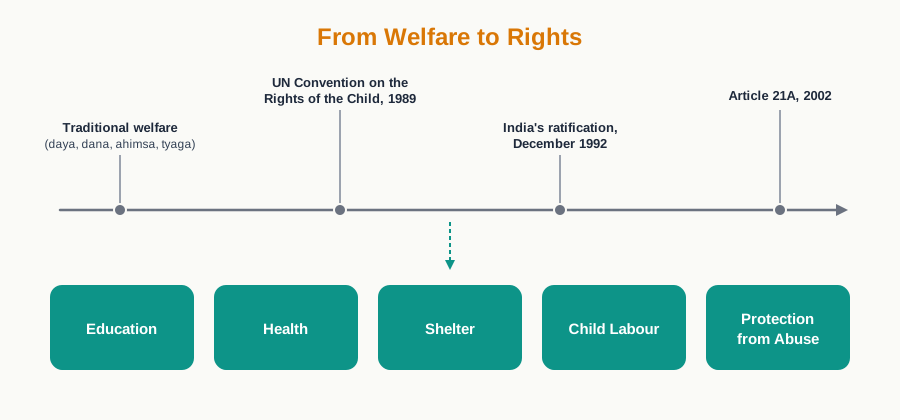
Fig. 16.0 – Evolution from welfare to rights.
This chapter will answer each of these questions. Keep them in mind as you read, and check your answers against what you learn.
16.1 Child Rights: Meaning and Evolution
Who is a Child?
The word ‘child’ comes from the Latin word infans, which means the one who does not speak. The etymology carries a clue to the whole subject. A person who cannot speak for himself cannot bargain, cannot complain, and cannot enforce a right on his own. The law therefore has to speak for him.
The most widely accepted definition comes from the Convention on the Rights of the Child 1989. Under it, a child is any human being below the age of eighteen years, unless under the law applicable to the child, majority is attained earlier. The second half of that sentence matters: the Convention fixes eighteen as the general standard but allows a country’s own law to set an earlier age of majority.
In India, a person becomes a major on attaining the age of 18 years under the Indian Majority Act, 1875. So the Indian position and the Convention’s standard match.
One caution before we go further. Eighteen is the general age of majority, but individual statutes fix their own age limits for their own purposes. The Constitution guarantees free and compulsory education to children between six and fourteen years, and prohibits the employment of a child below fourteen years in a factory, mine or other hazardous employment. When you answer a question, always ask which statute is in play, because the age that statute uses decides the answer.
From Welfare to Rights
The law, policy and practice of child welfare have changed a great deal over time. The earliest position was one of authority and control: the father had absolute rights over his children. The child was, in effect, an object of parental power rather than a person with an independent legal standing.
The next stage was the welfare principle, which became the dominant ideology of the family. The child was now someone to be cared for and protected — but the caring was still something done for the child by others, out of duty or compassion, and not something the child could demand.
The Indian traditional view of welfare grew out of values such as daya, dana, dakshina, bhiksha, ahimsa and tyaga. It was believed that the welfare of children depended upon these values. Compassion, giving and non-violence were treated as the guarantee of a child’s well-being.
It was only during the twentieth century that the concept of children’s rights emerged, and this shift in focus from the ‘welfare’ approach to the ‘rights’ approach is significant. The difference is not merely one of vocabulary. Under a welfare approach, if an adult chooses not to be compassionate, the child has no remedy. Under a rights approach, the child holds an entitlement, and someone else carries a corresponding legal duty to honour it.
The Rights Approach and the Convention
The rights approach is primarily concerned with issues of social justice, non-discrimination, equity and empowerment. Its clearest expression is the United Nations Convention on the Rights of the Child 1989, a landmark in international human rights. India ratified the Convention on the Rights of the Child in December, 1992.
The Convention gives children all those basic human rights that will enable them to achieve their full potential. These fall into civil, economic, social, cultural and political rights, as set out in Fig. 16.1. Note that these categories overlap; they are a way of organising the Convention’s guarantees, not watertight compartments.
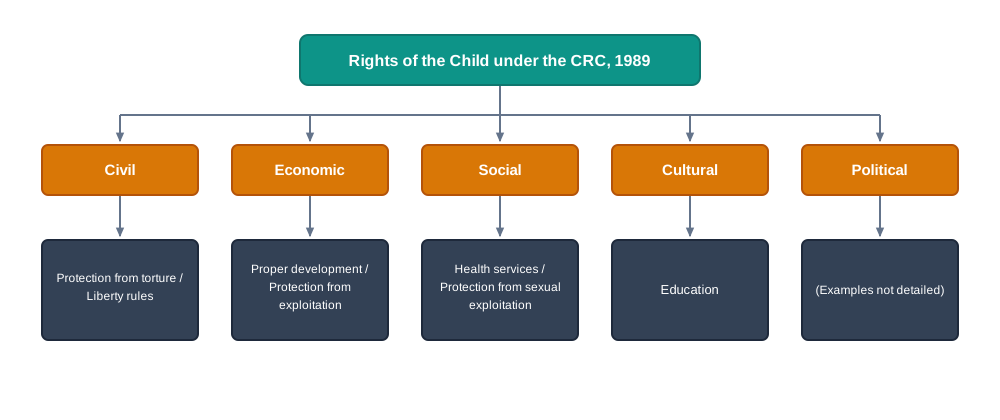
Fig. 16.1 – Rights of the child under the CRC, 1989.
The civil rights include protection from torture and maltreatment. They also cover the making of special rules governing the circumstances under which children may be deprived of their liberty — that is, a child who is arrested or detained must be dealt with under rules written for children, not the ordinary rules meant for adults. You will see this idea worked out in detail when we come to the juvenile justice system later in this chapter.
The economic rights include the right to ensure proper development and protection from exploitation at work. This is the root of the law on child labour.
The social rights include the right to the highest attainable standard of health services, protection from sexual exploitation, and the regulation of adoption.
The right to education is included in cultural rights, because education is how a society passes on its accumulated learning and culture to the next generation.
Each of the sections that follow takes one of these guarantees and shows how Indian law has given effect to it — education, health, shelter, freedom from child labour, protection from sexual abuse, and a separate justice system for children.
16.2 Right to Education
Why Education is Treated as a Right
Education is the transmission of the values and accumulated knowledge of a society. It helps children in knowing their culture, moulds their behaviour in the ways of adulthood, and directs them towards their eventual role in society.
That is why the previous section placed education among cultural rights. A society that fails to educate its children does not merely leave them poorer; it breaks the chain by which its own learning passes on.
Education as a Fundamental Right
The right to education is one of the fundamental rights in the Constitution of India under Article 21A, which was inserted by the 86th constitutional amendment. It provides that the state shall provide free and compulsory education to all children between the age of six to fourteen years (6-14 years).
Read the words carefully, because each one carries weight. “Free” means the child pays no fee that would prevent him from completing elementary education. “Compulsory” places the obligation on the State to ensure admission, attendance and completion — it is a duty on the government, not a punishment for the child.
Being a fundamental right, it sits in Part III of the Constitution and can be enforced directly in the High Courts and the Supreme Court. Before 2002 there was no such Article. Education appeared only among the Directive Principles, which cannot be enforced by a court, and it was the Supreme Court that first read a right to education into the right to life.
The Duties that Accompany the Right
A right of this kind cannot work unless duties are attached to it, and the Constitution attaches three.
- The state has to promote the educational and economic interests of the weaker sections of the society, and in particular of the Scheduled Castes and the Scheduled Tribes — a Directive Principle contained in Article 46.
- The mandatory duty of the state to make effective provisions for securing the right to education is subject to its economic capacity and development, under Article 41. The State cannot plead poverty to escape Article 21A altogether, but the pace at which it builds the wider system is measured against what it can afford.
- A fundamental duty has been imposed on the parent or guardian to provide opportunities for education to his child or ward between the age of six to fourteen years (6-14 years) under Article 51A sub clause (k), also inserted by the 86th constitutional amendment.
Clause (k) is worth pausing on. Most of the chapter’s provisions place duties on the State or on employers. This one places a duty on the family, and it recognises a hard practical truth: a child kept at home to mind younger siblings or to earn is out of school just as surely as a child turned away at the gate.
The Right of Children to Free and Compulsory Education Act, 2009
A fundamental right stated in one sentence still needs a statute to make it work on the ground — to say which school, on what terms, at whose cost. That statute is the Right of Children to Free and Compulsory Education Act, which was passed by Parliament in 2009.
The Act ensures that children get education irrespective of their economic condition. It provides for free and compulsory education to all children in the age group of six to fourteen years (6-14 years).
The financial burden for the implementation is to be shared by the state and the central government, on the basis of the Sarva Shiksha Abhiyan program of the central government, which now runs as part of the integrated Samagra Shiksha scheme.
The Act also provides for 25% reservation in entry-level admission for children belonging to weaker sections and disadvantaged groups in private unaided schools, under Section 12(1)(c). Schools that violate the provisions of the Act face penalty.
This 25% provision is the Act’s boldest idea. It does not merely fund seats for poor children in government schools; it requires a fee-charging private school to admit them alongside everyone else, and to teach them in the same classroom. Aided minority institutions and unaided minority institutions, however, stand outside this obligation, because Article 30(1) protects the right of minorities to establish and administer educational institutions of their choice.
16.3 Right to Health
What “Health” Means in Law
Health is a state of complete physical, mental, and social well-being. It is not merely the absence of disease or infirmity.
That second sentence is doing real work. If health meant only “not ill”, a child who is undernourished, frightened at home, or growing up in a room with no clean air would count as healthy. The wider definition treats all three of these as health problems, and therefore as matters the law can be asked to address.
The enjoyment of the highest attainable standard of health is one of the fundamental rights of every human being, without distinction of race, religion and political belief, economic or social condition. Healthy development of the child is one of the basic needs, and the ability to live harmoniously in a changing environment is essential for such development. The extension to all people of the benefits of medical, psychological and related knowledge is essential for the most comprehensive attainment of health.
The Judicial Contribution
Unlike education, health has no Article of its own in Part III of the Constitution. There is no “Article 21B” guaranteeing medical care. The right exists because the Supreme Court has read it into the right to life under Article 21, and it has done so by using the Directive Principles as an aid to understanding what a life with dignity requires. Two decisions carried in this chapter show how that was done.
The Constitutional Duties of the State
Around these decisions sits a set of duties that the Constitution places on the State, and several of them speak directly about children.
- A constitutional duty has been imposed on the state to ensure that the health and strength of workers, men and women, and the tender age of children are not abused — Article 39(e).
- The state has to ensure that children are given opportunities and facilities to develop in a healthy manner and in conditions of freedom and dignity, and that childhood is protected against exploitation — Article 39(f).
- The health of the infant and the mother has to be protected by maternity benefit, and the State must secure just and humane conditions of work — Article 42.
- The primary duty of the state is to improve public health; the extension of sickness, old age, disablement and maternity benefits is also contemplated — Articles 47 and 41.
- The state’s duty includes prohibition of the consumption of intoxicating drinks and of drugs that are injurious to health — Article 47.
- A mandatory duty has been imposed on the state to protect and improve the environment, so that citizens live in pollution-free surroundings — Article 48A.
Notice how these duties fit together. Article 39(e) and Article 39(f) look at the child directly. Article 42 looks at the mother, because the health of an infant begins with the health of the woman carrying and feeding it. Article 47 and Article 48A look at the surroundings — the air, the water, the substances in circulation — because a child cannot be healthy in an unhealthy environment, however good the hospital.
Read together, they explain why courts treat the right to health as belonging to children with particular force. A child cannot choose his food, his home, his air, or his medical treatment. Every one of those choices is made for him by adults, and the law’s answer is to place duties on those adults and on the State.
16.4 Right to Shelter
What Shelter Means
A roof is not the whole of shelter. The right to shelter includes adequate living space, a safe structure, clean and hygienic surroundings, sufficient light, pure air and water, electricity, sanitation, and other civic amenities like roads. It is a place where a person has opportunities to grow physically, mentally, intellectually and spiritually. It therefore includes the entire infrastructure necessary to enable an individual to live and develop as a human being.
For a student of this chapter, the point to hold on to is why the definition is drawn so widely. A child sleeping in a shed beside an open drain has a roof, but no light to read by, no clean water, no sanitation and no safety. Define shelter narrowly and that child’s position is lawful. Define it as the courts have, and it is a violation.
These components were discussed by the Supreme Court in Chameli Singh v. State of U.P., (1996) 2 SCC 549.
Shelter as Part of the Right to Life
The route by which shelter became a right is the same route we saw for health: it was read into Article 21.
The Court drew a distinction that is worth remembering, because it explains the whole approach. There is a difference between the need of an animal and the need of a human being for shelter. For the animal, shelter is the bare protection of the body. For a human being it has to be a suitable accommodation, one which would allow him to grow in every aspect — physical, mental and intellectual.
Thus the right to shelter has become an integral part of the right to life.
For a child this distinction bites harder than for an adult. Growth in the physical, mental and intellectual sense is precisely what childhood is, and a home that offers only bare protection of the body takes that growth away. A child with nowhere to study cannot use the right in section 16.2; a child in unsanitary surroundings cannot enjoy the health described in section 16.3. Shelter is the condition on which the other rights depend.
16.5 Child Labour
What Counts as Child Labour
Child labour means labour by the child — that is, when the child is made to work.
Stated that plainly, the definition raises an immediate difficulty. A boy who washes the family’s dishes, or a girl who helps at her father’s shop on a Sunday, is also doing work. Is every child who works a child labourer? The law’s answer is no, and it looks at a set of factors to decide.
There are a number of factors to determine whether a particular kind of work can be called ‘child labour’ or not. These include:
- the child’s age;
- the nature of the work;
- the hours of work; and
- the conditions under which such work is performed.
The test, in other words, is not the fact of working but the effect of the work on the child. Two hours of light help at home and ten hours at a furnace are not the same thing, and the law does not treat them as the same thing.
Labour that jeopardises the physical, mental or moral well-being of a child is known as ‘hazardous work’. Such labour deprives children of their childhood, their potential and their dignity.
Notice that “moral well-being” sits alongside physical and mental well-being. Work need not be physically dangerous to be hazardous in this sense. Work that exposes a child to an unsafe adult environment can damage the child just as surely as a machine can.
The International Background
The International Labour Organization (ILO) was founded in 1919. It was the first specialised agency of the United Nations to deal with the labour issue.
The ILO started the International Programme on the Elimination of Child Labour (IPEC) in 1992. Its main objective is the progressive elimination of child labour.
The word “progressive” is deliberate. Child labour is not merely a legal failure; it is usually a symptom of poverty, and a family that sends a child to work is often doing so because the child’s earnings are needed. A law that removes the child from work without putting anything in the child’s place solves half the problem. That is why the schemes described below combine prohibition with schooling and rehabilitation.
The Constitutional Position
The Constitution of India has provided the right against exploitation as a fundamental right. A child who is below the age of 14 years cannot be employed in any factory or mine or engaged in any other hazardous employment. This is Article 24.
Read the Article closely, because it has three limbs and a student is expected to apply them. The bar operates on any child below fourteen; the prohibited settings are a factory, a mine, or any other hazardous employment; and the prohibition is absolute, with no exception for consent, for the parent’s wishes, or for the family’s need.
Alongside Article 24, a duty has been imposed on the state to ensure that the tender age of children is not abused, and to ensure that these children are not forced by economic necessity to enter into any occupation unsuited to their age or strength. This is the Directive Principle in Article 39(e) that you met in section 16.3, now doing work in a different field.
The Statutory Framework
The Child Labour (Prohibition and Regulation) Act was enacted in 1986. The objectives of this Act are:
- banning the employment of children who have not completed their fourteenth year in specified occupations and processes;
- laying down procedures to decide modifications to the schedule of banned occupations or processes; and
- regulating the conditions of work of children in employment where they are not prohibited from working.
The structure of the 1986 Act is worth understanding, because it explains why the law had to keep changing. The Act as originally framed did not ban all child work. It banned work in occupations and processes listed in a schedule, and it regulated hours and conditions everywhere else. A child working in an occupation that had not yet been listed therefore fell outside the ban altogether, and the ban could be widened only by adding to the schedule — which is why the Act provided a procedure for modifying it.
A National Policy on Child Labour was formulated in 1987. This policy provides for strict enforcement of child labour laws. The focus under this policy is on general developmental programmes for children at risk, and it provides for starting projects in areas having a high concentration of child labour.
In pursuance of this policy, the National Child Labour Project (NCLP) scheme was launched in 1988. The scheme envisages the running of special schools for children withdrawn from work — the rehabilitation half of the answer, without which withdrawal from work simply leaves a child idle and no better off.
In 2006, the legislature took a further step towards the total elimination of child labour. It brought child domestic workers up to 14 years of age, and children working in hotels, dhabas, eateries and the entertainment industry, within the purview of the Child Labour (Prohibition and Regulation) Act, 1986. Domestic work and roadside eateries had until then been among the commonest places to find a working child, and among the hardest to inspect.
The Position after 2016
The Child Labour (Prohibition and Regulation) Amendment Act, 2016 changed the design of the law described above, and renamed the parent statute the Child and Adolescent Labour (Prohibition and Regulation) Act, 1986. Three changes matter for a student.
- The employment of a child below fourteen years is now prohibited in all occupations and processes, not merely in scheduled ones. The scheduled-occupation approach, with its gaps, has gone.
- Two exceptions are recognised: a child may help in a family or family enterprise after school hours or during vacations, provided the work is not hazardous, and a child may work as an artist in the audio-visual entertainment industry, subject to safeguards.
- A new category of “adolescent” — a person who has completed fourteen but not eighteen years — has been created, and adolescents are barred from hazardous occupations and processes. Penalties on employers have been raised and the offence has been made cognizable.
16.6 Child Sexual Abuse and the POCSO Act, 2012
What Child Sexual Abuse Is
Child sexual abuse involves any sexual activity with a child. It is inappropriate sexual behaviour with a child. It may be an interaction between a child and an adult, or between a child and an older child, in which the child is used for the sexual stimulation of the perpetrator — the wrongdoer.
It includes touching a child’s private parts, making the child touch the perpetrator, intercourse, incest, rape, sodomy, exhibitionism and sexual exploitation.
The perpetrator uses deception, threats or other coercive methods to engage the child and to maintain the child’s silence. That second half — the securing of silence — is a defining feature of this offence rather than an incidental detail, and it explains several of the legal rules that follow. An offence kept secret is an offence that continues.
Two further points complete the picture.
First, a person under the age of 18 years may also commit sexual abuse. The law does not assume that only adults offend. What matters is that there is a significant disparity in age, development or size between the two, which renders the victim — that is, the child — incapable of giving consent. The word “consent” is important here. Consent in law means a choice made freely by a person able to understand what is being chosen; where the disparity is so great that no free choice is possible, apparent agreement is not consent at all.
Second, child sexual abuse is broad enough to include extra-familial abuse, meaning abuse from outside the family, as well as inter-familial abuse, meaning abuse within the family. This is a point the law had to state expressly, because the family is where a child is presumed safest, and it is exactly that presumption an abuser within the family relies upon.
The Protection of Children from Sexual Offences (POCSO) Act, 2012
The Protection of Children from Sexual Offences (POCSO) Act, 2012 is a comprehensive law enacted by the Government of India to safeguard children below the age of 18 years from sexual abuse, sexual harassment and sexual exploitation.
The Act was introduced to address the growing need for a specific and child-centred legal framework, as the existing framework of laws was not comprehensive and did not adequately protect children from such offences. The general criminal law of the time was written with adult victims in mind: it did not name every form of abuse a child suffers, and its procedures — an open court, repeated questioning, an intimidating setting — were themselves capable of harming a child a second time.
The Act is gender-neutral, meaning it protects both boys and girls, and it places the best interests, dignity and well-being of the child at the centre of the justice system.
Objectives of the POCSO Act
The key objectives of the Act are:
- to protect children from sexual offences;
- to define various forms of sexual abuse clearly and comprehensively;
- to ensure child-friendly reporting, investigation and trial;
- to provide speedy justice through Special Courts; and
- to deter offenders by prescribing stringent punishments.
Objectives (b) and (c) are the ones students most often overlook, and they are the ones that make this Act different from the criminal law generally. A law that names an offence precisely leaves an offender no room to argue that his conduct fell into a gap; a law that adapts its procedure to the witness allows a child to give evidence at all.
Important Features and Provisions of the POCSO Act
1. Definition of a Child. The Act defines a ‘child’ as any person below 18 years of age, irrespective of gender or background.
This is a single, fixed threshold. Unlike some of the age limits met earlier in this chapter, it does not vary with the setting, and it does not bend to the child’s apparent maturity or willingness.
2. Classification of Offences. The Act clearly classifies offences against children so that there is no ambiguity about what is prohibited. These include:
- sexual assault (Section 7);
- penetrative sexual assault (Section 3);
- sexual harassment (Section 11); and
- use of a child for pornographic purposes (Section 13).
The Act also recognises aggravated forms of these offences — the same act treated more seriously because of who committed it. An offence is aggravated when committed by:
- a person in a position of trust or authority, such as a teacher, police officer, doctor or relative; or
- a person having control or dominance over the child.
The reasoning is important, and it is frequently tested. The child’s vulnerability is greater precisely where the adult’s authority is greater, because the child has been taught to obey that adult and is least likely to be believed if he complains about that adult. The relationship that ought to protect the child is turned into the instrument of the offence, and the law answers that by raising the punishment.
3. Child-Friendly Reporting and Investigation. To reduce trauma to the child, the Act provides:
- recording of the child’s statement at the child’s residence or a place of the child’s choice;
- the presence of a parent, guardian or trusted person;
- the use of simple language while questioning the child; and
- provision of medical examination with consent, conducted in a sensitive manner.
4. Protection of Privacy and Identity. The Act strictly prohibits:
- disclosure of the identity of the child in the media; and
- publication of the child’s name, photograph, school or address.
This provision ensures that the child’s privacy and dignity are preserved. A child whose identity is published carries the incident into every classroom and every neighbourhood conversation for years afterwards, which is a punishment visited on the victim rather than the offender.
5. Mandatory Reporting. POCSO makes it legally compulsory for any person who has knowledge of an offence to report it to the police or the appropriate authorities. Failure to report, and equally false reporting, can attract punishment.
This reverses the ordinary position, under which a bystander is generally under no legal duty to go to the police. Since abuse depends on silence, the Act removes the option of staying silent. The companion offence of false reporting exists so that the duty is not turned into a weapon for settling scores.
6. Special Courts and Speedy Trial. The Act provides for the establishment of Special POCSO Courts, so that the trial is conducted in a child-friendly environment and in a speedy manner. Delay affects a child witness far more than an adult one — memory fades, the family’s resolve weakens, and the child grows up inside the proceedings.
7. Role of the Child Welfare Committee (CWC). The Act works in coordination with the juvenile justice system, which is the subject of the sections that follow. If a child needs care or protection, the matter is referred to the Child Welfare Committee, which ensures:
- counselling and rehabilitation;
- temporary shelter, if required; and
- long-term care and protection.
This is the Act’s recognition that a prosecution is not by itself a remedy. Punishing the offender does not feed, house or heal the child, and where the offender was the person the child lived with, a conviction may leave the child with nowhere to go.
The Act was amended in 2019 to enhance the punishments prescribed for several offences and to widen the provisions dealing with the use of children for pornographic purposes.
16.7 Juvenile Justice: Meaning and Evolution
The Idea Behind Juvenile Justice
The word ‘juvenile’ has originated from the Latin word juvenilis, which means ‘of or belonging to youth’.
Juvenile justice is the area of criminal law applicable to persons who are not old — that is, not mature — enough to be held responsible for criminal acts.
The premise on which this branch of law rests is stated simply: a child is born innocent. The environmental factors that have stirred criminal tendencies in the child should be held responsible. The removal of these factors might turn the juvenile into a person of stature and excellence.
Follow that reasoning to its conclusion, because it decides everything that comes later. If a child’s wrongdoing is largely the product of the surroundings the child was placed in — poverty, neglect, violence at home, the company available on the street — then punishing the child answers the wrong question. What has to be changed is the surroundings, and what has to be done with the child is repair rather than retribution. This is why the system built for children speaks of care, inquiry and rehabilitation where the adult system speaks of trial, conviction and sentence.
The criminal law has long recognised a version of this idea through a maxim you should know.
History of the Juvenile Justice System in India
The system reached its present shape in four steps, shown in Fig. 16.2.
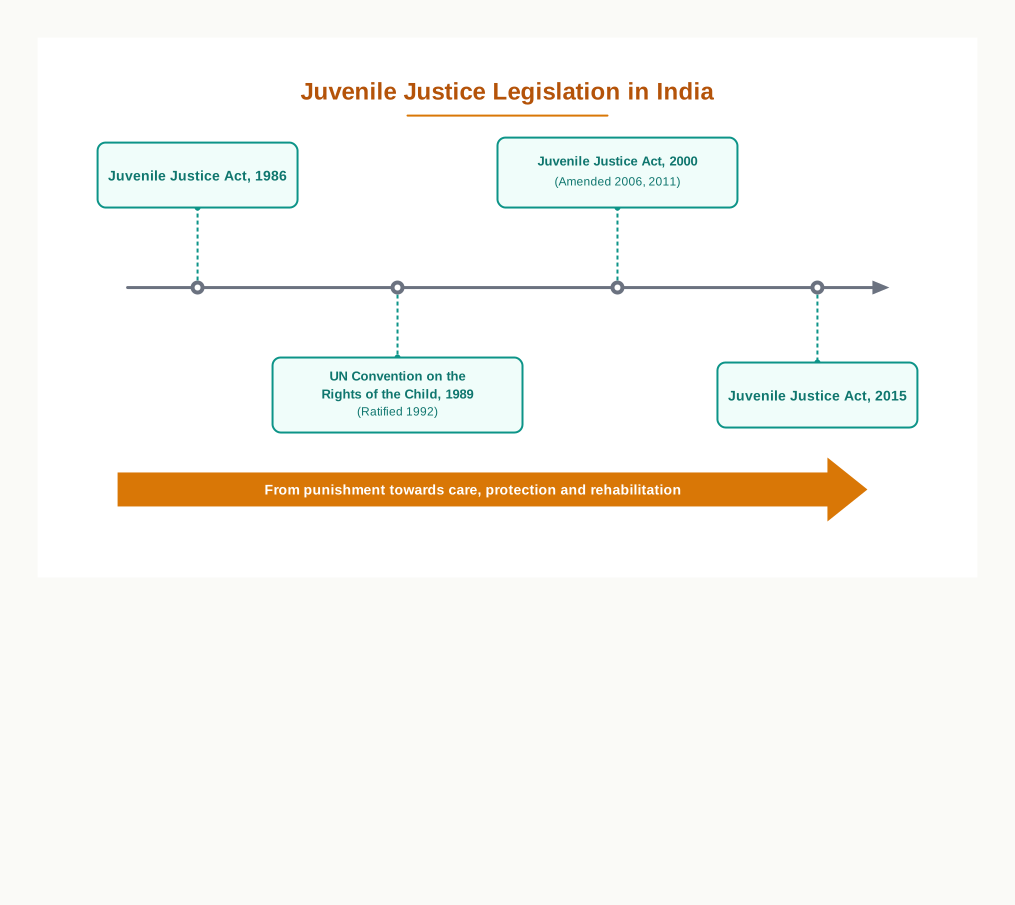
Fig. 16.2 – Juvenile justice legislation in India.
The Juvenile Justice Act, 1986. The primary legal framework of juvenile justice law in India was the Juvenile Justice Act 1986. It provided for the protection, treatment and rehabilitation of children and delinquent juveniles, and for the adjudication of certain matters related to the disposition of delinquent juveniles.
The Convention on the Rights of the Child, 1989. The General Assembly of the United Nations adopted the Convention on the Rights of the Child on 20th November 1989. You have already met this Convention in section 16.1 as the source of the rights approach; here it appears in its second role, as the document that reshaped the treatment of children accused of offences.
The Convention seeks to protect the best interests of juvenile offenders. It requires States, wherever it is appropriate and desirable, to deal with such children without resorting to judicial proceedings, so that the child’s social reintegration is not defeated by the very process meant to correct him. The object is to keep a child out of the ordinary courtroom where a suitable alternative exists, rather than to leave serious offences unanswered.
The Juvenile Justice (Care and Protection of Children) Act, 2000. The Convention led the Indian legislature to repeal the Juvenile Justice Act, 1986 and to make a new law. Thus the legislature came up with a new Act called the Juvenile Justice (Care and Protection of Children) Act, 2000.
The 2000 Act was amended twice — first in 2006 and later in 2011. The amendments were made to address the gaps and loopholes that had shown up in implementation. The pattern is worth noticing: the difficulty with juvenile justice legislation in India has rarely been the principle written into the statute; it has been the machinery available to carry the principle out.
The Juvenile Justice (Care and Protection of Children) Act, 2015. The increasing number of cases of juvenile crime, and in particular the Delhi gang rape incident of December 2012 — in which one of the accused was a few months short of eighteen and was therefore dealt with under the juvenile law rather than the ordinary criminal law — triggered an intense public debate and major changes in the criminal justice system of India. The appeals arising from that incident were finally decided by the Supreme Court in Mukesh v. State (NCT of Delhi), (2017) 6 SCC 1, some years after the new Act had already been passed.
The Juvenile Justice (Care and Protection of Children) Act, 2000 was accordingly replaced by the Juvenile Justice (Care and Protection of Children) Act, 2015, which is the law in force today and the subject of the next section.
The central question the 2015 Act had to settle is one you should carry into that section. If the whole system rests on the belief that a child is not mature enough to be held criminally responsible, what is to be done about an older child who plainly did understand exactly what he was doing? Keeping the answer at “nothing changes” ignores the facts of some cases; abandoning the principle altogether would dismantle the system for every other child. How the 2015 Act tries to hold both of these together is the heart of what follows.
16.8 The Juvenile Justice (Care and Protection of Children) Act, 2015
The Juvenile Justice (Care and Protection of Children) Act, 2015 is the primary legal framework for juvenile justice in India. Its most important structural decision is that it brought two very different groups of children within a single statute: ‘children in need of care and protection’ and ‘children in conflict with law’.
That choice tells you how the law sees the problem. A child who is neglected, abandoned or exploited today is very often the child who comes before the system as an offender tomorrow. Putting both groups in one Act, with one set of institutions, treats them as two faces of the same failure rather than as unrelated subjects.
The Two Categories of Children
Child in conflict with law. A ‘child in conflict with law’ is a person below 18 years of age on the day of commission of the offence, who is alleged to have committed an offence.
The date matters, and examiners test it. The age is fixed as on the day the offence was committed, not the day the child is caught, charged or produced. A boy who commits an offence at seventeen years and eleven months remains a child in conflict with law even if he is arrested a year later.
Child in need of care and protection. A ‘child in need of care and protection’ means a child who is found without any home and ostensible means of subsistence. The expression is much wider than homelessness alone. It includes:
- a child who is mentally or physically challenged, or who suffers from a terminal or incurable disease, with no one to look after him or her;
- a child who is likely to be grossly abused, tortured or exploited for the purpose of sex or other illegal acts;
- a child whose parents are unfit to exercise control over him or her;
- a child who has no parents, and whom no one is willing to take care of;
- a child found vulnerable and likely to be inducted into drug abuse or trafficking;
- a child likely to be abused for unconscionable gains;
- a child who is a victim of any armed conflict, civil commotion or natural calamity; and
- a child found begging, a child living on the streets, or a working child.
Read that list once more and notice how many entries begin with “likely to be”. The Act does not wait for the harm to happen. A child who is likely to be inducted into trafficking, or likely to be abused, already qualifies. This is deliberate: by the time such harm has occurred, protection has come too late.
In summary, the Act recognises two categories of children:
- Child in conflict with law — a person below 18 years of age on the day of the commission of the offence, alleged to have committed an offence.
- Child in need of care and protection — which includes children who are orphaned, abandoned or homeless, that is, without ostensible means of subsistence; children who are victims of, or are likely to be victims of, child abuse, substance abuse, neglect or exploitation; children who have no responsible adult to care for them; and children who are working in unsafe conditions.
The two categories are handled by two different bodies, as Fig. 16.3 shows. Keeping them separate is one of the Act’s design principles: a child who has been failed by adults is not to be processed through the machinery meant for a child who is accused of an offence.
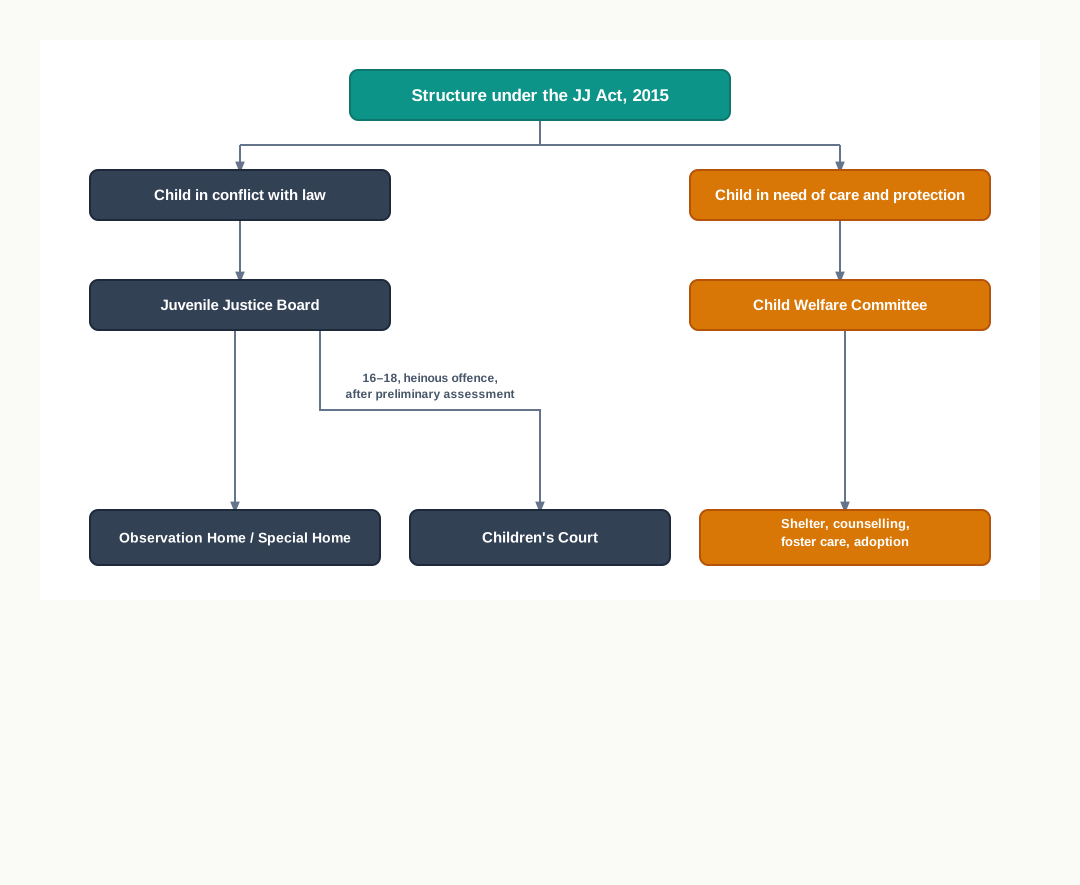
Fig. 16.3 – Structure under the JJ Act, 2015.
Main Objectives of the Act
The main objectives of the Act are:
- to ensure the care, protection, development, treatment and rehabilitation of children;
- to adopt a reformative and rehabilitative approach instead of a punitive one;
- to provide separate procedures for dealing with children, distinct from those for adults; and
- to safeguard the best interests of the child.
The Courts’ Concern for Children in Custody
Long before the present Act, the Supreme Court had begun insisting that a child in the custody of the State is owed something more than mere confinement. Two decisions shaped that insistence.
Important Provisions of the Juvenile Justice Act
1. Age of a juvenile. The Act defines a juvenile or child as a person below 18 years of age, regardless of gender, on the date of commission of the offence.
2. Juvenile Justice Board (JJB). The Act provides for the establishment of a Juvenile Justice Board in every district. The Board consists of:
- a Metropolitan Magistrate or a Judicial Magistrate of the First Class, who sits as the Principal Magistrate; and
- two social workers, of whom at least one shall be a woman.
The composition is not accidental. A magistrate alone would bring legal training but not the understanding of a child’s background that a case of this kind turns on; two social workers sitting alongside supply it, and the requirement of a woman member matters where the child before the Board is a girl.
The functions of the JJB include:
- conducting inquiries relating to children in conflict with law;
- ensuring a child-friendly atmosphere; and
- passing orders focused on rehabilitation, not punishment.
Note the word “inquiry”. The JJB holds an inquiry, not a trial. The difference is not merely verbal: the object is to find out what happened and what the child needs, rather than to establish guilt and fix a sentence.
3. Child Welfare Committee (CWC). For children in need of care and protection, the Act establishes a Child Welfare Committee. You have already met the CWC in section 16.6, where a child victim under POCSO is referred to it; this is the provision that creates it.
The functions of the CWC are:
- ensuring proper care, protection and rehabilitation;
- ordering shelter, counselling and medical care; and
- overseeing adoption, foster care and rehabilitation processes.
4. Principles of reform and rehabilitation. The Act is guided by important principles such as:
- presumption of innocence;
- dignity and worth of the child;
- best interest of the child; and
- fresh start, meaning that the child should not be labelled as a criminal.
5. Treatment of children aged 16–18 years. In certain serious offences, children aged 16 to 18 years may undergo a preliminary assessment by the Juvenile Justice Board to determine:
- mental and physical capacity;
- ability to understand the consequences of the offence; and
- the circumstances in which the offence was committed.
Based on the assessment by the Juvenile Justice Board, the case may be transferred to a Children’s Court, but the focus remains on reform rather than punishment. This provision is examined in detail below.
6. Prohibition on sending to jail and handcuffing. The Act strictly prohibits sending juveniles to regular prisons, or inflicting any harsh treatment on them such as handcuffing. To ensure their protection and welfare, they must be kept in Observation Homes or Special Homes. Sanjay Suri explains exactly why this prohibition exists.
7. Adoption and rehabilitation. The Act lays emphasis on the rehabilitation of juveniles through foster care and rehabilitation homes, so that the child has a safe and supportive family environment.
Classification of Offences under the Act
The Act classifies offences committed by children into three categories:
- Petty offences — punishable with imprisonment up to 3 years;
- Serious offences — punishable with imprisonment between 3 to 7 years; and
- Heinous offences — punishable with imprisonment of 7 years or more under the Indian Penal Code or other laws.
The classification is not a ranking of moral seriousness for its own sake. It decides procedure: what kind of inquiry the Board holds, and — for the third category alone — whether the question of transfer to the Children’s Court can arise at all.
Children Aged 16 to 18 and the Preliminary Assessment
Heinous offences are, in the scheme of the Act, the category in which a child between the age of 16 and 18 years may be dealt with differently. A special procedure is laid down for such cases, because a juvenile of that age may have sufficient maturity to understand the nature of his act. It thus becomes important to balance justice and child welfare.
Even here, the child is produced before the Juvenile Justice Board only, and not before a regular criminal court. He is kept in an Observation Home during this period. The Juvenile Justice Board carries out a preliminary assessment of the mental capacity of the juvenile to understand the consequences of his act. Based on this assessment, the Board may retain the proceedings with itself, or may forward the case to be tried by the Children’s Court, where the juvenile is tried like an adult. The Children’s Court ensures a child-friendly atmosphere, focusing on reforming the juvenile rather than on retribution.
This provision remains the most debated part of the Act. Those who support it argue that a child of sixteen or seventeen who plans and executes a grave offence understands exactly what he is doing, that the ordinary juvenile process offers no proportionate response in such a case, and that the assessment requirement confines the exception to the few cases that genuinely warrant it. Those who oppose it argue that maturity cannot be measured reliably in a short assessment, that exposing a child to the adult system destroys the prospect of reform on which the whole Act rests, and that the exception was created in response to a single incident rather than to evidence about children generally. The law as it stands accepts the exception, but hedges it with an age limit, an offence threshold, an assessment, and a direction that the Children’s Court must still focus on reform.
Principles Underlying the Act
The Act is based on the following principles:
- presumption of innocence of the juvenile;
- ensuring the best interest of the juvenile;
- protecting the dignity and worth of the juvenile; and
- an opportunity of a fresh start to the juvenile, ensuring no criminal record.
The last of these is the one most easily misread. “Fresh start” does not mean that nothing happened; it means that the child’s future is not to be permanently closed by what happened. A criminal record follows a person into every job application and every verification for the rest of his life, and a system built on reform cannot at the same time attach a lifelong label.
The Position after 2021
The Juvenile Justice (Care and Protection of Children) Amendment Act, 2021, which came into force on 1 September 2022, made further changes to the 2015 Act. District Magistrates and Additional District Magistrates were empowered to issue adoption orders, so that adoption cases are disposed of more quickly, and District Magistrates were given a wider role in monitoring the working of the Act. Eligibility conditions for the appointment of members of Child Welfare Committees were laid down. The amendment also settled the treatment of offences that the three-fold classification had left uncertain: an offence for which the maximum punishment is imprisonment of more than seven years, but for which no minimum punishment is prescribed or a minimum of less than seven years is prescribed, is treated as a serious offence and not a heinous one.
16.9 Summary
- The word ‘child’ comes from the Latin infans, meaning the one who does not speak.
- Under the Convention on the Rights of the Child 1989, a child is any human being below eighteen years, unless the law applicable to the child fixes an earlier age of majority.
- In India, a person attains majority at 18 years under the Indian Majority Act, 1875.
- Eighteen is the general age of majority, but individual statutes fix their own age limits for their own purposes, so the statute in question always decides the answer.
- The law’s approach to children has moved through three stages:
- authority and control, where the father had absolute rights over his children;
- the welfare principle, drawn in India from values such as daya, dana, dakshina, bhiksha, ahimsa and tyaga; and
- the rights approach, which emerged during the twentieth century.
- Under a welfare approach the child depends on the compassion of adults; under a rights approach the child holds an entitlement and someone else carries a corresponding legal duty.
- The rights approach is concerned with social justice, non-discrimination, equity and empowerment, and is embodied in the United Nations Convention on the Rights of the Child 1989.
- India ratified the Convention on the Rights of the Child in December, 1992.
- The Convention groups a child’s rights as civil, economic, social, cultural and political:
- civil rights include protection from torture and maltreatment, and special rules governing the circumstances in which children may be deprived of liberty;
- economic rights include proper development and protection from exploitation at work;
- social rights include the highest attainable standard of health services, protection from sexual exploitation and the regulation of adoption; and
- cultural rights include the right to education.
- Article 21A, inserted by the 86th constitutional amendment, makes free and compulsory education for children between six and fourteen years a fundamental right.
- Before the 86th amendment, education was only a Directive Principle; the Supreme Court in Unni Krishnan, J.P. v. State of Andhra Pradesh, (1993) 1 SCC 645 read a right to education into Article 21.
- Three duties accompany the right to education:
- the State must promote the educational and economic interests of the weaker sections, particularly the Scheduled Castes and Scheduled Tribes, under Article 46;
- the State’s duty to secure the right is subject to its economic capacity and development, under Article 41; and
- a parent or guardian has a fundamental duty under Article 51A(k) to provide opportunities for education to his child or ward between six and fourteen years.
- The Right of Children to Free and Compulsory Education Act, 2009 gives effect to Article 21A and provides free and compulsory education to all children between six and fourteen years, irrespective of economic condition.
- The financial burden of implementation is shared by the State and the Central Government on the basis of the Sarva Shiksha Abhiyan programme.
- Section 12(1)(c) of that Act requires private unaided schools to reserve 25% of entry-level seats for children of weaker sections and disadvantaged groups; minority institutions are outside this obligation.
- Health is a state of complete physical, mental and social well-being, and not merely the absence of disease or infirmity.
- The right to health has no separate Article in Part III and has been read into Article 21 by the courts:
- Consumer Education and Research Centre v. Union of India, AIR 1995 SC 922 held that the right to health and medical care is a fundamental right under Article 21 read with Articles 39(e), 41 and 43; and
- Paschim Banga Khet Mazdoor Samity v. State of West Bengal, AIR 1996 SC 2426 held that Article 21 obliges the State to safeguard the right to life, so that timely emergency medical treatment cannot be denied.
- The Constitution places health-related duties on the State through Articles 39(e), 39(f), 41, 42, 47 and 48A, covering the child, the mother, working conditions, public health and the environment.
- The right to shelter includes adequate living space, a safe structure, clean and hygienic surroundings, light, pure air and water, electricity, sanitation and civic amenities.
- Chameli Singh v. State of U.P., (1996) 2 SCC 549 set out these components, and Shantistar Builders v. Narayan Khimalal Totame, (1990) 1 SCC 520 held that the right to life includes the right to food, clothing, a decent environment and reasonable accommodation.
- For an animal, shelter is the bare protection of the body; for a human being it must be accommodation that allows growth in every aspect — physical, mental and intellectual.
- Child labour means labour by a child, and whether particular work amounts to child labour depends on the child’s age, the nature of the work, the hours of work and the conditions in which it is performed.
- Work that jeopardises the physical, mental or moral well-being of a child is hazardous work, and deprives the child of childhood, potential and dignity.
- The International Labour Organization was founded in 1919 and launched the International Programme on the Elimination of Child Labour (IPEC) in 1992, aimed at the progressive elimination of child labour.
- Article 24 prohibits the employment of a child below fourteen years in any factory or mine, or in any other hazardous employment, and the prohibition admits of no exception for consent or need.
- The Child Labour (Prohibition and Regulation) Act, 1986 banned the employment of children below fourteen in specified occupations and processes, laid down a procedure for modifying that schedule, and regulated conditions of work where employment was not prohibited.
- The National Policy on Child Labour, 1987 provided for strict enforcement, and the National Child Labour Project scheme launched in 1988 ran special schools for children withdrawn from work.
- In 2006 the legislature brought child domestic workers up to fourteen years, and children working in hotels, dhabas, eateries and the entertainment industry, within the purview of the 1986 Act.
- Child sexual abuse is any sexual activity with a child in which the child is used for the sexual stimulation of the perpetrator, and it is typically maintained through deception, threats or other coercive methods.
- A person below eighteen may also commit sexual abuse, and a significant disparity in age, development or size renders the child incapable of giving consent.
- Child sexual abuse includes both extra-familial abuse, from outside the family, and inter-familial abuse, from within it.
- The Protection of Children from Sexual Offences (POCSO) Act, 2012 protects children below eighteen from sexual abuse, harassment and exploitation; it is gender-neutral and places the best interests, dignity and well-being of the child at the centre of the justice system.
- The objectives of the POCSO Act are to protect children from sexual offences, to define forms of abuse clearly, to ensure child-friendly reporting, investigation and trial, to provide speedy justice through Special Courts, and to deter offenders through stringent punishment.
- The Act classifies offences as sexual assault, penetrative sexual assault, sexual harassment and use of a child for pornographic purposes, and recognises aggravated forms where the offender holds a position of trust or authority, or control or dominance over the child.
- The Act provides for child-friendly reporting and investigation, protection of the child’s identity and privacy, mandatory reporting by any person with knowledge of an offence, Special POCSO Courts for speedy trial, and coordination with the Child Welfare Committee where the child needs care and protection.
- ‘Juvenile’ comes from the Latin juvenilis, meaning of or belonging to youth; juvenile justice is the branch of criminal law applying to persons not mature enough to be held responsible for criminal acts.
- The system rests on the belief that a child is born innocent, that environmental factors stir criminal tendencies, and that removing those factors can turn the juvenile into a person of stature and excellence.
- Juvenile justice legislation in India developed in stages: the Juvenile Justice Act, 1986; the Convention on the Rights of the Child adopted on 20th November 1989; the Juvenile Justice (Care and Protection of Children) Act, 2000, amended in 2006 and 2011; and the Juvenile Justice (Care and Protection of Children) Act, 2015.
- The 2015 Act covers two categories of children:
- a child in conflict with law — a person below eighteen years on the day of commission of the offence, alleged to have committed it; and
- a child in need of care and protection — including children who are orphaned, abandoned or homeless, are victims or likely victims of abuse, substance abuse, neglect or exploitation, have no responsible adult to care for them, or are working in unsafe conditions.
- The main objectives of the 2015 Act are care, protection, development, treatment and rehabilitation; a reformative rather than punitive approach; separate procedures distinct from those for adults; and safeguarding the best interests of the child.
- Sheela Barse v. Secretary, Children’s Aid Society, AIR 1987 SC 656 held that children should not be kept in observation homes for too long, and while there should be kept occupied in congenial pursuits that build adaptability, self-confidence and human values.
- Sanjay Suri v. Delhi Administration, AIR 1988 SC 414 concerned the ill treatment of minors in Tihar Jail; the Court ordered the release of some juvenile undertrials and parole for some convicted minors, and stressed the need for humanism in jail administration.
- A Juvenile Justice Board is established in every district, consisting of a Metropolitan Magistrate or Judicial Magistrate of the First Class and two social workers, at least one of whom must be a woman; it conducts inquiries, ensures a child-friendly atmosphere and passes orders focused on rehabilitation.
- A Child Welfare Committee deals with children in need of care and protection, ensuring care and rehabilitation, ordering shelter, counselling and medical care, and overseeing adoption and foster care.
- The Act prohibits sending juveniles to regular prisons and inflicting harsh treatment such as handcuffing; they must be kept in Observation Homes or Special Homes.
- Offences under the Act are classified as petty, punishable with imprisonment up to 3 years; serious, punishable with imprisonment between 3 and 7 years; and heinous, punishable with imprisonment of 7 years or more.
- A child aged 16 to 18 accused of a heinous offence is produced before the Juvenile Justice Board, which conducts a preliminary assessment of his mental and physical capacity, his ability to understand the consequences of the act, and the circumstances of the offence.
- After the preliminary assessment the Board may retain the inquiry or forward the case to the Children’s Court, where the child may be tried as an adult, but in a child-friendly atmosphere focused on reform rather than retribution.
- The 2015 Act is founded on the presumption of innocence, the best interest of the child, the dignity and worth of the child, and a fresh start ensuring that the child carries no criminal record.
16.10 Key Terms
Child — any person below the age of eighteen years, unless the law applicable to that child fixes an earlier age of majority.
Majority — the age at which a person is treated in law as an adult, fixed at 18 years in India by the Indian Majority Act, 1875.
Welfare approach — the view that a child’s well-being depends on the compassion and duty of adults, leaving the child with no remedy if that compassion is withheld.
Rights approach — the view that a child holds legal entitlements in his own person, with a corresponding legal duty on others, enforceable if denied.
Convention on the Rights of the Child, 1989 — the United Nations convention, ratified by India in December 1992, that sets out the civil, economic, social, cultural and political rights of children.
Civil rights of the child — rights including protection from torture and maltreatment, and special rules governing the circumstances in which a child may be deprived of liberty.
Economic rights of the child — rights ensuring proper development and protection from exploitation at work.
Social rights of the child — rights including the highest attainable standard of health services, protection from sexual exploitation and the regulation of adoption.
Cultural rights of the child — rights concerned with a child’s participation in the life and learning of society, including the right to education.
Right to education — the fundamental right under Article 21A to free and compulsory education for every child between six and fourteen years.
Free and compulsory education — education for which the child pays no fee that would prevent completion of elementary schooling, and which the State is bound to ensure the child receives.
Right of Children to Free and Compulsory Education Act, 2009 — the statute enacted to give practical effect to Article 21A.
Health — a state of complete physical, mental and social well-being, and not merely the absence of disease or infirmity.
Right to health — the right to health and medical care, read into Article 21 by the Supreme Court rather than written separately into Part III.
Right to shelter — the right to adequate living space in a safe structure with clean surroundings, light, pure air and water, electricity, sanitation and civic amenities.
Child labour — labour by a child, judged by the child’s age, the nature and hours of the work, and the conditions in which it is performed.
Hazardous work — work that jeopardises the physical, mental or moral well-being of a child.
International Labour Organization (ILO) — the specialised agency of the United Nations dealing with labour, founded in 1919.
International Programme on the Elimination of Child Labour (IPEC) — the ILO programme started in 1992 with the object of progressively eliminating child labour.
National Child Labour Project (NCLP) — the scheme launched in 1988 to run special schools for children withdrawn from work.
Child sexual abuse — any sexual activity with a child in which the child is used for the sexual stimulation of the perpetrator.
Perpetrator — the wrongdoer, that is, the person who commits the offence.
Extra-familial abuse — abuse of a child by a person outside the child’s family.
Inter-familial abuse — abuse of a child by a person within the child’s own family.
Protection of Children from Sexual Offences (POCSO) Act, 2012 — the gender-neutral statute protecting all children below eighteen from sexual abuse, harassment and exploitation.
Aggravated offence — an offence treated more seriously because it was committed by a person in a position of trust or authority over the child, or having control or dominance over the child.
Mandatory reporting — the legal duty on any person having knowledge of an offence under the POCSO Act to report it to the police or appropriate authority.
Special POCSO Court — the court designated under the POCSO Act to try offences against children in a child-friendly environment and on a speedy footing.
Juvenile — a person belonging to youth; in law, a person below eighteen years of age.
Juvenile justice — the branch of criminal law applying to persons not mature enough to be held responsible for criminal acts, which proceeds by care and rehabilitation rather than punishment.
Doli incapax — the principle that a child below a prescribed age is treated in law as incapable of committing an offence.
Child in conflict with law — a person below eighteen years of age on the day of commission of the offence, alleged or found to have committed it.
Child in need of care and protection — a child without a home or ostensible means of subsistence, or otherwise neglected, abused, exploited or vulnerable in the ways the Juvenile Justice Act lists.
Juvenile Justice Board (JJB) — the body established in every district, consisting of a Magistrate and two social workers, that conducts inquiries relating to children in conflict with law.
Child Welfare Committee (CWC) — the body that deals with children in need of care and protection, ordering shelter, counselling, medical care, foster care and adoption.
Preliminary assessment — the inquiry by the Juvenile Justice Board into the mental and physical capacity of a child aged 16 to 18 accused of a heinous offence, his ability to understand the consequences of the act, and the circumstances of the offence.
Children’s Court — the court to which the Juvenile Justice Board may forward such a case, where the child may be tried as an adult but in a child-friendly and reformative setting.
Observation Home — the institution where a child in conflict with law is kept during the inquiry, in place of a prison.
Special Home — the institution for the longer-term care and rehabilitation of a child in conflict with law.
Petty offence — an offence punishable with imprisonment up to 3 years.
Serious offence — an offence punishable with imprisonment between 3 and 7 years.
Heinous offence — an offence punishable with imprisonment of 7 years or more.
Fresh start — the principle that a child should not be labelled a criminal, and should leave the juvenile justice system without a criminal record.
Parole — the conditional release of a prisoner before the full term of the sentence has been served.
16.11 Points to Ponder
The chapter describes a shift from a ‘welfare’ approach to a ‘rights’ approach. Does treating a child as a holder of rights rather than as an object of compassion change anything in the life of a child whose family is unwilling or unable to act? What does the rights approach need in order to make a practical difference?
The right to education is written into Part III as Article 21A, while the rights to health and shelter have had to be read into Article 21 by the courts. Is a right stronger for being written expressly into the Constitution, or does the judicial route serve equally well?
Article 21A guarantees free and compulsory education between the ages of six and fourteen. Consider what happens to a child on the day he turns fifteen, and whether an elementary education alone is enough to give a child the future the right was meant to secure.
Section 12(1)(c) requires private unaided schools to admit children from weaker sections and disadvantaged groups. What does the provision aim to achieve beyond providing seats, and what would have to be true inside a classroom for it to succeed?
Article 51A(k) places a fundamental duty on parents and guardians to provide opportunities for education. Fundamental duties are not enforceable in the way fundamental rights are. Should the duty of a parent towards a child’s schooling carry legal consequences, and what would be lost or gained if it did?
Child labour is closely tied to poverty. If a family depends on what a child earns, what does the law owe that family when it removes the child from work? Consider whether prohibition without rehabilitation can succeed.
The definition of a child in need of care and protection includes children who are merely ‘likely’ to be abused or exploited. Protecting a child before harm occurs is valuable, but it also allows the State to intervene in a family on the basis of a prediction. Where should the line be drawn?
POCSO makes reporting compulsory for any person with knowledge of an offence, including relatives, teachers and counsellors. Consider the position of a person who fears that reporting will expose the child to further harm within the family. Does the duty to report help such a child, and what else would need to exist for it to work?
The whole juvenile justice system rests on the premise that a child is not mature enough to be held criminally responsible. The preliminary assessment for children aged 16 to 18 asks a Board to decide, case by case, whether a particular child in fact understood what he was doing. Can maturity be assessed in this way, and what follows for the system if it cannot?
The principle of a ‘fresh start’ ensures that a child leaves the system without a criminal record. Consider this principle from the point of view of a person harmed by the child’s act. How should a legal system hold both concerns together?
Sheela Barse held that a child in an observation home must be kept occupied in congenial pursuits. Institutions rarely fail for want of a legal standard; they fail for want of staff, money and monitoring. What mechanisms would make a standard of this kind real for the child inside the home?
Every right in this chapter depends on an adult or an institution acting on the child’s behalf, because a child can rarely approach a court himself. What does this tell you about how child rights must be designed if they are to be more than statements on paper?
16.12 Textbook Questions
Based on your understanding, answer the following questions:
The United Nations Convention on the Rights of the Child gives a child all the basic rights that will enable the child to achieve his or her full potential. Explain the cultural and social rights available to a child.
What is the status of education as a right? How did it acquire this status?
Is there any legislation in India dealing with child labour? Name the relevant legislation. Aditi hired a 12-year-old girl to help her with domestic household chores. Can she be prosecuted for child labour? Explain, giving legal reasons.
16.13 Objective Questions
The word ‘child’ is derived from the Latin word ‘infans’, which means:
- the one who is protected
- the one who does not speak
- the one who belongs to youth
- the one who is not yet a major
In India, a person attains majority at the age of 18 years under the:
- Indian Majority Act, 1875
- Juvenile Justice (Care and Protection of Children) Act, 2015
- Protection of Children from Sexual Offences Act, 2012
- Right of Children to Free and Compulsory Education Act, 2009
India ratified the Convention on the Rights of the Child in:
- November 1989
- December 1992
- January 1996
- April 2002
Under the Convention on the Rights of the Child, the right to education is included among:
- civil rights
- economic rights
- social rights
- cultural rights
Article 21A of the Constitution was inserted by the:
- 42nd constitutional amendment
- 44th constitutional amendment
- 86th constitutional amendment
- 101st constitutional amendment
The fundamental duty of a parent or guardian to provide opportunities for education to his child or ward between six and fourteen years is contained in:
- Article 39(e)
- Article 45
- Article 51A(k)
- Article 46
Under Section 12(1)(c) of the Right of Children to Free and Compulsory Education Act, 2009, private unaided schools must reserve entry-level seats for children of weaker sections and disadvantaged groups to the extent of:
- 10%
- 15%
- 25%
- 33%
In Consumer Education and Research Centre v. Union of India, AIR 1995 SC 922, the Supreme Court held that the right to health and medical care is a fundamental right under:
- Article 19 read with Article 21
- Article 21 read with Articles 39(e), 41 and 43
- Article 24 read with Article 39(f)
- Article 14 read with Article 47
The components of the right to shelter — adequate living space, a safe structure, sanitation, light, air and civic amenities — were discussed by the Supreme Court in:
- Sheela Barse v. Secretary, Children’s Aid Society
- Chameli Singh v. State of U.P.
- Paschim Banga Khet Mazdoor Samity v. State of West Bengal
- Sanjay Suri v. Delhi Administration
Article 24 of the Constitution prohibits the employment of a child below the age of:
- 12 years
- 14 years
- 16 years
- 18 years
The International Programme on the Elimination of Child Labour (IPEC) was started by the ILO in:
- 1919
- 1986
- 1992
- 2006
The National Child Labour Project scheme, which runs special schools for children withdrawn from work, was launched in:
- 1986
- 1987
- 1988
- 1992
Which of the following is NOT among the offences classified under the Protection of Children from Sexual Offences Act, 2012?
- Sexual assault
- Penetrative sexual assault
- Use of a child for pornographic purposes
- Employment of a child in a hazardous process
Under the POCSO Act, 2012, an offence is treated as an aggravated offence when it is committed by:
- a stranger to the child
- a person in a position of trust or authority over the child
- a person below eighteen years of age
- a person residing outside the child’s district
A Juvenile Justice Board consists of:
- a Magistrate alone
- a Magistrate and one social worker
- a Magistrate and two social workers, at least one of whom is a woman
- three social workers, at least one of whom is a woman
Under the Juvenile Justice (Care and Protection of Children) Act, 2015, an offence punishable with imprisonment between 3 and 7 years is classified as:
- a petty offence
- a serious offence
- a heinous offence
- an aggravated offence
A preliminary assessment by the Juvenile Justice Board, which may lead to a case being forwarded to the Children’s Court, is possible only where the child, on the date of the offence, was:
- below 12 years
- between 12 and 14 years
- between 14 and 16 years
- between 16 and 18 years
Assertion (A): A child who is refused timely emergency treatment at a government hospital can complain of the violation of a fundamental right. Reason (R): Article 21 imposes an obligation on the State to safeguard the right to life of every person, and preservation of human life is of paramount importance.
Assertion (A): A boy who commits an offence at the age of 17 years and 11 months remains a child in conflict with law even if he is arrested a year later. Reason (R): Under the Juvenile Justice (Care and Protection of Children) Act, 2015, age is reckoned as on the day of commission of the offence.
Assertion (A): Minority educational institutions are not required to reserve 25% of entry-level seats under Section 12(1)(c) of the Right of Children to Free and Compulsory Education Act, 2009. Reason (R): Article 30(1) protects the right of minorities to establish and administer educational institutions of their choice.
Assertion (A): A school counsellor who learns of an offence against a child and decides to handle the matter privately commits an offence. Reason (R): The POCSO Act, 2012 makes reporting legally compulsory for any person who has knowledge of an offence under it.
Assertion (A): A child aged 15 years accused of an offence punishable with ten years’ imprisonment cannot be forwarded to the Children’s Court. Reason (R): The offence is not a heinous offence under the Juvenile Justice (Care and Protection of Children) Act, 2015.
Assertion (A): The Juvenile Justice (Care and Protection of Children) Act, 2015 deals with children in need of care and protection and children in conflict with law within a single statute. Reason (R): A child who is neglected, abandoned or exploited is often the child who later comes before the system as an offender.
16.14 Check Your Concepts
Why does the Convention on the Rights of the Child fix eighteen years as the age of a child, and yet allow a country’s own law to treat majority as attained earlier?
Distinguish between the welfare approach and the rights approach to children, on the basis of the position of the child, the source of the benefit, and the remedy available if the benefit is denied.
A student writes that a child in India is anyone below fourteen years, because Article 24 uses that age. Correct the error and explain what the student has misunderstood about age limits in different statutes.
State the four categories of rights that the Convention on the Rights of the Child guarantees, and give one example of a right falling within each.
What does the word ‘compulsory’ mean in the expression ‘free and compulsory education’ under Article 21A? On whom does the obligation fall?
Before 2002, education appeared only among the Directive Principles. Explain how the Supreme Court gave it the force of a right even before Article 21A was inserted, and why the 86th amendment was still necessary.
Article 41 makes the State’s duty to secure the right to education subject to its economic capacity and development. Does this mean a State can plead lack of funds to escape Article 21A? Give reasons.
Why did Parliament place a fundamental duty on parents and guardians under Article 51A(k), when the duty to provide education already rests on the State?
A private unaided school admits children under Section 12(1)(c) but teaches them in a separate afternoon section. Identify the provision engaged and explain whether the school has complied with it.
The right to health is nowhere written in Part III of the Constitution. Explain how it has nonetheless become enforceable, and name the two decisions carried in this chapter that established it.
Identify the Articles of the Constitution that place health-related duties on the State in respect of children, mothers, working conditions, public health and the environment, and state briefly what each requires.
Why is the right to shelter defined so widely, to include sanitation, light, air, water and civic amenities, rather than merely a roof? Answer with reference to the distinction the Supreme Court drew between the shelter needs of an animal and of a human being.
What happens to a child’s right to education and right to health if the right to shelter is not secured? Explain why shelter is described as the condition on which other rights depend.
State the factors that determine whether a particular kind of work amounts to child labour. Why is the fact that a child works not by itself decisive?
‘Hazardous work’ is defined to include work that jeopardises the moral well-being of a child, and not only the physical. Explain why the definition extends this far, with an example.
State the three limbs of Article 24 and explain why the prohibition it contains admits of no exception for the consent of the child or the parent.
Explain the objectives of the Child Labour (Prohibition and Regulation) Act, 1986. Why did the Act need a procedure for modifying the schedule of banned occupations and processes?
Why does the National Child Labour Project scheme run special schools for children withdrawn from work? What would be the difficulty with a law that removed children from work but did nothing further?
Why was a specific and child-centred law such as the POCSO Act, 2012 needed, when the general criminal law already punished sexual offences?
Explain why the POCSO Act treats an offence as aggravated when it is committed by a person in a position of trust or authority over the child.
What is mandatory reporting under the POCSO Act, and how does it depart from the ordinary position of a bystander in criminal law? Why does the Act also punish false reporting?
Arrange the following steps in the correct order and explain the purpose of each: referral of the child to the Child Welfare Committee; recording of the child’s statement at a place of the child’s choice; reporting of the offence to the police; trial before a Special POCSO Court.
Why does the POCSO Act prohibit the publication of a child’s name, photograph, school or address? Whose interest does the prohibition protect, and what harm does it prevent?
Explain the premise that ‘a child is born innocent’ and show how it shapes the design of the juvenile justice system, including the use of the word ‘inquiry’ instead of ‘trial’.
Distinguish between a child in conflict with law and a child in need of care and protection, and state which body under the Juvenile Justice (Care and Protection of Children) Act, 2015 deals with each.
Several entries in the definition of a child in need of care and protection begin with the words ‘likely to be’. Explain why the Act protects a child before harm has occurred, and what difficulty this creates.
State the composition of the Juvenile Justice Board and explain why the Act requires social workers to sit alongside a Magistrate, and why at least one of them must be a woman.
Arrange in order the steps by which a child aged 16 to 18 accused of a heinous offence is dealt with, from production before the Juvenile Justice Board to the possible transfer of the case, and identify the branch point in the process.
What happens if a child accused of a heinous offence was aged 15 years and 8 months on the date of the offence? Identify the fact that decides the outcome.
A student writes that a child aged 17 accused of a heinous offence is produced directly before the Children’s Court. Correct the error and state the correct procedure.
Why does the Juvenile Justice Act prohibit sending children to regular prisons and inflicting treatment such as handcuffing? Support your answer with the decision in Sanjay Suri v. Delhi Administration.
Explain the principle of a ‘fresh start’ under the Juvenile Justice Act. Why is it inconsistent with a system built on reform to attach a criminal record to a child?
16.15 Case-Based Questions
- Meera is six years old. Her father is a daily-wage worker and the family falls within the weaker sections. He applies for her admission to the entry-level class of a private unaided school near their home. The school refuses, saying that its fee structure makes it unsuitable for such families and that the parents should approach a government school instead. He then applies to a nearby minority-run school, which also refuses.
- Identify the constitutional provision and the statutory provision engaged by the first refusal.
- Is the private unaided school entitled to refuse admission on the ground it has given? Give reasons.
- Does the position differ in respect of the minority-run school? Explain why.
- Suppose Meera were eleven years old rather than six. Would the answer to (b) change? Give reasons.
- Ravi, aged eight, is injured in a road accident and is taken by a passer-by to the nearest government hospital. The hospital has doctors on duty and the equipment needed to treat him, but he is turned away because the admissions desk says no bed is free. He is taken to two more government hospitals and refused at each. He is finally treated at a private hospital, several hours later, at heavy cost to his family.
- Which fundamental right is engaged, and against whom can it be asserted?
- Name the decision of the Supreme Court that governs this situation and state the principle it laid down.
- Would the position be different if the first hospital genuinely lacked the equipment required to treat a head injury and referred Ravi immediately to a hospital that had it? Explain the fact that makes the difference.
- Ten-year-old Sunita lives with her family in a single room in a cluster of shelters built beside a drain. The room has a roof and walls, but there is no sanitation, no clean water supply and no electricity, and the surroundings are unhygienic. Sunita is enrolled in a nearby school but has nowhere to study after dark and misses school frequently because of illness.
- Does Sunita’s family have shelter within the meaning the Supreme Court has given to the right to shelter? Give reasons.
- Name the two decisions that supply the content of the right to shelter and state what each established.
- Explain how the failure to secure shelter here affects two other rights discussed in this chapter.
- Karan is thirteen years old. He is engaged at a small workshop where metal sheets are cut and polished, and he works eight hours a day handling the cutting machine. The owner says that Karan’s parents requested the job because the family needs the income, that Karan is willing, and that he is paid the same rate as the adult workers.
- Identify the constitutional provision engaged and state its three limbs.
- Do the consent of Karan’s parents, Karan’s own willingness, or the payment of fair wages affect the legality of the employment? Give reasons.
- Name the legislation in India that deals with child labour.
- Suppose Karan were fifteen years old. Explain which part of your answer to (a) would change, and which question would then have to be answered from statute rather than from the Constitution.
- Ananya, aged twelve, trains at a sports academy. Her coach begins sending her messages of a sexual nature and tells her that she will be dropped from the team if she speaks to anyone about it. She eventually tells her mother. When her mother approaches the academy’s manager, he says the matter should be settled quietly, that a complaint will damage Ananya’s future in the sport, and that he will speak to the coach himself. A local news channel later learns of the incident and prepares to broadcast Ananya’s name and photograph.
- Which Act applies, and why does it apply to conduct that involved no physical contact?
- Is the offence an aggravated one in these facts? Give reasons.
- What is the legal position of the academy’s manager, who knows of the offence and proposes to settle it quietly?
- Can the news channel broadcast Ananya’s name and photograph? State the provision and the interest it protects.
- Imran was sixteen years and four months old on the day of an incident in which he is alleged to have committed an offence punishable with imprisonment of ten years. He is apprehended eight months later, by which time he has turned seventeen. At the same police station, a thirteen-year-old boy who has no parents and has been living on the streets is brought in after being found begging.
- Before which authority must Imran be produced, and where is he to be kept during the proceedings?
- Into which category does the alleged offence fall, and what step does that make possible?
- State the three matters the Juvenile Justice Board must consider in the preliminary assessment, and the two courses open to it afterwards.
- Under which category of the Act does the thirteen-year-old fall, which body will deal with him, and what may that body order?
16.16 Landmark Cases & Maxims
State the principle settled by the Supreme Court in Unni Krishnan, J.P. v. State of Andhra Pradesh, (1993) 1 SCC 645, and explain its connection with Article 21A of the Constitution.
In Consumer Education and Research Centre v. Union of India, AIR 1995 SC 922, the Supreme Court read the right to health into the right to life. State the Articles the Court read together, and explain the technique it used.
A woman is refused admission at a government hospital after an accident, although the hospital is able to treat her. Identify the decision that governs this fact pattern and state the principle you would apply.
Distinguish the contributions of Chameli Singh v. State of U.P. and Shantistar Builders v. Narayan Khimalal Totame to the right to shelter, stating clearly what each decision established.
The Supreme Court has said that for an animal shelter is the bare protection of the body, while for a human being it must be a suitable accommodation allowing growth in every aspect. State the decision in which this distinction was drawn, and explain why it matters particularly for a child.
State the direction given by the Supreme Court in Sheela Barse v. Secretary, Children’s Aid Society, AIR 1987 SC 656, regarding children kept in observation homes, and explain the standard it sets for institutional care.
Children are found to be held in an adult prison, where they are unsafe and are afraid to complain. Identify the decision that governs this situation, state what the Court ordered, and name the statutory prohibition that reflects its reasoning today.
State the literal meaning and the legal meaning of the maxim doli incapax, and explain how it underlies the design of the juvenile justice system.
Apply the maxim doli incapax to the following situation and explain your reasoning: a very young child takes an article from a shop without paying, believing that anything on display may be taken home.
Match the authority in Column A with the principle in Column B. | Column A | Column B | |—|—| | a. Paschim Banga Khet Mazdoor Samity v. State of West Bengal | i. The right to life includes the right to food, clothing, a decent environment and reasonable accommodation. | | b. Shantistar Builders v. Narayan Khimalal Totame | ii. A child has a right to free education up to the age of fourteen years, flowing from Article 21. | | c. Sheela Barse v. Secretary, Children’s Aid Society | iii. The State is obliged to safeguard the right to life, and preservation of human life is of paramount importance. | | d. Unni Krishnan, J.P. v. State of Andhra Pradesh | iv. Children must not be kept in observation homes for too long, and must be kept occupied in congenial pursuits while there. |