Chapter 9: Law Reforms
On the morning of 1 July 2024, a police officer sitting down to register a case in an Indian police station had to reach for a different book from the one used the previous evening. For more than a century and a half, the first question in an Indian criminal court had been answered out of the Indian Penal Code — a code drafted by a Law Commission that sat in the 1830s, in a country then run by a trading company, and finally enacted in 1860. Criminal procedure came from a British-made code, re-enacted in 1973. The rules about what counted as proof dated from 1872. On that morning all three were replaced by the Bharatiya Nyaya Sanhita, the Bharatiya Nagarik Suraksha Sanhita and the Bharatiya Sakshya Adhiniyam. An FIR could now be filed online. A witness could give evidence over a video link. A message on a phone could be produced as proof. Nothing about crime itself changed that morning. What changed was the law’s answer to it. That is what law reform means — not an accident, and not a sudden burst of temper, but a slow, argued decision that the law as it stands no longer fits the society it is meant to govern. Every reform you will study in this chapter began with the same complaint: society had moved, and the law had not moved with it.

Fig. 9.0 – Timeline of Indian law reforms (1834–2024).
By the end of this chapter, you will be able to answer each of these questions yourself.
9.1 Need for Law Reform
Law and society are tied to each other. Society produces the problems, and law supplies the answers — but society keeps changing, and so the answers must change too.
This works in both directions. Society shapes the law it wants, and the law, once made, shapes how society behaves. The two act and react upon each other, which is why a legal system can never be finished.
That is the basic reason law has to be dynamic and cannot afford to be static. A law that stands still while the society around it moves does not stay neutral — it slowly becomes useless, and sometimes unjust.
What Forces the Law to Change
New problems keep arriving before society, and law has to respond to them and provide workable, amicable solutions rather than leave people without a remedy. Broadly, three kinds of change push the law forward.
- Social change — shifting values about marriage, caste, gender, childhood and dignity.
- Economic change — new kinds of business, trade, employment and wealth, and the new kinds of unfairness they create.
- Technological change — inventions that create conduct nobody drafting the old law could have imagined.
Law reform also matters to democracy itself. Political and legal environments change, and reform is how a democracy keeps its institutions, procedures and rights in step with what its people now expect.
Reform Is Slow by Design
Law reform is not a one-time event. It is a tedious and gradual process — a problem must be identified, studied, debated, drafted, passed and then brought into force, often across several years.
That slowness is frustrating, but it is not a defect. A law that could be changed overnight would be a law nobody could rely on. The delay is the price of stability.
9.2 Law Reforms in Pre-Independent India
Law reform in India is usually studied in two broad periods:
- law reforms in pre-independent India; and
- law reforms in post-independent India.
The dividing line matters because the two periods answer different questions. Before 1947, the law was being reformed by a foreign government for its own convenience as much as for the people it ruled. After 1947, reform had to answer to a Constitution written by Indians for themselves.
Before the British: Customary Law
Before British rule, Indian society was by and large governed by its customary laws. These were drawn either from the Hindu Dharmashastra or from Islamic religious texts, and they were followed both by the rulers and by the ruled.
Customary law is law that grows out of long-standing practice rather than out of a legislature. Its strength is that people already know it and accept it. Its weakness is that it is slow to bend.
That is exactly the criticism made of these customary laws: they were considered rigid, and averse to the idea of social change. A rule that draws its authority from the fact that it has always been followed is a rule that finds it very hard to admit it was ever wrong.
The Company and the Coming of Western Law
The East India Company introduced the western legal system into India, and with it, legal reform. Before the First War of Independence in 1857, the Company ruled India under permission of the British crown; afterwards the crown itself governed India, and continued to do so till 1947.
Across the whole span of British presence in India — from the Company’s charter in 1600 down to independence in 1947 — there were major changes in the political, economic, administrative and legal fields. The legal changes are the ones that concern us here.
Modern courts were set up in India through the enactment of various Acts, such as the Regulating Act, 1773 and, much later, the Government of India Act, 1935.
Setting up courts, however, only answers the question where a dispute will be heard. It does not answer by what rule it will be decided — and in a country where the Company’s own law did not cover most disputes, that gap had to be filled. Indian courts filled it with well-accepted principles of English law: justice, equity and good conscience. Where no statute and no personal law supplied an answer, a judge was to decide by what was fair and reasonable.
Administrators Who Shaped the Courts
Several British administrators played crucial roles in reforming the judicial system in pre-independent India.
- Warren Hastings (1732–1818), the first Governor-General of India, began the work of organising courts and deciding which law would apply to whom.
- Cornwallis (1738–1805), a British Army officer and colonial administrator who served as a civil and military governor in India, is known for his contribution to the policy of the Permanent Settlement, and for separating revenue administration from the work of the courts.
- William Bentinck (1774–1839), a British statesman who served as Governor-General of India from 1828 to 1835, carried judicial reform further during a period of active social legislation.
The First Law Commissions
A major milestone in law reform during the British Raj was the establishment of the Law Commission. The first Law Commission was established in 1834 under the Charter Act of 1833, under the chairmanship of Thomas Babington Macaulay.
Why a commission at all? Because the law being applied in India at the time was a patchwork — Company regulations in some places, English principles in others, personal and customary law elsewhere. A commission was a body of experts asked to study that confusion and recommend how to replace it with a single written code.
The major contribution of this first Law Commission was its recommendation on the codification of the penal code and the criminal procedure code — the recommendation that eventually produced the Indian Penal Code and the criminal procedure code that governed India for the next century and a half.
Three more Law Commissions followed, as shown in Fig. 9.1.
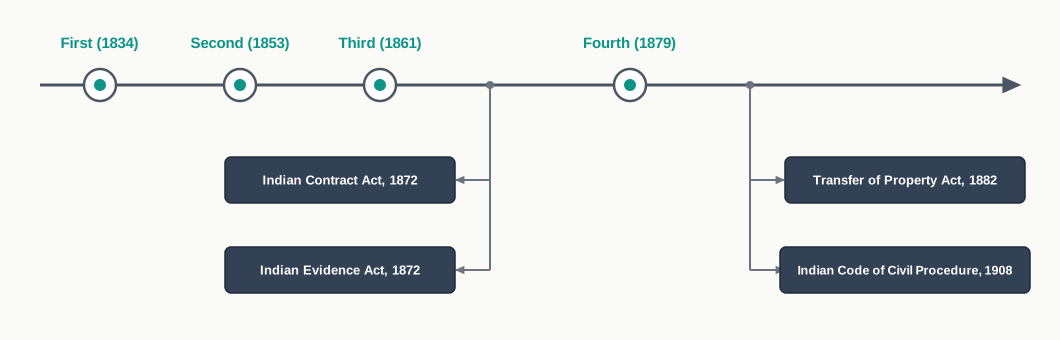
Fig. 9.1 – Pre-independence Law Commissions and major statutes.
- The Second Law Commission was established in 1853.
- The Third Law Commission was established in 1861.
- The Fourth Law Commission was established in 1879.
Between them, these Law Commissions produced statutes that are still the backbone of Indian civil law. Their major contributions include:
- the Indian Contract Act, 1872;
- the Indian Evidence Act, 1872;
- the Transfer of Property Act, 1882; and
- the Indian Code of Civil Procedure, 1908.
Notice how long that work took. The first Commission sat in 1834; the Code of Civil Procedure it set in motion reached its present form in 1908. Reform through commissions is careful, and careful is slow.
9.3 Law Reforms in Post-Independent India
Freedom brought the winds of change, and with them an ideological shift in post-colonial India. That shift was very visible in the field of law reform.
The change was one of authority. Before 1947, a law was reformed because the government of the day thought it should be. After 1947, every law had to answer to a document the country had given itself.
The Constitution as the Guiding Force
In independent India, the newly enacted Constitution, and the principles enshrined under it, became the main guiding forces of law. The Fundamental Rights and the Directive Principles of State Policy are now the basis for any social change.
The two work differently and it is worth being clear about how. Fundamental Rights set the outer limit — a reform that violates them can be struck down by a court. The Directive Principles set the direction — they tell the State what kind of society its laws should be building, even though they are not enforceable in a court.
So a modern law reform in India has to clear both tests: it must not cross a Fundamental Right, and it should carry the country towards the goals the Directive Principles name.
What Happened to the Colonial Laws
Independence did not wipe the statute book clean overnight. If it had, the country would have woken up on 26 January 1950 with no contract law, no evidence law and no penal code at all.
The Constitution avoided that under Article 372, which recognised the pre-constitutional laws and allowed them to continue.
Read the closing words carefully: the old laws continue until altered or repealed. Article 372 is not an endorsement of colonial law. It is a bridge that keeps the legal system running while the country decides, law by law, what to keep and what to replace.
That decision was demanded almost at once. There were demands from various quarters to have a fresh look at the colonial laws.
The Law Commission of India
Responding to the feeling of the Indian masses, the government constituted the First Law Commission of India under the chairmanship of the then Attorney General, Mr. M.C. Setalvad. Since then, twenty three Law Commissions have been constituted.
The Law Commission is not a court and not a legislature. It is an expert body, set up by the government for a fixed term, which studies areas of law, consults, and submits reports recommending changes. Parliament may act on a report, act on part of it, or ignore it altogether.
The Law Commission of India has dealt with a wide range of issues, and the government is equally aware and concerned about the need for timely reform in laws, so that the law may respond to the changing needs of society.
What Reform Must Tackle Today
In recent years, economic reforms have brought about many changes in Indian society, and those changes have produced problems the older statutes were never written for. Three are singled out as needing urgent attention:
- White-collar crimes — non-violent offences committed in the course of business or professional work, such as fraud, bribery, tax evasion and financial cheating, where the harm is done with paperwork rather than force.
- Crimes against women — an area where both the definition of offences and the procedure for dealing with them have needed repeated strengthening.
- Economic inequality — the gap between those who can afford to use the legal system and those who cannot.
Because these problems need careful study before any law is drafted, the Law Commission occupies a central role in law reforms in India.
9.4 The New Criminal Laws
India has replaced its old British-era criminal laws with three new laws:
- the Bharatiya Nyaya Sanhita, 2023 (BNS);
- the Bharatiya Nagarik Suraksha Sanhita, 2023 (BNSS); and
- the Bharatiya Sakshya Adhiniyam, 2023 (BSA).
These three came into force on 1 July 2024. Together they aim to deliver faster justice, to increase the use of technology — such as online FIRs and digital evidence — and to focus more on protecting victims.
Criminal law has always needed three separate sets of rules, and the three new laws map onto them exactly. One law must say what counts as a crime and what the punishment is. A second must say how a case is to be handled, step by step. A third must say what a court may accept as proof. Change all three together and you have rewritten the whole criminal justice system.
Bharatiya Nyaya Sanhita, 2023
The BNS replaces the old Indian Penal Code (IPC). It defines crimes and punishments in India — that is, it tells you what conduct is an offence and what a person convicted of it can be made to suffer.
It also adds offences the older code did not name, including organised crime and terrorism, and it focuses more on justice for victims.
Bharatiya Nagarik Suraksha Sanhita, 2023
The BNSS replaces the Code of Criminal Procedure (CrPC). It explains how the police and the courts are to handle criminal cases — from the filing of an FIR, through investigation, to trial.
It also allows more use of technology, such as online complaints and trials conducted over video.
Procedure sounds like the dull part of criminal law, but it is where most people actually meet the system. A person who has been wronged does not first meet a definition of an offence; they first meet a police station and a form.
Bharatiya Sakshya Adhiniyam, 2023
The BSA replaces the Indian Evidence Act. It deals with what evidence can be used in court.
Its most significant change for a student today is that it recognises digital evidence — emails, messages and electronic records — as important proof. Much of modern wrongdoing leaves its trace on a screen rather than on paper, and an evidence law that could not receive such material would leave courts unable to see what actually happened.
Notice what these three reforms have in common. None of them invents a new idea of justice. Each takes a law written for a world of paper, distance and slow travel, and rewrites it for a world of phones, video and instant messages — which is exactly the process described in Section 9.1.
9.5 Other Recent Law Reforms
The criminal codes are not the only laws India has rewritten in recent years. Three further reforms show how differently law reform can be triggered — one by a new technology, one by a court decision, and one by a new way of shopping.
Digital Personal Data Protection Act, 2023
This is India’s first major law to protect people’s personal data online.
Personal data is simply information that identifies a person — a name, a phone number, an address, a date of birth, a photograph, a location. Every app a person installs and every form filled online hands some of it over, and once handed over it can be copied, sold or leaked.
The Act does two things. It gives individuals control over their own data, and it requires companies to use and store personal information responsibly and safely.
Notice the shape of this reform. Nothing about it was needed in 1950, because nobody’s date of birth was sitting on a server owned by a stranger. The law changed because the world it governs changed — the technological trigger described in Section 9.1.
Muslim Women (Protection of Rights on Marriage) Act, 2019
The Muslim Women (Protection of Rights on Marriage) Act, 2019 was passed by the Parliament of India. It criminalises triple talaq, in order to protect the rights of married Muslim women and to prohibit divorce by the pronouncement of talaq by their husbands.
Triple talaq — the practice of a Muslim husband ending the marriage instantly by pronouncing talaq three times — left a wife married one moment and divorced the next, with no notice, no hearing and no opportunity to be heard.
The statute did not come first. The court did.
This is a sequence worth remembering, because law reform in India often runs this way: a court identifies a legal wrong, and the legislature then supplies the detailed rule and the penalty that a judgment alone cannot provide.
The Consumer Protection Act, 2019
The Consumer Protection Act, 2019 came into effect in July 2020. It repeals and replaces the Consumer Protection Act, 1986.
The reason for a fresh Act was that shopping itself had changed. The 1986 law was written for a buyer who walked into a shop, saw the goods, and dealt with a seller who had an address down the road. The purpose of the 2019 Act is to prevent unfair trade practices in e-commerce and so to protect consumers.
The Act also protects consumers from misleading and deceptive advertisements. An advertising code now gives customers protection against false advertisements, and in particular protects them from celebrities who do paid reviews of products and services. The advertising code applies across all mediums of communication — social media, print media and the rest.
The point of covering paid endorsements is straightforward. A buyer discounts a seller’s own claims about a product, but does not discount them in the same way when they come from a trusted face, and a person who is paid to praise a product is closer to a seller than to an ordinary reviewer.
The 2019 Act further provides for:
- the settlement of consumer disputes in India;
- strict penalties, including jail terms, for adulteration and for misleading advertisements; and
- rules for the sale of goods through e-commerce.
Taken together, the Act provides greater transparency and gives more power to the customer for the redressal of disputes.
9.6 Summary
- Law and society act and react upon each other, so law has to be dynamic and cannot afford to be static.
- Law reform is the process by which law is adapted and advanced over a period of time in response to changing social values and priorities.
- Law has to respond to the problems that keep coming before society and provide amicable solutions to them. The changes it must answer are of three broad kinds:
- social;
- economic;
- technological.
- Law reforms also help shape democracies to suit changing political and legal environments.
- Law reform is not a one-time process but a tedious and gradual one.
- Law reforms in India are studied in two periods — pre-independent India and post-independent India.
- Before British rule, Indian society was largely governed by customary laws drawn from the Hindu Dharmashastra or from Islamic religious texts, followed by the rulers and the ruled alike.
- These customary laws were considered rigid and averse to the idea of social change.
- The East India Company introduced the western legal system and legal reforms into India. The Company ruled India under permission of the British crown before the First War of Independence in 1857, and the crown governed India thereafter till 1947.
- Modern courts were established through Acts such as the Regulating Act, 1773 and the Government of India Act, 1935.
- Indian courts applied well-accepted principles of English law — justice, equity and good conscience — where no other rule supplied an answer.
- Three British administrators played crucial roles in reforming the judicial system in pre-independent India:
- Warren Hastings (1732–1818), the first Governor-General of India;
- Cornwallis (1738–1805), known for the policy of the Permanent Settlement;
- William Bentinck (1774–1839), Governor-General of India from 1828 to 1835.
- The first Law Commission was established in 1834 under the Charter Act of 1833, under the chairmanship of Thomas Babington Macaulay.
- Its major contribution was the recommendation on the codification of the penal code and the criminal procedure code.
- The Second, Third and Fourth Law Commissions were established in 1853, 1861 and 1879 respectively.
- Major statutes contributed by these Law Commissions include:
- the Indian Contract Act, 1872;
- the Indian Evidence Act, 1872;
- the Transfer of Property Act, 1882;
- the Indian Code of Civil Procedure, 1908.
- In independent India, the Constitution and the principles enshrined in it became the main guiding forces of law.
- The Fundamental Rights and the Directive Principles of State Policy are now the basis for any social change.
- Article 372 of the Constitution recognised the pre-constitutional laws and allowed them to continue in force until altered, repealed or amended by a competent authority.
- Responding to demands for a fresh look at the colonial laws, the government constituted the First Law Commission of India under the chairmanship of the then Attorney General, Mr. M.C. Setalvad.
- Twenty three Law Commissions have been constituted since then, and their recommendations are advisory, not binding on the government.
- Economic reforms have created problems needing urgent attention — white-collar crimes, crimes against women and economic inequality — which is why the Law Commission occupies a central role in law reforms in India.
- India has replaced its old British-era criminal laws with three new laws:
- the Bharatiya Nyaya Sanhita, which replaces the Indian Penal Code and defines crimes and punishments, including new offences such as organised crime and terrorism;
- the Bharatiya Nagarik Suraksha Sanhita, which replaces the Code of Criminal Procedure and governs how police and courts handle a case from FIR to trial;
- the Bharatiya Sakshya Adhiniyam, which replaces the Indian Evidence Act and recognises digital evidence such as emails, messages and electronic records.
- These three laws aim at faster justice, greater use of technology such as online FIRs and video trials, and better protection of victims.
- The Digital Personal Data Protection Act, 2023 is India’s first major law to protect personal data online, giving individuals control over their data and requiring companies to handle it responsibly and safely.
- In 2017 the Supreme Court declared triple talaq, which enabled a Muslim man to divorce his wife instantly, unconstitutional.
- The Muslim Women (Protection of Rights on Marriage) Act, 2019 criminalised triple talaq to protect the rights of married Muslim women and to prohibit divorce by the pronouncement of talaq.
- The Consumer Protection Act, 2019 came into effect in July 2020 and repeals and replaces the Consumer Protection Act, 1986, mainly to prevent unfair trade practices in e-commerce.
- The 2019 Act protects consumers against misleading and deceptive advertisements through an advertising code that applies to all mediums of communication, including paid endorsements by celebrities.
- The 2019 Act also provides for the settlement of consumer disputes, strict penalties including jail terms for adulteration and misleading advertisements, and rules for the sale of goods through e-commerce, giving the customer greater transparency and more power in redressal.
9.7 Key Terms
Law reform — the process by which law is adapted and advanced over a period of time in response to changing social values and priorities.
Customary law — law that draws its authority from long-standing practice rather than from a legislature.
Dharmashastra — the body of Hindu religious and legal texts that supplied much of the customary law followed in India before British rule.
Justice, equity and good conscience — the English law principle applied by Indian courts to decide a matter fairly where no statute or personal law supplied an answer.
Permanent Settlement — the revenue policy associated with Cornwallis, part of the wider administrative reordering under which judicial work was separated from revenue administration.
Codification — the collecting of scattered rules on a subject into a single written and systematically arranged law.
Law Commission — an expert body constituted for a fixed term to study areas of law and recommend reform, whose recommendations are advisory and not binding.
Charter Act of 1833 — the Act under which the first Law Commission was established in 1834 with Thomas Babington Macaulay as its chairman.
Fundamental Rights — the constitutionally guaranteed rights that set the outer limit of what any law reform may do.
Directive Principles of State Policy — the constitutional principles that indicate the direction a reform should take, though they are not enforceable in a court.
Article 372 — the Article under which pre-constitutional laws continue in force until altered, repealed or amended by a competent authority.
White-collar crime — a non-violent offence committed in the course of business or professional work, such as fraud, bribery or tax evasion.
Bharatiya Nyaya Sanhita (BNS) — the law replacing the Indian Penal Code, which defines crimes and punishments in India.
Bharatiya Nagarik Suraksha Sanhita (BNSS) — the law replacing the Code of Criminal Procedure, which governs how police and courts handle a criminal case from FIR to trial.
Bharatiya Sakshya Adhiniyam (BSA) — the law replacing the Indian Evidence Act, which governs what a court may accept as evidence.
Digital evidence — proof in electronic form, such as emails, messages and electronic records.
Personal data — information relating to an identifiable individual, which the Digital Personal Data Protection Act, 2023 requires to be handled responsibly and safely.
Triple talaq — the practice by which a Muslim husband could end the marriage instantly by pronouncing talaq, declared unconstitutional in 2017 and made punishable by the Act of 2019.
Unfair trade practice — a deceptive or dishonest method used to promote the sale or supply of goods or services.
Advertising code — the standard under the Consumer Protection Act, 2019 that protects consumers from false advertisements, including paid endorsements, across every medium of communication.
E-commerce — the buying and selling of goods and services online, brought expressly within consumer protection by the Consumer Protection Act, 2019.
Repeal — the cancelling of an existing law by a later law, as when the Consumer Protection Act, 2019 repealed and replaced the Act of 1986.
9.8 Points to Ponder
- If law reform is meant to follow changing social values, whose values should count when society itself is divided on the question?
- Customary law was criticised for being rigid and resistant to change. Is rigidity always a weakness in a legal system, or does a law that is hard to change also protect people from the mood of the moment?
- British administrators reformed India’s courts for the convenience of the government they served. Can a reform be genuinely useful to people even when it was not made for their benefit?
- Article 372 allowed colonial laws to continue after independence. Was this a practical necessity, a missed opportunity, or both?
- The Law Commission’s recommendations are advisory and not binding. Would a body whose reports bound the government be an improvement, or would it weaken the elected legislature?
- Renaming and rewriting the criminal codes has been described both as a decolonising step and as a change of labels. What would you look at to decide which it is?
- Technology now allows FIRs to be filed online and evidence to be given over video. Who is helped most by this, and is there anyone it might leave behind?
- The Digital Personal Data Protection Act, 2023 asks individuals to consent to how their data is used. Is consent a real protection when refusing it may mean losing access to a service altogether?
- A court declared triple talaq unconstitutional and Parliament then made it punishable. Should the criminal law be used to enforce every practice a court has held invalid, or only some?
- Should a celebrity who is paid to praise a product bear the same responsibility as the manufacturer who made it?
- Law reform is described as tedious and gradual. What is lost when reform is rushed, and what is lost when it is delayed for decades?
9.9 Textbook Questions
- Summarise the recent law reforms studied in this chapter in your own words, and explain their relevance and importance.
9.10 Objective Questions
The first Law Commission in India was established in the year:
- 1833
- 1834
- 1853
- 1861
The first Law Commission was established under the:
- Regulating Act, 1773
- Charter Act of 1833
- Government of India Act, 1935
- Indian Evidence Act, 1872
The chairman of the first Law Commission was:
- Warren Hastings
- Cornwallis
- Thomas Babington Macaulay
- M.C. Setalvad
William Bentinck served as Governor-General of India from:
- 1773 to 1785
- 1828 to 1835
- 1857 to 1861
- 1879 to 1882
Which of the following statutes is NOT credited to the pre-independence Law Commissions studied in this chapter?
- The Indian Contract Act, 1872
- The Transfer of Property Act, 1882
- The Indian Code of Civil Procedure, 1908
- The Consumer Protection Act, 2019
The Article of the Constitution under which pre-constitutional laws were recognised and allowed to continue is:
- Article 32
- Article 368
- Article 372
- Article 395
The First Law Commission of independent India was constituted under the chairmanship of:
- the then Chief Justice of India
- the then Attorney General, Mr. M.C. Setalvad
- the then Law Minister
- Lord Macaulay
The Bharatiya Nagarik Suraksha Sanhita replaces the:
- Indian Penal Code
- Code of Criminal Procedure
- Indian Evidence Act
- Indian Contract Act
Which of the three new criminal laws decides whether a screenshot of a threatening message may be produced in court?
- Bharatiya Nyaya Sanhita
- Bharatiya Nagarik Suraksha Sanhita
- Bharatiya Sakshya Adhiniyam
- Digital Personal Data Protection Act, 2023
The Consumer Protection Act, 2019 came into effect in:
- July 2019
- July 2020
- January 2021
- December 1986
The advertising code under the Consumer Protection Act, 2019 applies to:
- print media only
- television advertisements only
- social media only
- all mediums of communication
The number of Law Commissions constituted in independent India, as stated in this chapter, is:
- thirteen
- twenty
- twenty three
- twenty nine
Assertion (A): Law cannot afford to remain static. Reason (R): Law and society act and react upon each other, so the law must respond to social, economic and technological change.
Assertion (A): Article 372 allowed pre-constitutional laws to continue after the Constitution came into force. Reason (R): The Constitution treated colonial laws as permanent and beyond alteration by any legislature.
Assertion (A): Parliament enacted the Muslim Women (Protection of Rights on Marriage) Act, 2019 even after the Supreme Court had already ruled on triple talaq in 2017. Reason (R): A judgment can declare a practice invalid, but a statute is needed to attach a punishment to it.
Assertion (A): A recommendation of the Law Commission of India automatically becomes law. Reason (R): The Law Commission is a body of legal experts constituted by the government.
Assertion (A): The Bharatiya Sakshya Adhiniyam recognises emails, messages and electronic records as proof. Reason (R): Much modern wrongdoing leaves its trace on a screen rather than on paper.
9.11 Check Your Concepts
Define law reform in your own words, and explain why law and society are described as acting and reacting upon each other.
Law reform is described as tedious and gradual. Why is this slowness said to be a strength rather than a defect?
Name the three broad kinds of change that force the law to reform, and give one example of each drawn from this chapter.
Why were the customary laws followed in India before British rule considered rigid and averse to social change?
Distinguish between law reform in pre-independent India and law reform in post-independent India, on the basis of who directed it and what standard it had to satisfy.
What is meant by the principle of justice, equity and good conscience, and why did Indian courts need to rely on it?
Setting up a court answers the question of where a dispute will be heard. What further question must a legal system answer, and how was it answered in pre-independent India?
State the contribution of each of the following to reform of the judicial system: (a) Warren Hastings, (b) Cornwallis, (c) William Bentinck.
What was the major contribution of the first Law Commission, and under which Act and in which year was that Commission established?
Arrange the following in the correct chronological order and give the year of each: Fourth Law Commission; Indian Contract Act; first Law Commission; Indian Code of Civil Procedure; Transfer of Property Act.
What would have happened to India’s legal system on the commencement of the Constitution if Article 372 had not been enacted?
Article 372 allowed pre-constitutional laws to continue “until altered or repealed or amended”. Why are these closing words important to the meaning of the Article?
Explain how the Fundamental Rights and the Directive Principles of State Policy each shape a law reform, and how their roles differ.
A student writes: “Once the Law Commission recommends a change, the government is bound to make it.” Correct the error and explain where the Commission’s real influence lies.
Why are white-collar crimes described as needing urgent attention, and how do they differ from the kinds of crime the older codes were mainly written for?
Criminal law needs three separate sets of rules. Identify the question each of the three new criminal laws answers, and explain why changing only one of them would have been insufficient.
“Procedure is where most people actually meet the legal system.” Explain this statement with reference to the Bharatiya Nagarik Suraksha Sanhita.
Why would a modern evidence law be seriously incomplete if it did not recognise digital evidence?
The Digital Personal Data Protection Act, 2023 both gives individuals control over their data and places duties on companies. Why would either half alone be inadequate?
A court declared triple talaq unconstitutional in 2017, yet a statute followed in 2019. What can a statute do that a judgment alone cannot?
Identify the provision or law that applies in each situation: (a) a consumer misled by a paid celebrity review; (b) an FIR filed online; (c) a company storing customers’ phone numbers carelessly.
Why was a fresh consumer law needed in 2019, and what does the phrase “repeals and replaces” mean when used of the Act of 1986?
Explain the reasoning behind holding a paid celebrity endorser responsible for a misleading advertisement.
9.12 Case-Based Questions
- A packaged snack brand runs a campaign in which a popular film actor, paid by the company, tells viewers on a video-sharing platform that the snack is made entirely of natural ingredients and is safe for children. A laboratory test later shows that the snack contains an adulterant. Meena, who bought several packets after watching the video, wants to act against both the company and the actor.
- Which Act governs Meena’s grievance, and which earlier Act did it repeal and replace?
- Does it make any difference that the advertisement appeared on a video-sharing platform rather than in a newspaper? Give reasons.
- State two kinds of penalty the Act provides that are relevant on these facts.
- Suppose the actor had bought the snack himself and praised it honestly, without payment and without any claim about its ingredients. How would that change your answer regarding the actor?
- On 20 August 2024, Farhan discovers that someone has broken into his shop. He does not go to the police station in person; instead he registers his complaint online. The investigation relies on footage from a CCTV camera and on call records obtained from a mobile company. At the trial, one witness is out of the country and gives evidence over a video link.
- Which three laws are at work in these facts, and which question does each of them answer?
- Identify which of the three laws makes the online complaint and the video evidence possible.
- If the same facts had occurred in 2019, which laws would have applied instead?
- Suppose the CCTV camera had not been working and no call records existed. Which part of the case becomes weaker, and why does that show the importance of the evidence law?
- An expert body appointed by the government studies a nineteenth-century Act still in force in India and submits a detailed report recommending that it be repealed and rewritten. Newspapers report the recommendation. Aarti tells her class that the old Act has now been abolished. Two years later, Parliament has still not acted on the report.
- Which body is being described, and what is the nature of its recommendations?
- Is Aarti correct? Give reasons.
- Under which Article of the Constitution was the nineteenth-century Act able to remain in force after 1950, and until when may it remain so?
- What does this situation illustrate about the description of law reform as a tedious and gradual process?
- A mobile application used by school students collects each user’s name, date of birth, photograph and location. Its terms say that a user who does not agree to the collection of location data cannot use the app at all. The company later stores this information on a server with weak security, and the details of thousands of students are leaked.
- Which recent law is intended to deal with a situation of this kind, and what two things does it require?
- Which of the two requirements has the company failed on these facts?
- The users did click “I agree”. Does that consent answer the complaint completely? Discuss with reasons.
- Explain why no such law was needed in India in 1950, using the idea of a technological trigger for law reform.
9.13 Landmark Cases & Maxims
State the principle settled by the Supreme Court in Shayara Bano v. Union of India, and the year in which the decision was given.
Which decision of the Supreme Court preceded the Muslim Women (Protection of Rights on Marriage) Act, 2019, and what did the legislature add that the decision by itself could not supply?
“A practice cannot survive merely because it is long-standing.” Name the case studied in this chapter that illustrates this proposition, and explain how it does so.
Identify the governing law in each of the following fact situations:
- A husband pronounces talaq on his wife instantly and she seeks to have him prosecuted.
- A court has to decide whether an email may be produced as proof.
- A buyer is misled by a paid celebrity endorsement on social media.
- A dispute arises in 1880 and the court finds that no statute and no personal law supplies an answer.
Explain the principle of justice, equity and good conscience as applied by courts in pre-independent India, and give a situation in which a court would have had to fall back on it.