Chapter 19: Prevention of Violence against Women
Meera is nineteen and lives with her parents, her brother and her brother’s wife in a house her grandfather built. For months, her brother’s wife has been shouted at, kept short of money, and told repeatedly that she is worth nothing. Last week she was told to pack her things and leave the house. She has no income of her own and nowhere to go. She does not want her husband arrested. She wants three things: to stay in the house, to be left alone, and to be given enough money to live on. Meera assumes the only option is a police station and a criminal case. Her college senior tells her that is not so — that since 2005 there has been a law in India that lets a woman walk into a magistrate’s court herself and ask for exactly those three orders, without any criminal trial at all. Meera is surprised twice over: first, that such a law exists; and second, that it protects not only wives, but sisters, mothers and daughters living in the same household. She wonders how a country that had criminal law for cruelty for decades managed for so long without this, and what finally changed.
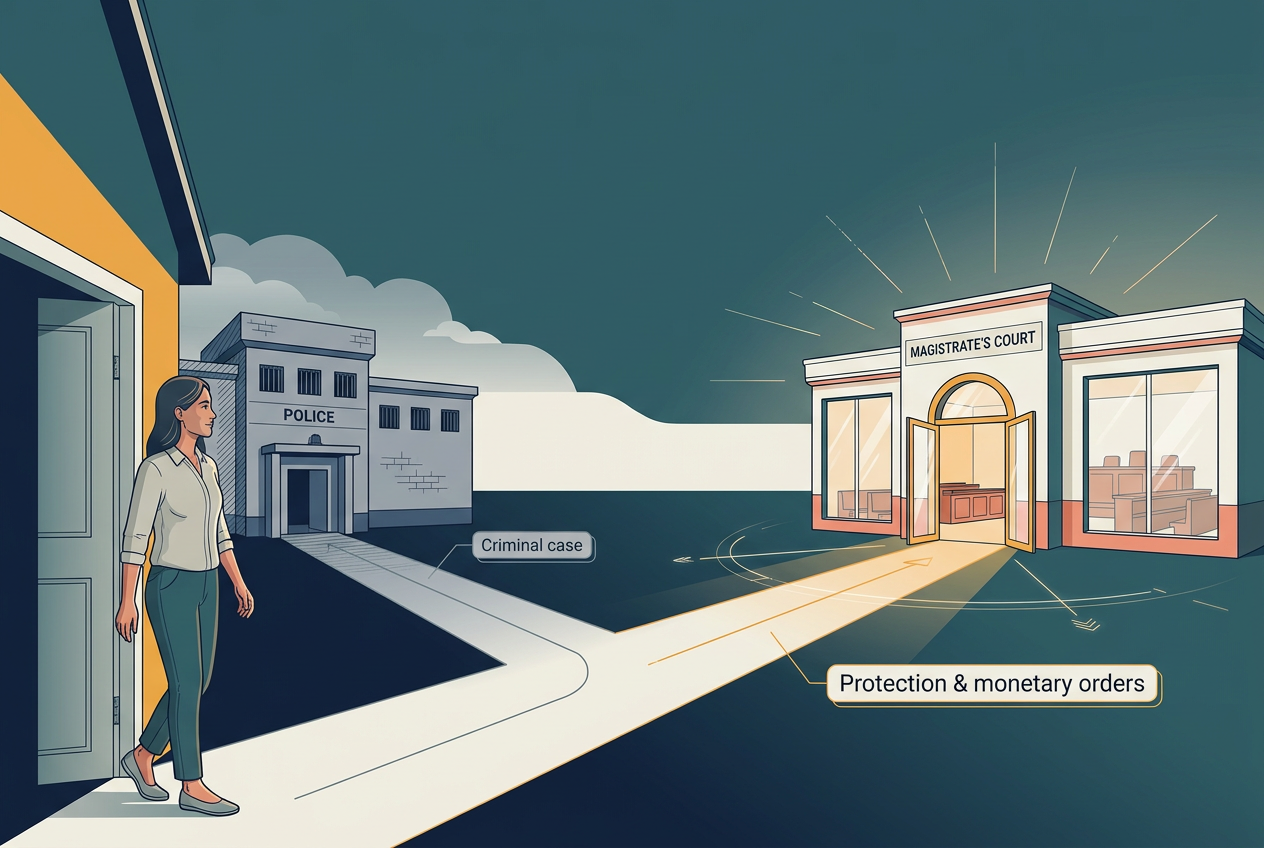
Fig. 19.0 – Legal paths for a woman facing domestic violence.
By the end of this chapter you will be able to answer each of these questions yourself.
19.1 Understanding Domestic Abuse and Violence against Women
Domestic abuse, also called domestic violence, is not a single quarrel or a single loss of temper. It is a pattern of behaviour within a domestic relationship, used by one person to gain or keep power and control over another.
That word “pattern” is doing real work. A one-off argument between two people who live together is not domestic violence; a steady course of conduct that keeps one person frightened, dependent or controlled is.
The forms abuse takes
Abuse is not only a blow. It may be physical, sexual, emotional, economic or psychological, and it includes both the actions themselves and threats of such actions used to influence another person.
Under this heading falls any behaviour that frightens, intimidates, terrorises, manipulates, hurts, humiliates, blames, injures or wounds someone. Cutting off a person’s access to money, or making her afraid of what will happen if she disobeys, is abuse just as surely as striking her is.
Who it affects
Domestic abuse can happen to anyone, of any race, age, sexual orientation, religion or gender. It is not confined to one kind of household.
It can occur across a range of relationships — couples who are married, couples living together, and couples who are dating. And it is found at every socio-economic level and every level of education. Wealth and degrees do not make a home safe.
19.2 The International Legal Framework
Long before India passed a special law on domestic violence, the subject was being argued over in international forums. Violence against women — including violence inside intimate relationships — has been a settled concern of international discourse and international legal frameworks for decades.
This matters for an Indian student for a practical reason. When Parliament had passed no law on a subject, Indian courts and lawmakers looked outward, to the standards India had already accepted internationally, and used them as the source of the rule.
CEDAW: the international bill of rights for women
The Convention on the Elimination of All Forms of Discrimination against Women, 1979 (CEDAW) is a United Nations treaty. It does two things: it defines what counts as discrimination against women, and it sets an agenda of national action for ending that discrimination.
CEDAW is often called the international bill of rights for women. India is among the very large number of countries — currently 189 States — that are parties to it, and each of them has committed itself to undertaking measures to end discrimination against women in all its forms.
Notice the word “commit”. A treaty binds the country that joins it in international law, but it does not by itself become the law inside India. It becomes a source of argument, of interpretation, and of pressure on Parliament — which is exactly the role CEDAW went on to play here.
Discrimination as violence: the 1992 recommendation
In 1992, the CEDAW Committee — the body of experts that monitors how States are performing under the Convention — made a recommendation that widened the whole field.
It said that any form of discrimination against women, or violation of women’s rights, amounts to violence. And it said something further that has shaped domestic law everywhere: the State is responsible for such violence, whether it is committed by the State itself or by private individuals.
That second half is the important one. The older assumption was that the State answers only for what its own officers do. After 1992, the accepted position is that a State which fails to protect a woman from violence inside her own home has also failed in its duty.
The 1993 Declaration: naming violence against women
The UN Declaration on Elimination of Violence against Women was adopted in 1993, and for the first time gave a working definition of the term. India is a party to this Declaration.
Three features of that definition are worth pausing on. It is gender-based — the violence is directed at a woman because she is a woman. It covers threats, not only completed acts. And it applies in private life as much as in public, which is what brings the family home inside its scope.
What the Declaration covers
The Declaration then sets out where such violence occurs. Within the family, it includes battering, sexual abuse of female children in the household, dowry-related violence, marital rape, female genital mutilation and other traditional practices harmful to women, non-spousal violence, and violence related to exploitation.
Outside the family, in the general community, it includes rape, sexual abuse, sexual harassment and intimidation at work, in educational institutions and elsewhere, trafficking in women, and forced prostitution.
To this the Declaration adds a third situation. Where violence is committed by the State, or overlooked by the State, that too amounts to violence against women. Looking away is itself a form of failure.
The UN Model Legislation, 1996
In 1996 the UN Commission on Human Rights created the UN Model Legislation on Domestic Violence. Its object was not to bind any country but to serve as a drafting guide — a template that States could use when framing a comprehensive domestic violence law of their own.
Its definition of domestic violence is deliberately wide, because the drafters wanted no form of abuse to fall through a gap in the wording.
Read that list once more and note how much of it is not physical. Threats, intimidation, coercion, stalking, humiliating verbal abuse and destruction of property all appear alongside battery. When India finally legislated in 2005, this breadth is what it carried across.
19.3 The Protection of Women from Domestic Violence Act, 2005
Before 2005, Indian law did not recognise “domestic violence” as a special category at all. Violence inside a home was dealt with only by borrowing tools built for other purposes — a criminal charge, or a petition for divorce.
In 2005, Parliament adopted the Protection of Women from Domestic Violence Act, 2005 (PWDVA). Its stated object is to give effective protection to women who are victims of violence occurring within the family, or in any way connected with the family sphere.
Where did the idea come from? Largely from the international framework studied in the previous section. India is a party both to CEDAW and to the UN Declaration on Elimination of Violence against Women, 1993, and the PWDVA conforms with the UN Model Legislation on Domestic Violence. The breadth of its definition is not an accident; it was drawn from a model already written.
Two gaps the Act was written to close
The adoption of the PWDVA addressed two specific concerns. Understanding them is the difference between remembering that a law exists and understanding why it had to exist.
Firstly, the family law reforms of the 1980s, such as the Family Courts Act, 1984, were built around the need to preserve the family at all costs. Reconciliation was the goal. A system whose instinct is to save the marriage does not naturally set itself to ending violence against a woman inside the private sphere of the home. The PWDVA was written precisely to address violence occurring in that private sphere.
Secondly, before 2005 domestic violence against a woman was treated as “cruelty”. As cruelty it was punishable under the criminal law, and it formed a ground for divorce under the family laws. Both routes existed — but notice what neither of them gave her.
Neither gave her a civil remedy: monetary relief or compensation, an order allowing her to remain in the house, or access to the support services a woman in that situation actually needs. A criminal case punishes a man; it does not house or feed the woman. A divorce ends a marriage; it does not stop the violence tomorrow morning. There was no comprehensive law supplying the civil side, and that is the hole the PWDVA was written to fill.
How the Act defines domestic violence
The PWDVA adopts a deliberately comprehensive definition. It takes in physical abuse, but also the other forms of violence within the family that show themselves in a woman’s life. The definition is in Section 3.
Read in plain terms, conduct of the respondent counts as domestic violence in four situations: where it harms or endangers her health, safety, life, limb or well-being, mental or physical; where it is used to coerce her over an unlawful dowry or property demand; where it threatens her or a person related to her through such conduct; or where it otherwise injures or harms her, physically or mentally.
Four words inside clause (a) carry most of the weight: physical, sexual, verbal and emotional, and economic abuse. Economic abuse — withholding money, or denying her the resources she is entitled to — is domestic violence under this Act, and so is sustained verbal and emotional abuse. Clause (a) also covers conduct that merely tends to harm, so a woman need not wait for the harm to be complete.
The support services the Act provides
The Act recognises that domestic violence affects a woman at several levels at once — her safety, her housing, her money, her health, her ability to reach a court. So alongside orders, it provides support services to help her deal with the situation. They are:
- mandatory assistance by medical facilities and shelter homes;
- provision for legal aid;
- counselling on the direction of the court;
- Protection Officers and Service Providers, who maintain a list of available facilities and facilitate her access to them.
Each of these answers a practical obstacle. A woman who has left a violent house needs somewhere to sleep and a doctor who will examine her; she usually cannot pay a lawyer; and she often does not know which office to walk into. The Act supplies all three, and then gives her a named officer whose job is to connect her to them.
19.4 Salient Features of the PWDVA
The previous section explained what the PWDVA covers. This section looks at how it is built — and its design is unusual enough that its features are regularly asked about in examinations.
A civil law, not a criminal one
The PWDVA is a civil law, except for Sections 31 and 33, where criminal proceedings are involved. Its primary object is to give the woman compensation and support, not to send a man to prison.
That is the opposite of criminal law, whose primary object is to punish the wrongdoer. The difference shows up most sharply in who drives the case. Enforcing a criminal law depends on the State, the police and the prosecution lawyer; the woman is a witness in someone else’s case. Being a civil law, the PWDVA is victim-driven — she has direct access to the court herself.
It follows that the rights and reliefs under the Act can be set in motion only with the consent of the woman. Nobody can force a proceeding on her, and nobody can continue one she does not want.
The two are not rivals. A woman may be pursuing both at once, and the Act is drafted on that assumption.
Emergency relief, and a law that adds rather than replaces
The Act provides for “stop violence” orders — emergency reliefs meant to halt the violence immediately, rather than at the end of a long trial. Speed is the point: a woman in danger this week cannot be told to return in two years.
The PWDVA is also an additional law. It does not take away her other remedies; she remains free to enforce other laws, such as the divorce laws, at the same time.
Access to justice and access to support
For the law to work in practice, the Act offers two things together: access to justice, and access to support systems. The machinery for this is shown in Fig. 19.1.
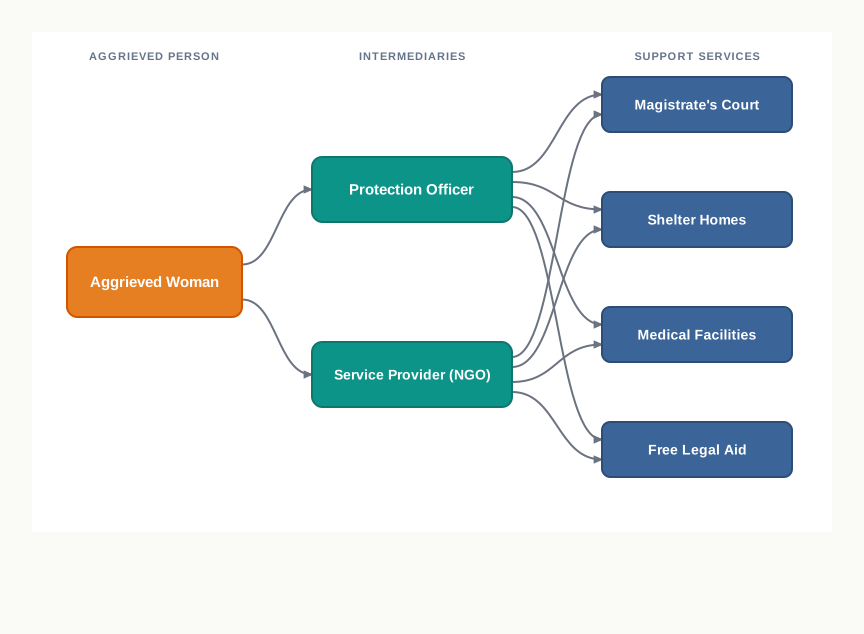
Fig. 19.1 – The PWDVA support machinery.
Protection Officers are the link in this design. They operate as a nexus between the court and the woman, so that the justice system is actually reachable by her. These officers are usually women. Their role includes:
- assisting women in filing applications seeking the various reliefs under the Act;
- assisting the magistrate in the discharge of his functions;
- making women aware of their right to free legal aid; and
- providing women with shelter homes, medical services and similar facilities.
Service Providers are the second limb. These are non-governmental organisations that voluntarily register under the Act, and they deliver the essential support a woman may need — shelter, medical facilities and the like.
Why build NGOs into a statute at all? Because of a simple human fact the drafters accepted: a woman will often feel far more comfortable walking into an NGO office than into a police station or a government department. A remedy she is too frightened to approach is not a remedy.
The single window clearance system
The Act stipulates a single window clearance system to help a woman reach the justice system without being sent from forum to forum. The practical effect is that she can use the PWDVA to obtain civil reliefs available under other laws as well, including in matters running alongside the criminal law.
Take the base book’s own example. A divorce petition is pending, and she also wants to enforce her right not to be dispossessed from the house, in a situation where cruelty under Section 498A of the Indian Penal Code is in issue. Instead of filing separate proceedings in separate forums, she brings the claim in one PWDVA proceeding — a possibility the Act itself creates by allowing its reliefs to be sought in other pending legal proceedings under Section 26.
The gain is not merely convenience. Every additional forum is another set of fees, another set of dates, and another chance that a woman with no independent income will simply give up.
Counselling — and the criticism of it
The Act provides that the magistrate may, at any stage of the proceedings, direct either one or both parties to undertake counselling with a member of a service provider who holds the required qualification and experience in counselling.
Women’s groups have been critical of this provision. Their concern is that counselling is often used as a tool for preserving the marriage, and that preserving the marriage can mean placing the woman back into the very situation she escaped from.
The duty on governments
Finally, the PWDVA does not stop at courts. It puts responsibility on the Central and State Governments for the training and sensitisation of the general public as well as of the State authorities, including the judiciary.
A law of this kind is only as good as the officials who apply it. Sensitisation is written into the statute because the drafters knew that an unsympathetic police officer or magistrate can defeat a well-drafted section entirely.
Where the Act came from
In matters of violence against women, the international legal standards studied earlier played an inspirational role for Indian stakeholders — the judiciary, the lawmakers and the many women’s groups working in the field. The PWDVA itself drew heavily on those standards.
And this did not begin in 2005. Even before the PWDVA was enacted, the Indian judiciary relied on the international legal framework for inspiration when deciding cases concerning violence against women and fashioning civil remedies for them. The next section takes up the most famous instance of exactly that.
19.5 Sexual Harassment of Women at the Workplace
Violence against women does not stop at the front door of the home. A woman spends a large part of her life at work, and the law’s second major intervention deals with what happens to her there.
The governing statute is the Sexual Harassment of Women at Workplace (Prevention, Prohibition and Redressal) Act, 2013, universally known as the POSH Act. Its title states its own scheme: three duties, in that order — prevent harassment before it happens, prohibit it, and redress it when it does.
The Act was enacted with the object of making workplaces safer for women by preventing, prohibiting and redressing acts of sexual harassment against them at the workplace. It was made effective throughout India on 9 December 2013 by the Ministry for Women and Child Development.
Before the Act: a law made by the Court
The history of the POSH Act is not a story about Parliament. It is a story about what a court does when Parliament has done nothing.
Many women’s rights groups and non-governmental organisations, demanding action against sexual harassment of women at the workplace, filed a case in the Supreme Court in the interest of women’s protection. It was brought as a public interest litigation — also described as social action litigation, meaning a petition filed not by the injured person for herself, but by others acting in the public interest.
The origin of that case goes back to 1992. Bhanwari Devi, a woman from a marginalised caste, worked as a social or grassroots worker with the Rajasthan Government’s women’s development project. In the course of that work she tried to stop a child marriage in her village. She was gang raped by a group of men from a dominant caste in retaliation.
What followed in the courts is as much a part of the case as the assault itself. The trial court acquitted the accused — that is, set them free of the charge — and its stated reasoning included the assumption that men of an upper caste could not have raped a woman of a lower caste. Her allegation had already been rejected at every earlier stage: by the village authorities, by the doctors, and by the police.
The Vishaka guidelines
At that time there was no Indian law dealing specifically with sexual harassment of women at the workplace. Faced with that vacuum, the Supreme Court did something remarkable: it turned to the international framework India had already accepted, referred to the Convention on the Elimination of All Forms of Discrimination against Women, and laid down a set of standards of its own — the Vishaka guidelines.
The guidelines included the following:
- it is the onus of the employer to include a rule in the company code of conduct for preventing sexual harassment;
- organisations must establish complaint committees, and these committees must be headed by women;
- disciplinary action must be initiated against offenders, and the interests of the victim safeguarded; and
- female employees must be made aware of their rights.
For the very first time, the Supreme Court recognised an obvious legislative insufficiency — a gap Parliament had left — and recognised sexual harassment at the workplace as a violation of human rights.
The judgment stated that until a legal structure on the subject was formulated and adopted, the guidelines would hold the field. The Court was hearing the petition under Article 32 of the Constitution, which is what brought the matter before it; the reason its declarations bind everyone thereafter is that a declaration of law by the Supreme Court is binding on all courts in India.
From guidelines to statute
The Sexual Harassment of Women at Workplace (Prevention, Prohibition and Redressal) Act, 2013 is based on the Vishaka guidelines. Its aim is to create a proper mechanism for the redressal of sexual harassment complaints at the workplace.
Read the guidelines and the Act together and the continuity is plain. The duty the Court placed on the employer became a statutory duty; the complaint committee headed by a woman became a committee the statute requires; and the obligation to make women aware of their rights became a legal requirement rather than good practice.
19.6 Summary
- Domestic abuse, also called domestic violence, is a pattern of behaviour in a domestic relationship used to gain or maintain power and control over another person.
- A single quarrel is not domestic violence; a continuing course of conduct aimed at control is.
- Abuse may be physical, sexual, emotional, economic or psychological, and includes threats of such actions as well as the actions themselves.
- It covers any behaviour that frightens, intimidates, terrorises, manipulates, hurts, humiliates, blames, injures or wounds a person.
- Domestic abuse can affect anyone of any race, age, sexual orientation, religion or gender, and occurs in marriages, in live-in relationships and in dating relationships, at every socio-economic and educational level.
- The Convention on the Elimination of All Forms of Discrimination against Women, 1979 (CEDAW) is a United Nations treaty that defines discrimination against women and sets an agenda for national action; it is called the international bill of rights for women, and India is a party to it.
- In 1992, the CEDAW Committee recommended that any form of discrimination against women or violation of their rights amounts to violence, and that the State is responsible for such violence whether committed by the State or by private individuals.
- The UN Declaration on Elimination of Violence against Women, 1993, to which India is a party, defines violence against women as any gender-based violence that results in, or is likely to result in, physical, sexual or psychological harm or suffering to women, including threats, coercion and arbitrary deprivation of liberty, in public or in private life.
- The Declaration covers violence within the family, violence in the general community, and violence committed or overlooked by the State.
- In 1996, the UN Commission on Human Rights created the UN Model Legislation on Domestic Violence as a drafting guide for comprehensive national legislation.
- Before 2005, Indian law did not recognise domestic violence as a special category; it was treated as cruelty, punishable under the criminal law and available as a ground for divorce.
- The Protection of Women from Domestic Violence Act, 2005 (PWDVA) was adopted to give effective protection to women facing violence within the family or connected with the family sphere.
- The PWDVA closed two gaps:
- the family law reforms of the 1980s, such as the Family Courts Act, 1984, focused on preserving the family and not on ending violence in the private sphere;
- no comprehensive law provided civil remedies such as monetary relief, compensation and support services.
- Section 3 of the PWDVA defines domestic violence as any act, omission or commission or conduct of the respondent that:
- harms, injures or endangers the health, safety, life, limb or well-being, mental or physical, of the aggrieved person, or tends to do so, and includes physical abuse, sexual abuse, verbal and emotional abuse and economic abuse; or
- harasses, harms, injures or endangers her to coerce her or a person related to her to meet an unlawful demand for dowry, other property or valuable security; or
- has the effect of threatening her or any person related to her by such conduct; or
- otherwise injures or causes harm, physical or mental, to the aggrieved person.
- The support services under the PWDVA are:
- mandatory assistance by medical facilities and shelter homes;
- provision for legal aid;
- counselling on the direction of the court;
- Protection Officers and Service Providers to maintain a list of facilities and facilitate access to them.
- The PWDVA is a civil law except Sections 31 and 33, where criminal proceedings are involved, and its object is compensation and support rather than punishment.
- Being a civil law, it is victim-driven: the woman has direct access to the court, and its rights and reliefs can be initiated only with her consent.
- Domestic relationships under the Act are described broadly to include wives, mothers, sisters, daughters and live-in partners.
- Protection is not confined to the matrimonial home but extends to the shared household.
- The Act provides ‘stop violence’ orders giving emergency relief, and is an additional law that leaves a woman free to enforce other laws, such as the divorce laws.
- Protection Officers, usually women, act as a nexus between the court and the woman, assisting her in filing applications, assisting the magistrate, informing her of free legal aid, and arranging shelter and medical services.
- Service Providers are non-governmental organisations that register voluntarily under the Act and deliver shelter, medical and other essential support, which women are often more comfortable approaching than the police.
- The single window clearance system allows a woman to seek reliefs available under other laws in one PWDVA proceeding, under Section 26, avoiding multiple suits in different forums.
- The magistrate may at any stage direct one or both parties to undertake counselling with a qualified member of a service provider; women’s groups criticise this as a device for preserving the marriage and returning the woman to a violent situation.
- The PWDVA places responsibility on the Central and State Governments for training and sensitisation of the public and of State authorities, including the judiciary.
- International legal standards inspired Indian lawmakers, courts and women’s groups, and the Indian judiciary relied on them even before the PWDVA was enacted.
- In Vishaka v. State of Rajasthan, AIR 1997 SC 3011, filed as a public interest litigation after the gang rape of a grassroots social worker who had tried to stop a child marriage, the Supreme Court found no Indian law on sexual harassment at the workplace and referred to CEDAW to lay down the Vishaka guidelines.
- The Vishaka guidelines require the employer to include a preventive rule in the code of conduct, require organisations to set up complaint committees headed by women, require disciplinary action against offenders with protection of the victim’s interests, and require female employees to be made aware of their rights.
- The Court recognised sexual harassment at the workplace as a violation of human rights, and held that until Parliament legislated, the guidelines would have the force of law and bind organisations in both the commercial and public sectors.
- The Sexual Harassment of Women at Workplace (Prevention, Prohibition and Redressal) Act, 2013, known as the POSH Act, is based on the Vishaka guidelines and creates a mechanism for the redressal of sexual harassment complaints at the workplace.
- The POSH Act was made effective throughout India on 9 December 2013 by the Ministry for Women and Child Development.
19.7 Key Terms
Domestic abuse (domestic violence) — a pattern of behaviour in a domestic relationship used to gain or maintain power and control over another person.
Economic abuse — abuse that works through money and resources, such as withholding a woman’s earnings or denying her the means she is entitled to.
CEDAW — the Convention on the Elimination of All Forms of Discrimination against Women, 1979, a United Nations treaty defining discrimination against women and setting an agenda for national action, often called the international bill of rights for women.
Gender-based violence — violence directed at a person because of her gender.
Violence against women — any act of gender-based violence that results in, or is likely to result in, physical, sexual or psychological harm or suffering to women, including threats, coercion and arbitrary deprivation of liberty, whether in public or private life.
UN Model Legislation on Domestic Violence — a drafting guide created by the UN Commission on Human Rights in 1996 to help States frame comprehensive domestic violence laws.
PWDVA — the Protection of Women from Domestic Violence Act, 2005, the Indian law giving civil remedies and support services to women facing violence within the family sphere.
Private sphere — the domain of the home and family relationships, as distinguished from public life.
Civil remedy — relief that compensates, protects or restores a person, such as a monetary order or a residence order, as opposed to punishment of the wrongdoer.
Aggrieved person — under the PWDVA, the woman who alleges that she has been subjected to domestic violence.
Respondent — the person against whom relief is sought under the PWDVA.
Domestic relationship — a relationship between persons living or having lived together in a shared household, described broadly under the PWDVA to include wives, mothers, sisters, daughters and live-in partners.
Shared household — the household in which the aggrieved woman lives or has lived in a domestic relationship, protection of which is not confined to the matrimonial home.
Victim-driven proceeding — a proceeding that the affected person herself initiates and controls, rather than one driven by the State machinery.
Stop violence order — an emergency relief under the PWDVA meant to halt the violence immediately rather than at the end of a trial.
Protection Officer — an officer under the PWDVA, usually a woman, who acts as a link between the aggrieved woman and the court and connects her to legal aid, shelter and medical services.
Service Provider — a non-governmental organisation voluntarily registered under the PWDVA that delivers shelter, medical and other essential support to the woman.
Single window clearance system — the arrangement allowing a woman to seek reliefs available under other laws within one PWDVA proceeding, so that she need not file separate suits in different forums.
Public interest litigation (social action litigation) — a petition filed in the public interest by persons other than the injured individual, on behalf of those unable to approach the court themselves.
Vishaka guidelines — the standards laid down by the Supreme Court in 1997 to prevent sexual harassment of women at the workplace, which had the force of law until Parliament legislated.
POSH Act — the Sexual Harassment of Women at Workplace (Prevention, Prohibition and Redressal) Act, 2013, which prevents, prohibits and redresses sexual harassment of women at the workplace.
Complaint committee — the committee an organisation must establish, headed by a woman, to receive and deal with complaints of sexual harassment at the workplace.
19.8 Points to Ponder
India had criminal law punishing cruelty long before 2005. Why did that not remove the need for a civil law like the PWDVA? What does a woman gain from a civil remedy that a conviction cannot give her?
The PWDVA can be set in motion only with the consent of the woman. Does leaving the choice entirely to her strengthen her position, or does it place the burden of a difficult decision on the person least able to bear it?
The family law reforms of the 1980s aimed at preserving the family. When the goal of preserving a family conflicts with the goal of protecting a woman inside it, which should the law prefer, and why?
A magistrate may direct parties in a domestic violence proceeding to undergo counselling. Should counselling ever be directed in a case built on power and control, or should it only be available if the woman asks for it?
Service Providers are non-governmental organisations, yet they are written into a statute. What does it tell us about the justice system that a woman may find an NGO easier to approach than a police station, and what should be done about that?
In Vishaka, the Supreme Court framed binding guidelines because Parliament had not legislated. Is it healthy for a court to fill a legislative gap in this way, or does it blur the line between making law and applying it?
India accepted CEDAW long before it enacted either the PWDVA or the POSH Act. What use is an international treaty in the years between a country accepting it and passing a law to give it effect?
The PWDVA obliges governments to sensitise the public and the authorities, including the judiciary. Why would a legislature think a statute needs sensitisation written into it, and what does that suggest about how laws fail in practice?
Sixteen years passed between the Vishaka guidelines and the POSH Act. What does that gap tell you about how legal change actually happens in India?
19.9 Textbook Questions
- Answer the following briefly:
- What is CEDAW?
- What is the PWDVA? State the support services provided to women under the PWDVA.
- What guidelines were issued by the Supreme Court in Vishaka & Others v. State of Rajasthan?
- Trace the evolution of the POSH Act, 2013 in India.
- The concern for ‘violence against women’, including violence in intimate relationships, has existed significantly in international discourse and legal frameworks.
- Which United Nations instrument defines ‘violence against women’?
- How did the Indian Parliament respond to the rising cases of domestic violence?
- State a few salient features of that Act.
19.10 Objective Questions
The Convention on the Elimination of All Forms of Discrimination against Women was adopted in the year:
- 1975
- 1979
- 1993
- 1996
CEDAW is often described as:
- the international bill of rights for women
- the model law on domestic violence
- the charter of workplace safety
- the universal declaration on family rights
The UN Declaration on Elimination of Violence against Women was adopted in:
- 1979
- 1992
- 1993
- 2005
The UN Model Legislation on Domestic Violence, 1996 was created by:
- the UN General Assembly
- the UN Commission on Human Rights
- the CEDAW Committee
- the International Labour Organization
Domestic violence is defined in which provision of the Protection of Women from Domestic Violence Act, 2005?
- Section 2
- Section 3
- Section 26
- Section 31
The PWDVA is a civil law except for:
- Sections 3 and 5
- Sections 12 and 17
- Sections 26 and 31
- Sections 31 and 33
Which of the following is NOT a support service provided under the PWDVA?
- Mandatory assistance by medical facilities and shelter homes
- Provision for legal aid
- Counselling on the direction of the court
- Immediate imprisonment of the respondent
Under the PWDVA, Service Providers are:
- officers appointed by the State Government
- non-governmental organisations that register voluntarily under the Act
- lawyers empanelled by the magistrate
- members of the police force trained in family matters
The single window clearance system under the PWDVA is given effect by:
- Section 3
- Section 17
- Section 26
- Section 33
The citation of the Supreme Court judgment that laid down guidelines against sexual harassment at the workplace is:
- AIR 1997 SC 3011
- AIR 1962 SC 605
- AIR 1993 SC 1960
- AIR 2005 SC 1112
The POSH Act was made effective throughout India on:
- 9 December 2013
- 26 October 2006
- 13 August 1997
- 1 January 2014
According to the Vishaka guidelines, complaint committees in organisations must be:
- headed by the senior-most employee
- headed by a woman
- headed by an external lawyer
- headed by a police officer
Assertion (A): Proceedings under the PWDVA are described as victim-driven. Reason (R): Being a civil law, the PWDVA gives the woman direct access to the court, and its reliefs can be initiated only with her consent.
Assertion (A): The protection of the PWDVA is not limited to a woman’s matrimonial home. Reason (R): The Act extends its protection to the shared household, which allows mothers, sisters and daughters to claim under it.
Assertion (A): Withholding a woman’s earnings can amount to domestic violence even if she is never struck. Reason (R): Section 3 of the PWDVA expressly includes verbal and emotional abuse and economic abuse within domestic violence.
Assertion (A): The Vishaka guidelines had the force of law when they were laid down. Reason (R): At that time no Indian legislation dealt specifically with sexual harassment of women at the workplace, and the Court declared that the guidelines would bind organisations until Parliament legislated.
Assertion (A): Women’s groups have criticised the counselling provision of the PWDVA. Reason (R): Counselling is often used as a tool for preserving the marriage, which can return the woman to a violent situation.
Assertion (A): A State may be held responsible for violence against women committed inside a private home. Reason (R): In 1992 the CEDAW Committee recommended that the State is responsible for such violence whether it is committed by the State itself or by private individuals.
19.11 Check Your Concepts
Why does the definition of domestic abuse speak of a ‘pattern of behaviour’ rather than a single act? What difference does that word make when a court is deciding whether conduct amounts to domestic violence?
State the four forms of abuse expressly named in Section 3 of the PWDVA, and give one example of each drawn from everyday life.
Distinguish between proceedings under the PWDVA and a criminal prosecution on the bases of nature of law, primary object, who drives the case, and the outcome each produces.
Why was a civil law on domestic violence thought necessary in 2005, when the criminal law already punished cruelty and the family laws already made it a ground for divorce?
What happens to a PWDVA proceeding if the aggrieved woman does not consent to it being initiated? What principle of the Act does this illustrate?
The family law reforms of the 1980s were built around preserving the family. Explain how this aim left a gap that the PWDVA was written to fill.
Identify the provision: which section of the PWDVA defines domestic violence, and which section makes the single window clearance system possible?
Explain the meaning of ‘shared household’ and state why the shift from ‘matrimonial home’ to ‘shared household’ widened the reach of the Act.
Distinguish between a Protection Officer and a Service Provider under the PWDVA, with reference to who they are, how they come into the system, and what each does.
Why did Parliament build non-governmental organisations into the structure of the PWDVA instead of relying only on the police and government departments?
State the four support services provided to women under the PWDVA, and explain the practical obstacle each one is meant to remove.
What is meant by saying that the PWDVA is an ‘additional’ law? Give an example of another proceeding a woman may pursue at the same time.
Why does the PWDVA provide for ‘stop violence’ orders separately, when the Act already allows a woman to seek final reliefs from the magistrate?
Correct the error in the following statement and explain your correction: “Under the PWDVA, only a wife may complain, and only in respect of the house belonging to her husband.”
Correct the error in the following statement and explain your correction: “The Vishaka guidelines were issued by Parliament in 1997 and were replaced by the POSH Act in 2013.”
Why does the PWDVA place a duty on the Central and State Governments to train and sensitise state authorities, including the judiciary? What does that duty suggest about how a law can fail even after it is enacted?
Explain the significance of the 1992 recommendation of the CEDAW Committee for the responsibility of a State towards violence occurring inside private homes.
Distinguish between CEDAW, 1979 and the UN Declaration on Elimination of Violence against Women, 1993 in terms of what each is and what each does.
What is the UN Model Legislation on Domestic Violence, 1996, and why does a document that binds no country still matter to Indian law?
Arrange the following in the order in which they occurred, and state the year of each: the POSH Act; the Vishaka judgment; CEDAW; the PWDVA; the UN Declaration on Elimination of Violence against Women.
State the four Vishaka guidelines, and show how each one is reflected in the scheme of the POSH Act.
The Supreme Court in Vishaka relied on an international convention to lay down binding standards. Explain why it did so, and what this tells you about the use of international law when a domestic statute is absent.
Why do women’s groups object to the counselling provision of the PWDVA? State the argument on the other side as well.
A woman is facing a pending divorce petition and also wishes to prevent being dispossessed from her house. Explain how the single window clearance system helps her, and what she would have had to do without it.
19.12 Case-Based Questions
- Sunita is thirty-four and unmarried. She lives in her parents’ house along with her brother and his family, and has lived there all her life. For the past year her brother has taken her salary each month, refused to return any part of it, and told her repeatedly that she will be put out of the house if she complains to anyone. He has never assaulted her. Sunita does not want her brother prosecuted; she wants to keep living in the house and to have her earnings restored.
- Is Sunita in a ‘domestic relationship’ for the purposes of the PWDVA, and is the house a ‘shared household’? Give reasons.
- Does conduct that involves no physical assault fall within Section 3 of the Act? Identify the clause and the form of abuse involved.
- Sunita is unwilling to start a criminal case. Explain why the PWDVA still gives her a route to the reliefs she wants.
- Would your answer to (a) change if Sunita had never lived in that house and had only visited her parents occasionally? Explain what turns on this fact.
- Rekha has been married for two years. Her husband’s family has repeatedly demanded that her parents transfer a plot of land to them, and when the demand is refused, Rekha is threatened and confined to one room of the house for days at a time. Her mother-in-law tells her that the threats will stop the day the land is transferred.
- Which clause of Section 3 of the PWDVA is most directly attracted by these facts, and why?
- Rekha’s parents are also being threatened. Does the Act take any account of conduct directed at persons related to the aggrieved woman?
- Rekha wants the threats stopped immediately and does not want to wait for a full trial. What kind of relief under the Act is designed for this situation?
- Would the position under Section 3 be different if the demand had been for repayment of a lawful loan the family had actually advanced? Explain what changes.
- Anjali has lived with her partner for six years without marrying him. After a series of incidents she leaves the house and approaches a local non-governmental organisation, which is registered under the PWDVA. The organisation arranges a place for her to stay and a medical examination, and puts her in touch with the Protection Officer of the district. She later files an application before the magistrate. At the first hearing, the magistrate directs both parties to undertake counselling.
- Can a woman who is not married to the respondent claim protection under the PWDVA? Give reasons.
- Identify the role played here by the Service Provider and by the Protection Officer, and explain how the two differ.
- Is the magistrate empowered to direct counselling at this stage? State the provision’s requirement as to who may conduct it.
- State the criticism women’s groups have made of the counselling provision, and explain why it is thought to be a particular risk in a case like Anjali’s.
- Meenakshi joins a private company with about two hundred employees. A senior colleague repeatedly makes remarks of a sexual nature to her and suggests that her confirmation in the job depends on how she responds. She looks for the company’s internal complaints mechanism and finds that none exists, that the code of conduct says nothing on the subject, and that no employee has been told of any right to complain.
- Which of the Vishaka guidelines has the employer failed to observe? List them.
- Explain the relationship between the Vishaka guidelines and the POSH Act, and state which of them governs Meenakshi’s complaint today.
- The Supreme Court described sexual harassment at the workplace as a violation of a particular category of rights. State which, and explain why that description matters.
- Would the employer’s position be any better if it argued that Parliament had passed no law on the subject at the time the guidelines were laid down? Explain.
- Farida is subjected to sustained verbal abuse and humiliation by her husband and his relatives. A criminal complaint is registered by the police, and the case is in progress. Farida is separately advised that the criminal case will not secure her a place to live or any money to live on, and that she must file three different proceedings in three different forums to obtain those reliefs.
- Is the advice about the criminal case correct? Explain what a criminal prosecution can and cannot give her.
- Is the advice about three separate proceedings correct? Identify the feature of the PWDVA that answers this, and the provision that gives effect to it.
- The PWDVA is described as an ‘additional’ law. Explain how the pending criminal case and a PWDVA application can exist side by side.
- Why does the Act’s design assume that a woman with no independent income may abandon her claim if she is sent from forum to forum?
19.13 Landmark Cases & Maxims
State, in two or three sentences, the principle settled by the Supreme Court in Vishaka v. State of Rajasthan, and give the citation of the judgment.
An incident of sexual harassment at a workplace takes place in 2005. Which set of standards governed the employer’s duty at that time, and what gave those standards their binding force in the absence of a statute?
Match each failure in Column A with the Vishaka guideline it breaches in Column B.
| Column A | Column B |
|---|---|
| a. The company’s code of conduct contains no rule on preventing sexual harassment | i. Female employees shall be made aware of their rights |
| b. The organisation has no committee to receive complaints | ii. It is the onus of the employer to include a preventive rule in the code of conduct |
| c. No employee has ever been informed of any right to complain | iii. Disciplinary action must be initiated against offenders and the victim’s interests safeguarded |
| d. A complaint is proved but the offender faces no consequence | iv. Organisations must establish complaint committees headed by women |
A public sector undertaking argues that the Vishaka guidelines were addressed only to private commercial organisations and did not bind it. Is this argument correct? Support your answer from the terms of the judgment.
Vishaka was filed as a public interest litigation, also called social action litigation. Explain what this meant for who was entitled to bring the case, and why that mattered on these facts.
Which authority governs each of the following, and why: (a) the duty of an employer today to provide a redressal mechanism for sexual harassment complaints; and (b) the right of a woman to remain in the shared household despite a pending divorce petition?
The Supreme Court in Vishaka drew on an international convention that India had accepted. Name the convention, and state the proposition about the use of international standards in Indian courts that the case is now cited for.