Chapter 13: Criminal Courts and Criminal Justice System
On the night of 30 June 2024, police stations across India stayed awake for an unusual reason. At one minute past midnight, three laws that had governed Indian criminal justice for over a century stopped applying to fresh offences — the Indian Penal Code of 1860, the Code of Criminal Procedure of 1973 and the Indian Evidence Act of 1872. In their place stood the Bharatiya Nyaya Sanhita, the Bharatiya Nagarik Suraksha Sanhita and the Bharatiya Sakshya Adhiniyam. Every complaint written down after that moment carried a new set of section numbers.
Now picture something ordinary happening under these new laws. A Class XI student is travelling home by train when his bag is snatched at a station two districts away from where he lives. He reaches home shaken, and his family walks into the nearest police station — a station that has nothing to do with the place where the theft happened. Should the officer send them away? Must a report be written down at all? Can the police pick up the suspect straight away, or do they need a court’s permission first? And if the suspect is picked up, can he walk out of custody the same evening?
Every one of those questions has a legal answer, and the answers are the subject of this chapter.

Fig. 13.0 – The journey of a criminal case.
You cannot answer these questions yet — but by the end of this chapter, you will be able to answer every one of them, and to point to the provision that supplies the answer.
13.1 Introduction to the New Criminal Laws
In 2024 India carried out the biggest change to its criminal law since Independence. Three statutes that had run the system for more than a century were replaced together, on the same day, by three new ones.
The three laws that went out were the Indian Penal Code, 1860, which listed offences and their punishments; the Code of Criminal Procedure, 1973, which laid down the procedure to be followed from the first complaint to the final appeal; and the Indian Evidence Act, 1872, which decided what a court may accept as proof. All three came out of the colonial period.
The three new enactments came into force on 1 July 2024:
- the Bharatiya Nyaya Sanhita, 2023 (BNS), replacing the Indian Penal Code;
- the Bharatiya Nagarik Suraksha Sanhita, 2023 (BNSS), replacing the Code of Criminal Procedure;
- the Bharatiya Sakshya Adhiniyam, 2023 (BSA), replacing the Indian Evidence Act.
Notice how the three fit together, as set out in Fig. 13.1. One tells you what is an offence, the second tells you how the State proceeds against it, and the third tells you what proof the court will look at. A criminal case cannot move without all three.
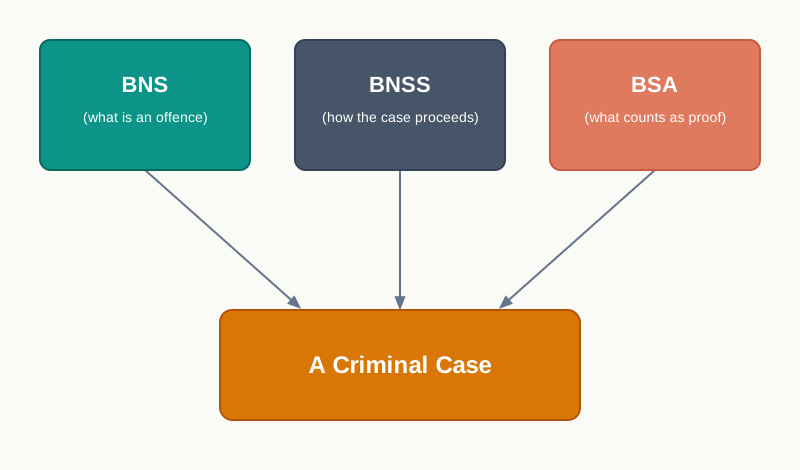
Fig. 13.1 – The three new criminal laws.
Why the change was made
The stated aim of the reform was to make criminal justice more modern, more technology-friendly and better suited to present-day needs, and to move away from statutes inherited from British rule. The new laws bring in electronic records, video-recorded procedures and fixed timelines at several stages — features the older codes were never written for.
One point often missed: the old codes did not vanish altogether on 1 July 2024. A case about an offence committed before that date continues under the old law, because a person is tried under the law as it stood when the act was done. This is why courts today still hear matters running on the Indian Penal Code even though it no longer applies to fresh offences.
Throughout this chapter, therefore, section numbers are those of the BNS and the BNSS unless stated otherwise.
13.2 Meaning of Crime
Not every wrong a person suffers is a crime. If a neighbour breaks a promise to sell you a cycle, you have a grievance, but the police will not step in. If the same neighbour breaks into your house and takes the cycle, the State itself moves against him. What separates the two is that the second act has been declared punishable by law.
Under the Bharatiya Nyaya Sanhita, 2023, a crime is an act or an omission that the law declares punishable. An act is something a person does; an omission is something a person fails to do when the law required it to be done. Both can amount to a crime, because the law is concerned with harm, not only with movement.
A crime therefore has three features:
- there is a wrongful act, or a failure to act where the law demanded action;
- that act or failure violates a legal prohibition;
- the law prescribes a punishment for it.
All three must be present together. A selfish act that no statute forbids is not a crime, however much it is disapproved of. Equally, a prohibition with no punishment attached to it does not create an offence.
Why a crime is a wrong against society
A crime is treated as an offence against the State and against society, even when the immediate harm falls on one individual. This is why the case is titled State v. the accused and not victim v. the accused, why a public prosecutor and not the victim’s own lawyer conducts the case, and why a victim cannot simply “withdraw” most criminal cases at will.
The reasoning is straightforward. A theft harms the person robbed, but it also tells everyone else that property is unsafe. The injury to public confidence belongs to the whole community, so the community — acting through the State — takes on the task of prosecuting.
What the BNS covers
The offences set out in the BNS fall into broad groups, shown in Fig. 13.2: offences against the human body, offences against property, offences against public order, offences against women and children, and cyber-related offences.
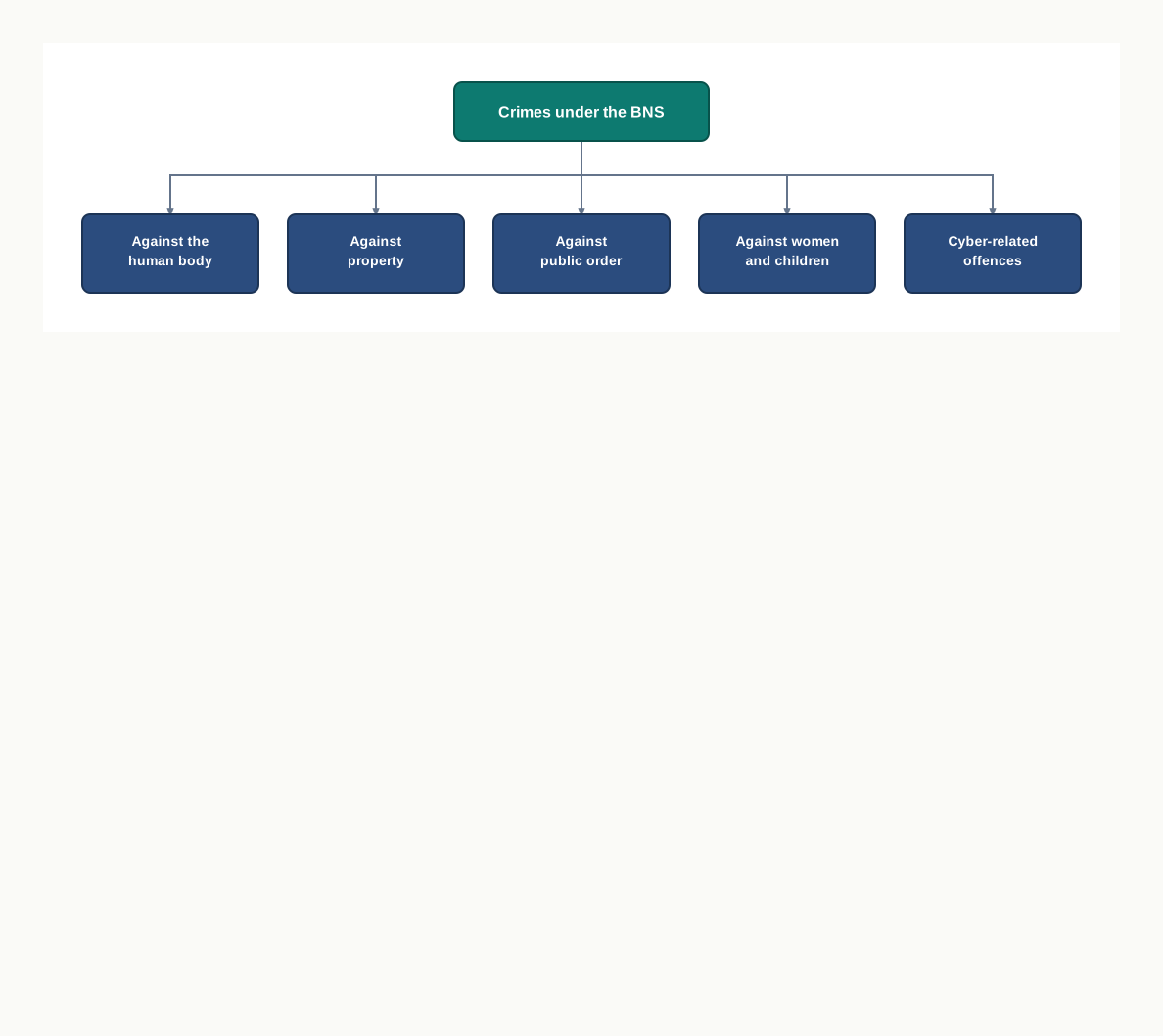
Fig. 13.2 – Categories of offences under the BNS.
The new law places its emphasis on three things — definitions stated clearly enough to be applied without confusion, deterrence, and accountability of those who exercise power under the criminal process.
13.3 Categories of Offences
Offences are not all of the same weight. Pushing someone in a queue and killing someone are both wrongs, but the law cannot treat them alike. So every offence is sorted according to how serious it is, and that sorting decides what the police may do, what the accused may claim, and whether the matter can ever be settled privately.
Three questions are asked about every offence:
- Cognizability — may the police act on their own, or must they first get a court’s permission?
- Provision for bail — is release on bail a right of the accused, or a favour the court may or may not grant?
- Compoundability — may the victim and the accused settle the matter between themselves, or must the court see it through?
These three questions are independent of one another, as Fig. 13.3 shows. The same offence carries an answer on all three at once — it may be cognizable and non-bailable and non-compoundable. Learning to read all three labels together is the skill this section is teaching.
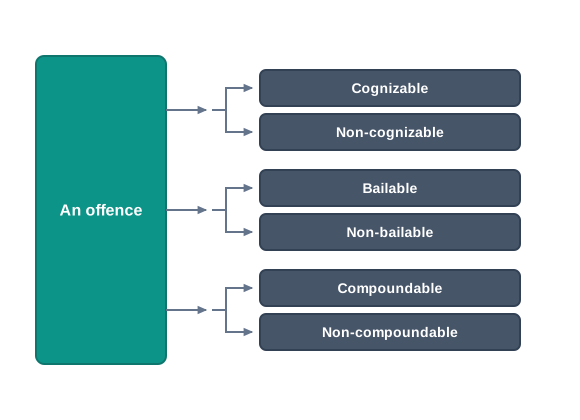
Fig. 13.3 – The three dimensions of an offence.
Cognizable and Non-Cognizable Offences
Cognizable offences are the serious ones. Here the police may register an FIR and begin investigating at once, and may arrest the accused without first obtaining a court’s permission. Murder, rape, robbery and serious assault fall in this group. The reason is practical: in grave offences, evidence disappears and suspects flee within hours, so the law does not make the police wait for a court order before moving.
Non-cognizable offences are the less serious ones. Here the police cannot investigate or arrest without the permission of a Magistrate. Defamation, public nuisance and minor hurt are examples. The information is still recorded, but the matter goes to the Magistrate, who decides whether police machinery should be set in motion at all. This protects ordinary people from having the police turned on them over small disputes.
Bailable and Non-Bailable Offences
In a bailable offence the accused has a legal right to be released on bail. It is not a request the court weighs; once the accused is ready to furnish the bond or surety required, release follows. Bail in these cases is generally granted by the police or by the court.
In a non-bailable offence bail is not a matter of right. The court alone decides, and it may refuse. Being “non-bailable” does not mean bail can never be obtained — it means the accused must persuade the court to grant it, and the court will look at how grave the offence is and what the accused may do if released.
That distinction is worth pausing on, because it is the single most common error in examination answers. Non-bailable is not the same as no bail.
Compoundable and Non-Compoundable Offences
To compound an offence means to settle it — the victim agrees to drop the matter, and the criminal proceedings come to an end. Compoundable offences are those where the victim and the accused may lawfully arrive at such a compromise. For some of them the settlement may be reached directly; for others the permission of the court is required first.
Non-compoundable offences cannot be settled in this way. These are offences of a serious nature, and the law’s reasoning returns to the point made earlier: such crimes injure society at large, not only the person immediately harmed. A private compromise cannot repair a public injury, so the case must run its course before the court even if the victim no longer wishes to pursue it.
In board examinations these three pairs are tested constantly — as distinguish-between questions, and as case-based problems where you are given a set of facts and asked whether the police could act on their own, whether the accused can insist on bail, and whether the parties may settle. Read the facts for all three at once.
13.4 Bail and Anticipatory Bail
A person who has been arrested has not yet been found guilty of anything. The trial may take months, sometimes years. If every accused person were kept locked up until the verdict, the law would be punishing people before deciding whether they deserved punishment at all. Bail is the answer the legal system has worked out to this problem.
Bail means the conditional or temporary release of a person who has been arrested or detained in connection with an offence, at a stage when the court has not yet given its final decision. The person released gives an undertaking to appear before the court whenever required.
Bail usually involves the execution of a bond or the furnishing of a surety. A bond is a written promise by the accused, backed by a stated sum of money, that he will attend court and obey the conditions imposed. A surety is another person who stands guarantee for him and becomes answerable for that sum if the accused disappears. Both work the same way — they give the accused something to lose by absconding.
The basic purpose of bail is to balance personal liberty against the interests of justice. The accused should not sit in custody unnecessarily; equally, the court must be sure he will be present when the trial proceeds. Bail is the arrangement that serves both.
Types of Bail
Bail is not a single thing. Which kind of bail a person seeks depends on where he stands in relation to arrest, as Fig. 13.4 shows — before arrest, immediately after it, or while a bail application is still being decided.
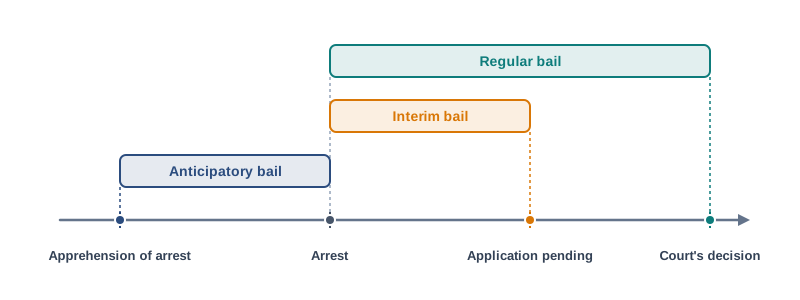
Fig. 13.4 – Types of bail in relation to arrest.
Regular Bail
Regular bail is granted to a person who has already been arrested and is in police custody or judicial custody. The court may order his release after considering the nature of the offence and the other relevant circumstances of the case.
Under the BNSS, regular bail may be granted by a Magistrate, a Sessions Court or a High Court, depending on the nature of the offence. The graver the offence, the higher the court that must be approached.
Interim Bail
Interim bail is a temporary bail granted for a short period. It is given while an application for regular bail or anticipatory bail is still pending before the court.
Its purpose is protective. Deciding a bail application takes time — the court may need the police report or may have to hear the prosecution. Interim bail keeps the accused out of immediate custody during that gap, so that the delay in deciding does not itself become a period of imprisonment.
Anticipatory Bail (Pre-Arrest Bail)
Anticipatory bail allows a person to seek bail in anticipation of arrest for a non-bailable offence. It is granted where the person has reasonable grounds to believe that he may be arrested. Note the two limits built into that sentence: the offence must be a non-bailable one, and the apprehension of arrest must be a reasonable one, not a vague fear.
Under the BNSS, anticipatory bail continues to be available, and it is granted by the Sessions Court or the High Court — not by a Magistrate.
The grant of anticipatory bail is not a matter of right. It is discretionary, and it depends on the facts and circumstances of each case. The provision exists largely because criminal proceedings are sometimes set in motion to harass a person rather than to punish an offence, and the law does not require an innocent person to submit to arrest first and argue afterwards.
Conditions for grant of anticipatory bail
Anticipatory bail is rarely granted unconditionally. While granting it, the court may impose one or more of the following conditions:
- the accused must make himself available for investigation whenever required;
- the accused must not leave the country without the prior permission of the court;
- the accused may be required to furnish a bond or a surety;
- the accused must not threaten, influence or induce any witness;
- the court may grant anticipatory bail for a limited duration, after which the accused may be required to surrender before the court.
Read the list together and its logic becomes clear. Each condition removes one of the risks that protection from arrest creates — that the investigation will be obstructed, that the accused will flee the country, that he will pressure witnesses, or that he will treat the order as permanent immunity.
Discretion of the court
While deciding an application for anticipatory bail, the court considers factors such as:
- the nature and seriousness of the offence;
- the criminal antecedents of the accused, that is, whether he has a record of earlier offences;
- the possibility of his absconding;
- the likelihood of his tampering with evidence.
Since anticipatory bail is protection from arrest itself, courts exercise greater caution in granting it than they do with ordinary bail after arrest.
13.5 Meaning of Criminal Justice
We have seen what a crime is and how offences are sorted. The next question is what the State actually does about a crime once it has happened. That machinery, taken as a whole, is called criminal justice.
Criminal justice refers to the system and the process through which crimes are dealt with by the State. It is not a single institution but a chain of stages, each handled by a different authority, as Fig. 13.5 shows:
- detection and investigation of offences — largely the work of the police;
- prosecution of accused persons — conducted on behalf of the State;
- trial by competent courts;
- award of punishment, or other legal consequences that follow from the court’s decision.

Fig. 13.5 – Stages of the criminal justice system.
Each link matters. An offence that is never detected never enters the system at all; a case investigated badly collapses at trial however grave the offence; and a conviction that follows an unfair trial is not justice, only the appearance of it.
Three interests to be balanced
Under the new criminal laws, criminal justice seeks to hold three interests together:
- the rights of the accused, who is presumed innocent until the case against him is proved;
- the interests of society, which needs offences punished and public order kept;
- justice to victims, who must not be reduced to spectators in a case about their own suffering.
These three pull in different directions, and that is precisely why the balance is difficult. Protecting the accused too little produces wrongful convictions and custodial abuse; protecting him at the cost of everything else leaves victims without a remedy and society without deterrence. Almost every procedural rule you will study in this chapter is an attempt to strike that balance at one particular point.
Taken together, the criminal justice system aims at fairness, transparency and the timely resolution of criminal cases. Timeliness is not a lesser goal than the other two. A case decided twenty years after the event may be accurate and still fail everyone concerned — the accused who lived under the shadow of it, the victim who waited, and the witnesses whose memories faded long before they were asked to speak.
13.6 The Bharatiya Nagarik Suraksha Sanhita, 2023
Of the three new laws, it is the Bharatiya Nagarik Suraksha Sanhita, 2023 that this chapter is chiefly about. The BNSS lays down the procedural law governing crimes in India — the rules that decide how a criminal case travels from the first report to the final order.
Procedure sounds like a lesser subject than the definition of offences, but it is not. A right that has no procedure attached to it cannot be enforced, and a wrongly conducted procedure can convict an innocent person as surely as a badly drafted offence can. The BNSS replaced the Code of Criminal Procedure, 1973 with the object of making criminal procedure more efficient, more uniform across the country, and more responsive to present-day needs.
The BNSS supplies the legal machinery for:
- the detection of crime;
- the apprehension of suspected offenders;
- the collection of evidence;
- the conduct of criminal trials;
- the imposition of appropriate punishment on persons found guilty.
The balance the BNSS tries to strike
Running through the whole statute is a single tension. Investigating and adjudicating authorities need real powers — to search, to summon, to arrest, to detain — or offences cannot be brought home to offenders. But those same powers, used carelessly or dishonestly, can ruin an innocent person.
The BNSS therefore tries to hold both ends. It seeks to ensure that law enforcement agencies are able to maintain law and order, while requiring that criminal proceedings be conducted in a fair, transparent and lawful manner. Every power it gives comes attached to a limit — a time period, a recorded reason, a report to a Magistrate, a right the accused may invoke.
Why arrest, bail and fair trial receive special emphasis
Concerns have grown in recent years about the misuse of arrest powers, about violence and deaths in custody, and about persons being denied bail and left in prison for long periods without a trial being concluded.
These are failures of procedure, not of the definition of offences, and that is exactly why the study of the BNSS gives special attention to investigation procedures, to arrest, to the provisions on bail, and to the principles of a fair trial. Rules of this kind exist to keep the criminal process within law, and public confidence in the system depends on their being observed.
13.7 Types of Criminal Courts in India
India’s court system is large and layered, and to a newcomer it can look complicated. But the layering has a purpose. Cases differ enormously in gravity, and a system that sent every dispute — a petty quarrel and a murder alike — to the same court would be both slow and unsuited to either. So the law creates several classes of criminal court and distributes work among them, while keeping every one of them within reach of an ordinary person.
Section 6 of the Bharatiya Nagarik Suraksha Sanhita, 2023 provides for a uniform structure of criminal courts throughout the country. Apart from the High Courts and courts established under special laws, it lays down the classes of criminal court that shall exist in every State for the administration of criminal justice.
These courts work in a hierarchy, shown in Fig. 13.6. Seriousness rises as you move up it, and so do the powers of the court — including the punishment it may impose and its authority to correct the courts below.
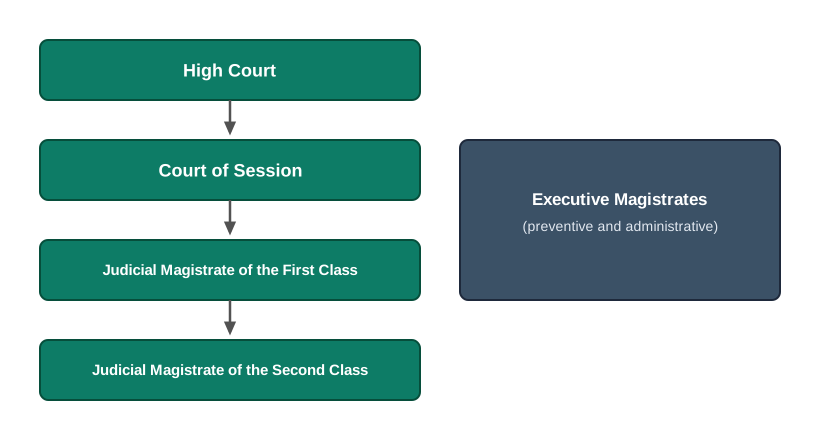
Fig. 13.6 – Hierarchy of criminal courts in a State.
Courts of Session
The Court of Session is the highest criminal court at the district level. It is presided over by a Sessions Judge.
Its jurisdiction and functions are:
- it tries serious criminal offences — those punishable with long-term imprisonment or life imprisonment;
- it hears appeals against the judgments of Judicial Magistrates;
- it exercises revisional powers as provided under law.
Notice that the Court of Session does two different kinds of work. It is a trial court for grave offences, and it is also a court of appeal and revision over the Magistrates below it. An appeal is a rehearing sought by an aggrieved party; revision is the higher court’s own power to examine the record of a subordinate court to see that no serious error or illegality has crept in.
The Court of Session has one special feature that students frequently miss. A case does not begin before it. Serious offences reach it only when a Magistrate commits the case to the Court of Session for trial — that is, the Magistrate, before whom the case first comes, sends it up because the offence is one that only the Sessions Court can try. The Court of Session then plays its central role: seeing that grave offences are dealt with both rigorously and fairly.
Judicial Magistrates of the First Class
Judicial Magistrates of the First Class form an important part of the lower criminal judiciary. The courts of Judicial Magistrates are established by the State Government after consultation with the High Court, and the Magistrates who preside over them are appointed by the High Court.
Their jurisdiction and functions are:
- to take cognizance of criminal offences — that is, to apply judicial mind to a case and take it on record so that proceedings may begin;
- to conduct trials for less serious offences;
- to issue summons and warrants;
- to grant bail and to remand accused persons to custody;
- to record statements and confessions.
As to punishment, a Judicial Magistrate of the First Class may impose imprisonment and fines within the limits prescribed by law. These Magistrates act as the primary trial courts for most criminal cases — the great majority of criminal matters in India begin and end here, and never reach a Sessions Court at all.
Judicial Magistrates of the Second Class
Judicial Magistrates of the Second Class deal with minor criminal offences. Their jurisdiction and functions are:
- to conduct trials in cases involving less serious offences;
- to issue summons and warrants;
- to perform the procedural functions assigned to them under the BNSS.
Their sentencing powers are more limited than those of Judicial Magistrates of the First Class. Their value to the system is that they take petty cases off the lists of the higher courts and dispose of them efficiently, so that the courts above are left free for heavier work.
Executive Magistrates
Executive Magistrates stand apart from the three courts described so far. They perform administrative and preventive functions rather than conducting judicial trials.
They are appointed by the State Government, and include officers such as the District Magistrate, the Additional District Magistrate and the Sub-Divisional Magistrate.
Their functions are:
- to maintain public order and peace;
- to issue preventive orders;
- to handle matters relating to law and order;
- to take preventive action so that offences are not committed in the first place.
Two things follow about the nature of their role. They do not conduct regular criminal trials, and their focus is on preventive justice rather than on punishment. The distinction is worth holding on to: the other courts act after an offence has happened, while an Executive Magistrate acts to stop one from happening. An order restricting an assembly where trouble is anticipated is preventive; a sentence for rioting is punitive.
Executive Magistrates therefore act as a link between the executive administration and the criminal justice system.
13.8 First Information Report (FIR)
Every criminal case has to start somewhere. For cognizable offences, it starts with the First Information Report.
Section 173 of the Bharatiya Nagarik Suraksha Sanhita, 2023 — Section 154 of the CrPC before it — deals with the FIR, that is, the first information of a cognizable crime given to the police. Curiously, the expression “First Information Report” is not itself defined in the criminal law. What the provision speaks of is information relating to the commission of a cognizable offence, and the FIR is simply that information as it reaches the police first in point of time.
The FIR matters because it sets the criminal law in motion. Until it is registered, the machinery described in the previous sections has nothing to work on; once it is registered, the police begin investigating.
With the introduction of the BNSS, three new features have been brought into the FIR process — the Zero-FIR, the e-FIR, and a regulated preliminary enquiry. Each is dealt with below.
What an FIR is
An FIR is the report of the information that reaches the police first, which is exactly why it carries that name. Under Section 173 of the BNSS, it is any information relating to the commission of a cognizable offence given to a police officer.
Some key points to note about FIRs:
- it is a written document prepared by the police when they receive information about the commission of a cognizable offence;
- it is generally a complaint lodged with the police by the victim of a cognizable offence, or by someone on his or her behalf;
- anyone can report the commission of a cognizable offence, either orally or in writing — even a telephonic message can be treated as an FIR.
Point 3 is worth pausing on. The informant need not be the victim, need not be an eyewitness, and need not be literate. The law’s concern is that information about a serious offence should reach the police quickly, not that it should arrive in a particular form from a particular person.
Essentials of an FIR under Section 173
For information to qualify as an FIR under Section 173 of the BNSS, the following requirements must be satisfied:
- it must be information relating to the commission of a cognizable offence;
- it must be given by the informant either orally or in writing;
- if given orally, it must be reduced to writing by the officer in charge of the police station or under his direction; and whether given in writing or reduced to writing, it must be signed by the person giving it;
- the substance of the information must be entered in a book kept in the form prescribed by the State Government — this book is called the General Diary;
- the information so written down and signed by the informant must have its key points recorded in the daily diary;
- a copy of the FIR must be given to the informant, and the FIR is then registered.
Notice how much of this list is about creating a record. Signature, General Diary entry, daily diary, copy to the informant — each requirement makes it harder to deny later that the information was ever given, or to alter what was said. The paperwork is a safeguard, not a formality.
What happens after an FIR is filed
Registration is the beginning, not the end. What follows is set out in Fig. 13.7.
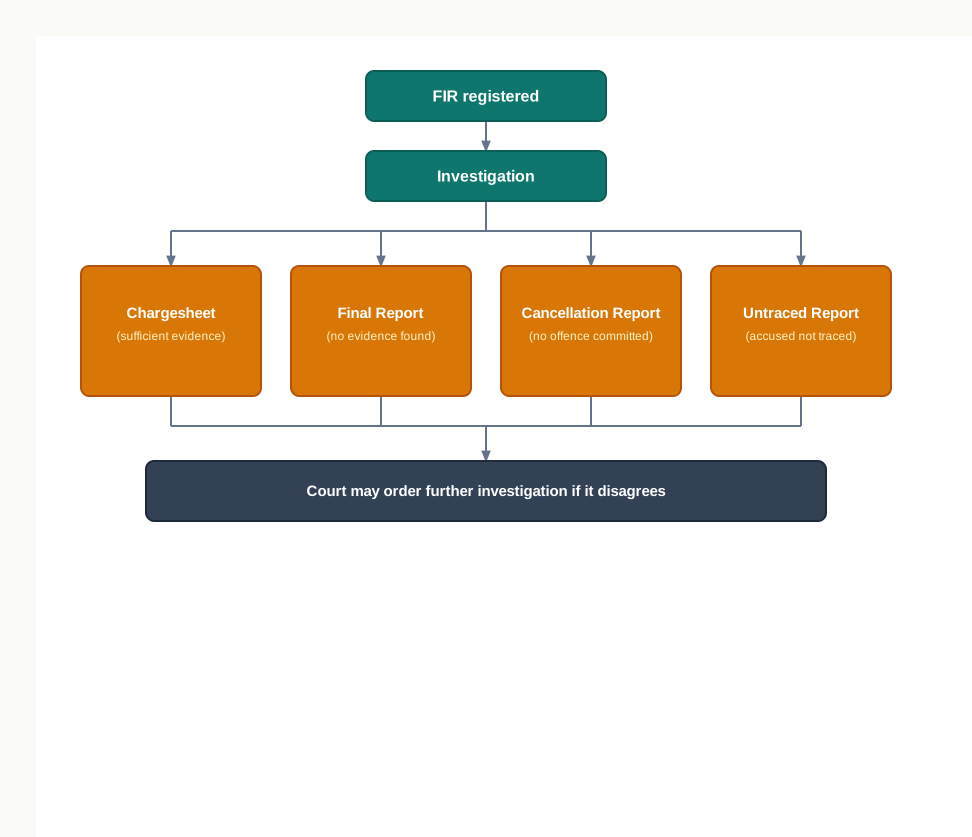
Fig. 13.7 – Outcomes of a police investigation.
- The police investigate the case and collect evidence, in the form of statements of witnesses or other scientific material. They may also arrest the alleged offenders in accordance with law.
- If sufficient evidence exists to support the complainant’s allegations, a chargesheet is filed. If not, a Final Report stating that no evidence was found is filed in court.
- If it turns out that no offence has been committed at all, a cancellation report is filed.
- If no trace of the accused persons is found, an ‘untraced’ report is filed.
- If the court does not agree with the investigation report, it may order further investigation.
Point 5 is the safeguard at the end of the chain. The police decide what the investigation found, but they do not have the last word on whether the investigation was good enough. That judgment belongs to the court.
Is the registration of an FIR mandatory?
This question reached the Supreme Court because police stations were, in practice, refusing to write down complaints — sending informants away, conducting informal “inquiries” indefinitely, or waiting to see whether the complaint was worth the trouble.
The guidelines the Supreme Court laid down are these:
- Mandatory registration — if the information discloses a cognizable offence, the police must register an FIR immediately, and no preliminary inquiry is permitted in such a case.
- Preliminary inquiry — if the information does not clearly disclose a cognizable offence but suggests the need to look further, a preliminary inquiry may be conducted to determine whether a cognizable offence is involved.
- Outcome of the inquiry — if the preliminary inquiry finds that a cognizable offence has occurred, an FIR must be registered. If it leads to closing the matter, the informant must be given a copy of that decision within one week, with a brief explanation for the closure.
- Duty of the police — officers must register an FIR where a cognizable offence is apparent, and officers who fail to do so should face disciplinary action.
- Scope of the preliminary inquiry — its purpose is only to verify whether the information discloses a cognizable offence, not to test whether the allegation is true.
- Types of cases — a preliminary inquiry may be appropriate in matters such as matrimonial disputes, commercial offences, medical negligence, corruption, or cases reported after significant delay. This list is illustrative, not exhaustive.
- Time frame — preliminary inquiries should be completed within seven days, and any delay must be recorded in the General Diary.
- General Diary — all information about cognizable offences, whether it results in an FIR or leads to an inquiry, must be carefully entered in the General Diary, and the decision to conduct a preliminary inquiry must itself be recorded.
Guideline (e) is the one students most often get wrong. A preliminary inquiry asks does this even sound like a cognizable offence? It does not ask is the complainant telling the truth? Truth is for the investigation and the trial to establish, not for the officer at the counter.
The BNSS has since given the preliminary enquiry a statutory footing of its own. Where the offence is punishable with imprisonment for three years or more but less than seven years, the officer may, with the permission of a higher-ranking officer, conduct a preliminary enquiry within fourteen days to ascertain whether a prima facie case exists.
What if the police refuse to register an FIR?
A refusal at the police station is not the end of the road. The BNSS provides a ladder of remedies.
An FIR is not substantive evidence
Students often assume that whatever is written in the FIR is proof of what happened. It is not.
An FIR is not evidence of the facts stated in it. It is not recorded on oath, and the person who gave it has not been cross-examined in court when it is written down. Both of those are the conditions on which the law treats a statement as proof, and an FIR satisfies neither. Its use is different: it records what was said at the earliest opportunity, and it sets the investigation going.
The one exception is the dying declaration — a statement by a person about the cause of his death, made when death is expected. Where the first information happens also to be a dying declaration, it can be used as substantive evidence, because the person who made it can never be brought to court to say it again.
Zero-FIR
Ordinarily, a police station investigates offences committed within its own territorial limits. That rule created a cruel gap: a person who had just been robbed or assaulted could be turned away from the nearest police station and told to travel to another one, losing the very hours in which evidence is freshest.
The Zero-FIR closes that gap. It allows anyone to report a crime at any police station, irrespective of where the incident occurred. It works in two movements:
- Report anywhere — the Zero-FIR may be lodged at any police station, which must then transfer the documents to the police station having jurisdiction over the place of the crime;
- Investigation begins — once transferred, the jurisdictional police station numbers the FIR and starts the investigation.
It is called a “Zero” FIR because the station that first records it enters no regular serial number against it; the number is given by the station that finally takes it up.
The legal basis is Section 173 of the BNSS, under which information about a cognizable offence may be reported regardless of where the offence took place.
Ways to report
- Orally — if the crime is reported orally, the police officer must write the information down; the officer must then read it back to the informant; and the written information must be signed to confirm it.
- Electronically — if the crime is reported through electronic communication, it must be recorded by the police, and the electronic report must be signed within three days for it to be officially recorded.
Reading the information back before it is signed is a small step with large consequences. It is the informant’s only opportunity to catch a mistake or an omission before the document becomes the case’s starting record.
How Zero-FIR developed
The idea is not new. It was recommended by the Ministry of Home Affairs in 2015 in the context of crimes against women. The courts have supported the registration of Zero-FIRs in several cases, emphasising the duty of the police to record information about cognizable offences and forward it to the appropriate police station. What the BNSS has done is turn an administrative practice into a statutory provision.
E-FIR
Section 173 of the BNSS also allows FIRs to be registered electronically, so that an informant need not be physically present at a police station at all.
The three-day signature requirement is the reason the e-FIR does not open the door to anonymous or careless accusations. Filing is made easy; owning what you have filed is still required.
13.9 Stages of a Criminal Trial
Criminal trials are not conducted in one uniform way. How elaborate the procedure is depends on how serious the offence is, because the care a system takes should match what is at stake. A case that can end in life imprisonment cannot be decided by the same short procedure that disposes of a traffic violation.
Criminal trials are therefore broadly classified into three kinds — warrant trials, summons trials and summary trials.
The three kinds of trial
Warrant trial. A warrant trial is conducted for serious offences — those punishable with death, life imprisonment, or imprisonment exceeding two years. Because the consequences are severe, the procedure is detailed and strict. The court formally frames charges, records evidence carefully, and gives the accused greater procedural safeguards at every step.
Summons trial. A summons trial is used for less serious offences, that is, offences punishable with imprisonment up to two years. The procedure is simpler and quicker than a warrant trial. Formal framing of charges is not required, and the case is usually begun by issuing a summons to the accused.
Summary trial. A summary trial is adopted for minor and petty offences where quick disposal is required. The procedure is highly simplified, evidence is recorded briefly, and the judgment is delivered promptly. The punishment that may be awarded in a summary trial is limited, which is what makes the abbreviated procedure acceptable — a court taking short cuts on evidence cannot be allowed to pass a heavy sentence. Summary trials suit minor offences and public order violations.
Whatever the kind of trial, criminal proceedings under the BNSS move through a structured process designed to secure fairness, transparency and justice. That process falls into three stages — the pre-trial stage, the trial stage and the post-trial stage — as Fig. 13.8 shows. Each stage does a distinct job in determining the guilt or innocence of the accused.

Fig. 13.8 – Detailed stages of a criminal case.
13.9.1 Pre-Trial Stage
The pre-trial stage begins with the commission of an offence, which may be either cognizable or non-cognizable.
Where information relating to a cognizable offence is given to the police, an FIR is registered under Section 173 of the BNSS. The FIR formally sets the criminal law in motion and contains the basic details of the offence. Under the BNSS, FIRs may also be registered electronically, which makes the process more accessible and more transparent.
Where the offence is non-cognizable, the police record a Non-Cognizable Report (NCR). They cannot investigate or arrest the accused without first obtaining the permission of a Magistrate having jurisdiction over the matter.
Proceedings begun by complaint
Not every criminal case starts with the police. Proceedings may also begin through a complaint made to a Magistrate. A complaint is an allegation made orally or in writing to a Magistrate, seeking that action be taken against a person for committing an offence — and it specifically excludes a police report. This is the route open to a person whom the police will not help, and to offences the police cannot take up on their own.
On receiving a complaint, the Magistrate may:
- examine the complainant and the witnesses;
- dismiss the complaint if there is no sufficient ground to proceed;
- issue process against the accused, that is, summon him to court; or
- postpone the issue of process and direct an inquiry or an investigation to decide whether the case should proceed at all.
Investigation
Once the FIR is registered, the police undertake investigation under Sections 180–189 of the BNSS. Investigation involves collecting evidence, recording the statements of witnesses, examining the accused, and gathering scientific and electronic evidence wherever it is required.
The rule about permission holds throughout: in cognizable offences investigation can begin without the approval of any court, whereas in non-cognizable offences the prior permission of the Magistrate is mandatory.
Arrest and remand
During the investigation, the accused may be arrested if it is necessary. The BNSS emphasises that arrest should be made only where it is justified — not automatically, and not as a routine accompaniment to every investigation.
After arrest, the accused must be produced before a Magistrate within twenty-four hours. If the investigation cannot be completed within that period, the police may seek remand, either in police custody or in judicial custody, and the Magistrate decides whether to grant it. The point of the rule is that no one’s detention continues on the say-so of the police alone; it continues only if a judicial officer, having seen the person, permits it.
Chargesheet, cognizance and charges
After the investigation is complete, the police file a chargesheet under Section 193 of the BNSS if a prima facie case is made out — that is, if the material collected is enough, taken at face value, to require the accused to answer. If no such case exists, a final report is submitted to the court instead.
The Magistrate then takes cognizance of the offence, which means applying judicial mind to the material placed before the court. At this stage the court may issue summons or warrants to secure the presence of the accused.
Upon appearance, the accused may apply for bail and engage an advocate of his choice. The court then considers the police report or the final report, and may:
- discharge the accused;
- order further investigation; or
- proceed to frame charges.
If the accused pleads guilty at this point, the court may convict him at its discretion. If he pleads not guilty, the case proceeds to trial.
13.9.2 Trial Stage
The trial stage begins once charges have been framed and the accused has pleaded not guilty. Which form the trial takes — warrant, summons or summary — depends on the seriousness of the offence and the procedure prescribed under the BNSS.
The order in which the trial proceeds is not a matter of convenience; it follows from who has to prove what.
13.9.3 Post-Trial Stage
After hearing the arguments, the court delivers its judgment. The judgment must contain the reasons for the acquittal or the conviction — a court in a criminal case does not simply announce a result.
If the accused is convicted, the court then hears arguments on the quantum of sentence and pronounces the punishment. In deciding what punishment to award, the court considers the nature of the offence, the circumstances of the accused, and the principles of reformative and deterrent justice. Deterrent justice looks outward, at discouraging others from committing the offence; reformative justice looks at the offender, and at whether he can be brought back into ordinary life. Sentencing is where those two aims have to be reconciled in a single order.
An aggrieved party — whether the convicted person or the State — may challenge the judgment by filing an appeal within the prescribed limitation period. In certain cases where no appeal has been filed, the Sessions Court or the High Court may still exercise revisional jurisdiction to prevent a miscarriage of justice. Once all legal remedies are exhausted, the sentence is executed, either through imprisonment or through recovery of the fine.
Taken as a whole, the BNSS modernises criminal procedure while keeping its basic structure intact, strengthening fair trial guarantees, bringing in technology, and protecting individual rights. The three-stage framework is what allows criminal justice to be delivered in a systematic, efficient and humane manner.
13.10 Principle of Autrefois Acquit and Autrefois Convict
Suppose a person is tried for theft, the trial runs its full course, and the court acquits him. Two years later the same prosecuting authority decides to try him again for the same theft, hoping for a better result. Can it?
The answer lies in two old pleas that criminal law has carried for centuries. Autrefois acquit and autrefois convict are French terms meaning “previously acquitted” and “previously convicted” respectively. They come from the common law, where they are accepted as principles having a particular effect: the trial cannot go ahead at all, because of the special circumstance that the plea discloses.
That is what makes these two pleas unusual. Most defences argue that the accused did not do it. These say something different — that whether he did it or not, this court cannot try the question again.
The two principles
The principle of autrefois acquit means that a person cannot be tried again for an offence for the reason that he has previously been acquitted of the same offence. Such a plea may be taken by itself or combined with the plea of not guilty.
The principle of autrefois convict means that a person cannot be tried for an offence for the reason that he has previously been convicted of that offence. This plea too may be combined with the plea of not guilty.
The constitutional position
The Constitution of India imbibes only the principle of autrefois convict, and not that of autrefois acquit. Article 20 provides protection in respect of conviction of offences, and the relevant guarantee is in Article 20(2):
- Article 20(2) states that no person shall be prosecuted and punished for the same offence more than once.
- It contains the rule against double jeopardy — that no person shall be convicted for the same offence more than once.
- It was adopted from the United States Constitution, but it does not carry the principle of autrefois acquit in the way the American provision does. The American amendment says that no person shall be put in jeopardy of life and limb twice — a wider protection, because it bars the second jeopardy, not merely the second punishment.
- Article 20(2) therefore offers protection only where the accused has been prosecuted and has also been punished.
Read (d) slowly, because it is the whole point of the distinction, and it is where marks are won and lost. The word in Article 20(2) is and, not or. Prosecution alone is not enough; punishment alone is not enough. Both must have happened before the constitutional bar operates — which is exactly why a previous acquittal, where there was a prosecution but no punishment, does not attract Article 20(2).
That does not leave an acquitted person unprotected. The plea of autrefois acquit survives as a principle of criminal law, and the criminal procedure law separately bars the retrial of a person who has once been tried and acquitted by a competent court for the same offence. The point being made here is narrower: the constitutional guarantee in Article 20(2) covers only the previously convicted.
Return, finally, to the question this section opened with. A person acquitted of theft cannot be tried again for that theft. But suppose the same conduct also disclosed a separate offence, distinct in its ingredients, on which he was never tried — the bar does not extend to it, because the protection attaches to the offence, not to the episode. Identifying whether the second charge is truly the same offence is the real work these pleas demand.
13.11 Summary
- In 2024 India replaced three colonial-era criminal laws with three new enactments, which came into force on 1 July 2024:
- the Bharatiya Nyaya Sanhita, 2023 (BNS), replacing the Indian Penal Code, 1860;
- the Bharatiya Nagarik Suraksha Sanhita, 2023 (BNSS), replacing the Code of Criminal Procedure, 1973;
- the Bharatiya Sakshya Adhiniyam, 2023 (BSA), replacing the Indian Evidence Act, 1872.
- The BNS says what is an offence, the BNSS says how a case proceeds, and the BSA says what a court may accept as proof.
- The reform aims to make criminal justice more modern, more technology-friendly and better suited to present-day needs.
- An offence committed before 1 July 2024 continues to be governed by the old law, because a person is tried under the law as it stood when the act was done.
- A crime is an act or omission which the law declares punishable.
- A crime has three features:
- a wrongful act, or a failure to act where the law required action;
- violation of a legal prohibition;
- a punishment prescribed by law.
- A crime is treated as an offence against the State and society, even where the immediate harm falls on one individual.
- Offences under the BNS include offences against the human body, against property, against public order, against women and children, and cyber-related offences.
- Every offence is classified on three independent bases — cognizability, provision for bail, and compoundability.
- In cognizable offences the police may register an FIR, investigate and arrest without prior permission of a court; in non-cognizable offences they may not investigate or arrest without the order of a Magistrate.
- In bailable offences bail is a right of the accused and may be granted by the police or the court; in non-bailable offences bail is not a right and is granted at the discretion of the court.
- Non-bailable does not mean that bail can never be granted; it means the court decides.
- Compoundable offences may be settled between the victim and the accused, with or without the permission of the court; non-compoundable offences are serious, affect society at large, and cannot be settled by compromise.
- Bail is the conditional release, on bond or surety, of a person arrested or detained for an offence before the court’s final decision, on his undertaking to appear whenever required.
- The purpose of bail is to balance personal liberty against the interests of justice.
- There are three kinds of bail:
- regular bail, granted to a person already arrested and in police or judicial custody, by a Magistrate, Sessions Court or High Court depending on the offence;
- interim bail, a temporary bail granted while an application for regular or anticipatory bail is pending;
- anticipatory bail, sought in anticipation of arrest for a non-bailable offence.
- Anticipatory bail is granted under Section 482 of the BNSS by the Sessions Court or the High Court, and replaces Section 438 of the CrPC.
- Anticipatory bail is not a matter of right; it is discretionary and depends on the facts of each case.
- While granting anticipatory bail the court may require the accused to join the investigation, not leave the country without permission, furnish a bond or surety, and not threaten or influence witnesses, and may limit the protection in time.
- In exercising its discretion the court considers the nature and seriousness of the offence, the criminal antecedents of the accused, the possibility of absconding, and the likelihood of tampering with evidence.
- Criminal justice is the system and process by which the State detects and investigates offences, prosecutes accused persons, tries them before competent courts, and imposes punishment or other legal consequences.
- Criminal justice seeks to balance the rights of the accused, the interests of society and justice to victims, and aims at fairness, transparency and timely resolution.
- The BNSS lays down the procedural law governing crimes, providing the machinery for detection of crime, apprehension of offenders, collection of evidence, conduct of trials and imposition of punishment.
- Because of concerns about misuse of arrest powers, custodial violence, custodial deaths and denial of bail, the BNSS gives special emphasis to investigation, arrest, bail and fair trial.
- Section 6 of the BNSS provides that, besides the High Courts and courts constituted under other laws, every State shall have four classes of criminal courts:
- Courts of Session;
- Judicial Magistrates of the First Class;
- Judicial Magistrates of the Second Class;
- Executive Magistrates.
- The Court of Session is the highest criminal court at the district level, presided over by a Sessions Judge; it tries serious offences, hears appeals from Judicial Magistrates and exercises revisional powers.
- A case reaches the Court of Session only when a Magistrate commits it for trial.
- Judicial Magistrates of the First Class are the primary trial courts for most criminal cases; they take cognizance of offences, try less serious offences, issue summons and warrants, grant bail, remand accused persons, and record statements and confessions.
- Judicial Magistrates of the Second Class try minor offences, issue summons and warrants, perform procedural functions under the BNSS, and have more limited sentencing powers.
- Executive Magistrates, appointed by the State Government and including the District Magistrate, Additional District Magistrate and Sub-Divisional Magistrate, perform preventive and administrative functions rather than conducting trials, and link the executive administration with the criminal justice system.
- Section 173 of the BNSS deals with the First Information Report — information relating to the commission of a cognizable offence given to a police officer first in point of time.
- The term “First Information Report” is not itself defined in the criminal law; anyone may give the information, orally or in writing, and even a telephonic message may be treated as an FIR.
- To qualify as an FIR under Section 173 of the BNSS, the information must:
- relate to the commission of a cognizable offence;
- be given by the informant orally or in writing;
- if oral, be reduced to writing by or under the direction of the officer in charge, and be signed by the person giving it;
- have its substance entered in the General Diary, in the form prescribed by the State Government;
- have its key points recorded in the daily diary;
- be followed by the supply of a copy to the informant, whereupon the FIR is registered.
- After an FIR is registered the police investigate, and the investigation ends in a chargesheet, a final report, a cancellation report or an untraced report; if the court disagrees with the report it may order further investigation.
- In Lalita Kumari v. Government of U.P. the Supreme Court held that registration of an FIR is mandatory where the information discloses a cognizable offence, and no preliminary inquiry is permitted in such a case.
- Under the guidelines in Lalita Kumari, a preliminary inquiry is permissible only where the information does not clearly disclose a cognizable offence, is limited to verifying whether such an offence is disclosed and not whether the allegation is true, should be completed within seven days, and must be recorded in the General Diary; officers who fail to register an FIR when a cognizable offence is apparent face disciplinary action.
- Where the police refuse to register an FIR, the aggrieved person may approach the Superintendent of Police or Deputy Commissioner of Police under Section 173(4) of the BNSS, and thereafter a Magistrate under Section 175(3) of the BNSS, who may order registration and investigation.
- An FIR is not substantive evidence, because it is not recorded on oath and is not tested by cross-examination; the only exception is a dying declaration.
- A Zero-FIR may be lodged at any police station irrespective of where the offence occurred; that station transfers the papers to the police station having jurisdiction, which numbers the FIR and investigates.
- Information may be given orally, in which case it must be written down, read back and signed, or electronically, in which case it must be signed within three days to be officially recorded.
- Zero-FIR was recommended by the Ministry of Home Affairs in 2015 for crimes against women and supported by the courts; the BNSS has now made it a statutory provision.
- Section 173 of the BNSS also permits registration of an e-FIR through the police portal, website or other electronic communication, with a preliminary enquiry within fourteen days for offences punishable with three to seven years’ imprisonment, signature within three days, a free copy to the informant under Section 173(2), and assignment by the Station House Officer to an investigating officer.
- Criminal trials are of three kinds:
- warrant trials, for offences punishable with death, life imprisonment or imprisonment exceeding two years, following a detailed and strict procedure with formal framing of charges;
- summons trials, for offences punishable with imprisonment up to two years, following a simpler procedure without formal framing of charges;
- summary trials, for minor and petty offences, following a highly simplified procedure with limited punishment.
- A criminal case passes through three stages — the pre-trial stage, the trial stage and the post-trial stage.
- In the pre-trial stage, a cognizable offence leads to an FIR under Section 173 of the BNSS, while a non-cognizable offence leads to a Non-Cognizable Report, with investigation and arrest requiring the Magistrate’s permission.
- Proceedings may also begin on a complaint made to a Magistrate, who may examine the complainant and witnesses, dismiss the complaint, issue process, or postpone process and direct an inquiry or investigation.
- Investigation is conducted under Sections 180–189 of the BNSS and involves collecting evidence, recording statements, examining the accused, and gathering scientific and electronic evidence.
- An arrested person must be produced before a Magistrate within twenty-four hours, and any further detention by way of police or judicial custody requires a judicial order.
- On completion of investigation the police file a chargesheet under Section 193 of the BNSS if a prima facie case is made out, or else a final report; the Magistrate then takes cognizance and may issue summons or warrants.
- On the appearance of the accused the court may discharge him, order further investigation, or frame charges; a plea of guilty may lead to conviction, and a plea of not guilty takes the case to trial.
- In the trial stage the prosecution leads evidence, the defence cross-examines, the accused is examined under Section 351 of the BNSS otherwise than on oath, defence evidence may be led, and both sides address final arguments.
- The burden of proof always lies on the prosecution.
- In the post-trial stage the court delivers a reasoned judgment, hears arguments on the quantum of sentence before pronouncing punishment, and considers the nature of the offence, the circumstances of the accused and the principles of reformative and deterrent justice.
- An appeal may be filed within the prescribed limitation period, revisional jurisdiction may be exercised by the Sessions Court or High Court to prevent a miscarriage of justice, and the sentence is executed once all remedies are exhausted.
- Autrefois acquit and autrefois convict are French terms meaning previously acquitted and previously convicted; they are common law pleas whose effect is that the trial cannot go ahead.
- The plea of autrefois acquit is that the accused cannot be tried again for an offence of which he has previously been acquitted, and it may be combined with the plea of not guilty.
- The plea of autrefois convict is that the accused cannot be tried again for an offence of which he has previously been convicted, and it too may be combined with the plea of not guilty.
- The Constitution of India imbibes only the principle of autrefois convict, through Article 20(2), and not the principle of autrefois acquit.
- Article 20(2) states that no person shall be prosecuted and punished for the same offence more than once, and contains the rule against double jeopardy.
- Article 20(2) was adopted from the United States Constitution but does not carry the wider American protection against being twice put in jeopardy of life and limb.
- Article 20(2) applies only where the accused has been both prosecuted and punished, which is why a previous acquittal does not attract it.
13.12 Key Terms
Bharatiya Nyaya Sanhita, 2023 (BNS) — the law that defines offences and prescribes their punishments, in force from 1 July 2024 in place of the Indian Penal Code, 1860.
Bharatiya Nagarik Suraksha Sanhita, 2023 (BNSS) — the procedural law governing criminal cases, in force from 1 July 2024 in place of the Code of Criminal Procedure, 1973.
Bharatiya Sakshya Adhiniyam, 2023 (BSA) — the law governing what a court may accept as evidence, in force from 1 July 2024 in place of the Indian Evidence Act, 1872.
Crime — an act or omission which the law forbids and for which the law prescribes a punishment.
Omission — a failure to act in a situation where the law required action, which may itself amount to an offence.
Cognizable offence — a serious offence in which the police may register an FIR, investigate and arrest without the prior permission of a court.
Non-cognizable offence — a comparatively minor offence in which the police cannot investigate or arrest without the order of a Magistrate.
Bailable offence — an offence in which the accused has a legal right to be released on bail.
Non-bailable offence — a serious offence in which bail is not a right but is granted at the discretion of the court.
Compoundable offence — an offence which the victim and the accused may lawfully settle between themselves, in some cases with the permission of the court.
Non-compoundable offence — a serious offence which cannot be settled by compromise and must be decided by the court.
Bail — the conditional release, on bond or surety, of a person arrested or detained for an offence before the court’s final decision, on his undertaking to appear whenever required.
Bond — a written promise by the accused, backed by a stated sum of money, that he will attend court and obey the conditions imposed on his release.
Surety — a person who stands guarantee for the accused and becomes answerable for the stated sum if the accused fails to appear.
Regular bail — bail granted to a person who has already been arrested and is in police or judicial custody.
Interim bail — a temporary bail granted for a short period while an application for regular or anticipatory bail is pending.
Anticipatory bail — pre-arrest bail under Section 482 of the BNSS, granted by the Sessions Court or High Court to a person who reasonably apprehends arrest for a non-bailable offence.
Criminal justice — the system and process by which the State detects and investigates offences, prosecutes accused persons, tries them before competent courts, and imposes punishment or other legal consequences.
Procedural law — the body of law that lays down how a case is to be conducted, as distinct from the law defining offences.
Court of Session — the highest criminal court at the district level, presided over by a Sessions Judge, which tries serious offences and hears appeals from Judicial Magistrates.
Committal — the act of a Magistrate sending a case up to the Court of Session for trial because the offence is one that only that court can try.
Appeal — a rehearing of a decided case sought by an aggrieved party before a higher court.
Revision — the power of a higher court to examine the record of a subordinate court to satisfy itself that no serious error or illegality has occurred.
Cognizance — the taking of a case on record by a court after applying judicial mind to the material placed before it, so that proceedings may begin.
Judicial Magistrate of the First Class — the primary criminal trial court for most cases, with power to try moderate offences, grant bail, issue summons and warrants, and record statements and confessions.
Judicial Magistrate of the Second Class — a criminal court trying minor offences, with more limited sentencing powers than a Judicial Magistrate of the First Class.
Executive Magistrate — an officer appointed by the State Government, such as a District Magistrate, who performs preventive and administrative functions relating to public order rather than conducting trials.
Preventive justice — action taken to stop an offence from being committed, as distinct from punishment imposed after an offence has occurred.
First Information Report (FIR) — the information relating to the commission of a cognizable offence given to a police officer first in point of time, recorded and registered under Section 173 of the BNSS.
General Diary — the book kept at a police station, in the form prescribed by the State Government, in which the substance of information about cognizable offences is entered.
Zero-FIR — an FIR lodged at any police station irrespective of where the offence occurred, which is then transferred to the police station having jurisdiction.
E-FIR — an FIR initiated by electronic communication, which must be signed by the complainant within three days to be officially registered.
Preliminary enquiry — a limited inquiry to ascertain whether the information received discloses a cognizable offence, permissible only where that is not already clear.
Chargesheet — the report filed by the police under Section 193 of the BNSS on completion of investigation, where a prima facie case is made out against the accused.
Final report — the report filed where the investigation does not produce sufficient evidence to support the allegations.
Cancellation report — the report filed where the investigation shows that no offence was committed at all.
Untraced report — the report filed where the accused persons cannot be traced.
Substantive evidence — material on which a court may base its finding of fact, which an FIR is not, since it is neither recorded on oath nor tested by cross-examination.
Dying declaration — a statement by a person as to the cause of his death, made when death is expected, which may be used as substantive evidence.
Warrant trial — the trial procedure for offences punishable with death, life imprisonment or imprisonment exceeding two years, in which charges are formally framed.
Summons trial — the simpler trial procedure for offences punishable with imprisonment up to two years, in which charges are not formally framed.
Summary trial — the highly simplified trial procedure for minor and petty offences, in which evidence is recorded briefly and punishment is limited.
Non-Cognizable Report (NCR) — the record made by the police of information about a non-cognizable offence, on which they cannot act without the Magistrate’s permission.
Complaint — an allegation made orally or in writing to a Magistrate that a person has committed an offence, excluding a police report.
Remand — the detention of an arrested person in police or judicial custody beyond twenty-four hours, permitted only by order of a Magistrate.
Prima facie case — a case which, on the material collected and taken at face value, is sufficient to require the accused to answer the charge.
Discharge — an order releasing the accused before charges are framed, because the material does not justify putting him on trial.
Burden of proof — the obligation to prove the case, which in a criminal trial always rests on the prosecution.
Quantum of sentence — the extent of the punishment to be awarded, argued and decided after conviction.
Deterrent justice — punishment aimed at discouraging others from committing the offence.
Reformative justice — punishment aimed at the improvement of the offender and his return to ordinary life.
Autrefois acquit — the plea that the accused cannot be tried again for an offence of which he has previously been acquitted.
Autrefois convict — the plea that the accused cannot be tried again for an offence of which he has previously been convicted.
Double jeopardy — the rule, contained in Article 20(2) of the Constitution of India, that no person shall be prosecuted and punished for the same offence more than once.
13.13 Points to Ponder
A crime is said to be a wrong against society and not merely against the person harmed. If the victim of an offence sincerely wishes to forgive the accused, should the State still insist on prosecuting? Does your answer change according to how serious the offence is?
Anticipatory bail protects a person from arrest before any court has examined the allegation against him. Is such protection a safeguard against misuse of the criminal process, or does it risk shielding those with the means to reach a Sessions Court quickly?
Bail is meant to balance liberty against the interests of justice. Where trials take years to conclude, does the refusal of bail begin to work as punishment before conviction? What would a fair response to that problem look like?
The law requires an arrested person to be produced before a Magistrate within twenty-four hours. What is the value of that rule if the Magistrate has only a few minutes and a written police report to go on? What would make the safeguard real rather than formal?
Lalita Kumari made the registration of an FIR mandatory where a cognizable offence is disclosed. A court can lay down a duty, but a duty is performed at a counter in a police station far from any court. What, apart from a judgment, is needed before a rule of this kind changes what actually happens?
The Zero-FIR and the e-FIR both make it easier to report a crime. Easier reporting also means more false and careless complaints reach the police. How should the law weigh access for genuine victims against the harm a false complaint does to the person named in it?
A preliminary enquiry is meant only to check whether the information discloses a cognizable offence, not whether the allegation is true. Why is that limit important, and what would go wrong if police officers were free to decide the truth of a complaint before registering it?
Summary trials dispose of petty cases quickly, and quick disposal is valued as a virtue. What is being given up in exchange for that speed, and how does the law try to make the exchange a fair one?
Executive Magistrates act to prevent offences rather than to punish them. Preventive powers are exercised before anyone has done anything wrong. What limits should attach to such powers, and who should enforce those limits?
Article 20(2) protects a person who has been prosecuted and punished, and so does not cover a person who has been acquitted. Is there a good reason for the Constitution to protect the previously convicted but not the previously acquitted?
In sentencing, courts weigh deterrence against reform. These two aims can point to very different sentences for the same offence. Which should carry more weight, and should the answer be the same for a first-time offender as for a repeat offender?
The criminal justice system is asked to balance the rights of the accused, the interests of society and justice to victims. Of the procedures you have studied in this chapter, which do most for the victim? Is the victim’s position in a criminal trial as strong as it should be?
13.14 Textbook Questions
Name the three new criminal laws that came into force on 1 July 2024, state which law each of them replaced, and explain what each of the three deals with.
Explain the meaning of crime with reference to the criminal justice system in India. What are the essential features of a crime?
Why is a crime treated as a wrong against the State and society, even when the harm is caused to a single individual?
Explain the categories of offences under the criminal law. In your answer, deal with:
- cognizable and non-cognizable offences;
- bailable and non-bailable offences;
- compoundable and non-compoundable offences.
Explain the concept of bail. What is the basic purpose that bail serves?
Describe the three types of bail recognised under the Bharatiya Nagarik Suraksha Sanhita, 2023.
What is anticipatory bail? State the conditions the court may impose while granting it, and the factors it considers in exercising its discretion.
What is meant by criminal justice? State the stages it includes and the interests it seeks to balance.
Explain the object and scope of the Bharatiya Nagarik Suraksha Sanhita, 2023.
Describe the classes of criminal courts provided for under Section 6 of the BNSS, and state the jurisdiction and functions of each.
Discuss the concept of the First Information Report and its types. What are the essentials that information must satisfy to qualify as an FIR?
What happens after an FIR is filed? What remedies are available to a person whose FIR the police refuse to register?
Describe the stages of a criminal trial under the Bharatiya Nagarik Suraksha Sanhita, 2023.
Differentiate between the principle of autrefois acquit and the principle of autrefois convict.
13.15 Objective Questions
The Bharatiya Nyaya Sanhita, the Bharatiya Nagarik Suraksha Sanhita and the Bharatiya Sakshya Adhiniyam came into force on:
- 1 January 2023
- 1 July 2024
- 26 January 2024
- 1 April 2025
The Bharatiya Nagarik Suraksha Sanhita, 2023 replaced the:
- Indian Penal Code, 1860
- Indian Evidence Act, 1872
- Code of Criminal Procedure, 1973
- Constitution of India
Which of the following is NOT an essential feature of a crime?
- A wrongful act or a failure to act
- Violation of a legal prohibition
- Punishment prescribed by law
- Financial loss to the victim
In a cognizable offence, the police may:
- arrest only after obtaining a warrant from the Court of Session
- register an FIR and arrest without the prior permission of a court
- investigate only after the accused has been produced before a Magistrate
- act only if the victim personally lodges the information
In a non-cognizable offence, the police cannot investigate or arrest without:
- the consent of the accused
- the permission of the Superintendent of Police
- the order of a Magistrate
- the permission of the High Court
In a bailable offence, bail is:
- a matter of right of the accused
- granted only by the High Court
- entirely within the discretion of the court
- not available at all
Anticipatory bail under the BNSS may be granted by:
- a Judicial Magistrate of the Second Class
- a Judicial Magistrate of the First Class
- the Sessions Court or the High Court
- the officer in charge of a police station
Anticipatory bail is provided for by:
- Section 173 of the BNSS
- Section 193 of the BNSS
- Section 351 of the BNSS
- Section 482 of the BNSS
Bail granted for a short period while an application for regular or anticipatory bail is pending is called:
- regular bail
- interim bail
- anticipatory bail
- default bail
The classes of criminal courts in every State are provided for by:
- Section 6 of the BNSS
- Section 173 of the BNSS
- Article 20 of the Constitution of India
- Section 482 of the BNSS
The highest criminal court at the district level is the:
- Court of the Judicial Magistrate of the First Class
- Court of Session
- Court of the Executive Magistrate
- High Court
Which of the following officers performs preventive and administrative functions rather than conducting criminal trials?
- Sessions Judge
- Judicial Magistrate of the First Class
- Judicial Magistrate of the Second Class
- Executive Magistrate
The First Information Report is dealt with by:
- Section 6 of the BNSS
- Section 173 of the BNSS
- Section 206 of the Constitution of India
- Section 482 of the BNSS
The book in which the substance of information about a cognizable offence is entered at a police station is called the:
- Case Diary
- Charge Register
- General Diary
- Station Ledger
If the police refuse to register an FIR, the aggrieved person may first approach the:
- Sessions Judge
- Superintendent of Police or Deputy Commissioner of Police
- High Court under Article 226
- Executive Magistrate
An FIR sent by electronic communication must be signed by the complainant within:
- twenty-four hours
- three days
- seven days
- fourteen days
An FIR is not substantive evidence. The only exception to this rule is:
- a confession made to a police officer
- a statement recorded during investigation
- a dying declaration
- a telephonic message
After arrest, the accused must be produced before a Magistrate within:
- twelve hours
- twenty-four hours
- forty-eight hours
- seven days
A warrant trial is conducted for offences punishable with:
- fine only
- imprisonment up to two years
- death, life imprisonment, or imprisonment exceeding two years
- any offence, at the option of the accused
The examination of the accused by the court to explain the evidence appearing against him is provided for by:
- Section 173 of the BNSS
- Section 193 of the BNSS
- Section 351 of the BNSS
- Section 482 of the BNSS
The rule against double jeopardy is contained in:
- Article 14 of the Constitution of India
- Article 20(2) of the Constitution of India
- Article 21 of the Constitution of India
- Article 32 of the Constitution of India
The Constitution of India imbibes the principle of:
- autrefois acquit only
- autrefois convict only
- both autrefois acquit and autrefois convict
- neither of the two
Assertion (A): An offence committed in March 2024 continues to be tried under the Indian Penal Code, 1860. Reason (R): A person is tried under the law as it stood at the time the act was done.
Assertion (A): Describing an offence as non-bailable does not mean that bail can never be granted for it. Reason (R): In non-bailable offences bail is not a right of the accused, but the court may grant it in its discretion.
Assertion (A): A Zero-FIR may be lodged at a police station within whose limits the offence did not take place. Reason (R): Under Section 173 of the BNSS, information about a cognizable offence may be reported regardless of where the offence occurred.
Assertion (A): An FIR is not a substantive piece of evidence. Reason (R): An FIR is not recorded on oath and its contents are not tested by cross-examination in court.
Assertion (A): A trial for a grave offence does not begin before the Court of Session. Reason (R): Such cases reach the Court of Session only when a Magistrate commits them for trial.
Assertion (A): The examination of the accused under Section 351 of the BNSS is not conducted on oath. Reason (R): The burden of proving the case always rests on the prosecution and not on the accused.
Assertion (A): Article 20(2) of the Constitution of India does not protect a person who has previously been acquitted. Reason (R): Article 20(2) applies only where the accused has been both prosecuted and punished for the same offence.
Assertion (A): A preliminary inquiry is not permitted where the information already discloses a cognizable offence. Reason (R): The purpose of a preliminary inquiry is to verify whether a cognizable offence is disclosed, not to test whether the allegation is true.
13.16 Check Your Concepts
Why did the law need to replace three statutes at the same time rather than only one of them? Explain with reference to what each of the three new laws does.
A theft was committed in February 2024, but the trial began in 2026. Which law governs the offence, and why?
State the three essential features of a crime. Why must all three be present before an act can be called a crime?
What happens if a person fails to do something the law required him to do? Can such a failure amount to a crime? Explain the reasoning behind your answer.
Why is a criminal case titled as one between the State and the accused rather than between the victim and the accused?
Distinguish between cognizable and non-cognizable offences on any four bases.
Distinguish between bailable and non-bailable offences.
Distinguish between compoundable and non-compoundable offences, and explain why the law refuses to allow serious offences to be settled by compromise.
“An offence is either cognizable or bailable.” Correct the error in this statement and explain the correct position.
Why does the law allow the police to arrest without a warrant in cognizable offences but not in non-cognizable ones? What problem is each rule trying to prevent?
State the meaning of bail and explain the two competing interests it is designed to balance.
What is the difference between a bond and a surety? Why does the law require one or the other before releasing an accused person?
Distinguish between regular bail, interim bail and anticipatory bail with reference to the stage at which each is sought.
What happens if a person granted anticipatory bail stops joining the investigation when called? Which condition has he broken, and what may the court do?
State any four conditions a court may impose while granting anticipatory bail, and explain what risk each condition is meant to remove.
“A person who fears arrest for any offence may apply for anticipatory bail.” Correct the error in this statement.
Identify the provision: under which section of the BNSS is anticipatory bail granted, and which section of the CrPC did it replace?
Why does the criminal justice system treat timeliness as a goal alongside fairness and transparency? What is lost when a case is decided correctly but many years late?
State the four classes of criminal courts provided for under Section 6 of the BNSS, and explain why Executive Magistrates stand apart from the other three.
Distinguish between an appeal and a revision.
What is meant by saying that a case is “committed” to the Court of Session? Why can such a case not simply be filed there in the first place?
“Judicial Magistrates of the First Class are appointed by the State Government.” Correct the error in this statement and state the correct position.
State the essentials that information must satisfy in order to qualify as an FIR under Section 173 of the BNSS.
Why does the law require the informant to sign the FIR and the police to enter its substance in the General Diary? What would be lost if these requirements were removed?
Arrange the following in the correct order and name the process: transfer of papers to the jurisdictional police station; information about a cognizable offence given at any police station; numbering of the FIR; commencement of investigation.
Arrange the following steps of an e-FIR in the correct order: assignment to an investigating officer by the Station House Officer; signature by the complainant within three days; electronic submission of the complaint; verification by the investigating officer; supply of a free copy to the informant.
What happens if the police refuse to register an FIR in a cognizable case? Set out the remedies available, in order, and identify the provision under which each is sought.
Why is an FIR not treated as substantive evidence? What is the single exception to this rule, and why is it treated differently?
What is the purpose of a preliminary inquiry, and what is it not permitted to decide? Why does that limit matter?
Distinguish between a warrant trial, a summons trial and a summary trial.
What happens if the police, on completing their investigation, find no prima facie case against the accused? What may the court do if it disagrees with that conclusion?
Arrange the following stages of a criminal case in the correct order: framing of charges; registration of the FIR; filing of the chargesheet; investigation; taking of cognizance; production of the arrested person before a Magistrate.
Distinguish between an FIR and a complaint made to a Magistrate.
Why must an arrested person be produced before a Magistrate within twenty-four hours? What is the Magistrate expected to decide at that point?
Why is the examination of the accused under Section 351 of the BNSS not conducted on oath? Connect your answer to the rule about the burden of proof.
Distinguish between deterrent justice and reformative justice, and explain how a court weighs the two while deciding the quantum of sentence.
Distinguish between autrefois acquit and autrefois convict.
“Article 20(2) of the Constitution protects every person who has once been tried for an offence.” Correct the error in this statement and explain the correct position.
Why is it said that Article 20(2) of the Constitution of India offers a narrower protection than the corresponding provision of the United States Constitution?
13.17 Case-Based Questions
- Meera is returning from a wedding in Kota when her handbag, containing cash and documents, is snatched near the bus stand. She reaches her home town of Ajmer late that night and goes straight to the police station nearest her house. The duty officer tells her that since the incident took place in Kota, she must travel back and report it there. Meera insists that the information be recorded. The officer refuses.
- Was the officer entitled to refuse to record the information on the ground of territorial limits? Give reasons.
- Name and explain the kind of FIR Meera is entitled to have registered, and state the provision under which it is registered.
- What steps may Meera take, in order, if the police station continues to refuse? Identify the provision under which each step is taken.
- Would your answer to (a) be different if the offence complained of were a non-cognizable one? Explain.
- Ravi and his neighbour Sunil have been quarrelling over a shared water connection. In the course of an argument, Sunil shouts accusations at Ravi in front of the whole street, calling him a thief. Ravi goes to the police station and demands that Sunil be arrested at once. The officer records the information but tells Ravi that the police cannot arrest Sunil or begin investigating without approaching a Magistrate first.
- Into which category of offences does the conduct complained of fall, and what is the record made by the police in such a case called?
- Was the officer correct in saying that the police could not act on their own? Give reasons.
- Ravi argues that since he is the victim, the police must obey him. Explain why the decision does not rest with the victim.
- Suppose instead that Sunil had attacked Ravi with an iron rod and caused him grievous injury. How would the police’s powers change, and why?
- Karan learns that a complaint has been lodged against him alleging a serious offence for which bail is not a matter of right. He has no previous criminal record and has lived at the same address for fifteen years. Fearing arrest, he applies to the Sessions Court, which grants him protection on condition that he joins the investigation whenever summoned and does not leave the country without the court’s permission. Three weeks later, the investigating officer reports that Karan has been telephoning two of the prosecution witnesses.
- Name the relief Karan obtained and identify the provision under which it was granted.
- Explain why Karan could apply to the Sessions Court rather than to a Judicial Magistrate.
- What is the legal significance of the report about the telephone calls? Identify the factor it goes to and state what the court may now do.
- Would Karan’s application have been maintainable at all if the offence alleged against him had been a bailable one? Give reasons.
- Following an FIR, the police arrest Deepak at 9 p.m. on Monday. They question him through the night and, finding that they need more time, continue to keep him at the police station. He is finally taken before a Magistrate at 4 p.m. on Wednesday. The investigating officer explains that the delay was caused by the investigation being incomplete.
- Identify the rule that has been broken, and state what it requires.
- What should the police have done if the investigation could not be completed in time? Name the order they should have sought and the two forms it may take.
- Why does the law insist that continued detention be authorised by a Magistrate rather than by the police themselves?
- Nisha is put on trial for an offence punishable with imprisonment of seven years. The prosecution examines four witnesses, who are cross-examined by her advocate. The court then puts questions to Nisha about the evidence appearing against her. Her advocate advises her to lead no defence evidence at all, arguing that the prosecution has not proved its case. The court convicts her, hears both sides on the punishment, and sentences her.
- Which kind of trial was this — warrant, summons or summary? Give reasons based on the punishment prescribed.
- Identify the stage at which the court put questions to Nisha, state the provision that governs it, and explain why that examination is not conducted on oath.
- Was the advocate’s advice legally sound? Answer with reference to the burden of proof.
- What remedies remain open to Nisha after the sentence is pronounced?
- Farhan was tried for an offence, and after a full trial the court acquitted him. Two years later, the prosecuting agency, having found a fresh witness, seeks to try him again for the very same offence. Farhan’s advocate raises a preliminary objection that the trial cannot proceed at all. The prosecution replies that Article 20(2) of the Constitution does not help Farhan, since he was never punished.
- Name the plea Farhan’s advocate is raising and state what it means.
- Is the prosecution correct about Article 20(2)? Explain the exact requirement of that Article.
- Does it follow that Farhan can lawfully be tried again? Explain where his protection comes from.
- Would the position be different if Farhan had been convicted in the earlier trial rather than acquitted? Give reasons.
13.18 Landmark Cases & Maxims
State the facts of Lalita Kumari v. Government of U.P. and the question of law the Supreme Court had to decide.
What principle did Lalita Kumari v. Government of U.P. settle regarding the registration of an FIR? State the guidelines the Supreme Court laid down on when a preliminary inquiry is permissible and when it is not.
A woman gives written information at a police station disclosing a cognizable offence. The officer tells her he will first “look into whether her story is true” and register an FIR only if he is satisfied. Identify the authority that governs this situation and state what the officer was bound to do.
Under the guidelines in Lalita Kumari, what must the police do if a preliminary inquiry results in the matter being closed? State both the requirement and the time within which it must be met.
State the literal meaning and the legal meaning of the maxim nemo debet bis vexari pro una et eadem causa, and name the two pleas that rest on it.
A man who has already served his sentence for an offence is prosecuted a second time for the very same offence. Which maxim does his advocate invoke, which plea does he raise, and which Article of the Constitution of India protects him?
Match the terms in Column A with the statements in Column B. | Column A | Column B | |—|—| | a. Autrefois acquit | i. Material which, taken at face value, is enough to require the accused to answer the charge | | b. Autrefois convict | ii. No one ought to be twice troubled for one and the same cause | | c. Prima facie case | iii. The plea that the accused has previously been convicted of the same offence | | d. Nemo debet bis vexari pro una et eadem causa | iv. The plea that the accused has previously been acquitted of the same offence |
Explain why the principle of autrefois acquit is not carried by Article 20(2) of the Constitution of India, and state where an acquitted person’s protection against a second trial comes from instead.