Chapter 2: Forms and Organs of Government
In 1948, the members of the Constituent Assembly faced a question that would shape every Indian life that followed: what kind of government should a free India have? Two models were on the table. One was the American model, in which the people directly elect a President who heads the government for a fixed term and is not answerable to the legislature between elections. The other was the British model, in which the head of government is drawn from the legislature and stays in office only for as long as the legislature keeps its confidence. The first offered stability. The second offered day-to-day answerability. Dr. B.R. Ambedkar, introducing the Draft Constitution, explained that the Assembly had chosen the second — a government that could be questioned every single day was worth more to a new democracy than a government that could not be shaken for four years. That choice is why India today has both a President and a Prime Minister, why ministers must sit in Parliament and answer questions there, and why a government can fall in a single afternoon if it loses a vote. It is also why the courts, sitting apart from both, can strike down what the other two do. Every one of those arrangements was a deliberate decision, not an accident.
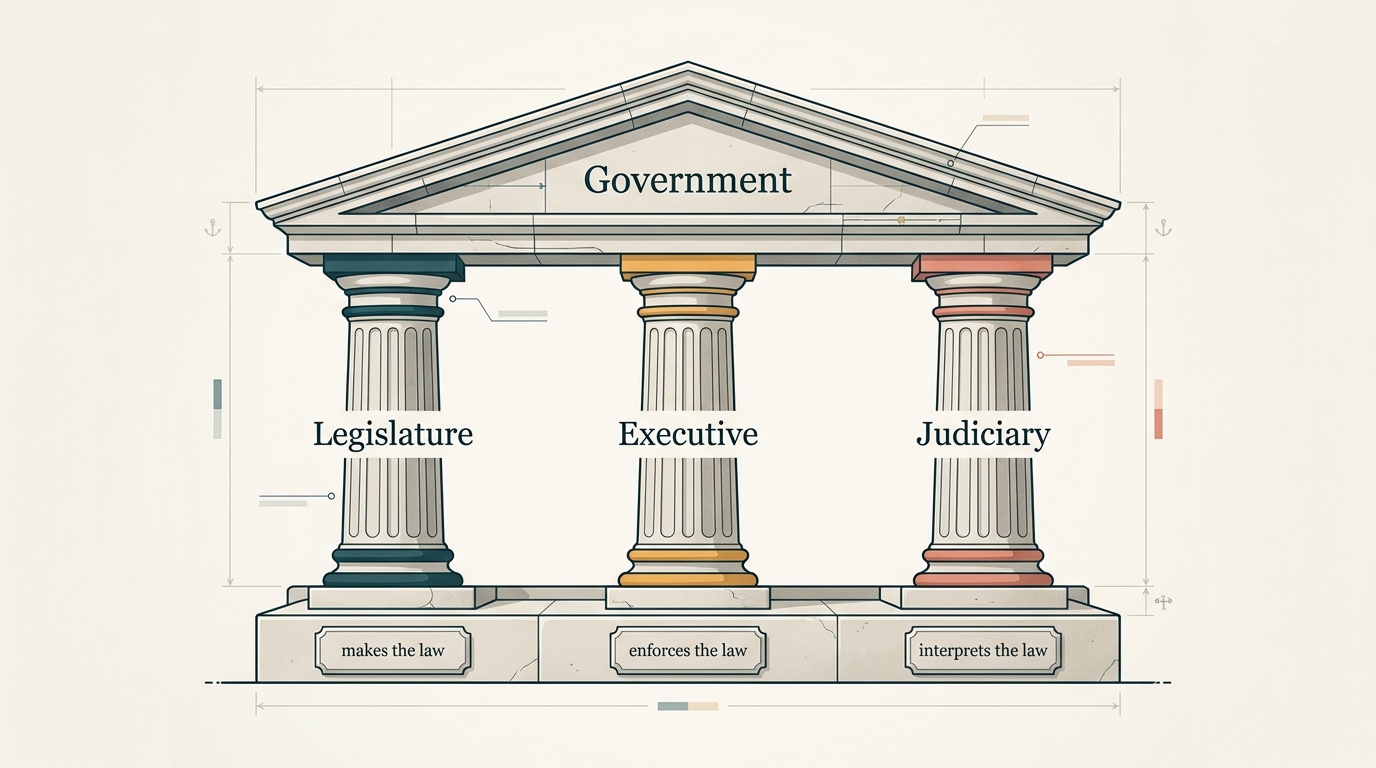
Fig. 2.0 – The pillars of government.
Keep these questions in mind as you read. By the end of this chapter, you will be able to answer every one of them.
2.1 Introduction to the Organs of Government
In the previous chapter you studied the four essential elements of a State — population, territory, government and sovereignty. Of these, government is the element that actually does something. A State without a government is only a piece of land with people living on it; it is the government that turns that population and territory into a working legal order.
Government can be described as a set of institutions that exercises control through legal devices and imposes penalties on those who break the law. Read that sentence carefully, because both halves matter. “Legal devices” means the government does not rule by brute force or personal whim — it rules through laws, rules, orders and judgments. “Imposes penalties” means those laws are not mere requests; behind each one stands the power of the State to punish disobedience.
How a Government Divides its Work
No government does all of its work through a single office or a single person. It functions by distributing its work among its organs, with each organ performing some specific functions. This division is not merely administrative convenience. It is what keeps power from collecting in one pair of hands.
A government primarily performs three functions: making the laws, enforcing the laws, and adjudicating disputes. These three essential functions are termed the legislative, the executive and the judicial functions, and the three organs that carry them out are the legislature, the executive and the judiciary.
Consider how the three fit together in an ordinary situation. Parliament passes a law that makes riding a two-wheeler without a helmet an offence. That is the legislative function. The traffic police stop a rider and issue a challan. That is the executive function. The rider disputes the challan and a court decides whether the offence was in fact committed. That is the judicial function. One rule, three organs, three different kinds of work.
Why Every Government Needs All Three
A government achieves the purpose of a State through the performance of these functions. They constitute the minimal requirements of any form of government — meaning that whatever the form, whether monarchy, dictatorship or democracy, somebody has to make the rules, somebody has to apply them, and somebody has to settle the disputes that arise under them.
What differs between forms of government is not whether these three functions exist, but who performs them and how separately. In a dictatorship, all three may collapse into the will of one person. In a modern democracy, they are deliberately kept in separate hands. That difference is the subject of the sections that follow.
To restate the division plainly: the legislature makes laws, the executive implements them, and the judiciary interprets laws and adjudicates disputes. This system of distribution of powers among the three organs of a government is called ‘Separation of Powers’.
You will study this principle in detail in the next chapter. For now, hold on to the basic idea: three functions, three organs, and a division of labour that is deliberate rather than accidental.
2.2 Forms of Government
Every State has a government, but not every State is governed in the same way. What separates one form of government from another is a single question: in whose hands does supreme political authority finally rest? Is it one person, a small group, or the people as a whole?
The four classical answers to that question give us the four forms of government studied in this section — monarchy, aristocracy, dictatorship and democracy, as set out in Fig. 2.1.
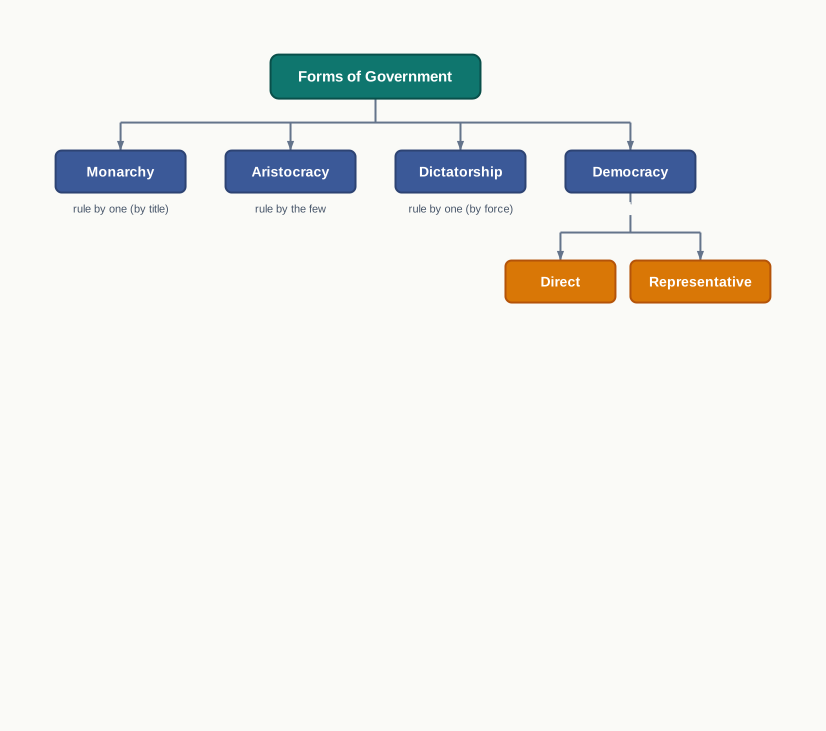
Fig. 2.1 – Classification of the forms of government.
2.2.1 Monarchy
Monarchy is the oldest form of government. In its classical shape, the whole machinery of the State worked according to the commands and the rule of the monarch. Whatever the king ordered was law, whatever he directed was administration, and whatever he decided was justice.
Monarchy is thus a form of political regime in which the supreme and final authority is in the hands of a single person wearing a crown, irrespective of whether that office is hereditary or elective. It is the will of one person which ultimately prevails in all matters of governance.
Notice the width of that description. The political scientist J.W. Garner (1871–1938) took the term in its widest sense: any government in which supreme and final authority rests with one person is a monarchy, whatever the source of that authority and whatever the length of that tenure. On this view it does not matter whether the office came by election — by a parliament or by the people — or by hereditary succession, and it does not matter whether the holder is titled emperor, king, czar, president or dictator. What gives a government the character of monarchy is the plain fact that the will of one person finally prevails in all matters of government.
The Decline of Monarchy
With the development of republican and democratic forms of government, the monarchical form declined. Real political power moved to elected bodies, and the crown was left holding ceremony rather than command.
In some cases, as in the United Kingdom, monarchs are merely retained as the ‘ceremonial’ or ‘nominal’ heads of government, devoid of key political powers. As observed by C.C. Rodee, constitutional monarchs are loved and respected by their people as symbols of the unity of the nation or empire, but are devoid of political power.
This gives us a distinction worth carrying forward. An absolute monarch actually governs; a constitutional monarch reigns while an elected government governs. Saudi Arabia is an example of the first, the United Kingdom of the second. The title is the same; the power behind it is not.
2.2.2 Aristocracy
The word ‘Aristocracy’ originates from the Greek word ‘aristo’, which means ‘the best’, and another Greek word, ‘kratein’, which means ‘to rule’. Put together, the word means rule by the best — though, as you will see, “the best” was almost always decided by the rulers themselves.
In an aristocratic form of government, the political power of the State is vested in the hands of a few people. It is a form of government in which a relatively small proportion of people determine the policies of the government. That small group can be a combination of priests, soldiers, professionals, landowners or men of wealth.
As defined by Garner, aristocracy is the form of government in which relatively a small portion of citizens have a voice in choosing public officials and in determining public policies.
Those few people are chosen from among the people of the State on varied bases — wealth (the land-owning class), education (the nobles), religious position (the priestly class), family, succession, physical force, and so on. Whatever the basis, the effect is the same: the ruler is treated as a class separate from, and superior to, the ruled.
That last point is what distinguishes aristocracy from democracy far more sharply than the number of rulers does. In a democracy the government is drawn from the people; in an aristocracy it stands above them as a different order of person.
2.2.3 Dictatorship
A dictatorship also places all power in one person, which makes it easy to confuse with monarchy. The difference lies in how that power was obtained and how it is exercised.
In the words of Alfred Cobban (1901–1968), a dictatorship is the government of one man who has not obtained his position by inheritance, but either by force or by consent or by a combination of both. He possesses absolute sovereignty — that is, all political power flows from his will and is unlimited in scope. It is exercised in an arbitrary manner, by decree rather than by law. His authority is not limited in duration and is not subject to any other authority, for such a restriction would be inconsistent with his absolute rule.
The dictatorial form of government is therefore rule by a single person or a determined set of individuals who control and exercise the political powers of the State. Unlike a monarch, who ordinarily comes to the throne by succession, the dictator occupies his position by force, invasion, intervention and militarism.
Once in place, he collapses all three organs into himself. His dictates are the law of the country; he implements them; and he adjudges according to his own will. He holds absolute power and is neither accountable nor answerable to the citizens of the State. Modern dictatorships play the role of totalitarian States — regimes that seek to control not merely the government but the economy, the press, education and private life as well.
2.2.4 Democracy
Democracy is the most popular form of government in the modern civilised States, and it is the form under which you live. The word ‘democratic’ comes from the Greek word ‘Demos’, meaning people, and ‘Kratia’, meaning rule — that is, rule by a popular vote.
Pericles (495–429 B.C.), the Greek leader, defined democracy as a form of government in which the people are powerful. Bryce defined the democratic form of government as one where the ruling power of the State is vested not in a particular class or classes, but in the community as a whole. Read Bryce’s definition against the definition of aristocracy given above and the contrast is exact: the same power, held by everybody instead of by a few.
Abraham Lincoln (1809–1865), a former President of the U.S., in his speech at Gettysburg defined democracy as a ‘government of the people, by the people and for the people’. Each of those three phrases carries a separate meaning.
- ‘Government of the people’ implies an equal distribution of political power and influence among the citizens of the State.
- ‘Government by the people’ implies the participation of all citizens in forming a government.
- ‘Government for the people’ implies the rule of government for the promotion of public welfare.
Democracy exists in two major forms: direct or pure democracy, and indirect or representative democracy.
Direct or Pure Democracy
As defined by Garner, a pure democracy is one in which the will of the State is formulated or expressed directly and immediately through the people in a mass meeting or primary assembly, rather than through the medium of delegates or representatives chosen to act for them.
Here the political power is in the hands of the citizens of the State as a whole — to enact legislation, to administer regulations, and, by common vote, to elect their public officers. The devices through which they do this are referred to as initiative, plebiscite or referendum.
This form of democracy operated in the Greek city state of Athens during the 4th and 5th centuries B.C., and in Rome during the early stages of the Roman polity, as an ideal system of popular participation. Both were small enough for the citizens to physically gather in one place — which is precisely why this form is not possible in States having a large population and a large territory. You cannot assemble a billion people in a field.
In contemporary times, this form of democracy survives in the provinces of Switzerland, where the voters meet in an open-air assembly to deliberate upon and decide public affairs. Four devices are used, and you should be able to tell them apart.
- Initiative — a specified number of voters themselves prepare a Bill for acceptance or approval by the legislature or the general public. If it is approved, it becomes law.
- Referendum — a Bill already passed by the legislature is forwarded to the voters for final ratification.
- Plebiscite — an important issue that could not be decided by the government is decided directly by the votes of the people.
- Recall — voters recall their elected representatives when they are not satisfied by their conduct.
Representative or Indirect Democracy
The other form is representative or indirect democracy, resting on the basis of universal suffrage — that is, the right to vote extended to all adult citizens without distinction of wealth, caste, religion or gender.
In this form, the citizens of the country elect their representatives on the basis of popular votes. The will of the State is then formulated and expressed through those representatives, who form a law-making and law-executing agency for a fixed term. On matters of governance, the representatives are accountable and answerable to the public in general.
The two forms are closer than they look. As observed by Garner, this kind of democracy resembles its pure form in the sense that political power remains vested in the people, but the two differ in respect to their exercise. The people still own the power; they simply exercise it through agents rather than in person.
Thus, in both forms, all the citizens of the State have an equal opportunity of participation in the political affairs of the State — in contrast to the monarchical or dictatorial forms of government, where that opportunity belongs to one person alone. The political power remains in the hands of the people.
Where the political power ultimately lies is the same in both columns. Only the method of exercising it changes.
2.3 Parliamentary and Presidential Forms of Government
Knowing that a State is a democracy tells you who holds ultimate power. It does not yet tell you how that power is organised at the top. Two democracies can both be built on universal suffrage and still be arranged very differently, depending on the relationship between the legislature and the executive.
That relationship is what separates the parliamentary form of government from the presidential form.
The Parliamentary Form
In a parliamentary system, the legislature and the executive are related to each other in two ways: by way of membership in the two bodies, and by way of accountability. Membership means that the ministers who run the government are themselves members of the legislature — they sit in the same House, on the same benches, as the members who question them. Accountability means that they hold office only so long as that House is satisfied with them.
This form of government is well prevalent in India and the United Kingdom. The executive body, while implementing laws and discharging its responsibilities — health, education, food and public distribution, defence, police services and so on — is responsible to the legislature.
That word ‘responsible’ is doing heavy work. It does not merely mean that ministers must be polite when questioned. It means that if the House withdraws its confidence, the government must go.
Collective Responsibility
As stated by Professor M.P. Jain, a notable principle underlying the working of parliamentary government is the principle of collective responsibility, which represents ministerial accountability to the legislature. The principle means that the Council of Ministers works as a team, as a unit, and is responsible as a body for the general conduct of the affairs of the government. All the Ministers stand or fall together in Parliament, and the government is carried on as a unity.
Follow the consequence. A minister may have opposed a decision inside the Cabinet room, but once the decision is taken, she must defend it in the House as her own or resign. And if the House votes the government out over a decision taken by one department, the entire Council of Ministers falls with it — not merely the minister responsible. Unity is not a courtesy in this system; it is a legal condition of holding office.
Because the Cabinet sits at the centre of this arrangement, this form of government is also termed Cabinet Government by Sir Ivor Jennings (1903–1965), an English lawyer and academician, and Prime Ministerial Government by Richard Crossman (1907–1974), an English author and politician. The two labels reflect a genuine argument about where power has actually settled — in the Cabinet as a body, or in the Prime Minister who leads it.
The Presidential Form
In the presidential system, the executive branch of the government is independent of the legislature for its tenure and its actions. The two are elected separately, serve separately, and neither can dismiss the other over a disagreement of policy.
In the words of Garner, presidential government is that form in which the chief executive is independent of the legislature as to his tenure and, to a large extent, as to his policies and acts. In this system the nominal head of the State is also the real executive.
That last sentence is the key to the whole distinction, and it explains something you may have wondered about.
This form of government is prevalent in the United States of America and Argentina. The President is elected by the people, whether directly or indirectly, for a fixed period, unless removed on impeachment by the legislature on the grounds stated in the Constitution of the country. This system works on the principle of ‘separation of powers’ and ‘checks and balances’.
Note carefully what impeachment is and is not. It is not a vote of no confidence over a bad policy; it is removal on specified constitutional grounds, and nothing less will do. The fixed term is precisely the point of the presidential design — the executive is meant to be stable enough to govern without watching the legislature’s mood every week.
When a question asks you to distinguish between the two forms, the safest single line is this: in the parliamentary form the executive survives at the pleasure of the legislature, and in the presidential form it does not.
2.4 Unitary and Federal Forms of Government
The previous section divided governments by the relationship between the legislature and the executive. This section divides them along a different axis altogether: the relationship between the government at the centre and the governments of the regions.
A country may be large, and it must be administered everywhere, not just at the capital. The question is whether the regional governments hold power of their own, or hold only what the centre chooses to hand them.
The Unitary Form
The unitary form of government is one where the whole State, with all its units and provinces, is organised under a single central government. The local or provincial governments are created by the central government as its subordinates, for better administration, and the central government delegates powers and authority to them.
The word ‘delegates’ is the giveaway. What is delegated can be withdrawn. A provincial government in a unitary State has no independent constitutional footing to stand on if the centre changes mind.
As remarked by Garner, where the whole power of government is conferred by the constitution upon a single central organ or organs, from which the local governments derive whatever authority or autonomy they may possess — and indeed derive their very existence — we have a system of unitary government. It is the characteristic of this form of government that there is no constitutional division or distribution of powers between the central government of the State and the subordinate local governments.
The Federal Form
A federal government is built the other way round. As remarked by Garner, a federal government, as distinguished from a unitary government, is a system in which the totality of governmental power is divided or distributed by the national Constitution — or by the organic act of Parliament creating it — between a central government and the governments of the individual states or other territorial subdivisions of which the federation is composed. Within the sphere assigned to them, the provincial governments enjoy full autonomy.
The crucial difference is the source of the division. In a federation, the split of powers is made by the Constitution itself, not by a decision of the centre. The centre cannot take a subject back from the states simply because it would prefer to handle that subject, any more than a state can help itself to a subject reserved for the centre.
The Division of Subjects in India
India’s Constitution makes this division through the Seventh Schedule, which distributes subjects across three Lists, as shown in Fig. 2.2.
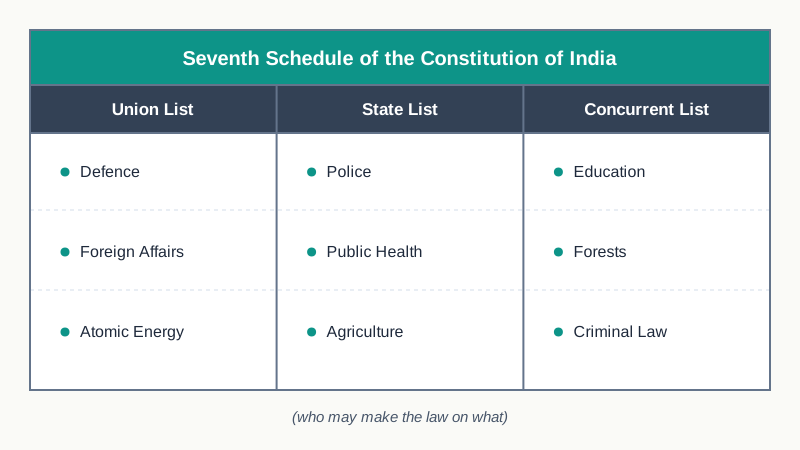
Fig. 2.2 – Division of powers under the Seventh Schedule.
- As listed in the Seventh Schedule of the Constitution of India, matters concerning national importance — international relations, war and peace, atomic energy and the like — are dealt with by the Central Government.
- Matters of regional and local importance, listed in the State List, can be legislated upon by the state governments.
- There are matters on which both the Central and the State governments are authorised to make laws, and these are included in the Concurrent List.
The logic of the division is worth noticing. Subjects that cannot sensibly stop at a state boundary — a war, a treaty, a currency — go to the centre. Subjects that differ genuinely from one part of the country to another go to the states. Subjects that need a common national standard but also local administration are shared.
India: Federal in Character, Unitary in Spirit
Despite having adopted federal features, the Constitution of India does not claim to establish India as a federation of states. Article 1 describes India as a Union of States, not as a federation — and that choice of word was deliberate.
Several features pull towards the centre. The states did not come together by agreement to form the Union and cannot leave it, and the Union Parliament’s powers in a number of areas run deeper than those of a classical federation.
K.C. Wheare, examining the Indian Constitution, described it as quasi-federal — a unitary State with subsidiary federal features, rather than a federal State with subsidiary unitary features. The same point is often put more briefly: India’s system of government is federal in character and unitary in spirit.
Mixed Forms in Practice
You should not expect any real country to be a clean example of a single form. In recent periods, the governments of most States have combined different forms stated above.
For instance, the British Government combines monarchy, democracy and parliamentary forms — a crowned head of State, an elected legislature, and a Cabinet answerable to it. India is a democratic republic with a parliamentary form of government, carrying both unitary and federal features.
So when a question asks you what form of government India has, a single word is not an answer. The accurate answer names the combination.
2.5 Composition of the Legislature
Having seen how a government may be organised as a whole, we now look inside one of its organs. The legislature is the law-making body, and the first structural question about any legislature is a simple one: does it have one chamber or two?
A legislature may be organised as a bicameral or a unicameral legislature.
Bicameral Legislature
In a bicameral system, there are two houses or chambers. A Bill must ordinarily be considered and passed by both before it can become law.
The Indian Parliament is a bicameral legislature, its houses being the House of People (Lok Sabha) and the Council of States (Rajya Sabha). In the States of the Indian Union, the legislature consists of the Vidhan Sabha (lower house) and the Vidhan Parishad (upper house). However, certain states have only one house.
The two chambers are composed differently, and that is deliberate — they are meant to represent two different things.
- The House of People (Lok Sabha) consists of the representatives of the citizens of the entire country living in states and union territories. It represents people.
- The Council of States (Rajya Sabha) consists of the representatives elected by the Legislative Assemblies of the states, along with other nominated members from the fields of art, culture, academics, sports, literature, science and social service. It represents states, with an admixture of expertise.
Why Have a Second Chamber?
The purposes and functions of the second chamber are to check hasty and ill-considered pieces of legislation, with the sober advice of experts and eminent persons. A Bill that has cleared one House in the heat of a moment must survive a second look by a differently constituted body.
Thus, it becomes possible to examine issues from different standpoints, and to safeguard the interests of the states in a federal system. Where the lower house counts heads, the upper house speaks for the units of the federation — which is exactly why a second chamber matters more in a large, diverse country than in a small, homogeneous one.
Unicameral Legislature
A unicameral legislature implies one legislative house. Every Bill begins and ends its journey in the same chamber.
This system of legislature is seen in Turkey, where it is known by the name of the Grand National Assembly of Turkey, and in Bangladesh by the name of the House of the Nation, among others.
The system is supported by the reason that the legislative body representing the people’s interest must be one, failing which delays and conflicts may arise in the enactment of legislation. If the people’s will is single, the argument runs, why should it need two voices — and why should a second chamber be able to hold up what the elected chamber has decided?
The Position in India
India has 28 States and 8 Union Territories. Their legislatures are not uniformly structured.
There are 22 states which have a unicameral structure. The list of these states is given below.
- Arunachal Pradesh
- Assam
- Chhattisgarh
- Goa
- Gujarat
- Haryana
- Himachal Pradesh
- Jharkhand
- Kerala
- Madhya Pradesh
- Manipur
- Meghalaya
- Mizoram
- Nagaland
- Odisha
- Punjab
- Rajasthan
- Sikkim
- Tamil Nadu
- Tripura
- Uttarakhand
- West Bengal
The names of the six states having a bicameral legislature are:
- Andhra Pradesh
- Bihar
- Karnataka
- Maharashtra
- Telangana
- Uttar Pradesh
Union Territories that have a legislature have a unicameral legislature. These are:
- Delhi
- Puducherry
- Jammu and Kashmir
Comparing the Two Systems
Read the table as a trade-off rather than a scoreboard. Speed and revision pull against each other: the more carefully a legislature is made to think, the longer it takes to act. Neither system is simply better — each buys one of those goods by giving up some of the other.
2.6 General Functions of the Legislature
Let us now look at the three main organs of government — the legislature, the executive and the judiciary — their functions, and the provisions that govern them. As we go, notice how often one organ performs work that appears to belong to another. That overlap is not untidiness; it is how the organs check each other.
We begin with the law-making organ.
Parliament, Assembly and Congress are the synonyms used for the term ‘Legislature’ in various countries. The word ‘Parliament’ is derived from the French word ‘parler’; Parliament means a meeting for discussion. The name is a reminder of what a legislature actually is — not a machine that stamps out laws, but a place where proposals are argued over before they bind anybody.
The following are some functions of this organ.
2.6.1 Expressing and Formulating the Will of the State, and Enacting Laws
The legislature formulates and expresses the ‘will of the state’. What that phrase means depends entirely on the form of government you are in.
In a representative democracy, the ‘will of the state’ is the will, opinion and sentiments of its citizens and the public issues concerning them. In a monarchy or a dictatorial government, the ‘will of the state’ is the interest and objectives of its ruler. The same words, then, describe two completely different things — which is why the form of government studied earlier in this chapter matters so much to what a legislature actually does.
Laws, when enacted, are called ‘Acts’. These Acts are the direct source of law to control and regulate the institutions running in a state and in society.
All legislations are enacted for the achievement of certain objectives and purposes. This is worth remembering as a habit of reading: when you meet any statute in later chapters, ask first what problem it was written to solve. For example, the Indian legislature enacted the Consumer Protection Act, 1986 with the purpose of protecting the interests of consumers and the speedy settlement of their disputes. That Act has since been replaced by the Consumer Protection Act, 2019, which pursues the same purpose in a wider form — a reminder that a legislature does not merely make laws, it also keeps remaking them as the problems change.
2.6.2 Ensuring Accountability of the Executive
In a parliamentary system, the executive holds office only so long as the legislature is satisfied with it. That relationship is not left to convention alone; the Constitution states it.
Parliament exercises this check and ensures executive and administrative accountability chiefly through its control over finances. The reasoning is direct: a government that cannot raise or spend money without the legislature’s approval cannot govern against the legislature’s wishes for very long.
Beyond money, Parliament assesses governmental policies and the performance of the administration through procedures like questions, calling attention motions and the like. A question put to a minister on the floor of the House compels an answer on the record, which is a far stronger discipline than it may sound.
At the extreme, a Motion of No-Confidence may be moved and passed against the Council of Ministers in the Lok Sabha. Notice that this motion lies only in the Lok Sabha — the House to which the Council of Ministers is collectively responsible under Article 75(3). Collective responsibility, which you studied in section 2.3, is what gives this motion its force: it is moved against the government as a whole, and if it is passed, the government as a whole must go.
Parliamentary Procedure and the Enactment of Laws
A Bill is a statute in draft. It cannot become law unless it has received the approval of both the Houses of Parliament and the assent of the President of India.
A Bill can be introduced either by a Minister, when it is called a Government Bill; or by a member other than a Minister, when it is known as a ‘Private Member’s Bill’.
The legislative procedure for the introduction and passing of Bills is laid down in Articles 107 to 108 of the Constitution of India in the case of ordinary Bills, and in Articles 109-110 in the case of Money Bills. Article 111 provides details of assent to Bills by the President.
- Ordinary Bills may originate in either House of Parliament.
- A Money Bill contains provisions for the imposition, abolition, alteration or regulation of any tax, the custody of the Consolidated Fund or the Contingency Fund of India, the payment of money into or the withdrawal of money from any such Fund, and related matters. However, a Money Bill shall be introduced only in the House of People and not in the Council of States.
- The Annual Financial Statement is the annual statement of estimated receipts and expenditure of the Government for the ensuing financial year. Article 112 of the Constitution of India states that the President shall cause the statement to be laid before both the Houses of Parliament. The Members of Parliament debate on the provisions of the proposal, and generally a Bill is passed after three readings.
The restriction in point 2 is not a technicality. Money is raised from the people, so the power to authorise taxing and spending is given to the House that the people elect directly. The Council of States, whose members are elected by the State legislatures rather than by the voters at large, does not get to originate such a Bill.
2.6.3 Judicial Functions of the Legislature
The legislature is a law-making body, but it also performs judicial functions in certain situations.
The Legislature performs judicial functions while hearing and trying cases of impeachment — that is, removal from office before the expiry of the term. The Constitution of India lays down the procedure for the impeachment of the President and the Vice President of India, the Judges of the Supreme Court and the High Courts, and the Chief Election Commissioner.
The reason these particular offices are dealt with by the legislature is worth pausing on. Each of them is meant to be independent of the government of the day. If a minister could remove a judge or the Chief Election Commissioner, that independence would be worthless. Placing the power of removal in the legislature, and hedging it with a demanding procedure, protects the office from the executive while still ensuring that it is not beyond all accountability.
A word of precision about the term itself. ‘Impeachment’ is used broadly here to mean removal from office before the expiry of the term, which is what all these procedures achieve. Strictly, the Constitution uses the word impeachment only for the President; the Vice-President is removed by resolution, and the Judges of the Supreme Court and the High Courts and the Chief Election Commissioner are removed on an address presented to the President on the ground of proved misbehaviour or incapacity. In every case, however, it is the legislature that decides.
The legislature also performs a judicial function while deciding on the privileges of the Members of the House.
2.6.4 Administrative Functions of the Legislature
Finally, the legislature performs certain administrative functions, chiefly the filling of high offices.
- In India, the elected members of both Houses of Parliament and the elected Members of the Legislative Assemblies of the States form an electoral college to elect the President.
- The Vice-President is elected by an electoral college comprising Members of both Houses of Parliament.
- The members of the Lok Sabha elect two members as the Speaker and the Deputy Speaker.
- The members of the Rajya Sabha elect the Deputy Chairman of the Rajya Sabha.
Look again at the first of these. The President is elected by an electoral college that includes the elected members of the State Legislative Assemblies, not by Parliament alone. That composition reflects the federal features you studied in section 2.4 — the head of the Indian State is chosen with the participation of the States, not merely by the Centre.
Taken together, these four functions show that a legislature does much more than pass laws. It makes them, it holds the executive to account for administering them, it sits in judgment in a narrow class of cases, and it staffs the highest offices of the State.
2.7 General Functions of the Executive
The executive is often referred to as the ‘government’ of a state. In everyday speech, when people say “the government has decided” or “the government should do something about this”, it is almost always the executive they mean.
In a representative democracy, the term ‘Executive’ has a broad meaning. It covers not only the Council of Ministers at the top, but the whole apparatus through which decisions are actually carried out — the departments, the officers, the police, the district administration, the public agencies. A law passed by the legislature is only words on paper until this machinery gives it effect.
The following are the functions of the executive organ.
2.7.1 Internal and External Administration of the State
The chief function of the executive is the maintenance of internal and external administration.
On the internal front, this covers law and order, financial matters, infrastructure and industrial development, the welfare and development of the people — health, education, labour, employment, and rural and local development — environment and forests, natural resource management, and trade and commerce.
On the external front, it covers defence, foreign affairs, international relations and related matters.
Read that list again and notice how it has grown. A government of the nineteenth century was expected to do very little beyond keeping order, collecting taxes and defending the frontier. The modern State takes responsibility for whether children are schooled, whether workers are safe, whether medicines are available and whether rivers are clean. This is what is meant by the welfare state — and it is the single biggest reason the executive has become the largest and busiest organ of government.
2.7.2 Legislative Functions of the Executive
The executive performs certain legislative functions as well. Two of these deserve careful study, because each is an exception to the ordinary rule that laws are made by the legislature.
Delegated Legislation
Delegated legislation is an enactment made by an individual or body other than Parliament.
By delegating the power to make legislation to the executive, Parliament empowers different people or bodies to integrate more details into an Act of Parliament. Parliament, through essential enactment — for example, an Act of Parliament — authorises the executive to make laws and guidelines through delegated legislation. The executive then frames orders, rules, regulations, ordinances, by-laws and circulars.
Why does Parliament do this at all? Because a legislature cannot possibly settle every detail of every subject it regulates, and should not try. Parliament can decide that food sold to the public must be safe; it cannot sensibly sit and debate the permitted limit of every additive in every product, or revise those limits each time the science changes. So it lays down the principle and the policy, and leaves the detailed working out to the executive body that has the expertise and can move quickly.
The condition attached to this power is the important part. Delegated legislation carries equal force of law only if it is framed within the sphere and policy of the parent legislation. A rule that travels beyond what the parent Act authorises is not law at all, however officially it may have been issued.
Ordinance
Under Article 123 of the Constitution of India, the President has the power to promulgate an ordinance during the recess of the Parliament. An ordinance is a law that is promulgated by the President of India only when the Indian Parliament is not in session, and the President promulgates it on the recommendation of the union cabinet.
The purpose is straightforward. Some situations will not wait for Parliament to reassemble, and using ordinances, immediate legislative actions can be taken.
However, it must be noted that an ordinance shall cease to operate at the expiration of six weeks from the reassembly of Parliament, unless it is approved by Parliament. This time limit is what keeps the power from swallowing the rule: an ordinance is a stop-gap that borrows the force of law for a short period, not a way for the executive to govern by decree while the legislature is away.
2.7.3 Financial Functions of the Executive
The executive imposes and collects taxes and incurs expenditure on the various activities of the state. It prepares the budget of the financial year, maintains the accounts of government departments and prepares national policies. It also arranges financial grants from international entities like the International Monetary Fund, the World Bank and others.
Set this beside what you studied in section 2.6. Parliament controls finances as a check on the executive, yet it is the executive that prepares the budget and does the actual collecting and spending. The two are not in conflict: the executive proposes and administers, and the legislature authorises and scrutinises. Neither can manage the public purse alone.
2.7.4 Judicial Functions of the Executive
The judicial functions of the executive include the power to grant pardon — the Presidential pardon — and the power to suspend or lessen a punishment on special grounds, or to exchange one form of punishment for another, on the petition of a person convicted of any offence by a court.
This power is an unusual one, and students often ask why an executive authority should be able to alter what a court has decided. The answer is that courts must apply the law as it stands to the facts proved before them, and a sentence that is entirely correct in law may still work an injustice in a particular case — where fresh material comes to light, where the convicted person is terminally ill, or where the punishment has become disproportionate with the passage of time. The pardoning power exists as a final safety valve for such cases. It does not sit in appeal over the court’s finding of guilt; it acts on the punishment.
Look back over these four functions and a pattern emerges. The executive administers, but it also legislates in a limited and borrowed way, and it also exercises a narrow judicial power. The three organs are separated in principle, yet each reaches a little into the work of the others — which is precisely what makes checks and balances possible.
2.8 General Functions of the Judiciary
The third organ neither makes the law nor administers it. Its work begins when something has gone wrong — when two parties disagree about what the law requires, when a citizen says the State has exceeded its powers, or when the words of a statute do not clearly cover the situation in front of it.
2.8.1 To Hear and Decide Disputes
The first and the foremost function of the judiciary is to hear and decide a case, according to the substantive and procedural laws of the land. Substantive law tells the court what the rights and liabilities are; procedural law tells it how the case must be conducted. A court must satisfy both — a correct outcome reached by an improper procedure is not justice.
The role of the judiciary is expanding along with the expanding role of the executive. This follows directly from what you studied in the previous section: the more fields the modern welfare State enters, the more decisions it takes, and the more of those decisions somebody will eventually dispute.
Disputes calling for the intervention of the judiciary may arise in several directions.
- Among the citizens of a State.
- Between citizens and the State.
- Among the federal units.
- Between the various departments of the executive.
- In international relations.
Dispute settlement and adjudication require the independent functioning of the judiciary, without political influence or interference. Impartial and time-bound justice delivery are essential requirements for the judiciary.
Both halves of that requirement matter. A court that is impartial but takes fifteen years to decide has failed the person who came to it, because a remedy that arrives too late is often no remedy at all. That is why delay in the courts is treated as a problem of justice and not merely of administration.
2.8.2 Judicial Review
Judicial review is the power bestowed upon the judiciary by the Constitution, by virtue of which the judiciary can examine legislative enactments and executive orders of the governments — be it State or Central — and declare them null and void if they contravene the provisions of the Constitution.
This is the sharpest of all the checks in the system, so be clear about what it does and does not permit. The court is not asking whether a law is wise, popular or well-drafted. It is asking one question only: is it consistent with the Constitution? A foolish law that breaches no constitutional provision survives judicial review; a well-meaning law that violates a constitutional guarantee does not.
The judiciary exercises jurisdiction on the basis of territorial limits, pecuniary or financial limits, appealable matters, and matters for review and revision. In other words, no court can hear every case: the place where the cause arose, the value of the claim, and the stage at which a matter has reached all decide which court may take it up. You will study these bases of jurisdiction in detail in a later chapter.
The judiciary consists of the Magisterial courts and the District and Sub-District Courts at the lower level, and the higher judiciary comprising the High Courts and the Supreme Court. The decision given by them is known as a ‘judgment’, a ‘decree’, an ‘order’ or an ‘award’, depending on the nature of the proceeding and the forum that decided it.
2.8.3 Interpretation of Laws
Wherever the law is ambiguous — that is, confusing or capable of more than one meaning — or is not clear, or is silent, or appears to be inconsistent with other laws of the land, the courts, after proper analysis, determine or interpret the intent, purpose and meaning of the provisions of law.
No legislature can foresee every situation its words will later have to cover. A statute written before smartphones existed may still have to be applied to something done on one. When that happens, the court does not send the problem back to Parliament; it works out what the provision means and applies it. That determination then guides everyone who reads the provision afterwards.
Students frequently confuse this function with judicial review, so hold the two apart carefully.
2.8.4 Advisor to the President
The Supreme Court has special advisory jurisdiction in matters which may specifically be referred to it by the President of India under Article 143 of the Constitution.
Notice how this differs from every other function in this section. Ordinarily a court decides a dispute between parties who have come before it. Here there is no dispute and no parties — the President seeks the Court’s opinion on a question, usually one of law or of public importance, so that the government may act with the benefit of that opinion rather than wait for a controversy to arise.
2.8.5 Role of the Judiciary as an Activist
In India, perhaps the first instance of the activist role of the judiciary was after the Emergency, when the Supreme Court came up with public-interest litigation (PIL) — a tool meant to ensure justice for the under-privileged and the marginalised.
The problem that PIL was designed to solve is worth understanding, because it explains the whole idea. Ordinarily, only the person whose own right has been affected can approach a court. But the people most likely to suffer serious legal wrongs — prisoners, bonded labourers, people living in extreme poverty — are precisely the people least able to hire a lawyer and file a petition. A right that its holder cannot enforce is a right in name only. PIL relaxed that barrier, allowing a matter affecting the public interest to be brought before the Court by someone acting on behalf of those who cannot come themselves.
2.8.6 Legislative and Executive Functions of the Judiciary
The judiciary has been empowered to frame rules and execute them for the smooth functioning of its own administration. This is also done to ensure the independence of the judiciary.
The link between those two sentences is the point. If the executive controlled the courts’ internal rules, staffing and day-to-day administration, judicial independence would exist on paper alone — the organ whose actions courts must review would hold the levers of the courts’ own working. By letting the judiciary manage its own house, the system keeps that dependence from arising.
The Overlap Between the Organs
You have now studied all three organs, and one observation should be made before we close.
Each organ performs some work that belongs, in principle, to another. The legislature tries cases of impeachment and decides questions of privilege — judicial work. The executive frames delegated legislation and issues ordinances — legislative work — and grants pardons, which touches judicial work. The judiciary frames rules for its own administration — legislative and executive work.
This overlap does not defeat the separation of powers. It is a deliberate part of the design. Absolute separation would leave each organ unchecked within its own field; a measured overlap allows each to restrain the others while the main body of each function still rests with the organ meant to perform it.
2.9 Summary
- Government is the set of institutions that exercises control through legal devices and imposes penalties on those who break the law.
- A government works by distributing its work among its organs, each performing specific functions.
- A government primarily performs three functions:
- making the laws — the legislative function;
- enforcing the laws — the executive function;
- adjudicating disputes — the judicial function.
- These three functions are the minimal requirements of any form of government, whatever its form.
- The distribution of powers among the three organs of government is called ‘Separation of Powers’.
- Monarchy is the oldest form of government, in which supreme and final authority rests with a single person, whether the office is hereditary or elective.
- A constitutional monarch, as in the United Kingdom, is a ceremonial or nominal head, respected as a symbol of national unity but devoid of political power.
- Aristocracy — from the Greek ‘aristo’ meaning the best and ‘kratein’ meaning to rule — is government by a small section of citizens, chosen on bases such as wealth, education, religious position, family, succession or physical force, who form a class separate from and superior to the ruled.
- Dictatorship is rule by one person or a determined set of individuals who obtain power by force or consent rather than inheritance, exercise absolute power arbitrarily by decree, and are answerable to no one.
- Democracy — from the Greek ‘Demos’ meaning people and ‘Kratia’ meaning rule — vests ruling power in the community as a whole rather than in any particular class.
- Abraham Lincoln defined democracy as government of the people, by the people and for the people, meaning respectively:
- equal distribution of political power among citizens;
- participation of all citizens in forming the government;
- rule for the promotion of public welfare.
- Democracy exists in two forms — direct or pure democracy, and indirect or representative democracy.
- Direct democracy operates through devices in which the citizens themselves act:
- initiative, where a specified number of voters prepare a Bill for approval;
- referendum, where a Bill passed by the legislature is sent to the voters for final ratification;
- plebiscite, where an important issue the government could not decide is decided by the votes of the people;
- recall, where voters recall a representative whose conduct has not satisfied them.
- Direct democracy operated in ancient Athens and early Rome and survives in the provinces of Switzerland, but is not possible in States with a large population and territory.
- In representative democracy, resting on universal suffrage, citizens elect representatives who form a law-making and law-executing agency for a fixed term and remain accountable to the public.
- In the parliamentary form, the legislature and the executive are linked by membership and by accountability; the executive is responsible to the legislature. India and the United Kingdom follow this form.
- Collective responsibility means the Council of Ministers is responsible to the legislature as a body, so that all Ministers stand or fall together.
- The parliamentary form is also called Cabinet Government by Sir Ivor Jennings and Prime Ministerial Government by Richard Crossman.
- In the presidential form, the executive is independent of the legislature as to tenure and actions, and the nominal head of the State is also the real executive. The United States of America and Argentina follow this form.
- A presidential executive holds office for a fixed period unless removed on impeachment, and the system works on separation of powers with checks and balances.
- In a unitary government, the whole power of government is conferred on a single central authority, from which local governments derive their authority and their very existence, with no constitutional division of powers.
- In a federal government, the totality of governmental power is divided by the Constitution between a central government and the governments of the constituent units, each autonomous within its own sphere.
- The Seventh Schedule of the Constitution of India divides subjects into three Lists:
- matters of national importance, such as international relations, war and peace and atomic energy, dealt with by the Central Government;
- matters of regional and local importance in the State List, legislated on by the State governments;
- matters in the Concurrent List, on which both the Centre and the States may make laws.
- Despite adopting federal features, the Constitution of India does not claim to establish India as a federation of states; K.C. Wheare described the Indian Constitution as quasi-federal — a unitary State with subsidiary federal features.
- Most modern States combine forms — the British Government combines monarchy, democracy and parliamentary forms, while India is a democratic republic with a parliamentary form carrying unitary and federal features.
- A bicameral legislature has two houses; the Indian Parliament consists of the House of People (Lok Sabha) and the Council of States (Rajya Sabha), and bicameral State legislatures consist of the Vidhan Sabha and the Vidhan Parishad.
- The second chamber exists to check hasty and ill-considered legislation, to bring the sober advice of experts and eminent persons, to allow issues to be examined from different standpoints, and to safeguard the interests of the states in a federal system.
- A unicameral legislature has one house, as in Turkey’s Grand National Assembly and Bangladesh’s House of the Nation; it is defended on the ground that a single body representing the people avoids delays and conflicts in enacting legislation.
- India has 28 States and 8 Union Territories; 22 States have unicameral legislatures, 6 States are bicameral, and the Union Territories that have legislatures have unicameral ones.
- A unicameral legislature is flexible and efficient and suits smaller States, while a bicameral legislature is more time-consuming and suits larger States.
- The legislature formulates and expresses the will of the state, which in a representative democracy means the will and opinion of the citizens, and in a monarchy or dictatorship means the interest of the ruler.
- Laws when enacted are called Acts, and every legislation is enacted to achieve a particular objective and purpose.
- Article 75(3) of the Constitution of India provides that the Council of Ministers shall be collectively responsible to the House of the People.
- Parliament ensures the accountability of the executive through its control over finances, through questions and calling attention motions, and through a Motion of No-Confidence in the Lok Sabha.
- A Bill is a statute in draft and becomes law only on the approval of both Houses of Parliament and the assent of the President.
- A Bill introduced by a Minister is a Government Bill; one introduced by any other member is a Private Member’s Bill.
- The legislative procedure is laid down in Articles 107 to 108 for ordinary Bills and Articles 109-110 for Money Bills, while Article 111 provides for assent by the President.
- Ordinary Bills may originate in either House, but a Money Bill — dealing with taxation and with the Consolidated Fund or Contingency Fund of India — may be introduced only in the House of People.
- Under Article 112, the President causes the Annual Financial Statement of estimated receipts and expenditure for the ensuing financial year to be laid before both Houses, and a Bill is generally passed after three readings.
- The legislature performs judicial functions when it hears cases of impeachment and when it decides on the privileges of its Members.
- The legislature performs administrative functions when it elects the President through an electoral college of elected Members of Parliament and of the State Legislative Assemblies, elects the Vice-President through an electoral college of Members of both Houses, and elects the Speaker, the Deputy Speaker and the Deputy Chairman.
- The chief function of the executive is the internal and external administration of the State, covering law and order, finance, infrastructure, welfare and development on the internal front, and defence, foreign affairs and international relations on the external front.
- Delegated legislation is an enactment made by a person or body other than Parliament, framing orders, rules, regulations, ordinances, by-laws and circulars, which carry equal force of law if framed within the sphere and policy of the parent legislation.
- Under Article 123 of the Constitution of India, the President may promulgate an ordinance during the recess of Parliament, on the recommendation of the union cabinet, so that immediate legislative action can be taken.
- An ordinance ceases to operate at the expiration of six weeks from the reassembly of Parliament unless it is approved by Parliament.
- The financial functions of the executive include imposing and collecting taxes, incurring expenditure, preparing the budget, maintaining the accounts of departments, preparing national policies and arranging grants from bodies such as the International Monetary Fund and the World Bank.
- The judicial functions of the executive include the power to grant pardon, to suspend or lessen a punishment on special grounds, and to exchange one form of punishment for another, on the petition of a convicted person.
- The foremost function of the judiciary is to hear and decide cases according to the substantive and procedural laws of the land, which requires independence from political influence and impartial, time-bound justice delivery.
- Judicial review is the constitutional power of the judiciary to examine legislative enactments and executive orders of the State or the Centre and declare them null and void if they contravene the Constitution.
- The judiciary exercises jurisdiction on the basis of territorial limits, pecuniary or financial limits, appealable matters, and matters for review and revision.
- The judiciary consists of the Magisterial courts and the District and Sub-District Courts at the lower level, and the High Courts and the Supreme Court in the higher judiciary; their decisions are known as a judgment, decree, order or award.
- Tribunals and forums, such as the Motor Accident Claims Tribunal and the Consumer Disputes Redressal Commissions under the Consumer Protection Act, 2019, have become part of the conventional judicial system.
- Courts interpret the law wherever it is ambiguous, unclear, silent or apparently inconsistent with other laws, determining the intent, purpose and meaning of the provision.
- Under Article 143 of the Constitution, the Supreme Court has special advisory jurisdiction in matters specifically referred to it by the President of India.
- The activist role of the judiciary in India began after the Emergency with public-interest litigation (PIL), a tool meant to ensure justice for the under-privileged and the marginalised.
- The judiciary frames and executes rules for its own administration, which also secures its independence.
- The functions of the three organs overlap — the legislature tries impeachments, the executive makes delegated legislation and grants pardons, and the judiciary makes rules for itself — and this measured overlap is what makes checks and balances possible.
2.10 Key Terms
Government — the set of institutions that exercises control through legal devices and imposes penalties on those who break the law.
Legislative function — the function of making the laws.
Executive function — the function of enforcing and administering the laws.
Judicial function — the function of interpreting the laws and adjudicating disputes.
Separation of Powers — the system under which the legislative, executive and judicial functions are distributed among three distinct organs of government.
Monarchy — a form of government in which supreme and final authority is vested in a single person, whether the office is hereditary or elective.
Constitutional monarch — a monarch retained as the ceremonial or nominal head, respected as a symbol of national unity but devoid of political power.
Aristocracy — a form of government in which political power is vested in a small section of citizens who alone choose public officials and determine public policies.
Dictatorship — a form of government in which one person, or a determined set of individuals, holds absolute power obtained by force or consent, exercises it arbitrarily by decree, and is answerable to no other authority.
Totalitarian state — a State in which the government seeks to control not only public affairs but the economy, information and private life as well.
Democracy — a form of government in which the ruling power of the State is vested in the community as a whole rather than in any particular class.
Direct or pure democracy — a democracy in which the will of the State is expressed directly by the people in a mass meeting or primary assembly, rather than through representatives.
Initiative — the device by which a specified number of voters themselves prepare a Bill for acceptance or approval.
Referendum — the device by which a Bill already passed by the legislature is forwarded to the voters for final ratification.
Plebiscite — the device by which an important issue that the government could not decide is decided by the votes of the people.
Recall — the device by which voters remove an elected representative whose conduct has not satisfied them.
Representative or indirect democracy — a democracy in which citizens elect representatives who form a law-making and law-executing agency for a fixed term and remain accountable to the public.
Universal suffrage — the right to vote extended to all adult citizens without distinction.
Parliamentary form of government — a form in which the legislature and the executive are linked by membership and by accountability, the executive holding office so long as it enjoys the legislature’s confidence.
Collective responsibility — the principle that the Council of Ministers is answerable to the legislature as a single body, so that all Ministers stand or fall together.
Cabinet Government — Sir Ivor Jennings’s name for the parliamentary form, stressing the Cabinet as the collective centre of the government.
Prime Ministerial Government — Richard Crossman’s name for the parliamentary form, stressing the dominance of the Prime Minister within the Cabinet.
Presidential form of government — a form in which the executive is independent of the legislature as to its tenure and actions, and the nominal head of the State is also the real executive.
Impeachment — the removal of a holder of a high constitutional office from that office before the expiry of the term, on grounds and by a procedure laid down in the Constitution.
Checks and balances — the arrangement by which each organ of government is given some power to restrain the others.
Unitary government — a government in which the whole power of the State is vested in a single central authority, from which local governments derive their authority and their very existence.
Federal government — a government in which the totality of governmental power is divided by the Constitution between a central government and the governments of the constituent units.
Seventh Schedule — the Schedule of the Constitution of India that distributes legislative subjects between the Centre and the States.
State List — the list of matters of regional and local importance on which the State governments may legislate.
Concurrent List — the list of matters on which both the Central and the State governments are authorised to make laws.
Bicameral legislature — a legislature consisting of two houses, both of which must ordinarily pass a Bill before it becomes law.
Unicameral legislature — a legislature consisting of a single house, in which the entire law-making power of the organ is concentrated.
Lok Sabha (House of People) — the house of the Indian Parliament consisting of the representatives of the citizens of the entire country living in the states and union territories.
Rajya Sabha (Council of States) — the house of the Indian Parliament consisting of representatives elected by the Legislative Assemblies of the states, together with nominated members drawn from fields such as art, culture, academics, sports, literature, science and social service.
Vidhan Sabha — the lower house of a State legislature.
Vidhan Parishad — the upper house of a State legislature, where one exists.
Act — a law after it has been enacted by the legislature.
Motion of No-Confidence — a motion that may be moved and passed against the Council of Ministers in the Lok Sabha, withdrawing the House’s confidence in the government.
Bill — a statute in draft, which becomes law only on the approval of both Houses of Parliament and the assent of the President.
Government Bill — a Bill introduced by a Minister.
Private Member’s Bill — a Bill introduced by a member other than a Minister.
Money Bill — a Bill containing provisions for the imposition, abolition, alteration or regulation of any tax, the custody of the Consolidated Fund or Contingency Fund of India, or payments into or withdrawals from such a Fund, which may be introduced only in the House of People.
Annual Financial Statement — the annual statement of the estimated receipts and expenditure of the Government for the ensuing financial year, laid before both Houses of Parliament.
Electoral college — the body of elected representatives that elects a holder of high office, such as the President or the Vice-President of India.
Delegated legislation — law made by a person or body other than Parliament under a power conferred by an Act of Parliament, carrying equal force of law if framed within the sphere and policy of the parent legislation.
Parent legislation — the Act of Parliament that confers the power under which delegated legislation is made, and whose sphere and policy limit it.
Ordinance — a law promulgated by the President under Article 123 when Parliament is not in session, which ceases to operate six weeks after Parliament reassembles unless approved by it.
Pardon — the executive power to excuse a convicted person from punishment, or to suspend, lessen or exchange the form of that punishment.
Judicial review — the power of the judiciary to examine legislative enactments and executive orders and declare them null and void if they contravene the Constitution.
Jurisdiction — the extent of a court’s authority to hear and decide a matter, determined by territorial limits, pecuniary limits and the nature of the proceeding.
Tribunal — a specialised adjudicating body that decides disputes of a particular kind and forms part of the wider judicial system.
Public-interest litigation (PIL) — a proceeding brought before a court in the interest of the under-privileged and the marginalised, rather than by the affected person alone.
2.11 Points to Ponder
Garner treated any government in which the will of one person finally prevails as a monarchy, whatever the ruler’s title. If the title does not matter, what does the word ‘monarchy’ actually describe — an office, or a concentration of power?
Aristocracy claims to be rule by the best. Who decides who counts as ‘the best’, and can any test of merit avoid becoming a way for one group to keep power within itself?
A dictator makes the rules, applies them and judges disputes under them. Which of those three powers, if taken away, would do most to end a dictatorship — and why?
Direct democracy is said to be impossible in a country of India’s size. Now that people can vote and comment on public questions through their phones, is that still true, and what would be lost if every issue were decided by a national vote?
A referendum asks the people to approve what the legislature has passed; an initiative allows the people to propose what the legislature has not. Which of the two does more to keep a government honest?
Collective responsibility requires a minister to defend in public a decision she argued against in private. Is that a strength of the parliamentary system or a weakness in it?
A presidential executive holds office for a fixed term and cannot be removed for an unpopular policy. Does stability of this kind serve the citizen better than the parliamentary answerability that can bring a government down in a single afternoon?
India was described as federal in character and unitary in spirit. Consider a subject like public health during a nationwide emergency: should the decisive power lie with the Centre or with the States, and what is risked either way?
Only six States maintain a Vidhan Parishad. If a second chamber genuinely improves the quality of legislation, why have the other twenty-two chosen to do without one?
Delegated legislation lets rules that bind everybody be made by officials nobody elected. What safeguards would you consider necessary before accepting that arrangement as democratic?
An ordinance allows urgent law-making when Parliament is not sitting. Where should the line be drawn between genuine urgency and mere convenience for the government of the day?
Judicial review allows unelected judges to strike down a law passed by elected representatives. On what basis can that power be justified in a democracy, and what argument would be made against it?
Public-interest litigation was created because those most in need of the courts were least able to reach them. What barriers still stand between an ordinary person and a remedy, and which of them can law alone remove?
Impartial justice and time-bound justice are both said to be essential. If a court could have only one of them, which failure would harm the public more?
Each organ of government performs a little of the work of the other two. At what point does a useful overlap become a dangerous concentration of power?
2.12 Textbook Questions
- Provide one point of difference between the following:
- Monarchy and Democracy
- Parliamentary and Presidential form of government
- Direct and Indirect democracy
- Lok Sabha and Rajya Sabha
- Unicameral and Bicameral legislature
- Give an example for each of the following:
- A country where a unicameral legislature exists
- A country where the presidential form of government prevails
- A country where the monarch enjoys absolute power
- A country where direct democracy exists
- A country where constitutional monarchy exists
- Write brief notes on the following:
- Money Bill
- Annual Financial Statement
- Democracy
- Unitary form of government
- Judicial functions of the executive
- Explain the role of the following organs of Government:
- Legislature
- Executive
- Judiciary
- A country, Amerintina, was governed by representatives on behalf of the citizens. Another country, Plicia, was governed by the citizens themselves by various methods. Identify the two forms of government described above and differentiate between their processes.
2.13 Objective Questions
The three essential functions performed by a government are:
- legislative, administrative and financial
- legislative, executive and judicial
- executive, financial and diplomatic
- judicial, advisory and administrative
The system of distribution of powers among the three organs of government is called:
- checks and balances
- collective responsibility
- separation of powers
- delegated legislation
The word ‘Aristocracy’ is derived from the Greek words:
- ‘demos’ and ‘kratia’
- ‘aristo’ and ‘kratein’
- ‘parler’ and ‘kratein’
- ‘aristo’ and ‘demos’
According to Alfred Cobban, a dictator differs from a monarch chiefly because the dictator:
- holds power for a limited duration
- is answerable to the citizens of the State
- has not obtained his position by inheritance
- exercises power by law rather than by decree
Abraham Lincoln’s phrase ‘government for the people’ implies:
- equal distribution of political power among citizens
- participation of all citizens in forming the government
- rule for the promotion of public welfare
- election of representatives for a fixed term
A Bill already passed by the legislature is sent to the voters for final ratification. This device is known as:
- initiative
- referendum
- plebiscite
- recall
Direct democracy in contemporary times is prevalent in:
- the provinces of Switzerland
- the United States of America
- Bangladesh
- Argentina
The parliamentary form of government has been termed ‘Prime Ministerial Government’ by:
- Sir Ivor Jennings
- Professor M.P. Jain
- Richard Crossman
- J.W. Garner
In which form of government is the nominal head of the State also the real executive?
- Parliamentary form
- Presidential form
- Constitutional monarchy
- Unitary form
Matters on which both the Central and the State governments are authorised to make laws are included in the:
- Union List
- State List
- Concurrent List
- Residuary List
Which of the following States has a bicameral legislature?
- Kerala
- Karnataka
- Punjab
- Odisha
The Council of States (Rajya Sabha) consists of representatives elected by:
- the citizens of the states directly
- the Legislative Assemblies of the states
- the members of the Lok Sabha
- the Council of Ministers
Article 75(3) of the Constitution of India provides that the Council of Ministers shall be collectively responsible to the:
- President of India
- Council of States
- House of the People
- Supreme Court
A Money Bill may be introduced:
- only in the House of People
- only in the Council of States
- in either House of Parliament
- in either House, with the prior approval of the President
A Bill introduced by a member of Parliament who is not a Minister is called a:
- Government Bill
- Money Bill
- Private Member’s Bill
- Finance Bill
The Annual Financial Statement is laid before both Houses of Parliament under:
- Article 107
- Article 111
- Article 112
- Article 123
An ordinance promulgated by the President ceases to operate on the expiry of:
- four weeks from the reassembly of Parliament
- six weeks from the reassembly of Parliament
- six months from the date of promulgation
- one year from the date of promulgation
Delegated legislation carries equal force of law only if it is:
- approved by the Supreme Court
- framed within the sphere and policy of the parent legislation
- passed by both Houses of Parliament
- published before the Parliament reassembles
The special advisory jurisdiction of the Supreme Court, exercised on a reference by the President of India, is provided for in:
- Article 111
- Article 123
- Article 143
- Article 75(3)
Public-interest litigation was developed by the Supreme Court of India:
- at the time the Constitution came into force
- after the Emergency
- after the Seventh Schedule was amended
- when the High Courts were established
Assertion (A): A Money Bill cannot be introduced in the Council of States. Reason (R): The Council of States consists of members elected by the Legislative Assemblies of the states and of nominated members, and not of members elected directly by the people.
Assertion (A): In a unitary government, the provincial governments have no independent constitutional footing. Reason (R): In a unitary system, the local governments derive their authority, and indeed their very existence, from the central government.
Assertion (A): In the parliamentary form of government, all Ministers stand or fall together. Reason (R): The Council of Ministers is collectively responsible to the legislature for the general conduct of the affairs of the government.
Assertion (A): An ordinance does not permit the executive to govern permanently without the legislature. Reason (R): An ordinance may be promulgated only when Parliament is not in session, and ceases to operate six weeks after Parliament reassembles unless it is approved by Parliament.
Assertion (A): A court exercising judicial review may strike down a law that it considers unwise. Reason (R): Judicial review empowers the judiciary to examine legislative enactments and executive orders and declare them null and void if they contravene the provisions of the Constitution.
Assertion (A): Direct democracy is not practicable in a country such as India. Reason (R): Direct democracy requires the citizens themselves to assemble and decide public affairs, which is not possible in States having a large population and territory.
2.14 Check Your Concepts
Why is it said that the three functions of government form the minimal requirements of any form of government, whatever that form may be?
What would go wrong if the same body made a law, enforced it and then decided whether it had been broken? Support your answer with the purpose behind the separation of powers.
Garner treated a government as a monarchy whenever the will of one person finally prevails, whatever title that person bears. On this reasoning, what distinguishes a monarch from a dictator?
Distinguish between an absolute monarchy and a constitutional monarchy, and explain what is left of the monarch’s position in the second.
State the bases on which the ruling few are selected in an aristocratic form of government.
Why is the relationship between the ruler and the ruled a sharper point of difference between aristocracy and democracy than the mere number of rulers?
Explain the three meanings carried by Abraham Lincoln’s description of democracy as government of the people, by the people and for the people.
Distinguish between an initiative and a referendum. Which of the two begins with the voters?
A government cannot decide a question of major public importance and places it before the voters for decision. Identify the device being used, and distinguish it from a referendum.
Why is direct democracy said to be impossible in States having a large population and territory? What arrangement do such States adopt instead?
Garner observed that representative democracy resembles direct democracy in one respect but differs in another. State what remains the same and what changes.
Explain the principle of collective responsibility. What happens to the other Ministers if the legislature withdraws its confidence from the government over a decision taken by one department?
Why does a parliamentary system have a nominal head of the State separate from the real executive, while a presidential system does not?
Distinguish between the parliamentary and the presidential forms of government on the basis of the tenure of the executive.
Correct the error in the following statement and explain your correction: “In a presidential system, the President may be removed by the legislature at any time by passing a motion of no-confidence.”
In a unitary system, what does Garner mean when he says that local governments derive from the centre “their very existence”? Why is that phrase the sharpest test of a unitary government?
State the essential difference between a unitary and a federal government with reference to the source of provincial authority.
Identify the List of the Seventh Schedule under which each of the following would fall, and give the reason for your answer:
- war and peace
- a matter of purely regional and local importance
- a matter on which both the Centre and the States may legislate
Why does the Constitution of India, despite adopting federal features, not claim to establish India as a federation of states?
State the purposes served by a second chamber in a legislature, and explain why the third of those purposes matters particularly in a federal system.
What is the argument advanced in favour of a unicameral legislature? Explain why the argument for one house and the argument for two are the same argument seen from opposite ends.
Distinguish between the Lok Sabha and the Rajya Sabha on the basis of whom each house represents and how its members reach it.
Correct the error in the following statement and explain your correction: “Every State in India has both a Vidhan Sabha and a Vidhan Parishad.”
How does the meaning of the phrase ‘will of the state’ change between a representative democracy and a dictatorship? What does this tell you about the work a legislature actually does?
Explain how Parliament ensures the accountability of the executive. Why is control over finances the most effective of these methods?
Arrange the following steps in the correct order, from the introduction of a Bill to its becoming an Act, and name the Article that governs the last step:
- The Bill is presented to the President for assent.
- The Bill is debated and passed after three readings in the House in which it was introduced.
- A Minister introduces the Bill in the House.
- The Bill becomes an Act.
- The other House considers and passes the Bill.
State the matters that a Money Bill may contain, and explain why such a Bill may be introduced only in the House of People.
Identify the provision of the Constitution of India that provides for each of the following, and state briefly what it requires:
- the collective responsibility of the Council of Ministers
- the laying of the Annual Financial Statement before both Houses
- the promulgation of an ordinance
- the advisory jurisdiction of the Supreme Court
Why does the legislature, rather than a Minister, hold the power to remove a judge or the Chief Election Commissioner from office?
The President of India is elected by an electoral college that includes the elected members of the State Legislative Assemblies. What feature of the Indian system does this composition reflect?
Why does Parliament delegate law-making power to the executive instead of settling every detail itself? Give one situation in which such delegation is clearly sensible.
A rule framed by the executive travels beyond what the parent Act authorised. What is its legal position, and why?
Arrange the following steps in the correct order and state what happens at the branch point:
- The ordinance ceases to operate, or is replaced by an Act.
- The union cabinet recommends the promulgation of an ordinance.
- Parliament reassembles and the ordinance is laid before it.
- Parliament is not in session and a matter requires immediate legislative action.
- The President promulgates the ordinance.
Correct the error in the following statement and explain your correction: “An ordinance made by the President continues in force until the President chooses to withdraw it.”
Parliament controls the finances of the country, yet the executive prepares the budget and collects the taxes. Explain why these two statements do not contradict each other.
Why should an executive authority be able to pardon or reduce a punishment that a court has lawfully imposed? What does this power not do?
The role of the judiciary is said to be expanding along with the expanding role of the executive. Explain the connection between the two.
Distinguish between judicial review and the interpretation of laws on the basis of the question before the court and the effect on the law.
A law is badly drafted and widely criticised as unwise, but breaches no provision of the Constitution. What happens to it in judicial review, and why?
State the bases on which the judiciary exercises jurisdiction, and explain why no single court can be allowed to hear every kind of case.
Why is the advisory jurisdiction of the Supreme Court different in character from every other function the judiciary performs?
What problem was public-interest litigation designed to solve? Why is a right that its holder cannot enforce described as a right in name only?
Why is the judiciary empowered to frame and execute rules for its own administration? Connect your answer to the independence of the judiciary.
Give one example each of the legislature performing judicial work, the executive performing legislative work, and the judiciary performing executive work. Explain why this overlap does not defeat the separation of powers.
2.15 Case-Based Questions
- In the country of Varenia, the head of the State is chosen by the citizens for a term of five years. He appoints his own ministers, none of whom sits in the legislature, and the legislature cannot remove him for taking an unpopular decision. It may remove him only on the specific grounds written into Varenia’s Constitution, and only by the procedure that document lays down.
- Identify the form of government followed in Varenia and state the feature of the facts that led you to that conclusion.
- Is the head of the State in Varenia the nominal head, the real executive, or both? Explain.
- Now change one fact: suppose Varenia’s ministers were all members of the legislature and had to resign the moment the legislature withdrew its confidence. Which form of government would Varenia then follow, and what principle would govern the position of its ministers?
- The Parliament of a country passes an Act to regulate the sale of packaged food. The Act lays down that no food sold to the public shall be unsafe, and it authorises the executive to frame rules prescribing the permitted limits of preservatives. Acting under this power, the executive frames two rules. Rule 1 fixes the maximum quantity of a named preservative in packaged juice. Rule 2 fixes the maximum price at which packaged juice may be sold.
- What is the name given to law made by the executive under a power conferred by an Act of Parliament?
- State the condition that such law must satisfy before it carries the force of law.
- Examine the legal position of Rule 1 and of Rule 2 separately, identifying in each case the fact on which your answer turns.
- Would it make any difference to your answer on Rule 2 if the executive could show that the price fixed was fair and reasonable? Give reasons.
- Parliament is not in session when a sudden failure in the national payments system leaves depositors unable to withdraw their money. The union cabinet recommends immediate legislative action, and the President promulgates an ordinance protecting depositors. Parliament reassembles seven weeks later. During the session, the Opposition raises the matter repeatedly, but no Bill replacing the ordinance is passed and Parliament gives it no approval.
- Under which Article of the Constitution of India was the ordinance promulgated, and what condition regarding Parliament had to be satisfied before it could be issued?
- What is the legal position of the ordinance at the end of the seventh week after Parliament reassembled? Give reasons.
- Explain why the Constitution attaches a time limit to an ordinance instead of allowing it to continue indefinitely.
- Change one fact: suppose Parliament had approved the ordinance in the third week after reassembling. What difference would that make?
- A Minister prepares a Bill that proposes a new tax on imported electronic goods and provides for the money collected to be paid into the Consolidated Fund of India. Wishing to save time, she has the Bill introduced in the Council of States, where the government’s numbers are stronger. A member objects to the introduction itself.
- Identify the kind of Bill described in the facts, and state the matters such a Bill may contain.
- Is the member’s objection well founded? Refer to the Articles governing the procedure for such a Bill.
- Explain the reasoning behind the restriction, connecting it to how the two Houses of Parliament are composed.
- Would the position be different if the Bill had contained no financial provisions at all? Explain.
- The legislature of a State passes a law. A citizen challenges it in court, arguing two things: first, that the law is badly drafted and will do more harm than good; and second, that it takes away a guarantee given by the Constitution.
- Name the power the court exercises when it examines a law of this kind, and state where that power comes from.
- Which of the citizen’s two arguments can the court act upon, and which cannot? Give reasons.
- If the court accepts the second argument, what happens to the law, and what does the court not do?
- Change one fact: suppose what was challenged was not a law of the State legislature but an order made by a Central government department. Could the court still examine it? Explain.
- The Legislative Assembly of a State with a single house has been passing Bills quickly, and several of them have later been found to contain serious defects that nobody noticed during the debate. A group of members proposes that the State should have a second chamber. Another group opposes the proposal, arguing that it will only slow down the making of laws and add to the expense.
- Name the two systems of legislative organisation described in the facts, and state the number of houses in each.
- State the purposes a second chamber is meant to serve, and identify which of them the first group of members is relying on.
- State the argument advanced in support of the position taken by the second group.
- Would your assessment change if the State in question were among the largest and most diverse in the country? Give reasons.
- A group of workers is being held in conditions of bonded labour in a remote district. They cannot read or write, have no money, and have never been inside a court. A social worker who learns of their condition wishes to bring the matter before the Supreme Court, although none of her own legal rights has been affected.
- Name the tool developed by the Supreme Court that allows a matter of this kind to be brought before it, and state when the activist role of the Indian judiciary is said to have begun.
- Explain the problem this tool was designed to solve, with reference to who ordinarily may approach a court.
- The chapter states that impartial and time-bound justice delivery are both essential requirements for the judiciary. Explain why the second of these matters especially to the workers in this situation.