Chapter 3: Separation of Powers
Imagine a school where one person holds every kind of power. The Principal writes the rule book — no phones on the campus, no leaving the gate without a pass. The Principal also patrols the corridors and decides who has broken the rule. And when a student says, “Sir, that was not my phone, it belonged to my brother and it was switched off in my bag,” the Principal hears the explanation, weighs it, and delivers the punishment. Rule-maker, enforcer and judge are the same person. Nobody thinks this is fair, and the reason is easy to feel even before it can be explained. The person who wrote the rule has already decided what it means. The person who caught you has already decided you are guilty. There is nobody left to hear you. Now enlarge that school into a country. If the same authority makes the laws, enforces them, and sits in judgment over those it accuses, an ordinary citizen has no protection at all — not because the ruler is necessarily cruel, but because no power stands anywhere to say no. That single worry is the seed of one of the most influential ideas in constitutional law: the doctrine of separation of powers. Every democratic constitution in the world, including India’s, is built around some version of it.
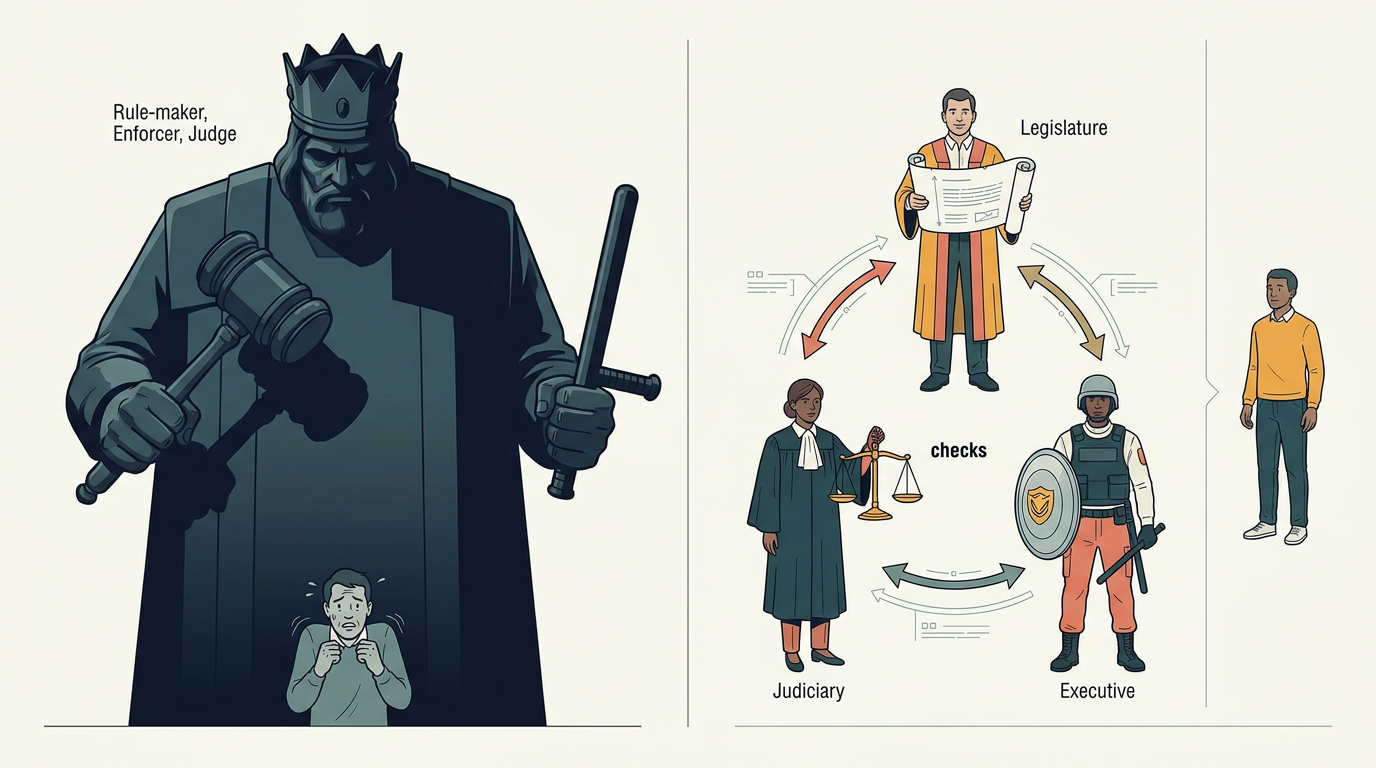
Fig. 3.0 – Concentrated versus separated powers.
Read this chapter, and by the end of it you will be able to answer every one of these questions for yourself.
3.1 Concept of Separation of Powers
A State exists to govern, and governing means doing three very different things: deciding what the rules will be, carrying those rules into effect, and settling disputes about them. If political liberty is to survive — and liberty here means the ordinary citizen’s freedom to live without fear of arbitrary power — these three jobs cannot be left in one pair of hands. A State therefore sets up special organs, and gives each organ the kind of power that suits the work it has to do.
The Three Kinds of State Power
The powers of a government in a State are broadly classified as the power to:
- enact laws, that is, the powers of the Legislature;
- interpret laws, that is, the powers of the Judiciary;
- enforce laws, that is, the powers of the Executive.
Notice how different these three activities are from one another. Making a law is a general act — it lays down a rule for everybody, before any particular dispute has arisen. Enforcing a law is an active, day-to-day business of administration: collecting taxes, running the police, delivering services. Interpreting a law is a detached exercise — a court looks backwards at what has already happened, hears both sides, and decides what the rule means for this particular person. Each demands a different temperament, and each is best done by a body built for it. This is shown in Fig. 3.1.
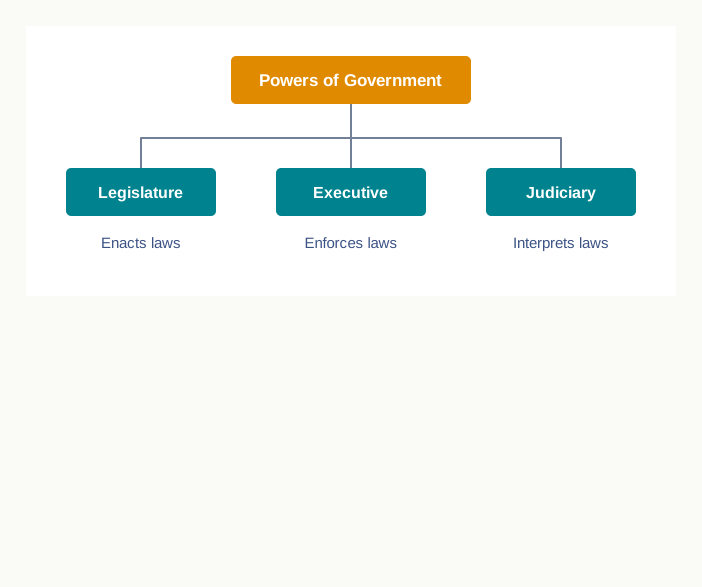
Fig. 3.1 – The three powers of government.
The Doctrine in Its Simplest Form
The theory of separation of powers, in its simplest form, says that these three functions should be entrusted to three different authorities. The three organs of government should be kept separate and distinct, and one organ should be independent of the control of the others.
Each Organ Within Its Own Sphere
The doctrine requires that each organ exercise its powers within its own sphere. It entails that no organ shall encroach upon, or interfere with, the powers and the independence of another organ of government.
But what happens if an organ does step across the line? The doctrine’s answer is elegant. If any organ encroaches into the terrain of another, it shall be checked by another organ of the government itself. No new organ is created over and above the existing organs to police encroachment.
Why a Written Constitution Matters
On the whole, separation of powers requires the existence of a written Constitution to define the formal powers of each organ. A boundary that exists only as a convention is easy to shift; a boundary written into a supreme document can be pointed to, and enforced by a court.
The powers shall be so defined and divided as to create a system of checks and balances of powers among the organs. This view finds support from the writings of Carl J. Friedrich (1901-1984), a German-American political theorist.
Three Meanings of the Doctrine
The doctrine does not carry a single fixed sense. In the words of Wade and Phillips (Constitutional Law, 1960), separation of powers may mean three different things:
- The same persons should not form part of more than one of the three organs of the Government.
- One organ of the government should not control or interfere with the exercise of its function by another organ.
- One organ of the government should not exercise the functions of another.
These three meanings are worth separating carefully, because a constitution may satisfy one and fail another. India, for instance, allows Ministers to sit in Parliament — so it does not satisfy the first meaning — while still insisting firmly on the third. When a question asks whether a country “follows” separation of powers, the honest answer usually begins by asking in which of these three senses.
3.2 Montesquieu’s Doctrine of Separation of Powers
3.2.1 Historical Background and Evolution
The idea that power should be divided is older than any single thinker, but the most original, systematic as well as scientific elaboration of the concept of ‘separation of powers’ was given by the French philosopher Baron De Montesquieu (1689-1755) in the 18th century. His theory on ‘separation of powers’ has become the model for governance of all democracies.
A doctrine of this kind is never written in a vacuum. Montesquieu was describing a disease he had watched at close quarters.
France under Absolute Monarchy
During his time, Montesquieu saw the oppressive and despotic rule of the French King Louis XIV, whose absolute personal rule ran from 1661 to 1715. The ruler enjoyed the absolute powers of the State, and the prevailing dictum was, ‘I am the State’. There was no assembly that could refuse the King a law, and no court that could tell him he was wrong. Liberty of the people was suppressed under the despotic rule of the King and his administrators.
The English Contrast
During his visit to England, Montesquieu experienced the sense of liberty and freedom enjoyed by the citizens of England. He was very impressed with the thoughts of Locke, the English philosopher who had already argued that the law-making and law-enforcing powers ought not to rest in the same hands.
Montesquieu compared the English system of governance with the system prevailing in his own country. He examined the separation of the powers of government, and their exercise by separate organs — namely, the King, Parliament and the law courts — in the governance structure of England. Here, he concluded, lay the explanation for the difference: the Englishman was free not because his rulers were kinder, but because power in England was divided and therefore limited.
The doctrine of the separation of powers emerged as a distinct doctrine in his famous book ‘Esprit Des Lois’ (The Spirit of Laws), published in 1748.
3.2.2 Basic Features of the Doctrine as Enunciated by Montesquieu
Montesquieu’s argument can be broken into four connected propositions.
One. He proposed the theory of separation of powers, advising that a division of powers is necessary between the legislative, the executive and the judicial system.
Two. Different departments must exercise the three powers of the government with their respective personnel. Montesquieu gave reasons for dividing power between the three branches:
- When the legislative and executive powers are united in the same persons, there cannot be liberty. It may lead to apprehensions that the monarch may enact tyrannical laws and execute them in a tyrannical manner, as the same agency becomes the maker and the executor of laws.
- Where judicial powers are combined with the legislative, the life and liberty of the subjects would be exposed to arbitrary control, as the Judge would be the legislator.
- Where the judicial power is combined with the executive power, the Judge might behave in a violent and oppressive manner. The prosecutor and the Judge would then be the same person and authority.
- If powers are vested in one organ, or exercised without separation, governance would not be effective.
Read those four together and a pattern appears. Each pairing removes a particular safeguard. Combine legislature and executive, and the rule-maker gains the machinery to impose the rule at will. Combine legislature and judiciary, and the person who decides your case can shape the rule to fit the result. Combine judiciary and executive, and the accuser becomes the decider. The fourth reason is different in kind and easy to overlook: Montesquieu argued that concentration is not merely unjust but also inefficient, because one body doing everything does none of it well.
Three. It is inherent in any authority to abuse powers unless limitations are imposed on its exercise. This is a claim about human nature rather than about any particular ruler, and it is why the doctrine does not depend on rulers being wicked. Give any office unchecked power and, sooner or later, it will be stretched.
Four. For safeguarding the liberty of the people, each organ of the Government shall have the obligation to act within its own sphere and not beyond it. If the authority acts beyond the permitted limits, it would be checked by the other organs. This means that the executive organ shall exercise some control over the legislature and the judiciary, the legislative organ over the executive and the judiciary, and the judiciary over the legislative and executive organs.
The system of checking the encroachment of powers by each organ, and thus balancing the division of powers, is termed the system of ‘checks and balances’.
This overview is the correct meaning of the maxim Le pouvoir arrête le pouvoir. By separating the functions of the executive, the legislature and the judiciary, one power may operate as a balance against another, and thus have a check on the power exercised by another.
3.2.3 Checks and Balances of Power
The origin of the concept of checks and balances is specifically credited to Montesquieu. The concept provides a system-based regulation that allows one branch to limit another.
The phrase “system-based” is doing important work there. A check is not an appeal to conscience or to convention; it is a power built into the constitutional design itself, which one organ may use against another as of right. The legislature votes the money the executive needs. The executive appoints the judges. The court strikes down the law. Nobody is asking anybody’s permission.
Notice that checks and balances and strict separation pull slightly against each other. Pure separation would have the three organs never touch; checks and balances require them to touch at defined points, because an organ that has no hold at all over another cannot restrain it. The doctrine, in practice, is a balance between the two ideas rather than a choice between them.
The operation of the check and balance mechanism between the different organs of government is seen most clearly in the United States, as shown in Fig. 3.2.
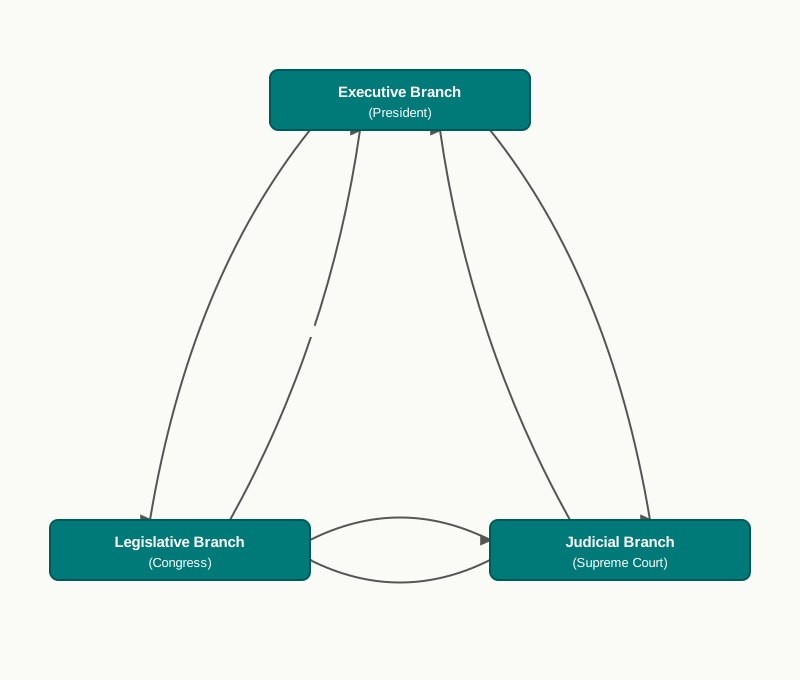
Fig. 3.2 – Checks and balances in the US government.
3.2.4 Impact of the Doctrine
Montesquieu advocated the adoption of this doctrine in his own country’s political system, and his teachings gave a boost to the French Revolution. They led to the adoption of the Declaration of Rights in 1789, which laid down that a society in which the separation of powers is not secured has no Constitution at all — a striking claim, because it treats the division of power not as one desirable feature among many, but as the very thing that makes a document a Constitution. The French Constitution of 1791 then made the executive, the legislature and the judiciary independent of one another.
The doctrine travelled further west with even greater effect. James Madison (1751-1836), the 4th President of the United States of America, wrote in The Federalist that the accumulation of all powers — legislative, executive and judicial — in the same hands, whether of one person, a few or many, and whether hereditary, self-appointed or elective, may justly be pronounced the very definition of tyranny.
Madison’s phrasing repays attention, because it disposes of a common defence of concentrated power. It does not matter that the body holding all three powers was elected. An elected assembly with unlimited power is still, on this view, tyranny. The objection is to the concentration, not to how the concentration was acquired.
The doctrine of separation of powers forms the foundation on which the entire structure of the U.S. Constitution of 1787 is based. Montesquieu thus became the intellectual father of the American Constitution — a French thinker describing the English system, whose ideas were finally built into an American document.
3.3 Evaluation of the Doctrine of Separation of Powers
The doctrine of separation of powers can be better understood in two forms. First, it implies that concentration of powers in the same person or the same body of persons should be avoided. Secondly, it implies a division of those powers which essentially and primarily belong to one organ and not to the other.
Once that essential core is kept where it belongs, allied functions can be performed with the coordination of the other organs. The emphasis, in other words, must be laid on modifying the concentration of powers rather than on drawing an impassable wall between the organs. A country need not choose between total separation and total fusion; it has to decide how much overlap it can tolerate before the core function of an organ is lost.
The doctrine can be better evaluated after studying its key benefits and its defects.
3.3.1 Key Benefits and Advantages of the Doctrine
Efficiency through specialisation. Different personnel, with the respective capabilities required for different organs, bring efficiency to the performance of functions and to administration. This indeed serves the purpose of the State and its people. Each organ must do its job to the best of its efficiency, and with due regard to its responsibility. Drafting a law, running a district and deciding a dispute call for different training and different habits of mind, and a system that lets each be done by people trained for it produces better government.
Protection of liberty and freedom. The doctrine safeguards the liberty and freedom of individuals, because it requires that each organ must act within the sphere of law. It thus establishes the government of law rather than of official will — an idea worth pausing on. Under government by official will, what happens to you depends on what the officer in front of you decides; under government of law, it depends on a rule that existed before your case arose and that the officer himself is bound by. The doctrine aims at protecting the freedom of the individual from the tyrannical rule of absolute monarchy, and Montesquieu developed the theory precisely as a means of limiting the absolute powers of the ruler in France.
An independent judiciary. One important aspect of this doctrine is to establish an independent judiciary that is free from administrative discretion. Montesquieu was interested in setting the judicial power as a check on the other two organs, and as an arbiter between them. A court that can be pressured, transferred or starved of funds by the executive cannot decide against the executive, and a right that no independent court will enforce is not a right at all.
Stability and harmony. The system of checks and balances within the organs of the government provides stability to the government by protecting the sovereignty of the State. It promotes the harmonious exercise of powers and functions within the three organs, because each knows the limits at which another may lawfully stop it.
3.3.2 Defects of the Doctrine
The doctrine did not describe Britain accurately. Historically speaking, there was no separation of powers under the British Constitution in the sense in which Montesquieu construed it — an irony worth noting, since Britain was the very model he was praising. A. V. Dicey observed that the British constitution had “a weak Separation of Powers”. As Barnett remarks in Constitutional and Administrative Law (2005), Britain has an uncodified or unwritten Constitution: much of it is contained in written sources such as statutes, court judgments and treaties, which are the supreme and final sources of law; the statutes of Parliament can themselves alter the Constitution by fresh legislation; and the Constitution also draws on unwritten sources, including parliamentary constitutional conventions.
The organs cannot be divided into watertight compartments. It would be wrong to say that the three organs are not interconnected, though their mode of action may differ. The legislature deliberates; the executive takes rapid action and gives effect both to legislative enactments and to judicial decisions; the judiciary critically analyses the laws and the actions of the executive, and may even declare them invalid. Every one of those sentences describes one organ acting on the work of another.
Extreme separation produces friction and deadlock. Extreme separation of powers prevents the unity and coordination needed to administer the legally expressed will of the State, and extreme checks and balances create frictions and dead-locks that prevent smooth and efficient government.
Nor are the functions performed by each organ unique to it. A Judge makes law in the form of precedents. The executive legislates in the form of framing subordinate legislation — rules, bye-laws, regulations, policies, schemes and the like, made under the authority of a parent Act because a legislature cannot foresee every detail it will need to regulate. The legislature acts judicially in deciding the breach of its own privileges. Absolute separation of powers may therefore even prove hazardous to the smooth functioning of the government.
Power itself remains the danger. “Power tends to corrupt, and absolute power corrupts absolutely” arose as part of a quotation by John Emerich Edward Dalberg (1834-1902), a historian, politician and writer popularly known as Lord Acton, who expressed this opinion in a letter to Bishop Mandell Creighton in 1887.
‘Powers’ or ‘functions’? Separation of powers is in itself a protest against power. Its meaning can be better analysed if the word ‘powers’ of the organs is substituted by ‘functions’. The word ‘functions’ implies an attitude of service, while the word ‘powers’ implies force. The government performs activities to serve the purpose of the State and its individuals through its classified functions, and it is for those functions that the different organs are created. The change of vocabulary changes the question being asked: not “how much power does this organ hold?” but “what work is this organ here to do?”
It cannot apply strictly to parliamentary systems. The theory of separation in its strict sense cannot apply to countries having a Parliamentary form of Government, where the legislative and executive organs are combined. In such systems the Ministers who form the executive are drawn from, and answerable to, the legislature — which is the exact opposite of Montesquieu’s first requirement.
Growth of the Executive in a Welfare State
Montesquieu had envisaged that all three organs of the government would be given an equal and independent position in the political organisation of the country. In fact, it is not so in reality.
The concept of the Welfare State demands more and more action and services from the government — health, education, food and public distribution, public transport and the supply of electricity. Every one of those services has to be planned, funded and delivered by somebody, and that somebody is the executive. This tends to increase the powers of the executive and to develop it as a multifunctional organ.
Today, the executive legislates, exercises judicial jurisdiction, and plans the future activities of the government. As Barker remarked, the notable feature of the 18th century was the growth of the legislative organ as a consequence of the cabinet system, while the notable feature of the 20th century has been the growth of the executive organ, following the extension of rights and the corresponding extension of services that mostly fall to the lot of executives.
This is the most practical difficulty facing the doctrine today. Montesquieu wrote for a State that kept order and collected taxes. A State that also runs hospitals, schools, ration shops and power grids will inevitably have a large and powerful executive, and the real modern question is not how to prevent that growth but how to keep it accountable.
3.4 Separation of Powers in Britain
So far the doctrine has been studied as theory. The next three sections test it against three real constitutions. Depending on the form of Government in a State, there is overlapping of powers among the organs, and the extent of that overlap can be better explained by studying the functions actually performed by the different organs in that State.
Britain is the natural place to begin, because Britain is where Montesquieu believed he had found his model — and, as it turns out, where the doctrine is followed least strictly of the three.
The British governing system follows a Parliamentary form of Government. The British constitutional system has adopted a fusion of powers rather than a separation of powers.
In Britain, the three organs of Government are the Executive Head (the British monarch), the Legislature comprised of the House of Commons and the House of Lords, and the Judiciary. Notice in Fig. 3.3 how the same persons appear in more than one organ.
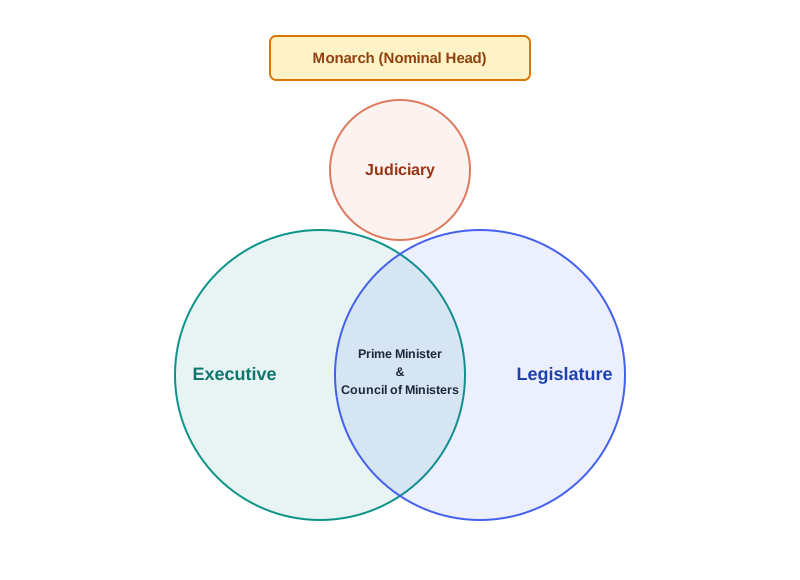
Fig. 3.3 – Fusion of powers in Britain.
3.4.1 Executive
The British monarch — presently King Charles III — acts as the nominal executive head, devoid of political powers, and holds the office by virtue of hereditary succession. The real executive powers vest with the Prime Minister and the Council of Ministers, and the monarch exercises powers on the advice of the Council of Ministers.
The word “nominal” is doing a great deal of work here. Laws are enacted in the monarch’s name and ministers are appointed by the monarch, yet the monarch does not decide what those laws will say or who those ministers will be. The title belongs to one person; the decision belongs to another.
3.4.2 Legislature
The United Kingdom Parliament consists of two Houses: the House of Commons and the House of Lords. Their work is similar — making laws (legislation), checking the work of the government (scrutiny), and debating current issues.
The Prime Minister and the Council of Ministers are themselves part of the legislature. They are collectively responsible to it and play an important role in legislative activities, and they remain in office so long as they enjoy the confidence of the House of Commons.
This single fact contradicts Montesquieu’s first requirement outright: the same persons form part of two organs at once. The people who run the country are the same people who sit in, and can be removed by, the body that makes its laws.
The overlap does not stop there. Ministers make subordinate legislation, which is a legislative function performed by the executive. They perform judicial functions by being members of Administrative Boards and Tribunals. And the House of Commons performs a judicial function in the case of a breach of its own privileges — the House itself deciding whether its rules have been violated and what should follow.
3.4.3 Judiciary
The highest judicial court in the UK is the Supreme Court, and it is relatively new. It was established in October 2009, after the Constitutional Reform Act, 2005. The judges of the Supreme Court are known as Justices of the Supreme Court, and Justices of the Supreme Court are granted the courtesy title Lord or Lady for life.
Prior to the creation of the Supreme Court, the highest court of appeal was the House of Lords Appellate Committee, made up of Law Lords. Formerly, the Law Lords — who were the final arbiters of judicial disputes in Britain — sat simultaneously in the House of Lords, the upper house of the legislature. The country’s highest judges were, quite literally, members of the legislature. This arrangement ceased in October 2009, when the Supreme Court of the United Kingdom came into existence.
The Old Office of Lord Chancellor
Until the Constitutional Reform Act, 2005, the Lord Chancellor was the head of the Judiciary in Britain, and that single office fused the Legislature, the Executive and the Judiciary in one person. He was the ex-officio Speaker of the House of Lords; he was a Government Minister who sat in the Cabinet; and he was head of the Lord Chancellor’s Department, which administered the courts and the justice system and appointed judges. He also sat as a judge on the Judicial Committee of the House of Lords, the highest domestic court in the entire United Kingdom, and on the Judicial Committee of the Privy Council, the senior tribunal court for parts of the Commonwealth.
For a student of this chapter, the office is almost a textbook illustration in reverse. Everything Montesquieu warned against — the legislator, the minister and the judge in one person — survived in a single British office into the 21st century.
The Reform of 2005
The Constitutional Reform Act, 2005 separated these powers. The Lord Chancellor ceased to be the Speaker of the Lords and was replaced by the Lord Speaker. The Lord Chief Justice is now the head of the judiciary, and the Lord Chancellor may no longer sit as a judge.
Therefore, legislative functions are now vested in an elected Lord Speaker, and judicial functions are vested in the Lord Chief Justice. The Lord Chancellor’s Department was replaced with a Ministry of Justice, and the Lord Chancellor currently serves in the position of Secretary of State for Justice.
3.5 Separation of Powers in the United States of America
The U.S. Constitution has adopted a Presidential form of Government. The three organs of the Government are the President as the executive organ, the Supreme Court of the United States and the subordinate courts as the judicial organ, and the Congress as the legislative organ, with two houses — the Senate (the upper house) and the House of Representatives (the lower house).
The theory of separation of powers finds its best expression in the United States of America.
How the American Constitution Achieves It
The American Constitution did not explicitly state that powers ought to be separate. It simply distributed the powers: the legislative powers are vested in the Congress, the executive powers in the President, and the judicial powers in the courts. Separation was achieved not by a declaration but by an allocation — each organ was handed its own store of authority, and none was handed the whole.
While apportioning the lion’s share of powers to one organ of Government, the Constitution gave smaller slices to each of the other organs. This was done to avoid concentration and the consequent abuse of power. The fathers of the Constitution considered that power should be limited, controlled and diffused.
Those smaller slices are the checks. The President is given a slice of the legislative power through the veto; the Senate is given a slice of the executive power through its say over appointments; the courts are given a hold over both by being able to declare their acts void. Each organ keeps the bulk of its own function, and each holds just enough of a neighbour’s function to be able to stop it.
3.5.1 Legislature
The US Congress is the legislative organ, with two houses — the Senate (the upper house) and the House of Representatives (the lower house).
- The law-making power is vested in the Congress, which is elected by the people. The members of the Senate sit for six years and those of the House of Representatives for two years.
- The bills passed by the legislature are subject to ratification or veto by the President. The Senate shares with the President the powers to make appointments and to ratify treaties, and the power to declare war rests with the Congress.
- The Congress acts in a judicial capacity in cases of impeachment of the President and of Supreme Court Judges — a legislative body performing a plainly judicial function.
- The U.S. Congress delegates law-making powers to the executive after laying down the legislative policy and principle. The limit matters: what is handed over is the working out of detail, not the choice of policy itself.
- The Congress cannot be dissolved by the President. In a parliamentary system the executive can send the legislature home; in the American system it cannot, and this is one of the clearest structural marks of separation.
- There are provisions in the Constitution to over-ride the veto power of the President, by a special majority vote in the legislature. A check is thus placed even upon a check.
3.5.2 Executive
- The President is elected by the people and remains in power for four years.
- The President receives a share of powers to recommend measures, to summon Congress in a special session, and to veto bills passed by the Congress.
- The President has been given the power of making appointments, but these have to be ratified by the Senate. The President appoints Secretaries, subject to Senate confirmation, as executive heads of the departments.
- The President and the Secretaries are not members of the legislature, that is, of Congress, and do not take part in legislative deliberations or in voting on a bill. Compare this with Britain, where the Ministers sit in Parliament and vote there. The same rule of eligibility, reversed, produces two entirely different constitutions.
- The President formulates national policy, mobilises military troops, and can declare a national emergency.
- The President cannot take the country into a declared war on his own; the approval of both Houses of the Congress is required.
- The President’s policies and treaty-making decisions are subject to ratification by the Senate.
- The President could intervene in the business of the court through the power of pardon, which extends to offences against the United States but does not extend to cases of impeachment.
- Neither is the President responsible to the Congress, nor is the Congress responsible to the President. Each has its own mandate from the electorate and neither can dismiss the other.
Thus, this system works on the principle of ‘separation of powers’ and ‘checks and balances’ together.
3.5.3 Judiciary
While the judges of the Supreme Court are nominated by the President, their appointments have to be ratified by the Senate, and in certain circumstances the Senate may refuse to ratify the choices made by the President. Two organs must therefore agree before a judge can take office — and the judge, once appointed, is beholden to neither.
The U.S. Supreme Court has the power under the Constitution to declare void the acts and actions of the legislature and the executive. This is the power of judicial review: the Court may examine the laws passed by the Congress and the executive orders issued by the President, and declare them null and void if they contravene the provisions of the U.S. Constitution.
Where does this power come from, if the Constitution does not spell it out? The Court claimed it for itself, early and decisively.
3.6 Separation of Powers in India
India’s governing system is broadly similar to that of Britain. Both countries have adopted the Parliamentary System of Government, and India therefore inherits the same fusion between the executive and the legislature that was studied in section 3.4.
Under the Constitution of India, the three organs of Government are the legislature, the executive and the judiciary. As stated in Article 79 of the Constitution of India, the Parliament consists of the President and two Houses known as the Council of States and the House of the People. The structure is set out in Fig. 3.4.
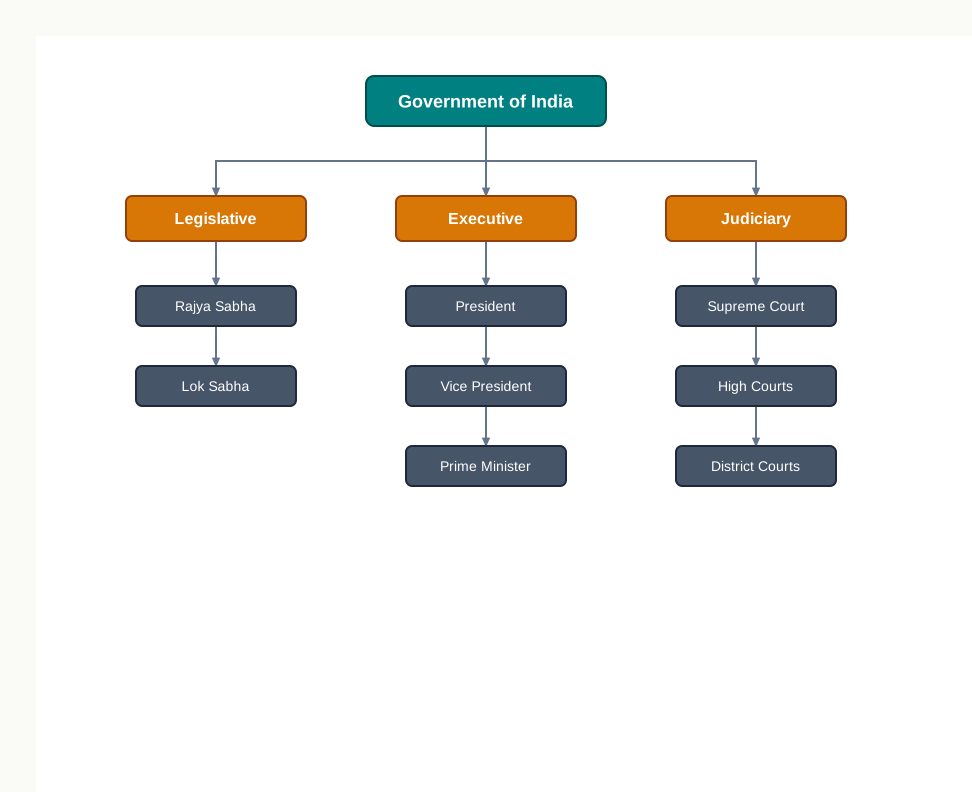
Fig. 3.4 – Structure of the Government of India.
Read Article 79 closely and the Indian position is visible at once. The President — the head of the executive — is made a part of Parliament itself. A constitution built on strict separation could never have written that sentence.
The Constitution of India has not adopted the doctrine of separation of powers in its strict sense. Nevertheless, the Constitution of India has sufficiently differentiated the essential functions of the organs, and no organ shall assume to itself what essentially belongs to another.
That formula is the key to every question on this topic. India does not ask whether the organs overlap — they plainly do. India asks whether an organ has taken over the essential function of another.
3.6.1 Executive
- The President of India is the nominal executive head. The real executive is the Prime Minister and his or her Council of Ministers. The President exercises his or her powers and functions with the aid and advice of the Prime Minister and the Council of Ministers, and usually that advice is binding on the President.
- The President is elected by an Electoral College consisting of the elected members of both Houses of Parliament and the elected members of the legislative assemblies of the States.
- The President holds office for a fixed term of five years.
Powers of the President
The President has wide legislative powers to issue ordinances for immediate action during the recess of the legislature. An ordinance so issued shall have the force and effect of an Act made by Parliament.
Pause on that. A law with the full force of an Act of Parliament, made while Parliament is not sitting, by the head of the executive. In a system of strict separation this would be unthinkable; in India it is a recognised constitutional power, hedged by the requirement that it operates only during a recess and must come before Parliament thereafter.
The President also has the power to dissolve the House of the People, and the power to declare a National Emergency, a State Emergency and a Financial Emergency. In the case of a State Emergency, the President is authorised to exercise legislative powers.
3.6.2 Legislature
The Prime Minister and the Council of Ministers are normally Members of Parliament. They play an active role in proposing a bill and in voting on a bill in Parliament. A bill becomes an Act when the President gives assent to it.
The Council of Ministers, including the Prime Minister, is collectively responsible to the House of the People. They therefore remain in office so long as they enjoy the confidence of the House of the People. The President may be impeached by Parliament.
Here is the same fusion Britain displays: the people who run the government sit inside the body that makes the laws and can be removed by it. And here too the legislature holds a judicial-style power, since it is Parliament that tries the President on impeachment.
Powers and Functions of the Legislature
The Constitution of India provides for the powers and functions of the legislature. Article 246 of the Constitution provides that the Parliament and the Legislatures of the States have the power to make laws. The matters are listed in Schedule VII of the Constitution under the Union List, the State List and the Concurrent List.
This is a division of power of a different kind — not between organs, but between the Union and the States. Separation of powers works horizontally, across the three organs; the Seventh Schedule works vertically, between two levels of government. Both are devices for preventing any single authority from holding everything.
3.6.3 Judiciary
The judiciary refers to the Supreme Court of India, the High Courts and the subordinate courts. The Supreme Court of India is the final court of appeal for the whole of India.
Independence of the Judiciary
Various provisions are incorporated in the Constitution to establish an independent judiciary. Article 50 of the Constitution of India provides that the State shall take steps to separate the judiciary from the executive in the public services of the State. The object behind Article 50 is to provide for the independence of the judiciary.
Article 50 is placed among the Directive Principles, so it is not enforceable in a court by itself. Its importance lies elsewhere: it tells us what the Constitution intends, and courts have read that intention into their interpretation of other provisions.
The Constitution then backs the principle with concrete protections:
- Judges of the Supreme Court and the High Courts shall be appointed by the President after consultation with such Judges of the Supreme Court and of the High Courts in the States as laid down in Article 124(2) of the Constitution.
- A nine-Judge Constitution Bench of the Supreme Court (In Re Presidential Reference, AIR 1999 SC 1) laid down the norms and requirements of the consultation process to be observed by the executive on the appointment of judges to the Supreme Court and the High Courts, and on the transfer of the latter. It is on these norms that the present collegium practice of appointment rests.
- The privileges and the allowances of a Judge cannot be varied after his appointment. If they could, a government displeased with a judgment would have an obvious instrument of pressure.
- No discussion shall take place in Parliament with respect to the conduct of any Judge of the Supreme Court or of a High Court, except when a proceeding of impeachment is initiated against him.
Role of the Judiciary
- The judiciary in India interprets the Constitution. It is entitled to scrutinise legislation and the administrative process, and to assess whether or not they conform to the Constitution.
- The judiciary provides remedies for the enforcement of the Fundamental Rights of citizens guaranteed by the Constitution. Writ jurisdiction can be invoked to move the Supreme Court under Article 32 and a High Court under Article 226 of the Constitution.
- The judiciary plays the role of a legislature while laying down its own procedures for the dispensation of justice. It also supervises, administers and controls the subordinate judiciary, and thus performs an administrative function.
- The judges of the Supreme Court and the High Courts can be removed on impeachment by the legislature, only on the grounds of proved misbehaviour or incapacity.
Point 3 is worth noticing carefully, because it cuts both ways. The judiciary, which polices the boundaries between the organs, itself exercises legislative and executive functions when it frames its own rules of procedure and runs the district courts. No organ in India is confined to a single function — and that is precisely why the test is the essential function.
The Basic Structure and Article 368
Article 368 of the Constitution provides for the constituent powers of the Parliament, and lays down the procedure for the amendment of the Constitution. Constituent power is the power to alter the Constitution itself, and it is the highest power any body in the country holds. The question that had to be answered was whether it is unlimited.
The Judges, while deciding this case, could not form a unanimous opinion on which provisions of the Constitution constitute its Basic Structure. On a perusal of the different cases decided by the Supreme Court, the following features seem to emerge as the Basic Structure, so as to be beyond the amending power of the Parliament under Article 368:
- Supremacy of the Constitution.
- Republic and democratic form of Government.
- Secular character of the Constitution and the State.
- Sovereignty of India.
- Judicial Review and the jurisdiction of courts under Article 32 and Article 226.
- Separation of Powers and an Independent Judiciary — recognised in State of Bihar v. Bal Mukund Shah, AIR 2000 SC 1296.
- Right to Equality and the Rule of Law.
Item 6 settles the constitutional status of everything in this chapter. Separation of powers in India is not merely a convention or an ideal — it is part of the Basic Structure, which means Parliament cannot remove it even by amendment.
It is, therefore, for the Supreme Court of India to determine finally the essential features constituting the framework of the Constitution. In other words, the Supreme Court has assumed to itself the constituent power in exercise of Judicial Review.
3.7 Summary
- For the preservation of political liberty and democracy, a State establishes special organs and divides its powers among them according to the nature of the power to be exercised.
- The powers of a government are broadly classified as the power to:
- enact laws, that is, the powers of the Legislature;
- interpret laws, that is, the powers of the Judiciary;
- enforce laws, that is, the powers of the Executive.
- The doctrine of separation of powers, in its simplest form, requires these three functions to be entrusted to three separate and distinct authorities, each independent of the control of the others.
- Each organ must act within its own sphere and must not encroach upon the powers or the independence of another organ.
- If an organ does encroach, it is checked by another existing organ; no new organ is created above the three to police encroachment.
- Separation of powers generally requires a written Constitution to define the formal powers of each organ, a view supported by the writings of Carl J. Friedrich (1901-1984).
- According to Wade and Phillips (Constitutional Law, 1960), separation of powers may mean three different things:
- the same persons should not form part of more than one of the three organs;
- one organ should not control or interfere with the exercise of its function by another organ;
- one organ should not exercise the functions of another.
- The most original, systematic and scientific elaboration of the doctrine was given by the French philosopher Baron De Montesquieu (1689-1755) in the 18th century.
- Montesquieu had lived under the absolute rule of Louis XIV in France, where liberty was suppressed and the prevailing dictum was ‘I am the State’.
- On visiting England he found citizens visibly freer under a system in which power was divided between the King, Parliament and the law courts, and he was much impressed by the thoughts of Locke.
- The doctrine emerged as a distinct doctrine in his book ‘Esprit Des Lois’ (The Spirit of Laws), published in 1748.
- Montesquieu gave four reasons for dividing power between the three branches:
- where the legislative and executive powers are united in the same persons there can be no liberty, as the same agency becomes both the maker and the executor of laws;
- where judicial power is combined with the legislative, life and liberty are exposed to arbitrary control, as the Judge would be the legislator;
- where judicial power is combined with the executive, the Judge might act in a violent and oppressive manner, as the prosecutor and the Judge would be the same authority;
- where powers are vested in one organ, or exercised without separation, governance would not be effective.
- Montesquieu held it to be inherent in any authority to abuse its powers unless limitations are imposed on their exercise.
- Each organ is obliged to act within its own sphere, and if it acts beyond the permitted limits it is checked by the other organs.
- The system of checking the encroachment of powers by each organ, and thus balancing the division of powers, is termed the system of checks and balances.
- The maxim Le pouvoir arrête le pouvoir means that power halts power — power must act as a check on power to prevent its misuse.
- The origin of the concept of checks and balances is specifically credited to Montesquieu, and it operates as a system-based regulation allowing one branch to limit another.
- Montesquieu’s teachings gave a boost to the French Revolution and led to the Declaration of Rights, 1789, which declared that a society in which the separation of powers is not determined has no Constitution.
- The French Constitution of 1791 made the executive, the legislature and the judiciary independent of one another.
- James Madison (1751-1836), the 4th President of the United States of America, wrote in The Federalist that the accumulation of all powers in the same hands, however acquired, is the very definition of tyranny.
- The doctrine forms the foundation of the U.S. Constitution of 1787, and Montesquieu is therefore called the intellectual father of the American Constitution.
- The doctrine may be understood in two forms: that concentration of powers in the same person or body must be avoided, and that powers essentially belonging to one organ must be divided out to it, allied functions then being performed in coordination with the other organs.
- The key benefits of the doctrine are:
- efficiency, since different personnel with different capabilities perform different functions;
- protection of liberty, since it establishes the government of law rather than of official will;
- an independent judiciary, free from administrative discretion and acting as arbiter between the other two organs;
- stability and harmony among the organs, through the system of checks and balances.
- The defects of the doctrine are:
- Britain, the model Montesquieu praised, never had separation of powers in his sense — Dicey observed that the British constitution had “a weak Separation of Powers”;
- the three organs cannot be divided into watertight compartments, since they are necessarily interconnected;
- extreme separation and extreme checks create friction and dead-locks that prevent smooth and efficient government;
- the functions of the organs are not unique, since a Judge makes law through precedents, the executive legislates through subordinate legislation, and the legislature acts judicially in deciding breaches of its own privileges;
- the meaning of the doctrine is better analysed if ‘powers’ is replaced by ‘functions’, since ‘functions’ implies service while ‘powers’ implies force;
- the theory in its strict sense cannot apply to countries with a Parliamentary form of Government, where the legislative and executive organs are combined.
- Lord Acton — John Emerich Edward Dalberg (1834-1902) — wrote in an 1887 letter to Bishop Mandell Creighton that “Power tends to corrupt, and absolute power corrupts absolutely”.
- The Welfare State demands services such as health, education, food and public distribution, public transport and electricity, which has made the executive a multifunctional organ that legislates, exercises judicial jurisdiction and plans future activities.
- Britain follows a Parliamentary form of Government and has adopted a fusion of powers rather than a separation of powers.
- In Britain the monarch is the nominal executive head, holding office by hereditary succession, while the real executive power vests in the Prime Minister and the Council of Ministers.
- British Ministers sit in Parliament, remain in office only while they enjoy the confidence of the House of Commons, make subordinate legislation and sit on Administrative Boards and Tribunals, while the House of Commons itself acts judicially on breaches of its own privileges.
- The Supreme Court of the United Kingdom was established in October 2009 after the Constitutional Reform Act, 2005, replacing the House of Lords Appellate Committee of Law Lords who had sat in the upper house of the legislature.
- Until the Constitutional Reform Act, 2005, the Lord Chancellor fused all three organs, being Speaker of the House of Lords, a Cabinet Minister, and head of the judiciary who sat as a judge.
- After the 2005 Act, legislative functions vest in an elected Lord Speaker, the Lord Chief Justice is head of the judiciary, and the Lord Chancellor serves as Secretary of State for Justice in the Ministry of Justice.
- The United States has a Presidential form of Government, and the theory of separation of powers finds its best expression there.
- The American Constitution did not declare that powers must be separate; it distributed them, giving the lion’s share to one organ and smaller slices to the others, so that power would be limited, controlled and diffused.
- The US Congress has two houses — the Senate, elected for six years, and the House of Representatives, elected for two years — and it cannot be dissolved by the President.
- The President is elected by the people for four years, is not a member of Congress, and neither the President nor the Congress is responsible to the other.
- American checks include the President’s veto over bills, the legislature’s power to override that veto by special majority, the Senate’s ratification of appointments and treaties, and the Congress’s judicial role in impeachment.
- The Supreme Court of the United States exercises judicial review and may declare laws of Congress and executive orders of the President null and void if they contravene the U.S. Constitution.
- India follows the Parliamentary system, and under Article 79 of the Constitution of India the Parliament consists of the President and two Houses, the Council of States and the House of the People.
- The Constitution of India has not adopted the doctrine in its strict sense, but has sufficiently differentiated the essential functions of the organs so that no organ may assume what essentially belongs to another.
- The President of India is the nominal executive head, elected by an Electoral College of the elected members of both Houses of Parliament and of the State legislative assemblies, and holds office for five years.
- The real executive is the Prime Minister and the Council of Ministers, on whose aid and advice the President acts, that advice usually being binding.
- The President may issue ordinances during the recess of the legislature, which have the force and effect of an Act of Parliament, may dissolve the House of the People, and may declare a National, State or Financial Emergency.
- Indian Ministers are normally Members of Parliament, the Council of Ministers is collectively responsible to the House of the People, and the President may be impeached by Parliament.
- Under Article 246, Parliament and the State Legislatures have power to make laws on the matters listed in Schedule VII under the Union List, the State List and the Concurrent List.
- Article 50 directs the State to take steps to separate the judiciary from the executive in the public services of the State, its object being the independence of the judiciary.
- Judges of the Supreme Court and the High Courts are appointed by the President after consultation as laid down in Article 124(2), the norms of that consultation having been settled by a nine-Judge Constitution Bench in In Re Presidential Reference, AIR 1999 SC 1.
- A Judge’s privileges and allowances cannot be varied after appointment, and no discussion on a Judge’s conduct may take place in Parliament except when impeachment proceedings are initiated.
- The Indian judiciary interprets the Constitution, enforces Fundamental Rights through writ jurisdiction under Article 32 and Article 226, frames its own procedures, and supervises the subordinate judiciary.
- Judges of the Supreme Court and the High Courts may be removed on impeachment by the legislature only on the grounds of proved misbehaviour or incapacity.
- Article 368 provides for the constituent power of Parliament and lays down the procedure for amendment of the Constitution.
- In Kesavananda Bharati v. State of Kerala, AIR 1973 SC 1461, popularly known as the Fundamental Rights Case, the Supreme Court held that Parliament cannot alter the Basic Structure of the Constitution in exercise of its amending power under Article 368.
- The features that seem to emerge as the Basic Structure, beyond the amending power of Parliament, are:
- supremacy of the Constitution;
- republic and democratic form of Government;
- secular character of the Constitution and the State;
- sovereignty of India;
- judicial review and the jurisdiction of courts under Article 32 and Article 226;
- separation of powers and an independent judiciary, recognised in State of Bihar v. Bal Mukund Shah, AIR 2000 SC 1296;
- right to equality and the rule of law.
- It is therefore for the Supreme Court of India to determine finally the essential features constituting the framework of the Constitution, and in doing so the Court has assumed to itself the constituent power in the exercise of judicial review.
3.8 Key Terms
Separation of powers — the doctrine that the legislative, executive and judicial functions of the State should be exercised by three separate and distinct organs, each independent of the control of the other two.
Legislature — the organ of government whose function is to enact laws.
Judiciary — the organ of government whose function is to interpret laws and decide disputes.
Executive — the organ of government whose function is to enforce laws and carry on the administration of the State.
Encroachment — the act of one organ of government entering the sphere of another and exercising powers that essentially belong to it.
Checks and balances — a constitutional arrangement in which each organ holds specific powers with which it can restrain the other organs, so that no organ can exceed its sphere without being corrected from within the system.
Absolute monarchy — a form of rule in which the monarch holds all the powers of the State without any legal limitation, as in the France of Louis XIV that Montesquieu wrote against.
Le pouvoir arrête le pouvoir — a maxim meaning “power halts power”, that is, power must act as a check on power to prevent its misuse.
Government of law — a system in which what happens to a citizen depends on a rule that existed before the case arose and that binds the official too, as opposed to government by official will.
Subordinate legislation — rules, bye-laws, regulations, policies and schemes framed by the executive under the authority and within the limits of a parent Act.
Precedent — a principle laid down in a decided case, which operates as law for later cases of the same kind.
Breach of privilege — a violation of the rights and immunities of a House of the legislature, which the House itself decides in a judicial capacity.
Welfare State — a State that undertakes to provide services such as health, education, food and public distribution, transport and electricity to its people, and whose executive therefore grows into a multifunctional organ.
Fusion of powers — a constitutional arrangement in which the executive is drawn from and remains answerable to the legislature, so that the two organs are joined in personnel and in political responsibility.
Parliamentary form of Government — a system in which the real executive is drawn from the legislature and holds office only so long as it enjoys the confidence of the popular House.
Nominal executive — the constitutional head of State in whose name executive action is taken, but who exercises those powers on the advice of the real executive.
Real executive — the Prime Minister and the Council of Ministers, in whom actual executive decision-making power vests.
Collective responsibility — the principle that the Council of Ministers, including the Prime Minister, is answerable as a body to the popular House and falls together if it loses that House’s confidence.
Presidential form of Government — a system in which the executive is elected separately from the legislature, is not a member of it, and holds office for a fixed term independent of its confidence.
Veto — the power of the executive head to refuse assent to a bill passed by the legislature.
Impeachment — a formal proceeding by which the legislature, acting in a judicial capacity, removes a high constitutional office-holder on specified grounds.
Judicial review — the power of a court to examine a law made by the legislature or an act done by the executive, and to declare it void if it violates the Constitution.
Ordinance — a law issued by the President during the recess of the legislature for immediate action, having the force and effect of an Act of Parliament.
Electoral College — the body of the elected members of both Houses of Parliament and of the State legislative assemblies, which elects the President of India.
Writ jurisdiction — the power of the Supreme Court under Article 32 and of the High Courts under Article 226 to issue writs for the enforcement of Fundamental Rights.
Constituent power — the power to amend the Constitution itself, conferred on Parliament by Article 368.
Basic Structure — the essential features of the Constitution, including separation of powers and an independent judiciary, which Parliament cannot alter even in exercise of its amending power under Article 368.
3.9 Points to Ponder
- Montesquieu argued that it is inherent in any authority to abuse its powers unless limitations are imposed. If that is true of every authority, is it also true of the judiciary — and if so, who limits the court that limits everyone else?
- Britain has no single written Constitution, yet British citizens are not obviously less free than citizens of countries that have one. What does this suggest about the relationship between a written Constitution and actual liberty?
- The doctrine is said to protect the ordinary citizen. Think of someone with no money and no lawyer, whose land has been taken by a government order. Which of the three organs is realistically available to that person, and what would have to be true for the protection to be more than theoretical?
- A welfare State cannot function without a large executive, but a large executive is exactly what Montesquieu feared. How should a modern constitution reconcile the two — by shrinking the executive, or by strengthening the checks upon it?
- The chapter notes that a Judge makes law through precedent and the executive makes law through subordinate legislation. At what point does convenient overlap turn into a takeover of another organ’s essential function? Try to state a test in your own words.
- The base of the doctrine is distrust — of rulers, of concentrated power, even of elected majorities. Is a constitution built on distrust of its own government a strength or a weakness in a democracy?
- Kesavananda Bharati placed limits on Parliament’s power to amend the Constitution, and it is the Supreme Court that decides what those limits are. Some argue this makes the Court the final authority in the country, above an elected Parliament. Consider the argument on both sides.
- India requires Ministers to be Members of Parliament, while the United States forbids it. Which arrangement do you think produces a government more answerable to the people, and why?
- Article 50 sits among the Directive Principles and is therefore not enforceable in a court. Does a constitutional direction that cannot be enforced still do useful work?
- If separation of powers exists to protect liberty rather than to tidy up administration, then a country could satisfy every formal requirement of the doctrine and still be unfree. What else, beyond the structure of government, does liberty depend on?
3.10 Textbook Questions
Write short notes on the following:
- Article 368
- Concept of Separation of Powers
- Separation of powers in Britain
- Separation of powers in the USA
Answer the following questions briefly:
- Enumerate a few features that come under the Basic Structure of the Constitution of India and are beyond the amending power of Parliament under Article 368.
- How did Wade and Phillips interpret the separation of powers in their 1960 work?
- What were the reasons that led Montesquieu to advocate the doctrine of separation of powers?
- List a few powers of each of the following:
- The President of the USA
- The Indian President
- The British Monarch
Answer the following questions in about 200 words:
- Evaluate the doctrine of separation of powers by setting out a few advantages and defects of the doctrine.
- Explain how the doctrine of separation of powers is exercised in India.
Can Montesquieu’s separation of powers be applied in countries like India and the UK?
Explain why America is the best example of separation of powers.
In the USA, ‘while apportioning the lion’s share of powers to one organ of Government, the Constitution gave smaller slices to each of the other organs. This was done to avoid concentration and consequent abuse of power’.
- Which organ of the government has the maximum power in the USA?
- Comment on whether power should be limited, controlled and diffused equally among the three organs of the government, and support your argument with the relevant doctrine.
- Of the three countries — the USA, the UK and India — where is power most evenly divided among the three organs of the government?
3.11 Objective Questions
The power to interpret laws belongs to which organ of government?
- The Legislature
- The Executive
- The Judiciary
- The Electorate
Montesquieu’s book ‘Esprit Des Lois’ (The Spirit of Laws) was published in the year:
- 1689
- 1748
- 1787
- 1789
The maxim Le pouvoir arrête le pouvoir means:
- Power belongs to the people
- Power halts power
- Power follows the law
- Power cannot be divided
According to Wade and Phillips (Constitutional Law, 1960), separation of powers may mean:
- One thing only
- Two different things
- Three different things
- Four different things
The despotic ruler whose absolute rule Montesquieu witnessed in France was:
- Louis XIV
- Napoleon Bonaparte
- Charles I
- James Madison
The observation that the British constitution had “a weak Separation of Powers” was made by:
- Carl J. Friedrich
- A. V. Dicey
- Lord Acton
- Barker
“Power tends to corrupt, and absolute power corrupts absolutely” was written by Lord Acton in a letter to Bishop Mandell Creighton in the year:
- 1834
- 1887
- 1902
- 1960
The Supreme Court of the United Kingdom was established in:
- October 2005
- October 2007
- October 2009
- October 2011
After the Constitutional Reform Act, 2005, the head of the judiciary in Britain is:
- The Lord Chancellor
- The Lord Speaker
- The Lord Chief Justice
- The Prime Minister
In the United States, the members of the Senate sit for a term of:
- Two years
- Four years
- Five years
- Six years
Which of the following is true of the American system?
- The President may dissolve the Congress
- The Congress may dismiss the President by a vote of no confidence
- Neither the President is responsible to the Congress, nor the Congress to the President
- The Secretaries are members of the Congress
Article 79 of the Constitution of India provides that Parliament consists of:
- The two Houses only
- The President and the two Houses
- The President, the Prime Minister and the two Houses
- The Council of Ministers and the two Houses
Which Article of the Constitution of India directs the State to take steps to separate the judiciary from the executive in the public services of the State?
- Article 32
- Article 50
- Article 226
- Article 246
The matters on which Parliament and the State Legislatures may make laws are listed in:
- Schedule V of the Constitution
- Schedule VI of the Constitution
- Schedule VII of the Constitution
- Schedule VIII of the Constitution
In Kesavananda Bharati v. State of Kerala, the Supreme Court held that Parliament, in exercise of its amending power under Article 368, cannot:
- Amend any provision of the Constitution
- Alter the Basic Structure of the Constitution
- Make laws on subjects in the State List
- Impeach a Judge of the Supreme Court
Assertion (A): The Constitution of India has not adopted the doctrine of separation of powers in its strict sense. Reason (R): The Prime Minister and the Council of Ministers are normally Members of Parliament and remain in office so long as they enjoy the confidence of the House of the People.
Assertion (A): The office of the Lord Chancellor was reformed by the Constitutional Reform Act, 2005. Reason (R): Until then, one person held legislative, executive and judicial functions in that single office.
Assertion (A): The theory of separation of powers finds its best expression in the United States of America. Reason (R): The American Constitution expressly declares that the three powers of government must always be kept separate.
Assertion (A): Parliament cannot take away the writ jurisdiction of the High Courts under Article 226 even by a constitutional amendment. Reason (R): Judicial review and the jurisdiction of courts under Article 32 and Article 226 form part of the Basic Structure of the Constitution.
Assertion (A): In a Welfare State the executive has developed into a multifunctional organ. Reason (R): The delivery of services such as health, education, public distribution, transport and electricity requires continuous executive action.
Assertion (A): The privileges and allowances of a Judge cannot be varied after his appointment. Reason (R): A government displeased with a judgment would otherwise have a ready instrument of pressure over the judiciary.
3.12 Check Your Concepts
Why does the doctrine of separation of powers rely on the three existing organs to check one another, instead of creating a fourth organ to supervise them all?
State the three meanings that separation of powers may carry, according to Wade and Phillips, and explain why a country may satisfy one of them while failing another.
What happens to the position of an accused person if the authority that frames the rule, the authority that prosecutes and the authority that decides are the same? Answer with reference to Montesquieu’s reasoning.
Distinguish between separation of powers and checks and balances.
Distinguish between a Parliamentary form of Government and a Presidential form of Government on the basis of the relationship between the executive and the legislature.
Distinguish between a nominal executive and a real executive, giving one example of each from this chapter.
Why did Montesquieu argue that a country needs a written Constitution if the separation of powers is to be effective?
State any four key benefits of the doctrine of separation of powers.
“The three organs of government cannot be divided into watertight compartments.” Explain this statement with three examples of one organ performing a function that essentially belongs to another.
Why is it said that the theory of separation of powers, in its strict sense, cannot apply to a country with a Parliamentary form of Government?
Explain how the concept of a Welfare State has affected the balance Montesquieu envisaged between the three organs.
What would be lost if the word ‘powers’ were replaced by the word ‘functions’ in the name of this doctrine — and what would be gained? Answer with reference to the chapter.
Identify the Article of the Constitution of India that corresponds to each of the following:
- Parliament consists of the President and two Houses.
- The State shall take steps to separate the judiciary from the executive in the public services of the State.
- Parliament and the State Legislatures have the power to make laws.
- The procedure for amendment of the Constitution.
- Writ jurisdiction of the High Courts.
Britain was the system Montesquieu admired, yet Britain follows a fusion of powers. How do you explain this apparent contradiction?
What was objectionable, from the point of view of this doctrine, about the office of the Lord Chancellor as it existed before 2005? State the three functions that office combined.
Why did the Constitutional Reform Act, 2005 separate the judiciary from the other two organs in Britain, while leaving the fusion between the executive and the legislature untouched?
Explain how the veto power of the American President, and the power of Congress to override that veto, together illustrate the working of checks and balances.
Why does the American Constitution give the Senate a role in the appointment of Supreme Court Judges, when the doctrine requires the judiciary to be independent of the other organs?
What happens if the Government of India issues an ordinance while Parliament is not in session? Explain the legal effect of the ordinance and why this power is difficult to reconcile with a strict separation of powers.
State the constitutional provisions that protect the independence of the judiciary in India, and explain how each of them removes a particular means of pressure on a Judge.
What is meant by the Basic Structure of the Constitution? State any five features that have emerged as part of it.
Why is it significant that separation of powers and an independent judiciary form part of the Basic Structure, when the Constitution has not adopted the doctrine in its strict sense?
Correct the errors in the following statements and give the correct position in each case:
- The Lord Chancellor is today the head of the judiciary in Britain.
- In the United States, the President may dissolve the Congress if it refuses to pass his bills.
- The President of India is elected directly by the people.
- Article 368 lays down the writ jurisdiction of the Supreme Court.
Arrange the following in chronological order and state the year of each:
- Publication of ‘Esprit Des Lois’ (The Spirit of Laws)
- Adoption of the U.S. Constitution
- The French Declaration of Rights
- The Constitutional Reform Act of the United Kingdom
- Establishment of the Supreme Court of the United Kingdom
3.13 Case-Based Questions
- Parliament is not in session. A serious outbreak of food adulteration is reported across several States, and the Union Government advises the President to issue an ordinance raising the penalty for adulteration and creating a new inspection authority. The ordinance is issued and comes into force at once. A trader prosecuted under it argues that a penalty can only be created by the legislature, and that a law made by the head of the executive is no law at all.
- What is the legal force and effect of an ordinance issued during the recess of the legislature?
- Is the trader’s argument correct? Give reasons.
- Which of Wade and Phillips’ three meanings of separation of powers is affected by the ordinance-making power?
- Would your answer change if Parliament had been in session on the day the ordinance was issued? Explain.
- Parliament passes a constitutional amendment by the special majority required under Article 368. The amendment provides that no High Court shall entertain any petition under Article 226 in matters relating to government service, and that all such disputes shall be finally decided by a departmental committee headed by a Secretary to the Government. A dismissed clerk challenges the amendment.
- Can a constitutional amendment passed by the required special majority still be struck down? State the authority for your answer.
- Which feature of the Basic Structure does this amendment appear to damage?
- Identify the organ that is gaining power and the organ that is losing it, and explain why the Constitution treats this particular transfer as impermissible.
- A State Legislature passes an Act providing that all judicial officers of the subordinate courts in the State shall be selected and appointed by a committee of Ministers, and that their postings and transfers shall be decided by the Department of Home Affairs. The State Government defends the Act on the ground that the Constitution nowhere adopts the doctrine of separation of powers in its strict sense, and that the executive is therefore free to organise the courts as it thinks fit.
- Evaluate the State Government’s defence. Is it enough to say that India has not adopted the doctrine in its strict sense?
- Which Directive Principle is directly relevant here, and what does it require of the State?
- Why is control over appointments, postings and transfers regarded as a threat to judicial independence, even if no judge is dismissed?
- A journalist publishes an article alleging that members of a legislative committee accepted favours from a company. The House treats the article as a breach of its privileges. A committee of the House examines the journalist, records its findings, and directs that she be reprimanded at the bar of the House. The journalist protests that she has been tried by the very body that accused her.
- Which organ of government is exercising which function in this situation?
- Does this power of the House support or contradict the claim that the three organs are kept in watertight compartments? Give reasons.
- Which of Montesquieu’s four reasons for dividing power is most directly engaged by the journalist’s protest?
- A newly independent country is drafting its Constitution. One group in the drafting committee wants the American model, with a separately elected President who is not a member of the legislature and whose term is fixed. Another group wants the British and Indian model, with a Council of Ministers drawn from the legislature and answerable to it. The country has a written Constitution and intends to give its Supreme Court the power of judicial review.
- State two advantages, from the point of view of this doctrine, that the American model would give this country.
- State two advantages that the parliamentary model would give it.
- If the drafting committee’s chief concern is that the executive should be answerable day to day for how it governs, which model should it choose, and why?
- Would your answer change if the country’s chief concern were instead that the executive should never be able to control the legislature? Explain.
3.14 Landmark Cases & Maxims
State the principle settled in Kesavananda Bharati v. State of Kerala, AIR 1973 SC 1461, and explain the limit it places on Article 368.
By what popular name is Kesavananda Bharati v. State of Kerala known, and why did the Judges deciding it leave the contents of the Basic Structure unsettled?
Which authority recognised separation of powers and an independent judiciary as part of the Basic Structure of the Constitution? State the case and its citation.
What did the nine-Judge Constitution Bench in In Re Presidential Reference, AIR 1999 SC 1, lay down, and which constitutional provision was it interpreting?
State the principle established in Marbury v. Madison, 5 U.S. 137 (1803), and explain why that principle matters to a country whose Constitution does not expressly grant the power of judicial review.
Give the literal and the legal meaning of the maxim Le pouvoir arrête le pouvoir, and identify the thinker with whom it is associated.
Apply the maxim Le pouvoir arrête le pouvoir to each of the following situations, and state in each case which organ is halting which:
- The American President refuses assent to a bill passed by the Congress.
- The Supreme Court of India strikes down a law for violating a Fundamental Right.
- The House of the People withdraws its confidence from the Council of Ministers.
- The Senate refuses to ratify a judge nominated by the President.
Match the authority or maxim in Column A with the proposition in Column B:
| Column A | Column B |
|---|---|
| a. Kesavananda Bharati v. State of Kerala | i. The power of a court to declare an Act of the legislature void as repugnant to the Constitution |
| b. Marbury v. Madison | ii. Norms of the consultation process for the appointment and transfer of Judges |
| c. In Re Presidential Reference | iii. Power should act as a check on power |
| d. State of Bihar v. Bal Mukund Shah | iv. Parliament cannot alter the Basic Structure while exercising its amending power |
| e. Le pouvoir arrête le pouvoir | v. Separation of powers and an independent judiciary as part of the Basic Structure |
- Identify the authority that governs each of the following fact patterns, and state the principle you would apply:
- Parliament amends the Constitution to abolish the secular character of the State.
- A State law transfers the appointment of subordinate judicial officers to the executive.
- The executive claims the right to appoint Supreme Court Judges without following the consultation norms.