Chapter 5: Administrative Law
In July 1977, a journalist in Delhi received a short official letter. It told her to surrender her passport within seven days. It gave no reason beyond the words “in the public interest”. She wrote back asking why. The Ministry of External Affairs replied that it was not in the interest of the general public to tell her. She had not been charged with anything. She had not been given a hearing. She had not even been told what she was supposed to have done. Her passport had simply been taken away by an officer exercising a power that a statute had handed to him. She challenged that order in the Supreme Court, and the case became Maneka Gandhi v. Union of India, AIR 1978 SC 597 — one of the most important decisions in Indian law. The Court did not say the officer had no power. It said that having a power is not the same as being free to use it however one likes. A procedure that affects a person’s liberty must be just, fair and reasonable, and a person must ordinarily be heard before an order goes against them. That single idea — that administrative power must answer to law — is the subject of this chapter.

Fig. 5.0 – Law as a balance to administrative power.
By the end of this chapter you will be able to answer each of these questions for yourself.
5.1 Background: Why Administration Needs Law
History tells us something surprising. Societies and civilisations have survived without science and without technology, but no society has survived without administration. Long before a civilisation had machines or medicine, it had someone collecting grain, settling disputes, guarding the store and deciding who got what.
Administration is simply the day-to-day work of running a State. A law passed in Parliament does nothing by itself. Somebody has to issue the ration card, sanction the pension, inspect the factory, grant the licence, and refuse it where it should be refused. That work is done by ministries, departments, boards, corporations, universities and local bodies — collectively, the administration.
The Risk That Comes With the Power
Policies, rules, regulations and legislation are all framed for the public good. But the very power that delivers a benefit can also be withheld, delayed or handed to the wrong person. A permit can be granted to a friend and denied to a stranger. An order can be passed against someone who was never told why.
Administrative Law is the branch of law that guards against exactly this. Its aim is to ensure that the policies, rules, regulations and legislation formulated for public good are not misused. It does not exist to slow the administration down; it exists to keep the administration inside the law while it works.
5.2 Administrative Law and Constitutional Law: Key Differences
For a long time, administrative law was not treated as a subject of its own. Before the 21st century, it was studied as a part of Constitutional Law, because both deal with the powers of the State. In recent times, however, a clear distinction has emerged in the subject matter each of them studies.
What Constitutional Law Deals With
Constitutional law sets out the scope of the rights and duties of citizens and of the Government. It answers the foundational questions of a democratic system: how elections are held, how Parliament is formed, what powers Parliament has, and how power is divided among the different branches of the State.
These are the questions every democratic constitution must settle before anything else can happen. Constitutional law, in other words, creates the offices and hands them their powers.
What Administrative Law Deals With
Administrative law picks up where that ends. It keeps a check on the actions of the Government when it deals with procedures affecting the rights of citizens. The office already exists and the power has already been granted; the question now is whether the power is being used lawfully and fairly.
One example carries the whole distinction. How a Minister comes to be appointed, and what the Constitution allows a Minister to do, is a constitutional law question. But once a Minister has finally been appointed and begins passing orders that affect the general public good, the study of those actions becomes a core constituent of Administrative Law.
Notice that the difference is not about who is being studied. The same Minister, the same department, even the same file can raise both kinds of question. The difference is about what is being asked. Is the question about the existence and extent of a power? That is constitutional law. Is the question about the manner in which an existing power has been exercised against a particular person? That is administrative law.
5.3 Reasons for Growth, Development and Study of Administrative Law
In the 21st century, developing countries like India expect a very proactive State to work for their own welfare. Citizens do not merely expect the State to keep order; they expect it to run schools, supply electricity, regulate medicines, license transport, pay pensions and respond when a river floods.
Why the Legislature Cannot Do It All
That welfare quotient in the administration cannot be vested in the legislature alone. In practical terms it is impossible. If the sanction of the legislature were compulsorily required for every kind of administrative action, governance as a whole would cease to function.
Think about what that would actually mean. Parliament would have to pass a separate law each time a drug was to be approved, a bus route altered, or a school recognised. The House would sit permanently and still fall behind. So the legislature lays down the policy and the broad framework, and leaves the working detail to authorities that can act quickly and with technical knowledge.
This need for delegation is often pointed out as the single most important factor which has led to the growth of Administrative Law. Once power is spread across hundreds of authorities that were never elected, a body of law becomes necessary to control how they use it. Administrative law grew because delegation grew.
How Far the State Reaches: Article 12
There is a second reason, and it comes from the scheme of our own Constitution. While defining ‘State’, Article 12 of the Constitution of India extends the term beyond the Government and the legislatures to other authorities as well.
The expression ‘other authorities’ has been read widely. It includes authorities created by law, authorities which are agencies and instrumentalities of the State, and authorities which are essentially discharging public functions having an impact on the common people. All of these are part of the State.
Why does this matter for administrative law? Because a body that counts as ‘State’ is bound by the Fundamental Rights in Part III. It cannot act arbitrarily, and a person aggrieved by its action can approach the courts. The wider the reach of Article 12, the wider the field over which administrative law operates.
5.4 Types of Administrative Action
Not everything an administrative authority does is the same kind of act. Some acts create rules for everybody; some decide a dispute between two parties; some involve a choice; some involve no choice at all. The law treats these differently, because the controls that apply to each are different.
Administrative action can be of four types, as set out in Fig. 5.1.
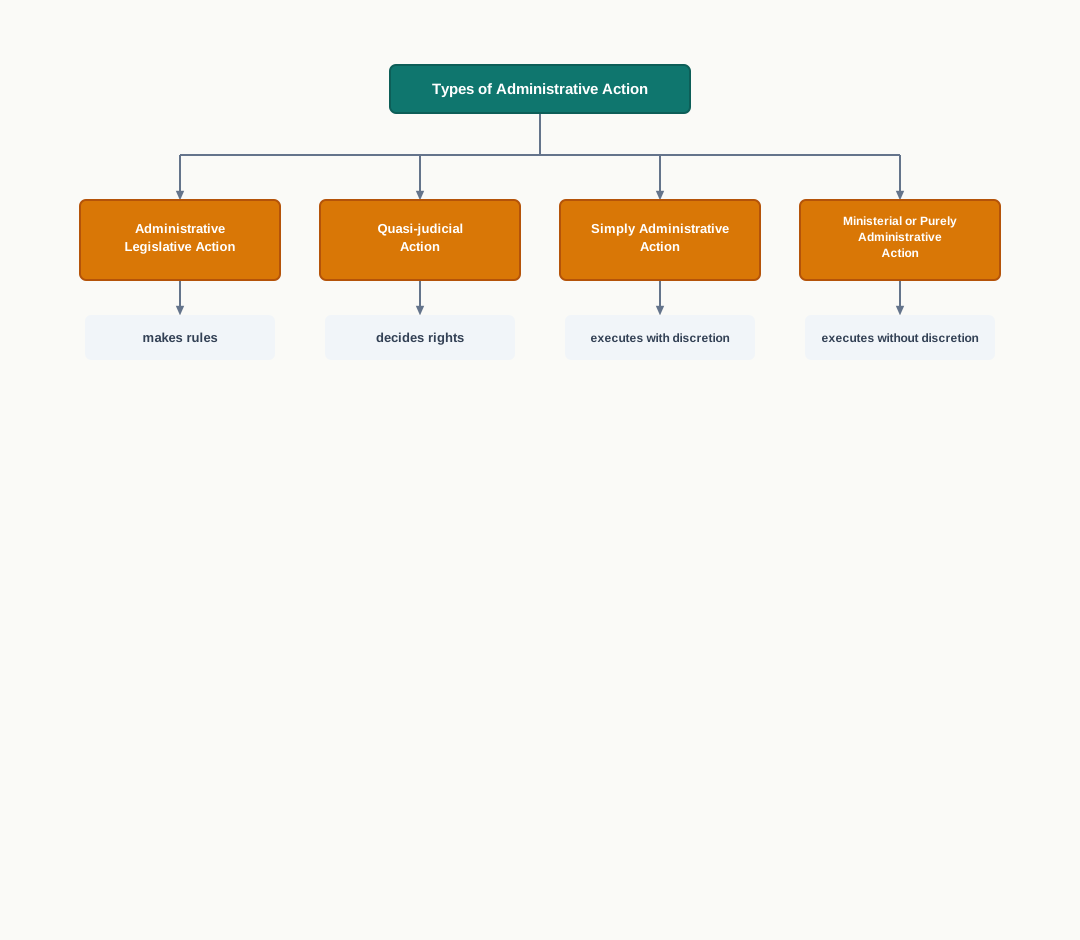
Fig. 5.1 – Types of administrative action.
Administrative Legislative Action
Here the administration puts on the hat of the legislature. It does so for a simple practical reason: it is not possible for any legislature in the world to legislate so perfectly that its laws cover every conflict that can arise out of a decision — not even if the Members of Parliament were to sit on all the days of the year.
So the legislature lays down the principal law, and the administration fills in the working detail. Administrative legislative action includes rule-making action as well as delegated legislation, which is examined separately later in this chapter.
Quasi-judicial Action
The second type is quasi-judicial action, also called administrative adjudicatory action. The word quasi means “almost” or “as if” — so a quasi-judicial body is one that is not a court but decides like a court.
In these cases the administration performs functions which can be placed under the judicial domain, because there is some adjudication on the legal rights of the individuals involved in the matter. Tribunals are the standard example.
Simply Administrative Action
Of all the actions undertaken by administrative authorities, those that fall outside the two types described above are called ‘Administrative Actions’. They essentially deal with the execution of crucial administrative decisions.
The defining feature here is discretion. In administrative action, there is discretion vested in the administrative authority — that is, the authority has the right to exercise its own understanding and judgment in dealing with the matter. Two officers on the same facts may lawfully reach different conclusions, because the law has left the choice to them.
Ministerial or Purely Administrative Action
The last type is the opposite of the third. These are copybook actions — actions in which no discretion at all is vested in the authority, because there is only one way of performing the act. Such action is called purely administrative action or ministerial action.
Why the Classification Matters
This classification carries a larger point. It would be wrong to say that Administrative Law deals only with the execution of policies, or that it is only procedural in nature. An authority that makes rules, decides rights and exercises discretion is doing far more than executing.
In contemporary times, therefore, administrative law can be called a full-fledged discipline which is very substantive in nature.
5.5 Fundamental Principles of Administrative Law: Rule of Law
Administrative law deals with the organisation, powers and functions of administrative authorities. It regulates how government departments and agencies exercise their powers while performing public duties.
The purpose of administrative law is to ensure that government action is lawful, fair, reasonable and not arbitrary. To achieve this, it works through a set of fundamental principles. These principles act as safeguards: they protect the rights of citizens and ensure the accountability of administrative authorities.
The first and most basic of these principles is the Rule of Law. The others — Separation of Powers, Delegated Legislation, the Principles of Natural Justice, and Judicial Review — are taken up in the sections that follow.
The Rule of Law
The Rule of Law is a foundational principle of democratic governance. It ensures that law, and not the will of individuals, governs the State.
That short sentence carries the whole idea. A person in office may be powerful, honest, popular or none of these; under the Rule of Law it makes no difference, because the officer’s personal will is not the source of authority. The law is.
The principle has two aims. It seeks to prevent the arbitrary exercise of power, and it seeks to protect the rights and liberties of citizens. In a society governed by the Rule of Law, all actions of the government must be carried out strictly in accordance with established legal principles.
Dicey’s Concept of the Rule of Law
The modern understanding of the Rule of Law is largely based on the ideas of Professor A.V. Dicey, explained in his book Introduction to the Study of the Law of the Constitution (1885). According to Dicey, the Rule of Law rests on three core principles.
Supremacy of Law. Law is the supreme authority in the State. No person can be punished or made to suffer except for a clear violation of law proved before an ordinary court. This principle rules out arbitrary and discretionary powers of government authorities. The important word is proved — suspicion, displeasure or convenience is not enough; the breach must be established in the ordinary way.
Equality Before Law. Every individual, irrespective of status or position, is subject to the same law and to the jurisdiction of ordinary courts. No one is above the law, and all persons are entitled to the equal protection of the law. A Secretary to the Government and a shopkeeper answer to the same courts for the same wrong.
Predominance of Legal Spirit. The protection of rights depends upon an independent and impartial judiciary. Courts play a central role in enforcing rights and in ensuring that government action remains within legal limits. A right written on paper is worth little if no independent forum will enforce it.
The Rule of Law Under the Indian Constitution
Though the expression “Rule of Law” is not explicitly mentioned in the Constitution of India, its essence is reflected throughout the constitutional framework. The Preamble emphasises justice, liberty and equality, which are core values of the Rule of Law.
Three constitutional features carry the principle into practice.
- Article 14 guarantees equality before law and equal protection of laws.
- Article 21 ensures that life and personal liberty can be restricted only by a fair and lawful procedure.
- Judicial Review, provided under various constitutional provisions, empowers courts to examine the validity of laws and executive actions.
Read together, these do the work of Dicey’s three principles in Indian conditions: Article 14 supplies equality before law, Article 21 supplies protection against arbitrary interference with liberty, and judicial review supplies the independent forum that enforces both.
Judicial Interpretation
Indian courts have played a vital role in strengthening the Rule of Law. In Kesavananda Bharati v. State of Kerala and Indira Gandhi v. Raj Narain, the Supreme Court recognised the Rule of Law as part of the ‘basic structure’ of the Constitution — meaning it is a feature so essential that even a constitutional amendment cannot take it away.
In Maneka Gandhi v. Union of India — the case with which this chapter opened — the Court held that laws affecting personal liberty must be just, fair and reasonable, thereby reinforcing protection against arbitrariness. Notice how far this carried the idea: it is no longer enough for the government to point to a procedure laid down by law; the procedure itself must be fair.
The Rule of Law is the backbone of Indian democracy. It ensures that power is exercised lawfully, that rights are protected, and that justice is accessible to all. By upholding equality, fairness and judicial independence, the Rule of Law maintains public confidence in the legal system and the Constitution.
5.6 Separation of Powers and Delegated Legislation
Separation of Powers
The second fundamental principle of administrative law is the Separation of Powers. It divides government functions among three organs — the legislature, the executive and the judiciary — in order to:
- prevent concentration of power in one authority;
- ensure checks and balances; and
- reduce chances of misuse of power.
The logic is straightforward. If the same authority makes the law, enforces it and then judges disputes about it, there is nobody left to say that it went wrong. Splitting the functions creates that outside check.
In practice, complete separation of power is not possible in India. The executive makes rules, tribunals decide disputes, and ministers sit in the legislature. What the courts insist upon instead is that administrative authorities do not exceed their powers, and do not interfere with judicial functions.
This is why the principle matters to administrative law in particular. Administrative authorities are constantly performing functions that look legislative or judicial, as Section 5.4 showed. Separation of powers supplies the outer limit within which they may do so.
Delegated Legislation
The third principle concerns the most common of those functions — law-making by the administration itself.
Delegated legislation refers to the process by which the legislature delegates limited law-making powers to the executive or to administrative authorities through a parent statute. The parent statute is the Act passed by the legislature itself; it lays down the policy and then authorises an authority to make rules for carrying that policy out. The rules live under the parent Act and cannot travel beyond it.
Why Delegation Is Needed
The need arises from the nature of modern government:
- modern governance is complex and technical;
- legislatures cannot make detailed rules on every subject; and
- experts are needed to frame technical regulations.
Consider what Parliament would have to decide for itself if there were no delegation: the permitted level of a preservative in packaged food, the syllabus for a professional examination, the design of a helmet. These are questions for specialists, and they change often.
Advantages of Delegated Legislation
- It saves the time of the legislature, which is freed to debate policy rather than detail.
- It allows flexibility and quick response, since a rule can be amended without passing a fresh Act.
- It ensures detailed and effective rule-making by those who understand the subject.
Control Over Delegated Legislation
Delegated legislation carries an obvious danger: law is being made by people the voters did not elect. Control is therefore essential, and the courts supply it. Courts ensure that delegated legislation:
- does not exceed the powers given under the parent Act; and
- is not arbitrary or unreasonable.
The first of these is the more frequently used. A rule that goes beyond what the parent Act permits is said to be ultra vires — beyond the powers — and a court will strike it down however sensible the rule may seem, because the authority simply never had the power to make it.
5.7 Principles of Natural Justice
The Principles of Natural Justice ensure fairness, transparency and impartiality in administrative actions. They are not written in any single statute; they are minimum standards of fair procedure that the law reads into administrative decision-making.
These principles apply whenever an administrative decision affects the rights, duties or interests of individuals. Notice how wide that is. It is not confined to punishments or to courts — a cancelled licence, a withdrawn scholarship, a rusticated student or a blacklisted contractor all fall within it.
The two core principles of Natural Justice are:
- Nemo judex in causa sua — the rule against bias; and
- Audi alteram partem — the right to be heard.
The first controls who decides. The second controls how the decision is reached.
Nemo Judex in Causa Sua: The Rule Against Bias
This principle means that no person should be a judge in his own cause. The deciding authority must be impartial and free from any interest that may influence the decision.
Kinds of Bias
Bias may be classified into the following three categories.
Pecuniary Bias. Pecuniary bias arises when the adjudicator or judge has a financial or economic interest in the subject matter of the dispute. Even a small monetary interest is sufficient to disqualify a person from deciding a case. The rule is deliberately strict, because justice must not only be done but must also appear to be done — and a decision-maker with money riding on the outcome cannot appear impartial to the losing side.
Personal Bias. Personal bias arises due to personal relationships, such as friendship, family ties, or professional or business association with one of the parties. Such relationships may affect impartial decision-making and therefore disqualify the authority from acting as a judge.
Bias as to Subject Matter (Official Bias). This type of bias occurs when the adjudicator has a general interest in, or prior involvement with, the subject matter of the dispute, arising out of an association with an administrative or private body. Here the rule is applied more cautiously: disqualification arises only when there is an intimate and direct connection between the authority and the issue involved. A general opinion about a subject is not enough, or no official who had ever worked on a matter could ever decide anything.
Audi Alteram Partem: The Rule of Fair Hearing
Audi alteram partem means “hear the other side”. It implies that no person shall be condemned unheard. Before passing an order that affects a person adversely, the authority must provide a reasonable opportunity to be heard.
This principle requires:
- disclosure of charges;
- opportunity to present evidence; and
- opportunity to rebut adverse material.
Essentials of Fair Hearing
For a hearing to be fair, the following elements must be satisfied.
- Notice. The deciding authority must give prior and reasonable notice to the affected person. The notice should clearly mention:
- time and place of hearing;
- nature of proceedings; and
- charges or allegations.
- Hearing. A fair hearing includes:
- knowledge of allegations;
- opportunity to submit an explanation;
- access to evidence, oral and documentary;
- opportunity to rebut evidence; and
- right to present one’s own evidence.
Notice must come before the hearing and must be reasonable in time — a notice served on the morning of the hearing is, in substance, no notice at all, because it gives the person nothing to prepare with.
The procedure of fair hearing is flexible and depends on the facts and circumstances of each case. There is no single format that every authority must follow. What the law insists upon is the substance: the person must know the case against them and must have a real chance to answer it.
Ingredients of Fair Hearing
A hearing will be treated as fair if:
- the adjudicating authority considers all relevant material produced by the individual;
- the authority discloses the evidence it intends to use against the individual; and
- the individual is given an opportunity to rebut such evidence.
The second of these deserves attention, because it is where administrative orders most often fail. An authority that relies on a report the affected person has never seen has decided on material the person could not possibly answer.
5.8 Judicial Review of Administrative Actions
Section 5.5 introduced judicial review as one of the ways the Rule of Law is secured under our Constitution. It is also the fifth fundamental principle of administrative law, and in practice it is the one that gives all the others their teeth. A rule against bias means little unless some forum can set aside a biased order.
Judicial Review is the power of courts to examine the legality of administrative actions.
One word in that definition does a great deal of work: legality. The court is not asked whether the decision was wise, or whether it would have decided the same way. It asks whether the authority was entitled to decide as it did. An administrative decision may be unpopular, or even mistaken, and still survive judicial review — provided it is lawful.
Grounds of Judicial Review
Judicial review proceeds on three recognised grounds.
- Illegality — acting beyond legal authority. The authority has done something the law never empowered it to do, or has used a power for a purpose other than the one for which it was given.
- Irrationality — decisions that are unreasonable or illogical. The decision is one that no reasonable authority, properly directing itself, could have arrived at on the material before it.
- Procedural Impropriety — failure to follow prescribed procedures. This is where the principles of natural justice examined in Section 5.7 come in, along with any procedure the parent statute itself lays down.
Judicial review thus ensures that administrative authorities act within constitutional and legal limits.
The Principles Working Together
The principles of administrative law play a vital role in maintaining a balance between government authority and individual rights. Government must be able to act; citizens must be protected while it acts. Neither goal can be sacrificed to the other.
Principles such as the Rule of Law, Separation of Powers, Delegated Legislation, Natural Justice and Judicial Review ensure fairness, transparency and accountability in governance. Together, they protect citizens from arbitrary administrative actions and strengthen democratic administration.
5.9 Droit System
Everything studied so far in this chapter belongs to the common law tradition, in which the ordinary courts control the administration. France took a different road. Its answer to the problem of controlling government was not to send the citizen to the ordinary courts, but to build a separate set of courts for disputes against the government. That system is known as the Droit system, or Droit Administrative Law.
How the System Arose
Under the French system of administration of justice, a landmark event occurred when Napoleon took over the power of administration and became First Consul in the late eighteenth century.
Before that, judicial power sat awkwardly. There existed the King’s court called the Conseil du Roi, but it only played an advisory role to the King. The ordinary courts, on the other hand, were much neglected, and the salaries of their judges depended on the fees they collected.
As a competitor to the King’s court, the ordinary courts began developing an attitude of putting brakes on the schemes and programmes of the Government. This is the tension out of which the whole system grew: courts that saw themselves as rivals of the administration, and an administration that could not get its programmes moving.
What Napoleon’s Reforms Aimed At
The reforms brought about by Napoleon had two objectives:
- to usher in socio-economic movements in the country as quickly as possible; and
- to ensure that any dispute between an individual and the Government departments was decided as quickly as possible.
Hence the ordinary court was disallowed from putting a spanner in the wheels of administration. Likewise, the King’s powers were curtailed and the King’s court was abolished.
The new system marked a paradigm shift from conventional judicial decision-making. Special courts were established to dispose of pending matters expeditiously.
The Dual System of Justice
The result was that France evolved a dual system of justice, operating on the same land and governing the same set of people in the same constituency, as shown in Fig. 5.2.
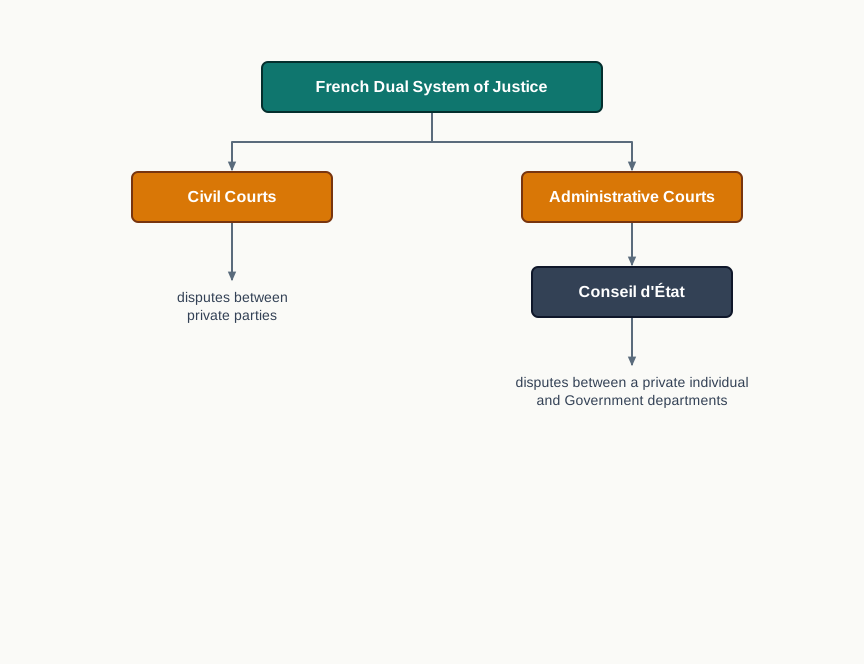
Fig. 5.2 – The French dual system of justice.
A dispute between private parties found its way to the civil court. A dispute between a private individual and a Government department nearly always went to the administrative courts.
The highest administrative court was the Conseil d’État. Initially, when this system was established, direct filing of cases was not allowed. The court could entertain a petition only when the Minister had forwarded it to the court, and the decision of the court could only be of advisory value for the Minister.
That last point is worth pausing on. At the start, a citizen could not walk into the highest administrative court, and even a favourable decision did not bind the Minister. The system began as an internal check on the administration rather than an external one, and it grew into something stronger over time.
Assessment of the Droit System
Although there have been theoretical objections to the Droit system, it is often considered far more efficient than its contemporary common law system. The objections and the praise pull in opposite directions, and both are easy to state: a court staffed and structured by the administration invites doubts about impartiality, yet it also brings speed and expert knowledge of how government actually works.
5.10 Summary
- No society has survived without administration, and administrative law exists to ensure that the policies, rules, regulations and legislation framed for public good are not misused.
- Administrative law deals with the organisation, powers and functions of administrative authorities, and regulates how government departments and agencies exercise their powers while performing public duties.
- Before the 21st century, administrative law was studied as a part of constitutional law, but the two are now treated as distinct disciplines.
- Constitutional law settles what powers exist and who holds them — how elections are held, how Parliament is formed, and the powers of the different branches of the State.
- Administrative law keeps a check on the actions of the Government when it deals with procedures affecting the rights of citizens; how a Minister is appointed is constitutional law, while the actions of an appointed Minister affecting the public good are administrative law.
- A proactive welfare State cannot vest all administrative action in the legislature, because governance would cease to function if legislative sanction were compulsorily required for every administrative act.
- The need for delegation is the single most important factor which has led to the growth of administrative law.
- Article 12 of the Constitution of India defines ‘State’ to include local or other authorities, and these have been read to cover:
- authorities created by law;
- authorities which are agencies and instrumentalities of the State; and
- authorities discharging public functions which have an impact on the common people.
- A Government-funded NGO whose control vests with the Government and whose functions are akin to the Government’s functions would be considered ‘State’ for the purpose of Article 12.
- Administrative action is of four types:
- administrative legislative action, which includes rule-making action and delegated legislation;
- quasi-judicial or administrative adjudicatory action, where there is adjudication on legal rights, as in tribunals;
- simply administrative action, which executes crucial administrative decisions and in which discretion is vested in the authority; and
- ministerial or purely administrative action, in which no discretion is vested because there is only one way of performing the act.
- Because it involves rule-making, adjudication and discretion, administrative law is not merely procedural; it is a full-fledged discipline which is very substantive in nature.
- The fundamental principles of administrative law act as safeguards that protect citizens’ rights and ensure the accountability of administrative authorities.
- The Rule of Law means that law, and not the will of individuals, governs the State; it prevents the arbitrary exercise of power and protects the rights and liberties of citizens.
- According to Professor A.V. Dicey, in Introduction to the Study of the Law of the Constitution (1885), the Rule of Law rests on three principles:
- supremacy of law, under which no person may be punished except for a clear violation of law proved before an ordinary court;
- equality before law, under which every person is subject to the same law and the jurisdiction of ordinary courts; and
- predominance of legal spirit, under which the protection of rights depends on an independent and impartial judiciary.
- The expression “Rule of Law” is not explicitly mentioned in the Constitution of India, but its essence runs through the Preamble, Article 14, Article 21 and the power of judicial review.
- In Kesavananda Bharati v. State of Kerala and Indira Gandhi v. Raj Narain, the Supreme Court recognised the Rule of Law as part of the basic structure of the Constitution.
- In Maneka Gandhi v. Union of India, the Court held that laws affecting personal liberty must be just, fair and reasonable.
- The Separation of Powers divides government functions among three organs to prevent concentration of power, ensure checks and balances, and reduce the chances of misuse of power.
- Complete separation of powers is not possible in India, but courts ensure that administrative authorities neither exceed their powers nor interfere with judicial functions.
- Delegated legislation is the process by which the legislature delegates limited law-making powers to the executive or administrative authorities through a parent statute.
- Delegated legislation is needed because modern governance is complex and technical, legislatures cannot make detailed rules on every subject, and experts are required to frame technical regulations.
- Its advantages are that it saves the time of the legislature, allows flexibility and quick response, and ensures detailed and effective rule-making.
- Courts control delegated legislation by ensuring that it does not exceed the powers given under the parent Act and is not arbitrary or unreasonable.
- In In Re Delhi Laws Act, AIR 1951 SC 332, the Supreme Court upheld delegated legislation but stressed the need for safeguards against its misuse, holding that essential legislative policy must remain with the legislature.
- The Principles of Natural Justice ensure fairness, transparency and impartiality, and apply whenever an administrative decision affects the rights, duties or interests of individuals.
- Nemo judex in causa sua means that no person should be a judge in his own cause, and the deciding authority must be impartial and free from any interest that may influence the decision.
- Bias is of three kinds:
- pecuniary bias, where the adjudicator has a financial interest in the subject matter, and even a small monetary interest disqualifies;
- personal bias, arising from friendship, family ties or professional or business association with a party; and
- bias as to subject matter, or official bias, which disqualifies only where there is an intimate and direct connection between the authority and the issue.
- Audi alteram partem means “hear the other side”, and requires that no person be condemned unheard; before passing an adverse order the authority must give a reasonable opportunity to be heard.
- This principle requires disclosure of charges, an opportunity to present evidence, and an opportunity to rebut adverse material.
- The essentials of a fair hearing are notice and hearing:
- notice must be prior and reasonable, and must state the time and place of hearing, the nature of proceedings, and the charges or allegations;
- hearing includes knowledge of allegations, an opportunity to submit an explanation, access to oral and documentary evidence, an opportunity to rebut evidence, and the right to present one’s own evidence.
- The procedure of fair hearing is flexible and depends on the facts and circumstances of each case.
- A hearing is treated as fair if the authority considers all relevant material produced by the individual, discloses the evidence it intends to use against the individual, and gives an opportunity to rebut that evidence.
- Judicial Review is the power of courts to examine the legality of administrative actions.
- The grounds of judicial review are:
- illegality, that is, acting beyond legal authority;
- irrationality, that is, decisions that are unreasonable or illogical; and
- procedural impropriety, that is, failure to follow prescribed procedures.
- Judicial review ensures that administrative authorities act within constitutional and legal limits.
- Together, the Rule of Law, Separation of Powers, Delegated Legislation, Natural Justice and Judicial Review protect citizens from arbitrary administrative action and strengthen democratic administration.
- Under the Droit system, developed in France after Napoleon became First Consul in the late eighteenth century, the King’s court called the Conseil du Roi was abolished and special courts were created to decide matters expeditiously.
- France thus evolved a dual system of justice, in which disputes between private parties go to the civil courts while disputes between a private individual and Government departments go to the administrative courts.
- The highest administrative court was the Conseil d’État; initially direct filing was not allowed, a petition could be entertained only if forwarded by the Minister, and its decision was of advisory value only.
- Despite theoretical objections, the Droit system is often considered far more efficient than its contemporary common law system.
5.11 Key Terms
Administration — the day-to-day work of running the State, carried on by ministries, departments, boards, corporations, universities and local bodies.
Administrative law — the branch of law governing the organisation, powers and functions of administrative authorities, and regulating how they exercise those powers in performing public duties.
Constitutional law — the branch of law that sets out the scope of the rights and duties of citizens and of the Government, and determines how the organs of the State are formed and what powers they hold.
‘State’ under Article 12 — the Government and Parliament of India, the Government and Legislature of each State, and all local or other authorities within the territory of India or under the control of the Government of India.
Instrumentality of the State — a body which, because of government funding, government control and the public nature of its functions, is treated as part of the State for the purpose of Article 12.
Administrative legislative action — action by which the administration makes law, including rule-making action and delegated legislation.
Quasi-judicial action — administrative adjudicatory action, in which an authority that is not a court decides upon the legal rights of individuals, as a tribunal does.
Simply administrative action — action executing crucial administrative decisions, in which discretion is vested in the authority.
Ministerial action — purely administrative or copybook action in which no discretion is vested, because there is only one way of performing the act.
Discretion — the right of an authority to exercise its own understanding and judgment in dealing with a matter, where more than one lawful course is open.
Rule of Law — the principle that law, and not the will of individuals, governs the State, so that all government action rests on established legal authority.
Supremacy of law — Dicey’s first principle, that no person may be punished or made to suffer except for a clear violation of law proved before an ordinary court.
Equality before law — Dicey’s second principle, that every person, irrespective of status or position, is subject to the same law and to the jurisdiction of the ordinary courts.
Predominance of legal spirit — Dicey’s third principle, that the protection of rights depends upon an independent and impartial judiciary.
Basic structure — those features of the Constitution which are so essential that they cannot be taken away, and of which the Rule of Law has been recognised to be one.
Separation of powers — the division of government functions among the legislature, the executive and the judiciary, so as to prevent concentration of power and ensure checks and balances.
Delegated legislation — the making of rules by the executive or an administrative authority under a limited law-making power conferred by the legislature through a parent statute.
Parent statute — the Act passed by the legislature which lays down the policy and confers the power to make delegated legislation under it.
Ultra vires — beyond the powers; used of a rule or action that goes further than the law authorising it permits.
Principles of Natural Justice — the minimum standards of fair procedure that apply whenever an administrative decision affects the rights, duties or interests of individuals.
Nemo judex in causa sua — the rule against bias, that no person should be a judge in his own cause.
Pecuniary bias — bias arising from a financial or economic interest in the subject matter of the dispute, where even a small monetary interest disqualifies.
Personal bias — bias arising from friendship, family ties, or professional or business association with one of the parties.
Official bias — bias as to subject matter, arising from a general interest or prior involvement in the matter, which disqualifies only where the connection is intimate and direct.
Audi alteram partem — the rule of fair hearing, that no person shall be condemned unheard.
Notice — the prior and reasonable intimation to an affected person stating the time and place of hearing, the nature of proceedings, and the charges or allegations.
Fair hearing — a hearing in which the person knows the allegations, may submit an explanation, has access to the evidence, may rebut it, and may present evidence of their own.
Judicial review — the power of courts to examine the legality of administrative actions and to set aside actions falling outside constitutional and legal limits.
Illegality — a ground of judicial review, that the authority acted beyond its legal authority.
Irrationality — a ground of judicial review, that the decision was unreasonable or illogical.
Procedural impropriety — a ground of judicial review, that the authority failed to follow the prescribed procedure.
Droit system — the French system under which disputes between a private individual and Government departments are decided by a separate hierarchy of administrative courts rather than by the ordinary civil courts.
Conseil du Roi — the King’s court in pre-Napoleonic France, which played only an advisory role to the King and was later abolished.
Conseil d’État — the highest administrative court in the French Droit system.
Dual system of justice — a system in which private disputes go to the civil courts while disputes involving Government departments go to the administrative courts, both operating over the same territory and people.
5.12 Points to Ponder
Dicey’s first principle rules out discretionary power, yet modern administration cannot function without discretion. Is Dicey’s Rule of Law still workable in a welfare State, or does it need to be restated for our times?
Delegated legislation means that rules binding on everyone are framed by officials whom no one elected. Does the control exercised by courts adequately make up for the absence of a vote, or is something more needed?
A hearing takes time, and time costs money and delays relief for others in the queue. Where an authority must act urgently, how should the law balance the right to be heard against the need for speed?
In pecuniary bias, even a small monetary interest disqualifies, while official bias disqualifies only where the connection is intimate and direct. Is this difference in strictness justified?
“Justice must not only be done but must also appear to be done.” Why should the appearance of fairness matter at all, if the decision itself was in fact fair?
Article 12 reaches bodies that discharge public functions affecting common people. As more public services are run by private companies, should the reach of Article 12 expand with them?
Judicial review examines the legality of a decision and not its wisdom. Is that self-restraint a strength of the system or a gap in it?
The Droit system is criticised for placing disputes against the Government before courts closely connected with the administration, yet it is often praised as more efficient. Which of the two considerations should weigh more heavily for a country deciding how to control its administration?
India’s older texts are said to reflect the ideal of fair administration through dharma. What does it add to a student’s understanding of the Rule of Law to know that the idea is not only a Western import?
Administrative law grew because delegation grew. If governance becomes still more technical — with decisions taken by automated systems, for instance — what new safeguards might administrative law need to develop?
5.13 Textbook Questions
Interpret the meaning of administrative law. What does it seek to achieve?
Differentiate between administrative law and constitutional law, using the example of a Minister’s appointment and a Minister’s actions.
State the reasons for the growth and development of administrative law as a separate discipline.
How does Article 12 of the Constitution of India widen the field over which administrative law operates?
Explain the four types of administrative action, giving one example of each.
“Administrative law is not merely procedural in nature.” Explain this statement with reference to the types of administrative action.
Critically evaluate the concept of the Rule of Law. Discuss Dicey’s three principles and the extent to which they are reflected in the Constitution of India.
Explain the meaning, need and advantages of delegated legislation, and state how the courts control it.
Discuss the two principles of natural justice, and explain the essentials of a fair hearing.
Explain the Droit system. Why is it described as a dual system of justice, and what objections have been raised against it?
5.14 Objective Questions
Administrative law is chiefly concerned with:
- how Parliament is formed
- how an existing power is exercised by an authority
- how elections are conducted
- how the Constitution is amended
Before the 21st century, administrative law was generally studied as a part of:
- criminal law
- international law
- constitutional law
- law of contract
The single most important factor pointed out as having led to the growth of administrative law is:
- the growth of the judiciary
- the need for delegation
- the abolition of the King’s court
- the increase in criminal litigation
Which Article of the Constitution of India defines ‘State’ so as to include local or other authorities?
- Article 12
- Article 14
- Article 21
- Article 32
A statute requires a University to open its bank account with a named bank, and the University does so. This is an example of:
- administrative legislative action
- quasi-judicial action
- simply administrative action
- ministerial action
The type of administrative action in which the administration adjudicates upon the legal rights of individuals is:
- rule-making action
- quasi-judicial action
- ministerial action
- purely administrative action
Discretion is vested in the authority in:
- ministerial action
- copybook action
- simply administrative action
- purely administrative action
Dicey explained his concept of the Rule of Law in the book:
- The Spirit of the Laws
- Introduction to the Study of the Law of the Constitution
- The Province of Jurisprudence Determined
- Commentaries on the Laws of England
Dicey’s principle that no person may be punished except for a clear violation of law proved before an ordinary court is known as:
- equality before law
- predominance of legal spirit
- supremacy of law
- separation of powers
The Article of the Constitution which guarantees equality before law and equal protection of laws is:
- Article 12
- Article 14
- Article 19
- Article 21
Delegated legislation is made under the authority of:
- a parent statute
- a judicial decision
- an administrative custom
- a ministerial circular alone
In In Re Delhi Laws Act, AIR 1951 SC 332, the Supreme Court:
- struck down all forms of delegated legislation
- upheld delegated legislation while stressing the need for safeguards against misuse
- held that Parliament may delegate its essential legislative policy
- held that only State legislatures may delegate law-making power
The maxim which means “no one should be a judge in his own cause” is:
- audi alteram partem
- nemo judex in causa sua
- ratio decidendi
- ultra vires
Bias arising because the deciding authority holds a financial interest in the subject matter of the dispute is called:
- personal bias
- official bias
- pecuniary bias
- subject-matter bias
Which of the following is NOT among the three recognised grounds of judicial review?
- illegality
- irrationality
- procedural impropriety
- inefficiency
The highest administrative court under the French Droit system is:
- the Conseil du Roi
- the Conseil d’État
- the Court of Cassation
- the Napoleonic Tribunal
Under the Droit system as originally established, a petition could reach the highest administrative court only when it was:
- filed directly by the aggrieved individual
- forwarded by the Minister
- referred by an ordinary civil court
- admitted by the King
Assertion (A): Complete separation of powers does not exist in India. Reason (R): Administrative authorities in India perform functions that are legislative and adjudicatory in character.
Assertion (A): The expression “Rule of Law” does not appear anywhere in the Constitution of India. Reason (R): The Rule of Law has no place in the Indian constitutional scheme.
Assertion (A): Even a small monetary interest is enough to disqualify an adjudicator from deciding a case. Reason (R): Justice must not only be done but must also appear to be done.
Assertion (A): Delegated legislation is necessary in modern governance. Reason (R): Legislatures cannot make detailed and technical rules on every subject.
Assertion (A): A court exercising judicial review may set aside an administrative order merely because it considers the order unwise. Reason (R): Judicial review examines the legality of administrative action.
Assertion (A): A Government-funded NGO controlled by the Government and performing functions akin to those of the Government may be treated as ‘State’. Reason (R): Article 12 extends the meaning of ‘State’ to local or other authorities within the territory of India or under the control of the Government of India.
Assertion (A): An order passed without giving the affected person notice of the allegations can be challenged before the courts. Reason (R): The principle of audi alteram partem requires that no person be condemned unheard.
5.15 Check Your Concepts
Why is it said that a society can survive without science and technology but not without administration?
The same Minister, the same department and even the same file can raise both a constitutional law question and an administrative law question. Explain how, with one example of each question.
What would happen to governance if the sanction of the legislature were compulsorily required for every kind of administrative action?
Distinguish between constitutional law and administrative law on any four bases.
State the three categories of bodies covered by the expression ‘other authorities’ in Article 12 of the Constitution of India.
Two organisations do identical charitable work. One is funded and controlled by the Government; the other raises its own funds and appoints its own governing body. Why does the reach of Article 12 differ between them?
Distinguish between simply administrative action and ministerial action.
Why is the word ‘quasi’ used in the expression ‘quasi-judicial action’? What does a quasi-judicial body do that an ordinary administrative body does not?
Identify the type of administrative action in each of the following, and give a reason:
- a ministry frames rules on the permitted level of a preservative in packaged food;
- a tribunal decides a dispute over an employee’s pension;
- an officer selects one of three permitted routes for a new bus service;
- a department deposits a fee in the account the statute names.
Why would it be wrong to say that administrative law is only procedural in nature?
State Dicey’s three principles of the Rule of Law, and match each of them with a feature of the Indian constitutional scheme that reflects it.
The expression “Rule of Law” is nowhere used in the Constitution of India. Why, then, is the Rule of Law said to run through the entire constitutional framework?
If Dicey’s first principle rules out discretionary power, how can administrative authorities lawfully exercise discretion at all?
What is meant by saying that the Rule of Law is part of the ‘basic structure’ of the Constitution? What consequence follows from that description?
Why is delegated legislation needed in modern governance? State three reasons and one danger it carries.
What is a parent statute, and what happens to a rule that goes beyond the power the parent statute confers?
Correct the errors in the following statements and give the correct position in each case:
- Delegated legislation is law made by the courts.
- Under the Rule of Law, government officers are answerable only to departmental authorities and not to ordinary courts.
- Bias must be actually proved to have influenced the decision before an order can be set aside.
- A court exercising judicial review may set aside an order it considers unwise.
Distinguish between pecuniary bias and official bias, and explain why the law is stricter about the first.
State the particulars a notice must contain for a hearing to be fair, and explain what happens if the notice is served on the morning of the hearing.
Arrange the following in the order in which they should occur in a fair hearing:
- opportunity to rebut the evidence used against the person;
- prior and reasonable notice stating the charges;
- the authority’s decision on all relevant material;
- disclosure of the evidence the authority intends to use;
- opportunity to submit an explanation and present one’s own evidence.
“The procedure of fair hearing is flexible.” If there is no fixed format, how does a court decide whether a particular hearing was fair?
Explain the three grounds of judicial review, and state which ground is attracted when an authority uses a power for a purpose other than the one for which it was granted.
Why is judicial review described as the principle that gives the other principles of administrative law their teeth?
Why did the ordinary courts in pre-Napoleonic France come to be seen as competitors of the King’s court, and what did that lead to?
Distinguish between the Droit system and the common law system in dealing with disputes between a citizen and the Government.
Under the Droit system as originally established, a citizen could not file directly before the highest administrative court and its decision bound no one. Why does this make it a weak safeguard at the start?
5.16 Case-Based Questions
- A municipal authority is empowered by statute to cancel a street food licence “on grounds of unhygienic conditions”. Ravi has held such a licence for six years. One morning he receives an order cancelling it with immediate effect. The order gives no reasons. Ravi is not told of any inspection, is shown no report, and is never called to explain anything. He later learns that the officer who passed the order is the brother-in-law of a rival vendor operating on the same street.
- Which principle of natural justice has been breached by the manner in which the order was passed, and what should the authority have done before passing it?
- Which kind of bias does the officer’s relationship with the rival vendor attract?
- On which grounds of judicial review can Ravi challenge the order?
- Suppose instead that the authority had served Ravi a notice stating the date of hearing and the allegation, shown him the inspection report, heard him, and then cancelled the licence on the strength of that report. Would your answer to (a) and (c) change? Give reasons.
- A State legislature passes an Act to regulate coaching centres. The Act lays down the policy, fixes the standards to be maintained, and empowers the State Coaching Regulatory Board to “make rules for carrying out the purposes of this Act”. The Board frames rules prescribing minimum classroom size, teacher qualifications and fee display requirements. It also frames a rule providing that any centre which fails an inspection shall stand permanently closed and that its owner shall be imprisoned for six months. The Act itself says nothing about imprisonment.
- Identify the parent statute and the delegated legislation in this situation.
- State two reasons why the legislature would leave rules of this kind to the Board rather than enact them itself.
- Is the rule providing for imprisonment valid? Identify the ground of control the courts would apply.
- Would your answer to (c) be different if the Act had expressly authorised the Board to prescribe penalties including imprisonment? Explain.
- The Sunrise Education Society runs a school. Its entire building and recurring expenditure are met from State Government grants, the Government appoints a majority of its governing body, and it admits students under the State’s education policy. Meera’s application for admission is rejected in writing on the ground that “students from her locality are not preferred”. Meera wishes to challenge the rejection as a violation of her Fundamental Rights.
- On what basis can it be argued that the Society falls within the meaning of ‘State’ under Article 12 of the Constitution of India?
- Which three features of the Society support that argument?
- Assume the Society received no government funds, appointed its own governing body, and framed its own admission policy. How would this change the position?
- Why does the answer to (a) matter for Meera’s ability to approach the court?
- In the course of a single week, the Transport Department of a State does four things. It issues a set of regulations fixing safety standards for school buses. It hears and decides a dispute between a bus operator and an inspector over a cancelled permit. It chooses one of three permissible routes for a new bus service, after weighing traffic and demand. It deposits the licence fees it has collected in the bank account named in the statute that created the Department.
- Identify the type of administrative action involved in each of the four acts.
- In which of the four is discretion vested in the authority, and in which is there none?
- Which of the four acts must comply with the principles of natural justice, and why?
- What does this week’s work show about the claim that administrative law is only procedural in nature?
- A departmental inquiry is held against Ms Fernandes, a government employee, on a charge of misappropriating stores. She is given notice stating the date, place and charge. At the hearing she is allowed to speak and to produce two witnesses. The inquiry officer then finds her guilty, relying partly on an internal audit report that was never shown to her and that she was never asked to answer. The inquiry officer had earlier served for two years in the same store branch, but had no dealings with the transactions in question.
- Which ingredient of a fair hearing has not been satisfied?
- Does the inquiry officer’s earlier service in the same branch disqualify him? Refer to the test applied for bias as to subject matter.
- If the audit report had been supplied to Ms Fernandes and she had been given an opportunity to reply to it, would the inquiry be open to challenge on the ground of procedural impropriety? Give reasons.
5.17 Landmark Cases & Maxims
State the principle settled in In Re Delhi Laws Act, AIR 1951 SC 332, and explain what a legislature must retain in its own hands when it delegates law-making power.
Which two decisions of the Supreme Court are relied upon in this chapter for the proposition that the Rule of Law is part of the basic structure of the Constitution? State the principle each of them settled.
In Indira Gandhi v. Raj Narain, AIR 1975 SC 2299, a constitutional amendment sought to place a particular election dispute beyond the reach of any court. State what the Supreme Court held and why that holding matters for administrative law.
State the principle laid down in Maneka Gandhi v. Union of India about laws affecting personal liberty, and explain how it strengthens the protection against arbitrary administrative action.
Give the literal meaning and the legal meaning of nemo judex in causa sua, and state one situation in which it would disqualify a deciding authority.
Give the literal meaning and the legal meaning of audi alteram partem, and state the three things this principle requires of an authority before it passes an adverse order.
Which maxim would you apply to each of the following situations, and what would the outcome be?
- A disciplinary authority decides a complaint that names its own son as the complainant.
- A scholarship is withdrawn on the basis of a report the student has never been shown.
- A regulatory board frames a rule imposing a penalty that the parent Act nowhere authorises.
A rule framed by an authority goes further than the power conferred by the parent Act. Which expression describes such a rule, and what will a court do with it even if the rule appears sensible?
“Justice must not only be done but must also appear to be done.” Identify the kind of bias in connection with which this statement is most often invoked, and explain why the rule there is applied strictly.