Chapter 7: Classification of Laws
Late one evening on a crowded market road, a delivery scooter races a changing signal and knocks down Meera as she crosses with her groceries. Her shoulder is fractured. What happens next is not one legal event but two, and they travel down two completely different roads.
The police register a case against the rider for driving dangerously. Notice how that case is named: it is not Meera against the rider. It is the State against the rider. Rash driving on a public road is treated as a wrong done to everybody who uses that road, so the State prosecutes it, and the charge must be proved beyond reasonable doubt before any punishment can follow.
At the same time, Meera is holding a hospital bill and three months of lost work. Punishing the rider does not pay for either. So she goes to a different court with a different claim — compensation for the injury. Nobody is sent to jail in that case. The only questions are who must pay and how much, and they are decided on the balance of probabilities, where the more probable version of events wins.
One accident. Two branches of law, two kinds of court, two standards of proof, two entirely different outcomes. That split is not accidental. It is the result of a system of classification that lawyers, judges and students use every day to know where a dispute belongs.
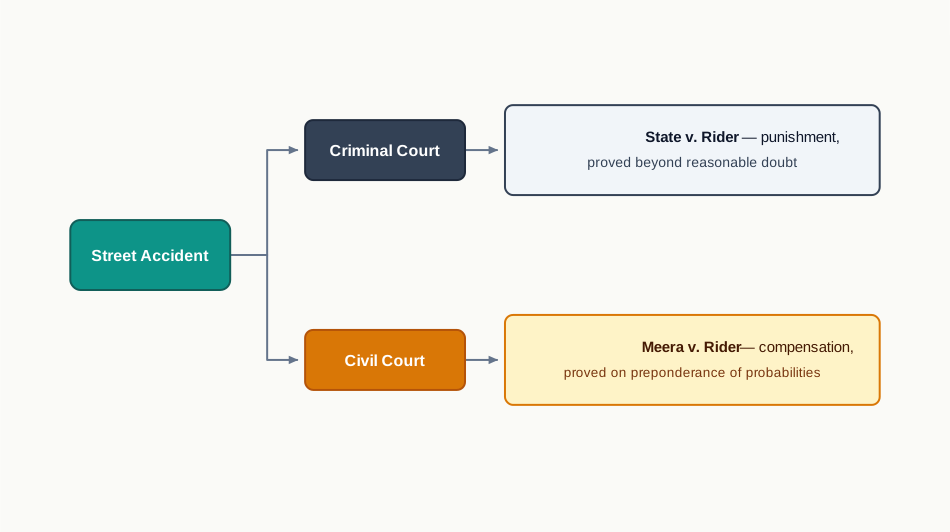
Fig. 7.0 – Civil and criminal branches of a single accident.
By the end of this chapter you will be able to answer each of these questions.
7.1 Why Law Is Classified
Law is enormous. A single country runs on thousands of statutes, rules, regulations and judicial decisions, and no one — not a judge, not a lawyer, not a student — carries all of it in their head. What they carry instead is a map. Classification is that map. It tells you which family a rule belongs to, and therefore which court, which procedure and which set of principles will govern it.
Classification matters for the correct and comprehensive understanding of law. Its benefits are these:
- It is useful in understanding the interrelation of rules — how one rule connects to, supports or limits another.
- It is useful in the systematic arrangement of rules, so that a vast body of law can be studied and applied in an orderly way.
- It is useful for the profession and for students of law, both of whom need to locate the right branch quickly before they can argue or answer anything.
Classification Is Not a New Idea
The idea of classifying law is very old. Even in ancient civilisations, jurists were well aware of the difference between civil and criminal laws — between a wrong you compensate and a wrong you are punished for.
But law does not stand still. With the passage of time many new branches have come into existence, and the older classifications have become outdated in places. Law can therefore be classified in many ways, and those ways differ with respect to time and place. What a jurist two centuries ago treated as one branch may today be three.
This chapter uses three bases of classification, shown in Fig. 7.1 — subject matter, scope, and jurisdiction.
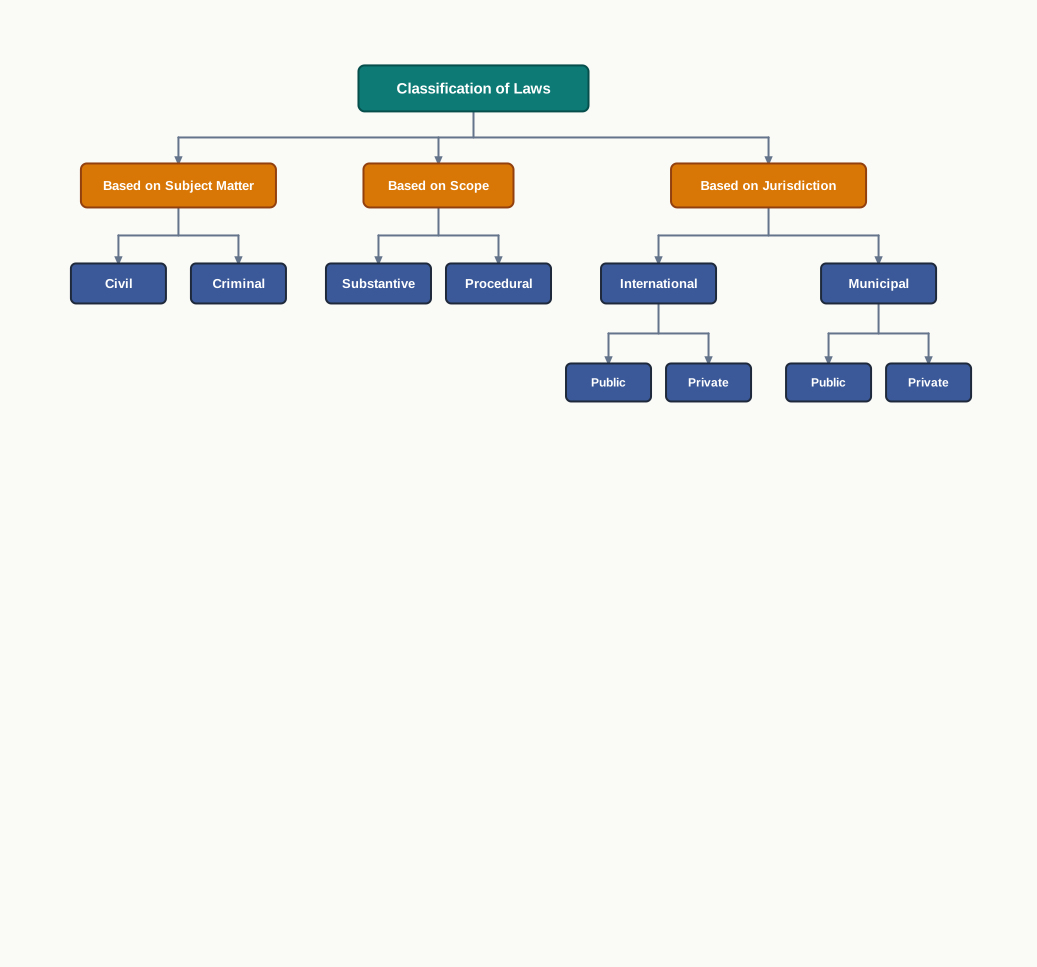
Fig. 7.1 – Bases of classifying laws.
7.2 Classification Based on Subject Matter: Civil Law and Criminal Law
The oldest and most useful division of law looks at the subject matter of the dispute — what kind of wrong was committed, and what the law offers by way of remedy. On this basis, law is broadly classified into civil law and criminal law, as shown in Fig. 7.2.
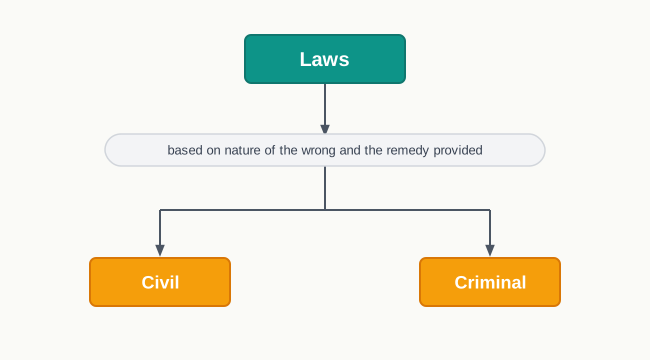
Fig. 7.2 – Classification based on subject matter.
Criminal Law
Criminal law deals with offences against the State or society as a whole. When a person commits a serious wrong that affects public order, safety or morality, it stops being a private quarrel and becomes a criminal matter.
This is the point students most often miss. Even though one individual may be directly harmed, the act is treated as a crime against society. A pickpocket takes one person’s wallet, but the message the theft sends is that nobody’s wallet is safe in that market. The harm to public order is what the criminal law responds to.
Typical examples of criminal wrongs are murder, theft, kidnapping, assault and fraud.
Because the wrong is against society, the case is filed by the State — that is, the government — and not by the private person who suffered. This is why criminal cases are titled State v. A, with the injured person appearing as a witness rather than as the party fighting the case.
The main aims of criminal law are:
- to punish the wrongdoer;
- to maintain law and order;
- to protect society;
- to prevent future crimes.
In criminal cases the offence must be proved beyond reasonable doubt. This is a deliberately heavy burden, because what follows a conviction is punishment — a fine, imprisonment, and a permanent mark on a person’s record. The law would rather let a doubtful case fail than punish an innocent person.
Civil Law
Civil law deals with disputes between individuals or organisations regarding rights and obligations. It usually involves private matters rather than public wrongs — a promise not kept, a boundary crossed, money not paid.
Common examples are property disputes, breach of contract, divorce and maintenance, defamation, and consumer complaints.
Here the case is filed by a private individual, who is called the plaintiff. That is why civil cases are titled A v. B — two private parties, with the State providing only the court in which they are heard.
The main aims of civil law are:
- to provide compensation;
- to resolve disputes;
- to enforce legal rights.
In civil cases the matter is proved on the preponderance of probabilities. The court does not need to be almost certain; it asks only which side’s version is more probably true. Since the outcome is usually payment of money or an order to do or stop doing something, the lower standard is considered fair.
When One Act Is Both
The two branches are separate, but the same set of facts can trigger both at once. When that happens, two cases run independently — one to punish, one to compensate — and the failure of one does not automatically decide the other.
7.3 Classification Based on Scope: Substantive Law and Procedural Law
Law can also be classified on the basis of its scope, into substantive law and procedural law. This division does not ask what the dispute is about; it asks what work the rule is doing. Some rules create the right. Other rules tell you how to reach a court and get that right enforced. Fig. 7.3 shows the two branches.
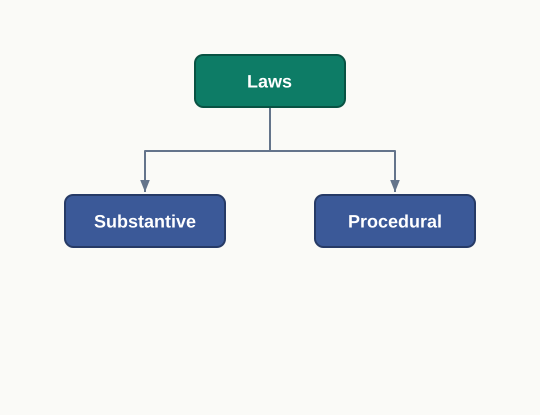
Fig. 7.3 – Classification based on scope.
Substantive Law
Substantive law defines the rights, duties and liabilities of individuals. It tells us what conduct is allowed and what is prohibited, and it lays down the legal consequences of wrongful acts.
For example, criminal laws that define offences such as theft or murder, and civil laws that define rights relating to property or contracts, are all forms of substantive law. They are substantive because they state what the law actually is.
Procedural Law
Procedural law lays down the process or method by which substantive law is enforced. It explains how a case should be filed, how evidence is to be presented, how trials are conducted, and how judgments are delivered.
Put simply, substantive law tells us what the law says, while procedural law tells us how the law is applied.
Why Both Matter Equally
Students often treat procedure as the boring half. It is not. Both branches are equally important, because rights and duties would have no meaning without a proper procedure to enforce them.
Take a simple case. The rule that a person who breaks a contract must compensate the other side is substantive — it creates the right to be compensated. The rules that decide which court the suit goes to, within what time it must be brought, and how the other side must be informed are procedural. A person who holds a perfect substantive right but files in the wrong court, or files too late, walks out with nothing. The right existed; the route to it was missed.
7.4 Classification Based on Jurisdiction: International Law
The third basis of classification is jurisdiction — the territory and the persons over which a body of law operates. Some rules operate between nations. Others operate inside one nation. The first group is called international law and is taken up here; the second is called municipal law and is taken up in the next section.
International law is an important branch of law. It deals with those rules and regulations of nations which are recognised by them and are binding upon each other through reciprocity.
Reciprocity is the key word, and it explains why this branch works the way it does. There is no world police force and no world legislature that can compel a country to obey. What holds the system together is mutual acceptance — a country follows the rules because it expects other countries to follow them in return, and because breaking them costs it trade, alliances and standing.
Many jurists, for this reason, do not give much importance to this branch. In recent times, however, it has grown manifold and has acquired increasing importance on account of globalisation and other related factors. Goods, money, data and people now cross borders every day, and each crossing raises a question that no single country’s law can answer alone.
International law has been further classified as shown in Fig. 7.4.
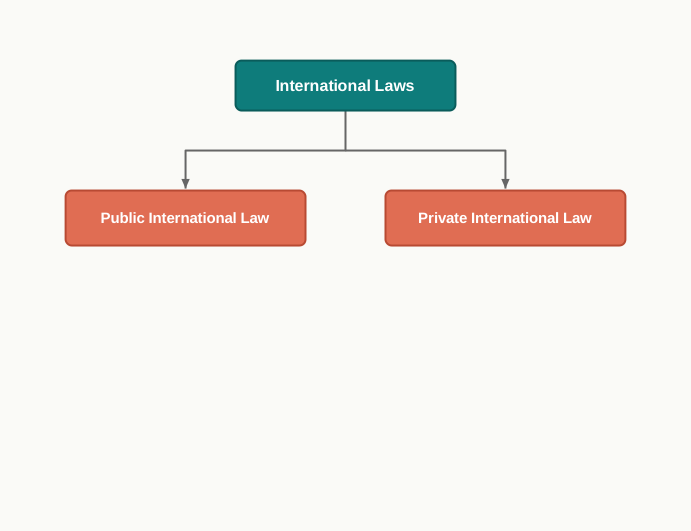
Fig. 7.4 – Branches of international law.
Public International Law
This branch of law relates to the body of rules and regulations which governs the relationship between nations. Countries mutually recognise these sets of rules, which are binding on them in their transactions on a reciprocal basis.
The parties here are States themselves. Questions of boundaries, treaties, diplomatic relations, trade between countries and the conduct of States towards one another belong to this branch.
Private International Law
Private international law is that part of the law of the State which deals with cases having a foreign element. Despite its name, it is not a law made between nations at all — it is part of a country’s own domestic law, and it is applied by that country’s own courts.
Its subject is the rights of private citizens of different countries. When a dispute has one foot in India and one foot abroad, this branch answers three questions: which country’s court can hear the matter, which country’s law applies to it, and whether a judgment given abroad will be recognised here. Marriages and adoption of individuals fall within its domain.
7.5 Municipal Law and Its Public Law Branches
Municipal laws are basically domestic or national laws. The word “municipal” here has nothing to do with a municipal corporation or a city council — in this classification it simply means internal to a country. These are the laws a State makes for itself, and they are the laws a student of Indian law will spend most of the time with.
Municipal law does two things. It regulates the relationship between the State and its citizens, and it determines the relationship among citizens themselves.
Those two functions are exactly why municipal law splits into two segments, shown in Fig. 7.5. Where the State stands on one side of the relationship, the law is public law. Where two citizens stand on either side, it is private law. Public law is taken up here; private law follows in the next section.
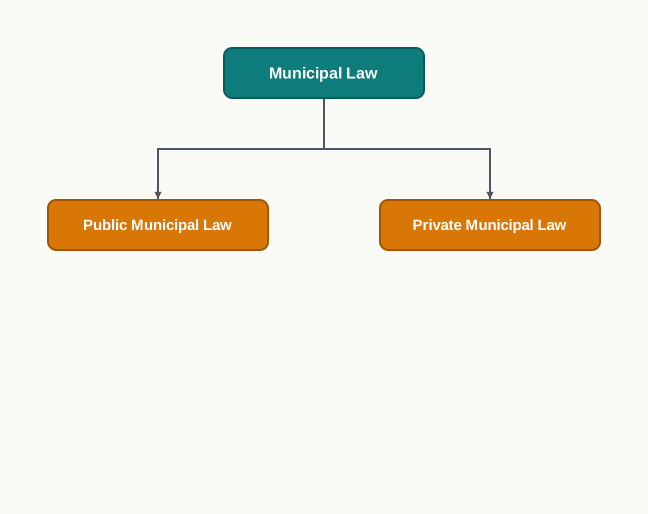
Fig. 7.5 – Branches of municipal law.
Public Law
Public law chiefly regulates the relationship between the State and its subjects. It also provides for the structure and functioning of the organs of the State — how power is created, who holds it, and what limits it operates under.
The three important branches of public law are the following.
- Constitutional Law — Constitutional law is considered to be the basic as well as the supreme law of the country. The nature of any State is basically determined by its Constitution. It also provides the structure of the government, and all the organs of the State derive their powers from the Constitution. Some countries, such as India, have a written Constitution, while countries such as the United Kingdom have an ‘uncodified Constitution’, where the rules are scattered across statutes, conventions and judicial decisions rather than gathered into a single document. In India, the fundamental rights are granted and protected under the Constitution.
- Administrative Law — Administrative law mainly deals with the powers and functions of administrative authorities — government departments, authorities, bodies and the like. It deals with the extent of the powers held by administrative bodies and with the mechanism whereby their actions can be controlled. It also provides for legal remedies in case of any violation of the rights of the people.
- Criminal Law — Criminal law generally deals with acts which are prohibited by law, and defines the prohibited act as an offence. It also prescribes punishments for criminal offences. Criminal law is very important for maintaining order in society and for maintaining peace. The Bharatiya Nyaya Sanhita, 2023 is an example of a criminal law legislation, in which different kinds of offences are defined and punishments are prescribed.
How Constitutional and Administrative Law Differ
Both concern the State, and students frequently mix them up. Constitutional law is about the framework — it creates the organs of government and fixes the outer boundaries of their power. Administrative law works inside that framework, checking whether an authority that has been given power has used it lawfully, fairly and within its limits.
Why Criminal Law Sits Under Public Law
Section 7.2 placed criminal law on one side of the subject-matter division. Here it appears again, this time as a branch of public law, and the reason is the same reason: crime is not only against the individual but against the whole society. Because the wrong is done to society, it is the State that prosecutes, and the relationship the case really tests is the one between the State and the accused. That relationship is what public law governs.
7.6 The Private Law Branches of Municipal Law
The second segment of municipal law is private law. This branch of law defines, regulates, governs and enforces relationships between individuals, associations and corporations. In other words, it deals with the definition, regulation and enforcement of the mutual rights and duties of individuals.
The State has not stepped out of the picture here — it has only changed roles. In public law the State is a party to the dispute. In private law the State intervenes through its judicial organs, that is, the courts, to settle the dispute between the parties. It supplies the referee, not one of the players.
Private law is also called civil law, because it confers civil rights which are administered and adjudicated by civil courts. Much of the life of a society is regulated by this set of private laws — whom you marry, what you own, what you have promised, and what care you owe to the people around you. Fig. 7.6 sets out its four branches.
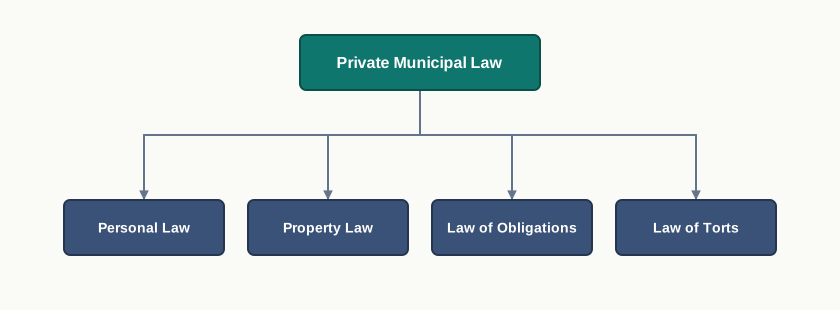
Fig. 7.6 – Branches of private municipal law.
Personal Law
Personal law is the branch of law related to marriage, divorce and succession, that is, inheritance. These laws are based on the religion, rituals and customs surrounding marriage, divorce and inheritance. In such matters, people are mostly governed by the personal laws laid down by their religions.
For example, the marriage of Hindus is governed by personal laws such as the Hindu Marriage Act, 1955, while Muslim marriages are governed by Muslim personal law, which rests on Muslim customary law and is largely un-codified. Codified means written down and enacted as a statute; un-codified law is found instead in recognised religious texts, customs and judicial decisions.
Property Law
Property law deals with the ownership of immovable and movable properties. Immovable property is property attached to the earth — land, a house, a shop. Movable property is property that can be carried from one place to another — a phone, a vehicle, a bag of grain.
The distinction is not merely descriptive; it decides which statute applies. The Transfer of Property Act, 1882 deals with the transfer of immovable property, whereas the Sale of Goods Act, 1930 deals with movable property.
Law of Obligations
This branch of law pertains to an area where a person is required to do something because of his promise, contract or law. It puts an obligation on the person to perform certain actions, and that obligation generally arises as a consequence of an enforceable promise or agreement.
The important word is enforceable. A casual assurance to a friend creates no legal obligation. A promise made in a transaction the law recognises does, and the other side can go to court over it.
Law of Torts
Tort is a civil wrong. This branch of law creates and provides remedies for civil wrongs that do not arise out of contractual duties. A tort deals with negligence cases as well as with intentional wrongs which cause harm, so torts cover both intentional acts and accidents.
An aggrieved person may use the law of tort to claim damages from someone who has caused the wrong or legal injury to him or her. Damages here means money awarded as compensation for the harm suffered.
For instance, if A throws a stone and it hits another person, B, on the head, B may sue A for the injury caused by the accident. Notice that A and B need have no agreement of any kind between them. The duty A broke — the duty not to injure people around him — was placed on him by law itself, not by any promise he made.
7.7 Conclusion: Classification Is Never Final
The classification provided in this chapter is not an exhaustive and conclusive one. It is just an attempt to develop a basic understanding of the classification of law.
With the passage of time many new branches of law have emerged, and there is always scope for revising and classifying laws based on new developments in the field of law. A dispute over a data leak or an online transaction did not exist as a category a few decades ago; today it has to be placed somewhere, and if the old boxes do not fit, new ones are made.
So treat these divisions as working tools rather than fixed walls. A single set of facts, as this chapter has shown more than once, can sit in two branches at the same time. The purpose of classification is not to put law into sealed compartments — it is to help you find, quickly and correctly, the rules that govern the problem in front of you.
7.8 Summary
- Classification of law is important for the correct and comprehensive understanding of law.
- The benefits of classifying law are:
- it helps in understanding the interrelation of rules;
- it helps in the systematic arrangement of rules;
- it is useful for the profession and for students of law.
- The idea of classification is not new — even in ancient civilisations jurists knew the difference between civil and criminal laws.
- New branches of law keep coming into existence, so law can be classified in many ways with respect to time and place.
- Based on subject matter, law is broadly classified into civil law and criminal law, according to the nature of the wrong committed and the remedy provided.
- Criminal law deals with offences against the State or society as a whole, such as murder, theft, kidnapping, assault and fraud.
- In criminal law the case is filed by the State and not by a private person, so it is titled State v. A.
- The main aims of criminal law are:
- to punish the wrongdoer;
- to maintain law and order;
- to protect society;
- to prevent future crimes.
- In criminal cases the offence must be proved beyond reasonable doubt.
- Civil law deals with disputes between individuals or organisations regarding rights and obligations, such as property disputes, breach of contract, divorce and maintenance, defamation and consumer complaints.
- In civil law the case is filed by a private individual called the plaintiff, so it is titled A v. B.
- The main aims of civil law are:
- to provide compensation;
- to resolve disputes;
- to enforce legal rights.
- In civil cases the matter is proved on the preponderance of probabilities.
- The same set of facts may give rise to both a civil case and a criminal case, which then proceed separately.
- Based on scope, law is classified into substantive law and procedural law.
- Substantive law defines the rights, duties and liabilities of individuals and lays down the legal consequences of wrongful acts — it tells us what the law says.
- Procedural law lays down how a case is filed, how evidence is presented, how trials are conducted and how judgments are delivered — it tells us how the law is applied.
- Both are equally important, because rights and duties would have no meaning without a proper procedure to enforce them.
- Based on jurisdiction, law is classified into international law and municipal law.
- International law deals with those rules of nations which are recognised by them and are binding upon each other through reciprocity, and it has grown in importance on account of globalisation.
- International law is of two kinds:
- public international law, which governs the relationship between nations on a reciprocal basis;
- private international law, which is part of the law of a State and deals with cases having a foreign element, such as marriage and adoption.
- Municipal laws are domestic or national laws that regulate the relationship between the State and its citizens and determine the relationship among citizens.
- Municipal law is divided into public law and private law.
- Public law chiefly regulates the relationship between the State and its subjects and provides for the structure and functioning of the organs of the State.
- The three important branches of public law are:
- constitutional law, the basic and supreme law of the country, which determines the nature of the State and the structure of the government;
- administrative law, which deals with the powers and functions of administrative authorities, the control of their actions and remedies for violation of people’s rights;
- criminal law, which defines prohibited acts as offences and prescribes punishments, the Bharatiya Nyaya Sanhita, 2023 being an example.
- Private law defines, regulates, governs and enforces relationships between individuals, associations and corporations, with the State intervening only through its judicial organs.
- The four branches of private law are:
- personal law, relating to marriage, divorce and succession, governed by religion, ritual and custom;
- property law, relating to ownership of immovable and movable property;
- the law of obligations, which requires a person to act because of his promise, contract or law;
- the law of torts, which provides remedies for civil wrongs that do not arise out of contractual duties.
- Hindu marriages are governed by personal laws such as the Hindu Marriage Act, 1955, while Muslim marriages are governed by Muslim personal law, which is largely un-codified.
- The Transfer of Property Act, 1882 deals with the transfer of immovable property, whereas the Sale of Goods Act, 1930 deals with movable property.
- The classification given in this chapter is not exhaustive or conclusive, and there is always scope for revising it as new branches of law develop.
7.9 Key Terms
Criminal law — the branch of law that deals with offences against the State or society as a whole, defines them as offences and prescribes punishment for them.
Plaintiff — the private individual who files a civil case.
Beyond reasonable doubt — the high standard of proof required in criminal cases, under which guilt must be established so firmly that no reasonable doubt about it remains.
Civil law — the branch of law that deals with disputes between individuals or organisations regarding their rights and obligations.
Preponderance of probabilities — the standard of proof in civil cases, under which the court decides in favour of the version that is more probably true.
Substantive law — the branch of law that defines rights, duties and liabilities and states the legal consequences of wrongful acts.
Procedural law — the branch of law that lays down how a case is filed, how evidence is presented, how trials are conducted and how judgments are delivered.
International law — the body of rules of nations which they recognise and which are binding upon each other through reciprocity.
Reciprocity — the mutual basis on which nations accept international rules as binding, each following them in the expectation that others will do the same.
Public international law — the body of rules and regulations which governs the relationship between nations.
Private international law — that part of the law of a State which deals with cases having a foreign element, such as the marriage or adoption of citizens of different countries.
Municipal law — the domestic or national law of a State, which regulates the relationship between the State and its citizens and among citizens themselves.
Public law — the branch of municipal law that chiefly regulates the relationship between the State and its subjects and provides for the structure and functioning of the organs of the State.
Constitutional law — the basic and supreme law of a country, which determines the nature of the State, provides the structure of government and is the source of the powers of all its organs.
Uncodified Constitution — a Constitution that is not contained in a single written document but is found scattered across statutes, conventions and judicial decisions, as in the United Kingdom.
Administrative law — the branch of public law dealing with the powers and functions of administrative authorities, the control of their actions and remedies for violation of people’s rights.
Private law — the branch of municipal law that defines, regulates and enforces the mutual rights and duties of individuals, associations and corporations, with the State intervening only through the courts.
Personal law — the branch of private law relating to marriage, divorce and succession, based on the religion, rituals and customs of the parties.
Un-codified law — law that has not been written down and enacted as a statute, existing instead in recognised texts, customs and judicial decisions.
Property law — the branch of private law dealing with the ownership of immovable and movable property.
Immovable property — property attached to the earth, such as land, a house or a shop.
Movable property — property that can be carried from one place to another, such as goods or a vehicle.
Law of obligations — the branch of private law under which a person is required to do something because of his promise, contract or law.
Tort — a civil wrong, other than a breach of contract, for which the law provides a remedy in damages.
Damages — money awarded by a court as compensation for the harm or legal injury suffered.
7.10 Points to Ponder
- If a crime is treated as a wrong against society, should the person actually injured have any say in whether the case is pursued or withdrawn?
- Criminal cases demand proof beyond reasonable doubt while civil cases need only the preponderance of probabilities. Is it fair that the same set of facts can fail in one court and succeed in the other?
- A person may hold a perfectly good right and still lose the case by approaching the wrong court or coming too late. Does procedural law protect justice, or does it sometimes defeat it?
- International law has no world police force behind it. Does a rule that cannot be forcibly enforced still deserve to be called law?
- Personal laws differ from religion to religion in matters of marriage, divorce and succession. What are the arguments for keeping this diversity, and what are the arguments against it?
- Should a citizen be able to sue the State in the same way one private person sues another, or does the State’s public role justify treating it differently?
- The law of torts imposes duties on people who never agreed to them. On what moral basis can the law bind a complete stranger?
- New areas such as online fraud, data misuse and harm caused by automated systems do not fit neatly into the old branches. Should the law create fresh categories for them, or stretch the existing ones?
7.11 Textbook Questions
Answer the following:
- Why is classification of law important? What are its benefits?
- What is international law? Explain the two types of international law.
- Differentiate between international law and municipal law.
- Discuss the different types of public and private municipal law.
Identify the branch of law in each of the following situations and define it:
- Antilla and Portico are two countries which have a border dispute.
- Shefali was aggrieved because her passport was refused by the Passport Department without any reason.
- Gita died intestate and her children do not know how the property is to be divided.
- Ajit had an agreement to supply 50 kg of rice to Bittu but did not do so.
Sheena was a victim of sexual harassment at her workplace. Explain why her criminal case is a part of public municipal law.
Halestina and Xina, two countries, are bound by certain laws which foster their relations by following rules based on reciprocity. Identify the branch of law and explain its two sub-types.
The Government of India introduced a new law whereby the passport of any person could be revoked on mere suspicion of fraudulent financial transactions, without providing a chance of hearing. Identify and define the branch of law under which such a law can be challenged.
7.12 Objective Questions
Law is broadly classified into civil law and criminal law on the basis of:
- the scope of the law
- the nature of the wrong committed and the remedy provided
- the jurisdiction of the court
- the age of the statute
In a criminal case, the case is filed by:
- the person who suffered the harm
- the State
- the police officer personally
- any member of the public
The standard of proof applied in civil cases is:
- beyond reasonable doubt
- absolute certainty
- preponderance of probabilities
- prima facie satisfaction
Which of the following is not given in the chapter as an aim of criminal law?
- to punish the wrongdoer
- to provide compensation
- to protect society
- to prevent future crimes
A law that lays down how evidence is to be presented and how a trial is to be conducted is:
- substantive law
- procedural law
- personal law
- public international law
Substantive law is best described as the law which tells us:
- how the law is applied
- which court has jurisdiction
- what the law says
- when an appeal may be filed
International law is binding upon nations mainly through:
- a world police force
- reciprocity
- the courts of one powerful State
- municipal legislation alone
A dispute about the validity of a marriage between citizens of two different countries falls within:
- public international law
- private international law
- administrative law
- the law of torts
Municipal law, in this classification, means:
- the bye-laws of a municipal corporation
- the domestic or national law of a State
- law applicable only in cities
- law made by local self-government bodies
Which of the following is not one of the three branches of public law given in the chapter?
- constitutional law
- administrative law
- criminal law
- property law
The Sale of Goods Act, 1930 deals with:
- immovable property
- movable property
- succession
- the powers of administrative authorities
The branch of private law that provides remedies for civil wrongs not arising out of contractual duties is:
- personal law
- the law of obligations
- the law of torts
- constitutional law
Assertion (A): In criminal cases the offence must be proved beyond reasonable doubt. Reason (R): A criminal conviction may result in punishment, including loss of liberty.
Assertion (A): Criminal law is treated as a branch of public law. Reason (R): A crime is regarded as a wrong against the whole society and not merely against the individual harmed.
Assertion (A): Private international law is a part of the domestic law of a State. Reason (R): It is applied by the national courts of that State to cases having a foreign element.
Assertion (A): Procedural law is as important as substantive law. Reason (R): Rights and duties would have no meaning without a proper procedure to enforce them.
Assertion (A): The classification of law given in this chapter is not exhaustive. Reason (R): New branches of law continue to emerge with developments in society and technology.
7.13 Check Your Concepts
Why is the classification of law considered necessary? State its three benefits.
The chapter says that older classifications of law have become outdated in places. Explain why classification has to keep changing.
Distinguish between civil law and criminal law on any four bases.
A person’s phone is snatched in a market. Explain why the case that follows is titled as one between the State and the accused, and not between the owner of the phone and the accused.
Why does criminal law demand a higher standard of proof than civil law? What would happen if both used the same standard?
State the main aims of civil law and of criminal law, and explain how the difference in aims explains the difference in remedies.
Can the same act give rise to both a civil case and a criminal case? Give one situation and explain what each case would seek.
Distinguish between substantive law and procedural law, and give one example of each.
“A person may hold a good right and still lose the case.” Explain this statement with reference to procedural law.
What is meant by reciprocity in international law, and why is it important for that branch?
Why do some jurists doubt whether international law is really law? State the argument on the other side.
Distinguish between public international law and private international law.
Private international law carries the word “international” in its name but is part of a country’s own law. Explain this apparent contradiction.
What is municipal law? On what basis is it divided into public law and private law?
Identify the branch of law involved in each of the following, and give a reason for your answer:
- a challenge to the powers exercised by a government department;
- a dispute over the inheritance of a grandfather’s house;
- a question about which organ of the State may exercise a particular power;
- a claim for compensation by a pedestrian injured by a falling signboard.
Correct the error in each statement and give the correct position:
- Private international law is made by agreement between nations.
- In civil cases the State files the complaint.
- Procedural law defines what conduct is prohibited.
- The Transfer of Property Act, 1882 deals with movable property.
Why is criminal law placed under public law when the person actually harmed is a private individual?
Distinguish between the law of obligations and the law of torts, and explain which of the two binds people who have never dealt with each other.
What is meant by an un-codified body of personal law? Give the example used in the chapter.
Why does the chapter say that the classification of law is not exhaustive and conclusive? Support your answer with one example of a newly developed area of law.
7.14 Case-Based Questions
- Nandini rents a one-room flat and pays the owner a security deposit of ₹30,000, to be returned when she leaves. When she vacates the flat after two years, the owner refuses to return the deposit. A week later, while she is away, the owner also breaks the lock of the flat and takes away a cupboard she had left behind, saying he is keeping it “in place of the rent”. Nandini approaches a lawyer.
- Which branch of private law governs the owner’s duty to return the deposit, and why?
- Explain whether the taking away of the cupboard raises a question of civil law, criminal law, or both, and who would file each case.
- Suppose the owner had returned the deposit but had honestly believed the cupboard was abandoned by Nandini. Which part of your answer would change, and why?
- Rehan is an Indian citizen working abroad. He marries Sara, a citizen of that country, under the law of that country. Two years later the couple returns to India, and a dispute arises before an Indian court about whether the marriage is validly recognised here and about the property Sara inherited from her parents abroad.
- Which branch of law will the Indian court use to decide which country’s law applies to the marriage? Give a reason.
- Explain why this branch is part of India’s own law even though it deals with a foreign element.
- Would the position be different if the dispute were between the two countries themselves over their common boundary? Identify the branch of law that would then apply.
- A State government department cancels the licence of a small food-processing unit without giving its owner, Farida, any notice or an opportunity to explain herself. The order simply states that the licence stands withdrawn. Farida wants to challenge the cancellation.
- Is this dispute governed by public law or private law? Give a reason for your answer.
- Which branch of public law deals with the control of the actions of such authorities and with remedies for the violation of people’s rights?
- If instead the dispute were about whether the State legislature had the power to make the law under which the department acted, which branch of public law would be involved?
- A heavy signboard fixed carelessly above a shop comes loose in the wind and falls on Gurmeet, who is walking past on the footpath. He suffers a fractured wrist and misses a month of work. Gurmeet has never entered the shop and has no dealings of any kind with its owner.
- Under which branch of private law can Gurmeet claim compensation, and what is such compensation called?
- Gurmeet and the shop owner had no agreement between them. Explain how a duty can still be said to exist.
- Suppose instead that the shop owner had been paid by Gurmeet to install that very signboard at Gurmeet’s own shop, and it fell because of poor workmanship. Which branch of private law would then be in question, and why?
- Vikas is owed ₹2,00,000 by a business partner who has refused to pay. His claim is clearly good on the facts and the documents are complete. However, he files his suit in a court that has no authority to hear a claim of that value, and by the time the mistake is pointed out, the period allowed by law for bringing such a suit has passed.
- Which type of law created Vikas’s right to be paid, and which type of law decided the court and the time limit? Name both.
- Explain, with reference to this situation, why the chapter says that both types of law are equally important.
- If the partner had taken the money by making a false promise he never intended to keep, would any additional branch of law be attracted? Explain who would act in that case.