Chapter 8: Sources of Laws
In 1997, a group of women’s organisations came to the Supreme Court of India with a problem that had no obvious legal answer. Women were facing harassment at their workplaces, and when they looked for a law that dealt with it, there was none. Parliament had not passed a statute on the subject. No old custom covered it. The Constitution guaranteed equality and the right to work with dignity, but it did not spell out what an employer had to do about complaints. The Court could have simply said: there is no law, so there is no remedy. Instead, in Vishaka v. State of Rajasthan, it read the constitutional guarantees together with India’s international commitments and laid down a set of binding guidelines that every workplace had to follow. For sixteen years, those guidelines were the law of the land — not because a legislature had voted on them, but because the Supreme Court had declared them. Then, in 2013, Parliament finally enacted a full statute on the subject, and the guidelines gave way to it. One problem, and law arriving from two very different directions. Where, then, does law actually come from? And if it comes from more than one place, what happens when those sources disagree?
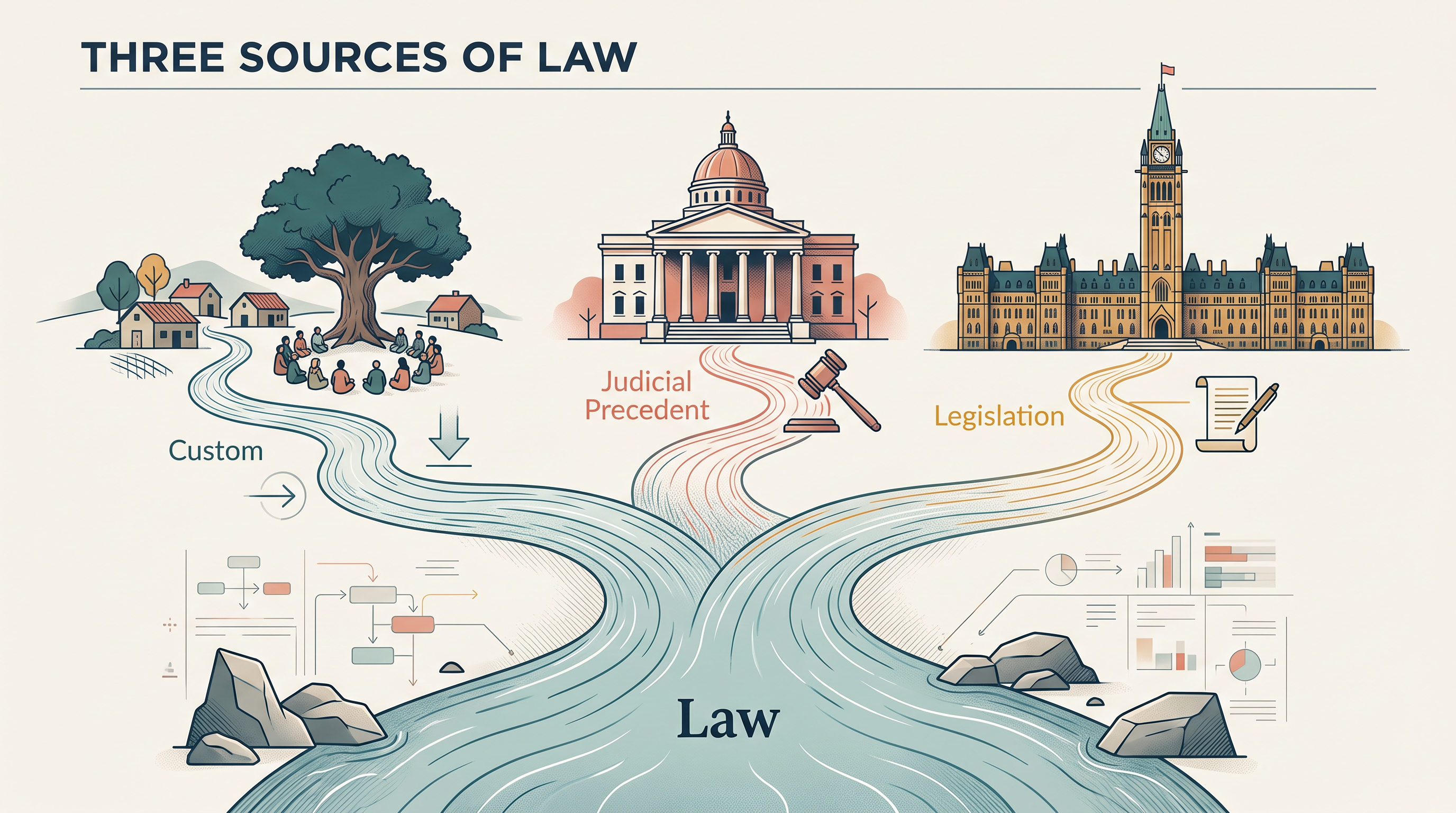
Fig. 8.0 – The three major sources of law.
By the end of this chapter you will be able to answer each of these questions.
8.1 Where Does Law Come From?
Before you can understand what law is, you need to know where it comes from. Every rule that binds you — the speed limit on a road, the age at which you may marry, the ritual that makes a marriage valid, the compensation a court awards for an injury — began somewhere. The study of that beginning is the study of the sources of law.
“Sources of law” means the sources from which law, or the binding rules of human conduct, originate. Law is not created out of nothing; it is derived from something that came before it. Some rules come from a legislature that debates and votes. Some come from a court that decides a dispute and lays down a principle while doing so. Some come from a practice so old that nobody remembers it beginning.
Different Jurists, Different Answers
Jurists disagree about the origin of law just as much as they disagree about the definition of law. This is not surprising. The word ‘law’ itself carries several meanings, so legal experts approach its sources from various angles, and each school of thought starts from a different assumption about what makes a rule binding in the first place.
Austin considered the Sovereign to be the source of law. For him, a rule counts as law only because a superior political authority has commanded it and can enforce it. Savigny and Henry Maine took the opposite view, treating custom as the most important source of law — the practices a people evolve for themselves reveal what that people actually accepts as binding.
The natural law school looks past both, and locates law in nature and human reason. On this view, certain principles are right and binding by their own nature, and a legislature merely recognises them. Theologians go further still and regard the religious scriptures as sources of law, binding because of their divine origin.
The Three Major Sources
There are various claims and counter-claims about the sources of law, and this chapter does not have to settle them. What is true is that in almost all societies, law has been derived from broadly similar sources. Whatever their theoretical starting point, jurists end up looking at the same three places.
The three major sources of law that can be identified in any modern society are as follows:
- Custom
- Judicial precedent
- Legislation
Each of these is taken up in turn in the sections that follow. As you read them, keep one question in the back of your mind: these three sources do not always agree with one another, so what happens when a long-standing custom runs into a statute that says the opposite, or when a court’s earlier decision no longer fits the law as it now stands? Much of this chapter is really about how a legal system ranks its own sources.
8.2 Custom as a Source of Law
Of the three sources, custom is the oldest. Long before legislatures existed and long before courts sat to decide disputes, communities were already following settled ways of doing things — how a marriage was solemnised, how land passed within a family, how a village grazing ground was shared. Nobody enacted these practices. People simply followed them, and in time came to feel that they had to follow them.
That feeling of obligation is what turns a mere habit into a custom in the legal sense. Custom can simply be explained as those long-established practices or unwritten rules which have acquired a binding or obligatory character.
When Is a Custom Valid?
A custom, to be valid, must be observed continuously for a very long time without any interruption. A practice followed for a few years, or followed and then abandoned and revived, does not qualify. Time is the first thing a custom must have on its side.
But time alone is not enough. A practice must be supported not only for a very long time; it must also be supported by the opinion of the general public and by morality. A practice that people quietly follow but generally disapprove of, or one that offends basic morality, will not be recognised however old it is. These requirements are examined in detail in the next section.
Not Every Custom Becomes Law
Every custom need not become law. Communities follow a great many practices that the legal system simply leaves alone — it neither enforces them nor interferes with them.
At the same time, the legal system sometimes does the opposite of ignoring a custom: it makes room for the custom inside a statute. The Hindu Marriage Act, 1955 prohibits marriages between persons who fall within the prohibited degrees of relationship. Yet the Act still permits a marriage within the prohibited degrees of relationship if there is a proven custom within a certain community that allows it.
Notice what the statute is doing there. It lays down a general rule and then makes a proved custom an exception to its own rule. The custom is not overriding the Act; the Act itself has chosen to give the custom effect. That is broadly how custom operates in modern Indian law — where the law has left room for it, or expressly saved it.
The Decline of Custom
In ancient societies, custom was considered one of the most important sources of law; in fact it was considered the real source of law. There was little else to consult. Disputes were settled by asking what the community had always done.
With the passage of time and the advent of modern civilization, the importance of custom as a source of law diminished, and other sources such as judicial precedents and legislation gained importance. A society that changes quickly cannot wait for practices to harden over generations; it needs rules that can be made, and changed, on demand.
Can Custom Be Law?
There is no doubt about the fact that custom is an important source of law. Whether custom is itself law is a different question, and on it two broad views prevail.
Jurists such as Austin opposed custom as law because it did not originate from the will of the sovereign. On this view a rule becomes law only when the sovereign commands it; until the State adopts a practice, the practice is social habit and nothing more.
Jurists like Savigny consider custom as the main source of law. According to him the real source of law is the will of the people and not the will of the sovereign. The will of the people has always been reflected in the customs and traditions of society. Custom is hence a main source of law.
The disagreement is not merely academic. It decides what a judge is doing when he enforces a custom — applying law that the community itself made, or applying law only because the State has chosen to recognise it.
Kinds of Customs
Customs are not all of one kind, and only some of them carry legal force. The classification in Fig. 8.1 shows how they divide.
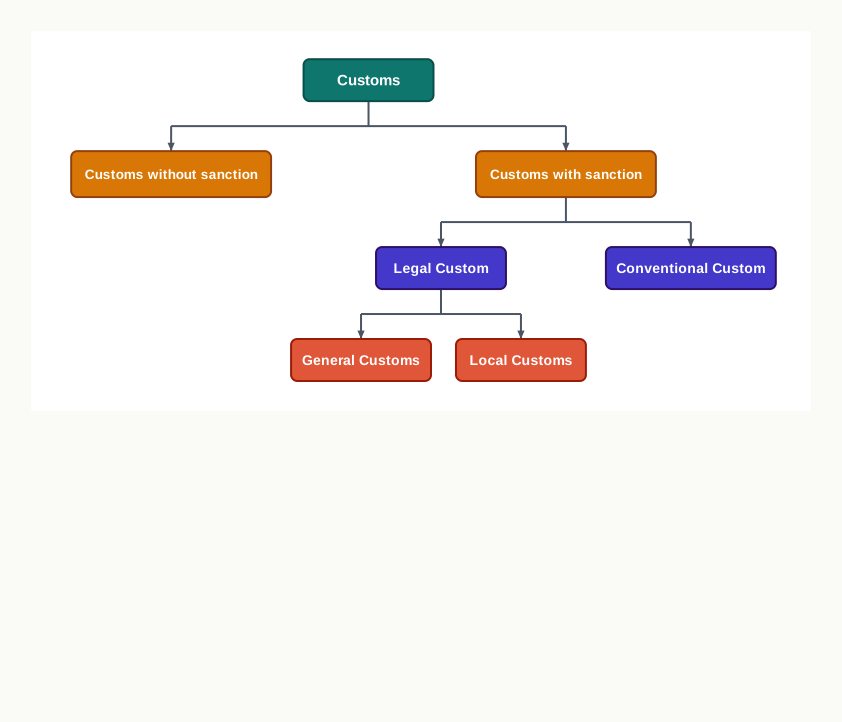
Fig. 8.1 – Kinds of customs.
Customs can be broadly divided into two classes:
- Customs without sanction: These kinds of customs are non-obligatory in nature and are followed because of public opinion. Nothing happens in law if a person departs from them; the only pressure is social.
- Customs with sanction: These customs are binding in nature and are enforced by the State. These customs may further be divided into the following categories:
- Legal Custom: Legal custom is a custom whose authority is absolute; it possesses the force of law. It is recognised and enforced by the courts. Legal custom may be further classified into two types. General customs prevail throughout the territory of the State. Local customs are applicable to a part of the State, or to a particular region of the country.
- Conventional Customs: Conventional customs are binding on the parties to an agreement. When two or more persons enter into an agreement related to a trade, it is presumed in law that they make the contract in accordance with the established convention or usage of that trade. For instance, an agreement between a landlord and tenant regarding the payment of rent will be governed by the convention prevailing in this regard.
The difference between the last two is the one students most often blur, so it is worth fixing clearly.
Keep the two apart by asking a single question: does the practice bind a person because of where she lives, or because of what she agreed to? The first is a legal custom, the second a conventional one.
8.3 Essentials of a Valid Custom
All customs cannot be accepted as sources of law, nor can all customs be recognised and enforced by the courts. If they could, any group could invent a practice, follow it for a while, and then demand that a court enforce it. The jurists and courts have therefore laid down some essential tests for customs to be recognised as a valid source of law.
These tests matter to you as a student for a very practical reason. In a problem question, a party will claim that “our community has always done it this way”. Your job is not to accept or reject that claim on instinct, but to run it through the tests one by one and see which of them it fails.
The Tests a Custom Must Pass
The tests are summarised as follows:
- Antiquity: In order to be legally valid, customs should have been in existence for a long time, even beyond human memory. In England, the year 1189 — that is, the reign of Richard I, King of England — has been fixed for the determination of the validity of customs, so a practice claimed as a custom must be shown to have existed before that year. However, in India there is no such time limit for deciding the antiquity of customs. The only condition is that they should have been in practice since time immemorial.
- Continuous: A custom, to be valid, should have been in continuous practice. It must have been enjoyed without any kind of interruption. Long intervals and disrupted practice of a custom raise doubts about the validity of the same, because a practice that the community itself allowed to lapse can hardly be said to bind that community.
- Exercised as a matter of right: Custom must be enjoyed openly and with the knowledge of the community. It should not have been practised secretly. A custom must be proved to be a matter of right — that is, followed because those concerned believed they were entitled to follow it, not because a neighbour tolerated it or a landlord permitted it. A mere doubtful exercise of a right is not sufficient to claim a valid custom.
- Reasonableness: A custom must conform to the norms of justice and public utility. A custom, to be valid, should be based on rationality and reason. If a custom is likely to cause more inconvenience and mischief than convenience, such a custom will not be valid.
- Morality: A custom which is immoral or opposed to public policy cannot be a valid custom. Courts have declared many customs invalid because they were practised for an immoral purpose or were opposed to public policy.
The morality test has real teeth, and the courts have used it. In Mathura Naikon v. Esu Naekin, (1880) ILR 4 Bom 545, the Bombay High Court held that the custom of adopting a girl for immoral purposes is illegal. Age and continuity could not save such a practice, because a custom that offends morality and public policy fails at the threshold no matter how long it has been followed.
That case makes an important point about how these tests operate. They are cumulative, not alternative. A practice must satisfy every one of them; failing any single test is enough to sink it.
Custom and Legislation
Suppose a valid custom exists, and Parliament then passes a statute that says the opposite. Which prevails?
In any modern State, when a new legislation is enacted, it is generally preferred to the custom. Therefore, it is imperative that a custom must not be opposed or contrary to legislation. This is really the sixth test, and in a modern legal system it is the decisive one: a custom survives only in the space the legislature leaves for it.
Many customs have been abrogated by laws enacted by the legislative bodies in India. For instance, the customary practice of child marriage has been declared an offence. Similarly, adoption laws have been changed by legislation in India, so that an adoption today takes effect according to the statute rather than according to whatever the local practice once was.
8.4 Importance of Custom as a Source of Law in India
Custom was the most important source of law in ancient India. Disputes about marriage, inheritance, adoption and religious observance were settled by what the community had always done, and the ruler’s law dealt mainly with matters of revenue, order and punishment.
That position survived well into the colonial period. Even the British initially adopted the policy of non-intervention in the personal matters of Hindus and Muslims. Rather than replacing personal law with English law, the colonial courts undertook to apply to each community its own rules — which meant applying custom.
The British courts, in particular the Privy Council, in cases such as Mohammad Ibrahim v. Shaik Ibrahim, AIR 1922 PC 59, observed and underlined the importance of custom in moulding the law.
The Problem of Variance
At the same time, it is important to note that customs were not uniform or universal throughout the country. Some regions of the country had their own customs and usages, so the rule that governed a family could change with the district it lived in.
These variances in customs were also considered a hindrance in the integration of the various communities of the country. A legal system in which the answer to the same question differed from region to region was difficult to administer and difficult to reform.
8.5 Judicial Precedent as a Source of Law
The second major source of law is the decided case. In simple words, judicial precedent refers to previously decided judgments of the superior courts, such as the High Courts and the Supreme Court, which judges are bound to follow.
Read that definition carefully, because two things in it do the real work. The judgment must come from a superior court, and later judges must be bound by it — not merely free to agree with it. A decision that a later court may politely ignore is not a precedent in the strict sense.
This binding character of previously decided cases is important, considering the hierarchy of courts established by the legal system of a particular country. A rule that lower courts must follow higher courts only makes sense if the system has already settled which court stands above which. In India, this hierarchy has been established by the Constitution of India.
The idea that like cases should be decided alike is old enough to have its own maxim.
Where Precedent Sits Among the Sources
Judicial precedent is an important source of law, but it is neither as modern as legislation nor as old as custom. Custom came first, precedent grew as courts became organised, and legislation became dominant last.
It is an important feature of the English legal system, as well as of other common law countries which follow the English legal system. India, having inherited that system, follows it too — which is why an Indian law student studies decided cases as closely as statutes.
Why Courts End Up Making Rules
In most of the developed legal systems, the judiciary is considered to be an important organ of the State. In modern societies, rights are generally conferred on citizens by legislation, and the main function of the judiciary is to adjudicate upon these rights — that is, to decide disputes about them.
The judges decide those matters on the basis of the legislation and the prevailing custom. But no statute can anticipate every situation, and its words are often capable of more than one meaning. So while applying the law, judges must also say what the law means.
While doing so, they play a creative role by interpreting the law. By this exercise, they lay down new principles and rules which are generally binding on lower courts within a legal system. That is precisely how a decided case turns into a source of law: the dispute itself is settled once and for all, but the principle the court used to settle it goes on governing everyone else.
Given this background, it is important to understand the extent to which courts are guided by precedents. It is equally important to understand what really constitutes the judicial decision in a case, and which part of the decision is actually binding on the lower courts. Both questions are taken up in the next section.
8.6 The Doctrine of Precedent and the Hierarchy of Courts
Every legal system has its own distinct features, and therefore the doctrine of precedent is applied differently in different countries. In India, the doctrine of precedent is based on the concept of the hierarchy of courts. Until you know which court stands where, you cannot say whose decision binds whom.
The modern system of precedent developed in India during British rule. It was the British who introduced the system of courts in India, and with those courts came the practice of treating earlier decisions as authority.
The Doctrine of Precedent in India
Pre-Independence
According to Section 212 of the Government of India Act, 1935, the law laid down by the Federal Court and any judgment of the Privy Council was binding on all courts of British India. The Privy Council, sitting in London, was therefore the supreme judicial authority for the country.
The structure of that system is shown in Fig. 8.2 — notice that the highest court was not in India at all.
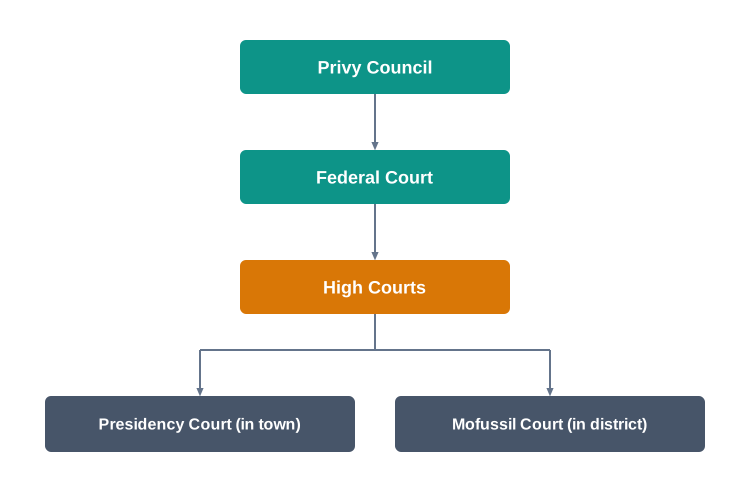
Fig. 8.2 – Hierarchy of courts in British India.
Post-Independence
After independence the picture changed at the top. The Supreme Court became the supreme judicial authority and a streamlined system of courts was established.
The rules on whose decisions bind whom can be set out court by court.
- Supreme Court:
- Its decisions are binding on all courts in India.
- It is not bound by its own decisions, or by decisions of the Privy Council or the Federal Court.
- High Courts:
- Their decisions are binding on all courts within their own jurisdiction.
- They have only persuasive value for courts outside their own jurisdiction.
- In case of a conflict with a decision of the same court by a bench of equal strength, the matter is referred to a higher bench.
- Lower Courts:
- They are bound to follow decisions of higher courts in their own State, in preference to the High Courts of other States.
The word jurisdiction is worth pausing on, since the whole scheme turns on it. Here it means the territory over which a court’s authority runs — each High Court has a defined State or group of States, and its rulings are law within that area and merely an opinion outside it.
The Two Parts of a Judicial Decision
A judgment is a long document. Not all of it binds later courts, and a student who cannot separate the binding part from the rest cannot use precedent properly.
Judicial decisions can be divided into the following two parts:
- Ratio decidendi (Reason of Decision): Ratio decidendi refers to the binding part of a judgment. The expression literally means the reasons for the decision. It is considered as the general principle which is deduced by the courts from the facts of a particular case. It becomes generally binding on lower courts in future cases involving similar questions of law.
- Obiter dicta (Said by the way): An obiter dictum refers to those parts of judicial decisions which are general observations of the judge and do not have any binding authority. However, the obiter of a higher judiciary is given due consideration by lower courts and has persuasive value.
The test in practice is simple to state: strip away everything the judge said that the outcome did not depend on. What is left — the principle the court had to apply in order to reach its conclusion on those facts — is the ratio. A remark about how the case might have been decided if the facts had been different is an observation made along the way, and binds nobody.
Having considered the various aspects of precedent, that is, ratio and obiter, it becomes clear that the system of precedent rests on the hierarchy of courts. So it is worth looking at that hierarchy as it stands today.
The Present Hierarchy of Courts
Post-independence, India adopted its own Constitution, which provided for a hierarchical judicial system that is pyramidal in nature. Under the Constitution of India, a single monolithic unified command of the judiciary has been established — one integrated system, not separate central and State court structures. The Supreme Court of India, which was established by the Constitution of India, was inaugurated on 28 January, 1950.
The Supreme Court replaced the Federal Court established by the Government of India Act, 1935. The Supreme Court of India is the Apex Court in the hierarchy of courts, followed by the High Courts at the State level. Below them are the District Courts and Sessions Courts. The structure of the judiciary in all States is almost similar, with little variation in the nomenclature of designations.
Below the High Court the ladder divides according to the kind of case. Fig. 8.3 shows the criminal side, running from the Supreme Court down to the Judicial Magistrate of the second class.
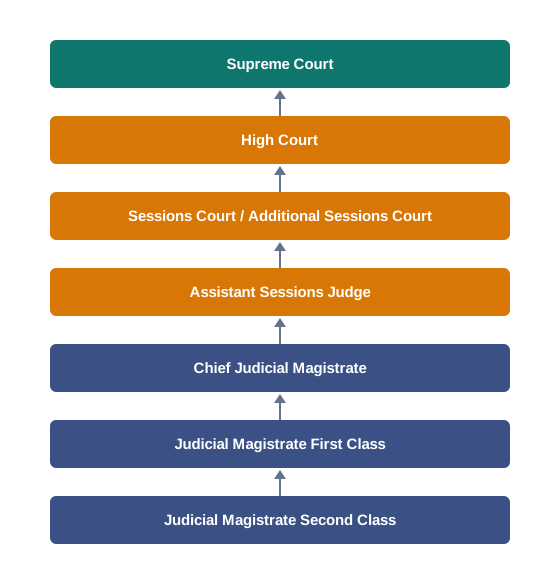
Fig. 8.3 – Hierarchy of the criminal justice system.
Fig. 8.4 shows the civil side of the same pyramid.
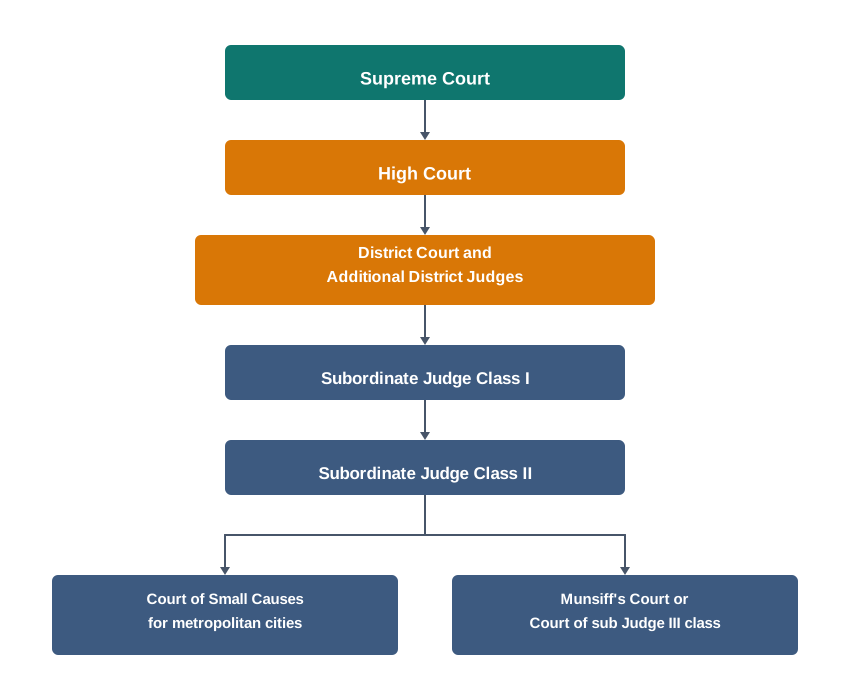
Fig. 8.4 – Hierarchy of the civil judicial system.
The Rules in a Nutshell
In a nutshell, the decisions given by the Supreme Court are binding on all the courts throughout the territory of India. The decisions given by the High Courts are binding on the subordinate courts within the jurisdiction of that particular High Court, but the decisions of the High Courts are not binding beyond their respective jurisdictions.
The decisions of the High Courts, however, have persuasive value for the other High Courts and for the subordinate courts beyond their jurisdiction. A judge who is not bound by such a decision may still find its reasoning convincing and adopt it — which is how a well-reasoned ruling of one High Court gradually spreads across the country.
It is important to note that the Supreme Court is not bound by its previous decisions, with an exception: a smaller bench is bound by the decision of a larger bench and by that of a co-equal bench. So the Court as an institution can change mind, but two judges cannot brush aside what five judges have held; they must have the question placed before a larger bench.
8.7 Do Judges Make Law?
The discussion in the previous section about the hierarchy of courts and the binding authority of Supreme Court decisions on lower courts raises another important question about the role of judges in law-making. If a decision of the Supreme Court binds every court in the country, is the Court not doing something very close to legislating? This section deals with that fundamental question: do judges make law?
What the Constitution Assigns to Each Organ
The Constitution of India confers power on the legislature to make law, while the judiciary has the power to examine the constitutionality of the laws enacted by the legislature. The courts also adjudicate upon the rights and duties of citizens, and further interpret the provisions of the Constitution and other statutes.
Through these processes, the courts create new rights for citizens. By this exercise, the judiciary makes additions to the existing laws of the country. It is argued that while doing this, judges actually make law.
Two Views Among Jurists
There are two views regarding this issue. One set of jurists say that judges do not make the law but simply declare the existing law. Another set say that judges do make the law.
Jurists like Edward Coke and Mathew Hale are of the opinion that judges do not make law. According to them, judicial decisions are not sources of law; they are simply proof of what the law is. Judges are not law-givers — they discover law that is already there, and a judgment is merely evidence of it.
At the same time, jurists like Dicey, Gray and Salmond are of the opinion that judges do make law. They hold the view that judges, while interpreting the law enacted by legislative bodies, contribute to the existing body of law. A large part of English law is judge-made law, built up case by case rather than enacted at any single moment.
The Two Views Are Complementary
The above arguments seem to be complementary rather than contradictory. It can be inferred that judges do not make law in the same manner in which legislative bodies do.
The difference is in the starting point. A legislature can begin with a blank page and enact a rule on any subject within its competence. Judges work on given legal material passed as law by the legislature, and only when a live dispute brings that material before them. While declaring the law, judges interpret the legislation in question and play a creative role. By this creative role, judges have contributed significantly to the development of law.
The Indian Experience
In the Indian context, former judges of the Supreme Court of India like Justice P.N. Bhagwati and Justice Krishna Iyer enlarged the meaning and scope of various provisions of the Constitution through their creative interpretation of the legal text.
The Supreme Court, too, in its role as an activist, has created many new rights, such as the right to privacy, the right to live in a pollution-free environment and the right to livelihood. None of these appears in the Constitution in those words.
These new rights were created only by way of interpreting Article 21 (Right to Life) of the Constitution of India. The Court did not amend Article 21; it read the words “life” and “personal liberty” as meaning more than mere physical existence, and each new right followed from that reading.
The rights developed by the courts are not in any sense lesser than the laws enacted by the legislative bodies. A person can enforce them in court just as she can enforce a statutory right.
Therefore, it can be concluded that judicial precedents are important sources of law in modern society, and judges do play a significant role in law-making.
8.8 Legislation as a Source of Law
In modern times, legislation is considered the most important source of law. Custom grew slowly and precedent depends on a dispute reaching a court; legislation, by contrast, can create a rule on any subject the day the legislature decides to.
The term ‘legislation’ is derived from the Latin word legis, which means ‘law’, and latum, which means ‘to make’ or ‘set’. Therefore, the word ‘legislation’ means the ‘making of law’.
The importance of legislation as a source of law can be measured from the fact that it is backed by the authority of the sovereign, and that it is directly enacted and recognised by the State. There is no need to prove it, as a custom must be proved, and no need to extract a principle from it, as a ratio must be extracted from a judgment. It is written down, published, and applies from the date it says it applies.
The expression ‘legislation’ has been used in various ways. In its widest sense it includes every method of law-making. In the strict sense, it means laws enacted by the sovereign, or by any other person or institution authorised by the sovereign.
Kinds of Legislation
Legislation is classified according to the authority that makes it, as shown in Fig. 8.5.
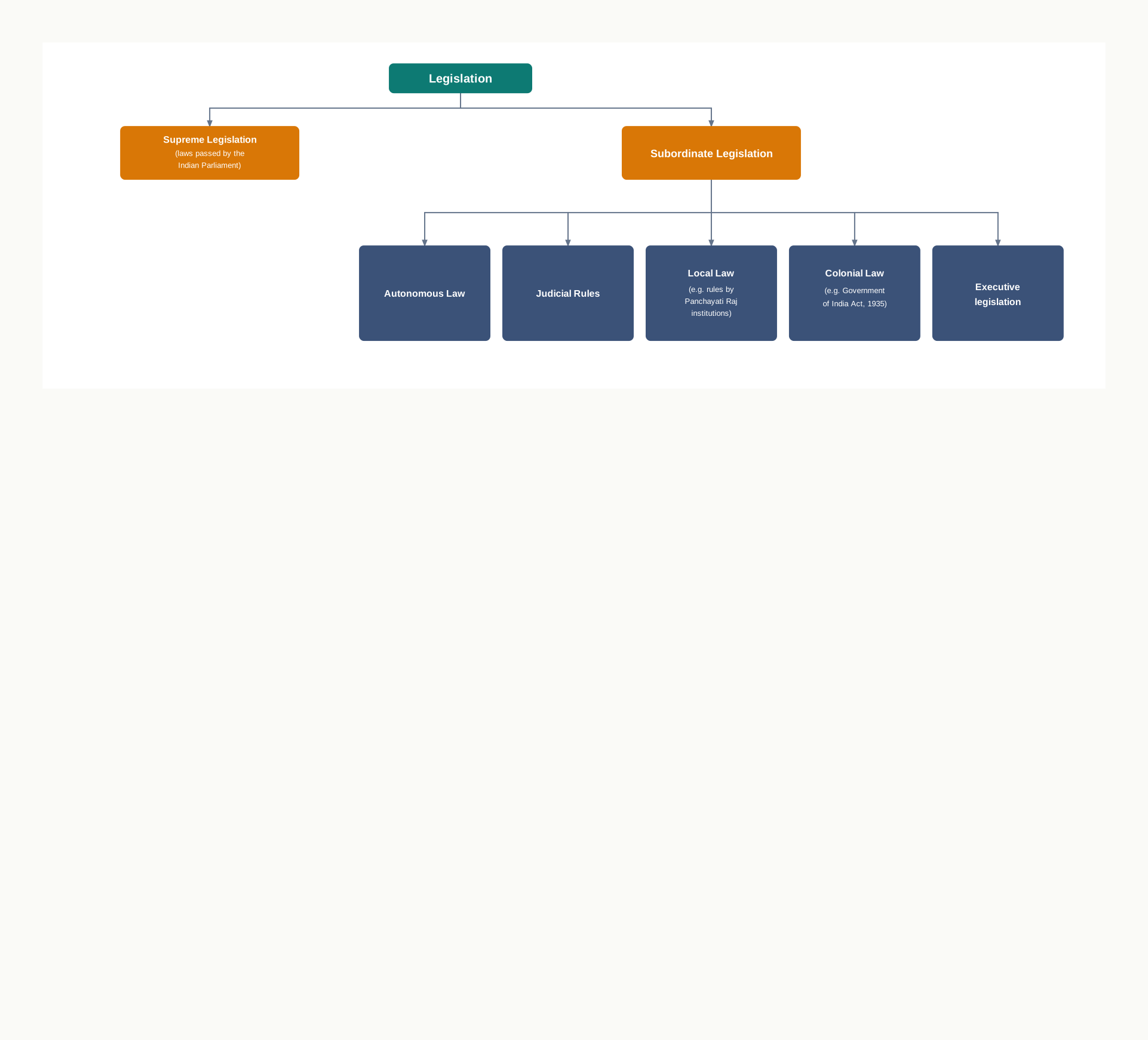
Fig. 8.5 – Kinds of legislation.
The kinds of legislation are as follows:
- Supreme Legislation (laws passed by the Indian Parliament)
- Subordinate Legislation
Subordinate legislation is itself of five types:
- Autonomous Law
- Judicial Rules
- Local Laws (for example, rules made by Panchayati Raj institutions)
- Colonial Law (for example, the Government of India Act, 1935)
- Laws made by the Executive
Each of these is explained below.
Supreme Legislation
When the laws are directly enacted by the sovereign, it is considered supreme legislation. One of the features of supreme legislation is that no other authority except the sovereign itself can control or check it.
The laws enacted by the British Parliament fall in this category, as the British Parliament is considered sovereign. No court there can strike down an Act of Parliament for being bad law.
The law enacted by the Indian Parliament also falls in the same category. However, in India the powers of Parliament are regulated and controlled by the Constitution, though the laws enacted by it are not under the control of any other legislative body.
That qualification is important, and students often miss it. Parliament in India is supreme among legislatures — no other legislative body can revise or veto its Acts — but it is not above the Constitution, and a law that violates the Constitution can be struck down by the courts.
Subordinate Legislation
Subordinate legislation is legislation which is made by any authority which is subordinate to the supreme or sovereign authority. It is enacted under the delegated authority of the sovereign.
The origin, validity, existence and continuance of such legislation totally depend on the will of the sovereign authority. The sovereign gave the power; the sovereign can withdraw it, and can lay down the limits within which it must be exercised.
Subordinate legislation can further be classified into the following types:
- Autonomous Law: When a group of individuals recognised or incorporated under the law as an autonomous body is conferred with the power to make rules and regulations, the laws made by such a body fall under autonomous law. For instance, laws made by bodies like universities and incorporated companies fall in this category of legislation. A university’s examination regulations bind its students in the same practical way a statute does.
- Judicial Rules: In some countries, the judiciary is conferred with the power to make rules for its administrative procedures. For instance, under the Constitution of India, the Supreme Court and the High Courts have been conferred with such kinds of power to regulate procedure and administration. Note the difference from Section 8.5: precedent is law that emerges from deciding cases, while judicial rules are law the courts make about how cases are to be conducted.
- Local laws: In some countries, local bodies are recognised and conferred with law-making powers. They are entitled to make bye-laws in their respective jurisdictions. In India, local bodies like Panchayats and Municipal Corporations have been recognised by the Constitution through the 73rd and 74th Constitutional amendments. The rules and bye-laws enacted by them are examples of local laws.
- Colonial Law: Laws made by colonial countries for their colonies, or for the countries controlled by them, are known as colonial laws. For a long time, India was governed by laws passed by the British Parliament. However, as most countries of the world have gained independence from the colonial powers, this legislation is losing its importance and may not be recognised as a kind of legislation at all.
- Laws made by the Executive: Laws are supposed to be enacted by the sovereign, and sovereignty may be vested in one authority or distributed among the various organs of the State. In most modern States, sovereignty is generally divided among the three organs of the State. The three organs — legislature, executive and judiciary — are vested with three different functions. The prime responsibility of law-making vests with the legislature, while the executive is vested with the responsibility of implementing the laws enacted by the legislature.
Delegated Legislation
The last of these categories deserves a closer look, because it is the one that has grown most.
The legislature delegates some of its law-making powers to executive organs, and the law so made is termed delegated legislation. Delegated legislation is also a class of subordinate legislation.
In welfare and modern States, the amount of legislation has increased manifold, and it is not possible for legislative bodies to go through all the details of law. Therefore, the legislature deals with only the fundamental part of the legislation, and wide discretion has been given to the executive to fill the gaps. A statute may lay down that a substance can be regulated, and leave it to a department to specify which substances, in what quantities, and by what procedure.
This increasing tendency to delegate legislation has been criticised. However, delegated legislation is resorted to on account of reasons like paucity of time, the technicalities of law, and emergency. Therefore, delegated legislation is sometimes considered a necessary evil.
8.9 Summary
- Sources of law are the origins from which law, or the binding rules of human conduct, are derived.
- Jurists differ on where law comes from, because each begins from a different test of what makes a rule binding:
- Austin considered the Sovereign to be the source of law;
- Savigny and Henry Maine considered custom to be the most important source of law;
- the natural law school considers nature and human reason to be the source of law;
- theologians consider the religious scriptures to be sources of law.
- The three major sources of law in any modern society are custom, judicial precedent and legislation.
- A custom is a long-established practice or unwritten rule which has acquired a binding or obligatory character.
- A custom must be observed continuously for a very long time without interruption, and must also be supported by the opinion of the general public and by morality.
- Every custom need not become law, and a statute may itself give effect to a proven custom — as the Hindu Marriage Act, 1955 does for marriages within the prohibited degrees of relationship.
- Austin opposed custom as law because it did not originate from the will of the sovereign, while Savigny treated custom as the main source of law because the real source of law is the will of the people.
- Customs are of two classes:
- customs without sanction, which are non-obligatory and are followed because of public opinion;
- customs with sanction, which are binding and enforced by the State.
- Customs with sanction are of two kinds:
- legal custom, whose authority is absolute and which possesses the force of law, further divided into general customs (prevailing throughout the territory of the State) and local customs (applicable to a part of the State or a particular region);
- conventional custom, which binds the parties to an agreement as the established usage of a trade.
- The essential tests of a valid custom are:
- antiquity — in England, existence before the year 1189, the reign of Richard I; in India, no fixed time limit, only practice since time immemorial;
- continuity of practice, without interruption;
- exercise openly and as a matter of right, not secretly;
- reasonableness, conforming to the norms of justice and public utility;
- morality, so that a custom opposed to morality or public policy is invalid.
- In Mathura Naikon v. Esu Naekin, (1880) ILR 4 Bom 545, the Bombay High Court held that the custom of adopting a girl for immoral purposes is illegal.
- A custom must not be opposed or contrary to legislation, because when a new legislation is enacted it is generally preferred to the custom; many customs, such as child marriage, have been abrogated by legislation in India.
- Custom was the most important source of law in ancient India, and the British initially adopted a policy of non-intervention in the personal matters of Hindus and Muslims.
- Customs were not uniform throughout the country, and this variance was considered a hindrance to the integration of communities.
- After independence, Parliament abrogated many old customary practices through progressive legislation, and Hindu personal laws were codified through the Hindu Marriage Act, 1955 and the Hindu Adoptions and Maintenance Act, 1956.
- The importance of custom has diminished since independence, but a large part of Indian law, especially personal law, is still governed by customs.
- Judicial precedent means previously decided judgments of superior courts, such as the High Courts and the Supreme Court, which judges are bound to follow.
- Precedent is neither as modern as legislation nor as old as custom, and is an important feature of the English legal system and of other common law countries.
- Judges decide matters on the basis of legislation and prevailing custom, but in interpreting the law they play a creative role and lay down new principles binding on lower courts.
- Before independence, under Section 212 of the Government of India Act, 1935, the law laid down by the Federal Court and any judgment of the Privy Council was binding on all courts of British India, and the Privy Council was the supreme judicial authority.
- After independence, the Supreme Court became the supreme judicial authority; it was inaugurated on 28 January, 1950 and replaced the Federal Court established by the Government of India Act, 1935.
- The binding force of decisions follows the hierarchy of courts:
- Supreme Court decisions are binding on all courts in India, and the Supreme Court is not bound by its own decisions, or by decisions of the Privy Council or the Federal Court;
- High Court decisions are binding on all courts within that High Court’s jurisdiction and have only persuasive value outside it;
- where a High Court decision conflicts with a decision of the same court by a bench of equal strength, the matter is referred to a higher bench;
- lower courts are bound to follow decisions of higher courts in their own State in preference to the High Courts of other States.
- A smaller bench of the Supreme Court is bound by the decision of a larger bench and by that of a co-equal bench.
- A judicial decision has two parts:
- ratio decidendi, the reason for the decision — the general principle deduced from the facts, which is the binding part;
- obiter dicta, general observations of the judge, which have no binding authority but carry persuasive value.
- Jurists like Edward Coke and Mathew Hale held that judges do not make law but only declare it, treating judicial decisions as proof of what the law is.
- Jurists like Dicey, Gray and Salmond held that judges do make law, since by interpreting legislation they contribute to the existing body of law.
- The two views are complementary: judges do not legislate as legislatures do, but by interpreting the legal material before them they play a creative role in developing the law.
- In India, judges such as Justice P.N. Bhagwati and Justice Krishna Iyer enlarged the scope of constitutional provisions, and rights such as the right to privacy, the right to a pollution-free environment and the right to livelihood were created by interpreting Article 21.
- Legislation is the making of law by the sovereign, or by a person or institution authorised by the sovereign, and is regarded as the most important source of law in modern times.
- The word ‘legislation’ comes from the Latin legis, meaning ‘law’, and latum, meaning ‘to make’ or ‘set’.
- Supreme legislation is enacted directly by the sovereign and cannot be controlled by any other authority; in India, Parliament’s laws are not controlled by any other legislative body, though its powers are regulated by the Constitution.
- Subordinate legislation is made by an authority subordinate to the sovereign under delegated authority, and its origin, validity, existence and continuance depend on the will of the sovereign authority.
- Subordinate legislation is of five types:
- autonomous law, made by bodies such as universities and incorporated companies;
- judicial rules, made by the Supreme Court and High Courts to regulate procedure and administration;
- local laws, made as bye-laws by bodies such as Panchayats and Municipal Corporations, recognised by the Constitution through the 73rd and 74th Constitutional amendments;
- colonial law, made by colonial powers for their colonies, which is losing its importance today;
- laws made by the executive.
- Delegated legislation is law made by executive organs under powers delegated by the legislature, and is a class of subordinate legislation.
- Delegated legislation has been criticised, but is resorted to because of paucity of time, the technicalities of law and emergency, and is therefore sometimes described as a necessary evil.
8.10 Key Terms
Sources of law — the origins from which law, or the binding rules of human conduct, are derived.
Sovereign — the supreme political authority in a State, which Austin regarded as the source of law.
Natural law school — the school of thought that locates law in nature and human reason rather than in the command of any authority.
Custom — a long-established practice or unwritten rule of a community which, through continuous observance, has acquired a binding or obligatory character.
Custom without sanction — a custom that is non-obligatory in nature and is followed only because of public opinion.
Custom with sanction — a custom that is binding in nature and is enforced by the State.
Legal custom — a custom whose authority is absolute, which possesses the force of law and is recognised and enforced by the courts.
General custom — a legal custom that prevails throughout the territory of the State.
Local custom — a legal custom that applies only to a part of the State or a particular region of the country.
Conventional custom — a usage of a trade that binds the parties to an agreement, because the law presumes they contracted in accordance with it.
Antiquity — the test requiring that a custom must have existed for a very long time; in England, before the year 1189, and in India, since time immemorial.
Time immemorial — a period so far back that its beginning is beyond human memory, which is the standard of antiquity applied to customs in India.
Judicial precedent — a previously decided judgment of a superior court which lays down a principle that judges in later cases are bound to follow.
Stare decisis — the principle that a court should stand by what has already been decided and follow the principle laid down in an earlier decision on the same question of law.
Jurisdiction — the territory or class of matters over which a court’s authority extends.
Ratio decidendi — the reason for the decision; the general principle deduced by the court from the facts of a case, which is the binding part of a judgment.
Obiter dicta — general observations of a judge made along the way, which have no binding authority but carry persuasive value.
Persuasive value — the weight a decision carries with a court that is not bound by it, which may follow it if it finds the reasoning convincing.
Legislation — the making of law by the sovereign, or by a person or institution authorised by the sovereign.
Supreme legislation — legislation enacted directly by the sovereign, which no other authority except the sovereign itself can control or check.
Subordinate legislation — legislation made by an authority subordinate to the sovereign, under the sovereign’s delegated authority.
Autonomous law — rules and regulations made by a body recognised or incorporated under the law as autonomous, such as a university or an incorporated company.
Judicial rules — rules made by the judiciary, such as the Supreme Court and the High Courts, to regulate their own procedure and administration.
Local laws — bye-laws made within their own jurisdictions by local bodies such as Panchayats and Municipal Corporations.
Colonial law — law made by a colonial power for its colonies or for the countries controlled by it.
Delegated legislation — law made by executive organs under law-making powers delegated to them by the legislature, forming a class of subordinate legislation.
8.11 Points to Ponder
If a practice has been followed by a community for centuries and the community still believes in it, is a legislature right to abolish it? Who should decide when a custom has outlived its usefulness — the community, the courts, or Parliament?
Austin held that custom is not law until the sovereign adopts it, while Savigny held that the will of the people is the real source of law. Which view better explains the way law actually works in India today?
The test of antiquity requires a custom to have been practised since time immemorial. Does this test make it almost impossible for a new practice, however reasonable, to ever become law? Should there be a fixed period instead?
A custom must be proved in court by the party relying on it, while a statute needs no proof at all. What does this difference mean for a poor litigant from a small community whose rights depend on custom?
The decisions of a High Court bind only the courts within its own jurisdiction. Is it fair that the same question of law can be answered differently for two citizens depending on which State they live in?
The Supreme Court is not bound by its own previous decisions. Does this freedom strengthen the law by allowing it to correct itself, or weaken it by making settled questions reopenable?
Rights such as the right to livelihood and the right to a pollution-free environment were read into Article 21 by judges, not enacted by Parliament. Does this strengthen democracy by protecting people the legislature overlooked, or weaken it by shifting law-making away from elected representatives?
Delegated legislation is described as a necessary evil. What safeguards would you suggest so that rules made by officials remain answerable to the legislature that authorised them?
Of the three sources — custom, precedent and legislation — which do you think will matter most fifty years from now, and why?
8.12 Textbook Questions
Write one point of difference between the following:
- Ratio decidendi and obiter dicta
- Custom and legislation as a source of law
- Supreme legislation and subordinate legislation
- Judgments of the Supreme Court and the High Court
- General customs and local customs
Write short notes on the following:
- Custom as a source of law
- Subordinate legislation
- Parts of a judicial decision
Identify the following legislations:
- The law made by the sovereign
- Law made by a Municipal Corporation
- Law made by universities
- Law made by the executive
- Laws made by colonial rulers
Provide brief answers for the following:
- How did Austin and Savigny view custom as a source of law?
- What are the two parts of judicial decisions?
- Do judges make law? Comment.
- What is the importance of custom as a source of law in India?
- Enumerate the legislations that are based on customs.
- What is the hierarchy of the civil and criminal justice system in India?
Provide detailed answers for the following:
- Explain the different kinds of customs.
- What are the essentials of a valid custom?
- Explain legislation as a source of law.
- Explain the different kinds of legislation.
Why is delegated legislation sometimes considered a necessary evil?
Which is the most relevant source of law in today’s time? Define it.
- Give any two differences between its two types.
- Also explain which of its forms is a necessary evil, and why.
What are judicial precedents? Also answer the following questions:
- The Madras High Court gave a decision in the year 2005 which was overturned by the Supreme Court in 2011. Which of the two decisions should be followed by a district court in Chennai?
- The Kerala High Court and the Calcutta High Court gave contradicting decisions in the years 2009 and 2017 respectively. Which decision should a district court in Kerala follow?
- In the year 2018, a Division Bench of the Supreme Court and a Constitution Bench of the Supreme Court gave two contradicting decisions. Which decision should be followed?
The Supreme Court of India passed a judgment in the year 2015 which banned diesel cars registered before the year 2005 from plying on the road. The rationale behind the judgment was the deterioration of the engine, and hence poor performance and increased pollution. While writing the judgment, the judges made many remarks on other sources of pollution too, such as construction, fires, and so on.
- What is the relevance of this judgment in the creation of laws?
- Which two parts of this judgment are being spoken about above?
- Can the Delhi High Court overturn this judgment?
“All customs cannot be accepted as sources of law, nor can all customs be recognized and enforced by the Courts.”
- Explain any three factors which are taken into consideration for deciding whether a custom is a valid source of law.
- What is the relevance of customs as a source of law in the present-day context?
8.13 Objective Questions
Which of the following did Austin regard as the source of law?
- Custom
- The Sovereign
- Nature and human reason
- Religious scriptures
Savigny and Henry Maine regarded which of the following as the most important source of law?
- Legislation
- Judicial precedent
- Custom
- Delegated legislation
In England, the year fixed for determining the validity of a custom is:
- 1066
- 1189
- 1215
- 1935
Which kind of custom is non-obligatory in nature and is followed only because of public opinion?
- Legal custom
- General custom
- Custom without sanction
- Conventional custom
A custom that applies only to a particular region of the country is called:
- A general custom
- A local custom
- A conventional custom
- A custom without sanction
The customary practice of Saptapadi has been incorporated in which provision?
- Section 5 of the Hindu Marriage Act, 1955
- Section 7 of the Hindu Marriage Act, 1955
- Section 9 of the Hindu Adoptions and Maintenance Act, 1956
- Article 21 of the Constitution of India
In Mathura Naikon v. Esu Naekin, the Bombay High Court held that:
- Every ancient custom is valid
- The custom of adopting a girl for immoral purposes is illegal
- A custom prevails over legislation
- A custom need not be proved in court
The binding part of a judgment is known as:
- Obiter dicta
- Ratio decidendi
- Stare decisis
- Persuasive value
Decisions of a High Court have which of the following effects on courts outside its jurisdiction?
- They are binding
- They have persuasive value only
- They have no value whatsoever
- They are binding only on other High Courts
The Supreme Court of India was inaugurated on:
- 26 January, 1950
- 28 January, 1950
- 15 August, 1947
- 26 November, 1949
Which jurists held the view that judges do not make law but only declare it?
- Dicey and Salmond
- Gray and Savigny
- Edward Coke and Mathew Hale
- Austin and Henry Maine
Rights such as the right to livelihood and the right to live in a pollution-free environment were developed by interpreting:
- Article 14
- Article 19
- Article 21
- Article 32
The word ‘legislation’ is derived from the Latin words:
- Legis and latum
- Lex and ratio
- Legis and dicta
- Lata and decidendi
Rules made by a university for its own working are an example of:
- Supreme legislation
- Autonomous law
- Colonial law
- Judicial rules
Panchayats and Municipal Corporations were recognised by the Constitution through which amendments?
- The 42nd and 44th Constitutional amendments
- The 61st and 62nd Constitutional amendments
- The 73rd and 74th Constitutional amendments
- The 86th and 91st Constitutional amendments
Delegated legislation is a class of:
- Supreme legislation
- Subordinate legislation
- Colonial law
- Conventional custom
Assertion (A): A custom that is opposed to legislation cannot be enforced by a court. Reason (R): In a modern State, when a new legislation is enacted, it is generally preferred to the custom.
Assertion (A): A custom practised secretly by a few families cannot be recognised as a valid custom. Reason (R): A custom must be enjoyed openly, with the knowledge of the community, and as a matter of right.
Assertion (A): The obiter dicta of the Supreme Court are not binding on the High Courts. Reason (R): Obiter dicta are general observations of a judge and do not have binding authority, though they carry persuasive value.
Assertion (A): A subordinate court in one State is not bound to follow a decision of the High Court of another State. Reason (R): The decisions of a High Court are binding only on the courts within its own jurisdiction.
Assertion (A): A Bench of two judges of the Supreme Court cannot depart from a principle laid down by a Bench of five judges. Reason (R): The Supreme Court is not bound by its own previous decisions.
Assertion (A): Laws made by the Indian Parliament are supreme legislation. Reason (R): No other legislative body controls the laws enacted by Parliament, although the powers of Parliament are regulated by the Constitution.
Assertion (A): Delegated legislation has increased greatly in modern welfare States. Reason (R): The volume and technicality of modern law make it impossible for legislative bodies to work out every detail themselves.
8.14 Check Your Concepts
Why do jurists disagree about where law comes from, when they are all studying the same legal system?
State the three major sources of law found in any modern society, and arrange them in the order in which they historically became important.
What is meant by ‘sources of law’? Why is it necessary to study them before studying any particular branch of law?
A practice has been followed by a group of families for the last twenty years and is widely known in the locality. Can it be enforced as a custom? Give reasons.
State the five essential tests of a valid custom. Are these tests cumulative or alternative? Explain what turns on the answer.
Why does the law insist that a custom must have been exercised openly and as a matter of right, rather than secretly?
What happens when a valid custom conflicts with a statute passed by Parliament? Support your answer with an example from the chapter.
Distinguish between a custom with sanction and a custom without sanction.
Distinguish between a legal custom and a conventional custom on any three bases.
Explain, with reference to the Hindu Marriage Act, 1955, how a statute can itself give legal effect to a custom.
Correct the error in the following statement and explain your correction: “Every custom that has been followed since time immemorial is automatically enforceable as law in India.”
Why did the importance of custom as a source of law decline in India after independence? Mention at least two developments that contributed to this decline.
Austin and Savigny took opposite positions on whether custom is law. State both positions and explain which of them better explains a court’s refusal to enforce a custom that conflicts with a statute.
What is judicial precedent? Why is the hierarchy of courts essential to the working of the doctrine of precedent?
Distinguish between ratio decidendi and obiter dicta, and state the test you would apply to tell one from the other in a judgment.
What is meant by saying that a decision has ‘persuasive value’? Give one situation from the chapter in which a decision is persuasive but not binding.
A District Court in State X is faced with conflicting decisions of the High Court of State X and the High Court of State Y on the same question of law. Which must it follow, and why?
The Supreme Court is not bound by its own previous decisions, yet a smaller Bench cannot depart from the decision of a larger Bench. Explain how both statements can be true at the same time.
Identify the provision under which the law laid down by the Federal Court and the judgments of the Privy Council were binding on all courts of British India before independence.
Explain the view of Edward Coke and Mathew Hale that judges do not make law. What is the strongest objection to this view?
“Judges do not make law in the same manner as legislative bodies do.” Explain this statement with reference to the creative role of judges.
Name any two rights created by the Supreme Court through interpretation, and identify the Article of the Constitution from which they were derived.
What is legislation? Why is it regarded as the most important source of law in modern times?
Distinguish between supreme legislation and subordinate legislation on any four bases.
The Indian Parliament makes supreme legislation, yet its powers are regulated and controlled by the Constitution. Is there a contradiction here? Explain.
State the five types of subordinate legislation and give one example of each.
Identify the kind of legislation in each of the following, and give a reason for your answer:
- Examination regulations framed by a university
- Bye-laws made by a Municipal Corporation
- Rules framed by a High Court to regulate its own procedure
- An Act passed by the Indian Parliament
- The Government of India Act, 1935
Why is colonial law losing its importance as a kind of legislation today?
What happens to a rule made by an executive department if the parent statute that authorised it is repealed? Answer with reference to the nature of subordinate legislation.
Why is delegated legislation described as a “necessary evil”? State two reasons for which it is resorted to and two grounds on which it is criticised.
Judicial rules and judicial precedent are both associated with the courts, but they are different sources of law. Explain the difference.
8.15 Case-Based Questions
- In a group of villages in a particular district, a practice has been followed for as long as anyone can remember: when a family’s land is divided, a share is set aside for the family’s unmarried daughters, and the village assembly records the division. The practice is followed openly, everyone in the region knows of it, and no family has departed from it. A dispute now reaches the civil court, where one brother argues that the practice is not law and that his sister has no claim under it. She replies that it is a valid custom of the region.
- Which tests of a valid custom does the practice appear to satisfy, and on what evidence?
- Is this a general custom or a local custom? Give reasons.
- Who has to prove the existence of the custom in court, and why does this matter to the sister?
- Suppose it is shown that the practice was abandoned for about forty years and revived only recently. Which test would now be in doubt, and what would be the likely effect on the sister’s claim?
- A community claims that, by an old custom, a girl of its community may be married before she attains the age fixed by law, and that the custom has been followed for centuries without a break. The custom is open, well known, and no one within the community disputes it. A prosecution is launched against the family that performed such a marriage, and the family defends itself by relying on the custom.
- Can the family successfully rely on the custom as a defence? Give reasons.
- Which rule about the relationship between custom and legislation governs the answer?
- Even setting aside the statute, which two essential tests of a valid custom would this practice have difficulty satisfying?
- Would your answer change if the legislature had never enacted any law on the subject? Explain.
- A trial court in State P is hearing a dispute about the meaning of a provision in a central Act. Three decisions are cited before it. The first is a judgment of the High Court of State P, which decides the very question. The second is a judgment of the High Court of State Q, which decides the same question the opposite way and is far more elaborately reasoned. The third is a judgment of the Supreme Court in a different case, in which the Court, while deciding a question of limitation, remarked in passing that the provision in dispute here should be read narrowly.
- Which of these three is binding on the trial court, and why?
- What is the status of the judgment of the High Court of State Q before this trial court? Does its superior reasoning change that status?
- Is the Supreme Court’s remark part of the ratio decidendi or obiter dicta? What weight should the trial court give it?
- Suppose the Supreme Court had decided the very question before the trial court, rather than merely remarking on it. How would the position change?
- A State legislature passes an Act to control air pollution. The Act lays down the general policy and provides that the State Government may, by rules, specify which industries must install pollution control equipment, the standards such equipment must meet, and the fees payable for inspection. Acting under the Act, a department issues detailed rules. A factory owner challenges the rules, arguing that they were never voted on by the legislature and are therefore not law at all.
- What kind of legislation are these rules? Explain the source of the department’s power to make them.
- Is the factory owner’s argument correct? Give reasons.
- State two reasons commonly given for allowing the legislature to delegate law-making power in a matter such as this.
- Suppose the rules had imposed a punishment of imprisonment that the parent Act nowhere authorised. Would that change the position, and why?
- A city Municipal Corporation makes a bye-law requiring every shop in the city to keep a covered waste bin at its entrance, and imposes a fine for breach. Around the same time, a university frames a regulation requiring its students to obtain seventy-five per cent attendance before appearing in examinations. A shopkeeper and a student, both aggrieved, argue that neither the Corporation nor the university is a legislature, so neither rule can bind them.
- Identify the kind of legislation each of the two rules represents.
- Explain the constitutional basis on which local bodies such as Municipal Corporations make bye-laws.
- Why does the origin, validity and continuance of both these rules depend on the will of the sovereign authority?
- Which of the two would be affected if Parliament repealed the law under which the body making it was constituted? Explain.
8.16 Landmark Cases & Maxims
State the principle settled by the Bombay High Court in Mathura Naikon v. Esu Naekin, and identify the test of a valid custom that the practice in that case failed.
What did the Privy Council underline about custom in cases such as Mohammad Ibrahim v. Shaik Ibrahim, and how does it fit the British policy towards personal law at that time?
In Vishaka v. State of Rajasthan, the Supreme Court laid down binding guidelines on a subject on which Parliament had not yet legislated. Which source of law does this illustrate, and what happened to those guidelines once Parliament enacted a statute on the subject?
State the literal meaning and the legal meaning of the maxim stare decisis, and explain how it is connected to the hierarchy of courts.
Match each expression in Column A with the description in Column B: | Column A | Column B | |—|—| | a. Ratio decidendi | i. A general observation of a judge, carrying persuasive value only | | b. Obiter dicta | ii. The Latin roots from which the word ‘legislation’ is derived | | c. Stare decisis | iii. The principle of standing by what has already been decided | | d. Legis and latum | iv. The general principle deduced from the facts of a case, binding on lower courts |
A judge, while deciding whether a custom of a particular region is valid, observes that in her view the antiquity test should be replaced by a fixed period of sixty years. Identify which part of the judgment this observation belongs to, and state whether a lower court is bound by it.
Which authority governs each of the following situations? Name the case or the principle, and state why it applies:
- A community defends a practice followed for an immoral purpose on the ground that it is very old.
- A subordinate court is asked to depart from a principle laid down by the Supreme Court because the judge disagrees with it.
- A colonial-era court applies the custom of a community instead of English law to a question of personal law.
Social Reform and the Turn to Legislation
During our freedom struggle, there were parallel movements for social reform in the country. Social reformers raised many issues related to women and children, such as widow re-marriage and child marriage. These were not abstract debates; they were arguments about whether a practice should continue to enjoy the force of law simply because it was old.
After independence, and with the enactment of the Constitution, the Indian Parliament took many steps and abrogated many old customary practices with some progressive legislation. Hindu personal laws were codified, and the Hindu Marriage Act, 1955 and the Hindu Adoptions and Maintenance Act, 1956 were adopted. The Constitution of India provided a positive environment for these social changes, because a document committed to equality and dignity gave the legislature both the authority and the reason to displace practices that could not meet those standards.
The result is the position we live with today. After independence, the importance of custom has definitely diminished as a source of law, and judicial precedent and legislation have gained a more significant place. A large part of Indian law, especially personal law, is however still governed by customs.
Custom has not disappeared from the statute book; it has been absorbed into it. The Hindu Marriage Act, 1955 itself preserves the right of parties to obtain a divorce under a custom governing them, and it does not apply to members of the Scheduled Tribes unless the Central Government directs otherwise — leaving tribal marriage and divorce to be regulated by tribal custom. A person relying on such a custom in court must still prove it, test by test, exactly as set out in Section 8.3.
Identify one custom still followed in your own region — in marriage, inheritance, festivals or local trade — and find out whether the law recognises it, ignores it, or has abolished it, and what statute or decision did so.