Chapter 12: Civil Courts and Civil Justice System
Anaya’s older sister was getting married in November. Six months earlier, the family had booked a banquet hall in their town, signed a booking form and paid an advance of ₹2,00,000. Three weeks before the wedding, the hall’s manager phoned to say the hall was no longer available — a larger booking had come in — and that the advance would not be returned. The family scrambled, found another venue at short notice, and paid far more for it. Anaya’s father was furious. “I want him punished,” he said. His lawyer explained, patiently, that this was not how it worked. No police officer would arrest the manager. No court would send him to jail. What the family could do was file a civil suit — asking a court to declare that the hall had broken its promise, to order the advance returned, and to award compensation for the extra cost. But even that raised questions the family had never thought about. Which court? The one nearest their house, or the one nearest the hall? How long would it take? What if the hall filed a case of its own first, somewhere else? And once a court decided, could the matter ever be reopened? This chapter is about those questions — and the system built to answer them.
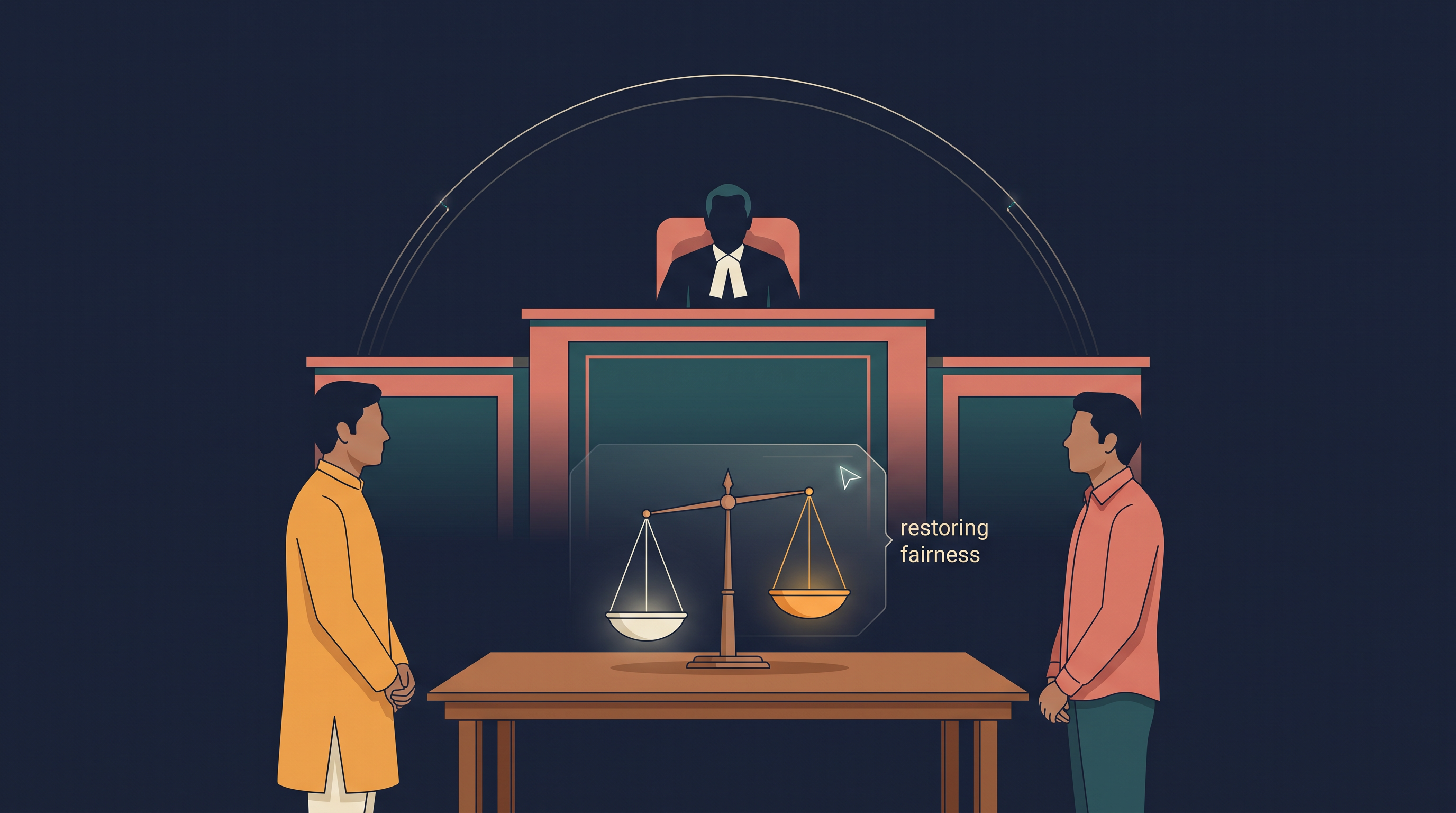
Fig. 12.0 – Civil justice: restoring a right, not punishing a crime.
By the end of this chapter, you will be able to answer each of these questions for yourself.
12.1 Understanding Civil Disputes
Not every legal problem is a crime. A great many of the disputes that reach Indian courts are quarrels between ordinary people and private organisations — over land, money, promises and families. These are civil disputes, and they form the everyday business of the civil courts.
A civil dispute is a disagreement between two or more private parties in which one party claims that the other has violated a legal or civil right belonging to them. The word private matters here. The State is not prosecuting anyone. One person is saying to another: you have taken something that is mine, or you have failed to do something you were legally bound to do, and I want the court to set it right.
The Aim Is Relief, Not Punishment
This is the single most important idea in the chapter, and it is the one students most often get wrong in examinations. The purpose of a civil case is not to punish the wrongdoer. It is to provide relief or compensation to the aggrieved party — to restore the position that person was entitled to.
Civil disputes therefore aim at restoring or enforcing private rights through remedies of a particular kind:
- Compensation — a sum of money paid to make good the loss suffered.
- Restitution — returning to a person what was wrongly taken from them, or giving back a benefit that was unfairly received.
- Specific performance — an order directing a party to actually carry out the promise they made, instead of merely paying money for breaking it.
Notice what is absent from that list. There is no fine payable to the State, no imprisonment, no criminal record. A civil court can order a person to pay, to hand back, to perform, or to stop doing something — but it cannot send them to prison for the wrong itself.
Common Types of Civil Disputes
Civil disputes fall into a few broad and recognisable families. Learning them is useful because the type of dispute usually decides which court and which specialised law will apply to it.
- Property disputes. These relate to ownership, possession, boundaries, or inheritance of land or buildings. A common example is a dispute regarding the division of ancestral property between two brothers.
- Contractual disputes. These arise when the terms of a contract are not fulfilled. For example, a builder fails to deliver a flat on time despite having received full payment.
- Family matters. These include divorce, maintenance, custody of children, succession, and partition of joint family property. For example, a wife files an application seeking maintenance from her husband.
- Money recovery and damages. These are claims for recovery of loans, unpaid dues, or compensation for loss. For example, a shopkeeper files a suit to recover unpaid bills from a customer.
The four families overlap more often than the list suggests. A single quarrel over an inherited house can be a property dispute, a family matter and a money claim all at once — which is exactly why identifying the real subject matter of a case is a skill worth practising.
12.2 Hierarchy of Civil Courts
India’s civil courts are arranged as a pyramid. A very large number of small courts sit at the base, close to where people actually live, and a single court sits at the top for the whole country. A case ordinarily begins at the bottom and, if a party remains dissatisfied, travels upward.
Two words will recur throughout this section, so it helps to fix their plain sense now. A court exercises original jurisdiction when it hears a case for the very first time, and appellate jurisdiction when it reviews a decision already given by a court below it. Section 12.3 examines both in detail; here they simply describe what each level of court does.
The full structure is set out in Fig. 12.1 — notice in particular which court sits immediately above the Court of Civil Judge, because that is where a first appeal from it will go.
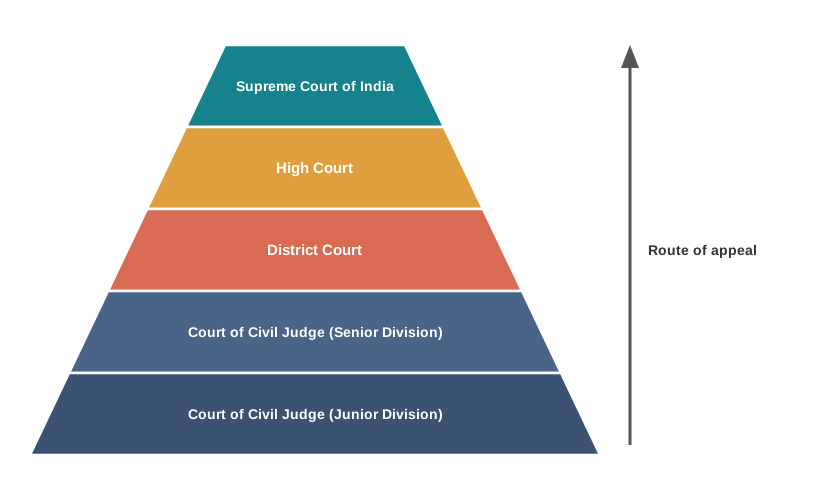
Fig. 12.1 – Hierarchy of civil courts in India.
12.2.1 Civil Courts at the District Level
Civil courts at the district level form the foundation of the civil justice system and deal with the maximum number of cases. Two kinds of court matter here.
- District Court. It is headed by the District Judge and is the highest civil court in the district. It has original jurisdiction in high-value cases and appellate jurisdiction over the courts below it. It also hears appeals from other special courts.
- Court of Civil Judge (Senior Division and Junior Division). These courts handle civil cases involving a lower pecuniary value than the district level. They deal with matters of a civil nature — serious property disputes, large compensation claims, and suits for recovery of money and injunctions.
The split between Senior Division and Junior Division is essentially a split by value: the Junior Division takes the smaller suits and the Senior Division the larger ones, with the exact monetary limit fixed separately by each State. An injunction, mentioned above, is a court order directing a person to do something or, more often, to stop doing something — for instance, to stop construction on a disputed plot until the dispute is decided.
Together, these courts ensure the accessibility of justice at the local level.
Why the Lower Courts Matter
The lower courts play a crucial role in the judicial system because they provide accessible and immediate justice close to home. Their primary purpose is to hear and decide disputes at the first instance, which allows people to resolve conflicts without directly approaching the higher courts.
These courts handle a very large volume of cases. That has two effects: justice is delivered more efficiently, and the burden on the higher courts is reduced. They also do the work that no appellate court can easily redo — fact-finding, recording evidence, and applying legal principles to particular situations.
By making justice more approachable, affordable and timely, the lower courts strengthen the overall functioning of the judicial system and uphold the rule of law.
12.2.2 High Courts
Each State, or in some cases a group of States, has a High Court.
- High Courts exercise appellate jurisdiction over the decisions of district and subordinate courts — that is, all the civil courts below the High Court within its territory.
- They may also exercise original jurisdiction in certain matters, as provided by law.
- They supervise and control the functioning of subordinate courts within their territorial jurisdiction.
That third power is easy to overlook but is what keeps the system coherent. A High Court is not merely a court of appeal sitting above the district courts; it is also responsible for how those courts run.
12.2.3 Supreme Court of India (Apex Court)
- The Supreme Court is the highest court in the country.
- It hears appeals against judgments of the High Courts.
- It ensures uniform interpretation of law across India.
- Its decisions are binding on all courts, a position secured by Article 141 of the Constitution.
The third and fourth points explain each other. Twenty-five High Courts interpreting the same statute could easily reach twenty-five different conclusions, and a person’s rights would then depend on which State they happened to live in. Because the Supreme Court’s decisions bind every court below, one reading of the law prevails throughout the country.
12.3 Jurisdiction of Civil Courts
Before filing a civil suit, it is essential to determine which court is competent to hear the case. That question is answered by the law of jurisdiction.
Jurisdiction is the legal authority of a court to hear and decide a particular kind of case. No court possesses unlimited authority. Each one is given a defined area of work — a territory it covers, a range of monetary values it may deal with, and a category of subject matter it is competent to decide.
Why Jurisdiction Matters
Understanding jurisdiction is essential because it decides which court has the legal authority to hear a case. It helps a person approach the correct forum by looking at three things — the nature of the dispute, the geographical location, and the value involved.
Proper knowledge of jurisdiction also ensures the efficient administration of justice. It prevents the confusion, delay and unnecessary expense that follow when a case is filed in the wrong court. And it maintains legal order by clearly marking out the powers and limits of different courts.
There is a further reason, and it is the sharpest one. Any decision made without proper jurisdiction may be challenged or declared invalid. A litigant who fights a case for years in a court that had no authority to hear it may find, at the end, that the whole exercise counted for nothing. Jurisdiction is therefore a fundamental concept for the smooth functioning of the judicial system, not a technicality.
12.3.1 Territorial Jurisdiction
Territorial jurisdiction refers to the geographical area within which a court has the authority to hear and decide cases. Every civil court is attached to a defined area — a district, a taluka, a city — and ordinarily it can deal only with disputes connected to that area.
A civil suit may generally be filed in a court where:
- the defendant resides or carries on business, or
- the cause of action arises, wholly or partly.
In the case of immovable property, the suit is filed where the property is situated. The reason is practical: land cannot be moved, and the court that must inspect records, hear local witnesses and finally enforce its decree should be the court on the spot.
12.3.2 Pecuniary Jurisdiction
Pecuniary jurisdiction refers to the monetary value, or financial limit, within which a court can hear cases. Different courts are assigned different financial thresholds so that workload is distributed and cases are managed efficiently. The word pecuniary simply means “relating to money”.
Consider two examples:
- A person files a case to recover ₹50,000 lent to a friend. Since the financial value is relatively low, the case may be filed before a Civil Judge (Junior Division).
- A dispute arises over ownership of commercial property valued at ₹1 crore. Because of the high monetary value and complexity, the case may fall within the jurisdiction of the District Court, depending on State rules.
The phrase “depending on State rules” is important. The exact limits are not the same everywhere in India; each State fixes the ceiling for its own courts, and those ceilings are revised from time to time. What a student must carry away is the principle, not a figure.
Pecuniary jurisdiction prevents the higher courts from being burdened with minor disputes and allows cases to be handled at the appropriate level. A judge deciding a ₹1 crore commercial dispute should not be spending the same day on a ₹5,000 claim, and a person with a ₹5,000 claim should not have to travel to a distant, more expensive court to pursue it.
12.3.3 Subject-Matter Jurisdiction
Subject-matter jurisdiction refers to the authority of a court to hear cases based on the nature or category of the dispute. Certain courts are specially established to handle specific types of matters, and a court outside that category simply cannot take up the case, however convenient it may be.
- Matrimonial disputes such as divorce or child custody are heard by Family Courts, because they require specialised procedures and sensitivity.
- Revenue disputes involving land records or agricultural matters may be heard by Revenue Courts or specialised tribunals.
- A civil court cannot try criminal cases, because criminal matters fall under criminal jurisdiction.
This division ensures that disputes are handled by courts with the appropriate expertise. It also explains why the same family quarrel can be split between two forums — a claim for maintenance going to the Family Court while a linked dispute over a shop goes to the ordinary civil court.
Putting the Three Tests Together
Territorial, pecuniary and subject-matter jurisdiction are not alternatives. A court must satisfy all three before it can hear a suit. The practical way to use them is as a sequence of filters, narrowing from the widest question to the narrowest.
12.3.4 Original Jurisdiction
Original jurisdiction refers to the authority of a court to hear and decide a case at the first instance — that is, when the dispute is brought before a court for the very first time. In such courts:
- evidence is recorded;
- witnesses are examined;
- facts are established.
This is the hardest and slowest judicial work, and it can be done properly only once. Most legal disputes begin in courts exercising original jurisdiction.
- A Civil Judge (Junior or Senior Division) hearing a property dispute for the first time.
- A District Court trying a high-value civil suit as the court of first instance.
- The Supreme Court exercising original jurisdiction in disputes between the Union and the States.
The third example is worth pausing on. The Supreme Court is chiefly a court of appeal, yet certain disputes — those between the Union and a State — begin there, because no lower court could sensibly be asked to decide between them. Original jurisdiction, in short, deals with the starting point of a case.
12.3.5 Appellate Jurisdiction
Appellate jurisdiction refers to the power of a higher court to review decisions made by lower courts when a party is dissatisfied with the judgment.
The appellate court generally:
- reviews the application of law;
- examines whether proper procedure was followed; and
- checks whether the decision was fair and legally sound.
An appellate court does not usually record fresh evidence. Instead it reviews the correctness, legality or fairness of the earlier decision on the material already on record. This is why an appeal is not a second trial: a party cannot simply produce new witnesses and start again because the first attempt went badly. Appellate jurisdiction helps in correcting errors and ensuring justice.
- An appeal from a Civil Judge’s court to the District Court.
- An appeal from the District Court to the High Court.
- An appeal from a High Court to the Supreme Court.
Read alongside Fig. 12.1, those three examples are simply the pyramid working in reverse. Appellate jurisdiction ensures the review and correction of judgments.
A single court can hold both. A District Court tries high-value suits itself and, on another day, hears appeals from the Court of Civil Judge — which is exactly why the base of the pyramid carries so much of the system’s weight.
12.4 Code of Civil Procedure, 1908
Knowing which court to approach is only half the problem. The other half is knowing how to approach it — what document to file, whom to inform, in what order the case will unfold, and what the court may do at each stage. That is the work of the Code of Civil Procedure, 1908, usually referred to as the CPC.
A Procedural Law, Not a Substantive One
The Code of Civil Procedure, 1908 is a procedural law. This means that it does not create any rights and does not take away existing rights. Its main purpose is to lay down the procedure that civil courts must follow while dealing with civil cases. In simple words, the CPC regulates the functioning of civil courts in India.
The distinction is worth holding on to. A substantive law tells you what your rights and duties are — that a promise, once validly made, must be kept, or that an owner may not be dispossessed of land except by due process. A procedural law tells you how to enforce those rights in a court. The right comes from one; the machinery comes from the other.
What the Code Covers
The CPC provides a detailed framework for how a civil case is to be conducted. It lays down the procedure for filing a civil suit and the powers of the court to pass different kinds of orders.
It also explains the jurisdiction of civil courts, the rules governing proceedings, and the rights of appeal, review and reference. The last two are less familiar than appeal. Review is a request to the same court that decided the case to look at its own decision again, on limited grounds such as an obvious error. Reference is the procedure by which a subordinate court refers a difficult question of law to the High Court for its opinion.
How the Code Came About
Historically, the first uniform Code of Civil Procedure in India was enacted in 1859. The present and comprehensive Code of Civil Procedure was enacted in 1908.
The main objective of the CPC is to consolidate and amend the laws relating to the procedure of civil courts. It is designed to advance the cause of justice. It is not a penal law, as it does not deal with punishments or penalties — a point that follows directly from what you learnt in Section 12.1 about the aim of civil justice.
How the Code Is Structured
Structurally, the CPC is divided into two main parts, as shown in Fig. 12.2.
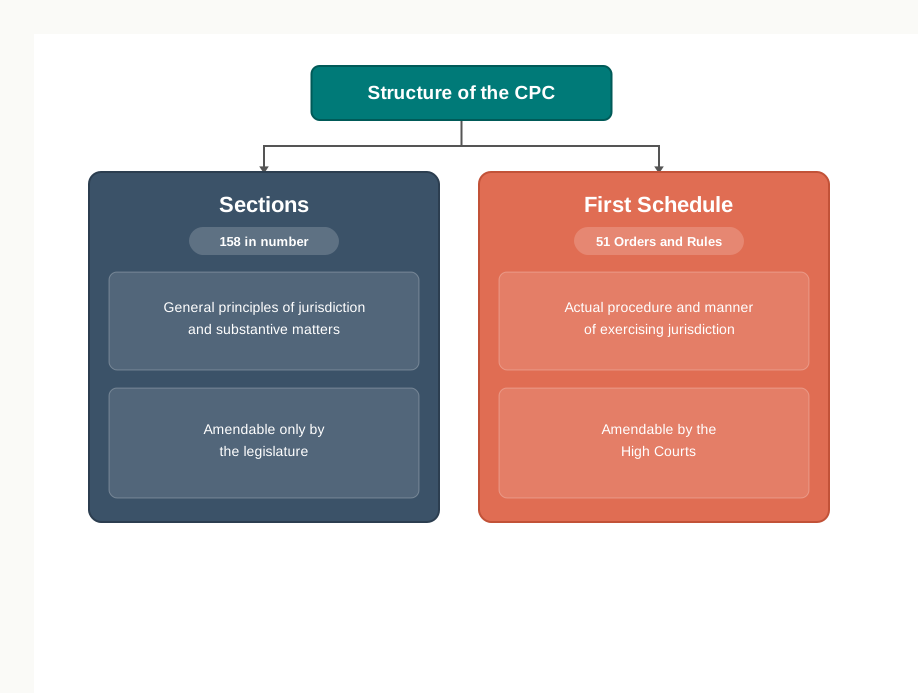
Fig. 12.2 – Structure of the Code of Civil Procedure, 1908.
- The first part consists of 158 Sections, which lay down the general principles of jurisdiction and substantive matters.
- The second part is the First Schedule, which contains 51 Orders and Rules dealing with the actual procedure and manner in which civil courts exercise their jurisdiction.
You will meet this two-part structure again in Section 12.5. When a book or a judgment refers to “Section 9” it is speaking of the first part; when it refers to an “Order” and a “Rule”, it is speaking of the First Schedule.
Amendment and Application
The Sections of the CPC are fundamental in nature and cannot be amended except by the legislature. The Orders and Rules in the First Schedule, in contrast, may be amended by the High Courts, because they relate to procedural detail.
There is sense in that division. The basic principles of civil justice ought to be settled by Parliament and applied uniformly, while the working details of court practice are better left to the High Courts, which supervise the courts that use them daily — the supervisory power you met in Section 12.2.2.
Lastly, the CPC does not have retrospective operation, meaning that it applies only to cases instituted after it came into force.
12.5 Stages of a Civil Suit
Civil cases are disputes between private individuals or parties relating to money, property, contracts or personal rights. Any court case that involves a claim for compensation, damages or the enforcement of personal rights, rather than punishment, is known as a civil case.
A civil suit does not proceed haphazardly. It follows a systematic and logical process, and the order of that process is itself a protection: each side learns the other’s case before evidence is led, and evidence is led before arguments are heard.
Two Conditions Before a Suit Can Be Filed
For a civil suit to be filed, two basic conditions must be satisfied.
- There must be a cause of action, which means a legal wrong committed against the plaintiff. You met this expression in Section 12.3.1, where it decided where a suit could be filed; here it decides whether there is a suit at all.
- There must be a claim for relief, such as damages, compensation, or the enforcement of a right.
In addition, the suit must fulfil the conditions laid down under Section 9 of the Code of Civil Procedure, 1908.
Read that carefully, because it is generous and restrictive at the same time. The starting position is that a civil court may try all suits of a civil nature — a person is not required to show a special permission to sue. The exception is that where a law has expressly or impliedly taken a category of dispute away from the civil courts and given it to some other forum, the civil court must stand aside.
The two people at the centre of every civil suit have fixed names. The plaintiff is the party who files the suit and claims that a right has been violated. The defendant is the party against whom the suit is filed and who is called upon to answer it.
The full sequence of twelve stages is set out in Fig. 12.3. Trace it once before reading the explanation of each stage, and notice how the case narrows: broad allegations at the start, precise issues in the middle, a single decision at the end.
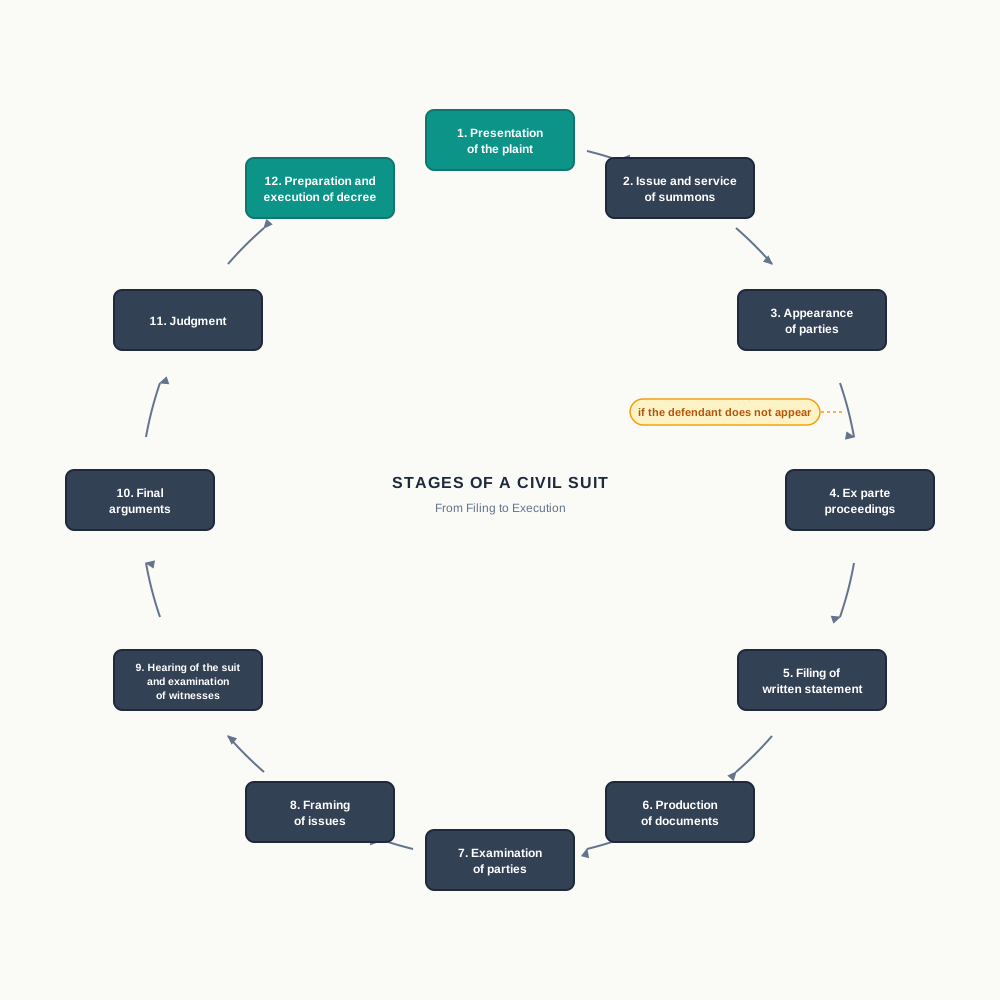
Fig. 12.3 – Stages of a civil suit.
12.5.1 Presentation of the Plaint
The filing of a plaint is the first and most important step in a civil suit. It is the document that sets the civil justice system into motion; until it is filed, the court knows nothing of the dispute and can do nothing about it.
The plaint generally contains:
- the name of the court;
- the names and addresses of the plaintiff and the defendant;
- the facts giving rise to the dispute;
- the grounds showing the court’s jurisdiction;
- the claim made by the plaintiff;
- a list of the documents relied upon.
Item 4 is the one students overlook. A plaintiff cannot simply file wherever it suits them and wait to be challenged; the plaint itself must show why this court has territorial, pecuniary and subject-matter competence.
12.5.2 Issue and Service of Summons
After the plaint is admitted, the court issues summons to the defendant. The summons informs the defendant that a civil suit has been filed against him and directs him to appear before the court on a specified date.
The summons is signed by the judge and sealed by the court. Those formalities matter: they distinguish a genuine court process from a threatening letter, and they fix the date from which the defendant’s time to respond begins to run.
This step ensures that the defendant gets a fair opportunity to present his defence. It is the procedural expression of a principle you will meet throughout law — that no one should be condemned unheard.
12.5.3 Appearance of Parties
On the date mentioned in the summons, both parties are required to appear before the court, either personally or through their lawyers.
The consequences of non-appearance differ depending on who is absent:
- If the defendant fails to appear, the court may proceed ex parte.
- If the plaintiff does not appear, the court may dismiss the suit.
- If both parties are absent, the suit may also be dismissed.
There is a logic to the difference. The plaintiff is the one asking the court to act; if that person cannot be bothered to attend, the court has no reason to continue. The defendant, by contrast, has been dragged in unwillingly, so the case against him goes on without him rather than disappearing.
12.5.4 Ex Parte Proceedings
If the defendant does not appear before the court despite being duly served with summons, the court may proceed ex parte, meaning that the case is heard in the absence of the defendant.
In such circumstances the court continues the proceedings on the basis of the plaintiff’s submissions and evidence. Since the defendant has failed to appear despite being given an opportunity, the right to participate at that stage is treated as waived, and the court may pass a judgment if the plaintiff successfully proves the case.
Notice the condition buried in that sentence. Even unopposed, the plaintiff must still prove the case. An absent defendant does not hand the plaintiff an automatic win; it only removes the contest.
An ex parte order does not permanently extinguish the defendant’s right to be heard. The defendant may later apply to set aside the ex parte decree by showing sufficient cause for the absence — a genuine illness, or summons that never in fact reached him.
12.5.5 Filing of Written Statement by the Defendant
After being served with summons, the defendant is required to file a written statement within the time prescribed under the Code of Civil Procedure, 1908. The written statement is usually to be filed within thirty days from the date of service of summons, and the court may allow an extension up to ninety days, depending on the circumstances and the applicable legal provisions.
The written statement contains the defendant’s response to the allegations made in the plaint. The defendant may admit or deny the claims, raise legal objections, and present defences. The defendant may also file counter-claims or set-offs where permitted — a counter-claim being a claim the defendant makes against the plaintiff in the same suit, and a set-off being an adjustment of what the plaintiff owes the defendant against what the defendant owes the plaintiff.
If the defendant fails to file the written statement within the permitted time, the court may proceed further in accordance with law, which may include deciding the case on the basis of the material available on record.
12.5.6 Production of Documents
After the written statement is filed, both parties must produce the documents on which they rely. A case is largely won or lost on documents — agreements, receipts, registered deeds, account entries.
If a party does not have possession of a required document, that party may request the court to summon the person who holds it. This matters in practice, because the most useful document in a dispute is often in the hands of the other side or of a bank, an employer or a registration office.
12.5.7 Examination of Parties
At the first hearing, the court examines the parties to clarify whether they admit or deny the allegations made by the other side. The judge records these admissions or denials in writing.
The purpose is to strip the case down. Much of what is written in a plaint and a written statement is not really in dispute; once the agreed portions are recorded, the court can see the real points of dispute and need not spend the trial proving what nobody contests.
12.5.8 Framing of Issues
Based on the pleadings and the examination of parties, the court frames issues. Issues are the main questions of fact or law that the court needs to decide.
The trial of the suit revolves around these issues. Once framed, they act as an agenda: evidence that does not go towards an issue is beside the point, and the judgment at the end must answer each issue in turn.
12.5.9 Hearing of the Suit and Examination of Witnesses
During this stage, both parties present their evidence and witnesses. Witnesses are examined by the party who calls them and cross-examined by the opposite party.
Cross-examination is the heart of the process. A statement that survives hostile questioning is worth far more than one made without challenge, which is why a court evaluates the evidence of both sides only after each has been tested in this way.
12.5.10 Final Arguments
After the evidence is completed, both parties present their final arguments. They summarise the facts, the evidence and the legal points in support of their case before the judge.
No new evidence enters at this stage. Arguments are about what the material already on record proves, and about which rule of law applies to it.
12.5.11 Judgment
After hearing the arguments, the court delivers its judgment, either immediately or within a reasonable time. The judgment contains the court’s decision and the reasons for it.
The reasons are not a courtesy. They allow the losing party to understand why the case failed and to decide whether an appeal is worth pursuing, and they allow the appellate court to test the reasoning rather than guess at it.
12.5.12 Preparation and Execution of Decree
After the judgment, a decree is prepared, which formally states the relief granted.
A decree that is obeyed ends the matter. If the losing party does not comply with it, the winning party may seek execution of the decree, through which the court enforces its decision — for instance by attaching and selling property, or by directing possession to be handed over.
This last stage is what makes the whole exercise real. A judgment that cannot be enforced is only an opinion; execution is the point at which the plaintiff actually receives what the court has said is theirs. Section 12.6 now examines the three key terms this stage turns on — judgment, decree and order.
12.6 Judgment, Decree and Order
The Code of Civil Procedure, 1908 lays down the procedure to be followed when a person wants to file a civil suit in a court of law. As you saw in Section 12.5, a civil suit generally begins with the filing of a plaint and ends with a judgment, which is then followed by a decree.
Everyday speech treats “judgment”, “decree” and “order” as though they meant much the same thing. The CPC does not. It defines each of them separately under Section 2, and the differences decide practical questions — above all, what can be appealed against and what can be enforced.
12.6.1 Judgment
According to Section 2(9) of the CPC, a judgment is the statement given by the judge explaining the reasons for passing a decree or an order.
In simple words:
- A judgment explains why the court has decided in a particular manner.
- It contains the reasoning and findings of the judge.
- It forms the basis for passing a decree or an order.
The judgment is therefore the reasoning. It works through the issues framed at the trial, sets out what the evidence established on each, and arrives at a conclusion.
12.6.2 Decree
A decree is defined under Section 2(2) of the CPC. It is the formal expression of the court’s decision in a civil suit — the document that states, in operative terms, what each party is entitled to.
Note the phrase “all or any of the matters in controversy”. A decree need not dispose of the entire suit at one stroke. In a partition suit, for instance, the court may first declare the shares of each party — that is a preliminary decree — and pass a final decree later, once the property has actually been divided. What makes each of them a decree is that it conclusively settles the rights it deals with.
Essential Elements of a Decree
A decision can be called a decree only when the following conditions are fulfilled.
- Formal expression of adjudication.
- There must be a judicial decision by the court.
- The decision must be formally drawn up on the basis of the judgment.
- The decision must be given in a suit.
- The adjudication must arise from a civil suit.
- Orders passed in applications or petitions do not amount to decrees.
- Determination of the rights of the parties.
- The decree must decide the substantive rights of the parties.
- It must relate to the matters in controversy — that is, the issues for which relief is claimed.
- The decision must be conclusive.
- The determination must conclusively settle the rights it deals with.
- Interlocutory orders — temporary or procedural orders — are not decrees.
- Orders granting or refusing adjournment or interim relief are not decrees.
All four conditions must be satisfied together. Consider a court that, midway through a suit over a disputed shop, restrains one party from selling the shop until the case is decided. That decision is judicial, and it is formally recorded — but it settles nothing conclusively about who owns the shop. It fails the fourth condition, and it is therefore an order, not a decree.
12.6.3 Order
According to Section 2(14) of the CPC, an order is the formal expression of any decision of a civil court which is not a decree.
In simple words:
- If a court passes a decision that does not finally decide the rights of the parties, it is called an order.
- Orders are generally procedural or interim in nature.
The definition is deliberately residual: the CPC defines what a decree is, and then treats everything else the court formally decides as an order. Summoning a witness, permitting an amendment, granting an adjournment, appointing a commissioner — each of these is an order.
12.6.4 Distinguishing Judgment, Decree and Order
The last two rows are the ones with real consequences. Because a first appeal generally lies from a decree, a losing party always has a route upward against the decision that settled the case. Orders are treated differently — only certain orders are appealable — because if every procedural direction could be appealed, no suit would ever reach trial.
The three terms also stand in a fixed sequence:
- A judgment is pronounced first.
- A decree follows the judgment.
- A judgment must contain the reasons for the decision.
- A decree does not require reasons, as it is based on the judgment.
- Orders are usually passed during the pendency of a suit.
12.7 Res Sub Judice and Res Judicata
Courts use various common law principles and legal doctrines to maintain balance in the judicial system and to improve its efficiency. The main purpose of these doctrines is to ensure that justice is delivered at a reasonable pace, without unnecessary delay.
Two such important doctrines are res sub judice and res judicata. Both answer a single practical question: how many times, and in how many places, may the same dispute be fought?
- Res judicata is a Latin term that means “a matter that has already been decided”.
- Res sub judice is a Latin maxim that means “under judicial consideration”.
The difference between them is simply a difference of timing. One deals with a dispute that is still going on somewhere else; the other deals with a dispute that has already ended.
Statutory Position under the Civil Procedure Code
The doctrine of res sub judice is provided under Section 10 of the Civil Procedure Code, 1908, while the doctrine of res judicata is contained in Section 11 of the CPC.
- Section 10 provides that when a suit is already pending before a competent court, the trial of a later suit involving the same matter must be stayed.
- Section 11 applies to cases that have already been decided. It bars the trial of a suit or issue if the same matter has been directly and substantially decided in a previous suit between the same parties.
12.7.1 Doctrine of Res Judicata
Under the doctrine of res judicata, a matter that has been finally decided by a competent court cannot be raised again, either in the same court or in a different court. Since it prevents further claims after a final decision, it is also known as claim preclusion.
How the Doctrine Works
Take a straightforward example. X filed a suit against Y for the recovery of ₹5 lakh on the basis of a loan agreement. After hearing both parties, the civil court dismissed the suit and held that no valid loan agreement existed, and the judgment became final once the appeal period expired.
Later, X again filed a fresh suit against Y in another court for the recovery of the same amount on the same facts. The court rejected the second suit, because the issue had already been finally decided by a competent court between the same parties.
Note what X could not escape by changing courts. Where the second suit is filed makes no difference at all; what matters is that the same matter, between the same parties, has already been decided.
This doctrine aims to prevent:
- injustice to parties, by giving finality to judicial decisions;
- wastage of court resources;
- multiple and conflicting judgments on the same issue;
- double recovery of damages for the same injury.
What the Doctrine Does Not Bar
It is important to note that the doctrine does not affect the right to appeal. Appeals are the lawful way to challenge a decision, and pursuing one is not an attempt to re-litigate a settled matter.
The timing follows from that. Once the appeal process is completed, or barred by limitation, the judgment becomes final and res judicata applies. Before that point, the matter is not yet finally decided at all.
The principle can also apply at a later stage of the same proceedings. If a court has already decided a particular question in a suit, that question cannot be reopened and argued again later in the same case.
12.7.2 Doctrine of Res Sub Judice
The doctrine of res sub judice prevents a court from proceeding with the trial of a suit when:
- a previously instituted suit is already pending;
- the matter in issue is directly and substantially the same;
- the parties are the same and are litigating under the same title;
- the earlier court has the authority to grant the relief sought.
All four conditions must be present together. If the earlier court could not grant the relief now being sought, there is no point in staying the later suit, because the parties would be left with no forum at all.
A Stay on Trial, Not on Filing
This rule applies only to the trial of the suit, not to its institution. The later suit may be filed and will remain on the record; what the court does not do is try it while the earlier suit is alive.
Courts may still pass interim orders in the stayed suit, such as injunctions or stays. That flexibility matters. A party should not lose the property in dispute simply because their suit is waiting its turn. The doctrine also applies to appeals and revisions.
Consider how this works in practice. A filed a civil suit against B in the District Court of Mumbai, seeking a declaration of ownership over a residential property. While this suit was still pending and under trial, B filed another suit against A in the District Court of Pune concerning the same property and the same issue of ownership. The Pune court stayed the trial of the later suit.
Every condition was satisfied: the matter in issue was directly and substantially the same, the parties were the same, and the earlier suit was pending before a competent court. Change one fact and the outcome changes — had B’s Pune suit concerned a different property altogether, there would have been nothing to stay, because the matter in issue would not have been the same.
The purpose of this doctrine is to:
- prevent courts from being overburdened;
- avoid contradictory judgments;
- protect parties from unnecessary harassment;
- ensure consistency in judicial decisions.
12.7.3 Why These Doctrines Matter
With the growing number of cases and the increasing pressure on courts, strict application of the doctrines of res sub judice and res judicata has become essential. These doctrines are not meant to deny justice, but to strengthen the efficiency of the judicial system.
They do so by ensuring that:
- a decided case is not reopened;
- the same dispute is not tried simultaneously in multiple courts.
These principles help in the smooth functioning of the judiciary. They ensure that court time is used effectively and that justice is delivered in a fair and timely manner.
Conclusion
Unlike criminal cases, which aim to punish the offender, civil suits focus on compensation and the enforcement of rights. That single idea has run through this chapter — from the types of civil dispute in Section 12.1 to the execution of a decree in Section 12.5.
The procedure laid down in the Code of Civil Procedure ensures fairness, transparency and justice. It is also binding on the parties: if the prescribed procedure is not followed, the court has the power to dismiss the suit.
12.8 Summary
- A civil dispute is a disagreement between two or more private parties in which one party claims that their legal or civil right has been violated by the other.
- The purpose of a civil case is not to punish the wrongdoer but to provide relief or compensation to the aggrieved party.
- Civil disputes restore or enforce private rights through remedies such as:
- compensation;
- restitution;
- specific performance.
- Civil disputes commonly fall into four families:
- property disputes, over ownership, possession, boundaries or inheritance;
- contractual disputes, where the terms of a contract are not fulfilled;
- family matters, including divorce, maintenance, custody, succession and partition;
- money recovery and damages, including loans, unpaid dues and compensation for loss.
- Civil courts at the district level form the foundation of the civil justice system and decide the largest number of cases.
- The District Court, headed by the District Judge, is the highest civil court in the district, with original jurisdiction in high-value cases and appellate jurisdiction over the courts below it.
- The Court of Civil Judge, in its Senior Division and Junior Division, handles civil cases of lower pecuniary value than the district level.
- Each State, or group of States, has a High Court, which exercises appellate jurisdiction over district and subordinate courts, may exercise original jurisdiction in certain matters, and supervises the subordinate courts within its territory.
- The Supreme Court is the highest court in the country; it hears appeals from the High Courts, ensures uniform interpretation of law, and its decisions bind all courts.
- Jurisdiction is the legal authority of a court to hear and decide a particular case, and a decision given without proper jurisdiction may be challenged or declared invalid.
- Three tests decide which court is competent, and all three must be satisfied together:
- territorial jurisdiction — where the defendant resides or carries on business, or where the cause of action arises, and for immovable property, where the property is situated;
- pecuniary jurisdiction — the monetary limit within which a court may hear cases, fixed by State rules;
- subject-matter jurisdiction — the category of dispute a court is competent to decide.
- The cause of action is the set of facts or events that gives rise to a legal dispute.
- Original jurisdiction is the authority to hear a case at the first instance, where evidence is recorded, witnesses are examined and facts are established.
- Appellate jurisdiction is the power of a higher court to review a decision of a lower court; fresh evidence is not usually recorded at this stage.
- The Code of Civil Procedure, 1908 is a procedural law: it lays down how civil cases are conducted without creating or taking away any right.
- The first uniform Code of Civil Procedure in India was enacted in 1859, and the present comprehensive Code was enacted in 1908.
- The CPC is divided into two parts:
- 158 Sections, laying down the general principles of jurisdiction and substantive matters, amendable only by the legislature;
- the First Schedule, containing 51 Orders and Rules on actual procedure, amendable by the High Courts.
- The CPC has no retrospective operation and applies only to cases instituted after it came into force.
- A civil suit requires a cause of action and a claim for relief, and must satisfy Section 9 of the CPC, under which civil courts may try all suits of a civil nature except those expressly or impliedly barred.
- A civil suit passes through twelve stages:
- presentation of the plaint;
- issue and service of summons;
- appearance of parties;
- ex parte proceedings, where the defendant does not appear;
- filing of the written statement;
- production of documents;
- examination of parties;
- framing of issues;
- hearing of the suit and examination of witnesses;
- final arguments;
- judgment;
- preparation and execution of the decree.
- A plaint is a written statement by the plaintiff explaining how their rights have been violated and what relief is sought, and it must show the grounds of the court’s jurisdiction.
- If the defendant does not appear despite service of summons, the court may proceed ex parte, but the plaintiff must still prove the case, and the defendant may later apply to set aside the ex parte decree by showing sufficient cause.
- If the plaintiff does not appear, the suit may be dismissed; if both parties are absent, the suit may also be dismissed.
- The written statement is usually to be filed within thirty days from the date of service of summons, and the court may allow an extension up to ninety days.
- Issues are the main questions of fact or law that the court must decide, and the trial revolves around them.
- Under Section 2(9) of the CPC, a judgment is the statement given by the judge explaining the reasons for passing a decree or an order.
- Under Section 2(2) of the CPC, a decree is the formal expression of an adjudication that conclusively determines the rights of the parties on the matters in controversy, and it may be preliminary, final, or partly both.
- A decision is a decree only if it is a formal expression of adjudication, given in a suit, determining the rights of the parties, and conclusive in nature.
- Interlocutory orders, including orders granting or refusing adjournment or interim relief, are not decrees.
- Under Section 2(14) of the CPC, an order is the formal expression of any decision of a civil court which is not a decree, and orders are generally procedural or interim in nature.
- A judgment is pronounced first and must contain reasons; the decree follows the judgment and does not require reasons.
- A first appeal generally lies from a decree, whereas only certain orders are appealable and no second appeal lies from an order.
- The doctrine of res sub judice, under Section 10 of the CPC, requires a court to stay the trial of a later suit when a previously instituted suit on directly and substantially the same matter is pending between the same parties before a competent court.
- Res sub judice bars the trial of the later suit but not its institution, and interim orders such as injunctions may still be passed.
- The doctrine of res judicata, under Section 11 of the CPC, bars the trial of a matter that has already been directly and substantially decided by a competent court in a previous suit between the same parties.
- Res judicata does not affect the right to appeal; a judgment becomes final for this purpose only once the appeal process is completed or barred by limitation.
- Both doctrines exist to prevent conflicting judgments, wastage of court resources and harassment of parties, and to give finality to judicial decisions.
12.9 Key Terms
Civil dispute — a disagreement between two or more private parties in which one claims that the other has violated a legal or civil right belonging to them.
Relief — what a party asks the court to grant, such as damages, compensation or the enforcement of a right.
Compensation — a sum of money awarded to make good the loss a party has suffered.
Restitution — the return of what was wrongly taken from a person, or of a benefit unfairly received.
Specific performance — an order directing a party to actually carry out the promise made, instead of merely paying money for breaking it.
Injunction — a court order directing a person to do something or, more often, to stop doing something.
Original jurisdiction — the authority of a court to hear and decide a case at the first instance, where evidence is recorded and facts are established.
Appellate jurisdiction — the power of a higher court to review a decision already given by a court below it.
District Court — the highest civil court in a district, headed by the District Judge.
Court of Civil Judge — the civil court below the district level, functioning in a Senior Division and a Junior Division, which handles suits of lower pecuniary value.
Subordinate courts — the civil courts functioning below the High Court within its territory.
Jurisdiction — the legal authority of a court to hear and decide a particular case, limited by territory, monetary value and subject matter.
Territorial jurisdiction — the geographical area within which a court has authority to hear and decide cases.
Cause of action — the set of facts or events that gives rise to a legal dispute.
Pecuniary jurisdiction — the monetary value or financial limit within which a court can hear cases.
Subject-matter jurisdiction — the authority of a court to hear cases based on the nature or category of the dispute.
Procedural law — a law that lays down how rights are enforced and cases are conducted in court, without itself creating or destroying any right.
Substantive law — a law that lays down what the rights and duties of persons actually are.
Review — a request to the same court that decided a case to reconsider its own decision on limited grounds.
Reference — the procedure by which a subordinate court refers a difficult question of law to the High Court for its opinion.
First Schedule — the second part of the CPC, containing 51 Orders and Rules that prescribe the actual procedure of civil courts.
Plaint — a statement in writing submitted by the plaintiff to the court, explaining how their rights have been violated and what relief is sought.
Plaintiff — the party who files a civil suit claiming that a right has been violated.
Defendant — the party against whom a civil suit is filed and who is called upon to answer it.
Summons — a document issued and sealed by the court informing the defendant that a suit has been filed and directing him to appear on a specified date.
Ex parte — a proceeding conducted in the absence of the defendant, where the defendant has not appeared despite due service of summons.
Written statement — the defendant’s written reply to the plaint, admitting or denying the claims and setting out defences.
Counter-claim — a claim made by the defendant against the plaintiff in the same suit.
Set-off — an adjustment of what the plaintiff owes the defendant against what the defendant owes the plaintiff.
Issues — the main questions of fact or law framed by the court, around which the trial revolves.
Cross-examination — the questioning of a witness by the opposite party, to test the evidence given.
Execution — the process by which a court enforces a decree when the losing party does not comply with it.
Judgment — the statement given by the judge explaining the reasons for passing a decree or an order, under Section 2(9) of the CPC.
Decree — the formal expression of an adjudication that conclusively determines the rights of the parties on the matters in controversy in a suit, under Section 2(2) of the CPC.
Preliminary decree — a decree that conclusively settles the rights of the parties but leaves further proceedings to be taken before the suit is completely disposed of.
Interlocutory order — a temporary or procedural order passed during a suit, which is not a decree.
Order — the formal expression of any decision of a civil court which is not a decree, under Section 2(14) of the CPC.
Res sub judice — the doctrine, under Section 10 of the CPC, that the trial of a later suit must be stayed when a suit on the same matter between the same parties is already pending before a competent court.
Res judicata — the doctrine, under Section 11 of the CPC, that a matter already directly and substantially decided by a competent court between the same parties cannot be tried again.
Claim preclusion — another name for res judicata, describing its effect of preventing further claims after a final decision.
12.10 Points to Ponder
Civil justice aims to restore a right rather than punish a wrong. Are there situations where restoring the right is simply not enough for the person who has been harmed — and if so, what should the law do about it?
A decision given by a court that lacked jurisdiction may be declared invalid, even after years of litigation. Is it fair that a litigant should lose everything for choosing the wrong forum, when it was a lawyer’s judgment and not their own?
Pecuniary limits are fixed by each State and revised only occasionally. What happens to the fairness of the system when property values rise steeply but the limits are not revised for many years?
Lower courts are described as making justice “approachable, affordable and timely”. From what you know of how long cases actually take, which of those three is hardest to achieve, and why?
The written statement is ordinarily due in thirty days, with an outer limit of ninety. Why does procedural law set deadlines at all, when a genuinely just decision might need more time?
A defendant who stays away can have the suit heard ex parte, yet may later have the decree set aside for sufficient cause. Where should the balance lie between finality for the plaintiff and a second chance for the defendant?
A judgment must give reasons, but a decree need not. What would be lost if courts were permitted to announce outcomes without explaining them?
Res judicata gives finality to decisions, but a wrong decision also becomes final. Is finality worth that price, and what does the right of appeal contribute to the answer?
Res sub judice stays the trial of the later suit but allows it to be filed. Why might the law prefer a stay to outright rejection?
Execution is the stage at which a decree becomes real. If a winning party cannot recover what the court has awarded, has justice been done? What does that suggest about how we should measure the success of a legal system?
Filing and pursuing a civil suit costs money, time and confidence with documents. Who is most likely to be shut out of the civil justice system by those costs, and what might reduce the barrier?
12.11 Textbook Questions
What is a civil dispute? How does its purpose differ from that of a criminal case?
Explain the common types of civil disputes, giving one example of each.
Name the remedies through which civil disputes restore or enforce private rights, and explain each briefly.
Describe the hierarchy of civil courts in India, from the district level up to the Supreme Court.
What is the role of the lower courts in the civil justice system? Why are they described as its foundation?
Explain the powers and position of the High Courts in relation to the subordinate civil courts within their territory.
What is jurisdiction? Why is it essential to determine jurisdiction before filing a civil suit?
Explain territorial, pecuniary and subject-matter jurisdiction with suitable examples.
Distinguish between original jurisdiction and appellate jurisdiction.
Why is the Code of Civil Procedure, 1908 described as a procedural law and not a penal law?
Discuss the structure of the Code of Civil Procedure, 1908, and state which part may be amended by the High Courts.
Describe the stages of a civil suit from the presentation of the plaint to the execution of the decree.
What is a plaint? State the particulars it generally contains.
What are ex parte proceedings? Can an ex parte decree ever be set aside?
Explain the meaning of judgment, decree and order as defined under the Code of Civil Procedure, 1908.
State the essential elements of a decree.
Differentiate between a decree and an order.
Explain the doctrines of res sub judice and res judicata, and state the provisions of the CPC in which each is contained.
12.12 Objective Questions
The main purpose of a civil case is to —
- punish the wrongdoer
- provide relief or compensation to the aggrieved party
- impose a fine payable to the State
- record a conviction against the defendant
An order directing a party to actually carry out the promise made, instead of paying money for breaking it, is called —
- restitution
- compensation
- specific performance
- execution
A dispute over the custody of a child would be classified as —
- a property dispute
- a contractual dispute
- a family matter
- a money recovery claim
The highest civil court in a district is the —
- Court of Civil Judge (Junior Division)
- Court of Civil Judge (Senior Division)
- District Court
- High Court
The power of the Supreme Court’s decisions to bind all courts in India is secured by —
- Article 141 of the Constitution
- Section 9 of the CPC
- Section 11 of the CPC
- the First Schedule to the CPC
A suit concerning immovable property is ordinarily filed in the court within whose territory —
- the plaintiff resides
- the property is situated
- the plaintiff’s lawyer practises
- the defendant was born
The monetary limit within which a court may hear a case is known as its —
- territorial jurisdiction
- pecuniary jurisdiction
- subject-matter jurisdiction
- appellate jurisdiction
Which of the following is true of a court exercising appellate jurisdiction?
- It hears the dispute for the first time
- It ordinarily records fresh evidence and examines new witnesses
- It reviews the correctness, legality or fairness of an earlier decision
- It cannot interfere with the decision of a lower court
The first part of the Code of Civil Procedure, 1908 consists of —
- 51 Sections
- 51 Orders and Rules
- 158 Sections
- 158 Orders and Rules
The Orders and Rules contained in the First Schedule to the CPC may be amended by —
- the District Courts
- the High Courts
- the State Government by notification
- Parliament alone
Under Section 9 of the CPC, civil courts have jurisdiction to try —
- only those suits which a statute expressly permits
- all suits of a civil nature except those expressly or impliedly barred
- all suits, civil and criminal, arising within the district
- only suits in which a claim for damages is made
The written statement is ordinarily to be filed within —
- fifteen days from the date of service of summons
- thirty days from the date of service of summons
- ninety days from the date of filing of the plaint
- six months from the date of the first hearing
If the plaintiff does not appear on the date fixed in the summons, the court may —
- proceed ex parte against the plaintiff
- dismiss the suit
- pass a decree in favour of the plaintiff
- frame issues and continue the trial
The main questions of fact or law that a court must decide in a suit are called —
- pleadings
- issues
- arguments
- findings
A judgment is defined under —
- Section 2(2) of the CPC
- Section 2(9) of the CPC
- Section 2(14) of the CPC
- Section 10 of the CPC
Which of the following is NOT a decree?
- A decision conclusively determining the shares of parties in a partition suit
- An order refusing an adjournment
- A formal expression of adjudication determining the rights of the parties in a suit
- A decision that is partly preliminary and partly final
The doctrine of res sub judice is contained in —
- Section 9 of the CPC
- Section 10 of the CPC
- Section 11 of the CPC
- Section 2(14) of the CPC
Assertion (A): A civil court cannot send the losing party to jail for the wrong complained of. Reason (R): The object of a civil suit is to restore or enforce a private right, not to punish the wrongdoer.
Assertion (A): A plaint must state the grounds showing the court’s jurisdiction. Reason (R): A decision given by a court that lacks jurisdiction may be challenged or declared invalid.
Assertion (A): An appellate court does not ordinarily record fresh evidence. Reason (R): The task of an appellate court is to review the correctness, legality and fairness of a decision already given.
Assertion (A): Where the defendant fails to appear despite service of summons, the plaintiff automatically succeeds in the suit. Reason (R): In ex parte proceedings the defendant’s right to participate at that stage is treated as waived.
Assertion (A): A decree does not require reasons to be recorded in it. Reason (R): A decree is drawn up on the basis of the judgment, which itself contains the reasons for the decision.
Assertion (A): The doctrine of res judicata does not take away a party’s right of appeal. Reason (R): A judgment becomes final for the purposes of res judicata only once the appeal process is completed or barred by limitation.
Assertion (A): Where a suit is stayed under the doctrine of res sub judice, the court can pass no order of any kind in it. Reason (R): The doctrine of res sub judice bars the trial of the later suit but not its institution.
12.13 Check Your Concepts
Why does civil law aim to restore a right rather than to punish the person who violated it?
Distinguish between compensation and restitution as civil remedies, using an example of each.
A single quarrel over an inherited house may be a property dispute, a family matter and a money claim at the same time. Why does it still matter to identify the real subject matter of the case?
Why are the courts at the district level described as the foundation of the civil justice system? Give two reasons.
Correct the error: “The District Court is the highest civil court in India.” Restate the sentence accurately and explain what makes the original wrong.
Explain the connection between the Supreme Court’s duty to ensure uniform interpretation of law and the binding force of its decisions.
What happens if a suit is decided by a court that had no jurisdiction to hear it? Why is this a strong reason to settle jurisdiction at the very beginning of a case?
Arrange the three jurisdictional tests in the order in which a person should apply them when choosing a court, and give the question each test asks.
Why is a suit concerning immovable property required to be filed where the property is situated? Give a practical reason.
What purpose is served by fixing different pecuniary limits for different grades of civil courts?
Distinguish between original jurisdiction and appellate jurisdiction on the basis of the stage of the case, the main task of the court, and the treatment of evidence.
Why is an appeal described as something other than a second trial?
Distinguish between substantive law and procedural law, and explain which of the two the Code of Civil Procedure, 1908 belongs to.
Identify the provision: which section of the CPC decides whether a civil court may try a particular suit at all, and what does it lay down?
Why can the Sections of the CPC be amended only by the legislature, while the Orders and Rules of the First Schedule may be amended by the High Courts?
State the two basic conditions that must be satisfied before a civil suit can be filed.
Arrange the following stages of a civil suit in their correct order and name the stage that has been left out: framing of issues, presentation of the plaint, final arguments, filing of the written statement, judgment, issue and service of summons, examination of parties, production of documents, hearing of the suit and examination of witnesses, appearance of parties.
Why must a plaint set out the grounds showing the court’s jurisdiction, rather than leaving the point to be raised by the defendant?
What happens if the defendant does not appear despite being duly served with summons? Explain what the plaintiff must still do, and what remedy remains open to the defendant afterwards.
Why does the law treat the absence of the plaintiff differently from the absence of the defendant?
Distinguish between a counter-claim and a set-off.
What is the purpose of the examination of parties at the first hearing, when the plaint and the written statement are already on record?
Why does the trial of a suit revolve around the issues framed by the court?
State the essential elements of a decree, and explain why an order granting interim relief fails to satisfy them.
Correct the error: “A decree is the formal expression of the court’s final decision, and can never be preliminary.” Restate the position accurately with reference to Section 2(2) of the CPC.
Why must a judgment contain reasons when a decree need not? Give two consequences that follow from this requirement.
Distinguish between a decree and an order on the basis of origin, nature, number and appeal.
Why is the definition of an order in Section 2(14) of the CPC described as residual?
Distinguish between res sub judice and res judicata on the basis of the stage of the earlier suit and the effect on the later suit.
State the four conditions that must be satisfied before the trial of a later suit is stayed under the doctrine of res sub judice.
What happens to the later suit when a stay is granted under res sub judice? Explain why the court may still pass interim orders in it.
Why does the doctrine of res judicata not interfere with a party’s right of appeal?
Why is execution described as the stage at which a decree becomes real?
12.14 Case-Based Questions
- Kavita runs a small embroidery business from her home in Kota, Rajasthan. She supplied finished garments worth ₹90,000 to a boutique owner, Mahesh, who lives and carries on business in Indore, Madhya Pradesh. The order was placed by telephone, the goods were made in Kota and despatched from there, and Mahesh has now refused to pay. Kavita wants to file a suit for recovery of the amount.
- Identify the type of civil dispute this is, and state the relief Kavita is likely to seek.
- Applying the rule of territorial jurisdiction, name the places where Kavita may be able to file her suit, giving a reason for each.
- Which further test must be applied before the exact court is identified, and on what does the answer to it depend?
- How would your answer to (b) change if the dispute concerned ownership of a shop building situated in Indore?
- Vikram was duly served with summons in a suit filed against him for recovery of money. He did not appear on the date fixed, and the court proceeded in his absence, heard the plaintiff’s evidence and passed a decree against him. Four weeks later Vikram approached the court with documents showing that he had been posted overseas on official duty throughout that period and had learnt of the case only on his return.
- Name the kind of proceeding the court conducted in Vikram’s absence, and state the condition that must be satisfied before such a proceeding can begin.
- The plaintiff argues that because Vikram stayed away, the decree followed automatically. Is that correct? Give reasons.
- What remedy is open to Vikram, and what must he establish to succeed in it?
- How would the position differ if it were the plaintiff, and not Vikram, who had failed to appear on the date fixed?
- Three sisters are in dispute over a house left by their father. A suit for partition is filed. Midway through the proceedings, the court passes an order restraining one sister from selling any part of the house until the suit is decided. Some months later the court declares the share of each sister in the property, leaving the actual division of the house to be carried out afterwards.
- Classify the mid-suit restraining direction, and state which essential element of a decree it fails to satisfy.
- Classify the later declaration of shares. Does it cease to be a decree merely because the division is still to be carried out? Refer to Section 2(2) of the CPC.
- Explain the difference in the right of appeal available against the two decisions in (a) and (b).
- Where, in each case, would the court’s reasons for the decision be found?
- Sunita filed a suit against her cousin claiming title to a piece of agricultural land. The court decided against her and held that she had no title. She did not appeal, and the period for filing an appeal has since expired. She has now filed a fresh suit against the same cousin, in a different district, claiming title to the same land on the same facts.
- Which doctrine bars the fresh suit, and in which section of the CPC is it contained?
- Does it make any difference that the second suit has been filed in a different district? Give reasons.
- Sunita argues that the doctrine takes away her right to challenge a wrong decision. Is she right? Explain the relationship between this doctrine and the right of appeal.
- How would the position have been different if the first suit were still pending and undecided when the second was filed?
- Imran and his brother-in-law fall out over a partnership. Imran wants to file three separate matters: a claim for his share of the partnership money, a petition for divorce from his wife, and a dispute about the entries in the revenue records of the family’s agricultural land. He assumes that all three can be filed together before the same civil court because they arise from the same family quarrel.
- Explain which jurisdictional test decides where each of the three matters must go.
- Identify the appropriate forum for each of the three matters, giving a reason in each case.
- Imran also wants the same court to punish his brother-in-law for allegedly forging a signature. Can a civil court do this? Give reasons.
- What consequence would follow if a matter were nevertheless filed and decided by a court that lacked jurisdiction over it?
- A housing society files a suit against a contractor for defective construction. Summons is served on the contractor on 5 March. He files no reply. On 2 April he applies to the court for permission to file his written statement, explaining that the site engineer holding all the relevant records had resigned without handing them over. The court is also asked to summon the resigned engineer’s file, which the contractor does not possess.
- State the ordinary period for filing a written statement and the outer limit up to which the court may allow an extension.
- Is the contractor’s application on 2 April within the outer limit? What would the position have been had he applied on 2 July?
- At which stage of the suit does the production of documents take place, and what may a party do about a document that is not in its possession?
- What are the possible consequences if the contractor ultimately files no written statement at all?
12.15 Landmark Cases & Maxims
State the literal meaning and the legal meaning of the maxim res judicata, and name the section of the CPC that gives it statutory form.
State the literal meaning and the legal meaning of the maxim res sub judice, and name the section of the CPC that gives it statutory form.
What does the expression ex parte mean, and at what point in a civil suit does a proceeding become an ex parte proceeding?
Match the term in Column A with the situation in Column B that it governs.
| Column A | Column B |
|---|---|
| a. Res judicata | i. A court restrains a party from selling disputed property while the suit continues |
| b. Res sub judice | ii. A suit is heard and decided without the defendant, who never appeared despite service of summons |
| c. Ex parte proceeding | iii. A claim already decided between the same parties is filed afresh in another court |
| d. Interlocutory order | iv. A second suit on the same matter is filed while the first is still pending and undecided |
Identify the doctrine that governs each of the following situations, and give one line of reasoning for each.
- A suit for possession is decided against a tenant; the appeal period lapses; the tenant files the same claim in a neighbouring district.
- Two brothers file suits against each other over the same plot, in two different District Courts, within a month of one another; both suits are alive.
- A question already decided by the court at an earlier stage of a suit is sought to be argued again later in the same suit.
“Res judicata is claim preclusion; res sub judice is a stay.” Explain what each half of this statement means, and state which of the two effects is permanent.
A litigant argues that the doctrines of res sub judice and res judicata deny justice by shutting a party out of court. State the principle on which both doctrines actually rest, and give two consequences that would follow if neither existed.