Chapter 14: Special Courts, Tribunals, Lok Adalats and Access to Justice
On a Saturday morning, the district court complex in a small town looks nothing like a court. Nobody is arguing in a black gown, and there is no queue outside a judge’s chamber. Instead, chairs are set out under a tent, and at each table sits a panel — a judge, a lawyer and a social worker — listening to both sides of a dispute at the same time. Ramesh, an auto-rickshaw driver, waits at one of these tables. Four years ago a truck hit him at a crossing. He lost eight months of work and most of his savings, and his claim for compensation has been pending ever since. He cannot afford to keep paying a lawyer, so a lawyer arranged by the legal services authority appears for him without charging a fee. By eleven o’clock, Ramesh and the insurance company have agreed on a figure. The panel records the settlement, Ramesh signs, and he walks out holding an order that neither side can appeal against. A dispute of four years is over in one morning. That tent is a Lok Adalat. Around it stands a wider arrangement built for the same purpose — family courts, Juvenile Justice Boards, consumer commissions, tribunals and free legal aid — so that an ordinary person can actually reach the justice the law promises.
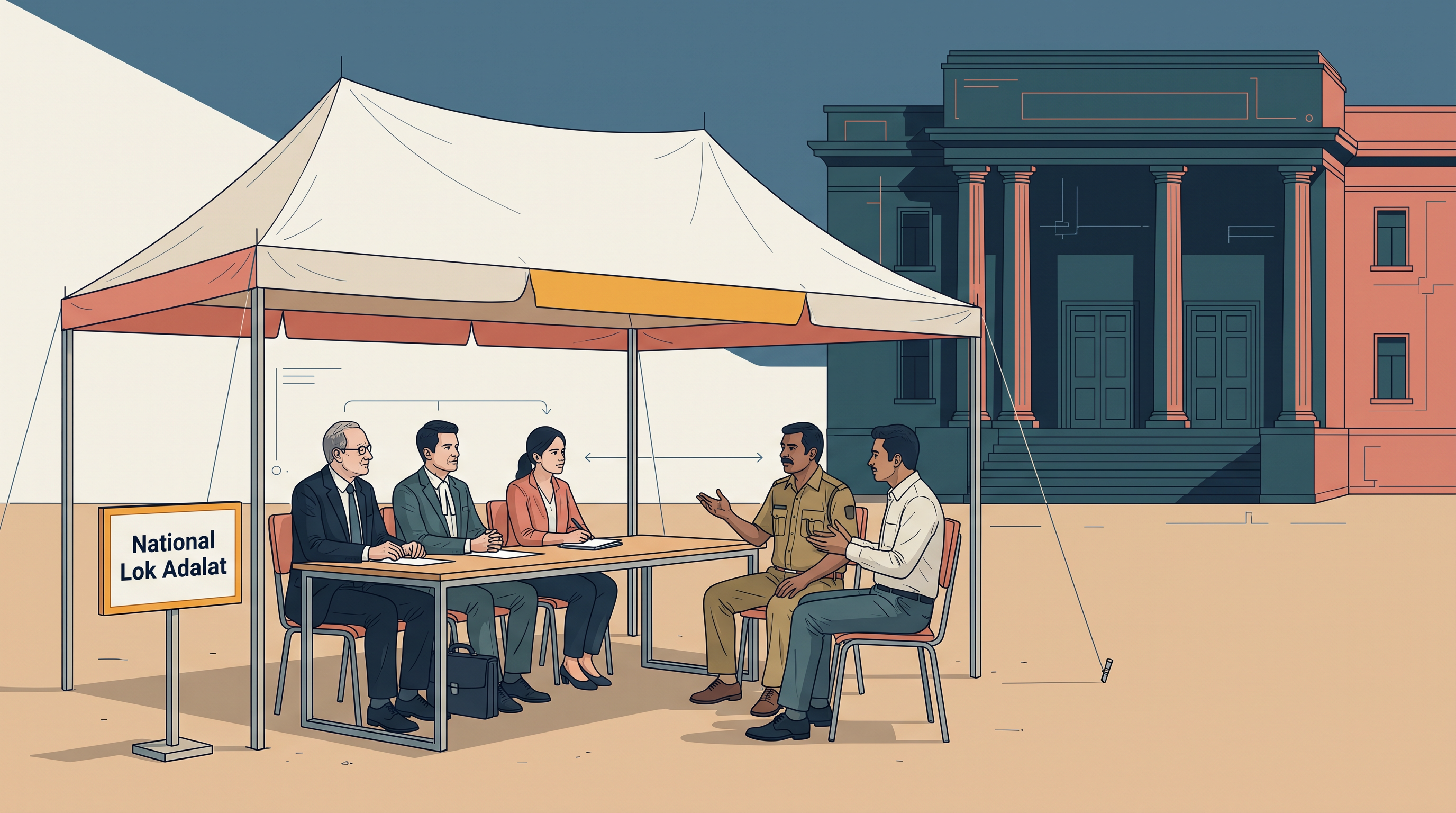
Fig. 14.0 – An open-air Lok Adalat in session.
Each of these questions is answered somewhere in this chapter.
14.1 Special Courts
The regular court system in India carries an enormous load. Every year, lakhs of new civil suits and criminal cases are filed before courts that are already working through a backlog from earlier years. When a single court must hear a property dispute, a cheque bounce case, a divorce petition and a theft trial from the same list, each matter waits its turn — and justice slows down for everyone.
Delay is not the only difficulty. Some disputes need something the ordinary court is not built to give. A custody fight between two parents needs sensitivity more than it needs cross-examination. A complaint about a defective mobile phone needs a quick, cheap forum, not a full-length trial. A child accused of an offence needs care and correction rather than the machinery built for adult criminals.
To meet both problems at once, Parliament and the State legislatures have created special courts: bodies set up by a particular statute to handle one defined category of cases, using a procedure shaped for that category. They do not replace the regular courts. They relieve them, by taking away a class of cases that the regular system was handling slowly and imperfectly.
Four Familiar Examples
The four bodies below are the ones a Class XI student is most likely to encounter, in the news or in life. Notice, as you read Fig. 14.1, what each of them was created to solve.
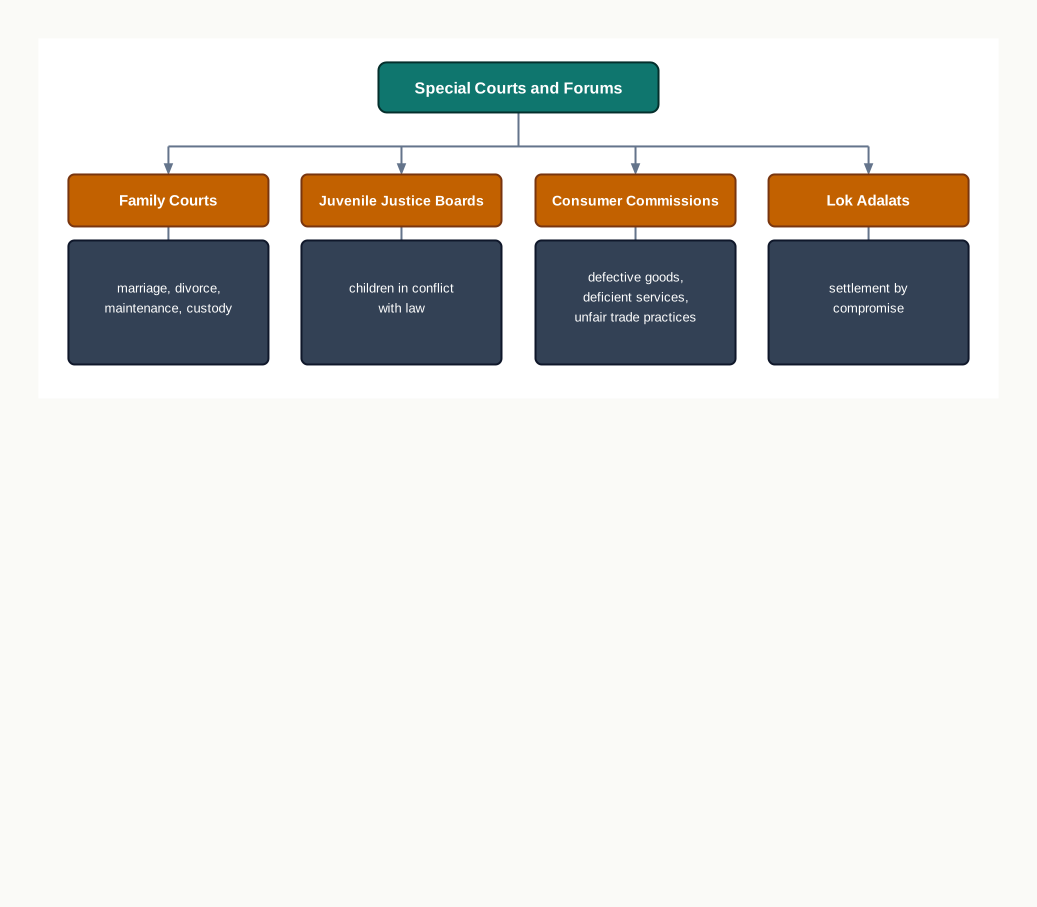
Fig. 14.1 – The four main special courts and forums.
Family Courts are established to deal with disputes relating to marriage, divorce, maintenance, custody of children and other family matters. They are designed to work in a less formal and more conciliatory manner, because a family dispute is not an ordinary contest between strangers — the two sides usually have to go on dealing with each other afterwards, especially where a child is involved. The court’s first attempt, therefore, is to bring the parties to a settlement rather than to declare a winner.
Juvenile Justice Boards deal with cases involving children who are alleged to have committed offences. Their focus is not punishment but care, protection and rehabilitation. The reasoning behind this is that a child’s judgment is still forming, and that a child who is sent through the adult criminal system is far more likely to return to crime than to leave it. The Board therefore sits informally, and orders that aim at correction — counselling, community service, or a stay at a special home — rather than an ordinary sentence.
Consumer Commissions, commonly called consumer courts, are set up to protect consumers against unfair trade practices, defective goods and deficiency in services. They provide a simple and relatively quick forum in which a buyer can seek redressal without the cost of a full civil suit. A consumer who has paid for a service and not received it should not have to spend more on litigation than the service itself was worth.
Lok Adalat, literally the “People’s Court”, is a forum for the amicable settlement of disputes. Here cases are resolved through mutual agreement and compromise rather than through lengthy court proceedings. The focus of a Lok Adalat is on conciliation and consensus, not adjudication — which is to say the panel helps the two sides arrive at their own settlement, instead of hearing evidence and imposing a decision on them. Section 14.3 takes up the Lok Adalat in detail, along with the wider question of access to justice.
Why the Category Matters
Whether a case belongs to a special court is not a matter of choice. It is decided by the statute that created that court, and it turns on facts — the subject matter of the dispute, or the age or status of a person involved. Spotting the fact that shifts a case from one forum to another is exactly the skill that case-based questions test.
14.2 Tribunals
Some disputes are not difficult because the parties disagree about the facts. They are difficult because the subject matter itself is technical. Whether a promotion was denied in breach of a service rule, whether a factory’s effluent has damaged a river, whether a product carried a defect — these questions need a decision-maker who already understands service rules, or environmental science, or the working of the market. A generalist judge can learn the subject, but only slowly, case by case.
For such matters, the law creates a tribunal: a specialised body established by statute to adjudicate disputes relating to one specific subject matter. Unlike regular courts, which deal with all kinds of civil and criminal cases, tribunals concentrate on particular areas such as taxation, service matters, labour, environment or consumer disputes. Because their members include experts in the field alongside members with judicial experience, and because their procedure is simplified, they are able to deliver speedy, expert and effective justice in technically complex matters.
Examples of Tribunals in India
Central Administrative Tribunal (CAT), set up under the Administrative Tribunals Act, 1985, handles service matters relating to government employees. It decides disputes about appointments, promotions, seniority and service conditions. Before it existed, a clerk aggrieved by a wrongly denied promotion had to file a writ petition in the High Court; the CAT gives such an employee a forum of his own.
Consumer Disputes Redressal Commissions at the State and National level handle consumer complaints about defective goods, deficient services and unfair trade practices. They provide speedy relief to consumers outside the regular courts, and hear appeals from the level below them.
National Green Tribunal (NGT), set up under the National Green Tribunal Act, 2010, deals with environmental disputes and cases arising under environmental protection laws. Its benches include expert members drawn from scientific and environmental backgrounds, which allows it to resolve matters requiring scientific expertise in a specialised and timely way.
How Tribunals Differ from Courts
Courts and tribunals differ in their nature and functioning. Courts follow formal procedures and deal with a wide range of civil and criminal matters. Tribunals are specialised bodies created by a particular statute to deal with specific subject matters, and they usually follow simplified procedures. Their strength lies in technical expertise and speedy disposal, but only within their limited area of jurisdiction — a tribunal cannot take up a dispute that its parent statute has not given it.
14.3 Access to Justice, Legal Aid and Lok Adalats
A right that a person cannot enforce is, in practice, no right at all. A tenant who has been wrongly thrown out has a remedy in law, but that remedy is worth nothing to him if the nearest court is three districts away, if the lawyer’s fee is more than a month’s income, or if he cannot read the notice served on him. Access to justice is the idea that closes this gap.
Access to justice means that every person should be able to seek and obtain justice without unnecessary difficulty. In simple terms, it ensures that legal remedies are available, affordable and understandable to all, regardless of a person’s income, background or social status. Each of those three words carries weight: a remedy that exists but is priced beyond reach is not available, and a remedy the person cannot understand is one he will never claim.
Why Access to Justice Matters
Access to justice is important because justice delayed, or made too expensive, defeats its very purpose. Affordable and speedy justice helps protect rights, resolve disputes peacefully and maintain public confidence in the legal system.
There is a further consequence, and it is the serious one. When justice is accessible, people are more likely to rely on lawful means rather than taking matters into their own hands. A society in which the courts are out of reach for ordinary people does not become a society without disputes — it becomes a society where disputes are settled by whoever is stronger.
The Constitution recognises this. Article 39A places a duty on the State to see that the legal system delivers justice on a basis of equal opportunity, and specifically to provide free legal aid so that no citizen is denied justice because of poverty or other disability.
Legal Aid
One of the key methods of improving access to justice is legal aid. Legal aid provides free legal services to those who cannot afford a lawyer, ensuring that lack of money does not become a barrier to justice. “Legal services” here means more than a lawyer in court — it covers advice, drafting of petitions, court fees and the cost of certified copies.
The system is built as a chain reaching from the capital down to the taluk, as Fig. 14.2 shows, so that a person seeking help does not have to travel to find it.
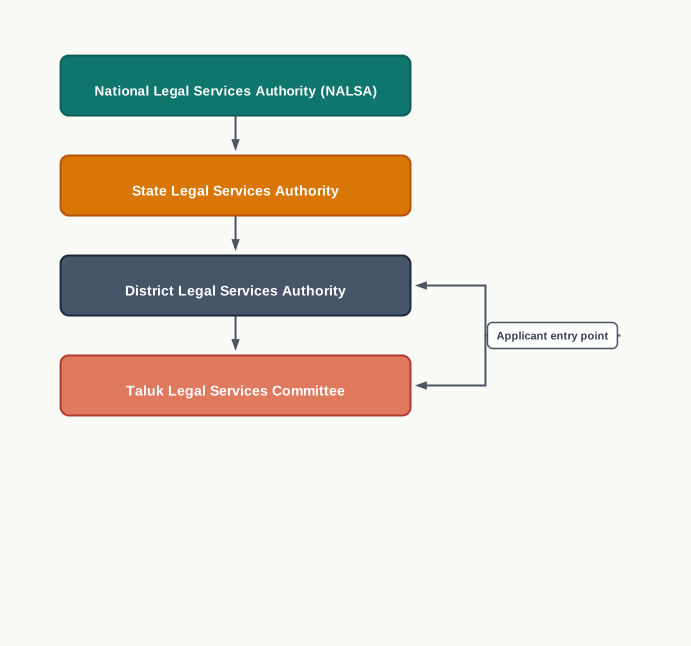
Fig. 14.2 – Hierarchy of the legal services authorities.
The right to be represented is not a courtesy the court extends. Where a person facing a criminal trial cannot afford a lawyer, the State must provide one, because a trial in which one side has counsel and the other does not is not a fair trial at all.
Lok Adalats
Another important mechanism is the Lok Adalat, the people’s court, which aims to settle disputes through compromise and mutual agreement. Lok Adalats provide a quick, informal and cost-effective way of resolving cases, especially in matters like motor accident claims, family disputes and recovery of money. There is no court fee, and where a case is settled after being filed in court, the court fee already paid is refunded.
The Lok Adalat does not hear evidence and does not decide who is right. The panel talks to both sides and helps them arrive at a figure or an arrangement they can both accept. If they do not agree, nothing is lost — the case simply goes back to the court it came from.
If they do agree, the settlement is recorded as an award. Under Section 21 of the Legal Services Authorities Act, 1987, that award is deemed to be a decree of a civil court, it is final and binding on the parties, and no appeal lies against it.
Together, special courts, tribunals, legal aid and Lok Adalats help make the justice system more inclusive and approachable for ordinary citizens.
14.4 Summary
- The regular courts in India carry a very large volume of cases, and this leads to delay in the delivery of justice.
- Some disputes also need what an ordinary court is not designed to give — speed, sensitivity, or technical expertise.
- Special courts are created by specific statutes to decide one defined class of disputes, using a procedure shaped for that class. They do not replace the regular courts; they relieve them.
- Four important special courts and forums are:
- Family Courts, for disputes relating to marriage, divorce, maintenance, custody of children and other family matters, decided in a less formal and more conciliatory manner;
- Juvenile Justice Boards, for children alleged to have committed offences, aiming at care, protection and rehabilitation rather than punishment;
- Consumer Commissions, for unfair trade practices, defective goods and deficiency in services, giving consumers a simple and quick forum for redressal;
- Lok Adalats, for amicable settlement of disputes by mutual agreement and compromise.
- Whether a case goes to a special court is decided by the statute, not by the choice of the parties, and it usually turns on a single fact such as the subject matter of the dispute or the age of the person involved.
- A tribunal is a specialised body established by law to adjudicate disputes relating to a specific subject matter, such as taxation, service matters, labour, environment or consumer disputes.
- Tribunals sit with expert members alongside judicial members and follow simplified procedures, so that technically complex matters are decided speedily and correctly.
- Important tribunals in India include:
- the Central Administrative Tribunal (CAT), which decides service matters of government employees such as appointments, promotions and service conditions;
- the Consumer Disputes Redressal Commissions at the State and National level, which decides consumer complaints outside the regular courts;
- the National Green Tribunal (NGT), which decides environmental disputes requiring scientific expertise.
- Courts follow formal procedures and deal with a wide range of civil and criminal matters, whereas tribunals are confined to the subject matter their parent Act assigns them.
- Access to justice means that every person should be able to seek and obtain justice without unnecessary difficulty, and that legal remedies are available, affordable and understandable to all.
- Access to justice matters because justice delayed or made too expensive defeats its own purpose, and because people who cannot reach the courts tend to settle disputes outside the law.
- Article 39A of the Constitution requires the State to secure equal opportunity in the working of the legal system and to provide free legal aid so that poverty or other disability does not deny anyone justice.
- Legal aid provides free legal services — advice, drafting, representation and litigation costs — to persons who cannot afford a lawyer, and is delivered through the legal services authorities at the national, State, district and taluk levels.
- In Hussainara Khatoon v. State of Bihar, the Supreme Court held that a speedy trial is part of the right to life and personal liberty under Article 21, and that an accused unable to afford a lawyer must be provided free legal services by the State.
- A Lok Adalat settles disputes through conciliation and consensus rather than adjudication, and is used particularly in motor accident claims, family disputes and recovery of money.
- If the parties do not settle, the case returns to the court it came from; if they do settle, the award is recorded.
- Under Section 21 of the Legal Services Authorities Act, 1987, the award of a Lok Adalat is deemed to be a decree of a civil court, is final and binding on the parties, and no appeal lies against it.
- Together, special courts, tribunals, legal aid and Lok Adalats make the justice system more inclusive and approachable for ordinary citizens.
14.5 Key Terms
Special court — a court established by a specific law to decide only one defined class of disputes, following a procedure designed for that class.
Family Court — a special court that decides disputes relating to marriage, divorce, maintenance, custody of children and other family matters, working in a less formal and more conciliatory way.
Juvenile Justice Board — the body that deals with children alleged to have committed offences, with the object of care, protection and rehabilitation rather than punishment.
Child in conflict with law — a person below the age of eighteen who is alleged to have committed an offence, and who is therefore produced before the Juvenile Justice Board instead of an ordinary criminal court.
Consumer Commission — the forum, commonly called a consumer court, that decides complaints about unfair trade practices, defective goods and deficiency in services.
Deficiency in service — a shortcoming or failure in the quality or manner of a service that a person has paid for.
Tribunal — a specialised body established by law to decide disputes relating to a specific subject matter, staffed with expertise in that subject and following a simplified procedure.
Central Administrative Tribunal (CAT) — the tribunal set up under the Administrative Tribunals Act, 1985 to decide service matters of government employees, such as appointments, promotions and service conditions.
National Green Tribunal (NGT) — the tribunal set up under the National Green Tribunal Act, 2010 to decide environmental disputes and cases arising under environmental protection laws.
Adjudication — the process by which an authority hears both sides, decides who is right in law, and imposes that decision on the parties.
Access to justice — the principle that every person should be able to seek and obtain justice without unnecessary difficulty, with legal remedies that are available, affordable and understandable to all.
Legal aid — free legal services, including advice, drafting, representation and the cost of litigation, provided to a person who cannot afford a lawyer.
Legal services authorities — the bodies constituted under the Legal Services Authorities Act, 1987 at the national, State, district and taluk levels to provide legal aid and organise Lok Adalats.
Lok Adalat — the people’s court, a forum in which disputes are settled by conciliation and mutual compromise rather than by adjudication.
Award of a Lok Adalat — the settlement recorded by a Lok Adalat, which under Section 21 of the Legal Services Authorities Act, 1987 is deemed to be a decree of a civil court, is final and binding, and cannot be appealed against.
Conciliation — a method of resolving a dispute in which a neutral third person helps the two sides reach their own agreement, instead of deciding the matter for them.
14.6 Points to Ponder
If special courts and tribunals were created to reduce delay, what should happen when a tribunal itself develops a backlog as long as that of the ordinary courts?
A tribunal decides technical questions with the help of expert members who are not judges. Does bringing in experts make the decision better, or does it risk weakening the independence that a court is expected to have?
The Juvenile Justice Board aims at rehabilitation rather than punishment. How would you answer a person who says this is unfair to the victim of the offence?
Legal aid gives a poor litigant a lawyer, but not necessarily an experienced one. Is a right to representation meaningful if it does not promise representation of equal quality?
A Lok Adalat settlement is final and cannot be appealed against. What might persuade a weaker party — someone who is tired, poor, or badly advised — to accept less than the case is worth, and what safeguards could reduce that risk?
Access to justice is usually discussed in terms of cost and distance. What other barriers — language, literacy, disability, fear of the police station — keep people away from the legal system, and which of them can law alone remove?
If most disputes were settled by conciliation and compromise rather than by judgment, courts would be far less crowded. What would society lose if very few cases were ever decided by a reasoned judicial decision?
14.7 Textbook Questions
The doctrine of autrefois acquit means:
- a person can be punished twice
- a person cannot be tried again after acquittal
- a person must be punished
- a person can appeal endlessly
Which stage comes first in a civil suit?
- filing of the written statement
- filing of the plaint
- framing of issues
- judgment
The primary purpose of an FIR is to:
- start a civil case
- record information of a cognizable offence
- give punishment
- grant bail
Autrefois convict protects a person from:
- arrest
- double punishment for the same offence
- civil liability
- filing of an FIR
In a criminal trial, framing of charges occurs:
- before investigation
- after filing of the FIR
- after the court examines the case and finds grounds
- after judgment
Which stage follows the filing of a written statement in a civil suit?
- judgment
- framing of issues
- execution
- appeal
Investigation in a criminal case is conducted by:
- the judge
- the police
- the lawyer
- the jury
Which of the following is the final stage in a civil suit?
- filing of the plaint
- evidence
- execution of the decree
- framing of issues
In a criminal case, the purpose of evidence is to:
- delay the trial
- help the judge decide guilt or innocence
- file an FIR
- grant bail
If a person is tried again for the same offence after conviction, it violates:
- the rule of law
- the doctrine of autrefois convict
- separation of powers
- judicial review
A shopkeeper reports a robbery to the police, but the officer refuses to record it. What is the legal document that should be filed, and what remedy does the shopkeeper have?
Anita files a case for recovery of money. The defendant submits his reply denying the claim. Identify the stage that has been completed, and state what the next stage is.
After an FIR is registered, the police collect evidence and question witnesses. Which stage is this, and what comes next?
Rohan was acquitted in a theft case. Later, the same case is filed against him again. Which legal doctrine applies, and what will be the outcome?
Seema was convicted and punished for fraud. After completing her sentence, she is tried again for the same offence. Identify the doctrine that has been violated and state its legal effect.
In a property dispute, the court identifies the key questions such as ownership and possession. Which stage is this, and why is it important?
After investigation, the police submit a chargesheet in court. What happens next in the trial?
During a civil case, both parties present documents and witnesses. Identify the stage and state its purpose.
In a criminal case, the judge gives the final decision after hearing arguments. What is this stage called, and what follows if the accused is found guilty?
A court orders the defendant to pay ₹5 lakh to the plaintiff, but the defendant refuses to comply. Which stage ensures enforcement of the order, and what can the court do?
Ramesh sold a piece of land to Suresh for ₹20 lakh. Suresh paid the full amount, but Ramesh later refused to transfer ownership, claiming that the price of land had risen and that he wanted more money. Suresh approached the court seeking enforcement of the agreement.
Ramesh filed a reply denying the claim and argued that the agreement was not legally binding. The court then identified the key questions in dispute, such as whether a valid contract existed and whether Suresh was entitled to ownership. Both parties produced documents and witnesses. The court finally passed a decree in favour of Suresh, directing Ramesh to transfer the property. Ramesh still refused to comply with the court’s order.
a. Identify the nature of the case and justify your answer.
b. What is the first step Suresh must have taken to initiate the case?
c. Identify the stage at which the court framed the key questions in dispute. Why is this stage important?
d. At which stage did both parties present evidence? Explain its significance.
e. What is the final step Suresh can take to enforce the court's decision?- A jewellery shop in a city was robbed at night. The shop owner, Meena, went at once to the police station to report the incident. The police recorded her complaint and began investigating the case by collecting CCTV footage and questioning witnesses.
After completing the investigation, the police found sufficient evidence against a suspect, Raj, and filed a chargesheet in court. The court examined the case, framed charges against Raj and began the trial. During the trial the prosecution produced witnesses and evidence to prove Raj’s guilt, while the defence lawyer cross-examined them. After hearing the final arguments of both sides, the court delivered its judgment, found Raj guilty and sentenced him to imprisonment.
a. What is the legal term for the complaint recorded by the police, and what is its significance?
b. Identify the stage at which the police collected evidence.
c. What is a chargesheet, and when is it filed?
d. Explain the purpose of framing of charges in this case.
e. After the judgment, what legal remedy is available to Raj if he is not satisfied?
14.8 Objective Questions
A special court is best described as:
- a court that hears appeals from all other courts
- a court established by a specific law to decide one defined class of disputes
- a court that sits only when the High Court directs it to
- a court in which the parties choose their own judge
Disputes relating to marriage, maintenance and custody of children are dealt with by:
- the Juvenile Justice Board
- the National Green Tribunal
- the Family Court
- the Central Administrative Tribunal
The focus of the Juvenile Justice Board is:
- punishment proportionate to the offence
- care, protection and rehabilitation
- compensation to the victim
- recovery of the value of the stolen property
Which of the following is decided by the Central Administrative Tribunal?
- A complaint about a defective washing machine
- A dispute about the promotion of a government employee
- A claim for compensation after a road accident
- A petition about illegal construction on a wetland
The National Green Tribunal was set up under:
- the Administrative Tribunals Act, 1985
- the Legal Services Authorities Act, 1987
- the National Green Tribunal Act, 2010
- the Family Courts Act, 1984
A tribunal differs from a court mainly because:
- a tribunal can hear any civil or criminal case
- a tribunal is confined to the subject matter its parent Act assigns it
- a tribunal cannot pass binding orders
- a tribunal is not created by any law
Access to justice requires that legal remedies are:
- available, affordable and understandable to all
- available only to citizens who can pay the court fee
- granted at the discretion of the State Government
- restricted to disputes above a fixed value
The Article of the Constitution that requires the State to provide free legal aid is:
- Article 14
- Article 21
- Article 39A
- Article 51A
In Hussainara Khatoon v. State of Bihar, the Supreme Court held that:
- every accused must be tried by a special court
- a speedy trial forms part of the right under Article 21, and an accused who cannot afford a lawyer must be given free legal services
- undertrial prisoners have no right to bail
- legal aid may be given only after conviction
The working method of a Lok Adalat is:
- adjudication after recording evidence
- conciliation and settlement by mutual agreement
- arbitration by a retired judge appointed by the State
- inquiry by the police followed by a report
Under Section 21 of the Legal Services Authorities Act, 1987, the award of a Lok Adalat is:
- a recommendation that the parties may accept or reject later
- deemed to be a decree of a civil court, final and not appealable
- appealable to the District Court within thirty days
- binding only on the party who filed the case
Which of these matters is most commonly settled in a Lok Adalat?
- A dispute about the interpretation of a constitutional provision
- A motor accident compensation claim
- A challenge to the validity of an Act of Parliament
- An appeal against a conviction for a serious offence
Assertion (A): Tribunals are able to dispose of technically complex matters more quickly than ordinary courts. Reason (R): Tribunals sit with expert members alongside judicial members and follow a simplified procedure.
Assertion (A): No appeal lies against the award of a Lok Adalat. Reason (R): The award records what the parties themselves agreed to, and is not a decision imposed on them.
Assertion (A): A person who cannot afford a lawyer in a criminal trial must be provided one by the State. Reason (R): A trial in which only one side has legal representation cannot be regarded as a fair trial.
Assertion (A): Special courts have replaced the ordinary civil and criminal courts in India. Reason (R): Special courts are created by specific statutes to handle one defined class of cases.
14.9 Check Your Concepts
Why were special courts created when India already had a complete system of civil and criminal courts?
Explain why a Family Court is expected to work in a conciliatory manner rather than as an ordinary contest between two sides.
What would be the likely consequences if children accused of offences were tried in the same courts, and in the same manner, as adults?
Distinguish between a court and a tribunal on the basis of source, subject matter, composition and procedure.
State the reasons why a tribunal is able to decide a technically complex dispute faster than an ordinary court.
Identify the forum that would decide each of the following, and give one reason for your answer in each case:
- a government clerk denied a promotion he claims was due to him;
- a factory discharging untreated waste into a river;
- a buyer who received a mobile phone with a defective battery;
- a couple seeking a decree of divorce.
Why is it said that a right which a person cannot enforce is, in practice, no right at all? Answer with reference to access to justice.
“Justice delayed or made too expensive defeats its very purpose.” Explain this statement and state what happens in a society where courts are out of reach for ordinary people.
Identify the constitutional provision that requires the State to provide free legal aid, and explain the duty it casts on the State.
Arrange the following steps in the correct order for obtaining free legal aid: assignment of a panel advocate; approaching the legal services authority; scrutiny of the application; making an application stating the ground of eligibility.
State any four categories of persons who are eligible for free legal services, and explain who bears the cost of the lawyer provided to them.
What is the principle established in Hussainara Khatoon v. State of Bihar, and why is that decision described as the foundation of the legal aid system in India?
Distinguish between adjudication and conciliation, and state which of the two a Lok Adalat follows.
What happens to a case if the parties appearing before a Lok Adalat fail to arrive at a settlement?
Why does the law make the award of a Lok Adalat final and non-appealable, when an ordinary decree of a civil court can be appealed against?
Correct the error in each of the following statements and give the correct position:
- A tribunal may take up any dispute that the parties bring before it.
- Legal aid is a favour granted by the State and not an entitlement.
- A Lok Adalat decides which of the two parties is right after hearing evidence.
- A person of eighteen years and two months, accused of theft, is produced before the Juvenile Justice Board.
Explain how special courts, tribunals, legal aid and Lok Adalats each answer a different obstacle that keeps an ordinary person away from justice.
14.10 Case-Based Questions
- Shabnam works as a domestic help and earns a small monthly wage. Her husband was knocked down by a bus two years ago and has been unable to work since. Her claim for compensation is still pending, and she has stopped meeting the lawyer she first engaged because she cannot pay his fee. A neighbour tells her that a Lok Adalat is being held at the district court next month, and that she may be able to get a lawyer without paying anything.
- On what basis might Shabnam be entitled to free legal services, and which authority would she approach?
- Explain the steps she must follow to obtain legal aid, and state who will bear the cost of the lawyer assigned to her.
- If the insurance company and Shabnam agree on a figure at the Lok Adalat, what is the legal status of that settlement?
- Suppose Shabnam attends the Lok Adalat but refuses the amount offered. What happens to her claim then?
- Two friends are caught after taking a scooter parked outside a market and riding it away. Aman is seventeen years and four months old. Vikram completed eighteen years three weeks before the incident. Both are produced before the authorities the same evening.
- Before which forum will each of them be produced, and what single fact decides this?
- Explain the difference in the object that each forum pursues while dealing with them.
- Aman’s family argues that since both boys did exactly the same act, both should be dealt with in the same way. How would you answer this argument, using the reasoning behind the Juvenile Justice Board?
- Residents of a colony find that a nearby unit has been releasing untreated chemical waste into a stream that runs past their fields. The crops along the bank have begun to fail. Separately, one of the residents, Farid, has bought a water purifier from a showroom that stopped working within a month, and the showroom refuses to repair or replace it.
- Which forum is appropriate for the complaint about the chemical waste, and why is it better suited to that dispute than the local civil court?
- Which forum should Farid approach, and what is the nature of his grievance in legal terms?
- Both forums are described as bodies that give speedy relief. State two features they share and one important difference between them.
- Mr Rathore, a clerk in a central government department, is passed over for promotion. He believes the departmental rule on seniority was applied wrongly in his case. He wishes to challenge the decision but is told that his matter will not be entertained by the ordinary civil court.
- Name the forum before which his dispute lies, and state the Act under which it was established.
- Explain why a dispute of this kind was taken away from the ordinary courts.
- If Mr Rathore later has a dispute with his neighbour about a boundary wall, can he take that dispute to the same forum? Give reasons.
- Meera and Suresh have been living separately for two years. Meera files a petition seeking maintenance and custody of their six-year-old daughter. At the first hearing, the presiding officer does not begin by recording evidence; instead, both parties are asked to sit with a counsellor to see whether an arrangement acceptable to both can be worked out.
- Identify the court before which this petition would lie and state the kinds of matters it deals with.
- Why does this court attempt a settlement before proceeding to a contest between the parties?
- Suppose the counselling fails and the court finally decides the question of custody itself. Does that decision become final in the same way as an award of a Lok Adalat? Explain the difference.
14.11 Landmark Cases & Maxims
State the principle settled in Hussainara Khatoon v. State of Bihar, and name the two rights of an accused person that the Supreme Court drew from Article 21 in that decision.
A man is arrested and kept in custody awaiting trial. Eighteen months pass and the trial has not begun. He has no lawyer and cannot afford one. Which decision governs his situation, and what relief does it entitle him to claim?
Explain how Hussainara Khatoon v. State of Bihar changed the character of legal aid in India, and identify the constitutional Article that the legal aid system rests on today.
Identify the authority or provision that governs each of the following situations:
- a settlement recorded by a Lok Adalat, which one party later wishes to appeal against;
- a woman seeking a lawyer without payment because she cannot afford one;
- a duty cast on the State to see that poverty does not deny a citizen the opportunity of securing justice;
- a dispute about the promotion of a central government employee.
The term Lok Adalat is translated as “People’s Court”. Explain how the working of a Lok Adalat justifies that name, and state one respect in which it is not a court at all.