Chapter 15: Institutional Framework: Marriage and Divorce
In 2016, a woman named Shayara Bano went to the Supreme Court of India with a simple complaint. Her marriage of fifteen years had been ended by her husband in a single moment, by the utterance of one word three times. She had not been heard, no court had been approached, and no reason had been given to her. Under the practice known as talaq-e-biddat, or instant triple talaq, that was enough.
Her petition asked a question that reaches far beyond one household. India allows each religious community to be governed by its own family law — Hindu, Muslim, Christian, Parsi, and the customs of tribal communities. Marriage, divorce, maintenance, guardianship and inheritance are therefore not one law but many. Shayara Bano’s argument was that whatever a community’s personal law says, it must still answer to the Constitution — to the guarantee of equality in Article 14 and the bar on discrimination in Article 15.
In Shayara Bano v. Union of India (2017), the Supreme Court set aside instant triple talaq. Parliament followed with legislation in 2019. One woman’s petition had changed the position of millions.
That is the tension this chapter studies: family law belongs to communities, but every community lives under one Constitution.
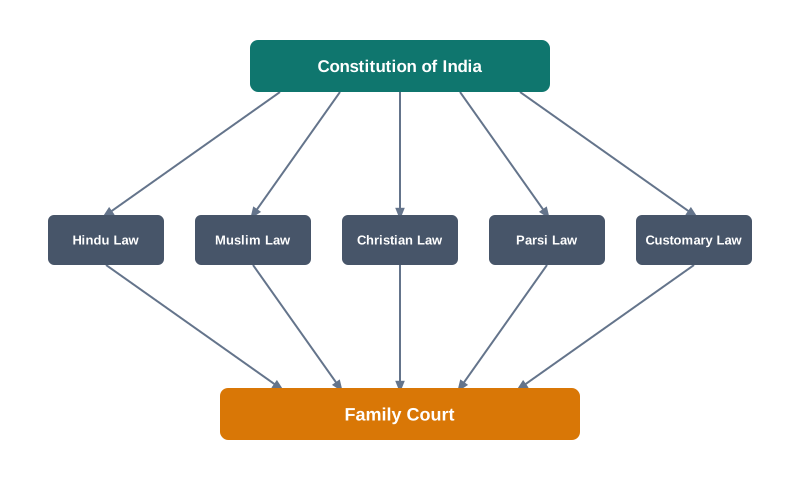
Fig. 15.0 – The constitutional framework of personal laws and family courts.
Each of these questions is answered somewhere in this chapter. Read on, and watch for the answers as they appear.
15.1 Nature of Family Laws in India
Every legal system has to answer a set of questions that arise inside the home rather than in the market or on the street. Who may marry whom? When can a marriage be ended? Who must support whom? Who looks after a child, and who inherits when a person dies?
The body of law that answers these questions is called family law, or personal law. It covers marriage, dowry, dissolution of marriage, guardianship, adoption, maintenance, gifts, wills, inheritance and succession.
The word “personal” here does not mean private or optional. It means that the law which applies to you is decided by the community you belong to, not by where you live or what you do. A contract dispute in Jaipur and a contract dispute in Kochi are decided under the same Indian Contract Act, 1872. A question of divorce may be decided under entirely different statutes depending on the religion of the parties.
Which law applies to whom
In India, religion and personal law are largely interlinked. Hindus, Sikhs, Jains and Buddhists are governed by Hindu family laws. Sikhs have their own marriage law — the Anand Marriage Act, 1909 — but are covered by Hindu law for other family matters.
Muslims, Christians and Parsees each have their own laws. Traditional communities, such as tribal groups, continue to follow their own customary practices, or customary laws.
There is a further difference in the form these laws take. The Hindu law, the Sikh marriage law, the Parsee law and the Christian law are codified — that is, they have been passed by the Indian Parliament as Acts, and a student can look up a numbered section and read it.
Muslim law is uncodified. It is based on the Sharia, which is the moral and religious law primarily grounded on the principles of the Islamic religious text, the holy Quran, and the examples laid down in the Sunnah by the Islamic Prophet Muhammad. Because there is no single enacted text of Muslim personal law in India, courts apply it as they find it in these sources and in earlier decisions interpreting them.
A distinctive kind of secularism
This produces a peculiar conception of a secular state. In many countries, secularism means the state keeps religion out of law altogether. In India it has meant something different: although these varied communities are one nation, they co-exist as independent and distinct communities in matters of family law.
The consequence is worth stating plainly. Unlike other laws in force in India, such as criminal and civil laws, family laws are not uniform.
Article 44 and the uniform civil code
The Constitution of India does not treat this position as permanent. Article 44 sets out a goal, or aspiration, of achieving a uniform civil code in family and personal matters.
Notice the verb: the State shall endeavour. Article 44 sits in Part IV of the Constitution, which contains the Directive Principles of State Policy. These are directions addressed to the government about the kind of society it should work towards. They are not rights that an individual can enforce. This provision is therefore merely a directive and is not enforceable by a court of law.
That is a deliberate design choice, not an oversight. The framers wanted a common civil code as a long-term national goal, but recognised that imposing one immediately on communities with very different marriage and inheritance traditions would have been resented as an attack on their identity. So the goal was written in, and the timing was left to Parliament.
15.2 Evolution of Family Laws
The present position — several communities, several family laws, only some of them codified — was not designed at one sitting. It is the result of a long history. Tracing that history explains why Indian family law looks the way it does, and as shown in Fig. 15.1, it falls into four broad stages.
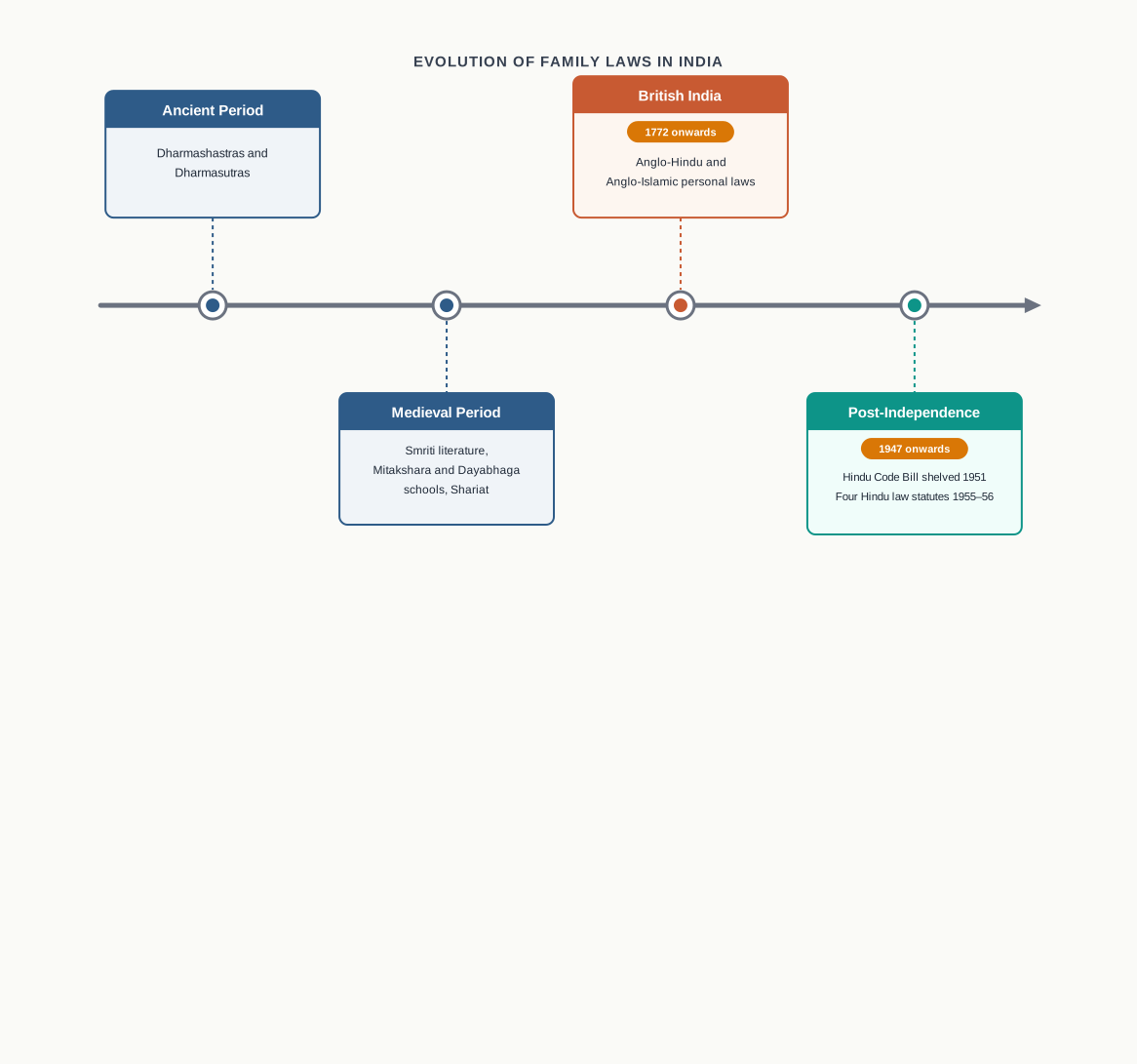
Fig. 15.1 – Evolution of family laws in India.
15.2.1 Ancient Period
The laws in ancient India were based mainly on religious texts such as the Dharmashastras and the Dharmasutras. These are Sanskrit written texts on religious and legal duties.
They provided rules for the life of an ideal householder, and contained the Hindu knowledge about religion, law, ethics and so on. Notice what that means for the shape of the law: duty and law were not separated. A rule about how to conduct oneself in the family was, at the same time, a religious obligation and a legal one.
15.2.2 Medieval Period
The Hindu legal system in the medieval period was also based on the smriti literature and the Dharmashastra, as well as other later digests. A digest is a work in which a scholar collects the earlier texts on a subject, reconciles them where they differ, and states the position that should be followed.
It is out of this work of interpretation that the schools of personal law grew. Since the medieval period, starting from the 8th century, two major schools of personal laws have been followed: Mitakshara, followed in North and South India, and Dayabhaga, followed in the Bengal region. The two schools took different views on questions such as how property devolved within a joint family, and a Hindu’s rights could therefore depend on which school governed his region.
The Muslims follow Shariat, which is uncodified law based on the Quran. The Hindu Law and the Muslim Shariat covered all aspects of life and did not differentiate much between morals, customs and laws.
Political rule did not disturb this arrangement. Even during the Mughal Empire in the Indian subcontinent, between the 16th and 18th centuries, Hindus and Muslims were ruled largely by their own sets of local customs and Personal Laws.
15.2.3 British India
The British came to the Indian subcontinent in the early 17th century. In the initial years, they were not concerned with the various regional and local laws practised in the subcontinent — they had come to trade, not to govern.
That changed once they became rulers. In 1772, when the East India Company established themselves as the civil administrators, Warren Hastings, the first Governor-General of Bengal, introduced the uniform criminal law with the idea of equality before the law for both Hindus and Muslims.
The important point is what he did not make uniform. In matters of Personal Law, he established that the laws of the holy Quran would be applicable to the Muslims, and the Shastras for the Hindus. This is the moment at which the division we still live with was written into the administration of British India: one criminal law for all, separate personal laws by community.
The British administrators, however, had no knowledge of the Personal Laws they had just undertaken to apply. They therefore appointed the Hindu pandits and the Muslim jurists as consultants in their courts, and this led to the administration and development of the Anglo-Hindu and the Anglo-Islamic Personal Laws — the traditional law as understood and applied through a British court system.
After 1864, the system of court Hindu pandits and Muslim jurists was abolished, due to dissimilar interpretations and some suspicions of corruption, and the court judges interpreted the Personal Laws themselves.
During British rule, both the Anglo-Hindu personal law and the Anglo-Islamic Personal Laws continued to develop through reforms, law commissions, and mainly through case laws. In other words, for much of this period family law grew through judicial decisions rather than through legislation.
15.2.4 Post-Independence
After India’s independence in 1947, efforts were made to develop a uniform civil code for dealing with matters of Personal Law.
It started with the uniform Hindu Code Bill, which attempted to combine the varied regional customs and usages. In 1951, it was shelved due to much opposition. Since the Constitution of India had adopted the word ‘secular’ as an important feature of the Indian republic, the uniform family law was seen as biased in favour of the Hindu majority community and unsecular.
Parliament then took a different route. Instead of one code for everyone, it codified the law of one community at a time. In 1955–56, the Parliament adopted and codified the four different major legislations governing the family and personal law matters of the Hindu community: the Hindu Marriage Act (1955), the Hindu Succession Act (1956), the Hindu Minority and Guardianship Act (1956), and the Hindu Adoptions and Maintenance Act (1956).
These four statutes are the backbone of Hindu family law today, and you will meet all of them again later in this chapter and in the chapters that follow.
Accordingly, Christians and Parsees have their own codified Marriage Acts; Muslims are governed by the Sharia; and the traditional communities continue to practise their uncodified customary laws.
15.3 Human Rights and Gender Perspective
Once family law is left to individual communities, a difficult question follows. What happens when a community’s own rules treat men and women unequally, while the Constitution promises equality to every citizen?
The constitutional promise of equality
There are various provisions in the Constitution of India that are specified for gender equality. The Preamble — the introduction to the Constitution — resolves to secure justice, liberty, equality and dignity of all.
Article 14 provides equal treatment before the law for every person. Article 15 prohibits discrimination based on religion, race, caste, sex or place of birth. Thus, the idea of equality is strongly emphasised in the Constitution.
The constitutional promise of religious freedom
However, exceptions exist too. Articles 25 and 26 of the Constitution provide for freedom of religion. This includes freedom of conscience and the free profession, practice and propagation of religion, as well as the freedom to manage religious affairs.
The religious communities have used these provisions to argue that modifying their family laws would be interfering with their freedom of religion. Here is the collision at the heart of this section: one set of Articles promises equality between men and women, another protects the right of a community to follow its own religious practices, and personal law is exactly the place where the two meet.
For those who promote the traditional religious values, the gender equity provisions described above are contrary to their customary methods of law. For example, the traditional Hindu religious legal methods found in The Laws of Manu provide for unequal treatment of law and punishment based on gender as well as caste. Gender inequalities also exist within the Islamic legal traditions.
Gender inequality within Hindu family law
The modern Hindu family laws were adopted by reconfiguring the traditional religious laws, and were further based on modern constitutional values. However, complete gender equity has not been achieved.
The instances of gender inequality existing in present-day Hindu family law include:
The Hindu Marriage Act, 1955 (Section 5(iii)) prescribes the marriageable age for a girl as 18 and for a boy as 21. A Bill introduced in Parliament in 2021 proposed raising the marriageable age of girls from 18 to 21 years, so that the age would be the same for both; that Bill lapsed, and the age for girls remains 18.
The Hindu Succession Act, 1956 provides different methods of intestate succession — that is, succession where the deceased left no will — for male and female intestates. The order in which relatives inherit is not the same when the property holder was a man and when the property holder was a woman.
The Hindu Minority and Guardianship Act, 1956 (Section 6) prohibits a mother from acting as a child’s natural guardian unless the father is dead or otherwise disqualified.
The Hindu Adoptions and Maintenance Act, 1956 (Section 6) prohibits a mother from giving her child in adoption unless the father is dead or otherwise disqualified.
Look closely at (c) and (d). In both, the mother is not treated as an equal decision-maker about her own child; she becomes one only when the father is unavailable. The Supreme Court has softened the guardianship rule by holding, in Githa Hariharan v. Reserve Bank of India (1999), that the mother can act as natural guardian not only after the father’s death but also when he is absent from the child’s affairs or indifferent to them. The words of the section, however, still read as they did in 1956 — which shows that judicial interpretation can reduce the effect of an unequal provision without removing it from the statute book.
Not knowing the law is itself a barrier
There are other practical challenges in achieving gender equity in the realm of family laws. One of the foremost is the lack of information about the family laws applicable to respective communities.
Most residents of rural India know neither the minimum age of marriage, nor that dowry is prohibited. They are also unaware of the legal grounds of divorce and of the prohibition of the practice of bigamy or polygamy.
This is a serious point, and it is easy to underestimate. A right that its holder does not know about produces no benefit. A woman who does not know that she can seek divorce on the ground of cruelty, or that her husband cannot lawfully take a second wife, is in practice governed not by the statute but by whatever her family tells her the rule is. Legal literacy is therefore not a side issue in family law; it is a condition for the law working at all.
Divorce under Islamic law: the three forms of talaq
In Islamic law, there are three types of divorce.
Talaq-e-Ahsan is regarded as the most ideal way of dissolving a marriage.
Talaq-e-Hasan is a form in which talaq is pronounced once a month, over a period of three months. If cohabitation is not resumed during this period, the divorce gets formalised after the third utterance in the third month. The gap between the pronouncements is the point of the procedure: it leaves room for the couple to reconcile before the marriage ends.
Talaq-e-Biddat, also called Instant Talaq or Triple Talaq, is a practice that allowed a man to divorce his wife immediately by uttering the word ‘talaq’ three times. The pronouncement to end the marriage could be oral or written, or by electronic means such as telephone, SMS, email or social media. It left no interval for reconciliation, and the wife had no say in it at all.
As you saw at the beginning of this chapter, the practice of divorce by the consecutive utterance of talaq three times has been held invalid. Under the Muslim Women (Protection of Rights on Marriage) Act, 2019, Talaq-e-Biddat or instant triple talaq in any form — spoken, written, or by electronic means such as email or SMS — is illegal and void, with up to three years in jail for the husband. The other two forms of talaq, Talaq-e-Ahsan and Talaq-e-Hasan, remain valid under Muslim law.
15.4 Institutional Framework – Family Courts
Knowing which law governs a marriage settles only half the problem. The other half is where a person actually goes when the marriage breaks down — and for a long time the answer was unsatisfactory. A wife seeking maintenance, a husband seeking divorce and a parent seeking custody of a child were each sent to a different ordinary court, to argue in the same formal, adversarial manner in which a property suit or a theft trial is conducted.
In 1984, the Family Courts Act was enacted for the creation and functioning of family courts with the expertise to deal with matrimonial and family law matters.
A procedural Act, not a new family law
One point about this Act must be fixed clearly in mind, because students lose marks on it regularly. The Act is procedural and does not override the substantive family laws. Accordingly, the rights and obligations of parties to disputes are based on the family, personal or matrimonial laws.
That is, the Family Courts Act tells you where and how a family dispute is heard. It does not tell you what the law of your marriage is. Whether a Hindu husband can obtain a divorce on the ground of desertion is still answered by the Hindu Marriage Act, 1955; the Family Courts Act only decides that the question will be heard by a family court.
During the late 1980s and 1990s, many family courts were established in most major cities in India, and matrimonial and family law cases were shifted from the district, civil and criminal courts to these newly created special courts.
Why family courts were designed differently
Family courts were created with many distinct features and goals, including:
reduction in formality in the litigation process;
speed in justice delivery; and
facilitation in conciliation and settlements.
Each of these answers a specific failing of the ordinary court. Formality intimidates a party who cannot afford an experienced lawyer. Delay is worse in a family dispute than almost anywhere else, because a maintenance claim is about eating this month and a custody dispute concerns a childhood that is passing while the case runs. And an ordinary trial ends by declaring one side the winner — which is a poor outcome when the two parties will remain the parents of the same child long after the case is over.
What a family court can hear
The personal or family law subject matters that fall within the jurisdiction of family courts include:
nullity of marriage — a proceeding to declare a marriage null and void;
restitution of conjugal rights;
judicial separation;
validity of marriage;
matrimonial status;
disputes regarding the property of either of the parties, or joint property;
injunction arising out of marital relations;
legitimacy of any person;
maintenance; and
guardianship, custody and access to any minor.
Two of these need explaining, because their names give little away.
Judicial separation is worth pausing on. The parties remain husband and wife — neither is free to marry again — but they are no longer bound to live together. It is often sought where the parties want distance without ending the marriage outright, and, as you will see later in this chapter, a period of separation that does not lead to the resumption of cohabitation can itself become relevant to divorce.
An injunction is a court order directing a person to do something or to stop doing something. Arising out of marital relations, it might, for instance, restrain one spouse from disposing of jointly held property while the dispute is pending.
The statutes a family court applies
The relevant statutes that come within the purview of the Family Courts Act include the following:
The Hindu Marriage Act, 1955 — codifies the marriage law of the Hindus and primarily deals with the validity of marriage, the conditions for invalidity, and the applicability of the Act.
The Special Marriage Act, 1954 — affords a special method of civil contractual marriage, and divorce, for all Indian nationals regardless of the religion or faith followed by the parties. This Act does not require the customary or religious rites or ceremonies of marriage to be observed.
The Dissolution of Muslim Marriage Act, 1939 — explains the dissolution of marriage by women married under Muslim law, and the effects of the renunciation of Islam by a married Muslim woman.
The Foreign Marriages Act, 1969 — deals with the marriages of citizens of India living outside India.
The Indian Divorce Act, 1869 — relates to the divorce of persons professing the Christian religion.
The Parsi Marriage and Divorce Act, 1936 — deals with marriage and divorce among the Parsis.
The Muslim Women (Protection of Rights on Divorce) Act, 1986 — deals with the matters of divorced Muslim women and governs their right to maintenance from their former husband.
The Muslim Personal Law (Shariat) Application Act, 1937 — requires the application of the Islamic Law Code of Shariat to Muslims in India in their family or personal matters.
The Hindu Adoptions and Maintenance Act, 1956 — codifies the legal process of adopting children by a Hindu adult, and the legal obligations to provide maintenance to various family members.
The Indian Christian Marriage Act, 1872 — regulates the formalisation of marriages among Indian Christians.
The Hindu Minority and Guardianship Act, 1956 — explains the guardianship relationships of Hindus involving adults and minors, as well as between people of all ages and their respective property.
The Guardians and Wards Act, 1890 — a non-religious and universally applicable law regarding issues relating to the guardianship of a child in India.
The Protection of Women from Domestic Violence Act, 2005 — provides safeguards to the wife or female live-in partner against domestic violence by the husband or male live-in partner or his relatives. This law also protects other women living in a household, including sisters, widows or mothers.
The Muslim Women (Protection of Rights on Marriage) Act, 2019 — made triple talaq a cognizable offence and punishable.
Read that list again and notice what it demonstrates. A single court applies statutes belonging to four communities and two statutes — the Special Marriage Act, 1954 and the Guardians and Wards Act, 1890 — that belong to no community at all. The forum is common; the law applied within it still depends on who the parties are.
Note also the word cognizable in item 14. A cognizable offence is one in which the police may register a case and arrest without first obtaining a warrant from a magistrate. Making triple talaq cognizable therefore made it a matter the police can act on directly.
Where family courts must be set up
The Family Courts Act mandates the state governments to set up family courts in cities and towns with a population over one million, and gives them discretionary powers for areas with a population of less than one million.
This is a real limitation on access to justice. The obligation is tied to population, so the litigant in a large city has a specialised court close by, while a litigant in a smaller town may still have to approach an ordinary court, or travel, for the same relief.
15.5 Role of Women in the Creation of Family Courts
Family courts did not arrive because the government one day decided that matrimonial cases needed a separate forum. They were demanded, and the demand came largely from women.
Women’s associations and organisations played a critical role in the creation of family courts. In the 1980s, the women’s rights movement groups were vocal about legislative reforms, such as the creation of special courts to deal with family matters, in order to curb violence against women, including wife murder. These issues of gender justice were an important motivating factor for the creation of family courts.
It is worth being clear about why a court was the demand. Violence within a marriage was not only a criminal law problem; it was also a problem of a woman having nowhere affordable, quick and comprehensible to go for maintenance, for the custody of her children, or for the right to remain in her own home. A forum that was slow and formal was, in effect, no forum at all for the woman who needed it most.
What the new courts were meant to do differently
Accordingly, family courts aimed at creating women-friendly court procedures that were less formal and more accessible to women, especially those from the marginalised section.
For this, the family courts intended to rely less on the traditional lawyers and to depend more on counsellors, to help the parties to the dispute reach mutually amicable solutions.
The conciliators were to increase the power of negotiation of women in reconciliation and settlement, in issues such as:
the quantum of maintenance upon divorce;
custody of, and access to, children;
protection against domestic violence; and
the right of residence in the matrimonial home.
The reasoning behind this design deserves attention. In a negotiation, the stronger party is usually the one with money, information and social support behind her or him — which, in most Indian marriages of that period, was not the wife. A neutral third person sitting with the parties was expected to correct that imbalance, so that a settlement reflected what was fair rather than what the stronger party could extract. Whether it has worked out that way in practice is the question the next two sections take up.
Notice the gap in the dates. The idea was pressed from 1953; the Family Courts Act came in 1984. Thirty years separate a good proposal from a statute — a reminder that law reform in a democracy moves at the speed of sustained public pressure.
The emphasis throughout was on a non-adversarial method of resolving family disputes — that is, a method not organised as a contest between two opposing sides — on promoting conciliation, and on securing the speedy settlement of disputes relating to marriage and family affairs.
15.6 Role of Lawyers and Counsellors in Family Courts
The Family Courts Act restricts the role of lawyers and increases the role of counsellors in dispute resolution, in order to encourage mutually amicable settlements.
This is peculiar, and it is also contrary to the practice of other courts, which commonly employ the English legal method of practice called the adversarial system of adjudication.
The adversarial system, and why family courts step away from it
In the adversarial system of adjudication, the judge plays the role of a neutral arbiter, and decides on the merits of the case as it is presented to him or her by the lawyers of the opposing parties. The lawyers argue; the judge does not investigate; the strength of each side’s presentation largely determines the result.
That system works reasonably well where the dispute is genuinely a contest — a claim for damages, a disputed contract, a criminal charge. Its logic is that truth emerges from two sides pressing their strongest case. In a family dispute, however, sharpening the contest can defeat the purpose of the proceeding. Positions harden, accusations are made on record that the parties cannot later take back, and a couple who must continue to co-parent a child leave the court further apart than they entered it.
Read the words carefully, because they are narrower than students often assume. A lawyer is not banned from the family court. What is removed is the right to be represented as of right — the court decides whether representation is permitted. The Latin term amicus curiae means “friend of the court”: a lawyer who assists the court itself with the legal position, rather than appearing for one of the parties.
What has happened in practice
As described above, the Family Courts Act has given counsellors high preference over lawyers in the family courts, in order to promote efforts at settlement between the parties. However, in practice the role of counsellors is merely superficial.
The majority of the States do not adequately integrate the requirement of counsellors with the legal practice of family courts. The role of the counsellors is limited to the task of ascertaining whether the dispute can be reconciled — and even this is not carried beyond the preliminary stage, and not into the actual trial of the case.
There is a reason for this beyond mere neglect. The role of counsellors in court practice is a new idea, and neither the judges nor the lawyers are oriented to this concept. A system staffed by people trained entirely in adversarial practice will tend to revert to adversarial practice, whatever the statute says.
The result is wide disparity among states with respect to the process adopted to appoint the counsellors, their qualifications and remunerations, their role, and the counselling techniques employed. While some states have used non-governmental organisations as counsellors, others have used trained personnel, individual volunteers, as well as lawyers.
That last detail is telling. Where a lawyer is appointed as the counsellor, the very distinction the Act was built on begins to dissolve — the statute intended the counsellor to bring a different kind of training to the table, and a state that fills the post with the same professionals it was steering away from has satisfied the letter of the requirement while losing its purpose.
15.7 Role of Counsellors and Gender Issues
There are a few states, such as Maharashtra, where counsellors play a considerable role in promoting negotiations and settlements. Where the counsellor is genuinely part of the process, a further question arises — not whether counselling happens, but how it is conducted.
Why “neutral” may not mean “fair”
Women’s groups contend that counsellors should be trained with gender-sensitivity, because the neutral stand of counsellors usually ends up being anti-women, influenced by long-standing patriarchal biases against women.
This is a subtle argument and it repays careful reading. A counsellor who takes no side is not thereby producing a fair outcome, because the two parties do not arrive equal. If one party has independent income, property in his name and the support of the household, while the other has none of these and nowhere else to live, then a process that simply encourages the two to agree will tend to produce the agreement the stronger party wanted.
The women’s groups have therefore demanded clearly defined frameworks for gender justice in the practice of the family courts, especially with respect to the roles of counsellors, in order to avoid gender biases in the process of fulfilling the statutory mandate of ‘speedy settlement’ and of ‘protecting and preserving’ the family.
Two ways the mandate can misfire
For example, in order to accomplish the mandate of ‘reconciliation’, some counsellors coerce women to reconcile and return to the spousal home, disregarding women’s human dignity, physical safety and economic rights. Where a woman has left because she was unsafe, treating her return as the successful outcome of the proceeding places her back in the situation she sought protection from.
In other instances, women who have been physically abused and thrown out of their matrimonial homes have demanded maintenance under Section 125 of the Code of Criminal Procedure. In such cases the counsellors and lawyers have regularly and successfully sought reconciliation — which is argued to be a legal trick that undermines the woman’s claim to maintenance.
The mechanism is worth spelling out, because it is the kind of reasoning an examiner rewards. Section 125 of the Code of Criminal Procedure is a safeguard that makes maintenance mandatory for neglected children and women. The claim rests on the fact of neglect. If the proceeding is diverted into a reconciliation and the woman returns to the matrimonial home, the foundation of her claim appears to disappear — she is no longer a neglected wife living apart — and the maintenance order she was close to obtaining is lost. The settlement looks like a success on the court’s record while leaving her with less than she had claimed.
Likewise, family issues are nuanced and carry legal complexities. Gender-sensitivity may help counsellors not merely to take neutral positions, but to consider the unequal power relationships between men and women in reconciliation and settlement processes.
The central criticism of the Act
One of the major criticisms by the women’s groups, about the Family Courts Act and the family justice system as a whole, is that the conceptual basis of ‘gender justice’ — the prime objective of the women’s movement — is left out. Instead, the Family Courts Act focuses on ‘preservation of the family’ through conciliation, and in a speedy manner.
Women’s groups have always maintained that ‘preservation of family’ is not synonymous with ‘gender justice’ or ‘rights of women’.
That sentence is the heart of the criticism. The two aims usually point the same way — most disputes are better resolved than fought — but they can point in opposite directions, and when they do, a statute written around preservation of the family gives the court no clear instruction to prefer the woman’s safety and economic security over the survival of the marriage.
15.8 Marriage: Meaning and Types
Marriage is defined as a social and legal union between a man and a woman. Through this institution, the spouses create kinship — a system of social organisation between people who are related by blood, marriage or adoption.
Both halves of that definition do work, and it is useful to take them one at a time.
Marriage as a legal union
Marriage is also a legal union, because certain legal consequences follow from it. For example:
the parties get the status of husband and wife;
legitimacy is conferred on children who are born after marriage; and
it confers rights of maintenance and inheritance of property on the husband and the wife.
This is what distinguishes marriage from every other relationship two people may form. Affection and companionship require no law. A change of legal status does — and status, once acquired, carries entitlements that a court will enforce, and obligations a party cannot walk away from by simply changing his or her mind.
Types of marriage
The majority of marriages are based on monogamy — a union between one woman and one man. Some societies have also allowed polygamous marriages, a term that generally refers to multiple spouses or multiple marriages, including either multiple husbands or multiple wives. The forms are set out in Fig. 15.2.
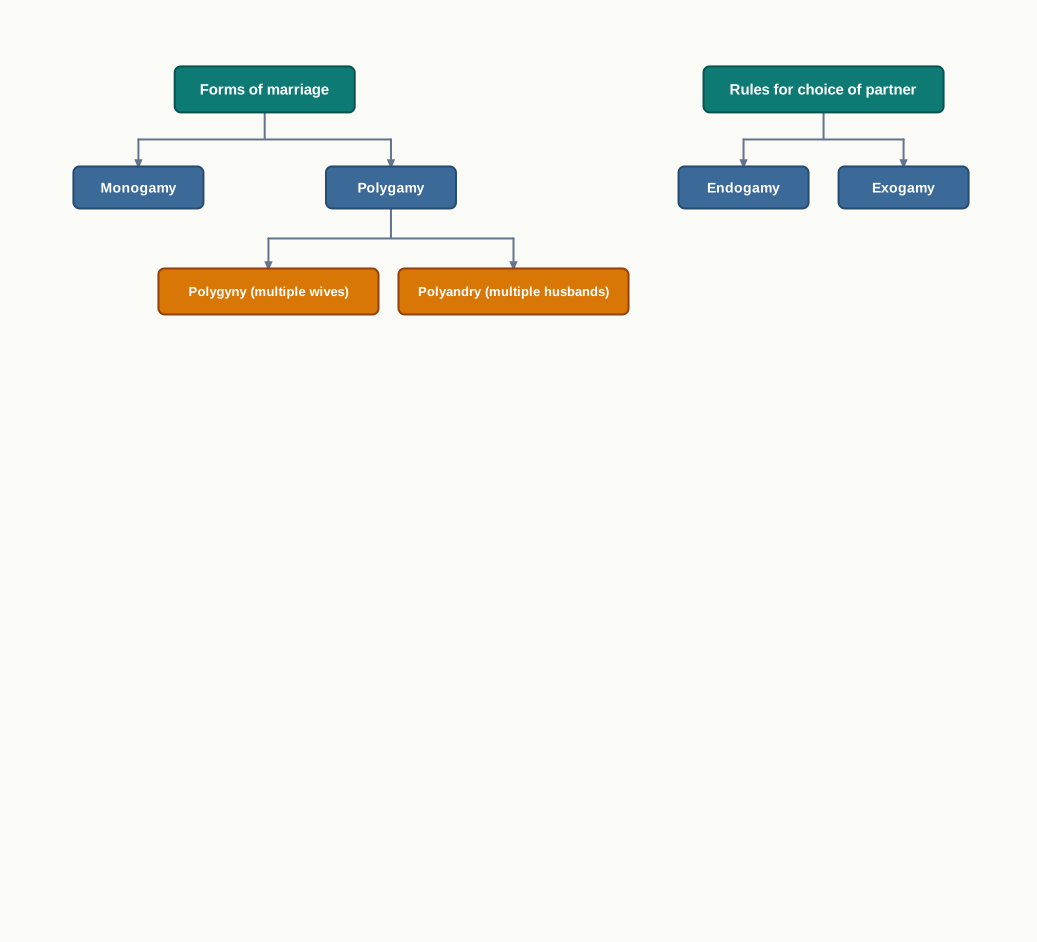
Fig. 15.2 – Forms of marriage and rules for choice of partner.
Whether monogamous or polygamous, the marriage system does not emerge in a vacuum. These different forms of marriage serve a purpose.
The practice of polygyny, or multiple wives, was often a strategy for increasing the population size. It also ensured that all the women in the society were taken care of when men were in short numbers.
Similarly, polyandry, or multiple husbands, is associated with a shortage of women — sometimes due to female infanticide and poverty.
The point being made here is one about how societies work, not about which arrangement is right. Forms of marriage tend to follow the conditions a society finds itself in, and they change as those conditions change. What each community’s law permits today is a separate question, and one this chapter takes up in the next section.
Rules about whom one may marry
Most societies also define marriage rules with respect to endogamy and exogamy.
Endogamy is about marriage to a person within one’s own group. Such a group may be based on caste (a Brahmin will marry a Brahmin; a Kshatriya will marry a Kshatriya, and so on), class (social categories based on economic and educational status), ethnic group (a socially defined category based on common culture or nationality), or a religious group, or even a village.
Exogamy is a rule that requires an individual to marry outside the tribe, family, clan or other social unit. It applies especially with regard to descent groups, formed on the basis of descent from a common ancestor or ancestress. Such a group can consist of the children of the same father or mother, the grandchildren of the same grandmother or grandfather, the great-grandchildren of the same great-grandparent, and so on, or the descendants of these persons.
Accordingly, in exogamy a certain degree of social or relationship distance must exist. Where it does not — that is, where the marriage takes place within close social or relationship proximity — an exogamic taboo is attached to such a marriage.
Keep exogamy in mind as you move to the next section. The social taboo on marrying within a descent group has a legal counterpart: personal laws prohibit marriage between persons too closely related by blood or by marriage, and a marriage that crosses that line is not merely disapproved of — it is void.
15.9 Conditions of a Valid Marriage
For a valid marriage, certain conditions are to be fulfilled by the parties to the marriage. These conditions may vary from religion to religion.
Five conditions run through the personal laws: monogamy, ceremony, age, prohibited relationships, and soundness of mind. They are taken up in turn below, and compared community by community at the end of the section.
Monogamy
Firstly, there is a rule of monogamy among Hindus, Parsis and Christians. They can have one spouse only.
If a person governed by these laws wishes to marry again, the first marriage must be dissolved. That dissolution can take place either by divorce — that is, dissolution of the marriage by the court — or by the death of the other spouse.
However, Muslim law permits polygamy, under which a Muslim man can have four wives.
Ceremony
Secondly, no religious ceremony is required to constitute a valid marriage under Muslim law. What is required of a Muslim couple is the offer and the acceptance to marry. A Muslim marriage is therefore in the nature of a contract, complete when one side proposes and the other accepts.
This is not so among the other religious groups, such as Hindus, Parsis or Christians, where the ceremony is not a celebration added on to the marriage but part of what makes the marriage.
For Hindus, if any Hindu marriage has been solemnised without the performance of the customary rites and ceremonies prevailing in the community of either of the parties, such marriage is legally void. Hindus follow the ceremony of Saptapadi, the taking of seven steps before a sacred fire; where this ceremony is followed, the marriage becomes complete and binding when the seventh step is taken.
Sikhs solemnise their marriage by the Anand Karaj ceremony, in which the Lavan, or the four hymns of Laav, are performed during the four nuptial rounds.
A Parsi marriage must be solemnised in accordance with a ceremony called Ashirwad. This ceremony binds the couple in matrimony spiritually. Both the bride and the groom promise to remain faithful to each other, and not to be led astray by any external temptations.
For Christians in India, the requirement takes a different form: the law identifies who may perform the marriage rather than what ritual must be performed. Certain persons are recognised as authorities under the Christian law who can perform the marriage; otherwise the marriage is void. These include:
persons who have received episcopal ordination — that is, consecration or installation by authority;
any Clergyman of the Church of Scotland; and
any Minister, or priest, of Religion licensed under the Act to solemnise marriages.
Such persons grant certificates of marriage to the Christian couples.
Age
Thirdly, different religions prescribe different ages for marriage. Hindu, Christian and Parsi law prescribe the age of 18 years for girls and 21 years for boys. Muslim law mentions the age of puberty, which is generally attained at 15 years of age.
Prohibited relationships
Fourthly, a person cannot marry anyone who belongs to his or her close relations.
All the religions recognise that the parties should not be within the prohibited degrees of consanguinity or affinity. Consanguinity is the prohibition on marrying certain blood relations. Affinity is the prohibition on marrying certain persons with whom a relationship has arisen by marriage. For example, a person cannot marry his or her brother or sister.
The reason for such rules is partly social — the exogamic distance discussed in the previous section — and partly a concern about the health of children born of unions between close blood relations.
Soundness of mind
Lastly, a person must be of sound mind at the time of marriage. Sound mind here refers to the ability of individuals to understand the nature of marriage, and their responsibilities towards their spouses once they get married.
Two things about this condition are commonly missed. The test is about understanding the nature of the transaction, not about intelligence or education. And the time that matters is the time of the marriage — a mental illness arising years afterwards is a different legal question altogether, which you will meet under the grounds for divorce.
The table introduces one term the running text has not yet used: sapinda relationship, which appears only in Hindu law and is wider than ordinary blood relationship. It is explained in the next section, where you will see what happens to a marriage that breaches it.
15.10 Void and Voidable Marriages
When all the conditions prescribed by the personal laws, as discussed in the previous section, are fulfilled and there is no legal impediment, the marriage is considered valid.
But a party may contravene any of those conditions. In such a case, a different status is ascribed to the marriage — it is either void or voidable. Which of the two it is depends on the nature of the condition that has been violated. The three possible statuses are set out in Fig. 15.3.
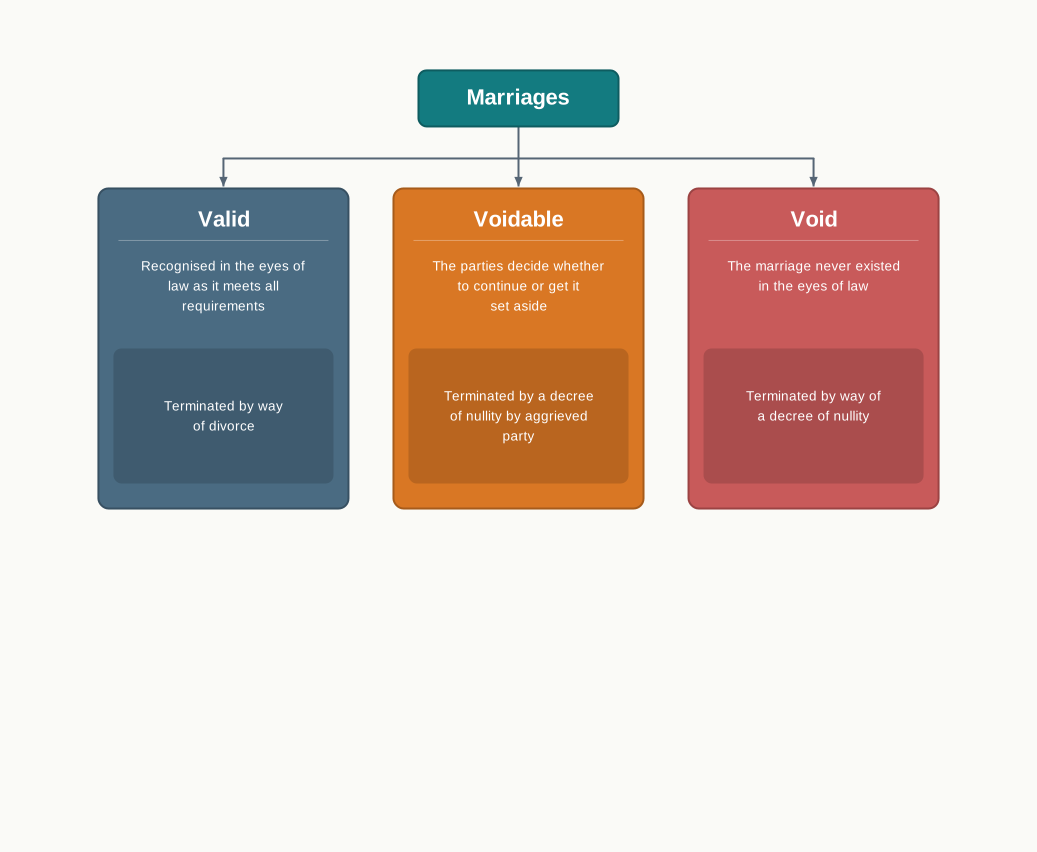
Fig. 15.3 – Valid, voidable and void marriages.
The difference between void and voidable
A voidable marriage is a perfectly valid marriage as long as it is not annulled — that is, set aside — by a court of law. Only the aggrieved party to the marriage can file the petition for annulment. The court can annul the voidable marriage by passing a decree of nullity.
A void marriage is no marriage.
That short sentence carries a great deal. In a void marriage there is nothing for the court to set aside, because in the eyes of law the marriage never came into existence. A court that is approached will declare its nullity, but the parties were never husband and wife; no decree is needed to make that so.
In a voidable marriage, the opposite is true. The parties are husband and wife, with every right and obligation that follows, unless and until the aggrieved party chooses to go to court. If that party never files a petition — or chooses to continue the marriage — it remains a valid marriage for all purposes.
Void marriages under Hindu law
The Hindu Marriage Act, 1955 makes the distinction between void and voidable marriage. It provides three grounds for a void marriage (Section 11).
First, a marriage with any person falling within a sapinda relationship is void. A person is a sapinda of another if one is a lineal descendant of the other as far as the third generation in the line of ascent through the mother, and the fifth generation in the line of ascent through the father, including the persons whose relationship is being tested. Blood relations are covered under it; for example, a person cannot marry his maternal or paternal uncle’s daughter.
Take that definition slowly, because it is easy to misread. You count generations upwards from the person concerned — three generations up on the mother’s side, five on the father’s side — and everyone descended within that span is a sapinda. The reason for the different numbers is the traditional structure of the Hindu family, in which the father’s line was traced further than the mother’s.
Second, one cannot marry any person falling within the ambit of a prohibited relationship. For example, there cannot be a marriage between uncle and niece, or aunt and nephew. The concept of prohibited relationship is wider than sapinda relationship, as it covers relationship by blood as well as by marriage.
Lastly, if any Hindu re-marries during the lifetime of his or her spouse, the second marriage is void. This is the rule of monogamy doing its work: since the first marriage still subsists, the second one cannot come into existence at all.
Voidable marriages under Hindu law
The Hindu Marriage Act also provides four grounds for voidable marriages (Section 12).
Firstly, if the marriage cannot be consummated due to the impotency of one spouse, the other spouse can get it annulled. Here, impotency does not mean barrenness or sterility — that is, the inability to have a child — but the failure to have sexual intercourse.
Secondly, when the consent for marriage is obtained by force or fraud, the aggrieved party can get the marriage annulled. The reason this ground makes the marriage voidable rather than void is worth grasping: the law leaves the choice to the person whose consent was defective, because that person alone can say whether, knowing the truth, he or she still wishes to remain married.
Thirdly, the pre-marriage pregnancy of the wife — where the wife is pregnant before the marriage by some person other than the husband — is another ground for a voidable marriage. But the husband must have been ignorant of this fact at the time of marriage. A husband who knew and married anyway cannot later use it to annul the marriage.
Lastly, unsoundness of mind is also a ground for a voidable marriage.
Void and irregular marriages under Muslim law
Under Muslim law, a void marriage is known as a Batil marriage. The term ‘nullity’, meaning non-existence, is applicable to a void marriage, as the marriage does not exist from the very beginning and the court merely passes a declaration as to its nullity.
A marriage is void on the grounds of polyandry, consanguinity, affinity and fosterage.
Polyandry means that a married woman cannot contract a second marriage during the subsistence of the first marriage.
Consanguinity means the prohibition on marrying certain blood relations. For example, a Muslim cannot marry his mother, grandmother, daughter, granddaughter, or paternal and maternal uncles and aunts.
Affinity means the prohibition on marrying certain persons with whom a relationship has arisen by marriage. For example, a Muslim cannot marry his wife’s mother or grandmother, or his wife’s daughter from another husband, or her granddaughter, if his marriage with the wife is consummated.
Fosterage means that when a woman other than the mother of the child has suckled a child under the age of two years, that woman becomes the foster mother of the child. A man cannot marry his foster-mother, or her daughter, or his foster sister.
Fosterage deserves a second look, because it has no counterpart in the other personal laws. It creates a relationship in law out of an act of nursing, and treats that relationship as a bar to marriage in the same way as a blood relationship.
There is no concept of voidable marriage under Muslim law. Instead, it recognises the concept of irregular, or Fasid, marriages. An irregular marriage is one which can become valid if the defect is cured.
For example, a marriage with a fifth wife is irregular, and it can be regularised if any of the earlier four wives either dies or obtains a divorce from the husband. The defect there is not in the parties themselves but in the number — remove the excess, and the objection disappears.
This is a third category that Hindu law does not have. A Hindu marriage is valid, void or voidable; a Muslim marriage may be valid, void (Batil) or irregular (Fasid), and the irregular marriage sits between the other two, waiting on a fact that may or may not change.
15.11 Divorce: Theories and Grounds
Marriage is a social institution, and there is a social interest in its protection and preservation. But sometimes it is not possible for the parties to continue with their marriage. As a consequence, the concept of divorce came into being.
Divorce is the termination of a marital union. It results in the cessation of the matrimonial tie between husband and wife, and the status of husband and wife ceases after divorce.
Notice how divorce differs from the annulment you studied in the previous section. Annulment says that the marriage was defective from the start; divorce says that the marriage was perfectly good and has now been brought to an end.
Situations like adultery — sexual intercourse outside wedlock — cruelty, and desertion, which is when one spouse leaves the other spouse never intending to come back, affect the very foundation of marriage. Divorce on these grounds merely enables the other party to put an end to the form from which the substance has already been destroyed.
15.11.1 Theories of Divorce
The concept of divorce has evolved in the form of different theories. Each theory arose because the one before it left some deserving person without a remedy, and reading them in sequence shows the law learning from its own gaps.
The guilt or offence theory
Divorce was originally regarded as a mode of punishing the guilty party, who had rendered himself or herself unworthy of consortium. This gave rise to the guilt or offence theory of divorce.
According to this theory, a marriage can be dissolved only if one of the parties to the marriage has, after its solemnisation, committed some matrimonial offence. The offence must be one that is recognised as a ground of divorce.
The guilt theory implies, on the one hand, a guilty party — a party who has committed a matrimonial offence — and, on the other, an innocent party, who is a victim.
The fault theory
Later on, insanity was added as a ground of divorce. Insanity did not fit within the framework of the guilt or matrimonial offence theory, as a party suffering from insanity could hardly be called a guilty party. Illness is a misfortune, not a wrong.
This led to the renaming of the guilt theory as the fault theory. If one of the parties has some fault in him or her, the marriage could be dissolved — whether that fault is his or her conscious act, or providential.
Divorce by mutual consent
The theory of divorce by mutual consent originated due to the loopholes in the fault theory of divorce.
The biggest drawback of the fault theory has been its presumption that there is one innocent party and one guilty party. Sometimes husband and wife are simply not able to live together, and there is no fault of either of them. In that case both of them were left with no remedy — the law could offer them nothing, because neither could accuse the other of anything.
Thus a new theory had to be evolved, under which a marriage could be dissolved by the mutual consent of both the husband and the wife where they are not able to live together. Divorce by mutual consent means that the law recognises the situation where parties can also obtain divorce by agreement.
But mutual consent alone will not automatically terminate the relationship. It is essential to obtain a decree of the court. A marriage is a status conferred by law, and it takes a court to undo it.
The six-month wait is meant to give a couple acting in anger the chance to reconsider. But where a marriage has been dead for years and every issue between the parties has been settled, the same period only prolongs the misery of two people waiting to move on. The Supreme Court addressed exactly this.
Even the Parsi Marriage and Divorce Act, 1936 provides this ground, but there is no requirement of filing a joint petition under it.
The concept of divorce by mutual consent is also recognised under Muslim law, in the form of Khula (redemption) and Mubarat (mutual release). In Mubarat, both the parties mutually decide to release each other from the marital bond. In Khula, the offer is from the wife’s side, and she has to pay consideration — that is, voluntarily give away something of monetary value in exchange for a promise — to the husband in lieu of his acceptance.
The theory of irretrievable breakdown of marriage
Divorce by mutual consent requires the consent of both the parties. If one of the parties withholds his or her consent, divorce can never be obtained on that basis — which hands a spouse who simply refuses to agree a power to keep a dead marriage alive indefinitely.
Therefore, with the passage of time, there arose a necessity for another ground, and this gave birth to the theory of irretrievable breakdown of marriage. The basic postulate of the breakdown theory is that if a marriage has broken down without possibility of repair — that is, irretrievably — then it should be dissolved, without looking at the fault of either of the parties.
Further, a divorce could also be obtained on the ground that the parties have not resumed cohabitation for a period of one year or more after a decree of judicial separation. The Parsi Marriage and Divorce Act, 1936, the Hindu Marriage Act, 1955 and the Special Marriage Act, 1954 all have this ground. This is the breakdown principle appearing in a limited, measurable form: instead of asking a court to judge whether a marriage is beyond repair, the law treats a year of continued separation after a judicial separation decree as proof of it.
In the 1960s, an agitation started to reform the English law of divorce. This agitation produced a rapid response in India, which led to the 1964 amendment in the Hindu Marriage Act, 1955. It tried to introduce the ‘breakdown principle’.
However, this ground in its entirety has not been specifically included in the Hindu Marriage Act, 1955. In Naveen Kohli v. Neelu Kohli, AIR 2006 SC 1675, the Supreme Court strongly recommended that irretrievable breakdown of marriage should be made a ground for divorce. The Indian Parliament introduced the Marriage Laws (Amendment) Bill, 2010 and the Marriage Laws (Amendment) Bill, 2013, with the aim of making irretrievable breakdown of marriage a ground for divorce in the Hindu Marriage Act, 1955.
15.11.2 Grounds for Divorce
Different laws of divorce govern people belonging to different religions:
the Hindu Marriage Act, 1955 governs divorce among Hindus;
the Parsi Marriage and Divorce Act, 1936 governs divorce among Parsis;
the Indian Divorce Act, 1869 governs divorce among Christians; and
Muslims do not have a codified law for marriage and divorce; they are governed by their religious texts.
The requirement of a court decree
A decree of court is required for the dissolution of marriage by divorce. But Muslims are an exception to this rule.
In Muslim law, the husband enjoys a special privilege in the area of divorce: he can divorce his wife at his will, without citing any reason. That privilege is not unlimited today — as you saw earlier in this chapter, instant triple talaq has been made illegal and punishable, and the remaining forms of talaq require pronouncement spread over time rather than in a single moment.
Earlier, the Muslim wife had no corresponding right of divorce. It is only after the passing of the Dissolution of Muslim Marriage Act, 1939 that the wife has been conferred the right to obtain divorce.
Grounds under the Hindu Marriage Act, 1955
The Hindu Marriage Act, 1955 governs Hindus in matters of marriage and divorce. Both husband and wife are entitled to file a petition for dissolution of marriage. The petition can be filed on grounds including:
adultery — sexual intercourse outside wedlock;
cruelty — conduct of such a nature that it is not possible for the aggrieved party to live with the spouse who has committed that act;
desertion — physical separation, as well as the intention on the part of the deserter to leave the matrimonial home permanently; and
unsoundness of mind — a mental disorder of such a kind that it is not possible for the petitioner to live with the respondent.
Look closely at the wording of cruelty and unsoundness of mind. Neither is defined by a list of acts; both are defined by their effect on the aggrieved party’s ability to live with the other spouse. That is deliberate. Conduct that one couple absorbs may make life impossible for another, and the statute leaves the court to judge the effect rather than tick off a catalogue.
Desertion is the ground students most often get wrong, because it has two elements and both must be present: the physical fact of separation and the intention to leave permanently. A spouse posted to another city for work has satisfied the first and not the second, and there is no desertion.
Grounds under Parsi and Christian law
Parsis, as well as Christians, recognise adultery, cruelty, desertion and unsoundness of mind as grounds of divorce.
The Indian Divorce Act, 1869 governs Christians in matters of divorce. As the Act now stands, following its amendment in 2001, both the husband and the wife may file a petition for dissolution of marriage on these grounds. In addition, if the husband is guilty of rape, sodomy or bestiality, the wife can file a petition for divorce. This additional remedy is available to a Hindu, Parsi and Christian wife.
15.12 Matrimonial Rights and Obligations
Marriage confers on husband and wife certain marital rights and obligations, such as conjugal rights, and rights of maintenance and inheritance. These are discussed below.
Keep one thing in mind as you read. These are not promises the parties make to each other; they are consequences the law attaches to the status of marriage. Neither spouse has to ask for them, and neither can be released from them by simply saying so.
15.12.1 Conjugal Rights
Marriage confers conjugal rights on the parties. These are the rights and privileges arising from the marital relation, especially the mutual rights of companionship, aid, and sexual relations.
The basis of this right is consortium, which means an association or alliance — a legal right of one spouse to have the comradeship and support of the other.
The parties also get the right of cohabitation. Cohabitation means the act or state of dwelling together, or in the same place with one another. The living together of a man and a woman is supposed to be the quintessence of the marital relationship. It means an emotional and physically intimate relationship, which includes a common living place known as the matrimonial home.
The matrimonial home is a more important idea than it first appears. It is the address at which cohabitation is expected to take place, and it is the reference point for two remedies you have already met: a petition for restitution of conjugal rights asks the court to direct a spouse to return to it, and a woman’s right of residence under the Protection of Women from Domestic Violence Act, 2005 is a right in relation to it.
15.12.2 Right of Maintenance
A man who marries takes on an obligation to support his wife out of his earnings or other income, in a style commensurate with his total income. This obligation remains in force for the duration of the marriage, and sometimes longer, even if the wife has an adequate income of her own.
The origin of the rule lies in the older division of work between husband and wife. The husband used to earn the livelihood, and his duty was to maintain and protect the wife; the wife’s duty was to live under the roof and protection of the husband. The obligation survives in the law even though the social arrangement that produced it has changed considerably.
Maintenance under Hindu law
Under Hindu law, the wife has an absolute right to claim maintenance from her husband. Her right to maintenance is codified in the Hindu Adoptions and Maintenance Act, 1956.
In assessing the amount of maintenance, the court takes into account various factors, such as the financial position and the liabilities of the husband.
There does not exist a parallel right for the husband. But if any matrimonial dispute is brought before the court, then the Hindu Marriage Act, 1955 provides that either the husband or the wife who has insufficient means can claim maintenance pendente lite, as well as permanent alimony — and both are different from litigation expenses, which are the costs of running the case itself.
In fixing the quantum of permanent alimony, the court will determine what is just, bearing in mind the ability of the husband to pay, the wife’s own assets, and the conduct of the parties. The order will remain in force as long as the wife remains chaste and unmarried; the Act lays down a corresponding condition where it is the husband who receives the alimony.
The three factors are worth separating, because a question will usually turn on one of them. Ability to pay looks at the paying spouse’s income and liabilities. The wife’s own assets prevent an order that ignores what she already has. Conduct of the parties allows the court to take into account how each behaved — an order for maintenance is not mechanical arithmetic.
Maintenance under Parsi, Muslim and Christian law
The Parsi Marriage and Divorce Act, 1936 also recognises the right of the husband, as well as of the wife, to claim maintenance pendente lite as well as permanent alimony. The parameters for granting maintenance are the same as in the case of Hindus.
Under Muslim law, the Muslim Women (Protection of Rights on Divorce) Act, 1986 protects the rights of Muslim women who have been divorced by, or have obtained divorce from, their husbands. Further, failure on the part of the husband to pay maintenance to the wife entitles her to obtain divorce from the husband.
That last rule is an unusual and instructive one. A failure to maintain is not merely a wrong to be compensated; it becomes a reason to end the marriage, because a marriage in which the husband does not support the wife has failed in one of its basic obligations.
The Indian Divorce Act, 1869 governs the maintenance rights of a Christian wife. This Act does not apply to any of the categories mentioned above — that is, to Hindus, Muslims and Parsis. The provisions of this Act are the same as those under the Parsi law, and the same considerations are applied in granting maintenance, both alimony pendente lite and permanent alimony.
15.12.3 Right of Inheritance
When a person dies without making a will, his property devolves — that is, passes on — under the law of succession. When two persons get married, they get mutual rights of inheritance in each other’s property.
Different laws of succession govern persons belonging to different religions.
Inheritance under Hindu law
Under the undivided Hindu family, if a male or a female dies without making a will, the property is distributed as per the rules of succession prescribed in the Hindu Succession Act, 1956.
Under the Act, both the husband and the wife are included in the category of most preferred heirs. Each of them can make a will of his or her separate properties and can give them to anyone. But ancestral property has to be disposed of according to the Hindu Succession Act, 1956.
The distinction being drawn there is between separate property — what a person has earned or acquired individually — and ancestral property, which comes down through the family. A person’s freedom to give property away by will is at its widest over the first and restricted over the second.
Inheritance under Muslim law
Under Muslim law, the shares of the surviving spouse are fixed, and they change according to whether the deceased left children.
On the death of the wife, the share of the husband is one-fourth of the property when there is a son, or a child of a son; but when there is no such child, the husband is entitled to one-half of the estate of the wife.
On the death of the husband, the share of the wife is one-eighth when there are children; but if there are no children, her share increases to one-fourth.
Under Muslim law, there is also a restriction that a Muslim cannot dispose of by will more than one-third of his property.
15.12.4 Matrimonial Property
Property and gifts received at or about the time of marriage belong jointly to the husband and the wife. But there are certain properties belonging exclusively to each one of them.
For example, there is the concept of stridhan in Hindu law. Any gifts given to the wife by her parents and in-laws belong exclusively to her, and she deals with them the way she likes.
The concept of dower, or mehr, under Muslim law is another example of such property, which belongs exclusively to the wife. Dower is a sum of money or property that the wife is entitled to receive from the husband in consideration of marriage. In fact, it would be more correct to say that dower is an obligation imposed upon the husband as a mark of respect for the wife.
Both ideas exist for the same practical reason. A woman who has property of her own that no one else may touch is not wholly dependent on the goodwill of the household she has married into, and the law protects that separate ownership precisely because it is what she can fall back on if the marriage goes wrong.
15.13 The Prohibition of Child Marriage Act, 2006
A minor is a person who has not completed the age of 18 years, under the Indian Majority Act, 1875.
With respect to the age of marriage, the Hindu Marriage Act, 1955, the Parsi Marriage and Divorce Act, 1936 and the Indian Christian Marriage Act, 1872 have prescribed the age of 18 years for girls and 21 years for boys.
The problem the law had to face
In India, child marriages — marriages that take place before a girl attains the age of 18 years, and 21 years in the case of boys — were prevalent.
When the Hindu Marriage Act, 1955 was drafted, it did not affect the validity of child marriages. Only some minor penalties were imposed: 15 days’ simple imprisonment, or a fine which might extend to 1,000 rupees.
The reason for that mild treatment is important, and it shows a genuine difficulty rather than mere indifference. Had the Act declared child marriages void or voidable, a very large number of existing marriages would immediately have fallen into those categories. Thousands of women would have found themselves in unions with no legal standing, and therefore with no right to maintenance, no legitimacy for their children and no claim to inherit. The law chose to penalise the practice lightly rather than to unsettle the marriages themselves.
What the 2006 Act changed
The Prohibition of Child Marriage Act, 2006 has changed the position in this regard. It has made child marriage voidable.
Recall what “voidable” means from the earlier section: the marriage is valid unless and until it is set aside by a court, and only the aggrieved party may seek that. Applied here, the party who was a child at the time of the marriage may petition for a decree of nullity, and the Act allows that petition to be brought up to two years after that party attains majority. Until then, and unless the petition is brought, the marriage stands.
Notice how neatly this answers the difficulty the 1955 Act could not solve. Making child marriage void would have destroyed the marriage whether or not the young person wanted that outcome. Making it voidable places the choice in the hands of the person the law is trying to protect.
Rigorous imprisonment of up to 2 years, or a fine which may extend up to one lakh rupees, may be imposed in the case of contravention of any provision of this Act. The jump from 15 days and 1,000 rupees to two years and one lakh rupees is the measure of how seriously the legislature came to regard the practice.
The proposal to raise the age for women
The Prohibition of Child Marriage (Amendment) Bill, 2021 proposed to increase the marriageable age of girls from 18 to 21 years, to bring parity in the marriageable age of girls and boys. The Bill also provided that the provisions of the Act shall have an overriding effect over any other law, custom, usage or practice governing the parties to the marriage.
The Bill was referred to a parliamentary committee and lapsed without being passed. The marriageable age for women therefore remains 18 years, and the proposal remains a proposal.
The second limb of the Bill deserves as much attention as the first. An overriding clause would have settled a question that runs through this whole chapter: where a personal law or a community custom permits a marriage that this Act prohibits, which of the two prevails? A clause of that kind answers it in favour of the general statute.
15.14 Summary
- Family law, also called personal law, governs marriage, dowry, dissolution of marriage, guardianship, adoption, maintenance, gifts, wills, inheritance and succession.
- In India, personal law is tied to religion rather than to territory, so unlike criminal and civil laws, family laws are not uniform.
- Hindus, Sikhs, Jains and Buddhists are governed by Hindu family laws; Muslims, Christians and Parsees have their own laws; and tribal and other traditional communities follow their customary laws.
- Hindu law, the Sikh marriage law, Parsee law and Christian law are codified as Acts of Parliament, while Muslim law is uncodified and based on the Sharia, grounded in the holy Quran and the Sunnah.
- Article 44 of the Constitution directs the State to endeavour to secure a uniform civil code, but it is a Directive Principle and is not enforceable by a court of law.
- Indian family law developed in four stages:
- the ancient period, based on the Dharmashastras and Dharmasutras;
- the medieval period, based on smriti literature and later digests, from which the Mitakshara and Dayabhaga schools emerged, with Muslims following the Shariat;
- British India, where Warren Hastings in 1772 introduced a uniform criminal law but left personal law to each community, producing the Anglo-Hindu and Anglo-Islamic personal laws; and
- the post-Independence period, in which the uniform Hindu Code Bill was shelved in 1951 and Hindu law was instead codified in four statutes between 1955 and 1956.
- The four Hindu statutes are the Hindu Marriage Act (1955), the Hindu Succession Act (1956), the Hindu Minority and Guardianship Act (1956), and the Hindu Adoptions and Maintenance Act (1956).
- The Constitution promises gender equality through the Preamble, Article 14 and Article 15, while Articles 25 and 26 protect freedom of religion — and communities have relied on the latter to resist reform of their family laws.
- Instances of gender inequality remaining in Hindu family law include the different marriageable ages under Section 5(iii) of the Hindu Marriage Act, 1955, different rules of intestate succession for male and female intestates, and provisions treating the mother as guardian, or as competent to give a child in adoption, only when the father is dead or otherwise disqualified.
- A practical barrier to gender equity is lack of legal awareness — many people do not know the minimum age of marriage, that dowry is prohibited, or what the grounds of divorce are.
- Islamic law recognises three forms of talaq: Talaq-e-Ahsan and Talaq-e-Hasan, which remain valid, and Talaq-e-Biddat or instant triple talaq, which is illegal and void and punishable with up to three years’ imprisonment for the husband under the Muslim Women (Protection of Rights on Marriage) Act, 2019.
- The Family Courts Act, 1984 created family courts to deal with matrimonial and family law matters; it is procedural and does not override the substantive personal laws.
- Family courts were designed for reduced formality in litigation, speed in justice delivery, and facilitation of conciliation and settlements.
- Their jurisdiction covers nullity of marriage, restitution of conjugal rights, judicial separation, validity of marriage, matrimonial status, property disputes between the parties, injunctions arising out of marital relations, legitimacy, maintenance, and guardianship, custody and access to a minor.
- The Act mandates family courts in cities and towns with a population over one million, and leaves them to the discretion of the State elsewhere.
- Women’s associations pressed for family courts from the 1950s onwards, the need having first been emphasised by Smt Durgabai Deshmukh after her visit to China in 1953.
- Family courts were meant to rely less on lawyers and more on counsellors, so that women could negotiate on maintenance, custody and access, protection from domestic violence, and residence in the matrimonial home.
- Under Section 13 of the Family Courts Act, 1984, no party is entitled as of right to be represented by a legal practitioner, though the court may seek the assistance of a legal expert as amicus curiae.
- In the adversarial system of adjudication the judge is a neutral arbiter deciding on the case presented by the lawyers, whereas the family court is meant to work through conciliation.
- In practice the role of counsellors has remained superficial, with wide disparity among states in their appointment, qualifications, remuneration and techniques.
- Women’s groups criticise the family justice system for pursuing ‘preservation of the family’ rather than ‘gender justice’, and point to reconciliation being used in ways that undermine a woman’s claim to maintenance.
- Marriage is a social and legal union: social because it entitles the spouses to each other’s company and conjugal rights, legal because it confers the status of husband and wife, legitimacy on children, and rights of maintenance and inheritance.
- Forms of marriage include monogamy and polygamy, the latter covering polygyny and polyandry; rules on choice of partner include endogamy, which requires marriage within one’s group, and exogamy, which requires marriage outside it.
- The conditions of a valid marriage are monogamy, the ceremony required by the personal law, the prescribed age, absence of a prohibited relationship, and soundness of mind — and they vary from community to community.
- Muslim law requires no religious ceremony, treating marriage as a contract of offer and acceptance, while a Hindu marriage solemnised without the customary rites and ceremonies is void, and a Christian marriage must be performed by a person authorised to do so.
- A void marriage is no marriage at all, while a voidable marriage is perfectly valid until the aggrieved party obtains a decree of nullity.
- Under the Hindu Marriage Act, 1955 a marriage is void on three grounds:
- marriage within a sapinda relationship;
- marriage within a prohibited relationship, which is wider than sapinda as it covers relationship by blood as well as by marriage; and
- remarriage during the lifetime of a spouse.
- Under the same Act a marriage is voidable on four grounds:
- non-consummation due to the impotency of a spouse;
- consent obtained by force or fraud;
- pre-marriage pregnancy of the wife, of which the husband was ignorant at the time of marriage; and
- unsoundness of mind.
- Under Muslim law a void marriage is called Batil, and it is void on the grounds of polyandry, consanguinity, affinity and fosterage.
- Muslim law has no voidable marriage, but recognises the irregular or Fasid marriage, which becomes valid if the defect is cured — as where a marriage with a fifth wife is regularised when one of the earlier four wives dies or obtains a divorce.
- Divorce is the termination of a marital union, after which the status of husband and wife ceases.
- The theories of divorce developed in sequence:
- the guilt or offence theory, requiring a matrimonial offence by one party;
- the fault theory, which covered faults such as insanity that are not the party’s conscious act;
- divorce by mutual consent, for couples where neither is at fault; and
- irretrievable breakdown, under which a marriage beyond repair should be dissolved without regard to the fault of either party.
- Under Section 13B of the Hindu Marriage Act, 1955 the parties must live separately for a year, file a joint first motion petition, wait a cooling-off period of six months, and then file a joint second motion petition.
- In Amardeep Singh v. Harveen Kaur, (2017) 8 SCC 746, the Supreme Court held that the six-month cooling-off period under Section 13B(2) is not compulsory.
- Muslim law recognises divorce by mutual consent as Khula, where the offer comes from the wife and she pays consideration, and Mubarat, where both parties release each other.
- Irretrievable breakdown has not been included in its entirety in the Hindu Marriage Act, 1955, though the Supreme Court recommended it in Naveen Kohli v. Neelu Kohli, AIR 2006 SC 1675.
- A decree of court is required for divorce, except under Muslim law, where the husband may pronounce talaq; the wife obtained a right to seek divorce only through the Dissolution of Muslim Marriage Act, 1939.
- Adultery, cruelty, desertion and unsoundness of mind are grounds of divorce recognised for Hindus, Parsis and Christians, and a wife has the additional ground of the husband’s rape, sodomy or bestiality.
- Marriage confers conjugal rights, whose basis is consortium, and the right of cohabitation in a common matrimonial home.
- A husband is under an obligation to maintain his wife; either spouse with insufficient means may claim maintenance pendente lite during the proceedings and permanent alimony at their conclusion.
- On intestate death, Hindu spouses are among the most preferred heirs under the Hindu Succession Act, 1956, while under Muslim law the surviving spouse’s share is fixed and depends on whether there are children, and no Muslim may will away more than one-third of his property.
- Certain property belongs exclusively to the wife — stridhan under Hindu law, and dower or mehr under Muslim law.
- The Prohibition of Child Marriage Act, 2006 made child marriage voidable, replacing the very light penalties of the earlier law with rigorous imprisonment of up to two years or a fine of up to one lakh rupees.
- The Prohibition of Child Marriage (Amendment) Bill, 2021 proposed raising the marriageable age of girls from 18 to 21 years, with an overriding effect over any other law, custom, usage or practice, but the Bill lapsed and the age remains 18.
15.15 Key Terms
Family law (personal law) — the branch of law governing family and personal matters such as marriage, dowry, dissolution of marriage, guardianship, adoption, maintenance, gifts, wills, inheritance and succession.
Codified law — law that has been enacted by the legislature as an Act, so that it can be read in numbered sections.
Sharia — the moral and religious law of Islam, grounded on the principles of the holy Quran and the examples laid down in the Sunnah, which forms the basis of uncodified Muslim personal law in India.
Uniform civil code — a common set of family and personal laws applicable to all citizens irrespective of religion, which Article 44 of the Constitution directs the State to endeavour to secure.
Directive Principle of State Policy — a direction to the government in Part IV of the Constitution about the goals it should work towards, which no individual can enforce in a court.
Dharmashastras and Dharmasutras — Sanskrit texts on religious and legal duties on which the law of ancient India was mainly based.
Mitakshara — the school of Hindu personal law followed in North and South India since the medieval period.
Dayabhaga — the school of Hindu personal law followed in the Bengal region since the medieval period.
Talaq-e-Ahsan — the form of Muslim divorce regarded as the most ideal way of dissolving a marriage.
Talaq-e-Hasan — the form of Muslim divorce in which talaq is pronounced once a month over three months, becoming final on the third utterance if cohabitation is not resumed.
Talaq-e-Biddat — instant triple talaq, by which a husband could end a marriage by uttering talaq three times, now illegal and void and punishable with up to three years’ imprisonment.
Family court — a court established under the Family Courts Act, 1984 to deal with matrimonial and family law matters with reduced formality, speed and an emphasis on conciliation.
Nullity of marriage — a proceeding to have a marriage declared null and void.
Restitution of conjugal rights — a remedy by which a spouse who has left the common matrimonial home without reasonable excuse may be directed by the court to return to it.
Judicial separation — a court order that does not dissolve the marriage but suspends the marital rights and obligations of the parties.
Injunction — a court order directing a person to do something or to stop doing something.
Cognizable offence — an offence in which the police may register a case and arrest without first obtaining a warrant.
Adversarial system of adjudication — the system in which the judge acts as a neutral arbiter and decides on the merits of the case as presented by the lawyers of the opposing parties.
Amicus curiae — literally a friend of the court; a legal expert whose assistance the court seeks for itself rather than for a party.
Kinship — a system of social organisation between people related by blood, marriage or adoption.
Conjugal rights — the mutual rights and privileges arising from the state of being married, including companionship, aid, cohabitation and sexual relations.
Consortium — the association or alliance between spouses, being the legal basis of conjugal rights.
Cohabitation — the act or state of spouses dwelling together in a common living place.
Matrimonial home — the common living place of the spouses.
Monogamy — a marriage between one man and one woman.
Polygamy — a marriage system permitting multiple spouses, covering both polygyny and polyandry.
Polygyny — the practice of a man having multiple wives.
Polyandry — the practice of a woman having multiple husbands.
Endogamy — the rule requiring marriage to a person within one’s own group, such as caste, class, ethnic group, religious group or village.
Exogamy — the rule requiring marriage outside one’s own tribe, family, clan or other social unit.
Saptapadi — the Hindu marriage ceremony of taking seven steps before a sacred fire.
Anand Karaj — the Sikh marriage ceremony, in which the four hymns of Laav are performed during the four nuptial rounds.
Ashirwad — the ceremony in accordance with which a Parsi marriage must be solemnised.
Consanguinity — the prohibition on marrying certain blood relations.
Affinity — the prohibition on marrying certain persons with whom a relationship has arisen by marriage.
Sapinda relationship — under Hindu law, the relationship extending to the third generation in the line of ascent through the mother and the fifth through the father, marriage within which is void.
Prohibited relationship — a relationship, wider than sapinda because it covers ties by blood as well as by marriage, within which marriage is void.
Void marriage — a marriage that never existed in the eyes of law, of which the court merely declares the nullity.
Voidable marriage — a perfectly valid marriage that remains so unless the aggrieved party obtains a decree of nullity.
Decree of nullity — the order by which a court annuls a marriage.
Batil marriage — under Muslim law, a void marriage.
Fasid (irregular) marriage — under Muslim law, a marriage with a defect that can become valid once the defect is cured.
Fosterage — the relationship created when a woman other than the mother suckles a child under two years of age, which bars marriage between them and certain of their relations.
Divorce — the termination of a marital union, after which the status of husband and wife ceases.
Guilt or offence theory — the theory that a marriage may be dissolved only where one party has committed a recognised matrimonial offence.
Fault theory — the renamed guilt theory, under which a marriage may be dissolved for a fault of one party, whether that fault is a conscious act or providential.
Divorce by mutual consent — dissolution of a marriage by the agreement of both parties, which still requires a decree of the court.
Cooling-off period — the six-month interval between the first and second motion petitions in a mutual consent divorce, which the court may dispense with.
Khula — a Muslim divorce in which the offer comes from the wife and she pays consideration to the husband for his acceptance.
Mubarat — a Muslim divorce in which both parties mutually decide to release each other from the marital bond.
Irretrievable breakdown of marriage — the theory that a marriage broken down beyond repair should be dissolved without regard to the fault of either party.
Adultery — sexual intercourse outside wedlock.
Cruelty — conduct of such a nature that it is not possible for the aggrieved party to live with the spouse who has committed it.
Desertion — physical separation coupled with the deserter’s intention to leave the matrimonial home permanently.
Maintenance pendente lite — maintenance granted during the pendency of the proceedings.
Permanent alimony — maintenance ordered at the time of the final disposal of the case.
Intestate succession — the passing of property under the law of succession where the deceased left no will.
Stridhan — under Hindu law, gifts given to a wife by her parents and in-laws, which belong exclusively to her.
Dower (mehr) — under Muslim law, the sum of money or property that a wife is entitled to receive from her husband, being an obligation imposed on him as a mark of respect for her.
Minor — a person who has not completed the age of 18 years under the Indian Majority Act, 1875.
Child marriage — a marriage in which either party is a child, being a girl below 18 years or a boy below 21 years of age.
15.16 Points to Ponder
India applies one criminal law to everyone but leaves marriage, divorce and inheritance to each community. What does this arrangement gain, and what does it cost?
Article 44 places the uniform civil code among the Directive Principles rather than the Fundamental Rights. Was that a way of postponing a difficult decision, or a realistic judgement about how social change happens?
Where a community’s personal law treats men and women differently, should reform come from Parliament, from the courts, or from within the community itself? What is lost if the change is imposed from outside, and what is lost if it never comes?
Most residents of rural India do not know the minimum age of marriage or that dowry is prohibited. Is a right that its holder has never heard of a right at all, and whose responsibility is it to close that gap?
The Family Courts Act, 1984 takes away the right to be represented by a lawyer. Does a party without a lawyer become freer, or simply less protected?
A counsellor is expected to be neutral between the two parties. If those parties come to the table with very unequal power, does neutrality produce a fair settlement?
Family courts are mandatory only in cities and towns with a population above one million. What does that mean for a woman seeking maintenance in a small town, and how might the law be designed differently?
Women’s groups argue that ‘preservation of the family’ is not the same thing as ‘gender justice’. Can a court pursue both at once, and what should it do when the two point in opposite directions?
Making child marriage voidable rather than void leaves the choice with the young person who was married. Does that protect her, or place a burden of decision on someone least able to bear it?
If a marriage has broken down beyond repair but one spouse refuses to consent to a divorce, whose interest does the law serve by keeping the marriage alive?
Personal laws fix the shares a spouse inherits, and Muslim law limits how much a person may give away by will. Should the law decide what happens to a person’s property, or should the person?
The concepts of stridhan and dower give a wife property that is exclusively her own. Why might a law that seems to be about property in fact be about a woman’s safety?
15.17 Textbook Questions
- Give one point of difference between the following:
- Exogamy and endogamy
- Void and voidable marriage
- Monogamy and polygamy
- Marriage and divorce
- Write brief notes on:
- Fosterage
- Significance of Article 44
- Gender inequality in Hindu family law
- Objectives of the family court
- Answer the following questions:
- Give any two examples of gender inequality in Islamic family law.
- Explain the grounds for a voidable marriage provided in the Hindu Marriage Act, 1955.
- What is divorce? What are the various grounds for divorce?
- What are the conditions for a valid marriage?
- Identify the marital right and explain:
- The obligation of a man to support his wife out of his income.
- Devolution of property after the death of a spouse under Hindu and Muslim laws.
15.18 Objective Questions
Which Article of the Constitution of India directs the State to endeavour to secure a uniform civil code?
- Article 14
- Article 15
- Article 25
- Article 44
The Family Courts Act was enacted in the year:
- 1954
- 1955
- 1984
- 2006
Two major schools of Hindu personal law followed since the medieval period are:
- Mitakshara and Dayabhaga
- Shariat and Sunnah
- Dharmasutra and Saptapadi
- Batil and Fasid
Which of the following is a ground for a void marriage under the Hindu Marriage Act, 1955?
- Impotency of one spouse
- Consent obtained by force or fraud
- Marriage within a sapinda relationship
- Unsoundness of mind
Which of the following is a ground for a voidable marriage under the Hindu Marriage Act, 1955?
- Remarriage during the lifetime of a spouse
- Pre-marriage pregnancy of the wife, unknown to the husband
- Marriage within a prohibited relationship
- Marriage within a sapinda relationship
Under Muslim law, a void marriage is known as:
- Fasid
- Batil
- Khula
- Mubarat
Under Muslim law, a marriage with a fifth wife is:
- Valid
- Void
- Irregular
- Voidable
The cooling-off period provided under Section 13B(2) of the Hindu Marriage Act, 1955 is:
- Three months
- Six months
- One year
- Two years
In which form of Muslim divorce does the offer come from the wife, who pays consideration to the husband for his acceptance?
- Mubarat
- Khula
- Talaq-e-Ahsan
- Talaq-e-Hasan
The Anand Karaj ceremony is associated with the solemnisation of a marriage among:
- Hindus
- Parsis
- Sikhs
- Christians
The Family Courts Act, 1984 makes it obligatory for a State Government to set up a family court in a city or town with a population exceeding:
- One lakh
- Five lakh
- One million
- Ten million
Maintenance granted to a spouse during the pendency of the proceedings is called:
- Permanent alimony
- Maintenance pendente lite
- Litigation expenses
- Dower
Under the Prohibition of Child Marriage Act, 2006, a child marriage is:
- Valid
- Void
- Voidable
- Irregular
Fosterage under Muslim law arises where a woman other than the mother has suckled a child under the age of:
- One year
- Two years
- Five years
- Seven years
Under Muslim law, a person cannot dispose of by will more than:
- One-eighth of his property
- One-fourth of his property
- One-third of his property
- One-half of his property
Assertion (A): A void marriage does not require a decree of court to be treated as void. Reason (R): A void marriage is one that never existed in the eyes of law, and a court approached in the matter merely declares its nullity.
Assertion (A): Only the aggrieved party can file a petition to annul a voidable marriage. Reason (R): A voidable marriage is a perfectly valid marriage so long as it is not annulled by a court of law.
Assertion (A): No individual can approach a court to compel the enactment of a uniform civil code. Reason (R): Article 44 is a Directive Principle of State Policy and is not enforceable by a court of law.
Assertion (A): The Family Courts Act, 1984 does not decide what rights a husband and wife have against each other. Reason (R): The Act is procedural in nature and does not override the substantive family laws.
Assertion (A): The fault theory of divorce left some couples without any remedy. Reason (R): The fault theory presumed that there is one guilty party and one innocent party in every broken marriage.
Assertion (A): A spouse who moves to another city for employment has not deserted the other spouse. Reason (R): Desertion requires physical separation together with the intention to leave the matrimonial home permanently.
Assertion (A): Talaq-e-Ahsan and Talaq-e-Hasan remain valid forms of divorce under Muslim law in India. Reason (R): The Muslim Women (Protection of Rights on Marriage) Act, 2019 declared instant triple talaq illegal and void.
15.19 Check Your Concepts
Why is family law in India described as “personal” law? What decides which family law applies to a given person?
Distinguish between codified and uncodified personal law, and give one example of each from the communities studied in this chapter.
Article 44 uses the word “endeavour”. Explain what turns on that single word.
Why was the uniform Hindu Code Bill criticised as being unsecular, even though a uniform code is what Article 44 asks for?
Warren Hastings introduced a uniform criminal law in 1772 but left personal law untouched. What long-term consequence for Indian family law followed from that decision?
Name the four statutes by which Hindu family law was codified between 1955 and 1956, and state in one line what each deals with.
Articles 14 and 15 promise equality, while Articles 25 and 26 protect freedom of religion. Explain, with one example from this chapter, how the two can pull in opposite directions.
State any two instances of gender inequality that remain in present-day Hindu family law, and explain in each case what the inequality consists of.
“Lack of legal awareness is itself a barrier to gender justice.” Explain this statement with reference to family law in rural India.
Distinguish between Talaq-e-Hasan and Talaq-e-Biddat, and explain why the law has treated the two differently.
Why is it said that the Family Courts Act, 1984 is procedural and does not override the substantive family laws? Illustrate your answer with the example of a Hindu husband seeking divorce on the ground of desertion.
State the three distinct goals with which family courts were created, and explain what defect of the ordinary courts each goal was meant to answer.
What is meant by restitution of conjugal rights? In what circumstances may such a petition be filed?
Distinguish between judicial separation and divorce.
Correct the error in the following statement and explain your correction: “Lawyers are completely banned from appearing in family courts.”
Explain the adversarial system of adjudication, and state why family courts were designed to move away from it.
Women’s groups argue that a counsellor’s neutral position may end up working against a woman. Explain the reasoning behind that argument.
Why do women’s groups insist that “preservation of the family” is not the same thing as “gender justice”?
Marriage is described as both a social union and a legal union. State two consequences that follow from each description.
Distinguish between endogamy and exogamy, and explain how the idea behind exogamy appears in the legal rules on prohibited relationships.
State the five conditions of a valid marriage, and identify one condition on which Muslim law differs from Hindu, Christian and Parsi law.
What happens to a Hindu marriage solemnised without the customary rites and ceremonies prevailing in the community of either party? Would it make a difference if the ceremony followed the custom of only one of the two parties?
Why does the law make a marriage brought about by force or fraud voidable rather than void?
Explain the sapinda relationship, and state why the concept of prohibited relationship is said to be wider than it.
Muslim law has no category of voidable marriage. What does it recognise instead, and how does that category differ from a void marriage?
Trace how the theories of divorce developed from the guilt theory to the theory of irretrievable breakdown, showing at each stage what gap in the previous theory prompted the change.
Arrange the following steps in the correct order and name the provision that governs them: filing of the second motion petition; living separately for one year; the cooling-off period; filing of the joint first motion petition; decree of divorce.
Why does divorce by mutual consent still require a decree of the court, when both parties have already agreed to end the marriage?
Distinguish between Khula and Mubarat.
“Cruelty is not defined by a list of acts.” Explain why the law defines cruelty by its effect on the aggrieved party instead.
A husband is posted to another city for two years and lives apart from his wife. Has he deserted her? Give reasons.
Distinguish between maintenance pendente lite and permanent alimony, and state the factors a court considers in fixing the quantum of permanent alimony.
Under Muslim law, what single fact decides whether a widow takes one-eighth or one-fourth of her husband’s estate?
What is stridhan, and why does the law treat it as belonging exclusively to the wife?
When the Hindu Marriage Act, 1955 was drafted, child marriages were not made void or voidable. Explain the difficulty the drafters were trying to avoid.
The Prohibition of Child Marriage Act, 2006 made child marriage voidable rather than void. Explain what practical difference that choice makes to the young person concerned.
15.20 Case-Based Questions
- Ravi, a Hindu, married Sunita in 2018. In 2023, without obtaining a divorce, he went through a full ceremony of marriage with Tara, who knew nothing of the earlier marriage. All customary rites and ceremonies were properly performed at the second ceremony, and Ravi and Tara have lived together since.
- What is the legal status of the marriage between Ravi and Tara? Give reasons.
- Does Tara’s ignorance of the first marriage change your answer?
- Would your answer be different if Sunita had died in 2022? Explain.
- Which court would hear a petition concerning the status of the second marriage?
- Meera and Anil, both Hindus, exchanged rings before their families, signed a written agreement stating that they were husband and wife, and began living together. No customary rites or ceremonies of either family’s community were performed. Two years later, Anil denies that Meera is his wife.
- Is there a valid marriage between Meera and Anil? Give reasons.
- What difference would it have made if the ceremony customary in Meera’s community alone had been performed?
- Name the condition of a valid marriage that is in issue here, and state how it operates differently under Muslim law.
- Farida’s husband sent her a message on her phone containing the word ‘talaq’ three times, and told her that the marriage was over. She approached the police station in her town.
- What is this form of divorce called, and what is its present legal status in India?
- Name the statute under which the husband’s act is punishable, and state the punishment it provides.
- Does it make any difference that the pronouncement was sent electronically rather than spoken? Give reasons.
- Which two forms of talaq remain valid, and what feature do they share that this form lacks?
- Priya and Karan, married in 2019, have lived separately since 2021. They have settled every question between them, including the custody of their daughter, and both wish to end the marriage. In 2026 they file a joint petition for divorce by mutual consent, and ask the court not to make them wait a further six months.
- Which provision governs divorce by mutual consent under the Hindu Marriage Act, 1955, and what are its steps?
- Is the six-month cooling-off period compulsory? Refer to the decision that settled this question.
- Suppose Karan withdraws his consent before the second motion petition is filed. What is the legal position then?
- Explain why mutual consent alone cannot terminate the marriage.
- Kavita left her matrimonial home and approached a family court, claiming maintenance from her husband and the right to live in the matrimonial home. At the first hearing, the counsellor told her that the purpose of the proceeding was to save the marriage, and urged her to return to her husband’s house and withdraw the case.
- Which of the goals of the Family Courts Act, 1984 is the counsellor relying on?
- Explain the criticism that women’s groups have made of exactly this use of the reconciliation mandate.
- Explain how a reconciliation reached in this way may weaken Kavita’s claim to maintenance.
- What do women’s groups suggest should be done about the training of counsellors, and why?
- Aarti was married at the age of 16, in a marriage arranged by her family. She is now 19, has completed her schooling, and wishes to have the marriage set aside.
- What is the status of Aarti’s marriage under the Prohibition of Child Marriage Act, 2006?
- Who may petition to have such a marriage set aside, and within what period?
- Explain why the legislature made a child marriage voidable rather than void.
- State the punishment that may be imposed for contravention of the Act.
- Imran died without leaving a will, survived by his wife Nazia and a substantial estate. He and Nazia had no children.
- What share of the estate does Nazia take under Muslim law?
- How would your answer change if the couple had two children?
- Suppose Imran had made a will leaving his entire estate to a charity. To what extent could that will be given effect?
- Name one item of property that would have belonged exclusively to Nazia during the marriage, and explain its basis.
15.21 Landmark Cases & Maxims
State the principle settled by the Supreme Court in Shayara Bano v. Union of India (2017), and name the statute Parliament enacted in 2019 following that decision.
State the question before the Supreme Court in Amardeep Singh v. Harveen Kaur, (2017) 8 SCC 746, and the principle it settled about Section 13B(2) of the Hindu Marriage Act, 1955.
In Naveen Kohli v. Neelu Kohli, AIR 2006 SC 1675, the Supreme Court made a strong recommendation to the legislature. State what it recommended, and explain why the recommendation was needed.
Which decision softened the operation of Section 6 of the Hindu Minority and Guardianship Act, 1956, and what did it hold about a mother’s position as natural guardian?
A couple who have been living apart for eight years reach a complete settlement and file a joint petition for divorce. The court is asked to dispense with the waiting period. Which authority governs this fact situation, and what is the outcome it points to?
A family court considers a difficult question of law on which neither party is represented. It invites a senior advocate to assist it on the legal position, without appearing for either side. Name the capacity in which that advocate appears, and state its literal meaning.
Give the literal meaning of pendente lite, and state the legal meaning it carries in a matrimonial proceeding.
Explain the term consortium, and state which matrimonial right rests on it.
Match the term in Column A with the situation in Column B:
| Column A | Column B |
|---|---|
| a. Batil | i. A wife offers to release her husband from the marriage and pays him consideration for his acceptance |
| b. Fasid | ii. A man marries a woman who is within the prohibited degrees of consanguinity |
| c. Khula | iii. Both spouses mutually decide to release each other from the marital bond |
| d. Mubarat | iv. A man marries a fifth wife while his four earlier marriages subsist |