Chapter 17: Adoption
On 24 February 1955, a boy was born in San Francisco to Abdulfattah Jandali and Joanne Schieble. His biological parents were not in a position to raise him. Within days he was placed with Paul and Clara Jobs, a couple who had been waiting to adopt. The child grew up as Steven Paul Jobs — Steve Jobs, who went on to co-found Apple. He never doubted whose son he was. Paul and Clara were, in every sense the law recognises, his parents.
That last sentence is the interesting one. Love and care are not what the law measures. A kind neighbour may feed and school a child for ten years and still be a stranger to that child in the eyes of the law — no right to decide on surgery, no place in the inheritance, no legal name to give. Adoption is the mechanism that closes that gap. It takes a child who is orphaned, abandoned or surrendered, and by a defined legal process makes that child the lawful child of a new family — permanently, irrevocably, and with every right a natural-born child would have.
India runs two routes to that outcome: one through Hindu personal law, one through a secular statute open to everybody. This chapter follows both.
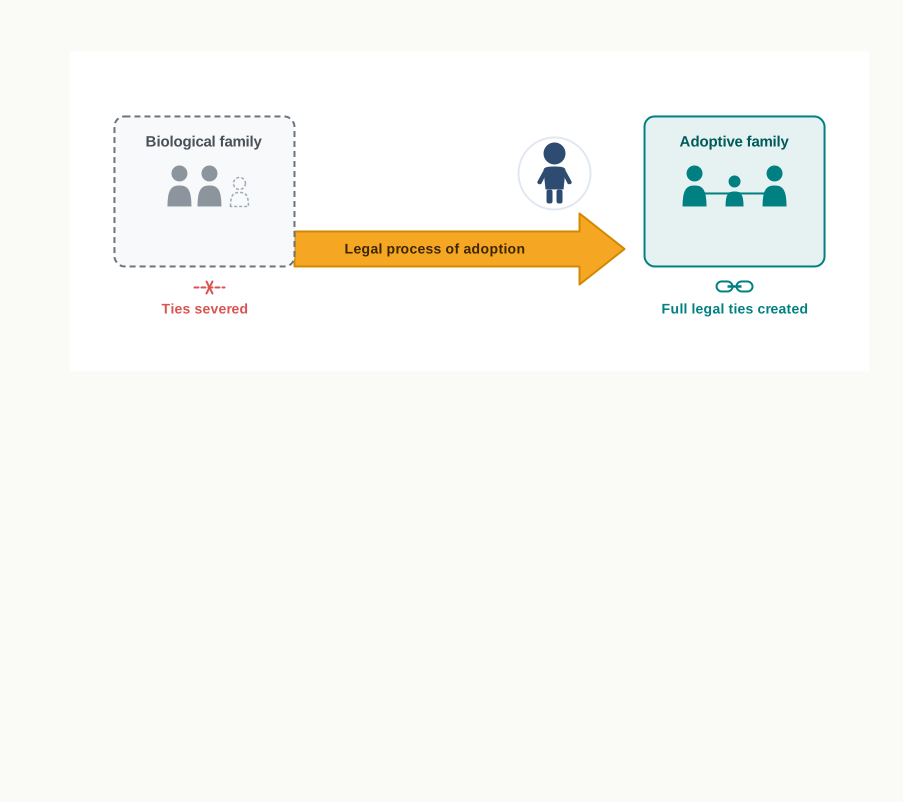
Fig. 17.0 – The legal transformation of adoption.
Read this chapter carefully, and by the end of it you will be able to answer each of these questions yourself.
17.1 Introduction: Why the Law Provides for Adoption
Every society is built out of families, and every family is built around the children it raises. A child who grows up in a secure home — with food, schooling, medical care, and an adult who is answerable for him — usually grows into an adult who can stand on his own feet. That security is not a luxury. It is the ordinary setting in which a child’s rights stop being words on paper and start being real.
For some children, that setting never arrives. Poverty, illness, the death of parents, an unwanted birth, or the collapse of a family can leave a child with no one at all. Such children are usually described in three ways, and the three words are not interchangeable.
Three Kinds of Children Without a Family
An abandoned child is one who has been deserted by his parents or guardians, and who is then declared abandoned by the competent authority after an enquiry. An orphan is a child who has no biological or adoptive parents or legal guardian, or whose legal guardian is unwilling or unable to care for him. A surrendered child is one whom the parents or guardians have voluntarily given up before the competent authority because of physical, emotional or social pressures beyond their control.
The distinction matters because the route into adoption differs. An abandoned child must first be traced and declared; a surrendered child comes through a formal act of relinquishment by parents who are still alive and identifiable.
Leaving such children to grow up in institutions, or in nobody’s care at all, does not answer the problem. Adoption does. It is both a social mechanism and a legal one: socially it gives a child a family, and legally it changes the child’s very status, turning him into the lawful child of the parents who raise him.
What Adoption Law Sets Out to Achieve
The objectives behind regulating adoption may be set out as follows:
- to provide care to children who have no parental or family support, and to secure their welfare;
- to give such children social, emotional and economic security;
- to prevent the exploitation, trafficking and illegal placement of children;
- to regulate adoption through a single, streamlined legal process.
Notice that the first two objectives look at the child’s future, while the last two look at the danger of leaving adoption unregulated. Both halves matter, and the second half explains why the law does not simply let willing families take children home.
17.2 Meaning and Key Features of Adoption
Adoption is the legal process by which a child becomes the lawful child of the adoptive parents. The word to hold on to is becomes. Adoption does not merely place a child in someone’s care; it changes what the child legally is.
From the date the adoption takes effect, the child stands in the same position as a child born into that family. He carries the same rights, the same privileges and the same responsibilities as a natural-born child — the same claim to maintenance, the same place in the line of inheritance, the same family identity.
The Three Key Features
Three features run through every adoption law in India, whichever statute governs the case:
- It creates a permanent legal relationship between the adopted child and the adoptive parents.
- It is irrevocable, and this irrevocability is what protects the adopted child’s interests.
- It puts the welfare of the child first.
Permanence means the relationship is not on trial. It is not a placement that lapses when the child turns eighteen, and not an arrangement that can be reviewed if the family’s circumstances change.
Irrevocability follows from permanence, and it is the feature students most often misread as a technicality. It is not. If an adoption could be undone, the adopted child would live with a conditional family — always at risk of being returned. The law removes that risk by refusing to let anyone, on either side, cancel a completed adoption.
The third feature is the one that decides doubtful cases. Where a provision can be read two ways, or where competing claims are made over a child, the welfare of the child is the paramount consideration — not the convenience of the adults, not the wishes of the biological family, and not the social standing of the applicants.
17.3 Legal Framework Governing Adoption in India
India is a secular country, and the Constitution guarantees the right to freedom of religion under Article 25. One consequence of that guarantee is that communities have been left free to regulate marriage, divorce, family relations, adoption and succession according to their own customs and personal laws.
This is why India has no single adoption law that applies to everyone by default. Instead, adoption sits at the meeting point of four different sources, as shown in Fig. 17.1.
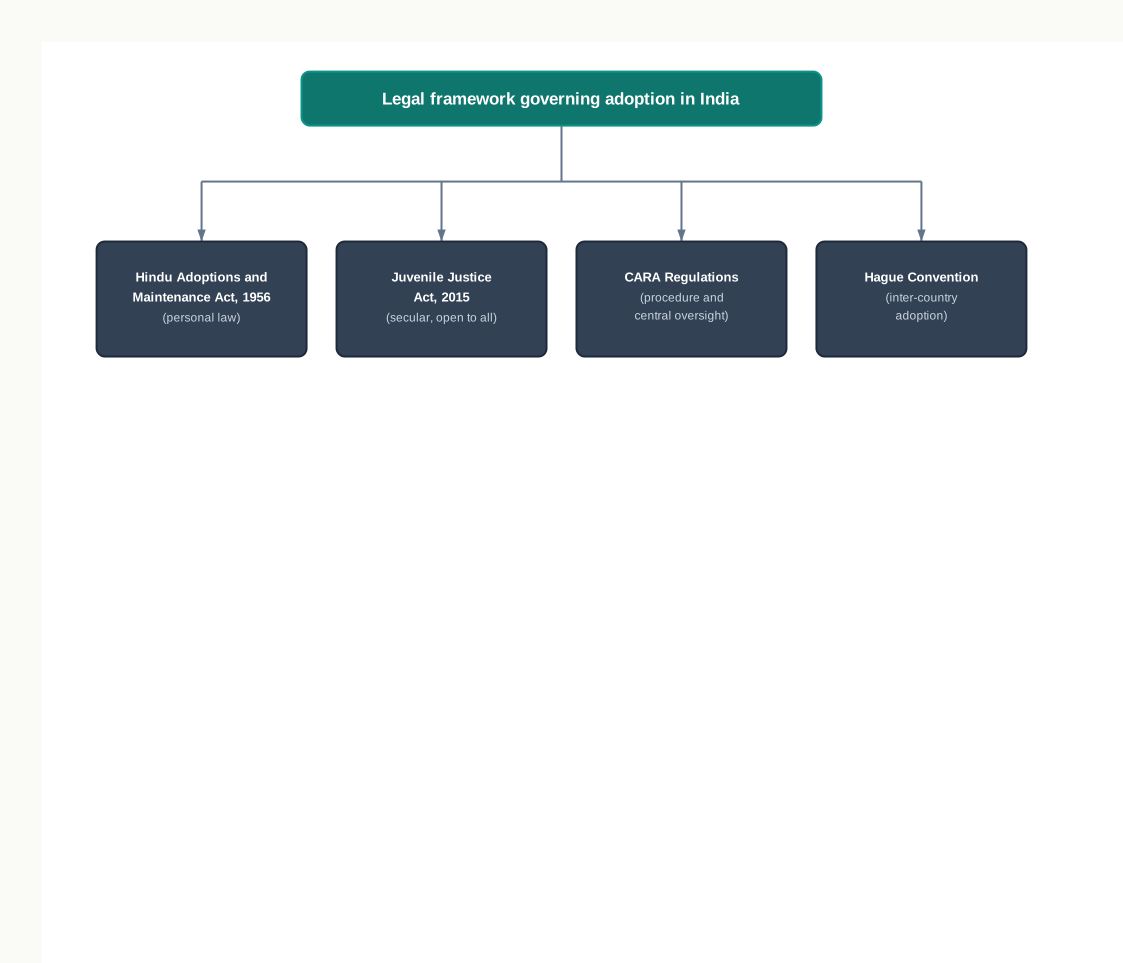
Fig. 17.1 – The legal framework governing adoption in India.
The law relating to adoption is governed by the following:
- the Hindu Adoptions and Maintenance Act, 1956;
- the Juvenile Justice (Care and Protection of Children) Act, 2015;
- the Central Adoption Resource Authority (CARA) Regulations, 2017;
- International Conventions, chiefly the Hague Convention.
How the Four Sources Fit Together
The first is a personal law. The Hindu Adoptions and Maintenance Act, 1956 applies to Hindus, Buddhists, Jains and Sikhs, and it treats adoption as a matter of family law — who may give, who may take, and what the effect is.
The second is a secular statute. The Juvenile Justice (Care and Protection of Children) Act, 2015 is not tied to any religion. It approaches adoption as a child-protection measure, and its procedure is open to any person, whatever their faith.
That distinction matters a great deal, because Muslim, Christian, Parsi and Jewish personal laws do not provide for adoption in the sense that Hindu law does. Under those personal laws a person may become a child’s guardian, but the child does not become a lawful child of the family. Before the secular route existed, that was the only option available to them.
The third source is procedural. CARA is the central authority that frames the detailed regulations under which adoptions are actually carried out, and those regulations supply the step-by-step machinery that the statute only outlines.
The fourth is international. Where a child is adopted by parents living abroad, the adoption crosses two legal systems, and the Hague Convention on inter-country adoption — which India has ratified — lays down safeguards so that a child is not moved across borders without proper scrutiny.
17.4 Adoption under the Hindu Adoptions and Maintenance Act, 1956
The Hindu Adoptions and Maintenance Act, 1956 governs adoption among Hindus, Buddhists, Jains and Sikhs. It is a comprehensive law, in the sense that it answers all three questions an adoption throws up: who may take a child, who may give a child, and who may be taken.
Read the Act with that three-part structure in mind. A single defect in any one of the three is enough to make the adoption invalid, however genuine the intentions of everyone involved.
Who May Take a Child in Adoption
Any male Hindu who is of sound mind and is not a minor has the capacity to take a son or a daughter in adoption. If he has a wife living, he cannot adopt except with her consent.
Any female Hindu who is of sound mind and is not a minor has the same capacity. If she has a husband living, she likewise cannot adopt except with his consent. This applies to a woman whether she is unmarried, widowed, divorced or married — the requirement of the spouse’s consent is what changes, not the capacity itself.
The rule about spousal consent exists for a practical reason. An adopted child enters a household, and acquires rights against the family property of that household. The law will not let one spouse impose that consequence on the other without agreement. The consent is dispensed with only where the spouse has finally and completely renounced the world, has ceased to be a Hindu, or has been declared by a competent court to be of unsound mind.
Who May Give a Child in Adoption
A child can be given in adoption only by a person the Act authorises to do so — the father, the mother, or a guardian. Where both parents are alive, each has an equal right to give the child in adoption, and neither may exercise that right without the other’s consent, subject to the same three exceptions noted above.
A guardian may give the child in adoption only with the prior permission of the court, and only where the parents are dead, have renounced the world, have abandoned the child, have been declared of unsound mind, or where the child’s parentage is unknown. The requirement of court permission is a safeguard: a guardian is giving away a child who is not his own, so a judicial eye is placed on the transaction.
Who May Be Adopted
The Act lays down four conditions that the child must satisfy:
- he or she must be a Hindu;
- he or she must not have been adopted already;
- he or she must not be married, unless a custom or usage applicable to the parties permits a married person to be taken in adoption;
- he or she must not have completed fifteen years of age, unless a custom or usage applicable to the parties permits an older person to be taken in adoption.
The last two conditions carry an escape clause, and students routinely miss it. The rule is not that a married person or a person over fifteen can never be adopted. The rule is that they cannot be adopted unless a recognised custom among those parties allows it — and the burden of proving that custom lies on the person asserting it.
Two Further Conditions
Beyond the capacity of the parties, the Act imposes two conditions on the adoption itself.
The first is the age gap. Where the adoptive parent and the child are of opposite sex, the parent must be at least twenty-one years older than the child. A father adopting a daughter, or a mother adopting a son, must clear that gap. Where parent and child are of the same sex, the condition does not apply at all.
The second is the ceremony of giving and taking. The child must actually be given by the person entitled to give, and actually taken by the person adopting, with the intention of transferring the child from the family of birth to the family of adoption. A written agreement or a registered deed, standing alone, is not enough.
17.5 Effects of a Valid Hindu Adoption
Once an adoption satisfies every condition examined in the previous section, the law treats it as complete, and three consequences follow:
- the adopted child becomes the legal child of the adoptive parents for all purposes, including inheritance;
- the child’s ties with the family of birth are severed and replaced by ties in the adoptive family;
- the adoption is permanent and cannot be revoked.
All three flow from a single idea: the adopted child is not a child in someone’s care, but a child of the family, from the date of the adoption onward.
Three Limits on the Severance Rule
The statement that the child loses all ties with the birth family is true as a general rule, but the Act attaches three limits to it, and each has a clear reason behind it.
First, the adopted child still cannot marry any person whom he or she could not have married had the child remained in the family of birth. Severance is legal, not biological. The prohibited relationships of blood survive the adoption, because the reason for those prohibitions has nothing to do with which family the child legally belongs to.
Second, any property that had already vested in the child before the adoption continues to belong to the child, along with any obligations attached to it — including the obligation to maintain relatives in the family of birth. What the child already owned is not swept into the new family.
Third, the adopted child does not divest any person of an estate that had already vested in that person before the adoption. Adoption changes the child’s status going forward; it does not reopen inheritances that have already closed.
Why the Adoption Cannot Be Undone
The Act makes irrevocability explicit. A validly made adoption cannot be cancelled by the adoptive father or mother, or by anyone else; nor can the adopted child renounce that status and return to the family of birth. The door closes from both sides, and that is deliberate. A child whose family could be dissolved by a later change of mind — on either side — would never have the security that the whole exercise was meant to provide.
17.6 Adoption under the Juvenile Justice Act, 2015 and CARA
Apart from the personal laws that apply to particular communities, the Juvenile Justice (Care and Protection of Children) Act, 2015 provides a secular and uniform procedure for adoption. Its starting point is different from that of a personal law. It does not ask which community the parties belong to; it asks whether a child needs a family and whether these applicants can provide one.
Which Children Can Be Adopted
The Act applies to a child who is abandoned, orphaned or surrendered, and to children who have been declared legally free for adoption by the Child Welfare Committee.
That last phrase does real work, so it is worth pausing on. The Child Welfare Committee, usually shortened to CWC, is the body constituted in every district to decide questions concerning children in need of care and protection. A child is not simply handed over because he appears to have no one. The CWC conducts an enquiry, satisfies itself that the child cannot be restored to his own family, and only then declares him legally free for adoption. Until that declaration is made, no adoption can proceed.
Who May Adopt
The persons eligible to adopt under the Act are:
- married couples;
- single parents;
- divorced persons;
- widows;
- Non-Resident Indians;
- Overseas Citizens of India.
Every applicant must, in addition, satisfy the following eligibility conditions:
- physical, mental and emotional fitness;
- financial stability;
- a clean criminal background;
- a minimum age difference of twenty-five years between the adoptive parent and the child.
Notice what these four conditions are testing. They are not a test of wealth or status. They ask whether this applicant can sustain a child through to adulthood — physically, emotionally and financially — and whether placing a child with this applicant would be safe. The twenty-five-year gap performs the same function as the age rule under Hindu law: it keeps the relationship a parental one.
The Role of CARA
The Central Adoption Resource Authority, known as CARA, has been established as a statutory body under the Ministry of Women and Child Development. It is the authority that turns the statute into a working system.
CARA frames the regulations under which adoptions are actually carried out, and those regulations exist largely to prevent illegal adoptions and trafficking. It also aids inter-country adoptions, where a child is placed with parents living abroad and two legal systems must be satisfied at once. And it maintains the central data for the adoption process — a single national record of children waiting and of parents waiting, so that placements are made from a common pool rather than through private arrangements no one can audit.
17.7 Adoption and Guardianship Distinguished
Adoption and guardianship both put a child into the care of an adult who did not give birth to that child. Students often treat them as two names for one arrangement. They are not, and the differences between them are striking.
The distinction can be reduced to a single line: adoption changes what the child is, while guardianship changes only who is responsible for the child. An adopted child acquires a new legal identity. A ward keeps his own, and simply has someone appointed to look after him and his property.
Read the last two rows together, because they explain each other. A guardian is watched by the court precisely because the guardian is not the child’s parent. He is looking after property and interests that belong to somebody else, and the court stays involved to see that he does it properly. An adoptive parent needs no such supervision, for the same reason a natural parent needs none — the child is his own.
Why the Law Keeps Both
Neither arrangement can do the other’s work. Adoption is the stronger remedy, but it is not always available or appropriate — a child’s parents may be alive and intending to resume care, or the applicant’s personal law may not recognise adoption at all. Guardianship covers those situations, giving a child protection without pretending that his family has changed.
The Balance the Law Strikes
Adoption, then, is a structured process that has evolved to balance competing claims — those of abandoned, surrendered and orphaned children who need safety and security, and those of the adults and institutions around them. Both the customs and the legislation regulating adoption rest on one foundation: the welfare of the child as the paramount consideration.
That is what the entire legal framework surveyed in this chapter is built to deliver. Its conditions, consents, declarations and central records exist to secure two things that a well-meaning private arrangement can never guarantee — transparency in how a child is placed, and permanence in where that child ends up.
17.8 Summary
- A child who has no family of his own is described in one of three ways:
- abandoned — deserted by the parents or guardians and declared abandoned by the competent authority after enquiry;
- orphaned — without biological or adoptive parents or a legal guardian, or with a guardian unwilling or unable to care for the child;
- surrendered — voluntarily relinquished before the competent authority because of physical, emotional or social pressures.
- Adoption law pursues four objectives:
- to provide care to children without parental or family support and secure their welfare;
- to give such children social, emotional and economic security;
- to prevent exploitation, trafficking and illegal placement of children;
- to regulate adoption through a single, streamlined legal process.
- Adoption is the legal process by which a child becomes the lawful child of the adoptive parents, with all the rights, privileges and responsibilities of a child born into the family.
- Adoption has three key features:
- it creates a permanent legal relationship between the child and the adoptive parents;
- it is irrevocable, and that irrevocability protects the adopted child;
- it puts the welfare of the child first.
- Because the Constitution guarantees the right to freedom of religion under Article 25, communities regulate family matters by their own personal laws, and India therefore has no single default adoption law.
- Adoption in India is governed by four sources:
- the Hindu Adoptions and Maintenance Act, 1956;
- the Juvenile Justice (Care and Protection of Children) Act, 2015;
- the Central Adoption Resource Authority (CARA) Regulations, 2017;
- International Conventions, chiefly the Hague Convention.
- Muslim, Christian, Parsi and Jewish personal laws do not provide for adoption; under them a person may become a guardian, but the child does not become a lawful child of the family.
- In Shabnam Hashmi v. Union of India, the Supreme Court held that any person, irrespective of religion, may adopt under the Juvenile Justice Act, but declined to declare adoption a fundamental right.
- The Hindu Adoptions and Maintenance Act, 1956 applies to Hindus, Buddhists, Jains and Sikhs, and answers three questions — who may take a child, who may give a child, and who may be taken.
- Any male or female Hindu of sound mind who is not a minor may adopt; if the spouse is living, the spouse’s consent is required, unless the spouse has finally and completely renounced the world, has ceased to be a Hindu, or has been declared of unsound mind by a competent court.
- A child may be given in adoption by the father, the mother or a guardian; the father and mother have an equal right, neither exercisable without the other’s consent, and a guardian may give the child only with the prior permission of the court.
- Under Section 10, a person may be taken in adoption only if:
- he or she is a Hindu;
- he or she has not already been adopted;
- he or she is not married, unless a custom or usage applicable to the parties permits it;
- he or she has not completed fifteen years of age, unless a custom or usage applicable to the parties permits it.
- Where the adoptive parent and the child are of opposite sex, the parent must be at least twenty-one years older than the child; where they are of the same sex, the condition does not apply.
- The ceremony of giving and taking is compulsory — the child must actually be given and taken, with the intention of transferring the child from the family of birth to the adoptive family; a document alone will not do.
- Under Section 12, the adopted child is deemed to be the child of the adoptive parents for all purposes from the date of adoption, and the ties with the family of birth are severed and replaced.
- The severance rule carries three limits:
- the child still cannot marry any person whom he or she could not have married in the family of birth;
- property already vested in the child continues to belong to the child, along with the obligations attached to it;
- the adoption does not divest any person of an estate already vested in him.
- A valid adoption cannot be cancelled by the adoptive parents or anyone else, nor can the adopted child renounce that status and return to the family of birth.
- The Juvenile Justice (Care and Protection of Children) Act, 2015 provides a secular and uniform procedure, covering children who are abandoned, orphaned or surrendered and those declared legally free for adoption by the Child Welfare Committee.
- Those eligible to adopt under that Act are married couples, single parents, divorced persons, widows, Non-Resident Indians and Overseas Citizens of India.
- Every applicant under that Act must show:
- physical, mental and emotional fitness;
- financial stability;
- a clean criminal background;
- a minimum age difference of twenty-five years between the adoptive parent and the child.
- CARA is a statutory body under the Ministry of Women and Child Development which frames adoption regulations, works to prevent illegal adoptions and trafficking, aids inter-country adoptions, and maintains the central data for the adoption process.
- Adoption differs from guardianship on five bases — permanence, parental rights, legal standing, inheritance and records, and court oversight.
- Adoption changes what the child legally is; guardianship changes only who is responsible for the child.
- Whichever law applies, the welfare of the child remains the paramount consideration, and the framework exists to secure transparency in how a child is placed and permanence in where the child ends up.
17.9 Key Terms
Abandoned child — a child deserted by his parents or guardians, and declared abandoned by the competent authority after an enquiry.
Orphan — a child who has no biological or adoptive parents or legal guardian, or whose legal guardian is unwilling or unable to care for him.
Surrendered child — a child voluntarily relinquished by the parents or guardians before the competent authority because of physical, emotional or social pressures beyond their control.
Adoption — the legal process by which a child becomes the lawful child of the adoptive parents, acquiring all the rights, privileges and responsibilities of a child born into the family.
Irrevocable — incapable of being cancelled or undone once validly completed, either by the adoptive parents or by the adopted child.
Welfare of the child — the paramount consideration in every adoption question, outweighing the convenience or wishes of the adults involved.
Personal law — the body of law that governs a person’s family matters according to the religious community to which that person belongs.
Hague Convention — the international convention on inter-country adoption, which lays down safeguards so that a child is not moved across borders without proper scrutiny.
Spousal consent — the consent a living husband or wife must give before the other spouse can take a child in adoption, dispensed with only where that spouse has finally and completely renounced the world, has ceased to be a Hindu, or has been declared of unsound mind by a competent court.
Custom or usage — an established practice among the parties which, if proved, permits an adoption that the general conditions of the Act would otherwise bar.
Giving and taking — the compulsory ceremony in which the child is actually given by the person entitled to give and actually taken by the person adopting, with the intention of transferring the child from the family of birth to the adoptive family.
Child Welfare Committee (CWC) — the district-level body that enquires into the position of a child in need of care and protection and declares a child legally free for adoption.
Legally free for adoption — the status a child acquires once the Child Welfare Committee has satisfied itself that the child cannot be restored to his own family and has so declared.
Central Adoption Resource Authority (CARA) — the statutory body under the Ministry of Women and Child Development that frames adoption regulations, works against illegal adoption and trafficking, aids inter-country adoption, and maintains the central adoption data.
Inter-country adoption — an adoption in which the child is placed with prospective parents living abroad, so that two legal systems must be satisfied.
Guardianship — an arrangement in which an adult is given responsibility for a child and the child’s property, without the child becoming that adult’s lawful child.
Ward — the child placed under the care of a guardian.
17.10 Points to Ponder
- The law makes a completed adoption irrevocable in order to give the child security. Suppose a placement breaks down badly some years later. What would the child gain, and what would the child lose, if the law allowed such an adoption to be undone?
- India regulates adoption through personal laws for some communities and a secular statute open to everyone. Set out the strongest argument for keeping both routes, and the strongest argument for having a single law for all. Where do you think the balance lies, and why?
- Every safeguard in the adoption process — enquiry, declaration, home study, central records — also makes adoption slower. Children wait while the safeguards operate. How should the law weigh the risk of trafficking against the cost of delay to a child who is already waiting?
- Financial stability is one of the eligibility conditions for an adoptive parent. Does this risk shutting out applicants who could give a child a loving home but not a prosperous one? How would you decide such a case if the welfare of the child were your only guide?
- Under Hindu law a child above fifteen ordinarily cannot be adopted, while the secular statute covers children up to eighteen. Think about a child who has spent years in a children’s home and has just turned fifteen. What does the law’s age line mean for him in practice?
- Adoption severs the child’s ties with the family of birth. Should an adopted person have a right, on reaching adulthood, to learn who his biological parents were? Consider the interests of the adopted person, the adoptive parents and the birth parents in turn.
- The ceremony of giving and taking comes from a time when written records were rare and witnesses were the best proof available. Is a physical ceremony still the most reliable evidence of an adoption today, or could the same certainty be achieved another way?
17.11 Textbook Questions
Based on your understanding, answer the following questions:
The Act that codified the law relating to custody and guardianship of children of the Hindu community is:
- the Guardians and Wards Act, 1890
- the Hindu Minority and Guardianship Act, 1956
- the Hindu Adoptions and Maintenance Act, 1956
Which of the following communities has a law on adoption?
- Christians
- Parsis
- Hindus
- Muslims
Anisha is a minor. Her father, by his Will, appointed Anisha’s aunt as her guardian under the Hindu Minority and Guardianship Act, 1956. Anisha’s aunt is a:
- testamentary guardian
- natural guardian
- de facto guardian
- certificated guardian
Shanaya is a five-year-old Muslim girl. Her parents have separated. Which parent will get custody of the child, and why?
Anuj is the son of Neeta and Neelesh Pandey. The couple have separated and both are eager to obtain custody of Anuj. Who will be Anuj’s guardian under Hindu law? Explain the position of the mother and of the father.
Angad, a minor, was living in Delhi with his parents, who were locked in a bitter dispute over his custody. Explain, with the relevant provisions, who will get his custody.
17.12 Objective Questions
Under the Hindu Adoptions and Maintenance Act, 1956, a person may ordinarily be taken in adoption only if he or she has not completed:
- twelve years of age
- fifteen years of age
- eighteen years of age
- twenty-one years of age
A male Hindu wishes to adopt a girl. The minimum age difference the Act requires between them is:
- fifteen years
- eighteen years
- twenty-one years
- twenty-five years
Under the Juvenile Justice (Care and Protection of Children) Act, 2015, the minimum age difference required between the adoptive parent and the child is:
- eighteen years
- twenty-one years
- twenty-five years
- thirty years
A child is declared legally free for adoption by:
- the Central Adoption Resource Authority
- the Child Welfare Committee
- the biological parents
- the prospective adoptive parents
Which of the following survives an adoption, even though the child’s ties with the family of birth are severed?
- the child’s right to inherit from the biological parents
- the bar on marrying a person from the family of birth whom the child could not have married
- the biological parents’ right to maintain contact with the child
- the biological father’s position as the child’s guardian
The Central Adoption Resource Authority functions under the:
- Ministry of Home Affairs
- Ministry of Law and Justice
- Ministry of Women and Child Development
- Ministry of Social Justice and Empowerment
Which of the following is compulsory for a valid adoption under the Hindu Adoptions and Maintenance Act, 1956?
- registration of an adoption deed
- a public announcement of the adoption
- the actual giving and taking of the child
- a declaration by the Child Welfare Committee
Which of the following is not a source of adoption law in India, as listed in this chapter?
- the Hindu Adoptions and Maintenance Act, 1956
- the Juvenile Justice (Care and Protection of Children) Act, 2015
- the Guardians and Wards Act, 1890
- the Hague Convention
Assertion (A): A validly completed adoption cannot be cancelled by the adoptive father or mother. Reason (R): If an adoption could be undone, the adopted child would live in a family that might return him at any time, which is the very insecurity adoption is meant to remove.
Assertion (A): A married Hindu woman has the capacity to take a child in adoption. Reason (R): The capacity of a female Hindu to adopt depends on her being of sound mind and not a minor, though the consent of her husband is required if he is living.
Assertion (A): A guardian may give a child in adoption only with the prior permission of the court. Reason (R): A guardian is giving away a child who is not his own, and the law places a judicial check on that transaction.
Assertion (A): An adoption does not divest any person of an estate that had already vested in him before the adoption. Reason (R): Adoption operates from the date it is made and does not reopen inheritances that have already closed.
Assertion (A): A person whose personal law does not recognise adoption cannot adopt a child anywhere in India. Reason (R): Adoption in India is governed exclusively by the personal law of the community to which the applicant belongs.
17.13 Check Your Concepts
Distinguish between an abandoned child, an orphan and a surrendered child. Why does the law keep the three categories separate instead of using one word for all of them?
A family genuinely wishes to bring up a child who genuinely needs a home. Why does the law nevertheless insist that they go through a formal legal process? Give two reasons.
State the three key features of adoption. Explain how permanence and irrevocability are connected to each other.
Why does the Hindu Adoptions and Maintenance Act, 1956 require the consent of a living spouse before a person takes a child in adoption? In which situations is that consent dispensed with?
State the four conditions a person must satisfy to be capable of being taken in adoption under Hindu law. Two of them carry an escape clause — identify them and explain what the escape clause is.
Correct the error in the following statement: “Under the Hindu Adoptions and Maintenance Act, 1956, a married person can never be taken in adoption.”
Rekha, a divorced Hindu woman aged thirty, wishes to adopt a boy of ten. Is the age condition satisfied? Would your answer change if she wished to adopt a girl of ten instead? Give reasons.
A parent may give a child in adoption without approaching any court, but a guardian may do so only with the prior permission of the court. Why does the law treat the two differently?
The parties to an adoption execute a written and registered adoption deed, but the child is never actually handed over. Is the adoption valid? Explain what the law requires and why.
“An adopted child loses all ties with the family of birth.” Explain the three limits the law places on this rule.
Why does an adoption not divest a person of an estate that had already vested in him before the adoption? What general principle about the working of adoption does this illustrate?
What is meant by saying that a child has been “declared legally free for adoption”? Which body makes that declaration, and what must it satisfy itself about before making it?
State the eligibility conditions that a prospective adoptive parent must satisfy under the Juvenile Justice (Care and Protection of Children) Act, 2015. What do these conditions, taken together, actually test?
Identify the provision of the Hindu Adoptions and Maintenance Act, 1956 which lays down that an adopted child is deemed to be the child of the adoptive parents for all purposes from the date of adoption, and state what that provision does to the child’s ties with the family of birth.
Distinguish, on any four bases, between adoption under the Hindu Adoptions and Maintenance Act, 1956 and adoption under the Juvenile Justice (Care and Protection of Children) Act, 2015.
Distinguish, on any four bases, between adoption and guardianship.
Arrange the following in the order in which the law tests them when deciding whether a Hindu adoption is valid, and explain why the order matters: the giving and taking of the child; the capacity of the person taking the child; the capability of the child to be adopted; the capacity of the person giving the child.
Explain the functions of the Central Adoption Resource Authority. Why does maintaining central data on children and on waiting parents help prevent trafficking?
The welfare of the child is described as the paramount consideration in adoption. What does the word “paramount” add that the word “important” would not?
Why is it said that adoption changes what a child legally is, while guardianship changes only who is responsible for the child? Use the position on inheritance to support your answer.
17.14 Case-Based Questions
- Sunita, a Hindu widow aged thirty-three, wishes to adopt Aarav, a Hindu boy of thirteen. Aarav’s parents died two years ago and he has since lived with his paternal uncle, who is his guardian and who agrees to the adoption. The two families meet at a lawyer’s office, sign and register an adoption deed, and go home. Aarav continues to live with his uncle for the next several months.
- Is Aarav capable of being taken in adoption? Test him against each condition the Act lays down for the child.
- Can the uncle give Aarav in adoption, and what must he do before he does so?
- Is the condition relating to the age difference satisfied here? Show your working, and state what Aarav’s age would have had to be for the condition to be met.
- Does the registered deed by itself complete the adoption? If not, what is still missing?
- Ishaan is validly adopted by the Menon family when he is eight. Three months before the adoption, he had inherited a small shop from his maternal grandfather. Two years after the adoption, Ishaan’s biological father dies leaving behind property, and Ishaan’s biological cousin claims that Ishaan is entitled to nothing from it. At the same time, a relative suggests that Ishaan can always go back to his birth family when he grows up.
- Does the shop continue to belong to Ishaan after the adoption? Does anything come attached to it?
- Is the cousin right that Ishaan takes no share in his biological father’s property? Give the reason.
- On what footing does Ishaan inherit from the Menons?
- Is the relative’s suggestion correct in law? Explain what would happen if Ishaan, on turning twenty-five, wished to renounce the adoption.
- Farida, an unmarried schoolteacher aged thirty-four, wishes to adopt a girl of four who was found abandoned as an infant and has since lived in a children’s home. Farida’s relatives tell her two things: that her personal law does not provide for adoption, and that in any case only married couples are allowed to adopt.
- Are the relatives correct on either point? Identify the law Farida can use and the authority that settled this question.
- Before the child can be placed with anyone, what must happen to her status, and which body decides it?
- State the eligibility conditions Farida must satisfy, and check whether the age difference between her and the child is sufficient.
- Suppose the child were twelve years old rather than four, and Farida’s age unchanged. Would your answer to (c) be the same? Explain what changes.
- Neel is seven. His mother has died, and his father must undergo prolonged medical treatment abroad and will be unable to care for him for about two years. Neel’s aunt is willing to take him into her home. She asks a lawyer whether she should adopt Neel or apply to be appointed his guardian, saying that either way she intends to look after him as her own.
- Which of the two arrangements fits these facts better, and why? Identify the fact that decides the question.
- How would each arrangement affect Neel’s position in matters of inheritance and records?
- If the aunt were appointed guardian, what continuing role would the court have, and why does the law provide for it?
- What would happen to the father’s rights over Neel under each arrangement?
17.15 Landmark Cases & Maxims
State the principle settled by the Supreme Court in Shabnam Hashmi v. Union of India. What did the Court decline to declare, and why does that refusal matter?
A Christian couple in Kochi wish to adopt a child who has been declared legally free for adoption. A neighbour tells them that adoption is not open to them because their personal law does not provide for it. Identify the authority that answers this objection, and state what it held.
A Sikh couple in Ludhiana wish to adopt their late brother’s son, a boy of nine. Identify which of the adoption laws studied in this chapter governs their case, and state the conditions they must satisfy.
An Overseas Citizen of India settled in Canada wishes to adopt a child from an Indian children’s home. Identify the statute that permits this, the body that regulates the process, and the international instrument that applies.
A Hindu couple wish to adopt a Hindu boy who is fifteen years and two months old. Identify the provision that stands in their way, and state the only basis on which the adoption could still be valid, together with who would have to prove it.
“The welfare of the child is the paramount consideration.” Identify any two rules studied in this chapter that exist to give effect to this principle, and explain in each case how the rule does so.