Chapter 18: Property, Succession and Inheritance
A shopkeeper in a small town dies in his sleep. He leaves behind a house, a shop, some gold in a bank locker, and no will. Within a week his two sons have divided the shop between themselves. His daughter, married and living in another city, is told what daughters in that family had always been told — the shop was ancestral property, and ancestral property went to sons.
She was not sure that was still the law. It was not.
For a long time, the law of the Hindu joint family did treat a son as a coparcener from the moment he was born, and treated a daughter as someone who would marry into another family and take nothing from her own. On 9 September 2005, Parliament amended Section 6 of the Hindu Succession Act, 1956. From that day, a daughter became a coparcener in her father’s joint family property by birth, on the same footing as a son, with the same rights and the same liabilities.
One amendment, a few lines long, unsettled thousands of quiet family arrangements that everyone had assumed were final. That is what this branch of law does. It decides who gets what after a death — and it does so whether or not the family has thought about it, whether or not anyone wrote anything down, and whether or not the family agrees.
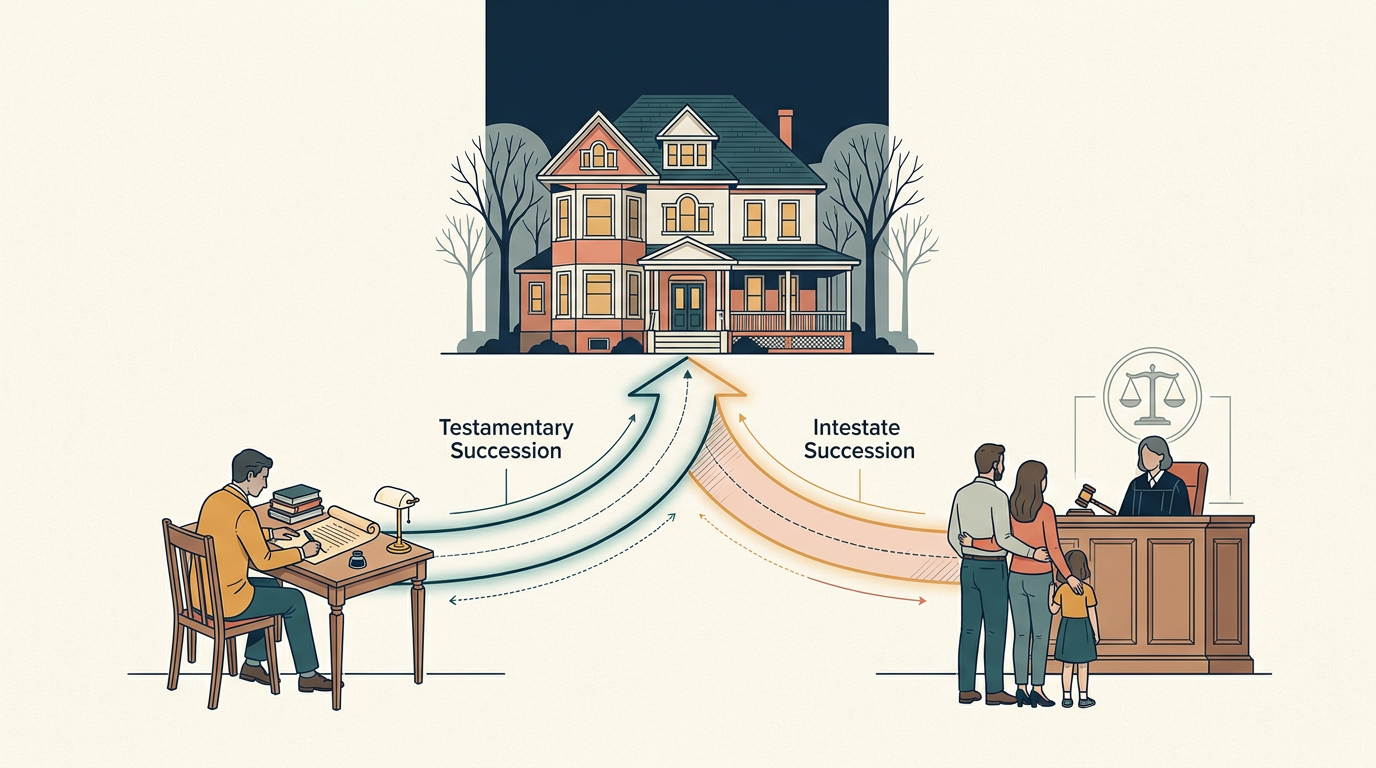
Fig. 18.0 – Testamentary and intestate succession.
By the end of this chapter, you will be able to answer each of these questions — and to draft a simple will of your own.
18.1 Concept of Property: Joint Family Property and Self-Acquired Property
Everything a person owns — a house, a shop, a bank balance, a scooter, a plot of land — is his property. The word itself carries that idea. It comes from the Latin proprietas, built on proprius, meaning “one’s own”, and from its French equivalent propriété. At its root, property means a thing owned.
Ownership matters here for one reason. Property does not die with its owner; it has to go somewhere. But before the law can decide where it goes, it must first ask what kind of property it is — because the answer is not the same for every kind.
Two Kinds of Property
There are two kinds of property: joint family property and self-acquired property.
Joint family property is property acquired out of the joint funds of the family. It is not owned by any one member. It belongs to the family as a body, and the needs of the family are met out of it.
Self-acquired property is property a person has acquired by his own exertion or labour, without drawing on the joint family funds. Here there is a single owner, and it includes property he has gained through his own learning.
This distinction is not a matter of vocabulary. It decides who may claim a share during the owner’s lifetime, and — as you will see later in this chapter — it decides what a person is free to leave by a will.
Property Earned by Learning
Self-acquired property includes what a person earns through his own learning — and that was once a genuinely disputed question. If a joint family paid for a son’s professional education out of family funds, and he then earned well from that profession, was the income his or the family’s? Courts had taken the view that where the special training had been paid for out of joint family funds, what the member earned by that training belonged to the family.
Parliament settled the dispute through the Hindu Gains of Learning Act, 1930. Under Section 3 of that Act, gains of learning are the exclusive and separate property of the acquirer, and they do not cease to be so merely because his learning was imparted to him by a family member, or was paid for out of joint family funds, or because he was maintained out of those funds while he studied.
The Act also tells us what counts as “learning”, and it is deliberately wide — it covers ordinary schooling as much as specialised professional training.
18.2 Inheritance and Succession
A person may come to own property in several ways. He may buy it, he may be given it, he may make it. He may also inherit it. Inheritance is one of the means of acquiring property, and it is the only one that operates because somebody has died.
What Inheritance Means
Inheritance is the right of an heir to succeed to property on the death of an ancestor. The right does not exist while the ancestor is alive; it is death that brings it into operation.
India has no single law of inheritance. Persons belonging to different religions are governed by different laws of succession, and much of this chapter is taken up with those differences.
Rights That Survive Death, and Rights That Do Not
When the owner dies, not everything he held passes on. All the rights belonging to the deceased with regard to property are divisible into two classes:
- inheritable rights; and
- un-inheritable rights.
A right is inheritable if it survives its owner. It remains functional even after the death of the person to whom it belongs, and devolves on his or her legal representative. Proprietary rights — that is, rights attached to property — are of this kind. A debt owed to the deceased is a good example: the money is still owed, and now it is owed to those who stand in his place.
A right is not inheritable if it dies with the person. Personal rights — rights associated with the person rather than with any property — are of this kind. They are extinguished by the death of the deceased and there is nothing left to devolve.
What Succession Means
Succession is the process by which property is transferred on someone’s death. The same word is also used for the estate itself — the whole body of property a person leaves behind when he dies.
There are two ways in which succession can happen, and everything that follows in this chapter sits under one or the other of them, as shown in Fig. 18.1. Either the deceased left instructions, or he did not.
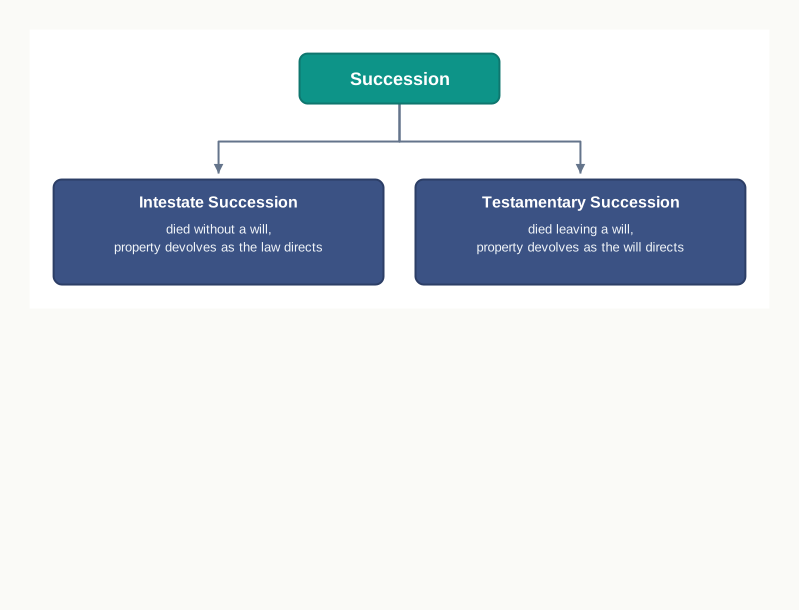
Fig. 18.1 – The two modes of succession.
Heir, Testator and Will
Three words recur throughout this chapter, and it is worth fixing them now.
The persons on whom the property devolves are called the heirs of the deceased. A person entitled to inherit property after the death of an intestate is an heir. A testator, by contrast, is a person who has made a legally valid will before death. And a will is the document in which he says what he wants done.
Notice the two features packed into that sentence. A will is a declaration of wishes, so it binds nobody during the testator’s lifetime and he may change it. And it takes effect only after death, which is why it must be legally valid on its own terms — the one person who could explain what he meant is no longer available to be asked.
Testamentary Succession in Outline
When a person disposes of his property by making a will, it is known as testamentary succession. A person can make a will only of property he is capable of disposing of — his separate property, which is the self-acquired property you met in the previous section. For Hindus, Christians and Parsis, testamentary succession is governed by the Indian Succession Act, 1925.
In testamentary succession, the law empowers a person to decide during his lifetime what is to become of the property he leaves behind after his death. The law then respects that decision and secures its enforcement — that is, it compels observance of and obedience to the will. A person who determines the disposition of his property in this way is said to have made a will.
That is the whole idea in outline. The detailed rules on wills, on who may make one and on how it is proved are taken up in Section 18.8.
18.3 Intestate Succession
Most people never write a will. They mean to, and then they run out of time. The law has to be ready for that, because property cannot simply be left lying about while a family argues.
A person who dies without making a will is known as an intestate, and succession to his property is known as intestate succession.
In intestate succession the property devolves according to the law or custom by which the deceased was governed. That is the key idea. The deceased left no instructions, so the law supplies a set of instructions for him — a ready-made scheme of heirs, arranged in an order of preference that the law thinks he would probably have chosen himself.
Intestate Succession among Hindus
If a Hindu dies intestate, both his separate property and joint family property pass to his heirs in accordance with the Hindu Succession Act, 1956.
Under Hindu law, a son had a birthright in joint family property — he became a coparcener the moment he was born, and did not have to wait for anyone to die. A daughter had no such right. The Hindu Succession (Amendment) Act, 2005 was enacted to remove the gender-discriminatory provisions of the Hindu Succession Act, 1956. It substituted a new Section 6, under which a daughter becomes a coparcener by birth in her own right, in the same manner as a son, with the same rights and the same liabilities. She therefore takes in the properties of her father, grandfather and great-grandfather exactly as a son does.
For some years after 2005 one question remained open, and it mattered to thousands of families: did the new Section 6 help a daughter whose father had already died before the amendment came into force?
Intestate Succession among Muslims
Muslims have no codified law of intestate succession. They are governed by the rules contained in their religious texts.
Two features of that system are worth noticing straight away, because they run against the Hindu pattern you have just read. First, Muslim law makes no distinction between ancestral property and self-acquired property; all property of the deceased is treated alike. Second, there is no birthright at all — the right of an heir comes into existence only on the death of the ancestor. Until that moment an heir has nothing but an expectation.
Intestate Succession in Other Religions
The Indian Succession Act, 1925 governs the intestate succession of Christians and Parsis.
So every community has its own rules, and they differ in detail. Yet certain ideas run through all of them, and it is those shared ideas that make the subject learnable. Chief among them is the idea of the heir. A person entitled to inherit property after the death of an intestate is an heir, and heirs everywhere fall into three broad types — ascendants, descendants and collaterals. Those categories, and the way blood relationships are graded within them, are taken up next.
18.4 Heirs and Their Classification
Every religion has its own rules of intestate succession, but certain concepts are common to all of them. The most basic is the heir. A person who is entitled to inherit property after the death of an intestate is known as an heir, and the persons on whom the property devolves are the heirs of the deceased.
Heirs can be of three types — ascendants, descendants and collaterals. The three are simply three directions in which you can move away from the dead person on a family tree: upwards, downwards, and sideways. Fig. 18.2 shows all three at once, and it is worth studying before you read further.
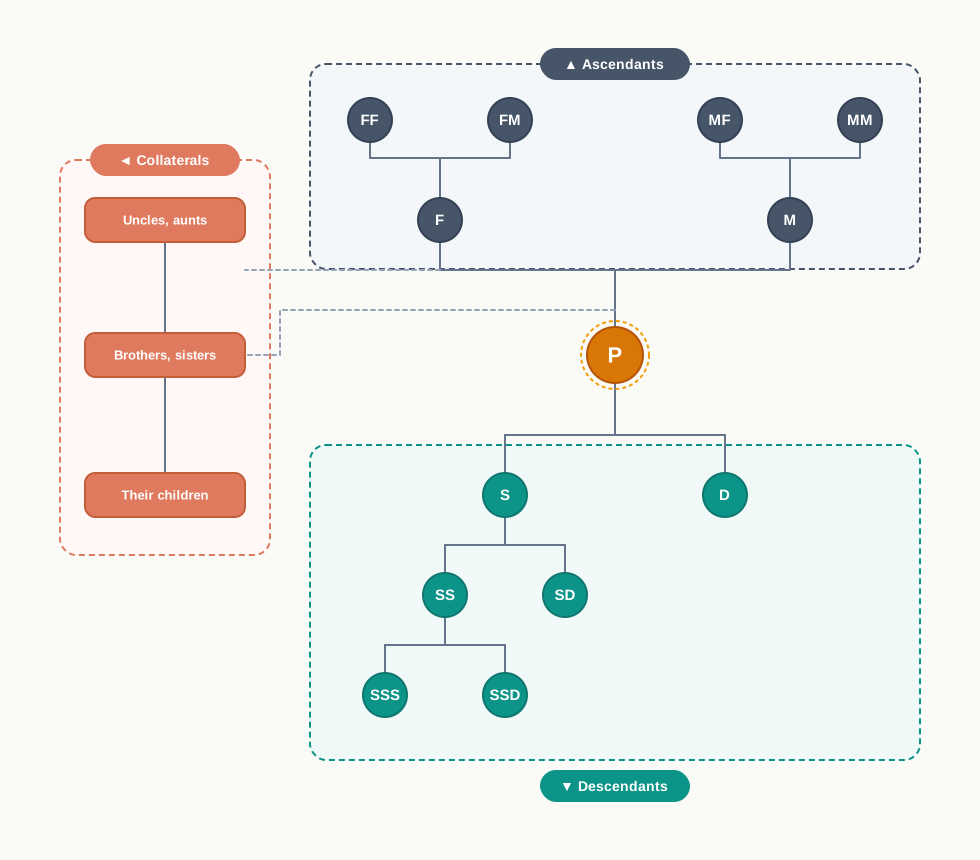
Fig. 18.2 – Ascendants, descendants and collaterals.
Reading the Notation
The letters in that figure are a shorthand this chapter will use again, so learn it now. The deceased whose property is being divided is P. F stands for father and M for mother; S for son and D for daughter. Longer strings are read outward from P, one step at a time: FF is the father’s father, FM is the father’s mother, SD is the son’s daughter, and SSS is the son’s son’s son.
Ascendants
Ascendants are the ancestors of a person, on both the paternal and the maternal side. The immediate ascendants are the father and the mother. The class includes father (F), mother (M), paternal grandfather (FF), paternal grandmother (FM), maternal grandfather (MF), maternal grandmother (MM), and so on. There is no limit to the degrees of ascent.
Descendants
Descendants mean the offspring of a person. The immediate descendants are his or her sons and daughters. The class includes son (S), daughter (D), grandson (SS), granddaughter (SD), great-grandson (SSS), great-granddaughter (SSD), and so on. Here too there is no limit to the degrees of descent.
Collaterals
Collaterals are descendants in parallel lines — that is, persons who descend from a common ancestor or ancestress but not from one another. Your brother is not your ancestor and not your offspring; you and he simply run down from the same parents in two parallel lines. Brothers and sisters and their children however low, and paternal and maternal uncles and aunts and their children however low, are all collaterals.
Relation by Full Blood, Half Blood and Uterine Blood
Collateral heirs can be related to each other by full blood, half blood or uterine blood, and the difference turns on one question only: which parent do they share?
Two persons are related by full blood when they have the same father and the same mother. They are related by half blood when they have the same father but different mothers. They are related by uterine blood when they have the same mother but different fathers.
This looks like a piece of vocabulary, but it does real work. Where two collaterals are otherwise equally placed, several systems of succession prefer the one related by full blood.
The Common Pattern
Look past the differences between communities and one broad pattern shows itself. The rules pertaining to intestate succession are more or less similar across communities: first preference goes to the husband or wife of the deceased and to their lineal descendants. In their absence, preference is given to collaterals who are close to the deceased. In their absence, the property goes to remote agnatic heirs, and after them to cognatic heirs. Agnates and cognates are explained in the next section.
The pattern is not accidental. It moves outward from the household the deceased actually lived in, to the family he came from, and only then to relatives he may never have met.
However, every religion has adopted a different way of working out that pattern in detail, and it is to those detailed schemes that we now turn.
18.5 Rules of Intestate Succession among Hindus
If a Hindu dies intestate, the Hindu Succession Act, 1956 decides who takes his property. The Act does not divide the estate among every relative it can find. It arranges relatives into categories and works through them in a fixed order, and a later category gets nothing so long as anyone in an earlier category is alive.
That single idea — exhaust one category before moving to the next — is the whole architecture of what follows.
18.5.1 Rules of Intestate Succession of a Hindu Male
Heirs of a Hindu male are classified into four categories: Class I heirs, Class II heirs, agnates and cognates.
Class I heirs are the most preferred heirs. The class includes the mother, the widow, the son and the daughter, and the descendants of a predeceased son or daughter up to the third generation. Class I heirs take the property together, and they exclude everybody else.
Class II heirs include the father, the brother and the sister and their children, maternal and paternal uncles and aunts, and maternal and paternal grandfathers and grandmothers. Class II heirs will inherit the property only in the absence of Class I heirs.
If there are no heirs belonging to Class I or Class II, the property goes to the agnates of the deceased. And if there are no agnates either, it goes to the cognates.
Who are Agnates?
When two persons are related by blood or adoption wholly through males, they are called agnates. “Wholly through males” is the whole test — trace the chain from one person to the other, and if every link in it is male, they are agnates.
Take the son of a great-grandson, where the son, the grandson and the great-grandson are all dead:
P → S → SS → SSS → SSSS1
Here S is the son of P; SS is the son of S and the grandson of P; SSS is the son of SS and the great-grandson of P; and SSSS1 is the son of SSS and the great-great-grandson of P. SSSS1 is an agnate of P, because he traces his relationship wholly through males — his father (SSS), his grandfather (SS) and his great-grandfather (S). No female has intervened in between.
Who are Cognates?
When two persons are related by blood or adoption but not wholly through males, they are called cognates. Notice how little it takes: one female anywhere in the chain, and the relationship is cognatic.
Take the father of the paternal grandmother:
P → F → FM → FMF1
F is the father of P; FM is the mother of F and therefore the paternal grandmother of P; and FMF1 is the father of FM. FMF1 is a cognate of P, because a female — the father’s mother (FM) — has intervened in between.
18.5.2 Rules of Intestate Succession of a Hindu Female
Where a female Hindu dies intestate, her heirs are divided into five categories instead of four. The governing idea is the same as before: heirs in the earlier categories are preferred over heirs in the later categories.
The first category includes the husband, the son, the daughter, and the children of a predeceased son and daughter. The second category consists of the heirs of the husband. The father and the mother fall in the third category. The heirs of the father are covered in the fourth category and the heirs of the mother in the fifth.
Why the Two Schemes Differ
One difference between the two schemes is worth pausing on, because it is a favourite of application-based questions. For a male intestate, the second port of call is his own blood family. For a female intestate, the second port of call is her husband’s family, which ranks ahead of her own father and mother.
The reason is historical. The scheme was built on an assumption about where a married woman’s property was thought to have come from, and about the family she was thought to have joined. Whether that assumption still holds for a woman who has earned her own property is a live question, and one you should be able to argue on both sides.
18.6 Rules of Intestate Succession among Muslims
There is no codified law for Muslims in the area of succession. They are governed by their religious texts, and the working rules differ between the two principal schools. The Sunni scheme and the Shia scheme are therefore taken up separately.
18.6.1 Rules of Intestate Succession among Sunni Muslims
Among Sunnis, heirs are divided into three categories:
- Sharers, also called Quranic heirs;
- Residuaries, also called agnatic heirs; and
- Distant kindred, also called uterine heirs.
The second and third names should look familiar. Residuaries are agnatic heirs — related to the deceased through males, in the sense you met in the previous section. Distant kindred are uterine heirs, the relations who come in through a female link.
Sharers are the most preferred heirs. The estate is opened by allotting the sharers their Quranic shares, which are fixed fractions rather than whatever happens to be left over. Only if something remains after those shares have been paid does the residue go to the residuaries. If the sharers’ shares exhaust the entire estate, then the sharers exclude both the residuaries and the distant kindred, and the later categories take nothing.
Distant kindred are not entitled to succeed so long as there is any heir belonging to the class of sharers or residuaries. But there is one case in which distant kindred will inherit along with a sharer: where the only sharer is the wife or the husband of the deceased, and no other sharer and no residuary exists. The spouse takes the fixed Quranic share and the remainder passes to the distant kindred, who would otherwise have been shut out.
18.6.2 Rules of Intestate Succession among Shia Muslims
Among Shias, heirs are divided into two categories:
- heirs by consanguinity — that is, heirs related by blood; and
- heirs by marriage — that is, the husband and the wife.
Heirs by Consanguinity
Heirs by consanguinity are further subdivided into three classes:
- Class I includes parents and children.
- Class II includes grandparents, brothers and sisters, and their descendants.
- Class III includes the paternal and maternal uncles and aunts of the deceased, and those of his parents and grandparents.
Among the heirs by consanguinity, the first group excludes the second and the second group excludes the third. So the presence of a single Class I heir keeps the whole of Class II out.
The two main categories, however, do not exclude each other. The claimants in both categories — heirs by consanguinity and heirs by marriage — succeed together, if there are heirs of both categories. A surviving husband or wife is therefore not displaced by the blood relations; the spouse takes alongside them.
18.7 Intestate Succession under the Indian Succession Act, 1925
The Indian Succession Act, 1925 is a central legislation, and it is applicable to every person unless he is governed by some law particularly applicable to him. That last clause is what keeps the Act out of the way of the personal laws you have already studied: its rules of intestate succession do not apply to Hindus or to Muslims, who are governed by the Hindu Succession Act, 1956 and by Muslim personal law respectively. Christians and Parsis are governed by this Act, though the Act lays down a separate set of rules for each of them.
Intestate Succession among Christians
Among Christians, the first preference is given to the spouse of the deceased and to his lineal descendants — that is, his children, grandchildren, great-grandchildren, or their remoter lineal descendants.
When there are no lineal descendants, the property passes to the spouse of the deceased and to those who are kindred to him. Kindred here rests on consanguinity, which is the connection or relation of persons descended from the same stock or common ancestor. In short, if the line running downwards from the deceased is empty, the law turns sideways and upwards to the family he came from.
If there are neither lineal descendants nor anyone who is kindred to him, the entire property goes to his or her spouse. And in the absence of such a spouse, the property passes to the lineal descendants, or to those who are kindred to him.
Rule of Escheat
Every scheme in this chapter can run out of people. A person may die intestate leaving no spouse, no descendant, no ascendant and no collateral that the law will recognise. The property still exists, and it cannot be allowed to belong to nobody.
The rule of escheat answers that situation, and it is applicable in all the communities. If no heir is present, the property goes to the Government by this rule.
18.8 Testamentary Succession
You met testamentary succession in outline in Section 18.2: where a person disposes of his property by making a will, the property devolves as the will directs and not as the law of intestacy would have directed. This section takes up the detail — who may make a will, what may be given away by one, and what formalities the law insists on.
18.8.1 Testamentary Succession under Muslim Law
An executor under Mohammedan law is called a wasi, a word derived from wasiyyat, which means a will. A Muslim who is of sound mind and who is not a minor may make a valid will.
No particular form is required to make a valid will. Any unequivocal expression of a testamentary nature will suffice, and it may be made either verbally or in writing. This is a striking contrast with the formality-heavy scheme you will read about next, and it places a great deal of weight on proof — a spoken will is valid, but somebody still has to establish to a court’s satisfaction that it was made and what it said.
Two limits apply to what can be given away. Any property which is capable of being transferred, and which exists at the time of the testator’s death, may be disposed of by a will. Property that belongs to another cannot be bequeathed by a will — a man cannot give away what was never his.
The more important limit is on quantity. A Muslim can dispose of only one-third of his property, and that one-third is worked out on what is left after the payment of his funeral expenses and his debts. The balance two-thirds of the property goes to the heirs of the deceased.
18.8.2 Testamentary Succession among Hindus, Parsis and Christians
The rules relating to testamentary succession among Hindus, Parsis and Christians are contained in the Indian Succession Act, 1925.
The Act does not deal with substantive law — it does not say what property may be transferred, or what estates and interests may be created. Those questions are answered by other laws. What this Act supplies is machinery: the formalities that turn a person’s wishes into an enforceable document, and the procedure for giving effect to it after he is gone.
The Indian Succession Act, 1925 primarily deals with formalities relating to the following matters:
- Execution — the validation of a legal document by the performance of all the necessary formalities.
- Revocation — the recalling, withdrawal or reversal of a will.
- Revival — the restoration of a will to use, acceptance, activity or vigour after a period of obscurity.
- Interpretation of wills — that is, the explanation or conceptualisation of what a will means.
- The grant of probate and other legal representations, and the powers and duties of executors.
Probate is the process of legally establishing the validity of a will before a judicial authority. Until a will is proved, it is only a piece of paper making claims; probate is what allows those claims to be acted upon with the court’s backing. An executor is a person appointed by a testator to execute the testator’s will.
Where there is no executor, somebody still has to gather in the estate, pay the debts and hand over what remains. Administrators are persons authorised to manage an estate, especially where the owner has died intestate or without having appointed executors.
Finally, a point about the character of this Act. It is a secular law in the sense that it is not tied to any single community: in matters of testamentary succession it governs Hindus, Parsis and Christians alike, which no personal law does. Muslim wills, as you have just seen, remain governed by Muslim personal law.
18.9 Drafting a Will
A will is not a difficult document to write. It is a difficult document to write well, because it has to be clear to people who will read it at a time when its author can no longer explain anything. Every ambiguity in a will is settled by a court, at the family’s expense.
A well-drafted will therefore does more than name a beneficiary. It proves that the testator was capable and acting freely, it identifies the property precisely, it deals with what should happen if a beneficiary dies first, and it is executed in a way that makes it easy to prove.
What Each Clause Is Doing
Read the specimen below once for its sense, and then read it again against this list, clause by clause.
- The opening clause identifies the testator, records his age and address, and revokes all earlier wills. That revocation matters: without it, an old will may survive to compete with the new one. The clause also states that he is of sound mind and acting under no duress, and names his family — which shows the court that he knew who his natural heirs were.
- The inventory lists the property. A will can operate only on property that can be identified, so each item is described by location, date of acquisition, quantity or value.
- The declaration that all the assets are self-acquired connects directly to Section 18.1. A testator can bequeath only property he is capable of disposing of, and self-acquired property is the clearest case.
- The operative clause makes the actual gift, and then adds a substitution — if the wife predeceases the testator, the assets go to the children equally. Wills that fail to plan for the order of deaths are a common source of litigation.
- The liabilities clause directs that debts, taxes and charges be discharged out of the estate. Beneficiaries take what is left after the estate’s obligations are met, not before.
- The declaration of free consent states that the will was made without pressure, coercion, undue influence or mistake. It anticipates the most common ground of challenge — that the old and ill were talked into signing something.
- The attestation clause records that the testator signed in the presence of two witnesses, who then signed in his presence and in the presence of each other. This is the formality that makes the will provable later.
Specimen Will
I ______, d/o or s/o ______, resident of ______, aged ______ years, hereby write my final will and testament. Any wills written previously are hereby revoked under the laws of India. I am writing this will freely and under no duress. I am of sound mental and physical health and in a position to comprehend what I write in this will. I am married to ______ and we have two children, namely ______ aged 20 years and ______ aged 25 years.
As of today, I own the following, which I would like to bequeath by virtue of this will:
- one 4 BHK flat located at ______, with an area of 1500 sq. feet, bought on 24th November 2008 for Rs. 75 lacs;
- cash amounting to Rs. 10 lacs in fixed deposit at ______ bank;
- one car bought in the year 2015;
- one car bought in the year 2018;
- gold jewellery weighing approximately 300 grams lying in a bank locker located at ______; and
- 1000 share certificates of ______ Limited amounting to Rs. 10 lacs.
All the assets owned by me are self-acquired properties. No one else has any right, title, interest, claim or demand whatsoever on these assets or properties. I have full right, absolute power and complete authority over these assets, or over any other property which may be substituted in their place, or which may be acquired or received by me hereafter.
It is my wish and desire that after my death all my assets as mentioned above will devolve upon my wife, who shall then become the sole and absolute owner thereof, to the exclusion of my other legal heirs. However, in the event that my wife predeceases me, all my assets will devolve upon my children equally, absolutely and forever, to the exclusion of any other legal heir.
All my loans and liabilities, including but not limited to taxes, penalties, cess and charges of whatsoever nature, whether existing or created after my death, shall be repaid and discharged by my wife or my children, as the case may be, out of my aforementioned assets.
I have made this will in full consciousness, without any pressure, coercion, undue influence or mistake of any kind, and with bona fide intent to avoid any dispute, misunderstanding or litigation that may arise between my legal heirs after my death.
I have carefully read and understood the contents of this will, and the same is being signed by me in the presence of two responsible persons who will be the attesting witnesses.
In witness whereof I, ______, declare this to be my last will and set my hand on this ______ day of ______, in the presence of the undermentioned witnesses, each of whom has simultaneously signed in my presence and in the presence of each other.
WITNESSES:
TESTATOR
Name:
Signature:
18.10 Summary
- The word property comes from the Latin proprietas and the French propriété, and at its root it means a thing owned.
- There are two kinds of property:
- joint family property, acquired out of the joint funds of the family and held for the family as a whole; and
- self-acquired property, acquired by a person’s own exertion, labour or learning.
- Under Section 3 of the Hindu Gains of Learning Act, 1930, gains of learning are the exclusive and separate property of the acquirer, even if his learning was imparted by a family member or paid for out of joint family funds.
- Section 2(c) of that Act defines learning widely, covering education of every kind as well as training intended to enable a person to pursue any trade, industry, profession or vocation.
- Inheritance is the right of an heir to succeed to the property of an ancestor on the ancestor’s death.
- On the death of the owner, his rights fall into two classes:
- inheritable rights, which are proprietary rights, survive the owner and devolve on his legal representative; and
- un-inheritable rights, which are personal rights and are extinguished with the person.
- Succession is the process by which property is transferred on a person’s death, and the word also describes the estate left behind.
- Succession takes two forms — intestate succession, where no will was made, and testamentary succession, where a will was made.
- An heir is a person entitled to inherit the property of an intestate; a testator is a person who has made a legally valid will; and a will is a legal declaration of a person’s wish regarding the disposal of his property after death.
- Where a person dies intestate, the property devolves according to the law or custom by which he was governed, not according to family agreement.
- If a Hindu dies intestate, both his separate property and his joint family property pass to his heirs under the Hindu Succession Act, 1956.
- The Hindu Succession (Amendment) Act, 2005 substituted Section 6 of that Act, making a daughter a coparcener by birth in her own right, in the same manner as a son, with the same rights and liabilities.
- In Vineeta Sharma v. Rakesh Sharma, (2020) 9 SCC 1, the Supreme Court held that this applies to a daughter born before or after the amendment, and that her father need not have been alive on 9 September 2005.
- Heirs everywhere fall into three types:
- ascendants, the ancestors of a person on both the paternal and maternal sides;
- descendants, the offspring of a person; and
- collaterals, relatives descending in parallel lines from a common ancestor or ancestress.
- There is no limit to the degrees either of ascent or of descent.
- Collaterals may be related by full blood (same father and same mother), half blood (same father, different mothers) or uterine blood (same mother, different fathers).
- Under Section 8 of the Hindu Succession Act, 1956, the property of a Hindu male dying intestate devolves in a fixed order:
- Class I heirs, who exclude all others;
- Class II heirs, only in the absence of Class I heirs;
- agnates, only in the absence of both classes; and
- cognates, only in the absence of agnates.
- Agnates are persons related wholly through males; cognates are persons related otherwise than wholly through males, that is, where at least one female intervenes in the line.
- Under Section 15 of the same Act, the heirs of a Hindu female dying intestate fall into five categories, taken in order:
- the husband, sons and daughters, and the children of a predeceased son or daughter;
- the heirs of the husband;
- the father and the mother;
- the heirs of the father; and
- the heirs of the mother.
- Muslims have no codified law of intestate succession and are governed by their religious texts, which make no distinction between ancestral and self-acquired property.
- Under Muslim law there is no birthright; the right of an heir comes into existence only on the death of the ancestor.
- Among Sunnis, heirs fall into three categories — sharers or Quranic heirs, residuaries or agnatic heirs, and distant kindred or uterine heirs.
- Sharers are allotted their fixed Quranic shares first; only the residue goes to residuaries; and distant kindred take only where there is no sharer or residuary.
- The single exception is that distant kindred inherit alongside a sole sharer who is the husband or wife of the deceased, where no other sharer and no residuary exists.
- Among Shias, heirs fall into two categories — heirs by consanguinity and heirs by marriage.
- Heirs by consanguinity are divided into three classes, each excluding the next, but heirs by marriage succeed together with them and are never displaced.
- The Indian Succession Act, 1925 is a central legislation applicable to every person unless he is governed by a law particularly applicable to him; its intestacy rules do not apply to Hindus or Muslims.
- Among Christians, first preference goes to the spouse and the lineal descendants; in the absence of lineal descendants the spouse takes with the kindred; in the absence of both the spouse takes the whole; and where there is no spouse, the estate goes to the lineal descendants and then to the kindred.
- Under the rule of escheat, which applies in all communities, the property of a person who dies leaving no heir goes to the Government; the idea behind it is expressed by the maxim bona vacantia.
- Under Muslim law, an executor is called a wasi, and a Muslim of sound mind who is not a minor may make a valid will.
- A Muslim will requires no particular form and may be made verbally or in writing, but it can operate only on property capable of being transferred and existing at the testator’s death.
- A Muslim may bequeath only one-third of the property remaining after payment of funeral expenses and debts; the balance two-thirds goes to his heirs.
- Testamentary succession among Hindus, Parsis and Christians is governed by the Indian Succession Act, 1925, which deals with formalities rather than substantive law.
- The formalities it governs include:
- execution of wills;
- revocation;
- revival;
- interpretation; and
- the grant of probate, and the powers and duties of executors.
- Probate is the process of legally establishing the validity of a will before a judicial authority.
- An executor is appointed by the testator to carry out the will, while an administrator is authorised to manage an estate where the deceased died intestate or appointed no executor.
- A well-drafted will identifies the testator and revokes earlier wills, describes the property precisely, records that the testator acted freely and with a sound mind, provides for a beneficiary predeceasing him, directs payment of liabilities, and is attested by two witnesses.
18.11 Key Terms
Property — anything that is owned; the word derives from the Latin proprietas, meaning a thing owned.
Joint family property — property acquired by the joint funds of the family, held for the family as a whole, out of which the needs of the family are fulfilled.
Self-acquired property — property acquired by a person’s own exertion or labour, including property acquired by means of his own learning.
Gains of learning — acquisitions of property made substantially by means of a person’s learning, which under the Hindu Gains of Learning Act, 1930 are his exclusive and separate property.
Learning — education of every kind, elementary, technical, scientific, special or general, together with training usually intended to enable a person to pursue any trade, industry, profession or vocation.
Inheritance — the right of an heir to succeed to the property of an ancestor on the ancestor’s death.
Inheritable rights — proprietary rights which survive their owner and devolve on his legal representative.
Un-inheritable rights — personal rights which are extinguished on the death of the person to whom they belong.
Succession — the process by which property is transferred on a person’s death; also the estate a person leaves behind.
Heir — a person entitled to inherit property after the death of an intestate.
Testator — a person who has made a legally valid will before death.
Will — a legal declaration of a person’s wish regarding the disposal of his or her property or estate after death.
Testamentary succession — succession that takes place where the deceased disposed of his property by making a will.
Intestate — a person who dies without making a will.
Intestate succession — succession to the property of a person who dies without making a will, governed by the law or custom applicable to him.
Coparcener — a member of a Hindu joint family who acquires a right in the coparcenary property by birth.
Ascendants — the ancestors of a person on both the paternal and maternal sides, with no limit to the degrees of ascent.
Descendants — the offspring of a person, with no limit to the degrees of descent.
Collaterals — relatives who descend in parallel lines from a common ancestor or ancestress, and not from one another.
Relation by full blood — the relationship between two persons who have the same father and the same mother.
Relation by half blood — the relationship between two persons who have the same father but different mothers.
Relation by uterine blood — the relationship between two persons who have the same mother but different fathers.
Class I heirs — the most preferred heirs of a Hindu male, including the mother, widow, son and daughter and the descendants of a predeceased son or daughter, who exclude all other heirs.
Class II heirs — the heirs of a Hindu male who inherit only in the absence of Class I heirs, including the father, brothers and sisters and their children, uncles, aunts and grandparents.
Agnates — persons related to each other by blood or adoption wholly through males.
Cognates — persons related to each other by blood or adoption otherwise than wholly through males.
Sharers — under Sunni law, the Quranic heirs, who are allotted fixed shares of the estate before anyone else takes.
Residuaries — under Sunni law, the agnatic heirs, who take whatever remains after the sharers have been paid.
Distant kindred — under Sunni law, the uterine heirs, who succeed only where there is no sharer or residuary, subject to one exception.
Heirs by consanguinity — under Shia law, heirs related to the deceased by blood, divided into three classes each of which excludes the next.
Heirs by marriage — under Shia law, the husband and the wife, who succeed together with the heirs by consanguinity.
Kindred — relations connected by consanguinity, that is, persons descended from the same stock or common ancestor.
Escheat — the rule by which the property of a person who dies leaving no heir passes to the Government.
Bona vacantia — ownerless goods; property with no owner and no claimant, which the State takes because there is nobody else in whom it can vest.
Wasi — the term for an executor under Mohammedan law, derived from wasiyyat, meaning a will.
Execution — the validation of a legal document by the performance of all the necessary formalities.
Revocation — the recalling, withdrawal or reversal of a will by the testator.
Revival — the restoration of a will to use, acceptance, activity or vigour after a period of obscurity.
Probate — the process of legally establishing the validity of a will before a judicial authority.
Executor — a person appointed by a testator to execute the testator’s will.
Administrator — a person authorised to manage an estate, especially where the owner died intestate or appointed no executor.
Attesting witness — a person in whose presence the testator signs the will, and who then signs it in the testator’s presence.
18.12 Points to Ponder
A joint family pays for one member’s professional education out of common funds, and he alone keeps everything he earns from it. The Hindu Gains of Learning Act, 1930 settled that question in his favour. Was that the fairer answer, and what could be said for the position the law replaced?
Under Hindu law a coparcener’s right arises at birth, while under Muslim law an heir has nothing until the ancestor dies. What difference does each rule make to how a family behaves while the older generation is still alive?
The rights of daughters were altered by an amendment in 2005 and clarified by the courts only in 2020. What does that fifteen-year gap tell you about how long it takes for a change in the statute book to become a change in what families actually do?
Under Section 15 of the Hindu Succession Act, 1956, the heirs of a woman’s husband rank ahead of her own father and mother. Consider a woman who earned all her property herself. What arguments can be made for keeping this order, and what arguments for changing it?
Most people in India die without making a will. Should the law do more to encourage will-making, and what might it reasonably do without forcing anybody?
Muslim law caps what a testator may give away at one-third and reserves the rest for the heirs. The Indian Succession Act, 1925 sets no such ceiling. Which approach better balances a person’s freedom to dispose of his property against his family’s expectations?
A Muslim will may be made verbally and needs no particular form, while a will under the Indian Succession Act, 1925 must satisfy formalities and be attested. Formality makes a will easier to prove but harder to make. Where should the balance lie for a testator who cannot read or write?
Where two collaterals are otherwise equally placed, several systems prefer the one related by full blood over the one related by half blood. Can that preference be justified today, and on what reasoning?
Under the rule of escheat the Government takes the property of a person who leaves no heir. Should the State be required to search harder for distant relatives before that happens, and who should bear the cost of that search?
India applies different rules of succession to persons of different religions. What are the strongest arguments made in favour of retaining separate personal laws in this field, and what are the strongest arguments made against?
18.13 Textbook Questions
Based on your understanding, answer the following questions:
X, a Hindu male, dies leaving behind a farm house that he purchased out of his own earnings and a flat that he acquired from his father. The heirs left behind him include his mother, wife, brother and two sons. By a will, he bequeathed the flat and the farm house in favour of his younger son, and left nothing for his elder son. Answer the following:
- Identify the two types of property, and the mode of disposing of each of them.
- Is the above will valid? If not, distribute the property of X among his heirs, stating all the applicable rules.
What do you mean by inheritance? Differentiate between inheritable and un-inheritable rights with relevant examples.
Differentiate between testamentary and intestate succession.
A dies without an heir. She has left behind substantial property that is self-acquired through her own learning. By what rule will her property be disposed of, and who will acquire the property?
You are a practising lawyer who is an expert in drafting wills. Draft a will for your client, who is a Senior Vice President in a company. She is married and has two daughters. She owns a house in a locality in South Delhi, and has shareholdings, jewellery, fixed deposits and money in a savings account. She has two cars. She also has a domestic help who has worked for her for the past 25 years. She wants to divide her property equally between her husband and her children, and also wants to provide for some amount for her domestic help in the will.
18.14 Objective Questions
Property acquired out of the joint funds of the family is known as:
- self-acquired property
- joint family property
- gains of learning
- bequeathed property
The Hindu Gains of Learning Act, 1930 provides that gains of learning are:
- the joint family property of the acquirer’s family
- the exclusive and separate property of the acquirer
- divisible equally among all coparceners
- liable to escheat
A right that is extinguished on the death of the person to whom it belongs is called:
- a proprietary right
- an inheritable right
- an un-inheritable right
- a testamentary right
A person who dies without making a will is known as:
- a testator
- an intestate
- an executor
- an administrator
Testamentary succession among Hindus, Parsis and Christians is governed by:
- the Hindu Succession Act, 1956
- the Hindu Gains of Learning Act, 1930
- the Indian Succession Act, 1925
- uncodified personal law
Two persons who have the same mother but different fathers are related by:
- full blood
- half blood
- uterine blood
- affinity
Class II heirs of a Hindu male inherit his property:
- along with the Class I heirs, in equal shares
- only in the absence of Class I heirs
- only in the absence of agnates and cognates
- only if named in a will
Where the relationship between two persons is traced through the father’s mother, the relationship is that of:
- agnates
- cognates
- Class I heirs
- residuaries
Under Sunni law, the heirs who are allotted fixed Quranic shares before anyone else takes are the:
- residuaries
- distant kindred
- sharers
- heirs by marriage
Under Shia law, heirs are divided into:
- two categories
- three categories
- four categories
- five categories
Under the rule of escheat, the property of a person who dies leaving no heir goes to:
- the nearest neighbour
- a charitable trust
- the Government
- the person’s creditors
A Muslim may dispose of by will:
- the whole of his property
- one-half of his property
- one-third of the property remaining after funeral expenses and debts
- two-thirds of the property remaining after funeral expenses and debts
An executor under Mohammedan law is called a:
- wasi
- wasiyyat
- radd
- bona vacantia
The process of legally establishing the validity of a will before a judicial authority is called:
- execution
- attestation
- revival
- probate
Where a Hindu female dies intestate, the second category of heirs consists of:
- her father and mother
- the heirs of her husband
- the heirs of her father
- the heirs of her mother
Assertion (A): A daughter is a coparcener in her father’s joint family property by birth. Reason (R): The Hindu Succession (Amendment) Act, 2005 substituted Section 6 of the Hindu Succession Act, 1956.
Assertion (A): Personal rights are not inheritable. Reason (R): Personal rights are extinguished with the death of the person to whom they belong.
Assertion (A): The property of a person who dies leaving no heir passes to the Government. Reason (R): The State takes such property as the nearest surviving relative of the deceased.
Assertion (A): A Muslim will may validly be made orally. Reason (R): No particular form is required for a Muslim will, and any unequivocal expression of a testamentary nature will suffice.
Assertion (A): The Indian Succession Act, 1925 does not govern the intestate succession of Hindus. Reason (R): The Act applies to every person unless he is governed by a law particularly applicable to him.
Assertion (A): Distant kindred do not succeed so long as there is any sharer or residuary. Reason (R): Sharers are allotted their Quranic shares before any other category of heirs takes anything.
18.15 Check Your Concepts
Why does the law lay down rules of intestate succession at all, when the members of a family could simply agree among themselves on how to divide the property?
Distinguish between joint family property and self-acquired property on any four bases.
What was the legal position before the Hindu Gains of Learning Act, 1930, and what problem was that Act enacted to solve?
A joint family pays for one member’s professional training. He later buys a shop using joint family funds, not his salary. Is the shop his self-acquired property? Give reasons.
Distinguish between inheritable rights and un-inheritable rights, and explain why the distinction is drawn.
Why is a debt owed to a deceased person inheritable, while a right personal to him is not?
Distinguish between intestate succession and testamentary succession.
Arrange the following in the order in which they take the property of a Hindu male dying intestate, and state the principle that governs the order: agnates, Class II heirs, cognates, Class I heirs.
Identify the Act and the section that govern the devolution of the property of a Hindu female dying intestate, and state the five categories of heirs in order.
Correct the error in the following statement and explain your correction: “Class II heirs of a Hindu male inherit his property along with the Class I heirs, in equal shares.”
Correct the error in the following statement and explain your correction: “Under Muslim law, an heir acquires a right in his ancestor’s property by birth.”
Distinguish between agnates and cognates, giving one example of each.
Why does the presence of a single female link in a chain of relationships change an agnate into a cognate? What does the test actually require you to examine?
What happens to the property of a Hindu male who dies intestate leaving no Class I heir, no Class II heir and no agnate?
Distinguish between relation by full blood, half blood and uterine blood, and state why the distinction matters in succession.
Distinguish between sharers, residuaries and distant kindred under Sunni law.
State the one situation in which distant kindred inherit along with a sharer, and explain why the rule makes an exception for it.
Arrange in the correct order the steps by which a Sunni Muslim’s estate is distributed on intestacy.
Why are heirs by marriage never displaced by the heirs by consanguinity under Shia law?
Identify the Act that governs the intestate succession of Christians and Parsis, and state the communities to whose intestate succession it does not apply.
What happens to the property of a person who dies intestate leaving no heir at all? Name the rule and explain the reasoning behind it.
State the essentials of a valid will under Muslim law.
Why is the one-third limit on a Muslim testator’s power of bequest calculated on the property remaining after funeral expenses and debts, rather than on the gross value of the estate?
Distinguish between an executor and an administrator.
What is probate, and why does the law require a will to be proved before it is acted upon?
Correct the error in the following statement and explain your correction: “A will takes effect as soon as the testator signs it.”
Why should a will expressly revoke all earlier wills, and what could go wrong if it does not?
Why does a carefully drafted will provide for the possibility that a beneficiary dies before the testator?
18.16 Case-Based Questions
- Suresh, a Hindu, dies without making a will. He is survived by his widow, one son, one married daughter, his father and his younger brother. He owned a flat that he had bought from his own earnings, and he also held an interest in the family’s ancestral house.
- Name the Act that governs the devolution of his property, and identify his Class I heirs.
- Suresh’s brother argues that the married daughter has left the family and can claim nothing. Is he correct? Give reasons.
- Do the father and the brother take any share in the flat? Explain the principle that decides this.
- Would your answer to (c) be different if the widow, the son and the daughter had all predeceased Suresh? State what changes.
- Rohit belongs to a Hindu joint family. The family paid his college and professional training fees out of joint family funds, and maintained him throughout his studies. He now earns a salary. From that salary he buys a car. A year later he buys a plot of land, paying for it out of the joint family funds.
- Is Rohit’s salary joint family property because the family paid for his education? Name the Act that settles this question and state what it provides.
- Is the car his self-acquired property? Give reasons.
- Is the plot of land his self-acquired property? Identify the single fact that decides this, and explain why it is the decisive one.
- Kavita, a Hindu woman, dies intestate. She is survived by her husband, one daughter, her mother, and her husband’s brother. The property she leaves consists of a flat and a bank deposit.
- Which category of heirs takes her property first, and who falls within it?
- Kavita’s mother claims a share along with the husband and daughter. Is she entitled to one? Give reasons.
- Suppose the husband and the daughter had both predeceased Kavita. Who would take her property before her mother, and why does the scheme place them there?
- Aslam, a Sunni Muslim, dies leaving property worth Rs. 12 lakh. His funeral expenses and outstanding debts together amount to Rs. 3 lakh. By his will he bequeaths Rs. 5 lakh to a friend who is not one of his heirs.
- What is the value of the estate on which the bequest is calculated?
- Up to what amount can Aslam’s will validly operate? Show the reasoning.
- What happens to the remainder of the estate, and under which rules is it distributed?
- Suppose Aslam’s debts had been Rs. 9 lakh instead of Rs. 3 lakh. State how this single change affects both what the friend receives and what the heirs receive.
- John, a Christian, dies intestate. He is survived by his wife. He has no children and no grandchildren, but his brother and his sister are alive.
- Which Act governs the succession to his property?
- Does his wife take the whole estate, or do his brother and sister also take a share? Explain the rule you rely on.
- Would your answer change if John had been survived by two children? State what changes and why.
- Suppose John had left no spouse, no descendant and no kindred of any kind. What would become of his property, and what is that rule called?
- A testator writes a will leaving all his property to his wife. He signs it in the presence of one friend, who also signs it. The will says nothing about what should happen if the wife dies first, and it does not mention an earlier will he had made ten years ago. The wife dies before the testator.
- Identify two defects in the way this will has been made.
- Why does the law require a will to be attested by two witnesses rather than one?
- Which clause, had it been included, would have dealt with the wife’s death before the testator?
- Why is the failure to mention the earlier will a problem, and what should the new will have said about it?
18.17 Landmark Cases & Maxims
State the principle settled by the Supreme Court in Vineeta Sharma v. Rakesh Sharma, (2020) 9 SCC 1.
A daughter claims a share in her father’s coparcenary property. Her father died in 2001. Her brothers argue that since he was not alive on 9 September 2005, the amended Section 6 cannot help her. Identify the decision that governs this fact pattern and state the outcome it dictates.
Why did the Court in Vineeta Sharma hold that a daughter’s right could not depend on whether her father survived to a particular date? State the reasoning in two or three sentences.
Explain the maxim bona vacantia, and name the rule of Indian succession law that rests on the idea it expresses.
A man dies leaving property but no spouse, no descendant, no ascendant and no collateral that the law will recognise. Which maxim describes the position of his property, and what follows from it?
A joint family paid for one member’s professional training out of common funds and now claims a share in the income he earns from that profession. Identify the enactment that governs this claim and state what it provides.
For each of the following, identify the authority — the Act, or the decision — that governs it: (a) the devolution of the property of a Hindu male dying intestate; (b) the intestate succession of Parsis; (c) the coparcenary rights of a daughter born before 2005; (d) the formalities required for a will made by a Christian.