Chapter 5: Rights
Look again at the photograph printed on the opening page of this chapter. It is kept today in the national archives of the United States, and at first glance it shows nothing unusual — a crowded street, coats and hats, ordinary people walking.
What is extraordinary is what they are carrying. The placards are hand-lettered and blunt. One demands voting rights, now. One demands an end to segregated rules in public schools. One asks for jobs for all. Nobody in the crowd is armed. Nobody is offering money, or a bargain, or a threat. They are marching with sentences.
Read those sentences again and notice something. Not one of them says ‘we would like this’. Each one says, in effect: this is owed to us, and it has been withheld. The marchers were not asking their government for a favour. They were telling it that it had failed to hand over something that was already theirs.
That is the whole idea of a right, compressed onto a piece of cardboard. A right is not a wish. It is a claim you believe the rest of society is bound to recognise — whether or not it is convenient, whether or not you are in a majority, whether or not the law has yet caught up with you.
Which leaves us with a hard question. People want a great many things. Who decides which of those wants are merely wants, and which are entitlements a state may not refuse?
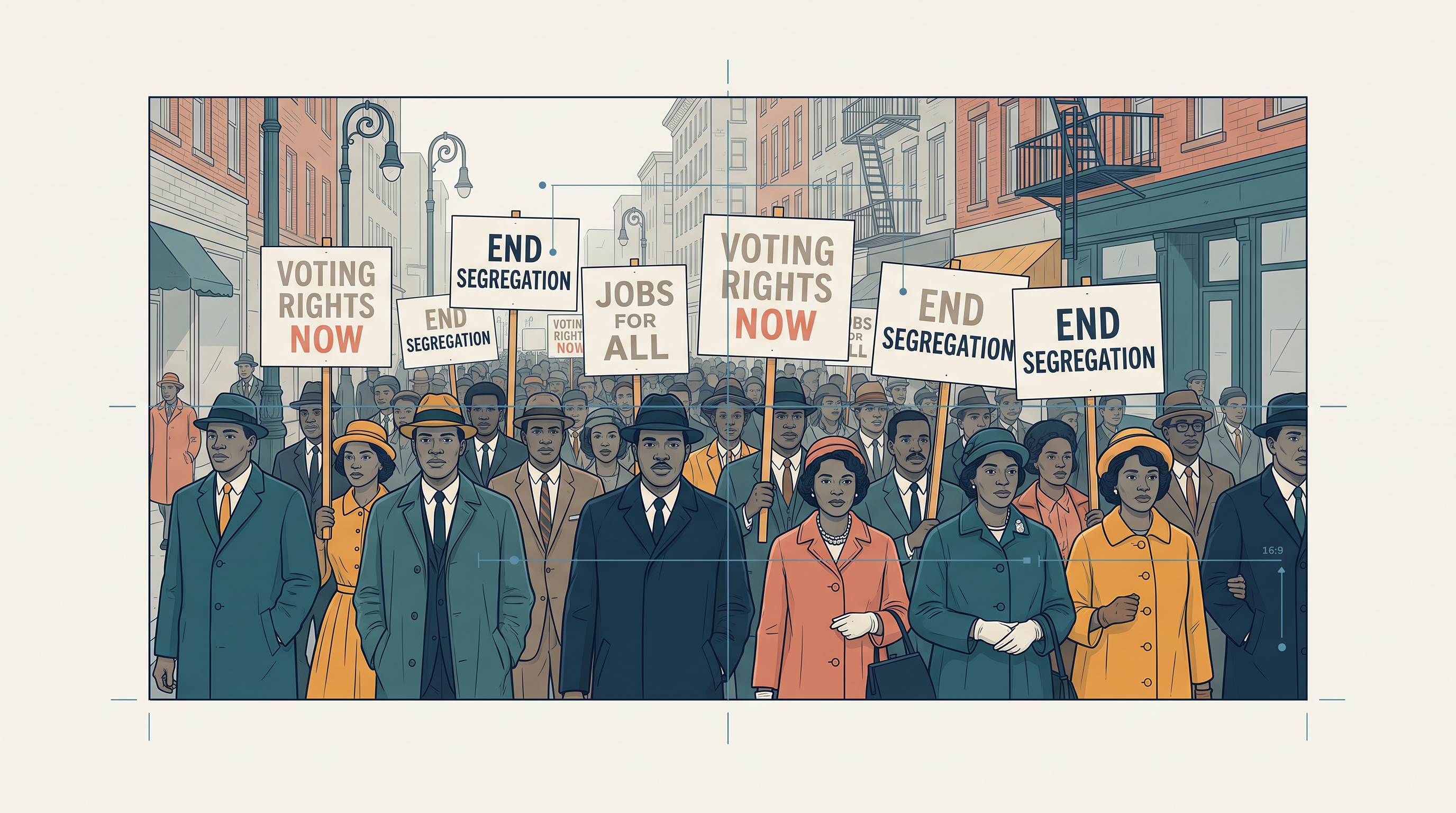
Fig. 5.0 – Marchers demanding civil rights as entitlements. Inspiration: The National Archives and Records Administration, USA.
5.1 What Are Rights?
A right is essentially an entitlement, or a justified claim. It says what we are entitled to as citizens, as individuals and as human beings. It is something we consider to be due to us — and, crucially, something the rest of society must recognise as a legitimate claim that has to be upheld.
Notice the two halves of that idea. There is what I claim for myself, and there is the recognition that others owe me. A right that nobody else is obliged to respect is not a right at all. It is only an opinion I hold about myself.
Wanting And Being Entitled
This does not mean that everything I regard as necessary and desirable is a right. I may want to wear clothes of my own choice to school rather than the prescribed uniform. I may want to stay out late at night.
Neither wish gives me a right to dress as I like at school, or to return home whenever I choose. There is a real distinction here — between what I want and think I am entitled to, and what can properly be designated as a right.
So the question becomes unavoidable: on what basis do we sort our many wants into the few that count as rights? The chapter offers two grounds.
The First Ground: Dignity
Rights are primarily those claims that I, along with others, regard as necessary for leading a life of respect and dignity. On this ground, rights represent conditions that we collectively see as a source of self-respect and dignity.
Take the right to livelihood. Being gainfully employed gives a person economic independence, and independence is central to their dignity. A person who must beg for every meal is not standing on equal ground with anyone. Having our basic needs met also gives us the freedom to pursue our talents and interests.
Or take the right to express ourselves freely. This right gives us the opportunity to be creative and original — in writing, in dance, in music, or in any other creative activity. It matters to us as individuals.
But freedom of expression matters for a second reason too. It is important for democratic government, because it allows for the free expression of beliefs and opinions. A government cannot be answerable to people who are not permitted to say what they think of it.
Rights such as the right to a livelihood, or freedom of expression, would be important for all human beings who live in society. That is why they are described as universal in nature — claimed not for one group or one country, but for anyone, anywhere, simply as a person.
The Second Ground: Well-Being
Another ground on which rights have been claimed is that they are necessary for our well-being. Rights help individuals to develop their talents and skills.
The right to education is the clearest instance. Education helps to develop our capacity to reason, gives us useful skills, and enables us to make informed choices in life. Every one of those is a good that any human being would need, in any society. It is in this sense that education can be designated as a universal right.
Where A Claim Fails The Test
The well-being ground cuts both ways. If an activity is injurious to our health and well-being, it cannot be claimed as a right.
Medical research has shown that prohibited drugs are injurious to one’s health, and that they affect our relations with others. We therefore cannot insist that we have a right to inhale or inject drugs, or to smoke tobacco. In the case of smoking, the harm may even extend to the health of people who happen to be around the smoker.
Drugs may not only injure our health. They may also, at times, change our behaviour patterns and make us a danger to other people. Measured against our own definition of rights, then, smoking or taking banned drugs cannot be claimed as a right.
Watch how that argument was made. It did not begin with disapproval. It began with the definition — rights are claims necessary for dignity and well-being — and then asked whether this particular claim can meet it. That is how a political argument is supposed to work, and it is worth practising. Go through recent newspapers and make a list of the people’s movements that have proposed new kinds of rights. Then ask, of each one, which ground it is standing on.
5.2 Where Do Rights Come From?
If a right is a claim that others are bound to honour, someone has to be able to say where that binding force comes from. Answer that question badly and the whole idea collapses into a demand. This section follows how political thinkers have answered it, and how the answer has shifted.
Rights Given By Nature
In the seventeenth and eighteenth centuries, political theorists argued that rights are given to us by nature, or by God. The rights of men, they said, were derived from natural law — an order of rules held to exist in nature itself, above and before any government.
This meant something startling. Rights were not conferred by a ruler or by a society. We are born with them. Because they come from nature, they are inalienable: they cannot be taken away or surrendered, and no one may strip them from us.
These theorists identified three natural rights of man — the right to life, liberty and property. All other rights, they argued, were derived from these three basic ones.
Notice the political work this idea does. If we are born with certain rights, then no state and no organisation should take away what has been given by the law of nature. The conception of natural rights has therefore been used very widely to oppose the exercise of arbitrary power by states and governments, and to safeguard individual freedom.
From Natural Rights To Human Rights
In recent years, the term human rights has been used more often than the term natural rights. The change is not merely a change of vocabulary.
The reason is that the idea of a natural law — a set of norms laid down for us by nature, or by God — appears unacceptable to many people today. We do not all share the same religion, and we do not all agree that nature issues commands.
So the ground has shifted. Rights are increasingly seen as guarantees that human beings themselves seek, or arrive at, in order to lead a minimally good life. They are not discovered in nature. They are worked out, argued for, and agreed upon by people.
The Free And Equal Self
The assumption behind human rights is that all persons are entitled to certain things simply because they are human beings. As a human being, each person is unique and equally valuable.
That single sentence carries a great deal. It means all persons are equal, and that no one is born to serve others. Each of us possesses an intrinsic value, and so each of us must have equal opportunities to be free and to realise our full potential.
This conception of a free and equal self is increasingly being used to challenge existing inequalities based on race, caste, religion and gender. If worth is intrinsic, then it cannot be adjusted downwards because of a person’s birth.
The clearest philosophical statement of that idea comes from the eighteenth century German philosopher Immanuel Kant, whose words the chapter prints.
Kant’s distinction is between things that can be exchanged and beings that cannot. Anything with a price has an equivalent — another object can be put in its place. Human beings, unlike all other objects, possess dignity: they are elevated above all price, admit of no equivalent, and are for this reason valuable in themselves.
For Kant, this simple idea had a deep meaning. Every person has dignity and ought to be treated accordingly, purely by virtue of being a human being. A person may be uneducated, poor or powerless. They may even be dishonest or immoral. They remain a human being, and deserve to be given some minimum dignity.
To treat people with dignity, on this view, was to treat them morally. The thought became a rallying point for those struggling against social hierarchies and for human rights — because it refuses, at the outset, to rank one human life below another.
Kant’s views represent what is called the moral conception of rights. It rests on two arguments. First, we should treat others as we would like to be treated ourselves. Second, we should make sure that we do not treat another person as a means to our ends.
We should not treat people as we treat a pen, a car, or a horse. That is, we should respect people not because they are useful to us, but because they are, after all, human beings.
Now the limit. This extract is philosophy, not law. It tells us that human beings must not be priced, but it does not tell us which particular rights follow from that — Kant’s words alone will not settle whether education, or a livelihood, or clean air belongs on the list. Nor does a moral argument, however powerful, oblige any government to do anything. It can persuade; it cannot compel. And it is one thinker’s position, argued for, not proved — the chapter names Kant precisely because his is a case that had to be made and can be questioned.
Struggles That Changed The Meaning
Ideas of this kind did not stay in books. The notion of universal human rights has been used by oppressed people all over the world to challenge laws which segregate them and deny them equal opportunities and rights.
Something important follows. It is through the struggles of groups that have felt excluded that the interpretation of existing rights has sometimes been altered. The words on the page may not change; what those words are held to cover does.
Today, the UN Universal Declaration of Human Rights builds upon this understanding of rights. The United Nations is the body in which almost all the world’s states are members, and the Declaration attempts to recognise those claims that the world community collectively sees as being important for leading a life of dignity and self-respect.
The record is mixed, and the chapter says so plainly. Slavery has been abolished. But there are other struggles that have had only limited success, and even today there are communities struggling to define humanity in a way which includes them. That last phrase is worth sitting with: the fight is not always for a new right, but for admission into the category of those who count.
Why The List Keeps Growing
The list of human rights which people have claimed has expanded over the years, as societies face new threats and challenges.
We are very conscious today of the need to protect the natural environment, and this has generated demands for rights to clean air, water, sustainable development, and the like. A new awareness of what many people — especially women, children or the sick — face in times of war or natural crisis has led to demands for a right to livelihood, rights of children, and the like.
Such claims express a sense of moral outrage about infringements of people’s dignity. They also act as a rallying call, urging people to try and extend rights to all human beings.
Newly won rights change what an ordinary person can actually do. A student in the chapter’s own illustration puts it in exactly those terms: his father applied for a telephone connection more than two months ago and still has not received it, and he wonders what can be done. His friend answers that they now have a right to information, and can find out both the status of the application and the cause of the delay. A right, once recognised, converts a private frustration into a claim that an office is obliged to answer.
We should not understate the extent and power of such claims. They often invoke wide support. The chapter points to the appeal made by the pop star Bob Geldof to western governments to end poverty in Africa, and to the television reports of the scale of support he received from ordinary people.
5.3 Legal Rights And The State
Claims for human rights appeal to our moral self. They ask us to recognise a wrong, and to feel that something owed to a person has been withheld. But an appeal is only an appeal.
Whether it succeeds depends on a number of factors, and the most important of them is the support of governments and the law. This is why so much importance is placed on the legal recognition of rights.
Writing Rights Into The Constitution
A Bill of Rights is enshrined in the constitutions of many countries. A constitution is the highest law of the land — every other law and policy must fit inside it — so constitutional recognition of certain rights gives them a primary importance.
In our country we call them Fundamental Rights: the rights guaranteed by the Constitution itself, which other laws and policies are supposed to respect. The rights written into a constitution are those considered to be of basic importance.
In some cases these are supplemented by claims that gain importance because of the particular history and customs of a country. In India, for instance, we have a provision banning untouchability — the practice of treating people of certain castes as impure and excluding them from ordinary social contact. The provision exists because that traditional social practice existed, and the Constitution deliberately draws attention to it.
This tells us something about constitutions in general. They are not identical everywhere, because the wrongs each society has had to confront are not identical.
Does The State Create Rights?
So important is the legal and constitutional recognition of our claims that several theorists define rights simply as claims that are recognised by the state.
There is real force in this. Legal endorsement certainly gives our rights a special status in society. A claim the courts will enforce is worth a great deal more, in practice, than a claim they will not.
But the chapter is careful here, and so should we be. Legal endorsement is not the basis on which rights are claimed. As we saw earlier, rights have steadily been expanded and reinterpreted to include previously excluded groups, and to reflect our contemporary understanding of what it means to lead a life of dignity and respect. That expansion was usually demanded before the law conceded it.
Rights Are Demands Upon The State
In most cases, the rights people claim are directed towards the state. That is, through these rights people make demands upon the state.
When I assert my right to education, I am calling upon the state to make provisions for my basic education. Society may also accept the importance of education and contribute to it on its own. Different groups may open schools and fund scholarships so that children of all classes can get the benefit of education.
But the primary responsibility rests upon the state. It is the state that must initiate the necessary steps to ensure that my right to education is fulfilled. A scholarship is a gift, and it can be withdrawn. A right is owed.
What The State Must Do, And Must Not Do
Rights therefore place an obligation upon the state to act in certain kinds of ways. Each right indicates what the state must do — and also what it must not do.
Take the first half. My right to life obliges the state to make laws that protect me from injury by others. It calls upon the state to punish those who hurt me or harm me. And if a society feels that the right to life means a right to a good quality of life, it expects the state to pursue policies that provide for a clean environment, along with the other conditions necessary for a healthy life. My right, in other words, places certain obligations upon the state to act.
Now the second half. Rights also suggest what the state must refrain from doing. My right to liberty as a person suggests that the state cannot simply arrest me at its own will.
If it wishes to put me behind bars, it must defend that action. It must give reasons for curtailing my liberty before a judicial court — a court that can examine whether the state had grounds for what it did. This is why the police are required to produce an arrest warrant before taking me away. My rights thus place certain constraints upon state actions.
Both halves are set side by side in Table 5.A1.
Why The State Exists At All
To put it another way, our rights ensure that the authority of the state is exercised without violating the sanctity of individual life and liberty.
The state may be the sovereign authority — the highest power in the land, with no power above it — and the laws it makes may be enforced with force. But the sovereign state exists not for its own sake. It exists for the sake of the individual.
It is people who matter more, and it is their well-being that must be pursued by the government in power. The rulers are accountable for their actions, and must not forget that law exists to ensure the good of the people.
That principle is easier to state than to keep. Test it against the news: go through the newspapers of the last few days and identify the cases of rights violations that have been discussed. Then ask the harder question the chapter puts to you — what should the government, and what should civil society, do to prevent such violations?
5.4 Kinds Of Rights
Once a society accepts that rights must be recognised, it has to decide which rights, and in what order. Most democracies today begin at the same place — by drawing up a charter of political rights.
Political Rights And Civil Liberties
Political rights give citizens the right to equality before law and the right to participate in the political process. They include the right to vote and elect representatives, the right to contest elections, and the right to form political parties or to join them.
Political rights are supplemented by civil liberties — the right to a free and fair trial, the right to express one’s views freely, and the right to protest and express dissent, which means openly disagreeing with those in power. Collectively, civil liberties and political rights form the basis of a democratic system of government.
But remember what rights are for. They aim to protect the well-being of the individual, and political rights must be judged by that standard too.
They meet it in three ways. They make the government accountable to the people. They give greater importance to the concerns of the individual than to those of the rulers. And they ensure that all persons have an opportunity to influence the decisions of the government.
Why A Vote Is Not Enough
However, our rights of political participation can only be exercised fully when our basic needs — of food, shelter, clothing, health — are met.
For a person living on the pavements and struggling to meet these basic needs, political rights by themselves have little value. The right to contest an election is not much use to someone who does not know where the next meal is coming from. What such a person requires is an adequate wage to meet basic needs, and reasonable conditions of work.
Hence democratic societies are beginning to recognise these obligations and to provide economic rights — claims to the material conditions a person needs in order to live decently.
The forms vary. In some countries, citizens with low incomes receive housing and medical facilities from the state. In others, unemployed persons receive a certain minimum wage so that they can meet their basic needs. In India, the government has recently introduced a rural employment guarantee scheme, among other measures to help the poor.
The Cultural Claims Of Citizens
Today, in addition to political and economic rights, more and more democracies are recognising the cultural claims of their citizens.
Cultural rights are claims to the conditions in which a community can keep and pass on its own language and way of life. The right to have primary education in one’s mother tongue, and the right to establish institutions for teaching one’s language and culture, are today recognised as being necessary for leading a good life.
Cultural claims are also where rights collide most sharply. The chapter puts a proposition to you and invites an argument: the right to culture means that no one should be allowed to make films that offend the religious or cultural beliefs of others.
The List Keeps Lengthening
The list of rights has thus steadily increased in democracies, and the three kinds we have met are compared in Table 5.A1’s companion, Table 5.A2.
Not all rights, however, stand on the same footing. Some — primarily the right to life, liberty, equal treatment, and the right to political participation — are seen as basic rights that must receive priority. Other conditions that are necessary for leading a decent life are being recognised, alongside them, as justified claims or rights.
That word ‘priority’ is doing quiet work. It concedes that a society cannot deliver everything at once, and it says which claims may not be postponed.
Rights Claimed By Groups
The rights we have discussed so far are largely claimed by individuals. But cultural rights are often claimed by a group — a community, a language, a state’s residents — and a group that wins a right can also use it against people inside it.
Before you read on, take the four situations the chapter sets out and argue each one through.
In each case, ask the two questions this chapter has given you. Is the claim necessary for a life of dignity and well-being? And whose dignity — the group’s, or that of the individual the group is deciding about?
5.5 Rights And Responsibilities
So far, rights have looked like demands we make. This section turns the idea around. Rights place obligations upon the state to act in certain ways — for instance, to ensure sustainable development, which means using resources today in a way that does not rob future generations of theirs. But they also place obligations upon each of us.
The chapter lists four such obligations. They are worth taking one at a time.
The First Duty: The Common Good
Firstly, rights compel us to think not just of our own personal needs and interests, but to defend some things as being good for all of us.
Protecting the ozone layer, minimising air and water pollution, maintaining the green cover by planting new trees and preventing the cutting down of forests, keeping the ecological balance — these are things that are essential for all of us. No individual can secure them alone, and no individual can be excluded from their benefit.
They represent the common-good that we must act to protect, for ourselves and also for the future generations who are entitled to inherit a safe and clean world. Without such a world, they cannot lead a reasonably good life.
Notice what has just happened to the idea of a right. It has been extended to people who do not yet exist, and who can make no demand of their own. Their claim has to be carried by us.
The Second Duty: Respecting The Rights Of Others
Secondly, rights require that I respect the rights of others. The logic is simple and unforgiving. If I say that I must be given the right to express my views, I must also grant the same right to others.
If I do not want others to interfere in the choices I make — the dress I wear, or the music I listen to — I must refrain from interfering in the choices that others make. I must leave them free to choose their own music and their own clothes.
The limit bites hardest at the extreme. I cannot use the right to free speech to incite a crowd to kill my neighbour. In exercising my rights, I cannot deprive others of theirs.
My rights are, in other words, limited by the principle of equal and same rights for all. A right I could only have by taking yours away was never a right at all.
The Third Duty: Balancing Rights In Conflict
Thirdly, we must balance our rights when they come into conflict. Two genuine rights can pull in opposite directions, and then one of them has to give way.
Take an example the chapter builds. My right to freedom of expression allows me to take pictures. But if I take pictures of a person bathing in his house without his consent and post them on the internet, that would be a violation of his right to privacy — the right to a part of life that others may not enter or expose without permission.
The same conflict runs through a conversation the chapter puts in the mouths of two students. One has watched a sting operation on television — a secretly recorded exposé — and cannot believe the conversation it caught between a senior official and a well-known actress. The other answers that it was cheap sensationalism, and that, in any case, it was an infringement of their right to privacy.
Neither student is simply wrong. Exposing wrongdoing is what free expression is for; being recorded without your knowledge is what privacy exists to prevent. Balancing is not a way of dodging the question. It is the question.
The Fourth Duty: Staying Vigilant
Fourthly, citizens must be vigilant about the limitations which may be placed on their rights. Rights are lost far more often by slow permission than by sudden seizure.
A currently debated topic concerns the increased restrictions which many governments are imposing on the civil liberties of citizens on the grounds of national security. Protecting national security may be defended as necessary for safeguarding the rights and well-being of citizens — and that defence is a serious one, not a pretext to be waved away.
But at what point could restrictions imposed as necessary for security themselves become a threat to the rights of people? The chapter presses the question through four hard cases. Should a country facing the threat of terrorist bombings be allowed to curtail the liberty of citizens? Should it be allowed to arrest people on mere suspicion? Should it be allowed to intercept their mail or tap their phones? Should it be allowed to use torture to extract a confession?
In such situations, the question to ask is whether the person concerned poses an imminent threat to society — a real and immediate danger, not a distant possibility. Even arrested persons should be allowed legal counsel and the opportunity to present their case before a magistrate or a court of law.
We need to be extremely cautious about giving governments powers which could be used to curtail the civil liberties of individuals, for such powers can be misused. Governments can become authoritarian — ruling without accountability and without limits — and thereby undermine the very reason for which governments exist, namely, the well-being of the members of the state.
Hence, even though rights can never be absolute, we need to be vigilant in protecting our rights and those of others, for they form the basis of a democratic society. Both halves of that sentence matter. Rights are not unlimited; and the power to limit them is exactly the power that must be watched.
A Common Standard For The World
Everything in this chapter — dignity, universality, the duty to respect the rights of others — was gathered into a single document after a war in which those ideas had been abandoned.
On 10 December 1948, the General Assembly of the United Nations adopted and proclaimed the Universal Declaration of Human Rights. Following this historic act, the Assembly called upon all Member countries to publicise the text — to have it circulated, displayed, read and explained, above all in schools and other educational institutions, and without distinction based on the political status of countries or territories. That instruction is why it is printed here.
Read the Preamble slowly. It is a chain of reasons, each beginning with ‘Whereas’, leading to a single conclusion at the end.
For more details, visit www.un.org.
Reading The Declaration
Look at what the argument rests on. Dignity is called inherent, and rights are called inalienable — they belong to every member of the human family and cannot be taken away. That is the ground we met in the earlier sections, now written into an international text.
The second paragraph explains why the document was needed. Disregard and contempt for human rights had resulted in barbarous acts that outraged the conscience of mankind. The Declaration is a response to catastrophe, not an exercise in theory.
The third paragraph is the most political of all. It says that human rights should be protected by the rule of law so that people are not driven, as a last resort, to rebellion against tyranny and oppression. Rights are being offered here as the alternative to revolt.
And the closing paragraph names what the Declaration actually is: a common standard of achievement for all peoples and all nations, to be pursued by teaching, by education, and by progressive measures at home and abroad.
Now the limit, and it is a large one. A common standard is not a law. The Declaration proclaims; it does not command. It sets out no punishment, no court and no police, and it cannot by itself compel any government to release a single prisoner.
It also records only what states were willing to declare in public in 1948 — not what they were doing, and not what they would do afterwards. The gap between a signature and a practice is precisely the gap that oppressed groups have had to close by struggle, as we saw earlier in this chapter. The Declaration tells us what the world community agreed to say. It cannot tell us how anyone was actually treated.
5.6 Summary
The Chapter In Points
- A right is an entitlement, or a justified claim — something due to us that the rest of society must recognise as legitimate and uphold. It is not the same as a want, however strongly the want is felt.
- Rights are claimed on two grounds: that they are necessary for a life of respect and dignity, and that they are necessary for our well-being. An activity injurious to health and well-being — smoking, or taking banned drugs — cannot be claimed as a right.
- Rights like a livelihood, free expression and education are described as universal, because they would matter to any human being living in society.
- In the seventeenth and eighteenth centuries, theorists held that rights come from nature or God. These natural rights — life, liberty and property — were inalienable, and the idea was used to oppose arbitrary power.
- Today the term human rights is preferred, because the idea of a natural law appears unacceptable to many. Rights are now seen as guarantees human beings themselves arrive at in order to lead a minimally good life.
- The assumption behind human rights is that every person is unique, equally valuable, and possesses intrinsic value. Kant argued that human beings have dignity rather than a price, and must never be treated merely as a means to someone else’s ends.
- Rights have been expanded by struggle. Excluded groups have used the idea of universal human rights to challenge laws that segregate them, and have thereby altered how existing rights are interpreted.
- The list of rights keeps growing as new threats appear — demands for clean air, water and sustainable development, and for the rights of children, women and the sick.
- Legal recognition gives rights force. A Bill of Rights is written into many constitutions; in India these are the Fundamental Rights. But legal endorsement is not the basis on which rights are claimed.
- Rights place obligations upon the state: what it must do, such as provide education, and what it must not do, such as arrest a person without giving reasons before a court. The sovereign state exists for the sake of the individual, and rulers are accountable.
- Democracies recognise political rights, civil liberties, economic rights and cultural rights. Political rights are of little use to a person struggling for food and shelter, which is why economic rights are claimed alongside them.
- Rights also place obligations upon us: to defend the common-good, to respect the rights of others, to balance rights when they conflict, and to stay vigilant about restrictions imposed on our liberties.
- Rights can never be absolute — but the power to limit them is the power that most needs watching. The Universal Declaration of Human Rights of 1948 sets out a common standard for all peoples and nations.
The Arguments In One Place
The chapter’s central claim is that a right is a claim that can be justified — shown to be necessary for a life of dignity and well-being — and that such claims belong to every person simply as a human being.
Against this, the chapter records a serious rival position: several theorists define rights as nothing more than claims that the state recognises. On that view, a right without legal backing is only a wish, and the whole language of natural or human rights is a way of demanding something no one is yet obliged to give.
The chapter does not settle the dispute, but it does mark the cost of each side. If rights are only what the law grants, then every excluded group that ever fought for recognition was claiming nothing. If rights exist independently of the law, then we must still explain what makes one claim justified and another merely loud.
What Remains Contested
Where exactly the line falls between a want and an entitlement is not fixed. The chapter’s own answer — whatever a life of dignity and well-being requires — leaves open who decides what a decent life needs.
Nor does the chapter settle when a government’s restriction on liberty is genuinely necessary, or what should happen when a community’s cultural right collides with the rights of an individual inside that community.
And notice whose voice the chapter’s strongest document does not carry. The Universal Declaration was written and adopted by governments. It records what states were willing to promise. It does not record what the people they governed actually received.
5.7 NCERT Questions
What are rights and why are they important? What are the bases on which claims to rights can be made?
On what grounds are some rights considered to be universal in nature? Identify three rights which you consider universal. Give reasons.
Discuss briefly some of the new rights claims which are being put forward in our country today — for example the rights of tribal peoples to protect their habitat and way of life, or the rights of children against bonded labour.
Differentiate between political, economic and cultural rights. Give examples of each kind of right.
Rights place some limits on the authority of the state. Explain with examples.
5.8 Check Your Concepts
The chapter says that wanting to wear clothes of my own choice to school is not a right. Using the chapter’s definition of a right, explain why not.
Distinguish between natural rights and human rights. Why has the second term come to be used more often than the first?
Read Source 5.1 again. What is the difference Kant draws between something that has a price and something that has a dignity, and what does that difference forbid us from doing to another person?
The chapter argues that smoking or taking banned drugs cannot be claimed as a right. Set out the steps of that argument, beginning from the definition of a right.
Rights place obligations not only upon the state but upon each of us. Name the four obligations the chapter lists, and explain what balancing rights in conflict means, using the chapter’s own example.
Using the chapter, reconstruct the chain by which a new demand comes to be recognised as a right. Why does the chapter say that groups which felt excluded have changed the meaning of rights that already existed?
Several theorists define rights simply as claims that are recognised by the state. State the strongest argument in favour of this view, and the strongest argument the chapter offers against it.
Read Source 5.2 again. The Declaration calls itself a common standard of achievement for all peoples and all nations. Name two things it cannot do for a person whose rights have actually been violated.