Chapter 7: Nationalism
Somewhere on a bare wall, a slab of stone has been fixed into place, and someone has painted words on it by hand. The letters are uneven. They run out of room and break in the middle. A photograph of that stone is what opens this chapter.
The stone records that the memorial was built in fond memory of Balbir Singh of the 11 Mtn Regt, who died at that spot while constructing defences, on 03 Dec 1983.
That is the whole of the record. No speech, no ceremony, no crowd. A man was doing hard work in a hard place, he did not come back from it, and the people he worked with cut his name into stone so that the place would remember him.
Now ask the question this chapter is built on. Balbir Singh had never met most of the people of India, and never would. He did not share a language with all of them, or a religion, or a line of descent. Most of them would never learn his name. Yet something called the nation was real enough to him that he was at work on its defences on the day he died.
What is that something? You cannot see it or touch it the way you can see a mountain or a river. It is not a family. It is not a tribe. It exists because people believe in it — and that belief moves them to vote, to argue, to migrate, to build, to divide, and sometimes to die.
This chapter asks what a nation is, what it may rightly claim, and where its claims should stop.
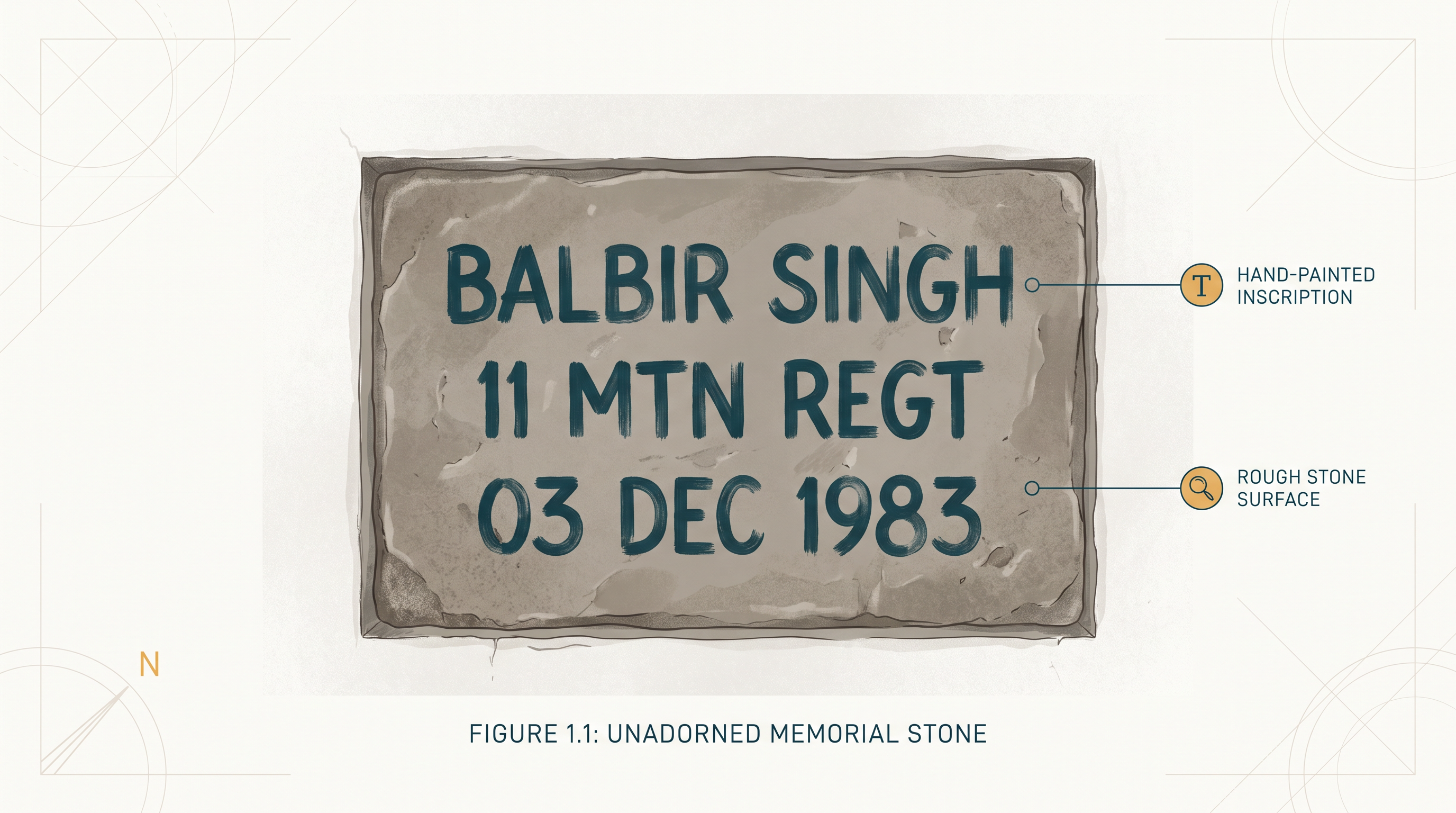
Fig. 7.0 – Memorial to Balbir Singh of the 11 Mtn Regt.
7.1 Introducing Nationalism
Suppose we stopped people on the street and asked them what nationalism means. Most answers would come quickly and confidently. They would talk about patriotism, about national flags, about sacrificing for the country, and about things of that kind.
The Republic Day parade in Delhi is a striking symbol of Indian nationalism. It brings out a sense of power and strength, and also the diversity that many people associate with the Indian nation. A great many Indians would point to it at once if asked what the nation looks like.
But push a little deeper and the confidence drains away. It is difficult to arrive at a precise and widely accepted definition of the term nationalism. Ask two thoughtful people what it means and you may get two answers that do not fit together.
That difficulty is not a reason to abandon the effort. Nationalism is a political creed — a set of beliefs about how people should be organised politically — and it has to be studied precisely because it plays such an important role in world affairs. A force this powerful cannot be left undefined simply because defining it is hard.
A Creed That Cuts Both Ways
During the last two centuries or more, nationalism has emerged as one of the most compelling political creeds in history, and it has helped to shape that history. Almost nothing in the modern political world is untouched by it.
What it has done, however, points in two directions at once. It has inspired intense loyalties, and it has inspired deep hatreds. It has united people, and it has divided them. It has helped to liberate people from oppressive rule, and it has been the cause of conflict, bitterness and wars.
It has also been a factor in the break up of empires and states. Nationalist struggles have contributed to the drawing and the redrawing of the boundaries of states and empires — the lines you see on a political map are, very often, the settled result of somebody’s nationalist claim.
At present a large part of the world is divided into different nation-states: states whose boundaries are meant to enclose a people who think of themselves as one nation. But the process of re-ordering state boundaries has not come to an end, and separatist struggles within existing states are common. A separatist struggle is one in which a group inside a state demands to break away and form a state of its own.
Nationalism As Unification
Nationalism has passed through many phases, and the earliest of them looks nothing like the later ones. In nineteenth century Europe, it led to the unification of a number of small kingdoms into larger nation-states. Before this, much of Europe was a patchwork of small principalities, each with its own ruler.
The present day German and Italian states were formed through exactly such a process of unification and consolidation. Where there had been many small units, there was now one state. A large number of new states were also founded in Latin America, the region of the Americas lying south of the United States.
Something quieter happened alongside the drawing of these new boundaries. Local dialects and local loyalties were gradually consolidated into state loyalties and common languages. A person who had thought of themselves as belonging to a town or a valley came to think of themselves as belonging to a country.
The people of the new states therefore acquired a new political identity, and it was based on membership of the nation-state. We have seen a similar process of consolidation taking place in our own country in the last century or more.
Nationalism As Break-Up
The same force worked in reverse as well. Nationalism accompanied and contributed to the break up of large empires. In early twentieth century Europe, the Austro-Hungarian empire in central Europe and the Russian empire came apart, and nationalist claims were part of why they did.
The great overseas empires went the same way. The British, French, Dutch and Portuguese empires in Asia and Africa broke up, and the peoples they had ruled emerged as separate states.
The struggle for freedom from colonial rule by India and other former colonies were nationalist struggles. They were inspired by the desire to establish nation-states which would be independent of foreign control. This is the point worth holding on to: unification and break-up look like opposites, but both were driven by the same creed.
Demands That Have Not Stopped
The process of redrawing state boundaries continues to take place. Since 1960 — within the lifetime of many people now living — even apparently stable nation-states have been confronted by nationalist demands put forward by groups or regions inside them, and these demands may include demands for separate statehood.
Today, in many parts of the world, we witness nationalist struggles that threaten to divide existing states. Such separatist movements have developed among the Quebecois in Canada, who are the French-speaking people of the province of Quebec; among the Basques in northern Spain; among the Kurds, who live in parts of Turkey and Iraq in west Asia; and among the Tamils in Sri Lanka, the island state to India’s south. There are others besides these. The language of nationalism is also used by some groups in India.
Notice that nationalism does not even pull in one direction at one time. Arab nationalism today may hope to unite Arab countries in a pan Arab union — that is, to gather several existing states into one. At the very same moment, separatist movements like the Basques or the Kurds struggle to divide existing states. One creed, two directly opposite projects.
Is The Nation Finished?
Students argue about this, and the argument is worth having. One line of thought runs like this: in this age of globalisation the world is shrinking, we are living in a global village, and therefore nations are irrelevant.
The reply is not hard to find either. Nationalism is still relevant, and you can see it when the Indian team goes out to play cricket. You can see it when you discover that Indians living abroad still watch Bollywood films. The nation, on this view, has not dissolved at all; it has simply travelled.
The Questions This Chapter Asks
We may all agree that nationalism is a powerful force in the world even today. But it is far more difficult to arrive at agreement about what terms like nation or nationalism actually mean.
So the chapter proceeds by questions rather than by definitions. What is a nation? Why do people form nations, and what do nations aspire to? Why are people ready to sacrifice and even die for their nation?
Then come the harder ones. Why, and in what way, are claims to nationhood linked to claims to statehood? Do nations have a right to statehood, or to national self-determination? Or can the claims of nationalism be met without conceding separate statehood?
These are the issues this chapter will explore. Keep them beside you as you read; the sections that follow are attempts at answers, not announcements of them.
7.2 Nations And Nationalism
A nation is not any casual collection of people. A crowd at a railway station is a collection of people; it is not a nation. But a nation is also different from the other groups and communities we find in human society, and it is worth being exact about how.
It is different from the family. A family is based on face-to-face relationships, in which each member has direct personal knowledge of the identity and character of the others. You know your family; you have met them.
It is different, too, from tribes and clans and other kinship groups. In these, ties of marriage and descent link the members to each other. Even if you do not personally know every member, you can, if need be, trace the links that bind them to you.
A nation offers neither of these. As a member of a nation we may never come face to face with most of our fellow nationals. Nor need we share ties of descent with them. And yet nations exist. They are lived in, and they are valued by their members. That is the puzzle this section has to solve.
No Feature Is Common To All Nations
It is commonly believed that nations are constituted by a group of people who share certain features — descent, or language, or religion, or ethnicity. It is a natural thought, and it is wrong.
There is in fact no common set of characteristics which is present in all nations. Take language first. Many nations do not have a common language. Canada is an example: it includes English speaking as well as French speaking peoples. India also has a large number of languages, spoken in different regions and by different communities.
Nor do many nations have a common religion to unite them. The same could be said of other characteristics such as race or descent. Every candidate for the defining feature of a nation fails the same test — you can always find a nation that manages without it.
What then constitutes a nation? A nation is to a great extent an ‘imagined’ community. That does not mean it is imaginary or false. It means it is held together by the collective beliefs, aspirations and imaginations of its members, rather than by anything you could photograph or measure.
A nation, in other words, rests on certain assumptions that people make about the collective whole with which they identify. So let us identify those assumptions, one by one, and look at each honestly.
7.2.2 History
Second, people who see themselves as a nation also embody a sense of continuing historical identity. Nations perceive themselves as stretching back into the past as well as reaching into the future. A nation, on this view, did not begin yesterday and will not end tomorrow.
How is such a sense produced? Nations articulate for themselves a sense of their own history by drawing on collective memories, legends and historical records. Out of this material they outline the continuing identity of the nation — a single thread running from long ago to now.
Indian nationalists did precisely this. They invoked India’s ancient civilisation, its cultural heritage and its other achievements. From these they claimed that India has had a long and continuing history as a civilisation, and that this civilisational continuity and unity is the basis of the Indian nation.
Jawaharlal Nehru made the claim in his book The Discovery of India. Read the sentence closely, and notice what it does with the fact of Indian diversity — it does not deny it, it absorbs it.
The word ‘outwardly’ is doing the heavy lifting. Diversity is admitted, and then placed on the surface, while oneness is placed underneath it, as the deeper and older truth. ‘Whatever political fate or misfortune had befallen us’ does similar work: kingdoms rose and fell, invaders came, but the oneness, he says, survived them all.
That is an argument for the nation, made out of history. It says the Indian nation is not being invented; it is being recovered.
Now the limit. This passage tells you, with certainty, how a leading Indian nationalist described the past while a freedom struggle was going on. It does not tell you how people in ‘ages past’ actually thought of themselves, and it cannot. Nobody in those centuries was asked. A claim about a nation’s deep history is evidence of how the nation is being imagined in the present, and only indirectly evidence about the past itself. Preserving this source is not the same as settling the question it raises.
7.2.3 Territory
Third, nations identify with a particular territory. Sharing a common past, and living together on a particular territory over a long period of time, gives people a sense of their collective identity. It helps them to imagine themselves as one people.
It is therefore not surprising that people who see themselves as a nation speak of a homeland. The territory they have occupied, and the land on which they have lived, has a special significance for them, and they claim it as their own.
Nations characterise the homeland in different ways. Some speak of it as a motherland, some as a fatherland, some as a holy land. The Jewish people, in spite of being dispersed and scattered in different parts of the world, always claimed that their original homeland was in Palestine, the ‘promised land’. The Indian nation identifies with the rivers, the mountains and the regions of the Indian subcontinent.
Here is where the trouble begins. More than one set of people may lay claim to the same territory. Land cannot be divided the way a language can be shared, and two homelands cannot occupy the same ground. This is why the aspiration for a homeland has been a major cause of conflict in the world.
7.2.5 Common Political Identity
Many people are not satisfied by any of this. They believe that a shared political vision about the state and the society we wish to create is simply not enough to bind individuals together as a nation. They seek instead a shared cultural identity — a common language, perhaps, or common descent.
The case for their view is real, and should not be dismissed. There is no doubt that speaking the same language makes it easier for us to communicate with each other. Sharing the same religion gives us a set of common beliefs and social practices. Observing the same festivals, seeking the same holidays and holding the same symbols valuable can bring people together.
But the same things can also pose a threat to the values that we cherish in a democracy. There are two reasons for this, and both need to be understood carefully.
Reason One: Religions Are Internally Diverse
One, all major religions in the world are internally diverse. They have survived and evolved through a dialogue within the community — argument, reinterpretation and disagreement are part of how a religion lives.
As a result, there exists within each religion a number of sects who differ significantly in their interpretation of the religious texts and norms. There is no single voice waiting to be adopted as the voice of the nation.
So if we ignore these differences and forge an identity on the basis of a common religion, we are likely to create a highly authoritative and oppressive society. Someone’s version of the religion would have to be declared the correct one, and everyone else’s would have to give way.
Reason Two: Societies Are Culturally Diverse
Two, most societies are culturally diverse. They have people belonging to different religions and different languages living together in the same territory. That is the ordinary condition of the world, not an exception to it.
To impose a single religious or linguistic identity as a condition of belonging to a particular state would therefore necessarily exclude some groups. The word ‘necessarily’ matters: this is not a risk that careful administration could avoid, it follows from the diversity itself.
The exclusion would take a concrete form. It might restrict the religious liberty of the excluded group. Or it might disadvantage those who do not speak the national language — in schools, in courts, in offices, in every place where the state’s language is the only one that counts. Either way, the ideal that we cherish most in democracy, namely equal treatment and liberty for all, would be severely limited.
The Conclusion, And What It Costs
For both these reasons it is desirable to imagine the nation in political rather than cultural terms. Democracies need to emphasise and expect loyalty to a set of values that may be enshrined in the Constitution of the country, rather than adherence to a particular religion, race or language.
The two ways of imagining a nation are set side by side in Table 7.A1. Read it only after you have followed the argument above; the grid is a summary of reasoning, not a substitute for it.
Where This Leaves Us
We have now identified some of the ways in which nations express their sense of collective identity — belief, history, territory, shared political ideals. We have also seen why democratic states need to forge this identity on the basis of shared political ideals rather than cultural ones.
But an important question remains untouched. Why do people imagine themselves as a nation at all? And what are the aspirations of different nations — what is it that a nation, once imagined, goes on to demand?
The next two sections try to address exactly these questions.
7.3 National Self-determination
What The Claim Actually Is
Nations, unlike other social groups, seek the right to govern themselves and to determine their own future development. A caste association or a trade union does not ask this. A nation does. It seeks, in other words, the right to self-determination — the right of a people to decide their own political future for themselves.
The claim is made outwards as much as inwards. In making it, a nation seeks recognition and acceptance by the international community of its status as a distinct political entity or state. It is asking the world’s other states to admit it as one of their own kind.
Who makes such claims? Most often they come from people who have lived together on a given land for a long period of time and who have a sense of common identity. Time on the same soil, and the feeling of being one people, tend to go together.
In some cases the claim carries a further wish. It is linked to the desire to form a state in which the culture of the group is protected — if not, indeed, privileged. Note the difference between those two words. To protect a culture is to shield it from being crushed. To privilege it is to place it above the cultures of everyone else who lives there.
One Culture, One State
Claims of this second kind were frequently made in nineteenth century Europe. The notion of one culture – one state began to gain acceptability at the time. Each distinct people, on this view, should have a state to itself, and each state should hold one people.
Subsequently, the idea of one culture – one state was employed while reordering state boundaries after World War I, when the map of Europe was redrawn at the war’s end. The Treaty of Versailles established a number of small, newly independent states.
But it proved virtually impossible to satisfy all the demands for self-determination which were made at the time. There were more claimants than there could be states, and someone’s claim always had to be refused.
The Price Of Redrawing Boundaries
Worse followed. The re-organisation of state boundaries to satisfy the demands of one culture – one state led to mass migration of population across state boundaries. If a border was to separate cultures, then people on the wrong side of it had to move.
Millions of people, as a consequence, were displaced from their homes and expelled from the land which had been their home for generations. Many others became victims of communal violence — violence between communities defined by religion or culture.
Humanity paid a heavy price for re-organising boundaries in a way that culturally distinct communities could form separate nation-states. And the price bought less than was promised. Even in this effort, it was not possible to ensure that the newly created states contained only one ethnic community.
Demand For National Self-determination In Basque
Demands for national self-determination have been raised in different parts of the world. It is worth looking closely at one such case, and the region shaded in Map 7.1 is a good place to begin.
Map
Map 7.1 Caption: The Basque region lies in the north of Spain, on the coast, against the border with France. Brief: Regional map with an inset locating the area in western Europe; shade the Basque region within northern Spain and outline Spain’s borders; boundaries as officially recognised by the Government of India; label only Spain and the Basque region, and nothing the chapter does not state.
Basque is a hilly and prosperous region in Spain. The region is recognised by the Spanish government as an ‘autonomous’ region within the Spanish federation — that is, a region allowed to run many of its own affairs while remaining part of Spain.
That is not enough for the leaders of the Basque Nationalist Movement. They are not satisfied with this autonomy, and they want the region to become a separate country. Supporters of the movement have used constitutional means to press for this demand, and, till recently, violent means as well.
The Case The Nationalists Make
Basque Nationalists say that their culture is very different from Spanish culture. They have their own language, and it does not resemble Spanish at all. But here the argument runs into a fact worth pausing on: only one-third of the people in Basque understand that language today.
They point to geography as well. The hilly terrain makes the Basque region geographically distinct from the rest of Spain.
Above all they point to history. Ever since the Roman days, the Basque region never surrendered its autonomy to the Spanish rulers. Its systems of justice, of administration and of finance were governed by its own unique arrangements. The Basque claim, then, is not that they want something new. It is that they are defending something old.
How The Modern Movement Began
The modern Basque Nationalist Movement started when, around the end of the nineteenth century, the Spanish rulers tried to abolish this unique political-administrative arrangement. The movement was a response to a loss.
In the twentieth century, the Spanish dictator Franco further cut down this autonomy. He went as far as to ban the use of the Basque language in public places, and even in homes. A state that reaches into a family’s kitchen to decide which language may be spoken there is doing something a democracy is not permitted to do.
These repressive measures have now been withdrawn. But the leaders of the Basque movement continue to be suspicious of the motives of the Spanish government, and fearful of the entry of ‘outsiders’ into their region. Their opponents say that Basque separatists are trying to make political gains out of an issue that is already resolved.
That is the disagreement, and the chapter does not settle it for you. It handed it to you instead.
The information in this account is drawn from multiple sources, including www.en.wikipedia.org.
Self-determination In Asia And Africa
Return now to the wider picture. Most states had more than one ethnic and cultural community living within their boundaries. These communities were often small in number, and constituted a minority within the state — and minorities were often disadvantaged.
Hence the problem of accommodating minorities as equal citizens remained. Redrawing the map had not dissolved the problem; it had merely moved it. The only positive aspect of these developments was that they granted political recognition to various groups who saw themselves as distinct nations, and who wanted the opportunity to govern themselves and determine their own future.
The right to national self-determination was also asserted by national liberation movements in Asia and Africa when they were struggling against colonial domination. Nationalist movements maintained that political independence would provide dignity and recognition to the colonised people, and would also help them to protect the collective interests of their people.
Most of these national liberation movements were inspired by the goal of bringing justice, rights and prosperity to the nation. They were not asking merely for a flag; they were asking for a life.
The Paradox
Here also, however, it proved almost impossible to ensure that each cultural group — some of whom claimed to be distinct nations — could achieve political independence and statehood. There were, once again, more claims than there could be states.
As a result, migration of populations, border wars and violence have continued to plague many countries in the region. The end of colonial rule did not end the argument about who belongs where.
And so we arrive at a paradox worth stating plainly. Nation-states which themselves achieved independence through struggle now act against minorities within their own territories who claim the right to national self-determination. The very argument that won them their freedom is the argument they now refuse to hear.
The Dilemma Every State Faces
Virtually every state in the world today faces the dilemma of how to deal with movements for self-determination. That experience has raised questions about the right itself — not only about how to satisfy it, but about whether independent statehood is what it should mean.
More and more people are beginning to realise that the solution does not lie in creating new states, but in making existing states more democratic and equal. The task, on this view, is to ensure that people with different cultural and ethnic identities live and co-exist as partners and as equal citizens within the country.
This may be essential not only for resolving problems arising from new claims for self-determination. It may be essential for building a strong and united state. After all, a nation-state which does not respect the rights and cultural identity of minorities within the state would find it difficult to gain the loyalty of its members.
That last sentence is worth reading twice. It says that respecting minorities is not a concession a strong state makes; it is part of what makes a state strong.
7.4 Nationalism And Pluralism
Living Together Without One Culture
Once we abandon the idea of one-culture-one-state, a new task appears. It becomes necessary to consider the ways by which different cultures and communities can survive and flourish within a single country. This is what pluralism asks of a state: not that differences be dissolved, but that many cultures be allowed to live and thrive side by side.
It is in pursuit of this goal that many democratic societies today have introduced measures for recognising and protecting the identity of cultural minority communities living within their territory. The Indian constitution has an elaborate set of provisions for the protection of religious, linguistic and cultural minorities.
Notice the shift. In the previous section, the demand of a minority was answered with a border. Here it is answered with a right.
What Group Rights Look Like
The kinds of group rights which have been granted in different countries — rights held by a community, not only by a person on their own — include constitutional protection for the language, the cultures and the religion of minority groups and their members.
Some countries go further. In some cases identified communities also have the right to representation as a group in legislative bodies and other state institutions. The law-making body itself is then required to contain the community’s voice, rather than leaving it to chance.
How are such rights defended? They may be justified on the grounds that they provide equal treatment and protection of the law for members of these groups, and also protection for the cultural identity of the group itself. Both halves matter: the individual is protected as a citizen, and the community is protected as a community.
Behind this lies a larger claim. Different groups need to be granted recognition as a part of the national community. This means that the national identity has to be defined in an inclusive manner — one which can recognise the importance and the unique contribution of all the cultural communities within the state. A nation defined this way does not ask a minority to become invisible in order to belong.
Why Recognition May Not Be Enough
It is hoped that granting groups recognition and protection would satisfy their aspirations. Hoped — not guaranteed. Some groups may continue to demand separate statehood even after their language, culture and religion have been protected.
This may seem paradoxical at a time when globalisation — the growing interconnection of the world through trade, travel, media and technology — is spreading. One might expect such a world to loosen the hold of the nation. It has not. Nationalist aspirations continue to motivate many groups and communities.
Considerable generosity and skill is needed for countries to be able to deal with such demands in a democratic manner. Generosity, because the state must be willing to give away some of its own authority. Skill, because it must do so without breaking apart.
Tagore’s Critique Of Nationalism
Not every Indian who fought colonial rule was comfortable with what nationalism might become. Rabindranath Tagore, whose photograph appears in Fig. 7.1, put the discomfort in a single sentence — and it is one of the sharpest sentences written on this subject in India.
The metaphor is doing the argument. Glass looks like a diamond and costs almost nothing; a diamond is the real thing. Tagore is saying that humanity is the diamond and patriotism the glass, and that he refuses the exchange — not because patriotism is worthless, but because it must never be paid for with something greater.
‘Final spiritual shelter’ is the other phrase to hold on to. He does not say patriotism is no shelter at all. He says it cannot be the last one, the place beyond which there is nothing.
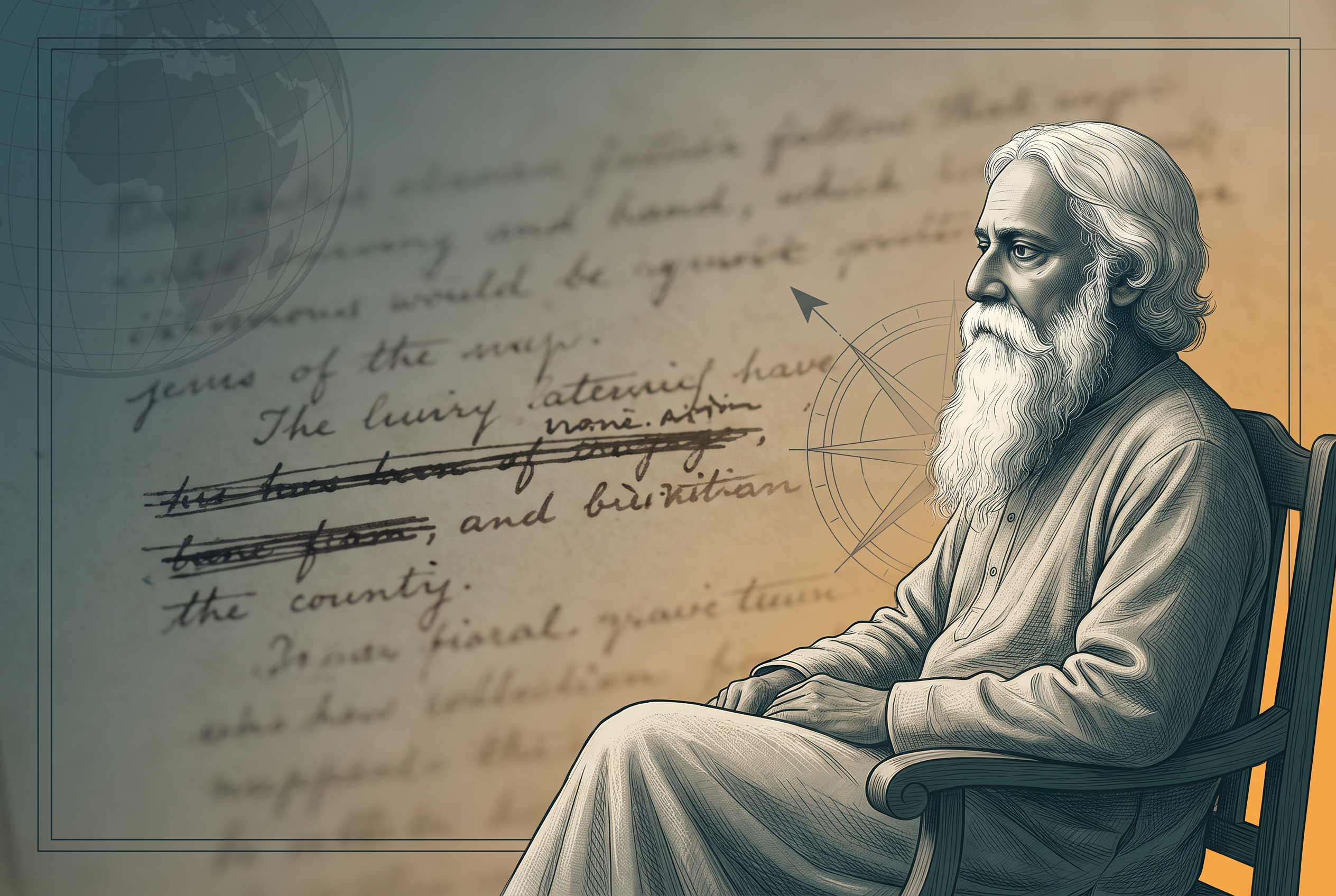
Fig. 7.1 – Rabindranath Tagore.
What Tagore Was Arguing
Tagore was against colonial rule and asserted India’s right to independence. On the central political question of his day, he was not neutral.
He felt that in the British administration of the colonies there was no place for the ‘upholding of dignity of human relationships’ — an idea which was otherwise cherished in the British civilisation. This is a precise charge: the British were failing by their own standards, not merely by his.
From this came a distinction he insisted upon. Tagore made a distinction between opposing western imperialism and rejecting western civilisation. You could fight the empire, he thought, without shutting the door on everything the West had produced. While Indians should be rooted in their own culture and heritage, they should not resist learning freely and profitably from abroad.
A critique of what he called ‘patriotism’ is a persistent theme in his writings. It was not a passing remark. He was very critical of the narrow expressions of nationalism that he found at work in parts of our independence movement — that is, at work among people on his own side.
His specific fear is worth stating exactly. He was afraid that a rejection of the west, in favour of what merely looked like Indian traditions, was not only limiting in itself. It could easily turn into hostility to other influences from abroad — including Christianity, Judaism, Zoroastrianism and Islam, all of which have been present in our country.
What This Source Cannot Settle
Now the limit, and it is an important one. Tagore’s words tell you what one writer believed, and how forcefully he was willing to say it in public. They do not tell you how many Indians agreed with him, and the chapter does not claim that they did.
Nor does a declaration of principle tell you what a person would do in a hard case, where loyalty to country and loyalty to humanity actually collide. A sentence is not a decision. Preserving Tagore’s critique is not the same as accepting it — it is placing the strongest objection to narrow nationalism in front of you, and asking you to answer it.
The Right, Reinterpreted
To sum up the argument of the last two sections. The right to national self-determination was often understood to include the right to independent statehood for nationalities. One nation, one state — that was the reading.
That reading has broken down twice over. It would be impossible to grant independent statehood to every group that sees itself as a distinct cultural group, or nation. And it would probably also be undesirable, which is the stronger claim, and needs its reasons.
Here they are. It might lead to the formation of a number of states too small to be economically and politically viable — too small, that is, to run an economy or to defend and govern themselves. And it could multiply the problems of minorities, since every new state would contain minorities of its own, each with the same grievance the new state was created to solve.
So the right has now been reinterpreted. It is taken to mean granting certain democratic rights for a nationality within a state, rather than a separate state for every nationality. The demand has not been rejected; it has been answered differently.
Many Identities In One Citizen
The world we live in is deeply conscious of the importance of giving recognition to identities. Today we witness many struggles for the recognition of group identities, and many of them employ the language of nationalism.
Two things must be held together here, and the chapter refuses to drop either. We need to acknowledge the claims of identity — they are real, and ignoring them is not an option. But we should be careful not to allow identity claims to lead to divisions and violence in the society.
What makes this possible is a fact about people that political slogans tend to forget: each person has many identities. A person may have identities based on gender, caste, religion, language or region — and may be proud of all of them at once. You are not one thing.
That fact carries a political consequence. So long as each person feels that he or she can freely express the different dimensions of his or her personality, they may not feel the need to make claims on the state for political recognition and concessions for any one identity. It is when an identity is denied expression that it hardens into a demand.
In a democracy, therefore, the political identity of the citizen should encompass the different identities which people may have. Citizenship should be the roof under which all of them can stand, not one more identity competing with the rest.
The chapter closes on a warning, and it is deliberately blunt. It would be dangerous if intolerant and homogenising forms of identity and nationalism are allowed to develop — forms, that is, which cannot tolerate difference, and which try to make everyone the same.
7.5 Summary
What Nationalism Has Done
- Nationalism is one of the most compelling political creeds of the last two centuries, and no precise, widely accepted definition of it exists.
- It has inspired intense loyalties and deep hatreds; it has united people and divided them; it has liberated people from oppressive rule and caused conflict, bitterness and wars.
- In nineteenth century Europe it produced unification: small kingdoms were consolidated into larger nation-states, and the present day German and Italian states were formed this way. Many new states were also founded in Latin America.
- Along with new boundaries came new loyalties. Local dialects and local loyalties were consolidated into common languages and state loyalties, and people acquired a political identity based on membership of the nation-state.
- The same creed also broke empires apart — the Austro-Hungarian and Russian empires in Europe, and the British, French, Dutch and Portuguese empires in Asia and Africa. India’s freedom struggle was a nationalist struggle of this kind.
- The redrawing has not stopped. Since 1960, separatist movements have arisen among the Quebecois in Canada, the Basques in northern Spain, the Kurds in Turkey and Iraq, and the Tamils in Sri Lanka. The language of nationalism is also used by some groups in India.
- Nationalism pulls in opposite directions at the same time: Arab nationalism may hope to unite Arab countries in a pan Arab union, while Basque or Kurdish movements seek to divide existing states.
What A Nation Is
- A nation is not a casual collection of people, and it is unlike a family, a tribe or a clan. Its members may never meet one another, and need share no ties of descent.
- No single feature — descent, language, religion or ethnicity — is present in all nations. Canada has English and French speakers; India has many languages; many nations have no common religion.
- A nation is to a great extent an ‘imagined’ community, held together by the collective beliefs, aspirations and imaginations of its members.
- Shared beliefs: a nation exists when its members believe they belong together, as a team exists only when its members conceive of themselves as one group.
- History: nations draw on collective memories, legends and historical records to claim a continuing identity. Indian nationalists invoked an ancient civilisation, and Nehru wrote in The Discovery of India of a ‘tremendous impress of oneness’ beneath India’s diversity.
- Territory: nations identify with a homeland, described as motherland, fatherland or holy land. Because more than one people may claim the same land, the aspiration for a homeland has been a major cause of conflict.
- Shared political ideals: what finally distinguishes a nation is a shared vision of the future and the aspiration to an independent political existence, expressed in values such as democracy, secularism and liberalism.
- In a democracy, members are bound by obligations that arise from recognising each other’s rights as citizens, and accepting this framework of obligations is the strongest test of loyalty to the nation.
- Building a nation on a common religion or language is dangerous for two reasons: religions are internally diverse, so one sect’s reading would have to be imposed; and societies are culturally diverse, so some group would necessarily be excluded.
- It is therefore desirable to imagine the nation in political rather than cultural terms — loyalty to values that may be enshrined in the Constitution, rather than to a particular religion, race or language.
Self-determination And Its Limits
- Nations seek the right to govern themselves and to be recognised by the international community as distinct political entities.
- The notion of one culture – one state gained acceptance in nineteenth century Europe and was used to reorder boundaries after World War I, when the Treaty of Versailles established several small new states.
- Not all demands could be satisfied. Boundary changes led to mass migration; millions were displaced from homes held for generations, and many became victims of communal violence.
- Even then, no state contained only one ethnic community. Minorities remained, often disadvantaged, and the problem of accommodating them as equal citizens remained too.
- The Basque case shows the difficulty in close focus: a region with its own language, terrain and long-standing autonomy, granted autonomy within Spain, whose nationalist leaders still demand a separate country, and whose opponents call the issue already resolved.
- National liberation movements in Asia and Africa asserted the same right against colonial rule, seeking dignity, justice, rights and prosperity — yet not every cultural group could be given a state.
- The result is a paradox: nation-states that won independence through struggle now act against minorities within their own territories who claim the very same right.
- Many now conclude that the solution lies not in creating new states, but in making existing states more democratic and equal.
Nationalism And Pluralism
- Many democracies protect the identity of minority communities. The Indian constitution has an elaborate set of provisions for religious, linguistic and cultural minorities.
- Group rights may include constitutional protection for a minority’s language, culture and religion, and in some countries a right to representation as a group in legislative bodies.
- National identity must therefore be defined inclusively, recognising the contribution of all cultural communities within the state.
- Even so, some groups may continue to demand separate statehood, and dealing with such demands democratically takes considerable generosity and skill.
- Rabindranath Tagore, who supported India’s independence, warned that patriotism cannot be our final spiritual shelter, and feared that a narrow nationalism would harden into hostility to influences long present in our country.
- Granting independent statehood to every group would be impossible, and probably undesirable: it would create states too small to be viable, and would multiply the problems of minorities.
- The right to self-determination has therefore been reinterpreted to mean democratic rights for a nationality within a state.
- Each person holds many identities — of gender, caste, religion, language and region — and in a democracy the political identity of the citizen should encompass all of them.
- It would be dangerous if intolerant and homogenising forms of identity and nationalism were allowed to develop.
The Arguments In One Place
The chapter’s central claim is that a nation is made by belief, not by blood, language or faith — and that a democracy should therefore imagine itself in political terms, asking of its members loyalty to shared values rather than adherence to one religion, race or language.
From this follows its second claim: that the demands of nationalism are better met by granting democratic rights and group protections within existing states than by creating a new state for every group that calls itself a nation.
The strongest position against this, as the chapter itself records, is that shared language, religion, festivals and symbols really do bind people together, and that some groups continue to demand a state of their own even after their culture has been recognised and protected. If such a group is genuinely a nation, refusing it statehood refuses it exactly what every existing nation-state claims for itself.
The chapter does not declare a winner. It gives you both sides, and Tagore’s warning that patriotism must never be allowed to triumph over humanity.
What Remains Contested
Is Basque a nation? The chapter puts the question to you and does not answer it — and it never tells you how to decide when a group’s claim to nationhood is genuine and when it is not.
Nor does it settle whether recognition can ever satisfy a nationalist demand, or whether some groups will always want a state. It asserts that free expression of many identities may remove the need to press claims on the state; that remains a hope, not a proven fact.
And notice whose voices the chapter’s own sources carry. Nehru and Tagore were a leader and a poet, writing for the public. No source here records how a family displaced across a new border, or a minority left inside a newly created state, described what had happened to them — and their account of nationalism might not read like either of these.
7.6 NCERT Questions
How is a nation different from other forms of collective belonging?
What do you understand by the right to national self-determination? How has this idea resulted in both formation of and challenges to nation-states?
‘We have seen that nationalism can unite people as well as divide them, liberate them as well as generate bitterness and conflict’. Illustrate your answer with examples.
Neither descent, nor language, nor religion or ethnicity can claim to be a common factor in nationalisms all over the world. Comment.
Illustrate with suitable examples the factors that lead to the emergence of nationalist feelings.
How is a democracy more effective than authoritarian governments in dealing with conflicting nationalist aspirations?
What do you think are the limitations of nationalism?
7.7 Check Your Concepts
In the chapter, one student asks another why he does not cheer for the team, and whether he has any nationalist spirit. He replies that he votes, pays his taxes, respects the laws of the country and is proud to belong to it. Whose test of nationalist spirit is closer to the account of the nation given in this chapter, and why?
Read Source 7.1 again. What work is the word ‘outwardly’ doing in Nehru’s sentence? State one thing the passage tells you with certainty, and one thing it cannot tell you about how people in ‘ages past’ saw themselves.
The chapter says that imposing a single religious or linguistic identity would ‘necessarily’ exclude some groups. Give the two reasons the chapter offers, and explain why the exclusion follows necessarily rather than by accident.
Basque nationalists argue that their culture is distinct because they have a language of their own, unlike Spanish. Identify the fact in the chapter’s account of Basque that weakens this particular argument. Does that fact defeat the Basque claim to nationhood? Give reasons.
Using Table 7.A1, set the cultural way of imagining a nation beside the political way. On what does each ask a citizen to base loyalty, and who is left out in each case?
Reconstruct, step by step, the chain of consequences that followed when the idea of one culture – one state was applied to the redrawing of boundaries after World War I. End your answer with the problem that remained even after the new states had been formed.
Tagore said that he would not buy glass for the price of diamonds. Explain what the metaphor claims. Then explain the distinction he drew between opposing western imperialism and rejecting western civilisation, and why he thought the distinction mattered.
The chapter claims that if people can freely express all the different dimensions of their personality, they may not feel the need to press the state to recognise any one identity. Which observation in the chapter counts against this claim? What would have to be true for the claim to hold?