Chapter 8: Secularism
The temple has stood in the town for generations. Its doors open every morning — but not to everyone. Some families have lived in the same lanes for as long as anyone can remember, and not one of them has ever been allowed to climb its steps. Their caste, it is said, makes them impure. The bar has never been written down anywhere. It has never needed to be.
One year, a few of those families decide to walk up the steps anyway. They are stopped at the entrance and turned back. They do not go home. They walk to the district office and put a question to the state: does the Constitution mean anything at that doorway?
Now imagine that the answer is yours to give. One answer says that religion is a private matter. The temple belongs to a religious community, the state has no business inside it, and if a religion bars some of its own members from its sanctum, the state must leave the matter exactly where it lies. That answer keeps the state entirely clear of religion.
The other answer says that a citizen has just been shut out, in public, on the ground of birth, by an organised religion — and that a state which promises every citizen freedom and dignity cannot look away.
Both answers claim the name ‘secular’. They cannot both be right.
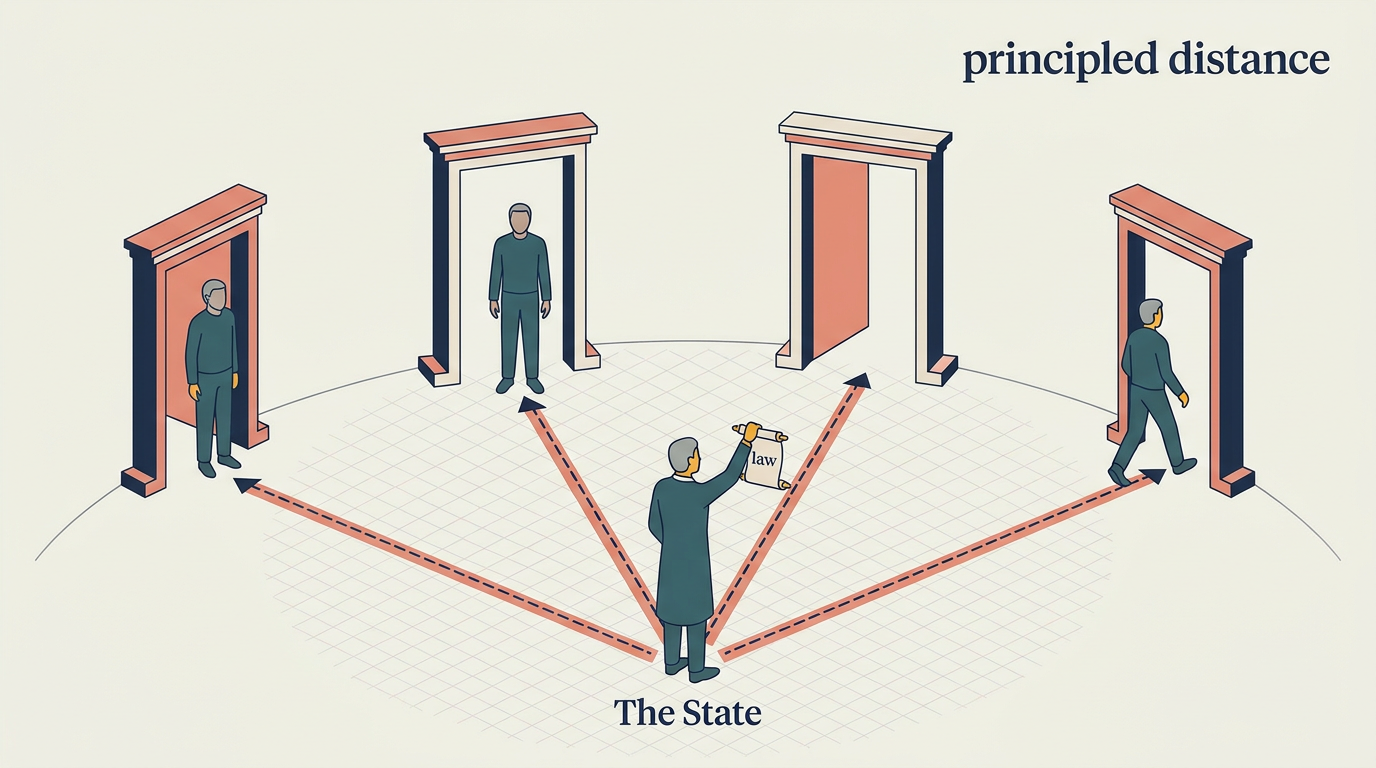
Fig. 8.0 – The state and principled distance.
8.1 What Is Secularism?
Begin outside India, because the problem is not India’s alone. Jews faced discrimination for centuries throughout Europe. In the present state of Israel, a country in West Asia, Arab minorities — both Christian and Muslim — are excluded from social, political and economic benefits that are available to Jewish citizens.
Subtle forms of discrimination also continue to persist against non-Christians in several parts of Europe. In India’s neighbouring states of Pakistan and Bangladesh, the condition of religious minorities has generated considerable concern. A minority here means a religious community that is small in numbers relative to the community around it, and therefore easy to outvote and easy to ignore.
Why This Is A Live Question
Notice what these examples have in common. In each case the state is not a bystander. It either practises the exclusion, permits it, or fails to stop it. That is why such examples remind us of the continuing importance of secularism for people and societies in today’s world.
The word ‘secularism’ is used loosely in everyday argument, and the loose use hides what the idea actually claims. So we will build the definition slowly, from the two problems it was designed to answer.
8.1.1 Inter-religious Domination
In our own country, the Constitution declares that every Indian citizen has a right to live with freedom and dignity in any part of the country. That is a promise made to each citizen, whatever community they belong to, and it is made by the state itself.
Yet in reality, many forms of exclusion and discrimination continue to persist. The chapter asks us to consider three of the starkest examples from India’s own recent past.
Three Examples
More than 2,700 Sikhs were massacred in Delhi and many other parts of the country in 1984. The families of the victims feel that the guilty were not punished.
Several thousands of Hindu Kashmiri pandits have been forced to leave their homes in the Kashmir valley. They have not been able to return to their homes for more than two decades.
More than 1,000 persons were killed during the post-Godhra riots in Gujarat in 2002. The surviving members of many of these families could not go back to the villages in which they lived.
8.1.2 Intra-religious Domination
Will Religion Simply Disappear?
Some people believe that religion is merely the ‘opium of the masses’. On this view, once the basic needs of all are fulfilled and people lead a happy and contented life, religion will simply disappear of its own accord.
Such a view comes from an exaggerated sense of human potential. It is unlikely that human beings will ever be able to fully know the world and control it. We may be able to prolong our life, but we will never become immortal.
Disease can never be entirely eliminated. Nor can we get rid of the element of accident and luck in our lives. Separation and loss are endemic to the human condition — that is, they belong to it permanently and cannot be engineered away.
So a large part of our suffering is man-made, and can therefore be removed. But at least some of our suffering is not made by man at all. Religion, art and philosophy are responses to such suffering. Secularism accepts this, and therefore secularism is not anti-religious.
Domination Inside A Religion
Accepting that religion answers something real is not the same as accepting everything religions do. Religion has its share of some deep-rooted problems.
For example, one can hardly think of a religion that treats its male and female members on an equal footing. In religions such as Hinduism, some sections have faced persistent discrimination: dalits have been barred from entering Hindu temples. In some parts of the country, Hindu woman cannot enter temples.
When religion is organised, it is frequently taken over by its most conservative faction, which does not tolerate any dissent. Religious fundamentalism in parts of the US has become a big problem, and endangers peace both within the country and outside it. Many religions fragment into sects, which leads to frequent sectarian violence and to the persecution of dissenting minorities within the faith.
Read that list again and see who is being dominated in it. Women. Dalits. Dissenters. Smaller sects. Every one of them belongs to the religion in question. The domination here is not one religion crushing another; it is a religion, as an organised institution, holding down its own.
Thus religious domination cannot be identified only with inter-religious domination. It takes another conspicuous form, namely, intra-religious domination. Since secularism is opposed to all forms of institutionalised religious domination, it challenges not merely inter-religious but also intra-religious domination.
Secularism In General Terms
We now possess a general idea of secularism. It is a normative doctrine — that is, a doctrine about what ought to be, not merely a description of what is. It seeks to realise a secular society: one devoid of either inter-religious or intra-religious domination.
That is the negative statement, and it is worth putting the same thing positively. Secularism promotes freedom within religions, and equality between religions as well as within them. Freedom for the dissenter, the woman, the dalit; equality for the small community and the large one alike.
Within this larger framework, a narrower and more specific question now arises. What kind of state is necessary to realise these goals? In other words, how should a state committed to the ideal of secularism relate to religion and to religious communities? That is the question the next section takes up.
8.2 Secular State
Suppose we agree that religious domination — between religions and within them — is the problem. Who is supposed to fix it?
Why Goodwill Is Not Enough
One answer is that people must work together for mutual enlightenment. Education is one way of helping to change the mindset of people. Individual examples of sharing and mutual help can also contribute towards reducing prejudice and suspicion between communities.
It is always inspiring to read stories of Hindus saving Muslims, or Muslims saving Hindus, in the midst of a deadly communal riot. A communal riot is violence between religious communities, in which people are attacked for the community they belong to rather than for anything they have done.
But it is unlikely that mere education, or the goodness of some persons, will eliminate religious discrimination. Individual courage saves individual lives. It does not dismantle the arrangements that put those lives in danger in the first place.
In modern societies, states have enormous public power. They make the laws, run the police, spend the taxes, and decide which practices are permitted and which are punished. How they function is bound to make a crucial difference to the outcome of any struggle to create a society less ridden with inter-community conflict and religious discrimination.
For this reason, we need to see what kind of state is needed to prevent religious conflict and to promote religious harmony.
The First Test: Not Theocratic
How should a state prevent domination by any religious group? For a start, a state must not be run by the heads of any particular religion.
A state governed directly by a priestly order is called theocratic. Theocratic states — such as the Papal states of Europe in medieval times, or in recent times the Taliban-controlled state — lack any separation between religious and political institutions.
Such states are known for their hierarchies, their oppressions, and their reluctance to allow freedom of religion to members of other religious groups. Notice that both kinds of domination we studied earlier appear here at once: other religions are shut out, and dissenters within the ruling religion are pushed down.
If we value peace, freedom and equality, then religious institutions and state institutions must be separated.
The Second Test: No Official Religion
Some people think that the separation of state and religion is sufficient for the existence of a secular state. This does not appear to be so.
Many states which are non-theocratic continue to have a close alliance with a particular religion. For example, the state in England in the sixteenth century was not run by a priestly class, but it clearly favoured the Anglican Church and its members. England had an established religion — a religion given official status by the state, in this case the Anglican Church.
Today Pakistan has an official state religion, namely Sunni Islam. Such regimes may leave little scope for internal dissent or religious equality.
Look carefully at what this shows. No priest rules; the state is not theocratic. Yet one religion is written into the state’s own identity, and the citizen who belongs to another religion — or who dissents inside the favoured one — is not standing on equal ground.
The Third Test: Ends Of Its Own
To be truly secular, then, a state must not only refuse to be theocratic. It must also have no formal, legal alliance with any religion.
Even that, however, is not the end of the matter. The separation of religion and state is a necessary but not sufficient condition of a secular state: you cannot have a secular state without it, but having it does not by itself make a state secular.
A secular state must also be committed to principles and goals which are at least partly derived from non-religious sources. That last phrase matters. The state’s purposes must be defensible to a citizen of any faith, and to one of none.
The chapter names those ends. They should include peace, religious freedom, freedom from religiously grounded oppression, discrimination and exclusion, and also inter-religious and intra-religious equality. Every one of them is aimed at the two kinds of domination identified in Section 8.1.
The three tests together are set out in Fig. 8.1.
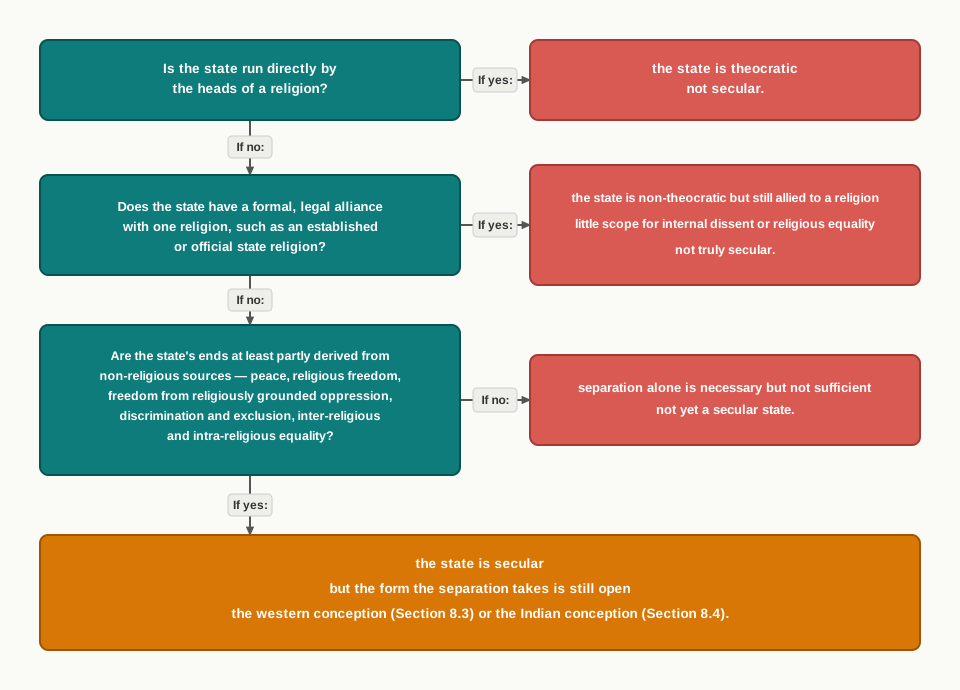
Fig. 8.1 – Three tests of a secular state.
Separation, But Of What Kind?
To promote these ends, the state must be separated from organised religion and its institutions, for the sake of some of these very values.
However, there is no reason to suggest that this separation should take one particular form. The nature and extent of the separation may take different forms, depending upon the specific values it is meant to promote and the way in which those values are spelt out.
This is the hinge of the whole chapter. Two states may both be secular, and yet stand at different distances from religion, because they are trying to protect different things.
We will now consider two such conceptions: the mainstream western conception, best represented by the American state, and an alternative conception, best exemplified by the Indian state.
8.3 The Western Model Of Secularism
All secular states have one thing in common: they are neither theocratic, nor do they establish a religion. That is the shared floor. Above it, the models diverge.
In the most commonly prevalent conceptions, inspired mainly by the American model, the separation of religion and state is understood as mutual exclusion. The state will not intervene in the affairs of religion, and, in the same manner, religion will not interfere in the affairs of the state.
Each has a separate sphere of its own, with independent jurisdiction. Jurisdiction means the area over which an authority has the right to decide. On this model, the state has no authority inside the religious sphere, and religion has none inside the state’s.
What The State May Not Do
Follow the rule out in both directions, because mutual exclusion cuts both ways. It restrains religion first.
No policy of the state can have an exclusively religious rationale. No religious classification can be the basis of any public policy — a law may not sort citizens into believers of this faith and that, and then treat them differently. If this happened, there would be an illegitimate intrusion of religion into the state.
Now the other direction. The state cannot aid any religious institution. It cannot give financial support to educational institutions run by religious communities.
Nor can the state hinder the activities of religious communities, as long as they stay within the broad limits set by the law of the land. And this is where the model shows its hard edge.
If a religious institution forbids a woman from becoming a priest, the state can do little about it. If a religious community excommunicates its dissenters — expels them from the community and cuts them off from its rites — the state can only be a silent witness. If a particular religion forbids the entry of some of its members into the sanctum of its temple, the state has no option but to let the matter rest exactly where it is.
On this view, religion is a private matter. It is not a matter of state policy or of law.
Liberty For Whom?
This common conception interprets freedom and equality in an individualist manner: the unit that holds the rights is the single person, not the group.
Liberty is the liberty of individuals. Equality is equality between individuals. There is no scope for the idea that a community, as a community, has the liberty to follow practices of its own choosing. There is little scope for community-based rights or for minority rights.
Read the temple example again with that in mind. The individual who is kept out of the sanctum is not helped, because the state will not enter the religious sphere. The community that keeps them out is not restrained, because the state will not enter either. Non-interference protects the practice as it stands.
Why Western Secularism Took This Shape
The history of western societies tells us why this is so. Except for the presence of the Jews, most western societies were marked by a great deal of religious homogeneity — that is, nearly everyone belonged to the same religion.
Given that fact, these societies naturally focused on intra-religious domination: on the church’s power over its own members, over dissenters, over the individual conscience. The danger they knew from experience was domination from within a single faith.
So while strict separation of the state from the church is emphasised — to realise, among other things, individual freedom — issues of inter-religious equality, and therefore of minority rights, are often neglected. A model built where there were few religious minorities was never designed to protect them.
Finally, this form of mainstream secularism has no place for the idea of state-supported religious reform — the state acting to change a religious practice, as with a law against untouchability. That absence is not an oversight. It follows directly from the understanding that the separation of state from church, or from religion, entails a relationship of mutual exclusion. A state that may not enter cannot reform.
A Third Kind Of Secularism: Kemal Ataturk’s Turkey
The chapter now sets a very different kind of secularism beside the American one — the secularism practised in Turkey in the first half of the twentieth century. It was not about principled distance from organised religion, that is, a distance set by the state’s own principles, which may require it to stay out of religion on one question and to step in on another. Instead it involved active intervention in, and suppression of, religion. This version of secularism was propounded and practised by Mustafa Kemal Ataturk.
He came to power after the First World War. He was determined to put an end to the institution of Khalifa in the public life of Turkey. Ataturk was convinced that only a clear break with traditional thinking and expressions could elevate Turkey from the sorry state it was in.
He set out in an aggressive manner to modernise and secularise Turkey. He changed his own name from Mustafa Kemal Pasha to Kemal Ataturk — Ataturk translates as Father of the Turks. The Fez, a traditional cap worn by Muslims, was banned by the Hat Law. Western clothing was encouraged for men and women. The Western (Gregorian) calendar replaced the traditional Turkish calendar. In 1928, the new Turkish alphabet, in a modified Latin form, was adopted.
Set the three models side by side and notice how far apart they stand. The American state will not touch religion. The Turkish state under Ataturk reached into what people wore, what they were called, and the very letters they wrote in. Both were called secular.
The second of those questions cannot be answered yet, and that is deliberate. It requires the model we turn to next.
8.4 The Indian Model Of Secularism
Sometimes it is said that Indian secularism is an imitation of western secularism. But a careful reading of our Constitution shows that this is not the case. Indian secularism is fundamentally different from western secularism.
Indian secularism does not focus only on church-state separation, and the idea of inter-religious equality is crucial to the Indian conception. Let us elaborate this further.
Nehru’s Answer To A Student
The chapter records how one of the makers of independent India put the point. Asked by a student to spell out what secularism meant in independent India, Jawaharlal Nehru gave a short answer, and it is printed in Source 8.1.
Read the second sentence closely, because it contains three separate commitments. The state protects religions; it favours none over another; and it takes none as its own. The chapter calls Nehru the philosopher of Indian secularism.
Now the man behind the words. Nehru did not practise any religion, nor did he believe in God. But for him secularism did not mean hostility to religion, and in that sense he was very different from Ataturk in Turkey.
At the same time, Nehru was not in favour of a complete separation between religion and state. On his view a secular state can interfere in matters of religion to bring about social reform. He himself played a key role in enacting laws abolishing caste discrimination, dowry and sati, and extending legal rights and social freedom to Indian women.
While Nehru was prepared to be flexible on many counts, there was one thing on which he was always firm and uncompromising. Secularism for him meant a complete opposition to communalism of all kinds. Communalism is the political use of religious identity — the claim that one’s own religious community is a single bloc whose interests are opposed to those of another community. Nehru was particularly severe in his criticism of communalism of the majority community. For him secularism was not only a matter of principles; it was also the only guarantee of the unity and integrity of India.
Now put the limit on this evidence, as we must with every source. These are the words of one leader, given in reply to a student’s question, and they record what he said secularism should mean. They do not tell us what the Indian state actually did afterwards, whether other framers of the Constitution agreed with him, or what ‘equal protection’ requires in a hard case where two communities want opposite things. A statement of principle is a starting point for an argument, not the end of one.
Diversity Came First
What makes Indian secularism distinctive? For a start, it arose in the context of deep religious diversity that predated the advent of western modern ideas and nationalism. India did not import its plurality; it already had it.
There was already a culture of inter-religious ‘tolerance’ in India. However, we must not forget that tolerance is compatible with religious domination. It may allow some space to everyone, but such freedom is usually limited.
Besides, tolerance allows you to put up with people whom you find deeply repugnant. That is a great virtue if a society is recovering from a major civil war. It is not enough in times of peace, when people are struggling for equal dignity and respect.
Two Secular States, Two Answers
The chapter now stages a small argument between two students, and prints it as Fig. 8.2. It is worth reading their exchange as a puzzle, not as a joke.

Fig. 8.2 – Comparing religious markers in France and India.
Unpack what the two of them have actually established. France, a secular republic in western Europe, kept religious markers out of its educational institutions. India, equally secular, does not prohibit citizens from wearing or displaying such markers in public institutions. Same label, opposite rules.
The girl treats this as strange. The boy’s reply is the chapter’s own: the ideal of secularism envisaged in India is different from that of France. Two states can both refuse theocracy, both refuse an official religion, and still draw the line in different places, because they are protecting different things.
And here is what the cartoon cannot do. It records the difference; it does not defend either side. It gives us no French argument for the ban, no Indian argument for permitting the markers, and no way of judging which state protects religious freedom better. A cartoon can pose a question sharply. It cannot settle it.
The First Difference: Both Kinds Of Domination
The advent of western modernity brought to the fore notions of equality in Indian thought that had until then been neglected and marginalised. It sharpened those ideas and helped us to focus on equality within the community. It also ushered in ideas of inter-community equality, to replace the notion of hierarchy.
Thus Indian secularism took on a distinct form. It was the result of an interaction between what already existed in a society that had religious diversity, and the ideas that came from the west.
The result was an equal focus on intra-religious and inter-religious domination. Indian secularism equally opposed the oppression of dalits and women within Hinduism, the discrimination against women within Indian Islam or Christianity, and the possible threats that a majority community might pose to the rights of the minority religious communities.
That is the first important difference from mainstream western secularism, which, as we saw, grew up in societies of religious homogeneity and therefore looked mainly inward, at one religion’s power over its own members.
The Second Difference: Communities Have Rights Too
Connected to it is the second difference. Indian secularism deals not only with the religious freedom of individuals but also with the religious freedom of minority communities.
Within it, an individual has the right to profess the religion of his or her choice. Likewise, religious minorities also have a right to exist and to maintain their own culture and educational institutions.
Notice how far this is from the individualist reading of liberty in the western model, where the community as such holds nothing. Here the community is itself a bearer of rights, because the threat the model is built against — a majority overwhelming a minority — is a threat to a community, not only to a person.
The Third Difference: The State May Reform
A third difference is this. Since a secular state must be concerned equally with intra-religious domination, Indian secularism has made room for, and is compatible with, the idea of state-supported religious reform.
Thus the Indian constitution bans untouchability. The Indian state has enacted several laws abolishing child marriage and lifting the taboo on inter-caste marriage sanctioned by Hinduism.
Return to the doorway of the temple in the opening story. The western model, holding to mutual exclusion, must let the matter rest where it lies. The Indian state does not.
Is Such A State Still Secular?
The question, however, that arises is this: can a state initiate or even support religious reforms and yet be secular? Can a state claim to be secular and not maintain a separation of religion from the state?
The secular character of the Indian state is established by virtue of the fact that it is neither theocratic, nor has it established any one or multiple religions. Both tests from Section 8.2 are passed.
Beyond that, it has adopted a very sophisticated policy in pursuit of religious equality. This allows it either to disengage with religion in American style, or to engage with it if required. That is what principled distance means in practice: the distance is not fixed in advance, but set by the principles the state is committed to.
The Indian state may engage with religion negatively, to oppose religious tyranny. This is reflected in such actions as the ban on untouchability. It may also choose a positive mode of engagement: the Indian Constitution grants all religious minorities the right to establish and maintain their own educational institutions, which may receive assistance from the state.
All these complex strategies can be adopted by the state to promote the values of peace, freedom and equality. The values decide the distance; the distance does not decide the values.
The Two Models Side By Side
We now have both models in full, and it is worth holding them together before the criticisms begin. They share a floor and differ above it. Both refuse to be run by priests, and both refuse an official religion. They part company over what separation means, over which domination they are built to stop, over who holds rights, and over whether the state may reform a religion or fund its schools. Table 8.A1 consolidates the contrast that the last two sections have argued out.
Why ‘Equal Respect’ Will Not Do
It should be clear by now why the complexity of Indian secularism cannot be captured by the phrase ‘equal respect for all religions’.
If by that phrase we mean the peaceful coexistence of all religions, or inter-religious toleration, then it will not be enough. Secularism is much more than mere peaceful coexistence or toleration — that was the argument against tolerance made earlier in this section.
If instead the phrase means an equal feeling of respect towards all established religions and their practices, then there is an ambiguity that needs clearing. Indian secularism allows for principled state intervention in all religions. Such intervention betrays disrespect to some aspects of every religion.
For example, religiously sanctioned caste-hierarchies are not acceptable within Indian secularism. The secular state does not have to treat every aspect of every religion with equal respect. What it offers, in the chapter’s own careful phrase, is equal disrespect for some aspects of organised religions — equal, because no religion is exempted from scrutiny, and no religion is singled out for it.
8.5 Criticisms Of Indian Secularism
Indian secularism has been subjected to fierce criticism. Some of it comes from clerics and religious nationalists, some from politicians, social activists and even academics, as the chapter noted at the outset.
What are these criticisms? And can we defend secularism from them? Six charges are taken up, one by one. Read each of them as an argument to be weighed, not as an insult to be brushed aside — a doctrine that cannot survive its critics does not deserve to survive at all.
8.5.1 Anti-religious
First, it is often argued that secularism is anti-religious. We hope to have shown that secularism is against institutionalised religious domination. That is not the same as being anti-religious.
The distinction is worth stating slowly, because the whole defence rests on it. To oppose a church’s power over its dissenters is not to oppose the faith the church teaches. To oppose one community’s persecution of another is not to oppose either community’s God.
Does It Threaten Religious Identity?
Similarly, it has been argued by some that secularism threatens religious identity. However, as we noted earlier, secularism promotes religious freedom and equality. Hence it clearly protects religious identity rather than threatens it. The believer whose community is small, and the dissenter whose views are unpopular, are protected precisely as believers.
Of course, secularism does undermine some forms of religious identity. It undermines those which are dogmatic, violent, fanatical, exclusivist, and those which foster hatred of other religions.
Here the chapter makes a sharp move, and it is a move in reasoning rather than in rhetoric. The real question is not whether something is undermined. Everything worth defending undermines something. The real question is whether what is undermined is intrinsically worthy or unworthy.
8.5.2 Western Import
A second criticism is that secularism is a western concept and, therefore, unsuited to Indian conditions.
On the surface, this is a strange complaint. There are millions of things in India today — from trousers to the internet and parliamentary democracy — that have their origins in the west. One response, therefore, could be: so what? Have you heard a European complain that because zero was invented in India, they will not work with it?
Why That Answer Is Too Quick
However, this is a somewhat shallow response. It defends secularism by shrugging, and a shrug is not an argument. The more important and relevant point is that for a state to be truly secular, it must have ends of its own.
Look at how western states became secular. At an important level, they did so when they challenged the control of established religious authority over social and political life. Secularism there was a revolt against the church, not a gift from it. The western model of secularism is not, therefore, a product of the Christian world.
And What Of The Claim That It Is Western?
The mutual exclusion of religion and state, which is supposed to be the ideal of western secular societies, is also not the defining feature of all secular states. That was the burden of the whole comparison in Sections 8.3 and 8.4.
The idea of separation can be interpreted differently by different societies. A secular state may keep a principled distance from religion in order to promote peace between communities, and it may also intervene to protect the rights of specific communities.
This exactly is what has happened in India. India evolved a variant of secularism that is not just an implant from the west on Indian soil. The fact is that secularism has both western and non-western origins. In the west, it was the Church-state separation which was central. In countries such as India, the idea of peaceful coexistence of different religious communities has been important.
8.5.3 Minoritism
A third accusation against secularism is the charge of minoritism — the charge that it favours minorities at the expense of everyone else. It is true that Indian secularism advocates minority rights. So the question is a fair one: is this justified?
The chapter answers with two examples, both of them designed to be argued with rather than admired. Work through each of them.
The Train Compartment
Consider four adults in a compartment of a train travelling at the fastest speed imaginable. In the middle of the journey, one of the four passengers expresses a desire to smoke. The second one complains that he cannot bear cigarette smoke. The other two passengers smoke too, but say nothing.
Clearly there is a conflict here between two passengers. A suggestion is made that it be resolved by vote. The two mild smokers go along with the addict, and the non-smoker is defeated by a margin of two votes.
The person in the minority loses. Yet the result appears fair, because a proper democratic procedure, adopted by common agreement, was followed. Note that carefully: everyone agreed to the method before they knew the outcome, and the method was applied honestly.
Now alter the situation a bit. Suppose that the non-smoker suffers from asthma. Smoking can induce a life-threatening attack in him. His preference that the other person does not smoke now expresses his fundamental and very urgent interest.
Would the procedure previously followed — going with the decision of the majority — be fair in such a context? Do you not think that the addicted smoker should refrain till the train reaches its destination?
You will agree that when it comes to fundamental interests, voting as a democratic procedure is inappropriate. A person has a prior right to the satisfaction of his or her significant interests. The vote did not become dishonest; it became the wrong instrument, because some interests are not the kind of thing a majority may vote away.
What holds true of individuals also holds for communities. The most fundamental interest of minorities must not be harmed, and must be protected by constitutional law. This is exactly how it is in the Indian Constitution. Minority rights are justified as long as these rights protect their fundamental interests.
So the student in the chapter’s margin has the point exactly right when he says that treating everyone in exactly the same way is not always fair. The same rule, applied to unequal situations, can produce a very unequal result.
The Auditorium And The Ramp
At this point someone might still say that minority rights are special privileges which come with some costs to others. Why then should such special privilege be given?
This question can be best answered by another example. Consider that a film is being shown in an auditorium on the first floor. The auditorium is accessible by a staircase. Everyone is free to buy a ticket, go up the stairs and see the film.
Or, are they? Is everyone really free? Suppose that among the avid film-goers are some old people, some who have recently broken a leg, and others who have long been physically challenged. None of them can really climb up the stairs.
Do you think it would be wrong if a lift or a ramp was provided for people in wheel chairs? Doing so enables them to achieve exactly what others routinely procure through the staircase. Yet this group in minority needs a different mode of getting to the first floor.
If all spaces are structured in such a way that they suit only young, able-bodied persons, then some category of persons will forever be excluded from a simple benefit such as watching a film. To make a separate arrangement for them is not to accord them any special treatment. It is to treat them with the same respect and dignity with which all others are being treated.
The lesson is that minority rights need not be, and should not be, viewed as special privileges. The ramp gives the person in a wheelchair no more than the staircase already gives everyone else.
8.5.4 Interventionist
A fourth criticism claims that secularism is coercive, and that it interferes excessively with the religious freedom of communities.
This misreads Indian secularism. It is true that by rejecting the idea of separation as mutual exclusion, Indian secularism rejects non-interference in religion. But it does not follow that it is excessively interventionist.
Indian secularism follows the concept of principled distance, which also allows for non-interference. The state that may step in is also free to stay out, and often does. Besides, interference need not automatically mean coercive intervention. Persuading, funding, facilitating and legislating are not the same act.
The Big Dilemma: Personal Laws
It is of course true that Indian secularism permits state-supported religious reform. But this should not be equated with a change imposed from above, with coercive intervention.
But it might be argued: does it do this consistently? Why have the personal laws of all religious communities not been reformed? This is the big dilemma facing the Indian state. Personal laws are the laws concerning marriage, inheritance and other family matters, which are governed by different religions.
A secularist might see the personal laws as manifestations of community-specific rights that are protected by the Constitution. Or he might see these same laws as an affront to the basic principles of secularism, on the ground that they treat women unequally and therefore unjustly.
Notice that both readings use the vocabulary this chapter has built. Personal laws can be seen as manifestations of freedom from inter-religious domination — a community protected from having another community’s rules imposed on it. Or they can be seen as instances of intra-religious domination — a community’s own women held unequal within it. The same law, two names.
Such internal conflicts are part and parcel of any complex doctrine. But they are not something we need to live with forever.
Personal laws can be reformed in such a way that they continue to exemplify both minority rights and equality between men and women. But such reform should neither be brought about by State or group coercion, nor should the state adopt a policy of total distance from it. The state must act as a facilitator, by supporting liberal and democratic voices within every religion.
8.5.5 Vote Bank Politics
Fifth, there is the argument that secularism encourages the politics of vote banks. A vote bank is a group assumed to vote together as a bloc for one candidate or party.
As an empirical claim — a claim about what actually happens — this is not entirely false. The defence here does not deny the fact. It puts the fact in perspective.
Seeking Votes Is Not The Charge
First, in a democracy politicians are bound to seek votes. That is part of their job, and that is what democratic politics is largely about. To blame a politician for pursuing a group of people, or for promising to initiate a policy with the motivation of securing their votes, is unfair.
The real question is what precisely the vote is sought for. Is it to promote solely the politician’s self-interest or power? Or is it also for the welfare of the group in question?
If the group which voted for the politician does not get any benefit from this act, then surely the politician must be blamed. But if secular politicians who sought the votes of minorities also manage to give them what they want, then this is a success of the secular project — which aims, after all, to also protect the interests of the minorities.
Where It Goes Wrong
But what if the welfare of the group in question is sought at the cost of the welfare and rights of other groups? What if the interests of the majority are undermined by these secular politicians? Then a new injustice is born. Can you think of such examples?
In theory, there may not be anything wrong with vote bank politics. The damage begins only when vote bank politics leads to the mobilisation of a social group to vote en masse for a particular candidate or political party during elections. That distorts electoral politics.
Here the important feature is that the whole group works as a single monolithic unit during voting. Despite the diversity within the unit, the party or leader pursuing such vote bank politics tries to artificially construct a belief that the interest of the group is one.
In effect, by doing this, the political parties’ priorities short-term electoral gains over the long-term development and governance needs of society. In India it has been observed that political parties neglecting substantive issues have often focused on emotive issues for electoral gains, neglecting the genuine problems faced by the community.
Competitive vote bank politics has the potential to exacerbate social division, by portraying different groups as rivals vying for limited resources. In India, vote bank politics is also associated with minority appeasement. This means that the political parties disregard the principles of equality of all citizens and give priority to the interests of a minority group.
Ironically, this has led to further alienation and marginalization of the minority group. And since vote bank politics fails to acknowledge diversity within the minority group, taking up issues of social reform within these groups has also proved difficult. The group is flattered as a bloc, and its own dissenters are left exactly where they were.
8.5.6 Impossible Project
A final, cynical criticism might be this: secularism cannot work, because it tries to do too much. It attempts to find a solution to an intractable problem.
What is this problem? People with deep religious differences will never live together in peace.
Testing The Claim Against History
Now, this is an empirically false claim — and notice that it is the kind of claim evidence can settle, because it says something about what has and has not happened. The history of Indian civilisation shows that this kind of living together is realisable. It was realised elsewhere too. The Ottoman Empire, which ruled over a religiously diverse population across south-eastern Europe and West Asia, is a stirring example.
But now critics might say that co-existence under conditions of inequality was indeed possible. Everyone could find a place in a hierarchically arranged order. The point, they claim, is that this will not work today, when equality is increasingly becoming a dominant cultural value.
That is a serious reply, and it should not be dismissed. It concedes the historical fact and then denies that the fact proves what it seems to prove.
The Experiment Being Watched
There is another way of responding to this criticism. Far from pursuing an impossible objective, Indian secularism mirrors the future of the world.
A great experiment is being carried out in India, watched with razor-sharp eyes and with great interest by the whole world. It is being watched for a reason.
With the migration of people from the former colonies to the west, and the increased movement of people across the globe with the intensification of globalisation, Europe and America and some parts of the Middle-East are beginning to resemble India in the diversity of cultures and religions present in their societies. Societies that once had religious homogeneity — and built their secularism for it — now have plurality, and are watching the future of the Indian experiment with keen interest.
Reading The Calendar
One last piece of evidence, and it is the one that sits closest to a student’s own life. The Indian state closes its offices on certain days. Which days it chooses is a public decision, made by a state that calls itself secular. Table 8.1 sets out the list of gazetted holidays.
Read the table before you argue about it. Three of the seventeen days are not religious at all: Republic Day, Independence Day and Mahatma Gandhi’s Birthday. The remaining fourteen are drawn from several religions, and they are not distributed in equal numbers.
Both defences and criticisms can be built from that. A defender can say that this is exactly a state keeping principled distance: it recognises the festivals its citizens actually keep, rather than pretending, as a mutual-exclusion state would, that religion does not exist in public life. A critic can say that the numbers are uneven, and that a state which counts holidays by community has made religious classification the basis of public policy.
Now the limit, which is where every reading of evidence must end. The table counts days; it cannot count fairness. It tells us nothing about how the list was arrived at, which communities were consulted, which festivals were considered and left out, or what a citizen who belongs to none of these religions gets from it. And it is a list for one year, in one calendar. A student who uses this table to settle the argument about Indian secularism has asked far more of it than seventeen rows of dates can give.
8.6 Summary
What Secularism Opposes
- Secularism is first of all a doctrine against inter-religious domination — one religious community denying the basic freedoms of another.
- It is equally a doctrine against intra-religious domination — a religion holding down its own women, its lower castes, its dissenters and its smaller sects.
- It is not anti-religious. It accepts that religion, like art and philosophy, answers suffering that no human effort can remove.
- Stated positively, secularism is a normative doctrine: it seeks freedom within religions, and equality both between religions and within them.
What Kind Of State Is Needed
- Education and individual goodness reduce prejudice, but only the state holds the public power that discrimination runs on.
- A secular state must not be theocratic, and must not be run by the heads of any religion.
- It must also have no formal, legal alliance with any religion — no established or official state religion.
- Separation of religion and state is therefore necessary, but not sufficient. A secular state must also pursue ends drawn at least partly from non-religious sources: peace, religious freedom, freedom from religiously grounded oppression, and inter- and intra-religious equality.
- The form the separation takes is not fixed. It depends on the values it is meant to protect.
Two Models
- The mainstream western model, best represented by the American state, reads separation as mutual exclusion: neither sphere enters the other.
- Because most western societies were religiously homogeneous, this model focused on intra-religious domination, made the individual the sole bearer of rights, left little room for minority or community rights, and has no place for state-supported religious reform.
- Ataturk’s Turkey shows a third path — not principled distance but active intervention in, and suppression of, religion.
- The Indian model arose from a society already deeply diverse. It rejects mere tolerance, which is compatible with domination.
- Indian secularism opposes both kinds of domination equally; it protects individuals and minority communities; and it permits state-supported religious reform, as with the constitutional ban on untouchability.
- Its guiding concept is principled distance: the state may disengage from religion in American style, or engage with it — negatively, to oppose religious tyranny, or positively, by aiding minority educational institutions.
- Indian secularism therefore cannot be captured by ‘equal respect for all religions’. It allows equal disrespect for some aspects of every organised religion.
The Criticisms And The Replies
- Anti-religious: secularism opposes institutionalised domination, not faith. It undermines only dogmatic, violent, fanatical and exclusivist forms of religious identity — and the real question is whether what is undermined is worthy or unworthy.
- Western import: secularism has both western and non-western origins, and India evolved its own variant rather than importing one.
- Minoritism: fundamental interests cannot be voted away by a majority, and a ramp is not a privilege. Minority rights equalise; they do not favour.
- Interventionist: principled distance also permits non-interference, and interference is not automatically coercion. The unreformed personal laws remain the big dilemma.
- Vote bank politics: seeking votes is a politician’s job, but treating a community as one monolithic bloc distorts electoral politics and, ironically, further alienates the minority it claims to serve.
- Impossible project: history shows deeply different communities can live together — though critics reply that this was coexistence under hierarchy, not under equality.
The Arguments In One Place
The chapter’s central claim is that a secular state is not one that ignores religion, but one that refuses domination in the name of religion — and that the distance it keeps from religion must be set by that purpose, not fixed in advance.
The strongest position against it, as the chapter itself records, is that a state which may reform religion has abandoned separation altogether, and that the resulting doctrine is either coercive or inconsistent: it reforms some practices and leaves the personal laws of religious communities untouched.
Between these stands the chapter’s own answer: principled distance. The state stays out where staying out protects freedom, and steps in where stepping in ends domination — the same principles giving different answers in different cases.
What Remains Contested
Whether personal laws are a minority community’s protection or a woman’s cage is not settled here, and the chapter admits it is the big dilemma facing the Indian state.
Nor is it settled whether coexistence achieved in older hierarchical orders can be repeated in a society where equality has become the dominant value — the critics’ reply that the chapter records but does not answer.
And notice whose voices the chapter’s evidence was never designed to record. Nehru’s reply to a student tells us what one leader believed secularism should mean. It does not tell us what the dalit turned away at a temple door, the woman shut out of a sanctum, or the family that could not return to its village would say secularism owes them.
8.7 NCERT Questions
- Which of the following do you feel are compatible with the idea of secularism? Give reasons.
- Absence of domination of one religious group by another.
- Recognition of a state religion.
- Equal state support to all religions.
- Mandatory prayers in schools.
- Allowing separate educational institutions for any minority community.
- Appointment of temple management bodies by the government.
- Intervention of state to ensure entry of Dalits in temples.
- Some of the key characteristics of western and Indian model of secularism have got mixed up. Separate them and make a new table.
| Western Secularism | Indian Secularism |
|---|---|
| Strict non-interference of religion and state in each other’s affairs | State supported religious reforms allowed |
| Equality between different religious groups is a key concern | Equality between different sects of a religion is emphasised |
| Attention to minority rights | Less attention to community based rights |
| Individual and his rights at the centre | Rights of both individual and religious community protected. |
What do you understand by secularism? Can it be equated with religious tolerance?
Do you agree with the following statements? Give reasons for supporting or opposing any of them.
- Secularism does not allow us to have a religious identity.
- Secularism is against inequality within a religious group or between different religious groups.
- Secularism has a western-Christian origin. It is not suitable for India.
Indian secularism focuses on more than the religion-state separation. Explain.
Explain the concept of principled distance.
8.8 Check Your Concepts
A state has no priestly rulers, but it does have an official state religion. Using the tests set out in Section 8.2, explain why such a state is still not truly secular.
Take the train compartment and the auditorium staircase together. Using both, explain why minority rights should not be viewed as special privileges.
Read Source 8.1. Name the separate commitments contained in Nehru’s reply. Then state one thing his words cannot tell us about how the Indian state actually behaved.
Study Fig. 8.2. What do the two students establish about France and India? What does their exchange leave undecided?
Look at Table 8.1. Build one argument that the list of gazetted holidays upholds the case of secularism in India, and one argument that it does not. Then state one question the table cannot answer.
Reconstruct, step by step, the chain by which vote bank politics is said to distort electoral politics — from the mobilisation of a group to vote as a bloc, to the further alienation of the minority group itself.
The chapter calls the unreformed personal laws the big dilemma facing the Indian state. Set out the two ways in which a secularist may read these laws, and explain what role the chapter argues the state should play in reforming them.
Critics who call secularism an impossible project accept that Indian civilisation, and the Ottoman Empire, achieved coexistence among deeply different religious communities. Yet they deny that this settles the question. On what does their objection turn?