Chapter 1: Nature and Significance of Management
Every organisation, whether it makes steel, runs a school, or sells candles from a small workshop, has to get a large number of tasks done by a large number of people. Someone must decide what is to be achieved, arrange the money, machines and people needed, guide those people while the work is on, and check whether the results match what was intended. This deliberate process of getting things done through others is called management.
The Tata Group, founded by Jamsetji Nusserwanji Tata in 1868, grew from a single trading concern into a conglomerate with businesses in steel, vehicles, software, power and hotels. Enterprises of that size do not hold together by chance. They survive because work at every level is planned, organised, staffed, directed, controlled and coordinated.
This chapter explains the meaning of management and the difference between effectiveness and efficiency. It then examines the characteristics, objectives and importance of management, its nature as an art, a science and a profession, the three levels of management, the five functions of management, and coordination as the essence of management.

Fig. 1.0 – Managers at work in an organisation.
1.1 Introduction
Look at any organisation that has grown large and stayed successful. It did not reach that position by accident. Behind it lies a deliberate process by which work is decided, divided, guided and reviewed. That process is called management.
Management is not something that only big companies need. It is required in every kind of organisation — a unit manufacturing handlooms, a shop trading in consumer goods, a salon providing hairstyling services, and even organisations that are not run for profit, such as schools, hospitals and charitable trusts. Wherever a group of people work together for a common purpose, their efforts have to be directed by someone.
Management In A Small Enterprise
Consider a small enterprise built up by a single entrepreneur. Namchi Designer Candles, set up in South Sikkim by Smita Rai, employs women from her district and produces a wide range of candles, including customised candles for the Diwali season. The unit has grown steadily and has received recognition for women’s entrepreneurship in the region.
A typical day in the life of the person running such a unit consists of a series of interrelated and continuous activities. A special festive collection has to be planned in advance. Funds have to be arranged and additional workers recruited. Suppliers have to be contacted regularly so that deliveries arrive on time. Customers have to be met so that their feedback and suggestions are known.
None of these activities stands alone. Each one is connected to the others, and each is aimed at the same end — achieving the goals of the organisation. These interconnected and interdependent activities are the functions of management.
Every Organisation Is Managed
The person running a small candle unit is a manager. So is the principal of a school. Schools, hospitals, shops and large corporations are all organisations, and each of them has goals that it wants to achieve. The goals may be entirely different, but every one of these organisations has the same two things in common — management and managers.
This is why management is described as a universal activity. Successful organisations do not achieve their goals by chance. They achieve them by following a deliberate process, and that process is ‘management’.
Management Is Needed At Every Level
Management is essential for all organisations, big or small, profit-making or non-profit, service-providing or manufacturing. Its basic purpose is to see that every individual makes their best possible contribution towards group objectives, instead of working in isolation or at cross purposes.
Management consists of a series of interrelated functions performed by all managers. However, managers do not all work at the same level of the organisation, and the time each of them spends on a particular function differs. Managers at the top level spend more time on planning and organising, while managers at the lower levels spend more of their time supervising the actual work. The levels of management are examined later in this chapter.
Definitions Of Management
Different management thinkers have defined management in slightly different words, but the core idea in each definition is the same — working with people and resources to achieve chosen goals in a way that is both effective and efficient.
Read together, these definitions point to three ideas that the next section examines closely — that management is a process, that it must be effective, and that it must be efficient.
1.2 Concept of Management
The term ‘management’ is used very widely. In everyday language it is used for taking charge of almost any activity in an enterprise. In business studies, however, it has a precise meaning that must be understood carefully, because every later chapter of the subject is built on it.
As the earlier examples show, management is an activity that becomes necessary wherever a group of people work together in an organisation. The people in an organisation perform diverse tasks, but they are all working towards the same goal. Management guides their separate efforts towards that common objective.
This gives management two responsibilities at the same time. It has to see that tasks are completed and goals are actually achieved, which is effectiveness. It has also to see that this is done with the least amount of resources and at minimum cost, which is efficiency.
Three terms in this definition need elaboration — process, effectively and efficiently.
Process
Process here means the primary functions or activities that management performs in order to get things done. These functions are planning, organising, staffing, directing and controlling. They are discussed later in this chapter and studied in detail in the chapters that follow.
Calling management a process is important. It tells us that management is not a single act or a one-time decision, but a series of continuous activities that go on as long as the organisation exists.
Effectiveness
Being effective, or doing work effectively, basically means finishing the given task. Effectiveness in management is concerned with doing the right task, completing activities and achieving goals. In other words, it is concerned with the end result.
If a factory is asked to produce a certain quantity of goods within a given time and it produces that quantity within that time, it has been effective. Whether it did so at a sensible cost is a separate question.
Efficiency
Completing the task is not enough by itself. The other aspect is being efficient, or doing the work efficiently.
Efficiency means doing the task correctly and with minimum cost. It involves a kind of cost-benefit analysis, and it turns on the relationship between inputs and outputs. Input resources are money, materials, equipment and the persons required to do a particular task.
Efficiency increases in two ways. It increases when fewer resources, that is, fewer inputs, are used to derive more benefits, that is, more outputs. It also increases when the same benefit or output is obtained using fewer resources, so that less cost is incurred.
Management is obviously concerned with the efficient use of resources, because reducing the use of resources reduces costs, and lower costs ultimately lead to higher profits.
1.2.1 Effectiveness Versus Efficiency
These two terms are different, but they are interrelated. For management, it is important to be both effective and efficient. Effectiveness and efficiency are two sides of the same coin. But the two aspects need to be balanced, and management at times has to compromise with efficiency.
It is easier to be effective and ignore efficiency, that is, to complete the given task but at a high cost. Suppose a company’s target production is 5000 units in a year. Because of power failure for most of the time, the manager has to operate on double shifts to achieve this target. The manager is able to produce 5000 units, but at a higher production cost. Here the manager was effective but not so efficient, since more inputs — labour cost and electricity cost — were used for the same output.
The opposite situation is equally possible. At times a business may concentrate more on producing goods with fewer resources, that is, on cutting down cost, but does not achieve the target production. As a result the goods do not reach the market, demand for them declines and competitors enter the market. This is a case of being efficient but not effective, since the goods did not reach the market.
It is therefore important for management to achieve goals, that is, effectiveness, with minimum resources, that is, as efficiently as possible, while maintaining a balance between the two. Usually high efficiency is associated with high effectiveness, which is the aim of all managers. But undue emphasis on high efficiency without being effective is also not desirable. Poor management is the result of both inefficiency and ineffectiveness. The distinction is set out in Table 1.1.
1.3 Characteristics of Management
The definitions examined so far describe management in different words, but certain common elements run through all of them. These common elements are called the basic characteristics of management. They tell us what kind of activity management is, and they are the features a student is expected to state and explain in an examination answer.
Management is a goal-oriented process — an organisation has a set of basic goals which are the basic reason for its existence. These goals should be simple and clearly stated. Different organisations have different goals. The goal of a retail store may be to increase sales, while the goal of The Spastics Society of India is to impart education to children with special needs. Management unites the efforts of different individuals in the organisation towards achieving these goals.
Management is all pervasive — the activities involved in managing an enterprise are common to all organisations, whether economic, social or political. A petrol pump needs to be managed as much as a hospital or a school. What managers do in India, the USA, Germany or Japan is the same. How they do it may be quite different, and this difference is due to differences in culture, tradition and history.
Management is multidimensional — management is a complex activity that has three main dimensions, namely management of work, management of people and management of operations. These three dimensions are shown in Fig. 1.1 and explained after this list.
Management is a continuous process — the process of management is a series of continuous, composite, but separate functions, that is, planning, organising, directing, staffing and controlling. These functions are simultaneously performed by all managers all the time. The owner of a small manufacturing unit may spend some days largely on planning a future exhibition, and another day on sorting out an employee’s problem. The task of a manager consists of an ongoing series of functions.
Management is a group activity — an organisation is a collection of diverse individuals with different needs. Every member of the group has a different purpose for joining the organisation, but as members of the organisation they work towards fulfilling the common organisational goal. This requires team work and coordination of individual effort in a common direction. At the same time, management should enable all its members to grow and develop as needs and opportunities change.
Management is a dynamic function — management has to adapt itself to the changing environment. An organisation interacts with its external environment, which consists of various social, economic and political factors. In order to be successful, an organisation must change itself and its goals according to the needs of the environment. McDonalds, the fast food giant, made major changes in its menu in order to survive in the Indian market.
Management is an intangible force — management is a force that cannot be seen, but its presence can be felt in the way the organisation functions. Its effect is noticeable in an organisation where targets are met according to plans, employees are happy and satisfied, and there is orderliness instead of chaos.
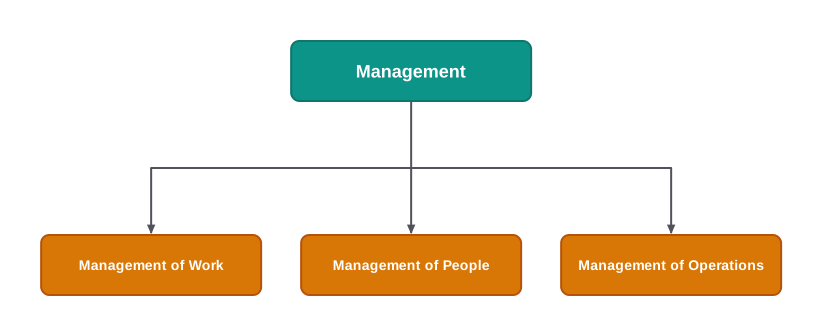
Fig. 1.1 – Dimensions of management.
The Three Dimensions Of Management
Management of work means that all organisations exist for the performance of some work. In a factory a product is manufactured, in a garment store a customer’s need is satisfied, and in a hospital a patient is treated. Management translates this work in terms of goals to be achieved and assigns the means to achieve it. This is done in terms of problems to be solved, decisions to be made, plans to be established, budgets to be prepared, responsibilities to be assigned and authority to be delegated.
Management of people means managing human resources, who are an organisation’s greatest asset. Despite all developments in technology, getting work done through people is still a major task for the manager. Managing people has two dimensions. First, it implies dealing with employees as individuals with diverse needs and behaviour. Second, it means dealing with individuals as a group of people. The task of management is to make people work towards achieving the organisation’s goals by making their strengths effective and their weaknesses irrelevant.
Management of operations means managing the production process. No matter what the organisation is, it has some basic product or service to provide in order to survive. This requires a production process, which entails the flow of input material and the technology for transforming this input into the desired output for consumption. Management of operations is interlinked with both the management of work and the management of people.

Fig. 1.2 – Management in a non-business organisation.
1.4 Objectives of Management
Management seeks to achieve certain objectives, which are the desired results of any activity. These objectives are not chosen at random. They must be derived from the basic purpose of the business itself, because management exists to serve that purpose and not the other way round.
In any organisation there are different objectives, and management has to achieve all of them in an effective and efficient manner. These objectives can be classified into three groups — organisational objectives, social objectives and personal or individual objectives. The classification is shown in Fig. 1.3.
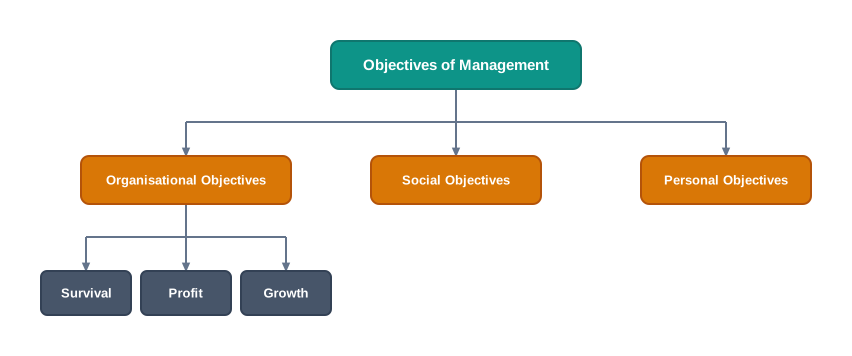
Fig. 1.3 – Objectives of management.
Organisational objectives — management is responsible for setting and achieving objectives for the organisation. It has to achieve a variety of objectives in all areas, considering the interest of all stakeholders, including shareholders, employees, customers and the government. The main objective of any organisation should be to utilise human and material resources to the maximum possible advantage, that is, to fulfil the economic objectives of a business. These are survival, profit and growth.
Social objectives — these involve the creation of benefit for society. As a part of society, every organisation, whether business or non-business, has a social obligation to fulfil. This refers to consistently creating economic value for various constituents of society. It includes using environment friendly methods of production, giving employment opportunities to the underprivileged sections of society, and providing basic amenities such as schools and healthcare for the community.
Personal objectives — organisations are made up of people who have different personalities, backgrounds, experiences and objectives. They all become part of the organisation to satisfy their diverse needs. These needs vary from financial needs such as competitive salaries and perks, to social needs such as peer recognition, to higher level needs such as personal growth and development. Management has to reconcile personal goals with organisational objectives so that there is harmony in the organisation.
The Three Economic Objectives
Survival is the basic objective of any business. Management must strive to ensure the survival of the organisation. In order to survive, an organisation must earn enough revenues to cover its costs. A business that cannot cover its costs cannot continue in existence, however good its other plans may be.
Profit is the next requirement, because mere survival is not enough for a business. Management has to ensure that the organisation makes a profit. Profit provides a vital incentive for the continued successful operation of the enterprise, and it is essential for covering the costs and the risks of the business.
Growth is necessary because a business needs to add to its prospects in the long run. To remain in the industry, management must fully exploit the growth potential of the organisation. Growth of a business can be measured in terms of increase in sales volume, increase in the number of employees, increase in the number of products or increase in capital investment. There can be other indicators of growth as well.
Why All Three Groups Matter
These three groups of objectives are connected. An organisation that ignores its social obligations may face resistance from the community and the government, which in the long run threatens its survival. An organisation that ignores the personal objectives of its employees will find that skilled people leave, which reduces both effectiveness and efficiency. Management therefore has to balance the three, and not pursue any one of them alone.
1.5 Importance of Management
Management is a universal activity that is integral to any organisation. Having understood what it is and what it seeks to achieve, we can now examine the reasons that have made management so important.
Management helps in achieving group goals — management is required not for itself but for achieving the goals of the organisation. Different individuals in an organisation pull in different directions unless someone unifies them. The task of a manager is to give a common direction to individual effort so that the overall goal of the organisation is achieved.
Management increases efficiency — the aim of a manager is to reduce costs and increase productivity. This is done through better planning, organising, directing, staffing and controlling the activities of the organisation. Each of these functions removes waste of effort, material or time, and the saving shows up as lower cost per unit of output.
Management creates a dynamic organisation — all organisations have to function in an environment that is constantly changing. It is generally seen that individuals in an organisation resist change, as change often means moving from a familiar, secure environment into a newer and more challenging one. Management helps people adapt to these changes so that the organisation is able to maintain its competitive edge.
Management helps in achieving personal objectives — a manager motivates and leads the team in such a manner that individual members are able to achieve their personal goals while contributing to the overall organisational objective. Through motivation and leadership, management helps individuals develop team spirit, cooperation and commitment to group success.
Management helps in the development of society — an organisation has multiple objectives that serve the purpose of the different groups that constitute it. In the process of fulfilling all these objectives, management helps in the development of the organisation, and through that it helps in the development of society. It provides good quality products and services, creates employment opportunities, adopts new technology for the greater good of the people, and leads the path towards growth and development.
How These Reasons Connect
These five reasons are not separate advantages that happen to occur together. Group goals are achieved because effort is directed; effort can be directed efficiently only when the organisation is able to change with its environment; and people cooperate in that change only when their own objectives are being met. Development of society follows from an organisation that is doing all of this well over a long period.
1.6 Nature of Management
Management is as old as civilisation. Although modern organisations are of recent origin, organised activity has existed since the time of the ancient civilisations. In fact, organisations may be considered the distinguishing feature that separated civilised society from uncivilised ones.
The earliest management practices were a set of rules and regulations that grew out of the experiences of governmental and commercial activities. As trade and commerce developed, these rules gradually developed into management principles and practices.
The term ‘management’ today has several different connotations that highlight different aspects of its nature. The study of management has evolved over a period of time along with modern organisations, and it is based both on the experience and practice of managers and on a set of theoretical relationships. Over time it has grown into a dynamic subject with its own special characteristics.
One question, however, needs to be addressed. Is management a science, or an art, or both? To answer this, we examine the features of science and of art, and see how far management fulfils them. A third question follows from these — whether management can also be called a profession.
1.6.1 Management as an Art
Art is the skilful and personal application of existing knowledge to achieve desired results. It can be acquired through study, observation and experience. Since art is concerned with the personal application of knowledge, some kind of ingenuity and creativity is required to practise the basic principles learnt.
Basic Features Of An Art
Existence of theoretical knowledge — art presupposes the existence of certain theoretical knowledge. Experts in their respective areas have derived certain basic principles that are applicable to a particular form of art. Literature on dancing, public speaking, acting and music is widely recognised.
Personalised application — the use of this basic knowledge varies from individual to individual. Art is therefore a very personalised concept. Two dancers, two speakers, two actors or two writers will always differ in demonstrating their art.
Based on practice and creativity — all art is practical, and it involves the creative practice of existing theoretical knowledge. All music is based on seven basic notes, but what makes the composition of a musician unique is the use of these notes in a creative manner that is entirely that musician’s own interpretation.
Why Management Satisfies These Features
Existence of theoretical knowledge — a successful manager practises the art of management in the day-to-day job of managing an enterprise on the basis of study, observation and experience. A great deal of literature is available in various areas of management such as marketing, finance and human resources, in which the manager has to specialise.
Personalised application — there are various theories of management, propounded by many management thinkers, which prescribe certain universal principles. A manager applies these scientific methods and this body of knowledge to a given situation, an issue or a problem, in his or her own unique manner. A good manager works through a combination of practice, creativity, imagination, initiative and innovation, and achieves perfection after long practice. Students of management also apply these principles differently depending on how creative they are.
Based on practice and creativity — a manager applies acquired knowledge in a personalised and skilful manner in the light of the realities of a given situation. Being involved in the activities of the organisation, the manager studies critical situations and formulates his or her own theories for use in a given situation. This gives rise to different styles of management.
The best managers are committed and dedicated individuals, highly trained and educated, with personal qualities such as ambition, self-motivation, creativity and imagination, and a desire for the development of the self and the organisation they belong to. All management practices are based on the same set of principles. What distinguishes a successful manager from a less successful one is the ability to put these principles into practice.
1.6.2 Management as a Science
Science is a systematised body of knowledge that explains certain general truths or the operation of general laws.
Basic Features Of Science
Systematised body of knowledge — science is a systematic body of knowledge whose principles are based on a cause and effect relationship. The phenomenon of an apple falling from a tree towards the ground is explained by the law of gravity.
Principles based on experimentation — scientific principles are first developed through observation and then tested through repeated experimentation under controlled conditions.
Universal validity — scientific principles have universal validity and application.
Why Management Has Characteristics Of Science
Management has a systematised body of knowledge. It has its own theory and principles that have developed over a period of time, but it also draws on other disciplines such as Economics, Sociology, Psychology and Mathematics. Sociology and Psychology help a manager understand how people and groups behave; Economics explains the working of markets and the allocation of scarce resources. Like all other organised activity, management has its own vocabulary of terms and concepts. Just as players and spectators of a sport use a common vocabulary to communicate with each other, managers need a common vocabulary for a better understanding of their work situation.
The principles of management have evolved over a period of time based on repeated experimentation and observation in different types of organisations. However, since management deals with human beings and human behaviour, the outcomes of these experiments are not capable of being accurately predicted or replicated. Management can therefore be called an inexact science. Despite these limitations, management scholars have been able to identify general principles of management, such as the scientific management principles of F.W. Taylor and the functional management principles of Henri Fayol, which are studied in the next chapter.
Since the principles of management are not as exact as the principles of science, their application and use is not universal. They have to be modified according to a given situation. However, they do provide managers with certain standardised techniques that can be used in different situations, and these principles are also used for the training and development of managers.
Art And Science Together
From the discussion above it is clear that management has features of both art and science. The practice of management is an art. However, managers can work better if their practice is based on the principles of management, and these principles constitute the science of management. Management as an art and as a science are therefore not mutually exclusive; they complement each other.
1.6.3 Management as a Profession
All forms of organised activity need to be managed, and organisations look for individuals with specific qualifications and experience to manage them. There has been an increase in the corporate form of business on the one hand, and an increasing emphasis on managed business concerns on the other. Does this imply that management is a profession? To answer this, we examine the salient features of a profession and see whether management satisfies them.
Characteristics Of A Profession
Well-defined body of knowledge — all professions are based on a well-defined body of knowledge that can be acquired through instruction.
Restricted entry — the entry to a profession is restricted through an examination or through acquiring an educational degree. To become a chartered accountant in India, a candidate has to clear a specified examination conducted by the Institute of Chartered Accountants of India.
Professional association — all professions are affiliated to a professional association which regulates entry, grants certificate of practice, and formulates and enforces a code of conduct. To be able to practise in India, lawyers have to become members of the Bar Council, which regulates and controls their activities.
Ethical code of conduct — all professions are bound by a code of conduct which guides the behaviour of their members. Doctors, for example, take the oath of ethical practice at the time they enter the profession.
Service motive — the basic motive of a profession is to serve the client’s interests by rendering dedicated and committed service. The task of a lawyer is to ensure that the client gets justice.
How Far Management Meets These Criteria
Management does not meet the exact criteria of a profession. However, it does have some of the features of a profession.
All over the world there is marked growth in management as a discipline. It is based on a systematic body of knowledge comprising well-defined principles based on a variety of business situations. This knowledge can be acquired at different colleges and professional institutes and through a number of books and journals. The subject of management is taught at different institutions, some of which have been set up with the specific purpose of providing management education, such as the Indian Institutes of Management in India. Entry to these institutes is usually through an examination.
There is no restriction on anyone being designated or appointed as a manager in any business enterprise. Anyone can be called a manager irrespective of the educational qualifications possessed. Unlike professions such as medicine or law, which require a practising doctor or lawyer to possess valid degrees, nowhere in the world is it mandatory for a manager to possess any such specific degree. Professional knowledge and training is, however, considered a desirable qualification, since there is greater demand for those who possess degrees or diplomas from reputed institutions. The second criterion has therefore not been strictly met.
There are several associations of practising managers in India, such as the All India Management Association, which has laid down a code of conduct to regulate the activities of their members. There is, however, no compulsion for managers to be members of such an association, nor does it have any statutory backing.
The basic purpose of management is to help the organisation achieve its stated goal. This may be profit maximisation for a business enterprise and service for a hospital. However, profit maximisation as the objective of management does not hold true any longer and is fast changing. If an organisation has a good management team that is efficient and effective, it automatically serves society by providing good quality products at reasonable prices.
Management is therefore to a large extent professional in character, without satisfying all the requirements of a full-fledged profession. Table 1.2 sets out the three features of the nature of management side by side.
1.7 Levels of Management
Management is a universal term used for certain functions performed by individuals in an enterprise who are bound together in a hierarchy of relationships. Every individual in this hierarchy is responsible for the successful completion of a particular task.
To be able to fulfil that responsibility, an individual is assigned a certain amount of authority, that is, the right to take a decision. This authority-responsibility relationship binds individuals as superiors and subordinates, and it is what gives rise to different levels in an organisation.
Generally speaking, there are three levels in the hierarchy of an organisation. They are shown in Fig. 1.4.
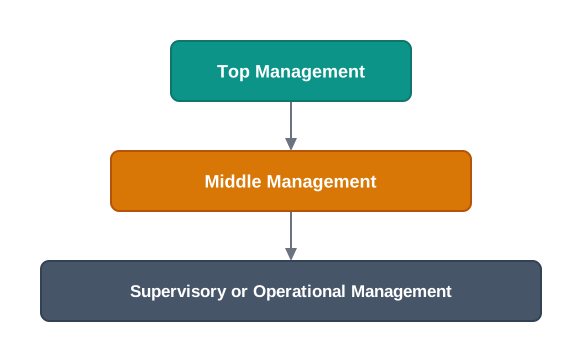
Fig. 1.4 – Levels of management.
Top Management
Top management consists of the senior-most executives of the organisation, by whatever name they are called. They are usually referred to as the chairman, the chief executive officer, the chief operating officer, the president and the vice-president.
Top management is a team consisting of managers from different functional levels, heading finance, marketing and other departments, for example the chief finance officer or the vice-president (marketing). Their basic task is to integrate diverse elements and coordinate the activities of different departments according to the overall objectives of the organisation.
These top level managers are responsible for the welfare and survival of the organisation. They analyse the business environment and its implications for the survival of the firm. They formulate overall organisational goals and strategies for their achievement. They are responsible for all the activities of the business and for its impact on society. The job of the top manager is complex and stressful, demanding long hours and commitment to the organisation.
Middle Management
Middle management is the link between the top level and the lower level managers. Middle level managers are subordinate to top managers and superior to the first line managers. They are usually known as division heads, for example the production manager.
Middle management is responsible for implementing and controlling the plans and strategies developed by top management. At the same time it is responsible for all the activities of first line managers. Its main task is to carry out the plans formulated by the top managers. For this, middle level managers need to do the following.
Interpret the policies framed by top management, so that those policies can be applied to the day-to-day work of the department.
Ensure that their department has the necessary personnel to carry out the assigned work.
Assign necessary duties and responsibilities to the personnel in the department.
Motivate them to achieve the desired objectives.
Cooperate with other departments for the smooth functioning of the organisation.
Supervisory Or Operational Management
Foremen and supervisors comprise the lower level in the hierarchy of the organisation. Supervisors directly oversee the efforts of the workforce. Their authority and responsibility is limited according to the plans drawn by the top management.
Supervisory management plays a very important role in the organisation, since supervisors interact with the actual workforce and pass on the instructions of middle management to the workers. Through their efforts the quality of output is maintained, wastage of materials is minimised, and safety standards are maintained.
The quality of workmanship and the quantity of output depend on the hard work, discipline and loyalty of the workers. It is the supervisor who is closest to the workers, and therefore closest to the point at which plans are either carried out properly or go wrong. The three levels are compared in Table 1.3.

Fig. 1.5 – A supervisor on the shop floor.
1.8 Functions of Management
Management is described as the process of planning, organising, directing and controlling the efforts of organisational members and of using organisational resources to achieve specific goals. Staffing is treated as a separate function as well, since finding the right people for the right jobs is a distinct managerial task.
These five functions are the content of the word ‘process’ in the definition of management. They are usually studied in the order shown in Fig. 1.6, and each of them is examined in detail in a later chapter.

Fig. 1.6 – Functions of management.
Planning
Planning is the function of determining in advance what is to be done and who is to do it. This implies setting goals in advance and developing a way of achieving them efficiently and effectively.
In a candle-making unit, for example, the objective is the production and sale of candles. The manager has to decide quantities, variety and colour, and then allocate resources for their purchase from different suppliers. Planning cannot prevent problems, but it can predict them and prepare contingency plans to deal with them if and when they occur.
Organising
Organising is the management function of assigning duties, grouping tasks, establishing authority and allocating the resources required to carry out a specific plan.
Once a specific plan has been established for the accomplishment of an organisational goal, the organising function examines the activities and resources required to implement the plan. It determines what activities and resources are required, and it decides who will do a particular task, where it will be done and when it will be done.
Organising involves the grouping of the required tasks into manageable departments or work units, and the establishment of authority and reporting relationships within the organisational hierarchy. Proper organisational techniques help in the accomplishment of work and promote both the efficiency of operations and the effectiveness of results. Different kinds of business require different structures according to the nature of the work.
Staffing
Staffing, simply stated, is finding the right people for the right job. A very important aspect of management is to make sure that people with the right qualifications are available at the right places and times to accomplish the goals of the organisation.
This is also known as the human resource function, and it involves activities such as recruitment, selection, placement and training of personnel. The kind of person required depends on the work to be done. A company that develops software, such as Infosys, needs systems analysts and programmers; a hospital needs qualified nurses and technicians.
Directing
Directing involves leading, influencing and motivating employees to perform the tasks assigned to them. This requires establishing an atmosphere that encourages employees to do their best.
Motivation and leadership are the two key components of direction. Motivating workers means creating an environment that makes them want to work. Leadership is influencing others to do what the leader wants them to do.
Directing also involves communicating effectively as well as supervising employees at work. A good manager directs through praise and criticism in such a way that it brings out the best in the employee.
Controlling
Controlling is the management function of monitoring organisational performance towards the attainment of organisational goals.
The task of controlling involves establishing standards of performance, measuring current performance, comparing this with the established standards, and taking corrective action wherever a deviation is found. Here management must determine what activities and outputs are critical to success, how and where they can be measured, and who should have the authority to take corrective action.
Controlling completes the circle. What was decided at the planning stage becomes the standard against which actual performance is judged, and the corrective action taken often becomes the basis of the next plan.
1.9 Coordination — The Essence of Management
A manager has to perform five interrelated functions in the process of managing an organisation. An organisation is a system made up of different interlinked and interdependent subsystems — its departments, divisions and work groups. A manager has to link these diverse groups towards the achievement of a common goal.
The process by which a manager synchronises the activities of different departments is known as coordination.
Coordination Binds The Other Functions
Coordination is the force that binds all the other functions of management. It is the common thread that runs through all activities such as purchase, production, sales and finance to ensure continuity in the working of the organisation.
Coordination is sometimes considered a separate function of management. It is, however, the essence of management, since it is the means of achieving harmony among individual efforts towards the accomplishment of group goals. Each managerial function is an exercise contributing individually to coordination, which is why coordination is described as implicit and inherent in all functions of an organisation.
Coordination Runs Through Every Stage
The process of coordinating the activities of an organisation begins at the planning stage itself. Top management plans for the entire organisation. According to these plans the organisational structure is developed and staffed. In order to ensure that the work is executed according to plans, directing is required. Any discrepancies between planned and actual activities are then taken care of at the stage of controlling.
It is through the process of coordination that a manager ensures the orderly arrangement of individual and group efforts, so as to ensure unity of action in the realisation of common objectives. Coordination therefore involves synchronisation of the different actions or efforts of the various units of an organisation. This provides the requisite amount, quality, timing and sequence of efforts, which ensures that planned objectives are achieved with a minimum of conflict.
Definitions Of Coordination
Management thinkers have described coordination in different words, but each of them points to the same idea — bringing separate efforts into a single orderly pattern aimed at a common purpose.
1.10 Characteristics of Coordination
The definitions given in the previous section highlight certain features of coordination. These features explain both what coordination does in an organisation and why it cannot be treated as one function among others.
Coordination integrates group efforts — coordination unifies unrelated or diverse interests into purposeful work activity. It gives a common focus to group effort, so as to ensure that performance is as it was planned and scheduled.
Coordination ensures unity of action — the purpose of coordination is to secure unity of action in the realisation of a common purpose. It acts as the binding force between departments and ensures that all action is aimed at achieving the goals of the organisation. In a manufacturing unit, for instance, the production and sales departments have to coordinate their work so that production takes place according to the demand in the market.
Coordination is a continuous process — coordination is not a one-time function but a continuous process. It begins at the planning stage and continues till controlling. A festive collection planned months in advance requires the manager to arrange an adequate workforce, then to monitor continuously whether production is proceeding according to plans, and also to brief the marketing department in time to prepare its promotional and advertising campaigns.
Coordination is an all pervasive function — coordination is required at all levels of management, because the activities of various departments are interdependent. It integrates the efforts of different departments and of different levels. The purchase department is responsible for procuring material; this becomes the basis of the activities of the production department, and only then can sales take place. If the material purchased is of inferior quality or is not according to the specifications of the production department, sales will decline as well. In the absence of coordination there is overlapping and chaos instead of harmony and integration of activities.
Coordination is the responsibility of all managers — coordination is the function of every manager in the organisation. Top level managers need to coordinate with their subordinates to ensure that the overall policies for the organisation are duly carried out. Middle level management coordinates with both the top level and the first line managers. Operational level management coordinates the activities of its workers to ensure that work proceeds according to plans.
Coordination is a deliberate function — a manager has to coordinate the efforts of different people in a conscious and deliberate manner. Even where members of a department willingly cooperate and work together, coordination gives a direction to that willing spirit. Cooperation in the absence of coordination may lead to wasted effort, and coordination without cooperation may lead to dissatisfaction among employees.
Why Coordination Is The Essence
Taken together, these features show that coordination is not a separate function of management but its very essence. For an organisation to achieve its objectives effectively and efficiently, coordination is required at every stage and at every level. Like a thread in a garland, coordination is a part of all management functions.
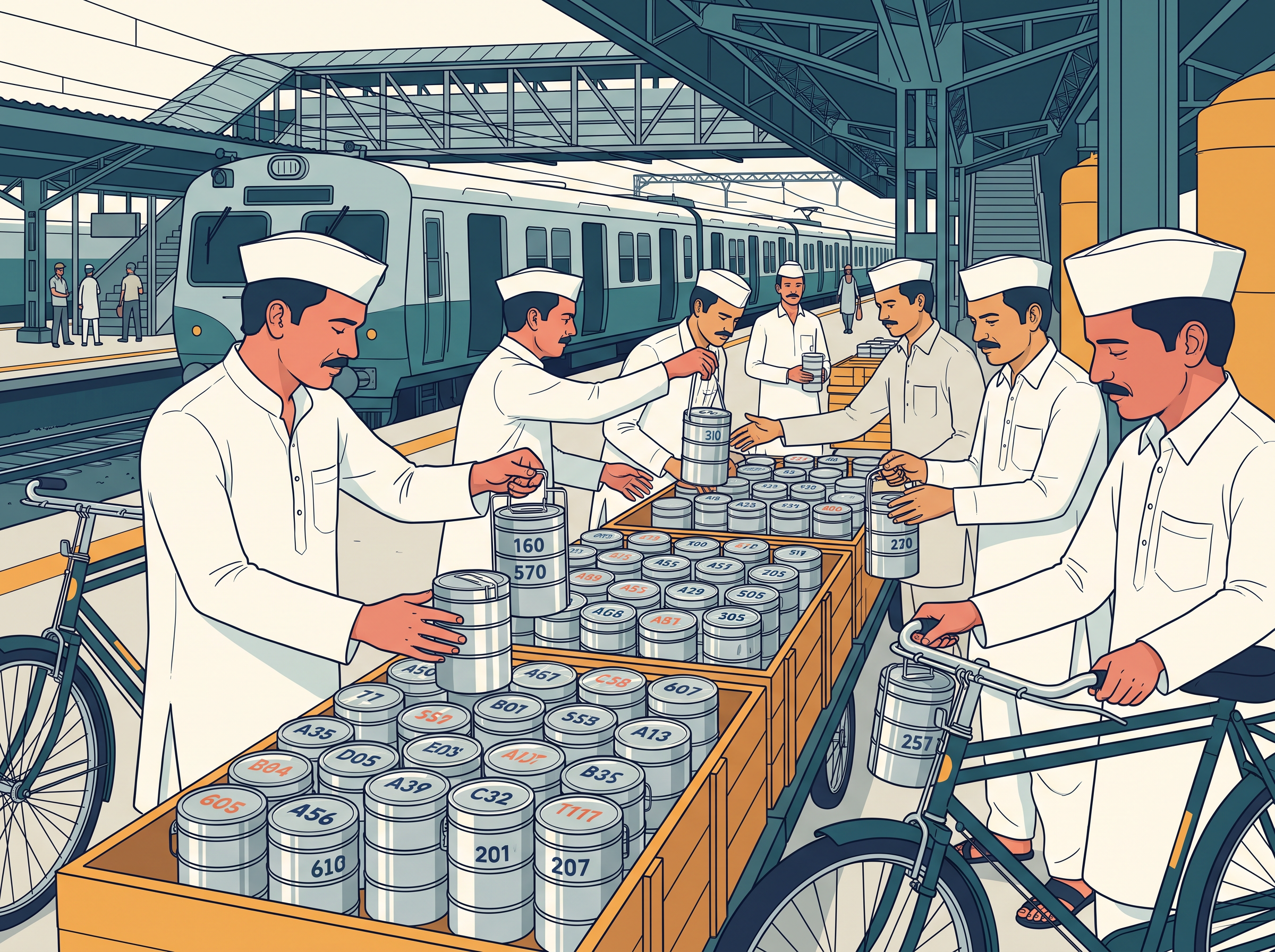
Fig. 1.7 – Sorting tiffin boxes at a railway station.
1.11 Importance of Coordination
Coordination is important because it integrates the efforts of individuals, departments and specialists. The primary reason coordination is needed at all is that departments and individuals in an organisation are interdependent, that is, they depend on each other for information and resources in order to perform their respective activities.
Because of this dependence, managers need to reconcile differences in approach, timing, effort or interest. At the same time, there is a need to harmonise individual goals and organisational goals. Three developments in particular make coordination necessary.
Growth in size — as organisations grow in size, the number of people employed also increases. At times it becomes difficult to integrate their efforts and activities, because all individuals differ in their habits of work, background, approaches to situations and relationships with others. It becomes necessary to ensure that all individuals work towards the common goals of the organisation. But employees may have their own individual goals as well. Therefore, for organisational efficiency, it is important to harmonise individual goals and organisational goals through coordination.
Functional differentiation — the functions of an organisation are divided into departments, divisions and sections. In an organisation there may be separate departments of finance, production, marketing or human resources. All these departments may have their own objectives, policies and style of working. The marketing department’s objective may be to increase sales by 10 per cent by offering discounts, but the finance department may not approve of such discounts as they mean loss of revenue. Such conflicts arise because each unit or department is performing activities in isolation from others, and barriers between departments become more rigid. However, all departments and individuals are interdependent and have to depend on each other for information to perform their activities. The activity of each department needs to be focused on the attainment of common organisational goals, and the process of linking the activities of various departments is accomplished by coordination.
Specialisation — modern organisations are characterised by a high degree of specialisation. Specialisation arises out of the complexities of modern technology and the diversity of tasks to be performed. Organisations therefore need to employ a number of specialists. Specialists usually think that they alone are qualified to evaluate, judge and decide according to their professional criteria, and they do not take advice or suggestions from others in matters pertaining to their area of specialisation. This often leads to conflict among different specialists as well as with others in the organisation. Some coordination is therefore required by an independent person to reconcile the differences in approach, interest or opinion of the specialists.
The Common Thread In All Three
In each of these three situations the underlying problem is the same. Work that is meant to serve one purpose has been divided among people who see only their own part of it — divided by numbers as the organisation grows, by function as departments are created, and by expertise as specialists are appointed. Coordination is the managerial act that puts the divided work back together.
1.12 Management in the Twenty-first Century
Even as this chapter is being read, organisations and their management are changing. Boundaries between cultures and nations are getting blurred, and new communication technology makes it possible to think of the world as a ‘global village’. The scope of international and intercultural relationships is rapidly expanding.
The modern organisation is a global organisation, and it has to be managed in a global perspective. This raises a practical question — what does managing in a global perspective actually require of a manager?
The Skills A Global Manager Needs
A global manager today is one who possesses what can be termed ‘hard’ types of skills as well as ‘softer’ types of skills. Managers who understand analysis, strategy, engineering and technology are still going to be needed. But what is extremely critical to global success are people who understand how teams work, how organisations work and how people are motivated.
A manager who really understands different cultures should be able to work in a West European, non-English speaking country, then move to a developing country such as Malaysia or Kenya, and then be transferred to an office based in New York in the USA, and be almost immediately productive in all three places.
How The Role Has Changed
The role of a global manager has evolved in much the same way that the global industry and economy have evolved. It has changed from being a single dimensional role in a defined business context to being a multi-faceted role.
That role now calls for a diverse combination of technical skills, soft management and people skills, and the ability to imbibe and learn different cultural experiences. This is a direct consequence of the characteristic studied earlier in this chapter — that management is a dynamic function, which has to adapt itself to a changing environment.
1.13 Summary
Concept — management is the process of planning, organising, staffing, directing and controlling the enterprise resources efficiently and effectively for achieving the goals of the organisation. Effectiveness is concerned with doing the right task, completing activities and achieving goals. Efficiency means doing the task correctly and with minimum cost.
Characteristics — the key features of management are that it is a goal-oriented process, all pervasive, multidimensional, a continuous process, a group activity, a dynamic function and an intangible force.
Objectives — management fulfils three basic objectives, namely organisational, social and personal. The organisational objectives are survival, profit and growth.
Importance — management is important because it helps in achieving group goals, increases efficiency, creates a dynamic organisation, helps achieve personal objectives and contributes to the development of society.
Nature — management is a combination of an organised body of knowledge, which is science, and its skilful application, which is art. Although it does not satisfy all the requirements of a profession, it is to a large extent professional in character.
Levels — management is considered a three-tier activity. Top management focuses on the determination of objectives and policies, middle management attempts to achieve these objectives through the effort of other managers, and supervisory or operational management directly oversees the efforts of the workforce.
Functions — all managers perform the following interrelated functions: planning, organising, staffing, directing and controlling.
Coordination — coordination is the essence of management. It is the process of achieving unity of action among the interdependent activities and departments of an organisation, and it is required at every level and in every function.
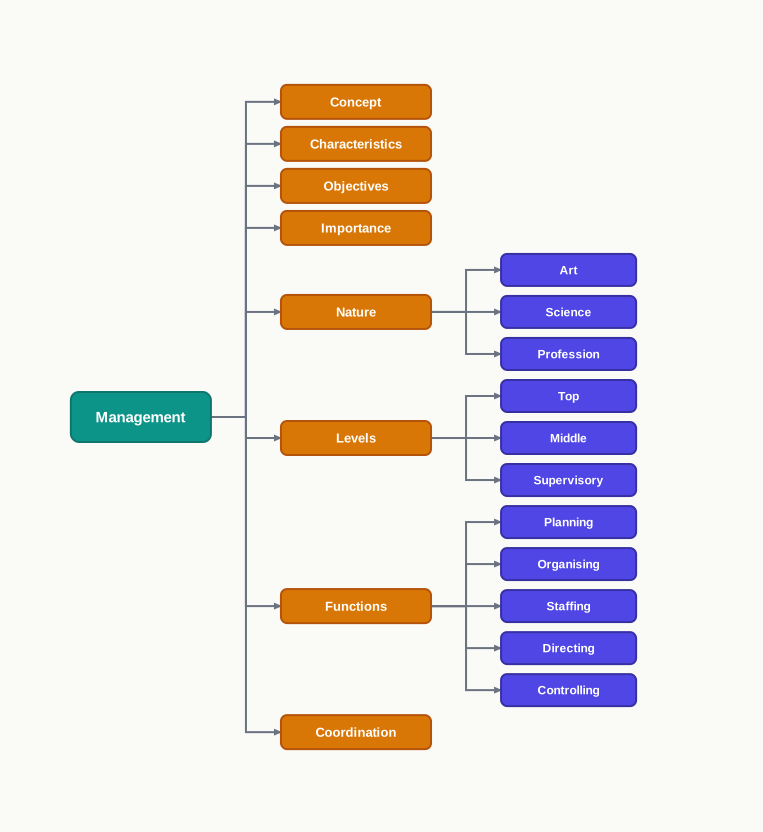
Fig. 1.8 – Structure of the chapter.
1.14 Key Terms
Management The process of getting things done with the aim of achieving goals effectively and efficiently.
Process The primary functions or activities that management performs to get things done, namely planning, organising, staffing, directing and controlling.
Effectiveness Completing the given task and achieving the goal, that is, doing the right task.
Efficiency Doing the task correctly and with minimum cost, that is, obtaining more output from fewer inputs.
Art The skilful and personal application of existing knowledge to achieve desired results.
Science A systematised body of knowledge that explains certain general truths or the operation of general laws.
Profession An occupation based on a well-defined body of knowledge, with restricted entry, a professional association, an ethical code of conduct and a service motive.
Planning The function of determining in advance what is to be done and who is to do it.
Organising The function of assigning duties, grouping tasks, establishing authority and allocating resources required to carry out a specific plan.
Staffing The function of finding the right people for the right job, covering recruitment, selection, placement and training of personnel.
Directing The function of leading, influencing and motivating employees to perform the tasks assigned to them, including supervision and communication.
Controlling The function of monitoring organisational performance by setting standards, measuring actual performance, comparing it with the standards and taking corrective action.
Coordination The process by which a manager synchronises the activities of different departments to secure unity of action in the achievement of common objectives.
1.15 NCERT Questions
Very Short Answer Type
- What is meant by management?
- Name any two important characteristics of management.
- Identify and state the force that binds all the other functions of management.
- List any two indicators of growth of an organisation.
- Indian Railways has launched a new broad gauge solar power train which is going to be a path breaking leap towards making trains greener and more environment friendly. The solar power DEMU (Diesel Electric Multiple Unit) has 6 trailer coaches and is expected to save about 21,000 litres of diesel and ensure a cost saving of Rs 12,00,000 per year. Name the objectives of management achieved by Indian Railways in the above case.
Short Answer Type
- Ritu is the manager of the northern division of a large corporate house. At what level does she work in the organisation? What are her basic functions?
- State the basic features of management as a profession.
- Why is management considered to be a multi-dimensional concept?
- Company X is facing a lot of problems these days. It manufactures white goods like washing machines, microwave ovens, refrigerators and air conditioners. The company’s margins are under pressure and the profits and market share are declining. The production department blames marketing for not meeting sales targets and marketing blames the production department for producing goods which are not of good quality meeting customers’ expectations. The finance department blames both production and marketing for declining return on investment and bad marketing. What quality of management do you think the company is lacking? Explain briefly. What steps should the company management take to bring the company back on track?
- Coordination is the essence of management. Do you agree? Give reasons.
- Ashita and Lakshita are employees working in Dazzling Enterprises dealing in costume jewellery. The firm secured an urgent order for 1,000 bracelets that were to be delivered within 4 days. They were assigned the responsibility of producing 500 bracelets each at a cost of Rs 100 per bracelet. Ashita was able to produce the required number within the stipulated time at the cost of Rs 55,000, whereas Lakshita was able to produce only 450 units at a cost of Rs 90 per unit. State whether Ashita and Lakshita are efficient and effective. Give reasons to justify your answer.
Long Answer Type
- Management is considered to be both an art and a science. Explain.
- Do you think management has the characteristics of a full-fledged profession?
- “A successful enterprise has to achieve its goals effectively and efficiently.” Explain.
- Management is a series of continuous interrelated functions. Comment.
- A company wants to modify its existing product in the market due to decreasing sales. You may take any product with which you are familiar. What decisions or steps should each level of management take to give effect to this decision?
- A firm plans in advance and has a sound organisation structure with efficient supervisory staff and control system, but on several occasions it finds that plans are not being adhered to. It leads to confusion and duplication of work. Advise a remedy.
1.16 Check Your Concepts
- Why is management described as a goal-oriented process rather than a single act?
- What happens to an organisation that is effective but not efficient over a long period? Explain with reasons.
- Distinguish between effectiveness and efficiency on any four bases.
- Why is management called an intangible force even though its effect is clearly visible in an organisation?
- Explain why coordination is described as a deliberate function and not merely the result of cooperation among employees.
- Distinguish between the roles of middle management and supervisory management on any four bases.
- Why is management called an inexact science?
- Arrange the following steps of the controlling function in the correct sequence: measuring actual performance; taking corrective action; setting standards of performance; comparing actual performance with standards.
- Identify the term: the process by which a manager synchronises the activities of different departments of an organisation.
- Match the following characteristics of a profession with the corresponding example:
| Column A | Column B |
|---|---|
| a. restricted entry | i. a doctor taking an oath of ethical practice |
| b. professional association | ii. the examination conducted by the Institute of Chartered Accountants of India |
| c. ethical code of conduct | iii. a lawyer working to ensure that the client gets justice |
| d. service motive | iv. membership of the Bar Council |
- Assertion (A): Management is not a full-fledged profession. Reason (R): Anyone can be appointed as a manager in a business enterprise irrespective of educational qualifications. Choose the correct option:
- Both A and R are true, and R is the correct explanation of A.
- Both A and R are true, but R is not the correct explanation of A.
- A is true but R is false.
- A is false but R is true.
- Why does the need for coordination increase as an organisation grows in size and employs a larger number of specialists?
- Explain why the survival, profit and growth objectives of an organisation have to be pursued in that order.
- State the three dimensions of management and explain how they are interlinked.
1.17 Case-Based Questions
- Sunrise Enterprises manufactures school bags. Its managing director decided that the firm would enter two new states in the coming year and fixed the annual sales target. The divisional head worked out the additional machinery and staff the plant would need and prepared the departmental budget. The floor supervisor allotted daily stitching targets to the workers and checked the finished bags at the end of each shift.
- Identify the three levels of management referred to in the case.
- State any two functions of the level at which the divisional head works.
- Pragya Metals Ltd. asked two of its unit heads to complete an order of 2,000 castings within twenty days. Unit head Ramesh completed all 2,000 castings on the twentieth day at a total cost of Rs 4,20,000 against a budgeted cost of Rs 4,00,000. Unit head Saira spent only Rs 3,60,000 but delivered 1,700 castings, and the shortfall had to be bought from another supplier.
- State whether Ramesh was effective, efficient, or both. Give a reason.
- State whether Saira was effective, efficient, or both. Give a reason.
- Explain briefly why management must balance the two.
- Kalindi Textiles has grown from sixty employees to four hundred in three years. The purchase department now orders yarn on its own schedule, the production department runs the looms to suit its convenience, and the sales department promises delivery dates to customers without informing either. Every department reports that it is working at full capacity, yet consignments are being delivered late and unsold stock is accumulating.
- Identify the concept of management that is missing at Kalindi Textiles.
- Explain any two reasons discussed in the chapter that make this concept necessary in the firm’s present situation.
- Bhavesh Agro Ltd. installed equipment to treat the waste water leaving its factory, began recruiting workers from the villages around the plant, and introduced a scheme under which every employee receives a bonus linked to departmental performance. In the same period the company’s sales volume and the number of products it offers both increased.
- Identify the three types of objectives of management being fulfilled by Bhavesh Agro Ltd.
- State the objective being served by the increase in sales volume and number of products.
- Two branch heads of Meghdoot Insurance work under the same policy manual and the same targets. Anil improves his branch’s performance by reorganising the duties at the service counter, while Farida improves hers by personally visiting long-standing policyholders. Both branches exceed their targets.
- Which aspect of the nature of management is illustrated by the different methods adopted by the two branch heads?
- Which aspect of the nature of management is illustrated by the common policy manual and the common set of principles they both work from?