Chapter 2: Principles of Management
Every organisation, however small, has to decide how work will be divided, who will give orders, how employees will be paid and how disputes will be settled. A firm that answers these questions afresh every time depends entirely on the personal judgement of whoever happens to be in charge. As the firm grows, that judgement becomes unreliable, and decisions taken in one department begin to contradict decisions taken in another.
Principles of management exist to solve this problem. They are broad, tested guidelines that tell a manager what is likely to work in a given situation and why. They do not supply ready-made answers, but they replace guesswork with reasoning that can be taught, examined and improved.
Two thinkers of the classical school shaped this body of knowledge. F.W. Taylor, an American mechanical engineer, studied efficiency on the factory floor. Henri Fayol, a French mining engineer, studied the work of managers at the top.
This chapter explains the meaning, nature and significance of principles of management, Taylor’s principles and techniques of scientific management, and Fayol’s fourteen principles.

Fig. 2.0 – Managers at work on a factory floor.
2.1 Principles of Management: The Concept
A principle of management is a broad and general guideline for decision-making and behaviour. It does not tell a manager exactly what to do in a particular case; it tells the manager what to keep in mind while deciding.
Consider a firm deciding whom to promote. One manager may go by seniority, so that long service is rewarded and employees feel secure. Another manager may go by merit, so that the most capable person gets the post. Each manager is following a principle, and each principle produces a different pattern of decisions over time.
How These Principles Evolved
Management principles are not the work of a single thinker or a single period. In tracing the history of management, one comes across various schools of thought, each of which put forward principles to guide management practice. These schools may be divided into six phases, shown in Fig. 2.1.
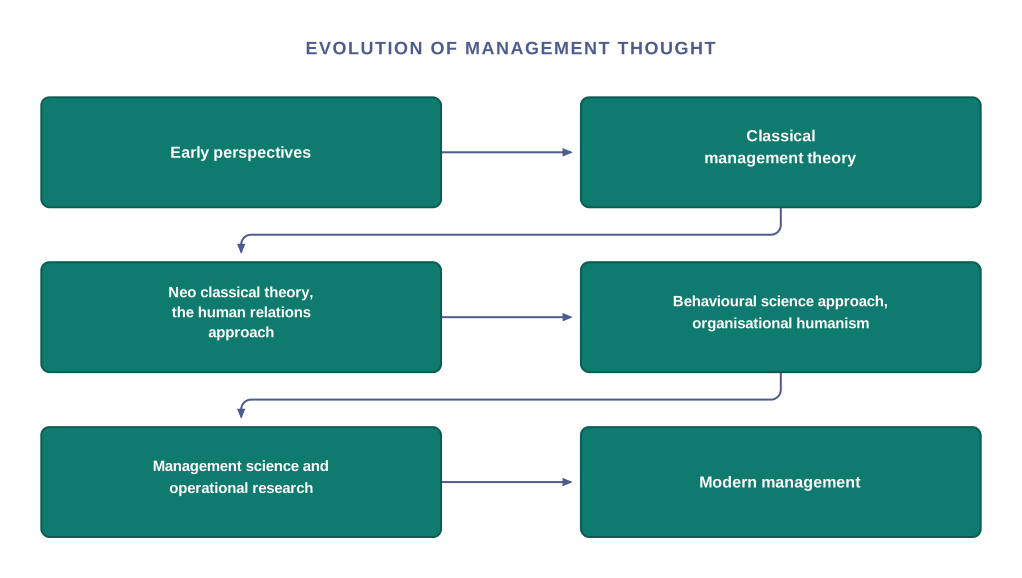
Fig. 2.1 – Phases in the evolution of management thought.
The earliest recorded management ideas go back to 3000–4000 B.C. The classical school, to which Taylor and Fayol belong, developed during the industrial revolution and the rise of the factory system. Later schools drew attention to social needs and human behaviour at work, then to quantitative techniques for decision-making, and finally to the organisation as a complex system requiring a contingency approach. Management principles have therefore evolved continuously, and they continue to evolve.
Not As Rigid As Pure Science
Principles of management must be distinguished from the principles of pure science. A principle of physics holds exactly, every time, because it deals with matter. A principle of management deals with human behaviour, and human behaviour is never identical from one situation to the next. These principles have therefore to be applied creatively, according to the demands of the situation.
Technology changes as well, and business changes with it, so the principles have to keep pace. Before the spread of information and communication technology, a manager could supervise only a small workforce, and that too within a narrow geographical area. Information and communication technology has extended a manager’s reach across the globe.
Principles, Techniques And Values
In understanding what principles of management are, it is equally useful to know what they are not.
Techniques of management are procedures or methods. They involve a series of steps to be taken in order to accomplish a desired goal. Principles are the guidelines a manager follows while taking decisions or actions during the practice of those techniques. The technique tells the manager how the work is to be carried out; the principle tells the manager on what basis to decide.
Values are what is acceptable or desirable, and they carry moral connotations. They are general rules for the behaviour of individuals in society, formed through common practice. Principles of management, in contrast, are basic truths or guidelines for behaviour that are formed after research in work situations, and they are technical in nature.
The distinction does not mean that values can be set aside. While practising the principles of management, values cannot be neglected, because a business has social and ethical responsibilities towards society. The three are compared in Table 2.1.
2.2 Nature of Principles of Management
By nature is meant the qualities and characteristics of a thing. The principles of management are general propositions, which apply when certain conditions are present. They have been developed on the basis of observation and experimentation, as well as the personal experience of managers.
Depending upon how they are derived, and how effective they are in explaining and predicting managerial behaviour, these principles contribute to the development of management both as a science and as an art. The derivation of the principles may be said to be a matter of science, while their creative application may be regarded as an art.
Because these principles can be stated, taught and tested, they lend the practice of management the credibility of a learnable and teachable discipline. Rising to a managerial position is therefore not a matter of birth but a matter of requisite qualifications. This is why management principles have gained importance as management has become more professionalised.
These principles are guidelines to action, and they denote a cause and effect relationship. The functions of management, namely planning, organising, staffing, directing and controlling, are the actions to be taken while practising management. The principles help managers to take decisions while performing these functions.
The Seven Features
The following points summarise the nature of the principles of management.
Universal applicability — the principles are intended to apply to all types of organisations: business as well as non-business, small as well as large, public sector as well as private sector, manufacturing as well as services. The extent of their applicability, however, varies with the nature of the organisation, the business activity, the scale of operations and similar factors. For greater productivity, for example, work should be divided into small tasks and each employee trained to perform a specialised job. This applies to a government office, where a despatch clerk receives and sends documents, a data entry operator inputs data on the computer, and a peon and an officer perform their own duties. It applies equally to a limited company with separate departments for production, finance, marketing, and research and development. Only the extent of division of work varies from case to case.
General guidelines — the principles are guidelines to action, but they do not provide readymade, straitjacket solutions to all managerial problems. Real business situations are complex and dynamic, and are the result of many factors acting together. The importance of the principles cannot be underestimated on this account, because even a small guideline helps to solve a given problem. In dealing with a conflict between two departments, for instance, a manager may emphasise the primacy of the overall goals of the organisation.
Formed by practice and experimentation — the principles are formed partly by the experience and collective wisdom of managers and partly by experimentation. It is a matter of common experience that discipline is indispensable for accomplishing any purpose, and this finds mention in management theory. On the other side, to remedy the problem of fatigue among factory workers, an experiment may be conducted to see the effect of improved physical conditions in reducing stress.
Flexible — the principles are not rigid prescriptions that must be followed absolutely. They can be modified by the manager when the situation so demands, and they give the manager enough discretion to do so. The degree of concentration of authority, called centralisation, or its dispersal, called decentralisation, will depend upon the situation and circumstances of each enterprise. Individual principles are like different tools serving different purposes, and the manager has to decide which tool to use under what circumstances.
Mainly behavioural — management principles aim at influencing the behaviour of human beings, and are therefore mainly behavioural in nature. It is not that they do not pertain to things and phenomena at all; it is a matter of emphasis. They also enable a better understanding of the relationship between human and material resources in accomplishing organisational purposes. While planning the layout of a factory, for example, orderliness requires that workflows are matched by the flow of materials and the movement of men.
Cause and effect relationships — the principles are intended to establish a relationship between cause and effect, so that they can be used in similar situations in a large number of cases. They tell us that if a particular principle is applied in a particular situation, what its likely effect will be. Since they apply mainly to human behaviour, they are less than perfect, and accurate cause and effect relationships may be difficult to establish because real situations are never identical. They nevertheless assist managers in establishing these relationships to some extent, and are therefore useful. In an emergency it is desirable that someone takes charge and others follow; in a situation requiring cross-functional expertise, such as setting up a new factory, a more participative approach to decision-making would be advisable.
Contingent — the application of the principles is contingent, that is, dependent upon the prevailing situation at a particular point of time, and has to be changed as requirements change. Employees deserve fair and just remuneration; but what is just and fair is determined by several factors together, including the contribution of the employee, the paying capacity of the employer and the prevailing wage rate for that occupation.
2.3 Significance of Principles of Management
The principles of management derive their significance from their utility. They provide useful insights into managerial behaviour and influence managerial practice, and managers apply them to fulfil their tasks and responsibilities.
Everything worthwhile is governed by some underlying principle. The quest of management theorists has been to unearth these underlying principles, so that a manager facing a situation that recurs need not think it out afresh every time, but can deal with it as a matter of settled management habit. The significance of the principles may be discussed under the following points.
Six Points Of Significance
Providing managers with useful insights into reality — the principles give managers useful insights into real world situations. Adherence to them adds to a manager’s knowledge, ability and understanding of managerial situations and circumstances. It also enables managers to learn from past mistakes and to conserve time by solving recurring problems quickly. In this way the principles increase managerial efficiency. A manager who follows the principles of delegation, for instance, leaves routine decision-making to subordinates and deals personally only with exceptional situations that require her or his own expertise.
Optimum utilisation of resources and effective administration — the resources available with a company, both human and material, are limited, and must be put to optimum use, that is, used in a manner that gives the maximum benefit at the minimum cost. The principles equip managers to foresee the cause and effect relationships of their decisions and actions, so that the wastage associated with a trial-and-error approach is overcome. Effective administration further requires impersonalisation of managerial conduct, so that managerial power is used with due discretion. The principles limit the boundary of managerial discretion, so that decisions are free from personal prejudice and bias. In deciding the annual budgets of different departments, for example, managerial discretion is bounded by the principle of contribution to organisational objectives rather than by personal preference.
Scientific decisions — decisions must be based on facts, must be thoughtful and justifiable in terms of the intended purpose, and must be timely, realistic and open to measurement and evaluation. Management principles help in such thoughtful decision-making because they emphasise logic rather than blind faith. Decisions taken on the basis of principles rest on an objective assessment of the situation and are free from bias and prejudice.
Meeting changing environment requirements — although the principles are in the nature of general guidelines, they are modified over time and so help managers to meet the changing requirements of the environment. Management principles emphasise division of work and specialisation. In modern times this principle has been extended to the business as a whole, with companies specialising in their core competency and divesting non-core businesses. Hindustan Lever Limited, for example, divested its non-core businesses of chemicals and seeds. Many companies now outsource non-core activities such as share-transfer management and advertising to outside agencies, and even core processes such as research and development, manufacturing and marketing are being outsourced. This is what has led to the growth of ‘Business Process Outsourcing’ (BPO) and ‘Knowledge Process Outsourcing’ (KPO).
Fulfilling social responsibility — increased public awareness compels businesses, and especially limited companies, to fulfil their social responsibilities. Management theory and management principles have evolved in response to these demands, and the interpretation of the principles takes on newer and contemporary meanings with the change in time. The principle of ‘equity’, if spoken of today, no longer applies to wages alone; value to the customer, care for the environment and fair dealings with business associates all come within its purview. As an application of this principle, public sector undertakings have developed entire townships, as BHEL has done at Ranipur in Hardwar.
Management training, education and research — the principles are at the core of management theory, and are therefore used as the basis for management training, education and research. Entrance to management institutes is preceded by management aptitude tests, which could not have been developed without an understanding of management principles and of how they may be applied in different situations. Professional courses such as the MBA (Master of Business Administration) and the BBA (Bachelor of Business Administration) teach these principles at the beginner’s level. The principles also enable refinement of management practice by facilitating the development of new techniques. Techniques such as Operations Research (OR), cost accounting, ‘Just in Time’, ‘Kanban’ and ‘Kaizen’ have developed out of further research on these principles.
In conclusion, understanding the meaning, nature and significance of the principles of management helps us to appreciate how they apply in real life situations.
2.4 Taylor’s Scientific Management
Scientific management refers to an important stream of one of the earlier schools of management thought, referred to as the ‘Classical’ school. The other two streams belonging to this school are Fayol’s administrative theory and Max Weber’s bureaucracy. Bureaucracy is not described here; Fayol’s principles are discussed later in the chapter.
The Man And His Times
Fredrick Winslow Taylor (March 20, 1856 – March 21, 1915) was an American mechanical engineer who sought to improve industrial efficiency. In 1874 he became an apprentice machinist, learning factory conditions at the grass roots level, and he later earned a degree in mechanical engineering. He was one of the intellectual leaders of the efficiency movement and was highly influential in reshaping the factory system of production.
Taylor belonged to the era of the industrial revolution, which was characterised by mass production. Every new development takes time to be perfected, and his contribution must be seen in the light of the efforts then being made to perfect the factory system.
In 1884 he became an executive at Midvale Steel Company by demonstrating his leadership abilities, and instructed his fellow workers to work in phases. In 1898 he joined the Bethlehem Iron Company, which later became Bethlehem Steel Company. He was originally employed there to introduce a piece rate wage system, and after setting it up he was given authority and further responsibilities. Using these resources he increased the staff and made Bethlehem a show place for inventive work. The company was later sold to another group and he was discharged. His health began to fail in 1910, and he died in 1915 of pneumonia.
He is known for coining the term ‘Scientific Management’ in his article The Principles of Scientific Management, published in 1911. After leaving Bethlehem Steel he wrote a book titled Shop floor, which sold well. He served as president of the American Society of Mechanical Engineers (ASME) from 1906 to 1907, and was a professor at the Tuck School of Business at Dartmouth College, founded in 1900.

Fig. 2.2 – F.W. Taylor and the concept of scientific management.
What Taylor Set Out To Do
Taylor thought that by scientifically analysing work it would be possible to find ‘one best way’ to do it. He is most remembered for his time and motion studies, in which he would break a job into its component parts and measure each to the second.
He believed that the management of his day was amateurish and that management should be studied as a discipline. He also wanted workers to cooperate with management, holding that in such a situation there would be no need of trade unions. The best results, in his view, would come from a partnership between a trained and qualified management and a cooperative and innovative workforce, because each side needed the other.
The Elements He Identified
In his most important work, published in 1911, and in his testimony before a committee of the United States House of Representatives in 1912, Taylor set out the main elements of scientific management as follows.
- Time studies.
- Functional or specialised supervision.
- Standardisation of tools and implements.
- Standardisation of work methods.
- A separate planning function.
- The management by exception principle.
- The use of slide-rules and similar time-saving devices.
- Instruction cards for workmen.
- Task allocation and a large bonus for successful performance.
- The use of the ‘differential rate’.
- Mnemonic systems for classifying products and implements.
- A routing system.
- A modern costing system.
Taylor described these as merely the elements or details of the mechanisms of management. He saw them as extensions of four principles of management, which he stated as the development of a true science; the scientific selection of the workman; the scientific education and development of the workman; and intimate and friendly cooperation between the management and the employees.
From this it is clear that Taylor was an ardent supporter of the use of scientific method in business. The principles he developed from this approach are taken up in the next section, and the techniques through which he applied them follow after that.
2.5 Principles of Scientific Management
In the earlier days of the Industrial Revolution there was no established theory of factory organisation. Factory owners and managers relied on personal judgment in attending to the problems they faced while managing their work. This is what is referred to as rule of thumb.
Managing factories by rule of thumb enabled managers to handle situations as they arose, but it suffered from the limitation of a trial and error approach. For one manager’s experience to be of use to another, it was important to know not only what works but also why it works. This called for an approach based on the method of science: defining a problem, developing alternative solutions, anticipating consequences, measuring progress and drawing conclusions.
In this scenario Taylor emerged as the ‘Father of Scientific Management’. He proposed scientific management as opposed to rule of thumb. He broke up human activity into small parts and found out how each could be done effectively, in less time and with increased productivity. Scientific management implies conducting business activities according to standardised tools, methods and trained personnel, in order to increase output, improve its quality, and reduce costs and wastes.
In the words of Taylor, scientific management means knowing exactly what you want men to do and seeing that they do it in the best and cheapest way. The Bethlehem Steel company, where Taylor himself worked, achieved a three-fold increase in productivity by applying scientific management principles. The five principles on which this approach rests are discussed below.
The Five Principles
Science, not rule of thumb — Taylor pioneered the introduction of the method of scientific enquiry into the domain of management practice. Since different managers follow their own rules of thumb, it is a statement of the obvious that all of them will not be equally effective. Taylor believed that there is only one best method of maximising efficiency, and that this method can be developed through study and analysis. The method so developed should then replace rule of thumb throughout the organisation. The scientific method involved investigating traditional methods through work-study, unifying the best practices, and developing a standard method to be followed everywhere in the organisation. According to Taylor, even a small production activity such as loading pigs of iron into boxcars can be scientifically planned and managed, resulting in a great saving of human energy and of time and material. The more sophisticated the process, the greater the savings. In the present context, the use of the internet has brought about dramatic improvements in internal efficiency and in customer satisfaction.
Harmony, not discord — the factory system of production meant that managers served as a link between the owners and the workers. Since managers had the mandate to get work done from the workers, there always existed the possibility of a kind of class-conflict between managers and workers. Taylor recognised that this conflict helped none of them, neither the workers nor the managers nor the factory owners. He emphasised that there should be complete harmony between management and workers, and that both should realise that each one is important. To achieve this state, Taylor called for a complete mental revolution on the part of both management and workers, meaning that both should transform their thinking. In such a situation even trade unions would not think of going on strike. Management should share the gains of the company, if any, with the workers; at the same time workers should work hard and be willing to embrace change for the good of the company. Both should be part of the same family. According to Taylor, scientific management has for its foundation the firm conviction that the true interests of the two are one and the same, and that prosperity for the employer cannot exist for long unless it is accompanied by prosperity for the employees, and the other way round.
Cooperation, not individualism — there should be complete cooperation between labour and management instead of individualism. This principle is an extension of the principle of ‘harmony, not discord’, and requires that competition be replaced by cooperation, with both sides realising that they need each other. Management should not close its ears to constructive suggestions made by employees, and should reward suggestions that result in a substantial reduction in costs. Workers should be treated as a part of management, and should be taken into confidence when important decisions are taken. At the same time workers should desist from going on strike and from making unreasonable demands on management. Where there is an open communication system and goodwill, there would be no need even for a trade union, and a paternalistic style of management, in which the employer takes care of the needs of employees, would prevail. Taylor also held that there should be an almost equal division of work and responsibility between workers and management, with management working side by side with the workers all day long, helping, encouraging and smoothing the way for them.
Maximum, not restricted output — instead of quarrelling over the share in the surplus, workers and managers should work in harmony to maximise output rather than restricting it. Both should aim at increasing the size of the surplus itself, so that there is more to be shared and the need for any agitation disappears. Management should share a part of the surplus with the workers, and the workers should contribute their full effort so that the company makes profits. In the long run only the worker’s well-being will ensure the prosperity of the business.
Development of each and every person to his or her greatest efficiency and prosperity — industrial efficiency depends to a large extent on the competencies of personnel, and scientific management therefore stood for worker development. Training was essential so that workers could learn the best method developed through the scientific approach. Taylor was of the view that the concern for efficiency could be built in right from the process of employee selection. Each person should be scientifically selected, and the work assigned should suit her or his physical, mental and intellectual capabilities. To increase efficiency they should then be given the required training. Efficient employees produce more and earn more, and this ensures the greatest efficiency and prosperity for both the company and the workers.

Fig. 2.3 – Sharing of gains leading to harmony.
2.6 Techniques of Scientific Management
The principles discussed in the previous section had to be put into practice on the shop floor. For this Taylor developed a set of techniques, based on the various experiments he conducted during his career. Each technique is taken up below.
2.6.1 Functional Foremanship
In the factory system, the foreman is the managerial figure with whom the workers are in face-to-face contact on a daily basis. The foreman is the lowest ranking manager and the highest ranking worker, and is the pivot around whom the entire production planning, implementation and control revolves. Taylor therefore concentrated on improving the performance of this role in the factory set-up.
He drew up a list of the qualities a good foreman or supervisor should have, and found that no single person could fit them all. A foreman should have intelligence, education, tact, grit, judgment, special knowledge, manual dexterity, energy, honesty and good health. Since all these qualities could not be found in one person, Taylor proposed eight specialists in place of one foreman. This is called functional foremanship.
Taylor advocated the separation of planning and execution functions, and extended this concept to the lowest level of the shop floor. Under the factory manager there was a planning incharge and a production incharge, each with four specialists under him, as shown in Fig. 2.4.
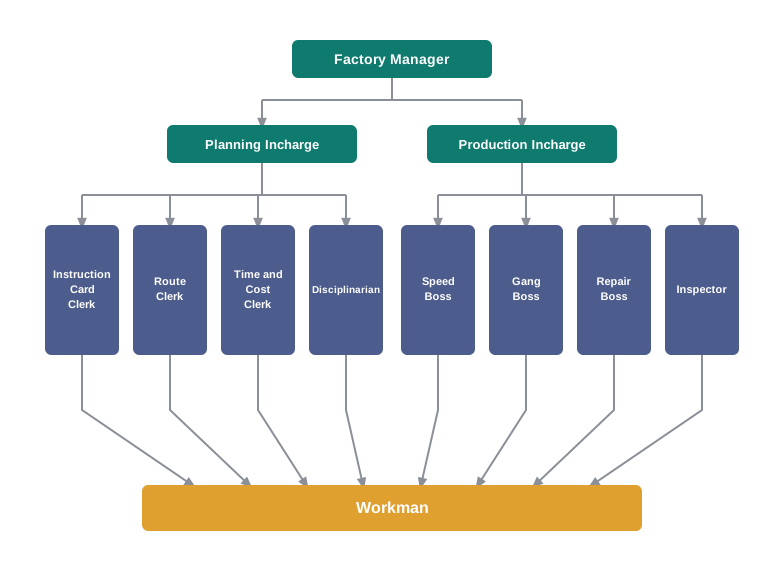
Fig. 2.4 – Functional foremanship under scientific management.
The four personnel under the planning incharge worked as follows. The instruction card clerk drafts instructions for the workers, the route clerk specifies the route of production, the time and cost clerk prepares the time and cost sheet, and the disciplinarian ensures discipline.
The four personnel under the production incharge worked as follows. The speed boss is responsible for the timely and accurate completion of the job, the gang boss keeps machines and tools ready for operation by workers, the repair boss ensures the proper working condition of machines and tools, and the inspector checks the quality of work.
Functional foremanship is an extension of the principle of division of work and specialisation to the shop floor. Each worker takes orders from these eight foremen in the related process or function of production. Each specialist is assigned work according to his or her qualities: those with technical mastery, intelligence and grit may be given planning work, while those with energy and good health may be assigned execution work.
2.6.2 Standardisation and Simplification of Work
Taylor was an ardent supporter of standardisation. According to him, the scientific method should be used to analyse the methods of production prevalent under rule of thumb. The best practices can then be kept and further refined to develop a standard to be followed throughout the organisation. This is done through work-study techniques, which include time study, motion study, fatigue study and method study, all discussed later in this section.
Standardisation refers to the process of setting standards for every business activity. There can be standardisation of process, raw material, time, product, machinery, methods or working conditions. These standards are the benchmarks that must be adhered to during production.
The objectives of standardisation are the following.
- To reduce a given line or product to fixed types, sizes and characteristics.
- To establish the interchangeability of manufactured parts and products.
- To establish standards of excellence and quality in materials.
- To establish standards of performance of men and machines.
Simplification aims at eliminating superfluous varieties, sizes and dimensions, while standardisation implies devising new varieties in place of the existing ones. Simplification therefore aims at eliminating unnecessary diversity of products. It results in savings in the cost of labour, machines and tools, and it implies reduced inventories, fuller utilisation of equipment and increasing turnover. Most large companies, such as Nokia, Toyota and Microsoft, have successfully implemented standardisation and simplification, which is evident from their large share in their respective markets.
Even the contemporary techniques of business process, including reengineering, kaizen, which means continuous improvement, and benchmarking, are aimed at standardising the work.
Some Terms Of Modern Production
- Just In Time manufacturing — an inventory management strategy that improves return on investment by reducing in-process inventory and its associated costs. It is implemented through visual signals, or kanban, which indicate whether replenishment is required at any level of the production process.
- Lean manufacturing — a management philosophy focusing on the reduction of seven wastes: overproduction, waiting time, transportation, processing, motion, inventory and scrap, in any type of manufacturing process or business. By eliminating waste, quality is improved while production time and cost are reduced.
- Kaizen — a Japanese word meaning ‘change for better’ or ‘improvement’. It is an approach to improving productivity, developed by the Japanese after the Second World War from the work of American experts such as Taylor. Its goals include eliminating waste, that is, activities which add cost but not value, just in time delivery, levelling of the production load, standardised work, paced moving lines and right sized equipment. It is a daily activity that takes a process, system, product or service apart and puts it together in a better way.
- Six Sigma — a data driven approach that helps an organisation in any sector to bring down inefficiencies and save time and money by reducing quality variations. Under its prescribed norms there should not be more than three to four defects per million opportunities. It can be applied to any process, but needs unstinted organisational support.
2.6.3 Method Study
The objective of method study is to find out the one best way of doing a job. There are various methods of doing any job, and several parameters have to be examined to determine the best one. Right from the procurement of raw materials till the final product is delivered to the customer, every activity is part of method study.
The objective of the whole exercise is to minimise the cost of production and to maximise the quality and satisfaction of the customer. For this purpose many techniques such as process charts and operations research are used.
Taylor devised the concept of the assembly line by using method study, and the Ford Motor Company used this concept very successfully. Auto companies use it even now. In designing a car, assembly line production would entail deciding the sequence of operations and the place for men, machines and raw materials, and all this is part of method study.
2.6.4 Motion Study
Motion study refers to the study of movements such as lifting, putting objects, sitting and changing positions, which are undertaken while doing a typical job. Unnecessary movements are sought to be eliminated, so that the job takes less time and is completed more efficiently.
On close examination of body motions it is possible to find out three kinds of movements.
- Motions which are productive.
- Motions which are incidental, such as going to the stores.
- Motions which are unproductive.
Taylor used stopwatches and various symbols and colours to identify different motions. Through motion studies he was able to design suitable equipment and tools and to educate workers in their use, and the results achieved were remarkable. Taylor and his associate Frank Gilbreth were able to reduce the motions in brick laying from eighteen to just five, and Taylor demonstrated that productivity increased to about four times through this process.
2.6.5 Time Study
Time study determines the standard time taken to perform a well-defined job. Time measuring devices are used for each element of the task, and the standard time for the whole task is fixed by taking several readings. The method of time study will depend upon the volume and frequency of the task, the cycle time of the operation and the cost of time measurement.
The objective of time study is to determine the number of workers to be employed, to frame suitable incentive schemes and to determine labour costs.
Suppose that on the basis of several observations it is determined that the standard time taken by a worker to make one cardboard box is 20 minutes. In one hour the worker will make 3 boxes. If a worker has to put in 8 hours of work in a shift, and one hour is deducted for rest and lunch, then in 7 hours the worker makes 21 boxes at 3 boxes per hour. This is the standard task a worker has to do, and wages can be decided accordingly.
2.6.6 Fatigue Study
A person is bound to feel tired physically and mentally if she or he does not rest while working. Rest intervals help the worker to regain stamina and to work again with the same capacity, which results in increased productivity. Fatigue study seeks to determine the amount and frequency of rest intervals required in completing a task.
Normally in a plant, work takes place in three shifts of eight hours each. Even within a single shift a worker has to be given some rest interval for lunch and similar needs. If the work involves heavy manual labour, then small pauses have to be given frequently, so that the worker can recharge her or his energy level for optimum contribution.
There can be many causes of fatigue, such as long working hours, doing unsuitable work, uncordial relations with the boss or bad working conditions. Such hindrances to good performance should be removed.
2.6.7 Differential Piece Wage System
Taylor was a strong advocate of the piece wage system, and wanted to differentiate between efficient and inefficient workers. The standard time and other parameters are determined on the basis of the work-study described above, and workers can then be classified as efficient or inefficient against these standards. To reward efficient workers, Taylor introduced a different rate of wage payment for those who performed above the standard and for those who performed below it.
Suppose it is determined that the standard output per worker per day is 10 units. Those who make the standard or more are paid Rs 50 per unit, and those below it are paid Rs 40 per unit. An efficient worker making 11 units will get 11 × 50 = Rs 550 per day, whereas a worker who makes 9 units will get 9 × 40 = Rs 360 per day. According to Taylor, the difference of Rs 190 should be enough for the inefficient worker to be motivated to perform better.
From his own experience Taylor gave the example of a worker named Schmidt, who was able to earn 60 per cent more wages, from $1.15 to $1.85, on increasing pig iron loading from 12.5 tons per man per day to 47 tons per man per day in box cars at Bethlehem Steel works, by following scientific management techniques.
The Techniques As One Whole
It is important to have a relook at these techniques as a unified whole, since together they form Taylor’s prescription of efficiency. The search for efficiency requires the search for one best method; the chosen method must lead to the determination of a fair day’s work; and there must be a compensation system that differentiates those who are able to accomplish or exceed that fair day’s work. The differential system rests on the premise that efficiency is the result of the joint efforts of managers and workers. The sum and substance of Taylor’s ideas therefore lies not in the separate techniques but in the change of mindset he called mental revolution.
Many new techniques have since been developed as a sequel to scientific management. Operations research was developed in the Second World War to optimise the deployment of war material. The assembly line was also discovered by Taylor and was used very successfully by the Ford Motor Company in manufacturing the ‘Model T’ car for the masses, and the concept is much used now. The latest development in this line is lean manufacturing. Robotics and computers are today used in production and other business activities, and this too is part of the scientific management of these activities, raising productivity levels further.
2.7 Fayol’s Principles of Management
In the development of the classical school of management thought, Fayol’s administrative theory provides an important link. Taylor succeeded in revolutionising the working of the factory shop-floor through the best method, a fair day’s work, the differential piece-rate system and functional foremanship. Henri Fayol explained what a manager’s work amounts to, and what principles should be followed in doing that work. If the efficiency of workers mattered in the factory system, so does managerial efficiency, and Fayol’s contribution must be interpreted in terms of the impact his writings had, and continue to have, on managerial efficiency.
The Man And His Work
Henri Fayol (1841–1925) was a French management theorist whose theories concerning the scientific organisation of labour were widely influential at the beginning of the twentieth century. He graduated in mining engineering from the mining academy of St. Etienne in 1860. As a young engineer of nineteen he started at the mining company Compagnie de Commentry-Fourchambeau-Decazeville, ultimately acting as its managing director from 1888 to 1918.
His theories deal with the organisation of production in the context of a competitive enterprise that has to control its production costs. Fayol was the first to identify four functions of management, namely planning, organising, directing and controlling, although his own version was a little different: to plan, to organise, to command, to coordinate and to control.
According to Fayol, all the activities of an industrial undertaking could be divided into six groups: technical; commercial; financial; security; accounting; and managerial. He also suggested that the qualities a manager must possess are physical, moral, education, knowledge and experience. He believed that the number of management principles that might help to improve an organisation’s operation is potentially limitless.
Based largely on his own experience, Fayol developed his concept of administration. The 14 principles of management propounded by him were discussed in detail in his book published in 1917, Administration industrielle et générale. It was published in English as General and Industrial Management in 1949 and is widely considered a foundational work in classical management theory. For this contribution he is also known as the ‘Father of General Management’.
The Fourteen Principles
Division of work — work is divided into small tasks or jobs, and a trained specialist who is competent is required to perform each job. Division of work therefore leads to specialisation. According to Fayol, the intent of division of work is to produce more and better work for the same effort, and specialisation is the most efficient way to use human effort. In a company we accordingly have separate departments for finance, marketing, production and human resource development, each staffed by specialised persons, and collectively they achieve the production and sales targets of the company. Fayol applies this principle to all kinds of work, technical as well as managerial, and it can be observed at work in any organisation, including a hospital or a government office.
Authority and responsibility — according to Fayol, authority is the right to give orders and obtain obedience, and responsibility is the corollary of authority. The two types of authority are official authority, which is the authority to command, and personal authority, which is the authority of the individual manager. Authority is thus both formal and informal. Managers require authority commensurate with their responsibility, and there should be a balance between the two. An organisation should build safeguards against the abuse of managerial power, and at the same time a manager should have the authority necessary to carry out her or his responsibility. Suppose a sales manager finds that a credit period of 60 days will win a deal that brings the company a substantial margin, but the company permits her to offer only 40 days. There is an imbalance between authority and responsibility, since she is answerable for the sales target without the authority needed to achieve it.
Discipline — discipline is obedience to organisational rules and to the employment agreement, which are necessary for the working of the organisation. According to Fayol, discipline requires good superiors at all levels, clear and fair agreements, and the judicious application of penalties. Suppose management and the labour union enter into an agreement whereby workers agree to put in extra hours without additional payment to bring the company out of loss, and management promises to raise wages once this is accomplished. Discipline here means that workers and management both honour their commitments without any prejudice towards one another.
Unity of command — according to Fayol there should be one and only one boss for every individual employee. If an employee receives orders from two superiors at the same time, this principle is violated. The principle states that each participant in a formal organisation should receive orders from, and be responsible to, only one superior. Fayol attached great importance to it, holding that if it is violated, authority is undermined, discipline is in jeopardy, order is disturbed and stability is threatened. The principle resembles military organisation, and dual subordination should be avoided to prevent confusion about the tasks to be done. Suppose a salesperson is allowed by the marketing manager to give a 10 per cent discount, while the finance department tells her not to offer more than 5 per cent. There is now no unity of command, and the confusion can be avoided only if there is coordination between the departments.
Unity of direction — all the units of an organisation should be moving towards the same objectives through coordinated and focussed efforts. Each group of activities having the same objective must have one head and one plan, and this ensures unity of action and coordination. If a company manufactures motorcycles as well as cars, it should have two separate divisions, each with its own incharge, plans and execution resources, and on no account should the working of the two divisions overlap.
Subordination of individual interest to general interest — the interests of the organisation should take priority over the interests of any one individual employee. Every worker has some individual interest in working for a company, and the company has its own objectives. The company would want to get the maximum output from its employees at a competitive cost, while an employee may want the maximum salary for the least work, or may demand a concession such as shorter hours that is not admissible to any other employee. In all such situations the interest of the group supersedes the interest of any one individual, because the larger interests of the workers and the stakeholders are more important than the interest of one person. The interests of owners, shareholders, creditors, debtors, financiers, tax authorities, customers and society at large cannot be sacrificed for one individual, or for a small group that wants to exert pressure on the company. A manager ensures this by exemplary behaviour, by not falling into the temptation of misusing powers for individual or family benefit at the cost of the larger interest, which raises the manager’s stature in the eyes of the workers and secures the same behaviour from them.
Remuneration of employees — the overall pay and compensation should be fair to both the employees and the organisation. Employees should be paid fair wages that give them at least a reasonable standard of living, and at the same time the payment should be within the paying capacity of the company. In other words, remuneration should be just and equitable. This ensures a congenial atmosphere and good relations between workers and management, and consequently the working of the company would be smooth.
Centralisation and decentralisation — the concentration of decision-making authority is called centralisation, whereas its dispersal among more than one person is known as decentralisation. According to Fayol, there is a need to balance subordinate involvement through decentralisation with the managers’ retention of final authority through centralisation. The degree of centralisation will depend upon the circumstances in which the company is working, and in general large organisations have more decentralisation than small ones.
Scalar chain — an organisation consists of superiors and subordinates, and the formal lines of authority from the highest to the lowest ranks are known as the scalar chain. According to Fayol, organisations should have a chain of authority and communication that runs from top to bottom and is followed by managers and subordinates alike.
Consider a situation in which one head ‘A’ has two lines of authority under her or him, as shown in Fig. 2.5. One line consists of B-C-D-E-F, and the other line under ‘A’ is L-M-N-O-P. If ‘E’ has to communicate with ‘O’, who is at the same level of authority, then she or he has to traverse the route E-D-C-B-A-L-M-N-O, because of the principle of scalar chain.
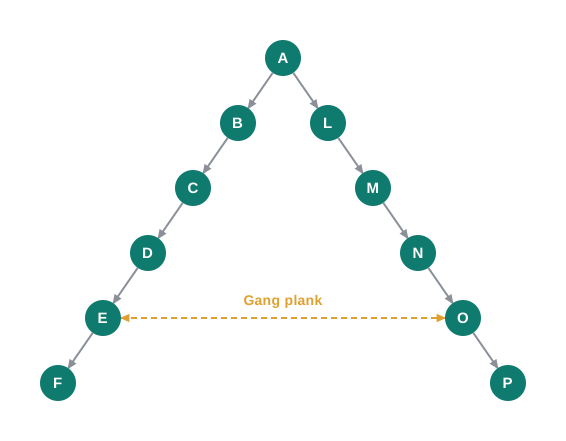
Fig. 2.5 – Fayol’s scalar chain and gang plank.
According to Fayol this chain should not be violated in the normal course of formal communication. However, if there is an emergency, then ‘E’ can contact ‘O’ directly through the ‘Gang Plank’, which is a shorter route provided so that communication is not delayed. In practice a worker cannot directly contact the chief executive of the company; if at all this has to happen, all the formal levels, namely the foreman, superintendent, manager and director, have to know about the matter. In an emergency, however, it is possible for a worker to contact the chief executive directly.
Order — according to Fayol, people and materials must be in suitable places at appropriate times for maximum efficiency. The principle of order states that there should be a place for everything and everyone, and everything and everyone should be in its place. Essentially it means orderliness. If there is a fixed place for everything and it is present there, then there will be no hindrance in the activities of the business or factory, and this leads to increased productivity and efficiency.
Equity — according to Fayol, good sense and experience are needed to ensure fairness to all employees, who should be treated as fairly as possible. This principle emphasises kindliness and justice in the behaviour of managers towards workers, and it ensures loyalty and devotion. Fayol does not rule out the use of force altogether; he says that lazy personnel should be dealt with sternly, to send the message that everyone is equal in the eyes of the management. There should be no discrimination against anyone on account of gender, religion, language, caste, belief or nationality. In practice we can observe that in multinational corporations today people of various nationalities work together in a discrimination-free environment, and equal opportunities to rise are available to everyone in such companies.
Stability of personnel — according to Fayol, employee turnover should be minimised to maintain organisational efficiency. Personnel should be selected and appointed after a due and rigorous procedure, but once selected they should be kept at their post or position for a minimum fixed tenure, so that they have stability of tenure and reasonable time to show results. Any adhocism in this regard will create instability and insecurity among employees, and they would tend to leave the organisation. Recruitment, selection and training costs will then be high, so stability in the tenure of personnel is good for the business.
Initiative — according to Fayol, workers should be encouraged to develop and carry out their plans for improvement. Initiative means taking the first step with self-motivation; it is thinking out and executing a plan, and it is one of the traits of an intelligent person. Initiative should be encouraged, but this does not mean going against the established practices of the company for the sake of being different. A good company should have an employee suggestion system, whereby suggestions that result in a substantial reduction in cost or time are rewarded.
Esprit de corps — according to Fayol, management should promote a team spirit of unity and harmony among employees. Teamwork should be promoted especially in large organisations, because otherwise objectives would be difficult to realise and there would be a loss of coordination. A manager should replace ‘I’ with ‘We’ in all conversations with workers to foster team spirit. This gives rise to a spirit of mutual trust and belongingness among team members, and it also minimises the need for using penalties.

Fig. 2.6 – An employee suggestion system at work.
The Principles Then And Now
Fayol’s 14 principles are widely applicable to managerial problems and have cast a profound impact on management thinking. But with the change in the environment in which business is done, the interpretation of these principles has changed. Authority and responsibility, for example, once meant the empowering of managers; today it means the empowerment of employees, because of the flat organisational structures that are gaining ground. Table 2.5 sets out these changed connotations.
2.8 Fayol Versus Taylor: A Comparison
Having studied both contributions, we are now in a position to compare them. Fayol and Taylor have each contributed immensely to the knowledge of management, and this knowledge has formed the basis for further practice by managers.
It must be pointed out at the outset that their contributions are complementary to each other. Taylor worked upwards from the shop floor, seeking efficiency in the way a job is performed. Fayol worked downwards from the top, seeking efficiency in the way an organisation is administered. A firm that applies one without the other is left with either well-designed jobs in a badly administered organisation, or sound administration over work that is done wastefully. The points of difference between their contributions are set out in Table 2.6.
Both sets of ideas remain relevant in the present business environment, though in altered forms. The search for one best method survives in process standardisation and quality systems, while the concern for authority, coordination and team spirit survives in the design of flatter organisation structures. In board examinations this comparison is most often tested by presenting a situation and asking which thinker’s approach is being followed, so it is worth noting which level of the organisation the situation describes.
2.9 Summary
Meaning — principles of management are general guidelines that can be used for conduct in work places under certain situations. They help managers to take and implement decisions.
Nature — the nature of management principles can be discussed under these heads: formed by practice and experimentation; general guidelines; universal in application; flexible; mainly behavioural; contingent; and expressing a cause and effect relationship.
Significance — a proper understanding of the significance of management principles is essential if managers are to make sound decisions. The significance can be discussed under these heads: increase in efficiency; optimum utilisation of resources; scientific decision making; adaptation to a changing environment; fulfilling social responsibilities; proper research and development; training of managers; and effective administration.
Taylor’s principles — the principles of scientific management given by Taylor are science, not the rule of thumb; harmony, not discord; cooperation, not individualism; maximum, not restricted output; and development of each person to her or his greatest efficiency and prosperity.
Taylor’s techniques — the techniques of scientific management as prescribed by Taylor were functional foremanship; standardisation and simplification of work; fatigue study; method study; time study; motion study; and the differential wage system.
Fayol’s view of the manager’s work — according to Fayol, the functions of management are to plan, to organise, to command, to coordinate and to control. The activities of an industrial undertaking could be divided into technical, commercial, financial, security, accounting and managerial. He also suggested that managers should have the following qualities: physical, moral, education, knowledge and experience.
Fayol’s principles — Fayol listed 14 principles of management: division of work; authority and responsibility; discipline; unity of command; unity of direction; subordination of individual interest to general interest; remuneration of personnel; centralisation and decentralisation; scalar chain; order; equity; stability in the tenure of personnel; initiative; and esprit de corps.
The two together — differences can be pointed out between the contributions of Taylor and Fayol, but essentially the two were complementary in nature, one addressing the shop floor and the other the administration of the organisation as a whole.
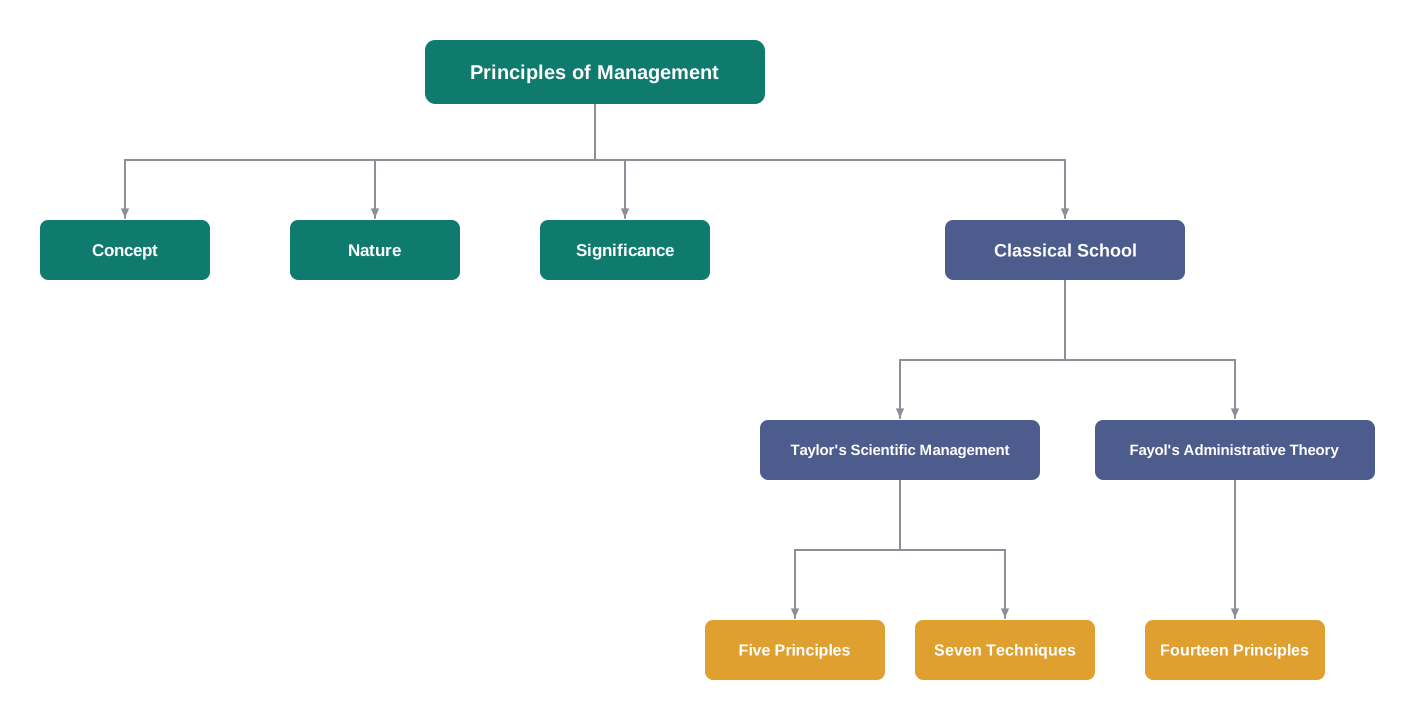
Fig. 2.7 – Structure of the chapter.
2.10 Key Terms
- Principle of Management A broad and general guideline for decision-making and behaviour, developed from observation, experimentation and managerial experience.
- Techniques of Management Procedures or methods involving a series of steps to be taken in order to accomplish a desired goal.
- Values General rules of behaviour, formed through common practice in society, which carry moral connotations.
- Scientific Management The practice of investigating how a job is done, combining the best features into a single standard method through time and motion study, and following that method throughout the organisation.
- Rule of Thumb Managing on the basis of the personal judgement and past experience of the individual manager, without any systematic study of the work.
- Mental Revolution A complete change in the attitude of workers and management towards one another, from competition to cooperation.
- Functional Foremanship A technique in which planning and execution are separated and a worker is supervised by eight specialist foremen, each responsible for one function.
- Standardisation of Work The process of setting benchmarks for every business activity, such as process, raw material, time, product, machinery, methods or working conditions.
- Simplification of Work The elimination of superfluous varieties, sizes and dimensions in order to reduce unnecessary diversity of products.
- Method Study The study of all activities from procurement of raw material to delivery of the product, in order to find the one best way of doing the job.
- Motion Study The study of the body movements made while doing a job, in order to eliminate unnecessary movements.
- Time Study The measurement of the time taken for each element of a task, in order to fix the standard time for a well-defined job.
- Fatigue Study The study that determines the amount and frequency of rest intervals needed to complete a task.
- Differential Piece Wage System A wage plan under which a higher rate per unit is paid for output at or above the standard, and a lower rate per unit for output below it.
- Unity of Command The principle that one subordinate should receive orders from, and be responsible to, only one superior.
- Unity of Direction The principle that each group of activities having the same objective must have one head and one plan.
- Centralisation The concentration of decision-making authority at the top of the organisation.
- Decentralisation The dispersal of decision-making authority among more than one person down the organisation.
- Scalar Chain The formal line of authority and communication running from the highest to the lowest rank of an organisation.
- Gang Plank A shorter route of communication between two employees at the same level, used only in an emergency, without following the scalar chain.
- Esprit de corps The team spirit of unity and harmony among employees that management should promote.
2.11 NCERT Questions
Very Short Answer Type
- What makes principles of management flexible?
- State the main objective of time study.
- Name the principle that is an extension of the ‘harmony, not discord’.
- State any two causes of fatigue that may create hindrance in the employee’s performance.
- Sanaklal and Gagan started their career in Wales Limited, a printing press, after going through a rigorous recruitment process. Since they had no prior work experience, the firm decided to give them one year to prove themselves. Name the principle of management followed by Wales Limited.
- Which technique is used by Taylor for distinguishing efficient and inefficient workers?
Short Answer Type
- How is the principle of ‘Unity of Command’ useful to management? Explain briefly.
- Define scientific management. State any three of its principles.
- If an organisation does not provide the right place for physical and human resources in an organisation, which principle is violated? What are the consequences of it?
- Explain any four points regarding significance of principles of management.
- Explain the principle of ‘Scalar Chain’ and gang plank.
- A production manager at top level in a reputed corporate, Mr. Rathore, holds the responsibility for ordering raw material for the firm. While deciding on the supplier for the financial year, he gave the order to his cousin at a higher price per unit instead of the firm’s usual supplier who was willing to lower the rates for the order. Which principle of management was violated by Mr. Rathore? What are the positive impacts of following the above identified principle?
Long Answer Type
- Explain the principles of scientific management given by Taylor.
- Explain the following principles of management given by Fayol with examples:
- Unity of direction
- Equity
- Esprit de corps
- Order
- Centralisation and decentralisation
- Initiative
- Explain the technique of ‘Functional Foremanship’ and the concept of ‘Mental Revolution’ as enunciated by Taylor.
- Discuss the following techniques of scientific work study:
- Time study
- Motion study
- Fatigue study
- Method study
- Simplification and standardisation of work
- Discuss the differences between the contributions of Taylor and Fayol.
- Discuss the relevance of Taylor and Fayol’s contribution in the contemporary business environment.
- ‘Bhasin’ Limited was engaged in the business of food processing and selling its products under a popular brand. Lately the business was expanding due to good quality and reasonable prices. Also, with more people working, the market for processed food was increasing. New players were also coming in to cash in on the new trend. In order to keep its market share in the short run, the company directed its existing workforce to work overtime. But this resulted in many problems. Due to increased pressure of work the efficiency of the workers declined. Sometimes the subordinates had to work for more than one superior, resulting in declining efficiency. The divisions that were previously working on one product were also made to work on two or more products. This resulted in a lot of overlapping and wastage. The workers were becoming indisciplined. The spirit of teamwork, which had characterised the company previously, was beginning to wane. Workers were feeling cheated and initiative was declining. The quality of the products was beginning to decline and market share was on the verge of decrease. Actually the company had implemented changes without creating the required infrastructure.
- Identify the principles of management, out of the 14 given by Henri Fayol, that were being violated by the company.
- Explain these principles in brief.
- What steps should the company management take in relation to the above principles to restore the company to its past glory?
- Further information related to the above question: the management of Bhasin Limited now realised its folly. In order to rectify the situation it appointed a management consultant, Mukti Consultants, to recommend a restructure plan to bring the company back on the rails. Mukti Consultants undertook a study of the production process at the plant of Bhasin Limited and recommended the following changes. The company should introduce scientific management with regard to production. Production planning, including routing, scheduling, dispatching and feedback, should be implemented. In order to separate planning from operational management, ‘Functional foremanship’ should be introduced. ‘Work study’ should be undertaken to optimise the use of resources. ‘Standardisation’ of all activities should be implemented to increase efficiency and accountability. To motivate the workers, the ‘Differential Piece Rate System’ should be implemented. These changes are to be introduced apart from the steps recommended in the previous question. It was expected that the changes would bring about a radical transformation in the working of the company and that it would regain its pristine glory.
- Do you think that introduction of scientific management as recommended by the consultants will result in the intended outcome?
- What precautions should the company undertake to implement the changes?
- Give your answer with regard to each technique separately as enunciated in the six recommendations in the case problem.
2.12 Check Your Concepts
- Why are the principles of management described as flexible and contingent at the same time? Explain the difference between the two features.
- Why can a principle of management not be as rigid as a principle of pure science?
- Distinguish between principles of management and techniques of management on any three bases.
- What happens to a firm’s costs and decision quality if managers continue to manage by rule of thumb as the firm grows?
- Why did Taylor propose eight foremen in place of one? State the reason he gave.
- Arrange the following in the correct sequence in which a firm would apply them: fixing the standard time for the task; studying the movements made while doing the job; finding the one best method of doing the job; fixing the rest intervals required.
- Identify the term: the shorter route of communication permitted between two employees of the same rank in an emergency.
- Assertion (A): Taylor did not treat unity of command as important. Reason (R): Under functional foremanship a worker receives orders from eight specialists. Choose the correct option:
- Both A and R are true, and R is the correct explanation of A.
- Both A and R are true, but R is not the correct explanation of A.
- A is true but R is false.
- A is false but R is true.
- Match the following techniques with what each of them determines:
| Column A | Column B |
|---|---|
| a. time study | i. the one best way of doing a job |
| b. motion study | ii. the amount and frequency of rest intervals |
| c. fatigue study | iii. the standard time for a task |
| d. method study | iv. the movements to be eliminated |
- Why is ‘mental revolution’ described as the sum and substance of Taylor’s ideas rather than any single technique?
- Distinguish between standardisation and simplification of work on any three bases.
- Why is it said that the contributions of Taylor and Fayol are complementary rather than competing? Support your answer with one example of each.
2.13 Case-Based Questions
- Tanvi Ceramics Ltd. has grown from one workshop to four. The managing director still approves every purchase, every leave application and every despatch, and files now wait for days on his table. A consultant advises him to allow each unit head to sanction routine matters up to a fixed limit, while decisions on new plants and new products remain with him.
- Name the principle of management involved in the consultant’s advice.
- State the balance that Fayol asked managers to maintain in this regard.
- State one benefit the firm will gain from the change.
- At Ojas Electricals Ltd., wages of assembly workers are the same for everyone, regardless of output. The production head observes the work of each operator, records the time taken for each element of the task, arrives at a standard output for a shift, and proposes that those who reach or exceed it be paid at a higher rate per unit than those who fall below it.
- Name the technique of scientific management being proposed.
- Name the study on which the standard output has been based.
- State one objection workers might raise if the standard is fixed without adequate rest intervals, and name the study that addresses it.
- Rehmat Foods Ltd. sets up a new plant. Materials are stacked wherever space is found, tools are kept in no fixed place, and workers lose time searching for them. In the same plant, employees who suggest improvements are neither heard nor rewarded, and the supervisor uses the word ‘I’ in every instruction he gives.
- Identify the three principles of Fayol that are being neglected here.
- Explain any two of them in brief.
- Suggest one practical step for each of the two principles you have explained.
- Kalindi Textiles Ltd. faces frequent disputes. Workers complain that the promised bonus has not been paid although they worked extra hours as agreed; the personnel officer transfers employees from one post to another every few months; and two employees doing the same work are paid differently for no stated reason.
- Identify the principle of management violated in each of the three situations.
- Explain any one of them in brief.
- State one consequence the company will face if the second situation continues.