Chapter 10: Marketing
Every product that reaches a household has travelled a long path of business decisions. Someone studied what buyers wanted, designed the product, decided its quality and packaging, fixed a price, arranged for it to reach thousands of shops, and communicated its benefits to buyers. A packet of biscuits on a shelf in a small town is the visible end of all these decisions. Taken together, they form the area of business known as marketing.
Marketing is often confused with selling or with shopping. It is much wider than either. It begins before a product is manufactured, with the identification of customer needs, and continues after the sale through customer support and repeat purchase. It applies to goods, services, ideas, places and events, and to non-profit organisations such as hospitals and schools as much as to business firms.
This chapter explains the meaning and features of marketing, the work of marketing management, the philosophies that guide marketing effort, the functions marketing performs, the four elements of the marketing mix, the classification of products, and the decisions relating to branding, packaging, labelling, pricing, physical distribution and promotion.

Fig. 10.0 – Packaged consumer goods on a retail shelf.
10.1 Marketing: Meaning and Features
The term marketing is described by different people in different ways. Some treat marketing as the same thing as shopping, and say they are ‘marketing’ whenever they go out to buy goods or services. Others confuse marketing with ‘selling’ and believe that marketing begins only after a product has been produced. A third group uses the word to mean ‘merchandising’, that is, designing the product.
Each of these descriptions is partly correct, but each captures only a small part of the idea. Marketing is a much broader concept, and the following discussion builds it up step by step.
The Traditional View
Traditionally, marketing was described in terms of the functions or activities it involves. In this sense, marketing was referred to as the performance of business activities that direct the flow of goods and services from producers to consumers.
This view arose from a simple fact of modern business. Most manufacturing firms do not produce goods for their own consumption, but for use by others. To move goods and services from the producer to the consumer, a large number of activities have to be performed — product designing or merchandising, packaging, warehousing, transportation, branding, selling, advertising and pricing. All these are referred to as marketing activities.
Thus ‘merchandising’, ‘selling’ and distribution are not separate rivals of marketing. They are parts of a large set of activities undertaken by a firm, which together are called marketing.
It should be noted that marketing is not merely a post-production activity. It includes many activities performed even before the goods are produced, and it continues even after the goods have been sold. Identifying customer needs, collecting information for developing the product, designing a suitable package and giving the product a brand name are all done before production begins. Similarly, follow-up activities are needed after the sale to maintain good customer relations and secure repeat purchases.
10.1.1 Understanding the Term ‘Market’
In the traditional sense, the term market refers to the place where buyers and sellers gather to enter into transactions involving the exchange of goods and services. This is the sense in which the word is still used in day-to-day language.
The term is also used in several other senses — a product market, such as the cotton market, the gold market or the share market; a geographic market, such as the national market and the international market; a market described by the type of buyers, such as the consumer market and the industrial market; and a market described by the quantity of goods transacted, such as the retail market and the wholesale market.
In the modern marketing sense, however, the term has a broader meaning that has nothing to do with a physical place.
For example, when a fashion designer designs a new dress and offers it for exchange, all the people who are willing to buy it and offer some value for it constitute the market for that dress. In the same way, the market for fans, bicycles, electric bulbs or shampoos means all the actual and potential buyers of these products. A firm that thinks of its market in this way is forced to study buyers, not merely locations.
10.1.2 Features of Marketing
A careful analysis of the definition of marketing brings out four important features.
Needs and wants — the process of marketing helps individuals and groups in obtaining what they need and want. The primary motivation for people to engage in marketing is to satisfy some of their needs or wants. In other words, the focus of the whole marketing process is on satisfying the needs and wants of individuals and organisations.
Creating a market offering — on the part of marketers, the effort involves creating a market offering, that is, a complete offer of a product or service with given features, at a certain price, available at a given outlet or location.
Customer value — marketing facilitates exchange between buyers and sellers, but buyers make their buying decisions on the basis of their perception of the value of the product in satisfying their need, in relation to its cost.
Exchange mechanism — marketing works through the exchange mechanism, by which buyers and sellers obtain what they need and want by giving something of value in return.
Each of these four features is explained below.
Needs and Wants
A need is a state of felt deprivation, or the feeling of being deprived of something. If it remains unsatisfied, it leaves a person unhappy and uncomfortable. On getting hungry, for example, we become uncomfortable and start looking for objects capable of satisfying our hunger.
Needs are basic to human beings and do not pertain to any particular product. Wants, on the other hand, are culturally defined objects that are potential satisfiers of needs. In other words, human needs shaped by such factors as culture, personality and religion are called wants. The basic need for food may take the form of a want for dosa and rice for a South Indian person, and for chapatti and vegetables for a North Indian person.
A marketer’s job in an organisation, therefore, is to identify the needs of the target customers and develop products and services that satisfy those needs.
Creating A Market Offering
A market offering is a complete offer for a product or service, having given features such as size, quality and taste, at a certain price, and available at a given outlet or location.
Suppose the offer is for a cell phone available in four different versions, distinguished by features such as size of memory, television viewing, internet and camera, for a given price of between ₹5,000 and ₹20,000 depending on the model selected, available for sale at the firm’s exclusive shops in and around all metropolitan cities in the country. This is a market offering, because it specifies not just the product but also its features, its price and its availability.
A good market offer is one which is developed after analysing the needs and preferences of the potential buyers. An offer designed without such analysis may be technically sound and still fail to sell.
Customer Value
The process of marketing facilitates the exchange of products and services between buyers and sellers. Buyers, however, do not decide on the basis of what the seller thinks the product is worth. They decide on the basis of their own perception of the value of the product or service in satisfying their need, in relation to its cost.
A product will therefore be purchased only if it is perceived to be giving the greatest benefit or value for the money. The job of a marketer is to add to the value of the product, so that customers prefer it in relation to competing products and decide to purchase it. This is why two products with similar features may sell very differently — the buyer’s perception of customer value differs.
Exchange Mechanism
Marketing works through the exchange mechanism. Individuals, that is, buyers and sellers, obtain what they need and want through the process of exchange. The process of marketing therefore involves the exchange of products and services for money or for something else considered valuable by people.
A person feeling hungry, for example, may obtain food by offering money or some other product or service in return to someone who is willing to accept it for food.
In the modern world, goods are produced at different places and distributed over a wide geographical area through various middlemen, involving exchanges at different levels of distribution. Exchange is therefore referred to as the essence of marketing. For any exchange to take place, the following conditions must be satisfied.
Involvement of at least two parties, namely the buyer and the seller.
Each party should be capable of offering something of value to the other. For example, the seller offers a product and the buyer offers money.
Each party should have the ability to communicate and deliver the product or service. No exchange can take place if the buyer and the seller are unable to communicate with each other, or cannot deliver something of value to the other.
Each party should have the freedom to accept or reject the other party’s offer.
The parties should be willing to enter into a transaction with each other. Acceptance or rejection of the offer thus takes place on a voluntary basis and not on the basis of any compulsion.
These are the necessary conditions for an exchange. Whether the exchange actually takes place or not depends on the suitability of the act of exchange to both the parties — whether it makes them better off, or at least not worse off. If either party expects to be worse off, it will simply refuse.
10.1.3 Scope of Marketing
Marketing is not merely a business phenomenon, and it is not confined to business organisations alone. Marketing activities are equally relevant to non-profit organisations such as hospitals, schools, sports clubs, and social and religious organisations.
Such organisations use marketing to achieve their own goals — spreading the message of family planning, improving the literacy standards of people, or providing medication to the sick. The tools are the same; only the objective is different.
The range of things that can be marketed is therefore wide, as Table 10.1 shows.
10.2 Marketing Management
Marketing management means management of the marketing function. In other words, it refers to planning, organising, directing and controlling the activities which facilitate the exchange of goods and services between producers and consumers or users.
The focus of marketing management is thus on achieving the desired exchange outcomes with the target markets. A firm does not want exchange with everybody; it wants exchange with the particular group of buyers it has chosen to serve.
Taking a management perspective, two well-known definitions of the term have been given.
10.2.1 The Process of Marketing Management
A careful analysis of the definition reveals that the process of management of marketing involves three elements, which follow one after the other, as shown in Fig. 10.1.
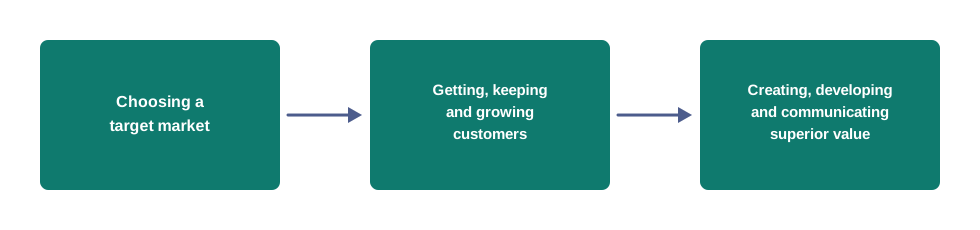
Fig. 10.1 – The process of marketing management.
Choosing a target market — the firm first decides which group of buyers it will serve. A manufacturer may, for example, choose to make readymade garments for children up to the age of five years.
Getting, keeping and growing the customers — in respect of the target market chosen, the marketer has to create demand so that the target customers purchase the product, keep them satisfied with the firm’s products, and also attract more customers so that the firm can grow.
Creating, developing and communicating superior value — the primary job of a marketing manager is to create superior value, so that customers are attracted to the products and services, and then to communicate that value to prospective buyers and persuade them to buy.
The order matters. Unless the target market is identified first, the firm cannot know whose needs it is trying to satisfy, and any value it creates may be superior in its own eyes but not in the eyes of the buyer.
10.2.2 Functions Performed in Marketing Management
Marketing management involves the performance of various functions such as analysing and planning the marketing activities, implementing the marketing plans, and setting a control mechanism to check whether the plans are working.
These functions have to be performed in such way that the organisation’s objectives are achieved at the minimum cost. Achieving the objective by spending without limit is not management; matching the objective with the resources used is.
10.2.3 Management of Demand
Marketing management is generally related to the creation of demand. In certain situations, however, the manager has to restrict demand instead of creating it.
Consider a situation of ‘overfull demand’, where the demand for a product is more than what the company can or wants to handle. Such a situation existed in our country before the adoption of the policies of liberalisation and globalisation in the early nineties, in most consumer products, whether automobiles, electronic goods or other durable products. The job of marketing managers in these situations is to find ways of reducing demand temporarily, say by reducing expenditure on promotion or by increasing prices.
Demand may also be ‘irregular’, as in the case of seasonal products such as fans or woollen clothes. Here the marketer’s job is to change the time pattern of demand, using methods such as short-term incentives to buyers in the off season.
Marketing management is therefore not concerned only with creating demand, but with managing demand effectively, as per the situation in the market.
10.2.4 Marketing and Selling
Many people confuse ‘selling’ with ‘marketing’ and consider the two terms to be one and the same. Marketing refers to a large set of activities, of which selling is just one part.
A marketer of televisions, before making the sale, carries out a number of other activities — planning the type and model of televisions to be produced, the price at which they would be sold, and the selection of the distribution outlets at which they would be available. In short, marketing involves the whole range of activities relating to planning, pricing, promoting and distributing products that satisfy customers’ needs.
The function of selling, on the other hand, is restricted to the promotion of goods and services through salesmanship, advertising, publicity and short-term incentives, so that the title of the product is transferred from the seller to the buyer, or in other words, the product is converted into cash. The main differences are summarised in Table 10.2.
10.3 Marketing Management Philosophies
In order to achieve the desired exchange outcomes with target markets, a firm must decide what philosophy or thinking should guide its marketing efforts. This decision matters because the philosophy adopted determines the emphasis or the weightage placed on different factors in achieving the organisational objectives.
For example, the philosophy adopted decides whether the marketing effort of an organisation will focus on the product and the designing of its features, or on selling techniques, or on the customer’s needs, or on wider social concerns.
The concept or philosophy of marketing has evolved over a period of time, and five stages in this evolution can be identified, as shown in Fig. 10.2.

Fig. 10.2 – Evolution of marketing management philosophies.
10.3.1 The Production Concept
During the earlier days of the industrial revolution, the demand for industrial goods started picking up but the number of producers was limited. As a result, demand exceeded supply and selling was no problem. Anybody who could produce the goods was able to sell them.
The focus of business activity, therefore, was on the production of goods. It was believed that profits could be maximised by producing on a large scale, thereby reducing the average cost of production. It was also assumed that consumers would favour those products which were widely available at an affordable price.
Thus, availability and affordability of the product were considered to be the key to the success of a firm, and greater emphasis was placed on improving the production and distribution efficiency of firms. This thinking is known as the production concept.
10.3.2 The Product Concept
As a result of the emphasis on production capacity in the earlier days, the position of supply improved over a period of time. Mere availability and low price of the product could no longer ensure increased sale, and therefore could not ensure the survival and growth of the firm.
With the increase in the supply of products, customers started looking for products which were superior in quality, performance and features. The emphasis of firms accordingly shifted from quantity of production to quality of products.
The focus of business activity changed to bringing continuous improvement in quality and to incorporating new features. Under this product concept, product improvement became the key to profit maximisation of a firm.
10.3.3 The Selling Concept
With the passage of time, the marketing environment underwent further change. The increase in the scale of business further improved the position with respect to the supply of goods, which resulted in increased competition among sellers.
Product quality and availability alone did not ensure the survival and growth of firms, because there were now a large number of sellers selling quality products. This led to greater importance being given to attracting and persuading customers to buy the product.
The business philosophy changed accordingly. It was assumed that customers would not buy, or would not buy enough, unless they were adequately convinced and motivated to do so. Firms therefore had to undertake aggressive selling and promotional efforts to make customers buy their products, and the use of promotional techniques such as advertising, personal selling and sales promotion was considered essential.
Under this selling concept, the focus of business firms shifted to pushing the sale of products through aggressive selling techniques, with a view to persuade, lure or coax the buyers into buying. Making the sale through any means became important. It was assumed that buyers could be manipulated, but what was forgotten was that in the long run, what matters most is customer satisfaction rather than anything else.
10.3.4 The Marketing Concept
Marketing orientation implies that focus on the satisfaction of the customer’s needs is the key to the success of any organisation in the market. It assumes that in the long run, an organisation can achieve its objective of profit maximisation by identifying the needs of its present and prospective buyers and satisfying them in an effective way.
Under the marketing concept, all the decisions in a firm are taken from the point of view of the customers. In other words, customer satisfaction becomes the focal point of all decision making in the organisation. What product will be produced, with what features, at what price it shall be sold, and where it shall be made available for sale — all depend on what the customers want.
If customers want features such as a double door in a refrigerator, or a separate provision for a water cooler in it, the organisation would produce a refrigerator with these features and price it at a level which the customers are willing to pay.
If all marketing decisions are taken with this perspective, selling will not be any problem. It will follow automatically. The basic role of a firm is then to ‘identify a need and fill it’.
The concept implies that products and services are bought not merely because of their quality, packing or brand name, but because they satisfy a specific need of a customer. A pre-requisite for the success of any organisation, therefore, is to understand and respond to customer needs.
Pillars Of The Marketing Concept
To sum up, the marketing concept is based on the following pillars.
Identification of the market or customer chosen as the target of the marketing effort.
Understanding the needs and wants of customers in the target market.
Development of products or services for satisfying the needs of the target market.
Satisfying the needs of the target market better than the competitors.
Doing all this at a profit.
Thus, the focus of the marketing concept is on customer needs, and customer satisfaction becomes the means of achieving the firm’s objective of maximising profit. The purpose of marketing is to generate customer value at a profit.
10.3.5 The Societal Marketing Concept
The marketing concept, as described in the preceding section, cannot be considered adequate if we look at the challenges posed by social problems such as environmental pollution, deforestation, shortage of resources, population explosion and inflation.
This is so because any activity which satisfies human needs but is detrimental to the interests of society at large cannot be justified. Business orientation should therefore not be short-sighted, serving only consumers’ needs. It should also consider the larger issues of long-term social welfare.
The societal marketing concept is thus an extension of the marketing concept, supplemented by concern for the long-term welfare of society. Apart from customer satisfaction, it pays attention to the social, ethical and ecological aspects of marketing, and there are a large number of such issues that need to be attended to.
10.3.6 Comparison of the Five Philosophies
The five philosophies differ in where they begin, what they concentrate on, how they pursue their goal and what they finally aim at. These differences are summarised in Table 10.3.
10.4 Functions of Marketing
Marketing is concerned with the exchange of goods and services from producers to consumers or users in such a way that the satisfaction of customers’ needs is maximised. From the viewpoint of the management function, a number of activities are involved in doing this.
These activities are called the functions of marketing. Twelve of them are described below, and they are listed together in Fig. 10.3.
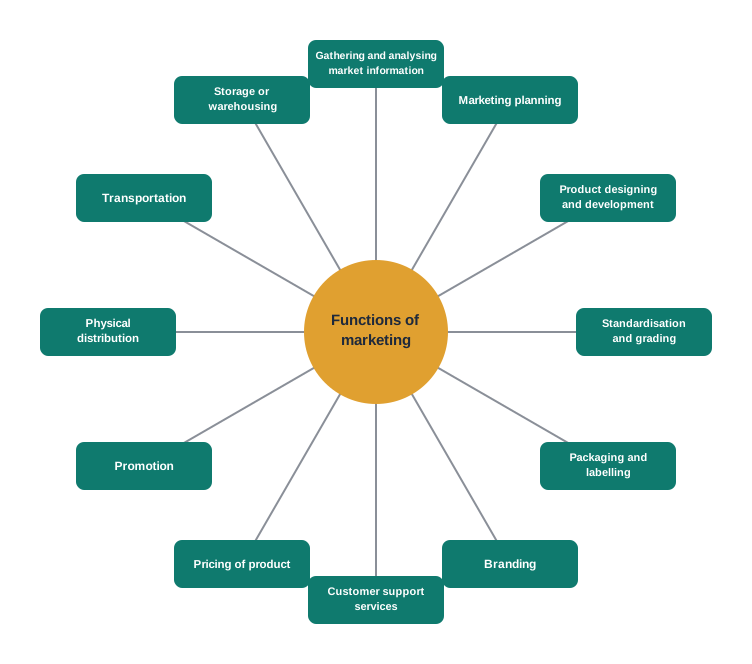
Fig. 10.3 – Functions of marketing.
- Gathering and analysing market information — one of the important functions of a marketer is to gather and analyse market information. This is necessary to identify the needs of customers and to take various decisions for the successful marketing of products and services. It is also important for analysing the available opportunities and threats, as well as the strengths and weaknesses of the organisation, and helps in deciding which opportunities can best be pursued by the firm.
For example, rapid growth may be predicted in several areas of the Indian economy, such as the use of the internet or the market for mobile phones. Which of these areas a particular organisation should enter, or in which area it should expand, requires a careful scanning of the strengths and weaknesses of the organisation, and this is done with the help of careful market analysis.
With the growth of computers, a new trend has emerged in the collection of market information. More and more companies are using interactive sites on the internet to gather customer views and opinions before taking important business decisions. Television news channels, for instance, invite viewers to choose through messages which of four or five main news stories of the day should be broadcast as a detailed story at prime time, so that viewers get to listen to the story of their own choice.
Marketing planning — another important area of work of a marketer is to develop appropriate marketing plans, so that the marketing objectives of the organisation can be achieved. Suppose a marketer of colour televisions holding ten per cent of the current market share in the country aims at raising it to twenty per cent in the next three years. The marketer will have to develop a complete marketing plan covering various important aspects, including the plan for increasing the level of production and the promotion of the products, and will have to specify the action programmes to achieve these objectives.
Product designing and development — another important marketing decision area relates to product designing and development. The design of the product contributes to making the product attractive to target customers. A good design can improve the performance of a product and also give it a competitive advantage in the market. When we plan to buy a motorbike, for example, we look not only at features such as cost and mileage but also at design aspects such as its shape and style.
Standardisation and grading — standardisation refers to producing goods of predetermined specifications, which helps in achieving uniformity and consistency in the output. It assures buyers that goods conform to predetermined standards of quality, price and packaging, and reduces the need for inspection, testing and evaluation of the products. Grading is the process of classification of products into different groups on the basis of some of their important characteristics such as quality and size. Grading is particularly necessary for products which are not produced according to predetermined specifications, such as agricultural products like wheat and oranges. It ensures that goods belong to a particular quality and helps in realising higher prices for high quality output.
Packaging and labelling — packaging refers to designing and developing the package for the product, while labelling refers to designing and developing the label to be put on the package. The label may vary from a simple tag to complex graphics. Packaging and labelling have become so important in modern day marketing that these are considered the pillars of marketing. Packaging is important not only for the protection of products but also serves as a promotional tool, and sometimes the quality of a product is judged by buyers from its packaging. The success of many consumer brands of potato wafers, shampoos and toothpastes in recent times owes a great deal to packaging.
Branding — a very important decision area for marketing of most consumer products is whether to sell the product under its generic name, that is, the name of the category of the product such as fan or pen, or to sell it under a brand name. A brand name helps in creating product differentiation, that is, it provides a basis for distinguishing the product of a firm from that of a competitor, which in turn helps in building customer loyalty and in promoting sales. The important decision areas in respect of branding include deciding the branding strategy — for instance, whether each product will be given a separate brand name, or whether the same brand name will be extended to all products of the company, such as the bulbs, tubes and televisions of one manufacturer, or the washing machine, television and refrigerator of another. Selection of the brand name plays an important role in the success of a product.
Customer support services — a very important function of marketing management relates to developing customer support services such as after-sales services, handling of customer complaints and adjustments, procuring credit services, maintenance services, technical services and consumer information. All these services aim at providing maximum satisfaction to customers, which is the key to marketing success in modern days. Customer support services are very effective in bringing repeat sales from customers and in developing brand loyalty for a product.
Pricing of product — price of a product refers to the amount of money customers have to pay to obtain the product. Price is an important factor affecting the success or failure of a product in the market. The demand for a product or service is related to its price; generally, the lower the price, the higher would be the demand for the product, and vice versa. Marketers have to analyse the factors determining the price of a product properly and take several crucial decisions in this respect, including setting the pricing objectives, determining the pricing strategies, determining the price, and changing prices.
Promotion — promotion of products and services involves informing customers about the firm’s product and its features, and persuading them to purchase these products. The four important methods of promotion include advertising, personal selling, publicity and sales promotion. A marketer has to take several crucial decisions in respect of promotion, such as deciding the promotion budget and the promotion mix, that is, the combination of promotional tools that will be used.
Physical distribution — managing physical distribution is another very important function in the marketing of goods and services. The two major decision areas under this function include, first, the decision regarding channels of distribution or the marketing intermediaries such as wholesalers and retailers to be used, and second, the physical movement of the product from where it is produced to the place where it is required by customers for their consumption or use. The important decision areas under physical distribution include managing inventory, that is, levels of stock of goods, storage and warehousing, and transportation of goods from one place to another.
Transportation — transportation involves the physical movement of goods from one place to another. As the users of products, particularly consumer products, are widespread and geographically separated from the place where these are produced, it is necessary to move them to the place where they are needed for consumption or use. Tea produced in Assam, for example, has to be transported not only within the state but to far off places such as Tamil Nadu, Punjab, Jammu and Kashmir, Haryana and Rajasthan, where it is consumed. A marketing firm has to analyse its transportation needs after taking into consideration factors such as the nature of the product, and the cost and location of the target market, and then take decisions regarding the mode of transportation to be chosen and other related aspects.
Storage or warehousing — usually there is a time gap between the production or procurement of goods and their sale or use. This may be because of irregular demand for the products, as in the case of woollen garments or raincoats, or because of irregular supply on account of seasonal production, as in the case of agricultural products such as sugarcane, rice, wheat and cotton. In order to maintain a smooth flow of products in the market, there is a need for proper storage of the products. Further, adequate stock has to be stored to protect against unavoidable delays in delivery or to meet contingencies in demand. In the process of marketing, the function of storage is performed by different agencies such as manufacturers, wholesalers and retailers.
10.5 Marketing Mix
A firm serving a target market has to decide a large number of things at the same time — what to offer, at what price, where to make it available, and how to tell buyers about it. These decisions are not independent of one another; they have to be combined into a single, consistent offer. This combination is called the marketing mix.
The elements of the marketing mix have broadly been classified into four categories, popularly known as the four Ps of marketing. These are product, price, place and promotion. The decisions falling under each of them are shown in Fig. 10.4.
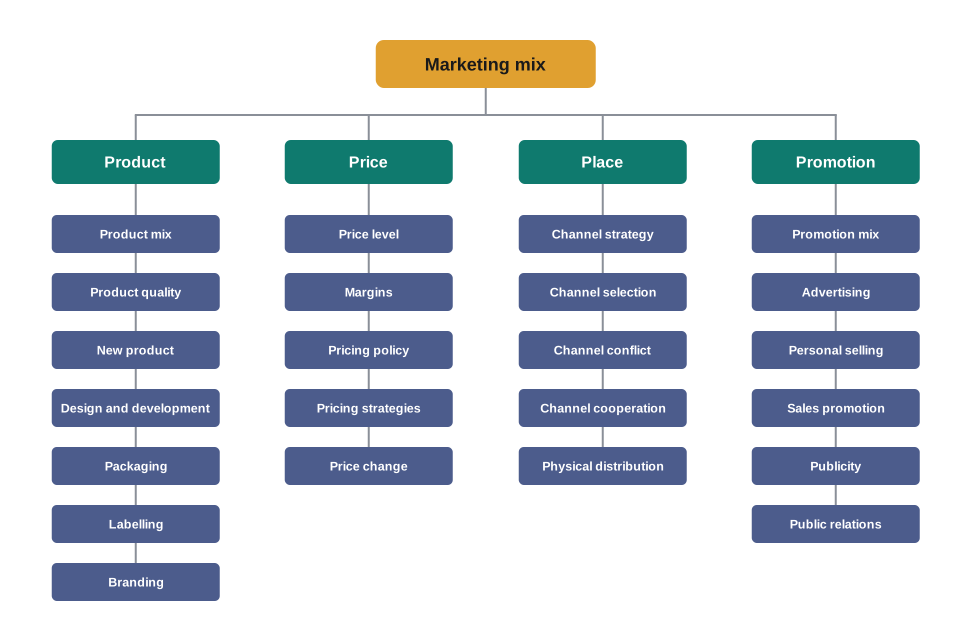
Fig. 10.4 – Elements of the marketing mix.
10.5.1 Product
Product means goods or services, or ‘anything of value’, which is offered to the market for sale. A single company may offer a wide range of such items — one large Indian firm offers steel, commercial vehicles and salt, while a dairy cooperative offers milk, ghee, butter, cheese and chocolates.
The concept of product relates not only to the physical product but also to the benefits offered by it from the customer’s viewpoint. Toothpaste, for example, is bought for whitening teeth and strengthening gums, not for the paste itself.
The concept of product also includes the extended product, that is, what is offered to customers by way of after-sales services, handling of complaints and availability of spare parts. These aspects are very important, particularly in the marketing of consumer durable products such as automobiles and refrigerators, where the buyer expects support for years after the purchase.
The important product decisions include deciding about the features, quality, packaging, labelling and branding of the products.
10.5.2 Price
Price is the amount of money customers have to pay to obtain the product. In the case of most products, the level of price affects the level of demand for them, which makes this the most sensitive element of the mix.
Marketers have not only to decide the objectives of price setting, but also to analyse the factors determining the price and then fix a price for the firm’s products. Decisions have also to be taken in respect of discounts to customers and traders and credit terms, so that customers perceive the price to be in line with the value of the product.
10.5.3 Place
Place, or physical distribution, includes activities that make the firm’s products available to the target customers. Important decision areas in this respect include the selection of dealers or intermediaries to reach the customers, and providing support to the intermediaries by way of discounts and promotional campaigns.
The intermediaries in turn keep inventory of the firm’s products, demonstrate them to potential buyers, negotiate price with buyers, close sales and also service the products after the sale. The other decision areas relate to managing inventory, storage and warehousing, and transportation of goods from the place where they are produced to the place where they are required by buyers.
10.5.4 Promotion
Promotion of products and services includes activities that communicate the availability, features and merits of the products to target customers and persuade them to buy.
Most marketing organisations undertake various promotional activities and spend a substantial amount of money on the promotion of their goods, using a number of tools such as advertising, personal selling and sales promotion techniques like price discounts and free samples. A large number of decisions have to be taken in each of these areas. In respect of advertising, for example, it is important to decide about the message and the media to be used, such as newspapers and magazines in the print media.
10.5.5 Combining the Elements
The success of a market offer depends on how well these ingredients are mixed to create superior value for customers and, at the same time, to achieve the firm’s sale and profit objectives.
Suppose a firm wishes to achieve a necessary volume of sale at a cost that will permit a desired level of profit. Many alternative mixes can be adopted to achieve this objective — a higher price with heavier advertising, or a lower price with wider distribution. The issue before the firm is to decide what would be the most effective combination of elements to achieve the given objectives.
The elements also have to be consistent with one another. A product of high quality, sold at a premium price, will not succeed if it is distributed through outlets that buyers associate with cheap goods, because each element sends a signal to the buyer about the offer as a whole.
10.6 Products and Their Classification
From the customer’s point of view, a product is a bundle of utilities, which is purchased because of its capability to provide satisfaction of a certain need. A buyer buys a product or service for what it does for her, or for the benefit it provides to her, and not for the materials it is made of.
There can be three types of benefits a customer may seek to satisfy from the purchase of a product.
Functional benefits.
Psychological benefits.
Social benefits.
The purchase of a motorcycle, for example, provides the functional utility of transportation, but at the same time satisfies the need for prestige and esteem, and provides a social benefit by way of acceptance from a group of people who ride motorbikes. All these aspects should therefore be considered while planning for a product.
Products may broadly be classified into two categories — consumer products and industrial products. Consumer products are further classified in two different ways, as shown in Fig. 10.5.
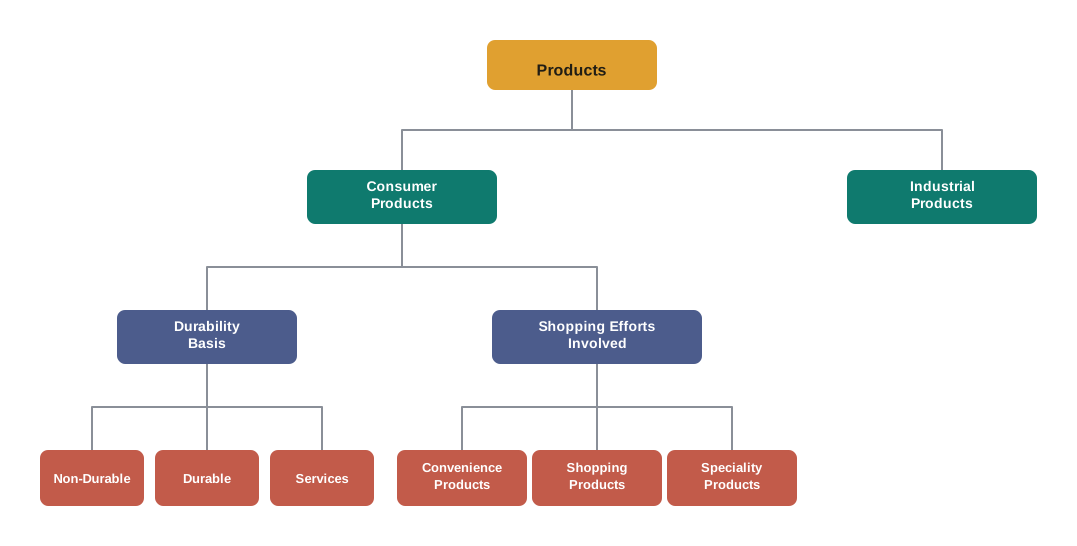
Fig. 10.5 – Classification of consumer products.
10.6.1 Consumer Products
Consumer products are products which are purchased by the ultimate consumers or users for satisfying their personal needs and desires. Soap, edible oil, eatables, textiles, toothpaste and fans, which we use for our personal and non-business use, are consumer goods.
Consumer products are classified on two bases — the shopping effort involved in buying them, and their durability.
On The Basis Of Shopping Effort
Convenience products — those consumer products which are purchased frequently, immediately and with the least time and effort are referred to as convenience goods. Examples of such products are ice creams, medicines, newspapers, stationery items and toothpaste. These products have a low unit value and are bought in small quantities.
Shopping products — shopping products are those consumer goods where buyers devote considerable time to compare the quality, price, style and suitability at several stores before making the final purchase. Some examples of shopping products are clothes, shoes, jewellery, furniture, radios and televisions.
Speciality products — speciality products are those consumer goods which have certain special features because of which people make special efforts in their purchase. These products have reached brand loyalty of the highest order with a significant number of buyers, who are willing to spend a lot of time and effort on their purchase. If there is a rare collection of artwork or of antiques, for instance, some people may be willing to spend a great deal of shopping effort and travel a long distance to buy it. In day-to-day life, we see people going to a particular hair-cutting saloon, restaurant or tailor for the same reason. The demand for these goods is relatively inelastic, that is, even if the price is increased, demand does not come down.
The three categories differ in several respects, as Table 10.4 shows.

Fig. 10.6 – Everyday convenience products at a neighbourhood shop.
On The Basis Of Durability
On the basis of their durability, consumer products have been classified into three categories — non-durable products, durable products and services.
Non-durable products — the consumer products which are normally consumed in one or a few uses are called non-durable products. Products like toothpaste, detergents, bathing soap and stationery products are examples. From the marketing point of view, these products generally command a small margin, should be made available in many locations, and need to be heavily advertised.
Durable products — those tangible consumer products which normally survive many years, such as a refrigerator, radio, bicycle, sewing machine and kitchen gadgets, are referred to as durable products. These goods are generally used for a longer period, command a higher per unit margin, and require greater personal selling efforts, guarantees and after-sales services on the part of the seller.
Services — by services we mean those intangible activities and benefits which are offered for sale, such as dry cleaning, watch repairs, hair cutting, postal services, and the services offered by a doctor, an architect and a lawyer.
10.6.2 Industrial Products
Industrial products are those products which are used as inputs in producing other products. Examples of such products are raw materials, engines, lubricants, machines and tools. In other words, industrial products are meant for non-personal and business use in producing other products.
The market for industrial products consists of manufacturers, transport agencies, banks and insurance companies, mining companies and public utilities. The number of buyers in this market is therefore much smaller than in the consumer market, but each buyer usually purchases in large quantity.
Consumer products and industrial products differ in several important respects, as summarised in Table 10.5.
Classification Of Industrial Products
The industrial goods are classified into three major categories, which are further sub-divided as shown in Fig. 10.7.
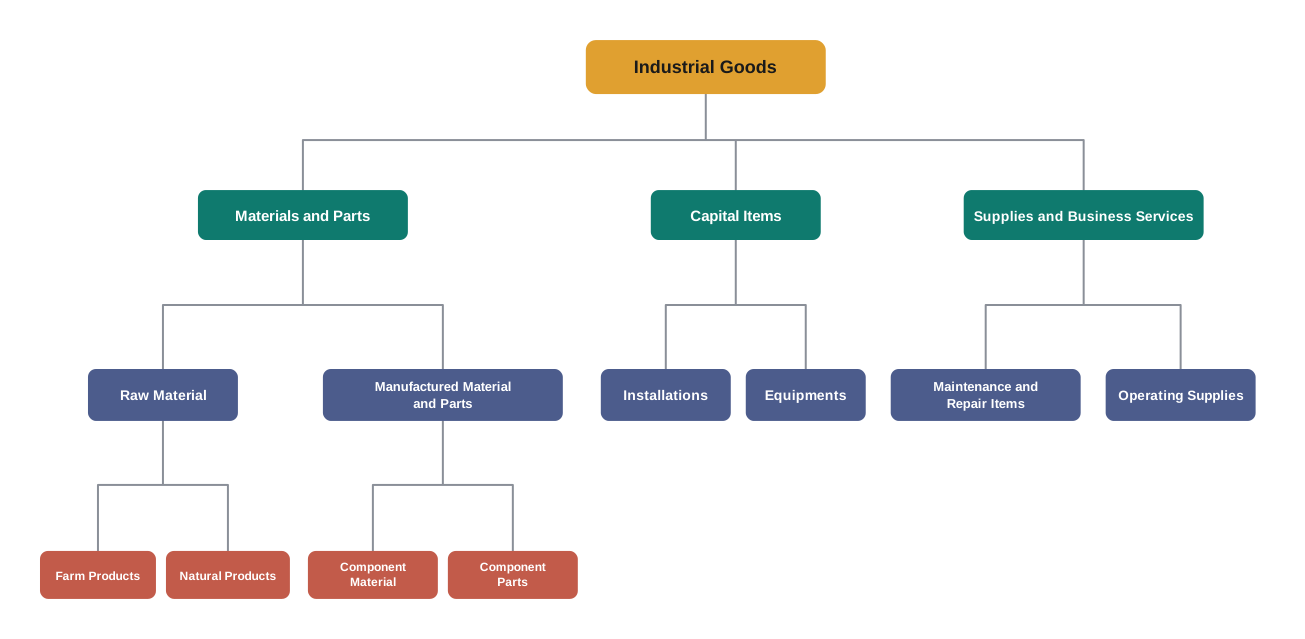
Fig. 10.7 – Classification of industrial goods.
Materials and parts — these include goods that enter the manufacturer’s products completely. Such goods are of two types. The first is raw material, including farm products like cotton, sugar cane and oil seed, and natural products such as minerals like crude petroleum and iron ore, and fish and lumber. The second is manufactured material and parts, which are again of two types — component materials like glass, iron and plastic, and component parts such as tyres, electric bulbs, steering and battery.
Capital items — these are goods that are used in the production of finished goods. They include installations, such as elevators and mainframe computers, and equipments, such as hand tools, personal computers and fax machines.
Supplies and business services — these are short lasting goods and services that facilitate developing or managing the finished product. They include maintenance and repair items like paint and nails, and operating supplies like lubricants, computer stationery and writing paper.
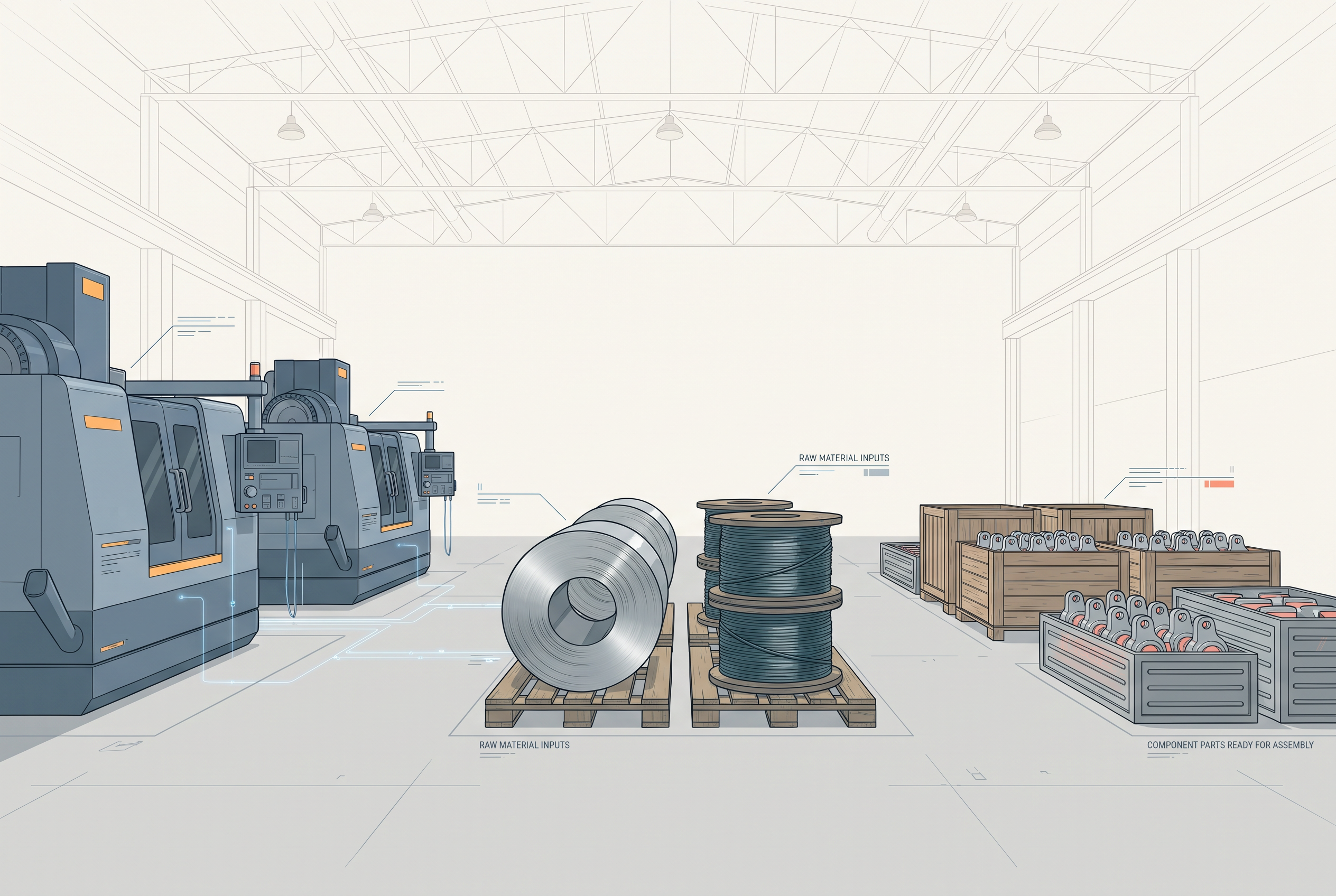
Fig. 10.8 – Industrial goods on a factory floor.
10.7 Branding
One of the most important decisions that a marketer has to take in the area of ‘product’ is in respect of branding. The marketer has to decide whether the firm’s products will be marketed under a brand name or under a generic name.
A generic name refers to the name of the whole class of the product — a book, a wristwatch, a tyre, a camera or a toilet soap. We know that a camera is a lens surrounded by plastic or steel on all sides, having certain other features such as a flash gun. Similarly, a book is a bunch of papers in bound form on which some useful information about a subject is printed. All products having these characteristics would be called by the generic name camera or book.
If products were sold by generic names, it would be very difficult for marketers to distinguish their products from those of their competitors. Most marketers therefore give a name to their product, which helps in identifying and distinguishing their products from competitors’ products.
10.7.1 Terms Relating to Branding
Four related terms are used in this area, and a student must be able to tell them apart.
Brand — a brand is a name, term, sign, symbol, design or some combination of them, used to identify the products, goods or services of one seller or group of sellers, and to differentiate them from those of the competitors. A brand is a comprehensive term, which has two components — brand name and brand mark.
Brand name — that part of a brand which can be spoken is called a brand name. In other words, the brand name is the verbal component of a brand.
Brand mark — that part of a brand which can be recognised but which is not utterable is called a brand mark. It appears in the form of a symbol, design, distinct colour scheme or lettering.
Trade mark — a brand or part of a brand that is given legal protection is called a trade mark. The protection is given against its use by other firms. Thus the firm which has got its brand registered gets the exclusive right to its use, and in that case no other firm can use such a name or mark in the country.
Branding adds to the cost of a firm — to the cost of packaging, labelling, legal protection and promotion. In spite of this added cost, it is widely used, because it provides several advantages both to sellers and to consumers.
10.7.2 Advantages of Branding
Advantages To The Marketer
Product differentiation — branding provides a basis for distinguishing the product of a firm from that of its competitors, so that buyers do not treat all products of the class as identical.
Helps in advertising and display — a brand name and brand mark give the promotion effort something definite to build on, since buyers can be asked to look for a particular name at the point of purchase.
Differential pricing — once buyers come to associate a brand with a certain quality, the firm can charge a price different from that of competing products, instead of being forced to sell at the price prevailing for unbranded goods.
Ease of introducing a new product — a firm with an established brand can launch a new product under the same name and obtain a ready acceptance from buyers who already trust the name.
Customer loyalty — satisfied buyers ask for the brand by name and repeat their purchase, which gives the firm a stable level of sales.
Advantages To The Customer
Easy identification — the buyer can pick out the desired product from a large number of similar-looking packages without examining each one.
Assurance of quality — a branded product is expected to maintain a consistent standard, because the seller’s reputation is attached to it, and the buyer is protected against a sudden fall in quality.
Basis of complaint — since the product carries an identified name, the buyer knows whom to hold responsible if the product is defective.
Status — the purchase of certain brands satisfies the buyer’s need for prestige and social acceptance.
10.7.3 Characteristics of a Good Brand Name
Choosing the right brand name is not an easy decision. What makes this decision important is the fact that once a brand name is chosen and the product is launched in the market, changing the brand name is very difficult. Getting it right the first time is therefore essential.
The following are some of the considerations which should be kept in mind while choosing a brand name.
The brand name should be short, and easy to pronounce, spell, recognise and remember.
A brand should suggest the product’s benefits and qualities. It should be appropriate to the product’s function.
A brand name should be distinctive.
The brand name should be adaptable to packing or labelling requirements, to different advertising media and to different languages.
The brand name should be sufficiently versatile to accommodate new products which are added to the product line.
It should be capable of being registered and protected legally.
The chosen name should have staying power, that is, it should not get out of date.
10.8 Packaging
One of the most important developments affecting the business world in recent years has been in the area of packaging. Many products which we thought could never lend themselves to packing because of their nature have been successfully packed — pulses, ghee, milk, salt and cold drinks are examples.
Packaging plays a very important role in the marketing success or failure of many products, particularly consumer non-durable products. In fact, if one analyses the reasons for the success of some of the successful products of the recent past, it can be noted that packaging has played its due role. It was one of the important factors in the success of products such as branded noodles and potato wafers.
10.8.1 Levels of Packaging
There can be three different levels of packaging, as shown in Fig. 10.9.

Fig. 10.9 – The three levels of packaging.
Primary package — it refers to the product’s immediate container. In some cases the primary package is kept till the consumer is ready to use the product, as in the case of a plastic packet for socks. In other cases it is kept throughout the entire life of the product, as in the case of a toothpaste tube or a match box.
Secondary packaging — it refers to additional layers of protection that are kept till the product is ready for use. A tube of shaving cream, for example, usually comes in a cardboard box. When consumers start using the shaving cream, they dispose of the box but retain the primary tube.
Transportation packaging — it refers to further packaging components necessary for storage, identification or transportation. A toothpaste manufacturer, for example, may send the goods to retailers in corrugated boxes containing ten, twenty or a hundred units.
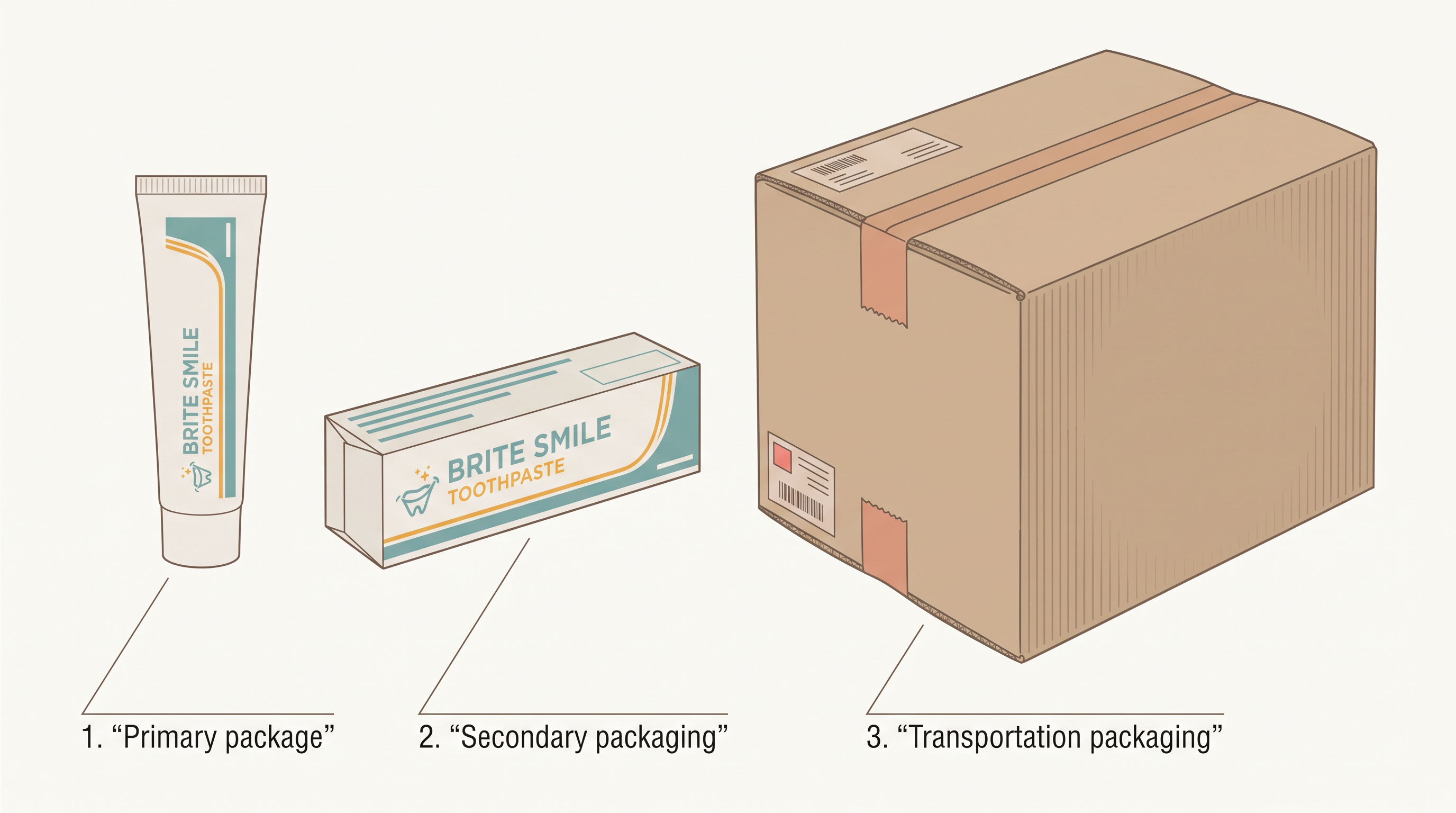
Fig. 10.10 – The three levels of packaging.
10.8.2 Importance of Packaging
Packaging has acquired great significance in the marketing of goods and services because of the following reasons.
Rising standards of health and sanitation — because of the increasing standards of living in the country, more and more people have started purchasing packed goods, as the chances of adulteration in such goods are minimised.
Self service outlets — self-service retail outlets are becoming very popular, particularly in major cities and towns. Because of this, some of the traditional role assigned to personal selling in respect of promotion has gone to packaging, since the package now has to do the work of persuading a buyer who is not attended by any salesperson.
Innovational opportunity — some of the recent developments in the area of packaging have completely changed the marketing scene in the country. Milk, for example, can now be stored for four to five days without refrigeration in recently developed packing materials. Similarly, in the area of pharmaceuticals and soft drinks, many innovations have come in respect of packaging, and as a result the scope for the marketing of such products has increased.
Product differentiation — packaging is one of the very important means of creating product differentiation. The colour, size and material of the package make a real difference in the perception of customers about the quality of the product. By looking at the package of a product such as paint or hair oil, one can make some guess about the quality of the product contained in it.
10.8.3 Functions of Packaging
Packaging performs a number of functions in the marketing of goods. Some of the important functions are as follows.
Product identification — packaging greatly helps in the identification of products. A toothpaste in a distinctive red carton, or a face cream in a familiar jar, can be easily identified by its package alone.
Product protection — packaging protects the contents of a product from spoilage, breakage, leakage, pilferage, damage and climatic effect. This kind of protection is required during storing, distribution and transportation of the product.
Facilitating use of the product — the size and shape of the package should be such that it is convenient to open, handle and use for consumers. Cosmetics, medicines and tubes of toothpaste are good examples of this.
Product promotion — packaging is also used for promotion purposes. A startling colour scheme, photograph or typeface may be used to attract the attention of people at the point of purchase. Sometimes it may work even better than advertising, and in self-service stores this role of packaging becomes all the more important.
10.9 Labelling
A simple looking but important task in the marketing of goods relates to designing the label to be put on the package.
The label may vary from a simple tag attached to the product, such as in the case of local unbranded products like sugar, wheat and pulses, indicating some information about the quality or price, to complex graphics that are part of the package, like the ones on branded products.
Labels are useful in providing detailed information about the product, its contents and its method of use. The various functions performed by a label are as follows.
10.9.1 Describe the Product and Specify its Contents
If we look at the labels of products used in day-to-day life, this function becomes clear. The label on the package of a local tea company describes the company and states the quality certification it holds. A popular brand of prickly heat powder describes how the product provides relief from prickly heat and controls bacterial growth and infection, and gives a caution forbidding its application on cuts and wounds.
The packages of fast food products such as ready-to-eat dosa, idli or noodles describe the procedure of cooking these products. The package of a toothpaste brand lists the tooth and gum problems which the product claims to fight, and the package of a brand of coconut oil describes the product as pure coconut oil with added heena, amla and lemon, and specifies how these are good for hair.
Thus, one of the most important functions of labels is to describe the product and its usage, state the cautions to be observed in use, and specify its contents.
10.9.2 Identification of the Product or Brand
The other important function performed by labels is to help in identifying the product or brand. The brand name of any product, say biscuits or potato chips, imprinted on its package, helps us to identify our favourite brand from among a number of similar packages.
Other common identification information provided by labels includes the name and address of the manufacturer, net weight when packed, manufacturing date, maximum retail price and batch number.
10.9.3 Grading of Products
Another important function performed by labels is to help in grading products into different categories. Sometimes marketers assign different grades to indicate different features or quality of the product.
A popular brand of hair conditioner, for example, comes in different categories for different hair types, such as one for normal hair and others for other categories. Different types of tea are sold by some brands under yellow, red and green label categories, so that a buyer can select the grade suited to her taste and budget.
10.9.4 Helps in Promotion of Products
An important function of a label is to aid in the promotion of the product. A carefully designed label can attract attention and give a reason to purchase.
Many product labels provide promotional messages — a hair oil pack may carry a catchy line about strong hair, and the label on a brand of detergent powder may promise to keep clothes looking good and the washing machine in top condition.
Labels also play an important role in the sales promotional schemes launched by companies. The label on a shaving cream package may mention ‘40% Extra Free’, and the package of a toothpaste may mention ‘Free Toothbrush Inside’ or a stated saving on the price.
10.9.5 Providing Information Required by Law
Another important function of labelling is to provide the information required by law. Packaged food articles, for example, must carry a list of ingredients, a declaration regarding vegetarian or non-vegetarian food additives, and the date of manufacturing or packing on the label.
Such information is required on processed foods, drugs and tobacco products. In the case of hazardous or poisonous material, an appropriate safety warning has to be put on the label. This function exists because the buyer cannot inspect the contents of a sealed package, and the law therefore compels the seller to disclose what the buyer cannot see.
Thus, labels perform a number of important functions relating to communicating with potential buyers and promoting the sale of the products.
10.10 Pricing
When a product is bought, some money is paid for it. This money represents the sum of values that consumers exchange for the benefit of having or using the product, and is referred to as the price of the product.
The same is true of services. Money paid as fare for a transport service, premium for an insurance policy, and fee to a doctor for medical advice represents the price of these services.
10.10.1 Importance of Pricing
Pricing occupies an important place in the marketing of goods and services by a firm. No product can be launched without a price tag, or at least some guidelines for pricing.
Pricing is often used as a regulator of the demand for a product. Generally, if the price of a product is increased, its demand comes down, and vice versa. A firm that wishes to clear stock or to slow down an excess of orders can therefore act through price faster than through any other element of the mix.
Pricing is also considered to be an effective competitive weapon. Under conditions of perfect competition, most firms compete with each other on the basis of this factor.
It is, in addition, the single most important factor affecting the revenue and profits of a firm, because every other decision only adds to cost, while price alone brings money in. Most marketing firms therefore give high importance to the fixation of price for their products and services.
10.10.2 Factors Affecting Price Determination
There are a number of factors which affect the fixation of the price of a product. The important ones are shown in Fig. 10.11 and are discussed below.
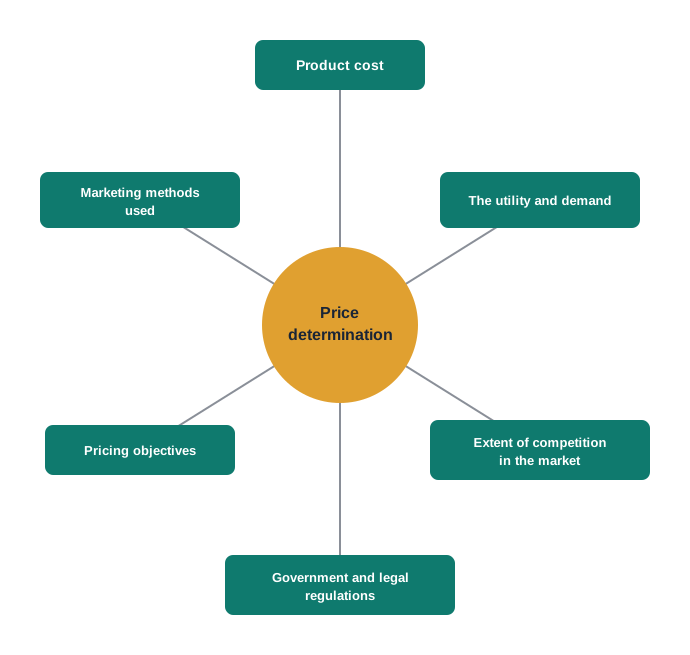
Fig. 10.11 – Factors affecting price determination.
Product Cost
One of the most important factors affecting the price of a product or service is its cost. This includes the cost of producing, distributing and selling the product.
Cost sets the minimum level, or the floor price, at which the product may be sold. Generally, all marketing firms strive to cover all their costs, at least in the long run, and in addition aim at earning a margin of profit over and above the costs.
In certain circumstances, for example at the time of introducing a new product or while entering a new market, products may be sold at a price which does not cover all the costs. But in the long run, a firm cannot survive unless at least all its costs are covered.
There are broadly three types of costs.
Fixed costs — fixed costs are those costs which do not vary with the level of activity of a firm, say with the volume of production or sale. Rent of a building or the salary of a sales manager remains the same whether one thousand units or ten units are produced in a week.
Variable costs — those costs which vary in direct proportion with the level of activity are called variable costs. The costs of raw material, labour and power are directly related to the quantity of goods produced. If the cost of wood for manufacturing one chair comes to ₹100, the cost of wood for ten chairs would be ₹1000, and obviously there will be no cost of wood if no chair is produced.
Semi variable costs — semi variable costs are those costs which vary with the level of activity but not in direct proportion with it. The compensation of a salesperson may include a fixed salary of, say, ₹10,000 plus a commission of five per cent on sales. With an increase in the volume of sales, the total compensation will increase, but not in direct proportion with the change in the volume of sale.
Total costs are the sum total of the fixed, variable and semi-variable costs for a specific level of activity, say a volume of sales or a quantity produced. The three types of cost are compared in Table 10.6.
The Utility and Demand
While product costs set the lower limit of the price, the utility provided by the product and the intensity of demand of the buyer set the upper limit of the price which a buyer would be prepared to pay.
In fact, the price must reflect the interest of both the parties to the transaction — the buyer and the seller. The buyer may be ready to pay up to the point where the utility from the product is at least equal to the sacrifice made in terms of the price paid. The seller, however, would try at least to cover the costs.
According to the law of demand, consumers usually purchase more units at a low price than at a high price. The intensity of demand therefore decides how close to the upper limit the seller can move.
Extent of Competition in the Market
Between the lower limit and the upper limit, where would the price settle down? This is affected by the nature and the degree of competition.
The price will tend to reach the upper limit in case there is a lesser degree of competition, while under conditions of free competition the price will tend to be set at the lowest level.
Competitors’ prices and their anticipated reactions must be considered before fixing the price of a product. Not only the price, but also the quality and the features of the competitive products must be examined carefully before fixing the price.
Government and Legal Regulations
In order to protect the interest of the public against unfair practices in the field of price fixing, the government can intervene and regulate the price of commodities. The government can declare a product an essential product and regulate its price.
For example, the cost of a drug manufactured by a company having a monopoly in its production may come to ₹20 per strip of ten, while the buyer is prepared to pay any amount for it, say ₹200. In the absence of any competitor, the seller may be tempted to extort the maximum amount of ₹200 for the drug. Usually in such a case, the government does not allow firms to charge such a high price, and intervenes to regulate the price of the drug by declaring it an essential commodity.
Pricing Objectives
Pricing objectives are another important factor affecting the fixation of the price of a product or a service. Generally the objective is stated to be maximising profits, but there is a difference between maximising profit in the short run and in the long run.
If a firm decides to maximise profits in the short run, it would tend to charge the maximum price for its products. But if it is to maximise its total profit in the long run, it would opt for a lower per unit price, so that it can capture a larger share of the market and earn greater profits through increased sales.
Apart from profit maximisation, the pricing objectives of a firm may include the following.
Obtaining market share leadership — if a firm’s objective is to obtain a larger share of the market, it will keep the price of its products at lower levels, so that a greater number of people are attracted to purchase the products.
Surviving in a competitive market — if a firm is facing difficulties in surviving in the market because of intense competition or the introduction of a more efficient substitute by a competitor, it may resort to discounting its products or running a promotion campaign to liquidate its stock.
Attaining product quality leadership — in this case, normally higher prices are charged to cover the high quality and the high cost of research and development.
Thus, the price of a firm’s products and services is affected by the pricing objective of the firm.
Marketing Methods Used
The price fixation process is also affected by other elements of marketing, such as the distribution system, the quality of salesmen employed, the quality and amount of advertising, sales promotion efforts, the type of packaging, product differentiation, credit facility and customer services provided.
If a company provides free home delivery, for example, it has some flexibility in fixing prices. Similarly, uniqueness in any of the elements mentioned above gives the company a competitive freedom in fixing the prices of its products.
10.11 Physical Distribution
The fourth important element of the marketing mix is the physical distribution of products and services. Through this component of the marketing mix, goods and services are made available at the right place, at the right time and to the right people.
Once goods are manufactured, packaged, branded, priced and promoted, they must be made available to customers at the right place, in the right quantity and at the right time. Suppose a person is convinced about the quality of a detergent bar and goes to a retail outlet to buy it. If the product is not available in that shop, the buyer may purchase an alternative brand available there. A sure sale is lost simply because the goods were not available at the place where the customer wanted to purchase them.
It is therefore an important responsibility of marketers to make the product physically available at the place where customers would like to buy it.
The important activities involved in physical distribution include transportation, warehousing, material handling and inventory control. These activities constitute the major components of physical distribution.
10.11.1 Components of Physical Distribution
Order processing — in a typical buyer-seller relationship, order placement is the first step. Products flow from manufacturers to customers through channel members, while orders flow in the reverse direction, from customers to manufacturers. A good physical distribution system should provide for accurate and speedy processing of orders, in the absence of which goods would reach customers late, or in the wrong quantity or specifications. This would result in customer dissatisfaction, with the danger of loss of business and goodwill.
Transportation — transportation is the means of carrying goods and raw materials from the point of production to the point of sale. It is one of the major elements in the physical distribution of goods, and it is important because unless the goods are physically made available, the sale cannot be completed.
Warehousing — warehousing refers to the act of storing and assorting products in order to create time utility in them. The basic purpose of warehousing activities is to arrange placement of goods and provide facilities to store them. The need for warehousing arises because there may be a difference between the time a product is produced and the time it is required for consumption.
Inventory control — linked to warehousing decisions are the inventory decisions, which hold the key to success for many manufacturers, especially those where the per unit cost is high.
More On Warehousing
Generally, the efficiency of a firm in serving its customers depends on where these warehouses are located and where the goods are to be delivered.
The larger the number of warehouses a firm has, the lesser would be the time taken in serving customers at different locations, but the greater would be the cost of warehousing, and vice versa. The firm therefore has to strike a balance between the cost of warehousing and the level of customer service.
For products requiring long-term storage, such as agricultural products, the warehouses are located near production sites, which helps in minimising the charges on transportation of the goods. On the other hand, products which are bulky and hard to ship, such as machinery and automobiles, as well as perishable products such as bakery items, meat and vegetables, are kept at different locations near the market.
More On Inventory Control
A very important decision in respect of inventory is deciding about the level of inventory to be maintained.
The higher the level of inventory, the higher will be the level of service to customers, because orders can be met immediately. But the cost of carrying the inventory will also be high, because a lot of capital would be tied up in the stock. A balance is therefore to be maintained between the cost of holding inventory and the satisfaction of customers.
10.11.2 Channels of Distribution
Physical movement of goods is only one of the two decisions in this area. The other decision relates to the channels of distribution, that is, the set of firms and individuals that take title to, or assist in transferring title to, goods as they move from the producer to the consumer.
Such firms and individuals placed between the producer and the consumer are called middlemen or intermediaries. The common types of channel are shown in Fig. 10.12.
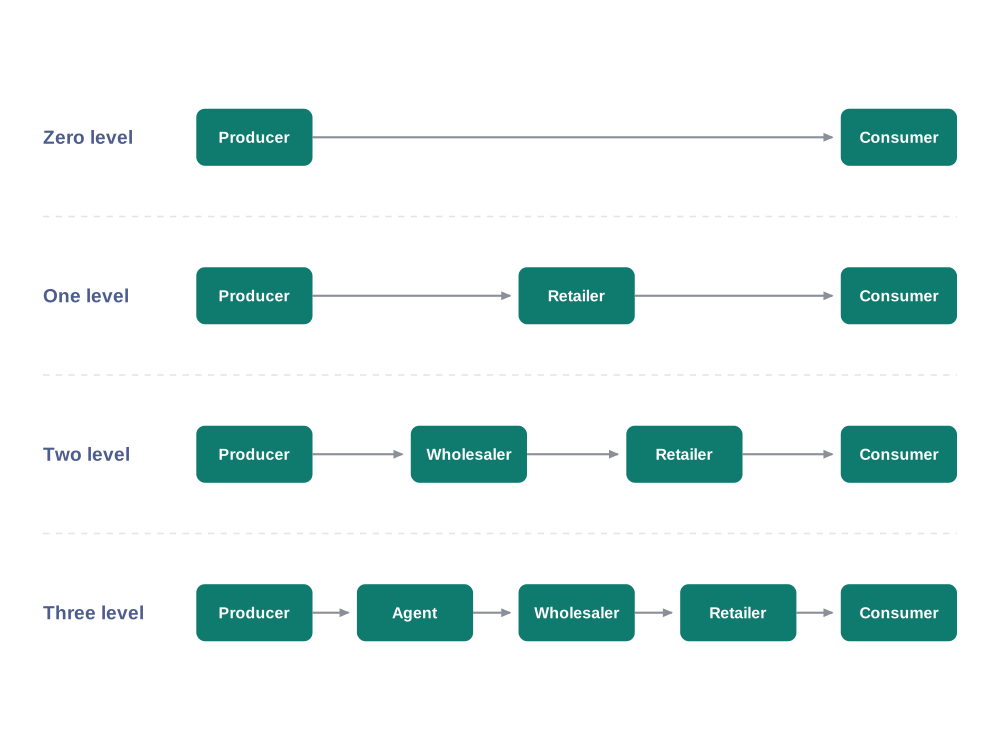
Fig. 10.12 – Channels of distribution.
Zero level channel — the manufacturer sells the goods directly to consumers, without using any middleman, as in the case of sale through the firm’s own retail outlets, door-to-door selling or online selling by the producer.
One level channel — one middleman, usually a retailer, is used between the producer and the consumer. This channel is common for consumer durables and for products sold through large retail chains.
Two level channel — the producer sells to wholesalers, who in turn sell to retailers, who finally sell to consumers. This is the most common channel for consumer non-durable products such as soap, tea and biscuits, which are needed in small quantities by a very large number of scattered buyers.
Three level channel — an agent is used in addition to the wholesaler and the retailer. Manufacturers who wish to cover a very wide market appoint agents who deal with a number of wholesalers on their behalf.
Role Of Intermediaries
Intermediaries are used because they reduce the number of transactions required to reach a large number of buyers. A manufacturer of a non-durable product cannot deal with lakhs of scattered households directly.
They also perform functions the producer would otherwise have to perform — holding stock near the market, breaking bulk into small saleable lots, extending credit to retailers, displaying the goods, and passing back information about buyer response.
10.11.3 Factors Determining the Choice of Channel
The choice of a channel is a long-term decision and is influenced by four sets of factors.
Product related factors — non-durable, low-priced products of daily use are distributed through long channels, while durable, technical and expensive products such as industrial machinery are distributed through short channels. Perishable products also need short channels so that they reach the buyer quickly.
Market related factors — a large number of scattered buyers purchasing in small quantities calls for a long channel, while a small number of buyers purchasing in large quantities, as in industrial markets, permits a direct channel. The size of the order and the buying habits of customers matter for the same reason.
Company related factors — a firm with sufficient finance and the ability to manage its own distribution may prefer direct channels, since these give it greater control over the way the product is sold. A firm lacking such resources depends on middlemen.
Competitive and environmental factors — the channel used by competitors, the economic conditions in the market, and legal restrictions on distribution also influence the choice.
10.12 Promotion
A company may produce a good quality product, price it appropriately, and make it available at selling points which are convenient to customers. In spite of all this, the product may still not sell well in the market.
The reason is that the first three elements of the marketing mix cannot speak for themselves. There is a need for developing proper communication with the market. In the absence of communication, customers would not know about the product and how it can satisfy their needs and wants, or may not be convinced about its utility and benefits.
Promotion is thus an important element of the marketing mix, by which marketers make use of various tools of communication to encourage the exchange of goods and services in the market.
The two objectives are related but distinct. Informing comes first, since a buyer cannot consider a product she has never heard of. Persuading follows, because knowing that a product exists does not by itself create a preference for it over competing products.
10.13 Promotion Mix
Various tools of communication are used by marketers to inform and persuade customers about their firm’s products. These tools are also called the elements of the promotion mix, and they are shown in Fig. 10.13.
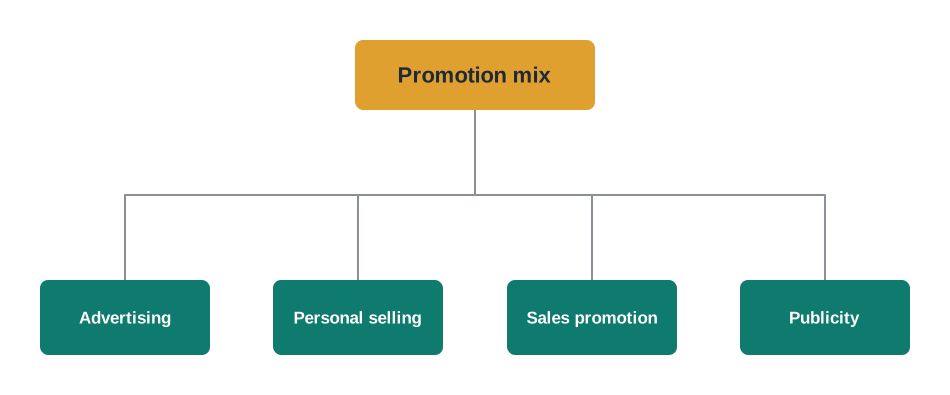
Fig. 10.13 – Elements of the promotion mix.
These tools can be used in different combinations to achieve the goals of promotion. Consumer goods firms, for example, may use more of advertising through mass media, while industrial goods firms may use more of personal selling, since their buyers are few in number and need technical explanation.
What combination of these elements is used by a firm will depend upon various factors such as the nature of the market, the nature of the product, the promotion budget available, and the objectives of promotion.
The four elements are not substitutes for one another. Each does a different part of the communication task — one reaches large numbers at low cost per head, another closes the sale, a third pushes an immediate purchase, and the fourth builds credibility. Each of them is examined in detail in the sections that follow.
10.14 Advertising
We generally come across hundreds of advertising messages every day, which tell us about various products such as toilet soaps, detergent powder and soft drinks, and services such as hotels and insurance policies.
Advertising is perhaps the most commonly used tool of promotion.
The most common modes of advertising are newspapers, magazines, television and radio.
10.14.1 Features of Advertising
The important distinguishing features of advertising are as follows.
Paid form — advertising is a paid form of communication. The sponsor has to bear the cost of communicating with the prospects.
Impersonality — there is no direct face-to-face contact between the prospect and the advertiser. It is therefore referred to as an impersonal method of promotion. Advertising creates a monologue and not a dialogue.
Identified sponsor — advertising is undertaken by some identified individual or company, who makes the advertising effort and also bears the cost of it.
10.14.2 Merits of Advertising
Advertising, as a medium of communication, has the following merits.
Mass reach — advertising is a medium through which a large number of people can be reached over a vast geographical area. An advertisement message placed in a national daily reaches lakhs of its subscribers.
Enhancing customer satisfaction and confidence — advertising creates confidence amongst prospective buyers, as they feel more comfortable and assured about the product quality and hence feel more satisfied.
Expressiveness — with the developments in art, computer designs and graphics, advertising has developed into one of the most forceful mediums of communication. With the special effects that can be created, even simple products and messages can be made to look very attractive.
Economy — advertising is a very economical mode of communication if a large number of people are to be reached. Because of its wide reach, the overall cost of advertising gets spread over numerous communication links established, and as a result the per unit cost of reach comes low.
10.14.3 Limitations of Advertising
Advertising also suffers from certain limitations as a medium of communication.
Less forceful — advertising cannot compel a prospect to attend to the message, since the buyer is free to turn the page or change the channel.
Lack of feedback — as it is a one-way communication, the advertiser does not come to know how the message has been received, and has to conduct separate market research to judge the response.
Inflexibility — the same standardised message goes to all prospects, and it cannot be adjusted to the background and needs of an individual buyer.
Low effectiveness — because of the large number of messages competing for attention, an individual advertisement may make little impression on the prospect.
10.14.4 Objections to Advertising
Though advertising is one of the most frequently used mediums of promotion of goods and services, it attracts a lot of criticism.
The opponents of advertising say that expenditure on advertising is a social waste, as it adds to cost, multiplies the needs of people and undermines social values. The proponents, however, argue that advertising is very useful, as it increases reach, brings the per unit cost of production down and adds to the growth of the economy. It is therefore important to examine the major criticisms against advertising and see the extent to which these are true.
Adds To Cost
The opponents of advertising argue that advertising unnecessarily adds to the cost of a product, which is ultimately passed on to buyers in the form of high prices. An advertisement on television for a few seconds costs the marketer several lakhs of rupees, and an advertisement in a newspaper or a magazine also costs a large amount of money. The money spent adds to cost, which is an important factor in the fixation of the price of a product.
It is true that advertisement of a product costs a lot of money, but it also helps to increase the demand for the product, as a large number of potential buyers come to know about the availability of the product and its features and are persuaded to buy it. The increased demand leads to higher production, which brings with it the economies of scale. As a result, the per unit cost of production comes down, as the total cost is divided by a larger number of units. Thus the expenditure on advertisement adds to the total cost, but the per unit cost comes down, which in fact lessens the burden on consumers rather than adding to it.
Confuses The Buyers
Another criticism against advertisement is that so many products are advertised making similar claims that the buyer gets confused as to which one is true and which one should be relied upon. We may note similar claims of whiteness or stain removing ability in competing brands of detergent powder, or claims of whiteness of teeth or a feeling of freshness in competing brands of toothpaste, so that it is sometimes confusing to decide which one to buy.
The supporters of advertisement, however, argue that we are all rational human beings who make our decisions for the purchase of products on factors such as price, style and size. Buyers can therefore clear their confusion by analysing the information provided in the advertisements and from other sources before taking a decision to purchase. However, this criticism cannot be completely overruled.
Encourages Sale Of Inferior Products
Advertising does not distinguish between superior and inferior products, and persuades people to purchase even the inferior products.
In fact, superiority and inferiority depend on quality, which is a relative concept. The desired level of quality will depend on the economic status and preferences of the target customers. Advertisements sell products of a given quality, and buyers will buy them if they suit their requirements. No advertisement should, however, make a false claim about the quality of a product, and if a firm makes a false claim it can be prosecuted for the same.
Most of the criticisms against advertising are therefore not fully true, and advertising is considered an essential function of marketing.
10.15 Personal Selling
Personal selling is a personal form of communication. Companies appoint salespersons to contact prospective buyers, create awareness about the product and develop product preferences, with the aim of making a sale.
10.15.1 Features of Personal Selling
Personal form — in personal selling a direct face-to-face dialogue takes place, that involves an interactive relationship between the seller and the buyer.
Development of relationship — personal selling allows a salesperson to develop personal relationships with prospective customers, which may become important in making a sale.
10.15.2 Merits of Personal Selling
Flexibility — there is a lot of flexibility in personal selling. The sales presentation can be adjusted to fit the specific needs of individual customers.
Direct feedback — as there is direct face-to-face communication in personal selling, it is possible to take direct feedback from the customer and to adapt the presentation according to the needs of the prospects.
Minimum wastage — the wastage of efforts in personal selling can be minimised, as the company can decide the target customers before making any contact with them.
10.15.3 Role of Personal Selling
Personal selling plays a very important role in the marketing of goods and services. Its importance to businessmen, to customers and to society is described below.
Importance To Businessmen
Personal selling is a powerful tool for creating demand for a firm’s products and increasing their sale. Its importance to a business organisation may be described as follows.
Effective promotional tool — personal selling is a very effective promotional tool, which helps in influencing the prospects about the merits of a product and thereby increasing its sale.
Flexible tool — personal selling is more flexible than other tools of promotion such as advertising and sales promotion. It helps business persons in adapting their offer to varying purchase situations.
Minimises wastage of efforts — compared with other tools of promotion, the possibility of wastage of efforts in personal selling is minimum. This helps business persons in bringing economy in their efforts.
Consumer attention — there is an opportunity to detect the loss of consumer attention and interest in a personal selling situation. This helps a business person in successfully completing the sale.
Lasting relationship — personal selling helps to develop a lasting relationship between the salespersons and the customers, which is very important for achieving the objectives of business.
Personal rapport — development of personal rapport with customers increases the competitive strength of a business organisation.
Role in introduction stage — personal selling plays a very important role in the introduction stage of a new product, as it helps in persuading customers about the merits of the product.
Link with customers — salespeople play three different roles, namely a persuasive role, a service role and an informative role, and thereby link a business firm to its customers.
Importance To Customers
This role of personal selling becomes more important for illiterate and rural customers, who do not have many other means of getting product information. Customers are benefited by personal selling in the following ways.
Help in identifying needs — personal selling helps customers in identifying their needs and wants, and in knowing how these can best be satisfied.
Latest market information — customers get the latest market information regarding price changes, product availability and shortages, and new product introduction, which helps them in taking purchase decisions in a better way.
Expert advice — customers get expert advice and guidance in purchasing various goods and services, which helps them in making better purchases.
Induces customers — personal selling induces customers to purchase new products that satisfy their needs in a better way, and thereby helps in improving their standards of living.
Importance To Society
Personal selling plays a very productive role in the economic progress of a society. The more specific benefits of personal selling to society are as follows.
Converts latent demand — personal selling converts latent demand into effective demand. It is through this cycle that economic activity in society is fostered, leading to more jobs, more incomes and more products and services. That is how economic growth is influenced by personal selling.
Employment opportunities — personal selling offers greater income and employment opportunities to unemployed youth.
Career opportunities — personal selling provides an attractive career with greater opportunities for advancement and job satisfaction, as well as security, respect, variety, interest and independence, to young men and women.
Mobility of sales people — there is a greater degree of mobility in sales people, which promotes travel and tourism in the country.
Product standardisation — personal selling increases product standardisation and uniformity in consumption pattern in a diverse society.
10.15.4 Advertising and Personal Selling
Advertising and personal selling are both tools of promotion, but they differ in nature, reach, cost and effect. The major differences are given in Table 10.7.
10.16 Sales Promotion
Sales promotion includes all promotional efforts other than advertising, personal selling and publicity, used by a company to boost its sales. Sales promotion activities include offering cash discounts, sales contests, free gift offers and free sample distribution.
Sales promotion is usually undertaken to supplement other promotional efforts such as advertising and personal selling. It is a support tool, not a substitute for them.
Companies use sales promotion tools specifically designed to promote to three different groups.
To customers — for example, free samples, discounts and contests.
To tradesmen or middlemen — for example, cooperative advertising, dealer discounts, and dealer incentives and contests.
To salespersons — for example, bonus, salesmen contests and special offers.
Sales promotion includes only those activities that are used to provide short-term incentives to boost the sales of a firm. An incentive that continues indefinitely becomes part of the regular price of the product and loses its power to prompt immediate action.
10.16.1 Merits of Sales Promotion
Attention value — sales promotion activities attract the attention of people because of the use of incentives.
Useful in new product launch — sales promotion tools can be very effective at the time of introduction of a new product in the market. They induce people to break away from their regular buying behaviour and try the new product.
Synergy in total promotional efforts — sales promotion activities are designed to supplement the personal selling and advertising efforts used by a firm, and add to the overall effectiveness of its promotional efforts.
10.16.2 Limitations of Sales Promotion
Reflects crisis — if a firm frequently relies on sales promotion, it may give the impression that it is unable to manage its sales, or that there are no takers for its product.
Spoils product image — use of sales promotion tools may affect the image of a product. Buyers may start feeling that the product is not of good quality, or that it is not appropriately priced.
10.16.3 Commonly Used Sales Promotion Activities
Rebate — offering products at special prices to clear off excess inventory. An example is a car manufacturer’s offer to sell a particular brand of car at a discount of ₹10,000 for a limited period.
Discount — offering products at less than list price. Examples are a shoe company’s offer of ‘Discount Up to 50%’ or a shirt marketer’s offer of ‘50+40% Discount’.
Refunds — refunding a part of the price paid by the customer on some proof of purchase, say on return of empty foils or a wrapper. This is commonly used by food product companies to boost their sales.
Product combinations — offering another product as a gift along with the purchase of a product, say the offer of a pack of half a kilogram of rice with the purchase of a bag of aatta, or an offer of a memory card free with a digital camera, or a bottle of sauce free with a pack of detergent.
Quantity gift — offering extra quantity of the product, commonly used by marketers of toiletry products. Examples are a shaving cream’s offer of ‘40% extra’, a hotel’s offer of an extra night’s stay at a nominal amount along with a package, or a shirt marketer’s offer of ‘Buy 2 Get 1 Free’.
Instant draws and assigned gift — for example, ‘Scratch a Card’ or ‘Burst a Cracker’ and instantly win a refrigerator, car, T-shirt or computer with the purchase of a television.
Lucky draw — for example, the offer of a bathing soap to win a gold coin on a lucky draw, or a coupon for free petrol on the purchase of a certain quantity of petrol from a given petrol pump.
Usable benefit — for example, ‘Purchase goods worth ₹3000 and get a holiday package worth ₹3000 free’, or ‘Get a discount voucher for accessories on apparel purchase of ₹1000 and above’.
Full finance at zero per cent — many marketers of consumer durables such as electronic goods and automobiles offer easy financing schemes, such as twenty-four easy instalments with eight paid up front and sixteen to be paid as post-dated cheques. However, one should be careful about the file charges, which sometimes are nothing but interest recovered in advance.
Sampling — offer of a free sample of a product, say a detergent powder or toothpaste, to potential customers at the time of launch of a new brand.
Contests — competitive events involving the application of skill or luck, say solving a quiz or answering some questions.
10.17 Public Relations
Managing public opinion of an organisation is an important task, which can be performed by the marketing department. The business needs to communicate effectively with customers, suppliers and dealers, since they are instrumental in increasing sales and profit.
Besides those who come into direct contact with the organisation or its products, there are other members of the general public whose voice or opinion is equally important. This public may be interested in the company and its product, and may have an impact on the business ability to achieve its objectives. It therefore becomes imperative to manage public opinion and the company’s relation with the public on a regular basis.
A business relates with a number of groups, including suppliers, shareholders, intermediaries, activist groups and the government. The active support of middlemen, for example, is needed if the firm wants to survive in a competitive selling environment. Similarly, consumer activist groups need to be satisfied, because they can impose restrictions on the sales of the firm’s products directly by urging customers to refrain from buying them, or through the imposition of laws.
Most organisations, business or otherwise, nowadays have a separate department to manage public relations. They may also utilise the services of an outside public relations agency.
The main task of the department is to disseminate information and build goodwill about the business. Concrete steps have to be taken to monitor the attitude of the general public and to generate positive publicity. The department is especially useful when there is negative publicity about the company or its products. At that time the situation has to be tackled like an emergency to improve the public image, and the department has to act quickly so that damage to the company’s image is controlled and minimised. It also advises top management to adopt certain programmes which will add to the public image, and to ensure that negative publicity does not take place at all.
10.17.1 Functions of the Public Relations Department
The role of public relations can be discussed with respect to the functions which the department performs. Public relations is itself an important tool in the hands of the marketing department, which can be used to the advantage of the business. The public relations department performs five functions.
Publicity — publicity is similar to advertising in the sense that it is a non-personal form of communication. However, as against advertising, it is a non-paid form of communication. Publicity generally takes place when favourable news is presented in the mass media about a product or service. If a manufacturer achieves a breakthrough by developing a car engine which runs on water instead of petrol, and this news is covered by television, radio or newspapers in the form of a news item, it would be termed publicity, because the engine manufacturer would benefit from such dissemination of information about its achievement by the media, but would not bear any cost for the same.
Press release — information about the organisation needs to be presented in a positive manner in the press. Generating news requires skill in developing and researching a story, and getting the media to accept press releases is a difficult task. The public relations department is in contact with the media to present true facts and a correct picture about the company; otherwise news can get distorted if taken from other sources.
Corporate communication — the image of the organisation needs to be promoted through communicating with the public and with the employees within the organisation. This is usually done with the help of newsletters, annual reports, brochures, articles and audio-visual materials. Companies rely on these materials to reach and influence their target markets. Speeches by the company’s executives at a meeting of trade associations or at trade fairs can really boost the company’s image, and even interviews with television channels and responding to queries from the media go a long way in promoting public relations.
Lobbying — the organisation has to deal with government officials and different ministers in charge of corporate affairs, industry and finance, with respect to policies relating to business and the economy. The government also seeks to maintain a healthy relationship with associations of commerce and industry, and solicits the opinion of major stakeholders while formulating industrial, telecom and taxation policies. The public relations department then has to be proactive in promoting or decoding regulations that affect the organisation.
Counselling — the public relations department advises the management on general issues which affect the public, and on the position the company would like to take on a particular issue. The company can build goodwill by contributing money and time to certain causes like the environment, wildlife, children’s rights and education. Such cause-related activities help in promoting public relations and building goodwill.
Features Of Publicity
The two important features of publicity are the following.
Publicity is an unpaid form of communication. It does not involve any direct expenditure by the marketing firm.
There is no identified sponsor for the communication, as the message goes as a news item.
In publicity, since the information is disseminated by an independent source such as the press in the form of news stories and features, the message has more credibility than if it comes as a sponsored message in advertising. An important limitation of publicity, however, is that as a medium of promotion it is not within the control of the marketing firm, which can neither decide the content of the message nor the time at which it appears.
10.17.2 Marketing Objectives Served by Public Relations
In addition to the above functions, maintaining good public relations also helps in achieving the following marketing objectives.
Building awareness — the public relations department can place stories and dramatise the product in the media. This builds marketplace excitement before the product reaches the market or media advertising takes place, and usually creates a favourable impression on the target customer.
Building credibility — if news about a product comes in the media, whether print or electronic, it always lends credibility, and people believe in the product since it is in the news.
Stimulates sales force — it becomes easier for the sales force to deal with retailers and convince dealers if they have already heard about the product in the news before it is launched. Retailers and dealers also feel that it is easier to sell the product to the ultimate consumer.
Lowers promotion costs — maintaining good public relations costs much less than advertising and direct mail. However, it requires a lot of communication and interpersonal skills to convince the media to give space or time for the organisation and its product.
10.18 Summary
In the traditional sense, the term ‘market’ refers to the place where buyers and sellers gather to enter into transactions involving the exchange of goods and services. In the modern marketing sense, it refers to the set of actual and potential buyers of a product or service.
Marketing has been described as the performance of business activities that direct the flow of goods and services from producers to consumers. It is not merely a post-production activity, since it includes many activities performed even before goods are produced and continues even after the goods have been sold.
The important functions of marketing include gathering and analysing market information, marketing planning, product designing and development, standardisation and grading, packaging and labelling, branding, customer support services, pricing of products, promotion, physical distribution, transportation, and storage or warehousing.
By adopting marketing orientation, an organisation, whether profit making or non-profit making, can achieve its goals in the most effective manner. Marketing also acts as a catalyst in the economic development of a country and helps in raising the standard of living of people.
The marketing mix is the set of marketing tools that a firm uses to pursue its marketing objectives in a target market. Its elements have been classified into four categories, popularly known as the four Ps of marketing — product, price, place and promotion. These elements are combined to create an offer.
In common parlance, the word ‘product’ is used to refer only to the physical or tangible attributes of a product. In marketing, a product is a mixture of tangible and intangible attributes, capable of being exchanged for a value, with the ability to satisfy customer needs. It is anything that can be offered to a market to satisfy a want or need.
Products may broadly be classified into consumer products and industrial products. Products purchased by ultimate consumers or users for satisfying their personal needs and desires are referred to as consumer products. On the basis of shopping efforts involved, they are classified as convenience products, shopping products and speciality products. On the basis of durability, they are classified as durable products, non-durable products and services.
Services are those activities, benefits or satisfactions which are offered for sale, such as dry cleaning, watch repairs and hair cutting.
Industrial products are those products which are used as inputs in producing other products. These are broadly classified into materials and parts, capital items, and supplies and business services.
Branding is the process of giving a name, sign or symbol to a product. A brand has two components — brand name, which can be spoken, and brand mark, which can be recognised but not uttered. A brand or part of a brand given legal protection is called a trade mark.
Packaging is the act of designing and producing the container or wrapper of a product. There can be three different levels of packaging — primary package, secondary package and transportation package. Packaging performs functions such as product identification, product protection, facilitating the use of the product, and promotion of goods and services.
Labelling relates to designing the label to be put on the package. The label may vary from a simple tag attached to the product to complex graphics that are part of the package. The most important functions of labels are describing the product and its contents, helping in identifying the product or brand, helping in grading products into different categories, aiding in promotion, and providing information required by law.
Price may be defined as the amount of money paid by a buyer, or received by a seller, in consideration of the purchase of a product or service. Generally, if the price of a product is increased, its demand comes down, and vice versa. Pricing is an effective competitive weapon and is the single most important factor affecting the revenue and profits of a firm.
The factors affecting price determination are product cost, the utility and demand, the extent of competition in the market, government and legal regulations, pricing objectives, and the marketing methods used.
There are two important decisions relating to physical distribution — one regarding the physical movement of goods, and the other regarding the channels used. Physical distribution covers all the activities required to physically move goods from manufacturers to customers. Its main components are order processing, transportation, warehousing and inventory control.
Promotion refers to the use of communication with the twin objective of informing potential customers about a product and persuading them to buy it. There are four major tools or elements of the promotion mix — advertising, personal selling, sales promotion and publicity. These are used in different combinations to achieve the goals of promotion.
Advertising is the most commonly used tool of promotion. It is an impersonal, paid form of communication undertaken by an identified sponsor. Its merits include mass reach, enhancing customer satisfaction and confidence, expressiveness, and economy. Its limitations are that it is less forceful, lacks feedback, is inflexible, and may have low effectiveness.
The most common objections to advertising are that it adds to cost, undermines social values, confuses buyers, and encourages the sale of inferior products. Most of these criticisms are not fully true, and advertising is therefore considered an essential function of marketing.
Personal selling involves oral presentation of a message in the form of conversation with one or more prospective customers, for the purpose of making sales. It plays an important role for business persons, for customers and for society.
Sales promotion refers to short-term incentives designed to encourage buyers to make an immediate purchase of a product or service. Commonly used sales promotion activities include rebate, discount, refunds, product combinations, quantity gift, instant draws and assigned gift, lucky draw, usable benefit, full finance at zero per cent, sampling and contests.
Publicity is similar to advertising in being a non-personal form of communication, but it is a non-paid form, in which the information is disseminated by an independent source. Its important limitation is that, as a medium of promotion, it is not within the control of the marketing firm.
Public relations is about managing an organisation’s image in the eyes of all its stakeholders. It has five components — publicity, press release, corporate communication, lobbying and counselling.
The overall structure of the chapter is summarised in Fig. 10.14.
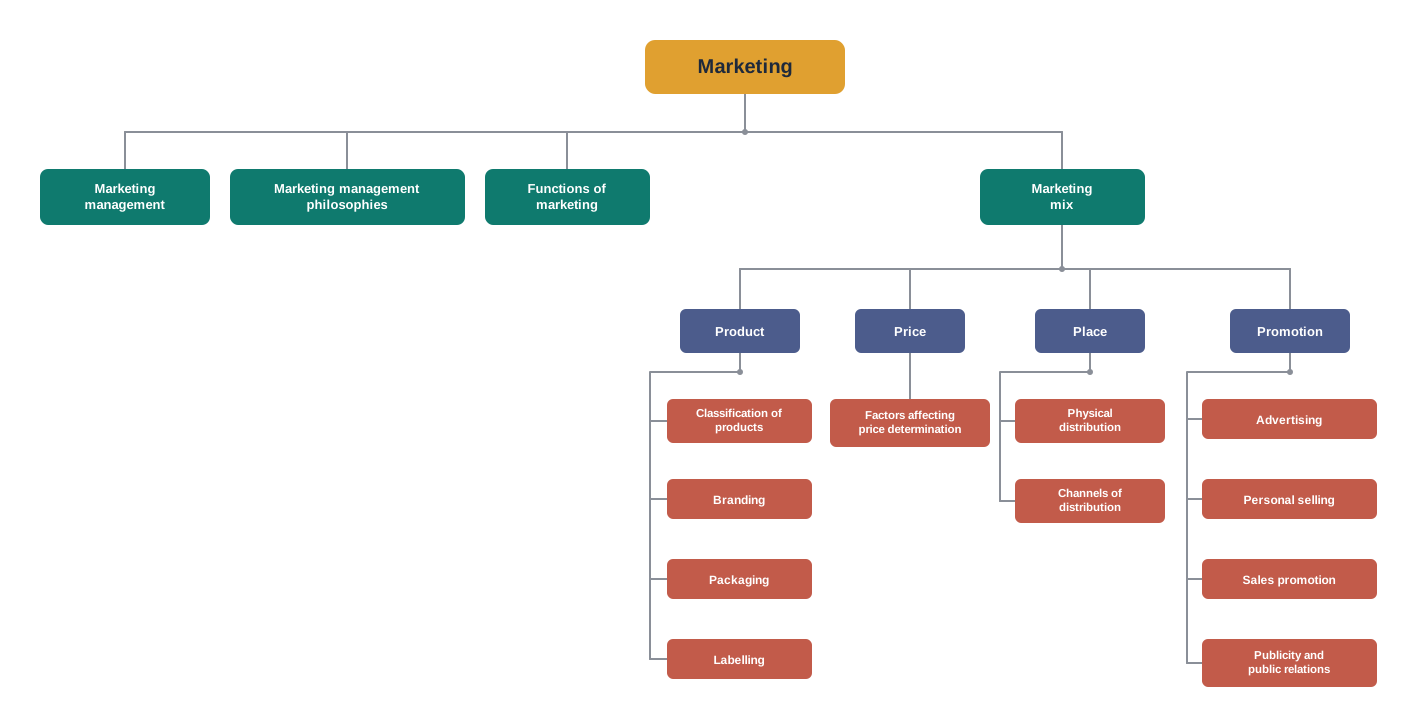
Fig. 10.14 – Structure of the chapter.
10.19 Key Terms
Marketing A social process by which individuals and groups obtain what they need and want through creating offerings and freely exchanging products and services of value with others.
Market The set of all actual and potential buyers of a product or service.
Need A state of felt deprivation, which is basic to human beings and not related to any particular product.
Want A culturally defined object that is a potential satisfier of a need, shaped by factors such as culture, personality and religion.
Market offering A complete offer of a product or service with given features, at a certain price, available at a given outlet or location.
Customer value The buyer’s perception of the benefit obtained from a product in satisfying a need, in relation to its cost.
Exchange The process through which two or more parties come together to obtain a desired product or service, offering something of value in return.
Marketing management The art and science of choosing target markets and getting, keeping and growing customers through creating, delivering and communicating superior customer value.
Production concept The philosophy that availability and affordability of the product are the key to a firm’s success.
Product concept The philosophy that continuous improvement in the quality, performance and features of the product is the key to a firm’s success.
Selling concept The philosophy that customers will not buy enough unless persuaded through aggressive selling and promotional effort.
Marketing concept The philosophy that satisfaction of customer needs is the key to a firm’s success, and that profit is earned through customer satisfaction.
Societal marketing concept The philosophy that an organisation must satisfy the needs of the target market in a manner that also protects the long-term well-being of consumers and of society.
Standardisation Producing goods of predetermined specifications, so as to achieve uniformity and consistency in output.
Grading Classification of products into different groups on the basis of characteristics such as quality and size.
Packaging The act of designing and producing the container or wrapper of a product.
Labelling The act of designing and developing the label to be put on the package of a product.
Brand name That part of a brand which can be spoken, that is, the verbal component of a brand.
Promotion The use of communication with the twin objective of informing potential customers about a product and persuading them to buy it.
Marketing mix The set of marketing tools that a firm uses to pursue its marketing objectives in a target market.
Product Goods, services or anything of value offered to the market for sale, viewed by the buyer as a bundle of utilities.
Price The amount of money paid by a buyer, or received by a seller, in consideration of the purchase of a product or service.
Place The element of the marketing mix covering the activities that make the firm’s products available to target customers.
Consumer products Products purchased by ultimate consumers or users for satisfying their personal needs and desires.
Industrial products Products used as inputs in producing other products, meant for non-personal and business use.
Branding The process of giving a name, a sign or a symbol to a product, so that it can be distinguished from competing products.
Brand A name, term, sign, symbol, design or a combination of them, used to identify the products of one seller and differentiate them from those of competitors.
Brand mark That part of a brand which can be recognised but not uttered, such as a symbol, design, distinct colour scheme or lettering.
Trade mark A brand or part of a brand that is given legal protection against its use by other firms.
Label The printed information appearing on or attached to a product or its package, describing the product, its contents and its use.
Fixed costs Costs which do not vary with the level of activity of a firm.
Variable costs Costs which vary in direct proportion with the level of activity of a firm.
Semi variable costs Costs which vary with the level of activity but not in direct proportion with it.
Physical distribution The physical handling and movement of goods from the place of production to the place of distribution.
Warehousing The act of storing and assorting products in order to create time utility in them.
Channels of distribution The set of firms and individuals that take title to, or assist in transferring title to, goods as they move from the producer to the consumer.
Middlemen Firms or individuals placed between the producer and the consumer, who assist in the distribution of goods.
Promotion mix The combination of promotional tools used by an organisation to achieve its communication objectives.
Advertising An impersonal, paid form of communication undertaken by an identified sponsor to promote goods or services.
Personal selling Oral presentation of a message in the form of conversation with one or more prospective customers, for the purpose of making sales.
Sales promotion Short-term incentives designed to encourage buyers to make an immediate purchase of a product or service.
Public relations Programmes designed to promote or protect a company’s image and its individual products in the eyes of the public.
Publicity A non-personal and non-paid form of communication, in which favourable news about a product or firm is carried by an independent source.
10.20 NCERT Questions
Very Short Answer Questions
- State any two advantages of branding to marketers of goods and services.
- How does branding help in differential pricing?
- What is the societal concept of marketing?
- Enlist the advantages of packaging of consumer products.
- List five shopping products purchased by you or your family during the last few months.
- A marketer of colour TV having 20% of the current market share of the country aims at enhancing the market share to 50 per cent in the next three years. For achieving this objective he specified an action programme. Name the function of marketing being discussed above.
Short Answer Questions
- What is marketing? What functions does it perform in the process of exchange of goods and services? Explain.
- Distinguish between the product concept and the production concept of marketing.
- Product is a bundle of utilities. Explain.
- What are industrial products? How are they different from consumer products? Explain.
- Distinguish between convenience product and shopping product.
- Describe the functions of labelling in the marketing of products.
- Discuss the role of intermediaries in the distribution of consumer non-durable products.
- Define advertising. What are its main features? Explain.
- Discuss the role of ‘sales promotion’ as an element of promotion mix.
- As the marketing manager of a big hotel located at an important tourist destination, what societal concerns would be faced by you, and what steps would you plan to take care of these concerns? Discuss.
- What information is generally placed on the package of a food product? Design a label for one of the food products of your choice.
- For buyers of consumer durable products, what ‘customer care services’ would you plan as a manager of a firm marketing a new brand of motorcycle? Discuss.
Long Answer Questions
- What is marketing concept? How does it help in the effective marketing of goods and services?
- What is marketing mix? What are its main elements? Explain.
- How does branding help in creating product differentiation? Does it help in marketing of goods and services? Explain.
- What are the factors affecting determination of the price of a product or service? Explain.
- Explain the major activities involved in the physical distribution of products.
- ‘Expenditure on advertising is a social waste.’ Do you agree? Discuss.
- Distinguish between advertising and personal selling.
- Explain the factors determining the choice of channel of distribution.
10.21 Check Your Concepts
- Why is marketing described as a social process rather than a set of activities performed only after production?
- What happens to a firm’s market offering if the needs and preferences of potential buyers are not analysed before the offer is designed?
- Distinguish between a need and a want, giving one example of each from your own daily life.
- Why does the marketing concept treat customer satisfaction as a means and not as the final objective of a business firm?
- Arrange the following marketing philosophies in the order in which they evolved: selling concept, production concept, societal marketing concept, marketing concept, product concept.
- Assertion: A firm following the societal marketing concept may refuse to sell a product that buyers are willing to purchase. Reason: The societal marketing concept requires the firm to consider the long-term welfare of society along with customer satisfaction. Choose the correct option.
- Both assertion and reason are true, and the reason is the correct explanation of the assertion.
- Both assertion and reason are true, but the reason is not the correct explanation of the assertion.
- The assertion is true but the reason is false.
- The assertion is false but the reason is true.
- Why is grading necessary for agricultural products but not for most manufactured products?
- Identify the term: that part of a brand which can be recognised but which cannot be spoken.
- Why is the demand for speciality products described as relatively inelastic?
- Match the following levels of packaging with the examples given:
| Column A | Column B |
|---|---|
| a. primary package | i. a corrugated box holding fifty cartons |
| b. secondary packaging | ii. a toothpaste tube |
| c. transportation packaging | iii. the cardboard box containing a tube of shaving cream |
- State the two limits within which the price of a product settles, and name the factor that sets each limit.
- What happens if a firm decides to maintain a very high level of inventory in order to serve customers immediately?
- Why do firms selling industrial goods rely more on personal selling than on advertising?
- Why does publicity carry greater credibility with the public than advertising, and what is the price a firm pays for this credibility?
- Assertion: Frequent use of sales promotion tools may harm the image of a product. Reason: Buyers may conclude that the product is not of good quality or is not appropriately priced. Choose the correct option.
- Both assertion and reason are true, and the reason is the correct explanation of the assertion.
- Both assertion and reason are true, but the reason is not the correct explanation of the assertion.
- The assertion is true but the reason is false.
- The assertion is false but the reason is true.
- Arrange the following in the correct sequence of a two level channel of distribution: retailer, consumer, producer, wholesaler.
- Why is a warehouse for agricultural produce usually located near the place of production, while a warehouse for bakery products is located near the market?
10.22 Case-Based Questions
- Harshit Ltd. manufactures ready-to-cook pulses. Before beginning production, its team studies the cooking habits of working households, decides the pack size, fixes a price that such households consider reasonable, and selects grocery chains near residential colonies for distribution. It then runs advertisements in local newspapers describing the cooking time saved.
- Identify the philosophy of marketing management being followed by the firm.
- Name the four elements of the marketing mix that appear in the above case.
- State why the study of household habits was undertaken before production and not after it.
- Rehmat Industries sells a floor cleaner in a sealed bottle carrying its name and a distinctive green leaf symbol. The bottle states the contents, the net quantity, the manufacturing date, the maximum retail price and a caution against contact with the eyes. The pack also carries the line ‘Save ₹20 on your next purchase’. The firm has obtained legal protection for the name and the symbol.
- Name the verbal and the non-verbal components of the brand.
- State the status the brand acquires after obtaining legal protection.
- Identify any three functions of labelling being performed by the pack.
- Manthan Ltd. has developed an electric kettle. Its cost of production is ₹700 per unit. Competing brands sell at about ₹1,100. The firm decides to sell at ₹950 in the first year so that it can capture a larger share of the market, and offers dealers a special margin during the launch period. It also learns that the government has recently placed a ceiling on the price of a component used in the kettle.
- Identify the pricing objective adopted by the firm.
- Name any three factors affecting price determination that are visible in the above case.
- State the type of cost that would remain unchanged if the firm produced no kettles at all in a month.
- Aparna Ltd. sells packaged spices to households all over the country and also supplies bulk spice mixes to a small number of large food processing units. For the household product it uses stockists, wholesalers and retailers, and advertises on television. For the bulk product it sends its own representatives to meet the purchase managers of the processing units.
- Name the level of channel used for the household product and state one reason for using it.
- Identify the promotion tool used for the bulk product.
- State any two product related factors that influence the choice of a channel of distribution.
- A newspaper carries a news item praising the fuel efficiency of a scooter launched by Sarthak Motors, for which the company pays nothing. In the same month the company distributes free service coupons with every purchase, sponsors a road safety campaign for school children, and appoints a team to brief officials about a proposed transport policy.
- Identify the promotion tool represented by the news item.
- Name the function of the public relations department represented by briefing government officials.
- State the element of the promotion mix to which the free service coupons belong, and give one merit of that element.