Chapter 4: Planning
Indian Oil Corporation Limited, a Maharatna public sector enterprise, is one of India’s largest energy companies. It has set itself the goal of achieving net zero operational emissions by the year 2046, and has stated that it will invest around two lakh crore rupees to move towards this target. Such a goal cannot be reached by working from day to day. It has to be broken into smaller objectives, spread across years, departments and units, with the resources for each step decided in advance.
This is what planning means in management. Every organisation, whether government-owned or privately owned, large or small, must decide in advance what it wants to achieve and how it will achieve it. A firm that does not plan reacts to events; a firm that plans directs them.
This chapter explains the meaning and concept of planning, its importance to a business, the features that describe its nature, its limitations, the steps of the planning process, and the different types of plans an organisation prepares.

Fig. 4.0 – Managers preparing a business plan.
4.1 Introduction
The energy company described at the start of this chapter has announced what it wants to achieve and by when. Such announcements are broad statements of intent. Before they can produce results, they have to be broken down into smaller targets, assigned to departments, and converted into steps that can actually be carried out.
This is true of every organisation, not only of large companies. A government-owned enterprise, a privately owned business and a company in the private sector all need to decide their course of action in advance. At the national level, the Government of India prepared Five Year Plans to guide the country’s development. A small shopkeeper works out how much stock to buy for the coming festival season. Large companies prepare sales plans, production plans and expansion plans. In every case, someone is deciding today what will be done tomorrow.
Why Firms Must Think Ahead
Every business firm wants to grow, increase its sales and earn profits. Managers hold such goals for their organisations and work towards them. But a goal by itself achieves nothing. It becomes real only when managers think in advance about the future, make predictions about business conditions, and fix targets that can be worked towards.
That act of thinking in advance about what is to be done and how it is to be done is the essence of planning. Without it, an organisation simply responds to whatever happens to it. With it, the organisation decides its own direction and prepares for what lies ahead.
Planning is therefore treated as the first function of management. The remaining functions — organising, staffing, directing and controlling — all work within the framework that planning creates.
4.2 Concept of Planning
Planning is deciding in advance what to do and how to do it. It is one of the basic managerial functions, and it is performed before any other function is taken up.
Before starting any task, a manager has to form an idea of how the work will be carried out. This makes planning closely connected with creativity and innovation, because forming that idea often means thinking of a better way of doing something than the way it was done before.
Objectives Come First
A manager cannot plan without first knowing where the organisation is going. Objectives are therefore set at the very beginning. They state what the organisation wants to achieve, and they give direction to every managerial decision and action that follows.
Once objectives are known, the manager can see the distance between the present position of the organisation and the position it wishes to reach. Planning seeks to bridge this gap between where we are and where we want to go.
Planning Requires Decision Making
Planning is not the work of top management alone. Managers at every level plan, though the scope of what they plan differs.
Planning also requires taking decisions, because there is usually more than one way of reaching an objective. The manager has to examine the available courses of action and choose from among them. Choosing is decision making, and it lies at the centre of the planning function.
Planning thus involves setting objectives and developing appropriate courses of action to achieve those objectives. It provides a rational approach — a reasoned, orderly approach — to achieving predetermined goals, in place of working by guesswork.
Ends And Means
All members of an organisation need to work towards its goals. These goals set the targets that have to be achieved, and they also become the standards against which actual performance is later measured.
Planning is therefore concerned with both ends and means. The ‘ends’ are what is to be done, that is, the objectives. The ‘means’ are how it is to be done, that is, the courses of action selected.
The Place Of Time In A Plan
Every plan is drawn up for a given time frame. Time is a limited resource and has to be used judiciously.
If the time factor is ignored, conditions in the environment may change before the plan is carried out, and the entire plan may go waste. Planning is also a futile exercise if it is not acted upon. A plan that is prepared but never implemented produces nothing.
Bringing these ideas together gives a complete definition of planning.

Fig. 4.1 – Keeping the objective in view.
4.3 Importance of Planning
Plans are drawn up in every organisation, but a student should ask why so much managerial time is spent on them. The answer is that planning tells an organisation where to go, gives direction to the people working in it, and reduces the risk of uncertainty by preparing forecasts of what lies ahead.
The major benefits of planning are given below.
Planning provides direction — by stating in advance how work is to be done, planning gives direction for action. It ensures that goals are clearly stated so that they act as a guide for deciding what action should be taken and in which direction. When goals are well defined, employees know what the organisation has to achieve and what they themselves must do to achieve it. Departments and individuals are then able to work in coordination. Without planning, employees would work in different directions and the organisation would not reach its desired goals.
Planning reduces the risks of uncertainty — planning enables a manager to look ahead and anticipate changes. By deciding in advance the tasks to be performed, planning shows the way to deal with changes and uncertain events. Changes and uncertain events cannot be eliminated, but they can be anticipated, and managerial responses to them can be prepared in advance.
Planning reduces overlapping and wasteful activities — planning serves as the basis of coordinating the activities and efforts of different divisions, departments and individuals. It helps in avoiding confusion and misunderstanding. Since planning ensures clarity in thought and action, work is carried on smoothly and without interruptions. Useless and duplicated activities are minimised or eliminated, and it becomes easier to detect inefficiencies and take corrective measures to deal with them.
Planning promotes innovative ideas — since planning is the first function of management, new ideas can take the shape of concrete plans at this stage. It is the most challenging activity for the management, because it guides all future action and therefore decides the growth and prosperity of the business.
Planning facilitates decision making — planning helps the manager to look into the future and make a choice from among various alternative courses of action. The manager has to evaluate each alternative and select the most viable proposition. Since planning involves setting targets and predicting future conditions, the decisions taken become rational rather than accidental.
Planning establishes standards for controlling — planning involves setting of goals. The entire managerial process is concerned with accomplishing predetermined goals through planning, organising, staffing, directing and controlling. Planning provides the goals or standards against which actual performance is measured. By comparing actual performance with a standard, managers can know whether the goals have actually been attained, and any deviation can be corrected. Planning is therefore a prerequisite for controlling. If there were no goals and standards, finding deviations — which is an essential part of controlling — would not be possible. The nature of the corrective action required depends upon how far actual performance has moved away from the standard. Planning thus provides the basis of control.
Why The Last Benefit Matters Most
The link between planning and controlling explains why planning cannot be treated as optional. Control means comparing what actually happened with what was supposed to happen. If nothing was decided in advance, there is nothing to compare against, and the manager has no way of judging whether the organisation is performing well or badly.
4.4 Features of Planning
Consider a software firm that wants to expand its capacity so that it can employ eight hundred more professionals within six months. The management has stated what is to be achieved, by when, and at what scale. Since planning is the primary function of management, the objective was fixed first and everything else follows from it. Every organisation that plans follows this same broad pattern.
The planning function of management has certain special features. These features throw light on its nature and scope.
Planning focuses on achieving objectives — organisations are set up with a general purpose in view. Specific goals are set out in the plans, along with the activities to be undertaken to achieve those goals. Planning is therefore purposeful. It has no meaning unless it contributes to the achievement of predetermined organisational goals.
Planning is a primary function of management — planning lays down the base for all other functions of management. Every other managerial function is performed within the framework of the plans that have been drawn up, so planning precedes them. This is also referred to as the primacy of planning. All the functions of management are interrelated and equally important, but planning provides the basis on which the rest are carried out.
Planning is pervasive — planning is required at all levels of management as well as in all departments of the organisation. It is not an exclusive function of top management, nor of any particular department. What differs is the scope of planning at each level. Top management undertakes planning for the organisation as a whole, middle management does departmental planning, and at the lowest level supervisors carry out day-to-day operational planning.
Planning is continuous — plans are prepared for a specific period of time, which may be a month, a quarter or a year. At the end of that period, a new plan has to be drawn up on the basis of new requirements and future conditions. Planning is therefore a continuous process. This continuity is related to the planning cycle: a plan is framed, it is implemented, it is followed by another plan, and so on.
Planning is futuristic — planning essentially involves looking ahead and preparing for the future. Its purpose is to meet future events effectively, to the best advantage of the organisation. It implies looking into the future, analysing it and predicting it. Planning is therefore regarded as a forward looking function based on forecasting. Through forecasting, future events and conditions are anticipated and plans are drawn accordingly. Sales forecasting, for example, is the basis on which a business firm prepares its annual plan for production and sales.
Planning involves decision making — planning essentially involves a choice from among various alternatives and activities. If there is only one possible goal or only one possible course of action, there is no need for planning, because there is no choice to be made. The need for planning arises only when alternatives are available. In actual practice, planning presupposes the existence of alternatives, and it involves a thorough examination and evaluation of each of them before the most appropriate one is chosen.
Planning is a mental exercise — planning requires application of the mind, involving foresight, intelligent imagination and sound judgement. It is basically an intellectual activity of thinking rather than doing, because planning determines the action that is to be taken later. However, it calls for logical and systematic thinking rather than guess work or wishful thinking. In other words, thinking for planning must be orderly and based on the analysis of facts and forecasts.
How These Features Fit Together
The seven features describe the same function from different angles. Planning is purposeful because it starts from objectives, primary because every other function depends on it, and pervasive because it is done everywhere in the organisation. It is continuous and futuristic because the future keeps changing, and it involves decision making and mental effort because choosing wisely between alternatives is demanding work.

Fig. 4.2 – Planning is the first step to management.
4.5 Limitations of Planning
Planning is essential for business organisations, and it is difficult to manage operations without formal planning. Yet things do not always go according to plan. Unforeseen events, a rise in costs and prices, environmental changes, government interventions and legal regulations all affect business plans, and plans then have to be modified.
This raises a fair question: if plans cannot always be adhered to, why plan at all? To answer it, a student must first understand where planning falls short. The major limitations of planning are given below.
Planning leads to rigidity — in an organisation, a well-defined plan is drawn up with specific goals to be achieved within a specific time frame. These plans then decide the future course of action, and managers may not be in a position to change them. This kind of rigidity in plans may create difficulty. Managers need to be given some flexibility so that they can cope with changed circumstances, because following a pre-decided plan after circumstances have changed may not turn out to be in the organisation’s interest.
Planning may not work in a dynamic environment — the business environment is dynamic and nothing in it is constant. It consists of a number of dimensions — economic, political, physical, legal and social — and the organisation has to adapt itself constantly to changes in them. It becomes difficult to assess future trends accurately if economic policies are modified, if political conditions in the country are not stable, or if there is a natural calamity. Competition in the market can also upset financial plans; sales targets may have to be revised, and cash budgets then have to be modified as well, since they are based on sales figures. Planning cannot foresee everything, and there may therefore be obstacles to effective planning.
Planning reduces creativity — planning is an activity done by the top management, and usually the rest of the members only implement these plans. As a consequence, middle management and other decision makers are neither allowed to deviate from plans nor permitted to act on their own. Much of the initiative or creativity inherent in them is thus lost or reduced. Most of the time, employees do not even attempt to formulate plans; they only carry out orders. Planning in this way reduces creativity, since people tend to think along the same lines as others and nothing new or innovative emerges.
Planning involves huge costs — when plans are drawn up, huge costs are involved in their formulation. These may be in terms of both time and money. Checking the accuracy of facts, for example, may take a great deal of time, and detailed plans require scientific calculations to ascertain facts and figures. The costs incurred sometimes may not justify the benefits derived from the plans. There are a number of incidental costs as well, such as expenses on boardroom meetings, discussions with professional experts and preliminary investigations to find out the viability of the plan.
Planning is a time-consuming process — sometimes plans take so much time to draw up that there is not much time left for their implementation.
Planning does not guarantee success — the success of an enterprise is possible only when plans are properly drawn up and implemented. Any plan needs to be translated into action, or it becomes meaningless. Managers have a tendency to rely on previously tried and tested successful plans, but it is not always true that a plan which worked before will work again. Besides, there are many other unknown factors to be considered. Such complacency and a false sense of security may actually lead to failure instead of success.
Planning Is Still Worth Doing
Despite these limitations, planning is not a useless exercise. It is a tool to be used with caution. It provides a base for analysing future courses of action, but it is not a solution to all problems.
The practical conclusion for a manager is that plans should be prepared carefully, reviewed regularly, and kept flexible enough to be revised when conditions change.
4.6 Planning Process
Planning is deciding in advance what to do and how to do it, and it is essentially a process of decision making. Since it is an activity, it has to be carried out through certain logical steps that every manager follows. The sequence is summarised in Fig. 4.3.
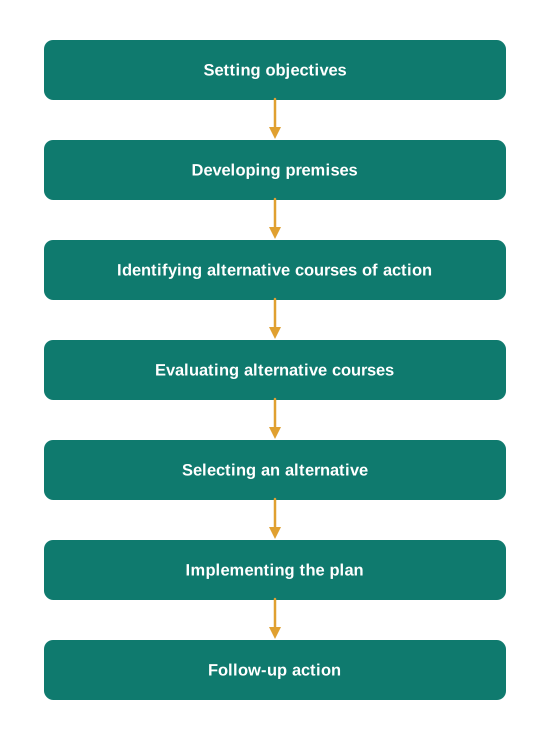
Fig. 4.3 – Steps in the planning process.
Setting objectives — the first and foremost step is setting objectives. Every organisation must have certain objectives, which may be set for the entire organisation and for each department or unit within it. Objectives specify what the organisation wants to achieve, such as an increase in sales by twenty per cent for the organisation as a whole. How all departments will contribute to this organisational goal is the plan that has to be drawn up. Objectives should be stated clearly for all departments, units and employees, since they give direction to everyone. Departments and units then set their own objectives within the broad framework of the organisation’s philosophy, so that objectives percolate down to every unit and to employees at all levels. At the same time, managers must contribute ideas and take part in the objective setting process. They must also understand how their own actions contribute to achieving the objectives, because when the end result is clear it becomes easier to work towards the goal.
Developing premises — planning is concerned with the future, which is uncertain, and every planner has to make conjectures about what might happen. The manager is therefore required to make certain assumptions about the future, and these assumptions are called premises. They are the base material upon which plans are to be drawn, and may take the form of forecasts, existing plans or past information about policies. The premises must be the same for all, and there should be total agreement on them, so all managers involved in planning should be familiar with and use the same assumptions. Forecasting is important in developing premises, since it is a technique of gathering information. Forecasts can be made about the demand for a particular product, policy changes, interest rates, prices of capital goods and tax rates. Accurate forecasts therefore become essential for successful plans.
Identifying alternative courses of action — once objectives are set and assumptions are made, the next step is to act upon them. There may be many ways of acting to achieve the objectives, and all the alternatives available should be identified. The course of action taken could be either routine or innovative. An innovative course may be arrived at by involving more people and sharing their ideas. If the project is an important one, then more alternatives should be generated and thoroughly discussed among the members of the organisation.
Evaluating alternative courses — the next step is to weigh the pros and cons of each alternative. Each course will have many variables that have to be weighed against each other, and the positive and negative aspects of each proposal need to be evaluated in the light of the objective to be achieved. In financial plans, for example, the risk-return trade-off is very common: the more risky the investment, the higher the returns it is likely to give. To evaluate such proposals, detailed calculations of earnings, earnings per share, interest, taxes and dividends are made and decisions are taken. Accurate forecasts in conditions of certainty or uncertainty then become vital assumptions for these proposals. Alternatives are thus evaluated in the light of their feasibility and their consequences.
Selecting an alternative — this is the real point of decision making, where the best plan has to be adopted and implemented. The ideal plan would be the one that is most feasible, most profitable and carries the least negative consequences. Most plans cannot always be subjected to a mathematical analysis. In such cases, subjectivity and the manager’s experience, judgement and, at times, intuition play an important part in selecting the most viable alternative. Sometimes a combination of plans may be selected instead of one best course, and the manager then has to apply permutations and combinations to select the best possible course of action.
Implementing the plan — this is the step where the other managerial functions also come into the picture. It is concerned with putting the plan into action, that is, doing what is required. For example, if there is a plan to increase production, then more labour and more machinery will be required. This step would therefore also involve organising for labour and arranging the purchase of machinery.
Follow-up action — seeing whether plans are being implemented and whether activities are being performed according to schedule is also part of the planning process. Monitoring the plans is equally important, since it is what ensures that the objectives are actually achieved.
Why The Order Cannot Be Changed
Each step supplies what the next one needs. Objectives must come first, because without them there is nothing to plan for. Premises must be developed before alternatives are identified, since an alternative can only be judged against assumed future conditions. Evaluation must precede selection, and implementation must precede follow-up. Reversing any two steps leaves the manager deciding without the information the decision requires.
4.7 Types of Plans
An organisation has to prepare a plan before taking any decision related to a business operation or before undertaking any project. Plans can be classified into several types, depending on the use to which they are put and on the length of the planning period.
Certain plans have a short-term horizon and help to achieve operational goals. Such plans are classified into single-use plans and standing plans, as shown in Fig. 4.4.
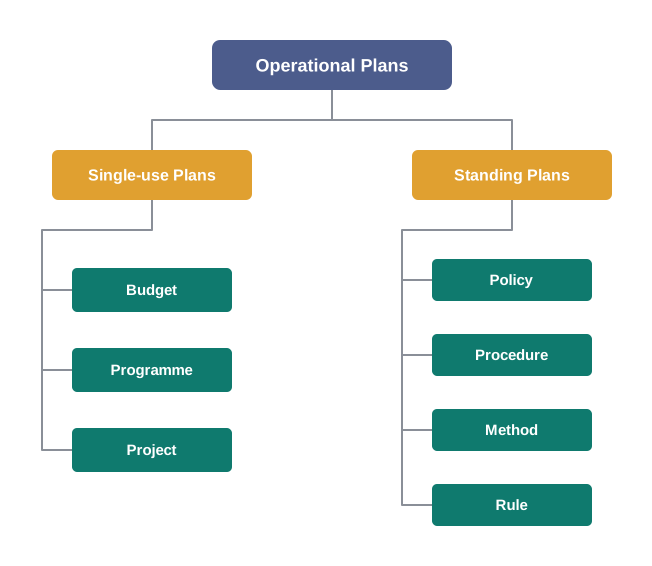
Fig. 4.4 – Operational plans.
4.7.1 Single-Use and Standing Plans
A single-use plan is developed for a one-time event or project. Such a course of action is not likely to be repeated in future, that is, it is meant for non-recurring situations.
The duration of a single-use plan depends upon the type of project. It may span a week or a month, and a project may sometimes last only one day, such as organising an event, a seminar or a conference. These plans include budgets, programmes and projects. They consist of details, including the names of the employees who are responsible for doing the work and contributing to the single-use plan. A programme, for example, may consist of identifying the steps and procedures required for opening a new department to handle other minor work. Projects are similar to programmes but differ in scope and complexity. A budget is a statement of expenses, revenue and income for a specified period.
A standing plan is used for activities that occur regularly over a period of time. It is designed to ensure that the internal operations of an organisation run smoothly, and it greatly enhances efficiency in routine decision-making.
A standing plan is usually developed once, but it is modified from time to time to meet business needs as they arise. Standing plans include policies, procedures, methods and rules.
Policies are general forms of standing plans that specify the organisation’s response to a certain situation, such as the admission policy of an educational institution. Procedures describe the steps to be followed in particular circumstances, such as the procedure for reporting progress in production. Methods provide the manner in which a task has to be performed. Rules are very clearly stated as to exactly what has to be done, such as reporting for work at a particular time.
Single-use plans and standing plans are both part of the operational planning process.
Plans Beyond The Operational Level
There are other types of plans which are usually not classified as single-use or standing plans. A strategy, for example, is part of strategic planning or strategic management. It is a general plan prepared by top management, outlining resource allocation and priorities, and taking into consideration the business environment and competition.
Objectives are usually set by top management and serve as a guide for overall planning. Each unit then formulates its own objectives, keeping in view the overall organisational goals.
Based on what the plans seek to achieve, plans can be classified as objectives, strategy, policy, procedure, method, rule, programme and budget. This classification is shown in Fig. 4.5.
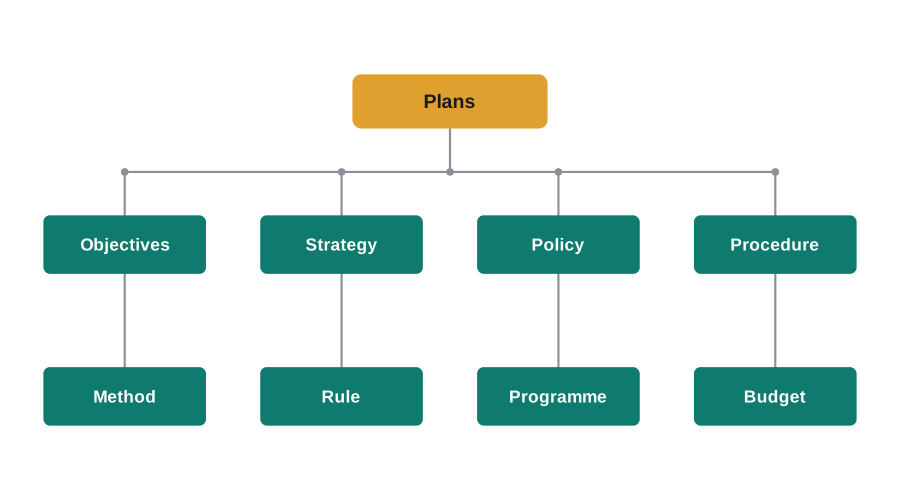
Fig. 4.5 – Types of plans.
4.7.2 Objectives
The first step in planning is setting objectives. Objectives can therefore be said to be the desired future position that the management would like to reach.
Objectives are very basic to the organisation. They are defined as the ends which the management seeks to achieve by its operations. Simply stated, an objective is what the organisation would like to achieve, that is, the end result of its activities. An organisation may have an objective of increasing sales by ten per cent, or of earning a reasonable rate of return on investment, or of earning a twenty per cent profit from its business.
Objectives represent the end point of planning, and all other managerial activities are directed towards achieving them. They are usually set by top management and focus on broad, general issues. They define the future state of affairs which the organisation strives to realise, and they serve as a guide for overall business planning. Different departments or units in the organisation may have their own objectives within this framework.
Objectives need to be expressed in specific terms, that is, they should be measurable in quantitative terms, in the form of a written statement of the desired results to be achieved within a given time period.
4.7.3 Strategy
A strategy provides the broad contours of an organisation’s business. It also refers to future decisions defining the organisation’s direction and scope in the long run.
A strategy is thus a comprehensive plan for accomplishing an organisation’s objectives. This comprehensive plan includes three dimensions: determining long term objectives, adopting a particular course of action, and allocating the resources necessary to achieve the objective.
Whenever a strategy is formulated, the business environment has to be taken into consideration. Changes in the economic, political, social, legal and technological environment affect an organisation’s strategy. Strategies usually take the course of forming the organisation’s identity in the business environment.
Major strategic decisions include decisions such as whether the organisation will continue in the same line of business, whether it will combine new lines of activity with the existing business, or whether it will seek to acquire a dominant position in the same market. A company’s marketing strategy, for example, has to answer questions such as who the customers are, what the demand for the product is, which channel of distribution to use, what the pricing policy should be, and how the product will be advertised. These and many other issues have to be resolved while formulating a marketing strategy.
4.7.4 Policy
A policy is a general statement that guides thinking or channelises energies towards a particular direction. Policies provide a basis for interpreting a strategy, which is usually stated in general terms.
Policies are guides to managerial action and decisions in the implementation of a strategy. A company may have a recruitment policy or a pricing policy within which objectives are set and decisions are made. Where an established policy exists, it becomes easier to resolve problems or issues, because a policy is the general response to a particular problem or situation.
There are policies for all levels and departments in the organisation, ranging from major company policies to minor policies. Major company policies are for all to know, that is, for customers, clients and competitors. Minor policies are applicable to insiders and contain minute details of information vital to the employees of an organisation. But there has to be some basis for divulging information to others.
Policies define the broad parameters within which a manager may function, and the manager may use his or her discretion to interpret and apply a policy. The decisions taken under a purchase policy, for example, would be in the nature of manufacturing or buying decisions. Should the company make or buy its requirements of packages, transport services, printing of stationery, water and power supply and other items? How should vendors be selected for procuring supplies? From how many suppliers should the company purchase, and what should be the criteria for choosing them? All these queries would be addressed by the purchase policy.
4.7.5 Procedure
A procedure consists of the routine steps on how to carry out activities. Procedures detail the exact manner in which any work is to be performed, and they are specified in chronological order. There may, for example, be a procedure for requisitioning supplies before production.
Procedures are specified steps to be followed in particular circumstances. They are generally meant for insiders to follow. The sequence of steps or actions to be taken is generally intended to enforce a policy and to attain predetermined objectives.
Policies and procedures are interlinked with each other. Procedures are the steps to be carried out within a broad policy framework.
4.7.6 Method
A method provides the prescribed way or manner in which a task has to be performed, considering the objective. It deals with a task comprising one step of a procedure and specifies how that step is to be carried out.
The method may vary from task to task. Selection of a proper method saves time, money and effort, and increases efficiency.
Different methods can be adopted for imparting training to employees at various levels, from top management to supervisory level. For higher level management, orientation programmes, lectures and seminars can be organised, whereas at the supervisory level, on the job training methods and work-oriented methods are appropriate.
4.7.7 Rule
A rule is a specific statement that informs what is to be done. Rules do not allow for any flexibility or discretion.
A rule reflects a managerial decision that a certain action must or must not be taken. Rules are usually the simplest type of plans, because there is no compromise or change in them unless a policy decision is taken.
4.7.8 Programme
A programme is a detailed statement about a project. It outlines the objectives, policies, procedures, rules, tasks, human and physical resources required, and the budget needed to implement any course of action.
Programmes include the entire gamut of activities, as well as the organisation’s policy and how the programme will contribute to the overall business plan. The minutest details are worked out, that is, the procedures, rules and budgets, within the broad policy framework.
4.7.9 Budget
A budget is a statement of expected results expressed in numerical terms. It is a plan which quantifies future facts and figures.
A sales budget, for example, may forecast the sales of different products in each area for a particular month. A budget may also be prepared to show the number of workers required in the factory at peak production times.
Since a budget represents all items in numbers, it becomes easier to compare actual figures with expected figures and to take corrective action afterwards. A budget is therefore also a control device, through which deviations can be taken care of. But since making a budget involves forecasting, it clearly comes under planning, and it is a fundamental planning instrument in many organisations.
The Cash Budget
The cash budget is a basic tool in the management of cash. It is a device that helps management to plan and control the use of cash, and it is a statement showing the estimated cash inflows and cash outflows over a given period.
Cash inflows would generally come from cash sales, and cash outflows would generally be the costs and expenses associated with the operations of the business. The net cash position is determined by the cash budget, that is, inflows minus outflows equals surplus or deficiency.
Management has to hold adequate cash balances for various purposes. At the same time, it should avoid an excess balance of cash, since idle cash gives little or no return. The business therefore has to assess and plan its need for cash with a degree of caution.
4.8 Summary
Concept Of Planning
Planning is deciding in advance what to do and how to do it. It is one of the basic managerial functions.
Planning therefore involves setting objectives and developing an appropriate course of action to achieve those objectives.
Importance Of Planning
- Planning provides direction, reduces the risks of uncertainty, reduces overlapping and wasteful activities, promotes innovative ideas, facilitates decision making, and establishes standards for controlling.
Features Of Planning
Planning focuses on achieving objectives and is a primary function of management.
Planning is pervasive, continuous and futuristic, and it involves decision making.
Planning is a mental exercise, requiring logical and systematic thinking based on facts and forecasts.
Limitations Of Planning
- Planning leads to rigidity, reduces creativity, involves huge costs and is a time-consuming process. It may not work in a dynamic environment and does not guarantee success.
Planning Process
Setting objectives — objectives may be set for the entire organisation and for each department or unit within the organisation.
Developing premises — planning is concerned with the future, which is uncertain, and every planner makes conjectures about what might happen in future.
Identifying alternative courses of action — once objectives are set and assumptions are made, the next step is to act upon them by identifying the alternatives available.
Evaluating alternative courses — the next step is to weigh the pros and cons of each alternative.
Selecting an alternative — this is the real point of decision making, where the best plan has to be adopted and implemented.
Implementing the plan — this step is concerned with putting the plan into action.
Follow-up action — monitoring the plans is equally important, to ensure that objectives are achieved.
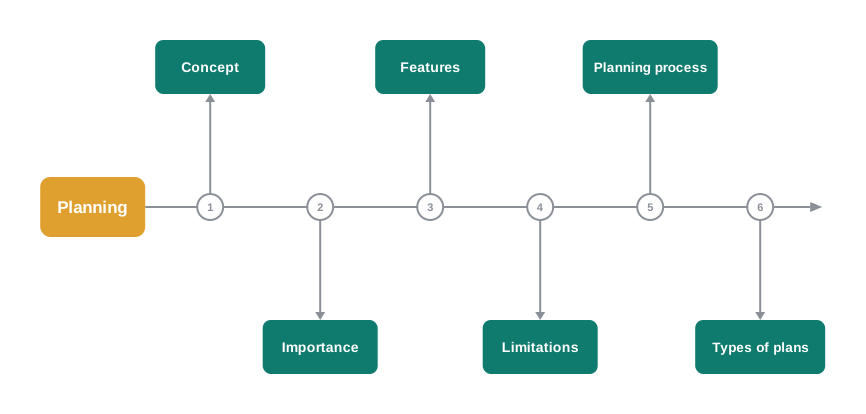
Fig. 4.6 – Structure of the chapter.
Types Of Plans
Objectives — objectives are the desired future position that the management would like to reach.
Strategy — a strategy provides the broad contours of an organisation’s business and refers to future decisions defining the organisation’s direction and scope in the long run.
Policy — policies are general statements that guide thinking or channelise energies towards a particular direction.
Procedure — procedures are routine steps on how to carry out activities.
Method — a method is the prescribed manner in which one step of a procedure is to be performed.
Rule — rules are specific statements that tell what is to be done, and allow no discretion.
Programme — programmes are detailed statements about a project which outline the objectives, policies, procedures, rules, tasks, human and physical resources required and the budget to implement any course of action.
Budget — a budget is a statement of expected results expressed in numerical terms. It is a plan which quantifies future facts and figures.
Plans meant for a one-time event are single-use plans, while plans used for activities that occur regularly are standing plans. Both are part of the operational planning process.
4.9 Key Terms
Planning The process of setting objectives for a given time period, formulating courses of action to achieve them, and selecting the best possible alternative from among them.
Objectives The ends which the management seeks to achieve by its operations, expressed in specific and measurable terms.
Goals The targets an organisation sets for itself, which give direction to its members and against which actual performance is measured.
Decisions Choices made by a manager from among the available courses of action.
Standards The goals or benchmarks laid down through planning, against which actual performance is later compared.
Controlling The managerial function of comparing actual performance with planned standards and taking corrective action on deviations.
Premises The assumptions about the future on the basis of which plans are drawn up.
Assumptions Expectations about future conditions, in the form of forecasts, existing plans or past information, used as the base material for planning.
Alternatives The different possible courses of action by which an objective may be achieved.
Single-use plan A plan developed for a one-time event or project that is not likely to be repeated.
Standing plan A plan used for activities that occur regularly, developed once and modified from time to time.
Strategy A comprehensive plan for accomplishing an organisation’s objectives, covering long term objectives, a course of action and allocation of resources.
Policy A general statement that guides thinking or channelises energies towards a particular direction, within which a manager may use discretion.
Procedure Routine steps, specified in chronological order, on how an activity is to be carried out.
Method The prescribed manner in which a task forming one step of a procedure is to be performed.
Rule A specific statement of what must or must not be done, allowing no flexibility or discretion.
Programme A detailed statement about a project outlining its objectives, policies, procedures, rules, tasks, resources and budget.
Budget A statement of expected results expressed in numerical terms, which quantifies future facts and figures.
4.10 NCERT Questions
Very Short Answer Type
- How does planning provide direction?
- A company wants to increase its market share from the present 10% to 25% to have a dominant position in the market by the end of the next financial year. Ms Rajni, the sales manager has been asked to prepare a proposal that will outline the options available for achieving this objective. Her report included the following options — entering new markets, expanding the product range offered to customers, using sales promotion techniques such as giving rebates and discounts, or increasing the budget for advertising activities. Which step of the planning process has been performed by Ms Rajni?
- Why are rules considered to be plans?
- Rama Stationery Mart has made a decision to make all the payments by e-transfers only. Identify the type of plan adopted by Rama Stationery Mart.
- Can planning work in a changing environment? Give a reason to justify your answer.
Short Answer Type
- What are the main aspects in the definition of planning?
- If planning involves working out details for the future, why does it not ensure success?
- What kind of strategic decisions are taken by business organisations?
- Planning reduces creativity. Critically comment.
- In an attempt to cope with Reliance Jio’s onslaught in 2018, market leader Bharti Airtel refreshed its ₹149 prepaid plan to offer 2 GB of 3G/4G data per day, twice the amount it offered earlier. Name the type of plan highlighted in the given example and state its three dimensions.
- State the type of plan in each case given below, and state whether it is a single-use or a standing plan:
- A type of plan which serves as a controlling device as well.
- A plan based on research and analysis and concerned with physical and technical tasks.
Long Answer Type
- Why is it that organisations are not always able to accomplish all their objectives?
- What are the steps taken by management in the planning process?
- An auto company C Ltd. is facing a problem of declining market share due to increased competition from other new and existing players in the market. Its competitors are introducing lower priced models for mass consumers who are price sensitive. C Ltd. realised that it needs to take steps immediately to improve its market standing in the future. For quality conscious consumers, C Limited plans to introduce new models with added features and new technological advancements. The company has formed a team with representatives from all the levels of management. This team will brainstorm and will determine the steps that will be adopted by the organisation for implementing the above strategy. Explain the features of planning highlighted in the situation given above.
4.11 Check Your Concepts
- Why must objectives be set before any other step of the planning process is taken up?
- What happens to the controlling function of management in an organisation that does not plan?
- Distinguish between a single-use plan and a standing plan on any four bases.
- Distinguish between a policy and a rule, giving one example of each.
- Why does the need for planning arise only when alternatives are available?
- Explain why planning is described as both pervasive and continuous.
- Arrange the following steps of the planning process in the correct sequence: evaluating alternative courses, setting objectives, follow-up action, developing premises, implementing the plan, identifying alternative courses of action, selecting an alternative.
- Identify the type of plan described in each of the following:
- A statement of expected results expressed in numerical terms.
- A general statement that guides thinking in a particular direction.
- Routine steps arranged in chronological order for carrying out an activity.
- A detailed statement about a project covering its objectives, tasks, resources and budget.
- Match the item in the first list with its correct description in the second list:
| Column A | Column B |
|---|---|
| a. Premises | i. Benchmarks against which actual performance is compared |
| b. Standards | ii. Prescribed manner of performing one step of a procedure |
| c. Strategy | iii. Assumptions about the future on which plans are based |
| d. Method | iv. Comprehensive plan covering long term objectives, course of action and allocation of resources |
- Assertion (A): Planning is a mental exercise. Reason (R): Planning requires foresight, imagination and sound judgement rather than physical action. Choose the correct option:
- Both A and R are true, and R is the correct explanation of A.
- Both A and R are true, but R is not the correct explanation of A.
- A is true but R is false.
- A is false but R is true.
- Assertion (A): Planning guarantees the success of an enterprise. Reason (R): A plan that has worked in the past will always work again. Choose the correct option:
- Both A and R are true, and R is the correct explanation of A.
- Both A and R are true, but R is not the correct explanation of A.
- A is true but R is false.
- Both A and R are false.
- ‘Planning promotes innovative ideas, yet planning reduces creativity.’ Explain how both statements can be correct.
- Why is a budget treated as a planning instrument even though it is also used as a device for control?
4.12 Case-Based Questions
- Shivalik Furniture Ltd. wants to raise its annual turnover by fifteen per cent in the coming year. Its managing director asks each department to state how it will contribute to this figure. The purchase head then studies expected timber prices and interest rates for the year and records these expectations in writing, so that every department uses the same expectations while preparing its own plan.
- Identify the two steps of the planning process being carried out by the company.
- State why the expectations recorded by the purchase head must be the same for all departments.
- Anmol Dairy Ltd. has laid down that no employee may enter the processing floor without protective clothing. It has also laid down the sequence to be followed for testing every batch of milk before packaging, and it has stated that the company will always source milk from cooperative societies within the district.
- Identify the three types of plans described above.
- State whether each of them is a single-use plan or a standing plan.
- Tarang Electronics Ltd. spent nine months and a large sum of money preparing a detailed five year expansion plan, engaging consultants and holding several boardroom meetings. Soon after the plan was approved, a change in import duties raised the cost of a key component sharply, and the board found that the plan could not be followed as approved. The general manager, however, refused to depart from the approved plan.
- Identify any three limitations of planning highlighted in the above situation.
- Explain any one of them with reference to the situation given.