Chapter 11: Consumer Protection
In 2017, a consumer forum in Raipur heard a complaint against a bank whose ATMs repeatedly displayed a ‘cash not available’ message. The bank argued that a person using an ATM was not directly its client at that moment. The forum rejected this reasoning, held that the repeated failure amounted to a deficiency in service, and ordered the bank to pay compensation to the complainant. A single ordinary transaction, gone wrong, ended in a legal remedy.
Every person is a consumer in one way or another. Yet consumers regularly face adulterated goods, duplicate products, underweight packets, misleading advertisements, overcharging and poor after-sales service. Acting alone, an individual buyer has little bargaining power against a manufacturer or a large seller. Consumer protection exists to correct this imbalance by giving the buyer defined rights, an inexpensive place to complain, and a legal machinery that can order relief.
This chapter explains why consumer protection matters to consumers and to business, who counts as a consumer, the rights and responsibilities of consumers, the ways in which protection is achieved, the redressal agencies under the Consumer Protection Act, 2019, and the role of consumer organisations and NGOs.

Fig. 11.0 – A consumer checking a product label.
11.1 Introduction
Each one of us is a consumer in one way or another. We buy food, clothes, medicines, electronic goods, and we use services such as banking, transport, telephone connections and repairs. Being an aware and informed consumer of the goods and services available in the market is therefore a practical necessity, not an academic idea.
The case described at the beginning of this chapter is only one example of the many problems consumers face in the purchase, use and consumption of goods and services. Very few consumers are aware of the rights given to them by the Consumer Protection Act 2019. This Act has replaced the earlier Act of 1986 and seeks to widen its scope in addressing consumer concerns.
Why Consumers Need Protection
Consider what would happen if adequate protection were not provided. With growing competition, and in an attempt to increase their sales and market share, manufacturers, sellers and service-providers may be tempted to engage in unscrupulous, exploitative and unfair trade practices such as defective and unsafe products, adulteration, false and misleading advertising, hoarding and black-marketing.
The consequences fall directly on the buyer. A consumer might be exposed to risk due to unsafe products, might suffer from bad health because of adulterated food products, might be cheated by misleading advertisements or by the sale of spurious products, and might have to pay a higher price when sellers engage in overpricing, hoarding or black-marketing. As a result, the consumer becomes unsafe, feels cheated, and is exposed to many risks and health problems.
The root of the problem is unequal bargaining power. A single buyer purchasing one packet or one appliance cannot test its quality, cannot verify the seller’s claims, and cannot negotiate terms with a large manufacturer. The law therefore steps in to restore the balance.
The Shift From Seller Market To Consumer Market
Can business afford to ignore the interests of consumers? Market forces have changed from a seller market to a consumer market. The earlier approach was that of caveat emptor, which means ‘let the buyer beware’ — the buyer alone was expected to examine the goods and bear the loss of a bad bargain. The present approach is that of caveat venditor, which implies ‘let the seller beware’ — the responsibility for quality, safety and honest description now rests on the seller.
In the free market economy the consumer is said to be a king, because it is the consumer’s choice that ultimately decides which firms survive. Consumer protection therefore has significance for both consumers and business alike. Under the Consumer Protection Act 2019, the Government of India has conferred legal protection to safeguard the interests of a consumer.
11.2 Importance of Consumer Protection
The concept of consumer protection is to safeguard the interests of consumers. It adopts measures to protect consumers from unethical malpractices by businesses and to provide a swift redressal of their grievances.
Malpractices Consumers Face
Consumer protection becomes necessary because of specific practices that occur in the market. The grievances it seeks to address relate to the following:
Sale of adulterated goods, such as adding inferior substances to the product being sold.
Sale of counterfeit goods, such as selling a product of lesser value than the real product.
Sale of sub-standard goods, such as the sale of products that do not meet the prescribed quality standards.
Sale of duplicate goods.
Use of malfunctioning weights and measures that lead to underweight of products.
Black marketing and hoarding, which eventually lead to scarcity of the product as well as a rise in its price.
Overcharging a product, that is, charging a price above its Maximum Retail Price.
Supplying of defective goods.
Advertisements that are misleading, that is, advertisements that falsely claim a product or a service to be of superior quality, grade or standard when it is not so in reality.
Supply of inferior services, that is, quality of service lesser than the condition agreed.
Need For Consumer Protection
The need for consumer protection arises from the need to protect consumers from loss, injury or other prevailing malpractices, and to ensure:
Physical safety of a consumer.
Access to information.
Corporate social responsibility, so that quality and quantity of goods are provided at fair prices.
Consumer satisfaction.
Social justice and trusteeship.
Survival and the growth of businesses.
That is why an informed consumer has to remain alert and protect himself or herself from various types of exploitation, and should complain when exploited. Consumer protection has a wide scope. It not only includes educating consumers about their rights and responsibilities, but also helps in getting their grievances redressed. It requires a judicial machinery for protecting the interests of consumers, and it also requires consumers to be united and to form themselves into consumer associations for the protection and promotion of their interests.
11.2.1 From Consumers’ Point of View
The importance of consumer protection from the consumers’ point of view can be understood from the following points:
Consumer ignorance — in the light of widespread ignorance of consumers about their rights and the reliefs available to them, it becomes necessary to educate them about the same so as to achieve consumer awareness. A buyer who does not know that a remedy exists will not use it.
Unorganised consumers — consumers need to be organised in the form of consumer organisations which would take care of their interests. Though in India we do have consumer organisations working in this direction, adequate protection is required to be given to consumers till these organisations become powerful enough to protect and promotion the interests of consumers.
Widespread exploitation of consumers — consumers might be exploited by unscrupulous, exploitative and unfair trade practices like defective and unsafe products, adulteration, false and misleading advertising, hoarding and black-marketing. Consumers need protection against such malpractices of the sellers.
11.2.2 From the Point of View of Business
A business must also lay emphasis on protecting consumers and adequately satisfying them. This is important because of the following reasons:
Long-term interest of business — enlightened businesses realise that it is in their long-term interest to satisfy their customers. Satisfied customers not only lead to repeat sales but also provide good feedback to prospective customers, and thus help in increasing the customer base of the business. Business firms should therefore aim at long-term profit maximisation through customer satisfaction.
Business uses society’s resources — business organisations use resources which belong to society. They thus have a responsibility to supply such products and render such services as are in public interest and would not impair public confidence in them.
Social responsibility — a business has social responsibilities towards various interest groups. Business organisations make money by selling goods and providing services to consumers. Consumers thus form an important group among the many stakeholders of business, and like other stakeholders, their interest has to be well taken care of.
Moral justification — it is the moral duty of any business to take care of the consumer’s interest and to avoid any form of exploitation. A business must therefore avoid unscrupulous, exploitative and unfair trade practices like defective and unsafe products, adulteration, false and misleading advertising, hoarding and black marketing.
Government intervention — a business engaging in any form of exploitative trade practice would invite government intervention or action. This can impair and tarnish the image of the company. It is therefore advisable that business organisations voluntarily resort to such practices where the customers’ needs and interests are well taken care of.
11.3 The Consumer Protection Act, 2019
The Consumer Protection Act 2019 seeks to protect and promote the consumers’ interest through speedy and inexpensive redressal of their grievances. A consumer who has to fight a long and costly court case will usually give up, so the Act deliberately creates a simple and low-cost route to relief.
The Act extends to the whole of India. It is applicable to all types of businesses, whether a manufacturer or a trader, and whether supplying goods or providing services, including e-commerce firms. The Act confers certain rights on consumers with a view to empowering them and protecting their interests.
The Wider Legal Framework
The Consumer Protection Act 2019 is the most important law protecting consumers, but it is not the only one. The Indian legal framework consists of a number of legislations which provide protection to consumers. These include:
The Consumer Protection Act, 1986 — replaced by the Act of 2019.
The Indian Contract Act, 1872.
The Sale of Goods Act, 1930.
The Essential Commodities Act, 1955.
The Agricultural Produce (Grading and Marking) Act, 1937.
The Prevention of Food Adulteration Act, 1954.
The Standards of Weights and Measures Act, 1976.
The Trade Marks Act, 1999.
The Competition Act, 2002.
The Bureau of Indian Standards Act, 1986.
Terms Used Under The Act
A complaint before a consumer commission has to be framed in the language of the Act. The Act therefore defines the terms complaint, complainant, spurious goods, unfair trade practice, restrictive trade practice, defect, deficiency, injury, product, product seller and product liability. These meanings decide whether a grievance can be taken up at all, and against whom.
11.4 Who is a Consumer
A consumer is generally understood as a person who uses or consumes goods or avails of any service. The Act, however, gives the word a precise meaning, because only a person who fits this meaning can file a complaint and claim relief.
Under the Consumer Protection Act 2019, a consumer is a person who buys any goods or avails of any services for a consideration. The consideration may have been paid or promised, or partly paid and partly promised, or made under any scheme of deferred payment such as instalments or a credit purchase.
The term also covers a person other than the buyer. It includes any user of such goods or beneficiary of such services, if such use is made with the approval of the buyer. A person who uses a mixer bought by a family member, with that member’s approval, is therefore a consumer for the purposes of the Act.
The Act applies to both offline and online transactions. Purchases made through electronic means, by teleshopping, by direct selling or by multilevel marketing are all covered.
There is one important exclusion. Any person who obtains goods or avails of services for resale or for a commercial purpose is not treated as a consumer, and is outside the scope of the Consumer Protection Act 2019. The Act is meant to protect the final user, not a trader dealing in goods to earn profit.
11.5 Consumer Rights
The Consumer Protection Act 2019 provides for six consumer rights. These rights convert a general concern for the buyer into specific entitlements that can be claimed before a consumer commission. The six rights are set out together in Fig. 11.1.
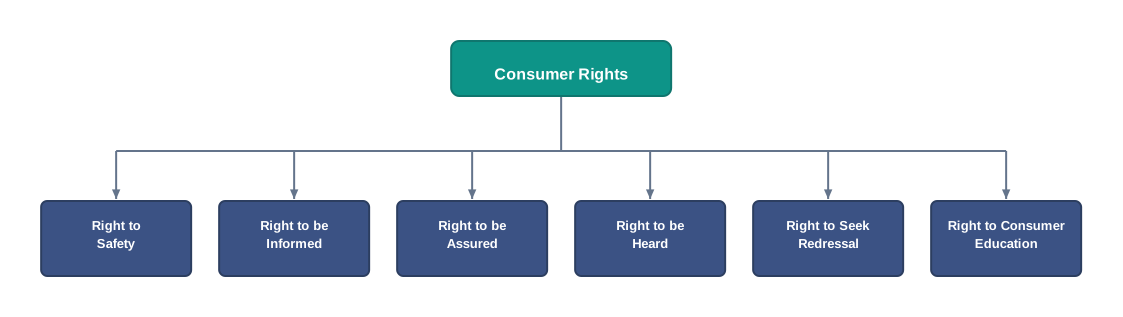
Fig. 11.1 – The six rights of a consumer.
These rights include the following:
Right to safety — the consumer has a right to be protected against goods and services which are hazardous to life, health and property. For example, electrical appliances which are manufactured with substandard products, or which do not conform to safety norms, might cause serious injury. Consumers are therefore educated that they should use electrical appliances which are ISI marked, as this would be an assurance of such products meeting quality specifications.
Right to be informed — the consumer has a right to have complete information about the product he intends to buy, including its ingredients, date of manufacture, price, quantity and directions for use. It is because of this reason that the legal framework in India requires manufacturers to provide such information on the package and label of the product. Without this information a buyer cannot compare products or judge whether a product is safe for use.
Right to be assured — the consumer has the freedom to access a variety of products at competitive prices. This implies that marketers should offer a wide variety of products in terms of quality, brand, price and size, and allow the consumer to make a choice from amongst these. Where choice exists, a seller cannot dictate terms to the buyer.
Right to be heard — the consumer has a right to file a complaint and to be heard in case of dissatisfaction with a good or a service. It is because of this reason that many enlightened business firms have set up their own consumer service and grievance cells. Many consumer organisations are also working in this direction and helping consumers in the redressal of their grievances.
Right to seek redressal — the consumer has a right to get relief against an unfair trade practice, a restrictive trade practice, or unscrupulous exploitation, in case the product or service falls short of his expectations. The Consumer Protection Act 2019 provides for redressal to consumers, including replacement of the product, removal of the defect in the product, and compensation paid for any loss or injury suffered by the consumer.
Right to consumer education — the consumer has a right to acquire knowledge and to be a well-informed consumer throughout life. He should be aware of his rights and of the reliefs available to him in case a product or service falls short of his expectations. Many consumer organisations and some enlightened businesses are taking an active part in educating consumers in this respect.
These rights work as a sequence rather than as six separate items. Education makes a consumer aware, information allows a sensible choice, choice and safety protect the purchase itself, and the rights to be heard and to seek redressal come into play when something goes wrong.
Board questions on this topic are usually application based. A short situation is given, and the student is asked to name and explain the right involved. The safest approach is to identify the stage of the transaction — before purchase, at purchase, or after purchase — and then match it with the right.
11.6 Consumer Responsibilities
The Consumer Protection Act empowers the consumer to fight against any unscrupulous, exploitative, unfair and restrictive trade practices adopted by sellers. Consumer rights, by themselves, cannot be effective in achieving the objective of consumer protection. Protection can, in effect, be achieved only when consumers also understand their consumer responsibilities.
The reason is practical. A right can be enforced only if the consumer knows about the product, keeps proof of purchase, and is willing to complain. A buyer who does not ask for a bill or does not read a label leaves himself with no evidence and no case.
A consumer should keep in mind the following responsibilities while purchasing, using and consuming goods and services:
Be aware about the various goods and services available in the market, so that an intelligent and wise choice can be made.
Buy only standardised goods, as they provide quality assurance. Thus, look for the ISI mark on electrical goods, the FPO mark on food products and the Hallmark on jewellery.
Learn about the risks associated with products and services, follow the manufacturer’s instructions, and use the products safely.
Read labels carefully, so as to have information about prices, net weight, and manufacturing and expiry dates.
Assert yourself to ensure that you get a fair deal.
Be honest in your dealings. Choose only from legal goods and services, and discourage unscrupulous practices like black-marketing and hoarding.
Ask for a cash memo on the purchase of goods or services. This would serve as proof of the purchase made.
File a complaint in an appropriate consumer forum in case of a shortcoming in the quality of goods purchased or services availed. Do not fail to take action even when the amount involved is small.
Form consumer societies, which would play an active part in educating consumers and safeguarding their interests.
Respect the environment. Avoid waste and littering, and avoid contributing to pollution.
Quality Certification Marks
Several marks help a consumer identify goods that meet prescribed standards, and are worth knowing by name:
ISI mark — the certification mark of the Bureau of Indian Standards, used on industrial and electrical products.
Agmark — the mark used for agricultural products.
FPO mark — the Fruit Products Order mark, used on processed fruit products.
Hallmark — the mark certifying the purity of gold and silver jewellery.
Eco-mark — the mark given to products that are environment friendly.
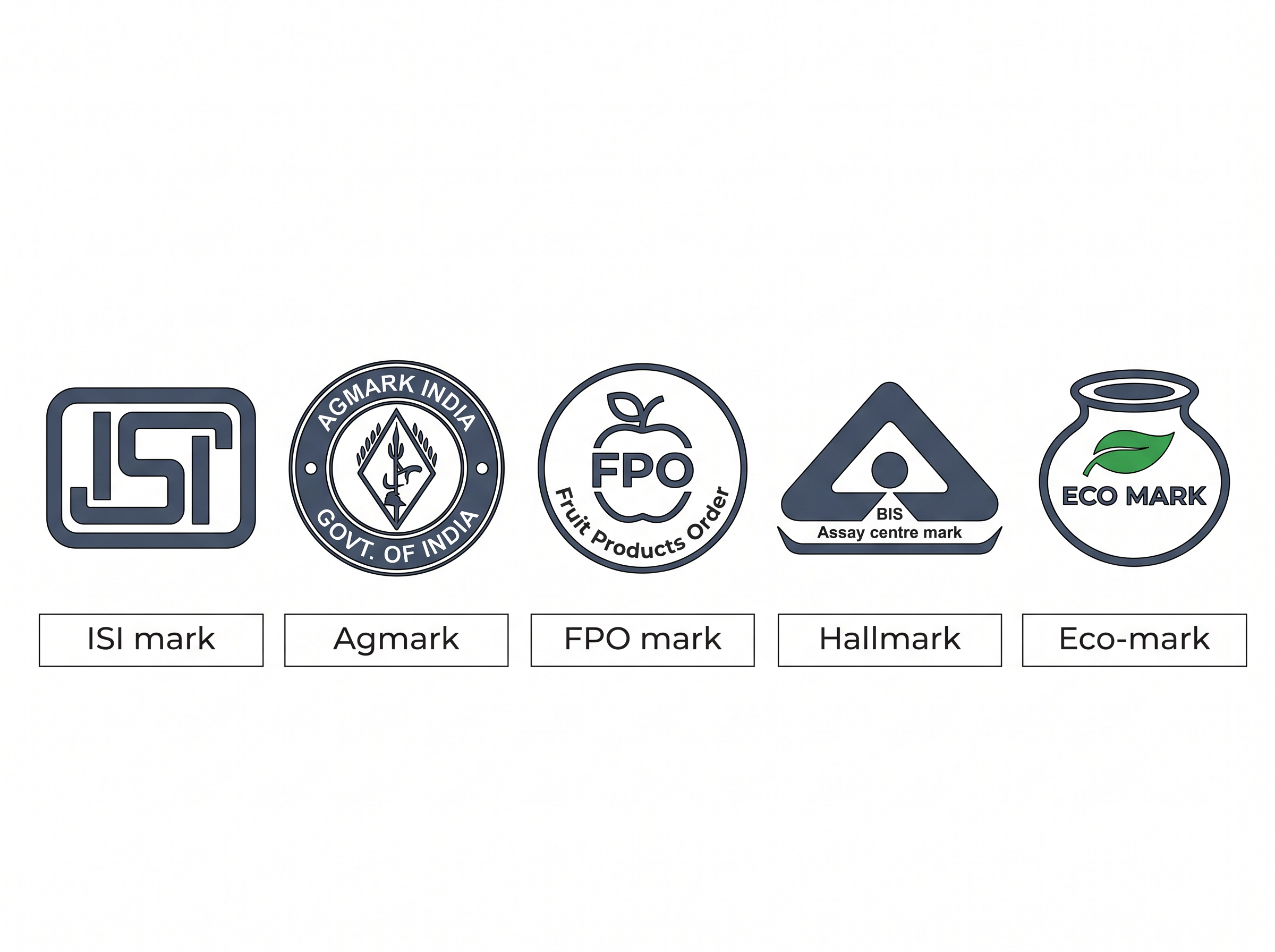
Fig. 11.2 – Quality certification marks.
Consumer rights and consumer responsibilities are often confused in examinations. Table 11.1 sets out the difference.
11.7 Ways and Means of Consumer Protection
A consumer’s awareness about rights and responsibilities is just one of the ways in which the objective of consumer protection can be achieved. There are other ways in which this objective may be achieved. The five ways are summarised in Fig. 11.3.
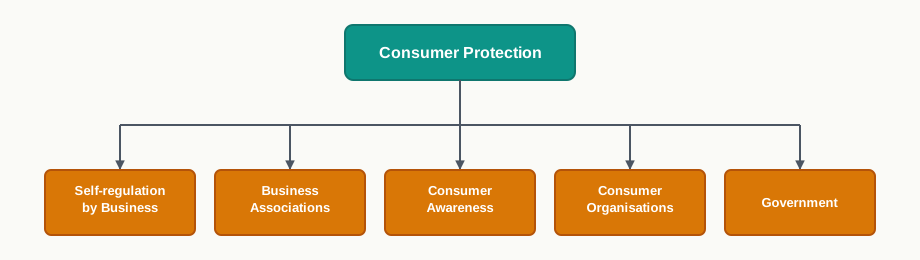
Fig. 11.3 – Ways and means of consumer protection.
Self-regulation by business — socially responsible firms follow ethical standards and practices in dealing with their customers. Good and ethical practices encourage firms to realise that it is in their long-term interest to serve customers in a rightful manner. Many firms have set up their own customer service and grievance cells to redress the problems and grievances of their consumers.
Business associations — the associations of trade, commerce and business, such as the Federation of Indian Chambers of Commerce and Industry and the Confederation of Indian Industry, have laid down codes of conduct which set out for their members the guidelines to be followed in their dealings with customers.
Consumer awareness — a consumer who is well informed about his rights and the reliefs available to him would be in a position to raise his voice against any unfair trade practice or unscrupulous exploitation. In addition, an understanding of his responsibilities would enable a consumer to safeguard his interests. In this regard, the Department of Consumer Affairs, Government of India, has been undertaking the Jago Grahak Jago campaign for generating awareness among consumers.
Consumer organisations — consumer organisations play an important role in educating consumers about their rights and in providing protection to them. These organisations can force business firms to avoid malpractices and the exploitation of consumers.
Government — the government can protect the interests of consumers by enacting various measures. For example, the Government of India has set up a toll-free National Consumer Helpline, 1800-11-4000, for this purpose. The legal framework in India encompasses various legislations which provide protection to consumers, the most important of these being the Consumer Protection Act, 2019.
11.8 Redressal Agencies under the Consumer Protection Act
For the redressal of consumer grievances, the Consumer Protection Act 2019 provides for the setting up of a three-tier enforcement machinery at the district, state and national levels. This redressal mechanism is designed so that a consumer can approach a body close to home, at low cost, without engaging in ordinary civil litigation.
The three levels are distinguished mainly by the value of the goods or services involved. As per the Consumer Protection Rules 2021, the jurisdiction of the District Commission, the State Commission and the National Commission is as given below, and the route of appeal is shown in Fig. 11.4.

Fig. 11.4 – Three-tier redressal machinery and route of appeal.
11.8.1 District Commission
The District Commission has jurisdiction to entertain complaints where the value of the goods or services paid as consideration does not exceed fifty lakh rupees.
Either on the first hearing, or at any later stage, if it appears to the District Commission that there exist elements of settlement which may be acceptable to the parties, it may direct them to give their consent for settlement of the dispute through mediation within five days. In case the parties agree to settlement by mediation and give written consent, the District Commission refers the matter for mediation, and the provisions relating to mediation apply. However, in the event of failure of settlement by mediation, the Commission proceeds with the complaint.
If the complaint alleges a defect in goods which cannot be determined without proper analysis or testing of the goods, the Commission obtains a sample of the goods, seals it, and refers it to the appropriate authority for analysis. In the case of services, the dispute is settled on the basis of evidence brought to its notice by the complainant, and the Commission can ask for any required information, document or record from the service provider for settlement.
If any of the parties is not satisfied by the order of the District Commission, it can appeal against such order to the State Commission on the grounds of facts or law, within a period of forty-five days from the date of the order.
11.8.2 State Commission
The State Commission is established by the respective state government and ordinarily functions at the state capital.
The State Commission has jurisdiction to entertain complaints where the value of the goods and services paid as consideration exceeds fifty lakh rupees but does not exceed two crore rupees.
If any of the parties is not satisfied by the order of the State Commission, it can appeal against such order to the National Commission within a period of thirty days of such order.
11.8.3 National Commission
The National Commission has territorial jurisdiction over the whole country.
It has jurisdiction to entertain complaints where the value of the goods or services paid as consideration exceeds two crore rupees.
If any of the parties is not satisfied by the order of the National Commission, it can appeal against such order to the Supreme Court of India within a period of thirty days of such order.
11.8.4 Relief Available
Where the District, State or National Commission is satisfied about a defect in goods, or a deficiency in services, or an unfair trade practice, or a claim for compensation under product liability, it issues an order directing one or more of the following:
To remove the defect in goods or the deficiency in service.
To replace the defective product with a new one, free from any defect.
To refund the price paid for the product, or the charges paid for the service.
To pay a reasonable amount of compensation for any loss or injury suffered by the consumer due to the negligence of the opposite party.
To pay punitive damages in appropriate circumstances.
To discontinue the unfair or restrictive trade practice and not to repeat it in the future.
Not to offer hazardous goods for sale.
To withdraw the hazardous goods from sale.
To cease manufacture of hazardous goods and to desist from offering hazardous services.
To compensate for any loss or injury suffered by the consumer under a product liability action, and to withdraw hazardous products from being offered for sale.
However, every order of a District Commission, a State Commission or the National Commission is deemed final if no appeal against such order is made by any of the parties involved in the dispute.
11.9 Role of Consumer Organisations and NGOs
In India, several consumer organisations and non-governmental organisations have been set up for the protection and promotion of consumers’ interests. An individual buyer with a small claim often lacks the money, information and confidence to fight a large seller, and these bodies supply exactly what the individual lacks.
Non-governmental organisations are non-profit organisations which aim at promoting the welfare of people. They have a constitution of their own and are free from government interference. This independence is important, because it allows them to criticise both business practices and government inaction.
Consumer organisations and NGOs perform several functions for the protection and promotion of the interests of consumers. These include:
Educating the general public about consumer rights by organising training programmes, seminars and workshops.
Publishing periodicals and other publications to impart knowledge about consumer problems, legal reporting, reliefs available and other matters of interest.
Carrying out comparative testing of consumer products in accredited laboratories, to test the relative qualities of competing brands, and publishing the test results for the benefit of consumers.
Encouraging consumers to strongly protest and take action against unscrupulous, exploitative and unfair trade practices of sellers.
Providing legal assistance to consumers by way of aid, legal advice and similar help in seeking legal remedy.
Filing complaints in appropriate consumer courts on behalf of consumers.
Taking the initiative in filing cases in consumer courts in the interest of the general public, and not for any individual.
Working as recognised consumer bodies in different parts of the country, such as the Consumer Unity and Trust Society, Jaipur.
Taken together, these functions cover the whole span of consumer protection. Education and publication work before a purchase goes wrong; comparative testing helps at the moment of choice; and legal assistance and the filing of complaints work after the loss has occurred.
11.10 Summary
Importance of consumer protection — from the point of view of consumers, consumer protection is important because consumers are ignorant, unorganised and exploited by sellers. It is also important for business because it is in the long-term interest of business, because business uses society’s resources, because it is a social responsibility of business, because it has moral justification, and because it avoids government intervention in the functioning of business.
Legal protection to consumers — the Indian legal framework consists of a number of legislations which provide protection to consumers. These include the Consumer Protection Act, 1986, the Indian Contract Act, 1872, the Sale of Goods Act, 1930, the Essential Commodities Act, 1955, the Agricultural Produce (Grading and Marking) Act, 1937, the Prevention of Food Adulteration Act, 1954, the Standards of Weights and Measures Act, 1976, the Trade Marks Act, 1999, the Competition Act, 2002 and the Bureau of Indian Standards Act, 1986. The Act of 1986 has been replaced by the Consumer Protection Act, 2019.
Who is a consumer — a consumer is a person who buys goods or avails of services for a consideration paid or promised, or partly paid and partly promised, or under a scheme of deferred payment, and includes a user or beneficiary using them with the buyer’s approval. A person buying for resale or for a commercial purpose is not a consumer.
Consumer rights — the Consumer Protection Act provides for six consumer rights. These are the right to safety, the right to be informed, the right to be assured, the right to be heard, the right to seek redressal, and the right to consumer education.
Consumer responsibilities — in addition to exercising his rights, a consumer should also keep in mind his responsibilities while purchasing, using and consuming goods and services.
Ways and means of consumer protection — there are various ways in which the objective of consumer protection can be achieved. These include self-regulation by business, business associations, consumer awareness, consumer organisations and the government.
Redressal agencies under the Consumer Protection Act — the Act provides for the setting up of a three-tier enforcement machinery at the district, state and national levels, referred to as the District Commission, the State Commission and the National Commission. Various reliefs are available to a consumer under the Act. The appropriate consumer court may pass an order for removal of the defect in goods, replacement of a defective product, refund of the price of the product, or payment of compensation for the loss suffered.
Consumer organisations and NGOs — in India, several consumer organisations and non-governmental organisations are playing an active role in the protection and promotion of consumers’ interests.
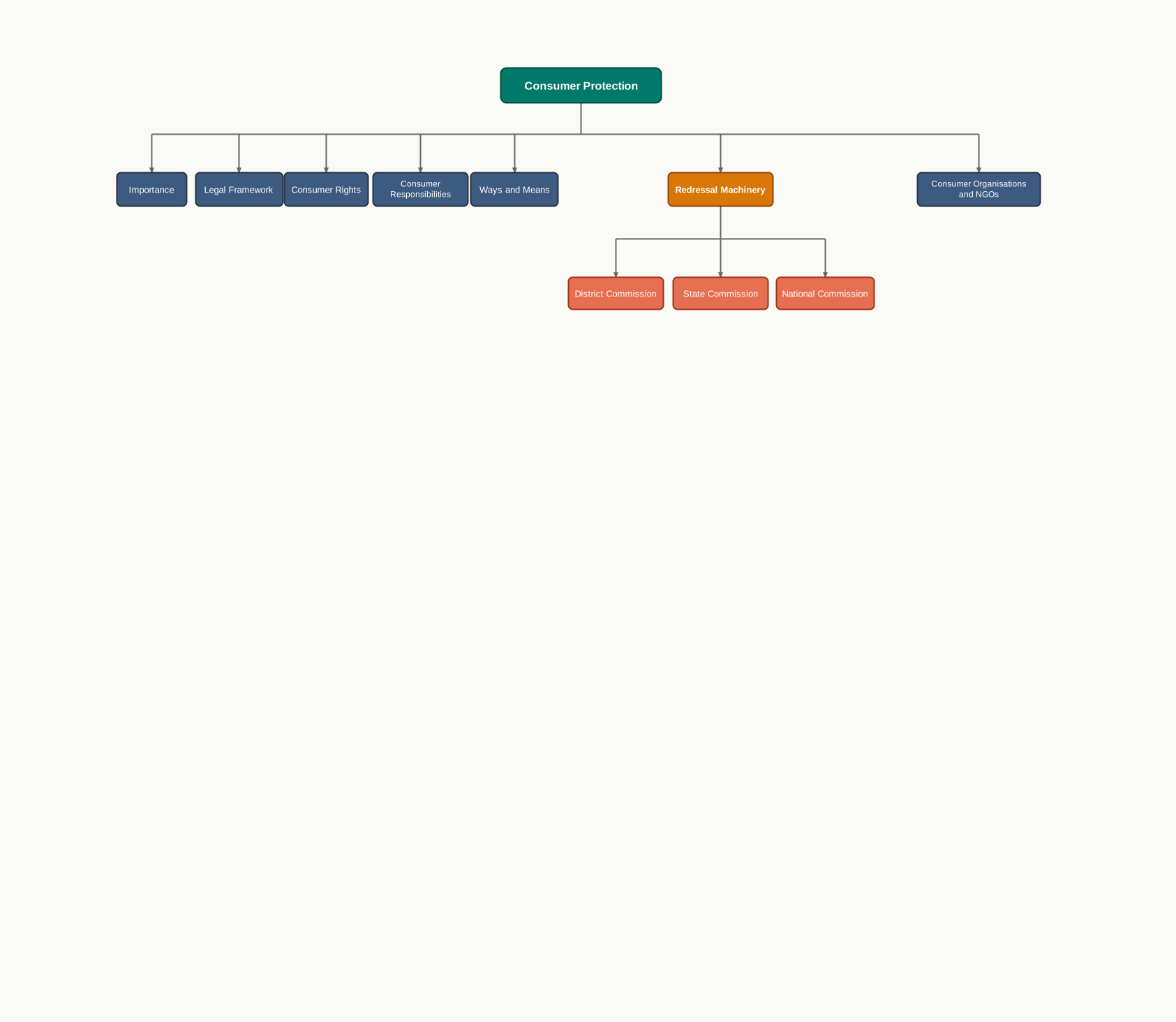
Fig. 11.5 – Structure of the chapter.
11.11 Key Terms
Unfair trade practice A trade practice which, to promote the sale, use or supply of goods or services, falsely represents their quality, standard, quantity, composition, style or model.
Caveat emptor The older market approach of ‘let the buyer beware’, under which the buyer alone bore the risk of a bad purchase.
Caveat venditor The present approach of ‘let the seller beware’, under which the seller answers for defects, deficiency and false claims.
Consumer protection The measures adopted to safeguard the interests of consumers against unfair business malpractices and to provide speedy redressal of their grievances.
Complaint Any allegation made in writing by a complainant for obtaining relief in respect of a restrictive trade practice, a defect in goods, a deficiency in services, overcharging of price, or goods or services injurious to life and safety.
Complainant One or more consumers, a voluntary consumer association, the central or state government or the central authority, a legal heir or legal representative, or a parent or legal representative of a minor.
Spurious goods Goods that are falsely claimed to be genuine.
Restrictive trade practice A trade practice which manipulates price or the flow of supplies in the market so as to impose an unjustified cost on the consumer.
Defect Any fault, imperfection, shortcoming or inadequacy in the quality, nature and manner of performance in relation to goods or a product.
Deficiency Any fault, imperfection, shortcoming or inadequacy in the quality, nature and manner of performance of any service, including negligence, omission, commission or withholding of relevant information that causes loss or injury to the consumer.
Injury Any harm illegally caused to a person in body, mind or property.
Product Any article, goods, substance or raw material in gaseous, liquid or solid state possessing intrinsic value and capable of delivery, excluding human tissues, blood, blood products and organs.
Product seller Any person who, in the course of business, imports, sells, distributes, leases, installs, prepares, labels, markets, repairs or maintains a product, or is otherwise involved in placing it for commercial use, or a service provider.
Product liability The responsibility of a product manufacturer or seller to compensate a consumer for harm caused by a defective product or by deficiency in services.
Consumer A person who buys goods or avails of services for a consideration paid, promised, partly paid and partly promised, or under a scheme of deferred payment, including a user or beneficiary using them with the buyer’s approval, but excluding a person buying for resale or for a commercial purpose.
Consumer rights The six entitlements conferred on consumers by the Consumer Protection Act 2019, namely safety, information, assurance of choice, being heard, redressal and consumer education.
Consumer responsibilities The duties a consumer is expected to perform while purchasing, using and consuming goods and services, so that the rights available can be exercised effectively.
Central Consumer Protection Authority The central authority set up under the Act to regulate violations of consumer rights, unfair trade practices, and false or misleading advertisements.
Redressal mechanism The three-tier machinery of District, State and National Commissions provided under the Act for the settlement of consumer grievances.
Mediation A settlement of a consumer dispute arrived at with the consent of both parties, to which a commission may refer the matter instead of proceeding with the complaint.
11.12 NCERT Questions
Very Short Answer Type
- Under which consumer right does a business firm set up a consumer grievance cell?
- Which quality certification mark is used for agricultural products?
- What is the jurisdiction of cases that can be filed in a State Commission?
- State any two reliefs available to consumers under the Consumer Protection Act.
- Name the component of the product mix that helps the consumer to exercise the right to information.
Short Answer Type
- Enumerate the various Acts passed by the Government of India which help in the protection of consumers’ interests.
- What are the responsibilities of a consumer?
- Who can file a complaint in a consumer court?
- The Food Safety and Standards Authority of India has made a proposal for hotels and other food outlets to declare the kind of oil or fat used in cooking each of the food items on their menus. Name and explain the consumer right being reinforced by this proposal.
- Who is a consumer as per the Consumer Protection Act?
Long Answer Type
- Explain the importance of consumer protection from the point of view of a business.
- Explain the rights and responsibilities of a consumer.
- What are the various ways in which the objective of consumer protection can be achieved?
- Explain the redressal mechanism available to consumers under the Consumer Protection Act, 2019.
- Explain the role of consumer organisations and NGOs in protecting and promoting consumers’ interests.
- Mrs. Mathur sent a jacket to a laundry shop in January 2018. The jacket had been purchased at a price of Rs. 4,500. She had previously sent the jacket for dry cleaning with Shine Dry Cleaners and the jacket was cleaned well. However, she noticed that her jacket had white discoloration marks when she collected it this time. On informing the dry cleaner, Mrs. Mathur received a letter confirming that the discolouration had indeed appeared after the jacket was dry cleaned. She contacted the dry cleaner multiple times and requested compensation for the discoloured jacket, but to no avail. Upon the consumer court’s intervention, Shine Dry Cleaners agreed to compensate Rs. 2,500 to Mrs. Mathur for the discoloured jacket.
- Which right was exercised by Mrs. Mathur at the first instance?
- Name and explain the right which helped Mrs. Mathur to avail the compensation.
- State which consumer responsibility has been fulfilled by Mrs. Mathur in the above case.
- State any other two responsibilities to be assumed by consumers.
11.13 Check Your Concepts
- Why is a person who buys goods for resale not treated as a consumer under the Consumer Protection Act 2019?
- Distinguish between a defect and a deficiency, giving one example of each.
- Distinguish between caveat emptor and caveat venditor, and state which approach the present law follows.
- Distinguish between consumer rights and consumer responsibilities on any four bases.
- What happens if a consumer does not ask for a cash memo at the time of purchase and the product later turns out to be defective?
- Why does the Act allow a commission to refer a dispute for mediation instead of proceeding with the complaint?
- Arrange the following in the correct sequence of appeal: National Commission, District Commission, Supreme Court of India, State Commission.
- Identify the term: a trade practice which manipulates price or the flow of supplies so as to impose an unjustified cost on the consumer.
- Match the following marks with the products they certify:
| Column A | Column B |
|---|---|
| a. Agmark | i. electrical goods |
| b. Hallmark | ii. processed fruit products |
| c. ISI mark | iii. gold jewellery |
| d. FPO mark | iv. agricultural produce |
- Assertion (A) — Consumer rights alone cannot achieve the objective of consumer protection. Reason (R) — Consumer protection becomes effective only when consumers also understand and fulfil their responsibilities. Choose the correct option:
- Both A and R are true, and R is the correct explanation of A.
- Both A and R are true, but R is not the correct explanation of A.
- A is true but R is false.
- A is false but R is true.
- Why is it said that protecting consumers is in the long-term interest of a business, even when it raises costs in the short run?
11.14 Case-Based Questions
- Tanmay buys a room heater for Rs. 3,200 from a shop that issues him a proper bill. The heater gives an electric shock on the second day of use, and a technician reports that its wiring does not meet the prescribed safety norms. The shopkeeper refuses to replace it, and Tanmay decides to approach the appropriate consumer commission.
- Name the consumer right that has been violated by the seller.
- Name the commission before which Tanmay should file his complaint, and give the reason.
- State any two reliefs the commission may order in his favour.
- Sunehri Foods Ltd. advertises a packaged juice as ‘made from one hundred per cent fresh fruit’. A laboratory test carried out by a consumer organisation shows that the juice is largely prepared from concentrate and added sugar. The organisation publishes the test results in its magazine and files a complaint in a consumer court on behalf of the affected buyers.
- Name the practice adopted by Sunehri Foods Ltd.
- State any two functions of consumer organisations being performed in this case.
- Name the authority set up under the Act to regulate false or misleading advertisements.
- Ojaswini books a holiday package worth Rs. 90,00,000 for a group tour through a travel company. The company cancels three of the promised destinations after the payment is made and refuses a refund. She files a complaint, and at the first hearing the commission finds that both parties may be willing to settle the matter.
- Name the commission having jurisdiction over her complaint.
- Name the method of settlement the commission may direct the parties to consent to, and state the period within which such consent is to be given.
- State the commission to which an appeal may be filed if Ojaswini is not satisfied with the order, and the time limit for such appeal.