Chapter 6: Staffing
Every organisation is built by the people who work in it. Machines, capital and buildings only produce results when competent persons are available to operate them. A firm may prepare an excellent plan and design a sound organisation structure, yet the plan will fail if the posts created remain vacant or are filled by persons who cannot do the work. This is why filling positions with the right people, and keeping them filled, is treated as a separate function of management. In India’s software services industry, firms compete as much for skilled engineers as for clients, and the ability to attract, train and retain such employees decides how fast a firm can grow. The same problem appears in a small workshop that cannot find a trained fitter. Staffing deals with this human side of management. This chapter explains what staffing means, why it matters, how it is linked to human resource management, and the steps by which an organisation estimates its manpower needs, recruits, selects, places, trains and develops its employees.

Fig. 6.0 – Job applicants waiting for an interview.
6.1 Introduction
The foundation of any organisation is its people. Talented and hardworking employees are the principal assets of a firm, because it is they who use the money, machines and materials that the business owns. Without capable people, even the best equipment and the largest capital remain idle.
It is an established fact that the growth of an organisation requires the continual infusion of quality staff. As a business expands, new departments open, new posts are created and existing employees retire or leave. Fresh talent must therefore keep flowing into the organisation if growth is to be sustained.
Adequate staffing, that is, the provision of appropriate human resources, is an essential requirement for the success of any organisation. It is for this reason that an organisation can achieve its objectives only when it has the right persons in the right positions. A post filled by an unsuitable person is, in practice, no better than a post left vacant.
6.2 Meaning Of Staffing
After the plans have been prepared and the organisation structure has been designed, a number of posts stand created on paper. The next step in the management process is to fill these posts with suitable persons. This work is called the management of the staffing function. Where staffing stands in the sequence of managerial functions is shown in Fig. 6.1.

Fig. 6.1 – Staffing in the sequence of managerial functions.
In the simplest terms, staffing means ‘putting people to jobs’. It begins with workforce planning, that is, working out how many people of what kind the organisation will need. It then includes several related activities such as recruitment, selection, training, development, promotion, compensation and performance appraisal of the workforce.
What Staffing Covers
In other words, staffing is that part of the process of management which is concerned with obtaining, utilising and maintaining a satisfactory and satisfied workforce. Each of these three words matters. Obtaining refers to bringing people into the organisation, utilising refers to placing and training them so that their abilities are actually used, and maintaining refers to keeping them willing to continue.
Today staffing may involve any combination of employees, including daily wagers, consultants and contract employees. Organisations no longer depend only on permanent staff, and the staffing function has to handle all these categories.
Staffing recognises the importance of every single person employed by an organisation, because it is the individual worker who is the ultimate performer. However good the plan or the structure may be, the work is finally done by a person at a particular post.
Two ideas in this description deserve attention. The first is ‘filling’, which is the act of appointing a person to a vacant post. The second is ‘keeping filled’, which means that the posts must not fall vacant and stay vacant. Staffing is therefore not a one-time appointment drive but a responsibility that continues for as long as the organisation exists.
Staffing In A New And In An Existing Enterprise
In a new enterprise, the staffing function follows the planning and organising functions. After deciding what is to be done and how it is to be done, and after the creation of the organisation structure, the management is in a position to know the human resource requirements of the enterprise at different levels. The structure tells the management which departments exist, what posts each contains and what each post demands.
Once the number and types of personnel to be selected is determined, management starts with the activities relating to recruiting, selecting and training people, to fulfil the requirements of the enterprise. The order is important, because a firm cannot sensibly advertise for candidates before it knows how many persons of what qualifications it needs.
In an existing enterprise, staffing is a continuous process. New jobs may be created as the business grows or as its technology changes, and some of the existing employees may leave the organisation on resignation, transfer or retirement. Both situations create vacancies, and both bring the staffing function into operation again.
6.3 Importance Of Staffing
In any organisation there is a need for people to perform work. The staffing function of management fulfils this requirement and finds the right people for the right job. Basically, staffing fills the positions as shown in the organisation structure, so that the structure stops being a chart and becomes a working team.
Human resources are the foundation of any business. The right people can take a business to the top; the wrong people can break it. Hence staffing is the most fundamental and critical drive of organisational performance, because every other resource is handled by people.
Why Staffing Matters More Today
The staffing function has assumed greater importance these days for three reasons. Technology is advancing rapidly, so employees must have new and higher skills. The size of organisations is increasing, so a larger number of posts of many different kinds have to be filled. The behaviour of human beings is complicated, so managing people calls for careful and specialised handling.
Human resources are the most important asset of an organisation. The ability of an organisation to achieve its goal depends upon the quality of its human resources. Staffing is therefore a very important managerial function, and no organisation can be successful unless it can fill and keep filled the various positions provided for in the structure with the right kind of people.
Benefits Of Proper Staffing
Proper staffing ensures the following benefits to the organisation:
It helps in discovering and obtaining competent personnel for various jobs. The organisation searches systematically instead of appointing whoever happens to be available.
It makes for higher performance, by putting the right person on the right job. A person whose qualifications and aptitude match the work will produce better results with the same effort.
It ensures the continuous survival and growth of the enterprise through succession planning for managers. Senior managers retire or leave, and the enterprise continues smoothly only if trained persons are ready to take their place.
It helps to ensure optimum utilisation of the human resources. By avoiding overmanning, it prevents under-utilisation of personnel and high labour costs. At the same time it avoids disruption of work by indicating in advance the shortages of personnel.
It improves job satisfaction and morale of employees through objective assessment and fair reward for their contribution. Employees who feel fairly judged and fairly paid remain willing to work.

Fig. 6.2 – Overstaffing in the workplace.
Consequences Of Poor Staffing
The staffing function must be performed efficiently by all organisations. If the right kind of employees are not available, it will lead to wastage of materials, time, effort and energy, resulting in lower productivity and poor quality of products. The enterprise will then not be able to sell its products profitably, since poor quality goods either do not sell or must be sold cheap.
It is, therefore, essential that the right kind of people must be available in the right number at the right time. Numbers alone are not enough, and neither is quality alone; both must be arranged before the work arises.
Such people should be given adequate training so that wastage is minimum. They must also be induced to show higher productivity and quality by offering them proper incentives, because ability produces results only when the employee is willing to use it.
6.4 Staffing As A Part Of Human Resource Management
Staffing is a function which all managers need to perform. At the same time it is a separate and specialised function, because there are many aspects of human relations to be considered before a person is appointed, placed and retained. It is the job of managers to fill positions in their organisation and to make sure that they remain occupied with qualified people.
Staffing is closely linked to organising. Once the structure and the positions have been decided, people are required to work in these positions. Subsequently, they need to be trained and motivated to work in harmony with the goals of the organisation. Staffing is thus seen as a generic function of management, that is, a function performed by every manager at every level and not by one department alone.
The staffing function deals with the human element of management. Managing the human component of an organisation is the most important task, because the performance of an organisation depends upon how well this function is performed. The success of an organisation in achieving its goals is determined to a great extent by the competence, motivation and performance of its human resource.
The Role Of Every Manager
It is the responsibility of all managers to directly deal with and select people to work for the organisation. When the manager performs the staffing function his role is slightly limited, since he handles the people of his own department rather than the whole workforce. Some of these responsibilities will include placing the right person on the right job, introducing new employees to the organisation, training employees and improving their performance, developing their abilities, maintaining their morale and protecting their health and physical conditions.
In small organisations, managers may perform all duties related to employees’ salaries, welfare and working conditions. The number of employees is small enough for one person to know each of them and to handle their problems personally.
Growth Of A Separate Department
But as organisations grow and the number of persons employed increases, a separate department called the human resource department is formed, which has specialists in managing people. The management of human resource is a specialised area which requires the expertise of many people, and a line manager who is also running production or sales cannot give it the attention it needs.
The number of human resource specialists and the size of this department gives an indication of the size of the business as well. For a very large company, the Human Resources Department itself will contain specialists for each function of this department, such as recruitment, training or industrial relations.
Duties Performed Under Human Resource Management
Human Resource Management includes many specialised activities and duties which the human resource personnel must perform. These duties are:
Recruitment, that is, the search for qualified people.
Analysing jobs and collecting information about jobs to prepare job descriptions.
Developing compensation and incentive plans.
Training and development of employees for efficient performance and career growth.
Maintaining labour relations and union management relations.
Handling grievances and complaints.
Providing for social security and welfare of employees.
Defending the company in law suits and avoiding legal complications.
6.5 Evolution Of Human Resource Management
Human resource management has replaced the traditional concept of labour welfare and personnel management. The change is not merely one of name. The older concepts treated employees as a group to be looked after or administered, while human resource management treats them as a resource to be developed.
Human Resource Management in its present form has evolved from a number of significant inter-related developments, which date back to the era of industrial revolution. The stages of this evolution are summarised in Fig. 6.3.
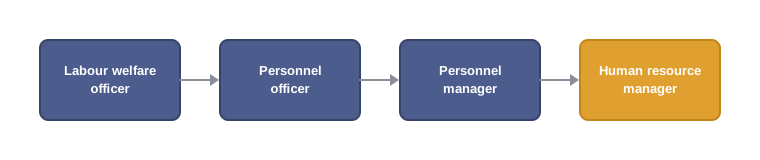
Fig. 6.3 – Evolution of human resource management.
From Labour Welfare To Personnel Management
The emergence of the trade union movement led to the need of a person who could act as an effective link between the owners and the workers. Thus, the concept of the labour welfare officer came into being. His role was limited to the bare minimum welfare activities of employees. In fact, he was looked down upon by both the workers and the owners, since neither side regarded him as truly its own.
With the introduction of the factory system, thousands of persons began to be employed under one roof. Hiring on such a scale could no longer be left to each supervisor, so the job of hiring people for the organisation was given to one man, who later on was assigned the responsibility of recruitment, selection and placement of personnel. This led to the emergence of the personnel officer in the first place and the personnel manager later on.
From Personnel Management To Human Resource Management
The human relations approach recognises the human factor as the most important instrument of success in an organisation. Fast changing technological developments, however, necessitated new skill development and training of employees, because the skills a worker already possessed became outdated within a few years.
People came to be recognised as a valuable resource, which can be further developed. Increase in the scope of the work led to the replacement of the personnel manager with the human resource manager, whose concern extends beyond hiring and record-keeping to training, appraisal and career growth.
You may have observed that all these aspects are concerned with the human element in industry as distinct from the mechanical side of the enterprise. Staffing is thus an inherent part of human resource management, as it is the practice of finding, evaluating and establishing a working relationship with people, for a purpose.
Staffing As A Function And As A Functional Area
It is important to understand that staffing is both a function of management, just like planning, organising, directing and controlling, and a distinct functional area of management, just as marketing management and financial management are. Every manager staffs the posts under him, and at the same time the subject has a specialised body of knowledge of its own.
Staffing is, therefore, referred to as both a line as well as a staff activity. It is an essential function of the manager, and it is also an advisory role played by the Human Resource Department, which assists other departments with expert help without itself commanding them.
6.6 Staffing Process
The prime concern of the staffing function in the management process is the timely fulfilment of the manpower requirements within an organisation. The word ‘timely’ is important, because a person appointed after the work has piled up is of limited use.
These requirements may arise in the case of starting a new business or expanding the existing one. They may also arise as a matter of the need for replacing those who quit, retire, are transferred or promoted from a post, or are fired from the job. In every one of these situations a post falls vacant and has to be filled.
The need for ‘the right person for the right job’ hardly needs an over emphasis. But just as the phrase ‘water water everywhere and not a drop to drink’ amplifies the fact that despite two-thirds of the earth being water, drinkable water is a scarce commodity, so may also be said of finding ‘the right person for the right job’. Applicants may be many; suitable applicants are few.
Staffing Seen As A Process
It is important to appreciate staffing as a process that starts from understanding the manpower requirements within the organisation and identifying the potential sources from where it can be met, either from within the organisation or from outside. And, given that ‘the right person’ is scarce, there is a need to ‘market’ the job and the organisation to the people, so that suitable persons are willing to apply.
Even in situations where a single job vacancy might attract a few hundreds of the applicants, there is a challenge of selecting the most appropriate one. A large number of applications makes the choice wider, but it also makes the task of judging more difficult.
Freshly appointed persons might need orientation or training to familiarise them with the way things are done in an organisation. And in case they have been selected only on the basis of academic qualifications and aptitude for learning, they might need training in specific skills as well. For example, if one is selected by a Business Process Outsourcing unit by virtue of being extrovert and well-versed in English speaking, one needs to be trained in the relevant business processes, telephone conversation etiquettes as well as diction adaptation before actual placement.
The employee’s experiences during orientation and placement form his or her ‘first impression’ of the organisation. Even whilst on the job, employees need training for upgradation of knowledge and skills and for preparing for higher responsibilities. So staff training and development is another important aspect of the staffing process. The complete sequence is summarised in Fig. 6.4.
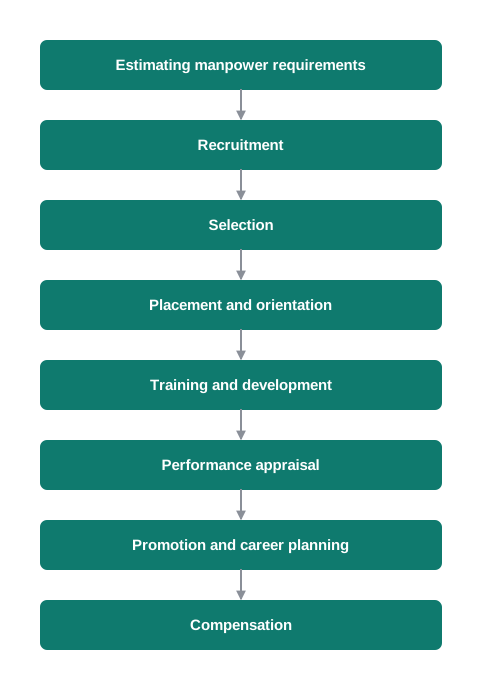
Fig. 6.4 – Steps in the staffing process.
A brief description of each of these stages follows.
Steps In The Staffing Process
Estimating the manpower requirements — while designing the organisation structure, an analysis is undertaken of the decisions, the decision-making levels, the activities and the relationships among them, with a view to evolving the horizontal and vertical dimensions of the structure. Thus, various job positions are created. Performance of each job necessitates the appointment of a person with a specific set of educational qualifications, skills, prior experience and so on. Understanding manpower requirements is therefore not merely a matter of knowing how many persons are needed, but also of what type.
Recruitment — recruitment may be defined as the process of searching for prospective employees and stimulating them to apply for jobs in the organisation. The information generated in the process of writing the job description and the candidate profile may be used for developing the ‘situations vacant’ advertisement. The advertisement may be displayed on the factory or office gate, or else it may be got published in print media or flashed in electronic media. This step involves locating the potential candidate or determining the sources of potential candidates, and a large number of recruitment avenues are available to a firm. The essential objective is to create a pool of the prospective job candidates. Both internal and external sources of recruitment may be explored; internal sources may be used to a limited extent, while for fresh talent and wider choice external sources are used.
Selection — selection is the process of choosing from among the pool of the prospective job candidates developed at the stage of recruitment. Even in the case of highly specialised jobs where the choice space is very narrow, the rigour of the selection process serves two important purposes. It ensures that the organisation gets the best among the available, and it enhances the self-esteem and prestige of those selected and conveys to them the seriousness with which the things are done in the organisation. The rigour involves a host of tests and interviews. Those who are able to successfully negotiate the test and the interviews are offered an employment contract, a written document containing the offer of employment, the terms and conditions and the date of joining.
Placement and orientation — joining a job marks the beginning of socialisation of the employee at the workplace. The employee is given a brief presentation about the company and is introduced to his superiors, subordinates and colleagues. He is taken around the workplace and given the charge of the job for which he has been selected. This process of familiarisation is very crucial and may have a lasting impact on his decision to stay and on his job performance. Orientation is thus introducing the selected employee to other employees and familiarising him with the rules and policies of the organisation, while placement refers to the employee occupying the position or post for which the person has been selected.
Training and development — what people seek is not simply a job but a career, and everyone must have the opportunity to rise to the top. The best way to provide such an opportunity is to facilitate employee learning. Organisations have either in-house training centres or have forged alliances with training and educational institutes to ensure continuing learning of their employees. The organisations too benefit in turn. If employee motivation is high, their competencies are strengthened, they perform better and thus contribute more to organisational effectiveness and efficiency. By offering the opportunities for career advancement to their members, organisations are not only able to attract but also retain their talented people.
In most organisations there is a separate Human Resource Department, which takes care of the staffing function. But in small organisations the line manager is required to perform all the functions of management, namely planning, organising, staffing, directing and controlling. The process of staffing will then include three more stages.
Performance appraisal — after the employees have undergone a period of training and have been on the job for some time, there is a need to evaluate their performance. All organisations have some formal or informal means of appraising their employee’s performance. The employee is expected to know what the standards are, and the superior is to provide the employee feedback on his or her performance. The process will therefore include defining the job, appraising performance and providing feedback.
Promotion and career planning — it becomes necessary for all organisations to address career related issues and promotional avenues for their employees. Managers need to design activities to serve employees’ long-term interests also. They must encourage employees to grow and realise their full potential. Promotions are an integral part of people’s career and refer to being placed in positions of increased responsibility. They usually mean more pay, responsibility and job satisfaction.
Compensation — all organisations need to establish wage and salary plans for their employees. There are various ways to prepare different pay plans depending on the worth of the job; basically, the price of the job needs to be determined. Compensation refers to all forms of pay or rewards going to employees. It may be in the form of direct financial payments like wages, salaries, incentives, commissions and bonuses, and indirect payments like employer paid insurance and vacations.
Estimating Manpower Requirements In Detail
Given that we need to encourage women, persons from backward communities and persons with special abilities, such as the physically challenged and the visually and hearing impaired, to assume responsible positions in our organisations, there is a need to understand, and if the need be, to redefine manpower requirements accordingly.
Operationally, understanding the manpower requirements would necessitate workload analysis on the one hand and workforce analysis on the other. Workload analysis would enable an assessment of the number and types of human resources necessary for the performance of various jobs and accomplishment of organisational objectives. Workforce analysis would reveal the number and type available.
In fact such an exercise would reveal whether we are understaffed, overstaffed or optimally staffed. It may be pointed out that neither over-staffing nor under-staffing is a desirable situation, and this exercise would form the basis of the subsequent staffing actions.
A situation of overstaffing somewhere would necessitate employee removal or transfer elsewhere. A situation of understaffing would necessitate the starting of the recruitment process. However, before that can be done, it is important to translate the manpower requirements into a specific job description and the desirable profile of its occupant, that is, the desired qualifications, experience, personality characteristics and so on. This information becomes the base for looking for potential employees.
Pay Plans Under Compensation
Direct financial payments are of two types, time based or performance based. A time based plan means salary and wages are paid either daily, weekly, monthly or annually. Performance based plans mean salary or wages are paid according to piecework; for example, a worker may be paid according to the number of units produced by him or her.
There are many methods to calculate the compensation under various incentive plans to reward performance. Certain pay plans can be created which are a combination of time based pay plus incentives for higher performance. Various plans may be formulated for paying employees time based wage or salary as well as performance based financial incentives and bonuses, and employee benefits.
Besides, there are some other factors also which influence the design of any pay plan, like legal considerations in the form of labour laws, the union, company policy and equity.
Staffing As Acquisition To Compensation
Thus, we see that as a process, staffing includes acquisition, retention, development, performance appraisal, promotion and compensation of the most important resource of an organisation, that is, its human capital.
It needs to be kept in mind that several factors will influence the way recruitment, selection and training are actually carried out. These include the supply and demand of specific skills in the labour market, the unemployment rate, labour market conditions, legal and political considerations, the company’s image and policy, human resource planning cost, technological developments and the general economic environment.
6.7 Aspects Of Staffing
There are three aspects of staffing: recruitment, selection and training. Recruitment brings applicants and the organisation into contact with each other, selection matches a particular applicant to a particular job, and training equips the selected person to perform that job. Each of these three is discussed in detail in the sections that follow.
The three aspects are linked, as shown in Fig. 6.5. The applicant, who is a person seeking work, and the organisation, which has a job to be filled, are brought together first through identification and attraction, then through assessment and final match, and finally through acquainting the person with the work and developing the skills it requires.
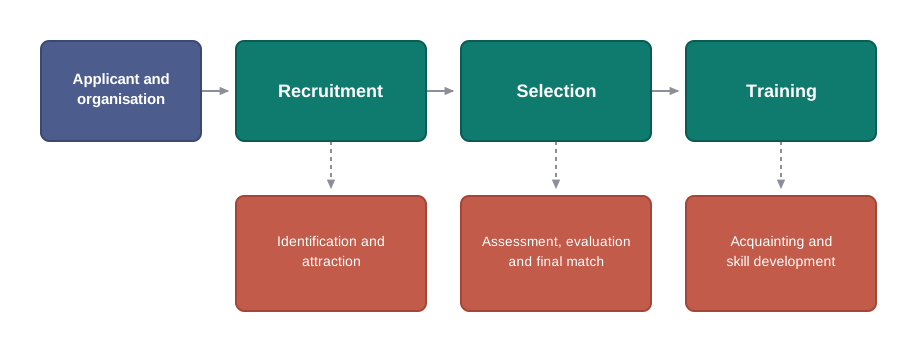
Fig. 6.5 – Linkage between the aspects of staffing.
6.8 Recruitment
Recruitment refers to the process of finding possible candidates for a job or a function. At this stage the organisation is not yet choosing anyone; it is only making sure that enough suitable persons come forward to be considered.
The definition has two parts, and both are necessary. ‘Searching’ means locating the persons who could do the job, and ‘stimulating them to apply’ means persuading those persons to actually send in their applications. A firm that finds suitable people but fails to interest them has not completed the recruitment step.
Advertising is commonly part of the recruitment process, and can occur through several means. These include newspapers, newspapers dedicated to job advertisement, professional publications, advertisements placed in windows, a job centre and campus interviews.
6.8.1 Sources Of Recruitment
The object of recruitment is to attract potential employees with the necessary characteristics or qualification, in adequate number for the jobs available. It locates available people for the job and invites them to apply for the job in the organisation.
The process of recruitment precedes the process of selection of a right candidate for the given positions in the organisation. This order cannot be reversed, because a firm can choose only from among those who have applied.
Activities Involved In Recruitment
The various activities involved with the process of recruitment include:
identification of the different sources of labour supply;
assessment of their validity;
choosing the most suitable source or sources; and
inviting applications from the prospective candidates, for the vacancies.
The requisite positions may be filled up from within the organisation or from outside. Thus, there are two sources of recruitment, internal and external, as set out in Fig. 6.6.
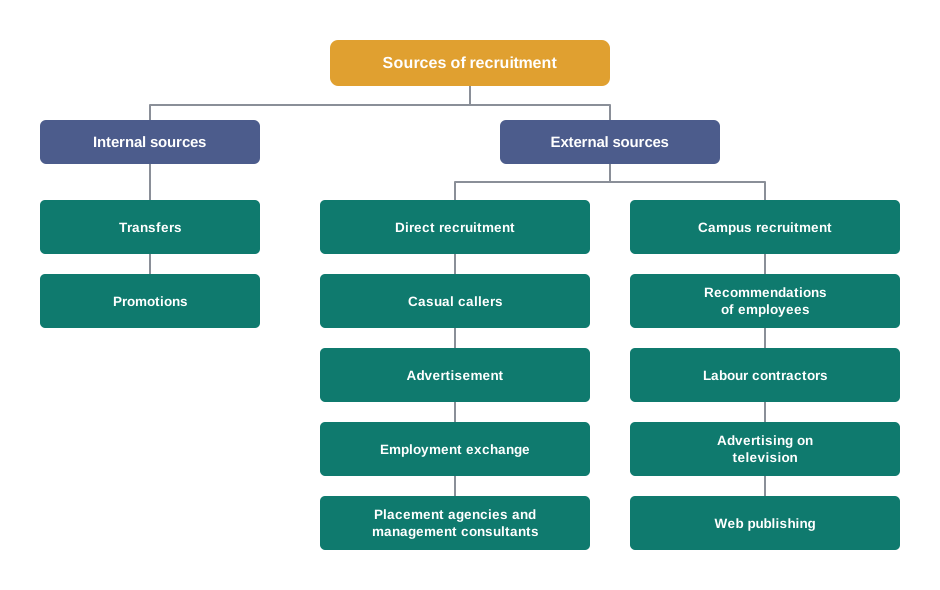
Fig. 6.6 – Sources of recruitment.
6.8.2 Internal Sources
There are two important sources of internal recruitment, namely transfers and promotions, which are discussed below.
Transfers — a transfer involves shifting of an employee from one job to another, one department to another or from one shift to another, without a substantive change in the responsibilities and status of the employee. It may lead to changes in duties and responsibilities and working conditions, but not necessarily in salary. Transfer is a good source of filling the vacancies with employees from over-staffed departments. It is practically a horizontal movement of employees. Shortage of suitable personnel in one branch may be filled through transfer from another branch or department. Job transfers are also helpful in avoiding termination and in removing individual problems and grievances. At the time of transfer, it should be ensured that the employee to be transferred to another job is capable of performing it. Transfers can also be used for training of employees for learning different jobs.
Promotions — business enterprises generally follow the practice of filling higher jobs by promoting employees from lower jobs. Promotion leads to shifting an employee to a higher position, carrying higher responsibilities, facilities, status and pay. Promotion is a vertical shifting of employees. This practice helps to improve the motivation, loyalty and satisfaction level of employees. It has a great psychological impact over the employees, because a promotion at the higher level may lead to a chain of promotions at lower levels in the organisation.
Merits Of Internal Sources
Filling vacancies in higher jobs from within the organisation or through internal transfers has the following merits:
Employees are motivated to improve their performance. A promotion at a higher level may lead to a chain of promotion at lower levels in the organisation. This motivates the employees to improve their performance through learning and practice. Employees work with commitment and loyalty and remain satisfied with their jobs. Also, peace prevails in the enterprise because of promotional avenues.
Internal recruitment also simplifies the process of selection and placement. The candidates that are already working in the enterprise can be evaluated more accurately and economically. This is a more reliable way of recruitment, since the candidates are already known to the organisation.
Transfer is a tool of training the employees to prepare them for higher jobs. Also, people recruited from within the organisation do not need induction training, as they already know the rules and working of the enterprise.
Transfer has the benefit of shifting workforce from the surplus departments to those where there is shortage of staff.
Filling of jobs internally is cheaper as compared to getting candidates from external sources.
Limitations Of Internal Sources
The limitations of using internal sources of recruitment are as follows:
When vacancies are filled through internal promotions, the scope for induction of fresh talent is reduced. Hence, complete reliance on internal recruitment involves the danger of ‘inbreeding’ by stopping the ‘infusion of new blood’ into the organisation.
The employees may become lethargic if they are sure of time-bound promotions, since the promotion no longer depends on their effort.
A new enterprise cannot use internal sources of recruitment, as it has no existing employees. No organisation can fill all its vacancies from internal sources.
The spirit of competition among the employees may be hampered.
Frequent transfers of employees may often reduce the productivity of the organisation.
6.8.3 External Sources
An enterprise has to tap external sources for various positions, because all the vacancies cannot be filled through internal recruitment. The existing staff may be insufficient in number, or they may not fulfil the eligibility criteria of the jobs to be filled. External recruitment provides wide choice and brings new blood into the organisation.
The commonly used external sources of recruitment are discussed below.
Direct recruitment — under direct recruitment, a notice is placed on the notice-board of the enterprise specifying the details of the jobs available. Job-seekers assemble outside the premises of the organisation on the specified date and selection is done on the spot. The practice of direct recruitment is followed usually for casual vacancies of unskilled or semi-skilled jobs. Such workers are known as casual or badli workers and they are paid remuneration on daily wage basis. This method of recruitment is very inexpensive, as it does not involve any cost of advertising the vacancies. It is suitable for filling casual vacancies when there is a rush of work or when some permanent workers are absent.
Casual callers — many reputed business organisations keep a database of unsolicited applicants in their offices. Such job-seekers can be a valuable source of manpower. A list of such job-seekers can be prepared and can be screened to fill the vacancies as they arise. The major merit of this source of recruitment is that it reduces the cost of recruiting workforce in comparison to other sources.
Advertisement — advertisement in newspapers or trade and professional journals is generally used when a wider choice is required. Most of the senior positions of industry as well as commerce are filled by this method. The advantage of advertising vacancies is that more information about the organisation and the job can be given in the advertisement, and it gives the management a wider range of candidates from which to choose. Its disadvantage is that it may bring in a flood of response, and many times from quite unsuitable candidates.
Employment exchange — employment exchanges run by the Government are regarded as a good source of recruitment for unskilled and skilled operative jobs. In some cases, compulsory notification of vacancies to the employment exchange is required by law. Thus, employment exchanges help to match personnel demand and supply by serving as a link between job-seekers and employers. Unfortunately, the records of employment exchanges are often not up to date and many of the candidates referred by them may not be found suitable.
Placement agencies and management consultants — in technical and professional areas, private agencies and professional bodies appear to be doing substantive work. Placement agencies provide a nationwide service in matching personnel demand and supply. These agencies compile bio-data of a large number of candidates and recommend suitable names to their clients. Such agencies charge a fee for their services and they are useful where extensive screening is required. These professional recruiters can entice the needed top executives from other companies by making the right offers. Management consultancy firms help the organisations to recruit technical, professional and managerial personnel. They specialise in middle level and top level executive placements, maintain a data bank of persons with different qualifications and skills, and even advertise the jobs on behalf of their clients to recruit the right type of personnel.
Campus recruitment — colleges and institutes of management and technology have become a popular source of recruitment for technical, professional and managerial jobs. Many big organisations maintain a close liaison with the universities, vocational schools and management institutes to recruit qualified personnel for various jobs. Recruitment from educational institutions is a well-established practice of businesses, and is referred to as campus recruitment.
Recommendations of employees — applicants introduced by present employees, or their friends and relatives, may prove to be a good source of recruitment. Such applicants are likely to be good employees, because their background is sufficiently known. A type of preliminary screening takes place because the present employees know both the company and the candidates, and they would try to satisfy both.
Labour contractors — labour contractors maintain close contacts with labourers and they can provide the required number of unskilled workers at short notice. Workers are recruited through labour contractors who are themselves employees of the organisation. The disadvantage of this system is that if the contractor himself decides to leave the organisation, all the workers employed through him will follow suit.
Advertising on television — the practice of telecasting of vacant posts over television is gaining importance these days. The detailed requirements of the job and the qualities required to do it are publicised along with the profile of the organisation where the vacancy exists.
Web publishing — the internet is becoming a common source of recruitment these days. There are certain websites specifically designed and dedicated for the purpose of providing information about both job seekers and job openings. In fact, such websites are very commonly visited both by the prospective employees and the organisations searching for suitable people.

Fig. 6.7 – A campus recruitment interview.
Merits Of External Sources
The advantages of using external sources of recruitment are as follows:
Qualified personnel — by using external sources of recruitment, the management can attract qualified and trained people to apply for vacant jobs in the organisation.
Wider choice — when vacancies are advertised widely, a large number of applicants from outside the organisation apply. The management has a wider choice while selecting the people for employment.
Fresh talent — the present employees may be insufficient or they may not fulfil the specifications of the jobs to be filled. External recruitment provides wider choice and brings new blood into the organisation. However, it is expensive and time-consuming.
Competitive spirit — if a company taps external sources, the existing staff will have to compete with the outsiders. They will work harder to show better performance.
Limitations Of External Sources
Dissatisfaction among existing staff — external recruitment may lead to dissatisfaction and frustration among existing employees. They may feel that their chances of promotion are reduced.
Lengthy process — recruitment from external sources takes a long time. The business has to notify the vacancies and wait for applications to initiate the selection process.
Costly process — it is very costly to recruit staff from external sources. A lot of money has to be spent on advertisement and processing of applications.
6.9 Selection
Selection is the process of identifying and choosing the best person out of a number of prospective candidates for a job. Towards this purpose, the candidates are required to take a series of employment tests and interviews. At every stage many are eliminated and a few move on to the next stage until the right type is found.
The process may start right from the screening of the applications. It may continue even after the offer of employment, acceptance and joining of the candidate. This is so because the process of selection, like any other managerial decision, involves judgment about the performance potential of the candidate, and a judgment about the future can only be confirmed later.
The effectiveness of the selection process would ultimately be tested in terms of the on-the-job performance of the chosen person. If the person selected performs well, the process has worked; if not, the fault usually lies somewhere in the selection.
6.9.1 Process Of Selection
The important steps in the process of selection are given below. The sequence is summarised in Fig. 6.8.
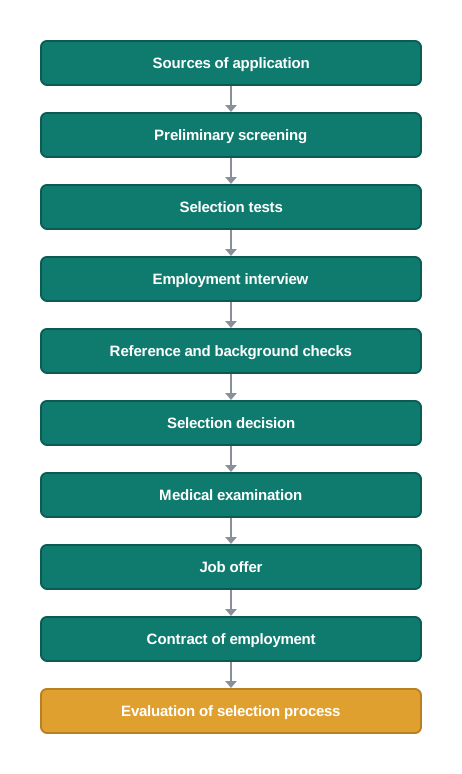
Fig. 6.8 – Steps in the selection process.
Preliminary screening — preliminary screening helps the manager eliminate unqualified or unfit job seekers based on the information supplied in the application forms. Preliminary interviews help reject misfits for reasons which did not appear in the application forms. This step saves the time and cost of testing candidates who clearly do not meet the basic requirements.
Selection tests — an employment test is a mechanism, either a paper and pencil test or an exercise, that attempts to measure certain characteristics of individuals. These characteristics range from aptitudes, such as manual dexterity, to intelligence to personality. The important selection tests used for selection of employees are described below.
Employment interview — an interview is a formal, in-depth conversation conducted to evaluate the applicant’s suitability for the job. The role of the interviewer is to seek information and that of the interviewee is to provide the same. Though, in present times, the interviewee also seeks information from the interviewer about the job and the organisation.
Reference and background checks — many employers request names, addresses and telephone numbers of references for the purpose of verifying information and gaining additional information on an applicant. Previous employers, known persons, teachers and university professors can act as references.
Selection decision — the final decision has to be made from among the candidates who pass the tests, interviews and reference checks. The views of the concerned manager will be generally considered in the final selection, because it is he or she who is responsible for the performance of the new employee.
Medical examination — after the selection decision and before the job offer is made, the candidate is required to undergo a medical fitness test. The job offer is given to the candidate being declared fit after the medical examination.
Job offer — the next step in the selection process is the job offer to those applicants who have passed all the previous hurdles. The job offer is made through a letter of appointment, which the candidate is asked to sign to confirm his acceptance. Such a letter generally contains a date by which the appointee must report on duty, and the appointee must be given reasonable time for reporting.
Contract of employment — after the job offer has been made and the candidate accepts the offer, certain documents need to be executed by the employer and the candidate. One such document is the attestation form. This form contains certain vital details about the candidate, which are authenticated and attested by him or her, and it will be a valid record for future reference.
Contents Of The Contract Of Employment
There is also a need for preparing a contract of employment. The basic information that should be included in a written contract of employment will vary according to the level of the job, but the following checklist sets out the typical headings: job title, duties, responsibilities, the date when continuous employment starts and the basis for calculating service, rates of pay, allowances, hours of work, leave rules, sickness, grievance procedure, disciplinary procedure, work rules and termination of employment.
Important Tests Used For Selection Of Employees
Intelligence tests — this is one of the important psychological tests used to measure the level of intelligence quotient of an individual. It is an indicator of a person’s learning ability or the ability to make decisions and judgments.
Aptitude test — it is a measure of an individual’s potential for learning new skills. It indicates the person’s capacity to develop, and such tests are good indices of a person’s future success score.
Personality tests — personality tests provide clues to a person’s emotions, her reactions, maturity and value system. These tests probe the overall personality, and hence they are difficult to design and implement.
Trade test — these tests measure the existing skills of the individual. They measure the level of knowledge and proficiency in the area of professions or technical training.
Interest tests — every individual has a fascination for some job more than another. Interest tests are used to know the pattern of interests or involvement of a person.
6.10 Training And Development
It has rightly been said that planning for a single year calls for sowing seeds, planning for ten years calls for planting trees, and planning for a lifetime calls for developing people. An organisation that wants to last has to invest in the abilities of its employees.
Training and development is an attempt to improve the current or future employee performance by increasing an employee’s ability to perform through learning. This is usually achieved by changing the employee’s attitude or by increasing his or her skills and knowledge.
6.10.1 Importance Of Training And Development
When jobs were simple, easy to learn and influenced to only a small degree by technological changes, there was little need for employees to upgrade or alter their skills. A worker learned the job once and could continue with the same skills for many years.
But the rapid changes taking place during the last quarter century in our highly sophisticated and complex society have created increased pressures for organisations. They have had to readapt the products and services produced, the manner in which products and services are produced and offered, the types of jobs required and the types of skills necessary to complete these jobs. Thus, as jobs have become more complex, the importance of employee training has increased.
Training and development help both the organisation and the individual, and the benefits to each are set out below.
Benefits To The Organisation
Training is a systematic learning, always better than hit and trial methods which lead to wastage of efforts and money.
It enhances employee productivity both in terms of quantity and quality, leading to higher profits.
Training equips the future manager who can take over in case of emergency, so that the work does not suffer when a senior person is absent or leaves.
Training increases employee morale and reduces absenteeism and employee turnover.
It helps in obtaining effective response to a fast changing environment, both technological and economic.
Benefits To The Employee
Improved skills and knowledge due to training lead to a better career of the individual.
Increased performance by the individual helps him to earn more.
Training makes the employee more efficient to handle machines, and he is thus less prone to accidents.
Training increases the satisfaction and morale of employees.
6.10.2 Training, Development And Education
The term training is used to indicate the process by which attitudes, skills and abilities of employees to perform specific jobs are increased. But the term development means growth of the individual in all respects. Training is a short term process, but development is an ongoing process. Also, development includes training.
It also needs to be understood that training, education and development are distinct terms, although they overlap to some extent. Each of the three is explained below.
Education imparts qualities of mind and character and understanding of the basic principles, and develops the capacities of analysis, synthesis and objectivity. Education is broader in scope than training, because training is tied to the goals of organisations more than to the goals of the individual.
The purpose of development is that employees become not only good employees but better men and women. Its concern is therefore with the whole person and the whole career, and not only with the present job.
The field of training and development deals with the design and delivery of learning to improve performance within organisations. In some organisations the term Learning and Development is used instead of Training and Development, in order to emphasise the importance of learning for the individual and the organisation. In other organisations, the term Human Resource Development is used.
6.11 Training Methods
There are various methods of training. These are broadly categorised into two groups, on-the-job methods and off-the-job methods, as shown in Fig. 6.9.
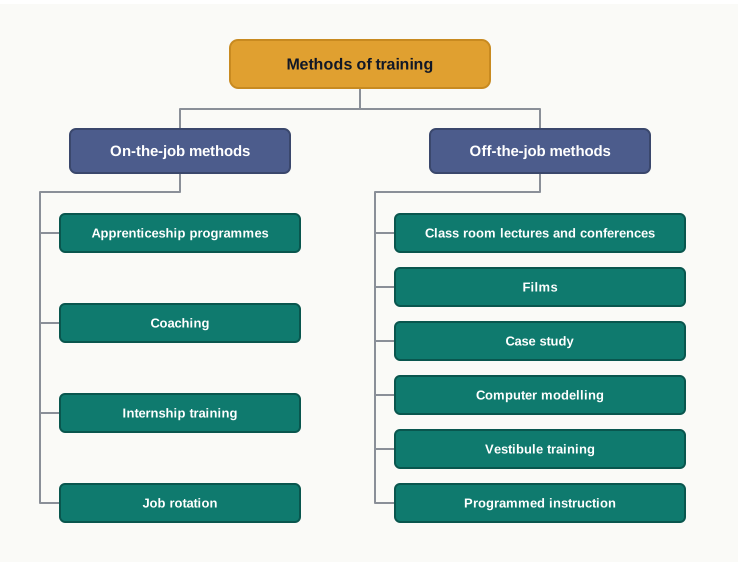
Fig. 6.9 – Classification of training methods.
On-the-job methods refer to the methods that are applied at the workplace, while the employee is actually working. Off-the-job methods are used away from the work place. The former means learning while doing, while the latter means learning before doing.
The distinction matters in practice. Where a mistake by an untrained person would be costly or dangerous, the organisation prefers to train the employee before he begins the actual work.
6.11.1 On The Job Methods
Apprenticeship programmes — apprenticeship programmes put the trainee under the guidance of a master worker. These are designed to acquire a higher level of skill. People seeking to enter skilled jobs, to become, for example, plumbers, electricians or iron-workers, are often required to undergo apprenticeship training. These apprentices are trainees who spend a prescribed amount of time working with an experienced guide or trainer. A uniform period of training is offered to trainees, in which both fast and slow learners are placed together, and slow learners may require additional training.
Coaching — in this method, the superior guides and instructs the trainee as a coach. The coach or counsellor sets mutually agreed upon goals, suggests how to achieve these goals, periodically reviews the trainee’s progress and suggests changes required in behaviour and performance. The trainee works directly with a senior manager and the manager takes full responsibility for the trainee’s coaching. Classically the trainee is being groomed to replace the senior manager and relieve him from some of his duties, which gives a chance for the trainee to learn the job also.
Internship training — it is a joint programme of training in which educational institutions and business firms cooperate. Selected candidates carry on regular studies for the prescribed period. They also work in some factory or office to acquire practical knowledge and skills.
Job rotation — this kind of training involves shifting the trainee from one department to another or from one job to another. This enables the trainee to gain a broader understanding of all parts of the business and how the organisation as a whole functions. The trainee gets fully involved in the department’s operations and also gets a chance to test her own aptitude and ability. Job rotation allows trainees to interact with other employees, facilitating future cooperation among departments. When employees are trained by this method, the organisation finds it easier at the time of promotions, replacements or transfers.
6.11.2 Off The Job Methods
Class room lectures and conferences — the lecture or conference approach is well adapted to conveying specific information such as rules, procedures or methods. The use of audio-visuals or demonstrations can often make a formal classroom presentation more interesting, while increasing retention and offering a vehicle for clarifying more difficult points.
Films — films can provide information and explicitly demonstrate skills that are not easily represented by the other techniques. Used in conjunction with conference discussions, this is a very effective method in certain cases.
Case study — taken from actual experiences of organisations, cases represent attempts to describe, as accurately as possible, real problems that managers have faced. Trainees study the cases to determine problems, analyse causes, develop alternative solutions, select what they believe to be the best solution, and implement it.
Computer modelling — it simulates the work environment by programming a computer to imitate some of the realities of the job. It allows learning to take place without the risk or high costs that would be incurred if a mistake were made in a real life situation.
Vestibule training — employees learn their jobs on the equipment they will be using, but the training is conducted away from the actual work floor. Actual work environments are created in a class room and employees use the same materials, files and equipment. This is usually done when employees are required to handle sophisticated machinery and equipment.
Programmed instruction — this method incorporates a prearranged and proposed acquisition of some specific skills or general knowledge. Information is broken into meaningful units and these units are arranged in a proper way to form a logical and sequential learning package, that is, from simple to complex. The trainee goes through these units by answering questions or filling the blanks.
6.12 Summary
Meaning — staffing is the managerial function of filling and keeping filled the positions in the organisation structure. This is achieved by first identifying the requirement of work force, followed by recruitment, selection, placement, promotion, appraisal and development of personnel, to fill the roles designed into the organisation structure.
Need and importance of staffing — in any organisation there is a need for people to perform work. The staffing function of management fulfils this requirement and finds the right people for the right job. The function has assumed greater importance these days because of rapid advancement of technology, increasing size of organisations and the complicated behaviour of human beings. The ability of an organisation to achieve its goal depends upon the quality of its human resources.
Staffing as a part of human resource management — staffing is a function which all managers need to perform. It is a separate and specialised function, and there are many aspects of human relations to be considered.
Role of managers — it is the responsibility of all managers to directly deal with and select people to work for the organisation. When the manager performs the staffing function his role is slightly limited. In small organisations, managers may perform all duties related to employees’ salaries, welfare and working conditions.
Growth of a separate department — as organisations grow and the number of persons employed increases, a separate department called the human resource department is formed, which has specialists in the field to manage people. Human resource management includes many specialised activities and duties which the human resource personnel must perform.
Evolution of human resource management — human resource management has replaced the traditional concept of labour welfare and personnel management. It has evolved from a number of significant inter-related developments, which date back to the era of industrial revolution. The emergence of the trade union movement led to the need of a person who could act as an effective link between the owners and the workers.
Staffing within human resource management — all these aspects are concerned with the human element in industry as distinct from the mechanical side of the enterprise. Staffing is thus an inherent part of human resource management, as it is the practice of finding, evaluating and establishing a working relationship with people, for a purpose.
Staffing process — the prime concern of the staffing function in the management process is the timely fulfilment of the manpower requirements within an organisation.
Estimating the manpower requirements — performance of each job necessitates the appointment of a person with a specific set of educational qualifications, skills, prior experience and so on. Operationally, understanding the manpower requirements would necessitate workload analysis on the one hand and workforce analysis on the other.
Recruitment — recruitment may be defined as the process of searching for prospective employees and stimulating them to apply for jobs in the organisation.
Selection — selection is the process of choosing from among the pool of the prospective job candidates developed at the stage of recruitment.
Placement and orientation — orientation is introducing the selected employee to other employees and familiarising him with the rules and policies of the organisation. Placement refers to the employee occupying the position or post for which the person has been selected.
Training and development in the staffing process — what people seek is not simply a job but a career, and everyone must have the opportunity to rise to the top. The best way to provide such an opportunity is to facilitate employee learning.
Sources of recruitment — the requisite positions may be filled up from within the organisation or from outside. Thus, there are two sources of recruitment, internal and external.
Internal sources — recruitment from within the enterprise. There are two important sources of internal recruitment, namely transfers and promotions.
External sources — an enterprise has to tap external sources for various positions, because all the vacancies cannot be filled through internal recruitment. The commonly used external sources of recruitment are direct recruitment, casual callers, advertisement, employment exchange, placement agencies and management consultants, campus recruitment, recommendations of employees, labour contractors, advertising on television and web publishing.
Process of selection — the steps are preliminary screening through the application form, selection tests, employment interview, reference and background checks, selection decision, medical examination, job offer and contract of employment. The selection tests used include intelligence tests, aptitude test, personality tests, trade test and interest tests.
Need of training and development — the rapid changes taking place in our highly sophisticated and complex society have created increased pressures for organisations to readapt the products and services produced, the manner in which products and services are produced and offered, the types of jobs required and the types of skills necessary to complete these jobs.
Training — training is any process by which the aptitudes, skills and abilities of employees to perform specific jobs are increased.
Education — education is the process of increasing the knowledge and understanding of employees. It is the understanding and interpretation of knowledge.
Development — development refers to the learning opportunities designed to help employees grow.
Training methods — there are various methods of training, broadly categorised into two groups, on-the-job methods and off-the-job methods. The on-the-job methods are apprenticeship programmes, coaching, internship training and job rotation. The off-the-job methods are class room lectures and conferences, films, case study, computer modelling, vestibule training and programmed instruction.
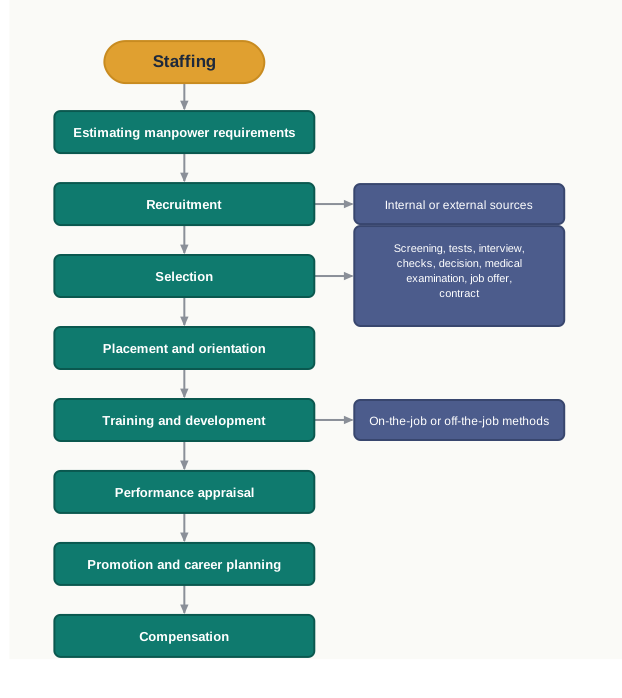
Fig. 6.10 – Overview of the staffing chapter.
6.13 Key Terms
- Staffing The managerial function of filling and keeping filled the positions in the organisation structure.
- Succession Planning Preparing employees in advance to take over managerial positions that fall vacant.
- Human Resource Management The specialised area of management that deals with the acquisition, development, welfare and relations of the people employed in an organisation.
- Personnel Management The earlier concept of managing employees, limited largely to hiring, welfare and administration of personnel.
- Recruitment The process of searching for prospective employees and stimulating them to apply for jobs in an organisation.
- Selection The process of choosing from among the pool of prospective job candidates developed at the stage of recruitment.
- Orientation Introducing the selected employee to other employees and familiarising him with the rules and policies of the organisation.
- Placement The employee occupying the position or post for which the person has been selected.
- Performance Appraisal Evaluating an employee’s current or past performance as against certain predetermined standards.
- Compensation All forms of pay or rewards going to employees, whether direct or indirect.
- Workload Analysis An assessment of the number and types of human resources necessary for the performance of various jobs and the accomplishment of organisational objectives.
- Workforce Analysis An assessment of the number and type of human resources already available in the organisation.
- Job Description A written statement of the duties and requirements of a particular post, along with the desirable profile of its occupant.
- Transfer Shifting an employee from one job, department or shift to another without a substantive change in responsibilities and status.
- Promotion Shifting an employee to a higher position carrying higher responsibilities, facilities, status and pay.
- Selection Tests Mechanisms, in the form of a written test or an exercise, that attempt to measure certain characteristics of individuals.
- Training Any process by which the aptitudes, skills and abilities of employees to perform specific jobs are increased.
- Education The process of increasing the knowledge and understanding of employees.
- Development The learning opportunities designed to help employees grow, in job performance as well as in personality.
- On-The-Job Methods Methods of training applied at the workplace while the employee is actually working.
- Off-The-Job Methods Methods of training conducted away from the workplace, before the employee takes up the actual work.
6.14 NCERT Questions
Very Short Answer Type
- What is meant by staffing?
- State the two important sources of recruitment.
- The workers of a factory are unable to work on new machines and always demand the help of the supervisor. The supervisor is overburdened with their frequent calls. Suggest the remedy.
- The quality of production is not as per standards. On investigation it was observed that most of the workers were not fully aware of the proper operation of the machinery. What could be the way to improve the quality of production to meet the standards?
- The workers of a factory remain idle because of lack of knowledge of hi-tech machines. Frequent visits of an engineer are made, which cause high overhead charges. How can this problem be removed?
Short Answer Type
- What is meant by recruitment? How is it different from selection?
- An organisation provides security services. It requires such candidates who are reliable and do not leak out the secrets of their clients. What steps should be incorporated in the selection process?
- A company is manufacturing paper plates and bowls. It produces 1,00,000 plates and bowls each day. Due to a local festival, it got an urgent order of extra 50,000 plates and bowls. Explain the method of recruitment that the company should adopt in the given circumstances to meet the order.
- Distinguish between training and development.
- Why are internal sources of recruitment considered to be more economical?
- ‘No organisation can be successful unless it fills and keeps the various positions filled with the right kind of people for the right job.’ Elucidate.
Long Answer Type
- ‘Human resource management includes many specialised activities and duties.’ Explain.
- Explain the procedure for selection of employees.
- What are the advantages of training to the individual and to the organisation?
- Kaul Consultants have launched a website exclusively for senior management professionals. The portal lists out senior level jobs and ensures that the job is genuine through a rigorous screening process.
- State the source of recruitment highlighted in the case above.
- State four benefits of the above identified source of recruitment.
- A company, Xylo Limited, is setting up a new plant in India for manufacturing auto components. India is a highly competitive and cost effective production base in this sector. Many reputed car manufacturers source their auto components from here. Xylo Limited is planning to capture about 40 per cent of the market share in India and also to export to the tune of at least ₹50 crores in about 2 years of its planned operations. To achieve these targets it requires a highly trained and motivated work force. You have been retained by the company to advise it in this matter. While giving answers keep in mind the sector the company is operating in.
- Outline the process of staffing the company should follow.
- Which sources of recruitment should the company rely upon? Give reasons for your recommendation.
- Outline the process of selection the company should follow, with reasons.
- A major insurance company handled all recruiting, screening and training processes for data entry and customer service representatives. Their competitor was attracting most of the qualified, potential employees in their market. Recruiting was made even more difficult by the strong economy and the ‘jobseeker’s market’. This resulted in the client having to choose from candidates who had the ‘soft’ skills needed for the job, but lacked the proper ‘hard’ skills and training.
- As an HR manager, what problems do you see in the company?
- How do you think it can be resolved and what would be its impact on the company?
- Ms. Jayshree recently completed her Post Graduate Diploma in Human Resource Management. A few months from now a large steel manufacturing company appointed her as its human resource manager. As of now, the company employs 800 persons and has an expansion plan in hand which may require another 200 persons for various types of additional requirements. Ms. Jayshree has been given complete charge of the company’s Human Resource Department.
- Point out what functions she is supposed to perform.
- What problems do you foresee in her job?
- What steps is she going to take to perform her job efficiently?
- How significant is her role in the organisation?
6.15 Check Your Concepts
- Why is staffing described as a function of filling and ‘keeping filled’ the positions in the organisation structure?
- Why does the staffing function follow planning and organising in a new enterprise, and why does it become a continuous process in an existing enterprise?
- Distinguish between transfer and promotion on the basis of nature of movement, change in status and change in pay.
- What happens to an organisation that relies completely on internal sources of recruitment? Explain with reference to ‘inbreeding’.
- Why is workforce analysis of no use to a manager unless workload analysis has also been carried out?
- Arrange the following steps of the selection process in the correct order: medical examination, preliminary screening, job offer, employment interview, selection tests, contract of employment, reference and background checks, selection decision.
- Identify the term: the test that measures the actual skills a candidate already possesses in a trade or profession.
- Assertion — recruitment is described as a positive process while selection is described as a negative process. Reason — recruitment attempts to increase the number of applicants, whereas selection rejects candidates at every stage until one remains. Choose the correct option.
- Both assertion and reason are true, and reason is the correct explanation of assertion.
- Both assertion and reason are true, but reason is not the correct explanation of assertion.
- Assertion is true but reason is false.
- Assertion is false but reason is true.
- State the group to which each of the following methods of training belongs, on-the-job or off-the-job:
- job rotation
- vestibule training
- coaching
- programmed instruction
- apprenticeship programmes
- computer modelling
- Why is vestibule training preferred to on-the-job learning where sophisticated and costly machinery is involved?
- Distinguish between education and training on the basis of purpose and scope.
- What happens if an organisation performs recruitment well but performs orientation poorly? Explain the likely effect on the new employee.
- Why is compensation regarded as a part of the staffing process rather than only a matter of accounting?
6.16 Case-Based Questions
- Girish Enterprises Ltd. manufactures electrical fittings and has grown from 40 workers to 500 workers in four years. Till last year its production manager fixed wages, sanctioned leave and settled complaints himself, and he now finds that he has no time left for production planning. The directors decide to create a separate department staffed by specialists to handle these matters.
- Identify the department the directors have decided to create.
- State any three duties that the personnel of this department will perform.
- Tarun Instruments Ltd. needs to fill the post of quality inspector. It first informs its existing employees of the vacancy and considers those working as senior operators for the post. The management believes this will encourage the operators and will also save the expense of advertising.
- Name the source of recruitment being used by the company.
- State any two merits and any two limitations of relying on this source.
- Meghdoot Airways Ltd. is appointing cabin staff. Applications are first sorted to remove those without the required qualification. The remaining candidates appear for tests that judge their potential to learn new skills and reveal their temperament and emotional maturity. Those who clear the tests are interviewed, and their previous employers are contacted before the final decision is taken.
- Name the first step of the selection process described above.
- Identify the two types of selection tests referred to and state what each measures.
- Sujata Chemicals Ltd. has installed a new automated mixing plant. The company sets up the same controls and containers in a training hall away from the shop floor and trains its operators there for three weeks before they are allowed to work on the actual plant. Its neighbouring unit instead lets its workers learn directly on the running plant and has suffered two spoiled batches.
- Name the training method adopted by Sujata Chemicals Ltd.
- Explain why this method is suitable in the given situation.