Chapter 3: Business Environment
Every business works inside a wider world that it does not control. Interest rates, consumer tastes, technology, government policy and the law all lie outside the factory gate, yet each of them can decide whether a firm grows or struggles. This surrounding set of forces is called the business environment.
Consider Dharamveer Kamboj, a former rickshaw puller from the Yamunanagar district of Haryana. While travelling through Rajasthan he saw women in self-help groups grating gooseberries by hand, because the processing machines then available were too costly for such small units. He designed a low-cost multipurpose fruit and vegetable processing machine, and his work was later supported by the National Innovation Foundation. The opportunity he identified was created by social conditions, income levels and the state of technology around him — all parts of the business environment.
A single firm can rarely change these forces. What it can do is study them, respond to them and plan accordingly.
This chapter explains the meaning and features of the business environment, why its understanding matters, its five dimensions, the economic environment in India, and the effect of the 1991 reforms and demonetisation on business and industry.
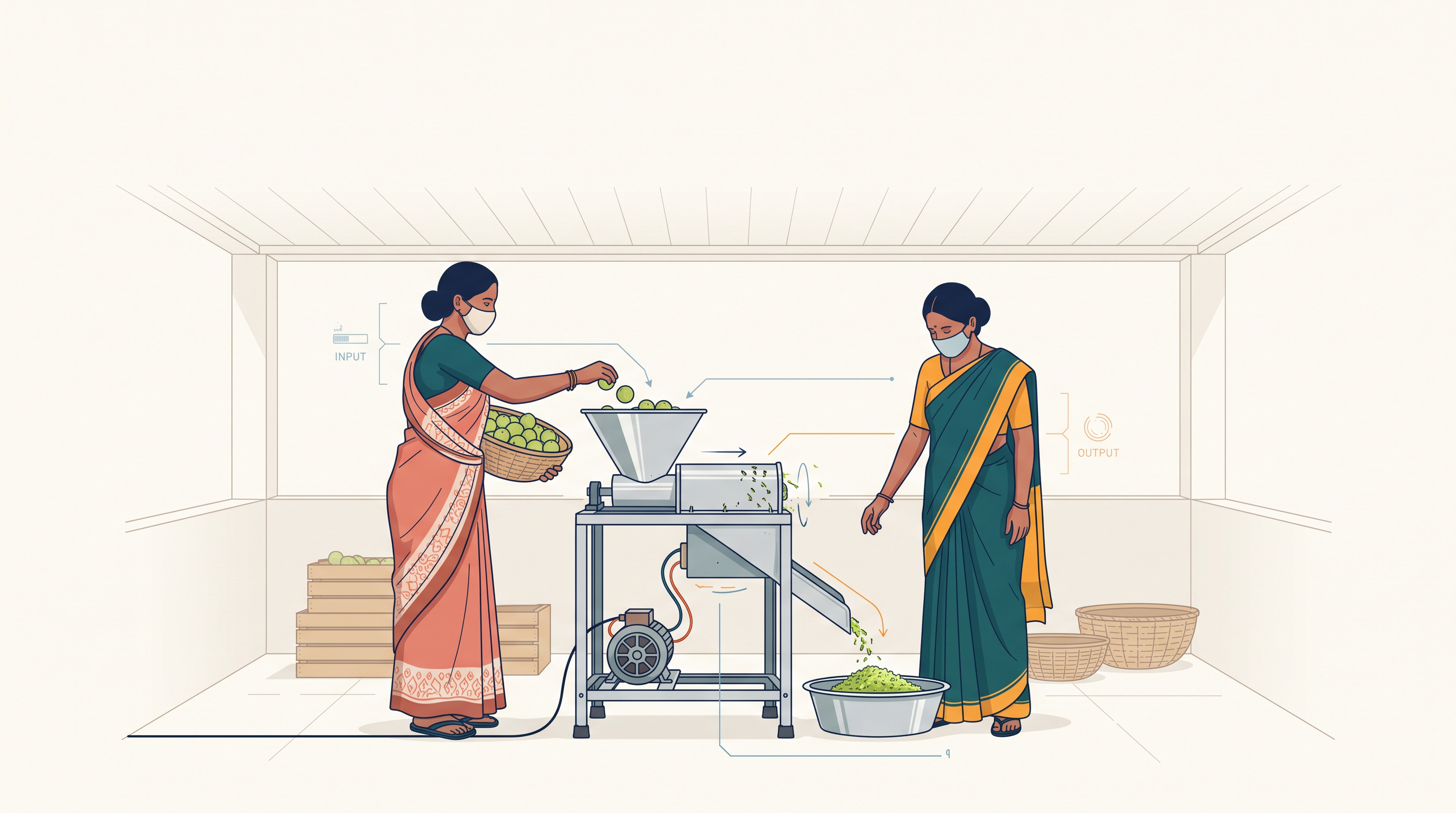
Fig. 3.0 – A small rural food processing unit.
3.1 Meaning of Business Environment
No business works in isolation. A firm buys raw materials from suppliers, sells to customers, competes with rival firms, borrows from banks, pays taxes to the government and works within the laws of the country. All of these lie outside the firm, yet all of them shape what it can and cannot do.
The term business environment means the sum total of all individuals, institutions and other forces that are outside the control of a business enterprise but that may affect its performance. One writer has explained it simply — take the whole universe, remove from it the part that represents the organisation, and whatever remains is the environment.
Thus the economic, social, political, technological and other forces operating outside a business enterprise form part of its environment. So do individual consumers, competing enterprises, governments, consumer groups, competitors, courts, media and other institutions working outside the enterprise.
The important point is that these individuals, institutions and forces exist outside the boundaries of the firm, and yet they are likely to influence its performance. The firm cannot command them, but it must live with them.
How External Forces Affect A Firm
A few everyday illustrations make this clear. A change in the government’s economic policies, rapid technological developments, political uncertainty, a shift in the fashions and tastes of consumers, or increased competition in the market — each of these influences the working of a business enterprise in important ways.
An increase in taxes by the government can make goods expensive to buy. Technological improvements may render existing products obsolete. Political uncertainty may create fear in the minds of investors. Changes in the fashions and tastes of consumers may shift demand from existing products to new ones. Increased competition in the market may reduce the profit margins of firms.
Features Of Business Environment
From the discussion above, the business environment can be said to have the following features.
Totality of external forces — business environment is the sum total of all things external to business firms. It is aggregative in nature, that is, it is made up of many forces taken together rather than any single force.
Specific and general forces — business environment includes both specific and general forces. Specific forces, such as investors, customers, competitors and suppliers, affect individual enterprises directly and immediately in their day-to-day working. General forces, such as social, political, legal and technological conditions, have an impact on all business enterprises and thus may affect an individual firm only indirectly.
Inter-relatedness — the different elements or parts of the business environment are closely inter-related. For example, increased life expectancy of people and increased awareness of health care have raised the demand for many health products and services such as soft drinks, fat-free cooking oil and health resorts. These new health products and services have, in turn, changed people’s life styles.
Dynamic nature — business environment is dynamic in that it keeps on changing, whether in terms of technological improvement, shifts in consumer preferences or the entry of new competition in the market.
Uncertainty — business environment is largely uncertain, as it is very difficult to predict future happenings. This is especially so when environmental changes take place too frequently, as in the case of the information technology or fashion industries.
Complexity — since the business environment consists of numerous interrelated and dynamic conditions or forces arising from different sources, it becomes difficult to comprehend at once what exactly constitutes a given environment. Environment is therefore a complex phenomenon that is relatively easier to understand in parts but difficult to grasp in its totality. For example, it may be difficult to know the extent of the relative impact of the social, economic, political, technological or legal factors on a change in the demand for a product in the market.
Relativity — business environment is a relative concept, since it differs from country to country and even from region to region. Political conditions in the USA, for instance, differ from those in China or Pakistan. Similarly, the demand for sarees may be fairly high in India, whereas it may be almost non-existent in France.
Specific Forces And General Forces Compared
Because the distinction between specific and general forces is frequently tested, the differences between the two are set out in Table 3.1.
3.2 Importance of Business Environment
Just as human beings do not live in isolation, business enterprises do not exist in isolation either. No business firm is an island unto itself. It exists, survives and grows within the context of the elements and forces of its environment.
An individual firm can do very little to change or control these forces. It therefore has no alternative to responding to them or adapting according to them. A good understanding of the environment enables business managers not only to identify and evaluate the forces external to their firms, but also to react to them in time.
The importance of the business environment, and of its understanding by managers, can be appreciated from the following facts.
It enables the firm to identify opportunities and get the first mover advantage — opportunities refer to the positive external trends or changes that will help a firm to improve its performance. The environment provides numerous opportunities for business success. Early identification of an opportunity helps an enterprise to be the first to exploit it, instead of losing it to competitors.
It helps the firm to identify threats and early warning signals — threats refer to the external environmental trends and changes that will hinder a firm’s performance. Besides opportunities, the environment happens to be the source of many threats. Environmental awareness helps managers to identify various threats on time and serves as an early warning signal. For example, if an Indian firm finds that a foreign multinational is entering the Indian market with new substitutes, it should treat this as a warning signal. On the basis of this information, Indian firms can prepare themselves to meet the threat by adopting such measures as improving the quality of the product, reducing the cost of production, engaging in aggressive advertising, and so on.
It helps in tapping useful resources — the environment is a source of the various resources needed for running a business. To carry on any activity, a business enterprise assembles resources called inputs, such as finance, machines, raw materials, power and water, and labour, from its environment, including financiers, government and suppliers. These suppliers of resources decide to provide them with their own expectation of getting something in return from the enterprise. The enterprise, in turn, supplies the environment with its outputs, such as goods and services for customers, payment of taxes to the government, and return on financial investment to investors. Because the enterprise depends on the environment both as a source of inputs and as an outlet for outputs, it only makes sense that it designs policies which allow it to obtain the resources it needs and convert them into the outputs the environment desires. This can be done better by understanding what the environment has to offer.
It helps in coping with rapid changes — today’s business environment is becoming increasingly dynamic, with changes taking place at a fast pace. It is not the fact of change itself that is so important as the pace of change. Turbulent market conditions, less brand loyalty, divisions and sub-divisions of markets, more demanding customers, rapid changes in technology and intense global competition are just a few of the images used to describe today’s business environment. Enterprises of all sizes and types face an increasingly dynamic environment. To cope effectively with these significant changes, managers must understand and examine the environment and develop suitable courses of action.
It helps in assisting in planning and policy formulation — since the environment is a source of both opportunities and threats, its understanding and analysis can be the basis for deciding the future course of action, which is planning, or for framing guidelines for decision making, which is policy. For instance, the entry of new players in the market, which means more competition, may make an enterprise think afresh about how to deal with the situation.
It helps in improving performance — the final reason for understanding the business environment relates to whether it really makes a difference to the performance of an enterprise. It does appear to make a difference. Many studies reveal that the future of an enterprise is closely bound up with what is happening in its environment. Enterprises that continuously monitor their environment and adopt suitable business practices are the ones which not only improve their present performance but also continue to succeed in the market for a longer period.
Why The Firm Depends On Its Environment
The third point above deserves a closer look, because it explains the basic relationship between a firm and the world outside it. A business is not a closed system. It draws resources in, converts them, and sends the results back out. This exchange is summarised in Fig. 3.1.
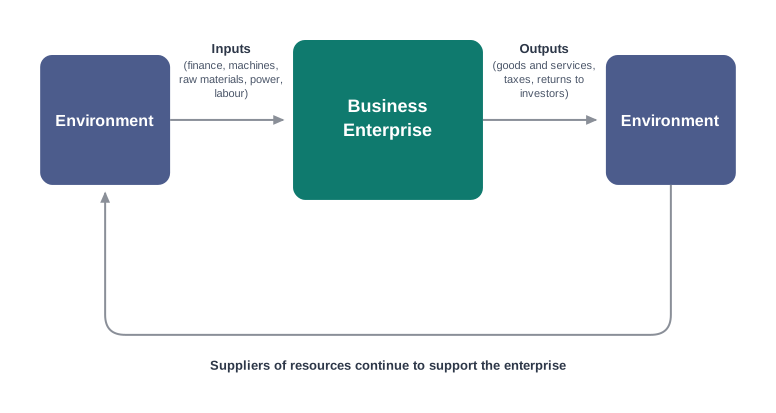
Fig. 3.1 – The firm and its environment.
3.3 Dimensions of Business Environment
The dimensions of the business environment are the factors that constitute it. They include economic, social, technological, political and legal conditions which are considered relevant for decision-making and for improving the performance of an enterprise.
In contrast to the specific environment, these factors explain the general environment, which mostly influences many enterprises at the same time. Even so, the management of every enterprise stands to benefit from being aware of these dimensions rather than being disinterested in them, because a change in any one of them can quietly alter the firm’s costs, its demand or its freedom to act.
The five dimensions are shown in Fig. 3.2.
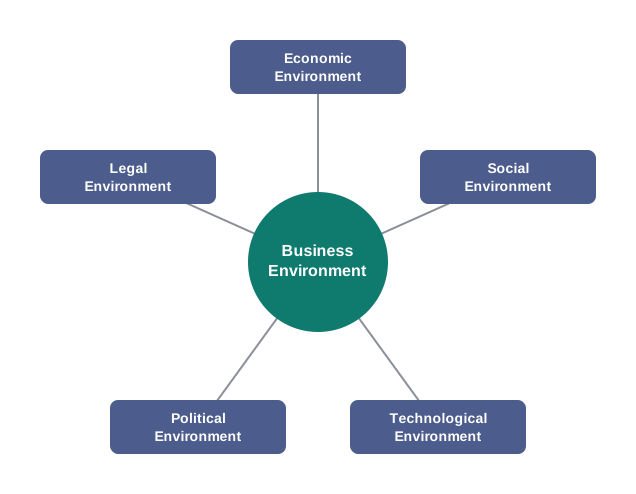
Fig. 3.2 – Dimensions of business environment.
3.3.1 Economic Environment
The economic environment consists of those economic forces outside a firm which affect the way it is managed. Interest rates, inflation rates, changes in the disposable income of people, stock market indices and the value of the rupee are some of the economic factors that can affect management practices in a business enterprise.
Short-term and long-term interest rates significantly affect the demand for products and services. For example, in the case of construction companies and automobile manufacturers, low longer-term rates are beneficial, because they result in increased spending by consumers for buying homes and cars on borrowed money.
Similarly, a rise in the disposable income of people, caused by an increase in the gross domestic product of a country, creates increasing demand for products. High inflation rates, on the other hand, generally place constraints on business enterprises, because they increase the various costs of business, such as the purchase of raw materials or machinery and the payment of wages and salaries to employees.
Components Of Economic Environment
- Existing structure of the economy in terms of the relative role of the private and public sectors.
- The rates of growth of GNP and per capita income at current and constant prices.
- Rates of saving and investment.
- Volume of imports and exports of different items.
- Balance of payments and changes in foreign exchange reserves.
- Agricultural and industrial production trends.
- Expansion of transportation and communication facilities.
- Money supply in the economy.
- Public debt, both internal and external.
- Planned outlay in the private and public sectors.
3.3.3 Technological Environment
The technological environment includes forces relating to scientific improvements and innovations which provide new ways of producing goods and services, and new methods and techniques of operating a business.
For example, recent technological advances in computers and electronics have modified the ways in which companies advertise their products. It is common now to see computerised information kiosks and World Wide Web multimedia pages highlighting the virtues of products. Similarly, retailers have direct links with suppliers who replenish stocks when needed, manufacturers have flexible manufacturing systems, and airline companies have Internet and World Wide Web pages where customers can look for flight times, destinations and fares and book their tickets online.
In addition, continuing innovations in different scientific and engineering fields, such as lasers, robotics, biotechnology, food preservatives, medicine, telecommunication and synthetic fuels, have provided numerous opportunities and threats for many different enterprises.
Technology also shifts demand from one product to another. Shifts in demand from vacuum tubes to transistors, from steam locomotives to diesel and electric engines, from fountain pens to ballpoint pens, from propeller airplanes to jets, and from typewriters to computer-based word processors have all been responsible for creating new business.
3.3.4 Political Environment
The political environment includes political conditions such as general stability and peace in the country, and the specific attitudes that elected government representatives hold towards business.
The significance of political conditions for business success lies in predictability. Under stable political conditions, business activities can be planned with reasonable certainty. On the other hand, there may be uncertainty of business activities due to political unrest and threats to law and order.
Political stability, thus, builds up confidence among business people to invest in long-term projects for the growth of the economy, while political instability can shake that confidence. Similarly, the attitudes of government officials towards business may have either a positive or a negative impact upon business.
Major Elements Of The Political Environment
- Prevailing political system.
- The degree of politicisation of business and economic issues.
- Dominant ideologies and values of major political parties.
- The nature and profile of political leadership and the thinking of political personalities.
- The level of political morality.
- Political institutions like the government and allied agencies.
- Political ideology and practices of the ruling party.
- The extent and nature of government intervention in business.
- The nature of the relationship of our country with foreign countries.
3.3.5 Legal Environment
The legal environment includes the various legislations passed by the Government, administrative orders issued by government authorities, court judgments, as well as the decisions rendered by various commissions and agencies at every level of the government — centre, state or local.
It is imperative for the management of every enterprise to obey the law of the land. An adequate knowledge of the rules and regulations framed by the Government is therefore a pre-requisite for better business performance, since non-compliance with laws can land a business enterprise in legal problems.
In India, Constitutional Provisions, the Companies Act 2013, the Industries (Development and Regulations) Act 1951, the Foreign Exchange Management Act, the Imports and Exports (Control) Act 1947, the Factories Act 1948, the Trade Union Act 1926, the Workmen’s Compensation Act 1923, the Industrial Disputes Act 1947, the Consumer Protection Act 1986, the Competition Act 2002 and a host of such other legal enactments, as amended from time to time by the Parliament, are important for doing business.
The impact of the legal environment can be illustrated with the help of government regulations meant to protect consumers’ interests. For example, the advertisement of alcoholic beverages is prohibited. Advertisements, including packets of cigarettes, carry the statutory warning ‘Cigarette smoking is injurious to health’. Similarly, advertisements of baby food must necessarily inform the potential buyer that mother’s milk is the best. All these regulations are required to be followed by advertisers.
3.4 Economic Environment in India
The economic environment in India consists of various macro-level factors related to the means of production and distribution of wealth which have an impact on business and industry. Because these factors operate at the level of the whole economy, no single firm can alter them, yet every firm has to work within them.
Factors Constituting The Economic Environment In India
Stage of economic development of the country.
The economic structure in the form of a mixed economy, which recognises the role of both the public and the private sectors.
Economic policies of the Government, including industrial, monetary and fiscal policies.
Economic planning, including five year plans, annual budgets, and so on.
Economic indices, such as national income, distribution of income, rate and growth of GNP, per capita income, disposable personal income, rate of savings and investments, value of exports and imports, balance of payments, and so on.
Infrastructural factors, such as financial institutions, banks, modes of transportation and communication facilities, and so on.
Business enterprises in India do realise the importance and impact of the economic environment on their working. Almost all annual company reports presented by their chairpersons devote considerable attention to the general economic environment prevailing in the country and to an assessment of its impact on their companies.
The Indian Economy At Independence
The economic environment of business in India has been steadily changing, mainly because of government policies. To understand the changes, it helps to begin with the condition of the economy at the time of Independence.
The Indian economy was mainly agricultural and rural in character.
About 70 per cent of the working population was employed in agriculture.
About 85 per cent of the population was living in the villages.
Production was carried out using irrational, low productivity technology.
Communicable diseases were widespread and mortality rates were high, as there was no good public health system.
Objectives Of India’s Development Plans
In order to solve the economic problems of the country, the government took several steps, including control by the State of certain industries, central planning, and reduced importance of the private sector. The main objectives of India’s development plans were as follows.
Initiate rapid economic growth to raise the standard of living, and to reduce unemployment and poverty.
Become self-reliant and set up a strong industrial base with emphasis on heavy and basic industries.
Reduce inequalities of income and wealth.
Adopt a socialist pattern of development, based on equality, and prevent exploitation of man by man.
In accordance with this economic planning, the government gave a lead role to the public sector for infrastructure industries, whereas the private sector was broadly given the responsibility of developing the consumer goods industry. At the same time, the government imposed several restrictions, regulations and controls on the working of private sector enterprises.
India’s experience with economic planning delivered mixed results. In 1991 the economy faced a serious foreign exchange crisis, a high government deficit and a rising trend of prices despite bumper crops. The path from Independence to that crisis is summarised in Fig. 3.4.
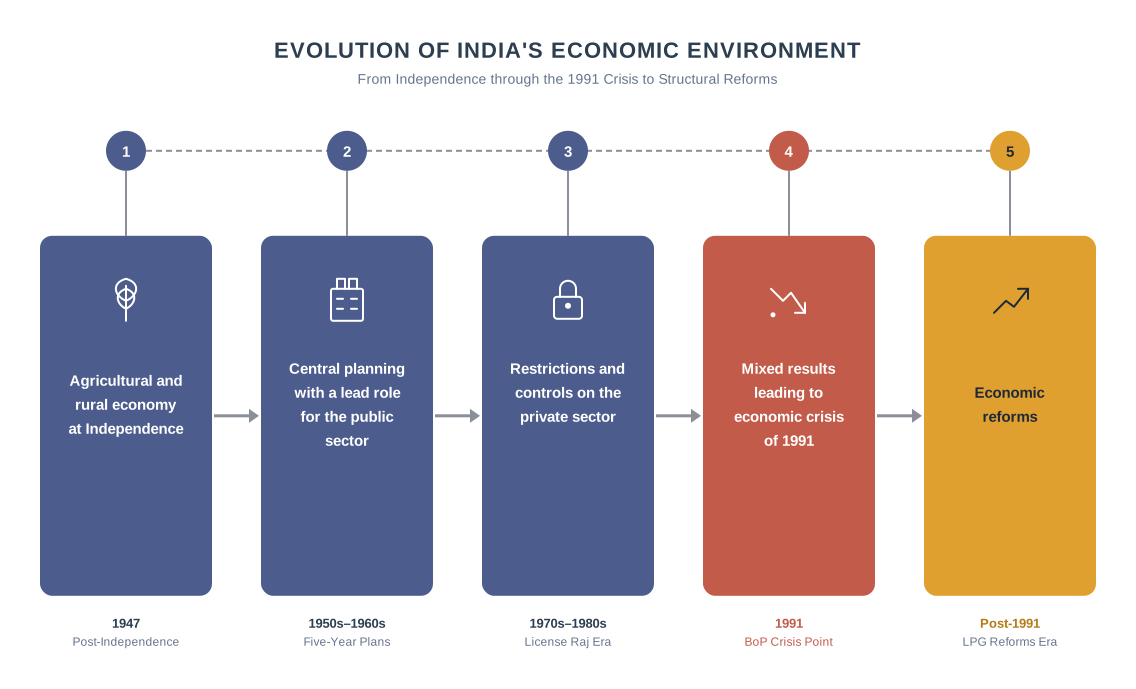
Fig. 3.4 – Changes in India’s economic environment.
Major Elements Of The Crisis Of June 1991
The crisis situation that led the Government of India to announce economic reform had the following major elements.
- A serious fiscal crisis, in which the fiscal deficit reached the level of 6.6 per cent of GDP in 1990-91.
- Heavy internal debt, which rose to about 50 per cent of GDP, with interest payments draining about 39 per cent of the total revenue collections of the central government.
- Low GNP growth rate, which fell to 1.4 per cent from the peak level of 10.5 per cent in 1988-89 at 1980-81 prices.
- Low overall agricultural production, foodgrain production and industrial production, which showed negative growth rates of –2.8 per cent, –5.3 per cent and –0.1 per cent respectively.
- A soaring inflation rate of 13-14 per cent, based both on the wholesale price index and on the consumer price index for industrial workers.
- Shrinkage of foreign trade, with imports in dollar terms falling by 19.4 per cent and exports by 1.5 per cent.
- Depreciation of the rupee by 26.7 per cent vis-à-vis US dollars.
- A fall in foreign exchange reserves to such a low level that they were barely adequate to meet the import requirements of a few weeks, while Non-resident Indians were withdrawing their deposits at an alarmingly high rate.
- A badly shaken confidence of the international financial institutions, with the country’s creditworthiness rating falling in just over a year from AAA to BB+, that is, being put on credit watch.
- The country was on the verge of defaulting on international financial obligations, and the situation warranted immediate policy action. In May 1991, the Government had to lease 20 tonnes of gold out of its stock to the State Bank of India to enable it to sell the gold with a repurchase option after six months. In addition, the Reserve Bank of India was allowed to pledge 47 tonnes of gold to the Bank of England to raise a loan of $600 million.
Early Reform Measures
Some of the early major steps taken to manage the economic crisis were the following.
- Fiscal correction aimed at reducing the fiscal deficit by about Rs. 7,700 crore in 1991-92, compared to 1990-91.
- Announcement of the New Industry Policy in July 1991, seeking to deregulate industry with the objective of promoting the growth of a more competitive and efficient industrial economy.
- Abolition of industrial licensing for all industrial projects except 18 industries of high strategic and environmental importance and with high import content; about 80 per cent of the industries were delicensed.
- Amendment of the MRTP Act to eliminate the need for prior approval of the Central Government by large companies for capacity expansion, diversification, merger and amalgamation.
- Nine areas in basic and core industries earlier reserved for the public sector were opened to the private sector.
- The limit of foreign equity holding was raised from 40 per cent to 51 per cent in a wide range of priority industries.
- The Foreign Investment Promotion Board was established to negotiate proposals from large international firms and expedite clearances of investment proposals.
- Rupee devaluation by 18 per cent during July 1-3, 1991, supported by a standby credit of $2.3 billion over a 20 month period, negotiated in October 1991.
- Negotiation of a $500 million Structural Adjustment Loan from the World Bank in April 1992, and a loan totalling SDR 1.3 billion from the International Monetary Fund between January and September 1991.
- Introduction of the India Development Bond Scheme and the Immunity Scheme for repatriation of funds held abroad in October 1991, under which more than $2 billion were mobilised during 1991-92.
- Bringing back of gold earlier pledged to the Bank of England and the Bank of Japan.
- Continuance of the measures of import control and credit squeeze.
- Administered licensing of imports was replaced by freely tradeable import entitlements, called Eximscrips, linked to export earnings; the measure was expected to introduce a self-balancing mechanism in India’s foreign trade.
- Introduction of the Liberalised Exchange Rate Management System, under which a dual exchange rate system was established, one rate being effectively floated in the market.
- Import licensing in most capital goods, raw materials, intermediates and components was eliminated, and the Advance Licensing System was considerably simplified.
This initial series of measures set the tone for the future economic reforms, and the measures taken continued to form a part of the ongoing reform process.
3.5 Economic Reforms of 1991
As a part of economic reforms, the Government of India announced a new industrial policy in July 1991. The policy was a response to the crisis described in the previous section, and it changed the rules within which Indian business had operated for four decades.
Broad Features Of The New Industrial Policy
The Government reduced the number of industries under compulsory licensing to six.
Many of the industries reserved for the public sector under the earlier policy were dereserved. The role of the public sector was limited only to four industries of strategic importance.
Disinvestment was carried out in the case of many public sector industrial enterprises.
Policy towards foreign capital was liberalised. The share of foreign equity participation was increased, and in many activities 100 per cent Foreign Direct Investment was permitted.
Automatic permission was now granted for technology agreements with foreign companies.
The Foreign Investment Promotion Board was set up to promote and channelise foreign investment in India.
Appropriate measures were also taken to remove obstacles in the way of the growth and expansion of the industrial units of large industrial houses. At the same time, the small-scale sector was assured all help and accorded due recognition.
In essence, this policy sought to liberate industry from the shackles of the licensing system, drastically reduce the role of the public sector, and encourage foreign private participation in India’s industrial development. These three directions of reform are known as liberalisation, privatisation and globalisation, and are shown in Fig. 3.5.
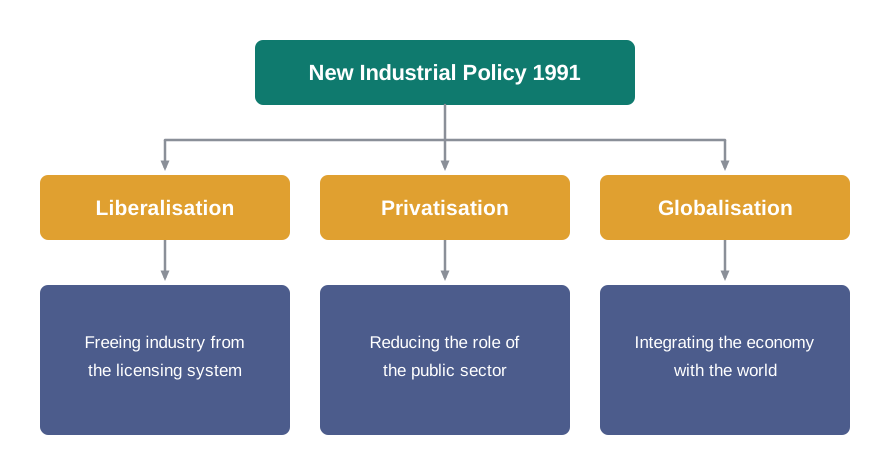
Fig. 3.5 – Directions of the New Industrial Policy 1991.
3.5.1 Liberalisation
Liberalisation means freeing business and industry from unnecessary controls and restrictions imposed by the government. The economic reforms introduced in 1991 were aimed at liberalising Indian business and industry from all such controls, and they signalled the end of the licence-permit-quota raj.
Liberalisation of Indian industry has taken place with respect to the following.
Abolishing the licensing requirement in most of the industries, except a short list.
Freedom in deciding the scale of business activities, that is, no restrictions on expansion or contraction of business activities.
Removal of restrictions on the movement of goods and services.
Freedom in fixing the prices of goods and services.
Reduction in tax rates and lifting of unnecessary controls over the economy.
Simplifying procedures for imports and exports.
Making it easier to attract foreign capital and technology to India.
3.5.2 Privatisation
Privatisation refers to the set of economic reforms aimed at giving a greater role to the private sector in the nation building process, and a reduced role to the public sector. This was a reversal of the development strategy pursued so far by Indian planners.
To achieve this, the government redefined the role of the public sector in the New Industrial Policy of 1991, adopted the policy of planned disinvestments of the public sector, and decided to refer loss making and sick enterprises to the Board of Industrial and Financial Reconstruction.
The term disinvestment used here means the transfer of public sector enterprises to the private sector. It results in the dilution of the stake of the Government in a public enterprise. If there is dilution of Government ownership beyond 51 per cent, it would result in the transfer of ownership and management of the enterprise to the private sector.
3.5.3 Globalisation
Globalisation means the integration of the various economies of the world, leading towards the emergence of a cohesive global economy.
Till 1991, the Government of India had followed a policy of strictly regulating imports in value and volume terms. These regulations were with respect to the licensing of imports, tariff restrictions and quantitative restrictions.
The new economic reforms aimed at trade liberalisation were directed towards import liberalisation, export promotion through rationalisation of the tariff structure, and reforms with respect to foreign exchange, so that the country does not remain isolated from the rest of the world.
Globalisation involves an increased level of interaction and interdependence among the various nations of the global economy. Physical geographical distance or political boundaries no longer remain barriers for a business enterprise wishing to serve a customer in a distant geographical market. This has been made possible by rapid advancement in technology and by liberal trade policies followed by governments. Through the policy of 1991, the Government of India moved the country to this globalisation pattern.
Features Of A Truly Globalised Economy
A truly global economy implies a boundaryless world where there is:
Free flow of goods and services across nations.
Free flow of capital across nations.
Free flow of information and technology.
Free movement of people across borders.
A common acceptable mechanism for the settlement of disputes.
A global governance perspective.
3.6 Demonetisation
The Government of India made an announcement on November 8, 2016 which had profound implications for the Indian economy. The two largest denomination notes, ₹500 and ₹1,000, were demonetised with immediate effect, ceasing to be legal tender except for a few specified purposes such as paying utility bills.
This step made eighty six per cent of the money in circulation invalid. The people of India had to deposit the invalid currency in banks, and this came along with restrictions placed on cash withdrawals. In other words, restrictions were placed on the convertibility of domestic money and bank deposits.
The aim of demonetisation was to curb corruption and counterfeiting, to check the use of high denomination notes for illegal activities, and especially to check the accumulation of ‘black money’ generated by income that has not been declared to the tax authorities.
Features Of Demonetisation
A tax administration measure — cash holdings arising from declared income were readily deposited in banks and exchanged for new notes. But those with black money had to declare their unaccounted wealth and pay taxes at a penalty rate.
A signal on tax evasion — demonetisation is also interpreted as a shift on the part of the government indicating that tax evasion will no longer be tolerated or accepted.
Channelling of savings into the formal financial system — demonetisation led tax administration to channel savings into the formal financial system. Much of the cash deposited in the banking system is bound to be withdrawn, but some of the new deposit schemes offered by banks will continue to provide a base for loans at lower interest rates.
Movement towards a less-cash economy — another feature of demonetisation is to create a less-cash or cash-lite economy, that is, to channel more savings through the formal financial system and improve tax compliance. There are arguments against this, since digital transactions require the use of cell phones by customers and Point-of-Sale machines by merchants, which work only where there is internet connectivity. On the contrary, these disadvantages are counterbalanced by the understanding that the measure helps bring people into the formal economy, thereby increasing financial saving and reducing tax evasion.
Impact Of Demonetisation
The measure affected different parts of the economy in different ways, as set out in Table 3.2.

Fig. 3.6 – Digital payment at a small shop.
3.7 Impact of Government Policy Changes on Business and Industry
The government policy of liberalisation, privatisation and globalisation has made a definite impact on the working of enterprises in business and industry. Firms that had grown used to a protected market, assured demand and government approval for most decisions suddenly found that survival now depended on their own efficiency.
In the new economic environment, Indian enterprises have developed various strategies to meet the challenge of competition. The main changes brought about by the policy shift are described below.
Increasing competition — as a result of the removal of licensing and the entry of foreign firms, Indian enterprises now face competition not only from other Indian firms but also from multinational companies, particularly in service industries such as telecommunications, airlines, banking and insurance.
More demanding customers — customers today are better informed about products and prices, and they are aware of the choices available to them. This awareness has made them more demanding, so that firms have to keep the customer at the centre of their planning rather than treating the product as fixed.
Rapidly changing technological environment — the opening of the economy exposed Indian firms to advanced technology from abroad. While this improves efficiency, it also creates pressure on smaller firms, since a new technology can make an existing production process uneconomical within a few years.
Necessity for change — under a protected environment, a firm could follow a set policy for a long period. In the new environment, enterprises have to continuously modify their operations, products and methods in response to changing market conditions.
Need for developing human resources — the new market conditions call for people with higher competence and greater commitment. Enterprises therefore have to invest in training and developing their employees, because outdated skills limit what even the best technology can achieve.
Market orientation — earlier, firms followed a production-oriented approach in which goods were produced first and sold afterwards. Now firms study the needs of the market first, and then design and produce goods accordingly, through market research and customer satisfaction programmes.
Loss of budgetary support to the public sector — the central government’s budgetary support for financing public sector enterprises has declined over the years. Public enterprises now have to generate their own resources and become efficient enough to survive on the strength of their own performance.
3.8 Summary
Meaning of business environment — business environment means the totality of all individuals, institutions and other forces that are outside a business but that potentially affect its performance.
Features of business environment — business environment can be characterised in terms of totality of external forces, specific and general forces, inter-relatedness, dynamic nature, uncertainty, complexity and relativity.
Importance of business environment — the business environment and its understanding are important because they enable the identification of opportunities and the first mover advantage, help in identifying threats and early warning signals, help in tapping useful resources, help in coping with rapid changes, assist in planning and policy formulation, and help in improving performance.
Elements of business environment — the business environment consists of five important dimensions: economic, social, technological, political and legal.
Economic environment — it includes such factors as interest rates, inflation rates, changes in the disposable income of people, stock market indices and the value of the rupee.
Social environment — it includes social forces such as traditions, values, social trends and society’s expectations of business.
Technological environment — it includes forces relating to scientific improvements and innovations which provide new ways of producing goods and services and new methods and techniques of operating a business.
Political environment — it includes political conditions such as general stability and peace in the country and the specific attitudes that elected government representatives hold towards business.
Legal environment — it includes various legislations passed by the government, administrative orders issued by government authorities, court judgments, as well as decisions rendered by various commissions and agencies at every level of the government — centre, state or local.
Economic environment in India — it consists of various macro-level factors related to the means of production and distribution of wealth which have an impact on business and industry. It has been steadily changing since Independence, mainly because of government policies. To solve the economic problems of the country at the time of Independence, the government took several steps, including control by the State of key industries, central planning and reduced importance of the private sector. These steps delivered mixed results until 1991, when the Indian economy faced a serious foreign exchange crisis, a high government deficit and a rising trend of prices despite bumper crops.
Liberalisation, privatisation and globalisation — as a part of economic reforms, the Government of India announced a new industrial policy in July 1991 which sought to liberate industry from the shackles of the licensing system, drastically reduce the role of the public sector, and encourage foreign private participation in industrial development.
Demonetisation — on November 8, 2016 the ₹500 and ₹1,000 notes ceased to be legal tender, with the aim of curbing corruption, counterfeiting and the accumulation of black money. Its features include its role as a tax administration measure, a signal that tax evasion will not be tolerated, the channelling of savings into the formal financial system, and the movement towards a less-cash economy.
Impact of government policy changes on business and industry — the policy of liberalisation, privatisation and globalisation has affected enterprises in terms of increasing competition, more demanding customers, a rapidly changing technological environment, the necessity for change, the need for developing human resources, market orientation, and loss of budgetary support to the public sector. In the new economic environment, Indian enterprises have developed various strategies to meet the challenge of competition.
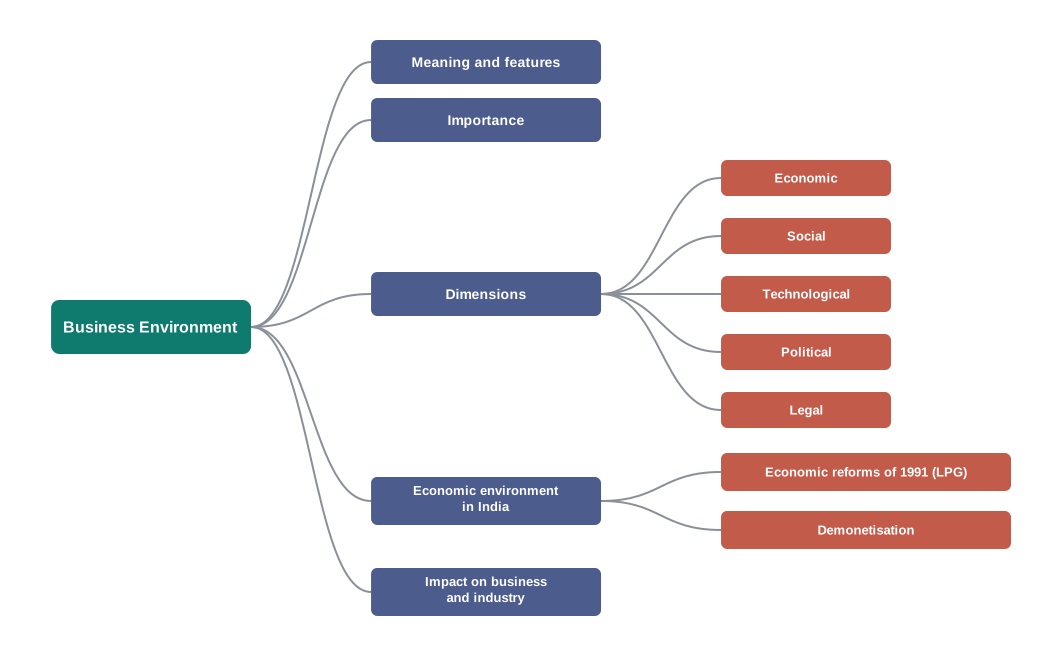
Fig. 3.7 – Structure of the chapter.
3.9 Key Terms
- Business environment The sum total of all individuals, institutions and other forces that are outside the control of a business enterprise but that may affect its performance.
- Specific forces Forces such as investors, customers, competitors and suppliers that affect an individual enterprise directly and immediately in its day-to-day working.
- General forces Forces such as social, political, legal and technological conditions that affect all business enterprises and influence an individual firm only indirectly.
- Opportunities Positive external trends or changes that will help a firm to improve its performance.
- Threats External environmental trends and changes that will hinder a firm’s performance.
- Economic environment Factors such as interest rates, inflation rates, changes in the disposable income of people, stock market indices and the value of the rupee that affect the working of a business enterprise.
- Social environment Social forces such as customs and traditions, values, social trends and society’s expectations from business.
- Technological environment Forces relating to scientific improvements and innovations which provide new ways of producing goods and services and new methods and techniques of operating a business.
- Political environment Political conditions such as general stability and peace in the country and the specific attitudes that elected government representatives hold towards business.
- Legal environment Legislations passed by the government, administrative orders issued by government authorities, court judgments and decisions rendered by various commissions and agencies at every level of the government.
- Liberalisation The removal of unnecessary controls and restrictions on business and industry so that enterprises are free to take their own decisions.
- Privatisation Economic reforms that give a greater role to the private sector in the nation building process and a reduced role to the public sector.
- Disinvestment The transfer of public sector enterprises to the private sector, resulting in dilution of the stake of the Government in the public enterprise.
- Globalisation The integration of the various economies of the world leading towards the emergence of a cohesive global economy.
- Demonetisation The withdrawal of the status of legal tender from currency notes of specified denominations, requiring holders to deposit them in banks.
3.10 NCERT Questions
Very Short Answer Type
- What is meant by business environment?
- How does understanding of business environment help in improving the performance of a business?
- Give an example to show that a business firm operates within numerous inter-related factors constituting the business environment.
- Krishna Furnishers Mart started its operations in the year 1954 and emerged as the market leader in the industry because of its original designs and efficiency in operations. It had a steady demand for its products, but over the years it found its market share declining because of new entrants in the field. The firm decided to review its operations, and decided that in order to meet the competition it needed to study and analyse market trends and then design and develop its products accordingly. List any two impacts of changes in business environment on Krishna Furnishers Mart’s operations.
- Name any two specific forces of business environment affecting business.
Short Answer Type
- Why is it important for business enterprises to understand their environment? Explain.
- Explain the following terms: (a) liberalisation, (b) privatisation, (c) globalisation.
- National Digital Library of India works towards developing a framework of a virtual repository of learning resources with a single-window search facility. It provides support to all academic levels, including researchers, life-long learners and differently-abled learners, free of cost. State the dimensions of business environment highlighted above.
- State the impact of demonetisation on interest rates, private wealth and real estate.
Long Answer Type
- How would you characterise business environment? Explain, with examples, the difference between general and specific environment.
- How would you argue that the success of a business enterprise is significantly influenced by its environment?
- Explain, with examples, the various dimensions of business environment.
- The Government of India announced demonetisation of ₹500 and ₹1,000 currency notes with effect from the midnight of November 8, 2016. As a result, the existing ₹500 and ₹1,000 currency notes ceased to be legal tender from that date. New currency notes of the denomination of ₹500 and ₹2,000 were issued by the Reserve Bank of India after the announcement. This step resulted in a substantial increase in the awareness about and use of Point of Sale machines, e-wallets, digital cash and other modes of cashless transactions. Also, increased transparency in monetary transactions and disclosure led to a rise in government revenue in the form of tax collection. (a) Enumerate the dimensions of business environment highlighted above. (b) State the features of demonetisation.
- What economic changes were initiated by the Government under the Industrial Policy, 1991? What impact have these changes made on business and industry?
3.11 Check Your Concepts
- Why is business environment described as a relative concept? Support your answer with one example.
- Distinguish between specific forces and general forces of business environment on any four bases.
- Why is it said that business environment is easier to understand in parts but difficult to grasp in its totality?
- What happens to an enterprise that continues to ignore changes taking place in its environment? Explain with reasons.
- Identify the term: the positive external trends or changes that help a firm improve its performance.
- Identify the dimension of business environment in each case: (a) a rise in the disposable income of consumers, (b) the celebration of festivals creating demand for sweets and gifts, (c) a court judgment restricting a particular kind of advertisement, (d) the entry of flexible manufacturing systems in a factory.
- Arrange the following in the correct sequence: economic crisis of 1991; central planning with a lead role for the public sector; announcement of the New Industrial Policy; agricultural and rural economy at Independence.
- Why did the Government of India find it necessary to reduce the number of industries under compulsory licensing in 1991?
- Assertion (A): A business enterprise must continuously study its environment. Reason (R): A business enterprise can control the forces of its environment. Choose the correct option:
- Both A and R are true, and R is the correct explanation of A.
- Both A and R are true, but R is not the correct explanation of A.
- A is true, but R is false.
- A is false, but R is true.
- Match the following:
| Column A | Column B |
|---|---|
| a. Disinvestment | i. integration of economies of the world |
| b. Globalisation | ii. transfer of public sector enterprises to the private sector |
| c. Liberalisation | iii. withdrawal of legal tender status from certain notes |
| d. Demonetisation | iv. removal of unnecessary controls on business |
- Distinguish between liberalisation and privatisation, giving one point of difference in meaning and one in purpose.
- Why did demonetisation lead to an increase in bank deposits and financial savings? Explain the cause and effect involved.
- What happens to the performance of public sector enterprises when budgetary support from the government declines? State two likely consequences.
3.12 Case-Based Questions
- Neelkanth Papers Ltd. manufactures notebooks and stationery. Over the last three years its sales have fallen, as many schools in its region have shifted to digital study material and as a large competitor has begun selling at lower prices. The management has also had to revise its costing after a change in the tax rate on paper.
- Identify the dimensions of business environment affecting Neelkanth Papers Ltd.
- State whether the forces identified above are specific forces or general forces, giving a reason in each case.
- Aarohi Foods Ltd. learns from a trade journal that a foreign company plans to launch a similar product in India at a lower price within the next year. The company immediately begins to improve the quality of its product, reduce its production cost and plan an advertising campaign.
- Name the importance of understanding business environment being highlighted here.
- Explain any two other points of importance of business environment.
- Girija Engineering Ltd. was set up in 1975 and had to obtain a licence before increasing its production capacity. Its prices were controlled and it could not import machinery freely. After the change in government policy, the firm expanded its capacity without prior approval, imported modern machinery and began selling in two foreign markets. However, it now faces competition from three multinational companies and finds that its customers demand better service.
- Identify the economic reforms whose effects are described above.
- State any three impacts of government policy changes on business and industry visible in this case.
3.3.2 Social Environment
The social environment of business includes the social forces such as customs and traditions, values, social trends and society’s expectations from business.
Traditions define social practices that have lasted for decades or even centuries. For example, the celebration of Diwali, Eid, Christmas and Guru Parv in India provides significant financial opportunities for greetings card companies, sweets or confectionery manufacturers, tailoring outlets and many other related businesses.
Values refer to concepts that a society holds in high esteem. In India, individual freedom, social justice, equality of opportunity and national integration are examples of major values cherished by all of us. In business terms, these values translate into freedom of choice in the market, business’s responsibility towards society, and non-discriminatory employment practices.
Social trends present various opportunities and threats to business enterprises. For example, the health-and-fitness trend has become popular among a large number of urban dwellers. This has created a demand for products such as organic food, gyms, bottled mineral water and food supplements.
Social Environment Social environment includes the social forces like customs and traditions, values, social trends and society’s expectations from business.
Major Elements Of Social Environment
Fig. 3.3 – Festival shopping in an Indian market.
Contact any ten families known to you. Find out the changes in their consumption habits over the last five years, and analyse the impact of these changes on the working of business enterprises.