Chapter 5: Organising
Every plan a business makes remains only an intention until someone decides who will do what, with what authority, and to whom each person will report. Organising is the management function that answers these questions. It follows planning and converts stated objectives into a working arrangement of jobs, departments and reporting relationships through which the plan can actually be carried out.
The need for such an arrangement becomes clear as a firm grows. When Wipro Technologies set out to compete with the largest global technology services companies, it separated itself into subsidiaries built around product lines such as telecommunications, engineering and financial services. Each unit was made self-sufficient, with its own accounting records, personnel and administrative functions, and authority for decisions was shifted from the top to the management of each entity. What changed was not the goal but the structure through which the goal was pursued.
This chapter explains the meaning of organising, the steps in the organising process, and why the function matters to an enterprise. It then takes up organisation structure and its functional and divisional forms, the distinction between formal and informal organisation, and the concepts of delegation and decentralisation.
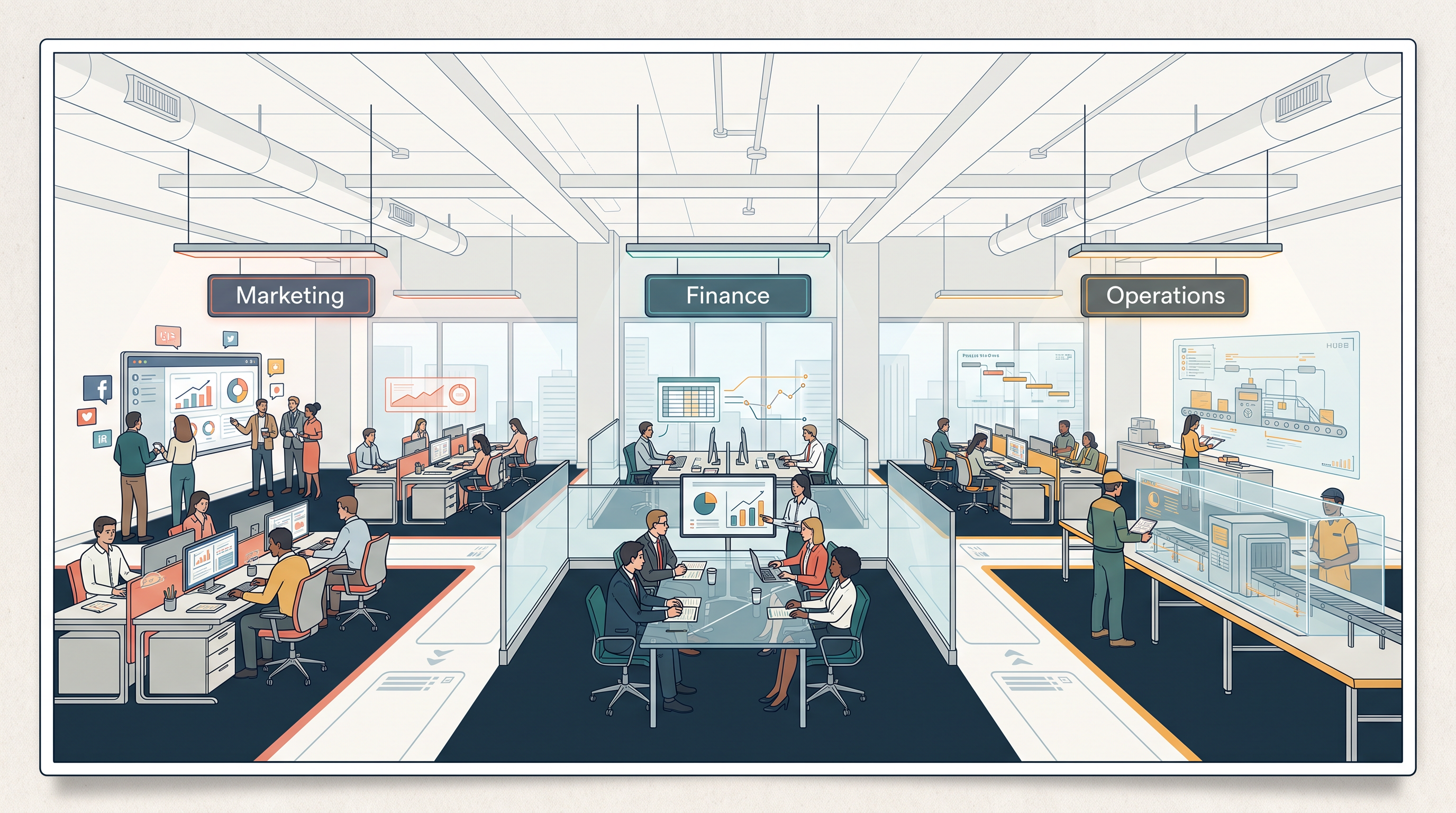
Fig. 5.0 – Departments at work in a large company.
5.1 Meaning of Organising
Once plans have been laid down and objectives specified, the next step is to arrange resources in a way that leads to the accomplishment of those objectives. Planning decides what is to be done; organising decides how the work will be divided, who will do it and how the different parts will be held together. It is therefore the function that translates plans into action.
For a plan to be fruitful, several matters have to be settled in advance — the resources that will be needed, how those resources can be used to best effect, how the total work can be broken into tasks that people can actually perform, and how the workforce is to be empowered to complete those tasks. Organising deals with all of these.
How Organising Takes Place
A school fete is a useful illustration. The whole event is divided into task groups, each looking after a specific area — a food committee, a decoration committee, a ticketing committee and so on. All of them work under the overall supervision of the official in charge of the event. Coordinating relationships are then established among the groups so that they interact smoothly and each is clear about what it must contribute. Every one of these activities is part of the organising function.
Organising, then, is a process that coordinates human effort, assembles physical and financial resources, and integrates both into a unified whole to be used for achieving specified objectives. Work is grouped, jobs are defined, and people are placed in relation to one another so that effort is not wasted or duplicated.
Why The Function Matters
The organising function leads to the creation of a framework of roles. These roles are designed to be filled by suitably skilled people, and the relationship between the roles is defined so that ambiguity in the performance of duties is removed. Such clarity is necessary not only for productive cooperation among the personnel, but also for fixing the extent of authority a person holds, the responsibility he carries for results, and the logical grouping of activities.
Its practical value lies here. Organising ensures that effort is directed towards the goals laid down during planning, that resources are used optimally, and that people are able to work collectively and effectively for a common purpose. It is in this sense that organising is described as a means of translating plans into action.
5.2 Steps in the Process of Organising
Organising is not a single act. It is a series of steps that have to be taken in a definite order if the desired goal is to be reached. Each step prepares the ground for the one that follows, which is why the sequence cannot be rearranged.
Consider a simple example. Suppose twelve students are working for the school library during the summer vacation. One afternoon they are told to unload a shipment of new releases, stock the bookshelves and then dispose of all the waste such as packaging and paper. If every student decides to go about it in his or her own way, the result will be mass confusion. If, however, one student supervises the work by grouping the students, dividing the work among the groups, assigning each group its quota and developing reporting relationships among them, the job will be finished faster and done better.
From this description, four steps emerge in the process of organising. The complete sequence is summarised in Fig. 5.1.
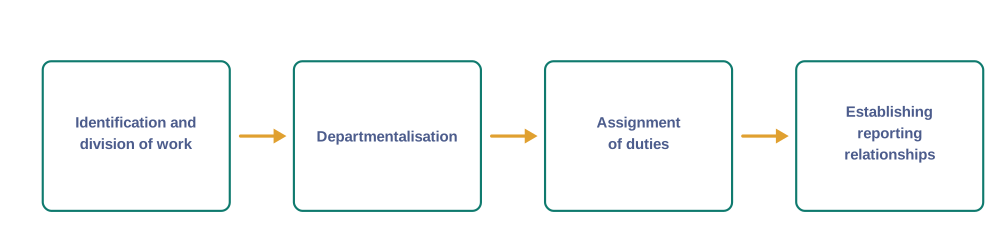
Fig. 5.1 – Steps in the process of organising.
The Four Steps Explained
Identification and division of work — the first step involves identifying the total work to be done and dividing it in accordance with plans decided earlier. The work is broken into manageable activities so that duplication of effort is avoided and the burden of work is shared among the employees. Division at this stage is what makes the remaining steps possible, because activities cannot be grouped or assigned until they have first been separated.
Departmentalisation — once the work has been divided into small and manageable activities, those activities which are similar in nature are grouped together. Such sets of related activities facilitate specialisation, since employees within a group perform work of a similar kind. This grouping process is called departmentalisation. Departments can be created using several criteria as a basis. Among the most commonly used bases are territory, such as north, south and west, and products, such as appliances, clothes and cosmetics.
Assignment of duties — it is necessary to define the work of different job positions and accordingly allocate work to various employees. Once departments have been formed, each is placed under the charge of an individual. Jobs are then allotted to the members of each department in accordance with their skills and competencies. For effective performance, a proper match must be made between the nature of a job and the ability of the person given it. The work must be assigned to those who are best fitted to perform it well.
Establishing authority and reporting relationships — merely allocating work is not enough. Each individual must also know whom he has to take orders from and to whom he is accountable. Establishing such clear relationships creates a hierarchical structure in the organisation and helps in coordination among the various departments. Without this step, work would stand allotted but no one would know who settles a dispute or approves a decision.
5.3 Importance of Organising
The business environment does not stand still, and an enterprise has to keep adjusting to it. Performing the organising function well is what makes such adjustment possible without disorder. Its significance arises mainly from the fact that it helps an enterprise survive and grow, and equips it to meet the various challenges it faces.
For any business enterprise to perform its tasks and meet its goals successfully, the organising function must be properly performed. The following points bring out the crucial role that organising plays in a business enterprise.
Benefits Of A Well-Organised Enterprise
Benefits of specialisation — organising leads to a systematic allocation of jobs among the workforce. This reduces the workload of individuals and also raises productivity, because specific workers perform a specific job on a regular basis. Repeated performance of a particular task allows a worker to gain experience in that area, and this results in specialisation.
Clarity in working relationships — establishing working relationships clarifies the lines of communication and specifies who is to report to whom. This removes ambiguity in the transfer of information and instructions. It helps in creating a hierarchical order, which in turn allows responsibility to be fixed on a particular person and the extent of authority he may exercise to be specified.
Optimum utilisation of resources — organising leads to the proper use of all material, financial and human resources. Proper assignment of jobs avoids overlapping of work and makes the best use of resources possible. Avoiding duplication of work helps in preventing confusion and in minimising the wastage of resources and effort.
Adaptation to change — the process of organising allows a business enterprise to accommodate changes in the business environment. The organisation structure can be suitably modified and the inter-relationships among managerial levels revised, so that the enterprise moves through the change smoothly. It also provides much needed stability, since the enterprise can then continue to survive and grow in spite of changes.
Effective administration — organising provides a clear description of jobs and the duties related to them. This helps to avoid confusion and duplication. Clarity in working relationships enables work to be executed properly. The management of an enterprise thereby becomes easier, and this brings effectiveness in administration.
Development of personnel — organising stimulates creativity among managers. Effective delegation, that is, the passing of authority from a superior to a subordinate, allows managers to reduce their workload by assigning routine jobs to their subordinates. This reduction in workload is necessary not merely because the capacity of an individual is limited, but also because it allows the manager to develop new methods and ways of performing tasks. It gives him time to explore areas for growth and the opportunity to innovate, thereby strengthening the company’s competitive position. Delegation also develops in the subordinate the ability to deal effectively with challenges and helps him to realise his full potential.
Expansion and growth — organising helps in the growth and diversification of an enterprise by enabling it to move away from existing norms and take up new challenges. It allows a business enterprise to add more job positions and departments and even to diversify its product lines. New geographical territories can be added to the current areas of operation, and this helps to increase the customer base, sales and profit.
Taken together, these points explain why organising is described as the process by which a manager brings order out of chaos, removes conflict among people over work or the sharing of responsibility, and creates an environment suitable for teamwork.
5.4 Organisation Structure
The organisation structure is the outcome of the organising process. Once work has been divided, grouped, allotted and linked through reporting relationships, what remains is a definite framework within which the enterprise functions. An effective structure results in increased profitability of the enterprise, because effort inside it is directed rather than scattered.
The need for an adequate structure is felt by an enterprise whenever it grows in size or in complexity. Only those enterprises which do not focus on growth can maintain a particular structure for a long period of time. Such stagnancy, however, may prove detrimental, since companies which do not change at all will either close down or cease to grow.
Growth creates a specific problem. As an organisation grows, coordination becomes difficult because new functions emerge and the number of levels in the hierarchy increases. For an organisation to function smoothly and to face changes in its environment, it therefore becomes necessary to pay attention to its structure. Peter Drucker stressed this point when he described organisation structure as an indispensable means, and warned that a wrong structure will seriously impair business performance and may even destroy it.
The structure allows correlation and coordination among human, physical and financial resources, and this enables a business enterprise to accomplish its desired goals. The structure of a firm is shown in an organisation chart, which sets out the various positions and the reporting links between them in diagrammatic form.
Span Of Management
The shape of a structure depends to a large extent on the span of management. Where a superior can effectively manage only a few subordinates, more levels of management become necessary and the structure grows taller. Where a superior can manage a larger number, fewer levels are needed and the structure becomes flatter.
What A Sound Structure Achieves
A proper organisation structure is essential to ensure a smooth flow of communication and better control over the operations of a business enterprise. It provides the framework which enables the enterprise to function as an integrated unit by regulating and coordinating the responsibilities of individuals and departments.
For example, Sunita opened her own travel agency. Its success depends on a harmonious relationship between the customers and the employees of the agency. To achieve this, she divided the entire work of the agency into three subheads based on functions, namely operations, sales and administration. Operations includes the travel counsellor, reservation and ticketing, and customer care. Sales includes the accounts executive. Administration includes the book keeper, the cashier and the utility personnel. This division of work on the basis of functions has resulted in a structure that specifies the line of authority and responsibility.
Because business operates in a dynamic environment, an enterprise that fails to adapt cannot survive. Management must therefore review its plans and objectives continuously, and the organisation structure must also be subjected to periodic review to determine whether modification is required. At all times, the structure should contribute towards the achievement of the enterprise’s objectives and should provide scope for initiative, so that the contribution of personnel can be maximum and effective.
The structure adopted may take one of two broad forms, functional or divisional. These are examined in the next section.
5.5 Types of Organisation Structures
The type of structure adopted by an organisation varies with the nature and the types of activities it performs. A firm making a single product needs a different arrangement from one making several unrelated products. On this basis, the organisation structure can be classified under two categories, functional structure and divisional structure.
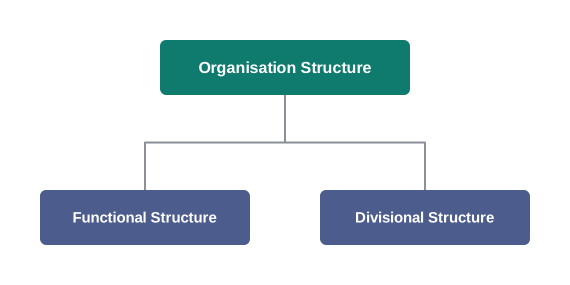
Fig. 5.2 – Types of organisation structures.
5.5.1 Functional Structure
Grouping jobs of a similar nature according to function, and organising these major functions as separate departments, creates a functional structure. All the departments report to a coordinating head. For example, in a manufacturing concern the division of work into key functions will include production, purchase, marketing, accounts and personnel. These departments may be further divided into sections. A functional structure is thus an organisational design that groups similar or related jobs together.
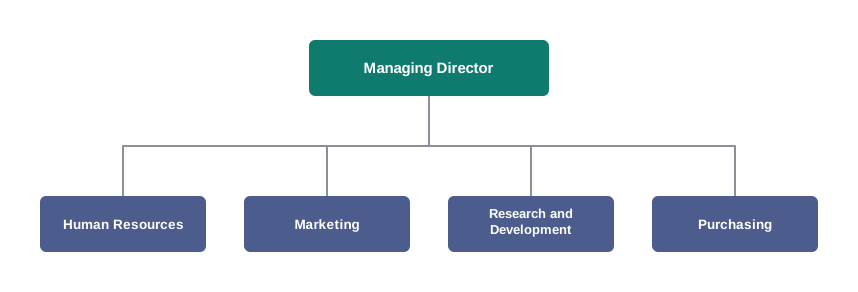
Fig. 5.3 – A functional structure.
Advantages Of A Functional Structure
The functional structure has many advantages to offer. The important ones are as follows.
Occupational specialisation — a functional structure leads to occupational specialisation, since emphasis is placed on specific functions. This promotes efficiency in the utilisation of manpower, as employees perform similar tasks within a department and are able to improve their performance.
Control and coordination within a department — it promotes control and coordination within a department because of the similarity in the tasks being performed.
Higher efficiency — it helps in increasing managerial and operational efficiency, and this results in increased profit.
Economies of scale — it leads to minimal duplication of effort, which results in economies of scale and lowers cost.
Easier training — it makes the training of employees easier, as the focus is only on a limited range of skills.
Due attention to every function — it ensures that different functions get due attention.
Disadvantages Of A Functional Structure
The functional structure has certain disadvantages which an organisation must take into consideration before adopting it. Some of them are as follows.
Functional empires — a functional structure places less emphasis on the overall objectives of the enterprise than on the objectives pursued by a functional head. Such practices may lead to functional empires, in which the importance of a particular function is overemphasised. Pursuing departmental interests at the cost of organisational interests can also hinder interaction between two or more departments.
Problems in coordination — it may lead to problems in coordination, as information has to be exchanged across functionally differentiated departments.
Conflict of interests — a conflict of interests may arise when the interests of two or more departments are not compatible. For example, the sales department may insist on a customer friendly design that causes difficulties in production. Such dissension can prove harmful to the fulfilment of organisational interest. Inter-departmental conflicts can also arise where there is no clear separation of responsibility.
Inflexibility — it may lead to inflexibility, as people with the same skills and knowledge base may develop a narrow perspective and have difficulty in appreciating any other point of view. Functional heads do not get training for top management positions, because they are unable to gather experience in diverse areas.
Suitability
A functional structure is most suitable when the size of the organisation is large, when it has diversified activities, and when operations require a high degree of specialisation.
5.5.2 Divisional Structure
Many large organisations with diversified activities have reorganised themselves away from the simpler and basic functional structure towards a divisional structure, which is more suited to their activities. This is particularly true of enterprises which have more than one category of products to offer. Although every organisation performs a set of homogeneous functions, as it diversifies into varied product categories the need for a more evolved structural design is felt to cope with the emerging complexity.
In a divisional structure, the organisation structure comprises separate business units or divisions. Each unit has a divisional manager who is responsible for performance and who has authority over the unit. Manpower is generally grouped on the basis of the different products manufactured. Each division is multifunctional, because within each division functions such as production, marketing, finance and purchase are performed together to achieve a common goal. Each division is self-contained, as it develops expertise in all the functions related to a product line.
In other words, within each division the functional structure tends to be adopted. However, functions may vary across divisions in accordance with the particular product line. Further, each division works as a profit centre, where the divisional head is responsible for the profit or loss of his division. For example, a large company may have divisions such as cosmetics and clothing.
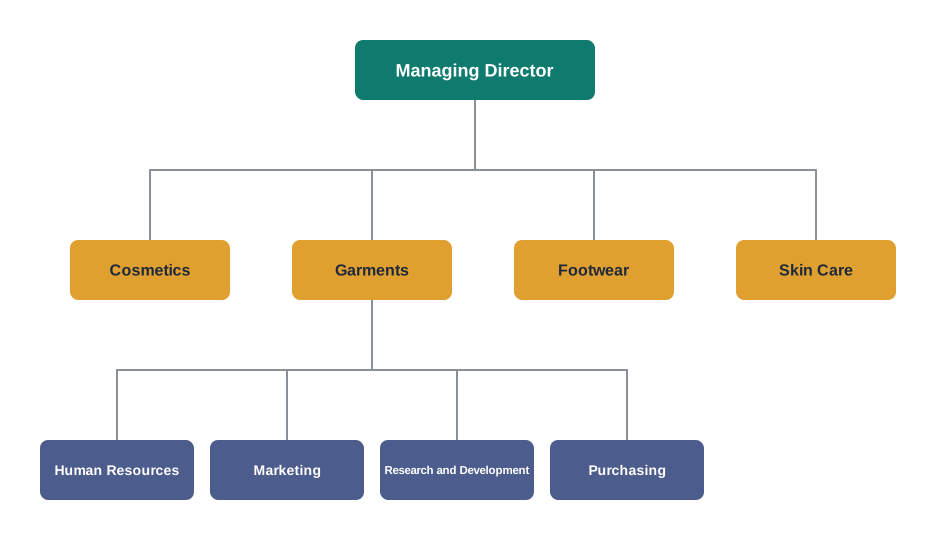
Fig. 5.4 – Divisional and functional structure.
Advantages Of A Divisional Structure
The divisional structure offers many benefits. The prominent ones are as follows.
Product specialisation — product specialisation helps in the development of varied skills in a divisional head, and this prepares him for higher positions, because he gains experience in all the functions related to a particular product.
Accountability for profits — divisional heads are accountable for profits, as revenues and costs related to different departments can be easily identified and assigned to them. This provides a proper basis for performance measurement. It also helps in fixing responsibility in cases of poor performance of a division, so that appropriate remedial action can be taken.
Flexibility and initiative — it promotes flexibility and initiative, because each division functions as an autonomous unit, and this leads to faster decision making.
Ease of expansion — it facilitates expansion and growth, as new divisions can be added without interrupting existing operations, merely by adding another divisional head and staff for the new product line.
Disadvantages Of A Divisional Structure
The divisional structure has certain disadvantages. Some of them are as follows.
Conflict among divisions — conflict may arise among different divisions with reference to the allocation of funds, and a particular division may seek to maximise its profits at the cost of other divisions.
Increase in costs — it may lead to an increase in costs, since there may be duplication of activities across products. Providing each division with a separate set of similar functions increases expenditure.
Ignoring organisational interests — it provides managers with the authority to supervise all activities related to a particular division. In course of time, such a manager may gain power and, in a bid to assert his independence, may ignore organisational interests.
Suitability
A divisional structure is suitable for those business enterprises where a large variety of products are manufactured using different productive resources. When an organisation grows and needs to add more employees, create more departments and introduce new levels of management, it will decide to adopt a divisional structure.
A comparison of the two structures is given in Table 5.1.
5.6 Formal and Informal Organisation
In all organisations, employees are guided by rules and procedures. For the enterprise to function smoothly, job descriptions and the rules and procedures relating to work processes have to be laid down in advance. This is done through the formal organisation.
Alongside this deliberate arrangement, another kind of grouping grows on its own. People who work together talk to one another, form friendships and develop loyalties that no rule book has provided for. This is the informal organisation. Every enterprise contains both, and a manager has to understand each of them.
5.6.1 Formal Organisation
Formal organisation refers to the organisation structure designed by the management to accomplish a particular task. It clearly specifies the boundaries of authority and responsibility, and there is systematic coordination among the various activities so that organisational goals are achieved. The structure in a formal organisation may be functional or divisional.
Features Of Formal Organisation
Specification of relationships — it specifies the relationships among various job positions and the nature of their inter-relationship. This clarifies who has to report to whom.
Means of achieving objectives — it is a means to achieve the objectives specified in the plans, as it lays down the rules and procedures essential for their achievement.
Coordination of departments — the efforts of various departments are coordinated, interlinked and integrated through the formal organisation.
Deliberate design — it is deliberately designed by the top management to facilitate the smooth functioning of the organisation.
Emphasis on work — it places more emphasis on the work to be performed than on interpersonal relationships among the employees.
Advantages Of Formal Organisation
Easier fixing of responsibility — it is easier to fix responsibility, since mutual relationships are clearly defined.
No ambiguity in roles — there is no ambiguity in the role that each member has to play, as duties are specified. This also helps in avoiding duplication of effort.
Unity of command — unity of command is maintained through an established chain of command.
Effective accomplishment of goals — it leads to the effective accomplishment of goals by providing a framework for the operations to be performed and by ensuring that each employee knows the role he has to play.
Stability — it provides stability to the organisation, because the behaviour of employees can be fairly predicted when there are specific rules to guide them.
Limitations Of Formal Organisation
Procedural delays — formal communication may lead to procedural delays, as the established chain of command has to be followed, and this increases the time taken for decision making.
Inadequate recognition of creativity — poor organisation practices may not provide adequate recognition to creative talent, since deviations from rigidly laid down policies are not permitted.
Limited scope — it is difficult to understand all human relationships in an enterprise, as the formal organisation places more emphasis on structure and work. Hence it does not provide a complete picture of how an organisation actually works.
5.6.2 Informal Organisation
Interaction among people at work gives rise to a network of social relationships among employees, and this network is called the informal organisation. It emerges from within the formal organisation when people interact beyond their officially defined roles.
When people have frequent contact with one another, they cannot be forced into a rigid formal structure. Instead, on the basis of their interaction and friendship, they tend to form groups that show conformity in terms of interest. Groups formed with a common interest may consist of those who take part in cricket matches on Sundays, those who meet in the cafeteria for coffee, or those who are interested in dramatics. The informal organisation has no written rules, is fluid in form and scope, and does not have fixed lines of communication.
Features Of Informal Organisation
Origin within the formal organisation — an informal organisation originates from within the formal organisation as a result of personal interaction among employees.
Behaviour governed by group norms — the standards of behaviour evolve from group norms rather than from officially laid down rules and regulations.
Independent channels of communication — channels of communication without any specified direction of flow of information are developed by group members.
Spontaneous emergence — it emerges spontaneously and is not deliberately created by the management.
No definite structure — it has no definite structure or form, because it is a complex network of social relationships among members.
Advantages Of Informal Organisation
Faster spread of information — prescribed lines of communication are not followed, so the informal organisation leads to a faster spread of information as well as quick feedback.
Fulfilment of social needs — it helps to fulfil the social needs of the members and allows them to find like-minded people. This enhances their job satisfaction, since it gives them a sense of belongingness in the organisation.
Support to organisational objectives — it contributes towards the fulfilment of organisational objectives by compensating for inadequacies in the formal organisation. For example, the reactions of employees towards plans and policies can be tested through the informal network.
Disadvantages Of Informal Organisation
Spread of rumours — when an informal organisation spreads rumours, it becomes a destructive force and works against the interest of the formal organisation.
Resistance to change — the management may not succeed in implementing changes if the informal organisation opposes them. Such resistance to change may delay or restrict growth.
Pressure to conform — it pressurises members to conform to group expectations. This can be harmful to the organisation if the norms set by the group are against organisational interests.
Managing The Two Together
The informal organisation cannot be altogether eliminated. It is therefore in the best interest of the organisation that the existence of such groups is recognised and the roles played by their members are identified. Knowledge of these groups can be used to gather their support and thereby improve organisational performance, and such groups can also provide useful communication channels. Instead of confronting them, the management should skilfully take advantage of both the formal and the informal organisation so that work continues smoothly.
A comparison of the two is given in Table 5.2.
5.7 Delegation
A manager, however capable he may be, cannot manage to do every task on his own. The sheer volume of work makes it impractical for him to handle it all by himself. Consequently, if he wishes to meet organisational goals, focus on objectives and ensure that all work is accomplished, he must delegate authority.
Delegation refers to the downward transfer of authority from a superior to a subordinate. It is a pre-requisite to the efficient functioning of an organisation, because it enables a manager to use his time on high priority activities. It also satisfies the subordinate’s need for recognition and provides him with opportunities to develop and exercise initiative.
Delegation helps a manager to extend his area of operations. Without it, his activities would be restricted to only what he himself can do. However, delegation does not mean abdication. The manager shall still be accountable for the performance of the assigned tasks. Moreover, the authority granted to a subordinate can be taken back and redelegated to another person. Thus, irrespective of the extent of authority delegated, the manager remains accountable to the same extent as before delegation.

Fig. 5.5 – A manager who refuses to delegate.
5.7.1 Elements of Delegation
According to Louis Allen, delegation is the entrustment of responsibility and authority to another and the creation of accountability for performance. A close analysis of this definition brings to light three essential elements of delegation.
Responsibility
Responsibility is the obligation of a subordinate to properly perform the assigned duty. It arises from a superior-subordinate relationship, because the subordinate is bound to perform the duty assigned to him by his superior. Responsibility therefore flows upwards, that is, a subordinate will always be responsible to his superior.
An important consideration to be kept in view with respect to both authority and responsibility is that when an employee is given responsibility for a job, he must also be given the degree of authority necessary to carry it out. Thus, for effective delegation, the authority granted must be commensurate with the assigned responsibility. If the authority granted is more than the responsibility, it may lead to misuse of authority; and if the responsibility assigned is more than the authority, it may make a person ineffective.
Accountability
Delegation of authority undoubtedly empowers an employee to act for his superior, but the superior remains answerable for the outcome. Accountability implies being answerable for the final outcome. Once authority has been delegated and responsibility accepted, one cannot deny accountability.
Accountability cannot be delegated and flows upwards, that is, a subordinate will be accountable to his superior for satisfactory performance of work. It indicates that the manager has to ensure the proper discharge of duties by his subordinates. It is generally enforced through regular feedback on the extent of work accomplished, and the subordinate is expected to explain the consequences of his actions or omissions.
In conclusion, it can be stated that while authority is delegated, responsibility is assumed, and accountability is imposed. Responsibility is derived from authority, and accountability is derived from responsibility. A comparison of the three elements is given in Table 5.3.

Fig. 5.6 – Creation of accountability for performance.
5.7.2 Importance of Delegation
Delegation ensures that subordinates perform tasks on behalf of the manager, thereby reducing his workload and providing him with more time to concentrate on important matters. Effective delegation leads to the following benefits.
Effective management — by empowering employees, managers are able to function more efficiently, as they get more time to concentrate on important matters. Freedom from routine work provides them with opportunities to excel in new areas.
Employee development — as a result of delegation, employees get more opportunities to utilise their talent, and this may give rise to latent abilities in them. It allows them to develop skills that will enable them to perform complex tasks and assume responsibilities that improve their career prospects. It makes them better leaders and decision makers, and so helps in preparing better future managers. Delegation empowers employees by providing them with the chance to use their skills, gain experience and develop themselves for higher positions.
Motivation of employees — delegation helps in developing the talents of employees and also has psychological benefits. When a superior entrusts a subordinate with a task, it is not merely the sharing of work but involves trust on the superior’s part and commitment on the part of the subordinate. Responsibility for work builds the self-esteem of an employee and improves his confidence. He feels encouraged and tries to improve his performance further.
Facilitation of growth — delegation helps in the expansion of an organisation by providing a ready workforce to take up leading positions in new ventures. Trained and experienced employees are able to play significant roles in the launch of new projects by replicating in the newly set up branches the work ethos they have absorbed from existing units.
Basis of management hierarchy — delegation of authority establishes superior-subordinate relationships, which are the basis of the hierarchy of management. It is the degree and flow of authority which determines who has to report to whom. The extent of delegated authority also decides the power that each job position enjoys in the organisation.
Better coordination — the elements of delegation, namely authority, responsibility and accountability, help to define the powers, duties and answerability related to the various positions in an organisation. This helps to avoid overlapping of duties and duplication of effort, as it gives a clear picture of the work being done at various levels. Such clarity in reporting relationships helps in developing and maintaining effective coordination among the departments, levels and functions of management.
Delegation is thus a key element in effective organising.
5.8 Decentralisation
In many organisations the top management plays an active role in taking all decisions, while in others this power is given even to the lower levels of management. Those organisations in which decision-making authority lies with the top management are termed centralised organisations, a condition described as centralisation, whereas those in which such authority is shared with lower levels are decentralised organisations.
Decentralisation explains the manner in which decision-making responsibilities are divided among hierarchical levels. Put simply, it refers to the delegation of authority throughout all the levels of the organisation. Decision-making authority is shared with lower levels and is consequently placed nearest to the points of action. In other words, decision-making authority is pushed down the chain of command.
When the decisions taken by the lower levels are numerous as well as important, an organisation can be regarded as greatly decentralised. The test is therefore not how many powers have been passed down, but how significant those powers are.
5.8.1 Centralisation and Decentralisation
Centralisation and decentralisation are relative terms, as can be seen from the existing status of various business enterprises. An organisation is centralised when decision-making authority is retained by higher management levels, and it is decentralised when such authority is delegated.
Complete centralisation would imply the concentration of all decision-making functions at the apex of the management hierarchy. Such a situation would remove the need for a management hierarchy at all. On the other hand, complete decentralisation would imply the delegation of all decision-making functions to the lower level of the hierarchy, and this would remove the need for higher managerial positions. Both these situations are unrealistic.
An organisation can therefore never be completely centralised or completely decentralised. As it grows in size and complexity, there is a tendency to move towards decentralised decision making. This is because in large organisations those employees who are directly and closely involved with certain operations tend to have more knowledge about them than the top management, which may be only indirectly associated with individual operations.
Hence there is a need for a balance between these two co-existing forces. It can thus be said that every organisation will be characterised by both centralisation and decentralisation.
5.8.2 Importance of Decentralisation
Decentralisation is much more than a mere transfer of authority to the lower levels of the management hierarchy. It is a philosophy that implies the selective dispersal of authority, because it rests on the belief that people are competent, capable and resourceful, and can assume responsibility for the effective implementation of their decisions. This philosophy recognises the decision maker’s need for autonomy. The management, however, needs to select carefully those decisions which will be pushed down to lower levels and those which will be retained at higher levels.
Decentralisation is a fundamental step, and its importance can be understood from the following points.
Develops initiative among subordinates — decentralisation helps to promote self-reliance and confidence among subordinates. When lower managerial levels are given the freedom to take their own decisions, they learn to depend on their own judgment. It also keeps them in a state where they are constantly challenged and have to develop solutions for the various problems they encounter. A decentralisation policy helps to identify those executives who have the necessary potential to become dynamic leaders.
Develops managerial talent for the future — formal training plays an important part in equipping subordinates with skills that help them rise in the organisation, but equally important is the experience gained by handling assignments independently. Decentralisation gives them a chance to prove their abilities and creates a reservoir of qualified manpower who can be considered for more challenging positions through promotions. It also helps to identify those who may not be successful in assuming greater responsibility. It is thus a means of management education as well as an opportunity for trained manpower to use its talent in real life situations.
Quick decision making — the management hierarchy can be looked upon as a chain of communication. In a centralised organisation, because every decision is taken by the top management, the flow of information is slow, as it has to traverse many levels, and the response also takes time. This reduces the speed of decision making and makes it difficult for an enterprise to adapt to dynamic operating conditions. In a decentralised organisation, however, decisions are taken at levels nearest to the points of action and there is no requirement for approval from many levels, so the process is much faster. There are also fewer chances of information getting distorted, because it does not have to travel through long channels.
Relief to top management — decentralisation diminishes the amount of direct supervision exercised by a superior over the activities of a subordinate, because subordinates are given the freedom to act and decide, though within the limits set by the superior. Personal supervision is generally replaced by other forms of control such as return on investment. Decentralisation also leaves the top management with more time, which it can devote to important policy decisions rather than occupying itself with both policy and operational decisions. In fact, decentralisation is greatest when the checking required on decisions taken by lower levels of management is least.
Facilitates growth — decentralisation awards greater autonomy to the lower levels of management as well as to divisional or departmental heads. This allows them to function in a manner best suited to their department and fosters a sense of competition among the departments. Consequently, with each department doing its best in a bid to outdo the others, productivity levels increase and the organisation is able to generate more returns, which can be used for expansion.
Better control — decentralisation makes it possible to evaluate performance at each level, and departments can be held individually accountable for their results. The extent of achievement of organisational objectives, as well as the contribution of each department in meeting the overall objectives, can be ascertained. Feedback from all levels helps to analyse variances and improve operations. In decentralisation, one of the challenges is the accountability of performance, and in response to this challenge better control systems are being evolved, such as the balance score card and the management information system. Decentralisation thus compels the management to devise innovative performance measurement systems.
In spite of these benefits, decentralisation should be applied with caution. It can lead to organisational disintegration if departments begin to operate on their own guidelines, which may run contrary to the interest of the organisation. Decentralisation must therefore always be balanced with centralisation in areas of major policy decisions.
A comparison of delegation and decentralisation is given in Table 5.4.
5.9 Summary
Organising is the process of defining and grouping the activities of an enterprise and establishing authority relationships among them. It converts plans into a working arrangement of jobs, departments and reporting relationships.
The process of organising consists of four steps, namely identification and division of work, departmentalisation, assignment of duties, and establishing reporting relationships.
Organising is important because it leads to division of work, clarity in reporting relationships, optimum utilisation of resources, adaptation to change, better administration, development of personnel and greater creativity, and expansion and growth.
Organisation structure is the framework within which managerial and operating tasks are performed. It can be functional or divisional, and it is shown in an organisation chart.
Span of management is the number of subordinates that can be effectively managed by a superior. It determines the number of levels of management in the structure.
Functional structure groups activities on the basis of functions. Its advantages are specialisation, better control and coordination, managerial efficiency, economies of scale, ease in training employees and due attention to each function. Its disadvantages are functional empires, problems in coordination, conflict of interest, inflexibility and restricted managerial development.
Divisional structure groups activities on the basis of products. Its advantages are product specialisation, accountability for profits, flexibility and initiative, faster decision making, and ease of expansion. Its disadvantages are conflict among divisions, increase in costs due to duplication of activities, and the risk that a divisional manager may ignore organisational interests.
Formal organisation is the structure designed by the management to achieve organisational goals. Its advantages are fixation of responsibility, clarity of roles, unity of command, effective accomplishment of goals and stability. Its limitations are procedural delays, inadequate recognition of creativity and limited scope.
Informal organisation arises out of interaction among people at work. Its advantages are speed of communication, fulfilment of social needs and the filling of inadequacies in the formal structure. Its disadvantages are that it can act as a disruptive force through rumours, can resist change, and can give priority to group interests over organisational interests.
Delegation is the downward transfer of authority from a superior to a subordinate. It has three elements, namely authority, responsibility and accountability. Authority can be delegated, responsibility cannot be entirely delegated, and accountability cannot be delegated at all.
The importance of delegation lies in effective management, employee development, motivation of employees, facilitation of growth, providing the basis of the management hierarchy, and better coordination.
Decentralisation is the delegation of authority throughout all the levels of the organisation. Centralisation and decentralisation are relative terms, and no organisation is completely one or the other.
The importance of decentralisation lies in developing initiative among subordinates, developing managerial talent for the future, quick decision making, relief to top management, facilitating growth and better control. It must, however, be balanced with centralisation in areas of major policy decisions.
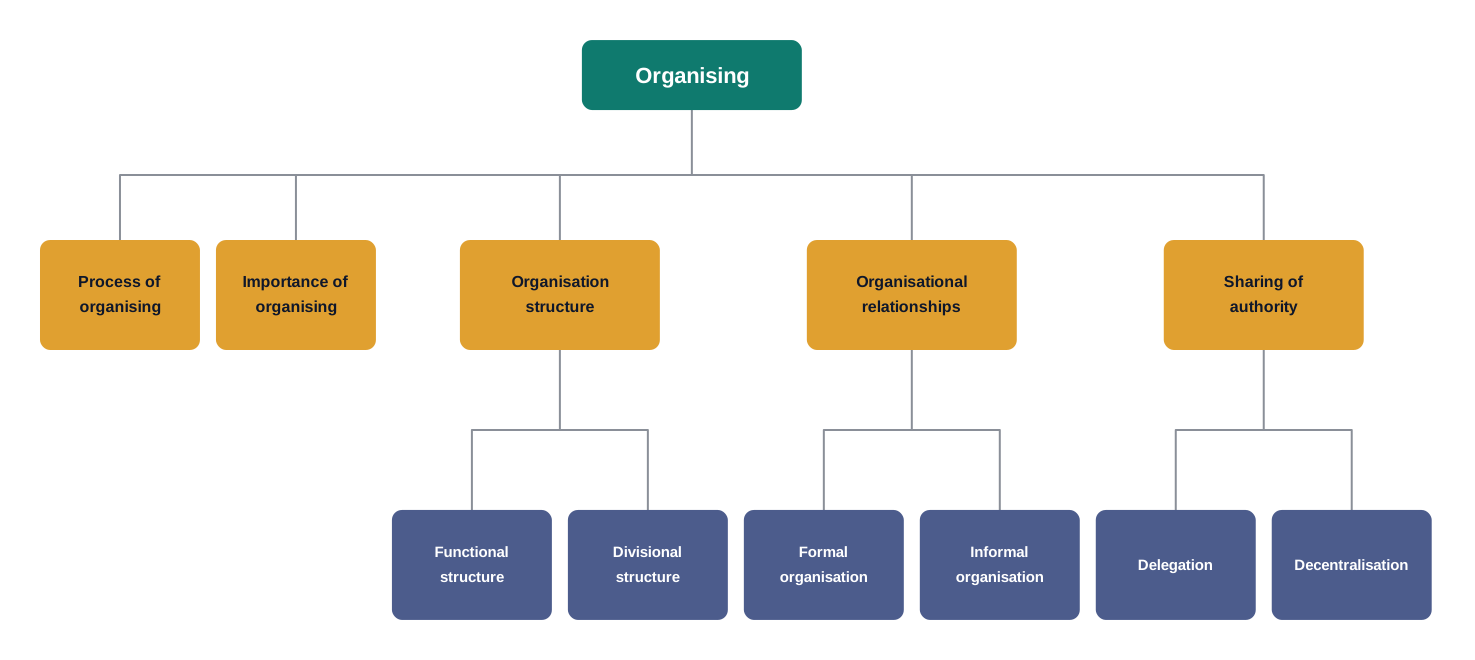
Fig. 5.7 – Structure of the chapter.
5.10 Key Terms
- Organising The process that initiates the implementation of plans by clarifying jobs and working relationships and by effectively deploying resources for the attainment of desired goals.
- Departmentalisation The grouping together of activities that are similar in nature, after the total work has been divided into manageable activities.
- Delegation The downward transfer of authority from a superior to a subordinate, along with the assignment of responsibility and the creation of accountability.
- Organisation structure The framework within which managerial and operating tasks are performed, specifying the relationships between people, work and resources.
- Organisation chart A diagram showing the various positions in an enterprise and the reporting relationships between them.
- Span of management The number of subordinates that can be effectively managed by a superior, which determines the levels of management in the structure.
- Functional structure An organisational design in which jobs of a similar nature are grouped by function and organised as separate departments reporting to a coordinating head.
- Divisional structure An organisational design in which the enterprise is divided into separate self-contained business units, generally on the basis of products, each headed by a divisional manager.
- Formal organisation The organisation structure deliberately designed by the management, specifying the boundaries of authority and responsibility, to accomplish a particular task.
- Informal organisation The network of social relationships among employees that arises spontaneously out of interaction at work.
- Authority The right of an individual to command his subordinates and to take action within the scope of his position.
- Responsibility The obligation of a subordinate to properly perform the duty assigned to him.
- Accountability Answerability for the final outcome of an assigned task, which cannot be delegated and flows upwards.
- Centralisation The retention of decision-making authority at the higher levels of management.
- Decentralisation The systematic delegation of decision-making authority throughout all the levels of the organisation.
5.11 NCERT Questions
Very Short Answer Questions
- Identify the network of social relationships which arises spontaneously due to interaction at work.
- What does the term ‘span of management’ refer to?
- State any two circumstances under which the functional structure will prove to be an appropriate choice.
- Draw a diagram depicting a functional structure.
- A company has its registered office in Delhi, its manufacturing unit at Gurgaon and its marketing and sales department at Faridabad. The company manufactures consumer products. Which type of organisational structure should it adopt to achieve its target?
Short Answer Questions
- What are the steps in the process of organising?
- Discuss the elements of delegation.
- How does informal organisation support the formal organisation?
- Can a large sized organisation be totally centralised or decentralised? Give your opinion.
- Decentralisation is extending delegation to the lowest level. Comment.
- Neha runs a factory wherein she manufactures shoes. The business has been doing well and she intends to expand by diversifying into leather bags as well as western formal wear, thereby making her company a complete provider of corporate wear. This will enable her to market her business unit as the one stop for working women. Which type of structure would you recommend for her expanded organisation and why?
- The production manager asked the foreman to achieve a target production of 200 units per day, but he does not give him the authority to requisition tools and materials from the stores department. Can the production manager blame the foreman if he is not able to achieve the desired target? Give reasons.
Long Answer Questions
- Why is delegation considered essential for effective organising?
- What is a divisional structure? Discuss its advantages and limitations.
- Decentralisation is an optional policy. Explain why an organisation would choose to be decentralised.
- Distinguish between centralisation and decentralisation.
- How is a functional structure different from a divisional structure?
- A company, which manufactures a popular brand of toys, has been enjoying good market reputation. It has a functional organisational structure with separate departments for Production, Marketing, Finance, Human Resources and Research and Development. Lately, to use its brand name and also to cash in on new business opportunities, it is thinking of diversifying into the manufacture of a new range of electronic toys for which a new market is emerging. Which organisation structure should be adopted in this situation? Give concrete reasons with regard to the benefits the company will derive from the steps it should take.
- A company manufacturing sewing machines, set up in 1945 by British promoters, follows formal organisation culture in totality. It is facing a lot of problems in delays in decision making. As a result it is not able to adapt to the changing business environment. The workforce is also not motivated, since they cannot vent their grievances except through formal channels, which involve red tape. Employee turnover is high. Its market share is also declining due to changed circumstances and business environment. You are to advise the company with regard to the change it should bring about in its organisation structure to overcome the problems faced by it. Give reasons in terms of the benefits it will derive from the changes suggested by you.
- A company X Limited, manufacturing cosmetics, which has enjoyed a pre-eminent position in business, has grown in size. Its business was very good till 1991. But after that, the new liberalised environment has seen the entry of many multinational companies in the sector. As a result the market share of X Limited has declined. The company had followed a very centralised business model, with directors and divisional heads making even minor decisions. Before 1991 this business model had served the company very well, as consumers had no choice. But now the company is under pressure to reform. What organisation structure changes should the company bring about in order to retain its market share? How will the changes suggested by you help the firm? Keep in mind that the sector in which the company operates is FMCG.
5.12 Check Your Concepts
- Why must the identification and division of work precede departmentalisation in the process of organising?
- What would happen in an enterprise where work is allotted to employees but reporting relationships are never established?
- Explain why the need for a proper organisation structure is felt only when an enterprise grows in size or complexity.
- How does the span of management affect the number of levels of management in an organisation?
- Distinguish between authority, responsibility and accountability on the basis of meaning, delegation and flow.
- Why is it said that delegation does not mean abdication?
- What may happen if the authority granted to an employee is more than the responsibility assigned to him, and what may happen in the reverse situation?
- Arrange the following steps of the organising process in their correct sequence: assignment of duties, establishing reporting relationships, identification and division of work, departmentalisation.
- Identify the concept: a systematic effort to delegate to the lowest level all authority except that which can be exercised at central points.
- Match the following bases of comparison with the correct statement about a divisional structure:
| Column A | Column B |
|---|---|
| a. formation | i. Duplication of resources in various departments, hence costly |
| b. cost | ii. Easy, because all functions related to a particular product are integrated in one department |
| c. responsibility | iii. Formation is based on product lines and is supported by functions |
| d. coordination | iv. Easy to fix responsibility for performance |
- Assertion: An organisation can never be completely centralised. Reason: In large organisations, employees closely involved with certain operations tend to have more knowledge about them than the top management. Choose the correct option.
- Both the assertion and the reason are true, and the reason is the correct explanation of the assertion.
- Both the assertion and the reason are true, but the reason is not the correct explanation of the assertion.
- The assertion is true but the reason is false.
- The assertion is false but the reason is true.
- Assertion: Informal organisation should be eliminated by the management. Reason: The informal organisation can spread rumours and resist change. Choose the correct option.
- Both the assertion and the reason are true, and the reason is the correct explanation of the assertion.
- Both the assertion and the reason are true, but the reason is not the correct explanation of the assertion.
- The assertion is false but the reason is true.
- Both the assertion and the reason are false.
- Why does a divisional structure make it easier to fix responsibility for performance than a functional structure?
- Explain why decentralisation must always be balanced with centralisation in areas of major policy decisions.
5.13 Case-Based Questions
- Tanushree Ltd. manufactures a single range of steel furniture and has separate departments for production, purchase, marketing, finance and personnel, all reporting to the managing director. The marketing head insists on a design change that the production head says cannot be made without heavy cost, and each refuses to move from his position. The managing director finds that decisions requiring both departments now take several weeks.
- Identify the type of organisation structure being followed by the company.
- State the two limitations of this structure that are visible in the situation described.
- State any two advantages that this structure would still be giving the company.
- Kritika Foods Ltd. began as a maker of packaged spices and has since added biscuits and ready-to-eat meals. Each of the three product lines now has its own head, who looks after production, marketing and finance for that line and is answerable for its profit or loss. The finance officer points out that the company is now paying for three separate marketing teams.
- Name the type of organisation structure the company has adopted.
- State one advantage and one disadvantage of this structure evident in the case.
- Name the term used for a division whose head is responsible for its profit or loss.
- Rakesh, a branch manager at Suvarna Ltd., handles every purchase approval himself and works late every day. On the advice of his general manager, he permits his two assistant managers to approve purchases up to a fixed limit, while continuing to answer to the general manager for all purchases made by the branch. Within two months the assistant managers are handling the work confidently and Rakesh has time to plan the branch’s expansion.
- Identify the concept of management applied by Rakesh.
- Name the element of this concept which explains why Rakesh continues to answer to the general manager.
- State any two benefits gained by the firm from the step taken.
- Nirvaan Ltd. has grown rapidly, but all decisions, including routine operational ones, are still taken by the board of directors. Regional managers complain that they must wait for approval even for minor purchases, and customers are being lost to faster rivals. The board is considering allowing regional managers to take all operating decisions for their regions, while retaining decisions on new products and major investment at the top.
- Identify the concept the board is considering adopting.
- State two benefits the company will derive from adopting it.
- Explain why the board is right in retaining certain decisions at the top level.