Chapter 7: Directing
Every organisation reaches a point where the plans have been made, the work has been divided and the right people have been appointed, and yet nothing actually moves until someone instructs, guides and encourages the people who must do that work. This function of management is called directing.
Consider a retail chain that opens ten new stores in a single year. Its plans may be sound and its staff qualified, but a store manager who does not explain targets clearly, or who cannot keep the team interested in its work, will face slow service and frequent resignations. Another manager, working with employees of the same ability, guides them patiently, listens to their difficulties and recognises good work, and obtains steady performance.
Directing deals with the human side of management. It concerns how a manager oversees the work of subordinates, keeps them willing to give their best, influences them through personal example, and exchanges information with them without distortion.
This chapter explains the meaning, importance and principles of directing, and its four elements — supervision, motivation, leadership and communication.

Fig. 7.0 – A store manager briefing the sales team.
7.1 Meaning and Characteristics of Directing
In ordinary language, directing means giving instructions and guiding people while they carry out work. Such situations occur constantly in daily life. A hotel owner instructs his employees about the arrangements to be made for a function, a teacher directs a student to complete an assignment, and a film director tells the artists how they should perform in a scene.
In each of these situations the same pattern appears. One person guides the effort of another towards a result that has already been decided. Directing, therefore, is never aimless; it is always carried on to achieve some predetermined objective.
The same idea applies inside a business organisation, where a large number of people must work together. Directing refers to the process of instructing, guiding, counselling, motivating and leading people in the organisation so that its objectives are achieved.
This function answers a practical problem. Planning decides what is to be done, organising decides how the work will be divided, and staffing places suitable people in each position. None of these three, by itself, makes an employee actually begin work or apply full effort. Directing is the function that turns plans and job assignments into real activity.
Directing is also more than a matter of passing on information. It covers the overseeing of subordinates at work, the effort to keep them willing to perform, the influence a manager exercises over them personally, and the exchange of information in both directions. These are the four elements of directing, discussed later in this chapter.
Directing is one of the key managerial functions and is performed by every manager. It is a managerial process that continues throughout the life of an organisation.
Characteristics Of Directing
Directing initiates action — directing is a key managerial function that a manager performs along with planning, organising, staffing and controlling. The other functions only prepare a setting for action; it is directing that actually starts action in the organisation.
Directing takes place at every level of management — every manager, from the top executive down to the supervisor, performs this function. Directing takes place wherever a superior–subordinate relationship exists, and such relationships exist at all levels.
Directing is a continuous process — it is a continuous activity that goes on throughout the life of the organisation, irrespective of the individuals occupying managerial positions. Managers may be transferred, promoted or replaced, but the directing process carries on, because organisational activity cannot continue without direction.
Directing flows from top to bottom — directing is first initiated at the top level and then flows downward through the organisational hierarchy. Every manager directs his immediate subordinate and, in turn, takes instructions from his immediate boss.
The last two characteristics are often tested together in application questions, because they explain why directing survives changes in personnel and why an instruction reaches an operative worker only through the chain of superiors above him.
7.2 Importance of Directing
The importance of directing can be understood from a simple fact: every action in an organisation is initiated through directing only. It is directing that guides people towards the achievement of common objectives.
Through directing, managers do not merely tell people what they should do, when they should do it and how they should do it. They also see that their instructions are carried out in the proper perspective. Very often this becomes an important factor in the efficient and effective functioning of the organisation.
The points which emphasise the importance of directing are given below.
Directing helps to initiate action — it makes people in the organisation begin work towards the attainment of desired objectives. For example, if a supervisor guides his subordinates and clarifies their doubts before they begin a task, it becomes easier for the worker to achieve the work targets given to him.
Directing integrates employees’ efforts — it links individual efforts in such a way that each one contributes to organisational performance. This ensures that individuals work for organisational goals and not only for their own. For example, a manager with good leadership ability is able to convince the employees working under him that both individual effort and team effort lead to the achievement of organisational goals.
Directing guides employees to realise their potential — through motivation and effective leadership, employees are helped to make full use of their potential and capabilities. A good leader can always identify the potential of his employees and motivate them to work up to that full potential, instead of settling for routine performance.
Directing facilitates the introduction of changes — people generally have a tendency to resist changes in the organisation. Effective directing, through motivation, communication and leadership, helps to reduce such resistance and to develop the cooperation needed to bring in a change. For example, if a manager wants to introduce a new system of accounting, there may be initial resistance from the accounting staff. But if the manager explains the purpose of the change, provides training and motivates the staff with additional rewards, the employees may accept the change and cooperate with him.
Directing brings stability and balance — effective directing fosters cooperation and commitment among people. It thereby helps the organisation to achieve balance among its various groups, activities and departments, so that no single section works at cross purposes with the rest.
These five points are connected. Action is initiated first, individual efforts are then integrated, potential is drawn out through motivation and leadership, change becomes possible because people trust the manager who directs them, and the result over time is a stable and balanced organisation.
7.3 Principles of Directing
Providing good and effective directing is a challenging task, because it involves many complexities. A manager has to deal with people who differ in background, ability and expectations, and this complicates the directing process.
Certain guiding principles have therefore been developed. They do not remove the difficulty, but they tell a manager what to keep in mind while instructing and influencing people. The eight principles are listed together in Fig. 7.1 and explained below.
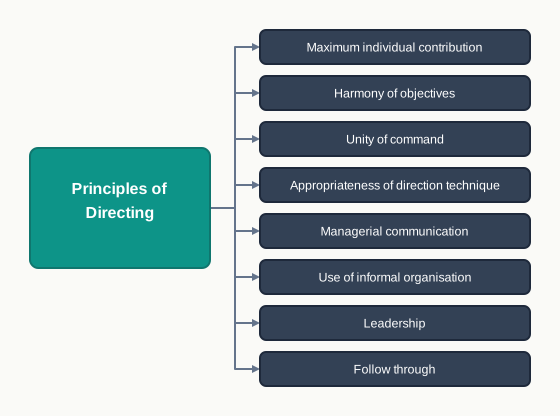
Fig. 7.1 – Principles of directing.
Maximum individual contribution — this principle emphasises that directing techniques must help every individual in the organisation to contribute to his maximum potential for the achievement of organisational objectives. Directing should bring out the untapped energies of employees for the efficiency of the organisation. For example, a good motivation plan carrying suitable monetary and non-monetary rewards can persuade an employee to contribute his maximum effort, because he feels that his effort will bring him a suitable reward.
Harmony of objectives — very often the individual objectives of employees and the objectives of the organisation appear to conflict with each other. An employee may expect an attractive salary and monetary benefits to fulfil his personal needs, while the organisation may expect employees to improve productivity so that it earns the expected profits. Good directing should provide harmony by convincing employees that employee rewards and work efficiency are complementary to each other, and not opposed.
Unity of command — this principle insists that a person in the organisation should receive instructions from one superior only. If instructions are received from more than one superior, it creates confusion, conflict and disorder in the organisation, since the subordinate cannot decide whose order to obey first. Adherence to this principle ensures effective direction.
Appropriateness of direction technique — according to this principle, the motivational and leadership technique used should be appropriate to the subordinate’s needs, capabilities, attitudes and other situational variables. There is no single technique that works on everybody. For example, for some people money can act as a powerful motivator, while for others promotion may act as the effective motivator.
Managerial communication — effective managerial communication across all levels in the organisation makes direction effective. Directing should convey clear instructions so that subordinates understand them completely. Through proper feedback, managers should ensure that the subordinate has actually understood the instructions and has not merely heard them.
Use of informal organisation — a manager should realise that informal groups exist within every formal organisation. He should be able to spot such groups and make use of them for effective directing, rather than pretend that they do not exist.
Leadership — while directing subordinates, managers should exercise good leadership, because leadership can influence subordinates positively without causing dissatisfaction among them.
Follow through — merely giving an order is not sufficient. Managers should follow it up by reviewing continuously whether orders are being implemented accordingly, or whether any problems are being encountered. If necessary, suitable modifications should be made in the directions given.
The first two principles concern the purpose for which directing is carried on, while the remaining principles concern the manner in which the directing process is actually conducted.
7.4 Elements of Directing
The process of directing involves guiding, coaching, instructing, motivating and leading people in an organisation so that organisational objectives are achieved. These activities look different from one another on the surface, but each of them is a way of getting work done through people.
Consider the following examples.
A supervisor explains to a worker the operations to be carried out by him on a lathe machine.
A mining engineer explains the safety precautions to be followed while working in a coal mine.
A Managing Director declares a share in the profits for the managers, in return for their contribution to enhancing the profits of the company.
A manager inspires his employees by playing a lead role in performing a piece of work himself.
All these examples, and many other activities related to directing, may broadly be grouped into four categories. These four categories are the elements of directing, shown in Fig. 7.2.
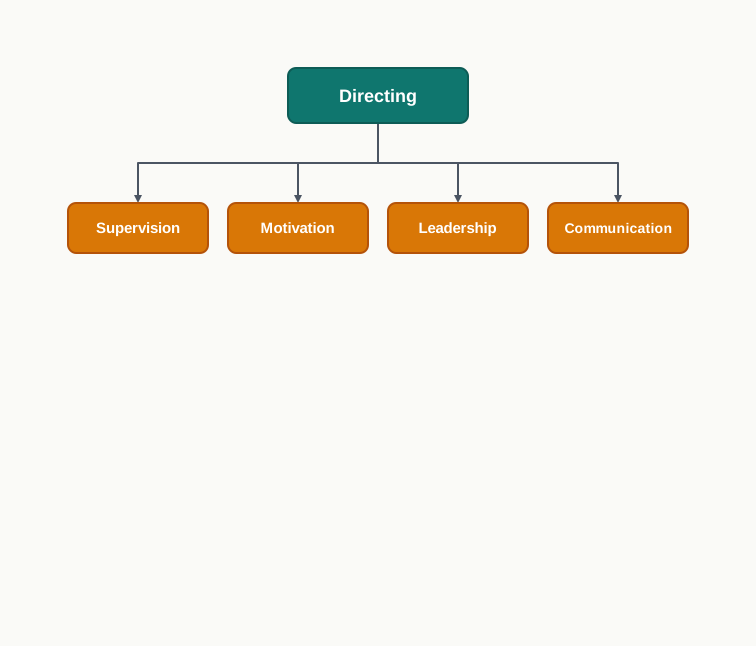
Fig. 7.2 – Elements of directing.
The first two examples above are instances of supervision, since a superior is overseeing and instructing operative workers. The third is an instance of motivation, since a reward is being used to induce better performance. The fourth is an instance of leadership, since the manager is influencing others by his own conduct rather than by an order. Communication runs through all four examples, because none of these activities is possible without conveying information and receiving a response.
Each of these four elements is discussed in detail in the sections that follow.
7.5 Supervision
The term supervision can be understood in two ways. Firstly, it can be understood as an element of directing. Secondly, it can be understood as a function performed by supervisors placed in the organisational hierarchy.
Supervision As An Element Of Directing
As an element of directing, supervision is performed by every manager in the organisation, because every manager oversees the work of his own subordinates. In this sense, supervision is the process of guiding the efforts of employees and other resources to accomplish the desired objectives.
It means overseeing what is being done by subordinates and giving them instructions, so that resources are put to optimum use and work targets are actually achieved. A manager who allots work but never looks at how it is progressing is not supervising.
Supervision As A Function Of The Supervisor
Secondly, supervision may be understood as the function to be performed by a supervisor. A supervisor holds a managerial position in the organisation hierarchy at the operative level, that is, immediately above the worker.
The functions and performance of the supervisor are vital to any organisation, because he is directly related with the workers, whereas other managers have no direct touch with bottom level workers. Whatever the top management decides reaches the worker finally through the supervisor, and whatever the worker faces reaches the management the same way.
Importance Of Supervision
The importance of supervision can be understood from the several roles performed by a supervisor.
Day-to-day contact with workers — the supervisor maintains daily contact and friendly relations with the workers. A good supervisor acts as a guide, friend and philosopher to the workers.
Link between workers and management — he conveys management ideas to the workers on the one hand, and the problems of workers to the management on the other. This role helps to avoid misunderstandings and conflicts between management and workers.
Maintaining group unity — the supervisor plays a key role in maintaining unity among the group of workers placed under his control. He sorts out internal differences and maintains harmony among workers.
Ensuring performance of work — he ensures that work is performed according to the targets set. He takes responsibility for task achievement and motivates his workers effectively.
Providing on-the-job training — a skilled and knowledgeable supervisor provides good on-the-job training to workers and employees, and can thereby build an efficient team of workers.
Supervisory leadership — supervisory leadership plays a key role in influencing the workers in the organisation. A supervisor with good leadership qualities can build up high morale among workers.
Analysis and feedback — a good supervisor analyses the work performed and gives feedback to the workers. He also suggests ways and means of developing their work skills.

Fig. 7.3 – A supervisor on the shop floor.
7.6 Motivation
It is not always possible to get the best work out of employees merely by exercising formal authority. A manager may find highly committed and hardworking staff in one part of the organisation, and lazy, evasive and superficial workers in another. What makes people behave the way they do? Why are some people reluctant to do work even though they have the ability to do it?
For answering such questions, a manager has to develop some insight into the causes of human behaviour. Psychologists say that it is motivation which stimulates people to take up work voluntarily. An employee can be ordered to be present at the workplace, but not ordered to be willing.
Motivation means incitement or inducement to act or move. In the context of an organisation, it means the process of making subordinates act in a desired manner to achieve certain organisational goals.
Motive, Motivation And Motivators
Three inter-related terms are used while discussing this subject, and they should be kept apart.
Motive — a motive is an inner state that energises, activates or moves behaviour and directs it towards goals. Motives arise out of the needs of individuals. The realisation of a motive causes restlessness in the individual, which prompts some action to reduce that restlessness. For example, the need for food causes hunger, on account of which a person searches for food. Hunger, thirst, security, affiliation, need for comfort and recognition are some such motives.
Motivation — motivation is the process of stimulating people to action to accomplish desired goals. It depends upon satisfying the needs of people.
Motivators — a motivator is the technique used to motivate people in an organisation. Managers use diverse motivators such as pay, bonus, promotion, recognition, praise and responsibility to influence people to contribute their best.
In short, a motive lies inside the employee, a motivator is supplied by the manager, and motivation is the process that connects the two.
Definitions Of Motivation
Several management writers have defined motivation from different angles.
Features Of Motivation
An analysis of these definitions and viewpoints reveals the following features of motivation.
Motivation is an internal feeling — the urges, drives, desires, aspirations, strivings or needs of a human being are internal, and it is these that influence human behaviour. For example, people may have the urge or desire to possess a motorbike, a comfortable house, or a reputation in society. These urges are internal to the individual, and a manager can only work upon them; he cannot insert them.
Motivation produces goal directed behaviour — behaviour is shaped towards a particular goal. For example, a promotion may be offered to an employee with the object of improving his performance. If the employee is interested in promotion, it helps to produce behaviour aimed at improving performance.
Motivation can be either positive or negative — positive motivation provides positive rewards such as an increase in pay, promotion or recognition. Negative motivation uses negative means such as punishment, stopping increments or threatening, which may also induce a person to act in the desired way.
Motivation is a complex process — individuals are heterogeneous in their expectations, perceptions and reactions. Any one type of motivation may not have a uniform effect on all members of the organisation.
Motivation Process
The motivation process is based on human needs. The sequence is summarised in Fig. 7.4.

Fig. 7.4 – The motivation process.
The following example explains this process of satisfaction of human needs. Ramu is very hungry, since he did not have breakfast in the morning. By 1.00 P.M. he became restless and started walking on the road in search of a hotel for snacks or a meal. After walking for 2 kms, he found a hotel where roti and dal were available for ₹ 10. Since he had only ₹ 15 in his pocket, he paid ₹ 10 and had a satisfying meal. After the meal, he felt that he had regained his energy.
The stages of the process can be traced in this example. An unsatisfied need of an individual creates tension, which stimulates his or her drives. These drives generate a search behaviour to satisfy the need. If the need is satisfied, the individual is relieved of tension.
Importance Of Motivation
Motivation is considered important because it helps to identify and satisfy the needs of human resources in the organisation and thereby helps to improve their performance. This is the reason why every major organisation develops various kinds of motivational programmes and spends large sums of money on them. Its importance may be pointed out through the following benefits.
Improvement in performance levels — proper motivation satisfies the needs of employees, and they in turn devote all their energies to optimum performance in their work. A satisfied employee can always turn out the expected performance, so good motivation helps the organisation achieve higher levels of performance as well.
Change in attitudes — motivation helps to change negative or indifferent attitudes of employees into positive attitudes. For example, a worker may have an indifferent or negative attitude towards his work if he is not rewarded properly. If suitable rewards are given, and the supervisor offers encouragement and praise for good work, the worker may slowly develop a positive attitude towards the work.
Reduction in employee turnover — the main reason for a high rate of employee turnover is lack of motivation. If managers identify the motivational needs of employees and provide suitable incentives, employees may not think of leaving the organisation. A high rate of turnover compels management to go in for fresh recruitment and training, which involves additional investment of money, time and effort. Motivation helps to save such costs and also helps to retain talented people.
Reduction in absenteeism — some important reasons for absenteeism are bad working conditions, inadequate rewards, lack of recognition and poor relations with supervisors and colleagues. A sound motivational system can cover all these deficiencies. If motivation is adequately provided, work becomes a source of pleasure and workers attend to work regularly.
Smooth introduction of changes — normally there may be resistance to any change introduced in the organisation. If the manager can convince employees that the proposed changes will bring them additional rewards, they may readily accept the change.
7.7 Maslow’s Need Hierarchy Theory of Motivation
Since motivation is highly complex, many researchers have studied it from several dimensions and developed theories about it. These theories help to develop an understanding of the phenomenon of motivation. Among them, Maslow’s Need Hierarchy Theory is considered fundamental to the understanding of motivation.
Abraham Maslow, a well-known psychologist, outlined the elements of an overall theory of motivation in a classic paper published in 1943. His theory was based on human needs. He felt that within every human being there exists a hierarchy of five needs.
Basic physiological needs — these needs are the most basic in the hierarchy and correspond to primary needs. Hunger, thirst, shelter and sleep are examples of these needs. In the organisational context, basic salary helps to satisfy these needs.
Safety and security needs — these needs provide security and protection from physical and emotional harm. Job security, stability of income and pension plans are examples.
Affiliation or belonging needs — these needs refer to affection, a sense of belongingness, acceptance and friendship. A person wants to be part of a group and to be accepted by it.
Esteem needs — these include factors such as self-respect, autonomy, status, recognition and attention. They are also referred to as egoistic needs.
Self actualisation needs — this is the highest level of need in the hierarchy. It refers to the drive to become what one is capable of becoming. These needs include growth, self-fulfilment and the achievement of goals.
The order of the five needs is shown in Fig. 7.5.
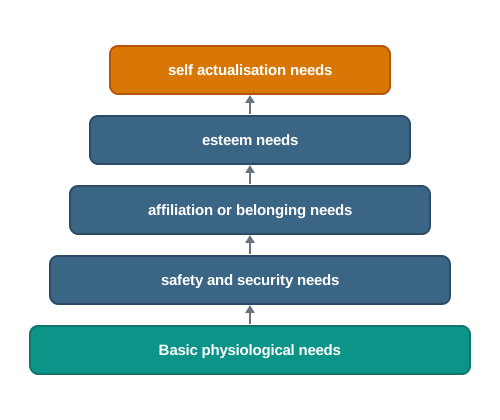
Fig. 7.5 – Maslow’s hierarchy of needs.
Each need level can be seen both in a person’s private life and in the organisation that employs him, as set out in Table 7.1.
Assumptions Of The Theory
Maslow’s theory rests on four assumptions.
People’s behaviour is based on their needs, and the satisfaction of such needs influences their behaviour.
People’s needs are in hierarchical order, starting from basic needs and moving to other, higher level needs.
A satisfied need can no longer motivate a person; only the next higher level need can motivate him.
A person moves to the next higher level of the hierarchy only when the lower level need is satisfied.
The third assumption carries a practical warning for managers. A pay rise given to an employee whose financial needs are already comfortably met may produce very little change in his effort, while recognition or a more challenging assignment may produce a great deal.
Evaluation Of The Theory
Maslow’s theory focuses on needs as the basis of motivation, and it is widely recognised and appreciated. However, some of its propositions have been questioned, particularly his classification of needs and the strict hierarchy among them. People do not always move up the ladder in the neat order suggested.
Despite such criticism, the theory remains relevant, because needs, no matter how they are classified, are important for understanding behaviour. It helps managers to realise that the need level of an employee should first be identified, and motivation then provided accordingly.
7.8 Financial and Non-Financial Incentives
An incentive means all those measures which are used to motivate people to improve their performance. Incentives are the practical instruments through which the ideas discussed in the previous two sections are actually applied in an organisation.
Incentives may be broadly classified as financial and non-financial. Both are discussed in detail below, and their essential differences are summarised in Table 7.2.
Financial Incentives
In the existing economic system, money has become the means of satisfying the physical needs of daily life, and also of obtaining social position and power. Since money has purchasing power, it becomes a very important incentive for every individual.
Financial incentives refer to incentives which are in direct monetary form, or are measurable in monetary terms, and which serve to motivate people for better performance. These incentives may be provided on an individual basis or on a group basis.
The financial incentives generally used in organisations are listed below.
Pay and allowances — for every employee, salary is the basic monetary incentive. It includes basic pay, dearness allowance and other allowances. The salary system consists of regular increments in pay every year and enhancement of allowances from time to time. In some business organisations, pay hikes and increments may be linked to performance.
Productivity linked wage incentives — several wage incentive plans aim at linking the payment of wages to an increase in productivity, at the individual or the group level.
Bonus — bonus is an incentive offered over and above the wages or salary payable to employees.
Profit sharing — profit sharing is meant to provide employees a share in the profits of the organisation. This serves to motivate employees to improve their performance and contribute to an increase in profits.
Co-partnership and stock option — under these incentive schemes, employees are offered company shares at a set price which is lower than the market price. Sometimes management may allot shares in place of various incentives payable in cash. The allotment of shares creates a feeling of ownership among employees and makes them contribute to the growth of the organisation. In Infosys, the scheme of stock option has been implemented as a part of managerial compensation.
Retirement benefits — several retirement benefits, such as provident fund, pension and gratuity, provide financial security to employees after their retirement. The assurance of such security acts as an incentive while they are still in service.
Perquisites — in many companies, perquisites and fringe benefits are offered over and above the salary, such as car allowance, housing, medical aid and education for children. These measures help to provide motivation to employees and managers.
Non-Financial Incentives
All the needs of individuals are not satisfied by money alone. Psychological, social and emotional factors also play an important role in providing motivation, and non-financial incentives mainly focus on these needs.
Sometimes a monetary aspect may be involved in a non-financial incentive as well. However, the emphasis is on providing psychological and emotional satisfaction rather than money driven satisfaction. For example, if an individual gets a promotion, it satisfies him psychologically because he gets a feeling of elevation, an increase in status, an increase in authority and greater challenge in the job. Though promotion involves the payment of extra money, its non-monetary aspects override the monetary aspects.
Some of the important non-financial incentives are discussed below.
Status — in the organisational context, status means the ranking of positions in the organisation. The authority, responsibility, rewards, recognition, perquisites and prestige of a job indicate the status given to a person holding a managerial position. The psychological, social and esteem needs of an individual are satisfied by the status given to the job.
Organisational climate — organisational climate indicates the characteristics which describe an organisation and distinguish one organisation from another. These characteristics influence the behaviour of individuals in the organisation. Some of them are individual autonomy, reward orientation, consideration shown to employees and attitude to risk-taking. If managers take positive measures on these aspects, it helps to develop a better organisational climate.
Career advancement opportunity — every individual wants to grow to a higher level in the organisation. Managers should provide the opportunity to employees to improve their skills and be promoted to higher level jobs. Appropriate skill development programmes and a sound promotion policy will help employees to achieve promotions. Promotion works as a tonic and encourages employees to exhibit improved performance.
Job enrichment — job enrichment is concerned with designing jobs that include a greater variety of work content, require a higher level of knowledge and skill, give workers more autonomy and responsibility, and provide the opportunity for personal growth and a meaningful work experience. If jobs are enriched and made interesting, the job itself becomes a source of motivation to the individual.
Employee recognition programmes — most people have a need for evaluation of their work and due recognition. They feel that what they do should be recognised by others concerned. Recognition means acknowledgment with a show of appreciation. When such appreciation is given to the work performed by employees, they feel motivated to work at a higher level.
Job security — employees want their job to be secure. They want a certain stability about future income and work, so that they do not feel worried on these counts and can work with greater zeal. In India this aspect is more important, considering the inadequate job opportunities and the large number of aspirants for them. However, job security has one negative aspect. When people feel that they are not likely to lose their jobs, they may become complacent.
Employee participation — this means involving employees in decision making on issues related to them. In many companies such programmes are in practice in the form of joint management committees, work committees, canteen committees and quality circles.
Employee empowerment — empowerment means giving more autonomy and powers to subordinates. Empowerment makes people feel that their jobs are important, and this feeling contributes positively to the use of their skills and talents in job performance.
Examples Of Employee Recognition
Congratulating the employee for good performance.
Displaying the achievement of the employee on the notice board or in the company newsletter.
Instituting an award or certificate for best performance.
Distributing mementos and complimentaries such as T-shirts in recognition of employee services.
Rewarding an employee for giving valuable suggestions.
7.9 Leadership
Whenever we hear the success story of an organisation, we are immediately reminded of the people who led it. It is difficult to imagine Microsoft without Bill Gates, Reliance Industries without the Ambanis, Tata without J.R.D. Tata, or Wipro without Azim Premji. Such organisations could hardly have achieved what they did without leaders of this kind. Leaders always play a key role in the success and excellence of an organisation.
Leadership is the process of influencing the behaviour of people by making them strive voluntarily towards the achievement of organisational goals. The word ‘voluntarily’ is important. A manager can obtain compliance through authority; a leader obtains willing effort.
Leadership also indicates the ability of an individual to maintain good interpersonal relations with followers and to motivate them to contribute towards organisational objectives.
Features Of Leadership
An examination of the above definitions reveals the following important features of leadership.
Leadership indicates the ability of an individual to influence others.
Leadership tries to bring a change in the behaviour of others.
Leadership indicates interpersonal relations between leaders and followers.
Leadership is exercised to achieve the common goals of the organisation.
Leadership is a continuous process.
Leader And Follower
The term leader emerges from leadership. An individual possessing the attributes of leadership is known as a leader.
While discussing leadership, it is important to understand the leader–follower relationship. Many times the success of an organisation is attributed only to the leader, and due credit is not given to the followers. In fact, many follower related factors, such as their skills, knowledge, commitment, willingness to cooperate and team spirit, make a person an effective leader.
It is said that followers make a person a good leader by accepting his leadership. It must therefore be recognised that both the leader and the follower play a key role in the leadership process.
Importance Of Leadership
Leadership is a key factor in making any organisation successful. History reveals that, many times, the difference between the success and failure of an organisation is leadership. Stephen Covey, a well-known management consultant, aptly observed that managers are important but leaders are vital for lasting organisational success. A leader not only commits his followers to organisational goals, but also pools the needed resources, guides subordinates and motivates them to reach those goals.
The importance of leadership may be discussed through the following benefits to the organisation.
Influence on behaviour — leadership influences the behaviour of people and makes them contribute their energies positively for the benefit of the organisation. Good leaders always produce good results through their followers.
Personal relations and confidence — a leader maintains personal relations and helps followers in fulfilling their needs. He provides the confidence, support and encouragement they require, and thereby creates a congenial work environment.
Introduction of change — a leader plays a key role in introducing required changes in the organisation. He persuades, clarifies and inspires people to accept changes whole-heartedly. He thus overcomes the problem of resistance to change and introduces it with minimum discontentment.
Handling of conflicts — a leader handles conflicts effectively and does not allow adverse effects to result from them. A good leader always allows his followers to ventilate their feelings and disagreement, but persuades them by giving suitable clarifications.
Training of subordinates — a leader provides training to his subordinates. A good leader always builds up his successor and helps in a smooth succession process.
Qualities Of A Good Leader
The qualities of a good leader have been researched by many experts. This line of study, which tries to identify the personal traits that make a leader effective, is known as the trait approach. Some of the qualities generally listed are courage, will power, judgement, knowledge, integrity, physical energy, faith, moral qualities, fairness, vitality, decisiveness and social skills.
However, it should be remembered that all good leaders may not necessarily possess all these qualities. In fact, it is not possible for any individual to have all of them, nor does possessing them always guarantee success. But an understanding of these qualities helps managers to acquire them through training and conscious effort.

Fig. 7.6 – Effective leadership at work.
7.10 Leadership Styles
There are many theories of leadership behaviour and leadership styles. Research studies have revealed certain traits and qualities which a leader might possess. However, these findings are not conclusive, since many people may possess these qualities and yet not be leaders.
Attention therefore shifted from what a leader is to what a leader does. There are several bases for classifying leadership styles, but the most popular classification is based on the use of authority. Depending on the use of authority, there are three basic styles of leadership, shown in Fig. 7.7.
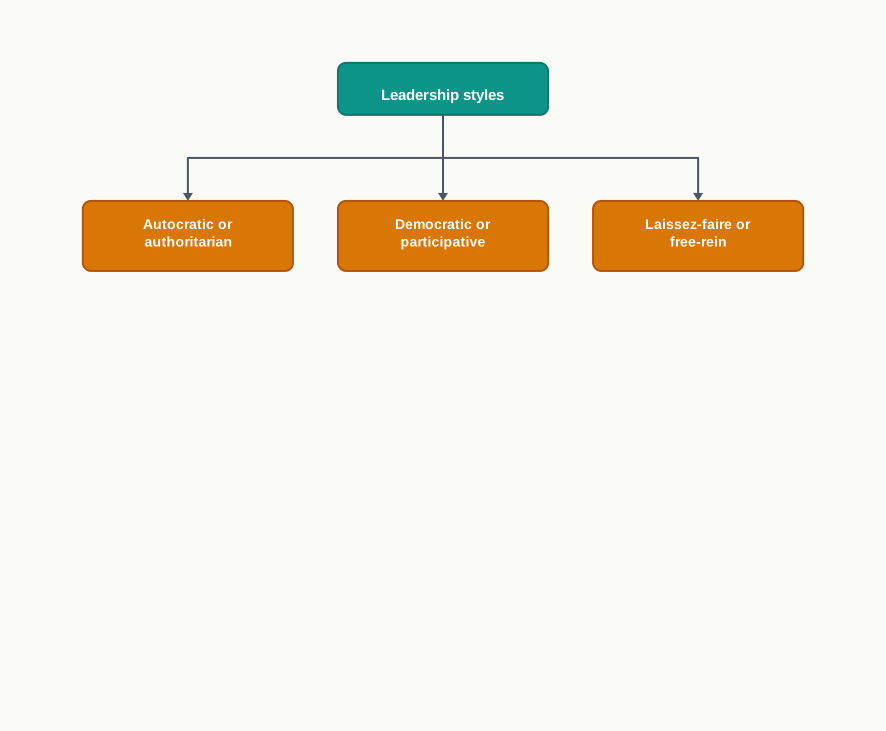
Fig. 7.7 – Styles of leadership.
Democratic Or Participative Leader
A democratic leader develops action plans and makes decisions in consultation with his subordinates. He encourages them to participate in decision-making.
This kind of leadership style is more common nowadays, since leaders recognise that people perform best when they have themselves set their objectives. Such leaders also respect the opinions of others and support subordinates in performing their duties and accomplishing organisational objectives. They exercise more control by using forces within the group rather than by issuing commands from above.
Laissez-faire Or Free-rein Leader
A laissez-faire leader does not believe in the use of power unless it is absolutely essential. The followers are given a high degree of independence to formulate their own objectives and the ways to achieve them.
The group members work on their own tasks and resolve issues themselves. The manager is there only to support them and to supply the information required to complete the task assigned. At the same time, the subordinate assumes responsibility for the work to be performed.
The three styles are compared in Table 7.3.
Depending upon the situation, a leader may choose to exercise a combination of these styles when required. Even a laissez-faire leader would lay down certain rules to be followed while doing work, and a democratic leader may have to take his own decision in an emergency situation.
7.11 Communication
Communication plays a key role in the success of a manager. However much professional knowledge and intelligence a manager may possess, it becomes immaterial if he is not able to communicate effectively with his subordinates and create understanding in them.
The directing abilities of a manager depend mainly on his communication skills. That is why organisations always place emphasis on improving the communication skills of managers as well as of employees.
The word communication has been derived from the Latin word communis, which means ‘common’, and this implies common understanding. Communication is generally understood as the process of exchange of ideas, views, facts and feelings between or among people, in order to create common understanding.
Some definitions given by management experts are given below.
Communication — Harold Koontz and Heinz Weihrich Communication is the transfer of information from the sender to the receiver, with the information being understood by the receiver. [/Definition
[Definition:] Communication — Rogers Communication is a process by which people create and share information with one another in order to reach common understanding. [/Definition]
A close examination of these definitions reveals that communication is the process of exchange of information between two or more persons to reach common understanding. Mere transmission is not enough; unless the receiver understands the message in the sense intended, communication has not taken place.
Elements Of The Communication Process
Communication has been defined as a process. This process involves elements such as the source, encoding, media or channel, receiver, decoding, noise and feedback. The complete process is shown in Fig. 7.8.
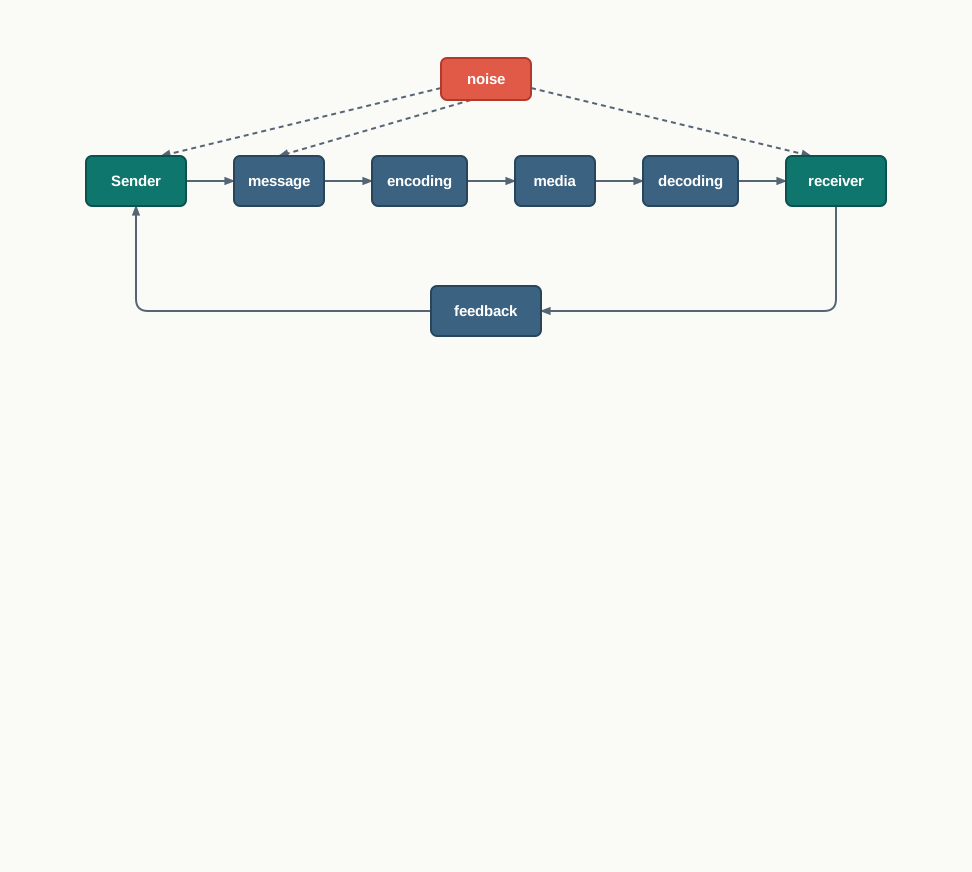 [Caption:] Fig. 7.8 – The communication process. [/Caption:]
The elements involved in the communication process are explained below.
Sender — the sender means the person who conveys his thoughts or ideas to the receiver. The sender represents the source of communication.
Message — it is the content of ideas, feelings, suggestions or orders which is intended to be communicated.
Encoding — it is the process of converting the message into communication symbols such as words, pictures or gestures.
Media — it is the path through which the encoded message is transmitted to the receiver. The channel may be written form, face to face conversation, a phone call or the Internet.
Decoding — it is the process of converting the encoded symbols of the sender back into meaning.
Receiver — the receiver is the person who receives the communication of the sender.
Feedback — it includes all those actions of the receiver which indicate that he has received and understood the message of the sender.
Noise — noise means some obstruction or hindrance to communication. This hindrance may be caused to the sender, to the message or to the receiver.
Examples Of Noise
Ambiguous symbols that lead to faulty encoding.
A poor telephone connection.
An inattentive receiver.
Faulty decoding, that is, attaching wrong meanings to the message.
Prejudices obstructing the proper understanding of the message.
Gestures and postures that may distort the message.
Feedback is what makes the process a loop rather than a straight line. Without it, the sender has no way of knowing whether the message survived the noise.
Importance Of Communication
Communication is one of the most central aspects of managerial activity. It has been estimated that a manager spends 90 per cent of his time in communicating, that is, in reading, writing, listening, guiding, instructing, approving and reprimanding. The effectiveness of a manager depends significantly on his ability to communicate with his superiors, subordinates and external agencies such as bankers, suppliers, unions and the government.
An ex-president of the American Management Association once observed that the number one management problem today is communication. Barnard has called it the foundation of all group activities. Communication serves as the lubricant that fosters the smooth operation of the management process. Its importance may be judged from the following points.
Acts as the basis of coordination — communication provides coordination among departments, activities and persons in the organisation. Such coordination is provided by explaining organisational goals, the mode of their achievement, and the inter-relationships between different individuals.
Helps in the smooth working of an enterprise — all organisational interactions depend on communication. The job of a manager is to coordinate the human and physical elements of an organisation into an efficient and active working unit that achieves common objectives, and only communication makes this possible. Communication is basic to an organisation’s existence, right from its birth through its continuing life. When communication stops, organised activity ceases to exist.
Acts as the basis of decision making — communication provides the information needed for decision making. In its absence it may not be possible for managers to take any meaningful decision. Only on the basis of communication of relevant information can a right decision be taken.
Increases managerial efficiency — communication is essential for the quick and effective performance of managerial functions. The management conveys goals and targets, issues instructions, allocates jobs and responsibilities, and looks after the performance of subordinates. Communication is involved in all these aspects, and thus keeps the organisation at work with efficiency.
Promotes cooperation and industrial peace — efficient operation is the aim of all prudent management, and it is possible only when there is industrial peace in the factory and mutual cooperation between management and workers. Two-way communication promotes such cooperation and mutual understanding.
Establishes effective leadership — communication is the basis of leadership. Effective communication helps to influence subordinates, and a leader who wishes to influence people must possess good communication skills.
Boosts morale and provides motivation — an efficient system of communication enables management to motivate, influence and satisfy subordinates. Good communication assists workers in their adjustment with the physical and social aspects of work, and improves human relations in industry. It is the basis of a participative and democratic pattern of management, and helps to boost the morale of employees and managers.
7.12 Formal and Informal Communication
Communication taking place within an organisation may be broadly classified as formal communication and informal communication. The full classification is shown in Fig. 7.9.
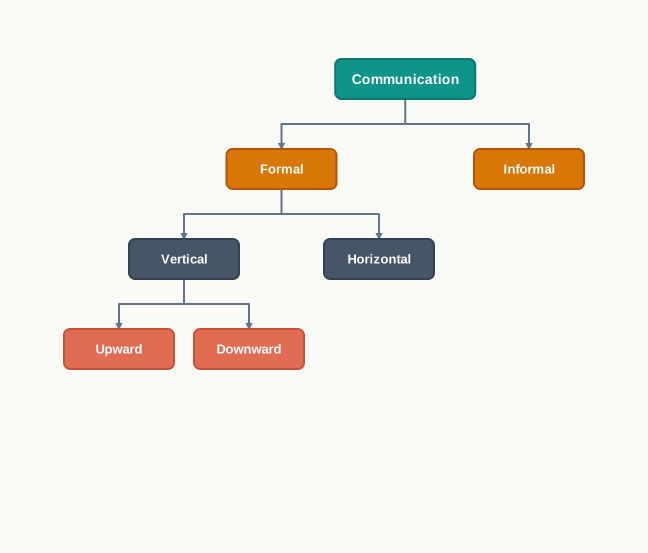 [Caption:] Fig. 7.9 – Types of communication. [/Caption:]
Formal Communication
Formal communication flows through the official channels designed in the organisation chart. Such communication may take place between a superior and a subordinate, between a subordinate and a superior, or among employees or managers of the same cadre.
These communications may be oral or written, but they are generally recorded and filed in the office. This record is what makes formal communication dependable as evidence of what was instructed or reported.
Formal communication may be further classified as vertical and horizontal.
Vertical communication flows vertically, that is, upwards or downwards through formal channels. Upward communication refers to the flow of communication from a subordinate to a superior, whereas downward communication indicates communication from a superior to a subordinate.
The examples of upward communication are an application for grant of leave, submission of a progress report and a request for grants. The examples of downward communication include sending a notice to employees to attend a meeting, ordering subordinates to complete an assigned work, and passing on guidelines framed by top management to the subordinates.
Horizontal or lateral communication takes place between one division and another. For example, a production manager may contact the marketing manager to discuss the schedule of product delivery, product design or quality.
Communication Networks
The pattern through which communication flows within the organisation is generally indicated through a communication network. Different types of networks may operate in a formal organisation.
Single chain — this network exists between a supervisor and his subordinates. Since many levels exist in an organisation structure, communication flows from every superior to his subordinate through a single chain.
Wheel — in the wheel network, all subordinates under one superior communicate through him only, as he acts as the hub of the wheel. The subordinates are not allowed to talk among themselves.
Circular — in the circular network, communication moves in a circle. Each person can communicate with his two adjoining persons. In this network, the flow of communication is slow.
Free flow — in this network, each person can communicate with all others freely. The flow of communication is fast in this network.
Inverted V — in this network, a subordinate is allowed to communicate with his immediate superior as well as with his superior’s superior. However, in the latter case only prescribed communication takes place.
Informal Communication
Communication that takes place without following the formal lines of communication is said to be informal communication. This system is generally referred to as the grapevine, because it spreads throughout the organisation with its branches going out in all directions, in utter disregard of the levels of authority.
Informal communication arises out of the need of employees to exchange views which cannot be exchanged through formal channels. Workers chit-chatting in a canteen about the behaviour of a superior, or discussing rumours that some employees are likely to be transferred, are examples of informal communication.
Grapevine communication spreads rapidly and sometimes gets distorted. It is very difficult to detect the source of such communication. It also leads to the generation of rumours which are not authentic. People’s behaviour is affected by rumours and informal discussions, and this may sometimes hamper the work environment.
At the same time, grapevine channels may be helpful, as they carry information rapidly and may therefore be useful to the manager at times. Informal channels are used by managers to transmit information and to know the reactions of their subordinates. An intelligent manager should make use of the positive aspects of informal channels and minimise the negative aspects of this channel of communication.
Grapevine Networks
Grapevine communication may follow different types of network, shown in Fig. 7.10.
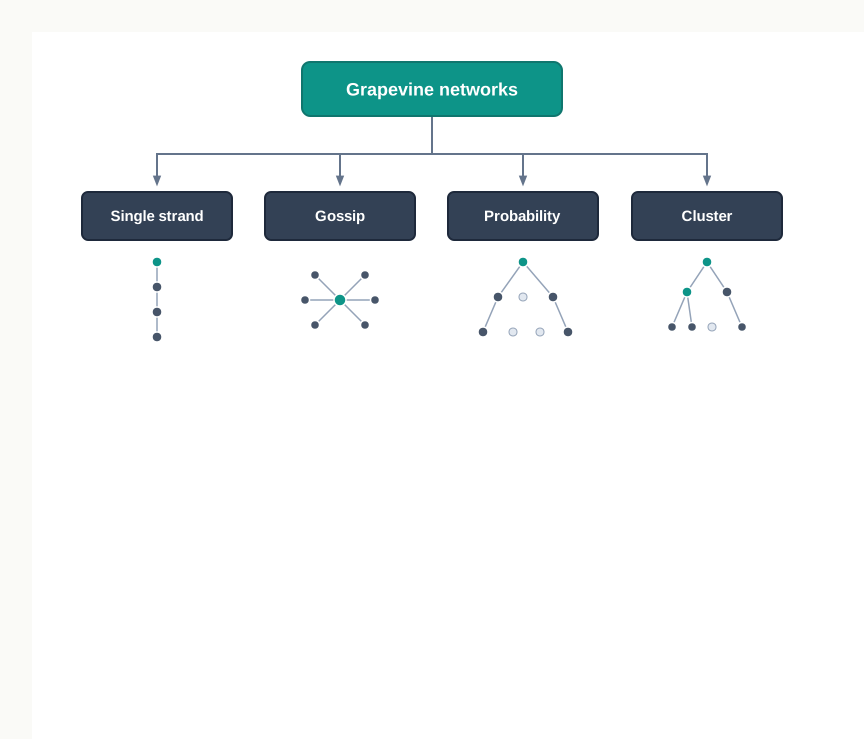 [Caption:] Fig. 7.10 – Grapevine networks. [/Caption:]
In the single strand network, each person communicates to the other in sequence. In the gossip network, one person communicates with all others on a non-selective basis. In the probability network, the individual communicates randomly with other individuals. In the cluster network, the individual communicates only with those people whom he trusts. Of these four types of networks, cluster is the most popular in organisations.
[Table:] Table 7.4 — Formal And Informal Communication | Basis | Formal communication | Informal communication | |—|—|—| | Origin | Arises from the official channels shown in the organisation chart | Arises from the social needs of employees | | Flow | Follows the lines of authority, vertically or horizontally | Flows in any direction, disregarding authority levels | | Record | Generally recorded and filed | Unrecorded and unofficial | | Speed | Comparatively slow, as it moves through prescribed channels | Very fast | | Accuracy | Generally accurate and authentic | Often distorted, and may become a rumour | | Networks | Single chain, wheel, circular, free flow, inverted V | Single strand, gossip, probability, cluster | [/Table]
[Business Example:] Reading The Canteen Correctly A manufacturing company announced that one of its two assembly lines would be modernised. Within two days the canteen was full of talk that half the workforce would be retrenched, although no such decision had been taken. The works manager, who heard of the rumour through a foreman, called a shop meeting the same week and explained the actual plan. The grapevine had carried the alarm quickly, and it also gave the management early warning that an announcement was needed. [/Business Example]
7.13 Barriers to Communication
It is generally observed that managers face several problems due to communication breakdowns or barriers. These barriers may prevent a communication from reaching the receiver, filter part of it, or carry an incorrect meaning, on account of which misunderstandings are created. It is therefore important for a manager to identify such barriers and take measures to overcome them.
The barriers to communication in organisations can be broadly grouped into four categories, as shown in Fig. 7.11.
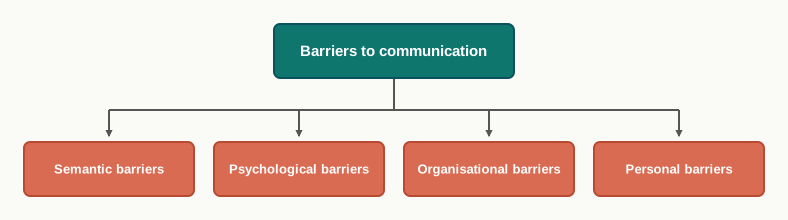 [Caption:] Fig. 7.11 – Barriers to communication. [/Caption:]
Semantic Barriers
Semantics is the branch of linguistics dealing with the meaning of words and sentences. Semantic barriers are concerned with problems and obstructions in the process of encoding and decoding a message into words or impressions. Normally such barriers arise on account of the use of wrong words, faulty translations and different interpretations.
Badly expressed message — sometimes the intended meaning may not be conveyed by a manager to his subordinates. Such badly expressed messages may be on account of inadequate vocabulary, usage of wrong words or omission of needed words.
Symbols with different meanings — a word may have several meanings, and the receiver has to perceive one such meaning for the word used by the communicator. Consider the three sentences below, in which the word ‘value’ is used.
What is the value of this ring?
I value our friendship.
What is the value of learning computer skills?
The word ‘value’ gives a different meaning in each context. Wrong perception of the intended meaning leads to communication problems.
Faulty translations — sometimes communications originally drafted in one language, such as English, need to be translated into a language understandable to workers, such as Hindi. If the translator is not proficient in both languages, mistakes may creep in and cause a different meaning to be conveyed.
Unclarified assumptions — some communications carry certain assumptions which are subject to different interpretations. For example, a boss may instruct his subordinate, ‘Take care of our guest’. The boss may mean that the subordinate should take care of the transport, food and accommodation of the guest until he leaves the place. The subordinate may interpret it as meaning that the guest should be taken to a hotel with care. The guest actually suffers on account of such unclarified assumptions.
Technical jargon — it is usually found that specialists use technical jargon while explaining matters to persons who are not specialists in that field. Such persons may therefore not understand the actual meaning of many of these words.
Body language and gesture decoding — every movement of the body communicates some meaning. The body movements and gestures of the communicator matter a great deal in conveying the message. If there is no match between what is said and what is expressed through body movements, the communication may be wrongly perceived.
Psychological Barriers
Emotional or psychological factors act as barriers to communicators. For example, a worried person cannot communicate properly, and an angry receiver cannot understand the real meaning of a message. The state of mind of both the sender and the receiver is reflected in the effectiveness of communication.
Premature evaluation — sometimes people evaluate the meaning of a message before the sender has completed it. Such premature evaluation may be due to pre-conceived notions or prejudices against the communication.
Lack of attention — the pre-occupied mind of the receiver, and the resultant non-listening of the message, acts as a major psychological barrier. For instance, an employee explains his problems to a boss who is pre-occupied with an important file before him. The boss does not grasp the message and the employee is disappointed.
Loss by transmission and poor retention — when communication passes through various levels, successive transmissions result in the loss of information, or in the transmission of inaccurate information. This happens more in the case of oral communication. Poor retention is another problem, since people usually cannot retain information for a long time if they are inattentive or not interested.
Distrust — distrust between the communicator and the communicatee acts as a barrier. If the parties do not believe each other, they cannot understand each other’s message in its original sense.
Organisational Barriers
The factors related to organisation structure, authority relationships, and rules and regulations may sometimes act as barriers to effective communication.
Organisational policy — if the organisational policy, explicit or implicit, is not supportive of the free flow of communication, it may hamper the effectiveness of communications. For example, in an organisation with a highly centralised pattern, people may not be encouraged to communicate freely.
Rules and regulations — rigid rules and cumbersome procedures may be a hurdle to communication. Similarly, communications routed through a prescribed channel may result in delays.
Status — the status of a superior may create a psychological distance between him and his subordinates. A status conscious manager also may not allow his subordinates to express their feelings freely.
Complexity in organisation structure — in an organisation where there are a number of managerial levels, communication gets delayed and distorted, as the number of filtering points is greater.
Organisational facilities — if facilities for smooth, clear and timely communication are not provided, communications may be hampered. Facilities such as frequent meetings, a suggestion box, a complaint box, social and cultural gatherings and transparency in operations encourage the free flow of communication. Lack of these facilities may create communication problems.
Personal Barriers
The personal factors of both the sender and the receiver may exert an influence on effective communication. Some of the personal barriers of superiors and subordinates are mentioned below.
Fear of challenge to authority — if a superior perceives that a particular communication may adversely affect his authority, he or she may withhold or suppress such communication.
Lack of confidence of superior in his subordinates — if superiors do not have confidence in the competency of their subordinates, they may not seek their advice or opinions.
Unwillingness to communicate — sometimes subordinates may not be prepared to communicate with their superiors, if they perceive that it may adversely affect their interests.
Lack of proper incentives — if there is no motivation or incentive for communication, subordinates may not take the initiative to communicate. For example, if there is no reward or appreciation for a good suggestion, subordinates may not be willing to offer useful suggestions.
[Do Not Mix Up:] Semantic Barriers And Psychological Barriers Semantic barriers arise from the words and symbols used, such as wrong words, jargon or faulty translation. Psychological barriers arise from the state of mind of the sender or the receiver, such as inattention, distrust or premature evaluation. The first is a defect in the message; the second is a defect in the person handling it. [/Do Not Mix Up]
7.14 Improving Communication Effectiveness
Barriers to effective communication exist in all organisations to a greater or lesser degree. They cannot be removed altogether, but their effect can be reduced considerably. Organisations keen on developing effective communication should adopt suitable measures to overcome the barriers and improve communication effectiveness. Some such measures are indicated below.
Clarify the ideas before communication — the problem to be communicated to subordinates should be clear in all its perspective to the executive himself. The entire problem should be studied in depth, analysed and stated in such a manner that it is clearly conveyed to subordinates. A manager who is himself unclear cannot make anyone else clear.
Communicate according to the needs of the receiver — the level of understanding of the receiver should be crystal clear to the communicator. A manager should adjust his communication according to the education and understanding levels of his subordinates.
Consult others before communicating — before actually communicating the message, it is better to involve others in developing a plan for communication. The participation and involvement of subordinates helps to gain ready acceptance and their willing cooperation.
Be aware of the language, tone and content of the message — the contents of the message, the tone, the language used and the manner in which the message is to be communicated are all important aspects of effective communication. The language used should be understandable to the receiver and should not offend the sentiments of listeners. The message should be stimulating enough to evoke a response from them.
Convey things of help and value to listeners — while conveying a message to others, it is better to know the interests and needs of the people with whom one is communicating. If the message relates directly or indirectly to such interests and needs, it certainly evokes a response from the communicatee.
Ensure proper feedback — the communicator may ensure the success of communication by asking questions regarding the message conveyed. The receiver may also be encouraged to respond to the communication. The communication process may be improved by the feedback received, so as to make it more responsive.
Communicate for the present as well as the future — generally, communication is needed to meet existing commitments and to maintain consistency. However, communication should also aim at the future goals of the enterprise.
Follow up communications — there should be regular follow up and review of the instructions given to subordinates. Such follow up measures help in removing hurdles, if any, in implementing the instructions.
Be a good listener — a manager should be a good listener. Patient and attentive listening solves half of the problems. Managers should also give indications of their interest in listening to their subordinates.
These measures act on different points of the communication process. The first two work on encoding, the third and fifth on the receiver’s acceptance, the fourth on the message itself, and the sixth, eighth and ninth on feedback. Together they close the gaps at which the barriers discussed earlier usually appear.
[Try Yourself:] Recall an occasion on which an instruction given to you was misunderstood. Identify the barrier that caused the misunderstanding and state which one of the nine measures above would have prevented it. [/Try Yourself]
7.15 Summary
Directing is a complex managerial function consisting of all the activities designed to encourage subordinates to work effectively. It includes supervision, motivation, communication and leading.
The principles which guide effective directing may be classified as principles related to the purpose of directing and principles related to the direction process.
Supervision is an element of direction. It can be understood as a process, and also as the function performed by a supervisor, a position at the operative level. Supervision is important because it is closely linked to overseeing the work, guiding workers and ensuring that targets are met by workers and employees.
Motivation is the process of stimulating people to action to accomplish the desired goals of the organisation. It is an internal feeling of an individual and leads to goal directed behaviour. It is mainly based on the needs of individuals, and it helps individuals and groups in the organisation to improve performance.
Managers offer incentives to employees, both financial and non-financial. Financial incentives are monetary and may take the form of salary, bonus, profit sharing and pension. Non-financial incentives provide social and psychological satisfaction, and include status, promotion, responsibility, job enrichment, job recognition, job security, employee participation, delegation and empowerment.
Leadership is the most important factor in the success of an enterprise. It is the process of influencing people to strive willingly for group objectives. Some of the qualities of a good leader are courage, will power, judgement, knowledge, integrity, physical energy, faith, moral qualities, fairness, vitality, decisiveness and social skills. All these qualities cannot be possessed by any one individual, nor do they always assure success.
Communication refers to the process of exchange of ideas between or among persons so as to create understanding. The communication process involves the elements of source, encoding, channel, receiver, decoding and feedback.
In organisations, both formal and informal communication take place simultaneously. Formal communication refers to all official communication in the form of orders, memos, appeals, notes, circulars, agenda and minutes.
Apart from formal communication, informal or grapevine communication also exists. Informal communications are usually in the form of rumours and whispers. They are unofficial, spontaneous and unrecorded, spread very fast and are usually distorted. A manager should learn to manage with informal communication as well.
In most organisations several barriers may exist to effective communication. Some of these are semantic barriers, organisational barriers, language barriers, transmission barriers, psychological barriers and personal barriers. Managers should take appropriate measures to overcome these barriers and promote effective communication in the organisation.
The overall structure of the chapter is summarised in Fig. 7.12.
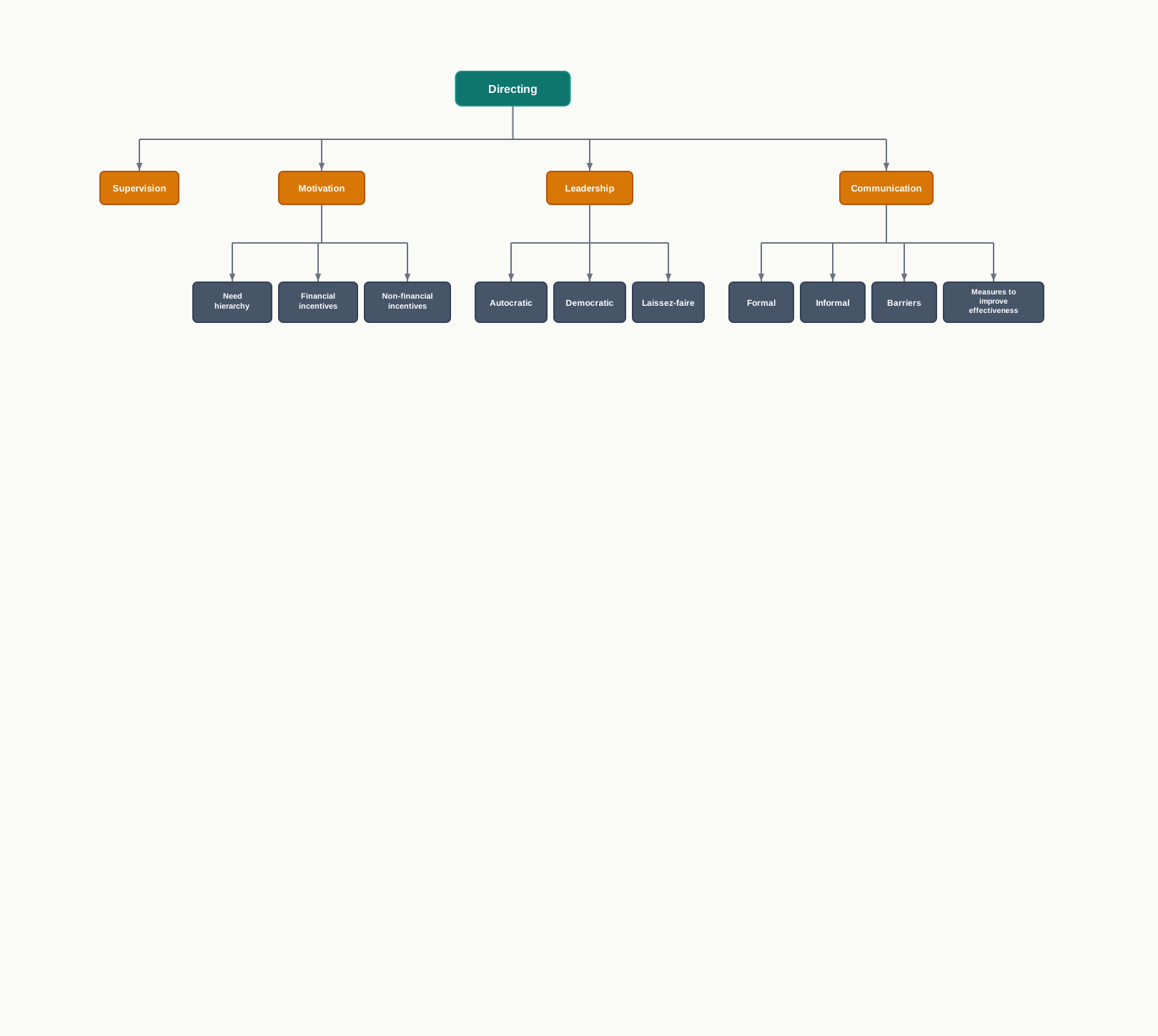 [Caption:] Fig. 7.12 – Structure of the directing function. [/Caption:]
7.16 Key Terms
- Directing The process of instructing, guiding, counselling, motivating and leading people in an organisation to achieve its objectives.
- Supervision The process of guiding the efforts of employees and other resources to accomplish the desired objectives, by overseeing the work of subordinates and giving instructions.
- Motivation The process of stimulating people to action to accomplish desired goals.
- Motive An inner state that energises, activates or moves behaviour and directs it towards goals, arising out of the needs of an individual.
- Motivator The technique used by managers to motivate people, such as pay, bonus, promotion, recognition, praise or responsibility.
- Egoistic needs Esteem needs, covering self-respect, autonomy, status, recognition and attention.
- Self actualisation The highest need in Maslow’s hierarchy, being the drive to become what one is capable of becoming.
- Incentive Any measure used to motivate people to improve their performance.
- Financial incentives Incentives in direct monetary form, or measurable in monetary terms, that motivate people for better performance.
- Profit sharing An incentive that provides employees a share in the profits of the organisation.
- Co-partnership An incentive scheme under which employees are offered company shares, creating a feeling of ownership in them.
- Stock option An incentive scheme under which employees are offered company shares at a set price lower than the market price.
- Quality circles A form of employee participation in which employees meet as a group to discuss and improve work-related matters.
- Leadership The process of influencing the behaviour of people by making them strive voluntarily towards the achievement of organisational goals.
- Trait approach The study of leadership that seeks to identify the personal qualities which make a leader effective.
- Autocratic leader A leader who gives orders and expects subordinates to obey them, with communication flowing only one way.
- Democratic leader A leader who develops action plans and takes decisions in consultation with subordinates.
- Laissez-faire leader A leader who avoids the use of power and leaves subordinates free to set their own objectives and ways of achieving them.
- Communication The process of exchange of information between two or more persons to reach common understanding.
- Encoding The process of converting a message into communication symbols such as words, pictures or gestures.
- Decoding The process of converting the encoded symbols of the sender back into meaning.
- Feedback All those actions of the receiver which indicate that he has received and understood the message of the sender.
- Noise Any obstruction or hindrance to communication, affecting the sender, the message or the receiver.
- Formal communication Communication that flows through the official channels designed in the organisation chart.
- Informal communication Communication that takes place without following the formal lines of communication.
- Grapevine The informal system of communication, so called because it spreads in all directions in disregard of levels of authority.
- Semantic barriers Barriers concerned with problems in encoding and decoding a message into words or impressions.
7.17 NCERT Questions
Very Short Answer Questions
- What is informal communication?
- Which style of leadership does not believe in the use of power unless it is absolutely essential?
- Which element in the communication process involves converting the message into words, symbols, gestures, etc.?
- The workers always try to show their inability when any new work is given to them. They are always unwilling to take up any kind of work. Due to a sudden rise in demand, a firm wants to meet excess orders. The supervisor is finding it difficult to cope with the situation. State the element of directing that can help the supervisor in handling the problem.
Short Answer Questions
- What are semantic barriers of communication?
- Explain the process of motivation with the help of a diagram.
- State the different networks of grapevine communication.
- Explain any three principles of directing.
- In an organisation, one of the departmental managers is inflexible, and once he takes a decision he does not like to be contradicted. As a result, employees always feel they are under stress, they take the least initiative and fear to express their opinions and problems before the manager. What is the problem in the way authority is being used by the manager?
- A reputed hostel, GyanPradan, provides medical aid and free education to the children of its employees. Which incentive is being highlighted here? State its category and name any two more incentives of the same category.
Long Answer Questions
- Discuss Maslow’s Need Hierarchy theory of motivation.
- What are the common barriers to effective communication? Suggest measures to overcome them.
- Explain the different financial and non-financial incentives used to motivate the employees of a company.
- In an organisation all the employees take things easy and are free to approach anyone for minor queries and problems. This has resulted in everyone talking to each other and thus resulting in inefficiency in the office. It has also resulted in loss of secrecy and confidential information being leaked out. What system do you think the manager should adopt to improve communication?
7.18 Check Your Concepts
- Why is directing said to initiate action, when planning, organising and staffing are completed before it?
- Explain why the directing function continues in an organisation even when the managers occupying its positions are transferred or replaced.
- Distinguish between delegation of an order and follow through, and state why merely giving an order is not sufficient.
- What happens in an organisation if the principle of unity of command is not followed while directing subordinates?
- Distinguish between a motive, a motivation and a motivator, giving one example of each.
- A company gives its senior managers a large annual pay rise, but their performance does not improve. Using Maslow’s assumptions, explain why this may have happened.
- Distinguish between financial and non-financial incentives on any four bases.
- Arrange the following in the correct sequence of the motivation process: search behaviour, unsatisfied need, reduction of tension, drives, tension, satisfied need.
- Assertion (A): A laissez-faire leader gives subordinates a high degree of independence. Reason (R): Such a leader does not believe in the use of power unless it is absolutely essential. Choose the correct option:
- Both A and R are true, and R is the correct explanation of A.
- Both A and R are true, but R is not the correct explanation of A.
- A is true but R is false.
- A is false but R is true.
- Identify the term: the element of the communication process which includes all those actions of the receiver indicating that he has received and understood the message.
- Match the network in column I with its description in column II:
| Column A | Column B |
|---|---|
| a. Wheel | i. each person communicates with all others freely |
| b. Circular | ii. all subordinates communicate only through their common superior |
| c. Free flow | iii. a subordinate may communicate with his superior’s superior |
| d. Inverted V | iv. each person communicates with two adjoining persons |
- Why is the grapevine described as both a danger and a useful tool for a manager? Support your answer with reasons.
- Distinguish between organisational barriers and personal barriers to communication.
- What happens to the accuracy of a message when it passes through many managerial levels, and which measure of improving communication effectiveness addresses this problem?
7.19 Case-Based Questions
- Rohilla Tools employs 400 workers across three shifts. The production head noticed that absenteeism had risen sharply, that workers complained of being unnoticed, and that four skilled machinists had resigned in six months. He introduced a monthly best-worker certificate, began displaying achievements on the notice board, and offered the senior machinists a role in planning the shift schedule.
- Identify the category of incentive introduced by the production head.
- Name the three specific incentives described in the case.
- State any two benefits of motivation that the firm is likely to obtain from these measures.
- At Suvarna Appliances, the marketing head circulates written targets to her team every Monday and files a copy in the office. Separately, a rumour began in the staff canteen that the company was about to close its Nagpur depot, and within three days it had reached every branch, although the management had taken no such decision.
- Identify the two types of communication described in the case.
- State any three differences between them.
- Suggest one way in which the marketing head can make use of the second type of communication.
- Girish is a newly appointed supervisor in a packaging unit. He issues instructions in technical language that the workers do not follow, and he is often pre-occupied with reports when workers try to explain their difficulties to him. The unit head has also observed that Girish does not check whether his instructions have been carried out.
- Identify the two barriers to communication present in the case.
- State the principle of directing that Girish has ignored by not checking on his instructions.
- State any two measures Girish should adopt to improve communication effectiveness.