Chapter 8: Controlling
Every business plans before it acts. A production target is fixed, a sales figure is set, a delivery date is promised. What happens after that decides whether the plan was worth making. Actual work usually drifts away from what was planned — machines break down, workers fall short of targets, costs rise, market conditions change. Unless someone measures this gap and acts on it, the plan remains only on paper.
Consider an airline. Its departure control system keeps track of check-in, printing of boarding passes, baggage acceptance and boarding load for every flight. Staff can see at any moment how the actual position compares with the schedule, and can act before a small delay spreads to later flights. The same idea works in a factory that counts defective pieces in a batch, or a store that compares each day’s sales with its target.
Controlling is the function of management that performs this task. This chapter explains the meaning and importance of controlling, its limitations, its relationship with planning, the steps in the controlling process, and the techniques of managerial control.

Fig. 8.0 – Airline check-in counters in operation.
8.1 Meaning of Controlling
Controlling is one of the important functions performed by a manager. A manager assigns work to subordinates and expects planned results from them. To make sure those results actually come, the manager has to keep an effective check on the activities of the subordinates while the work is going on.
In simple words, controlling means ensuring that activities in an organisation are performed as per the plans. It also ensures that the organisation’s resources — money, material, machinery and manpower — are being used effectively and efficiently for the achievement of predetermined goals. Controlling is, therefore, a goal-oriented function.
The purpose of controlling is not fault-finding. It exists because plans are made in advance, while work is done later under changing conditions. Some gap between the two is natural. Controlling is the function that measures this gap, reveals its causes, and puts the organisation back on track before the damage becomes serious.
An authoritative definition of managerial control is given below.
Controlling Is A Pervasive Function
Controlling is a pervasive function. It is a primary function of every manager, not the special duty of any one department or any one level. Managers at all levels of management — top, middle and lower — have to perform controlling functions to keep a check on the activities falling in their own areas.
Its usefulness is not limited to business firms either. Controlling is as much required in an educational institution, in the military, in a hospital and in a club as it is in any business organisation. Wherever objectives are set and resources are used to achieve them, performance has to be checked against those objectives.
Controlling Is Not The Last Function
Controlling should not be misunderstood as the last function of management. It is a function that brings the management cycle back to the planning function, as shown in Fig. 8.1.
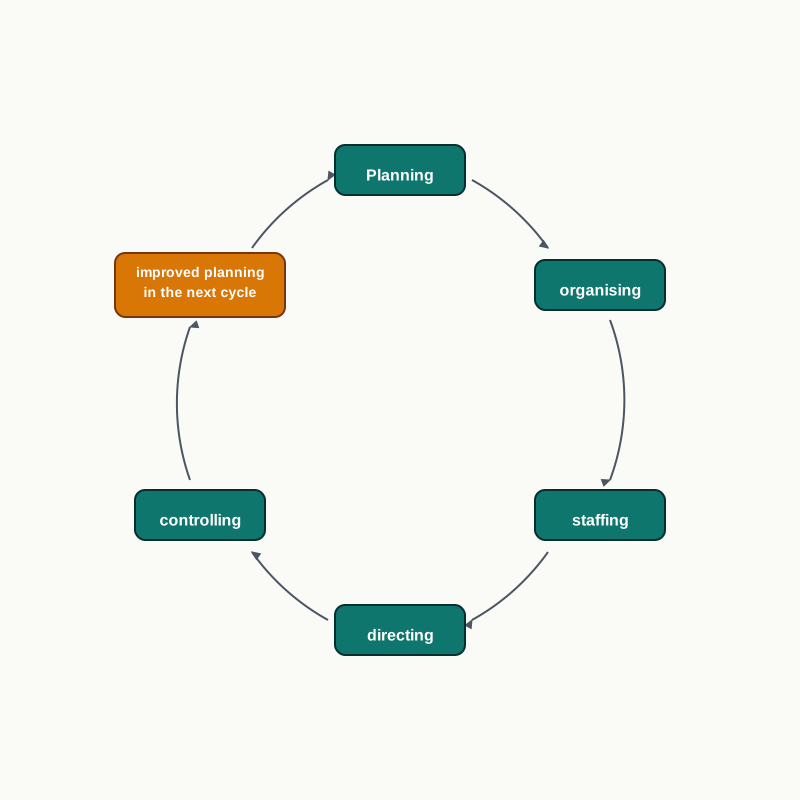
Fig. 8.1 – Controlling completes one cycle of management.
The controlling function finds out how far actual performance deviates from the standards, analyses the causes of such deviations, and attempts to take corrective action on that basis. This process helps in the formulation of future plans in the light of the problems that were identified.
Controlling, thus, only completes one cycle of the management process and improves planning in the next cycle. This is the reason management is described as a continuous process rather than a set of steps that end once.
8.2 Importance of Controlling
Control is an indispensable function of management. Without control, even the best of plans can go awry, because a plan by itself does not guarantee that the work will actually be done in the manner intended.
A good control system helps an organisation in the following ways.
Accomplishing organisational goals — the controlling function measures progress towards the organisational goals and brings to light the deviations, if any, and indicates corrective action. It thus guides the organisation and keeps it on the right track so that organisational goals might be achieved.
Judging accuracy of standards — a good control system enables management to verify whether the standards set are accurate and objective. An efficient control system keeps a careful check on the changes taking place in the organisation and in the environment, and helps to review and revise the standards in the light of such changes.
Making efficient use of resources — by exercising control, a manager seeks to reduce wastage and spoilage of resources. Each activity is performed in accordance with predetermined standards and norms. This ensures that resources are used in the most effective and efficient manner.
Improving employee motivation — a good control system ensures that employees know well in advance what they are expected to do and what the standards of performance are on the basis of which they will be appraised. This clarity motivates them and helps them to give better performance.
Ensuring order and discipline — controlling creates an atmosphere of order and discipline in the organisation. It helps to minimise dishonest behaviour on the part of employees by keeping a close check on their activities.
Facilitating coordination in action — controlling provides direction to all activities and efforts for achieving organisational goals. Each department and each employee is governed by predetermined standards which are well coordinated with one another. This ensures that overall organisational objectives are accomplished.
Why These Benefits Follow
Each of these benefits arises from the same feature of control, namely that performance is compared against a standard fixed in advance. A standard tells the employee what is expected, tells the manager whether resources are being wasted, and tells the organisation whether it is moving towards its goals.
Where such standards are absent, deviations are noticed only when the damage has already occurred. Control, therefore, works best when it is exercised while the work is in progress and not merely after it is over.
8.3 Limitations of Controlling
Although controlling is an important function of management, it cannot solve every problem an organisation faces. It suffers from the following limitations.
Difficulty in setting quantitative standards — the control system loses some of its effectiveness when standards cannot be defined in quantitative terms. This makes measurement of performance and its comparison with standards a difficult task. Employee morale, job satisfaction and human behaviour are areas where this problem might arise.
Little control on external factors — generally an enterprise cannot control external factors such as government policies, technological changes, competition and similar forces. A control system can help the firm adjust to these factors, but it cannot prevent them from arising.
Resistance from employees — control is often resisted by employees. They see it as a restriction on their freedom. For instance, employees might object when they are kept under a strict watch with the help of Closed Circuit Televisions (CCTVs).
Costly affair — control is a costly affair, as it involves a lot of expenditure, time and effort. A small enterprise cannot afford to install an expensive control system, since it cannot justify the expenses involved. Managers must ensure that the costs of installing and operating a control system do not exceed the benefits derived from it.
Working Around The Limitations
These limitations do not make controlling unnecessary; they only decide how far it should be carried. Where standards cannot be stated in figures, an effort is made to define them in a way that still allows measurement, such as the time taken to attend to a customer complaint.
Where employees resist control, explaining the standards in advance and involving them in setting those standards reduces the feeling of being policed. Where cost is the constraint, control is concentrated on the few areas that matter most rather than spread over every activity.
8.4 Relationship Between Planning and Controlling
Planning and controlling are the inseparable twins of management. They are studied as two separate functions, but in practice neither can work without the other.
A system of control presupposes the existence of certain standards. These standards of performance, which serve as the basis of controlling, are provided by planning. Once a plan becomes operational, controlling is necessary to monitor the progress, measure it, discover deviations and initiate corrective measures so that events conform to plans.
Thus, planning without controlling is meaningless. A plan that is never checked has no way of showing whether it is being followed. Similarly, controlling is blind without planning. If standards are not set in advance, managers have nothing against which to compare actual performance. When there is no plan, there is no basis of controlling.
Planning Is A Prerequisite For Controlling
Planning is clearly a prerequisite for controlling. It is unrealistic to think that controlling could be accomplished without planning, because without planning there is no predetermined understanding of the desired performance.
Planning seeks consistent, integrated and articulated programmes, while controlling seeks to compel events to conform to those plans. One decides what ought to happen; the other ensures that it does happen.
Planning is basically an intellectual process involving thinking, articulation and analysis, in order to discover and prescribe an appropriate course of action for achieving objectives. Controlling, on the other hand, checks whether decisions have been translated into the desired action. Planning is thus prescriptive, whereas controlling is evaluative.
Both Look Forward And Backward
It is often said that planning is looking ahead while controlling is looking back. This statement is only partially correct.
Plans are prepared for the future and are based on forecasts about future conditions. Therefore, planning involves looking ahead and is called a forward-looking function. On the contrary, controlling is like a postmortem of past activities, carried out to find out deviations from the standards. In that sense, controlling is a backward-looking function.
However, it should be understood that planning is guided by past experiences, and the corrective action initiated by the control function aims to improve future performance. Thus, planning and controlling are both backward-looking as well as forward-looking functions. This point is frequently tested in board examinations, where the statement is given for comment rather than for simple agreement.
Planning and controlling are, therefore, interrelated and in fact reinforce each other in the sense that
Planning based on facts makes controlling easier and effective; and
Controlling improves future planning by providing information derived from past experience.
The main differences between the two functions are set out in Table 8.1.
8.5 Controlling Process
Controlling is not a single act performed at the end of the year. It is a systematic process, and each step in it prepares the ground for the next. The complete sequence is summarised in Fig. 8.2.
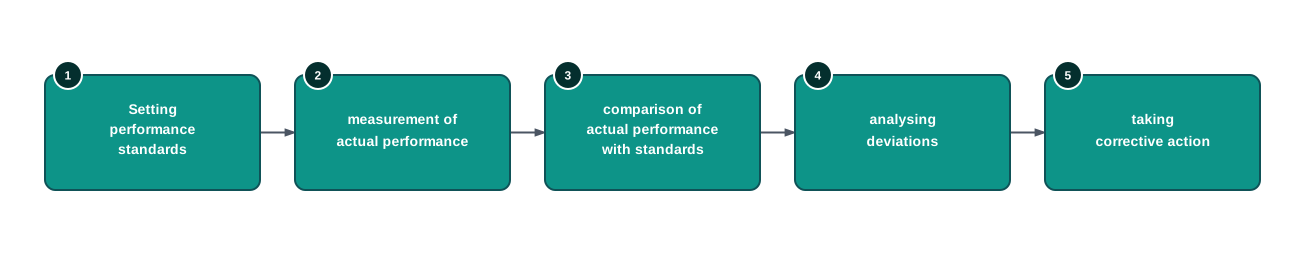
Fig. 8.2 – Steps in the controlling process.
The five steps are explained below.
8.5.1 Setting Performance Standards
The first step in the controlling process is setting up of performance standards. Standards are the criteria against which actual performance is measured. They serve as benchmarks towards which an organisation strives to work.
Standards can be set in both quantitative as well as qualitative terms. Standards set in terms of cost to be incurred, revenue to be earned, product units to be produced and sold, and time to be spent in performing a task all represent quantitative standards. Sometimes standards may also be set in qualitative terms; improving goodwill and the motivation level of employees are examples of qualitative standards.
At the time of setting standards, a manager should try to set standards in precise quantitative terms, as this makes their comparison with actual performance much easier. For instance, a standard may state that defects are to be reduced from 10 in every 1,000 pieces produced to 5 in every 1,000 pieces produced by the end of the quarter.
However, whenever qualitative standards are set, an effort must be made to define them in a manner that makes their measurement easier. For instance, for improving customer satisfaction in a self-service fast food chain, standards can be set in terms of the time a customer waits for a table, the time taken by him to place the order, and the time taken to collect the order.
It is important that standards should be flexible enough to be modified whenever required. Due to changes taking place in the internal and external business environment, standards may need some modification to remain realistic in the changed business environment.
Standards In Different Functional Areas
Different departments of a business gauge performance through standards suited to their own work.
Production — quantity, quality, cost, individual job and performance.
Marketing — sales volume, sales expense, advertising expenditure, individual and sales-person’s performance.
Human resource management — labour relations, labour turnover and labour absenteeism.
Finance and accounting — capital expenditure, inventories, flow of capital and liquidity.
8.5.2 Measurement of Actual Performance
Once performance standards are set, the next step is measurement of actual performance. Performance should be measured in an objective and reliable manner, so that the figures obtained can be trusted.
There are several techniques for measurement of performance. These include personal observation, sample checking and performance reports. As far as possible, performance should be measured in the same units in which the standards are set, as this makes their comparison easier.
It is generally believed that measurement should be done after the task is completed. However, wherever possible, measurement of work should be done during the performance itself. For instance, in an assembling task each part produced should be checked before assembling. Similarly, in a manufacturing plant, levels of gas particles in the air could be continuously monitored for safety.
The method of measurement differs with what is being measured. Measurement of the performance of an employee may require preparation of a performance report by his superior. Measurement of a company’s performance may involve calculation of certain ratios such as gross profit ratio, net profit ratio and return on investment at periodic intervals.
Progress of work in operating areas like marketing may be measured by considering the number of units sold and the increase in market share, whereas efficiency of production may be measured by counting the number of pieces produced and the number of defective pieces in a batch.
In small organisations, each piece produced may be checked to ensure that it conforms to the quality specifications laid down for the product. This might not be possible in a large organisation. Therefore, in large organisations certain pieces are checked at random for quality, and this is known as sample checking.

Fig. 8.3 – Quality inspection on a factory line.
8.5.3 Comparing Actual Performance with Standards
This step involves comparison of actual performance with the standard. Such comparison reveals the deviation between actual and desired results.
Comparison becomes easier when standards are set in quantitative terms. For instance, the performance of a worker in terms of units produced in a week can be easily measured against the standard output fixed for that week. Where the standard is qualitative, the comparison calls for judgement, which is why the previous step stresses measurable definitions.
8.5.4 Analysing Deviations
Some deviation in performance can be expected in all activities. It is therefore important to determine the acceptable range of deviations, that is, the limit within which a difference between the standard and actual performance will be tolerated.
Also, deviations in key areas of business need to be attended to more urgently as compared to deviations in certain insignificant areas. Two principles help a manager here: critical point control and management by exception.
8.5.4.1 Critical Point Control
It is neither economical nor easy to keep a check on each and every activity in an organisation. Control should therefore focus on key result areas (KRAs) which are critical to the success of an organisation. These KRAs are set as the critical points, and if anything goes wrong at the critical points, the entire organisation suffers.
For instance, in a manufacturing organisation an increase of 5 per cent in the labour cost may be more troublesome than a 15 per cent increase in postal charges, because labour cost forms a major part of total cost while postal charges do not.
8.5.4.2 Management by Exception
Management by exception, which is often referred to as control by exception, is an important principle of management control. It is based on the belief that an attempt to control everything results in controlling nothing.
Thus, only significant deviations which go beyond the permissible limit should be brought to the notice of management. If the plans lay down a 2 per cent increase in labour cost as an acceptable range of deviation in a manufacturing organisation, only an increase in labour cost beyond 2 per cent should be brought to the notice of the management. However, in the case of a major deviation from the standard, say 5 per cent, the matter has to receive immediate action of management on a priority basis.
Advantages Of These Two Principles
When a manager sets critical points and focuses attention on significant deviations which cross the permissible limit, the following advantages accrue.
It saves the time and effort of managers, as they deal with only significant deviations.
It focuses managerial attention on important areas, so there is better utilisation of managerial talent.
Routine problems are left to the subordinates. Management by exception thus facilitates delegation of authority and increases the morale of employees.
It identifies critical problems which need timely action to keep the organisation on the right track.
Finding The Causes
After identifying the deviations that demand managerial attention, these deviations need to be analysed for their causes. Deviations may have several causes for their origin. These include unrealistic standards, a defective process, inadequacy of resources, structural drawbacks, organisational constraints and environmental factors beyond the control of the organisation.
It is necessary to identify the exact cause or causes of a deviation, failing which an appropriate corrective action might not be possible. The deviations and their causes are then reported and corrective action is taken at the appropriate level.
8.5.5 Taking Corrective Action
The final step in the controlling process is taking corrective action. No corrective action is required when the deviations are within acceptable limits. However, when the deviations go beyond the acceptable range, especially in the important areas, the matter demands immediate managerial attention so that such deviations do not occur again and the standards are accomplished.
The nature of the corrective action depends on the cause identified in the previous step. Corrective action might involve training of employees if the production target could not be met. Similarly, if an important project is running behind schedule, corrective action might involve assigning additional workers and equipment to the project and granting permission for overtime work.
In case the deviation cannot be corrected through managerial action, the standards themselves may have to be revised. This happens when the original standard was unrealistic, or when a change in the business environment has made it impossible to achieve.
8.6 Techniques of Managerial Control
Knowing the steps of the controlling process is not enough. A manager also needs practical devices through which performance can actually be watched, measured and reported. These devices are called techniques of managerial control.
They are broadly divided into traditional techniques and modern techniques, as shown in Fig. 8.4. Traditional techniques are those that have been used by firms for a long time and continue to be in use. Modern techniques are those that have come into use more recently and provide a newer way of looking at managerial performance.
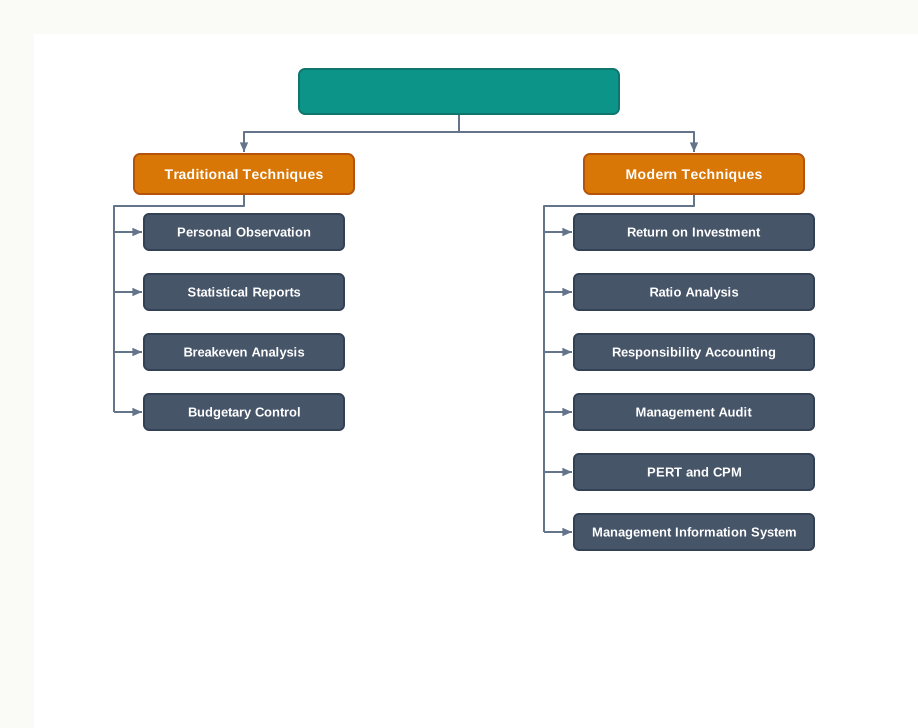
Fig. 8.4 – Techniques of managerial control.
8.6.1 Traditional Techniques
Personal observation — this is the most traditional method of control. It enables the manager to collect first-hand information about actual performance. It also creates a psychological pressure on the employees to perform well, because they know that they are being observed personally. However, it is a very time-consuming exercise and cannot be used effectively in all kinds of jobs, especially where work is spread over many locations.
Statistical reports — statistical analysis in the form of averages, percentages, ratios and correlation presents useful information to managers about performance in different areas. When this information is presented in the form of charts, graphs and tables, comparison becomes easy and trends can be seen quickly. A sales manager, for instance, can compare the sales of a product across regions and months from a single chart.
Breakeven analysis — breakeven analysis is a technique used by managers to study the relationship between sales volume, costs and profit. It shows the probable profit or loss at different levels of activity, and helps the manager see how much the firm must sell before it begins to earn a profit. The point at which the firm earns no profit and suffers no loss is called the breakeven point.
Budgetary control — budgetary control is a technique of managerial control in which all operations are planned in advance in the form of budgets, and actual results are compared with the budgetary standards. This comparison reveals the necessary actions to be taken so that organisational goals are accomplished.
Understanding The Breakeven Point
At the breakeven point, total revenue is exactly equal to total cost. Below this level of sales the firm makes a loss, and above it the firm makes a profit. The breakeven point is worked out by dividing the fixed costs by the contribution made by each unit, that is, by the difference between the selling price per unit and the variable cost per unit.
The usefulness of this technique lies in what it tells a manager before a decision is taken. A firm considering a price cut or an increase in fixed costs can see at once how much extra it will have to sell simply to stay at the same position.
Budgets And Their Types
A budget is a quantitative statement, prepared for a definite future period of time, for the purpose of attaining a given objective. Being quantitative, it becomes a ready standard against which actual performance can be compared.
Organisations prepare different budgets for different purposes.
Sales budget — a statement of what the organisation expects to sell in terms of quantity as well as value.
Production budget — a statement of what the organisation plans to produce in the budget period.
Material budget — a statement of the quantity and cost of materials required for the planned production.
Cash budget — an estimate of the expected cash receipts and cash payments over the budget period.
Capital budget — an estimate of the expected expenditure on major assets such as plant, machinery and buildings.
Research and development budget — an estimate of the expenditure on the development and improvement of products and processes.
Budgetary control is valued because a budget serves as a standard, a means of coordination among departments, and a source of motivation for employees who know in advance what is expected of them. It also promotes the efficient use of resources, since each department must work within a fixed allotment.
8.6.2 Modern Techniques
Return on investment — return on investment, commonly written as ROI, is a useful technique which measures whether the capital invested in the business has been used effectively to generate a reasonable amount of return. It is calculated by relating the net income earned to the total investment made, and is expressed as a percentage. ROI can be used to compare the performance of the firm over different years, to compare it with other firms, and to compare different divisions within the same firm.
Ratio analysis — ratio analysis refers to the analysis of the financial statements of an organisation through the computation of ratios. The commonly used ratios are liquidity ratios, which are calculated to determine the short-term solvency of the business; solvency ratios, which are calculated to determine the long-term solvency; profitability ratios, which are calculated to analyse the profitability position; and turnover ratios, which are calculated to determine how efficiently the resources of the business are being used.
Responsibility accounting — responsibility accounting is a system of accounting in which different sections, divisions and departments of an organisation are set up as responsibility centres. The head of each centre is responsible for achieving the target set for that centre. Performance is judged only against those items that the head can actually control, which makes the evaluation fair.
Management audit — management audit refers to a systematic appraisal of the overall performance of the management of an organisation. Its purpose is to review whether the management is performing its functions efficiently and whether the objectives of the organisation are being achieved. It helps in identifying deficiencies in the performance of management functions, improves coordination among departments, and keeps the management alert to changes in the environment.
PERT and CPM — PERT, which stands for Programme Evaluation and Review Technique, and CPM, which stands for Critical Path Method, are network techniques used for the planning and control of large and complex projects such as the construction of a bridge or the launch of a new product. Under these techniques the project is divided into activities, the activities are arranged in a logical sequence, a network diagram is prepared, and the time required for each activity is estimated. The longest path through the network, called the critical path, shows the minimum time in which the project can be completed and identifies the activities that must not be delayed.
Management information system — a management information system, commonly written as MIS, is a computer-based information system that provides the information and support needed for effective decision making by managers. It supplies relevant information at the right time, helps managers identify problems early, reduces the burden of collecting data personally, and improves the quality of decisions by making comparison of past and present performance possible.
Choosing A Technique
No single technique is suitable for every situation. Personal observation suits a small workshop, while a large multi-unit firm must rely on statistical reports and a management information system. A financial deviation is best examined through ratio analysis or return on investment, while a delay in a construction project is best examined through PERT and CPM.
The choice depends on the nature of the activity being controlled, the size of the organisation, and the cost of operating the technique. This is consistent with the earlier point that the cost of a control system should never exceed the benefit derived from it.

Fig. 8.5 – Managers reviewing a control report.
8.7 Summary
Controlling is the process of ensuring that actual activities conform to planned activities. It is a goal-oriented and pervasive function, performed by managers at all levels and in every kind of organisation.
The importance of managerial control lies in the fact that it helps in accomplishing organisational goals. Controlling also helps in judging the accuracy of standards, ensuring efficient utilisation of resources, boosting employee morale, creating an atmosphere of order and discipline in the organisation, and coordinating different activities so that they all work together in one direction to meet targets.
Controlling suffers from certain limitations as well. An organisation has no control over external factors. The control system may face resistance from employees. Sometimes controlling turns out to be a costly affair, especially in the case of small organisations. Moreover, it is not always possible for the management to set quantitative standards of performance, in the absence of which the controlling exercise loses some of its effectiveness.
The process of control involves setting performance standards, measurement of actual performance, comparison of actual performance with standards, analysis of deviations, and taking corrective action.
While analysing deviations, a manager applies critical point control by focusing on key result areas, and management by exception by reporting only those deviations that cross the permissible limit.
Planning and controlling are the inseparable twins of management. Planning initiates the process of management and controlling completes it. Plans are the basis of control, and without control the best laid plans may go astray.
Personal observation, statistical reports, breakeven analysis and budgetary control are the traditional techniques of managerial control.
Return on investment, ratio analysis, responsibility accounting, management audit, PERT and CPM, and management information system are the modern techniques of managerial control.
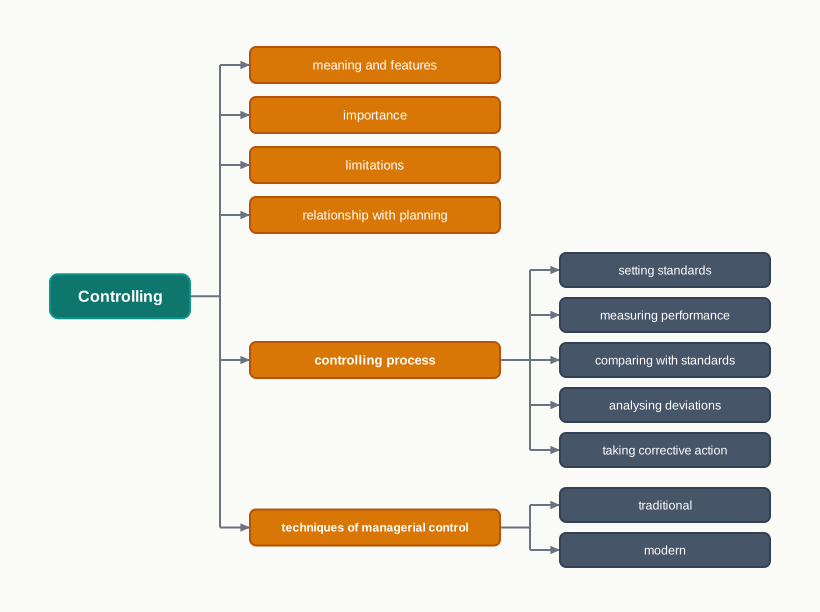
Fig. 8.6 – The structure of this chapter.
8.8 Key Terms
- Controlling The process of ensuring that activities in an organisation are performed as per the plans and that resources are used effectively and efficiently for the achievement of predetermined goals.
- Managerial control The measurement of accomplishment against the standard and the correction of deviations to assure attainment of objectives according to plans.
- Standards The criteria of performance, set in advance, against which actual performance is measured.
- Deviation The difference between the standard performance and the actual performance.
- Sample checking The practice of checking pieces selected at random for quality, used where checking every piece is not possible.
- Critical point control A principle of control under which attention is focused on key result areas that are critical to the success of the organisation.
- Key result areas Those areas of an organisation’s working whose failure would affect the success of the entire organisation, and which are set as critical points for control.
- Management by exception A principle of control under which only significant deviations that go beyond the permissible limit are brought to the notice of management.
- Breakeven analysis A technique used to study the relationship between sales volume, costs and profit at different levels of activity.
- Breakeven point That level of sales at which total revenue equals total cost, so that the firm earns neither a profit nor a loss.
- Budget A quantitative statement prepared for a definite future period of time for the purpose of attaining a given objective.
- Budgetary control A technique of control in which operations are planned in advance in the form of budgets and actual results are compared with the budgetary standards.
- Return on investment A technique that measures whether the capital invested in the business has been used effectively, by relating net income to the total investment made.
- Ratio analysis The analysis of the financial statements of an organisation through the computation of ratios such as liquidity, solvency, profitability and turnover ratios.
- Responsibility accounting A system of accounting in which different sections and divisions of an organisation are set up as responsibility centres, each headed by a person answerable for its performance.
- Management audit A systematic appraisal of the overall performance of the management of an organisation.
- PERT and CPM Network techniques used for the planning and control of large and complex projects by arranging activities in sequence and identifying the critical path.
- Management information system A computer-based information system that provides the information and support needed for effective decision making by managers.
8.9 NCERT Questions
Very Short Answer Type
- State the meaning of controlling.
- Name the principle that a manager should consider while dealing with deviations effectively.
- State any one situation in which an organisation’s control system loses its effectiveness.
- Give any two standards that can be used by a company to evaluate the performance of its Finance and Accounting department.
- Which term is used to indicate the difference between standard performance and actual performance?
Short Answer Type
- ‘Planning is looking ahead and controlling is looking back.’ Comment.
- ‘An effort to control everything may end up in controlling nothing.’ Explain.
- Explain how management audit serves as an effective technique of controlling.
- Mr. Arfaaz had been heading the production department of Writewell Products Ltd., a firm manufacturing stationery items. The firm secured an export order that had to be completed on a priority basis, and production targets were defined for all the employees. One of the workers, Mr. Bhanu Prasad, fell short of his daily production target by 10 units for two days consecutively. Mr. Arfaaz approached Ms. Vasundhara, the CEO of the company, to file a complaint against Mr. Bhanu Prasad and requested her to terminate his services. Explain the principle of management control that Ms. Vasundhara should consider while taking her decision.
Long Answer Type
- Explain the various steps involved in the process of control.
- Explain the techniques of managerial control.
- Explain the importance of controlling in an organisation. What are the problems faced by the organisation in implementing an effective control system?
- Discuss the relationship between planning and controlling.
- A company ‘M’ Limited is manufacturing mobile phones both for the domestic Indian market as well as for export. It had enjoyed a substantial market share and also had a loyal customer following. But lately it has been experiencing problems, because its targets have not been met with regard to sales and customer satisfaction. Also, the mobile market in India has grown tremendously and new players have come in with better technology and pricing. This is causing problems for the company. It is planning to revamp its controlling system and take other steps necessary to rectify the problems it is facing.
- Identify the benefits the company will derive from a good control system.
- How can the company relate its planning with control in this line of business to ensure that its plans are actually implemented and targets attained?
- Give the steps in the control process that the company should follow to remove the problems it is facing.
- Mr. Shantanu is a chief manager of a reputed company that manufactures garments. He called the production manager and instructed him to keep a constant and continuous check on all the activities related to his department, so that everything goes as per the set plan. He also suggested to him that he should keep track of the performance of all the employees in the organisation, so that targets are achieved effectively and efficiently.
- Describe any two features of controlling highlighted in the above situation.
- Explain any four points of importance of controlling.
8.10 Check Your Concepts
- Why is controlling described as a goal-oriented function rather than a fault-finding exercise?
- Why is controlling called a pervasive function? Support your answer with one example from a non-business organisation.
- What happens to the controlling function of a manager if no standards have been laid down in advance?
- Distinguish between planning and controlling on any four bases.
- Distinguish between critical point control and management by exception.
- Why must the cause of a deviation be analysed before corrective action is taken? Give one situation in which the correct action is to revise the standard itself.
- Why is it easier to compare actual performance with standards when the standards are quantitative? How can a qualitative standard such as customer satisfaction be made measurable?
- Arrange the following steps of the controlling process in the correct sequence: analysing deviations; setting performance standards; taking corrective action; comparison of actual performance with standards; measurement of actual performance.
- Identify the technique of managerial control described in each case:
- Different divisions of a firm are set up as centres whose heads are answerable for the targets fixed for them.
- The level of sales at which the firm earns neither a profit nor a loss is worked out.
- A computer-based system supplies managers with the information required for decision making.
- The overall performance of the management of the organisation is systematically appraised.
- Match the technique in Column I with the purpose it serves in Column II:
| Column A | Column B |
|---|---|
| a. Ratio analysis | i. Planning and control of large and complex projects |
| b. PERT and CPM | ii. Measuring whether capital invested has been used effectively |
| c. Budgetary control | iii. Analysing financial statements for liquidity, solvency and profitability |
| d. Return on investment | iv. Comparing actual results with quantitative statements prepared in advance |
- Assertion (A): A small enterprise may decide not to install an elaborate control system. Reason (R): Control is a costly affair involving expenditure, time and effort. Choose the correct option:
- Both A and R are true, and R is the correct explanation of A.
- Both A and R are true, but R is not the correct explanation of A.
- A is true but R is false.
- A is false but R is true.
- Assertion (A): Controlling is the last function of management, after which the management process ends. Reason (R): Controlling brings the management cycle back to the planning function by supplying information for future plans. Choose the correct option:
- Both A and R are true, and R is the correct explanation of A.
- Both A and R are true, but R is not the correct explanation of A.
- A is false but R is true.
- Both A and R are false.
- Why do employees often resist control, and what can a manager do to reduce this resistance?
- ‘An organisation cannot control external factors, yet it must still exercise control.’ Explain this statement.
8.11 Case-Based Questions
- Vaayu Appliances Ltd. manufactures electric fans. At the start of the year the management fixed a standard of not more than 4 defective fans in every 1,000 produced. In the first quarter the actual figure rose to 11 in every 1,000. On enquiry it was found that a newly purchased moulding machine was producing faulty blade fittings, and that the workers operating it had received no training on the new machine.
- Name the step of the controlling process at which the problem came to light.
- State the causes of the deviation identified by the company.
- Suggest the corrective action the management should take.
- Tarang Retail Ltd. runs forty stores across four states. The managing director earlier visited each store personally to check performance, but found that he could cover only a few stores in a month. He has now introduced a system under which each store sends weekly figures of sales, stock and staff attendance, which are compiled into charts for review at the head office.
- Name the technique of control the managing director was using earlier and state one limitation of it.
- Name the technique he has adopted now.
- State any two benefits the company will gain from the new system.
- Ojas Furnishings Ltd. prepared detailed sales, production and cash budgets for the year. Six months later, the finance head reported that the actual cash position was far below the budgeted figure, because a large customer had delayed payment. The management arranged short-term finance and also revised the cash budget for the remaining months.
- Identify the technique of managerial control being used by the company.
- Which step of the controlling process is reflected in the arranging of short-term finance?
- Why did the company revise its budget instead of only correcting performance?
- Shilpa is the head of the customer service department of Nirvaha Services Ltd. The department has a standard that no customer complaint should remain unresolved for more than 48 hours. The monthly report shows that expenditure on stationery has increased by 9 per cent, while 22 per cent of complaints are being resolved beyond the 48-hour limit. Shilpa asks her assistant to look into the stationery bills and takes up the complaint delays herself.
- Identify the two principles of management control applied by Shilpa.
- Explain any two advantages the department gains from applying these principles.